EP4517577A1 - Method of labeling empathy dataset according to depressive disorder diagnostic criteria - Google Patents
Method of labeling empathy dataset according to depressive disorder diagnostic criteria Download PDFInfo
- Publication number
- EP4517577A1 EP4517577A1 EP24196866.8A EP24196866A EP4517577A1 EP 4517577 A1 EP4517577 A1 EP 4517577A1 EP 24196866 A EP24196866 A EP 24196866A EP 4517577 A1 EP4517577 A1 EP 4517577A1
- Authority
- EP
- European Patent Office
- Prior art keywords
- labeling
- sentence
- dataset
- consultation
- word dictionary
- Prior art date
- Legal status (The legal status is an assumption and is not a legal conclusion. Google has not performed a legal analysis and makes no representation as to the accuracy of the status listed.)
- Pending
Links
Images





Classifications
-
- G—PHYSICS
- G06—COMPUTING OR CALCULATING; COUNTING
- G06F—ELECTRIC DIGITAL DATA PROCESSING
- G06F16/00—Information retrieval; Database structures therefor; File system structures therefor
- G06F16/30—Information retrieval; Database structures therefor; File system structures therefor of unstructured textual data
- G06F16/35—Clustering; Classification
-
- A—HUMAN NECESSITIES
- A61—MEDICAL OR VETERINARY SCIENCE; HYGIENE
- A61B—DIAGNOSIS; SURGERY; IDENTIFICATION
- A61B5/00—Measuring for diagnostic purposes; Identification of persons
- A61B5/16—Devices for psychotechnics; Testing reaction times ; Devices for evaluating the psychological state
- A61B5/165—Evaluating the state of mind, e.g. depression, anxiety
-
- G—PHYSICS
- G06—COMPUTING OR CALCULATING; COUNTING
- G06F—ELECTRIC DIGITAL DATA PROCESSING
- G06F40/00—Handling natural language data
- G06F40/10—Text processing
- G06F40/12—Use of codes for handling textual entities
- G06F40/131—Fragmentation of text files, e.g. creating reusable text-blocks; Linking to fragments, e.g. using XInclude; Namespaces
-
- A—HUMAN NECESSITIES
- A61—MEDICAL OR VETERINARY SCIENCE; HYGIENE
- A61B—DIAGNOSIS; SURGERY; IDENTIFICATION
- A61B5/00—Measuring for diagnostic purposes; Identification of persons
- A61B5/0002—Remote monitoring of patients using telemetry, e.g. transmission of vital signals via a communication network
-
- G—PHYSICS
- G06—COMPUTING OR CALCULATING; COUNTING
- G06F—ELECTRIC DIGITAL DATA PROCESSING
- G06F16/00—Information retrieval; Database structures therefor; File system structures therefor
- G06F16/30—Information retrieval; Database structures therefor; File system structures therefor of unstructured textual data
- G06F16/31—Indexing; Data structures therefor; Storage structures
-
- G—PHYSICS
- G06—COMPUTING OR CALCULATING; COUNTING
- G06F—ELECTRIC DIGITAL DATA PROCESSING
- G06F16/00—Information retrieval; Database structures therefor; File system structures therefor
- G06F16/30—Information retrieval; Database structures therefor; File system structures therefor of unstructured textual data
- G06F16/33—Querying
- G06F16/332—Query formulation
- G06F16/3329—Natural language query formulation
-
- G—PHYSICS
- G06—COMPUTING OR CALCULATING; COUNTING
- G06F—ELECTRIC DIGITAL DATA PROCESSING
- G06F16/00—Information retrieval; Database structures therefor; File system structures therefor
- G06F16/30—Information retrieval; Database structures therefor; File system structures therefor of unstructured textual data
- G06F16/36—Creation of semantic tools, e.g. ontology or thesauri
-
- G—PHYSICS
- G06—COMPUTING OR CALCULATING; COUNTING
- G06F—ELECTRIC DIGITAL DATA PROCESSING
- G06F40/00—Handling natural language data
- G06F40/20—Natural language analysis
- G06F40/205—Parsing
- G06F40/216—Parsing using statistical methods
-
- G—PHYSICS
- G06—COMPUTING OR CALCULATING; COUNTING
- G06F—ELECTRIC DIGITAL DATA PROCESSING
- G06F40/00—Handling natural language data
- G06F40/20—Natural language analysis
- G06F40/237—Lexical tools
- G06F40/242—Dictionaries
-
- G—PHYSICS
- G06—COMPUTING OR CALCULATING; COUNTING
- G06F—ELECTRIC DIGITAL DATA PROCESSING
- G06F40/00—Handling natural language data
- G06F40/20—Natural language analysis
- G06F40/268—Morphological analysis
-
- G—PHYSICS
- G06—COMPUTING OR CALCULATING; COUNTING
- G06F—ELECTRIC DIGITAL DATA PROCESSING
- G06F40/00—Handling natural language data
- G06F40/30—Semantic analysis
-
- G—PHYSICS
- G06—COMPUTING OR CALCULATING; COUNTING
- G06F—ELECTRIC DIGITAL DATA PROCESSING
- G06F40/00—Handling natural language data
- G06F40/30—Semantic analysis
- G06F40/35—Discourse or dialogue representation
-
- G—PHYSICS
- G06—COMPUTING OR CALCULATING; COUNTING
- G06F—ELECTRIC DIGITAL DATA PROCESSING
- G06F40/00—Handling natural language data
- G06F40/40—Processing or translation of natural language
- G06F40/42—Data-driven translation
- G06F40/44—Statistical methods, e.g. probability models
-
- G—PHYSICS
- G06—COMPUTING OR CALCULATING; COUNTING
- G06F—ELECTRIC DIGITAL DATA PROCESSING
- G06F40/00—Handling natural language data
- G06F40/40—Processing or translation of natural language
- G06F40/55—Rule-based translation
- G06F40/56—Natural language generation
-
- G—PHYSICS
- G06—COMPUTING OR CALCULATING; COUNTING
- G06N—COMPUTING ARRANGEMENTS BASED ON SPECIFIC COMPUTATIONAL MODELS
- G06N20/00—Machine learning
-
- G—PHYSICS
- G16—INFORMATION AND COMMUNICATION TECHNOLOGY [ICT] SPECIALLY ADAPTED FOR SPECIFIC APPLICATION FIELDS
- G16H—HEALTHCARE INFORMATICS, i.e. INFORMATION AND COMMUNICATION TECHNOLOGY [ICT] SPECIALLY ADAPTED FOR THE HANDLING OR PROCESSING OF MEDICAL OR HEALTHCARE DATA
- G16H50/00—ICT specially adapted for medical diagnosis, medical simulation or medical data mining; ICT specially adapted for detecting, monitoring or modelling epidemics or pandemics
- G16H50/20—ICT specially adapted for medical diagnosis, medical simulation or medical data mining; ICT specially adapted for detecting, monitoring or modelling epidemics or pandemics for computer-aided diagnosis, e.g. based on medical expert systems
-
- H—ELECTRICITY
- H04—ELECTRIC COMMUNICATION TECHNIQUE
- H04L—TRANSMISSION OF DIGITAL INFORMATION, e.g. TELEGRAPHIC COMMUNICATION
- H04L51/00—User-to-user messaging in packet-switching networks, transmitted according to store-and-forward or real-time protocols, e.g. e-mail
- H04L51/02—User-to-user messaging in packet-switching networks, transmitted according to store-and-forward or real-time protocols, e.g. e-mail using automatic reactions or user delegation, e.g. automatic replies or chatbot-generated messages
Definitions
- One or more embodiments relate to a method of labeling an empathy dataset according to depressive disorder diagnostic criteria.
- chatbots which are conversational recognition AI, may help with simple counseling by predicting the state of mental illness through text data of counselees.
- a chatbot refers to a robot that can converse with users. Natural language processing and machine learning tasks are essential to successfully conduct complex conversations. In this case, supervised learning is mainly used, and labeling a dataset is essential so that correct data may be used during learning.
- a machine learning model uses a labeled dataset to solve classification problems.
- a high-quality labeled dataset is required.
- labeling datasets such as manual labeling and automatic labeling.
- manual labeling is a method of assigning datasets to experts and manually labeling them, which is highly accurate but expensive and time-consuming.
- Semi-supervised learning uses some manually labeled data and unlabeled data together to learn, which may reduce labeling costs but may result in incorrect labeling or omission.
- a labeling method may include: receiving a consultation dataset sentence; classifying the consultation dataset sentence into morpheme units and extracting target data; searching whether the target data is included in each of a plurality of categories of a word dictionary; and labeling the consultation dataset sentence in the word dictionary based on a result of the searching.
- the labeling the consultation dataset sentence may include labeling the consultation dataset sentence into a category corresponding to the target data.
- the extracting of the target data may include determining parts of speech, general adverbs, and noun prefixes corresponding to nouns, verbs, and roots as the target data in the consultation dataset sentence classified into the morpheme units.
- the word dictionary may be generated based on DMS-5 depressive disorder diagnostic criteria.
- the labeling the consultation dataset sentence may include determining similarity with the target data in each of the plurality of categories of the word dictionary when the target data is not included in the word dictionary; and labeling the consultation dataset sentence in the word dictionary when the similarity is equal to or greater than a preset threshold value.
- the consultation dataset sentence may include a counselee utterance sentence and a counselor utterance sentence.
- the labeling method according to an embodiment may further include training a depression counseling chatbot model based on the labeled data.
- the training of the depression counseling chatbot model may include determining an answer to an input message based on the counselee utterance sentence.
- chatbots which are conversational recognition AI, may help with simple counseling by predicting the state of mental illness through text data of counselees.
- a chatbot refers to a robot that can converse with users. Natural language processing and machine learning tasks are essential to successfully conduct complex conversations. In this case, supervised learning is mainly used, and labeling a dataset is essential so that correct data may be used during learning.
- a machine learning model uses a labeled dataset to solve classification problems.
- a high-quality labeled dataset is required.
- labeling datasets such as manual labeling and automatic labeling.
- manual labeling is a method of assigning datasets to experts and manually labeling them, which is highly accurate but expensive and time-consuming.
- Semi-supervised learning uses some manually labeled data and unlabeled data together to learn, which may reduce labeling costs but may result in incorrect labeling or omission.
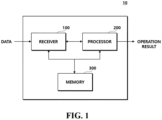
- FIG. 1 is a schematic block diagram of a labeling device according to an embodiment.
- the labeling device 10 is widely used in a medical field and may label a dataset using DSM-5 depressive disorder diagnostic criteria, which has proven expertise. A result of the labeling may be used to increase the accuracy of diagnosis through the corresponding dataset and a machine learning model in the medical field, and may be utilized in a depression counseling chatbot, etc. in a natural language processing field. In particular, in a chatbot field, the labeling device 10 also helps in eliciting positive chatbot evaluations because it shows an empathetic attitude toward a user by utilizing an empathy dataset and an actual consultation dataset.
- the processor 200 may be a data processing device implemented in hardware having a circuit with a physical structure for performing desired operations.
- desired operations may include code or instructions included in a program.
- a data processing device implemented in hardware may be a microprocessor, a central processing unit, a processor core, a multi-core processor, a multiprocessor, an application-specific integrated circuit (ASIC), and a field programmable gate array (FPGA).
- a microprocessor a central processing unit
- a processor core a processor core
- a multi-core processor a multiprocessor
- ASIC application-specific integrated circuit
- FPGA field programmable gate array
- the processor 200 may search whether the target data is included in each of a plurality of categories of the word dictionary, and label the consultation dataset sentence in the word dictionary based on search results.
- the processor 200 may label the consultation dataset sentence in a category corresponding to the target data.
- the processor 200 may determine the similarity with the target data in each of the plurality of categories of the word dictionary, and may label the consultation dataset sentence in the word dictionary when the similarity is equal to or greater than a preset threshold value.
- the memory 300 may store instructions (or programs) executable by the processor 200.
- the instructions may include instructions for executing operations of the processor 200 and/or operations of each component of the processor 200.
- the memory 300 may be implemented as a volatile memory device or a nonvolatile memory device.
- the volatile memory device may be implemented as dynamic random access memory (DRAM), static random access memory (SRAM), thyristor RAM (T-RAM), zero capacitor RAM (Z-RAM), or twin transistor RAM (TTRAM).
- DRAM dynamic random access memory
- SRAM static random access memory
- T-RAM thyristor RAM
- Z-RAM zero capacitor RAM
- TTRAM twin transistor RAM
- the nonvolatile memory device may be implemented as electrically erasable programmable read-only memory (EEPROM), a flash memory, magnetic RAM (MRAM), spin-transfer torque (STT)-MRAM, conductive bridging RAM (CBRAM), ferroelectric RAM (FeRAM), phase change RAM (PRAM), resistive RAM (RRAM), nanotube RRAM, polymer RAM (PoRAM), nano floating gate memory (NFGM), a holographic memory, a molecular electronic memory device, or an insulator resistance change memory.
- EEPROM electrically erasable programmable read-only memory
- MRAM magnetic RAM
- STT spin-transfer torque
- CBRAM conductive bridging RAM
- FeRAM ferroelectric RAM
- PRAM phase change RAM
- RRAM resistive RAM
- NFGM nano floating gate memory
- holographic memory a molecular electronic memory device
- molecular electronic memory device or an insulator resistance change memory
- FIGS. 2A and 2B are views for explaining a method of generating a word dictionary according to an embodiment.
- the word dictionary according to an embodiment may be generated based on DMS-5 depressive disorder diagnostic criteria.
- DSM-5 The Diagnostic and Statistical Manual of Mental Disorders 5th Edition (DSM-5) is a mental disorder diagnostic classification system officially used by the American Psychiatric Association (APA).
- APA American Psychiatric Association
- the DSM-5 is used all over the world, and depressive disorder is also included in the classification of mental disorders. Depressive disorder is determined by comprehensively considering nine diagnostic criteria of the DSM-5, the clinical experience of psychiatrists, clinical interviews, psychological test results, and treatment progress.
- the DSM-5 is also used to diagnose depressive disorder, but the lack of specialized personnel including psychiatrists and the negative social perception of depressive disorder prevents counselees from treating depressive disorder.
- the DSM-5 has nine diagnostic criteria: 1) persistent depressed mood most of the day, nearly every day; 2) markedly decreased interest or pleasure in almost all daily activities most of the day, nearly every day; 3) weight loss or gain without dieting, decreased or increased appetite nearly every day; 4) insomnia or hypersomnia nearly every day; 5) mental agitation or retardation nearly every day; 6) fatigue or loss of energy nearly every day; 7) simple self-blame, feelings of worthlessness or inappropriate guilt nearly every day; 8) decreased thinking and concentration, difficulty making decisions nearly every day; and 9) recurrent thoughts of death, recurrent suicidal thoughts or attempts without a plan, or a detailed plan to attempt suicide.
- a word dictionary according to an embodiment may be generated based on the DSM-5.
- the word dictionary may be composed of nine categories and words corresponding to the categories.
- the category 3) 'weight loss or gain without dieting, decreased or increased appetite nearly every day' of the word dictionary may include words such as 'pig', 'fat', 'body weight', and 'appetite'.
- the words included in the word dictionary may be added according to a data augmentation algorithm.
- the similarity of the words included in the word dictionary may be searched using Word2Vec.
- the window can be set to 5, allowing the prediction by using the 5 words to the left and right of the target word as context.
- min_count is a parameter that specifies the minimum frequency to be used in learning and is set to five times. Words that appear less than five times are excluded from learning.
- a CBOW algorithm is used by setting sg, a parameter that specifies an algorithm, to 0. Results of searching for words similar to 'lonely' and 'terrible' are as shown in Table 210. In addition, results of visualizing words similar to 'hard' are as shown in Table 220.
- the word dictionary generated based on the DSM-5 is described as an example, but a method of generating the word dictionary is not limited to the above example.
- the word dictionary may be generated based on diagnostic criteria different from the DSM-5.
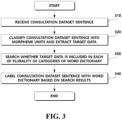
- FIG. 3 is a flowchart for explaining a labeling method according to an embodiment.
- operations 310 to 340 are described as being performed by the labeling device 10 described with reference to FIG. 1 . However, these operations 310 to 340 may be used via any other suitable electronic device and within any suitable system.
- FIG. 3 may be performed in the illustrated order and manner, but the order of some operations may be changed or some operations may be omitted without departing from the spirit and scope of the illustrated embodiment.
- a number of operations shown in FIG. 3 may be performed in parallel or concurrently.
- the labeling device 10 may receive a consultation dataset sentence.
- the consultation dataset sentence is data related to mental health counseling and may be composed of a set of counselee utterance sentences and counselor utterance sentences.
- the consultation dataset sentence may be, for example, 'wellness counseling data.
- the wellness counseling data is data created by processing mental health counseling records.
- the wellness counseling data consists of 19 labels: depression, sadness, loneliness, anger, listlessness, emotional dysregulation, loss, decreased appetite, increased appetite, insomnia, nervousness, fatigue, guilt, decreased concentration, decreased self-confidence, decreased self-esteem, despair, suicidal impulse, and anxiety.
- the labeling device 10 classify the consultation dataset sentence into morpheme units and extract target data.
- Morpheme analysis refers to dividing sentences into morpheme units and identifying linguistic structures, and may distinguish between roots, prefixes, suffixes, and parts of speech.
- FIG. 4A is a view illustrating an example of classifying a consultation dataset sentence into morpheme units according to an embodiment.
- a morphological analyzer may use an adjacent condition inspection method utilizing a pre-analyzed dictionary for speed, and a probabilistic model based on heuristics and a hidden Markov model (HMM) for quality.
- HMM hidden Markov model
- morphemes may be analyzed by considering language characteristics such as part of speech of the previous word and part of speech of the next word. Afterwards, morphological analysis results are sorted to obtain the most appropriate information.
- the hidden Markov model is a probabilistic model that has a hidden state and an observed state, and the morphological analyzer may model each morpheme as a hidden state and the part of speech of the morpheme as an observed state. Through this, the probability of a morpheme appearing in a sentence may be estimated and morphological analysis may be performed.
- the labeling device 10 may determine parts of speech, general adverbs, and noun prefixes corresponding to nouns, verbs, and roots as target data in the consultation dataset sentence classified into morpheme units.
- the labeling device 10 may determine parts of speech, general adverbs, and noun prefixes corresponding to nouns, verbs, and roots as target data in the consultation dataset sentence classified into morpheme units by using a part-of-speech tag table of the morphological analyzer.
- FIG. 4B is a view illustrating an example of a part-of-speech tag table of a morphological analyzer according to an embodiment.
- the labeling device 10 may select only parts of speech, general adverbs, and noun prefixes corresponding to nouns, verbs, and roots in order to extract only words with specific meanings.
- the labeling device 10 may search whether target data is included in each of a plurality of categories of a word dictionary.
- the labeling device 10 may label the consultation dataset sentence with the word dictionary based on search results.
- the labeling device 10 may label the consultation dataset sentence with a category corresponding to the target data.
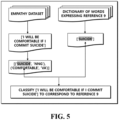
- FIG. 5 is a view illustrating an example of a labeling method according to an embodiment.
- the labeling device 10 may receive 'I will be comfortable if I commit suicide' as an empathy dataset sentence, analyze morphemes of the sentence, and determine 'suicide', a common noun corresponding to a substantive, and 'comfortable', an adjective corresponding to a predicate, as target data from the consultation dataset sentence classified by morpheme units.
- the labeling device 10 may determine whether the target data, 'suicide' and 'comfortable', exist in the word dictionary, and may label the sentence 'I will be comfortable if I commit suicide' to the word dictionary reference 9 based on the determination that 'suicide' exists in the word dictionary reference 9.
- the labeling device 10 may label not only the sentence 'I will be comfortable if I commit suicide' but also an empathy response sentence, which is a counselor sentence corresponding to the sentence 'I will be comfortable if I commit suicide.'
- the labeling device may label a sentence including target data if a word having a similarity that is equal to or greater than a preset threshold value exists, even if the same word as the target data is not searched in the word dictionary.
- a sentence including 'Zhu Bajie' may be labeled with the number 3 in the word dictionary.
- the labeling device 10 may label a sentence including target data if a word having a similarity equal to or greater than a preset first threshold value exists in a corresponding reference equal to or greater than a second threshold value, even if the same word as the target data is not searched in the word dictionary.
- 'Zhu Bajie' is determined as the target data
- the labeling device 10 may train a depression counseling chatbot model using data generated by the labeling method according to an embodiment. At this time, the labeling device 10 may determine an answer to an input message based on a counselee utterance sentence.
- a consultation dataset sentence may include a counselee utterance sentence and a counselor utterance sentence. Even if target data is generated based on the counselor utterance sentence, the consultation dataset sentence including the counselee utterance sentence and the counselor utterance sentence may be the target of labeling. In other words, the labeling device may label the counselee utterance sentence corresponding to the counselor utterance sentence together.
- the labeling device 10 may be trained to determine a chatbot answer using the counselee utterance sentence.
- the counselee utterance sentence is an empathic answer, and may be particularly effective for AI chatbot answers.
- FIG. 6 is a view for explaining a depression diagnosis model using multimodal deep learning according to an embodiment.
- the depression diagnosis model may include a voice feature extraction layer 610, a text feature extraction layer 620, a modality fusion layer 630, and a depression diagnosis layer 640.
- the voice feature extraction layer 610 may be a layer that converts each speaker's voice into a digital signal and extracts features.
- the speaker's voice is a voice required to detect depression and may be the voice of a counselor.
- the text feature extraction layer 620 may be a layer that extracts features corresponding to a counselor's text.
- the text feature extraction layer 620 may be trained with training data generated by the labeling method described with reference to FIGS. 1 to 5 .
- the modality fusion layer 630 may fuse an output of the voice feature extraction layer 610 and an output of the text feature extraction layer 620 using a tensor fusion network.
- the tensor fusion network may express features extracted from each modality as a single feature vector by connecting them to a fully connected layer.
- the voice and text features may be represented in a two-dimensional space by performing a two-layer Cartesian product operation. Because the two-layer Cartesian product calculates the product of all possible sets, it may capture correlations without information loss, and because the two-layer Cartesian product is a simple external operation, training parameters do not increase, so even if the dimension of features increases, the possibility of overfitting may not increase.
- the amount of operations may be reduced by using the tensor fusion network, and both the internal and external correlations between modalities may be considered.
- the depression diagnosis layer 640 may perform classification by connecting a final multimodal feature vector merged into one feature in the modality fusion layer 630 to an LSTM model.
- the LSTM model is a type of RNN model and may be used to complement shortcomings of RNN that does not reflect long-term memory when performing a task that requires a lot of context. Because it is reasonable to classify whether the subject is depressed or not by considering the entire context of an interview, LSTM may be used as the depression diagnosis layer 640 to add time-series characteristics.
- the function of an output layer may use sigmoid because a proposed model performs binary classification into two groups: 0, which is a group that does not show symptoms of depression, and 1, which is a group that shows symptoms of depression.
- the embodiments described above may be implemented by hardware components, software components, and/or any combination thereof.
- the devices, the methods, and components described in the embodiments may be implemented by using general-purpose computers or special-purpose computers, such as a processor, a controller, an arithmetic logic unit (ALU), a digital signal processor, a microcomputer, a field programmable gate array (FPGA), a programmable logic unit (PLU), a microprocessor, or any other devices which may execute and respond to instructions.
- a processing apparatus may execute an operating system (OS) and a software application executed in the OS. Also, the processing apparatus may access, store, operate, process, and generate data in response to the execution of software. For convenience of understanding, it may be described that one processing apparatus is used.
- OS operating system
- the processing apparatus may access, store, operate, process, and generate data in response to the execution of software. For convenience of understanding, it may be described that one processing apparatus is used.
- the processing apparatus may include a plurality of processing elements and/or various types of processing elements.
- the processing apparatus may include a plurality of processors or a processor and a controller.
- other processing configurations such as a parallel processor, are also possible.
- the software may include computer programs, code, instructions, or any combination thereof, and may construct the processing apparatus for desired operations or may independently or collectively command the processing apparatus.
- the software and/or data may be permanently or temporarily embodied in any types of machines, components, physical devices, virtual equipment, computer storage mediums, or transmitted signal waves.
- the software may be distributed over network coupled computer systems so that it may be stored and executed in a distributed fashion.
- the software and/or data may be recorded in a computer-readable recording medium.
- a method according to an embodiment may be implemented as program instructions that can be executed by various computer devices, and recorded on a computer-readable recording medium.
- the computer-readable recording medium may include program instructions, data files, data structures or a combination thereof. Program instructions recorded on the medium may be particularly designed and structured for embodiments or available to one of ordinary skill in a field of computer software. Examples of the computer-readable recording medium include magnetic media, such as a hard disc, a floppy disc, and magnetic tape; optical media, such as a compact disc-read only memory (CD-ROM) and a digital versatile disc (DVD); magneto-optical media, such as floptical discs; and hardware devices specially configured to store and execute program instructions, such as ROM, random-access memory (RAM), a flash memory, etc.
- Program instructions may include, for example, high-level language code that can be executed by a computer using an interpreter, as well as machine language code made by a complier.
Landscapes
- Engineering & Computer Science (AREA)
- Theoretical Computer Science (AREA)
- Health & Medical Sciences (AREA)
- Physics & Mathematics (AREA)
- General Physics & Mathematics (AREA)
- General Engineering & Computer Science (AREA)
- General Health & Medical Sciences (AREA)
- Computational Linguistics (AREA)
- Artificial Intelligence (AREA)
- Audiology, Speech & Language Pathology (AREA)
- Medical Informatics (AREA)
- Data Mining & Analysis (AREA)
- Life Sciences & Earth Sciences (AREA)
- Biomedical Technology (AREA)
- Databases & Information Systems (AREA)
- Public Health (AREA)
- Pathology (AREA)
- Software Systems (AREA)
- Mathematical Physics (AREA)
- Primary Health Care (AREA)
- Surgery (AREA)
- Computer Networks & Wireless Communication (AREA)
- Psychiatry (AREA)
- Veterinary Medicine (AREA)
- Epidemiology (AREA)
- Animal Behavior & Ethology (AREA)
- Biophysics (AREA)
- Heart & Thoracic Surgery (AREA)
- Molecular Biology (AREA)
- Probability & Statistics with Applications (AREA)
- Human Computer Interaction (AREA)
- Computer Vision & Pattern Recognition (AREA)
- Evolutionary Computation (AREA)
- Computing Systems (AREA)
- Signal Processing (AREA)
- Child & Adolescent Psychology (AREA)
- Developmental Disabilities (AREA)
- Educational Technology (AREA)
- Hospice & Palliative Care (AREA)
- Psychology (AREA)
Abstract
A labeling method according to an embodiment may include: receiving a consultation dataset sentence; classifying the consultation dataset sentence into morpheme units and extracting target data; searching whether the target data is included in each of a plurality of categories of a word dictionary; and labeling the consultation dataset sentence in the word dictionary based on a result of the searching.
Description
- One or more embodiments relate to a method of labeling an empathy dataset according to depressive disorder diagnostic criteria.
- Fear due to negative social perception of mental disorders prevents counselees from receiving treatment for depressive disorder. Not only is there a shortage of counselors including psychiatrists, but there is also a lack of infrastructure to deal with depressive disorder accompanied by physical illness, making it difficult to respond in a timely manner. Accordingly, AI services based on natural language processing capable of providing timely counseling are emerging. Among them, chatbots, which are conversational recognition AI, may help with simple counseling by predicting the state of mental illness through text data of counselees. A chatbot refers to a robot that can converse with users. Natural language processing and machine learning tasks are essential to successfully conduct complex conversations. In this case, supervised learning is mainly used, and labeling a dataset is essential so that correct data may be used during learning.
- In general, a machine learning model uses a labeled dataset to solve classification problems. In order for a machine learning model to learn and predict efficiently, a high-quality labeled dataset is required. There are several methods of labeling datasets, such as manual labeling and automatic labeling. First, manual labeling is a method of assigning datasets to experts and manually labeling them, which is highly accurate but expensive and time-consuming. Semi-supervised learning uses some manually labeled data and unlabeled data together to learn, which may reduce labeling costs but may result in incorrect labeling or omission.
- A labeling method according to an embodiment may include: receiving a consultation dataset sentence; classifying the consultation dataset sentence into morpheme units and extracting target data; searching whether the target data is included in each of a plurality of categories of a word dictionary; and labeling the consultation dataset sentence in the word dictionary based on a result of the searching.
- The labeling the consultation dataset sentence may include labeling the consultation dataset sentence into a category corresponding to the target data. The extracting of the target data may include determining parts of speech, general adverbs, and noun prefixes corresponding to nouns, verbs, and roots as the target data in the consultation dataset sentence classified into the morpheme units.
- The word dictionary may be generated based on DMS-5 depressive disorder diagnostic criteria.
- The labeling the consultation dataset sentence may include determining similarity with the target data in each of the plurality of categories of the word dictionary when the target data is not included in the word dictionary; and labeling the consultation dataset sentence in the word dictionary when the similarity is equal to or greater than a preset threshold value.
- According to an embodiment, the consultation dataset sentence may include a counselee utterance sentence and a counselor utterance sentence.
- The labeling method according to an embodiment may further include training a depression counseling chatbot model based on the labeled data.
- The training of the depression counseling chatbot model may include determining an answer to an input message based on the counselee utterance sentence.
-
-
FIG. 1 is a schematic block diagram of a labeling device according to an embodiment. -
FIGS. 2A and2B are views for explaining a method of generating a word dictionary according to an embodiment. -
FIG. 3 is a flowchart for explaining a labeling method according to an embodiment. -
FIG. 4A is a view illustrating an example of classifying a consultation dataset sentence into morpheme units according to an embodiment. -
FIG. 4B is a view illustrating an example of a part-of-speech tag table of a morphological analyzer according to an embodiment. -
FIG. 5 is a view illustrating an example of a labeling method according to an embodiment. -
FIG. 6 is a view for explaining a depression diagnosis model using multimodal deep learning according to an embodiment. - Hereinafter, embodiments of the present invention will be described with reference to the drawings. In the following description, descriptions of a well-known technical configuration in relation to a lead implantation system for a deep brain stimulator will be omitted. For example, descriptions of the configuration/structure/method of a device or system commonly used in deep brain stimulation, such as the structure of an implantable pulse generator, a connection structure/method of the implantable pulse generator and a lead, and a process for transmitting and receiving electrical signals measured through the lead with an external device, will be omitted. Even if these descriptions are omitted, one of ordinary skill in the art will be able to easily understand the characteristic configuration of the present invention through the following description.
- Fear due to negative social perception of mental disorders prevents counselees from receiving treatment for depressive disorder. Not only is there a shortage of counselors including psychiatrists, but there is also a lack of infrastructure to deal with depressive disorder accompanied by physical illness, making it difficult to respond in a timely manner. Accordingly, AI services based on natural language processing capable of providing timely counseling are emerging. Among them, chatbots, which are conversational recognition AI, may help with simple counseling by predicting the state of mental illness through text data of counselees. A chatbot refers to a robot that can converse with users. Natural language processing and machine learning tasks are essential to successfully conduct complex conversations. In this case, supervised learning is mainly used, and labeling a dataset is essential so that correct data may be used during learning.
- In general, a machine learning model uses a labeled dataset to solve classification problems. In order for a machine learning model to learn and predict efficiently, a high-quality labeled dataset is required. There are several methods of labeling datasets, such as manual labeling and automatic labeling. First, manual labeling is a method of assigning datasets to experts and manually labeling them, which is highly accurate but expensive and time-consuming. Semi-supervised learning uses some manually labeled data and unlabeled data together to learn, which may reduce labeling costs but may result in incorrect labeling or omission.
- Hereinafter, a method of labeling an empathy dataset according to depressive disorder diagnostic criteria according to an embodiment will be described.
-
FIG. 1 is a schematic block diagram of a labeling device according to an embodiment. - Referring to
FIG. 1 , alabeling device 10 may label a dataset using a word dictionary. The word dictionary may be generated based on DMS-5 depressive disorder diagnostic criteria. A method of generating a word dictionary according to an embodiment will be described in detail below with reference toFIGS. 2A and2B . Thelabeling device 10 classifies and labels corresponding datasets using a word dictionary that classifies words expressing depressive disorder according to nine criteria. - The
labeling device 10 is widely used in a medical field and may label a dataset using DSM-5 depressive disorder diagnostic criteria, which has proven expertise. A result of the labeling may be used to increase the accuracy of diagnosis through the corresponding dataset and a machine learning model in the medical field, and may be utilized in a depression counseling chatbot, etc. in a natural language processing field. In particular, in a chatbot field, thelabeling device 10 also helps in eliciting positive chatbot evaluations because it shows an empathetic attitude toward a user by utilizing an empathy dataset and an actual consultation dataset. - The
labeling device 10 includes areceiver 100 and aprocessor 200. Thelabeling device 10 may further include amemory 300. - The
receiver 100 may include a receiving interface. Thereceiver 100 may receive a consultation dataset sentence. - The
processor 200 may process data stored in thememory 300. Theprocessor 200 may execute computer-readable code (e.g., software) stored in thememory 300 and instructions generated by theprocessor 200. - The
processor 200 may be a data processing device implemented in hardware having a circuit with a physical structure for performing desired operations. For example, desired operations may include code or instructions included in a program. - For example, a data processing device implemented in hardware may be a microprocessor, a central processing unit, a processor core, a multi-core processor, a multiprocessor, an application-specific integrated circuit (ASIC), and a field programmable gate array (FPGA).
- The
processor 200 may classify the consultation dataset sentence into morpheme units and extract target data. Theprocessor 200 may determine parts of speech, general adverbs, and noun prefixes corresponding to nouns, verbs, and roots as target data in the consultation dataset sentence classified into morpheme units. - The
processor 200 may search whether the target data is included in each of a plurality of categories of the word dictionary, and label the consultation dataset sentence in the word dictionary based on search results. - The
processor 200 may label the consultation dataset sentence in a category corresponding to the target data. - When the target data is not included in the word dictionary, the
processor 200 may determine the similarity with the target data in each of the plurality of categories of the word dictionary, and may label the consultation dataset sentence in the word dictionary when the similarity is equal to or greater than a preset threshold value. - The
memory 300 may store instructions (or programs) executable by theprocessor 200. For example, the instructions may include instructions for executing operations of theprocessor 200 and/or operations of each component of theprocessor 200. - The
memory 300 may be implemented as a volatile memory device or a nonvolatile memory device. - The volatile memory device may be implemented as dynamic random access memory (DRAM), static random access memory (SRAM), thyristor RAM (T-RAM), zero capacitor RAM (Z-RAM), or twin transistor RAM (TTRAM).
- The nonvolatile memory device may be implemented as electrically erasable programmable read-only memory (EEPROM), a flash memory, magnetic RAM (MRAM), spin-transfer torque (STT)-MRAM, conductive bridging RAM (CBRAM), ferroelectric RAM (FeRAM), phase change RAM (PRAM), resistive RAM (RRAM), nanotube RRAM, polymer RAM (PoRAM), nano floating gate memory (NFGM), a holographic memory, a molecular electronic memory device, or an insulator resistance change memory.
-
FIGS. 2A and2B are views for explaining a method of generating a word dictionary according to an embodiment. - As described above, the word dictionary according to an embodiment may be generated based on DMS-5 depressive disorder diagnostic criteria.
- The Diagnostic and Statistical Manual of Mental Disorders 5th Edition (DSM-5) is a mental disorder diagnostic classification system officially used by the American Psychiatric Association (APA). The DSM-5 is used all over the world, and depressive disorder is also included in the classification of mental disorders. Depressive disorder is determined by comprehensively considering nine diagnostic criteria of the DSM-5, the clinical experience of psychiatrists, clinical interviews, psychological test results, and treatment progress.
- In Korea, the DSM-5 is also used to diagnose depressive disorder, but the lack of specialized personnel including psychiatrists and the negative social perception of depressive disorder prevents counselees from treating depressive disorder.
- Referring to
FIG. 2A , the DSM-5 has nine diagnostic criteria: 1) persistent depressed mood most of the day, nearly every day; 2) markedly decreased interest or pleasure in almost all daily activities most of the day, nearly every day; 3) weight loss or gain without dieting, decreased or increased appetite nearly every day; 4) insomnia or hypersomnia nearly every day; 5) mental agitation or retardation nearly every day; 6) fatigue or loss of energy nearly every day; 7) simple self-blame, feelings of worthlessness or inappropriate guilt nearly every day; 8) decreased thinking and concentration, difficulty making decisions nearly every day; and 9) recurrent thoughts of death, recurrent suicidal thoughts or attempts without a plan, or a detailed plan to attempt suicide. - A word dictionary according to an embodiment may be generated based on the DSM-5. In other words, the word dictionary may be composed of nine categories and words corresponding to the categories. For example, the category 3) 'weight loss or gain without dieting, decreased or increased appetite nearly every day' of the word dictionary may include words such as 'pig', 'fat', 'body weight', and 'appetite'. Furthermore, the words included in the word dictionary may be added according to a data augmentation algorithm.
- Referring to
FIG. 2B , the similarity of the words included in the word dictionary may be searched using Word2Vec. For example, in the case of Word2Vec hyperparameters, the window can be set to 5, allowing the prediction by using the 5 words to the left and right of the target word as context. In addition, min_count is a parameter that specifies the minimum frequency to be used in learning and is set to five times. Words that appear less than five times are excluded from learning. Finally, a CBOW algorithm is used by setting sg, a parameter that specifies an algorithm, to 0. Results of searching for words similar to 'lonely' and 'terrible' are as shown in Table 210. In addition, results of visualizing words similar to 'hard' are as shown in Table 220. - In
FIGS. 2A and2B , the word dictionary generated based on the DSM-5 is described as an example, but a method of generating the word dictionary is not limited to the above example. The word dictionary may be generated based on diagnostic criteria different from the DSM-5. -
FIG. 3 is a flowchart for explaining a labeling method according to an embodiment. - Referring to
FIG. 3 ,operations 310 to 340 are described as being performed by thelabeling device 10 described with reference toFIG. 1 . However, theseoperations 310 to 340 may be used via any other suitable electronic device and within any suitable system. - In addition, operations of
FIG. 3 may be performed in the illustrated order and manner, but the order of some operations may be changed or some operations may be omitted without departing from the spirit and scope of the illustrated embodiment. A number of operations shown inFIG. 3 may be performed in parallel or concurrently. - In
operation 310, thelabeling device 10 according to an embodiment may receive a consultation dataset sentence. The consultation dataset sentence is data related to mental health counseling and may be composed of a set of counselee utterance sentences and counselor utterance sentences. - The consultation dataset sentence may be, for example, 'wellness counseling data.' The wellness counseling data is data created by processing mental health counseling records. The wellness counseling data consists of 19 labels: depression, sadness, loneliness, anger, listlessness, emotional dysregulation, loss, decreased appetite, increased appetite, insomnia, nervousness, fatigue, guilt, decreased concentration, decreased self-confidence, decreased self-esteem, despair, suicidal impulse, and anxiety.
- In
operation 320, thelabeling device 10 according to an embodiment classify the consultation dataset sentence into morpheme units and extract target data. Morpheme analysis refers to dividing sentences into morpheme units and identifying linguistic structures, and may distinguish between roots, prefixes, suffixes, and parts of speech. -
FIG. 4A is a view illustrating an example of classifying a consultation dataset sentence into morpheme units according to an embodiment. - Referring to
FIG. 4A , a morphological analyzer according to an embodiment may use an adjacent condition inspection method utilizing a pre-analyzed dictionary for speed, and a probabilistic model based on heuristics and a hidden Markov model (HMM) for quality. In the case of the heuristic model, morphemes may be analyzed by considering language characteristics such as part of speech of the previous word and part of speech of the next word. Afterwards, morphological analysis results are sorted to obtain the most appropriate information. The hidden Markov model is a probabilistic model that has a hidden state and an observed state, and the morphological analyzer may model each morpheme as a hidden state and the part of speech of the morpheme as an observed state. Through this, the probability of a morpheme appearing in a sentence may be estimated and morphological analysis may be performed. - The
labeling device 10 according to an embodiment may determine parts of speech, general adverbs, and noun prefixes corresponding to nouns, verbs, and roots as target data in the consultation dataset sentence classified into morpheme units. Thelabeling device 10 may determine parts of speech, general adverbs, and noun prefixes corresponding to nouns, verbs, and roots as target data in the consultation dataset sentence classified into morpheme units by using a part-of-speech tag table of the morphological analyzer. -
FIG. 4B is a view illustrating an example of a part-of-speech tag table of a morphological analyzer according to an embodiment. - Referring to
FIG. 4B , thelabeling device 10 may select only parts of speech, general adverbs, and noun prefixes corresponding to nouns, verbs, and roots in order to extract only words with specific meanings. - Referring again to
FIG. 3 , inoperation 330, thelabeling device 10 according to an embodiment may search whether target data is included in each of a plurality of categories of a word dictionary. - In
operation 340, thelabeling device 10 according to an embodiment may label the consultation dataset sentence with the word dictionary based on search results. Thelabeling device 10 may label the consultation dataset sentence with a category corresponding to the target data. -
FIG. 5 is a view illustrating an example of a labeling method according to an embodiment. - Referring to
FIG. 5 , thelabeling device 10 according to an embodiment may receive 'I will be comfortable if I commit suicide' as an empathy dataset sentence, analyze morphemes of the sentence, and determine 'suicide', a common noun corresponding to a substantive, and 'comfortable', an adjective corresponding to a predicate, as target data from the consultation dataset sentence classified by morpheme units. - Afterwards, the
labeling device 10 may determine whether the target data, 'suicide' and 'comfortable', exist in the word dictionary, and may label the sentence 'I will be comfortable if I commit suicide' to theword dictionary reference 9 based on the determination that 'suicide' exists in theword dictionary reference 9. Thelabeling device 10 may label not only the sentence 'I will be comfortable if I commit suicide' but also an empathy response sentence, which is a counselor sentence corresponding to the sentence 'I will be comfortable if I commit suicide.' - As another example, if 'pig' is included in the consultation dataset sentence in the word dictionary of 'weight loss or gain without dieting, decreased or increased appetite nearly every day', the
labeling device 10 may label the corresponding sentence with thenumber 3. - In another embodiment, the labeling device according to an embodiment may label a sentence including target data if a word having a similarity that is equal to or greater than a preset threshold value exists, even if the same word as the target data is not searched in the word dictionary.
- For example, assuming that 'Zhu Bajie' is determined as target data, if there is no word identical to 'Zhu Bajie' in the
word dictionary reference 3, but there is a word (e.g., 'pig') with a similarity to 'Zhu Bajie' that is equal to greater than a preset threshold value, a sentence including 'Zhu Bajie' may be labeled with thenumber 3 in the word dictionary. - Alternatively, the
labeling device 10 may label a sentence including target data if a word having a similarity equal to or greater than a preset first threshold value exists in a corresponding reference equal to or greater than a second threshold value, even if the same word as the target data is not searched in the word dictionary. - For example, assuming that 'Zhu Bajie' is determined as the target data, if there is no word identical to 'Zhu Bajie' in the
word dictionary reference 3, but there are words (e.g., 'pig', 'fatty', 'chubby') that have a similarity to 'Zhu Bajie' equal to or greater than the preset first threshold value, and if there are at least the preset second threshold value (e.g., 3) of such words in theword dictionary reference 3, then a sentence including 'Zhu Bajie' can be labeled with thenumber 3 in the word dictionary. - The
labeling device 10 may train a depression counseling chatbot model using data generated by the labeling method according to an embodiment. At this time, thelabeling device 10 may determine an answer to an input message based on a counselee utterance sentence. - In more detail, as described above, a consultation dataset sentence according to an embodiment may include a counselee utterance sentence and a counselor utterance sentence. Even if target data is generated based on the counselor utterance sentence, the consultation dataset sentence including the counselee utterance sentence and the counselor utterance sentence may be the target of labeling. In other words, the labeling device may label the counselee utterance sentence corresponding to the counselor utterance sentence together.
- Therefore, when training a depression counseling chatbot model using data generated by the labeling method, the
labeling device 10 may be trained to determine a chatbot answer using the counselee utterance sentence. The counselee utterance sentence is an empathic answer, and may be particularly effective for AI chatbot answers. -
FIG. 6 is a view for explaining a depression diagnosis model using multimodal deep learning according to an embodiment. - Referring to
FIG. 6 , the depression diagnosis model according to an embodiment may include a voicefeature extraction layer 610, a textfeature extraction layer 620, amodality fusion layer 630, and adepression diagnosis layer 640. - The voice
feature extraction layer 610 according to an embodiment may be a layer that converts each speaker's voice into a digital signal and extracts features. The speaker's voice is a voice required to detect depression and may be the voice of a counselor. - The text
feature extraction layer 620 according to an embodiment may be a layer that extracts features corresponding to a counselor's text. The textfeature extraction layer 620 may be trained with training data generated by the labeling method described with reference toFIGS. 1 to 5 . - The
modality fusion layer 630 according to an embodiment may fuse an output of the voicefeature extraction layer 610 and an output of the textfeature extraction layer 620 using a tensor fusion network. The tensor fusion network may express features extracted from each modality as a single feature vector by connecting them to a fully connected layer. In this process, the voice and text features may be represented in a two-dimensional space by performing a two-layer Cartesian product operation. Because the two-layer Cartesian product calculates the product of all possible sets, it may capture correlations without information loss, and because the two-layer Cartesian product is a simple external operation, training parameters do not increase, so even if the dimension of features increases, the possibility of overfitting may not increase. The amount of operations may be reduced by using the tensor fusion network, and both the internal and external correlations between modalities may be considered. - The
depression diagnosis layer 640 according to an embodiment may perform classification by connecting a final multimodal feature vector merged into one feature in themodality fusion layer 630 to an LSTM model. The LSTM model is a type of RNN model and may be used to complement shortcomings of RNN that does not reflect long-term memory when performing a task that requires a lot of context. Because it is reasonable to classify whether the subject is depressed or not by considering the entire context of an interview, LSTM may be used as thedepression diagnosis layer 640 to add time-series characteristics. The function of an output layer may use sigmoid because a proposed model performs binary classification into two groups: 0, which is a group that does not show symptoms of depression, and 1, which is a group that shows symptoms of depression. - The embodiments described above may be implemented by hardware components, software components, and/or any combination thereof. For example, the devices, the methods, and components described in the embodiments may be implemented by using general-purpose computers or special-purpose computers, such as a processor, a controller, an arithmetic logic unit (ALU), a digital signal processor, a microcomputer, a field programmable gate array (FPGA), a programmable logic unit (PLU), a microprocessor, or any other devices which may execute and respond to instructions. A processing apparatus may execute an operating system (OS) and a software application executed in the OS. Also, the processing apparatus may access, store, operate, process, and generate data in response to the execution of software. For convenience of understanding, it may be described that one processing apparatus is used. However, one of ordinary skill in the art will understand that the processing apparatus may include a plurality of processing elements and/or various types of processing elements. For example, the processing apparatus may include a plurality of processors or a processor and a controller. Also, other processing configurations, such as a parallel processor, are also possible.
- The software may include computer programs, code, instructions, or any combination thereof, and may construct the processing apparatus for desired operations or may independently or collectively command the processing apparatus. In order to be interpreted by the processing apparatus or to provide commands or data to the processing apparatus, the software and/or data may be permanently or temporarily embodied in any types of machines, components, physical devices, virtual equipment, computer storage mediums, or transmitted signal waves. The software may be distributed over network coupled computer systems so that it may be stored and executed in a distributed fashion. The software and/or data may be recorded in a computer-readable recording medium.
- A method according to an embodiment may be implemented as program instructions that can be executed by various computer devices, and recorded on a computer-readable recording medium. The computer-readable recording medium may include program instructions, data files, data structures or a combination thereof. Program instructions recorded on the medium may be particularly designed and structured for embodiments or available to one of ordinary skill in a field of computer software. Examples of the computer-readable recording medium include magnetic media, such as a hard disc, a floppy disc, and magnetic tape; optical media, such as a compact disc-read only memory (CD-ROM) and a digital versatile disc (DVD); magneto-optical media, such as floptical discs; and hardware devices specially configured to store and execute program instructions, such as ROM, random-access memory (RAM), a flash memory, etc. Program instructions may include, for example, high-level language code that can be executed by a computer using an interpreter, as well as machine language code made by a complier.
- In concluding the detailed description, those skilled in the art will appreciate that many variations and modifications may be made to the preferred embodiments without substantially departing from the principles of the present invention. Therefore, the disclosed preferred embodiments of the invention are used in a generic and descriptive sense only and not for purposes of limitation.
Claims (8)
- A labeling method comprising:receiving a consultation dataset sentence;classifying the consultation dataset sentence into morpheme units and extracting target data;searching whether the target data is included in each of a plurality of categories of a word dictionary; andlabeling the consultation dataset sentence into the word dictionary based on a result of the searching.
- The labeling method of claim 1, wherein the labeling comprises:
labeling the consultation dataset sentence into a category corresponding to the target data. - The labeling method of claim 1, wherein the extracting of the target data comprises:
determining parts of speech, general adverbs, and noun prefixes corresponding to nouns, verbs, and roots as the target data in the consultation dataset sentence classified into the morpheme units. - The labeling method of claim 1, wherein the word dictionary is generated based on DMS-5 depressive disorder diagnostic criteria.
- The labeling method of claim 1, wherein the labeling comprises:determining similarity with the target data in each of the plurality of categories of the word dictionary when the target data is not included in the word dictionary; andlabeling the consultation dataset sentence in the word dictionary when the similarity is equal to or greater than a preset threshold value.
- The labeling method of claim 1, wherein the consultation dataset sentence comprises a counselee utterance sentence and a counselor utterance sentence.
- The labeling method of claim 6, the labeling method comprising:
training a depression counseling chatbot model based on the labeled data. - A computer program stored on a medium for executing the method of any one of claims 1 to 7 in combination with hardware.
Applications Claiming Priority (1)
| Application Number | Priority Date | Filing Date | Title |
|---|---|---|---|
| KR1020230114707A KR20250032200A (en) | 2023-08-30 | 2023-08-30 | Methods for labeling empathy datasets with diagnostic criteria for depressive disorders |
Publications (1)
| Publication Number | Publication Date |
|---|---|
| EP4517577A1 true EP4517577A1 (en) | 2025-03-05 |
Family
ID=92593131
Family Applications (1)
| Application Number | Title | Priority Date | Filing Date |
|---|---|---|---|
| EP24196866.8A Pending EP4517577A1 (en) | 2023-08-30 | 2024-08-28 | Method of labeling empathy dataset according to depressive disorder diagnostic criteria |
Country Status (3)
| Country | Link |
|---|---|
| US (1) | US20250072800A1 (en) |
| EP (1) | EP4517577A1 (en) |
| KR (1) | KR20250032200A (en) |
-
2023
- 2023-08-30 KR KR1020230114707A patent/KR20250032200A/en active Pending
-
2024
- 2024-08-28 EP EP24196866.8A patent/EP4517577A1/en active Pending
- 2024-08-30 US US18/820,738 patent/US20250072800A1/en active Pending
Non-Patent Citations (6)
| Title |
|---|
| AHMED USMAN ET AL: "Attention-Based Deep Entropy Active Learning Using Lexical Algorithm for Mental Health Treatment", FRONTIERS IN PSYCHOLOGY, vol. 12, 30 March 2021 (2021-03-30), XP093236423, ISSN: 1664-1078, DOI: 10.3389/fpsyg.2021.642347 * |
| BINWEI YAO ET AL: "D4: a Chinese Dialogue Dataset for Depression-Diagnosis-Oriented Chat", ARXIV.ORG, CORNELL UNIVERSITY LIBRARY, 201 OLIN LIBRARY CORNELL UNIVERSITY ITHACA, NY 14853, 24 May 2022 (2022-05-24), XP091231542 * |
| GAUR MANAS ET AL: ""Let Me Tell You About Your Mental Health!" Contextualized Classification of Reddit Posts to DSM-5 for Web-based Intervention", 22 October 2018 (2018-10-22), XP093236430, Retrieved from the Internet <URL:https://dl.acm.org/doi/pdf/10.1145/3269206.3271732> [retrieved on 20250102] * |
| MOHSINUL KABIR ET AL: "DEPTWEET: A Typology for Social Media Texts to Detect Depression Severities", ARXIV.ORG, CORNELL UNIVERSITY LIBRARY, 201 OLIN LIBRARY CORNELL UNIVERSITY ITHACA, NY 14853, 10 October 2022 (2022-10-10), XP091339697, DOI: 10.1016/J.CHB.2022.107503 * |
| OMAROV BATYRKHAN ET AL: "Artificial Intelligence-Enabled Chatbots in Mental Health: A Systematic Review", COMPUTERS, MATERIALS & CONTINUA, vol. 74, no. 3, 28 December 2022 (2022-12-28), pages 5105 - 5122, XP093236400, ISSN: 1546-2226, Retrieved from the Internet <URL:https://www.techscience.com/cmc/v74n3/50951> [retrieved on 20250103], DOI: 10.32604/cmc.2023.034655 * |
| YAO XUEWEN ET AL: "Development and Evaluation of Three Chatbots for Postpartum Mood and Anxiety Disorders", 14 August 2023 (2023-08-14), XP093236406, Retrieved from the Internet <URL:https://arxiv.org/pdf/2308.07407> [retrieved on 20250102] * |
Also Published As
| Publication number | Publication date |
|---|---|
| US20250072800A1 (en) | 2025-03-06 |
| KR20250032200A (en) | 2025-03-07 |
Similar Documents
| Publication | Publication Date | Title |
|---|---|---|
| Danner et al. | Advancing mental health diagnostics: GPT-based method for depression detection | |
| Diederich | Rule extraction from support vector machines: An introduction | |
| Lee et al. | Emotion recognition using a hierarchical binary decision tree approach | |
| Hasan et al. | A study of the effectiveness of machine learning methods for classification of clinical interview fragments into a large number of categories | |
| US20210342212A1 (en) | Method and system for identifying root causes | |
| Van Genugten et al. | Automated scoring of the autobiographical interview with natural language processing | |
| Nassiri et al. | Arabic L2 readability assessment: Dimensionality reduction study | |
| Lukwaro et al. | A review on nlp techniques and associated challenges in extracting features from education data | |
| Ehsan et al. | Automatic question & answer generation using generative Large Language Model (LLM) | |
| Uban et al. | Explainability of depression detection on social media: From deep learning models to psychological interpretations and multimodality | |
| Alkenani et al. | Predicting prodromal dementia using linguistic patterns and deficits | |
| Chaudhuri et al. | A computational model for subjective evaluation of novelty in descriptive aptitude | |
| Hussein et al. | Lstm-based text generation: A study on historical datasets | |
| Bingel et al. | CoastalCPH at SemEval-2016 Task 11: The importance of designing your Neural Networks right | |
| Mohmand et al. | A deep learning approach for automated depression assessment using roman urdu | |
| Siregar et al. | Multiple Choice Question Difficulty Level Classification with Multi Class Confusion Matrix in the Online Question Bank of Education Gallery | |
| Carroll | Towards an AI narratology: the possibilities of LLM classification for the quantification of abstract narrative concepts in literary studies | |
| Yuan | [Retracted] A Classroom Emotion Recognition Model Based on a Convolutional Neural Network Speech Emotion Algorithm | |
| US20250072800A1 (en) | Method of labeling empathy dataset according to depressive disorder diagnostic criteria | |
| Seneviratne | Text simplification using natural language processing and machine learning for better language understandability | |
| Sun et al. | Differential contributions of machine learning and statistical analysis to language and cognitive sciences | |
| Ghelani et al. | A review on student automatic grading system | |
| Dunn et al. | Designing and evaluating context-sensitive visualization models for deep learning text classifiers | |
| Gaikwad et al. | DepreLex-BERT-Att-LSTM: An Advanced Framework for Automatic Clinical Depression Detection from Marathi Text | |
| Cui et al. | Data-driven or dataless? detecting indicators of mental health difficulties and negative life events in financial resilience using prompt-based learning |
Legal Events
| Date | Code | Title | Description |
|---|---|---|---|
| PUAI | Public reference made under article 153(3) epc to a published international application that has entered the european phase |
Free format text: ORIGINAL CODE: 0009012 |
|
| STAA | Information on the status of an ep patent application or granted ep patent |
Free format text: STATUS: REQUEST FOR EXAMINATION WAS MADE |
|
| 17P | Request for examination filed |
Effective date: 20240828 |
|
| AK | Designated contracting states |
Kind code of ref document: A1 Designated state(s): AL AT BE BG CH CY CZ DE DK EE ES FI FR GB GR HR HU IE IS IT LI LT LU LV MC ME MK MT NL NO PL PT RO RS SE SI SK SM TR |