EP4517574A1 - Booting secured kernels with customizable command line functionality - Google Patents
Booting secured kernels with customizable command line functionality Download PDFInfo
- Publication number
- EP4517574A1 EP4517574A1 EP24194802.5A EP24194802A EP4517574A1 EP 4517574 A1 EP4517574 A1 EP 4517574A1 EP 24194802 A EP24194802 A EP 24194802A EP 4517574 A1 EP4517574 A1 EP 4517574A1
- Authority
- EP
- European Patent Office
- Prior art keywords
- command line
- boot
- kernel
- command
- override
- Prior art date
- Legal status (The legal status is an assumption and is not a legal conclusion. Google has not performed a legal analysis and makes no representation as to the accuracy of the status listed.)
- Pending
Links
Images




Classifications
-
- G—PHYSICS
- G06—COMPUTING OR CALCULATING; COUNTING
- G06F—ELECTRIC DIGITAL DATA PROCESSING
- G06F21/00—Security arrangements for protecting computers, components thereof, programs or data against unauthorised activity
- G06F21/50—Monitoring users, programs or devices to maintain the integrity of platforms, e.g. of processors, firmware or operating systems
- G06F21/57—Certifying or maintaining trusted computer platforms, e.g. secure boots or power-downs, version controls, system software checks, secure updates or assessing vulnerabilities
- G06F21/575—Secure boot
-
- G—PHYSICS
- G06—COMPUTING OR CALCULATING; COUNTING
- G06F—ELECTRIC DIGITAL DATA PROCESSING
- G06F9/00—Arrangements for program control, e.g. control units
- G06F9/06—Arrangements for program control, e.g. control units using stored programs, i.e. using an internal store of processing equipment to receive or retain programs
- G06F9/44—Arrangements for executing specific programs
- G06F9/4401—Bootstrapping
-
- G—PHYSICS
- G06—COMPUTING OR CALCULATING; COUNTING
- G06F—ELECTRIC DIGITAL DATA PROCESSING
- G06F9/00—Arrangements for program control, e.g. control units
- G06F9/06—Arrangements for program control, e.g. control units using stored programs, i.e. using an internal store of processing equipment to receive or retain programs
- G06F9/44—Arrangements for executing specific programs
- G06F9/4401—Bootstrapping
- G06F9/4403—Processor initialisation
-
- H—ELECTRICITY
- H04—ELECTRIC COMMUNICATION TECHNIQUE
- H04L—TRANSMISSION OF DIGITAL INFORMATION, e.g. TELEGRAPHIC COMMUNICATION
- H04L9/00—Cryptographic mechanisms or cryptographic arrangements for secret or secure communications; Network security protocols
- H04L9/30—Public key, i.e. encryption algorithm being computationally infeasible to invert or user's encryption keys not requiring secrecy
- H04L9/3066—Public key, i.e. encryption algorithm being computationally infeasible to invert or user's encryption keys not requiring secrecy involving algebraic varieties, e.g. elliptic or hyper-elliptic curves
- H04L9/3073—Public key, i.e. encryption algorithm being computationally infeasible to invert or user's encryption keys not requiring secrecy involving algebraic varieties, e.g. elliptic or hyper-elliptic curves involving pairings, e.g. identity based encryption [IBE], bilinear mappings or bilinear pairings, e.g. Weil or Tate pairing
-
- H—ELECTRICITY
- H04—ELECTRIC COMMUNICATION TECHNIQUE
- H04L—TRANSMISSION OF DIGITAL INFORMATION, e.g. TELEGRAPHIC COMMUNICATION
- H04L9/00—Cryptographic mechanisms or cryptographic arrangements for secret or secure communications; Network security protocols
- H04L9/32—Cryptographic mechanisms or cryptographic arrangements for secret or secure communications; Network security protocols including means for verifying the identity or authority of a user of the system or for message authentication, e.g. authorization, entity authentication, data integrity or data verification, non-repudiation, key authentication or verification of credentials
- H04L9/3247—Cryptographic mechanisms or cryptographic arrangements for secret or secure communications; Network security protocols including means for verifying the identity or authority of a user of the system or for message authentication, e.g. authorization, entity authentication, data integrity or data verification, non-repudiation, key authentication or verification of credentials involving digital signatures
-
- G—PHYSICS
- G06—COMPUTING OR CALCULATING; COUNTING
- G06F—ELECTRIC DIGITAL DATA PROCESSING
- G06F2221/00—Indexing scheme relating to security arrangements for protecting computers, components thereof, programs or data against unauthorised activity
- G06F2221/03—Indexing scheme relating to G06F21/50, monitoring users, programs or devices to maintain the integrity of platforms
- G06F2221/034—Test or assess a computer or a system
Definitions
- the present disclosure relates generally to a computing environment. More specifically, but not by way of limitation, this disclosure relates to booting secured kernels with customizable command line functionality.
- a bootloader of the computing device can find a kernel image of a kernel and load the kernel image into memory to initiate a booting process.
- the computing system may use a signature validation process as a security feature to prevent malicious software from loading during the booting process.
- the signature validation process can involve confirming that the kernel image being booted is signed by a vendor key trusted by firmware of the computing device. After validating the kernel image using the signature validation process, the bootloader can continue the booting process to initialize hardware components and start the operating system of the computing device.
- Booting an unsecure kernel can make a computing system vulnerable to malicious actors.
- conventional signature validation processes can involve validating the kernel by verifying a signature of the kernel.
- the kernel may include a single command line that is unsigned, thereby exposing the computing system to potential breaches or attacks.
- Command line arguments of the single command line may not be verified during the signature validation process, leading to opportunities for malicious actors to exploit the kernel to boot undesirable code.
- Combining the kernel and the command line arguments of the single command line into a unified kernel image that is signed can ensure that the command line arguments are protected by a signature of the unified kernel image that is verified prior to booting the kernel.
- using this version of the unified kernel image can sacrifice operational flexibility or administrative flexibility with respect to the command line arguments. For instance, options for booting the kernel may be limited to the command line arguments of the single command line.
- the signed unified kernel image may include multiple command lines that each can be executed to perform a different functionality (e.g., default operation, troubleshooting, debugging, etc.).
- Providing the multiple command lines with different functionalities can enable a user to select a particular command line based on a corresponding functionality, thereby customizing the booting process.
- Each command line can be defined in the signed unified kernel image such that verifying the signature of the unified kernel image can establish trustworthiness of the command line selected for the kernel boot, thereby increasing security with respect to the command line. Accordingly, providing the multiple command lines can afford operational flexibility while ensuring security associated with the kernel boot.
- a command line used to boot the kernel can be modifiable to customize the command line and may be covered or protected by the signature of the unified kernel image.
- the command line may be customizable by modifying arguments of the command line to create a modified command line that can be executed to perform the kernel boot. Accordingly, the customizable command line can be suitable for unpredictable scenarios that can be specific to an end user deployment.
- the signed unified kernel image can store an allowlist that can indicate a subset of the arguments of the command line that are permitted to be modified.
- the signature of the unified kernel image additionally can protect the allowlist to ensure trustworthiness of the allowlist.
- the allowlist can ensure further security associated with the kernel boot by controlling modify permissions to prevent modifying critical components of the command line.
- the allowlist additionally can include a list of permitted override values that can indicate allowable values to replace or append to existing values of modifiable arguments in the command line.
- the boot loader can compare override values stored in a specification file with the list of permitted override values to determine whether the override values are verified or authorized (e.g., part of or associated with the allowable values). If an override value of a modifiable argument is excluded from the list of permitted override values, the boot loader may interrupt or halt the kernel boot to prevent an unauthorized override of the modifiable argument in the command line.
- a boot loader of a computing device can initiate a kernel boot using a unified kernel image that includes files to execute the kernel boot.
- the unified kernel image can be signed with a cryptographic signature to ensure security, for example to prevent unauthorized modifications.
- the signed unified kernel image can include a command line that is covered or protected by the cryptographic signature to prevent malicious actors from modifying the command line or the kernel boot process.
- the unified kernel image can be cryptographically signed using a private key of a public-private key pair.
- the command line can include one or more arguments that can correspond to different functionalities provided by the command line.
- the arguments may correspond to debugging, auditing, or other suitable functionalities.
- the signed unified kernel image can include an allowlist that can indicate which arguments of the command line are modifiable arguments.
- the allowlist can be afforded security protections by the cryptographic signature of the signed unified kernel image due to being included in the signed unified kernel image.
- the boot loader can determine suitable override values defined in a specification file stored in a boot partition accessible by the boot loader. In some cases, the boot loader may compare an override value of the specification file to a set of permitted override values provided in the allowlist to ensure that the override value is authorized to include in the command line. Once the boot loader confirms that the override value is included in the set of permitted override values, the boot loader can modify a customizable argument of the command line to create a modified command line to execute to complete the kernel boot.
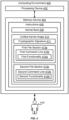
- FIG. 1 is a block diagram of an example of a system 100 for a kernel boot 102 with multiple command lines 104a-b to implement customizable command line functionality according to one example of the present disclosure.
- the command lines 104a-b can be referred to as kargs.
- the system 100 can include part of a computing environment associated with a computing device (e.g., a desktop computer, laptop computer, server, mobile phone, or tablet).
- a computing device e.g., a desktop computer, laptop computer, server, mobile phone, or tablet.
- UEFI Unified Extensible Firmware Interface
- the kernel boot 102 can be initiated by a boot loader 106 (e.g., Grand Unified Boot Loader (GRUB), Low Level Boot Loader (LLB), SYSLINUX, etc.) of the system 100 to begin the kernel boot 102 as a startup process for a kernel 108 of the computing device.
- a boot loader 106 e.g., Grand Unified Boot Loader (GRUB), Low Level Boot Loader (LLB), SYSLINUX, etc.
- the boot loader 106 can initiate the kernel boot 102 using a unified kernel image 110 that can include the command lines 104a-b that are cryptographically signed.
- the command lines 104a-b may be stored as an alphanumeric string in the unified kernel image 110.
- the unified kernel image 110 can be a single executable component that can include one or more of: a stub loader, the command lines 104a-b, microcode, an initial RAM file system (initramfs) image, the kernel 108, or a splash screen.
- the unified kernel image 110 can be signed using a cryptographic signature 111, for example using a private key of a public-private key pair such that the signed unified kernel image 110 can be decrypted or verified using a public key of the public-private key pair.
- the unified kernel image 110 may be cryptographically signed by an external entity (e.g., a vendor, a client, etc.) to enable integrity checking such that the kernel boot 102 is completed only after verifying a chain of trust.
- contents e.g., the command lines 104a-b
- verifying the cryptographic signature 111 of the signed unified kernel image 110 can prevent malicious actors from tampering with critical components of software integral to the computing device.
- the signed unified kernel image 110 can include separate file sections 112a-b to store each command line.
- the file sections 112a-b can be Portable Executable (PE) file sections.
- PE Portable Executable
- the signed unified kernel image 110 can include a first file section 112a to store a first command line 104a and a second file section 112b to store a subset 113 of the command lines 104a-b (e.g., second command line 104b).
- the first file section 112a may store the first command line 104a, while the second file section 112b may store the rest of the command lines (i.e., nine command lines) as the subset 113 of the command lines 104a-b.
- the first command line 104a can be a production command line that is a default command line for the computing device to use for the kernel boot 102.
- the first command line 104a being the default command line can ensure backwards compatibility with existing implementations of the kernel boot 102.
- the second command line 104b can provide a different functionality than the first command line 104.
- the second command line 104b may be executed to initiate a troubleshooting process associated with the kernel boot 102.
- a user 114 may select to execute the second command line 104b to determine a solution to the problems.
- the signed unified kernel image 110 may only include the first file section 112a and the second file section 112b.
- FIG. 2 is a block diagram of an example of the signed unified kernel image 110 having the first file section 112a including a single command line and a second file section 112b including multiple command lines 202b-c according to one example of the present disclosure. Aspects of FIG. 2 are described with respect to components discussed above in FIG. 1 .
- the second file section 112b can store a subset of the command lines 202a-c provided in the signed unified kernel image 110.
- the single command line can be the first command line 202a having a first functionality 204a of being a default option for the kernel boot 102.
- the second file section 112b can include a respective human-readable sequence that can describe each of the command lines 202b-c of the subset of the command lines 202a-b in the unified kernel image 110.
- the second file section 112b can include a first human-readable sequence 206a that corresponds to the second command line 202b and a second human-readable sequence 206b that corresponds to the third command line 202c.
- the human-readable sequences 206a-b can be arranged in a series with the command lines 202b-c.
- the series can alternate the human-readable sequences 206a-b with the command lines 202b-c while include a separator (e.g., a null character) between each data element.
- FIG. 2 only depicts the second and third command lines 202b-c including the human-readable sequences 206a-b, it should be understood that the first file section 112a can include a suitable human-readable sequence corresponding to the first command line 202a.
- the human-readable sequences 206a-b can provide context associated with the command lines 202b-c that is suitable to display in a boot loader interface.
- the user 114 may use the human-readable sequences 206a-b to select a suitable command line of the command lines 202a-c to execute for the kernel boot 102.
- the boot loader interface is described in further detail below with respect to FIG. 1 .
- the signed unified kernel image 110 can include a respective file section that is cryptographically signed to store each of the command lines 104a-b.
- a unified kernel image 300 having three command lines 302a-c can include three file sections 304a-c corresponding to each command line. Aspects of FIG. 3 are described with respect to components discussed above in FIG. 1 . Similar to the signed unified kernel image 110 described with respect to FIG. 2 , each of the command lines 302a-c can be associated with a respective functionality.
- a first command line 302a stored in a first file section 304a of the signed unified kernel image 110 can provide a first functionality 306a of being a default command line for the kernel boot 102.
- the second command line 302b stored in a second file section 304b of the signed unified kernel image 110 can be executed to provide a second functionality 306b with debugging capabilities associated with the kernel boot 102.
- the third command line 302c stored in a third file section 304c of the signed unified kernel image 110 can provide a third functionality 306c to enable the boot loader 106 to choose between different device tree settings for the kernel boot 102.
- FIGS. 1-3 depicts a specific arrangement of components, other examples can include more components, fewer components, different components, or a different arrangement of the components shown in FIGS. 1-3 .
- the unified kernel image may include more than three file sections or command lines. Additionally, any component or combination of components depicted in FIGS. 1-3 can be used to implement the process(es) described herein.
- the processing device 402 can include one processing device or multiple processing devices.
- the processing device 402 can be referred to as a processor.
- Non-limiting examples of the processing device 402 include a Field-Programmable Gate Array (FPGA), an application-specific integrated circuit (ASIC), and a microprocessor.
- the processing device 402 can execute instructions 406 stored in the memory device 404 to perform operations.
- the instructions 406 can include processor-specific instructions generated by a compiler or an interpreter from code written in any suitable computer-programming language, such as C, C++, C#, Java, Python, or any combination of these.
- the kernel boot 408 can be used to initiate an operating system (e.g., Linux, iOS, Android, etc.) of the computing environment 400.
- an operating system e.g., Linux, iOS, Android, etc.
- the kernel boot 408 may be initiated after powering on a computing device associated with the computing environment 400.
- the command lines 410a-b can implement different functionalities 414a-b with respect to the kernel boot 408, thereby enabling dynamic behavior associated with the kernel boot 408.
- the processing device 402 can extract the command lines 410a-b from the signed unified kernel image 412.
- a first command line 410a or a second command line 410b of the signed unified kernel image 412 may be selected by a user 416 to complete the kernel boot 408.
- the processing device 402 can execute the suitable command line to complete the kernel boot 408 using the suitable command line. For example, during normal operation, the processing device 402 may execute the first command line 410a as a default command line for the kernel boot 408.
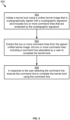
- FIG. 5 is a flowchart of a process 500 for a kernel boot 408 with multiple command lines 410a-b to implement customizable command line functionality according to one example of the present disclosure.
- the processing device 402 can perform one or more of the steps shown in FIG. 5 .
- the processing device 402 can implement more steps, fewer steps, different steps, or a different order of the steps depicted in FIG. 5 .
- the steps of FIG. 5 are described below with reference to components discussed above in FIGS. 1-4 .
- the processing device 402 initiates the kernel boot 408 using a unified kernel image 412 that includes two or more command lines 410a-b.
- the unified kernel image 412 can be cryptographically signed with a cryptographic signature 411, for example using asymmetric cryptography, symmetric cryptography, or other suitable encryption techniques.
- the cryptographic signature 411 of the signed unified kernel image 412 can protect the command lines 410a-b, for example to prevent malware from interfering with the command lines 410a-b. Accordingly, protection afforded by coverage of the cryptographic signature 411 can increase security of the command lines 410a-b.
- the processing device 402 detects a problem (e.g., a corrupted component), the processing device 402 can refuse to complete the kernel boot 408. In some cases, the processing device 402 additionally may output an alert to notify a user 114 that the kernel boot 408 has failed.
- the processing device 402 extracts the command lines 410a-b from the signed unified kernel image 412. For example, the processing device 402 may extract the first command line 410a from a first file section 413a of the signed unified kernel image 412. Similarly, the processing device 402 can obtain the second command line 410b from a second file section 413b of the signed unified kernel image 412. Additionally, the command lines 410a-b can include a command line selected by the user 114 to complete the kernel boot 408. In some examples, the command line may be the first command line 410a. In other examples, the command line can be the second command line 410b.
- the processing device 402 executes the command line of the command lines 410a-b to complete the kernel boot 408 using the command line.
- the processing device 402 can determine the command line to complete the kernel boot 408 at least in part using the user input 116 provided by the user 114.
- the processing device 402 can receive the user input 116 via a boot loader interface 118 that can display the command lines 410a-b to the user 114.
- human-readable sequences 206a-b corresponding to the command lines 202b-c can be displayed using the boot loader interface 118 to provide description regarding the command lines 410b-c.
- FIG. 6 is a block diagram of an example of a system 600 for a kernel boot 602 using a customizable command line 604 to implement customizable command line functionality according to one example of the present disclosure.
- the system 600 can include part of a computing environment associated with a computing device (e.g., a desktop computer, laptop computer, server, mobile phone, or tablet).
- the system 600 can be associated with Unified Extensible Firmware Interface (UEFI).
- UEFI Unified Extensible Firmware Interface
- the kernel boot 602 can be initiated by a boot loader 606 (e.g., Grand Unified Boot Loader (GRUB), Low Level Boot Loader (LLB), SYSLINUX, etc.) of the system 600 to begin the kernel boot 602 as a startup process for a kernel 608 of the computing device.
- GRUB Grand Unified Boot Loader
- LLB Low Level Boot Loader
- SYSLINUX SYSLINUX
- the boot loader 606 can initiate the kernel boot 602 using a unified kernel image 610 that can include the command line 604.
- the unified kernel image 610 can be cryptographically signed with a cryptographic signature 611 to prevent unauthorized modification by malicious actors. Because the command line 604 is included as part of the signed unified kernel image 610, protections afforded by the cryptographic signature 611 can cover the command line 604.
- the command line 604 can include one or more arguments 612a-c corresponding to at least one functionality 614 of the command line 604.
- the signed unified kernel image 610 can include an allowlist 616 indicating a portion of the arguments 612a-c that are permitted to be altered by deployments.
- the cryptographic signature 611 can additionally cover the allowlist 616 to afford security protections, for example to prevent unauthorized modifications.
- the boot loader 606 can check for the allowlist 616 to determine whether to enable modifications to the command line 604.
- the allowlist 616 can be stored in a signed file section (e.g., the file sections 112a-b of FIG. 1 ), thereby preventing unauthorized changes to the allowlist 616.
- the allowlist 616 may be stored in a device tree blob that describes hardware components of a particular computing device.
- the allowlist 616 can include a list of argument names corresponding to modifiable arguments of the arguments 612a-c.
- the override values 618a-b can include a series of alphanumeric characters (e.g., 'ttyS0' or 'tty0') inputted at least in part by a user 626 as part of user input 628.
- the specification file 622 can be modified or written using the user input 628, enabling the override values 618a-b to be created.
- the allowlist 616 additionally can include a list of permitted override values 630 to indicate allowable values to modify the modifiable arguments 612a-b.
- the boot loader 606 can compare the override values 618a-b of the specification file 622 to the list of permitted override values 630 to determine whether the override values 618a-b are allowable. As an example, if the override values 618a-b are included in the list of permitted override values 630, the override values 618a-b can be considered allowable and can be appended to the command line 604. In some implementations, determining that the override values 618a-b are included in the list of permitted override values 630 can involve using a rule set 632.
- the rule set can enable wildcard matching of the override values 618a-b and the list of permitted override values 630, for example to cover a set of valid patterns.
- the wildcard matching can include glob matches or regular expression matches.
- the boot loader 606 may prevent unauthorized override values from being appended to the command line 604, for example by ignoring the unauthorized override values. Additionally, or alternatively, the boot loader 606 may output an alert 634 to notify the user 626 or other suitable entities (e.g., an administrator) about malfunctions or abnormal events. In this case, the alert 634 outputted by the boot loader 606 can indicate that the unauthorized override values are present in the specification file 622. The alert 634 then may result in a failure of the kernel boot 602. Rebooting the kernel 608 may occur after the failure of the kernel boot 602, for example using a different specification file with different override values.
- the first override value 618a may correspond to the first argument 612a
- the second override value 618b may correspond to the second argument 612b.
- the first argument 612a and the second argument 612b may be included in the list of permitted override values 630.
- the boot loader 606 can determine that the first override value 618a is incompatible with the second override value 618b, for example using the list of permitted override values 630. Subsequently, the boot loader 606 can output the alert 634 to indicate that the first override value 618a is incompatible with the second override value 618b. Similar to when the override values 618a-b are unauthorized, the alert 634 can result in the failure of the kernel boot 602.
- the boot loader 606 can add the override values 618a-b to the command line 604, creating a modified command line 636. Due to modifying the modifiable arguments 612a-b of the command line 603, the boot loader 606 can adjust the functionality 614 of the command line 604 to become an adjusted functionality 638 corresponding to the modified command line 636. To complete the kernel boot 602, the boot loader 606 can execute the modified command line 636, thereby implementing the adjusted functionality 638.
- the existing argument value 620 of the first argument 612a may corresponding to a specific parameter (e.g., a serial port, a graphical console, etc.) defined for a graphics card of the system 600. By replacing the existing argument value 620 with the first override value 618a, the boot loader 606 can adjust the specific parameter of the graphics card.
- a specific parameter e.g., a serial port, a graphical console, etc.
- the unified kernel image 610 may be a combination of the unified kernel image 610 described above with respect to FIG. 6 and the unified kernel image 110 of FIGS. 1-3 .
- the second file section 112b of the signed unified kernel image 110 may include a customizable command line (e.g., the command line 604 of FIG. 6 ) as the second command line 202b.
- the boot loader 106 can determine that the second command line 202b is modifiable by identifying that an allowlist (e.g., the allowlist 616 of FIG. 6 ) is available in the signed unified kernel image 110.
- the user 114 can select the first command line 202a or modify the second command line 202b to complete the kernel boot 102. Having both options can further improve operational flexibility for the kernel boot 102 while still ensuring that the command line executed by the boot loader 106 is secure (e.g., protected by the cryptographic signature 111 of the signed unified kernel image 110).
- FIG. 7 is a block diagram of an example of a computing environment 700 for a kernel boot 708 using a customizable command line 710 to implement customizable command line functionality according to one example of the present disclosure.
- the computing environment 700 can include a processing device 702 communicatively coupled to a memory device 704.
- the processing device 702 can include one processing device or multiple processing devices.
- the processing device 702 can be referred to as a processor.
- Non-limiting examples of the processing device 702 include a Field-Programmable Gate Array (FPGA), an application-specific integrated circuit (ASIC), and a microprocessor.
- the processing device 702 can execute instructions 706 stored in the memory device 704 to perform operations.
- the instructions 706 can include processor-specific instructions generated by a compiler or an interpreter from code written in any suitable computer-programming language, such as C, C++, C#, Java, Python, or any combination of these.
- the memory device 704 can include one memory device or multiple memory devices.
- the memory device 704 can be non-volatile and may include any type of memory device that retains stored information when powered off.
- Non-limiting examples of the memory device 704 include electrically erasable and programmable read-only memory (EEPROM), flash memory, or any other type of non-volatile memory.
- At least some of the memory device 704 includes a non-transitory computer-readable medium from which the processing device 702 can read instructions 706.
- a computer-readable medium can include electronic, optical, magnetic, or other storage devices capable of providing the processing device 702 with the instructions 706 or other program code.
- Non-limiting examples of a computer-readable medium include magnetic disk(s), memory chip(s), ROM, random-access memory (RAM), an ASIC, a configured processor, and optical storage.
- the processing device 702 can initiate the kernel boot 708 using a unified kernel image 712 containing the command line 710.
- the unified kernel image 712 can include a cryptographic signature 713 to indicate that the unified kernel image 712 is cryptographically signed.
- the command line 710 can include one or more arguments 714a-c that can be modified or replaced to adjust a functionality 716 of the command line 710.
- the signed unified kernel image 712 can include an allowlist 718 to indicate allowable values to modify the arguments 714a-c, customizable arguments 720 of the command line, or a combination thereof.
- the cryptographic signature 713 of the signed unified kernel image 712 can protect the allowlist 718 by establish trustworthiness of the allowlist 718.
- the customizable arguments 720 can be a portion or a subset of the arguments 714a-c.
- the processing device 702 can access a boot partition or another suitable storage location to identify an override value 722 to modify the customizable argument 720 of the command line 710.
- the processing device 702 can create a modified command line 724 including the override value 722 as part of the customizable argument 720. Due to the override value 722 being included in the modified command line 724, the processing device 702 can execute the modified command line 724 to implement an adjusted functionality 726 of the modified command line 724. For example, the override value 722 may enable the adjusted functionality 726 with respect to an amount of time before an automatic reboot on kernel panic. Subsequent to executing the modified command line 724, the processing device 702 can complete the kernel boot 708.
- FIG. 8 is a flowchart of a process 800 for a kernel boot 708 using a customizable command line 710 to implement customizable command line functionality according to one example of the present disclosure.
- the processing device 702 can perform one or more of the steps shown in FIG. 8 .
- the processing device 702 can implement more steps, fewer steps, different steps, or a different order of the steps depicted in FIG. 8 .
- the steps of FIG. 8 are described below with reference to components discussed above in FIGS. 6-7 .
- the processing device 702 initiates the kernel boot 708 using a unified kernel image 712 that can include the command line 710 having one or more arguments 714a-c.
- the unified kernel image 712 can be cryptographically signed with a cryptographic signature 713 to ensure security while having the command line 710 to enable customization through modifying one or more customizable arguments 720a-b of the arguments 714a-c.
- the arguments 714a-c can correspond to parameters of the command line 710 or the kernel boot 708.
- the customizable arguments 720a-c can be modified to set an initialization order of one or more security modules.
- the customizable arguments 720a-c may be modified to force a usage of a predefined amount of memory during the kernel boot 708.
- the processing device 702 extracts, from the signed unified kernel image 712, the allowlist 718 associated with the arguments 714a-c.
- the allowlist 718 can indicate a customizable argument 720a of the arguments 714a-c that is modifiable to adjust the functionality 716 of the command line 710.
- the processing device 702 can check to determine whether the allowlist 718 is available or present in the signed unified kernel image 712. In some examples, if the processing device 702 determines that the allowlist 718 is unavailable or not present in the signed unified kernel image 712, the processing device 702 may end the process 800 or avoid proceeding to block 806. In other examples, if the processing device 702 determines that the allowlist 718 is present and if an override capability is enabled at kernel build time, the processing device 702 can proceed to block 806.
- the processing device 702 determines an override value 722 to modify the customizable argument 720a included in the allowlist 718 to adjust the functionality 716 of the command line 710.
- the override value 722 can be cryptographically signed or otherwise verifiable to ensure that the modified command line 724 created by modifying the command line 710 using the override value 722 is secure.
- the processing device 702 can compare the override value 722 with a list of permitted override values 630 that is stored in a boot partition 624.
- the processing device 702 can output an alert 634 to warn a user 626. For example, the processing device 702 may determine that all wildcard iterations of the override value 722 are excluded from the list of permitted override values 630. Alternatively, if the processing device 702 determines that the override value 722 is included in the list of permitted override values 630, the processing device 702 can modify the customizable argument 720a by appending the override value 722 to the command line 710.
- the processing device 702 modifies the customizable argument 720 of the command line 710 to create the modified command line 724. Due to the unified kernel image 712 being cryptographically signed or otherwise verified, the modified command line 724 can maintain a similar level of security while having customization afforded by the arguments 714. In some examples, the processing device 702 can modify the customizable argument 720 by adding the override value 722 to an existing argument value 620 of the customizable argument 720. In other examples, the processing device 702 may replace the existing argument value 620 using the override value 722. Once the processing device 702 creates the modified command line 724, the modified command line 724 can be executed to implement the adjusted functionality 726.
- the processing device 702 executes the modified command line 724 to complete the kernel boot 708 using the modified command line 724.
- the processing device 702 may implement a secure boot process to verify the cryptographic signature 713 of the signed unified kernel image 712. Verifying the signed unified kernel image 712 can establish trust of components (e.g., the modified command line 724, the allowlist 718, etc.) in the signed unified kernel image 712. After successfully verifying the signed unified kernel image 712, the processing device 702 can complete the kernel boot 708 using the modified command line 724.
- any reference to a series of examples is to be understood as a reference to each of those examples disjunctively (e.g., "Examples 1-4" is to be understood as “Examples 1, 2, 3, or 4").
- Example 1 is a non-transitory computer-readable medium comprising program code executable by a processing device for causing the processing device to perform operations comprising: initiating, by a boot loader, a kernel boot using a unified kernel image that is cryptographically signed with a cryptographic signature and includes two or more command lines that are protected by the cryptographic signature, the two or more command lines configured to implement different functionalities with respect to the kernel boot; extracting, by the boot loader, the two or more command lines from the signed unified kernel image, the two or more command lines including a command line selectable by a user to complete the kernel boot; and in response to the user selecting the command line, executing, by the boot loader, the command line of the two or more command lines to complete the kernel boot using the command line.
- Example 2 is the non-transitory computer-readable medium of example(s) 1, wherein the signed unified kernel image containing the two or more command lines is cryptographically signed using a private key of a public-private key pair.
- Example 3 is the non-transitory computer-readable medium of example(s) 1-2, wherein the signed unified kernel image comprises a first file section that stores the command line as a default command line and a second file section that stores a subset of the two or more command lines.
- Example 4 is the non-transitory computer-readable medium of example(s) 1-3, wherein the second file section further comprises a respective human-readable sequence that describes each command line of the subset of the two or more command lines.
- Example 5 is the non-transitory computer-readable medium of example(s) 1-3, wherein the default command line is a first command line, and wherein a second command line of the subset of the two or more command lines is executable to initiate a troubleshooting process associated with the kernel boot.
- Example 6 is the non-transitory computer-readable medium of example(s) 1-5, wherein the signed unified kernel image comprises a respective file section that is cryptographically signed to store each of the two or more command lines, and wherein each file section of the signed unified kernel image comprises a respective human-readable sequence that describes the respective command line.
- Example 7 is the non-transitory computer-readable medium of example(s) 1-6, wherein the operations further comprise: providing a boot loader interface to the user to select the command line of the two or more command lines, the boot loader interface displaying a respective human-readable sequence that describes the two or more command lines; and in response to the user selecting the command line, executing the command line to complete the kernel boot using the command line selected by the user via the boot loader interface.
- Example 8 is a method comprising: initiating a kernel boot using a unified kernel image that includes a command line comprising one or more arguments, the unified kernel image being cryptographically signed with a cryptographic signature that covers the command line; extracting, from the signed unified kernel image, an allowlist associated with the one or more arguments, the allowlist being protected by the cryptographic signature and indicating one or more customizable arguments of the one or more arguments that are modifiable to adjust a functionality of the command line; in response, determining an override value configured to modify a customizable argument included in the allowlist to adjust the functionality of the command line; modifying the customizable argument of the command line to create a modified command line, the modified command line configured to implement the adjusted functionality; and executing the modified command line to complete the kernel boot using the modified command line.
- Example 9 is the method of example(s) 8, wherein determining the override value comprises accessing a boot partition configured to store a specification file that provides the override value, and wherein the specification file is modifiable using user input.
- Example 10 is the method of example(s) 8-9, wherein the override value comprises a series of alphanumeric characters inputted at least in part by a user as part of the user input.
- Example 11 is the method of example(s) 8-10, wherein the allowlist further comprises a set of permitted override values that indicates allowable values to override the one or more arguments that are modifiable, and wherein the method further comprises: determining, using a rule set, that the override value is included in the set of permitted override values, wherein the rule set enables wildcard matching associated with the set of permitted override values; and in response, modifying the customizable argument of the command line using the override value to create the modified command line.
- Example 12 is the method of example(s) 8-11, wherein the override value is a first override value configured to override a first argument of the command line, and wherein the method further comprises: determining that a second override value is excluded from the set of permitted override values, wherein the second override values is configured to override a second argument of the command line that is included in the allowlist; and in response, outputting an alert to indicate that the second override value is excluded from the set of permitted override values, wherein the alert results in a failure of the kernel boot.
- Example 13 is the method of example(s) 8-12, wherein modifying the customizable argument of the command line further comprises replacing an existing argument value of the customizable argument with the override value.
- Example 14 is the method of example(s) 8-13, wherein the customizable argument is a first argument configured to be overrode by a first override value, and wherein the method further comprises: identifying a second override value configured to override a second argument of the command line that is included in the allowlist; determining that the first override value is incompatible with the second override value; and in response, outputting an alert to indicate that the first override value is incompatible with the second override value, wherein the alert results in a failure of the kernel boot.
- Example 15 is a system comprising: a boot loader configured to: initiate a kernel boot using a unified kernel image that includes a command line comprising one or more arguments, the unified kernel image being cryptographically signed with a cryptographic signature that protects the command line; extract, from the signed unified kernel image, an allowlist associated with the one or more arguments, the allowlist being protected by the cryptographic signature and indicating one or more customizable arguments of the one or more arguments that are modifiable to adjust a functionality of the command line; in response, determine an override value configured to modify a customizable argument included in the allowlist to adjust the functionality of the command line; modify the customizable argument of the command line to create a modified command line, the modified command line configured to implement the adjusted functionality; execute the modified command line to complete the kernel boot using the modified command line; and a boot partition configured to store a specification file including the override value.
- Example 16 is the system of example(s) 15, wherein determining the override value comprises accessing the specification file stored in the boot partition, and wherein the specification file is modifiable using user input.
- Example 17 is the system of example(s) 15-16, wherein the override value comprises a series of alphanumeric characters inputted at least in part by a user as part of the user input.
- Example 18 is the system of example(s) 15-17, wherein the allowlist further comprises a set of permitted override values that indicates allowable values to override the one or more arguments that are modifiable, and wherein the boot loader is further configured to: determine, using a rule set, that the override value is included in the set of permitted override values, wherein the rule set enables wildcard matching associated with the set of permitted override values; and in response, modify the customizable argument of the command line using the override value to create the modified command line.
- the allowlist further comprises a set of permitted override values that indicates allowable values to override the one or more arguments that are modifiable
- the boot loader is further configured to: determine, using a rule set, that the override value is included in the set of permitted override values, wherein the rule set enables wildcard matching associated with the set of permitted override values; and in response, modify the customizable argument of the command line using the override value to create the modified command line.
- Example 19 is the system of example(s) 15-18, wherein the override value is a first override value configured to override a first argument of the command line, and wherein the boot loader is further configured to: determine that a second override value is excluded from the set of permitted override values, wherein the second override values is configured to override a second argument of the command line that is included in the allowlist; and in response, output an alert to indicate that the second override value is excluded from the set of permitted override values, wherein the alert results in a failure of the kernel boot.
- the override value is a first override value configured to override a first argument of the command line
- the boot loader is further configured to: determine that a second override value is excluded from the set of permitted override values, wherein the second override values is configured to override a second argument of the command line that is included in the allowlist; and in response, output an alert to indicate that the second override value is
- Example 21 is a system comprising: a processing device; and a memory device including instructions that are executable by the processing device for causing the processing device to perform operations comprising: initiating a kernel boot using a unified kernel image that is cryptographically signed with a cryptographic signature and includes two or more command lines that are protected by the cryptographic signature, the two or more command lines configured to implement different functionalities with respect to the kernel boot; extracting the two or more command lines from the signed unified kernel image, the two or more command lines including a command line selectable by a user to complete the kernel boot; and executing the command line of the two or more command lines to complete the kernel boot using the command line.
- Example 23 is the system of example(s) 21-22, wherein the signed unified kernel image comprises a first file section that stores the command line as a default command line and a second file section that stores a subset of the two or more command lines.
- Example 24 is the system of example(s) 21-23, wherein the second file section further comprises a respective human-readable sequence that describes each command line of the subset of the two or more command lines.
- Example 26 is the system of example(s) 21-25, wherein the signed unified kernel image comprises a respective file section that is cryptographically signed to store each of the two or more command lines, and wherein each file section of the signed unified kernel image comprises a respective human-readable sequence that describes the respective command line.
- Example 27 is the system of example(s) 21-26, wherein the operations further comprise: providing a boot loader interface to the user to select the command line of the two or more command lines, the boot loader interface displaying a respective human-readable sequence that describes the two or more command lines; and in response to the user selecting the command line, executing the command line to complete the kernel boot using the command line selected by the user via the boot loader interface.
- Example 28 is a method comprising: initiating a kernel boot using a unified kernel image that is cryptographically signed with a cryptographic signature and includes two or more command lines that are protected by the cryptographic signature, the two or more command lines configured to implement different functionalities with respect to the kernel boot; extracting the two or more command lines from the signed unified kernel image, the two or more command lines including a command line having one or more arguments; determining that an allowlist associated with the one or more arguments of the command line is available in the signed unified kernel image, the allowlist being protected by the cryptographic signature and indicating one or more customizable arguments of the one or more arguments that are modifiable to adjust a functionality of the command line; in response, determining an override value configured to modify a customizable argument included in the allowlist to adjust the functionality of the command line; modifying the customizable argument of the command line to create a modified command line, the modified command line configured to implement the adjusted functionality; and executing the command line or the modified command line to complete the kernel boot.
- Example 29 is the method of example(s) 28, wherein the signed unified kernel image containing the two or more command lines is cryptographically signed using a private key of a public-private key pair.
- Example 30 is the method of example(s) 28-29, wherein the signed unified kernel image comprises a first file section that stores the command line as a default command line and a second file section that stores a subset of the two or more command lines.
- Example 31 is the method of example(s) 28-30, wherein determining the override value comprises accessing a boot partition configured to store a specification file that provides the override value, and wherein the specification file is modifiable using user input.
- Example 32 is the method of example(s) 28-31, wherein the override value comprises a series of alphanumeric characters inputted at least in part by a user as part of the user input.
- Example 33 is the method of example(s) 28-32, wherein the allowlist further comprises a set of permitted override values that indicates allowable values to override the one or more arguments that are modifiable, and wherein the method further comprises: determining, using a rule set, that the override value is included in the set of permitted override values, wherein the rule set enables wildcard matching associated with the set of permitted override values; and in response, modifying the customizable argument of the command line using the override value to create the modified command line.
- Example 34 is the method of example(s) 28-33, wherein the override value is a first override value configured to override a first argument of the command line, and wherein the method further comprises: determining that a second override value is outside of the set of permitted override values, wherein the second override values is configured to override a second argument of the command line that is included in the allowlist; and in response, outputting an alert to indicate that the second override value is outside of the set of permitted override values, wherein the alert results in a failure of the kernel boot.
- Example 35 is the method of example(s) 28-34, wherein modifying the customizable argument of the command line further comprises replacing an existing argument value of the customizable argument with the override value.
- Example 36 is a system comprising: means for initiating a kernel boot using a unified kernel image that is cryptographically signed with a cryptographic signature and includes two or more command lines that are protected by the cryptographic signature, the two or more command lines configured to implement different functionalities with respect to the kernel boot; means for extracting the two or more command lines from the signed unified kernel image, the two or more command lines including a command line selectable by a user to complete the kernel boot; and means for executing the command line of the two or more command lines to complete the kernel boot using the command line.
Landscapes
- Engineering & Computer Science (AREA)
- Theoretical Computer Science (AREA)
- Software Systems (AREA)
- Computer Security & Cryptography (AREA)
- General Engineering & Computer Science (AREA)
- Physics & Mathematics (AREA)
- General Physics & Mathematics (AREA)
- Computer Hardware Design (AREA)
- Computer Networks & Wireless Communication (AREA)
- Signal Processing (AREA)
- Mathematical Optimization (AREA)
- Pure & Applied Mathematics (AREA)
- Computing Systems (AREA)
- Mathematical Physics (AREA)
- Mathematical Analysis (AREA)
- Algebra (AREA)
- Stored Programmes (AREA)
Abstract
Description
- The present disclosure relates generally to a computing environment. More specifically, but not by way of limitation, this disclosure relates to booting secured kernels with customizable command line functionality.
- To start an operating system of a computing device, a bootloader of the computing device can find a kernel image of a kernel and load the kernel image into memory to initiate a booting process. The computing system may use a signature validation process as a security feature to prevent malicious software from loading during the booting process. The signature validation process can involve confirming that the kernel image being booted is signed by a vendor key trusted by firmware of the computing device. After validating the kernel image using the signature validation process, the bootloader can continue the booting process to initialize hardware components and start the operating system of the computing device.
-
-
FIG. 1 is a block diagram of an example of a system for a kernel boot with multiple command lines to implement customizable command line functionality according to one example of the present disclosure. -
FIG. 2 is a block diagram of an example of a unified kernel image having a first file section including a single command line and a second file section including multiple command lines according to one example of the present disclosure. -
FIG. 3 is a block diagram of an example of a unified kernel image having a respective file section to store each command line according to one example of the present disclosure. -
FIG. 4 is a block diagram of an example of a computing environment for a kernel boot with multiple command lines to implement customizable command line functionality according to one example of the present disclosure. -
FIG. 5 is a flowchart of a process for a kernel boot with multiple command lines to implement customizable command line functionality according to one example of the present disclosure. -
FIG. 6 is a block diagram of an example of a system for a kernel boot using a customizable command line to implement customizable command line functionality according to one example of the present disclosure. -
FIG. 7 is a block diagram of an example of a computing environment for a kernel boot using a customizable command line to implement customizable command line functionality according to one example of the present disclosure. -
FIG. 8 is a flowchart of a process for a kernel boot using a customizable command line to implement customizable command line functionality according to one example of the present disclosure. - Booting an unsecure kernel can make a computing system vulnerable to malicious actors. To ensure that a kernel is secure, conventional signature validation processes can involve validating the kernel by verifying a signature of the kernel. But, the kernel may include a single command line that is unsigned, thereby exposing the computing system to potential breaches or attacks. Command line arguments of the single command line may not be verified during the signature validation process, leading to opportunities for malicious actors to exploit the kernel to boot undesirable code. Combining the kernel and the command line arguments of the single command line into a unified kernel image that is signed can ensure that the command line arguments are protected by a signature of the unified kernel image that is verified prior to booting the kernel. But, using this version of the unified kernel image can sacrifice operational flexibility or administrative flexibility with respect to the command line arguments. For instance, options for booting the kernel may be limited to the command line arguments of the single command line.
- Some examples of the present disclosure can overcome one or more of the issues mentioned above by booting secured kernels with customizable command line functionality. In some implementations, instead of providing the single command line to boot a kernel, the signed unified kernel image may include multiple command lines that each can be executed to perform a different functionality (e.g., default operation, troubleshooting, debugging, etc.). Providing the multiple command lines with different functionalities can enable a user to select a particular command line based on a corresponding functionality, thereby customizing the booting process. Each command line can be defined in the signed unified kernel image such that verifying the signature of the unified kernel image can establish trustworthiness of the command line selected for the kernel boot, thereby increasing security with respect to the command line. Accordingly, providing the multiple command lines can afford operational flexibility while ensuring security associated with the kernel boot.
- In additional or alternative implementations, a command line used to boot the kernel can be modifiable to customize the command line and may be covered or protected by the signature of the unified kernel image. For instance, the command line may be customizable by modifying arguments of the command line to create a modified command line that can be executed to perform the kernel boot. Accordingly, the customizable command line can be suitable for unpredictable scenarios that can be specific to an end user deployment. The signed unified kernel image can store an allowlist that can indicate a subset of the arguments of the command line that are permitted to be modified. The signature of the unified kernel image additionally can protect the allowlist to ensure trustworthiness of the allowlist. The allowlist can ensure further security associated with the kernel boot by controlling modify permissions to prevent modifying critical components of the command line.
- In some cases, the allowlist additionally can include a list of permitted override values that can indicate allowable values to replace or append to existing values of modifiable arguments in the command line. The boot loader can compare override values stored in a specification file with the list of permitted override values to determine whether the override values are verified or authorized (e.g., part of or associated with the allowable values). If an override value of a modifiable argument is excluded from the list of permitted override values, the boot loader may interrupt or halt the kernel boot to prevent an unauthorized override of the modifiable argument in the command line.
- In one particular example, a boot loader of a computing device can initiate a kernel boot using a unified kernel image that includes files to execute the kernel boot. The unified kernel image can be signed with a cryptographic signature to ensure security, for example to prevent unauthorized modifications. The signed unified kernel image can include a command line that is covered or protected by the cryptographic signature to prevent malicious actors from modifying the command line or the kernel boot process. For instance, the unified kernel image can be cryptographically signed using a private key of a public-private key pair. Additionally, the command line can include one or more arguments that can correspond to different functionalities provided by the command line. For instance, the arguments may correspond to debugging, auditing, or other suitable functionalities.
- Besides the command line, the signed unified kernel image can include an allowlist that can indicate which arguments of the command line are modifiable arguments. The allowlist can be afforded security protections by the cryptographic signature of the signed unified kernel image due to being included in the signed unified kernel image. Based on the modifiable arguments, the boot loader can determine suitable override values defined in a specification file stored in a boot partition accessible by the boot loader. In some cases, the boot loader may compare an override value of the specification file to a set of permitted override values provided in the allowlist to ensure that the override value is authorized to include in the command line. Once the boot loader confirms that the override value is included in the set of permitted override values, the boot loader can modify a customizable argument of the command line to create a modified command line to execute to complete the kernel boot.
- Illustrative examples are given to introduce the reader to the general subject matter discussed herein and are not intended to limit the scope of the disclosed concepts. The following sections describe various additional features and examples with reference to the drawings in which like numerals indicate like elements, and directional descriptions are used to describe the illustrative aspects, but, like the illustrative aspects, should not be used to limit the present disclosure.
-
FIG. 1 is a block diagram of an example of asystem 100 for akernel boot 102 withmultiple command lines 104a-b to implement customizable command line functionality according to one example of the present disclosure. In some examples, thecommand lines 104a-b can be referred to as kargs. Thesystem 100 can include part of a computing environment associated with a computing device (e.g., a desktop computer, laptop computer, server, mobile phone, or tablet). In some examples, thesystem 100 can be associated with Unified Extensible Firmware Interface (UEFI). Thekernel boot 102 can be initiated by a boot loader 106 (e.g., Grand Unified Boot Loader (GRUB), Low Level Boot Loader (LLB), SYSLINUX, etc.) of thesystem 100 to begin thekernel boot 102 as a startup process for akernel 108 of the computing device. - The
boot loader 106 can initiate thekernel boot 102 using a unifiedkernel image 110 that can include thecommand lines 104a-b that are cryptographically signed. Thecommand lines 104a-b may be stored as an alphanumeric string in the unifiedkernel image 110. The unifiedkernel image 110 can be a single executable component that can include one or more of: a stub loader, thecommand lines 104a-b, microcode, an initial RAM file system (initramfs) image, thekernel 108, or a splash screen. Additionally, the unifiedkernel image 110 can be signed using acryptographic signature 111, for example using a private key of a public-private key pair such that the signed unifiedkernel image 110 can be decrypted or verified using a public key of the public-private key pair. In some examples, the unifiedkernel image 110 may be cryptographically signed by an external entity (e.g., a vendor, a client, etc.) to enable integrity checking such that thekernel boot 102 is completed only after verifying a chain of trust. By signing the unifiedkernel image 110 with thecryptographic signature 111, contents (e.g., thecommand lines 104a-b) of the signed unifiedkernel image 110 can be covered or protected by thecryptographic signature 111 as well. Accordingly, verifying thecryptographic signature 111 of the signed unifiedkernel image 110 can prevent malicious actors from tampering with critical components of software integral to the computing device. - The signed unified
kernel image 110 can includeseparate file sections 112a-b to store each command line. For example, thefile sections 112a-b can be Portable Executable (PE) file sections. As depicted inFIG. 1 , the signedunified kernel image 110 can include afirst file section 112a to store afirst command line 104a and asecond file section 112b to store asubset 113 of thecommand lines 104a-b (e.g.,second command line 104b). For example, if the signedunified kernel image 110 includes a total of ten command lines, thefirst file section 112a may store thefirst command line 104a, while thesecond file section 112b may store the rest of the command lines (i.e., nine command lines) as thesubset 113 of thecommand lines 104a-b. - In some cases, the
first command line 104a can be a production command line that is a default command line for the computing device to use for thekernel boot 102. Thefirst command line 104a being the default command line can ensure backwards compatibility with existing implementations of thekernel boot 102. Thesecond command line 104b can provide a different functionality than the first command line 104. For example, thesecond command line 104b may be executed to initiate a troubleshooting process associated with thekernel boot 102. In some examples, if problems arise with thekernel boot 102, a user 114 may select to execute thesecond command line 104b to determine a solution to the problems. - In some examples, the signed
unified kernel image 110 may only include thefirst file section 112a and thesecond file section 112b.FIG. 2 is a block diagram of an example of the signedunified kernel image 110 having thefirst file section 112a including a single command line and asecond file section 112b includingmultiple command lines 202b-c according to one example of the present disclosure. Aspects ofFIG. 2 are described with respect to components discussed above inFIG. 1 . Thesecond file section 112b can store a subset of thecommand lines 202a-c provided in the signedunified kernel image 110. The single command line can be thefirst command line 202a having afirst functionality 204a of being a default option for thekernel boot 102. Thesecond file section 112b can include thesecond command line 202b and thethird command line 202c that each correspond to a different functionality. For example, thesecond command line 202b may provide asecond functionality 204b associated with modifying user space behavior, while thethird command line 202c may provide athird functionality 204c associated with modifying operating system behavior. - The
second file section 112b can include a respective human-readable sequence that can describe each of thecommand lines 202b-c of the subset of thecommand lines 202a-b in theunified kernel image 110. For example, thesecond file section 112b can include a first human-readable sequence 206a that corresponds to thesecond command line 202b and a second human-readable sequence 206b that corresponds to thethird command line 202c. In some cases, the human-readable sequences 206a-b can be arranged in a series with thecommand lines 202b-c. As an example, the series can alternate the human-readable sequences 206a-b with thecommand lines 202b-c while include a separator (e.g., a null character) between each data element. Other data formats (e.g., JSON format) are possible. AlthoughFIG. 2 only depicts the second andthird command lines 202b-c including the human-readable sequences 206a-b, it should be understood that thefirst file section 112a can include a suitable human-readable sequence corresponding to thefirst command line 202a. The human-readable sequences 206a-b can provide context associated with thecommand lines 202b-c that is suitable to display in a boot loader interface. For example, the user 114 may use the human-readable sequences 206a-b to select a suitable command line of thecommand lines 202a-c to execute for thekernel boot 102. The boot loader interface is described in further detail below with respect toFIG. 1 . - Returning to
FIG. 1 , in some examples, instead of having only twofile sections 112a-b, the signedunified kernel image 110 can include a respective file section that is cryptographically signed to store each of thecommand lines 104a-b. For example, as depicted inFIG. 3 , a unified kernel image 300 having threecommand lines 302a-c can include threefile sections 304a-c corresponding to each command line. Aspects ofFIG. 3 are described with respect to components discussed above inFIG. 1 . Similar to the signedunified kernel image 110 described with respect toFIG. 2 , each of thecommand lines 302a-c can be associated with a respective functionality. For example, afirst command line 302a stored in afirst file section 304a of the signedunified kernel image 110 can provide afirst functionality 306a of being a default command line for thekernel boot 102. Thesecond command line 302b stored in asecond file section 304b of the signedunified kernel image 110 can be executed to provide asecond functionality 306b with debugging capabilities associated with thekernel boot 102. Similarly, thethird command line 302c stored in athird file section 304c of the signedunified kernel image 110 can provide athird functionality 306c to enable theboot loader 106 to choose between different device tree settings for thekernel boot 102. - As described above with respect to
FIG. 2 , the second andthird file sections 304b-c can include a respective human-readable sequence that describes a respective command line of thefile sections 304b-c. For example, a first human-readable sequence 308a corresponding to thesecond command line 302b can indicate that thesecond command line 302b provides debugging capabilities. In some implementations, the second andthird file sections 304b-c can store the human-readable sequences 308a-b with thecommand lines 302b-c using a data format having null characters as separators. Other data formats (e.g., JSON format) are possible. AlthoughFIG. 3 only depicts the second andthird file sections 304b-c including the human-readable sequences 308a-b, it should be understood that thefirst file section 304a can include a suitable human-readable sequence corresponding to thefirst command line 302a. - Referring back to
FIG. 1 , when theboot loader 106 initiates thekernel boot 102, theboot loader 106 can extract thecommand lines 104a-b from thefile sections 112a-b of the signedunified kernel image 110 to provide thecommand lines 104a-b to the user 114. The user 114 then can provideuser input 116 received by theboot loader 106 to determine which of thecommand lines 104a-b to execute for thekernel boot 102. Examples of theuser input 116 can include mouse clicks, keystrokes, touchscreen input, etc. For example, the user 114 can customize thekernel boot 102 by selecting a suitable command line of thecommand lines 104a-b via a dropdown menu provided by theboot loader interface 118. In some examples, theboot loader 106 can be communicatively coupled to theboot loader interface 118 such that the user 114 can interact with theboot loader interface 118 to provide theuser input 116. For example, theboot loader interface 118 may include one or more interface elements (e.g., radio buttons, dropdown menus, etc.) that the user 114 can use to provide theuser input 116. After extracting thecommand lines 104a-b, theboot loader 106 can output a respective human-readable sequence corresponding to thecommand lines 104a-b via theboot loader interface 118. Theboot loader interface 118 may be coupled to an input device (e.g., keyboard, mouse, touchscreen, etc.) to enable the user 114 to provide theuser input 116. - While
FIGS. 1-3 depicts a specific arrangement of components, other examples can include more components, fewer components, different components, or a different arrangement of the components shown inFIGS. 1-3 . For instance, in other examples, the unified kernel image may include more than three file sections or command lines. Additionally, any component or combination of components depicted inFIGS. 1-3 can be used to implement the process(es) described herein. -
FIG. 4 is a block diagram of an example of acomputing environment 400 for akernel boot 408 withmultiple command lines 410a-b to implement customizable command line functionality according to one example of the present disclosure. Through protection provided a signedunified kernel image 412, thecommand lines 410a-b can enable flexibility with respect to functionalities provided by thecommand lines 410a-b while avoiding security holes caused by command lines that are vulnerable to unauthorized modifications. Thecomputing environment 400 can include aprocessing device 402 communicatively coupled to amemory device 404. - The
processing device 402 can include one processing device or multiple processing devices. Theprocessing device 402 can be referred to as a processor. Non-limiting examples of theprocessing device 402 include a Field-Programmable Gate Array (FPGA), an application-specific integrated circuit (ASIC), and a microprocessor. Theprocessing device 402 can execute instructions 406 stored in thememory device 404 to perform operations. In some examples, the instructions 406 can include processor-specific instructions generated by a compiler or an interpreter from code written in any suitable computer-programming language, such as C, C++, C#, Java, Python, or any combination of these. - The
memory device 404 can include one memory device or multiple memory devices. Thememory device 404 can be non-volatile and may include any type of memory device that retains stored information when powered off. Non-limiting examples of thememory device 404 include electrically erasable and programmable read-only memory (EEPROM), flash memory, or any other type of non-volatile memory. At least some of thememory device 404 includes a non-transitory computer-readable medium from which theprocessing device 402 can read instructions 406. A computer-readable medium can include electronic, optical, magnetic, or other storage devices capable of providing theprocessing device 402 with the instructions 406 or other program code. Non-limiting examples of a computer-readable medium include magnetic disk(s), memory chip(s), ROM, random-access memory (RAM), an ASIC, a configured processor, and optical storage. - In some examples, the
processing device 402 can initiate thekernel boot 408 using aunified kernel image 412 that includes two ormore command lines 410a-b. Theunified kernel image 412 can be cryptographically signed using acryptographic signature 411 such that thecommand lines 410a-b are covered or protected by thecryptographic signature 411. Thecommand lines 410a-b can be stored in separate file sections. For example, afirst command line 410a may be stored in afirst file section 413a of the signedunified kernel image 412, while asecond command line 410b may be accessible via asecond file section 413b of the signedunified kernel image 412. Thekernel boot 408 can be used to initiate an operating system (e.g., Linux, iOS, Android, etc.) of thecomputing environment 400. For example, thekernel boot 408 may be initiated after powering on a computing device associated with thecomputing environment 400. Thecommand lines 410a-b can implementdifferent functionalities 414a-b with respect to thekernel boot 408, thereby enabling dynamic behavior associated with thekernel boot 408. - To boot a kernel (e.g., the
kernel 108 ofFIG. 1 ) of the signedunified kernel image 412, theprocessing device 402 can extract thecommand lines 410a-b from the signedunified kernel image 412. Afirst command line 410a or asecond command line 410b of the signedunified kernel image 412 may be selected by a user 416 to complete thekernel boot 408. Once the user 416 selects a suitable command line of thecommand lines 410a-b, theprocessing device 402 can execute the suitable command line to complete thekernel boot 408 using the suitable command line. For example, during normal operation, theprocessing device 402 may execute thefirst command line 410a as a default command line for thekernel boot 408. -
FIG. 5 is a flowchart of aprocess 500 for akernel boot 408 withmultiple command lines 410a-b to implement customizable command line functionality according to one example of the present disclosure. In some examples, theprocessing device 402 can perform one or more of the steps shown inFIG. 5 . In other examples, theprocessing device 402 can implement more steps, fewer steps, different steps, or a different order of the steps depicted inFIG. 5 . The steps ofFIG. 5 are described below with reference to components discussed above inFIGS. 1-4 . - In
block 502, theprocessing device 402 initiates thekernel boot 408 using aunified kernel image 412 that includes two ormore command lines 410a-b. Theunified kernel image 412 can be cryptographically signed with acryptographic signature 411, for example using asymmetric cryptography, symmetric cryptography, or other suitable encryption techniques. Thecryptographic signature 411 of the signedunified kernel image 412 can protect thecommand lines 410a-b, for example to prevent malware from interfering with thecommand lines 410a-b. Accordingly, protection afforded by coverage of thecryptographic signature 411 can increase security of thecommand lines 410a-b. If theprocessing device 402 detects a problem (e.g., a corrupted component), theprocessing device 402 can refuse to complete thekernel boot 408. In some cases, theprocessing device 402 additionally may output an alert to notify a user 114 that thekernel boot 408 has failed. - The
command lines 410a-b can implement different functionalities with respect to thekernel boot 408. For example, theprocessing device 402 may execute afirst command line 410a as a default command line during normal processes. In some examples, if the user 114 is notified about the problem, theprocessing device 402 then may receiveuser input 116 to execute asecond command line 410b to initiate a troubleshooting process. In such examples, thesecond command line 410b may include debugging, diagnosis, or self-healing capabilities to identify the problem and determine a solution to address the problem. - In
block 504, theprocessing device 402 extracts thecommand lines 410a-b from the signedunified kernel image 412. For example, theprocessing device 402 may extract thefirst command line 410a from afirst file section 413a of the signedunified kernel image 412. Similarly, theprocessing device 402 can obtain thesecond command line 410b from asecond file section 413b of the signedunified kernel image 412. Additionally, thecommand lines 410a-b can include a command line selected by the user 114 to complete thekernel boot 408. In some examples, the command line may be thefirst command line 410a. In other examples, the command line can be thesecond command line 410b. - In
block 506, in response to the user 114 selecting the command line, theprocessing device 402 executes the command line of thecommand lines 410a-b to complete thekernel boot 408 using the command line. Theprocessing device 402 can determine the command line to complete thekernel boot 408 at least in part using theuser input 116 provided by the user 114. In some examples, theprocessing device 402 can receive theuser input 116 via aboot loader interface 118 that can display thecommand lines 410a-b to the user 114. In some cases, human-readable sequences 206a-b corresponding to thecommand lines 202b-c can be displayed using theboot loader interface 118 to provide description regarding thecommand lines 410b-c. -
FIG. 6 is a block diagram of an example of asystem 600 for akernel boot 602 using acustomizable command line 604 to implement customizable command line functionality according to one example of the present disclosure. Thesystem 600 can include part of a computing environment associated with a computing device (e.g., a desktop computer, laptop computer, server, mobile phone, or tablet). In some examples, thesystem 600 can be associated with Unified Extensible Firmware Interface (UEFI). Thekernel boot 602 can be initiated by a boot loader 606 (e.g., Grand Unified Boot Loader (GRUB), Low Level Boot Loader (LLB), SYSLINUX, etc.) of thesystem 600 to begin thekernel boot 602 as a startup process for akernel 608 of the computing device. - The
boot loader 606 can initiate thekernel boot 602 using aunified kernel image 610 that can include thecommand line 604. Theunified kernel image 610 can be cryptographically signed with acryptographic signature 611 to prevent unauthorized modification by malicious actors. Because thecommand line 604 is included as part of the signedunified kernel image 610, protections afforded by thecryptographic signature 611 can cover thecommand line 604. Thecommand line 604 can include one or more arguments 612a-c corresponding to at least onefunctionality 614 of thecommand line 604. The signedunified kernel image 610 can include anallowlist 616 indicating a portion of the arguments 612a-c that are permitted to be altered by deployments. Thecryptographic signature 611 can additionally cover theallowlist 616 to afford security protections, for example to prevent unauthorized modifications. When initiating thekernel boot 602, theboot loader 606 can check for theallowlist 616 to determine whether to enable modifications to thecommand line 604. Theallowlist 616 can be stored in a signed file section (e.g., thefile sections 112a-b ofFIG. 1 ), thereby preventing unauthorized changes to theallowlist 616. As another example, if thesystem 600 involves a mobile device, theallowlist 616 may be stored in a device tree blob that describes hardware components of a particular computing device. In some cases, theallowlist 616 can include a list of argument names corresponding to modifiable arguments of the arguments 612a-c. For example, theboot loader 606 may use theallowlist 616 to determine that a first argument 612a and asecond argument 612b are modifiable arguments 612a-b, while athird argument 612c is an unmodifiable argument. In some implementations, the list of argument names may be separated using null characters or other suitable separators. - In some examples, the modifiable arguments 612a-b may accept one or
more override values 618a-b to modify or alter the modifiable arguments 612a-b. As an example, an existing argument value 620 of the first argument 612a may be replaced with afirst override value 618a. In some cases, the override values 618a-b can be provided in aspecification file 622 stored in a boot partition 624 (e.g., a VFAT partition) accessible by theboot loader 606. In other cases, if thesystem 600 involves a mobile device, the override values 618a-b may be defined in a Device Tree Blob Overlay (DTBO) that can be stored in a verified partition of the mobile device. In some examples, the override values 618a-b can include a series of alphanumeric characters (e.g., 'ttyS0' or 'tty0') inputted at least in part by auser 626 as part ofuser input 628. For example, thespecification file 622 can be modified or written using theuser input 628, enabling the override values 618a-b to be created. - In some cases, the
allowlist 616 additionally can include a list of permitted override values 630 to indicate allowable values to modify the modifiable arguments 612a-b. Theboot loader 606 can compare the override values 618a-b of thespecification file 622 to the list of permitted override values 630 to determine whether the override values 618a-b are allowable. As an example, if the override values 618a-b are included in the list of permitted override values 630, the override values 618a-b can be considered allowable and can be appended to thecommand line 604. In some implementations, determining that the override values 618a-b are included in the list of permitted override values 630 can involve using arule set 632. Rather than applying an exact string match, the rule set can enable wildcard matching of the override values 618a-b and the list of permitted override values 630, for example to cover a set of valid patterns. The wildcard matching can include glob matches or regular expression matches. - As another example, if the override values 618a-b are excluded from the list of permitted override values 630, the override values 618a-b may be considered unauthorized. Accordingly, the
boot loader 606 may prevent unauthorized override values from being appended to thecommand line 604, for example by ignoring the unauthorized override values. Additionally, or alternatively, theboot loader 606 may output an alert 634 to notify theuser 626 or other suitable entities (e.g., an administrator) about malfunctions or abnormal events. In this case, the alert 634 outputted by theboot loader 606 can indicate that the unauthorized override values are present in thespecification file 622. The alert 634 then may result in a failure of thekernel boot 602. Rebooting thekernel 608 may occur after the failure of thekernel boot 602, for example using a different specification file with different override values. - In some examples, the
first override value 618a may correspond to the first argument 612a, while thesecond override value 618b may correspond to thesecond argument 612b. In such examples, the first argument 612a and thesecond argument 612b may be included in the list of permitted override values 630. In some cases, theboot loader 606 can determine that thefirst override value 618a is incompatible with thesecond override value 618b, for example using the list of permitted override values 630. Subsequently, theboot loader 606 can output the alert 634 to indicate that thefirst override value 618a is incompatible with thesecond override value 618b. Similar to when the override values 618a-b are unauthorized, the alert 634 can result in the failure of thekernel boot 602. - Once the override values 618a-b are verified, the
boot loader 606 can add the override values 618a-b to thecommand line 604, creating a modifiedcommand line 636. Due to modifying the modifiable arguments 612a-b of the command line 603, theboot loader 606 can adjust thefunctionality 614 of thecommand line 604 to become an adjusted functionality 638 corresponding to the modifiedcommand line 636. To complete thekernel boot 602, theboot loader 606 can execute the modifiedcommand line 636, thereby implementing the adjusted functionality 638. As an example, the existing argument value 620 of the first argument 612a may corresponding to a specific parameter (e.g., a serial port, a graphical console, etc.) defined for a graphics card of thesystem 600. By replacing the existing argument value 620 with thefirst override value 618a, theboot loader 606 can adjust the specific parameter of the graphics card. - In some examples, the
unified kernel image 610 may be a combination of theunified kernel image 610 described above with respect toFIG. 6 and theunified kernel image 110 ofFIGS. 1-3 . For example, referring toFIG. 2 , thesecond file section 112b of the signedunified kernel image 110 may include a customizable command line (e.g., thecommand line 604 ofFIG. 6 ) as thesecond command line 202b. In such examples, theboot loader 106 can determine that thesecond command line 202b is modifiable by identifying that an allowlist (e.g., theallowlist 616 ofFIG. 6 ) is available in the signedunified kernel image 110. Thus, the user 114 can select thefirst command line 202a or modify thesecond command line 202b to complete thekernel boot 102. Having both options can further improve operational flexibility for thekernel boot 102 while still ensuring that the command line executed by theboot loader 106 is secure (e.g., protected by thecryptographic signature 111 of the signed unified kernel image 110). -
FIG. 7 is a block diagram of an example of acomputing environment 700 for akernel boot 708 using a customizable command line 710 to implement customizable command line functionality according to one example of the present disclosure. Thecomputing environment 700 can include aprocessing device 702 communicatively coupled to amemory device 704. - The
processing device 702 can include one processing device or multiple processing devices. Theprocessing device 702 can be referred to as a processor. Non-limiting examples of theprocessing device 702 include a Field-Programmable Gate Array (FPGA), an application-specific integrated circuit (ASIC), and a microprocessor. Theprocessing device 702 can execute instructions 706 stored in thememory device 704 to perform operations. In some examples, the instructions 706 can include processor-specific instructions generated by a compiler or an interpreter from code written in any suitable computer-programming language, such as C, C++, C#, Java, Python, or any combination of these. - The
memory device 704 can include one memory device or multiple memory devices. Thememory device 704 can be non-volatile and may include any type of memory device that retains stored information when powered off. Non-limiting examples of thememory device 704 include electrically erasable and programmable read-only memory (EEPROM), flash memory, or any other type of non-volatile memory. At least some of thememory device 704 includes a non-transitory computer-readable medium from which theprocessing device 702 can read instructions 706. A computer-readable medium can include electronic, optical, magnetic, or other storage devices capable of providing theprocessing device 702 with the instructions 706 or other program code. Non-limiting examples of a computer-readable medium include magnetic disk(s), memory chip(s), ROM, random-access memory (RAM), an ASIC, a configured processor, and optical storage. - In some examples, the
processing device 702 can initiate thekernel boot 708 using aunified kernel image 712 containing the command line 710. Theunified kernel image 712 can include a cryptographic signature 713 to indicate that theunified kernel image 712 is cryptographically signed. The command line 710 can include one or more arguments 714a-c that can be modified or replaced to adjust afunctionality 716 of the command line 710. The signedunified kernel image 712 can include anallowlist 718 to indicate allowable values to modify the arguments 714a-c,customizable arguments 720 of the command line, or a combination thereof. The cryptographic signature 713 of the signedunified kernel image 712 can protect theallowlist 718 by establish trustworthiness of theallowlist 718. Thecustomizable arguments 720 can be a portion or a subset of the arguments 714a-c. Theprocessing device 702 can access a boot partition or another suitable storage location to identify anoverride value 722 to modify thecustomizable argument 720 of the command line 710. - Once the
override value 722 is identified, theprocessing device 702 can create a modifiedcommand line 724 including theoverride value 722 as part of thecustomizable argument 720. Due to theoverride value 722 being included in the modifiedcommand line 724, theprocessing device 702 can execute the modifiedcommand line 724 to implement an adjusted functionality 726 of the modifiedcommand line 724. For example, theoverride value 722 may enable the adjusted functionality 726 with respect to an amount of time before an automatic reboot on kernel panic. Subsequent to executing the modifiedcommand line 724, theprocessing device 702 can complete thekernel boot 708. -
FIG. 8 is a flowchart of aprocess 800 for akernel boot 708 using a customizable command line 710 to implement customizable command line functionality according to one example of the present disclosure. In some examples, theprocessing device 702 can perform one or more of the steps shown inFIG. 8 . In other examples, theprocessing device 702 can implement more steps, fewer steps, different steps, or a different order of the steps depicted inFIG. 8 . The steps ofFIG. 8 are described below with reference to components discussed above inFIGS. 6-7 . - In
block 802, theprocessing device 702 initiates thekernel boot 708 using aunified kernel image 712 that can include the command line 710 having one or more arguments 714a-c. Theunified kernel image 712 can be cryptographically signed with a cryptographic signature 713 to ensure security while having the command line 710 to enable customization through modifying one or more customizable arguments 720a-b of the arguments 714a-c. The arguments 714a-c can correspond to parameters of the command line 710 or thekernel boot 708. For example, the customizable arguments 720a-c can be modified to set an initialization order of one or more security modules. As another example, the customizable arguments 720a-c may be modified to force a usage of a predefined amount of memory during thekernel boot 708. - In
block 804, theprocessing device 702 extracts, from the signedunified kernel image 712, theallowlist 718 associated with the arguments 714a-c. Theallowlist 718 can indicate a customizable argument 720a of the arguments 714a-c that is modifiable to adjust thefunctionality 716 of the command line 710. When theprocessing device 702 initiates thekernel boot 708 atblock 802, theprocessing device 702 can check to determine whether theallowlist 718 is available or present in the signedunified kernel image 712. In some examples, if theprocessing device 702 determines that theallowlist 718 is unavailable or not present in the signedunified kernel image 712, theprocessing device 702 may end theprocess 800 or avoid proceeding to block 806. In other examples, if theprocessing device 702 determines that theallowlist 718 is present and if an override capability is enabled at kernel build time, theprocessing device 702 can proceed to block 806. - In
block 806, in response, theprocessing device 702 determines anoverride value 722 to modify the customizable argument 720a included in theallowlist 718 to adjust thefunctionality 716 of the command line 710. Theoverride value 722 can be cryptographically signed or otherwise verifiable to ensure that the modifiedcommand line 724 created by modifying the command line 710 using theoverride value 722 is secure. In some examples, to determine whether theoverride value 722 is acceptable, theprocessing device 702 can compare theoverride value 722 with a list of permitted override values 630 that is stored in aboot partition 624. - If the
processing device 702 determines that theoverride value 722 is excluded from the list of permitted override values 630, theprocessing device 702 can output an alert 634 to warn auser 626. For example, theprocessing device 702 may determine that all wildcard iterations of theoverride value 722 are excluded from the list of permitted override values 630. Alternatively, if theprocessing device 702 determines that theoverride value 722 is included in the list of permitted override values 630, theprocessing device 702 can modify the customizable argument 720a by appending theoverride value 722 to the command line 710. - In
block 808, theprocessing device 702 modifies thecustomizable argument 720 of the command line 710 to create the modifiedcommand line 724. Due to theunified kernel image 712 being cryptographically signed or otherwise verified, the modifiedcommand line 724 can maintain a similar level of security while having customization afforded by thearguments 714. In some examples, theprocessing device 702 can modify thecustomizable argument 720 by adding theoverride value 722 to an existing argument value 620 of thecustomizable argument 720. In other examples, theprocessing device 702 may replace the existing argument value 620 using theoverride value 722. Once theprocessing device 702 creates the modifiedcommand line 724, the modifiedcommand line 724 can be executed to implement the adjusted functionality 726. - In
block 810, theprocessing device 702 executes the modifiedcommand line 724 to complete thekernel boot 708 using the modifiedcommand line 724. Prior to executing the modifiedcommand line 724, theprocessing device 702 may implement a secure boot process to verify the cryptographic signature 713 of the signedunified kernel image 712. Verifying the signedunified kernel image 712 can establish trust of components (e.g., the modifiedcommand line 724, theallowlist 718, etc.) in the signedunified kernel image 712. After successfully verifying the signedunified kernel image 712, theprocessing device 702 can complete thekernel boot 708 using the modifiedcommand line 724. - As used below, any reference to a series of examples is to be understood as a reference to each of those examples disjunctively (e.g., "Examples 1-4" is to be understood as "Examples 1, 2, 3, or 4").
- Example 1 is a non-transitory computer-readable medium comprising program code executable by a processing device for causing the processing device to perform operations comprising: initiating, by a boot loader, a kernel boot using a unified kernel image that is cryptographically signed with a cryptographic signature and includes two or more command lines that are protected by the cryptographic signature, the two or more command lines configured to implement different functionalities with respect to the kernel boot; extracting, by the boot loader, the two or more command lines from the signed unified kernel image, the two or more command lines including a command line selectable by a user to complete the kernel boot; and in response to the user selecting the command line, executing, by the boot loader, the command line of the two or more command lines to complete the kernel boot using the command line.
- Example 2 is the non-transitory computer-readable medium of example(s) 1, wherein the signed unified kernel image containing the two or more command lines is cryptographically signed using a private key of a public-private key pair.
- Example 3 is the non-transitory computer-readable medium of example(s) 1-2, wherein the signed unified kernel image comprises a first file section that stores the command line as a default command line and a second file section that stores a subset of the two or more command lines.
- Example 4 is the non-transitory computer-readable medium of example(s) 1-3, wherein the second file section further comprises a respective human-readable sequence that describes each command line of the subset of the two or more command lines.
- Example 5 is the non-transitory computer-readable medium of example(s) 1-3, wherein the default command line is a first command line, and wherein a second command line of the subset of the two or more command lines is executable to initiate a troubleshooting process associated with the kernel boot.
- Example 6 is the non-transitory computer-readable medium of example(s) 1-5, wherein the signed unified kernel image comprises a respective file section that is cryptographically signed to store each of the two or more command lines, and wherein each file section of the signed unified kernel image comprises a respective human-readable sequence that describes the respective command line.
- Example 7 is the non-transitory computer-readable medium of example(s) 1-6, wherein the operations further comprise: providing a boot loader interface to the user to select the command line of the two or more command lines, the boot loader interface displaying a respective human-readable sequence that describes the two or more command lines; and in response to the user selecting the command line, executing the command line to complete the kernel boot using the command line selected by the user via the boot loader interface.
- Example 8 is a method comprising: initiating a kernel boot using a unified kernel image that includes a command line comprising one or more arguments, the unified kernel image being cryptographically signed with a cryptographic signature that covers the command line; extracting, from the signed unified kernel image, an allowlist associated with the one or more arguments, the allowlist being protected by the cryptographic signature and indicating one or more customizable arguments of the one or more arguments that are modifiable to adjust a functionality of the command line; in response, determining an override value configured to modify a customizable argument included in the allowlist to adjust the functionality of the command line; modifying the customizable argument of the command line to create a modified command line, the modified command line configured to implement the adjusted functionality; and executing the modified command line to complete the kernel boot using the modified command line.
- Example 9 is the method of example(s) 8, wherein determining the override value comprises accessing a boot partition configured to store a specification file that provides the override value, and wherein the specification file is modifiable using user input.
- Example 10 is the method of example(s) 8-9, wherein the override value comprises a series of alphanumeric characters inputted at least in part by a user as part of the user input.
- Example 11 is the method of example(s) 8-10, wherein the allowlist further comprises a set of permitted override values that indicates allowable values to override the one or more arguments that are modifiable, and wherein the method further comprises: determining, using a rule set, that the override value is included in the set of permitted override values, wherein the rule set enables wildcard matching associated with the set of permitted override values; and in response, modifying the customizable argument of the command line using the override value to create the modified command line.
- Example 12 is the method of example(s) 8-11, wherein the override value is a first override value configured to override a first argument of the command line, and wherein the method further comprises: determining that a second override value is excluded from the set of permitted override values, wherein the second override values is configured to override a second argument of the command line that is included in the allowlist; and in response, outputting an alert to indicate that the second override value is excluded from the set of permitted override values, wherein the alert results in a failure of the kernel boot.
- Example 13 is the method of example(s) 8-12, wherein modifying the customizable argument of the command line further comprises replacing an existing argument value of the customizable argument with the override value.
- Example 14 is the method of example(s) 8-13, wherein the customizable argument is a first argument configured to be overrode by a first override value, and wherein the method further comprises: identifying a second override value configured to override a second argument of the command line that is included in the allowlist; determining that the first override value is incompatible with the second override value; and in response, outputting an alert to indicate that the first override value is incompatible with the second override value, wherein the alert results in a failure of the kernel boot.
- Example 15 is a system comprising: a boot loader configured to: initiate a kernel boot using a unified kernel image that includes a command line comprising one or more arguments, the unified kernel image being cryptographically signed with a cryptographic signature that protects the command line; extract, from the signed unified kernel image, an allowlist associated with the one or more arguments, the allowlist being protected by the cryptographic signature and indicating one or more customizable arguments of the one or more arguments that are modifiable to adjust a functionality of the command line; in response, determine an override value configured to modify a customizable argument included in the allowlist to adjust the functionality of the command line; modify the customizable argument of the command line to create a modified command line, the modified command line configured to implement the adjusted functionality; execute the modified command line to complete the kernel boot using the modified command line; and a boot partition configured to store a specification file including the override value.
- Example 16 is the system of example(s) 15, wherein determining the override value comprises accessing the specification file stored in the boot partition, and wherein the specification file is modifiable using user input.
- Example 17 is the system of example(s) 15-16, wherein the override value comprises a series of alphanumeric characters inputted at least in part by a user as part of the user input.
- Example 18 is the system of example(s) 15-17, wherein the allowlist further comprises a set of permitted override values that indicates allowable values to override the one or more arguments that are modifiable, and wherein the boot loader is further configured to: determine, using a rule set, that the override value is included in the set of permitted override values, wherein the rule set enables wildcard matching associated with the set of permitted override values; and in response, modify the customizable argument of the command line using the override value to create the modified command line.
- Example 19 is the system of example(s) 15-18, wherein the override value is a first override value configured to override a first argument of the command line, and wherein the boot loader is further configured to: determine that a second override value is excluded from the set of permitted override values, wherein the second override values is configured to override a second argument of the command line that is included in the allowlist; and in response, output an alert to indicate that the second override value is excluded from the set of permitted override values, wherein the alert results in a failure of the kernel boot.
- Example 20 is the system of example(s) 15-19, wherein modifying the customizable argument of the command line further comprises replacing an existing argument value of the customizable argument with the override value.
- Example 21 is a system comprising: a processing device; and a memory device including instructions that are executable by the processing device for causing the processing device to perform operations comprising: initiating a kernel boot using a unified kernel image that is cryptographically signed with a cryptographic signature and includes two or more command lines that are protected by the cryptographic signature, the two or more command lines configured to implement different functionalities with respect to the kernel boot; extracting the two or more command lines from the signed unified kernel image, the two or more command lines including a command line selectable by a user to complete the kernel boot; and executing the command line of the two or more command lines to complete the kernel boot using the command line.
- Example 22 is the system of example(s) 21, wherein the signed unified kernel image containing the two or more command lines is cryptographically signed using a private key of a public-private key pair.
- Example 23 is the system of example(s) 21-22, wherein the signed unified kernel image comprises a first file section that stores the command line as a default command line and a second file section that stores a subset of the two or more command lines.
- Example 24 is the system of example(s) 21-23, wherein the second file section further comprises a respective human-readable sequence that describes each command line of the subset of the two or more command lines.
- Example 25 is the system of example(s) 21-24, wherein the default command line is a first command line, and wherein a second command line of the subset of the two or more command lines is executable to initiate a troubleshooting process associated with the kernel boot.
- Example 26 is the system of example(s) 21-25, wherein the signed unified kernel image comprises a respective file section that is cryptographically signed to store each of the two or more command lines, and wherein each file section of the signed unified kernel image comprises a respective human-readable sequence that describes the respective command line.
- Example 27 is the system of example(s) 21-26, wherein the operations further comprise: providing a boot loader interface to the user to select the command line of the two or more command lines, the boot loader interface displaying a respective human-readable sequence that describes the two or more command lines; and in response to the user selecting the command line, executing the command line to complete the kernel boot using the command line selected by the user via the boot loader interface.
- Example 28 is a method comprising: initiating a kernel boot using a unified kernel image that is cryptographically signed with a cryptographic signature and includes two or more command lines that are protected by the cryptographic signature, the two or more command lines configured to implement different functionalities with respect to the kernel boot; extracting the two or more command lines from the signed unified kernel image, the two or more command lines including a command line having one or more arguments; determining that an allowlist associated with the one or more arguments of the command line is available in the signed unified kernel image, the allowlist being protected by the cryptographic signature and indicating one or more customizable arguments of the one or more arguments that are modifiable to adjust a functionality of the command line; in response, determining an override value configured to modify a customizable argument included in the allowlist to adjust the functionality of the command line; modifying the customizable argument of the command line to create a modified command line, the modified command line configured to implement the adjusted functionality; and executing the command line or the modified command line to complete the kernel boot.
- Example 29 is the method of example(s) 28, wherein the signed unified kernel image containing the two or more command lines is cryptographically signed using a private key of a public-private key pair.
- Example 30 is the method of example(s) 28-29, wherein the signed unified kernel image comprises a first file section that stores the command line as a default command line and a second file section that stores a subset of the two or more command lines.
- Example 31 is the method of example(s) 28-30, wherein determining the override value comprises accessing a boot partition configured to store a specification file that provides the override value, and wherein the specification file is modifiable using user input.
- Example 32 is the method of example(s) 28-31, wherein the override value comprises a series of alphanumeric characters inputted at least in part by a user as part of the user input.
- Example 33 is the method of example(s) 28-32, wherein the allowlist further comprises a set of permitted override values that indicates allowable values to override the one or more arguments that are modifiable, and wherein the method further comprises: determining, using a rule set, that the override value is included in the set of permitted override values, wherein the rule set enables wildcard matching associated with the set of permitted override values; and in response, modifying the customizable argument of the command line using the override value to create the modified command line.
- Example 34 is the method of example(s) 28-33, wherein the override value is a first override value configured to override a first argument of the command line, and wherein the method further comprises: determining that a second override value is outside of the set of permitted override values, wherein the second override values is configured to override a second argument of the command line that is included in the allowlist; and in response, outputting an alert to indicate that the second override value is outside of the set of permitted override values, wherein the alert results in a failure of the kernel boot.
- Example 35 is the method of example(s) 28-34, wherein modifying the customizable argument of the command line further comprises replacing an existing argument value of the customizable argument with the override value.
- Example 36 is a system comprising: means for initiating a kernel boot using a unified kernel image that is cryptographically signed with a cryptographic signature and includes two or more command lines that are protected by the cryptographic signature, the two or more command lines configured to implement different functionalities with respect to the kernel boot; means for extracting the two or more command lines from the signed unified kernel image, the two or more command lines including a command line selectable by a user to complete the kernel boot; and means for executing the command line of the two or more command lines to complete the kernel boot using the command line.
- The foregoing description of certain examples, including illustrated examples, has been presented only for the purpose of illustration and description and is not intended to be exhaustive or to limit the disclosure to the precise forms disclosed. Numerous modifications, adaptations, and uses thereof will be apparent to those skilled in the art without departing from the scope of the disclosure.
Claims (15)
- A non-transitory computer-readable medium comprising program code executable by a processing device for causing the processing device to perform operations comprising:initiating, by a boot loader, a kernel boot using a unified kernel image that is cryptographically signed with a cryptographic signature and includes two or more command lines that are protected by the cryptographic signature, the two or more command lines configured to implement different functionalities with respect to the kernel boot;extracting, by the boot loader, the two or more command lines from the signed unified kernel image, the two or more command lines including a command line selectable by a user to complete the kernel boot; andin response to the user selecting the command line, executing, by the boot loader, the command line of the two or more command lines to complete the kernel boot using the command line.
- The non-transitory computer-readable medium of claim 1, wherein the signed unified kernel image containing the two or more command lines is cryptographically signed using a private key of a public-private key pair.
- The non-transitory computer-readable medium of claim 1, wherein the signed unified kernel image comprises a first file section that stores the command line as a default command line and a second file section that stores a subset of the two or more command lines.
- The non-transitory computer-readable medium of claim 3, wherein the second file section further comprises a respective human-readable sequence that describes each command line of the subset of the two or more command lines.
- The non-transitory computer-readable medium of claim 3, wherein the default command line is a first command line, and wherein a second command line of the subset of the two or more command lines is executable to initiate a troubleshooting process associated with the kernel boot.
- The non-transitory computer-readable medium of claim 1, wherein the signed unified kernel image comprises a respective file section that is cryptographically signed to store each of the two or more command lines, and wherein each file section of the signed unified kernel image comprises a respective human-readable sequence that describes the respective command line.
- The non-transitory computer-readable medium of claim 1, wherein the operations further comprise:providing a boot loader interface to the user to select the command line of the two or more command lines, the boot loader interface displaying a respective human-readable sequence that describes the two or more command lines; andin response to the user selecting the command line, executing the command line to complete the kernel boot using the command line selected by the user via the boot loader interface.
- A method comprising:initiating a kernel boot using a unified kernel image that includes a command line comprising one or more arguments, the unified kernel image being cryptographically signed with a cryptographic signature that covers the command line;extracting, from the signed unified kernel image, an allowlist associated with the one or more arguments, the allowlist being protected by the cryptographic signature and indicating one or more customizable arguments of the one or more arguments that are modifiable to adjust a functionality of the command line;in response, determining an override value configured to modify a customizable argument included in the allowlist to adjust the functionality of the command line;modifying the customizable argument of the command line to create a modified command line, the modified command line configured to implement the adjusted functionality; andexecuting the modified command line to complete the kernel boot using the modified command line.
- The method of claim 8, wherein the allowlist further comprises a set of permitted override values that indicates allowable values to override the one or more arguments that are modifiable, and wherein the method further comprises:determining, using a rule set, that the override value is included in the set of permitted override values, wherein the rule set enables wildcard matching associated with the set of permitted override values; andin response, modifying the customizable argument of the command line using the override value to create the modified command line, and optionally wherein the override value is a first override value configured to override a first argument of the command line, and wherein the method further comprises:determining that a second override value is excluded from the set of permitted override values, wherein the second override values is configured to override a second argument of the command line that is included in the allowlist; andin response, outputting an alert to indicate that the second override value is excluded from the set of permitted override values, wherein the alert results in a failure of the kernel boot.
- The method of claim 8, wherein the customizable argument is a first argument configured to be overrode by a first override value, and wherein the method further comprises:identifying a second override value configured to override a second argument of the command line that is included in the allowlist;determining that the first override value is incompatible with the second override value; andin response, outputting an alert to indicate that the first override value is incompatible with the second override value, wherein the alert results in a failure of the kernel boot.
- A system comprising:a boot loader configured to:initiate a kernel boot using a unified kernel image that includes a command line comprising one or more arguments, the unified kernel image being cryptographically signed with a cryptographic signature that protects the command line;extract, from the signed unified kernel image, an allowlist associated with the one or more arguments, the allowlist being protected by the cryptographic signature and indicating one or more customizable arguments of the one or more arguments that are modifiable to adjust a functionality of the command line;in response, determine an override value configured to modify a customizable argument included in the allowlist to adjust the functionality of the command line;modify the customizable argument of the command line to create a modified command line, the modified command line configured to implement the adjusted functionality;execute the modified command line to complete the kernel boot using the modified command line; anda boot partition configured to store a specification file including the override value.
- The system of claim 11, wherein determining the override value comprises accessing the specification file stored in the boot partition, and wherein the specification file is modifiable using user input, or the method of claim 8 wherein determining the override value comprises accessing a boot partition configured to store a specification file that provides the override value, and wherein the specification file is modifiable using user input.
- The system of claim 11, or the method of claim 9, wherein the override value comprises a series of alphanumeric characters inputted at least in part by a user as part of the user input.
- The system of claim 11, wherein the boot loader is further configured to execute the method of either of claims 9 or 10.
- The system of claim 11, or the method of claim 8, wherein modifying the customizable argument of the command line further comprises replacing an existing argument value of the customizable argument with the override value.
Applications Claiming Priority (1)
| Application Number | Priority Date | Filing Date | Title |
|---|---|---|---|
| US18/460,025 US20250077676A1 (en) | 2023-09-01 | 2023-09-01 | Booting secured kernels with customizable command line functionality |
Publications (1)
| Publication Number | Publication Date |
|---|---|
| EP4517574A1 true EP4517574A1 (en) | 2025-03-05 |
Family
ID=92456517
Family Applications (1)
| Application Number | Title | Priority Date | Filing Date |
|---|---|---|---|
| EP24194802.5A Pending EP4517574A1 (en) | 2023-09-01 | 2024-08-15 | Booting secured kernels with customizable command line functionality |
Country Status (2)
| Country | Link |
|---|---|
| US (1) | US20250077676A1 (en) |
| EP (1) | EP4517574A1 (en) |
Citations (1)
| Publication number | Priority date | Publication date | Assignee | Title |
|---|---|---|---|---|
| US20120226895A1 (en) * | 2011-03-01 | 2012-09-06 | Microsoft Corporation | Protecting operating system configuration values |
Family Cites Families (2)
| Publication number | Priority date | Publication date | Assignee | Title |
|---|---|---|---|---|
| US6128730A (en) * | 1997-12-29 | 2000-10-03 | Bull Hn Information Systems Inc. | Method and apparatus for multilevel software configuration having administrator and software driven override limiting capabilities |
| WO2019167045A1 (en) * | 2018-03-01 | 2019-09-06 | Keini David | Command line interface replacement for security purposes |
-
2023
- 2023-09-01 US US18/460,025 patent/US20250077676A1/en active Pending
-
2024
- 2024-08-15 EP EP24194802.5A patent/EP4517574A1/en active Pending
Patent Citations (1)
| Publication number | Priority date | Publication date | Assignee | Title |
|---|---|---|---|---|
| US20120226895A1 (en) * | 2011-03-01 | 2012-09-06 | Microsoft Corporation | Protecting operating system configuration values |
Non-Patent Citations (2)
| Title |
|---|
| ANONYMOUS: "Support alternate cmdline entries in UKIs . Issue #24539 . systemd/systemd . GitHub", 2 September 2022 (2022-09-02), pages 1 - 16, XP093235987, Retrieved from the Internet <URL:https://github.com/systemd/systemd/issues/24539> [retrieved on 20241220] * |
| LENNART POETTERING: "Towards Secure Unified KernelImages for Generic LinuxDistributions and Everyone Else", 12 September 2022 (2022-09-12), LPC 2022, Dublin, pages 1 - 21, XP093236064, Retrieved from the Internet <URL:https://lpc.events/event/16/contributions/1187/attachments/960/1879/Towards%20Secure%20Unified%20Kernel%20Images%20for%20Generic%20Linux%20Distributions%20and%20Everyone%20Else.pdf> [retrieved on 20241220] * |
Also Published As
| Publication number | Publication date |
|---|---|
| US20250077676A1 (en) | 2025-03-06 |
Similar Documents
| Publication | Publication Date | Title |
|---|---|---|
| TWI534610B (en) | Method, medium and computing device for secure option rom control | |
| EP2729896B1 (en) | Bios flash attack protection and notification | |
| US11194586B2 (en) | Secure boot override in a computing device equipped with unified-extensible firmware interface (UEFI)-compliant firmware | |
| US10397230B2 (en) | Service processor and system with secure booting and monitoring of service processor integrity | |
| EP2926249B1 (en) | Preboot environment with system security check | |
| US9319380B2 (en) | Below-OS security solution for distributed network endpoints | |
| JP5512610B2 (en) | Method, system, and machine-readable storage medium for permitting or blocking access to memory from non-firmware agent | |
| EP3575999A1 (en) | Secure booting a computing device | |
| US20080168275A1 (en) | Securely Recovering a Computing Device | |
| US20070113062A1 (en) | Bootable computer system circumventing compromised instructions | |
| US20170132412A1 (en) | System and method for protection of memory pages using a hypervisor | |
| EP3701411B1 (en) | Software packages policies management in a securela booted enclave | |
| TW201333747A (en) | Secure boot administration in a unified extensible firmware interface (UEFI)-compliant computing device | |
| WO2008085367A1 (en) | Trusting an unverified code image in a computing device | |
| US9448888B2 (en) | Preventing a rollback attack in a computing system that includes a primary memory bank and a backup memory bank | |
| EP3176723B1 (en) | Computer system and operating method therefor | |
| EP3961387A1 (en) | Boot device and method for booting a computer system | |
| US20250077676A1 (en) | Booting secured kernels with customizable command line functionality | |
| CN113051576B (en) | Control method and electronic equipment | |
| CN115906046B (en) | Trusted computing system and measurement method based on same | |
| US20190339987A1 (en) | System and Method to Update Operating System Services | |
| US20250307409A1 (en) | System and method for performing test for tampering verification in activation of software to be executed by storage controller | |
| RU2537814C9 (en) | Method of launching hypervisor in computer system at early computer booting stage | |
| CN111782230B (en) | Program installation control method and device and electronic equipment | |
| Wang et al. | Trusted computing technology analyzing in NGSCB |
Legal Events
| Date | Code | Title | Description |
|---|---|---|---|
| PUAI | Public reference made under article 153(3) epc to a published international application that has entered the european phase |
Free format text: ORIGINAL CODE: 0009012 |
|
| STAA | Information on the status of an ep patent application or granted ep patent |
Free format text: STATUS: THE APPLICATION HAS BEEN PUBLISHED |
|
| AK | Designated contracting states |
Kind code of ref document: A1 Designated state(s): AL AT BE BG CH CY CZ DE DK EE ES FI FR GB GR HR HU IE IS IT LI LT LU LV MC ME MK MT NL NO PL PT RO RS SE SI SK SM TR |
|
| STAA | Information on the status of an ep patent application or granted ep patent |
Free format text: STATUS: REQUEST FOR EXAMINATION WAS MADE |
|
| 17P | Request for examination filed |
Effective date: 20250718 |
|
| STAA | Information on the status of an ep patent application or granted ep patent |
Free format text: STATUS: EXAMINATION IS IN PROGRESS |
|
| 17Q | First examination report despatched |
Effective date: 20251104 |
|
| RAP3 | Party data changed (applicant data changed or rights of an application transferred) |
Owner name: RED HAT, LLC |