EP4516867A1 - Adhesive set, adhesive body, and manufacturing method therefor - Google Patents
Adhesive set, adhesive body, and manufacturing method therefor Download PDFInfo
- Publication number
- EP4516867A1 EP4516867A1 EP23803590.1A EP23803590A EP4516867A1 EP 4516867 A1 EP4516867 A1 EP 4516867A1 EP 23803590 A EP23803590 A EP 23803590A EP 4516867 A1 EP4516867 A1 EP 4516867A1
- Authority
- EP
- European Patent Office
- Prior art keywords
- meth
- mass
- group
- initiator
- acrylate
- Prior art date
- Legal status (The legal status is an assumption and is not a legal conclusion. Google has not performed a legal analysis and makes no representation as to the accuracy of the status listed.)
- Pending
Links
Images

Classifications
-
- C—CHEMISTRY; METALLURGY
- C09—DYES; PAINTS; POLISHES; NATURAL RESINS; ADHESIVES; COMPOSITIONS NOT OTHERWISE PROVIDED FOR; APPLICATIONS OF MATERIALS NOT OTHERWISE PROVIDED FOR
- C09J—ADHESIVES; NON-MECHANICAL ASPECTS OF ADHESIVE PROCESSES IN GENERAL; ADHESIVE PROCESSES NOT PROVIDED FOR ELSEWHERE; USE OF MATERIALS AS ADHESIVES
- C09J11/00—Features of adhesives not provided for in group C09J9/00, e.g. additives
- C09J11/02—Non-macromolecular additives
- C09J11/06—Non-macromolecular additives organic
-
- B—PERFORMING OPERATIONS; TRANSPORTING
- B32—LAYERED PRODUCTS
- B32B—LAYERED PRODUCTS, i.e. PRODUCTS BUILT-UP OF STRATA OF FLAT OR NON-FLAT, e.g. CELLULAR OR HONEYCOMB, FORM
- B32B7/00—Layered products characterised by the relation between layers; Layered products characterised by the relative orientation of features between layers, or by the relative values of a measurable parameter between layers, i.e. products comprising layers having different physical, chemical or physicochemical properties; Layered products characterised by the interconnection of layers
- B32B7/04—Interconnection of layers
- B32B7/12—Interconnection of layers using interposed adhesives or interposed materials with bonding properties
-
- B—PERFORMING OPERATIONS; TRANSPORTING
- B32—LAYERED PRODUCTS
- B32B—LAYERED PRODUCTS, i.e. PRODUCTS BUILT-UP OF STRATA OF FLAT OR NON-FLAT, e.g. CELLULAR OR HONEYCOMB, FORM
- B32B27/00—Layered products comprising a layer of synthetic resin
-
- C—CHEMISTRY; METALLURGY
- C08—ORGANIC MACROMOLECULAR COMPOUNDS; THEIR PREPARATION OR CHEMICAL WORKING-UP; COMPOSITIONS BASED THEREON
- C08F—MACROMOLECULAR COMPOUNDS OBTAINED BY REACTIONS ONLY INVOLVING CARBON-TO-CARBON UNSATURATED BONDS
- C08F220/00—Copolymers of compounds having one or more unsaturated aliphatic radicals, each having only one carbon-to-carbon double bond, and only one being terminated by only one carboxyl radical or a salt, anhydride ester, amide, imide or nitrile thereof
- C08F220/02—Monocarboxylic acids having less than ten carbon atoms; Derivatives thereof
- C08F220/10—Esters
- C08F220/12—Esters of monohydric alcohols or phenols
- C08F220/16—Esters of monohydric alcohols or phenols of phenols or of alcohols containing two or more carbon atoms
- C08F220/18—Esters of monohydric alcohols or phenols of phenols or of alcohols containing two or more carbon atoms with acrylic or methacrylic acids
- C08F220/1811—C10or C11-(Meth)acrylate, e.g. isodecyl (meth)acrylate, isobornyl (meth)acrylate or 2-naphthyl (meth)acrylate
-
- C—CHEMISTRY; METALLURGY
- C08—ORGANIC MACROMOLECULAR COMPOUNDS; THEIR PREPARATION OR CHEMICAL WORKING-UP; COMPOSITIONS BASED THEREON
- C08F—MACROMOLECULAR COMPOUNDS OBTAINED BY REACTIONS ONLY INVOLVING CARBON-TO-CARBON UNSATURATED BONDS
- C08F220/00—Copolymers of compounds having one or more unsaturated aliphatic radicals, each having only one carbon-to-carbon double bond, and only one being terminated by only one carboxyl radical or a salt, anhydride ester, amide, imide or nitrile thereof
- C08F220/02—Monocarboxylic acids having less than ten carbon atoms; Derivatives thereof
- C08F220/10—Esters
- C08F220/26—Esters containing oxygen in addition to the carboxy oxygen
- C08F220/30—Esters containing oxygen in addition to the carboxy oxygen containing aromatic rings in the alcohol moiety
- C08F220/301—Esters containing oxygen in addition to the carboxy oxygen containing aromatic rings in the alcohol moiety and one oxygen in the alcohol moiety
-
- C—CHEMISTRY; METALLURGY
- C08—ORGANIC MACROMOLECULAR COMPOUNDS; THEIR PREPARATION OR CHEMICAL WORKING-UP; COMPOSITIONS BASED THEREON
- C08F—MACROMOLECULAR COMPOUNDS OBTAINED BY REACTIONS ONLY INVOLVING CARBON-TO-CARBON UNSATURATED BONDS
- C08F220/00—Copolymers of compounds having one or more unsaturated aliphatic radicals, each having only one carbon-to-carbon double bond, and only one being terminated by only one carboxyl radical or a salt, anhydride ester, amide, imide or nitrile thereof
- C08F220/02—Monocarboxylic acids having less than ten carbon atoms; Derivatives thereof
- C08F220/52—Amides or imides
- C08F220/54—Amides, e.g. N,N-dimethylacrylamide or N-isopropylacrylamide
-
- C—CHEMISTRY; METALLURGY
- C08—ORGANIC MACROMOLECULAR COMPOUNDS; THEIR PREPARATION OR CHEMICAL WORKING-UP; COMPOSITIONS BASED THEREON
- C08F—MACROMOLECULAR COMPOUNDS OBTAINED BY REACTIONS ONLY INVOLVING CARBON-TO-CARBON UNSATURATED BONDS
- C08F220/00—Copolymers of compounds having one or more unsaturated aliphatic radicals, each having only one carbon-to-carbon double bond, and only one being terminated by only one carboxyl radical or a salt, anhydride ester, amide, imide or nitrile thereof
- C08F220/02—Monocarboxylic acids having less than ten carbon atoms; Derivatives thereof
- C08F220/52—Amides or imides
- C08F220/54—Amides, e.g. N,N-dimethylacrylamide or N-isopropylacrylamide
- C08F220/58—Amides, e.g. N,N-dimethylacrylamide or N-isopropylacrylamide containing oxygen in addition to the carbonamido oxygen, e.g. N-methylolacrylamide, N-(meth)acryloylmorpholine
-
- C—CHEMISTRY; METALLURGY
- C08—ORGANIC MACROMOLECULAR COMPOUNDS; THEIR PREPARATION OR CHEMICAL WORKING-UP; COMPOSITIONS BASED THEREON
- C08K—Use of inorganic or non-macromolecular organic substances as compounding ingredients
- C08K5/00—Use of organic ingredients
- C08K5/04—Oxygen-containing compounds
- C08K5/10—Esters; Ether-esters
- C08K5/12—Esters; Ether-esters of cyclic polycarboxylic acids
-
- C—CHEMISTRY; METALLURGY
- C09—DYES; PAINTS; POLISHES; NATURAL RESINS; ADHESIVES; COMPOSITIONS NOT OTHERWISE PROVIDED FOR; APPLICATIONS OF MATERIALS NOT OTHERWISE PROVIDED FOR
- C09J—ADHESIVES; NON-MECHANICAL ASPECTS OF ADHESIVE PROCESSES IN GENERAL; ADHESIVE PROCESSES NOT PROVIDED FOR ELSEWHERE; USE OF MATERIALS AS ADHESIVES
- C09J11/00—Features of adhesives not provided for in group C09J9/00, e.g. additives
- C09J11/02—Non-macromolecular additives
- C09J11/04—Non-macromolecular additives inorganic
-
- C—CHEMISTRY; METALLURGY
- C09—DYES; PAINTS; POLISHES; NATURAL RESINS; ADHESIVES; COMPOSITIONS NOT OTHERWISE PROVIDED FOR; APPLICATIONS OF MATERIALS NOT OTHERWISE PROVIDED FOR
- C09J—ADHESIVES; NON-MECHANICAL ASPECTS OF ADHESIVE PROCESSES IN GENERAL; ADHESIVE PROCESSES NOT PROVIDED FOR ELSEWHERE; USE OF MATERIALS AS ADHESIVES
- C09J4/00—Adhesives based on organic non-macromolecular compounds having at least one polymerisable carbon-to-carbon unsaturated bond ; adhesives, based on monomers of macromolecular compounds of groups C09J183/00 - C09J183/16
-
- C—CHEMISTRY; METALLURGY
- C09—DYES; PAINTS; POLISHES; NATURAL RESINS; ADHESIVES; COMPOSITIONS NOT OTHERWISE PROVIDED FOR; APPLICATIONS OF MATERIALS NOT OTHERWISE PROVIDED FOR
- C09J—ADHESIVES; NON-MECHANICAL ASPECTS OF ADHESIVE PROCESSES IN GENERAL; ADHESIVE PROCESSES NOT PROVIDED FOR ELSEWHERE; USE OF MATERIALS AS ADHESIVES
- C09J5/00—Adhesive processes in general; Adhesive processes not provided for elsewhere, e.g. relating to primers
-
- C—CHEMISTRY; METALLURGY
- C08—ORGANIC MACROMOLECULAR COMPOUNDS; THEIR PREPARATION OR CHEMICAL WORKING-UP; COMPOSITIONS BASED THEREON
- C08K—Use of inorganic or non-macromolecular organic substances as compounding ingredients
- C08K5/00—Use of organic ingredients
- C08K5/55—Boron-containing compounds
-
- C—CHEMISTRY; METALLURGY
- C09—DYES; PAINTS; POLISHES; NATURAL RESINS; ADHESIVES; COMPOSITIONS NOT OTHERWISE PROVIDED FOR; APPLICATIONS OF MATERIALS NOT OTHERWISE PROVIDED FOR
- C09J—ADHESIVES; NON-MECHANICAL ASPECTS OF ADHESIVE PROCESSES IN GENERAL; ADHESIVE PROCESSES NOT PROVIDED FOR ELSEWHERE; USE OF MATERIALS AS ADHESIVES
- C09J2423/00—Presence of polyolefin
- C09J2423/10—Presence of homo or copolymers of propene
- C09J2423/108—Presence of homo or copolymers of propene in the pretreated surface to be joined
Definitions
- the present disclosure relates to an adhesive set, a bonded body, and a method for manufacturing the same.
- An adhesive composition containing an organoborane complex has been disclosed as an adhesive between plastics such as polyethylene and polypropylene (for example, Patent Literature 1).
- the organoborane complex is decomplexed by mixing with a decomplexing agent to form an organoborane.
- the organoborane acts as an initiator that generates radicals by reacting with oxygen.
- the borinate radical generated here acts on generation of a dormant species in atom transfer radical polymerization (ATRP) that sustains a growth reaction including surface grafting while suppressing chain transfer or termination reaction of a compound having a radically polymerizable group.
- ATRP atom transfer radical polymerization
- Patent Literature 1 JP 2005-514489 A
- curing time a time until sufficient adhesive strength is obtained (curing time) be short from the viewpoint of process compatibility (handleability).
- process compatibility handleability
- the inventors of the present disclosure have studied to solve the above problem, and found that the curing time of an adhesive composition can be sufficiently shortened by using maleic anhydride acting as a decomplexing agent for an organoborane complex, thereby completing the invention of the present disclosure.
- the present disclosure provides an adhesive set according to the following [1], a bonded body according to the following [2], and a method for manufacturing the bonded body according to the following [3].
- the adhesive set described above allows for preparation of an adhesive composition capable of sufficiently shortening the curing time.
- the reason why such an effect is developed is not necessarily clear, but the present inventors infer that this is because by containing maleic anhydride as a decomplexing agent, for example, a reaction in which an organoborane complex is decomplexed to generate an organoborane is accelerated.
- the adhesive composition obtained from such an adhesive set When the adhesive composition obtained from such an adhesive set is used for pasting adherends together, the adhesive composition tends to be excellent in curability of a portion that has overflowed from a predetermined location.
- the reason why such an effect is developed is inferred to be as follows.
- maleic anhydride as a decomplexing agent, for example, a product having a polymerizable group generated by reaction between a Lewis base of an organoborane complex and maleic anhydride acts as a compound having a radically polymerizable group. As a result, a three-dimensional crosslinked structure is formed, and thus the curing of the overflow portion is accelerated.
- an adhesive set that allows for preparation of an adhesive composition capable of sufficiently shortening the curing time.
- the adhesive composition tends to be excellent in curability of a portion that has overflowed from a predetermined location.
- a bonded body using such an adhesive set and a method for manufacturing the same are provided.
- FIG. 1 is a graph showing changes in shear strength with respect to curing time in Examples 1 and 2 and Comparative Example 1.
- a numerical range expressed by using "to” indicates a range including numerical values described before and after "to" as a minimum value and a maximum value, respectively.
- the upper limit value or the lower limit value described in one numerical range may be replaced with the upper limit value or the lower limit value of another numerical range described in a stepwise manner.
- the upper limit value or the lower limit value of the numerical range may be replaced with a value shown in the examples.
- (meth)acrylamide means acrylamide or methacrylamide corresponding thereto.
- (Meth)acrylate means an acrylate or a methacrylate corresponding thereto.
- the same applies to other analogous expressions such as a (meth)acryloyl group and a (meth)acrylic copolymer.
- the materials exemplified below may be used singly, or in combination of two or more kinds thereof unless otherwise specified.
- the content of each component in the composition means the total amount of the plurality of substances present in the composition unless otherwise specified.
- An adhesive set includes a main agent containing a decomplexing agent and an initiator containing an organoborane complex.
- a main agent containing a decomplexing agent and an initiator containing an organoborane complex in the adhesive set of the present embodiment, by mixing the main agent and the initiator, an adhesive composition containing the main agent and the initiator can be obtained.
- the main agent contains a decomplexing agent containing maleic anhydride.
- the initiator contains an organoborane complex. At least one of the main agent and the initiator further contains a compound having a radically polymerizable group. At least one of the main agent and the initiator further contains at least one selected from the group consisting of a metal halide salt and a compound having a thiocarbonyl thio structure.
- the initiator may contain a stabilizer. At least one of the main agent and the initiator may further contain any of a filler, a plasticizer, or the like. Each component will be described below.
- the initiator contains an organoborane complex.
- the organoborane complex means an organoborane-Lewis base complex obtained by coordinating a Lewis base to an organoborane to form a complex.
- the organoborane-Lewis base complex is a compound that reacts with a decomplexing agent described later to form an organoborane. Since the organoborane causes radical cleavage in the presence of oxygen to generate a borinate radical or the like, the organoborane can act as an initiator of living radical polymerization.
- the organoborane may be, for example, an alkyl borane (BR 3 , R: alkyl group).
- the Lewis base may be, for example, an amine.
- the amine may be, for example, a compound having a plurality of amino groups or a compound having at least an amino group constituting the amine and a group (for example, an alkoxy group or the like) containing an atom (for example, an oxygen atom or the like) capable of coordinating to boron other than the nitrogen atom of the amino group. Since these compounds act as a multidentate ligand for organoboranes, they can be referred to as multidentate amines.
- the organoborane complex may be an alkylborane-amine complex, and may be an alkylborane-multidentate amine complex.
- the organoborane complex include a triethylborane-1,3-diaminopropane complex, a triethylborane-diethylene triamine complex, a tri-n-butylborane-3-methoxy-1-propylamine complex, a tri-n-butylborane-1,3-diaminopropane complex, a triisobutylborane-1,3-diaminopropane complex, a triethylborane-1,6-diaminohexane complex, a triisobutylborane-1,3-diaminopropane complex, and a triisobutylborane-1,6-diaminohexane complex.
- the organoborane complex may be a triethylborane-1,3-diaminopropane complex or a tri-n-butylborane-3-methoxy-1-propylamine complex.
- the organoborane complex a commercially available product or a synthesized product may be used.
- the content of the organoborane complex may be 0.1% by mass or more, 1% by mass or more, 3% by mass or more, or 5% by mass or more based on the total amount of the initiator from the viewpoint of developing adhesive strength.
- the content of the organoborane complex may be 30% by mass or less, 20% by mass or less, 15% by mass or less, or 10% by mass or less based on the total amount of the initiator from the viewpoint of storage stability.
- the content of the organoborane complex may be 0.01% by mass or more, 0.05% by mass or more, 0.1% by mass or more, or 0.2% by mass or more based on the total amount of the main agent and the initiator from the viewpoint of developing adhesive strength.
- the content of the organoborane complex may be 10% by mass or less, 5% by mass or less, 3% by mass or less, or 1% by mass or less based on the total amount of the main agent and the initiator from the viewpoint of toughness of an adhesive layer.
- the content of the organoborane complex may be 0.01 mol% or more, 0.05 mol% or more, 0.1 mol% or more, or 0.5 mol% or more based on the total amount of the compound having a radically polymerizable group from the viewpoint of developing adhesive strength.
- the content of the organoborane complex may be 10 mol% or less, 5 mol% or less, 2 mol% or less, or 1 mol% or less based on the total amount of the compound having a radically polymerizable group from the viewpoint of toughness of an adhesive layer.
- the initiator may further contain a stabilizer.
- the stabilizer can be a component that can act on stabilization of the organoborane complex and can also be a component that can contribute to stabilization of the adhesive set.
- examples of the stabilizer include tertiary amines.
- Specific examples of the tertiary amine include an N,N-disubstituted (meth)acrylamide and a heterocyclic tertiary amine.
- the N,N-disubstituted (meth)acrylamide means a compound in which two hydrogen atoms on the nitrogen atom of (meth)acrylamide are substituted with a group other than hydrogen atoms.
- the heterocyclic tertiary amine means a compound that has a heterocyclic ring containing a nitrogen atom, and in which the nitrogen atom in the heterocyclic ring constitutes a tertiary amine.
- the heterocyclic ring of the heterocyclic tertiary amine may be a three or more-membered ring, a four or more-membered ring, or a five or more-membered ring, and may be an eight or less-membered ring, a seven or less-membered ring, or a six or less-membered ring.
- the tertiary amine may be an N,N-disubstituted (meth)acrylamide, and may be N,N-disubstituted acrylamide.
- the N,N-disubstituted (meth)acrylamide may be, for example, a compound represented by Formula (1).
- R 1 represents a hydrogen atom or a methyl group.
- R 1 may be a hydrogen atom.
- R 2 and R 3 each independently represent an alkyl group.
- the number of carbon atoms of the alkyl group may be 1 to 20, 1 to 10, 1 to 6, or 1 to 3.
- the alkyl group may be any of a linear alkyl group, a branched alkyl group, or a cyclic alkyl group.
- the number of carbon atoms of the linear alkyl group is usually 1 to 20, and may be 1 to 10, 1 to 6, or 1 to 3.
- the number of carbon atoms of the branched alkyl group is usually 3 to 20, and may be 3 to 10 or 3 to 6.
- the number of carbon atoms of the cyclic alkyl group is usually 3 to 20, and may be 3 to 10 or 3 to 6.
- Examples of the linear alkyl group include a methyl group, an ethyl group, an n-propyl group, an n-butyl group, an n-hexyl group, an n-octyl group, an n-dodecyl group, and an n-hexadecyl group.
- Examples of the branched alkyl group include an isopropyl group, an isobutyl group, a sec-butyl group, a tert-butyl group, a 2-ethylhexyl group, a 3,7-dimethyloctyl group, and a 2-hexyldecyl group.
- cyclic alkyl group examples include a cyclopentyl group, a cyclohexyl group, and an adamantyl group.
- the alkyl group may be a methyl group or an ethyl group, and may be a methyl group.
- the substituent means a group that compounds can generally have in the field of organic chemistry.
- substituents include a halogen atom (fluorine atom, chlorine atom, bromine atom, and iodine atom), a cyano group, an alkyl group having 1 to 10 carbon atoms, an aryl group having 6 to 10 carbon atoms, an alkoxy group having 1 to 10 carbon atoms, and an amino group.
- R 2 and R 3 may be bonded to each other or bonded to each other with an oxygen atom interposed therebetween to form a ring together with a nitrogen atom to which R 2 and R 3 are bonded.
- the ring (heterocyclic ring containing a nitrogen atom or a heterocyclic ring containing a nitrogen atom and an oxygen atom) to be formed may be a four or more-membered ring or a five or more-membered ring, and may be an eight or less-membered ring or a seven or less-membered ring.
- the N,N-disubstituted (meth)acrylamide may be, for example, a compound represented by Formula (2).
- R 4 represents a hydrogen atom or a methyl group.
- R 4 may be a hydrogen atom.
- R 5 and R 6 each independently represent an alkylene group.
- the number of carbon atoms of the alkylene group may be 1 to 20, 1 to 10, 1 to 6, or 1 to 3.
- the alkylene group may be either a linear alkylene group or a branched alkylene group.
- the number of carbon atoms of the linear alkylene group is usually 1 to 20, and may be 1 to 10, 1 to 6, or 1 to 3.
- the number of carbon atoms of the branched alkylene group is usually 3 to 20, and may be 3 to 10 or 3 to 6.
- Examples of the linear alkylene group include a methylene group, an ethylene group, a propylene group, a butylene group, a pentylene group, and a hexylene group.
- Examples of the branched alkylene group include an isopropylene group, an isobutylene group, and a dimethylpropylene group.
- the alkylene group may be an ethylene group.
- Some of the hydrogen atoms of the alkylene group may be substituted by a substituent.
- the heterocyclic ring containing a nitrogen atom or the heterocyclic ring containing a nitrogen atom and an oxygen atom may be, for example, a morpholine ring.
- N,N-disubstituted (meth)acrylamide examples include N,N-dialkyl (meth)acrylamides such as N,N-dimethyl (meth)acrylamide, N,N-diethyl (meth)acrylamide, N,N-dipropyl (meth)acrylamide, N,N-diisopropyl (meth)acrylamide, N,N-di(n-butyl)(meth)acrylamide, and N,N-di(t-butyl)(meth)acrylamide; and 4-(meth)acryloylmorpholine.
- the N,N-disubstituted (meth)acrylamide may be 4-(meth)acryloylmorpholine, and may be 4-acryloylmorpholine (ACMO).
- an N,N-disubstituted (meth)acrylamide has a radically polymerizable group, it can also act as a compound having a radically polymerizable group ((meth)acrylamide derivative) described later.
- the content of the stabilizer may be 0.1% by mass or more, 1% by mass or more, 3% by mass or more, or 5% by mass or more based on the total amount of the initiator from the viewpoint of developing adhesive strength of the adhesive composition in a short time.
- the content of the stabilizer may be 30% by mass or less, 25% by mass or less, 20% by mass or less, or 15% by mass or less based on the total amount of the initiator.
- the content of the stabilizer may be 0.01% by mass or more, 0.05% by mass or more, 0.1% by mass or more, or 0.5% by mass or more based on the total amount of the main agent and the initiator from the viewpoint of developing adhesive strength of the adhesive composition in a short time.
- the content of the stabilizer may be 10% by mass or less, 7% by mass or less, 5% by mass or less, or 3% by mass or less based on the total amount of the main agent and the initiator from the viewpoint of toughness of an adhesive layer.
- the content of the stabilizer may be 0.01 mol% or more, 0.05 mol% or more, 0.1 mol% or more, or 0.5 mol% or more based on the total amount of the compound having a radically polymerizable group from the viewpoint of developing adhesive strength of the adhesive composition in a short time.
- the content of the stabilizer may be 10 mol% or less, 7 mol% or less, 5 mol% or less, or 3 mol% or less based on the total amount of the compound having a radically polymerizable group from the viewpoint of toughness of an adhesive layer.
- the main agent contains a decomplexing agent.
- the decomplexing agent is a compound capable of dissociating a Lewis base from an organoborane complex (organoborane-Lewis base complex) to generate an organoborane.
- organoborane complex organoborane-Lewis base complex
- the decomplexing agent contains maleic anhydride from the viewpoint of shortening the curing time of the adhesive composition.
- the decomplexing agent may be composed only of maleic anhydride.
- the content of the maleic anhydride may be 80% by mass or more, 90% by mass or more, 95% by mass or more, 98% by mass or more, or 99% by mass or more, and may be 100% by mass or less based on the total amount of the decomplexing agent from the viewpoint of shortening the curing time of the adhesive composition.
- the decomplexing agent may contain other decomplexing agents in addition to maleic anhydride as long as the effects of the present disclosure are not impaired.
- decomplexing agents include acids, acid anhydrides, aldehydes, and ⁇ -ketone compounds. These may be used singly, or in combination of two or more kinds thereof.
- the acid include Lewis acids such as SnCl 4 and TiCl 4 and Br ⁇ nsted acids such as aliphatic carboxylic acids and aromatic carboxylic acids.
- the acid anhydride include acetic anhydride, propionic anhydride, succinic anhydride, and phthalic anhydride.
- aldehyde examples include benzaldehyde, o-, m-, and p-nitrobenzaldehyde.
- ⁇ -ketone compound examples include methyl acetoacetate, ethyl acetoacetate, t-butyl acetoacetate, and 2-methacryloyloxyethyl acetoacetate.
- the content of the decomplexing agent may be 0.01% by mass or more, 0.1% by mass or more, 0.2% by mass or more, or 0.3% by mass or more based on the total amount of the main agent from the viewpoint of shortening the curing time of the adhesive composition.
- the content of the decomplexing agent may be 10% by mass or less, 5% by mass or less, 3% by mass or less, 2% by mass or less, or 1% by mass or less based on the total amount of the main agent from the viewpoint of ensuring working time from application of the adhesive composition to an adherend to pasting the adherend and another adherend together.
- the content of the decomplexing agent may be 0.01% by mass or more, 0.1% by mass or more, 0.2% by mass or more, or 0.3% by mass or more based on the total amount of the main agent and the initiator from the viewpoint of shortening the curing time of the adhesive composition.
- the content of the decomplexing agent may be 10% by mass or less, 7% by mass or less, 5% by mass or less, 3% by mass or less, or 1% by mass or less based on the total amount of the main agent and the initiator from the viewpoint of ensuring working time from application of the adhesive composition to an adherend to pasting the adherend and another adherend together.
- the molar amount ratio of the decomplexing agent to the organoborane complex may be, for example, 0.3 or more, 0.5 or more, 0.8 or more, or 1 or more. When the molar ratio is 1 or more, more sufficient adhesive strength tends to be obtained.
- the molar amount ratio of the decomplexing agent to the organoborane complex may be, for example, 50 or less, 30 or less, 10 or less, 7 or less, 5 or less, or 3 or less. As the molar amount ratio decreases, the working time from application of the adhesive composition to an adherend to pasting the adherend and another adherend together tends to be more sufficiently ensured.
- At least one of the main agent and the initiator further contains a compound having a radically polymerizable group.
- the compound having a radically polymerizable group is a compound having a polymerizable group that radically reacts.
- Examples of the radically polymerizable group include a (meth)acryloyl group, a vinyl group, an allyl group, a styryl group, an alkenyl group, an alkenylene group, and a maleimide group.
- a compound having a (meth)acryloyl group may be contained.
- the compound having a (meth)acryloyl group include a monofunctional (meth)acrylate having one (meth)acryloyl group, a polyfunctional (meth)acrylate having two or more (meth)acryloyl groups, and a (meth)acrylamide derivative.
- the compound having a (meth)acryloyl group may be a monofunctional (meth)acrylate having one (meth)acryloyl group.
- Examples of the monofunctional (meth)acrylate include (meth)acrylic acid; alkyl (meth)acrylates having an alkyl group such as methyl (meth)acrylate, ethyl (meth)acrylate, n-butyl (meth)acrylate, isobutyl (meth)acrylate, tert-butyl (meth)acrylate, n-pentyl (meth)acrylate, n-hexyl (meth)acrylate, n-octyl (meth)acrylate, isooctyl (meth)acrylate, 2-ethylhexyl (meth)acrylate, isodecyl (meth)acrylate, dodecyl (meth)acrylate (n-lauryl (meth)acrylate), isomyristyl (meth)acrylate, stearyl (meth)acrylate, and isostearyl acrylate; alkenyl (meth)acrylates having an
- polyfunctional (meth)acrylate examples include aliphatic (meth)acrylates such as ethylene glycol di(meth)acrylate, diethylene glycol di(meth)acrylate, triethylene glycol di(meth)acrylate, tetraethylene glycol di(meth)acrylate, polyethylene glycol di(meth)acrylate, propylene glycol di(meth)acrylate, dipropylene glycol di(meth)acrylate, tripropylene glycol di(meth)acrylate, tetrapropylene glycol di(meth)acrylate, polypropylene glycol di(meth)acrylate, ethoxylated polypropylene glycol di(meth)acrylate, 1,3-butanediol di(meth)acrylate, 1,4-butanediol di(meth)acrylate, neopentyl glycol di(meth)acrylate, 3-methyl-1,5-pentanediol di(meth)acrylate, 1,
- Examples of the (meth)acrylamide derivative include N,N-dimethylaminopropyl (meth)acrylamide, N,N-dimethyl (meth)acrylamide, N-isopropyl (meth)acrylamide, N,N-diethyl (meth)acrylamide, N-hydroxyethyl (meth)acrylamide, and 4-(meth)acryloylmorpholine. These may be used singly, or in combination of two or more kinds thereof.
- At least one of the main agent and the initiator further contains at least one selected from the group consisting of a metal halide salt and a compound having a thiocarbonyl thio structure as a polymerization control agent.
- the compound having a thiocarbonyl thio structure can be used without particular limitation as long as it has a thiocarbonyl thio structure, and for example, a chain transfer agent used in the field of Reversible Addition/Fragmentation Chain Transfer (RAFT) polymerization (i.e., RAFT agent) can be suitably used.
- RAFT agent a chain transfer agent used in the field of Reversible Addition/Fragmentation Chain Transfer (RAFT) polymerization
- the polymerization control agent may be contained in at least one of the main agent and the initiator, and for example, the main agent may contain the polymerization control agent.
- the content of the polymerization control agent may be 0.01% by mass or more, 0.02% by mass or more, 0.03% by mass or more, or 0.05% by mass or more based on the total amount of the main agent and the initiator from the viewpoints of ensuring working time from application of the adhesive composition to an adherend to pasting the adherend and another adherend together and improving the adhesive strength.
- the content of the polymerization control agent may be 5% by mass or less, 3% by mass or less, 1% by mass or less, 0.5% by mass or less, or 0.1% by mass or less based on the total amount of the main agent and the initiator from the viewpoint of storage stability of the main agent.
- the content of the polymerization control agent may be 0.01 mol% or more, 0.03 mol% or more, 0.05 mol% or more, or 0.08 mol% or more based on the total amount of the compound having a radically polymerizable group from the viewpoints of ensuring working time from application of the adhesive composition to an adherend to pasting the adherend and another adherend together and improving the adhesive strength.
- the content of the polymerization control agent may be 5 mol% or less, 3 mol% or less, 1 mol% or less, 0.7 mol% or less, 0.5 mol% or less, or 0.2 mol% or less based on the total amount of the compound having a radically polymerizable group from the viewpoint of storage stability of the main agent.
- the filler may be, for example, either an inorganic filler or an organic filler.
- the inorganic filler include inorganic fine particles such as silica, alumina, silica-alumina, titania, zirconia, magnesia, kaolin, talc, calcium carbonate, bentonite, mica, sericite, glass flakes, glass fibers, graphite, magnesium hydroxide, aluminum hydroxide, antimony trioxide, barium sulfate, zinc borate, wollastonite, xonotlite, and whisker.
- the inorganic filler may contain a silica filler.
- organic filler examples include organic fine particles such as silicone, acrylic silicone, acrylic rubber, MBS (methacrylate butadiene styrene), polyamide, and polyimide. These fillers (fine particles) may have a uniform structure, or may have a core-shell type structure. When an organic filler is used as the filler, the organic filler may contain acrylic core-shell particles.
- the organic filler may contain an antioxidant in the organic filler.
- the content of the antioxidant in the organic filler may be, for example, 15000 ppm by mass or less, 10,000 ppm by mass or less, 5000 ppm by mass or less, or 3000 ppm by mass or less.
- the filler may be contained in at least one of the main agent and the initiator.
- the main agent may contain a filler containing an organic filler, and may contain a filler containing acrylic core-shell particles.
- the initiator may contain a filler containing an inorganic filler, and may contain a filler containing a silica filler.
- the content of the filler may be 1% by mass or more, 3% by mass or more, or 5% by mass or more, and may be 40% by mass or less, 35% by mass or less, or 30% by mass or less based on the total amount of the main agent and the initiator.
- plasticizer examples include phthalic acid ester-based compounds, alkyl sulfonic acid ester-based compounds, and adipic acid ester-based compounds.
- the plasticizer may be contained in at least one of the main agent and the initiator.
- the content of the plasticizer may be 0.1% by mass or more, 0.3% by mass or more, or 1.0% by mass or more, and may be 30% by mass or less, 20% by mass or less, or 10% by mass or less based on the total amount of the main agent and the initiator.
- At least one of the main agent and the initiator may further contain, a crosslinking agent, an ultraviolet absorber, a dehydrating agent, a pigment, a dye, an anti-aging agent, an antioxidant, an antistatic agent, a flame retardant, an adhesion-imparting agent, a dispersant, a solvent, and the like.
- an adhesive composition can be prepared.
- the temperature at which the main agent and the initiator are mixed may be, for example, 10 to 35°C.
- the pot life of the adhesive set may be, for example, 0.1 to 10 minutes.
- the main agent and the initiator are mixed, it is preferable to mix the main agent and the initiator such that the molar amount ratio of the decomplexing agent in the main agent to the organoborane complex in the initiator (molar amount of decomplexing agent/molar amount of organoborane complex) is 0.3 or more, 0.5 or more, 0.8 or more, or 1 or more, or 50 or less, 30 or less, 10 or less, 7 or less, 5 or less, or 3 or less.
- the mass ratio of the main agent to the initiator is, for example, 1 or more, 3 or more, or 5 or more, or 200 or less, 100 or less, or 50 or less.
- the method of mixing the main agent and the initiator is not particularly limited as long as both are mixed together.
- Examples of the method of mixing the main agent and the initiator include a manual mixing method, a mixing method by hand painting using a normal caulking gun or the like, and a mixing method using a mechanical rotary mixer, a static mixer, or the like while concurrently using a quantitative pump (for example, a gear pump, a plunger pump, or the like) and a throttle valve for feeding raw materials.
- a dispenser, a hand gun, or the like having a mechanism in which the main agent and the initiator are separately disposed, fed to a nozzle or the like from each location, mixed inside the nozzle or the like, and discharged from the tip of the nozzle, mixing of the main agent and the initiator and application of the adhesive composition described later may be continuously performed.
- the adhesive composition thus prepared can form an adhesive layer by applying the adhesive composition to a predetermined place.
- the formed adhesive layer acts as an adhesive layer for bonding the base materials to each other because the molecular weight of the compound having a radically polymerizable group gradually increases and the compound cures.
- a conventionally known method such as a method using a dispenser or the like can be applied.
- Conditions for curing the adhesive composition may be, for example, a curing temperature of 10 to 35°C and a curing time of 24 to 96 hours.
- a bonded body includes a first adherend, a second adherend, and an adhesive layer bonding the first adherend and the second adherend to each other.
- the adhesive layer contains a cured product of an adhesive composition containing the main agent and the initiator in the adhesive set.
- first adherend and the second adherend include plastic substrates such as polypropylene (PP), polyvinyl chloride, an acrylonitrile/butadiene/styrene copolymer (ABS), polycarbonate (PC), polyamide (PA), poly(methyl methacrylate) (PMMA), polyester, an epoxy resin, polyurethane (PUR), polyoxymethylene (POM), polyethylene (PE), an ethylene/propylene copolymer (EPM), and an ethylene/propylene/diene polymer (EPDM), and metal substrates such as aluminum, steel, copper, and stainless steel.
- plastic substrates such as polypropylene (PP), polyvinyl chloride, an acrylonitrile/butadiene/styrene copolymer (ABS), polycarbonate (PC), polyamide (PA), poly(methyl methacrylate) (PMMA), polyester, an epoxy resin, polyurethane (PUR), polyoxymethylene (POM), polyethylene (PE), an ethylene/propylene
- Examples of the bonded body include a plastic laminate substrate, a metal laminate substrate, an electronic component, a semiconductor component, and a display component.
- a method for manufacturing a bonded body includes pasting a first adherend and a second adherend together with an adhesive composition containing a main agent and an initiator interposed between the first adherend and the second adherend.
- the temperature at the time of mixing the main agent and the initiator in the adhesive set, the conditions for curing the adhesive composition, and the like may be the same as those described above.
- a decomplexing agent, a compound having a radically polymerizable group, a polymerization control agent, and a filler were weighed in a plastic bottle according to the types and ratios (unit: parts by mass) shown in Table 1, using a rotation-revolution mixer (THINKY CORPORATION, Awatori Rentaro), mixed for 15 minutes under the condition of 2000 rpm, and further defoamed for 5 minutes under the condition of 2000 rpm to prepare each main agent in Examples 1 and 2 and Comparative Example 1.
- An organoborane complex, a stabilizer, a plasticizer, and a filler were weighed in a plastic bottle according to the types and ratios (unit: parts by mass) shown in Table 1, using a rotation-revolution mixer (THINKY CORPORATION, Awatori Rentaro), mixed for 15 minutes under the condition of 2000 rpm, and further defoamed for 5 minutes under the condition of 2000 rpm to prepare each initiator in Examples 1 and 2 and Comparative Example 1.
- the initiators in Example 2 and Comparative Example 1 are the same.
- Two polypropylene substrates (size: 100 mm ⁇ 25 mm, thickness: 2 mm) were prepared.
- a spacer having a thickness of 0.5 mm was disposed such that the application region of the adhesive composition had a thickness of 0.5 mm, a length of 12.5 mm in the longitudinal direction of the polypropylene substrate, and a length of 25 mm in the lateral direction of the polypropylene substrate.
- Each main agent and each initiator were filled in a manual dispenser such that the main agent and the initiator were mixed.
- the resulting mixture was applied to the adhesive application region of the polypropylene substrate on which the spacer was disposed, and then the polypropylene substrate and the other polypropylene substrate were pasted together to obtain a laminate.
- a plurality of laminates were produced.
- the obtained laminate was allowed to stand at 25°C, and the shear strength was measured every predetermined time to determine the change in shear strength with respect to the curing time.
- the shear test was performed at room temperature (25°C) using AUTOGRAPH (manufactured by SHIMADZU CORPORATION, model number: AGS X Plus, load cell: 50 kN) under the conditions of a distance between chucks of 100 mm and a tensile rate of 5 mm/min.
- the strength at break was measured, and the shear bond strength (MPa) was calculated from the measured value and the bonded area.
- the results are shown in FIG. 1 .
- Two polypropylene substrates (size: 100 mm ⁇ 25 mm, thickness: 2 mm) were prepared.
- a spacer having a thickness of 0.5 mm was disposed such that the application region of the adhesive composition had a thickness of 0.5 mm, a length of 12.5 mm in the longitudinal direction of the polypropylene substrate, and a length of 25 mm in the lateral direction of the polypropylene substrate.
- Each main agent and each initiator were filled in a manual dispenser such that the main agent and the initiator were mixed.
- the resulting mixture was applied to the adhesive application region of the polypropylene substrate on which the spacer was disposed, and then the polypropylene substrate and the other polypropylene substrate were pasted together to obtain a laminate.
- the obtained laminate was allowed to stand at 25°C for 48 hours to obtain a bonded body.
- the side surface of the obtained bonded body was photographed using a digital camera, and the state of the adhesive composition in a portion that had overflowed from the adherends was evaluated.
- a case where the state of the adhesive composition in the overflow portion was white and cured as a whole was rated as "A", that is, evaluated as having favorable curability, and a case where the state of the adhesive composition in the overflow portion was uncured was rated as "B".
- FIG. 1 is a graph showing changes in shear strength with respect to curing time in Examples 1 and 2 and Comparative Example 1.
- the time until sufficient adhesive strength was obtained in the adhesive compositions of Examples 1 and 2 that contained maleic anhydride as a decomplexing agent was shorter than that in the adhesive composition of Comparative Example 1 that contained succinic anhydride as a decomplexing agent.
- the adhesive compositions of Examples 1 and 2 were also superior to the adhesive composition of Comparative Example 1 in terms of curability of the overflow portion. From these results, it was confirmed that the adhesive set of the present disclosure allowed for preparation of an adhesive composition capable of sufficiently shortening the curing time.
Landscapes
- Chemical & Material Sciences (AREA)
- Organic Chemistry (AREA)
- Health & Medical Sciences (AREA)
- Chemical Kinetics & Catalysis (AREA)
- Medicinal Chemistry (AREA)
- Polymers & Plastics (AREA)
- Inorganic Chemistry (AREA)
- Adhesives Or Adhesive Processes (AREA)
- Adhesive Tapes (AREA)
Abstract
Description
- The present disclosure relates to an adhesive set, a bonded body, and a method for manufacturing the same.
- An adhesive composition containing an organoborane complex has been disclosed as an adhesive between plastics such as polyethylene and polypropylene (for example, Patent Literature 1). The organoborane complex is decomplexed by mixing with a decomplexing agent to form an organoborane. The organoborane acts as an initiator that generates radicals by reacting with oxygen. The borinate radical generated here acts on generation of a dormant species in atom transfer radical polymerization (ATRP) that sustains a growth reaction including surface grafting while suppressing chain transfer or termination reaction of a compound having a radically polymerizable group.
- Patent Literature 1:
JP 2005-514489 A - Incidentally, for adhesive compositions, it is required that a time until sufficient adhesive strength is obtained (curing time) be short from the viewpoint of process compatibility (handleability). However, in conventional adhesive compositions containing an organoborane complex, the curing time is extremely long, and there is still room for improvement.
- It is therefore a main object of the present disclosure to provide an adhesive set that allows for preparation of an adhesive composition capable of sufficiently shortening the curing time.
- The inventors of the present disclosure have studied to solve the above problem, and found that the curing time of an adhesive composition can be sufficiently shortened by using maleic anhydride acting as a decomplexing agent for an organoborane complex, thereby completing the invention of the present disclosure.
- That is, the present disclosure provides an adhesive set according to the following [1], a bonded body according to the following [2], and a method for manufacturing the bonded body according to the following [3].
- [1] An adhesive set including: a main agent containing a decomplexing agent; and an initiator containing an organoborane complex, in which the decomplexing agent contains maleic anhydride, at least one of the main agent and the initiator further contains a compound having a radically polymerizable group, and at least one of the main agent and the initiator further contains at least one selected from the group consisting of a metal halide salt and a compound having a thiocarbonyl thio structure.
- [2] A bonded body including: a first adherend; a second adherend; and an adhesive layer bonding the first adherend and the second adherend to each other, in which the adhesive layer contains a cured product of an adhesive composition containing the main agent and the initiator in the adhesive set according to [1].
- [3] A method for manufacturing the bonded body according to [2], the method including: pasting the first adherend and the second adherend together with an adhesive composition containing the main agent and the initiator interposed between the first adherend and the second adherend.
- The adhesive set described above allows for preparation of an adhesive composition capable of sufficiently shortening the curing time. The reason why such an effect is developed is not necessarily clear, but the present inventors infer that this is because by containing maleic anhydride as a decomplexing agent, for example, a reaction in which an organoborane complex is decomplexed to generate an organoborane is accelerated.
- When the adhesive composition obtained from such an adhesive set is used for pasting adherends together, the adhesive composition tends to be excellent in curability of a portion that has overflowed from a predetermined location. The reason why such an effect is developed is inferred to be as follows. By containing maleic anhydride as a decomplexing agent, for example, a product having a polymerizable group generated by reaction between a Lewis base of an organoborane complex and maleic anhydride acts as a compound having a radically polymerizable group. As a result, a three-dimensional crosslinked structure is formed, and thus the curing of the overflow portion is accelerated.
- According to the present disclosure, there is provided an adhesive set that allows for preparation of an adhesive composition capable of sufficiently shortening the curing time. When some forms of the adhesive set are used as an adhesive composition for pasting adherends together, the adhesive composition tends to be excellent in curability of a portion that has overflowed from a predetermined location. Furthermore, according to the present disclosure, there are provided a bonded body using such an adhesive set and a method for manufacturing the same.
-
FIG. 1 is a graph showing changes in shear strength with respect to curing time in Examples 1 and 2 and Comparative Example 1. - Hereinafter, embodiments of the present disclosure will be described. However, the present disclosure is not limited to the following embodiments.
- The same applies to numerical values and ranges thereof in the present disclosure, and the present disclosure is not limited thereto. In the present description, a numerical range expressed by using "to" indicates a range including numerical values described before and after "to" as a minimum value and a maximum value, respectively. In the numerical ranges described in a stepwise manner in the present description, the upper limit value or the lower limit value described in one numerical range may be replaced with the upper limit value or the lower limit value of another numerical range described in a stepwise manner. In addition, in the numerical range described in the present description, the upper limit value or the lower limit value of the numerical range may be replaced with a value shown in the examples.
- In the present description, (meth)acrylamide means acrylamide or methacrylamide corresponding thereto. (Meth)acrylate means an acrylate or a methacrylate corresponding thereto. The same applies to other analogous expressions such as a (meth)acryloyl group and a (meth)acrylic copolymer. In addition, the materials exemplified below may be used singly, or in combination of two or more kinds thereof unless otherwise specified. When a plurality of substances corresponding to each component are present in the composition, the content of each component in the composition means the total amount of the plurality of substances present in the composition unless otherwise specified.
- An adhesive set according to one embodiment includes a main agent containing a decomplexing agent and an initiator containing an organoborane complex. In the adhesive set of the present embodiment, by mixing the main agent and the initiator, an adhesive composition containing the main agent and the initiator can be obtained.
- The main agent contains a decomplexing agent containing maleic anhydride. The initiator contains an organoborane complex. At least one of the main agent and the initiator further contains a compound having a radically polymerizable group. At least one of the main agent and the initiator further contains at least one selected from the group consisting of a metal halide salt and a compound having a thiocarbonyl thio structure. The initiator may contain a stabilizer. At least one of the main agent and the initiator may further contain any of a filler, a plasticizer, or the like. Each component will be described below.
- The initiator contains an organoborane complex. The organoborane complex means an organoborane-Lewis base complex obtained by coordinating a Lewis base to an organoborane to form a complex. The organoborane-Lewis base complex is a compound that reacts with a decomplexing agent described later to form an organoborane. Since the organoborane causes radical cleavage in the presence of oxygen to generate a borinate radical or the like, the organoborane can act as an initiator of living radical polymerization. The organoborane may be, for example, an alkyl borane (BR3, R: alkyl group). The Lewis base may be, for example, an amine. The amine may be, for example, a compound having a plurality of amino groups or a compound having at least an amino group constituting the amine and a group (for example, an alkoxy group or the like) containing an atom (for example, an oxygen atom or the like) capable of coordinating to boron other than the nitrogen atom of the amino group. Since these compounds act as a multidentate ligand for organoboranes, they can be referred to as multidentate amines.
- The organoborane complex may be an alkylborane-amine complex, and may be an alkylborane-multidentate amine complex. Examples of the organoborane complex include a triethylborane-1,3-diaminopropane complex, a triethylborane-diethylene triamine complex, a tri-n-butylborane-3-methoxy-1-propylamine complex, a tri-n-butylborane-1,3-diaminopropane complex, a triisobutylborane-1,3-diaminopropane complex, a triethylborane-1,6-diaminohexane complex, a triisobutylborane-1,3-diaminopropane complex, and a triisobutylborane-1,6-diaminohexane complex. These may be used singly, or in combination of two or more kinds thereof. Among them, the organoborane complex may be a triethylborane-1,3-diaminopropane complex or a tri-n-butylborane-3-methoxy-1-propylamine complex. As the organoborane complex, a commercially available product or a synthesized product may be used.
- The content of the organoborane complex may be 0.1% by mass or more, 1% by mass or more, 3% by mass or more, or 5% by mass or more based on the total amount of the initiator from the viewpoint of developing adhesive strength. The content of the organoborane complex may be 30% by mass or less, 20% by mass or less, 15% by mass or less, or 10% by mass or less based on the total amount of the initiator from the viewpoint of storage stability.
- The content of the organoborane complex may be 0.01% by mass or more, 0.05% by mass or more, 0.1% by mass or more, or 0.2% by mass or more based on the total amount of the main agent and the initiator from the viewpoint of developing adhesive strength. The content of the organoborane complex may be 10% by mass or less, 5% by mass or less, 3% by mass or less, or 1% by mass or less based on the total amount of the main agent and the initiator from the viewpoint of toughness of an adhesive layer.
- The content of the organoborane complex may be 0.01 mol% or more, 0.05 mol% or more, 0.1 mol% or more, or 0.5 mol% or more based on the total amount of the compound having a radically polymerizable group from the viewpoint of developing adhesive strength. The content of the organoborane complex may be 10 mol% or less, 5 mol% or less, 2 mol% or less, or 1 mol% or less based on the total amount of the compound having a radically polymerizable group from the viewpoint of toughness of an adhesive layer.
- The initiator may further contain a stabilizer. The stabilizer can be a component that can act on stabilization of the organoborane complex and can also be a component that can contribute to stabilization of the adhesive set. Examples of the stabilizer include tertiary amines. Specific examples of the tertiary amine include an N,N-disubstituted (meth)acrylamide and a heterocyclic tertiary amine. Here, the N,N-disubstituted (meth)acrylamide means a compound in which two hydrogen atoms on the nitrogen atom of (meth)acrylamide are substituted with a group other than hydrogen atoms. The heterocyclic tertiary amine means a compound that has a heterocyclic ring containing a nitrogen atom, and in which the nitrogen atom in the heterocyclic ring constitutes a tertiary amine. The heterocyclic ring of the heterocyclic tertiary amine may be a three or more-membered ring, a four or more-membered ring, or a five or more-membered ring, and may be an eight or less-membered ring, a seven or less-membered ring, or a six or less-membered ring. Among these, the tertiary amine may be an N,N-disubstituted (meth)acrylamide, and may be N,N-disubstituted acrylamide.
- The N,N-disubstituted (meth)acrylamide may be, for example, a compound represented by Formula (1).
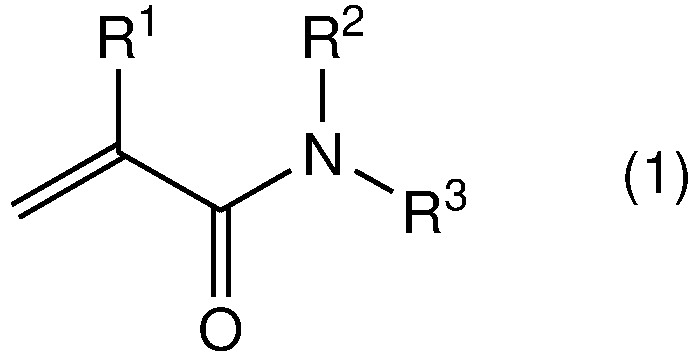
- R1 represents a hydrogen atom or a methyl group. R1 may be a hydrogen atom.
- R2 and R3 each independently represent an alkyl group. The number of carbon atoms of the alkyl group may be 1 to 20, 1 to 10, 1 to 6, or 1 to 3. The alkyl group may be any of a linear alkyl group, a branched alkyl group, or a cyclic alkyl group. The number of carbon atoms of the linear alkyl group is usually 1 to 20, and may be 1 to 10, 1 to 6, or 1 to 3. The number of carbon atoms of the branched alkyl group is usually 3 to 20, and may be 3 to 10 or 3 to 6. The number of carbon atoms of the cyclic alkyl group is usually 3 to 20, and may be 3 to 10 or 3 to 6.
- Examples of the linear alkyl group include a methyl group, an ethyl group, an n-propyl group, an n-butyl group, an n-hexyl group, an n-octyl group, an n-dodecyl group, and an n-hexadecyl group. Examples of the branched alkyl group include an isopropyl group, an isobutyl group, a sec-butyl group, a tert-butyl group, a 2-ethylhexyl group, a 3,7-dimethyloctyl group, and a 2-hexyldecyl group. Examples of the cyclic alkyl group include a cyclopentyl group, a cyclohexyl group, and an adamantyl group. Among them, the alkyl group may be a methyl group or an ethyl group, and may be a methyl group.
- Some of the hydrogen atoms of the alkyl group may be substituted by substituents. In the present description, the substituent means a group that compounds can generally have in the field of organic chemistry. Specific examples of the substituent include a halogen atom (fluorine atom, chlorine atom, bromine atom, and iodine atom), a cyano group, an alkyl group having 1 to 10 carbon atoms, an aryl group having 6 to 10 carbon atoms, an alkoxy group having 1 to 10 carbon atoms, and an amino group.
- R2 and R3 may be bonded to each other or bonded to each other with an oxygen atom interposed therebetween to form a ring together with a nitrogen atom to which R2 and R3 are bonded. The ring (heterocyclic ring containing a nitrogen atom or a heterocyclic ring containing a nitrogen atom and an oxygen atom) to be formed may be a four or more-membered ring or a five or more-membered ring, and may be an eight or less-membered ring or a seven or less-membered ring.
- The N,N-disubstituted (meth)acrylamide may be, for example, a compound represented by Formula (2).

- R4 represents a hydrogen atom or a methyl group. R4 may be a hydrogen atom.
- R5 and R6 each independently represent an alkylene group. The number of carbon atoms of the alkylene group may be 1 to 20, 1 to 10, 1 to 6, or 1 to 3. The alkylene group may be either a linear alkylene group or a branched alkylene group. The number of carbon atoms of the linear alkylene group is usually 1 to 20, and may be 1 to 10, 1 to 6, or 1 to 3. The number of carbon atoms of the branched alkylene group is usually 3 to 20, and may be 3 to 10 or 3 to 6.
- Examples of the linear alkylene group include a methylene group, an ethylene group, a propylene group, a butylene group, a pentylene group, and a hexylene group. Examples of the branched alkylene group include an isopropylene group, an isobutylene group, and a dimethylpropylene group. Among them, the alkylene group may be an ethylene group.
- Some of the hydrogen atoms of the alkylene group may be substituted by a substituent.
- The heterocyclic ring containing a nitrogen atom or the heterocyclic ring containing a nitrogen atom and an oxygen atom may be, for example, a morpholine ring.
- Specific examples of the N,N-disubstituted (meth)acrylamide include N,N-dialkyl (meth)acrylamides such as N,N-dimethyl (meth)acrylamide, N,N-diethyl (meth)acrylamide, N,N-dipropyl (meth)acrylamide, N,N-diisopropyl (meth)acrylamide, N,N-di(n-butyl)(meth)acrylamide, and N,N-di(t-butyl)(meth)acrylamide; and 4-(meth)acryloylmorpholine. Among these, the N,N-disubstituted (meth)acrylamide may be 4-(meth)acryloylmorpholine, and may be 4-acryloylmorpholine (ACMO).
- Since an N,N-disubstituted (meth)acrylamide has a radically polymerizable group, it can also act as a compound having a radically polymerizable group ((meth)acrylamide derivative) described later.
- The content of the stabilizer may be 0.1% by mass or more, 1% by mass or more, 3% by mass or more, or 5% by mass or more based on the total amount of the initiator from the viewpoint of developing adhesive strength of the adhesive composition in a short time. The content of the stabilizer may be 30% by mass or less, 25% by mass or less, 20% by mass or less, or 15% by mass or less based on the total amount of the initiator.
- The content of the stabilizer may be 0.01% by mass or more, 0.05% by mass or more, 0.1% by mass or more, or 0.5% by mass or more based on the total amount of the main agent and the initiator from the viewpoint of developing adhesive strength of the adhesive composition in a short time. The content of the stabilizer may be 10% by mass or less, 7% by mass or less, 5% by mass or less, or 3% by mass or less based on the total amount of the main agent and the initiator from the viewpoint of toughness of an adhesive layer.
- The content of the stabilizer may be 0.01 mol% or more, 0.05 mol% or more, 0.1 mol% or more, or 0.5 mol% or more based on the total amount of the compound having a radically polymerizable group from the viewpoint of developing adhesive strength of the adhesive composition in a short time. The content of the stabilizer may be 10 mol% or less, 7 mol% or less, 5 mol% or less, or 3 mol% or less based on the total amount of the compound having a radically polymerizable group from the viewpoint of toughness of an adhesive layer.
- The main agent contains a decomplexing agent. The decomplexing agent is a compound capable of dissociating a Lewis base from an organoborane complex (organoborane-Lewis base complex) to generate an organoborane. Thus, by mixing and reacting the organoborane complex contained in the initiator and the decomplexing agent contained in the main agent, it is possible to generate an organoborane that can be an initiator of living radical polymerization.
- The decomplexing agent contains maleic anhydride from the viewpoint of shortening the curing time of the adhesive composition. The decomplexing agent may be composed only of maleic anhydride.
- The content of the maleic anhydride may be 80% by mass or more, 90% by mass or more, 95% by mass or more, 98% by mass or more, or 99% by mass or more, and may be 100% by mass or less based on the total amount of the decomplexing agent from the viewpoint of shortening the curing time of the adhesive composition.
- The decomplexing agent may contain other decomplexing agents in addition to maleic anhydride as long as the effects of the present disclosure are not impaired. Examples of other decomplexing agents include acids, acid anhydrides, aldehydes, and β-ketone compounds. These may be used singly, or in combination of two or more kinds thereof. Examples of the acid include Lewis acids such as SnCl4 and TiCl4 and Brønsted acids such as aliphatic carboxylic acids and aromatic carboxylic acids. Examples of the acid anhydride include acetic anhydride, propionic anhydride, succinic anhydride, and phthalic anhydride. Examples of the aldehyde include benzaldehyde, o-, m-, and p-nitrobenzaldehyde. Examples of the β-ketone compound include methyl acetoacetate, ethyl acetoacetate, t-butyl acetoacetate, and 2-methacryloyloxyethyl acetoacetate.
- The content of the other decomplexing agent may be 0 to 20% by mass, 0 to 10% by mass, 0 to 5% by mass, 0 to 2% by mass, or 0 to 1% by mass based on the total amount of the decomplexing agent from the viewpoint of shortening the curing time of the adhesive composition.
- The content of the decomplexing agent may be 0.01% by mass or more, 0.1% by mass or more, 0.2% by mass or more, or 0.3% by mass or more based on the total amount of the main agent from the viewpoint of shortening the curing time of the adhesive composition. The content of the decomplexing agent may be 10% by mass or less, 5% by mass or less, 3% by mass or less, 2% by mass or less, or 1% by mass or less based on the total amount of the main agent from the viewpoint of ensuring working time from application of the adhesive composition to an adherend to pasting the adherend and another adherend together.
- The content of the decomplexing agent may be 0.01% by mass or more, 0.1% by mass or more, 0.2% by mass or more, or 0.3% by mass or more based on the total amount of the main agent and the initiator from the viewpoint of shortening the curing time of the adhesive composition. The content of the decomplexing agent may be 10% by mass or less, 7% by mass or less, 5% by mass or less, 3% by mass or less, or 1% by mass or less based on the total amount of the main agent and the initiator from the viewpoint of ensuring working time from application of the adhesive composition to an adherend to pasting the adherend and another adherend together.
- The molar amount ratio of the decomplexing agent to the organoborane complex (molar amount of decomplexing agent/molar amount of organoborane complex) may be, for example, 0.3 or more, 0.5 or more, 0.8 or more, or 1 or more. When the molar ratio is 1 or more, more sufficient adhesive strength tends to be obtained. The molar amount ratio of the decomplexing agent to the organoborane complex (molar amount of decomplexing agent/molar amount of organoborane complex) may be, for example, 50 or less, 30 or less, 10 or less, 7 or less, 5 or less, or 3 or less. As the molar amount ratio decreases, the working time from application of the adhesive composition to an adherend to pasting the adherend and another adherend together tends to be more sufficiently ensured.
- At least one of the main agent and the initiator further contains a compound having a radically polymerizable group. The compound having a radically polymerizable group is a compound having a polymerizable group that radically reacts. Examples of the radically polymerizable group include a (meth)acryloyl group, a vinyl group, an allyl group, a styryl group, an alkenyl group, an alkenylene group, and a maleimide group.
- As the compound having a radically polymerizable group, for example, a compound having a (meth)acryloyl group may be contained. Examples of the compound having a (meth)acryloyl group include a monofunctional (meth)acrylate having one (meth)acryloyl group, a polyfunctional (meth)acrylate having two or more (meth)acryloyl groups, and a (meth)acrylamide derivative. Among them, the compound having a (meth)acryloyl group may be a monofunctional (meth)acrylate having one (meth)acryloyl group.
- Examples of the monofunctional (meth)acrylate include (meth)acrylic acid; alkyl (meth)acrylates having an alkyl group such as methyl (meth)acrylate, ethyl (meth)acrylate, n-butyl (meth)acrylate, isobutyl (meth)acrylate, tert-butyl (meth)acrylate, n-pentyl (meth)acrylate, n-hexyl (meth)acrylate, n-octyl (meth)acrylate, isooctyl (meth)acrylate, 2-ethylhexyl (meth)acrylate, isodecyl (meth)acrylate, dodecyl (meth)acrylate (n-lauryl (meth)acrylate), isomyristyl (meth)acrylate, stearyl (meth)acrylate, and isostearyl acrylate; alkenyl (meth)acrylates having an alkenyl group such as 3-butenyl (meth)acrylate; (meth)acrylates having an aromatic group such as benzyl (meth)acrylate and phenoxyethyl (meth)acrylate; alkoxy polyalkylene glycol (meth)acrylates such as methoxy tetraethylene glycol (meth)acrylate, methoxy hexaethylene glycol (meth)acrylate, methoxy octaethylene glycol (meth)acrylate, methoxy nonaethylene glycol (meth)acrylate, methoxy polyethylene glycol (meth)acrylate, methoxy heptapropylene glycol (meth)acrylate, ethoxy tetraethylene glycol (meth)acrylate, butoxy ethylene glycol (meth)acrylate, and butoxy diethylene glycol (meth)acrylate; (meth)acrylates having an alicyclic group such as cyclohexyl (meth)acrylate, isobornyl (meth)acrylate, and dicyclopentanyl (meth)acrylate; (meth)acrylates having a hydroxy group such as 2-hydroxyethyl (meth)acrylate, 3-hydroxypropyl (meth)acrylate, and 4-hydroxybutyl (meth)acrylate; (meth)acrylates having an amino group such as N,N-dimethylaminoethyl (meth)acrylate; (meth)acrylates having an isocyanate group such as 2-(2-methacryloyloxyethyloxy)ethyl isocyanate and 2-(meth)acryloyloxyethyl isocyanate; polyalkylene glycol mono(meth)acrylates such as tetraethylene glycol mono(meth)acrylate, hexaethylene glycol mono(meth)acrylate, octapropylene glycol mono(meth)acrylate, dipropylene glycol mono(meth)acrylate, tripropylene glycol mono(meth)acrylate, and octapropylene glycol mono(meth)acrylate; and (meth)acrylates having a siloxane skeleton. These may be used singly, or in combination of two or more kinds thereof.
- Examples of the polyfunctional (meth)acrylate include aliphatic (meth)acrylates such as ethylene glycol di(meth)acrylate, diethylene glycol di(meth)acrylate, triethylene glycol di(meth)acrylate, tetraethylene glycol di(meth)acrylate, polyethylene glycol di(meth)acrylate, propylene glycol di(meth)acrylate, dipropylene glycol di(meth)acrylate, tripropylene glycol di(meth)acrylate, tetrapropylene glycol di(meth)acrylate, polypropylene glycol di(meth)acrylate, ethoxylated polypropylene glycol di(meth)acrylate, 1,3-butanediol di(meth)acrylate, 1,4-butanediol di(meth)acrylate, neopentyl glycol di(meth)acrylate, 3-methyl-1,5-pentanediol di(meth)acrylate, 1,6-hexanediol di(meth)acrylate, 2-butyl-2-ethyl-1,3-propanediol di(meth)acrylate, 1,9-nonanediol di(meth)acrylate, 1,10-decanediol di(meth)acrylate, glycerin di(meth)acrylate, tricyclodecanedimethanol (meth)acrylate, and ethoxylated 2-methyl-1,3-propanediol di(meth)acrylate; aromatic (meth)acrylates such as ethoxylated bisphenol A type di(meth)acrylate, propoxylated bisphenol A type di(meth)acrylate, ethoxylated propoxylated bisphenol A type di(meth)acrylate, ethoxylated bisphenol F type di(meth)acrylate, propoxylated bisphenol F type di(meth)acrylate, ethoxylated propoxylated bisphenol F type di(meth)acrylate, ethoxylated fluorene type di(meth)acrylate, propoxylated fluorene type di(meth)acrylate, and ethoxylated propoxylated fluorene type di(meth)acrylate; and aromatic epoxy (meth)acrylates such as bisphenol type epoxy (meth)acrylate, phenol novolac type epoxy (meth)acrylate, and cresol novolac type epoxy (meth)acrylate. These may be used singly, or in combination of two or more kinds thereof.
- Examples of the (meth)acrylamide derivative include N,N-dimethylaminopropyl (meth)acrylamide, N,N-dimethyl (meth)acrylamide, N-isopropyl (meth)acrylamide, N,N-diethyl (meth)acrylamide, N-hydroxyethyl (meth)acrylamide, and 4-(meth)acryloylmorpholine. These may be used singly, or in combination of two or more kinds thereof.
- As the compound having a radically polymerizable group, in addition to the compound having a (meth)acryloyl group, for example, a copolymerizable compound that is copolymerizable therewith may be contained. Examples of the copolymerizable compound include compounds having a radically polymerizable group other than a (meth)acryloyl group, such as styrene, 4-methylstyrene, vinylpyridine, vinylpyrrolidone, vinyl acetate, cyclohexylmaleimide, and phenylmaleimide.
- The compound having a radically polymerizable group may be contained in at least one of the main agent and the initiator, and for example, the main agent may contain a compound having a radically polymerizable group.
- The content of the compound having a radically polymerizable group may be 40% by mass or more, 50% by mass or more, 60% by mass or more, or 65% by mass or more based on the total amount of the main agent and the initiator from the viewpoints of improving the toughness and improving the adhesive strength of an adhesive layer. The content of the compound having a radically polymerizable group may be 99% by mass or less, 98% by mass or less, 95% by mass or less, 90% by mass or less, 85% by mass or less, or 80% by mass or less based on the total amount of the main agent and the initiator from the viewpoint of suppressing sagging of the applied adhesive composition and suppressing a decrease in toughness of an adhesive layer.
- At least one of the main agent and the initiator further contains at least one selected from the group consisting of a metal halide salt and a compound having a thiocarbonyl thio structure as a polymerization control agent.
- Examples of the metal halide salt include copper (II) bromide, copper (II) chloride, iron (III) bromide, vanadium (III) bromide, chromium (III) bromide, ruthenium (III) bromide, copper (I) bromide, iron (II) bromide, manganese (II) bromide, cobalt (II) bromide, nickel (II) bromide, and palladium (II) bromide. These may be used singly, or in combination of two or more kinds thereof. The metal halide salt may be, for example, copper (II) bromide.
- The compound having a thiocarbonyl thio structure can be used without particular limitation as long as it has a thiocarbonyl thio structure, and for example, a chain transfer agent used in the field of Reversible Addition/Fragmentation Chain Transfer (RAFT) polymerization (i.e., RAFT agent) can be suitably used.
- The polymerization control agent may be contained in at least one of the main agent and the initiator, and for example, the main agent may contain the polymerization control agent.
- The content of the polymerization control agent may be 0.01% by mass or more, 0.02% by mass or more, 0.03% by mass or more, or 0.05% by mass or more based on the total amount of the main agent and the initiator from the viewpoints of ensuring working time from application of the adhesive composition to an adherend to pasting the adherend and another adherend together and improving the adhesive strength. The content of the polymerization control agent may be 5% by mass or less, 3% by mass or less, 1% by mass or less, 0.5% by mass or less, or 0.1% by mass or less based on the total amount of the main agent and the initiator from the viewpoint of storage stability of the main agent.
- The content of the polymerization control agent may be 0.01 mol% or more, 0.03 mol% or more, 0.05 mol% or more, or 0.08 mol% or more based on the total amount of the compound having a radically polymerizable group from the viewpoints of ensuring working time from application of the adhesive composition to an adherend to pasting the adherend and another adherend together and improving the adhesive strength. The content of the polymerization control agent may be 5 mol% or less, 3 mol% or less, 1 mol% or less, 0.7 mol% or less, 0.5 mol% or less, or 0.2 mol% or less based on the total amount of the compound having a radically polymerizable group from the viewpoint of storage stability of the main agent.
- The filler may be, for example, either an inorganic filler or an organic filler. Examples of the inorganic filler include inorganic fine particles such as silica, alumina, silica-alumina, titania, zirconia, magnesia, kaolin, talc, calcium carbonate, bentonite, mica, sericite, glass flakes, glass fibers, graphite, magnesium hydroxide, aluminum hydroxide, antimony trioxide, barium sulfate, zinc borate, wollastonite, xonotlite, and whisker. When an inorganic filler is used as the filler, the inorganic filler may contain a silica filler.
- Examples of the organic filler include organic fine particles such as silicone, acrylic silicone, acrylic rubber, MBS (methacrylate butadiene styrene), polyamide, and polyimide. These fillers (fine particles) may have a uniform structure, or may have a core-shell type structure. When an organic filler is used as the filler, the organic filler may contain acrylic core-shell particles.
- The organic filler may contain an antioxidant in the organic filler. The content of the antioxidant in the organic filler may be, for example, 15000 ppm by mass or less, 10,000 ppm by mass or less, 5000 ppm by mass or less, or 3000 ppm by mass or less.
- The filler may be contained in at least one of the main agent and the initiator. For example, the main agent may contain a filler containing an organic filler, and may contain a filler containing acrylic core-shell particles. In addition, for example, the initiator may contain a filler containing an inorganic filler, and may contain a filler containing a silica filler.
- The content of the filler may be 1% by mass or more, 3% by mass or more, or 5% by mass or more, and may be 40% by mass or less, 35% by mass or less, or 30% by mass or less based on the total amount of the main agent and the initiator.
- Examples of the plasticizer include phthalic acid ester-based compounds, alkyl sulfonic acid ester-based compounds, and adipic acid ester-based compounds.
- The plasticizer may be contained in at least one of the main agent and the initiator.
- The content of the plasticizer may be 0.1% by mass or more, 0.3% by mass or more, or 1.0% by mass or more, and may be 30% by mass or less, 20% by mass or less, or 10% by mass or less based on the total amount of the main agent and the initiator.
- In addition to the above components, at least one of the main agent and the initiator may further contain, a crosslinking agent, an ultraviolet absorber, a dehydrating agent, a pigment, a dye, an anti-aging agent, an antioxidant, an antistatic agent, a flame retardant, an adhesion-imparting agent, a dispersant, a solvent, and the like.
- In the adhesive set of the present embodiment, by mixing the main agent and the initiator, an adhesive composition can be prepared. The temperature at which the main agent and the initiator are mixed may be, for example, 10 to 35°C. The pot life of the adhesive set may be, for example, 0.1 to 10 minutes.
- When the main agent and the initiator are mixed, it is preferable to mix the main agent and the initiator such that the molar amount ratio of the decomplexing agent in the main agent to the organoborane complex in the initiator (molar amount of decomplexing agent/molar amount of organoborane complex) is 0.3 or more, 0.5 or more, 0.8 or more, or 1 or more, or 50 or less, 30 or less, 10 or less, 7 or less, 5 or less, or 3 or less.
- When the main agent and the initiator are mixed, it is preferable to mix them such that the mass ratio of the main agent to the initiator (mass of main agent/mass of initiator) is, for example, 1 or more, 3 or more, or 5 or more, or 200 or less, 100 or less, or 50 or less.
- The method of mixing the main agent and the initiator is not particularly limited as long as both are mixed together. Examples of the method of mixing the main agent and the initiator include a manual mixing method, a mixing method by hand painting using a normal caulking gun or the like, and a mixing method using a mechanical rotary mixer, a static mixer, or the like while concurrently using a quantitative pump (for example, a gear pump, a plunger pump, or the like) and a throttle valve for feeding raw materials. In addition, by using a dispenser, a hand gun, or the like having a mechanism in which the main agent and the initiator are separately disposed, fed to a nozzle or the like from each location, mixed inside the nozzle or the like, and discharged from the tip of the nozzle, mixing of the main agent and the initiator and application of the adhesive composition described later may be continuously performed.
- The adhesive composition thus prepared can form an adhesive layer by applying the adhesive composition to a predetermined place. The formed adhesive layer acts as an adhesive layer for bonding the base materials to each other because the molecular weight of the compound having a radically polymerizable group gradually increases and the compound cures. As a method of applying it to a predetermined place, a conventionally known method such as a method using a dispenser or the like can be applied.
- Conditions for curing the adhesive composition may be, for example, a curing temperature of 10 to 35°C and a curing time of 24 to 96 hours.
- A bonded body according to one embodiment includes a first adherend, a second adherend, and an adhesive layer bonding the first adherend and the second adherend to each other. The adhesive layer contains a cured product of an adhesive composition containing the main agent and the initiator in the adhesive set.
- Examples of the first adherend and the second adherend include plastic substrates such as polypropylene (PP), polyvinyl chloride, an acrylonitrile/butadiene/styrene copolymer (ABS), polycarbonate (PC), polyamide (PA), poly(methyl methacrylate) (PMMA), polyester, an epoxy resin, polyurethane (PUR), polyoxymethylene (POM), polyethylene (PE), an ethylene/propylene copolymer (EPM), and an ethylene/propylene/diene polymer (EPDM), and metal substrates such as aluminum, steel, copper, and stainless steel.
- Examples of the bonded body include a plastic laminate substrate, a metal laminate substrate, an electronic component, a semiconductor component, and a display component.
- A method for manufacturing a bonded body according to an embodiment includes pasting a first adherend and a second adherend together with an adhesive composition containing a main agent and an initiator interposed between the first adherend and the second adherend. The temperature at the time of mixing the main agent and the initiator in the adhesive set, the conditions for curing the adhesive composition, and the like may be the same as those described above.
- Hereinafter, the present disclosure will be described more specifically with reference to examples. However, the present disclosure is not limited to these examples.
-
- [Production of Adhesive Set]
- (Preparation of Raw Material)
- ·Organoborane Complex
- TEB-DAP: triethylborane-1,3-diaminopropane complex (molecular weight: 172.1, KISHIDA CHEMICAL Co., Ltd.)
- ·Stabilizer
- ACMO: 4-acryloylmorpholine (N,N-disubstituted acrylamide, molecular weight: 141.2, KJ Chemicals Corporation)
- Az: 2,2-bis(hydroxymethyl)-1-butanol-tris[3-(1-aziridinyl)propionate] (molecular weight: 425.5, NIPPON SHOKUBAI CO., LTD., trade name: Chemitite PZ-33)

- ·Decomplexing Agent
- Maleic anhydride (molecular weight: 98.1, FUJIFILM Wako Pure Chemical Corporation)
- Succinic anhydride (molecular weight: 100.1, FUJIFILM Wako Pure Chemical Corporation)
- ·Compound Having Radically Polymerizable Group (Polymerizable Compound)
- FA-513AS: dicyclopentanyl acrylate (molecular weight: 206.3, Showa Denko Materials Co., Ltd.)
- FA-310A: phenoxyethyl acrylate (molecular weight: 192.2, Showa Denko Materials Co., Ltd.)
- DMAA: N,N-dimethylacrylamide (molecular weight: 99.1, FUJIFILM Wako Pure Chemical Corporation)
- ·Polymerization Control Agent
- Copper (II) bromide (molecular weight: 223.4, FUJIFILM Wako Pure Chemical Corporation)
- ·Filler
- RY200S: fumed silica (hydrophobic fumed silica surface-treated with silicone oil, NIPPON AEROSIL CO., LTD.)
- M210: acrylic core-shell particles (KANEKA CORPORATION, no antioxidant detected)
- ·Plasticizer
- PN-5090: adipic acid polyester (ADEKA CORPORATION)
- A decomplexing agent, a compound having a radically polymerizable group, a polymerization control agent, and a filler were weighed in a plastic bottle according to the types and ratios (unit: parts by mass) shown in Table 1, using a rotation-revolution mixer (THINKY CORPORATION, Awatori Rentaro), mixed for 15 minutes under the condition of 2000 rpm, and further defoamed for 5 minutes under the condition of 2000 rpm to prepare each main agent in Examples 1 and 2 and Comparative Example 1.
- An organoborane complex, a stabilizer, a plasticizer, and a filler were weighed in a plastic bottle according to the types and ratios (unit: parts by mass) shown in Table 1, using a rotation-revolution mixer (THINKY CORPORATION, Awatori Rentaro), mixed for 15 minutes under the condition of 2000 rpm, and further defoamed for 5 minutes under the condition of 2000 rpm to prepare each initiator in Examples 1 and 2 and Comparative Example 1. The initiators in Example 2 and Comparative Example 1 are the same.
- Two polypropylene substrates (size: 100 mm × 25 mm, thickness: 2 mm) were prepared. On one polypropylene substrate, a spacer having a thickness of 0.5 mm was disposed such that the application region of the adhesive composition had a thickness of 0.5 mm, a length of 12.5 mm in the longitudinal direction of the polypropylene substrate, and a length of 25 mm in the lateral direction of the polypropylene substrate. Each main agent and each initiator were filled in a manual dispenser such that the main agent and the initiator were mixed. Using the manual dispenser, the resulting mixture was applied to the adhesive application region of the polypropylene substrate on which the spacer was disposed, and then the polypropylene substrate and the other polypropylene substrate were pasted together to obtain a laminate. A plurality of laminates were produced. The obtained laminate was allowed to stand at 25°C, and the shear strength was measured every predetermined time to determine the change in shear strength with respect to the curing time. The shear test was performed at room temperature (25°C) using AUTOGRAPH (manufactured by SHIMADZU CORPORATION, model number: AGS X Plus, load cell: 50 kN) under the conditions of a distance between chucks of 100 mm and a tensile rate of 5 mm/min. The strength at break was measured, and the shear bond strength (MPa) was calculated from the measured value and the bonded area. The results are shown in
FIG. 1 . - Two polypropylene substrates (size: 100 mm × 25 mm, thickness: 2 mm) were prepared. On one polypropylene substrate, a spacer having a thickness of 0.5 mm was disposed such that the application region of the adhesive composition had a thickness of 0.5 mm, a length of 12.5 mm in the longitudinal direction of the polypropylene substrate, and a length of 25 mm in the lateral direction of the polypropylene substrate. Each main agent and each initiator were filled in a manual dispenser such that the main agent and the initiator were mixed. Using the manual dispenser, the resulting mixture was applied to the adhesive application region of the polypropylene substrate on which the spacer was disposed, and then the polypropylene substrate and the other polypropylene substrate were pasted together to obtain a laminate. The obtained laminate was allowed to stand at 25°C for 48 hours to obtain a bonded body. The side surface of the obtained bonded body was photographed using a digital camera, and the state of the adhesive composition in a portion that had overflowed from the adherends was evaluated. A case where the state of the adhesive composition in the overflow portion was white and cured as a whole was rated as "A", that is, evaluated as having favorable curability, and a case where the state of the adhesive composition in the overflow portion was uncured was rated as "B". The results are shown in Table 1.
Table 1 Exam. 1 Exam. 2 Comp. Exam. 1 Main agent Decomplexing agent Maleic anhydride 0.34 0.34 - Succinic anhydride - - 0.34 Polymerizable compound FA-513AS 39.92 39.92 40.03 FA-310A 40.00 40.00 40.05 DMAA 0.49 0.49 0.49 Polymerization control agent Copper (II) bromide 0.08 0.08 0.09 Filler M210 19.17 19.17 19.00 Total amount of main agent 100.00 100.00 100.00 Initiator Organoborane complex TEB-DAP 0.59 0.59 0.59 Stabilizer ACMO 1.11 - - Az - 1.11 1.11 Plasticizer PN-5090 7.94 7.94 7.94 Filler RY200S 0.36 0.36 0.36 Total amount of initiator 10.00 10.00 10.00 Molar amount of decomplexing agent/molar amount of organoborane complex 1.0 1.0 1.0 Mass of main agent/mass of initiator 10.0 10.0 10.0 Curability of overflow portion A A B -
FIG. 1 is a graph showing changes in shear strength with respect to curing time in Examples 1 and 2 and Comparative Example 1. As shown inFIG. 1 , the time until sufficient adhesive strength was obtained in the adhesive compositions of Examples 1 and 2 that contained maleic anhydride as a decomplexing agent was shorter than that in the adhesive composition of Comparative Example 1 that contained succinic anhydride as a decomplexing agent. The adhesive compositions of Examples 1 and 2 were also superior to the adhesive composition of Comparative Example 1 in terms of curability of the overflow portion. From these results, it was confirmed that the adhesive set of the present disclosure allowed for preparation of an adhesive composition capable of sufficiently shortening the curing time.
Claims (3)
- An adhesive set comprising:a main agent comprising a decomplexing agent; andan initiator comprising an organoborane complex, whereinthe decomplexing agent comprises maleic anhydride,at least one of the main agent and the initiator further comprises a compound having a radically polymerizable group, andat least one of the main agent and the initiator further comprises at least one selected from the group consisting of a metal halide salt and a compound having a thiocarbonyl thio structure.
- A bonded body comprising:a first adherend;a second adherend; andan adhesive layer bonding the first adherend and the second adherend to each other, whereinthe adhesive layer comprises a cured product of an adhesive composition comprising the main agent and the initiator in the adhesive set according to claim 1.
- A method for manufacturing the bonded body according to claim 2, the method comprising:
pasting the first adherend and the second adherend together with an adhesive composition comprising the main agent and the initiator interposed between the first adherend and the second adherend.
Applications Claiming Priority (2)
| Application Number | Priority Date | Filing Date | Title |
|---|---|---|---|
| JP2022079725A JP2023168083A (en) | 2022-05-13 | 2022-05-13 | Adhesive set, adhesive body, and manufacturing method therefor |
| PCT/JP2023/017623 WO2023219115A1 (en) | 2022-05-13 | 2023-05-10 | Adhesive set, adhesive body, and manufacturing method therefor |
Publications (2)
| Publication Number | Publication Date |
|---|---|
| EP4516867A1 true EP4516867A1 (en) | 2025-03-05 |
| EP4516867A4 EP4516867A4 (en) | 2025-09-03 |
Family
ID=88730341
Family Applications (1)
| Application Number | Title | Priority Date | Filing Date |
|---|---|---|---|
| EP23803590.1A Pending EP4516867A4 (en) | 2022-05-13 | 2023-05-10 | ADHESIVE SEAL, ADHESIVE BODY AND MANUFACTURING METHOD THEREFOR |
Country Status (7)
| Country | Link |
|---|---|
| US (1) | US20250333627A1 (en) |
| EP (1) | EP4516867A4 (en) |
| JP (1) | JP2023168083A (en) |
| KR (1) | KR20250010002A (en) |
| CN (1) | CN119173594A (en) |
| TW (1) | TW202400741A (en) |
| WO (1) | WO2023219115A1 (en) |
Family Cites Families (8)
| Publication number | Priority date | Publication date | Assignee | Title |
|---|---|---|---|---|
| EP0859801B1 (en) * | 1995-11-07 | 2001-06-13 | Minnesota Mining And Manufacturing Company | Initiator system and adhesive composition made therewith |
| US6849569B2 (en) * | 2001-12-31 | 2005-02-01 | 3M Innovative Properties Company | Initiator systems comprising β-ketone compounds |
| US6734268B2 (en) | 2001-12-31 | 2004-05-11 | 3M Innovative Properties Company | Metal salt modifiers for bonding compositions |
| JP6404645B2 (en) * | 2014-08-28 | 2018-10-10 | スリーエム イノベイティブ プロパティズ カンパニー | Two-component adhesive and structure including the same |
| JP2018100345A (en) * | 2016-12-20 | 2018-06-28 | スリーエム イノベイティブ プロパティズ カンパニー | Two-part adhesive, and structure comprising cured product thereof |
| JP7022870B2 (en) * | 2019-08-22 | 2022-02-18 | デンカ株式会社 | Composition |
| KR102830808B1 (en) * | 2020-11-17 | 2025-07-04 | 가부시끼가이샤 레조낙 | Adhesive set, and adhesive and method for making same |
| WO2022107211A1 (en) * | 2020-11-17 | 2022-05-27 | 昭和電工マテリアルズ株式会社 | Adhesive agent set, and adhesion body and method for producing same |
-
2022
- 2022-05-13 JP JP2022079725A patent/JP2023168083A/en active Pending
-
2023
- 2023-05-10 KR KR1020247039628A patent/KR20250010002A/en active Pending
- 2023-05-10 WO PCT/JP2023/017623 patent/WO2023219115A1/en not_active Ceased
- 2023-05-10 EP EP23803590.1A patent/EP4516867A4/en active Pending
- 2023-05-10 US US18/864,550 patent/US20250333627A1/en active Pending
- 2023-05-10 CN CN202380039957.4A patent/CN119173594A/en active Pending
- 2023-05-11 TW TW112117501A patent/TW202400741A/en unknown
Also Published As
| Publication number | Publication date |
|---|---|
| US20250333627A1 (en) | 2025-10-30 |
| TW202400741A (en) | 2024-01-01 |
| JP2023168083A (en) | 2023-11-24 |
| KR20250010002A (en) | 2025-01-20 |
| WO2023219115A1 (en) | 2023-11-16 |
| CN119173594A (en) | 2024-12-20 |
| EP4516867A4 (en) | 2025-09-03 |
Similar Documents
| Publication | Publication Date | Title |
|---|---|---|
| US12595401B2 (en) | Adhesive set, adhesive body, and method for producing same | |
| EP4509571A1 (en) | Adhesive set, bonded body and method for producing same | |
| EP4516866A1 (en) | Adhesive set, adhesive body, and manufacturing method therefor | |
| US12258498B2 (en) | Adhesive set, adhesive body, and manufacturing method therefor | |
| WO2025013728A1 (en) | Adhesive body and method for producing same | |
| US20250333627A1 (en) | Adhesive set, adhesive body, and manufacturing method therefor | |
| JP4971802B2 (en) | Moisture curable resin composition, method for producing the same, and moisture curable adhesive composition | |
| WO2026088860A1 (en) | Adhesive set, bonded body, and method for manufacturing same | |
| WO2025013726A1 (en) | Adhesive composition | |
| JP7848543B2 (en) | Adhesive set, adhesive body, and method for manufacturing the adhesive body | |
| JP7848542B2 (en) | Adhesive set, adhesive body, and method for manufacturing the adhesive body | |
| WO2026088859A1 (en) | Method for selecting combination of trialkylborane-amine complex and amine compound |
Legal Events
| Date | Code | Title | Description |
|---|---|---|---|
| STAA | Information on the status of an ep patent application or granted ep patent |
Free format text: STATUS: THE INTERNATIONAL PUBLICATION HAS BEEN MADE |
|
| PUAI | Public reference made under article 153(3) epc to a published international application that has entered the european phase |
Free format text: ORIGINAL CODE: 0009012 |
|
| STAA | Information on the status of an ep patent application or granted ep patent |
Free format text: STATUS: REQUEST FOR EXAMINATION WAS MADE |
|
| 17P | Request for examination filed |
Effective date: 20241125 |
|
| AK | Designated contracting states |
Kind code of ref document: A1 Designated state(s): AL AT BE BG CH CY CZ DE DK EE ES FI FR GB GR HR HU IE IS IT LI LT LU LV MC ME MK MT NL NO PL PT RO RS SE SI SK SM TR |
|
| STAA | Information on the status of an ep patent application or granted ep patent |
Free format text: STATUS: EXAMINATION IS IN PROGRESS |
|
| DAV | Request for validation of the european patent (deleted) | ||
| DAX | Request for extension of the european patent (deleted) | ||
| A4 | Supplementary search report drawn up and despatched |
Effective date: 20250801 |
|
| RIC1 | Information provided on ipc code assigned before grant |
Ipc: C09J 4/00 20060101AFI20250728BHEP Ipc: B32B 27/00 20060101ALI20250728BHEP Ipc: C09J 11/04 20060101ALI20250728BHEP Ipc: C09J 11/06 20060101ALI20250728BHEP |
|
| 17Q | First examination report despatched |
Effective date: 20250818 |