EP4513854A1 - Adaptive streaming for a multi-mno-enabled user equipment - Google Patents
Adaptive streaming for a multi-mno-enabled user equipment Download PDFInfo
- Publication number
- EP4513854A1 EP4513854A1 EP23193304.5A EP23193304A EP4513854A1 EP 4513854 A1 EP4513854 A1 EP 4513854A1 EP 23193304 A EP23193304 A EP 23193304A EP 4513854 A1 EP4513854 A1 EP 4513854A1
- Authority
- EP
- European Patent Office
- Prior art keywords
- data
- mno
- qos
- streaming
- data rate
- Prior art date
- Legal status (The legal status is an assumption and is not a legal conclusion. Google has not performed a legal analysis and makes no representation as to the accuracy of the status listed.)
- Pending
Links
Images


Classifications
-
- H—ELECTRICITY
- H04—ELECTRIC COMMUNICATION TECHNIQUE
- H04L—TRANSMISSION OF DIGITAL INFORMATION, e.g. TELEGRAPHIC COMMUNICATION
- H04L65/00—Network arrangements, protocols or services for supporting real-time applications in data packet communication
- H04L65/80—Responding to QoS
-
- H—ELECTRICITY
- H04—ELECTRIC COMMUNICATION TECHNIQUE
- H04L—TRANSMISSION OF DIGITAL INFORMATION, e.g. TELEGRAPHIC COMMUNICATION
- H04L65/00—Network arrangements, protocols or services for supporting real-time applications in data packet communication
- H04L65/60—Network streaming of media packets
- H04L65/61—Network streaming of media packets for supporting one-way streaming services, e.g. Internet radio
- H04L65/612—Network streaming of media packets for supporting one-way streaming services, e.g. Internet radio for unicast
-
- H—ELECTRICITY
- H04—ELECTRIC COMMUNICATION TECHNIQUE
- H04L—TRANSMISSION OF DIGITAL INFORMATION, e.g. TELEGRAPHIC COMMUNICATION
- H04L65/00—Network arrangements, protocols or services for supporting real-time applications in data packet communication
- H04L65/60—Network streaming of media packets
- H04L65/75—Media network packet handling
- H04L65/752—Media network packet handling adapting media to network capabilities
-
- H—ELECTRICITY
- H04—ELECTRIC COMMUNICATION TECHNIQUE
- H04N—PICTORIAL COMMUNICATION, e.g. TELEVISION
- H04N21/00—Selective content distribution, e.g. interactive television or video on demand [VOD]
- H04N21/40—Client devices specifically adapted for the reception of or interaction with content, e.g. set-top-box [STB]; Operations thereof
- H04N21/41—Structure of client; Structure of client peripherals
- H04N21/414—Specialised client platforms, e.g. receiver in car or embedded in a mobile appliance
- H04N21/41422—Specialised client platforms, e.g. receiver in car or embedded in a mobile appliance located in transportation means, e.g. personal vehicle
-
- H—ELECTRICITY
- H04—ELECTRIC COMMUNICATION TECHNIQUE
- H04N—PICTORIAL COMMUNICATION, e.g. TELEVISION
- H04N21/00—Selective content distribution, e.g. interactive television or video on demand [VOD]
- H04N21/60—Network structure or processes for video distribution between server and client or between remote clients; Control signalling between clients, server and network components; Transmission of management data between server and client, e.g. sending from server to client commands for recording incoming content stream; Communication details between server and client
- H04N21/61—Network physical structure; Signal processing
- H04N21/6156—Network physical structure; Signal processing specially adapted to the upstream path of the transmission network
- H04N21/6181—Network physical structure; Signal processing specially adapted to the upstream path of the transmission network involving transmission via a mobile phone network
-
- H—ELECTRICITY
- H04—ELECTRIC COMMUNICATION TECHNIQUE
- H04W—WIRELESS COMMUNICATION NETWORKS
- H04W4/00—Services specially adapted for wireless communication networks; Facilities therefor
- H04W4/30—Services specially adapted for particular environments, situations or purposes
- H04W4/40—Services specially adapted for particular environments, situations or purposes for vehicles, e.g. vehicle-to-pedestrians [V2P]
-
- H—ELECTRICITY
- H04—ELECTRIC COMMUNICATION TECHNIQUE
- H04W—WIRELESS COMMUNICATION NETWORKS
- H04W48/00—Access restriction; Network selection; Access point selection
- H04W48/18—Selecting a network or a communication service
-
- H—ELECTRICITY
- H04—ELECTRIC COMMUNICATION TECHNIQUE
- H04N—PICTORIAL COMMUNICATION, e.g. TELEVISION
- H04N21/00—Selective content distribution, e.g. interactive television or video on demand [VOD]
- H04N21/80—Generation or processing of content or additional data by content creator independently of the distribution process; Content per se
- H04N21/83—Generation or processing of protective or descriptive data associated with content; Content structuring
- H04N21/845—Structuring of content, e.g. decomposing content into time segments
- H04N21/8456—Structuring of content, e.g. decomposing content into time segments by decomposing the content in the time domain, e.g. in time segments
-
- H—ELECTRICITY
- H04—ELECTRIC COMMUNICATION TECHNIQUE
- H04W—WIRELESS COMMUNICATION NETWORKS
- H04W60/00—Affiliation to network, e.g. registration; Terminating affiliation with the network, e.g. de-registration
- H04W60/005—Multiple registrations, e.g. multihoming
-
- H—ELECTRICITY
- H04—ELECTRIC COMMUNICATION TECHNIQUE
- H04W—WIRELESS COMMUNICATION NETWORKS
- H04W88/00—Devices specially adapted for wireless communication networks, e.g. terminals, base stations or access point devices
- H04W88/02—Terminal devices
- H04W88/06—Terminal devices adapted for operation in multiple networks or having at least two operational modes, e.g. multi-mode terminals
Definitions
- Prior art defines an automated vehicle, also known as an AV, an autonomous vehicle, a selfdriving car, a driverless car, a robo-car, or a robotic car, which is a vehicle that is capable of sensing its environment and moving safely with little or no human input.
- AV automated vehicle
- data streaming is exchanged between an AV and a control center.
- Such data streaming may include any of audio, video, or an audio/video streaming.
- video streaming adaptive protocols are now widespread among multiple day-to-day services. Those applications that rely on timely delivery of the best possible video experience make use of several data streams of video at different qualities, from which the client can choose based on preference, link capacity, or end-device. However, these different data streams are generally offered through the same path, routing-wise, and the capacity of the server is always assumed sufficient.
- a 3GPP 5G radio communication system can support demanding QoS requirements of many advanced V2X use cases and their corresponding applications.
- efficient driving especially of automated vehicles, may be affected by sudden changes of the provided QoS.
- a prediction of QoS changes and early notification of these predicted changes to vehicles recently have been enabled for example by the 3GPP 5G communication systems.
- This approach enables vehicles to avoid or mitigate effects of sudden QoS changes at application level.
- Naturally such predicted QoS influences possibilities of data streaming delivery.
- CAMARA Telco Global API Alliance
- multi-MNO connectivity adds a layer of redundancy to the channel that can be used for increased reliance on the link.
- a conventional approach is to balance the traffic among MNOs based on link quality, location or upon shortages of the currently active one.
- the benefit of the method according to the first aspect of the present disclosure that the reliability of data streaming and/or the flexibility to change the resolution are enhanced. Further, there is no MNOs switching when data delivery problems occur because the additional one or more MNOs are always delivering the second, backup data streaming.
- the first data streaming and the second data streaming may originate from the same initial data stream, for example a RAW data stream captured by a camera and/or a microphone. In other words, the first data streaming is a higher quality version of the second data streaming.
- the step of entering a state requiring data streaming from the UE to a remote device may be initiated by the UE, for example as a result of an accident of other unexpected scenario that might require assistance of a control center, or may be initiated by the control center, for example on a scheduled basis or for example for a routine check of an AV.
- a remote device e.g. a server device at a control center
- the terminal may be an AV the first aspect of the present disclosure is not limited thereto.
- such an AV may specifically plan driving routes so that there is always available one or more of the second MNOs in addition to the first MNO.
- Such planning allows to address critical movement scenarios, for example of very important persons or goods.
- a terminal selects among the MNOs that can support the service with the required QoS (i.e. the pQoS profile can support the expected data rate) the one with better pQoS estimation to transmit the desired resolution.
- This MNO may be labelled as MNObest.
- the terminal selects at least one of the MNOs that have a pQoS lower than MNObest (ordered by quality) to transmit at least one lower resolution.
- an AV using tele-operated driving in a safety-critical scenario can transmit a low quality video in the second best MNO-pQoS as a backup stream for safety reasons, while transmitting e.g. Full-HD with the best MNO-pQoS for better user experience at the remote operator's side.
- the step of determining QoS for each of the MNOs may be location, network and time dependent and once any of these factors change (which may be determined by the UE) the terminal may re-execute the determining step and execute again the steps of the method that follow the determining step. For example when a location A changes to location B the first MNO may be maintained while the second MNO may change to a different MNO.
- the state requiring data streaming is any one of a tele-operated driving, a tele-operated assistance or a hazard-resolution state, which are typically initiated by the terminal (although the state may also be explicitly requested remotely from the control center).
- a tele-operated driving typically initiated by the terminal (although the state may also be explicitly requested remotely from the control center).
- it is particularly important to support reliability of data streaming or the flexibility to change the data quality in the data streaming. Delivery of different data streams of the same source content (after processing) over different MNOs is beneficial to mitigate the switching lag required for adaptive streaming when only one delivery path is available.
- the data streaming is any one of audio, video, or an audio/video streaming.
- video data may be sufficient without audio, while in others audio/video data streams are necessary.
- the different data rates of the data streaming result from any one or more of different resolutions, different quality levels, different encoding methods, different sampling rate.
- the reduced data rate is preferably selected so as not to significantly impair the control actions effected by the control center.
- the video resolution according to the first data rate may be 1440p while the video resolution according to the second data rate may be 720p i.e. four times less pixels.
- the resolution change may be combined with other data reduction techniques such as compression.
- the compression according to the first data rate may be a lossless compression while the compression according to the second data rate may be lossy compression.
- the first data rate stream may comprise audio and video while the second data rate stream may comprise video only.
- the sampling rate may concern audio sampling rate e.g. 44kHz and/or a video sampling rate expressed as frames per second, fps, such as 60fps or 30fps.
- fps frames per second
- Such data rate optimization techniques for the second data stream allow sufficient operability by a control center while being instantly available in case that the data streaming according to the first data rate fails.
- the configuration of the different data rates for each MNO may be determined by the terminal alone (for example based on one or more pre-defined configurations) or the different data rates for each MNO may be configured by the remote device explicitly by means of configuration transmitted to a UE in advance.
- the QoS, for each of the MNOs is a predictive QoS, pQoS.
- a pQoS is a prediction and the corresponding pQoS model applies different approaches to arrive at predicted QoS.
- Such approaches may include Artificial Intelligence learning models to improve predictions of pQoS. Therefore, predicting the QoS requirements of a receiver/terminal in given circumstances before executing the corresponding services can potentially improve offering the most suitable services.
- pQoS is also based on input parameters, such as environmental parameters of the receiver/terminal, which also may be differently treated by a pQoS model. Therefore, the variety of pQoS models is significant.
- the pQoS determined for each of the MNOs are mapped to a common pQoS format. Having a common understanding of different pQoS indications available from different MNOs advantageously allows to efficiently configure an application of a receiver/terminal thereby often reducing a number of adaptations of the application operation due to a mismatch between a pQoS of different MNOs and/or a mismatch of different pQoSs and actual QoS.
- the terminal may determine (according to one or more pre-defined configurations) or be configured (for example by the remote device) to apply two or more redundant data streams thereby utilizing for example three MNOs.
- a second aspect of the present disclosure is a user equipment, UE, the UE comprising a processor configured to: enter a state requiring data streaming from the UE to a remote device, determine quality of service, QoS, for each of the MNOs, determine a first QoS for a first data rate of the data streaming, determine a second QoS for a second data rate of the data streaming wherein the second data rate is lower than the first data rate, select a first MNO that supports the first QoS, select at least one second MNO, different from the first MNO, that supports the second QoS, transmit to the remote device the first data streaming, via the first MNO, at the first data rate, and transmit to the remote device the second data streaming, via at least one second MNO, at the second data rate.
- QoS quality of service
- the UE is an automatic vehicle.
- the UE may be a part of the automatic vehicle or part of a vehicle in general.
- the state requiring data streaming is any one of a tele-operated driving, a tele-operated assistance or a hazard-resolution state.
- the data streaming is any one of audio, video, or an audio/video streaming and wherein the different data rates of the data streaming result from any one or more of different resolutions, different quality, different encoding methods, different sampling rate.
- the QoS is a predictive QoS, pQoS, and the pQoS determined for each of the MNOs are mapped to a common pQoS format.
- a third aspect of the present invention is a computer program comprising instructions which, when the program is executed by a computer, cause the computer to carry out all the steps of the method of the first aspect of the present disclosure according to any variants thereof presented above.
- a fourth aspect of the present invention is a computer-readable storage medium comprising instructions which, when executed by a computer, cause the computer to carry out all the steps of the method of the first aspect of the present disclosure according to any variants thereof presented above.
- Such computer programs are typically executed by utilizing the computing resources in a computing device e.g. a processor or a controller.
- Applications are stored on a non-transitory medium.
- An example of a non-transitory medium is a non-volatile memory, for example a flash memory while an example of a volatile memory is RAM.
- the computer instructions are typically executed by a processor.
- These memories are exemplary recording media for storing computer programs comprising computer-executable instructions performing all the steps of the computerimplemented method according the technical concept presented herein.
- these quantities take the form of electrical or magnetic signals capable of being stored, transferred, combined, compared, and otherwise manipulated in a computer system.
- these signals are referred to as bits, packets, messages, values, elements, symbols, characters, terms, numbers, or the like.
- example means serving as a non-limiting example, instance, or illustration.
- terms "for example” and “e.g.” introduce a list of one or more non-limiting examples, instances, or illustrations.
- first and second are used to describe various elements, these elements should not be limited by these terms. These terms are only used to distinguish one element from another element. For example, a first element may be named a second element and, similarly, a second element may be named a first element, without departing from the scope of the present invention.
- the term “and/or” includes any and all combinations of one or more of the associated listed items and expressions such as "at least one of” when preceding a list of elements, modify the entire list of elements.
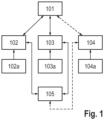
- Figure 1 presents a high level diagram of a system according to the present invention.
- the system comprises a server 101 (or otherwise a remote device) and a terminal 105 that are in communication with each other via at least two MNOs 102, 103, 104. At least two MNO are present according to the present invention while any additional MNO(s) are optional.
- the terminal 105 selects one MNO 101 as the primary MNO that delivers pQoS 1 higher than a pQoS 2 of an alternative, secondary MNO. Because the pQoS 1 is higher than the pQoS 2 the respective data rate 1 of the primary MNO is higher than that data rate 2 of the alternative, secondary MNO.
- the configuration of the different data rates for each MNO may be determined by the terminal 105 alone (for example based on one or more pre-defined configurations) or the different data rates for each MNO may be configured by the remote device 101 explicitly by means of configuration transmitted to a UE in advance as also described below with reference to figure 3 .
- the pre-determined configuration may be for example one of:
- the third configuration there may be present more than three data rates that will be selected according to the configured number of MNOs.
- the configuration 3 when there are two MNOs and the configuration 3 is applied, then only the first two data rates will be used while omitting the remaining ones.
- the video configuration may explicitly identify a video codec such as MPEG-2, H.264, VC-1 and correspondingly the audio configuration may explicitly identify an audio codec such as, ACC, MP3, WMA.
- a video codec such as MPEG-2, H.264, VC-1
- the audio configuration may explicitly identify an audio codec such as, ACC, MP3, WMA.
- FIG. 2 presents a diagram of a method according to the present invention.
- a terminal enters a state requiring data streaming from the UE (105) to a remote device.
- the terminal determines 202 quality of service, QoS, for each of the MNOs, and determines 203 a first QoS for a first data rate of the data streaming.
- the terminal determines 204 a second QoS for a second data rate of the data streaming wherein the second data rate is lower than the first data rate.
- the terminal selects 205 a first MNO that supports the first QoS, and selects 206 at least one second MNO, different from the first MNO, that supports the second QoS.
- the terminal transmits 207 the first data streaming to the first MNO at the first data rate, and transmits 208 the second data streaming to the at least one second MNO at the second data rate.
- a correspondence between the streams may be explicitly indicated by the terminal to the server.
- correspondence information may be embedded in the first data streaming and the second data streaming or be communicated separately.
- each data stream may have its identifier and a pair of such identifiers will map both streams to one another.
- Explicit identification that the first data streaming and the second data streaming correspond to one another may be beneficial in some scenarios and allows a server to quickly discard redundant data of the one or more data streams of lower quality if a corresponding data stream of higher quality is available.
- Figure 3 presents a diagram of a configuration data container for a terminal.
- a configuration container may be called a multi MNO session config 301.
- the multi MNO session config indicates at least a number of MNOs 302 and may further configure each MNO expected data rates independently.
- the configuration may be explicitly given as 'data stream config 1' 303 and or the first MNO the configuration may be explicitly given as 'data stream config 2' 304.
- additional 'data stream config n' may be given for each of the MNOs in addition to the first and second MNOs.
- the configurations 1 to 3 given in relation to figure 1 above may be delivered to the terminal 105 from the server 101 using the configuration data container described with reference to figure 3 .
Landscapes
- Engineering & Computer Science (AREA)
- Multimedia (AREA)
- Signal Processing (AREA)
- Computer Networks & Wireless Communication (AREA)
- Computer Security & Cryptography (AREA)
- Two-Way Televisions, Distribution Of Moving Picture Or The Like (AREA)
Abstract
Description
- The present disclosure relates to a method for improving service reliability in critical applications requiring data streaming in mobile communication. Particularly, the method is applicable when there are more than one mobile network operators, MNOs, providing mobile communication service to a receiver (or otherwise to a terminal or more generically to a device).
- Prior art defines an automated vehicle, also known as an AV, an autonomous vehicle, a selfdriving car, a driverless car, a robo-car, or a robotic car, which is a vehicle that is capable of sensing its environment and moving safely with little or no human input. Frequently when such AVs operate autonomously or are tele-operated, data streaming is exchanged between an AV and a control center. Such data streaming may include any of audio, video, or an audio/video streaming. With respect to video streaming, adaptive protocols are now widespread among multiple day-to-day services. Those applications that rely on timely delivery of the best possible video experience make use of several data streams of video at different qualities, from which the client can choose based on preference, link capacity, or end-device. However, these different data streams are generally offered through the same path, routing-wise, and the capacity of the server is always assumed sufficient.
- Further, automotive applications and mobile communications become more and more entangled, particularly due to the increasing interest in automatic driving that requires larger amounts of data when compared to conventional driving. These data amounts are provided partially by the vehicle itself (i.e., by sensors thereof) and partially via an air/radio interface. Via the air interface such as a vehicle to vehicle, V2V, communication or a vehicle to infrastructure, V2I, communication or a vehicle to everything, V2X, communication is carried out, the latter including communication with road side units, RSUs.
- In such state-of-the-art systems efficient mobile communication is essential, which depending on a criticality of a particular operation must also meet certain requirements concerning quality of service, QoS.
- In this context, for example a 3GPP 5G radio communication system can support demanding QoS requirements of many advanced V2X use cases and their corresponding applications. However, efficient driving, especially of automated vehicles, may be affected by sudden changes of the provided QoS. For that reason, a prediction of QoS changes and early notification of these predicted changes to vehicles recently have been enabled for example by the 3GPP 5G communication systems. This approach enables vehicles to avoid or mitigate effects of sudden QoS changes at application level. Naturally such predicted QoS influences possibilities of data streaming delivery.
- A predicted QoS, pQoS, may for example be used to plan execution of a route or on a lower level to plan a specific maneuver of an AV. If, for example, the pQoS does not meet the requirements long enough, an application will not perform a given action. Typically, applications adapt to a pQoS time series, so that an improved or even optimal target distance planning can be achieved to fully utilize the most out of the predicted QoS feature.
- It is already foreseen that AVs will need the support of multiple MNOs. To address the topic of multi MNO architectures, its API, and its challenges the CAMARA project has been started i.e. the "CAMARA: Telco Global API Alliance" aimed at Enabling Seamless Access to Telco Network Capabilities. CAMARA works in close collaboration with the GSMA Operator Platform Group to align API requirements and publish API definitions and APIs. Different MNOs have distinct networks and also use distinct pQoS models and learning methods to predict the future QoS for user devices such as AVs. Also, usually the pQoS levels differ at one location between different MNOs. Regardless of the specific perks for implementation, multi-MNO connectivity adds a layer of redundancy to the channel that can be used for increased reliance on the link. In this paradigm, a conventional approach is to balance the traffic among MNOs based on link quality, location or upon shortages of the currently active one.
- In the execution of an application between a terminal and an application service, such as video streaming towards a remote operator for remote guidance, resolution of transmitted video will depend on channel conditions and the experienced QoS, which are at the same time are dependent on an MNO. Conventional adaptive streaming protocols make use of different streams of videos of different resolutions. The videos are divided into segments, and the clientserver connection evaluates the quality of the connection to select a segment of the appropriate resolution considering such quality. In case of a sudden change of QoS (such as those in a fastmoving vehicular scenario), a 1-to-1 video streaming using one MNO may not have enough time to react to adapt the streaming resolution, which may result in loss of the video stream.
- It is thus an object of the present disclosure to overcome or reduce at least some of the drawbacks of the prior art and to provide a method for improving service reliability in critical applications requiring data streaming in mobile communication. Particularly, when there are more than one mobile network operators, MNOs, providing mobile communication service to a receiver/terminal. The given task is solved by the subject-matter of the independent claim 1. Advantageous embodiments of the invention can further be gained from the dependent claims and/or optional features of the description.
- In the case for an adaptive streaming server which has access to multi-MNO connectivity to transmit different data streams, it is so far unclear how can the multiple connectivity streams be used to guarantee the best user experience and a reliable data stream. Further, it is undefined so far how can adaptive streaming be realized Multi-MNO scenarios where the connection with each MNO offers a different QoS. Therefore, the present disclosure addresses these problems as follows.
- A first aspect of the invention refers to a method for adaptive streaming in a user equipment, UE, connected to more than one mobile network operator, MNO, the method comprising the steps of: entering a state requiring data streaming from the UE to a remote device, determining quality of service, QoS, for each of the MNOs, determining a first QoS for a first data rate of the data streaming, determining a second QoS for a second data rate of the data streaming wherein the second data rate is lower than the first data rate, selecting a first MNO that supports the first QoS, selecting at least one second MNO, different from the first MNO, that supports the second QoS, transmitting to the remote device the first data streaming, via the first MNO, at the first data rate, and transmitting to the remote device the second data streaming, via at least one second MNO, at the second data rate.
- The benefit of the method according to the first aspect of the present disclosure that the reliability of data streaming and/or the flexibility to change the resolution are enhanced. Further, there is no MNOs switching when data delivery problems occur because the additional one or more MNOs are always delivering the second, backup data streaming. The first data streaming and the second data streaming may originate from the same initial data stream, for example a RAW data stream captured by a camera and/or a microphone. In other words, the first data streaming is a higher quality version of the second data streaming.
- The step of entering a state requiring data streaming from the UE to a remote device (e.g. a server device at a control center) may be initiated by the UE, for example as a result of an accident of other unexpected scenario that might require assistance of a control center, or may be initiated by the control center, for example on a scheduled basis or for example for a routine check of an AV. Although, the terminal may be an AV the first aspect of the present disclosure is not limited thereto.
- Optionally, such an AV may specifically plan driving routes so that there is always available one or more of the second MNOs in addition to the first MNO. Such planning allows to address critical movement scenarios, for example of very important persons or goods. In an exemplary scenario a terminal selects among the MNOs that can support the service with the required QoS (i.e. the pQoS profile can support the expected data rate) the one with better pQoS estimation to transmit the desired resolution. This MNO may be labelled as MNObest. Subsequently, the terminal selects at least one of the MNOs that have a pQoS lower than MNObest (ordered by quality) to transmit at least one lower resolution. Consequently, an AV using tele-operated driving in a safety-critical scenario can transmit a low quality video in the second best MNO-pQoS as a backup stream for safety reasons, while transmitting e.g. Full-HD with the best MNO-pQoS for better user experience at the remote operator's side.
- The step of determining QoS for each of the MNOs may be location, network and time dependent and once any of these factors change (which may be determined by the UE) the terminal may re-execute the determining step and execute again the steps of the method that follow the determining step. For example when a location A changes to location B the first MNO may be maintained while the second MNO may change to a different MNO.
- According to an option of the first aspect of the present invention the state requiring data streaming is any one of a tele-operated driving, a tele-operated assistance or a hazard-resolution state, which are typically initiated by the terminal (although the state may also be explicitly requested remotely from the control center). In such scenarios it is particularly important to support reliability of data streaming or the flexibility to change the data quality in the data streaming. Delivery of different data streams of the same source content (after processing) over different MNOs is beneficial to mitigate the switching lag required for adaptive streaming when only one delivery path is available.
- According to an option according to any previous variants of the first aspect of the present invention the data streaming is any one of audio, video, or an audio/video streaming. In some tele-operation video data may be sufficient without audio, while in others audio/video data streams are necessary.
- According to an option according to any previous variants of the first aspect of the present invention the different data rates of the data streaming result from any one or more of different resolutions, different quality levels, different encoding methods, different sampling rate. The reduced data rate is preferably selected so as not to significantly impair the control actions effected by the control center. According to one example the video resolution according to the first data rate may be 1440p while the video resolution according to the second data rate may be 720p i.e. four times less pixels. The resolution change may be combined with other data reduction techniques such as compression. For example, the compression according to the first data rate may be a lossless compression while the compression according to the second data rate may be lossy compression. In other examples, the first data rate stream may comprise audio and video while the second data rate stream may comprise video only. The sampling rate may concern audio sampling rate e.g. 44kHz and/or a video sampling rate expressed as frames per second, fps, such as 60fps or 30fps. Such data rate optimization techniques for the second data stream allow sufficient operability by a control center while being instantly available in case that the data streaming according to the first data rate fails. Moreover, the configuration of the different data rates for each MNO may be determined by the terminal alone (for example based on one or more pre-defined configurations) or the different data rates for each MNO may be configured by the remote device explicitly by means of configuration transmitted to a UE in advance.
- According to an option according to any previous variants of the first aspect of the present invention the QoS, for each of the MNOs, is a predictive QoS, pQoS. In such a case, a pQoS is a prediction and the corresponding pQoS model applies different approaches to arrive at predicted QoS. Such approaches may include Artificial Intelligence learning models to improve predictions of pQoS. Therefore, predicting the QoS requirements of a receiver/terminal in given circumstances before executing the corresponding services can potentially improve offering the most suitable services. Naturally, pQoS is also based on input parameters, such as environmental parameters of the receiver/terminal, which also may be differently treated by a pQoS model. Therefore, the variety of pQoS models is significant.
- According to an option according to any previous variants of the first aspect of the present invention the pQoS determined for each of the MNOs are mapped to a common pQoS format. Having a common understanding of different pQoS indications available from different MNOs advantageously allows to efficiently configure an application of a receiver/terminal thereby often reducing a number of adaptations of the application operation due to a mismatch between a pQoS of different MNOs and/or a mismatch of different pQoSs and actual QoS.
- According to an option according to any previous variants of the first aspect of the present invention, when there are more than one second MNOs the second data rate differs among the second MNOs. This feature allows to control the level of redundancy of the additional data streams that are generated and transmitted to the server. For very critical scenarios, the terminal may determine (according to one or more pre-defined configurations) or be configured (for example by the remote device) to apply two or more redundant data streams thereby utilizing for example three MNOs.
- Correspondingly to the first aspect of the disclosure a second aspect of the present disclosure is a user equipment, UE, the UE comprising a processor configured to: enter a state requiring data streaming from the UE to a remote device, determine quality of service, QoS, for each of the MNOs, determine a first QoS for a first data rate of the data streaming, determine a second QoS for a second data rate of the data streaming wherein the second data rate is lower than the first data rate, select a first MNO that supports the first QoS, select at least one second MNO, different from the first MNO, that supports the second QoS, transmit to the remote device the first data streaming, via the first MNO, at the first data rate, and transmit to the remote device the second data streaming, via at least one second MNO, at the second data rate.
- According to an option according to any previous variants of the second aspect of the present invention the UE is an automatic vehicle. In other variants the UE may be a part of the automatic vehicle or part of a vehicle in general.
- According to an option according to any previous variants of the second aspect of the present invention the state requiring data streaming is any one of a tele-operated driving, a tele-operated assistance or a hazard-resolution state.
- According to an option according to any previous variants of the second aspect of the present invention the data streaming is any one of audio, video, or an audio/video streaming and wherein the different data rates of the data streaming result from any one or more of different resolutions, different quality, different encoding methods, different sampling rate.
- According to an option according to any previous variants of the second aspect of the present invention the QoS is a predictive QoS, pQoS, and the pQoS determined for each of the MNOs are mapped to a common pQoS format.
- According to an option according to any previous variants of the second aspect of the present invention wherein when there are more than one second MNOs the second data rate differs among the second MNOs.
- A third aspect of the present invention is a computer program comprising instructions which, when the program is executed by a computer, cause the computer to carry out all the steps of the method of the first aspect of the present disclosure according to any variants thereof presented above.
- A fourth aspect of the present invention is a computer-readable storage medium comprising instructions which, when executed by a computer, cause the computer to carry out all the steps of the method of the first aspect of the present disclosure according to any variants thereof presented above.
- Such computer programs are typically executed by utilizing the computing resources in a computing device e.g. a processor or a controller. Applications are stored on a non-transitory medium. An example of a non-transitory medium is a non-volatile memory, for example a flash memory while an example of a volatile memory is RAM. The computer instructions are typically executed by a processor. These memories are exemplary recording media for storing computer programs comprising computer-executable instructions performing all the steps of the computerimplemented method according the technical concept presented herein.
- The various embodiments of the invention mentioned herein can be advantageously combined with each other, unless otherwise specified in the individual case.
- Various objects and advantages of the present invention will become apparent to those skilled in the art from the following detailed description of embodiments, when read in light of the accompanying drawings.
- Reference is now made to the following figures, in order to describe preferred embodiments of the invention in more detail.
- Figure 1
- presents a high level diagram of a system according to the present invention,
- Figure 2
- presents a diagram of a method according to the present invention, and
- Figure 3
- presents a diagram of a configuration data container for a terminal.
- Some portions of the detailed description which follows are presented in terms of data processing procedures, steps or other symbolic representations of operations on data bits that can be performed on computer memory. Therefore, a computer executes such logical steps thus requiring physical manipulations of physical quantities.
- Usually these quantities take the form of electrical or magnetic signals capable of being stored, transferred, combined, compared, and otherwise manipulated in a computer system. For reasons of common usage, these signals are referred to as bits, packets, messages, values, elements, symbols, characters, terms, numbers, or the like.
- Additionally, all of these and similar terms are to be associated with the appropriate physical quantities and are merely convenient labels applied to these quantities. Terms such as "processing" or "creating" or "transferring" or "executing" or "determining" or "detecting" or "obtaining" or "selecting" or "calculating" or "generating" or the like, refer to the action and processes of a computer system that manipulates and transforms data represented as physical (electronic) quantities within the computer's registers and memories into other data similarly represented as physical quantities within the memories or registers or other such information storage.
- As utilized herein, the term "example" means serving as a non-limiting example, instance, or illustration. As utilized herein, the terms "for example" and "e.g." introduce a list of one or more non-limiting examples, instances, or illustrations.
- As used herein, the term "and/or" includes any and all combinations of one or more of the associated listed items. Further, the use of "may" when describing embodiments of the present invention refers to "one or more embodiments of the present invention." Further, in the following description of embodiments of the present invention, the terms of a singular form may include plural forms unless the presented context clearly indicates otherwise.
- It will be understood that although the terms "first" and "second" are used to describe various elements, these elements should not be limited by these terms. These terms are only used to distinguish one element from another element. For example, a first element may be named a second element and, similarly, a second element may be named a first element, without departing from the scope of the present invention. As used herein, the term "and/or" includes any and all combinations of one or more of the associated listed items and expressions such as "at least one of" when preceding a list of elements, modify the entire list of elements.
- Reference will now be made in detail to embodiments which are illustrated in the drawings. Effects and features of the exemplary embodiments will be described with reference to the accompanying drawings. Therein, like reference numerals denote like elements, and redundant descriptions are omitted. The present invention, however, may be embodied in various different forms, and should not be construed as being limited to only the illustrated embodiments herein. Rather, these embodiments are provided solely as examples for fully conveying the aspects and features of the present invention to those skilled in the art.
-
Figure 1 presents a high level diagram of a system according to the present invention. The system comprises a server 101 (or otherwise a remote device) and a terminal 105 that are in communication with each other via at least twoMNOs server 101 it selects oneMNO 101 as the primary MNO that delivers pQoS 1 higher than a pQoS 2 of an alternative, secondary MNO. Because the pQoS 1 is higher than the pQoS 2 the respective data rate 1 of the primary MNO is higher than that data rate 2 of the alternative, secondary MNO. - The configuration of the different data rates for each MNO may be determined by the terminal 105 alone (for example based on one or more pre-defined configurations) or the different data rates for each MNO may be configured by the
remote device 101 explicitly by means of configuration transmitted to a UE in advance as also described below with reference tofigure 3 . - The pre-determined configuration may be for example one of:
- Configuration 1:
- Data Rate 1:
- video: 1080p
- audio: stereo 48kHz, 192 Kbps
- Data Rate 2:
- video: 720p
- audio: mono 44KHz, 64 Kbps
- Data Rate 1:
- Configuration 2:
- Data Rate 1:
- video: 1080p, 60fps
- audio: stereo 48kHz, 192 Kbps
- Data Rate 2:
- video: 720p, 30fps
- audio: mono 44KHz, 64 Kbps
- Data Rate 1:
- Configuration 3:
- Data Rate 1:
- video: 1440p
- audio: stereo 48kHz, 192 Kbps
- Data Rate 2:
- video: 1080p
- audio: mono 44KHz, 64 Kbps
- Data Rate 3:
- video: SD (Standard Definition)
- audio: none
- Data Rate 1:
- In the third configuration there may be present more than three data rates that will be selected according to the configured number of MNOs. On the other hand when there are two MNOs and the configuration 3 is applied, then only the first two data rates will be used while omitting the remaining ones. In other cases, there may be a specific, dedicated configuration for a configured number of simultaneously used MNOs, for example 2, 3, 4 etc. This allows to configure for example MNO 2 with the data rate 2 differently when there are 2 MNOs and when there are 3 MNOs.
- Optionally, the video configuration may explicitly identify a video codec such as MPEG-2, H.264, VC-1 and correspondingly the audio configuration may explicitly identify an audio codec such as, ACC, MP3, WMA.
-
Figure 2 presents a diagram of a method according to the present invention. At step 201 a terminal enters a state requiring data streaming from the UE (105) to a remote device. Subsequently, the terminal determines 202 quality of service, QoS, for each of the MNOs, and determines 203 a first QoS for a first data rate of the data streaming. After that, the terminal determines 204 a second QoS for a second data rate of the data streaming wherein the second data rate is lower than the first data rate. Based on the above the terminal selects 205 a first MNO that supports the first QoS, and selects 206 at least one second MNO, different from the first MNO, that supports the second QoS. Once set up, the terminal transmits 207 the first data streaming to the first MNO at the first data rate, and transmits 208 the second data streaming to the at least one second MNO at the second data rate. - Although normally the application managing the communication (either on the terminal or on the server) will be aware that the terminal transmits the first data streaming and the second data streaming because they are explicitly requested, a correspondence between the streams may be explicitly indicated by the terminal to the server. Such correspondence information may be embedded in the first data streaming and the second data streaming or be communicated separately. For example each data stream may have its identifier and a pair of such identifiers will map both streams to one another. Explicit identification that the first data streaming and the second data streaming correspond to one another may be beneficial in some scenarios and allows a server to quickly discard redundant data of the one or more data streams of lower quality if a corresponding data stream of higher quality is available.
- It is clear that the invention also lies in a
server 101 exchanging communication with theUE 105 as explained above with reference tofigure 2 . -
Figure 3 presents a diagram of a configuration data container for a terminal. Such a configuration container may be called a multiMNO session config 301. The multi MNO session config indicates at least a number ofMNOs 302 and may further configure each MNO expected data rates independently. For example, for the first MNO the configuration may be explicitly given as 'data stream config 1' 303 and or the first MNO the configuration may be explicitly given as 'data stream config 2' 304. Depending on the number ofMNOs 302, additional 'data stream config n' may be given for each of the MNOs in addition to the first and second MNOs. The configurations 1 to 3 given in relation tofigure 1 above may be delivered to the terminal 105 from theserver 101 using the configuration data container described with reference tofigure 3 . -
- 101
- Server
- 102
- MNO 1
- 103
- MNO 2
- 104
- MNO n
- 105
- Terminal
- 102a
- pQoS 1 and Data Rate 1 for MNO 1
- 103a
- pQoS 2 and Data Rate 2 for MNO 2
- 104a
- pQoS n and Data Rate n for MNO n
- 201
- entering a state requiring data streaming from the UE to a remote device
- 202
- determining quality of service, QoS, for each of the MNOs
- 203
- determining a first QoS for a first data rate of the data streaming
- 204
- determining a second QoS for a second data rate of the data streaming wherein the second data rate is lower than the first data rate
- 205
- selecting a first MNO that supports the first QoS
- 206
- selecting at least one second MNO, different from the first MNO, that supports the second QoS
- 207
- transmitting the first data streaming to the first MNO at the first data rate
- 208
- transmitting the second data streaming to the at least one second MNO at the second data rate
- 301
- Multi MNO session config
- 302
- no. of MNOs
- 303
- Data stream config 1
- 304
- Data stream config 2
- 305
- Data stream config n
Claims (15)
- A method for adaptive streaming in a user equipment, UE (105), connected to more than one mobile network operator, MNO (102 to 104), the method comprising the steps of:entering (201) a state requiring data streaming from the UE (105) to a remote device,determining (202) quality of service, QoS, for each of the MNOs (102 to 104),determining (203) a first QoS for a first data rate of the data streaming,determining (204) a second QoS for a second data rate of the data streaming wherein the second data rate is lower than the first data rate,selecting (205) a first MNO that supports the first QoS,selecting (206) at least one second MNO, different from the first MNO, that supports the second QoS,transmitting (207) to the remote device the first data streaming, via the first MNO, at the first data rate, andtransmitting (208) to the remote device the second data streaming, via at least one second MNO, at the second data rate.
- The method according to claim 1, wherein the state requiring data streaming is any one of a tele-operated driving, a tele-operated assistance or a hazard-resolution state.
- The method according to any one of the preceding claims, wherein the data streaming is any one of audio, video, or an audio/video streaming.
- The method according to any one of the preceding claims, wherein the different data rates of the data streaming result from any one or more of different resolutions, different quality levels, different encoding methods, different sampling rate.
- The method according to any one of the preceding claims, wherein QoS, for each of the MNOs (102 to 104), is a predictive QoS, pQoS.
- The method according to claim 5, wherein the pQoS determined for each of the MNOs are mapped to a common pQoS format.
- The method according to any one of the preceding claims, wherein, when there are more than one second MNOs, the second data rate differs among the second MNOs.
- A user equipment, UE (105), the UE comprising a processor configured to:enter (201) a state requiring data streaming from the UE (105) to a remote device,determine (202) quality of service, QoS, for each of the MNOs (102 to 104),determine (203) a first QoS for a first data rate of the data streaming,determine (204) a second QoS for a second data rate of the data streaming wherein the second data rate is lower than the first data rate,select (205) a first MNO that supports the first QoS,select (206) at least one second MNO, different from the first MNO, that supports the second QoS,transmit (207) to the remote device the first data streaming, via the first MNO, at the first data rate, andtransmit (208) to the remote device the second data streaming, via at least one second MNO, at the second data rate.
- The UE of claim 8, wherein the UE is part of a vehicle.
- The UE of any of claims 8 or 9, wherein the state requiring data streaming is any one of a tele-operated driving, a tele-operated assistance or a hazard-resolution state.
- The UE of any of claims 8 to 10, wherein the data streaming is any one of audio, video, or an audio/video streaming and wherein the different data rates of the data streaming result from any one or more of different resolutions, different quality levels, different encoding methods, different sampling rate.
- The UE of any of claims 8 to 11, wherein the QoS is a predictive QoS, pQoS, and
wherein the pQoS determined for each of the MNOs are mapped to a common pQoS format. - The UE of any of claims 8 to 12, wherein, when there are more than one second MNOs, the second data rate differs among the second MNOs.
- A computer program comprising instructions which, when the program is executed by a device, preferably the UE (105) according to any one of the claims 8 to 13, cause the device, preferably the UE (105) according to any one of the claims 8 to 13, to carry out all the steps of the method according to any of claims 1 to 7.
- A computer-readable storage medium comprising instructions which, when executed by a device, preferably the UE (105) according to any one of the claims 8 to 13, cause the device, preferably the UE (105) according to any one of the claims 8 to 13, to carry out all the steps of the method according to any of claims 1 to 7.
Priority Applications (1)
| Application Number | Priority Date | Filing Date | Title |
|---|---|---|---|
| EP23193304.5A EP4513854A1 (en) | 2023-08-24 | 2023-08-24 | Adaptive streaming for a multi-mno-enabled user equipment |
Applications Claiming Priority (1)
| Application Number | Priority Date | Filing Date | Title |
|---|---|---|---|
| EP23193304.5A EP4513854A1 (en) | 2023-08-24 | 2023-08-24 | Adaptive streaming for a multi-mno-enabled user equipment |
Publications (1)
| Publication Number | Publication Date |
|---|---|
| EP4513854A1 true EP4513854A1 (en) | 2025-02-26 |
Family
ID=87845627
Family Applications (1)
| Application Number | Title | Priority Date | Filing Date |
|---|---|---|---|
| EP23193304.5A Pending EP4513854A1 (en) | 2023-08-24 | 2023-08-24 | Adaptive streaming for a multi-mno-enabled user equipment |
Country Status (1)
| Country | Link |
|---|---|
| EP (1) | EP4513854A1 (en) |
Citations (3)
| Publication number | Priority date | Publication date | Assignee | Title |
|---|---|---|---|---|
| US20190086217A1 (en) * | 2017-09-20 | 2019-03-21 | Ford Global Technologies, Llc | Method and apparatus for route planning accomodating data transfer |
| US20200351322A1 (en) * | 2019-04-30 | 2020-11-05 | Phantom Auto Inc. | Low latency wireless communication system for teleoperated vehicle environments |
| WO2022206771A1 (en) * | 2021-03-31 | 2022-10-06 | 华为技术有限公司 | Screen projection method, electronic device, and system |
-
2023
- 2023-08-24 EP EP23193304.5A patent/EP4513854A1/en active Pending
Patent Citations (4)
| Publication number | Priority date | Publication date | Assignee | Title |
|---|---|---|---|---|
| US20190086217A1 (en) * | 2017-09-20 | 2019-03-21 | Ford Global Technologies, Llc | Method and apparatus for route planning accomodating data transfer |
| US20200351322A1 (en) * | 2019-04-30 | 2020-11-05 | Phantom Auto Inc. | Low latency wireless communication system for teleoperated vehicle environments |
| WO2022206771A1 (en) * | 2021-03-31 | 2022-10-06 | 华为技术有限公司 | Screen projection method, electronic device, and system |
| EP4290360A1 (en) * | 2021-03-31 | 2023-12-13 | Huawei Technologies Co., Ltd. | Screen projection method, electronic device, and system |
Non-Patent Citations (1)
| Title |
|---|
| ETSI SECRETARIAT: "LS from 5GAA on potential enhancements to MEC VIS API", vol. ISG MEC Multi-access Edge Computing, 31 March 2022 (2022-03-31), pages 1 - 33, XP014425939, Retrieved from the Internet <URL:ftp://docbox.etsi.org/ISG/MEC/05-Contributions/2022/MEC(22)000183_LS_from_5GAA_on_potential_enhancements_to_MEC_VIS_API.zip 5GAA_220317_gMEC4AUTO_Task3_TP Baseline-cl.docx> [retrieved on 20220331] * |
Similar Documents
| Publication | Publication Date | Title |
|---|---|---|
| KR102806947B1 (en) | Devices, systems and methods for autonomous and remotely operated vehicles | |
| JP7504128B2 (en) | SYSTEM AND METHOD FOR MANAGING V2X COMMUNICATIONS BETWEEN A VEHICLE AND A RECEIVING DEVICE - Patent application | |
| US20190029002A1 (en) | Intelligent vehicle-based communication mangement | |
| US10757711B2 (en) | Vehicle terminal and operation method thereof | |
| El Marai et al. | Smooth and low latency video streaming for autonomous cars during handover | |
| CN108351215B (en) | Method and device for switching roadside navigation unit in navigation system | |
| CN113611098B (en) | Remote driving control method, device, computer readable medium and electronic device | |
| US11354158B2 (en) | Platooning of computational resources in automated vehicles networks | |
| US20240053744A1 (en) | Methods, Computer Programs and Apparatus for Performing a Teleoperated Driving Session | |
| JP2020513708A (en) | Interface, vehicle control system and network equipment for combining vehicle control with communication services | |
| US20200068412A1 (en) | Method for controlling a wireless communication system | |
| EP3964909B1 (en) | Methods, computer programs, apparatuses for a vehicle and a control center for resolving a deadlock traffic situation of an automatically operated vehicle | |
| US20220089182A1 (en) | Method and device for controlling applications distributed between a vehicle and a cloud | |
| US11755010B2 (en) | Automatic vehicle and method for operating the same | |
| US20240422616A1 (en) | Method for determining an effective quality of service, qos, in mobile communication | |
| US20190244532A1 (en) | Optimized data transmission between an unmanned aerial vehicle and a telecommunications network | |
| KR20230050381A (en) | A method of operating a UE related to sensor raw data sharing and feedback in a wireless communication system. | |
| US20200084685A1 (en) | Communication method, electronic device, and communication system | |
| EP4513141A1 (en) | Method and apparatus for determining route feasibility | |
| EP4513852A1 (en) | Adaptive streaming for a multi-mno-enabled electronic device | |
| EP4518435A1 (en) | Method for ensuring communication path redundancy along a route | |
| JP2022170889A (en) | Communication device, communication method, and communication system | |
| Bendrick et al. | Teleoperation as a step towards fully autonomous systems | |
| CN113703441B (en) | Control method, device and system of unmanned equipment | |
| US20240422614A1 (en) | Method for determining a predictive quality of service, pqos, in mobile communications |
Legal Events
| Date | Code | Title | Description |
|---|---|---|---|
| PUAI | Public reference made under article 153(3) epc to a published international application that has entered the european phase |
Free format text: ORIGINAL CODE: 0009012 |
|
| STAA | Information on the status of an ep patent application or granted ep patent |
Free format text: STATUS: THE APPLICATION HAS BEEN PUBLISHED |
|
| AK | Designated contracting states |
Kind code of ref document: A1 Designated state(s): AL AT BE BG CH CY CZ DE DK EE ES FI FR GB GR HR HU IE IS IT LI LT LU LV MC ME MK MT NL NO PL PT RO RS SE SI SK SM TR |
|
| STAA | Information on the status of an ep patent application or granted ep patent |
Free format text: STATUS: REQUEST FOR EXAMINATION WAS MADE |
|
| 17P | Request for examination filed |
Effective date: 20250826 |
|
| STAA | Information on the status of an ep patent application or granted ep patent |
Free format text: STATUS: EXAMINATION IS IN PROGRESS |
|
| 17Q | First examination report despatched |
Effective date: 20251203 |