EP4513480A1 - Hardware-oriented deep spiking neural network speech recognition method and system - Google Patents
Hardware-oriented deep spiking neural network speech recognition method and system Download PDFInfo
- Publication number
- EP4513480A1 EP4513480A1 EP23917051.7A EP23917051A EP4513480A1 EP 4513480 A1 EP4513480 A1 EP 4513480A1 EP 23917051 A EP23917051 A EP 23917051A EP 4513480 A1 EP4513480 A1 EP 4513480A1
- Authority
- EP
- European Patent Office
- Prior art keywords
- layer
- neural network
- neuron
- pulse
- weight
- Prior art date
- Legal status (The legal status is an assumption and is not a legal conclusion. Google has not performed a legal analysis and makes no representation as to the accuracy of the status listed.)
- Pending
Links
Images


Classifications
-
- G—PHYSICS
- G10—MUSICAL INSTRUMENTS; ACOUSTICS
- G10L—SPEECH ANALYSIS TECHNIQUES OR SPEECH SYNTHESIS; SPEECH RECOGNITION; SPEECH OR VOICE PROCESSING TECHNIQUES; SPEECH OR AUDIO CODING OR DECODING
- G10L15/00—Speech recognition
- G10L15/08—Speech classification or search
- G10L15/16—Speech classification or search using artificial neural networks
-
- G—PHYSICS
- G10—MUSICAL INSTRUMENTS; ACOUSTICS
- G10L—SPEECH ANALYSIS TECHNIQUES OR SPEECH SYNTHESIS; SPEECH RECOGNITION; SPEECH OR VOICE PROCESSING TECHNIQUES; SPEECH OR AUDIO CODING OR DECODING
- G10L15/00—Speech recognition
- G10L15/02—Feature extraction for speech recognition; Selection of recognition unit
-
- G—PHYSICS
- G10—MUSICAL INSTRUMENTS; ACOUSTICS
- G10L—SPEECH ANALYSIS TECHNIQUES OR SPEECH SYNTHESIS; SPEECH RECOGNITION; SPEECH OR VOICE PROCESSING TECHNIQUES; SPEECH OR AUDIO CODING OR DECODING
- G10L15/00—Speech recognition
- G10L15/06—Creation of reference templates; Training of speech recognition systems, e.g. adaptation to the characteristics of the speaker's voice
- G10L15/063—Training
-
- G—PHYSICS
- G10—MUSICAL INSTRUMENTS; ACOUSTICS
- G10L—SPEECH ANALYSIS TECHNIQUES OR SPEECH SYNTHESIS; SPEECH RECOGNITION; SPEECH OR VOICE PROCESSING TECHNIQUES; SPEECH OR AUDIO CODING OR DECODING
- G10L25/00—Speech or voice analysis techniques not restricted to a single one of groups G10L15/00 - G10L21/00
- G10L25/27—Speech or voice analysis techniques not restricted to a single one of groups G10L15/00 - G10L21/00 characterised by the analysis technique
- G10L25/30—Speech or voice analysis techniques not restricted to a single one of groups G10L15/00 - G10L21/00 characterised by the analysis technique using neural networks
-
- G—PHYSICS
- G10—MUSICAL INSTRUMENTS; ACOUSTICS
- G10L—SPEECH ANALYSIS TECHNIQUES OR SPEECH SYNTHESIS; SPEECH RECOGNITION; SPEECH OR VOICE PROCESSING TECHNIQUES; SPEECH OR AUDIO CODING OR DECODING
- G10L25/00—Speech or voice analysis techniques not restricted to a single one of groups G10L15/00 - G10L21/00
- G10L25/03—Speech or voice analysis techniques not restricted to a single one of groups G10L15/00 - G10L21/00 characterised by the type of extracted parameters
- G10L25/24—Speech or voice analysis techniques not restricted to a single one of groups G10L15/00 - G10L21/00 characterised by the type of extracted parameters the extracted parameters being the cepstrum
Definitions
- the present invention belongs to the technical field of voice recognition and neuromorphic computing, and relates to a hardware-oriented deep pulse neural network voice recognition method and system.
- the spiking neural network simulates the working mechanism of human cranial neurons, and transmits information in the form of pulses.
- the film potential is accumulated, and when the accumulated film potential reaches a threshold, the neuron is activated to issue a pulse and is transferred to the next layer. If the film potential has not reached the threshold, the neuron is in an inactive state.
- This sparse, event-driven information processing mechanism gives the advantages of high efficiency and low power consumption of the spiking neural network, and is suitable for application deployment on resource-limited hardware devices.
- pulse neural networks are more and more concerned in voice recognition tasks.
- the pulse neural network voice models face the computer software platform, and when the training pulse neural network performs the voice recognition task, the high-dimensional voice data is directly used as the network input, and at the same time, in order to obtain better performance, the weight in the network uses the high-precision floating point number.
- the present invention provides a hardware-oriented deep pulse neural network voice recognition method and system, which are applied to the recognition of voice data, and the specific technical solutions thereof are as follows:
- a hardware-oriented deep pulse neural network voice recognition method comprising the following steps:
- the step 1 specifically includes: acquiring an audioMNIST open source voice data set, and dividing the audioMNIST open source voice data set into a training set and a test set.
- step 2 specifically includes the following sub-steps:
- Step 2.1 pre-processing the voice data, and first performing pre-emphasis, framing, and windowing operations on the voice data; then, performing fast Fourier transform on each frame of short-time analysis window to obtain a corresponding frequency spectrum; then obtaining a Mel frequency spectrum from the obtained frequency spectrum through a Mel filter group; and finally, performing discrete cosine transform on the Mel spectrum logarithm to obtain a Mel frequency cepstrum coefficient as a voice feature;
- Step 2.2 Encode the voice feature, set the total simulation time step as T, and at each time step, if the spectrum feature is greater than the random probability generated by the uniform distribution, the time step generates a pulse, the pulse value is 1, otherwise, the pulse value is 0, thereby encoding the real value of the spectrum feature into the pulse sequence represented by the discrete value of 0 and 1.
- step 3 specifically includes the following sub-steps:
- Step 3.1 The constructed deep pulse neural network model includes an input layer, an N hidden layer, and an output layer, and a full connection is used between layers.
- the input layer is configured to receive the encoded pulse sequence;
- the hidden layer is configured to learn features contained in the input pulse sequence;
- the output layer is configured to identify a voice category, one neuron represents a type of voice. For each input sample, calculate a pulse issue rate of each neuron in the output layer in the simulation time step, and a category represented by the neuron with the highest pulse issue rate is a predicted tag.
- V i n t is the film potential of the n th layer neuron i at the moment t
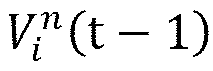
- V i n t ⁇ 1 is the film potential of the n th layer neuron i at the moment t - 1
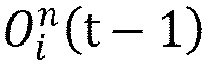
- O i n t ⁇ 1 is the output of the n th layer neuron i at the moment t - 1
- w ij n is the synaptic weight from the (n - 1) th layer neuron j to the n th layer neuron i
- O j n ⁇ 1 t ⁇ 1 is the output of the n - 1 th layer of neuron j at the moment t
- V th is the threshold of the neuron.
- step 4 specifically includes the following sub-steps:
- ⁇ L ⁇ V n t is the derivative of the loss function to the film potential
- step 5 specifically includes the following sub-steps:
- the present invention further comprises a hardware-oriented deep pulse neural network voice recognition system, comprising a data set acquisition module, a data preprocessing and encoding module, a network construction module, a network training storage module, and a quantization test module;
- the data set obtaining module is configured to obtain an audioMNIST open source voice data set, and divide a training set and a test set.
- the data preprocessing and encoding module is configured to perform feature extraction through the MFCC, obtain a low-dimensional feature from the high-dimensional voice data, and then encode and convert the obtained feature into a pulse sequence.
- the network construction module is configured to construct a deep pulse neural network including an input layer, N hidden layers, and an output layer, and a full connection is used between layers.
- the input layer receives the encoded pulse sequence; the hidden layers learn features contained in the input pulse sequence; and the output layer identifies the voice category.
- Each neuron in the model is a hardware-friendly integrated ignition model.
- the network training storage module is configured to obtain the pulse issuing rate of each neuron of the output layer, construct a mean square error loss function to calculate an error between the output layer pulse issuing rate and the sample label, and allocate the error to the weight of each layer of neurons through the space-time relationship between the layers of integrated ignition model film potentials by using a space-time inversion algorithm to optimize the network weight, and store the trained network weight.
- the quantization test module is configured to quantize the trained floating point weight into a fixed-point weight through a quantization operation, load a fixed-point weight, and recognize the test data set to obtain a predicted classification label.
- the present disclosure further provides a hardware-oriented deep pulse neural network voice recognition apparatus, including a memory and one or more processors, where the memory stores executable code, and when the one or more processors execute the executable code, the hardware-oriented deep pulse neural network voice recognition method of the present disclosure is implemented.
- a hardware-oriented deep pulse neural network voice recognition apparatus including a memory and one or more processors, where the memory stores executable code, and when the one or more processors execute the executable code, the hardware-oriented deep pulse neural network voice recognition method of the present disclosure is implemented.
- the present invention further provides a computer-readable storage medium, on which a program is stored, and when the program is executed by a processor, the hardware-oriented deep pulse neural network voice recognition method of the present disclosure is implemented.
- the hardware-oriented deep pulse neural network voice recognition model of the present invention converts the floating point weight into a low specific point weight, maintains the recognition accuracy similar to the floating point precision weight while reducing the recognition power consumption, and well ensures the deployment of the pulse neural network voice recognition model to the hardware device.
- the present invention provides a hardware-oriented deep pulse neural network voice recognition method and device
- the hardware-oriented deep pulse neural network voice recognition method of the present invention includes the following steps:
- Step 1 obtaining an open source voice data set, and dividing the open source voice data set into a training data set and a test data set;
- the voice data set is an audioMNIST open source voice data set, which is composed of 300000 audio samples, including 10 types of voice numbers from 0 to 9, and the audioMNIST data set is divided into a training set and a test set according to a proportion of 7: 3.
- Step 2 preprocessing the voice data set, obtaining a low-dimensional voice feature from the high-dimensional voice data, and encoding the low-dimensional voice feature into a pulse sequence;
- Step 2.2 The encoding process is specifically: in this embodiment, the total simulation time step T is set to 200, and at each time step, if the total simulation time step T is greater than the random probability generated by the uniform distribution, the time step generates a pulse, the pulse value is 1, otherwise, the pulse value is 0, thereby encoding the real value of the spectrum feature into a pulse sequence represented by 0, 1 discrete value, and the scale of the pulse sequence obtained after 1287 feature encoding is 1287 * 200 .
- step 3 constructing a deep pulse neural network model, wherein each neuron in the model adopts a hardware-friendly integrated ignition model;
- Step 3.1 As shown in the schematic diagram of the network structure in FIG. 4 , the deep pulse neural network model constructed in this example includes an input layer, the number of neurons in the input layer is 1287, the number of neurons of the input layer is consistent with the number of voice features of a single voice sample, a hidden layer includes 500 neurons, and an output layer includes 10 neurons, and a full connection is used between layers.
- the input layer is configured to receive the encoded pulse sequence; the hidden layer is configured to learn features contained in the input pulse sequence; and the output layer is configured to identify a voice category, one neuron represents a type of voice. For each input sample, calculate a pulse issue rate of each neuron in the output layer in 200 time steps, and a category represented by the neuron with the highest pulse issue rate is a predicted tag.
- V i n t is the film potential of the n th layer neuron i at the moment t
- V i n t ⁇ 1 is the film potential of the n th layer neuron i at the moment t - 1
- O i n t ⁇ 1 is the output of the n th layer neuron i at the moment t - 1
- w ij n is the synaptic weight from the (n - 1) th layer neuron j to the n th layer neuron i
- O j n ⁇ 1 t ⁇ 1 is the output of the n - 1th layer of neuron j at the moment t
- V th is the threshold of the neuron.
- V th 1
- ⁇ L ⁇ V n t is the derivative of the loss function to the film potential
- Step 4.3 Train the deep pulse neural network model on the training set, and in this embodiment, set the batch size to 20 for each batch, at each time step, load the pulse data obtained after encoding at this moment, the size is 20 * 1287, after 200 time steps, the pulse issuing rate of each neuron in the batch output layer is calculated, and the category represented by the neuron with the highest pulse issuing rate is the predicted label.
- the loss is calculated according to the predicted label and the actual label, the gradient of the loss to the weight is calculated by using a space-time anti-transmission algorithm, the network weight is optimized by using an Adam gradient descent algorithm, and the learning rate is set to 0.001. After 30 rounds of training, the network weight obtained after training is stored.
- Step 5 quantizing the floating point weight into a fixed-point weight, loading the quantized fixed-point weight by the deep pulse neural network model, identifying the test data set to obtain a predicted classification label, and realizing voice recognition of the hardware-oriented deep pulse neural network model.
- the quatiaed_W is a quantized fixed-point weight matrix
- W is a floating-point weight matrix
- bit is a quantized bit number
- bit 8
- Step 5.2 The deep pulse neural network model loads the quantized fixed-point weight, and for each sample of the test data set, at each time step, the pulse data obtained by encoding at the moment is loaded, the size is 1 * 1287, after 200 time steps, the pulse distribution rate of each neuron of the sample output layer is calculated, and the category represented by the neuron with the highest pulse issuing rate is the predicted label. The number of correctly predicted samples is counted, the recognition accuracy is calculated, and the recognition accuracy of the 32-bit floating point weight and the 8-bit fixed-point weight on the audioMNIST voice test set is given in Table 1. Simulation time step Dataset 32 32 - bit floating point weight 8bit 8 bit fixed-point weight 200 audioMNIST 98.78% 98.74%
- the hardware-oriented deep pulse neural network voice recognition method provided by the present invention reduces the weight precision while the recognition accuracy is basically not damaged, which can well ensure the deployment of the pulse neural network voice model trained by the software terminal on the resource-limited hardware device.
- a hardware-oriented deep pulse neural network voice recognition system of the present invention comprises a data set acquisition module 100, a data preprocessing and encoding module 200, a network construction module 300, a network training storage module 400, and a quantization test module 500;
- the data set acquisition module 100 is configured to obtain an audioMNIST open source voice data set, and divide a training set and a test set.
- the data preprocessing and encoding module 200 is configured to perform feature extraction on the training set and the test set divided by the data set acquisition module 100 through MFCC, obtain a low-dimensional feature from the high-dimensional voice data, and then encode and convert the obtained feature into a pulse sequence.
- the network construction module 300 is configured to construct a deep pulse neural network including an input layer, N hidden layers, and an output layer, and a full connection is used between layers.
- the input layer accepts the pulse sequence encoded by the data preprocessing and encoding module 200; the hidden layers learn features contained in the input pulse sequence; and the output layer identifies the voice category.
- Each neuron in the model is a hardware-friendly integrated ignition model.
- the network training storage module 400 is configured to obtain the pulse distribution rate of each neuron at the output layer of the network construction module 300, construct a mean square error loss function to calculate an error between the output layer pulse distribution rate and the sample label, and allocate the error to the weight of each layer of neurons through the space-time relationship between the layers of integrated ignition model film potentials by using a space-time inversion algorithm to optimize the network weight, and store the trained network weight.
- the quantization test module 500 is configured to quantize the floating point weight stored by the network training storage module 400 into a fixed-point weight through a quantization operation, and recognize the test data set to obtain a predicted classification label.
- each module of the hardware-oriented deep pulse neural network voice recognition system of the present disclosure specifically includes:
- ⁇ L ⁇ V n t is the derivative of the loss function to the film potential
- This embodiment provides a hardware-oriented deep pulse neural network voice recognition apparatus, including a memory and one or more processors, where the memory stores executable code, and when the one or more processors execute the executable code, the hardware-oriented deep pulse neural network voice recognition method for implementing Embodiment 1 is implemented.
- This embodiment further provides a computer-readable storage medium, on which a program is stored, and when the program is executed by a processor, the hardware-oriented deep pulse neural network voice recognition method according to Embodiment 1 is implemented.
- the embodiments of the present disclosure may be provided as a method, a system, or a computer program product. Accordingly, the present invention may take the form of an entirely hardware embodiment, an entirely software embodiment or an embodiment combining software and hardware aspects. Moreover, the present disclosure may use a form of a computer program product implemented on one or more computer-usable storage media (including but not limited to a disk memory, a CD-ROM, an optical memory, and the like) including computer-usable program codes.
- computer-usable storage media including but not limited to a disk memory, a CD-ROM, an optical memory, and the like
- the invention may be described in the general context of computer-executable instructions, such as program modules, being executed by a computer.
- program modules include routines, programs, objects, components, data structures, etc. that perform particular tasks or implement particular abstract data types.
- the invention may also be practiced in distributed computing environments where tasks are performed by remote processing devices that are connected through a communications network.
- program modules may be located in both local and remote computer storage media including storage devices.
Landscapes
- Engineering & Computer Science (AREA)
- Physics & Mathematics (AREA)
- Multimedia (AREA)
- Health & Medical Sciences (AREA)
- Audiology, Speech & Language Pathology (AREA)
- Human Computer Interaction (AREA)
- Computational Linguistics (AREA)
- Acoustics & Sound (AREA)
- Artificial Intelligence (AREA)
- Evolutionary Computation (AREA)
- Signal Processing (AREA)
- Computer Vision & Pattern Recognition (AREA)
- Complex Calculations (AREA)
- Image Analysis (AREA)
- Compression, Expansion, Code Conversion, And Decoders (AREA)
Abstract
Description
- The present invention belongs to the technical field of voice recognition and neuromorphic computing, and relates to a hardware-oriented deep pulse neural network voice recognition method and system.
- As a "third generation neural network", the spiking neural network simulates the working mechanism of human cranial neurons, and transmits information in the form of pulses. When a neuron receives a pulse, the film potential is accumulated, and when the accumulated film potential reaches a threshold, the neuron is activated to issue a pulse and is transferred to the next layer. If the film potential has not reached the threshold, the neuron is in an inactive state. This sparse, event-driven information processing mechanism gives the advantages of high efficiency and low power consumption of the spiking neural network, and is suitable for application deployment on resource-limited hardware devices. At present, pulse neural networks are more and more concerned in voice recognition tasks. Most of the pulse neural network voice models face the computer software platform, and when the training pulse neural network performs the voice recognition task, the high-dimensional voice data is directly used as the network input, and at the same time, in order to obtain better performance, the weight in the network uses the high-precision floating point number.
- However, models with high-dimensional inputs and high-precision floating-point weights are not suitable for bit-width-limited hardware devices, and software-end-trained pulse neural network voice models are difficult to deploy on resourceconstrained hardware devices.
- In order to solve the above technical problems in the prior art, the present invention provides a hardware-oriented deep pulse neural network voice recognition method and system, which are applied to the recognition of voice data, and the specific technical solutions thereof are as follows:
- A hardware-oriented deep pulse neural network voice recognition method, comprising the following steps:
- Step 1: obtaining an open source voice data set, and dividing the open source voice data set into a training data set and a test data set;
- Step 2: preprocessing the voice data set, obtaining a low-dimensional voice feature from the high-dimensional voice data, and encoding the low-dimensional voice feature into a pulse sequence;
- step 3: constructing a deep pulse neural network model, wherein each neuron in the model adopts a hardware-friendly integrated ignition model;
- step 4: constructing a loss function, optimizing the network weight by adopting a space-time anti-transmission algorithm, training the deep pulse neural network model on the training data set, and storing the updated network weight;
- Step 5: quantizing the floating point weight into a fixed-point weight, loading the quantized fixed-point weight by the deep pulse neural network model, identifying the test data set to obtain a predicted classification label, and realizing voice recognition of the hardware-oriented deep pulse neural network model.
- Further, the step 1 specifically includes: acquiring an audioMNIST open source voice data set, and dividing the audioMNIST open source voice data set into a training set and a test set.
- Further, the
step 2 specifically includes the following sub-steps: - Step 2.1, pre-processing the voice data, and first performing pre-emphasis, framing, and windowing operations on the voice data; then, performing fast Fourier transform on each frame of short-time analysis window to obtain a corresponding frequency spectrum; then obtaining a Mel frequency spectrum from the obtained frequency spectrum through a Mel filter group; and finally, performing discrete cosine transform on the Mel spectrum logarithm to obtain a Mel frequency cepstrum coefficient as a voice feature;
- Step 2.2: Encode the voice feature, set the total simulation time step as T, and at each time step, if the spectrum feature is greater than the random probability generated by the uniform distribution, the time step generates a pulse, the pulse value is 1, otherwise, the pulse value is 0, thereby encoding the real value of the spectrum feature into the pulse sequence represented by the discrete value of 0 and 1.
- Further, the step 3 specifically includes the following sub-steps:
- Step 3.1: The constructed deep pulse neural network model includes an input layer, an N hidden layer, and an output layer, and a full connection is used between layers. The input layer is configured to receive the encoded pulse sequence; the hidden layer is configured to learn features contained in the input pulse sequence; the output layer is configured to identify a voice category, one neuron represents a type of voice. For each input sample, calculate a pulse issue rate of each neuron in the output layer in the simulation time step, and a category represented by the neuron with the highest pulse issue rate is a predicted tag.
- Step 3.2, the neurons in the hidden layer and the output layer in the model both adopt an integrated ignition model, and the film potential of the neuron is calculated according to the following formula:


- Wherein,


- Further, the step 4 specifically includes the following sub-steps:
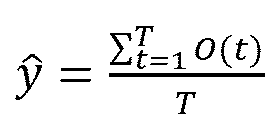
- Step 4.1: Construct a mean square error loss function Loss(y, y̌), The calculation formula is as follows:

- where y is a label of the training sample,
- ŷ is a statistical output layer neuron pulse emission rate,

- T is the total simulation time step.
- Step 4.2: Distribute the error through the space-time relationship between the film potentials of the integrated ignition model of each layer to the weight of each layer of neurons by using a space-time inversion algorithm, so as to optimize the network weight. The gradient of the loss to the network weight is:

- Wherein


- 2) When n is the hidden layer:

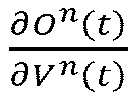
where h(Vn (t)) is a gradient substitution function of
- Step 4.3: Train the deep pulse neural network model on the training set, and store the network weight obtained after training.
- Further, the step 5 specifically includes the following sub-steps:
- Step 5.1: Quantize the floating point weight into a fixed-point weight, which is specifically expressed as follows:

- wherein quatized_W is a quantized fixed-point weight matrix, W is a floating-point weight matrix, and bit is a quantized bit number;
- Step 5.2: The deep pulse neural network model loads the quantized fixed-point weight, identifies the encoded test data set to obtain a predicted classification label, and implements voice recognition of the hardware-oriented deep pulse neural network model.
- The present invention further comprises a hardware-oriented deep pulse neural network voice recognition system, comprising a data set acquisition module, a data preprocessing and encoding module, a network construction module, a network training storage module, and a quantization test module;
- The data set obtaining module is configured to obtain an audioMNIST open source voice data set, and divide a training set and a test set.
- The data preprocessing and encoding module is configured to perform feature extraction through the MFCC, obtain a low-dimensional feature from the high-dimensional voice data, and then encode and convert the obtained feature into a pulse sequence.
- The network construction module is configured to construct a deep pulse neural network including an input layer, N hidden layers, and an output layer, and a full connection is used between layers. The input layer receives the encoded pulse sequence; the hidden layers learn features contained in the input pulse sequence; and the output layer identifies the voice category. Each neuron in the model is a hardware-friendly integrated ignition model.
- The network training storage module is configured to obtain the pulse issuing rate of each neuron of the output layer, construct a mean square error loss function to calculate an error between the output layer pulse issuing rate and the sample label, and allocate the error to the weight of each layer of neurons through the space-time relationship between the layers of integrated ignition model film potentials by using a space-time inversion algorithm to optimize the network weight, and store the trained network weight.
- The quantization test module is configured to quantize the trained floating point weight into a fixed-point weight through a quantization operation, load a fixed-point weight, and recognize the test data set to obtain a predicted classification label.
- The present disclosure further provides a hardware-oriented deep pulse neural network voice recognition apparatus, including a memory and one or more processors, where the memory stores executable code, and when the one or more processors execute the executable code, the hardware-oriented deep pulse neural network voice recognition method of the present disclosure is implemented.
- The present invention further provides a computer-readable storage medium, on which a program is stored, and when the program is executed by a processor, the hardware-oriented deep pulse neural network voice recognition method of the present disclosure is implemented.
- Compared with other existing recognition methods, the hardware-oriented deep pulse neural network voice recognition model of the present invention converts the floating point weight into a low specific point weight, maintains the recognition accuracy similar to the floating point precision weight while reducing the recognition power consumption, and well ensures the deployment of the pulse neural network voice recognition model to the hardware device.
-
-
FIG. 1 is a schematic flowchart of a hardware-oriented deep pulse neural network voice recognition method according to the present invention; -
FIG. 2 is a schematic flowchart of a hardware-oriented deep pulse neural network voice recognition method according to the present invention; -
FIG. 3 is a schematic diagram of a data preprocessing process according to the present invention; -
FIG. 4 is a schematic diagram of a network structure according to the present invention; -
FIG. 5 is a frame intention of a hardware-oriented deep pulse neural network voice recognition system of the present invention. - In order to make the objectives, technical solutions, and technical effects of the present invention clearer, the technical solutions in the embodiments of the present invention are clearly and completely described below with reference to the accompanying drawings and embodiments of the specification, and obviously, the described embodiments are a part of the embodiments of the present invention, rather than all of the embodiments.
- Compared with an artificial neural network, a spiking neural network is sparse, and an event-driven information processing mechanism gives advantages of high efficiency and low power consumption, and is suitable for application deployment on a resource-limited hardware device. Therefore, the present invention provides a hardware-oriented deep pulse neural network voice recognition method and device
- As shown in
FIG. 1 andFIG. 2 , the hardware-oriented deep pulse neural network voice recognition method of the present invention includes the following steps: - Step 1: obtaining an open source voice data set, and dividing the open source voice data set into a training data set and a test data set;
- In this embodiment, the voice data set is an audioMNIST open source voice data set, which is composed of 300000 audio samples, including 10 types of voice numbers from 0 to 9, and the audioMNIST data set is divided into a training set and a test set according to a proportion of 7: 3.
- Step 2: preprocessing the voice data set, obtaining a low-dimensional voice feature from the high-dimensional voice data, and encoding the low-dimensional voice feature into a pulse sequence;
- In step 2.1, the voice data is preprocessed, as shown in the process of
FIG. 3 , in this embodiment, firstly, the voice data is pre-weighted through a high-pass filter, the voice data obtained through high-pass filtering is divided into frames, the length of each frame is 25 ms, the sampling rate is 16000 Hz, one frame has 25 * 16000 = 400 sampling points, each voice sample is divided into 99 frames, windowing operation is performed on each frame, and is multiplied by the Hamming window; then performing fast Fourier transform on each windowed frame to obtain a frequency spectrum corresponding to each frame; filtering the obtained spectrum through a filter bank composed of 26 Mel-scale triangular filters to obtain a Mel spectrum; and finally, taking the logarithm of the Mel spectrum, performing discrete cosine transform on the Mel spectrum logarithm, taking the 1st to 13th coefficients as Mel frequency cepstrum coefficients, and finally, the feature size of each voice sample is 99 * 13, and the feature size of each voice sample is 1287 features; - Step 2.2: The encoding process is specifically: in this embodiment, the total simulation time step T is set to 200, and at each time step, if the total simulation time step T is greater than the random probability generated by the uniform distribution, the time step generates a pulse, the pulse value is 1, otherwise, the pulse value is 0, thereby encoding the real value of the spectrum feature into a pulse sequence represented by 0, 1 discrete value, and the scale of the pulse sequence obtained after 1287 feature encoding is 1287 * 200 .
- step 3: constructing a deep pulse neural network model, wherein each neuron in the model adopts a hardware-friendly integrated ignition model;
- Step 3.1: As shown in the schematic diagram of the network structure in
FIG. 4 , the deep pulse neural network model constructed in this example includes an input layer, the number of neurons in the input layer is 1287, the number of neurons of the input layer is consistent with the number of voice features of a single voice sample, a hidden layer includes 500 neurons, and an output layer includes 10 neurons, and a full connection is used between layers. The input layer is configured to receive the encoded pulse sequence; the hidden layer is configured to learn features contained in the input pulse sequence; and the output layer is configured to identify a voice category, one neuron represents a type of voice. For each input sample, calculate a pulse issue rate of each neuron in the output layer in 200 time steps, and a category represented by the neuron with the highest pulse issue rate is a predicted tag. - Step 3.2, the neurons in the hidden layer and the output layer in the model both adopt an integrated ignition model, and the film potential of the neuron is calculated according to the following formula:


- Wherein,



- In this embodiment, Vth = 1
- step 4: constructing a loss function, optimizing the network weight by adopting a space-time anti-transmission algorithm, training the deep pulse neural network model on the training data set, and storing the updated network weight;
- Specifically, the following sub-steps are included:
- Step 4.1: Construct a mean square error loss function
- Loss(y, ŷ)
- The calculation formula is as follows:

- where y is a label of the training sample,
- ŷ
is a statistical output layer neuron pulse emission rate,
- T is the total simulation time step, and in this embodiment, the value is 200
- Step 4.2: Distribute the error through the space-time relationship between the film potentials of the integrated ignition model of each layer to the weight of each layer of neurons by using a space-time inversion algorithm, so as to optimize the network weight. The gradient of the loss to the network weight is:

- Wherein


-

where h(Vn (t)) is a gradient substitution function of
- In the present embodiment, the gradient substitution function h (Vn (t)) uses a rectangular function, i.e. h(Vn (t)) = sign (|Vn (t) - Vth|< 1).
- Step 4.3: Train the deep pulse neural network model on the training set, and in this embodiment, set the batch size to 20 for each batch, at each time step, load the pulse data obtained after encoding at this moment, the size is 20 * 1287, after 200 time steps, the pulse issuing rate of each neuron in the batch output layer is calculated, and the category represented by the neuron with the highest pulse issuing rate is the predicted label. The loss is calculated according to the predicted label and the actual label, the gradient of the loss to the weight is calculated by using a space-time anti-transmission algorithm, the network weight is optimized by using an Adam gradient descent algorithm, and the learning rate is set to 0.001. After 30 rounds of training, the network weight obtained after training is stored.
- Step 5: quantizing the floating point weight into a fixed-point weight, loading the quantized fixed-point weight by the deep pulse neural network model, identifying the test data set to obtain a predicted classification label, and realizing voice recognition of the hardware-oriented deep pulse neural network model.
- Step 5.1: Quantize the floating point weight into a fixed-point weight, which is specifically expressed as follows:

- The quatiaed_W is a quantized fixed-point weight matrix, W is a floating-point weight matrix, and bit is a quantized bit number.
- In this embodiment, bit = 8
- Step 5.2: The deep pulse neural network model loads the quantized fixed-point weight, and for each sample of the test data set, at each time step, the pulse data obtained by encoding at the moment is loaded, the size is 1 * 1287, after 200 time steps, the pulse distribution rate of each neuron of the sample output layer is calculated, and the category represented by the neuron with the highest pulse issuing rate is the predicted label. The number of correctly predicted samples is counted, the recognition accuracy is calculated, and the recognition accuracy of the 32-bit floating point weight and the 8-bit fixed-point weight on the audioMNIST voice test set is given in Table 1.

Simulation time step
Dataset32 
32 - bit floating point weight8bit 
8 bit fixed-point weight 200 audioMNIST 98.78% 98.74% - It can be seen from the table that compared with the pulse neural network model of the 32 floating point weight, the hardware-oriented deep pulse neural network voice recognition method provided by the present invention reduces the weight precision while the recognition accuracy is basically not damaged, which can well ensure the deployment of the pulse neural network voice model trained by the software terminal on the resource-limited hardware device.
- As shown in
FIG. 5 , a hardware-oriented deep pulse neural network voice recognition system of the present invention comprises a dataset acquisition module 100, a data preprocessing andencoding module 200, anetwork construction module 300, a networktraining storage module 400, and aquantization test module 500;
The dataset acquisition module 100 is configured to obtain an audioMNIST open source voice data set, and divide a training set and a test set. - The data preprocessing and
encoding module 200 is configured to perform feature extraction on the training set and the test set divided by the data setacquisition module 100 through MFCC, obtain a low-dimensional feature from the high-dimensional voice data, and then encode and convert the obtained feature into a pulse sequence. - The
network construction module 300 is configured to construct a deep pulse neural network including an input layer, N hidden layers, and an output layer, and a full connection is used between layers. The input layer accepts the pulse sequence encoded by the data preprocessing andencoding module 200; the hidden layers learn features contained in the input pulse sequence; and the output layer identifies the voice category. Each neuron in the model is a hardware-friendly integrated ignition model. - The network
training storage module 400 is configured to obtain the pulse distribution rate of each neuron at the output layer of thenetwork construction module 300, construct a mean square error loss function to calculate an error between the output layer pulse distribution rate and the sample label, and allocate the error to the weight of each layer of neurons through the space-time relationship between the layers of integrated ignition model film potentials by using a space-time inversion algorithm to optimize the network weight, and store the trained network weight. - The
quantization test module 500 is configured to quantize the floating point weight stored by the networktraining storage module 400 into a fixed-point weight through a quantization operation, and recognize the test data set to obtain a predicted classification label. - Specifically, each module of the hardware-oriented deep pulse neural network voice recognition system of the present disclosure specifically includes:
- the data set obtaining module is configured to obtain an audioMNIST open source voice data set, and divide a training set and a test set;
- The data preprocessing and encoding module is configured to perform feature extraction through the MFCC, obtain a low-dimensional feature from the high-dimensional voice data, and then encode and convert the obtained feature into a pulse sequence; Specifically, first, pre-emphasis, framing, and windowing operations are performed on the voice data; then, for each frame of short-time analysis window, obtaining a corresponding spectrum by means of fast Fourier transform; then obtaining a Mel spectrum by means of a Mel filter group; and finally, performing discrete cosine transform on the Mel spectrum logarithm to obtain a Mel frequency cepstrum coefficient as a voice feature, encoding the voice feature, setting a total simulation time step as T, and at each time step, if the spectrum feature is greater than a random probability generated by a uniform distribution, the time step generates a pulse, the pulse value is 1, otherwise the pulse value is 0, the real value of the spectral feature is encoded as a sequence of pulses represented by a discrete value of 0, 1;
- The network construction module is configured to include an input layer, N hidden layers, and a deep pulse neural network of an output layer, and a full connection is used between layers; the hidden layer is used for learning features contained in the input pulse sequence; the output layer is used for recognizing a voice category, one neuron represents one type of voice, and for each input sample, the pulse issuing rate of each neuron of the output layer in the simulation time step is calculated, and the category represented by the neuron with the highest pulse issuing rate is the predicted label; neurons in the hidden layer and the output layer in the model both adopt an integrated ignition model, and the film potential of the neuron is calculated according to the following formula:


- Wherein,

- is the film potential of the nth layer neuron i at the moment t,

- is the film potential of the nth layer neuron i at the moment t - 1,

- is the output of the nth layer neuron i at the moment t - 1,
-


- The network training storage module is configured to obtain the pulse distribution rate of each neuron of the output layer in the simulation time step, construct a mean square error loss function to calculate an error between the output layer distribution rate and the sample label, and allocate the error to the weight of each layer of neurons through the space-time relationship between the layers of integrated ignition model film potentials by using a space-time inversion algorithm to optimize the network weight, and store the trained network weight, specifically:
- Construct Mean Square Error Loss Function Loss(y, ŷ)
The formula is as follows:
- where y is a label of the training sample,
- ŷ is a statistical output layer neuron pulse emission rate,

- the error is distributed to the weight of each layer of neurons through the space-time relationship between the film potentials of the integrated ignition model of each layer by using a space-time anti-transmission algorithm to optimize the network weight; the gradient of the loss on the network weight is:

- Construct Mean Square Error Loss Function Loss(y, ŷ)
- Wherein


-

- where h(Vn (t)) is the gradient substitution function of

- Training the deep pulse neural network model on the training set, and storing a network weight obtained after training;
- The quantization test module is configured to quantize the trained floating point weight into a fixed-point weight through a quantization operation, load a fixed-point weight, and recognize the test data set to obtain a predicted classification label.
- This embodiment provides a hardware-oriented deep pulse neural network voice recognition apparatus, including a memory and one or more processors, where the memory stores executable code, and when the one or more processors execute the executable code, the hardware-oriented deep pulse neural network voice recognition method for implementing Embodiment 1 is implemented.
- This embodiment further provides a computer-readable storage medium, on which a program is stored, and when the program is executed by a processor, the hardware-oriented deep pulse neural network voice recognition method according to Embodiment 1 is implemented.
- It should also be noted that the terms "comprising," " including, "or any other variation thereof are intended to cover a non-exclusive inclusion, so that a process, method, commodity, or device that includes a series of elements includes not only those elements, but also other elements that are not explicitly listed, or elements inherent to such a process, method, commodity, or device. In the absence of more restrictions, the sentence" includes one. There are no additional identical elements in the process, method, article, or device that includes the element.
- A person skilled in the art should understand that the embodiments of the present disclosure may be provided as a method, a system, or a computer program product. Accordingly, the present invention may take the form of an entirely hardware embodiment, an entirely software embodiment or an embodiment combining software and hardware aspects. Moreover, the present disclosure may use a form of a computer program product implemented on one or more computer-usable storage media (including but not limited to a disk memory, a CD-ROM, an optical memory, and the like) including computer-usable program codes.
- The invention may be described in the general context of computer-executable instructions, such as program modules, being executed by a computer. Generally, program modules include routines, programs, objects, components, data structures, etc. that perform particular tasks or implement particular abstract data types. The invention may also be practiced in distributed computing environments where tasks are performed by remote processing devices that are connected through a communications network. In a distributed computing environment, program modules may be located in both local and remote computer storage media including storage devices.
- The embodiments of the present invention are all described in a progressive manner, and the same or similar parts between the embodiments may refer to each other, and each embodiment focuses on differences from other embodiments. In particular, for the system embodiment, since it is basically similar to the method embodiment, the description is relatively simple, and for the relevant parts, reference may be made to the description of the method embodiment.
- The foregoing descriptions are merely embodiments of the present invention, and are not intended to limit the present invention. For those skilled in the art, the present disclosure may have various modifications and changes. Any modifications, equivalent replacements, improvements and the like made within the spirit and principle of the present disclosure shall fall within the scope of the claims of the present disclosure.
Claims (10)
- A hardware-oriented deep pulse neural network voice recognition method, comprising the following steps:Step 1: obtaining an open source voice data set, and dividing the open source voice data set into a training data set and a test data set;Step 2: preprocessing the voice data set, obtaining a low-dimensional voice feature from the high-dimensional voice data, and encoding the low-dimensional voice feature into a pulse sequence;step 3: constructing a deep pulse neural network model, wherein each neuron in the model adopts a hardware-friendly integrated ignition model;step 4: constructing a loss function, optimizing the network weight by adopting a space-time anti-transmission algorithm, training the deep pulse neural network model on the training data set, and storing the updated network weight;Step 5: quantizing the floating point weight into a fixed-point weight, loading the quantized fixed-point weight by the deep pulse neural network model, identifying the test data set to obtain a predicted classification label, and realizing voice recognition of the hardware-oriented deep pulse neural network model.
- The hardware-oriented deep pulse neural network voice recognition method according to claim 1, wherein the step 1 specifically comprises: acquiring an audioMNIST open source voice data set, and dividing a training set and a test set.
- The hardware-oriented deep pulse neural network voice recognition method according to claim 1, wherein step 2 specifically comprises:Step 2.1, pre-processing the voice data, and first performing pre-emphasis, framing, and windowing operations on the voice data; then, performing fast Fourier transform on each frame of short-time analysis window to obtain a corresponding frequency spectrum; then obtaining a Mel frequency spectrum from the obtained frequency spectrum through a Mel filter group; and finally, performing discrete cosine transform on the Mel spectrum logarithm to obtain a Mel frequency cepstrum coefficient as a voice feature;Step 2.2: Encode the voice feature, set the total simulation time step as T, and at each time step, if the spectrum feature is greater than the random probability generated by the uniform distribution, the time step generates a pulse, the pulse value is 1, otherwise, the pulse value is 0, thereby encoding the real value of the spectrum feature into the pulse sequence represented by the discrete value of 0 and 1.
- The hardware-oriented deep pulse neural network voice recognition method according to claim 1, wherein step 3 specifically comprises:Step 3.1: The constructed deep pulse neural network model includes an input layer, N hidden layers, and an output layer, and a full connection is used between layers. The input layer is configured to receive the encoded pulse sequence; the hidden layer is configured to learn features contained in the input pulse sequence; the output layer is configured to identify a voice category, one neuron represents a type of voice, for each input sample, calculate a pulse issue rate of each neuron in the output layer in the simulation time step, and a category represented by the neuron with the highest pulse issue rate is a predicted tag;Step 3.2, the neurons in the hidden layer and the output layer in the model both adopt an integrated ignition model, and the film potential of the neuron is calculated according to the following formula:

 Wherein,


- The hardware-oriented deep pulse neural network voice recognition method according to claim 1, wherein step 4 specifically comprises:Step 4.1: Construct a mean square error loss function Loss(y, ŷ),The calculation formula is as follows:
 where y is a label of the training sample,ŷ is a statistical output layer neuron pulse emission rate,
 T is the total simulation time step;Step 4.2: allocating the error through the space-time relationship between the film potentials of the integrated ignition model of each layer to the weight of each layer of neurons by using a space-time inversion algorithm to optimize the network weight, wherein the gradient of the loss on the network weight is:
 Wherein

 where h(Vn (t)) is the gradient substitution function of
 Step 4.3: Train the deep pulse neural network model on the training set, and store the network weight obtained after training.
 - The hardware-oriented deep pulse neural network voice recognition method according to claim 1, wherein step 5 specifically comprises:Step 5.1: Quantize the floating point weight into a fixed-point weight, which is specifically expressed as follows:
 wherein quatized_W is a quantized fixed-point weight matrix, W is a floating-point weight matrix, and bit is a quantized bit number;Step 5.2: The deep pulse neural network model loads the quantized fixed-point weight, identifies the encoded test data set to obtain a predicted classification label, andimplements voice recognition of the hardware-oriented deep pulse neural network model.
 - A hardware-oriented deep pulse neural network voice recognition system, comprising: a data set acquisition module, a data preprocessing and encoding module, a network construction module, a network training storage module, and a quantization test module;the data set obtaining module is configured to obtain an audioMNIST open source voice data set, and divide a training set and a test set;The data preprocessing and encoding module is configured to perform feature extraction through the MFCC, obtain a low-dimensional feature from the high-dimensional voice data, and then encode and convert the obtained feature into a pulse sequence;Specifically, first, pre-emphasis, framing, and windowing operations are performed on the voice data; then, for each frame of short-time analysis window, obtaining a corresponding spectrum by means of fast Fourier transform; then obtaining a Mel spectrum by means of a Mel filter group; and finally, performing discrete cosine transform on the Mel spectrum logarithm to obtain a Mel frequency cepstrum coefficient as a voice feature, encoding the voice feature, setting a total simulation time step as T, and at each time step, if the spectrum feature is greater than a random probability generated by a uniform distribution, the time step generates a pulse, the pulse value is 1, otherwise the pulse value is 0, the real value of the spectral feature is encoded as a sequence of pulses represented by a discrete value of 0, 1;
The network construction module is configured to include an input layer, N hidden layers, and a deep pulse neural network of an output layer, and a full connection is used between layers; the hidden layer is used for learning features contained in the input pulse sequence; the output layer is used for recognizing a voice category, one neuron represents one type of voice, and for each input sample, the pulse issuing rate of each neuron of the output layer in the simulation time step is calculated, and the category represented by the neuron with the highest pulse issuing rate is the predicted label; neurons in the hidden layer and the output layer in the model both adopt an integrated ignition model, and the film potential of the neuron is calculated according to the following formula: Wherein,
 is the film potential of the nth layer neuron i at the moment t,
 is the film potential of the nth layer neuron i at time t - 1,
 is the output of the nth layer neuron i at the time t - 1,
 is the synaptic weight from the (n - 1)th layer neuron j to the nth layer neuron i,
 is the output of the (n - 1) th layer of neuron j at the moment t, and Vth is the threshold of the neuron;The network training storage module is configured to obtain the pulse distribution rate of each neuron of the output layer in the simulation time step, construct a mean square error loss function to calculate an error between the output layer distribution rate and the sample label, and allocate the error to the weight of each layer of neurons through the space-time relationship between the layers of integrated ignition model film potentials by using a space-time inversion algorithm to optimize the network weight, and store the trained network weight, specifically:Construct Mean Square Error Loss Function Loss(y, ŷ), the formula is as follows:
 the error is distributed to the weight of each layer of neurons through the space-time relationship between the film potentials of the integrated ignition model of each layer by using a space-time anti-transmission algorithm to optimize the network weight; the gradient of the loss on the network weight is:
 Wherein

 where h (Vn (t)) is the gradient substitution function of
 training the deep pulse neural network model on the training set, and storing a network weight obtained after training;The quantization test module is configured to quantize the trained floating point weight into a fixed-point weight through a quantization operation, load a fixed-point weight, and recognize the test data set to obtain a predicted classification label.
 - The hardware-oriented deep pulse neural network voice recognition system according to claim 1, wherein:The quantization operation is specifically as follows:
 The quatized_W is a quantized fixed-point weight matrix, W is a floating-point weight matrix, and Bit is a quantized bit number.
 - A hardware-oriented deep pulse neural network voice recognition apparatus, comprising a memory and one or more processors, wherein the memory stores executable code, and when the one or more processors execute the executable code, the hardware-oriented deep pulse neural network voice recognition method according to any one of claims 1-6 is implemented.
- The computer-readable storage medium is characterized in that a program is stored thereon, and when the program is executed by a processor, the hardware-oriented deep pulse neural network voice recognition method according to any one of claims 1-6 is implemented.
Applications Claiming Priority (2)
| Application Number | Priority Date | Filing Date | Title |
|---|---|---|---|
| CN202310110811.6A CN116259310A (en) | 2023-01-16 | 2023-01-16 | A hardware-oriented deep spiking neural network speech recognition method and system |
| PCT/CN2023/118244 WO2024152583A1 (en) | 2023-01-16 | 2023-09-12 | Hardware-oriented deep spiking neural network speech recognition method and system |
Publications (2)
| Publication Number | Publication Date |
|---|---|
| EP4513480A1 true EP4513480A1 (en) | 2025-02-26 |
| EP4513480A4 EP4513480A4 (en) | 2025-07-30 |
Family
ID=86687491
Family Applications (1)
| Application Number | Title | Priority Date | Filing Date |
|---|---|---|---|
| EP23917051.7A Pending EP4513480A4 (en) | 2023-01-16 | 2023-09-12 | Hardware-oriented deep spiking neural network speech recognition method and system |
Country Status (3)
| Country | Link |
|---|---|
| EP (1) | EP4513480A4 (en) |
| CN (1) | CN116259310A (en) |
| WO (1) | WO2024152583A1 (en) |
Families Citing this family (19)
| Publication number | Priority date | Publication date | Assignee | Title |
|---|---|---|---|---|
| CN116259310A (en) * | 2023-01-16 | 2023-06-13 | 之江实验室 | A hardware-oriented deep spiking neural network speech recognition method and system |
| CN116978384B (en) * | 2023-09-25 | 2024-01-02 | 成都市青羊大数据有限责任公司 | Public security integrated big data management system |
| CN119049460B (en) * | 2024-07-26 | 2025-11-11 | 浙江大学 | Robot real-time voice interaction method and system based on impulse neural network |
| CN119026647B (en) * | 2024-08-16 | 2025-04-29 | 深圳技术大学 | Deep pulse neural network construction method based on element residual error |
| CN119251492B (en) * | 2024-09-05 | 2026-04-28 | 西安电子科技大学 | An edge-based open vocabulary segmentation model for target recognition |
| CN119295817A (en) * | 2024-09-27 | 2025-01-10 | 北京大学 | Grain classification method, device and electronic equipment based on pulse neural network |
| CN118890597B (en) * | 2024-09-27 | 2024-11-29 | 湘潭大学 | Bluetooth AOA prediction method based on quadrant classification and convolutional neural network |
| CN118885976B (en) * | 2024-09-27 | 2024-11-29 | 石家庄博瑞迪生物技术有限公司 | Method and system for detecting state of sample test tube for biological sample detection |
| CN119398132B (en) * | 2024-10-29 | 2025-10-28 | 哈尔滨工程大学 | Rapid increment learning technology based on pulse brain model |
| CN119252276B (en) * | 2024-12-04 | 2025-03-18 | 华东交通大学 | Unknown audio event recognition algorithm based on impulse neural network |
| CN119719720B (en) * | 2024-12-24 | 2025-10-03 | 广东工业大学 | A computing system for spiking recurrent neural networks |
| CN120146125B (en) * | 2025-03-21 | 2025-11-11 | 哈尔滨工业大学 | An approximate time coding method for shallow spiking neural network accelerators |
| CN120317330B (en) * | 2025-06-16 | 2025-09-23 | 硕橙(厦门)科技有限公司 | Time sequence data increment learning prediction method, device, equipment and medium |
| CN120692299B (en) * | 2025-07-03 | 2026-05-29 | 绵阳能创科技有限责任公司 | Kitchen scene customized networking method and system |
| CN120748430B (en) * | 2025-07-24 | 2026-04-17 | 北京中星微人工智能芯片技术有限公司 | Audio processing method, device, electronic equipment and computer readable medium |
| CN120976654B (en) * | 2025-10-20 | 2025-12-23 | 安徽大学 | Hybrid pulse Mamba-transducer-based mobile robot low-energy-consumption point cloud classification method |
| CN121040862B (en) * | 2025-10-29 | 2026-02-10 | 东华大学 | Schizophrenia brain electrical data identification method based on impulse neural network |
| CN121074527B (en) * | 2025-11-06 | 2026-03-03 | 浙江大学 | Multi-layer pulse Hopfield network image classification method based on spectrum norm regularization |
| CN121834844B (en) * | 2026-01-16 | 2026-07-31 | 沈阳大学 | Attack resistance defense method based on pulse neural network and internal dynamic activation examination |
Family Cites Families (11)
| Publication number | Priority date | Publication date | Assignee | Title |
|---|---|---|---|---|
| CN111724796B (en) * | 2020-06-22 | 2023-01-13 | 之江实验室 | Musical instrument sound identification method and system based on deep pulse neural network |
| WO2022035379A1 (en) * | 2020-08-12 | 2022-02-17 | National University Of Singapore | Detecting keywords using a spiking neural network |
| KR102637568B1 (en) * | 2020-11-23 | 2024-02-19 | 충북대학교 산학협력단 | Method and apparatus of optimizing spiking neural network |
| CN113160823B (en) * | 2021-05-26 | 2024-05-17 | 中国工商银行股份有限公司 | Voice awakening method and device based on impulse neural network and electronic equipment |
| CN113257282B (en) * | 2021-07-15 | 2021-10-08 | 成都时识科技有限公司 | Speech emotion recognition method, device, electronic device and storage medium |
| CN113974607B (en) * | 2021-11-17 | 2024-04-26 | 杭州电子科技大学 | A sleep snoring detection system based on pulse neural network |
| CN113838459A (en) * | 2021-11-25 | 2021-12-24 | 之江实验室 | A speech recognition method based on spiking neural network aggregation label learning |
| CN114155478B (en) * | 2022-02-09 | 2022-05-10 | 苏州浪潮智能科技有限公司 | Emotion recognition method, device, system and computer-readable storage medium |
| CN114332545B (en) * | 2022-03-17 | 2022-08-05 | 之江实验室 | Image data classification method and device based on low-bit pulse neural network |
| CN114821096B (en) * | 2022-03-25 | 2025-06-13 | 华为技术有限公司 | Image processing method, neural network training method and related equipment |
| CN116259310A (en) * | 2023-01-16 | 2023-06-13 | 之江实验室 | A hardware-oriented deep spiking neural network speech recognition method and system |
-
2023
- 2023-01-16 CN CN202310110811.6A patent/CN116259310A/en active Pending
- 2023-09-12 EP EP23917051.7A patent/EP4513480A4/en active Pending
- 2023-09-12 WO PCT/CN2023/118244 patent/WO2024152583A1/en not_active Ceased
Also Published As
| Publication number | Publication date |
|---|---|
| WO2024152583A1 (en) | 2024-07-25 |
| CN116259310A (en) | 2023-06-13 |
| WO2024152583A9 (en) | 2024-10-31 |
| EP4513480A4 (en) | 2025-07-30 |
Similar Documents
| Publication | Publication Date | Title |
|---|---|---|
| WO2024152583A1 (en) | Hardware-oriented deep spiking neural network speech recognition method and system | |
| Yang et al. | Relevance of time–frequency features for phonetic and speaker-channel classification | |
| US11475273B1 (en) | Deep convolutional neural networks for automated scoring of constructed responses | |
| CN110941945B (en) | Language model pre-training method and device | |
| US8838446B2 (en) | Method and apparatus of transforming speech feature vectors using an auto-associative neural network | |
| US20190318726A1 (en) | Real-time speaker-dependent neural vocoder | |
| US9646634B2 (en) | Low-rank hidden input layer for speech recognition neural network | |
| CN110556130A (en) | Voice emotion recognition method and device and storage medium | |
| CN109658921B (en) | Voice signal processing method, equipment and computer readable storage medium | |
| US12518773B2 (en) | Compressing audio waveforms using a structured latent space | |
| KR20080078466A (en) | Multi-level speech recognition device and method | |
| CN112233675B (en) | A speech wake-up method and system based on separate convolutional neural network | |
| CN106683666A (en) | Field adaptive method based on deep neural network (DNN) | |
| CN113160823A (en) | Voice awakening method and device based on pulse neural network and electronic equipment | |
| Subhashree et al. | Speech emotion recognition: performance analysis based on fused algorithms and GMM modelling | |
| CN118035411A (en) | Customer service voice quality inspection method, customer service voice quality inspection device, customer service voice quality inspection equipment and storage medium | |
| Huo et al. | Iterative refinement, not training objective, makes hubert behave differently from wav2vec 2.0 | |
| Kamal et al. | Beyond size and accuracy: the impact of model compression on fairness | |
| Bouchakour et al. | Noise-robust speech recognition in mobile network based on convolution neural networks | |
| CN116542783A (en) | Risk assessment method, device, equipment and storage medium based on artificial intelligence | |
| Alhlffee | MFCC-Based Feature Extraction Model for Long Time Period Emotion Speech Using CNN. | |
| Mait et al. | Unsupervised phoneme segmentation of continuous Arabic speech | |
| JP5091202B2 (en) | Identification method that can identify any language without using samples | |
| Zhu et al. | Continuous speech recognition based on DCNN-LSTM | |
| CN104183239B (en) | Text-independent speaker recognition method based on weighted Bayes hybrid model |
Legal Events
| Date | Code | Title | Description |
|---|---|---|---|
| STAA | Information on the status of an ep patent application or granted ep patent |
Free format text: STATUS: THE INTERNATIONAL PUBLICATION HAS BEEN MADE |
|
| PUAI | Public reference made under article 153(3) epc to a published international application that has entered the european phase |
Free format text: ORIGINAL CODE: 0009012 |
|
| STAA | Information on the status of an ep patent application or granted ep patent |
Free format text: STATUS: REQUEST FOR EXAMINATION WAS MADE |
|
| 17P | Request for examination filed |
Effective date: 20241121 |
|
| AK | Designated contracting states |
Kind code of ref document: A1 Designated state(s): AL AT BE BG CH CY CZ DE DK EE ES FI FR GB GR HR HU IE IS IT LI LT LU LV MC ME MK MT NL NO PL PT RO RS SE SI SK SM TR |
|
| A4 | Supplementary search report drawn up and despatched |
Effective date: 20250630 |
|
| RIC1 | Information provided on ipc code assigned before grant |
Ipc: G10L 15/06 20130101AFI20250624BHEP Ipc: G10L 15/16 20060101ALI20250624BHEP Ipc: G10L 25/24 20130101ALN20250624BHEP |
|
| DAV | Request for validation of the european patent (deleted) | ||
| DAX | Request for extension of the european patent (deleted) |