EP4513463A1 - Symbiotic warning methods and systems to warn nearby target actors while driving for collision avoidance - Google Patents
Symbiotic warning methods and systems to warn nearby target actors while driving for collision avoidance Download PDFInfo
- Publication number
- EP4513463A1 EP4513463A1 EP24191598.2A EP24191598A EP4513463A1 EP 4513463 A1 EP4513463 A1 EP 4513463A1 EP 24191598 A EP24191598 A EP 24191598A EP 4513463 A1 EP4513463 A1 EP 4513463A1
- Authority
- EP
- European Patent Office
- Prior art keywords
- training
- actors
- host vehicle
- road
- symbiotic
- Prior art date
- Legal status (The legal status is an assumption and is not a legal conclusion. Google has not performed a legal analysis and makes no representation as to the accuracy of the status listed.)
- Pending
Links
Images


Classifications
-
- B—PERFORMING OPERATIONS; TRANSPORTING
- B60—VEHICLES IN GENERAL
- B60W—CONJOINT CONTROL OF VEHICLE SUB-UNITS OF DIFFERENT TYPE OR DIFFERENT FUNCTION; CONTROL SYSTEMS SPECIALLY ADAPTED FOR HYBRID VEHICLES; ROAD VEHICLE DRIVE CONTROL SYSTEMS FOR PURPOSES NOT RELATED TO THE CONTROL OF A PARTICULAR SUB-UNIT
- B60W50/00—Details of control systems for road vehicle drive control not related to the control of a particular sub-unit, e.g. process diagnostic or vehicle driver interfaces
-
- B—PERFORMING OPERATIONS; TRANSPORTING
- B60—VEHICLES IN GENERAL
- B60W—CONJOINT CONTROL OF VEHICLE SUB-UNITS OF DIFFERENT TYPE OR DIFFERENT FUNCTION; CONTROL SYSTEMS SPECIALLY ADAPTED FOR HYBRID VEHICLES; ROAD VEHICLE DRIVE CONTROL SYSTEMS FOR PURPOSES NOT RELATED TO THE CONTROL OF A PARTICULAR SUB-UNIT
- B60W30/00—Purposes of road vehicle drive control systems not related to the control of a particular sub-unit, e.g. of systems using conjoint control of vehicle sub-units
- B60W30/08—Active safety systems predicting or avoiding probable or impending collision or attempting to minimise its consequences
- B60W30/095—Predicting travel path or likelihood of collision
- B60W30/0956—Predicting travel path or likelihood of collision the prediction being responsive to traffic or environmental parameters
-
- G—PHYSICS
- G08—SIGNALLING
- G08G—TRAFFIC CONTROL SYSTEMS
- G08G1/00—Traffic control systems for road vehicles
- G08G1/16—Anti-collision systems
- G08G1/166—Anti-collision systems for active traffic, e.g. moving vehicles, pedestrians, bikes
-
- B—PERFORMING OPERATIONS; TRANSPORTING
- B60—VEHICLES IN GENERAL
- B60Q—ARRANGEMENT OF SIGNALLING OR LIGHTING DEVICES, THE MOUNTING OR SUPPORTING THEREOF OR CIRCUITS THEREFOR, FOR VEHICLES IN GENERAL
- B60Q1/00—Arrangement of optical signalling or lighting devices, the mounting or supporting thereof or circuits therefor
- B60Q1/26—Arrangement of optical signalling or lighting devices, the mounting or supporting thereof or circuits therefor the devices being primarily intended to indicate the vehicle, or parts thereof, or to give signals, to other traffic
- B60Q1/50—Arrangement of optical signalling or lighting devices, the mounting or supporting thereof or circuits therefor the devices being primarily intended to indicate the vehicle, or parts thereof, or to give signals, to other traffic for indicating other intentions or conditions, e.g. request for waiting or overtaking
- B60Q1/525—Arrangement of optical signalling or lighting devices, the mounting or supporting thereof or circuits therefor the devices being primarily intended to indicate the vehicle, or parts thereof, or to give signals, to other traffic for indicating other intentions or conditions, e.g. request for waiting or overtaking automatically indicating risk of collision between vehicles in traffic or with pedestrians, e.g. after risk assessment using the vehicle sensor data
-
- B—PERFORMING OPERATIONS; TRANSPORTING
- B60—VEHICLES IN GENERAL
- B60Q—ARRANGEMENT OF SIGNALLING OR LIGHTING DEVICES, THE MOUNTING OR SUPPORTING THEREOF OR CIRCUITS THEREFOR, FOR VEHICLES IN GENERAL
- B60Q5/00—Arrangement or adaptation of acoustic signal devices
- B60Q5/005—Arrangement or adaptation of acoustic signal devices automatically actuated
- B60Q5/006—Arrangement or adaptation of acoustic signal devices automatically actuated indicating risk of collision between vehicles or with pedestrians
-
- B—PERFORMING OPERATIONS; TRANSPORTING
- B60—VEHICLES IN GENERAL
- B60W—CONJOINT CONTROL OF VEHICLE SUB-UNITS OF DIFFERENT TYPE OR DIFFERENT FUNCTION; CONTROL SYSTEMS SPECIALLY ADAPTED FOR HYBRID VEHICLES; ROAD VEHICLE DRIVE CONTROL SYSTEMS FOR PURPOSES NOT RELATED TO THE CONTROL OF A PARTICULAR SUB-UNIT
- B60W10/00—Conjoint control of vehicle sub-units of different type or different function
- B60W10/30—Conjoint control of vehicle sub-units of different type or different function including control of auxiliary equipment, e.g. air-conditioning compressors or oil pumps
-
- B—PERFORMING OPERATIONS; TRANSPORTING
- B60—VEHICLES IN GENERAL
- B60W—CONJOINT CONTROL OF VEHICLE SUB-UNITS OF DIFFERENT TYPE OR DIFFERENT FUNCTION; CONTROL SYSTEMS SPECIALLY ADAPTED FOR HYBRID VEHICLES; ROAD VEHICLE DRIVE CONTROL SYSTEMS FOR PURPOSES NOT RELATED TO THE CONTROL OF A PARTICULAR SUB-UNIT
- B60W30/00—Purposes of road vehicle drive control systems not related to the control of a particular sub-unit, e.g. of systems using conjoint control of vehicle sub-units
- B60W30/08—Active safety systems predicting or avoiding probable or impending collision or attempting to minimise its consequences
- B60W30/095—Predicting travel path or likelihood of collision
-
- B—PERFORMING OPERATIONS; TRANSPORTING
- B60—VEHICLES IN GENERAL
- B60W—CONJOINT CONTROL OF VEHICLE SUB-UNITS OF DIFFERENT TYPE OR DIFFERENT FUNCTION; CONTROL SYSTEMS SPECIALLY ADAPTED FOR HYBRID VEHICLES; ROAD VEHICLE DRIVE CONTROL SYSTEMS FOR PURPOSES NOT RELATED TO THE CONTROL OF A PARTICULAR SUB-UNIT
- B60W30/00—Purposes of road vehicle drive control systems not related to the control of a particular sub-unit, e.g. of systems using conjoint control of vehicle sub-units
- B60W30/08—Active safety systems predicting or avoiding probable or impending collision or attempting to minimise its consequences
- B60W30/095—Predicting travel path or likelihood of collision
- B60W30/0953—Predicting travel path or likelihood of collision the prediction being responsive to vehicle dynamic parameters
-
- B—PERFORMING OPERATIONS; TRANSPORTING
- B60—VEHICLES IN GENERAL
- B60W—CONJOINT CONTROL OF VEHICLE SUB-UNITS OF DIFFERENT TYPE OR DIFFERENT FUNCTION; CONTROL SYSTEMS SPECIALLY ADAPTED FOR HYBRID VEHICLES; ROAD VEHICLE DRIVE CONTROL SYSTEMS FOR PURPOSES NOT RELATED TO THE CONTROL OF A PARTICULAR SUB-UNIT
- B60W50/00—Details of control systems for road vehicle drive control not related to the control of a particular sub-unit, e.g. process diagnostic or vehicle driver interfaces
- B60W50/08—Interaction between the driver and the control system
- B60W50/14—Means for informing the driver, warning the driver or prompting a driver intervention
-
- G—PHYSICS
- G01—MEASURING; TESTING
- G01S—RADIO DIRECTION-FINDING; RADIO NAVIGATION; DETERMINING DISTANCE OR VELOCITY BY USE OF RADIO WAVES; LOCATING OR PRESENCE-DETECTING BY USE OF THE REFLECTION OR RERADIATION OF RADIO WAVES; ANALOGOUS ARRANGEMENTS USING OTHER WAVES
- G01S17/00—Systems using the reflection or reradiation of electromagnetic waves other than radio waves, e.g. lidar systems
- G01S17/88—Lidar systems specially adapted for specific applications
- G01S17/93—Lidar systems specially adapted for specific applications for anti-collision purposes
- G01S17/931—Lidar systems specially adapted for specific applications for anti-collision purposes of land vehicles
-
- G—PHYSICS
- G06—COMPUTING OR CALCULATING; COUNTING
- G06F—ELECTRIC DIGITAL DATA PROCESSING
- G06F18/00—Pattern recognition
- G06F18/20—Analysing
- G06F18/21—Design or setup of recognition systems or techniques; Extraction of features in feature space; Blind source separation
- G06F18/214—Generating training patterns; Bootstrap methods, e.g. bagging or boosting
-
- G—PHYSICS
- G06—COMPUTING OR CALCULATING; COUNTING
- G06N—COMPUTING ARRANGEMENTS BASED ON SPECIFIC COMPUTATIONAL MODELS
- G06N20/00—Machine learning
-
- G—PHYSICS
- G06—COMPUTING OR CALCULATING; COUNTING
- G06N—COMPUTING ARRANGEMENTS BASED ON SPECIFIC COMPUTATIONAL MODELS
- G06N3/00—Computing arrangements based on biological models
- G06N3/02—Neural networks
- G06N3/08—Learning methods
- G06N3/092—Reinforcement learning
-
- G—PHYSICS
- G06—COMPUTING OR CALCULATING; COUNTING
- G06V—IMAGE OR VIDEO RECOGNITION OR UNDERSTANDING
- G06V20/00—Scenes; Scene-specific elements
- G06V20/50—Context or environment of the image
- G06V20/56—Context or environment of the image exterior to a vehicle by using sensors mounted on the vehicle
-
- G—PHYSICS
- G06—COMPUTING OR CALCULATING; COUNTING
- G06V—IMAGE OR VIDEO RECOGNITION OR UNDERSTANDING
- G06V20/00—Scenes; Scene-specific elements
- G06V20/50—Context or environment of the image
- G06V20/56—Context or environment of the image exterior to a vehicle by using sensors mounted on the vehicle
- G06V20/58—Recognition of moving objects or obstacles, e.g. vehicles or pedestrians; Recognition of traffic objects, e.g. traffic signs, traffic lights or roads
-
- G—PHYSICS
- G06—COMPUTING OR CALCULATING; COUNTING
- G06V—IMAGE OR VIDEO RECOGNITION OR UNDERSTANDING
- G06V20/00—Scenes; Scene-specific elements
- G06V20/70—Labelling scene content, e.g. deriving syntactic or semantic representations
-
- G—PHYSICS
- G08—SIGNALLING
- G08G—TRAFFIC CONTROL SYSTEMS
- G08G1/00—Traffic control systems for road vehicles
- G08G1/16—Anti-collision systems
- G08G1/161—Decentralised systems, e.g. inter-vehicle communication
- G08G1/162—Decentralised systems, e.g. inter-vehicle communication event-triggered
-
- H—ELECTRICITY
- H04—ELECTRIC COMMUNICATION TECHNIQUE
- H04W—WIRELESS COMMUNICATION NETWORKS
- H04W4/00—Services specially adapted for wireless communication networks; Facilities therefor
- H04W4/30—Services specially adapted for particular environments, situations or purposes
- H04W4/40—Services specially adapted for particular environments, situations or purposes for vehicles, e.g. vehicle-to-pedestrians [V2P]
- H04W4/46—Services specially adapted for particular environments, situations or purposes for vehicles, e.g. vehicle-to-pedestrians [V2P] for vehicle-to-vehicle communication [V2V]
-
- B—PERFORMING OPERATIONS; TRANSPORTING
- B60—VEHICLES IN GENERAL
- B60W—CONJOINT CONTROL OF VEHICLE SUB-UNITS OF DIFFERENT TYPE OR DIFFERENT FUNCTION; CONTROL SYSTEMS SPECIALLY ADAPTED FOR HYBRID VEHICLES; ROAD VEHICLE DRIVE CONTROL SYSTEMS FOR PURPOSES NOT RELATED TO THE CONTROL OF A PARTICULAR SUB-UNIT
- B60W50/00—Details of control systems for road vehicle drive control not related to the control of a particular sub-unit, e.g. process diagnostic or vehicle driver interfaces
- B60W2050/0001—Details of the control system
- B60W2050/0019—Control system elements or transfer functions
- B60W2050/0028—Mathematical models, e.g. for simulation
-
- B—PERFORMING OPERATIONS; TRANSPORTING
- B60—VEHICLES IN GENERAL
- B60W—CONJOINT CONTROL OF VEHICLE SUB-UNITS OF DIFFERENT TYPE OR DIFFERENT FUNCTION; CONTROL SYSTEMS SPECIALLY ADAPTED FOR HYBRID VEHICLES; ROAD VEHICLE DRIVE CONTROL SYSTEMS FOR PURPOSES NOT RELATED TO THE CONTROL OF A PARTICULAR SUB-UNIT
- B60W50/00—Details of control systems for road vehicle drive control not related to the control of a particular sub-unit, e.g. process diagnostic or vehicle driver interfaces
- B60W50/08—Interaction between the driver and the control system
- B60W50/14—Means for informing the driver, warning the driver or prompting a driver intervention
- B60W2050/143—Alarm means
-
- B—PERFORMING OPERATIONS; TRANSPORTING
- B60—VEHICLES IN GENERAL
- B60W—CONJOINT CONTROL OF VEHICLE SUB-UNITS OF DIFFERENT TYPE OR DIFFERENT FUNCTION; CONTROL SYSTEMS SPECIALLY ADAPTED FOR HYBRID VEHICLES; ROAD VEHICLE DRIVE CONTROL SYSTEMS FOR PURPOSES NOT RELATED TO THE CONTROL OF A PARTICULAR SUB-UNIT
- B60W50/00—Details of control systems for road vehicle drive control not related to the control of a particular sub-unit, e.g. process diagnostic or vehicle driver interfaces
- B60W50/08—Interaction between the driver and the control system
- B60W50/14—Means for informing the driver, warning the driver or prompting a driver intervention
- B60W2050/146—Display means
-
- B—PERFORMING OPERATIONS; TRANSPORTING
- B60—VEHICLES IN GENERAL
- B60W—CONJOINT CONTROL OF VEHICLE SUB-UNITS OF DIFFERENT TYPE OR DIFFERENT FUNCTION; CONTROL SYSTEMS SPECIALLY ADAPTED FOR HYBRID VEHICLES; ROAD VEHICLE DRIVE CONTROL SYSTEMS FOR PURPOSES NOT RELATED TO THE CONTROL OF A PARTICULAR SUB-UNIT
- B60W2420/00—Indexing codes relating to the type of sensors based on the principle of their operation
- B60W2420/40—Photo, light or radio wave sensitive means, e.g. infrared sensors
- B60W2420/403—Image sensing, e.g. optical camera
-
- B—PERFORMING OPERATIONS; TRANSPORTING
- B60—VEHICLES IN GENERAL
- B60W—CONJOINT CONTROL OF VEHICLE SUB-UNITS OF DIFFERENT TYPE OR DIFFERENT FUNCTION; CONTROL SYSTEMS SPECIALLY ADAPTED FOR HYBRID VEHICLES; ROAD VEHICLE DRIVE CONTROL SYSTEMS FOR PURPOSES NOT RELATED TO THE CONTROL OF A PARTICULAR SUB-UNIT
- B60W2420/00—Indexing codes relating to the type of sensors based on the principle of their operation
- B60W2420/40—Photo, light or radio wave sensitive means, e.g. infrared sensors
- B60W2420/408—Radar; Laser, e.g. lidar
-
- B—PERFORMING OPERATIONS; TRANSPORTING
- B60—VEHICLES IN GENERAL
- B60W—CONJOINT CONTROL OF VEHICLE SUB-UNITS OF DIFFERENT TYPE OR DIFFERENT FUNCTION; CONTROL SYSTEMS SPECIALLY ADAPTED FOR HYBRID VEHICLES; ROAD VEHICLE DRIVE CONTROL SYSTEMS FOR PURPOSES NOT RELATED TO THE CONTROL OF A PARTICULAR SUB-UNIT
- B60W2554/00—Input parameters relating to objects
- B60W2554/40—Dynamic objects, e.g. animals, windblown objects
-
- G—PHYSICS
- G01—MEASURING; TESTING
- G01S—RADIO DIRECTION-FINDING; RADIO NAVIGATION; DETERMINING DISTANCE OR VELOCITY BY USE OF RADIO WAVES; LOCATING OR PRESENCE-DETECTING BY USE OF THE REFLECTION OR RERADIATION OF RADIO WAVES; ANALOGOUS ARRANGEMENTS USING OTHER WAVES
- G01S13/00—Systems using the reflection or reradiation of radio waves, e.g. radar systems; Analogous systems using reflection or reradiation of waves whose nature or wavelength is irrelevant or unspecified
- G01S13/88—Radar or analogous systems specially adapted for specific applications
- G01S13/93—Radar or analogous systems specially adapted for specific applications for anti-collision purposes
- G01S13/931—Radar or analogous systems specially adapted for specific applications for anti-collision purposes of land vehicles
Definitions
- the disclosure herein generally relates to the field of vehicle driver assistance and safety control, and more specifically to symbiotic warning methods and systems to warn nearby target actors while driving for collision avoidance.
- ADAS Advanced driver-assistance systems
- the ADAS systems warn the driver of the host vehicle and at times takes control of the host vehicle to avoid potential collisions.
- current ADAS systems are limited to assisting the driver of the host vehicle only.
- the current ADAS systems targets only small chunk of road accidents while leaving a behind large chunk of the accidents. This is because the actors present on the road such as other vehicles, pedestrians, or non-motorized vehicles may not be equipped with the ADAS system.
- ADAS systems may fail to warn, or they get very less time to take necessary action to avoid the collisions: (a) inability of automotive sensor to detect nearby targets (other vehicles including non-motorized vehicles and pedestrians) due to occluded environment, (b) sudden appearance of the targets (other vehicles including non-motorized vehicles and pedestrians) near to the host vehicle, and (c) inattentive driving from the driver of the target vehicle (other vehicles including non-motorized vehicles).
- Embodiments of the present disclosure present technological improvements as solutions to one or more of the above-mentioned technical problems recognized by the inventors in conventional systems.
- a processor-implemented method for generating a cause-effect sentiment-enriched knowledge graph for portfolio optimization including the steps of: receiving one or more road contextual parameters to create a 360-degree scene perception of road surroundings of a host vehicle, wherein the 360-degree scene perception of road surroundings of the host vehicle comprises one or more actors present on a road as the host vehicle navigates on the road; estimating one or more 3-dimensional (3-D) scene semantics of each of the one or more actors present on the road as the host vehicle navigates, using the 360-degree scene perception of road surroundings, using a localizing technique; detecting, one or more priority actors those lead to probable collisions, out of the one or more actors present on the road as the host vehicle navigates, based on the one or more 3-dimensional (3-D) scene semantics, using a path estimation and tracking technique; deciding to generate a symbiotic warning signal, to one or more priority actors, based on the one or more 3-dimensional (3-D) scene semantics and the 360-degree scene perception of road surroundings
- a system for generating a cause-effect sentiment-enriched knowledge graph for portfolio optimization includes: a memory storing instructions; one or more Input/Output (I/O) interfaces; and one or more hardware processors coupled to the memory via the one or more I/O interfaces, wherein the one or more hardware processors are configured by the instructions to: receive one or more road contextual parameters to create a 360-degree scene perception of road surroundings of a host vehicle, wherein the 360-degree scene perception of road surroundings of the host vehicle comprises one or more actors present on a road as the host vehicle navigates on the road; estimate one or more 3-dimensional (3-D) scene semantics of each of the one or more actors present on the road as the host vehicle navigates, using the 360-degree scene perception of road surroundings, using a localizing technique; detect one or more priority actors those lead to probable collisions, out of the one or more actors present on the road as the host vehicle navigates, based on the one or more 3-dimensional (3-D) scene semantics, using a path estimation and
- one or more non-transitory machine-readable information storage mediums comprising one or more instructions which when executed by one or more hardware processors cause : receiving one or more road contextual parameters to create a 360-degree scene perception of road surroundings of a host vehicle, wherein the 360-degree scene perception of road surroundings of the host vehicle comprises one or more actors present on a road as the host vehicle navigates on the road; estimating one or more 3-dimensional (3-D) scene semantics of each of the one or more actors present on the road as the host vehicle navigates, using the 360-degree scene perception of road surroundings, using a localizing technique; detecting one or more priority actors those lead to probable collisions, out of the one or more actors present on the road as the host vehicle navigates, based on the one or more 3-dimensional (3-D) scene semantics, using a path estimation and tracking technique; deciding to generate a symbiotic warning signal, to one or more priority actors, based on the one or more 3-dimensional (3-D) scene semantics and the 360-degree scene perception
- detecting one or more priority actors those lead to probable collisions, out of the one or more actors present on the road as the host vehicle navigates, based on the one or more 3-dimensional (3-D) scene semantics, using a path estimation and tracking technique comprises: detecting one or more actors of interest, from the one or more actors present on the road as the host vehicle navigates, using the path estimation and tracking technique; determining one or more predicted moves of (i) each of the one or more actors of interest and (ii) the host vehicle, using the path estimation and tracking technique; and mapping (i) the one or more predicted moves and (ii) a current move, of each of the one or more actors of interest and the host vehicle, to detect the one or more priority actors those may lead to probable collisions.
- deciding to generate the symbiotic warning signal of the one or more symbiotic warning signals, to one or more priority actors based on the one or more 3-dimensional (3-D) scene semantics and the 360-degree scene perception of road surroundings using the symbiotic warning trained model, comprising: determining a current state of the host vehicle and the one or more priority actors, using the 360-degree scene perception of road surroundings, wherein the state is associated with current dynamics of the each of the one or more priority actors on the road; determining a current action for the host vehicle and the one or more priority actors, based on the current state of the host vehicle and the one or more priority actors, using the one or more 3-dimensional (3-D) scene semantics and the 360-degree scene perception of road surroundings, wherein the action describes one or more possible moves that each of the one or more priority actors and the host vehicle; and passing (i) the current state of the host vehicle and the one or more priority actors, (ii) the current action for the host vehicle and the one or more priority actors, to the
- the symbiotic warning trained model is obtained by: receiving a training dataset comprising a plurality of training samples, wherein the training dataset is associated with one or more driving environment scenarios and comprises one or more training sub-datasets, wherein each training sub-dataset is associated with each driving environment scenario and comprises one or more training samples of the plurality of training samples, and wherein each of the plurality of training samples comprises (i) a training 360-degree scene perception of road surroundings of a training host vehicle and (ii) one or more training 3-dimensional (3-D) scene semantics of the training host vehicle, associated with a plurality of training actors; processing each of the plurality of training samples present in each training sub-dataset to obtain a plurality of processed training samples from the plurality of training samples, wherein each processed training sample comprises a state and an action of each training priority actor and the training host vehicle, from (i) the training 360-degree scene perception of road surroundings and (ii) one or more training 3-dimensional (3-D) scene semantics; assigning a training sym
- training the deep reinforcement learning neural network model with each processed training sample at a time using the associated training symbiotic warning signal assigned, until the plurality of processed training samples is completed, to obtain the symbiotic warning trained model, comprises: passing the state of a training host vehicle, of each processed training sample, to a reinforcement learning (RL) agent of the deep reinforcement learning neural network model; obtaining (i) a predicted action of each training priority actor and the training host vehicle, for a given state of the training host vehicle, and (ii) a predicted symbiotic warning signal, from each processed training sample, from the RL agent; comparing (i) the predicted action of each training priority actor and the training host vehicle with the from each processed training sample with the action of each training priority actor and the training host vehicle, and (ii) the predicted symbiotic warning signal with the corresponding training symbiotic warning signal assigned, for each processed training sample, to provide a reward for the RL agent based on the comparison; and performing the training of the reinforcement learning (RL) agent with
- the one or more actors present on the road comprises one or more motorized and non-motorized vehicles, pedestrians, and animals present on the road surrounding the host vehicle.
- the symbiotic warning signal is generated through horn, headlights, a vehicle-vehicle to communication, and a combination thereof, based on type of the priority actor and a driving environment scenario.
- the one or more road contextual parameters are associated with a road modelling and the one or more road contextual parameters are received from one or more of: one or more 360-degree Lidars, one or more front corner radars, one or more rear corner radars, one or more cameras, one or more ultrasonic sensors, and one or more geographical road information devices, or a combination thereof, installed in the host vehicle.
- the present disclosure solves the technical problems in the art with the symbiotic warning methods and systems installed in the host vehicle, to identify such scenarios and gives necessary warning to the target vehicles, pedestrians, and animals around the host vehicle.
- the conventional ADAS system issues warning to alert driver of the host vehicle whereas the present symbiotic warning methods and systems warn nearby target vehicles, pedestrians, and animals automatically by taking control of host vehicle communication devices such as a horn, a headlight flash or communicate with a dedicated short-range communication (DSRC) technology.
- host vehicle communication devices such as a horn, a headlight flash or communicate with a dedicated short-range communication (DSRC) technology.
- DSRC dedicated short-range communication
- FIG. 1 through FIG. 7 where similar reference characters denote corresponding features consistently throughout the figures, there are shown preferred embodiments, and these embodiments are described in the context of the following exemplary systems and/or methods.
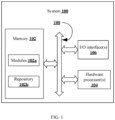
- FIG. 1 is an exemplary block diagram of a symbiotic warning system 100 to warn nearby target actors while driving for collision avoidance, in accordance with some embodiments of the present disclosure.
- the system 100 includes or is otherwise in communication with one or more hardware processors 104, communication interface device(s) or input/output (I/O) interface(s) 106, and one or more data storage devices or memory 102 operatively coupled to the one or more hardware processors 104.
- the one or more hardware processors 104, the memory 102, and the I/O interface(s) 106 may be coupled to a system bus 108 or a similar mechanism.
- the I/O interface(s) 106 may include a variety of software and hardware interfaces, for example, a web interface, a graphical user interface, and the like.
- the I/O interface(s) 106 may include a variety of software and hardware interfaces, for example, interfaces for peripheral device(s), such as a keyboard, a mouse, an external memory, a plurality of sensor devices, a printer and the like. Further, the I/O interface(s) 106 may enable the system 100 to communicate with other devices, such as web servers and external databases.
- the I/O interface(s) 106 can facilitate multiple communications within a wide variety of networks and protocol types, including wired networks, for example, local area network (LAN), cable, etc., and wireless networks, such as Wireless LAN (WLAN), cellular, or satellite.
- the I/O interface(s) 106 may include one or more ports for connecting a number of computing systems with one another or to another server computer. Further, the I/O interface(s) 106 may include one or more ports for connecting a number of devices to one another or to another server.
- the one or more hardware processors 104 may be implemented as one or more microprocessors, microcomputers, microcontrollers, digital signal processors, central processing units, state machines, logic circuitries, and/or any devices that manipulate signals based on operational instructions.
- the one or more hardware processors 104 are configured to fetch and execute computer-readable instructions stored in the memory 102.
- the expressions 'processors' and ⁇ hardware processors' may be used interchangeably.
- the system 100 can be implemented in a variety of computing systems, such as laptop computers, portable computers, notebooks, hand-held devices, workstations, mainframe computers, servers, a network cloud and the like.
- the memory 102 may include any computer-readable medium known in the art including, for example, volatile memory, such as static random access memory (SRAM) and dynamic random access memory (DRAM), and/or non-volatile memory, such as read only memory (ROM), erasable programmable ROM, flash memories, hard disks, optical disks, and magnetic tapes.
- volatile memory such as static random access memory (SRAM) and dynamic random access memory (DRAM)
- non-volatile memory such as read only memory (ROM), erasable programmable ROM, flash memories, hard disks, optical disks, and magnetic tapes.
- the memory 102 includes a plurality of modules 102a and a repository 102b for storing data processed, received, and generated by one or more of the plurality of modules 102a.
- the plurality of modules 102a may include routines, programs, objects, components, data structures, and so on, which perform particular tasks or implement particular abstract data types.
- the plurality of modules 102a may include programs or computer-readable instructions or coded instructions that supplement applications or functions performed by the system 100.
- the plurality of modules 102a may also be used as, signal processor(s), state machine(s), logic circuitries, and/or any other device or component that manipulates signals based on operational instructions.
- the plurality of modules 102a can be used by hardware, by computer-readable instructions executed by the one or more hardware processors 104, or by a combination thereof.
- the plurality of modules 102a can include various sub-modules (not shown in FIG. 1 ).
- the memory 102 may include information pertaining to input(s)/output(s) of each step performed by the processor(s) 104 of the system 100 and methods of the present disclosure.
- the repository 102b may include a database or a data engine. Further, the repository 102b amongst other things, may serve as a database or includes a plurality of databases for storing the data that is processed, received, or generated as a result of the execution of the plurality of modules 102a. Although the repository 102b is shown internal to the system 100, it will be noted that, in alternate embodiments, the repository 102b can also be implemented external to the system 100, where the repository 102b may be stored within an external database (not shown in FIG. 1 ) communicatively coupled to the system 100. The data contained within such external database may be periodically updated. For example, data may be added into the external database and/or existing data may be modified and/or non-useful data may be deleted from the external database.
- the data may be stored in an external system, such as a Lightweight Directory Access Protocol (LDAP) directory and a Relational Database Management System (RDBMS).
- LDAP Lightweight Directory Access Protocol
- RDBMS Relational Database Management System
- the data stored in the repository 102b may be distributed between the system 100 and the external database.
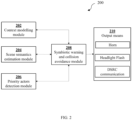
- FIG. 2 is an exemplary block diagram illustrating modules 200 of the symbiotic warning system 100 of FIG. 1 , to warn nearby target actors while driving for collision avoidance, in accordance with some embodiments of the present disclosure.
- the symbiotic warning system 100 is installed or equipped in the host vehicle.
- the modules 200 include a context modelling module 202, a scene semantics estimation module 204, a priority actors detection module 206, a symbiotic warning and collision avoidance module 208, and an output means 210.
- the modules 200 are stored in the repository 102b of the system 100.
- the context modelling module 202 is configured to receive one or more road contextual parameters to create a 360-degree scene perception of road surroundings of the host vehicle.
- the 360-degree scene perception of the road surroundings of the host vehicle includes one or more actors present on a road within a specific range, a proximity, or a distance to the host vehicle as the host vehicle navigates on the road.
- the one or more actors present on the road includes but are not limited to one or more motorized vehicles, one or more non-motorized vehicles, pedestrians, and animals present on the road surrounding the host vehicle.
- the one or more road contextual parameters are related to the parameters of the road surroundings as the host vehicle travels on the road approaching towards the one or more actors.
- the one or more road contextual parameters are received from one or more of: one or more 360-degree light detection and ranging (Lidars), one or more front corner radars, one or more rear corner radio detection and ranging (radars), one or more cameras, one or more ultrasonic sensors, and one or more geographical road information devices, or a combination of the above thereof, that are installed or equipped in the host vehicle.
- the 360-degree scene perception of road surroundings of the host vehicle typically include one or more images and/or one or more sensor values, or a combination there of, that are generated using the one or more road contextual parameters associated with the road surroundings of the host vehicle as it moves on.
- the scene semantics estimation module 204 is configured to estimate one or more 3-dimensional (3-D) scene semantics of each of the one or more actors present on the road as the host vehicle navigates.
- the 360-degree scene perception of road surroundings of the host vehicle is analyzed using a localization technique to estimate the one or more 3-dimensional (3-D) scene semantics of each of the one or more actors present on the road as the host vehicle navigates.
- the one or more 3-dimensional (3-D) scene semantics includes but are not limited to: a number of the one or more motorized vehicles, a current distance between the host vehicle and each of the one or more motorized vehicles, an acceleration of each of the one or more motorized vehicles, dimensions and dynamics of each of the one or more motorized vehicles, a current moving direction of each of the one or more motorized vehicles, the number of the one or more non-motorized vehicles, the current distance between the host vehicle and each of the one or more non-motorized vehicles, the acceleration of each of the one or more non-motorized vehicles, the dimensions and the dynamics of each of the one or more non-motorized vehicles, the current moving direction of each of the one or more non-motorized vehicles, the number of the one or more pedestrians, the current distance between the host vehicle and each of the one or more pedestrians, the current moving direction of each of the one or more pedestrians, the number of the one or more animals, the current distance between the host vehicle and each of the one or more animals, and the current moving direction of each of each of the
- the priority actors detection module 206 is configured to detect one or more priority actors, out of the one or more actors present on the road as the host vehicle navigates.
- the one or more priority actors are the actors that may lead to probable collisions with the host vehicle as they navigate on the road.
- the one or more priority actors are detected using the one or more 3-dimensional (3-D) scene semantics estimated by the scene semantics estimation module 204.
- the priority actors detection module 206 utilizes a path estimation and tracking technique in order to detect the one or more priority actors those lead to probable collisions.
- the symbiotic warning and collision avoidance module 208 is configured to continuously decide when to generate a symbiotic warning signal, and to which of the one or more priority actors the symbiotic warning is to be provided.
- the symbiotic warning and collision avoidance module 208 employs a symbiotic warning trained model to decide when to generate a symbiotic warning signal, and to which of the one or more priority actors the symbiotic warning is to be provided, based on the 360-degree scene perception of road surroundings created by the context modelling module 202 and the one or more 3-dimensional (3-D) scene semantics estimated by the scene semantics estimation module 204.
- the symbiotic warning signal is generated through horn, headlights, a vehicle-vehicle to communication, and a combination thereof, equipped in the host vehicle, based on type of a priority actor and a driving environment scenario. For example, if the host vehicle is a car and the surrounding environment is in day light, then the symbiotic warning signal generated may be by sounding horn. Similarly, if the host vehicle is the car and the surrounding environment is at night (dark environment), then the symbiotic warning signal generated may be by flashing the headlights. Similarly, when the host vehicle is a similar vehicle as that of the host vehicle and if both are having the vehicle-vehicle to communication, then the symbiotic warning signal is in the form of vehicle-vehicle to communication.
- the output means 210 includes one or more symbiotic warning signal means such as the horn, the headlights, the vehicle-vehicle to communication equipped in the host vehicle.
- the output means 210 is configured to receive the instructions decided by the symbiotic warning and collision avoidance module 208 and generates the symbiotic warning signal, to the one or more priority actors, based on the decision by the symbiotic warning and collision avoidance module 208, through one or more output means (symbiotic warning signal means).
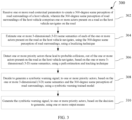
- FIG. 3 illustrates an exemplary flow diagram of a processor-implemented symbiotic warning method 300 to warn nearby target actors while driving for collision avoidance, in accordance with some embodiments of the present disclosure.
- steps of the method 300 including process steps, method steps, techniques or the like may be described in a sequential order, such processes, methods, and techniques may be configured to work in alternate orders. In other words, any sequence or order of steps that may be described does not necessarily indicate a requirement that the steps be performed in that order.
- the steps of processes described herein may be performed in any practical order. Further, some steps may be performed simultaneously, or some steps may be performed alone or independently.
- the one or more hardware processors 104 of the system 100 are configured to receive the one or more road contextual parameters thorough the context modelling module 202 to create the 360-degree scene perception of road surroundings of the host vehicle.
- the one or more road contextual parameters are related to the parameters of the road surroundings as the host vehicle travels on the road approaching towards the one or more actors.
- the one or more road contextual parameters are received from one or more of: one or more 360-degree light detection and ranging (Lidars), one or more front corner radars, one or more rear corner radio detection and ranging (radars), one or more cameras, one or more ultrasonic sensors, and one or more geographical road information devices, or a combination of the above thereof, that are installed or equipped in the host vehicle.
- Lidars 360-degree light detection and ranging
- radars rear corner radio detection and ranging
- ultrasonic sensors one or more geographical road information devices, or a combination of the above thereof, that are installed or equipped in the host vehicle.
- the 360-degree scene perception of road surroundings of the host vehicle gives a visual representation of surroundings of the host vehicle (helps the see the world around itself), and allows the host vehicle to recognize and classify the one or more actors (things) in the surroundings during the navigation of the host vehicle.
- the host vehicle needs to see and classify traffic lights, pedestrians, road signs, walkways, parking spots, lanes, and much more. Further, the host vehicle also needs to know the exact distance between itself and the things around it.
- the 360-degree scene perception of road surroundings of the host vehicle typically includes one or more images, one or more sensor values, or a combination there of, that are generated using the one or more road contextual parameters are associated with the road surroundings of the host vehicle as it moves on.
- one or more image processing techniques may be employed to create the 360-degree scene perception of road surroundings of the host vehicle from the one or more road contextual parameters.
- one or more image processing techniques include but are not limited to OmniDet and SurroundNet.
- a deep learning-based object detection model may be employed to recognize the one or more actors present on the road from the created 360-degree scene perception of road surroundings.
- some of the deep learning-based object detection model include but are not limited to a region-based convolutional neural network (R-CNN) and point cloud based networks).
- the one or more hardware processors 104 of the system 100 are configured to estimate the one or more 3-dimensional (3-D) scene semantics of each of the one or more actors present on the road as the host vehicle navigates, using the 360-degree scene perception of road surroundings, through the scene semantics estimation module 204.
- the localizing technique is employed by the scene semantics estimation module 204 to estimate the one or more 3-dimensional (3-D) scene semantics of each of the one or more actors.
- the one or more 3-dimensional (3-D) scene semantics includes but are not limited to: the number of the one or more motorized vehicles, the current distance between the host vehicle and each of the one or more motorized vehicles, the acceleration of each of the one or more motorized vehicles, dimensions and dynamics of each of the one or more motorized vehicles, the current moving direction of each of the one or more motorized vehicles, the number of the one or more non-motorized vehicles, the current distance between the host vehicle and each of the one or more non-motorized vehicles, the acceleration of each of the one or more non-motorized vehicles, the dimensions and the dynamics of each of the one or more non-motorized vehicles, the current moving direction of each of the one or more non-motorized vehicles, the number of the one or more pedestrians, the current distance between the host vehicle and each of the one or more pedestrians, the current moving direction of each of the one or more pedestrians, the number of the one or more animals, the current distance between the host vehicle and each of the one or more animals, and the current moving direction of each of the one or more
- the localizing technique includes one or more localization algorithms that calculate a position and an orientation of the host vehicle with respect to the position of the one or more actors in the road surroundings.
- a visual odometry (VO) algorithm is employed which works by matching key points in consecutive video frames, wherein the key points are the position and the orientation. With each frame, the key points are used as the input to a mapping algorithm.
- the mapping algorithm such as simultaneous localization and mapping (SLAM), computes the position and orientation of each actor in a current frame with respect to the previous frame and helps to classify all the actors on the road.
- SLAM simultaneous localization and mapping
- a deep learning may be generally used to improve the performance of VO algorithm, and to classify different actors.
- Neural networks such as PoseNet and VLocNet++, are some of the frameworks that use point data to estimate the 3-D position and orientation. These estimated 3-D positions and orientations can be used to derive the one or more 3-dimensional (3-D) scene semantics.
- the one or more hardware processors 104 of the system 100 are configured to detect one or more priority actors those may lead to probable collisions, out of the one or more actors present on the road as the host vehicle navigates, through the priority actors detection module 206.
- the one or more priority actors are detected using the one or more 3-dimensional (3-D) scene semantics estimated at the step 304 of the method 300.
- the priority actors detection module 206 utilizes the path estimation and tracking technique in order to detect the one or more priority actors.
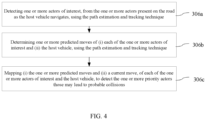
- FIG. 4 illustrates an exemplary flow diagram for detecting the one or more priority actors, out of the one or more actors present on the road as the host vehicle navigates, based on the one or more 3-dimensional (3-D) scene semantics, using the path estimation and tracking technique, in accordance with some embodiments of the present disclosure.
- detecting the one or more priority actors those lead to probable collisions, out of the one or more actors is explained through steps 306a through 306c.
- one or more actors of interest are detected from the one or more actors present on the road as the host vehicle navigates, using the path estimation and tracking technique.
- one or more predicted moves of (i) each of the one or more actors of interest with respect to the host vehicle by its moves, are determined using the path estimation and tracking technique.
- some of the path estimation and tracking techniques include but are not limited to Pure Pursuit algorithm and a Kalman filter.
- (i) the one or more predicted moves and (ii) a current move, of each of the one or more actors of interest and the host vehicle are mapped to detect the one or more priority actors those lead to probable collisions.
- the current move is the present or current movement in a real-time.
- the priority actor's detection module 206 detects the one or more priority actors which would be affected by probable collisions with the host vehicle. These one or more priority actors can be vehicle in blind spot or in occluded area, lane changing vehicles, non-motorized vehicles, pedestrians etc. Further, the priority actors detection module 206 calculates a Time-To-Collision (TTC) which is a distance between each actor and the host vehicle divided by their relative speed. The Time-To-Collision (TTC) is further used for warning computation. In an embodiment, the priority actors detection module 206 processes output from other existing ADAS systems like Adaptive Cruise Control, Emergency braking system, Blind spot warning, Rear/Front cross traffic alert, Lateral collision warning etc. This ensures that the reuse of the existing algorithms and avoids the repetition.
- TTC Time-To-Collision
- the one or more hardware processors 104 of the system 100 are configured to continuously decide when to generate a symbiotic warning signal, and to which of the one or more priority actors those lead to probable collisions with the host vehicle, through the symbiotic warning and collision avoidance module 208.
- the symbiotic warning and collision avoidance module 208 employs the symbiotic warning trained model to decide when to generate the symbiotic warning signal, to which of the one or more priority actors those lead to probable collisions with the host vehicle, based on the 360-degree scene perception of road surroundings created by the context modelling module 202 and the one or more 3-dimensional (3-D) scene semantics estimated by the scene semantics estimation module 204.
- the symbiotic warning signal is generated through horn, headlights, a vehicle-vehicle to communication, and a combination thereof, equipped in the host vehicle, based on type of a priority actor and a driving environment scenario. For example, if the host vehicle is a car and the surrounding environment is in day light, then the symbiotic warning signal generated may be by sounding horn. Similarly, if the host vehicle is the car and the surrounding environment is at night (dark environment), then the symbiotic warning signal generated may be by flashing the headlights. Similarly, when the host vehicle is a similar vehicle as that of the host vehicle and if both are having the vehicle-vehicle to communication, then the symbiotic warning signal is in the form of vehicle-vehicle to communication.
- FIG. 5 illustrates an exemplary flow diagram for obtaining the symbiotic warning trained model, in accordance with some embodiments of the present disclosure.
- obtaining the symbiotic warning trained model is explained through steps 308b1 through 308b4.
- a training dataset comprising a plurality of training samples is received.
- the training dataset is associated with one or more driving environment scenarios.
- the training dataset includes one or more training sub-datasets, wherein each training sub-dataset is associated with each driving environment scenario.
- the one or more driving environment scenarios include but are not limited to (i) cut in lane driving, (ii) driving through a hair pin bend road on a hill side, (iii) an abnormal/un-intentional lane change by the priority actors while host vehicle in a blind spot, (iv) overtaking the host vehicle in a narrow lane, (v) a sudden close appearance of pedestrian/animal/other vehicle on road, (vi) merging lane and T Junction situations, and (vii) vehicle backing up.
- each training sub-dataset comprises one or more training samples corresponding to the driving environment scenario.
- Each training sample comprises (i) a training 360-degree scene perception of road surroundings of a training host vehicle, and (ii) one or more training 3-dimensional (3-D) scene semantics of the training host vehicle, associated with a plurality of training actors.
- each training sample present in each training sub-dataset is processed to obtain a plurality of processed training samples from the plurality of training samples.
- Each processed training sample comprises a state and an action of each training priority actor and the training host vehicle, defined from (i) the training 360-degree scene perception of road surroundings and (ii) one or more training 3-dimensional (3-D) scene semantics.
- the state and the action of each training priority actor and the training host vehicle corresponding to one of the one or more driving environment scenarios.
- a training symbiotic warning signal of the plurality of symbiotic warning signals is assigned for each processed training sample, based on the state and the action of each training priority actor and the training host vehicle.
- the plurality of symbiotic warning signals is generated through the horn, the headlights, the vehicle-vehicle to communication, and the combination thereof, based on type of the priority actor and the driving environment scenario.
- Table 1 shows an exemplary processed training sample present in each training sub-dataset associated with different driving scenarios with their exemplary states.
- the state is defined in terms of their corresponding speeds.
- Table 1 Scenario Data set Driving through hair pin bend road on hill side - Steep turn encountered which resulted in near miss with oncoming two wheelers 1.
- Host vehicle (HV) speed 40, 50, 60, 80 kmph with No target vehicle present 2.
- HV speed 40, 50, 60, 80 kmph and oncoming Target vehicle (TV) speed at 10, 20, 40, 60, 80 kmph 3.
- HV speed 40, 60, 80, 100 kmph and slow-moving target or stationary target at 100m in ego lane
- a deep reinforcement learning neural network model is trained with each processed training sample at time using the corresponding training symbiotic warning signal assigned obtained at step 308b2 and at step 308b3 respectively.
- the training process is iterated until the plurality of processed training samples is completed, to obtain the symbiotic warning trained model.
- the deep reinforcement learning neural network model is one from a list including but is not limited to Q-learning, and a Markov decision process (MDP).
- FIG. 6 illustrates an exemplary flow diagram for training the deep reinforcement learning neural network model, with each processed training sample at time using the corresponding training symbiotic warning signal assigned, until the plurality of processed training samples is completed, to obtain the symbiotic warning trained model, in accordance with some embodiments of the present disclosure.
- training the deep reinforcement learning neural network model to obtain the symbiotic warning trained model is explained through steps 308c1 through 308c4.
- the state of a training host vehicle, in each processed training sample is passed to a reinforcement learning (RL) agent of the deep reinforcement learning neural network model.
- RL reinforcement learning
- (i) a predicted action of each training priority actor and the training host vehicle, for a given state of the training host vehicle, and (ii) a predicted symbiotic warning signal, from each processed training sample, are obtained from the RL agent.
- step 308c3 (i) the predicted action of each training priority actor and the training host vehicle with the from each processed training sample with the action of each training priority actor and the training host vehicle, and (ii) the predicted symbiotic warning signal with the corresponding training symbiotic warning signal assigned, for each processed training sample, are compared to provide a reward for the RL agent based on the comparison.
- step 308c4 the training of the reinforcement learning (RL) agent with a successive processed training sample, is performed until the plurality of processed training samples is completed, to maximize the reward for the RL agent and to obtain the symbiotic warning trained model.
- RL reinforcement learning
- FIG. 7 illustrates an exemplary flow diagram for deciding to generate the symbiotic warning signal of the one or more symbiotic warning signals, to one or more priority actors based on the one or more 3-dimensional (3-D) scene semantics and the 360-degree scene perception of road surroundings, using the symbiotic warning trained model, in accordance with some embodiments of the present disclosure.
- deciding to generate the symbiotic warning signal of the one or more symbiotic warning signals, to one or more priority actors is explained through steps 308a1 through 308a3.
- a current state of the host vehicle and the one or more priority actors is determined, using the 360-degree scene perception of road surroundings created at step 302 of the method 300.
- the state is associated with current dynamics of the each of the one or more priority actors on the road.
- a current action for the host vehicle and the one or more priority actors is determined based on the current state of the host vehicle and the one or more priority actors determined at step 308a1, using the one or more 3-dimensional (3-D) scene semantics estimated at step 304 of the method 300 and the 360-degree scene perception of road surroundings created at step 302 of the method 300.
- the action describes one or more possible moves that each of the one or more priority actors and the host vehicle.
- step 308a3 (i) the current state of the host vehicle and the one or more priority actors, (ii) the current action for the host vehicle and the one or more priority actors, determined at step 308a1 and 308a2 respectively, are passed to the symbiotic warning trained model, to decide whether to generate the symbiotic warning signal, to one or more priority actors those lead to probable collisions.
- the current state of the host vehicle and the one or more priority actors the current action for the host vehicle and the one or more priority actors are associated with one of the driving scenarios and the corresponding symbiotic warning signal is generated to alert the one or more priority actors.
- the one or more hardware processors 104 of the system 100 are configured to generate the symbiotic warning signal, to one or more priority actors those lead to probable collisions, based on the decision to generate, using the one or more output means, through the output means 210.
- the output means 210 includes one or more symbiotic warning signal means such as the horn, the headlights, the vehicle-vehicle to communication equipped in the host vehicle.
- the output means 210 is configured to receive the instructions decided by the symbiotic warning and collision avoidance module 208 and generates the symbiotic warning signal, to one or more priority actors those lead to probable collisions, based on the decision by the symbiotic warning and collision avoidance module 208, through one or more output means (symbiotic warning signal means).
- the method and systems of the present disclosure warns nearby target vehicles, pedestrians, and animals automatically by taking control of host vehicle communication devices such as a horn, a headlight flash or communicate with a dedicated short-range communication (DSRC) technology.
- host vehicle communication devices such as a horn, a headlight flash or communicate with a dedicated short-range communication (DSRC) technology.
- DSRC dedicated short-range communication
- the symbiotic warning methods and systems are installed in the host vehicle, to identify such scenarios and gives necessary warning to the target vehicles, pedestrians, and animals around the host vehicle.
- the embodiments of present disclosure herein address unresolved problems of alerting the target actors on road by the host vehicle.
- the symbiotic warning methods and systems of the present disclosure warns nearby target vehicles, pedestrians, and animals automatically by taking control of host vehicle communication devices such as the horn, the headlight flash or communicate with the dedicated short-range communication (DSRC) technology.
- DSRC dedicated short-range communication
- Such computer-readable storage means contain program-code means for implementation of one or more steps of the method, when the program runs on a server or mobile device or any suitable programmable device.
- the hardware device can be any kind of device which can be programmed including e.g., any kind of computer like a server or a personal computer, or the like, or any combination thereof.
- the device may also include means which could be e.g., hardware means like e.g., an application-specific integrated circuit (ASIC), a field-programmable gate array (FPGA), or a combination of hardware and software means, e.g., an ASIC and an FPGA, or at least one microprocessor and at least one memory with software processing components located therein.
- the means can include both hardware means and software means.
- the method embodiments described herein could be implemented in hardware and software.
- the device may also include software means. Alternatively, the embodiments may be implemented on different hardware devices, e.g., using a plurality of CPUs.
- the embodiments herein can comprise hardware and software elements.
- the embodiments that are implemented in software include but are not limited to, firmware, resident software, microcode, etc.
- the functions performed by various components described herein may be implemented in other components or combinations of other components.
- a computer-usable or computer readable medium can be any apparatus that can comprise, store, communicate, propagate, or transport the program for use by or in connection with the instruction execution system, apparatus, or device.
- a computer-readable storage medium refers to any type of physical memory on which information or data readable by a processor may be stored.
- a computer-readable storage medium may store instructions for execution by one or more processors, including instructions for causing the processor(s) to perform steps or stages consistent with the embodiments described herein.
- the term "computer-readable medium” should be understood to include tangible items and exclude carrier waves and transient signals, i.e., be non-transitory. Examples include random access memory (RAM), read-only memory (ROM), volatile memory, nonvolatile memory, hard drives, CD ROMs, DVDs, flash drives, disks, and any other known physical storage media.
Landscapes
- Engineering & Computer Science (AREA)
- Physics & Mathematics (AREA)
- Mechanical Engineering (AREA)
- Theoretical Computer Science (AREA)
- General Physics & Mathematics (AREA)
- Transportation (AREA)
- Automation & Control Theory (AREA)
- Data Mining & Analysis (AREA)
- Multimedia (AREA)
- Software Systems (AREA)
- General Engineering & Computer Science (AREA)
- Evolutionary Computation (AREA)
- Artificial Intelligence (AREA)
- Computational Linguistics (AREA)
- Computing Systems (AREA)
- Computer Networks & Wireless Communication (AREA)
- Life Sciences & Earth Sciences (AREA)
- Mathematical Physics (AREA)
- Computer Vision & Pattern Recognition (AREA)
- Human Computer Interaction (AREA)
- Biophysics (AREA)
- Molecular Biology (AREA)
- Chemical & Material Sciences (AREA)
- Combustion & Propulsion (AREA)
- Health & Medical Sciences (AREA)
- Biomedical Technology (AREA)
- Signal Processing (AREA)
- General Health & Medical Sciences (AREA)
- Medical Informatics (AREA)
- Acoustics & Sound (AREA)
- Evolutionary Biology (AREA)
- Bioinformatics & Computational Biology (AREA)
- Bioinformatics & Cheminformatics (AREA)
- Electromagnetism (AREA)
- Radar, Positioning & Navigation (AREA)
- Remote Sensing (AREA)
- Traffic Control Systems (AREA)
- Control Of Driving Devices And Active Controlling Of Vehicle (AREA)
Abstract
The disclosure relates generally to symbiotic warning methods and systems to warn nearby target actors while driving for collision avoidance. Current ADAS systems are limited in assisting only the driver of the host vehicle in the potential dangers. The present disclosure identifies various driving scenarios and gives necessary warning to the target vehicles, pedestrians, and animals around the host vehicle. A symbiotic warning method involves receiving one or more road contextual parameters to create a 360-degree scene perception of road surroundings of a host vehicle, with one or more actors. Then, estimating one or more 3-dimensional (3-D) scene semantics of each of the one or more actors and detecting one or more priority actors those lead to probable collisions. Further, deciding to generate a symbiotic warning signal, to one or more priority actors, and generating the symbiotic warning signal to one or more priority actors those lead to probable collisions.
Description
- The present application claims priority to
Indian application no. 202321057195, filed on August 25, 2023 - The disclosure herein generally relates to the field of vehicle driver assistance and safety control, and more specifically to symbiotic warning methods and systems to warn nearby target actors while driving for collision avoidance.
- Advanced driver-assistance systems (ADAS) are electronic systems equipped in a host vehicle that use advanced technologies to assist the driver while driving. The ADAS systems warn the driver of the host vehicle and at times takes control of the host vehicle to avoid potential collisions. However, current ADAS systems are limited to assisting the driver of the host vehicle only. Hence the current ADAS systems targets only small chunk of road accidents while leaving a behind large chunk of the accidents. This is because the actors present on the road such as other vehicles, pedestrians, or non-motorized vehicles may not be equipped with the ADAS system.
- Mentioned below are certain scenarios where the current ADAS systems may fail to warn, or they get very less time to take necessary action to avoid the collisions: (a) inability of automotive sensor to detect nearby targets (other vehicles including non-motorized vehicles and pedestrians) due to occluded environment, (b) sudden appearance of the targets (other vehicles including non-motorized vehicles and pedestrians) near to the host vehicle, and (c) inattentive driving from the driver of the target vehicle (other vehicles including non-motorized vehicles).
- Embodiments of the present disclosure present technological improvements as solutions to one or more of the above-mentioned technical problems recognized by the inventors in conventional systems.
- In an aspect, a processor-implemented method for generating a cause-effect sentiment-enriched knowledge graph for portfolio optimization is provided. The method including the steps of: receiving one or more road contextual parameters to create a 360-degree scene perception of road surroundings of a host vehicle, wherein the 360-degree scene perception of road surroundings of the host vehicle comprises one or more actors present on a road as the host vehicle navigates on the road; estimating one or more 3-dimensional (3-D) scene semantics of each of the one or more actors present on the road as the host vehicle navigates, using the 360-degree scene perception of road surroundings, using a localizing technique; detecting, one or more priority actors those lead to probable collisions, out of the one or more actors present on the road as the host vehicle navigates, based on the one or more 3-dimensional (3-D) scene semantics, using a path estimation and tracking technique; deciding to generate a symbiotic warning signal, to one or more priority actors, based on the one or more 3-dimensional (3-D) scene semantics and the 360-degree scene perception of road surroundings, using a symbiotic warning trained model; and generating the symbiotic warning signal, to one or more priority actors, based on the decision to generate, using one or more output means.
- In another aspect, a system for generating a cause-effect sentiment-enriched knowledge graph for portfolio optimization is provided. The system includes: a memory storing instructions; one or more Input/Output (I/O) interfaces; and one or more hardware processors coupled to the memory via the one or more I/O interfaces, wherein the one or more hardware processors are configured by the instructions to: receive one or more road contextual parameters to create a 360-degree scene perception of road surroundings of a host vehicle, wherein the 360-degree scene perception of road surroundings of the host vehicle comprises one or more actors present on a road as the host vehicle navigates on the road; estimate one or more 3-dimensional (3-D) scene semantics of each of the one or more actors present on the road as the host vehicle navigates, using the 360-degree scene perception of road surroundings, using a localizing technique; detect one or more priority actors those lead to probable collisions, out of the one or more actors present on the road as the host vehicle navigates, based on the one or more 3-dimensional (3-D) scene semantics, using a path estimation and tracking technique; decide to generate a symbiotic warning signal, to one or more priority actors, based on the one or more 3-dimensional (3-D) scene semantics and the 360-degree scene perception of road surroundings, using a symbiotic warning trained model; and generate the symbiotic warning signal, to one or more priority actors, based on the decision to generate, using one or more output means.
- In yet another aspect, there are provided one or more non-transitory machine-readable information storage mediums comprising one or more instructions which when executed by one or more hardware processors cause : receiving one or more road contextual parameters to create a 360-degree scene perception of road surroundings of a host vehicle, wherein the 360-degree scene perception of road surroundings of the host vehicle comprises one or more actors present on a road as the host vehicle navigates on the road; estimating one or more 3-dimensional (3-D) scene semantics of each of the one or more actors present on the road as the host vehicle navigates, using the 360-degree scene perception of road surroundings, using a localizing technique; detecting one or more priority actors those lead to probable collisions, out of the one or more actors present on the road as the host vehicle navigates, based on the one or more 3-dimensional (3-D) scene semantics, using a path estimation and tracking technique; deciding to generate a symbiotic warning signal, to one or more priority actors, based on the one or more 3-dimensional (3-D) scene semantics and the 360-degree scene perception of road surroundings, using a symbiotic warning trained model; and generating the symbiotic warning signal, to one or more priority actors, based on the decision to generate, using one or more output means.
- In an embodiment, detecting one or more priority actors those lead to probable collisions, out of the one or more actors present on the road as the host vehicle navigates, based on the one or more 3-dimensional (3-D) scene semantics, using a path estimation and tracking technique, comprises: detecting one or more actors of interest, from the one or more actors present on the road as the host vehicle navigates, using the path estimation and tracking technique; determining one or more predicted moves of (i) each of the one or more actors of interest and (ii) the host vehicle, using the path estimation and tracking technique; and mapping (i) the one or more predicted moves and (ii) a current move, of each of the one or more actors of interest and the host vehicle, to detect the one or more priority actors those may lead to probable collisions.
- In an embodiment, deciding to generate the symbiotic warning signal of the one or more symbiotic warning signals, to one or more priority actors based on the one or more 3-dimensional (3-D) scene semantics and the 360-degree scene perception of road surroundings, using the symbiotic warning trained model, comprising: determining a current state of the host vehicle and the one or more priority actors, using the 360-degree scene perception of road surroundings, wherein the state is associated with current dynamics of the each of the one or more priority actors on the road; determining a current action for the host vehicle and the one or more priority actors, based on the current state of the host vehicle and the one or more priority actors, using the one or more 3-dimensional (3-D) scene semantics and the 360-degree scene perception of road surroundings, wherein the action describes one or more possible moves that each of the one or more priority actors and the host vehicle; and passing (i) the current state of the host vehicle and the one or more priority actors, (ii) the current action for the host vehicle and the one or more priority actors, to the symbiotic warning trained model, to decide whether to generate the symbiotic warning signal, to one or more priority actors those lead to probable collisions.
- In an embodiment, the symbiotic warning trained model is obtained by: receiving a training dataset comprising a plurality of training samples, wherein the training dataset is associated with one or more driving environment scenarios and comprises one or more training sub-datasets, wherein each training sub-dataset is associated with each driving environment scenario and comprises one or more training samples of the plurality of training samples, and wherein each of the plurality of training samples comprises (i) a training 360-degree scene perception of road surroundings of a training host vehicle and (ii) one or more training 3-dimensional (3-D) scene semantics of the training host vehicle, associated with a plurality of training actors; processing each of the plurality of training samples present in each training sub-dataset to obtain a plurality of processed training samples from the plurality of training samples, wherein each processed training sample comprises a state and an action of each training priority actor and the training host vehicle, from (i) the training 360-degree scene perception of road surroundings and (ii) one or more training 3-dimensional (3-D) scene semantics; assigning a training symbiotic warning signal of a plurality of symbiotic warning signals, for each processed training sample, based on the state and the action of each training priority actor and the training host vehicle; and training a deep reinforcement learning neural network model, with each processed training sample at a time using an associated training symbiotic warning signal assigned, until the plurality of processed training samples is completed, to obtain the symbiotic warning trained model.
- In an embodiment, training the deep reinforcement learning neural network model, with each processed training sample at a time using the associated training symbiotic warning signal assigned, until the plurality of processed training samples is completed, to obtain the symbiotic warning trained model, comprises: passing the state of a training host vehicle, of each processed training sample, to a reinforcement learning (RL) agent of the deep reinforcement learning neural network model; obtaining (i) a predicted action of each training priority actor and the training host vehicle, for a given state of the training host vehicle, and (ii) a predicted symbiotic warning signal, from each processed training sample, from the RL agent; comparing (i) the predicted action of each training priority actor and the training host vehicle with the from each processed training sample with the action of each training priority actor and the training host vehicle, and (ii) the predicted symbiotic warning signal with the corresponding training symbiotic warning signal assigned, for each processed training sample, to provide a reward for the RL agent based on the comparison; and performing the training of the reinforcement learning (RL) agent with a successive processed training sample, until the plurality of processed training samples is completed, to maximize the reward for the RL agent.
- In an embodiment, the one or more actors present on the road comprises one or more motorized and non-motorized vehicles, pedestrians, and animals present on the road surrounding the host vehicle.
- In an embodiment, wherein the symbiotic warning signal is generated through horn, headlights, a vehicle-vehicle to communication, and a combination thereof, based on type of the priority actor and a driving environment scenario.
- In an embodiment, the one or more road contextual parameters are associated with a road modelling and the one or more road contextual parameters are received from one or more of: one or more 360-degree Lidars, one or more front corner radars, one or more rear corner radars, one or more cameras, one or more ultrasonic sensors, and one or more geographical road information devices, or a combination thereof, installed in the host vehicle.
- It is to be understood that both the foregoing general description and the following detailed description are exemplary and explanatory only and are not restrictive of the invention, as claimed.
- The accompanying drawings, which are incorporated in and constitute a part of this disclosure, illustrate exemplary embodiments and, together with the description, serve to explain the disclosed principles:
-
FIG. 1 is an exemplary block diagram of a symbiotic warning system to warn nearby target actors while driving for collision avoidance, in accordance with some embodiments of the present disclosure. -
FIG. 2 is an exemplary block diagram illustrating modules of the symbiotic warning system ofFIG. 1 , to warn nearby target actors while driving for collision avoidance, in accordance with some embodiments of the present disclosure. -
FIG. 3 illustrates an exemplary flow diagram of a processor-implemented symbiotic warning method to warn nearby target actors while driving for collision avoidance, in accordance with some embodiments of the present disclosure. -
FIG. 4 illustrates an exemplary flow diagram for detecting one or more priority actors those lead to probable collisions, out of the one or more actors present on the road as the host vehicle navigates, based on the one or more 3-dimensional (3-D) scene semantics, using a path estimation and tracking technique, in accordance with some embodiments of the present disclosure. -
FIG. 5 illustrates an exemplary flow diagram for obtaining a symbiotic warning trained model, in accordance with some embodiments of the present disclosure. -
FIG. 6 illustrates an exemplary flow diagram for training a deep reinforcement learning neural network model, with each processed training sample at time using the corresponding training symbiotic warning signal assigned, until the plurality of symbiotic warning signals is completed, to obtain the symbiotic warning trained model, in accordance with some embodiments of the present disclosure. -
FIG. 7 illustrates an exemplary flow diagram for deciding to generate the symbiotic warning signal of the one or more symbiotic warning signals, to one or more priority actors those lead to probable collisions based on the one or more 3-dimensional (3-D) scene semantics and the 360-degree scene perception of road surroundings, using the symbiotic warning trained model, in accordance with some embodiments of the present disclosure. - Exemplary embodiments are described with reference to the accompanying drawings. In the figures, the left-most digit(s) of a reference number identifies the figure in which the reference number first appears. Wherever convenient, the same reference numbers are used throughout the drawings to refer to the same or like parts. While examples and features of disclosed principles are described herein, modifications, adaptations, and other implementations are possible without departing from the scope of the disclosed embodiments.
- Current ADAS systems are limited to assisting only the driver of the host vehicle in potential dangers. Hence, the current ADAS systems are not effectively averting accidents or providing assistance in certain scenarios. This is because the actors present on the road such as other vehicles, pedestrians or non-motorized vehicles may not be equipped with the ADAS system.
- Below are some of the scenarios where the current ADAS systems may fail to warn, or they get very less time to take necessary action to avoid the collisions: (a) inability of automotive sensor to detect nearby targets (other vehicles including non-motorized vehicles and pedestrians) due to occluded environment, (b) sudden appearance of the targets (other vehicles including non-motorized vehicles and pedestrians) near to the host vehicle, and (c) inattentive driving from the driver of the target vehicle (other vehicles including non-motorized vehicles).
- The present disclosure solves the technical problems in the art with the symbiotic warning methods and systems installed in the host vehicle, to identify such scenarios and gives necessary warning to the target vehicles, pedestrians, and animals around the host vehicle. The conventional ADAS system issues warning to alert driver of the host vehicle whereas the present symbiotic warning methods and systems warn nearby target vehicles, pedestrians, and animals automatically by taking control of host vehicle communication devices such as a horn, a headlight flash or communicate with a dedicated short-range communication (DSRC) technology.
- Referring now to the drawings, and more particularly to
FIG. 1 through FIG. 7 , where similar reference characters denote corresponding features consistently throughout the figures, there are shown preferred embodiments, and these embodiments are described in the context of the following exemplary systems and/or methods. -
FIG. 1 is an exemplary block diagram of asymbiotic warning system 100 to warn nearby target actors while driving for collision avoidance, in accordance with some embodiments of the present disclosure. In an embodiment, thesystem 100 includes or is otherwise in communication with one ormore hardware processors 104, communication interface device(s) or input/output (I/O) interface(s) 106, and one or more data storage devices ormemory 102 operatively coupled to the one ormore hardware processors 104. The one ormore hardware processors 104, thememory 102, and the I/O interface(s) 106 may be coupled to asystem bus 108 or a similar mechanism. - The I/O interface(s) 106 may include a variety of software and hardware interfaces, for example, a web interface, a graphical user interface, and the like. The I/O interface(s) 106 may include a variety of software and hardware interfaces, for example, interfaces for peripheral device(s), such as a keyboard, a mouse, an external memory, a plurality of sensor devices, a printer and the like. Further, the I/O interface(s) 106 may enable the
system 100 to communicate with other devices, such as web servers and external databases. - The I/O interface(s) 106 can facilitate multiple communications within a wide variety of networks and protocol types, including wired networks, for example, local area network (LAN), cable, etc., and wireless networks, such as Wireless LAN (WLAN), cellular, or satellite. For the purpose, the I/O interface(s) 106 may include one or more ports for connecting a number of computing systems with one another or to another server computer. Further, the I/O interface(s) 106 may include one or more ports for connecting a number of devices to one another or to another server.
- The one or
more hardware processors 104 may be implemented as one or more microprocessors, microcomputers, microcontrollers, digital signal processors, central processing units, state machines, logic circuitries, and/or any devices that manipulate signals based on operational instructions. Among other capabilities, the one ormore hardware processors 104 are configured to fetch and execute computer-readable instructions stored in thememory 102. In the context of the present disclosure, the expressions 'processors' and `hardware processors' may be used interchangeably. In an embodiment, thesystem 100 can be implemented in a variety of computing systems, such as laptop computers, portable computers, notebooks, hand-held devices, workstations, mainframe computers, servers, a network cloud and the like. - The
memory 102 may include any computer-readable medium known in the art including, for example, volatile memory, such as static random access memory (SRAM) and dynamic random access memory (DRAM), and/or non-volatile memory, such as read only memory (ROM), erasable programmable ROM, flash memories, hard disks, optical disks, and magnetic tapes. In an embodiment, thememory 102 includes a plurality of modules 102a and arepository 102b for storing data processed, received, and generated by one or more of the plurality of modules 102a. The plurality of modules 102a may include routines, programs, objects, components, data structures, and so on, which perform particular tasks or implement particular abstract data types. - The plurality of modules 102a may include programs or computer-readable instructions or coded instructions that supplement applications or functions performed by the
system 100. The plurality of modules 102a may also be used as, signal processor(s), state machine(s), logic circuitries, and/or any other device or component that manipulates signals based on operational instructions. Further, the plurality of modules 102a can be used by hardware, by computer-readable instructions executed by the one ormore hardware processors 104, or by a combination thereof. In an embodiment, the plurality of modules 102a can include various sub-modules (not shown inFIG. 1 ). Further, thememory 102 may include information pertaining to input(s)/output(s) of each step performed by the processor(s) 104 of thesystem 100 and methods of the present disclosure. - The
repository 102b may include a database or a data engine. Further, therepository 102b amongst other things, may serve as a database or includes a plurality of databases for storing the data that is processed, received, or generated as a result of the execution of the plurality of modules 102a. Although therepository 102b is shown internal to thesystem 100, it will be noted that, in alternate embodiments, therepository 102b can also be implemented external to thesystem 100, where therepository 102b may be stored within an external database (not shown inFIG. 1 ) communicatively coupled to thesystem 100. The data contained within such external database may be periodically updated. For example, data may be added into the external database and/or existing data may be modified and/or non-useful data may be deleted from the external database. In one example, the data may be stored in an external system, such as a Lightweight Directory Access Protocol (LDAP) directory and a Relational Database Management System (RDBMS). In another embodiment, the data stored in therepository 102b may be distributed between thesystem 100 and the external database. - Referring collectively to
FIG. 2 andFIG. 3 , components and functionalities of thesystem 100 are described in accordance with an example embodiment of the present disclosure. For example,FIG. 2 is an exemplary blockdiagram illustrating modules 200 of thesymbiotic warning system 100 ofFIG. 1 , to warn nearby target actors while driving for collision avoidance, in accordance with some embodiments of the present disclosure. In an embodiment, thesymbiotic warning system 100 is installed or equipped in the host vehicle. - As shown in
FIG. 2 , themodules 200 include acontext modelling module 202, a scenesemantics estimation module 204, a priorityactors detection module 206, a symbiotic warning andcollision avoidance module 208, and an output means 210. In an embodiment, themodules 200 are stored in therepository 102b of thesystem 100. - In an embodiment, the
context modelling module 202 is configured to receive one or more road contextual parameters to create a 360-degree scene perception of road surroundings of the host vehicle. The 360-degree scene perception of the road surroundings of the host vehicle includes one or more actors present on a road within a specific range, a proximity, or a distance to the host vehicle as the host vehicle navigates on the road. In an embodiment, the one or more actors present on the road includes but are not limited to one or more motorized vehicles, one or more non-motorized vehicles, pedestrians, and animals present on the road surrounding the host vehicle. - In an embodiment, the one or more road contextual parameters are related to the parameters of the road surroundings as the host vehicle travels on the road approaching towards the one or more actors. In an embodiment, the one or more road contextual parameters are received from one or more of: one or more 360-degree light detection and ranging (Lidars), one or more front corner radars, one or more rear corner radio detection and ranging (radars), one or more cameras, one or more ultrasonic sensors, and one or more geographical road information devices, or a combination of the above thereof, that are installed or equipped in the host vehicle.
- In an embodiment, the 360-degree scene perception of road surroundings of the host vehicle, typically include one or more images and/or one or more sensor values, or a combination there of, that are generated using the one or more road contextual parameters associated with the road surroundings of the host vehicle as it moves on.
- The scene
semantics estimation module 204 is configured to estimate one or more 3-dimensional (3-D) scene semantics of each of the one or more actors present on the road as the host vehicle navigates. The 360-degree scene perception of road surroundings of the host vehicle is analyzed using a localization technique to estimate the one or more 3-dimensional (3-D) scene semantics of each of the one or more actors present on the road as the host vehicle navigates. - In an embodiment, the one or more 3-dimensional (3-D) scene semantics includes but are not limited to: a number of the one or more motorized vehicles, a current distance between the host vehicle and each of the one or more motorized vehicles, an acceleration of each of the one or more motorized vehicles, dimensions and dynamics of each of the one or more motorized vehicles, a current moving direction of each of the one or more motorized vehicles, the number of the one or more non-motorized vehicles, the current distance between the host vehicle and each of the one or more non-motorized vehicles, the acceleration of each of the one or more non-motorized vehicles, the dimensions and the dynamics of each of the one or more non-motorized vehicles, the current moving direction of each of the one or more non-motorized vehicles, the number of the one or more pedestrians, the current distance between the host vehicle and each of the one or more pedestrians, the current moving direction of each of the one or more pedestrians, the number of the one or more animals, the current distance between the host vehicle and each of the one or more animals, and the current moving direction of each of the one or more animals.
- In an embodiment, the priority
actors detection module 206 is configured to detect one or more priority actors, out of the one or more actors present on the road as the host vehicle navigates. The one or more priority actors are the actors that may lead to probable collisions with the host vehicle as they navigate on the road. The one or more priority actors are detected using the one or more 3-dimensional (3-D) scene semantics estimated by the scenesemantics estimation module 204. In an embodiment, the priorityactors detection module 206 utilizes a path estimation and tracking technique in order to detect the one or more priority actors those lead to probable collisions. - In an embodiment, the symbiotic warning and
collision avoidance module 208 is configured to continuously decide when to generate a symbiotic warning signal, and to which of the one or more priority actors the symbiotic warning is to be provided. The symbiotic warning andcollision avoidance module 208 employs a symbiotic warning trained model to decide when to generate a symbiotic warning signal, and to which of the one or more priority actors the symbiotic warning is to be provided, based on the 360-degree scene perception of road surroundings created by thecontext modelling module 202 and the one or more 3-dimensional (3-D) scene semantics estimated by the scenesemantics estimation module 204. - In various embodiments, the symbiotic warning signal is generated through horn, headlights, a vehicle-vehicle to communication, and a combination thereof, equipped in the host vehicle, based on type of a priority actor and a driving environment scenario. For example, if the host vehicle is a car and the surrounding environment is in day light, then the symbiotic warning signal generated may be by sounding horn. Similarly, if the host vehicle is the car and the surrounding environment is at night (dark environment), then the symbiotic warning signal generated may be by flashing the headlights. Similarly, when the host vehicle is a similar vehicle as that of the host vehicle and if both are having the vehicle-vehicle to communication, then the symbiotic warning signal is in the form of vehicle-vehicle to communication.
- In an embodiment, the output means 210 includes one or more symbiotic warning signal means such as the horn, the headlights, the vehicle-vehicle to communication equipped in the host vehicle. The output means 210 is configured to receive the instructions decided by the symbiotic warning and
collision avoidance module 208 and generates the symbiotic warning signal, to the one or more priority actors, based on the decision by the symbiotic warning andcollision avoidance module 208, through one or more output means (symbiotic warning signal means). - Referring to
FIG. 3 , components and functionalities of thesystem 100 are described in accordance with an example embodiment of the present disclosure. For example,FIG. 3 illustrates an exemplary flow diagram of a processor-implementedsymbiotic warning method 300 to warn nearby target actors while driving for collision avoidance, in accordance with some embodiments of the present disclosure. Although steps of themethod 300 including process steps, method steps, techniques or the like may be described in a sequential order, such processes, methods, and techniques may be configured to work in alternate orders. In other words, any sequence or order of steps that may be described does not necessarily indicate a requirement that the steps be performed in that order. The steps of processes described herein may be performed in any practical order. Further, some steps may be performed simultaneously, or some steps may be performed alone or independently. - At
step 302 of themethod 300, the one ormore hardware processors 104 of thesystem 100 are configured to receive the one or more road contextual parameters thorough thecontext modelling module 202 to create the 360-degree scene perception of road surroundings of the host vehicle. The one or more road contextual parameters are related to the parameters of the road surroundings as the host vehicle travels on the road approaching towards the one or more actors. - In an embodiment, the one or more road contextual parameters are received from one or more of: one or more 360-degree light detection and ranging (Lidars), one or more front corner radars, one or more rear corner radio detection and ranging (radars), one or more cameras, one or more ultrasonic sensors, and one or more geographical road information devices, or a combination of the above thereof, that are installed or equipped in the host vehicle.
- In an embodiment, the 360-degree scene perception of road surroundings of the host vehicle, gives a visual representation of surroundings of the host vehicle (helps the see the world around itself), and allows the host vehicle to recognize and classify the one or more actors (things) in the surroundings during the navigation of the host vehicle. Apart from the one or more actors, the host vehicle needs to see and classify traffic lights, pedestrians, road signs, walkways, parking spots, lanes, and much more. Further, the host vehicle also needs to know the exact distance between itself and the things around it.
- In an embodiment, the 360-degree scene perception of road surroundings of the host vehicle typically includes one or more images, one or more sensor values, or a combination there of, that are generated using the one or more road contextual parameters are associated with the road surroundings of the host vehicle as it moves on.
- In an embodiment, one or more image processing techniques may be employed to create the 360-degree scene perception of road surroundings of the host vehicle from the one or more road contextual parameters. In an embodiment, one or more image processing techniques include but are not limited to OmniDet and SurroundNet. Further a deep learning-based object detection model may be employed to recognize the one or more actors present on the road from the created 360-degree scene perception of road surroundings. In an embodiment, some of the deep learning-based object detection model include but are not limited to a region-based convolutional neural network (R-CNN) and point cloud based networks).
- At
step 304 of themethod 300, the one ormore hardware processors 104 of thesystem 100 are configured to estimate the one or more 3-dimensional (3-D) scene semantics of each of the one or more actors present on the road as the host vehicle navigates, using the 360-degree scene perception of road surroundings, through the scenesemantics estimation module 204. As described, the localizing technique is employed by the scenesemantics estimation module 204 to estimate the one or more 3-dimensional (3-D) scene semantics of each of the one or more actors. - In an embodiment, the one or more 3-dimensional (3-D) scene semantics includes but are not limited to: the number of the one or more motorized vehicles, the current distance between the host vehicle and each of the one or more motorized vehicles, the acceleration of each of the one or more motorized vehicles, dimensions and dynamics of each of the one or more motorized vehicles, the current moving direction of each of the one or more motorized vehicles, the number of the one or more non-motorized vehicles, the current distance between the host vehicle and each of the one or more non-motorized vehicles, the acceleration of each of the one or more non-motorized vehicles, the dimensions and the dynamics of each of the one or more non-motorized vehicles, the current moving direction of each of the one or more non-motorized vehicles, the number of the one or more pedestrians, the current distance between the host vehicle and each of the one or more pedestrians, the current moving direction of each of the one or more pedestrians, the number of the one or more animals, the current distance between the host vehicle and each of the one or more animals, and the current moving direction of each of the one or more animals.
- In an embodiment, the localizing technique includes one or more localization algorithms that calculate a position and an orientation of the host vehicle with respect to the position of the one or more actors in the road surroundings. In an embodiment, a visual odometry (VO) algorithm is employed which works by matching key points in consecutive video frames, wherein the key points are the position and the orientation. With each frame, the key points are used as the input to a mapping algorithm. The mapping algorithm, such as simultaneous localization and mapping (SLAM), computes the position and orientation of each actor in a current frame with respect to the previous frame and helps to classify all the actors on the road.
- In an embodiment, a deep learning may be generally used to improve the performance of VO algorithm, and to classify different actors. Neural networks, such as PoseNet and VLocNet++, are some of the frameworks that use point data to estimate the 3-D position and orientation. These estimated 3-D positions and orientations can be used to derive the one or more 3-dimensional (3-D) scene semantics.
- At
step 306 of themethod 300, the one ormore hardware processors 104 of thesystem 100 are configured to detect one or more priority actors those may lead to probable collisions, out of the one or more actors present on the road as the host vehicle navigates, through the priorityactors detection module 206. The one or more priority actors are detected using the one or more 3-dimensional (3-D) scene semantics estimated at thestep 304 of themethod 300. In an embodiment, the priorityactors detection module 206 utilizes the path estimation and tracking technique in order to detect the one or more priority actors. -
FIG. 4 illustrates an exemplary flow diagram for detecting the one or more priority actors, out of the one or more actors present on the road as the host vehicle navigates, based on the one or more 3-dimensional (3-D) scene semantics, using the path estimation and tracking technique, in accordance with some embodiments of the present disclosure. As shown inFIG. 4 , detecting the one or more priority actors those lead to probable collisions, out of the one or more actors, is explained throughsteps 306a through 306c. - At
step 306a, one or more actors of interest, are detected from the one or more actors present on the road as the host vehicle navigates, using the path estimation and tracking technique. Atstep 306b, one or more predicted moves of (i) each of the one or more actors of interest with respect to the host vehicle by its moves, are determined using the path estimation and tracking technique. In an embodiment, some of the path estimation and tracking techniques include but are not limited to Pure Pursuit algorithm and a Kalman filter. Finally, atstep 306c, (i) the one or more predicted moves and (ii) a current move, of each of the one or more actors of interest and the host vehicle, are mapped to detect the one or more priority actors those lead to probable collisions. The current move is the present or current movement in a real-time. - The priority actor's
detection module 206 detects the one or more priority actors which would be affected by probable collisions with the host vehicle. These one or more priority actors can be vehicle in blind spot or in occluded area, lane changing vehicles, non-motorized vehicles, pedestrians etc. Further, the priorityactors detection module 206 calculates a Time-To-Collision (TTC) which is a distance between each actor and the host vehicle divided by their relative speed. The Time-To-Collision (TTC) is further used for warning computation. In an embodiment, the priorityactors detection module 206 processes output from other existing ADAS systems like Adaptive Cruise Control, Emergency braking system, Blind spot warning, Rear/Front cross traffic alert, Lateral collision warning etc. This ensures that the reuse of the existing algorithms and avoids the repetition. - At
step 308 of themethod 300, the one ormore hardware processors 104 of thesystem 100 are configured to continuously decide when to generate a symbiotic warning signal, and to which of the one or more priority actors those lead to probable collisions with the host vehicle, through the symbiotic warning andcollision avoidance module 208. - The symbiotic warning and
collision avoidance module 208 employs the symbiotic warning trained model to decide when to generate the symbiotic warning signal, to which of the one or more priority actors those lead to probable collisions with the host vehicle, based on the 360-degree scene perception of road surroundings created by thecontext modelling module 202 and the one or more 3-dimensional (3-D) scene semantics estimated by the scenesemantics estimation module 204. - In various embodiments, the symbiotic warning signal is generated through horn, headlights, a vehicle-vehicle to communication, and a combination thereof, equipped in the host vehicle, based on type of a priority actor and a driving environment scenario. For example, if the host vehicle is a car and the surrounding environment is in day light, then the symbiotic warning signal generated may be by sounding horn. Similarly, if the host vehicle is the car and the surrounding environment is at night (dark environment), then the symbiotic warning signal generated may be by flashing the headlights. Similarly, when the host vehicle is a similar vehicle as that of the host vehicle and if both are having the vehicle-vehicle to communication, then the symbiotic warning signal is in the form of vehicle-vehicle to communication.
-
FIG. 5 illustrates an exemplary flow diagram for obtaining the symbiotic warning trained model, in accordance with some embodiments of the present disclosure. As shown inFIG. 5 , obtaining the symbiotic warning trained model is explained through steps 308b1 through 308b4. At step 308b1, a training dataset comprising a plurality of training samples is received. The training dataset is associated with one or more driving environment scenarios. The training dataset includes one or more training sub-datasets, wherein each training sub-dataset is associated with each driving environment scenario. - In an embodiment, the one or more driving environment scenarios include but are not limited to (i) cut in lane driving, (ii) driving through a hair pin bend road on a hill side, (iii) an abnormal/un-intentional lane change by the priority actors while host vehicle in a blind spot, (iv) overtaking the host vehicle in a narrow lane, (v) a sudden close appearance of pedestrian/animal/other vehicle on road, (vi) merging lane and T Junction situations, and (vii) vehicle backing up.
- In an embodiment, each training sub-dataset comprises one or more training samples corresponding to the driving environment scenario. Each training sample comprises (i) a training 360-degree scene perception of road surroundings of a training host vehicle, and (ii) one or more training 3-dimensional (3-D) scene semantics of the training host vehicle, associated with a plurality of training actors.
- At step 308b2, each training sample present in each training sub-dataset is processed to obtain a plurality of processed training samples from the plurality of training samples. Each processed training sample comprises a state and an action of each training priority actor and the training host vehicle, defined from (i) the training 360-degree scene perception of road surroundings and (ii) one or more training 3-dimensional (3-D) scene semantics. In an embodiment, the state and the action of each training priority actor and the training host vehicle corresponding to one of the one or more driving environment scenarios.
- At step 308b3, a training symbiotic warning signal of the plurality of symbiotic warning signals, is assigned for each processed training sample, based on the state and the action of each training priority actor and the training host vehicle. In an embodiment, the plurality of symbiotic warning signals is generated through the horn, the headlights, the vehicle-vehicle to communication, and the combination thereof, based on type of the priority actor and the driving environment scenario.
- Table 1 shows an exemplary processed training sample present in each training sub-dataset associated with different driving scenarios with their exemplary states. In Table 1, the state is defined in terms of their corresponding speeds.
Table 1 Scenario Data set Driving through hair pin bend road on hill side - Steep turn encountered which resulted in near miss with oncoming two wheelers 1. Host vehicle (HV) speed = 40, 50, 60, 80 kmph with No target vehicle present 2. HV speed = 40, 50, 60, 80 kmph and oncoming Target vehicle (TV) speed at 10, 20, 40, 60, 80 kmph 3. Repeat the dataset with target vehicle as car, truck, and motorcycle. 4. Repeat the above dataset with different road curvature e.g. <125m and > 125m Cut-In lane scenarios - Target and host vehicle in right lane suddenly cut on to host lane resulting in near miss rear ending 1. HV speed = 40, 60, 80, 100 kmph and cut-in TV speed = 60, 80, 100, 120 kmph Merging scenarios - Target and host vehicle merging on T-junction and merging lane 1. HV speed = 40, 60, 80, 100 kmph and target is merging with TV speed = 40, 60, 80, 100 kmph 2. HV speed = 40, 60, 80, 100 kmph and target is merging from T-junction with TV speed = 10, 20, 40 kmph Target host vehicle in ego lane applied sudden brake due to which there was near collision 1. HV speed = 40, 60, 80, 100 kmph and TV speed = 20 kmph at 350m in ego lane 2. HV speed = 40, 60, 80, 100 kmph and TV speed = 50 kmph at 250m in ego lane 3. HV speed = 40, 60, 80, 100 kmph and slow-moving target or stationary target at 100m in ego lane - At step 308b4, a deep reinforcement learning neural network model is trained with each processed training sample at time using the corresponding training symbiotic warning signal assigned obtained at step 308b2 and at step 308b3 respectively. The training process is iterated until the plurality of processed training samples is completed, to obtain the symbiotic warning trained model. In an embodiment, the deep reinforcement learning neural network model is one from a list including but is not limited to Q-learning, and a Markov decision process (MDP).
-
FIG. 6 illustrates an exemplary flow diagram for training the deep reinforcement learning neural network model, with each processed training sample at time using the corresponding training symbiotic warning signal assigned, until the plurality of processed training samples is completed, to obtain the symbiotic warning trained model, in accordance with some embodiments of the present disclosure. As shown inFIG. 6 , training the deep reinforcement learning neural network model to obtain the symbiotic warning trained model, is explained through steps 308c1 through 308c4. - At step 308c1, the state of a training host vehicle, in each processed training sample is passed to a reinforcement learning (RL) agent of the deep reinforcement learning neural network model. At step 308c2, (i) a predicted action of each training priority actor and the training host vehicle, for a given state of the training host vehicle, and (ii) a predicted symbiotic warning signal, from each processed training sample, are obtained from the RL agent.
- At step 308c3, (i) the predicted action of each training priority actor and the training host vehicle with the from each processed training sample with the action of each training priority actor and the training host vehicle, and (ii) the predicted symbiotic warning signal with the corresponding training symbiotic warning signal assigned, for each processed training sample, are compared to provide a reward for the RL agent based on the comparison. At step 308c4, the training of the reinforcement learning (RL) agent with a successive processed training sample, is performed until the plurality of processed training samples is completed, to maximize the reward for the RL agent and to obtain the symbiotic warning trained model.
-
FIG. 7 illustrates an exemplary flow diagram for deciding to generate the symbiotic warning signal of the one or more symbiotic warning signals, to one or more priority actors based on the one or more 3-dimensional (3-D) scene semantics and the 360-degree scene perception of road surroundings, using the symbiotic warning trained model, in accordance with some embodiments of the present disclosure. As shown inFIG. 7 , deciding to generate the symbiotic warning signal of the one or more symbiotic warning signals, to one or more priority actors is explained through steps 308a1 through 308a3. - At step 308a1, a current state of the host vehicle and the one or more priority actors, is determined, using the 360-degree scene perception of road surroundings created at
step 302 of themethod 300. In an embodiment, the state is associated with current dynamics of the each of the one or more priority actors on the road. At 308a2, a current action for the host vehicle and the one or more priority actors, is determined based on the current state of the host vehicle and the one or more priority actors determined at step 308a1, using the one or more 3-dimensional (3-D) scene semantics estimated atstep 304 of themethod 300 and the 360-degree scene perception of road surroundings created atstep 302 of themethod 300. In an embodiment, the action describes one or more possible moves that each of the one or more priority actors and the host vehicle. - At step 308a3, (i) the current state of the host vehicle and the one or more priority actors, (ii) the current action for the host vehicle and the one or more priority actors, determined at step 308a1 and 308a2 respectively, are passed to the symbiotic warning trained model, to decide whether to generate the symbiotic warning signal, to one or more priority actors those lead to probable collisions. When the current state of the host vehicle and the one or more priority actors the current action for the host vehicle and the one or more priority actors are associated with one of the driving scenarios and the corresponding symbiotic warning signal is generated to alert the one or more priority actors.
- At
step 310 of themethod 300, the one ormore hardware processors 104 of thesystem 100 are configured to generate the symbiotic warning signal, to one or more priority actors those lead to probable collisions, based on the decision to generate, using the one or more output means, through the output means 210. In an embodiment, the output means 210 includes one or more symbiotic warning signal means such as the horn, the headlights, the vehicle-vehicle to communication equipped in the host vehicle. The output means 210 is configured to receive the instructions decided by the symbiotic warning andcollision avoidance module 208 and generates the symbiotic warning signal, to one or more priority actors those lead to probable collisions, based on the decision by the symbiotic warning andcollision avoidance module 208, through one or more output means (symbiotic warning signal means). - The method and systems of the present disclosure warns nearby target vehicles, pedestrians, and animals automatically by taking control of host vehicle communication devices such as a horn, a headlight flash or communicate with a dedicated short-range communication (DSRC) technology. The symbiotic warning methods and systems are installed in the host vehicle, to identify such scenarios and gives necessary warning to the target vehicles, pedestrians, and animals around the host vehicle.
- The symbiotic warning systems of the present disclosure may be implemented on top of the current ADAS systems, so that a separate hardware is not required and reduces the cost. The methods and systems of the present disclosure are useful to warn the targets in very quick time so that many roads fatal accidents may be avoided.
- The embodiments of present disclosure herein address unresolved problems of alerting the target actors on road by the host vehicle. The symbiotic warning methods and systems of the present disclosure warns nearby target vehicles, pedestrians, and animals automatically by taking control of host vehicle communication devices such as the horn, the headlight flash or communicate with the dedicated short-range communication (DSRC) technology.
- The written description describes the subject matter herein to enable any person skilled in the art to make and use the embodiments. The scope of the subject matter embodiments is defined by the claims and may include other modifications that occur to those skilled in the art. Such other modifications are intended to be within the scope of the claims if they have similar elements that do not differ from the literal language of the claims or if they include equivalent elements with insubstantial differences from the literal language of the claims.
- It is to be understood that the scope of the protection is extended to such a program and in addition to a computer-readable means having a message therein; such computer-readable storage means contain program-code means for implementation of one or more steps of the method, when the program runs on a server or mobile device or any suitable programmable device. The hardware device can be any kind of device which can be programmed including e.g., any kind of computer like a server or a personal computer, or the like, or any combination thereof. The device may also include means which could be e.g., hardware means like e.g., an application-specific integrated circuit (ASIC), a field-programmable gate array (FPGA), or a combination of hardware and software means, e.g., an ASIC and an FPGA, or at least one microprocessor and at least one memory with software processing components located therein. Thus, the means can include both hardware means and software means. The method embodiments described herein could be implemented in hardware and software. The device may also include software means. Alternatively, the embodiments may be implemented on different hardware devices, e.g., using a plurality of CPUs.
- The embodiments herein can comprise hardware and software elements. The embodiments that are implemented in software include but are not limited to, firmware, resident software, microcode, etc. The functions performed by various components described herein may be implemented in other components or combinations of other components. For the purposes of this description, a computer-usable or computer readable medium can be any apparatus that can comprise, store, communicate, propagate, or transport the program for use by or in connection with the instruction execution system, apparatus, or device.
- The illustrated steps are set out to explain the exemplary embodiments shown, and it should be anticipated that ongoing technological development will change the manner in which particular functions are performed. These examples are presented herein for purposes of illustration, and not limitation. Further, the boundaries of the functional building blocks have been arbitrarily defined herein for the convenience of the description. Alternative boundaries can be defined so long as the specified functions and relationships thereof are appropriately performed. Alternatives (including equivalents, extensions, variations, deviations, etc., of those described herein) will be apparent to persons skilled in the relevant art(s) based on the teachings contained herein. Such alternatives fall within the scope of the disclosed embodiments. Also, the words "comprising," "having," "containing," and "including," and other similar forms are intended to be equivalent in meaning and be open ended in that an item or items following any one of these words is not meant to be an exhaustive listing of such item or items, or meant to be limited to only the listed item or items. It must also be noted that as used herein and in the appended claims, the singular forms "a," "an," and "the" include plural references unless the context clearly dictates otherwise.
- Furthermore, one or more computer-readable storage media may be utilized in implementing embodiments consistent with the present disclosure. A computer-readable storage medium refers to any type of physical memory on which information or data readable by a processor may be stored. Thus, a computer-readable storage medium may store instructions for execution by one or more processors, including instructions for causing the processor(s) to perform steps or stages consistent with the embodiments described herein. The term "computer-readable medium" should be understood to include tangible items and exclude carrier waves and transient signals, i.e., be non-transitory. Examples include random access memory (RAM), read-only memory (ROM), volatile memory, nonvolatile memory, hard drives, CD ROMs, DVDs, flash drives, disks, and any other known physical storage media.
- It is intended that the disclosure and examples be considered as exemplary only, with a true scope of disclosed embodiments being indicated by the following claims.
Claims (15)
- A processor-implemented method (300), comprising the steps of:receiving, via one or more hardware processors, one or more road contextual parameters to create a 360-degree scene perception of road surroundings of a host vehicle, wherein the 360-degree scene perception of road surroundings of the host vehicle comprises one or more actors present on a road as the host vehicle navigates on the road (302);estimating, via the one or more hardware processors, one or more 3-dimensional (3-D) scene semantics of each of the one or more actors present on the road as the host vehicle navigates, using the 360-degree scene perception of road surroundings, using a localizing technique (304);detecting, via the one or more hardware processors, one or more priority actors those lead to probable collisions, out of the one or more actors present on the road as the host vehicle navigates, based on the one or more 3-dimensional (3-D) scene semantics, using a path estimation and tracking technique (306);deciding, via the one or more hardware processors, to generate a symbiotic warning signal, to one or more priority actors, based on the one or more 3-dimensional (3-D) scene semantics and the 360-degree scene perception of road surroundings, using a symbiotic warning trained model (308); andgenerating, via the one or more hardware processors, the symbiotic warning signal, to one or more priority actors, based on the decision to generate, using one or more output means (310).
- The processor-implemented method as claimed in claim 1, wherein detecting one or more priority actors those lead to probable collisions, out of the one or more actors present on the road as the host vehicle navigates, based on the one or more 3-dimensional (3-D) scene semantics, using a path estimation and tracking technique, comprises:detecting one or more actors of interest, from the one or more actors present on the road as the host vehicle navigates, using the path estimation and tracking technique (306a);determining one or more predicted moves of (i) each of the one or more actors of interest and (ii) the host vehicle, using the path estimation and tracking technique (306b); andmapping (i) the one or more predicted moves and (ii) a current move, of each of the one or more actors of interest and the host vehicle, to detect the one or more priority actors those may lead to probable collisions (306c).
- The processor-implemented method as claimed in claim 1, wherein deciding to generate the symbiotic warning signal of the one or more symbiotic warning signals, to one or more priority actors based on the one or more 3-dimensional (3-D) scene semantics and the 360-degree scene perception of road surroundings, using the symbiotic warning trained model, comprising:determining a current state of the host vehicle and the one or more priority actors, using the 360-degree scene perception of road surroundings, wherein the state is associated with current dynamics of the each of the one or more priority actors on the road (308a1);determining a current action for the host vehicle and the one or more priority actors, based on the current state of the host vehicle and the one or more priority actors, using the one or more 3-dimensional (3-D) scene semantics and the 360-degree scene perception of road surroundings, wherein the action describes one or more possible moves that each of the one or more priority actors and the host vehicle (308a2); andpassing (i) the current state of the host vehicle and the one or more priority actors, (ii) the current action for the host vehicle and the one or more priority actors, to the symbiotic warning trained model, to decide whether to generate the symbiotic warning signal, to one or more priority actors those lead to probable collisions (308a3).
- The processor-implemented method as claimed in claim 1, the symbiotic warning trained model is obtained by:receiving a training dataset comprising a plurality of training samples, wherein the training dataset is associated with one or more driving environment scenarios and comprises one or more training sub-datasets, wherein each training sub-dataset is associated with each driving environment scenario and comprises one or more training samples of the plurality of training samples, and wherein each of the plurality of training samples comprises (i) a training 360-degree scene perception of road surroundings of a training host vehicle and (ii) one or more training 3-dimensional (3-D) scene semantics of the training host vehicle, associated with a plurality of training actors (308b 1);processing each of the plurality of training samples present in each training sub-dataset to obtain a plurality of processed training samples from the plurality of training samples, wherein each processed training sample comprises a state and an action of each training priority actor and the training host vehicle, from (i) the training 360-degree scene perception of road surroundings and (ii) one or more training 3-dimensional (3-D) scene semantics (308b2);assigning a training symbiotic warning signal of a plurality of symbiotic warning signals, for each processed training sample, based on the state and the action of each training priority actor and the training host vehicle (308b3); andtraining a deep reinforcement learning neural network model, with each processed training sample at a time using an associated training symbiotic warning signal assigned, until the plurality of processed training samples is completed, to obtain the symbiotic warning trained model (308b4).
- The processor-implemented method as claimed in claim 3, wherein training the deep reinforcement learning neural network model, with each processed training sample at a time using the associated training symbiotic warning signal assigned, until the plurality of processed training samples is completed, to obtain the symbiotic warning trained model, comprises:passing the state of a training host vehicle, of each processed training sample, to a reinforcement learning (RL) agent of the deep reinforcement learning neural network model (308c1);obtaining (i) a predicted action of each training priority actor and the training host vehicle, for a given state of the training host vehicle, and (ii) a predicted symbiotic warning signal, from each processed training sample, from the RL agent (308c2);comparing (i) the predicted action of each training priority actor and the training host vehicle with the from each processed training sample with the action of each training priority actor and the training host vehicle, and (ii) the predicted symbiotic warning signal with the corresponding training symbiotic warning signal assigned, for each processed training sample, to provide a reward for the RL agent based on the comparison (308c3); andperforming the training of the reinforcement learning (RL) agent with a successive processed training sample, until the plurality of processed training samples is completed, to maximize the reward for the RL agent (308c4).
- The processor-implemented method as claimed in claim 1, wherein:the one or more actors present on the road comprises one or more motorized and non-motorized vehicles, pedestrians, and animals present on the road surrounding the host vehicle, andthe symbiotic warning signal is generated through horn, headlights, a vehicle-vehicle to communication, and a combination thereof, based on type of the priority actor and a driving environment scenario.
- The processor-implemented method as claimed in claim 1, wherein the one or more road contextual parameters are associated with road modelling and the one or more road contextual parameters are received from one or more of: one or more 360-degree Lidars, one or more front corner radars, one or more rear corner radars, one or more cameras, one or more ultrasonic sensors, and one or more geographical road information devices, or a combination thereof, installed in the host vehicle.
- A system (100) comprising:a memory (102) storing instructions;one or more input/output (I/O) interfaces (106); andone or more hardware processors (104) coupled to the memory (102) via the one or more I/O interfaces (106), wherein the one or more hardware processors (104) are configured by the instructions to:receive one or more road contextual parameters to create a 360-degree scene perception of road surroundings of a host vehicle, wherein the 360-degree scene perception of road surroundings of the host vehicle comprises one or more actors present on a road as the host vehicle navigates on the road;estimate one or more 3-dimensional (3-D) scene semantics of each of the one or more actors present on the road as the host vehicle navigates, using the 360-degree scene perception of road surroundings, using a localizing technique;detect one or more priority actors those lead to probable collisions, out of the one or more actors present on the road as the host vehicle navigates, based on the one or more 3-dimensional (3-D) scene semantics, using a path estimation and tracking technique;decide to generate a symbiotic warning signal, to one or more priority actors, based on the one or more 3-dimensional (3-D) scene semantics and the 360-degree scene perception of road surroundings, using a symbiotic warning trained model; andgenerate the symbiotic warning signal, to one or more priority actors, based on the decision to generate, using one or more output means.
- The system as claimed in claim 8, wherein the symbiotic warning and collision avoidance module (102b1) is configured via the one or more hardware processors (104), to detect one or more priority actors those lead to probable collisions, out of the one or more actors present on the road as the host vehicle navigates, based on the one or more 3-dimensional (3-D) scene semantics, using a path estimation and tracking technique, by:detecting one or more actors of interest, from the one or more actors present on the road as the host vehicle navigates, using the path estimation and tracking technique;determining one or more predicted moves of (i) each of the one or more actors of interest and (ii) the host vehicle, using the path estimation and tracking technique; andmapping (i) the one or more predicted moves and (ii) a current move, of each of the one or more actors of interest and the host vehicle, to detect the one or more priority actors those may lead to probable collisions.
- The system as claimed in claim 8, wherein the symbiotic warning and collision avoidance module (102b1) is configured via the one or more hardware processors (104), to deciding to generate the symbiotic warning signal of the one or more symbiotic warning signals, to one or more priority actors based on the one or more 3-dimensional (3-D) scene semantics and the 360-degree scene perception of road surroundings, using the symbiotic warning trained model, by:determining a current state of the host vehicle and the one or more priority actors, using the 360-degree scene perception of road surroundings, wherein the state is associated with current dynamics of the each of the one or more priority actors on the road;determining a current action for the host vehicle and the one or more priority actors, based on the current state of the host vehicle and the one or more priority actors, using the one or more 3-dimensional (3-D) scene semantics and the 360-degree scene perception of road surroundings, wherein the action describes one or more possible moves that each of the one or more priority actors and the host vehicle; andpassing (i) the current state of the host vehicle and the one or more priority actors, (ii) the current action for the host vehicle and the one or more priority actors, to the symbiotic warning trained model, to decide whether to generate the symbiotic warning signal, to one or more priority actors those lead to probable collisions.
- The system as claimed in claim 8, wherein the one or more hardware processors (104) are configured to obtain the symbiotic warning trained model, by:receiving a training dataset comprising a plurality of training samples, wherein the training dataset is associated with one or more driving environment scenarios and comprises one or more training sub-datasets, wherein each training sub-dataset is associated with each driving environment scenario and comprises one or more training samples of the plurality of training samples, and wherein each of the plurality of training samples comprises (i) a training 360-degree scene perception of road surroundings of a training host vehicle and (ii) one or more training 3-dimensional (3-D) scene semantics of the training host vehicle, associated with a plurality of training actors;processing each of the plurality of training samples present in each training sub-dataset to obtain a plurality of processed training samples from the plurality of training samples, wherein each processed training sample comprises a state and an action of each training priority actor and the training host vehicle, from (i) the training 360-degree scene perception of road surroundings and (ii) one or more training 3-dimensional (3-D) scene semantics;assigning a training symbiotic warning signal of a plurality of symbiotic warning signals, for each processed training sample, based on the state and the action of each training priority actor and the training host vehicle; andtraining a deep reinforcement learning neural network model, with each processed training sample at a time using an associated training symbiotic warning signal assigned, until the plurality of processed training samples is completed, to obtain the symbiotic warning trained model.
- The system as claimed in claim 11, wherein the one or more hardware processors (104) are configured to train the deep reinforcement learning neural network model, with each processed training sample at time using the associated training symbiotic warning signal assigned, until the plurality of processed training samples is completed, to obtain the symbiotic warning trained model, by:passing the state of a training host vehicle, of each processed training sample, to a reinforcement learning (RL) agent of the deep reinforcement learning neural network model;obtaining (i) a predicted action of each training priority actor and the training host vehicle, for a given state of the training host vehicle, and (ii) a predicted symbiotic warning signal, from each processed training sample, from the RL agent;comparing (i) the predicted action of each training priority actor and the training host vehicle with the from each processed training sample with the action of each training priority actor and the training host vehicle, and (ii) the predicted symbiotic warning signal with the corresponding training symbiotic warning signal assigned, for each processed training sample, to provide a reward for the RL agent based on the comparison; andperforming the training of the reinforcement learning (RL) agent with a successive processed training sample, until the plurality of processed training samples is completed, to maximize the reward for the RL agent.
- The system as claimed in claim 8, wherein:the one or more actors present on the road comprises one or more motorized and non-motorized vehicles, pedestrians, and animals present on the road surrounding the host vehicle, andthe symbiotic warning signal is generated through horn, headlights, a vehicle-vehicle to communication, and a combination thereof, based on type of the priority actor and a driving environment scenario.
- The system as claimed in claim 8, wherein the one or more road contextual parameters are associated with road modelling and the one or more road contextual parameters are received from one or more of: one or more 360-degree Lidars, one or more front corner radars, one or more rear corner radars, one or more cameras, one or more ultrasonic sensors, and one or more geographical road information devices, or a combination thereof, installed in the host vehicle.
- One or more non-transitory machine-readable information storage mediums comprising one or more instructions which when executed by one or more hardware processors cause:receiving one or more road contextual parameters to create a 360-degree scene perception of road surroundings of a host vehicle, wherein the 360-degree scene perception of road surroundings of the host vehicle comprises one or more actors present on a road as the host vehicle navigates on the road;estimating one or more 3-dimensional scene semantics of each of the one or more actors present on the road as the host vehicle navigates, using the 360-degree scene perception of road surroundings, using a localizing technique;detecting one or more priority actors those lead to probable collisions, out of the one or more actors present on the road as the host vehicle navigates, based on the one or more 3-dimensional scene semantics, using a path estimation and tracking technique;deciding to generate a symbiotic warning signal, to one or more priority actors, based on the one or more 3-dimensional scene semantics and the 360-degree scene perception of road surroundings, using a symbiotic warning trained model; andgenerating the symbiotic warning signal, to one or more priority actors, based on the decision to generate, using one or more output means.
Applications Claiming Priority (1)
| Application Number | Priority Date | Filing Date | Title |
|---|---|---|---|
| IN202321057195 | 2023-08-25 |
Publications (1)
| Publication Number | Publication Date |
|---|---|
| EP4513463A1 true EP4513463A1 (en) | 2025-02-26 |
Family
ID=92142186
Family Applications (1)
| Application Number | Title | Priority Date | Filing Date |
|---|---|---|---|
| EP24191598.2A Pending EP4513463A1 (en) | 2023-08-25 | 2024-07-29 | Symbiotic warning methods and systems to warn nearby target actors while driving for collision avoidance |
Country Status (4)
| Country | Link |
|---|---|
| US (1) | US20250065868A1 (en) |
| EP (1) | EP4513463A1 (en) |
| JP (1) | JP2025041534A (en) |
| CN (1) | CN119502931A (en) |
Families Citing this family (1)
| Publication number | Priority date | Publication date | Assignee | Title |
|---|---|---|---|---|
| CN112308977B (en) * | 2020-10-29 | 2024-04-16 | 字节跳动有限公司 | Video processing method, video processing device, and storage medium |
Citations (2)
| Publication number | Priority date | Publication date | Assignee | Title |
|---|---|---|---|---|
| US20200398743A1 (en) * | 2019-06-24 | 2020-12-24 | GM Global Technology Operations LLC | Method and apparatus for learning how to notify pedestrians |
| US20210166564A1 (en) * | 2019-12-02 | 2021-06-03 | Denso Corporation | Systems and methods for providing warnings to surrounding vehicles to avoid collisions |
Family Cites Families (22)
| Publication number | Priority date | Publication date | Assignee | Title |
|---|---|---|---|---|
| US7209221B2 (en) * | 1994-05-23 | 2007-04-24 | Automotive Technologies International, Inc. | Method for obtaining and displaying information about objects in a vehicular blind spot |
| US6859148B2 (en) * | 2002-10-30 | 2005-02-22 | Ford Global Technologies, Llc | Blind spot warning system for an automotive vehicle |
| DE602005007006D1 (en) * | 2004-04-08 | 2008-07-03 | Mobileye Technologies Ltd | COLLISION WARNING SYSTEM |
| JP2006127055A (en) * | 2004-10-27 | 2006-05-18 | Denso Corp | Vehicle information presentation device |
| JP5262057B2 (en) * | 2006-11-17 | 2013-08-14 | 株式会社豊田中央研究所 | Irradiation device |
| US20090256698A1 (en) * | 2008-04-10 | 2009-10-15 | Estevan Bonilla | Brake light warning system with early warning feature |
| US20140085106A1 (en) * | 2012-09-21 | 2014-03-27 | Checkers Industrial Products, Llc | Vehicle proximity warning system and methods |
| US9744903B2 (en) * | 2014-08-26 | 2017-08-29 | Ford Global Technologies, Llc | Urgent vehicle warning indicator using vehicle illumination |
| FR3041110B1 (en) * | 2015-09-14 | 2018-03-16 | Valeo Vision | PROJECTION METHOD FOR A MOTOR VEHICLE OF AN IMAGE ON A PROJECTION SURFACE |
| US9725038B2 (en) * | 2015-11-24 | 2017-08-08 | Thunder Power New Energy Vehicle Development Company Limited | Collision warning system |
| US9787951B2 (en) * | 2015-12-18 | 2017-10-10 | Serge Kannon | Vehicle proximity warning system |
| US11367346B2 (en) * | 2017-06-07 | 2022-06-21 | Nexar, Ltd. | Digitizing and mapping the public space using collaborative networks of mobile agents and cloud nodes |
| US11169536B2 (en) * | 2018-04-09 | 2021-11-09 | SafeAI, Inc. | Analysis of scenarios for controlling vehicle operations |
| US11561541B2 (en) * | 2018-04-09 | 2023-01-24 | SafeAI, Inc. | Dynamically controlling sensor behavior |
| US11531100B2 (en) * | 2019-06-13 | 2022-12-20 | The Boeing Company | Methods and systems for acoustic machine perception for an aircraft |
| US11475774B2 (en) * | 2020-04-03 | 2022-10-18 | Verizon Patent And Licensing Inc. | Systems and methods for machine learning based collision avoidance |
| US11675362B1 (en) * | 2021-12-17 | 2023-06-13 | Motional Ad Llc | Methods and systems for agent prioritization |
| US12100299B2 (en) * | 2022-08-22 | 2024-09-24 | Gm Cruise Holdings Llc | Predictive threat warning system |
| US12361829B2 (en) * | 2023-04-21 | 2025-07-15 | Toyota Motor Engineering & Manufacturing North America, Inc. | Omnidirectional collision avoidance |
| US20240416949A1 (en) * | 2023-06-14 | 2024-12-19 | Volvo Car Corporation | Method to detect and manage icy uphill roads in autonomous vehicles |
| US20240416899A1 (en) * | 2023-06-15 | 2024-12-19 | Volvo Car Corporation | Method to detect and manage situations where a large vehicle may hit a vehicle when turning |
| US20250033539A1 (en) * | 2023-07-28 | 2025-01-30 | Volvo Car Corporation | Child seat installation assessment |
-
2024
- 2024-07-29 EP EP24191598.2A patent/EP4513463A1/en active Pending
- 2024-07-31 US US18/790,147 patent/US20250065868A1/en active Pending
- 2024-08-20 JP JP2024138449A patent/JP2025041534A/en active Pending
- 2024-08-23 CN CN202411168343.9A patent/CN119502931A/en active Pending
Patent Citations (2)
| Publication number | Priority date | Publication date | Assignee | Title |
|---|---|---|---|---|
| US20200398743A1 (en) * | 2019-06-24 | 2020-12-24 | GM Global Technology Operations LLC | Method and apparatus for learning how to notify pedestrians |
| US20210166564A1 (en) * | 2019-12-02 | 2021-06-03 | Denso Corporation | Systems and methods for providing warnings to surrounding vehicles to avoid collisions |
Also Published As
| Publication number | Publication date |
|---|---|
| US20250065868A1 (en) | 2025-02-27 |
| CN119502931A (en) | 2025-02-25 |
| JP2025041534A (en) | 2025-03-26 |
Similar Documents
| Publication | Publication Date | Title |
|---|---|---|
| US10055652B2 (en) | Pedestrian detection and motion prediction with rear-facing camera | |
| US20220309920A1 (en) | Controlling vehicle-infrastructure cooperated autonomous driving | |
| US11462022B2 (en) | Traffic signal analysis system | |
| CN106873580B (en) | Autonomous driving at intersections based on perception data | |
| EP3825979B1 (en) | Travel assistance method and travel assistance device | |
| US12352597B2 (en) | Methods and systems for predicting properties of a plurality of objects in a vicinity of a vehicle | |
| US11481913B2 (en) | LiDAR point selection using image segmentation | |
| US20170206426A1 (en) | Pedestrian Detection With Saliency Maps | |
| WO2022183329A1 (en) | Intelligent driving method and apparatus, and storage medium and computer program | |
| CN119479362A (en) | Vehicle collision risk warning method, system, device and medium | |
| EP4201776B1 (en) | Driver scoring system and method using optimum path deviation | |
| CN115107641B (en) | Light projection device, method and storage medium | |
| Padmaja et al. | A novel design of autonomous cars using IoT and visual features | |
| CN113043955A (en) | Road condition information display device and method and vehicle | |
| DE112017006804T5 (en) | DISPLAY FOR REAR LIGHT OF A VEHICLE | |
| Farhat et al. | A novel cooperative collision avoidance system for vehicular communication based on deep learning | |
| US20250065868A1 (en) | Symbiotic warning methods and systems to warn nearby target actors while driving for collision avoidance | |
| Mutlukaya et al. | Visual detection and tracking of lane violations for heavy vehicles | |
| Alam et al. | Deep Learning envisioned accident detection system | |
| EP4325251A1 (en) | High throughput point cloud processing | |
| US20240239352A1 (en) | Systems and methods for detecting speeding violations | |
| Murali et al. | Using Blue Whale Technology: An ML Edge Self-Adaptable Vehicle Slowdown Earliest Warning Information System | |
| Liu et al. | Research on Autonomous Driving Perception and Recognition Technology at Intersection | |
| US20260073794A1 (en) | Systems and methods for preventing unsafe driving behavior | |
| US20250368192A1 (en) | Collision avoidance by observed vehicle wheel rotation |
Legal Events
| Date | Code | Title | Description |
|---|---|---|---|
| PUAI | Public reference made under article 153(3) epc to a published international application that has entered the european phase |
Free format text: ORIGINAL CODE: 0009012 |
|
| STAA | Information on the status of an ep patent application or granted ep patent |
Free format text: STATUS: THE APPLICATION HAS BEEN PUBLISHED |
|
| AK | Designated contracting states |
Kind code of ref document: A1 Designated state(s): AL AT BE BG CH CY CZ DE DK EE ES FI FR GB GR HR HU IE IS IT LI LT LU LV MC ME MK MT NL NO PL PT RO RS SE SI SK SM TR |
|
| STAA | Information on the status of an ep patent application or granted ep patent |
Free format text: STATUS: REQUEST FOR EXAMINATION WAS MADE |
|
| 17P | Request for examination filed |
Effective date: 20250630 |