EP4513403A1 - Computation program, computation method, and information processing apparatus - Google Patents
Computation program, computation method, and information processing apparatus Download PDFInfo
- Publication number
- EP4513403A1 EP4513403A1 EP24184276.4A EP24184276A EP4513403A1 EP 4513403 A1 EP4513403 A1 EP 4513403A1 EP 24184276 A EP24184276 A EP 24184276A EP 4513403 A1 EP4513403 A1 EP 4513403A1
- Authority
- EP
- European Patent Office
- Prior art keywords
- delivery
- node
- regular
- site
- regular delivery
- Prior art date
- Legal status (The legal status is an assumption and is not a legal conclusion. Google has not performed a legal analysis and makes no representation as to the accuracy of the status listed.)
- Withdrawn
Links
Images






Classifications
-
- G—PHYSICS
- G06—COMPUTING OR CALCULATING; COUNTING
- G06Q—INFORMATION AND COMMUNICATION TECHNOLOGY [ICT] SPECIALLY ADAPTED FOR ADMINISTRATIVE, COMMERCIAL, FINANCIAL, MANAGERIAL OR SUPERVISORY PURPOSES; SYSTEMS OR METHODS SPECIALLY ADAPTED FOR ADMINISTRATIVE, COMMERCIAL, FINANCIAL, MANAGERIAL OR SUPERVISORY PURPOSES, NOT OTHERWISE PROVIDED FOR
- G06Q10/00—Administration; Management
- G06Q10/08—Logistics, e.g. warehousing, loading or distribution; Inventory or stock management
-
- G—PHYSICS
- G06—COMPUTING OR CALCULATING; COUNTING
- G06Q—INFORMATION AND COMMUNICATION TECHNOLOGY [ICT] SPECIALLY ADAPTED FOR ADMINISTRATIVE, COMMERCIAL, FINANCIAL, MANAGERIAL OR SUPERVISORY PURPOSES; SYSTEMS OR METHODS SPECIALLY ADAPTED FOR ADMINISTRATIVE, COMMERCIAL, FINANCIAL, MANAGERIAL OR SUPERVISORY PURPOSES, NOT OTHERWISE PROVIDED FOR
- G06Q10/00—Administration; Management
- G06Q10/08—Logistics, e.g. warehousing, loading or distribution; Inventory or stock management
- G06Q10/083—Shipping
-
- G—PHYSICS
- G06—COMPUTING OR CALCULATING; COUNTING
- G06Q—INFORMATION AND COMMUNICATION TECHNOLOGY [ICT] SPECIALLY ADAPTED FOR ADMINISTRATIVE, COMMERCIAL, FINANCIAL, MANAGERIAL OR SUPERVISORY PURPOSES; SYSTEMS OR METHODS SPECIALLY ADAPTED FOR ADMINISTRATIVE, COMMERCIAL, FINANCIAL, MANAGERIAL OR SUPERVISORY PURPOSES, NOT OTHERWISE PROVIDED FOR
- G06Q10/00—Administration; Management
- G06Q10/08—Logistics, e.g. warehousing, loading or distribution; Inventory or stock management
- G06Q10/083—Shipping
- G06Q10/08355—Routing methods
-
- G—PHYSICS
- G06—COMPUTING OR CALCULATING; COUNTING
- G06Q—INFORMATION AND COMMUNICATION TECHNOLOGY [ICT] SPECIALLY ADAPTED FOR ADMINISTRATIVE, COMMERCIAL, FINANCIAL, MANAGERIAL OR SUPERVISORY PURPOSES; SYSTEMS OR METHODS SPECIALLY ADAPTED FOR ADMINISTRATIVE, COMMERCIAL, FINANCIAL, MANAGERIAL OR SUPERVISORY PURPOSES, NOT OTHERWISE PROVIDED FOR
- G06Q10/00—Administration; Management
- G06Q10/04—Forecasting or optimisation specially adapted for administrative or management purposes, e.g. linear programming or "cutting stock problem"
- G06Q10/047—Optimisation of routes or paths, e.g. travelling salesman problem
-
- G—PHYSICS
- G06—COMPUTING OR CALCULATING; COUNTING
- G06Q—INFORMATION AND COMMUNICATION TECHNOLOGY [ICT] SPECIALLY ADAPTED FOR ADMINISTRATIVE, COMMERCIAL, FINANCIAL, MANAGERIAL OR SUPERVISORY PURPOSES; SYSTEMS OR METHODS SPECIALLY ADAPTED FOR ADMINISTRATIVE, COMMERCIAL, FINANCIAL, MANAGERIAL OR SUPERVISORY PURPOSES, NOT OTHERWISE PROVIDED FOR
- G06Q10/00—Administration; Management
- G06Q10/08—Logistics, e.g. warehousing, loading or distribution; Inventory or stock management
- G06Q10/083—Shipping
- G06Q10/0838—Historical data
Definitions
- the embodiment discussed herein is related to a computation program, a computation method, and an information processing apparatus.
- Transport of packages using transport vehicles is performed in the distribution industry. Because there are a wide variety of types of packages and there are a large number of sites, optimization of a transport plan is performed.
- an object of the present disclosure is to provide a computer-readable recording medium storing a computation program, a computation method, and an information processing apparatus capable of efficiently generating a transport vehicle relay delivery.
- a computation program including instructions which, when executed by a computer, cause the computer to execute processing including: acquiring a combination of a first regular delivery and a second regular delivery from a set that includes a plurality of regular deliveries each of which has a route from a first node to a last node and for which it is determined at which node each package is loaded and transported to which node; and creating a transport vehicle relay delivery by specifying a node at which a package is loaded last in the first regular delivery, adding a route of the second regular delivery after the specified node, deleting a first node of the second regular delivery when the specified node and the first node of the second regular delivery match, and adding a first node of the first regular delivery as a last node when a last node of the second regular delivery does not match the first node of the first regular delivery.
- a transport vehicle relay delivery may be efficiently generated.
- Transport of packages using transport vehicles is performed in the distribution industry. For example, packages are transported from a site (node) to a site. Because there are a wide variety of types of packages and a large number of sites, optimization of a transport plan is desired.
- FIG. 1A is a diagram illustrating a transport plan.
- a regular delivery a is a delivery in which a package 1 is loaded at a site A and the package 1 is unloaded at a site B.
- a regular delivery b is a delivery in which a package 2 is loaded at a site C and the package 2 is unloaded at a site E.
- a regular delivery c is a delivery in which a package 3 and a package 4 are loaded at a site D, the package 3 is unloaded at the site B, and then the package 4 is unloaded at the site E.
- FIG. 1B illustrates an example in which the transport plan in FIG. 1A is optimized.
- a stop-by site of the regular delivery is changed, and a package transfer site is changed, thereby reducing a number of deliveries, reducing an operation distance, shortening a transport time (lead time) of packages, and the like.
- the package 3 and the package 4 are loaded at the site D
- the package 3 is unloaded and the package 2 is loaded at the site C
- the package 2 and the package 4 are unloaded at the site E.
- the package 1 is loaded at the site A
- the package 3 is loaded at the site C
- the package 1 and the package 3 are unloaded at the site B.
- the transport vehicle relay delivery has the following advantages. For example, at a site at which a driver changes from a first transport vehicle to a second transport vehicle, a time taken to unload packages from the first transport vehicle is reduced. Before the first transport vehicle arrives at this site, the second transport vehicle may be loaded with packages. Accordingly, since the time for loading and unloading the packages may be reduced, the transport time may be shortened. As a result, it is possible to shorten a constraint time of the driver, and the number of drivers may be reduced. By separating the transportation work and the cargo handling work from each other, the work environment of the driver may be improved. Since the second transport vehicle may be loaded with packages in advance, a space for stocking the packages during a waiting time until the first transport vehicle arrives may be reduced.
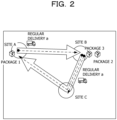
- FIG. 2 is a diagram illustrating a transport vehicle relay delivery.
- one driver loads the package 1 into the first transport vehicle at the site A and transports the package 1 to the site B in the regular delivery a.
- this driver changes to the second transport vehicle loaded with the package 2 and the package 3 at the site B, unloads the package 2 at the site C, and unloads the package 3 at the site C. Unloading of the package is not performed by the driver but is performed by a loading and unloading staff at each site.
- FIG. 3 is a diagram illustrating a time schedule of the transport vehicle relay delivery in FIG. 2 .
- the upper part of FIG. 3 illustrates a time schedule until the package 2 is unloaded at the site C as an example.
- a work of loading the package 1 is performed by the loading and unloading staff, the work may be performed by the driver.
- a traveling time for traveling by the first transport vehicle from the site A to the site B is taken.
- a work of unloading the package 1 occurs at the site B, the driver does not perform this work.
- the package 2 is already loaded in the second transport vehicle.
- the driver changes from the first transport vehicle to the second transport vehicle, departs from the site B, and transports the package 2 to the site C.
- a work of unloading the package 2 occurs.
- the work of unloading the packages 2 is performed by the loading and unloading staff, the work may be performed by the driver.
- a lower part in FIG. 3 is a time schedule in a case where the package 1 and the package 2 are transported by one transport vehicle instead of the transport vehicle relay delivery. Also in the lower part of FIG. 3 , a time schedule until the package 2 is unloaded at the site C is illustrated. As illustrated in the lower part of FIG. 3 , first, it takes time to load the package 1 into the first transport vehicle at the site A. Although a work of loading the package 1 is performed by the loading and unloading staff, the work may be performed by the driver. Next, a traveling time for traveling by the first transport vehicle from the site A to the site B is taken. At the site B, a work of unloading the package 1 occurs.
- the work of unloading the package 1 may be performed by the loading and unloading staff or the driver.
- the loading and unloading staff or the driver loads the package 2 into the first transport vehicle at the site B.
- the driver transports the package 2 to the site C.
- a work of unloading the package 2 occurs.
- the work of unloading the package 2 may be performed by the loading and unloading staff or the driver.
- a work time is shortened by the work of unloading the package 1 and the work of loading the package 2 at the site B as compared with the schedule in the lower part of FIG. 3 . Accordingly, the transport time may be shortened. Since the work of unloading the package 1 and the work of loading the package 2 at the site B are performed by the loading and unloading staff, the load on the driver is reduced. As described above, by using the transport vehicle relay delivery, it is possible to shorten the transport time and reduce the load on the driver.
- a constraint condition of the transport vehicle relay delivery will be described.
- the driver changes the transport vehicle at a designated site.
- packages may be loaded before the transport vehicle before change arrives.
- the departure may be made at a later time among a time when the transport vehicle before change arrives and a time when loading of packages to the transport vehicle after change is completed.
- the transport vehicle after change does not continue to transport the packages of the transport vehicle before change.
- a departure site and a final site are matched (the driver returns to the departure site). Efficient generation of the above-described transport vehicle relay delivery is desired.
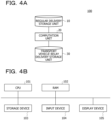
- FIG. 4A is a functional block diagram illustrating an overall configuration of an information processing apparatus 100 according to a first embodiment.
- the information processing apparatus 100 is a server or the like for optimization processing. As illustrated in FIG. 4A , the information processing apparatus 100 functions as a regular delivery storage unit 10, a computation unit 20, a transport vehicle relay delivery storage unit 30, and the like.
- FIG. 4B is a hardware configuration diagram of the information processing apparatus 100.
- the information processing apparatus 100 includes a central processing unit (CPU) 101, a random-access memory (RAM) 102, a storage device 103, an input device 104, a display device 105, and the like.
- CPU central processing unit
- RAM random-access memory
- the CPU 101 is a central processing unit.
- the CPU 101 includes one or more cores.
- the RAM 102 is a volatile memory that temporarily stores a program executed by the CPU 101, data processed by the CPU 101, and the like.
- the storage device 103 is a nonvolatile storage device.
- a read-only memory (ROM), a solid-state drive (SSD) such as a flash memory, a hard disk to be driven by a hard disk drive, or the like may be used.
- the storage device 103 stores a computation program.
- the input device 104 is a device for a user to input desired information, and is a keyboard, a mouse, or the like.
- the display device 105 is a device that displays a computation result or the like of the computation unit 20 on a screen.
- Each unit of the information processing apparatus 100 is realized by the CPU 101 executing the computation program.
- Hardware such as a dedicated circuit may be used as each unit of the information processing apparatus 100.
- the regular delivery storage unit 10 stores a plurality of regular deliveries.
- FIG. 5 is a regular delivery table that stores each regular delivery stored in the regular delivery storage unit 10.
- Each of the regular deliveries has a route from a first site to a last site, and it is determined at which site each package is loaded and transported to which site.
- an operation start time and an operation time limit are defined.
- the operation start time is a time at which an operation may be started, and is a time at which the operation does not have to be performed at the time.
- the operation time limit is a time by which the operation is to be ended.
- a stop-by site is determined for each regular delivery. For example, in the regular delivery a, the transport vehicle departs from the site A, stops at the site B and the site C in this order, and returns to the site A. In the regular delivery b, the transport vehicle departs from the site B and arrives at the site A.
- the packages to be transported are determined in each regular delivery. For each package, a route, a weight, a transport time taken to travel along all routes, an arrival time, and the like are determined. For example, it is determined that the package 1 and the package 2 are transported by the regular delivery a. The package 1 is transported from the site A to the site B. The package 2 is transported from the site B to the site C. It is determined that the package 3 is transported by the regular delivery b. The package 3 is transported from the site B to the site A.
- a type of the transport vehicle to be used for transport is determined in each regular delivery. Once a transport vehicle type is specified, a maximum loading capacity and the like are determined.
- the computation unit 20 acquires information on each regular delivery from the regular delivery storage unit 10, and creates a set P of pairs of arbitrary two regular deliveries (step S1).
- a pair of regular deliveries includes a first half regular delivery and a second half regular delivery.
- a pair of the regular deliveries a and b, a pair of the regular deliveries b and a, a pair of the regular deliveries b and c, a pair of the regular deliveries c and b, a pair of the regular deliveries a and c, and a pair of the regular deliveries c and a are acquired as the set P.
- the pair of the regular deliveries a and b and the pair of the regular deliveries b and a are treated as different pairs.
- a pair including a regular delivery whose operation end limit is not satisfied even when there is no package is excluded from the set P.
- a pair including a regular delivery prohibited from being set as a transport vehicle relay delivery is also excluded from the set P.
- a pair including a regular delivery that involves a plurality of drivers because the time of the regular delivery exceeds a work time of one driver per day is excluded from the set P because one driver may not change the transport vehicles.
- the computation unit 20 performs transport vehicle relay delivery creation processing (step S2).
- FIG. 7 is a flowchart illustrating details of the transport vehicle relay delivery creation processing in step S2.
- the computation unit 20 acquires one pair from the pairs included in the set P, and sets the first half regular delivery as a regular delivery ⁇ and the second half regular delivery as a regular delivery ⁇ .
- a pair of the first half regular delivery ⁇ and the second half regular delivery ⁇ is referred to as a pair ( ⁇ , ⁇ ).
- the computation unit 20 newly creates a transport vehicle relay delivery ⁇ from the pair ( ⁇ , ⁇ ) (step S11).
- attributes operation start time, operation time limit, transport vehicle type, and the like
- attributes of the regular delivery ⁇ are inherited.
- As the maximum loading capacity of the transport vehicle relay delivery a larger one of a maximum loading capacity of the regular delivery ⁇ and a maximum loading capacity of the regular delivery ⁇ is inherited.
- the computation unit 20 obtains a stop-by site ⁇ _k at which a package is loaded last, other than a first stop-by site.
- the computation unit 20 adds ( ⁇ _1, ..., and ⁇ _k) from the stop-by site ⁇ _1 to the stop-by site ⁇ _k to the transport vehicle relay delivery ⁇ (step S 12).
- the stop-by sites in order from the site on the left to the site on the right are represented.
- the transport vehicle stops at the site ⁇ _1, then stops at the site ⁇ _2, and stops at the site ⁇ _n at last.
- the site ⁇ _1 is a departure site
- ⁇ _k is a last stop-by site.
- the following steps S13 to S21 are not executed.
- step S13 the computation unit 20 adds ⁇ _1 to the end of the transport vehicle relay delivery ⁇ (step S13). Accordingly, after the site ⁇ _k at which the package is loaded last in the regular delivery ⁇ , the transport vehicle travels to the loading site at which the package is loaded first in the regular delivery ⁇ . When ⁇ _k is the same as ⁇ _1, step S13 is not executed.
- the computation unit 20 adds ( ⁇ _k + 1, ..., and ⁇ _n) and ( ⁇ _2, ..., and ⁇ _n) to the end of the transport vehicle relay delivery ⁇ (step S14).
- step S15 the computation unit 20 adds the site ⁇ _1 to the end of the transport vehicle relay delivery ⁇ (step S15). Accordingly, the driver departs from the site ⁇ _1 and returns to the site ⁇ _1.
- step S15 is not executed.
- the computation unit 20 acquires a package set Q of each package transported by the regular delivery ⁇ and each package transported by the regular delivery ⁇ (step S16).
- packages that are not able to be transported by the transport vehicle relay delivery are deleted from the package set Q and set as a package set R.
- a criterion for determining whether or not transport is possible by the transport vehicle relay delivery is determined.
- the computation unit 20 checks whether or not various constraint conditions (the operation time limit, the arrival time limit of the package, the loading capacity, and the like of the transport vehicle relay delivery ⁇ ) are satisfied when the package set Q is transported by the transport vehicle relay delivery ⁇ (step S17). For example, since a traveling time between sites is determined, once an order of stop-by sites is determined, an arrival time at each site is calculated. For each package, it is possible to determine whether or not a time when a package arrives at a site of a transport destination is before the arrival time limit. Because a loading site and an unloading site are determined for each package, once a route is determined, a combination of packages loaded at the same time is determined.
- various constraint conditions the operation time limit, the arrival time limit of the package, the loading capacity, and the like of the transport vehicle relay delivery ⁇
- the computation unit 20 deletes a package that does not satisfy the arrival time limit from the package set Q and adds the package to the package set R (step S18).
- the computation unit 20 searches for a regular delivery, from those other than the regular deliveries ⁇ and ⁇ , that is capable of transporting each package in the package set R (step S19).
- the Dijkstra method or the like may be used as the search method.
- a regular delivery transporting a package for which a loading site and an unloading site match is searched.
- each package in the package set R is added to the searched regular delivery.
- the transport vehicle relay delivery storage unit 30 outputs information on the transport vehicle relay delivery ⁇ (step S20).
- the information to be output includes stop-by sites ( ⁇ _1, ..., and ⁇ _j) of the transport vehicle relay delivery ⁇ .
- the information to be output includes a site ⁇ _i-1 at which the driver changes the transport vehicle.
- the information to be output includes transport information of the package set Q to be transported by the transport vehicle relay delivery ⁇ .
- the information to be output includes transport information of the package set R to be transported by a delivery other than the transport vehicle relay delivery ⁇ .
- Information stored in the transport vehicle relay delivery storage unit 30 may be displayed on the display device 105.
- the computation unit 20 deletes a pair corresponding to a pair ( ⁇ , ⁇ ) of regular deliveries from the set P (step S21). This is because a transport vehicle relay delivery may be generated by a combination of the regular deliveries ( ⁇ , ⁇ ). By executing the above-described processing, the transport vehicle relay delivery creation processing is completed.
- the computation unit 20 deletes a pair corresponding to the pair ( ⁇ and ⁇ ) of regular deliveries from the set P (step S3).
- the pair ( ⁇ and ⁇ ) is successfully set as a transport vehicle relay delivery, a pair including a regular delivery corresponding to the regular delivery ⁇ or a regular delivery corresponding to the regular delivery ⁇ is deleted from the set P.
- the computation unit 20 determines whether or not the pair is lost from the set P (step S4). For example, when the number of remaining regular deliveries is less than two in the set P, "Yes" is determined in step S4.
- step S4 When “Yes” is determined in step S4, the execution of the flowchart ends.
- step S4 the processing is executed again from step S1. Accordingly, steps S1 to S4 are executed again for any of the pairs remaining in the set P, and it is determined whether or not it is possible to set the pair as the transport vehicle relay delivery.
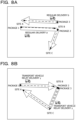
- FIGs. 8A, 8B , and 9 are diagrams illustrating a case where the transport vehicle relay delivery ⁇ is generated by using the regular delivery a described in FIG. 5 as a first half regular delivery ⁇ and the regular delivery b as a second half regular delivery ⁇ .
- the stop-by sites ( ⁇ _1, ⁇ _2, ..., and ⁇ _n) of the first half regular delivery ⁇ are (site A, site B, and site C).
- the stop-by sites ( ⁇ _1, ..., and ⁇ _n) of the second half regular delivery ⁇ are (site B and site A).
- the site at which the package is loaded last other than the first stop-by site is the site B, and thus ⁇ _k is the site B. Accordingly, (site A and site B) are added to the transport vehicle relay delivery ⁇ .
- ⁇ _1 is not added to the end of the transport vehicle relay delivery ⁇ .
- FIG. 10 is a diagram for describing a case where the first half regular delivery ⁇ is the regular delivery a described in FIG. 5 , and the second half regular delivery ⁇ is a regular delivery in which a package is loaded at the site D and this package is unloaded at the site E.
- the stop-by sites ( ⁇ _1, ⁇ _2, ..., and ⁇ _n) of the first half regular delivery ⁇ are (site A, site B, and site C).
- the stop-by sites ( ⁇ _1, ..., and ⁇ _n) of the second half regular delivery ⁇ are (site D and site E).
- the site at which the package is loaded last other than the first stop-by site is the site B, and thus ⁇ _k is the site B. Accordingly, (site A and site B) are added to the transport vehicle relay delivery ⁇ .
- the site D that is ⁇ _1 is added to the end of the transport vehicle relay delivery ⁇ .
- the site C that is the remaining ( ⁇ _k + 1, ..., and ⁇ _n) of the regular delivery ⁇ is added to the end of the transport vehicle relay delivery ⁇ .
- the site E corresponding to ( ⁇ _2, ..., and ⁇ _n) is added.
- the site A that is ⁇ _1 and the site C that is ⁇ _n are different from each other, the site A that is ⁇ _1 is added after the site ⁇ _n.
- the stop-by sites of the transport vehicle relay delivery ⁇ are (site A, site B, site D, site C, site E, and site A).
- a combination of a first half regular delivery ⁇ and a second half regular delivery ⁇ is acquired.
- a site at which a package is loaded last in the regular delivery ⁇ is specified, a route of the regular delivery ⁇ is added after the specified site, and when the specified site matches a first site of the regular delivery ⁇ , the first site of the regular delivery ⁇ is deleted.
- the first site of the regular delivery ⁇ is added as the last site, and a transport vehicle relay delivery is created.
- the regular delivery ⁇ is an example of a first regular delivery
- the regular delivery ⁇ is an example of a second regular delivery
- the site or the stop-by site is an example of a node.
Landscapes
- Business, Economics & Management (AREA)
- Engineering & Computer Science (AREA)
- Economics (AREA)
- Human Resources & Organizations (AREA)
- Strategic Management (AREA)
- Quality & Reliability (AREA)
- Marketing (AREA)
- Operations Research (AREA)
- Entrepreneurship & Innovation (AREA)
- Development Economics (AREA)
- Tourism & Hospitality (AREA)
- Physics & Mathematics (AREA)
- General Business, Economics & Management (AREA)
- General Physics & Mathematics (AREA)
- Theoretical Computer Science (AREA)
- Game Theory and Decision Science (AREA)
- Management, Administration, Business Operations System, And Electronic Commerce (AREA)
Abstract
Description
- The embodiment discussed herein is related to a computation program, a computation method, and an information processing apparatus.
- Transport of packages using transport vehicles is performed in the distribution industry. Because there are a wide variety of types of packages and there are a large number of sites, optimization of a transport plan is performed.
-
Japanese Laid-open Patent Publication Nos. 2020-56683 2019-117444 U.S. Patent Publication Nos. 2021/0046929 and2020/0027060 are disclosed as related art. - When packages are loaded and unloaded at sites in the middle of such a transport plan, there is a risk that it takes a long transport time to complete the transport of the packages. By contrast, a transport vehicle relay delivery in which one driver changes a plurality of transport vehicles has been studied. However, a technique for efficiently generating the transport vehicle relay delivery is not disclosed.
- In one aspect, an object of the present disclosure is to provide a computer-readable recording medium storing a computation program, a computation method, and an information processing apparatus capable of efficiently generating a transport vehicle relay delivery.
- According to an aspect of the embodiments, there is provided a computation program including instructions which, when executed by a computer, cause the computer to execute processing including: acquiring a combination of a first regular delivery and a second regular delivery from a set that includes a plurality of regular deliveries each of which has a route from a first node to a last node and for which it is determined at which node each package is loaded and transported to which node; and creating a transport vehicle relay delivery by specifying a node at which a package is loaded last in the first regular delivery, adding a route of the second regular delivery after the specified node, deleting a first node of the second regular delivery when the specified node and the first node of the second regular delivery match, and adding a first node of the first regular delivery as a last node when a last node of the second regular delivery does not match the first node of the first regular delivery.
- A transport vehicle relay delivery may be efficiently generated.
-
-
FIG. 1A is a diagram illustrating a transport plan, andFIG. 1B is an example in which the transport plan inFIG. 1A is optimized; -
FIG. 2 is a diagram illustrating a transport vehicle relay delivery; -
FIG. 3 is a diagram illustrating a time schedule; -
FIG. 4A is a functional block diagram illustrating an overall configuration of an information processing apparatus according to a first embodiment, andFIG. 4B is a hardware configuration diagram of the information processing apparatus; -
FIG. 5 is a regular delivery table that stores each regular delivery stored in a regular delivery storage unit; -
FIG. 6 is a diagram illustrating a flowchart; -
FIG. 7 is a flowchart presenting details of transport vehicle relay delivery creation processing in step S2; -
FIGs. 8A and 8B are diagrams illustrating a case where a transport vehicle relay delivery is generated; -
FIG. 9 is a diagram illustrating a case where the transport vehicle relay delivery is generated; and -
FIG. 10 is a diagram illustrating a case where the transport vehicle relay delivery is generated. - Transport of packages using transport vehicles is performed in the distribution industry. For example, packages are transported from a site (node) to a site. Because there are a wide variety of types of packages and a large number of sites, optimization of a transport plan is desired.
-
FIG. 1A is a diagram illustrating a transport plan. As illustrated inFIG. 1A , a regular delivery a is a delivery in which apackage 1 is loaded at a site A and thepackage 1 is unloaded at a site B. A regular delivery b is a delivery in which apackage 2 is loaded at a site C and thepackage 2 is unloaded at a site E. A regular delivery c is a delivery in which apackage 3 and apackage 4 are loaded at a site D, thepackage 3 is unloaded at the site B, and then thepackage 4 is unloaded at the site E. -
FIG. 1B illustrates an example in which the transport plan inFIG. 1A is optimized. In the optimization, a stop-by site of the regular delivery is changed, and a package transfer site is changed, thereby reducing a number of deliveries, reducing an operation distance, shortening a transport time (lead time) of packages, and the like. For example, in the optimization result ofFIG. 1B , in the regular delivery c, thepackage 3 and thepackage 4 are loaded at the site D, thepackage 3 is unloaded and thepackage 2 is loaded at the site C, and thepackage 2 and thepackage 4 are unloaded at the site E. In the regular delivery a, thepackage 1 is loaded at the site A, thepackage 3 is loaded at the site C, and thepackage 1 and thepackage 3 are unloaded at the site B. By doing so, it is possible to omit the regular delivery b. - According to such a transport plan, it is common that one driver operates one transport vehicle. However, when loading and unloading of a package occurs at a site in the middle of the transport, there is a risk that the transport time taken to complete the transport of the package may increase. By contrast, when one driver changes a plurality of transport vehicles, it is possible to shorten the time taken to load and unload packages. Hereinafter, this will be referred to as a transport vehicle relay delivery in which one driver changes a plurality of transport vehicles.
- The transport vehicle relay delivery has the following advantages. For example, at a site at which a driver changes from a first transport vehicle to a second transport vehicle, a time taken to unload packages from the first transport vehicle is reduced. Before the first transport vehicle arrives at this site, the second transport vehicle may be loaded with packages. Accordingly, since the time for loading and unloading the packages may be reduced, the transport time may be shortened. As a result, it is possible to shorten a constraint time of the driver, and the number of drivers may be reduced. By separating the transportation work and the cargo handling work from each other, the work environment of the driver may be improved. Since the second transport vehicle may be loaded with packages in advance, a space for stocking the packages during a waiting time until the first transport vehicle arrives may be reduced.
-
FIG. 2 is a diagram illustrating a transport vehicle relay delivery. For example, one driver loads thepackage 1 into the first transport vehicle at the site A and transports thepackage 1 to the site B in the regular delivery a. Next, this driver changes to the second transport vehicle loaded with thepackage 2 and thepackage 3 at the site B, unloads thepackage 2 at the site C, and unloads thepackage 3 at the site C. Unloading of the package is not performed by the driver but is performed by a loading and unloading staff at each site. - An upper part of
FIG. 3 is a diagram illustrating a time schedule of the transport vehicle relay delivery inFIG. 2 . The upper part ofFIG. 3 illustrates a time schedule until thepackage 2 is unloaded at the site C as an example. As illustrated in the upper part ofFIG. 3 , first, it takes time to load thepackage 1 into the first transport vehicle at the site A. Although a work of loading thepackage 1 is performed by the loading and unloading staff, the work may be performed by the driver. Next, a traveling time for traveling by the first transport vehicle from the site A to the site B is taken. Although a work of unloading thepackage 1 occurs at the site B, the driver does not perform this work. Thepackage 2 is already loaded in the second transport vehicle. Next, the driver changes from the first transport vehicle to the second transport vehicle, departs from the site B, and transports thepackage 2 to the site C. At the site C, a work of unloading thepackage 2 occurs. Although the work of unloading thepackages 2 is performed by the loading and unloading staff, the work may be performed by the driver. - A lower part in
FIG. 3 is a time schedule in a case where thepackage 1 and thepackage 2 are transported by one transport vehicle instead of the transport vehicle relay delivery. Also in the lower part ofFIG. 3 , a time schedule until thepackage 2 is unloaded at the site C is illustrated. As illustrated in the lower part ofFIG. 3 , first, it takes time to load thepackage 1 into the first transport vehicle at the site A. Although a work of loading thepackage 1 is performed by the loading and unloading staff, the work may be performed by the driver. Next, a traveling time for traveling by the first transport vehicle from the site A to the site B is taken. At the site B, a work of unloading thepackage 1 occurs. The work of unloading thepackage 1 may be performed by the loading and unloading staff or the driver. Next, the loading and unloading staff or the driver loads thepackage 2 into the first transport vehicle at the site B. Next, the driver transports thepackage 2 to the site C. At the site C, a work of unloading thepackage 2 occurs. The work of unloading thepackage 2 may be performed by the loading and unloading staff or the driver. - In the schedule in the upper part of
FIG. 3 , a work time is shortened by the work of unloading thepackage 1 and the work of loading thepackage 2 at the site B as compared with the schedule in the lower part ofFIG. 3 . Accordingly, the transport time may be shortened. Since the work of unloading thepackage 1 and the work of loading thepackage 2 at the site B are performed by the loading and unloading staff, the load on the driver is reduced. As described above, by using the transport vehicle relay delivery, it is possible to shorten the transport time and reduce the load on the driver. - A constraint condition of the transport vehicle relay delivery will be described. First, the driver changes the transport vehicle at a designated site. Next, for the transport vehicle after change, packages may be loaded before the transport vehicle before change arrives. For the transport vehicle after change, the departure may be made at a later time among a time when the transport vehicle before change arrives and a time when loading of packages to the transport vehicle after change is completed. The transport vehicle after change does not continue to transport the packages of the transport vehicle before change. There are types of packages that may not be transported by the transport vehicle relay delivery. A departure site and a final site are matched (the driver returns to the departure site). Efficient generation of the above-described transport vehicle relay delivery is desired.
- An information processing apparatus, a computation method, and a computation program that may efficiently generate a transport vehicle relay delivery will be described in the following embodiment.
-
FIG. 4A is a functional block diagram illustrating an overall configuration of aninformation processing apparatus 100 according to a first embodiment. Theinformation processing apparatus 100 is a server or the like for optimization processing. As illustrated inFIG. 4A , theinformation processing apparatus 100 functions as a regulardelivery storage unit 10, acomputation unit 20, a transport vehicle relaydelivery storage unit 30, and the like. -
FIG. 4B is a hardware configuration diagram of theinformation processing apparatus 100. As exemplified inFIG. 4B , theinformation processing apparatus 100 includes a central processing unit (CPU) 101, a random-access memory (RAM) 102, astorage device 103, aninput device 104, adisplay device 105, and the like. - The
CPU 101 is a central processing unit. TheCPU 101 includes one or more cores. TheRAM 102 is a volatile memory that temporarily stores a program executed by theCPU 101, data processed by theCPU 101, and the like. Thestorage device 103 is a nonvolatile storage device. As thestorage device 103, for example, a read-only memory (ROM), a solid-state drive (SSD) such as a flash memory, a hard disk to be driven by a hard disk drive, or the like may be used. Thestorage device 103 stores a computation program. Theinput device 104 is a device for a user to input desired information, and is a keyboard, a mouse, or the like. Thedisplay device 105 is a device that displays a computation result or the like of thecomputation unit 20 on a screen. Each unit of theinformation processing apparatus 100 is realized by theCPU 101 executing the computation program. Hardware such as a dedicated circuit may be used as each unit of theinformation processing apparatus 100. - The regular
delivery storage unit 10 stores a plurality of regular deliveries.FIG. 5 is a regular delivery table that stores each regular delivery stored in the regulardelivery storage unit 10. Each of the regular deliveries has a route from a first site to a last site, and it is determined at which site each package is loaded and transported to which site. For example, as illustrated inFIG. 5 , an operation start time and an operation time limit are defined. The operation start time is a time at which an operation may be started, and is a time at which the operation does not have to be performed at the time. The operation time limit is a time by which the operation is to be ended. A stop-by site is determined for each regular delivery. For example, in the regular delivery a, the transport vehicle departs from the site A, stops at the site B and the site C in this order, and returns to the site A. In the regular delivery b, the transport vehicle departs from the site B and arrives at the site A. - The packages to be transported are determined in each regular delivery. For each package, a route, a weight, a transport time taken to travel along all routes, an arrival time, and the like are determined. For example, it is determined that the
package 1 and thepackage 2 are transported by the regular delivery a. Thepackage 1 is transported from the site A to the site B. Thepackage 2 is transported from the site B to the site C. It is determined that thepackage 3 is transported by the regular delivery b. Thepackage 3 is transported from the site B to the site A. - A type of the transport vehicle to be used for transport is determined in each regular delivery. Once a transport vehicle type is specified, a maximum loading capacity and the like are determined.
- Hereinafter, computation processing will be described with reference to a flowchart in
FIG. 6 . First, thecomputation unit 20 acquires information on each regular delivery from the regulardelivery storage unit 10, and creates a set P of pairs of arbitrary two regular deliveries (step S1). A pair of regular deliveries includes a first half regular delivery and a second half regular delivery. For example, in a case where the regular deliveries a, b, and c are included in the regulardelivery storage unit 10, as the pairs of the first half regular delivery and the second half regular delivery, a pair of the regular deliveries a and b, a pair of the regular deliveries b and a, a pair of the regular deliveries b and c, a pair of the regular deliveries c and b, a pair of the regular deliveries a and c, and a pair of the regular deliveries c and a are acquired as the set P. As described above, the pair of the regular deliveries a and b and the pair of the regular deliveries b and a are treated as different pairs. However, a pair including a regular delivery whose operation end limit is not satisfied even when there is no package is excluded from the set P. A pair including a regular delivery prohibited from being set as a transport vehicle relay delivery is also excluded from the set P. For example, a pair including a regular delivery that involves a plurality of drivers because the time of the regular delivery exceeds a work time of one driver per day is excluded from the set P because one driver may not change the transport vehicles. - Next, the
computation unit 20 performs transport vehicle relay delivery creation processing (step S2). -
FIG. 7 is a flowchart illustrating details of the transport vehicle relay delivery creation processing in step S2. First, thecomputation unit 20 acquires one pair from the pairs included in the set P, and sets the first half regular delivery as a regular delivery α and the second half regular delivery as a regular delivery β. A pair of the first half regular delivery α and the second half regular delivery β is referred to as a pair (α, β). Thecomputation unit 20 newly creates a transport vehicle relay delivery γ from the pair (α, β) (step S11). As attributes (operation start time, operation time limit, transport vehicle type, and the like) of the transport vehicle relay delivery γ, attributes of the regular delivery α are inherited. As the maximum loading capacity of the transport vehicle relay delivery, a larger one of a maximum loading capacity of the regular delivery α and a maximum loading capacity of the regular delivery β is inherited. - Next, among stop-by sites (α_1, α_2, ..., and α_n) defined in the regular delivery α, the
computation unit 20 obtains a stop-by site α_k at which a package is loaded last, other than a first stop-by site. Thecomputation unit 20 adds (α_1, ..., and α_k) from the stop-by site α_1 to the stop-by site α_k to the transport vehicle relay delivery γ (step S 12). In the (α_1, α_2, ..., and α_n), the stop-by sites in order from the site on the left to the site on the right are represented. Accordingly, the transport vehicle stops at the site α_1, then stops at the site α_2, and stops at the site α_n at last. In a case of (α_1, ..., and α_k), the site α_1 is a departure site, and α_k is a last stop-by site. In a case where there is a package that is loaded before the site α_k and unloaded after the site α_k, the following steps S13 to S21 are not executed. - Next, for stop-by sites (β_1, ..., and β_n) defined in the regular delivery β, when α_k is different from β_1, the
computation unit 20 adds β_1 to the end of the transport vehicle relay delivery γ (step S13). Accordingly, after the site α_k at which the package is loaded last in the regular delivery α, the transport vehicle travels to the loading site at which the package is loaded first in the regular delivery β. When α_k is the same as β_1, step S13 is not executed. - Next, the
computation unit 20 adds (α_k + 1, ..., and α_n) and (β_2, ..., and β_n) to the end of the transport vehicle relay delivery γ (step S14). - Next, in a case where the last stop-by site is different from the site α_1 in the transport vehicle relay delivery γ, the
computation unit 20 adds the site α_1 to the end of the transport vehicle relay delivery γ (step S15). Accordingly, the driver departs from the site α_1 and returns to the site α_1. When the last stop-by site is the same as the site α_1 in the transport vehicle relay delivery γ, step S15 is not executed. - Next, the
computation unit 20 acquires a package set Q of each package transported by the regular delivery α and each package transported by the regular delivery β (step S16). However, among the package set Q, packages that are not able to be transported by the transport vehicle relay delivery are deleted from the package set Q and set as a package set R. For example, a criterion for determining whether or not transport is possible by the transport vehicle relay delivery is determined. - Next, the
computation unit 20 checks whether or not various constraint conditions (the operation time limit, the arrival time limit of the package, the loading capacity, and the like of the transport vehicle relay delivery γ) are satisfied when the package set Q is transported by the transport vehicle relay delivery γ (step S17). For example, since a traveling time between sites is determined, once an order of stop-by sites is determined, an arrival time at each site is calculated. For each package, it is possible to determine whether or not a time when a package arrives at a site of a transport destination is before the arrival time limit. Because a loading site and an unloading site are determined for each package, once a route is determined, a combination of packages loaded at the same time is determined. Accordingly, it is possible to determine whether or not there is one in which a maximum total weight exceeds a maximum loading capacity among the combinations of the packages. In a case where the transport vehicle relay delivery γ does not satisfy the operation time limit, the following steps S18 to S21 are not executed. - Next, the
computation unit 20 deletes a package that does not satisfy the arrival time limit from the package set Q and adds the package to the package set R (step S18). - Next, the
computation unit 20 searches for a regular delivery, from those other than the regular deliveries α and β, that is capable of transporting each package in the package set R (step S19). For example, the Dijkstra method or the like may be used as the search method. For example, among the regular deliveries remaining in the set P, a regular delivery transporting a package for which a loading site and an unloading site match is searched. After the corresponding regular delivery is searched, each package in the package set R is added to the searched regular delivery. When there is no regular delivery capable of transporting each package in the package set R, the following steps S20 and S21 are not executed. - Next, the transport vehicle relay
delivery storage unit 30 outputs information on the transport vehicle relay delivery γ (step S20). The information to be output includes stop-by sites (γ_1, ..., and γ_j) of the transport vehicle relay delivery γ. The information to be output includes a site γ_i-1 at which the driver changes the transport vehicle. The information to be output includes transport information of the package set Q to be transported by the transport vehicle relay delivery γ. The information to be output includes transport information of the package set R to be transported by a delivery other than the transport vehicle relay delivery γ. Information stored in the transport vehicle relaydelivery storage unit 30 may be displayed on thedisplay device 105. - Next, the
computation unit 20 deletes a pair corresponding to a pair (β, α) of regular deliveries from the set P (step S21). This is because a transport vehicle relay delivery may be generated by a combination of the regular deliveries (α, β). By executing the above-described processing, the transport vehicle relay delivery creation processing is completed. - Referring to
FIG. 6 again, thecomputation unit 20 deletes a pair corresponding to the pair (α and β) of regular deliveries from the set P (step S3). In a case where the pair (α and β) is successfully set as a transport vehicle relay delivery, a pair including a regular delivery corresponding to the regular delivery α or a regular delivery corresponding to the regular delivery β is deleted from the set P. - Next, the
computation unit 20 determines whether or not the pair is lost from the set P (step S4). For example, when the number of remaining regular deliveries is less than two in the set P, "Yes" is determined in step S4. - When "Yes" is determined in step S4, the execution of the flowchart ends. When "No" is determined in step S4, the processing is executed again from step S1. Accordingly, steps S1 to S4 are executed again for any of the pairs remaining in the set P, and it is determined whether or not it is possible to set the pair as the transport vehicle relay delivery.
-
FIGs. 8A, 8B , and9 are diagrams illustrating a case where the transport vehicle relay delivery γ is generated by using the regular delivery a described inFIG. 5 as a first half regular delivery α and the regular delivery b as a second half regular delivery β. As illustrated inFIG. 8A , the stop-by sites (α_1, α_2, ..., and α_n) of the first half regular delivery α are (site A, site B, and site C). The stop-by sites (β_1, ..., and β_n) of the second half regular delivery β are (site B and site A). - Among the stop-by sites of the first half regular delivery α, the site at which the package is loaded last other than the first stop-by site is the site B, and thus α_k is the site B. Accordingly, (site A and site B) are added to the transport vehicle relay delivery γ.
- Because the site B that is α_k and the site B that is β_1 are the same, β_1 is not added to the end of the transport vehicle relay delivery γ.
- The site A corresponding to (β_2, ..., and β_n) is added to the end of the transport vehicle relay delivery γ. In this case, since the site A that is α_1 and the site A that is α_n are the same, α_1 is not added after the site α_n. From the above, the stop-by sites of the transport vehicle relay delivery γ are (site A, site B, site C, and site A).
-
FIG. 10 is a diagram for describing a case where the first half regular delivery α is the regular delivery a described inFIG. 5 , and the second half regular delivery β is a regular delivery in which a package is loaded at the site D and this package is unloaded at the site E. As illustrated inFIG. 10 , the stop-by sites (α_1, α_2, ..., and α_n) of the first half regular delivery α are (site A, site B, and site C). The stop-by sites (β_1, ..., and β_n) of the second half regular delivery β are (site D and site E). - Among the stop-by sites of the first half regular delivery α, the site at which the package is loaded last other than the first stop-by site is the site B, and thus α_k is the site B. Accordingly, (site A and site B) are added to the transport vehicle relay delivery γ.
- Because the site B that is α_k and the site D that is β_1 are different from each other, the site D that is β_1 is added to the end of the transport vehicle relay delivery γ.
- The site C that is the remaining (α_k + 1, ..., and α_n) of the regular delivery α is added to the end of the transport vehicle relay delivery γ. After that, the site E corresponding to (β_2, ..., and β_n) is added. In this case, since the site A that is α_1 and the site C that is α_n are different from each other, the site A that is α_1 is added after the site α_n. From the above, the stop-by sites of the transport vehicle relay delivery γ are (site A, site B, site D, site C, site E, and site A).
- According to the present embodiment, from a set including a plurality of regular deliveries, a combination of a first half regular delivery α and a second half regular delivery β is acquired. A site at which a package is loaded last in the regular delivery α is specified, a route of the regular delivery β is added after the specified site, and when the specified site matches a first site of the regular delivery β, the first site of the regular delivery β is deleted. In a case where a last site of the regular delivery β does not match a first site of the regular delivery α, the first site of the regular delivery α is added as the last site, and a transport vehicle relay delivery is created. By the above-described processing, a transport vehicle relay delivery is efficiently generated.
- In each of the examples described above, the regular delivery α is an example of a first regular delivery, the regular delivery β is an example of a second regular delivery, and the site or the stop-by site is an example of a node.
- Although the embodiment of the present disclosure has been described above in detail, the present disclosure is not limited to such particular examples and may be variously modified and changed within the scope of the gist of the present disclosure described in claims.
Claims (6)
- A computation program comprising instructions which, when executed by a computer, cause the computer to execute processing comprising:acquiring a combination of a first regular delivery and a second regular delivery from a set that includes a plurality of regular deliveries each of which has a route from a first node to a last node and for which it is determined at which node each package is loaded and transported to which node; andcreating a transport vehicle relay delivery by specifying a node at which a package is loaded last in the first regular delivery, adding a route of the second regular delivery after the specified node, deleting a first node of the second regular delivery when the specified node and the first node of the second regular delivery match, and adding a first node of the first regular delivery as a last node when a last node of the second regular delivery does not match the first node of the first regular delivery.
- The computation program according to claim 1, the processing further comprising:
determining whether or not a condition of the transport vehicle relay delivery is satisfied for the regular deliveries included in the set, and excluding a regular delivery that does not satisfy the condition of the transport vehicle relay delivery from both the first regular delivery and the second regular delivery. - The computation program according to claim 1, the processing further comprising:
determining whether or not a condition of the transport vehicle relay delivery is satisfied for the packages to be transported by the first regular delivery and the second regular delivery, and for a package that does not satisfy the condition of the transport vehicle relay delivery, searching for a regular delivery that is capable of transporting the package other than the first regular delivery and the second regular delivery. - The computation program according to claim 1, the processing further comprising:
repeating processing of deleting the first regular delivery and the second regular delivery from the set, acquiring two regular deliveries from remaining regular deliveries, and creating a new transport vehicle relay delivery until a number of remaining regular deliveries is less than two. - A computation method implemented by a computer to execute processing comprising:acquiring a combination of a first regular delivery and a second regular delivery from a set that includes a plurality of regular deliveries each of which has a route from a first node to a last node and for which it is determined at which node each package is loaded and transported to which node; andcreating a transport vehicle relay delivery by specifying a node at which a package is loaded last in the first regular delivery, adding a route of the second regular delivery after the specified node, deleting a first node of the second regular delivery when the specified node and the first node of the second regular delivery match, and adding a first node of the first regular delivery as a last node when a last node of the second regular delivery does not match the first node of the first regular delivery.
- An information processing apparatus comprising a computation unit configured to perform processing comprising:acquiring a combination of a first regular delivery and a second regular delivery from a set that includes a plurality of regular deliveries each of which has a route from a first node to a last node and for which it is determined at which node each package is loaded and transported to which node; andcreating a transport vehicle relay delivery by specifying a node at which a package is loaded last in the first regular delivery, adding a route of the second regular delivery after the specified node, deleting a first node of the second regular delivery when the specified node and the first node of the second regular delivery match, and adding a first node of the first regular delivery as a last node when a last node of the second regular delivery does not match the first node of the first regular delivery.
Applications Claiming Priority (1)
| Application Number | Priority Date | Filing Date | Title |
|---|---|---|---|
| JP2023134015A JP2025029401A (en) | 2023-08-21 | 2023-08-21 | Calculation program, calculation method, and information processing device |
Publications (1)
| Publication Number | Publication Date |
|---|---|
| EP4513403A1 true EP4513403A1 (en) | 2025-02-26 |
Family
ID=91670590
Family Applications (1)
| Application Number | Title | Priority Date | Filing Date |
|---|---|---|---|
| EP24184276.4A Withdrawn EP4513403A1 (en) | 2023-08-21 | 2024-06-25 | Computation program, computation method, and information processing apparatus |
Country Status (4)
| Country | Link |
|---|---|
| US (1) | US20250069023A1 (en) |
| EP (1) | EP4513403A1 (en) |
| JP (1) | JP2025029401A (en) |
| CN (1) | CN119494603A (en) |
Citations (10)
| Publication number | Priority date | Publication date | Assignee | Title |
|---|---|---|---|---|
| US20140046585A1 (en) * | 2012-08-10 | 2014-02-13 | Telogis, Inc. | Real-time computation of vehicle service routes |
| JP2019117444A (en) | 2017-12-26 | 2019-07-18 | 株式会社オービック | Allocation data creation device, allocation data creation method and allocation data creation program |
| US20200027060A1 (en) | 2017-03-30 | 2020-01-23 | Huawei Technologies Co., Ltd. | Logistics Path Planning Method and Device |
| JP2020056683A (en) | 2018-10-02 | 2020-04-09 | トヨタ自動車株式会社 | Operation route judgment device, operation route judgment program, and operation route judgment method |
| WO2021015663A1 (en) * | 2019-07-23 | 2021-01-28 | Hitachi, Ltd. | Delivery route planning apparatus and methods of generating delivery route plans |
| US20210046929A1 (en) | 2018-02-24 | 2021-02-18 | Beijing Tusen Weilai Technology Co., Ltd. | System, method and device for planning driving path for vehicle |
| JP2021060644A (en) * | 2019-10-03 | 2021-04-15 | 三菱重工サーマルシステムズ株式会社 | Delivery plan change device, delivery plan change method, and program |
| JP2023006316A (en) * | 2021-06-30 | 2023-01-18 | 株式会社アイシン | matching system |
| US20240220914A1 (en) * | 2022-12-29 | 2024-07-04 | United Parcel Service Of America, Inc. | Self-healing logistics network technology |
| US20240426618A1 (en) * | 2023-06-21 | 2024-12-26 | International Business Machines Corporation | Ad-Hoc Transport Node for Transshipping |
Family Cites Families (3)
| Publication number | Priority date | Publication date | Assignee | Title |
|---|---|---|---|---|
| US8001017B1 (en) * | 2000-03-27 | 2011-08-16 | Hector Franco | Supply-chain management system |
| US20120251289A1 (en) * | 2010-02-05 | 2012-10-04 | Thomas Gesuale | Cargo Delivery System and Method |
| US20130046624A1 (en) * | 2011-08-17 | 2013-02-21 | Bank Of America Corporation | Optimizing routing based on offers |
-
2023
- 2023-08-21 JP JP2023134015A patent/JP2025029401A/en active Pending
-
2024
- 2024-06-21 US US18/749,691 patent/US20250069023A1/en not_active Abandoned
- 2024-06-25 EP EP24184276.4A patent/EP4513403A1/en not_active Withdrawn
- 2024-07-08 CN CN202410905755.XA patent/CN119494603A/en active Pending
Patent Citations (10)
| Publication number | Priority date | Publication date | Assignee | Title |
|---|---|---|---|---|
| US20140046585A1 (en) * | 2012-08-10 | 2014-02-13 | Telogis, Inc. | Real-time computation of vehicle service routes |
| US20200027060A1 (en) | 2017-03-30 | 2020-01-23 | Huawei Technologies Co., Ltd. | Logistics Path Planning Method and Device |
| JP2019117444A (en) | 2017-12-26 | 2019-07-18 | 株式会社オービック | Allocation data creation device, allocation data creation method and allocation data creation program |
| US20210046929A1 (en) | 2018-02-24 | 2021-02-18 | Beijing Tusen Weilai Technology Co., Ltd. | System, method and device for planning driving path for vehicle |
| JP2020056683A (en) | 2018-10-02 | 2020-04-09 | トヨタ自動車株式会社 | Operation route judgment device, operation route judgment program, and operation route judgment method |
| WO2021015663A1 (en) * | 2019-07-23 | 2021-01-28 | Hitachi, Ltd. | Delivery route planning apparatus and methods of generating delivery route plans |
| JP2021060644A (en) * | 2019-10-03 | 2021-04-15 | 三菱重工サーマルシステムズ株式会社 | Delivery plan change device, delivery plan change method, and program |
| JP2023006316A (en) * | 2021-06-30 | 2023-01-18 | 株式会社アイシン | matching system |
| US20240220914A1 (en) * | 2022-12-29 | 2024-07-04 | United Parcel Service Of America, Inc. | Self-healing logistics network technology |
| US20240426618A1 (en) * | 2023-06-21 | 2024-12-26 | International Business Machines Corporation | Ad-Hoc Transport Node for Transshipping |
Also Published As
| Publication number | Publication date |
|---|---|
| CN119494603A (en) | 2025-02-21 |
| JP2025029401A (en) | 2025-03-06 |
| US20250069023A1 (en) | 2025-02-27 |
Similar Documents
| Publication | Publication Date | Title |
|---|---|---|
| Feng et al. | Dynamic hoist scheduling problem with multi-capacity reentrant machines: A mixed integer programming approach | |
| Battarra et al. | The traveling salesman problem with pickups, deliveries, and handling costs | |
| JP2021174262A (en) | Delivery plan creation support program, delivery plan creation support method, and information processing device | |
| CN113506068A (en) | Warehouse entry and exit method and device, storage medium and electronic equipment | |
| US10976965B1 (en) | Optimization of in-memory processing of data represented by an acyclic graph so that the removal and re-materialization of data in selected nodes is minimized | |
| CN110704096A (en) | Packaging method and device of front-end item, storage medium and electronic equipment | |
| CN110826954A (en) | Information processing apparatus, information processing method, and storage medium storing program | |
| US20210285778A1 (en) | Information processing apparatus, route generation method, and non-transitory computer-readable storage medium | |
| US20240420076A1 (en) | Delivery assistance device | |
| WO2006069601A2 (en) | Optimizing vehicle loading operations | |
| US20250069023A1 (en) | Computer-readable recording medium storing computation program, computation method, and information processing apparatus | |
| CN111144796A (en) | Method and device for generating tally information | |
| JP7496057B2 (en) | Delivery support system | |
| CN116313961A (en) | Handling method, system, equipment and medium for wafer transfer box | |
| US11593730B2 (en) | Schedule creation device, schedule creation method, and program | |
| CN114632725A (en) | A method and device for stacking articles in a warehouse | |
| US20100131431A1 (en) | Shipment Order, Freight Order and Tour Builder | |
| JP6433830B2 (en) | Transport support system | |
| Jargalsaikhan et al. | A compact arc-based ILP formulation for the pickup and delivery problem with divisible pickups and deliveries | |
| CN114493056B (en) | Cargo transportation method, cargo transportation system, computer device, and storage medium | |
| CN112651680A (en) | Multitask sorting method and device, computer readable storage medium | |
| CN118536887A (en) | A bulk logistics multimodal transport scheduling method and system based on the Internet of Things | |
| JPH08225116A (en) | Automatic warehouse loading / unloading control method and apparatus | |
| CN114186931B (en) | A method, device, equipment and storage medium for determining a scheduling plan | |
| EP4502889A1 (en) | Computer-readable recording medium storing information processing program, information processing method, and information processing device |
Legal Events
| Date | Code | Title | Description |
|---|---|---|---|
| PUAI | Public reference made under article 153(3) epc to a published international application that has entered the european phase |
Free format text: ORIGINAL CODE: 0009012 |
|
| STAA | Information on the status of an ep patent application or granted ep patent |
Free format text: STATUS: REQUEST FOR EXAMINATION WAS MADE |
|
| 17P | Request for examination filed |
Effective date: 20241002 |
|
| AK | Designated contracting states |
Kind code of ref document: A1 Designated state(s): AL AT BE BG CH CY CZ DE DK EE ES FI FR GB GR HR HU IE IS IT LI LT LU LV MC ME MK MT NL NO PL PT RO RS SE SI SK SM TR |
|
| STAA | Information on the status of an ep patent application or granted ep patent |
Free format text: STATUS: EXAMINATION IS IN PROGRESS |
|
| 17Q | First examination report despatched |
Effective date: 20250616 |
|
| STAA | Information on the status of an ep patent application or granted ep patent |
Free format text: STATUS: THE APPLICATION HAS BEEN WITHDRAWN |
|
| 18W | Application withdrawn |
Effective date: 20250820 |