EP4512863A1 - Aza[3.2.1] bridged ring substituted fluorescent dye, and preparation method therefor and use thereof - Google Patents
Aza[3.2.1] bridged ring substituted fluorescent dye, and preparation method therefor and use thereof Download PDFInfo
- Publication number
- EP4512863A1 EP4512863A1 EP23904797.0A EP23904797A EP4512863A1 EP 4512863 A1 EP4512863 A1 EP 4512863A1 EP 23904797 A EP23904797 A EP 23904797A EP 4512863 A1 EP4512863 A1 EP 4512863A1
- Authority
- EP
- European Patent Office
- Prior art keywords
- substituted
- unsubstituted
- aza
- fluorescent dye
- compound
- Prior art date
- Legal status (The legal status is an assumption and is not a legal conclusion. Google has not performed a legal analysis and makes no representation as to the accuracy of the status listed.)
- Pending
Links
Images





Classifications
-
- C—CHEMISTRY; METALLURGY
- C07—ORGANIC CHEMISTRY
- C07F—ACYCLIC, CARBOCYCLIC OR HETEROCYCLIC COMPOUNDS CONTAINING ELEMENTS OTHER THAN CARBON, HYDROGEN, HALOGEN, OXYGEN, NITROGEN, SULFUR, SELENIUM OR TELLURIUM
- C07F7/00—Compounds containing elements of Groups 4 or 14 of the Periodic Table
- C07F7/02—Silicon compounds
- C07F7/08—Compounds having one or more C—Si linkages
- C07F7/0803—Compounds with Si-C or Si-Si linkages
- C07F7/081—Compounds with Si-C or Si-Si linkages comprising at least one atom selected from the elements N, O, halogen, S, Se or Te
- C07F7/0812—Compounds with Si-C or Si-Si linkages comprising at least one atom selected from the elements N, O, halogen, S, Se or Te comprising a heterocyclic ring
- C07F7/0816—Compounds with Si-C or Si-Si linkages comprising at least one atom selected from the elements N, O, halogen, S, Se or Te comprising a heterocyclic ring said ring comprising Si as a ring atom
-
- C—CHEMISTRY; METALLURGY
- C07—ORGANIC CHEMISTRY
- C07F—ACYCLIC, CARBOCYCLIC OR HETEROCYCLIC COMPOUNDS CONTAINING ELEMENTS OTHER THAN CARBON, HYDROGEN, HALOGEN, OXYGEN, NITROGEN, SULFUR, SELENIUM OR TELLURIUM
- C07F9/00—Compounds containing elements of Groups 5 or 15 of the Periodic Table
- C07F9/02—Phosphorus compounds
- C07F9/547—Heterocyclic compounds, e.g. containing phosphorus as a ring hetero atom
- C07F9/6564—Heterocyclic compounds, e.g. containing phosphorus as a ring hetero atom having phosphorus atoms, with or without nitrogen, oxygen, sulfur, selenium or tellurium atoms, as ring hetero atoms
- C07F9/6568—Heterocyclic compounds, e.g. containing phosphorus as a ring hetero atom having phosphorus atoms, with or without nitrogen, oxygen, sulfur, selenium or tellurium atoms, as ring hetero atoms having phosphorus atoms as the only ring hetero atoms
- C07F9/65685—Heterocyclic compounds, e.g. containing phosphorus as a ring hetero atom having phosphorus atoms, with or without nitrogen, oxygen, sulfur, selenium or tellurium atoms, as ring hetero atoms having phosphorus atoms as the only ring hetero atoms the ring phosphorus atom being part of a phosphine oxide or thioxide
-
- C—CHEMISTRY; METALLURGY
- C09—DYES; PAINTS; POLISHES; NATURAL RESINS; ADHESIVES; COMPOSITIONS NOT OTHERWISE PROVIDED FOR; APPLICATIONS OF MATERIALS NOT OTHERWISE PROVIDED FOR
- C09B—ORGANIC DYES OR CLOSELY-RELATED COMPOUNDS FOR PRODUCING DYES, e.g. PIGMENTS; MORDANTS; LAKES
- C09B11/00—Diaryl- or thriarylmethane dyes
- C09B11/04—Diaryl- or thriarylmethane dyes derived from triarylmethanes, i.e. central C-atom is substituted by amino, cyano, alkyl
- C09B11/10—Amino derivatives of triarylmethanes
- C09B11/12—Amino derivatives of triarylmethanes without any OH group bound to an aryl nucleus
- C09B11/20—Preparation from other triarylmethane derivatives, e.g. by substitution, by replacement of substituents
-
- C—CHEMISTRY; METALLURGY
- C09—DYES; PAINTS; POLISHES; NATURAL RESINS; ADHESIVES; COMPOSITIONS NOT OTHERWISE PROVIDED FOR; APPLICATIONS OF MATERIALS NOT OTHERWISE PROVIDED FOR
- C09B—ORGANIC DYES OR CLOSELY-RELATED COMPOUNDS FOR PRODUCING DYES, e.g. PIGMENTS; MORDANTS; LAKES
- C09B19/00—Oxazine dyes
-
- C—CHEMISTRY; METALLURGY
- C09—DYES; PAINTS; POLISHES; NATURAL RESINS; ADHESIVES; COMPOSITIONS NOT OTHERWISE PROVIDED FOR; APPLICATIONS OF MATERIALS NOT OTHERWISE PROVIDED FOR
- C09B—ORGANIC DYES OR CLOSELY-RELATED COMPOUNDS FOR PRODUCING DYES, e.g. PIGMENTS; MORDANTS; LAKES
- C09B57/00—Other synthetic dyes of known constitution
-
- C—CHEMISTRY; METALLURGY
- C09—DYES; PAINTS; POLISHES; NATURAL RESINS; ADHESIVES; COMPOSITIONS NOT OTHERWISE PROVIDED FOR; APPLICATIONS OF MATERIALS NOT OTHERWISE PROVIDED FOR
- C09B—ORGANIC DYES OR CLOSELY-RELATED COMPOUNDS FOR PRODUCING DYES, e.g. PIGMENTS; MORDANTS; LAKES
- C09B57/00—Other synthetic dyes of known constitution
- C09B57/02—Coumarine dyes
-
- C—CHEMISTRY; METALLURGY
- C09—DYES; PAINTS; POLISHES; NATURAL RESINS; ADHESIVES; COMPOSITIONS NOT OTHERWISE PROVIDED FOR; APPLICATIONS OF MATERIALS NOT OTHERWISE PROVIDED FOR
- C09K—MATERIALS FOR MISCELLANEOUS APPLICATIONS, NOT PROVIDED FOR ELSEWHERE
- C09K11/00—Luminescent materials, e.g. electroluminescent or chemiluminescent
- C09K11/06—Luminescent materials, e.g. electroluminescent or chemiluminescent containing organic luminescent materials
-
- G—PHYSICS
- G01—MEASURING; TESTING
- G01N—INVESTIGATING OR ANALYSING MATERIALS BY DETERMINING THEIR CHEMICAL OR PHYSICAL PROPERTIES
- G01N33/00—Investigating or analysing materials by specific methods not covered by groups G01N1/00 - G01N31/00
- G01N33/48—Biological material, e.g. blood, urine; Haemocytometers
- G01N33/50—Chemical analysis of biological material, e.g. blood, urine; Testing involving biospecific ligand binding methods; Immunological testing
- G01N33/58—Chemical analysis of biological material, e.g. blood, urine; Testing involving biospecific ligand binding methods; Immunological testing involving labelled substances
- G01N33/582—Chemical analysis of biological material, e.g. blood, urine; Testing involving biospecific ligand binding methods; Immunological testing involving labelled substances with fluorescent label
Definitions
- the aza[3.2.1]bridged ring substituted fluorescent dye is selected from at least one of the following formulas A528, A532, A555, A586, A591, A620, A634, A640, A655, A720, A586-2Me, A586-2Me-5-COOH, A528-6-COOH, A532-6-COOH, A555-6-COOH, A586-6-COOH, A591-6-COOH, A620-6-COOH, A634-5-COOH, A640-6-COOH, A655-6-COOH, A528-HTL, A532-HTL, A555-HTL, A586-HTL, A620-HTL, A655-HTL, A555-STL, A528-NHS, A620-STL, A655-STL, A634-NHS, A586-NHS, A591-HTL, A640-HTL, A555-TMP3, A620-TMP3, A655-TMP3, A655-
- a method for preparing an aza[3.2.1]bridged ring substituted fluorescent dye includes: step S11, mixing a compound A, an aza[3.2.1]bridged ring compound and a first catalyst in a first reaction solvent to carry out a reaction so as to obtain a compound B; and step S12, mixing the compound B with an HZ aqueous solution to carry out a reaction so as to obtain the aza[3.2.1]bridged ring substituted fluorescent dye shown in Formula (I).
- the first catalyst includes a palladium catalyst, a palladium catalyst ligand and an alkaline catalyst.
- the palladium catalyst ligand includes at least one of bis(dibenzylideneacetone)palladium and 2,2'-bis(diphenylphosphino)-1,1'-binaphthyl.
- the alkaline catalyst includes at least one of cesium carbonate, sodium tert-butoxide, potassium carbonate, sodium carbonate, sodium methoxide, sodium ethoxide and potassium tert-butoxide.
- the alkaline catalyst includes at least one of cesium carbonate, sodium tert-butoxide and potassium tert-butoxide.
- the first reaction solvent includes at least one of n-hexane, tetrahydrofuran, 1,4-dioxane, ethyl ether and toluene.
- the compound C has a structure shown in Formula (VII) below: where R g , R b , R j , R j , R k and X independently have the same meaning as defined in the first aspect.
- the second catalyst has the same meaning as the first catalyst.
- the second reaction solvent has the same meaning as the first reaction solvent.
- a method for preparing an aza[3.2.1]bridged ring substituted fluorescent dye includes: step S31, mixing a compound D, an aza[3.2.1]bridged ring compound and a third catalyst in a third reaction solvent to carry out a reaction so as to obtain a compound E; step S32, mixing the compound E with an oxidizing agent in a fourth reaction solvent to carry out a reaction so as to obtain a compound F; and step S33, mixing the compound F with an HZ aqueous solution to carry out a reaction so as to obtain the aza[3.2.1]bridged ring substituted fluorescent dye shown in Formula (III).
- the compound D has a structure shown in Formula (VIII) below: where R l , R m , R n , R o , R p , R q , X and Y independently have the same meaning as defined in the first aspect, and Z - in the HZ aqueous solution has the same meaning as defined in the first aspect.
- the third reaction solvent has the same meaning as the first reaction solvent.
- the oxidizing agent includes at least one of 2,3-dichloro-5,6-dicyano-1,4-benzoquinone, potassium permanganate, hydrogen peroxide and m-chloroperoxybenzoic acid.
- an aza[3.2.1]bridged ring substituted fluorescent dye is provided.
- the aza[3.2.1]bridged ring substituted fluorescent dye has a structure shown in Formula (I), Formula (II) or Formula (III) below:
- heteroaryl refers to heteroaryl
- the heteroaryl refers to aryl containing at least one heteroatom selected from the group consisting of N, O and S as a main chain atom of a ring, which may be a monocyclic ring, such as furyl, thienyl, pyrrolyl, imidazolyl, pyrazolyl, thiazolyl, thiadiazolyl, isothiazolyl, isoxazolyl, oxazolyl, oxadiazolyl, triazinyl, tetrazinyl, triazolyl, tetrazolyl, furazyl, pyridyl, pyrazinyl, pyrimidyl or pyridazinyl, or may be a fused ring condensed with at least one benzene ring, such as benzofuryl, benzothienyl, isobenzofuryl, dibenzofuryl, dibenz
- the "substituted” in the "substituted or unsubstituted” indicates that a hydrogen atom in a functional group is substituted with another atom or group (namely, substituent).
- the substituent is independently select from at least one of the following groups: deuterium, halogen, C 1 -C 10 alkyl, C 1 -C 10 alkoxyl, C 6 -C 10 aryl, C 5 -C 10 heteroaryl, C 5 -C 10 heteroaryl substituted with C 6 -C 10 aryl, imidazolyl, benzoimidazolyl, C 3 -C 10 cycloalkyl, C 5 -C 7 heterocycloalkyl, tri-(C 1 -C 10 ) alkylsilyl, tri-(C 1 -C 10 ) arylsilyl, di-(C 1 -C 10 ) alkyl-(C 6 -C 10 ) arylsilyl, C 1 -C 10 alky
- the aza[3.2.1]bridged ring substituted fluorescent dye provided by the present disclosure in technical schemes of the present disclosure, by adopting an aza[3.2.1]bridged ring as a substituent of the fluorescent dye, not only are the brightness and photostability of the fluorescent dye obviously improved, but also the phenomenon of spectral blue shift caused by irradiation of the dye for a long time is completely avoided. Meanwhile, the water solubility of the fluorescent dye can be effectively improved, and good membrane permeability of the fluorescent dye is maintained.
- the R a , the R b , the R c , the R d , the R e , the R f , the R g , the R h , the R i , the R j , the R k , the R l , the R m , the R n , the R o , the R p and the R q are independently selected from hydrogen, halogen, carboxyl, substituted or unsubstituted C 1 -C 10 alkyl, substituted or unsubstituted C 3 -C 10 cycloalkyl, substituted or unsubstituted C 4 -C 10 cycloalkylalkyl, C 4 -C 10 alkylcycloalkyl, substituted or unsubstituted C 1 -C 10 alkoxyl, substituted or unsubstituted C 1 -C 10
- the R A is selected from substituted or unsubstituted C 6 -C 30 aryl, substituted or unsubstituted C 6 -C 30 aralkyl, and substituted or unsubstituted C 5 -C 30 heteroaryl.
- the X is selected from oxygen, sulfur, substituted or unsubstituted C 1 -C 10 alkyl
- the Y is selected from oxygen, sulfur, nitrogen, substituted or unsubstituted C 1 -C 10 alkyl, substituted or unsubstituted C 1 -C 10 alkoxyl, substituted or unsubstituted C 1 -C 10 acyl, substituted or unsubstituted C 1 -C 10 ester group
- the R B is selected from substituted or unsubstituted C 1 -C 20 alkyl, substituted or unsubstituted C 1 -C 20 alkoxyl, substituted or unsubstituted C 1 -C 20 acyl, and substituted or unsubstituted C 1 -C 20 ester group.
- the Z- is selected from F - , Cl - , Br, I - , OAc - , HSO 4 - , H 2 PO 4 - , ClO 4 - , CF 3 COO - , CF 3 SO 3 - , CH 3 SO 3 - , NO 3 - , C 5 H 7 O 5 COO - , and PF 6 - ;
- m is a positive integer ranged from 1 to 3; and OAc - represents an acetate ion.
- the aza[3.2.1]bridged ring substituted fluorescent dye has a structure shown in Formula (IV) below:
- the first catalyst includes a palladium catalyst, a palladium catalyst ligand and an alkaline catalyst, where the palladium catalyst includes at least one of tetrakis(triphenylphosphine)palladium, palladium acetate, tris(dibenzylideneacetone)dipalladium, [(diphenylphosphino)ferrocene]dichloropalladium, dichlorobis(triphenylphosphine)palladium and palladium chloride, preferably at least one of tetrakis(triphenylphosphine)palladium, palladium acetate or tris(dibenzylideneacetone)dipalladium.
- the palladium catalyst includes at least one of tetrakis(triphenylphosphine)palladium, palladium acetate, tris(dibenzylideneacetone)dipalladium,
- the palladium catalyst includes at least one of te
- the palladium catalyst ligand includes at least one of bis(dibenzylideneacetone)palladium, 2,2'-bis(diphenylphosphino)-1,1'-binaphthyl, 2-dicyclohexylphosphino-2',4',6'-triisopropylbiphenyl and 2-dicyclohexylphosphino-2',6'-dimethoxybiphenyl, further preferably at least one of bis(dibenzylideneacetone)palladium and 2,2'-bis(diphenylphosphino)-1,1'-binaphthyl.
- the alkaline catalyst commonly used in the field includes at least one of cesium carbonate, sodium tert-butoxide, potassium carbonate, sodium carbonate, sodium methoxide, sodium ethoxide and potassium tert-butoxide, preferably at least one of cesium carbonate, sodium tert-butoxide and potassium tert-butoxide.
- the alkaline catalyst can not only improve the deprotonation ability, but also improve the compatibility of functional groups in reaction compounds, thus improving the reaction efficiency.
- the molar ratio of the palladium catalyst to the compound A is (0.1-1.0):1 (such as 0.1:1, 0.2:1, 0.4:1, 0.6:1, 0.8:1, 1:1 or any ranges composed of two values); preferably, the molar ratio of the palladium catalyst ligand to the compound A is (0.3-1.2):1 (such as 0.3:1, 0.6:1, 0.9:1, 1.2:1 or any ranges composed of two values); and preferably, the molar ratio of the alkaline catalyst to the compound A is (1.2-2.0):1 (such as 1.2:1, 1.4:1, 1.6:1, 1.8:1, 2:1 or any ranges composed of two values).
- Specific types of the first reaction solvent are not particularly limited to any reaction solvents commonly used in the field, including but not limited to: at least one of n-hexane, tetrahydrofuran, 1,4-dioxane, ethyl ether and toluene, which can make a reactant completely dissolved, thereby improving the reaction efficiency.
- toluene is usually used as the first reaction solvent when the reactant is a benzene ring compound
- 1,4-dioxane is usually used as the first reaction solvent when the reactant is a heterocyclic ring compound.
- An appropriate first reaction solvent is selected according to the solubility of the reactant in the organic solvent, so as to improve the reaction efficiency.
- step S11 the reaction is carried out at a temperature of 60-120°C (such as 60°C, 70°C, 80°C, 90°C, 100°C, 110°C, 120°C or any ranges composed of two values).
- the reaction temperature is too high, a large number of by-products are produced, which may lead to decomposition of an intermediate.
- the reaction temperature is too low, the reaction rate is low.
- the reaction temperature is in the range, the reaction yield and the reaction efficiency can be further improved.
- the reaction is carried out for 4-18 h.
- the reaction is carried out to a certain extent, not only is the reaction yield not increased by prolonging the reaction time, but also a large number of by-products are produced, so that the reaction yield is reduced.
- the reaction time is too short, the reaction is incomplete, so that the reaction yield is reduced.
- the time is in the range, the reaction yield can be improved, and the reaction time can be shortened.
- step S12 the reaction is carried out at a temperature of 20-30°C.
- the reaction temperature is low, so that the reaction has simple operation and a high reaction yield.
- the HZ aqueous solution is slowly dropped into the reaction system in step S11 to neutralize a positive charge carried by an intermediate, so that the obtained aza[3.2.1]bridged ring substituted fluorescent dye is electrically neutral.
- the HZ aqueous solution has a molar concentration of 1-6 mol/L, preferably 1-3 mol/L.
- a violent reaction is caused, the reaction rate is too high, and the reaction is not easy to control.
- the molar concentration of the HZ aqueous solution is too low, a large amount of the HZ aqueous solution needs to be added.
- the reaction rate can be effectively improved.
- post-treatment is performed after the reaction is completed, where the post-treatment includes extraction, drying, separation by column chromatography and other common post-treatment processes.
- a method for preparing the aza[3.2.1]bridged ring substituted fluorescent dye shown in Formula (II) includes: mixing a compound C, an aza[3.2.1]bridged ring compound and a second catalyst in a second reaction solvent to carry out a reaction so as to obtain the aza[3.2.1]bridged ring substituted fluorescent dye shown in Formula (II).
- the compound C has a structure shown in Formula (VII) below: R g , R h , R i , R j , R k and X have the same meaning as the R g , the R h , the R i , the R j , the R k and the X in the first typical embodiment, and Z - in the HZ aqueous solution has the same meaning as the Z in the first typical embodiment, which are not repeated herein.
- R g , R h , R i , R j , R k and X have the same meaning as the R g , the R h , the R i , the R j , the R k and the X in the first typical embodiment
- Z - in the HZ aqueous solution has the same meaning as the Z in the first typical embodiment, which are not repeated herein.
- the second catalyst has the same meaning as the first catalyst, and the second reaction solvent has the same meaning as the first reaction solvent, which are not repeated herein.
- the third typical embodiment of the present disclosure has same catalysts, same ratios of the catalysts to compounds, same solvents, same reaction process parameters and same post-treatment processes compared with the second typical embodiment, which are not repeated herein.
- a method for preparing the aza[3.2.1]bridged ring substituted fluorescent dye shown in Formula (III) includes: step S31, mixing a compound D, an aza[3.2.1]bridged ring compound and a third catalyst in a third reaction solvent to carry out a reaction so as to obtain a compound E; step S32, mixing the compound E with an oxidizing agent in a fourth reaction solvent to carry out a reaction so as to obtain a compound F; and step S33, mixing the compound F with an HZ aqueous solution to carry out a reaction so as to obtain the aza[3.2.1]bridged ring substituted fluorescent dye shown in Formula (III).
- the compound D has a structure shown in Formula (VIII) below: R l , R m , R n , R o , R p , R q , X and Y have the same meaning as the R l , the R m , the R n , the R o , the R p , the R q , the X and the Y in the first typical embodiment, and Z - in the HZ aqueous solution has the same meaning as the Z - in the first typical embodiment, which are not repeated herein.
- the third catalyst has the same meaning as the first catalyst, and the third reaction solvent has the same meaning as the first reaction solvent, which are not repeated herein.
- step S31 and step S33 in the fourth typical embodiment of the present disclosure have same catalysts, same ratios of the catalysts to compounds, same solvents, same reaction process parameters and same post-treatment processes, which are not repeated herein.
- the oxidizing agent includes at least one of 2,3-dichloro-5,6-dicyano-1,4-benzoquinone, potassium permanganate, hydrogen peroxide (30% aqueous solution) and m-chloroperoxybenzoic acid, preferably 2,3-dichloro-5,6-dicyano-1,4-benzoquinone; and the molar ratio of the oxidizing agent to the compound D is (1.0-2.0):1 (such as 1:1, 1.2:1, 1.4:1, 1.6:1, 1.8:1, 2:1 or any ranges composed of two values).
- the fourth reaction solvent is a mixed solvent of dichloromethane and water, where the volume ratio of the dichloromethane to the water is (10-30):1.
- step S32 the reaction is carried out at a temperature of 40-120°C for 2-24 h.
- aza[3.2.1]bridged ring substituted fluorescent dye in the fields of fluorescence analysis, fluorescence detection and fluorescence imaging as a fluorescent marker is further provided, where the aza[3.2.1]bridged ring substituted fluorescent dye is the aza[3.2.1]bridged ring substituted fluorescent dye provided in the first typical embodiment.
- a preparation method in the present example was the same as that in Example 1, and a blue solid product with a yield of 16% was obtained.
- a preparation method in the present example was the same as that in Example 1, and a blue solid product with a total yield of 2% was obtained.
- a preparation method in the present example was the same as that in Example 1, and a blue solid product with a yield of 14% was obtained.
- a preparation method in the present example was the same as that in Example 1, and a green solid product with a total yield of 8% was obtained.
- a preparation method in the present example was the same as that in Example 1, and a purple-red solid product with a total yield of 18% was obtained.
- the compound B350 was prepared in the following steps.
- a compound 4 (1 mol) and a compound 5 (3 mol) were added into a toluene solvent under anhydrous and anaerobic conditions, and palladium acetate (0.2 mol), 2,2'-bis(diphenylphosphino)-1,1'-binaphthyl (0.3 mol) and cesium carbonate (1.5 mol) were sequentially added to carry out a reaction at a temperature of 100°C for 18h, followed by extraction, drying and separation by column chromatography to obtain a colorless solid product, namely, the compound B350, with a yield of 40%.
- a preparation method in the present example was the same as that in Example 20, and a colorless solid product with a yield of 70% was obtained.
- the compound C622 was prepared in the following steps.
- a preparation method in the present example was the same as that in Example 22, and a blue solid product with a total yield of 52% was obtained.
- the compound A528-HTL was obtained by condensation of the A528-6-COOH in Example 10 and HaloTag(O 2 )amines, and a red solid product with a yield of 78% was obtained.
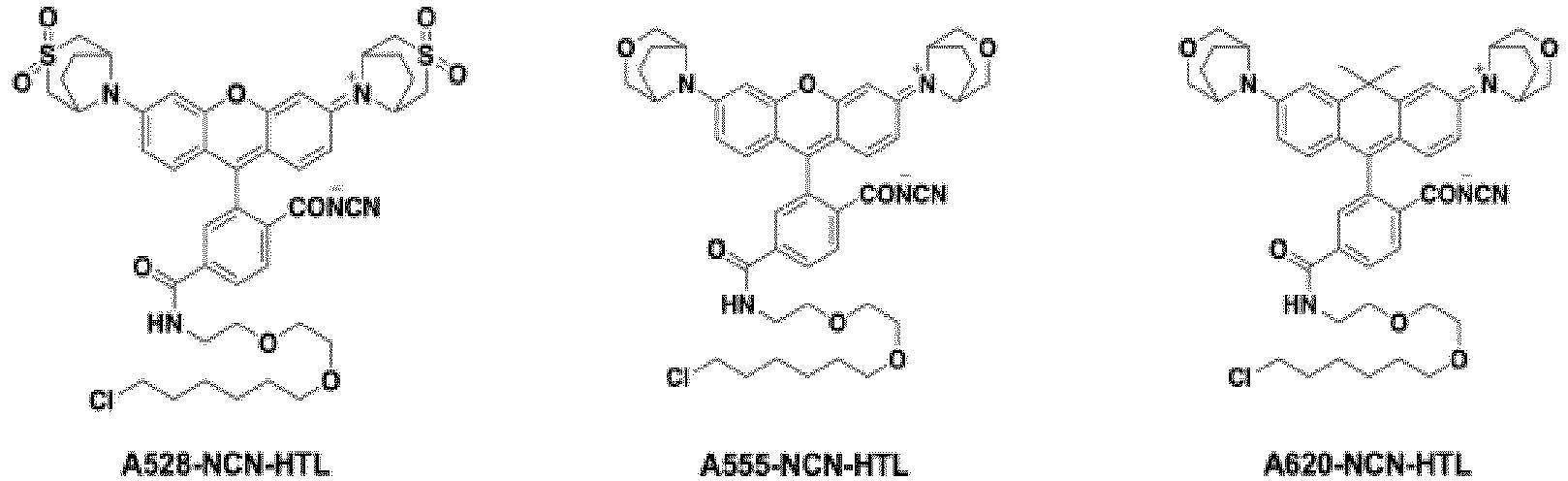
- the compound A528-NCN-HTL was obtained by condensation of the compound A528-NCN-6-COOH and HaloTag(Oz)amines, and a red solid product with a yield of 81% was obtained.
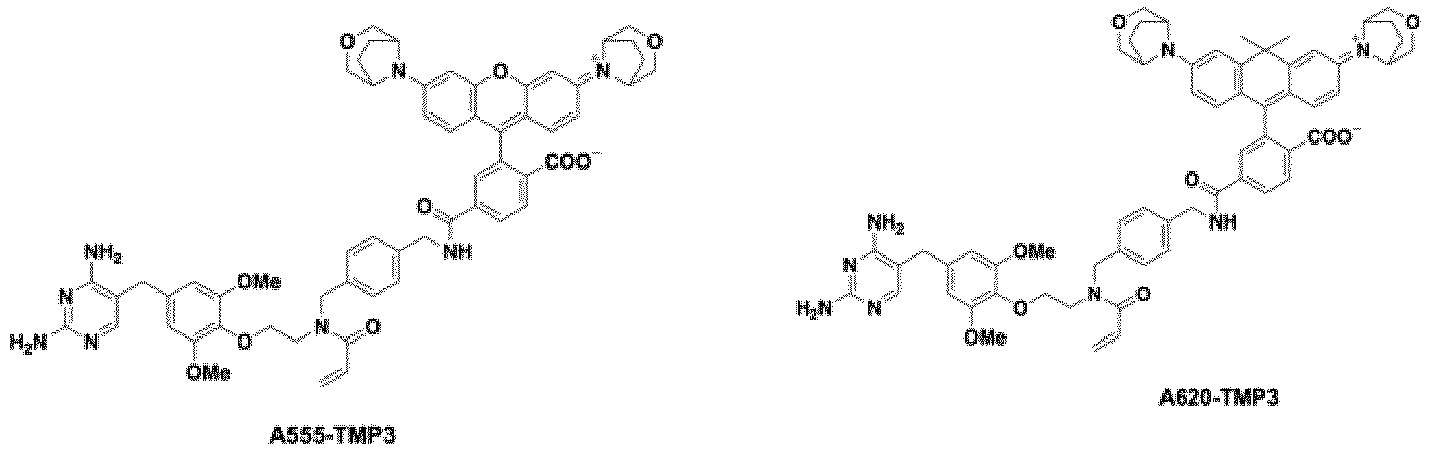
- the compound A620-TMP3 was obtained by condensation of the A620-6-COOH in Example 14 and TMP3-NH 2 , and a blue solid product with a yield of 42% was obtained.
- the compound A655-HTL was obtained by condensation of the A655-6-COOH in Example 17 and HaloTag(Oz)amines, and a blue solid product with a yield of 86% was obtained.
- the compound A655-STL was obtained by condensation of the A655-6-COOH in Example 17 and BG-NH 2 , and a blue solid product with a yield of 60% was obtained.
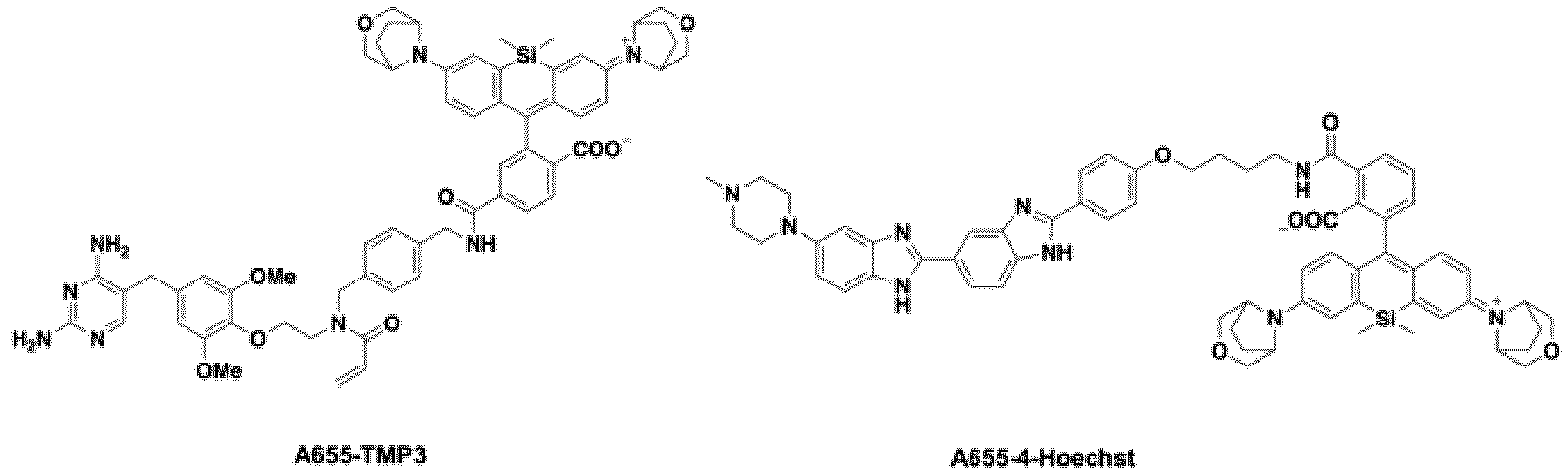
- the compound A655-TMP3 was obtained by condensation of the A655-6-COOH in Example 17 and TMP3-NH 2 , and a blue solid product with a yield of 57% was obtained.
- the compound A655-4-Hoechst was obtained by condensation of the A655-6-COOH in Example 17 and Hoechst-NH 2 , and a green solid product with a yield of 32% was obtained.
- Example 1 Basic photophysical properties of the fluorescent dyes in Example 1 (A528), Example 2 (A532), Example 3 (A555), Example 4 (A586), Example 6 (A620), Example 7 (A634), Example 9 (A655), Example 18 (A720), Example 20 (B350) and Example 21 (B356) were determined, as shown in Fig. 1 and Fig. 2 .
- a fluorescent dye was prepared into a solution with a concentration of 1 ⁇ mol/L, where a PBS buffer solution (phosphate buffer solution) with a pH value of 7.4 was used as a solvent; and then, the solution was tested in a Duetta fluorescence and absorption spectrometer at 25°C for 3 times.
- PBS buffer solution phosphate buffer solution
- the fluorescence quantum yield was determined by a reference method, a fluorescent dye to be tested or a reference fluorescent dye was prepared into a solution with a concentration of 1 ⁇ mol/L, where a PBS buffer solution (phosphate buffer solution) with a pH value of 7.4 was used as a solvent; and then, the solution was scanned in a Duetta fluorescence and absorption spectrometer at 25°C to obtain an absorption spectrum and a fluorescence spectrum, and the fluorescence spectrum was integrated, where the fluorescence quantum yield of the dye was obtained based on a ratio of fluorescence spectrum integrals of the fluorescent dye to be tested and the reference fluorescent dye.
- a class of aza[3.2.1]bridged ring substituted fluorescent dyes obtained in the present disclosure have an emission wavelength within ultraviolet and visible light regions, and the brightness of the fluorescent dyes of various colors is 1.2-16 times higher than that of traditional dimethylamino or diethylamino substituted fluorescent dyes.
- the dyes with emissions in ultraviolet, orange and red light regions have quantum yields similar to theoretical limits.
- Example 3 The photostability of the fluorescent dyes in Example 3 (A555), Example 10 (A528-6-COOH), Example 7 (A634), Comparative Example 2 (TMRE), Comparative Example 1 (JF549), Comparative Example 3 (Rhodamine B), Comparative Example 4 (Cy3) and Comparative Example 5 (Atto647N) was determined, as shown in Fig. 3 and Fig. 4 .
- a fluorescent dye with a concentration of 10 mol/L was dissolved in a PBS buffer solution (phosphate buffer solution) with a pH value of 7.4; and then, the dye solution was irradiated with an LED lamp (light-emitting diode) having an excitation wavelength matched with that of the fluorescent dye, and measured once after the irradiation for 10 min to obtain an absorption spectrum, where the measurement was performed for a total of 30 min.
- PBS buffer solution phosphate buffer solution
- pH value of 7.4 phosphate buffer solution
- Example 3 and Example 10 in an orange channel, the stability in Example 3 and Example 10 is improved by 3.3-7.6 times compared with that in Comparative Example 2, Comparative Example 1, Comparative Example 3 and Comparative Example 4.
- the fluorescent dyes in Comparative Example 2, Comparative Example 1, Comparative Example 3 and Comparative Example 4 have the phenomenon of blue shift of absorption spectra in 12-22 nm, while the fluorescent dyes in Example 3 and Example 10 of the present disclosure have no phenomenon of spectral blue shift.
- Example 7 of the present disclosure is improved by 1 time compared with that in Comparative Example 5, and the phenomenon of spectral blue shift is not observed.
- Example 27 A555-HTL
- Comparative Example 6 TMR-HTL
- Comparative Example 7 JF549-HTL
- aza[3.2.1]bridged ring substituted fluorescent dye prepared in the present disclosure can not only be used in a single molecule imaging experiment, but also has good performance in brightness and photostability.
- Example 27 The functionalized derivatives of fluorescent dyes in Example 27 (A555-HTL), Example 31 (A620-HTL), Example 34 (A655-HTL), Example 28 (A555-STL), Comparative Example 6 (TMR-HTL), Comparative Example 8 (JFX554-HTL), Comparative Example 9 (CPY-HTL) and Comparative Example 10 (TMR-STL) were determined in a confocal microscopy imaging experiment of living cells, as shown in Fig. 8, Fig. 9 , Fig. 10, Fig. 11 , Fig. 12, Fig. 13 and Fig. 14 .
- the brightness in Example 27 is 50% higher than that of a high-brightness dye reported in a document JACS Au. 2021, 1:690-696 ., namely, in Comparative Example 8, and is 158% higher than that in Comparative Example 6 (confocal imaging at an excitation wavelength of 561 nm and an excitation intensity of 10%, a detector at 566 nm, and no gate).
- Example 31 the brightness in Example 31 is 350% higher than that of a high-brightness dye reported in a document Angew. Chem. Int. Ed. 2016, 55: 3290-3294 , namely, in Comparative Example 9 (confocal imaging at an excitation wavelength of 640 nm and an excitation intensity of 5%, a detector at 664 nm, and no gate).
- Example 28 the brightness in Example 28 is 223% higher than that in Comparative Example 10 (confocal imaging at an excitation wavelength of 561 nm and an excitation intensity of 10%, a detector at 566 nm, and no gate).
- Example 34 A655-HTL
- Comparative Example 11 SiR-HTL
- a 1 ⁇ M functional derivative of a fluorescent dye was used to perform wash-free super-resolution imaging on Lifeact-Halo proteins in living Hela cells (STED imaging at an excitation wavelength of 640 nm, an excitation intensity of 2% and a depletion light intensity of 30%, a detector at 650 nm, and no gate).
- the above embodiments of the present disclosure have the following technical effects.
- the aza[3.2.1]bridged ring substituted fluorescent dye provided by the present disclosure, by adopting an aza[3.2.1]bridged ring as a substituent of the fluorescent dye, not only can the brightness of the fluorescent dye be improved, but also the photostability of the fluorescent dye is improved while spectral blue shift of the dye is avoided. Meanwhile, the water solubility of the fluorescent dye can be effectively improved, and good membrane permeability of the fluorescent dye is maintained.
- the fluorescence quantum yield, photostability, resistance to photooxidation dealkylation (spectral blue shift), water solubility and membrane permeability of the fluorescent dye can be improved simultaneously.
Landscapes
- Chemical & Material Sciences (AREA)
- Organic Chemistry (AREA)
- Health & Medical Sciences (AREA)
- Life Sciences & Earth Sciences (AREA)
- Engineering & Computer Science (AREA)
- Molecular Biology (AREA)
- Immunology (AREA)
- Urology & Nephrology (AREA)
- General Health & Medical Sciences (AREA)
- Hematology (AREA)
- Biomedical Technology (AREA)
- Biochemistry (AREA)
- Microbiology (AREA)
- Materials Engineering (AREA)
- Food Science & Technology (AREA)
- Medicinal Chemistry (AREA)
- Physics & Mathematics (AREA)
- Analytical Chemistry (AREA)
- Biotechnology (AREA)
- Cell Biology (AREA)
- General Physics & Mathematics (AREA)
- Pathology (AREA)
- Medicines Containing Antibodies Or Antigens For Use As Internal Diagnostic Agents (AREA)
Abstract
Description
- The present disclosure claims the priority of a
Chinese patent application No. 2023108090626, filed to China National Intellectual Property Administration on July 03, 2023 - The present disclosure relates to the field of fluorescent dyes in biofluorescence analysis, and specifically relates to an aza[3.2.1]bridged ring substituted fluorescent dye and a preparation method and use thereof.
- In recent years, fluorescent dyes have been widely used in the fields of biological macromolecular labeling, ion detection, single molecule imaging, super-resolution imaging and the like, and have become an irreplaceable important tool in life science research. Thus, higher requirements on physical and chemical properties of the fluorescent dyes have been put forward. Traditional fluorescent dyes, such as fluorescein, tetramethylrhodamine and coumarin, are usually in lack of sufficient brightness, water solubility and photostability. In the past three decades, different novel substituents have been introduced into matrices of the fluorescent dyes by chemists to improve the fluorescence quantum yield, photostability, resistance to photooxidation dealkylation (spectral blue shift), water solubility and membrane permeability of the dyes. However, the challenge is that currently reported strategies for optimizing the fluorescent dyes can be used for only optimizing a few properties separately and cannot be used for comprehensively improving all the core properties of the dyes.
- According to the document Nature Methods. 2015, 12: 244-250, the brightness of a fluorescent dye is systematically improved by an azacyclobutane substitution method, but the dye has poor photostability and no resistance to photooxidation dealkylation (spectral blue shift). According to the document J. Am. Chem. Soc. 2008, 130, 52: 17652-17653, the brightness, photostability and resistance to photooxidation dealkylation (spectral blue shift) of a dye are improved by a method of substituting rhodamine with azabicyclo[2.2.1]heptane, but the dye has poor water solubility and membrane permeability, so that use of the dye in living cell imaging is hindered. By introducing a sulfonic acid group into a matrix of a fluorescent dye, the water solubility of the dye can be greatly improved, the antibody labeling efficiency is improved, and non-specific dyeing is reduced, but the dye is also prevented from permeating a cell membrane, so that the sulfonated dye cannot be used in living cells.
- Therefore, it is urgent for persons skilled in the art to develop a class of fluorescent dyes capable of simultaneously improving the fluorescence quantum yield, the photostability, the resistance to photooxidation dealkylation (spectral blue shift), the water solubility and the membrane permeability.
- The main purpose of the present disclosure is to provide an aza[3.2.1]bridged ring substituted fluorescent dye and a preparation method and use thereof, so as to solve the problems that the fluorescence quantum yield, photostability, resistance to photooxidation dealkylation (spectral blue shift), water solubility and membrane permeability of fluorescent dyes in the prior art cannot be optimized simultaneously.
- In order to achieve the above purpose, an aza[3.2.1]bridged ring substituted fluorescent dye is provided according to one aspect of the present disclosure. The aza[3.2.1]bridged ring substituted fluorescent dye has a structure shown in Formula (I), Formula (II) or Formula (III) below:


- Ra, Rb, Rc, Rd, Re, Rf, Rg, Rb, Ri, Rj, Rk, Rl, Rm, Rn, Ro, Rp and Rq are independently selected from hydrogen, halogen, carboxyl, substituted or unsubstituted C1-C20 alkyl, substituted or unsubstituted C3-C20 cycloalkyl, substituted or unsubstituted C4-C20 cycloalkylalkyl, C4-C20 alkylcycloalkyl, substituted or unsubstituted C1-C20 alkoxyl, substituted or unsubstituted C1-C20 ester group, and substituted or unsubstituted C1-C20 acylamino;
- RA is selected from substituted or unsubstituted C6-C40 aryl, substituted or unsubstituted C6-C40 aralkyl, and substituted or unsubstituted C5-C40 heteroaryl;
- X is selected from oxygen, sulfur, substituted or unsubstituted C1-C20 alkylene,


- Y is selected from oxygen, sulfur, nitrogen, substituted or unsubstituted C1-C20 alkylene, substituted or unsubstituted C1-C20 alkylenoxyl, substituted or unsubstituted C1-C20 acyl, substituted or unsubstituted C1-C20 ester group,

- Z- is selected from F-, Cl-, Br, I-, OAc-, HSO4 -, H2PO4 -, ClO4 -, CF3COO-, CF3SO3 -, CH3SO3 -, NO3 -, C5H7O5COO-, and PF6 -; and m is an integer ranged from 1 to 3.
- Further, the Ra, the Rb, the Rc, the Rd, the Re, the Rf, the Rg, the Rb, the Ri, the Rj, the Rk, the Rl, the Rm, the Rb, the Ro, the Rp and the Rq are independently selected from hydrogen, halogen, carboxyl, substituted or unsubstituted C1-C10 alkyl, substituted or unsubstituted C3-C10 cycloalkyl, substituted or unsubstituted C4-C10 cycloalkylalkyl, C4-C10 alkylcycloalkyl, substituted or unsubstituted C1-C10 alkoxyl, substituted or unsubstituted C1-C10 ester group, and substituted or unsubstituted C1-C10 acylamino; and/or, the Ra, is selected from substituted or unsubstituted C6-C30 aryl, substituted or unsubstituted C6-C30 aralkyl, and substituted or unsubstituted C5-C30 heteroaryl; and/or, the X is selected from oxygen, sulfur, substituted or unsubstituted C1-C10 alkyl,


- Further, the aza[3.2.1]bridged ring substituted fluorescent dye shown in Formula (I) has a structure shown in Formula (IV) below:





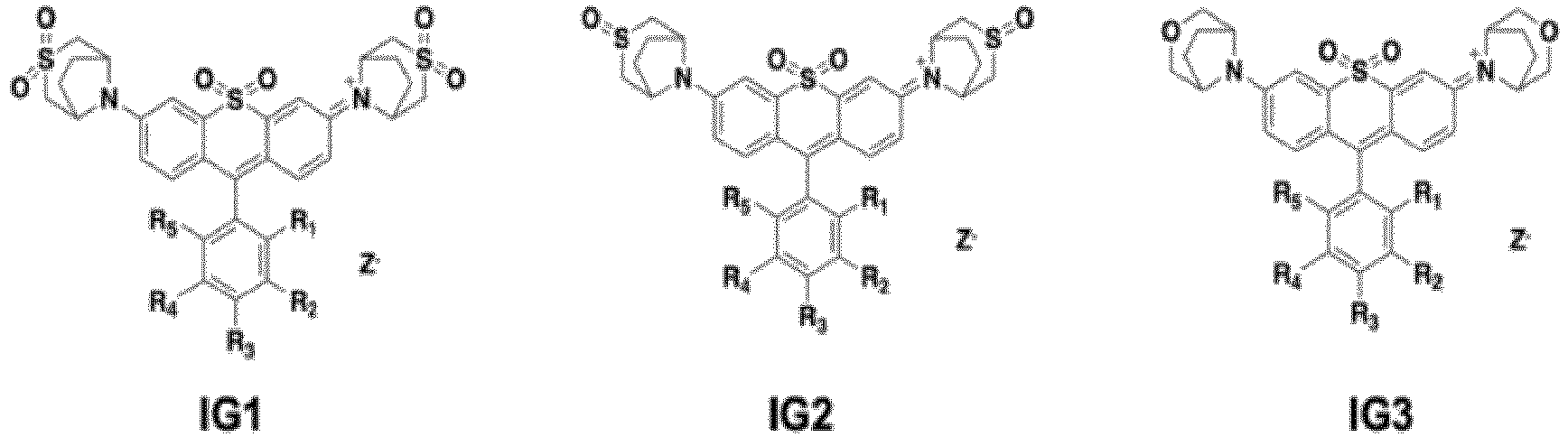
- Further, the aza[3.2.1]bridged ring substituted fluorescent dye is selected from at least one of the following formulas IA1-IA3, IIA1-IIA3, IIIA1-IIIA3, IB1-IB3, IC1-IC3, ID1-ID3, IE1-IE3, IF1-IF3, and IG1-IG3:




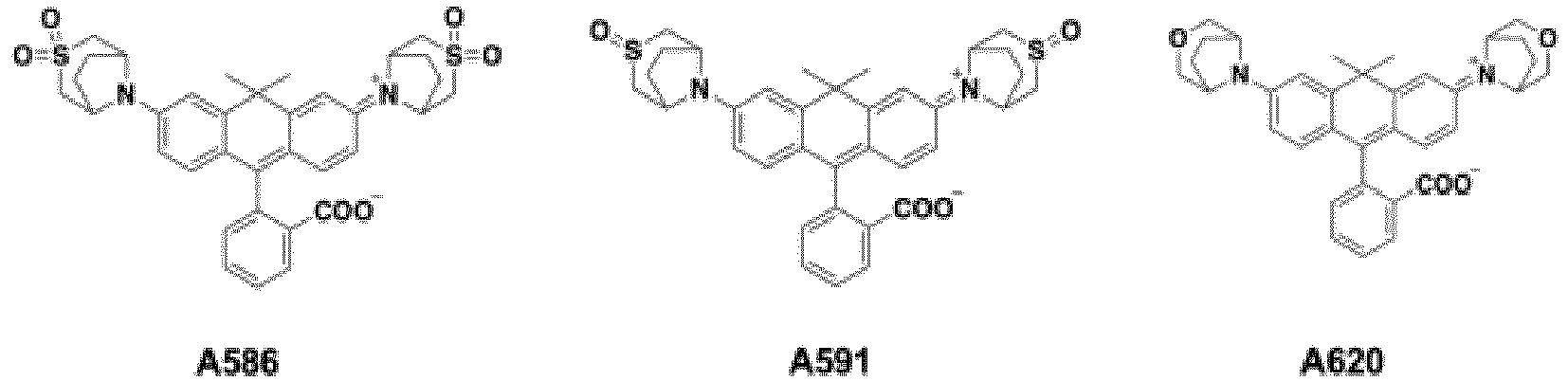
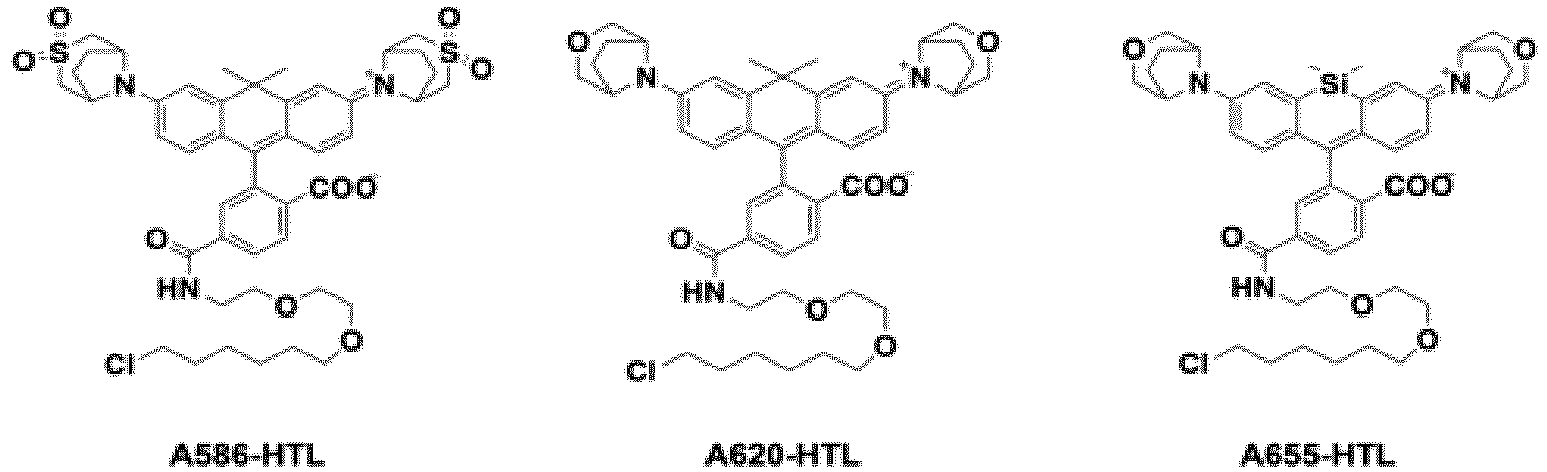
- Further, the aza[3.2.1]bridged ring substituted fluorescent dye is selected from at least one of the following formulas A528, A532, A555, A586, A591, A620, A634, A640, A655, A720, A586-2Me, A586-2Me-5-COOH, A528-6-COOH, A532-6-COOH, A555-6-COOH, A586-6-COOH, A591-6-COOH, A620-6-COOH, A634-5-COOH, A640-6-COOH, A655-6-COOH, A528-HTL, A532-HTL, A555-HTL, A586-HTL, A620-HTL, A655-HTL, A555-STL, A528-NHS, A620-STL, A655-STL, A634-NHS, A586-NHS, A591-HTL, A640-HTL, A555-TMP3, A620-TMP3, A655-TMP3, A655-4-Hoechst, A591-TMP3, A640-TMP3, A591-STL, A640-STL, A528-NCN-HTL, A555-NCN-HTL, A620-NCN-HTL, B350, B356, C622, and C654, and Me in the following formulas represents methyl:





- In order to achieve the above purpose, a method for preparing an aza[3.2.1]bridged ring substituted fluorescent dye is provided according to one aspect of the present disclosure. The preparation method includes: step S11, mixing a compound A, an aza[3.2.1]bridged ring compound and a first catalyst in a first reaction solvent to carry out a reaction so as to obtain a compound B; and step S12, mixing the compound B with an HZ aqueous solution to carry out a reaction so as to obtain the aza[3.2.1]bridged ring substituted fluorescent dye shown in Formula (I). The compound A has a structure shown in Formula (V) below, and the aza[3.2.1]bridged ring compound has a structure shown in Formula (VI) below:

- Further, the first catalyst includes a palladium catalyst, a palladium catalyst ligand and an alkaline catalyst.
- Further, the palladium catalyst includes at least one of tetrakis(triphenylphosphine)palladium, palladium acetate, tris(dibenzylideneacetone)dipalladium, [(diphenylphosphino)ferrocene]dichloropalladium, dichlorobis(triphenylphosphine)palladium and palladium chloride.
- Further, the palladium catalyst includes at least one of tetrakis(triphenylphosphine)palladium, palladium acetate or tris(dibenzylideneacetone)dipalladium.
- Further, the palladium catalyst ligand includes at least one of bis(dibenzylideneacetone)palladium, 2,2'-bis(diphenylphosphino)-1,1'-binaphthyl, 2-dicyclohexylphosphino-2',4',6'-triisopropylbiphenyl and 2-dicyclohexylphosphino-2',6'-dimethoxybiphenyl.
- Further, the palladium catalyst ligand includes at least one of bis(dibenzylideneacetone)palladium and 2,2'-bis(diphenylphosphino)-1,1'-binaphthyl.
- Further, the alkaline catalyst includes at least one of cesium carbonate, sodium tert-butoxide, potassium carbonate, sodium carbonate, sodium methoxide, sodium ethoxide and potassium tert-butoxide.
- Further, the alkaline catalyst includes at least one of cesium carbonate, sodium tert-butoxide and potassium tert-butoxide.
- Further, the first reaction solvent includes at least one of n-hexane, tetrahydrofuran, 1,4-dioxane, ethyl ether and toluene.
- In order to achieve the above purpose, a method for preparing an aza[3.2.1]bridged ring substituted fluorescent dye is provided according to one aspect of the present disclosure. The preparation method includes: mixing a compound C, an aza[3.2.1]bridged ring compound and a second catalyst in a second reaction solvent to carry out a reaction so as to obtain the aza[3.2.1]bridged ring substituted fluorescent dye shown in Formula (II).
- The compound C has a structure shown in Formula (VII) below:

- Further, the second catalyst has the same meaning as the first catalyst.
- Further, the second reaction solvent has the same meaning as the first reaction solvent.
- In order to achieve the above purpose, a method for preparing an aza[3.2.1]bridged ring substituted fluorescent dye is provided according to one aspect of the present disclosure. The preparation method includes: step S31, mixing a compound D, an aza[3.2.1]bridged ring compound and a third catalyst in a third reaction solvent to carry out a reaction so as to obtain a compound E; step S32, mixing the compound E with an oxidizing agent in a fourth reaction solvent to carry out a reaction so as to obtain a compound F; and step S33, mixing the compound F with an HZ aqueous solution to carry out a reaction so as to obtain the aza[3.2.1]bridged ring substituted fluorescent dye shown in Formula (III).
- The compound D has a structure shown in Formula (VIII) below:

- Further, the third catalyst has the same meaning as the first catalyst.
- Further, the third reaction solvent has the same meaning as the first reaction solvent.
- Further, in step S32, the fourth reaction solvent is a mixed solvent of dichloromethane and water, and the volume ratio of the dichloromethane to the water is (10-30):1.
- Further, in step S32, the oxidizing agent includes at least one of 2,3-dichloro-5,6-dicyano-1,4-benzoquinone, potassium permanganate, hydrogen peroxide and m-chloroperoxybenzoic acid.
- Further, the oxidizing agent is 2,3-dichloro-5,6-dicyano-1,4-benzoquinone.
- Further, the molar ratio of the oxidizing agent to the compound E is (1.0-2.0):1.
- In order to achieve the above purpose, use of the aza[3.2.1]bridged ring substituted fluorescent dye or the aza[3.2.1]bridged ring substituted fluorescent dye prepared by the method for preparing an aza[3.2.1]bridged ring substituted fluorescent dye in the fields of fluorescence analysis, fluorescence detection and fluorescence imaging as a fluorescent marker is provided according to one aspect of the present disclosure.
- Further, use of the aza[3.2.1]bridged ring substituted fluorescent dye in fluorescence analysis, fluorescence detection, biomolecular labeling, immunofluorescence imaging, live-cell imaging, tissue imaging, in vivo imaging, single-molecule imaging and super-resolution fluorescence imaging as a fluorescent marker is provided.
- According to use of the aza[3.2.1]bridged ring substituted fluorescent dye provided by the present disclosure in technical schemes of the present disclosure, by adopting an aza[3.2.1]bridged ring as a substituent of the fluorescent dye, not only are the brightness and photostability of the fluorescent dye obviously improved, but also the phenomenon of spectral blue shift caused by irradiation of the dye for a long time is completely avoided. Meanwhile, the water solubility of the fluorescent dye can be effectively improved, and good membrane permeability of the fluorescent dye is maintained.
- Drawings attached to the specification that form a part of the present disclosure are used to provide further understanding of the present disclosure, and schematic embodiments of the present disclosure and description thereof are used to interpret the present disclosure and are not intended to constitute improper limitations to the present disclosure.
-
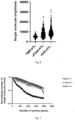
Fig.1 shows absorption spectra of aza[3.2.1]bridged ring substituted fluorescent dyes according to Examples 1-4, 6, 7, 9, 18, 20 and 21 of the present disclosure; -
Fig. 2 shows emission spectra of the aza[3.2.1]bridged ring substituted fluorescent dyes according to Examples 1-4, 6, 7, 9, 18, 20 and 21 of the present disclosure; -
Fig. 3 shows comparison curves of differences of the photostability in orange channel according to Examples 3 and 10 as well as Comparative Examples 1-4 of the present disclosure; -
Fig. 4 shows comparison curves of differences of the photostability in a far-red channel according to Example 7 and Comparative Example 5 of the present disclosure; -
Fig. 5 shows a single molecule imaging photo of fixed U2OS cells according to Example 27 of the present disclosure; -
Fig. 6 shows comparison of the single molecule brightness of fixed U2OS cells according to Example 27 and Comparative Examples 6 and 7 of the present disclosure; -
Fig. 7 shows comparison of the photostability of fixed U2OS cells according to Example 27 and Comparative Examples 6 and 7 of the present disclosure; -
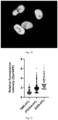
Fig. 8 shows a confocal fluorescence imaging photo of labeled TMP-Halo-SNAP-GFP-H2B proteins in living Hela cells according to Example 27 of the present disclosure; -
Fig. 9 shows a confocal fluorescence imaging photo of labeled TMP-Halo-SNAP-GFP-H2B proteins in living Hela cells according to Example 31 of the present disclosure; -
Fig. 10 shows a confocal fluorescence imaging photo of labeled TMP-Halo-SNAP-GFP-H2B proteins in living Hela cells according to Example 34 of the present disclosure; -
Fig. 11 shows comparison of the relative fluorescence intensity of labeled TMP-Halo-SNAP-GFP-H2B proteins in living Hela cells according to Example 27 and Comparative Examples 6 and 8 of the present disclosure; -
Fig. 12 shows comparison of the relative fluorescence intensity of labeled TMP-Halo-SNAP-GFP-H2B proteins in living Hela cells according to Example 31 and Comparative Example 9 of the present disclosure; -
Fig. 13 shows a confocal fluorescence imaging photo of labeled TMP-Halo-SNAP-GFP-H2B proteins in living Hela cells according to Example 28 of the present disclosure; -
Fig. 14 shows comparison of the relative fluorescence intensity of labeled TMP-Halo-SNAP-GFP-H2B proteins in living Hela cells according to Example 28 and Comparative Example 10 of the present disclosure; -
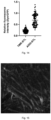
Fig. 15 shows a wash-free super-resolution fluorescence imaging photo of labeled Lifeact-Halo proteins in living Hela cells under an STED microscope according to Example 34 of the present disclosure; -
Fig. 16 shows comparison of the photostability of labeled Lifeact-Halo proteins in living Hela cells under super-resolution fluorescence imaging conditions of an STED microscope according to Example 34 and Comparative Example 11 of the present disclosure. - Notably, embodiments in the present disclosure and features in the embodiments may be combined with each other without conflict. The present disclosure is described in detail below with reference to the attached drawings and in conjunction with the embodiments.
- As described in the background of the present disclosure, by introducing an azacyclobutane group into a matrix of a fluorescent dye in the prior art, the brightness of the fluorescent dye can be improved, but the fluorescent dye has poor photostability and no resistance to photooxidation dealkylation (spectral blue shift). In addition, by adopting a method of introducing azabicyclo[2.2.1]heptane into a matrix of a fluorescent dye to substitute rhodamine, the fluorescence quantum yield, photostability and resistance to photooxidation dealkylation (spectral blue shift) of the dye are improved, but the dye has poor water solubility and membrane permeability, so that use of the dye in living cell imaging is hindered. By introducing a sulfonic acid group into a matrix of a fluorescent dye, the water solubility of the dye can be improved, the antibody labeling efficiency is improved, and non-specific dyeing is reduced, but the dye is also prevented from permeating a cell membrane, so that the sulfonated dye cannot be used in living cells. In order to solve the problems, the present disclosure provides an aza[3.2.1]bridged ring substituted fluorescent dye and a preparation method and use thereof.
- In a first typical embodiment of the present disclosure, an aza[3.2.1]bridged ring substituted fluorescent dye is provided. The aza[3.2.1]bridged ring substituted fluorescent dye has a structure shown in Formula (I), Formula (II) or Formula (III) below:


- Ra, Rb, Rc, Rd, Re, Rf, Rg, Rb, Ri, Rj, Rk, Rl, Rm, Rn, Ro, Rp and Rq are independently selected from hydrogen, halogen, carboxyl, substituted or unsubstituted C1-C20 alkyl, substituted or unsubstituted C3-C20 cycloalkyl, substituted or unsubstituted C4-C20 cycloalkylalkyl, C4-C20 alkylcycloalkyl, substituted or unsubstituted C1-C20 alkoxyl, substituted or unsubstituted C1-C20 ester group, and substituted or unsubstituted C1-C20 acylamino;
- RA is selected from substituted or unsubstituted C6-C40 aryl, substituted or unsubstituted C6-C40 aralkyl, and substituted or unsubstituted C5-C40 heteroaryl;
- X is selected from oxygen, sulfur, substituted or unsubstituted C1-C20 alkylene,


- Y is selected from oxygen, sulfur, nitrogen, substituted or unsubstituted C1-C20 alkylene, substituted or unsubstituted C1-C20 alkylenoxyl, substituted or unsubstituted C1-C20 acyl, substituted or unsubstituted C1-C20 ester group,

- Z- is selected from F-, Cl-, Br, I-, OAc-, HSO4 -, H2PO4 -, ClO4 -, CF3COO-, CF3SO3 -, CH3SO3 -, NO3 -, C5H7O5COO-, and PF6 -;
- and in the Formula (I), the Z- may exist in an ionic form and may also be connected with the RA through a chemical bond, the Z- may exist in the two forms simultaneously when m is equal to or greater than 2, and the m is an integer ranged from 1 to 3.
- In the present disclosure, the "aryl" refers to a monocyclic ring or fused polycyclic ring derived from an aromatic hydrocarbon, and includes phenyl, biphenyl, bitriphenyl, naphthyl, binaphthyl, phenylnaphthyl, naphthylphenyl, fluorenyl, phenylfluorenyl, benzofluorenyl, dibenzofluorenyl, phenanthryl, phenylphenanthryl, anthryl, indenyl, bitriphenylenyl, pyrenyl, fused tetraphenyl, perylo, boryl, naphthonaphthyl, allenylfluorenyl and the like.
- The "heteroaryl" refers to heteroaryl, and the heteroaryl refers to aryl containing at least one heteroatom selected from the group consisting of N, O and S as a main chain atom of a ring, which may be a monocyclic ring, such as furyl, thienyl, pyrrolyl, imidazolyl, pyrazolyl, thiazolyl, thiadiazolyl, isothiazolyl, isoxazolyl, oxazolyl, oxadiazolyl, triazinyl, tetrazinyl, triazolyl, tetrazolyl, furazyl, pyridyl, pyrazinyl, pyrimidyl or pyridazinyl, or may be a fused ring condensed with at least one benzene ring, such as benzofuryl, benzothienyl, isobenzofuryl, dibenzofuryl, dibenzothienyl, benzoimidazolyl, benzothiazolyl, benzoisothiazolyl, benzoisoxazolyl, quinolyl, isoquinolyl, cinolinyl, quinazoinyl, quinoxalinyl, carbazolyl, phenoxazolyl, phenanthridinyl, benzodiacenaphthenyl or dihydroacridinyl.
- The "substituted" in the "substituted or unsubstituted" indicates that a hydrogen atom in a functional group is substituted with another atom or group (namely, substituent). The substituent is independently select from at least one of the following groups: deuterium, halogen, C1-C10 alkyl, C1-C10 alkoxyl, C6-C10 aryl, C5-C10 heteroaryl, C5-C10 heteroaryl substituted with C6-C10 aryl, imidazolyl, benzoimidazolyl, C3-C10 cycloalkyl, C5-C7 heterocycloalkyl, tri-(C1-C10) alkylsilyl, tri-(C1-C10) arylsilyl, di-(C1-C10) alkyl-(C6-C10) arylsilyl, C1-C10 alkyl-di-(C6-C10) arylsilyl, C2-C10 alkenyl, C2-C30 alkynyl, cyano, di-(C1-C30) alkylamino, di-(C6-C30) arylboryl, di-(C1-C30) alkylboryl, C1-C30 alkyl, C6-C10 arylC1-C10 alkyl, C1-C10 alkyl C6-C10 aryl, carboxyl, nitro, hydroxyl,


- In the present disclosure, "*" represents a connecting bond.
- According to use of the aza[3.2.1]bridged ring substituted fluorescent dye provided by the present disclosure in technical schemes of the present disclosure, by adopting an aza[3.2.1]bridged ring as a substituent of the fluorescent dye, not only are the brightness and photostability of the fluorescent dye obviously improved, but also the phenomenon of spectral blue shift caused by irradiation of the dye for a long time is completely avoided. Meanwhile, the water solubility of the fluorescent dye can be effectively improved, and good membrane permeability of the fluorescent dye is maintained.
- In order to further improve properties of the aza[3.2.1]bridged ring substituted fluorescent dye, preferably, the Ra, the Rb, the Rc, the Rd, the Re, the Rf, the Rg, the Rh, the Ri, the Rj, the Rk, the Rl, the Rm, the Rn, the Ro, the Rp and the Rq are independently selected from hydrogen, halogen, carboxyl, substituted or unsubstituted C1-C10 alkyl, substituted or unsubstituted C3-C10 cycloalkyl, substituted or unsubstituted C4-C10 cycloalkylalkyl, C4-C10 alkylcycloalkyl, substituted or unsubstituted C1-C10 alkoxyl, substituted or unsubstituted C1-C10 ester group, and substituted or unsubstituted C1-C10 acylamino.
- In some embodiments, preferably, the RA is selected from substituted or unsubstituted C6-C30 aryl, substituted or unsubstituted C6-C30 aralkyl, and substituted or unsubstituted C5-C30 heteroaryl.
- In other embodiments, preferably, the X is selected from oxygen, sulfur, substituted or unsubstituted C1-C10 alkyl,


- In some other embodiments, preferably, the Z- is selected from F-, Cl-, Br, I-, OAc-, HSO4 -, H2PO4 -, ClO4 -, CF3COO-, CF3SO3 -, CH3SO3 -, NO3 -, C5H7O5COO-, and PF6 -; m is a positive integer ranged from 1 to 3; and OAc- represents an acetate ion.
- In order to further improve properties of the aza[3.2.1]bridged ring substituted fluorescent dye, preferably, the aza[3.2.1]bridged ring substituted fluorescent dye has a structure shown in Formula (IV) below:
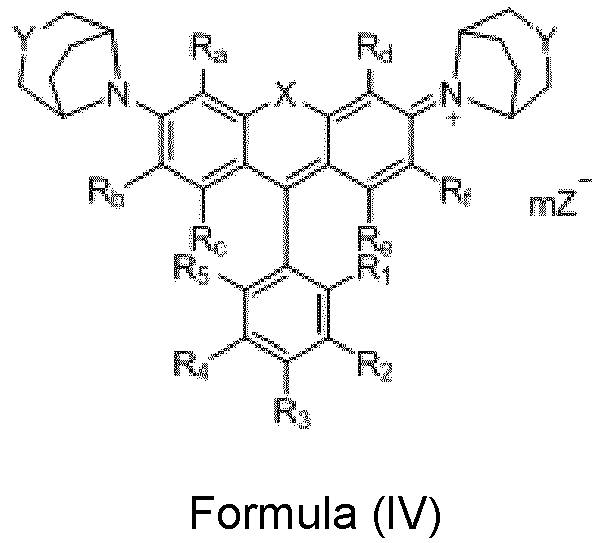
- R1 and R5 are independently selected from hydrogen, carboxyl, halogen, substituted or unsubstituted C1-C6 alkyl, substituted or unsubstituted C1-C6 alkoxyl, nitro, amino, hydroxyl,

- R2, R3 and R4 are independently selected from hydrogen, halogen, carboxyl, substituted or unsubstituted C1-C10 alkyl, substituted or unsubstituted C3-C10 cycloalkyl, substituted or unsubstituted C4-C10 cycloalkylalkyl, C4-C10 alkylcycloalkyl, substituted or unsubstituted C1-C10 alkoxyl, substituted or unsubstituted C1-C10 ester group,


- In some specific embodiments of the present disclosure, the aza[3.2.1]bridged ring substituted fluorescent dye is selected from at least one of the following formulas IA1-IA3, IIA1-IIA3, IIIA1-IIIA3, IB1-IB3, IC1-IC3, ID1-ID3, IE1-IE3, IF1-IF3, and IG1-IG3, where Ph is phenyl:


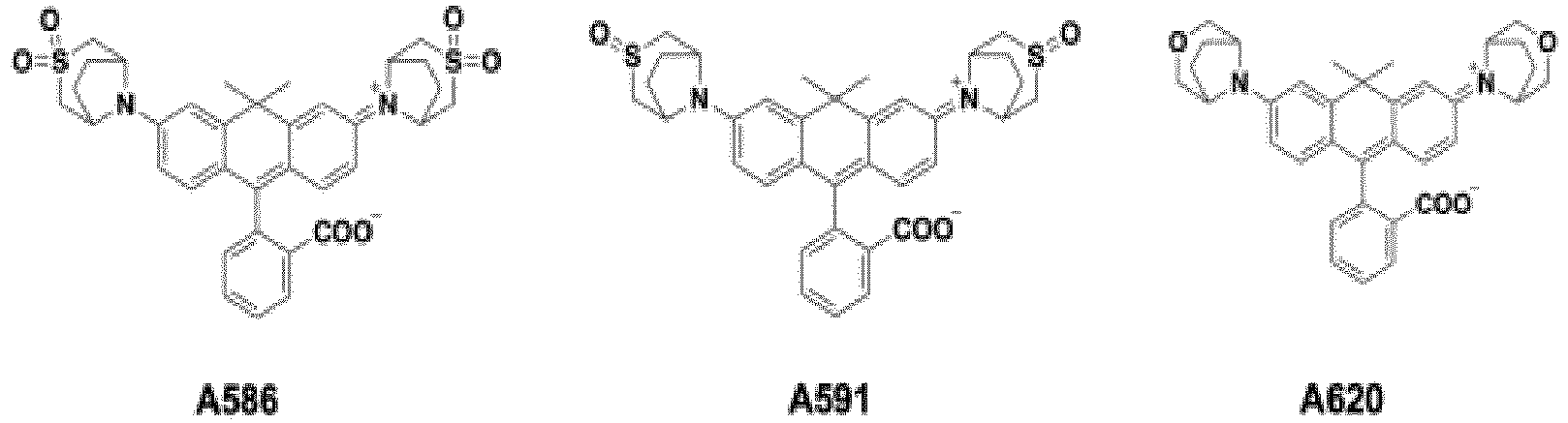
- In other specific embodiments of the present disclosure, the aza[3.2.1]bridged ring substituted fluorescent dye is selected from at least one of the following formulas A528, A532, A555, A586, A591, A620, A634, A640, A655, A720, A586-2Me, A586-2Me-5-COOH, A528-6-COOH, A532-6-COOH, A555-6-COOH, A586-6-COOH, A591-6-COOH, A620-6-COOH, A634-5-COOH, A640-6-COOH, A655-6-COOH, A528-HTL, A532-HTL, A555-HTL, A586-HTL, A620-HTL, A655-HTL, A555-STL, A528-NHS, A620-STL, A655-STL, A634-NHS, A586-NHS, A591-HTL, A640-HTL, A555-TMP3, A620-TMP3, A655-TMP3, A655-4-Hoechst, A591-TMP3, A640-TMP3, A591-STL, A640-STL, A528-NCN-HTL, A555-NCN-HTL, A620-NCN-HTL, B350, B356, C622, and C654:






- In a second typical embodiment of the present disclosure, a method for preparing the aza[3.2.1]bridged ring substituted fluorescent dye shown in Formula (I) is further provided. The preparation method includes: step S11, mixing a compound A, an aza[3.2.1]bridged ring compound and a first catalyst in a first reaction solvent to carry out a reaction so as to obtain a compound B; and step S12, mixing the compound B with an HZ aqueous solution to carry out a reaction so as to obtain the aza[3.2.1]bridged ring substituted fluorescent dye shown in Formula (I).
- The compound A has a structure shown in Formula (V) below, and the aza[3.2.1]bridged ring compound has a structure shown in Formula (VI) below:

- In some embodiments, a reaction diagram is shown in Formula (IX) below:

- In order to further improve the reaction efficiency, in step S11, the first catalyst includes a palladium catalyst, a palladium catalyst ligand and an alkaline catalyst, where the palladium catalyst includes at least one of tetrakis(triphenylphosphine)palladium, palladium acetate, tris(dibenzylideneacetone)dipalladium, [(diphenylphosphino)ferrocene]dichloropalladium, dichlorobis(triphenylphosphine)palladium and palladium chloride, preferably at least one of tetrakis(triphenylphosphine)palladium, palladium acetate or tris(dibenzylideneacetone)dipalladium.
- In the present disclosure, a catalytic reaction is mainly carried out using the palladium catalyst and the palladium ligand. Different palladium catalyst ligands contain different electron-rich substituents, which have a great impact on the reaction yield. In order to further improve the reaction yield, preferably, the palladium catalyst ligand includes at least one of bis(dibenzylideneacetone)palladium, 2,2'-bis(diphenylphosphino)-1,1'-binaphthyl, 2-dicyclohexylphosphino-2',4',6'-triisopropylbiphenyl and 2-dicyclohexylphosphino-2',6'-dimethoxybiphenyl, further preferably at least one of bis(dibenzylideneacetone)palladium and 2,2'-bis(diphenylphosphino)-1,1'-binaphthyl.
- Specific types of the alkaline catalyst are not limited. The alkaline catalyst commonly used in the field includes at least one of cesium carbonate, sodium tert-butoxide, potassium carbonate, sodium carbonate, sodium methoxide, sodium ethoxide and potassium tert-butoxide, preferably at least one of cesium carbonate, sodium tert-butoxide and potassium tert-butoxide. The alkaline catalyst can not only improve the deprotonation ability, but also improve the compatibility of functional groups in reaction compounds, thus improving the reaction efficiency.
- In step S11, in order to further improve the yield of the aza[3.2.1]bridged ring substituted fluorescent dye, preferably, the reaction is carried out under anhydrous and anaerobic conditions, air in a reaction vessel is replaced by an inert gas, and the inert gas includes, but is not limited to, at least one of nitrogen, helium and argon.
- In step S11, in order to further improve the preparation efficiency of the aza[3.2.1]bridged ring substituted fluorescent dye, preferably, the molar ratio of the palladium catalyst to the compound A is (0.1-1.0):1 (such as 0.1:1, 0.2:1, 0.4:1, 0.6:1, 0.8:1, 1:1 or any ranges composed of two values); preferably, the molar ratio of the palladium catalyst ligand to the compound A is (0.3-1.2):1 (such as 0.3:1, 0.6:1, 0.9:1, 1.2:1 or any ranges composed of two values); and preferably, the molar ratio of the alkaline catalyst to the compound A is (1.2-2.0):1 (such as 1.2:1, 1.4:1, 1.6:1, 1.8:1, 2:1 or any ranges composed of two values). The palladium catalyst and the palladium catalyst ligand are precious metal catalysts with high prices. When the added amounts of the palladium catalyst and the palladium catalyst ligand are too large, the reaction cost is increased. When the added amounts of the palladium catalyst and the palladium catalyst ligand are too small, the effect of catalyzing a reaction cannot be achieved, thus reducing the reaction yield. Therefore, the palladium catalyst and the palladium catalyst ligand used within the above ranges can reduce the reaction cost under the condition of a sufficient reaction. The reaction yield is reduced when the added amount of the alkaline catalyst is too small, and more complicated post-treatment is caused when the added amount of the alkaline catalyst is too large. Thus, the reaction efficiency can be further improved when the alkaline catalyst is within the range.
- Specific types of the first reaction solvent are not particularly limited to any reaction solvents commonly used in the field, including but not limited to: at least one of n-hexane, tetrahydrofuran, 1,4-dioxane, ethyl ether and toluene, which can make a reactant completely dissolved, thereby improving the reaction efficiency.
- In some embodiments, toluene is usually used as the first reaction solvent when the reactant is a benzene ring compound, and 1,4-dioxane is usually used as the first reaction solvent when the reactant is a heterocyclic ring compound. An appropriate first reaction solvent is selected according to the solubility of the reactant in the organic solvent, so as to improve the reaction efficiency.
- In step S11, the reaction is carried out at a temperature of 60-120°C (such as 60°C, 70°C, 80°C, 90°C, 100°C, 110°C, 120°C or any ranges composed of two values). When the reaction temperature is too high, a large number of by-products are produced, which may lead to decomposition of an intermediate. When the reaction temperature is too low, the reaction rate is low. When the reaction temperature is in the range, the reaction yield and the reaction efficiency can be further improved. The reaction is carried out for 4-18 h. When the reaction is carried out to a certain extent, not only is the reaction yield not increased by prolonging the reaction time, but also a large number of by-products are produced, so that the reaction yield is reduced. Moreover, when the reaction time is too short, the reaction is incomplete, so that the reaction yield is reduced. When the time is in the range, the reaction yield can be improved, and the reaction time can be shortened.
- In some embodiments, in step S12, the reaction is carried out at a temperature of 20-30°C. The reaction temperature is low, so that the reaction has simple operation and a high reaction yield.
- In step S12, in order to avoid release of a large amount of heat from a violent reaction, in some embodiments, the HZ aqueous solution is slowly dropped into the reaction system in step S11 to neutralize a positive charge carried by an intermediate, so that the obtained aza[3.2.1]bridged ring substituted fluorescent dye is electrically neutral. The HZ aqueous solution has a molar concentration of 1-6 mol/L, preferably 1-3 mol/L. When the molar concentration of the HZ aqueous solution is too high, a violent reaction is caused, the reaction rate is too high, and the reaction is not easy to control. When the molar concentration of the HZ aqueous solution is too low, a large amount of the HZ aqueous solution needs to be added. When the molar concentration is within the range, the reaction rate can be effectively improved.
- In some embodiments, in order to further improve the purity of the aza[3.2.1]bridged ring substituted fluorescent dye, post-treatment is performed after the reaction is completed, where the post-treatment includes extraction, drying, separation by column chromatography and other common post-treatment processes.
- In a third typical embodiment of the present disclosure, a method for preparing the aza[3.2.1]bridged ring substituted fluorescent dye shown in Formula (II) is further provided. The preparation method includes: mixing a compound C, an aza[3.2.1]bridged ring compound and a second catalyst in a second reaction solvent to carry out a reaction so as to obtain the aza[3.2.1]bridged ring substituted fluorescent dye shown in Formula (II).
- The compound C has a structure shown in Formula (VII) below:

- The second catalyst has the same meaning as the first catalyst, and the second reaction solvent has the same meaning as the first reaction solvent, which are not repeated herein.
- In some embodiments, a reaction diagram is shown in Formula (X) below:

- In addition to different reaction compounds, the third typical embodiment of the present disclosure has same catalysts, same ratios of the catalysts to compounds, same solvents, same reaction process parameters and same post-treatment processes compared with the second typical embodiment, which are not repeated herein.
- In a fourth typical embodiment of the present disclosure, a method for preparing the aza[3.2.1]bridged ring substituted fluorescent dye shown in Formula (III) is further provided. The preparation method includes: step S31, mixing a compound D, an aza[3.2.1]bridged ring compound and a third catalyst in a third reaction solvent to carry out a reaction so as to obtain a compound E; step S32, mixing the compound E with an oxidizing agent in a fourth reaction solvent to carry out a reaction so as to obtain a compound F; and step S33, mixing the compound F with an HZ aqueous solution to carry out a reaction so as to obtain the aza[3.2.1]bridged ring substituted fluorescent dye shown in Formula (III).
- The compound D has a structure shown in Formula (VIII) below:

- The third catalyst has the same meaning as the first catalyst, and the third reaction solvent has the same meaning as the first reaction solvent, which are not repeated herein.
- In some embodiments, a reaction diagram is shown in Formula (XI) below:

- Compared with step S11 and step S12 in the second typical embodiment, in addition to different reaction compounds, step S31 and step S33 in the fourth typical embodiment of the present disclosure have same catalysts, same ratios of the catalysts to compounds, same solvents, same reaction process parameters and same post-treatment processes, which are not repeated herein.
- In step S32, the oxidizing agent includes at least one of 2,3-dichloro-5,6-dicyano-1,4-benzoquinone, potassium permanganate, hydrogen peroxide (30% aqueous solution) and m-chloroperoxybenzoic acid, preferably 2,3-dichloro-5,6-dicyano-1,4-benzoquinone; and the molar ratio of the oxidizing agent to the compound D is (1.0-2.0):1 (such as 1:1, 1.2:1, 1.4:1, 1.6:1, 1.8:1, 2:1 or any ranges composed of two values).
- In order to further improve the reaction yield, in step S32, preferably, the fourth reaction solvent is a mixed solvent of dichloromethane and water, where the volume ratio of the dichloromethane to the water is (10-30):1.
- In step S32, the reaction is carried out at a temperature of 40-120°C for 2-24 h.
- In a fifth typical embodiment of the present disclosure, use of an aza[3.2.1]bridged ring substituted fluorescent dye in the fields of fluorescence analysis, fluorescence detection and fluorescence imaging as a fluorescent marker is further provided, where the aza[3.2.1]bridged ring substituted fluorescent dye is the aza[3.2.1]bridged ring substituted fluorescent dye provided in the first typical embodiment.
- Use of the aza[3.2.1]bridged ring substituted fluorescent dye in fluorescence analysis, fluorescence detection, biological macromolecular labeling, immunofluorescence imaging, live cell imaging, tissue imaging, biological living imaging, single molecule imaging and super-resolution fluorescence imaging as a fluorescent marker is provided.
- The beneficial effects of the present disclosure are further described below in combination with examples and comparative examples.
- The compound A528 was prepared in the following steps.

- (1) A compound 1 (1 mol) and a compound 2 (3 mol) were added into a toluene solvent under anhydrous and anaerobic conditions, and palladium acetate (0.2 mol), 2,2'-bis(diphenylphosphino)-1,1'-binaphthyl (0.3 mol) and cesium carbonate (1.5 mol) were sequentially added to carry out a reaction at a temperature of 100°C for 18 h so as to obtain a compound 3.
- (2) A 2 mol/L hydrochloric acid (0.5 mL) aqueous solution was slowly dropped into the reaction system containing the compound 3 to carry out a reaction at a temperature of 25°C for 0.5 h, followed by extraction, drying and separation by column chromatography to obtain a red solid product, namely, the compound A528, with a yield of 33%.
- 1H NMR (400 MHz, CDCl3) δ 8.03 (d, J = 7.6 Hz, 1H), 7.71 (td, J = 7.5, 1.2 Hz, 1H), 7.63 (td, J = 7.4, 1.2 Hz, 1H), 7.28 (d, J = 7.6 Hz, 1H), 6.72 (d, J = 8.7 Hz, 2H), 6.55 (d, J = 2.4 Hz, 2H), 6.44 (dd,

- 13C NMR (101 MHz, DMSO-d6 ) δ 168.71, 152.42, 152.13, 145.56, 135.57, 130.13, 129.27, 126.41, 124.64, 124.19, 111.48, 108.54, 101.37, 83.27, 54.68, 54.64, 52.98, 52.96, 26.42.
- An HRMS (ESI) theoretical value of C32H30N2O7S2 [M+H]+ was 619.1562, and an actual value was 619.1573.
- A preparation method in the present example was the same as that in Example 1, and a red solid product with a yield of 19% was obtained.
- 1H NMR (400 MHz, Methanol-d 4) δ 8.37 (dd, J = 7.7, 1.5 Hz, 1H), 7.89 (td, J = 7.5, 1.5 Hz, 1H), 7.84 (td, J = 7.6, 1.5 Hz, 1H), 7.46 (dd, J = 7.4, 1.4 Hz, 1H), 7.33-7.28 (m, 4H), 7.25 (dd, J = 9.3, 2.3 Hz, 2H), 5.10-4.99 (m, 4H), 3.91-3.79 (m, 4H), 2.82-2.72 (m, 4H), 2.40-2.27 (m, 4H), 2.14-2.05 (m, 4H).
- 13C NMR (101 MHz, DMSO-d6 ) δ 168.82, 153.05, 146.97, 131.54, 130.18, 129.90, 125.76, 125.19, 124.48, 112.57, 108.34, 102.34, 70.38, 53.35, 52.79, 44.70, 29.63, 28.52.
- An HRMS (ESI) theoretical value of C32H30N2O5S2 [M+H]+ was 587.1663, and an actual value was 587.1632.
-

- A preparation method in the present example was the same as that in Example 1, and a purple-red solid product with a yield of 40% was obtained.
- 1H NMR (400 MHz, CDCl3) δ 8.03 (d, J = 7.6 Hz, 1H), 7.66 (td, J = 7.5, 1.3 Hz, 1H), 7.60 (td, J = 7.4, 1.1 Hz, 1H), 7.21 (d, J = 7.6 Hz, 1H), 6.64 (d, J = 8.8 Hz, 2H), 6.56 (d, J = 2.4 Hz, 2H), 6.45 (dd, J = 8.8, 2.4 Hz, 2H), 4.12-4.03 (m, 4H), 3.92-3.84 (m, 4H), 3.57-3.49 (m, 4H), 2.16-1.97 (m, 8H).
- 13C NMR (101 MHz, DMSO-d6 ) δ 166.66, 152.21, 148.26, 137.07, 130.83, 130.24, 129.41, 129.18, 120.15, 115.01, 112.97, 108.34, 72.30, 70.24, 57.22, 34.94, 27.20.
- An HRMS (ESI) theoretical value of C32H30N2O5 [M+H]+ was 523.2222, and an actual value was 523.2256.
-

- A preparation method in the present example was the same as that in Example 1, and a white solid product with a yield of 12% was obtained.
- 1H NMR (400 MHz, CDCl3) δ 8.01 (d, J = 7.6 Hz, 1H), 7.65 (td, J = 7.5, 1.2 Hz, 1H), 7.58 (td, J = 7.4, 1.2 Hz, 1H), 7.13 (d, J = 7.6 Hz, 1H), 6.91 (d, J = 2.5 Hz, 2H), 6.70 (d, J = 8.7 Hz, 2H), 6.55 (dd, J = 8.8, 2.4 Hz, 2H), 4.77-4.63 (m, 4H), 3.54-3.35 (m, 4H), 3.16-2.98 (m, 4H), 2.62-2.49 (m, 4H), 2.30-2.18 (m, 4H), 1.83 (s, 3H), 1.75 (s, 3H).
- 13C NMR (101 MHz, CDCl3) δ 170.77, 155.28, 147.06, 143.81, 135.04, 130.29, 129.31, 126.47, 125.06, 124.23, 122.10, 113.98, 111.66, 86.47, 54.70, 54.63, 53.46, 53.44, 38.41, 35.31, 33.49, 27.06, 27.04.
- An HRMS (ESI) theoretical value of C35H36N2O6S2 [M+H]+ was 645.2082, and an actual value was 645.2048.
-

- A preparation method in the present example was the same as that in Example 1, and a bluish violet solid product with a yield of 10% was obtained.
- An MS (ESI) theoretical value of C35H36N2O4S2 [M+H]+ was 613.21, and an actual value was 613.21.

- A preparation method in the present example was the same as that in Example 1, and a blue solid product with a yield of 18% was obtained.
- 1H NMR (400 MHz, CDCl3) δ 7.99 (dd, J = 7.0, 1.4 Hz, 1H), 7.60 (td, J = 7.4, 1.4 Hz, 1H), 7.55 (td, J = 7.4, 1.2 Hz, 1H), 7.08 (d, J = 7.6 Hz, 1H), 6.97 (d, J = 2.3 Hz, 2H), 6.60 (d, J = 8.7 Hz, 2H), 6.54 (dd, J = 8.8, 2.4 Hz, 2H), 4.11-4.06 (m, 4H), 3.93-3.86 (m, 4H), 3.56-3.50 (m, 4H), 2.12-1.96 (m, 8H), 1.82 (s, 3H), 1.73 (s, 3H).
- 13C NMR (101 MHz, CDCl3) δ 170.83, 155.31, 147.80, 147.15, 134.58, 129.49, 129.02, 127.14, 125.00, 124.00, 121.34, 114.35, 112.26, 87.70, 69.79, 69.77, 57.06, 38.52, 35.58, 32.60, 26.88.
- An HRMS (ESI) theoretical value of C35H36N2O4 [M+H]+ was 549.2742, and an actual value was 549.2748.
-

- A preparation method in the present example was the same as that in Example 1, and a blue solid product with a total yield of 8% was obtained.
- An HRMS (ESI) theoretical value of C35H41N2O4S2Si+ [M]+ was 645.2272, and an actual value was 645.2305.
-

- A preparation method in the present example was the same as that in Example 1, and a white solid product with a yield of 5% was obtained.
- An MS (ESI) theoretical value of C34H36N2O4S2Si [M+H]+ was 629.10, and an actual value was 629.19.
-

- A preparation method in the present example was the same as that in Example 1, and a blue solid product with a yield of 14% was obtained.
- 1H NMR (400 MHz, Methanol-d 4) δ 8.22 (d, J = 7.9 Hz, 1H), 7.77 (td, J = 7.5, 1.4 Hz, 1H), 7.70 (td, J = 7.6, 1.3 Hz, 1H), 7.36 (d, J = 2.7 Hz, 2H), 7.31 (dd, J = 7.6, 1.3 Hz, 1H), 6.96 (d, J = 9.4 Hz, 2H), 6.77 (dd, J = 9.5, 2.7 Hz, 2H), 4.62 (s, 4H), 3.72 (q, J = 11.0 Hz, 8H), 2.26 - 2.01 (m, 7H), 0.63 (s, 3H), 0.58 (s, 3H).
- An HRMS (ESI) theoretical value of C34H36N2O4Si [M+H]+ was 565.2517, and an actual value was 565.2528.
-

- A preparation method in the present example was the same as that in Example 1, and a red solid product with a yield of 28% was obtained.
- 1H NMR (400 MHz, DMSO-d 6) δ 8.27 (d, J = 7.6, 1H), 8.20 (d, J = 8.4 Hz, 1H), 7.80 (s, 1H), 6.66 - 7.12 (m, 6H), 4.93 (s, 4H), 3.20 - 3.45 (m, 8H), 2.36 (d, J = 7.2 Hz, 4H), 2.07 - 2.22 (m, 4H).
- 13C NMR (101 MHz, Methanol-d 4)6167.48, 159.29, 158.56, 158.20, 155.14, 148.82, 137.04, 131.38, 130.79, 120.54, 117.64, 114.73, 113.92, 100.79, 82.72, 56.31, 53.88, 28.09.
- An HRMS (ESI) theoretical value of C33H30N2O9S2 [M+H]+ was 663.1465, and an actual value was 663.1467.
-

- A preparation method in the present example was the same as that in Example 1, and a purple-red solid product with a yield of 37% was obtained.
- 1H NMR (400 MHz, Methanol-d 4) δ 8.44 - 8.37 (m, 2H), 7.99 (s, 1H), 7.16 - 7.07 (m, 6H), 4.68 - 4.57 (m, 4H), 3.82 - 3.66 (m, 8H), 2.26 - 2.07 (m, 8H).
- 13C NMR (101 MHz, Methanol-d 4) δ 167.67, 167.38, 159.74, 159.65, 154.68, 135.99, 135.98, 135.36, 132.85, 132.70, 132.36, 132.32, 116.89, 115.43, 98.98, 72.75, 59.30, 27.45.
- An HRMS (ESI) theoretical value of C37H30N2O7 [M+H]+ was 567.2126, and an actual value was 567.2148.
-

- A preparation method in the present example was the same as that in Example 1, and a white solid product with a yield of 16% was obtained.
- 1H NMR (400 MHz, DMSO-d6 ) δ 8.18 (dd, J = 8.0, 1.3 Hz, 1H), 8.11 (d, J = 8.0 Hz, 1H), 7.49 (s, 1H), 7.20 (d, J = 2.5 Hz, 2H), 6.77 (dd, J = 8.9, 2.4 Hz, 2H), 6.55 (d, J = 8.7 Hz, 2H), 4.97 - 4.78 (m, 4H), 3.32 - 3.18 (m, 8H), 2.37 - 2.25 (m, 4H), 2.18 - 2.00 (m, 4H), 1.86 (s, 3H), 1.76 (s, 3H).
- 13C NMR (101 MHz, DMSO-d 6) δ 169.41, 166.48, 155.59, 147.59, 144.62, 137.63, 130.85, 129.51, 129.36, 125.79, 124.40, 120.28, 114.78, 112.69, 55.01, 53.21, 53.17,38.68, 34.56, 33.62, 26.88.
- An HRMS (ESI) theoretical value of C36H36N2O8S2 [M+H]+ was 689.1986, and an actual value was 689.1990.
-

- A preparation method in the present example was the same as that in Example 1, and a blue solid product with a yield of 8% was obtained.
- An MS (ESI) theoretical value of C36H36N2O6S2 [M+H]+ was 657.21, and an actual value was 657.32.
-

- A preparation method in the present example was the same as that in Example 1, and a blue solid product with a yield of 16% was obtained.
- 1H NMR (400 MHz, DMSO-d 6) δ 8.28 - 8.13 (m, 2H), 7.68 (s, 1H), 7.40 - 7.19 (m, 2H), 6.91 - 6.61 (m, 4H), 4.77 - 4.49 (m, 4H), 3.73-3.53 (m, 8H), 2.12 - 1.86 (m, 8H).
- 13C NMR (101 MHz, DMSO-d 6) δ 169.99, 164.41, 155.36, 147.78, 146.98, 137.76, 130.05, 129.93, 129.38, 124.97, 124.80, 120.51, 114.38, 112.27, 82.34, 56.99, 56.97, 38.36, 35.24, 33.02, 26.80.
- An HRMS (ESI) theoretical value of C36H36N2O8S2 [M+H]+ was 593.2646, and an actual value was 593.2641.
-

- A preparation method in the present example was the same as that in Example 1, and a blue solid product with a total yield of 2% was obtained.
- An MS (ESI) theoretical value of C36H41N2O6S2Si+ [M]+ was 689.22, and an actual value was 689.42.
-

- A preparation method in the present example was the same as that in Example 1, and a blue solid product with a yield of 6% was obtained.
- An MS (ESI) theoretical value of C35H36N2O6S2Si [M+H]+ was 673.19, and an actual value was 673.40.
-

- A preparation method in the present example was the same as that in Example 1, and a blue solid product with a yield of 14% was obtained.
- 1H NMR (400 MHz, Methanol-d 4) δ 8.28 (dd, J = 8.1, 1.5 Hz, 1H), 8.22 (d, J = 8.1 Hz, 1H), 7.87 (d, J = 1.4 Hz, 1H), 7.32 (d, J = 2.6 Hz, 2H), 6.89 (d, J = 9.2 Hz, 2H), 6.76 (dd, J = 9.4, 2.7 Hz, 2H), 4.53 - 4.48 (m, 4H), 3.85 - 3.73 (m, 4H), 3.72 - 3.59 (m, 4H), 2.18 -1.95 (m, 8H), 0.65 (s, 3H), 0.57 (s, 3H).
- An HRMS (ESI) theoretical value of C35H36N2O6Si [M+H]+ was 609.2415, and an actual value was 609.2420.
-

- A preparation method in the present example was the same as that in Example 1, and a green solid product with a total yield of 8% was obtained.
- An MS (ESI) theoretical value of C39H4oN2O3P+ [M]+ was 615.28, and an actual value was 615.57.
-

- A preparation method in the present example was the same as that in Example 1, and a purple-red solid product with a total yield of 18% was obtained.
- An MS (ESI) theoretical value of C36H41N2O4S2 + [M]+ was 629.25, and an actual value was 629.38.
-

- The compound B350 was prepared in the following steps.

- A compound 4 (1 mol) and a compound 5 (3 mol) were added into a toluene solvent under anhydrous and anaerobic conditions, and palladium acetate (0.2 mol), 2,2'-bis(diphenylphosphino)-1,1'-binaphthyl (0.3 mol) and cesium carbonate (1.5 mol) were sequentially added to carry out a reaction at a temperature of 100°C for 18h, followed by extraction, drying and separation by column chromatography to obtain a colorless solid product, namely, the compound B350, with a yield of 40%.
- 1H NMR (400 MHz, DMSO-d 6) δ 7.63 (d, J = 8.8 Hz, 1H), 6.98 (dd, J = 8.8, 2.5 Hz, 1H), 6.94 (d, J = 2.4 Hz, 1H), 6.09 (q, J = 1.3 Hz, 1H), 4.93 - 4.87 (m, 2H), 3.31 - 3.28 (m, 2H), 3.27 - 3.20 (m, 2H), 2.37 (d, J = 1.2 Hz, 3H), 2.36 - 2.33 (m, 2H), 2.18-2.13 (m, 2H).
- 13C NMR (101 MHz, DMSO-d 6) δ 160.97, 155.93, 154.05, 147.47, 127.44, 112.21, 111.52, 110.38, 101.78, 55.61, 53.69, 40.74, 40.54, 40.33, 40.12, 39.91, 39.70, 39.49, 26.94, 18.59.
- An HRMS (ESI) theoretical value of C16H17NO4S [M+H]+ was 320.0957, and an actual value was 320.0962.
-

- A preparation method in the present example was the same as that in Example 20, and a colorless solid product with a yield of 70% was obtained.
- 1H NMR (400 MHz, CDCl3) δ 7.43 (d, J = 8.8 Hz, 1H), 6.68 (dd, J = 8.8, 2.4 Hz, 1H), 6.59 (d, J = 2.4 Hz, 1H), 6.02 (q, J = 1.2 Hz, 1H), 4.18 - 4.11 (m, 2H), 3.86 (d, J = 10.9 Hz, 2H), 3.56 (dt, J = 11.1, 1.1 Hz, 2H), 2.36 (d, J = 1.2 Hz, 3H), 2.20-2.03 (m, 4H).
- 13C NMR (101 MHz, CDCl3) δ 162.00, 156.04, 152.90, 149.79, 126.10, 111.69, 110.95, 110.23, 101.57, 77.48, 77.16, 76.84, 69.60, 56.97, 27.08, 18.62.
- An HRMS (ESI) theoretical value of C16H17NO3 [M+H]+ was 272.1287, and an actual value was 272.1280.
-

- The compound C622 was prepared in the following steps.

- ( 1 ) A compound 6 (1 mol) and a compound 7 (3 mol) were added into a toluene solvent under anhydrous and anaerobic conditions, and palladium acetate (0.2 mol), 2,2'-bis(diphenylphosphino)-1,1'-binaphthyl (0.3 mol) and cesium carbonate (1.5 mol) were sequentially added to carry out a reaction at a temperature of 100°C for 18 h so as to obtain a
compound 8. - ( 2 ) The
compound 8 was dissolved in a mixed solvent (100 mL) of dichloromethane and water at a ratio of 20:1, and 2,3-dichloro-5,6-dicyano-1,4-benzoquinone (1.6 mol) was added to carry out a reaction at a temperature of 25°C for 3 h. - ( 3 ) A 2 mol/L hypochlorous acid (5 mL) aqueous solution was slowly dropped into the reaction system containing the
compound 7 to carry out a reaction at a temperature of 25°C for 0.5 h, followed by extraction, drying and separation by column chromatography to obtain a blue solid product, namely, the compound C622, with a total yield of 35%. - An HRMS (ESI) theoretical value of C24H26N3O5S2 + [M]+ was 500.13, and an actual value was 500.14.
-

- A preparation method in the present example was the same as that in Example 22, and a blue solid product with a total yield of 52% was obtained.
- An HRMS (ESI) theoretical value of C24H26N3O3 + [M]+ was 404.20, and an actual value was 404.19.
- Compounds listed below are functional derivatives of fluorescent matrices above, which are synthesized by dissolving corresponding dye matrices containing carboxyl and functional groups containing amino in dimethylformamide (DMF), adding 1.2 equivalent amount of a Castros condensing agent and 2.0 equivalent amount of diisopropylethylamine (DIPEA), performing stirring at normal temperature for 1 h, and performing separation and purification by high performance liquid chromatography to obtain final products.
-

- The compound A528-HTL was obtained by condensation of the A528-6-COOH in Example 10 and HaloTag(O2)amines, and a red solid product with a yield of 78% was obtained.
- An HRMS (ESI) theoretical value of C43H50ClN3O10S2 [M+H]+ was 868.2699, and an actual value was 868.2720.
-

- The compound A528-NCN-HTL was obtained by condensation of the compound A528-NCN-6-COOH and HaloTag(Oz)amines, and a red solid product with a yield of 81% was obtained.
- An MS (ESI) theoretical value of C44H54ClN5O9S2 [M+H]+ was 896.31, and an actual value was 896.70.
-

- The compound A532-HTL was obtained by condensation of the compound A532-6-COOH and HaloTag(Oz)amines, and a red solid product with a yield of 72% was obtained.
- An HRMS (ESI) theoretical value of C43H50ClN3O8S2 [M+H]+ was 836.2801, and an actual value was 836.2830.
-
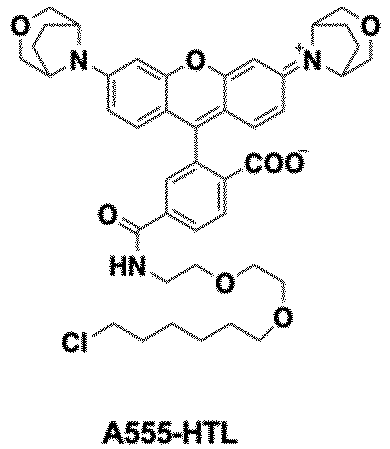
- The compound A555-HTL was obtained by condensation of the A555-6-COOH in Example 11 and HaloTag(O2)amines, and a purple-red solid product with a yield of 82% was obtained.
- An HRMS (ESI) theoretical value of C43H50ClN3O8 [M+H]+ was 772.3359, and an actual value was 772.3383.
-

- The compound A555-STL was obtained by condensation of the A555-6-COOH in Example 11 and BG-NH2, and a purple-red solid product with a yield of 65% was obtained.
- An MS (ESI) theoretical value of C46H42N8O7 [M+H]+ was 819.32, and an actual value was 819.68.
-

- The compound A555-TMP3 was obtained by condensation of the A555-6-COOH in Example 11 and TMP3-NH2, and a purple-red solid product with a yield of 74% was obtained.
- An MS (ESI) theoretical value of C59H60N8O10 [M+2H]2+ was 521.23, and an actual value was 521.70.
-

- The compound A586-HTL was obtained by condensation of the A586-6-COOH in Example 12 and HaloTag(O2)amines, and a white solid product with a yield of 52% was obtained.
- An HRMS (ESI) theoretical value of C46H56ClN3O9S2 [M+H]+ was 894.3219, and an actual value was 894.3216.
-

- The compound A620-HTL was obtained by condensation of the A620-6-COOH in Example 14 and HaloTag(O2)amines, and a blue solid product with a yield of 62% was obtained.
- An HRMS (ESI) theoretical value of C46H56ClN3O7 [M+H]+ was 798.3880, and an actual value was 798.3872.
-

- The compound A620-STL was obtained by condensation of the A620-6-COOH in Example 14 and BG-NH2, and a blue solid product with a yield of 51% was obtained.
- An HRMS (ESI) theoretical value of C49H48N8O6 was [M+H]+ 845.3770, and an actual value was 845.3776.
-

- The compound A620-TMP3 was obtained by condensation of the A620-6-COOH in Example 14 and TMP3-NH2, and a blue solid product with a yield of 42% was obtained.
- An MS (ESI) theoretical value of C62H66N8O9 [M+2H]2+ was 534.26, and an actual value was 534.42.
-

- The compound A655-HTL was obtained by condensation of the A655-6-COOH in Example 17 and HaloTag(Oz)amines, and a blue solid product with a yield of 86% was obtained.
- An HRMS (ESI) theoretical value of C45H56ClN3O7Si [M+H]+ was 814.3649, and an actual value was 814.3650.
-
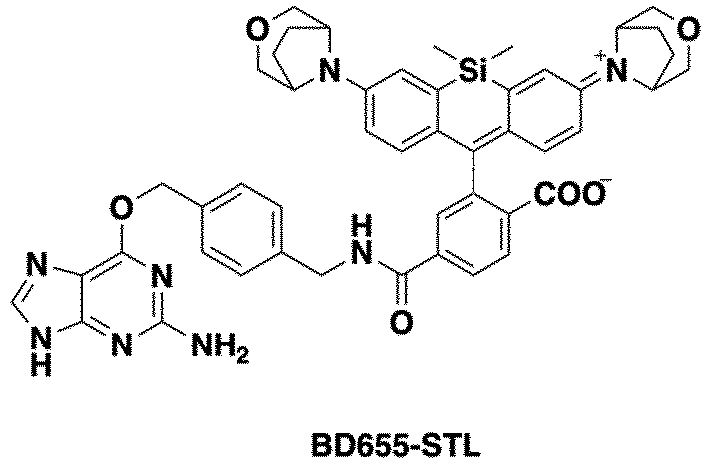
- The compound A655-STL was obtained by condensation of the A655-6-COOH in Example 17 and BG-NH2, and a blue solid product with a yield of 60% was obtained.
- An MS (ESI) theoretical value of C48H48N8O6Si [M+H]+ was 861.35, and an actual value was 861.49.
-
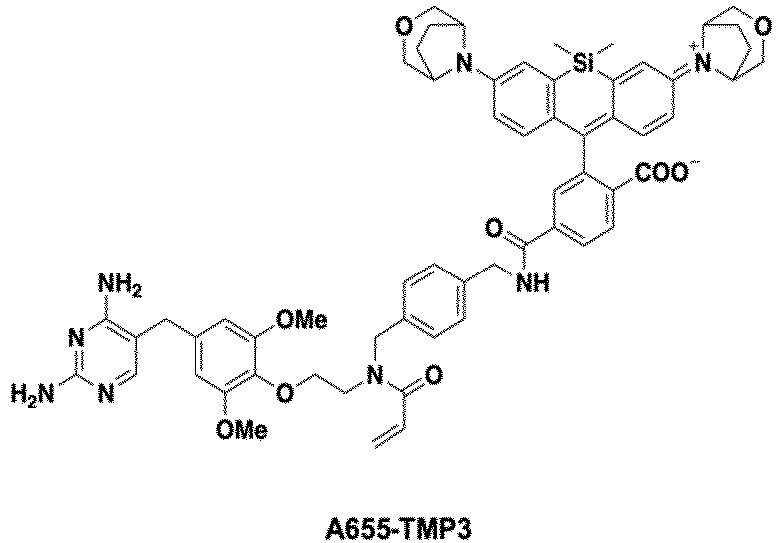
- The compound A655-TMP3 was obtained by condensation of the A655-6-COOH in Example 17 and TMP3-NH2, and a blue solid product with a yield of 57% was obtained.
- An MS (ESI) theoretical value of C61H66N8O9Si [M+2H]2+ was 542.24, and an actual value was 542.68.
-

- The compound A655-4-Hoechst was obtained by condensation of the A655-6-COOH in Example 17 and Hoechst-NH2, and a green solid product with a yield of 32% was obtained.
- An MS (ESI) theoretical value of C64H67N9O6Si [M+H]+ was 1086.51, and an actual value was 1086.22.
-

-

-
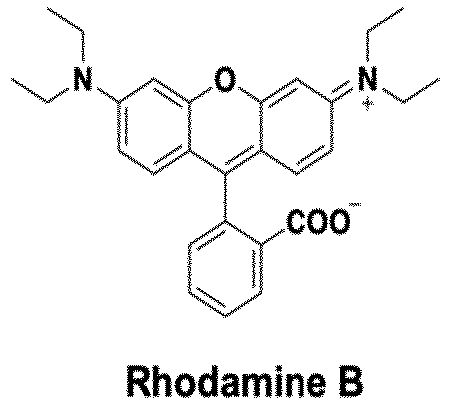
-

-

-
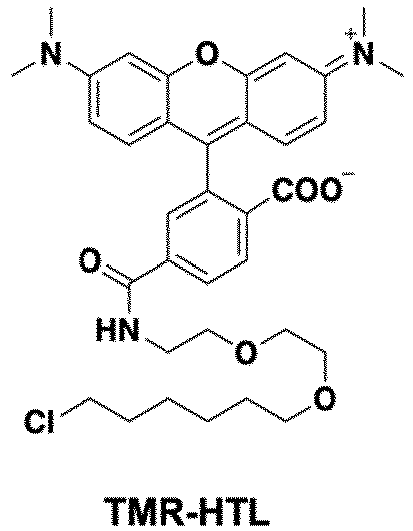
-
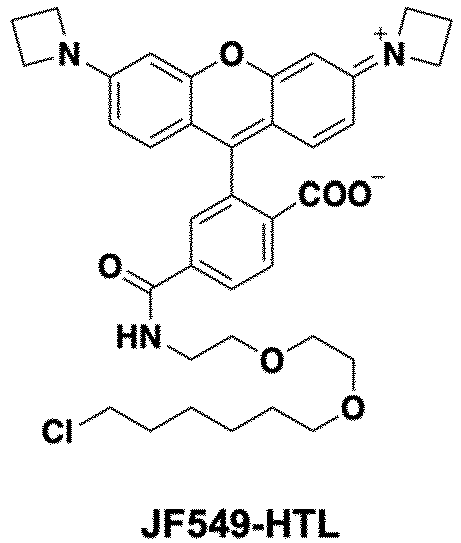
-

-

-

-

- Basic photophysical properties of the fluorescent dyes in Example 1 (A528), Example 2 (A532), Example 3 (A555), Example 4 (A586), Example 6 (A620), Example 7 (A634), Example 9 (A655), Example 18 (A720), Example 20 (B350) and Example 21 (B356) were determined, as shown in
Fig. 1 and Fig. 2 . - Method for determining basic photophysical properties of a fluorescent dye: A fluorescent dye was prepared into a solution with a concentration of 1 µmol/L, where a PBS buffer solution (phosphate buffer solution) with a pH value of 7.4 was used as a solvent; and then, the solution was tested in a Duetta fluorescence and absorption spectrometer at 25°C for 3 times.
- Method for determining the fluorescence quantum yield of a fluorescent dye: The fluorescence quantum yield was determined by a reference method, a fluorescent dye to be tested or a reference fluorescent dye was prepared into a solution with a concentration of 1 µmol/L, where a PBS buffer solution (phosphate buffer solution) with a pH value of 7.4 was used as a solvent; and then, the solution was scanned in a Duetta fluorescence and absorption spectrometer at 25°C to obtain an absorption spectrum and a fluorescence spectrum, and the fluorescence spectrum was integrated, where the fluorescence quantum yield of the dye was obtained based on a ratio of fluorescence spectrum integrals of the fluorescent dye to be tested and the reference fluorescent dye. A formula for calculating the fluorescence quantum yield of a fluorescent dye is as follows:

- where Φ sample and Φ ref represent a fluorescence quantum yield of the fluorescent dye to be tested and the reference fluorescent dye, respectively;
- ODsample and ODref represent an absorption value of the fluorescent dye to be tested and the reference fluorescent dye at an excitation wavelength, respectively;
- lsample and lref represent an integral value of an excitation spectrum of the fluorescent dye to be tested and the reference fluorescent dye, respectively;
- dsample and dref represent a refractive index of a test solvent of the fluorescent dye to be tested and the reference fluorescent dye, respectively.
- As can be seen from Table 1, a class of aza[3.2.1]bridged ring substituted fluorescent dyes obtained in the present disclosure have an emission wavelength within ultraviolet and visible light regions, and the brightness of the fluorescent dyes of various colors is 1.2-16 times higher than that of traditional dimethylamino or diethylamino substituted fluorescent dyes. The dyes with emissions in ultraviolet, orange and red light regions have quantum yields similar to theoretical limits.
Table 1 Matrix Substituen t NR2= Compound name λAbs (nm) λEm (nm) Φ 

Dimethylcouma rin 372 470 0.19 
B350 (Example 20) 350 440 0.96 
B356 (Example 21) 356 472 0.72 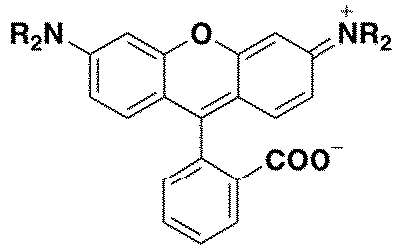

TMR 548 572 0.41 
A528 (Example 1) 528 552 0.94 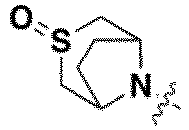
A532 (Example 2) 532 558 0.92 
A555 (Example 3) 555 583 0.78 

CPY 606 626 0.52 
A586 (Example 4) 588 613 0.92 
A591 (Example 5) 593 620 0.87 
A620 (Example 6) 615 645 0.64 

SiRhodB 655 674 0.21 
A634 (Example 7) 634 652 0.78 
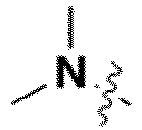
SiR 643 662 0.41 
A640 (Example 8) 640 660 0.72 
A655 (Example 9) 657 680 0.31 
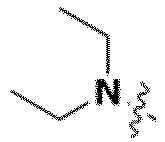
oxazine 655 669 0.07 
C622 (Example 22) 622 646 0.47 
C654 (Example 23) 654 691 0.21 

PRhodB 708 734 0.22 
A720 (Example 18) 714 747 0.15 - The photostability of the fluorescent dyes in Example 3 (A555), Example 10 (A528-6-COOH), Example 7 (A634), Comparative Example 2 (TMRE), Comparative Example 1 (JF549), Comparative Example 3 (Rhodamine B), Comparative Example 4 (Cy3) and Comparative Example 5 (Atto647N) was determined, as shown in
Fig. 3 andFig. 4 . - Method for determining the photostability of a fluorescent dye: A fluorescent dye with a concentration of 10 mol/L was dissolved in a PBS buffer solution (phosphate buffer solution) with a pH value of 7.4; and then, the dye solution was irradiated with an LED lamp (light-emitting diode) having an excitation wavelength matched with that of the fluorescent dye, and measured once after the irradiation for 10 min to obtain an absorption spectrum, where the measurement was performed for a total of 30 min.
- As can be seen from
Fig.3 , in an orange channel, the stability in Example 3 and Example 10 is improved by 3.3-7.6 times compared with that in Comparative Example 2, Comparative Example 1, Comparative Example 3 and Comparative Example 4. In addition, the fluorescent dyes in Comparative Example 2, Comparative Example 1, Comparative Example 3 and Comparative Example 4 have the phenomenon of blue shift of absorption spectra in 12-22 nm, while the fluorescent dyes in Example 3 and Example 10 of the present disclosure have no phenomenon of spectral blue shift. - As can be seen from
Fig. 4 , in a far-red channel, the photostability in Example 7 of the present disclosure is improved by 1 time compared with that in Comparative Example 5, and the phenomenon of spectral blue shift is not observed. - By combining
Fig. 3 andFig. 4 , it is shown that the photostability of the aza[3.2.1]bridged ring substituted fluorescent dye prepared in the present disclosure is greatly improved, and a photooxidation dealkylation (spectral blue shift) process is completely avoided. - The functionalized derivatives of fluorescent dyes in Example 27 (A555-HTL), Comparative Example 6 (TMR-HTL) and Comparative Example 7 (JF549-HTL) were determined in a single molecule experiment of fixed cells, as shown in
Fig. 5 ,Fig. 6 and Fig. 7 . - Method for determining a functionalized derivative of a fluorescent dye in a single molecule experiment of fixed cells: 5 pM of a fluorescent dye and U2OS cells were co-incubated for 30 min; then, the cells were washed with a PBS buffer solution with a pH value of 7.4 for three times, and fixed with 4% paraformaldehyde; and a single molecule experiment was carried out on a total internal reflection fluorescence microscope (100 mW, excitation at 561 nm, and excitation intensity: 6%).
- As can be seen from
Fig. 6 , the average single molecule fluorescence intensity in Comparative Example 6, Comparative Example 7 and Example 27 is 4,354, 5,466 and 8,176, respectively, and the photostability in Example 27 is improved by one time compared with that in Comparative Example 7. - By combining
Fig. 5 ,Fig. 6 and Fig. 7 , it is shown that the aza[3.2.1]bridged ring substituted fluorescent dye prepared in the present disclosure can not only be used in a single molecule imaging experiment, but also has good performance in brightness and photostability. - The functionalized derivatives of fluorescent dyes in Example 27 (A555-HTL), Example 31 (A620-HTL), Example 34 (A655-HTL), Example 28 (A555-STL), Comparative Example 6 (TMR-HTL), Comparative Example 8 (JFX554-HTL), Comparative Example 9 (CPY-HTL) and Comparative Example 10 (TMR-STL) were determined in a confocal microscopy imaging experiment of living cells, as shown in
Fig. 8, Fig. 9 ,Fig. 10, Fig. 11 ,Fig. 12, Fig. 13 andFig. 14 . - Method for determining a functionalized derivative of a fluorescent dye in a confocal microscopy imaging experiment of living cells: A 200 nM fluorescent dye was used to perform confocal fluorescence imaging on TMP-Halo-SNAP-GFP-H2B proteins in living Hela cells, and compared with a traditional dye of the same color in brightness.
- As can be seen from
Fig. 11 , the brightness in Example 27 is 50% higher than that of a high-brightness dye reported in a document JACS Au. 2021, 1:690-696., namely, in Comparative Example 8, and is 158% higher than that in Comparative Example 6 (confocal imaging at an excitation wavelength of 561 nm and an excitation intensity of 10%, a detector at 566 nm, and no gate). - As can be seen from
Fig. 12 , the brightness in Example 31 is 350% higher than that of a high-brightness dye reported in a document Angew. Chem. Int. Ed. 2016, 55: 3290-3294, namely, in Comparative Example 9 (confocal imaging at an excitation wavelength of 640 nm and an excitation intensity of 5%, a detector at 664 nm, and no gate). - As can be seen from
Fig. 14 , the brightness in Example 28 is 223% higher than that in Comparative Example 10 (confocal imaging at an excitation wavelength of 561 nm and an excitation intensity of 10%, a detector at 566 nm, and no gate). - The functional derivatives of fluorescent dyes in Example 34 (A655-HTL) and Comparative Example 11 (SiR-HTL) were determined in a super-resolution microscopy imaging experiment of living cells, as shown in
Fig. 15 andFig. 16 . - Method for determining a functional derivative of a fluorescent dye in a super-resolution microscopy imaging experiment of living cells: A 1 µM functional derivative of a fluorescent dye was used to perform wash-free super-resolution imaging on Lifeact-Halo proteins in living Hela cells (STED imaging at an excitation wavelength of 640 nm, an excitation intensity of 2% and a depletion light intensity of 30%, a detector at 650 nm, and no gate).
- By combining
Fig. 15 andFig. 16 , it can be seen that compared with a far-red wash-free dye reported in a document Nature Chemistry. 2013, 5: 132-139., namely, in Comparative Example 11, the dye in Example 34 has higher photostability on STED. - As can be seen from the above descriptions, the above embodiments of the present disclosure have the following technical effects. According to the aza[3.2.1]bridged ring substituted fluorescent dye provided by the present disclosure, by adopting an aza[3.2.1]bridged ring as a substituent of the fluorescent dye, not only can the brightness of the fluorescent dye be improved, but also the photostability of the fluorescent dye is improved while spectral blue shift of the dye is avoided. Meanwhile, the water solubility of the fluorescent dye can be effectively improved, and good membrane permeability of the fluorescent dye is maintained. The fluorescence quantum yield, photostability, resistance to photooxidation dealkylation (spectral blue shift), water solubility and membrane permeability of the fluorescent dye can be improved simultaneously.
- The above descriptions are only preferred embodiments of the present disclosure and are not intended to limit the present disclosure. For persons skilled in the art, various alterations and changes of the present disclosure may be made. Any modifications, equivalent substitutions, improvements and the like made within the spirit and principles of the present disclosure shall be included in the scope of protection of the present disclosure.
Claims (10)
- An aza[3.2.1]bridged ring substituted fluorescent dye, wherein the aza[3.2.1]bridged ring substituted fluorescent dye has a structure shown in Formula (I), Formula (II) or Formula (III) below:

 Ra, Rb, Rc, Rd, Re, Rf, Rg, Rh, Ri, Rj, Rk, Rl, Rm, Rn, Ro, Rp and Rq are independently selected from hydrogen, halogen, carboxyl, substituted or unsubstituted C1-C20 alkyl, substituted or unsubstituted C3-C20 cycloalkyl, substituted or unsubstituted C4-C20 cycloalkylalkyl, C4-C20 alkylcycloalkyl, substituted or unsubstituted C1-C20 alkoxyl, substituted or unsubstituted C1-C20 ester group, and substituted or unsubstituted C1-C20 acylamino;RA is selected from substituted or unsubstituted C6-C40 aryl, substituted or unsubstituted C6-C40 aralkyl, and substituted or unsubstituted C5-C40 heteroaryl;X is selected from oxygen, sulfur, substituted or unsubstituted C1-C20 alkylene,
 Y is selected from oxygen, sulfur, nitrogen, substituted or unsubstituted C1-C20 alkylene, substituted or unsubstituted C1-C20 alkylenoxyl, substituted or unsubstituted C1-C20 acyl, substituted or unsubstituted C1-C20 ester group,
 Z- is selected from F-, Cl-, Br, I-, OAc-, HSO4 -, H2PO4 -, ClO4 -, CF3COO-, CF3SO3 -, CH3SO3 -, NO3 -, C5H7O5COO-; and PF6 -; and m is an integer ranged from 1 to 3.
 - The aza[3.2.1]bridged ring substituted fluorescent dye according to claim 1, wherein the Ra, the Rb, the Rc, the Rd, the Re, the Rf, the Rg, the Rh, the Ri, the Rj, the Rk, the Rl, the Rm, the Rn, the Ro, the Rp and the Rq are independently selected from hydrogen, halogen, carboxyl, substituted or unsubstituted C1-C10 alkyl, substituted or unsubstituted C3-C10 cycloalkyl, substituted or unsubstituted C4-C10 cycloalkylalkyl, C4-C10 alkylcycloalkyl, substituted or unsubstituted C1-C10 alkoxyl, substituted or unsubstituted C1-C10 ester group, and substituted or unsubstituted C1-C10 acylamino;and/or, the RA is selected from substituted or unsubstituted C6-C30 aryl, substituted or unsubstituted C6-C30 aralkyl, and substituted or unsubstituted C5-C30 heteroaryl;and/or, the X is selected from oxygen, sulfur, substituted or unsubstituted C1-C10 alkyl,
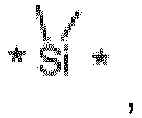
 and/or, the Y is selected from oxygen, sulfur, nitrogen, substituted or unsubstituted C1-C10 alkyl, substituted or unsubstituted C1-C10 alkoxyl, substituted or unsubstituted C1-C10 acyl, substituted or unsubstituted C1-C10 ester group,
 and/or, the Z- is selected from F-, Cl-, Br, I-, OAc-, HSO4 -, H2PO4 -, ClO4 -, CF3COO-, CF3SO3 -, CH3SO3 -, NO3 -, C5H7O5COO-, and PF6 -;and/or, the m is an integer ranged from 1 to 3.
 - The aza[3.2.1]bridged ring substituted fluorescent dye according to claim 1 or 2, wherein the aza[3.2.1]bridged ring substituted fluorescent dye shown in Formula (I) has a structure shown in Formula (IV) below:





- The aza[3.2.1]bridged ring substituted fluorescent dye according to claim 3, wherein the aza[3.2.1]bridged ring substituted fluorescent dye is selected from at least one of the following formulas IA1-IA3, IIA1-IIA3, IIIA1-IIIA3, IB1-IB3, IC1-IC3, ID1-ID3, IE1-IE3, IF1-IF3, and IG1-IG3:


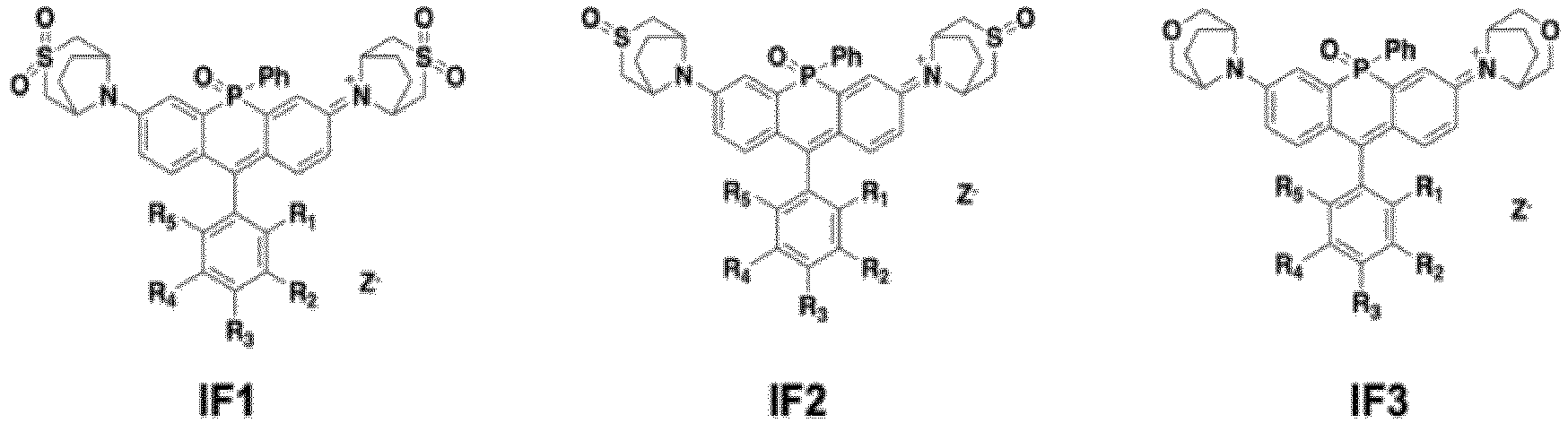


- The aza[3.2.1]bridged ring substituted fluorescent dye according to any one of claims 1 to 4, wherein the aza[3.2.1]bridged ring substituted fluorescent dye is selected from at least one of the following formulas A528, A532, A555, A586, A591, A620, A634, A640, A655, A720, A586-2Me, A586-2Me-5-COOH, A528-6-COOH, A532-6-COOH, A555-6-COOH, A586-6-COOH, A591-6-COOH, A620-6-COOH, A634-5-COOH, A640-6-COOH, A655-6-COOH, A528-HTL, A532-HTL, A555-HTL, A586-HTL, A620-HTL, A655-HTL, A555-STL, A528-NHS, A620-STL, A655-STL, A634-NHS, A586-NHS, A591-HTL, A640-HTL, A555-TMP3, A620-TMP3, A655-TMP3, A655-4-Hoechst, A591-TMP3, A640-TMP3, A591-STL, A640-STL, A528-NCN-HTL, A555-NCN-HTL, A620-NCN-HTL, B350, B356, C622, and C654:


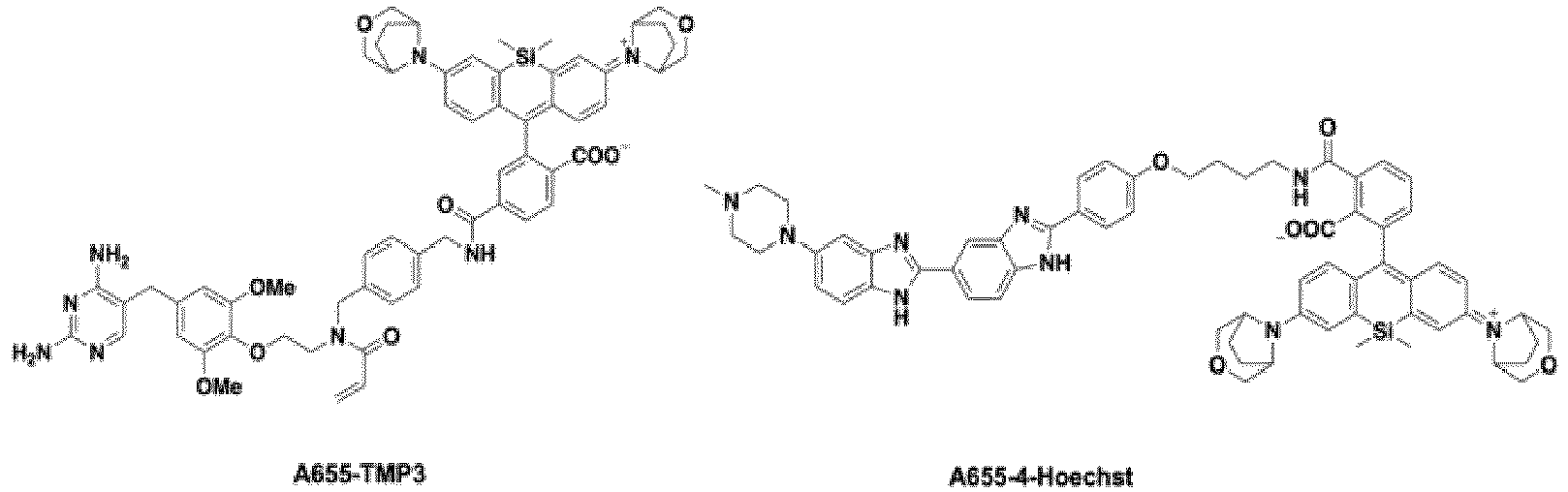


- A method for preparing an aza[3.2.1]bridged ring substituted fluorescent dye, wherein the preparation method comprises:step S11, mixing a compound A, an aza[3.2.1]bridged ring compound and a first catalyst in a first reaction solvent to carry out a reaction so as to obtain a compound B; andstep S12, mixing the compound B with an HZ aqueous solution to carry out a reaction so as to obtain the aza[3.2.1]bridged ring substituted fluorescent dye shown in Formula (I);the compound A has a structure shown in Formula (V) below, and the aza[3.2.1]bridged ring compound has a structure shown in Formula (VI) below:
 wherein RA, Ra, Rb, Rc, Rd, Re, Rf, X and Y independently have the same meaning as defined in any one of claims 1 to 5, and Z- in the HZ aqueous solution has the same meaning as defined in any one of claims 1 to 5;preferably, the first catalyst comprises a palladium catalyst, a palladium catalyst ligand and an alkaline catalyst;preferably, the palladium catalyst comprises at least one of tetrakis(triphenylphosphine)palladium, palladium acetate, tris(dibenzylideneacetone)dipalladium, [(diphenylphosphino)ferrocene]dichloropalladium, dichlorobis(triphenylphosphine) palladium and palladium chloride, preferably at least one of tetrakis(triphenylphosphine)palladium, palladium acetate or tris(dibenzylideneacetone)dipalladium;preferably, the palladium catalyst ligand comprises at least one of bis(dibenzylideneacetone)palladium, 2,2'-bis(diphenylphosphino)-1,1'-binaphthyl, 2-dicyclohexylphosphino-2',4',6'-triisopropylbiphenyl and 2-dicyclohexylphosphino-2',6'-dimethoxybiphenyl, preferably at least one of bis(dibenzylideneacetone)palladium and 2,2'-bis(diphenylphosphino)-1,1'-binaphthyl;preferably, the alkaline catalyst comprises at least one of cesium carbonate, sodium tert-butoxide, potassium carbonate, sodium carbonate, sodium methoxide, sodium ethoxide and potassium tert-butoxide, preferably at least one of cesium carbonate, sodium tert-butoxide and potassium tert-butoxide;and preferably, the first reaction solvent comprises at least one of n-hexane, tetrahydrofuran, 1,4-dioxane, ethyl ether and toluene.
 - A method for preparing an aza[3.2.1]bridged ring substituted fluorescent dye, wherein the preparation method comprises:mixing a compound C, an aza[3.2.1]bridged ring compound and a second catalyst in a second reaction solvent to carry out a reaction so as to obtain the aza[3.2.1]bridged ring substituted fluorescent dye shown in Formula (II);the compound C has a structure shown in Formula (VII) below:
 wherein Rg, Rh, Ri, Rj, Rk and X independently have the same meaning as defined in any one of claims 1 to 5;preferably, the second catalyst has the same meaning as the first catalyst;and preferably, the second reaction solvent has the same meaning as the first reaction solvent.
 - A method for preparing an aza[3.2.1]bridged ring substituted fluorescent dye, wherein the preparation method comprises:step S31, mixing a compound D, an aza[3.2.1]bridged ring compound and a third catalyst in a third reaction solvent to carry out a reaction so as to obtain a compound E;step S32, mixing the compound E with an oxidizing agent in a fourth reaction solvent to carry out a reaction so as to obtain a compound F; andstep S33, mixing the compound F with an HZ aqueous solution to carry out a reaction so as to obtain the aza[3.2.1]bridged ring substituted fluorescent dye shown in Formula (III);the compound D has a structure shown in Formula (VIII) below:
 wherein Rl, Rm, Rn, Ro, Rp, Rq, X and Y independently have the same meaning as defined in any one of claims 1 to 5, and Z- in the HZ aqueous solution has the same meaning as defined in any one of claims 1 to 5;preferably, the third catalyst has the same meaning as the first catalyst;preferably, the third reaction solvent has the same meaning as the first reaction solvent; preferably, in step S32, the fourth reaction solvent is a mixed solvent of dichloromethane and water, and the volume ratio of the dichloromethane to the water is (10-30):1;preferably, in step S32, the oxidizing agent comprises at least one of 2,3-dichloro-5,6-dicyano-1,4-benzoquinone, potassium permanganate, hydrogen peroxide and m-chloroperoxybenzoic acid, preferably 2,3-dichloro-5,6-dicyano-1,4-benzoquinone;and preferably, the molar ratio of the oxidizing agent to the compound E is (1.0-2.0):1.
 - Use of the aza[3.2.1]bridged ring substituted fluorescent dye according to any one of claims 1 to 5 or the aza[3.2.1]bridged ring substituted fluorescent dye prepared by the method for preparing an aza[3.2.1]bridged ring substituted fluorescent dye according to any one of claims 6 to 8 in the fields of fluorescence analysis, fluorescence detection and fluorescence imaging as a fluorescent marker.
- The use of the aza[3.2.1]bridged ring substituted fluorescent dye according to claim 9, wherein the aza[3.2.1]bridged ring substituted fluorescent dye is used in fluorescence analysis, fluorescence detection, biomolecular labeling, immunofluorescence imaging, live-cell imaging, tissue imaging, in vivo imaging, single-molecule imaging and super-resolution fluorescence imaging as a fluorescent marker.
Applications Claiming Priority (2)
| Application Number | Priority Date | Filing Date | Title |
|---|---|---|---|
| CN202310809062.6A CN119241565A (en) | 2023-07-03 | 2023-07-03 | Aza[3.2.1] bridged ring substituted fluorescent dye and preparation method and application thereof |
| PCT/CN2023/117328 WO2025007415A1 (en) | 2023-07-03 | 2023-09-06 | Aza[3.2.1] bridged ring substituted fluorescent dye, and preparation method therefor and use thereof |
Publications (2)
| Publication Number | Publication Date |
|---|---|
| EP4512863A1 true EP4512863A1 (en) | 2025-02-26 |
| EP4512863A4 EP4512863A4 (en) | 2025-09-10 |
Family
ID=91664111
Family Applications (1)
| Application Number | Title | Priority Date | Filing Date |
|---|---|---|---|
| EP23904797.0A Pending EP4512863A4 (en) | 2023-07-03 | 2023-09-06 | AZA[3.2.1 YL-SUBSTITUTED RING-SUBSTITUTED FLUORESCENT DYE AND PRODUCTION PROCESS THEREOF AND USE THEREOF |
Country Status (3)
| Country | Link |
|---|---|
| EP (1) | EP4512863A4 (en) |
| CN (1) | CN119241565A (en) |
| WO (1) | WO2025007415A1 (en) |
Family Cites Families (4)
| Publication number | Priority date | Publication date | Assignee | Title |
|---|---|---|---|---|
| WO2010054183A2 (en) * | 2008-11-07 | 2010-05-14 | President And Fellows Of Harvard College | Dyes, compositions and related methods of use |
| WO2015153813A1 (en) * | 2014-04-01 | 2015-10-08 | Howard Hughes Medical Institute | Azetidine-substituted fluorescent compounds |
| EP3801495A4 (en) * | 2018-05-29 | 2022-03-02 | Howard Hughes Medical Institute | DEUTERATED FLUOROPHORES |
| CN112812584A (en) * | 2019-11-16 | 2021-05-18 | 复旦大学 | Fluorescent dye containing azetidine spiro-structure as well as preparation method and application thereof |
-
2023
- 2023-07-03 CN CN202310809062.6A patent/CN119241565A/en active Pending
- 2023-09-06 EP EP23904797.0A patent/EP4512863A4/en active Pending
- 2023-09-06 WO PCT/CN2023/117328 patent/WO2025007415A1/en not_active Ceased
Also Published As
| Publication number | Publication date |
|---|---|
| EP4512863A4 (en) | 2025-09-10 |
| CN119241565A (en) | 2025-01-03 |
| WO2025007415A1 (en) | 2025-01-09 |
Similar Documents
| Publication | Publication Date | Title |
|---|---|---|
| Guo et al. | A visible-near-infrared fluorescent probe for peroxynitrite with large pseudo-Stokes and emission shift via through-bond energy and charge transfers controlled by energy matching | |
| CN110218220A (en) | A kind of functional metal-organic frame compound, its compound formed and its preparation method and application | |
| Kirner et al. | Synthesis and photophysical properties of new catenated electron donor–acceptor materials with magnesium and free base porphyrins as donors and C 60 as the acceptor | |
| Nakamura et al. | STUDIES ON AMINODIOXETANES AS A MODEL OF BIOLUMINESCENCE INTERMEDIATES. 1‐(1‐METHYL‐3‐INDOLYL)‐6‐PHENYL‐2, 5, 7, 8‐TETRAOXABICYCLO [4, 2, 0] OCTANE, AN AMINODIOXETANE RESULTING IN EFFICIENT ULTRAVIOLET AND EXCIPLEX CHEMILUMINESCENCE | |
| Che et al. | Exploiting aggregation induced emission and twisted intramolecular charge transfer in a BODIPY dye for selective sensing of fluoride in aqueous medium and living cells | |
| US12552938B2 (en) | Deuterated fluorophores | |
| CN111793371B (en) | A kind of 3,5-position asymmetric modified BODIPY near-infrared fluorescent dye and preparation method thereof | |
| Miao et al. | Design and facile synthesis of quinazolinone-based full color-tunable boron difluoride dyes: Efficient solvent/solid-state emission and bioimaging application | |
| Ponsot et al. | Near-infrared emissive bacteriochlorin-diketopyrrolopyrrole triads: Synthesis and photophysical properties | |
| Chevalier et al. | Rapid Synthesis of Unsymmetrical Sulforhodamines Through Nucleophilic Amination of a Monobrominated Sulfoxanthene Dye | |
| CN120272028A (en) | Fluorine-substituted pentamethine cyanine dye and preparation method and application thereof | |
| CN105837568B (en) | A kind of fluorenyl β carbolines class compound, its application and preparation method as luminous organic material and aggregation inducing Fluorescence Increasing material | |
| Han et al. | A diphenylacrylonitrile conjugated porphyrin with near-infrared emission by AIE–FRET | |
| CN107586292A (en) | Compound, its preparation method, fluorescent dye and fluorescence probe | |
| CN118666862A (en) | Novel aggregation-induced emission type I photosensitizer molecule and preparation method and application thereof | |
| CN114989184B (en) | Pyranoquinoline hybridized coumarin fluorescent dye | |
| CN111548363A (en) | A kind of intelligent photosensitizer and its preparation method and application | |
| CN117024433A (en) | naphthalimide-TB compound and synthetic method and application thereof | |
| Kroonen et al. | A cross-shaped organic framework: a multi-functional template arranging chromophores | |
| Chen et al. | Tuning the push-pull dyes: Construction of polarity insensitive probes for G4 DNA | |
| CN119241565A (en) | Aza[3.2.1] bridged ring substituted fluorescent dye and preparation method and application thereof | |
| CN111621289A (en) | Light-operated double-channel fluorescent dye and preparation method and application thereof | |
| CN117304193B (en) | Organic purple light absorbing material based on TB-naphthalimide derivative, and preparation and application thereof | |
| CN114853665B (en) | Fluorescent compound and preparation method and application thereof | |
| Tripathi et al. | Synthesis and study of meso-phenothiazinyl 3-pyrrolyl BODIPY and its derivatives |
Legal Events
| Date | Code | Title | Description |
|---|---|---|---|
| STAA | Information on the status of an ep patent application or granted ep patent |
Free format text: STATUS: UNKNOWN |
|
| STAA | Information on the status of an ep patent application or granted ep patent |
Free format text: STATUS: THE INTERNATIONAL PUBLICATION HAS BEEN MADE |
|
| PUAI | Public reference made under article 153(3) epc to a published international application that has entered the european phase |
Free format text: ORIGINAL CODE: 0009012 |
|
| STAA | Information on the status of an ep patent application or granted ep patent |
Free format text: STATUS: REQUEST FOR EXAMINATION WAS MADE |
|
| 17P | Request for examination filed |
Effective date: 20240626 |
|
| AK | Designated contracting states |
Kind code of ref document: A1 Designated state(s): AL AT BE BG CH CY CZ DE DK EE ES FI FR GB GR HR HU IE IS IT LI LT LU LV MC ME MK MT NL NO PL PT RO RS SE SI SK SM TR |
|
| RIC1 | Information provided on ipc code assigned before grant |
Ipc: G01N 33/58 20060101ALI20250514BHEP Ipc: G01N 33/533 20060101ALI20250514BHEP Ipc: A61K 31/46 20060101ALI20250514BHEP Ipc: C07D 451/00 20060101ALI20250514BHEP Ipc: C09B 57/00 20060101ALI20250514BHEP Ipc: C09B 19/00 20060101AFI20250514BHEP |
|
| A4 | Supplementary search report drawn up and despatched |
Effective date: 20250812 |
|
| RIC1 | Information provided on ipc code assigned before grant |
Ipc: C09B 19/00 20060101AFI20250806BHEP Ipc: C09B 57/00 20060101ALI20250806BHEP Ipc: C07D 451/00 20060101ALI20250806BHEP Ipc: A61K 31/46 20060101ALI20250806BHEP Ipc: G01N 33/533 20060101ALI20250806BHEP Ipc: G01N 33/58 20060101ALI20250806BHEP |