EP4512803A1 - Gpcr regulator and use thereof - Google Patents
Gpcr regulator and use thereof Download PDFInfo
- Publication number
- EP4512803A1 EP4512803A1 EP23791233.2A EP23791233A EP4512803A1 EP 4512803 A1 EP4512803 A1 EP 4512803A1 EP 23791233 A EP23791233 A EP 23791233A EP 4512803 A1 EP4512803 A1 EP 4512803A1
- Authority
- EP
- European Patent Office
- Prior art keywords
- group
- hydrogen
- pharmaceutically acceptable
- alkyl
- cancer
- Prior art date
- Legal status (The legal status is an assumption and is not a legal conclusion. Google has not performed a legal analysis and makes no representation as to the accuracy of the status listed.)
- Pending
Links
Classifications
-
- A—HUMAN NECESSITIES
- A61—MEDICAL OR VETERINARY SCIENCE; HYGIENE
- A61K—PREPARATIONS FOR MEDICAL, DENTAL OR TOILETRY PURPOSES
- A61K31/00—Medicinal preparations containing organic active ingredients
- A61K31/33—Heterocyclic compounds
- A61K31/395—Heterocyclic compounds having nitrogen as a ring hetero atom, e.g. guanethidine or rifamycins
- A61K31/495—Heterocyclic compounds having nitrogen as a ring hetero atom, e.g. guanethidine or rifamycins having six-membered rings with two or more nitrogen atoms as the only ring heteroatoms, e.g. piperazine or tetrazines
- A61K31/496—Non-condensed piperazines containing further heterocyclic rings, e.g. rifampin, thiothixene or sparfloxacin
-
- A—HUMAN NECESSITIES
- A61—MEDICAL OR VETERINARY SCIENCE; HYGIENE
- A61P—SPECIFIC THERAPEUTIC ACTIVITY OF CHEMICAL COMPOUNDS OR MEDICINAL PREPARATIONS
- A61P1/00—Drugs for disorders of the alimentary tract or the digestive system
-
- A—HUMAN NECESSITIES
- A61—MEDICAL OR VETERINARY SCIENCE; HYGIENE
- A61K—PREPARATIONS FOR MEDICAL, DENTAL OR TOILETRY PURPOSES
- A61K31/00—Medicinal preparations containing organic active ingredients
- A61K31/33—Heterocyclic compounds
- A61K31/335—Heterocyclic compounds having oxygen as the only ring hetero atom, e.g. fungichromin
- A61K31/34—Heterocyclic compounds having oxygen as the only ring hetero atom, e.g. fungichromin having five-membered rings with one oxygen as the only ring hetero atom, e.g. isosorbide
- A61K31/343—Heterocyclic compounds having oxygen as the only ring hetero atom, e.g. fungichromin having five-membered rings with one oxygen as the only ring hetero atom, e.g. isosorbide condensed with a carbocyclic ring, e.g. coumaran, bufuralol, befunolol, clobenfurol, amiodarone
-
- A—HUMAN NECESSITIES
- A61—MEDICAL OR VETERINARY SCIENCE; HYGIENE
- A61K—PREPARATIONS FOR MEDICAL, DENTAL OR TOILETRY PURPOSES
- A61K31/00—Medicinal preparations containing organic active ingredients
- A61K31/33—Heterocyclic compounds
- A61K31/335—Heterocyclic compounds having oxygen as the only ring hetero atom, e.g. fungichromin
- A61K31/357—Heterocyclic compounds having oxygen as the only ring hetero atom, e.g. fungichromin having two or more oxygen atoms in the same ring, e.g. crown ethers, guanadrel
- A61K31/36—Compounds containing methylenedioxyphenyl groups, e.g. sesamin
-
- A—HUMAN NECESSITIES
- A61—MEDICAL OR VETERINARY SCIENCE; HYGIENE
- A61K—PREPARATIONS FOR MEDICAL, DENTAL OR TOILETRY PURPOSES
- A61K31/00—Medicinal preparations containing organic active ingredients
- A61K31/33—Heterocyclic compounds
- A61K31/38—Heterocyclic compounds having sulfur as a ring hetero atom
- A61K31/381—Heterocyclic compounds having sulfur as a ring hetero atom having five-membered rings
-
- A—HUMAN NECESSITIES
- A61—MEDICAL OR VETERINARY SCIENCE; HYGIENE
- A61K—PREPARATIONS FOR MEDICAL, DENTAL OR TOILETRY PURPOSES
- A61K31/00—Medicinal preparations containing organic active ingredients
- A61K31/33—Heterocyclic compounds
- A61K31/395—Heterocyclic compounds having nitrogen as a ring hetero atom, e.g. guanethidine or rifamycins
- A61K31/435—Heterocyclic compounds having nitrogen as a ring hetero atom, e.g. guanethidine or rifamycins having six-membered rings with one nitrogen as the only ring hetero atom
- A61K31/44—Non condensed pyridines; Hydrogenated derivatives thereof
- A61K31/4427—Non condensed pyridines; Hydrogenated derivatives thereof containing further heterocyclic ring systems
- A61K31/443—Non condensed pyridines; Hydrogenated derivatives thereof containing further heterocyclic ring systems containing a five-membered ring with oxygen as a ring hetero atom
-
- A—HUMAN NECESSITIES
- A61—MEDICAL OR VETERINARY SCIENCE; HYGIENE
- A61P—SPECIFIC THERAPEUTIC ACTIVITY OF CHEMICAL COMPOUNDS OR MEDICINAL PREPARATIONS
- A61P1/00—Drugs for disorders of the alimentary tract or the digestive system
- A61P1/16—Drugs for disorders of the alimentary tract or the digestive system for liver or gallbladder disorders, e.g. hepatoprotective agents, cholagogues, litholytics
-
- A—HUMAN NECESSITIES
- A61—MEDICAL OR VETERINARY SCIENCE; HYGIENE
- A61P—SPECIFIC THERAPEUTIC ACTIVITY OF CHEMICAL COMPOUNDS OR MEDICINAL PREPARATIONS
- A61P13/00—Drugs for disorders of the urinary system
- A61P13/12—Drugs for disorders of the urinary system of the kidneys
-
- A—HUMAN NECESSITIES
- A61—MEDICAL OR VETERINARY SCIENCE; HYGIENE
- A61P—SPECIFIC THERAPEUTIC ACTIVITY OF CHEMICAL COMPOUNDS OR MEDICINAL PREPARATIONS
- A61P17/00—Drugs for dermatological disorders
-
- A—HUMAN NECESSITIES
- A61—MEDICAL OR VETERINARY SCIENCE; HYGIENE
- A61P—SPECIFIC THERAPEUTIC ACTIVITY OF CHEMICAL COMPOUNDS OR MEDICINAL PREPARATIONS
- A61P17/00—Drugs for dermatological disorders
- A61P17/02—Drugs for dermatological disorders for treating wounds, ulcers, burns, scars, keloids, or the like
-
- A—HUMAN NECESSITIES
- A61—MEDICAL OR VETERINARY SCIENCE; HYGIENE
- A61P—SPECIFIC THERAPEUTIC ACTIVITY OF CHEMICAL COMPOUNDS OR MEDICINAL PREPARATIONS
- A61P25/00—Drugs for disorders of the nervous system
-
- A—HUMAN NECESSITIES
- A61—MEDICAL OR VETERINARY SCIENCE; HYGIENE
- A61P—SPECIFIC THERAPEUTIC ACTIVITY OF CHEMICAL COMPOUNDS OR MEDICINAL PREPARATIONS
- A61P3/00—Drugs for disorders of the metabolism
-
- A—HUMAN NECESSITIES
- A61—MEDICAL OR VETERINARY SCIENCE; HYGIENE
- A61P—SPECIFIC THERAPEUTIC ACTIVITY OF CHEMICAL COMPOUNDS OR MEDICINAL PREPARATIONS
- A61P3/00—Drugs for disorders of the metabolism
- A61P3/04—Anorexiants; Antiobesity agents
-
- A—HUMAN NECESSITIES
- A61—MEDICAL OR VETERINARY SCIENCE; HYGIENE
- A61P—SPECIFIC THERAPEUTIC ACTIVITY OF CHEMICAL COMPOUNDS OR MEDICINAL PREPARATIONS
- A61P3/00—Drugs for disorders of the metabolism
- A61P3/06—Antihyperlipidemics
-
- A—HUMAN NECESSITIES
- A61—MEDICAL OR VETERINARY SCIENCE; HYGIENE
- A61P—SPECIFIC THERAPEUTIC ACTIVITY OF CHEMICAL COMPOUNDS OR MEDICINAL PREPARATIONS
- A61P3/00—Drugs for disorders of the metabolism
- A61P3/08—Drugs for disorders of the metabolism for glucose homeostasis
- A61P3/10—Drugs for disorders of the metabolism for glucose homeostasis for hyperglycaemia, e.g. antidiabetics
-
- A—HUMAN NECESSITIES
- A61—MEDICAL OR VETERINARY SCIENCE; HYGIENE
- A61P—SPECIFIC THERAPEUTIC ACTIVITY OF CHEMICAL COMPOUNDS OR MEDICINAL PREPARATIONS
- A61P35/00—Antineoplastic agents
-
- A—HUMAN NECESSITIES
- A61—MEDICAL OR VETERINARY SCIENCE; HYGIENE
- A61P—SPECIFIC THERAPEUTIC ACTIVITY OF CHEMICAL COMPOUNDS OR MEDICINAL PREPARATIONS
- A61P35/00—Antineoplastic agents
- A61P35/02—Antineoplastic agents specific for leukemia
-
- A—HUMAN NECESSITIES
- A61—MEDICAL OR VETERINARY SCIENCE; HYGIENE
- A61P—SPECIFIC THERAPEUTIC ACTIVITY OF CHEMICAL COMPOUNDS OR MEDICINAL PREPARATIONS
- A61P37/00—Drugs for immunological or allergic disorders
-
- A—HUMAN NECESSITIES
- A61—MEDICAL OR VETERINARY SCIENCE; HYGIENE
- A61P—SPECIFIC THERAPEUTIC ACTIVITY OF CHEMICAL COMPOUNDS OR MEDICINAL PREPARATIONS
- A61P37/00—Drugs for immunological or allergic disorders
- A61P37/02—Immunomodulators
-
- A—HUMAN NECESSITIES
- A61—MEDICAL OR VETERINARY SCIENCE; HYGIENE
- A61P—SPECIFIC THERAPEUTIC ACTIVITY OF CHEMICAL COMPOUNDS OR MEDICINAL PREPARATIONS
- A61P37/00—Drugs for immunological or allergic disorders
- A61P37/02—Immunomodulators
- A61P37/06—Immunosuppressants, e.g. drugs for graft rejection
-
- A—HUMAN NECESSITIES
- A61—MEDICAL OR VETERINARY SCIENCE; HYGIENE
- A61P—SPECIFIC THERAPEUTIC ACTIVITY OF CHEMICAL COMPOUNDS OR MEDICINAL PREPARATIONS
- A61P5/00—Drugs for disorders of the endocrine system
- A61P5/48—Drugs for disorders of the endocrine system of the pancreatic hormones
- A61P5/50—Drugs for disorders of the endocrine system of the pancreatic hormones for increasing or potentiating the activity of insulin
-
- A—HUMAN NECESSITIES
- A61—MEDICAL OR VETERINARY SCIENCE; HYGIENE
- A61P—SPECIFIC THERAPEUTIC ACTIVITY OF CHEMICAL COMPOUNDS OR MEDICINAL PREPARATIONS
- A61P7/00—Drugs for disorders of the blood or the extracellular fluid
- A61P7/06—Antianaemics
-
- A—HUMAN NECESSITIES
- A61—MEDICAL OR VETERINARY SCIENCE; HYGIENE
- A61P—SPECIFIC THERAPEUTIC ACTIVITY OF CHEMICAL COMPOUNDS OR MEDICINAL PREPARATIONS
- A61P9/00—Drugs for disorders of the cardiovascular system
- A61P9/10—Drugs for disorders of the cardiovascular system for treating ischaemic or atherosclerotic diseases, e.g. antianginal drugs, coronary vasodilators, drugs for myocardial infarction, retinopathy, cerebrovascula insufficiency, renal arteriosclerosis
-
- C—CHEMISTRY; METALLURGY
- C07—ORGANIC CHEMISTRY
- C07C—ACYCLIC OR CARBOCYCLIC COMPOUNDS
- C07C233/00—Carboxylic acid amides
- C07C233/01—Carboxylic acid amides having carbon atoms of carboxamide groups bound to hydrogen atoms or to acyclic carbon atoms
- C07C233/45—Carboxylic acid amides having carbon atoms of carboxamide groups bound to hydrogen atoms or to acyclic carbon atoms having the nitrogen atom of at least one of the carboxamide groups bound to a carbon atom of a hydrocarbon radical substituted by carboxyl groups
- C07C233/53—Carboxylic acid amides having carbon atoms of carboxamide groups bound to hydrogen atoms or to acyclic carbon atoms having the nitrogen atom of at least one of the carboxamide groups bound to a carbon atom of a hydrocarbon radical substituted by carboxyl groups with the substituted hydrocarbon radical bound to the nitrogen atom of the carboxamide group by a carbon atom of a six-membered aromatic ring
- C07C233/54—Carboxylic acid amides having carbon atoms of carboxamide groups bound to hydrogen atoms or to acyclic carbon atoms having the nitrogen atom of at least one of the carboxamide groups bound to a carbon atom of a hydrocarbon radical substituted by carboxyl groups with the substituted hydrocarbon radical bound to the nitrogen atom of the carboxamide group by a carbon atom of a six-membered aromatic ring having the carbon atom of the carboxamide group bound to a hydrogen atom or to a carbon atom of a saturated carbon skeleton
-
- C—CHEMISTRY; METALLURGY
- C07—ORGANIC CHEMISTRY
- C07C—ACYCLIC OR CARBOCYCLIC COMPOUNDS
- C07C233/00—Carboxylic acid amides
- C07C233/01—Carboxylic acid amides having carbon atoms of carboxamide groups bound to hydrogen atoms or to acyclic carbon atoms
- C07C233/45—Carboxylic acid amides having carbon atoms of carboxamide groups bound to hydrogen atoms or to acyclic carbon atoms having the nitrogen atom of at least one of the carboxamide groups bound to a carbon atom of a hydrocarbon radical substituted by carboxyl groups
- C07C233/53—Carboxylic acid amides having carbon atoms of carboxamide groups bound to hydrogen atoms or to acyclic carbon atoms having the nitrogen atom of at least one of the carboxamide groups bound to a carbon atom of a hydrocarbon radical substituted by carboxyl groups with the substituted hydrocarbon radical bound to the nitrogen atom of the carboxamide group by a carbon atom of a six-membered aromatic ring
- C07C233/55—Carboxylic acid amides having carbon atoms of carboxamide groups bound to hydrogen atoms or to acyclic carbon atoms having the nitrogen atom of at least one of the carboxamide groups bound to a carbon atom of a hydrocarbon radical substituted by carboxyl groups with the substituted hydrocarbon radical bound to the nitrogen atom of the carboxamide group by a carbon atom of a six-membered aromatic ring having the carbon atom of the carboxamide group bound to a carbon atom of an unsaturated carbon skeleton
-
- C—CHEMISTRY; METALLURGY
- C07—ORGANIC CHEMISTRY
- C07C—ACYCLIC OR CARBOCYCLIC COMPOUNDS
- C07C59/00—Compounds having carboxyl groups bound to acyclic carbon atoms and containing any of the groups OH, O—metal, —CHO, keto, ether, groups, groups, or groups
- C07C59/40—Unsaturated compounds
- C07C59/58—Unsaturated compounds containing ether groups, groups, groups, or groups
- C07C59/64—Unsaturated compounds containing ether groups, groups, groups, or groups containing six-membered aromatic rings
-
- C—CHEMISTRY; METALLURGY
- C07—ORGANIC CHEMISTRY
- C07C—ACYCLIC OR CARBOCYCLIC COMPOUNDS
- C07C59/00—Compounds having carboxyl groups bound to acyclic carbon atoms and containing any of the groups OH, O—metal, —CHO, keto, ether, groups, groups, or groups
- C07C59/40—Unsaturated compounds
- C07C59/58—Unsaturated compounds containing ether groups, groups, groups, or groups
- C07C59/64—Unsaturated compounds containing ether groups, groups, groups, or groups containing six-membered aromatic rings
- C07C59/66—Unsaturated compounds containing ether groups, groups, groups, or groups containing six-membered aromatic rings the non-carboxylic part of the ether containing six-membered aromatic rings
- C07C59/68—Unsaturated compounds containing ether groups, groups, groups, or groups containing six-membered aromatic rings the non-carboxylic part of the ether containing six-membered aromatic rings the oxygen atom of the ether group being bound to a non-condensed six-membered aromatic ring
-
- C—CHEMISTRY; METALLURGY
- C07—ORGANIC CHEMISTRY
- C07D—HETEROCYCLIC COMPOUNDS
- C07D209/00—Heterocyclic compounds containing five-membered rings, condensed with other rings, with one nitrogen atom as the only ring hetero atom
- C07D209/02—Heterocyclic compounds containing five-membered rings, condensed with other rings, with one nitrogen atom as the only ring hetero atom condensed with one carbocyclic ring
- C07D209/04—Indoles; Hydrogenated indoles
- C07D209/30—Indoles; Hydrogenated indoles with hetero atoms or with carbon atoms having three bonds to hetero atoms with at the most one bond to halogen, directly attached to carbon atoms of the hetero ring
- C07D209/42—Carbon atoms having three bonds to hetero atoms with at the most one bond to halogen, e.g. ester or nitrile radicals
-
- C—CHEMISTRY; METALLURGY
- C07—ORGANIC CHEMISTRY
- C07D—HETEROCYCLIC COMPOUNDS
- C07D307/00—Heterocyclic compounds containing five-membered rings having one oxygen atom as the only ring hetero atom
- C07D307/77—Heterocyclic compounds containing five-membered rings having one oxygen atom as the only ring hetero atom ortho- or peri-condensed with carbocyclic rings or ring systems
- C07D307/78—Benzo [b] furans; Hydrogenated benzo [b] furans
- C07D307/82—Benzo [b] furans; Hydrogenated benzo [b] furans with hetero atoms or with carbon atoms having three bonds to hetero atoms with at the most one bond to halogen, e.g. ester or nitrile radicals, directly attached to carbon atoms of the hetero ring
- C07D307/84—Carbon atoms having three bonds to hetero atoms with at the most one bond to halogen
- C07D307/85—Carbon atoms having three bonds to hetero atoms with at the most one bond to halogen attached in position 2
-
- C—CHEMISTRY; METALLURGY
- C07—ORGANIC CHEMISTRY
- C07D—HETEROCYCLIC COMPOUNDS
- C07D333/00—Heterocyclic compounds containing five-membered rings having one sulfur atom as the only ring hetero atom
- C07D333/50—Heterocyclic compounds containing five-membered rings having one sulfur atom as the only ring hetero atom condensed with carbocyclic rings or ring systems
- C07D333/52—Benzo[b]thiophenes; Hydrogenated benzo[b]thiophenes
- C07D333/62—Benzo[b]thiophenes; Hydrogenated benzo[b]thiophenes with hetero atoms or with carbon atoms having three bonds to hetero atoms with at the most one bond to halogen, e.g. ester or nitrile radicals, directly attached to carbon atoms of the hetero ring
- C07D333/68—Carbon atoms having three bonds to hetero atoms with at the most one bond to halogen
- C07D333/70—Carbon atoms having three bonds to hetero atoms with at the most one bond to halogen attached in position 2
-
- C—CHEMISTRY; METALLURGY
- C07—ORGANIC CHEMISTRY
- C07D—HETEROCYCLIC COMPOUNDS
- C07D405/00—Heterocyclic compounds containing both one or more hetero rings having oxygen atoms as the only ring hetero atoms, and one or more rings having nitrogen as the only ring hetero atom
- C07D405/02—Heterocyclic compounds containing both one or more hetero rings having oxygen atoms as the only ring hetero atoms, and one or more rings having nitrogen as the only ring hetero atom containing two hetero rings
- C07D405/12—Heterocyclic compounds containing both one or more hetero rings having oxygen atoms as the only ring hetero atoms, and one or more rings having nitrogen as the only ring hetero atom containing two hetero rings linked by a chain containing hetero atoms as chain links
-
- C—CHEMISTRY; METALLURGY
- C07—ORGANIC CHEMISTRY
- C07D—HETEROCYCLIC COMPOUNDS
- C07D407/00—Heterocyclic compounds containing two or more hetero rings, at least one ring having oxygen atoms as the only ring hetero atoms, not provided for by group C07D405/00
- C07D407/02—Heterocyclic compounds containing two or more hetero rings, at least one ring having oxygen atoms as the only ring hetero atoms, not provided for by group C07D405/00 containing two hetero rings
- C07D407/12—Heterocyclic compounds containing two or more hetero rings, at least one ring having oxygen atoms as the only ring hetero atoms, not provided for by group C07D405/00 containing two hetero rings linked by a chain containing hetero atoms as chain links
-
- C—CHEMISTRY; METALLURGY
- C07—ORGANIC CHEMISTRY
- C07D—HETEROCYCLIC COMPOUNDS
- C07D409/00—Heterocyclic compounds containing two or more hetero rings, at least one ring having sulfur atoms as the only ring hetero atoms
- C07D409/02—Heterocyclic compounds containing two or more hetero rings, at least one ring having sulfur atoms as the only ring hetero atoms containing two hetero rings
- C07D409/12—Heterocyclic compounds containing two or more hetero rings, at least one ring having sulfur atoms as the only ring hetero atoms containing two hetero rings linked by a chain containing hetero atoms as chain links
Definitions
- the present invention relates to the field of medicine, and specifically to a GPCR modulator and use thereof.
- G protein-coupled receptors are a group of transmembrane proteins that transmit chemical signals from extracellular matrix proteins into cells, and participate in and regulate the operation of physiological and pathological functions. More than 800 GPCRs have been identified in the human genome, which are divided into A, B, C, and F classes based on the similarity of amino acid sequences. Among them, the class A (also known as rhodopsin-like GPCR) has the largest family members, consisting of 719 GPCRs. GPCR signal regulation involves ligands, GPCRs, effector proteins, and downstream corresponding signal pathways. After the ligands acts on GPCRs, GPCRs are activated and undergo conformational rearrangement, recruiting effector proteins to exert signal transduction functions. GPCR signal transduction has a high degree of biological complexity and importance, so GPCRs have become very valuable drug targets.
- G protein-coupled receptor 132 is a seven-transmembrane G protein-coupled receptor, and a GPCR of the rhodopsin family (Class A).
- G2A G2 accumulation
- GPR132 expression is tissue-specific and cell-type-specific, mainly present in blood and lymphoid tissues. GPR132 expression is mainly found in blood cells such as macrophages, dendritic cells, neutrophils, T cells, B lymphocytes, but its expression in immune cells is not specific.
- GPR132 mainly plays a role in immune cells, regulates immune function, and is closely related to a variety of immune-related diseases and malignant tumors.
- Le et al. found that GPR132-deficient mice developed delayed autoimmune syndrome and proposed that GPR132 is a potential target for autoimmune diseases.
- David et al. found that GPR132 deficiency promoted macrophage activation and aggravated atherosclerotic diseases.
- Frasch et al. found that IFN- ⁇ expression decreased after monocytes lost GPR132, aggravating the progression of colitis.
- GPR132 may play an important role in the hematopoietic system.
- Li P et al. found that the GPR132 agonist 11,12-EET significantly increased the mRNA expression of hematopoietic genes in the zebrafish model; in the mouse bone marrow transplantation model, the use of 11,12-EET to treat bone marrow cells significantly improved the short-term and long-term chimerism of the transplanted donor.
- Lahvic JL et al. used the GPR132 knockout mouse model to find that GPR132 in bone marrow transplantation improved the chimerism of donor cells by promoting the implantation and homing of donor hematopoietic stem cells and progenitor cells.
- GPR132 agonists are expected to be used in autoimmune diseases and hematopoietic stem cell transplantation.
- the use of small molecule ONC212 to stimulate GPR132 could promote apoptosis of acute myeloid leukemia cells and prolong the survival of mice with transplanted tumors.
- GPR132 agonist useful in diseases such as atherosclerosis, colorectal inflammation and leukemia, or in treatment approaches such as bone marrow transplantation.
- the inventors of the present application have obtained a GPR132 modulator (e.g., agonist) with new structure through in-depth research and creative discovery, which can be used in the prevention and/or treatment of diseases such as atherosclerosis, colorectal inflammation, leukemia, or in treatment approaches such as bone marrow transplantation.
- a GPR132 modulator e.g., agonist
- the present invention provides a compound of Formula I, or a stereoisomer, prodrug, crystal form, pharmaceutically acceptable salt, pharmaceutically acceptable solvate or pharmaceutically acceptable ester of the compound, wherein:
- Ring A is selected from the group consisting of and X is selected from the group consisting of O, S and NH, and X is preferably O.
- R 0 is
- L a is selected from the group consisting of and .
- R 1 is selected from the group consisting of hydroxyl and C1-C6 alkoxy.
- R 1 is hydroxyl
- R 1 is selected from the group consisting of hydroxyl, ethoxy and - NH-OH.
- R 2 is selected from the group consisting of halogen and C1-C6 alkyl.
- R 2 is selected from the group consisting of fluorine, chlorine and methyl.
- R 2 is selected from the group consisting of C1-C6 alkyl.
- R 2 is methyl
- R 3 is selected from the group consisting of C2-C6 alkenyl, C2-C6 alkynyl, phenyl, naphthyl, pyridyl, pyrrolyl, thienyl and indolyl; optionally, the phenyl, naphthyl, pyridyl, pyrrolyl, thienyl and indolyl are each independently substituted by 1 to 2 (preferably 1) groups selected from the group consisting of R x , or the phenyl, naphthyl, pyridyl, pyrrolyl, thienyl and indolyl are each independently substituted by 2 adjacent groups, and the 2 adjacent groups and the carbon atoms to which they are respectively connected together form a 5- to 6-membered heterocyclic ring.
- R 3 is selected from the group consisting of C2-C6 alkenyl, C2-C6 alkynyl, phenyl, naphthyl, pyridyl, pyrrolyl, thienyl and indolyl; optionally, the phenyl, pyridyl and thienyl are each independently substituted by 1 to 2 (preferably 1) groups selected from the group consisting of R x , or the phenyl is substituted by 2 adjacent groups, and the 2 adjacent groups and the carbon atoms to which they are respectively connected form
- R 3 is selected from the group consisting of:
- R 3 is selected from the group consisting of
- R x is selected from the group consisting of methyl, fluorine, chlorine, iodine, methoxy, trifluoromethyl, cyano, phenyl and -NR m R n .
- any one is hydrogen, and the other is selected from the group consisting of C1-C6 alkyl.
- any one is hydrogen, and the other is methyl.
- R 4' is selected from the group consisting of phenyl-(CH 2 ) r - and quinolyl-(CH 2 ) r -, and optionally, the phenyl and quinolyl are each independently substituted by a group selected from the group consisting of R a .
- R 4' is selected from the group consisting of phenyl-(CH 2 ) r - and quinolyl-(CH 2 ) r -, and optionally, the phenyl is substituted by a group selected from the group consisting of R a .
- r is selected from the group consisting of 0 and 1.
- R a is selected from the group consisting of bromine
- R b is selected from the group consisting of C1-C6 alkyl.
- R b is methyl
- R 4' is selected from the group consisting of and wherein,
- R 4' is selected from the group consisting of
- L 1 is and in the carbonyl end is connected to L 2 , and the amino end is connected to the benzene ring.
- L 2 is selected from the group consisting of the carbonyl end is connected to R 3 .
- L 2 is selected from the group consisting of the carbonyl end is connected to R 3 .
- L 2 is selected from the group consisting of the carbonyl end is connected to R 3 .
- L 2 is
- n is selected from the group consisting of 2, 3 and 4.
- n is selected from the group consisting of 2 and 4.
- m is selected from the group consisting of 1, 2 and 3.
- n is 2.
- p is 0.
- the present invention provides a compound represented by Formula I-1, Formula I-2 or Formula I-3, or a stereoisomer, prodrug, crystal form, pharmaceutically acceptable salt, pharmaceutically acceptable solvate or pharmaceutically acceptable ester of the compound, wherein:
- R 1' is selected from the group consisting of hydrogen and ethyl.
- R 1' is hydrogen
- R 2' is selected from the group consisting of C1-C6 alkyl.
- R 2' is methyl
- R 3' is phenyl, optionally, the phenyl is substituted by 1 group selected from the group consisting of C1-C6 alkyl.
- R 3' is phenyl
- q is selected from the group consisting of 1, 2 and 3.
- q is 2.
- R 4' is selected from the group consisting of phenyl-(CH 2 ) r - and quinolyl-(CH 2 ) r -, optionally, the phenyl and quinolyl is each independently substituted by 1 group selected from the group consisting of R a .
- R 4' is selected from the group consisting of phenyl-(CH 2 ) r - and quinolyl-(CH 2 ) r -, optionally, the phenyl group is substituted by 1 group selected from the group consisting of R a .
- r is selected from the group consisting of 0 and 1.
- R a is selected from the group consisting of bromine
- R b is selected from the group consisting of C1-C6 alkyl.
- R 4' is selected from the group consisting of
- the present invention provides a compound represented by Formula I-2-1, or a stereoisomer, prodrug, crystal form, pharmaceutically acceptable salt, pharmaceutically acceptable solvate or pharmaceutically acceptable ester of the compound, wherein: R 1 , R 2 , R 3 , L a , L 1 and L 2 are defined as described in the first aspect.
- R 1 is hydroxyl
- R 2 is selected from the group consisting of halogen.
- R 2 is fluorine
- R 3 is
- L a is selected from the group consisting of C1-C6 alkylene.
- L a is selected from the group consisting of
- L 1 is selected from the group consisting of and in the carbonyl end is connected to L 2 , and the amino end is connected to the benzene ring.
- L 1 is the carbonyl end is connected to L 2 , and the amino end is connected to the benzene ring.
- L 2 is selected from
- L 2 is selected from the group consisting of
- n is selected from the group consisting of 1, 2, 3, 4, 5 and 6.
- n is selected from the group consisting of 2 and 3.
- the compound represented by Formula I is selected from the group consisting of the following: No. Structural Formula No. Structural Formula 1 16 2 17 3 18 4 19 5 20 6 21 7 22 B101 B113 B102 B114 B103 B115 GPR132-A-8 B116 B104 B117 B105 B118 B106 B119 B107 B120 B108 B121 B109 B122 B110 B123 B111 B124 B112 B125 B126 B127 B128 B129 B130 B131 B132 B133 9 24 10 25 11 26 12 27 14 29
- the present invention provides a pharmaceutical composition, which comprises the aforementioned compound, or a stereoisomer, prodrug, crystal form, pharmaceutically acceptable salt, pharmaceutically acceptable solvate or pharmaceutically acceptable ester of the compound, and an optional pharmaceutically acceptable excipient.
- the compounds of the present invention can be used as GPR132 modulators (e.g., agonists), which can be used to prevent and/or treat diseases related to GPR132, or for hematopoietic stem cell transplantation, or for bone marrow transplantation, for example, used for the prevention and/or treatment of diseases such as atherosclerosis, colorectal inflammation, leukemia, or in treatment approaches such as bone marrow transplantation.
- GPR132 modulators e.g., agonists
- diseases related to GPR132 or for hematopoietic stem cell transplantation, or for bone marrow transplantation, for example, used for the prevention and/or treatment of diseases such as atherosclerosis, colorectal inflammation, leukemia, or in treatment approaches such as bone marrow transplantation.
- the present invention provides a use of the aforementioned compound or a stereoisomer, prodrug, crystal form, pharmaceutically acceptable salt, pharmaceutically acceptable solvate or pharmaceutically acceptable ester of the compound in manufacture of a medicament, or a use of the aforementioned pharmaceutical composition in manufacture of a medicament, or a use of the compound shown in Table A below or a stereoisomer, prodrug, crystal form, pharmaceutically acceptable salt, pharmaceutically acceptable solvate or pharmaceutically acceptable ester of the compound in manufacture of a medicament, in which the medicament is used for treatment and/or prevention of a disease related to GPR132, or for hematopoietic stem cell transplantation, or for bone marrow transplantation; Table A: No. Structural Formula No. Structural Formula 8 23 13 28 15 30
- the disease related to GPR132 is selected from the group consisting of tumor, metabolic disease, immune-related disease, and neuropathic pain.
- the tumor is selected from the group consisting of breast cancer, melanoma, meningioma, soft tissue sarcoma, salivary gland tumor, liver cancer (e.g., primary liver cancer), intraspinal tumor, mediastinal tumor, brain cancer, bone cancer, penile cancer, osteosarcoma, intracranial tumor, tongue cancer, maxillary sinus cancer, thyroid cancer, malignant lymphoma, multiple myeloma, pituitary adenoma, testicular tumor, non-Hodgkin's lymphoma, bladder cancer, leukemia (e.g., acute myeloid leukemia), gastric cancer, nasopharyngeal cancer, laryngeal cancer, oral cancer, esophageal cancer, lung cancer, kidney cancer, cervical cancer, choriocarcinoma, vulvar cancer, skin cancer, endometrial cancer, ovarian cancer, prostate cancer, pancreatic cancer, colon cancer, rectal cancer, colorectal cancer,
- liver cancer
- the metabolic disease is selected from the group consisting of atherosclerosis, obesity, non-alcoholic fatty liver disease (NAFLD) (e.g., simple fatty liver or non-alcoholic steatohepatitis (NASH)), metabolic syndrome, type 2 diabetes, type 1 diabetes, insulin resistance, hyperinsulinemia, glucose intolerance, hyperglycemia, hyperlipidemia (e.g., hypercholesterolemia), and secondary complications of these diseases (e.g., diabetic complications such as retinopathy, neuropathy, nephropathy, and delayed wound healing, or cardiovascular and cerebrovascular diseases such as atherosclerosis, coronary heart disease, hypertension, and stroke).
- NAFLD non-alcoholic fatty liver disease
- NASH non-alcoholic fatty liver disease
- metabolic syndrome type 2 diabetes, type 1 diabetes, insulin resistance, hyperinsulinemia, glucose intolerance, hyperglycemia, hyperlipidemia (e.g., hypercholesterolemia), and secondary complications of these diseases (e.g., diabetic complications such as retinopathy,
- the immune-related disease is selected from the group consisting of:
- the present invention provides a method for treating and/or preventing a disease related to GPR132, a method for performing hematopoietic stem cell transplantation, and a method for performing bone marrow transplantation, each of these methods independently comprises: administering to a subject an effective amount of the aforementioned compound or a stereoisomer, prodrug, crystal form, pharmaceutically acceptable salt, pharmaceutically acceptable solvate or pharmaceutically acceptable ester of the compound, or the aforementioned pharmaceutical composition, or a compound shown in Table A above or a stereoisomer, prodrug, crystal form, pharmaceutically acceptable salt, pharmaceutically acceptable solvate or pharmaceutically acceptable ester of the compound.
- the disease related to GPR132 is selected from the group consisting of tumor, metabolic disease, immune-related disease, and neuropathic pain.
- the tumor is selected from the group consisting of breast cancer, melanoma, meningioma, soft tissue sarcoma, salivary gland tumor, liver cancer (e.g., primary liver cancer), intraspinal tumor, mediastinal tumor, brain cancer, bone cancer, penile cancer, osteosarcoma, intracranial tumor, tongue cancer, maxillary sinus cancer, thyroid cancer, malignant lymphoma, multiple myeloma, pituitary adenoma, testicular tumor, non-Hodgkin's lymphoma, bladder cancer, leukemia (e.g., acute myeloid leukemia), gastric cancer, nasopharyngeal cancer, laryngeal cancer, oral cancer, esophageal cancer, lung cancer, kidney cancer, cervical cancer, choriocarcinoma, vulvar cancer, skin cancer, endometrial cancer, ovarian cancer, prostate cancer, pancreatic cancer, colon cancer, rectal cancer, colorectal cancer,
- liver cancer
- the metabolic disease is selected from the group consisting of atherosclerosis, obesity, non-alcoholic fatty liver disease (NAFLD) (e.g., simple fatty liver or non-alcoholic steatohepatitis (NASH)), metabolic syndrome, type 2 diabetes, type 1 diabetes, insulin resistance, hyperinsulinemia, glucose intolerance, hyperglycemia, hyperlipidemia (e.g., hypercholesterolemia), and secondary complications of these diseases (e.g., diabetic complications such as retinopathy, neuropathy, nephropathy, and delayed wound healing, or cardiovascular and cerebrovascular diseases such as atherosclerosis, coronary heart disease, hypertension, and stroke).
- NAFLD non-alcoholic fatty liver disease
- NASH non-alcoholic fatty liver disease
- metabolic syndrome type 2 diabetes, type 1 diabetes, insulin resistance, hyperinsulinemia, glucose intolerance, hyperglycemia, hyperlipidemia (e.g., hypercholesterolemia), and secondary complications of these diseases (e.g., diabetic complications such as retinopathy,
- the immune-related disease is selected from the group consisting of:
- C1-C6 alkyl specifically refers to the independently disclosed methyl, ethyl, C3 alkyl, C4 alkyl, C5 alkyl and C6 alkyl.
- alkyl refers to branched and straight-chain saturated aliphatic hydrocarbonyl groups including those with a specified number of carbon atoms.
- C1-C6 alkyl refers to C1, C2, C3, C4, C5 and C6.
- C1-C6 alkyl refers to alkyl groups having 1 to 6 carbon atoms, preferably “C1-C4 alkyl", and more preferably "C1-C3 alkyl”.
- alkyl groups include, but are not limited to, methyl, ethyl, propyl (e.g., N- propyl, isopropyl), butyl (e.g., N- butyl, isobutyl, tert-butyl), pentyl (e.g., N -pentyl, isopentyl, neopentyl), etc.
- alkylene refers to a divalent group obtained by removing one hydrogen atom from any of the above alkyl groups (e.g., C1-C6 alkyl, C1-C4 alkyl, C1-C3 alkyl, etc.), such as
- alkoxy refers to any of the above alkyl groups (e.g., C1-C6 alkyl, C1-C4 alkyl, C1-C3 alkyl, etc.) connected via an oxygen atom (-O-) to the rest of the molecule.
- C1-C6 haloalkyl refers to a group obtained by replacing one or more hydrogen atoms in any of the above alkyl groups (e.g., C1-C6 alkyl, C1-C4 alkyl, C1-C3 alkyl, etc.) with a halogen (preferably fluorine or chlorine), such as monofluoromethyl, difluoroethyl, trifluoromethyl, etc.
- a halogen preferably fluorine or chlorine
- C2-C6 alkenyl refers to any straight or branched group containing 2-6 carbon atoms and at least one carbon-carbon double bond, such as vinyl, 1-propenyl, 2-propenyl, etc.
- C2-C6 alkynyl refers to any straight or branched group containing 2-6 carbon atoms and at least one carbon-carbon triple bond, such as ethynyl, 1-propynyl, 2-propynyl, etc.
- Heteroatom refers to N, O or S.
- Halogen refers to fluorine, chlorine, bromine or iodine.
- heteroaryl refers to a substituted and unsubstituted aromatic 5-membered or 6-membered monocyclic group, 8-membered, 9-membered or 10-membered bicyclic group and 11-membered to 14-membered tricyclic group having at least one heteroatom (N, O or S) in at least one ring, and the heteroatom-containing ring optionally further has 1, 2 or 3 heteroatoms selected from the group consisting of N, O and S.
- substituted and unsubstituted aromatic 8-membered, 9-membered or 10-membered bicyclic group and 11-membered to 14-membered tricyclic group having at least one heteroatom (N, O or S) in at least one ring are "fused heteroaryl".
- a bicyclic or tricyclic heteroaryl group its bicyclic or tricyclic overall structure is required to form an aromatic system.
- the heteroaryl group can be connected to any available nitrogen or carbon atom of any ring.
- two adjacent atoms preferably carbon atoms
- the "5- to 10-membered heteroaryl” can be a 5-membered or 6-membered monocyclic heteroaryl group, or an 8-membered, 9-membered or 10-membered bicyclic heteroaryl group.
- Exemplary monocyclic heteroaryl groups include, but are not limited to: pyrrolyl, pyrazolyl, imidazolyl, oxazolyl, isoxazolyl, thiazolyl, thiadiazolyl, isothiazolyl, furanyl, thienyl, oxadiazolyl, pyridyl, pyrazinyl, pyrimidinyl, pyridazinyl, triazinyl, triazolyl, etc.
- bicyclic heteroaryl groups include, but are not limited to, indolyl, 5-azaindolyl, pyrrolo[2,3-d]pyrimidinyl, 5,6-diazaindolyl, 6-azaindolyl, 7-azaindolyl, pyrazolo[3,4-b]pyridinyl, pyrrolo[2,3-c]pyridazinyl, thieno[2,3-d]imidazolyl, thieno[2,3-d]imidazolyl, pyrazolo[3,4-c]pyridinyl, benzothiazolyl, benzimidazolyl, benzoxazolyl, benzothienyl, quinolyl, isoquinolyl, benzofuranyl, indolizinyl, quinoxalinyl, indazolyl, pyrrolopyrimidinyl, furopyridinyl, isoindolyl, and the like
- heterocycle refers to substituted and unsubstituted 3- to 7-membered (preferably 4- to 7-membered, more preferably 5- to 6-membered) monocyclic groups, 7- to 11-membered bicyclic groups and 10-to 15-membered tricyclic groups, which may contain one or more double bonds but do not constitute aromatic ring; and wherein at least one ring has at least one heteroatom (N, O or S).
- the fused rings completing the bicyclic and tricyclic groups may contain only carbon atoms and may be saturated or partially saturated and do not constitute aromatic rings.
- the heterocyclyl may be attached at any available nitrogen or carbon atom.
- Exemplary monocyclic heterocyclyls include azacyclobutyl, oxacyclobutyl, pyrrolidinyl, imidazolinyl, oxazolidinyl, isoxazolinyl, thiazolidinyl, tetrahydrofuranyl, piperidinyl, piperazinyl, 2-oxopiperazinyl, 2-oxopiperidinyl, 2-oxopyrrolidinyl, 2-oxazacycloheptatrienyl, 1-pyridonyl, 4-piperidonyl, tetrahydropyranyl, morpholinyl, 1,3-dioxolane, etc.
- saturated heterocyclyl means that the heterocyclic ring defined above does not contain unsaturated bond, such as double bond.
- “5- to 6-membered saturated heterocyclyl” can be pyrrolidinyl, oxazolidinyl, thiazolidinyl, tetrahydrofuranyl, piperidinyl, piperazinyl, tetrahydropyranyl, morpholinyl, 1,3-dioxolane, preferably piperidinyl and piperazinyl, more preferably piperazinyl.
- substituted means that any one or more hydrogen atoms on a designated atom or group are replaced by a selected designated group, provided that the normal valence of the designated atom is not exceeded.
- the phenyl and 5- to 10-membered heteroaryl are each independently substituted by 1 to 5 groups selected from the group consisting of R a
- the phenyl is substituted by 1, 2, 3, 4 or 5 groups selected from the group consisting of R a
- the 5- to 10-membered heteroaryl is substituted by 1, 2, 3, 4 or 5 groups selected from the group consisting of R a
- the options of each R a may be the same or different.
- the expression "the phenyl, naphthyl, and 5- to 10-membered heteroaryl are each independently substituted by 2 adjacent groups, and the 2 adjacent groups and the carbon atoms to which they are respectively connected together form a 5- to 6-membered heterocyclic ring” means that the phenyl is substituted by two groups, and the two groups are in the adjacent positions, and the 2 adjacent groups and the carbon atoms to which they are respectively connected together form a 5- to 6-membered heterocyclic ring; or, the naphthyl is substituted by two groups, and the two groups are in the adjacent positions, and the 2 adjacent groups and the carbon atoms to which they are respectively connected together form a 5- to 6-membered heterocyclic ring; or, the 5- to 10-membered heteroaryl is substituted by two groups, and the two groups are in the adjacent positions, and the 2 adjacent groups and the carbon atoms to which they are respectively connected together form a 5- to 6-membered heterocyclic ring.
- the phenyl group is substituted by 2 adjacent groups, and the 2 adjacent groups and the carbon atoms to which they are respectively connected together form a 5- to 6-membered heterocyclic ring, and the 5- to 6-membered heterocyclic ring is the formed group can be wherein the dotted double bond represents the fusion site of the heterocyclic ring and the phenyl.
- the dotted double bond represents the fusion site of the heterocyclic ring and the phenyl.
- any group whose name is a composite name should refer to the conventional construction from the part derived therefrom from left to right, wherein "C1-C6 alkyl” is as defined above.
- R 4' is selected from the group consisting of phenyl-(CH 2 ) r -, 5- to 10-membered heteroaryl-(CH 2 ) r -, and when r is 0, those skilled in the art can understand that R 4' is selected from the group consisting of phenyl, 5- to 10-membered heteroaryl. Other similar definitions can be understood with reference to the foregoing content.
- the meaning of the structural formula as shown in Formula I is that Ring A is substituted by three substituents, and the three substituents are R 0 , R 2 and and the substitution positions and arrangement order of the three substituents can be adjusted arbitrarily.
- Ring A is the structural formula as shown in Formula I can be Formula I-1, that is
- Ring A is the structural formula as shown in Formula I can be Formula I-2, that is
- treatment generally refers to obtaining the desired pharmacological and/or physiological effects.
- the effect can be preventive based on the complete or partial prevention of a disease or its symptoms; and/or can be therapeutic based on partial or complete stabilization or cure of a disease and/or side effects caused by the disease.
- treatment encompasses any treatment for a patient's disease, including: (a) preventing a disease or symptom from occurring in a patient who is susceptible to the disease or symptom but has not yet been diagnosed with the disease; (b) inhibiting a symptom of a disease, i.e., preventing its development; or (c) alleviating a symptom of a disease, i.e., causing the disease or symptom to regress.
- vertebrate refers to a mammal.
- the mammal includes, but is not limited to, livestock (e.g., cattle), pet (e.g., cat, dog, and horse), primate, mouse, and rat.
- livestock e.g., cattle
- pet e.g., cat, dog, and horse
- an amount refers to an amount that is effective at the required dose and time to achieve the desired therapeutic or preventive effect.
- the "therapeutically effective amount” of the substance/molecule of the present invention may vary according to factors such as the individual's disease state, age, gender, and weight, and the ability of the substance/molecule to elicit a desired response in the individual.
- the therapeutically effective amount also encompasses an amount in which the therapeutically beneficial effects of the substance/molecule outweigh any toxic or harmful consequences.
- “Prophylactically effective amount” refers to an amount that is effective at the required dose and time to achieve the desired preventive effect.
- the preventive effective amount will be lower than the therapeutic effective amount.
- the therapeutically effective amount of the drug can reduce the number of cancer cells; reduce the size of the tumor; inhibit (i.e., slow down to a certain extent, preferably stop) the infiltration of cancer cells into the surrounding organs; inhibit (i.e., slow down to a certain extent, preferably stop) tumor metastasis; inhibit tumor growth to a certain extent; and/or alleviate one or more symptoms related to cancer to a certain extent.
- the pharmaceutical composition of the present invention may contain a pharmaceutically acceptable excipient, and the excipient includes but is not limited to: ion exchanger, aluminum oxide, aluminum stearate, lecithin, serum protein such as human albumin, buffer substance such as phosphate, glycerol, sorbic acid, potassium sorbate, mixture of partial glycerides of saturated vegetable fatty acids, water, salt or electrolyte, such as protamine sulfate, disodium hydrogen phosphate, potassium hydrogen phosphate, sodium chloride, zinc salt, colloidal silica, magnesium trisilicate, polyvinyl pyrrolidone, cellulosic substance, polyethylene glycol, sodium carboxymethyl cellulose, polyacrylate, beeswax, lanolin, etc.
- the excipient includes but is not limited to: ion exchanger, aluminum oxide, aluminum stearate, lecithin, serum protein such as human albumin, buffer substance such as phosphate, glycerol, sorb
- the pharmaceutical composition of the present invention can be prepared into various forms according to different administration routes.
- the pharmaceutical composition can be administered in any of the following ways: oral administration, spray inhalation, rectal administration, nasal administration, buccal administration, vaginal administration, topical administration, parenteral administration, such as subcutaneous, intravenous, intramuscular, intraperitoneal, intrathecal, intraventricular, intrasternal and intracranial injection or infusion, or by means of an explanted reservoir.
- oral or intravenous administration is preferred.
- the compound of the present invention can optionally be used in combination with one or more other active ingredients, and their respective dosages and proportions can be adjusted by those skilled in the art according to specific symptoms, patient conditions and clinical needs.
- prodrug refers to a derivative that can be hydrolyzed, oxidized or otherwise reacted in biological conditions (in vitro or in vivo) to provide the compound of the present invention.
- Prodrugs becomes an active compound only under biological conditions through the reaction, or they have no or only low activity in their unreactive form.
- Prodrugs can generally be prepared using well-known methods, such as those described in Burger's Medicinal Chemistry and Drug Discovery (1995) 172-178, 949-982 (Manfred E. Wolff, ed., 5th ed .).
- Any asymmetric carbon atom may be present in the (R)-, (S)-, or (R, S)-configuration, preferably in the (R)- or (S)-configuration.
- solvent and “solvant” are used interchangeably, and refer to a compound that exists in combination with a solvent molecule.
- the combination may contain a stoichiometric amount of a solvent, for example, it can be a monohydrate or a dihydrate, or may contain any amount of water; for example, methanol or ethanol may form an "alcoholate", which may also be stoichiometric or non-stoichiometric.
- solvate refers to a solid form, i.e., although a compound in solvent of a solution can be solvated, it is not a solvate as described by the term used herein.
- the term "pharmaceutically acceptable salt” refers to (i) a salt formed by an acidic functional group (e.g., -COOH) present in a compound provided by the present invention and an appropriate inorganic or organic cation (base), which includes, but is not limited to, alkali metal salt, such as sodium salt, potassium salt, lithium salt, etc.; alkaline earth metal salt, such as calcium salt, magnesium salt, etc.; other metal salt, such as aluminum salt, iron salt, zinc salt, copper salt, nickel salt, cobalt salt, etc.; inorganic base salt, such as ammonium salt; organic base salt, such as tert-octylamine salt, dibenzylamine salt, morpholine salt, glucosamine salt, phenylglycine alkyl ester salt, ethylenediamine salt, N- methylglucosamine salt, guanidine salt, diethylamine salt, triethylamine salt, dicyclohexylamine salt,
- an appropriate inorganic or organic anion which includes, but is not limited to, hydrohalide, such as hydrofluoride, hydrochloride, hydrobromide, hydroiodide, etc.; inorganic acid salt, such as nitrate, perchlorate, sulfate, phosphate, etc.; lower alkane sulfonate, such as methanesulfonate, trifluoromethanesulfonate, ethanesulfonate, etc.; aryl sulfonate, such as benzenesulfonate, p-toluenesulfonate, etc.; organic acid salt, such as acetate, malate, fumarate, succinate, citrate, tartrate, oxalate, maleate, etc.; amino acid salt, such as glycinate, trimethylglycinate, arginate, ornithinate, gluta
- hydrohalide such as hydrofluoride, hydrochloride, hydrobromid
- the term "pharmaceutically acceptable ester” refers to an ester formed by -COOH present in a compound provided by the present invention and a suitable alcohol, or an ester formed by -OH present in a compound provided by the present invention and a suitable acid (e.g., carboxylic acid or oxygen-containing inorganic acid).
- suitable ester groups include, but are not limited to, formate, acetate, propionate, butyrate, acrylate, ethylsuccinate, stearate or palmitate.
- Esters can undergo hydrolysis reaction in the presence of acid or base to generate corresponding acids or alcohols.
- the ester formed by -COOH present in a compound provided by the present invention and a suitable alcohol is ethyl carboxylate, that is, the "pharmaceutically acceptable ester" is an ethyl ester.
- crystal form refers to a crystal structure of a substance. When a substance crystallizes, it is affected by various factors, which changes the intramolecular or intermolecular bonding mode, causing molecules or atoms to be arranged differently in the lattice space, forming different crystal structures.
- the compound of the present invention can exist in one crystal structure or in multiple crystal structures, that is, it has "polymorphism".
- the compound of the present invention may exist in different crystalline forms.
- the term "modulator” refers to a molecule that can interact directly or indirectly with a target.
- the modulator includes, but is not limited to, agonist, partial agonist, inverse agonist, and antagonist. In some embodiments of the present application, the modulator is an agonist.
- agonist refers to a molecule that binds to a specific receptor and triggers a reaction in a cell.
- Agonist can mimic the effects of an endogenous ligand (e.g., LPA, prostaglandin, hormone, or neurotransmitter) that binds to the same receptor.
- endogenous ligand e.g., LPA, prostaglandin, hormone, or neurotransmitter
- Antagonist refers to a molecule that weakens, inhibits, or prevents the action of another molecule or the activity of a receptor site.
- Antagonist includes, but is not limited to, competitive antagonist, non-competitive antagonist, uncompetitive antagonist, partial agonist, and inverse agonist.
- DCM/MeOH 30:1
- DCM/MeOH 50:1
- Phenylpropionic acid (0.08 g, 0.53 mmol) was dissolved in DMF (2 mL), added with HATU (0.26 g, 0.68 mmol) and DIPEA (0.1 mL), stirred at room temperature for 10 min, then added with ethyl 5-amino-3-methylbenzofuran-2-carboxylate (0.10 g, 0.46 mmol), and stirred at room temperature for 1 h, until TLC monitoring indicated that the reaction was completed. Saturated sodium chloride solution was added, and EA was used to perform extraction twice. The organic phases were combined and washed once with saturated sodium chloride solution.
- the preparation method was the same as that of Example 1, except that (E)-3-(3-iodophenyl)acrylic acid was used instead of phenylpropionic acid to obtain the title compound. 120 mg of white solid was obtained, with a yield of 70.2%.
- Step 3 Ethyl 3-methyl-5-( N -phenylethylsulfamoyl)benzofuran-2-carboxylate
- Step 4 Ethyl 3-methyl-5-( N -benzyl- N -phenylethylsulfamoyl)benzofuran-2-carboxylate
- Step 1 4-(4-(Methylsulfonyl)piperazin-1-yl)- N -phenylethylaniline
- Step 2 Ethyl 3-methyl-5-( N -(4-(4-(methylsulfonyl)piperazin-1-yl)phenyl)- N- phenylethylsulfamoyl)benzofuran-2-carboxylate
- Step 2 Ethyl 3-methyl-5-( N -(4-phenoxyphenyl)- N -phenethylsulfamoyl) benzofuran-2-carboxylate
- Ethyl 3-methyl-5-(3-phenylpropylamino)benzofuran-2-carboxylate (0.19 g, 0.53 mmol) was dissolved in ethanol (8 mL), added with sodium hydroxide solution (0.11 g, 2.67 mmol, dissolved in 2 mL water), heated to reflux and reacted for 2 h. After the reaction was completed, the ethanol was removed by concentration. After an appropriate amount of water was added for dilution, 3N HCl was added to adjust the pH to 2 to 3, and a large amount of white solid was precipitated.
- the preparation method was the same as that of Example 16, except that ethyl 5-cinnamylamino-3-methylbenzofuran-2-carboxylate was used instead of ethyl 3-methyl-5-(3-phenylpropylamino)benzofuran-2-carboxylate to obtain the title compound.
- the obtained product was a light-yellow solid (155 mg), with a yield of 71.4%.
- the preparation method was the same as that of Example 16, except that ethyl (E)-5-(3-(3-iodophenyl)acrylamido)-3-methylbenzofuran-2-carboxylate was used instead of ethyl 3-methyl-5-(3-phenylpropylamino)benzofuran-2-carboxylate to obtain the title compound. 94 mg of white solid was obtained with a yield of 83.2%.
- Example 19 3-Methyl-5-((1 S ,2 R )-2-phenylcyclopropane-1-carboxamido) benzofuran-2-carboxylic acid (GPR132-A-4)
- the preparation method was the same as that of Example 16, except that ethyl ( E )-5-(3-(3-iodophenyl)acrylamido)-3-methylbenzofuran-2-carboxylate was used instead of ethyl 3-methyl-5-(3-phenylpropylamino)benzofuran-2-carboxylate to obtain the title compound. 121 mg of white solid was obtained, with a yield of 87.0%.
- the preparation method was the same as Example 16, except that ethyl 3-methyl-5-(4-oxo-4-phenylbutylamino)benzofuran-2-carboxylate was used instead of ethyl 3-methyl-5-(3-phenylpropylamino)benzofuran-2-carboxylate to obtain the title compound. 38 mg of white solid was obtained, with a yield of 70.5%.
- the preparation method was the same as that of Example 16, except that ethyl 3-methyl-5-(4-oxo-4-phenylbutylamino)benzofuran-2-carboxylate was used instead of ethyl 3-methyl-5-(3-phenylpropylamino)benzofuran-2-carboxylate to obtain the title compound. 199 mg of white solid was obtained, with a yield of 99%.
- the preparation method was the same as that of Example 16, except that ethyl 3-methyl-5-(3-phenylpropyloxy)benzofuran-2-carboxylate was used instead of ethyl 3-methyl-5-(3-phenylpropylamino)benzofuran-2-carboxylate to obtain the title compound. 111 mg of white solid was obtained, with a yield of 87%.
- the preparation method was the same as that of Example 16, except that ethyl 3-methyl-5-( N -benzyl- N -phenylethylsulfamoyl)benzofuran-2-carboxylate was used instead of ethyl 3-methyl-5-(3-phenylpropylamino)benzofuran-2-carboxylate to obtain the title compound.
- a white solid of 75 mg was obtained with a yield of 84%.
- the preparation method was the same as Example 16, except that ethyl 3-methyl-5-(N-(4-bromobenzyl)- N -phenylethylsulfamoyl)benzofuran-2-carboxylate was used instead of ethyl 3-methyl-5-(3-phenylpropylamino)benzofuran-2-carboxylate to obtain the title compound. 227 mg of white solid was obtained, with a yield of 85%.
- Example 25 3-Methyl-5-( N -(4-(tert-butyloxycarbonyl)benzyl)- N -phenylethylsulfamoyl) benzofuran-2-carboxylic acid (GPR132-A-10)
- the preparation method was the same as Example 16, except that ethyl 3-methyl- 5-( N- (4-(tert-butyloxycarbonyl)benzyl)- N -phenylethylsulfamoyl)benzofuran-2-carboxylate was used instead of ethyl 3-methyl-5-(3-phenylpropylamino)benzofuran-2-carboxylate to obtain the title compound. 200 mg of white solid was obtained, with a yield of 77%.
- the preparation method was the same as Example 16, except that ethyl 3-methyl- 5-( N- (4-(tert-butyloxycarbonyl)benzyl)- N -phenylethylsulfamoyl)benzofuran-2-carboxylate was used instead of ethyl 3-methyl-5-(3-phenylpropylamino)benzofuran-2-carboxylate to obtain the title compound. 103 mg of white solid was obtained, with a yield of 99%.
- the preparation method was the same as Example 16, except that ethyl 3-methyl-5-( N- phenethyl- N -phenylsulfamoyl)benzofuran-2-carboxylate was used instead of ethyl 3-methyl-5-(3-phenylpropylamino)benzofuran-2-carboxylate to obtain the title compound. 50 mg of white solid was obtained, with a yield of 76%.
- Example 28 3-Methyl-5-( N,N -diphenylethylsulfamoyl)benzofuran-2-carboxylic acid (GPR132-A-15)
- the preparation method was the same as Example 16, except that ethyl 3-methyl-5-(N,N-diphenylethylsulfamoyl)benzofuran-2-carboxylate was used instead of ethyl 3-methyl-5-(3-phenylpropylamino)benzofuran-2-carboxylate to obtain the title compound. 54 mg of white solid was obtained, with a yield of 78%.
- the preparation method was the same as that of Example 16, except that ethyl 3-methyl-5-( N,N -diphenylethylsulfamoyl)benzofuran-2-carboxylate was used instead of ethyl 3-methyl-5-(3-phenylpropylamino)benzofuran-2-carboxylate to obtain the title compound. 126 mg of white solid was obtained, with a yield of 99%.
- the preparation method was the same as Example 16, except that ethyl 3-methyl-5-(N,N-diphenylethylsulfamoyl)benzofuran-2-carboxylate was used instead of ethyl 3-methyl-5-(3-phenylpropylamino)benzofuran-2-carboxylate to obtain the title compound. 85 mg of white solid was obtained, with a yield of 81%.
- the above compounds could be prepared by referring to the above method.
- Gi BRET probes were generated according to previous literature (Olsen et al., 2020), and included G ⁇ i-RLuc8, G ⁇ 3, and G ⁇ 9-GFP2.
- GPR132 and Gi BRET probes were transiently co-transfected in HEK293 cells. 24 hours after transfection, the cells were distributed into 96-well microplates at a density of 5 ⁇ 10 4 cells per well and cultured for another 24 hours. The cells were washed twice with Tyrode buffer and stimulated with compound ligands at different concentrations (10 -12 to 10 -5 M) for 2 minutes.
- BRET signal was measured using a Mithras LB940 microplate reader equipped with a BRET filter set. The BRET signal was calculated as the emission light ratio at 510 nm/400 nm.
- Human embryonic kidney cell line HEK293A was sub-cultured in MEM medium containing penicillin (final concentration was 100 U/mL), streptomycin (final concentration was 100 ⁇ g/mL) and 10% FBS, and underwent constant temperature incubation at 37 °C in a humidified atmosphere comprising 95% air and 5% carbon dioxide. When the cells were 90% confluent, the old medium was discarded, and the cells were washed twice with 2 mL of PBS. After discarding PBS, 2 mL of 0.25% trypsin-0.25% EDTA mixed digestion solution was added, and the cells were observed with a microscope.
- Human liver cancer cell line HepG2 was sub-cultured in DMEM medium containing penicillin (final concentration was 100 U/mL), streptomycin (final concentration was 100 ⁇ g/mL) and 10% FBS, and the rest operations were the same as the HEK293A sub-culture.
- the inhibition ability of the compounds on cell proliferation was determined by MTT method.
- the compounds with high viability and high CC50 values for HEK293 cells had good safety.
- the compounds with high inhibition rate and low EC 50 values for HepG2 cells could better inhibit the proliferation of tumor cells.
- TNF- ⁇ tumor necrosis factor
- HepG2 cells were inoculated in 96-well plates at a density of 30%. After incubation for 18 h to allow the cells to adhere to wall, the original culture medium was removed, and each well of the drug group was added with LPS culture medium (LPS concentration was 1 ⁇ g/mL), the control group was added with an equal amount of DMSO, and incubation was performed overnight. Subsequently, the original culture medium was removed, and the compound to be tested that had a given concentration was added, and the control group was added with an equal amount of DMSO. Three replicate wells were set for each compound. After 48 h of drug administration, the cell supernatant was collected with a sterile tube, and centrifuged for about 20 minutes (2000 to 3000 rpm). The supernatant was carefully collected. The TNF- ⁇ level was then determined using ELISA method. The specific steps were as follows:
- Cell TC/TG was determined using Nanjing Jiancheng TG test kit and TC test kit.
- HepG2 cells were incubated with 0.5 mmol/L FFA (oleic acid and palmitate mixed in a ratio of 2:1) and solvent or compounds of different concentrations (20 ⁇ M, 40 ⁇ M, 80 ⁇ M) for 24 h.
- the culture medium was discarded, and the cells were washed once with 0.01 M, pH 7.4 PBS.
- the cells were scraped with a cell scraper, added with 2 to 5 mL of 0.01 M, pH 7.4 PBS; the cell suspension was collected, centrifuged at 1000 ⁇ g and 4 °C for 10 min to collect the cells.
- Preparation of protein standards a. 1.2 mL of protein standard preparation solution was added to a tube of protein standard (30 mg BSA) and fully dissolved, and a 25 mg/mL protein standard solution was prepared. b. an appropriate amount of a 25 mg/mL protein standard was diluted to a final concentration of 0.5 mg/mL.
- Preparation of BCA working solution According to the number of samples, an appropriate amount of BCA working solution was prepared by thoroughly mixing 50 volumes of BCA reagent A with 1 volume of BCA reagent B (50:1). Determination of protein concentration: a.
- 0, 1, 2, 4, 8, 12, 16, and 20 ⁇ L of the standard was added to the standard wells of a 96-well plate, respectively, and standard diluent was added to make up to 20 ⁇ L, resulted with standard samples with concentrations of 0, 0.025, 0.05, 0.1, 0.2, 0.3, 0.4, and 0.5 mg/mL, respectively.
- an appropriate volume of sample was added to sample wells of the 96-well plate. If the sample was less than 20 ⁇ L, the standard diluent was added to make up to 20 ⁇ L.
- 200 ⁇ L of BCA working solution was added to each well and placed at 37°C for 20 to 30 minutes.
- the absorbance at wavelength of A562 nm was measured by a microplate reader.
- the protein concentration of the sample was calculated based on the standard curve and the sample volume used.
- mice Male C57BL/6 mice were randomly divided into 8 groups, including Control group, Model group, SIPI-7623 groups (10 mg/kg, 30 mg/kg and 100 mg/kg) and test groups (3 doses).
- the Model group, SIPI-7623 group and test groups were intraperitoneally injected with 600 mg/kg Triton WR-1339, and the Control group was injected with the same volume of saline.
- the test compound was administered by gavage 1 hour before and 23 hours after the injection of the inducer; one hour later, blood and tissue samples were collected.
- mice Male C57BL/6 mice were randomly divided into 6 groups, including Control group, HFD group, SIPI-7623 group (40 mg/kg) and test groups (3 doses).
- the Control group was given a normal diet, and the HFD group, SIPI-7623 group and test groups were given a high-fat diet.
- the Control group and the HFD group were given solvent by gavage, and the other groups were given corresponding doses of the test compound for treatment.
- the weight of mice was recorded every day. Blood and tissue samples were collected after 8 weeks of the gavage of the test compound.
- the composition of the high-fat diet was shown in the table below.
- compositions of standard chow and high fat diet for mice Ingredient Standard chow (g/kg) Kcal/kg High fat diet (g/kg) Kcal/kg Corn starch 397.5 1590 115.5 462 Casein 200 800 200 800 Sucrose 100 400 100 400 Dextrin starch 132 528 132 528 Lard - - 312 2808 Soybean oil 70 630 40 360 Cellulose 50 - 50 - Minerals 35 - 35 - Vitamins 10 - 10 - L-cysteine 3 - 3 - Choline 2.5 - 2.5 - Total 1000 3948 1000 5358
- mice Male C57BL/6 mice were divided into 2 groups: Control group that had a normal diet, and HFD group that was given a high-fat diet. After 12 weeks of high-fat diet, the HFD group was randomly divided into 9 groups: HFD group, test substance groups (3 doses), SIPI-7623 group (40 mg/kg), Atorvastatin group (10 mg/kg), and group of test substance (10 mg/kg) + Atorvastatin (10 mg/kg).
- the Control group and HFD group were given solvent by gavage, and the other groups were treated with corresponding doses of compounds. Body weight of mice was recorded weekly. After 8 weeks of gavage treatment with compounds, blood samples and tissue samples were collected. The composition of the high-fat diet is shown in the table above.
- mice Male db/db mice were randomly divided into 5 groups, and the experimental groups were db/db group, test substance group (3 doses), and pioglitazone (7 mg/kg). The db/db group was treated with solvent by gavage, and the other groups were treated with corresponding compounds by gavage for 4 weeks. Weight of the mice was recorded weekly, and fasting blood glucose was tested. After 4 weeks of the treatment with compounds by gavage, blood samples and tissue samples were collected for subsequent experiments.
- the glucose tolerance test was performed in the 5 th week after the administration of the test substance by gavage (the 17 th week of the experiment). After fasting for 16 h, the mice were intraperitoneally injected with glucose (1.5 g/kg), and the blood glucose levels of mice were measured with a blood glucose meter at 0, 15, 30, 60, 90, and 120 min after glucose injection, respectively.
- the insulin tolerance test was performed in the 6 th week after the administration of the test substance by gavage (the 18 th week of the experiment). After fasting for 4 h, the mice were intraperitoneally injected with insulin (1 U/kg), and the blood glucose levels of mice were measured with a blood glucose meter at 0, 15, 30, 60, 90, and 120 min after insulin injection, respectively.
- DSS is a polyanionic derivative of dextran, formed by the esterification reaction of dextran and chlorosulfonic acid, with a molecular formula of (C 6 H 7 Na 3 O 14 S 3 ) n , MW: 36000 ⁇ 50000, and a sulfur content of 17% to 20%.
- DSS is often used to induce colitis models, although its induction mechanism has not yet been clarified.
- Current studies mainly believe that DSS increases intestinal permeability, destroys intestinal mucosal barrier, upregulates certain cytokines (tumor necrosis factor, interleukin, interferon, IL-10 and IL-12), activates certain pathways (NF- ⁇ B pathway and TRPV1 pathway), or is related to intestinal microbiota imbalance.
- cytokines tumor necrosis factor, interleukin, interferon, IL-10 and IL-12
- NF- ⁇ B pathway and TRPV1 pathway NF- ⁇ B pathway and TRPV1 pathway
- mice Male C57BL/6 mice were randomly divided into 6 groups, with a control group and experimental groups.
- the experimental groups were model group, test group (3 doses) and positive compound ,tofacitinib, group (10 mg/kg).
- the control group was treated with solvent by gavage, and the other groups were treated with corresponding compounds by gavage.
- the weight of mice was recorded every day. After the treatment with compounds by gavage, blood samples and tissue samples were collected for subsequent experiments.
- the chronic colitis model could be established with low concentration DSS, but the administration time was longer. For example, it could be made by giving mice 1% to 3% DSS via free drinking for several weeks.
- the manifestations of a chronic colitis model included: obvious shortening of mouse colon, epithelial hyperplasia, mucosal fibrosis and lymphadenopathy; as well as granulation tissue hyperplasia and tumor-like changes in a small number of animals.
- mice Male C57BL/6 mice were randomly divided into 6 groups, with a control group and experimental groups.
- the experimental groups include model group, test groups (3 doses) and positive compound tofacitinib group (10 mg/kg).
- the control group was given solvent by gavage, and the other groups were given corresponding compound by gavage.
- the weight of mice was recorded every day. After the treatment with compounds by gavage, blood samples and tissue samples were collected for subsequent experiments.
- Acute colitis modeling is also one of the commonly used colitis models. Because of its simple preparation, high success rate, and similarity to human UC lesions, it is an ideal model for studying the pathogenesis of UC and evaluating drug efficacy. Acute modeling is generally established with a higher concentration of DSS and a shorter administration time. For example, it could be made by giving hamsters 3% to 5% DSS via free drinking for one week.
- the manifestations of an acute colitis model included: congestion, edema, shortening, brittleness, and increased weight-to-length ratio in colon, varying degrees of colon ulcers, mucosal edema, goblet cell loss, crypt swelling and destruction, varying degrees of inflammatory cell infiltration in mucosa and submucosal layer, and epithelial cell damage.
- mice Male C57BL/6 mice were randomly divided into 6 groups, with a control group and experimental groups.
- the experimental groups included model group, test groups (3 doses) and positive compound tofacitinib group (10 mg/kg).
- the control group was treated with solvent by gavage, and the other groups were treated with corresponding compounds by gavage. Weight of mice was recorded every day. After the treatment with compounds by gavage, blood samples and tissue samples were collected for subsequent experiments.
- the compounds of the present invention could be used as GPR132 agonists for the prevention and/or treatment of diseases related to GPR132, such as tumors, metabolic diseases or autoimmune diseases.
Landscapes
- Health & Medical Sciences (AREA)
- Chemical & Material Sciences (AREA)
- Organic Chemistry (AREA)
- General Health & Medical Sciences (AREA)
- Pharmacology & Pharmacy (AREA)
- Life Sciences & Earth Sciences (AREA)
- Animal Behavior & Ethology (AREA)
- Medicinal Chemistry (AREA)
- Public Health (AREA)
- Veterinary Medicine (AREA)
- Nuclear Medicine, Radiotherapy & Molecular Imaging (AREA)
- General Chemical & Material Sciences (AREA)
- Chemical Kinetics & Catalysis (AREA)
- Engineering & Computer Science (AREA)
- Bioinformatics & Cheminformatics (AREA)
- Diabetes (AREA)
- Hematology (AREA)
- Obesity (AREA)
- Immunology (AREA)
- Epidemiology (AREA)
- Endocrinology (AREA)
- Urology & Nephrology (AREA)
- Dermatology (AREA)
- Child & Adolescent Psychology (AREA)
- Neurosurgery (AREA)
- Biomedical Technology (AREA)
- Neurology (AREA)
- Emergency Medicine (AREA)
- Transplantation (AREA)
- Oncology (AREA)
- Vascular Medicine (AREA)
- Cardiology (AREA)
- Heart & Thoracic Surgery (AREA)
- Gastroenterology & Hepatology (AREA)
- Pharmaceuticals Containing Other Organic And Inorganic Compounds (AREA)
Abstract
Description
- The present invention relates to the field of medicine, and specifically to a GPCR modulator and use thereof.
- G protein-coupled receptors (GPCRs) are a group of transmembrane proteins that transmit chemical signals from extracellular matrix proteins into cells, and participate in and regulate the operation of physiological and pathological functions. More than 800 GPCRs have been identified in the human genome, which are divided into A, B, C, and F classes based on the similarity of amino acid sequences. Among them, the class A (also known as rhodopsin-like GPCR) has the largest family members, consisting of 719 GPCRs. GPCR signal regulation involves ligands, GPCRs, effector proteins, and downstream corresponding signal pathways. After the ligands acts on GPCRs, GPCRs are activated and undergo conformational rearrangement, recruiting effector proteins to exert signal transduction functions. GPCR signal transduction has a high degree of biological complexity and importance, so GPCRs have become very valuable drug targets.
- G protein-coupled receptor 132 (GPR132) is a seven-transmembrane G protein-coupled receptor, and a GPCR of the rhodopsin family (Class A). In 1998, Weng et al. found that B cells and T cells can upregulate GPR132 expression under stress induction, causing G2 phase cell cycle arrest. Therefore, the gene encoding this protein is named G2A (G2 accumulation) and is considered to be a potential tumor suppressor gene. GPR132 expression is tissue-specific and cell-type-specific, mainly present in blood and lymphoid tissues. GPR132 expression is mainly found in blood cells such as macrophages, dendritic cells, neutrophils, T cells, B lymphocytes, but its expression in immune cells is not specific.
- As far as people know, GPR132 mainly plays a role in immune cells, regulates immune function, and is closely related to a variety of immune-related diseases and malignant tumors. In 2001, Le et al. found that GPR132-deficient mice developed delayed autoimmune syndrome and proposed that GPR132 is a potential target for autoimmune diseases. David et al. found that GPR132 deficiency promoted macrophage activation and aggravated atherosclerotic diseases. In the inflammatory bowel disease model induced by sodium dextran sulfate, Frasch et al. found that IFN-γ expression decreased after monocytes lost GPR132, aggravating the progression of colitis. In addition to immune diseases, GPR132 may play an important role in the hematopoietic system. Li P et al. found that the GPR132 agonist 11,12-EET significantly increased the mRNA expression of hematopoietic genes in the zebrafish model; in the mouse bone marrow transplantation model, the use of 11,12-EET to treat bone marrow cells significantly improved the short-term and long-term chimerism of the transplanted donor. Lahvic JL et al. used the GPR132 knockout mouse model to find that GPR132 in bone marrow transplantation improved the chimerism of donor cells by promoting the implantation and homing of donor hematopoietic stem cells and progenitor cells. Therefore, GPR132 agonists are expected to be used in autoimmune diseases and hematopoietic stem cell transplantation. In addition, Takenobu et al. found that the use of small molecule ONC212 to stimulate GPR132 could promote apoptosis of acute myeloid leukemia cells and prolong the survival of mice with transplanted tumors.
- However, those skilled in the art are still eager to obtain a new type of GPR132 agonist useful in diseases such as atherosclerosis, colorectal inflammation and leukemia, or in treatment approaches such as bone marrow transplantation.
- The inventors of the present application have obtained a GPR132 modulator (e.g., agonist) with new structure through in-depth research and creative discovery, which can be used in the prevention and/or treatment of diseases such as atherosclerosis, colorectal inflammation, leukemia, or in treatment approaches such as bone marrow transplantation.
- To this end, in the first aspect of the present invention, the present invention provides a compound of Formula I, or a stereoisomer, prodrug, crystal form, pharmaceutically acceptable salt, pharmaceutically acceptable solvate or pharmaceutically acceptable ester of the compound,

- Ring A is selected from the group consisting of benzofuran ring, benzothiophene ring, indole ring and benzene ring;
- R0 is selected from the group consisting of

- La is selected from the group consisting of C1-C6 alkylene;
- R1 is selected from the group consisting of hydroxyl, C1-C6 alkoxy and -NH-OH;
- R2 is selected from the group consisting of hydrogen, halogen and C1-C6 alkyl;
- R3 is selected from the group consisting of C2-C6 alkenyl, C2-C6 alkynyl, phenyl, naphthyl and 5- to 10-membered heteroaryl; optionally, the phenyl, naphthyl and 5- to 10-membered heteroaryl are each independently substituted by 1 to 5 groups selected from the group consisting of Rx, or the phenyl, naphthyl and 5- to 10-membered heteroaryl are each independently substituted by 2 adjacent groups, and the 2 adjacent groups and the carbon atoms to which they are respectively connected together form a 5- to 6-membered heterocyclic ring;
- Rx is selected from the group consisting of C1-C6 alkyl, halogen, C1-C6 alkoxy, C1-C6 haloalkyl, C2-C6 alkynyl, cyano, phenyl and -NRmRn;
- Rm and Rn are each independently selected from the group consisting of hydrogen and C1-C6 alkyl;
- L1 is selected from the group consisting of

- preferably, L1 is selected from the group consisting of

- L2 is selected from the group consisting of

- n is selected from the group consisting of 1, 2, 3, 4, 5 and 6;
- m is selected from the group consisting of 1, 2, 3, 4, 5 and 6;
- p is selected from the group consisting of 0, 1, 2 and 3;
- R4' is selected from the group consisting of phenyl-(CH2)r- and 5- to 10-membered heteroaryl-(CH2)r-, optionally, the phenyl and 5- to 10-membered heteroaryl are each independently substituted by 1 to 5 groups selected from the group consisting of Ra;
- r is selected from the group consisting of 0, 1, 2, 3, 4 and 5;
- Ra is selected from the group consisting of halogen, C1-C6 alkyl-O-C(=O)-, and 5- to 6-membered saturated heterocyclyl optionally substituted by

- Rb is selected from the group consisting of hydrogen and C1-C6 alkyl.
- In some embodiments, Ring A is selected from the group consisting of


- In some embodiments, R0 is

- In some embodiments, La is selected from the group consisting of


- In some embodiments, R1 is selected from the group consisting of hydroxyl and C1-C6 alkoxy.
- In some embodiments, R1 is selected from the group consisting of hydroxyl and ethoxy.
- In some embodiments, R1 is hydroxyl.
- In some embodiments, R1 is selected from the group consisting of hydroxyl, ethoxy and - NH-OH.
- In some embodiments, R2 is selected from the group consisting of halogen and C1-C6 alkyl.
- In some embodiments, R2 is selected from the group consisting of fluorine, chlorine and methyl.
- In some embodiments, R2 is selected from the group consisting of C1-C6 alkyl.
- In some embodiments, R2 is methyl.
- In some embodiments, R3 is selected from the group consisting of C2-C6 alkenyl, C2-C6 alkynyl, phenyl, naphthyl, pyridyl, pyrrolyl, thienyl and indolyl; optionally, the phenyl, naphthyl, pyridyl, pyrrolyl, thienyl and indolyl are each independently substituted by 1 to 2 (preferably 1) groups selected from the group consisting of Rx, or the phenyl, naphthyl, pyridyl, pyrrolyl, thienyl and indolyl are each independently substituted by 2 adjacent groups, and the 2 adjacent groups and the carbon atoms to which they are respectively connected together form a 5- to 6-membered heterocyclic ring.
- In some embodiments, R3 is selected from the group consisting of C2-C6 alkenyl, C2-C6 alkynyl, phenyl, naphthyl, pyridyl, pyrrolyl, thienyl and indolyl; optionally, the phenyl, pyridyl and thienyl are each independently substituted by 1 to 2 (preferably 1) groups selected from the group consisting of Rx, or the phenyl is substituted by 2 adjacent groups, and the 2 adjacent groups and the carbon atoms to which they are respectively connected form
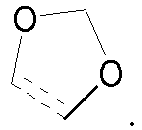
- In some embodiments, R3 is selected from the group consisting of:
- 1)

- R4, R5, R6, R7 and R8 are each independently selected from the group consisting of hydrogen, C1-C6 alkyl, halogen, C1-C6 alkoxy, C1-C6 haloalkyl, C2-C6 alkynyl, cyano, phenyl and -NRmRn; or, R4, R5 and the carbon atoms to which they are respectively connected together form a 5- to 6-membered heterocyclic ring, and R6, R7, R8 are hydrogen;
- preferably, any one of R4, R5, R6, R7, and R8 (e.g., R5, R6 or R7) is selected from the group consisting of hydrogen, C1-C6 alkyl, halogen, C1-C6 alkoxy, C1-C6 haloalkyl, C2-C6 alkynyl, cyano, phenyl and -NRmRn, and the rest are hydrogen;
- more preferably, any one of R4, R5, R6, R7, and R8 (e.g., R5, R6 or R7) is selected from the group consisting of hydrogen, methyl, fluorine, chlorine, iodine, methoxy,


- or preferably, R4, R5 and the carbon atoms to which they are respectively connected together form

- 2)

- R9, R10, R11 and R12 are each independently selected from the group consisting of hydrogen, C1-C6 alkyl, halogen and C1-C6 alkoxy;
- preferably, R9, R10, R11 and R12 are each independently selected from the group consisting of hydrogen, halogen and C1-C6 alkoxy;
- more preferably, any one of R9, R10, R11 and R12 (e.g., R10 or R11) is selected from the group consisting of hydrogen, halogen and C1-C6 alkoxy, and the rest are hydrogen;
- most preferably, any one of R9, R10, R11 and R12 (e.g., R10 or R11) is selected from the group consisting of hydrogen, chlorine and methoxy, and the rest are hydrogen;
- 3)
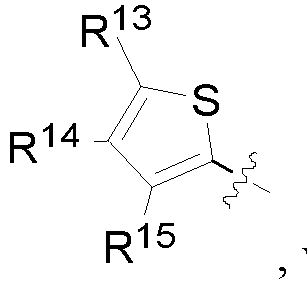
- R13, R14 and R15 are each independently selected from the group consisting of hydrogen, C1-C6 alkyl and halogen;
- preferably, any one of R13, R14 and R15 (e.g., R13) is selected from the group consisting of hydrogen, C1-C6 alkyl and halogen, and the rest are hydrogen;
- more preferably, any one of R13, R14 and R15 (e.g., R13) is selected from the group consisting of hydrogen, methyl and chlorine, and the rest are hydrogen;
- 4)

- In some embodiments, R3 is selected from the group consisting of


- In some embodiments, Rx is selected from the group consisting of methyl, fluorine, chlorine, iodine, methoxy,

- In some embodiments, among Rm and Rn, any one is hydrogen, and the other is selected from the group consisting of C1-C6 alkyl.
- In some embodiments, among Rm and Rn, any one is hydrogen, and the other is methyl.
- In some embodiments, R4' is selected from the group consisting of phenyl-(CH2)r- and quinolyl-(CH2)r-, and optionally, the phenyl and quinolyl are each independently substituted by a group selected from the group consisting of Ra.
- In some embodiments, R4' is selected from the group consisting of phenyl-(CH2)r- and quinolyl-(CH2)r-, and optionally, the phenyl is substituted by a group selected from the group consisting of Ra.
- In some embodiments, r is selected from the group consisting of 0 and 1.
- In some embodiments, Ra is selected from the group consisting of halogen, C1-C6 alkyl-O-C(=O)-, and piperazinyl which is substituted by

- In some embodiments, Ra is selected from the group consisting of halogen, C1-C6 alkyl-O-C(=O)-, and piperazinyl which is substituted by

- In some embodiments, Ra is selected from the group consisting of bromine,
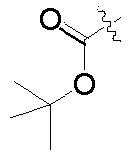

- In some embodiments, Rb is selected from the group consisting of C1-C6 alkyl.
- In some embodiments, Rb is methyl.
- In some embodiments, R4' is selected from the group consisting of


- r' is selected from the group consisting of 0, 1, 2, 3, 4 and 5;
- preferably, r' is selected from the group consisting of 0 and 1;
- R5', R6', R7', R8' and R9' are each independently selected from the group consisting of hydrogen, halogen, C1-C6 alkyl-O-C(=O)-, and 5- to 6-membered saturated heterocyclyl optionally substituted by

- preferably, among R5', R6', R7', R8' and R9', any one (e.g., R7') is selected from the group consisting of hydrogen, halogen, C1-C6 alkyl-O-C(=O)-, and 5- to 6-membered saturated heterocyclyl optionally substituted by

- more preferably, among R5', R6', R7', R8', R9' , any one (e.g., R7') is selected from the group consisting of hydrogen, halogen, C1-C6 alkyl-O-C(=O)-, and piperazinyl which is substituted by
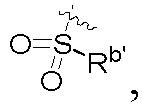
- further preferably, among R5', R6', R7', R8', and R9', any one (e.g., R7') is selected from the group consisting of hydrogen, halogen, C1-C6 alkyl-O-C(=O)-, and piperazinyl which is substituted by

- most preferably, among R5', R6', R7', R8', and R9', any one (e.g., R7') is selected from the group consisting of hydrogen, bromine,

- Rb' is selected from the group consisting of hydrogen and C1-C6 alkyl;
- preferably, Rb' is selected from the group consisting of C1-C6 alkyl;
- more preferably, Rb' is methyl.
- In some embodiments, R4' is selected from the group consisting of


- In some embodiments, L1 is selected from the group consisting of


- In some embodiments, L1 is


- In some embodiments, L2 is selected from the group consisting of


- In some embodiments, L2 is selected from the group consisting of


- In some embodiments, L2 is selected from the group consisting of


- In some embodiments, L2 is

- In some embodiments, n is selected from the group consisting of 2, 3 and 4.
- In some embodiments, n is selected from the group consisting of 2 and 4.
- In some embodiments, m is selected from the group consisting of 1, 2 and 3.
- In some embodiments, m is 2.
- In some embodiments, p is 0.
- In the second aspect of the present invention, the present invention provides a compound represented by Formula I-1, Formula I-2 or Formula I-3, or a stereoisomer, prodrug, crystal form, pharmaceutically acceptable salt, pharmaceutically acceptable solvate or pharmaceutically acceptable ester of the compound,

- X is selected from the group consisting of O, S and NH, preferably O;
- R0, R2, R3, L1 and L2 are defined as described in the first aspect;
- R1' is selected from the group consisting of hydrogen and C1-C6 alkyl;
- R2' is selected from the group consisting of hydrogen and C1-C6 alkyl;
- R3' is phenyl, optionally, the phenyl is substituted by 1 to 5 groups selected from the group consisting of C1-C6 alkyl;
- L3 is selected from

- q is selected from the group consisting of 1, 2, 3, 4, 5 and 6;
- R4' is selected from the group consisting of phenyl-(CH2)r- and 5- to 10-membered heteroaryl-(CH2)r-, optionally, the phenyl and 5- to 10-membered heteroaryl are each independently substituted by 1 to 5 groups selected from the group consisting of Ra;
- r is selected from the group consisting of 0, 1, 2, 3, 4 and 5;
- Ra is selected from the group consisting of halogen, C1-C6 alkyl-O-C(=O)-, and 5- to 6-membered saturated heterocyclyl optionally substituted by

- Rb is selected from the group consisting of hydrogen and C1-C6 alkyl.
- In some embodiments, R1' is selected from the group consisting of hydrogen and ethyl.
- In some embodiments, R1' is hydrogen.
- In some embodiments, R2' is selected from the group consisting of C1-C6 alkyl.
- In some embodiments, R2' is methyl.
- In some embodiments, R3' is phenyl, optionally, the phenyl is substituted by 1 group selected from the group consisting of C1-C6 alkyl.
- In some embodiments, R3' is phenyl.
- In some embodiments, q is selected from the group consisting of 1, 2 and 3.
- In some embodiments, q is 2.
- In some embodiments, R4' is selected from the group consisting of phenyl-(CH2)r- and quinolyl-(CH2)r-, optionally, the phenyl and quinolyl is each independently substituted by 1 group selected from the group consisting of Ra.
- In some embodiments, R4' is selected from the group consisting of phenyl-(CH2)r- and quinolyl-(CH2)r-, optionally, the phenyl group is substituted by 1 group selected from the group consisting of Ra.
- In some embodiments, r is selected from the group consisting of 0 and 1.
- In some embodiments, Ra is selected from the group consisting of halogen, C1-C6 alkyl-O-C(=O)-, and piperazinyl which is substituted by

- In some embodiments, Ra is selected from the group consisting of halogen, C1-C6 alkyl-O-C(=O)-, and piperazinyl which is substituted by

- In some embodiments, Ra is selected from the group consisting of bromine,


- In some embodiments, Rb is selected from the group consisting of C1-C6 alkyl.
- In some embodiments, Rb is methyl.
- In some embodiments, R4' is selected from the group consisting of


- r' is selected from the group consisting of 0, 1, 2, 3, 4 and 5;
- preferably, r' is selected from the group consisting of 0 and 1;
- R5', R6', R7', R8' and R9' are each independently selected from the group consisting of hydrogen, halogen, C1-C6 alkyl-O-C(=O)-, and 5- to 6-membered saturated heterocyclyl optionally substituted by

- preferably, among R5', R6', R7', R8 and R9', any one (e.g., R7') is selected from the group consisting of hydrogen, halogen, C1-C6 alkyl-O-C(=O)-, and 5- to 6-membered saturated heterocyclyl optionally substituted by
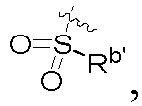
- more preferably, among R5', R6', R7', R8' and R9' , any one (e.g., R7') is selected from the group consisting of hydrogen, halogen, C1-C6 alkyl-O-C(=O)-, and piperazinyl which is substituted by

- further preferably, among R5', R6', R7', R8', and R9', any one (e.g., R7') is selected from the group consisting of hydrogen, halogen, C1-C6 alkyl-O-C(=O)-, and piperazinyl which is substituted by

- most preferably, among R5', R6', R7', R8', and R9', any one (e.g., R7') is selected from the group consisting of hydrogen, bromine,

- Rb' is selected from the group consisting of hydrogen and C1-C6 alkyl;
- preferably, Rb' is selected from the group consisting of C1-C6 alkyl;
- more preferably, Rb' is methyl.
- In some embodiments, R4' is selected from the group consisting of


- In the third aspect of the present invention, the present invention provides a compound represented by Formula I-1-1, or a stereoisomer, prodrug, crystal form, pharmaceutically acceptable salt, pharmaceutically acceptable solvate or pharmaceutically acceptable ester of the compound,

- X is selected from the group consisting of O, S and NH, and preferably O;
- R1, R2, R3, L1 and L2 are defined as described in the first aspect.
- In the fourth aspect of the present invention, the present invention provides a compound represented by Formula I-2-1, or a stereoisomer, prodrug, crystal form, pharmaceutically acceptable salt, pharmaceutically acceptable solvate or pharmaceutically acceptable ester of the compound,

R1, R2, R3, La, L1 and L2 are defined as described in the first aspect. - In some embodiments, R1 is hydroxyl.
- In some embodiments, R2 is selected from the group consisting of halogen.
- In some embodiments, R2 is fluorine.
- In some embodiments, R3 is

- In some embodiments, La is selected from the group consisting of C1-C6 alkylene.
- In some embodiments, La is selected from the group consisting of

- In some embodiments, L1 is selected from the group consisting of

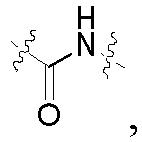
- In some embodiments, L1 is
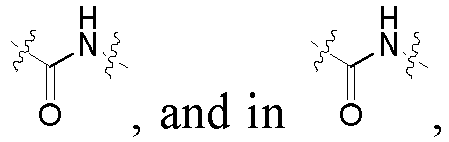
- In some embodiments, L2 is selected from

- In some embodiments, L2 is selected from the group consisting of

- In some embodiments, n is selected from the group consisting of 1, 2, 3, 4, 5 and 6.
- In some embodiments, n is selected from the group consisting of 2 and 3.
- In some embodiments, the compound represented by Formula I is selected from the group consisting of the following:
No. Structural Formula No. Structural Formula 1 
16 
2 
17 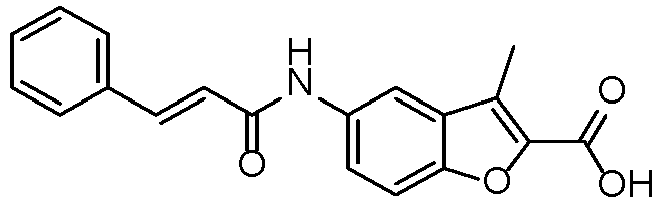
3 
18 
4 
19 
5 
20 
6 
21 
7 
22 
B101 
B113 
B102 
B114 
B103 
B115 
GPR132-A-8 
B116 
B104 
B117 
B105 
B118 
B106 
B119 
B107 
B120 
B108 
B121 
B109 
B122 
B110 
B123 
B111 
B124 
B112 
B125 
B126 
B127 
B128 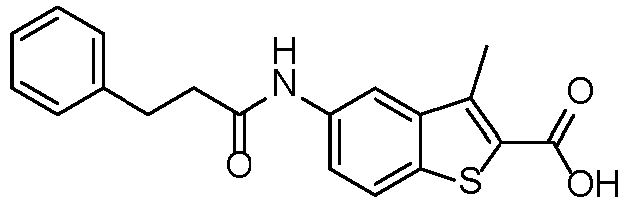
B129 
B130 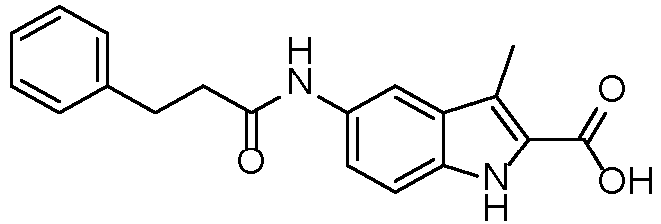
B131 
B132 
B133 
9 
24 
10 
25 
11 
26 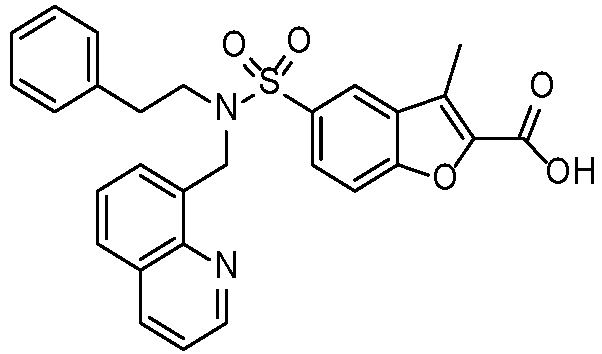
12 
27 
14 
29 
- In the fifth aspect of the present invention, the present invention provides a pharmaceutical composition, which comprises the aforementioned compound, or a stereoisomer, prodrug, crystal form, pharmaceutically acceptable salt, pharmaceutically acceptable solvate or pharmaceutically acceptable ester of the compound, and an optional pharmaceutically acceptable excipient.
- The compounds of the present invention can be used as GPR132 modulators (e.g., agonists), which can be used to prevent and/or treat diseases related to GPR132, or for hematopoietic stem cell transplantation, or for bone marrow transplantation, for example, used for the prevention and/or treatment of diseases such as atherosclerosis, colorectal inflammation, leukemia, or in treatment approaches such as bone marrow transplantation.
- Thus, in the sixth aspect of the present invention, the present invention provides a use of the aforementioned compound or a stereoisomer, prodrug, crystal form, pharmaceutically acceptable salt, pharmaceutically acceptable solvate or pharmaceutically acceptable ester of the compound in manufacture of a medicament, or a use of the aforementioned pharmaceutical composition in manufacture of a medicament, or a use of the compound shown in Table A below or a stereoisomer, prodrug, crystal form, pharmaceutically acceptable salt, pharmaceutically acceptable solvate or pharmaceutically acceptable ester of the compound in manufacture of a medicament, in which the medicament is used for treatment and/or prevention of a disease related to GPR132, or for hematopoietic stem cell transplantation, or for bone marrow transplantation;
Table A: No. Structural Formula No. Structural Formula 8 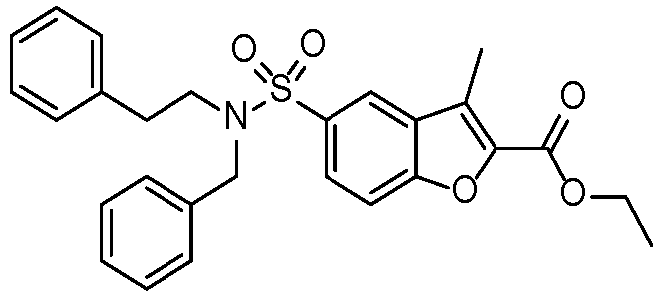
23 
13 
28 
15 
30 
- In some embodiments, the disease related to GPR132 is selected from the group consisting of tumor, metabolic disease, immune-related disease, and neuropathic pain.
- In some embodiments, the tumor is selected from the group consisting of breast cancer, melanoma, meningioma, soft tissue sarcoma, salivary gland tumor, liver cancer (e.g., primary liver cancer), intraspinal tumor, mediastinal tumor, brain cancer, bone cancer, penile cancer, osteosarcoma, intracranial tumor, tongue cancer, maxillary sinus cancer, thyroid cancer, malignant lymphoma, multiple myeloma, pituitary adenoma, testicular tumor, non-Hodgkin's lymphoma, bladder cancer, leukemia (e.g., acute myeloid leukemia), gastric cancer, nasopharyngeal cancer, laryngeal cancer, oral cancer, esophageal cancer, lung cancer, kidney cancer, cervical cancer, choriocarcinoma, vulvar cancer, skin cancer, endometrial cancer, ovarian cancer, prostate cancer, pancreatic cancer, colon cancer, rectal cancer, colorectal cancer, Kaposi's sarcoma, non-melanoma skin cancer (including squamous cell carcinoma and basal cell carcinoma), hemangioma and glioma.
- In some embodiments, the metabolic disease is selected from the group consisting of atherosclerosis, obesity, non-alcoholic fatty liver disease (NAFLD) (e.g., simple fatty liver or non-alcoholic steatohepatitis (NASH)), metabolic syndrome, type 2 diabetes, type 1 diabetes, insulin resistance, hyperinsulinemia, glucose intolerance, hyperglycemia, hyperlipidemia (e.g., hypercholesterolemia), and secondary complications of these diseases (e.g., diabetic complications such as retinopathy, neuropathy, nephropathy, and delayed wound healing, or cardiovascular and cerebrovascular diseases such as atherosclerosis, coronary heart disease, hypertension, and stroke).
- In some embodiments, the immune-related disease is selected from the group consisting of:
- secondary immunodeficiency: for example, secondary immunodeficiency caused by infection (e.g., rubella, measles, leprosy, tuberculosis, cytomegalovirus infection, HIV infection, coccidioidomycosis infection), protein loss (e.g., nephrotic syndrome, protein-losing enteropathy), insufficient immunoglobulin synthesis, lymphocyte loss (e.g., lymphocyte loss caused by drug and/or systemic infection), secondary immunodeficiency caused by other diseases (e.g., diabetes, cirrhosis, subacute sclerosing panencephalitis) and/or immunosuppressive therapy, and
- autoimmune diseases: for example, inflammatory bowel disease, systemic lupus erythematosus, rheumatoid arthritis, scleroderma, hyperthyroidism, juvenile diabetes, idiopathic thrombocytic purpura, autoimmune hemolytic anemia, colorectal inflammation (e.g., ulcerative colitis), skin diseases, chronic liver diseases.
- In the seventh aspect of the present invention, the present invention provides the aforementioned compound or a stereoisomer, prodrug, crystal form, pharmaceutically acceptable salt, pharmaceutically acceptable solvate or pharmaceutically acceptable ester of the compound, or the aforementioned pharmaceutical composition, or the compound shown in Table A above or a stereoisomer, prodrug, crystal form, pharmaceutically acceptable salt, pharmaceutically acceptable solvate or pharmaceutically acceptable ester of the compound, which is used for the treatment and/or prevention of a disease related to GPR132, or for hematopoietic stem cell transplantation, or for bone marrow transplantation.
- In some embodiments, the disease related to GPR132 is selected from the group consisting of tumor, metabolic disease, immune-related disease, and neuropathic pain.
- In some embodiments, the tumor is selected from the group consisting of breast cancer, melanoma, meningioma, soft tissue sarcoma, salivary gland tumor, liver cancer (e.g., primary liver cancer), intraspinal tumor, mediastinal tumor, brain cancer, bone cancer, penile cancer, osteosarcoma, intracranial tumor, tongue cancer, maxillary sinus cancer, thyroid cancer, malignant lymphoma, multiple myeloma, pituitary adenoma, testicular tumor, non-Hodgkin's lymphoma, bladder cancer, leukemia (e.g., acute myeloid leukemia), gastric cancer, nasopharyngeal cancer, laryngeal cancer, oral cancer, esophageal cancer, lung cancer, kidney cancer, cervical cancer, choriocarcinoma, vulvar cancer, skin cancer, endometrial cancer, ovarian cancer, prostate cancer, pancreatic cancer, colon cancer, rectal cancer, colorectal cancer, Kaposi's sarcoma, non-melanoma skin cancer (including squamous cell carcinoma and basal cell carcinoma), hemangioma and glioma.
- In some embodiments, the metabolic disease is selected from the group consisting of atherosclerosis, obesity, non-alcoholic fatty liver disease (NAFLD) (e.g., simple fatty liver or non-alcoholic steatohepatitis (NASH)), metabolic syndrome, type 2 diabetes, type 1 diabetes, insulin resistance, hyperinsulinemia, glucose intolerance, hyperglycemia, hyperlipidemia (e.g., hypercholesterolemia), and secondary complications of these diseases (e.g., diabetic complications such as retinopathy, neuropathy, nephropathy, and delayed wound healing, or cardiovascular and cerebrovascular diseases such as atherosclerosis, coronary heart disease, hypertension, and stroke).
- In some embodiments, the immune-related disease is selected from the group consisting of:
- secondary immunodeficiency: for example, secondary immunodeficiency caused by infection (e.g., rubella, measles, leprosy, tuberculosis, cytomegalovirus infection, HIV infection, coccidioidomycosis infection), protein loss (e.g., nephrotic syndrome, protein-losing enteropathy), insufficient immunoglobulin synthesis, lymphocyte loss (e.g., lymphocyte loss caused by drug and/or systemic infection), secondary immunodeficiency caused by other diseases (e.g., diabetes, cirrhosis, subacute sclerosing panencephalitis) and/or immunosuppressive therapy, and
- autoimmune diseases: for example, inflammatory bowel disease, systemic lupus erythematosus, rheumatoid arthritis, scleroderma, hyperthyroidism, juvenile diabetes, idiopathic thrombocytic purpura, autoimmune hemolytic anemia, colorectal inflammation (e.g., ulcerative colitis), skin diseases, chronic liver diseases.
- In the eighth aspect of the present invention, the present invention provides a method for treating and/or preventing a disease related to GPR132, a method for performing hematopoietic stem cell transplantation, and a method for performing bone marrow transplantation, each of these methods independently comprises: administering to a subject an effective amount of the aforementioned compound or a stereoisomer, prodrug, crystal form, pharmaceutically acceptable salt, pharmaceutically acceptable solvate or pharmaceutically acceptable ester of the compound, or the aforementioned pharmaceutical composition, or a compound shown in Table A above or a stereoisomer, prodrug, crystal form, pharmaceutically acceptable salt, pharmaceutically acceptable solvate or pharmaceutically acceptable ester of the compound.
- In some embodiments, the disease related to GPR132 is selected from the group consisting of tumor, metabolic disease, immune-related disease, and neuropathic pain.
- In some embodiments, the tumor is selected from the group consisting of breast cancer, melanoma, meningioma, soft tissue sarcoma, salivary gland tumor, liver cancer (e.g., primary liver cancer), intraspinal tumor, mediastinal tumor, brain cancer, bone cancer, penile cancer, osteosarcoma, intracranial tumor, tongue cancer, maxillary sinus cancer, thyroid cancer, malignant lymphoma, multiple myeloma, pituitary adenoma, testicular tumor, non-Hodgkin's lymphoma, bladder cancer, leukemia (e.g., acute myeloid leukemia), gastric cancer, nasopharyngeal cancer, laryngeal cancer, oral cancer, esophageal cancer, lung cancer, kidney cancer, cervical cancer, choriocarcinoma, vulvar cancer, skin cancer, endometrial cancer, ovarian cancer, prostate cancer, pancreatic cancer, colon cancer, rectal cancer, colorectal cancer, Kaposi's sarcoma, non-melanoma skin cancer (including squamous cell carcinoma and basal cell carcinoma), hemangioma and glioma.
- In some embodiments, the metabolic disease is selected from the group consisting of atherosclerosis, obesity, non-alcoholic fatty liver disease (NAFLD) (e.g., simple fatty liver or non-alcoholic steatohepatitis (NASH)), metabolic syndrome, type 2 diabetes, type 1 diabetes, insulin resistance, hyperinsulinemia, glucose intolerance, hyperglycemia, hyperlipidemia (e.g., hypercholesterolemia), and secondary complications of these diseases (e.g., diabetic complications such as retinopathy, neuropathy, nephropathy, and delayed wound healing, or cardiovascular and cerebrovascular diseases such as atherosclerosis, coronary heart disease, hypertension, and stroke).
- In some embodiments, the immune-related disease is selected from the group consisting of:
- secondary immunodeficiency: for example, secondary immunodeficiency caused by infection (e.g., rubella, measles, leprosy, tuberculosis, cytomegalovirus infection, HIV infection, coccidioidomycosis infection), protein loss (e.g., nephrotic syndrome, protein-losing enteropathy), insufficient immunoglobulin synthesis, lymphocyte loss (e.g., lymphocyte loss caused by drug and/or systemic infection), secondary immunodeficiency caused by other diseases (e.g., diabetes, cirrhosis, subacute sclerosing panencephalitis) and/or immunosuppressive therapy, and
- autoimmune diseases: for example, inflammatory bowel disease, systemic lupus erythematosus, rheumatoid arthritis, scleroderma, hyperthyroidism, juvenile diabetes, idiopathic thrombocytic purpura, autoimmune hemolytic anemia, colorectal inflammation (e.g., ulcerative colitis), skin diseases, chronic liver diseases.
- It should be understood that the terminology used herein is intended to describe specific embodiments and is not intended to be limiting. In addition, although any methods, devices and materials similar or equivalent to those described herein can be used to implement or test the present invention, preferred methods, devices and materials are now described.
- In the present invention, unless otherwise explicitly stated, the expression "... each independently selected from" used herein can mean that the specific options expressed by the same or different symbols in different groups do not affect each other, or that the specific options expressed by the same or different symbols in the same group do not affect each other.
- The substituents of the compounds of the present invention are disclosed according to the group types or ranges. In particular, the present invention comprises each independent subcombination of the individual members of these group types and ranges. For example, the term "C1-C6 alkyl" specifically refers to the independently disclosed methyl, ethyl, C3 alkyl, C4 alkyl, C5 alkyl and C6 alkyl.
- The term "alkyl" refers to branched and straight-chain saturated aliphatic hydrocarbonyl groups including those with a specified number of carbon atoms. For example, "C1-C6 alkyl" refers to C1, C2, C3, C4, C5 and C6. In addition, for example, "C1-C6 alkyl" refers to alkyl groups having 1 to 6 carbon atoms, preferably "C1-C4 alkyl", and more preferably "C1-C3 alkyl". Examples of alkyl groups include, but are not limited to, methyl, ethyl, propyl (e.g., N-propyl, isopropyl), butyl (e.g., N-butyl, isobutyl, tert-butyl), pentyl (e.g., N-pentyl, isopentyl, neopentyl), etc.
- The term "alkylene" refers to a divalent group obtained by removing one hydrogen atom from any of the above alkyl groups (e.g., C1-C6 alkyl, C1-C4 alkyl, C1-C3 alkyl, etc.), such as
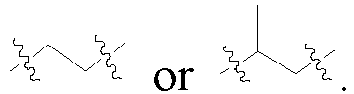
- The term "alkoxy" refers to any of the above alkyl groups (e.g., C1-C6 alkyl, C1-C4 alkyl, C1-C3 alkyl, etc.) connected via an oxygen atom (-O-) to the rest of the molecule.
- The term "C1-C6 haloalkyl" refers to a group obtained by replacing one or more hydrogen atoms in any of the above alkyl groups (e.g., C1-C6 alkyl, C1-C4 alkyl, C1-C3 alkyl, etc.) with a halogen (preferably fluorine or chlorine), such as monofluoromethyl, difluoroethyl, trifluoromethyl,

- The term "C2-C6 alkenyl" refers to any straight or branched group containing 2-6 carbon atoms and at least one carbon-carbon double bond, such as vinyl, 1-propenyl, 2-propenyl, etc.
- The term "C2-C6 alkynyl" refers to any straight or branched group containing 2-6 carbon atoms and at least one carbon-carbon triple bond, such as ethynyl, 1-propynyl, 2-propynyl, etc.
- Heteroatom refers to N, O or S.
- Halogen refers to fluorine, chlorine, bromine or iodine.
- The term "heteroaryl" refers to a substituted and unsubstituted aromatic 5-membered or 6-membered monocyclic group, 8-membered, 9-membered or 10-membered bicyclic group and 11-membered to 14-membered tricyclic group having at least one heteroatom (N, O or S) in at least one ring, and the heteroatom-containing ring optionally further has 1, 2 or 3 heteroatoms selected from the group consisting of N, O and S. Among them, substituted and unsubstituted aromatic 8-membered, 9-membered or 10-membered bicyclic group and 11-membered to 14-membered tricyclic group having at least one heteroatom (N, O or S) in at least one ring are "fused heteroaryl". For a bicyclic or tricyclic heteroaryl group, its bicyclic or tricyclic overall structure is required to form an aromatic system. The heteroaryl group can be connected to any available nitrogen or carbon atom of any ring. And those skilled in the art can understand that two adjacent atoms (preferably carbon atoms) are shared between each two rings in the fused ring.
- Specifically, the "5- to 10-membered heteroaryl" can be a 5-membered or 6-membered monocyclic heteroaryl group, or an 8-membered, 9-membered or 10-membered bicyclic heteroaryl group.
- Exemplary monocyclic heteroaryl groups include, but are not limited to: pyrrolyl, pyrazolyl, imidazolyl, oxazolyl, isoxazolyl, thiazolyl, thiadiazolyl, isothiazolyl, furanyl, thienyl, oxadiazolyl, pyridyl, pyrazinyl, pyrimidinyl, pyridazinyl, triazinyl, triazolyl, etc.
- Exemplary bicyclic heteroaryl groups include, but are not limited to, indolyl, 5-azaindolyl, pyrrolo[2,3-d]pyrimidinyl, 5,6-diazaindolyl, 6-azaindolyl, 7-azaindolyl, pyrazolo[3,4-b]pyridinyl, pyrrolo[2,3-c]pyridazinyl, thieno[2,3-d]imidazolyl, thieno[2,3-d]imidazolyl, pyrazolo[3,4-c]pyridinyl, benzothiazolyl, benzimidazolyl, benzoxazolyl, benzothienyl, quinolyl, isoquinolyl, benzofuranyl, indolizinyl, quinoxalinyl, indazolyl, pyrrolopyrimidinyl, furopyridinyl, isoindolyl, and the like.
- The terms "heterocycle", "heterocyclic" or "heterocyclyl" are used interchangeably and refer to substituted and unsubstituted 3- to 7-membered (preferably 4- to 7-membered, more preferably 5- to 6-membered) monocyclic groups, 7- to 11-membered bicyclic groups and 10-to 15-membered tricyclic groups, which may contain one or more double bonds but do not constitute aromatic ring; and wherein at least one ring has at least one heteroatom (N, O or S). The fused rings completing the bicyclic and tricyclic groups may contain only carbon atoms and may be saturated or partially saturated and do not constitute aromatic rings. The heterocyclyl may be attached at any available nitrogen or carbon atom.
- Exemplary monocyclic heterocyclyls include azacyclobutyl, oxacyclobutyl, pyrrolidinyl, imidazolinyl, oxazolidinyl, isoxazolinyl, thiazolidinyl, tetrahydrofuranyl, piperidinyl, piperazinyl, 2-oxopiperazinyl, 2-oxopiperidinyl, 2-oxopyrrolidinyl, 2-oxazacycloheptatrienyl, 1-pyridonyl, 4-piperidonyl, tetrahydropyranyl, morpholinyl, 1,3-dioxolane, etc.
- Wherein, "saturated heterocyclyl" means that the heterocyclic ring defined above does not contain unsaturated bond, such as double bond. For example, "5- to 6-membered saturated heterocyclyl" can be pyrrolidinyl, oxazolidinyl, thiazolidinyl, tetrahydrofuranyl, piperidinyl, piperazinyl, tetrahydropyranyl, morpholinyl, 1,3-dioxolane, preferably piperidinyl and piperazinyl, more preferably piperazinyl.
- The term "substituted" means that any one or more hydrogen atoms on a designated atom or group are replaced by a selected designated group, provided that the normal valence of the designated atom is not exceeded.
- In the present invention, the expression "phenyl-(CH2)r- and 5- to 10-membered heteroaryl-(CH2)r-, optionally, the phenyl and 5- to 10-membered heteroaryl are each independently substituted by 1 to 5 groups selected from the group consisting of Ra" means that the phenyl or 5- to 10-membered heteroaryl may be substituted or unsubstituted. Among them, "the phenyl and 5- to 10-membered heteroaryl are each independently substituted by 1 to 5 groups selected from the group consisting of Ra" means that the phenyl is substituted by 1, 2, 3, 4 or 5 groups selected from the group consisting of Ra, or the 5- to 10-membered heteroaryl is substituted by 1, 2, 3, 4 or 5 groups selected from the group consisting of Ra. Moreover, when the phenyl or the 5- to 10-membered heteroaryl is substituted by 2, 3, 4 or 5 groups selected from the group consisting of Ra, the options of each Ra may be the same or different. Other similar definitions can be understood with reference to the foregoing content.
- In the present invention, the expression "the phenyl, naphthyl, and 5- to 10-membered heteroaryl are each independently substituted by 2 adjacent groups, and the 2 adjacent groups and the carbon atoms to which they are respectively connected together form a 5- to 6-membered heterocyclic ring" means that the phenyl is substituted by two groups, and the two groups are in the adjacent positions, and the 2 adjacent groups and the carbon atoms to which they are respectively connected together form a 5- to 6-membered heterocyclic ring; or, the naphthyl is substituted by two groups, and the two groups are in the adjacent positions, and the 2 adjacent groups and the carbon atoms to which they are respectively connected together form a 5- to 6-membered heterocyclic ring; or, the 5- to 10-membered heteroaryl is substituted by two groups, and the two groups are in the adjacent positions, and the 2 adjacent groups and the carbon atoms to which they are respectively connected together form a 5- to 6-membered heterocyclic ring. Specifically, if the phenyl group is substituted by 2 adjacent groups, and the 2 adjacent groups and the carbon atoms to which they are respectively connected together form a 5- to 6-membered heterocyclic ring, and the 5- to 6-membered heterocyclic ring is

 represents the fusion site of the heterocyclic ring and the phenyl. Other similar definitions can be understood with reference to the foregoing content.
- From all the above descriptions, it is obvious to those skilled in the art that any group whose name is a composite name, for example "C1-C6 alkyl-O-C(=O)-", should refer to the conventional construction from the part derived therefrom from left to right, wherein "C1-C6 alkyl" is as defined above. For example, "C1-C6 alkyl-O-C(=O)-" can be

- In the present invention, when L2 is


- In the present invention, R4' is selected from the group consisting of phenyl-(CH2)r-, 5- to 10-membered heteroaryl-(CH2)r-, and when r is 0, those skilled in the art can understand that R4' is selected from the group consisting of phenyl, 5- to 10-membered heteroaryl. Other similar definitions can be understood with reference to the foregoing content.
- In the present invention, the meaning of the structural formula


- In the present invention, "treatment" generally refers to obtaining the desired pharmacological and/or physiological effects. The effect can be preventive based on the complete or partial prevention of a disease or its symptoms; and/or can be therapeutic based on partial or complete stabilization or cure of a disease and/or side effects caused by the disease. As used herein, "treatment" encompasses any treatment for a patient's disease, including: (a) preventing a disease or symptom from occurring in a patient who is susceptible to the disease or symptom but has not yet been diagnosed with the disease; (b) inhibiting a symptom of a disease, i.e., preventing its development; or (c) alleviating a symptom of a disease, i.e., causing the disease or symptom to regress.
- In the present invention, "subject" refers to a vertebrate. In certain embodiments, the vertebrate refers to a mammal. The mammal includes, but is not limited to, livestock (e.g., cattle), pet (e.g., cat, dog, and horse), primate, mouse, and rat. In certain embodiments, the mammal refers to human.
- In the present invention, "effective amount" refers to an amount that is effective at the required dose and time to achieve the desired therapeutic or preventive effect. The "therapeutically effective amount" of the substance/molecule of the present invention may vary according to factors such as the individual's disease state, age, gender, and weight, and the ability of the substance/molecule to elicit a desired response in the individual. The therapeutically effective amount also encompasses an amount in which the therapeutically beneficial effects of the substance/molecule outweigh any toxic or harmful consequences. "Prophylactically effective amount" refers to an amount that is effective at the required dose and time to achieve the desired preventive effect. Usually, but not necessarily, since the preventive dose is administered to a subject before the onset of a disease or in the early stage of the disease, the preventive effective amount will be lower than the therapeutic effective amount. In the case of cancer, the therapeutically effective amount of the drug can reduce the number of cancer cells; reduce the size of the tumor; inhibit (i.e., slow down to a certain extent, preferably stop) the infiltration of cancer cells into the surrounding organs; inhibit (i.e., slow down to a certain extent, preferably stop) tumor metastasis; inhibit tumor growth to a certain extent; and/or alleviate one or more symptoms related to cancer to a certain extent.
- The pharmaceutical composition of the present invention may contain a pharmaceutically acceptable excipient, and the excipient includes but is not limited to: ion exchanger, aluminum oxide, aluminum stearate, lecithin, serum protein such as human albumin, buffer substance such as phosphate, glycerol, sorbic acid, potassium sorbate, mixture of partial glycerides of saturated vegetable fatty acids, water, salt or electrolyte, such as protamine sulfate, disodium hydrogen phosphate, potassium hydrogen phosphate, sodium chloride, zinc salt, colloidal silica, magnesium trisilicate, polyvinyl pyrrolidone, cellulosic substance, polyethylene glycol, sodium carboxymethyl cellulose, polyacrylate, beeswax, lanolin, etc.
- The pharmaceutical composition of the present invention can be prepared into various forms according to different administration routes. For example, the pharmaceutical composition can be administered in any of the following ways: oral administration, spray inhalation, rectal administration, nasal administration, buccal administration, vaginal administration, topical administration, parenteral administration, such as subcutaneous, intravenous, intramuscular, intraperitoneal, intrathecal, intraventricular, intrasternal and intracranial injection or infusion, or by means of an explanted reservoir. Among them, oral or intravenous administration is preferred.
- The compound of the present invention can optionally be used in combination with one or more other active ingredients, and their respective dosages and proportions can be adjusted by those skilled in the art according to specific symptoms, patient conditions and clinical needs.
- As used herein, unless otherwise specified, the term "prodrug" refers to a derivative that can be hydrolyzed, oxidized or otherwise reacted in biological conditions (in vitro or in vivo) to provide the compound of the present invention. Prodrugs becomes an active compound only under biological conditions through the reaction, or they have no or only low activity in their unreactive form. Prodrugs can generally be prepared using well-known methods, such as those described in Burger's Medicinal Chemistry and Drug Discovery (1995) 172-178, 949-982 (Manfred E. Wolff, ed., 5th ed.).
- A stereoisomer in the compound described herein, when specifically designated as (R)- or (S)-isomer in the chemical name, should be understood as the predominant configuration being the (R)-isomer or the (S)-isomer, respectively. Any asymmetric carbon atom may be present in the (R)-, (S)-, or (R, S)-configuration, preferably in the (R)- or (S)-configuration.
- "Solvate" and "solvant" are used interchangeably, and refer to a compound that exists in combination with a solvent molecule. The combination may contain a stoichiometric amount of a solvent, for example, it can be a monohydrate or a dihydrate, or may contain any amount of water; for example, methanol or ethanol may form an "alcoholate", which may also be stoichiometric or non-stoichiometric. The term "solvate" as used herein refers to a solid form, i.e., although a compound in solvent of a solution can be solvated, it is not a solvate as described by the term used herein.
- As used herein, the term "pharmaceutically acceptable salt" refers to (i) a salt formed by an acidic functional group (e.g., -COOH) present in a compound provided by the present invention and an appropriate inorganic or organic cation (base), which includes, but is not limited to, alkali metal salt, such as sodium salt, potassium salt, lithium salt, etc.; alkaline earth metal salt, such as calcium salt, magnesium salt, etc.; other metal salt, such as aluminum salt, iron salt, zinc salt, copper salt, nickel salt, cobalt salt, etc.; inorganic base salt, such as ammonium salt; organic base salt, such as tert-octylamine salt, dibenzylamine salt, morpholine salt, glucosamine salt, phenylglycine alkyl ester salt, ethylenediamine salt, N-methylglucosamine salt, guanidine salt, diethylamine salt, triethylamine salt, dicyclohexylamine salt, N,N'-dibenzylethylenediamine salt, chloroprocaine salt, procaine salt, diethanolamine salt, N-benzyl-phenethylamine salt, piperazine salt, tetramethylamine salt, tris(hydroxymethyl)aminomethane salt; and, (ii) a salt formed by an basic functional group (e.g. -NH2) present in a compound provided by the present invention and an appropriate inorganic or organic anion (acid), which includes, but is not limited to, hydrohalide, such as hydrofluoride, hydrochloride, hydrobromide, hydroiodide, etc.; inorganic acid salt, such as nitrate, perchlorate, sulfate, phosphate, etc.; lower alkane sulfonate, such as methanesulfonate, trifluoromethanesulfonate, ethanesulfonate, etc.; aryl sulfonate, such as benzenesulfonate, p-toluenesulfonate, etc.; organic acid salt, such as acetate, malate, fumarate, succinate, citrate, tartrate, oxalate, maleate, etc.; amino acid salt, such as glycinate, trimethylglycinate, arginate, ornithinate, glutamate, aspartate, etc.
- As used herein, the term "pharmaceutically acceptable ester" refers to an ester formed by -COOH present in a compound provided by the present invention and a suitable alcohol, or an ester formed by -OH present in a compound provided by the present invention and a suitable acid (e.g., carboxylic acid or oxygen-containing inorganic acid). Suitable ester groups include, but are not limited to, formate, acetate, propionate, butyrate, acrylate, ethylsuccinate, stearate or palmitate. Esters can undergo hydrolysis reaction in the presence of acid or base to generate corresponding acids or alcohols. In some embodiments, the ester formed by -COOH present in a compound provided by the present invention and a suitable alcohol is ethyl carboxylate, that is, the "pharmaceutically acceptable ester" is an ethyl ester.
- As used herein, the term "crystal form" refers to a crystal structure of a substance. When a substance crystallizes, it is affected by various factors, which changes the intramolecular or intermolecular bonding mode, causing molecules or atoms to be arranged differently in the lattice space, forming different crystal structures. The compound of the present invention can exist in one crystal structure or in multiple crystal structures, that is, it has "polymorphism". The compound of the present invention may exist in different crystalline forms.
- As used herein, the term "modulator" refers to a molecule that can interact directly or indirectly with a target. The modulator includes, but is not limited to, agonist, partial agonist, inverse agonist, and antagonist. In some embodiments of the present application, the modulator is an agonist.
- As used herein, the term "agonist" refers to a molecule that binds to a specific receptor and triggers a reaction in a cell. Agonist can mimic the effects of an endogenous ligand (e.g., LPA, prostaglandin, hormone, or neurotransmitter) that binds to the same receptor.
- As used herein, the term "antagonist" refers to a molecule that weakens, inhibits, or prevents the action of another molecule or the activity of a receptor site. Antagonist includes, but is not limited to, competitive antagonist, non-competitive antagonist, uncompetitive antagonist, partial agonist, and inverse agonist.
- The present invention is further explained below in conjunction with specific examples. Unless otherwise specified, the raw materials used in the following examples could be purchased commercially.
-

- N-(3-acetyl-4-hydroxyphenyl)acetamide (1.01 g, 5.23 mmol), ethyl bromoacetate (1 mL, 8.98 mmol), potassium carbonate (1.33 g, 9.62 mmol) and potassium iodide (0.16 g, 0.97 mmol) were added to a pear-shaped bottle, added with acetone (30 mL), heated to reflux at 60 °C, and reacted for 2 h; when TLC monitoring indicated that the reaction was completed, an appropriate amount of water was added; the system was extracted with dichloromethane 3 times; the organic phases were combined, dried over anhydrous sodium sulfate, filtered and concentrated, and purified by silica gel column chromatography (DCM/MeOH = 30:1) to obtain 1.32 g of white solid with a yield of 90.4%.
-

- Ethyl 2-(4-acetylamino-2-acetylphenoxy)acetate (1.32 g, 4.72 mmol), potassium carbonate (0.85 g, 6.15 mmol) and DMF (41 mL) were added to a pear-shaped bottle, heated to reflux at 140°C, and reacted for 1 h; when TLC monitoring indicated that the reaction was completed, a small amount of EA was added; the system was filtered with diatomaceous earth; the filtrate was added with saturated sodium chloride solution, extracted with EA 3 times; the organic phases were combined, and washed twice with saturated sodium chloride solution; the organic phase was dried over anhydrous sodium sulfate, filtered and concentrated, and purified by silica gel column chromatography (DCM/MeOH = 50:1) to obtain 0.78 g of white solid with a yield of 63.6%.
-

- Ethyl 5-acetylamino-3-methylbenzofuran-2-carboxylate (0.78 g, 2.79 mmol) was dissolved in ethanol (16 mL), added with 3N HCl (16 mL), heated to reflux at 80°C, and reacted for 2 h; when TLC monitoring indicated that the reaction was completed, saturated sodium bicarbonate solution was added to adjust the pH to 7 to 8; EA was used to perform extraction 3 times; the organic phases were combined and dried over anhydrous sodium sulfate, filtered and concentrated, and purified by silica gel column chromatography (DCM/MeOH = 30: 1) to obtain 0.44 g of light-yellow solid with a yield of 71.2%.
-

- Phenylpropionic acid (0.08 g, 0.53 mmol) was dissolved in DMF (2 mL), added with HATU (0.26 g, 0.68 mmol) and DIPEA (0.1 mL), stirred at room temperature for 10 min, then added with ethyl 5-amino-3-methylbenzofuran-2-carboxylate (0.10 g, 0.46 mmol), and stirred at room temperature for 1 h, until TLC monitoring indicated that the reaction was completed. Saturated sodium chloride solution was added, and EA was used to perform extraction twice. The organic phases were combined and washed once with saturated sodium chloride solution. The organic phase was dried over anhydrous sodium sulfate, filtered and concentrated, and purified by silica gel column chromatography (DCM/MeOH = 100:1) to obtain 188 mg of a light-yellow solid with a yield of 95.4%. 1H NMR (400 MHz, CDCl3) δ 8.14 (s, 1H), 7.96 (s, 1H), 7.38 - 7.13 (m, 7H), 4.43 (q, J = 7.2 Hz, 2H), 3.05 (t, J = 7.6 Hz, 2H), 2.70 (t, J = 7.6 Hz, 2H), 2.45 (s, 3H), 1.43 (t, J = 7.2 Hz, 3H). 13C NMR (101 MHz, CDCl3) δ 171.11, 150.53, 151.21, 141.60, 140.61, 133.54, 129.27, 128.59, 128.32, 126.35, 125.74, 121.50, 112.73, 112.11, 61.25, 39.05, 31.60, 14.38, 9.36.
-
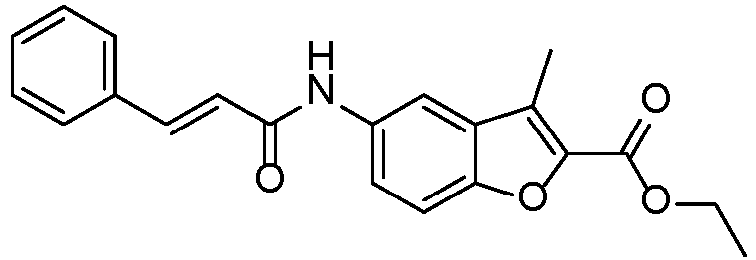
- The preparation method was the same as that of Example 1, except that cinnamic acid was used instead of phenylpropionic acid to obtain the title compound. 236 mg of light-white solid was obtained, with a yield of 98.7%. 1H NMR (400 MHz, CDCl3) δ 8.85 (s, 1H), 8.15 (s, 1H), 7.77 (d, J = 15.6 Hz, 1H), 7.52 - 7.18 (m, 7H), 6.76 (d, J = 15.6 Hz, 1H), 4.44 (q, J = 7.2 Hz, 2H), 2.41 (s, 3H), 1.43 (t, J = 7.2 Hz, 3H). 13C NMR (101 MHz, CDCl3) δ 164.87, 160.50, 151.30, 142.20, 141.61, 134.53, 133.84, 129.9 4, 129.37, 128.79, 127.87, 125.78, 121.62, 121.03, 112.84, 112.22, 61.25, 14.38, 9.32.
-

- The preparation method was the same as that of Example 1, except that (E)-3-(3-iodophenyl)acrylic acid was used instead of phenylpropionic acid to obtain the title compound. 120 mg of white solid was obtained, with a yield of 70.2%. 1H NMR (400 MHz, CDCl3) δ 8.18 (s, 1H), 8.14 (s, 1H), 7.83 (s, 1H), 7.72 - 7.58 (m, 2H), 7.47 - 7.36 (m, 3H), 7.06 (t, J = 7.8 Hz, 1H), 6.62 (d, J = 15.5 Hz, 1H), 4.44 (q, J = 7.2 Hz, 2H), 2.51 (s, 3H), 1.44 (t, J = 7.2 Hz, 3H).
-
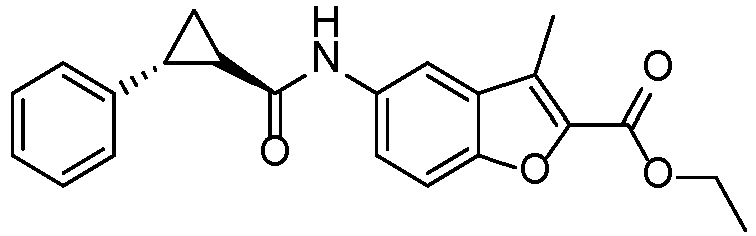
- The preparation method was the same as that of Example 1, except that (1S,2R)-2-phenylcyclopropane-1-carboxylic acid was used instead of phenylpropionic acid to obtain the title compound. 151 mg of white solid was obtained, with a yield of 55.5%. 1H NMR (400 MHz, CDCl3) δ 8.16 (s, 1H), 8.09 (s, 1H), 7.43 - 7.17 (m, 5H), 7.09 (d, J = 7.6 Hz, 2H), 4.43 (q, J = 7.2 Hz, 2H), 2.64 - 2.56 (m, 1 H), 2.50 (s, 3H), 1.91 - 1.83 (m, 1H), 1.78 - 1.70 (m, 1H), 1.44 (t, J = 7.2 Hz, 3H), 1.39 -1.30 (m, 1H). 13C NMR (101 MHz, CDCl3) δ 170.70, 16 0.53, 151.15, 141.66, 140.43, 133.77, 129.41, 128.51, 126.44, 126.02, 121.05, 112.33, 112.23, 61.23, 27.42, 25.92, 16.45, 14.38, 9.39.
-

- The preparation method was the same as that of Example 1, except that 4-oxo-4-phenylbutyric acid was used instead of phenylpropionic acid to obtain the title compound. 231 mg of yellow solid is obtained, with a yield of 91.3%. 1H NMR (400 MHz, CDCl3) δ 8.50 (s, 1H), 8.01 (m, 3H), 7.66 - 7.26 (m, 5H), 4.54 - 4.38 (m, 2H), 3.59 - 3.41 (m, 2H), 2.98 - 2.82 (m, 2H), 2.48 (d, J = 12.0 Hz, 3H), 1.45 (m, 3H). 13C NMR (101 MHz, CDCl3) δ 199.55, 170.69, 160.44, 151.05, 141.55, 136.33, 133.80, 133.55, 129.24, 128.69, 128.13, 125.76, 121.00, 112.11, 112.04, 61.14, 33.99, 31.13, 14.38, 9.34.
-

- The preparation method was the same as that of Example 1, except that 4-oxo-4-phenylbutyric acid was used instead of phenylpropionic acid to obtain the title compound. 0.2 g of white solid was obtained, with a yield of 72.2%. 1H NMR (400 MHz, CDCl3) δ 8.82 (s, 1H), 8.02 (d, J = 6.0 Hz, 1H), 7.42 - 7.04 (m, 7H), 4.43 (q, J = 7.2 Hz, 2H), 2.59 (dd, J = 13.2, 5.6 Hz, 2H), 2.50 - 2.35 (m, 5H), 1.86 - 1.60 (m, 4H), 1.43 (t, J = 7.2 Hz, 3H). 13C NMR (101 MHz, CDCl3) δ 172.35, 160.56, 151.17, 142.01, 141.55, 133.9 2, 129.21, 128.32, 125.81, 125.71, 121.71, 112.74, 112.00, 61.26, 37.16, 35.67, 31.05, 25.41, 14.39, 9.34.
-

- Ethyl 5-hydroxy-3-methylbenzofuran-2-carboxylate (189 mg, 0.86 mmol), triphenylphosphine (458 mg, 1.74 mmol), 3-phenylpropanol (175 mg, 1.29 mmol), diisopropyl azodicarboxylate (347 mg, 1.72 mmol) were dissolved in anhydrous tetrahydrofuran (10 mL) and reacted at room temperature in argon for 4 h. After TLC monitoring indicated that the reaction was completed, water (10 mL) was added and ethyl acetate (30 mL) was used to perform extraction three times. The organic phase was washed with saturated aqueous sodium chloride solution and dried over anhydrous sodium sulfate. The crude product was separated by column chromatography (PE/EA = 15/1 10/1) to obtain 0.15 g of a yellow solid with a yield of 54%. 1H NMR (400 MHz, CDCl3) δ 7.43 (d, J = 9.0 Hz, 1H), 7.33 - 7.16 (m, 5H), 7.06 (dd, J = 9.0, 2.6 Hz, 1H), 6.97 (d, J = 2.6 Hz, 1H), 4.44 (q, J = 7.1 Hz, 2H), 4.01 (t, J = 6.2 Hz, 2H), 2.84 (t, J = 7.6 Hz, 2H), 2.54 (s, 3H), 2.20 - 2.08 (m, 2H), 1.44 (t, J = 7.1 Hz, 3H). 13C NMR (101 MHz, CDCl3) δ 160.6, 155.7, 149.6, 141.7, 129.6, 128.7, 128.6, 126.1, 125.7, 118.1, 113.0, 103.4, 67.8, 61.2, 32.3, 31.0, 14.5, 9.6. HRMS (ESI) [M+H]+ Calculated value for C21H23O4: 339.1596; Measured value: 339.1592.
-

- 2-Hydroxyacetophenone (2.72 g, 20 mmol), ethyl bromoacetate (5.01 g, 30 mmol), and potassium carbonate (5.52 g, 40 mmol) were added to N,N-dimethylformamide (25 mL), heated to 160 °C and reacted for 3 h; after TLC monitoring indicated that the reaction was completed, the reaction mixture was cooled to room temperature, and the solid was obtained by filtration under reduced pressure. The filter cake was rinsed three times with ethyl acetate (25 mL). The filtrate was combined, and the solvent was removed by distillation under reduced pressure, the residue was added with water (100 mL) for dissolution and extracted with ether (100 mL) three times. The organic phase was washed with saturated sodium chloride aqueous solution and dried over anhydrous sodium sulfate. The crude product was separated by column chromatography (PE/EA = 15/1 ~ 10/1) to obtain 1.54 g of white solid, with a yield of 38%.
-

- Ethyl 3-methylbenzofuran-2-carboxylate (3.06 g, 15 mmol) was added to chloroform (45 mL), stirred at 0 °C for 10 minutes, added dropwise with chlorosulfonic acid (8.70 g, 75 mmol) in chloroform (45 mL), stirred at room temperature for 4 h. After TLC monitoring indicated that the reaction was completed, the reaction solution was poured into ice water and extracted three times with dichloromethane (150 mL). The organic phases were combined and washed with saturated sodium chloride aqueous solution, dried over anhydrous sodium sulfate, and the crude product was recrystallized from petroleum ether/ethyl acetate to obtain 2.07 g of white solid with a yield of 46%.
-

- Ethyl 5-(chlorosulfonyl)-3-methylbenzofuran-2-carboxylate (2.07 g, 6.86 mmol) and potassium carbonate (1.89 g, 13.72 mmol) were dissolved in anhydrous dichloromethane (80 mL), added dropwise with phenylethylamine (0.97 g, 8.23 mmol) in anhydrous dichloromethane (20 mL) at room temperature, and stirred at room temperature for 3 h. After TLC monitoring indicated that the reaction was completed, the solvent was removed by distillation under reduced pressure, the residue was dissolved with water (100 mL) and extracted three times with ethyl acetate (100 mL). The organic phase was washed with saturated sodium chloride aqueous solution and dried over anhydrous sodium sulfate. The crude product was separated by column chromatography (PE/EA = 10/1~ 5/1) to obtain 2.33 g of a white solid with a yield of 88%. 1H NMR (400 MHz, CDCl3) δ 8.15 (d, J = 1.8 Hz, 1H), 7.84 (dd, J = 8.8, 1.9 Hz, 1H), 7.59 (d, J = 8.8 Hz, 1H), 7.25 - 7.13 (m, 3H), 7.10 - 6.99 (m, 2H), 4.77 (t, J = 6.2 Hz, 1H), 4.47 (q, J = 7.1 Hz, 2H), 3.24 (q, J = 6.9 Hz, 2H), 2.77 (t, J = 7.0 Hz, 2H), 2.59 (s, 3H), 1.45 (t, J = 7.1 Hz, 3 H). 13C NMR (101 MHz, CDCl3) δ 159.9, 155.8, 143.0, 137.6, 135.2, 129.4, 128.7, 126.8, 126.2, 125.6, 121.6, 113.0, 61.6, 44.3, 35.8, 14.4, 9.4. HRMS (ESI) [M+H]+ Calculated value for C20H22NO5S: 388.1219; Measured value: 388.1213.
-

- Ethyl 3-methyl-5-(N-phenylethylsulfamoyl)benzofuran-2-carboxylate (195 mg, 0.5 mmol), benzyl bromide (171 mg, 1.0 mmol), and potassium carbonate (276 mg, 2.0 mmol) were dissolved in anhydrous dichloromethane (10 mL), and stirred at 60 °C overnight. After TLC monitoring indicated that the reaction was completed, the solvent was removed by distillation under reduced pressure; the residue was dissolved with water (20 mL) and extracted three times with dichloromethane (20 mL) ; the organic phase was washed with saturated sodium chloride aqueous solution, and dried over anhydrous sodium sulfate. The crude product was separated by column chromatography (PE/EA = 20/1 ~ 2/1) to obtain 229 mg of a white solid with a yield of 96%. 1H NMR (400 MHz, CDCl3) δ 8.14 (d, J = 1.5 Hz, 1H), 7.87 (dd, J = 8.8, 1.7 Hz, 1H), 7.63 (d, J = 8.8 Hz, 1H), 7.39 - 7.23 (m, 5H), 7.22 - 7.09 (m, 3H), 6.95 (d, J = 6.8 Hz, 2H), 4.48 (q, J = 7.1 Hz, 2H), 4.40 (s, 2H), 3.45 - 3.28 (m, 2H), 2.71 - 2.62 (m, 2H), 2.60 (s, 3H), 1.46 (t, J= 7.1 Hz, 3H). 13C NMR (101 MHz, CDCl3) δ 159.9, 155.8, 143.0, 138.3, 136.0, 135.6, 129.4, 128.7, 128.7, 128.5, 128.5, 128.0, 126.5, 126.2, 125.6, 121.5, 113.1, 61.6, 52.2, 49.5, 35.3, 14.4, 9.4. HRMS (ESI) [M+H]+ Calculated value for C27H28NO5S: 478.1688; Measured value: 478.1680.
-

- The preparation method was the same as Example 8, except that 4-bromobenzyl bromide was used instead of benzyl bromide to obtain the title compound. 193 mg of white solid was obtained, with a yield of 70%. 1H NMR (400 MHz, CDCl3) δ 8.14 (d, J = 1.8 Hz, 1H), 7.87 (dd, J = 8.8, 1.9 Hz, 1H), 7.64 (d, J = 8.7 Hz, 1H), 7.42 (d, J = 8.3 Hz, 2H), 7.17 (dd, J = 1 7.6, 7.7 Hz, 5H), 6.96 (d, J = 6.5 Hz, 2H), 4.49 (q, J = 7.1 Hz, 2H), 4.34 (s, 2H), 3.48 - 3.30 (m, 2H), 2.70 - 2.64 (m, 2H), 2.62 (s, 3H), 1.47 (t, J = 7.1 Hz, 3H). 13C NMR (101 MHz, CDCl3) δ 159.8, 155.8, 143.0, 138.1, 135.3, 135.2, 131.8, 130.0, 129.4, 128.6, 128.5, 126.6, 126.2, 125.5, 121.9, 121.5, 113.1, 61.6, 51.6, 49.6, 35.2, 14.4, 9.4.
-

- The preparation method was the same as that of Example 8, except that 4-(tert-butyloxycarbonyl)benzyl bromide was used instead of benzyl bromide to prepare the title compound. 273 mg of white solid was obtained, with a yield of 94%. 1H NMR (400 MHz, CDCl3) δ 8.12 (d, J = 1.6 Hz, 1H), 7.92 (d, J = 8.2 Hz, 2H), 7.87 (dd, J= 8.8, 1.8 Hz, 1H), 7.62 (d, J= 8.8 Hz, 1H), 7.31 (d, J = 8 (s, 9H), 1.45 (t, J= 7.1 Hz, 3H). 13C NMR (101 MHz, CDCl3) δ 165.3, 159.8, 155.8, 143.0, 140.8, 138.1, 135.3, 131.7, 129.7, 129.4, 128.6, 128.5, 128.1, 126.5, 126.2, 125.5, 121.5, 113.1, 81.1, 61.5, 51.9, 49.8, 35.2, 28.2, 14.4, 9.4.
-

- The preparation method was the same as Example 8, except that 8-(bromomethyl)quinoline was used instead of benzyl bromide to obtain the title compound. 222 mg of white solid was obtained, with a yield of 84%. 1H NMR (400 MHz, CDCl3) δ 8.83 (d, J = 2.6 Hz, 1H), 8.19 - 8.07 (m, 2H), 7.95 (d, J = 7.1 Hz, 1H), 7.88 (d, J = 10.3 Hz, 1H), 7.71 (d, J = 8.0 Hz, 1 H), 7.61 - 7.47 (m, 2H), 7.36 (dd, J = 8.2, 4.2 Hz, 1H), 7.11 (dq, J = 14.2, 7.0 Hz, 3H), 6.94 (d, J = 7.0 Hz, 2H), 5.22 (s, 2H), 4.46 (q, J = 7.1 Hz, 2H), 3.71 - 3.50 (m, 2H), 2.91 - 2.66 (m, 2H), 2.56 (s, 3H), 1.44 (t, J = 7.1 Hz, 3H). 13C NMR (101 MHz, CDCl3) δ 159.9, 155.6, 149.5, δ 146. 2, 142.8, 138.4, 136.4, 135.7, 134.8, 129.7, 129.2, 128.7, 128.4, 128.1, 127.7, 126.5, 126.3, 126.3, 125.6, 121.4, 121.2, 11 2.8, 61.5, 50.8, 47.5, 35.3, 14.4, 9.4. HRMS (ESI) [M+H]+ Calculated value for C30H29N2O5S: 529.1797; Measured value: 529.1790.
-

- Ethyl 3-methyl-5-(chlorosulfonyl)benzofuran-2-carboxylate (91 mg, 0.3 mmol), N-phenethylaniline (59 mg, 0.3 mmol), and potassium carbonate (46 mg, 0.33 mmol) were dissolved in anhydrous dichloromethane (10 mL) and stirred at 60 °C overnight. After TLC monitoring indicated that the reaction was completed, the solvent was removed by distillation under reduced pressure; the residue was dissolved in water (10 mL), and extracted with dichloromethane (20 mL) three times. The organic phase was washed with saturated aqueous sodium chloride solution and dried over anhydrous sodium sulfate. The crude product was separated by column chromatography (PE/EA = 10/1 ~ 5/1) to obtain 90 mg of a yellow solid with a yield of 65%. 1H NMR (400 MHz, CDCl3) δ 7.88 (s, 1H), 7.63 (d, J = 8.8 Hz, 1H), 7.56 (d, J = 8.7 Hz, 1H), 7.39 - 7.31 (m, 3H), 7.30 - 7.24 (m, 2H), 7.23 - 7.1 8 (m, 1H), 7.17 - 7.10 (m, 2H), 7.09 - 7.00 (m, 2H), 4.48 (q, J = 7.1 Hz, 2H), 3.90 - 3.77 (m, 2H), 2.89 - 2.76 (m, 2H), 2.54 (s, 3H), 1.4 6 (t, J= 7.1 Hz, 3H). 13C NMR (101 MHz, CDCl3) δ 159.9, 155.9, 142.9, 139.0, 138.0, 133.6, 129.2, 128.9, 128.8, 128.5, 128.2, 126.8, 126.6, 125. 6, 122.0, 112.6, 61.5, 52.2, 35.2, 14.4, 9.3. HRMS (ESI) [M+H]+ Calculated value for C26H26NO5S: 464.1532; Measured value: 464.1525.
-

- The preparation method was the same as that of Example 12, except that diphenylethylamine was used instead of N-phenylethylaniline to obtain the title compound. 112 mg of white oil was obtained, with a yield of 76%. 1H NMR (400 MHz, CDCl3) δ 8.16 (s, 1H), 7.84 (d, J = 8.7 Hz, 1H), 7.60 (d, J = 8.7 Hz, 1H), 7.29 (t, J = 7.2 Hz, 4H), 7.22 (t, J = 7.3 Hz, 2H), 7.1 6 (d, J = 7.0 Hz, 4H), 4.49 (q, J = 7.1 Hz, 2H), 3.56 - 3.40 (m, 4H), 2.96 - 2.82 (m, 4H), 2.63 (s, 3H), 1.48 (t, J = 7.1 Hz, 3H).13C NMR MHz, CDCl3) δ 159.9, 155.7, 142.9, 138.4, 135.4, 129.4, 128.8, 128.6, 126.6, 126.3, 125.6, 121.5, 113.0, 61.6, 50.0, 35.6, 14.4, 9.4. HRMS (ESI) [M+H]+ Calculated value for C28H30NO5S: 492.1845; Measured value: 492.1836.
-

- 4-(4-(Methylsulfonyl)piperazin-1-yl)aniline (0.46 g, 1.8 mmol), 2-iodoethylbenzene (0.28 g, 1.2 mmol), and potassium carbonate (0.25 g, 2.7 mmol) were dissolved in acetonitrile (8 mL), heated to 60 °C and reacted for 24 h. After TLC monitoring indicated that the reaction was completed, the reaction mixture was cooled to room temperature; the solvent was removed by distillation under reduced pressure; the residual was added with water (10 mL) and extracted three times with ethyl acetate (10 mL). The organic phase was washed with saturated sodium chloride aqueous solution and dried over anhydrous sodium sulfate. The crude product was separated by column chromatography to obtain 155 mg of a yellow solid with a yield of 36%. 1H NMR (400 MHz, CDCl3) δ 7.26 (dt, J = 35.0, 7.5 Hz, 5H), 6.83 (d, J = 7.5 Hz, 2H), 6.57 (d, J = 8.3 Hz, 2H), 3.54 - 3.23 (m, 7H), 3.09 (s, 4H), 2.88 (t, J = 6.9 Hz, 2H), 2.79 (s, 3H). 13C NMR (101 MHz, CDCl3) δ 143.4, 142.8, 139.4, 128.8, 128.6, 126.5, 119.7, 114.0, 51.1, 46.1, 4 5.7, 35.6, 34.2.
-

- The preparation method was the same as that of Example 12, except that diphenylethylamine was used instead of N-phenylethylaniline to obtain the title compound. 275 mg of yellow oil was obtained, with a yield of 87%. 1H NMR (400 MHz, CDCl3) δ 7.87 (d, J = 1.8 Hz, 1H), 7.58 (dd, J = 8.8, 1.9 Hz, 1H), 7.50 (d, J = 8.8 Hz, 1H), 7.20 (t, J = 7.2 Hz, 2H), 7.13 (dd, J = 8.6, 5.9 Hz, 1H), 7.07 (d, J = 6.9 Hz, 2H), 6.89 (d, J = 9.0 Hz, 2H), 6.81 (d, J = 9.0 Hz, 2H), 4.41 (q, J = 7.1 Hz, 2H), 3.79 - 3.69 (m, 2H), 3.39 - 3.31 (m, 4H), 3.30 - 3.22 (m, 4H), 2.80 (s, 3H), 2.77 - 2.68 (m, 2H), 2.50 (s, 3H), 1.40 (t, J = 7.1 Hz, 3H). 13C NMR (101 MHz, CDCl3) δ 159.8, 15 5.8, 150.2, 142.8, 138.1, 133.8, 130.9, 129.9, 129.1, 128.8, 128.5, 126.9, 126.5, 125.5, 122.0, 116.6, 112.6, 61.5, 52.2, 48.7, 45.7, 35.0, 34.5, 14.4, 9.4.
-

- Phenylacetaldehyde (0.06 g, 0.5 mmol), 4-aminodiphenyl ether (0.09 g, 0.5 mmol), and trimethyl orthoformate (85 mg, 0.8 mmol) were dissolved in methanol (10 mL) and stirred at 0 °C; sodium cyanoborohydride (0.04 g, 0.6 mmol) was added in batches, and reacted at room temperature for 10 h. After TLC monitoring indicated that the reaction was completed, the solvent was removed by distillation under reduced pressure. The residual was added with water (10 mL) and extracted three times with ethyl acetate (10 mL). The organic phase was washed with saturated sodium chloride aqueous solution and dried over anhydrous sodium sulfate. The crude product was separated by column chromatography to obtain a yellow solid 140 mg, yield 65%.
-
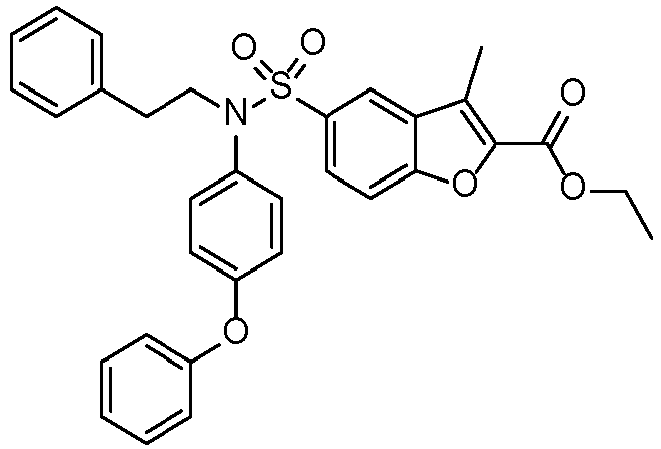
- The preparation method was the same as Example 12, except that N-phenethyl-4-phenoxyaniline was used instead of N-phenethylaniline to obtain the title compound. 123 mg of white solid was obtained, with a yield of 44%. 1H NMR (400 MHz, CDCl3) δ 7.92 (d, J = 1.9 Hz, 1H), 7.67 (dd, J = 8.8, 1.9 Hz, 1H), 7.58 (d, J = 8.8 Hz, 1H), 7.39 (t, J = 7.9 Hz, 2H), 7.28 (t, J= 7.2 Hz, 2H), 7.18 (dt, J = 22.1, 7.0 Hz, 4H), 7.07 (t, J = 7.8 Hz, 2H), 7.02 - 6.97 (m, 2H), 6.93 (d, J = 9.0 Hz, 2H), 4.49 (q, J = 7.1 Hz, 2H), 3.93 - 3.65 (m, 2H), 2.94 - 2.79 (m, 2H), 2.57 (s, 3H), 1.47 (t, J= 7.1 Hz, 3H). 13C NMR (101 MHz, CDCl3) δ 159.9, 157.3, 156.3, 155.9, 142.9, 1 38.0, 133.6, 133.6, 130.4, 129.9, 129.2, 128.8, 128.5, 126.8, 126.6, 125.6, 124.1, 122.0, 119.5, 118.6, 112.7, 61.6, 52.3, 35.2, 14.4, 9.3.
-

- Ethyl 3-methyl-5-(3-phenylpropylamino)benzofuran-2-carboxylate (0.19 g, 0.53 mmol) was dissolved in ethanol (8 mL), added with sodium hydroxide solution (0.11 g, 2.67 mmol, dissolved in 2 mL water), heated to reflux and reacted for 2 h. After the reaction was completed, the ethanol was removed by concentration. After an appropriate amount of water was added for dilution, 3N HCl was added to adjust the pH to 2 to 3, and a large amount of white solid was precipitated. Filtration was performed and the filter cake was washed with distilled water, and dried to obtain 148.7 mg of a light-yellow solid with a yield of 85.9%. 1H NMR (400 MHz, DMSO-d6 ) δ 13.40 (s, 1H), 10.06 (s, 1H), 8.10 (d, J = 2.1 Hz, 1H), 7.59 - 7.49 (m, 2H), 7.34 - 7.24 (m, 4H), 7.22 - 7.15 (m, 1H), 2.93 (t, J = 8.0 Hz, 2H), 2.65 (t, J = 8.0 Hz, 2H), 2.49 (s, 3H). 13C NMR (101 MHz, DMSO-d6 ) δ 170.81, 161.51, 150.27, 142.28, 141.64, 135.52, 129.12, 128.81, 128.71, 126.42, 124.84, 120.96, 112.41, 111.10, 38.35, 31.30, 9.58. HRMS (ESI) [M-H]- Calculated value for C19H16NO4S: 322.1085; Measured value: 322.1078.
-

- The preparation method was the same as that of Example 16, except that ethyl 5-cinnamylamino-3-methylbenzofuran-2-carboxylate was used instead of ethyl 3-methyl-5-(3-phenylpropylamino)benzofuran-2-carboxylate to obtain the title compound. The obtained product was a light-yellow solid (155 mg), with a yield of 71.4%. 1H NMR (400 MHz, DMSO-d6 ) δ 13.46 (s, 1H), 10.37 (s, 1H), 8.23 (d, J = 2.0 Hz, 1H), 7.69 - 7.61 (m, 4H), 7.60 (d, J = 5.6 Hz, 1H), 7.49 - 7.37 ( m, 3H), 6.86 (d, J = 15.6 Hz, 1H), 2.52 (s, 3H). 13C NMR (101 MHz, DMSO-d6 ) δ 163.98, 161.52, 150.46, 142.44, 140.59, 135.56, 135.17, 130.27, 129.51, 129.25, 128.20, 124.82, 122.68, 121.04, 112.57, 111.31, 9.61. HRMS (ESI) [M-H]- Calculated value for C10H14NO4S: 320.0928; Measured value: 320.0920.
-
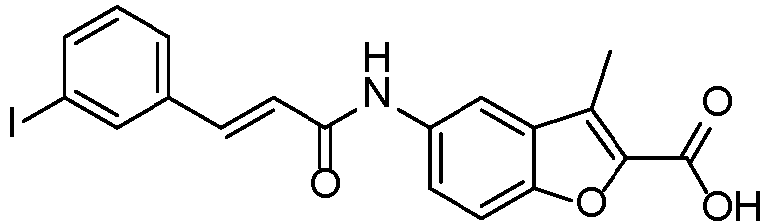
- The preparation method was the same as that of Example 16, except that ethyl (E)-5-(3-(3-iodophenyl)acrylamido)-3-methylbenzofuran-2-carboxylate was used instead of ethyl 3-methyl-5-(3-phenylpropylamino)benzofuran-2-carboxylate to obtain the title compound. 94 mg of white solid was obtained with a yield of 83.2%. 1H NMR (400 MHz, DMSO-d6 ) δ 13.41 (s, 1H), 10.34 (s, 1H), 8.21 (s, 1H), 7.99 (s, 1H), 7.82 - 7.44 (m, 5H), 7.22 (t, J = 7.8 Hz, 1H), 6.86 (d, J = 15.7 Hz, 1H), 2.50 (s, 3H). 13C NMR (101 MHz, DMSO-d6 ) δ 163.60, 161.48, 150.48, 142.37, 138.80, 138.54, 137.61, 136.43, 135.45, 13 1.48, 129.23, 127.44, 124.86, 124.14, 120.98, 112.55, 111.27, 95.90, 9.59.
-

- The preparation method was the same as that of Example 16, except that ethyl (E)-5-(3-(3-iodophenyl)acrylamido)-3-methylbenzofuran-2-carboxylate was used instead of ethyl 3-methyl-5-(3-phenylpropylamino)benzofuran-2-carboxylate to obtain the title compound. 121 mg of white solid was obtained, with a yield of 87.0%. 1H NMR (400 MHz, DMSO-d6 ) δ 10.40 (s, 1H), 8.14 (d, J = 2.4 Hz, 1H), 7.60 - 7.50 (m, 2H), 7.45 - 7.40 (m, 2H), 7.34 - 7.26 (m, 2H), 7.24 - 7.1 5 (m, 3H), 2.49 (s, 3H), 2.43 - 2.35 (m, 1H), 2.12 - 2.05 (m, 1H), 1.55 - 1.48 (m, 1H), 1.42 - 1.35 (m, 1H). 13C NMR (101 MHz, DMSO-d6 ) δ 170.30, 161.53, 150.27, 142.38, 141.26, 135.57, 129.19, 128.83, 126.58, 126.37, 124.80, 120.77, 112.44, 111.00, 27.18, 25.35, 16.05, 9.55. HRMS (ESI) [M-H]- Calculated value for C20H16NO4: 334.1085; Measured value: 334.1083.
-

- The preparation method was the same as Example 16, except that ethyl 3-methyl-5-(4-oxo-4-phenylbutylamino)benzofuran-2-carboxylate was used instead of ethyl 3-methyl-5-(3-phenylpropylamino)benzofuran-2-carboxylate to obtain the title compound. 38 mg of white solid was obtained, with a yield of 70.5%. 1H NMR (400 MHz, DMSO-d6 ) δ 13.39 (s, 1H), 10.20 (s, 1H), 8.12 (d, J = 2.0 Hz, 1H), 8.05 - 7.98 (m, 2H), 7.68 - 7.62 (m, 1H), 7.60 - 7.51 (m, 4H), 3.37 (t, J = 6.4 Hz, 2H), 2.76 (t, J = 6.4 Hz, 2H), 2.47 (s, 3H). 13C NMR (101 MHz, CDCl3) δ 199.31, 170.78, 161.50, 150.20, 142.24, 137.01, 135.69, 133.66, 129.20, 129.12, 128.34, 124.88, 120.82, 112.41, 110.86, 33.58, 30.66, 9.55.
-
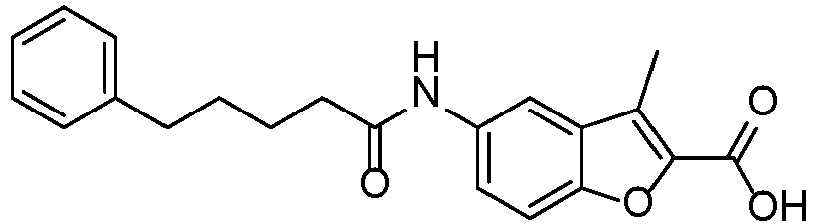
- The preparation method was the same as that of Example 16, except that ethyl 3-methyl-5-(4-oxo-4-phenylbutylamino)benzofuran-2-carboxylate was used instead of ethyl 3-methyl-5-(3-phenylpropylamino)benzofuran-2-carboxylate to obtain the title compound. 199 mg of white solid was obtained, with a yield of 99%. 1H NMR (400 MHz, DMSO-d6 ) δ 13.36 (s, 1H), 10.01 (s, 1H), 8.12 (d, J = 2.0 Hz, 1H), 7.56 (d, J = 8.8 Hz, 1H), 7.53 (dd, J = 8.8, 2.0 Hz, 1H), 7.3 0 - 7.23 (m, 2H), 7.21 - 7.12 (m, 3H), 2.60 (t, J = 7.2 Hz, 2H), 2.49 (s, 3H), 2.35 (d, J = 7.2 Hz, 2H), 1.67 - 1.57 (m, 4H). 13C NMR (101 MHz, DM SO-d6) δ 171.58, 161.51, 150.26, 142.52, 142.28, 135.62, 129.12, 128.74, 128.70, 126.11, 124.84, 120.95, 112.33, 111.08, 36.68, 35.40, 31.11, 25.29, 9.56. HRMS (ESI) [M-H]- Calculated value for C21H20NO4: 350.1398; Measured value: 350.1390.
-

- The preparation method was the same as that of Example 16, except that ethyl 3-methyl-5-(3-phenylpropyloxy)benzofuran-2-carboxylate was used instead of ethyl 3-methyl-5-(3-phenylpropylamino)benzofuran-2-carboxylate to obtain the title compound. 111 mg of white solid was obtained, with a yield of 87%. 1HNMR (400 MHz, DMSO-d6 ) δ 7.53 (d, J = 9.0 Hz, 1H), 7.34 - 7.15 (m, 6H), 7.11 (dd, J = 9.0, 2.6 Hz, 1H), 4.03 (t, J = 6.3 Hz, 2H), 2.81 - 2.73 (m , 2H), 2.50 (s, 3H), 2.10 - 2.01 (m, 2H). 13C NMR (101 MHz, DMSO-d6 ) δ 161.1, 155.1, 148.5, 142.0, 141.4, 129.3, 128.4, 125.8, 124.4, 117.6, 112.6, 103.7, 67.4, 31.5, 30.4, 9.2. HRMS (ESI) [M-H]- Calculated value for C21H23O4: 339.1596; Measured value: 339.1592.
-

- The preparation method was the same as that of Example 16, except that ethyl 3-methyl-5-(N-benzyl-N-phenylethylsulfamoyl)benzofuran-2-carboxylate was used instead of ethyl 3-methyl-5-(3-phenylpropylamino)benzofuran-2-carboxylate to obtain the title compound. A white solid of 75 mg was obtained with a yield of 84%. 1H NMR (400 MHz, DMSO-d6 ) δ 8.28 (s, 1H), 7.95 (d, J = 8.7 Hz, 1H), 7.84 (d, J = 8.8 Hz, 1H), 7.33 (dd, J = 16.2, 3.9 Hz, 5H), 7.24 - 7.05 (m, 3H) , 6.97 (d, J= 7.1 Hz, 2H), 4.43 (s, 2H), 3.41 - 3.20 (m, 2H), 2.58 (s, 3H), 2.56 - 2.51 (m, 2H). 13C NMR (101 MHz, DMSO-d6 ) δ 161.3, δ 155.5, 1 44.2, 138.7, 137.3, 135.3, 129.7, 129.0, 128.9, 128.8, 128.8, 128.1, 126.7, 126.5, 124.8, 122.0, 113.5, 51.8, 49.8, 34.8, 9.6. HRMS (ESI) [M-H]- Calculated value for C25H24NO5S: 450.1375; Measured value: 450.1378.
-

- The preparation method was the same as Example 16, except that ethyl 3-methyl-5-(N-(4-bromobenzyl)-N-phenylethylsulfamoyl)benzofuran-2-carboxylate was used instead of ethyl 3-methyl-5-(3-phenylpropylamino)benzofuran-2-carboxylate to obtain the title compound. 227 mg of white solid was obtained, with a yield of 85%. 1H NMR (400 MHz, DMSO-d6 ) δ 8.15 (s, 1H), 7.93 - 7.69 (m, 2H), 7.42 (dd, J = 89.8, 8.2 Hz, 4H), 7.23 - 7.10 (m, 3H), 7.00 (d, J = 7.2 Hz, 2H), 4.39 (s, 2H), 3.39 - 3.27 (m, 2H), 2.56 (s, 5H). 13C NMR (101 MHz, DMSO-d6 ) δ 162.0, 154.6, 148.2, 138.2, 136.7, 133.8, 131.3, 130.4, 130.0, 128.5, 128.3, 126.3, 124.7, 120.7, 120.7, 119.7, 112.6, 50.8, 49.6, 34.3, 9.1. HRMS (ESI) [M-H]- Calculated value for C25H21BrNO5S: 526.0329; Measured value: 506.0323.
-

- The preparation method was the same as Example 16, except that ethyl 3-methyl- 5-(N-(4-(tert-butyloxycarbonyl)benzyl)-N-phenylethylsulfamoyl)benzofuran-2-carboxylate was used instead of ethyl 3-methyl-5-(3-phenylpropylamino)benzofuran-2-carboxylate to obtain the title compound. 200 mg of white solid was obtained, with a yield of 77%. 1H NMR (400 MHz, DMSO-d 6) δ 13.61 (s, 1H), 8.21 (s, 1H), 7.88 (dd, J = 47.6, 7.6 Hz, 4H), 7.42 (d, J = 8.1 Hz, 2H), 7.15 (dt, J = 16.9, 7.1 Hz, 3H), 7.01 (d, J = 6.2 Hz, 2H), 4.50 (s, 2H), 3.37 (s, 2H), 2.58 (d, J = 19.8 Hz, 5H), 1.52 (s, 9H). 13C NMR (101 MHz, DMSO) δ 165.1, 161.1, 155.5, 143.8, 142.5, 138.6, 135.2, 131.0, 129.9, 129.5, 129.0, 128.7, 128.6, 126.7, 126.6, 125.1, 122.0, 113.5, 81.1, 51.6, 50.3, 34.9, 28.2, 9.5.HRMS (ESI) [M-H]- Calculated value for C30H30NO7S: 548.1748; Measured value: 548.1738.
-
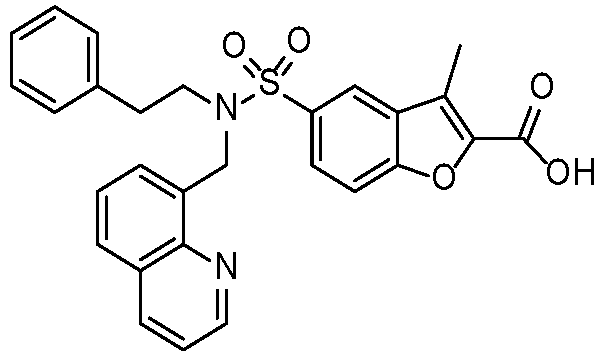
- The preparation method was the same as Example 16, except that ethyl 3-methyl- 5-(N-(4-(tert-butyloxycarbonyl)benzyl)-N-phenylethylsulfamoyl)benzofuran-2-carboxylate was used instead of ethyl 3-methyl-5-(3-phenylpropylamino)benzofuran-2-carboxylate to obtain the title compound. 103 mg of white solid was obtained, with a yield of 99%. 1H NMR (400 MHz, DMSO-d 6) δ 8.88 (s, 1H), 8.36 (d, J = 7.9 Hz, 1H), 8.20 (s, 1H), 7.91 (t, J = 9.1 Hz, 2H), 7.80 (d, J = 5.6 Hz, 2H), 7.68 - 7.48 (m, 2H), 7.12 (dd, J = 15.3, 6.9 Hz, 3H), 6.95 (d, J = 7.0 Hz, 2H), 5.10 (s, 2H), 3.60 - 3.38 (m, 2H), 2.73 - 2.60 (m, 2H), 2.54 (s, 3H). 13C NMR (101 MHz, DMSO-d 6) δ 161.1, 155.4, 150.2, 145.8, 143.6, 138.7, 137.2, 135.4, 135.0, 129.8, 129.4, 129.0, 128.7, 128.2, 126.8, 126.7, 125.2, 122.0, 121.9, 113.4, 50.8, 47.7, 35.1, 9.5. HRMS (ESI) [M-H]- Calculated value for C28H23N2O5S: 499.1328; Measured value: 499.1321.
-

- The preparation method was the same as Example 16, except that ethyl 3-methyl-5-(N-phenethyl-N-phenylsulfamoyl)benzofuran-2-carboxylate was used instead of ethyl 3-methyl-5-(3-phenylpropylamino)benzofuran-2-carboxylate to obtain the title compound. 50 mg of white solid was obtained, with a yield of 76%. 1H NMR (400 MHz, DMSO-d6 ) δ 7.73 (s, 1H), 7.67 (d, J = 8.7 Hz, 1H), 7.44 (d, J = 8.6 Hz, 1H), 7.35 (d, J = 6.8 Hz, 3H), 7.21 (dt, J = 27.5, 7.2 Hz, 3H), 7.12 (d, J = 7.1 Hz, 2H), 7.04 (d, J = 7.8 Hz, 2H), 3.82 (t, J = 7.2 Hz, 2H), 2.64 (t, J = 7.2 Hz, 2H), 2.45 (s, 3H). 13C NMR (101 MHz, DMSO-d6 ) δ 154.9, 139.2, 138.7, 132.2, 130.6, 129.4, 129.2, 129.0, 128.7, 128.3, 126.8, 124.9, 121.0, 112.5, 51.5, 34.6, 9.4. HRMS (ESI) [M-H]- Calculated value for C24H20NO5S: 434.1062; Measured value: 434.1054.
-

- The preparation method was the same as Example 16, except that ethyl 3-methyl-5-(N,N-diphenylethylsulfamoyl)benzofuran-2-carboxylate was used instead of ethyl 3-methyl-5-(3-phenylpropylamino)benzofuran-2-carboxylate to obtain the title compound. 54 mg of white solid was obtained, with a yield of 78%. 1H NMR (400 MHz, DMSO-d6 ) δ 13.75 (s, 1H), 8.25 (s, 1H), 7.96 - 7.86 (m, 1H), 7.82 (d, J = 8.8 Hz, 1H), 7.32 - 7.22 (m, 4H), 7.18 (d, J = 7.4 Hz, 6H), 3.49 - 3.29 (m, 4H), 2.86 - 2.66 (m, 4H), 2.58 (s, 3H). 13C NMR (101 MHz, DMSO-d6 ) δ 161.2, 155.5, 143.8, 139.0, 135.3, 129.6, 129.2, 128.8, 126.8, 126.6, 125.2, 121.8, 113.5, 49.8, 35.2, 9.6. HRMS (ESI) [M-H]- Calculated value for C26H24NO5S: 462.1375; Measured value: 462.1377.
-
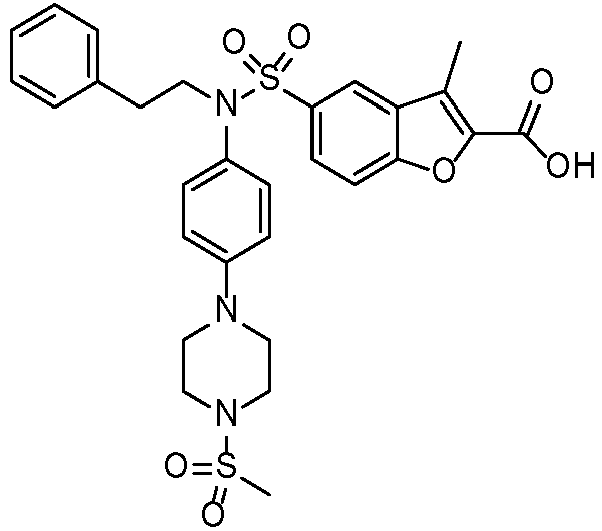
- The preparation method was the same as that of Example 16, except that ethyl 3-methyl-5-(N,N-diphenylethylsulfamoyl)benzofuran-2-carboxylate was used instead of ethyl 3-methyl-5-(3-phenylpropylamino)benzofuran-2-carboxylate to obtain the title compound. 126 mg of white solid was obtained, with a yield of 99%. H NMR (400 MHz, DMSO-d6 ) δ 7.75 (d, J = 1.9 Hz, 1H), 7.67 (d, J = 8.7 Hz, 1H), 7.46 (dd, J = 8.7, 1.9 Hz, 1H), 7.26 (dd, J = 8.0, 6.5 Hz, 2H), 7.22 - 7.10 (m, 3H), 6.96 - 6.82 (m, 4H), 3.75 (t, J = 7.3 Hz, 2H), 3.25 (q, J = 5.7 Hz, 8H), 2.93 (s, 3H), 2.63 (t, J = 7.3 Hz, 2H), 2.46 (s, 3H). 13C NMR (101 MHz, DMSO-d6 ) δ 162.7, 154.9, 150.1, 138.8, 132.5, 130.5, 130.2, 129.8, 129.2, 128.7, 126.7, 125.0, 121.1, 118.3, 116.1, 112.5, 51.7, 48.0, 45.7, 34.6, 34.4, 9.5. HRMS (ESI) [M-H]- Calculated value for C29H30N3O7S2: 596.1525; Measured value: 596.1525.
-

- The preparation method was the same as Example 16, except that ethyl 3-methyl-5-(N,N-diphenylethylsulfamoyl)benzofuran-2-carboxylate was used instead of ethyl 3-methyl-5-(3-phenylpropylamino)benzofuran-2-carboxylate to obtain the title compound. 85 mg of white solid was obtained, with a yield of 81%. 1H NMR (400 MHz, DMSO-d6 ) δ 7.85 (d, J= 1.9 Hz, 1H), 7.75 (d, J = 8.8 Hz, 1H), 7.54 (dd, J = 8.7, 1.9 Hz, 1H), 7.46 - 7.38 (m, 2H), 7.25 (t, J = 7. 1 Hz, 2H), 7.22 - 7.11 (m, 4H), 7.07 - 6.99 (m, 4H), 6.97 - 6.91 (m, 2H), 3.81 (t, J = 7.2 Hz, 2H), 2.67 (t, J = 7.2 Hz, 2H), 2.51 (s, 3H). 13C NMR (101 MHz, DMSO-d6 ) δ 162.0, 156.7, 156.6, 155.3, 138.7, 134.1, 132.6, 130.8, 130.6, 130.0, 129.2, 128.7, 126.7, 126.0, 124.3, 121.7, 119.4, 119.1, 112.9, 51.6, 34.6, 9.4. HRMS (ESI) [M-H]- Calculated value for C30H24NO6S: 526.1324; Measured value: 526.1316.
-
No. Chemical Name Structure of Compound GPR132-A-1 3-Methyl-5-(3-phenylpropylamino)benzofuran-2-carboxylic acid 
GPR132-A-2 5-Cinnamylamino-3-methylbenzofuran-2-carboxylic acid 
GPR132-A-3 (E)-5-(3-(3-iodophenyl)acrylamide)-3-methylbenzofuran-2-carboxylic acid 
GPR132-A-4 3-Methyl-5-((1S,2R)-2-phenylcyclopropyl-1-carboxamido)benzofuran-2-carboxylic acid 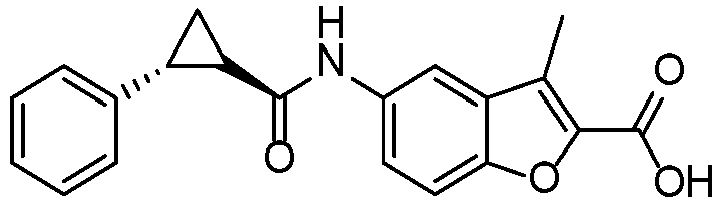
GPR132-A-5 3-Methyl-5-(4-oxo-4-phenylbutylamino)benzofuran-2-carboxylic acid 
GPR132-A-6 3-Methyl-5-(5-phenylvaleramido)benzofuran-2-carboxylic acid 
GPR132-A-7 3-Methyl-5-(3-phenylpropoxy)benzofuran-2-carboxylic acid 
B101 3-Methyl-5-(3-(m-tolyl)propoxy)benzofuran-2-carboxylic acid 
B102 5-(3-(3-Methoxyphenyl)propoxy)-3-methylbenzofuran-2-carboxylic acid 
B103 5-(3-(3-Chlorophenyl)propoxy)-3-methylbenzofuran-2-carboxylic acid 
GPR132-A-8 5-(3-(3-Methoxyphenyl)propylamino)-3-methylbenzofuran-2-carboxylic acid 
B104 5-(3-(3-Chlorophenyl)propylamino)-3-methylbenzofuran-2-carboxylic acid 
B105 3-Methyl-5-(3-(m-tolyl)propylamino)benzofuran-2-carboxylic acid 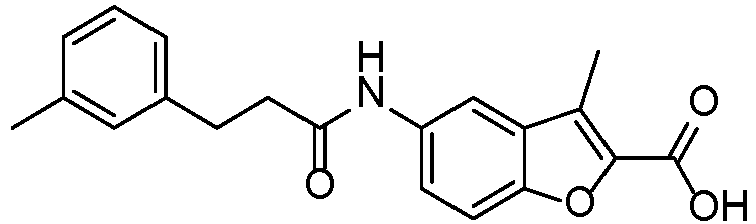
B106 5-(3-(4-(Chloromethyl)phenyl)propylamin o)-3-methylbenzofuran-2-carboxylic acid 
B107 5-(3-(Benzo[d][1,3]dioxin-4-yl)propylamino)-3-methylbenzofuran-2-carboxylic acid 
B108 5-(3-(3-Ethynylphenyl)propylamino)-3-methylbenzofuran-2-carboxylic acid 
B109 3-Methyl-5-(3-(methylamino)phenyl)propylamin o)benzofuran-2-carboxylic acid 
B110 5-(3-(3-Cyanophenyl)propionamido)-3-methylbenzofuran-2-carboxylic acid 
B111 3-Methyl-5-(3-(4-(trifluoromethyl)phenyl)propylami no)benzofuran-2-carboxylic acid 
B112 3-Methyl-5-(3-(pyridin-4-yl)propylamino)benzofuran-2-carboxylic acid 
B113 5-(3-(4-Methoxypyridin-2-yl)propylamino)-3-methylbenzofuran-2-carboxylic acid 
B114 (E)-5-(3-(5-Chloropyridin-2-yl)acrylamido)-3-methylbenzofuran-2-carboxylic acid 
B115 5-(3-(1H-Pyrrol-2-yl)propylamino)-3-methylbenzofuran-2-carboxylic acid 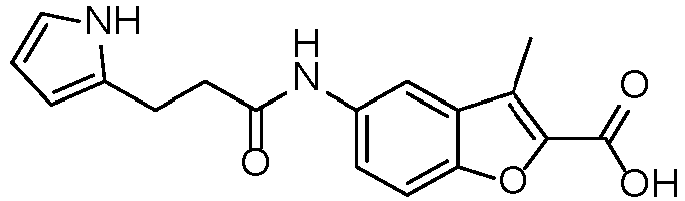
B116 3-Methyl-5-(3-(thiophen-2-yl)propionamido)benzofuran-2-carboxylic acid 
B117 5-(3-(5-Chlorothiophen-2-yl)propylamino)-3-methylbenzofuran-2-carboxylic acid 
B118 3-Methyl-5-(3-(5-methylthiophen-2-yl)propylamino)benzofuran-2-carboxylic acid 
B119 3-Methyl-5-(pent-4-eneylamino)benzofuran-2-carboxylic acid 
B120 3-Methyl-5-(pent-4-ynylamino)benzofuran-2-carboxylic acid 
B121 3-Methyl-5-(3-(naphthalen-1-yl)propylamino)benzofuran-2-carboxylic acid 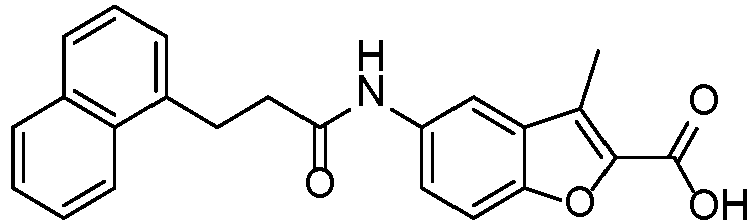
B 122 5-(3-([1,1'-Biphenyl]-3-yl)propylamino)-3-methylbenzofuran-2-carboxylic acid 
B123 5-(3-(1H-indol-3-yl)propylamino)-3-methylbenzofuran-2-carboxylic acid 
B124 5-(4-(4-Fluorophenyl)-4-oxobutylamino)-3-methylbenzofuran-2-carboxylic acid 
B125 5-(4-(4-Chlorophenyl)-4-oxobutylamino)-3-methylbenzofuran-2-carboxylic acid 
B126 N-Hydroxy-3-methyl-5-(3-phenylpropylamino)benzofuran-2-carboxamide 
B127 3-Chloro-5-(3-phenylpropylamino)benzo[b]thiop hene-2-carboxylic acid 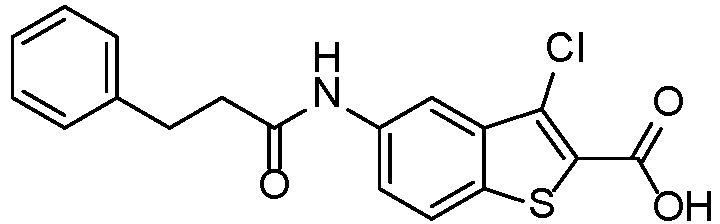
B128 3-Methyl-5-(3-phenylpropylamino)benzo[b]thiop hene-2-carboxylic acid 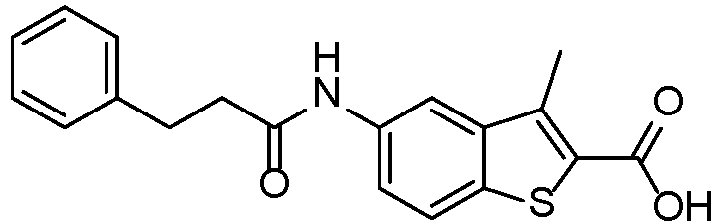
B129 3-Chloro-5-(3-phenylpropylamino)-1H-indole-2-carboxylic acid 
B130 3-Methyl-5-(3-phenylpropylamino)-1H-indole-2-carboxylic acid 
B131 3-(2-Fluoro-5-(3-phenylpropylamino)phenyl)propio nic acid 
B132 3-(2-Fluoro-5-(3-phenylpropylamino)phenyl)butyric acid 
B133 3-(2-Fluoro-5-(3-phenylpropyloxy)phenyl)propionic acid 
GPR132-A-9 3-Methyl-5-(N-(4-bromobenzyl)-N-phenylethylsulfamoyl)benzofuran-2-carboxylic acid 
GPR132-A-10 3-Methyl-5-(N-(4-(tert-butyloxycarbonyl)benzyl)-N-phenylethylsulfamoyl)benzofuran-2-carboxylic acid 
GPR132-A-11 3-Methyl-5-(N-(quinolin-8-ylmethyl)-N-phenylethylsulfamoyl)benzofuran-2-carboxylic acid 
GPR132-A-12 3-Methyl-5-(N-phenylethyl-N-phenylsulfamoyl)benzofuran-2-carboxylic acid 
GPR132-A-13 3-Methyl-5-(N-(4-(4-(methylsulfonyl)piperazin-1-yl)phenyl)-N-phenylethylsulfamoyl)benzofuran-2-carboxylic acid 
GPR132-A-14 3-Methyl-5-(N-benzyl-N-phenylethylsulfamoyl)benzofuran-2-carboxylic acid 
GPR132-A-15 Example 28 3-Methyl-5-(N,N-diphenylethylsulfamoyl)benzofura n-2-carboxylic acid 
GPR132-A-16 3-Methyl-5-(N-(4-phenoxyphenyl)-N-phenylethylsulfamoyl)benzofuran-2-carboxylic acid 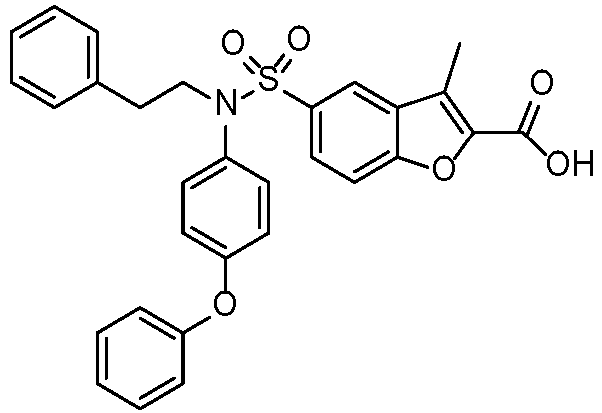
- The above compounds could be prepared by referring to the above method.
- Gi BRET probes were generated according to previous literature (Olsen et al., 2020), and included Gαi-RLuc8, Gβ3, and Gγ9-GFP2. GPR132 and Gi BRET probes were transiently co-transfected in HEK293 cells. 24 hours after transfection, the cells were distributed into 96-well microplates at a density of 5×10⁴ cells per well and cultured for another 24 hours. The cells were washed twice with Tyrode buffer and stimulated with compound ligands at different concentrations (10-12 to 10-5 M) for 2 minutes. After adding coelenterazine, the substrate of luciferase, 400a (5 µM), BRET signal was measured using a Mithras LB940 microplate reader equipped with a BRET filter set. The BRET signal was calculated as the emission light ratio at 510 nm/400 nm.
- The compounds with lower EC50 values in the above experiments had good GPR132 agonist activity.
- Human embryonic kidney cell line HEK293A was sub-cultured in MEM medium containing penicillin (final concentration was 100 U/mL), streptomycin (final concentration was 100 µg/mL) and 10% FBS, and underwent constant temperature incubation at 37 °C in a humidified atmosphere comprising 95% air and 5% carbon dioxide. When the cells were 90% confluent, the old medium was discarded, and the cells were washed twice with 2 mL of PBS. After discarding PBS, 2 mL of 0.25% trypsin-0.25% EDTA mixed digestion solution was added, and the cells were observed with a microscope. When the cells became round, 2 mL of complete medium was quickly added to terminate digestion, and the cells were gently pipetted and collected, centrifuged at 800 rpm and 4 °C for 5 min; the supernatant was discarded; the cells were resuspended with complete medium, cultured in bottles, and the medium was changed every other day.
- Human liver cancer cell line HepG2 was sub-cultured in DMEM medium containing penicillin (final concentration was 100 U/mL), streptomycin (final concentration was 100 µg/mL) and 10% FBS, and the rest operations were the same as the HEK293A sub-culture.
- The inhibition ability of the compounds on cell proliferation was determined by MTT method. HepG2 and HEK293 cells were inoculated in 96-well plates at a density of 30%. After incubation for 18 h to allow the cells to adhere to wall, the original culture medium was removed, and the compound to be tested that had a given concentration was added to each well. The control group was added with an equal amount of DMSO. Three replicate wells were set for each compound. After 48 h of drug administration, the cell viability was determined by MTT method. The blank group was the well without cells. Then the OD value was read at 490 nm using a microplate reader. The calculation formula for cell viability was Cell viability (%) = (OD to be tested - OD blank) / (OD control - OD blank) × 100.
- In the above experiment, the compounds with high viability and high CC50 values for HEK293 cells had good safety. The compounds with high inhibition rate and low EC50 values for HepG2 cells could better inhibit the proliferation of tumor cells.
- HepG2 cells were inoculated in 96-well plates at a density of 30%. After incubation for 18 h to allow the cells to adhere to wall, the original culture medium was removed, and each well of the drug group was added with LPS culture medium (LPS concentration was 1 µg/mL), the control group was added with an equal amount of DMSO, and incubation was performed overnight. Subsequently, the original culture medium was removed, and the compound to be tested that had a given concentration was added, and the control group was added with an equal amount of DMSO. Three replicate wells were set for each compound. After 48 h of drug administration, the cell supernatant was collected with a sterile tube, and centrifuged for about 20 minutes (2000 to 3000 rpm). The supernatant was carefully collected. The TNF-α level was then determined using ELISA method. The specific steps were as follows:
- ▪ Standard sample addition: Standard sample wells and sample wells were set, and 50 µL of standard sample at different concentrations was added to each standard sample well.
- ▪ Sample addition: Blank wells (blank control wells was not added with sample and ELISA reagent, and the rest operations were the same) and test sample wells were set. First, 40 µL of sample diluent was added to each test sample well on an ELISA plate, and then 10 µL of the sample to be tested (the final dilution ratio of sample was 5) was added. The sample was added to the bottom of the well of the ELISA plate, not touching the well wall as much as possible, and then the gentle shaking was carried out for mixing.
- ▪ Enzyme addition: 100 µL of ELISA reagent was added to each well, except for the blank wells.
- ▪ Incubation: The plate was sealed with a sealing film and incubated at 37°C for 60 minutes.
- ▪ Solution preparation: 20-Fold concentrated washing solution was diluted by 20-fold with distilled water for later use.
- ▪ Washing: The sealing film was carefully peeled off, the liquid was discarded, the plate was spin-dried; each well was filled with the washing solution, allowed to stand for 30 seconds and then the washing solution was discarded. This operation was repeated 5 times, and pat-drying was performed.
- ▪ Color development: First, 50 µL of color developer A was added to each well, then 50 µL of color developer B was added, gently shaken and mixed, and color development was performed at 37°C in the dark for 15 minutes.
- ▪ Termination: 50 µL of termination liquid was added to each well to stop the reaction (the blue color immediately turned yellow).
- ▪ Determination: Zero was set with the blank well, and the absorbance (OD value) at 450 nm of each well was measured in sequence. The determination should be performed within 15 minutes after adding the termination liquid.
- TNF-α content in the sample to be tested could be calculated by drawing a standard curve based on the standard samples. TNF-α reduction rate was further calculated. The formula for calculating TNF-α reduction was Reduction rate (%) = TNF-α content control - TNF-α content to be tested/TNF-α content control × 100.
- In the above experiment, the compounds with higher TNF-α reduction rate and lower EC50 value could better reduce the level of inflammation.
- Cell TC/TG was determined using Nanjing Jiancheng TG test kit and TC test kit. HepG2 cells were incubated with 0.5 mmol/L FFA (oleic acid and palmitate mixed in a ratio of 2:1) and solvent or compounds of different concentrations (20 µM, 40 µM, 80 µM) for 24 h. The culture medium was discarded, and the cells were washed once with 0.01 M, pH 7.4 PBS. The cells were scraped with a cell scraper, added with 2 to 5 mL of 0.01 M, pH 7.4 PBS; the cell suspension was collected, centrifuged at 1000 × g and 4 °C for 10 min to collect the cells. Isopropanol was added according to the ratio of 300 to 500 µL of homogenization medium per 106 cells, mechanical homogenization was performed, and the cells were fully broken until there was no obvious cell precipitation. Centrifugation was performed at 10000 × g and 4 °C for 10 min; the supernatant was taken and placed on ice for later test. 2.5 µL of distilled water; standard or sample was taken and mixed with 250 µL of distilled water respectively, incubated at 37 °C for 10 minutes, and the absorbance of each well was measured at 510 nm with a microplate reader. The calculation formula of TC/TG concentration was sample concentration (mmol/g protein) = (OD sample - OD blank) / (OD standard - OD blank) × standard concentration (mmol/L) / protein concentration (g protein /L).
- Preparation of protein standards: a. 1.2 mL of protein standard preparation solution was added to a tube of protein standard (30 mg BSA) and fully dissolved, and a 25 mg/mL protein standard solution was prepared. b. an appropriate amount of a 25 mg/mL protein standard was diluted to a final concentration of 0.5 mg/mL. Preparation of BCA working solution: According to the number of samples, an appropriate amount of BCA working solution was prepared by thoroughly mixing 50 volumes of BCA reagent A with 1 volume of BCA reagent B (50:1). Determination of protein concentration: a. 0, 1, 2, 4, 8, 12, 16, and 20 µL of the standard was added to the standard wells of a 96-well plate, respectively, and standard diluent was added to make up to 20 µL, resulted with standard samples with concentrations of 0, 0.025, 0.05, 0.1, 0.2, 0.3, 0.4, and 0.5 mg/mL, respectively. b. an appropriate volume of sample was added to sample wells of the 96-well plate. If the sample was less than 20 µL, the standard diluent was added to make up to 20 µL. c. 200 µL of BCA working solution was added to each well and placed at 37°C for 20 to 30 minutes. d. the absorbance at wavelength of A562 nm was measured by a microplate reader. e. the protein concentration of the sample was calculated based on the standard curve and the sample volume used.
- In the above experiment, the compounds with higher TC/TG reduction rates and lower EC50 values could better reduce the fat content in blood and/or liver.
- Male C57BL/6 mice were randomly divided into 8 groups, including Control group, Model group, SIPI-7623 groups (10 mg/kg, 30 mg/kg and 100 mg/kg) and test groups (3 doses). The Model group, SIPI-7623 group and test groups were intraperitoneally injected with 600 mg/kg Triton WR-1339, and the Control group was injected with the same volume of saline. The test compound was administered by gavage 1 hour before and 23 hours after the injection of the inducer; one hour later, blood and tissue samples were collected.
- Male C57BL/6 mice were randomly divided into 6 groups, including Control group, HFD group, SIPI-7623 group (40 mg/kg) and test groups (3 doses). The Control group was given a normal diet, and the HFD group, SIPI-7623 group and test groups were given a high-fat diet. The Control group and the HFD group were given solvent by gavage, and the other groups were given corresponding doses of the test compound for treatment. The weight of mice was recorded every day. Blood and tissue samples were collected after 8 weeks of the gavage of the test compound. The composition of the high-fat diet was shown in the table below.
- Compositions of standard chow and high fat diet for mice
Ingredient Standard chow (g/kg) Kcal/kg High fat diet (g/kg) Kcal/kg Corn starch 397.5 1590 115.5 462 Casein 200 800 200 800 Sucrose 100 400 100 400 Dextrin starch 132 528 132 528 Lard - - 312 2808 Soybean oil 70 630 40 360 Cellulose 50 - 50 - Minerals 35 - 35 - Vitamins 10 - 10 - L-cysteine 3 - 3 - Choline 2.5 - 2.5 - Total 1000 3948 1000 5358 - Male C57BL/6 mice were divided into 2 groups: Control group that had a normal diet, and HFD group that was given a high-fat diet. After 12 weeks of high-fat diet, the HFD group was randomly divided into 9 groups: HFD group, test substance groups (3 doses), SIPI-7623 group (40 mg/kg), Atorvastatin group (10 mg/kg), and group of test substance (10 mg/kg) + Atorvastatin (10 mg/kg). The Control group and HFD group were given solvent by gavage, and the other groups were treated with corresponding doses of compounds. Body weight of mice was recorded weekly. After 8 weeks of gavage treatment with compounds, blood samples and tissue samples were collected. The composition of the high-fat diet is shown in the table above.
- Male db/db mice were randomly divided into 5 groups, and the experimental groups were db/db group, test substance group (3 doses), and pioglitazone (7 mg/kg). The db/db group was treated with solvent by gavage, and the other groups were treated with corresponding compounds by gavage for 4 weeks. Weight of the mice was recorded weekly, and fasting blood glucose was tested. After 4 weeks of the treatment with compounds by gavage, blood samples and tissue samples were collected for subsequent experiments.
-
- 1. Roche blood glucose meter, containing blood glucose meter, blood collection pen, and blood glucose test strips.
- 2. The tip of mouse tail was wiped with an alcohol cotton ball, and sampling needle on the blood collection pen was opened to pierce the tip of the mouse tail; the tail tip blood was dipped with a blood glucose test strip, and the blood must completely cover the test area of the test strip; the blood glucose meter was opened, the blood glucose test strip was inserted into the blood glucose meter, and the blood glucose value was read and recorded. The sampling needle and blood glucose test strip should be replaced before each mouse was tested for blood glucose.
- The glucose tolerance test was performed in the 5th week after the administration of the test substance by gavage (the 17th week of the experiment). After fasting for 16 h, the mice were intraperitoneally injected with glucose (1.5 g/kg), and the blood glucose levels of mice were measured with a blood glucose meter at 0, 15, 30, 60, 90, and 120 min after glucose injection, respectively.
- The insulin tolerance test was performed in the 6th week after the administration of the test substance by gavage (the 18th week of the experiment). After fasting for 4 h, the mice were intraperitoneally injected with insulin (1 U/kg), and the blood glucose levels of mice were measured with a blood glucose meter at 0, 15, 30, 60, 90, and 120 min after insulin injection, respectively.
-
- 1. After the mice were weighed, they were anesthetized by intraperitoneal injection of sodium pentobarbital.
- 2. Blood was collected from the inner canthus, 20 µL of whole blood was taken, diluted with whole blood diluent, and blood routine tests were performed; the remaining whole blood was left to stand at room temperature for 2 h, centrifuged at 3000 rpm and 4 °C for 10 min, and the upper serum was taken for blood biochemical tests.
- 3. After the blood sampling of the mice was completed, the chest and abdominal cavities were opened, and the liver, intestine, white fat and brown fat tissues were taken out, respectively.
- 4. A portion of the liver was fixed with 4% formaldehyde for paraffin sectioning and frozen sectioning, and the remaining tissue was frozen at -80 °C.
- 5. After the intestinal tissue was rinsed with PBS, intestinal epithelial cells were scraped and frozen at -80 °C.
- 6. The white fat and brown fat tissues were weighed.
-
- 1. An appropriate amount of liver tissue was taken, added with grinding beads and subjected to tissue homogenization using PBS as buffer.
- 2. The homogenate was divided into two equal parts, chloroform and methanol were added to one part for extraction, and concentrations of cholesterol and triglycerides were measured. Chloroform-methanol extract solution (chloroform: methanol = 2:1) at 4 times the volume was added to one of the tubes, vortexed to mix thoroughly, allowed to stand until stratification, and centrifuged at 2000 rpm and 4 °C for 30 min; the lower layer liquid was pipetted and placed into a new centrifuge tube, evaporated to remove the solvent in a vacuum concentrator, and then an appropriate amount of 3% Triton X-100 was added, and dissolution was carried out in a constant temperature water bath shaker at 50 to 60 °C. TC and TG kits were used to determine concentrations.
- 5. Another tube of homogenate was taken, centrifuged at 12000 rpm and 4 °C for 15 min, the supernatant was taken, and the BCA kit was used to determine the protein concentration.
- 6. Lipid content = lipid concentration/protein concentration
-
- 1. Fresh liver tissues of the same size and location were taken, placed in 4% neutral formaldehyde for fixation, and send them to a testing company to prepare slices and perform Oil Red O staining.
- 2. The prepared slices were taken back, scanned with a scanner, and photographed.
-
- 1. Fresh liver tissues of the same size and location were taken, placed in 4% neutral formaldehyde for fixation, and send them to a testing company to prepare slices and perform HE staining.
- 2. The prepared slices were taken back, scanned with a scanner and photographed.
- DSS is a polyanionic derivative of dextran, formed by the esterification reaction of dextran and chlorosulfonic acid, with a molecular formula of (C6H7Na3O14S3)n, MW: 36000~50000, and a sulfur content of 17% to 20%. DSS is often used to induce colitis models, although its induction mechanism has not yet been clarified. Current studies mainly believe that DSS increases intestinal permeability, destroys intestinal mucosal barrier, upregulates certain cytokines (tumor necrosis factor, interleukin, interferon, IL-10 and IL-12), activates certain pathways (NF-κB pathway and TRPV1 pathway), or is related to intestinal microbiota imbalance. According to the administration time and administration cycle, there are two types of colitis models: acute model and chronic model.
- Male C57BL/6 mice were randomly divided into 6 groups, with a control group and experimental groups. The experimental groups were model group, test group (3 doses) and positive compound ,tofacitinib, group (10 mg/kg). The control group was treated with solvent by gavage, and the other groups were treated with corresponding compounds by gavage. The weight of mice was recorded every day. After the treatment with compounds by gavage, blood samples and tissue samples were collected for subsequent experiments.
- The chronic colitis model could be established with low concentration DSS, but the administration time was longer. For example, it could be made by giving mice 1% to 3% DSS via free drinking for several weeks. The manifestations of a chronic colitis model included: obvious shortening of mouse colon, epithelial hyperplasia, mucosal fibrosis and lymphadenopathy; as well as granulation tissue hyperplasia and tumor-like changes in a small number of animals.
- Male C57BL/6 mice were randomly divided into 6 groups, with a control group and experimental groups. The experimental groups include model group, test groups (3 doses) and positive compound tofacitinib group (10 mg/kg). The control group was given solvent by gavage, and the other groups were given corresponding compound by gavage. The weight of mice was recorded every day. After the treatment with compounds by gavage, blood samples and tissue samples were collected for subsequent experiments.
- Acute colitis modeling is also one of the commonly used colitis models. Because of its simple preparation, high success rate, and similarity to human UC lesions, it is an ideal model for studying the pathogenesis of UC and evaluating drug efficacy. Acute modeling is generally established with a higher concentration of DSS and a shorter administration time. For example, it could be made by giving hamsters 3% to 5% DSS via free drinking for one week. The manifestations of an acute colitis model included: congestion, edema, shortening, brittleness, and increased weight-to-length ratio in colon, varying degrees of colon ulcers, mucosal edema, goblet cell loss, crypt swelling and destruction, varying degrees of inflammatory cell infiltration in mucosa and submucosal layer, and epithelial cell damage.
- Male C57BL/6 mice were randomly divided into 6 groups, with a control group and experimental groups. The experimental groups included model group, test groups (3 doses) and positive compound tofacitinib group (10 mg/kg). The control group was treated with solvent by gavage, and the other groups were treated with corresponding compounds by gavage. Weight of mice was recorded every day. After the treatment with compounds by gavage, blood samples and tissue samples were collected for subsequent experiments.
- GPR132 agonist activity results indicated:
- A: 0.01 µM < EC50 < 1 µM
- B: 1 µM < EC50 < 10 µM
- C: 10 µM < EC50 < 100 µM
- The experimental results showed that the compounds of the present invention had one or more of the following effects:
- (1) having good GPR132 agonist activity;
- (2) having good safety;
- (3) being able to improve glucose tolerance;
- (4) being able to improve insulin resistance;
- (5) being able to lower blood sugar levels;
- (6) being able to lower blood lipid levels;
- (7) being able to lower fat content in liver;
- (8) being able to inhibit proliferation of tumor cells;
- (9) being able to reduce inflammation levels; and
- (10) being able to improve intestinal diseases.
- In summary, the compounds of the present invention could be used as GPR132 agonists for the prevention and/or treatment of diseases related to GPR132, such as tumors, metabolic diseases or autoimmune diseases.
- Although the specific embodiments of the present invention have been described in detail, those skilled in the art will understand that various modifications and substitutions can be made to those details based on all the teachings disclosed, and these changes are within the scope of protection of the present invention. The full scope of the present invention is given by the appended claims and any equivalents thereof.
| Test compound | Compound No. | GPR132 EC50 (µM) |
| Example 16 | GPR132-A-1 | 6.5 |
| Example 18 | GPR132-A-3 | 0.51 |
| Example 23 | GPR132-A-14 | 3.8 |
| Example 24 | GPR132-A-9 | 0.30 |
| Example 28 | GPR132-A-15 | 2.1 |
| Test compound | Compound No. | GPR132 EC50 (µM) |
| Example 17 | GPR132-A-2 | A |
| Example 19 | GPR132-A-4 | B |
| Example 20 | GPR132-A-5 | A |
| Example 21 | GPR132-A-6 | B |
| Example 22 | GPR132-A-7 | A |
| Example 25 | GPR132-A-10 | A |
| Example 26 | GPR132-A-11 | B |
| Example 27 | GPR132-A-12 | B |
| Example 29 | GPR132-A-13 | B |
| Example 30 | GPR132-A-16 | A |
| Test compound | Compound No. | EC50 (µM) |
| Example 16 | GPR132-A-1 | 10.2 |
| Example 18 | GPR132-A-3 | 1.0 |
| Example 23 | GPR132-A-14 | 5.9 |
| Example 24 | GPR132-A-9 | 0.7 |
| Example 28 | GPR132-A-15 | 3.1 |
| Activity results in reducing TNF-α indicated: | ||
| Test compound | Compound No. | EC50 (µM) |
| Example 17 | GPR132-A-2 | A |
| Example 19 | GPR132-A-4 | B |
| Example 20 | GPR132-A-5 | A |
| Example 21 | GPR132-A-6 | A |
| Example 22 | GPR132-A-7 | A |
| Example 25 | GPR132-A-10 | A |
| Example 26 | GPR132-A-11 | B |
| Example 27 | GPR132-A-12 | B |
| Example 29 | GPR132-A-13 | B |
| Example 30 | GPR132-A-16 | B |
| A: 0.01 µM < EC50 < 10 µM B: 10 µM < EC50 < 50 µM C: 50 µM < EC50 < 100 µM |
Claims (13)
- A compound of Formula I, or a stereoisomer, prodrug, crystal form, pharmaceutically acceptable salt, pharmaceutically acceptable solvate or pharmaceutically acceptable ester of the compound,
 Ring A is selected from the group consisting of benzofuran ring, benzothiophene ring, indole ring and benzene ring;preferably, Ring A is selected from the group consisting of
 R0 is selected from the group consisting of
 preferably, R0 is
 La is selected from the group consisting of C1-C6 alkylene;preferably, La is selected from the group consisting of
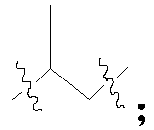 R1 is selected from the group consisting of hydroxyl, C1-C6 alkoxy and -NH-OH;R2 is selected from the group consisting of hydrogen, halogen and C1-C6 alkyl;R3 is selected from the group consisting of C2-C6 alkenyl, C2-C6 alkynyl, phenyl, naphthyl and 5- to 10-membered heteroaryl; optionally, the phenyl, naphthyl and 5- to 10-membered heteroaryl are each independently substituted by 1 to 5 groups selected from the group consisting of Rx, or the phenyl, naphthyl and 5- to 10-membered heteroaryl are each independently substituted by 2 adjacent groups, and the 2 adjacent groups and the carbon atoms to which they are respectively connected together form a 5- to 6-membered heterocyclic ring;Rx is selected from the group consisting of C1-C6 alkyl, halogen, C1-C6 alkoxy, C1-C6 haloalkyl, C2-C6 alkynyl, cyano, phenyl and -NRmRn;Rm and Rn are each independently selected from the group consisting of hydrogen and C1-C6 alkyl;L1 is selected from the group consisting of
 preferably, L1 is selected from the group consisting of
 L2 is selected from the group consisting of
 m is selected from the group consisting of 1, 2, 3, 4, 5 and 6;p is selected from the group consisting of 0, 1, 2 and 3;R4' is selected from the group consisting of phenyl-(CH2)r- and 5- to 10-membered heteroaryl-(CH2)r-, optionally, the phenyl and 5- to 10-membered heteroaryl are each independently substituted by 1 to 5 groups selected from the group consisting of Ra;r is selected from the group consisting of 0, 1, 2, 3, 4 and 5;Ra is selected from the group consisting of halogen, C1-C6 alkyl-O-C(=O)-, and 5- to 6-membered saturated heterocyclyl optionally substituted by
 Rb is selected from the group consisting of hydrogen and C1-C6 alkyl.
 - The compound, or stereoisomer, prodrug, crystal form, pharmaceutically acceptable salt, pharmaceutically acceptable solvate or pharmaceutically acceptable ester of the compound, according to claim 1, wherein R1 is selected from the group consisting of hydroxyl and C1-C6 alkoxy;preferably, R1 is selected from the group consisting of hydroxyl and ethoxy;more preferably, R1 is hydroxyl;or preferably, R1 is selected from the group consisting of hydroxyl, ethoxy and -NH-OH.
- The compound, or stereoisomer, prodrug, crystal form, pharmaceutically acceptable salt, pharmaceutically acceptable solvate or pharmaceutically acceptable ester of the compound, according to any one of claims 1 to 2, wherein R2 is selected from the group consisting of halogen and C1-C6 alkyl;preferably, R2 is selected from the group consisting of fluorine, chlorine and methyl;or preferably, R2 is selected from the group consisting of C1-C6 alkyl;or more preferably, R2 is methyl.
- The compound, or stereoisomer, prodrug, crystal form, pharmaceutically acceptable salt, pharmaceutically acceptable solvate or pharmaceutically acceptable ester of the compound, according to any one of claims 1 to 3, wherein R3 is selected from the group consisting of C2-C6 alkenyl, C2-C6 alkynyl, phenyl, naphthyl, pyridyl, pyrrolyl, thienyl and indolyl; optionally, the phenyl, naphthyl, pyridyl, pyrrolyl, thienyl and indolyl are each independently substituted by 1 to 2 (preferably 1) groups selected from the group consisting of Rx, or the phenyl, naphthyl, pyridyl, pyrrolyl, thienyl and indolyl are each independently substituted by 2 adjacent groups, and the 2 adjacent groups and the carbon atoms to which they are respectively connected together form a 5-to 6-membered heterocyclic ring;preferably, R3 is selected from the group consisting of C2-C6 alkenyl, C2-C6 alkynyl, phenyl, naphthyl, pyridyl, pyrrolyl, thienyl and indolyl; optionally, the phenyl, pyridyl and thienyl are each independently substituted by 1 to 2 (preferably 1) groups selected from the group consisting of Rx, or the phenyl is substituted by 2 adjacent groups, and the 2 adjacent groups and the carbon atoms to which they are respectively connected form
 more preferably, R3 is selected from the group consisting of:1)
 R4, R5, R6, R7 and R8 are each independently selected from the group consisting of hydrogen, C1-C6 alkyl, halogen, C1-C6 alkoxy, C1-C6 haloalkyl, C2-C6 alkynyl, cyano, phenyl and -NRmRn; or, R4, R5 and the carbon atoms to which they are respectively connected together form a 5- to 6-membered heterocyclic ring, and R6, R7 and R8 are hydrogen;preferably, any one of R4, R5, R6, R7 and R8 (e.g., R5, R6 or R7) is selected from the group consisting of hydrogen, C1-C6 alkyl, halogen, C1-C6 alkoxy, C1-C6 haloalkyl, C2-C6 alkynyl, cyano, phenyl and -NRmRn, and the rest are hydrogen;more preferably, any one of R4, R5, R6, R7 and R8 (e.g., R5, R6 or R7) is selected from the group consisting of hydrogen, methyl, fluorine, chlorine, iodine, methoxy,

 or preferably, R4, R5 and the carbon atoms to which they are respectively connected together form
 2)
2) R9, R10, R11 and R12 are each independently selected from the group consisting of hydrogen, C1-C6 alkyl, halogen and C1-C6 alkoxy;preferably, R9, R10, R11 and R12 are each independently selected from the group consisting of hydrogen, halogen and C1-C6 alkoxy;more preferably, any one of R9, R10, R11 and R12 (e.g., R10 or R11) is selected from the group consisting of hydrogen, halogen and C1-C6 alkoxy, and the rest are hydrogen;most preferably, any one of R9, R10, R11 and R12 (e.g., R10 or R11) is selected from the group consisting of hydrogen, chlorine and methoxy, and the rest are hydrogen;3)
 R13, R14 and R15 are each independently selected from the group consisting of hydrogen, C1-C6 alkyl and halogen;preferably, any one of R13, R14 and R15 (e.g., R13) is selected from the group consisting of hydrogen, C1-C6 alkyl and halogen, and the rest are hydrogen;more preferably, any one of R13, R14 and R15 (e.g., R13) is selected from the group consisting of hydrogen, methyl and chlorine, and the rest are hydrogen;4)
 most preferably, R3 is selected from the group consisting of


 preferably, Rx is selected from the group consisting of methyl, fluorine, chlorine, iodine, methoxy,
 preferably, among Rm and Rn, any one is hydrogen, and the other is selected from the group consisting of C1-C6 alkyl;preferably, among Rm and Rn, any one is hydrogen, and the other is methyl.
 - The compound, or stereoisomer, prodrug, crystal form, pharmaceutically acceptable salt, pharmaceutically acceptable solvate or pharmaceutically acceptable ester of the compound, according to any one of claims 1 to 4, wherein R4' is selected from the group consisting of phenyl-(CH2)r- and quinolyl-(CH2)r-, and optionally, the phenyl and quinolyl are each independently substituted by a group selected from the group consisting of Ra;preferably, R4' is selected from the group consisting of phenyl-(CH2)r- and quinolyl-(CH2)r-, and optionally, the phenyl is substituted by a group selected from the group consisting of Ra;preferably, r is selected from the group consisting of 0 and 1;preferably, Ra is selected from the group consisting of halogen, C1-C6 alkyl-O-C(=O)-, and piperazinyl which is substituted by
 more preferably, Ra is selected from the group consisting of halogen, C1-C6 alkyl-O-C(=O)-, and piperazinyl which is substituted by
 most preferably, Ra is selected from the group consisting of bromine,
 more preferably, Rb is methyl;more preferably, R4' is selected from the group consisting of
 r' is selected from the group consisting of 0, 1, 2, 3, 4 and 5;preferably, r' is selected from the group consisting of 0 and 1;R5', R6', R7', R8' and R9' are each independently selected from the group consisting of hydrogen, halogen, C1-C6 alkyl-O-C(=O)-, and 5- to 6-membered saturated heterocyclyl optionally substituted by
 preferably, among R5', R6', R7', R8' and R9', any one (e.g., R7') is selected from the group consisting of hydrogen, halogen, C1-C6 alkyl-O-C(=O)-, and 5- to 6-membered saturated heterocyclyl optionally substituted by
 more preferably, among R5', R6', R7', R8' and R9' , any one (e.g., R7') is selected from the group consisting of hydrogen, halogen, C1-C6 alkyl-O-C(=O)-, and piperazinyl which is substituted by
 further preferably, among R5', R6', R7', R8' and R9', any one (e.g., R7') is selected from the group consisting of hydrogen, halogen, C1-C6 alkyl-O-C(=O)-, and piperazinyl which is substituted by
 most preferably, among R5', R6', R7', R8' and R9', any one (e.g., R7') is selected from the group consisting of hydrogen, bromine,
 Rb' is selected from the group consisting of hydrogen and C1-C6 alkyl;preferably, Rb' is selected from the group consisting of C1-C6 alkyl;more preferably, Rb' is methyl;most preferably, R4' is selected from the group consisting of

- The compound, or stereoisomer, prodrug, crystal form, pharmaceutically acceptable salt, pharmaceutically acceptable solvate or pharmaceutically acceptable ester of the compound, according to any one of claims 1 to 5, wherein L1 is selected from the group consisting of


preferably, L1 is
- The compound, or stereoisomer, prodrug, crystal form, pharmaceutically acceptable salt, pharmaceutically acceptable solvate or pharmaceutically acceptable ester of said compound, according to any one of claims 1 to 6, wherein L2 is selected from the group consisting of
 preferably, L2 is selected from the group consisting of
 the carbonyl end is connected to R3;more preferably, L2 is selected from the group consisting of
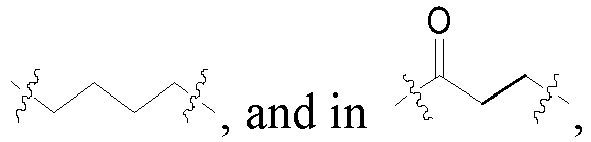 most preferably, L2 is
 preferably, n is selected from the group consisting of 2, 3 and 4;preferably, n is selected from the group consisting of 2 and 4;preferably, m is selected from the group consisting of 1, 2 and 3;preferably, m is 2;preferably, p is 0.
 - The compound, or stereoisomer, prodrug, crystal form, pharmaceutically acceptable salt, pharmaceutically acceptable solvate or pharmaceutically acceptable ester of the compound, according to any one of claims 1 to 7, wherein the structural formula of the compound represented by Formula I is selected from the group consisting of the following:
 X is selected from the group consisting of O, S and NH, preferably O;R0, R2, R3, L1 and L2 are defined in any one according to claims 1 to 7;R1' is selected from the group consisting of hydrogen and C1-C6 alkyl;preferably, R1' is selected from the group consisting of hydrogen and ethyl;more preferably, R1' is selected from the group consisting of hydrogen;R2' is selected from the group consisting of hydrogen and C1-C6 alkyl;preferably, R2' is selected from the group consisting of C1-C6 alkyl;more preferably, R2' is methyl;R3' is phenyl, optionally, the phenyl is substituted by 1 to 5 groups selected from the group consisting of C1-C6 alkyl;preferably, R3' is phenyl, optionally, the phenyl is substituted by 1 group selected from the group consisting of C1-C6 alkyl;more preferably, R3' is phenyl;L3 is selected from
 q is selected from the group consisting of 1, 2, 3, 4, 5 and 6;preferably, q is selected from the group consisting of 1, 2 and 3;more preferably, q is 2;R4' is selected from the group consisting of phenyl-(CH2)r- and 5- to 10-membered heteroaryl-(CH2)r-, optionally, the phenyl and 5- to 10-membered heteroaryl are each independently substituted by 1 to 5 groups selected from the group consisting of Ra;preferably, R4' is selected from the group consisting of phenyl-(CH2)r- and quinolyl-(CH2)r-, optionally, the phenyl and quinolyl are each independently substituted by 1 group selected from the group consisting of Ra;more preferably, R4' is selected from the group consisting of phenyl-(CH2)r- and quinolyl-(CH2)r-, optionally, the phenyl is substituted by 1 group selected from the group consisting of Ra;r is selected from the group consisting of 0, 1, 2, 3, 4 and 5;preferably, r is selected from the group consisting of 0 and 1;Ra is selected from the group consisting of halogen, C1-C6 alkyl-O-C(=O)-, and 5- to 6-membered saturated heterocyclyl optionally substituted by
 preferably, Ra is selected from the group consisting of halogen, C1-C6 alkyl-O-C(=O)-, and piperazinyl which is substituted by
 more preferably, Ra is selected from the group consisting of halogen, C1-C6 alkyl-O-C(=O)-, piperazinyl which is substituted by
 most preferably, Ra is selected from the group consisting of
 Rb is selected from the group consisting of hydrogen and C1-C6 alkyl;preferably, Rb is selected from the group consisting of C1-C6 alkyl;more preferably, Rb is methyl;further preferably, R4' is selected from the group consisting of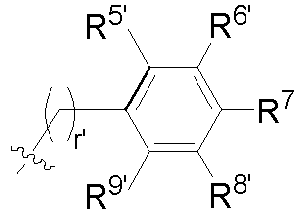
 r' is selected from the group consisting of 0, 1, 2, 3, 4 and 5;preferably, r' is selected from the group consisting of 0 and 1;R5', R6', R7', R8' and R9' are each independently selected from the group consisting of hydrogen, halogen, C1-C6 alkyl-O-C(=O)-, and 5- to 6-membered saturated heterocyclyl optionally substituted by
 preferably, among R5', R6', R7', R8' and R9', any one (e.g., R7') is selected from the group consisting of hydrogen, halogen, C1-C6 alkyl-O-C(=O)-, and 5- to 6-membered saturated heterocyclyl optionally substituted by
 more preferably, among R5', R6', R7', R8' and R9' , any one (e.g., R7') is selected from the group consisting of hydrogen, halogen, C1-C6 alkyl-O-C(=O)-, piperazinyl which is substituted by
 further preferably, among R5', R6', R7', R8' and R9', any one (e.g., R7') is selected from the group consisting of hydrogen, halogen, C1-C6 alkyl-O-C(=O)-, and piperazinyl which is substituted by
 most preferably, among R5', R6', R7', R8' and R9', any one (e.g., R7') is selected from the group consisting of hydrogen, bromine,
 Rb' is selected from the group consisting of hydrogen and C1-C6 alkyl;preferably, Rb' is selected from the group consisting of C1-C6 alkyl;more preferably, Rb' is methyl;most preferably, R4' is selected from the group consisting of

- The compound, or stereoisomer, prodrug, crystal form, pharmaceutically acceptable salt, pharmaceutically acceptable solvate or pharmaceutically acceptable ester of the compound, according to claim 8, wherein the structural formula of the compound represented by Formula I-1 is:
 X is selected from the group consisting of O, S and NH, preferably O;R1, R2, R3, L1 and L2 are defined in any one according to claims 1 to 7.
 - The compound, or stereoisomer, prodrug, crystal form, pharmaceutically acceptable salt, pharmaceutically acceptable solvate or pharmaceutically acceptable ester of the compound, according to claim 8, wherein the structural formula of the compound represented by Formula I-2 is:
 R1, R2, R3, La, L1 and L2 are defined in any one according to claims 1 to 7;preferably, R1 is hydroxyl;preferably, R2 is selected from the group consisting of halogen;more preferably, R2 is fluorine;preferably, R3 is
 preferably, La is selected from the group consisting of C1-C6 alkylene;more preferably, La is selected from the group consisting of
 preferably, L1 is selected from the group consisting of
 more preferably, L1 is
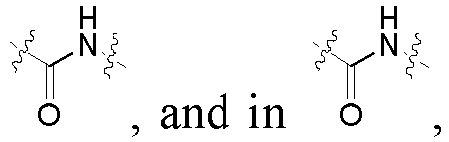 preferably, L2 is selected from
 more preferably, L2 is selected from the group consisting of
 preferably, n is selected from the group consisting of 1, 2, 3, 4, 5 and 6;more preferably, n is selected from the group consisting of 2 and 3.
 - The compound, or stereoisomer, prodrug, crystal form, pharmaceutically acceptable salt, pharmaceutically acceptable solvate or pharmaceutically acceptable ester of the compound, according to any one of claims 1 to 10, wherein the compound is selected from the group consisting of the following:
No. Structural Formula No. Structural Formula 1 
16 
2 
17 
3 
18 
4 
19 
5 
20 
6 
21 
7 
22 
B101 
B113 
B102 
B114 
B103 
B115 
GPR132-A-8 
B116 
B104 
B117 
B105 
B118 
B106 
B119 
B107 
B120 
B108 
B121 
B109 
B122 
B110 
B123 
B111 
B124 
B112 
B125 
B126 
B127 
B128 
B129 
B130 
B131 
B132 
B133 
9 
24 
10 
25 
11 
26 
12 
27 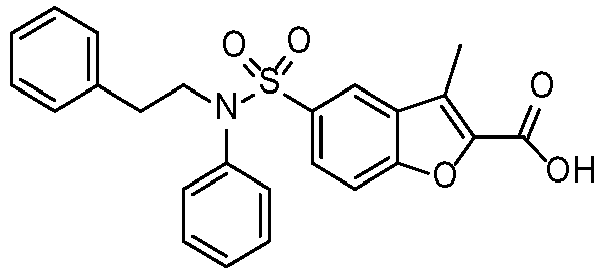
14 
29 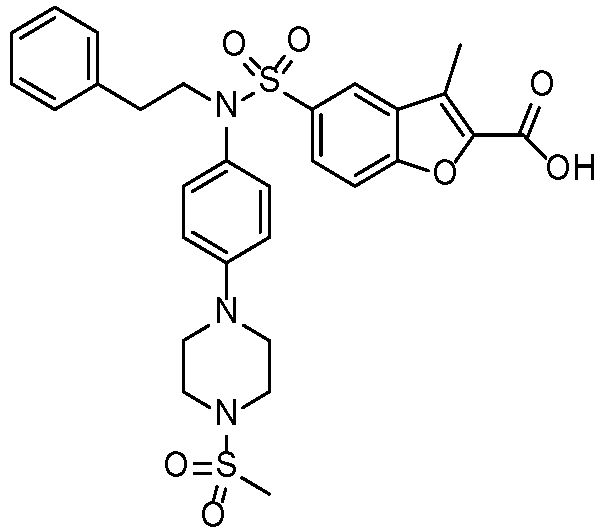
- A pharmaceutical composition, which comprises the compound, or stereoisomer, prodrug, crystal form, pharmaceutically acceptable salt, pharmaceutically acceptable solvate or pharmaceutically acceptable ester of the compound, according to any one of claims 1 to 11, and an optional pharmaceutically acceptable excipient.
- Use of the compound, or stereoisomer, prodrug, crystal form, pharmaceutically acceptable salt, pharmaceutically acceptable solvate or pharmaceutically acceptable ester of the compound, according to any one of claims 1 to 11, in manufacture of a medicament; or use of the pharmaceutical composition according to any one of claim 12 in manufacture of a medicament; or use of the compound shown in the following table, or stereoisomer, prodrug, crystal form, pharmaceutically acceptable salt, pharmaceutically acceptable solvate or pharmaceutically acceptable ester of the compound, in the manufacture of a medicament, wherein the medicament is used for treatment and/or prevention of a disease related to GPR132, or for hematopoietic stem cell transplantation, or for bone marrow transplantation;
No. Structural Formula No. Structural Formula 8 
23 
13 
28 
15 
30  preferably, the disease related to GPR132 is selected from the group consisting of tumor, metabolic disease, immune-related disease, and neuropathic pain;preferably, the tumor is selected from the group consisting of breast cancer, melanoma, meningioma, soft tissue sarcoma, salivary gland tumor, liver cancer (e.g., primary liver cancer), intraspinal tumor, mediastinal tumor, brain cancer, bone cancer, penile cancer, osteosarcoma, intracranial tumor, tongue cancer, maxillary sinus cancer, thyroid cancer, malignant lymphoma, multiple myeloma, pituitary adenoma, testicular tumor, non-Hodgkin's lymphoma, bladder cancer, leukemia (e.g., acute myeloid leukemia), gastric cancer, nasopharyngeal cancer, laryngeal cancer, oral cancer, esophageal cancer, lung cancer, kidney cancer, cervical cancer, choriocarcinoma, vulvar cancer, skin cancer, endometrial cancer, ovarian cancer, prostate cancer, pancreatic cancer, colon cancer, rectal cancer, colorectal cancer, Kaposi's sarcoma, non-melanoma skin cancer (including squamous cell carcinoma and basal cell carcinoma), hemangioma, and glioma;preferably, the metabolic disease is selected from the group consisting of atherosclerosis, obesity, non-alcoholic fatty liver disease (NAFLD) (e.g., simple fatty liver or non-alcoholic steatohepatitis (NASH)), metabolic syndrome, type 2 diabetes, type 1 diabetes, insulin resistance, hyperinsulinemia, glucose intolerance, hyperglycemia, hyperlipidemia (e.g., hypercholesterolemia), and secondary complications of these diseases (e.g., complications of diabetes, such as retinopathy, neuropathy, nephropathy and delayed wound healing, or cardiovascular and cerebrovascular diseases such as atherosclerosis, coronary heart disease, hypertension, and stroke);preferably, the immune-related disease is selected from the group consisting of:secondary immunodeficiency: for example, secondary immunodeficiency caused by infection (e.g., rubella, measles, leprosy, tuberculosis, cytomegalovirus infection, HIV infection, coccidioidomycosis infection), protein loss (e.g., nephrotic syndrome, protein-losing enteropathy), insufficient immunoglobulin synthesis, lymphocyte loss (e.g., lymphocyte loss caused by drug and/or systemic infection), secondary immunodeficiency caused by other diseases (e.g., diabetes, cirrhosis, subacute sclerosing panencephalitis) and/or immunosuppressive therapy, andautoimmune disease: for example, inflammatory bowel disease, systemic lupus erythematosus, rheumatoid arthritis, scleroderma, hyperthyroidism, juvenile diabetes, idiopathic thrombocytic purpura, autoimmune hemolytic anemia, colorectal inflammation (e.g., ulcerative colitis), skin disease, chronic liver disease.
Applications Claiming Priority (2)
| Application Number | Priority Date | Filing Date | Title |
|---|---|---|---|
| CN202210404732 | 2022-04-18 | ||
| PCT/CN2023/088997 WO2023202578A1 (en) | 2022-04-18 | 2023-04-18 | Gpcr regulator and use thereof |
Publications (2)
| Publication Number | Publication Date |
|---|---|
| EP4512803A1 true EP4512803A1 (en) | 2025-02-26 |
| EP4512803A4 EP4512803A4 (en) | 2026-04-08 |
Family
ID=88360958
Family Applications (1)
| Application Number | Title | Priority Date | Filing Date |
|---|---|---|---|
| EP23791233.2A Pending EP4512803A4 (en) | 2022-04-18 | 2023-04-18 | GPCR REGULATOR AND ITS USE |
Country Status (7)
| Country | Link |
|---|---|
| US (1) | US20250275958A1 (en) |
| EP (1) | EP4512803A4 (en) |
| JP (1) | JP2025514766A (en) |
| KR (1) | KR20250006901A (en) |
| CN (1) | CN116903562A (en) |
| AU (1) | AU2023256071A1 (en) |
| WO (1) | WO2023202578A1 (en) |
Cited By (1)
| Publication number | Priority date | Publication date | Assignee | Title |
|---|---|---|---|---|
| EP4324825A4 (en) * | 2021-04-16 | 2025-08-27 | Beijing Best Pathway Man Consulting Center Limited Partnership | FXR regulator, manufacturing process therefor, pharmaceutical composition thereof and use thereof |
Family Cites Families (5)
| Publication number | Priority date | Publication date | Assignee | Title |
|---|---|---|---|---|
| WO2006101454A1 (en) * | 2005-03-21 | 2006-09-28 | S*Bio Pte Ltd | Benzothiophene derivatives: preparation and pharmaceutical applications |
| JP2007262009A (en) * | 2006-03-29 | 2007-10-11 | Dai Ichi Seiyaku Co Ltd | Heteroaryl lower carboxylic acid derivative |
| CN107619384B (en) * | 2016-07-13 | 2020-07-28 | 江苏恒瑞医药股份有限公司 | Benzo-heterocycle derivative, preparation method and application thereof in medicine |
| WO2019080882A1 (en) * | 2017-10-25 | 2019-05-02 | 成都先导药物开发有限公司 | HDAC INHIBITOR, PREPARATION METHOD AND USE THEREOF |
| EP4324825A4 (en) * | 2021-04-16 | 2025-08-27 | Beijing Best Pathway Man Consulting Center Limited Partnership | FXR regulator, manufacturing process therefor, pharmaceutical composition thereof and use thereof |
-
2023
- 2023-04-18 AU AU2023256071A patent/AU2023256071A1/en active Pending
- 2023-04-18 CN CN202310416571.2A patent/CN116903562A/en active Pending
- 2023-04-18 JP JP2024561874A patent/JP2025514766A/en active Pending
- 2023-04-18 EP EP23791233.2A patent/EP4512803A4/en active Pending
- 2023-04-18 KR KR1020247038177A patent/KR20250006901A/en active Pending
- 2023-04-18 WO PCT/CN2023/088997 patent/WO2023202578A1/en not_active Ceased
- 2023-04-18 US US18/857,713 patent/US20250275958A1/en active Pending
Cited By (1)
| Publication number | Priority date | Publication date | Assignee | Title |
|---|---|---|---|---|
| EP4324825A4 (en) * | 2021-04-16 | 2025-08-27 | Beijing Best Pathway Man Consulting Center Limited Partnership | FXR regulator, manufacturing process therefor, pharmaceutical composition thereof and use thereof |
Also Published As
| Publication number | Publication date |
|---|---|
| KR20250006901A (en) | 2025-01-13 |
| US20250275958A1 (en) | 2025-09-04 |
| WO2023202578A1 (en) | 2023-10-26 |
| JP2025514766A (en) | 2025-05-09 |
| AU2023256071A1 (en) | 2024-11-14 |
| CN116903562A (en) | 2023-10-20 |
| EP4512803A4 (en) | 2026-04-08 |
Similar Documents
| Publication | Publication Date | Title |
|---|---|---|
| CN116444498B (en) | THRβ receptor agonist compound and preparation method and use thereof | |
| KR101751325B1 (en) | Novel compounds effective as xanthine oxidase inhibitors, method for preparing the same, and pharmaceutical composition containing the same | |
| CA2714181C (en) | Ampk modulators | |
| WO2020177653A1 (en) | Pyrazine derivative and application thereof in inhibiting shp2 | |
| TWI718113B (en) | Pyridinecarboxamides derivatives, preparation process and pharmaceutical use thereof | |
| JP2009533410A (en) | Azetidine derivatives as G protein-coupled receptor (GPR119) agonists | |
| TW202115052A (en) | Aromatic ring or aromatic heterocyclic compounds, preparation method and medical use thereof | |
| KR102678581B1 (en) | Novel LXR modulators with bicyclic core moieties | |
| CN114375193A (en) | Thyroid hormone receptor beta agonist compounds | |
| KR20100126467A (en) | Tyrosine kinase inhibitors | |
| KR20210079290A (en) | Treatment of nonalcoholic fatty liver disease | |
| TW202203940A (en) | Nucleotide prodrug compounds | |
| WO2020083264A1 (en) | Guanidine derivative and uses thereof | |
| US20250275958A1 (en) | Gpcr regulator and use thereof | |
| WO2009133314A1 (en) | 1,3-dihydro-2h-pyrrolo[3,2-b]pyridin-2-one derivatives, preparation thereof and therapeutic uses thereof | |
| EP3259256B1 (en) | Compounds and methods for inducing browning of white adipose tissue | |
| CN101087783B (en) | Trisubstituted thiophenes as progesterone receptor modulators | |
| JP2022525121A (en) | Pyrazolopyridine derivative as an inhibitor of PASK | |
| CN105646330B (en) | Aromatic Heterocyclic Derivatives and Their Applications in Medicine | |
| JP2008534439A (en) | Inhibitor of checkpoint kinase | |
| KR102967967B1 (en) | Novel compound with pendrin inhibitory activity and medical use thereof | |
| CN118084898B (en) | iCRT14 derivatives and preparation methods and applications thereof | |
| EP4558478A1 (en) | Aryl hydrocarbon receptor agonist prodrugs and methods of use thereof | |
| WO2006032771A1 (en) | Indolin-2-one pyridine derivatives, preparation and therapeutic use thereof | |
| HK40061204A (en) | Pyrazine derivative and application thereof in inhibiting shp2 |
Legal Events
| Date | Code | Title | Description |
|---|---|---|---|
| STAA | Information on the status of an ep patent application or granted ep patent |
Free format text: STATUS: THE INTERNATIONAL PUBLICATION HAS BEEN MADE |
|
| PUAI | Public reference made under article 153(3) epc to a published international application that has entered the european phase |
Free format text: ORIGINAL CODE: 0009012 |
|
| STAA | Information on the status of an ep patent application or granted ep patent |
Free format text: STATUS: REQUEST FOR EXAMINATION WAS MADE |
|
| 17P | Request for examination filed |
Effective date: 20241112 |
|
| AK | Designated contracting states |
Kind code of ref document: A1 Designated state(s): AL AT BE BG CH CY CZ DE DK EE ES FI FR GB GR HR HU IE IS IT LI LT LU LV MC ME MK MT NL NO PL PT RO RS SE SI SK SM TR |
|
| DAV | Request for validation of the european patent (deleted) | ||
| DAX | Request for extension of the european patent (deleted) | ||
| A4 | Supplementary search report drawn up and despatched |
Effective date: 20260306 |
|
| RIC1 | Information provided on ipc code assigned before grant |
Ipc: C07D 307/79 20060101AFI20260302BHEP Ipc: C07D 333/62 20060101ALI20260302BHEP Ipc: C07D 209/10 20060101ALI20260302BHEP Ipc: A61K 31/343 20060101ALI20260302BHEP Ipc: A61K 31/404 20060101ALI20260302BHEP Ipc: A61K 31/381 20060101ALI20260302BHEP Ipc: A61P 3/00 20060101ALI20260302BHEP Ipc: A61P 35/00 20060101ALI20260302BHEP Ipc: A61P 37/02 20060101ALI20260302BHEP |