EP4512674A1 - Trailer yaw-rate estimator - Google Patents
Trailer yaw-rate estimator Download PDFInfo
- Publication number
- EP4512674A1 EP4512674A1 EP23193089.2A EP23193089A EP4512674A1 EP 4512674 A1 EP4512674 A1 EP 4512674A1 EP 23193089 A EP23193089 A EP 23193089A EP 4512674 A1 EP4512674 A1 EP 4512674A1
- Authority
- EP
- European Patent Office
- Prior art keywords
- trailer
- truck
- yaw
- rate
- sensor
- Prior art date
- Legal status (The legal status is an assumption and is not a legal conclusion. Google has not performed a legal analysis and makes no representation as to the accuracy of the status listed.)
- Pending
Links
Images


Classifications
-
- B—PERFORMING OPERATIONS; TRANSPORTING
- B62—LAND VEHICLES FOR TRAVELLING OTHERWISE THAN ON RAILS
- B62D—MOTOR VEHICLES; TRAILERS
- B62D13/00—Steering specially adapted for trailers
-
- B—PERFORMING OPERATIONS; TRANSPORTING
- B60—VEHICLES IN GENERAL
- B60T—VEHICLE BRAKE CONTROL SYSTEMS OR PARTS THEREOF; BRAKE CONTROL SYSTEMS OR PARTS THEREOF, IN GENERAL; ARRANGEMENT OF BRAKING ELEMENTS ON VEHICLES IN GENERAL; PORTABLE DEVICES FOR PREVENTING UNWANTED MOVEMENT OF VEHICLES; VEHICLE MODIFICATIONS TO FACILITATE COOLING OF BRAKES
- B60T8/00—Arrangements for adjusting wheel-braking force to meet varying vehicular or ground-surface conditions, e.g. limiting or varying distribution of braking force
- B60T8/17—Using electrical or electronic regulation means to control braking
- B60T8/1701—Braking or traction control means specially adapted for particular types of vehicles
- B60T8/1708—Braking or traction control means specially adapted for particular types of vehicles for lorries or tractor-trailer combinations
-
- B—PERFORMING OPERATIONS; TRANSPORTING
- B60—VEHICLES IN GENERAL
- B60T—VEHICLE BRAKE CONTROL SYSTEMS OR PARTS THEREOF; BRAKE CONTROL SYSTEMS OR PARTS THEREOF, IN GENERAL; ARRANGEMENT OF BRAKING ELEMENTS ON VEHICLES IN GENERAL; PORTABLE DEVICES FOR PREVENTING UNWANTED MOVEMENT OF VEHICLES; VEHICLE MODIFICATIONS TO FACILITATE COOLING OF BRAKES
- B60T8/00—Arrangements for adjusting wheel-braking force to meet varying vehicular or ground-surface conditions, e.g. limiting or varying distribution of braking force
- B60T8/17—Using electrical or electronic regulation means to control braking
- B60T8/1755—Brake regulation specially adapted to control the stability of the vehicle, e.g. taking into account yaw rate or transverse acceleration in a curve
- B60T8/17552—Brake regulation specially adapted to control the stability of the vehicle, e.g. taking into account yaw rate or transverse acceleration in a curve responsive to the tyre sideslip angle or the vehicle body slip angle
-
- B—PERFORMING OPERATIONS; TRANSPORTING
- B62—LAND VEHICLES FOR TRAVELLING OTHERWISE THAN ON RAILS
- B62D—MOTOR VEHICLES; TRAILERS
- B62D15/00—Steering not otherwise provided for
- B62D15/02—Steering position indicators ; Steering position determination; Steering aids
- B62D15/025—Active steering aids, e.g. helping the driver by actively influencing the steering system after environment evaluation
-
- B—PERFORMING OPERATIONS; TRANSPORTING
- B62—LAND VEHICLES FOR TRAVELLING OTHERWISE THAN ON RAILS
- B62D—MOTOR VEHICLES; TRAILERS
- B62D6/00—Arrangements for automatically controlling steering depending on driving conditions sensed and responded to, e.g. control circuits
- B62D6/002—Arrangements for automatically controlling steering depending on driving conditions sensed and responded to, e.g. control circuits computing target steering angles for front or rear wheels
- B62D6/003—Arrangements for automatically controlling steering depending on driving conditions sensed and responded to, e.g. control circuits computing target steering angles for front or rear wheels in order to control vehicle yaw movement, i.e. around a vertical axis
-
- B—PERFORMING OPERATIONS; TRANSPORTING
- B60—VEHICLES IN GENERAL
- B60T—VEHICLE BRAKE CONTROL SYSTEMS OR PARTS THEREOF; BRAKE CONTROL SYSTEMS OR PARTS THEREOF, IN GENERAL; ARRANGEMENT OF BRAKING ELEMENTS ON VEHICLES IN GENERAL; PORTABLE DEVICES FOR PREVENTING UNWANTED MOVEMENT OF VEHICLES; VEHICLE MODIFICATIONS TO FACILITATE COOLING OF BRAKES
- B60T2230/00—Monitoring, detecting special vehicle behaviour; Counteracting thereof
- B60T2230/06—Tractor-trailer swaying
-
- B—PERFORMING OPERATIONS; TRANSPORTING
- B60—VEHICLES IN GENERAL
- B60T—VEHICLE BRAKE CONTROL SYSTEMS OR PARTS THEREOF; BRAKE CONTROL SYSTEMS OR PARTS THEREOF, IN GENERAL; ARRANGEMENT OF BRAKING ELEMENTS ON VEHICLES IN GENERAL; PORTABLE DEVICES FOR PREVENTING UNWANTED MOVEMENT OF VEHICLES; VEHICLE MODIFICATIONS TO FACILITATE COOLING OF BRAKES
- B60T2250/00—Monitoring, detecting, estimating vehicle conditions
- B60T2250/03—Vehicle yaw rate
Definitions
- the present invention relates to a trailer yaw-rate estimator and, in particular, to a trailer yaw-rate estimation from trailer wheel speed values.
- the yaw-rate of a trailer is, however, one of the important state variables for an estimation of the current and future behavior of a trailer or of vehicle combinations.
- the yaw-rate value can be combined with the yaw-rate of a truck (towing vehicle) that tows the trailer to evaluate reliably the vehicle state and to predict an instable driving situation of the whole vehicle combination.
- the yaw-rate of the trailer is often a desired input for environmental sensors - not only on the truck, but also on the trailer.
- the environmental sensors of the truck may utilize signals from the yaw-rate sensor as an input to determine in which direction the trailer is heading.
- These environmental (perceptional) sensors may be mounted on a trailer and may expect the yaw-rate of the trailer as an input value.
- radar sensors as an example of environmental sensors can be mounted on the trailer may use the yaw-rate of the trailer itself as an input to interpret the situation correctly.
- the exemplary radar sensor may be able, based on the provided yaw-rate and optional other input values, to distinguish detected objects as stationary objects or as moving objects. For example, when the trailer is performing a cornering (yaw-rate is nonzero), an object such as a tree may appear as not moving although the trailer itself moves around the corner. Such situations can correctly be interpreted if the yaw-rate is available to the exemplary radar sensor. Same applies to cameras and other environmental sensors.
- the present disclosure relates to a trailer yaw-rate estimator, wherein the trailer and a truck represent a vehicle combination with one or more sensors for providing sensor data indicative of a yaw-rate of the trailer.
- the yaw-rate estimator includes a data processing unit configured to estimate the yaw-rate of the trailer based on the provided sensor data.
- the sensor data include at least one of the following:
- the steering angle of the trailer refers to trailers with a steered axel or a dolly (e.g. steered by a drawbar).
- the speed values of wheels may relate to wheels on a non-steered or non-dolly axles and may be measured on opposite sides of one axle.
- the data processing unit is further configured to base the estimation of the yaw-rate additionally on at least one of the following parameters:
- At least some of the parameter(s) may be geometric parameter(s) defining the geometry of the trailer and/or truck.
- the term "indicative" will be used within this disclosure as representing a functional relationship.
- data indicative of a yaw-rate relates to all data that influence the yaw-rate (i.e. a change of the data changes the yaw-rata) or parameters indicative of an axlebase may be the value of the axlebase or any other value from which the axlebase can be derived.
- the paratameter(s) may be stored in the estimator or may be retrieved from another trailer or truck components (e.g. a storage or an electronic control unit, ECU).
- the one or more sensors may include multiple trailer sensors installed on the trailer.
- the data processing unit is configured to estimate the yaw-rate based only on trailer sensor data provided by the multiple sensors installed on the trailer.
- the trailer sensor data may include at least one of the following:
- the one or more sensors may include multiple truck sensors installed on the truck.
- the data processing unit is configured to estimate the yaw-rate based only on truck sensor data provided by the multiple sensors installed on the truck.
- the truck sensor data may include at least one of the following:
- the one or more sensors may include at least one truck sensor installed on the truck and at least one trailer sensor installed on the trailer.
- the data processing unit is configured to estimate the yaw-rate based on a combination of truck sensor data provided by the at least one truck sensor and of trailer sensor data provided by the at least one trailer sensor.
- the combination of sensor data may include one or more of the following:
- the trailer is configured receive truck sensor data of a truck sensor, wherein the truck is configured to tow the trailer.
- the trailer includes further:
- the received truck sensor data may be utilized for the estimate itself or for improving an available estimate of the yaw-rate.
- the environmental sensor may use the yaw rate for the situational awareness such as the determination of the current moving direction.
- the trailer is one of the following: a steered trailer, a semitrailer, central axle trailer.
- Embodiments of the present disclosure can, in particular, be implemented by software or software modules installed in an electronic control unit (ECU). Therefore, embodiment relate also to a computer program or a computer-readable storage device having a program code for performing the method when the computer program is executed on a processor (e.g. on the estimator as defined before).
- ECU electronice control unit
- Embodiments overcome the problems of trailers by providing an estimator dedicated to be installed on the trailer and by providing a method to estimate a yaw-rate of a vehicle such as a trailer or a truck-semi trailer or a central axle trailer.
- existing sensors are utilized to estimate or determined the yaw-rate of a trailer or a semi-trailer.
- Such available sensors may include wheel speed sensors, steering angle sensors, sensors to detect an articulation angle and other sensors.
- Embodiments refer to both situations.
- the term “trailer” shall also include semi-trailer and central axle trailer and any other vehicle that can be towed by a towing vehicle.
- the term “yaw-rate” can be defined as the angular velocity about the vertical axis and thus defines a speed level (rate) of the trailer 10 with which it is turning at a given moment. Hence, this physical quantity is clearly related to the articulation angle 60 or steering angle 70 in combination with the wheel speeds of the trailer 10. In particular, speed values for wheels on opposite sided of non-steered axles are suitable to determine a turning maneuver or the radius of the curve (e.g. based on the speed differences).
- the speed values also allow to determine the lateral speed of the trailer/vehicle, whether or not it performs a motion along a curve or a straight line. It is thus straightforward to determine a rate of directional change and thus the yaw-rate based only on the different wheel speeds.
- the yaw-rate 50 of the trailer 10 can be calculated or at least estimated. It is understood that not all of the sensor data is needed. Already, some of this sensor data may allow a more or less correct estimate for the yaw-rate 50 which can then be further improved by including further optional sensor data 115, 125.
- one or more parameters 116, 118, 119, 126 may be utilized to further improve the estimate, which will be described in the following.
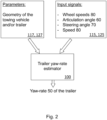
- Fig. 2 illustrates further details being realized in additional embodiments.
- the input values for the yaw-rate estimator 100 can be distinguished between sensor data 115, 127 on the one hand and, on the other hand, parameters 117, 127 which are available from other sources and define (non-dynamic) characteristics of the particular trailer 10 or of the particular truck 20.
- the parameters 117, 127 are one or more (geometric) parameters 117 of trailer and/or one or more (geometric) parameters 127 of the truck.
- the parameters 117, 127 may include all available geometry data of the truck 20 and/or the trailer 10.
- the geometric parameters 117 of trailer 10 may include (see Fig. 1 ): a track width 116, one or more axlebases or wheelbases 118, kingpin base 119 (distance to coupling point between the trailer 10 and truck 20).
- the geometric parameters 127 of the truck 20 may include: a track width 126, one or more axlebases or wheelbases 128, position of the trailer coupling point 30.
- Further parameters may be the weight or size (length, width, height) of the trailer and/or the truck, the number of wheels, number of axles.
- the yaw-rate estimator 100 retrieves these parameters from another vehicle component such as a storage or an electronic control unit. Alternatively or additionally, these parameters can be stored locally in the estimator 100. Therefore, the estimator 100 may comprise a data storage to store at least some of these parameters 117, 127. These parameters 117, 127 further improve the estimate. For example, the deviation in the wheel speeds on both sides of the trailer 10 implies apparently a stronger yaw-rate 50 when the track width is smaller and vice versa.
- the yaw-rate estimator 100 can rely only on sensor data 125 from the truck 20 and sensor data 115 from the trailer 10, wherein less information might be needed from the trailer 10.
- the truck 20 can provide the steering angle 70 and/or the articulation angle 60 which, in combination, with at least one wheel speed value from the wheel speed sensor 15 on the trailer 10 may be sufficient to determine accurately the yaw-rate 50 acting on the trailer 10.
- the yaw-rate 50 can be estimated by processing at least two-wheel speed values, for example on a same (non-steered) axle, because a rate of directional change of the trailer 10 corresponds to different speed values on both sides of the trailer 10. If the left wheels rotate with the same speed as the wheels on the right-hand side, one can assume that the trailer 10 moves along a straight line (zero yaw-rate 50).
- the estimator 100 may further base the estimation on the velocity of the trailer 10. This value can be obtained by an average of the speed values of two wheels on opposite sides. As a result, even if no information is received from the truck 20 (e.g. no available data connection), the estimation of the yaw-rate 50 can still be performed.
- the trailer 10 may estimate the yaw-rate 50 autonomously.
- Fig. 3 depicts a schematic flow diagram of a method for estimating a yaw-rate of a trailer of a vehicle combination with a truck 20 and the trailer 10.
- the method includes:
- the sensor data may include any of the above-mentioned quantities. Furthermore, the method may be performed by a data processing unit of an estimator 100 installed on the trailer 10 as described before.
- This method may also be a computer-implemented method.
- a person of skill in the art would readily recognize that steps of various above-described methods may be performed by programmed computers.
- Embodiments are also intended to cover program storage devices, e.g., digital data storage media, which are machine or computer readable and encode machine-executable or computer-executable programs of instructions, wherein the instructions perform some or all of the acts of the above-described methods, when executed on the computer or processor.
- the geometry described by the geometric parameter may include not only parameters such as the axle basis and wheel basis of the respective vehicle (towing vehicle or trailer), but also the king pin basis utilized for estimating the yaw-rate plus the trailer axis basis and trailer wheel basis.
Landscapes
- Engineering & Computer Science (AREA)
- Transportation (AREA)
- Mechanical Engineering (AREA)
- Chemical & Material Sciences (AREA)
- Combustion & Propulsion (AREA)
- Physics & Mathematics (AREA)
- Mathematical Physics (AREA)
- Steering Control In Accordance With Driving Conditions (AREA)
Abstract
Description
- The present invention relates to a trailer yaw-rate estimator and, in particular, to a trailer yaw-rate estimation from trailer wheel speed values.
- Although trucks are usually equipped with a yaw-rate sensor, such a sensor is rarely available in conventional trailers. The yaw-rate of a trailer is, however, one of the important state variables for an estimation of the current and future behavior of a trailer or of vehicle combinations. The yaw-rate value can be combined with the yaw-rate of a truck (towing vehicle) that tows the trailer to evaluate reliably the vehicle state and to predict an instable driving situation of the whole vehicle combination.
- Moreover, even if the yaw-rate of the trailer is not utilized by the towing vehicle (e.g. for future state estimation), the yaw-rate of the trailer is often a desired input for environmental sensors - not only on the truck, but also on the trailer. For example, the environmental sensors of the truck may utilize signals from the yaw-rate sensor as an input to determine in which direction the trailer is heading. These environmental (perceptional) sensors may be mounted on a trailer and may expect the yaw-rate of the trailer as an input value.
- For example, radar sensors as an example of environmental sensors can be mounted on the trailer may use the yaw-rate of the trailer itself as an input to interpret the situation correctly. The exemplary radar sensor may be able, based on the provided yaw-rate and optional other input values, to distinguish detected objects as stationary objects or as moving objects. For example, when the trailer is performing a cornering (yaw-rate is nonzero), an object such as a tree may appear as not moving although the trailer itself moves around the corner. Such situations can correctly be interpreted if the yaw-rate is available to the exemplary radar sensor. Same applies to cameras and other environmental sensors.
- Since conventional trailers are not able to provide this information itself, they have to rely on yaw-rate values provided by the truck. However, these values may not be accurately enough or may be absent. In either case, there is a demand for an estimator to estimate the yaw-rate of a trailer itself so that there is no need to rely on the yaw-rate obtained from the truck.
- At least some of the above-mentioned problems are overcome by an estimator according to claim 1 or a method according to claim 9. The dependent claims refer to further advantageous realizations of the subject matter of the independent claims.
- The present disclosure relates to a trailer yaw-rate estimator, wherein the trailer and a truck represent a vehicle combination with one or more sensors for providing sensor data indicative of a yaw-rate of the trailer. The yaw-rate estimator includes a data processing unit configured to estimate the yaw-rate of the trailer based on the provided sensor data. The sensor data include at least one of the following:
- one or more speed values of wheels of the trailer,
- a steering angle of the truck,
- steering angle of the trailer,
- articulation angle between trailer and truck,
- yaw rate of the truck,
- a speed value of the truck.
- The steering angle of the trailer refers to trailers with a steered axel or a dolly (e.g. steered by a drawbar). The speed values of wheels may relate to wheels on a non-steered or non-dolly axles and may be measured on opposite sides of one axle.
- Optionally, the data processing unit is further configured to base the estimation of the yaw-rate additionally on at least one of the following parameters:
- parameter(s) indicative of an axlebase of the trailer,
- parameter(s) indicative of a wheelbase of the trailer,
- parameter(s) indicative of an axlebase of the truck,
- parameter(s) indicative of a wheelbase of the truck,
- parameter(s) defining position of a coupling point between the trailer and the tuck (e.g. a kingpin bases or distances between kingpin and at least one axles).
- At least some of the parameter(s) may be geometric parameter(s) defining the geometry of the trailer and/or truck. The term "indicative" will be used within this disclosure as representing a functional relationship. For example, data indicative of a yaw-rate relates to all data that influence the yaw-rate (i.e. a change of the data changes the yaw-rata) or parameters indicative of an axlebase may be the value of the axlebase or any other value from which the axlebase can be derived. The paratameter(s) may be stored in the estimator or may be retrieved from another trailer or truck components (e.g. a storage or an electronic control unit, ECU).
- The one or more sensors may include multiple trailer sensors installed on the trailer. Then, optionally, the data processing unit is configured to estimate the yaw-rate based only on trailer sensor data provided by the multiple sensors installed on the trailer. The trailer sensor data may include at least one of the following:
- wheel speed values of two trailer wheels mounted on opposite sides of one trailer axle (e.g. a non-steered axle),
- the articulation angle between the trailer and the truck in combination with one of the wheel speed values of the trailer wheels.
- The one or more sensors may include multiple truck sensors installed on the truck. Then, optionally, the data processing unit is configured to estimate the yaw-rate based only on truck sensor data provided by the multiple sensors installed on the truck. The truck sensor data may include at least one of the following:
- the wheel speed value of at least one wheel of the truck in combination with the steering angle,
- the wheel speed value of at least one wheel of the truck in combination with the articulation angle between the trailer and the truck,
- the yaw-rate value of the truck,
- a longitudinal speed of the truck in combination with the steering angle and/or with the articulation angle.
- The one or more sensors may include at least one truck sensor installed on the truck and at least one trailer sensor installed on the trailer. Then, optionally, the data processing unit is configured to estimate the yaw-rate based on a combination of truck sensor data provided by the at least one truck sensor and of trailer sensor data provided by the at least one trailer sensor. The combination of sensor data may include one or more of the following:
- the steering angle of the truck and one wheel speed value of a wheel of the trailer,
- multiple wheel speed values of at least one wheel of the truck and of at least one wheel of the trailer.
- Further embodiments relate to a trailer with a trailer sensor. Optionally, the trailer is configured receive truck sensor data of a truck sensor, wherein the truck is configured to tow the trailer. The trailer includes further:
- a trailer yaw-rate estimator as defined before; and
- an environmental sensor, especially a radar sensor, which includes an input for the yaw-rate provided by the yaw-rate estimator.
- The received truck sensor data may be utilized for the estimate itself or for improving an available estimate of the yaw-rate.
- The environmental sensor may use the yaw rate for the situational awareness such as the determination of the current moving direction.
- Optionally, the trailer is one of the following: a steered trailer, a semitrailer, central axle trailer.
- Further embodiments relate to a method for estimating a yaw-rate of a trailer of a vehicle combination. The vehicle combination includes a truck and the trailer and at least one sensor for providing sensor data indicative of a yaw-rate of the trailer. The method includes a step of estimating a yaw-rate of the trailer based on the provided sensor data. The estimation may be performed by a data processing unit of an estimator. The method uses as sensor data at least one of the following:
- one or more wheel speed values of trailer wheels,
- a steering angle of the truck,
- a steering angle of the trailer,
- an articulation angle between trailer and truck,
- at least one parameter defining a trailer axlebase,
- at least one parameter defining a trailer wheelbase,
- at least one parameter defining an axlebase of the truck,
- at least one parameter defining a wheelbase of the truck.
- This method or at least some steps thereof may also be implemented in software or in a computer program product. Embodiments of the present disclosure can, in particular, be implemented by software or software modules installed in an electronic control unit (ECU). Therefore, embodiment relate also to a computer program or a computer-readable storage device having a program code for performing the method when the computer program is executed on a processor (e.g. on the estimator as defined before).
- Embodiments overcome the problems of trailers by providing an estimator dedicated to be installed on the trailer and by providing a method to estimate a yaw-rate of a vehicle such as a trailer or a truck-semi trailer or a central axle trailer. According to embodiments, existing sensors are utilized to estimate or determined the yaw-rate of a trailer or a semi-trailer. Such available sensors may include wheel speed sensors, steering angle sensors, sensors to detect an articulation angle and other sensors.
- According to embodiments, there are two distinctive situations for which the yaw-rate is estimated:
- (a) input data from the available sensors are coming from the truck as well as from the trailer;
- (b) input data (e.g. sensor data) from of utilized sensors originate only from the trailer.
- Embodiments refer to both situations.
- Some examples of the systems and/or methods will be described in the following by way of examples only, and with respect to the accompanying figures, in which:
- Fig. 1
- depicts an embodiment for the trailer yaw-rate estimator according to an embodiment of the present disclosure.
- Fig. 2
- illustrates further details realized in additional embodiments.
- Fig. 3
- show a schematical flow chart for a method of estimating a trailer yaw-rate according to embodiments.
-
Fig. 1 depicts an embodiment for the trailer yaw-rate estimator, wherein thetrailer 10 is towed by atruck 20 via a coupling 30 (kingpin). Thetrailer 10 may comprise one ormore trailer sensors 15. The truck may comprise one ormore truck sensors 25. The trailer sensor(s) 15 and/or the truck sensor(s) 25 providerespective sensor data rate 50 of thetrailer 10. Theestimator 100 includes a data processing unit configured to estimate a yaw-rate 50 of thetrailer 10 based on the providedsensor data sensor data - speed values of one or more wheels of the
trailer 10, - a
steering angle 70 of thetruck 20, - steering angle of the trailer 10 (e.g. if the trailer is not a semi-trailer),
- an
articulation angle 60 between thetrailer 10 and thetruck 20. - In the present disclosure, the term "trailer" shall also include semi-trailer and central axle trailer and any other vehicle that can be towed by a towing vehicle. The term "yaw-rate" can be defined as the angular velocity about the vertical axis and thus defines a speed level (rate) of the
trailer 10 with which it is turning at a given moment. Apparently, this physical quantity is clearly related to thearticulation angle 60 orsteering angle 70 in combination with the wheel speeds of thetrailer 10. In particular, speed values for wheels on opposite sided of non-steered axles are suitable to determine a turning maneuver or the radius of the curve (e.g. based on the speed differences). In addition, the speed values also allow to determine the lateral speed of the trailer/vehicle, whether or not it performs a motion along a curve or a straight line. It is thus straightforward to determine a rate of directional change and thus the yaw-rate based only on the different wheel speeds. - Therefore, if this data is known, the yaw-
rate 50 of thetrailer 10 can be calculated or at least estimated. It is understood that not all of the sensor data is needed. Already, some of this sensor data may allow a more or less correct estimate for the yaw-rate 50 which can then be further improved by including furtheroptional sensor data - Furthermore, one or
more parameters -
Fig. 2 illustrates further details being realized in additional embodiments. The input values for the yaw-rate estimator 100 can be distinguished betweensensor data 115, 127 on the one hand and, on the other hand, parameters 117, 127 which are available from other sources and define (non-dynamic) characteristics of theparticular trailer 10 or of theparticular truck 20. - The parameters 117, 127 are one or more (geometric) parameters 117 of trailer and/or one or more (geometric) parameters 127 of the truck. The parameters 117, 127 may include all available geometry data of the
truck 20 and/or thetrailer 10. For example, the geometric parameters 117 oftrailer 10 may include (seeFig. 1 ): atrack width 116, one or more axlebases orwheelbases 118, kingpin base 119 (distance to coupling point between thetrailer 10 and truck 20). The geometric parameters 127 of thetruck 20 may include: atrack width 126, one or more axlebases orwheelbases 128, position of thetrailer coupling point 30. Further parameters may be the weight or size (length, width, height) of the trailer and/or the truck, the number of wheels, number of axles. According to embodiments, the yaw-rate estimator 100 retrieves these parameters from another vehicle component such as a storage or an electronic control unit. Alternatively or additionally, these parameters can be stored locally in theestimator 100. Therefore, theestimator 100 may comprise a data storage to store at least some of these parameters 117, 127. These parameters 117, 127 further improve the estimate. For example, the deviation in the wheel speeds on both sides of thetrailer 10 implies apparently a stronger yaw-rate 50 when the track width is smaller and vice versa. - However, the yaw-
rate estimator 100 can rely only onsensor data 125 from thetruck 20 andsensor data 115 from thetrailer 10, wherein less information might be needed from thetrailer 10. For example, thetruck 20 can provide thesteering angle 70 and/or thearticulation angle 60 which, in combination, with at least one wheel speed value from thewheel speed sensor 15 on thetrailer 10 may be sufficient to determine accurately the yaw-rate 50 acting on thetrailer 10. - On the other hand, when only
trailer sensor data 115 are available (from thesensors 15 on the trailer 10),multiple sensors 15 might be needed at thetrailer 10 to estimate a sufficiently accurate the yaw-rate 50. For example,wheel speed sensors 15 may be available on the left-hand side and right-hand side (or for all wheels). As already mentioned, the yaw-rate 50 can be estimated by processing at least two-wheel speed values, for example on a same (non-steered) axle, because a rate of directional change of thetrailer 10 corresponds to different speed values on both sides of thetrailer 10. If the left wheels rotate with the same speed as the wheels on the right-hand side, one can assume that thetrailer 10 moves along a straight line (zero yaw-rate 50). - For a given curve the yaw-
rate 50 depends on the longitudinal speed with which the vehicle moves through the given curve. Therefore, theestimator 100 may further base the estimation on the velocity of thetrailer 10. This value can be obtained by an average of the speed values of two wheels on opposite sides. As a result, even if no information is received from the truck 20 (e.g. no available data connection), the estimation of the yaw-rate 50 can still be performed. Thetrailer 10 may estimate the yaw-rate 50 autonomously. -
Fig. 3 depicts a schematic flow diagram of a method for estimating a yaw-rate of a trailer of a vehicle combination with atruck 20 and thetrailer 10. The method includes: - obtaining
S110 sensor data trailer 10 and/or on thetruck 20; and - estimating S120 the yaw-
rate 50 of thetrailer 10 based on thesensor data - The sensor data may include any of the above-mentioned quantities. Furthermore, the method may be performed by a data processing unit of an
estimator 100 installed on thetrailer 10 as described before. - This method may also be a computer-implemented method. A person of skill in the art would readily recognize that steps of various above-described methods may be performed by programmed computers. Embodiments are also intended to cover program storage devices, e.g., digital data storage media, which are machine or computer readable and encode machine-executable or computer-executable programs of instructions, wherein the instructions perform some or all of the acts of the above-described methods, when executed on the computer or processor.
- Important aspect of embodiments can be summarized as follows:
- The yaw-rate estimation method for vehicle(s), especially for
trailers 10, may use the vehicle dynamic input signals 115 of thetrailer 10 and its towingvehicle 20. - The yaw-rate estimation method for vehicle(s) may utilize a
steering angle 70 of thetruck 20. - The yaw-rate estimation method for vehicle(s) may utilize the
articulation angle 60 between atrailer 10 and its towingvehicle 20. - The yaw-rate estimation method for vehicle(s) may utilize the wheel speed(s) of the
trailer 10 on non-steered axle(s) (e.g. non dolly axles). - The yaw-rate estimation method for vehicle(s) may utilize geometric parameters of the truck axle- and kingpin bases plus the trailer axle- and wheelbases.
- The yaw-rate estimation method for vehicle(s) may utilize vehicle dynamic input signals of the
specific trailer 10 only. - The yaw-rate estimation method for vehicle(s) may utilize wheel speed(s) of the
trailer 10 on non-steered axle(s) (e.g. non dolly axles). - The yaw-rate estimation method for vehicle(s) may utilize wheel speed(s) of the trailer on both sides on the same axle.
- The yaw-rate estimation method for vehicle(s) may utilize geometric parameters of the trailer axle- and wheelbases.
- The geometry described by the geometric parameter may include not only parameters such as the axle basis and wheel basis of the respective vehicle (towing vehicle or trailer), but also the king pin basis utilized for estimating the yaw-rate plus the trailer axis basis and trailer wheel basis.
- The description and drawings merely illustrate the principles of the disclosure. It will thus be appreciated that those skilled in the art will be able to devise various arrangements that, although not explicitly described or shown herein, embody the principles of the disclosure and are included within its scope.
- Furthermore, while each embodiment may stand on its own as a separate example, it is to be noted that in other embodiments the defined features can be combined differently, i.e. a particular feature descripted in one embodiment may also be realized in other embodiments. Such combinations are covered by the disclosure herein unless it is stated that a specific combination is not intended.
-
- 10
- trailer (towed vehicle)
- 20
- truck (towing vehicle)
- 15
- sensor(s) installed on trailer (trailer sensor(s))
- 25
- sensor(s) installed on truck (truck sensor(s))
- 30
- trailer-truck coupling (kingpin, drawbar)
- 50
- yaw-rate
- 60
- articulation angle
- 70
- steering angle
- 100
- yaw-rate estimator
- 115
- sensor data of trailer sensor(s)
- 117
- (geometric) parameter(s) of trailer
- 118
- axle base trailer
- 119
- distance between kingpin and trailer axle
- 125
- sensor data of truck sensor(s)
- 127
- (geometric parameter(s) of truck
- 128
- wheelbase
- 116, 126
- wheel widths (trailer, truck)
Claims (10)
- A trailer yaw-rate estimator (100), wherein the trailer (10) and a truck (20) representing a vehicle combination with one or more sensors (15, 25) for providing sensor data (115, 125) indicative of a yaw-rate (50) of the trailer (10),
characterized by
a data processing unit configured to estimate the yaw-rate (50) of the trailer (10) based on the provided sensor data (115, 125), wherein the sensor data (115, 125) include at least one of the following:- one or more speed values of wheels of the trailer (10),- a steering angle (70) of the truck (20),- steering angle of the trailer (10),- articulation angle (60) between trailer (10) and truck (20),- yaw rate of the truck (20),- a speed value of the truck (20). - The estimator according to claim 1,
characterized in that
the data processing unit is further configured to base or to improve the estimate of the yaw-rate (50) further at least one of the following parameters (117, 127):- a parameter (117) indicative of an axlebase of the trailer (10),- a parameter (117) indicative of a wheelbase of the trailer (10),- a parameter (127) indicative of an axlebase of the truck (20),- a parameter (127) indicative of a wheelbase of the truck (20),- a parameter defining position of a coupling point (30) between the trailer (10) and the tuck (20). - The estimator according to claim 1 or claim 2, wherein the one or more sensors (15, 25) include multiple trailer sensors (15) installed on the trailer (10),
characterized in that
the data processing unit is configured to estimate the yaw-rate (50) based only on trailer sensor data (115) provided by the multiple sensors (15) installed on the trailer (10) and the trailer sensor data (115) includes at least one of the following:- wheel speed values of two trailer wheels mounted on opposite sides of one trailer axle,- the articulation angle (60) between the trailer (10) and the truck (20) in combination with one of the wheel speed values of the trailer wheels. - The estimator according to claim 1 or claim 2, wherein the one or more sensors (15, 25) include multiple truck sensors (25) installed on the truck (20),
characterized in that
the data processing unit is configured to estimate the yaw-rate (50) based only on truck sensor data (125) provided by the multiple sensors (25) installed on the truck (20) and the truck sensor data (125) include at least one of the following:- the yaw-rate value of the truck (20),- the wheel speed value of at least one wheel of the truck (20) in combination with the steering angle (70),- the wheel speed value of at least one wheel of the truck (20) in combination with the articulation angle (60) between the trailer (10) and the truck (20),- a longitudinal speed of the truck (20) in combination with the steering angle (70) or with the articulation angle (60). - The estimator according to claim 1 or claim 2, wherein the one or more sensors (15, 25) include at least one truck sensor (25) installed on the truck (20) and at least one trailer sensor (15) installed on the trailer (10),
characterized in that
the data processing unit is configured to estimate the yaw-rate (50) based on a combination of truck sensor data (125) provided by the at least one truck sensor (25) and of trailer sensor data (115) provided by the at least one trailer sensor (15), wherein the combination of sensor data includes one or more of the following:- the steering angle (70) of the truck (20) and one wheel speed value of a wheel of the trailer (10),- multiple wheel speed values of wheels of the truck (20) and/or of the trailer (10). - A trailer (10) with a trailer sensor (15),
characterized by- a trailer yaw-rate estimator (100) according to one of the preceding claims; and- an environmental sensor, especially a radar sensor, which includes an input for the yaw-rate provided by the yaw-rate estimator (100). - The trailer (10) according to claim 6, the trailer (10) being configured to receive truck sensor data (125) of a truck sensor (25), wherein the truck (20) is configured to tow the trailer (10),
characterized in that
the yaw-rate estimator (100) is configured to utilize the truck sensor (125) for the estimation of the yaw-rate (50) or for improving an available estimate. - The trailer (10) according to claim 6 or claim 7,
characterized in that
the trailer is one of the following: a steered trailer, a semitrailer, central axle trailer, - A method for estimating a yaw-rate of a trailer (10) of a vehicle combination, wherein the vehicle combination includes a truck (20) and the trailer (10) and a sensor (15, 25) for providing sensor data (115, 125) indicative of a yaw-rate (50) of the trailer (10),
characterized by
estimating (S120), by a data processing unit, a yaw-rate of the trailer (10) based on the provided sensor data (115, 125), wherein the sensor data (115, 125) include at least one of the following:- one or more wheel speed values of trailer wheels,- a steering angle of the truck (20),- a steering angle of the trailer (10),- an articulation angle (60) between the trailer (10) and the truck (20),- one or more parameters (118, 119) defining a trailer axlebase,- one or more parameters (118, 119) of a trailer wheelbase,- one or more parameters (128) of an axlebase of the truck (20),- one or more parameters (128) of a wheelbase of the truck (20). - Computer-readable storage device having a software code stored thereon designed to operate a data processing unit to estimate a yaw-rate as claimed in claim 9, when the program code is executed on a processor.
Priority Applications (3)
| Application Number | Priority Date | Filing Date | Title |
|---|---|---|---|
| EP23193089.2A EP4512674A1 (en) | 2023-08-24 | 2023-08-24 | Trailer yaw-rate estimator |
| PCT/EP2024/070951 WO2025040356A1 (en) | 2023-08-24 | 2024-07-24 | Trailer yaw-rate estimator |
| CN202480054165.9A CN121752477A (en) | 2023-08-24 | 2024-07-24 | Trailer yaw rate estimator |
Applications Claiming Priority (1)
| Application Number | Priority Date | Filing Date | Title |
|---|---|---|---|
| EP23193089.2A EP4512674A1 (en) | 2023-08-24 | 2023-08-24 | Trailer yaw-rate estimator |
Publications (1)
| Publication Number | Publication Date |
|---|---|
| EP4512674A1 true EP4512674A1 (en) | 2025-02-26 |
Family
ID=87845626
Family Applications (1)
| Application Number | Title | Priority Date | Filing Date |
|---|---|---|---|
| EP23193089.2A Pending EP4512674A1 (en) | 2023-08-24 | 2023-08-24 | Trailer yaw-rate estimator |
Country Status (3)
| Country | Link |
|---|---|
| EP (1) | EP4512674A1 (en) |
| CN (1) | CN121752477A (en) |
| WO (1) | WO2025040356A1 (en) |
Citations (4)
| Publication number | Priority date | Publication date | Assignee | Title |
|---|---|---|---|---|
| EP2433839B1 (en) * | 2010-09-22 | 2012-10-10 | Haldex Brake Products AB | Method for a stability control of a trailer |
| US20140136052A1 (en) * | 2010-11-04 | 2014-05-15 | Audi Ag | Method for determining the drawbar length of a trailer of a tractor vehicle |
| US10293834B2 (en) * | 2012-10-31 | 2019-05-21 | Volvo Truck Corporation | Method for estimation of a trailer wheelbase length |
| DE102020109598A1 (en) * | 2020-04-07 | 2021-10-07 | Connaught Electronics Ltd. | System and method for tracking a coupled vehicle |
-
2023
- 2023-08-24 EP EP23193089.2A patent/EP4512674A1/en active Pending
-
2024
- 2024-07-24 WO PCT/EP2024/070951 patent/WO2025040356A1/en active Pending
- 2024-07-24 CN CN202480054165.9A patent/CN121752477A/en active Pending
Patent Citations (4)
| Publication number | Priority date | Publication date | Assignee | Title |
|---|---|---|---|---|
| EP2433839B1 (en) * | 2010-09-22 | 2012-10-10 | Haldex Brake Products AB | Method for a stability control of a trailer |
| US20140136052A1 (en) * | 2010-11-04 | 2014-05-15 | Audi Ag | Method for determining the drawbar length of a trailer of a tractor vehicle |
| US10293834B2 (en) * | 2012-10-31 | 2019-05-21 | Volvo Truck Corporation | Method for estimation of a trailer wheelbase length |
| DE102020109598A1 (en) * | 2020-04-07 | 2021-10-07 | Connaught Electronics Ltd. | System and method for tracking a coupled vehicle |
Also Published As
| Publication number | Publication date |
|---|---|
| WO2025040356A1 (en) | 2025-02-27 |
| CN121752477A (en) | 2026-03-27 |
Similar Documents
| Publication | Publication Date | Title |
|---|---|---|
| JP7124117B2 (en) | Trailer detection and autonomous hitching | |
| Trigell et al. | Advanced vehicle dynamics of heavy trucks with the perspective of road safety | |
| US9168951B2 (en) | Jackknife condition for backing up of a vehicle attached to a long wheelbase dual axle trailers | |
| US10293834B2 (en) | Method for estimation of a trailer wheelbase length | |
| US8073594B2 (en) | Trailer articulation angle estimation | |
| Cheng et al. | High-speed optimal steering of a tractor–semitrailer | |
| CN114435471B (en) | System and method for estimating hitch angle | |
| CN115771518A (en) | System and method for determining whether a vehicle is in an understeer or oversteer condition | |
| US11772648B2 (en) | Lane keep assistance based on rate of departure | |
| CN112985843B (en) | Wheel alignment imbalance detection method and device and terminal | |
| CN107161126B (en) | Method for controlling the reverse steering of a vehicle during ABS braking | |
| SE1250978A1 (en) | Method for detecting faults on the steering and a system for detecting faults on a vehicle's steering system | |
| WO2025040356A1 (en) | Trailer yaw-rate estimator | |
| CN111216732A (en) | Road surface friction coefficient estimation method and device and vehicle | |
| US12434517B2 (en) | Method for assisting during a coupling process with a trailer, computing device, and assistance system for a vehicle | |
| US11866033B2 (en) | Method for estimating an effective length of a first vehicle segment of a vehicle combination | |
| CN119305541A (en) | System and method for early warning of trailer instability based on hitch load measurement | |
| EP4253197B1 (en) | Method for estimating an articulation angle between a towing vehicle and a trailer, respective device, driving assistance system, commercial vehicle and computer program product | |
| US12491880B2 (en) | Trailer reverse with automated free-space guidance | |
| CN119898357A (en) | Articulation angle estimation method and system for vehicle and vehicle | |
| CN115384503A (en) | Method, device, equipment and medium for determining automobile, radius and road trafficability | |
| Bortoni-Anzures et al. | Experimental Study of the Maneuverability of a Testing Trailer with a Steering Axle at Low Speed Maneuvers |
Legal Events
| Date | Code | Title | Description |
|---|---|---|---|
| PUAI | Public reference made under article 153(3) epc to a published international application that has entered the european phase |
Free format text: ORIGINAL CODE: 0009012 |
|
| STAA | Information on the status of an ep patent application or granted ep patent |
Free format text: STATUS: THE APPLICATION HAS BEEN PUBLISHED |
|
| AK | Designated contracting states |
Kind code of ref document: A1 Designated state(s): AL AT BE BG CH CY CZ DE DK EE ES FI FR GB GR HR HU IE IS IT LI LT LU LV MC ME MK MT NL NO PL PT RO RS SE SI SK SM TR |
|
| STAA | Information on the status of an ep patent application or granted ep patent |
Free format text: STATUS: REQUEST FOR EXAMINATION WAS MADE |
|
| 17P | Request for examination filed |
Effective date: 20250826 |
|
| STAA | Information on the status of an ep patent application or granted ep patent |
Free format text: STATUS: EXAMINATION IS IN PROGRESS |
|
| 17Q | First examination report despatched |
Effective date: 20260121 |