EP4512671A1 - Locking boot for vehicle wheel - Google Patents
Locking boot for vehicle wheel Download PDFInfo
- Publication number
- EP4512671A1 EP4512671A1 EP23202069.3A EP23202069A EP4512671A1 EP 4512671 A1 EP4512671 A1 EP 4512671A1 EP 23202069 A EP23202069 A EP 23202069A EP 4512671 A1 EP4512671 A1 EP 4512671A1
- Authority
- EP
- European Patent Office
- Prior art keywords
- support arm
- vertical support
- horizontal
- vehicle locking
- vertical
- Prior art date
- Legal status (The legal status is an assumption and is not a legal conclusion. Google has not performed a legal analysis and makes no representation as to the accuracy of the status listed.)
- Pending
Links
Images






Classifications
-
- B—PERFORMING OPERATIONS; TRANSPORTING
- B60—VEHICLES IN GENERAL
- B60R—VEHICLES, VEHICLE FITTINGS, OR VEHICLE PARTS, NOT OTHERWISE PROVIDED FOR
- B60R25/00—Fittings or systems for preventing or indicating unauthorised use or theft of vehicles
- B60R25/01—Fittings or systems for preventing or indicating unauthorised use or theft of vehicles operating on vehicle systems or fittings, e.g. on doors, seats or windscreens
- B60R25/09—Fittings or systems for preventing or indicating unauthorised use or theft of vehicles operating on vehicle systems or fittings, e.g. on doors, seats or windscreens by restraining wheel rotation, e.g. wheel clamps
- B60R25/093—Fittings or systems for preventing or indicating unauthorised use or theft of vehicles operating on vehicle systems or fittings, e.g. on doors, seats or windscreens by restraining wheel rotation, e.g. wheel clamps comprising ground-engaging means
-
- B—PERFORMING OPERATIONS; TRANSPORTING
- B60—VEHICLES IN GENERAL
- B60R—VEHICLES, VEHICLE FITTINGS, OR VEHICLE PARTS, NOT OTHERWISE PROVIDED FOR
- B60R25/00—Fittings or systems for preventing or indicating unauthorised use or theft of vehicles
- B60R25/01—Fittings or systems for preventing or indicating unauthorised use or theft of vehicles operating on vehicle systems or fittings, e.g. on doors, seats or windscreens
- B60R25/09—Fittings or systems for preventing or indicating unauthorised use or theft of vehicles operating on vehicle systems or fittings, e.g. on doors, seats or windscreens by restraining wheel rotation, e.g. wheel clamps
Definitions
- the present disclosure relates to a locking boot and, more particularly, to a locking boot for a vehicle wheel.
- Parking enforcement often involves the use of identifying one or more vehicles illegally occupying a particular parking space or area and towing said vehicle. Further, vehicle tags registered to an owner who owed substantial fees in unpaid parking tickets. Fines may be increased substantially for repeat violators who are termed scofflaws. Scofflaws may be individuals who repeatedly violate a summons. Thus, vehicles registered to such owners may be towed to a storage location until back fines are paid the towed vehicle is replaced.
- An alternative approach is to utilize a vehicle locking boot which attaches to a vehicle's wheel and will prevent said vehicle from being moved until any related back fines are paid.
- a vehicle locking boot may be applied to at least one wheel of a vehicle registered to a scofflaw or to a vehicle parked in an illegal area.
- the vehicle locking boot may eliminate the need to tow the vehicle, which saves time and money for both the vehicle owner and the municipality in which the vehicle is located.
- Such vehicle locking boots may be released after a fine is paid and the released vehicle locking boot may be returned to a management company without the vehicle ever being towed.
- a vehicle locking boot including a horizontal support arm.
- the horizontal support arm defines a horizontal axis extending along the horizontal support arm.
- the horizontal support arm includes a thermoplastic polymer.
- a track is formed in the horizontal support arm. The track extends along the horizontal axis defined by the horizontal support arm.
- a first vertical support arm extends from the horizontal support arm along a direction orthogonal to an upper surface of the horizontal support arm.
- the first vertical support arm includes a front engagement protrusion extending therefrom.
- the first vertical support arm includes the thermoplastic polymer.
- a receiving orifice is defined in the horizontal support arm and extends along a direction parallel to an extending direction of the horizontal support arm.
- a horizontal extension portion is coupled to the track formed in the horizontal support arm.
- the horizontal extension portion is slidably received in the receiving orifice by sliding horizontally along the track formed in the horizontal support arm.
- a second vertical support arm extends from the horizontal extension portion along the direction orthogonal to the upper surface of the horizontal support arm.
- the second vertical support arm includes a rear engagement protrusion extending therefrom.
- the second vertical support arm includes the thermoplastic polymer.
- a lug nut blocking plate extends from the first vertical support arm above the front engagement protrusion.
- the lug nut block plate includes the thermoplastic polymer.
- a first rear surface is defined by the first vertical support arm.
- a second rear surface is defined by the lug nut blocking plate.
- a number of first interconnected support walls extend along a direction orthogonal to the first rear surface of the first vertical support arm. The first interconnected support walls are configured to increase a rigidity of the first vertical support arm.
- a number of second interconnected support walls extend along a direction orthogonal to the second rear surface of the lug nut blocking plate. The second interconnected support walls are configured to increase a rigidity of the lug nut blocking plate.
- the horizontal support arm, the first vertical support arm, and the luck nut block plate are a single integrally formed structure.
- thermoplastic polymer is polycarbonate.
- thermoplastic polymer includes discontinuous carbon fibers or nylon.
- the second vertical support arm includes a base member connected with the horizontal extension portion and a vertical extension portion supporting the rear engagement protrusion.
- the base member defines a first width greater than a second width defined by the vertical extension portion.
- the base member of the second vertical support arm defines a first angled sidewall, a second angled sidewall, and a third angled sidewall.
- the base member includes a first vertical sidewall extending from the first angled sidewall, a second vertical sidewall extending form the second angled sidewall, and a third vertical sidewall extending from the third angled sidewall.
- the first vertical support arm includes a vertical extension portion, a first angled sidewall extending between the horizontal support arm and the vertical extension portion, and a second angled sidewall extending between the lug nut blocking plate and the vertical extension portion.
- a recess is defined in the first vertical support arm.
- the recess is defined by a first inner sidewall of the first vertical support arm and a second inner sidewall of the first vertical support arm.
- a keypad assembly is arranged in the recess defined in the first vertical support arm.
- the keypad assembly defines a first outward facing sidewall configured to face the first inner sidewall of the first vertical support arm.
- the keypad assembly defines a second outward facing sidewall configured to face the second inner sidewall of the first vertical support arm.
- a compartment is defined in the first vertical support arm.
- the compartment is configured to house a global positioning system module.
- a compartment cover is configured to be removably coupled with the lug nut blocking plate or the first vertical support arm to close the compartment.
- At least two orifices are formed in a wall of the compartment. At least two projections extend from the compartment cover. Each projection is configured to be received in a corresponding orifice to prevent lateral movement of the compartment cover with respect to the compartment.
- the lug nut blocking plate includes a lug nut blocking pad disposed on lug nut blocking plate.
- the horizontal extension portion is configured to slide along the track to move the rear engagement protrusion to varying distances from the front engagement protrusion.
- the first vertical support arm forms a 90° angle with the horizontal support arm.
- the front engagement protrusion faces the rear engagement protrusion.
- the front engagement protrusion is substantially horizontally aligned with the rear engagement protrusion.
- the horizontal extension portion is configured to slide horizontally along the track below the first vertical support arm.
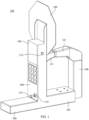
- FIG. 1 illustrates an angled side view of a vehicle locking boot according to an exemplary embodiment of the present invention.
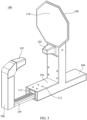
- FIG. 2 illustrates an angled side view of a vehicle locking boot according to an exemplary embodiment of the present invention.
- FIG. 3 illustrates an angled side view of a vehicle locking boot according to an exemplary embodiment of the present invention.
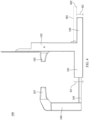
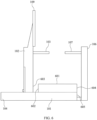
- FIG. 4 illustrates a side view of a vehicle locking boot according to an exemplary embodiment of the present invention.
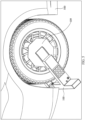
- FIG. 5 illustrates a view of a vehicle locking boot according to an exemplary embodiment of the present invention coupled to a vehicle wheel.
- a vehicle locking boot 100 may include an oversized lug nut blocking plate (e.g., a lug nut blocking plate 109 ) and pad (e.g., a lug nut blocking pad 110 ) .
- the lug nut blocking plate 109 and pad 110 may be approximately ten inches in diameter, and may have a substantially octagonal shape.
- the lug not blocking plate 109 and pad 110 may be dimensioned, shaped and positioned to prevent tampering with the vehicle locking boot 100 by preventing lug nuts of a locked vehicle (e.g., vehicle 500 ) from being removed.
- a vehicle locking boot 100 may include relatively wide front and rear engagement protrusions (e.g., a front engagement protrusion 103 and a rear engagement protrusion 107 ) configured to be inserted into inner and outer indentations of a wheel.
- the engagement protrusions may be approximately two inches in diameter, and may taper to approximately one inch in diameter at innermost points of the engagement protrusions which face each other at an inner portion of a wheel (e.g., approximately behind the lug nuts of the vehicle).
- each of the engagement protrusions may project horizontally
- the engagement protrusions may be formed as a single continuous member without weld joints.
- the engagement protrusions may be substantially rigid such that they cannot be easily tampered with or broken away from the vehicle locking boot through an application of force to the engagement protrusions or corresponding support arms.
- the support arms and the engagement protrusions may be dimensioned, shaped and positioned such that tips of the engagement protrusions come into contact with each other when the vehicle locking boot 100 is fully closed, and the engagement protrusions may become separated from each other when the vehicle locking boot 100 is opened (e.g., to lock the vehicle locking boot to a wheel).
- dimensions of a wheel to which the vehicle locking boot 100 is attached may vary, and thus the engagement protrusions may be separated from each other even when the vehicle locking boot 100 is locked to a wheel of a vehicle.
- a first engagement protrusion (e.g., a front engagement protrusion 103 ) coupled to a first vertical support arm (e.g., a first vertical support arm 102 ) opposite the lug nut blocking plate 109 may be moved away from a second engagement protrusion (e.g., a rear engagement protrusion 107 ) coupled to a second vertical support arm (e.g., a second vertical support arm 106 ) immediately below the lug nut blocking plate 109 by way of a horizontal extension portion coupled to the first vertical support arm.
- the horizontal extension portion may slide through a track immediately below the second vertical support arm.
- the horizontal extension portion 105 may move in and out of a receiving sleeve 104 which is fully enclosed and is positioned approximately below the lug nut blocking plate 109. Thus, a distal end of the horizontal extension portion 105 is not exposed to an outside of the vehicle locking boot, which may prevent damage to the horizontal extension portion, and may reduce an amount of maintenance (e.g., greasing and cleaning) of the horizontal extension portion and the track.
- An upper surface of the receiving sleeve 104 may be in a different horizontal plane (e.g., a first horizontal plane 401 ) than an upper surface of a horizontal support arm (e.g., a horizontal support arm 101 ) coupled to the second vertical support arm (e.g., a second vertical support arm 106 ) on an opposite side of the second vertical support arm from the horizontal support arm 101.
- a horizontal support arm e.g., a horizontal support arm 101
- the second vertical support arm e.g., a second vertical support arm 106
- an upper surface of the receiving sleeve 104 may be below the upper surface of the horizontal support arm 101, which may reduce a size and weight of the overall vehicle locking boot, while still protecting the horizontal extension portion.
- the first vertical support arm may form substantially a ninety degree angle with the horizontal support arm.
- the vehicle locking boot may be unlocked and removed by entering a code into keypad, unlocking the boot, and sliding the engagement protrusions away from each other to remove the vehicle locking boot from the wheel.
- the vehicle locking boot 100 may be formed of steel or another rigid metal, and may include a relatively small number of weld joints, which may prevent one or more portions of the vehicle locking boot from being tampered with or broken off through an application of force.
- each of the support arms described herein may have a hollow, tubular steel structure to maximize strength, while minimizing weight, thus allowing the vehicle locking boot 100 described herein to be easily locked to a vehicle's wheel without being damaged or broken off through an application of mechanical force or through tampering with by an owner of a vehicle.
- the vehicle locking boot 100 may include countersunk screws 112, a charging port 113 for charging to key pad 108 or any other connected electronic devices, a lock 114 and a release button 115 for releasing the lock 114 when the release button 115 is depressed after a correct unlock code is entered into the keypad 108.
- a vehicle locking boot 100 includes a horizontal support arm 101 and a first vertical support arm 102 extending from the horizontal support arm 101 along a direction orthogonal to an upper surface the horizontal support arm 101.
- the first vertical support arm 102 includes a front engagement protrusion 103 extending therefrom.
- a receiving sleeve 104 extends from the horizontal support arm at a base of the first vertical support arm 102 along a direction parallel to an extending direction of the horizontal support arm 101.
- a horizontal extension portion 105 is coupled to the horizontal support arm 101.
- a second vertical support arm 106 extends from the horizontal extension portion 105 along the direction orthogonal to the upper surface of the horizontal support arm 101.
- the second vertical support arm 106 includes a rear engagement protrusion 107 extending therefrom.
- the front engagement protrusion 103 faces the rear engagement protrusion 107.
- a keypad 108 is disposed on the first vertical support arm 102.
- the keypad 108 is configured to lock and unlock the horizontal extension portion 105.
- a lug nut blocking plate 109 is coupled to the first vertical support arm 102 above the front engagement protrusion 103.
- the lug nut blocking plate 109 may include a lug nut blocking pad 110 disposed on lug nut blocking plate.
- the lug nut blocking pad 110 may be a foam or rubber pad having substantially a same size and shape as the lug nut blocking plate 109 to protect a vehicle (e.g., vehicle 500 ) wheel from damage.
- the lug nut blocking plate 109 may have an octagonal shape, which may prevent the lug nuts from being accessed or tampered with.
- the horizontal extension portion 105 may be coupled to an internal track 111 formed in the horizontal support arm.
- the horizontal extension portion 105 may be configured to slide along the internal track 111 to move the rear engagement protrusion 107 to varying distances from the front engagement protrusion 103.
- a distal end of the horizontal extension portion 105 with respect to the second vertical support arm 106 may be concealed within the receiving sleeve 104 when the front engagement protrusion 103 is in contact with the rear engagement protrusion 107.
- the horizontal support arm 101 may have a first thickness (e.g., first thickness H1 illustrated in FIG. 4 ) along the direction orthogonal to the upper surface of the horizontal support arm 101.
- the receiving sleeve 104 may have a second thickness (e.g., second thickness H2 illustrated in FIG. 4 ) along the direction orthogonal to the upper surface of the horizontal support arm 101.
- the second thickness may be less than the first thickness.
- the upper surface of the horizontal support arm 101 may extend along a first horizontal plane (e.g., first horizontal plane 401 illustrated in FIG. 4 ).
- An upper surface of the receiving sleeve may extend along a second horizontal plane (e.g., second horizontal plane 402 illustrated in FIG. 4 ).
- the first horizontal plane may be spaced apart from the second horizontal plane along the direction orthogonal to the upper surface of the horizontal support arm 101.
- the first vertical support arm 102 may form a 90° angle with the horizontal support arm 101.
- a diameter of the lug nut blocking plate 109 may be at least 10 inches.
- the lug nut blocking pad 110 may be relatively large to prevent access to and tampering with the underlying lug nuts.
- a diameter of each of the front engagement protrusion 103 at a first end of the front engagement protrusion 103 opposite the rear engagement protrusion 107 may be at least 2 inches.
- a diameter of the rear engagement protrusion 107 may taper to 1 inch at a second end of the front engagement protrusion 103 facing the rear engagement protrusion 107.
- FIG. 6 illustrates a side view of a vehicle locking boot according to an exemplary embodiment of the present invention.
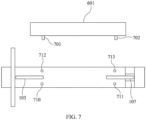
- FIG. 7 illustrates a top down view of a vehicle locking boot and a spacer configured to be coupled to the vehicle locking boot according to an exemplary embodiment of the present invention.
- FIG. 8 illustrates an angled side view of a vehicle locking boot according to an exemplary embodiment of the present invention.
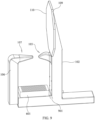
- FIG. 9 illustrates an angled side view of a vehicle locking boot according to an exemplary embodiment of the present invention.
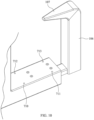
- FIG. 10 illustrates an exemplary front engagement protrusion of a vehicle locking boot according to an exemplary embodiment of the present invention.
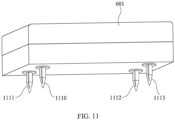
- FIG. 11 illustrates an exemplary spacer of a vehicle locking boot according to an exemplary embodiment of the present invention.
- a vehicle locking boot may include a horizontal support arm 101 and a first vertical support arm 102 extending from the horizontal support arm 101 along a direction orthogonal to an upper surface the horizontal support arm 101.
- the first vertical support arm 102 may include a front engagement protrusion 103 extending therefrom.
- a receiving sleeve 104 may extend from the horizontal support arm 101 at a base of the first vertical support arm 102 along a direction parallel to an extending direction of the horizontal support arm 101.
- a horizontal extension portion 105 may be coupled to the horizontal support arm 101.
- a second vertical support arm 106 may extend from the horizontal extension portion 105 along the direction orthogonal to the upper surface of the horizontal support arm 101.
- the second vertical support arm 106 may include a rear engagement protrusion 107 extending therefrom.
- the front engagement protrusion 103 may face the rear engagement protrusion 107.
- a keypad 108 may be disposed on the first vertical support arm 102. The keypad 108 may be configured to lock and unlock the horizontal extension portion 105.
- a lug nut blocking plate 109 may be coupled to the first vertical support arm 102 above the front engagement protrusion 103.
- a spacer 601 is removably coupled to the horizontal support arm 101. The spacer 601 extends along the extending direction of the horizontal support arm 101.
- the spacer 601 substantially closes a space between the horizontal support arm 101 and a tire positioned above the spacer 601 (see, e.g., FIG. 5 ). Accordingly, tampering with the vehicle locking boot by objects (e.g., a pry bar or crowbar) positioned between the horizontal support arm 101 and the tire may be reduced or eliminated by the spacer 601.
- the spacer 601 may be positioned and dimensioned to be in direct contact with a tire, thus eliminating an open space into which tools (e.g., a pry bar or crowbar) could be inserted. Accordingly, tampering with the vehicle locking boot may be reduced or eliminated through use of the spacer 601.
- a diameter of the rear engagement protrusion 107 may taper to about 3 ⁇ 8 of an inch along a direction toward the front engagement protrusion 103.
- the diameter of the rear engagement protrusion 107 may taper to about 3 ⁇ 8 of an inch from a diameter of about 2 inches along the direction toward the front engagement protrusion 103.
- a diameter of the front engagement protrusion 103 may taper to about 3 ⁇ 8 of an inch along a direction toward the rear engagement protrusion 107.
- a length of the spacer 601 may be less than a length of the horizontal support arm 101 (see, e.g., FIG. 9 ).
- the spacer 601 may be smaller than a distance between the vertical support arms 102 and 106 in a closed state.
- a weight of the spacer 601 may be relatively low, and manufacturing costs of the vehicle locking boot may be reduced.
- the vehicle locking boot described herein may include or be formed of aluminum or an aluminum alloy.
- the use of aluminum or aluminum alloy in forming the vehicle locking boot may reduce a weight of the vehicle locking boot when compared with steel.
- Reducing an overall weight of the vehicle locking boot including the spacer 601 may allow the vehicle locking boot to be more easily manipulated to be attached to or removed from a vehicle's wheel. Accordingly, damage to a vehicle or vehicle wheel may be reduced or eliminated.
- a side surface 602 of the spacer 601 facing the first vertical support arm 102 may be spaced apart from a side surface 603 the first vertical support arm 102.
- the vehicle locking boot may include a space 901 between the spacer and the first vertical support arm 102 (see, e.g. FIG. 9 ).
- the space may be from 0.5 inches to 3 inches.
- a side surface 604 of the spacer 601 facing the second vertical support arm 106 may be substantially aligned with or slightly spaced apart from a side surface 605 of the horizontal support arm 101 facing the second vertical support arm 106 (see, e.g., FIGS. 6 and 9 ).
- This may maximize contact between the spacer 601 and a vehicle's tire without making the spacer 601 unnecessarily large.
- the spacer 601 may have substantially a same width as a vehicle's tire, thus eliminating an open space into which tools (e.g., a pry bar or crowbar) could be inserted. Accordingly, tampering with the vehicle locking boot may be reduced or eliminated.
- the spacer 601 may include a plastic frame having a hollow center.
- the hollow center of the plastic frame may be substantially filled with foam.
- a weight of the spacer 601 may be minimized, while maximizing strength and structural integrity of the spacer 601.
- the spacer 601 may include or may be formed of rubber or plastic; however, exemplary embodiments of the present invention are not limited thereto.
- the spacer 601 may include a plurality of pins (see, e.g., pins 70 1 and 702 in FIG. 7 or compression pins 1110, 1111, 1112 and 1113 in FIG. 11 ) positioned and dimensioned to be inserted into corresponding holes (see, e.g., holes 710, 711, 712 and 713 in FIGS. 7 and 10 ) formed in the horizontal support arm 101.
- pins 70 1 and 702 in FIG. 7 or compression pins 1110, 1111, 1112 and 1113 in FIG. 11 positioned and dimensioned to be inserted into corresponding holes (see, e.g., holes 710, 711, 712 and 713 in FIGS. 7 and 10 ) formed in the horizontal support arm 101.
- the pins may be compression pins (see, e.g., FIG. 11 ) configured to removably couple the spacer 601 to the horizontal support arm 101.
- the front engagement protrusion 103 may include a plastic or rubber coating 801.
- the rear engagement protrusion 107 may include a plastic or rubber coating 802.
- damage to a vehicle's wheel may be reduced or eliminated.
- FIG. 12 illustrates a perspective view of a vehicle locking boot according to an exemplary embodiment of the present invention.
- FIG. 13 illustrates a rear perspective view of the vehicle locking boot of FIG. 12 .
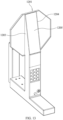
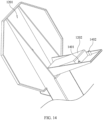
- FIG. 14 illustrates a close up view of an interior of a GPS housing and a GPS unit according to an exemplary embodiment of the present invention.
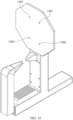
- FIG. 15 illustrates an angled front view of the vehicle locking boot of FIG. 12 .
- a global positioning system (GPS) housing 1201 is positioned at an upper portion of the first vertical support arm 102.
- a GPS unit 1202 is positioned in the GPS housing 1201.
- the GPS unit 1202 includes a GPS transmitter.
- the GPS unit 1202 may additionally include a GPS receiver.
- the GPS unit 1202 is configured to allow detection of a location of the vehicle locking boot described herein by determining a location of the GPS unit 1202.
- the GPS unit 1202 may also transmit a position of the vehicle locking boot.
- the GPS transmitter is able to transmit signals through the GPS housing 1201 and the GPS receiver is able to receive signals through the GPS housing 1201.
- the GPS housing 1201 includes a first side plate 1203 and a second side plate 1204 opposite the first side plate.
- the first and second side plates 1203 and 1204 may extend along the lug nut blocking plate 109, such as along substantially an entire vertical dimension of the lug nut blocking plate 109.
- the first and second side plates 1203 and 1204 may each be angled sidewalls that gradually taper in width along the vertical dimension of the lug nut blocking plate 109.
- a rear plate 1205 is positioned between the first and second side plates 1203 and 1204.
- the rear plate 1205 may be formed of reinforced plastic.
- the reinforced plastic may be a Fiber-reinforced plastic (FRP).
- FRP is a composite material including a polymer matrix reinforced with fibers.
- the fibers may be glass (e.g., fiberglass), carbon (e.g., carbon fiber reinforced polymer), aramid, or basalt.
- the polymer may be an epoxy, vinyl ester, or polyester thermosetting plastic.
- Applicant has determined that the arrangement of the GPS housing 1201, as described herein in various embodiments, allows the GPS unit 1202 to receive and transmit signals to identify and track a location of a vehicle locking boot. This allows for location and recovery of lost or stolen boots, which may reduce costs associated with booting vehicles. For example, even when the vehicle locking boot is formed of steel or aluminum alloy, which could interfere with GPS signal transmission, Applicant has unexpectedly discovered that the arrangement of the GPS housing 1201, as described herein in various embodiments, allows the GPS unit 1202 to receive and transmit signals to identify and track a location of a vehicle locking boot.
- the rear plate 1205 may be removably anchored to the lug nut blocking plate 109.
- the rear plate 1205 forms an enclosed GPS housing 1201 concealing the GPS unit 1202.
- the rear plate 1205 may include a plurality of screw extensions (e.g., 1401, 1402-see, e.g., FIG. 14 ) configured to extend toward the lug nut blocking plate 109.
- the screw extensions may each be aligned with a corresponding hole (e.g., holes 1501, 1502, 1503, 1504-see, e.g., FIG.
- Each corresponding hole may include a screw threaded into a corresponding screw extension and the screw heads may each be concealed by lug nut blocking pad 110.
- Each screw head may be countersunk into the lug nut blocking plate 109 to allow a substantially smooth surface for adhering the lug nut blocking pad 110.
- the GPS unit 1202 may be configured to be activated by movement from a predetermined location. Initial movement of the GPS unit may be determined using a cellular tower network. Thus, unexpected or unauthorized movement of the vehicle locking boot may be detected and the location of the vehicle locking boot may be tracked. This allows for determining and tracking of a location of the vehicle locking boot and recovery of the vehicle locking boot, thus reducing costs for booting vehicles.
- Use of a cellular tower network allows for a relatively low amount of battery power to be used for location tracking compared with satellite tracking, thus longevity of the battery described in more detail below may be increased and a size of the battery may be reduced.
- the battery associated with the GPS unit 1202 may have a battery life of 1-2 years even with relatively constant use of the vehicle locking boot described herein.
- a first vertical support arm 1602 extends from the horizontal support arm 1601 along a direction orthogonal to an upper surface of the horizontal support arm 1601.
- the first vertical support arm 1602 includes a front engagement protrusion 1603 extending therefrom.
- the first vertical support 1602 arm includes the thermoplastic polymer.
- a first rear surface 1801 is defined by the first vertical support arm 1602.
- a second rear surface 1802 is defined by the lug nut blocking plate 1609.
- a number of first interconnected support walls 1803 extend along a direction orthogonal to the first rear surface 1801 of the first vertical support arm 1602. The first interconnected support walls 1803 are configured to increase a rigidity of the first vertical support arm 1602.
- a number of second interconnected support walls 1804 extend along a direction orthogonal to the second rear surface 1802 of the lug nut blocking plate 1609.
- the second interconnected support walls 1804 are configured to increase a rigidity of the lug nut blocking plate 1609.
- the interconnected support walls 1803 and 1804 each define a number of open spaces 1805 and 1806 therebetween, which expose the rear surfaces 1801 and 1802, respectively. This arrangement of the interconnected support walls 1803 and 1804 provides structural rigidity to the first vertical support arm 1602 and the lug nut blocking plate 1609, while also reducing the weight of the first vertical support arm 1602 and the lug nut blocking plate 1609 and reducing the overall weight of the vehicle locking boot 1600.
- the interconnected support walls 1803 and 1804 may define a checkered, honeycomb, or spiderweb pattern.
- the same or a similar arrangement of interconnected support walls may be formed in any component described herein that is formed of or includes a thermoplastic polymer (e.g., the horizontal support arm 1601 or the second vertical support arm 1606 ) .
- a cover or plate may be arranged to cover the support walls 1804. That is the interconnected support walls 1803 and 1804 might not be visible when the vehicle locking boot is in use.
- the horizontal support arm 1601, the first vertical support arm 1602, and the luck nut block plate 1609 are a single integrally formed structure, and may each be formed substantially entirely from the thermoplastic polymer.
- each of the horizontal support arm 1601, the first vertical support arm 1602, and the luck nut block plate 1609 may be manufactured in a comment mold (e.g., a family mold).
- Each of the horizontal support arm 1601, the first vertical support arm 1602, and the luck nut block plate 1609 may include or may be formed of the same thermoplastic polymer as each other, such as by employing a single mold.
- thermoplastic polymer is polycarbonate.
- the thermoplastic polymer may include, for example, discontinuous carbon fibers or nylon.
- the second vertical support arm 1606 includes a base member 1621 connected with the horizontal extension portion 1605 and a vertical extension portion 1622 supporting the rear engagement protrusion 1607.
- the base member 1621 of the second vertical support arm 1606 defines a first angled sidewall 1623, a second angled sidewall 1624, and a third angled sidewall 1625 (see, e.g., FIG. 19 ).
- a side 1626 (see, e.g., FGI. 23) of the base member 1621 opposite the second angled sidewall 1624 may define a substantially flat surface that is vertically aligned with the vertical extension portion 1622. That is, the base member 1621 may define a shape having 3 angled side surfaces and four vertical side surfaces.
- the shape and dimensions of the base member 1621 increase a strength of the second vertical support arm 1606, particularly at the connection between the base member 1621 and the horizontal extension portion 1605.
- the base member 1621 may be connected with the horizontal extension portion 1605 by one or more bolts or screws.
- the shape and dimensions of the base member 1621 increase a strength of the second vertical support arm 1606 and prevent tampering with or breaking the connection between the base member 1621 and the horizontal extension portion 1605.
- the first vertical support arm 1602 includes a vertical extension portion 1630, a first angled sidewall 1631 extending between the horizontal support arm 1601 and the vertical extension portion 1630, and a second angled sidewall 1632 extending between the lug nut blocking plate 1609 and the vertical extension portion 1630.
- the shape and dimensions of the angled sidewalls 1631 and 1632 increase a strength of the first vertical support arm 1602 and the horizontal support arm 1601.
- the shape and dimensions of the angled sidewalls 1631 and 1632 also decrease an area in which a tool can be applied to forcibly remove the vehicle locking boot 1600 from a vehicle. Therefore, the shape and dimensions of the angled sidewalls 1631 and 1632 prevent tampering with the vehicle locking boot 1600.
- a recess 1841 is defined in the first vertical support arm 1602.
- the recess 1841 is defined by a first inner sidewall 1842 of the first vertical support arm 1602 and a second inner sidewall 1843 of the first vertical support arm 1602.
- a keypad assembly 1608 is arranged in the recess 1841 defined in the first vertical support arm 1602.
- the keypad assembly 1608 defines a first outward facing sidewall 1844 configured to face the first inner sidewall 1842 of the first vertical support arm 1602.
- the keypad assembly 1608 defines a second outward facing sidewall 1845 configured to face the second inner sidewall 1843 of the first vertical support arm 1602.
- the sidewalls 1844 and 1845 of the keypad assembly 1608 are concealed within the recess 1841. That is, the front surface 1846 of the keypad assembly 1608 defines a continuously flush surface with outer sidewalls 1842 and 1843.
- the arrangement of the keypad assembly 1608 in the recess 1841 prevents tampering with or forced removal of the keypad assembly 1608, particularly when compared with a surface mounted keypad assembly in which the sidewalls of the keypad assembly are exposed.
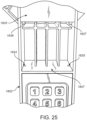
- a compartment 1847 is defined in the first vertical support arm 1602.
- the compartment 1847 is configured to house a global positioning system module (see, e.g., GPS unit 1202 in FIG. 12 ).
- a compartment cover 1633 is configured to be removably coupled with the lug nut blocking plate 1609 or the first vertical support arm 1602 to close the compartment 1847.
- At least two orifices 1634 and 1635 are formed in a wall of the compartment 1847.
- At least two projections 1636 and 1637 extend from the compartment cover 1633.
- Each projection 1636 and 1637 is configured to be received in a corresponding orifice 1634 and 1635 to prevent lateral movement of the compartment cover 1633 with respect to the compartment 1847. While two projections and two orifices are shown and described, various numbers of projections and orifices may similarly be implemented (e.g., one projection/orifice, 3 projections/orifices, etc.).
- the compartment cover 1633 may include a number of orifices (e.g., any of 2601, 2602, 2603, and/or 2604 ) configured to receive screws or bolts therein to secure the compartment cover 1633 with the lug nut blocking plate 1609 or the first vertical support arm 1602 to close the compartment 1847.
- the orifices may be defined in projections (e.g., any of 2605, 2606, 2607, and/or 2608 ) configured to extend away from the compartment cover 1633 to be received in the lug nut blocking plate 1609 or the first vertical support arm 1602 to close the compartment 1847.
- the vehicle locking boot 1600 incorporating the various components formed of the thermoplastic polymer is relatively light in weight, without sacrificing necessary rigidity.
- the arrangement of the connecting sections between the various horizontal and vertical components is expanded to prevent tampering or breakage that is comparable to a metal (e.g., steel) boot.
- the weight of the vehicle locking boot 1600 is approximately 8-10lbs, compared with a conventional boot, which is approximately 18lbs.
- the reduction in overall weight provides vehicle locking boot 1600 that is easier to install and easier to remove, in part as a result of the reduced weight.
- the use of a thermoplastic polymer prevents metal to metal contact between a vehicle locking boot and the wheel of a vehicle, thus preventing damage to the wheel of the vehicle.
- the vehicle locking boot 1600 incorporating the various components formed of the thermoplastic polymer has also been found to increase the accuracy of GPS location by using a GPS module arranged in the vertical support arm 1602. That is, metal such as steel can interfere with a GPS signal transmission and can reduce accuracy of determining a location of a vehicle locking boot by employing GPS location.
- the vehicle locking boot 1600 incorporating the various components formed of the thermoplastic polymer increases GPS location accuracy by reducing interference with a GPS transmission signal.
- the vehicle locking boot 1600 incorporating the various components formed of the thermoplastic polymer (e.g., polycarbonate), thus extending a lifespan of a battery employed in powering a GPS unit (see, e.g., GPS unit 1202 described in more detail above), and increasing an amount of time that the vehicle locking boot 1600 can be used in the field without the need for charging or battery replacement.
- the thermoplastic polymer e.g., polycarbonate
Landscapes
- Engineering & Computer Science (AREA)
- Mechanical Engineering (AREA)
- Diaphragms And Bellows (AREA)
- Vehicle Body Suspensions (AREA)
Abstract
A horizontal support arm including a thermoplastic polymer defines a horizontal axis extending along the horizontal support arm. A track is formed in the horizontal support arm. The track extends along the horizontal axis. A first vertical support arm extends from the horizontal support arm. The first vertical support arm includes a front engagement protrusion. The first vertical support arm includes the thermoplastic polymer. A receiving orifice is defined in the horizontal support arm. A horizontal extension portion is slidably received in the receiving orifice by sliding horizontally along the track formed in the horizontal support arm. A second vertical support arm extends from the horizontal extension portion. The second vertical support arm includes a rear engagement protrusion. The second vertical support arm includes the thermoplastic polymer. A lug nut blocking plate extends from the first vertical support arm. The lug nut block plate includes the thermoplastic polymer.
Description
- The present disclosure relates to a locking boot and, more particularly, to a locking boot for a vehicle wheel.
- Parking enforcement often involves the use of identifying one or more vehicles illegally occupying a particular parking space or area and towing said vehicle. Further, vehicle tags registered to an owner who owed substantial fees in unpaid parking tickets. Fines may be increased substantially for repeat violators who are termed scofflaws. Scofflaws may be individuals who repeatedly violate a summons. Thus, vehicles registered to such owners may be towed to a storage location until back fines are paid the towed vehicle is replaced. An alternative approach is to utilize a vehicle locking boot which attaches to a vehicle's wheel and will prevent said vehicle from being moved until any related back fines are paid.
- A vehicle locking boot may be applied to at least one wheel of a vehicle registered to a scofflaw or to a vehicle parked in an illegal area. The vehicle locking boot may eliminate the need to tow the vehicle, which saves time and money for both the vehicle owner and the municipality in which the vehicle is located. Such vehicle locking boots may be released after a fine is paid and the released vehicle locking boot may be returned to a management company without the vehicle ever being towed.
- Provided in accordance with aspects of the present disclosure is a vehicle locking boot including a horizontal support arm. The horizontal support arm defines a horizontal axis extending along the horizontal support arm. The horizontal support arm includes a thermoplastic polymer. A track is formed in the horizontal support arm. The track extends along the horizontal axis defined by the horizontal support arm. A first vertical support arm extends from the horizontal support arm along a direction orthogonal to an upper surface of the horizontal support arm. The first vertical support arm includes a front engagement protrusion extending therefrom. The first vertical support arm includes the thermoplastic polymer. A receiving orifice is defined in the horizontal support arm and extends along a direction parallel to an extending direction of the horizontal support arm. A horizontal extension portion is coupled to the track formed in the horizontal support arm. The horizontal extension portion is slidably received in the receiving orifice by sliding horizontally along the track formed in the horizontal support arm. A second vertical support arm extends from the horizontal extension portion along the direction orthogonal to the upper surface of the horizontal support arm. The second vertical support arm includes a rear engagement protrusion extending therefrom. The second vertical support arm includes the thermoplastic polymer. A lug nut blocking plate extends from the first vertical support arm above the front engagement protrusion. The lug nut block plate includes the thermoplastic polymer.
- In an aspect of the present disclosure, a first rear surface is defined by the first vertical support arm. A second rear surface is defined by the lug nut blocking plate. A number of first interconnected support walls extend along a direction orthogonal to the first rear surface of the first vertical support arm. The first interconnected support walls are configured to increase a rigidity of the first vertical support arm. A number of second interconnected support walls extend along a direction orthogonal to the second rear surface of the lug nut blocking plate. The second interconnected support walls are configured to increase a rigidity of the lug nut blocking plate.
- In an aspect of the present disclosure, the horizontal support arm, the first vertical support arm, and the luck nut block plate are a single integrally formed structure.
- In an aspect of the present disclosure, the thermoplastic polymer is polycarbonate.
- In an aspect of the present disclosure, the thermoplastic polymer includes discontinuous carbon fibers or nylon.
- In an aspect of the present disclosure, the second vertical support arm includes a base member connected with the horizontal extension portion and a vertical extension portion supporting the rear engagement protrusion. The base member defines a first width greater than a second width defined by the vertical extension portion.
- In an aspect of the present disclosure, the base member of the second vertical support arm defines a first angled sidewall, a second angled sidewall, and a third angled sidewall.
- In an aspect of the present disclosure, the base member includes a first vertical sidewall extending from the first angled sidewall, a second vertical sidewall extending form the second angled sidewall, and a third vertical sidewall extending from the third angled sidewall.
- In an aspect of the present disclosure, the first vertical support arm includes a vertical extension portion, a first angled sidewall extending between the horizontal support arm and the vertical extension portion, and a second angled sidewall extending between the lug nut blocking plate and the vertical extension portion.
- In an aspect of the present disclosure, a recess is defined in the first vertical support arm. The recess is defined by a first inner sidewall of the first vertical support arm and a second inner sidewall of the first vertical support arm. A keypad assembly is arranged in the recess defined in the first vertical support arm. The keypad assembly defines a first outward facing sidewall configured to face the first inner sidewall of the first vertical support arm. The keypad assembly defines a second outward facing sidewall configured to face the second inner sidewall of the first vertical support arm.
- In an aspect of the present disclosure, a compartment is defined in the first vertical support arm. The compartment is configured to house a global positioning system module. A compartment cover is configured to be removably coupled with the lug nut blocking plate or the first vertical support arm to close the compartment.
- In an aspect of the present disclosure, at least two orifices are formed in a wall of the compartment. At least two projections extend from the compartment cover. Each projection is configured to be received in a corresponding orifice to prevent lateral movement of the compartment cover with respect to the compartment.
- In an aspect of the present disclosure, the lug nut blocking plate includes a lug nut blocking pad disposed on lug nut blocking plate.
- In an aspect of the present disclosure, the lug nut locking plate defines an octagonal shape.
- In an aspect of the present disclosure, the horizontal extension portion is configured to slide along the track to move the rear engagement protrusion to varying distances from the front engagement protrusion.
- In an aspect of the present disclosure, the first vertical support arm forms a 90° angle with the horizontal support arm.
- In an aspect of the present disclosure, the front engagement protrusion faces the rear engagement protrusion.
- In an aspect of the present disclosure, the front engagement protrusion is substantially horizontally aligned with the rear engagement protrusion.
- In an aspect of the present disclosure, a keypad is disposed in the first vertical support arm.
- In an aspect of the present disclosure, the horizontal extension portion is configured to slide horizontally along the track below the first vertical support arm.
- Various aspects and features of the present disclosure are described hereinbelow with reference to the drawings wherein:
-
FIG. 1 illustrates an angled side view of a vehicle locking boot according to an aspect of the present disclosure; -
FIG. 2 illustrates an angled side view of a vehicle locking boot according to an aspect of the present disclosure; -
FIG. 3 illustrates an angled side view of a vehicle locking boot according to an aspect of the present disclosure; -
FIG. 4 illustrates a side view of a vehicle locking boot according to an aspect of the present disclosure; -
FIG. 5 illustrates a view of a vehicle locking boot according to an aspect of the present disclosure; -
FIG. 6 illustrates a side view of a vehicle locking boot according to an aspect of the present disclosure; -
FIG. 7 illustrates a top down view of a vehicle locking boot and a spacer configured to be coupled to the vehicle locking boot according to an aspect of the present disclosure; -
FIG. 8 illustrates an angled side view of a vehicle locking boot according to an aspect of the present disclosure; -
FIG. 9 illustrates an angled side view of a vehicle locking boot according to an aspect of the present disclosure; -
FIG. 10 illustrates an exemplary front engagement protrusion of a vehicle locking boot according to an aspect of the present disclosure; -
FIG. 11 illustrates an exemplary spacer of a vehicle locking boot according to an aspect of the present disclosure; -
FIG. 12 illustrates a perspective view of a vehicle locking boot according to an aspect of the present disclosure; -
FIG. 13 illustrates a rear perspective view of the vehicle locking boot ofFIG. 12 ; -
FIG. 14 illustrates a close up view of an interior of a GPS housing and a GPS unit according to an exemplary embodiment of the present disclosure; -
FIG. 15 illustrates an angled front view of the vehicle locking boot ofFIG. 12 ; -
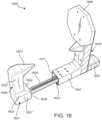
FIG. 16 is a first front, perspective view of a vehicle locking boot in an expanded configuration according to an aspect of the present disclosure; -
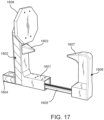
FIG. 17 is a second front, perspective view of the vehicle locking boot ofFIG. 16 in an expanded configuration; -
FIG. 18 is a rear view of an interior of a vertical support arm and a lug nut blocking plate of the vehicle locking boot ofFIG. 16 ; -
FIG. 19 is a first rear, perspective view of the vehicle locking boot ofFIG. 16 ; -
FIG. 20 is a second rear, perspective view of the vehicle locking boot ofFIG. 16 ; -
FIG. 21 is a third rear, perspective view of the vehicle locking boot ofFIG. 16 ; -
FIG. 22 is a side view of the vehicle locking boot ofFIG. 16 ; -
FIG. 23 is a first front, perspective view of the vehicle locking boot ofFIG. 16 in a collapsed configuration; -
FIG. 24 is a second front, perspective view of the vehicle locking boot ofFIG. 16 in a collapsed configuration; -
FIG. 25 is an enlarged view of the interior of a vertical support arm and a partially removed rear plate of the vehicle locking boot ofFIG. 16 according to an aspect of the present disclosure; and -
FIG. 26 is a rear, perspective view of a rear plate employable by the vehicle locking boot ofFIG. 16 . - Descriptions of technical features or aspects of an exemplary configuration of the disclosure should typically be considered as available and applicable to other similar features or aspects in another exemplary configuration of the disclosure. Accordingly, technical features described herein according to one exemplary configuration of the disclosure may be applicable to other exemplary configurations of the disclosure, and thus duplicative descriptions may be omitted herein.
- Exemplary configurations of the disclosure will be described more fully below (e.g., with reference to the accompanying drawings). Like reference numerals may refer to like elements throughout the specification and drawings.
-
FIG. 1 illustrates an angled side view of a vehicle locking boot according to an exemplary embodiment of the present invention.FIG. 2 illustrates an angled side view of a vehicle locking boot according to an exemplary embodiment of the present invention.FIG. 3 illustrates an angled side view of a vehicle locking boot according to an exemplary embodiment of the present invention.FIG. 4 illustrates a side view of a vehicle locking boot according to an exemplary embodiment of the present invention.FIG. 5 illustrates a view of a vehicle locking boot according to an exemplary embodiment of the present invention coupled to a vehicle wheel. - Referring to
FIGS. 1 to 5 , according to an exemplary embodiment of the present invention, avehicle locking boot 100 may include an oversized lug nut blocking plate (e.g., a lug nut blocking plate 109) and pad (e.g., a lug nut blocking pad 110). The lugnut blocking plate 109 andpad 110 may be approximately ten inches in diameter, and may have a substantially octagonal shape. Thus, the lug not blockingplate 109 andpad 110 may be dimensioned, shaped and positioned to prevent tampering with thevehicle locking boot 100 by preventing lug nuts of a locked vehicle (e.g., vehicle 500) from being removed. - According to an exemplary embodiment of the present invention, a
vehicle locking boot 100 may include relatively wide front and rear engagement protrusions (e.g., afront engagement protrusion 103 and a rear engagement protrusion 107) configured to be inserted into inner and outer indentations of a wheel. The engagement protrusions may be approximately two inches in diameter, and may taper to approximately one inch in diameter at innermost points of the engagement protrusions which face each other at an inner portion of a wheel (e.g., approximately behind the lug nuts of the vehicle). Upward projecting support arms (e.g., a firstvertical support arm 102 and a second vertical support arm 106) of each of the engagement protrusions (the engagement protrusions may project horizontally) and the engagement protrusions may be formed as a single continuous member without weld joints. Thus, the engagement protrusions may be substantially rigid such that they cannot be easily tampered with or broken away from the vehicle locking boot through an application of force to the engagement protrusions or corresponding support arms. - The support arms and the engagement protrusions may be dimensioned, shaped and positioned such that tips of the engagement protrusions come into contact with each other when the
vehicle locking boot 100 is fully closed, and the engagement protrusions may become separated from each other when thevehicle locking boot 100 is opened (e.g., to lock the vehicle locking boot to a wheel). However, dimensions of a wheel to which thevehicle locking boot 100 is attached may vary, and thus the engagement protrusions may be separated from each other even when thevehicle locking boot 100 is locked to a wheel of a vehicle. - A first engagement protrusion (e.g., a front engagement protrusion 103) coupled to a first vertical support arm (e.g., a first vertical support arm 102) opposite the lug
nut blocking plate 109 may be moved away from a second engagement protrusion (e.g., a rear engagement protrusion 107) coupled to a second vertical support arm (e.g., a second vertical support arm 106) immediately below the lugnut blocking plate 109 by way of a horizontal extension portion coupled to the first vertical support arm. The horizontal extension portion may slide through a track immediately below the second vertical support arm. Thehorizontal extension portion 105 may move in and out of a receivingsleeve 104 which is fully enclosed and is positioned approximately below the lugnut blocking plate 109. Thus, a distal end of thehorizontal extension portion 105 is not exposed to an outside of the vehicle locking boot, which may prevent damage to the horizontal extension portion, and may reduce an amount of maintenance (e.g., greasing and cleaning) of the horizontal extension portion and the track. An upper surface of the receivingsleeve 104 may be in a different horizontal plane (e.g., a first horizontal plane 401) than an upper surface of a horizontal support arm (e.g., a horizontal support arm 101) coupled to the second vertical support arm (e.g., a second vertical support arm 106) on an opposite side of the second vertical support arm from thehorizontal support arm 101. For example, an upper surface of the receivingsleeve 104 may be below the upper surface of thehorizontal support arm 101, which may reduce a size and weight of the overall vehicle locking boot, while still protecting the horizontal extension portion. - According to an exemplary embodiment of the present invention, the first vertical support arm may form substantially a ninety degree angle with the horizontal support arm.
- The vehicle locking boot may be unlocked and removed by entering a code into keypad, unlocking the boot, and sliding the engagement protrusions away from each other to remove the vehicle locking boot from the wheel.
- According to an exemplary embodiment of the present invention, the
vehicle locking boot 100 may be formed of steel or another rigid metal, and may include a relatively small number of weld joints, which may prevent one or more portions of the vehicle locking boot from being tampered with or broken off through an application of force. For example, each of the support arms described herein may have a hollow, tubular steel structure to maximize strength, while minimizing weight, thus allowing thevehicle locking boot 100 described herein to be easily locked to a vehicle's wheel without being damaged or broken off through an application of mechanical force or through tampering with by an owner of a vehicle. - According to an exemplary embodiment of the present invention, the
vehicle locking boot 100 may include countersunk screws 112, a chargingport 113 for charging tokey pad 108 or any other connected electronic devices, alock 114 and arelease button 115 for releasing thelock 114 when therelease button 115 is depressed after a correct unlock code is entered into thekeypad 108. - According to an exemplary embodiment of the present invention, a
vehicle locking boot 100 includes ahorizontal support arm 101 and a firstvertical support arm 102 extending from thehorizontal support arm 101 along a direction orthogonal to an upper surface thehorizontal support arm 101. The firstvertical support arm 102 includes afront engagement protrusion 103 extending therefrom. A receivingsleeve 104 extends from the horizontal support arm at a base of the firstvertical support arm 102 along a direction parallel to an extending direction of thehorizontal support arm 101. Ahorizontal extension portion 105 is coupled to thehorizontal support arm 101. A secondvertical support arm 106 extends from thehorizontal extension portion 105 along the direction orthogonal to the upper surface of thehorizontal support arm 101. The secondvertical support arm 106 includes arear engagement protrusion 107 extending therefrom. Thefront engagement protrusion 103 faces therear engagement protrusion 107. Akeypad 108 is disposed on the firstvertical support arm 102. Thekeypad 108 is configured to lock and unlock thehorizontal extension portion 105. A lugnut blocking plate 109 is coupled to the firstvertical support arm 102 above thefront engagement protrusion 103. - According to an exemplary embodiment of the present invention, the lug
nut blocking plate 109 may include a lugnut blocking pad 110 disposed on lug nut blocking plate. The lugnut blocking pad 110 may be a foam or rubber pad having substantially a same size and shape as the lugnut blocking plate 109 to protect a vehicle (e.g., vehicle 500) wheel from damage. - According to an exemplary embodiment of the present invention, the lug
nut blocking plate 109 may have an octagonal shape, which may prevent the lug nuts from being accessed or tampered with. - According to an exemplary embodiment of the present invention, the
horizontal extension portion 105 may be coupled to aninternal track 111 formed in the horizontal support arm. Thehorizontal extension portion 105 may be configured to slide along theinternal track 111 to move therear engagement protrusion 107 to varying distances from thefront engagement protrusion 103. - According to an exemplary embodiment of the present invention, a distal end of the
horizontal extension portion 105 with respect to the secondvertical support arm 106 may be concealed within the receivingsleeve 104 when thefront engagement protrusion 103 is in contact with therear engagement protrusion 107. - According to an exemplary embodiment of the present invention, the
horizontal support arm 101 may have a first thickness (e.g., first thickness H1 illustrated inFIG. 4 ) along the direction orthogonal to the upper surface of thehorizontal support arm 101. The receivingsleeve 104 may have a second thickness (e.g., second thickness H2 illustrated inFIG. 4 ) along the direction orthogonal to the upper surface of thehorizontal support arm 101. The second thickness may be less than the first thickness. - According to an exemplary embodiment of the present invention, the upper surface of the
horizontal support arm 101 may extend along a first horizontal plane (e.g., firsthorizontal plane 401 illustrated inFIG. 4 ). An upper surface of the receiving sleeve may extend along a second horizontal plane (e.g., secondhorizontal plane 402 illustrated inFIG. 4 ). The first horizontal plane may be spaced apart from the second horizontal plane along the direction orthogonal to the upper surface of thehorizontal support arm 101. - According to an exemplary embodiment of the present invention, the first
vertical support arm 102 may form a 90° angle with thehorizontal support arm 101. - According to an exemplary embodiment of the present invention, a diameter of the lug
nut blocking plate 109 may be at least 10 inches. Thus, the lugnut blocking pad 110 may be relatively large to prevent access to and tampering with the underlying lug nuts. - According to an exemplary embodiment of the present invention, a diameter of each of the
front engagement protrusion 103 at a first end of thefront engagement protrusion 103 opposite therear engagement protrusion 107 may be at least 2 inches. A diameter of therear engagement protrusion 107 may taper to 1 inch at a second end of thefront engagement protrusion 103 facing therear engagement protrusion 107. -
FIG. 6 illustrates a side view of a vehicle locking boot according to an exemplary embodiment of the present invention.FIG. 7 illustrates a top down view of a vehicle locking boot and a spacer configured to be coupled to the vehicle locking boot according to an exemplary embodiment of the present invention.FIG. 8 illustrates an angled side view of a vehicle locking boot according to an exemplary embodiment of the present invention.FIG. 9 illustrates an angled side view of a vehicle locking boot according to an exemplary embodiment of the present invention.FIG. 10 illustrates an exemplary front engagement protrusion of a vehicle locking boot according to an exemplary embodiment of the present invention.FIG. 11 illustrates an exemplary spacer of a vehicle locking boot according to an exemplary embodiment of the present invention. - Referring to
FIGS. 6-11 , according to an exemplary embodiment of the present invention, a vehicle locking boot may include ahorizontal support arm 101 and a firstvertical support arm 102 extending from thehorizontal support arm 101 along a direction orthogonal to an upper surface thehorizontal support arm 101. The firstvertical support arm 102 may include afront engagement protrusion 103 extending therefrom. A receivingsleeve 104 may extend from thehorizontal support arm 101 at a base of the firstvertical support arm 102 along a direction parallel to an extending direction of thehorizontal support arm 101. Ahorizontal extension portion 105 may be coupled to thehorizontal support arm 101. A secondvertical support arm 106 may extend from thehorizontal extension portion 105 along the direction orthogonal to the upper surface of thehorizontal support arm 101. The secondvertical support arm 106 may include arear engagement protrusion 107 extending therefrom. Thefront engagement protrusion 103 may face therear engagement protrusion 107. Akeypad 108 may be disposed on the firstvertical support arm 102. Thekeypad 108 may be configured to lock and unlock thehorizontal extension portion 105. A lugnut blocking plate 109 may be coupled to the firstvertical support arm 102 above thefront engagement protrusion 103. Aspacer 601 is removably coupled to thehorizontal support arm 101. Thespacer 601 extends along the extending direction of thehorizontal support arm 101. - The
spacer 601 substantially closes a space between thehorizontal support arm 101 and a tire positioned above the spacer 601 (see, e.g.,FIG. 5 ). Accordingly, tampering with the vehicle locking boot by objects (e.g., a pry bar or crowbar) positioned between thehorizontal support arm 101 and the tire may be reduced or eliminated by thespacer 601. For example, thespacer 601 may be positioned and dimensioned to be in direct contact with a tire, thus eliminating an open space into which tools (e.g., a pry bar or crowbar) could be inserted. Accordingly, tampering with the vehicle locking boot may be reduced or eliminated through use of thespacer 601. - According to an exemplary embodiment of the present invention, a diameter of the
rear engagement protrusion 107 may taper to about ⅜ of an inch along a direction toward thefront engagement protrusion 103. For example, the diameter of therear engagement protrusion 107 may taper to about ⅜ of an inch from a diameter of about 2 inches along the direction toward thefront engagement protrusion 103. Similarly, a diameter of thefront engagement protrusion 103 may taper to about ⅜ of an inch along a direction toward therear engagement protrusion 107. - According to an exemplary embodiment of the present invention, a length of the
spacer 601 may be less than a length of the horizontal support arm 101 (see, e.g.,FIG. 9 ). Thus, thespacer 601 may be smaller than a distance between thevertical support arms spacer 601 may be relatively low, and manufacturing costs of the vehicle locking boot may be reduced. - The vehicle locking boot described herein may include or be formed of aluminum or an aluminum alloy. The use of aluminum or aluminum alloy in forming the vehicle locking boot may reduce a weight of the vehicle locking boot when compared with steel.
- Reducing an overall weight of the vehicle locking boot including the
spacer 601 may allow the vehicle locking boot to be more easily manipulated to be attached to or removed from a vehicle's wheel. Accordingly, damage to a vehicle or vehicle wheel may be reduced or eliminated. - According to an exemplary embodiment of the present invention, a
side surface 602 of thespacer 601 facing the firstvertical support arm 102 may be spaced apart from aside surface 603 the firstvertical support arm 102. For example, the vehicle locking boot may include aspace 901 between the spacer and the first vertical support arm 102 (see, e.g.FIG. 9 ). The space may be from 0.5 inches to 3 inches. - According to an exemplary embodiment of the present invention, a
side surface 604 of thespacer 601 facing the secondvertical support arm 106 may be substantially aligned with or slightly spaced apart from aside surface 605 of thehorizontal support arm 101 facing the second vertical support arm 106 (see, e.g.,FIGS. 6 and9 ). This may maximize contact between thespacer 601 and a vehicle's tire without making thespacer 601 unnecessarily large. As an example, thespacer 601 may have substantially a same width as a vehicle's tire, thus eliminating an open space into which tools (e.g., a pry bar or crowbar) could be inserted. Accordingly, tampering with the vehicle locking boot may be reduced or eliminated. - According to an exemplary embodiment of the present invention, the
spacer 601 may include a plastic frame having a hollow center. As an example, the hollow center of the plastic frame may be substantially filled with foam. Thus, a weight of thespacer 601 may be minimized, while maximizing strength and structural integrity of thespacer 601. As an example, thespacer 601 may include or may be formed of rubber or plastic; however, exemplary embodiments of the present invention are not limited thereto. - According to an exemplary embodiment of the present invention, the
spacer 601 may include a plurality of pins (see, e.g., pins 701 and 702 inFIG. 7 orcompression pins FIG. 11 ) positioned and dimensioned to be inserted into corresponding holes (see, e.g., holes 710, 711, 712 and 713 inFIGS. 7 and10 ) formed in thehorizontal support arm 101. - According to an exemplary embodiment of the present invention, the pins may be compression pins (see, e.g.,
FIG. 11 ) configured to removably couple thespacer 601 to thehorizontal support arm 101. - According to an exemplary embodiment of the present invention, the
front engagement protrusion 103 may include a plastic orrubber coating 801. - According to an exemplary embodiment of the present invention, the
rear engagement protrusion 107 may include a plastic orrubber coating 802. Thus, damage to a vehicle's wheel may be reduced or eliminated. -
FIG. 12 illustrates a perspective view of a vehicle locking boot according to an exemplary embodiment of the present invention.FIG. 13 illustrates a rear perspective view of the vehicle locking boot ofFIG. 12 .FIG. 14 illustrates a close up view of an interior of a GPS housing and a GPS unit according to an exemplary embodiment of the present invention.FIG. 15 illustrates an angled front view of the vehicle locking boot ofFIG. 12 . - Referring to
FIGS. 12-15 , a global positioning system (GPS)housing 1201 is positioned at an upper portion of the firstvertical support arm 102. AGPS unit 1202 is positioned in theGPS housing 1201. TheGPS unit 1202 includes a GPS transmitter. TheGPS unit 1202 may additionally include a GPS receiver. TheGPS unit 1202 is configured to allow detection of a location of the vehicle locking boot described herein by determining a location of theGPS unit 1202. TheGPS unit 1202 may also transmit a position of the vehicle locking boot. As described below in more detail, the GPS transmitter is able to transmit signals through theGPS housing 1201 and the GPS receiver is able to receive signals through theGPS housing 1201. - According to an exemplary embodiment of the present invention, the
GPS housing 1201 includes afirst side plate 1203 and asecond side plate 1204 opposite the first side plate. The first andsecond side plates nut blocking plate 109, such as along substantially an entire vertical dimension of the lugnut blocking plate 109. The first andsecond side plates nut blocking plate 109. Arear plate 1205 is positioned between the first andsecond side plates rear plate 1205 may be formed of reinforced plastic. - According to an exemplary embodiment of the present invention, the reinforced plastic may be a Fiber-reinforced plastic (FRP). FRP is a composite material including a polymer matrix reinforced with fibers. The fibers may be glass (e.g., fiberglass), carbon (e.g., carbon fiber reinforced polymer), aramid, or basalt. The polymer may be an epoxy, vinyl ester, or polyester thermosetting plastic.
- Applicant has determined that the arrangement of the
GPS housing 1201, as described herein in various embodiments, allows theGPS unit 1202 to receive and transmit signals to identify and track a location of a vehicle locking boot. This allows for location and recovery of lost or stolen boots, which may reduce costs associated with booting vehicles. For example, even when the vehicle locking boot is formed of steel or aluminum alloy, which could interfere with GPS signal transmission, Applicant has unexpectedly discovered that the arrangement of theGPS housing 1201, as described herein in various embodiments, allows theGPS unit 1202 to receive and transmit signals to identify and track a location of a vehicle locking boot. - According to an exemplary embodiment of the present invention, the
rear plate 1205 may be removably anchored to the lugnut blocking plate 109. Thus, therear plate 1205 forms anenclosed GPS housing 1201 concealing theGPS unit 1202. For example, therear plate 1205 may include a plurality of screw extensions (e.g., 1401, 1402-see, e.g.,FIG. 14 ) configured to extend toward the lugnut blocking plate 109. The screw extensions may each be aligned with a corresponding hole (e.g., holes 1501, 1502, 1503, 1504-see, e.g.,FIG. 15 ) formed in the lugnut blocking plate 109 Each corresponding hole may include a screw threaded into a corresponding screw extension and the screw heads may each be concealed by lugnut blocking pad 110. Each screw head may be countersunk into the lugnut blocking plate 109 to allow a substantially smooth surface for adhering the lugnut blocking pad 110. Thus, the presence of theGPS unit 1202 is not readily apparent to an observer of the vehicle locking boot, which may reduce or eliminate an occurrence of tampering or damage to theGPS unit 1202. - According to an exemplary embodiment of the present invention, the
GPS unit 1202 may be configured to be activated by movement from a predetermined location. Initial movement of the GPS unit may be determined using a cellular tower network. Thus, unexpected or unauthorized movement of the vehicle locking boot may be detected and the location of the vehicle locking boot may be tracked. This allows for determining and tracking of a location of the vehicle locking boot and recovery of the vehicle locking boot, thus reducing costs for booting vehicles. Use of a cellular tower network allows for a relatively low amount of battery power to be used for location tracking compared with satellite tracking, thus longevity of the battery described in more detail below may be increased and a size of the battery may be reduced. As described in more detail below, the battery associated with theGPS unit 1202 may have a battery life of 1-2 years even with relatively constant use of the vehicle locking boot described herein. - According to an exemplary embodiment of the present invention, a location of the
GPS unit 1202 may be determined by a Global Navigation Satellite System (GNSS) network after the initial movement of theGPS unit 1202 is detected. The location of theGPS unit 1202 determined by the GNSS may be determined at a predetermined rate (e.g., one or two times per day, or continuously if desired). Determining the location of theGPS unit 1202 disposed in the vehicle locking boot, as described herein, allows a battery of the GPS unit to last for an extended period of time (e.g., as long as 1-2 years). - The GPS unit may be powered by a battery, such as a rechargeable battery. For example, the battery may be a lithium ion battery.
- According to an exemplary embodiment of the present invention, the
GPS unit 1202 may be programmable. Programming the GPS unit allows, for example, setting the rate at which the location of theGPS unit 1202 is determined. TheGPS unit 1202 may include a WiFi or cellular network receiver. Thus, the GPS unit may be connected with remotely, and programming of the GPS unit may be accomplished from a remote location (e.g., via connection over WiFi or a cellular tower network). - Referring to
FIGS. 16 to 24 , avehicle locking boot 1600 includes ahorizontal support arm 1601. Thehorizontal support arm 1601 defines a horizontal axis (see, e.g.,axis 401 inFIG. 4 ) extending along thehorizontal support arm 1601. Thehorizontal support 1601 arm includes a thermoplastic polymer. Atrack 1611 is formed in thehorizontal support arm 1601. Thetrack 1611 extends along the horizontal axis defined by thehorizontal support arm 1601. - A first
vertical support arm 1602 extends from thehorizontal support arm 1601 along a direction orthogonal to an upper surface of thehorizontal support arm 1601. The firstvertical support arm 1602 includes afront engagement protrusion 1603 extending therefrom. The firstvertical support 1602 arm includes the thermoplastic polymer. - A receiving
orifice 1612 is defined in thehorizontal support arm 1601 and extends along a direction parallel to an extending direction of the horizontal support arm 1601 (e.g., along the horizontal axis, such ashorizontal axis 401 inFIG. 4 ). The receivingorifice 1612 may extend through thehorizontal support arm 1601 and the receivingsleeve 1604. - A
horizontal extension portion 1605 is coupled to thetrack 1611 formed in thehorizontal support arm 1601. Thehorizontal extension portion 1605 is slidably received in the receivingorifice 1612 by sliding horizontally along thetrack 1611 formed in thehorizontal support arm 1601. - A second
vertical support arm 1606 extends from thehorizontal extension portion 1605 along the direction orthogonal to the upper surface of thehorizontal support arm 1601. The secondvertical support arm 1606 includes arear engagement protrusion 1607 extending therefrom. The secondvertical support arm 1606 includes the thermoplastic polymer. A lugnut blocking plate 1609 extends from the firstvertical support arm 1602 above thefront engagement protrusion 1603. The lugnut block plate 1609 includes the thermoplastic polymer. A pad (see, e.g.,pad 110 inFIG. 2 ) may be arranged on the lugnut block plate 1609. - Referring particularly to
FIG. 18 , a firstrear surface 1801 is defined by the firstvertical support arm 1602. A secondrear surface 1802 is defined by the lugnut blocking plate 1609. A number of firstinterconnected support walls 1803 extend along a direction orthogonal to the firstrear surface 1801 of the firstvertical support arm 1602. The firstinterconnected support walls 1803 are configured to increase a rigidity of the firstvertical support arm 1602. - A number of second
interconnected support walls 1804 extend along a direction orthogonal to the secondrear surface 1802 of the lugnut blocking plate 1609. The secondinterconnected support walls 1804 are configured to increase a rigidity of the lugnut blocking plate 1609. Theinterconnected support walls open spaces rear surfaces interconnected support walls vertical support arm 1602 and the lugnut blocking plate 1609, while also reducing the weight of the firstvertical support arm 1602 and the lugnut blocking plate 1609 and reducing the overall weight of thevehicle locking boot 1600. Theinterconnected support walls horizontal support arm 1601 or the second vertical support arm 1606). While theinterconnected support walls 1804 are shown as exposed in the figures, a cover or plate may be arranged to cover thesupport walls 1804. That is theinterconnected support walls - In an aspect of the present disclosure, the
horizontal support arm 1601, the firstvertical support arm 1602, and the lucknut block plate 1609 are a single integrally formed structure, and may each be formed substantially entirely from the thermoplastic polymer. For example, each of thehorizontal support arm 1601, the firstvertical support arm 1602, and the lucknut block plate 1609 may be manufactured in a comment mold (e.g., a family mold). Each of thehorizontal support arm 1601, the firstvertical support arm 1602, and the lucknut block plate 1609 may include or may be formed of the same thermoplastic polymer as each other, such as by employing a single mold. - In an aspect of the present disclosure, the thermoplastic polymer is polycarbonate. The thermoplastic polymer may include, for example, discontinuous carbon fibers or nylon.
- In an aspect of the present disclosure, the second
vertical support arm 1606 includes abase member 1621 connected with thehorizontal extension portion 1605 and avertical extension portion 1622 supporting therear engagement protrusion 1607. - Referring particularly to
FIGS. 1 and19 , thebase member 1621 defines afirst width 1901 greater than asecond width 1902 defined by the vertical extension portion. - In an aspect of the present disclosure, the
base member 1621 of the secondvertical support arm 1606 defines a firstangled sidewall 1623, a secondangled sidewall 1624, and a third angled sidewall 1625 (see, e.g.,FIG. 19 ). A side 1626 (see, e.g., FGI. 23) of thebase member 1621 opposite the secondangled sidewall 1624 may define a substantially flat surface that is vertically aligned with thevertical extension portion 1622. That is, thebase member 1621 may define a shape having 3 angled side surfaces and four vertical side surfaces. - In an aspect of the present disclosure, the
base member 1621 includes a firstvertical sidewall 1627 extending from the firstangled sidewall 1623, a secondvertical sidewall 1628 extending form the secondangled sidewall 1624, and a third vertical sidewall 1629 (see, e.g.,FIG. 19 ) extending from the thirdangled sidewall 1625. - The shape and dimensions of the
base member 1621 increase a strength of the secondvertical support arm 1606, particularly at the connection between thebase member 1621 and thehorizontal extension portion 1605. Thebase member 1621 may be connected with thehorizontal extension portion 1605 by one or more bolts or screws. The shape and dimensions of thebase member 1621 increase a strength of the secondvertical support arm 1606 and prevent tampering with or breaking the connection between thebase member 1621 and thehorizontal extension portion 1605. - Referring particularly to
FIG. 21 , the firstvertical support arm 1602 includes avertical extension portion 1630, a firstangled sidewall 1631 extending between thehorizontal support arm 1601 and thevertical extension portion 1630, and a secondangled sidewall 1632 extending between the lugnut blocking plate 1609 and thevertical extension portion 1630. The shape and dimensions of the angled sidewalls 1631 and 1632 increase a strength of the firstvertical support arm 1602 and thehorizontal support arm 1601. The shape and dimensions of the angled sidewalls 1631 and 1632 also decrease an area in which a tool can be applied to forcibly remove thevehicle locking boot 1600 from a vehicle. Therefore, the shape and dimensions of the angled sidewalls 1631 and 1632 prevent tampering with thevehicle locking boot 1600. - Referring particularly to
FIGS. 18 to 21 , arecess 1841 is defined in the firstvertical support arm 1602. Therecess 1841 is defined by a firstinner sidewall 1842 of the firstvertical support arm 1602 and a secondinner sidewall 1843 of the firstvertical support arm 1602. Akeypad assembly 1608 is arranged in therecess 1841 defined in the firstvertical support arm 1602. Thekeypad assembly 1608 defines a first outward facingsidewall 1844 configured to face the firstinner sidewall 1842 of the firstvertical support arm 1602. Thekeypad assembly 1608 defines a second outward facingsidewall 1845 configured to face the secondinner sidewall 1843 of the firstvertical support arm 1602. That is, thesidewalls keypad assembly 1608 are concealed within therecess 1841. That is, thefront surface 1846 of thekeypad assembly 1608 defines a continuously flush surface withouter sidewalls keypad assembly 1608 in therecess 1841 prevents tampering with or forced removal of thekeypad assembly 1608, particularly when compared with a surface mounted keypad assembly in which the sidewalls of the keypad assembly are exposed. - In an aspect of the present disclosure, a
compartment 1847 is defined in the firstvertical support arm 1602. Thecompartment 1847 is configured to house a global positioning system module (see, e.g.,GPS unit 1202 inFIG. 12 ). Acompartment cover 1633 is configured to be removably coupled with the lugnut blocking plate 1609 or the firstvertical support arm 1602 to close thecompartment 1847. - Referring particularly to
FIGS. 18 ,25 , and26 , at least twoorifices compartment 1847. At least twoprojections compartment cover 1633. Eachprojection corresponding orifice compartment cover 1633 with respect to thecompartment 1847. While two projections and two orifices are shown and described, various numbers of projections and orifices may similarly be implemented (e.g., one projection/orifice, 3 projections/orifices, etc.). - Referring particularly to
FIG. 26 , thecompartment cover 1633 may include a number of orifices (e.g., any of 2601, 2602, 2603, and/or 2604) configured to receive screws or bolts therein to secure thecompartment cover 1633 with the lugnut blocking plate 1609 or the firstvertical support arm 1602 to close thecompartment 1847. The orifices may be defined in projections (e.g., any of 2605, 2606, 2607, and/or 2608) configured to extend away from thecompartment cover 1633 to be received in the lugnut blocking plate 1609 or the firstvertical support arm 1602 to close thecompartment 1847. - The
vehicle locking boot 1600 incorporating the various components formed of the thermoplastic polymer (e.g., polycarbonate) is relatively light in weight, without sacrificing necessary rigidity. In particular, the arrangement of the connecting sections between the various horizontal and vertical components is expanded to prevent tampering or breakage that is comparable to a metal (e.g., steel) boot. In particular, the weight of thevehicle locking boot 1600 is approximately 8-10lbs, compared with a conventional boot, which is approximately 18lbs. The reduction in overall weight providesvehicle locking boot 1600 that is easier to install and easier to remove, in part as a result of the reduced weight. Additionally, the use of a thermoplastic polymer (e.g., polycarbonate) prevents metal to metal contact between a vehicle locking boot and the wheel of a vehicle, thus preventing damage to the wheel of the vehicle. - The
vehicle locking boot 1600 incorporating the various components formed of the thermoplastic polymer (e.g., polycarbonate) has also been found to increase the accuracy of GPS location by using a GPS module arranged in thevertical support arm 1602. That is, metal such as steel can interfere with a GPS signal transmission and can reduce accuracy of determining a location of a vehicle locking boot by employing GPS location. Thevehicle locking boot 1600 incorporating the various components formed of the thermoplastic polymer (e.g., polycarbonate) increases GPS location accuracy by reducing interference with a GPS transmission signal. Additionally, increasing the reliability of the GPS signal reduces the number of GPS signals that need to be transmitted to locate thevehicle locking boot 1600 incorporating the various components formed of the thermoplastic polymer (e.g., polycarbonate), thus extending a lifespan of a battery employed in powering a GPS unit (see, e.g.,GPS unit 1202 described in more detail above), and increasing an amount of time that thevehicle locking boot 1600 can be used in the field without the need for charging or battery replacement. - It will be understood that various modifications may be made to the aspects and features disclosed herein. Therefore, the above description should not be construed as limiting, but merely as exemplifications of various aspects and features. Those skilled in the art will envision other modifications within the scope and spirit of the claims appended thereto.
Claims (15)
- A vehicle locking boot, comprising:a horizontal support arm, wherein the horizontal support arm defines a horizontal axis extending along the horizontal support arm, wherein the horizontal support arm includes a thermoplastic polymer;a track formed in the horizontal support arm, wherein the track extends along the horizontal axis defined by the horizontal support arm;a first vertical support arm extending from the horizontal support arm substantially along a direction orthogonal to an upper surface of the horizontal support arm, wherein the first vertical support arm comprises a front engagement protrusion extending therefrom, wherein the first vertical support arm includes the thermoplastic polymer;a receiving orifice defined in the horizontal support arm and extending along a direction substantially parallel to an extending direction of the horizontal support arm;a horizontal extension portion coupled to the track formed in the horizontal support arm, wherein the horizontal extension portion is configured to be slidably received in the receiving orifice by sliding horizontally along the track formed in the horizontal support arm;a second vertical support arm extending from the horizontal extension portion substantially along the direction orthogonal to the upper surface of the horizontal support arm, wherein the second vertical support arm comprises a rear engagement protrusion extending therefrom, wherein the second vertical support arm includes the thermoplastic polymer; anda lug nut blocking plate extending from the first vertical support arm above the front engagement protrusion, wherein the lug nut block plate includes the thermoplastic polymer.
- The vehicle locking boot of claim 1, further including:a first rear surface defined by the first vertical support arm;a second rear surface defined by the lug nut blocking plate;a plurality of first interconnected support walls extending substantially along a direction orthogonal to the first rear surface of the first vertical support arm, wherein the first interconnected support walls of the plurality of first interconnected support walls are configured to increase a rigidity of the first vertical support arm; anda plurality of second interconnected support walls extending substantially along a direction orthogonal to the second rear surface of the lug nut blocking plate, wherein the second interconnected support walls of the plurality of second interconnected support walls are configured to increase a rigidity of the lug nut blocking plate.
- The vehicle locking boot of claim 1 or 2, wherein the horizontal support arm, the first vertical support arm, and the luck nut block plate are a single integrally formed structure.
- The vehicle locking boot of any of the claims 1 to 3 , wherein the thermoplastic polymer is polycarbonate, and/or wherein the thermoplastic polymer includes discontinuous carbon fibers or nylon.
- The vehicle locking boot of any of the claims 1 to 4, wherein the second vertical support arm includes a base member connected with the horizontal extension portion and a vertical extension portion supporting the rear engagement protrusion, wherein the base member defines a first width greater than a second width defined by the vertical extension portion, and/or wherein the base member of the second vertical support arm defines a first angled sidewall, a second angled sidewall, and a third angled sidewall, and/or wherein the base member includes a first vertical sidewall extending from the first angled sidewall, a second vertical sidewall extending from the second angled sidewall, and a third vertical sidewall extending from the third angled sidewall.
- The vehicle locking boot of any of the claims 1 to 4, wherein the first vertical support arm includes a vertical extension portion, a first angled sidewall extending between the horizontal support arm and the vertical extension portion, and a second angled sidewall extending between the lug nut blocking plate and the vertical extension portion.
- The vehicle locking boot of any of the claims 1 to 6, further including:a recess defined in the first vertical support arm, wherein the recess is defined by a first inner sidewall of the first vertical support arm and a second inner sidewall of the first vertical support arm; anda keypad assembly arranged in the recess defined in the first vertical support arm, wherein the keypad assembly defines a first outward facing sidewall configured to face the first inner sidewall of the first vertical support arm, and wherein the keypad assembly defines a second outward facing sidewall configured to face the second inner sidewall of the first vertical support arm.
- The vehicle locking boot of any of the claims 1 to 7, further including:a compartment defined in the first vertical support arm, wherein the compartment is configured to house a global positioning system module therein; anda compartment cover configured to be removably coupled with the lug nut blocking plate or the first vertical support arm to close the compartment.
- The vehicle locking boot of claim 8, further including:at least two orifices formed in a wall of the compartment; andat least two projections extending from the compartment cover, wherein each projection of the at least two projections is configured to be received in a corresponding orifice of the at least two orifices to prevent lateral movement of the compartment cover with respect to the compartment.
- The vehicle locking boot of any of the claims 1 to 9, wherein the lug nut blocking plate comprises a lug nut blocking pad disposed on the lug nut blocking plate, and/or wherein the lug nut locking plate defines an octagonal shape.
- The vehicle locking boot of any of the claims 1 to 10, wherein the horizontal extension portion is configured to slide along the track to move the rear engagement protrusion to varying distances from the front engagement protrusion.
- The vehicle locking boot of any of the claims 1 to 11, wherein the first vertical support arm forms a 90° angle with the horizontal support arm.
- The vehicle locking boot of any of the claims 1 to 12, wherein the front engagement protrusion faces the rear engagement protrusion, and/or wherein the front engagement protrusion is substantially horizontally aligned with the rear engagement protrusion.
- The vehicle locking boot of any of the claims 1 to 13, further including a keypad disposed in the first vertical support arm.
- The vehicle locking boot of any of the claims 1 to 14, wherein the horizontal extension portion is configured to slide horizontally along the track below the first vertical support arm.
Applications Claiming Priority (1)
| Application Number | Priority Date | Filing Date | Title |
|---|---|---|---|
| US202363534653P | 2023-08-25 | 2023-08-25 |
Publications (1)
| Publication Number | Publication Date |
|---|---|
| EP4512671A1 true EP4512671A1 (en) | 2025-02-26 |
Family
ID=88372468
Family Applications (1)
| Application Number | Title | Priority Date | Filing Date |
|---|---|---|---|
| EP23202069.3A Pending EP4512671A1 (en) | 2023-08-25 | 2023-10-06 | Locking boot for vehicle wheel |
Country Status (3)
| Country | Link |
|---|---|
| US (2) | US12286074B2 (en) |
| EP (1) | EP4512671A1 (en) |
| CA (1) | CA3252734A1 (en) |
Citations (3)
| Publication number | Priority date | Publication date | Assignee | Title |
|---|---|---|---|---|
| WO1998012083A1 (en) * | 1996-09-19 | 1998-03-26 | Thomas Food & Amusement Hire Service Pty. Ltd. | Motor vehicle security device |
| JP2002308074A (en) * | 2001-04-10 | 2002-10-23 | Nobuo Hayashi | Car stopper |
| US20200216020A1 (en) * | 2019-01-04 | 2020-07-09 | Mike Gordon | Locking boot for vehicle wheel |
Family Cites Families (50)
| Publication number | Priority date | Publication date | Assignee | Title |
|---|---|---|---|---|
| US1376114A (en) | 1920-03-02 | 1921-04-26 | Raney James Lewis | Vehicle-wheel lock |
| US1488893A (en) | 1922-09-07 | 1924-04-01 | Plouffe Adilard | Vehicle locking device |
| US1793379A (en) * | 1929-06-10 | 1931-02-17 | Evans Auto Loading Co Inc | Wheel chock |
| US1849964A (en) * | 1931-05-27 | 1932-03-15 | Evans Prod Co | Chock block |
| US2956646A (en) * | 1958-04-16 | 1960-10-18 | Elmer E Isgren | Wheel chock |
| US2960857A (en) | 1958-11-24 | 1960-11-22 | Rhino Products Corp | Automobile wheel chock |
| US3265159A (en) * | 1965-07-29 | 1966-08-09 | Edward C Worden | Chock block for vehicles |
| US3800917A (en) * | 1972-08-28 | 1974-04-02 | M Vick | Wheel chock |
| US3868837A (en) | 1973-10-03 | 1975-03-04 | Charles A Quimby | Wheelock for vehicle wheels |
| US3907072A (en) | 1974-08-22 | 1975-09-23 | Lawrence Peska Ass Inc | Chock-lock block |
| JPS5655081Y2 (en) * | 1976-09-21 | 1981-12-22 | ||
| WO1985002823A1 (en) * | 1983-12-22 | 1985-07-04 | Edward Morgan Raine | Vehicle immobilisation device |
| US4723426A (en) | 1986-12-15 | 1988-02-09 | Fernand Beaudoin | Wheel clamp attachment |
| US4833442A (en) | 1987-06-19 | 1989-05-23 | Robert Von Heck | Wheel immobilizer-chock w/integral latch and alarm |
| US5266378A (en) * | 1992-05-14 | 1993-11-30 | James Stephenson | Wheel positioning garage mat |
| US5385038A (en) | 1992-06-18 | 1995-01-31 | John A. Malabre | Vehicle wheel clamp |
| US5315848A (en) | 1993-01-19 | 1994-05-31 | Beyer Terrance L | Wheel lock |
| US5375442A (en) | 1993-04-28 | 1994-12-27 | Hammer; Robert N. | Clamp assembly for a trailer or like wheeled vehicle |
| US5865048A (en) | 1994-08-18 | 1999-02-02 | Beavers Et Al. | Vehicle immobilizer with indexing inner arm assembly |
| IT1277849B1 (en) | 1994-09-19 | 1997-11-12 | Guglielmo Riccitelli | ANTI-THEFT FOR LOCKING THE STEERING WHEEL OF ANY KIND OF VEHICLE. |
| NO300454B1 (en) | 1994-12-05 | 1997-06-02 | Oedegaard Kjell O | Locking device |
| US5829285A (en) | 1996-02-13 | 1998-11-03 | Wilson; Thomas Edward | Tire lock |
| US5765414A (en) * | 1997-05-09 | 1998-06-16 | Yu; Chien-Ho | Steering wheel lock |
| US5873275A (en) | 1997-08-07 | 1999-02-23 | Lukich; Walter Vojin | Vehicle wheel lock |
| US6032497A (en) | 1998-05-22 | 2000-03-07 | Miti Manufacturing Co., Inc. | Vehicle immobilizer with self-positioning tire shop |
| AU780729B2 (en) * | 1999-09-15 | 2005-04-14 | Ronald L. Scheffer | Method and apparatus for securing a shopping cart |
| US6516642B1 (en) * | 2001-12-07 | 2003-02-11 | Robert A. Vito | Column security device |
| US6851523B1 (en) * | 2003-10-06 | 2005-02-08 | Ivan Gaster | Shock absorbing vehicle wheel chock |
| US7950570B2 (en) | 2004-06-16 | 2011-05-31 | Ipt, Llc | Parking environment management system and method |
| US8219442B2 (en) | 2005-11-16 | 2012-07-10 | Ipt, Llc | Permit-based parking environment management method and system |
| US7731088B2 (en) | 2004-06-16 | 2010-06-08 | Ipt, Llc | Vehicle violation enforcement system and method |
| US9262749B2 (en) | 2005-11-16 | 2016-02-16 | Ipt Llc | System and method for generating permit reports |
| US20120215595A1 (en) | 2005-11-16 | 2012-08-23 | Ipt Llc | System and Method For Automatically Issuing Permits |
| US20120215596A1 (en) | 2005-11-16 | 2012-08-23 | Ipt Llc | System And Method For Permit Enforcement |
| USD542122S1 (en) | 2005-12-14 | 2007-05-08 | California Immobilizer International Ltd | Assembly of a lug nut cover and wheel lock |
| GB2435250A (en) * | 2006-02-17 | 2007-08-22 | Mark Andrew Curtis | Wheel locking device |
| US20070245783A1 (en) | 2006-04-19 | 2007-10-25 | Miti Manufacturing Company | Adjustable Two-Piece Vehicle Immobilizer |
| USD567062S1 (en) | 2007-01-08 | 2008-04-22 | Mcgard Llc | Vehicle wheel lock |
| US7843321B2 (en) | 2007-02-15 | 2010-11-30 | Ipt, Llc | Vehicle violation enforcement system and method |
| US20090188284A1 (en) | 2008-01-24 | 2009-07-30 | Mechalchuk Dan | Apparatus for immobilizing a vehicle |
| US20100108448A1 (en) | 2008-10-30 | 2010-05-06 | Wyers Philip W | Locking wheel chock |
| US7594415B1 (en) | 2008-12-01 | 2009-09-29 | Chun-Hsien Wu | Wheel clamp |
| US8733141B2 (en) | 2009-10-08 | 2014-05-27 | James F. Cheatham | Security devices for wheels |
| US20110226022A1 (en) | 2010-03-16 | 2011-09-22 | Dennis N. Monahan | Security apparatus |
| TW201134685A (en) | 2010-04-09 | 2011-10-16 | Chun-Hsien Wu | Tire lock |
| US8733140B2 (en) | 2011-04-13 | 2014-05-27 | Charles Jones | Trailer theft deterrent device |
| US9156436B2 (en) | 2012-02-29 | 2015-10-13 | Pra Group, Inc. | Vehicle immobilizing devices, systems, and methods |
| EP3507144B1 (en) | 2016-09-02 | 2023-10-25 | Hardcore Automotive Locking Technologies (Pty) Ltd | A vehicle anti-theft device |
| US9963105B1 (en) * | 2017-07-19 | 2018-05-08 | Mike Gordon | Locking boot for vehicle wheel |
| IT202000001807A1 (en) * | 2020-01-30 | 2021-07-30 | Tkl Vision S R L | FOLDABLE WHEEL STOP WEDGE FOR INDUSTRIAL AND / OR COMMERCIAL VEHICLES |
-
2023
- 2023-10-06 EP EP23202069.3A patent/EP4512671A1/en active Pending
-
2024
- 2024-08-20 CA CA3252734A patent/CA3252734A1/en active Pending
- 2024-08-21 US US18/810,747 patent/US12286074B2/en active Active
-
2025
- 2025-03-28 US US19/094,134 patent/US20250222896A1/en active Pending
Patent Citations (3)
| Publication number | Priority date | Publication date | Assignee | Title |
|---|---|---|---|---|
| WO1998012083A1 (en) * | 1996-09-19 | 1998-03-26 | Thomas Food & Amusement Hire Service Pty. Ltd. | Motor vehicle security device |
| JP2002308074A (en) * | 2001-04-10 | 2002-10-23 | Nobuo Hayashi | Car stopper |
| US20200216020A1 (en) * | 2019-01-04 | 2020-07-09 | Mike Gordon | Locking boot for vehicle wheel |
Also Published As
| Publication number | Publication date |
|---|---|
| CA3252734A1 (en) | 2025-06-04 |
| US20250222896A1 (en) | 2025-07-10 |
| US20250065840A1 (en) | 2025-02-27 |
| US12286074B2 (en) | 2025-04-29 |
Similar Documents
| Publication | Publication Date | Title |
|---|---|---|
| US12233816B2 (en) | Locking boot for vehicle wheel | |
| US11661030B2 (en) | Locking boot for vehicle wheel | |
| US6695338B1 (en) | Gooseneck hitch assembly | |
| GB2424918A (en) | Removable locking unit including electronic module and power source | |
| BE1027178B1 (en) | ELECTRONIC RING LOCK WITH REMOVABLE CHAIN LOCK | |
| US7740295B2 (en) | System and method for connecting attachments to a vehicle | |
| CA2753970C (en) | Vehicle lock box | |
| CA2500630C (en) | Lockbox for hitch receiver | |
| US12286074B2 (en) | Locking boot for vehicle wheel | |
| CN117940336A (en) | Intelligent lock | |
| US20250029469A1 (en) | Tracking device coupling mechanism | |
| US7665755B2 (en) | Kingpin locking system for trailers | |
| KR20110087733A (en) | Binding device of car black box | |
| CN116279919A (en) | Antitheft device for electric motorcycle | |
| CN103729909A (en) | Intelligent traffic integrated machine with protection structure |
Legal Events
| Date | Code | Title | Description |
|---|---|---|---|
| PUAI | Public reference made under article 153(3) epc to a published international application that has entered the european phase |
Free format text: ORIGINAL CODE: 0009012 |
|
| STAA | Information on the status of an ep patent application or granted ep patent |
Free format text: STATUS: THE APPLICATION HAS BEEN PUBLISHED |
|
| AK | Designated contracting states |
Kind code of ref document: A1 Designated state(s): AL AT BE BG CH CY CZ DE DK EE ES FI FR GB GR HR HU IE IS IT LI LT LU LV MC ME MK MT NL NO PL PT RO RS SE SI SK SM TR |
|
| STAA | Information on the status of an ep patent application or granted ep patent |
Free format text: STATUS: REQUEST FOR EXAMINATION WAS MADE |
|
| 17P | Request for examination filed |
Effective date: 20250826 |