EP4510625A2 - Binaural dialoague enhancement - Google Patents
Binaural dialoague enhancement Download PDFInfo
- Publication number
- EP4510625A2 EP4510625A2 EP24208742.7A EP24208742A EP4510625A2 EP 4510625 A2 EP4510625 A2 EP 4510625A2 EP 24208742 A EP24208742 A EP 24208742A EP 4510625 A2 EP4510625 A2 EP 4510625A2
- Authority
- EP
- European Patent Office
- Prior art keywords
- presentation
- dialogue
- audio signal
- audio
- signal presentation
- Prior art date
- Legal status (The legal status is an assumption and is not a legal conclusion. Google has not performed a legal analysis and makes no representation as to the accuracy of the status listed.)
- Pending
Links
Images




Classifications
-
- H—ELECTRICITY
- H04—ELECTRIC COMMUNICATION TECHNIQUE
- H04R—LOUDSPEAKERS, MICROPHONES, GRAMOPHONE PICK-UPS OR LIKE ACOUSTIC ELECTROMECHANICAL TRANSDUCERS; ELECTRIC HEARING AIDS; PUBLIC ADDRESS SYSTEMS
- H04R5/00—Stereophonic arrangements
- H04R5/04—Circuit arrangements, e.g. for selective connection of amplifier inputs/outputs to loudspeakers, for loudspeaker detection, or for adaptation of settings to personal preferences or hearing impairments
-
- H—ELECTRICITY
- H04—ELECTRIC COMMUNICATION TECHNIQUE
- H04S—STEREOPHONIC SYSTEMS
- H04S1/00—Two-channel systems
- H04S1/002—Non-adaptive circuits, e.g. manually adjustable or static, for enhancing the sound image or the spatial distribution
-
- H—ELECTRICITY
- H04—ELECTRIC COMMUNICATION TECHNIQUE
- H04S—STEREOPHONIC SYSTEMS
- H04S3/00—Systems employing more than two channels, e.g. quadraphonic
-
- H—ELECTRICITY
- H04—ELECTRIC COMMUNICATION TECHNIQUE
- H04S—STEREOPHONIC SYSTEMS
- H04S7/00—Indicating arrangements; Control arrangements, e.g. balance control
- H04S7/30—Control circuits for electronic adaptation of the sound field
- H04S7/302—Electronic adaptation of stereophonic sound system to listener position or orientation
- H04S7/303—Tracking of listener position or orientation
-
- H—ELECTRICITY
- H04—ELECTRIC COMMUNICATION TECHNIQUE
- H04S—STEREOPHONIC SYSTEMS
- H04S2420/00—Techniques used stereophonic systems covered by H04S but not provided for in its groups
- H04S2420/01—Enhancing the perception of the sound image or of the spatial distribution using head related transfer functions [HRTF's] or equivalents thereof, e.g. interaural time difference [ITD] or interaural level difference [ILD]
-
- H—ELECTRICITY
- H04—ELECTRIC COMMUNICATION TECHNIQUE
- H04S—STEREOPHONIC SYSTEMS
- H04S2420/00—Techniques used stereophonic systems covered by H04S but not provided for in its groups
- H04S2420/03—Application of parametric coding in stereophonic audio systems
-
- H—ELECTRICITY
- H04—ELECTRIC COMMUNICATION TECHNIQUE
- H04S—STEREOPHONIC SYSTEMS
- H04S3/00—Systems employing more than two channels, e.g. quadraphonic
- H04S3/008—Systems employing more than two channels, e.g. quadraphonic in which the audio signals are in digital form, i.e. employing more than two discrete digital channels
-
- H—ELECTRICITY
- H04—ELECTRIC COMMUNICATION TECHNIQUE
- H04S—STEREOPHONIC SYSTEMS
- H04S3/00—Systems employing more than two channels, e.g. quadraphonic
- H04S3/02—Systems employing more than two channels, e.g. quadraphonic of the matrix type, i.e. in which input signals are combined algebraically, e.g. after having been phase shifted with respect to each other
Definitions
- the present invention relates to the field of audio signal processing, and discloses methods and systems for efficient estimation of dialogue components, in particular for audio signals having spatialization components, sometimes referred to as immersive audio content.
- Content creation, coding, distribution and reproduction of audio are traditionally performed in a channel based format, that is, one specific target playback system is envisioned for content throughout the content ecosystem.
- Examples of such target playback systems audio formats are mono, stereo, 5.1, 7.1, and the like, and we refer to these formats as different presentations of the original content.
- the above mentioned presentations are typically played back over loudspeakers but a notable exception is the stereo presentation which also commonly is played back directly over headphones.
- binaural presentation typically targeting playback on headphones. Distinctive to a binaural presentation is that it is a two-channel signal with each signal representing the content as perceived at, or close to, the left and right eardrum respectively.
- a binaural presentation can be played back directly over loudspeakers, but preferably the binaural presentation is transformed into a presentation suitable for playback over loudspeakers using cross-talk cancellation techniques.
- a downmixing or upmixing process can be applied.
- 5.1 content can be reproduced over a stereo playback system by employing specific downmix equations.
- Another example is playback of stereo encoded content over a 7.1 speaker setup, which may comprise a so-called upmixing process, that could or could not be guided by information present in the stereo signal.
- a system capable of upmixing is Dolby Pro Logic from Dolby Laboratories Inc ( Roger Dressler, "Dolby Pro Logic Surround Decoder, Principles of Operation", www.Dolby.com ).
- An alternative audio format system is an audio object format such as that provided by the Dolby Atmos system.
- objects or components are defined to have a particular location around a listener, which may be time varying. Audio content in this format is sometimes referred to as immersive audio content.
- an audio object format is not considered a presentation as described above, but rather a format of the original content that is rendered to one or more presentations in an encoder, after which the presentation(s) is encoded and transmitted to a decoder.
- the acoustic scene consisting of loudspeakers and objects at particular locations is simulated by means of head-related impulse responses (HRIRs), or binaural room impulse responses (BRIRs), which simulate the acoustical pathway from each loudspeaker/object to the ear drums, in an anechoic or echoic (simulated) environment, respectively.
- HRIRs head-related impulse responses
- BRIRs binaural room impulse responses
- audio signals can be convolved with HRIRs or BRIRs to re-instate inter-aural level differences (ILDs), inter-aural time differences (ITDs) and spectral cues that allow the listener to determine the location of each individual loudspeaker/object.
- ILDs inter-aural level differences
- ITDs inter-aural time differences
- spectral cues that allow the listener to determine the location of each individual loudspeaker/object.
- Figure 1 illustrates a schematic overview of the processing flow for rendering two object or channel signals x i 10, 11, being read out of a content store 12 for processing by 4 HRIRs e.g. 14.
- the HRIR outputs are then summed 15, 16, for each channel signal, so as to produce headphone speaker outputs for playback to a listener via headphones 18.
- the basic principle of HRIRs is, for example, explained in Wightman, Frederic L., and Doris J. Kistler. "Sound localization.” Human psychophysics. Springer New York, 1993. 155-192 .
- the HRIR/BRIR convolution approach comes with several drawbacks, one of them being the substantial amount of convolution processing that is required for headphone playback.
- the HRIR or BRIR convolution needs to be applied for every input object or channel separately, and hence complexity typically grows linearly with the number of channels or objects.
- a high computational complexity is not desirable as it may substantially shorten battery life.
- object-based audio content which may comprise say more than 100 objects active simultaneously, the complexity of HRIR convolution can be substantially higher than for traditional channel-based content.
- Audio component A part of the content which during creation is associated with a specific spatial location is referred to as an audio component.
- the spatial location can be a point in space or a distributed location.
- Audio components can be thought of as all the individual audio sources that a sound artist mixes, i.e., positions spatially, into a soundtrack.
- a semantic meaning e.g. dialogue
- the processing e.g. dialogue enhancement
- audio components that are produced during content creation are typically present throughout the processing chain, from the original content to different presentations. For example, in an object format there can be dialogue objects with associated spatial locations. And in a stereo presentation there can be dialogue components that are spatially located in the horizontal plane.
- the goal of dialogue enhancement may be to modify the speech part of a piece of content that contains a mix of speech and background audio so that the speech becomes more intelligible and/or less fatiguing for an end-user.
- Another use of DE is to attenuate dialogue that for example is perceived as disturbing by an end-user.
- encoder side and decoder side DE There are two fundamental classes of DE methods: encoder side and decoder side DE. Decoder side DE (called single ended) operates solely on the decoded parameters and signals that reconstruct the non-enhanced audio, i.e., no dedicated side-information for DE is present in the bitstream. In encoder side DE (called dual ended), dedicated side-information that can be used to do DE in the decoder is computed in the encoder and inserted in the bitstream.
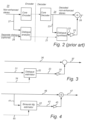
- Figure 2 shows an example of dual ended dialogue enhancement in a conventional stereo example.
- dedicated parameters 21 are computed in the encoder 20 that enable extraction of the dialogue 22 from the decoded non-enhanced stereo signal 23 in the decoder 24.
- the extracted dialogue is level modified, e.g. boosted 25 (by an amount partially controlled by the end-user) and added to the non-enhanced output 23 to form the final output 26.
- the dedicated parameters 21 can be extracted blindly from the non-enhanced audio 27 or exploit a separately provided dialogue signal 28 in the parameter computations.
- the bitstream to the decoder includes an object downmix signal (e.g. a stereo presentation), object parameters to enable reconstruction of the audio objects, and object based metadata allowing manipulation of the reconstructed audio objects.
- object downmix signal e.g. a stereo presentation
- object parameters to enable reconstruction of the audio objects
- object based metadata allowing manipulation of the reconstructed audio objects.
- the manipulation may include amplification of speech related objects.
- a method for dialogue enhancing audio content having one or more audio components, wherein each component is associated with a spatial location comprising providing a first audio signal presentation of the audio components intended for reproduction on a first audio reproduction system, providing a second audio signal presentation of the audio components intended for reproduction on a second audio reproduction system, receiving a set of dialogue estimation parameters configured to enable estimation of dialogue components from the first audio signal presentation, applying the set of dialogue estimation parameters to the first audio signal presentation, to form a dialogue presentation of the dialogue components; and combining the dialogue presentation with the second audio signal presentation to form a dialogue enhanced audio signal presentation for reproduction on the second audio reproduction system, wherein at least one of the first and second audio signal presentation is a binaural audio signal presentation.
- a method for dialogue enhancing audio content having one or more audio components, wherein each component is associated with a spatial location comprising receiving a first audio signal presentation of the audio components intended for reproduction on a first audio reproduction system, receiving a set of presentation transform parameters configured to enable transformation of the first audio signal presentation into a second audio signal presentation intended for reproduction on a second audio reproduction system, receiving a set of dialogue estimation parameters configured to enable estimation of dialogue components from the first audio signal presentation, applying the set of presentation transform parameters to the first audio signal presentation to form a second audio signal presentation, applying the set of dialogue estimation parameters to the first audio signal presentation to form a dialogue presentation of the dialogue components; and combining the dialogue presentation with the second audio signal presentation to form a dialogue enhanced audio signal presentation for reproduction on the second audio reproduction system, wherein only one of the first audio signal presentation and the second audio signal presentation is a binaural audio signal presentation.
- a method for dialogue enhancing audio content having one or more audio components, wherein each component is associated with a spatial location comprising receiving a first audio signal presentation of the audio components intended for reproduction on a first audio reproduction system, receiving a set of presentation transform parameters configured to enable transformation of the first audio signal presentation into the second audio signal presentation intended for reproduction on a second audio reproduction system, receiving a set of dialogue estimation parameters configured to enable estimation of dialogue components from the second audio signal presentation, applying the set of presentation transform parameters to the first audio signal presentation to form a second audio signal presentation, applying the set of dialogue estimation parameters to the second audio signal presentation to form a dialogue presentation of the dialogue components; and summing the dialogue presentation with the second audio signal presentation to form a dialogue enhanced audio signal presentation for reproduction on the second audio reproduction system, wherein only one of the first audio signal presentation and the second audio signal presentation is a binaural audio signal presentation.
- a decoder for dialogue enhancing audio content having one or more audio components, wherein each component is associated with a spatial location comprising, a core decoder for receiving and decoding a first audio signal presentation of the audio components intended for reproduction on a first audio reproduction system and a set of dialogue estimation parameters configured to enable estimation of dialogue components from the first audio signal presentation, a dialogue estimator for applying the set of dialogue estimation parameters to the first audio signal presentation, to form a dialogue presentation of the dialogue components, and means for combining the dialogue presentation with the second audio signal presentation to form a dialogue enhanced audio signal presentation for reproduction on the second audio reproduction system, wherein only one of the first and second audio signal presentation is a binaural audio signal presentation.
- a decoder for dialogue enhancing audio content having one or more audio components, wherein each component is associated with a spatial location comprising a core decoder for receiving a first audio signal presentation of the audio components intended for reproduction on a first audio reproduction system, a set of presentation transform parameters configured to enable transformation of the first audio signal presentation into a second audio signal presentation intended for reproduction on a second audio reproduction system, and a set of dialogue estimation parameters configured to enable estimation of dialogue components from the first audio signal presentation, a transform unit configured to apply the set of presentation transform parameters to the first audio signal presentation to form a second audio signal presentation intended for reproduction on a second audio reproduction system, a dialogue estimator for applying the set of dialogue estimation parameters to the first audio signal presentation to form a dialogue presentation of the dialogue components, and means for combining the dialogue presentation with the second audio signal presentation to form a dialogue enhanced audio signal presentation for reproduction on the second audio reproduction system, wherein only one of the first audio signal presentation and the second audio signal presentation is a bina
- a A decoder for dialogue enhancing audio content having one or more audio components, wherein each component is associated with a spatial location comprising a core decoder for receiving a first audio signal presentation of the audio components intended for reproduction on a first audio reproduction system, a set of presentation transform parameters configured to enable transformation of the first audio signal presentation into a second audio signal presentation intended for reproduction on a second audio reproduction system, and a set of dialogue estimation parameters configured to enable estimation of dialogue components from the first audio signal presentation, a transform unit configured to apply the set of presentation transform parameters to the first audio signal presentation to form a second audio signal presentation intended for reproduction on a second audio reproduction system, a dialogue estimator for applying the set of dialogue estimation parameters to the second audio signal presentation to form a dialogue presentation of the dialogue components, and a summation block for summing the dialogue presentation with the second audio signal presentation to form a dialogue enhanced audio signal presentation for reproduction on the second audio reproduction system, wherein one of the first audio signal presentation and the second audio signal
- the invention is based on the insight that a dedicated parameter set may provide an efficient way to extract a dialogue presentation from one audio signal presentation which may then be combined with another audio signal presentation, where at least one of the presentations is a binaural presentation. It is noted that according to the invention, it is not necessary to reconstruct the original audio objects in order to enhance dialogue. Instead, the dedicated parameters are applied directly on a presentation of the audio objects, e.g. a binaural presentation, a stereo presentation, etc.
- the inventive concept enables a variety of specific embodiments, each with specific advantages.
- dialogue enhancement here is not restricted to amplifying or boosting dialogue components, but may also relate to attenuation of selected dialogue components.
- dialogue enhancement refers to a level-modification of one or more dialogue related components of the audio content.
- the gain factor G of the level modification may be less than zero in order to attenuate dialogue, or greater than zero in order to enhance dialogue.
- the first and second presentations are both (echoic or anechoic) binaural presentations.
- the other presentation may be a stereo or surround audio signal presentation.
- the dialogue estimation parameters may be configured to also perform a presentation transform, so that the dialogue presentation corresponds to the second audio signal presentation.
- the invention may advantageously be implemented in a particular type of a so called simulcast system, where the encoded bit stream also includes a set of transform parameters suitable for transforming the first audio signal presentation to a second audio signal presentation.
- Systems and methods disclosed in the following may be implemented as software, firmware, hardware or a combination thereof.
- the division of tasks referred to as "stages" in the below description does not necessarily correspond to the division into physical units; to the contrary, one physical component may have multiple functionalities, and one task may be carried out by several physical components in cooperation.
- Certain components or all components may be implemented as software executed by a digital signal processor or microprocessor, or be implemented as hardware or as an application-specific integrated circuit.
- Such software may be distributed on computer readable media, which may comprise computer storage media (or non-transitory media) and communication media (or transitory media).
- computer storage media includes both volatile and non-volatile, removable and non-removable media implemented in any method or technology for storage of information such as computer readable instructions, data structures, program modules or other data.
- Computer storage media includes, but is not limited to, RAM, ROM, EEPROM, flash memory or other memory technology, CD-ROM, digital versatile disks (DVD) or other optical disk storage, magnetic cassettes, magnetic tape, magnetic disk storage or other magnetic storage devices, or any other medium which can be used to store the desired information and which can be accessed by a computer.
- communication media typically embodies computer readable instructions, data structures, program modules or other data in a modulated data signal such as a carrier wave or other transport mechanism and includes any information delivery media.
- All these embodiments generally relate to a system and method for applying dialogue enhancement to an input audio signal having one or more audio components, wherein each component is associated with a spatial location.
- the illustrated blocks are typically implemented in a decoder.
- the input signals are preferably analyzed in time/frequency tiles, for example by means of a filter bank such as a quadrature mirror filter (QMF) bank, a discrete Fourier transform (DFT), a discrete cosine transform (DCT), or any other means to split input signals into a variety of frequency bands.
- a filter bank such as a quadrature mirror filter (QMF) bank, a discrete Fourier transform (DFT), a discrete cosine transform (DCT), or any other means to split input signals into a variety of frequency bands.
- QMF quadrature mirror filter
- DFT discrete Fourier transform
- DCT discrete cosine transform
- the number of time slots in the set K can be independent of, and constant with respect to frequency and is typically chosen to correspond to a time interval of 5-40 ms.
- the number P of sets of frequency indices is typically between 1-25 with the number of frequency indices in each set typically increasing with increasing frequency to reflect properties of hearing (higher frequency resolution in the parameterization toward low frequencies).
- the dialogue parameters w may be computed in the encoder, and encoded using techniques disclosed in US Provisional Patent Application Serial Number 62/209,735, filed August 25, 2015 , hereby incorporated by reference.
- the parameters w are then transmitted in the bitstream and decoded by a decoder prior to application using the above equation. Due to the linear nature of the estimate the encoder computation can be implemented using minimum mean squared error (MMSE) methods in cases where the target signal (the clean dialogue or an estimate of the clean dialogue) is available.
- MMSE minimum mean squared error
- the choice of P, and the choice of the number of time slots in K is a trade-off between quality and bit rate.
- the choice of M is also a quality/bitrate trade-off, see US patent application 62/209,742 filed on August 25, 2015 , hereby incorporated by reference.
- the parameters w are in general complex valued since the binauralization of the signals introduces ITDs (phase differences). However, the parameters can be constrained to be real-valued in order to lower the bit rate.
- the above form of the estimator may be used when performing only dialogue extraction, or when performing only a presentation transform, as well as in the case where both extraction and presentation transform is done using a single set of parameters as is detailed in embodiments below.
- a first audio signal presentation 31 has been rendered from an immersive audio signal including a plurality of spatialized audio components.
- This first audio signal presentation is provided to a dialogue estimator 32, in order to provide a presentation 33 of one or several extracted dialogue components.
- the dialogue estimator 32 is provided with a dedicated set of dialogue estimation parameters 34.
- the dialogue presentation is level modified (e.g. boosted) by gain block 35, and then combined with a second presentation 36 of the audio signal to form a dialogue enhanced output 37.
- the combination may be a simple summation, but may also involve a summation of the dialogue presentation with the first presentation, before applying a transform to the sum, thereby forming the dialogue enhanced second presentation.
- At least one of the presentations is a binaural presentation (echoic or anechoic).
- the first and second presentations may be different, and the dialogue presentation may or may not correspond to the second presentation.
- the first audio signal presentation may be intended for playback on a first audio reproduction system, e.g. a set of loudspeakers, while the second audio signal presentation may be intended for playback on a second audio reproduction system, e.g. headphones.
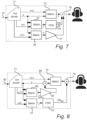
- the first and second presentations 41, 46, as well as the dialogue presentation 43 are all (echoic or anechoic) binaural presentations.
- the (binaural) dialogue estimator 42 - and the dedicated parameters 44 - is thus configured to estimate binaural dialogue components which are level modified in block 45 and added to the second audio presentation 46 to form output 47.
- the parameters 44 are not configured to perform any presentation transform.
- the binaural dialogue estimator 42 should be complex valued in frequency bands up to the phase/magnitude cut-off frequency. To explain why complex valued estimators can be needed even when no presentation transform is done consider estimation of binaural dialogue from a binaural signal that is a mix of binaural dialogue and other binaural background content. Optimal extraction of dialogue often includes subtracting portions of say the right binaural signal from the left binaural signal to cancel background content. Since the binaural processing, by nature, introduces time (phase) differences between left and right signals, those phase differences must be compensated for prior to any subtraction can be done, and such compensation requires complex valued parameters.
- parameters when studying the result of MMSE computation of parameters the parameters in general come out as complex valued if not constrained to be real valued. In practice the choice of complex vs real valued parameters is a trade-off between quality and bit rate. As mentioned above, parameters can be real-valued above the frequency phase/magnitude cut-off frequency without any loss in quality by exploiting the insensitivity to fine-structure waveform phase differences at high frequencies.
- the first and second presentations are different.
- the first presentation 51 is a non-binaural presentation (e.g. stereo 2.0, or surround 5.1)
- the second presentation 56 is a binaural presentation.
- the set of dialogue estimation parameters 54 are configured to allow the binaural dialogue estimator 52 to estimate a binaural dialogue presentation 53 from a non-binaural presentation 51.
- the presentations could be reversed, in which case the binaural dialogue estimator would e.g. estimate a stereo dialogue presentation from a binaural audio presentation. In either case, the dialogue estimator needs to extract dialogue components and perform a presentation transform.
- the binaural dialogue presentation 53 is level modified by block 55 and added to the second presentation 56.
- the binaural dialogue estimator 52 receives one single set of parameters 54, configured to perform the two operations of dialogue extraction and presentation transform.
- an (echoic or anechoic) binaural dialogue estimator 62 receives two sets of parameters D1, D2; one set (D1) configured to extract dialogue (dialogue extraction parameters) and one set (D2) configured to perform the dialogue presentation transform (dialogue transform parameters).
- D1, D2 receives two sets of parameters D1, D2; one set (D1) configured to extract dialogue (dialogue extraction parameters) and one set (D2) configured to perform the dialogue presentation transform (dialogue transform parameters).
- the dialogue extraction parameters D1 may be available for conventional dialogue extraction as illustrated in figure 2 .
- the parameter transform parameters D2 may be available in a simulcast implementation, as discussed below.
- the dialogue extraction (block 62a) is indicated as occurring before the presentation transform (block 62b), but this order may of course equally well be reversed. It is also noted that for reasons of computational efficiency, even if the parameters are provided as two separate sets D1, D2, it may be advantageous to first combine the two sets of parameters into one combined matrix transform, before applying this combined transform to the input signal 61.
- the dialogue extraction can be one dimensional, such that the extracted dialogue is a mono representation.
- the transform parameters D2 are then positional metadata, and the presentation transform comprises rendering the mono dialogue using HRTFs, HRIRs or BRIRs corresponding to the position.
- the mono dialogue could be rendered using loudspeaker rendering techniques such as amplitude panning or vector-based amplitude panning (VBAP).
- Figures 7-11 show embodiments of the present invention in the context of a simulcast system, i.e. a system where one audio presentation is encoded and transmitted to a decoder together with a set of transform parameters which enable the decoder to transform the audio presentation into a different presentation adapted to the intended playback system (e.g. as indicated a binaural presentation for headphones).
- a simulcast system i.e. a system where one audio presentation is encoded and transmitted to a decoder together with a set of transform parameters which enable the decoder to transform the audio presentation into a different presentation adapted to the intended playback system (e.g. as indicated a binaural presentation for headphones).
- a simulcast system i.e. a system where one audio presentation is encoded and transmitted to a decoder together with a set of transform parameters which enable the decoder to transform the audio presentation into a different presentation adapted to the intended playback system (e.g. as indicated a binaural presentation for headphones).
- a core decoder 71 receives an encoded bitstream 72 including an initial audio signal presentation of the audio components.
- this initial presentation is a stereo presentation z, but it may also be any other presentation.
- the bitstream 72 also includes a set of presentation transform parameters w(y) which are used as matrix coefficients to perform a matrix transform 73 of the stereo signal z to generate a reconstructed anechoic binaural signal ⁇ .
- the transform parameters w(y) have been determined in the encoder as discussed in US 62/209,735 .
- the bitstream 72 also includes a set of parameters w(f) which are used as matrix coefficients to perform a matrix transform 74 of the stereo signal z to generate a reconstructed input signal f ⁇ for an acoustic environment simulation, here a feedback delay network (FDN) 75.
- FDN feedback delay network
- These parameters w(f) have been determined in a similar way as the presentation transform parameters w(y).
- the FDN 75 receives the input signal f ⁇ and provides an acoustic environment simulation output FDN out which may be combined with the anechoic binaural signal ⁇ to provide an echoic binaural signal.
- the bitstream further includes a set of dialogue estimation parameters w(D) which are used as matrix coefficients in a dialogue estimator 76 to perform a matrix transform of the stereo signal z to generate an anechoic binaural dialogue presentation D.
- the dialogue presentation D is level modified (e.g. boosted) in block 77, and combined with the reconstructed anechoic signal ⁇ and the acoustic environment simulation output FDN out in summation block 78.
- Figure 7 is essentially an implementation of the embodiment in figure 5 in a simulcast context.
- a stereo signal z, a set of transform parameters w(y) and a further set of parameters w(f) are received and decoded just as in figure 7 , and elements 71, 73, 74, 75, and 78 are equivalent to those discussed with respect to figure 7 .
- the bitstream 82 here also includes a set of dialogue estimation parameters w(D1) which are applied by a dialogue estimator 86 on the signal z.
- the dialogue estimation parameters w(D1) are not configured to provide any presentation transform.
- the dialogue presentation output D stereo from the dialogue estimator 86 therefore corresponds to the initial audio signal presentation, here a stereo presentation.
- This dialogue presentation D stereo is level modified in block 87, and then added to the signal z in the summation 88.
- the dialogue enhanced signal (z + D stereo ) is then transformed by the set of transform parameters w(y).
- Figure 8 can be seen as an implementation of the embodiment in figure 6 in a simulcast context, where w(D1) is used as D1 and w(y) is used as D2. However, while in figure 6 both sets of parameters are applied in the dialogue estimator 62, in figure 8 the extracted dialogue D stereo is added to the signal z and the transform w(y) is applied to the combined signal (z + D).
- the set of parameters w(D1) may be identical to the dialogue enhancement parameters used to provide dialogue enhancement of the stereo signal in a simulcast implementation.
- This alternative is illustrated in figure 9a , where the dialogue extraction 96a is indicated as forming part of the core decoder 91. Further, in figure 9a , a presentation transform 96b using the parameter set w(y) is performed before the gain, separately from the transformation of the signal z. This embodiment is thus even more similar to the case shown in figure 6 , with the dialogue estimator 62 comprising both transforms 96a, 96b.
- Figure 9b shows a modified version of the embodiment in figure 9a .
- the presentation transform is not performed using the parameter set w(y), but with an additional set of parameters w(D2) which is provided in a part of the bitstream dedicated to binaural dialogue estimation.
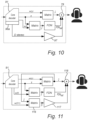
- Figure 10 shows a modified version of the embodiment in figure 9a-9b .
- the dialogue extractor 96a again provides a stereo dialogue presentation D stereo , and is again indicated as forming part of the core decoder 91.
- the stereo dialogue presentation D stereo after level modification in block 97, is added directly to the anechoic binaural signal ⁇ (together with the acoustic environment simulation from the FDN).
- combining signals with different presentations e.g., summing a stereo dialogue signal to a binaural signal (which contains non-enhanced binaural dialogue components) naturally leads to spatial imaging artifacts since the non-enhanced binaural dialogue components are perceived to be spatially different compared to a stereo presentation of the same components.
- phase differences phase differences
- phase differences above the phase/magnitude cut-off frequency are avoided in the binaural processing so as to reduce this type of artifact.
- a stereo signal z, a set of transform parameters w(y) and a further set of parameters w(f) are received and decoded just as in figure 7 .
- the bitstream also includes a set of dialogue estimation parameters w(D1) which are not configured to provide any presentation transform.
- the dialogue estimation parameters w(D1) are applied by the dialogue estimator 116 on the reconstructed anechoic binaural signal ⁇ to provide an anechoic binaural dialogue presentation D.
- This dialogue presentation D is level modified by a block 117 and added in summation 118 to the signal ⁇ together with FDN out .
- Figure 11 is essentially an implementation of the single presentation embodiment in figure 5 in a simulcast context. However, it can also be seen as an implementation of figure 6 with a reversed order of D1 and D2, where again w(D1) is used as D1 and w(y) is used as D2. However, while in figure 6 both sets of parameters are applied in the dialogue estimator, in figure 9 the transform parameters D2 have already been applied in order to obtain ⁇ , and the dialogue estimator 116 only needs to apply the parameters w(D1) to the signal ⁇ in order to obtain the echoic binaural dialogue presentation D.
- ⁇ processing is selected based on a determination of whether the factor G is greater than or smaller than a given threshold.
- the threshold is zero, and first processing is applied when G ⁇ 0 (attenuation of dialogue), while a second processing is applied when G>0 (enhancement of dialogue).
- the circuit in figure 12 includes selection logic in the form of a switch 121 with two positions A and B.
- the switch is provided with the value of the gain factor G from block 122, and is configured to assume position A when G ⁇ 0, and position B when G>0.
- the circuit When the switch is in position A, the circuit is here configured to combine the estimated stereo dialogue from matrix transform 86 with the stereo signal z, and then perform the matrix transform 73 on the combined signal to generate a reconstructed anechoic binaural signal.
- the output from the feedback delay network 75 is then combined with this signal in 78. It is noted that this processing essentially corresponds to figure 8 discussed above.
- the circuit When the switch is in position B, the circuit is here configured to apply transform parameters w(D2) to the stereo dialogue from matrix transform 86 in order to provide a binaural dialogue estimation. This estimation is then added to the anechoic binaural signal from transform 73, and output from the feedback delay network 75. It is noted that this processing essentially corresponds to figure 9b discussed above.
- the processing in position A and B could instead correspond to that in figure 10 .
- the main contribution of the embodiment in figure 12 is the introduction of the switch 121, which enables alternative processing depending on the value of the gain factor G.
- any one of the terms comprising, comprised of or which comprises is an open term that means including at least the elements/features that follow, but not excluding others.
- the term comprising, when used in the claims should not be interpreted as being limitative to the means or elements or steps listed thereafter.
- the scope of the expression a device comprising A and B should not be limited to devices consisting only of elements A and B.
- Any one of the terms including or which includes or that includes as used herein is also an open term that also means including at least the elements/features that follow the term, but not excluding others. Thus, including is synonymous with and means comprising.
- exemplary is used in the sense of providing examples, as opposed to indicating quality. That is, an "exemplary embodiment” is an embodiment provided as an example, as opposed to necessarily being an embodiment of exemplary quality.
- an element described herein of an apparatus embodiment is an example of a means for carrying out the function performed by the element for the purpose of carrying out the invention.
- Coupled when used in the claims, should not be interpreted as being limited to direct connections only.
- the terms “coupled” and “connected,” along with their derivatives, may be used. It should be understood that these terms are not intended as synonyms for each other.
- the scope of the expression a device A coupled to a device B should not be limited to devices or systems wherein an output of device A is directly connected to an input of device B. It means that there exists a path between an output of A and an input of B which may be a path including other devices or means.
- Coupled may mean that two or more elements are either in direct physical or electrical contact, or that two or more elements are not in direct contact with each other but yet still co-operate or interact with each other.
Landscapes
- Physics & Mathematics (AREA)
- Engineering & Computer Science (AREA)
- Acoustics & Sound (AREA)
- Signal Processing (AREA)
- Stereophonic System (AREA)
Abstract
Description
- This application is a European divisional application of Euro-
PCT patent application EP 17702510.3 (reference: D15139EP01), filed on 26 January 2017 - The present invention relates to the field of audio signal processing, and discloses methods and systems for efficient estimation of dialogue components, in particular for audio signals having spatialization components, sometimes referred to as immersive audio content.
- Any discussion of the background art throughout the specification should in no way be considered as an admission that such art is widely known or forms part of common general knowledge in the field.
- Content creation, coding, distribution and reproduction of audio are traditionally performed in a channel based format, that is, one specific target playback system is envisioned for content throughout the content ecosystem. Examples of such target playback systems audio formats are mono, stereo, 5.1, 7.1, and the like, and we refer to these formats as different presentations of the original content. The above mentioned presentations are typically played back over loudspeakers but a notable exception is the stereo presentation which also commonly is played back directly over headphones.
- One specific presentation is the binaural presentation, typically targeting playback on headphones. Distinctive to a binaural presentation is that it is a two-channel signal with each signal representing the content as perceived at, or close to, the left and right eardrum respectively. A binaural presentation can be played back directly over loudspeakers, but preferably the binaural presentation is transformed into a presentation suitable for playback over loudspeakers using cross-talk cancellation techniques.
- Different audio reproduction systems have been introduced above, like loudspeakers in different configurations, for example stereo, 5.1, and 7.1, and headphones. It is understood from the examples above that a presentation of the original content has a natural, intended, associated audio reproduction system, but can of course be played back on a different audio reproduction system.
- If content is to be reproduced on a different playback system than the intended one, a downmixing or upmixing process can be applied. For example, 5.1 content can be reproduced over a stereo playback system by employing specific downmix equations. Another example is playback of stereo encoded content over a 7.1 speaker setup, which may comprise a so-called upmixing process, that could or could not be guided by information present in the stereo signal. A system capable of upmixing is Dolby Pro Logic from Dolby Laboratories Inc (Roger Dressler, "Dolby Pro Logic Surround Decoder, Principles of Operation", www.Dolby.com).
- An alternative audio format system is an audio object format such as that provided by the Dolby Atmos system. In this type of format, objects or components are defined to have a particular location around a listener, which may be time varying. Audio content in this format is sometimes referred to as immersive audio content. It is noted that within the context of this application an audio object format is not considered a presentation as described above, but rather a format of the original content that is rendered to one or more presentations in an encoder, after which the presentation(s) is encoded and transmitted to a decoder.
- When multi-channel and object based content is to be transformed into a binaural presentation as mentioned above, the acoustic scene consisting of loudspeakers and objects at particular locations is simulated by means of head-related impulse responses (HRIRs), or binaural room impulse responses (BRIRs), which simulate the acoustical pathway from each loudspeaker/object to the ear drums, in an anechoic or echoic (simulated) environment, respectively. In particular, audio signals can be convolved with HRIRs or BRIRs to re-instate inter-aural level differences (ILDs), inter-aural time differences (ITDs) and spectral cues that allow the listener to determine the location of each individual loudspeaker/object. The simulation of an acoustic environment (reverberation) also helps to achieve a certain perceived distance.
Figure 1 illustrates a schematic overview of the processing flow for rendering two object or channel signals xi 10, 11, being read out of acontent store 12 for processing by 4 HRIRs e.g. 14. The HRIR outputs are then summed 15, 16, for each channel signal, so as to produce headphone speaker outputs for playback to a listener viaheadphones 18. The basic principle of HRIRs is, for example, explained in Wightman, Frederic L., and Doris J. Kistler. "Sound localization." Human psychophysics. Springer New York, 1993. 155-192. - The HRIR/BRIR convolution approach comes with several drawbacks, one of them being the substantial amount of convolution processing that is required for headphone playback. The HRIR or BRIR convolution needs to be applied for every input object or channel separately, and hence complexity typically grows linearly with the number of channels or objects. As headphones are often used in conjunction with battery-powered portable devices, a high computational complexity is not desirable as it may substantially shorten battery life. Moreover, with the introduction of object-based audio content, which may comprise say more than 100 objects active simultaneously, the complexity of HRIR convolution can be substantially higher than for traditional channel-based content.
- For this purpose, co-pending and non-published
US Provisional Patent Application Serial Number 62/209,735, filed August 25, 2015 - A part of the content which during creation is associated with a specific spatial location is referred to as an audio component. The spatial location can be a point in space or a distributed location. Audio components can be thought of as all the individual audio sources that a sound artist mixes, i.e., positions spatially, into a soundtrack. Typically a semantic meaning (e.g. dialogue) is assigned to the components of interest so that the goal of the processing (e.g. dialogue enhancement) becomes defined. It is noted that audio components that are produced during content creation are typically present throughout the processing chain, from the original content to different presentations. For example, in an object format there can be dialogue objects with associated spatial locations. And in a stereo presentation there can be dialogue components that are spatially located in the horizontal plane.
- In some applications, it is desirable to extract dialogue components in the audio signal, in order to e.g. enhance or amplify such components. The goal of dialogue enhancement (DE) may be to modify the speech part of a piece of content that contains a mix of speech and background audio so that the speech becomes more intelligible and/or less fatiguing for an end-user. Another use of DE is to attenuate dialogue that for example is perceived as disturbing by an end-user. There are two fundamental classes of DE methods: encoder side and decoder side DE. Decoder side DE (called single ended) operates solely on the decoded parameters and signals that reconstruct the non-enhanced audio, i.e., no dedicated side-information for DE is present in the bitstream. In encoder side DE (called dual ended), dedicated side-information that can be used to do DE in the decoder is computed in the encoder and inserted in the bitstream.
-
Figure 2 shows an example of dual ended dialogue enhancement in a conventional stereo example. Here,dedicated parameters 21 are computed in theencoder 20 that enable extraction of thedialogue 22 from the decodednon-enhanced stereo signal 23 in thedecoder 24. The extracted dialogue is level modified, e.g. boosted 25 (by an amount partially controlled by the end-user) and added to the non-enhancedoutput 23 to form thefinal output 26. Thededicated parameters 21 can be extracted blindly from thenon-enhanced audio 27 or exploit a separately provideddialogue signal 28 in the parameter computations. - Another approach is disclosed in
US 8,315,396 . Here, the bitstream to the decoder includes an object downmix signal (e.g. a stereo presentation), object parameters to enable reconstruction of the audio objects, and object based metadata allowing manipulation of the reconstructed audio objects. As indicated infigure 10 ofUS 8,315,396 , the manipulation may include amplification of speech related objects. This approach thus requires the reconstruction of the original audio objects on the decoder side, which typically is computationally demanding. - There is a general desire to provide dialogue estimation efficiently also in a binaural context.
- It is an object of the invention to provide efficient dialogue enhancement in a binaural context, i.e. when at least one of the audio presentations that the dialogue component(s) is extracted from, or the audio presentation to which the extracted dialogue is added to, is a (echoic or anechoic) binaural representation.
- In accordance with a first aspect of the present invention, there is provided a method for dialogue enhancing audio content having one or more audio components, wherein each component is associated with a spatial location, comprising providing a first audio signal presentation of the audio components intended for reproduction on a first audio reproduction system, providing a second audio signal presentation of the audio components intended for reproduction on a second audio reproduction system, receiving a set of dialogue estimation parameters configured to enable estimation of dialogue components from the first audio signal presentation, applying the set of dialogue estimation parameters to the first audio signal presentation, to form a dialogue presentation of the dialogue components; and combining the dialogue presentation with the second audio signal presentation to form a dialogue enhanced audio signal presentation for reproduction on the second audio reproduction system, wherein at least one of the first and second audio signal presentation is a binaural audio signal presentation.
- In accordance with a second aspect of the present invention, there is provided a method for dialogue enhancing audio content having one or more audio components, wherein each component is associated with a spatial location, comprising receiving a first audio signal presentation of the audio components intended for reproduction on a first audio reproduction system, receiving a set of presentation transform parameters configured to enable transformation of the first audio signal presentation into a second audio signal presentation intended for reproduction on a second audio reproduction system, receiving a set of dialogue estimation parameters configured to enable estimation of dialogue components from the first audio signal presentation, applying the set of presentation transform parameters to the first audio signal presentation to form a second audio signal presentation, applying the set of dialogue estimation parameters to the first audio signal presentation to form a dialogue presentation of the dialogue components; and combining the dialogue presentation with the second audio signal presentation to form a dialogue enhanced audio signal presentation for reproduction on the second audio reproduction system, wherein only one of the first audio signal presentation and the second audio signal presentation is a binaural audio signal presentation.
- In accordance with a third aspect of the present invention, there is provided a method for dialogue enhancing audio content having one or more audio components, wherein each component is associated with a spatial location, comprising receiving a first audio signal presentation of the audio components intended for reproduction on a first audio reproduction system, receiving a set of presentation transform parameters configured to enable transformation of the first audio signal presentation into the second audio signal presentation intended for reproduction on a second audio reproduction system, receiving a set of dialogue estimation parameters configured to enable estimation of dialogue components from the second audio signal presentation, applying the set of presentation transform parameters to the first audio signal presentation to form a second audio signal presentation, applying the set of dialogue estimation parameters to the second audio signal presentation to form a dialogue presentation of the dialogue components; and summing the dialogue presentation with the second audio signal presentation to form a dialogue enhanced audio signal presentation for reproduction on the second audio reproduction system, wherein only one of the first audio signal presentation and the second audio signal presentation is a binaural audio signal presentation.
- In accordance with a fourth aspect of the present invention, there is provided a decoder for dialogue enhancing audio content having one or more audio components, wherein each component is associated with a spatial location, comprising, a core decoder for receiving and decoding a first audio signal presentation of the audio components intended for reproduction on a first audio reproduction system and a set of dialogue estimation parameters configured to enable estimation of dialogue components from the first audio signal presentation, a dialogue estimator for applying the set of dialogue estimation parameters to the first audio signal presentation, to form a dialogue presentation of the dialogue components, and means for combining the dialogue presentation with the second audio signal presentation to form a dialogue enhanced audio signal presentation for reproduction on the second audio reproduction system, wherein only one of the first and second audio signal presentation is a binaural audio signal presentation.
- In accordance with a fifth aspect of the present invention, there is provided a decoder for dialogue enhancing audio content having one or more audio components, wherein each component is associated with a spatial location, comprising a core decoder for receiving a first audio signal presentation of the audio components intended for reproduction on a first audio reproduction system, a set of presentation transform parameters configured to enable transformation of the first audio signal presentation into a second audio signal presentation intended for reproduction on a second audio reproduction system, and a set of dialogue estimation parameters configured to enable estimation of dialogue components from the first audio signal presentation, a transform unit configured to apply the set of presentation transform parameters to the first audio signal presentation to form a second audio signal presentation intended for reproduction on a second audio reproduction system, a dialogue estimator for applying the set of dialogue estimation parameters to the first audio signal presentation to form a dialogue presentation of the dialogue components, and means for combining the dialogue presentation with the second audio signal presentation to form a dialogue enhanced audio signal presentation for reproduction on the second audio reproduction system, wherein only one of the first audio signal presentation and the second audio signal presentation is a binaural audio signal presentation.
- In accordance with a sixth aspect of the present invention, there is provided a A decoder for dialogue enhancing audio content having one or more audio components, wherein each component is associated with a spatial location, comprising a core decoder for receiving a first audio signal presentation of the audio components intended for reproduction on a first audio reproduction system, a set of presentation transform parameters configured to enable transformation of the first audio signal presentation into a second audio signal presentation intended for reproduction on a second audio reproduction system, and a set of dialogue estimation parameters configured to enable estimation of dialogue components from the first audio signal presentation, a transform unit configured to apply the set of presentation transform parameters to the first audio signal presentation to form a second audio signal presentation intended for reproduction on a second audio reproduction system, a dialogue estimator for applying the set of dialogue estimation parameters to the second audio signal presentation to form a dialogue presentation of the dialogue components, and a summation block for summing the dialogue presentation with the second audio signal presentation to form a dialogue enhanced audio signal presentation for reproduction on the second audio reproduction system, wherein one of the first audio signal presentation and the second audio signal presentation is a binaural audio signal presentation.
- The invention is based on the insight that a dedicated parameter set may provide an efficient way to extract a dialogue presentation from one audio signal presentation which may then be combined with another audio signal presentation, where at least one of the presentations is a binaural presentation. It is noted that according to the invention, it is not necessary to reconstruct the original audio objects in order to enhance dialogue. Instead, the dedicated parameters are applied directly on a presentation of the audio objects, e.g. a binaural presentation, a stereo presentation, etc. The inventive concept enables a variety of specific embodiments, each with specific advantages.
- It is noted that the expression "dialogue enhancement" here is not restricted to amplifying or boosting dialogue components, but may also relate to attenuation of selected dialogue components. Thus, in general the expression "dialogue enhancement" refers to a level-modification of one or more dialogue related components of the audio content. The gain factor G of the level modification may be less than zero in order to attenuate dialogue, or greater than zero in order to enhance dialogue.
- In some embodiments, the first and second presentations are both (echoic or anechoic) binaural presentations. In case only one of them binaural, the other presentation may be a stereo or surround audio signal presentation.
- In the case of different presentations, the dialogue estimation parameters may be configured to also perform a presentation transform, so that the dialogue presentation corresponds to the second audio signal presentation.
- The invention may advantageously be implemented in a particular type of a so called simulcast system, where the encoded bit stream also includes a set of transform parameters suitable for transforming the first audio signal presentation to a second audio signal presentation.
- Embodiments of the invention will now be described, by way of example only, with reference to the accompanying drawings in which:
-
Figure 1 illustrates a schematic overview of the HRIR convolution process for two sound sources or objects, with each channel or object being processed by a pair of HRIRs/BRIRs. -
Figure 2 illustrates schematically dialogue enhancement in a stereo context. -
Figure 3 is a schematic block diagram illustrating the principle of dialogue enhancement according to the invention. -
Figure 4 is a schematic block diagram of single presentation dialogue enhancement according to an embodiment of the invention. -
Figure 5 is a schematic block diagram of two presentation dialogue enhancement according to a further embodiment of the invention. -
Figure 6 is a schematic block diagram of the binaural dialogue estimator infigure 5 according to a further embodiment of the invention. -
Figure 7 is a schematic block diagram of a simulcast decoder implementing dialogue enhancement according to an embodiment of the invention. -
Figure 8 is a schematic block diagram of a simulcast decoder implementing dialogue enhancement according to another embodiment of the invention. -
Figure 9a is a schematic block diagram of a simulcast decoder implementing dialogue enhancement according to yet another embodiment of the invention. -
Figure 9b is a schematic block diagram of a simulcast decoder implementing dialogue enhancement according to yet another embodiment of the invention. -
Figure 10 is a schematic block diagram of a simulcast decoder implementing dialogue enhancement according to yet another embodiment of the invention. -
Figure 11 is a schematic block diagram of a simulcast decoder implementing dialogue enhancement according to yet another embodiment of the invention. -
Figure 12 is a schematic block diagram showing yet another embodiment of the present invention. - Systems and methods disclosed in the following may be implemented as software, firmware, hardware or a combination thereof. In a hardware implementation, the division of tasks referred to as "stages" in the below description does not necessarily correspond to the division into physical units; to the contrary, one physical component may have multiple functionalities, and one task may be carried out by several physical components in cooperation. Certain components or all components may be implemented as software executed by a digital signal processor or microprocessor, or be implemented as hardware or as an application-specific integrated circuit. Such software may be distributed on computer readable media, which may comprise computer storage media (or non-transitory media) and communication media (or transitory media). As is well known to a person skilled in the art, the term computer storage media includes both volatile and non-volatile, removable and non-removable media implemented in any method or technology for storage of information such as computer readable instructions, data structures, program modules or other data. Computer storage media includes, but is not limited to, RAM, ROM, EEPROM, flash memory or other memory technology, CD-ROM, digital versatile disks (DVD) or other optical disk storage, magnetic cassettes, magnetic tape, magnetic disk storage or other magnetic storage devices, or any other medium which can be used to store the desired information and which can be accessed by a computer. Further, it is well known to the skilled person that communication media typically embodies computer readable instructions, data structures, program modules or other data in a modulated data signal such as a carrier wave or other transport mechanism and includes any information delivery media.
- Various ways to implement embodiments of the invention will be discussed with reference to
figures 3-6 . All these embodiments generally relate to a system and method for applying dialogue enhancement to an input audio signal having one or more audio components, wherein each component is associated with a spatial location. The illustrated blocks are typically implemented in a decoder. - In the presented embodiments the input signals are preferably analyzed in time/frequency tiles, for example by means of a filter bank such as a quadrature mirror filter (QMF) bank, a discrete Fourier transform (DFT), a discrete cosine transform (DCT), or any other means to split input signals into a variety of frequency bands. The result of such a transform is that an input signal xi[n] for input with index i and discrete-time index n is represented by sub-band signals xi [b,k] for time slot (or frame) k and sub-band b. Consider for example the estimation of the binaural dialogue presentation from a stereo presentation. Let xj [b,k], j = 1,2 denote the sub-band signals of the left and right stereo channels, and d̂i [b,k],i = 1,2 denote the sub-band signals of the estimated left and right binaural dialogue signals. The dialogue estimate may be computed like


- The dialogue parameters w may be computed in the encoder, and encoded using techniques disclosed in
US Provisional Patent Application Serial Number 62/209,735, filed August 25, 2015 - The choice of P, and the choice of the number of time slots in K is a trade-off between quality and bit rate. Furthermore, the parameters w can be constrained in order to lower the bit rate (at the cost of lower quality), e.g., by assuming

US patent application 62/209,742 filed on August 25, 2015 - In general it is proposed to use estimators of the form

- The above estimator can conveniently be expressed in matrix notation as (omitting the time/frequency tile indexing for ease of notation)

- With reference to
figure 3 , a firstaudio signal presentation 31 has been rendered from an immersive audio signal including a plurality of spatialized audio components. This first audio signal presentation is provided to adialogue estimator 32, in order to provide apresentation 33 of one or several extracted dialogue components. Thedialogue estimator 32 is provided with a dedicated set ofdialogue estimation parameters 34. The dialogue presentation is level modified (e.g. boosted) bygain block 35, and then combined with asecond presentation 36 of the audio signal to form a dialogue enhancedoutput 37. As will be discussed below, the combination may be a simple summation, but may also involve a summation of the dialogue presentation with the first presentation, before applying a transform to the sum, thereby forming the dialogue enhanced second presentation. - According to the present invention, at least one of the presentations is a binaural presentation (echoic or anechoic). As will be further discussed in the following, the first and second presentations may be different, and the dialogue presentation may or may not correspond to the second presentation. For example, the first audio signal presentation may be intended for playback on a first audio reproduction system, e.g. a set of loudspeakers, while the second audio signal presentation may be intended for playback on a second audio reproduction system, e.g. headphones.
- In the decoder embodiment in
figure 4 , the first andsecond presentations dialogue presentation 43, are all (echoic or anechoic) binaural presentations. The (binaural) dialogue estimator 42 - and the dedicated parameters 44 - is thus configured to estimate binaural dialogue components which are level modified inblock 45 and added to thesecond audio presentation 46 to formoutput 47. - In the embodiment in
figure 4 , theparameters 44 are not configured to perform any presentation transform. Still, for best quality, thebinaural dialogue estimator 42 should be complex valued in frequency bands up to the phase/magnitude cut-off frequency. To explain why complex valued estimators can be needed even when no presentation transform is done consider estimation of binaural dialogue from a binaural signal that is a mix of binaural dialogue and other binaural background content. Optimal extraction of dialogue often includes subtracting portions of say the right binaural signal from the left binaural signal to cancel background content. Since the binaural processing, by nature, introduces time (phase) differences between left and right signals, those phase differences must be compensated for prior to any subtraction can be done, and such compensation requires complex valued parameters. Indeed, when studying the result of MMSE computation of parameters the parameters in general come out as complex valued if not constrained to be real valued. In practice the choice of complex vs real valued parameters is a trade-off between quality and bit rate. As mentioned above, parameters can be real-valued above the frequency phase/magnitude cut-off frequency without any loss in quality by exploiting the insensitivity to fine-structure waveform phase differences at high frequencies. - In the decoder embodiment in
figure 5 , the first and second presentations are different. In the illustrated example, thefirst presentation 51 is a non-binaural presentation (e.g. stereo 2.0, or surround 5.1), while thesecond presentation 56 is a binaural presentation. In this case, the set ofdialogue estimation parameters 54 are configured to allow thebinaural dialogue estimator 52 to estimate abinaural dialogue presentation 53 from anon-binaural presentation 51. It is noted that the presentations could be reversed, in which case the binaural dialogue estimator would e.g. estimate a stereo dialogue presentation from a binaural audio presentation. In either case, the dialogue estimator needs to extract dialogue components and perform a presentation transform. Thebinaural dialogue presentation 53 is level modified byblock 55 and added to thesecond presentation 56. - As indicated in
figure 5 , thebinaural dialogue estimator 52 receives one single set ofparameters 54, configured to perform the two operations of dialogue extraction and presentation transform. However, as indicated infigure 6 , it is also possible that an (echoic or anechoic)binaural dialogue estimator 62 receives two sets of parameters D1, D2; one set (D1) configured to extract dialogue (dialogue extraction parameters) and one set (D2) configured to perform the dialogue presentation transform (dialogue transform parameters). This may be advantageous in an implementation where one or both of these subsets D1, D2 are already available in the decoder. For example, the dialogue extraction parameters D1 may be available for conventional dialogue extraction as illustrated infigure 2 . Further, the parameter transform parameters D2 may be available in a simulcast implementation, as discussed below. - In
figure 6 , the dialogue extraction (block 62a) is indicated as occurring before the presentation transform (block 62b), but this order may of course equally well be reversed. It is also noted that for reasons of computational efficiency, even if the parameters are provided as two separate sets D1, D2, it may be advantageous to first combine the two sets of parameters into one combined matrix transform, before applying this combined transform to theinput signal 61. - Further, it is noted that the dialogue extraction can be one dimensional, such that the extracted dialogue is a mono representation. The transform parameters D2 are then positional metadata, and the presentation transform comprises rendering the mono dialogue using HRTFs, HRIRs or BRIRs corresponding to the position. Alternatively, if the desired rendered dialogue presentation is intended for loudspeaker playback, the mono dialogue could be rendered using loudspeaker rendering techniques such as amplitude panning or vector-based amplitude panning (VBAP).
-
Figures 7-11 show embodiments of the present invention in the context of a simulcast system, i.e. a system where one audio presentation is encoded and transmitted to a decoder together with a set of transform parameters which enable the decoder to transform the audio presentation into a different presentation adapted to the intended playback system (e.g. as indicated a binaural presentation for headphones). Various aspects of such a system is described in detail in co-pending and non-publishedUS Provisional Patent Application Serial Number 62/209,735, filed August 25, 2015figures 7-11 only illustrate the decoder side. - As illustrated in
figure 7 , acore decoder 71 receives an encodedbitstream 72 including an initial audio signal presentation of the audio components. In the illustrated case this initial presentation is a stereo presentation z, but it may also be any other presentation. Thebitstream 72 also includes a set of presentation transform parameters w(y) which are used as matrix coefficients to perform amatrix transform 73 of the stereo signal z to generate a reconstructed anechoic binaural signal ŷ. The transform parameters w(y) have been determined in the encoder as discussed inUS 62/209,735bitstream 72 also includes a set of parameters w(f) which are used as matrix coefficients to perform amatrix transform 74 of the stereo signal z to generate a reconstructed input signal f̂ for an acoustic environment simulation, here a feedback delay network (FDN) 75. These parameters w(f) have been determined in a similar way as the presentation transform parameters w(y). TheFDN 75 receives the input signal f̂ and provides an acoustic environment simulation output FDNout which may be combined with the anechoic binaural signal ŷ to provide an echoic binaural signal. - In the embodiment in
figure 7 , the bitstream further includes a set of dialogue estimation parameters w(D) which are used as matrix coefficients in adialogue estimator 76 to perform a matrix transform of the stereo signal z to generate an anechoic binaural dialogue presentation D. The dialogue presentation D is level modified (e.g. boosted) inblock 77, and combined with the reconstructed anechoic signal ŷ and the acoustic environment simulation output FDNout insummation block 78. -
Figure 7 is essentially an implementation of the embodiment infigure 5 in a simulcast context. - In the embodiment in
figure 8 , a stereo signal z, a set of transform parameters w(y) and a further set of parameters w(f) are received and decoded just as infigure 7 , andelements figure 7 . Further, thebitstream 82 here also includes a set of dialogue estimation parameters w(D1) which are applied by adialogue estimator 86 on the signal z. However, in this embodiment, the dialogue estimation parameters w(D1) are not configured to provide any presentation transform. The dialogue presentation output Dstereo from thedialogue estimator 86 therefore corresponds to the initial audio signal presentation, here a stereo presentation. This dialogue presentation Dstereo is level modified in block 87, and then added to the signal z in thesummation 88. The dialogue enhanced signal (z + Dstereo) is then transformed by the set of transform parameters w(y). -
Figure 8 can be seen as an implementation of the embodiment infigure 6 in a simulcast context, where w(D1) is used as D1 and w(y) is used as D2. However, while infigure 6 both sets of parameters are applied in thedialogue estimator 62, infigure 8 the extracted dialogue Dstereo is added to the signal z and the transform w(y) is applied to the combined signal (z + D). - It is noted that the set of parameters w(D1) may be identical to the dialogue enhancement parameters used to provide dialogue enhancement of the stereo signal in a simulcast implementation. This alternative is illustrated in
figure 9a , where thedialogue extraction 96a is indicated as forming part of thecore decoder 91. Further, infigure 9a , apresentation transform 96b using the parameter set w(y) is performed before the gain, separately from the transformation of the signal z. This embodiment is thus even more similar to the case shown infigure 6 , with thedialogue estimator 62 comprising bothtransforms -
Figure 9b shows a modified version of the embodiment infigure 9a . In this case the presentation transform is not performed using the parameter set w(y), but with an additional set of parameters w(D2) which is provided in a part of the bitstream dedicated to binaural dialogue estimation. - In one embodiment, the aforementioned dedicated presentation transform w(D2) in
figure 9b is a real-valued, single-tap (M=1), full-band (P=1) matrix. -
Figure 10 shows a modified version of the embodiment infigure 9a-9b . In this case, thedialogue extractor 96a again provides a stereo dialogue presentation Dstereo, and is again indicated as forming part of thecore decoder 91. Here, however, the stereo dialogue presentation Dstereo, after level modification inblock 97, is added directly to the anechoic binaural signal ŷ (together with the acoustic environment simulation from the FDN). - It is noted that combining signals with different presentations, e.g., summing a stereo dialogue signal to a binaural signal (which contains non-enhanced binaural dialogue components) naturally leads to spatial imaging artifacts since the non-enhanced binaural dialogue components are perceived to be spatially different compared to a stereo presentation of the same components.
- It is further noted that combining signals with different presentations can lead to constructive summing of dialogue components in certain frequency bands, and destructive summing in other frequency bands. The reason for this is that binaural processing introduces ITDs (phase differences) and we are summing signals that are in-phase in certain frequency bands and out-of-phase in other bands, leading to coloring artifacts in the dialogue components (moreover the coloring can be different in the left and right ear). In one embodiment, phase differences above the phase/magnitude cut-off frequency are avoided in the binaural processing so as to reduce this type of artifact.
- As a final note to the case of combining signals with different presentations it is acknowledged that in general, binaural processing can reduce the intelligibility of dialogue. In cases where the goal of dialogue enhancement is to maximize intelligibility, it may be advantageous to extract and level modify (e.g. boost) a dialogue signal that is non-binaural. To elaborate further, even if the final presentation intended for playback is binaural, it may be advantageous in such a case to extract and level modify (e.g. boost) a stereo dialogue signal and combine that with the binaural presentation (trading off coloring artifacts and spatial imaging artifacts as described above, for increased intelligibility).
- In the embodiment in
figure 11 , a stereo signal z, a set of transform parameters w(y) and a further set of parameters w(f) are received and decoded just as infigure 7 . Further, similar tofigure 8 , the bitstream also includes a set of dialogue estimation parameters w(D1) which are not configured to provide any presentation transform. However, in this embodiment, the dialogue estimation parameters w(D1) are applied by thedialogue estimator 116 on the reconstructed anechoic binaural signal ŷ to provide an anechoic binaural dialogue presentation D. This dialogue presentation D is level modified by ablock 117 and added insummation 118 to the signal ŷ together with FDNout. -
Figure 11 is essentially an implementation of the single presentation embodiment infigure 5 in a simulcast context. However, it can also be seen as an implementation offigure 6 with a reversed order of D1 and D2, where again w(D1) is used as D1 and w(y) is used as D2. However, while infigure 6 both sets of parameters are applied in the dialogue estimator, infigure 9 the transform parameters D2 have already been applied in order to obtain ŷ, and thedialogue estimator 116 only needs to apply the parameters w(D1) to the signal ŷ in order to obtain the echoic binaural dialogue presentation D. - In some applications, it may be desirable to apply different processing depending on the desired value of the dialogue level modification factor G. In one embodiment, example, appropriate processing is selected based on a determination of whether the factor G is greater than or smaller than a given threshold. Of course, there may also be more than one threshold, and more than one alternative processing. For example, a first processing when G<th1, a second processing when th1<=G<th2, and a third processing when G>=th2, where th1 and th2 are two given threshold values.
- In a specific example, illustrated in
figure 12 , the threshold is zero, and first processing is applied when G<0 (attenuation of dialogue), while a second processing is applied when G>0 (enhancement of dialogue). For this purpose, the circuit infigure 12 includes selection logic in the form of aswitch 121 with two positions A and B. The switch is provided with the value of the gain factor G fromblock 122, and is configured to assume position A when G<0, and position B when G>0. - When the switch is in position A, the circuit is here configured to combine the estimated stereo dialogue from matrix transform 86 with the stereo signal z, and then perform the matrix transform 73 on the combined signal to generate a reconstructed anechoic binaural signal. The output from the
feedback delay network 75 is then combined with this signal in 78. It is noted that this processing essentially corresponds tofigure 8 discussed above. - When the switch is in position B, the circuit is here configured to apply transform parameters w(D2) to the stereo dialogue from matrix transform 86 in order to provide a binaural dialogue estimation. This estimation is then added to the anechoic binaural signal from
transform 73, and output from thefeedback delay network 75. It is noted that this processing essentially corresponds tofigure 9b discussed above. - The skilled person will realize many other alternatives for the processing in position A and B, respectively. For example, the processing when the switch is in position B could instead correspond to that in
figure 10 . However, the main contribution of the embodiment infigure 12 is the introduction of theswitch 121, which enables alternative processing depending on the value of the gain factor G. - Reference throughout this specification to "one embodiment", "some embodiments" or "an embodiment" means that a particular feature, structure or characteristic described in connection with the embodiment is included in at least one embodiment of the present invention. Thus, appearances of the phrases "in one embodiment", "in some embodiments" or "in an embodiment" in various places throughout this specification are not necessarily all referring to the same embodiment, but may. Furthermore, the particular features, structures or characteristics may be combined in any suitable manner, as would be apparent to one of ordinary skill in the art from this disclosure, in one or more embodiments.
- As used herein, unless otherwise specified the use of the ordinal adjectives "first", "second", "third", etc., to describe a common object, merely indicate that different instances of like objects are being referred to, and are not intended to imply that the objects so described must be in a given sequence, either temporally, spatially, in ranking, or in any other manner.
- In the claims below and the description herein, any one of the terms comprising, comprised of or which comprises is an open term that means including at least the elements/features that follow, but not excluding others. Thus, the term comprising, when used in the claims, should not be interpreted as being limitative to the means or elements or steps listed thereafter. For example, the scope of the expression a device comprising A and B should not be limited to devices consisting only of elements A and B. Any one of the terms including or which includes or that includes as used herein is also an open term that also means including at least the elements/features that follow the term, but not excluding others. Thus, including is synonymous with and means comprising.
- As used herein, the term "exemplary" is used in the sense of providing examples, as opposed to indicating quality. That is, an "exemplary embodiment" is an embodiment provided as an example, as opposed to necessarily being an embodiment of exemplary quality.
- It should be appreciated that in the above description of exemplary embodiments of the invention, various features of the invention are sometimes grouped together in a single embodiment, FIG., or description thereof for the purpose of streamlining the disclosure and aiding in the understanding of one or more of the various inventive aspects. This method of disclosure, however, is not to be interpreted as reflecting an intention that the claimed invention requires more features than are expressly recited in each claim. Rather, as the following claims reflect, inventive aspects lie in less than all features of a single foregoing disclosed embodiment. Thus, the claims following the Detailed Description are hereby expressly incorporated into this Detailed Description, with each claim standing on its own as a separate embodiment of this invention.
- Furthermore, while some embodiments described herein include some but not other features included in other embodiments, combinations of features of different embodiments are meant to be within the scope of the invention, and form different embodiments, as would be understood by those skilled in the art. For example, in the following claims, any of the claimed embodiments can be used in any combination.
- Furthermore, some of the embodiments are described herein as a method or combination of elements of a method that can be implemented by a processor of a computer system or by other means of carrying out the function. Thus, a processor with the necessary instructions for carrying out such a method or element of a method forms a means for carrying out the method or element of a method. Furthermore, an element described herein of an apparatus embodiment is an example of a means for carrying out the function performed by the element for the purpose of carrying out the invention.
- In the description provided herein, numerous specific details are set forth. However, it is understood that embodiments of the invention may be practiced without these specific details. In other instances, well-known methods, structures and techniques have not been shown in detail in order not to obscure an understanding of this description.
- Similarly, it is to be noticed that the term coupled, when used in the claims, should not be interpreted as being limited to direct connections only. The terms "coupled" and "connected," along with their derivatives, may be used. It should be understood that these terms are not intended as synonyms for each other. Thus, the scope of the expression a device A coupled to a device B should not be limited to devices or systems wherein an output of device A is directly connected to an input of device B. It means that there exists a path between an output of A and an input of B which may be a path including other devices or means. "Coupled" may mean that two or more elements are either in direct physical or electrical contact, or that two or more elements are not in direct contact with each other but yet still co-operate or interact with each other.
- Thus, while there has been described specific embodiments of the invention, those skilled in the art will recognize that other and further modifications may be made thereto without departing from the spirit of the invention, and it is intended to claim all such changes and modifications as falling within the scope of the invention. For example, any formulas given above are merely representative of procedures that may be used. Functionality may be added or deleted from the block diagrams and operations may be interchanged among functional blocks. Steps may be added or deleted to methods described within the scope of the present invention.
- Various aspects of the present invention may be appreciated from the following Enumerated Example Embodiments (EEEs):
-
EEE 1. A method for dialogue enhancing audio content having one or more audio components, wherein each component is associated with a spatial location, comprising:- providing a first audio signal presentation of the audio components intended for reproduction on a first audio reproduction system;
- providing a second audio signal presentation of the audio components intended for reproduction on a second audio reproduction system;
- receiving a set of dialogue estimation parameters configured to enable estimation of dialogue components from the first audio signal presentation;
- applying said set of dialogue estimation parameters to said first audio signal presentation, to form a dialogue presentation of the dialogue components; and
- combining the dialogue presentation with said second audio signal presentation to form a dialogue enhanced audio signal presentation for reproduction on the second audio reproduction system;
- wherein at least one of said first and second audio signal presentation is a binaural audio signal presentation.
-
EEE 2. The method according toEEE 1, wherein both said first and second audio signal presentations are binaural audio signal presentations. - EEE 3. The method according to
EEE 1, wherein only one of said first and second audio signal presentation is a binaural audio signal presentation. - EEE 4. The method according to EEE 3, wherein another of said first and second audio signal presentation is a stereo or surround audio signal presentation.
- EEE 5. The method according to EEE 3 or 4, further comprising receiving a set of dialogue transform parameters and applying the set of dialogue transform parameters before or after application of said set of dialogue estimation parameters to form a transformed dialogue presentation corresponding to the second audio signal presentation.
- EEE 6. The method according to EEE 3 or 4, wherein said dialogue estimation parameters are configured to also perform a presentation transform, so that the dialogue presentation corresponds to the second audio signal presentation.
- EEE 7. The method according to
EEE 2, wherein providing said first audio signal presentation includes receiving an initial audio signal presentation and a set of presentation transform parameters, and applying said set of presentation transform parameters to the initial audio signal presentation. -
EEE 8. The method according to any one of the preceding EEEs, further comprising receiving a set of presentation transform parameters configured to enable transformation of said first audio signal presentation into said second audio signal presentation, and applying the set of presentation transform parameters to the first audio signal presentation to form the second audio signal presentation. - EEE 9. The method according to
EEE 8, further comprising applying said set of presentation transform parameters before or after application of said set of dialogue estimation parameters to form a transformed dialogue presentation corresponding to the second audio signal presentation. -
EEE 10. The method according toEEE 8, wherein the step of combining the dialogue presentation with the second audio signal presentation includes forming a sum of the dialogue presentation and the first audio signal presentation and applying the set of presentation transform parameters to the sum. -
EEE 11. The method according to any one of the preceding EEEs, wherein the first audio signal presentation is received from an encoder. -
EEE 12. The method according to any one of the preceding EEEs, further comprising applying a level modification by a factor G to the dialogue presentation. - EEE 13. The method according to
EEE 12, wherein a first processing is applied when G is less than a given threshold, and a second processing is applied when G is greater than said threshold. -
EEE 14. The method according to EEE 13, wherein the threshold is equal to zero, wherein G<0 represents attenuation of dialogue and G>0 represents enhancement of dialogue. -
EEE 15. The method according toEEE 13 or 14, wherein the first processing comprises forming a sum of the dialogue presentation and the first audio signal presentation and applying a set of presentation transform parameters to the sum. -
EEE 16. The method according to one of EEEs 13-15, wherein the second processing comprises applying a set of presentation transform parameters before or after application of said set of dialogue estimation parameters to form a transformed dialogue presentation corresponding to the second audio signal presentation. - EEE 17. A method for dialogue enhancing audio content having one or more audio components, wherein each component is associated with a spatial location, comprising:
- receiving a first audio signal presentation of the audio components intended for reproduction on a first audio reproduction system;
- receiving a set of presentation transform parameters configured to enable transformation of said first audio signal presentation into a second audio signal presentation intended for reproduction on a second audio reproduction system;
- receiving a set of dialogue estimation parameters configured to enable estimation of dialogue components from the first audio signal presentation;
- applying the set of presentation transform parameters to the first audio signal presentation to form a second audio signal presentation;
- applying the set of dialogue estimation parameters to the first audio signal presentation to form a dialogue presentation of the dialogue components; and
- combining the dialogue presentation with the second audio signal presentation to form a dialogue enhanced audio signal presentation for reproduction on the second audio reproduction system;
- wherein only one of the first audio signal presentation and the second audio signal presentation is a binaural audio signal presentation.
-
EEE 18. The method according to EEE 17, wherein the step of combining the dialogue presentation with the second audio signal presentation includes forming a sum of the dialogue presentation and the first audio signal presentation and applying the set of presentation transform parameters to the sum. - EEE 19. The method according to EEE 17, wherein said dialogue estimation parameters are configured to also perform a presentation transform, so that the dialogue presentation corresponds to the second audio signal presentation.
-
EEE 20. The method according to EEE 17, further comprising applying said set of presentation transform parameters before or after application of said set of dialogue estimation parameters to form a transformed dialogue presentation corresponding to the second audio signal presentation. -
EEE 21. The method according to EEE 17, wherein the dialogue presentation is a mono presentation, and further comprising:- receiving positional data related to said dialogue components,
- rendering the mono dialogue presentation using the positional data before combining with the second audio signal presentation.
-
EEE 22. The method according toEEE 21, wherein the rendering includes:- selecting head related transfer functions (HRTFs) from a library based on the positional data, and
- applying the selected HRTFs to the mono dialogue presentation.
-
EEE 23. The method according toEEE 21, wherein the rendering includes amplitude panning. -
EEE 24. A method for dialogue enhancing audio content having one or more audio components, wherein each component is associated with a spatial location, comprising:
receiving a first audio signal presentation of the audio components intended for reproduction on a first audio reproduction system;- receiving a set of presentation transform parameters configured to enable transformation of said first audio signal presentation into said second audio signal presentation intended for reproduction on a second audio reproduction system;
- receiving a set of dialogue estimation parameters configured to enable estimation of dialogue components from the second audio signal presentation;
- applying the set of presentation transform parameters to the first audio signal presentation to form a second audio signal presentation;
- applying the set of dialogue estimation parameters to the second audio signal presentation to form a dialogue presentation of the dialogue components; and
- summing the dialogue presentation with the second audio signal presentation to form a dialogue enhanced audio signal presentation for reproduction on the second audio reproduction system;
- wherein only one of the first audio signal presentation and the second audio signal presentation is a binaural audio signal presentation.
-
EEE 25. A decoder for dialogue enhancing audio content having one or more audio components, wherein each component is associated with a spatial location, comprising:- a core decoder for receiving and decoding a first audio signal presentation of the audio components intended for reproduction on a first audio reproduction system and a set of dialogue estimation parameters configured to enable estimation of dialogue components from the first audio signal presentation;
- a dialogue estimator for applying said set of dialogue estimation parameters to said first audio signal presentation, to form a dialogue presentation of the dialogue components; and
- means for combining the dialogue presentation with a second audio signal presentation to form a dialogue enhanced audio signal presentation for reproduction on a second audio reproduction system;
- wherein only one of said first and second audio signal presentation is a binaural audio signal presentation.
-
EEE 26. The decoder according toEEE 25, wherein one of said first and second audio signal presentation is a stereo or surround audio signal presentation. -
EEE 27. The decoder according toEEE -
EEE 28. The decoder according toEEE - EEE 29. The decoder according to any one of EEEs 25 - 28, wherein the core decoder is further configured to receive a set of presentation transform parameters, and further comprising:
a transform unit configured to apply the set of presentation transform parameters to the first audio signal presentation to form the second audio signal presentation. - EEE 30. The decoder according to EEE 29, wherein said dialogue estimator is configured to apply said set of presentation transform parameters before or after application of said set of dialogue estimation parameters to form a transformed dialogue presentation corresponding to the second audio signal presentation.
-
EEE 31. The decoder according to EEE 29, wherein the means for combining the dialogue presentation with the second audio signal presentation includes a summing block for forming a sum of the dialogue presentation and the first audio signal presentation, and wherein the transform unit is configured to apply the set of presentation transform parameters to said sum. -
EEE 32. The decoder according to any one of EEEs 25 - 31, further comprising a level modifying block configured to apply a level modification by a factor G to the dialogue presentation. -
EEE 33. The decoder according toEEE 32, further comprising selection logic configured to select a first application of the dialogue estimation parameters when G is less than a given threshold, and a second processing is applied when G is greater than said threshold. -
EEE 34. The method according toEEE 33, wherein the threshold is equal to zero, wherein G<0 represents attenuation of dialogue and G>0 represents enhancement of dialogue. -
EEE 35. The method according toEEE -
EEE 36. The method according to one of EEEs 33 - 35, wherein the second application comprises applying the set of presentation transform parameters before or after application of said set of dialogue estimation parameters to form a transformed dialogue presentation corresponding to the second audio signal presentation. -
EEE 37. A decoder for dialogue enhancing audio content having one or more audio components, wherein each component is associated with a spatial location, comprising:- a core decoder for receiving a first audio signal presentation of the audio components intended for reproduction on a first audio reproduction system, a set of presentation transform parameters configured to enable transformation of said first audio signal presentation into a second audio signal presentation intended for reproduction on a second audio reproduction system, and a set of dialogue estimation parameters configured to enable estimation of dialogue components from the first audio signal presentation;
- a transform unit configured to apply the set of presentation transform parameters to the first audio signal presentation to form a second audio signal presentation intended for reproduction on a second audio reproduction system;
- a dialogue estimator for applying the set of dialogue estimation parameters to the first audio signal presentation to form a dialogue presentation of the dialogue components; and
- means for combining the dialogue presentation with the second audio signal presentation to form a dialogue enhanced audio signal presentation for reproduction on the second audio reproduction system;
- wherein only one of the first audio signal presentation and the second audio signal presentation is a binaural audio signal presentation.
- EEE 38. The decoder according to
EEE 37, wherein the means for combining the dialogue presentation with the second audio signal presentation includes a summing block for forming a sum of the dialogue presentation and the first audio signal presentation, and wherein the transform unit is configured to apply the set of presentation transform parameters to said sum. - EEE 39. The decoder according to
EEE 37, wherein said dialogue estimator is configured to also perform a presentation transform using the set of dialogue estimation parameters, so that the dialogue presentation corresponds to the second audio signal presentation. - EEE 40. The decoder according to
EEE 37, wherein said dialogue estimator is configured to apply said set of presentation transform parameters before or after application of said set of dialogue estimation parameters to form a transformed dialogue presentation corresponding to the second audio signal presentation. -
EEE 41. The decoder according toEEE 37, wherein the dialogue presentation is a mono presentation, and wherein the core decoder is further configured to receive positional data related to said dialogue components, and further comprising:
a rendered configured to render the mono dialogue presentation using the positional data before combining with the second audio signal presentation. -
EEE 42. The decoder according toEEE 41, wherein the renderer is configured to:- select head related transfer functions (HRTFs) from a library based on the positional data, and
- apply the selected HRTFs to the mono dialogue presentation.
-
EEE 43. The decoder according toEEE 41, wherein the renderer is configured to apply amplitude panning. -
EEE 44. A decoder for dialogue enhancing audio content having one or more audio components, wherein each component is associated with a spatial location, comprising:- a core decoder for receiving a first audio signal presentation of the audio components intended for reproduction on a first audio reproduction system, a set of presentation transform parameters configured to enable transformation of said first audio signal presentation into a second audio signal presentation intended for reproduction on a second audio reproduction system, and a set of dialogue estimation parameters configured to enable estimation of dialogue components from the first audio signal presentation;
- a transform unit configured to apply the set of presentation transform parameters to the first audio signal presentation to form a second audio signal presentation intended for reproduction on a second audio reproduction system;
- a dialogue estimator for applying the set of dialogue estimation parameters to the second audio signal presentation to form a dialogue presentation of the dialogue components; and
- a summation block for summing the dialogue presentation with the second audio signal presentation to form a dialogue enhanced audio signal presentation for reproduction on the second audio reproduction system;
- wherein only one of the first audio signal presentation and the second audio signal presentation is a binaural audio signal presentation.
Claims (15)
- A method for dialogue enhancing audio content having one or more audio components, comprising:receiving a first audio signal presentation of the audio components designated for reproduction on a first audio reproduction system;receiving a set of presentation transform parameters configured to enable transformation of the first audio signal presentation into a second audio signal presentation suitable for reproduction on a second audio reproduction system;receiving a set of dialogue estimation parameters configured to enable estimation of dialogue components from the first audio signal presentation;applying the set of presentation transform parameters to the first audio signal presentation to form the second audio signal presentation;applying the set of dialogue estimation parameters to the first audio signal presentation to form a dialogue presentation of the dialogue components; andcombining the dialogue presentation with the second audio signal presentation to form a dialogue enhanced audio signal presentation for reproduction on the second audio reproduction system.
- The method of claim 1, wherein each of the one or more audio components is associated with respective spatial information
- The method according to claim 1 or claim 2, wherein both the first and second audio signal presentations are binaural audio signal presentations.
- The method according to claim 1 or claim 2, wherein only one of the first and second audio signal presentation is a binaural audio signal presentation.
- The method of any one of claims 1-4, wherein the dialogue estimation parameters are configured to also perform a presentation transform, so that the dialogue presentation corresponds to the second audio signal presentation.
- A system comprising:one or more processors; anda non-transitory computer readable medium storing instructions that, upon execution by the one or more processors, cause the one or more processors to perform operations of dialogue enhancing audio content having one or more audio components, the operations comprising:receiving a first audio signal presentation of the audio components designated for reproduction on a first audio reproduction system;receiving a set of presentation transform parameters configured to enable transformation of the first audio signal presentation into a second audio signal presentation suitable for reproduction on a second audio reproduction system;receiving a set of dialogue estimation parameters configured to enable estimation of dialogue components from the first audio signal presentation;applying the set of presentation transform parameters to the first audio signal presentation to form the second audio signal presentation;applying the set of dialogue estimation parameters to the first audio signal presentation to form a dialogue presentation of the dialogue components; andcombining the dialogue presentation with the second audio signal presentation to form a dialogue enhanced audio signal presentation for reproduction on the second audio reproduction system.
- The system of claim 6, wherein each of the one or more audio components is associated with respective spatial information.
- The system of claim 6 or claim 7, wherein both the first and second audio signal presentations are binaural audio signal presentations.
- The system of claim 6 or claim 7, wherein only one of the first and second audio signal presentation is a binaural audio signal presentation.
- The system of any one of claims 6-9, wherein the dialogue estimation parameters are configured to also perform a presentation transform, so that the dialogue presentation corresponds to the second audio signal presentation.
- A non-transitory computer readable medium storing instructions that, upon execution by one or more processors, cause the one or more processors to perform operations of dialogue enhancing audio content having one or more audio components, the operations comprising:receiving a first audio signal presentation of the audio components designated for reproduction on a first audio reproduction system;receiving a set of presentation transform parameters configured to enable transformation of the first audio signal presentation into a second audio signal presentation suitable for reproduction on a second audio reproduction system;receiving a set of dialogue estimation parameters configured to enable estimation of dialogue components from the first audio signal presentation;applying the set of presentation transform parameters to the first audio signal presentation to form the second audio signal presentation;applying the set of dialogue estimation parameters to the first audio signal presentation to form a dialogue presentation of the dialogue components; andcombining the dialogue presentation with the second audio signal presentation to form a dialogue enhanced audio signal presentation for reproduction on the second audio reproduction system.
- The non-transitory computer readable medium of claim 11, wherein each of the one or more audio components is associated with respective spatial information.
- The non-transitory computer readable medium of claim 11 or claim 12, wherein both the first and second audio signal presentations are binaural audio signal presentations.
- The non-transitory computer readable medium of claim 11 or claim 12, wherein only one of the first and second audio signal presentation is a binaural audio signal presentation.
- The non-transitory computer readable medium of any one of claims 11-14, wherein the dialogue estimation parameters are configured to also perform a presentation transform, so that the dialogue presentation corresponds to the second audio signal presentation.
Applications Claiming Priority (4)
| Application Number | Priority Date | Filing Date | Title |
|---|---|---|---|
| US201662288590P | 2016-01-29 | 2016-01-29 | |
| EP16153468 | 2016-01-29 | ||
| EP17702510.3A EP3409029B1 (en) | 2016-01-29 | 2017-01-26 | Binaural dialogue enhancement |
| PCT/US2017/015165 WO2017132396A1 (en) | 2016-01-29 | 2017-01-26 | Binaural dialogue enhancement |
Related Parent Applications (1)
| Application Number | Title | Priority Date | Filing Date |
|---|---|---|---|
| EP17702510.3A Division EP3409029B1 (en) | 2016-01-29 | 2017-01-26 | Binaural dialogue enhancement |
Publications (2)
| Publication Number | Publication Date |
|---|---|
| EP4510625A2 true EP4510625A2 (en) | 2025-02-19 |
| EP4510625A3 EP4510625A3 (en) | 2025-05-07 |
Family
ID=55272356
Family Applications (2)
| Application Number | Title | Priority Date | Filing Date |
|---|---|---|---|
| EP24208742.7A Pending EP4510625A3 (en) | 2016-01-29 | 2017-01-26 | Binaural dialoague enhancement |
| EP17702510.3A Active EP3409029B1 (en) | 2016-01-29 | 2017-01-26 | Binaural dialogue enhancement |
Family Applications After (1)
| Application Number | Title | Priority Date | Filing Date |
|---|---|---|---|
| EP17702510.3A Active EP3409029B1 (en) | 2016-01-29 | 2017-01-26 | Binaural dialogue enhancement |
Country Status (5)
| Country | Link |
|---|---|
| US (7) | US10375496B2 (en) |
| EP (2) | EP4510625A3 (en) |
| JP (4) | JP7023848B2 (en) |
| CN (2) | CN112218229B (en) |
| WO (1) | WO2017132396A1 (en) |
Families Citing this family (9)
| Publication number | Priority date | Publication date | Assignee | Title |
|---|---|---|---|---|
| KR20250159289A (en) * | 2016-01-27 | 2025-11-10 | 돌비 레버러토리즈 라이쎈싱 코오포레이션 | Acoustic environment simulation |
| US11004457B2 (en) * | 2017-10-18 | 2021-05-11 | Htc Corporation | Sound reproducing method, apparatus and non-transitory computer readable storage medium thereof |
| GB2575511A (en) | 2018-07-13 | 2020-01-15 | Nokia Technologies Oy | Spatial audio Augmentation |
| GB2575509A (en) | 2018-07-13 | 2020-01-15 | Nokia Technologies Oy | Spatial audio capture, transmission and reproduction |
| CN109688513A (en) * | 2018-11-19 | 2019-04-26 | 恒玄科技(上海)有限公司 | Wireless active noise reduction earphone and double active noise reduction earphone communicating data processing methods |
| EP3956886B1 (en) * | 2019-04-15 | 2024-05-29 | Dolby International AB | Dialogue enhancement in audio codec |
| CN115485771A (en) | 2020-05-04 | 2022-12-16 | 杜比实验室特许公司 | Method and apparatus for separating and classifying combined audio signals |
| CN116615919B (en) | 2020-12-17 | 2026-07-03 | 杜比实验室特许公司 | Post-processing of binaural signals |
| JP7810612B2 (en) * | 2022-06-16 | 2026-02-03 | シャープ株式会社 | Broadcasting system, receiver, receiving method, and program |
Citations (1)
| Publication number | Priority date | Publication date | Assignee | Title |
|---|---|---|---|---|
| US8315396B2 (en) | 2008-07-17 | 2012-11-20 | Fraunhofer-Gesellschaft Zur Foerderung Der Angewandten Forschung E.V. | Apparatus and method for generating audio output signals using object based metadata |
Family Cites Families (23)
| Publication number | Priority date | Publication date | Assignee | Title |
|---|---|---|---|---|
| US6311155B1 (en) | 2000-02-04 | 2001-10-30 | Hearing Enhancement Company Llc | Use of voice-to-remaining audio (VRA) in consumer applications |
| US20080056517A1 (en) * | 2002-10-18 | 2008-03-06 | The Regents Of The University Of California | Dynamic binaural sound capture and reproduction in focued or frontal applications |
| DE602006016017D1 (en) * | 2006-01-09 | 2010-09-16 | Nokia Corp | CONTROLLING THE DECODING OF BINAURAL AUDIO SIGNALS |
| EP1853092B1 (en) * | 2006-05-04 | 2011-10-05 | LG Electronics, Inc. | Enhancing stereo audio with remix capability |
| JP2010515290A (en) | 2006-09-14 | 2010-05-06 | エルジー エレクトロニクス インコーポレイティド | Dialog enhancement technology controller and user interface |
| CN101518100B (en) * | 2006-09-14 | 2011-12-07 | Lg电子株式会社 | Dialogue enhancement techniques |
| US20080201369A1 (en) * | 2007-02-16 | 2008-08-21 | At&T Knowledge Ventures, Lp | System and method of modifying media content |
| AU2008309951B8 (en) * | 2007-10-09 | 2011-12-22 | Dolby International Ab | Method and apparatus for generating a binaural audio signal |
| TWI413421B (en) * | 2008-07-29 | 2013-10-21 | Lg Electronics Inc | A method and an apparatus for processing an audio signal |
| US8537980B2 (en) * | 2009-03-27 | 2013-09-17 | Verizon Patent And Licensing Inc. | Conversation support |
| KR101387195B1 (en) * | 2009-10-05 | 2014-04-21 | 하만인터내셔날인더스트리스인코포레이티드 | System for spatial extraction of audio signals |
| CA2837893C (en) * | 2011-07-01 | 2017-08-29 | Dolby Laboratories Licensing Corporation | System and method for adaptive audio signal generation, coding and rendering |
| JP2013153307A (en) * | 2012-01-25 | 2013-08-08 | Sony Corp | Audio processing apparatus and method, and program |
| US9622010B2 (en) | 2012-08-31 | 2017-04-11 | Dolby Laboratories Licensing Corporation | Bi-directional interconnect for communication between a renderer and an array of individually addressable drivers |
| CN104604257B (en) | 2012-08-31 | 2016-05-25 | 杜比实验室特许公司 | System for rendering and playback of object-based audio in various listening environments |
| CN104078050A (en) * | 2013-03-26 | 2014-10-01 | 杜比实验室特许公司 | Device and method for audio classification and audio processing |
| ES2643789T3 (en) * | 2013-05-24 | 2017-11-24 | Dolby International Ab | Efficient coding of audio scenes comprising audio objects |
| EP2840811A1 (en) * | 2013-07-22 | 2015-02-25 | Fraunhofer-Gesellschaft zur Förderung der angewandten Forschung e.V. | Method for processing an audio signal; signal processing unit, binaural renderer, audio encoder and audio decoder |
| RU2639952C2 (en) * | 2013-08-28 | 2017-12-25 | Долби Лабораторис Лайсэнзин Корпорейшн | Hybrid speech amplification with signal form coding and parametric coding |
| EP2879131A1 (en) * | 2013-11-27 | 2015-06-03 | Fraunhofer-Gesellschaft zur Förderung der angewandten Forschung e.V. | Decoder, encoder and method for informed loudness estimation in object-based audio coding systems |
| CN106796804B (en) * | 2014-10-02 | 2020-09-18 | 杜比国际公司 | Decoding method and decoder for dialog enhancement |
| CN108141685B (en) | 2015-08-25 | 2021-03-02 | 杜比国际公司 | Audio encoding and decoding using rendering transform parameters |
| ES2956344T3 (en) | 2015-08-25 | 2023-12-19 | Dolby Laboratories Licensing Corp | Audio decoder and decoding procedure |
-
2017
- 2017-01-26 WO PCT/US2017/015165 patent/WO2017132396A1/en not_active Ceased
- 2017-01-26 JP JP2018539144A patent/JP7023848B2/en active Active
- 2017-01-26 US US16/073,149 patent/US10375496B2/en active Active
- 2017-01-26 EP EP24208742.7A patent/EP4510625A3/en active Pending
- 2017-01-26 CN CN202011117783.3A patent/CN112218229B/en active Active
- 2017-01-26 CN CN201780013669.6A patent/CN108702582B/en active Active
- 2017-01-26 EP EP17702510.3A patent/EP3409029B1/en active Active
-
2019
- 2019-08-05 US US16/532,143 patent/US10701502B2/en active Active
-
2020
- 2020-06-29 US US16/915,670 patent/US11115768B2/en active Active
-
2021
- 2021-09-02 US US17/465,733 patent/US11641560B2/en active Active
- 2021-12-17 JP JP2021205176A patent/JP7383685B2/en active Active
-
2023
- 2023-04-28 US US18/309,099 patent/US11950078B2/en active Active
- 2023-09-14 JP JP2023148875A patent/JP7652849B2/en active Active
-
2024
- 2024-03-15 US US18/606,040 patent/US12302082B2/en active Active
-
2025
- 2025-03-14 JP JP2025040836A patent/JP2025090783A/en active Pending
- 2025-05-06 US US19/200,525 patent/US20250350895A1/en active Pending
Patent Citations (1)
| Publication number | Priority date | Publication date | Assignee | Title |
|---|---|---|---|---|
| US8315396B2 (en) | 2008-07-17 | 2012-11-20 | Fraunhofer-Gesellschaft Zur Foerderung Der Angewandten Forschung E.V. | Apparatus and method for generating audio output signals using object based metadata |
Non-Patent Citations (1)
| Title |
|---|
| BREEBAART, JNATER, F.KOHLRAUSCH, A.: "Spectral and spatial parameter resolution requirements for parametric, filter-bank-based HRTF processing.", J. AUDIO ENG. SOC, vol. 58, no. 3, 2010, pages 126 - 140, XP040509332 |
Also Published As
| Publication number | Publication date |
|---|---|
| US20200329326A1 (en) | 2020-10-15 |
| JP7023848B2 (en) | 2022-02-22 |
| US20220060838A1 (en) | 2022-02-24 |
| CN108702582A (en) | 2018-10-23 |
| US20250350895A1 (en) | 2025-11-13 |
| JP2025090783A (en) | 2025-06-17 |
| US20230345192A1 (en) | 2023-10-26 |
| EP3409029A1 (en) | 2018-12-05 |
| JP2023166560A (en) | 2023-11-21 |
| CN112218229B (en) | 2022-04-01 |
| JP7652849B2 (en) | 2025-03-27 |
| US11950078B2 (en) | 2024-04-02 |
| US10701502B2 (en) | 2020-06-30 |
| EP4510625A3 (en) | 2025-05-07 |
| US20240406650A1 (en) | 2024-12-05 |
| EP3409029B1 (en) | 2024-10-30 |
| JP7383685B2 (en) | 2023-11-20 |
| US10375496B2 (en) | 2019-08-06 |
| US20190356997A1 (en) | 2019-11-21 |
| CN108702582B (en) | 2020-11-06 |
| US11115768B2 (en) | 2021-09-07 |
| US11641560B2 (en) | 2023-05-02 |
| US20190037331A1 (en) | 2019-01-31 |
| US12302082B2 (en) | 2025-05-13 |
| JP2022031955A (en) | 2022-02-22 |
| WO2017132396A1 (en) | 2017-08-03 |
| JP2019508947A (en) | 2019-03-28 |
| CN112218229A (en) | 2021-01-12 |
Similar Documents
| Publication | Publication Date | Title |
|---|---|---|
| US12302082B2 (en) | Binaural dialogue enhancement | |
| US20240105186A1 (en) | Audio Encoding and Decoding Using Presentation Transform Parameters | |
| EP1999999B1 (en) | Generation of spatial downmixes from parametric representations of multi channel signals | |
| KR102881405B1 (en) | Acoustic environment simulation | |
| HK40121700A (en) | Binaural dialoague enhancement | |
| HK40097425A (en) | Audio encoding and decoding using presentation transform parameters | |
| EA042232B1 (en) | ENCODING AND DECODING AUDIO USING REPRESENTATION TRANSFORMATION PARAMETERS | |
| HK1257673B (en) | Audio encoding and decoding using presentation transform parameters | |
| HK1122174B (en) | Generation of spatial downmixes from parametric representations of multi channel signals | |
| HK1122174A1 (en) | Generation of spatial downmixes from parametric representations of multi channel signals |
Legal Events
| Date | Code | Title | Description |
|---|---|---|---|
| PUAI | Public reference made under article 153(3) epc to a published international application that has entered the european phase |
Free format text: ORIGINAL CODE: 0009012 |
|
| STAA | Information on the status of an ep patent application or granted ep patent |
Free format text: STATUS: THE APPLICATION HAS BEEN PUBLISHED |
|
| AC | Divisional application: reference to earlier application |
Ref document number: 3409029 Country of ref document: EP Kind code of ref document: P |
|
| AK | Designated contracting states |
Kind code of ref document: A2 Designated state(s): AL AT BE BG CH CY CZ DE DK EE ES FI FR GB GR HR HU IE IS IT LI LT LU LV MC MK MT NL NO PL PT RO RS SE SI SK SM TR |
|
| REG | Reference to a national code |
Ref country code: DE Ref legal event code: R079 Free format text: PREVIOUS MAIN CLASS: H04S0003020000 Ipc: H04S0003000000 |
|
| PUAL | Search report despatched |
Free format text: ORIGINAL CODE: 0009013 |
|
| AK | Designated contracting states |
Kind code of ref document: A3 Designated state(s): AL AT BE BG CH CY CZ DE DK EE ES FI FR GB GR HR HU IE IS IT LI LT LU LV MC MK MT NL NO PL PT RO RS SE SI SK SM TR |
|
| RIC1 | Information provided on ipc code assigned before grant |
Ipc: H04S 3/02 20060101ALN20250401BHEP Ipc: H04S 3/00 20060101AFI20250401BHEP |
|
| P01 | Opt-out of the competence of the unified patent court (upc) registered |
Free format text: CASE NUMBER: APP_30106/2025 Effective date: 20250624 |
|
| REG | Reference to a national code |
Ref country code: HK Ref legal event code: DE Ref document number: 40121700 Country of ref document: HK |
|
| STAA | Information on the status of an ep patent application or granted ep patent |
Free format text: STATUS: REQUEST FOR EXAMINATION WAS MADE |
|
| 17P | Request for examination filed |
Effective date: 20251106 |
|
| GRAP | Despatch of communication of intention to grant a patent |
Free format text: ORIGINAL CODE: EPIDOSNIGR1 |
|
| STAA | Information on the status of an ep patent application or granted ep patent |
Free format text: STATUS: GRANT OF PATENT IS INTENDED |
|
| RIC1 | Information provided on ipc code assigned before grant |
Ipc: H04S 3/00 20060101AFI20260313BHEP Ipc: H04S 3/02 20060101ALN20260313BHEP |
|
| INTG | Intention to grant announced |
Effective date: 20260325 |
|
| GRAJ | Information related to disapproval of communication of intention to grant by the applicant or resumption of examination proceedings by the epo deleted |
Free format text: ORIGINAL CODE: EPIDOSDIGR1 |
|
| STAA | Information on the status of an ep patent application or granted ep patent |
Free format text: STATUS: REQUEST FOR EXAMINATION WAS MADE |
|
| GRAP | Despatch of communication of intention to grant a patent |
Free format text: ORIGINAL CODE: EPIDOSNIGR1 |
|
| STAA | Information on the status of an ep patent application or granted ep patent |
Free format text: STATUS: GRANT OF PATENT IS INTENDED |