EP4510013A1 - Information processing program and information processing method - Google Patents
Information processing program and information processing method Download PDFInfo
- Publication number
- EP4510013A1 EP4510013A1 EP22937465.7A EP22937465A EP4510013A1 EP 4510013 A1 EP4510013 A1 EP 4510013A1 EP 22937465 A EP22937465 A EP 22937465A EP 4510013 A1 EP4510013 A1 EP 4510013A1
- Authority
- EP
- European Patent Office
- Prior art keywords
- solution
- information processing
- parameter
- processing device
- parameter calculated
- Prior art date
- Legal status (The legal status is an assumption and is not a legal conclusion. Google has not performed a legal analysis and makes no representation as to the accuracy of the status listed.)
- Pending
Links
Images




Classifications
-
- G—PHYSICS
- G06—COMPUTING OR CALCULATING; COUNTING
- G06F—ELECTRIC DIGITAL DATA PROCESSING
- G06F17/00—Digital computing or data processing equipment or methods, specially adapted for specific functions
- G06F17/10—Complex mathematical operations
- G06F17/11—Complex mathematical operations for solving equations, e.g. nonlinear equations, general mathematical optimization problems
- G06F17/13—Differential equations
-
- G—PHYSICS
- G06—COMPUTING OR CALCULATING; COUNTING
- G06F—ELECTRIC DIGITAL DATA PROCESSING
- G06F17/00—Digital computing or data processing equipment or methods, specially adapted for specific functions
- G06F17/10—Complex mathematical operations
-
- G—PHYSICS
- G06—COMPUTING OR CALCULATING; COUNTING
- G06F—ELECTRIC DIGITAL DATA PROCESSING
- G06F17/00—Digital computing or data processing equipment or methods, specially adapted for specific functions
- G06F17/10—Complex mathematical operations
- G06F17/11—Complex mathematical operations for solving equations, e.g. nonlinear equations, general mathematical optimization problems
-
- G—PHYSICS
- G06—COMPUTING OR CALCULATING; COUNTING
- G06F—ELECTRIC DIGITAL DATA PROCESSING
- G06F17/00—Digital computing or data processing equipment or methods, specially adapted for specific functions
- G06F17/10—Complex mathematical operations
- G06F17/17—Function evaluation by approximation methods, e.g. inter- or extrapolation, smoothing, least mean square method
-
- G—PHYSICS
- G06—COMPUTING OR CALCULATING; COUNTING
- G06F—ELECTRIC DIGITAL DATA PROCESSING
- G06F17/00—Digital computing or data processing equipment or methods, specially adapted for specific functions
- G06F17/10—Complex mathematical operations
- G06F17/18—Complex mathematical operations for evaluating statistical data, e.g. average values, frequency distributions, probability functions, regression analysis
-
- G—PHYSICS
- G16—INFORMATION AND COMMUNICATION TECHNOLOGY [ICT] SPECIALLY ADAPTED FOR SPECIFIC APPLICATION FIELDS
- G16C—COMPUTATIONAL CHEMISTRY; CHEMOINFORMATICS; COMPUTATIONAL MATERIALS SCIENCE
- G16C10/00—Computational theoretical chemistry, i.e. ICT specially adapted for theoretical aspects of quantum chemistry, molecular mechanics, molecular dynamics or the like
Definitions
- the present invention relates to an information processing program and an information processing method.
- the numerical analysis method is, for example, a self consistent field method.
- a self consistent field method For example, in a case where the electron density is calculated by the self consistent field method, an operation of calculating the electron density using a wave function is repeated until it is determined that the electron density has converged.
- the electron density is calculated by the self consistent field method, when the number of atoms is N, a calculation amount is O(N ⁇ 3).
- the prior art has a problem of causing an increase in a calculation amount when the electron density is calculated by the numerical analysis method. For example, in a case where the electron density is calculated by the self consistent field method, it may be difficult to determine that the electron density has converged and the number of times of repeating the operation may increase, and the calculation amount increases.
- an object of the present invention is to suppress an increase in a calculation amount.
- an information processing program and an information processing method for repeatedly performing a specific operation of calculating a solution of a parameter by using a function until the number of upper digits whose values match between a characteristic value that corresponds to a solution of the parameter calculated last time and a characteristic value that corresponds to a solution of the parameter calculated this time becomes equal to or greater than a threshold.
- an information processing program and an information processing method for repeatedly performing a specific operation of calculating a solution of a parameter by using a function until a degree of variation between a difference between a solution of the parameter calculated last time and a solution of the parameter calculated a time before last, and a difference between a solution of the parameter calculated this time and the solution of the parameter calculated last time becomes equal to or smaller than a threshold.
- FIG. 1 is an explanatory diagram illustrating one example of the information processing method according to the embodiment.
- An information processing device 100 is a computer for suppressing an increase in a calculation amount for numerical calculation.
- the information processing device 100 is, for example, a server, a personal computer (PC), or the like.
- the numerical calculation corresponds to, for example, an iterative solution.
- the iterative solution is, for example, a method of repeatedly performing a specific operation until it is determined that a solution has converged.
- the convergence is, for example, a state where a difference between a solution calculated last time and a solution calculated this time is equal to or smaller than a threshold.
- the numerical calculation corresponds to a self consistent field method.
- the self consistent field method a specific operation of calculating an electron density at each point in a space using a wave function is repeatedly performed until it is determined that the electron density has converged.
- the convergence is, for example, a state where a difference between an electron density calculated last time and an electron density calculated this time is equal to or smaller than a threshold.
- the self consistent field method is used when, for example, it is attempted to calculate an electron density in a field of material development.
- the self consistent field method is used when it is attempted to accumulate material data by calculating an electron density according to a density functional theory for materials informatics for shortening a research period, and the like.
- a density functional theory for example, Reference Document 1 described below may be referred to.
- the larger a scale of a problem to be calculated the larger the calculation amount needed for the numerical calculation tends to be.
- the larger the number of atoms the larger the calculation amount needed for the self consistent field method tends to be.
- a time needed until it is determined that a solution has converged becomes long depending on the problem to be calculated, which causes an increase in the number of times of performing the specific operation and an increase in the calculation amount.
- the self consistent field method in a case where a predetermined condition is satisfied, an increase in the number of times of repeating the specific operation of calculating the electron density at each point in the space is caused.
- the predetermined condition is that total electron energy transitions to a state of minute variation.
- the predetermined condition is that there is a point having a relatively small degree of influence on the total electron energy in the space, and the electron density at the point becomes difficult to converge.
- the predetermined condition is that there is a point in the space where a variation rate of the difference between the electron density calculated last time and the electron density calculated this time is relatively small, and the electron density at the point becomes difficult to converge.
- the self consistent field method may be referred to as the "self consistent field (SCF) method".
- the information processing device 100 stores a function 101 that enables calculation of a parameter.
- the parameter is, for example, an electron density.
- the function 101 is, for example, a Kohn-Sham equation that enables derivation of a one-electron wave function that enables calculation of the parameter.
- the information processing device 100 sets an end condition. For example, the information processing device 100 sets, as the end condition, a condition A indicating that the number of upper digits whose values match between a characteristic value corresponding to a solution of the parameter calculated last time and a characteristic value corresponding to a solution of the parameter calculated this time is equal to or greater than a threshold a.
- the characteristic value is, for example, total electron energy.
- the characteristic value may be, for example, the parameter itself.
- the characteristic value may be, for example, the electron density itself.
- the information processing device 100 sets, as the end condition, a condition B indicating that a degree of variation between a difference between the solution of the parameter calculated last time and a solution of the parameter calculated a time before last, and a difference between the solution of the parameter calculated this time and the solution of the parameter calculated last time is equal to or smaller than a threshold b.
- the information processing device 100 may set only one of the condition A and the condition B as the end condition.
- the information processing device 100 may set both the condition A and the condition B as the end conditions.
- the information processing device 100 may further set, as the end condition, a condition C indicating that the difference between the solution of the parameter calculated last time and the solution of the parameter calculated this time is equal to or smaller than a threshold c.
- the information processing device 100 repeatedly performs a specific operation of calculating a solution of the parameter using the function 101 until the end condition is satisfied.
- the specific operation is a series of operations of calculating a solution of the parameter using the function 101 based on the solution of the parameter calculated last time.
- the information processing device 100 sets an initial value of the parameter, and calculates a first solution of the parameter using the function 101. Thereafter, for example, the information processing device 100 repeatedly performs the series of operations of calculating a solution of the parameter using the function 101 based on the solution of the parameter calculated last time until the end condition is satisfied.
- the information processing device 100 outputs the solution of the parameter calculated this time without repeating the specific operation.
- An output format is, for example, display on a display, print output to a printer, transmission to an external device by a network I/F, storage to a storage area, or the like.
- the information processing device 100 outputs the solution of the parameter calculated this time so that a user may refer to the solution.
- the information processing device 100 may suppress an increase in the calculation amount. For example, even when there is a point having a relatively small degree of influence on the total electron energy in a space, the information processing device 100 may suppress an increase in the number of times of repeating the specific operation.
- the information processing device 100 outputs a notification indicating that the parameter is unconverged, without repeating the specific operation.
- the information processing device 100 outputs the notification indicating that the parameter is unconverged so that a user may refer to the notification.
- the information processing device 100 may suppress an increase in the calculation amount.
- the information processing device 100 may prevent the calculation amount from becoming enormous while there is a point in the space where a variation rate of a difference between an electron density calculated last time and an electron density calculated this time is relatively small and the parameter remains unconverged.
- the information processing device 100 outputs the solution of the parameter calculated this time without repeating the specific operation. For example, the information processing device 100 outputs the solution of the parameter calculated this time so that a user may refer to the solution.
- the information processing device 100 may suppress an increase in the calculation amount.
- the information processing device 100 may make a relatively accurate solution of the parameter available. In this manner, the information processing device 100 may suppress an increase in the calculation amount, and may suppress an increase in a calculation time and a calculation load.
- the information processing device 100 operates independently.
- the embodiment is not limited to this.
- a case where a plurality of computers cooperates to implement a function as the information processing device 100 there may be a case where the specific operation may be subjected to distributed processing by the plurality of computers.
- a specific example of the case where the plurality of computers cooperates will be described later with reference to FIG. 2 , for example.
- the function as the information processing device 100 is implemented in a cloud.
- FIG. 2 is an explanatory diagram illustrating an example of the information processing system 200.
- the information processing system 200 includes the information processing device 100, a numerical calculation device 201, and a client device 202.
- the information processing device 100 and the client device 202 are coupled via a wired or wireless network 210.
- the network 210 is, for example, a local area network (LAN), a wide area network (WAN), the Internet, or the like.
- the information processing device 100 and the numerical calculation device 201 are coupled via the wired or wireless network 210.
- the information processing device 100 is a computer that manages numerical calculation.
- the information processing device 100 receives, for example, a calculation instruction from the client device 202.
- the calculation instruction specifies a problem to be calculated.
- the information processing device 100 sets an end condition.
- the information processing device 100 repeatedly performs a specific operation until the end condition is satisfied.
- the information processing device 100 sets an initial value of an electron density, and calculates a first solution of the electron density using a one-electron wave function derived by solving a Kohn-Sham equation based on the initial value. Thereafter, for example, the information processing device 100 repeatedly performs a series of operations of calculating a solution of the electron density using the one-electron wave function derived by solving the Kohn-Sham equation based on a solution of the electron density calculated last time until the end condition is satisfied.
- the information processing device 100 may perform distributed processing on the operations of calculating a solution of the electron density with the numerical calculation device 201.
- the information processing device 100 transmits the solution of the electron density to the client device 202.
- the information processing device 100 transmits a notification of unconvergence to the client device 202.
- the information processing device 100 is, for example, a server, a PC, or the like.
- the numerical calculation device 201 is a computer that shares an operation of calculating a solution of an electron density.
- the numerical calculation device 201 is, for example, a server, a PC, or the like.
- the client device 202 is a computer that transmits a calculation instruction to the information processing device 100 based on operation input of a user.
- the client device 202 When receiving the solution of the electron density from the information processing device 100, the client device 202 outputs the solution so that the user may refer to the solution.
- the client device 202 When receiving a notification of unconvergence from the information processing device 100, the client device 202 outputs the notification so that the user may refer to the notification.
- the client device 202 is, for example, a PC, a tablet terminal, a smartphone, or the like.
- FIG. 3 is a block diagram illustrating the hardware configuration example of the information processing device 100.
- the information processing device 100 includes a central processing unit (CPU) 301, a memory 302, a network interface (I/F) 303, a recording medium I/F 304, and a recording medium 305. Furthermore, the respective components are coupled to each other by a bus 300.
- the CPU 301 is in charge of overall control of the information processing device 100.
- the memory 302 includes, for example, a read only memory (ROM), a random access memory (RAM), a flash ROM, and the like.
- ROM read only memory
- RAM random access memory
- flash ROM read only memory
- the flash ROM or the ROM stores various programs
- the RAM is used as a work area for the CPU 301.
- the programs stored in the memory 302 are loaded into the CPU 301 to cause the CPU 301 to execute coded processing.
- the network I/F 303 is coupled to the network 210 through a communication line, and is coupled to another computer via the network 210. Then, the network I/F 303 takes control of an interface between the network 210 and the inside, and controls input and output of data to and from the another computer.
- the network I/F 303 is, for example, a modem, a LAN adapter, or the like.
- the recording medium I/F 304 controls reading and writing of data from and to the recording medium 305 under the control of the CPU 301.
- Examples of the recording medium I/F 304 include a disk drive, a solid state drive (SSD), a universal serial bus (USB) port, or the like.
- the recording medium 305 is a nonvolatile memory that stores data written under the control of the recording medium I/F 304.
- Examples of the recording medium 305 include a disk, a semiconductor memory, a USB memory, or the like.
- the recording medium 305 may be attachable to and detachable from the information processing device 100.
- the information processing device 100 may include, for example, a keyboard, a mouse, a display, a printer, a scanner, a microphone, a speaker, and the like in addition to the components described above. Furthermore, the information processing device 100 may include a plurality of the recording medium I/Fs 304 and a plurality of the recording media 305. Furthermore, the information processing device 100 does not have to include the recording medium I/F 304 or the recording medium 305.
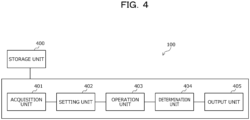
- FIG. 4 is a block diagram illustrating the functional configuration example of the information processing device 100.
- the information processing device 100 includes a storage unit 400, an acquisition unit 401, a setting unit 402, an operation unit 403, a determination unit 404, and an output unit 405.
- the storage unit 400 is implemented by, for example, a storage area such as the memory 302 or the recording medium 305 illustrated in FIG. 3 .
- a storage area such as the memory 302 or the recording medium 305 illustrated in FIG. 3 .
- the storage unit 400 is included in the information processing device 100 will be described, but the embodiment is not limited to this.
- the storage unit 400 is included in a device different from the information processing device 100, and the information processing device 100 may refer to content stored in the storage unit 400.
- the acquisition unit 401 to the output unit 405 function as examples of a control unit. Specifically, the acquisition unit 401 to the output unit 405 implement functions thereof by, for example, causing the CPU 301 to execute a program stored in a storage area such as the memory 302 or the recording medium 305 illustrated in FIG. 3 , or by the network I/F 303. A processing result of each functional unit is stored in, for example, a storage area such as the memory 302 or the recording medium 305 illustrated in FIG. 3 .
- the storage unit 400 stores various types of information to be referred to or updated in processing of each functional unit.
- the storage unit 400 stores a function for calculating a solution of a parameter.
- the parameter is, for example, an electron density.
- the function is, for example, a Kohn-Sham equation that enables derivation of a one-electron wave function that enables calculation of the parameter.
- the acquisition unit 401 acquires various types of information to be used for processing of each functional unit.
- the acquisition unit 401 stores various types of the acquired information in the storage unit 400 or outputs various types of the acquired information to each functional unit. Furthermore, the acquisition unit 401 may output various types of information previously stored in the storage unit 400 to each functional unit.
- the acquisition unit 401 acquires various types of information based on, for example, operation input of a user.
- the acquisition unit 401 may receive various types of information from, for example, a device different from the information processing device 100.
- the acquisition unit 401 acquires, for example, a calculation instruction.
- the calculation instruction includes, for example, information for specifying a problem to be calculated.
- the acquisition unit 401 accepts input of the calculation instruction based on operation input from a user.
- the acquisition unit 401 acquires the calculation instruction by receiving the calculation instruction from the another computer.
- the acquisition unit 401 may accept a start trigger to start processing of any one of the functional units.
- the start trigger is, for example, predetermined operation input by a user.
- the start trigger may be, for example, reception of predetermined information from another computer.
- the start trigger may be, for example, output of predetermined information by any one of the functional units.
- the acquisition unit 401 accepts acquisition of the calculation instruction as a start trigger for starting processing of the setting unit 402, the operation unit 403, and the determination unit 404.
- the setting unit 402 sets an end condition for repetition of a specific operation.
- the specific operation is, for example, a series of operations of calculating a solution of a parameter using a function.
- the specific operation is a series of operations of calculating a solution of a parameter using a function based on a solution of the parameter calculated last time.
- the specific operation corresponds to the SCF method.
- the setting unit 402 sets an end condition A indicating that the number of upper digits whose values match between a characteristic value corresponding to the solution of the parameter calculated last time and a characteristic value corresponding to a solution of the parameter calculated this time is equal to or greater than a first threshold.
- the first threshold is preset by a user, for example.
- the characteristic value is, for example, total electron energy. For example, in a case where the characteristic value corresponding to the solution of the parameter calculated last time is "5678" and the characteristic value corresponding to the solution of the parameter calculated this time is "5679", the number of digits is "3" since three values of upper digits "567" match.
- the setting unit 402 may set a guideline for reducing the calculation amount. For example, the setting unit 402 may enable detection that a solution of the parameter has been accurately calculated.
- the setting unit 402 sets an end condition B indicating that a difference between the solution of the parameter calculated last time and the solution of the parameter calculated this time is equal to or smaller than a second threshold.
- the second threshold is, for example, a threshold different from the first threshold.
- the second threshold is preset by a user, for example.
- the setting unit 402 may set a guideline for reducing the calculation amount.
- the setting unit 402 may enable detection that a solution of the parameter has been accurately calculated.
- the setting unit 402 sets an end condition C indicating that a degree of variation between a difference between the solution of the parameter calculated last time and a solution of the parameter calculated a time before last, and the difference between the solution of the parameter calculated this time and the solution of the parameter calculated last time is equal to or smaller than a third threshold.
- the third threshold is, for example, a threshold different from the first threshold and the second threshold.
- the third threshold is preset by a user, for example.
- the setting unit 402 may set a guideline for reducing the calculation amount.
- the setting unit 402 may enable detection that a solution of the parameter is unconverged.
- the setting unit 402 sets at least any one of the end condition A and the end condition C. Specifically, the setting unit 402 may set all of the end condition A, the end condition B, and the end condition C. Specifically, the setting unit 402 may set any two of the end condition A, the end condition B, and the end condition C.
- the operation unit 403 repeatedly performs the specific operation. For example, the operation unit 403 repeatedly performs the specific operation until the end condition A is satisfied. Specifically, the operation unit 403 calculates a solution of the parameter using the function based on an initial value of the parameter. Thereafter, specifically, the operation unit 403 repeatedly performs the specific operation of calculating a solution of the parameter using the function based on the solution of the parameter calculated last time until the end condition A is satisfied. With this configuration, the operation unit 403 may accurately calculate a solution of the parameter. The operation unit 403 may suppress an increase in the calculation amount.
- the operation unit 403 repeatedly performs the specific operation until the end condition C is satisfied. Specifically, the operation unit 403 calculates a solution of the parameter using the function based on the initial value of the parameter. Thereafter, specifically, the operation unit 403 repeatedly performs the specific operation of calculating a solution of the parameter using the function based on the solution of the parameter calculated last time until the end condition C is satisfied.
- the operation unit 403 may facilitate detection that the solution of the parameter is unconverged relatively early.
- the operation unit 403 may suppress an increase in the calculation amount.
- the operation unit 403 may repeatedly perform the specific operation until at least any one of the end condition A and the end condition B is satisfied. Specifically, the operation unit 403 calculates a solution of the parameter using the function based on the initial value of the parameter. Thereafter, specifically, the operation unit 403 repeatedly performs the specific operation of calculating a solution of the parameter using the function based on the solution of the parameter calculated last time until at least any one of the end condition A and the end condition B is satisfied. With this configuration, the operation unit 403 may accurately calculate a solution of the parameter. The operation unit 403 may suppress an increase in the calculation amount.
- the operation unit 403 may repeatedly perform the specific operation until at least any one of the end condition C and the end condition B is satisfied. Specifically, the operation unit 403 calculates a solution of the parameter using the function based on the initial value of the parameter. Thereafter, specifically, the operation unit 403 repeatedly performs the specific operation of calculating a solution of the parameter using the function based on the solution of the parameter calculated last time until at least any one of the end condition C and the end condition B is satisfied. With this configuration, the operation unit 403 may accurately calculate a solution of the parameter. The operation unit 403 may facilitate detection that the solution of the parameter is unconverged relatively early. The operation unit 403 may suppress an increase in the calculation amount.
- the operation unit 403 may repeatedly perform the specific operation until at least any one of the end condition A and the end condition C is satisfied. Specifically, the operation unit 403 calculates a solution of the parameter using the function based on the initial value of the parameter. Thereafter, specifically, the operation unit 403 repeatedly performs the specific operation of calculating a solution of the parameter using the function based on the solution of the parameter calculated last time until at least any one of the end condition A and the end condition C is satisfied. With this configuration, the operation unit 403 may accurately calculate a solution of the parameter. The operation unit 403 may facilitate detection that the solution of the parameter is unconverged relatively early. The operation unit 403 may suppress an increase in the calculation amount.
- the operation unit 403 may repeatedly perform the specific operation until at least any one of the end condition A, the end condition B, and the end condition C is satisfied. Specifically, the operation unit 403 calculates a solution of the parameter using the function based on the initial value of the parameter. Thereafter, specifically, the operation unit 403 repeatedly performs the specific operation of calculating a solution of the parameter using the function based on the solution of the parameter calculated last time until at least any one of the end condition A, the end condition B, and the end condition C is satisfied. With this configuration, the operation unit 403 may accurately calculate a solution of the parameter. The operation unit 403 may facilitate detection that the solution of the parameter is unconverged relatively early. The operation unit 403 may suppress an increase in the calculation amount.
- the determination unit 404 determines whether or not a solution of the parameter has converged. In a case where the end condition A is satisfied, the determination unit 404 determines that the solution of the parameter has converged. In a case where the end condition B is satisfied, the determination unit 404 determines that the solution of the parameter has converged. In a case where the end condition C is satisfied, the determination unit 404 determines that the solution of the parameter is unconverged.
- the output unit 405 outputs a processing result of at least any one of the functional units.
- An output format is, for example, display on a display, print output to a printer, transmission to an external device by the network I/F 303, or storage to a storage area such as the memory 302 or the recording medium 305.
- the output unit 405 may make it possible to notify a user of the processing result of at least any one of the functional units, and may improve convenience of the information processing device 100.
- the output unit 405 outputs the solution of the parameter calculated this time. Specifically, the output unit 405 outputs the solution of the parameter so that a user may refer to the solution. With this configuration, the output unit 405 may make a relatively accurate solution of the parameter available.
- the output unit 405 outputs the solution of the parameter calculated this time. Specifically, the output unit 405 outputs the solution of the parameter so that a user may refer to the solution. With this configuration, the output unit 405 may make a relatively accurate solution of the parameter available.
- the output unit 405 outputs a notification indicating that the solution of the parameter is unconverged. Specifically, the output unit 405 outputs the notification indicating that the solution of the parameter is unconverged so that a user may refer to the notification. With this configuration, the output unit 405 may enable the user to grasp that the solution of the parameter is unconverged.
- the first operation example corresponds to a case where the information processing device 100 uses at least the end condition C described above.
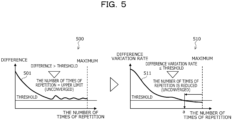
- FIG. 5 is an explanatory diagram illustrating the first operation example of the information processing device 100.
- the information processing device 100 repeatedly performs a specific operation of calculating an electron density p(r) of each point in a space in a predetermined situation setting according to the SCF method.
- the electron density p(r) calculated at the x-th time may be referred to as “electron density ⁇ x (r) " . Furthermore, in the following description, it may be assumed that the electron density p(r) indicates the electron density p(r) at any one point in the space in order to simplify the description.
- the information processing device 100 sets, for example, an end condition.
- the end condition includes, for example, that when an electron density ⁇ n (r) is calculated, a difference variation rate between a difference ⁇ n-1 (r) between an electron density ⁇ n-1 (r) and an electron density ⁇ n-2 (r) and a difference ⁇ n (r) between the electron density ⁇ n (r) and the electron density ⁇ n-1 (r) is equal to or smaller than a threshold DTH.
- DTH is, for example, 5 [%].
- the difference ⁇ n-1 (r) electron density ⁇ n-2 (r) - electron density ⁇ n-1 (r) is satisfied.
- the difference ⁇ n (r) electron density ⁇ n-1 (r) - electron density ⁇ n (r) is satisfied.
- the difference variation rate is (difference ⁇ n (r) - difference ⁇ n-1 (r) ) /difference ⁇ n-1 (r).
- the end condition includes that the difference variation rates of all the points are equal to or smaller than the threshold DTH.
- the end condition may further include that the difference ⁇ p n (r) between the electron density ⁇ n (r) and the electron density ⁇ n-1 (r) is equal to or smaller than a ⁇ allowable value.
- the end condition may include that the difference ⁇ n (r) of all the points are equal to or smaller than the ⁇ allowable value.
- the information processing device 100 When calculating the n-th electron density ⁇ n (r) and the difference variation rate is equal to or smaller than the threshold DTH, the information processing device 100 ends repetition of the specific operation and determines that the electron density ⁇ n (r) is unconverged. In a case where it is determined that the electron density ⁇ n (r) is unconverged, the information processing device 100 outputs a notification indicating that the electron density ⁇ n (r) is unconverged so that a user may refer to the notification.
- the information processing device 100 When calculating the n-th electron density ⁇ n (r) and the difference ⁇ p n (r) is equal to or smaller than the ⁇ allowable value, the information processing device 100 ends repetition of the specific operation and determines that the electron density ⁇ n (r) has converged. In a case where it is determined that the electron density ⁇ n (r) has converged, the information processing device 100 outputs the electron density ⁇ n (r) so that a user may refer to the electron density ⁇ n (r).
- the information processing device 100 may end repetition of the specific operation and determine that the electron density ⁇ n (r) is unconverged.
- a prior method adopts, as the end condition, that the difference ⁇ n (r) between the electron density ⁇ n (r) and the electron density ⁇ n-1 (r) is equal to or smaller than the ⁇ allowable value. Therefore, in the prior method, unless the difference ⁇ p n (r) becomes equal to or smaller than the ⁇ allowable value, the specific operation is continuously repeatedly performed until the number of times n reaches the upper limit.
- a graph 500 illustrates a characteristic curve 501 representing a correspondence relationship between the number of times n of repeating the specific operation and the difference ⁇ n (r) for the prior method.
- the specific operation is continuously repeatedly performed until the number of times n reaches the upper limit, which causes an increase in the calculation amount.
- the upper limit of the number of times n is not set, an infinite loop is caused.
- a graph 510 illustrates a characteristic curve 511 representing a correspondence relationship between the number of times n of repeating the specific operation and the difference variation rate for the information processing device 100.
- the information processing device 100 is applied to a problem of calculating the electron density p(r).
- the embodiment is not limited to this.
- the information processing device 100 is applied to another problem other than the problem of calculating the electron density p(r) .
- the information processing device 100 implements the SCF method.
- the embodiment is not limited to this.
- the information processing device 100 implements an iterative solution other than the SCF method.
- the overall processing is implemented by, for example, the CPU 301, a storage area such as the memory 302 or the recording medium 305, and the network I/F 303 illustrated in FIG. 3 .
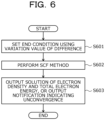
- FIG. 6 is a flowchart illustrating an example of the overall processing procedure in the first operation example.
- the information processing device 100 sets an end condition using a variation value of a difference (step S601).
- the information processing device 100 performs the SCF method (Step S602).
- the information processing device 100 outputs a solution of an electron density and total electron energy when the solution of the electron density has converged, and outputs a notification indicating unconvergence when the solution of the electron density is unconverged (step S603).
- step S603 specifically, in a case where there is a plurality of points in a space, when all solutions of the electron density at the plurality of points have converged, the information processing device 100 outputs the solution of the electron density at each point and the total electron energy. Specifically, in the case where there is the plurality of points in the space, the information processing device 100 outputs the notification indicating unconvergence when the solution of the electron density of at least any one of the points is unconverged. Thereafter, the information processing device 100 ends the overall processing.
- Operation processing is implemented by, for example, the CPU 301, a storage area such as the memory 302 or the recording medium 305, and the network I/F 303 illustrated in FIG. 3 .
- FIG. 7 is a flowchart illustrating an example of the operation processing procedure in the first operation example.
- the information processing device 100 sets an electron density p(r) (step S701). For example, in a case where there is a plurality of points in a space, the information processing device 100 sets the electron density p(r) of each point. For example, the information processing device 100 sets an initial value of the electron density p(r) in the first setting, and sets the electron density p(r) by some method in the second and subsequent settings.
- the information processing device 100 solves a Kohn-Sham equation based on the electron density p(r), and derives a one-electron wave function ⁇ i (r) (step S702). For example, in the case where there is the plurality of points in the space, the information processing device 100 derives the one-electron wave function ⁇ i (r) for each point. Then, the information processing device 100 calculates an electron density p' (r) using the one-electron wave function ⁇ i (r) (step S703). For example, in the case where there is the plurality of points in the space, the information processing device 100 calculates the electron density p'(r) of each point.
- the information processing device 100 determines whether or not the difference ⁇ (r) ⁇ ⁇ allowable value is satisfied (step S706). For example, in the case where there is the plurality of points in the space, the information processing device 100 determines whether or not the difference ⁇ (r) of all the points ⁇ ⁇ allowable value is satisfied.
- step S706 the information processing device 100 determines that the electron density p(r) has converged, outputs the electron density p(r), and ends the operation processing. For example, in the case where there is the plurality of points in the space, when the difference ⁇ (r) of all the points ⁇ ⁇ allowable value is satisfied, the information processing device 100 ends the operation processing.
- step S706 the information processing device 100 proceeds to processing of step S707.
- the information processing device 100 proceeds to the processing of step S707.
- step S707 the information processing device 100 determines whether or not the difference variation rate ⁇ DTH is satisfied (step S707). For example, in the case where there is the plurality of points in the space, the information processing device 100 determines whether or not the difference variation rate of at least any one of the points ⁇ DTH is satisfied.
- the information processing device 100 determines that the electron density p(r) is unconverged, outputs a notification of unconvergence, and ends the operation processing. For example, in the case where there is the plurality of points in the space, when the difference variation rate of at least any one of the points ⁇ DTH is satisfied, the information processing device 100 ends the operation processing.
- step S707 the information processing device 100 returns to the processing of step S701.
- the information processing device 100 returns the processing of step S701.
- the information processing device 100 may swap some steps in the processing order in each of the flowcharts of FIGs. 6 and 7 and execute the processing. For example, steps S706 and S707 may be swapped in the processing order. Furthermore, the information processing device 100 may omit the processing in some steps in each of the flowcharts of FIGs. 6 and 7 . For example, the processing of step S706 may be omitted.
- the second operation example corresponds to a case where the information processing device 100 uses at least the end condition A described above.
- FIG. 8 is an explanatory diagram illustrating the second operation example of the information processing device 100.
- the information processing device 100 repeatedly performs a specific operation of calculating an electron density p(r) of each point in a space in a predetermined situation setting according to the SCF method.
- the electron density p(r) calculated at the x-th time may be referred to as “electron density ⁇ x (r) " . Furthermore, in the following description, it may be assumed that the electron density p(r) indicates the electron density p(r) at any one point in the space in order to simplify the description.
- the information processing device 100 sets, for example, an end condition.
- the end condition includes, for example, that when an electron density ⁇ n (r) is calculated, the number of digits of significant figures is equal to or greater than a threshold SD between total electron energy corresponding to an electron density ⁇ n-1 (r) and total electron energy corresponding to the electron density ⁇ n (r). SD is, for example, 5 [digits].
- the significant figure is a number string of a portion in which values match in a case where the values in the same digits successively match from upper digits.
- the number of digits of significant figures is the number indicating how many digits have matching values in the case where the values in the same digits successively match from the upper digits.
- the end condition may include, for example, that when the electron density ⁇ n (r) is calculated, the number of digits of significant figures of the past i or more consecutive times up to this time is equal to or greater than the threshold SD.
- i is an integer equal to or greater than 2.
- the end condition may further include, for example, that a difference ⁇ p n (r) between the electron density ⁇ n (r) and the electron density ⁇ n-1 (r) is equal to or smaller than a ⁇ allowable value.
- the end condition may include that the difference ⁇ n (r) of all the points are equal to or smaller than the ⁇ allowable value.
- the information processing device 100 When calculating the n-th electron density ⁇ n (r) and the number of digits of significant figures is equal to or greater than SD, the information processing device 100 ends repetition of the specific operation and determines that the electron density ⁇ n (r) has converged. In a case where it is determined that the electron density ⁇ n (r) has converged, the information processing device 100 outputs the electron density ⁇ n (r) so that a user may refer to the electron density ⁇ n (r) .
- the information processing device 100 When calculating the n-th electron density ⁇ n (r) and the difference ⁇ p n (r) is equal to or smaller than the ⁇ allowable value, the information processing device 100 ends repetition of the specific operation and determines that the electron density ⁇ n (r) has converged. In a case where it is determined that the electron density ⁇ n (r) has converged, the information processing device 100 outputs the electron density ⁇ n (r) so that a user may refer to the electron density ⁇ n (r).
- the information processing device 100 may end repetition of the specific operation and determine that the electron density ⁇ n (r) is unconverged.
- a prior method adopts, as the end condition, that the difference ⁇ n (r) between the electron density ⁇ n (r) and the electron density ⁇ n-1 (r) is equal to or smaller than the ⁇ allowable value. Therefore, in the prior method, unless the difference ⁇ p n (r) becomes equal to or smaller than the ⁇ allowable value, the specific operation is continuously repeatedly performed until the number of times n reaches the upper limit.
- a graph 800 illustrates characteristic curves 801 to 803 representing a correspondence relationship between the number of times n of repeating the specific operation and a difference ⁇ p n (r i ) for a point i in the space, for the prior method.
- the characteristic curve 801 corresponds to the point i at which an electron density p n (r i ) is relatively small.
- the characteristic curve 802 corresponds to the point i at which the electron density p n (r i ) is medium.
- the characteristic curve 803 corresponds to the point i at which the electron density p n (r i ) is relatively large.
- a graph 810 illustrates a characteristic curve 811 representing a correspondence relationship between the number of times n of repeating the specific operation and the number of digits of significant figures for the information processing device 100.
- the information processing device 100 may relatively early determine that the electron density p n (r i ) has converged even in a situation setting in which the electron density p n (r i ) at any one of the points is relatively small and the degree of decrease in the difference ⁇ n (r i ) is relatively small. Then, the information processing device 100 may end repetition of the specific operation. Therefore, the information processing device 100 may suppress an increase in the calculation amount.
- the information processing device 100 is applied to a problem of calculating the electron density p(r).
- the embodiment is not limited to this.
- the information processing device 100 is applied to another problem other than the problem of calculating the electron density ⁇ (r).
- the information processing device 100 implements the SCF method.
- the embodiment is not limited to this.
- the information processing device 100 implements an iterative solution other than the SCF method.
- the overall processing is implemented by, for example, the CPU 301, a storage area such as the memory 302 or the recording medium 305, and the network I/F 303 illustrated in FIG. 3 .
- FIG. 9 is a flowchart illustrating an example of the overall processing procedure in the second operation example.
- the information processing device 100 sets an end condition using a physical characteristic value (step S901).
- the information processing device 100 performs the SCF method (Step S902).
- the information processing device 100 outputs a solution of an electron density and total electron energy when the solution of the electron density has converged, and outputs a notification indicating unconvergence when the solution of the electron density is unconverged (step S903).
- step S903 specifically, in a case where there is a plurality of points in a space, when all solutions of the electron density at the plurality of points have converged, the information processing device 100 outputs the solution of the electron density at each point and the total electron energy. Specifically, in the case where there is the plurality of points in the space, the information processing device 100 outputs the notification indicating unconvergence when the solution of the electron density of at least any one of the points is unconverged. Thereafter, the information processing device 100 ends the overall processing.
- Operation processing is implemented by, for example, the CPU 301, a storage area such as the memory 302 or the recording medium 305, and the network I/F 303 illustrated in FIG. 3 .
- FIG. 10 is a flowchart illustrating an example of the operation processing procedure in the second operation example.
- the information processing device 100 sets an electron density p(r) (step S1001). For example, in a case where there is a plurality of points in a space, the information processing device 100 sets the electron density p(r) of each point. For example, the information processing device 100 sets an initial value of the electron density p(r) in the first setting, and sets the electron density p(r) by some method in the second and subsequent settings.
- the information processing device 100 solves a Kohn-Sham equation based on the electron density p(r), and derives a one-electron wave function ⁇ i(r) (step S1002). For example, in the case where there is the plurality of points in the space, the information processing device 100 derives the one-electron wave function ⁇ i(r) for each point. Then, the information processing device 100 calculates an electron density p' (r) using the one-electron wave function ⁇ i(r) (step S1003). For example, in the case where there is the plurality of points in the space, the information processing device 100 calculates the electron density p' (r) of each point.
- the information processing device 100 determines whether or not the difference ⁇ (r) ⁇ ⁇ allowable value is satisfied (step S1006). For example, in the case where there is the plurality of points in the space, the information processing device 100 determines whether or not the difference ⁇ (r) of all the points ⁇ ⁇ allowable value is satisfied.
- step S1006 the information processing device 100 determines that the electron density p(r) has converged, outputs the electron density p(r), and ends the operation processing. For example, in the case where there is the plurality of points in the space, when the difference ⁇ (r) of all the points ⁇ ⁇ allowable value is satisfied, the information processing device 100 ends the operation processing.
- step S1006 the information processing device 100 proceeds to processing of step S1007.
- the information processing device 100 proceeds to the processing of step S1007.
- step S1007 the information processing device 100 determines whether or not the number of digits of significant figures of the total electron energy ⁇ SD is satisfied (step S1007).
- step S1007: Yes the information processing device 100 determines that the electron density p(r) has converged, outputs the electron density p(r), and ends the operation processing.
- step S1007: No the information processing device 100 returns to the processing of step S1001.
- the information processing device 100 may swap some steps in the processing order in each of the flowcharts of FIGs. 9 and 10 and execute the processing. For example, steps S1006 and S1007 may be swapped in the processing order. Furthermore, the information processing device 100 may omit the processing in some steps in each of the flowcharts of FIGs. 9 and 10 . For example, the processing of step S1006 may be omitted.
- FIG. 11 is an explanatory diagram illustrating a comparative example of a calculation result with a prior method.
- the CP2K is open source software.
- total electron energy -7572.409.
- a speed-up rate of the calculation time based on the prior method is 1.44.
- the information processing device 100 may calculate a value of the total electron energy similar to that of the prior method at 1.44 times higher speed than that of the prior method.
- total electron energy -7572.240.
- a speed-up rate of the calculation time based on the prior method is 2.64.
- the information processing device 100 may calculate a value of the total electron energy similar to that of the prior method at 2.64 times higher speed than that of the prior method. Next, description of FIG. 12 will be made.
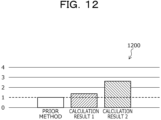
- FIG. 12 is an explanatory diagram illustrating the comparative example of the speed-up rate with the prior method.
- a graph 1200 of FIG. 12 illustrates the speed-up rate of the calculation result 1 and the speed-up rate of the calculation result 2 in a case where the prior method is used as a reference: 1.
- the information processing device 100 may speed up the SCF method as compared with the prior method, and may suppress an increase in the calculation time needed for the SCF method.
- the information processing device 100 may achieve, for example, 1.4 to 2.6 times higher speed than the prior method.
- description of FIG. 13 will be made.
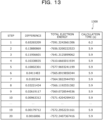
- FIG. 13 is an explanatory diagram illustrating a display example.
- the information processing device 100 outputs a log 1300 indicating a calculation result for each step.
- the information processing device 100 outputs the log 1300 indicating a calculation result for each step corresponding to the calculation result 2.
- the log 1300 indicates, for each step, the number of steps in the step, a difference in the step, total electron energy in the step, and a calculation time in the step in association with each other.
- the information processing device 100 may determine that the electron density p(r) and the total electron energy have converged before the difference ⁇ (r) ⁇ ⁇ allowable value is satisfied based on the number of significant digits, and may suppress an increase in the calculation amount.
- the information processing device 100 it is possible to repeatedly perform a specific operation until the number of upper digits whose values match between a characteristic value corresponding to a solution of a parameter calculated last time and a characteristic value corresponding to a solution of the parameter calculated this time becomes equal to or greater than a first threshold.
- the information processing device 100 may suppress an increase in the calculation amount.
- the information processing device 100 in a case where the number of digits becomes equal to or greater than the first threshold, it is possible to output the solution of the parameter calculated this time. With this configuration, the information processing device 100 may make the solution of the parameter available.
- the information processing device 100 it is possible to repeatedly perform the specific operation until the number of digits becomes equal to or greater than the first threshold or a difference between the solution of the parameter calculated last time and the solution of the parameter calculated this time becomes equal to or smaller than a second threshold. With this configuration, the information processing device 100 may suppress an increase in the calculation amount. The information processing device 100 may detect that a relatively accurate solution of the parameter has been calculated.
- the information processing device 100 it is possible to calculate the solution of the parameter using a function based on an initial value of the parameter. According to the information processing device 100, it is possible to repeatedly perform a specific operation of calculating the solution of the parameter using the function based on the solution of the parameter calculated last time until the number of digits becomes equal to or greater than the first threshold. With this configuration, the information processing device 100 may make it possible to calculate the solution of the parameter.
- the information processing device 100 it is possible to repeatedly perform a specific operation until a degree of variation between a difference between a solution of the parameter calculated last time and a solution of the parameter calculated a time before last, and a difference between a solution of the parameter calculated this time and the solution of the parameter calculated last time becomes equal to or smaller than a third threshold. With this configuration, the information processing device 100 may suppress an increase in the calculation amount.
- the information processing device 100 in a case where the degree of variation becomes equal to or smaller than the third threshold, it is possible to output a notification indicating that the solution of the parameter is unconverged.
- the information processing device 100 may enable a user to grasp that the solution of the parameter is unconverged.
- the information processing device 100 it is possible to repeatedly perform the specific operation until the degree of variation becomes equal to or smaller than the third threshold or the difference between the solution of the parameter calculated last time and the solution of the parameter calculated this time becomes equal to or smaller than the second threshold.
- the information processing device 100 may suppress an increase in the calculation amount.
- the information processing device 100 may detect that a relatively accurate solution of the parameter has been calculated.
- the information processing device 100 it is possible to calculate the solution of the parameter using a function based on an initial value of the parameter. According to the information processing device 100, it is possible to repeatedly perform the specific operation of calculating the solution of the parameter using the function based on the solution of the parameter calculated last time until the degree of variation becomes equal to or smaller than the third threshold. With this configuration, the information processing device 100 may make it possible to calculate the solution of the parameter.
- the information processing device 100 it is possible to repeatedly perform the specific operation until the number of digits becomes equal to or greater than the first threshold or the degree of variation becomes equal to or smaller than the third threshold. With this configuration, the information processing device 100 may suppress an increase in the calculation amount.
- the information processing device 100 it is possible to adopt an electron density as the parameter. According to the information processing device 100, it is possible to include, in the function, a Kohn-Sham equation that enables calculation of a one-electron wave function. With this configuration, the information processing device 100 may suppress an increase in the calculation amount when the electron density is calculated.
- the information processing device 100 it is possible to adopt an operation corresponding to the SCF method as the specific operation. With this configuration, the information processing device 100 may speed up the SCF method.
- the information processing method described in the present embodiment may be implemented by executing a program prepared in advance in a computer such as a PC or a workstation.
- the information processing program described in the present embodiment is executed by being recorded in a computer-readable recording medium and being read from the recording medium by the computer.
- the recording medium is a hard disk, a flexible disk, a compact disc (CD)-ROM, a magneto optical disc (MO), a digital versatile disc (DVD), or the like.
- the information processing program described in the present embodiment may be distributed via a network such as the Internet.
Landscapes
- Engineering & Computer Science (AREA)
- Physics & Mathematics (AREA)
- General Physics & Mathematics (AREA)
- Mathematical Physics (AREA)
- Theoretical Computer Science (AREA)
- Computational Mathematics (AREA)
- Mathematical Analysis (AREA)
- Mathematical Optimization (AREA)
- Pure & Applied Mathematics (AREA)
- Data Mining & Analysis (AREA)
- General Engineering & Computer Science (AREA)
- Databases & Information Systems (AREA)
- Algebra (AREA)
- Software Systems (AREA)
- Operations Research (AREA)
- Computing Systems (AREA)
- Life Sciences & Earth Sciences (AREA)
- Bioinformatics & Cheminformatics (AREA)
- Bioinformatics & Computational Biology (AREA)
- Evolutionary Biology (AREA)
- Health & Medical Sciences (AREA)
- Probability & Statistics with Applications (AREA)
- General Health & Medical Sciences (AREA)
- Spectroscopy & Molecular Physics (AREA)
- Management, Administration, Business Operations System, And Electronic Commerce (AREA)
- Complex Calculations (AREA)
Abstract
Description
- The present invention relates to an information processing program and an information processing method.
- Conventionally, in a field of material development, there is a technology of calculating an electron density by a numerical analysis method. The numerical analysis method is, for example, a self consistent field method. For example, in a case where the electron density is calculated by the self consistent field method, an operation of calculating the electron density using a wave function is repeated until it is determined that the electron density has converged. For example, in a case where the electron density is calculated by the self consistent field method, when the number of atoms is N, a calculation amount is O(N^3).
- As prior art, for example, there is a technology of repeatedly calculating a value indicating a spin state of an electron included in a substance by using a value indicating a virtual magnetic field. Furthermore, for example, there is a technology of determining convergence by comparing a result obtained by previous calculation with a result calculated this time for energy and a one-electron reduced density matrix. Furthermore, for example, there is a technology of performing end determination based on comparison between a total energy value and a convergence determination value in the self consistent field method.
-
- Patent Document 1:
Japanese Laid-open Patent Publication No. 2015-141533 - Patent Document 2:
Japanese Laid-open Patent Publication No. 2006-277582 - Patent Document 3:
U.S. Patent No. 6106562 - However, the prior art has a problem of causing an increase in a calculation amount when the electron density is calculated by the numerical analysis method. For example, in a case where the electron density is calculated by the self consistent field method, it may be difficult to determine that the electron density has converged and the number of times of repeating the operation may increase, and the calculation amount increases.
- In one aspect, an object of the present invention is to suppress an increase in a calculation amount.
- According to one embodiment, there are proposed an information processing program and an information processing method for repeatedly performing a specific operation of calculating a solution of a parameter by using a function until the number of upper digits whose values match between a characteristic value that corresponds to a solution of the parameter calculated last time and a characteristic value that corresponds to a solution of the parameter calculated this time becomes equal to or greater than a threshold.
- Furthermore, according to one embodiment, there are proposed an information processing program and an information processing method for repeatedly performing a specific operation of calculating a solution of a parameter by using a function until a degree of variation between a difference between a solution of the parameter calculated last time and a solution of the parameter calculated a time before last, and a difference between a solution of the parameter calculated this time and the solution of the parameter calculated last time becomes equal to or smaller than a threshold.
- In one aspect, it becomes possible to suppress an increase in a calculation amount.
-
-
FIG. 1 is an explanatory diagram illustrating one example of an information processing method according to an embodiment. -
FIG. 2 is an explanatory diagram illustrating an example of aninformation processing system 200. -
FIG. 3 is a block diagram illustrating a hardware configuration example of aninformation processing device 100. -
FIG. 4 is a block diagram illustrating a functional configuration example of theinformation processing device 100. -
FIG. 5 is an explanatory diagram illustrating a first operation example of theinformation processing device 100. -
FIG. 6 is a flowchart illustrating an example of an overall processing procedure in the first operation example. -
FIG. 7 is a flowchart illustrating an example of an operation processing procedure in the first operation example. -
FIG. 8 is an explanatory diagram illustrating a second operation example of theinformation processing device 100. -
FIG. 9 is a flowchart illustrating an example of an overall processing procedure in the second operation example. -
FIG. 10 is a flowchart illustrating an example of an operation processing procedure in the second operation example. -
FIG. 11 is an explanatory diagram illustrating a comparative example of a calculation result with a prior method. -
FIG. 12 is an explanatory diagram illustrating a comparative example of a speed-up rate with the prior method. -
FIG. 13 is an explanatory diagram illustrating a display example. - Hereinafter, an embodiment of an information processing program and an information processing method according to the present invention will be described in detail with reference to the drawings.
-
FIG. 1 is an explanatory diagram illustrating one example of the information processing method according to the embodiment. Aninformation processing device 100 is a computer for suppressing an increase in a calculation amount for numerical calculation. Theinformation processing device 100 is, for example, a server, a personal computer (PC), or the like. - The numerical calculation corresponds to, for example, an iterative solution. The iterative solution is, for example, a method of repeatedly performing a specific operation until it is determined that a solution has converged. The convergence is, for example, a state where a difference between a solution calculated last time and a solution calculated this time is equal to or smaller than a threshold. Specifically, the numerical calculation corresponds to a self consistent field method. In the self consistent field method, a specific operation of calculating an electron density at each point in a space using a wave function is repeatedly performed until it is determined that the electron density has converged. The convergence is, for example, a state where a difference between an electron density calculated last time and an electron density calculated this time is equal to or smaller than a threshold.
- It is conceivable that the self consistent field method is used when, for example, it is attempted to calculate an electron density in a field of material development. Specifically, in the field of material development, the self consistent field method is used when it is attempted to accumulate material data by calculating an electron density according to a density functional theory for materials informatics for shortening a research period, and the like. For the density functional theory, for example,
Reference Document 1 described below may be referred to. - Reference Document 1: Takao Tsuneda and Eiko Soejima, "Fundamentals of Density Functional Method", Book 11 (2012): 12
- Here, the larger a scale of a problem to be calculated, the larger the calculation amount needed for the numerical calculation tends to be. For example, in the case of attempting to calculate the electron density, the larger the number of atoms, the larger the calculation amount needed for the self consistent field method tends to be. Moreover, there is a problem that a time needed until it is determined that a solution has converged becomes long depending on the problem to be calculated, which causes an increase in the number of times of performing the specific operation and an increase in the calculation amount.
- Specifically, in the self consistent field method, in a case where a predetermined condition is satisfied, an increase in the number of times of repeating the specific operation of calculating the electron density at each point in the space is caused. The predetermined condition is that total electron energy transitions to a state of minute variation.
- Specifically, the predetermined condition is that there is a point having a relatively small degree of influence on the total electron energy in the space, and the electron density at the point becomes difficult to converge. Specifically, the predetermined condition is that there is a point in the space where a variation rate of the difference between the electron density calculated last time and the electron density calculated this time is relatively small, and the electron density at the point becomes difficult to converge.
- Thus, in the present embodiment, the information processing method capable of suppressing an increase in the calculation amount needed for the numerical calculation will be described. In the following description, the self consistent field method may be referred to as the "self consistent field (SCF) method".
- In
FIG. 1 , theinformation processing device 100 stores afunction 101 that enables calculation of a parameter. The parameter is, for example, an electron density. Thefunction 101 is, for example, a Kohn-Sham equation that enables derivation of a one-electron wave function that enables calculation of the parameter. - (1-1) The
information processing device 100 sets an end condition. For example, theinformation processing device 100 sets, as the end condition, a condition A indicating that the number of upper digits whose values match between a characteristic value corresponding to a solution of the parameter calculated last time and a characteristic value corresponding to a solution of the parameter calculated this time is equal to or greater than a threshold a. The characteristic value is, for example, total electron energy. The characteristic value may be, for example, the parameter itself. The characteristic value may be, for example, the electron density itself. - For example, the
information processing device 100 sets, as the end condition, a condition B indicating that a degree of variation between a difference between the solution of the parameter calculated last time and a solution of the parameter calculated a time before last, and a difference between the solution of the parameter calculated this time and the solution of the parameter calculated last time is equal to or smaller than a threshold b. Theinformation processing device 100 may set only one of the condition A and the condition B as the end condition. Theinformation processing device 100 may set both the condition A and the condition B as the end conditions. Theinformation processing device 100 may further set, as the end condition, a condition C indicating that the difference between the solution of the parameter calculated last time and the solution of the parameter calculated this time is equal to or smaller than a threshold c. - (1-2) The
information processing device 100 repeatedly performs a specific operation of calculating a solution of the parameter using thefunction 101 until the end condition is satisfied. Specifically, the specific operation is a series of operations of calculating a solution of the parameter using thefunction 101 based on the solution of the parameter calculated last time. For example, theinformation processing device 100 sets an initial value of the parameter, and calculates a first solution of the parameter using thefunction 101. Thereafter, for example, theinformation processing device 100 repeatedly performs the series of operations of calculating a solution of the parameter using thefunction 101 based on the solution of the parameter calculated last time until the end condition is satisfied. - (1-3) In a case where the condition A is satisfied, the
information processing device 100 outputs the solution of the parameter calculated this time without repeating the specific operation. An output format is, for example, display on a display, print output to a printer, transmission to an external device by a network I/F, storage to a storage area, or the like. For example, theinformation processing device 100 outputs the solution of the parameter calculated this time so that a user may refer to the solution. With this configuration, theinformation processing device 100 may suppress an increase in the calculation amount. For example, even when there is a point having a relatively small degree of influence on the total electron energy in a space, theinformation processing device 100 may suppress an increase in the number of times of repeating the specific operation. - In a case where the condition B is satisfied, the
information processing device 100 outputs a notification indicating that the parameter is unconverged, without repeating the specific operation. For example, theinformation processing device 100 outputs the notification indicating that the parameter is unconverged so that a user may refer to the notification. With this configuration, theinformation processing device 100 may suppress an increase in the calculation amount. For example, theinformation processing device 100 may prevent the calculation amount from becoming enormous while there is a point in the space where a variation rate of a difference between an electron density calculated last time and an electron density calculated this time is relatively small and the parameter remains unconverged. - In a case where the condition C is satisfied, the
information processing device 100 outputs the solution of the parameter calculated this time without repeating the specific operation. For example, theinformation processing device 100 outputs the solution of the parameter calculated this time so that a user may refer to the solution. With this configuration, theinformation processing device 100 may suppress an increase in the calculation amount. Theinformation processing device 100 may make a relatively accurate solution of the parameter available. In this manner, theinformation processing device 100 may suppress an increase in the calculation amount, and may suppress an increase in a calculation time and a calculation load. - Here, a case has been described where the
information processing device 100 operates independently. However, the embodiment is not limited to this. For example, there may be a case where a plurality of computers cooperates to implement a function as theinformation processing device 100. Specifically, there may be a case where the specific operation may be subjected to distributed processing by the plurality of computers. A specific example of the case where the plurality of computers cooperates will be described later with reference toFIG. 2 , for example. For example, there may be a case where the function as theinformation processing device 100 is implemented in a cloud. - Next, an example of an
information processing system 200, to which theinformation processing device 100 illustrated inFIG. 1 is applied, will be described with reference toFIG. 2 . -
FIG. 2 is an explanatory diagram illustrating an example of theinformation processing system 200. InFIG. 2 , theinformation processing system 200 includes theinformation processing device 100, anumerical calculation device 201, and aclient device 202. - In the
information processing system 200, theinformation processing device 100 and theclient device 202 are coupled via a wired orwireless network 210. Thenetwork 210 is, for example, a local area network (LAN), a wide area network (WAN), the Internet, or the like. In theinformation processing system 200, theinformation processing device 100 and thenumerical calculation device 201 are coupled via the wired orwireless network 210. - The
information processing device 100 is a computer that manages numerical calculation. Theinformation processing device 100 receives, for example, a calculation instruction from theclient device 202. The calculation instruction specifies a problem to be calculated. Theinformation processing device 100 sets an end condition. In response to the calculation instruction, theinformation processing device 100 repeatedly performs a specific operation until the end condition is satisfied. - For example, the
information processing device 100 sets an initial value of an electron density, and calculates a first solution of the electron density using a one-electron wave function derived by solving a Kohn-Sham equation based on the initial value. Thereafter, for example, theinformation processing device 100 repeatedly performs a series of operations of calculating a solution of the electron density using the one-electron wave function derived by solving the Kohn-Sham equation based on a solution of the electron density calculated last time until the end condition is satisfied. - Here, for example, the
information processing device 100 may perform distributed processing on the operations of calculating a solution of the electron density with thenumerical calculation device 201. In a case where the end condition is satisfied, when the solution of the electron density has converged, theinformation processing device 100 transmits the solution of the electron density to theclient device 202. In a case where the end condition is satisfied, when the solution of the electron density is unconverged, theinformation processing device 100 transmits a notification of unconvergence to theclient device 202. Theinformation processing device 100 is, for example, a server, a PC, or the like. - The
numerical calculation device 201 is a computer that shares an operation of calculating a solution of an electron density. Thenumerical calculation device 201 is, for example, a server, a PC, or the like. Theclient device 202 is a computer that transmits a calculation instruction to theinformation processing device 100 based on operation input of a user. When receiving the solution of the electron density from theinformation processing device 100, theclient device 202 outputs the solution so that the user may refer to the solution. When receiving a notification of unconvergence from theinformation processing device 100, theclient device 202 outputs the notification so that the user may refer to the notification. Theclient device 202 is, for example, a PC, a tablet terminal, a smartphone, or the like. - In the following description, a case will be mainly described where the
information processing device 100 operates independently. - Next, a hardware configuration example of the
information processing device 100 will be described with reference toFIG. 3 . -
FIG. 3 is a block diagram illustrating the hardware configuration example of theinformation processing device 100. InFIG. 3 , theinformation processing device 100 includes a central processing unit (CPU) 301, amemory 302, a network interface (I/F) 303, a recording medium I/F 304, and arecording medium 305. Furthermore, the respective components are coupled to each other by abus 300. - Here, the
CPU 301 is in charge of overall control of theinformation processing device 100. Thememory 302 includes, for example, a read only memory (ROM), a random access memory (RAM), a flash ROM, and the like. Specifically, for example, the flash ROM or the ROM stores various programs, and the RAM is used as a work area for theCPU 301. The programs stored in thememory 302 are loaded into theCPU 301 to cause theCPU 301 to execute coded processing. - The network I/
F 303 is coupled to thenetwork 210 through a communication line, and is coupled to another computer via thenetwork 210. Then, the network I/F 303 takes control of an interface between thenetwork 210 and the inside, and controls input and output of data to and from the another computer. The network I/F 303 is, for example, a modem, a LAN adapter, or the like. - The recording medium I/
F 304 controls reading and writing of data from and to therecording medium 305 under the control of theCPU 301. Examples of the recording medium I/F 304 include a disk drive, a solid state drive (SSD), a universal serial bus (USB) port, or the like. Therecording medium 305 is a nonvolatile memory that stores data written under the control of the recording medium I/F 304. Examples of therecording medium 305 include a disk, a semiconductor memory, a USB memory, or the like. Therecording medium 305 may be attachable to and detachable from theinformation processing device 100. - The
information processing device 100 may include, for example, a keyboard, a mouse, a display, a printer, a scanner, a microphone, a speaker, and the like in addition to the components described above. Furthermore, theinformation processing device 100 may include a plurality of the recording medium I/Fs 304 and a plurality of therecording media 305. Furthermore, theinformation processing device 100 does not have to include the recording medium I/F 304 or therecording medium 305. - Next, a functional configuration example of the
information processing device 100 will be described with reference toFIG. 4 . -
FIG. 4 is a block diagram illustrating the functional configuration example of theinformation processing device 100. Theinformation processing device 100 includes astorage unit 400, anacquisition unit 401, asetting unit 402, anoperation unit 403, adetermination unit 404, and anoutput unit 405. - The
storage unit 400 is implemented by, for example, a storage area such as thememory 302 or therecording medium 305 illustrated inFIG. 3 . Hereinafter, a case where thestorage unit 400 is included in theinformation processing device 100 will be described, but the embodiment is not limited to this. For example, there may be a case where thestorage unit 400 is included in a device different from theinformation processing device 100, and theinformation processing device 100 may refer to content stored in thestorage unit 400. - The
acquisition unit 401 to theoutput unit 405 function as examples of a control unit. Specifically, theacquisition unit 401 to theoutput unit 405 implement functions thereof by, for example, causing theCPU 301 to execute a program stored in a storage area such as thememory 302 or therecording medium 305 illustrated inFIG. 3 , or by the network I/F 303. A processing result of each functional unit is stored in, for example, a storage area such as thememory 302 or therecording medium 305 illustrated inFIG. 3 . - The
storage unit 400 stores various types of information to be referred to or updated in processing of each functional unit. Thestorage unit 400 stores a function for calculating a solution of a parameter. The parameter is, for example, an electron density. The function is, for example, a Kohn-Sham equation that enables derivation of a one-electron wave function that enables calculation of the parameter. - The
acquisition unit 401 acquires various types of information to be used for processing of each functional unit. Theacquisition unit 401 stores various types of the acquired information in thestorage unit 400 or outputs various types of the acquired information to each functional unit. Furthermore, theacquisition unit 401 may output various types of information previously stored in thestorage unit 400 to each functional unit. Theacquisition unit 401 acquires various types of information based on, for example, operation input of a user. Theacquisition unit 401 may receive various types of information from, for example, a device different from theinformation processing device 100. - The
acquisition unit 401 acquires, for example, a calculation instruction. The calculation instruction includes, for example, information for specifying a problem to be calculated. Specifically, theacquisition unit 401 accepts input of the calculation instruction based on operation input from a user. Specifically, theacquisition unit 401 acquires the calculation instruction by receiving the calculation instruction from the another computer. - The
acquisition unit 401 may accept a start trigger to start processing of any one of the functional units. The start trigger is, for example, predetermined operation input by a user. The start trigger may be, for example, reception of predetermined information from another computer. The start trigger may be, for example, output of predetermined information by any one of the functional units. - Specifically, the
acquisition unit 401 accepts acquisition of the calculation instruction as a start trigger for starting processing of thesetting unit 402, theoperation unit 403, and thedetermination unit 404. - The
setting unit 402 sets an end condition for repetition of a specific operation. The specific operation is, for example, a series of operations of calculating a solution of a parameter using a function. For example, the specific operation is a series of operations of calculating a solution of a parameter using a function based on a solution of the parameter calculated last time. Specifically, the specific operation corresponds to the SCF method. - For example, the
setting unit 402 sets an end condition A indicating that the number of upper digits whose values match between a characteristic value corresponding to the solution of the parameter calculated last time and a characteristic value corresponding to a solution of the parameter calculated this time is equal to or greater than a first threshold. The first threshold is preset by a user, for example. The characteristic value is, for example, total electron energy. For example, in a case where the characteristic value corresponding to the solution of the parameter calculated last time is "5678" and the characteristic value corresponding to the solution of the parameter calculated this time is "5679", the number of digits is "3" since three values of upper digits "567" match. - Furthermore, for example, in a case where the characteristic value corresponding to the solution of the parameter calculated last time is "1234" and the characteristic value corresponding to the solution of the parameter calculated this time is "123.4", the number of digits is "0" since values existing in the same digits from upper digits do not match. With this configuration, the
setting unit 402 may set a guideline for reducing the calculation amount. For example, thesetting unit 402 may enable detection that a solution of the parameter has been accurately calculated. - For example, the
setting unit 402 sets an end condition B indicating that a difference between the solution of the parameter calculated last time and the solution of the parameter calculated this time is equal to or smaller than a second threshold. The second threshold is, for example, a threshold different from the first threshold. The second threshold is preset by a user, for example. With this configuration, thesetting unit 402 may set a guideline for reducing the calculation amount. For example, thesetting unit 402 may enable detection that a solution of the parameter has been accurately calculated. - For example, the
setting unit 402 sets an end condition C indicating that a degree of variation between a difference between the solution of the parameter calculated last time and a solution of the parameter calculated a time before last, and the difference between the solution of the parameter calculated this time and the solution of the parameter calculated last time is equal to or smaller than a third threshold. The third threshold is, for example, a threshold different from the first threshold and the second threshold. The third threshold is preset by a user, for example. With this configuration, thesetting unit 402 may set a guideline for reducing the calculation amount. For example, thesetting unit 402 may enable detection that a solution of the parameter is unconverged. - Specifically, the
setting unit 402 sets at least any one of the end condition A and the end condition C. Specifically, thesetting unit 402 may set all of the end condition A, the end condition B, and the end condition C. Specifically, thesetting unit 402 may set any two of the end condition A, the end condition B, and the end condition C. - The
operation unit 403 repeatedly performs the specific operation. For example, theoperation unit 403 repeatedly performs the specific operation until the end condition A is satisfied. Specifically, theoperation unit 403 calculates a solution of the parameter using the function based on an initial value of the parameter. Thereafter, specifically, theoperation unit 403 repeatedly performs the specific operation of calculating a solution of the parameter using the function based on the solution of the parameter calculated last time until the end condition A is satisfied. With this configuration, theoperation unit 403 may accurately calculate a solution of the parameter. Theoperation unit 403 may suppress an increase in the calculation amount. - For example, the
operation unit 403 repeatedly performs the specific operation until the end condition C is satisfied. Specifically, theoperation unit 403 calculates a solution of the parameter using the function based on the initial value of the parameter. Thereafter, specifically, theoperation unit 403 repeatedly performs the specific operation of calculating a solution of the parameter using the function based on the solution of the parameter calculated last time until the end condition C is satisfied. With this configuration, theoperation unit 403 may facilitate detection that the solution of the parameter is unconverged relatively early. Theoperation unit 403 may suppress an increase in the calculation amount. - For example, the
operation unit 403 may repeatedly perform the specific operation until at least any one of the end condition A and the end condition B is satisfied. Specifically, theoperation unit 403 calculates a solution of the parameter using the function based on the initial value of the parameter. Thereafter, specifically, theoperation unit 403 repeatedly performs the specific operation of calculating a solution of the parameter using the function based on the solution of the parameter calculated last time until at least any one of the end condition A and the end condition B is satisfied. With this configuration, theoperation unit 403 may accurately calculate a solution of the parameter. Theoperation unit 403 may suppress an increase in the calculation amount. - For example, the
operation unit 403 may repeatedly perform the specific operation until at least any one of the end condition C and the end condition B is satisfied. Specifically, theoperation unit 403 calculates a solution of the parameter using the function based on the initial value of the parameter. Thereafter, specifically, theoperation unit 403 repeatedly performs the specific operation of calculating a solution of the parameter using the function based on the solution of the parameter calculated last time until at least any one of the end condition C and the end condition B is satisfied. With this configuration, theoperation unit 403 may accurately calculate a solution of the parameter. Theoperation unit 403 may facilitate detection that the solution of the parameter is unconverged relatively early. Theoperation unit 403 may suppress an increase in the calculation amount. - For example, the
operation unit 403 may repeatedly perform the specific operation until at least any one of the end condition A and the end condition C is satisfied. Specifically, theoperation unit 403 calculates a solution of the parameter using the function based on the initial value of the parameter. Thereafter, specifically, theoperation unit 403 repeatedly performs the specific operation of calculating a solution of the parameter using the function based on the solution of the parameter calculated last time until at least any one of the end condition A and the end condition C is satisfied. With this configuration, theoperation unit 403 may accurately calculate a solution of the parameter. Theoperation unit 403 may facilitate detection that the solution of the parameter is unconverged relatively early. Theoperation unit 403 may suppress an increase in the calculation amount. - For example, the
operation unit 403 may repeatedly perform the specific operation until at least any one of the end condition A, the end condition B, and the end condition C is satisfied. Specifically, theoperation unit 403 calculates a solution of the parameter using the function based on the initial value of the parameter. Thereafter, specifically, theoperation unit 403 repeatedly performs the specific operation of calculating a solution of the parameter using the function based on the solution of the parameter calculated last time until at least any one of the end condition A, the end condition B, and the end condition C is satisfied. With this configuration, theoperation unit 403 may accurately calculate a solution of the parameter. Theoperation unit 403 may facilitate detection that the solution of the parameter is unconverged relatively early. Theoperation unit 403 may suppress an increase in the calculation amount. - The
determination unit 404 determines whether or not a solution of the parameter has converged. In a case where the end condition A is satisfied, thedetermination unit 404 determines that the solution of the parameter has converged. In a case where the end condition B is satisfied, thedetermination unit 404 determines that the solution of the parameter has converged. In a case where the end condition C is satisfied, thedetermination unit 404 determines that the solution of the parameter is unconverged. - The
output unit 405 outputs a processing result of at least any one of the functional units. An output format is, for example, display on a display, print output to a printer, transmission to an external device by the network I/F 303, or storage to a storage area such as thememory 302 or therecording medium 305. With this configuration, theoutput unit 405 may make it possible to notify a user of the processing result of at least any one of the functional units, and may improve convenience of theinformation processing device 100. - For example, in a case where the end condition A is satisfied, the
output unit 405 outputs the solution of the parameter calculated this time. Specifically, theoutput unit 405 outputs the solution of the parameter so that a user may refer to the solution. With this configuration, theoutput unit 405 may make a relatively accurate solution of the parameter available. - For example, in a case where the end condition B is satisfied, the
output unit 405 outputs the solution of the parameter calculated this time. Specifically, theoutput unit 405 outputs the solution of the parameter so that a user may refer to the solution. With this configuration, theoutput unit 405 may make a relatively accurate solution of the parameter available. - For example, in a case where the end condition C is satisfied, the
output unit 405 outputs a notification indicating that the solution of the parameter is unconverged. Specifically, theoutput unit 405 outputs the notification indicating that the solution of the parameter is unconverged so that a user may refer to the notification. With this configuration, theoutput unit 405 may enable the user to grasp that the solution of the parameter is unconverged. - Next, a first operation example of the
information processing device 100 will be described with reference toFIG. 5 . The first operation example corresponds to a case where theinformation processing device 100 uses at least the end condition C described above. -
FIG. 5 is an explanatory diagram illustrating the first operation example of theinformation processing device 100. InFIG. 5 , theinformation processing device 100 repeatedly performs a specific operation of calculating an electron density p(r) of each point in a space in a predetermined situation setting according to the SCF method. - In the following description, the electron density p(r) calculated at the x-th time may be referred to as "electron density ρx(r)". Furthermore, in the following description, it may be assumed that the electron density p(r) indicates the electron density p(r) at any one point in the space in order to simplify the description.
- The
information processing device 100 sets, for example, an end condition. The end condition includes, for example, that when an electron density ρn(r) is calculated, a difference variation rate between a difference Δρn-1 (r) between an electron density ρn-1(r) and an electron density ρn-2(r) and a difference Δρn(r) between the electron density ρn(r) and the electron density ρn-1(r) is equal to or smaller than a threshold DTH. DTH is, for example, 5 [%]. - For example, the difference Δρn-1 (r) = electron density ρn-2(r) - electron density ρn-1(r) is satisfied. For example, the difference Δρn(r) = electron density ρn-1 (r) - electron density ρn (r) is satisfied. The difference variation rate is (difference Δρn(r) - difference Δρn-1 (r) ) /difference Δρn-1 (r). Specifically, in a case where there is a plurality of points in the space, the end condition includes that the difference variation rates of all the points are equal to or smaller than the threshold DTH.
- The end condition may further include that the difference Δpn(r) between the electron density ρn(r) and the electron density ρn-1(r) is equal to or smaller than a Δρ allowable value. Specifically, in a case where there is a plurality of points in the space, the end condition may include that the difference Δρn(r) of all the points are equal to or smaller than the Δρ allowable value.
- When calculating the n-th electron density ρn(r) and the difference variation rate is equal to or smaller than the threshold DTH, the
information processing device 100 ends repetition of the specific operation and determines that the electron density ρn(r) is unconverged. In a case where it is determined that the electron density ρn(r) is unconverged, theinformation processing device 100 outputs a notification indicating that the electron density ρn(r) is unconverged so that a user may refer to the notification. - When calculating the n-th electron density ρn(r) and the difference Δpn(r) is equal to or smaller than the Δρ allowable value, the
information processing device 100 ends repetition of the specific operation and determines that the electron density ρn(r) has converged. In a case where it is determined that the electron density ρn(r) has converged, theinformation processing device 100 outputs the electron density ρn(r) so that a user may refer to the electron density ρn(r). - Furthermore, in a case where the number of times n reaches an upper limit, the
information processing device 100 may end repetition of the specific operation and determine that the electron density ρn(r) is unconverged. - On the other hand, a prior method adopts, as the end condition, that the difference Δρn(r) between the electron density ρn(r) and the electron density ρn-1(r) is equal to or smaller than the Δρ allowable value. Therefore, in the prior method, unless the difference Δpn(r) becomes equal to or smaller than the Δρ allowable value, the specific operation is continuously repeatedly performed until the number of times n reaches the upper limit.
- A
graph 500 illustrates acharacteristic curve 501 representing a correspondence relationship between the number of times n of repeating the specific operation and the difference Δρn(r) for the prior method. As illustrated in thegraph 500, in the prior method, in a situation setting in which the electron density ρn(r) is difficult to converge, the specific operation is continuously repeatedly performed until the number of times n reaches the upper limit, which causes an increase in the calculation amount. In the prior method, when the upper limit of the number of times n is not set, an infinite loop is caused. - On the other hand, a
graph 510 illustrates acharacteristic curve 511 representing a correspondence relationship between the number of times n of repeating the specific operation and the difference variation rate for theinformation processing device 100. As illustrated in thegraph 510, even in a situation setting in which the electron density ρn(r) is difficult to converge, theinformation processing device 100 may relatively early determine that the electron density ρn(r) is unconverged at the number of times n = a, and may end repetition of the specific operation. Therefore, theinformation processing device 100 may suppress an increase in the calculation amount. - Here, a case has been described where the
information processing device 100 is applied to a problem of calculating the electron density p(r). However, the embodiment is not limited to this. For example, there may be a case where theinformation processing device 100 is applied to another problem other than the problem of calculating the electron density p(r) . Here, a case has been described where theinformation processing device 100 implements the SCF method. However, the embodiment is not limited to this. For example, there may be a case where theinformation processing device 100 implements an iterative solution other than the SCF method. - Next, an example of an overall processing procedure in the first operation example executed by the
information processing device 100 will be described with reference toFIG. 6 . The overall processing is implemented by, for example, theCPU 301, a storage area such as thememory 302 or therecording medium 305, and the network I/F 303 illustrated inFIG. 3 . -
FIG. 6 is a flowchart illustrating an example of the overall processing procedure in the first operation example. InFIG. 6 , theinformation processing device 100 sets an end condition using a variation value of a difference (step S601). Next, theinformation processing device 100 performs the SCF method (Step S602). Then, theinformation processing device 100 outputs a solution of an electron density and total electron energy when the solution of the electron density has converged, and outputs a notification indicating unconvergence when the solution of the electron density is unconverged (step S603). - In step S603, specifically, in a case where there is a plurality of points in a space, when all solutions of the electron density at the plurality of points have converged, the
information processing device 100 outputs the solution of the electron density at each point and the total electron energy. Specifically, in the case where there is the plurality of points in the space, theinformation processing device 100 outputs the notification indicating unconvergence when the solution of the electron density of at least any one of the points is unconverged. Thereafter, theinformation processing device 100 ends the overall processing. - Next, an example of an operation processing procedure in the first operation example executed by the
information processing device 100 will be described with reference toFIG. 7 . Operation processing is implemented by, for example, theCPU 301, a storage area such as thememory 302 or therecording medium 305, and the network I/F 303 illustrated inFIG. 3 . -
FIG. 7 is a flowchart illustrating an example of the operation processing procedure in the first operation example. InFIG. 7 , theinformation processing device 100 sets an electron density p(r) (step S701). For example, in a case where there is a plurality of points in a space, theinformation processing device 100 sets the electron density p(r) of each point. For example, theinformation processing device 100 sets an initial value of the electron density p(r) in the first setting, and sets the electron density p(r) by some method in the second and subsequent settings. - Next, the
information processing device 100 solves a Kohn-Sham equation based on the electron density p(r), and derives a one-electron wave function ϕi (r) (step S702). For example, in the case where there is the plurality of points in the space, theinformation processing device 100 derives the one-electron wave function ϕi (r) for each point. Then, theinformation processing device 100 calculates an electron density p' (r) using the one-electron wave function ϕi (r) (step S703). For example, in the case where there is the plurality of points in the space, theinformation processing device 100 calculates the electron density p'(r) of each point. - Next, the
information processing device 100 calculates a difference Δρ (r) = electron density p(r) - electron density p' (r) (step S704). Then, theinformation processing device 100 calculates a difference variation rate = (current difference Δρ (r) - previous difference Δp(r))/previous difference Δρ (r) (step S705). For example, in the case where there is the plurality of points in the space, theinformation processing device 100 calculates the difference Δρ (r) and the difference variation rate of each point. - Next, the
information processing device 100 determines whether or not the difference Δρ (r) ≤ Δρ allowable value is satisfied (step S706). For example, in the case where there is the plurality of points in the space, theinformation processing device 100 determines whether or not the difference Δρ (r) of all the points ≤ Δρ allowable value is satisfied. - Here, in a case where the difference Δρ (r) ≤ Δρ allowable value is satisfied (step S706: Yes), the
information processing device 100 determines that the electron density p(r) has converged, outputs the electron density p(r), and ends the operation processing. For example, in the case where there is the plurality of points in the space, when the difference Δρ (r) of all the points ≤ Δρ allowable value is satisfied, theinformation processing device 100 ends the operation processing. - On the other hand, in a case where the difference Δρ (r) ≤ Δρ allowable value is not satisfied (step S706: No), the
information processing device 100 proceeds to processing of step S707. For example, in the case where there is the plurality of points in the space, when the difference Δρ (r) of at least any one of the points ≤ Δρ allowable value is not satisfied, theinformation processing device 100 proceeds to the processing of step S707. - In step S707, the
information processing device 100 determines whether or not the difference variation rate ≤ DTH is satisfied (step S707). For example, in the case where there is the plurality of points in the space, theinformation processing device 100 determines whether or not the difference variation rate of at least any one of the points ≤ DTH is satisfied. - Here, in a case where the difference variation rate ≤ DTH is satisfied (step S707: Yes), the
information processing device 100 determines that the electron density p(r) is unconverged, outputs a notification of unconvergence, and ends the operation processing. For example, in the case where there is the plurality of points in the space, when the difference variation rate of at least any one of the points ≤ DTH is satisfied, theinformation processing device 100 ends the operation processing. - On the other hand, in a case where the difference variation rate ≤ DTH is not satisfied (step S707: No), the
information processing device 100 returns to the processing of step S701. For example, in the case where there is the plurality of points in the space, when the difference variation rate of all the points ≤ DTH is not satisfied, theinformation processing device 100 returns the processing of step S701. - Here, the
information processing device 100 may swap some steps in the processing order in each of the flowcharts ofFIGs. 6 and7 and execute the processing. For example, steps S706 and S707 may be swapped in the processing order. Furthermore, theinformation processing device 100 may omit the processing in some steps in each of the flowcharts ofFIGs. 6 and7 . For example, the processing of step S706 may be omitted. - Next, a second operation example of the
information processing device 100 will be described with reference toFIG. 8 . The second operation example corresponds to a case where theinformation processing device 100 uses at least the end condition A described above. -
FIG. 8 is an explanatory diagram illustrating the second operation example of theinformation processing device 100. InFIG. 8 , theinformation processing device 100 repeatedly performs a specific operation of calculating an electron density p(r) of each point in a space in a predetermined situation setting according to the SCF method. - In the following description, the electron density p(r) calculated at the x-th time may be referred to as "electron density ρx(r)". Furthermore, in the following description, it may be assumed that the electron density p(r) indicates the electron density p(r) at any one point in the space in order to simplify the description.
- The
information processing device 100 sets, for example, an end condition. The end condition includes, for example, that when an electron density ρn(r) is calculated, the number of digits of significant figures is equal to or greater than a threshold SD between total electron energy corresponding to an electron density ρn-1(r) and total electron energy corresponding to the electron density ρn(r). SD is, for example, 5 [digits]. - The significant figure is a number string of a portion in which values match in a case where the values in the same digits successively match from upper digits. The number of digits of significant figures is the number indicating how many digits have matching values in the case where the values in the same digits successively match from the upper digits.
- The end condition may include, for example, that when the electron density ρn(r) is calculated, the number of digits of significant figures of the past i or more consecutive times up to this time is equal to or greater than the threshold SD. For example, i is an integer equal to or greater than 2.
- The end condition may further include, for example, that a difference Δpn(r) between the electron density ρn(r) and the electron density ρn-1(r) is equal to or smaller than a Δρ allowable value. Specifically, in a case where there is a plurality of points in the space, the end condition may include that the difference Δρn(r) of all the points are equal to or smaller than the Δρ allowable value.
- When calculating the n-th electron density ρn(r) and the number of digits of significant figures is equal to or greater than SD, the
information processing device 100 ends repetition of the specific operation and determines that the electron density ρn(r) has converged. In a case where it is determined that the electron density ρn(r) has converged, theinformation processing device 100 outputs the electron density ρn(r) so that a user may refer to the electron density ρn (r) . - When calculating the n-th electron density ρn(r) and the difference Δpn(r) is equal to or smaller than the Δρ allowable value, the
information processing device 100 ends repetition of the specific operation and determines that the electron density ρn(r) has converged. In a case where it is determined that the electron density ρn(r) has converged, theinformation processing device 100 outputs the electron density ρn(r) so that a user may refer to the electron density ρn(r). - Furthermore, in a case where the number of times n reaches an upper limit, the
information processing device 100 may end repetition of the specific operation and determine that the electron density ρn(r) is unconverged. - On the other hand, a prior method adopts, as the end condition, that the difference Δρn (r) between the electron density ρn(r) and the electron density ρn-1(r) is equal to or smaller than the Δρ allowable value. Therefore, in the prior method, unless the difference Δpn(r) becomes equal to or smaller than the Δρ allowable value, the specific operation is continuously repeatedly performed until the number of times n reaches the upper limit.
- A
graph 800 illustratescharacteristic curves 801 to 803 representing a correspondence relationship between the number of times n of repeating the specific operation and a difference Δpn(ri) for a point i in the space, for the prior method. Specifically, thecharacteristic curve 801 corresponds to the point i at which an electron density pn(ri) is relatively small. Specifically, thecharacteristic curve 802 corresponds to the point i at which the electron density pn(ri) is medium. Specifically, thecharacteristic curve 803 corresponds to the point i at which the electron density pn(ri) is relatively large. - As illustrated in the
graph 800, in the prior method, in a situation setting in which the electron density pn(ri) at the any one point i is relatively small and a degree of decrease in the difference Δpn (ri) is relatively small, the number of times n of repeating the specific operation easily increases, causing an increase in the calculation amount. - On the other hand, a
graph 810 illustrates acharacteristic curve 811 representing a correspondence relationship between the number of times n of repeating the specific operation and the number of digits of significant figures for theinformation processing device 100. As illustrated in thegraph 810, theinformation processing device 100 may relatively early determine that the electron density pn(ri) has converged even in a situation setting in which the electron density pn(ri) at any one of the points is relatively small and the degree of decrease in the difference Δρn(ri) is relatively small. Then, theinformation processing device 100 may end repetition of the specific operation. Therefore, theinformation processing device 100 may suppress an increase in the calculation amount. - Here, a case has been described where the
information processing device 100 is applied to a problem of calculating the electron density p(r). However, the embodiment is not limited to this. For example, there may be a case where theinformation processing device 100 is applied to another problem other than the problem of calculating the electron density ρ(r). Here, a case has been described where theinformation processing device 100 implements the SCF method. However, the embodiment is not limited to this. For example, there may be a case where theinformation processing device 100 implements an iterative solution other than the SCF method. - Next, an example of an overall processing procedure in the second operation example executed by the
information processing device 100 will be described with reference toFIG. 9 . The overall processing is implemented by, for example, theCPU 301, a storage area such as thememory 302 or therecording medium 305, and the network I/F 303 illustrated inFIG. 3 . -
FIG. 9 is a flowchart illustrating an example of the overall processing procedure in the second operation example. InFIG. 9 , theinformation processing device 100 sets an end condition using a physical characteristic value (step S901). Next, theinformation processing device 100 performs the SCF method (Step S902). Then, theinformation processing device 100 outputs a solution of an electron density and total electron energy when the solution of the electron density has converged, and outputs a notification indicating unconvergence when the solution of the electron density is unconverged (step S903). - In step S903, specifically, in a case where there is a plurality of points in a space, when all solutions of the electron density at the plurality of points have converged, the
information processing device 100 outputs the solution of the electron density at each point and the total electron energy. Specifically, in the case where there is the plurality of points in the space, theinformation processing device 100 outputs the notification indicating unconvergence when the solution of the electron density of at least any one of the points is unconverged. Thereafter, theinformation processing device 100 ends the overall processing. - Next, an example of an operation processing procedure in the second operation example executed by the
information processing device 100 will be described with reference toFIG. 10 . Operation processing is implemented by, for example, theCPU 301, a storage area such as thememory 302 or therecording medium 305, and the network I/F 303 illustrated inFIG. 3 . -
FIG. 10 is a flowchart illustrating an example of the operation processing procedure in the second operation example. InFIG. 10 , theinformation processing device 100 sets an electron density p(r) (step S1001). For example, in a case where there is a plurality of points in a space, theinformation processing device 100 sets the electron density p(r) of each point. For example, theinformation processing device 100 sets an initial value of the electron density p(r) in the first setting, and sets the electron density p(r) by some method in the second and subsequent settings. - Next, the
information processing device 100 solves a Kohn-Sham equation based on the electron density p(r), and derives a one-electron wave function ϕi(r) (step S1002). For example, in the case where there is the plurality of points in the space, theinformation processing device 100 derives the one-electron wave function ϕi(r) for each point. Then, theinformation processing device 100 calculates an electron density p' (r) using the one-electron wave function ϕi(r) (step S1003). For example, in the case where there is the plurality of points in the space, theinformation processing device 100 calculates the electron density p' (r) of each point. - Next, the
information processing device 100 calculates a difference Δρ(r) = electron density p(r) - electron density p' (r) (step S1004). For example, in the case where there is the plurality of points in the space, theinformation processing device 100 calculates the difference Δρ(r) of each point. Then, theinformation processing device 100 calculates total electron energy as a physical characteristic value based on the electron density p' (r) (step S1005) . - Next, the
information processing device 100 determines whether or not the difference Δρ(r) ≤ Δρ allowable value is satisfied (step S1006). For example, in the case where there is the plurality of points in the space, theinformation processing device 100 determines whether or not the difference Δρ(r) of all the points ≤ Δρ allowable value is satisfied. - Here, in a case where the difference Δρ(r) ≤ Δρ allowable value is satisfied (step S1006: Yes), the
information processing device 100 determines that the electron density p(r) has converged, outputs the electron density p(r), and ends the operation processing. For example, in the case where there is the plurality of points in the space, when the difference Δρ(r) of all the points ≤ Δρ allowable value is satisfied, theinformation processing device 100 ends the operation processing. - On the other hand, in a case where the difference Δρ(r) ≤ Δρ allowable value is not satisfied (step S1006: No), the
information processing device 100 proceeds to processing of step S1007. For example, in the case where there is the plurality of points in the space, when the difference Δρ(r) of at least any one of the points ≤ Δρ allowable value is not satisfied, theinformation processing device 100 proceeds to the processing of step S1007. - In step S1007, the
information processing device 100 determines whether or not the number of digits of significant figures of the total electron energy ≥ SD is satisfied (step S1007). Here, in a case where the number of digits of significant figures ≥ SD is satisfied (step S1007: Yes), theinformation processing device 100 determines that the electron density p(r) has converged, outputs the electron density p(r), and ends the operation processing. On the other hand, in a case where the number of digits of significant figures ≥ SD is not satisfied (step S1007: No), theinformation processing device 100 returns to the processing of step S1001. - Here, the
information processing device 100 may swap some steps in the processing order in each of the flowcharts ofFIGs. 9 and10 and execute the processing. For example, steps S1006 and S1007 may be swapped in the processing order. Furthermore, theinformation processing device 100 may omit the processing in some steps in each of the flowcharts ofFIGs. 9 and10 . For example, the processing of step S1006 may be omitted. - Next, an example of an effect of the
information processing device 100 will be described with reference toFIGs. 11 to 13 . -
FIG. 11 is an explanatory diagram illustrating a comparative example of a calculation result with a prior method. A table 1100 inFIG. 11 illustrates, for a problem of an ammonia catalyst, a calculation result of the prior method using CP2K, acalculation result 1 in a case where SD = 5 is set using the CP2K in the second operation example, and acalculation result 2 in a case where SD = 4 is set using the CP2K in the second operation example. The CP2K is open source software. - In the prior method, total electron energy = -7572.428 is calculated. In the prior method, the number of steps when the total electron energy = -7572.428 is calculated is 53 steps. In the prior method, an elapsed time at the time of calculating the total electron energy = -7572.428 = calculation time is 383.261 s.
- On the other hand, in the
calculation result 1, total electron energy = -7572.409. In thecalculation result 1, the number of steps when the total electron energy = -7572.409 is calculated is 37 steps. In thecalculation result 1, an elapsed time at the time of calculating the total electron energy = -7572.409 = calculation time is 266.375 s. In thecalculation result 1, a speed-up rate of the calculation time based on the prior method is 1.44. As indicated in thecalculation result 1, theinformation processing device 100 may calculate a value of the total electron energy similar to that of the prior method at 1.44 times higher speed than that of the prior method. - Furthermore, in the
calculation result 2, total electron energy = -7572.240. In thecalculation result 2, the number of steps when the total electron energy = -7572.240 is calculated is 20 steps. In thecalculation result 2, an elapsed time at the time of calculating the total electron energy = -7572.240 = calculation time is 145.025 s. In thecalculation result 2, a speed-up rate of the calculation time based on the prior method is 2.64. As indicated in thecalculation result 2, theinformation processing device 100 may calculate a value of the total electron energy similar to that of the prior method at 2.64 times higher speed than that of the prior method. Next, description ofFIG. 12 will be made. -
FIG. 12 is an explanatory diagram illustrating the comparative example of the speed-up rate with the prior method. Agraph 1200 ofFIG. 12 illustrates the speed-up rate of thecalculation result 1 and the speed-up rate of thecalculation result 2 in a case where the prior method is used as a reference: 1. As illustrated in thegraph 1200, theinformation processing device 100 may speed up the SCF method as compared with the prior method, and may suppress an increase in the calculation time needed for the SCF method. Theinformation processing device 100 may achieve, for example, 1.4 to 2.6 times higher speed than the prior method. Next, description ofFIG. 13 will be made. -
FIG. 13 is an explanatory diagram illustrating a display example. InFIG. 13 , theinformation processing device 100 outputs alog 1300 indicating a calculation result for each step. In the example ofFIG. 13 , specifically, theinformation processing device 100 outputs thelog 1300 indicating a calculation result for each step corresponding to thecalculation result 2. Thelog 1300 indicates, for each step, the number of steps in the step, a difference in the step, total electron energy in the step, and a calculation time in the step in association with each other. - In this manner, the
information processing device 100 may determine that the electron density p(r) and the total electron energy have converged before the difference Δρ(r) ≤ Δρ allowable value is satisfied based on the number of significant digits, and may suppress an increase in the calculation amount. - As described above, according to the
information processing device 100, it is possible to repeatedly perform a specific operation until the number of upper digits whose values match between a characteristic value corresponding to a solution of a parameter calculated last time and a characteristic value corresponding to a solution of the parameter calculated this time becomes equal to or greater than a first threshold. With this configuration, theinformation processing device 100 may suppress an increase in the calculation amount. - According to the
information processing device 100, in a case where the number of digits becomes equal to or greater than the first threshold, it is possible to output the solution of the parameter calculated this time. With this configuration, theinformation processing device 100 may make the solution of the parameter available. - According to the
information processing device 100, it is possible to repeatedly perform the specific operation until the number of digits becomes equal to or greater than the first threshold or a difference between the solution of the parameter calculated last time and the solution of the parameter calculated this time becomes equal to or smaller than a second threshold. With this configuration, theinformation processing device 100 may suppress an increase in the calculation amount. Theinformation processing device 100 may detect that a relatively accurate solution of the parameter has been calculated. - According to the
information processing device 100, it is possible to calculate the solution of the parameter using a function based on an initial value of the parameter. According to theinformation processing device 100, it is possible to repeatedly perform a specific operation of calculating the solution of the parameter using the function based on the solution of the parameter calculated last time until the number of digits becomes equal to or greater than the first threshold. With this configuration, theinformation processing device 100 may make it possible to calculate the solution of the parameter. - According to the
information processing device 100, it is possible to repeatedly perform a specific operation until a degree of variation between a difference between a solution of the parameter calculated last time and a solution of the parameter calculated a time before last, and a difference between a solution of the parameter calculated this time and the solution of the parameter calculated last time becomes equal to or smaller than a third threshold. With this configuration, theinformation processing device 100 may suppress an increase in the calculation amount. - According to the
information processing device 100, in a case where the degree of variation becomes equal to or smaller than the third threshold, it is possible to output a notification indicating that the solution of the parameter is unconverged. With this configuration, theinformation processing device 100 may enable a user to grasp that the solution of the parameter is unconverged. - According to the
information processing device 100, it is possible to repeatedly perform the specific operation until the degree of variation becomes equal to or smaller than the third threshold or the difference between the solution of the parameter calculated last time and the solution of the parameter calculated this time becomes equal to or smaller than the second threshold. With this configuration, theinformation processing device 100 may suppress an increase in the calculation amount. Theinformation processing device 100 may detect that a relatively accurate solution of the parameter has been calculated. - According to the
information processing device 100, it is possible to calculate the solution of the parameter using a function based on an initial value of the parameter. According to theinformation processing device 100, it is possible to repeatedly perform the specific operation of calculating the solution of the parameter using the function based on the solution of the parameter calculated last time until the degree of variation becomes equal to or smaller than the third threshold. With this configuration, theinformation processing device 100 may make it possible to calculate the solution of the parameter. - According to the
information processing device 100, it is possible to repeatedly perform the specific operation until the number of digits becomes equal to or greater than the first threshold or the degree of variation becomes equal to or smaller than the third threshold. With this configuration, theinformation processing device 100 may suppress an increase in the calculation amount. - According to the
information processing device 100, it is possible to adopt an electron density as the parameter. According to theinformation processing device 100, it is possible to include, in the function, a Kohn-Sham equation that enables calculation of a one-electron wave function. With this configuration, theinformation processing device 100 may suppress an increase in the calculation amount when the electron density is calculated. - According to the
information processing device 100, it is possible to adopt an operation corresponding to the SCF method as the specific operation. With this configuration, theinformation processing device 100 may speed up the SCF method. - Note that the information processing method described in the present embodiment may be implemented by executing a program prepared in advance in a computer such as a PC or a workstation. The information processing program described in the present embodiment is executed by being recorded in a computer-readable recording medium and being read from the recording medium by the computer. The recording medium is a hard disk, a flexible disk, a compact disc (CD)-ROM, a magneto optical disc (MO), a digital versatile disc (DVD), or the like. Furthermore, the information processing program described in the present embodiment may be distributed via a network such as the Internet.
-
- 100 Information processing device
- 101 Function
- 200 Information processing system
- 201 Numerical calculation device
- 202 Client device
- 210 Network
- 300 Bus
- 301 CPU
- 302 Memory
- 303 Network I/F
- 304 Recording medium I/F
- 305 Recording medium
- 400 Storage unit
- 401 Acquisition unit
- 402 Setting unit
- 403 Operation unit
- 404 Determination unit
- 405 Output unit
- 500, 510, 800, 810, 1200 Graph
- 501, 511, 801 to 803, 811 Characteristic curve
- 1100 Table
- 1300 Log
Claims (13)
- An information processing program for causing a computer to execute processing comprising
repeatedly performing a specific operation of calculating a solution of a parameter by using a function until the number of upper digits whose values match between a characteristic value that corresponds to a solution of the parameter calculated last time and a characteristic value that corresponds to a solution of the parameter calculated this time becomes equal to or greater than a first threshold. - The information processing program according to claim 1, for causing the computer to further execute processing comprising
outputting, in a case where the number of digits becomes equal to or greater than the first threshold, the solution of the parameter calculated this time. - The information processing program according to claim 1 or 2, wherein,in the processing of performing,the specific operation is repeatedly performed until the number of digits becomes equal to or greater than the first threshold or a difference between the solution of the parameter calculated last time and the solution of the parameter calculated this time becomes equal to or smaller than a second threshold.
- The information processing program according to claim 1 or 2, wherein,after causing the computer to execute processing ofcalculating the solution of the parameter by using the function based on an initial value of the parameter,in the processing of performing,a specific operation of calculating the solution of the parameter by using the function based on the solution of the parameter calculated last time is repeatedly performed until the number of digits becomes equal to or greater than the first threshold.
- An information processing program for causing a computer to execute processing comprising
repeatedly performing a specific operation of calculating a solution of a parameter by using a function until a degree of variation between a difference between a solution of the parameter calculated last time and a solution of the parameter calculated a time before last, and a difference between a solution of the parameter calculated this time and the solution of the parameter calculated last time becomes equal to or smaller than a first threshold. - The information processing program according to claim 5, for causing the computer to further execute processing comprising
outputting, in a case where the degree of variation becomes equal to or smaller than the first threshold, a notification that indicates that the solution of the parameter is unconverged. - The information processing program according to claim 5 or 6, wherein,in the processing of performing,the specific operation is repeatedly performed until the degree of variation becomes equal to or smaller than the first threshold or the difference between the solution of the parameter calculated last time and the solution of the parameter calculated this time becomes equal to or smaller than a second threshold.
- The information processing program according to claim 5 or 6, wherein,after causing the computer to execute processing ofcalculating the solution of the parameter by using the function based on an initial value of the parameter,in the processing of performing,a specific operation of calculating the solution of the parameter by using the function based on the solution of the parameter calculated last time is repeatedly performed until the degree of variation becomes equal to or smaller than the first threshold.
- The information processing program according to claim 1 or 2, wherein,in the processing of performing,the specific operation is repeatedly performed until the number of digits becomes equal to or greater than the first threshold or a degree of variation between a difference between the solution of the parameter calculated last time and a solution of the parameter calculated a time before last, and a difference between the solution of the parameter calculated this time and the solution of the parameter calculated last time becomes equal to or smaller than a third threshold.
- The information processing program according to any one of claims 1, 2, 5, and 6, whereinthe parameter is an electron density, andthe function includes a Kohn-Sham equation that enables calculation of a one-electron wave function.
- The information processing program according to any one of claims 1, 2, 5, and 6, wherein the specific operation corresponds to a self consistent field method.
- An information processing method for causing a computer to execute processing comprising
repeatedly performing a specific operation of calculating a solution of a parameter by using a function until the number of upper digits whose values match between a characteristic value that corresponds to a solution of the parameter calculated last time and a characteristic value that corresponds to a solution of the parameter calculated this time becomes equal to or greater than a first threshold. - An information processing method for causing a computer to execute processing comprising
repeatedly performing a specific operation of calculating a solution of a parameter by using a function until a degree of variation between a difference between a solution of the parameter calculated last time and a solution of the parameter calculated a time before last, and a difference between a solution of the parameter calculated this time and the solution of the parameter calculated last time becomes equal to or smaller than a first threshold.
Applications Claiming Priority (1)
| Application Number | Priority Date | Filing Date | Title |
|---|---|---|---|
| PCT/JP2022/017849 WO2023199486A1 (en) | 2022-04-14 | 2022-04-14 | Information processing program and information processing method |
Publications (2)
| Publication Number | Publication Date |
|---|---|
| EP4510013A1 true EP4510013A1 (en) | 2025-02-19 |
| EP4510013A4 EP4510013A4 (en) | 2025-05-28 |
Family
ID=88329403
Family Applications (1)
| Application Number | Title | Priority Date | Filing Date |
|---|---|---|---|
| EP22937465.7A Pending EP4510013A4 (en) | 2022-04-14 | 2022-04-14 | INFORMATION PROCESSING PROGRAM AND INFORMATION PROCESSING METHOD |
Country Status (4)
| Country | Link |
|---|---|
| US (1) | US20240419757A1 (en) |
| EP (1) | EP4510013A4 (en) |
| JP (1) | JP7705082B2 (en) |
| WO (1) | WO2023199486A1 (en) |
Family Cites Families (5)
| Publication number | Priority date | Publication date | Assignee | Title |
|---|---|---|---|---|
| CA2012139C (en) | 1990-03-08 | 2004-01-13 | Michael P. Teter | Apparatus and method for predicting physical and chemical properties of materials |
| JP3879532B2 (en) * | 2002-02-22 | 2007-02-14 | 株式会社デンソー | Numerical fluid calculation method, numerical calculation convergence determination method, and numerical calculation system |
| JP4646064B2 (en) | 2005-03-30 | 2011-03-09 | 日本電気株式会社 | Molecular orbital calculation method and calculation apparatus |
| JP2015141533A (en) | 2014-01-28 | 2015-08-03 | シャープ株式会社 | Electronic state calculation device, electronic state calculation method, and electronic state calculation program |
| JP6201788B2 (en) * | 2014-01-29 | 2017-09-27 | 富士通株式会社 | Loop division detection program and loop division detection method |
-
2022
- 2022-04-14 JP JP2024515282A patent/JP7705082B2/en active Active
- 2022-04-14 WO PCT/JP2022/017849 patent/WO2023199486A1/en not_active Ceased
- 2022-04-14 EP EP22937465.7A patent/EP4510013A4/en active Pending
-
2024
- 2024-08-29 US US18/818,858 patent/US20240419757A1/en active Pending
Also Published As
| Publication number | Publication date |
|---|---|
| US20240419757A1 (en) | 2024-12-19 |
| EP4510013A4 (en) | 2025-05-28 |
| JP7705082B2 (en) | 2025-07-09 |
| JPWO2023199486A1 (en) | 2023-10-19 |
| WO2023199486A1 (en) | 2023-10-19 |
Similar Documents
| Publication | Publication Date | Title |
|---|---|---|
| US20100306300A1 (en) | Sparse Matrix Padding | |
| CN102737205B (en) | Protection comprises can the file of editing meta-data | |
| KR20120011332A (en) | Maintain undo and redo capabilities across metadata merges | |
| US20210151128A1 (en) | Learning Method, Mixing Ratio Prediction Method, and Prediction Device | |
| CN105320669B (en) | Data storage and reading method and data storage and reading device | |
| CN112926647A (en) | Model training method, domain name detection method and device | |
| JP7529159B2 (en) | Learning device, learning method, and learning program | |
| US20240419757A1 (en) | Computer-readable recording medium storing information processing program and information processing method | |
| CN113031871A (en) | Data adding and aggregating method and device, electronic equipment and readable storage medium | |
| US7685211B2 (en) | Deterministic file content generation of seed-based files | |
| US20220309128A1 (en) | Recording medium, information processing method, and information processing apparatus | |
| US11295496B2 (en) | Intelligent exporting of images using an image editing application | |
| KR102225820B1 (en) | Apparatus and method for generating hybrid feature vector for machine learning for malicious code analysis | |
| JPWO2023199486A5 (en) | ||
| CN108694162A (en) | The treating method and apparatus of file | |
| JP5803511B2 (en) | Electronic device and program | |
| CN117909393A (en) | Interface parameter mapping acquisition method, device, equipment, medium and program product | |
| CN110929033A (en) | Long text classification method and device, computer equipment and storage medium | |
| CN112596671B (en) | Data storage method and device, storage medium and electronic equipment | |
| CN110378037B (en) | CFD simulation data storage method and device based on Ceph and server | |
| Zhou et al. | LGBM‐CBFS: A Heuristic Feature Sampling Method Based on Tree Ensembles | |
| CN112052655B (en) | A page processing method, device, computer storage medium and terminal | |
| US20160004940A1 (en) | Image processing apparatus and method for controlling the image processing apparatus | |
| CN114529929A (en) | Electronic invoice layout file processing method and device, electronic equipment and storage medium | |
| US20250173587A1 (en) | Computer-readable recording medium storing information processing program and information processing method |
Legal Events
| Date | Code | Title | Description |
|---|---|---|---|
| STAA | Information on the status of an ep patent application or granted ep patent |
Free format text: STATUS: THE INTERNATIONAL PUBLICATION HAS BEEN MADE |
|
| PUAI | Public reference made under article 153(3) epc to a published international application that has entered the european phase |
Free format text: ORIGINAL CODE: 0009012 |
|
| STAA | Information on the status of an ep patent application or granted ep patent |
Free format text: STATUS: REQUEST FOR EXAMINATION WAS MADE |
|
| 17P | Request for examination filed |
Effective date: 20240830 |
|
| AK | Designated contracting states |
Kind code of ref document: A1 Designated state(s): AL AT BE BG CH CY CZ DE DK EE ES FI FR GB GR HR HU IE IS IT LI LT LU LV MC MK MT NL NO PL PT RO RS SE SI SK SM TR |
|
| REG | Reference to a national code |
Ref country code: DE Ref legal event code: R079 Free format text: PREVIOUS MAIN CLASS: G06F0017130000 Ipc: G16C0010000000 |
|
| A4 | Supplementary search report drawn up and despatched |
Effective date: 20250428 |
|
| RIC1 | Information provided on ipc code assigned before grant |
Ipc: G06F 17/17 20060101ALI20250422BHEP Ipc: G06F 17/13 20060101ALI20250422BHEP Ipc: G16C 10/00 20190101AFI20250422BHEP |
|
| DAV | Request for validation of the european patent (deleted) | ||
| DAX | Request for extension of the european patent (deleted) |