EP4509546A1 - Fluoropolyether group-containing polymer, surface treatment agent, and article - Google Patents
Fluoropolyether group-containing polymer, surface treatment agent, and article Download PDFInfo
- Publication number
- EP4509546A1 EP4509546A1 EP23788188.3A EP23788188A EP4509546A1 EP 4509546 A1 EP4509546 A1 EP 4509546A1 EP 23788188 A EP23788188 A EP 23788188A EP 4509546 A1 EP4509546 A1 EP 4509546A1
- Authority
- EP
- European Patent Office
- Prior art keywords
- integer
- group
- independently
- formula
- containing polymer
- Prior art date
- Legal status (The legal status is an assumption and is not a legal conclusion. Google has not performed a legal analysis and makes no representation as to the accuracy of the status listed.)
- Pending
Links
Classifications
-
- C—CHEMISTRY; METALLURGY
- C09—DYES; PAINTS; POLISHES; NATURAL RESINS; ADHESIVES; COMPOSITIONS NOT OTHERWISE PROVIDED FOR; APPLICATIONS OF MATERIALS NOT OTHERWISE PROVIDED FOR
- C09K—MATERIALS FOR MISCELLANEOUS APPLICATIONS, NOT PROVIDED FOR ELSEWHERE
- C09K3/00—Materials not provided for elsewhere
- C09K3/18—Materials not provided for elsewhere for application to surfaces to minimize adherence of ice, mist or water thereto; Thawing or antifreeze materials for application to surfaces
-
- C—CHEMISTRY; METALLURGY
- C09—DYES; PAINTS; POLISHES; NATURAL RESINS; ADHESIVES; COMPOSITIONS NOT OTHERWISE PROVIDED FOR; APPLICATIONS OF MATERIALS NOT OTHERWISE PROVIDED FOR
- C09D—COATING COMPOSITIONS, e.g. PAINTS, VARNISHES OR LACQUERS; FILLING PASTES; CHEMICAL PAINT OR INK REMOVERS; INKS; CORRECTING FLUIDS; WOODSTAINS; PASTES OR SOLIDS FOR COLOURING OR PRINTING; USE OF MATERIALS THEREFOR
- C09D5/00—Coating compositions, e.g. paints, varnishes or lacquers, characterised by their physical nature or the effects produced; Filling pastes
- C09D5/16—Antifouling paints; Underwater paints
- C09D5/1656—Antifouling paints; Underwater paints characterised by the film-forming substance
- C09D5/1662—Synthetic film-forming substance
- C09D5/1675—Polyorganosiloxane-containing compositions
-
- C—CHEMISTRY; METALLURGY
- C08—ORGANIC MACROMOLECULAR COMPOUNDS; THEIR PREPARATION OR CHEMICAL WORKING-UP; COMPOSITIONS BASED THEREON
- C08G—MACROMOLECULAR COMPOUNDS OBTAINED OTHERWISE THAN BY REACTIONS ONLY INVOLVING UNSATURATED CARBON-TO-CARBON BONDS
- C08G65/00—Macromolecular compounds obtained by reactions forming an ether link in the main chain of the macromolecule
- C08G65/002—Macromolecular compounds obtained by reactions forming an ether link in the main chain of the macromolecule from unsaturated compounds
- C08G65/005—Macromolecular compounds obtained by reactions forming an ether link in the main chain of the macromolecule from unsaturated compounds containing halogens
- C08G65/007—Macromolecular compounds obtained by reactions forming an ether link in the main chain of the macromolecule from unsaturated compounds containing halogens containing fluorine
-
- C—CHEMISTRY; METALLURGY
- C08—ORGANIC MACROMOLECULAR COMPOUNDS; THEIR PREPARATION OR CHEMICAL WORKING-UP; COMPOSITIONS BASED THEREON
- C08G—MACROMOLECULAR COMPOUNDS OBTAINED OTHERWISE THAN BY REACTIONS ONLY INVOLVING UNSATURATED CARBON-TO-CARBON BONDS
- C08G65/00—Macromolecular compounds obtained by reactions forming an ether link in the main chain of the macromolecule
- C08G65/02—Macromolecular compounds obtained by reactions forming an ether link in the main chain of the macromolecule from cyclic ethers by opening of the heterocyclic ring
- C08G65/04—Macromolecular compounds obtained by reactions forming an ether link in the main chain of the macromolecule from cyclic ethers by opening of the heterocyclic ring from cyclic ethers only
- C08G65/22—Cyclic ethers having at least one atom other than carbon and hydrogen outside the ring
- C08G65/223—Cyclic ethers having at least one atom other than carbon and hydrogen outside the ring containing halogens
- C08G65/226—Cyclic ethers having at least one atom other than carbon and hydrogen outside the ring containing halogens containing fluorine
-
- C—CHEMISTRY; METALLURGY
- C08—ORGANIC MACROMOLECULAR COMPOUNDS; THEIR PREPARATION OR CHEMICAL WORKING-UP; COMPOSITIONS BASED THEREON
- C08G—MACROMOLECULAR COMPOUNDS OBTAINED OTHERWISE THAN BY REACTIONS ONLY INVOLVING UNSATURATED CARBON-TO-CARBON BONDS
- C08G65/00—Macromolecular compounds obtained by reactions forming an ether link in the main chain of the macromolecule
- C08G65/02—Macromolecular compounds obtained by reactions forming an ether link in the main chain of the macromolecule from cyclic ethers by opening of the heterocyclic ring
- C08G65/32—Polymers modified by chemical after-treatment
- C08G65/329—Polymers modified by chemical after-treatment with organic compounds
- C08G65/336—Polymers modified by chemical after-treatment with organic compounds containing silicon
-
- C—CHEMISTRY; METALLURGY
- C08—ORGANIC MACROMOLECULAR COMPOUNDS; THEIR PREPARATION OR CHEMICAL WORKING-UP; COMPOSITIONS BASED THEREON
- C08G—MACROMOLECULAR COMPOUNDS OBTAINED OTHERWISE THAN BY REACTIONS ONLY INVOLVING UNSATURATED CARBON-TO-CARBON BONDS
- C08G77/00—Macromolecular compounds obtained by reactions forming a linkage containing silicon with or without sulfur, nitrogen, oxygen or carbon in the main chain of the macromolecule
- C08G77/42—Block-or graft-polymers containing polysiloxane sequences
- C08G77/46—Block-or graft-polymers containing polysiloxane sequences containing polyether sequences
-
- C—CHEMISTRY; METALLURGY
- C09—DYES; PAINTS; POLISHES; NATURAL RESINS; ADHESIVES; COMPOSITIONS NOT OTHERWISE PROVIDED FOR; APPLICATIONS OF MATERIALS NOT OTHERWISE PROVIDED FOR
- C09D—COATING COMPOSITIONS, e.g. PAINTS, VARNISHES OR LACQUERS; FILLING PASTES; CHEMICAL PAINT OR INK REMOVERS; INKS; CORRECTING FLUIDS; WOODSTAINS; PASTES OR SOLIDS FOR COLOURING OR PRINTING; USE OF MATERIALS THEREFOR
- C09D171/00—Coating compositions based on polyethers obtained by reactions forming an ether link in the main chain; Coating compositions based on derivatives of such polymers
-
- C—CHEMISTRY; METALLURGY
- C09—DYES; PAINTS; POLISHES; NATURAL RESINS; ADHESIVES; COMPOSITIONS NOT OTHERWISE PROVIDED FOR; APPLICATIONS OF MATERIALS NOT OTHERWISE PROVIDED FOR
- C09D—COATING COMPOSITIONS, e.g. PAINTS, VARNISHES OR LACQUERS; FILLING PASTES; CHEMICAL PAINT OR INK REMOVERS; INKS; CORRECTING FLUIDS; WOODSTAINS; PASTES OR SOLIDS FOR COLOURING OR PRINTING; USE OF MATERIALS THEREFOR
- C09D171/00—Coating compositions based on polyethers obtained by reactions forming an ether link in the main chain; Coating compositions based on derivatives of such polymers
- C09D171/02—Polyalkylene oxides
-
- C—CHEMISTRY; METALLURGY
- C09—DYES; PAINTS; POLISHES; NATURAL RESINS; ADHESIVES; COMPOSITIONS NOT OTHERWISE PROVIDED FOR; APPLICATIONS OF MATERIALS NOT OTHERWISE PROVIDED FOR
- C09D—COATING COMPOSITIONS, e.g. PAINTS, VARNISHES OR LACQUERS; FILLING PASTES; CHEMICAL PAINT OR INK REMOVERS; INKS; CORRECTING FLUIDS; WOODSTAINS; PASTES OR SOLIDS FOR COLOURING OR PRINTING; USE OF MATERIALS THEREFOR
- C09D183/00—Coating compositions based on macromolecular compounds obtained by reactions forming in the main chain of the macromolecule a linkage containing silicon, with or without sulfur, nitrogen, oxygen, or carbon only; Coating compositions based on derivatives of such polymers
- C09D183/10—Block or graft copolymers containing polysiloxane sequences
- C09D183/12—Block or graft copolymers containing polysiloxane sequences containing polyether sequences
-
- C—CHEMISTRY; METALLURGY
- C09—DYES; PAINTS; POLISHES; NATURAL RESINS; ADHESIVES; COMPOSITIONS NOT OTHERWISE PROVIDED FOR; APPLICATIONS OF MATERIALS NOT OTHERWISE PROVIDED FOR
- C09D—COATING COMPOSITIONS, e.g. PAINTS, VARNISHES OR LACQUERS; FILLING PASTES; CHEMICAL PAINT OR INK REMOVERS; INKS; CORRECTING FLUIDS; WOODSTAINS; PASTES OR SOLIDS FOR COLOURING OR PRINTING; USE OF MATERIALS THEREFOR
- C09D5/00—Coating compositions, e.g. paints, varnishes or lacquers, characterised by their physical nature or the effects produced; Filling pastes
- C09D5/16—Antifouling paints; Underwater paints
-
- G—PHYSICS
- G02—OPTICS
- G02B—OPTICAL ELEMENTS, SYSTEMS OR APPARATUS
- G02B1/00—Optical elements characterised by the material of which they are made; Optical coatings for optical elements
- G02B1/10—Optical coatings produced by application to, or surface treatment of, optical elements
- G02B1/18—Coatings for keeping optical surfaces clean, e.g. hydrophobic or photo-catalytic films
-
- C—CHEMISTRY; METALLURGY
- C08—ORGANIC MACROMOLECULAR COMPOUNDS; THEIR PREPARATION OR CHEMICAL WORKING-UP; COMPOSITIONS BASED THEREON
- C08G—MACROMOLECULAR COMPOUNDS OBTAINED OTHERWISE THAN BY REACTIONS ONLY INVOLVING UNSATURATED CARBON-TO-CARBON BONDS
- C08G2650/00—Macromolecular compounds obtained by reactions forming an ether link in the main chain of the macromolecule
- C08G2650/28—Macromolecular compounds obtained by reactions forming an ether link in the main chain of the macromolecule characterised by the polymer type
- C08G2650/46—Macromolecular compounds obtained by reactions forming an ether link in the main chain of the macromolecule characterised by the polymer type containing halogen
- C08G2650/48—Macromolecular compounds obtained by reactions forming an ether link in the main chain of the macromolecule characterised by the polymer type containing halogen containing fluorine, e.g. perfluropolyethers
Definitions
- This invention relates to a fluoropolyether-containing polymer (or compound having a divalent fluorooxyalkylene-containing polymer residue in the molecule), and more particularly, to a fluoropolyether-containing polymer having a silanol or hydrolyzable silyl group and capable of forming a coating having improved water/oil repellency and abrasion resistance, a surface treating agent comprising the polymer and/or partial (hydrolytic) condensate thereof, and an article having a surface treated with the surface treating agent.
- fluoropolyether-containing compounds exhibit, by virtue of their extremely low surface free energy, water/oil repellency, chemical resistance, lubricity, parting, antifouling and other properties. Taking advantage of these properties, they find use in a variety of industrial fields as water/oil repellent antifouling agents for paper and textiles, lubricants for magnetic recording media, oil-repellent agents for precision instruments, parting agents, cosmetic ingredients, protective films and the like. Inversely, the same properties indicate non-tackiness or non-adhesion to other substrates. Even if they can be coated to the substrate surface, it is difficult for the coating to tightly adhere thereto.
- silane coupling agents are well known for their ability to bond surfaces of glass or fabric substrates to organic compounds. They are widely used as surface coating agents for numerous substrates.
- the silane coupling agent contains an organic functional group and a reactive silyl group (typically hydrolyzable silyl such as alkoxysilyl) in the molecule.
- a reactive silyl group typically hydrolyzable silyl such as alkoxysilyl
- the hydrolyzable silyl groups undergo self-condensation reaction to form a coating.
- the hydrolyzable silyl groups form chemical and physical bonds with the surface of substrates, whereby the coating becomes a tough coating having durability.
- Patent Documents 1 to 4 JP-A 2012-072272 , JP-A 2012-157856 , JP-A 2013-136833 , JP-A 2015-199906 ) disclose a composition comprising a fluoropolyether-containing polymer which is obtained by introducing a hydrolyzable silyl group into a fluoropolyether-containing compound at one end, the composition being tightly adherent to the substrate surface and able to form a coating with water/oil repellency, chemical resistance, lubricity, parting, antifouling and other properties on the substrate surface.
- the cured film-bearing substrate is improved in slipping and parting properties.
- the cured film-bearing substrate is fixedly secured and machined, tight securement is difficult due to slippage, indicating poor chucking. This allows the substrate to be shifted during machining, making it difficult to machine the substrate to the desired shape.
- An object of the invention which has been made under the above-mentioned circumstances, is to provide a fluoropolyether-containing polymer having a silanol or hydrolyzable silyl group and capable of forming a cured film having improved water/oil repellency, abrasion resistance and chucking properties, a surface treating agent comprising the polymer and/or a partial (hydrolytic) condensate thereof, and an article having a surface treated with the surface treating agent.
- a fluoropolyether-containing polymer having a silanol or hydrolyzable silyl group represented by the general formula (1) shown below, is effective in that a surface treating agent comprising the polymer and/or a partial (hydrolytic) condensate thereof is capable of forming a cured coating having improved water/oil repellency, abrasion resistance, and chucking properties.
- the present invention is predicated on this finding.
- the invention provides a fluoropolyether-containing polymer, a surface treating agent, and an article as defined below.
- the fluoropolyether-containing polymer of the invention is a high-molecular-weight polymer whose backbone is a fluorooxyalkylene-containing polymer residue (Rf) having a number average molecular weight of 6,000 to 30,000.
- silanol groups or hydrolyzable silyl groups (-SiX n (R) 3-n ) are present at both ends of the molecular chain, and a linking group between the fluorooxyalkylene-containing polymer residue (Rf) as the backbone and the silanol groups or hydrolyzable silyl groups (-SiX n (R) 3-n ) at both ends of the molecular chain has a siloxane structure or siloxane bond, the polymer is improved in substrate adhesion.
- An article which is surface-treated with a surface treating agent comprising the polymer and/or a partial (hydrolytic) condensate thereof is improved in water/oil repellency, abrasion resistance (especially paper abrasion resistance), and chucking properties to substrates, especially lens substrates.
- partial (hydrolytic) condensate refers to a partial condensate or partial hydrolytic condensate.
- organo(poly)siloxane residue refers to an organosiloxane residue or organopolysiloxane residue.
- the term "about (a value)” is a numerical value (approximate value) obtained by counting fractions over 1/2 as one and disregarding the rest, and when the lowest digit of the numerical value described is not "0", includes a numerical value range in which the numerical value described is reached by counting fractions of the digit below the lowest digit over 1/2 as one and disregarding the rest.
- “about 1.5 equivalents” implies a range from 1.45 equivalents to 1.54 equivalents
- “about 65 parts by weight” implies a range from 64.5 parts by weight to 65.4 parts by weight.
- the term “about (a value)” includes a numerical value range in which the numerical value described is reached by counting fractions of the lowest digit over 1/2 as one and disregarding the rest. For example, “about 80°C” implies a range from 75°C to 84°C, and “about 100 parts by weight” implies a range from 95 parts by weight to 104 parts by weight.
- the fluoropolyether-containing polymer of the invention is a polymer, represented by the general formula (1), whose backbone is composed of a divalent fluorooxyalkylene-containing polymer residue (Rf) wherein a linking group between the divalent fluorooxyalkylene-containing polymer residue (Rf) and reactive functional groups (specifically silanol groups or hydrolyzable silyl groups) at both ends of the molecular chain has a siloxane bond (Si-O-Si).
- Rf is a divalent fluorooxyalkylene-containing polymer residue represented by the general formula (2).
- W is a fluoroalkylene group containing at least one hydrogen
- d is independently for each unit an integer of 1 to 3
- p, q, r, s, t, u, and v each are an integer of 0 to 450
- p+q+r+s+t+u+v is 20 to 450
- each of the units associated with p, q, r, s, t, u and v may be linear or branched
- individual repeating units within the parentheses with p, q, r, s, t, u and v may be randomly bonded
- the polymer residue has a number average molecular weight of 6,000 to 30,000.
- U is independently a di- to tetravalent organic group.
- Z is independently a di- to hexavalent linear organo(poly)siloxane residue of 2 to 10 silicon atoms or a di- to hexavalent branched or cyclic organo(poly)siloxane residue of 3 to 10 silicon atoms.
- Y is independently a divalent organic group.
- R is independently a C 1 -C 4 alkyl group or phenyl group.
- X is independently a hydroxy or hydrolyzable group, n is independently for each attachment silicon an integer of 1 to 3, m is independently an integer of 1 to 3, and l is independently an integer of 1 to 5.
- Rf is a divalent fluorooxyalkylene-containing polymer residue represented by formula (2).
- W is a fluoroalkylene group containing at least one hydrogen.
- examples thereof include perfluoroalkylene groups such as CF 2 , C 2 F 4 , C 3 F 6 , C 4 F 8 , C s F 10 , and C 6 F 12 , in which one or two fluorine atoms are substituted by hydrogen atoms.
- d is independently for each unit an integer of 1 to 3, preferably 1 or 2.
- p, q, r, s, t, u, and v each are an integer of 0 to 450, preferably p is an integer of 5 to 440, q is an integer of 5 to 250, r is an integer of 0 to 180, s is an integer of 0 to 100, t is an integer of 0 to 100, u is an integer of 0 to 100, v is an integer of 0 to 100, p+q+r+s+t+u+v is 20 to 450, preferably 50 to 200, more preferably p+q is an integer of 50 to 450, especially 50 to 200.
- Each of the units associated with p, q, r, s, t, u and v may be linear or branched. Individual repeating units within the parentheses with p, q, r, s, t, u and v may be randomly bonded.
- the fluorooxyalkylene-containing polymer residue Rf should have a number average molecular weight (Mn) of 6,000 to 30,000, preferably 6,000 to 20,000.
- Mn may be computed by gel permeation chromatography (GPC) using a fluorochemical solvent as the developing solvent or spectroscopy such as 19F -NMR.
- GPC gel permeation chromatography
- the cured film is provided on its surface with a low coefficient of dynamic friction despite the inclusion of hydrolyzable groups at both ends.
- p', q', r', s', t', and u' each are an integer of at least 1, their upper limit is the same as the upper limit of p, q, r, s, t, and u, and the sum of p', q', r', s', t', and u' is 20 to 450; r2' and r3' each are an integer of at least 1, and the sum of r2' and r3' is 35 to 180; p", q", r2", and r3" each are an integer of at least 1, and the sum of p", q", r2" and r3" is 35 to 450.
- the polymer residue has a Mn of 6,000 to 30,000.
- U is independently a di- to tetravalent organic group, preferably a C 1 -C 20 di- to tetravalent, unsubstituted or substituted, aliphatic saturated hydrocarbon group, which may contain at least one atom or group selected from among C 6 -C 8 arylene groups, oxygen, sulfur, silicon, hydroxy, diorganosilylene groups (e.g., dimethylsilylene), unsubstituted or substituted secondary amino (e.g., imino, N-methyl-substituted imino, N-phenyl-substituted imino), tertiary amino, carbonyl (ketone structure), amide, ester, isocyanurate, and triazine ring-containing groups.
- aliphatic saturated hydrocarbon group which may contain at least one atom or group selected from among C 6 -C 8 arylene groups, oxygen, sulfur, silicon, hydroxy, diorganosilylene groups (e.g., dimethylsilylene
- U is a C 1 -C 20 di- or trivalent aliphatic saturated hydrocarbon group which may contain at least one atom or group selected from among C 6 -C 8 arylene group, oxygen, sulfur, hydroxy, diorganosilylene groups, unsubstituted or substituted secondary amino, tertiary amino, carbonyl, amide, ester, isocyanurate, and triazine ring-containing groups, or a tetravalent group which has carbon or silicon as a center atom wherein a C 1 -C 20 aliphatic saturated hydrocarbon group which may contain one or more atoms or groups selected from oxygen, unsubstituted or substituted secondary amino, carbonyl and amide groups, or oxygen is bonded to three or four of four valence bonds of the center atom.
- U examples include the following groups.
- the valence bond on the left side is attached to Rf and other valence bonds are attached to Z.
- f is independently an integer of 2 to 8
- a and b are independently an integer of 1 to 4.
- Z is independently a di- to hexavalent linear organo(poly)siloxane residue of 2 to 10 silicon atoms, preferably 2 to 5 silicon atoms or a di- to hexavalent branched or cyclic organo(poly)siloxane residue of 3 to 10 silicon atoms, preferably 3 to 5 silicon atoms. Examples thereof are shown by the following formulae.
- R 1 which may be the same or different is a C 1 -C 4 alkyl group such as methyl, ethyl, propyl or butyl, or C 6 -C 10 aryl group such as phenyl.
- R 2 is a C 1 -C 4 alkylene group such as methylene, ethylene, propylene or butylene, or C 6 -C 10 arylene group such as phenylene.
- R A is a single bond or a group having the general formula (X):
- Exemplary of Z are groups of the following formulae.
- the valence bond on the left side is attached to U and other valence bonds are attached to Y.
- g is as defined above.
- Y is independently a divalent organic group, preferably C 1 -C 20 alkylene group, which may contain one or more atoms or groups selected from oxygen, sulfur and C 6 -C 8 arylene groups.
- Y are groups of the following formulae.
- the valence bond on the left side is attached to Z and the valence bond on the right side is attached to silicon.
- x is an integer of 1 to 20, preferably 2 to 10
- y and z each are an integer of 1 to 10, preferably 1 to 5
- y+z is an integer of 2 to 20, preferably 2 to 10.
- X is independently a hydroxy group, or a hydrolyzable group selected from the group consisting of C 1 -C 10 alkoxy groups such as methoxy, ethoxy, propoxy, isopropoxy, butoxy, isobutoxy, sec-butoxy and tert-butoxy, C 2 -C 10 alkoxyalkoxy groups such as methoxymethoxy, methoxyethoxy, ethoxymethoxy, and ethoxyethoxy, C 2 -C 10 acyloxy groups such as acetoxy and propionoxy, C 2 -C 10 alkenyloxy groups such as vinyloxy, allyloxy, propenoxy, and isopropenoxy, and halogen atoms such as chloro, bromo and iodo.
- C 1 -C 10 alkoxy groups such as methoxy, ethoxy, propoxy, isopropoxy, butoxy, isobutoxy, sec-butoxy and tert-butoxy
- R is independently a C 1 -C 4 alkyl group such as methyl, ethyl, propyl or butyl, or a phenyl group.
- n is independently for each attachment silicon an integer of 1 to 3, preferably 2 or 3
- m is independently an integer of 1 to 3
- l is independently an integer of 1 to 5, preferably 1 to 3.
- the fluoropolyether-containing polymer preferably contains 2 to 48, especially 2 to 6 silanol groups or hydrolyzable silyl groups per molecule.
- the fluoropolyether-containing polymer containing silanol groups or hydrolyzable silyl groups, represented by formula (1), may be prepared, for example, by the following method.
- One exemplary method involves dissolving a fluoropolyether-containing polymer having olefin sites (alkenyl groups) at both ends of the molecular chain in a solvent such as fluorochemical solvent (e.g., 1,3-bis(trifluoromethyl)benzene), mixing an organosilicon compound containing a di- to hexavalent linear organo(poly)siloxane residue of 2 to 10 silicon atoms or branched or cyclic organo(poly)siloxane residue of 3 to 10 silicon atoms in the molecule and having a SiH group and a silanol or hydrolyzable silyl group (e.g., halogenated silyl or alkoxysilyl group), and aging the mixture in the presence of a toluene solution of a hydrosilation reaction catalyst such as chloroplatinic acid/vinylsiloxane complex, at a temperature of 40 to 120°C, preferably 60 to 100°
- organosilicon compound having halogen as the hydrolyzable silyl group when used as the organosilicon compound containing a di- to hexavalent linear organo(poly)siloxane residue of 2 to 10 silicon atoms or branched or cyclic organo(poly)siloxane residue of 3 to 10 silicon atoms and having a SiH group and a silanol or hydrolyzable silyl group, the substituent (i.e., halogen) on the silyl group may be subsequently converted to another hydrolyzable group, for example, alkoxy group (e.g., methoxy).
- alkoxy group e.g., methoxy
- the fluoropolyether-containing polymer having olefin sites (alkenyl groups) at both ends of the molecular chain is exemplified by a fluoropolyether-containing polymer having the general formula (4): wherein Rf and m are as defined above, and U' is independently a single bond or a di- to tetravalent organic group.
- U' is independently a single bond or a di- to tetravalent organic group.
- the preferred di- to tetravalent organic groups include C 1 -C 18 di- or tetravalent aliphatic saturated hydrocarbon groups which may contain at least one atom or group selected from among C 6 -C 8 arylene groups, oxygen, sulfur, hydroxy, diorganosilylene (e.g., dimethylsilylene), secondary amino, tertiary amino, carbonyl, amide, ester, isocyanurate, triazine ring-containing groups, and tetravalent groups having silicon or carbon as the center atom.
- valence bond on the left side is attached to Rf and other valence bonds are attached to alkenyl groups.
- f is independently an integer of 2 to 8
- f' is independently an integer of 0 to 6
- a and b are each independently an integer of 1 to 4.
- p1 is an integer of 5 to 440
- q1 is an integer of 5 to 250
- p1+q1 is an integer of 50 to 450
- r1 is an integer of 35 to 180
- r2 is an integer of 1 to 100
- r3 is an integer of 1 to 100
- r2+r3 is an integer of 35 to 180
- p2 is an integer of 1 to 400
- q2 is an integer of 1 to 250
- r4 is an integer of 1 to 100
- r5 is an integer of 1 to 100
- p2+q2+r4+r5 is an integer of 40 to 403
- qs1 is an integer of 1 to 85
- qs2 is an integer of 1 to 85
- qs1+qs2 is an integer of 16 to 86
- p3 is an integer of 5 to 440
- q3 is an integer of 5 to 250
- p3+q3 is an integer of 50 to 445.
- the organosilicon compound containing a di- to hexavalent linear organo(poly)siloxane residue of 2 to 10 silicon atoms or branched or cyclic organo(poly)siloxane residue of 3 to 10 silicon atoms in the molecule and having a SiH group and a silanol or hydrolyzable silyl group is preferably selected from compounds having the general formulae (5), (6), and (Z).
- R B ' is R 1 or a group having the general formula (W): wherein Y, R, X, n, R 1 , and g3 are as defined above, at least one R B ' is a group having formula (W), i is an integer of 1 to 5, preferably 2 to 4, and i+j is an integer of 2 to 9, preferably 2 to 4.
- organosilicon compound containing a di- to hexavalent linear organo(poly)siloxane residue of 2 to 10 silicon atoms or branched or cyclic organo(poly)siloxane residue of 3 to 10 silicon atoms in the molecule and having a SiH group and a silanol or hydrolyzable silyl group are shown below.
- the organosilicon compound is preferably used in such an amount as to provide 1 to 4 equivalents, more preferably 1 to 2.5 equivalents, even more preferably about 1.5 equivalents of SiH groups in the organosilicon compound per equivalent of olefin sites (alkenyl groups) in the fluoropolyether-containing polymer.
- organosilicon compound having halogen as the hydrolyzable silyl group When an organosilicon compound having halogen as the hydrolyzable silyl group is used as the organosilicon compound containing a di- to hexavalent linear organo(poly)siloxane residue of 2 to 10 silicon atoms or branched or cyclic organo(poly)siloxane residue of 3 to 10 silicon atoms in the molecule and having a SiH group and a silanol or hydrolyzable silyl group, the substituent (halogen) on the silyl group may be subsequently converted to another hydrolyzable group such as alkoxy group (e.g., methoxy).
- alkoxy group e.g., methoxy
- Examples of the reagent which can be used in converting the substituent (halogen) on the silyl group to another hydrolyzable group include C 1 -C 10 alcohols such as methanol, ethanol, propanol, isopropanol and butanol.
- the amount of the reagent used is preferably 10 to 200 parts by weight, more preferably 40 to 100 parts by weight, even more preferably about 65 parts by weight per 100 parts by weight of the addition reaction product of the fluoropolyether-containing polymer having olefin sites (alkenyl groups) at both ends of the molecular chain with the organosilicon compound containing a di- to hexavalent linear organo(poly)siloxane residue of 2 to 10 silicon atoms or branched or cyclic organo(poly)siloxane residue of 3 to 10 silicon atoms in the molecule and having a SiH group and a silanol or hydrolyzable silyl group (e.g., halogenated silyl or alkoxysilyl group).
- fluorochemical solvents are exemplary.
- Suitable fluorochemical solvents include 1,3-bis(trifluoromethyl)benzene, trifluoromethylbenzene, methyl nonafluorobutyl ether, methyl nonafluoroisobutyl ether, ethyl nonafluorobutyl ether, ethyl nonafluoroisobutyl ether, hydrofluoroether (HFE) solvents (tradename Novec series by 3M) such as 1,1,1,2,3,4,4,5,5,5-decafluoro-3-methoxy-2-(trifluoromethyl)pentane, and perfluoro solvents composed of completely fluorinated compounds (tradename Fluorinert series by 3M).
- HFE hydrofluoroether
- the amount of the solvent used is 10 to 300 parts by weight, preferably 50 to 200 parts by weight, more preferably about 100 parts by weight per 100 parts by weight of the fluoropolyether-containing polymer having olefin sites (alkenyl groups) at both ends of the molecular chain.
- Examples of the hydrosilation catalyst used in the preparation of the fluoropolyether-containing polymer containing silanol groups or hydrolyzable silyl groups include platinum group metal based catalysts such as platinum black, chloroplatinic acid, alcohol-modified chloroplatinic acid, complexes of chloroplatinic acid with olefin, aldehyde, vinyl siloxane, and acetylene alcohol, tetrakis(triphenylphosphine)palladium, and chlorotris(triphenylphosphine)rhodium.
- platinum compounds such as vinyl siloxane coordination compounds are preferred.
- the hydrosilation catalyst is preferably used in an amount to provide 0.01 to 100 ppm, more preferably 0.1 to 50 ppm of transition metal based on the weight of the fluoropolyether-containing polymer having olefin sites (alkenyl groups) at both ends of the molecular chain.
- the method involves the steps of dissolving a fluoropolyether-containing polymer containing a di- to hexavalent linear organo(poly)siloxane residue of 2 to 10 silicon atoms or branched or cyclic organo(poly)siloxane residue of 3 to 10 silicon atoms in the molecule and having SiH groups at both ends of the molecular chain in a solvent such as fluorochemical solvent (e.g., 1,3-bis(trifluoromethyl)benzene), mixing an organosilicon compound having olefin sites (alkenyl groups) and silanol or hydrolyzable silyl groups (e.g., halogenated silyl or alkoxysilyl groups), and aging the mixture in the presence of a toluene solution of a hydrosilation reaction catalyst such as chloroplatinic acid/vinylsiloxane complex, at a temperature of 40 to 120°C, preferably 60 to 100°C, more
- organosilicon compound having halogen as the hydrolyzable silyl group when used as the organosilicon compound having olefin sites (alkenyl groups) and silanol or hydrolyzable silyl groups (e.g., halogenated silyl or alkoxysilyl groups), the substituent (i.e., halogen) on the silyl group may be subsequently converted to another hydrolyzable group, for example, alkoxy group (e.g., methoxy).
- alkoxy group e.g., methoxy
- the fluoropolyether-containing polymer containing a di- to hexavalent linear organo(poly)siloxane residue of 2 to 10 silicon atoms or branched or cyclic organo(poly)siloxane residue of 3 to 10 silicon atoms and having SiH groups at both ends of the molecular chain is exemplified by a fluoropolyether-containing polymer having the general formula (7).
- Z' is independently a monovalent linear organo(poly)siloxane residue of 2 to 10 silicon atoms or branched or cyclic organo(poly)siloxane residue of 3 to 10 silicon atoms, having a SiH group.
- Z' is independently a monovalent linear organo(poly)siloxane residue of 2 to 10 silicon atoms or branched or cyclic organo(poly)siloxane residue of 3 to 10 silicon atoms, having a SiH group.
- Examples of the monovalent organo(poly)siloxane residue include those of the following formulae.
- R 1 , R 2 , g, g2, k, i, j, and i+j are as defined above, and individual repeating units within the parentheses may be randomly bonded.
- g is as defined above.
- fluoropolyether-containing polymer containing a di- to hexavalent linear organo(poly)siloxane residue of 2 to 10 silicon atoms or branched or cyclic organo(poly)siloxane residue of 3 to 10 silicon atoms in the molecule and having SiH groups at both ends of the molecular chain, represented by formula (7), include the following.
- p1 is an integer of 5 to 440
- q1 is an integer of 5 to 250
- p1+q1 is an integer of 50 to 450
- r1 is an integer of 35 to 180
- r2 is an integer of 1 to 100
- r3 is an integer of 1 to 100
- r2+r3 is an integer of 35 to 180
- p2 is an integer of 1 to 400
- q2 is an integer of 1 to 250
- r4 is an integer of 1 to 100
- r5 is an integer of 1 to 100
- p2+q2+r4+r5 is an integer of 40 to 403
- qs1 is an integer of 1 to 85
- qs2 is an integer of 1 to 85
- qs1+qs2 is an integer of 16 to 86.
- Individual repeating units within the parentheses with p1 and q1, and p2 and q2 may be randomly bonded.
- the fluorooxyalkylene-containing polymer residue has
- the organosilicon compound having olefin sites and silanol or hydrolyzable silyl groups is preferably a compound having the general formula (8).
- R, X and n are as defined above.
- Y' is independently a single bond or divalent organic group.
- Y' is independently a single bond or divalent organic group.
- divalent organic group include C 1 -C 18 alkylene groups which may contain one or more atoms or groups selected from oxygen, sulfur and C 6 -C 8 arylene groups.
- divalent organic group Y' examples include the following groups.
- the valence bond on the left is attached to carbon and the valence bond on the right is attached to silicon.
- x' is an integer of 1 to 18, preferably 1 to 8
- y' is an integer of 0 to 8, preferably 0 to 3
- z is an integer of 1 to 10, preferably 1 to 5
- y'+z is an integer of 1 to 18, preferably 1 to 8.
- organosilicon compound having olefin sites and silanol or hydrolyzable silyl groups include the following.
- the organosilicon compound is preferably used in such an amount as to provide 1 to 4 equivalents, more preferably 1 to 2.5 equivalents, even more preferably about 1.5 equivalents of olefin sites in the organosilicon compound per equivalent of SiH groups in the fluoropolyether-containing polymer.
- the substituent (i.e., halogen) on the silyl group may be subsequently converted to another hydrolyzable group, for example, alkoxy group (e.g., methoxy).
- alkoxy group e.g., methoxy
- the reagent which can be used in converting the substituent (halogen) on the silyl group to another hydrolyzable group include C 1 -C 10 alcohols such as methanol, ethanol, propanol, isopropanol and butanol.
- the amount of the reagent used is preferably 10 to 200 parts by weight, more preferably 40 to 100 parts by weight, even more preferably about 65 parts by weight per 100 parts by weight of the addition reaction product of the fluoropolyether-containing polymer containing a di- to hexavalent linear organo(poly)siloxane residue of 2 to 10 silicon atoms or branched or cyclic organo(poly)siloxane residue of 3 to 10 silicon atoms in the molecule and having SiH groups at both ends of the molecular chain with the organosilicon compound having olefin sites and silanol or hydrolyzable silyl groups.
- fluorochemical solvents are exemplary.
- Suitable fluorochemical solvents include 1,3-bis(trifluoromethyl)benzene, trifluoromethylbenzene, methyl nonafluorobutyl ether, methyl nonafluoroisobutyl ether, ethyl nonafluorobutyl ether, ethyl nonafluoroisobutyl ether, hydrofluoroether (HFE) solvents (tradename Novec series by 3M) such as 1,1,1,2,3,4,4,5,5,5-decafluoro-3-methoxy-2-(trifluoromethyl)pentane, and perfluoro solvents composed of completely fluorinated compounds (tradename Fluorinert series by 3M).
- HFE hydrofluoroether
- the amount of the solvent used is 10 to 300 parts by weight, preferably 50 to 200 parts by weight, more preferably about 100 parts by weight per 100 parts by weight of the fluoropolyether-containing polymer containing a di- to hexavalent linear organo(poly)siloxane residue of 2 to 10 silicon atoms or branched or cyclic organo(poly)siloxane residue of 3 to 10 silicon atoms in the molecule and having SiH groups at both ends of the molecular chain.
- Examples of the hydrosilation catalyst used in the preparation of the fluoropolyether-containing polymer containing silanol groups or hydrolyzable silyl groups include platinum group metal based catalysts such as platinum black, chloroplatinic acid, alcohol-modified chloroplatinic acid, complexes of chloroplatinic acid with olefin, aldehyde, vinyl siloxane, and acetylene alcohol, tetrakis(triphenylphosphine)palladium, and chlorotris(triphenylphosphine)rhodium.
- platinum compounds such as vinyl siloxane coordination compounds are preferred.
- the hydrosilation catalyst is preferably used in an amount to provide 0.01 to 100 ppm, more preferably 0.1 to 50 ppm of transition metal based on the weight of the fluoropolyether-containing polymer containing a di- to hexavalent linear organo(poly)siloxane residue of 2 to 10 silicon atoms or branched or cyclic organo(poly)siloxane residue of 3 to 10 silicon atoms in the molecule and having SiH groups at both ends of the molecular chain.
- fluoropolyether-containing polymer containing silanol groups or hydrolyzable silyl groups represented by formula (1) is a compound having the following formula:
- fluoropolyether-containing polymer containing silanol groups or hydrolyzable silyl groups represented by formula (1) include the structures shown below.
- a series of fluoropolyether-containing polymers containing hydrolyzable silyl groups are obtained by changing the combination of Rf, U, Z, Y, X, R, n and m in formula (1).
- p1 is an integer of 5 to 440
- q1 is an integer of 5 to 250
- p1+q1 is an integer of 50 to 450
- r1 is an integer of 35 to 180
- r2 is an integer of 1 to 100
- r3 is an integer of 1 to 100
- r2+r3 is an integer of 35 to 180
- p2 is an integer of 1 to 400
- q2 is an integer of 1 to 250
- r4 is an integer of 1 to 100
- r5 is an integer of 1 to 100
- p2+q2+r4+r5 is an integer of 40 to 403
- p3 is an integer of 5 to 440
- q3 is an integer of 5 to 250
- p3+q3 is an integer of 50 to 445
- qs1 is an integer of 1 to 85
- qs2 is an integer of 1 to 85
- qs1+qs2 is an integer of 16 to 86.
- Another embodiment of the invention is a surface treating agent comprising a fluoropolyether-containing polymer having a silanol group or hydrolyzable silyl group, represented by the above formula (1), and/or a partial (hydrolytic) condensate thereof as a main component.
- the surface treating agent may contain unreacted reactants prior to the introduction of a terminal silanol group or terminal hydrolyzable silyl group into the fluoropolyether-containing polymer having a silanol group or hydrolyzable silyl group, and reaction intermediates.
- the surface treating agent may comprise a partial (hydrolytic) condensate which is obtained by condensing the hydroxy group on the fluoropolyether-containing polymer or a hydroxy group resulting from previous partial hydrolysis of the terminal hydrolyzable silyl group on the fluoropolyether-containing polymer by a well-known method.
- the surface treating agent comprising a fluoropolyether-containing polymer having a silanol group or hydrolyzable silyl group, represented by formula (1), and/or a partial (hydrolytic) condensate thereof as a main component
- the content of a fluoropolyether-containing polymer having a silanol group or hydrolyzable silyl group, represented by formula (1), and/or a partial (hydrolytic) condensate thereof is at least 50% by weight, preferably at least 70% by weight, more preferably at least 90% by weight based on the total weight of components excluding the solvent.
- the surface treating agent may further contain a fluoropolyether-containing polymer having a silanol group or hydrolyzable silyl group, represented by the following formula (3), and/or a partial (hydrolytic) condensate thereof, if necessary.
- Rf, U, Z, Y, X, R, n, m, and l are as defined in formula (1),
- A is independently fluorine, hydrogen or a monovalent fluorinated group terminated with -CF 3 , -CF 2 H or -CH 2 F group.
- Rf is as exemplified above for Rf in formula (1).
- Rf may be identical with or different from Rf in formula (1).
- A is independently fluorine, hydrogen or a monovalent fluorinated group terminated with -CF 3 , -CF 2 H or -CH 2 F group.
- Examples of the monovalent fluorinated group terminated with -CF 3 , -CF 2 H or -CH 2 F group include -CF 3 , -CF 2 CF 3 , -CF 2 CF 2 CF 3 , -CH 2 CF(CF 3 )-OC 3 F 7 , and -CH 2 OCF 2 CFH-OC 3 F 7 .
- A is preferably fluorine, -CF 3 or -CF 2 CF 3 group.
- U, Z, Y, X, R, n, and m are as defined for U, Z, Y, X, R, n, and m in formula (1).
- U, Z, Y, X, R, n, and m may be identical with or different from U, Z, Y, X, R, n, and m in formula (1).
- fluoropolyether-containing polymer having a silanol group or hydrolyzable silyl group represented by formula (3), and/or partial (hydrolytic) condensate thereof are shown below.
- p1, q1, p1+q1, r1, r2, r3, and r2+r3 are as defined above, qs3 is an integer of 16 to 86, r6 is an integer of 33 to 180, p4 is an integer of 5 to 440, q4 is an integer of 5 to 250, r7 is an integer of 1 to 175, p4+q4+r7 is an integer of 30 to 443. Individual repeating units within the parentheses with p1 and q1, and p4, q4 and r7 may be randomly bonded.
- the fluorooxyalkylene-containing polymer residue has a Mn of 6,000 to 30,000.
- the content of the fluoropolyether-containing polymer having a silanol group or hydrolyzable silyl group, represented by formula (3), and/or partial (hydrolytic) condensate thereof may be 0 to 100 parts by weight, preferably 0 to 60 parts by weight, more preferably 0 to 40 parts by weight per 100 parts by weight of the fluoropolyether-containing polymer having a silanol group or hydrolyzable silyl group, represented by formula (1), and/or partial (hydrolytic) condensate thereof as the main component.
- the fluoropolyether-containing polymer having a silanol group or hydrolyzable silyl group, represented by formula (3), and/or partial (hydrolytic) condensate thereof when blended, its amount is preferably at least 1 part by weight, more preferably at least 5 parts by weight per 100 parts by weight of the fluoropolyether-containing polymer having a silanol group or hydrolyzable silyl group, represented by formula (1), and/or partial (hydrolytic) condensate thereof.
- the surface treating agent may contain a fluorinated compound (non-functional fluoropolyether polymer) having the formula (9): A-Rf-A (9) wherein Rf is as defined above, and A is independently fluorine, hydrogen or a monovalent fluorinated group terminated with -CF 3 , -CF 2 H or -CH 2 F group, if necessary.
- Rf is as exemplified above for Rf in formula (1).
- Rf may be identical with or different from Rf in formula (1).
- A is independently fluorine, hydrogen or a monovalent fluorinated group terminated with -CF 3 , -CF 2 H or -CH 2 F group.
- Examples of the monovalent fluorinated group terminated with -CF 3 , -CF 2 H or -CH 2 F group include -CF 3 , -CF 2 CF 3 , -CF 2 CF 2 CF 3 , -CH 2 CF(CF 3 )-OC 3 F 7 , and -CH 2 OCF 2 CFH-OC 3 F 7 .
- A is preferably fluorine, -CF 3 or -CF 2 CF 3 group.
- p5, q5 and r8 are each independently an integer of 0 to 450, the sum of p5, q5, and r8 is 20 to 450, r9 and r10 each are an integer of 20 to 450. Individual repeating units within the parentheses with p5, q5, and r8 may be randomly bonded.
- the fluorooxyalkylene-containing polymer residue has a Mn of 6,000 to 30,000.
- the content of the fluorinated compound (non-functional fluoropolyether polymer) having formula (9) may be 0 to 100 parts by weight, preferably 0 to 60 parts by weight, more preferably 0 to 40 parts by weight per 100 parts by weight of the fluoropolyether-containing polymer having a silanol group or hydrolyzable silyl group, represented by formula (1), and/or partial (hydrolytic) condensate thereof as the main component.
- a hydrolytic condensation catalyst may be added if necessary.
- Suitable hydrolytic condensation catalysts include organotin compounds such as dibutyltin dimethoxide and dibutyltin dilaurate, organotitanium compounds such as tetra-n-butyl titanate, organozirconium compounds such as tetra-n-butyl zirconate, organic acids such as acetic acid, methanesulfonic acid, and fluorine-modified carboxylic acids, and inorganic acids such as hydrochloric acid and sulfuric acid.
- organotin compounds such as dibutyltin dimethoxide and dibutyltin dilaurate
- organotitanium compounds such as tetra-n-butyl titanate
- organozirconium compounds such as tetra-n-butyl zirconate
- organic acids such as acetic acid, methanesulfonic acid, and fluorine-modified
- the hydrolytic condensation catalyst may be added in a catalytic amount, typically 0.01 to 5 parts, more preferably 0.1 to 1 part by weight per 100 parts by weight of the fluoropolyether-containing polymers having a silanol group or hydrolyzable silyl group, represented by formulae (1) and (3), and/or partial (hydrolytic) condensates thereof combined.
- the surface treating agent may further comprise a solvent.
- Suitable solvents include fluorine-modified aliphatic hydrocarbon solvents such as perfluorohexane, perfluoroheptane, perfluorooctane and tridecafluorooctane; fluorine-modified aromatic hydrocarbon solvents such as 1,3-bis(trifluoromethyl)benzene; fluorine-modified ether solvents such as methyl perfluorobutyl ether, ethyl perfluorobutyl ether, perfluoro(2-butyltetrahydrofuran), and methyl perfluoroheptenyl ether; fluorine-modified alkylamine solvents such as perfluorotributylamine and perfluorotripentylamine; hydrocarbon solvents such as petroleum benzine, toluene, and xylene; ketone solvents such as acetone, methyl ethyl ketone, and
- fluorine-modified solvents are desirable for solubility and wettability, with 1,3-bis(trifluoromethyl)benzene, perfluoro(2-butyltetrahydrofuran), perfluorotributylamine, ethyl perfluorobutyl ether, and tridecafluorooctane being more desirable.
- the solvents may be used in admixture of two or more while it is preferred that the fluoropolyether-containing polymer and its partial (hydrolytic) condensate (including a fluoropolyether-containing polymer having a silanol group or hydrolyzable silyl group represented by formula (1) and a partial (hydrolytic) condensate thereof, a fluoropolyether-containing polymer having a silanol group or hydrolyzable silyl group represented by formula (3) and a partial (hydrolytic) condensate thereof, and a fluorinated compound (non-functional fluoropolyether polymer) represented by formula (9), the same holds true, hereinafter) be uniformly dissolved in the solvent.
- the fluoropolyether-containing polymer and its partial (hydrolytic) condensate including a fluoropolyether-containing polymer having a silanol group or hydrolyzable silyl group represented by formula (1) and a partial (hydrolytic)
- concentration of the fluoropolyether-containing polymer and its partial (hydrolytic) condensate in the solvent varies with a particular treating mode.
- the amount which is easy to weigh may be chosen.
- the concentration is preferably 0.01 to 10 parts by weight, more preferably 0.05 to 5 parts by weight per 100 parts by weight of the solvent and the fluoropolyether-containing polymer and its partial (hydrolytic) condensate in total.
- the concentration is preferably 1 to 100 parts by weight, more preferably 3 to 50 parts by weight per 100 parts by weight of the solvent and the fluoropolyether-containing polymer and its partial (hydrolytic) condensate in total.
- the surface treating agent may be applied to a substrate by any well-known techniques such as brush coating, dipping, spraying and evaporation.
- the heating mode may be either resistance heating or EB heating and is not particularly limited.
- the curing temperature varies with a particular curing technique.
- suitable curing conditions include a temperature of 25 to 200°C, especially 25 to 150°C for 30 minutes to 36 hours, especially 1 to 18 hours.
- the curing temperature is desirably in a range of 20 to 200°C. Humid curing conditions are also useful.
- the cured coating typically has a thickness of 0.1 to 100 nm, desirably 1 to 20 nm although the thickness depends on the type of substrate. Also, in the case of spray coating, for example, a procedure involving diluting the agent with a fluorochemical solvent having water previously added thereto, for thereby effecting hydrolysis to generate Si-OH, and thereafter, spraying the dilution is recommended because the coating rapidly cures.
- the film thickness may be measured by suitable means, for example, spectroscopic reflectometry, X-ray reflectometry, spectroscopic ellipsometry, and X-ray fluorescence film thickness measurement.
- the substrate to be treated with the surface treating agent is not particularly limited, and may be made of any desired materials including paper, fabric, metals, metal oxides, glass, plastics, ceramics, and quartz.
- the surface treating agent is effective for endowing the substrate with water/oil repellency.
- the surface treating agent is advantageously used for the treatment of SiO 2 -deposited glass and film.
- Preferred articles which may be treated with the surface treating agent include car navigation systems, mobile phones, smart phones, digital cameras, digital video cameras, PDA, portable audio players, car audio players, game consoles, eyeglass lenses, camera lenses, lens filters, sunglasses, medical instruments (e.g., gastroscopes), copiers, personal computers, LC displays, organic EL displays, plasma displays, touch panel displays, protective film, antireflective film, and other optical articles. Since the surface treating agent of the invention is effective for preventing fingerprints and sebum from adhering to the articles and also for imparting scratch resistance, it is particularly useful as a water/oil repellent layer on lenses, touch panel displays, and antireflective films.
- the surface treating agent is also used for anti-staining coatings on sanitary ware such as bathtubs and washbowls; anti-staining coatings on glazing or strengthened glass in transport vehicles such as automobiles, trains and aircraft and head lamp covers; water/oil repellent coatings on building exteriors; coatings for preventing oil contamination on kitchen ware; anti-staining, anti-sticking, anti-graffiti coatings in telephone booths; anti-fingerprint coatings on artistic objects; anti-fingerprint coatings on compact discs and DVD's; mold parting agents; paint additives; and resin modifiers.
- the agent is also effective for modifying the flow and dispersion of inorganic fillers and as a lubricity-improving agent for tape and film.
- the surface treating agent is able to form on a lens substrate a cured film having water/oil repellency, abrasion resistance and chucking properties.
- chucking properties refer to, in the step of machining a substrate which is fixedly secured by an adhesive tape, the degree of securement of the substrate.
- the degree of securement is judged in terms of the strength of adhesion (tensile shear bond strength) between the lens blocking tape and the lens.
- Chucking properties are regarded satisfactory when the adhesion between the adhesive tape and the substrate ensures to secure the substrate so firmly that the substrate is machined at an acceptable accuracy.
- the number of repetition of fluorooxyalkylene units in fluorooxyalkylene-containing polymer residue is a number average value computed from 19 F-NMR spectroscopy.
- individual repeating units within the parentheses with p1 and q1, p1, q1 and r1, p2 and q2, and p3 and q3 are randomly bonded.
- the film thickness is measured by spectroscopic ellipsometry using a spectral ellipsometer.
- a reactor was charged with 50 g (3.61 ⁇ 10 -3 mol) of a compound having the formula (4A): 50 g of 1,3-bis(trifluoromethyl)benzene, 3.19 g (1.08 ⁇ 10 -2 mol) of an organosilicon compound having the formula (4B): and 1.21 ⁇ 10 -2 g (containing 3.73 ⁇ 10 -8 mol of Pt element) of a toluene solution of chloroplatinic acid/vinylsiloxane complex. The mixture was aged at 80°C for 24 hours. The solvent and unreacted reactants were distilled off under reduced pressure. After washing, 51.0 g of a liquid product was obtained.
- a surface treating agent was prepared by dissolving the compound of Synthesis Example 1 in Novec 7200 (ethyl perfluorobutyl ether, 3M) in a concentration of 20% by weight.
- a surface treating agent was prepared by dissolving the compound of Synthesis Example 2 in Novec 7200 (ethyl perfluorobutyl ether, 3M) in a concentration of 20% by weight.
- a surface treating agent was prepared by dissolving the compound of Synthesis Example 3 in Novec 7200 (ethyl perfluorobutyl ether, 3M) in a concentration of 20% by weight.
- a surface treating agent was prepared by dissolving the compound of Synthesis Example 4 in Asahiklin AC-6000 (tridecafluorooctane, AGC) in a concentration of 20% by weight.
- a surface treating agent was prepared by dissolving the compound of Synthesis Example 6 in Asahiklin AC-6000 (tridecafluorooctane, AGC) in a concentration of 20% by weight.
- a surface treating agent was prepared by dissolving the compound of Synthesis Example 7 in Opteon SF10 (methyl perfluoroheptenyl ether, Chemours-Mitsui Fluoroproducts Co., Ltd.) in a concentration of 20% by weight.
- Opteon SF10 methyl perfluoroheptenyl ether, Chemours-Mitsui Fluoroproducts Co., Ltd.
- a surface treating agent was prepared by dissolving the compound of Synthesis Example 8 in Novec 7200 (ethyl perfluorobutyl ether, 3M) in a concentration of 20% by weight.
- a surface treating agent was prepared by dissolving the compound of Synthesis Example 10 in Opteon SF10 (methyl perfluoroheptenyl ether, Chemours-Mitsui Fluoroproducts Co., Ltd.) in a concentration of 20% by weight.
- Opteon SF10 methyl perfluoroheptenyl ether, Chemours-Mitsui Fluoroproducts Co., Ltd.
- a surface treating agent was prepared by dissolving the compound of Synthesis Example 11 in Opteon SF10 (methyl perfluoroheptenyl ether, Chemours-Mitsui Fluoroproducts Co., Ltd.) in a concentration of 20% by weight.
- a surface treating agent was prepared by dissolving the compound of Synthesis Example 13 in Novec 7200 (ethyl perfluorobutyl ether, 3M) in a concentration of 20% by weight.
- a surface treating agent was prepared by dissolving the compound of Synthesis Example 15 in Asahiklin AC-6000 (tridecafluorooctane, AGC) in a concentration of 20% by weight.
- a surface treating agent was prepared by dissolving the compound of Synthesis Example 16 in Novec 7300 (methyl perfluorohexyl ether, 3M) in a concentration of 20% by weight.
- a surface treating agent was prepared by dissolving the compound of Synthesis Example 17 in Novec 7300 (methyl perfluorohexyl ether, 3M) in a concentration of 20% by weight.
- a surface treating agent was prepared by dissolving the compound of Synthesis Example 19 in Novec 7200 (ethyl perfluorobutyl ether, 3M) in a concentration of 20% by weight.
- a surface treating agent was prepared by dissolving the compound of Synthesis Example 20 in Asahiklin AE-3000 (1, 1,2,2-tetrafluoroethyl 2,2,2-trifluoroethyl ether, AGC) in a concentration of 20% by weight.
- a surface treating agent was prepared by dissolving the compound of Synthesis Example 21 in Opteon SF10 (methyl perfluoroheptenyl ether, Chemours-Mitsui Fluoroproducts Co., Ltd.) in a concentration of 20% by weight.
- Opteon SF10 methyl perfluoroheptenyl ether, Chemours-Mitsui Fluoroproducts Co., Ltd.
- a surface treating agent was prepared by dissolving the compound of Synthesis Example 23 in Novec 7300 (methyl perfluorohexyl ether, 3M) in a concentration of 20% by weight.
- a surface treating agent was prepared by dissolving the compound of Synthesis Example 24 in Novec 7300 (methyl perfluorohexyl ether, 3M) in a concentration of 20% by weight.
- a surface treating agent was prepared by dissolving the compound of Synthesis Example 25 in Opteon SF10 (methyl perfluoroheptenyl ether, Chemours-Mitsui Fluoroproducts Co., Ltd.) in a concentration of 20% by weight.
- a surface treating agent was prepared by mixing the compound of Synthesis Example 1 with a compound having the formula (D): in such a ratio that the compound of Synthesis Example 1 : the compound having formula (D) was 95:5, and dissolving them in Novec 7200 (ethyl perfluorobutyl ether, 3M) in a concentration of 20% by weight.
- Novec 7200 ethyl perfluorobutyl ether, 3M
- a surface treating agent was prepared by dissolving a compound having the formula (E): in Novec 7200 (ethyl perfluorobutyl ether, 3M) in a concentration of 20% by weight.
- a surface treating agent was prepared by dissolving a compound having the formula (F): in Novec 7200 (ethyl perfluorobutyl ether, 3M) in a concentration of 20% by weight.
- a surface treating agent was prepared by dissolving a compound having the formula (G): C 6 F 13 -Si(OCH 3 ) 3 (G) in Novec 7200 (ethyl perfluorobutyl ether, 3M) in a concentration of 20% by weight.
- each surface treating agent was deposited by vacuum evaporation under conditions including pressure 2.0 ⁇ 10 -2 Pa and heating temperature 700°C. The deposit was cured in an atmosphere of 25°C and relative humidity 50% for 12 hours, forming a cured film of 10 nm thick.
- Lens blocking tape (LEAP III 1695M, 3M) was applied to the cured film on lens before a tensile shear bond strength was measured. Specifically, the cured film-bearing lens and the lens blocking tape attached thereto were pulled apart such that a shear stress acted on the bonding interface. The maximum force (tensile shear bond strength) when the bonded juncture was ruptured was measured. Evaluation was made according to the following criteria. The results are shown in Table 1.
- Examples 1 to 20 which used a compound having a high molecular weight and possessing a siloxane structure or siloxane bond in a linking group (i.e., fluoropolyether-containing polymer within the scope of the invention), showed improved substrate adhesion and high paper abrasion durability. Owing to the inclusion of functional groups at both ends of the molecular chain, a high tensile shear bond strength was observed. Comparative Example 1 showed a low coefficient of dynamic friction and low tensile shear bond strength. Comparative Example 2 showed a high tensile shear bond strength, but poor paper abrasion durability. Comparative Example 3 also showed poor paper abrasion resistance.
- a linking group i.e., fluoropolyether-containing polymer within the scope of the invention
Landscapes
- Chemical & Material Sciences (AREA)
- Organic Chemistry (AREA)
- Chemical Kinetics & Catalysis (AREA)
- Engineering & Computer Science (AREA)
- Materials Engineering (AREA)
- Life Sciences & Earth Sciences (AREA)
- Wood Science & Technology (AREA)
- Medicinal Chemistry (AREA)
- Health & Medical Sciences (AREA)
- Polymers & Plastics (AREA)
- Physics & Mathematics (AREA)
- General Chemical & Material Sciences (AREA)
- General Physics & Mathematics (AREA)
- Optics & Photonics (AREA)
- Combustion & Propulsion (AREA)
- Polyethers (AREA)
- Silicon Polymers (AREA)
- Materials Applied To Surfaces To Minimize Adherence Of Mist Or Water (AREA)
Abstract
Description
- This invention relates to a fluoropolyether-containing polymer (or compound having a divalent fluorooxyalkylene-containing polymer residue in the molecule), and more particularly, to a fluoropolyether-containing polymer having a silanol or hydrolyzable silyl group and capable of forming a coating having improved water/oil repellency and abrasion resistance, a surface treating agent comprising the polymer and/or partial (hydrolytic) condensate thereof, and an article having a surface treated with the surface treating agent.
- Generally, fluoropolyether-containing compounds exhibit, by virtue of their extremely low surface free energy, water/oil repellency, chemical resistance, lubricity, parting, antifouling and other properties. Taking advantage of these properties, they find use in a variety of industrial fields as water/oil repellent antifouling agents for paper and textiles, lubricants for magnetic recording media, oil-repellent agents for precision instruments, parting agents, cosmetic ingredients, protective films and the like. Inversely, the same properties indicate non-tackiness or non-adhesion to other substrates. Even if they can be coated to the substrate surface, it is difficult for the coating to tightly adhere thereto.
- On the other hand, silane coupling agents are well known for their ability to bond surfaces of glass or fabric substrates to organic compounds. They are widely used as surface coating agents for numerous substrates. The silane coupling agent contains an organic functional group and a reactive silyl group (typically hydrolyzable silyl such as alkoxysilyl) in the molecule. In the presence of airborne moisture or the like, the hydrolyzable silyl groups undergo self-condensation reaction to form a coating. The hydrolyzable silyl groups form chemical and physical bonds with the surface of substrates, whereby the coating becomes a tough coating having durability.
- Patent Documents 1 to 4 (
JP-A 2012-072272 JP-A 2012-157856 JP-A 2013-136833 JP-A 2015-199906 - When lenses and antireflective coatings are surface-treated with a composition comprising the fluoropolyether-containing polymer obtained by introducing a hydrolyzable silyl group into a fluoropolyether-containing compound, the cured film-bearing substrate is improved in slipping and parting properties. When the cured film-bearing substrate is fixedly secured and machined, tight securement is difficult due to slippage, indicating poor chucking. This allows the substrate to be shifted during machining, making it difficult to machine the substrate to the desired shape.
- Using a fluoropolyether-containing polymer which is obtained by introducing hydrolyzable silyl groups into a fluoropolyether-containing compound at both ends, the substrate-securing problem can be solved. With respect to abrasion durability, this polymer fails to perform well.
- As the prior art pertinent to the present invention, the following documents are cited as well as the foregoing.
-
- Patent Document 1:
JP-A 2012-072272 - Patent Document 2:
JP-A 2012-157856 - Patent Document 3:
JP-A 2013-136833 - Patent Document 4:
JP-A 2015-199906 - Patent Document 5:
JP-A 2003-238577 - An object of the invention, which has been made under the above-mentioned circumstances, is to provide a fluoropolyether-containing polymer having a silanol or hydrolyzable silyl group and capable of forming a cured film having improved water/oil repellency, abrasion resistance and chucking properties, a surface treating agent comprising the polymer and/or a partial (hydrolytic) condensate thereof, and an article having a surface treated with the surface treating agent.
- Making extensive investigations to attain the above object, the inventors have found that among the foregoing fluoropolyether-containing polymers, a fluoropolyether-containing polymer having a silanol or hydrolyzable silyl group, represented by the general formula (1) shown below, is effective in that a surface treating agent comprising the polymer and/or a partial (hydrolytic) condensate thereof is capable of forming a cured coating having improved water/oil repellency, abrasion resistance, and chucking properties. The present invention is predicated on this finding.
- Accordingly, the invention provides a fluoropolyether-containing polymer, a surface treating agent, and an article as defined below.
- [1] A fluoropolyether-containing polymer having a silanol group or hydrolyzable silyl group, represented by the general formula (1):

- wherein Rf is a divalent fluorooxyalkylene-containing polymer residue represented by the general formula (2):

- wherein W is a fluoroalkylene group containing at least one hydrogen, d is independently for each unit an integer of 1 to 3, p, q, r, s, t, u, and v each are an integer of 0 to 450, p+q+r+s+t+u+v is 20 to 450, each of the units associated with p, q, r, s, t, u and v may be linear or branched, and individual repeating units within the parentheses with p, q, r, s, t, u and v may be randomly bonded, and the polymer residue has a number average molecular weight of 6,000 to 30,000,
- U is independently a di- to tetravalent organic group,
- Z is independently a di- to hexavalent linear organo(poly)siloxane residue of 2 to 10 silicon atoms or a di- to hexavalent branched or cyclic organo(poly)siloxane residue of 3 to 10 silicon atoms,
- Y is independently a divalent organic group,
- R is independently a C1-C4 alkyl group or phenyl group,
- X is independently a hydroxy or hydrolyzable group,
- n is independently for each attachment silicon an integer of 1 to 3, m is independently an integer of 1 to 3, and l is independently an integer of 1 to 5.
- wherein Rf is a divalent fluorooxyalkylene-containing polymer residue represented by the general formula (2):
- [2] The fluoropolyether-containing polymer of [1] wherein in formula (1), U is
- a C1-C20 di- or trivalent aliphatic saturated hydrocarbon group which may contain at least one atom or group selected from among C6-C8 arylene groups, oxygen, sulfur, hydroxy, diorganosilylene, unsubstituted or substituted secondary amino, tertiary amino, carbonyl, amide, ester, isocyanurate, and triazine ring-containing groups, or
- a tetravalent group which contains a carbon or silicon atom having four valence bonds as the center atom and in which a C1-C20 aliphatic saturated hydrocarbon group, which may contain at least one atom or group selected from among oxygen, unsubstituted or substituted secondary amino, carbonyl, and amide, or oxygen is attached to three or four of the four valence bonds of the center atom.
- [3] The fluoropolyether-containing polymer of [1] or [2] wherein in formula (1), Y is a C1-C20 alkylene group which may contain at least one atom or group selected from among oxygen, sulfur and C6-C8 arylene groups.
- [4] The fluoropolyether-containing polymer of any one of [1] to [3] wherein in formula (1), X is selected from the group consisting of hydroxy, C1-C10 alkoxy groups, C2-C10 alkoxyalkoxy groups, C2-C10 acyloxy groups, C2-C10 alkenyloxy groups, and halogen.
- [5] The fluoropolyether-containing polymer of any one of [1] to [4] wherein the polymer having formula (1) is represented by any one of the following formulae.











- [6] A surface treating agent comprising the fluoropolyether-containing polymer of any one of [1] to [5] and/or a partial (hydrolytic) condensate thereof as a main component.
- [7] The surface treating agent of [6], further comprising a fluoropolyether-containing polymer having a silanol group or hydrolyzable silyl group, represented by the general formula (3), and/or a partial (hydrolytic) condensate thereof,

- Rf is a divalent fluorooxyalkylene-containing polymer residue having the general formula (2):

- U is independently a di- to tetravalent organic group,
- Z is independently a di- to hexavalent linear organo(poly)siloxane residue of 2 to 10 silicon atoms or a di- to hexavalent branched or cyclic organo(poly)siloxane residue of 3 to 10 silicon atoms,
- Y is independently a divalent organic group,
- R is independently a C1-C4 alkyl group or phenyl group,
- X is independently a hydroxy or hydrolyzable group,
- n is independently for each attachment silicon an integer of 1 to 3, m is independently an integer of 1 to 3, and l is independently an integer of 1 to 5.
- Rf is a divalent fluorooxyalkylene-containing polymer residue having the general formula (2):
- [8] An article having a surface treated with the surface treating agent of [6] or [7].
- [9] The article of [8] which is a lens.
- The fluoropolyether-containing polymer of the invention is a high-molecular-weight polymer whose backbone is a fluorooxyalkylene-containing polymer residue (Rf) having a number average molecular weight of 6,000 to 30,000. Since silanol groups or hydrolyzable silyl groups (-SiXn(R)3-n) are present at both ends of the molecular chain, and a linking group between the fluorooxyalkylene-containing polymer residue (Rf) as the backbone and the silanol groups or hydrolyzable silyl groups (-SiXn(R)3-n) at both ends of the molecular chain has a siloxane structure or siloxane bond, the polymer is improved in substrate adhesion. An article which is surface-treated with a surface treating agent comprising the polymer and/or a partial (hydrolytic) condensate thereof is improved in water/oil repellency, abrasion resistance (especially paper abrasion resistance), and chucking properties to substrates, especially lens substrates.
- As used herein, the "partial (hydrolytic) condensate" refers to a partial condensate or partial hydrolytic condensate. The "organo(poly)siloxane residue" refers to an organosiloxane residue or organopolysiloxane residue.
- As used herein, the term "about (a value)" is a numerical value (approximate value) obtained by counting fractions over 1/2 as one and disregarding the rest, and when the lowest digit of the numerical value described is not "0", includes a numerical value range in which the numerical value described is reached by counting fractions of the digit below the lowest digit over 1/2 as one and disregarding the rest. For example, "about 1.5 equivalents" implies a range from 1.45 equivalents to 1.54 equivalents, and "about 65 parts by weight" implies a range from 64.5 parts by weight to 65.4 parts by weight. When the lowest digit of the numerical value described is "0", the term "about (a value)" includes a numerical value range in which the numerical value described is reached by counting fractions of the lowest digit over 1/2 as one and disregarding the rest. For example, "about 80°C" implies a range from 75°C to 84°C, and "about 100 parts by weight" implies a range from 95 parts by weight to 104 parts by weight.
- The fluoropolyether-containing polymer of the invention is a polymer, represented by the general formula (1), whose backbone is composed of a divalent fluorooxyalkylene-containing polymer residue (Rf) wherein a linking group between the divalent fluorooxyalkylene-containing polymer residue (Rf) and reactive functional groups (specifically silanol groups or hydrolyzable silyl groups) at both ends of the molecular chain has a siloxane bond (Si-O-Si).

- Herein Rf is a divalent fluorooxyalkylene-containing polymer residue represented by the general formula (2).

- Herein W is a fluoroalkylene group containing at least one hydrogen, d is independently for each unit an integer of 1 to 3, p, q, r, s, t, u, and v each are an integer of 0 to 450, p+q+r+s+t+u+v is 20 to 450, each of the units associated with p, q, r, s, t, u and v may be linear or branched, and individual repeating units within the parentheses with p, q, r, s, t, u and v may be randomly bonded, and the polymer residue has a number average molecular weight of 6,000 to 30,000.
- U is independently a di- to tetravalent organic group. Z is independently a di- to hexavalent linear organo(poly)siloxane residue of 2 to 10 silicon atoms or a di- to hexavalent branched or cyclic organo(poly)siloxane residue of 3 to 10 silicon atoms. Y is independently a divalent organic group. R is independently a C1-C4 alkyl group or phenyl group. X is independently a hydroxy or hydrolyzable group, n is independently for each attachment silicon an integer of 1 to 3, m is independently an integer of 1 to 3, and l is independently an integer of 1 to 5.
- In formula (1), Rf is a divalent fluorooxyalkylene-containing polymer residue represented by formula (2).
- In formula (2), W is a fluoroalkylene group containing at least one hydrogen. Examples thereof include perfluoroalkylene groups such as CF2, C2F4, C3F6, C4F8, CsF10, and C6F12, in which one or two fluorine atoms are substituted by hydrogen atoms.
- In formula (2), d is independently for each unit an integer of 1 to 3, preferably 1 or 2.
- Also, p, q, r, s, t, u, and v each are an integer of 0 to 450, preferably p is an integer of 5 to 440, q is an integer of 5 to 250, r is an integer of 0 to 180, s is an integer of 0 to 100, t is an integer of 0 to 100, u is an integer of 0 to 100, v is an integer of 0 to 100, p+q+r+s+t+u+v is 20 to 450, preferably 50 to 200, more preferably p+q is an integer of 50 to 450, especially 50 to 200. When p+q+r+s+t+u+v is not more than the upper limit, adhesion and curability are satisfactory, and when the same is not less than the lower limit, the characteristics of fluoropolyether group are fully developed. Each of the units associated with p, q, r, s, t, u and v may be linear or branched. Individual repeating units within the parentheses with p, q, r, s, t, u and v may be randomly bonded.
- The fluorooxyalkylene-containing polymer residue Rf should have a number average molecular weight (Mn) of 6,000 to 30,000, preferably 6,000 to 20,000. As used herein, Mn may be computed by gel permeation chromatography (GPC) using a fluorochemical solvent as the developing solvent or spectroscopy such as 19F -NMR. As long as the Mn of the fluorooxyalkylene-containing polymer residue is in the range, the cured film is provided on its surface with a low coefficient of dynamic friction despite the inclusion of hydrolyzable groups at both ends.
- Examples of Rf are shown below.


- Herein, p', q', r', s', t', and u' each are an integer of at least 1, their upper limit is the same as the upper limit of p, q, r, s, t, and u, and the sum of p', q', r', s', t', and u' is 20 to 450; r2' and r3' each are an integer of at least 1, and the sum of r2' and r3' is 35 to 180; p", q", r2", and r3" each are an integer of at least 1, and the sum of p", q", r2" and r3" is 35 to 450. Also, individual repeating units within the parentheses with p', q', r', s', t', u', p", and q" may be randomly bonded. The polymer residue has a Mn of 6,000 to 30,000.
- In formula (1), U is independently a di- to tetravalent organic group, preferably a C1-C20 di- to tetravalent, unsubstituted or substituted, aliphatic saturated hydrocarbon group, which may contain at least one atom or group selected from among C6-C8 arylene groups, oxygen, sulfur, silicon, hydroxy, diorganosilylene groups (e.g., dimethylsilylene), unsubstituted or substituted secondary amino (e.g., imino, N-methyl-substituted imino, N-phenyl-substituted imino), tertiary amino, carbonyl (ketone structure), amide, ester, isocyanurate, and triazine ring-containing groups.
- Preferably U is a C1-C20 di- or trivalent aliphatic saturated hydrocarbon group which may contain at least one atom or group selected from among C6-C8 arylene group, oxygen, sulfur, hydroxy, diorganosilylene groups, unsubstituted or substituted secondary amino, tertiary amino, carbonyl, amide, ester, isocyanurate, and triazine ring-containing groups, or a tetravalent group which has carbon or silicon as a center atom wherein a C1-C20 aliphatic saturated hydrocarbon group which may contain one or more atoms or groups selected from oxygen, unsubstituted or substituted secondary amino, carbonyl and amide groups, or oxygen is bonded to three or four of four valence bonds of the center atom.
- Examples of U include the following groups. Preferably the valence bond on the left side is attached to Rf and other valence bonds are attached to Z.


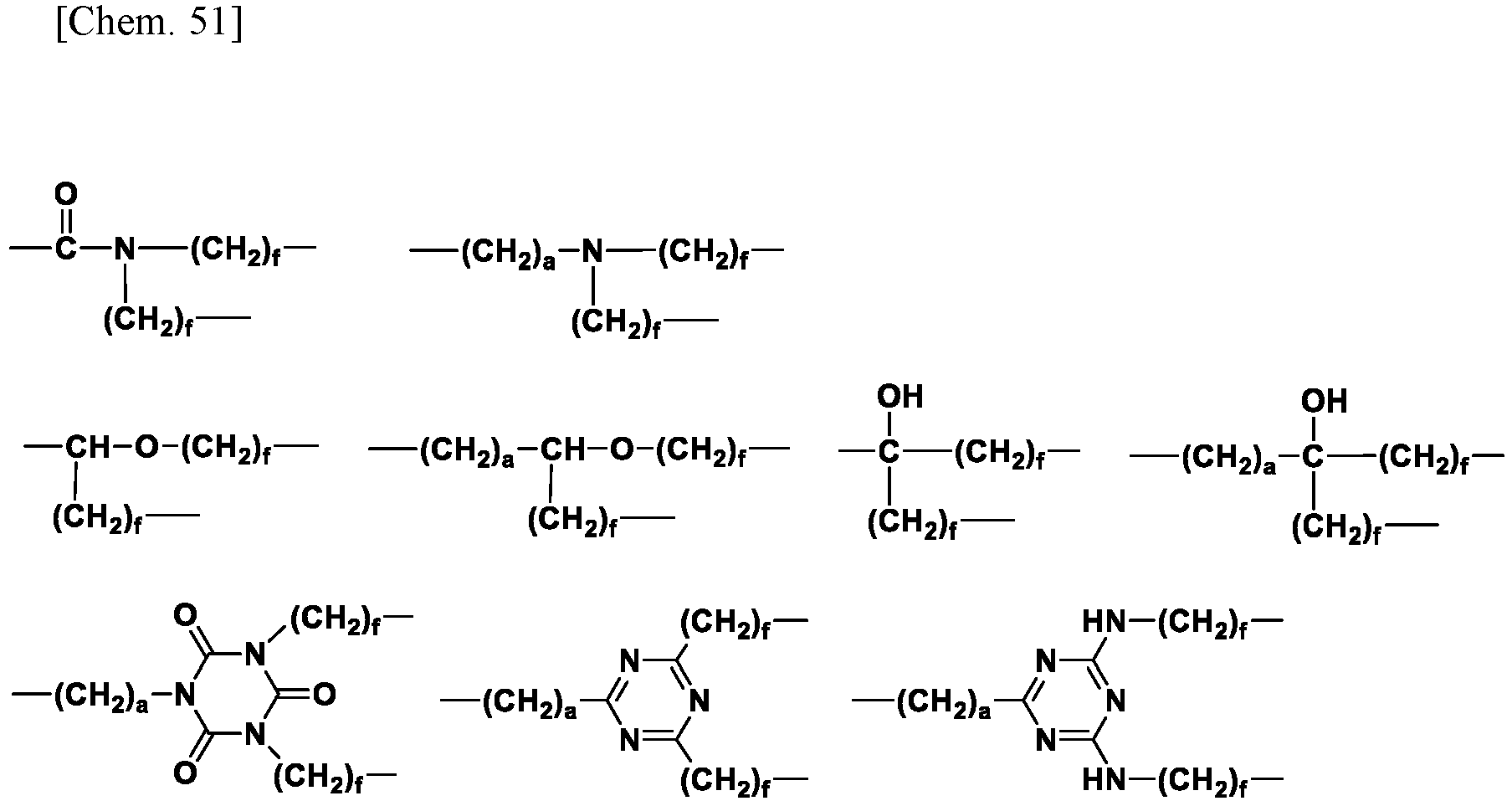

- Herein f is independently an integer of 2 to 8, a and b are independently an integer of 1 to 4.
- In formula (1), Z is independently a di- to hexavalent linear organo(poly)siloxane residue of 2 to 10 silicon atoms, preferably 2 to 5 silicon atoms or a di- to hexavalent branched or cyclic organo(poly)siloxane residue of 3 to 10 silicon atoms, preferably 3 to 5 silicon atoms. Examples thereof are shown by the following formulae.
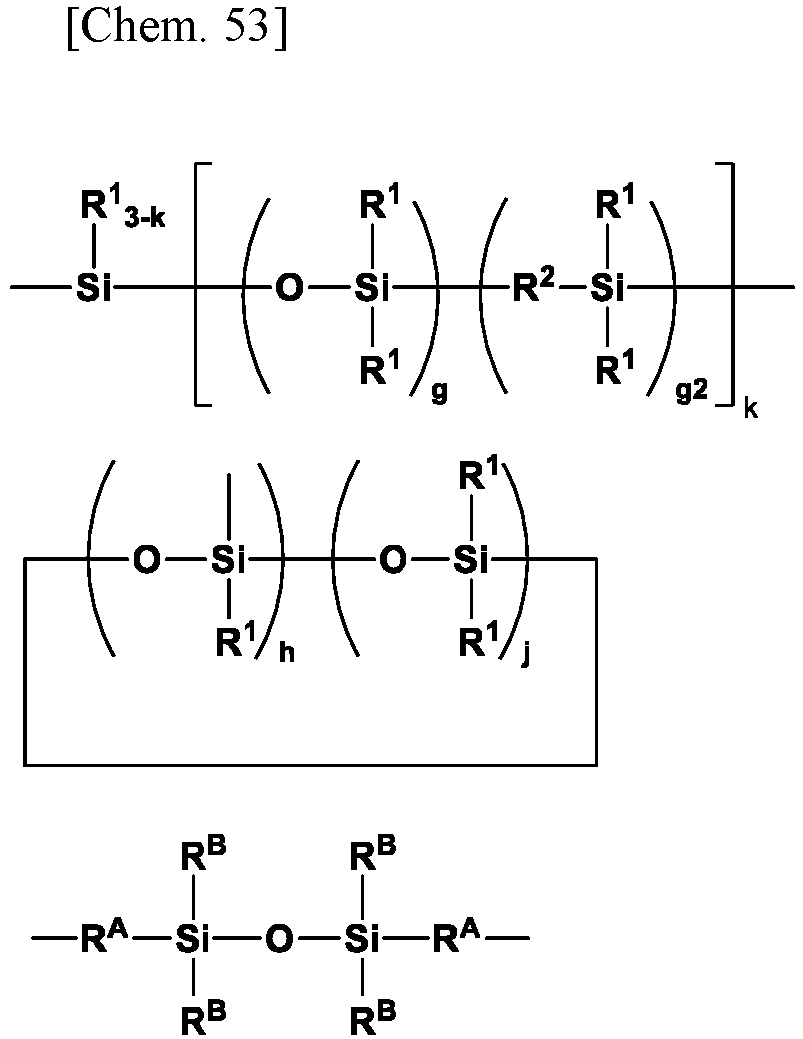
- Herein R1 which may be the same or different is a C1-C4 alkyl group such as methyl, ethyl, propyl or butyl, or C6-C10 aryl group such as phenyl. R2 is a C1-C4 alkylene group such as methylene, ethylene, propylene or butylene, or C6-C10 arylene group such as phenylene. RA is a single bond or a group having the general formula (X):

- wherein R1 and R2 are as defined above, g' is an integer of 0 to 6, preferably 0 or 1, g2' is an integer of 0 to 6, preferably 0 or 1, individual repeating units within the parentheses may be randomly bonded, and the valence bond on the right side is attached to Si. RB is R1 or a group having the general formula (Y):
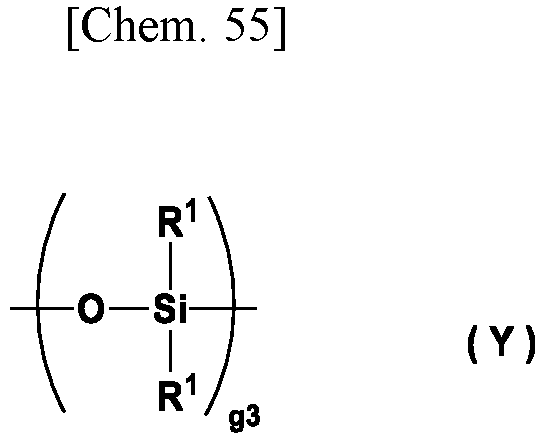
- wherein R1 is as defined above, g3 is an integer of 1 to 6, and the valence bond on the left side is attached to Si, at least one RB being a group of formula (Y), g is an integer of 1 to 9, preferably 1 to 4, g2 is an integer of 0 to 9, preferably 0 to 3, h is an integer of 2 to 6, preferably 3 to 5, j is an integer of 0 to 8, preferably 0 or 1, h+j is an integer of 3 to 10, preferably 3 to 5, k is an integer of 1 to 3, individual repeating units within the parentheses may be randomly bonded. In each formula, the number of silicon atoms is 10 at maximum.
- Exemplary of Z are groups of the following formulae. Preferably the valence bond on the left side is attached to U and other valence bonds are attached to Y.


- Herein g is as defined above.
- In formula (1), Y is independently a divalent organic group, preferably C1-C20 alkylene group, which may contain one or more atoms or groups selected from oxygen, sulfur and C6-C8 arylene groups.
- Exemplary of Y are groups of the following formulae. Preferably the valence bond on the left side is attached to Z and the valence bond on the right side is attached to silicon.

- Herein x is an integer of 1 to 20, preferably 2 to 10, y and z each are an integer of 1 to 10, preferably 1 to 5, y+z is an integer of 2 to 20, preferably 2 to 10.
- In formula (1), X is independently a hydroxy group, or a hydrolyzable group selected from the group consisting of C1-C10 alkoxy groups such as methoxy, ethoxy, propoxy, isopropoxy, butoxy, isobutoxy, sec-butoxy and tert-butoxy, C2-C10 alkoxyalkoxy groups such as methoxymethoxy, methoxyethoxy, ethoxymethoxy, and ethoxyethoxy, C2-C10 acyloxy groups such as acetoxy and propionoxy, C2-C10 alkenyloxy groups such as vinyloxy, allyloxy, propenoxy, and isopropenoxy, and halogen atoms such as chloro, bromo and iodo.
- In formula (1), R is independently a C1-C4 alkyl group such as methyl, ethyl, propyl or butyl, or a phenyl group.
- In formula (1), n is independently for each attachment silicon an integer of 1 to 3, preferably 2 or 3, m is independently an integer of 1 to 3, and l is independently an integer of 1 to 5, preferably 1 to 3.
- It is noted that the fluoropolyether-containing polymer preferably contains 2 to 48, especially 2 to 6 silanol groups or hydrolyzable silyl groups per molecule.
- The fluoropolyether-containing polymer containing silanol groups or hydrolyzable silyl groups, represented by formula (1), may be prepared, for example, by the following method.
- One exemplary method involves dissolving a fluoropolyether-containing polymer having olefin sites (alkenyl groups) at both ends of the molecular chain in a solvent such as fluorochemical solvent (e.g., 1,3-bis(trifluoromethyl)benzene), mixing an organosilicon compound containing a di- to hexavalent linear organo(poly)siloxane residue of 2 to 10 silicon atoms or branched or cyclic organo(poly)siloxane residue of 3 to 10 silicon atoms in the molecule and having a SiH group and a silanol or hydrolyzable silyl group (e.g., halogenated silyl or alkoxysilyl group), and aging the mixture in the presence of a toluene solution of a hydrosilation reaction catalyst such as chloroplatinic acid/vinylsiloxane complex, at a temperature of 40 to 120°C, preferably 60 to 100°C, more preferably about 80°C, for 1 to 72 hours, preferably 20 to 36 hours, more preferably about 24 hours. It is noted that when an organosilicon compound having halogen as the hydrolyzable silyl group is used as the organosilicon compound containing a di- to hexavalent linear organo(poly)siloxane residue of 2 to 10 silicon atoms or branched or cyclic organo(poly)siloxane residue of 3 to 10 silicon atoms and having a SiH group and a silanol or hydrolyzable silyl group, the substituent (i.e., halogen) on the silyl group may be subsequently converted to another hydrolyzable group, for example, alkoxy group (e.g., methoxy).
- In the preparation of the fluoropolyether-containing polymer containing silanol groups or hydrolyzable silyl groups, represented by formula (1), the fluoropolyether-containing polymer having olefin sites (alkenyl groups) at both ends of the molecular chain is exemplified by a fluoropolyether-containing polymer having the general formula (4):

- In formula (4), U' is independently a single bond or a di- to tetravalent organic group. The preferred di- to tetravalent organic groups include C1-C18 di- or tetravalent aliphatic saturated hydrocarbon groups which may contain at least one atom or group selected from among C6-C8 arylene groups, oxygen, sulfur, hydroxy, diorganosilylene (e.g., dimethylsilylene), secondary amino, tertiary amino, carbonyl, amide, ester, isocyanurate, triazine ring-containing groups, and tetravalent groups having silicon or carbon as the center atom.
- Preferred examples of U' are shown below. Preferably the valence bond on the left side is attached to Rf and other valence bonds are attached to alkenyl groups.


- Herein f is independently an integer of 2 to 8, f' is independently an integer of 0 to 6, and a and b are each independently an integer of 1 to 4.
- Examples of the fluoropolyether-containing polymer having olefin sites (alkenyl groups) at both ends of the molecular chain, represented by formula (4), are shown below.


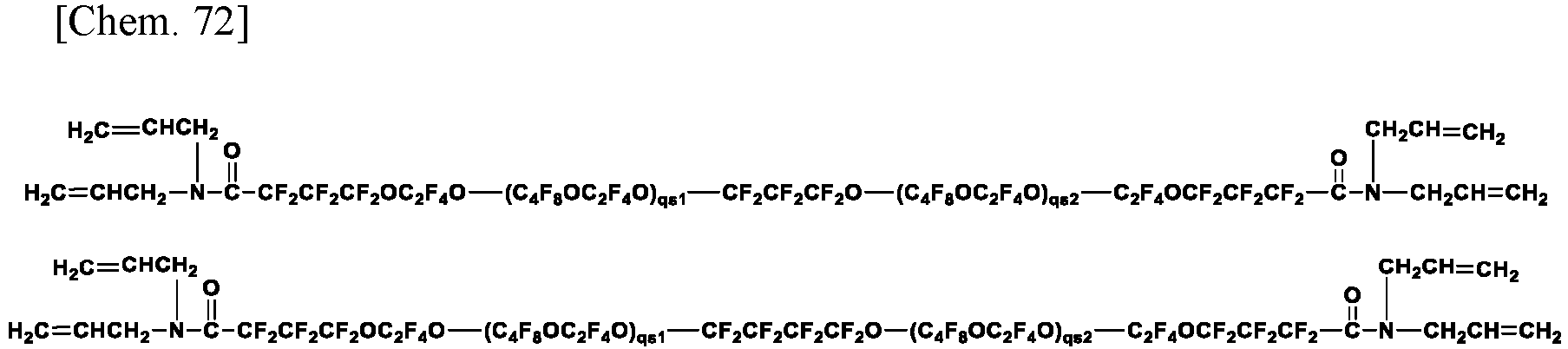


- Herein p1 is an integer of 5 to 440, q1 is an integer of 5 to 250, p1+q1 is an integer of 50 to 450; r1 is an integer of 35 to 180, r2 is an integer of 1 to 100, r3 is an integer of 1 to 100, r2+r3 is an integer of 35 to 180; p2 is an integer of 1 to 400, q2 is an integer of 1 to 250, r4 is an integer of 1 to 100, r5 is an integer of 1 to 100, p2+q2+r4+r5 is an integer of 40 to 403; qs1 is an integer of 1 to 85, qs2 is an integer of 1 to 85, qs1+qs2 is an integer of 16 to 86; p3 is an integer of 5 to 440, q3 is an integer of 5 to 250, p3+q3 is an integer of 50 to 445. Individual repeating units within the parentheses with p1 and q1, p2 and q2, and p3 and q3 may be randomly bonded. The fluorooxyalkylene-containing polymer residue has a Mn of 6,000 to 30,000.
- In the preparation of the fluoropolyether-containing polymer containing silanol groups or hydrolyzable silyl groups, represented by formula (1), the organosilicon compound containing a di- to hexavalent linear organo(poly)siloxane residue of 2 to 10 silicon atoms or branched or cyclic organo(poly)siloxane residue of 3 to 10 silicon atoms in the molecule and having a SiH group and a silanol or hydrolyzable silyl group is preferably selected from compounds having the general formulae (5), (6), and (Z).

- Herein Y, R, X, n, R1, R2, RA, g, g2, j, and k are as defined above, RB' is R1 or a group having the general formula (W):

- Examples of the organosilicon compound containing a di- to hexavalent linear organo(poly)siloxane residue of 2 to 10 silicon atoms or branched or cyclic organo(poly)siloxane residue of 3 to 10 silicon atoms in the molecule and having a SiH group and a silanol or hydrolyzable silyl group are shown below.


- In the method of preparing the fluoropolyether-containing polymer containing silanol groups or hydrolyzable silyl groups, represented by formula (1), including the step of reacting the fluoropolyether-containing polymer having olefin sites (alkenyl groups) at both ends of the molecular chain with the organosilicon compound containing a di- to hexavalent linear organo(poly)siloxane residue of 2 to 10 silicon atoms or branched or cyclic organo(poly)siloxane residue of 3 to 10 silicon atoms and having a SiH group and a silanol or hydrolyzable silyl group, the organosilicon compound is preferably used in such an amount as to provide 1 to 4 equivalents, more preferably 1 to 2.5 equivalents, even more preferably about 1.5 equivalents of SiH groups in the organosilicon compound per equivalent of olefin sites (alkenyl groups) in the fluoropolyether-containing polymer.
- When an organosilicon compound having halogen as the hydrolyzable silyl group is used as the organosilicon compound containing a di- to hexavalent linear organo(poly)siloxane residue of 2 to 10 silicon atoms or branched or cyclic organo(poly)siloxane residue of 3 to 10 silicon atoms in the molecule and having a SiH group and a silanol or hydrolyzable silyl group, the substituent (halogen) on the silyl group may be subsequently converted to another hydrolyzable group such as alkoxy group (e.g., methoxy). Examples of the reagent which can be used in converting the substituent (halogen) on the silyl group to another hydrolyzable group include C1-C10 alcohols such as methanol, ethanol, propanol, isopropanol and butanol.
- The amount of the reagent used is preferably 10 to 200 parts by weight, more preferably 40 to 100 parts by weight, even more preferably about 65 parts by weight per 100 parts by weight of the addition reaction product of the fluoropolyether-containing polymer having olefin sites (alkenyl groups) at both ends of the molecular chain with the organosilicon compound containing a di- to hexavalent linear organo(poly)siloxane residue of 2 to 10 silicon atoms or branched or cyclic organo(poly)siloxane residue of 3 to 10 silicon atoms in the molecule and having a SiH group and a silanol or hydrolyzable silyl group (e.g., halogenated silyl or alkoxysilyl group).
- As the solvent used in the preparation of the fluoropolyether-containing polymer containing silanol groups or hydrolyzable silyl groups, represented by formula (1), fluorochemical solvents are exemplary. Suitable fluorochemical solvents include 1,3-bis(trifluoromethyl)benzene, trifluoromethylbenzene, methyl nonafluorobutyl ether, methyl nonafluoroisobutyl ether, ethyl nonafluorobutyl ether, ethyl nonafluoroisobutyl ether, hydrofluoroether (HFE) solvents (tradename Novec series by 3M) such as 1,1,1,2,3,4,4,5,5,5-decafluoro-3-methoxy-2-(trifluoromethyl)pentane, and perfluoro solvents composed of completely fluorinated compounds (tradename Fluorinert series by 3M).
- The amount of the solvent used is 10 to 300 parts by weight, preferably 50 to 200 parts by weight, more preferably about 100 parts by weight per 100 parts by weight of the fluoropolyether-containing polymer having olefin sites (alkenyl groups) at both ends of the molecular chain.
- Examples of the hydrosilation catalyst used in the preparation of the fluoropolyether-containing polymer containing silanol groups or hydrolyzable silyl groups, represented by formula (1), include platinum group metal based catalysts such as platinum black, chloroplatinic acid, alcohol-modified chloroplatinic acid, complexes of chloroplatinic acid with olefin, aldehyde, vinyl siloxane, and acetylene alcohol, tetrakis(triphenylphosphine)palladium, and chlorotris(triphenylphosphine)rhodium. Inter alia, platinum compounds such as vinyl siloxane coordination compounds are preferred.
- The hydrosilation catalyst is preferably used in an amount to provide 0.01 to 100 ppm, more preferably 0.1 to 50 ppm of transition metal based on the weight of the fluoropolyether-containing polymer having olefin sites (alkenyl groups) at both ends of the molecular chain.
- As another method for preparing the fluoropolyether-containing polymer containing silanol groups or hydrolyzable silyl groups, represented by formula (1), the following method is exemplary.
- The method involves the steps of dissolving a fluoropolyether-containing polymer containing a di- to hexavalent linear organo(poly)siloxane residue of 2 to 10 silicon atoms or branched or cyclic organo(poly)siloxane residue of 3 to 10 silicon atoms in the molecule and having SiH groups at both ends of the molecular chain in a solvent such as fluorochemical solvent (e.g., 1,3-bis(trifluoromethyl)benzene), mixing an organosilicon compound having olefin sites (alkenyl groups) and silanol or hydrolyzable silyl groups (e.g., halogenated silyl or alkoxysilyl groups), and aging the mixture in the presence of a toluene solution of a hydrosilation reaction catalyst such as chloroplatinic acid/vinylsiloxane complex, at a temperature of 40 to 120°C, preferably 60 to 100°C, more preferably about 80°C, for 1 to 72 hours, preferably 20 to 36 hours, more preferably about 24 hours. It is noted that when an organosilicon compound having halogen as the hydrolyzable silyl group is used as the organosilicon compound having olefin sites (alkenyl groups) and silanol or hydrolyzable silyl groups (e.g., halogenated silyl or alkoxysilyl groups), the substituent (i.e., halogen) on the silyl group may be subsequently converted to another hydrolyzable group, for example, alkoxy group (e.g., methoxy).
- In the other method for preparing the fluoropolyether-containing polymer containing silanol groups or hydrolyzable silyl groups, represented by formula (1), the fluoropolyether-containing polymer containing a di- to hexavalent linear organo(poly)siloxane residue of 2 to 10 silicon atoms or branched or cyclic organo(poly)siloxane residue of 3 to 10 silicon atoms and having SiH groups at both ends of the molecular chain is exemplified by a fluoropolyether-containing polymer having the general formula (7).

- Herein Rf, U and m are as defined above. Z' is independently a monovalent linear organo(poly)siloxane residue of 2 to 10 silicon atoms or branched or cyclic organo(poly)siloxane residue of 3 to 10 silicon atoms, having a SiH group.
- In formula (7), Z' is independently a monovalent linear organo(poly)siloxane residue of 2 to 10 silicon atoms or branched or cyclic organo(poly)siloxane residue of 3 to 10 silicon atoms, having a SiH group. Examples of the monovalent organo(poly)siloxane residue include those of the following formulae.

- Herein R1, R2, g, g2, k, i, j, and i+j are as defined above, and individual repeating units within the parentheses may be randomly bonded.
- Preferred examples of Z' are shown below.


- Herein g is as defined above.
- Examples of the fluoropolyether-containing polymer containing a di- to hexavalent linear organo(poly)siloxane residue of 2 to 10 silicon atoms or branched or cyclic organo(poly)siloxane residue of 3 to 10 silicon atoms in the molecule and having SiH groups at both ends of the molecular chain, represented by formula (7), include the following.


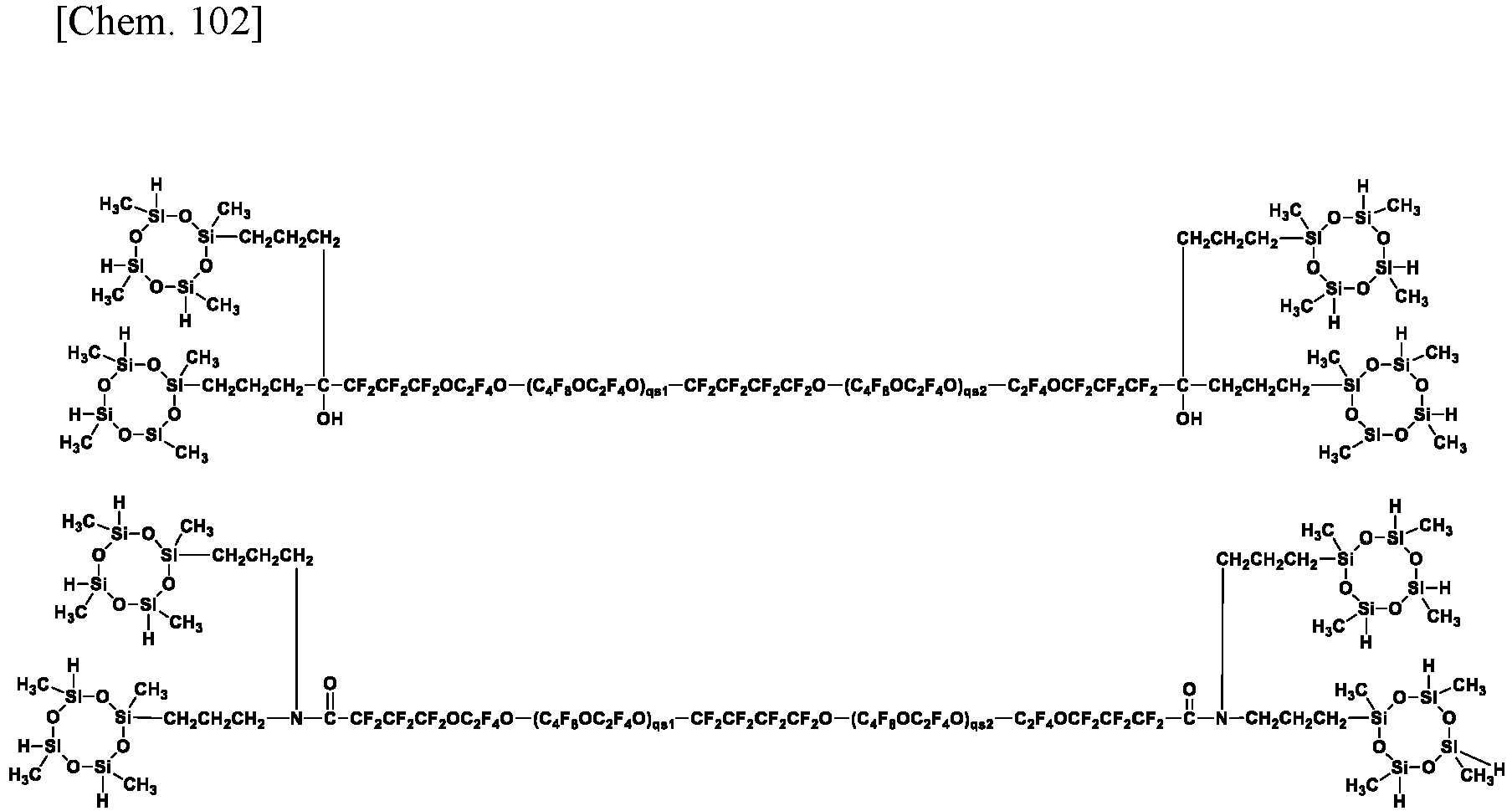


- Herein p1 is an integer of 5 to 440, q1 is an integer of 5 to 250, p1+q1 is an integer of 50 to 450, r1 is an integer of 35 to 180, r2 is an integer of 1 to 100, r3 is an integer of 1 to 100, r2+r3 is an integer of 35 to 180, p2 is an integer of 1 to 400, q2 is an integer of 1 to 250, r4 is an integer of 1 to 100, r5 is an integer of 1 to 100, p2+q2+r4+r5 is an integer of 40 to 403, qs1 is an integer of 1 to 85, qs2 is an integer of 1 to 85, qs1+qs2 is an integer of 16 to 86. Individual repeating units within the parentheses with p1 and q1, and p2 and q2 may be randomly bonded. The fluorooxyalkylene-containing polymer residue has a Mn of 6,000 to 30,000.
- In the other method for preparing the fluoropolyether-containing polymer containing silanol groups or hydrolyzable silyl groups, represented by formula (1), the organosilicon compound having olefin sites and silanol or hydrolyzable silyl groups is preferably a compound having the general formula (8).

- Herein R, X and n are as defined above. Y' is independently a single bond or divalent organic group.
- In formula (8), Y' is independently a single bond or divalent organic group. Examples of the divalent organic group include C1-C18 alkylene groups which may contain one or more atoms or groups selected from oxygen, sulfur and C6-C8 arylene groups.
- Examples of the divalent organic group Y' include the following groups. Preferably the valence bond on the left is attached to carbon and the valence bond on the right is attached to silicon.

- Herein x' is an integer of 1 to 18, preferably 1 to 8, y' is an integer of 0 to 8, preferably 0 to 3, z is an integer of 1 to 10, preferably 1 to 5, and y'+z is an integer of 1 to 18, preferably 1 to 8.
- Examples of the organosilicon compound having olefin sites and silanol or hydrolyzable silyl groups include the following.

- In the other method for preparing the fluoropolyether-containing polymer containing silanol groups or hydrolyzable silyl groups, represented by formula (1), including the step of reacting the fluoropolyether-containing polymer containing a di- to hexavalent linear organo(poly)siloxane residue of 2 to 10 silicon atoms or branched or cyclic organo(poly)siloxane residue of 3 to 10 silicon atoms in the molecule and having SiH groups at both ends of the molecular chain with the organosilicon compound having olefin sites and silanol or hydrolyzable silyl groups, the organosilicon compound is preferably used in such an amount as to provide 1 to 4 equivalents, more preferably 1 to 2.5 equivalents, even more preferably about 1.5 equivalents of olefin sites in the organosilicon compound per equivalent of SiH groups in the fluoropolyether-containing polymer.
- It is noted that when an organosilicon compound having halogen as the hydrolyzable silyl group is used as the organosilicon compound having olefin sites and silanol or hydrolyzable silyl groups, the substituent (i.e., halogen) on the silyl group may be subsequently converted to another hydrolyzable group, for example, alkoxy group (e.g., methoxy). Examples of the reagent which can be used in converting the substituent (halogen) on the silyl group to another hydrolyzable group include C1-C10 alcohols such as methanol, ethanol, propanol, isopropanol and butanol.
- The amount of the reagent used is preferably 10 to 200 parts by weight, more preferably 40 to 100 parts by weight, even more preferably about 65 parts by weight per 100 parts by weight of the addition reaction product of the fluoropolyether-containing polymer containing a di- to hexavalent linear organo(poly)siloxane residue of 2 to 10 silicon atoms or branched or cyclic organo(poly)siloxane residue of 3 to 10 silicon atoms in the molecule and having SiH groups at both ends of the molecular chain with the organosilicon compound having olefin sites and silanol or hydrolyzable silyl groups.
- As the solvent used in the other method for the preparation of the fluoropolyether-containing polymer containing silanol groups or hydrolyzable silyl groups, represented by formula (1), fluorochemical solvents are exemplary. Suitable fluorochemical solvents include 1,3-bis(trifluoromethyl)benzene, trifluoromethylbenzene, methyl nonafluorobutyl ether, methyl nonafluoroisobutyl ether, ethyl nonafluorobutyl ether, ethyl nonafluoroisobutyl ether, hydrofluoroether (HFE) solvents (tradename Novec series by 3M) such as 1,1,1,2,3,4,4,5,5,5-decafluoro-3-methoxy-2-(trifluoromethyl)pentane, and perfluoro solvents composed of completely fluorinated compounds (tradename Fluorinert series by 3M).
- The amount of the solvent used is 10 to 300 parts by weight, preferably 50 to 200 parts by weight, more preferably about 100 parts by weight per 100 parts by weight of the fluoropolyether-containing polymer containing a di- to hexavalent linear organo(poly)siloxane residue of 2 to 10 silicon atoms or branched or cyclic organo(poly)siloxane residue of 3 to 10 silicon atoms in the molecule and having SiH groups at both ends of the molecular chain.
- Examples of the hydrosilation catalyst used in the preparation of the fluoropolyether-containing polymer containing silanol groups or hydrolyzable silyl groups, represented by formula (1), include platinum group metal based catalysts such as platinum black, chloroplatinic acid, alcohol-modified chloroplatinic acid, complexes of chloroplatinic acid with olefin, aldehyde, vinyl siloxane, and acetylene alcohol, tetrakis(triphenylphosphine)palladium, and chlorotris(triphenylphosphine)rhodium. Inter alia, platinum compounds such as vinyl siloxane coordination compounds are preferred.
- The hydrosilation catalyst is preferably used in an amount to provide 0.01 to 100 ppm, more preferably 0.1 to 50 ppm of transition metal based on the weight of the fluoropolyether-containing polymer containing a di- to hexavalent linear organo(poly)siloxane residue of 2 to 10 silicon atoms or branched or cyclic organo(poly)siloxane residue of 3 to 10 silicon atoms in the molecule and having SiH groups at both ends of the molecular chain.
- Exemplary of the fluoropolyether-containing polymer containing silanol groups or hydrolyzable silyl groups, represented by formula (1) is a compound having the following formula:

- wherein p1 and q1 are as defined below. This compound may be prepared by forming a compound having the following formula:

- wherein p1 and q1 are as defined above through reaction according to the teaching of
JP 6531833 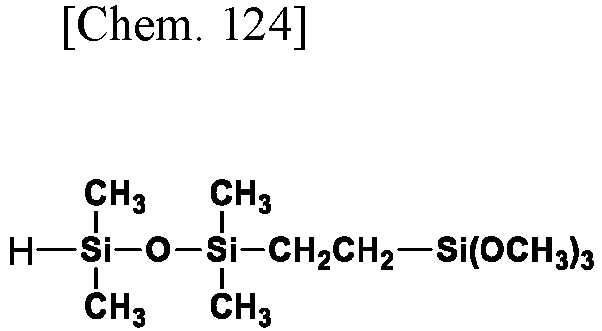
- according to a similar procedure.
- Examples of the fluoropolyether-containing polymer containing silanol groups or hydrolyzable silyl groups, represented by formula (1) include the structures shown below. A series of fluoropolyether-containing polymers containing hydrolyzable silyl groups are obtained by changing the combination of Rf, U, Z, Y, X, R, n and m in formula (1). It is noted that in the formulae shown below, p1 is an integer of 5 to 440, q1 is an integer of 5 to 250, p1+q1 is an integer of 50 to 450, r1 is an integer of 35 to 180, r2 is an integer of 1 to 100, r3 is an integer of 1 to 100, r2+r3 is an integer of 35 to 180, p2 is an integer of 1 to 400, q2 is an integer of 1 to 250, r4 is an integer of 1 to 100, r5 is an integer of 1 to 100, p2+q2+r4+r5 is an integer of 40 to 403, p3 is an integer of 5 to 440, q3 is an integer of 5 to 250, p3+q3 is an integer of 50 to 445, qs1 is an integer of 1 to 85, qs2 is an integer of 1 to 85, qs1+qs2 is an integer of 16 to 86. Individual repeating units within the parentheses with p1 and q1, p2 and q2, and p3 and q3 may be randomly bonded. The fluorooxyalkylene-containing polymer residue has a Mn of 6,000 to 30,000.






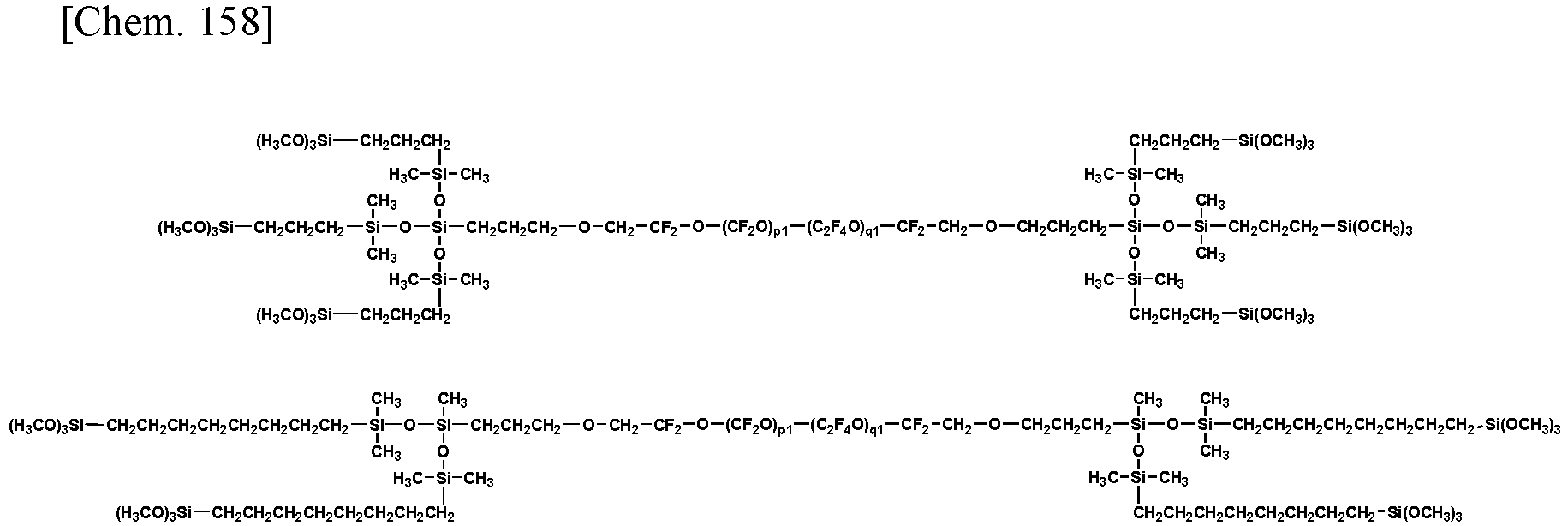


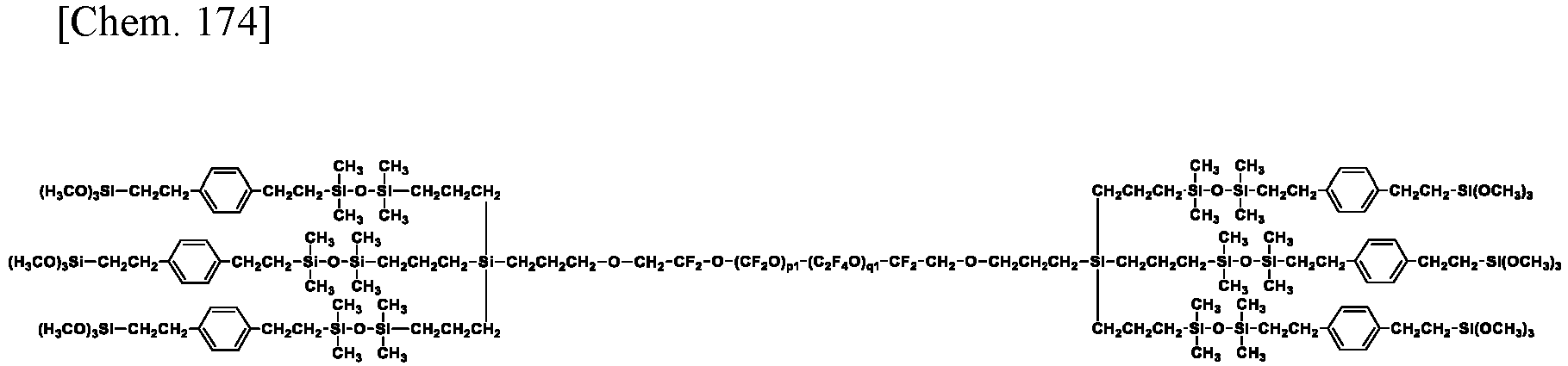

- In one embodiment wherein a compound having the following formula:

- is used as the fluoropolyether-containing polymer having olefin sites (alkenyl groups) at both ends of the molecular chain, and a silane compound having the following formula:

- is used as the organosilicon compound containing a di- to hexavalent linear organo(poly)siloxane residue of 2 to 10 silicon atoms or branched or cyclic organo(poly)siloxane residue of 3 to 10 silicon atoms in the molecule and having a SiH group and a silanol or hydrolyzable silyl group, a compound having the following formula:

- is obtained.
- Another embodiment of the invention is a surface treating agent comprising a fluoropolyether-containing polymer having a silanol group or hydrolyzable silyl group, represented by the above formula (1), and/or a partial (hydrolytic) condensate thereof as a main component. The surface treating agent may contain unreacted reactants prior to the introduction of a terminal silanol group or terminal hydrolyzable silyl group into the fluoropolyether-containing polymer having a silanol group or hydrolyzable silyl group, and reaction intermediates. As mentioned above, the surface treating agent may comprise a partial (hydrolytic) condensate which is obtained by condensing the hydroxy group on the fluoropolyether-containing polymer or a hydroxy group resulting from previous partial hydrolysis of the terminal hydrolyzable silyl group on the fluoropolyether-containing polymer by a well-known method.
- Notably, the surface treating agent "comprising a fluoropolyether-containing polymer having a silanol group or hydrolyzable silyl group, represented by formula (1), and/or a partial (hydrolytic) condensate thereof as a main component" means that the content of a fluoropolyether-containing polymer having a silanol group or hydrolyzable silyl group, represented by formula (1), and/or a partial (hydrolytic) condensate thereof is at least 50% by weight, preferably at least 70% by weight, more preferably at least 90% by weight based on the total weight of components excluding the solvent.
- In addition to the fluoropolyether-containing polymer having a silanol group or hydrolyzable silyl group, represented by formula (1), and/or partial (hydrolytic) condensate thereof as the main component, the surface treating agent may further contain a fluoropolyether-containing polymer having a silanol group or hydrolyzable silyl group, represented by the following formula (3), and/or a partial (hydrolytic) condensate thereof, if necessary.

- Herein Rf, U, Z, Y, X, R, n, m, and l are as defined in formula (1), A is independently fluorine, hydrogen or a monovalent fluorinated group terminated with -CF3, -CF2H or -CH2F group.
- In formula (3), Rf is as exemplified above for Rf in formula (1). Rf may be identical with or different from Rf in formula (1).
- In formula (3), A is independently fluorine, hydrogen or a monovalent fluorinated group terminated with -CF3, -CF2H or -CH2F group. Examples of the monovalent fluorinated group terminated with -CF3, -CF2H or -CH2F group include -CF3, -CF2CF3, -CF2CF2CF3, -CH2CF(CF3)-OC3F7, and -CH2OCF2CFH-OC3F7. Among others, A is preferably fluorine, -CF3 or -CF2CF3 group.
- In formula (3), U, Z, Y, X, R, n, and m are as defined for U, Z, Y, X, R, n, and m in formula (1). U, Z, Y, X, R, n, and m may be identical with or different from U, Z, Y, X, R, n, and m in formula (1).
- Examples of the fluoropolyether-containing polymer having a silanol group or hydrolyzable silyl group, represented by formula (3), and/or partial (hydrolytic) condensate thereof are shown below.


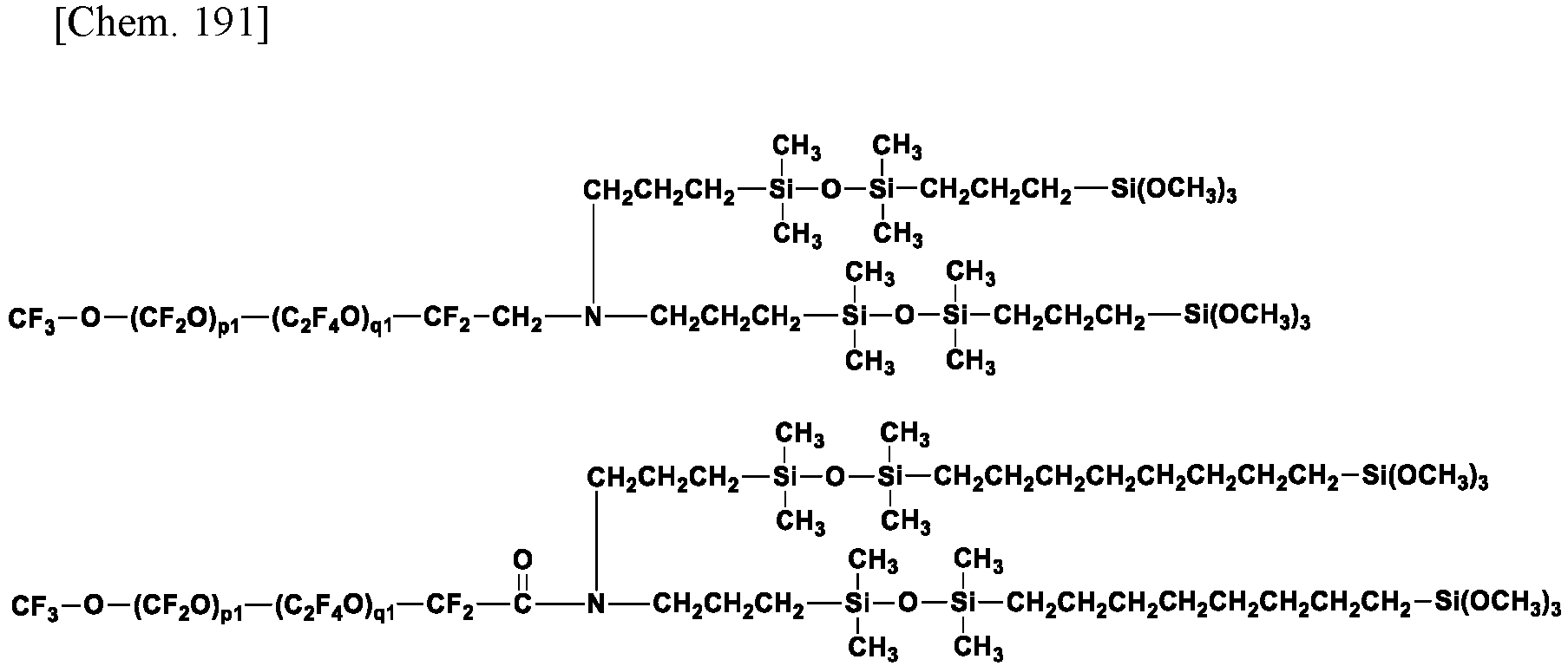


- Herein p1, q1, p1+q1, r1, r2, r3, and r2+r3 are as defined above, qs3 is an integer of 16 to 86, r6 is an integer of 33 to 180, p4 is an integer of 5 to 440, q4 is an integer of 5 to 250, r7 is an integer of 1 to 175, p4+q4+r7 is an integer of 30 to 443. Individual repeating units within the parentheses with p1 and q1, and p4, q4 and r7 may be randomly bonded. The fluorooxyalkylene-containing polymer residue has a Mn of 6,000 to 30,000.
- The content of the fluoropolyether-containing polymer having a silanol group or hydrolyzable silyl group, represented by formula (3), and/or partial (hydrolytic) condensate thereof may be 0 to 100 parts by weight, preferably 0 to 60 parts by weight, more preferably 0 to 40 parts by weight per 100 parts by weight of the fluoropolyether-containing polymer having a silanol group or hydrolyzable silyl group, represented by formula (1), and/or partial (hydrolytic) condensate thereof as the main component. Notably, when the fluoropolyether-containing polymer having a silanol group or hydrolyzable silyl group, represented by formula (3), and/or partial (hydrolytic) condensate thereof is blended, its amount is preferably at least 1 part by weight, more preferably at least 5 parts by weight per 100 parts by weight of the fluoropolyether-containing polymer having a silanol group or hydrolyzable silyl group, represented by formula (1), and/or partial (hydrolytic) condensate thereof.
- Besides the fluoropolyether-containing polymer having a silanol group or hydrolyzable silyl group, represented by formula (1), and/or partial (hydrolytic) condensate thereof as the main component and the fluoropolyether-containing polymer having a silanol group or hydrolyzable silyl group, represented by formula (3), and/or partial (hydrolytic) condensate thereof, the surface treating agent may contain a fluorinated compound (non-functional fluoropolyether polymer) having the formula (9):
A-Rf-A (9)
wherein Rf is as defined above, and A is independently fluorine, hydrogen or a monovalent fluorinated group terminated with -CF3, -CF2H or -CH2F group, if necessary. - In formula (9), Rf is as exemplified above for Rf in formula (1). Rf may be identical with or different from Rf in formula (1).
- In formula (9), A is independently fluorine, hydrogen or a monovalent fluorinated group terminated with -CF3, -CF2H or -CH2F group. Examples of the monovalent fluorinated group terminated with -CF3, -CF2H or -CH2F group include -CF3, -CF2CF3, -CF2CF2CF3, -CH2CF(CF3)-OC3F7, and -CH2OCF2CFH-OC3F7. Among others, A is preferably fluorine, -CF3 or -CF2CF3 group.
- Examples of the fluorinated compound (non-functional fluoropolyether polymer) having formula (9) are shown below.

- Herein p5, q5 and r8 are each independently an integer of 0 to 450, the sum of p5, q5, and r8 is 20 to 450, r9 and r10 each are an integer of 20 to 450. Individual repeating units within the parentheses with p5, q5, and r8 may be randomly bonded. The fluorooxyalkylene-containing polymer residue has a Mn of 6,000 to 30,000.
- The content of the fluorinated compound (non-functional fluoropolyether polymer) having formula (9) may be 0 to 100 parts by weight, preferably 0 to 60 parts by weight, more preferably 0 to 40 parts by weight per 100 parts by weight of the fluoropolyether-containing polymer having a silanol group or hydrolyzable silyl group, represented by formula (1), and/or partial (hydrolytic) condensate thereof as the main component.
- To the surface treating agent, a hydrolytic condensation catalyst may be added if necessary. Suitable hydrolytic condensation catalysts include organotin compounds such as dibutyltin dimethoxide and dibutyltin dilaurate, organotitanium compounds such as tetra-n-butyl titanate, organozirconium compounds such as tetra-n-butyl zirconate, organic acids such as acetic acid, methanesulfonic acid, and fluorine-modified carboxylic acids, and inorganic acids such as hydrochloric acid and sulfuric acid. Of these, acetic acid, tetra-n-butyl titanate, dibutyltin dilaurate, and fluorine-modified carboxylic acids are desirable.
- When used, the hydrolytic condensation catalyst may be added in a catalytic amount, typically 0.01 to 5 parts, more preferably 0.1 to 1 part by weight per 100 parts by weight of the fluoropolyether-containing polymers having a silanol group or hydrolyzable silyl group, represented by formulae (1) and (3), and/or partial (hydrolytic) condensates thereof combined.
- The surface treating agent may further comprise a solvent. Suitable solvents include fluorine-modified aliphatic hydrocarbon solvents such as perfluorohexane, perfluoroheptane, perfluorooctane and tridecafluorooctane; fluorine-modified aromatic hydrocarbon solvents such as 1,3-bis(trifluoromethyl)benzene; fluorine-modified ether solvents such as methyl perfluorobutyl ether, ethyl perfluorobutyl ether, perfluoro(2-butyltetrahydrofuran), and methyl perfluoroheptenyl ether; fluorine-modified alkylamine solvents such as perfluorotributylamine and perfluorotripentylamine; hydrocarbon solvents such as petroleum benzine, toluene, and xylene; ketone solvents such as acetone, methyl ethyl ketone, and methyl isobutyl ketone. Of these, fluorine-modified solvents are desirable for solubility and wettability, with 1,3-bis(trifluoromethyl)benzene, perfluoro(2-butyltetrahydrofuran), perfluorotributylamine, ethyl perfluorobutyl ether, and tridecafluorooctane being more desirable.
- The solvents may be used in admixture of two or more while it is preferred that the fluoropolyether-containing polymer and its partial (hydrolytic) condensate (including a fluoropolyether-containing polymer having a silanol group or hydrolyzable silyl group represented by formula (1) and a partial (hydrolytic) condensate thereof, a fluoropolyether-containing polymer having a silanol group or hydrolyzable silyl group represented by formula (3) and a partial (hydrolytic) condensate thereof, and a fluorinated compound (non-functional fluoropolyether polymer) represented by formula (9), the same holds true, hereinafter) be uniformly dissolved in the solvent. An optimum concentration of the fluoropolyether-containing polymer and its partial (hydrolytic) condensate in the solvent varies with a particular treating mode. The amount which is easy to weigh may be chosen. In the case of direct coating, the concentration is preferably 0.01 to 10 parts by weight, more preferably 0.05 to 5 parts by weight per 100 parts by weight of the solvent and the fluoropolyether-containing polymer and its partial (hydrolytic) condensate in total. In the case of evaporation treatment, the concentration is preferably 1 to 100 parts by weight, more preferably 3 to 50 parts by weight per 100 parts by weight of the solvent and the fluoropolyether-containing polymer and its partial (hydrolytic) condensate in total.
- The surface treating agent may be applied to a substrate by any well-known techniques such as brush coating, dipping, spraying and evaporation. In the case of evaporation, the heating mode may be either resistance heating or EB heating and is not particularly limited. The curing temperature varies with a particular curing technique. For example, in the case of direct coating (brush coating, dipping or spraying), suitable curing conditions include a temperature of 25 to 200°C, especially 25 to 150°C for 30 minutes to 36 hours, especially 1 to 18 hours. When the agent is applied by evaporation, the curing temperature is desirably in a range of 20 to 200°C. Humid curing conditions are also useful. The cured coating typically has a thickness of 0.1 to 100 nm, desirably 1 to 20 nm although the thickness depends on the type of substrate. Also, in the case of spray coating, for example, a procedure involving diluting the agent with a fluorochemical solvent having water previously added thereto, for thereby effecting hydrolysis to generate Si-OH, and thereafter, spraying the dilution is recommended because the coating rapidly cures.
- It is noted that the film thickness may be measured by suitable means, for example, spectroscopic reflectometry, X-ray reflectometry, spectroscopic ellipsometry, and X-ray fluorescence film thickness measurement.
- The substrate to be treated with the surface treating agent is not particularly limited, and may be made of any desired materials including paper, fabric, metals, metal oxides, glass, plastics, ceramics, and quartz. The surface treating agent is effective for endowing the substrate with water/oil repellency. In particular, the surface treating agent is advantageously used for the treatment of SiO2-deposited glass and film.
- Preferred articles which may be treated with the surface treating agent include car navigation systems, mobile phones, smart phones, digital cameras, digital video cameras, PDA, portable audio players, car audio players, game consoles, eyeglass lenses, camera lenses, lens filters, sunglasses, medical instruments (e.g., gastroscopes), copiers, personal computers, LC displays, organic EL displays, plasma displays, touch panel displays, protective film, antireflective film, and other optical articles. Since the surface treating agent of the invention is effective for preventing fingerprints and sebum from adhering to the articles and also for imparting scratch resistance, it is particularly useful as a water/oil repellent layer on lenses, touch panel displays, and antireflective films.
- The surface treating agent is also used for anti-staining coatings on sanitary ware such as bathtubs and washbowls; anti-staining coatings on glazing or strengthened glass in transport vehicles such as automobiles, trains and aircraft and head lamp covers; water/oil repellent coatings on building exteriors; coatings for preventing oil contamination on kitchen ware; anti-staining, anti-sticking, anti-graffiti coatings in telephone booths; anti-fingerprint coatings on artistic objects; anti-fingerprint coatings on compact discs and DVD's; mold parting agents; paint additives; and resin modifiers. The agent is also effective for modifying the flow and dispersion of inorganic fillers and as a lubricity-improving agent for tape and film.
- In particular, the surface treating agent is able to form on a lens substrate a cured film having water/oil repellency, abrasion resistance and chucking properties.
- As used herein, chucking properties refer to, in the step of machining a substrate which is fixedly secured by an adhesive tape, the degree of securement of the substrate. In a lens edging system in which a lens is secured by a lens blocking tape, for example, the degree of securement is judged in terms of the strength of adhesion (tensile shear bond strength) between the lens blocking tape and the lens. Chucking properties are regarded satisfactory when the adhesion between the adhesive tape and the substrate ensures to secure the substrate so firmly that the substrate is machined at an acceptable accuracy.
- Synthesis Examples, Examples and Comparative Examples are given below for illustrating the invention, but the invention is not limited by Examples. The number of repetition of fluorooxyalkylene units in fluorooxyalkylene-containing polymer residue is a number average value computed from 19F-NMR spectroscopy. In the formulae below, individual repeating units within the parentheses with p1 and q1, p1, q1 and r1, p2 and q2, and p3 and q3 are randomly bonded. The film thickness is measured by spectroscopic ellipsometry using a spectral ellipsometer.
- A reactor was charged with 100 g (1.55 × 10⁻² mol) of a compound having the formula (1A):

- 100 g of 1,3-bis(trifluoromethyl)benzene, 13.1 g (4.64×10⁻² mol) of an organosilicon compound having the formula (1B):

- and 5.92×10⁻² g (containing 1.83 × 10⁻⁷ mol of Pt element) of a toluene solution of chloroplatinic acid/vinylsiloxane complex. The mixture was aged at 80°C for 24 hours. The solvent and unreacted reactants were distilled off under reduced pressure. After washing, 100 g of a liquid product was obtained.
- On 1H-NMR analysis, the compound was identified to have the structure represented by the formula (1C).

- A reactor was charged with 100 g (1.55 × 10⁻² mol) of a compound having the formula (2A):

- 100 g of 1,3-bis(trifluoromethyl)benzene, 16.5 g (4.64×10⁻² mol) of an organosilicon compound having the formula (2B):

- and 5.92×10⁻² g (containing 1.83 × 10⁻⁷ mol of Pt element) of a toluene solution of chloroplatinic acid/vinylsiloxane complex. The mixture was aged at 80°C for 24 hours. The solvent and unreacted reactants were distilled off under reduced pressure. After washing, 96 g of a liquid product was obtained.
- On 1H-NMR analysis, the compound was identified to have the structure represented by the formula (2C).

- A reactor was charged with 50 g (6.15 × 10⁻³ mol) of a compound having the formula (3A):

- 50 g of 1,3-bis(trifluoromethyl)benzene, 6.74 g (1.84×10⁻² mol) of an organosilicon compound having the formula (3B):

- and 2.3 5 × 10⁻² g (containing 7.26 × 10⁻⁸ mol of Pt element) of a toluene solution of chloroplatinic acid/vinylsiloxane complex. The mixture was aged at 80°C for 24 hours. The solvent and unreacted reactants were distilled off under reduced pressure. After washing, 49.7 g of a liquid product was obtained.
- On 1H-NMR analysis, the compound was identified to have the structure represented by the formula (3C).

- A reactor was charged with 50 g (3.61 × 10⁻³ mol) of a compound having the formula (4A):


- On 1H-NMR analysis, the compound was identified to have the structure represented by the formula (4C).

- A reactor was charged with 100 g (1.10×10⁻² mol) of a compound having the formula (5A):

- 100 g of 1,3-bis(trifluoromethyl)benzene, 13.4 g (3.30×10⁻² mol) of an organosilicon compound having the formula (5B):
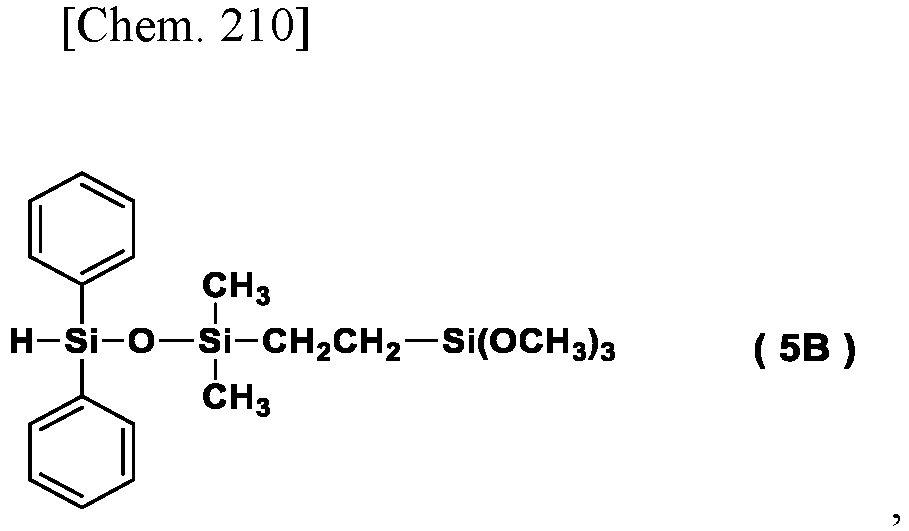
- and 4.20×10⁻² g (containing 1.30×10⁻⁷ mol of Pt element) of a toluene solution of chloroplatinic acid/vinylsiloxane complex. The mixture was aged at 80°C for 24 hours. The solvent and unreacted reactants were distilled off under reduced pressure. After washing, 102 g of a liquid product was obtained.
- On 1H-NMR analysis, the compound was identified to have the structure represented by the formula (5C).

- A reactor was charged with 100 g (5.94×10⁻³ mol) of a compound having the formula (6A):

- 100 g of 1,3-bis(trifluoromethyl)benzene, 6.52 g (1.78×10⁻² mol) of an organosilicon compound having the formula (6B):

- and 2.27×10⁻² g (containing 7.01×10⁻⁸ mol of Pt element) of a toluene solution of chloroplatinic acid/vinylsiloxane complex. The mixture was aged at 80°C for 24 hours. The solvent and unreacted reactants were distilled off under reduced pressure. After washing, 102 g of a liquid product was obtained.
- On 1H-NMR analysis, the compound was identified to have the structure represented by the formula (6C).

- A reactor was charged with 50 g (6.38×10⁻³ mol) of a compound having the formula (7A):

- 50 g of 1,3-bis(trifluoromethyl)benzene, 11.3 g (3.83×10⁻² mol) of an organosilicon compound having the formula (7B):

- and 2.44×10⁻² g (containing 7.53×10⁻⁸ mol of Pt element) of a toluene solution of chloroplatinic acid/vinylsiloxane complex. The mixture was aged at 80°C for 24 hours. The solvent and unreacted reactants were distilled off under reduced pressure. After washing, 53 g of a liquid product was obtained.
- On 1H-NMR analysis, the compound was identified to have the structure represented by the formula (7C).

- A reactor was charged with 100 g (1.10×10⁻² mol) of a compound having the formula (8A):

- 100 g of 1,3-bis(trifluoromethyl)benzene, 18.6 g (6.59×10⁻² mol) of an organosilicon compound having the formula (8B):

- and 4.20×10⁻² g (containing 1.30×10⁻⁷ mol of Pt element) of a toluene solution of chloroplatinic acid/vinylsiloxane complex. The mixture was aged at 80°C for 24 hours. The solvent and unreacted reactants were distilled off under reduced pressure. After washing, 110 g of a liquid product was obtained.
- On 1H-NMR analysis, the compound was identified to have the structure represented by the formula (8C).

- A reactor was charged with 100 g (1.41×10⁻² mol) of a compound having the formula (9A):

- 100 g of 1,3-bis(trifluoromethyl)benzene, 21.8 g (4.23×10⁻² mol) of an organosilicon compound having the formula (9B):

- and 5.39×10⁻² g (containing 1.66×10⁻⁷ mol of Pt element) of a toluene solution of chloroplatinic acid/vinylsiloxane complex. The mixture was aged at 80°C for 24 hours. The solvent and unreacted reactants were distilled off under reduced pressure. After washing, 115 g of a liquid product was obtained.
- On 1H-NMR analysis, the compound was identified to have the structure represented by the formula (9C).

- A reactor was charged with 100 g (5.99×10⁻³ mol) of a compound having the formula (10A):
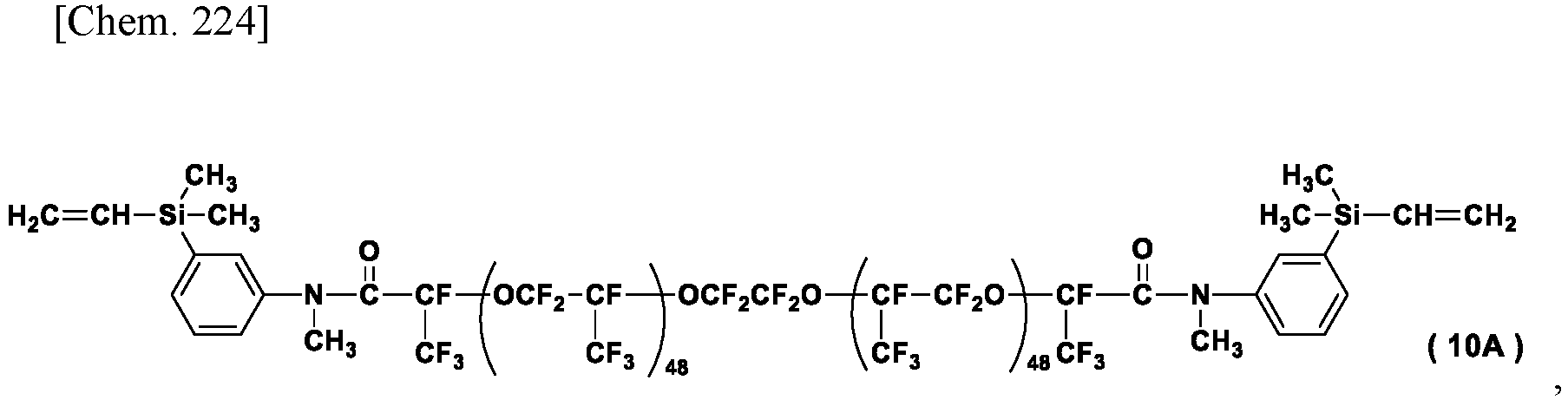
- 100 g of 1,3-bis(trifluoromethyl)benzene, 5.33 g (1.80×10⁻² mol) of an organosilicon compound having the formula (10B):

- and 2.29×10⁻² g (containing 7.07×10⁻⁸ mol of Pt element) of a toluene solution of chloroplatinic acid/vinylsiloxane complex. The mixture was aged at 80°C for 24 hours. The solvent and unreacted reactants were distilled off under reduced pressure. After washing, 102 g of a liquid product was obtained.
- On 1H-NMR analysis, the compound was identified to have the structure represented by the formula (10C).

- A reactor was charged with 100 g (1.01×10⁻² mol) of a compound having the formula (11A):

- 100 g of 1,3-bis(trifluoromethyl)benzene, 22.3 g (6.08×10⁻² mol) of an organosilicon compound having the formula (11B):

- and 3.86×10⁻² g (containing 1.19×10⁻⁷ mol of Pt element) of a toluene solution of chloroplatinic acid/vinylsiloxane complex. The mixture was aged at 80°C for 24 hours. The solvent and unreacted reactants were distilled off under reduced pressure. After washing, 113 g of a liquid product was obtained.
- On 1H-NMR analysis, the compound was identified to have the structure represented by the formula (11C).

- A reactor was charged with 50 g (4.04×10⁻³ mol) of a compound having the formula (12A):
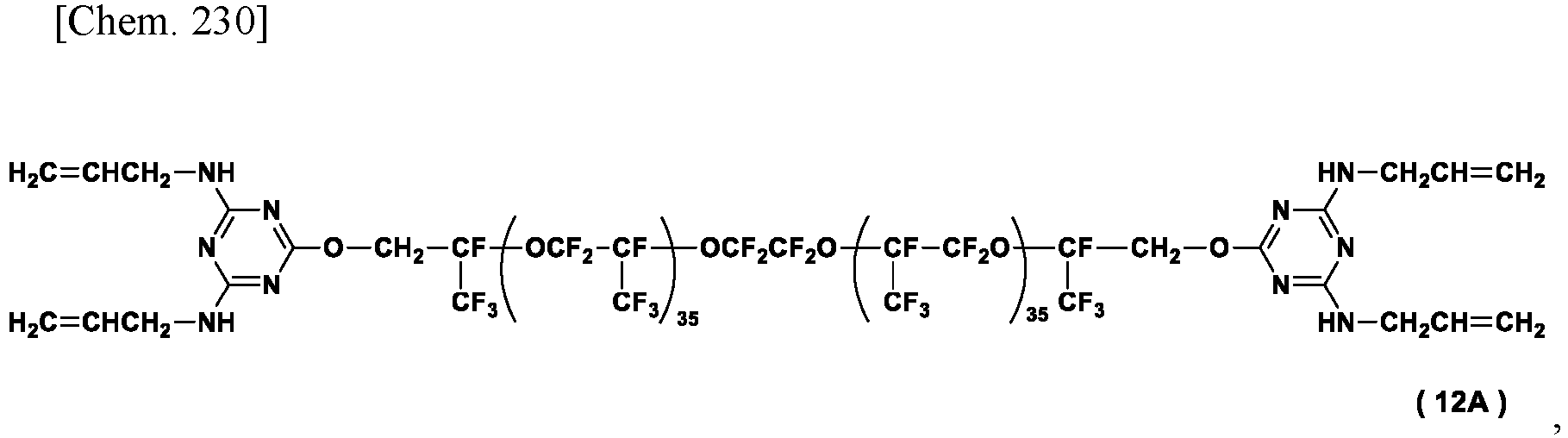
- 50 g of 1,3-bis(trifluoromethyl)benzene, 8.99 g (2.43×10⁻² mol) of an organosilicon compound having the formula (12B):

- and 1.54×10⁻² g (containing 4.77×10⁻⁸ mol of Pt element) of a toluene solution of chloroplatinic acid/vinylsiloxane complex. The mixture was aged at 80°C for 24 hours. The solvent and unreacted reactants were distilled off under reduced pressure. After washing, 50 g of a liquid product was obtained.
- On 1H-NMR analysis, the compound was identified to have the structure represented by the formula (12C).
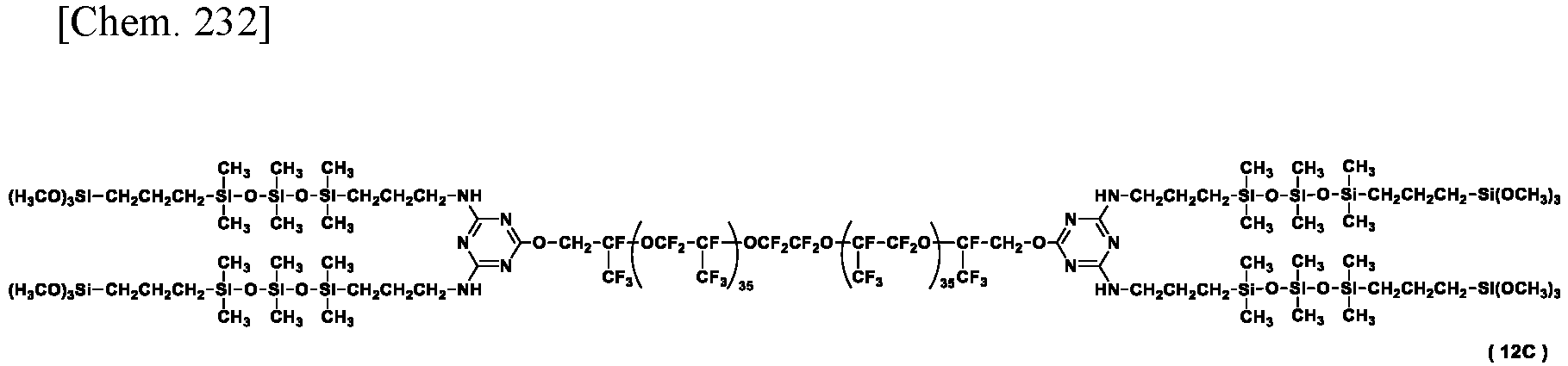
- A reactor was charged with 100 g (1.28×10⁻² mol) of a compound having the formula (13A):

- 100 g of 1,3-bis(trifluoromethyl)benzene, 10.8 g (3.84×10⁻² mol) of an organosilicon compound having the formula (13B):

- and 4.89×10⁻² g (containing 1.51×10⁻⁷ mol of Pt element) of a toluene solution of chloroplatinic acid/vinylsiloxane complex. The mixture was aged at 80°C for 24 hours. The solvent and unreacted reactants were distilled off under reduced pressure. After washing, 102 g of a liquid product was obtained.
- On 1H-NMR analysis, the compound was identified to have the structure represented by the formula (13C).

- A reactor was charged with 100 g (1.42×10⁻² mol) of a compound having the formula (14A):

- 100 g of 1,3-bis(trifluoromethyl)benzene, 15.1 g (4.25×10⁻² mol) of an organosilicon compound having the formula (14B):

- and 5.42×10⁻² g (containing 1.68×10⁻⁷ mol of Pt element) of a toluene solution of chloroplatinic acid/vinylsiloxane complex. The mixture was aged at 80°C for 24 hours. The solvent and unreacted reactants were distilled off under reduced pressure. After washing, 106 g of a liquid product was obtained.
- On 1H-NMR analysis, the compound was identified to have the structure represented by the formula (14C).

- A reactor was charged with 70 g (7.14×10⁻³ mol) of a compound having the formula (15A):

- 70 g of 1,3-bis(trifluoromethyl)benzene, 12.6 g (4.28×10⁻² mol) of an organosilicon compound having the formula (15B):

- and 2.73×10⁻² g (containing 8.43×10⁻⁸ mol of Pt element) of a toluene solution of chloroplatinic acid/vinylsiloxane complex. The mixture was aged at 80°C for 24 hours. The solvent and unreacted reactants were distilled off under reduced pressure. After washing, 78 g of a liquid product was obtained.
- On 1H-NMR analysis, the compound was identified to have the structure represented by the formula (15C).

- A reactor was charged with 100 g (1.23×10⁻² mol) of a compound having the formula (16A):

- 100 g of 1,3-bis(trifluoromethyl)benzene, 21.9 g (7.40×10⁻² mol) of an organosilicon compound having the formula (16B):

- and 4.70×10⁻² g (containing 1.45×10⁻⁷ mol of Pt element) of a toluene solution of chloroplatinic acid/vinylsiloxane complex. The mixture was aged at 80°C for 24 hours. The solvent and unreacted reactants were distilled off under reduced pressure. After washing, 110 g of a liquid product was obtained.
- On 1H-NMR analysis, the compound was identified to have the structure represented by the formula (16C).

- A reactor was charged with 100 g (1.44×10⁻² mol) of a compound having the formula (17A):

- 100 g of 1,3-bis(trifluoromethyl)benzene, 21.0 g (1.30×10⁻¹ mol) of an organosilicon compound having the formula (17B):

- and 5.49×10⁻² g (containing 1.70×10⁻⁷ mol of Pt element) of a toluene solution of chloroplatinic acid/vinylsiloxane complex. The mixture was aged at 80°C for 24 hours. The solvent and unreacted reactants were distilled off under reduced pressure. After washing, 101 g of a liquid product was obtained.
- On 1H-NMR analysis, the compound was identified to have the structure represented by the formula (17C).

- A reactor was charged with 30 g (1.76×10⁻³ mol) of a compound having the formula (18A):

- 30 g of 1,3-bis(trifluoromethyl)benzene, 2.35 g (1.58×10⁻² mol) of an organosilicon compound having the formula (18B):

- and 6.70×10⁻³ g (containing 2.07×10⁻⁸ mol of Pt element) of a toluene solution of chloroplatinic acid/vinylsiloxane complex. The mixture was aged at 80°C for 24 hours. The solvent and unreacted reactants were distilled off under reduced pressure. After washing, 30 g of a liquid product was obtained.
- On 1H-NMR analysis, the compound was identified to have the structure represented by the formula (18C).

- A reactor was charged with 50 g (7.57×10⁻³ mol) of a compound having the formula (19A):

- 50 g of 1,3-bis(trifluoromethyl)benzene, 13.5 g (4.54× 10⁻² mol) of an organosilicon compound having the formula (19B):

- and 2.89×10⁻² g (containing 8.94×10⁻⁸ mol of Pt element) of a toluene solution of chloroplatinic acid/vinylsiloxane complex. The mixture was aged at 80°C for 24 hours. The solvent and unreacted reactants were distilled off under reduced pressure. After washing, 48 g of a liquid product was obtained.
- On 1H-NMR analysis, the compound was identified to have the structure represented by the formula (19C).

- A reactor was charged with 100 g (1.52×10⁻² mol) of a compound having the formula (20A):

- 100 g of 1,3-bis(trifluoromethyl)benzene, 33.4 g (9.12×10⁻² mol) of an organosilicon compound having the formula (20B):

- and 5.82×10⁻² g (containing 1.80×10⁻⁷ mol of Pt element) of a toluene solution of chloroplatinic acid/vinylsiloxane complex. The mixture was aged at 80°C for 24 hours. The solvent and unreacted reactants were distilled off under reduced pressure. After washing, 120 g of a liquid product was obtained.
- On 1H-NMR analysis, the compound was identified to have the structure represented by the formula (20C).

- A reactor was charged with 80 g (1.01×10⁻² mol) of a compound having the formula (21A):

- 80 g of 1,3-bis(trifluoromethyl)benzene, 25.6 g (9.09×10⁻² mol) of an organosilicon compound having the formula (21B):

- and 3.87×10⁻² g (containing 1.20×10⁻⁷ mol of Pt element) of a toluene solution of chloroplatinic acid/vinylsiloxane complex. The mixture was aged at 80°C for 24 hours. The solvent and unreacted reactants were distilled off under reduced pressure. After washing, 90 g of a liquid product was obtained.
- On 1H-NMR analysis, the compound was identified to have the structure represented by the formula (21C).

- A reactor was charged with 50 g (7.37×10⁻³ mol) of a compound having the formula (22A):

- 100 g of 1,3-bis(trifluoromethyl)benzene, 25.6 g (6.63×10⁻² mol) of an organosilicon compound having the formula (22B):

- and 2.81×10⁻² g (containing 8.70×10⁻⁸ mol of Pt element) of a toluene solution of chloroplatinic acid/vinylsiloxane complex. The mixture was aged at 80°C for 24 hours. The solvent and unreacted reactants were distilled off under reduced pressure. After washing, 63 g of a liquid product was obtained.
- On 1H-NMR analysis, the compound was identified to have the structure represented by the formula (22C).
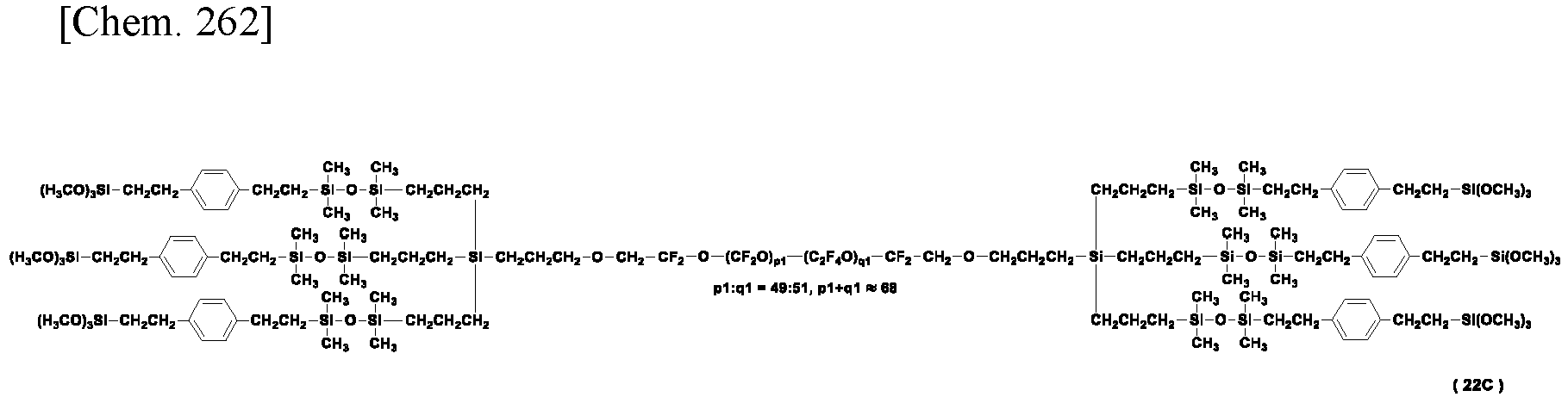
- A reactor was charged with 50 g (6.27 × 10⁻³ mol) of a compound having the formula (23A):
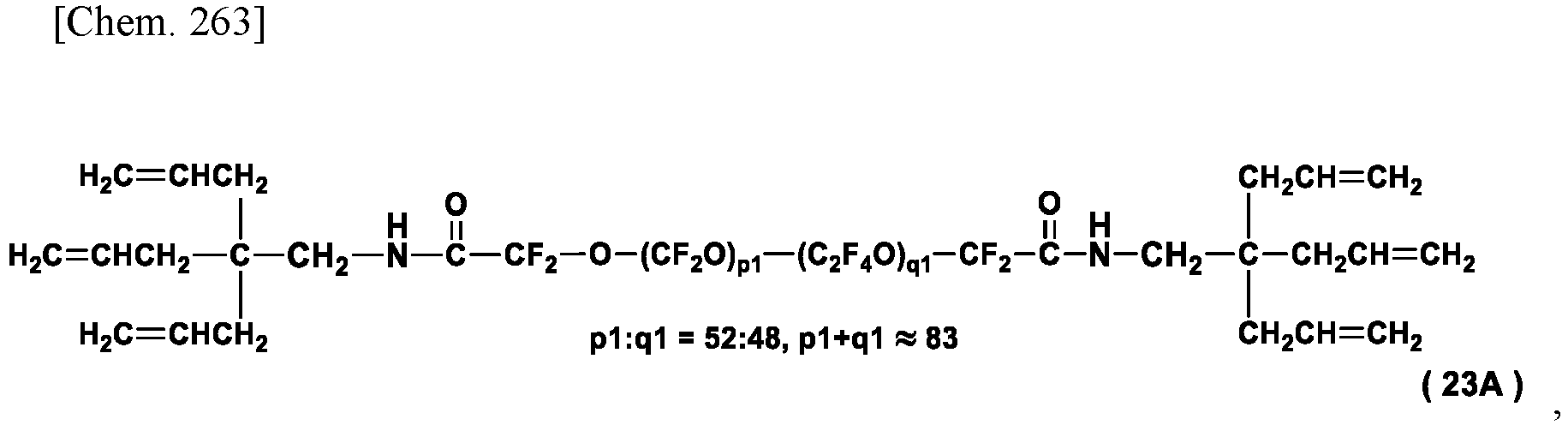
- 100 g of 1,3-bis(trifluoromethyl)benzene, 16.7 g (5.64×10⁻² mol) of an organosilicon compound having the formula (23B):

- and 2.40×10⁻² g (containing 7.41×10⁻⁸ mol of Pt element) of a toluene solution of chloroplatinic acid/vinylsiloxane complex. The mixture was aged at 80°C for 24 hours. The solvent and unreacted reactants were distilled off under reduced pressure. After washing, 57 g of a liquid product was obtained.
- On 1H-NMR analysis, the compound was identified to have the structure represented by the formula (23C).

- A reactor was charged with 50 g (7.14×10⁻³ mol) of a compound having the formula (24A):

- 50 g of 1,3-bis(trifluoromethyl)benzene, 6.04 g (2.14×10⁻² mol) of an organosilicon compound having the formula (24B):

- and 2.73×10⁻² g (containing 8.43×10⁻⁸ mol of Pt element) of a toluene solution of chloroplatinic acid/vinylsiloxane complex. The mixture was aged at 80°C for 24 hours. The solvent and unreacted reactants were distilled off under reduced pressure. After washing, 48 g of a liquid product was obtained.
- On 1H-NMR analysis, the compound was identified to have the structure represented by the formula (24C).

- A reactor was charged with 50 g (5.62×10⁻³ mol) of a compound having the formula (25A):

- 50 g of 1,3-bis(trifluoromethyl)benzene, 5.00 g (1.69×10⁻² mol) of an organosilicon compound having the formula (25B):

- and 2.15×10⁻² g (containing 6.60×10⁻⁸ mol of Pt element) of a toluene solution of chloroplatinic acid/vinylsiloxane complex. The mixture was aged at 80°C for 24 hours. The solvent and unreacted reactants were distilled off under reduced pressure. After washing, 47 g of a liquid product was obtained.
- On 1H-NMR analysis, the compound was identified to have the structure represented by the formula (25C).

- A surface treating agent was prepared by dissolving the compound of Synthesis Example 1 in Novec 7200 (ethyl perfluorobutyl ether, 3M) in a concentration of 20% by weight.
- A surface treating agent was prepared by dissolving the compound of Synthesis Example 2 in Novec 7200 (ethyl perfluorobutyl ether, 3M) in a concentration of 20% by weight.
- A surface treating agent was prepared by dissolving the compound of Synthesis Example 3 in Novec 7200 (ethyl perfluorobutyl ether, 3M) in a concentration of 20% by weight.
- A surface treating agent was prepared by dissolving the compound of Synthesis Example 4 in Asahiklin AC-6000 (tridecafluorooctane, AGC) in a concentration of 20% by weight.
- A surface treating agent was prepared by dissolving the compound of Synthesis Example 6 in Asahiklin AC-6000 (tridecafluorooctane, AGC) in a concentration of 20% by weight.
- A surface treating agent was prepared by dissolving the compound of Synthesis Example 7 in Opteon SF10 (methyl perfluoroheptenyl ether, Chemours-Mitsui Fluoroproducts Co., Ltd.) in a concentration of 20% by weight.
- A surface treating agent was prepared by dissolving the compound of Synthesis Example 8 in Novec 7200 (ethyl perfluorobutyl ether, 3M) in a concentration of 20% by weight.
- A surface treating agent was prepared by dissolving the compound of Synthesis Example 10 in Opteon SF10 (methyl perfluoroheptenyl ether, Chemours-Mitsui Fluoroproducts Co., Ltd.) in a concentration of 20% by weight.
- A surface treating agent was prepared by dissolving the compound of Synthesis Example 11 in Opteon SF10 (methyl perfluoroheptenyl ether, Chemours-Mitsui Fluoroproducts Co., Ltd.) in a concentration of 20% by weight.
- A surface treating agent was prepared by dissolving the compound of Synthesis Example 13 in Novec 7200 (ethyl perfluorobutyl ether, 3M) in a concentration of 20% by weight.
- A surface treating agent was prepared by dissolving the compound of Synthesis Example 15 in Asahiklin AC-6000 (tridecafluorooctane, AGC) in a concentration of 20% by weight.
- A surface treating agent was prepared by dissolving the compound of Synthesis Example 16 in Novec 7300 (methyl perfluorohexyl ether, 3M) in a concentration of 20% by weight.
- A surface treating agent was prepared by dissolving the compound of Synthesis Example 17 in Novec 7300 (methyl perfluorohexyl ether, 3M) in a concentration of 20% by weight.
- A surface treating agent was prepared by dissolving the compound of Synthesis Example 19 in Novec 7200 (ethyl perfluorobutyl ether, 3M) in a concentration of 20% by weight.
- A surface treating agent was prepared by dissolving the compound of Synthesis Example 20 in Asahiklin AE-3000 (1, 1,2,2-tetrafluoroethyl 2,2,2-trifluoroethyl ether, AGC) in a concentration of 20% by weight.
- A surface treating agent was prepared by dissolving the compound of Synthesis Example 21 in Opteon SF10 (methyl perfluoroheptenyl ether, Chemours-Mitsui Fluoroproducts Co., Ltd.) in a concentration of 20% by weight.
- A surface treating agent was prepared by dissolving the compound of Synthesis Example 23 in Novec 7300 (methyl perfluorohexyl ether, 3M) in a concentration of 20% by weight.
- A surface treating agent was prepared by dissolving the compound of Synthesis Example 24 in Novec 7300 (methyl perfluorohexyl ether, 3M) in a concentration of 20% by weight.
- A surface treating agent was prepared by dissolving the compound of Synthesis Example 25 in Opteon SF10 (methyl perfluoroheptenyl ether, Chemours-Mitsui Fluoroproducts Co., Ltd.) in a concentration of 20% by weight.
- A surface treating agent was prepared by mixing the compound of Synthesis Example 1 with a compound having the formula (D):

- A surface treating agent was prepared by dissolving a compound having the formula (E):

- A surface treating agent was prepared by dissolving a compound having the formula (F):

- A surface treating agent was prepared by dissolving a compound having the formula (G):
C6F13-Si(OCH3)3 (G)
in Novec 7200 (ethyl perfluorobutyl ether, 3M) in a concentration of 20% by weight. - Surface treating agents were prepared as described in Examples and Comparative Examples. Onto an antireflective-treated plastic lens having a SiO2 layer on its outermost surface (size: 80 mm diameter), each surface treating agent was deposited by vacuum evaporation under conditions including pressure 2.0×10⁻² Pa and heating temperature 700°C. The deposit was cured in an atmosphere of 25°C and relative humidity 50% for 12 hours, forming a cured film of 10 nm thick.
- Using a contact angle meter Drop Master (Kyowa Interface Science Co., Ltd.), the cured film on lens was measured for a contact angle with water as an index of water repellency (droplet 2 µl, temperature 25°C, RH 40%). The results (initial contact angle with water) are shown in Table 1.
- At the initial, all the films of Examples and Comparative Examples showed excellent water repellency.
- Using a surface tester Type 14FW (Shinto Scientific Co., Ltd.), the coefficient of dynamic friction of the cured film on lens relative to BEMCOT (Asahi Kasei Corp.) was measured under the following conditions. The results are shown in Table 1.
contact area: 10 mm × 30 mm load: 100 gf - Lens blocking tape (LEAP III 1695M, 3M) was applied to the cured film on lens before a tensile shear bond strength was measured. Specifically, the cured film-bearing lens and the lens blocking tape attached thereto were pulled apart such that a shear stress acted on the bonding interface. The maximum force (tensile shear bond strength) when the bonded juncture was ruptured was measured. Evaluation was made according to the following criteria. The results are shown in Table 1.
-
Contact area: 2.7 cm2 Tensile rate: 50 mm/min -
- ×: less than 30 N
- △: from 30 N to less than 40 N
- ○: from 40 N to less than 50 N
- ⊚: from 50 N to less than 60 N
- Using a rubbing tester (Shinto Scientific Co., Ltd.), the cured film on lens was rubbed under the following conditions. Thereafter, the cured film was measured for a contact angle with water as an index of water repellency as described above. The test environment conditions included temperature 25°C and RH 40%. A percent reduction from the initial contact angle with water was computed. The results (contact angle with water after paper abrasion and reduction of contact angle with water) are shown in Table 1.
-
Paper: dusper (Ozu Corp.) Contact area: 1 cm2 Moving distance (one way): 40 mm Moving speed: 4,800 mm/min Load: 1 kgf/1 cm2 Abrasion cycles: 10,000 cycles - Examples 1 to 20, which used a compound having a high molecular weight and possessing a siloxane structure or siloxane bond in a linking group (i.e., fluoropolyether-containing polymer within the scope of the invention), showed improved substrate adhesion and high paper abrasion durability. Owing to the inclusion of functional groups at both ends of the molecular chain, a high tensile shear bond strength was observed. Comparative Example 1 showed a low coefficient of dynamic friction and low tensile shear bond strength. Comparative Example 2 showed a high tensile shear bond strength, but poor paper abrasion durability. Comparative Example 3 also showed poor paper abrasion resistance. As seen from the foregoing, Examples using fluoropolyether-containing polymers within the scope of the invention meet both paper abrasion durability and chucking properties at a high level.
[Table 1] Initial contact angle with water (°) Contact angle with water after paper abrasion (°) Reduction of contact angle with water (%) Chucking property (1) Chucking property (2) Example 1 110 108 1.8 0.08 ⊚ Example 2 109 108 0.9 0.07 ⊚ Example 3 111 108 2.7 0.08 ⊚ Example 4 112 109 2.7 0.07 ○ Example 5 111 110 0.9 0.07 ○ Example 6 109 108 0.9 0.08 ⊚ Example 7 110 108 1.8 0.09 ⊚ Example 8 111 107 3.6 0.22 ⊚ Example 9 108 106 1.9 0.25 ⊚ Example 10 110 108 1.8 0.09 ○ Example 11 111 109 1.8 0.10 ⊚ Example 12 110 107 2.7 0.09 ○ Example 13 109 107 1.8 0.12 ⊚ Example 14 108 107 0.9 0.07 ⊚ Example 15 109 106 2.8 0.08 ⊚ Example 16 107 105 1.9 0.08 ⊚ Example 17 107 106 0.9 0.09 ⊚ Example 18 108 106 1.9 0.17 ⊚ Example 19 108 107 0.9 0.18 ⊚ Example 20 110 107 2.7 0.09 ⊚ Comparative Example 1 116 112 3.4 0.03 × Comparative Example 2 107 98 8.4 0.08 Δ Comparative Example 3 105 79 24.7 0.30 ⊚
Claims (9)
- A fluoropolyether-containing polymer having a silanol group or hydrolyzable silyl group, represented by the general formula (1):
 wherein Rf is a divalent fluorooxyalkylene-containing polymer residue represented by the general formula (2):
 wherein W is a fluoroalkylene group containing at least one hydrogen, d is independently for each unit an integer of 1 to 3, p, q, r, s, t, u, and v each are an integer of 0 to 450, p+q+r+s+t+u+v is 20 to 450, each of the units associated with p, q, r, s, t, u and v may be linear or branched, and individual repeating units within the parentheses with p, q, r, s, t, u and v may be randomly bonded, and the polymer residue has a number average molecular weight of 6,000 to 30,000,U is independently a di- to tetravalent organic group,Z is independently a di- to hexavalent linear organo(poly)siloxane residue of 2 to 10 silicon atoms or a di- to hexavalent branched or cyclic organo(poly)siloxane residue of 3 to 10 silicon atoms,Y is independently a divalent organic group,R is independently a C1-C4 alkyl group or phenyl group,X is independently a hydroxy or hydrolyzable group,n is independently for each attachment silicon an integer of 1 to 3, m is independently an integer of 1 to 3, and l is independently an integer of 1 to 5.
 - The fluoropolyether-containing polymer of claim 1 wherein in formula (1), U isa C1-C20 di- or trivalent aliphatic saturated hydrocarbon group which may contain at least one atom or group selected from among C6-C8 arylene groups, oxygen, sulfur, hydroxy, diorganosilylene, unsubstituted or substituted secondary amino, tertiary amino, carbonyl, amide, ester, isocyanurate, and triazine ring-containing groups, ora tetravalent group which contains a carbon or silicon atom having four valence bonds as the center atom and in which a C1-C20 aliphatic saturated hydrocarbon group, which may contain at least one atom or group selected from among oxygen, unsubstituted or substituted secondary amino, carbonyl, and amide, or oxygen is attached to three or four of the four valence bonds of the center atom.
- The fluoropolyether-containing polymer of claim 1 wherein in formula (1), Y is a C1-C20 alkylene group which may contain at least one atom or group selected from among oxygen, sulfur and C6-C8 arylene groups.
- The fluoropolyether-containing polymer of claim 1 wherein in formula (1), X is selected from the group consisting of hydroxy, C1-C10 alkoxy groups, C2-C10 alkoxyalkoxy groups, C2-C10 acyloxy groups, C2-C10 alkenyloxy groups, and halogen.
- The fluoropolyether-containing polymer of claim 1 wherein the polymer having formula (1) is represented by any one of the following formulae:


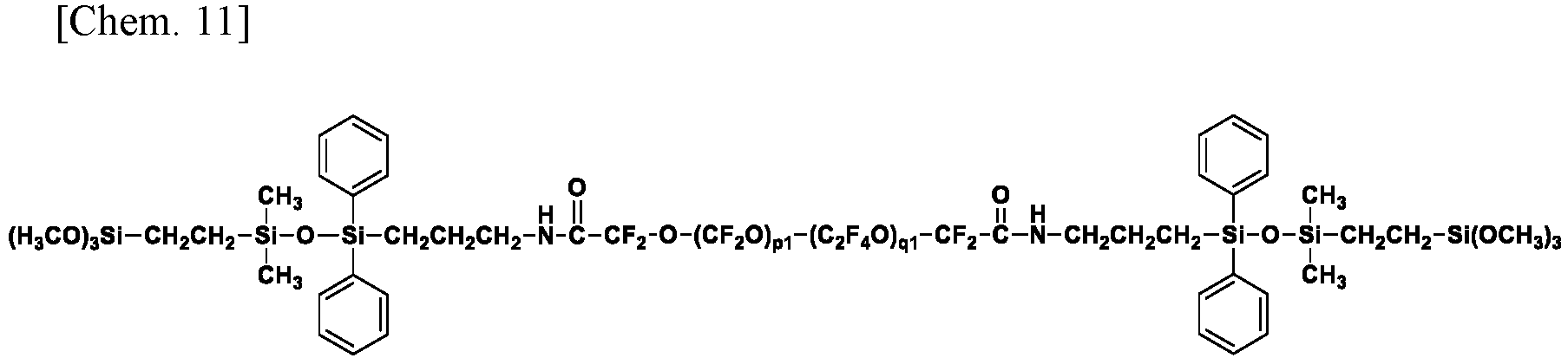










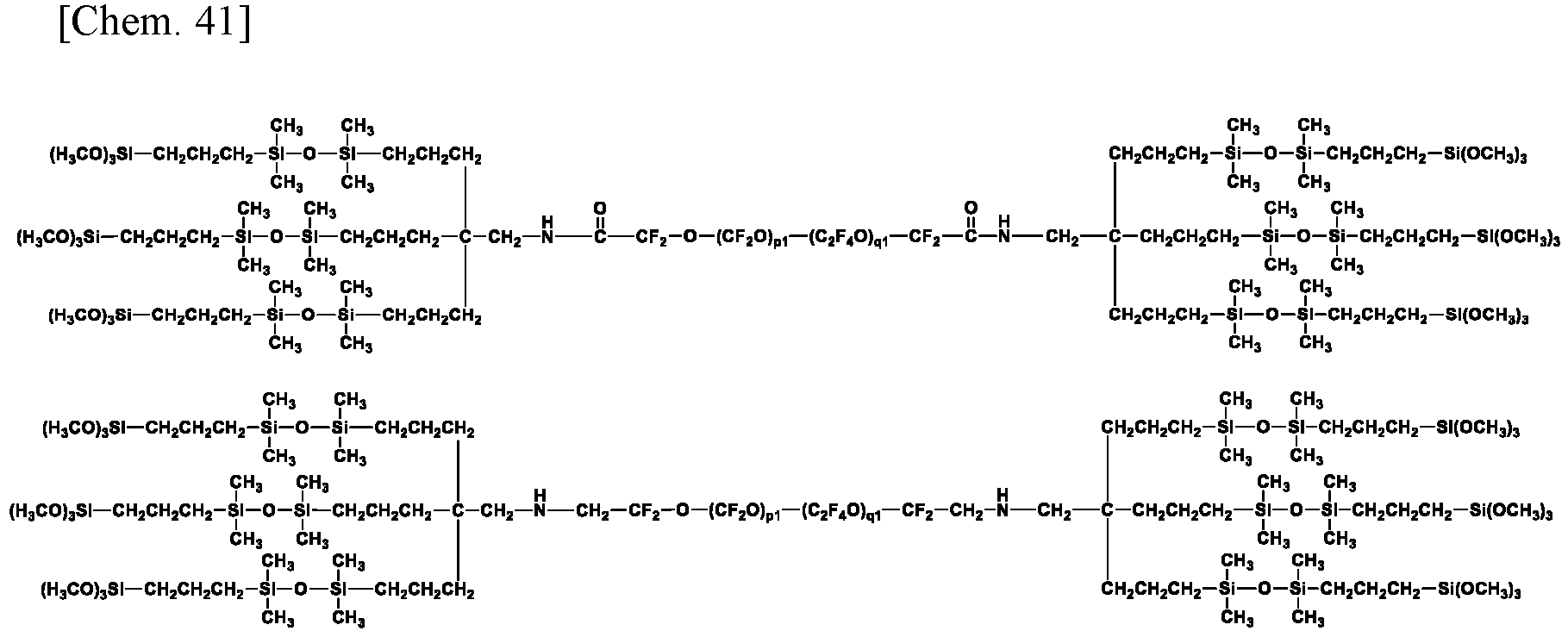
- A surface treating agent comprising the fluoropolyether-containing polymer of any one of claims 1 to 5 and/or a partial (hydrolytic) condensate thereof as a main component.
- The surface treating agent of claim 6, further comprising a fluoropolyether-containing polymer having a silanol group or hydrolyzable silyl group, represented by the general formula (3), and/or a partial (hydrolytic) condensate thereof,
 wherein A is independently fluorine, hydrogen or a monovalent fluorinated group terminated with -CF3, -CF2H or -CH2F group,
Rf is a divalent fluorooxyalkylene-containing polymer residue having the general formula (2): wherein W is a fluoroalkylene group containing at least one hydrogen, d is independently for each unit an integer of 1 to 3, p, q, r, s, t, u, and v is independently an integer of 0 to 450, p+q+r+s+t+u+v is 20 to 450, each of the units associated with p, q, r, s, t, u and v may be linear or branched, and individual repeating units within the parentheses with p, q, r, s, t, u and v may be randomly bonded, and the polymer residue has a number average molecular weight of 6,000 to 30,000,U is independently a di- to tetravalent organic group,Z is independently a di- to hexavalent linear organo(poly)siloxane residue of 2 to 10 silicon atoms or a di- to hexavalent branched or cyclic organo(poly)siloxane residue of 3 to 10 silicon atoms,Y is independently a divalent organic group,R is independently a C1-C4 alkyl group or phenyl group,X is independently a hydroxy or hydrolyzable group,n is independently for each attachment silicon an integer of 1 to 3, m is independently an integer of 1 to 3, and l is independently an integer of 1 to 5.
 - An article having a surface treated with the surface treating agent of claim 6.
- The article of claim 8 which is a lens.
Applications Claiming Priority (2)
| Application Number | Priority Date | Filing Date | Title |
|---|---|---|---|
| JP2022067432 | 2022-04-15 | ||
| PCT/JP2023/013759 WO2023199768A1 (en) | 2022-04-15 | 2023-04-03 | Fluoropolyether group-containing polymer, surface treatment agent, and article |
Publications (2)
| Publication Number | Publication Date |
|---|---|
| EP4509546A1 true EP4509546A1 (en) | 2025-02-19 |
| EP4509546A4 EP4509546A4 (en) | 2026-04-22 |
Family
ID=88329557
Family Applications (1)
| Application Number | Title | Priority Date | Filing Date |
|---|---|---|---|
| EP23788188.3A Pending EP4509546A4 (en) | 2022-04-15 | 2023-04-03 | Fluoropolyether group-containing polymer, surface treatment agent and articles |
Country Status (7)
| Country | Link |
|---|---|
| US (1) | US20250250445A1 (en) |
| EP (1) | EP4509546A4 (en) |
| JP (1) | JPWO2023199768A1 (en) |
| KR (1) | KR20250003706A (en) |
| CN (1) | CN119173553A (en) |
| TW (1) | TW202409142A (en) |
| WO (1) | WO2023199768A1 (en) |
Families Citing this family (3)
| Publication number | Priority date | Publication date | Assignee | Title |
|---|---|---|---|---|
| EP4382290A4 (en) * | 2021-08-05 | 2025-07-30 | Shinetsu Chemical Co | ARTICLES WITH WATER AND OIL-REPELLENT SURFACE LAYER |
| WO2025182641A1 (en) * | 2024-02-29 | 2025-09-04 | 信越化学工業株式会社 | Fluoropolyether group-containing polymer composition, coating agent, article, and method for modifying surface of article |
| WO2025239180A1 (en) * | 2024-05-17 | 2025-11-20 | 信越化学工業株式会社 | Surface treatment agent and article |
Family Cites Families (11)
| Publication number | Priority date | Publication date | Assignee | Title |
|---|---|---|---|---|
| JP4412450B2 (en) | 2001-10-05 | 2010-02-10 | 信越化学工業株式会社 | Anti-reflective filter |
| JP5669257B2 (en) * | 2009-10-27 | 2015-02-12 | 信越化学工業株式会社 | Fluorooxyalkylene group-containing polymer composition, surface treatment agent containing the composition, and article surface-treated with the surface treatment agent |
| JP5235026B2 (en) | 2010-09-28 | 2013-07-10 | 信越化学工業株式会社 | Fluorooxyalkylene group-containing polymer composition, surface treatment agent containing the composition, and article surface-treated with the surface treatment agent |
| JP2012157856A (en) | 2011-01-13 | 2012-08-23 | Central Glass Co Ltd | Stainproof article and method for manufacturing this article |
| JP5857942B2 (en) | 2011-11-30 | 2016-02-10 | 信越化学工業株式会社 | Fluorine surface treatment agent for vapor deposition and article vapor-deposited with the surface treatment agent |
| JP6451279B2 (en) | 2014-03-31 | 2019-01-16 | 信越化学工業株式会社 | Fluoropolyether group-containing polymer-modified silane, surface treatment agent and article |
| EP3085749B1 (en) * | 2015-04-20 | 2017-06-28 | Shin-Etsu Chemical Co., Ltd. | Fluoropolyether-containing polymer-modified silane, surface treating agent, and treated article |
| JP6531833B2 (en) | 2015-11-06 | 2019-06-19 | 信越化学工業株式会社 | Surface-treated resin products |
| WO2018216404A1 (en) * | 2017-05-23 | 2018-11-29 | 信越化学工業株式会社 | Fluorine-containing coating agent composition, surface treatment agent containing said composition, and article |
| WO2021210420A1 (en) * | 2020-04-14 | 2021-10-21 | 信越化学工業株式会社 | Surface treatment agent including fluoropolyether group–containing polymer and/or partial (hydrolysis) condensate of same, and article |
| JP7613288B2 (en) * | 2020-07-17 | 2025-01-15 | 信越化学工業株式会社 | Fluoropolyether-modified amidosilane compound, surface treatment composition and article, and method for synthesizing fluoropolyether-modified amidosilane compound |
-
2023
- 2023-04-03 JP JP2024514891A patent/JPWO2023199768A1/ja active Pending
- 2023-04-03 CN CN202380033500.2A patent/CN119173553A/en active Pending
- 2023-04-03 WO PCT/JP2023/013759 patent/WO2023199768A1/en not_active Ceased
- 2023-04-03 EP EP23788188.3A patent/EP4509546A4/en active Pending
- 2023-04-03 KR KR1020247036992A patent/KR20250003706A/en active Pending
- 2023-04-03 US US18/853,359 patent/US20250250445A1/en active Pending
- 2023-04-13 TW TW112113887A patent/TW202409142A/en unknown
Also Published As
| Publication number | Publication date |
|---|---|
| TW202409142A (en) | 2024-03-01 |
| KR20250003706A (en) | 2025-01-07 |
| EP4509546A4 (en) | 2026-04-22 |
| US20250250445A1 (en) | 2025-08-07 |
| CN119173553A (en) | 2024-12-20 |
| JPWO2023199768A1 (en) | 2023-10-19 |
| WO2023199768A1 (en) | 2023-10-19 |
Similar Documents
| Publication | Publication Date | Title |
|---|---|---|
| EP2725078B1 (en) | Coating composition, surface treating material containing said composition, and article whose surface is treated with said surface treating material | |
| EP3006447B1 (en) | Fluorochemical surface treating agent and article treated therewith | |
| US12479956B2 (en) | Fluoropolyether-group-containing polymer, surface treatment agent, and article | |
| EP4137547A1 (en) | Surface treatment agent including fluoropolyether group?containing polymer and/or partial (hydrolysis) condensate of same, and article | |
| EP3715399B1 (en) | Fluoropolyether-group-containing polymer, surface treatment agent, and article | |
| US20100029889A1 (en) | Perfluoroether moiety-containing polymer and a surface treating agent comprising the same | |
| EP4071197B1 (en) | Fluoropolyether group-containing polymer, surface treatment agent, and article | |
| JP7806802B2 (en) | Fluoropolyether group-containing polymer, surface treatment agent and article | |
| US12054637B2 (en) | Fluorine-containing coating agent composition, surface treatment agent containing said composition, and article | |
| US20250250445A1 (en) | Fluoropolyether group-containing polymer, surface treatment agent, and article | |
| JP2025138786A (en) | Fluoropolyether group-containing polymer, surface treatment agent and article | |
| EP4545586A1 (en) | Fluoropolyether group-containing polymer, surface treatment agent, and article | |
| EP4585646A1 (en) | Fluorine-containing composition, surface treatment agent, and article | |
| EP4265413A1 (en) | Surface treatment agent and article treated with said surface treatment agent | |
| EP4600305A1 (en) | Fluoropolyether group-containing polymer composition, coating agent, article, and method for modifying surface of article | |
| WO2025229833A1 (en) | Fluoropolyether-group-containing polymer composition, surface treatment agent, and article | |
| EP4631993A1 (en) | Fluoropolyether group-containing polymer, surface treatment agent, and article | |
| WO2025047304A1 (en) | Fluoropolyether-group-containing polymer, surface-treating agent, and article | |
| WO2025047303A1 (en) | Fluorine-containing ether composition, surface treatment agent, and article | |
| JP2026015259A (en) | Article having on its surface a cured product of a surface treatment agent containing a fluoropolyether group-containing polymer | |
| WO2025150358A1 (en) | Fluoropolyether-group-containing polymer, surface treatment agent, and article | |
| WO2026038439A1 (en) | Hydrocarbon terminal group-containing compound, surface treatment agent, article, and film forming method | |
| WO2025239180A1 (en) | Surface treatment agent and article |
Legal Events
| Date | Code | Title | Description |
|---|---|---|---|
| STAA | Information on the status of an ep patent application or granted ep patent |
Free format text: STATUS: THE INTERNATIONAL PUBLICATION HAS BEEN MADE |
|
| PUAI | Public reference made under article 153(3) epc to a published international application that has entered the european phase |
Free format text: ORIGINAL CODE: 0009012 |
|
| STAA | Information on the status of an ep patent application or granted ep patent |
Free format text: STATUS: REQUEST FOR EXAMINATION WAS MADE |
|
| 17P | Request for examination filed |
Effective date: 20241031 |
|
| AK | Designated contracting states |
Kind code of ref document: A1 Designated state(s): AL AT BE BG CH CY CZ DE DK EE ES FI FR GB GR HR HU IE IS IT LI LT LU LV MC ME MK MT NL NO PL PT RO RS SE SI SK SM TR |
|
| DAV | Request for validation of the european patent (deleted) | ||
| DAX | Request for extension of the european patent (deleted) | ||
| A4 | Supplementary search report drawn up and despatched |
Effective date: 20260319 |
|
| RIC1 | Information provided on ipc code assigned before grant |
Ipc: C08G 65/336 20060101AFI20260313BHEP Ipc: C09K 3/18 20060101ALI20260313BHEP Ipc: C08G 65/00 20060101ALI20260313BHEP Ipc: C09D 171/00 20060101ALI20260313BHEP Ipc: C09D 183/12 20060101ALI20260313BHEP |