EP4509498A1 - Compound, material for organic electroluminescent elements, organic electroluminescent element, and electronic device - Google Patents
Compound, material for organic electroluminescent elements, organic electroluminescent element, and electronic device Download PDFInfo
- Publication number
- EP4509498A1 EP4509498A1 EP23788251.9A EP23788251A EP4509498A1 EP 4509498 A1 EP4509498 A1 EP 4509498A1 EP 23788251 A EP23788251 A EP 23788251A EP 4509498 A1 EP4509498 A1 EP 4509498A1
- Authority
- EP
- European Patent Office
- Prior art keywords
- group
- single bond
- substituted
- unsubstituted
- ring
- Prior art date
- Legal status (The legal status is an assumption and is not a legal conclusion. Google has not performed a legal analysis and makes no representation as to the accuracy of the status listed.)
- Pending
Links
Images

Classifications
-
- C—CHEMISTRY; METALLURGY
- C07—ORGANIC CHEMISTRY
- C07D—HETEROCYCLIC COMPOUNDS
- C07D307/00—Heterocyclic compounds containing five-membered rings having one oxygen atom as the only ring hetero atom
- C07D307/77—Heterocyclic compounds containing five-membered rings having one oxygen atom as the only ring hetero atom ortho- or peri-condensed with carbocyclic rings or ring systems
-
- C—CHEMISTRY; METALLURGY
- C07—ORGANIC CHEMISTRY
- C07D—HETEROCYCLIC COMPOUNDS
- C07D307/00—Heterocyclic compounds containing five-membered rings having one oxygen atom as the only ring hetero atom
- C07D307/77—Heterocyclic compounds containing five-membered rings having one oxygen atom as the only ring hetero atom ortho- or peri-condensed with carbocyclic rings or ring systems
- C07D307/91—Dibenzofurans; Hydrogenated dibenzofurans
-
- C—CHEMISTRY; METALLURGY
- C07—ORGANIC CHEMISTRY
- C07D—HETEROCYCLIC COMPOUNDS
- C07D307/00—Heterocyclic compounds containing five-membered rings having one oxygen atom as the only ring hetero atom
- C07D307/77—Heterocyclic compounds containing five-membered rings having one oxygen atom as the only ring hetero atom ortho- or peri-condensed with carbocyclic rings or ring systems
- C07D307/92—Naphthofurans; Hydrogenated naphthofurans
-
- C—CHEMISTRY; METALLURGY
- C07—ORGANIC CHEMISTRY
- C07D—HETEROCYCLIC COMPOUNDS
- C07D405/00—Heterocyclic compounds containing both one or more hetero rings having oxygen atoms as the only ring hetero atoms, and one or more rings having nitrogen as the only ring hetero atom
- C07D405/02—Heterocyclic compounds containing both one or more hetero rings having oxygen atoms as the only ring hetero atoms, and one or more rings having nitrogen as the only ring hetero atom containing two hetero rings
- C07D405/12—Heterocyclic compounds containing both one or more hetero rings having oxygen atoms as the only ring hetero atoms, and one or more rings having nitrogen as the only ring hetero atom containing two hetero rings linked by a chain containing hetero atoms as chain links
-
- C—CHEMISTRY; METALLURGY
- C07—ORGANIC CHEMISTRY
- C07D—HETEROCYCLIC COMPOUNDS
- C07D405/00—Heterocyclic compounds containing both one or more hetero rings having oxygen atoms as the only ring hetero atoms, and one or more rings having nitrogen as the only ring hetero atom
- C07D405/14—Heterocyclic compounds containing both one or more hetero rings having oxygen atoms as the only ring hetero atoms, and one or more rings having nitrogen as the only ring hetero atom containing three or more hetero rings
-
- C—CHEMISTRY; METALLURGY
- C07—ORGANIC CHEMISTRY
- C07D—HETEROCYCLIC COMPOUNDS
- C07D407/00—Heterocyclic compounds containing two or more hetero rings, at least one ring having oxygen atoms as the only ring hetero atoms, not provided for by group C07D405/00
- C07D407/02—Heterocyclic compounds containing two or more hetero rings, at least one ring having oxygen atoms as the only ring hetero atoms, not provided for by group C07D405/00 containing two hetero rings
- C07D407/12—Heterocyclic compounds containing two or more hetero rings, at least one ring having oxygen atoms as the only ring hetero atoms, not provided for by group C07D405/00 containing two hetero rings linked by a chain containing hetero atoms as chain links
-
- C—CHEMISTRY; METALLURGY
- C07—ORGANIC CHEMISTRY
- C07D—HETEROCYCLIC COMPOUNDS
- C07D407/00—Heterocyclic compounds containing two or more hetero rings, at least one ring having oxygen atoms as the only ring hetero atoms, not provided for by group C07D405/00
- C07D407/14—Heterocyclic compounds containing two or more hetero rings, at least one ring having oxygen atoms as the only ring hetero atoms, not provided for by group C07D405/00 containing three or more hetero rings
-
- C—CHEMISTRY; METALLURGY
- C07—ORGANIC CHEMISTRY
- C07D—HETEROCYCLIC COMPOUNDS
- C07D409/00—Heterocyclic compounds containing two or more hetero rings, at least one ring having sulfur atoms as the only ring hetero atoms
- C07D409/02—Heterocyclic compounds containing two or more hetero rings, at least one ring having sulfur atoms as the only ring hetero atoms containing two hetero rings
- C07D409/12—Heterocyclic compounds containing two or more hetero rings, at least one ring having sulfur atoms as the only ring hetero atoms containing two hetero rings linked by a chain containing hetero atoms as chain links
-
- C—CHEMISTRY; METALLURGY
- C07—ORGANIC CHEMISTRY
- C07D—HETEROCYCLIC COMPOUNDS
- C07D409/00—Heterocyclic compounds containing two or more hetero rings, at least one ring having sulfur atoms as the only ring hetero atoms
- C07D409/14—Heterocyclic compounds containing two or more hetero rings, at least one ring having sulfur atoms as the only ring hetero atoms containing three or more hetero rings
-
- C—CHEMISTRY; METALLURGY
- C09—DYES; PAINTS; POLISHES; NATURAL RESINS; ADHESIVES; COMPOSITIONS NOT OTHERWISE PROVIDED FOR; APPLICATIONS OF MATERIALS NOT OTHERWISE PROVIDED FOR
- C09K—MATERIALS FOR MISCELLANEOUS APPLICATIONS, NOT PROVIDED FOR ELSEWHERE
- C09K11/00—Luminescent materials, e.g. electroluminescent or chemiluminescent
- C09K11/06—Luminescent materials, e.g. electroluminescent or chemiluminescent containing organic luminescent materials
-
- H—ELECTRICITY
- H05—ELECTRIC TECHNIQUES NOT OTHERWISE PROVIDED FOR
- H05B—ELECTRIC HEATING; ELECTRIC LIGHT SOURCES NOT OTHERWISE PROVIDED FOR; CIRCUIT ARRANGEMENTS FOR ELECTRIC LIGHT SOURCES, IN GENERAL
- H05B33/00—Electroluminescent light sources
- H05B33/12—Light sources with substantially two-dimensional [2D] radiating surfaces
- H05B33/14—Light sources with substantially two-dimensional [2D] radiating surfaces characterised by the chemical or physical composition or the arrangement of the electroluminescent material, or by the simultaneous addition of the electroluminescent material in or onto the light source
-
- H—ELECTRICITY
- H10—SEMICONDUCTOR DEVICES; ELECTRIC SOLID-STATE DEVICES NOT OTHERWISE PROVIDED FOR
- H10K—ORGANIC ELECTRIC SOLID-STATE DEVICES
- H10K50/00—Organic light-emitting devices
-
- H—ELECTRICITY
- H10—SEMICONDUCTOR DEVICES; ELECTRIC SOLID-STATE DEVICES NOT OTHERWISE PROVIDED FOR
- H10K—ORGANIC ELECTRIC SOLID-STATE DEVICES
- H10K50/00—Organic light-emitting devices
- H10K50/10—OLEDs or polymer light-emitting diodes [PLED]
- H10K50/11—OLEDs or polymer light-emitting diodes [PLED] characterised by the electroluminescent [EL] layers
-
- H—ELECTRICITY
- H10—SEMICONDUCTOR DEVICES; ELECTRIC SOLID-STATE DEVICES NOT OTHERWISE PROVIDED FOR
- H10K—ORGANIC ELECTRIC SOLID-STATE DEVICES
- H10K50/00—Organic light-emitting devices
- H10K50/10—OLEDs or polymer light-emitting diodes [PLED]
- H10K50/14—Carrier transporting layers
- H10K50/15—Hole transporting layers
- H10K50/156—Hole transporting layers comprising a multilayered structure
-
- H—ELECTRICITY
- H10—SEMICONDUCTOR DEVICES; ELECTRIC SOLID-STATE DEVICES NOT OTHERWISE PROVIDED FOR
- H10K—ORGANIC ELECTRIC SOLID-STATE DEVICES
- H10K85/00—Organic materials used in the body or electrodes of devices covered by this subclass
- H10K85/60—Organic compounds having low molecular weight
- H10K85/615—Polycyclic condensed aromatic hydrocarbons, e.g. anthracene
- H10K85/622—Polycyclic condensed aromatic hydrocarbons, e.g. anthracene containing four rings, e.g. pyrene
-
- H—ELECTRICITY
- H10—SEMICONDUCTOR DEVICES; ELECTRIC SOLID-STATE DEVICES NOT OTHERWISE PROVIDED FOR
- H10K—ORGANIC ELECTRIC SOLID-STATE DEVICES
- H10K85/00—Organic materials used in the body or electrodes of devices covered by this subclass
- H10K85/60—Organic compounds having low molecular weight
- H10K85/631—Amine compounds having at least two aryl rest on at least one amine-nitrogen atom, e.g. triphenylamine
-
- H—ELECTRICITY
- H10—SEMICONDUCTOR DEVICES; ELECTRIC SOLID-STATE DEVICES NOT OTHERWISE PROVIDED FOR
- H10K—ORGANIC ELECTRIC SOLID-STATE DEVICES
- H10K85/00—Organic materials used in the body or electrodes of devices covered by this subclass
- H10K85/60—Organic compounds having low molecular weight
- H10K85/631—Amine compounds having at least two aryl rest on at least one amine-nitrogen atom, e.g. triphenylamine
- H10K85/633—Amine compounds having at least two aryl rest on at least one amine-nitrogen atom, e.g. triphenylamine comprising polycyclic condensed aromatic hydrocarbons as substituents on the nitrogen atom
-
- H—ELECTRICITY
- H10—SEMICONDUCTOR DEVICES; ELECTRIC SOLID-STATE DEVICES NOT OTHERWISE PROVIDED FOR
- H10K—ORGANIC ELECTRIC SOLID-STATE DEVICES
- H10K85/00—Organic materials used in the body or electrodes of devices covered by this subclass
- H10K85/60—Organic compounds having low molecular weight
- H10K85/631—Amine compounds having at least two aryl rest on at least one amine-nitrogen atom, e.g. triphenylamine
- H10K85/636—Amine compounds having at least two aryl rest on at least one amine-nitrogen atom, e.g. triphenylamine comprising heteroaromatic hydrocarbons as substituents on the nitrogen atom
-
- H—ELECTRICITY
- H10—SEMICONDUCTOR DEVICES; ELECTRIC SOLID-STATE DEVICES NOT OTHERWISE PROVIDED FOR
- H10K—ORGANIC ELECTRIC SOLID-STATE DEVICES
- H10K85/00—Organic materials used in the body or electrodes of devices covered by this subclass
- H10K85/60—Organic compounds having low molecular weight
- H10K85/649—Aromatic compounds comprising a hetero atom
- H10K85/654—Aromatic compounds comprising a hetero atom comprising only nitrogen as heteroatom
-
- H—ELECTRICITY
- H10—SEMICONDUCTOR DEVICES; ELECTRIC SOLID-STATE DEVICES NOT OTHERWISE PROVIDED FOR
- H10K—ORGANIC ELECTRIC SOLID-STATE DEVICES
- H10K85/00—Organic materials used in the body or electrodes of devices covered by this subclass
- H10K85/60—Organic compounds having low molecular weight
- H10K85/649—Aromatic compounds comprising a hetero atom
- H10K85/657—Polycyclic condensed heteroaromatic hydrocarbons
- H10K85/6572—Polycyclic condensed heteroaromatic hydrocarbons comprising only nitrogen in the heteroaromatic polycondensed ring system, e.g. phenanthroline or carbazole
-
- H—ELECTRICITY
- H10—SEMICONDUCTOR DEVICES; ELECTRIC SOLID-STATE DEVICES NOT OTHERWISE PROVIDED FOR
- H10K—ORGANIC ELECTRIC SOLID-STATE DEVICES
- H10K85/00—Organic materials used in the body or electrodes of devices covered by this subclass
- H10K85/60—Organic compounds having low molecular weight
- H10K85/649—Aromatic compounds comprising a hetero atom
- H10K85/657—Polycyclic condensed heteroaromatic hydrocarbons
- H10K85/6576—Polycyclic condensed heteroaromatic hydrocarbons comprising only sulfur in the heteroaromatic polycondensed ring system, e.g. benzothiophene
-
- H—ELECTRICITY
- H10—SEMICONDUCTOR DEVICES; ELECTRIC SOLID-STATE DEVICES NOT OTHERWISE PROVIDED FOR
- H10K—ORGANIC ELECTRIC SOLID-STATE DEVICES
- H10K99/00—Subject matter not provided for in other groups of this subclass
-
- C—CHEMISTRY; METALLURGY
- C09—DYES; PAINTS; POLISHES; NATURAL RESINS; ADHESIVES; COMPOSITIONS NOT OTHERWISE PROVIDED FOR; APPLICATIONS OF MATERIALS NOT OTHERWISE PROVIDED FOR
- C09K—MATERIALS FOR MISCELLANEOUS APPLICATIONS, NOT PROVIDED FOR ELSEWHERE
- C09K2211/00—Chemical nature of organic luminescent or tenebrescent compounds
- C09K2211/10—Non-macromolecular compounds
- C09K2211/1003—Carbocyclic compounds
-
- C—CHEMISTRY; METALLURGY
- C09—DYES; PAINTS; POLISHES; NATURAL RESINS; ADHESIVES; COMPOSITIONS NOT OTHERWISE PROVIDED FOR; APPLICATIONS OF MATERIALS NOT OTHERWISE PROVIDED FOR
- C09K—MATERIALS FOR MISCELLANEOUS APPLICATIONS, NOT PROVIDED FOR ELSEWHERE
- C09K2211/00—Chemical nature of organic luminescent or tenebrescent compounds
- C09K2211/10—Non-macromolecular compounds
- C09K2211/1003—Carbocyclic compounds
- C09K2211/1014—Carbocyclic compounds bridged by heteroatoms, e.g. N, P, Si or B
-
- C—CHEMISTRY; METALLURGY
- C09—DYES; PAINTS; POLISHES; NATURAL RESINS; ADHESIVES; COMPOSITIONS NOT OTHERWISE PROVIDED FOR; APPLICATIONS OF MATERIALS NOT OTHERWISE PROVIDED FOR
- C09K—MATERIALS FOR MISCELLANEOUS APPLICATIONS, NOT PROVIDED FOR ELSEWHERE
- C09K2211/00—Chemical nature of organic luminescent or tenebrescent compounds
- C09K2211/10—Non-macromolecular compounds
- C09K2211/1018—Heterocyclic compounds
-
- C—CHEMISTRY; METALLURGY
- C09—DYES; PAINTS; POLISHES; NATURAL RESINS; ADHESIVES; COMPOSITIONS NOT OTHERWISE PROVIDED FOR; APPLICATIONS OF MATERIALS NOT OTHERWISE PROVIDED FOR
- C09K—MATERIALS FOR MISCELLANEOUS APPLICATIONS, NOT PROVIDED FOR ELSEWHERE
- C09K2211/00—Chemical nature of organic luminescent or tenebrescent compounds
- C09K2211/10—Non-macromolecular compounds
- C09K2211/1018—Heterocyclic compounds
- C09K2211/1025—Heterocyclic compounds characterised by ligands
- C09K2211/1029—Heterocyclic compounds characterised by ligands containing one nitrogen atom as the heteroatom
-
- H—ELECTRICITY
- H10—SEMICONDUCTOR DEVICES; ELECTRIC SOLID-STATE DEVICES NOT OTHERWISE PROVIDED FOR
- H10K—ORGANIC ELECTRIC SOLID-STATE DEVICES
- H10K2102/00—Constructional details relating to the organic devices covered by this subclass
- H10K2102/301—Details of OLEDs
- H10K2102/351—Thickness
-
- H—ELECTRICITY
- H10—SEMICONDUCTOR DEVICES; ELECTRIC SOLID-STATE DEVICES NOT OTHERWISE PROVIDED FOR
- H10K—ORGANIC ELECTRIC SOLID-STATE DEVICES
- H10K50/00—Organic light-emitting devices
- H10K50/10—OLEDs or polymer light-emitting diodes [PLED]
- H10K50/14—Carrier transporting layers
- H10K50/15—Hole transporting layers
-
- H—ELECTRICITY
- H10—SEMICONDUCTOR DEVICES; ELECTRIC SOLID-STATE DEVICES NOT OTHERWISE PROVIDED FOR
- H10K—ORGANIC ELECTRIC SOLID-STATE DEVICES
- H10K85/00—Organic materials used in the body or electrodes of devices covered by this subclass
- H10K85/60—Organic compounds having low molecular weight
- H10K85/615—Polycyclic condensed aromatic hydrocarbons, e.g. anthracene
-
- H—ELECTRICITY
- H10—SEMICONDUCTOR DEVICES; ELECTRIC SOLID-STATE DEVICES NOT OTHERWISE PROVIDED FOR
- H10K—ORGANIC ELECTRIC SOLID-STATE DEVICES
- H10K85/00—Organic materials used in the body or electrodes of devices covered by this subclass
- H10K85/60—Organic compounds having low molecular weight
- H10K85/615—Polycyclic condensed aromatic hydrocarbons, e.g. anthracene
- H10K85/624—Polycyclic condensed aromatic hydrocarbons, e.g. anthracene containing six or more rings
-
- H—ELECTRICITY
- H10—SEMICONDUCTOR DEVICES; ELECTRIC SOLID-STATE DEVICES NOT OTHERWISE PROVIDED FOR
- H10K—ORGANIC ELECTRIC SOLID-STATE DEVICES
- H10K85/00—Organic materials used in the body or electrodes of devices covered by this subclass
- H10K85/60—Organic compounds having low molecular weight
- H10K85/615—Polycyclic condensed aromatic hydrocarbons, e.g. anthracene
- H10K85/626—Polycyclic condensed aromatic hydrocarbons, e.g. anthracene containing more than one polycyclic condensed aromatic rings, e.g. bis-anthracene
-
- H—ELECTRICITY
- H10—SEMICONDUCTOR DEVICES; ELECTRIC SOLID-STATE DEVICES NOT OTHERWISE PROVIDED FOR
- H10K—ORGANIC ELECTRIC SOLID-STATE DEVICES
- H10K85/00—Organic materials used in the body or electrodes of devices covered by this subclass
- H10K85/60—Organic compounds having low molecular weight
- H10K85/649—Aromatic compounds comprising a hetero atom
- H10K85/657—Polycyclic condensed heteroaromatic hydrocarbons
- H10K85/6574—Polycyclic condensed heteroaromatic hydrocarbons comprising only oxygen in the heteroaromatic polycondensed ring system, e.g. cumarine dyes
Definitions
- the present invention relates to a compound, a material for organic electroluminescent devices, an organic electroluminescent device, and an electronic instrument including the organic electroluminescent device.
- an organic electroluminescent device (hereinafter sometimes referred to as "organic EL device") is composed of an anode, a cathode, and an organic layer interposed between the anode and the cathode.
- organic EL device In application of a voltage between the two electrodes, electrons from the cathode side and holes from the anode side are injected into a light emitting region, and the injected electrons and holes are recombined in the light emitting region to generate an excited state, which then returns to the ground state to emit light.
- PTLs 1 to 4 disclose compounds for use as a material for organic electroluminescent devices.
- the present invention has been made for solving the above problem, and has an object to provide a compound that further improves performance of an organic EL device, an organic EL device having further improved device performance by containing a specific compound, and an electronic instrument including such an organic EL device.
- the present invention provides a compound represented by the following formula (1): wherein
- the present invention provides a material for organic EL devices, the material containing the compound represented by the formula (1).
- the present invention provides an organic electroluminescent device including a cathode, an anode, and an organic layer disposed between the cathode and the anode, the organic layer including a light emitting layer, at least one layer of the organic layer containing the compound represented by the formula (1).
- the present invention provides an electronic instrument including the organic electroluminescent device.
- the organic EL device containing the compound represented by the formula (1) shows an improved device performance.
- the hydrogen atom encompasses isotopes thereof having different numbers of neutrons, i.e., protium, deuterium, and tritium.
- the bonding site where the symbol, such as "R”, or "D” representing a deuterium atom is not shown is assumed to have a hydrogen atom, i.e., a protium atom, a deuterium atom, or a tritium atom, bonded thereto.
- the number of ring carbon atoms shows the number of carbon atoms among the atoms constituting the ring itself of a compound having a structure including atoms bonded to form a ring (such as a monocyclic compound, a condensed ring compound, a bridged compound, a carbocyclic compound, and a heterocyclic compound).
- a ring such as a monocyclic compound, a condensed ring compound, a bridged compound, a carbocyclic compound, and a heterocyclic compound.
- the carbon atom contained in the substituent is not included in the number of ring carbon atoms.
- the same definition is applied to the "number of ring carbon atoms" described hereinafter unless otherwise indicated.
- a benzene ring has 6 ring carbon atoms
- a naphthalene ring has 10 ring carbon atoms
- a pyridine ring has 5 ring carbon atoms
- a furan ring has 4 ring carbon atoms.
- 9,9-diphenylfluorenyl group has 13 ring carbon atoms
- 9,9'-spirobifluorenyl group has 25 ring carbon atoms.
- a benzene ring having, for example, an alkyl group substituted thereon as a substituent the number of carbon atoms of the alkyl group is not included in the number of ring carbon atoms of the benzene ring. Accordingly, a benzene ring having an alkyl group substituted thereon has 6 ring carbon atoms.
- a naphthalene ring having, for example, an alkyl group substituted thereon as a substituent the number of carbon atoms of the alkyl group is not included in the number of ring carbon atoms of the naphthalene ring. Accordingly, a naphthalene ring having an alkyl group substituted thereon has 10 ring carbon atoms.
- the number of ring atoms shows the number of atoms constituting the ring itself of a compound having a structure including atoms bonded to form a ring (such as a monocyclic ring, a condensed ring, and a set of rings) (such as a monocyclic compound, a condensed ring compound, a bridged compound, a carbocyclic compound, and a heterocyclic compound).
- a ring such as a monocyclic ring, a condensed ring, and a set of rings
- the atom that does not constitute the ring such as a hydrogen atom terminating the bond of the atom constituting the ring
- the atom contained in the substituent are not included in the number of ring atoms.
- a pyridine ring has 6 ring atoms
- a quinazoline ring has 10 ring atoms
- a furan ring has 5 ring atoms.
- the number of hydrogen atoms bonded to a pyridine ring or atoms constituting a substituent is not included in the number of ring atoms of the pyridine ring. Accordingly, a pyridine ring having a hydrogen atom or a substituent bonded thereto has 6 ring atoms.
- a quinazoline ring having a hydrogen atom or a substituent bonded thereto has 10 ring atoms.
- the expression “having XX to YY carbon atoms” in the expression “substituted or unsubstituted ZZ group having XX to YY carbon atoms” means the number of carbon atoms of the unsubstituted ZZ group, and, in the case where the ZZ group is substituted, the number of carbon atoms of the substituent is not included.
- YY is larger than "XX", “XX” represents an integer of 1 or more, and "YY" represents an integer of 2 or more.
- the expression “having XX to YY atoms” in the expression “substituted or unsubstituted ZZ group having XX to YY atoms” means the number of atoms of the unsubstituted ZZ group, and, in the case where the ZZ group is substituted, the number of atoms of the substituent is not included.
- "YY" is larger than “XX", “XX” represents an integer of 1 or more, and "YY" represents an integer of 2 or more.
- an unsubstituted ZZ group means the case where the "substituted or unsubstituted ZZ group" is an "unsubstituted ZZ group”
- a substituted ZZ group means the case where the "substituted or unsubstituted ZZ group" is a "substituted ZZ group”.
- the expression "unsubstituted” in the expression “substituted or unsubstituted ZZ group” means that hydrogen atoms in the ZZ group are not substituted by a substituent.
- the hydrogen atoms in the "unsubstituted ZZ group” each are a protium atom, a deuterium atom, or a tritium atom.
- the expression “substituted” in the expression “substituted or unsubstituted ZZ group” means that one or more hydrogen atom in the ZZ group is substituted by a substituent.
- the expression “substituted” in the expression “BB group substituted by an AA group” similarly means that one or more hydrogen atom in the BB group is substituted by the AA group.
- the number of ring carbon atoms of the "unsubstituted aryl group” is 6 to 50, preferably 6 to 30, and more preferably 6 to 18, unless otherwise indicated in the description.
- the number of ring atoms of the "unsubstituted heterocyclic group” is 5 to 50, preferably 5 to 30, and more preferably 5 to 18, unless otherwise indicated in the description.
- the number of carbon atoms of the "unsubstituted alkyl group” is 1 to 50, preferably 1 to 20, and more preferably 1 to 6, unless otherwise indicated in the description.
- the number of carbon atoms of the "unsubstituted alkenyl group” is 2 to 50, preferably 2 to 20, and more preferably 2 to 6, unless otherwise indicated in the description.
- the number of carbon atoms of the "unsubstituted alkynyl group” is 2 to 50, preferably 2 to 20, and more preferably 2 to 6, unless otherwise indicated in the description.
- the number of ring carbon atoms of the "unsubstituted cycloalkyl group” is 3 to 50, preferably 3 to 20, and more preferably 3 to 6, unless otherwise indicated in the description.
- the number of ring carbon atoms of the "unsubstituted arylene group” is 6 to 50, preferably 6 to 30, and more preferably 6 to 18, unless otherwise indicated in the description.
- the number of ring atoms of the "unsubstituted divalent heterocyclic group” is 5 to 50, preferably 5 to 30, and more preferably 5 to 18, unless otherwise indicated in the description.
- the number of carbon atoms of the "unsubstituted alkylene group” is 1 to 50, preferably 1 to 20, and more preferably 1 to 6, unless otherwise indicated in the description.
- specific examples (set of specific examples G1) of the "substituted or unsubstituted aryl group” include the unsubstituted aryl groups (set of specific examples G1A) and the substituted aryl groups (set of specific examples G1B) shown below.
- the unsubstituted aryl group means the case where the "substituted or unsubstituted aryl group" is an "unsubstituted aryl group"
- the substituted aryl group means the case where the "substituted or unsubstituted aryl group” is a "substituted aryl group”.
- the simple expression “aryl group” encompasses both the "unsubstituted aryl group” and the "substituted aryl group”.
- the "substituted aryl group” means a group formed by substituting one or more hydrogen atom of the "unsubstituted aryl group” by a substituent.
- Examples of the “substituted aryl group” include groups formed by one or more hydrogen atom of each of the "unsubstituted aryl groups” in the set of specific examples G1A by a substituent, and the examples of the substituted aryl groups in the set of specific examples G1B.
- heterocyclic group means a cyclic group containing at least one hetero atom in the ring atoms.
- the hetero atom include a nitrogen atom, an oxygen atom, a sulfur atom, a silicon atom, a phosphorus atom, and a boron atom.
- heterocyclic group is a monocyclic group or a condensed ring group.
- heterocyclic group is an aromatic heterocyclic group or a non-aromatic heterocyclic group.
- specific examples (set of specific examples G2) of the "substituted or unsubstituted heterocyclic group" include the unsubstituted heterocyclic groups (set of specific examples G2A) and the substituted heterocyclic groups (set of specific examples G2B) shown below.
- the unsubstituted heterocyclic group means the case where the "substituted or unsubstituted heterocyclic group" is an "unsubstituted heterocyclic group"
- the substituted heterocyclic group means the case where the "substituted or unsubstituted heterocyclic group” is a "substituted heterocyclic group”.
- the "substituted heterocyclic group” means a group formed by substituting one or more hydrogen atom of the "unsubstituted heterocyclic group” by a substituent.
- Specific examples of the "substituted heterocyclic group” include groups formed by substituting a hydrogen atom of each of the "unsubstituted heterocyclic groups" in the set of specific examples G2A by a substituent, and the examples of the substituted heterocyclic groups in the set of specific examples G2B.
- the set of specific examples G2A includes, for example, the unsubstituted heterocyclic group containing a nitrogen atom (set of specific examples G2A1), the unsubstituted heterocyclic group containing an oxygen atom (set of specific examples G2A2), the unsubstituted heterocyclic group containing a sulfur atom (set of specific examples G2A3), and monovalent heterocyclic groups derived by removing one hydrogen atom from each of the ring structures represented by the following general formulae (TEMP-16) to (TEMP-33) (set of specific examples G2A4).
- the unsubstituted heterocyclic group containing a nitrogen atom set of specific examples G2A1
- the unsubstituted heterocyclic group containing an oxygen atom set of specific examples G2A2
- the unsubstituted heterocyclic group containing a sulfur atom set of specific examples G2A3
- the set of specific examples G2B includes, for example, the substituted heterocyclic groups containing a nitrogen atom (set of specific examples G2B 1), the substituted heterocyclic groups containing an oxygen atom (set of specific examples G2B2), the substituted heterocyclic groups containing a sulfur atom (set of specific examples G2B3), and groups formed by substituting one or more hydrogen atom of each of monovalent heterocyclic groups derived from the ring structures represented by the following general formulae (TEMP-16) to (TEMP-33) by a substituent (set of specific examples G2B4).
- the substituted heterocyclic groups containing a nitrogen atom set of specific examples G2B 1
- the substituted heterocyclic groups containing an oxygen atom set of specific examples G2B2
- the substituted heterocyclic groups containing a sulfur atom set of specific examples G2B3
- X A and Y A each independently represent an oxygen atom, a sulfur atom, NH, or CH 2 , provided that at least one of X A and Y A represents an oxygen atom, a sulfur atom, or NH.
- the monovalent heterocyclic groups derived from the ring structures represented by the general formulae (TEMP-16) to (TEMP-33) include monovalent groups formed by removing one hydrogen atom from the NH or CH 2 .
- the "one or more hydrogen atom of the monovalent heterocyclic group” means one or more hydrogen atom selected from the hydrogen atom bonded to the ring carbon atom of the monovalent heterocyclic group, the hydrogen atom bonded to the nitrogen atom in the case where at least one of X A and Y A represents NH, and the hydrogen atom of the methylene group in the case where one of X A and Y A represents CH 2 .
- specific examples (set of specific examples G3) of the "substituted or unsubstituted alkyl group” include the unsubstituted alkyl groups (set of specific examples G3A) and the substituted alkyl groups (set of specific examples G3B) shown below.
- the unsubstituted alkyl group means the case where the "substituted or unsubstituted alkyl group" is an "unsubstituted alkyl group"
- the substituted alkyl group means the case where the "substituted or unsubstituted alkyl group” is a "substituted alkyl group”.
- the "substituted alkyl group” means a group formed by substituting one or more hydrogen atom of the "unsubstituted alkyl group” by a substituent.
- Specific examples of the “substituted alkyl group” include groups formed by substituting one or more hydrogen atom of each of the "unsubstituted alkyl groups” (set of specific examples G3A) by a substituent, and the examples of the substituted alkyl groups (set of specific examples G3B).
- the alkyl group in the "unsubstituted alkyl group” means a chain-like alkyl group.
- the "unsubstituted alkyl group” encompasses an "unsubstituted linear alkyl group” and an "unsubstituted branched alkyl group".
- the examples of the "unsubstituted alkyl group” and the examples of the “substituted alkyl group” enumerated herein are mere examples, and the “substituted alkyl group” in the description herein encompasses groups formed by substituting a hydrogen atom of the alkyl group itself of each of the "substituted alkyl groups" in the set of specific examples G3B by a substituent, and groups formed by substituting a hydrogen atom of the substituent of each of the "substituted alkyl groups" in the set of specific examples G3B by a substituent.
- specific examples (set of specific examples G4) of the "substituted or unsubstituted alkenyl group” include the unsubstituted alkenyl groups (set of specific examples G4A) and the substituted alkenyl groups (set of specific examples G4B) shown below.
- the unsubstituted alkenyl group means the case where the "substituted or unsubstituted alkenyl group” is an "unsubstituted alkenyl group"
- the substituted alkenyl group means the case where the "substituted or unsubstituted alkenyl group” is a "substituted alkenyl group”.
- the "substituted alkenyl group” means a group formed by substituting one or more hydrogen atom of the "unsubstituted alkenyl group” by a substituent.
- Specific examples of the "substituted alkenyl group” include the “unsubstituted alkenyl groups” (set of specific examples G4A) that each have a substituent, and the examples of the substituted alkenyl groups (set of specific examples G4B).
- specific examples (set of specific examples G5) of the "substituted or unsubstituted alkynyl group” include the unsubstituted alkynyl group (set of specific examples G5A) shown below.
- the unsubstituted alkynyl group means the case where the "substituted or unsubstituted alkynyl group" is an "unsubstituted alkynyl group”.
- the simple expression “alkynyl group” encompasses both the "unsubstituted alkynyl group” and the "substituted alkynyl group”.
- substituted alkynyl group means a group formed by substituting one or more hydrogen atom of the "unsubstituted alkynyl group” by a substituent.
- substituted alkenyl group include groups formed by substituting one or more hydrogen atom of the "unsubstituted alkynyl group” (set of specific examples G5A) by a substituent.
- Unsubstituted Alkynyl Group (Set of Specific Examples G5A): an ethynyl group.
- the unsubstituted cycloalkyl group means the case where the "substituted or unsubstituted cycloalkyl group" is an "unsubstituted cycloalkyl group", and the substituted cycloalkyl group means the case where the "substituted or unsubstituted cycloalkyl group” is a "substituted cycloalkyl group”.
- the simple expression "cycloalkyl group” encompasses both the "unsubstituted cycloalkyl group” and the "substituted cycloalkyl group”.
- the "substituted cycloalkyl group” means a group formed by substituting one or more hydrogen atom of the "unsubstituted cycloalkyl group” by a substituent.
- Specific examples of the "substituted cycloalkyl group” include groups formed by substituting one or more hydrogen atom of each of the "unsubstituted cycloalkyl groups" (set of specific examples G6A) by a substituent, and the example of the substituted cycloalkyl group (set of specific examples G6B).
- Substituted Cycloalkyl Group (Set of Specific Examples G6B): a 4-methylcyclohexyl group.
- specific examples (set of specific examples G7) of the group represented by -Si(R 901 )(R 902 )(R 903 ) include: -Si(G1)(G1)(G1), -Si(G1)(G2)(G2), -Si(G1)(G1)(G2), -Si(G2)(G2)(G2), -Si(G3)(G3)(G3), and -Si(G6)(G6)(G6).
- specific examples (set of specific examples G8) of the group represented by -O-(R 904 ) include: -O(G1), -O(G2), -O(G3), and -O(G6).
- specific examples (set of specific examples G9) of the group represented by -S-(R 905 ) include: -S(G1), -S(G2), -S(G3), and -S(G6).
- specific examples (set of specific examples G10) of the group represented by -N(R 906 )(R 907 ) include: -N(G1)(G1), -N(G2)(G2), -N(G1)(G2), -N(G3)(G3), and -N(G6)(G6).
- halogen atom examples include a fluorine atom, a chlorine atom, a bromine atom, and an iodine atom.
- the "substituted or unsubstituted fluoroalkyl group” means a group formed by substituting at least one hydrogen atom bonded to the carbon atom constituting the alkyl group in the "substituted or unsubstituted alkyl group” by a fluorine atom, and encompasses a group formed by substituting all the hydrogen atoms bonded to the carbon atoms constituting the alkyl group in the "substituted or unsubstituted alkyl group” by fluorine atoms (i.e., a perfluoroalkyl group).
- the number of carbon atoms of the "unsubstituted fluoroalkyl group” is 1 to 50, preferably 1 to 30, and more preferably 1 to 18, unless otherwise indicated in the description.
- the "substituted fluoroalkyl group” means a group formed by substituting one or more hydrogen atom of the "fluoroalkyl group” by a substituent.
- the "substituted fluoroalkyl group” encompasses a group formed by substituting one or more hydrogen atom bonded to the carbon atom of the alkyl chain in the "substituted fluoroalkyl group” by a substituent, and a group formed by substituting one or more hydrogen atom of the substituent in the "substituted fluoroalkyl group” by a substituent.
- Specific examples of the "unsubstituted fluoroalkyl group” include examples of groups formed by substituting one or more hydrogen atom in each of the "alkyl group” (set of specific examples G3) by a fluorine atom.
- the "substituted or unsubstituted haloalkyl group” means a group formed by substituting at least one hydrogen atom bonded to the carbon atom constituting the alkyl group in the "substituted or unsubstituted alkyl group” by a halogen atom, and encompasses a group formed by substituting all the hydrogen atoms bonded to the carbon atoms constituting the alkyl group in the "substituted or unsubstituted alkyl group” by halogen atoms.
- the number of carbon atoms of the "unsubstituted haloalkyl group” is 1 to 50, preferably 1 to 30, and more preferably 1 to 18, unless otherwise indicated in the description.
- the "substituted haloalkyl group” means a group formed by substituting one or more hydrogen atom of the "haloalkyl group” by a substituent.
- the "substituted haloalkyl group” encompasses a group formed by substituting one or more hydrogen atom bonded to the carbon atom of the alkyl chain in the "substituted haloalkyl group” by a substituent, and a group formed by substituting one or more hydrogen atom of the substituent in the "substituted haloalkyl group” by a substituent.
- Specific examples of the "unsubstituted haloalkyl group” include examples of groups formed by substituting one or more hydrogen atom in each of the "alkyl group” (set of specific examples G3) by a halogen atom.
- a haloalkyl group may be referred to as a halogenated alkyl group in some cases.
- specific examples of the "substituted or unsubstituted alkoxy group” include a group represented by -O(G3), wherein G3 represents the "substituted or unsubstituted alkyl group” described in the set of specific examples G3.
- the number of carbon atoms of the "unsubstituted alkoxy group” is 1 to 50, preferably 1 to 30, and more preferably 1 to 18, unless otherwise indicated in the description.
- specific examples of the "substituted or unsubstituted alkylthio group” include a group represented by -S(G3), wherein G3 represents the "substituted or unsubstituted alkyl group” described in the set of specific examples G3.
- the number of carbon atoms of the "unsubstituted alkylthio group” is 1 to 50, preferably 1 to 30, and more preferably 1 to 18, unless otherwise indicated in the description.
- specific examples of the "substituted or unsubstituted aryloxy group” include a group represented by -O(G1), wherein G1 represents the "substituted or unsubstituted aryl group” described in the set of specific examples G1.
- the number of ring carbon atoms of the "unsubstituted aryloxy group” is 6 to 50, preferably 6 to 30, and more preferably 6 to 18, unless otherwise indicated in the description.
- specific examples of the "substituted or unsubstituted arylthio group” include a group represented by -S(G1), wherein G1 represents the "substituted or unsubstituted aryl group” described in the set of specific examples G1.
- the number of ring carbon atoms of the "unsubstituted arylthio group” is 6 to 50, preferably 6 to 30, and more preferably 6 to 18, unless otherwise indicated in the description.
- trialkylsilyl group examples include a group represented by -Si(G3)(G3)(G3), wherein G3 represents the "substituted or unsubstituted alkyl group” described in the set of specific examples G3.
- G3 represents the "substituted or unsubstituted alkyl group” described in the set of specific examples G3.
- Plural groups represented by G3 in - Si(G3)(G3)(G3)(G3) are the same as or different from each other.
- the number of carbon atoms of each of alkyl groups of the "substituted or unsubstituted trialkylsilyl group” is 1 to 50, preferably 1 to 20, and more preferably 1 to 6, unless otherwise indicated in the description.
- specific examples of the "substituted or unsubstituted aralkyl group” include a group represented by -(G3)-(G1), wherein G3 represents the "substituted or unsubstituted alkyl group” described in the set of specific examples G3, and G1 represents the "substituted or unsubstituted aryl group” described in the set of specific examples G1.
- the “aralkyl group” is a group formed by substituting a hydrogen atom of an "alkyl group” by an "aryl group” as a substituent, and is one embodiment of the "substituted alkyl group”.
- the "unsubstituted aralkyl group” is an "unsubstituted alkyl group” that is substituted by an “unsubstituted aryl group", and the number of carbon atoms of the "unsubstituted aralkyl group” is 7 to 50, preferably 7 to 30, and more preferably 7 to 18, unless otherwise indicated in the description.
- substituted or unsubstituted aralkyl group examples include a benzyl group, a 1-phenylethyl group, a 2-phenylethyl group, a 1-phenylisopropyl group, a 2-phenylisopropyl group, a phenyl-t-butyl group, an ⁇ -naphthylmethyl group, a 1- ⁇ -naphthylethyl group, a 2- ⁇ -naphthylethyl group, a 1- ⁇ -naphthylisopropyl group, a 2- ⁇ -naphthylisopropyl group, a ⁇ -naphthylmethyl group, a 1- ⁇ -naphthylethyl group, a 2- ⁇ -naphthylethyl group, a 1- ⁇ -naphthylisopropyl group, and a 2- ⁇ -naphthyl
- the substituted or unsubstituted aryl group is preferably a phenyl group, a p-biphenyl group, a m-biphenyl group, an o-biphenyl group, a p-terphenyl-4-yl group, a p-terphenyl-3-yl group, a p-terphenyl-2-yl group, a m-terphenyl-4-yl group, a m-terphenyl-3-yl group, a m-terphenyl-2-yl group, an o-terphenyl-4-yl group, an o-terphenyl-3-yl group, an o-terphenyl-2-yl group, a 1-naphthyl group, a 2-naphthyl group, an anthryl group, a phenanthryl group, a pyrenyl group, a chrysenyl
- the substituted or unsubstituted heterocyclic group is preferably a pyridyl group, a pyrimidinyl group, a triazinyl group, a quinolyl group, an isoquinolyl group, a quinazolinyl group, a benzimidazolyl group, a phenanthrolinyl group, a carbazolyl group (e.g., a 1-carbazolyl, group, a 2-carbazolyl, group, a 3-carbazolyl, group, a 4-carbazolyl, group, or a 9-carbazolyl, group), a benzocarbazolyl group, an azacarbazolyl group, a diazacarbazolyl group, a dibenzofuranyl group, a naphthobenzofuranly group, an azadibenzofuranyl group, a diazadibenzofuranyl group, a diazadibenzo
- the carbazolyl group is specifically any one of the following groups unless otherwise indicated in the description.
- the (9-phenyl)carbazolyl group is specifically any one of the following groups unless otherwise indicated in the description.
- dibenzofuranyl group and the dibenzothiophenyl group are specifically any one of the following groups unless otherwise indicated in the description.
- the substituted or unsubstituted alkyl group is preferably a methyl group, an ethyl group, a propyl group, an isopropyl group, a n-butyl group, an isobutyl group, a t-butyl group, or the like unless otherwise indicated in the description.
- the "substituted or unsubstituted arylene group” is a divalent group derived by removing one hydrogen atom on the aryl ring from the "substituted or unsubstituted aryl group” described above unless otherwise indicated in the description.
- Specific examples (set of specific examples G12) of the "substituted or unsubstituted arylene group” include divalent groups derived by removing one hydrogen atom on the aryl ring from the "substituted or unsubstituted aryl groups" described in the set of specific examples G1.
- the "substituted or unsubstituted divalent heterocyclic group” is a divalent group derived by removing one hydrogen atom on the heterocyclic ring from the "substituted or unsubstituted heterocyclic group” described above unless otherwise indicated in the description.
- Specific examples (set of specific examples G13) of the "substituted or unsubstituted divalent heterocyclic group” include divalent groups derived by removing one hydrogen atom on the heterocyclic ring from the "substituted or unsubstituted heterocyclic groups" described in the set of specific examples G2.
- the "substituted or unsubstituted alkylene group” is a divalent group derived by removing one hydrogen atom on the alkyl chain from the "substituted or unsubstituted alkyl group” described above unless otherwise indicated in the description.
- Specific examples (set of specific examples G14) of the "substituted or unsubstituted alkylene group” include divalent groups derived by removing one hydrogen atom on the alkyl chain from the "substituted or unsubstituted alkyl groups" described in the set of specific examples G3.
- the substituted or unsubstituted arylene group is preferably any one of the groups represented by the following general formulae (TEMP-42) to (TEMP-68) unless otherwise indicated in the description.
- Q 1 to Q 10 each independently represent a hydrogen atom or a substituent.
- Q 1 to Q 10 each independently represent a hydrogen atom or a substituent.
- the formulae Q 9 and Q 10 may be bonded to each other to form a ring via a single bond.
- Q 1 to Q 8 each independently represent a hydrogen atom or a substituent.
- the substituted or unsubstituted divalent heterocyclic group is preferably the groups represented by the following general formulae (TEMP-69) to (TEMP-102) unless otherwise indicated in the description.
- Q 1 to Q 9 each independently represent a hydrogen atom or a substituent.
- Q 1 to Q 8 each independently represent a hydrogen atom or a substituent.
- the case where "one or more combinations of combinations each including adjacent two or more each are bonded to each other to form a substituted or unsubstituted monocyclic ring, or each are bonded to each other to form a substituted or unsubstituted condensed ring, or each are not bonded to each other" means a case where "one or more combinations of combinations each including adjacent two or more each are bonded to each other to form a substituted or unsubstituted monocyclic ring", a case where "one or more combinations of combinations each including adjacent two or more each are bonded to each other to form a substituted or unsubstituted condensed ring", and a case where "one or more combinations of combinations each including adj acent two or more each are not bonded to each other".
- the combinations each including adjacent two as one combination include a combination of R 921 and R 922 , a combination of R 922 and R 923 , a combination of R 923 and R 924 , a combination of R 924 and R 930 , a combination of R 930 and R 925 , a combination of R 925 and R 926 , a combination of R 926 and R 927 , a combination of R 927 and R 928 , a combination of R 928 and R 929 , and a combination of R 929 and R 921 .
- the "one or more combinations” mean that two or more combinations each including adjacent two or more may form rings simultaneously.
- the anthracene compound represented by the general formula (TEMP-103) is represented by the following general formula (TEMP-104).
- the "combination including adjacent two or more forms rings” encompasses not only the case where adjacent two included in the combination are bonded as in the aforementioned example, but also the case where adjacent three or more included in the combination are bonded.
- this case means that R 921 and R 922 are bonded to each other to form a ring Q A , R 922 and R 923 are bonded to each other to form a ring Qc, and adjacent three (R 921 , R 922 , and R 923 ) included in the combination are bonded to each other to form rings, which are condensed to the anthracene core skeleton, and in this case, the anthracene compound represented by the general formula (TEMP-103) is represented by the following general formula (TEMP-105). In the following general formula (TEMP-105), the ring Q A and the ring Qc share R 922 .
- the formed "monocyclic ring” or “condensed ring” may be a saturated ring or an unsaturated ring in terms of structure of the formed ring itself.
- the “monocyclic ring” or the “condensed ring” may form a saturated ring or an unsaturated ring.
- the ring Q A and the ring Q B formed in the general formula (TEMP-104) each are a “monocyclic ring” or a “condensed ring”.
- the ring Q A and the ring Qc formed in the general formula (TEMP-105) each are a "condensed ring".
- the ring Q A and the ring Qc in the general formula (TEMP-105) form a condensed ring through condensation of the ring Q A and the ring Qc.
- the ring Q A in the general formula (TMEP-104) is a benzene ring
- the ring Q A is a monocyclic ring.
- the ring Q A in the general formula (TMEP-104) is a naphthalene ring
- the ring Q A is a condensed ring.
- the "unsaturated ring” means an aromatic hydrocarbon ring or an aromatic heterocyclic ring.
- the “saturated ring” means an aliphatic hydrocarbon ring or a non-aromatic heterocyclic ring.
- aromatic hydrocarbon ring examples include the structures formed by terminating the groups exemplified as the specific examples in the set of specific examples G1 with a hydrogen atom.
- aromatic heterocyclic ring examples include the structures formed by terminating the aromatic heterocyclic groups exemplified as the specific examples in the set of specific examples G2 with a hydrogen atom.
- Specific examples of the aliphatic hydrocarbon ring include the structures formed by terminating the groups exemplified as the specific examples in the set of specific examples G6 with a hydrogen atom.
- the expression "to form a ring” means that the ring is formed only with the plural atoms of the core structure or with the plural atoms of the core structure and one or more arbitrary element.
- the ring Q A formed by bonding R 921 and R 922 each other shown in the general formula (TEMP-104) means a ring formed with the carbon atom of the anthracene skeleton bonded to R 921 , the carbon atom of the anthracene skeleton bonded to R 922 , and one or more arbitrary element.
- the ring Q A is formed with R 921 and R 922
- a monocyclic unsaturated ring is formed with the carbon atom of the anthracene skeleton bonded to R 921
- the carbon atom of the anthracene skeleton bonded to R 922 is a benzene ring.
- the "arbitrary element” is preferably at least one kind of an element selected from the group consisting of a carbon element, a nitrogen element, an oxygen element, and a sulfur element, unless otherwise indicated in the description.
- a bond that does not form a ring may be terminated with a hydrogen atom or the like, and may be substituted by an "arbitrary substituent" described later.
- the formed ring is a heterocyclic ring.
- the number of the "one or more arbitrary element" constituting the monocyclic ring or the condensed ring is preferably 2 or more and 15 or less, more preferably 3 or more and 12 or less, and further preferably 3 or more and 5 or less, unless otherwise indicated in the description.
- the "monocyclic ring” is preferably a benzene ring unless otherwise indicated in the description.
- the "unsaturated ring” is preferably a benzene ring unless otherwise indicated in the description.
- the "one or more combinations of combinations each including adjacent two or more” each are “bonded to each other to form a substituted or unsubstituted monocyclic ring", or each are “bonded to each other to form a substituted or unsubstituted condensed ring", it is preferred that the one or more combinations of combinations each including adjacent two or more each are bonded to each other to form a substituted or unsubstituted "unsaturated ring" containing the plural atoms of the core skeleton and 1 or more and 15 or less at least one kind of an element selected from the group consisting of a carbon element, a nitrogen element, an oxygen element, and a sulfur element, unless otherwise indicated in the description.
- the substituent is, for example, an "arbitrary substituent” described later.
- specific examples of the substituent include the substituents explained in the section "Substituents in Description" described above.
- the substituent is, for example, an "arbitrary substituent” described later.
- substituents include the substituents explained in the section "Substituents in Description" described above.
- the substituent for the case of “substituted or unsubstituted” (which may be hereinafter referred to as an "arbitrary substituent") is, for example, a group selected from the group consisting of
- the substituent for the case of "substituted or unsubstituted" may be a group selected from the group consisting of
- the substituent for the case of "substituted or unsubstituted" may be a group selected from the group consisting of
- the arbitrary adjacent substituents may form a "saturated ring" or an "unsaturated ring", preferably form a substituted or unsubstituted saturated 5-membered ring, a substituted or unsubstituted saturated 6-membered ring, a substituted or unsubstituted unsaturated 5-membered ring, or a substituted or unsubstituted unsaturated 6-membered ring, and more preferably form a benzene ring, unless otherwise indicated.
- the arbitrary substituent may further have a substituent unless otherwise indicated in the description.
- the definition of the substituent that the arbitrary substituent further has may be the same as the arbitrary substituent.
- a numerical range shown by “AA to BB” means a range including the numerical value AA as the former of “AA to BB” as the lower limit value and the numerical value BB as the latter of "A A to BB” as the upper limit value.
- the compound of the present invention is represented by the formula (1).
- signs in the formula (1) and each formula, which will be described later, included in the formula (1) will be described. Unless otherwise specified, the same signs have the same meaning.
- N* is a central nitrogen atom.
- R 1 to R 4 are each independently a hydrogen atom, an unsubstituted alkyl group having 1 to 6 carbon atoms, or an unsubstituted aryl group having 6 to 12 ring carbon atoms.
- Adjacent two selected from R 1 to R 4 are not bonded to each other, thus forming no ring.
- the unsubstituted alkyl group having 1 to 6 carbon atoms represented by R 1 to R 4 is, for example, a methyl group, an ethyl group, an n-propyl group, an isopropyl group, an n-butyl group, an isobutyl group, an s-butyl group, a t-butyl group, a pentyl group, or a hexyl group, preferably a methyl group, an ethyl group, an n-propyl group, an isopropyl group, an n-butyl group, an isobutyl group, an s-butyl group, or a t-butyl group, and more preferably a methyl group or a t-butyl group.
- the unsubstituted aryl group having 6 to 12 ring carbon atoms represented by R 1 to R 4 is, for example, a phenyl group, a biphenylyl group, a biphenylenyl group, or a naphthyl group, preferably a phenyl group, a 2-, 3-, or 4-biphenylyl group, or a 1- or 2-naphthyl group, and more preferably a phenyl group.
- All of R 1 to R 4 may be a hydrogen atom.
- L 1 to L 4 are each independently a single bond, an unsubstituted arylene group having 6 to 30, preferably 6 to 25, more preferably 6 to 12 ring carbon atoms, or an unsubstituted divalent heterocyclic group having 5 to 30, preferably 5 to 18, more preferably 5 to 13 ring atoms.
- L 1 to L 4 are each independently preferably a single bond, or an unsubstituted arylene group having 6 to 30 ring carbon atoms.
- L 3 is preferably a single bond.
- L 4 is preferably a single bond.
- the unsubstituted arylene group having 6 to 30 ring carbon atoms represented by L 1 to L 4 refers to a divalent group obtained by removing one hydrogen atom from an unsubstituted aryl group having 6 to 30 ring carbon atoms.
- the unsubstituted aryl group having 6 to 30 ring carbon atoms is, for example, a phenyl group, a biphenylyl group, a terphenylyl group, a biphenylenyl group, a naphthyl group, an anthryl group, a benzanthryl group, a phenanthryl group, a benzophenanthryl group, a phenalenyl group, a picenyl group, a pentaphenyl group, a pyrenyl group, a chrysenyl group, a benzocrysenyl group , a fluorenyl group, a fluoranthenyl group, a perylenyl group, or a triphenylenyl group, preferably a phenyl group, a biphenylyl group, a terphenylyl group, or a naphthyl group, more preferably a phen
- the unsubstituted divalent heterocyclic group having 5 to 30 ring atoms represented by L 1 to L 4 refers to a divalent group obtained by removing one hydrogen atom from an unsubstituted heterocyclic group.
- the unsubstituted aromatic heterocyclic group having 5 to 30 ring atoms represented by L 1 to L 4 is, for example, a pyrrolyl group, a furyl group, a thienyl group, a pyridyl group, an imidazopyridyl group, a pyridazinyl group, a pyrimidinyl group, a pyrazinyl group, a triazinyl group, an imidazolyl group, an oxazolyl group, a thiazolyl group, a pyrazolyl group, an isoxazolyl group, an isothiazolyl group, an oxadiazolyl group, a thiadiazolyl group, a triazolyl group, a tetrazolyl group, an indolyl group, an isoindolyl group, an indolizinyl group, a quinolidinyl group, a quinolyl
- Ar 1 and Ar 2 are each independently a substituted or unsubstituted aryl group having 6 to 30, preferably 6 to 25, more preferably 6 to 12 ring carbon atoms constituted only of 6-membered rings, a substituted or unsubstituted heterocyclic group having 5 to 30, preferably 5 to 18, more preferably 5 to 13 ring atoms, or a group represented by the following formula (a).
- *1 is a bonding site to L 1 or L 2 .
- R a and R b are each independently a hydrogen atom, a substituted or unsubstituted alkyl group having 1 to 30, preferably 1 to 18, more preferably 1 to 6 carbon atoms, a substituted or unsubstituted aryl group having 6 to 30, preferably 6 to 25, more preferably 6 to 12 ring carbon atoms, or a substituted or unsubstituted heterocyclic group having 5 to 30, preferably 5 to 18, more preferably 5 to 13 ring atoms.
- R a and R b may be bonded to each other to form a substituted or unsubstituted ring, or may not be bonded to each other, thus forming no ring.
- R a and R b are each independently preferably a substituted or unsubstituted alkyl group having 1 to 30 carbon atoms, or a substituted or unsubstituted aryl group having 6 to 30 ring carbon atoms.
- the unsubstituted alkyl group having 1 to 30 carbon atoms represented by R a and R b is, for example, a methyl group, an ethyl group, an n-propyl group, an isopropyl group, an n-butyl group, an isobutyl group, an s-butyl group, a t-butyl group, a pentyl group, a hexyl group, a heptyl group, an octyl group, a nonyl group, a decyl group, an undecyl group, or a dodecyl group, preferably a methyl group, an ethyl group, an n-propyl group, an isopropyl group, an n-butyl group, an isobutyl group, an s-butyl group, a t-butyl group, or a pentyl group, more preferably a methyl group,
- the unsubstituted monocyclic ring formed by R a and R b is, for example, a benzene ring, a cyclopentane ring, or a cyclohexane ring.
- the unsubstituted condensed ring formed by R a and R b is, for example, a naphthalene ring or an anthracene ring.
- R a and R b when R a and R b are bonded to each other to form an unsubstituted monocyclic ring or an unsubstituted condensed ring, R a and R b may form a ring with a fluorene skeleton to which they are bonded to form a spiro ring.
- the spiro ring is a hydrocarbon ring or a heterocyclic ring, and is selected from a monocyclic ring, a condensed ring, a bridged bicyclo ring, and a bridged tricyclo ring.
- * indicates a bonding site of the fluorene skeleton to the benzene ring.
- R 21 to R 28 is a single bond bonded to *2, and R 21 to R 28 that are not a single bond bonded to *2 are each independently a hydrogen atom, a substituted or unsubstituted alkyl group having 1 to 6 carbon atoms, a substituted or unsubstituted aryl group having 6 to 12 ring carbon atoms, or a substituted or unsubstituted heterocyclic group having 5 to 13 ring atoms, adjacent two selected from R 21 to R 28 that are not the single bond may be bonded to each other to form one or more unsubstituted benzene rings, or may not be bonded to each other, thus forming no ring.
- R 22 to R 27 is a single bond bonded to *2
- Ar 1 and Ar 2 are groups represented by the formula (a)
- R 22 or R 27 is a single bond bonded to *2
- at least one selected from two R a 's and two R b 's is a substituted or unsubstituted aryl group having 6 to 30 ring carbon atoms.
- All of R 21 to R 28 that are not a single bond bonded to *2 may be a hydrogen atom.
- Ar 1 and Ar 2 are each independently preferably a substituted or unsubstituted aryl group having 6 to 30 ring carbon atoms constituted only of 6-membered rings, or a substituted or unsubstituted heterocyclic group having 5 to 30 ring atoms, and more preferably a substituted or unsubstituted aryl group having 6 to 30 ring carbon atoms constituted only of 6-membered rings.
- Ar 1 and Ar 2 are each independently preferably a group represented by any of the following formulas (1a) to (1e), and more preferably a group represented by any of the following formulas (1a), (1b) and (1d).
- *21 is a bonding site to L 1 or L 2 .
- R 101 to R 110 are each independently a hydrogen atom, an unsubstituted alkyl group having 1 to 6 carbon atoms, or an unsubstituted aryl group having 6 to 12 ring carbon atoms, provided that one selected from R 101 to R 105 is a single bond bonded to *22, and one selected from R 106 to R 110 is a single bond bonded to *23.
- Adjacent two selected from R 101 to R 105 that are not the single bond are not bonded to each other, thus forming no ring, adjacent two selected from R 106 to R 110 that are not the single bond are not bonded to each other, thus forming no ring.
- All of R 101 to R 110 that are not a single bond bonded to *22 or a single bond bonded to *23 may be a hydrogen atom.
- k is 0 or 1
- 1 is 0 or 1
- k + l is an integer of 0 to 2.
- k is 0 and l is 0.
- *23 represents *21
- the formula (1a) is represented by the following formula.
- k is 1 and l is 0.
- *23 represents *22
- the formula (1a) is represented by the following formula.
- k is 0 and l is 1.
- *22 represents *21
- the formula (1a) is represented by the following formula.
- k is 1 and l is 1.
- the formula (1a) is represented by the following formula.
- k + l is preferably 1.
- R 111 to R 115 are each independently a hydrogen atom, a substituted or unsubstituted alkyl group having 1 to 6 carbon atoms, a substituted or unsubstituted aryl group having 6 to 12 ring carbon atoms, or a substituted or unsubstituted heterocyclic group having 5 to 13 ring atoms.
- Adjacent two selected from R 111 to R 115 may be bonded to each other to form one or more unsubstituted benzene rings, or may not be bonded to each other, thus forming no ring.
- All of R 111 to R 115 may be a hydrogen atom.
- a group represented by the formula (1a) is preferably represented by the following formula.
- R is omitted for simplification.
- the formula (1b) is represented by the following formula.
- *24 is a bonding site to L 1 or L 2 .
- R 121 to R 128 are each independently a hydrogen atom, a substituted or unsubstituted alkyl group having 1 to 6 carbon atoms, or a substituted or unsubstituted aryl group having 6 to 12 ring carbon atoms, provided that one selected from R 121 to R 128 is a single bond bonded to *25, and adjacent two selected from R 121 to R 128 that are not the single bond are not bonded to each other, thus forming no ring.
- R 121 is preferably a single bond bonded to *25, and in another aspect, R 122 is preferably a single bond bonded to *25.
- All of R 121 to R 128 that are not a single bond bonded to *25 may be a hydrogen atom.
- the formula (1c) is represented by the following formula.
- *26 is a bonding site to L 1 or L 2 .
- R 131 to R 140 are each independently a hydrogen atom, a substituted or unsubstituted alkyl group having 1 to 6 carbon atoms, or a substituted or unsubstituted aryl group having 6 to 12 ring carbon atoms, provided that one selected from R 131 to R 140 is a single bond bonded to *27, and adjacent two selected from R 131 to R 140 that are not the single bond are not bonded to each other, thus forming no ring.
- R 131 , R 132 , and R 140 is preferably a single bond bonded to *27.
- R 131 is a single bond bonded to *27
- R 132 is a single bond bonded to *27
- R 140 is a single bond bonded to *27.
- All of R 131 to R 140 that are not a single bond bonded to *27 may be a hydrogen atom.
- the formula (1d) is represented by the following formula.
- *26 is a bonding site to L 1 or L 2 .
- X 2 is an oxygen atom, a sulfur atom, or NR A .
- X 2 is preferably an oxygen atom or NR A .
- R A is a substituted or unsubstituted alkyl group having 1 to 6 carbon atoms or a substituted or unsubstituted aryl group having 6 to 12 ring carbon atoms.
- R 141 to R 148 are each independently a hydrogen atom, a substituted or unsubstituted alkyl group having 1 to 6 carbon atoms, a substituted or unsubstituted aryl group having 6 to 12 ring carbon atoms, or a substituted or unsubstituted heterocyclic group having 5 to 13 ring atoms, provided that one selected from R 141 to R 148 and R A is a single bond bonded to *29.
- At least one adjacent two selected from R 141 to R 148 that are not the single bond may be bonded to each other to form one or more unsubstituted benzene rings, or may not be bonded to each other, thus forming no ring.
- All of R 141 to R 148 and R A that are not a single bond bonded to *29 may be a hydrogen atom.
- R 141 to R 144 is a single bond bonded to *29.
- R A is a single bond bonded to *29, an unsubstituted phenyl group, or a naphthyl group.
- the formula (1e) is represented by the following formula.
- *30 is a bonding site to L 1 or L 2 .
- R 151 to R 155 are each independently a hydrogen atom, an unsubstituted alkyl group having 1 to 6 carbon atoms, or an unsubstituted phenyl group, provided that one selected from R 151 to R 155 is a single bond bonded to *31, and another one selected from R 151 to R 155 is a single bond bonded to *32.
- Adjacent two selected from R 151 to R 155 that are neither a single bond bonded to *31 nor a single bond bonded to *32 are not bonded to each other, thus forming no ring.
- All of R 151 to R 155 that are neither a single bond bonded to *31 nor a single bond bonded to *32 may be a hydrogen atom.
- R 161 to R 165 and R 171 to R 175 are each independently a hydrogen atom or an unsubstituted alkyl group having 1 to 6 carbon atoms, provided that at least one adjacent two selected from R 161 to R 165 may be bonded to each other to form one or more unsubstituted benzene rings, or may not be bonded to each other, thus forming no ring.
- At least one adjacent two selected from R 171 to R 175 may be bonded to each other to form one or more unsubstituted benzene rings, or may not be bonded to each other, thus forming no ring.
- All of R 161 to R 165 and R 171 to R 175 may be a hydrogen atom.
- the formula (1e) includes groups represented by the following formulas (1e-1) to (1e-5), with the formulas (1e-1), (1e-2) or (1e-4) being preferred.
- Ar 3 is a group represented by the following formula (x).
- *3 is a bonding site to L 4 .
- R 31 to R 38 , R 41 to R 44 , and R 51 to R 58 are each independently a hydrogen atom, a halogen atom, a cyano group, a nitro group, a substituted or unsubstituted alkyl group having 1 to 50 carbon atoms, a substituted or unsubstituted alkenyl group having 2 to 50 carbon atoms, a substituted or unsubstituted alkynyl group having 2 to 50 carbon atoms, a substituted or unsubstituted cycloalkyl group having 3 to 50 ring carbon atoms, a group represented by - Si(R 901 )(R 902 )(R 903 ), a group represented by -O-(R 904 ), a group represented by -S-(R 905 ), a group represented by -N(R 906 )(R 907 ), a substituted or unsubstituted aryl group having 6 to 50 ring carbon
- R 901 to R 907 are each independently a hydrogen atom, a substituted or unsubstituted alkyl group having 1 to 50 carbon atoms, a substituted or unsubstituted cycloalkyl group having 3 to 50 ring carbon atoms, a substituted or unsubstituted aryl group having 6 to 50 ring carbon atoms, or a substituted or unsubstituted heterocyclic group having 5 to 50 ring atoms,
- R 31 to R 38 , R 41 to R 44 , and R 51 to R 58 are each independently preferably a hydrogen atom, a substituted or unsubstituted alkyl group having 1 to 50 carbon atoms, a substituted or unsubstituted aryl group having 6 to 50 ring carbon atoms, or a substituted or unsubstituted heterocyclic group having 5 to 50 ring atoms, more preferably a hydrogen atom, a substituted or unsubstituted alkyl group having 1 to 30 carbon atoms, or a substituted or unsubstituted aryl group having 6 to 30 ring carbon atoms, further preferably a hydrogen atom, a substituted or unsubstituted alkyl group having 1 to 12 carbon atoms, or a substituted or unsubstituted aryl group having 6 to 12 ring carbon atoms, and furthermore preferably a hydrogen atom.
- halogen atom represented by R 31 to R 38 , R 41 to R 44 , and R 51 to R 58 are as described in the section "Substituents in Description", and preferred is a fluorine atom.
- the unsubstituted alkyl group represented by R 31 to R 38 , R 41 to R 44 , and R 51 to R 58 is preferably a methyl group, an ethyl group, an n-propyl group, an isopropyl group, an n-butyl group, an isobutyl group, an s-butyl group, or a t-butyl group, more preferably a methyl group, an ethyl group, an isopropyl group, or a t-butyl group, and still more preferably a methyl group or a t-butyl group.
- the unsubstituted cycloalkyl group represented by R 31 to R 38 , R 41 to R 44 , and R 51 to R 58 is preferably a cyclopentyl group, a cyclohexyl group, a 1-adamantyl group, a 2-adamantyl group, a 1-norbornyl group, or a 2-norbornyl group, and more preferably a cyclopentyl group or a cyclohexyl group.
- the unsubstituted aryl group represented by R 1 to R 8 and R 11 to R 18 is preferably a phenyl group, a biphenyl group, or a phenanthryl group, more preferably a phenyl group, a biphenyl group, or a naphthyl group, and further preferably a phenyl group.
- the unsubstituted heterocyclic group represented by R 31 to R 38 , R 41 to R 44 , and R 51 to R 58 is preferably a dibenzofuranyl group or a dibenzothiophenyl group.
- n 0 or 1.
- R 31 and R 32 , R 32 and R 33 , or R 33 and R 34 is a single bond bonded to *a, and the other is a single bond bonded to *b, one selected from R 31 to R 38 that are not a single bond bonded to *a and *b, and R 41 to R 44 is a single bond bonded to *4.
- R 31 and R 32 , R 32 and R 33 , or R 33 and R 34 is a single bond bonded to *a, and the other is a single bond bonded to *b,
- R 31 and R 32 , R 32 and R 33 , or R 33 and R 34 is a single bond bonded to *a, and the other is a single bond bonded to *b,
- R 31 and R 32 , R 32 and R 33 , or R 33 and R 34 is a single bond bonded to *a, and the other is a single bond bonded to *b,
- n 0.
- n 0.
- n is 0.
- R 31 to R 33 that are not a single bond bonded to *a and *b
- R 36 to R 38 is a single bond bonded to *4
- R 31 and R 32 that are not a single bond bonded to *a and *b
- R 37 and R 38 is a single bond bonded to *4
- R 32 or R 37 that is not a single bond bonded to *a and *b is a single bond bonded to *4.
- X 1 is an oxygen atom or a sulfur atom.
- X 1 is preferably an oxygen atom.
- a "hydrogen atom” as used herein includes a light hydrogen atom, a deuterium atom, and a tritium atom.
- the inventive compound may contain a naturally-derived deuterium atom.
- a deuterium atom may also be intentionally introduced in the compound (1) by using a deuterated compound in a part or all of raw material compounds.
- the compound (1) contains at least one deuterium atom.
- the inventive compound may be a compound represented by the formula (1), at least one of the hydrogen atoms contained in the compound being a deuterium atom.
- At least one hydrogen atom selected from the following hydrogen atoms may be a deuterium atom (in the following, "substituted or unsubstituted", the number of carbon atoms, and the number of atoms are omitted):
- the deuteration ratio of the inventive compound depends on the deuteration ratio of the raw material compound used. Even when a raw material having a predetermined deuteration ratio is used, light hydrogen isomers may be contained at a certain naturally-derived ratio. Thus, the aspects of the deuteration ratio of the inventive compound shown below are a ratio obtained by taking a minor amount of naturally-derived isomers into account based on a ratio obtained by simply counting the number of deuterium atoms shown by the chemical formula.
- the deuteration ratio of the inventive compound is preferably 1% or more, more preferably 3% or more, further preferably 5% or more, furthermore preferably 10% or more, and still furthermore preferably 50% or more.
- the inventive compound may be a mixture containing a deuterated compound and a non-deuterated compound or a mixture of two or more compounds having different deuteration ratios.
- the deuteration ratio of such a mixture is preferably 1% or more, more preferably 3% or more, further preferably 5% or more, furthermore preferably 10% or more, still furthermore preferably 50% or more, and less than 100%.
- the ratio of the number of the deuterium atoms based on the number of all the hydrogen atoms in the inventive compound is preferably 1% or more, more preferably 3% or more, further preferably 5% or more, furthermore preferably 10% or more, and 100% or less.
- a substituted or unsubstituted XX group included in the definitions of the above formulas is a substituted XX group
- substituents for 'Substituted or Unsubstituted are as described in "Substituents for 'Substituted or Unsubstituted"', and is preferably an alkyl group having 1 to 6 carbon atoms, an aryl group having 6 to 12 ring carbon atoms, or an aromatic heterocyclic group having 5 to 13 ring atoms, and more preferably an alkyl group having 1 to 6 carbon atoms or an aryl group having 6 to 12 ring carbon atoms. Details of each group are as described above.
- the inventive compound can be easily produced by a person skilled in the art with reference to synthetic examples described below and known synthetic methods.
- inventive compound will be shown below, but were not limited to the exemplified compounds.
- D represents a deuterium atom.
- the material for organic EL devices of the present invention contains the inventive compound.
- the content of the inventive compound in the material for organic EL devices is 1% by mass or more (including 100%), preferably 10% by mass or more (including 100%), more preferably 50% by mass or more (including 100%), further preferably 80% by mass or more (including 100%), and particularly preferably 90% by mass or more (including 100%).
- the material for organic EL devices of the present invention is useful for production of an organic EL device.
- the organic EL device of the present invention includes an anode, a cathode, and organic layers disposed between the anode and the cathode.
- the organic layers include a light emitting layer and at least one of the organic layers contains the inventive compound.
- organic layer containing the inventive compound examples include, but not limited to, a hole transporting zone (hole injecting layer, hole transporting layer, electron blocking layer, exciton blocking layer, etc.) provided between the anode and the light emitting layer, the light emitting layer, a space layer, and an electron transporting zone (electron injecting layer, electron transporting layer, hole blocking layer, etc.) provided between the cathode and the light emitting layer.
- a hole transporting zone hole injecting layer, hole transporting layer, electron blocking layer, exciton blocking layer, etc.
- an electron transporting zone electron injecting layer, electron transporting layer, hole blocking layer, etc.
- the inventive compound is preferably used as a material for the hole transporting zone or light emitting layer, more preferably as a material for the hole transporting zone, further preferably as a material for the hole injecting layer, hole transporting layer, electron blocking layer, or exciton blocking layer, and particularly preferably as a material for the hole injecting layer or hole transporting layer, of a fluorescent or phosphorescent EL device.
- the organic EL device of the present invention may be a fluorescence or phosphorescence emission type monochromatic luminescent device, a fluorescence/phosphorescence hybrid type white luminescent device, a simple type having a single light emitting unit, or a tandem type having two or more light emitting units, and is preferably a fluorescence emission type device.
- the "light emitting unit” refers to a minimum unit that includes organic layers, at least one of which is a light emitting layer, and that emits light by recombination of injected holes and injected electrons.
- An example of a typical device configuration of the simple type organic EL device is the following device configuration.
- the light emitting unit may be a multilayer type having two or more phosphorescence emitting layers and fluorescence emitting layers, and in this case, a space layer may be provided between the light emitting layers for the purpose of preventing excitons generated in the phosphorescence emitting layers from diffusing into the fluorescence emitting layers.
- a typical layer configuration of the simple type light emitting unit is shown below. The layers in parentheses are optional.
- the phosphorescence or fluorescence emitting layers described above can exhibit luminescent colors different from one another.
- a specific example of the layer configuration is a layer configuration in the light emitting unit (f) of (hole injecting layer/) hole transporting layer/first phosphorescence emitting layer (red light emission)/second phosphorescence emitting layer (green light emission)/space layer/fluorescence emitting layer (blue light emission)/electron transporting layer.
- An electron blocking layer may be appropriately provided between each light emitting layer and a hole transporting layer or a space layer.
- a hole blocking layer may be appropriately provided between each light emitting layer and an electron transporting layer.
- An example of a typical device configuration of the tandem type organic EL device is the following device configuration.
- first light emitting unit and the second light emitting unit can each be independently selected, for example, from the light emitting units as described above.
- the intermediate layer is generally also referred to as intermediate electrode, intermediate conductive layer, charge generating layer, electron withdrawing layer, connection layer, or intermediate insulating layer, and a known material configuration in which electrons are supplied to the first light emitting unit and holes are supplied to the second light emitting unit can be used.
- Fig. 1 is a schematic diagram illustrating an example of the configuration of the organic EL device of the present invention.
- An organic EL device 1 includes a substrate 2, an anode 3, a cathode 4, and a light emitting unit 10 disposed between the anode 3 and the cathode 4.
- the light emitting unit 10 includes a light emitting layer 5.
- the organic EL device 1 includes a hole transporting zone 6 (hole injecting layer, hole transporting layer, etc.) between the light emitting layer 5 and the anode 3, and an electron transporting zone 7 (electron injecting layer, electron transporting layer, etc.) between the light emitting layer 5 and the cathode 4.
- an electron blocking layer (not shown) may be provided on the anode 3 side of the light emitting layer 5 and a hole blocking layer (not shown) may be provided on the cathode 4 side of the light emitting layer 5. This enables to trap electrons or holes in the light emitting layer 5 to further increase the efficiency of generating excitons in the light emitting layer 5.
- FIG. 2 is a schematic diagram illustrating another configuration of the organic EL device of the present invention.
- An organic EL device 11 includes the substrate 2, the anode 3, the cathode 4, and a light emitting unit 20 disposed between the anode 3 and the cathode 4.
- the light emitting unit 20 includes the light emitting layer 5.
- a hole transporting zone disposed between the anode 3 and the light emitting layer 5 is formed of a hole injecting layer 6a, a first hole transporting layer 6b, and a second hole transporting layer 6c.
- An electron transporting zone disposed between the light emitting layer 5 and the cathode 4 is formed of a first electron transporting layer 7a and a second electron transporting layer 7b.
- FIG. 3 is a schematic diagram illustrating another configuration of the organic EL device of the present invention.
- An organic EL device 12 includes the substrate 2, the anode 3, the cathode 4, and a light emitting unit 30 disposed between the anode 3 and the cathode 4.
- the light emitting unit 30 includes the light emitting layer 5.
- a hole transporting zone disposed between the anode 3 and the light emitting layer 5 is formed of the hole injecting layer 6a, the first hole transporting layer 6b, the second hole transporting layer 6c, and a third hole transporting layer 6d.
- An electron transporting zone disposed between the light emitting layer 5 and the cathode 4 is formed of the first electron transporting layer 7a and the second electron transporting layer 7b.
- a host combined with a fluorescent dopant material is referred to as a fluorescent host
- a host combined with a phosphorescent dopant material is referred to as a phosphorescent host.
- the fluorescent host and the phosphorescent host are not distinguished only by the molecular structure.
- the phosphorescent host means a material that forms a phosphorescence emitting layer containing a phosphorescent dopant, and does not mean that it cannot be used as a material that forms a fluorescence emitting layer. The same applies to the fluorescent host.
- the substrate is used as a support of the organic EL device.
- a plate of glass, quartz, or a plastic can be used as the substrate.
- a flexible substrate may be used as the substrate.
- An example of the flexible substrate is a plastic substrate of polycarbonate, polyarylate, polyethersulfone, polypropylene, polyester, polyvinyl fluoride, or polyvinyl chloride.
- An inorganic vapor deposition film can also be used.
- a metal, an alloy, an electrically conductive compound, a mixture thereof, or the like that has a high work function (specifically 4.0 eV or more) is preferably used.
- a metal, an alloy, an electrically conductive compound, a mixture thereof, or the like that has a high work function (specifically 4.0 eV or more) is preferably used.
- Specific examples thereof include indium oxide-tin oxide (ITO: indium tin oxide), indium oxide-tin oxide containing silicon or silicon oxide, indium oxide-zinc oxide, indium oxide containing tungsten oxide and zinc oxide, and graphene.
- nitride examples include gold (Au), platinum (Pt), nickel (Ni), tungsten (W), chromium (Cr), molybdenum (Mo), iron (Fe), cobalt (Co), cupper (Cu), palladium (Pd), titanium (Ti), and nitride of the metals (for example, titanium nitride).
- a film of such a material is generally formed by a spattering method.
- indium oxide-zinc oxide can be formed by a spattering method by using a target obtained by adding to indium oxide 1 to 10wt% of zinc oxide based on the indium oxide
- indium oxide containing tungsten oxide and zinc oxide can be formed by a spattering method by using a target obtained by adding to indium oxide 0.5 to 5wt% of tungsten oxide and 0.1 to 1wt% of zinc oxide based on the indium oxide.
- a film of such a material may be produced by a vacuum vapor deposition method, a coating method, an inkjet method, a spin-coating method, or the like.
- the organic layer may include a hole transporting zone between the anode and the light emitting layer.
- the hole transporting zone is composed of a hole injecting layer, a hole transporting layer, an electron blocking layer, and the like.
- the hole transporting zone contains the inventive compound. It is preferable that at least one layer of these layers constituting the hole transporting layer contains the inventive compound, and it is particularly preferable that the hole transporting layer contains the inventive compound.
- the hole injecting layer formed in contact with the anode is, regardless of the work function of the anode, formed by using a material in which hole injection is easy, and thus a material that is generally used as an electrode material (for example, a metal, an alloy, an electrically conductive compound, or a mixture thereof, or an element belonging to the group 1 or 2 in the periodic table) can be used.
- a material that is generally used as an electrode material for example, a metal, an alloy, an electrically conductive compound, or a mixture thereof, or an element belonging to the group 1 or 2 in the periodic table
- An element belonging to the group 1 or 2 in the periodic table which is a material having a small work function, specifically, an alkali metal, such as lithium (Li) or cesium (Cs), or an alkaline earth metal, such as magnesium (Mg), calcium (Ca), or strontium (Sr), and an alloy containing them (for example, MgAg, AlLi), a rare earth metal, such as europium (Eu) or ytterbium (Yb), or an alloy containing them, or the like, can be used.
- an alkali metal such as lithium (Li) or cesium (Cs)
- an alkaline earth metal such as magnesium (Mg), calcium (Ca), or strontium (Sr)
- an alloy containing them for example, MgAg, AlLi
- a rare earth metal such as europium (Eu) or ytterbium (Yb), or an alloy containing them, or the like
- the hole injecting layer is a layer containing a material having a high hole injecting capability (hole injecting material), and is formed between the anode and the light emitting layer, or between a hole transporting layer, if present, and the anode.
- hole injecting material a material having a high hole injecting capability
- molybdenum oxide titanium oxide, vanadium oxide, rhenium oxide, ruthenium oxide, chromium oxide, zirconium oxide, hafnium oxide, tantalum oxide, silver oxide, tungsten oxide, manganese oxide, or the like can be used.
- a material for the hole injecting layer include aromatic amine compounds, such as 4,4',4"-tris(N,N-diphenylamino)triphenylamine (abbreviation: TDATA), 4,4',4"-tris[N-(3-methylphenyl)-N-phenylamino]triphenylamine (abbreviation: MTDATA), 4,4'-bis[N-(4-diphenylaminophenyl)-N-phenylamino]biphenyl (abbreviation: DPAB), 4,4'-bis(N- f 4-[N'-(3-methylphenyl)-N'-phenylamino]phenyl ⁇ -N-phenylamino)biphenyl (abbreviation: DNTPD), 1,3,5-tris[N-(4-diphenylaminophenyl)-N-phenylamino]benzene (abbreviation: DPA3B), 3-[N-(9-(N
- a high-molecular weight compound (oligomer, dendrimer, polymer, or the like) can also be used.
- the high-molecular weight compound include poly(N-vinylcarbazole) (abbreviation: PVK), poly(4-vinyltriphenylamine) (abbreviation: PVTPA), poly[N-(4- ⁇ N'-[4-(4-diphenylamino)phenyl]phenyl-N'-phenylamino ⁇ phenyl)methacrylamide] (abbreviation: PTPDMA), and poly[N,N'-bis(4-butylphenyl)-N,N'-bis(phenyl)benzidine] (abbreviation: Poly-TPD).
- PVK poly(N-vinylcarbazole)
- PVTPA poly(4-vinyltriphenylamine)
- PTPDMA poly[N-(4- ⁇ N'-[4-(4-diphenylamino
- a high-molecular weight compound with an acid such as poly(3,4-ethylenedioxythiophene)/poly(styrenesulfonic acid) (PEDOT/PSS) or polyaniline/poly(styrenesulfonic acid) (PAni/PSS), added thereto can also be used.
- an acid such as poly(3,4-ethylenedioxythiophene)/poly(styrenesulfonic acid) (PEDOT/PSS) or polyaniline/poly(styrenesulfonic acid) (PAni/PSS)
- an acceptor material such as a hexaazatriphenylene (HAT) compound represented by the following formula (K)
- R 221 to R 226 each independently represent a cyano group, -CONH 2 , a carboxy group, or -COOR 227 (R 227 represents an alkyl group having 1 to 20 carbon atoms or a cycloalkyl group having 3 to 20 carbon atoms). Adjacent two selected from R ZZI and R 222 , R 223 and R 224 , and R 225 and R 226 may be bonded to each other to form a group represented by -CO-O-CO-.)
- R 127 examples include a methyl group, an ethyl group, an n-propyl group, an isopropyl group, an n-butyl group, an isobutyl group, a t-butyl group, a cyclopentyl group, and a cyclohexyl group.
- the hole transporting layer is a layer containing a material having a high hole transporting capability (hole transporting material), and is formed between the anode and the light emitting layer or between a hole injecting layer, if present, and the light emitting layer.
- the inventive compound may be used, for the hole transporting layer, alone or in combination with the following compound.
- the hole transporting layer may have a monolayer structure or a multilayer structure including two or more layers.
- the hole transporting layer may have a two-layer structure including a first hole transporting layer (anode side) and a second hole transporting layer (cathode side). That is, the hole transporting zone may include a first hole transporting layer on the anode side and a second hole transporting layer on the cathode side.
- the hole transporting layer may have a three-layer structure including, in order from the anode side, a first hole transporting layer, a second hole transporting layer, and a third hole transporting layer. That is, the third hole transporting layer may be arranged between the second hole transporting layer and the light emitting layer.
- the hole transporting layer of the monolayer structure is preferably adjacent to the light emitting layer, and the hole transporting layer that is the nearest to the cathode in the multilayer structure, for example, the second hole transporting layer in the two-layer structure and the third hole transporting layer in the three-layer structure are preferably adjacent to the light emitting layer.
- an electron blocking layer as described later or the like may be interposed between the hole transporting layer of the monolayer structure and the light emitting layer or between the hole transporting layer that is the nearest to the light emitting layer in the multilayer structure and the light emitting layer.
- the hole transporting layer has a two-layer structure
- at least one of the first hole transporting layer and the second hole transporting layer contains the inventive compound. That is, the inventive compound is contained only in the first hole transporting layer, or only in the second hole transporting layer, or in both the first hole transporting layer and the second hole transporting layer.
- the inventive compound is preferably contained in the second hole transporting layer. That is, it is preferable that the inventive compound is contained only in the second hole transporting layer, or the inventive compound is contained in the first hole transporting layer and the second hole transporting layer.
- the hole transporting layer has a three-layer structure
- at least one of the first to third hole transporting layers contains the inventive compound. That is, the inventive compound is contained only in one layer selected from the first to third hole transporting layers (only in the first hole transporting layer, only in the second hole transporting layer, or only in the third hole transporting layer), only in two layers selected from the first to third hole transporting layers (only in the first hole transporting layer and the second hole transporting layer, only in the first hole transporting layer and the third hole transporting layer, or only in the second hole transporting layer and the third hole transporting layer), or in all of the first to third hole transporting layers.
- the inventive compound is preferably contained in the third hole transporting layer. That is, it is preferable that the inventive compound is contained only in the third hole transporting layer, or the inventive compound is contained in the third hole transporting layer and one or both of the first hole transporting layer and the second hole transporting layer.
- the inventive compound contained in each of the hole transporting layers is preferably a light hydrogen form from the viewpoint of the production cost.
- the light hydrogen form refers to the inventive compound in which all the hydrogen atoms are a light hydrogen atom.
- the present invention includes an organic EL device in which one or both of the first hole transporting layer and the second hole transporting layer (in the case of a two-layer structure), or at least one of the first to third hole transporting layers contain the inventive compound essentially constituted only of light hydrogen forms.
- inventive compound essentially constituted only of light hydrogen forms means that the content of the light hydrogen form based on the total amount of the inventive compound is 90% by mole or more, preferably 95% by mole or more, and more preferably 99% by mole or more (each including 100%).
- an aromatic amine compound for example, an aromatic amine compound, a carbazole derivative, an anthracene derivative can be used.
- aromatic amine compound examples include 4,4'-bis[N-(1-naphtyl)-N-phenylamino]biphenyl (abbreviation: NPB) and N,N'-bis(3-methylphenyl)-N,N'-diphenyl-[1,1'-biphenyl]-4,4'-diamine (abbreviation: TPD), 4-phenyl-4'-(9-phenylfluoren-9-yl)triphenylamine ( abbreviation: BAFLP), 4,4'-bis[N-(9,9-dimethylfluoren-2-yl)-N-phenylamino]biphenyl (abbreviation: DFLDPBi), 4,4',4"-tris(N,N-diphenylamino)triphenylamine (abbreviation: TDATA), 4,4',4"-tris[N-(3-methylphenyl)-N-phenylamino]triphenyl
- carbazole derivative examples include 4,4'-di(9-carbazolyl)biphenyl (abbreviation: CBP), 9-[4-(9-carbazolyl)phenyl]-10-phenylanthracene (abbreviation: CzPA), and 9-phenyl-3-[4-(10-phenyl-9-anthryl)phenyl]-9H-carbazole (abbreviation: PCzPA).
- anthracene derivative examples include 2-t-butyl-9,10-di(2-naphtyl)anthracene (abbreviation: t-BuDNA), 9,10-di(2-naphtyl)anthracene (abbreviation: DNA), and 9,10-diphenylanthracene (abbreviation: DPAnth).
- t-BuDNA 2-t-butyl-9,10-di(2-naphtyl)anthracene
- DNA 9,10-di(2-naphtyl)anthracene
- DPAnth 9,10-diphenylanthracene
- a high-molecular weight compound such as poly(N-vinylcarbazole) (abbreviation: PVK) or poly(4-vinyltriphenylamine) (abbreviation: PVTPA), can also be used.
- PVK poly(N-vinylcarbazole)
- PVTPA poly(4-vinyltriphenylamine)
- the first hole transporting layer preferably contains one or more compounds represented by the following formula (11) or formula (12).
- first hole transporting layer and the second hole transporting layer contain one or more compounds represented by the following formula (11) or (12).
- an organic EL device of the present invention having a hole transporting layer having an n-layer structure (n is an integer of 4 or more), it is preferable that at least one layer of the first hole transporting layer to the (n-1)th hole transporting layer contains one or more compounds represented by the following formula (11) or formula (12).
- formula (11) and formula (12) In the above formula (11) and formula (12),
- A1, B1, C1, A2, B2, C2, and D2 are preferably each independently selected from a substituted or unsubstituted phenylene group, a substituted or unsubstituted biphenyl group, a substituted or unsubstituted terphenyl group, a substituted or unsubstituted naphthyl group, a substituted or unsubstituted fluorenyl group, a substituted or unsubstituted dibensofuranyl group, a substituted or unsubstituted dibenzothiophenyl group, and a substituted or unsubstituted carbazolyl group.
- At least one of A1, B1 and C1 and in the formula (12), at least one of A2, B2, C2 and D2 is a substituted or unsubstituted biphenyl group, a substituted or unsubstituted terphenyl group, a substituted or unsubstituted naphthyl group, a substituted or unsubstituted fluorenyl group, a substituted or unsubstituted dibensofuranyl group, or a substituted or unsubstituted dibenzothiophenyl group, a substituted or unsubstituted carbazolyl group.
- the fluorenyl group that A1, B1, C1, A2, B2, C2, and D2 might be may have a substituent at site 9, for example, it may be a 9,9-dimethylfluorenyl group, or a 9,9-diphenylfluorenyl group. Further, the substituents at site 9 may form a ring with each other, for example, the substituents at site 9 may form a fluorene skeleton or a xanthene skeleton with each other.
- L A1 , L B1 , L C1 , L A2 , L B2 , L C2 and L D2 are preferably each independently a single bond or a substituted or unsubstituted arylene group having 6 to 12 ring carbon atoms.
- the light emitting layer is a layer containing a material having a high light emitting capability (dopant material), and various materials can be used.
- a fluorescence emitting material or a phosphorescence emitting material can be used as the dopant material.
- a fluorescence emitting material is a compound that emits light from the singlet excited state
- a phosphorescence emitting material is a compound that emits light from the triplet excited state.
- the light emitting layer is a single layer.
- the light emitting layer includes a first light emitting layer and a second light emitting layer.
- a blue fluorescence emitting material that can be used in the light emitting layer
- a pyrene derivative, a styrylamine derivative, a chrysene derivative, a fluoranthene derivative, a fluorene derivative, a diamine derivative, a triarylamine derivative, or the like can be used.
- N,N'-bis[4-(9H-carbazol-9-yl)phenyl]-N,N'-diphenylstilbene-4,4'-diamine abbreviation: YGA2S
- 4-(9H-carbazol-9-yl)-4'-(10-phenyl-9-anthryl)triphenylamine abbreviation: YGAPA
- 4-(10-phenyl-9-anthryl)-4'-(9-phenyl-9H-carbazol-3-yl)triphenylamine abbreviation: PCBAPA.
- an aromatic amine derivative or the like can be used as a green fluorescence emitting material that can be used in the light emitting layer.
- an aromatic amine derivative or the like include N-(9,10-diphenyl-2-anthryl)-N,9-diphenyl-9H-carbazole-3-amine (abbreviation: 2PCAPA), N-[9,10-bis(1,1'-biphenyl-2-yl)-2-anthryl]-N,9-diphenyl-9H-carbazole-3-amine (abbreviation: 2PCABPhA), N-(9,10-diphenyl-2-anthryl)-N,N',N'-triphenyl-1,4-phenylenediamine (abbreviation: 2DPAPA), N-[9,10-bis(1,1'-biphenyl-2-yl)-2-anthryl]-N,N',N'-triphenyl-1,4-phenylenediamine (abb
- a red fluorescence emitting material that can be used in the light emitting layer
- a tetracene derivative, a diamine derivative, or the like can be used.
- Specific examples thereof include N,N,N',N'-tetrakis(4-methylphenyl)tetracene-5,11-diamine (abbreviation: p-mPhTD) and 7,14-diphenyl-N,N,N',N'-tetrakis(4-methylphenyl)acetonaphtho[1,2-a]fluoranthene-3,10-diamine (abbreviation: p-mPhAFD).
- the light emitting layer contains a fluorescence emitting material (fluorescent dopant material).
- a metal complex such as an iridium complex, an osmium complex, or a platinum complex
- a metal complex such as an iridium complex, an osmium complex, or a platinum complex
- a metal complex such as an iridium complex, an osmium complex, or a platinum complex
- a metal complex such as an iridium complex, an osmium complex, or a platinum complex
- Specific examples thereof include bis[2-(4',6'-difluorophenyl)pyridinato-N,C2']iridium(III) tetrakis(1-pyrazolyl)borate (abbreviation: FIr6), bis[2-(4',6'-difluorophenyl)pyridinato-N,C2']iridium(III) picolinate (abbreviation: FIrpic), bis[2-(3',5'-bistrifluoromethylphenyl)pyridin
- an iridium complex or the like is used as a green phosphorescence emitting material that can be used in the light emitting layer.
- examples thereof include tris(2-phenylpyridinato-N,C2')iridium(III) (abbreviation: Ir(ppy)3), bis(2-phenylpyridinato-N,C2')iridium(III) acetylacetonate (abbreviation: Ir(ppy)2(acac)), bis(1,2-diphenyl-1H-benzimidazolato)iridium(III) acetylacetonate (abbreviation: Ir(pbi)2(acac)), and bis(benzo[h]quinolinato)iridium(III) acetylacetonate (abbreviation: Ir(bzq)2(acac)).
- a metal complex such as an iridium complex, a platinum complex, a terbium complex, or a europium complex
- organic metal complexes such as bis[2-(2'-benzo[4,5- ⁇ ]thienyl)pyridinato-N,C3']iridium(III) acetylacetonate (abbreviation: Ir(btp)2(acac)), bis(1-phenylisoquinolinato-N,C2')iridium(III) acetylacetonate (abbreviation: Ir(piq)2(acac)), (acetylacetonato)bis[2,3-bis(4-fluorophenyl)quinoxalinato]iridium(III) (abbreviation: Ir(Fdpq)2(acac)), and 2,3,7,8,
- a rare earth metal complex such as tris(acetylacetonate)(monophenanthroline)terbium(III) (abbreviation: Tb(acac)3(Phen)), tris(1,3-diphenyl-1,3-propanedionato)(monophenanthroline)europium(III) (abbreviation: Eu(DBM)3(Phen)), or tris[1-(2-thenoyl)-3,3,3-trifluoroacetonato](monophenanthroline)europium(III) (abbreviation: Eu(TTA)3(Phen)), emits light from rare earth metal ions (electron transition between different multiplicities) and thus, can be used as a phosphorescence emitting material.
- Tb(acac)3(Phen) tris(1,3-diphenyl-1,3-propanedionato)(monophenanthroline)europium(III)
- the light emitting layer may have a configuration in which such a dopant material as described above is dispersed in another material (host material).
- a material that has a higher lowest unoccupied molecular orbital level (LUMO level) and a lower highest occupied molecular orbital level (HOMO level) than the dopant material is preferably used.
- the host material for example,
- a metal complex such as tris(8-quinolinolato)aluminum(III) (abbreviation: Alq), tris(4-methyl-8-quinolinolato)aluminum(III) (abbreviation: Almq3), bis(10-hydroxybenzo[h]quinolinato)beryllium(II) (abbreviation: BeBq2), bis(2-methyl-8-quinolinolato)(4-phenylphenolato)aluminum(III) (abbreviation: BAlq), bis(8-quinolinolato)zinc(II) (abbreviation: Znq), bis[2-(2-benzoxazolyl)phenolato]zinc(II) (abbreviation: ZnPBO), or bis[2-(2-benzothiazolyl)phenolato]zinc(II) (abbreviation: ZnBTZ);
- Alq tris(8-quinolinolato)aluminum
- the following anthracene compounds are preferably used as a host material.
- the organic EL device when the light emitting layer includes a first light emitting layer and a second light emitting layer, at least one of the components constituting the first light emitting layer is different from the components constituting the second light emitting layer.
- the dopant material contained in the first light emitting layer is different from the dopant material contained in the second light emitting layer, or the host material contained in the first light emitting layer is different from the host material contained in the second light emitting layer.
- the light emitting layer may contain a light emitting compound (hereinafter sometimes simply referred to as a "fluorescent compound”) that exhibits fluorescent light emission with a main peak wavelength of 500 nm or less.
- a light emitting compound hereinafter sometimes simply referred to as a "fluorescent compound” that exhibits fluorescent light emission with a main peak wavelength of 500 nm or less.
- a method for measuring the main peak wavelength of a compound is as follows.
- a 5 ⁇ mol/L toluene solution of a compound to be measured is prepared and placed in a quartz cell, and the emission spectrum of the sample (vertical axis: emission intensity, horizontal axis: wavelength) is measured at room temperature (300K).
- the emission spectrum can be measured using a spectrofluorometer (device name: F-7000) manufactured by Hitachi High-Tech Science Co., Ltd.
- the emission spectrum measuring device is not limited to the device used herein.
- a peak wavelength of an emission spectrum at which the emission intensity is maximum is defined as the main peak wavelength.
- the main peak wavelength may be referred to as fluorescent light emission main peak wavelength (FL-peak).
- the fluorescent compound may be the dopant material or the host material.
- the light emitting layer is a single layer
- only one of the dopant material and the host material may be the fluorescent compound, or both may be the fluorescent compound.
- the light emitting layer includes a first light emitting layer (anode side) and a second light emitting layer (cathode side)
- first light emitting layer and the second light emitting layer may contain the fluorescent compound, or both of the light emitting layers may contain the fluorescent compound.
- first light emitting layer contains the fluorescent compound
- second light emitting layer contains the fluorescent compound
- only one of the dopant material and the host material contained in the second light emitting layer may be the fluorescent compound, or both may be the fluorescent compound.
- the electron transporting layer is a layer containing a material having a high electron transporting capability (electron transporting material), and is formed between the light emitting layer and the cathode or between an electron injecting layer, if present, and the light emitting layer.
- electron transporting material a material having a high electron transporting capability
- the electron transporting layer may have a monolayer structure or a multilayer structure including two or more layers.
- the electron transporting layer may have a two-layer structure including a first electron transporting layer (anode side) and a second electron transporting layer (cathode side).
- the electron transporting layer in the monolayer structure is preferably adjacent to the light emitting layer, and the electron transporting layer that is the nearest to the anode in the multilayer configuration, for example, the first electron transporting layer of the two-layer structure, is preferably adjacent to the light emitting layer.
- a hole blocking layer as described later or the like may be interposed between the electron transporting layer of the monolayer structure and the light emitting layer or between the electron transporting layer that is the nearest to the light emitting layer in the multilayer structure and the light emitting layer.
- the electron transporting layer for example,
- Examples of the metal complex include tris(8-quinolinolato)aluminum(III) (abbreviation: Alq), tris(4-methyl-8-quinolinolato)aluminum (abbreviation: Almq3), bis(10-hydroxybenzo[h]quinolinato)beryllium (abbreviation: BeBq 2 ), bis(2-methyl-8-quinolinolato)(4-phenylphenolato)aluminum(III) (abbreviation: BAlq), bis(8-quinolinolato)zinc(II) (abbreviation: Znq), bis[2-(2-benzoxazolyl)phenolato]zinc(II) (abbreviation: ZnPBO), and bis[2-(2-benzothiazolyl)phenolato]zinc(II) (abbreviation: ZnBTZ).
- Alq tris(8-quinolinolato)aluminum(III)
- heteroaromatic compound examples include 2-(4-biphenylyl)-5-(4-tert-butylphenyl)-1,3,4-oxadiazole (abbreviation: PBD), 1,3-bis[5-(p-tert-butylphenyl)-1,3,4-oxadiazol-2-yl]benzene (abbreviation: OXD-7), 3-(4-tert-butylphenyl)-4-phenyl-5-(4-biphenylyl)-1,2,4-triazole (abbreviation: TAZ), 3-(4-tert-butylphenyl)-4-(4-ethylphenyl)-5-(4-biphenylyl)-1,2,4-triazole (abbreviation: p-EtTAZ), bathophenanthroline (abbreviation: BPhen), bathocuproine (abbreviation: BCP), and 4,4'-bis(5-methylbenzoxa
- high-molecular weight compound examples include poly[(9,9-dihexylfluorene-2,7-diyl)-co-(pyridine-3,5-diyl)] (abbreviation: PF-Py) and poly [(9,9-dioctylfluorene-2,7-diyl)-co-(2,2'-bipyridine-6,6'-diyl)] (abbreviation: PF-BPy).
- the materials are materials having an electron mobility of 10 -6 cm 2 /Vs or more. Materials other than those as mentioned above may be used for the electron transporting layer so long as they are materials higher in the electron transporting capability rather than in the hole transporting capability.
- the electron injecting layer is a layer containing a material having a high electron injecting capability.
- an alkali metal such as lithium (Li) or cesium (Cs)
- an alkaline earth metal such as magnesium (Mg), calcium (Ca), or strontium (Sr)
- Mg magnesium
- Ca calcium
- a rare earth metal such as europium (Eu) or ytterbium (Yb)
- a compound containing them can be used.
- Examples of the compound include an alkali metal oxide, an alkali metal halide, an alkali metal-containing organic complex, an alkaline earth metal oxide, an alkaline earth metal halide, an alkaline earth metal-containing organic complex, a rare earth metal oxide, a rare earth metal halide, and a rare earth metal-containing organic complex.
- two or more of the compounds can be used in mixture.
- a material in which an alkali metal, an alkaline earth metal, or a compound thereof is contained in a material having electron transporting capability specifically, a material in which magnesium (Mg) is contained in Alq, or the like, may be used. In this case, electron injection from the cathode can be more efficiently achieved.
- a composite material obtained by mixing an organic compound with an electron doner may be used in the electron injecting layer.
- Such a composite material is excellent in the electron injecting capability and the electron transporting capability because the organic compound receives electrons from the electron doner.
- the organic compound is preferably a material excellent in transporting received electrons, and specifically, a material constituting the aforementioned electron transporting layer (such as a metal complex or a heteroaromatic compound) can be used.
- the electron donor a material having an electron donation capability for an organic compound can be used.
- an alkali metal, an alkaline earth metal, and a rare earth metal are preferred, and examples thereof include lithium, cesium, magnesium, calcium, erbium, and ytterbium.
- An alkali metal oxide or an alkaline earth metal oxide is also preferred, and examples thereof include lithium oxide, calcium oxide, and barium oxide.
- ALewis base such as magnesium oxide, can also be used.
- An organic compound, such as tetrathiafulvalene (abbreviation: TTF), can also be used.
- a metal, an alloy, an electrically conductive compound, or a mixture thereof that has a low work function (specifically 3.8 eV or less) is preferably used for the cathode.
- a cathode material include elements belonging to the group 1 or 2 of the periodic table, that is, an alkali metal, such as lithium (Li) or cesium (Cs), an alkaline earth metal, such as magnesium (Mg), calcium (Ca), or strontium (Sr), and an alloy containing them (for example, MgAg, AlLi), and a rare earth metal, such as europium (Eu) or ytterbium (Yb), and an alloy containing them.
- an alkali metal such as lithium (Li) or cesium (Cs)
- an alkaline earth metal such as magnesium (Mg), calcium (Ca), or strontium (Sr)
- an alloy containing them for example, MgAg, AlLi
- a rare earth metal such as europium (E
- the cathode is formed by using an alkali metal, an alkaline earth metal, and an alloy containing them, a vacuum vapor deposition method or a sputtering method can be adopted.
- a coating method, an inkjet method, or the like can be adopted.
- the cathode can be formed using various conductive materials, such as Al, Ag, ITO, graphene, and indium oxide-tin oxide containing silicon or silicon oxide, regardless of the magnitude of the work function.
- a film of such a conductive material can be formed by using a sputtering method, an inkjet method, a spin-coating method, or the like.
- the organic EL device applies an electric field to an ultrathin film, and thus, pixel defects are likely to occur due to leaks or short-circuiting.
- an insulating layer formed of an insulating thin film layer may be inserted between a pair of electrodes.
- Examples of the material used for the insulating layer include aluminum oxide, lithium fluoride, lithium oxide, cesium fluoride, cesium oxide, magnesium oxide, magnesium fluoride, calcium oxide, calcium fluoride, aluminum nitride, titanium oxide, silicon oxide, germanium oxide, silicon nitride, boron nitride, molybdenum oxide, ruthenium oxide, and vanadium oxide. A mixture or a laminate of them may also be used.
- the space layer is, for example, a layer provided between a fluorescence emitting layer and a phosphorescence emitting layer for the purpose of preventing excitons generated in the phosphorescence emitting layer from diffusing into the fluorescence emitting layer, or adjusting the carrier balance, in the case where the fluorescence emitting layers and the phosphorescence emitting layers are stacked.
- the space layer can also be provided between two or more phosphorescence emitting layers.
- the space layer is provided between the light emitting layers, a material having both an electron transporting capability and a hole transporting capability is preferred.
- one having a triplet energy of 2.6 eV or more is preferred in order to prevent diffusion of the triplet energy in the adjacent phosphorescence emitting layers.
- Examples of the material used for the space layer include the same as those used for the hole transporting layer as described above.
- a blocking layer such as an electron blocking layer, a hole blocking layer, or an exciton blocking layer, may be provided adjacent to the light emitting layer.
- the electron blocking layer is a layer that prevents electrons from leaking from the light emitting layer to a hole transporting layer
- the hole blocking layer is a layer that prevents holes from leaking from the light emitting layer to an electron transporting layer.
- the exciton blocking layer functions to prevent excitons generated in the light emitting layer from diffusing into the surrounding layers to trap the excitons within the light emitting layer.
- Each layer of the organic EL device can be formed by a conventionally known vapor deposition method, a coating method, or the like.
- each layer can be formed by a known technique by a vapor deposition method, such as a vacuum vapor deposition method or a molecular beam vapor deposition method (MBE method), or a coating method using a solution of a compound for forming a layer, such as a dipping method, a spin-coating method, a casting method, a bar-coating method, and a roll-coating method.
- a vapor deposition method such as a vacuum vapor deposition method or a molecular beam vapor deposition method (MBE method)
- MBE method molecular beam vapor deposition method
- a coating method using a solution of a compound for forming a layer such as a dipping method, a spin-coating method, a casting method, a bar-coating method, and a roll-coating method.
- the film thickness of each layer is not particularly limited, but is typically 5 nm to 10 ⁇ m, and more preferably 10 nm to 0.2 ⁇ m because in general, when the film thickness is too small, defects such as pinholes are likely to occur, and conversely, when the film thickness is too large, a high driving voltage is required and the efficiency decreases.
- a total thickness of the first hole transporting layer and the second hole transporting layer is preferably 30 nm or more and 150 nm or less, and more preferably 40 nm or more and 130 nm or less.
- the thickness of the second hole transporting layer having a two-layer structure or a three-layer structure is preferably 5 nm or more, more preferably 20 nm or more, further preferably 25 nm or more, and particularly preferably 35 nm or more, and is preferably 100 nm or less.
- the thickness of the hole transporting layer adjacent to the light emitting layer is preferably 5 nm or more, more preferably 20 nm or more, further preferably 25 nm or more, and particularly preferably 30 nm or more, and is preferably 100 nm or less.
- the ratio of a film thickness D2 of the second hole transporting layer to a film thickness D1 of the first hole transporting layer is preferably 0.3 ⁇ D2/D1 ⁇ 4.0, more preferably 0.5 ⁇ D2/D1 ⁇ 3.5, and further preferably 0.75 ⁇ D2/D1 ⁇ 3.0.
- the organic EL device can be used in an electronic instrument, such as a display apparatus and a light emitting apparatus.
- the display apparatus include a display component of an organic EL panel module or the like, a television, a mobile phone, a tablet, and a personal computer.
- the light emitting apparatus include a lighting or a vehicle lamp.
- the organic EL device can be used in an electronic instrument, such as a display component of an organic EL panel module or the like, a display apparatus of a television, a mobile phone, a personal computer, or the like, and a light emitting apparatus of a lighting or a vehicle lamp.
- an electronic instrument such as a display component of an organic EL panel module or the like, a display apparatus of a television, a mobile phone, a personal computer, or the like, and a light emitting apparatus of a lighting or a vehicle lamp.
- a glass substrate of 25 mm ⁇ 75 mm ⁇ 1.1 mm with an ITO transparent electrode (anode) (manufactured by GEOMATEC Co., Ltd.) was ultrasonically cleaned in isopropyl alcohol for 5 minutes and then subjected to UV ozone cleaning for 30 minutes.
- the film thickness of the ITO was 130 nm.
- the cleaned glass substrate with the ITO transparent electrode was mounted on a substrate holder of a vacuum vapor deposition apparatus, and firstly, Compound HT-1 and Compound HA were vapor co-deposited on the surface having the transparent electrode formed thereon so as to cover the transparent electrode, thus forming a hole injecting layer with a film thickness of 10 nm.
- the mass ratio of Compound HT-1 and Compound HA was 97:3.
- Compound HT-1 was vapor deposited to form a first hole transporting layer with a film thickness of 40 nm.
- Compound Inv-1 was vapor deposited to form a second hole transporting layer with a film thickness of 5 nm.
- Compound BH-1 (host material) and Compound BD-1 (dopant material) were vapor co-deposited to form a first light emitting layer with a film thickness of 10 nm.
- the mass ratio of Compound BH-1 and Compound BD-1 (BH-1:BD-1) was 99:1.
- Compound BH-2 (host material) and Compound BD-1 (dopant material) were vapor co-deposited to form a second light emitting layer with a film thickness of 10 nm.
- the mass ratio of Compound BH-2 and Compound BD-1 (BH-2:BD-1) was 99:1.
- Compound ET-1 was vapor deposited to form a first electron transporting layer with a film thickness of 5 nm.
- Compound ET-2 and Liq were vapor co-deposited to form a second electron transporting layer with a film thickness of 25 nm.
- the mass ratio of Compound ET-2 and Liq (ET-2:Liq) was 50:50.
- Yb was vapor deposited to form an electron injecting electrode with a film thickness of 1 nm.
- metal Al was vapor deposited to form a metal cathode with a film thickness of 50 nm.
- the layer configuration of the organic EL device (I) of Example 1 thus obtained was as follows.
- the numerals in parentheses each indicate the film thickness (nm), and the ratios are each a mass ratio.
- Each organic EL device (I) was produced in the same manner as in Example 1 except for using a comparative compound Ref-1 instead of the inventive compound Inv-1.
- the resulting organic EL device (I) was driven with a constant direct current at a current density of 50 mA/cm 2 , and the period of time until the luminance was reduced to 95% of the initial luminance was measured, and was defined as 95% lifetime (LT95).
- the Compound Inv-1 provides an organic EL device with a longer lifetime than that of the Comparative Compound Ref-1.
- a glass substrate of 25 mm ⁇ 75 mm ⁇ 1.1 mm with an ITO transparent electrode (anode) (manufactured by GEOMATEC Co., Ltd.) was ultrasonically cleaned in isopropyl alcohol for 5 minutes and then subjected to UV ozone cleaning for 30 minutes.
- the film thickness of the ITO was 130 nm.
- the cleaned glass substrate with the ITO transparent electrode was mounted on a substrate holder of a vacuum vapor deposition apparatus, and firstly, Compound HT-2 and Compound HA were vapor co-deposited on the surface having the transparent electrode formed thereon so as to cover the transparent electrode, thus forming a hole injecting layer with a film thickness of 10 nm.
- the mass ratio of Compound HT-2 and Compound HA was 97:3.
- Compound HT-2 was vapor deposited to form a first hole transporting layer with a film thickness of 85 nm.
- Compound Inv-4 was vapor deposited to form a second hole transporting layer with a film thickness of 5 nm.
- Compound BH-3 (host material) and Compound BD-2 (dopant material) were vapor co-deposited to form a first light emitting layer with a film thickness of 20 nm.
- the mass ratio of Compound BH-3 and Compound BD-2 (BH-3:BD-2) was 99:1.
- Compound ET-3 was vapor deposited to form a first electron transporting layer with a film thickness of 5 nm.
- Compound ET-4 and Liq were vapor co-deposited to form a second electron transporting layer with a film thickness of 31 nm.
- the mass ratio of Compound ET-4 and Liq (ET-4:Liq) was 50:50.
- Liq was vapor deposited to form an electron injecting electrode with a film thickness of 1 nm.
- metal Al was vapor deposited to form a metal cathode with a film thickness of 80 nm.
- the layer configuration of the organic EL device (II) of Example 2 thus obtained was as follows.
- the numerals in parentheses each indicate the film thickness (nm), and the ratios are each a mass ratio.
- An organic EL device (II) was produced in the same manner as in Example 2 except for using the compounds shown in Table 2 instead of the Compound Inv-2.
- the Compounds Inv-4 to 12 and 20 provide an organic EL device with a longer lifetime than that of the Comparative Compound Ref-2.
- a glass substrate of 25 mm ⁇ 75 mm ⁇ 1.1 mm with an ITO transparent electrode (anode) (manufactured by GEOMATEC Co., Ltd.) was ultrasonically cleaned in isopropyl alcohol for 5 minutes and then subjected to UV ozone cleaning for 30 minutes.
- the film thickness of the ITO was 130 nm.
- the cleaned glass substrate with the ITO transparent electrode was mounted on a substrate holder of a vacuum vapor deposition apparatus, and firstly, Compound HT-3 and Compound HA were vapor co-deposited on the surface having the transparent electrode formed thereon so as to cover the transparent electrode, thus forming a hole injecting layer with a film thickness of 10 nm.
- the mass ratio of Compound HT-3 and Compound HA (HT-3:HA) was 97:3.
- Compound HT-3 was vapor deposited to form a first hole transporting layer with a film thickness of 80 nm.
- Compound Inv-13 was vapor deposited to form a second hole transporting layer with a film thickness of 7.5 nm.
- BH host material
- BD-3 dopant material
- This BH:BD-3 film functions as a light emitting layer.
- the BH [Compounds BH-4 and BH-5 (both host materials)] contained in the light emitting layer have a mass ratio of 3:2, and the concentration of BD-3 is 2% by mass with respect to the entire light emitting layer.
- Compound ET-5 was vapor deposited to form a first electron transporting layer with a film thickness of 5 nm.
- Compound ET-6 and Liq were vapor co-deposited to form a second electron transporting layer with a film thickness of 25 nm.
- the mass ratio of Compound ET-6 and Liq (ET-6:Liq) was 67:33.
- Yb was vapor deposited to form an electron injecting electrode with a film thickness of 1 nm.
- metal Al was vapor deposited to form a metal cathode with a film thickness of 80 nm.
- the layer configuration of the organic EL device (III) of Example 12 thus obtained was as follows.
- the numerals in parentheses each indicate the film thickness (nm), and the ratios are each a mass ratio.
- An organic EL device (III) was produced in the same manner as in Example 12 except for using the compounds shown in Table 3 instead of the Compound Inv-13.
- the Compounds Inv-13 to 19 provide an organic EL device with a longer lifetime than that of the Comparative Compound Ref-3.
Landscapes
- Chemical & Material Sciences (AREA)
- Organic Chemistry (AREA)
- Physics & Mathematics (AREA)
- Engineering & Computer Science (AREA)
- Materials Engineering (AREA)
- Spectroscopy & Molecular Physics (AREA)
- Optics & Photonics (AREA)
- Electroluminescent Light Sources (AREA)
- Plural Heterocyclic Compounds (AREA)
Abstract
Description
- The present invention relates to a compound, a material for organic electroluminescent devices, an organic electroluminescent device, and an electronic instrument including the organic electroluminescent device.
- In general, an organic electroluminescent device (hereinafter sometimes referred to as "organic EL device") is composed of an anode, a cathode, and an organic layer interposed between the anode and the cathode. In application of a voltage between the two electrodes, electrons from the cathode side and holes from the anode side are injected into a light emitting region, and the injected electrons and holes are recombined in the light emitting region to generate an excited state, which then returns to the ground state to emit light. Accordingly, it is important, for providing a high-performance organic EL device, to develop a material that efficiently transports electrons or holes into a light emitting region, promotes recombination of the electrons and holes and efficiently issue excitons, and to find combinations thereof.
- PTLs 1 to 4 disclose compounds for use as a material for organic electroluminescent devices.
-
- PTL 1:
WO 2022/009999 A - PTL 2:
WO 2019/185061 A - PTL 3:
CN 112430225 A - PTL 4:
CN 108689972 A - Although many compounds for organic EL devices have conventionally been reported, it is still desired to further enhance performance of an organic EL device.
- The present invention has been made for solving the above problem, and has an object to provide a compound that further improves performance of an organic EL device, an organic EL device having further improved device performance by containing a specific compound, and an electronic instrument including such an organic EL device.
- As a result of intensive and extensive studies about the performance of organic EL devices containing the compounds disclosed in PTLs 1 to 4, the present inventors have found that an organic EL device containing a compound represented by the following formula (1) has further improved performance.
- In an aspect, the present invention provides a compound represented by the following formula (1):

- N* is a central nitrogen atom,
- R1 to R4 are each independently a hydrogen atom, an unsubstituted alkyl group having 1 to 6 carbon atoms, or an unsubstituted aryl group having 6 to 12 ring carbon atoms, adjacent two selected from R1 to R4 are not bonded to each other, thus forming no ring,
- L1 to L4 are each independently a single bond, an unsubstituted arylene group having 6 to 30 ring carbon atoms or an unsubstituted divalent heterocyclic group having 5 to 30 ring atoms,
- Ar1 and Ar2 are each independently a substituted or unsubstituted aryl group having 6 to 30 ring carbon atoms constituted only of 6-membered rings, a substituted or unsubstituted heterocyclic group having 5 to 30 ring atoms, or a group represented by the following formula (a):

- * 1 is a bonding site to L1 or L2,
- Ra and Rb are each independently a hydrogen atom, a substituted or unsubstituted alkyl group having 1 to 30 carbon atoms, a substituted or unsubstituted aryl group having 6 to 30 ring carbon atoms, or a substituted or unsubstituted heterocyclic group having 5 to 30 ring atoms,
- Ra and Rb may be bonded to each other to form a substituted or unsubstituted ring, or may not be bonded to each other, thus forming no ring,
- one selected from R21 to R28 is a single bond bonded to *2, and R21 to R28 that are not a single bond bonded to *2 are each independently a hydrogen atom, a substituted or unsubstituted alkyl group having 1 to 6 carbon atoms, a substituted or unsubstituted aryl group having 6 to 12 ring carbon atoms, or a substituted or unsubstituted heterocyclic group having 5 to 13 ring atoms,
- adjacent two selected from R21 to R28 that are not the single bond may be bonded to each other to form one or more unsubstituted benzene rings, or may not be bonded to each other, thus forming no ring,
- provided that when Ra and Rb are bonded to each other to form a substituted or unsubstituted spirofluorene ring with a carbon atom at site 9 of a fluorene skeleton, one selected from R22 to R27 is a single bond bonded to *2,
- when all of L1 to L4 are single bonds, Ar1 and Ar2 are groups represented by the formula (a), and R22 or R27 is a single bond bonded to *2, at least one selected from two Ra's and two Rb's is a substituted or unsubstituted aryl group having 6 to 30 ring carbon atoms;
- Ar3 is a group represented by the following formula (x):

- *3 is a bonding site to L4,
- R31 to R38, R41 to R44, and R51 to R58 are each independently a hydrogen atom, a halogen atom, a cyano group, a nitro group, a substituted or unsubstituted alkyl group having 1 to 50 carbon atoms, a substituted or unsubstituted alkenyl group having 2 to 50 carbon atoms, a substituted or unsubstituted alkynyl group having 2 to 50 carbon atoms, a substituted or unsubstituted cycloalkyl group having 3 to 50 ring carbon atoms, a group represented by - Si(R901)(R902)(R903), a group represented by -O-(R904), a group represented by -S-(R905), a group represented by -N(R906)(R907), a substituted or unsubstituted aryl group having 6 to 50 ring carbon atoms, or a substituted or unsubstituted heterocyclic group having 5 to 50 ring atoms,
- R901 to R907 are each independently a hydrogen atom, a substituted or unsubstituted alkyl group having 1 to 50 carbon atoms, a substituted or unsubstituted cycloalkyl group having 3 to 50 ring carbon atoms, a substituted or unsubstituted aryl group having 6 to 50 ring carbon atoms, or a substituted or unsubstituted heterocyclic group having 5 to 50 ring atoms,
- in the case where two or more groups represented by R901 exist, the two or more groups each represented by R901 are the same as or different from each other,
- in the case where two or more groups represented by R902 exist, the two or more groups each represented by R902 are the same as or different from each other,
- in the case where two or more groups represented by R903 exist, the two or more groups each represented by R903 are the same as or different from each other,
- in the case where two or more groups represented by R904 exist, the two or more groups each represented by R904 are the same as or different from each other,
- in the case where two or more groups represented by R905 exist, the two or more groups each represented by R905 are the same as or different from each other,
- in the case where two or more groups represented by R906 exist, the two or more groups each represented by R906 are the same as or different from each other,
- in the case where two or more groups represented by R907 exist, the two or more groups each represented by R907 are the same as or different from each other,
- m is 0 or 1, and n is 0 or 1,
- when m and n are 0, one of R31 and R32, R32 and R33, or R33 and R34 is a single bond bonded to *a, and the other is a single bond bonded to *b,
- one selected from R31 to R38 that are not a single bond bonded to *a and *b, and R41 to R44 is a single bond bonded to *4,
- when m is 1 and n is 0, one of R31 and R32, R32 and R33, or R33 and R34 is a single bond bonded to *a, and the other is a single bond bonded to *b,
- one of R35 and R36, R36 and R37, or R37 and R38 is a single bond bonded to *c, and the other is a single bond bonded to *d,
- one selected from R31 to R34 that are not a single bond bonded to *a and *b, R35 to R38 that are not a single bond bonded to *c and *d, R41 to R44, and R51 to R54 is a single bond bonded to *4,
- when m is 0 and n is 1, one of R31 and R32, R32 and R33, or R33 and R34 is a single bond bonded to *a, and the other is a single bond bonded to *b,
- one of R35 and R36, R36 and R37, or R37 and R38 is a single bond bonded to *e, and the other is a single bond bonded to *f,
- one selected from R31 to R34 that are not a single bond bonded to *a and *b, R35 to R38 that are not a single bond bonded to *e and *f, R41 to R44, and R55 to R58 is a single bond bonded to *4,
- when m is 1 and n is 1, one of R31 and R32, R32 and R33, or R33 and R34 is a single bond bonded to *a, and the other is a single bond bonded to *b,
- one in any one group of three groups, R35 and R36, R36 and R37, and R37 and R38, is a single bond bonded to *c, and the other is a single bond bonded to *d,
- one in any one group of the remaining two groups of R35 and R36, R36 and R37, or R37 and R38, is a single bond bonded to *e, and the other is a single bond bonded to *f,
- one selected from R31 to R34 that are not a single bond bonded to *a and *b, R35 to R38 that are not a single bond bonded to *c to *f, R41 to R44, and R51 to R58 is a single bond bonded to *4,
- provided that when L3 and L4 are a single bond, m and n are 0, R33 is a single bond bonded to *a, and R34 is a single bond bonded to *b, or R34 is a single bond bonded to *a and R33 is a single bond bonded to *b, one selected from R31, R32, R35 to R37, and R41 to R44 is a single bond bonded to *4,
- when L3 and L4 are a single bond, m and n are 0, R31 is a single bond bonded to *a, and R32 is a single bond bonded to *b, one selected from R33 to R38 and R42 to R44 is a single bond bonded to *4,
- when L3 and L4 are a single bond, m and n are 0, R32 is a single bond bonded to *a, and R31 is a single bond bonded to *b, one selected from R33 to R38 and R41 to R43 is a single bond bonded to *4;
- X1 is an oxygen atom or a sulfur atom.
- In another aspect, the present invention provides a material for organic EL devices, the material containing the compound represented by the formula (1).
- In still another aspect, the present invention provides an organic electroluminescent device including a cathode, an anode, and an organic layer disposed between the cathode and the anode, the organic layer including a light emitting layer, at least one layer of the organic layer containing the compound represented by the formula (1).
- In still yet another aspect, the present invention provides an electronic instrument including the organic electroluminescent device.
- The organic EL device containing the compound represented by the formula (1) shows an improved device performance.
-
-
Fig. 1 is a schematic diagram illustrating an example of the layer configuration of the organic EL device according to an aspect of the present invention. -
Fig. 2 is a schematic diagram illustrating another example of the layer configuration of the organic EL device according to an aspect of the present invention. -
Fig. 3 is a schematic diagram illustrating still another example of the layer configuration of the organic EL device according to an aspect of the present invention. - In the description herein, the hydrogen atom encompasses isotopes thereof having different numbers of neutrons, i.e., protium, deuterium, and tritium.
- In the description herein, the bonding site where the symbol, such as "R", or "D" representing a deuterium atom is not shown is assumed to have a hydrogen atom, i.e., a protium atom, a deuterium atom, or a tritium atom, bonded thereto.
- In the description herein, the number of ring carbon atoms shows the number of carbon atoms among the atoms constituting the ring itself of a compound having a structure including atoms bonded to form a ring (such as a monocyclic compound, a condensed ring compound, a bridged compound, a carbocyclic compound, and a heterocyclic compound). In the case where the ring is substituted by a substituent, the carbon atom contained in the substituent is not included in the number of ring carbon atoms. The same definition is applied to the "number of ring carbon atoms" described hereinafter unless otherwise indicated. For example, a benzene ring has 6 ring carbon atoms, a naphthalene ring has 10 ring carbon atoms, a pyridine ring has 5 ring carbon atoms, and a furan ring has 4 ring carbon atoms. For example, 9,9-diphenylfluorenyl group has 13 ring carbon atoms, and 9,9'-spirobifluorenyl group has 25 ring carbon atoms.
- In the case where a benzene ring has, for example, an alkyl group substituted thereon as a substituent, the number of carbon atoms of the alkyl group is not included in the number of ring carbon atoms of the benzene ring. Accordingly, a benzene ring having an alkyl group substituted thereon has 6 ring carbon atoms. In the case where a naphthalene ring has, for example, an alkyl group substituted thereon as a substituent, the number of carbon atoms of the alkyl group is not included in the number of ring carbon atoms of the naphthalene ring. Accordingly, a naphthalene ring having an alkyl group substituted thereon has 10 ring carbon atoms.
- In the description herein, the number of ring atoms shows the number of atoms constituting the ring itself of a compound having a structure including atoms bonded to form a ring (such as a monocyclic ring, a condensed ring, and a set of rings) (such as a monocyclic compound, a condensed ring compound, a bridged compound, a carbocyclic compound, and a heterocyclic compound). The atom that does not constitute the ring (such as a hydrogen atom terminating the bond of the atom constituting the ring) and, in the case where the ring is substituted by a substituent, the atom contained in the substituent are not included in the number of ring atoms. The same definition is applied to the "number of ring atoms" described hereinafter unless otherwise indicated. For example, a pyridine ring has 6 ring atoms, a quinazoline ring has 10 ring atoms, and a furan ring has 5 ring atoms. For example, the number of hydrogen atoms bonded to a pyridine ring or atoms constituting a substituent is not included in the number of ring atoms of the pyridine ring. Accordingly, a pyridine ring having a hydrogen atom or a substituent bonded thereto has 6 ring atoms. For example, the number of hydrogen atoms bonded to carbon atoms of a quinazoline ring or atoms constituting a substituent is not included in the number of ring atoms of the quinazoline ring. Accordingly, a quinazoline ring having a hydrogen atom or a substituent bonded thereto has 10 ring atoms.
- In the description herein, the expression "having XX to YY carbon atoms" in the expression "substituted or unsubstituted ZZ group having XX to YY carbon atoms" means the number of carbon atoms of the unsubstituted ZZ group, and, in the case where the ZZ group is substituted, the number of carbon atoms of the substituent is not included. Herein, "YY" is larger than "XX", "XX" represents an integer of 1 or more, and "YY" represents an integer of 2 or more.
- In the description herein, the expression "having XX to YY atoms" in the expression "substituted or unsubstituted ZZ group having XX to YY atoms" means the number of atoms of the unsubstituted ZZ group, and, in the case where the ZZ group is substituted, the number of atoms of the substituent is not included. Herein, "YY" is larger than "XX", "XX" represents an integer of 1 or more, and "YY" represents an integer of 2 or more.
- In the description herein, an unsubstituted ZZ group means the case where the "substituted or unsubstituted ZZ group" is an "unsubstituted ZZ group", and a substituted ZZ group means the case where the "substituted or unsubstituted ZZ group" is a "substituted ZZ group".
- In the description herein, the expression "unsubstituted" in the expression "substituted or unsubstituted ZZ group" means that hydrogen atoms in the ZZ group are not substituted by a substituent. The hydrogen atoms in the "unsubstituted ZZ group" each are a protium atom, a deuterium atom, or a tritium atom.
- In the description herein, the expression "substituted" in the expression "substituted or unsubstituted ZZ group" means that one or more hydrogen atom in the ZZ group is substituted by a substituent. The expression "substituted" in the expression "BB group substituted by an AA group" similarly means that one or more hydrogen atom in the BB group is substituted by the AA group.
- The substituents described in the description herein will be explained.
- In the description herein, the number of ring carbon atoms of the "unsubstituted aryl group" is 6 to 50, preferably 6 to 30, and more preferably 6 to 18, unless otherwise indicated in the description.
- In the description herein, the number of ring atoms of the "unsubstituted heterocyclic group" is 5 to 50, preferably 5 to 30, and more preferably 5 to 18, unless otherwise indicated in the description.
- In the description herein, the number of carbon atoms of the "unsubstituted alkyl group" is 1 to 50, preferably 1 to 20, and more preferably 1 to 6, unless otherwise indicated in the description.
- In the description herein, the number of carbon atoms of the "unsubstituted alkenyl group" is 2 to 50, preferably 2 to 20, and more preferably 2 to 6, unless otherwise indicated in the description.
- In the description herein, the number of carbon atoms of the "unsubstituted alkynyl group" is 2 to 50, preferably 2 to 20, and more preferably 2 to 6, unless otherwise indicated in the description.
- In the description herein, the number of ring carbon atoms of the "unsubstituted cycloalkyl group" is 3 to 50, preferably 3 to 20, and more preferably 3 to 6, unless otherwise indicated in the description.
- In the description herein, the number of ring carbon atoms of the "unsubstituted arylene group" is 6 to 50, preferably 6 to 30, and more preferably 6 to 18, unless otherwise indicated in the description.
- In the description herein, the number of ring atoms of the "unsubstituted divalent heterocyclic group" is 5 to 50, preferably 5 to 30, and more preferably 5 to 18, unless otherwise indicated in the description.
- In the description herein, the number of carbon atoms of the "unsubstituted alkylene group" is 1 to 50, preferably 1 to 20, and more preferably 1 to 6, unless otherwise indicated in the description.
- In the description herein, specific examples (set of specific examples G1) of the "substituted or unsubstituted aryl group" include the unsubstituted aryl groups (set of specific examples G1A) and the substituted aryl groups (set of specific examples G1B) shown below. (Herein, the unsubstituted aryl group means the case where the "substituted or unsubstituted aryl group" is an "unsubstituted aryl group", and the substituted aryl group means the case where the "substituted or unsubstituted aryl group" is a "substituted aryl group".) In the description herein, the simple expression "aryl group" encompasses both the "unsubstituted aryl group" and the "substituted aryl group".
- The "substituted aryl group" means a group formed by substituting one or more hydrogen atom of the "unsubstituted aryl group" by a substituent. Examples of the "substituted aryl group" include groups formed by one or more hydrogen atom of each of the "unsubstituted aryl groups" in the set of specific examples G1A by a substituent, and the examples of the substituted aryl groups in the set of specific examples G1B. The examples of the "unsubstituted aryl group" and the examples of the "substituted aryl group" enumerated herein are mere examples, and the "substituted aryl group" in the description herein encompasses groups formed by substituting a hydrogen atom bonded to the carbon atom of the aryl group itself of each of the "substituted aryl groups" in the set of specific examples G1B by a substituent, and groups formed by substituting a hydrogen atom of the substituent of each of the "substituted aryl groups" in the set of specific examples G1B by a substituent.
-
- a phenyl group,
- a p-biphenyl group,
- a m-biphenyl group,
- an o-biphenyl group,
- a p-terphenyl-4-yl group,
- a p-terphenyl-3-yl group,
- a p-terphenyl-2-yl group,
- a m-terphenyl-4-yl group,
- a m-terphenyl-3-yl group,
- a m-terphenyl-2-yl group,
- an o-terphenyl-4-yl group,
- an o-terphenyl-3-yl group,
- an o-terphenyl-2-yl group,
- a 1-naphthyl group,
- a 2-naphthyl group,
- an anthryl group,
- a benzanthryl group,
- a phenanthryl group,
- a benzophenanthryl group,
- a phenarenyl group,
- a pyrenyl group,
- a chrysenyl group,
- a benzochrysenyl group,
- a triphenylenyl group,
- a benzotriphenylenyl group,
- a tetracenyl group,
- a pentacenyl group,
- a fluorenyl group,
- a 9,9'-spirobifluorenyl group,
- a benzofluorenyl group,
- a dibenzofluorenyl group,
- a fluoranthenyl group,
- a benzofluoranthenyl group,
- a perylenyl group, and
- monovalent aryl groups derived by removing one hydrogen atom from each of the ring structures represented by the following general formulae (TEMP-1) to (TEMP-15):
-
- an o-tolyl group,
- a m-tolyl group,
- a p-tolyl group,
- a p-xylyl group,
- a m-xylyl group,
- an o-xylyl group,
- a p-isopropylphenyl group,
- a m-isopropylphenyl group,
- an o-isopropylphenyl group,
- a p-t-butylphenyl group,
- a m-t-butylphenyl group,
- a o-t-butylphenyl group,
- a 3,4,5-trimethylphenyl group,
- a 9,9-dimethylfluorenyl group,
- a 9,9-diphenylfluorenyl group,
- a 9,9-bis(4-methylphenyl)fluorenyl group,
- a 9,9-bis(4-isopropylphenyl)fluorenyl group,
- a 9,9-bis(4-t-butylphenyl)fluorenyl group,
- a cyanophenyl group,
- a triphenylsilylphenyl group,
- a trimethylsilylphenyl group,
- a phenylnaphthyl group,
- a naphthylphenyl group, and
- groups formed by substituting one or more hydrogen atom of each of monovalent aryl groups derived from the ring structures represented by the general formulae (TEMP-1) to (TEMP-15) by a substituent.
- In the description herein, the "heterocyclic group" means a cyclic group containing at least one hetero atom in the ring atoms. Specific examples of the hetero atom include a nitrogen atom, an oxygen atom, a sulfur atom, a silicon atom, a phosphorus atom, and a boron atom.
- In the description herein, the "heterocyclic group" is a monocyclic group or a condensed ring group.
- In the description herein, the "heterocyclic group" is an aromatic heterocyclic group or a non-aromatic heterocyclic group.
- In the description herein, specific examples (set of specific examples G2) of the "substituted or unsubstituted heterocyclic group" include the unsubstituted heterocyclic groups (set of specific examples G2A) and the substituted heterocyclic groups (set of specific examples G2B) shown below. (Herein, the unsubstituted heterocyclic group means the case where the "substituted or unsubstituted heterocyclic group" is an "unsubstituted heterocyclic group", and the substituted heterocyclic group means the case where the "substituted or unsubstituted heterocyclic group" is a "substituted heterocyclic group".) In the description herein, the simple expression "heterocyclic group" encompasses both the "unsubstituted heterocyclic group" and the "substituted heterocyclic group".
- The "substituted heterocyclic group" means a group formed by substituting one or more hydrogen atom of the "unsubstituted heterocyclic group" by a substituent. Specific examples of the "substituted heterocyclic group" include groups formed by substituting a hydrogen atom of each of the "unsubstituted heterocyclic groups" in the set of specific examples G2A by a substituent, and the examples of the substituted heterocyclic groups in the set of specific examples G2B. The examples of the "unsubstituted heterocyclic group" and the examples of the "substituted heterocyclic group" enumerated herein are mere examples, and the "substituted heterocyclic group" in the description herein encompasses groups formed by substituting a hydrogen atom bonded to the ring atom of the heterocyclic group itself of each of the "substituted heterocyclic groups" in the set of specific examples G2B by a substituent, and groups formed by substituting a hydrogen atom of the substituent of each of the "substituted heterocyclic groups" in the set of specific examples G2B by a substituent.
- The set of specific examples G2Aincludes, for example, the unsubstituted heterocyclic group containing a nitrogen atom (set of specific examples G2A1), the unsubstituted heterocyclic group containing an oxygen atom (set of specific examples G2A2), the unsubstituted heterocyclic group containing a sulfur atom (set of specific examples G2A3), and monovalent heterocyclic groups derived by removing one hydrogen atom from each of the ring structures represented by the following general formulae (TEMP-16) to (TEMP-33) (set of specific examples G2A4).
- The set of specific examples G2B includes, for example, the substituted heterocyclic groups containing a nitrogen atom (set of specific examples G2B 1), the substituted heterocyclic groups containing an oxygen atom (set of specific examples G2B2), the substituted heterocyclic groups containing a sulfur atom (set of specific examples G2B3), and groups formed by substituting one or more hydrogen atom of each of monovalent heterocyclic groups derived from the ring structures represented by the following general formulae (TEMP-16) to (TEMP-33) by a substituent (set of specific examples G2B4).
-
- a pyrrolyl group,
- an imidazolyl group,
- a pyrazolyl group,
- a triazolyl group,
- a tetrazolyl group,
- an oxazolyl group,
- an isoxazolyl group,
- an oxadiazolyl group,
- a thiazolyl group,
- an isothiazolyl group,
- a thiadiazolyl group,
- a pyridyl group,
- a pyridazinyl group,
- a pyrimidinyl group,
- a pyrazinyl group,
- a triazinyl group,
- an indolyl group,
- an isoindolyl group,
- an indolizinyl group,
- a quinolizinyl group,
- a quinolyl group,
- an isoquinolyl group,
- a cinnolinyl group,
- a phthalazinyl group,
- a quinazolinyl group,
- a quinoxalinyl group,
- a benzimidazolyl group,
- an indazolyl group,
- a phenanthrolinyl group,
- a phenanthridinyl group,
- an acridinyl group,
- a phenazinyl group,
- a carbazolyl group,
- a benzocarbazolyl group,
- a morpholino group,
- a phenoxazinyl group,
- a phenothiazinyl group,
- an azacarbazolyl group, and
- a diazacarbazolyl group.
-
- a furyl group,
- an oxazolyl group,
- an isoxazolyl group,
- an oxadiazolyl group,
- a xanthenyl group,
- a benzofuranyl group,
- an isobenzofuranyl group,
- a dibenzofuranyl group,
- a naphthobenzofuranyl group,
- a benzoxazolyl group,
- a benzisoxazolyl group,
- a phenoxazinyl group,
- a morpholino group,
- a dinaphthofuranyl group,
- an azadibenzofuranyl group,
- a diazadibenzofuranyl group,
- an azanaphthobenzofuranyl group, and
- a diazanaphthobenzofuranyl group.
-
- a thienyl group,
- a thiazolyl group,
- an isothiazolyl group,
- a thiadiazolyl group,
- a benzothiophenyl group (benzothienyl group),
- an isobenzothiophenyl group (isobenzothienyl group),
- a dibenzothiophenyl group (dibenzothienyl group),
- a naphthobenzothiophenyl group (naphthobenzothienyl group),
- a benzothiazolyl group,
- a benzisothiazolyl group,
- a phenothiazinyl group,
- a dinaphthothiophenyl group (dinaphthothienyl group),
- an azadibenzothiophenyl group (azadibenzothienyl group),
- a diazadibenzothiophenyl group (diazadibenzothienyl group),
- an azanaphthobenzothiophenyl group (azanaphthobenzothienyl group), and
- a diazanaphthobenzothiophenyl group (diazanaphthobenzothienyl group).
-


- In the general formulae (TEMP-16) to (TEMP-33), XA and YA each independently represent an oxygen atom, a sulfur atom, NH, or CH2, provided that at least one of XA and YA represents an oxygen atom, a sulfur atom, or NH.
- In the general formulae (TEMP-16) to (TEMP-33), in the case where at least one of XA and YA represents NH or CH2, the monovalent heterocyclic groups derived from the ring structures represented by the general formulae (TEMP-16) to (TEMP-33) include monovalent groups formed by removing one hydrogen atom from the NH or CH2.
- Substituted Heterocyclic Group containing Nitrogen Atom (Set of Specific Examples G2B1):
- a (9-phenyl)carbazolyl group,
- a (9-biphenylyl)carbazolyl group,
- a (9-phenyl)phenylcarbazolyl group,
- a (9-naphthyl)carbazolyl group,
- a diphenylcarbazol-9-yl group,
- a phenylcarbazol-9-yl group,
- a methylbenzimidazolyl group,
- an ethylbenzimidazolyl group,
- a phenyltriazinyl group,
- a biphenyltriazinyl group,
- a diphenyltriazinyl group,
- a phenylquinazolinyl group, and
- a biphenylquinazolinyl group.
-
- a phenyldibenzofuranyl group,
- a methyldibenzofuranyl group,
- a t-butyldibenzofuranyl group, and
- a monovalent residual group of spiro[9H-xanthene-9,9'-[9H]fluorene].
-
- a phenyldibenzothiophenyl group,
- a methyldibenzothiophenyl group,
- a t-butyldibenzothiophenyl group, and
- a monovalent residual group of spiro[9H-thioxanthene-9,9'-[9H]fluorene].
- The "one or more hydrogen atom of the monovalent heterocyclic group" means one or more hydrogen atom selected from the hydrogen atom bonded to the ring carbon atom of the monovalent heterocyclic group, the hydrogen atom bonded to the nitrogen atom in the case where at least one of XA and YA represents NH, and the hydrogen atom of the methylene group in the case where one of XA and YA represents CH2.
- In the description herein, specific examples (set of specific examples G3) of the "substituted or unsubstituted alkyl group" include the unsubstituted alkyl groups (set of specific examples G3A) and the substituted alkyl groups (set of specific examples G3B) shown below. (Herein, the unsubstituted alkyl group means the case where the "substituted or unsubstituted alkyl group" is an "unsubstituted alkyl group", and the substituted alkyl group means the case where the "substituted or unsubstituted alkyl group" is a "substituted alkyl group".) In the description herein, the simple expression "alkyl group" encompasses both the "unsubstituted alkyl group" and the "substituted alkyl group".
- The "substituted alkyl group" means a group formed by substituting one or more hydrogen atom of the "unsubstituted alkyl group" by a substituent. Specific examples of the "substituted alkyl group" include groups formed by substituting one or more hydrogen atom of each of the "unsubstituted alkyl groups" (set of specific examples G3A) by a substituent, and the examples of the substituted alkyl groups (set of specific examples G3B). In the description herein, the alkyl group in the "unsubstituted alkyl group" means a chain-like alkyl group. Accordingly, the "unsubstituted alkyl group" encompasses an "unsubstituted linear alkyl group" and an "unsubstituted branched alkyl group". The examples of the "unsubstituted alkyl group" and the examples of the "substituted alkyl group" enumerated herein are mere examples, and the "substituted alkyl group" in the description herein encompasses groups formed by substituting a hydrogen atom of the alkyl group itself of each of the "substituted alkyl groups" in the set of specific examples G3B by a substituent, and groups formed by substituting a hydrogen atom of the substituent of each of the "substituted alkyl groups" in the set of specific examples G3B by a substituent.
-
- a methyl group,
- an ethyl group,
- a n-propyl group,
- an isopropyl group,
- a n-butyl group,
- an isobutyl group,
- a s-butyl group, and
- a t-butyl group.
-
- a heptafluoropropyl group (including isomers),
- a pentafluoroethyl group,
- a 2,2,2-trifluoroethyl group, and
- a trifluoromethyl group.
- In the description herein, specific examples (set of specific examples G4) of the "substituted or unsubstituted alkenyl group" include the unsubstituted alkenyl groups (set of specific examples G4A) and the substituted alkenyl groups (set of specific examples G4B) shown below. (Herein, the unsubstituted alkenyl group means the case where the "substituted or unsubstituted alkenyl group" is an "unsubstituted alkenyl group", and the substituted alkenyl group means the case where the "substituted or unsubstituted alkenyl group" is a "substituted alkenyl group".) In the description herein, the simple expression "alkenyl group" encompasses both the "unsubstituted alkenyl group" and the "substituted alkenyl group".
- The "substituted alkenyl group" means a group formed by substituting one or more hydrogen atom of the "unsubstituted alkenyl group" by a substituent. Specific examples of the "substituted alkenyl group" include the "unsubstituted alkenyl groups" (set of specific examples G4A) that each have a substituent, and the examples of the substituted alkenyl groups (set of specific examples G4B). The examples of the "unsubstituted alkenyl group" and the examples of the "substituted alkenyl group" enumerated herein are mere examples, and the "substituted alkenyl group" in the description herein encompasses groups formed by substituting a hydrogen atom of the alkenyl group itself of each of the "substituted alkenyl groups" in the set of specific examples G4B by a substituent, and groups formed by substituting a hydrogen atom of the substituent of each of the "substituted alkenyl groups" in the set of specific examples G4B by a substituent.
-
- a vinyl group,
- an allyl group,
- a 1-butenyl group,
- a 2-butenyl group, and
- a 3-butenyl group.
-
- a 1,3-butanedienyl group,
- a 1-methylvinyl group,
- a 1-methylallyl group,
- a 1,1-dimethylallyl group,
- a 2-methylallyl group, and
- a 1,2-dimethylallyl group.
- In the description herein, specific examples (set of specific examples G5) of the "substituted or unsubstituted alkynyl group" include the unsubstituted alkynyl group (set of specific examples G5A) shown below. (Herein, the unsubstituted alkynyl group means the case where the "substituted or unsubstituted alkynyl group" is an "unsubstituted alkynyl group".) In the description herein, the simple expression "alkynyl group" encompasses both the "unsubstituted alkynyl group" and the "substituted alkynyl group".
- The "substituted alkynyl group" means a group formed by substituting one or more hydrogen atom of the "unsubstituted alkynyl group" by a substituent. Specific examples of the "substituted alkenyl group" include groups formed by substituting one or more hydrogen atom of the "unsubstituted alkynyl group" (set of specific examples G5A) by a substituent.
- Unsubstituted Alkynyl Group (Set of Specific Examples G5A):
an ethynyl group. - In the description herein, specific examples (set of specific examples G6) of the "substituted or unsubstituted cycloalkyl group" include the unsubstituted cycloalkyl groups (set of specific examples G6A) and the substituted cycloalkyl group (set of specific examples G6B) shown below. (Herein, the unsubstituted cycloalkyl group means the case where the "substituted or unsubstituted cycloalkyl group" is an "unsubstituted cycloalkyl group", and the substituted cycloalkyl group means the case where the "substituted or unsubstituted cycloalkyl group" is a "substituted cycloalkyl group".) In the description herein, the simple expression "cycloalkyl group" encompasses both the "unsubstituted cycloalkyl group" and the "substituted cycloalkyl group".
- The "substituted cycloalkyl group" means a group formed by substituting one or more hydrogen atom of the "unsubstituted cycloalkyl group" by a substituent. Specific examples of the "substituted cycloalkyl group" include groups formed by substituting one or more hydrogen atom of each of the "unsubstituted cycloalkyl groups" (set of specific examples G6A) by a substituent, and the example of the substituted cycloalkyl group (set of specific examples G6B). The examples of the "unsubstituted cycloalkyl group" and the examples of the "substituted cycloalkyl group" enumerated herein are mere examples, and the "substituted cycloalkyl group" in the description herein encompasses groups formed by substituting one or more hydrogen atom bonded to the carbon atoms of the cycloalkyl group itself of the "substituted cycloalkyl group" in the set of specific examples G6B by a substituent, and groups formed by substituting a hydrogen atom of the substituent of the "substituted cycloalkyl group" in the set of specific examples G6B by a substituent.
-
- a cyclopropyl group,
- a cyclobutyl group,
- a cyclopentyl group,
- a cyclohexyl group,
- a 1-adamantyl group,
- a 2-adamantyl group,
- a 1-norbornyl group, and
- a 2-norbornyl group.
- Substituted Cycloalkyl Group (Set of Specific Examples G6B):
a 4-methylcyclohexyl group. - In the description herein, specific examples (set of specific examples G7) of the group represented by -Si(R901)(R902)(R903) include:
-Si(G1)(G1)(G1),
-Si(G1)(G2)(G2),
-Si(G1)(G1)(G2),
-Si(G2)(G2)(G2),
-Si(G3)(G3)(G3),
and
-Si(G6)(G6)(G6).
- Herein,
- G1 represents the "substituted or unsubstituted aryl group" described in the set of specific examples G1,
- G2 represents the "substituted or unsubstituted heterocyclic group" described in the set of specific examples G2,
- G3 represents the "substituted or unsubstituted alkyl group" described in the set of specific examples G3, and
- G6 represents the "substituted or unsubstituted cycloalkyl group" described in the set of specific examples G6.
- Plural groups represented by G1 in -Si(G1)(G1)(G1) are the same as or different from each other.
- Plural groups represented by G2 in -Si(G1)(G2)(G2) are the same as or different from each other.
- Plural groups represented by G1 in -Si(G1)(G1)(G2) are the same as or different from each other.
- Plural groups represented by G2 in -Si(G2)(G2)(G2) are the same as or different from each other.
- Plural groups represented by G3 in -Si(G3)(G3)(G3) are the same as or different from each other.
- Plural groups represented by G6 in -Si(G6)(G6)(G6) are the same as or different from each other.
- In the description herein, specific examples (set of specific examples G8) of the group represented by -O-(R904) include:
-O(G1),
-O(G2),
-O(G3),
and
-O(G6).
- Herein,
- G1 represents the "substituted or unsubstituted aryl group" described in the set of specific examples G1,
- G2 represents the "substituted or unsubstituted heterocyclic group" described in the set of specific examples G2,
- G3 represents the "substituted or unsubstituted alkyl group" described in the set of specific examples G3, and
- G6 represents the "substituted or unsubstituted cycloalkyl group" described in the set of specific examples G6.
- In the description herein, specific examples (set of specific examples G9) of the group represented by -S-(R905) include:
-S(G1),
-S(G2),
-S(G3),
and
-S(G6).
- Herein,
- G1 represents the "substituted or unsubstituted aryl group" described in the set of specific examples G1,
- G2 represents the "substituted or unsubstituted heterocyclic group" described in the set of specific examples G2,
- G3 represents the "substituted or unsubstituted alkyl group" described in the set of specific examples G3, and
- G6 represents the "substituted or unsubstituted cycloalkyl group" described in the set of specific examples G6.
- In the description herein, specific examples (set of specific examples G10) of the group represented by -N(R906)(R907) include:
-N(G1)(G1),
-N(G2)(G2),
-N(G1)(G2),
-N(G3)(G3),
and
-N(G6)(G6).
- G1 represents the "substituted or unsubstituted aryl group" described in the set of specific examples G1,
- G2 represents the "substituted or unsubstituted heterocyclic group" described in the set of specific examples G2,
- G3 represents the "substituted or unsubstituted alkyl group" described in the set of specific examples G3, and
- G6 represents the "substituted or unsubstituted cycloalkyl group" described in the set of specific examples G6.
- Plural groups represented by G1 in -N(G1)(G1) are the same as or different from each other.
- Plural groups represented by G2 in -N(G2)(G2) are the same as or different from each other.
- Plural groups represented by G3 in -N(G3)(G3) are the same as or different from each other.
- Plural groups represented by G6 in -N(G6)(G6) are the same as or different from each other.
- In the description herein, specific examples (set of specific examples G11) of the "halogen atom" include a fluorine atom, a chlorine atom, a bromine atom, and an iodine atom.
- In the description herein, the "substituted or unsubstituted fluoroalkyl group" means a group formed by substituting at least one hydrogen atom bonded to the carbon atom constituting the alkyl group in the "substituted or unsubstituted alkyl group" by a fluorine atom, and encompasses a group formed by substituting all the hydrogen atoms bonded to the carbon atoms constituting the alkyl group in the "substituted or unsubstituted alkyl group" by fluorine atoms (i.e., a perfluoroalkyl group). The number of carbon atoms of the "unsubstituted fluoroalkyl group" is 1 to 50, preferably 1 to 30, and more preferably 1 to 18, unless otherwise indicated in the description. The "substituted fluoroalkyl group" means a group formed by substituting one or more hydrogen atom of the "fluoroalkyl group" by a substituent. In the description herein, the "substituted fluoroalkyl group" encompasses a group formed by substituting one or more hydrogen atom bonded to the carbon atom of the alkyl chain in the "substituted fluoroalkyl group" by a substituent, and a group formed by substituting one or more hydrogen atom of the substituent in the "substituted fluoroalkyl group" by a substituent. Specific examples of the "unsubstituted fluoroalkyl group" include examples of groups formed by substituting one or more hydrogen atom in each of the "alkyl group" (set of specific examples G3) by a fluorine atom.
- In the description herein, the "substituted or unsubstituted haloalkyl group" means a group formed by substituting at least one hydrogen atom bonded to the carbon atom constituting the alkyl group in the "substituted or unsubstituted alkyl group" by a halogen atom, and encompasses a group formed by substituting all the hydrogen atoms bonded to the carbon atoms constituting the alkyl group in the "substituted or unsubstituted alkyl group" by halogen atoms. The number of carbon atoms of the "unsubstituted haloalkyl group" is 1 to 50, preferably 1 to 30, and more preferably 1 to 18, unless otherwise indicated in the description. The "substituted haloalkyl group" means a group formed by substituting one or more hydrogen atom of the "haloalkyl group" by a substituent. In the description herein, the "substituted haloalkyl group" encompasses a group formed by substituting one or more hydrogen atom bonded to the carbon atom of the alkyl chain in the "substituted haloalkyl group" by a substituent, and a group formed by substituting one or more hydrogen atom of the substituent in the "substituted haloalkyl group" by a substituent. Specific examples of the "unsubstituted haloalkyl group" include examples of groups formed by substituting one or more hydrogen atom in each of the "alkyl group" (set of specific examples G3) by a halogen atom. A haloalkyl group may be referred to as a halogenated alkyl group in some cases.
- In the description herein, specific examples of the "substituted or unsubstituted alkoxy group" include a group represented by -O(G3), wherein G3 represents the "substituted or unsubstituted alkyl group" described in the set of specific examples G3. The number of carbon atoms of the "unsubstituted alkoxy group" is 1 to 50, preferably 1 to 30, and more preferably 1 to 18, unless otherwise indicated in the description.
- In the description herein, specific examples of the "substituted or unsubstituted alkylthio group" include a group represented by -S(G3), wherein G3 represents the "substituted or unsubstituted alkyl group" described in the set of specific examples G3. The number of carbon atoms of the "unsubstituted alkylthio group" is 1 to 50, preferably 1 to 30, and more preferably 1 to 18, unless otherwise indicated in the description.
- In the description herein, specific examples of the "substituted or unsubstituted aryloxy group" include a group represented by -O(G1), wherein G1 represents the "substituted or unsubstituted aryl group" described in the set of specific examples G1. The number of ring carbon atoms of the "unsubstituted aryloxy group" is 6 to 50, preferably 6 to 30, and more preferably 6 to 18, unless otherwise indicated in the description.
- In the description herein, specific examples of the "substituted or unsubstituted arylthio group" include a group represented by -S(G1), wherein G1 represents the "substituted or unsubstituted aryl group" described in the set of specific examples G1. The number of ring carbon atoms of the "unsubstituted arylthio group" is 6 to 50, preferably 6 to 30, and more preferably 6 to 18, unless otherwise indicated in the description.
- In the description herein, specific examples of the "trialkylsilyl group" include a group represented by -Si(G3)(G3)(G3), wherein G3 represents the "substituted or unsubstituted alkyl group" described in the set of specific examples G3. Plural groups represented by G3 in - Si(G3)(G3)(G3) are the same as or different from each other. The number of carbon atoms of each of alkyl groups of the "substituted or unsubstituted trialkylsilyl group" is 1 to 50, preferably 1 to 20, and more preferably 1 to 6, unless otherwise indicated in the description.
- In the description herein, specific examples of the "substituted or unsubstituted aralkyl group" include a group represented by -(G3)-(G1), wherein G3 represents the "substituted or unsubstituted alkyl group" described in the set of specific examples G3, and G1 represents the "substituted or unsubstituted aryl group" described in the set of specific examples G1. Accordingly, the "aralkyl group" is a group formed by substituting a hydrogen atom of an "alkyl group" by an "aryl group" as a substituent, and is one embodiment of the "substituted alkyl group". The "unsubstituted aralkyl group" is an "unsubstituted alkyl group" that is substituted by an "unsubstituted aryl group", and the number of carbon atoms of the "unsubstituted aralkyl group" is 7 to 50, preferably 7 to 30, and more preferably 7 to 18, unless otherwise indicated in the description.
- Specific examples of the "substituted or unsubstituted aralkyl group" include a benzyl group, a 1-phenylethyl group, a 2-phenylethyl group, a 1-phenylisopropyl group, a 2-phenylisopropyl group, a phenyl-t-butyl group, an α-naphthylmethyl group, a 1-α-naphthylethyl group, a 2-α-naphthylethyl group, a 1-α-naphthylisopropyl group, a 2-α-naphthylisopropyl group, a β-naphthylmethyl group, a 1-β-naphthylethyl group, a 2-β-naphthylethyl group, a 1-β-naphthylisopropyl group, and a 2-β-naphthylisopropyl group.
- In the description herein, the substituted or unsubstituted aryl group is preferably a phenyl group, a p-biphenyl group, a m-biphenyl group, an o-biphenyl group, a p-terphenyl-4-yl group, a p-terphenyl-3-yl group, a p-terphenyl-2-yl group, a m-terphenyl-4-yl group, a m-terphenyl-3-yl group, a m-terphenyl-2-yl group, an o-terphenyl-4-yl group, an o-terphenyl-3-yl group, an o-terphenyl-2-yl group, a 1-naphthyl group, a 2-naphthyl group, an anthryl group, a phenanthryl group, a pyrenyl group, a chrysenyl group, a triphenylenyl group, a fluorenyl group, a 9,9'-spirobifluorenyl group, a 9,9-dimethylfluorenyl group, a 9,9-diphenylfluorenyl group, and the like, unless otherwise indicated in the description.
- In the description herein, the substituted or unsubstituted heterocyclic group is preferably a pyridyl group, a pyrimidinyl group, a triazinyl group, a quinolyl group, an isoquinolyl group, a quinazolinyl group, a benzimidazolyl group, a phenanthrolinyl group, a carbazolyl group (e.g., a 1-carbazolyl, group, a 2-carbazolyl, group, a 3-carbazolyl, group, a 4-carbazolyl, group, or a 9-carbazolyl, group), a benzocarbazolyl group, an azacarbazolyl group, a diazacarbazolyl group, a dibenzofuranyl group, a naphthobenzofuranly group, an azadibenzofuranyl group, a diazadibenzofuranyl group, a dibenzothiophenyl group, a naphthobenzothiophenyl group, an azadibenzothiophenyl group, a diazadibenzothiophenyl group, a (9-phenyl)carbazolyl group (e.g., a (9-phenyl)carbazol-1-yl group, a (9-phenyl)carbazol-2-yl group, a (9-phenyl)carbazol-3-yl group, or a (9-phenyl)carbazol-4-yl group), a (9-biphenylyl)carbazolyl group, a (9-phenyl)phenylcarbazolyl group, a diphenylcarbazol-9-yl group, a phenylcarbazol-9-yl group, a phenyltriazinyl group, a biphenylyltriazinyl group, a diphenyltriazinyl group, a phenyldibenzofuranyl group, a phenyldibenzothiophenyl group, and the like, unless otherwise indicated in the description.
- In the description herein, the carbazolyl group is specifically any one of the following groups unless otherwise indicated in the description.


- In the description herein, the (9-phenyl)carbazolyl group is specifically any one of the following groups unless otherwise indicated in the description.

- In the general formulae (TEMP-Cz1) to (TEMP-Cz9), * represents a bonding site.
- In the description herein, the dibenzofuranyl group and the dibenzothiophenyl group are specifically any one of the following groups unless otherwise indicated in the description.


- In the general formulae (TEMP-34) to (TEMP-41), * represents a bonding site.
- In the description herein, the substituted or unsubstituted alkyl group is preferably a methyl group, an ethyl group, a propyl group, an isopropyl group, a n-butyl group, an isobutyl group, a t-butyl group, or the like unless otherwise indicated in the description.
- In the description herein, the "substituted or unsubstituted arylene group" is a divalent group derived by removing one hydrogen atom on the aryl ring from the "substituted or unsubstituted aryl group" described above unless otherwise indicated in the description. Specific examples (set of specific examples G12) of the "substituted or unsubstituted arylene group" include divalent groups derived by removing one hydrogen atom on the aryl ring from the "substituted or unsubstituted aryl groups" described in the set of specific examples G1.
- In the description herein, the "substituted or unsubstituted divalent heterocyclic group" is a divalent group derived by removing one hydrogen atom on the heterocyclic ring from the "substituted or unsubstituted heterocyclic group" described above unless otherwise indicated in the description. Specific examples (set of specific examples G13) of the "substituted or unsubstituted divalent heterocyclic group" include divalent groups derived by removing one hydrogen atom on the heterocyclic ring from the "substituted or unsubstituted heterocyclic groups" described in the set of specific examples G2.
- In the description herein, the "substituted or unsubstituted alkylene group" is a divalent group derived by removing one hydrogen atom on the alkyl chain from the "substituted or unsubstituted alkyl group" described above unless otherwise indicated in the description. Specific examples (set of specific examples G14) of the "substituted or unsubstituted alkylene group" include divalent groups derived by removing one hydrogen atom on the alkyl chain from the "substituted or unsubstituted alkyl groups" described in the set of specific examples G3.
- In the description herein, the substituted or unsubstituted arylene group is preferably any one of the groups represented by the following general formulae (TEMP-42) to (TEMP-68) unless otherwise indicated in the description.
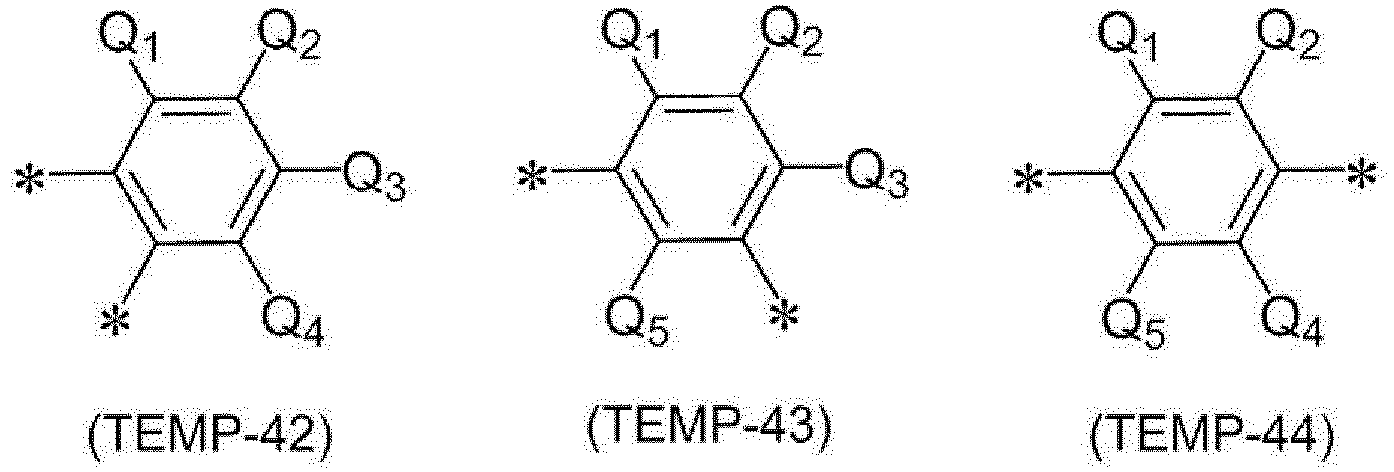


- In the general formulae (TEMP-42) to (TEMP-52), Q1 to Q10 each independently represent a hydrogen atom or a substituent.
- In the general formulae (TEMP-42) to (TEMP-52), * represents a bonding site.


- In the general formulae (TEMP-53) to (TEMP-62), Q1 to Q10 each independently represent a hydrogen atom or a substituent.
- The formulae Q9 and Q10 may be bonded to each other to form a ring via a single bond.
- In the general formulae (TEMP-53) to (TEMP-62), * represents a bonding site.


- In the general formulae (TEMP-63) to (TEMP-68), Q1 to Q8 each independently represent a hydrogen atom or a substituent.
- In the general formulae (TEMP-63) to (TEMP-68), * represents a bonding site.
- In the description herein, the substituted or unsubstituted divalent heterocyclic group is preferably the groups represented by the following general formulae (TEMP-69) to (TEMP-102) unless otherwise indicated in the description.


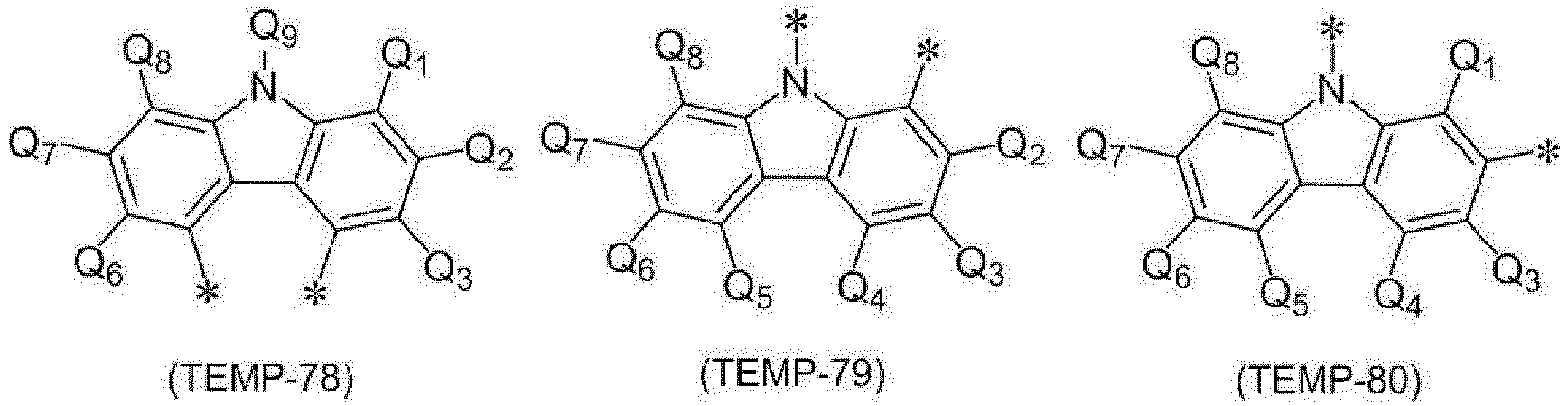

- In the general formulae (TEMP-69) to (TEMP-82), Q1 to Q9 each independently represent a hydrogen atom or a substituent.
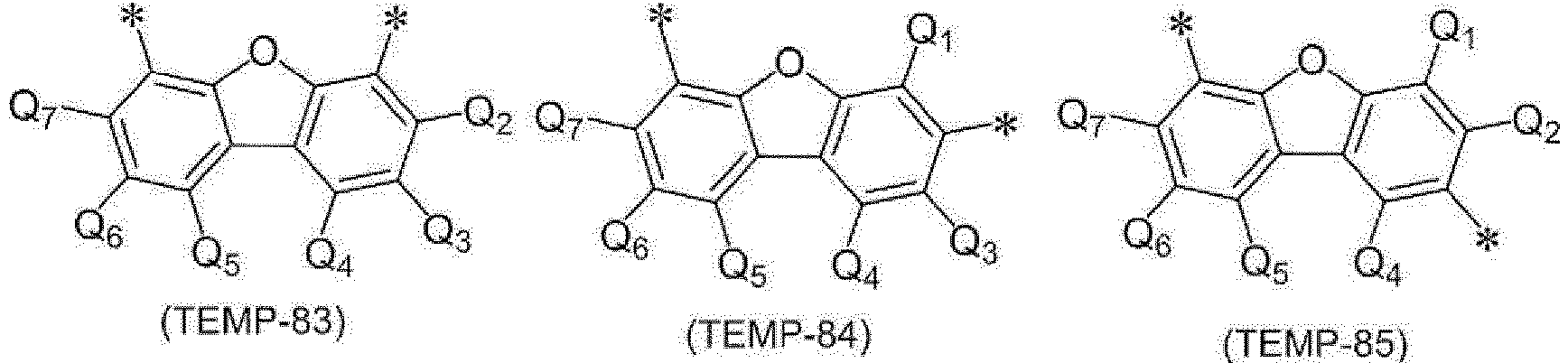


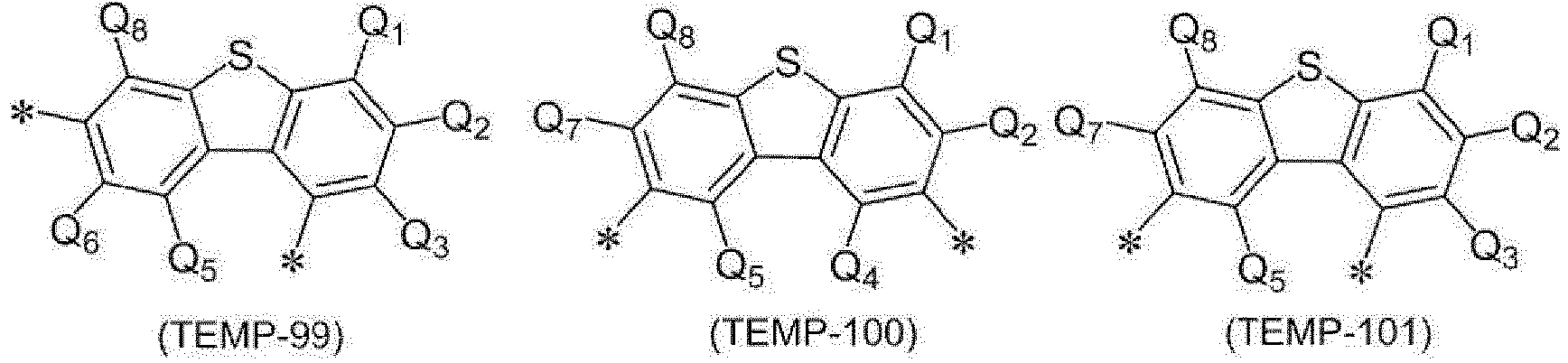

- In the general formulae (TEMP-83) to (TEMP-102), Q1 to Q8 each independently represent a hydrogen atom or a substituent.
- The above are the explanation of the "substituents in the description herein".
- In the description herein, the case where "one or more combinations of combinations each including adjacent two or more each are bonded to each other to form a substituted or unsubstituted monocyclic ring, or each are bonded to each other to form a substituted or unsubstituted condensed ring, or each are not bonded to each other" means a case where "one or more combinations of combinations each including adjacent two or more each are bonded to each other to form a substituted or unsubstituted monocyclic ring", a case where "one or more combinations of combinations each including adjacent two or more each are bonded to each other to form a substituted or unsubstituted condensed ring", and a case where "one or more combinations of combinations each including adj acent two or more each are not bonded to each other".
- In the description herein, the case where "one or more combinations of combinations each including adjacent two or more each are bonded to each other to form a substituted or unsubstituted monocyclic ring" and the case where "one or more combinations of combinations each including adjacent two or more each are bonded to each other to form a substituted or unsubstituted condensed ring" (which may be hereinafter collectively referred to as a "case forming a ring by bonding") will be explained below. The cases will be explained for the anthracene compound represented by the following general formula (TEMP-103) having an anthracene core skeleton as an example.

- For example, in the case where "one or more combinations of combinations each including adjacent two or more each are bonded to each other to form a ring" among R921 to R930, the combinations each including adjacent two as one combination include a combination of R921 and R922, a combination of R922 and R923, a combination of R923 and R924, a combination of R924 and R930, a combination of R930 and R925, a combination of R925 and R926, a combination of R926 and R927, a combination of R927 and R928, a combination of R928 and R929, and a combination of R929 and R921.
- The "one or more combinations" mean that two or more combinations each including adjacent two or more may form rings simultaneously. For example, in the case where R921 and R922 are bonded to each other to form a ring QA, and simultaneously R925 and R926 are bonded to each other to form a ring QB, the anthracene compound represented by the general formula (TEMP-103) is represented by the following general formula (TEMP-104).

- The case where the "combination including adjacent two or more forms rings" encompasses not only the case where adjacent two included in the combination are bonded as in the aforementioned example, but also the case where adjacent three or more included in the combination are bonded. For example, this case means that R921 and R922 are bonded to each other to form a ring QA, R922 and R923 are bonded to each other to form a ring Qc, and adjacent three (R921, R922, and R923) included in the combination are bonded to each other to form rings, which are condensed to the anthracene core skeleton, and in this case, the anthracene compound represented by the general formula (TEMP-103) is represented by the following general formula (TEMP-105). In the following general formula (TEMP-105), the ring QA and the ring Qc share R922.

- The formed "monocyclic ring" or "condensed ring" may be a saturated ring or an unsaturated ring in terms of structure of the formed ring itself. In the case where the "one combination including adjacent two" forms a "monocyclic ring" or a "condensed ring", the "monocyclic ring" or the "condensed ring" may form a saturated ring or an unsaturated ring. For example, the ring QA and the ring QB formed in the general formula (TEMP-104) each are a "monocyclic ring" or a "condensed ring". The ring QA and the ring Qc formed in the general formula (TEMP-105) each are a "condensed ring". The ring QA and the ring Qc in the general formula (TEMP-105) form a condensed ring through condensation of the ring QA and the ring Qc. In the case where the ring QA in the general formula (TMEP-104) is a benzene ring, the ring QA is a monocyclic ring. In the case where the ring QA in the general formula (TMEP-104) is a naphthalene ring, the ring QA is a condensed ring.
- The "unsaturated ring" means an aromatic hydrocarbon ring or an aromatic heterocyclic ring. The "saturated ring" means an aliphatic hydrocarbon ring or a non-aromatic heterocyclic ring.
- Specific examples of the aromatic hydrocarbon ring include the structures formed by terminating the groups exemplified as the specific examples in the set of specific examples G1 with a hydrogen atom.
- Specific examples of the aromatic heterocyclic ring include the structures formed by terminating the aromatic heterocyclic groups exemplified as the specific examples in the set of specific examples G2 with a hydrogen atom.
- Specific examples of the aliphatic hydrocarbon ring include the structures formed by terminating the groups exemplified as the specific examples in the set of specific examples G6 with a hydrogen atom.
- The expression "to form a ring" means that the ring is formed only with the plural atoms of the core structure or with the plural atoms of the core structure and one or more arbitrary element. For example, the ring QA formed by bonding R921 and R922 each other shown in the general formula (TEMP-104) means a ring formed with the carbon atom of the anthracene skeleton bonded to R921, the carbon atom of the anthracene skeleton bonded to R922, and one or more arbitrary element. As a specific example, in the case where the ring QA is formed with R921 and R922, and in the case where a monocyclic unsaturated ring is formed with the carbon atom of the anthracene skeleton bonded to R921, the carbon atom of the anthracene skeleton bonded to R922, and four carbon atoms, the ring formed with R921 and R922 is a benzene ring.
- Herein, the "arbitrary element" is preferably at least one kind of an element selected from the group consisting of a carbon element, a nitrogen element, an oxygen element, and a sulfur element, unless otherwise indicated in the description. For the arbitrary element (for example, for a carbon element or a nitrogen element), a bond that does not form a ring may be terminated with a hydrogen atom or the like, and may be substituted by an "arbitrary substituent" described later. In the case where an arbitrary element other than a carbon element is contained, the formed ring is a heterocyclic ring.
- The number of the "one or more arbitrary element" constituting the monocyclic ring or the condensed ring is preferably 2 or more and 15 or less, more preferably 3 or more and 12 or less, and further preferably 3 or more and 5 or less, unless otherwise indicated in the description.
- What is preferred between the "monocyclic ring" and the "condensed ring" is the "monocyclic ring" unless otherwise indicated in the description.
- What is preferred between the "saturated ring" and the "unsaturated ring" is the "unsaturated ring" unless otherwise indicated in the description.
- The "monocyclic ring" is preferably a benzene ring unless otherwise indicated in the description.
- The "unsaturated ring" is preferably a benzene ring unless otherwise indicated in the description.
- In the case where the "one or more combinations of combinations each including adjacent two or more" each are "bonded to each other to form a substituted or unsubstituted monocyclic ring", or each are "bonded to each other to form a substituted or unsubstituted condensed ring", it is preferred that the one or more combinations of combinations each including adjacent two or more each are bonded to each other to form a substituted or unsubstituted "unsaturated ring" containing the plural atoms of the core skeleton and 1 or more and 15 or less at least one kind of an element selected from the group consisting of a carbon element, a nitrogen element, an oxygen element, and a sulfur element, unless otherwise indicated in the description.
- In the case where the "monocyclic ring" or the "condensed ring" has a substituent, the substituent is, for example, an "arbitrary substituent" described later. In the case where the "monocyclic ring" or the "condensed ring" has a substituent, specific examples of the substituent include the substituents explained in the section "Substituents in Description" described above.
- In the case where the "saturated ring" or the "unsaturated ring" has a substituent, the substituent is, for example, an "arbitrary substituent" described later. In the case where the "monocyclic ring" or the "condensed ring" has a substituent, specific examples of the substituent include the substituents explained in the section "Substituents in Description" described above.
- The above are the explanation of the case where "one or more combinations of combinations each including adjacent two or more" each are "bonded to each other to form a substituted or unsubstituted monocyclic ring", and the case where "one or more combinations of combinations each including adjacent two or more" each are "bonded to each other to form a substituted or unsubstituted condensed ring" (i.e., the "case forming a ring by bonding").
- In one embodiment in the description herein, the substituent for the case of "substituted or unsubstituted" (which may be hereinafter referred to as an "arbitrary substituent") is, for example, a group selected from the group consisting of
- an unsubstituted alkyl group having 1 to 50 carbon atoms,
- an unsubstituted alkenyl group having 2 to 50 carbon atoms,
- an unsubstituted alkynyl group having 2 to 50 carbon atoms,
- an unsubstituted cycloalkyl group having 3 to 50 ring carbon atoms,
-Si(R901)(R902)(R903),
-O-(R904),
-S-(R905),
-N(R906)(R907),
- a halogen atom, a cyano group, a nitro group,
- an unsubstituted aryl group having 6 to 50 ring carbon atoms, and
- an unsubstituted heterocyclic group having 5 to 50 ring atoms,
- wherein R901 to R907 each independently represent
- a hydrogen atom,
- a substituted or unsubstituted alkyl group having 1 to 50 carbon atoms
- a substituted or unsubstituted cycloalkyl group having 3 to 50 ring carbon atoms,
- a substituted or unsubstituted aryl group having 6 to 50 ring carbon atoms, or
- a substituted or unsubstituted heterocyclic group having 5 to 50 ring atoms.
- In the case where two or more groups each represented by R901 exist, the two or more groups each represented by R901 are the same as or different from each other,
- in the case where two or more groups each represented by R902 exist, the two or more groups each represented by R902 are the same as or different from each other,
- in the case where two or more groups each represented by R903 exist, the two or more groups each represented by R903 are the same as or different from each other,
- in the case where two or more groups each represented by R904 exist, the two or more groups each represented by R904 are the same as or different from each other,
- in the case where two or more groups each represented by R905 exist, the two or more groups each represented by R905 are the same as or different from each other,
- in the case where two or more groups each represented by R906 exist, the two or more groups each represented by R906 are the same as or different from each other, and
- in the case where two or more groups each represented by R907 exist, the two or more groups each represented by R907 are the same as or different from each other.
- In one embodiment, the substituent for the case of "substituted or unsubstituted" may be a group selected from the group consisting of
- an alkyl group having 1 to 50 carbon atoms,
- an aryl group having 6 to 50 ring carbon atoms, and
- a heterocyclic group having 5 to 50 ring atoms.
- In one embodiment, the substituent for the case of "substituted or unsubstituted" may be a group selected from the group consisting of
- an alkyl group having 1 to 18 carbon atoms,
- an aryl group having 6 to 18 ring carbon atoms, and
- a heterocyclic group having 5 to 18 ring atoms.
- The specific examples of the groups for the arbitrary substituent described above are the specific examples of the substituent described in the section "Substituents in Description" described above.
- In the description herein, the arbitrary adjacent substituents may form a "saturated ring" or an "unsaturated ring", preferably form a substituted or unsubstituted saturated 5-membered ring, a substituted or unsubstituted saturated 6-membered ring, a substituted or unsubstituted unsaturated 5-membered ring, or a substituted or unsubstituted unsaturated 6-membered ring, and more preferably form a benzene ring, unless otherwise indicated.
- In the description herein, the arbitrary substituent may further have a substituent unless otherwise indicated in the description. The definition of the substituent that the arbitrary substituent further has may be the same as the arbitrary substituent.
- In the description herein, a numerical range shown by "AA to BB" means a range including the numerical value AA as the former of "AA to BB" as the lower limit value and the numerical value BB as the latter of "A A to BB" as the upper limit value.
- The compound of the present invention will be described below.
- The compound of the present invention is represented by the formula (1). Hereinafter, signs in the formula (1) and each formula, which will be described later, included in the formula (1) will be described. Unless otherwise specified, the same signs have the same meaning.
- The compound of the present invention represented by the formula (1) and each formula, which will be described later, included in the formula (1) is sometimes referred to as "the inventive compound".

- N* is a central nitrogen atom.
- R1 to R4 are each independently a hydrogen atom, an unsubstituted alkyl group having 1 to 6 carbon atoms, or an unsubstituted aryl group having 6 to 12 ring carbon atoms.
- Adjacent two selected from R1 to R4 are not bonded to each other, thus forming no ring.
- The unsubstituted alkyl group having 1 to 6 carbon atoms represented by R1 to R4 is, for example, a methyl group, an ethyl group, an n-propyl group, an isopropyl group, an n-butyl group, an isobutyl group, an s-butyl group, a t-butyl group, a pentyl group, or a hexyl group, preferably a methyl group, an ethyl group, an n-propyl group, an isopropyl group, an n-butyl group, an isobutyl group, an s-butyl group, or a t-butyl group, and more preferably a methyl group or a t-butyl group.
- The unsubstituted aryl group having 6 to 12 ring carbon atoms represented by R1 to R4 is, for example, a phenyl group, a biphenylyl group, a biphenylenyl group, or a naphthyl group, preferably a phenyl group, a 2-, 3-, or 4-biphenylyl group, or a 1- or 2-naphthyl group, and more preferably a phenyl group.
- All of R1 to R4 may be a hydrogen atom.
- L1 to L4 are each independently a single bond, an unsubstituted arylene group having 6 to 30, preferably 6 to 25, more preferably 6 to 12 ring carbon atoms, or an unsubstituted divalent heterocyclic group having 5 to 30, preferably 5 to 18, more preferably 5 to 13 ring atoms.
- L1 to L4 are each independently preferably a single bond, or an unsubstituted arylene group having 6 to 30 ring carbon atoms.
- In an aspect of the present invention, L3 is preferably a single bond.
- In another aspect of the present invention, L4 is preferably a single bond.
- The unsubstituted arylene group having 6 to 30 ring carbon atoms represented by L1 to L4 refers to a divalent group obtained by removing one hydrogen atom from an unsubstituted aryl group having 6 to 30 ring carbon atoms. The unsubstituted aryl group having 6 to 30 ring carbon atoms is, for example, a phenyl group, a biphenylyl group, a terphenylyl group, a biphenylenyl group, a naphthyl group, an anthryl group, a benzanthryl group, a phenanthryl group, a benzophenanthryl group, a phenalenyl group, a picenyl group, a pentaphenyl group, a pyrenyl group, a chrysenyl group, a benzocrysenyl group , a fluorenyl group, a fluoranthenyl group, a perylenyl group, or a triphenylenyl group, preferably a phenyl group, a biphenylyl group, a terphenylyl group, or a naphthyl group, more preferably a phenyl group, a 2-, 3-, or 4-biphenylyl group, a 2-, 3-, or 4-o-terphenylyl group, a 2-, 3-, or 4-m-terphenylyl group, a 2-, 3-, or 4-p-terphenylyl group, or a 1- or 2-naphthyl group, still more preferably a phenyl group, a 2-, 3-, or 4-biphenylyl group, or a 1- or 2-naphthyl group, and particularly preferably a phenyl group.
- The unsubstituted divalent heterocyclic group having 5 to 30 ring atoms represented by L1 to L4 refers to a divalent group obtained by removing one hydrogen atom from an unsubstituted heterocyclic group.
- The unsubstituted aromatic heterocyclic group having 5 to 30 ring atoms represented by L1 to L4 is, for example, a pyrrolyl group, a furyl group, a thienyl group, a pyridyl group, an imidazopyridyl group, a pyridazinyl group, a pyrimidinyl group, a pyrazinyl group, a triazinyl group, an imidazolyl group, an oxazolyl group, a thiazolyl group, a pyrazolyl group, an isoxazolyl group, an isothiazolyl group, an oxadiazolyl group, a thiadiazolyl group, a triazolyl group, a tetrazolyl group, an indolyl group, an isoindolyl group, an indolizinyl group, a quinolidinyl group, a quinolyl group, an isoquinolyl group, a cinnolyl group, a phthalazinyl group, a quinazolinyl group, a quinoxalinyl group, a benzimidazolyl group, a benzoxazolyl group, a benzothiazolyl group, an indazolyl group, a benzisoxazolyl group, a benzisothiazolyl group, a phenanthridinyl group, an acridinyl group, a phenanthrolinyl group, a phenazinyl group, a phenothiazinyl group, a phenoxazinyl group, a xanthenyl group, a benzofuranyl group, an isobenzofuranyl group, a naphthobenzofuranyl group, a dibenzofuranyl group, a benzothiophenyl group (benzothienyl group, hereinafter the same), an isobenzothiophenyl group (isobenzothienyl group, hereinafter the same), a naphthobenzothiophenyl group (naphthobenzothienyl group, hereinafter the same), a dibenzothiophenyl group (dibenzothienyl group, hereinafter the same), or a carbazolyl group, and preferably a benzofuranyl group, an isobenzofuranyl group, a naphthobenzofuranyl group, a dibenzofuranyl group, a benzothiophenyl group, an isobenzothiophenyl group, a naphthobenzothiophenyl group, a dibenzothiophenyl group, or a carbazolyl group (9-carbazolyl group, or a 1-, 2-, 3- or 4-carbazolyl group).
- Ar1 and Ar2 are each independently a substituted or unsubstituted aryl group having 6 to 30, preferably 6 to 25, more preferably 6 to 12 ring carbon atoms constituted only of 6-membered rings, a substituted or unsubstituted heterocyclic group having 5 to 30, preferably 5 to 18, more preferably 5 to 13 ring atoms, or a group represented by the following formula (a).

- In the formula (a), *1 is a bonding site to L1 or L2.
- Ra and Rb are each independently a hydrogen atom, a substituted or unsubstituted alkyl group having 1 to 30, preferably 1 to 18, more preferably 1 to 6 carbon atoms, a substituted or unsubstituted aryl group having 6 to 30, preferably 6 to 25, more preferably 6 to 12 ring carbon atoms, or a substituted or unsubstituted heterocyclic group having 5 to 30, preferably 5 to 18, more preferably 5 to 13 ring atoms.
- Ra and Rb may be bonded to each other to form a substituted or unsubstituted ring, or may not be bonded to each other, thus forming no ring.
- Ra and Rb are each independently preferably a substituted or unsubstituted alkyl group having 1 to 30 carbon atoms, or a substituted or unsubstituted aryl group having 6 to 30 ring carbon atoms.
- The unsubstituted alkyl group having 1 to 30 carbon atoms represented by Ra and Rb is, for example, a methyl group, an ethyl group, an n-propyl group, an isopropyl group, an n-butyl group, an isobutyl group, an s-butyl group, a t-butyl group, a pentyl group, a hexyl group, a heptyl group, an octyl group, a nonyl group, a decyl group, an undecyl group, or a dodecyl group, preferably a methyl group, an ethyl group, an n-propyl group, an isopropyl group, an n-butyl group, an isobutyl group, an s-butyl group, a t-butyl group, or a pentyl group, more preferably a methyl group, an ethyl group, an n-propyl group, an isopropyl group, an n-butyl group, an isobutyl group, an s-butyl group, or a t-butyl group, and still more preferably a methyl group or a t-butyl group.
- Details of the unsubstituted aryl group having 6 to 30 ring carbon atoms represented by Ra and Rb are as described for L1 to L4.
- Details of the unsubstituted heterocyclic group having 5 to 30 ring atoms represented by Ra and Rb are as described for L1 to L4.
- The unsubstituted monocyclic ring formed by Ra and Rb is, for example, a benzene ring, a cyclopentane ring, or a cyclohexane ring.
- The unsubstituted condensed ring formed by Ra and Rb is, for example, a naphthalene ring or an anthracene ring.
- In addition, when Ra and Rb are bonded to each other to form an unsubstituted monocyclic ring or an unsubstituted condensed ring, Ra and Rb may form a ring with a fluorene skeleton to which they are bonded to form a spiro ring. The spiro ring is a hydrocarbon ring or a heterocyclic ring, and is selected from a monocyclic ring, a condensed ring, a bridged bicyclo ring, and a bridged tricyclo ring. Although examples of substituted or unsubstituted spiro rings are shown below, the invention is not limited thereto. * indicates a bonding site of the fluorene skeleton to the benzene ring.


- One selected from R21 to R28 is a single bond bonded to *2, and R21 to R28 that are not a single bond bonded to *2 are each independently a hydrogen atom, a substituted or unsubstituted alkyl group having 1 to 6 carbon atoms, a substituted or unsubstituted aryl group having 6 to 12 ring carbon atoms, or a substituted or unsubstituted heterocyclic group having 5 to 13 ring atoms,
adjacent two selected from R21 to R28 that are not the single bond may be bonded to each other to form one or more unsubstituted benzene rings, or may not be bonded to each other, thus forming no ring. - Details of the unsubstituted alkyl group having 1 to 6 carbon atoms represented by R21 to R28 that is not the single bond bonded to *2 are as described for R1 to R4.
- Details of the unsubstituted aryl group having 6 to 12 ring carbon atoms represented by R21 to R28 that is not the single bond bonded to *2 are as described for L1 to L4 except that the number of ring carbon atoms is 6 to 12.
- Details of the unsubstituted heterocyclic group having 5 to 13 ring atoms represented by R21 to R28 that is not the single bond bonded to *2 are as described for L1 to L4 except that the number of ring atoms is 5 to 13.
- When Ra and Rb are bonded to each other to form a substituted or unsubstituted spirofluorene ring with a carbon atom at site 9 of a fluorene skeleton, one selected from R22 to R27 is a single bond bonded to *2,
when all of L1 to L4 are single bonds, Ar1 and Ar2 are groups represented by the formula (a), and R22 or R27 is a single bond bonded to *2, at least one selected from two Ra's and two Rb's is a substituted or unsubstituted aryl group having 6 to 30 ring carbon atoms. - All of R21 to R28 that are not a single bond bonded to *2 may be a hydrogen atom.
- Details of the unsubstituted aryl group having 6 to 30 ring carbon atoms constituted only of 6-membered rings represented by Ar1 and Ar2 are as described for L1 to L4 except that it is an aryl group constituted only of 6-membered rings.
- Details of the unsubstituted heterocyclic group having 5 to 30 ring atoms represented by Ar1 and Ar2 are as described for L1 to L4.
- Ar1 and Ar2 are each independently preferably a substituted or unsubstituted aryl group having 6 to 30 ring carbon atoms constituted only of 6-membered rings, or a substituted or unsubstituted heterocyclic group having 5 to 30 ring atoms, and more preferably a substituted or unsubstituted aryl group having 6 to 30 ring carbon atoms constituted only of 6-membered rings.
- Ar1 and Ar2 are each independently preferably a group represented by any of the following formulas (1a) to (1e), and more preferably a group represented by any of the following formulas (1a), (1b) and (1d).

- In the formula (1a),
*21 is a bonding site to L1 or L2. - R101 to R110 are each independently a hydrogen atom, an unsubstituted alkyl group having 1 to 6 carbon atoms, or an unsubstituted aryl group having 6 to 12 ring carbon atoms, provided that one selected from R101 to R105 is a single bond bonded to *22, and one selected from R106 to R110 is a single bond bonded to *23.
- Adjacent two selected from R101 to R105 that are not the single bond are not bonded to each other, thus forming no ring,
adjacent two selected from R106 to R110 that are not the single bond are not bonded to each other, thus forming no ring. - Details of the unsubstituted alkyl group having 1 to 6 carbon atoms represented by R101 to R110 are as described for R1 to R4.
- Details of the unsubstituted aryl group having 6 to 12 ring carbon atoms represented by R101 to R110 are as described for L1 to L4 except that the number of ring carbon atoms is 6 to 12.
- All of R101 to R110 that are not a single bond bonded to *22 or a single bond bonded to *23 may be a hydrogen atom.
- k is 0 or 1, 1 is 0 or 1,
k + l is an integer of 0 to 2. - In one aspect of the present invention, k is 0 and l is 0. In this case, *23 represents *21, and the formula (1a) is represented by the following formula.

- In another aspect of the present invention, k is 1 and l is 0. In this case, *23 represents *22, and the formula (1a) is represented by the following formula.

- In another aspect of the present invention, k is 0 and l is 1. In this case, *22 represents *21, and the formula (1a) is represented by the following formula.

- In another aspect of the present invention, k is 1 and l is 1. In this case, the formula (1a) is represented by the following formula.

- In one aspect of the present invention, k + l is preferably 1.
- R111 to R115 are each independently a hydrogen atom, a substituted or unsubstituted alkyl group having 1 to 6 carbon atoms, a substituted or unsubstituted aryl group having 6 to 12 ring carbon atoms, or a substituted or unsubstituted heterocyclic group having 5 to 13 ring atoms.
- Adjacent two selected from R111 to R115 may be bonded to each other to form one or more unsubstituted benzene rings, or may not be bonded to each other, thus forming no ring.
- Details of the unsubstituted alkyl group having 1 to 6 carbon atoms represented by R111 to R115 are as described for R1 to R4.
- Details of the unsubstituted aryl group having 6 to 12 ring carbon atoms represented by R111 to R115 are as described for L1 to L4 except that the number of ring carbon atoms is 6 to 12.
- Details of the unsubstituted heterocyclic group having 5 to 13 ring atoms represented by R111 to R115 are as described for L1 to L4 except that the number of ring atoms is 5 to 13.
- All of R111 to R115 may be a hydrogen atom.
- A group represented by the formula (1a) is preferably represented by the following formula. In the following formula, R is omitted for simplification.


- The formula (1b) is represented by the following formula.

- In the formula (1b),
*24 is a bonding site to L1 or L2. - R121 to R128 are each independently a hydrogen atom, a substituted or unsubstituted alkyl group having 1 to 6 carbon atoms, or a substituted or unsubstituted aryl group having 6 to 12 ring carbon atoms,
provided that one selected from R121 to R128 is a single bond bonded to *25, and adjacent two selected from R121 to R128 that are not the single bond are not bonded to each other, thus forming no ring. - Details of the unsubstituted alkyl group having 1 to 6 carbon atoms represented by R121 to R128 are as described for R1 to R4.
- Details of the unsubstituted aryl group having 6 to 12 ring carbon atoms represented by R121 to R128 are as described for L1 to L4 except that the number of ring carbon atoms is 6 to 12.
- In one aspect of the present invention, R121 is preferably a single bond bonded to *25, and in another aspect, R122 is preferably a single bond bonded to *25.
- All of R121 to R128 that are not a single bond bonded to *25 may be a hydrogen atom.
- The formula (1c) is represented by the following formula.

- In the formula (1c),
*26 is a bonding site to L1 or L2. - R131 to R140 are each independently a hydrogen atom, a substituted or unsubstituted alkyl group having 1 to 6 carbon atoms, or a substituted or unsubstituted aryl group having 6 to 12 ring carbon atoms,
provided that one selected from R131 to R140 is a single bond bonded to *27, and adjacent two selected from R131 to R140 that are not the single bond are not bonded to each other, thus forming no ring. - Details of the unsubstituted alkyl group having 1 to 6 carbon atoms represented by R131 to R140 are as described for R1 to R4.
- Details of the unsubstituted aryl group having 6 to 12 ring carbon atoms represented by R131 to R140 are as described for L1 to L4 except that the number of ring carbon atoms is 6 to 12.
- One selected from R131, R132, and R140 is preferably a single bond bonded to *27. In one aspect of the present invention, R131 is a single bond bonded to *27, in another aspect, R132 is a single bond bonded to *27, and in still another aspect, R140 is a single bond bonded to *27.
- All of R131 to R140 that are not a single bond bonded to *27 may be a hydrogen atom.
- The formula (1d) is represented by the following formula.

- In the formula (1d),
*26 is a bonding site to L1 or L2. - X2 is an oxygen atom, a sulfur atom, or NRA.
- X2 is preferably an oxygen atom or NRA.
- RA is a substituted or unsubstituted alkyl group having 1 to 6 carbon atoms or a substituted or unsubstituted aryl group having 6 to 12 ring carbon atoms.
- Details of the unsubstituted alkyl group having 1 to 6 carbon atoms represented by RA are as described for R1 to R4.
- Details of the unsubstituted aryl group having 6 to 12 ring carbon atoms represented by RA are as described for L1 to L4 except that the number of ring carbon atoms is 6 to 12.
- R141 to R148 are each independently a hydrogen atom, a substituted or unsubstituted alkyl group having 1 to 6 carbon atoms, a substituted or unsubstituted aryl group having 6 to 12 ring carbon atoms, or a substituted or unsubstituted heterocyclic group having 5 to 13 ring atoms, provided that one selected from R141 to R148 and RA is a single bond bonded to *29.
- At least one adjacent two selected from R141 to R148 that are not the single bond may be bonded to each other to form one or more unsubstituted benzene rings, or may not be bonded to each other, thus forming no ring.
- Details of the unsubstituted alkyl group having 1 to 6 carbon atoms represented by R141 to R148 are as described for R1 to R4.
- Details of the unsubstituted aryl group having 6 to 12 ring carbon atoms represented by R141 to R148 are as described for L1 to L4 except that the number of ring carbon atoms is 6 to 12.
- Details of the unsubstituted heterocyclic group having 5 to 13 ring atoms represented by R141 to R148 are as described for L1 to L4 except that the number of ring atoms is 5 to 13.
- All of R141 to R148 and RA that are not a single bond bonded to *29 may be a hydrogen atom.
- When X2 is an oxygen atom or a sulfur atom, it is preferable that one selected from R141 to R144 is a single bond bonded to *29.
- When X2 is NRA, it is preferable that one selected from R141 to R144 and RA is a single bond bonded to *29.
- It is particularly preferable that RA is a single bond bonded to *29, an unsubstituted phenyl group, or a naphthyl group.
- The formula (1e) is represented by the following formula.

- In the formula (1e),
*30 is a bonding site to L1 or L2. - R151 to R155 are each independently a hydrogen atom, an unsubstituted alkyl group having 1 to 6 carbon atoms, or an unsubstituted phenyl group,
provided that one selected from R151 to R155 is a single bond bonded to *31, and another one selected from R151 to R155 is a single bond bonded to *32. - Adjacent two selected from R151 to R155 that are neither a single bond bonded to *31 nor a single bond bonded to *32 are not bonded to each other, thus forming no ring.
- Details of the unsubstituted alkyl group having 1 to 6 carbon atoms represented by R151 to R155 are as described for R1 to R4.
- All of R151 to R155 that are neither a single bond bonded to *31 nor a single bond bonded to *32 may be a hydrogen atom.
- R161 to R165 and R171 to R175 are each independently a hydrogen atom or an unsubstituted alkyl group having 1 to 6 carbon atoms,
provided that at least one adjacent two selected from R161 to R165 may be bonded to each other to form one or more unsubstituted benzene rings, or may not be bonded to each other, thus forming no ring. - At least one adjacent two selected from R171 to R175 may be bonded to each other to form one or more unsubstituted benzene rings, or may not be bonded to each other, thus forming no ring.
- Details of the unsubstituted alkyl group having 1 to 6 carbon atoms represented by R161 to R165 and R171 to R175 are as described for R1 to R4.
- All of R161 to R165 and R171 to R175 may be a hydrogen atom.
- The formula (1e) includes groups represented by the following formulas (1e-1) to (1e-5), with the formulas (1e-1), (1e-2) or (1e-4) being preferred.


- Ar3 is a group represented by the following formula (x).

- In the formula (x),
*3 is a bonding site to L4. - R31 to R38, R41 to R44, and R51 to R58 are each independently a hydrogen atom, a halogen atom, a cyano group, a nitro group, a substituted or unsubstituted alkyl group having 1 to 50 carbon atoms, a substituted or unsubstituted alkenyl group having 2 to 50 carbon atoms, a substituted or unsubstituted alkynyl group having 2 to 50 carbon atoms, a substituted or unsubstituted cycloalkyl group having 3 to 50 ring carbon atoms, a group represented by - Si(R901)(R902)(R903), a group represented by -O-(R904), a group represented by -S-(R905), a group represented by -N(R906)(R907), a substituted or unsubstituted aryl group having 6 to 50 ring carbon atoms, or a substituted or unsubstituted heterocyclic group having 5 to 50 ring atoms,
- R901 to R907 are each independently a hydrogen atom, a substituted or unsubstituted alkyl group having 1 to 50 carbon atoms, a substituted or unsubstituted cycloalkyl group having 3 to 50 ring carbon atoms, a substituted or unsubstituted aryl group having 6 to 50 ring carbon atoms, or a substituted or unsubstituted heterocyclic group having 5 to 50 ring atoms,
- in the case where two or more groups represented by R901 exist, the two or more groups each represented by R901 are the same as or different from each other,
- in the case where two or more groups represented by R902 exist, the two or more groups each represented by R902 are the same as or different from each other,
- in the case where two or more groups represented by R903 exist, the two or more groups each represented by R903 are the same as or different from each other,
- in the case where two or more groups represented by R904 exist, the two or more groups each represented by R904 are the same as or different from each other,
- in the case where two or more groups represented by R905 exist, the two or more groups each represented by R905 are the same as or different from each other,
- in the case where two or more groups represented by R906 exist, the two or more groups each represented by R906 are the same as or different from each other,
- in the case where two or more groups represented by R907 exist, the two or more groups each represented by R907 are the same as or different from each other.
- R31 to R38, R41 to R44, and R51 to R58 are each independently preferably a hydrogen atom, a substituted or unsubstituted alkyl group having 1 to 50 carbon atoms, a substituted or unsubstituted aryl group having 6 to 50 ring carbon atoms, or a substituted or unsubstituted heterocyclic group having 5 to 50 ring atoms, more preferably a hydrogen atom, a substituted or unsubstituted alkyl group having 1 to 30 carbon atoms, or a substituted or unsubstituted aryl group having 6 to 30 ring carbon atoms, further preferably a hydrogen atom, a substituted or unsubstituted alkyl group having 1 to 12 carbon atoms, or a substituted or unsubstituted aryl group having 6 to 12 ring carbon atoms, and furthermore preferably a hydrogen atom.
- Details of the halogen atom represented by R31 to R38, R41 to R44, and R51 to R58 are as described in the section "Substituents in Description", and preferred is a fluorine atom.
- Details of the substituted or unsubstituted alkyl group having 1 to 50 carbon atoms represented by R31 to R38, R41 to R44, and R51 to R58 are as described in the section "Substituents in Description".
- The unsubstituted alkyl group represented by R31 to R38, R41 to R44, and R51 to R58 is preferably a methyl group, an ethyl group, an n-propyl group, an isopropyl group, an n-butyl group, an isobutyl group, an s-butyl group, or a t-butyl group, more preferably a methyl group, an ethyl group, an isopropyl group, or a t-butyl group, and still more preferably a methyl group or a t-butyl group.
- Details of the substituted or unsubstituted alkenyl group having 2 to 50 ring carbon atoms represented by R31 to R38, R41 to R44, and R51 to R58 are as described in the section "Substituents in Description".
- Details of the substituted or unsubstituted alkynyl group having 2 to 50 ring carbon atoms represented by R31 to R38, R41 to R44, and R51 to R58 are as described in the section "Substituents in Description".
- Details of the substituted or unsubstituted cycloalkyl group having 3 to 50 ring carbon atoms represented by R31 to R38, R41 to R44, and R51 to R58 are as described in the section "Substituents in Description".
- The unsubstituted cycloalkyl group represented by R31 to R38, R41 to R44, and R51 to R58 is preferably a cyclopentyl group, a cyclohexyl group, a 1-adamantyl group, a 2-adamantyl group, a 1-norbornyl group, or a 2-norbornyl group, and more preferably a cyclopentyl group or a cyclohexyl group.
- Details of the -Si(R901)(R902)(R903) represented by R31 to R38, R41 to R44, and R51 to R58, the group represented by -O-(R904), the group represented by -S-(R905), and the group represented by -N(R906)(R907) are as described in the section "Substituents in Description".
- Details of the substituted or unsubstituted aryl group having 6 to 50 ring carbon atoms represented by R31 to R38, R41 to R44, and R51 to R58 are as described in the section "Substituents in Description".
- The unsubstituted aryl group represented by R1 to R8 and R11 to R18 is preferably a phenyl group, a biphenyl group, or a phenanthryl group, more preferably a phenyl group, a biphenyl group, or a naphthyl group, and further preferably a phenyl group.
- Details of the substituted or unsubstituted heterocyclic group having 5 to 50 ring atoms represented by R31 to R38, R41 to R44, and R51 to R58 are as described in the section "Substituents in Description".
- The unsubstituted heterocyclic group represented by R31 to R38, R41 to R44, and R51 to R58 is preferably a dibenzofuranyl group or a dibenzothiophenyl group.
- m is 0 or 1, and n is 0 or 1.
- When m and n are 0, one of R31 and R32, R32 and R33, or R33 and R34 is a single bond bonded to *a, and the other is a single bond bonded to *b,
one selected from R31 to R38 that are not a single bond bonded to *a and *b, and R41 to R44 is a single bond bonded to *4. - When m is 1 and n is 0, one of R31 and R32, R32 and R33, or R33 and R34 is a single bond bonded to *a, and the other is a single bond bonded to *b,
- one of R35 and R36, R36 and R37, or R37 and R38 is a single bond bonded to *c, and the other is a single bond bonded to *d,
- one selected from R31 to R34 that are not a single bond bonded to *a and *b, R35 to R38 that are not a single bond bonded to *c and *d, R41 to R44, and R51 to R54 is a single bond bonded to *4.
- When m is 0 and n is 1, one of R31 and R32, R32 and R33, or R33 and R34 is a single bond bonded to *a, and the other is a single bond bonded to *b,
- one of R35 and R36, R36 and R37, or R37 and R38 is a single bond bonded to *e, and the other is a single bond bonded to *f,
- one selected from R31 to R34 that are not a single bond bonded to *a and *b, R35 to R38 that are not a single bond bonded to *e and *f, R41 to R44, and R55 to R58 is a single bond bonded to *4.
- When m is 1 and n is 1, one of R31 and R32, R32 and R33, or R33 and R34 is a single bond bonded to *a, and the other is a single bond bonded to *b,
- one in any one group of three groups, R35 and R36, R36 and R37, and R37 and R38, is a single bond bonded to *c, and the other is a single bond bonded to *d,
- one in any one group of the remaining two groups of R35 and R36, R36 and R37, or R37 and R38, is a single bond bonded to *e, and the other is a single bond bonded to *f,
- one selected from R31 to R34 that are not a single bond bonded to *a and *b, R35 to R38 that are not a single bond bonded to *c to *f, R41 to R44, and R51 to R58 is a single bond bonded to *4,
- provided that when L3 and L4 are a single bond, m and n are 0, R33 is a single bond bonded to *a, and R34 is a single bond bonded to *b, or R34 is a single bond bonded to *a and R33 is a single bond bonded to *b, one selected from R31, R32, R35 to R37, and R41 to R44 is a single bond bonded to *4,
- when L3 and L4 are a single bond, m and n are 0, R31 is a single bond bonded to *a, and R32 is a single bond bonded to *b, one selected from R33 to R38 and R42 to R44 is a single bond bonded to *4,
- when L3 and L4 are a single bond, m and n are 0, R32 is a single bond bonded to *a, and R31 is a single bond bonded to *b, one selected from R33 to R38 and R41 to R43 is a single bond bonded to *4.
- In one aspect of the present invention, it is preferable that m is 0.
- In another aspect of the present invention, it is preferable that n is 0.
- In still another aspect of the present invention, it is preferable that m is 0 and n is 0.
- When m is 0 and n is 1, it is preferable that one selected from R31 to R33 that are not a single bond bonded to *a and *b, and R36 to R38 is a single bond bonded to *4, it is more preferable that one selected from R31 and R32 that are not a single bond bonded to *a and *b, and R37 and R38 is a single bond bonded to *4, and it is still more preferable that R32 or R37 that is not a single bond bonded to *a and *b is a single bond bonded to *4.
- X1 is an oxygen atom or a sulfur atom.
- X1 is preferably an oxygen atom.
- As described above, a "hydrogen atom" as used herein includes a light hydrogen atom, a deuterium atom, and a tritium atom. Thus, the inventive compound may contain a naturally-derived deuterium atom.
- A deuterium atom may also be intentionally introduced in the compound (1) by using a deuterated compound in a part or all of raw material compounds. Thus, in an aspect of the present invention, the compound (1) contains at least one deuterium atom. Specifically, the inventive compound may be a compound represented by the formula (1), at least one of the hydrogen atoms contained in the compound being a deuterium atom.
- At least one hydrogen atom selected from the following hydrogen atoms may be a deuterium atom (in the following, "substituted or unsubstituted", the number of carbon atoms, and the number of atoms are omitted):
- a hydrogen atom represented by R1 to R4 of the formula (1);
- a hydrogen atom thereof when R1 to R4 of the formula (1) are an alkyl group or an aryl group;
- a hydrogen atom thereof when L1 to L4 of the formula (1) are an arylene group or a divalent heterocyclic group;
- a hydrogen atom thereof when Ar1 and Ar2 of the formula (1) are an aryl group constituted only of 6-membered rings or a heterocyclic group;
- a hydrogen atom represented by Ra and Rb of the formula (a);
- a hydrogen atom thereof when Ra and Rb of the formula (a) are an alkyl group, an aryl group, or a heterocyclic group;
- a hydrogen atom represented by R21 to R28 that are not a single bond bonded to *2 in the formula (a);
- a hydrogen atom thereof when R21 to R28 that are not a single bond bonded to *2 in the formula (a) are an alkyl group, an aryl group, or a heterocyclic group;
- a hydrogen atom represented by R31 to R38, R41 to R44, and R51 to R58 that are not a single bond bonded to *a to *f in the formula (x); and
- a hydrogen atom thereof when R31 to R38, R41 to R44, and R51 to R58 that are not a single bond bonded to *a to *f in the formula (x) are an alkyl group, an alkenyl group, an alkynyl group, a cycloalkyl group, a group represented by -Si(R901)(R902)(R903), a group represented by -O-(R904), a group represented -S-(R905), a group represented by -N(R906)(R907), an aryl group or a heterocyclic group.
- The deuteration ratio of the inventive compound depends on the deuteration ratio of the raw material compound used. Even when a raw material having a predetermined deuteration ratio is used, light hydrogen isomers may be contained at a certain naturally-derived ratio. Thus, the aspects of the deuteration ratio of the inventive compound shown below are a ratio obtained by taking a minor amount of naturally-derived isomers into account based on a ratio obtained by simply counting the number of deuterium atoms shown by the chemical formula.
- The deuteration ratio of the inventive compound is preferably 1% or more, more preferably 3% or more, further preferably 5% or more, furthermore preferably 10% or more, and still furthermore preferably 50% or more.
- The inventive compound may be a mixture containing a deuterated compound and a non-deuterated compound or a mixture of two or more compounds having different deuteration ratios. The deuteration ratio of such a mixture is preferably 1% or more, more preferably 3% or more, further preferably 5% or more, furthermore preferably 10% or more, still furthermore preferably 50% or more, and less than 100%.
- The ratio of the number of the deuterium atoms based on the number of all the hydrogen atoms in the inventive compound is preferably 1% or more, more preferably 3% or more, further preferably 5% or more, furthermore preferably 10% or more, and 100% or less.
- When a "substituted or unsubstituted XX group" included in the definitions of the above formulas is a substituted XX group, details of the substituent are as described in "Substituents for 'Substituted or Unsubstituted"', and is preferably an alkyl group having 1 to 6 carbon atoms, an aryl group having 6 to 12 ring carbon atoms, or an aromatic heterocyclic group having 5 to 13 ring atoms, and more preferably an alkyl group having 1 to 6 carbon atoms or an aryl group having 6 to 12 ring carbon atoms. Details of each group are as described above.
- The inventive compound can be easily produced by a person skilled in the art with reference to synthetic examples described below and known synthetic methods.
- Specific examples of the inventive compound will be shown below, but were not limited to the exemplified compounds.
- In the following specific examples, D represents a deuterium atom.


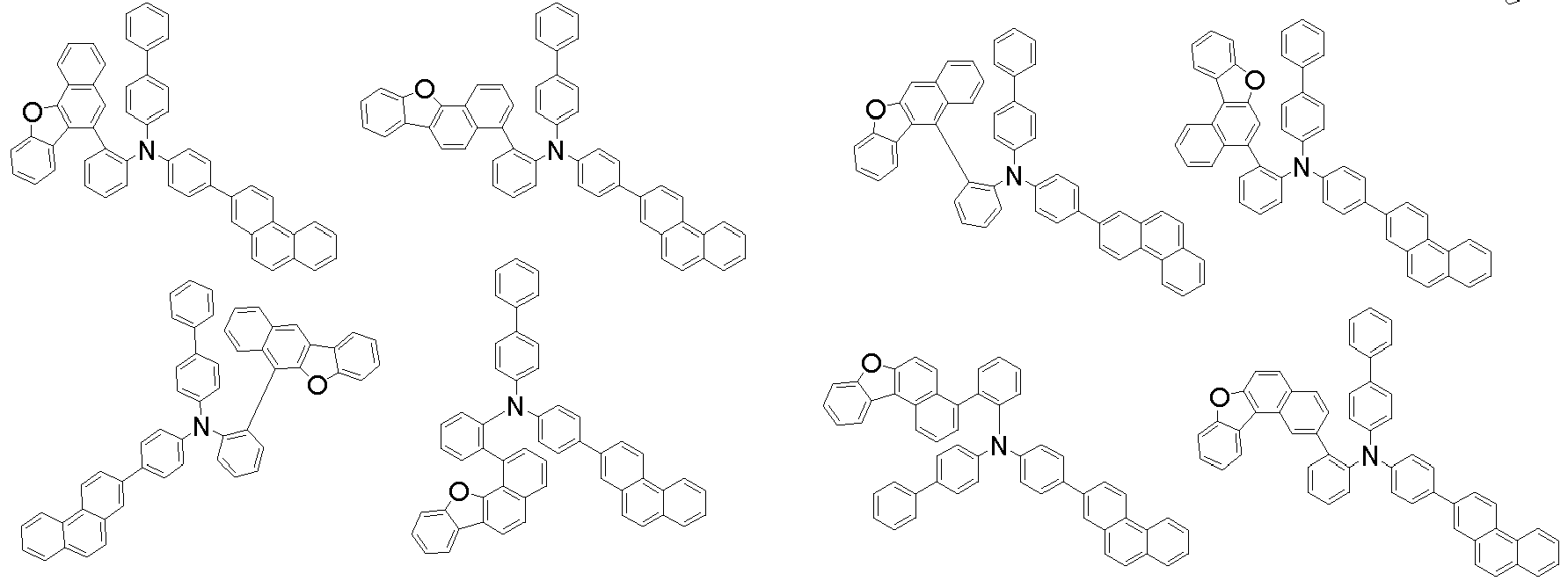


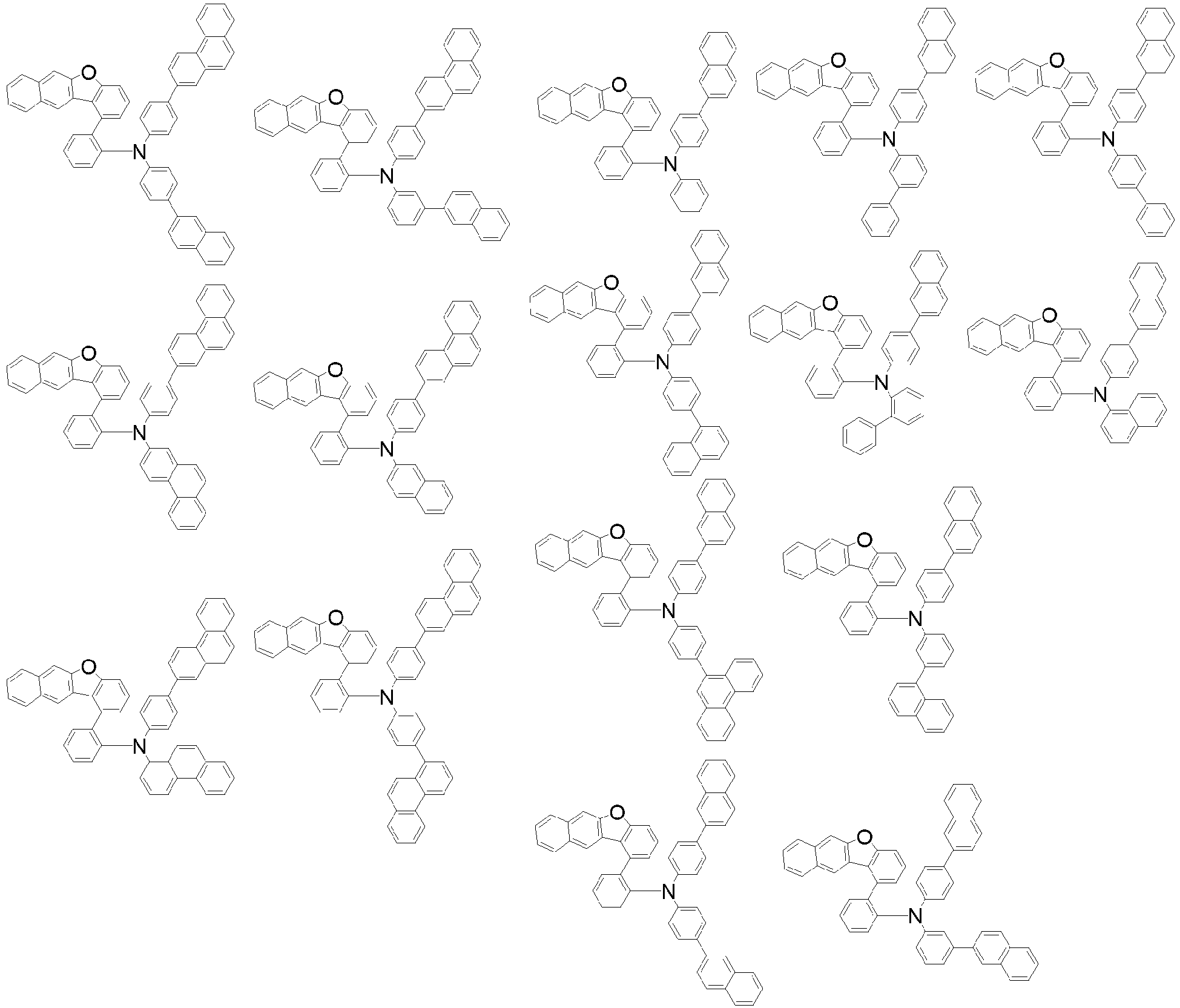



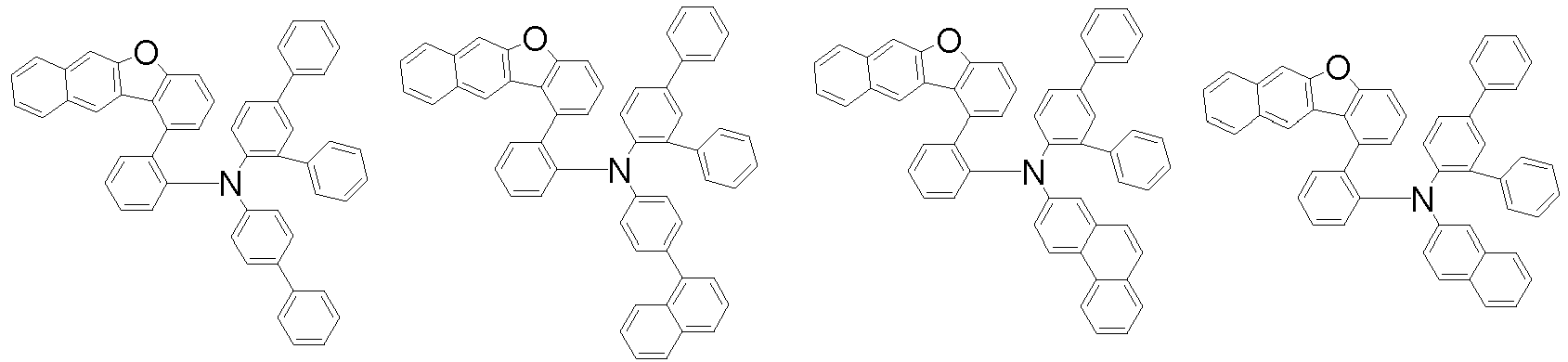


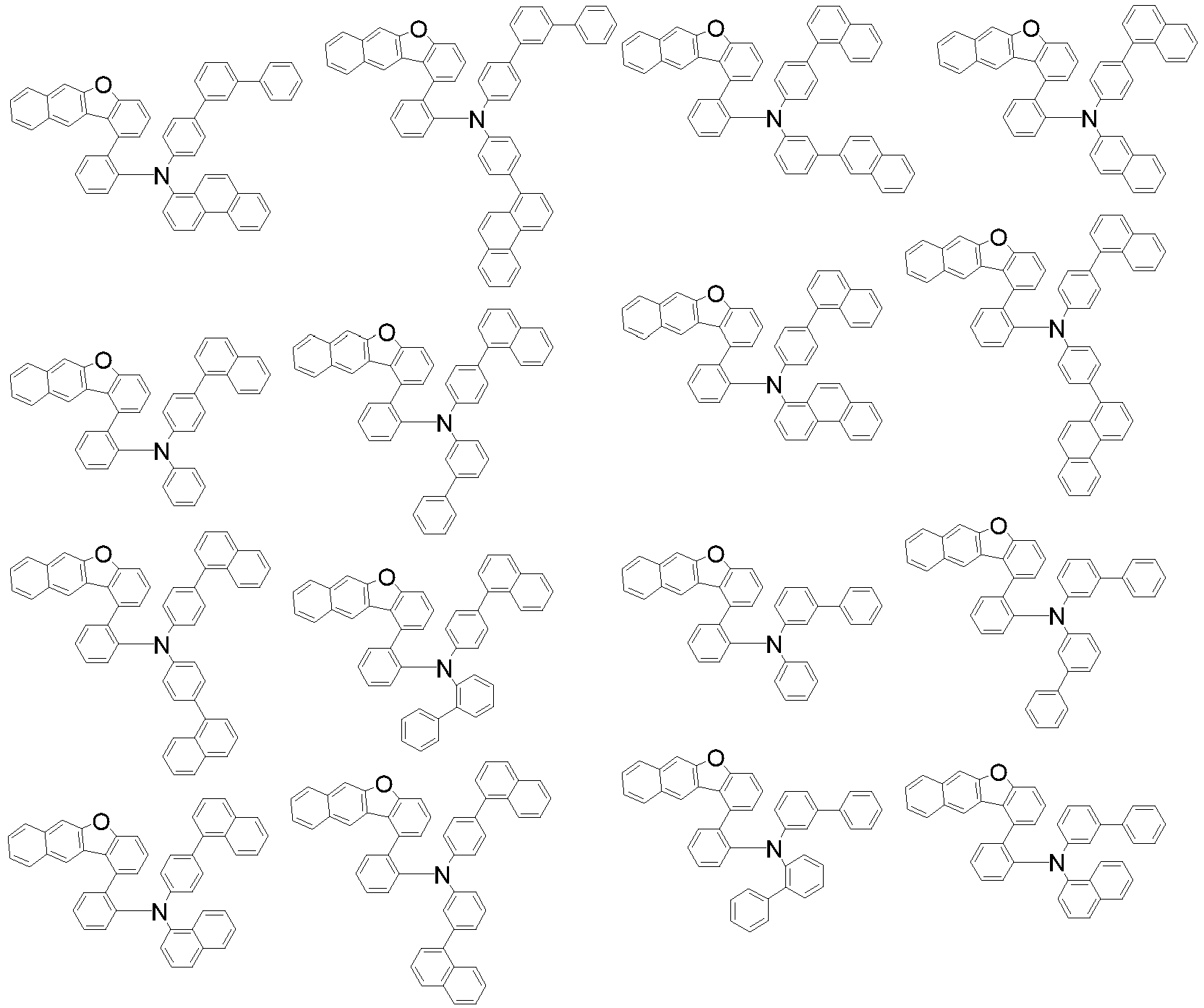


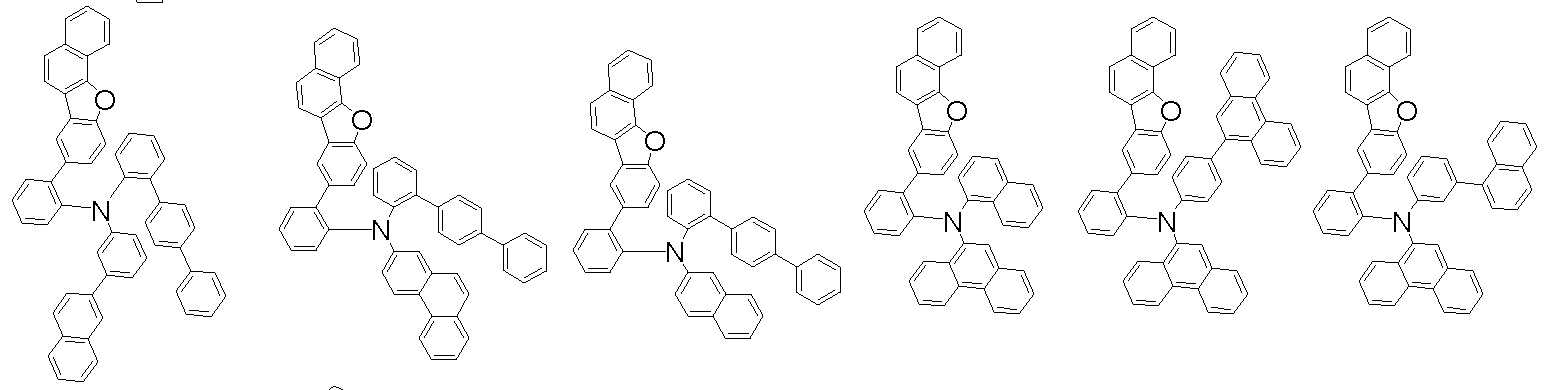


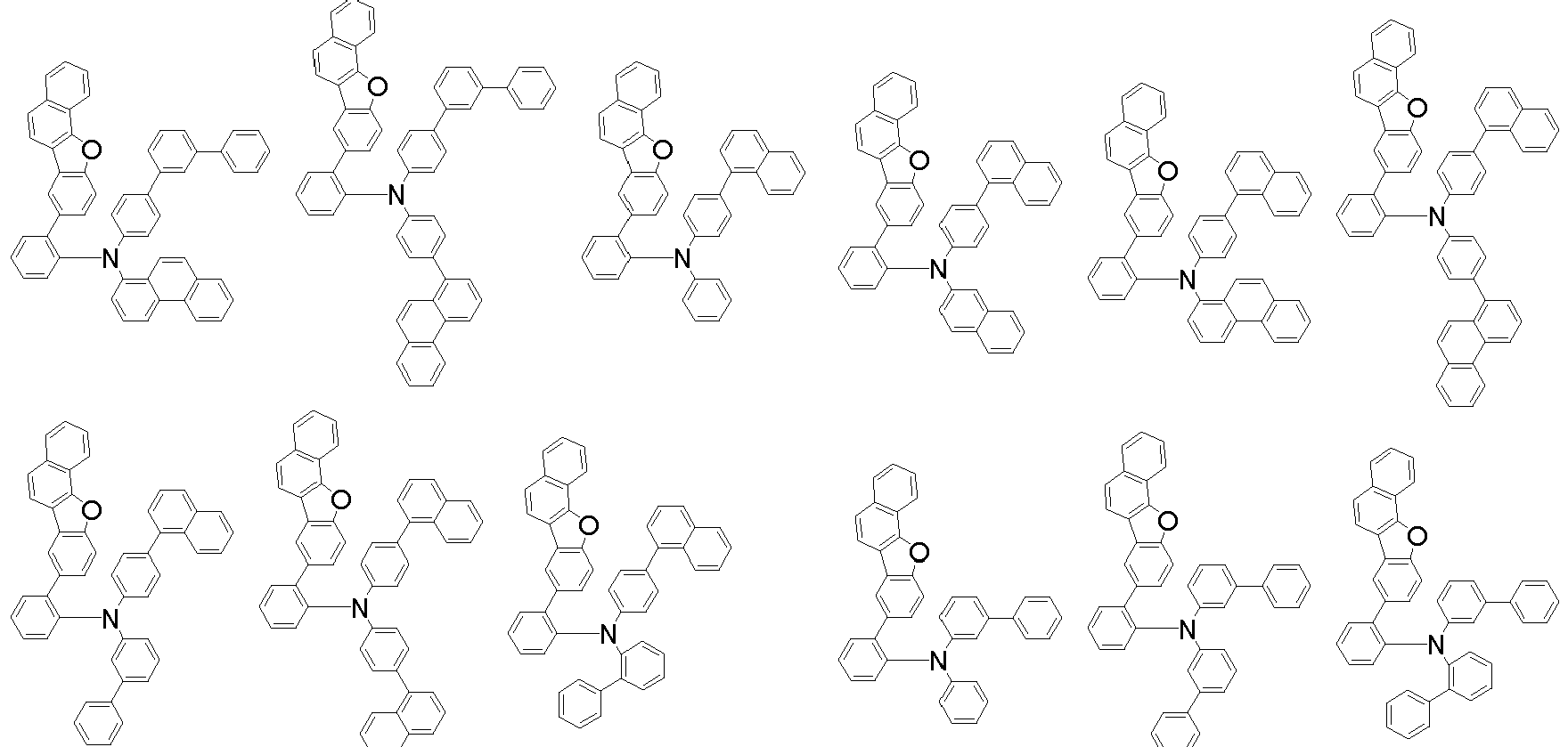
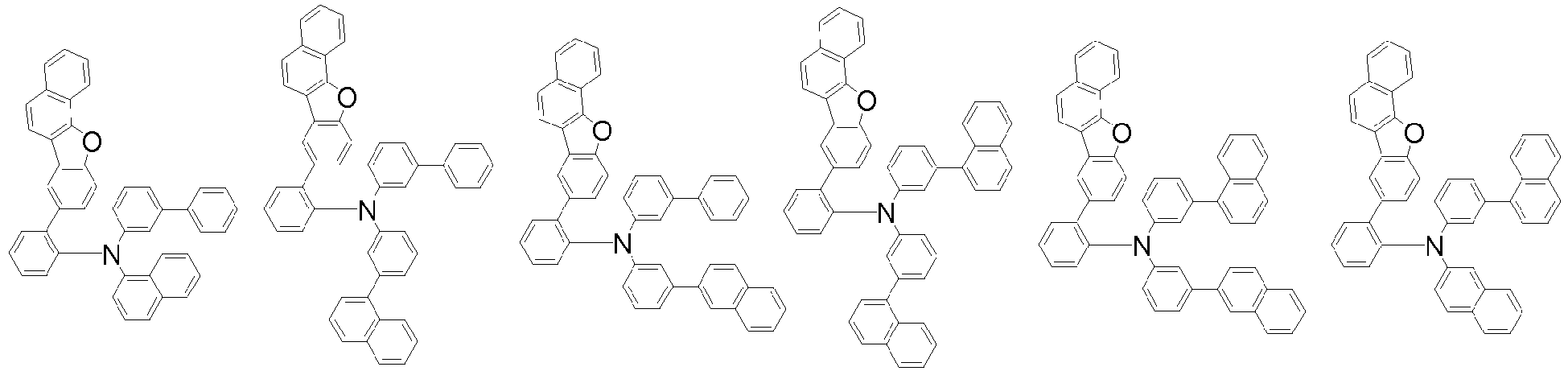


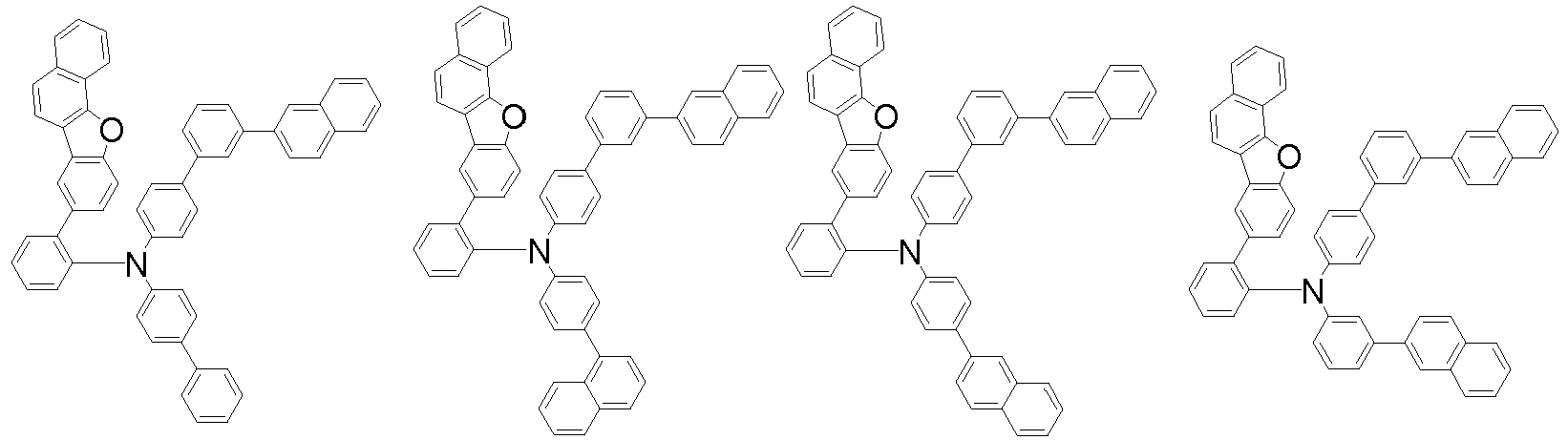


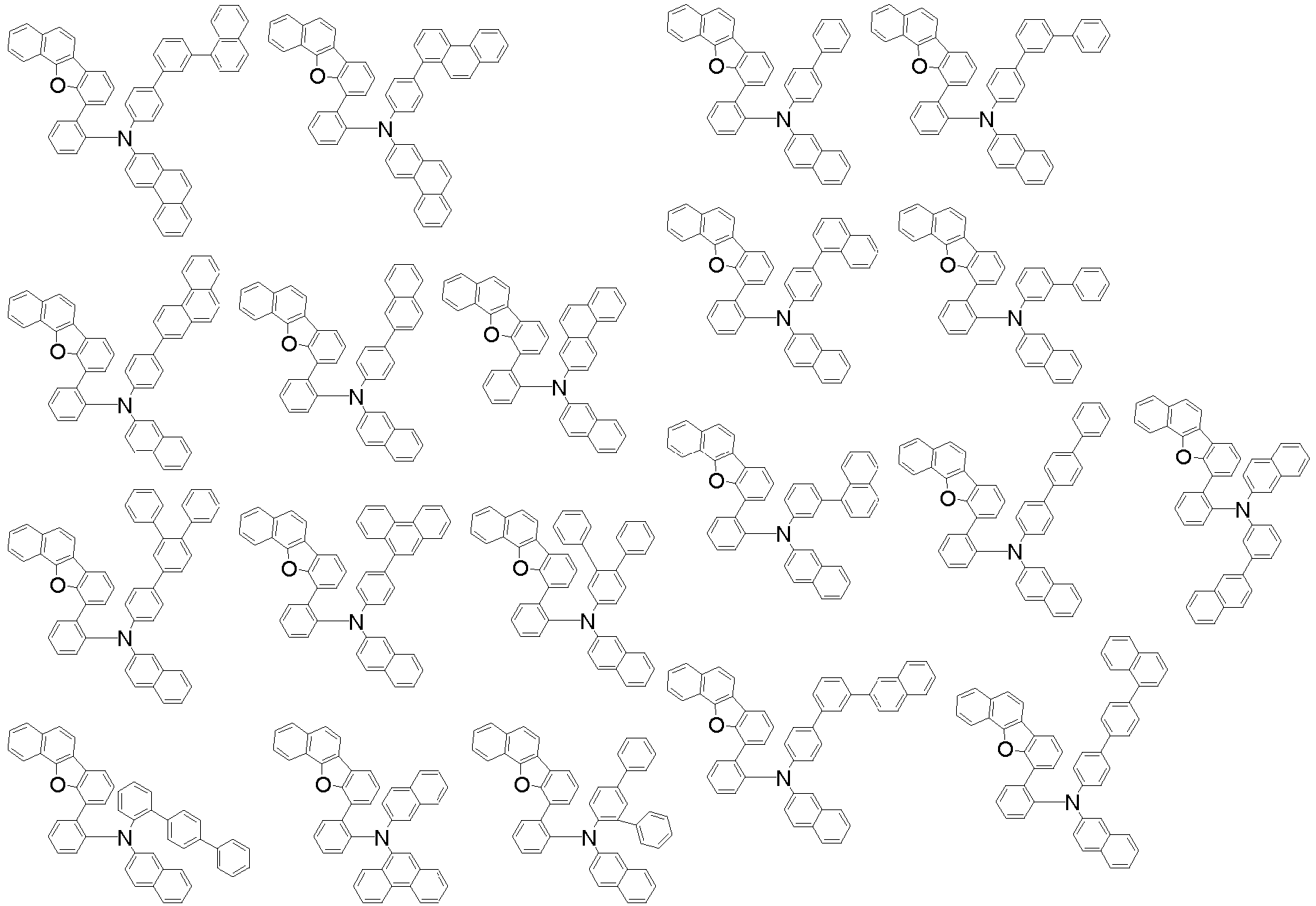


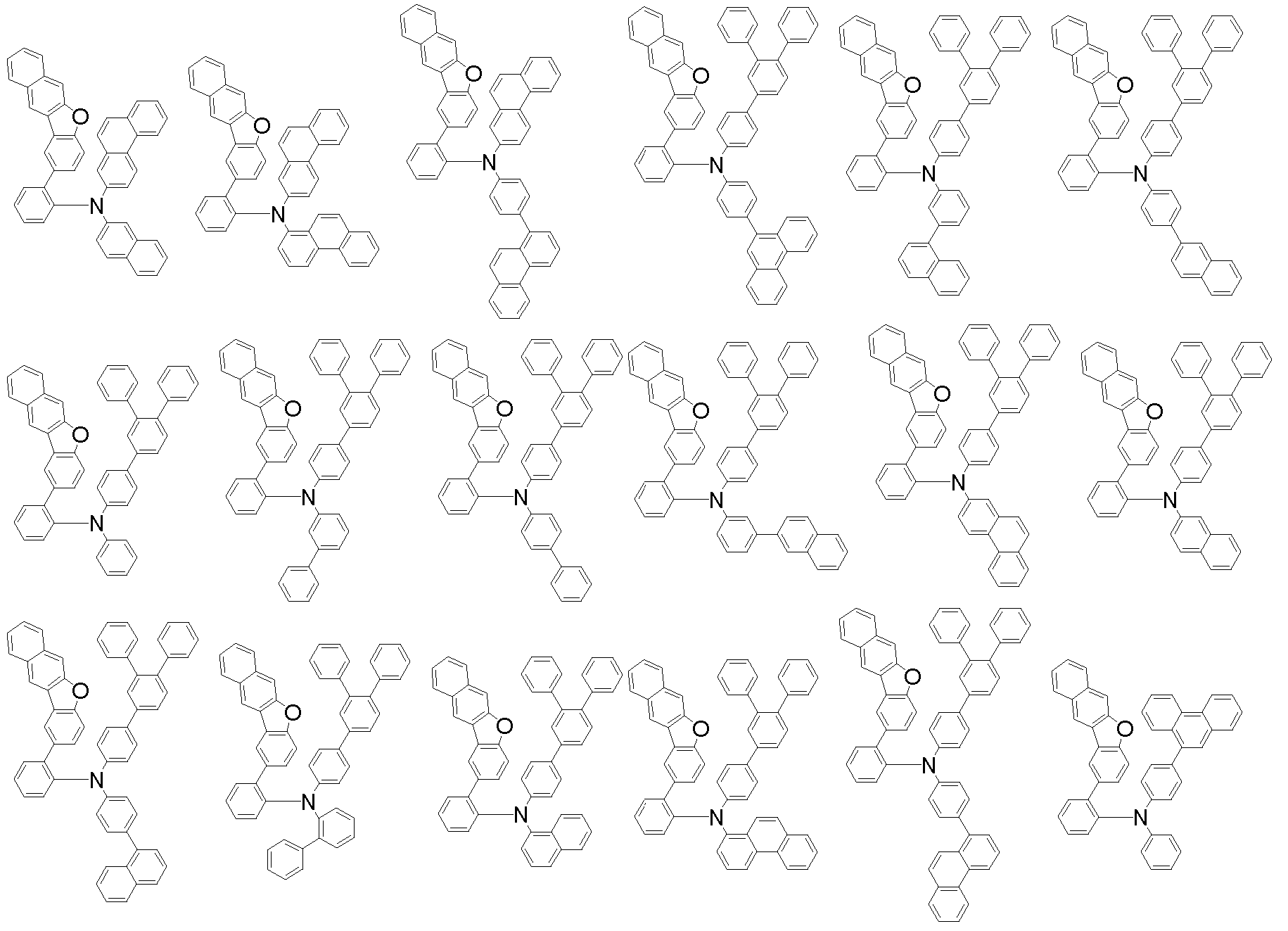


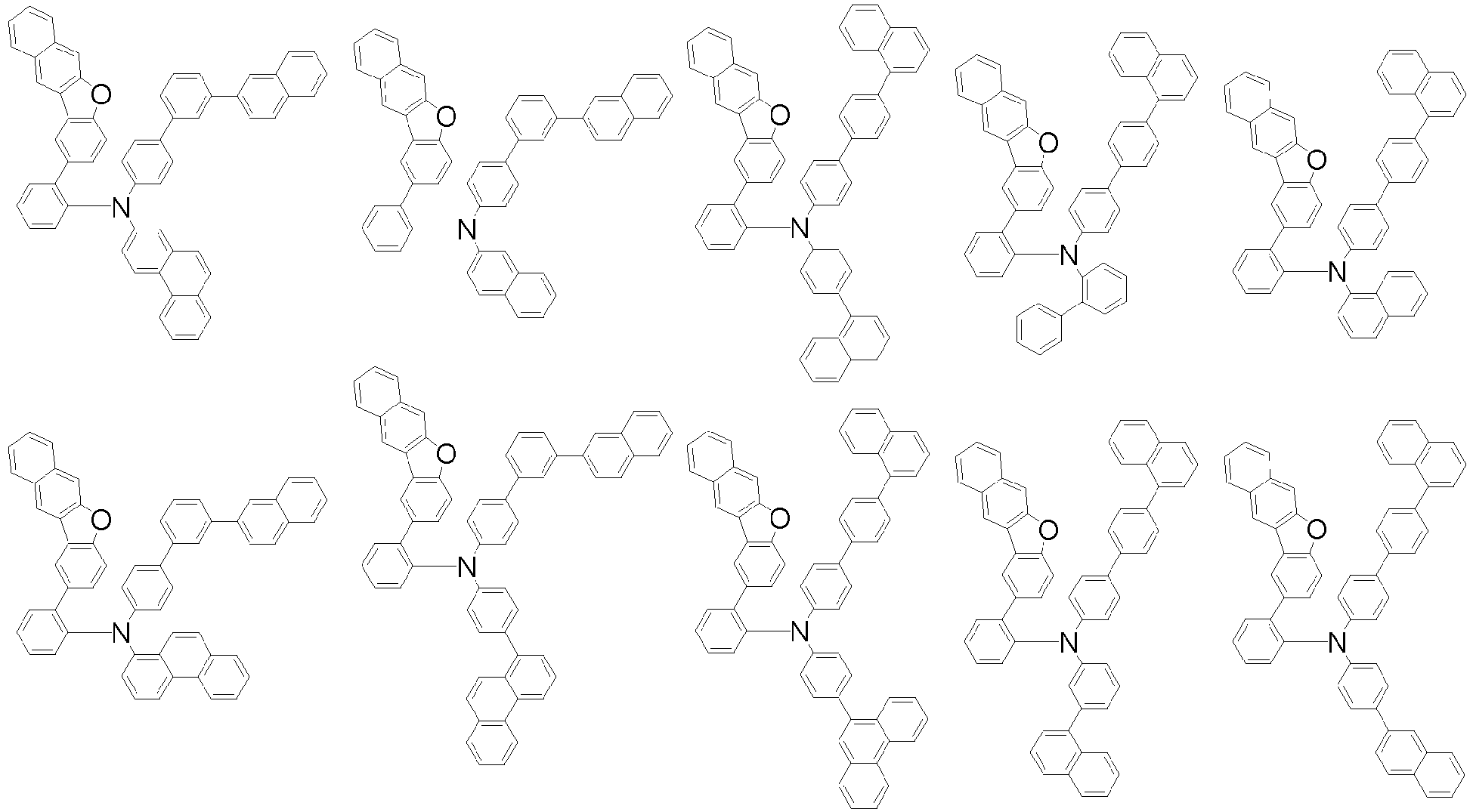


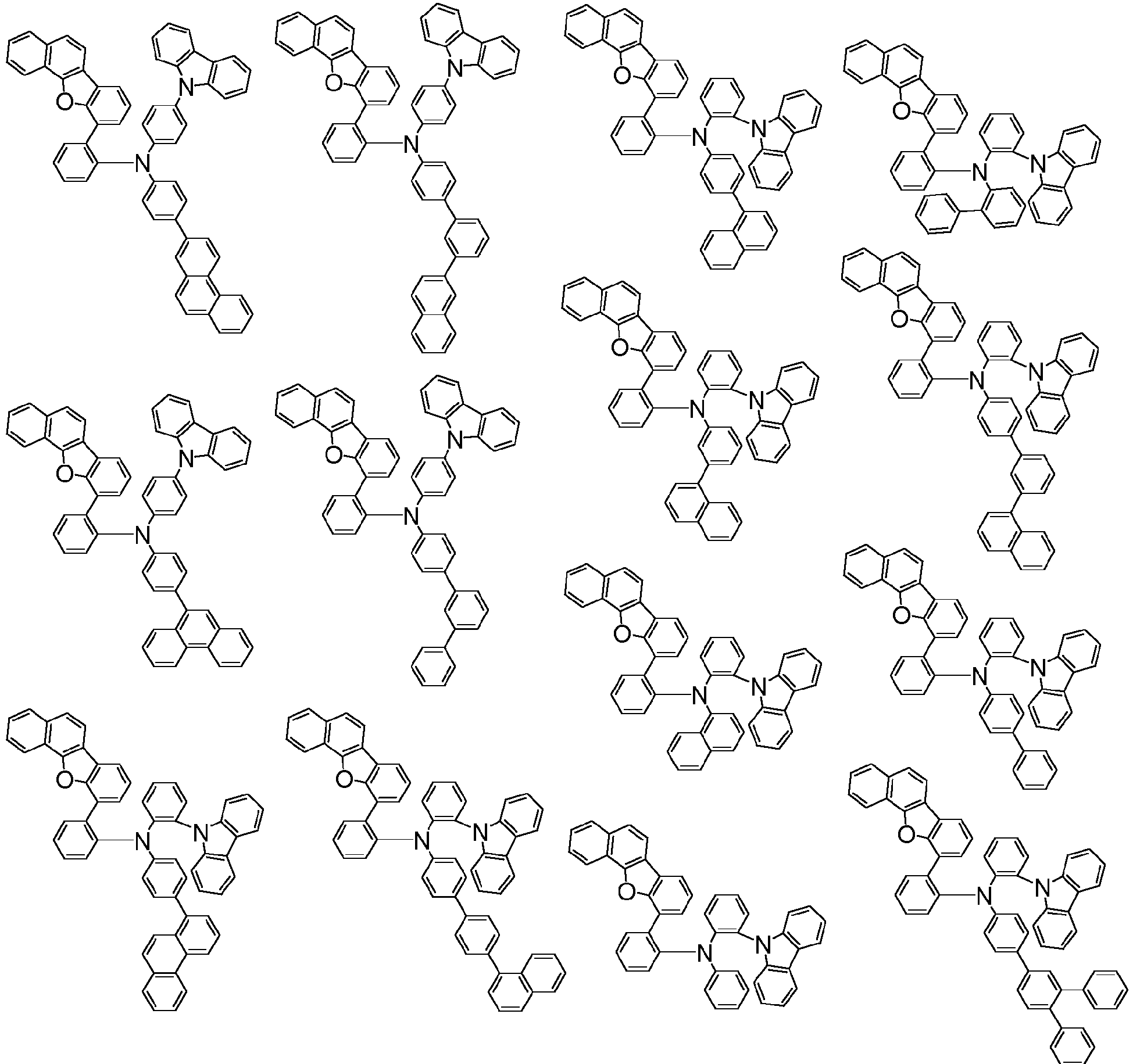


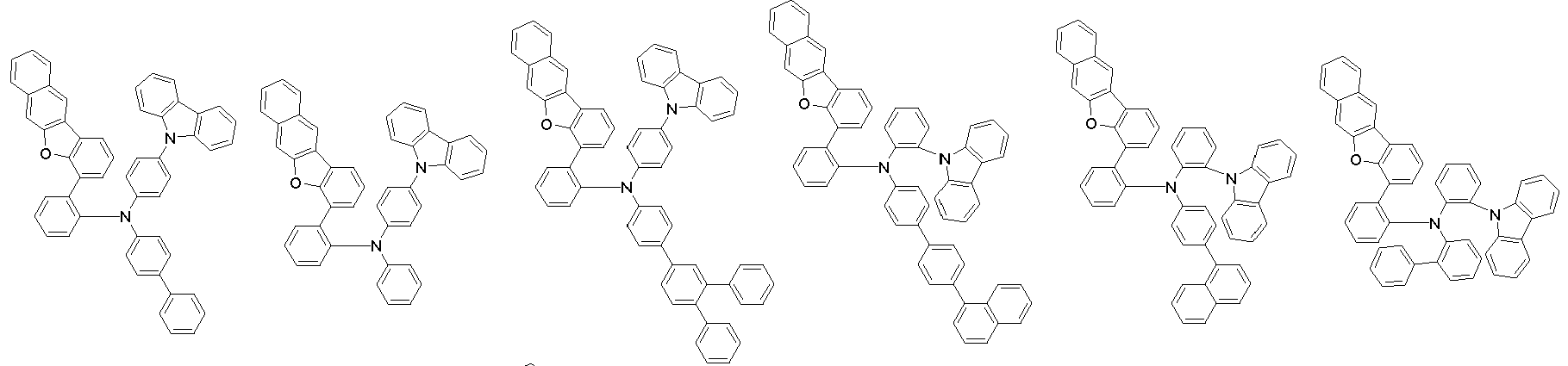


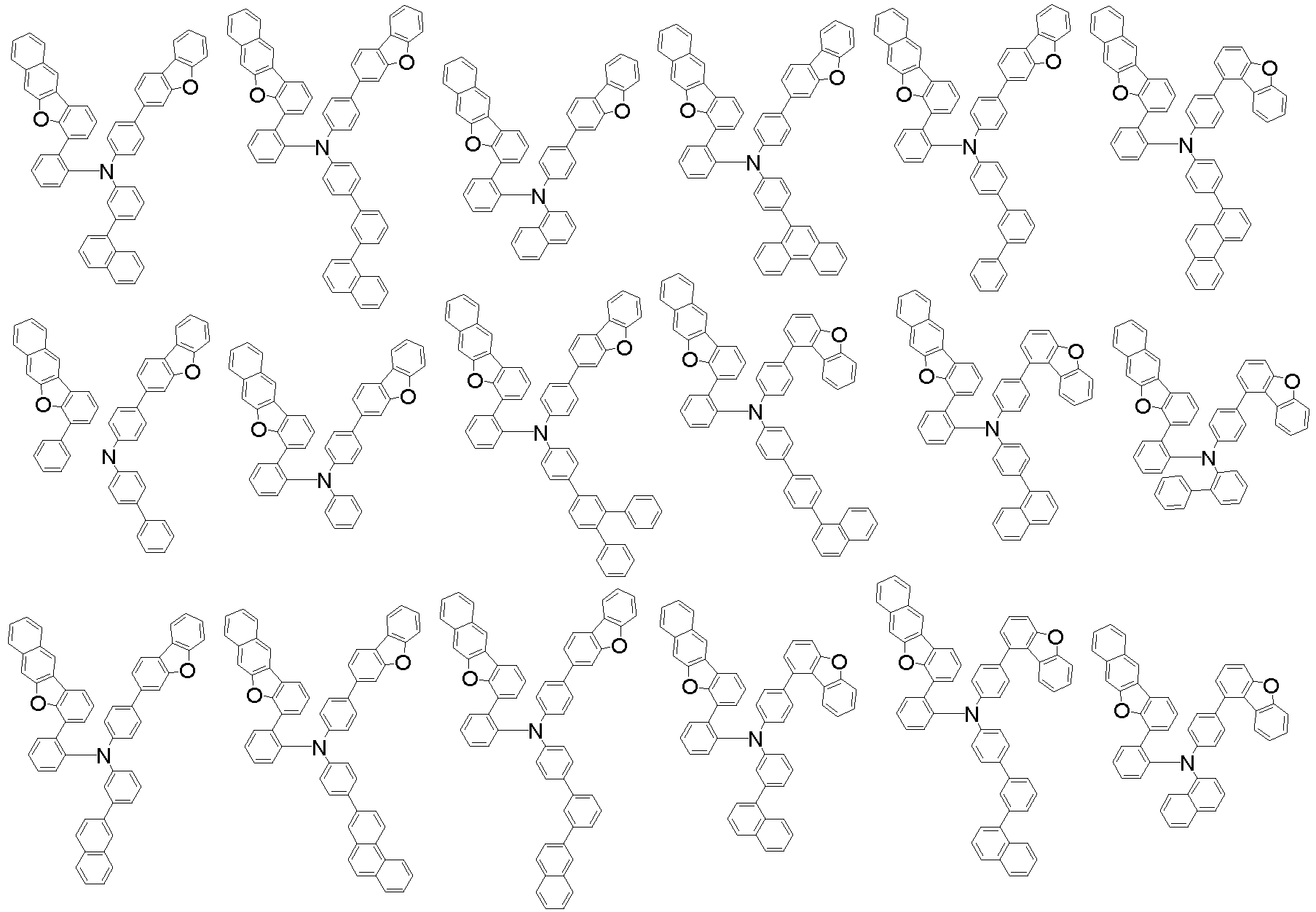


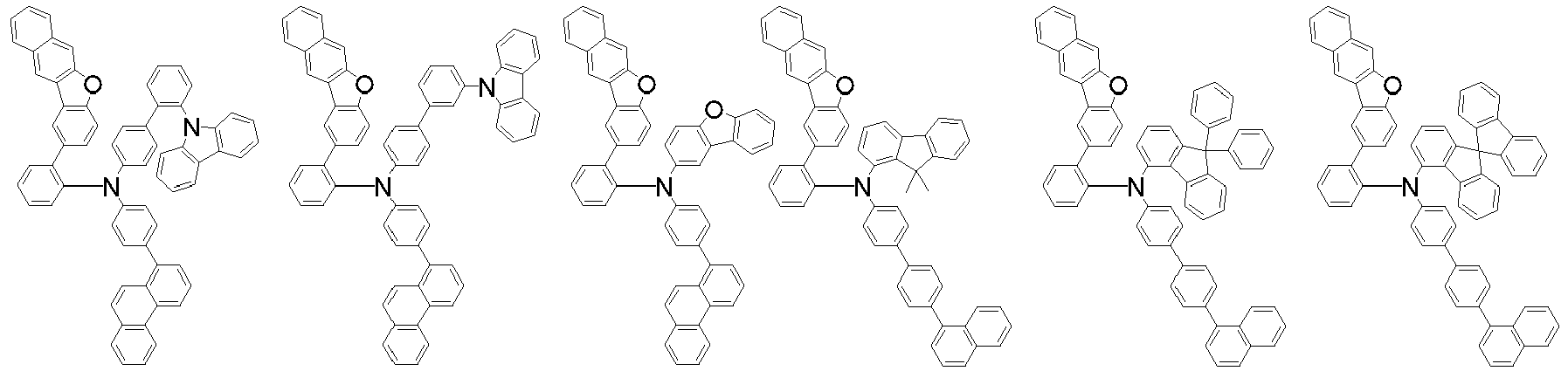


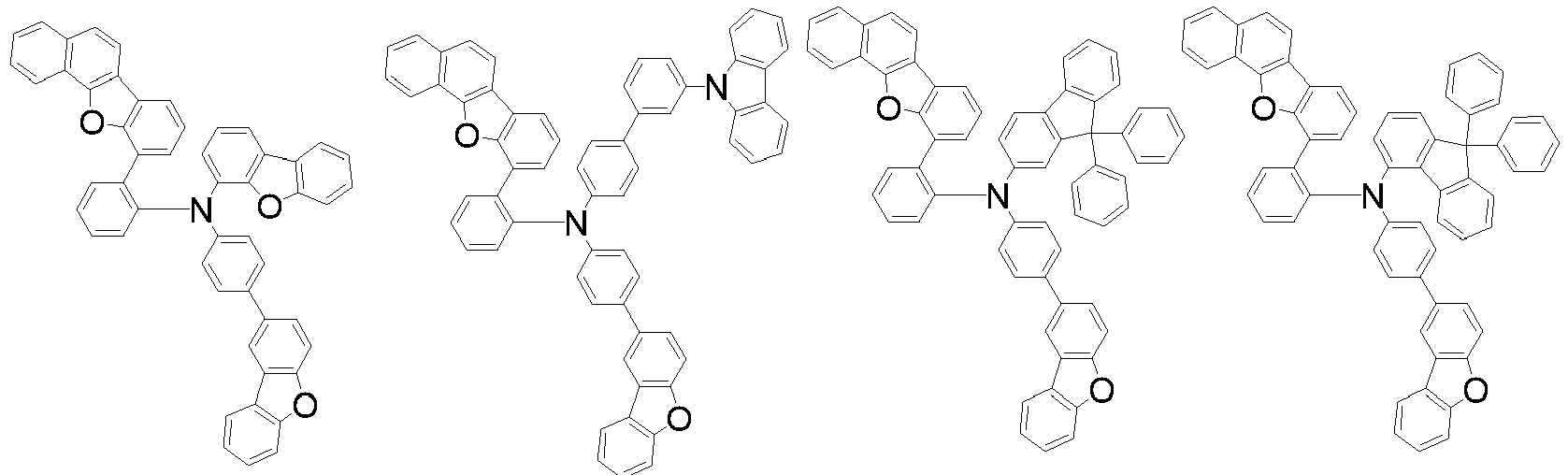


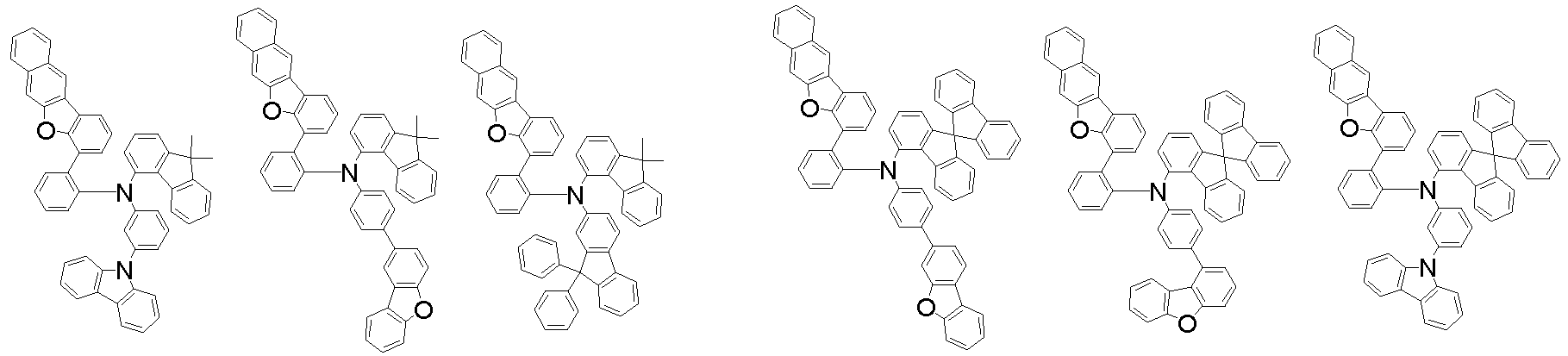


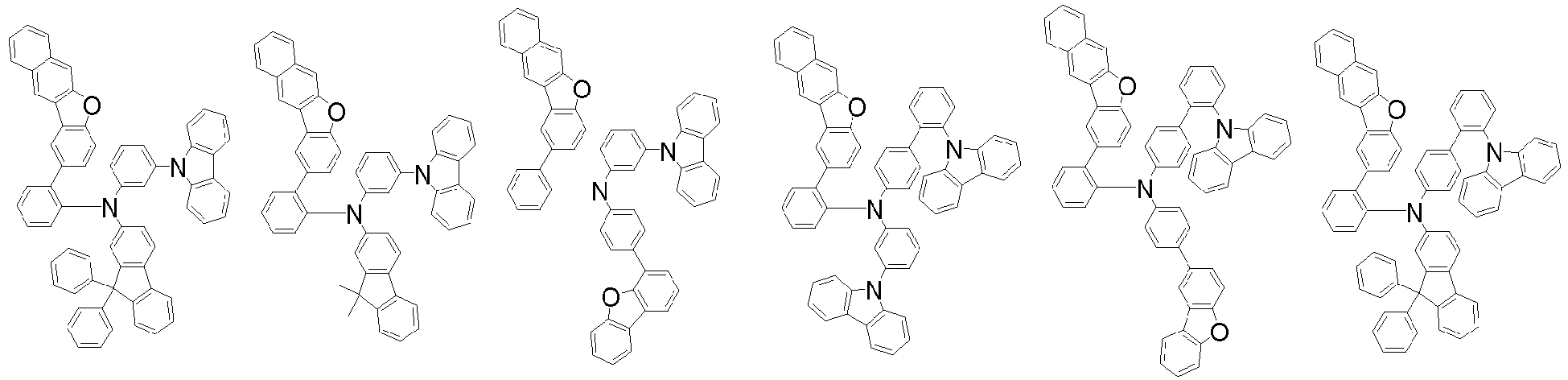


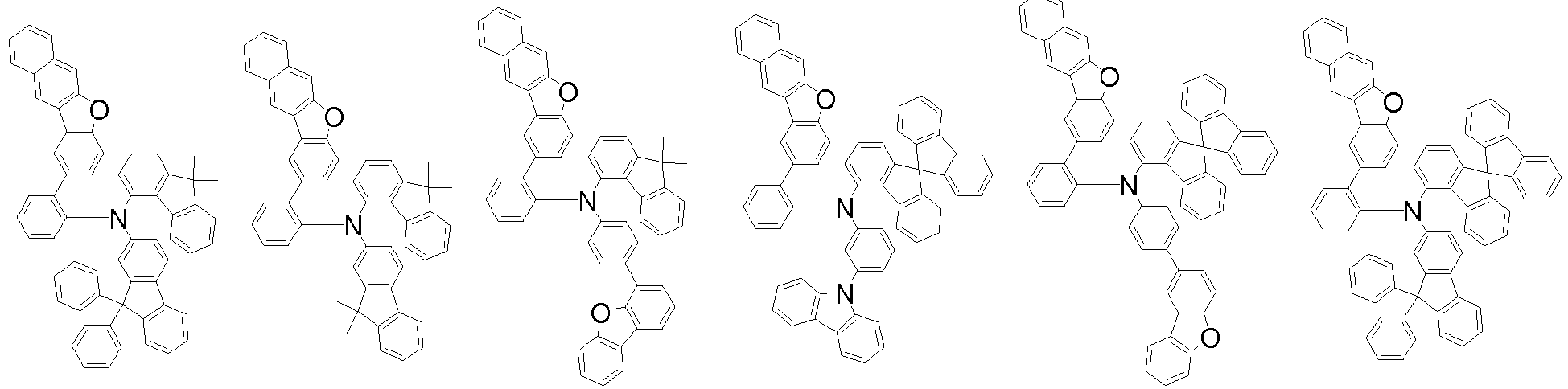


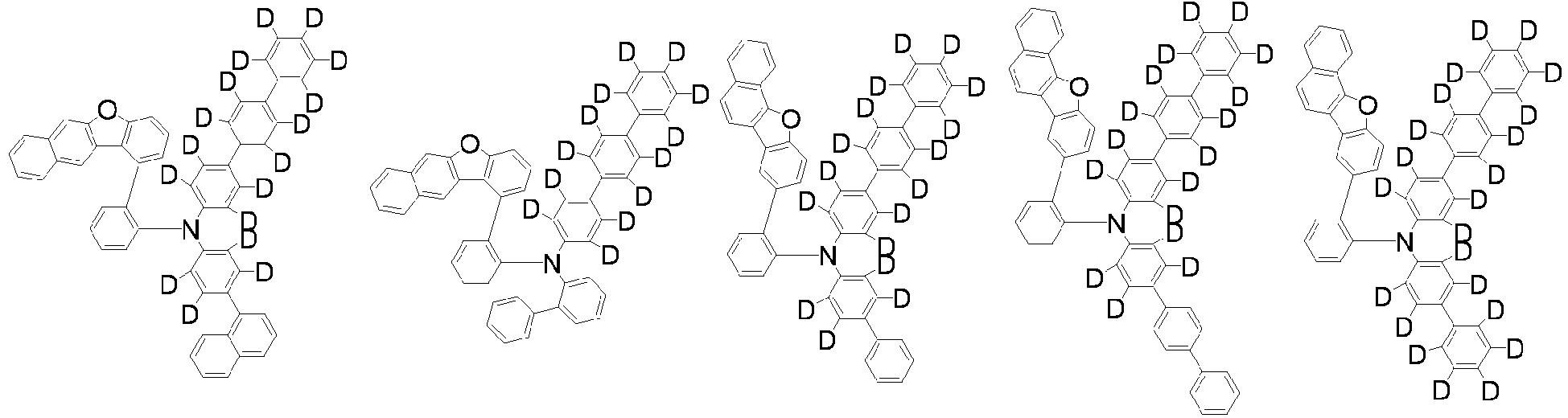
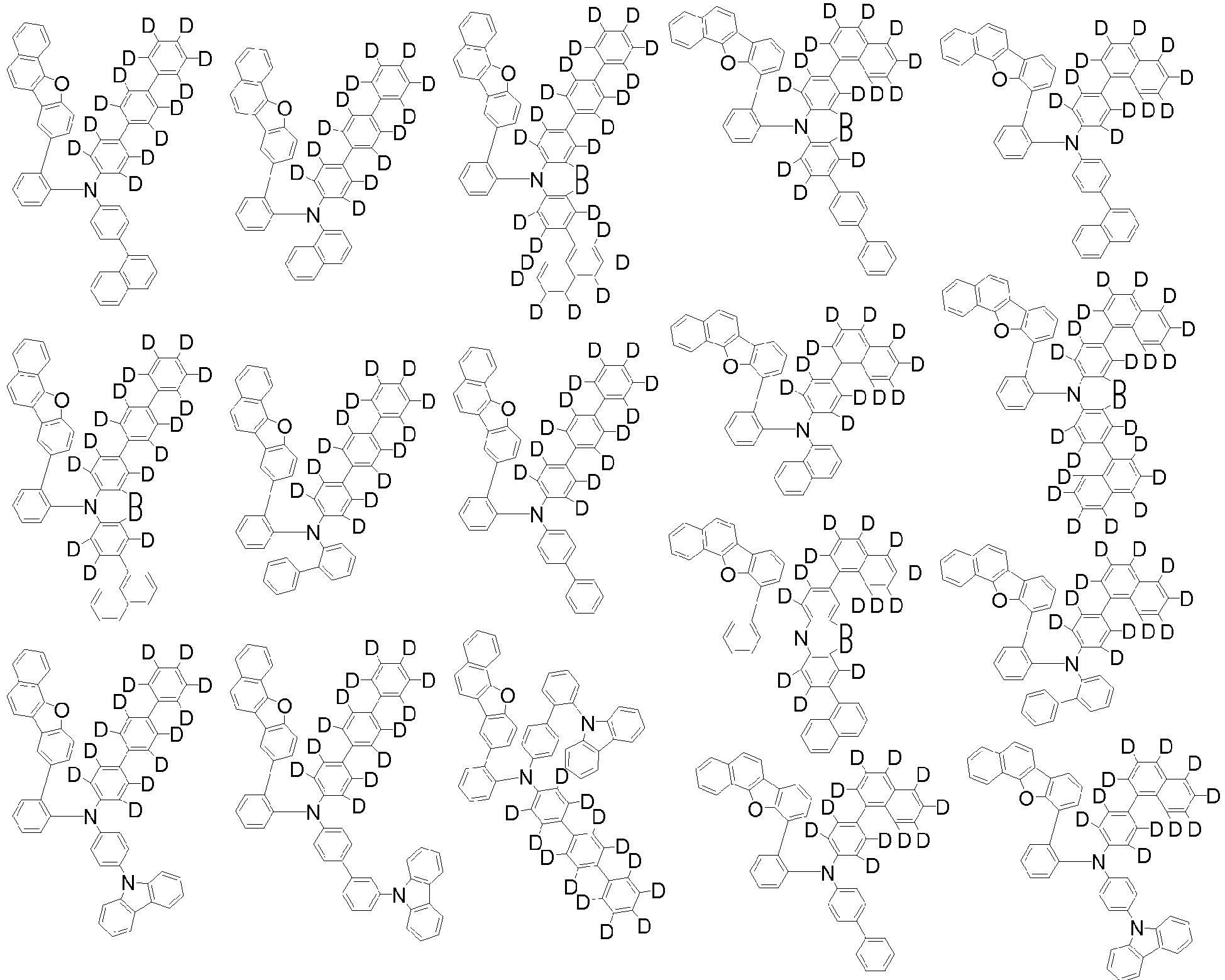


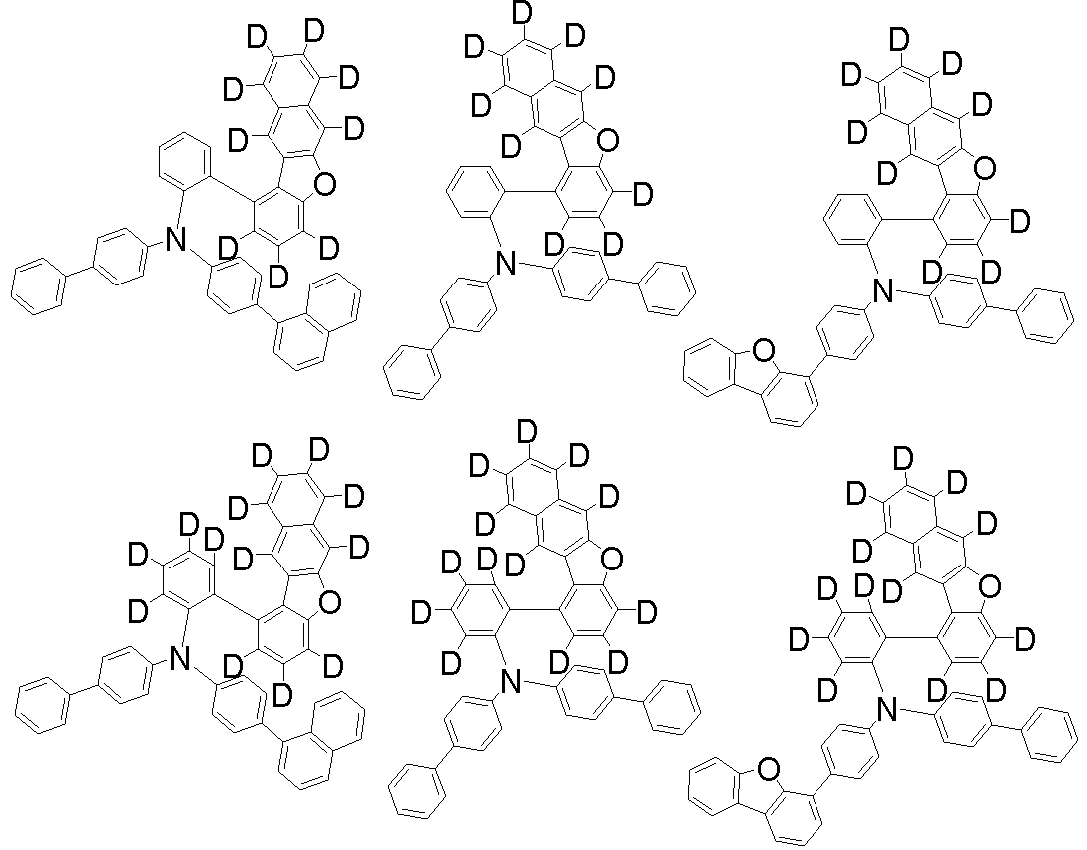




















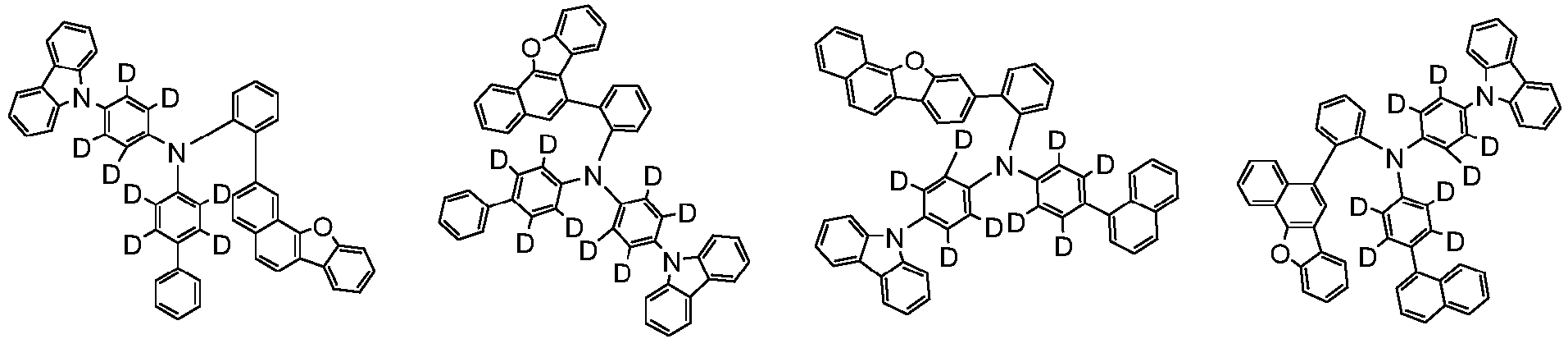
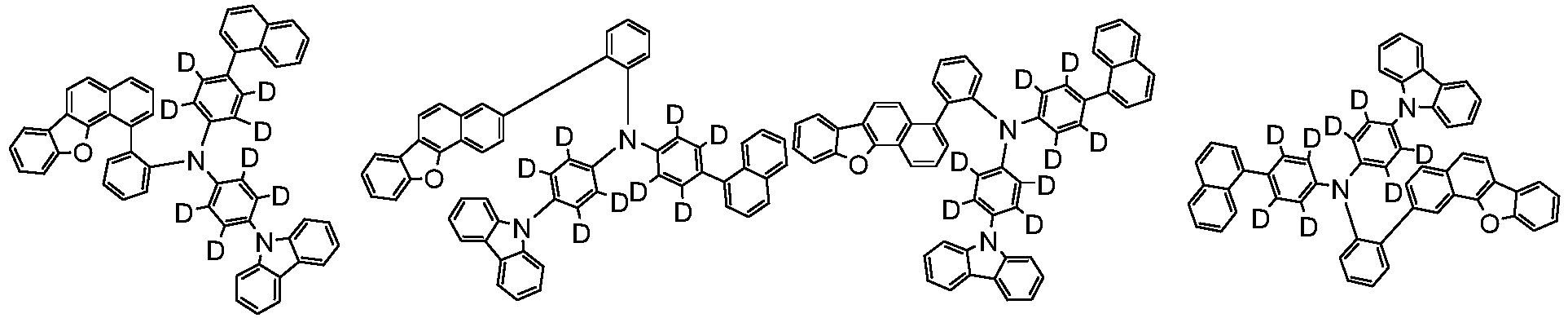


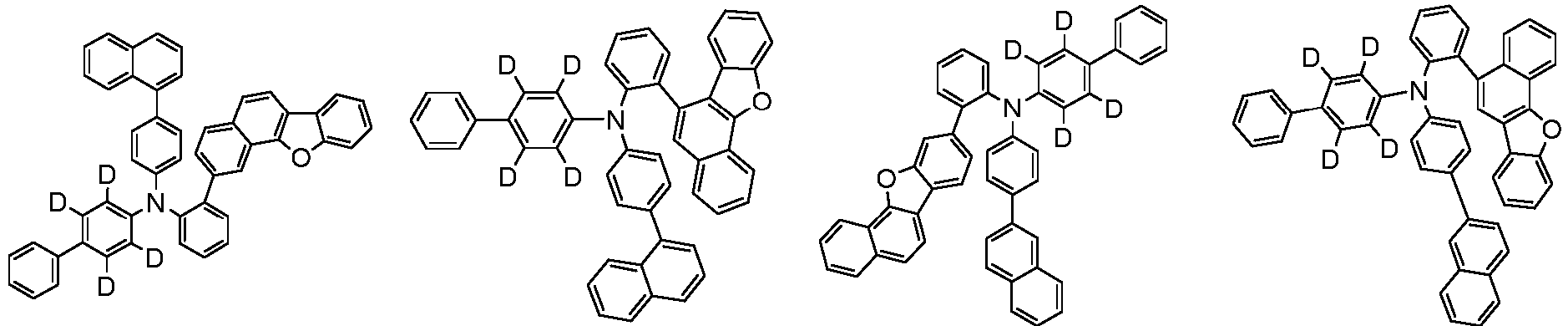











- The material for organic EL devices of the present invention contains the inventive compound. The content of the inventive compound in the material for organic EL devices is 1% by mass or more (including 100%), preferably 10% by mass or more (including 100%), more preferably 50% by mass or more (including 100%), further preferably 80% by mass or more (including 100%), and particularly preferably 90% by mass or more (including 100%). The material for organic EL devices of the present invention is useful for production of an organic EL device.
- The organic EL device of the present invention includes an anode, a cathode, and organic layers disposed between the anode and the cathode. The organic layers include a light emitting layer and at least one of the organic layers contains the inventive compound.
- Examples of the organic layer containing the inventive compound include, but not limited to, a hole transporting zone (hole injecting layer, hole transporting layer, electron blocking layer, exciton blocking layer, etc.) provided between the anode and the light emitting layer, the light emitting layer, a space layer, and an electron transporting zone (electron injecting layer, electron transporting layer, hole blocking layer, etc.) provided between the cathode and the light emitting layer. The inventive compound is preferably used as a material for the hole transporting zone or light emitting layer, more preferably as a material for the hole transporting zone, further preferably as a material for the hole injecting layer, hole transporting layer, electron blocking layer, or exciton blocking layer, and particularly preferably as a material for the hole injecting layer or hole transporting layer, of a fluorescent or phosphorescent EL device.
- The organic EL device of the present invention may be a fluorescence or phosphorescence emission type monochromatic luminescent device, a fluorescence/phosphorescence hybrid type white luminescent device, a simple type having a single light emitting unit, or a tandem type having two or more light emitting units, and is preferably a fluorescence emission type device. Here, the "light emitting unit" refers to a minimum unit that includes organic layers, at least one of which is a light emitting layer, and that emits light by recombination of injected holes and injected electrons.
- An example of a typical device configuration of the simple type organic EL device is the following device configuration.
- The light emitting unit may be a multilayer type having two or more phosphorescence emitting layers and fluorescence emitting layers, and in this case, a space layer may be provided between the light emitting layers for the purpose of preventing excitons generated in the phosphorescence emitting layers from diffusing into the fluorescence emitting layers. A typical layer configuration of the simple type light emitting unit is shown below. The layers in parentheses are optional.
- (a) (hole injecting layer/) hole transporting layer/fluorescence emitting layer/electron transporting layer (/electron injecting layer)
- (b) (hole injecting layer/) hole transporting layer/first fluorescence emitting layer/second fluorescence emitting layer/ electron transporting layer (/electron injecting layer)
- (c) (hole injecting layer/) hole transporting layer/phosphorescence emitting layer/space layer/fluorescence emitting layer/electron transporting layer (/electron injecting layer)
- (d) (hole injecting layer/) hole transporting layer/first phosphorescence emitting layer/second phosphorescence emitting layer/space layer/fluorescence emitting layer/electron transporting layer (/electron injecting layer)
- (e) (hole injecting layer/) hole transporting layer/phosphorescence emitting layer/space layer/first fluorescence emitting layer/second fluorescence emitting layer/electron transporting layer (/electron injecting layer)
- (f) (hole injecting layer/) hole transporting layer/electron blocking layer/fluorescence emitting layer/electron transporting layer (/electron injecting layer)
- (g) (hole injecting layer/) hole transporting layer/exciton blocking layer/fluorescence emitting layer/electron transporting layer (/electron injecting layer)
- (h) (hole injecting layer/) first hole transporting layer/second hole transporting layer/fluorescence emitting layer/electron transporting layer (/electron injecting layer)
- (i) (hole injecting layer/) first hole transporting layer/second hole transporting layer/fluorescence emitting layer/first electron transporting layer/second electron transporting layer (/electron injecting layer)
- (j) (hole injecting layer/) hole transporting layer/fluorescence emitting layer/hole blocking layer/electron transporting layer (/electron injecting layer)
- (k) (hole injecting layer/) hole transporting layer/fluorescence emitting layer/exciton blocking layer/electron transporting layer (/electron injecting layer)
- (l) (hole injecting layer/) first hole transporting layer/second hole transporting layer/first fluorescence emitting layer/second fluorescence emitting layer/first electron transporting layer/second electron transporting layer (/electron injecting layer)
- (m) (hole injecting layer/) first hole transporting layer/second hole transporting layer/third hole transporting layer/first fluorescence emitting layer/second fluorescence emitting layer/first electron transporting layer/second electron transporting layer (/electron injecting layer)
- (n) (hole injecting layer/) first hole transporting layer/second hole transporting layer/third hole transporting layer/fluorescence emitting layer/first electron transporting layer/second electron transporting layer (/electron injecting layer)
- The phosphorescence or fluorescence emitting layers described above can exhibit luminescent colors different from one another. A specific example of the layer configuration is a layer configuration in the light emitting unit (f) of (hole injecting layer/) hole transporting layer/first phosphorescence emitting layer (red light emission)/second phosphorescence emitting layer (green light emission)/space layer/fluorescence emitting layer (blue light emission)/electron transporting layer.
- An electron blocking layer may be appropriately provided between each light emitting layer and a hole transporting layer or a space layer. In addition, a hole blocking layer may be appropriately provided between each light emitting layer and an electron transporting layer. By providing an electron blocking layer or hole blocking layer, electrons or holes can be trapped inside the light emitting layer to increase the probability of recombination of charges in the light emitting layer, thus enhancing the light emitting efficiency.
- An example of a typical device configuration of the tandem type organic EL device is the following device configuration.
- Here, the first light emitting unit and the second light emitting unit can each be independently selected, for example, from the light emitting units as described above.
- The intermediate layer is generally also referred to as intermediate electrode, intermediate conductive layer, charge generating layer, electron withdrawing layer, connection layer, or intermediate insulating layer, and a known material configuration in which electrons are supplied to the first light emitting unit and holes are supplied to the second light emitting unit can be used.
-
Fig. 1 is a schematic diagram illustrating an example of the configuration of the organic EL device of the present invention. An organic EL device 1 includes asubstrate 2, ananode 3, acathode 4, and alight emitting unit 10 disposed between theanode 3 and thecathode 4. Thelight emitting unit 10 includes alight emitting layer 5. The organic EL device 1 includes a hole transporting zone 6 (hole injecting layer, hole transporting layer, etc.) between the light emittinglayer 5 and theanode 3, and an electron transporting zone 7 (electron injecting layer, electron transporting layer, etc.) between the light emittinglayer 5 and thecathode 4. In addition, an electron blocking layer (not shown) may be provided on theanode 3 side of thelight emitting layer 5 and a hole blocking layer (not shown) may be provided on thecathode 4 side of thelight emitting layer 5. This enables to trap electrons or holes in thelight emitting layer 5 to further increase the efficiency of generating excitons in thelight emitting layer 5. -
Fig. 2 is a schematic diagram illustrating another configuration of the organic EL device of the present invention. Anorganic EL device 11 includes thesubstrate 2, theanode 3, thecathode 4, and alight emitting unit 20 disposed between theanode 3 and thecathode 4. Thelight emitting unit 20 includes thelight emitting layer 5. A hole transporting zone disposed between theanode 3 and thelight emitting layer 5 is formed of ahole injecting layer 6a, a firsthole transporting layer 6b, and a secondhole transporting layer 6c. An electron transporting zone disposed between the light emittinglayer 5 and thecathode 4 is formed of a firstelectron transporting layer 7a and a secondelectron transporting layer 7b. -
Fig. 3 is a schematic diagram illustrating another configuration of the organic EL device of the present invention. Anorganic EL device 12 includes thesubstrate 2, theanode 3, thecathode 4, and alight emitting unit 30 disposed between theanode 3 and thecathode 4. Thelight emitting unit 30 includes thelight emitting layer 5. A hole transporting zone disposed between theanode 3 and thelight emitting layer 5 is formed of thehole injecting layer 6a, the firsthole transporting layer 6b, the secondhole transporting layer 6c, and a thirdhole transporting layer 6d. An electron transporting zone disposed between the light emittinglayer 5 and thecathode 4 is formed of the firstelectron transporting layer 7a and the secondelectron transporting layer 7b. - In the present invention, a host combined with a fluorescent dopant material (fluorescence emitting material) is referred to as a fluorescent host, and a host combined with a phosphorescent dopant material is referred to as a phosphorescent host. The fluorescent host and the phosphorescent host are not distinguished only by the molecular structure. In other words, the phosphorescent host means a material that forms a phosphorescence emitting layer containing a phosphorescent dopant, and does not mean that it cannot be used as a material that forms a fluorescence emitting layer. The same applies to the fluorescent host.
- The substrate is used as a support of the organic EL device. As the substrate, for example, a plate of glass, quartz, or a plastic can be used. A flexible substrate may be used. An example of the flexible substrate is a plastic substrate of polycarbonate, polyarylate, polyethersulfone, polypropylene, polyester, polyvinyl fluoride, or polyvinyl chloride. An inorganic vapor deposition film can also be used.
- For the anode formed on the substrate, a metal, an alloy, an electrically conductive compound, a mixture thereof, or the like that has a high work function (specifically 4.0 eV or more) is preferably used. Specific examples thereof include indium oxide-tin oxide (ITO: indium tin oxide), indium oxide-tin oxide containing silicon or silicon oxide, indium oxide-zinc oxide, indium oxide containing tungsten oxide and zinc oxide, and graphene. Other examples include gold (Au), platinum (Pt), nickel (Ni), tungsten (W), chromium (Cr), molybdenum (Mo), iron (Fe), cobalt (Co), cupper (Cu), palladium (Pd), titanium (Ti), and nitride of the metals (for example, titanium nitride).
- A film of such a material is generally formed by a spattering method. For example, indium oxide-zinc oxide can be formed by a spattering method by using a target obtained by adding to indium oxide 1 to 10wt% of zinc oxide based on the indium oxide, and indium oxide containing tungsten oxide and zinc oxide can be formed by a spattering method by using a target obtained by adding to indium oxide 0.5 to 5wt% of tungsten oxide and 0.1 to 1wt% of zinc oxide based on the indium oxide. Alternatively, a film of such a material may be produced by a vacuum vapor deposition method, a coating method, an inkjet method, a spin-coating method, or the like.
- As mentioned above, the organic layer may include a hole transporting zone between the anode and the light emitting layer. The hole transporting zone is composed of a hole injecting layer, a hole transporting layer, an electron blocking layer, and the like. Preferably, the hole transporting zone contains the inventive compound. It is preferable that at least one layer of these layers constituting the hole transporting layer contains the inventive compound, and it is particularly preferable that the hole transporting layer contains the inventive compound.
- The hole injecting layer formed in contact with the anode is, regardless of the work function of the anode, formed by using a material in which hole injection is easy, and thus a material that is generally used as an electrode material (for example, a metal, an alloy, an electrically conductive compound, or a mixture thereof, or an element belonging to the
group 1 or 2 in the periodic table) can be used. - An element belonging to the
group 1 or 2 in the periodic table which is a material having a small work function, specifically, an alkali metal, such as lithium (Li) or cesium (Cs), or an alkaline earth metal, such as magnesium (Mg), calcium (Ca), or strontium (Sr), and an alloy containing them (for example, MgAg, AlLi), a rare earth metal, such as europium (Eu) or ytterbium (Yb), or an alloy containing them, or the like, can be used. When the anode is formed using an alkali metal, an alkaline earth metal, or an alloy containing them, a vacuum vapor deposition method or a spattering method can be adopted. When silver paste or the like is used, a coating method, an inkjet method, or the like can be adopted. - The hole injecting layer is a layer containing a material having a high hole injecting capability (hole injecting material), and is formed between the anode and the light emitting layer, or between a hole transporting layer, if present, and the anode.
- As a hole injecting material other than the inventive compound, molybdenum oxide, titanium oxide, vanadium oxide, rhenium oxide, ruthenium oxide, chromium oxide, zirconium oxide, hafnium oxide, tantalum oxide, silver oxide, tungsten oxide, manganese oxide, or the like can be used.
- Other examples of a material for the hole injecting layer include aromatic amine compounds, such as 4,4',4"-tris(N,N-diphenylamino)triphenylamine (abbreviation: TDATA), 4,4',4"-tris[N-(3-methylphenyl)-N-phenylamino]triphenylamine (abbreviation: MTDATA), 4,4'-bis[N-(4-diphenylaminophenyl)-N-phenylamino]biphenyl (abbreviation: DPAB), 4,4'-bis(N- f 4-[N'-(3-methylphenyl)-N'-phenylamino]phenyl}-N-phenylamino)biphenyl (abbreviation: DNTPD), 1,3,5-tris[N-(4-diphenylaminophenyl)-N-phenylamino]benzene (abbreviation: DPA3B), 3-[N-(9-phenylcarbazol-3-yl)-N-phenylamino]-9-phenylcarbazole (abbreviation: PCzPCA1), 3,6-bis[N-(9-phenylcarbazol-3-yl)-N-phenylamino]-9-phenylcarbazole (abbreviation: PCzPCA2), and 3-[N-(1-naphtyl)-N-(9-phenylcarbazol-3-yl)amino]-9-phenylcarbazole (abbreviation: PCzPCN1), which are low-molecular weight organic compounds.
- A high-molecular weight compound (oligomer, dendrimer, polymer, or the like) can also be used. Examples of the high-molecular weight compound include poly(N-vinylcarbazole) (abbreviation: PVK), poly(4-vinyltriphenylamine) (abbreviation: PVTPA), poly[N-(4-{N'-[4-(4-diphenylamino)phenyl]phenyl-N'-phenylamino}phenyl)methacrylamide] (abbreviation: PTPDMA), and poly[N,N'-bis(4-butylphenyl)-N,N'-bis(phenyl)benzidine] (abbreviation: Poly-TPD). A high-molecular weight compound with an acid, such as poly(3,4-ethylenedioxythiophene)/poly(styrenesulfonic acid) (PEDOT/PSS) or polyaniline/poly(styrenesulfonic acid) (PAni/PSS), added thereto can also be used.
- Furthermore, an acceptor material, such as a hexaazatriphenylene (HAT) compound represented by the following formula (K), is also preferably used.

- Examples of R127 include a methyl group, an ethyl group, an n-propyl group, an isopropyl group, an n-butyl group, an isobutyl group, a t-butyl group, a cyclopentyl group, and a cyclohexyl group.
- The hole transporting layer is a layer containing a material having a high hole transporting capability (hole transporting material), and is formed between the anode and the light emitting layer or between a hole injecting layer, if present, and the light emitting layer. The inventive compound may be used, for the hole transporting layer, alone or in combination with the following compound.
- The hole transporting layer may have a monolayer structure or a multilayer structure including two or more layers. For example, the hole transporting layer may have a two-layer structure including a first hole transporting layer (anode side) and a second hole transporting layer (cathode side). That is, the hole transporting zone may include a first hole transporting layer on the anode side and a second hole transporting layer on the cathode side. Further, the hole transporting layer may have a three-layer structure including, in order from the anode side, a first hole transporting layer, a second hole transporting layer, and a third hole transporting layer. That is, the third hole transporting layer may be arranged between the second hole transporting layer and the light emitting layer.
- In an aspect of the present invention, the hole transporting layer of the monolayer structure is preferably adjacent to the light emitting layer, and the hole transporting layer that is the nearest to the cathode in the multilayer structure, for example, the second hole transporting layer in the two-layer structure and the third hole transporting layer in the three-layer structure are preferably adjacent to the light emitting layer. In another embodiment of the present invention, an electron blocking layer as described later or the like may be interposed between the hole transporting layer of the monolayer structure and the light emitting layer or between the hole transporting layer that is the nearest to the light emitting layer in the multilayer structure and the light emitting layer.
- When the hole transporting layer has a two-layer structure, at least one of the first hole transporting layer and the second hole transporting layer contains the inventive compound. That is, the inventive compound is contained only in the first hole transporting layer, or only in the second hole transporting layer, or in both the first hole transporting layer and the second hole transporting layer. In an embodiment of the present invention, the inventive compound is preferably contained in the second hole transporting layer. That is, it is preferable that the inventive compound is contained only in the second hole transporting layer, or the inventive compound is contained in the first hole transporting layer and the second hole transporting layer.
- When the hole transporting layer has a three-layer structure, at least one of the first to third hole transporting layers contains the inventive compound. That is, the inventive compound is contained only in one layer selected from the first to third hole transporting layers (only in the first hole transporting layer, only in the second hole transporting layer, or only in the third hole transporting layer), only in two layers selected from the first to third hole transporting layers (only in the first hole transporting layer and the second hole transporting layer, only in the first hole transporting layer and the third hole transporting layer, or only in the second hole transporting layer and the third hole transporting layer), or in all of the first to third hole transporting layers.
- In an aspect of the present invention, the inventive compound is preferably contained in the third hole transporting layer. That is, it is preferable that the inventive compound is contained only in the third hole transporting layer, or the inventive compound is contained in the third hole transporting layer and one or both of the first hole transporting layer and the second hole transporting layer.
- In an embodiment of the present invention, the inventive compound contained in each of the hole transporting layers is preferably a light hydrogen form from the viewpoint of the production cost. The light hydrogen form refers to the inventive compound in which all the hydrogen atoms are a light hydrogen atom.
- Accordingly, the present invention includes an organic EL device in which one or both of the first hole transporting layer and the second hole transporting layer (in the case of a two-layer structure), or at least one of the first to third hole transporting layers contain the inventive compound essentially constituted only of light hydrogen forms. "The inventive compound essentially constituted only of light hydrogen forms" means that the content of the light hydrogen form based on the total amount of the inventive compound is 90% by mole or more, preferably 95% by mole or more, and more preferably 99% by mole or more (each including 100%).
- As a material for the hole transporting layer other than the inventive compound, for example, an aromatic amine compound, a carbazole derivative, an anthracene derivative can be used.
- Examples of the aromatic amine compound include 4,4'-bis[N-(1-naphtyl)-N-phenylamino]biphenyl (abbreviation: NPB) and N,N'-bis(3-methylphenyl)-N,N'-diphenyl-[1,1'-biphenyl]-4,4'-diamine (abbreviation: TPD), 4-phenyl-4'-(9-phenylfluoren-9-yl)triphenylamine ( abbreviation: BAFLP), 4,4'-bis[N-(9,9-dimethylfluoren-2-yl)-N-phenylamino]biphenyl (abbreviation: DFLDPBi), 4,4',4"-tris(N,N-diphenylamino)triphenylamine (abbreviation: TDATA), 4,4',4"-tris[N-(3-methylphenyl)-N-phenylamino]triphenylamine (abbreviation: MTDATA), and 4,4'-bis[N-(spiro-9,9'-bifluoren-2-yl)-N-phenylamino]biphenyl (abbreviation: BSPB). The compounds have a hole mobility of 10-6 cm2/Vs or more.
- Examples of the carbazole derivative include 4,4'-di(9-carbazolyl)biphenyl (abbreviation: CBP), 9-[4-(9-carbazolyl)phenyl]-10-phenylanthracene (abbreviation: CzPA), and 9-phenyl-3-[4-(10-phenyl-9-anthryl)phenyl]-9H-carbazole (abbreviation: PCzPA).
- Examples of the anthracene derivative include 2-t-butyl-9,10-di(2-naphtyl)anthracene (abbreviation: t-BuDNA), 9,10-di(2-naphtyl)anthracene (abbreviation: DNA), and 9,10-diphenylanthracene (abbreviation: DPAnth).
- A high-molecular weight compound, such as poly(N-vinylcarbazole) (abbreviation: PVK) or poly(4-vinyltriphenylamine) (abbreviation: PVTPA), can also be used.
- However, compounds other than those mentioned above may be used when they are compounds higher in the hole transporting capability rather than in the electron transporting capability.
- In an organic EL device of the present invention having a hole transporting layer having a two-layer structure, the first hole transporting layer preferably contains one or more compounds represented by the following formula (11) or formula (12).
- In an organic EL device of the present invention having a hole transporting layer having a three-layer structure, it is preferable that one or both of the first hole transporting layer and the second hole transporting layer contain one or more compounds represented by the following formula (11) or (12).
- In an organic EL device of the present invention having a hole transporting layer having an n-layer structure (n is an integer of 4 or more), it is preferable that at least one layer of the first hole transporting layer to the (n-1)th hole transporting layer contains one or more compounds represented by the following formula (11) or formula (12).

- LA1, LB1, LC1, LA2, LB2, LC2 and LD2 are each independently a single bond, a substituted or unsubstituted arylene group having 6 to 50 ring carbon atoms, or a substituted or unsubstituted divalent heterocyclic group having 5 to 50 ring atoms,
- k is 1, 2, 3 or 4,
- when k is 1, LE2 is a substituted or unsubstituted arylene group having 6 to 50 ring carbon atoms, or a substituted or unsubstituted divalent heterocyclic group having 5 to 50 ring atoms,
- when k is 2, 3 or 4, two, three, or four LE2's are the same as or different from each other,
- when k is 2, 3 or 4, a plurality of LE2's are bonded to each other to form a substituted or unsubstituted monocyclic ring, or are bonded to each other to form a substituted or unsubstituted condensed ring, or are not bonded to each other,
- LE2 that does not form the monocyclic ring and does not form the condensed ring is a substituted or unsubstituted arylene group having 6 to 50 ring carbon atoms, or a substituted or unsubstituted divalent heterocyclic group having 5 to 50 ring atoms,
- A1, B1, C1, A2, B2, C2, and D2 are each independently a substituted or unsubstituted aryl group having 6 to 50 ring carbon atoms, a substituted or unsubstituted heterocyclic group having 5 to 50 ring atoms, or -Si(R'901)(R'902)(R'903),
- R'901, R'902 and R'903 are each independently a substituted or unsubstituted aryl group having 6 to 50 ring carbon atoms,
- in the case where a plurality of groups each represented by R'901 exist, the plurality of groups each represented by R'901 are the same as or different from each other,
- in the case where a plurality of groups each represented by R'902 exist, the plurality of groups each represented by R'902 are the same as or different from each other,
- in the case where a plurality of groups each represented by R'903 exist, the plurality of groups each represented by R'903 are the same as or different from each other.
- In the formulas (11) and (12), A1, B1, C1, A2, B2, C2, and D2 are preferably each independently selected from a substituted or unsubstituted phenylene group, a substituted or unsubstituted biphenyl group, a substituted or unsubstituted terphenyl group, a substituted or unsubstituted naphthyl group, a substituted or unsubstituted fluorenyl group, a substituted or unsubstituted dibensofuranyl group, a substituted or unsubstituted dibenzothiophenyl group, and a substituted or unsubstituted carbazolyl group.
- More preferably, in the formula (11), at least one of A1, B1 and C1, and in the formula (12), at least one of A2, B2, C2 and D2 is a substituted or unsubstituted biphenyl group, a substituted or unsubstituted terphenyl group, a substituted or unsubstituted naphthyl group, a substituted or unsubstituted fluorenyl group, a substituted or unsubstituted dibensofuranyl group, or a substituted or unsubstituted dibenzothiophenyl group, a substituted or unsubstituted carbazolyl group.
- The fluorenyl group that A1, B1, C1, A2, B2, C2, and D2 might be may have a substituent at site 9, for example, it may be a 9,9-dimethylfluorenyl group, or a 9,9-diphenylfluorenyl group. Further, the substituents at site 9 may form a ring with each other, for example, the substituents at site 9 may form a fluorene skeleton or a xanthene skeleton with each other.
- LA1, LB1, LC1, LA2, LB2, LC2 and LD2 are preferably each independently a single bond or a substituted or unsubstituted arylene group having 6 to 12 ring carbon atoms.
- Specific examples of the compounds represented by the formula (11) and the formula (12) include the following compounds.


- The light emitting layer is a layer containing a material having a high light emitting capability (dopant material), and various materials can be used. For example, a fluorescence emitting material or a phosphorescence emitting material can be used as the dopant material. A fluorescence emitting material is a compound that emits light from the singlet excited state, and a phosphorescence emitting material is a compound that emits light from the triplet excited state.
- In an aspect of the organic EL device according to the present invention, the light emitting layer is a single layer.
- In another aspect of the organic EL device according to the present invention, the light emitting layer includes a first light emitting layer and a second light emitting layer.
- As a blue fluorescence emitting material that can be used in the light emitting layer, a pyrene derivative, a styrylamine derivative, a chrysene derivative, a fluoranthene derivative, a fluorene derivative, a diamine derivative, a triarylamine derivative, or the like can be used. Specific examples thereof include N,N'-bis[4-(9H-carbazol-9-yl)phenyl]-N,N'-diphenylstilbene-4,4'-diamine (abbreviation: YGA2S), 4-(9H-carbazol-9-yl)-4'-(10-phenyl-9-anthryl)triphenylamine (abbreviation: YGAPA), and 4-(10-phenyl-9-anthryl)-4'-(9-phenyl-9H-carbazol-3-yl)triphenylamine (abbreviation: PCBAPA).
- As a green fluorescence emitting material that can be used in the light emitting layer, an aromatic amine derivative or the like can be used. Specific examples thereof include N-(9,10-diphenyl-2-anthryl)-N,9-diphenyl-9H-carbazole-3-amine (abbreviation: 2PCAPA), N-[9,10-bis(1,1'-biphenyl-2-yl)-2-anthryl]-N,9-diphenyl-9H-carbazole-3-amine (abbreviation: 2PCABPhA), N-(9,10-diphenyl-2-anthryl)-N,N',N'-triphenyl-1,4-phenylenediamine (abbreviation: 2DPAPA), N-[9,10-bis(1,1'-biphenyl-2-yl)-2-anthryl]-N,N',N'-triphenyl-1,4-phenylenediamine (abbreviation: 2DPABPhA), N-[9,10-bis(1,1'-biphenyl-2-yl)]-N-[4-(9H-carbazol-9-yl)phenyl]-N-phenylanthracene-2-amine (abbreviation: 2YGABPhA), and N,N,9-triphenylanthracene-9-amine (abbreviation: DPhAPhA).
- As a red fluorescence emitting material that can be used in the light emitting layer, a tetracene derivative, a diamine derivative, or the like can be used. Specific examples thereof include N,N,N',N'-tetrakis(4-methylphenyl)tetracene-5,11-diamine (abbreviation: p-mPhTD) and 7,14-diphenyl-N,N,N',N'-tetrakis(4-methylphenyl)acetonaphtho[1,2-a]fluoranthene-3,10-diamine (abbreviation: p-mPhAFD).
- In one embodiment of the present invention, it is preferable that the light emitting layer contains a fluorescence emitting material (fluorescent dopant material).
- As a blue phosphorescence emitting material that can be used in the light emitting layer, a metal complex, such as an iridium complex, an osmium complex, or a platinum complex, is used. Specific examples thereof include bis[2-(4',6'-difluorophenyl)pyridinato-N,C2']iridium(III) tetrakis(1-pyrazolyl)borate (abbreviation: FIr6), bis[2-(4',6'-difluorophenyl)pyridinato-N,C2']iridium(III) picolinate (abbreviation: FIrpic), bis[2-(3',5'-bistrifluoromethylphenyl)pyridinato-N,C2']iridium(III) picolinate (abbreviation: Ir(CF3ppy)2(pic)), and bis[2-(4',6'-difluorophenyl)pyridinato-N,C2']iridium(III) acetylacetonate (abbreviation: FIracac).
- As a green phosphorescence emitting material that can be used in the light emitting layer, an iridium complex or the like is used. Examples thereof include tris(2-phenylpyridinato-N,C2')iridium(III) (abbreviation: Ir(ppy)3), bis(2-phenylpyridinato-N,C2')iridium(III) acetylacetonate (abbreviation: Ir(ppy)2(acac)), bis(1,2-diphenyl-1H-benzimidazolato)iridium(III) acetylacetonate (abbreviation: Ir(pbi)2(acac)), and bis(benzo[h]quinolinato)iridium(III) acetylacetonate (abbreviation: Ir(bzq)2(acac)).
- As a red phosphorescence emitting material that can be used in the light emitting layer, a metal complex, such as an iridium complex, a platinum complex, a terbium complex, or a europium complex, is used. Specific examples thereof include organic metal complexes, such as bis[2-(2'-benzo[4,5-α]thienyl)pyridinato-N,C3']iridium(III) acetylacetonate (abbreviation: Ir(btp)2(acac)), bis(1-phenylisoquinolinato-N,C2')iridium(III) acetylacetonate (abbreviation: Ir(piq)2(acac)), (acetylacetonato)bis[2,3-bis(4-fluorophenyl)quinoxalinato]iridium(III) (abbreviation: Ir(Fdpq)2(acac)), and 2,3,7,8,12,13,17,18-octaethyl-21H,23H-porphyrin platinum(II) (abbreviation: PtOEP).
- In addition, a rare earth metal complex, such as tris(acetylacetonate)(monophenanthroline)terbium(III) (abbreviation: Tb(acac)3(Phen)), tris(1,3-diphenyl-1,3-propanedionato)(monophenanthroline)europium(III) (abbreviation: Eu(DBM)3(Phen)), or tris[1-(2-thenoyl)-3,3,3-trifluoroacetonato](monophenanthroline)europium(III) (abbreviation: Eu(TTA)3(Phen)), emits light from rare earth metal ions (electron transition between different multiplicities) and thus, can be used as a phosphorescence emitting material.
- The light emitting layer may have a configuration in which such a dopant material as described above is dispersed in another material (host material). A material that has a higher lowest unoccupied molecular orbital level (LUMO level) and a lower highest occupied molecular orbital level (HOMO level) than the dopant material is preferably used.
- As the host material, for example,
- (1) a metal complex, such as an aluminum complex, a beryllium complex, or a zinc complex,
- (2) a heterocyclic compound, such as an oxadiazole derivative, a benzimidazole derivative, or a phenanthroline derivative,
- (3) a condensed aromatic compound, such as a carbazole derivative, an anthracene derivative, a phenanthrene derivative, a pyrene derivative, or a chrysene derivative, or
- (4) an aromatic amine compound, such as a triarylamine derivative or a condensed polycyclic aromatic amine derivative
- For example, a metal complex, such as tris(8-quinolinolato)aluminum(III) (abbreviation: Alq), tris(4-methyl-8-quinolinolato)aluminum(III) (abbreviation: Almq3), bis(10-hydroxybenzo[h]quinolinato)beryllium(II) (abbreviation: BeBq2), bis(2-methyl-8-quinolinolato)(4-phenylphenolato)aluminum(III) (abbreviation: BAlq), bis(8-quinolinolato)zinc(II) (abbreviation: Znq), bis[2-(2-benzoxazolyl)phenolato]zinc(II) (abbreviation: ZnPBO), or bis[2-(2-benzothiazolyl)phenolato]zinc(II) (abbreviation: ZnBTZ);
- a heterocyclic compound, such as 2-(4-biphenylyl)-5-(4-tert-butylphenyl)-1,3,4-oxadiazole (abbreviation: PBD), 1,3-bis[5-(p-tert-butylphenyl)-1,3,4-oxadiazol-2-yl]benzene (abbreviation: OXD-7), 3-(4-biphenylyl)-4-phenyl-5-(4-tert-butylphenyl)-1,2,4-triazole (abbreviation: TAZ), 2,2',2"-(1,3,5-benzenetriyl)tris(1-phenyl-1H-benzimidazole) (abbreviation: TPBI), bathophenanthroline (abbreviation: BPhen), or bathocuproine (abbreviation: BCP);
- a condensed aromatic compound, such as 9-[4-(10-phenyl-9-anthryl)phenyl]-9H-carbazole (abbreviation: CzPA), 3,6-diphenyl-9-[4-(10-phenyl-9-anthryl)phenyl]-9H-carbazole (abbreviation: DPCzPA), 9,10-bis(3,5-diphenylphenyl)anthracene (abbreviation: DPPA), 9,10-di(2-naphtyl)anthracene (abbreviation: DNA), 2-tert-butyl-9,10-di(2-naphtyl)anthracene (abbreviation: t-BuDNA), 9,9'-bianthryl (abbreviation: BANT), 9,9'-(stilbene-3,3'-diyl)diphenanthrene (abbreviation: DPNS), 9,9'-(stilbene-4,4'-diyl)diphenanthrene (abbreviation: DPNS2), 3,3',3"-(benzene-1,3,5-triyl)tripyrene (abbreviation: TPB3), 9,10-diphenylanthracene (abbreviation: DPAnth), or 6,12-dimethoxy-5,11-diphenylchrysene; and
- an aromatic amine compound, such as N,N-diphenyl-9-[4-(10-phenyl-9-anthryl)phenyl]-9H-carbazole-3-amine (abbreviation: CzA1PA), 4-(10-phenyl-9-anthryl)triphenylamine (abbreviation: DPhPA), N,9-diphenyl-N-[4-(10-phenyl-9-anthryl)phenyl]-9H-carbazole-3-amine (abbreviation: PCAPA), N,9-diphenyl-N-{4-[4-(10-phenyl-9-anthryl)phenyl]phenyl}-9H-carbazole-3-amine (abbreviation: PCAPBA), N-(9,10-diphenyl-2-anthryl)-N,9-diphenyl-9H-carbazole-3-amine (abbreviation: 2PCAPA), 4,4'-bis[N-(1-naphtyl)-N-phenylamino]biphenyl (abbreviation: NPB or α-NPD), N,N'-bis(3-methylphenyl)-N,N'-diphenyl-[1,1'-biphenyl]-4,4'-diamine (abbreviation: TPD), 4,4'-bis[N-(9,9-dimethylfluoren-2-yl)-N-phenylamino]biphenyl (abbreviation: DFLDPBi), or 4,4'-bis[N-(spiro-9,9'-bifluoren-2-yl)-N-phenylamino]biphenyl (abbreviation: BSPB), can be used. Two or more host materials may be used.
- In particular, in the case of the blue fluorescence device, the following anthracene compounds are preferably used as a host material.


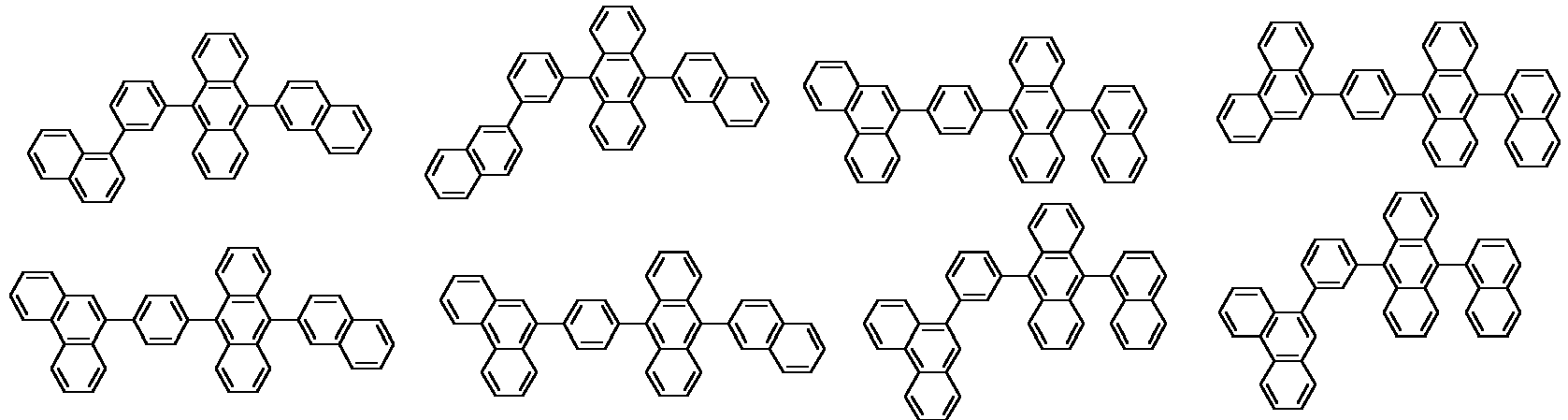





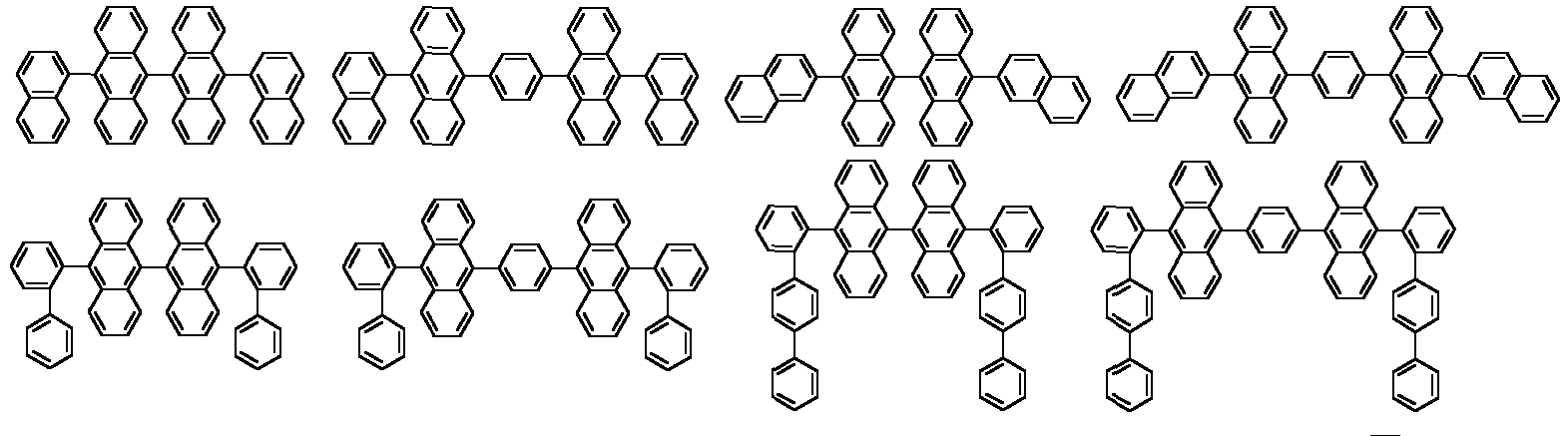




- In an aspect of the organic EL device according to the present invention, when the light emitting layer includes a first light emitting layer and a second light emitting layer, at least one of the components constituting the first light emitting layer is different from the components constituting the second light emitting layer. For example, the dopant material contained in the first light emitting layer is different from the dopant material contained in the second light emitting layer, or the host material contained in the first light emitting layer is different from the host material contained in the second light emitting layer.
- In the organic EL device of the present invention, the light emitting layer may contain a light emitting compound (hereinafter sometimes simply referred to as a "fluorescent compound") that exhibits fluorescent light emission with a main peak wavelength of 500 nm or less.
- A method for measuring the main peak wavelength of a compound is as follows. A 5 µmol/L toluene solution of a compound to be measured is prepared and placed in a quartz cell, and the emission spectrum of the sample (vertical axis: emission intensity, horizontal axis: wavelength) is measured at room temperature (300K). The emission spectrum can be measured using a spectrofluorometer (device name: F-7000) manufactured by Hitachi High-Tech Science Co., Ltd. The emission spectrum measuring device is not limited to the device used herein.
- In the emission spectrum, a peak wavelength of an emission spectrum at which the emission intensity is maximum is defined as the main peak wavelength. In the description herein, the main peak wavelength may be referred to as fluorescent light emission main peak wavelength (FL-peak).
- When the light emitting layer is a single layer, only one of the dopant material and the host material may be the fluorescent compound, or both may be the fluorescent compound.
- Further, when the light emitting layer includes a first light emitting layer (anode side) and a second light emitting layer (cathode side), only one of the first light emitting layer and the second light emitting layer may contain the fluorescent compound, or both of the light emitting layers may contain the fluorescent compound. When the first light emitting layer contains the fluorescent compound, only one of the dopant material and the host material contained in the first light emitting layer may be the fluorescent compound, or both may be the fluorescent compound. Further, when the second light emitting layer contains the fluorescent compound, only one of the dopant material and the host material contained in the second light emitting layer may be the fluorescent compound, or both may be the fluorescent compound.
- The electron transporting layer is a layer containing a material having a high electron transporting capability (electron transporting material), and is formed between the light emitting layer and the cathode or between an electron injecting layer, if present, and the light emitting layer.
- The electron transporting layer may have a monolayer structure or a multilayer structure including two or more layers. For example, the electron transporting layer may have a two-layer structure including a first electron transporting layer (anode side) and a second electron transporting layer (cathode side). In an aspect of the present invention, the electron transporting layer in the monolayer structure is preferably adjacent to the light emitting layer, and the electron transporting layer that is the nearest to the anode in the multilayer configuration, for example, the first electron transporting layer of the two-layer structure, is preferably adjacent to the light emitting layer. In another aspect of the present invention, a hole blocking layer as described later or the like may be interposed between the electron transporting layer of the monolayer structure and the light emitting layer or between the electron transporting layer that is the nearest to the light emitting layer in the multilayer structure and the light emitting layer.
- For the electron transporting layer, for example,
- (1) a metal complex, such as an aluminum complex, a beryllium complex, or a zinc complex,
- (2) a heteroaromatic compound, such as an imidazole derivative, a benzimidazole derivative, an azine derivative, a carbazole derivative, or a phenanthroline derivative, or
- (3) a high-molecular weight compound
- Examples of the metal complex include tris(8-quinolinolato)aluminum(III) (abbreviation: Alq), tris(4-methyl-8-quinolinolato)aluminum (abbreviation: Almq3), bis(10-hydroxybenzo[h]quinolinato)beryllium (abbreviation: BeBq2), bis(2-methyl-8-quinolinolato)(4-phenylphenolato)aluminum(III) (abbreviation: BAlq), bis(8-quinolinolato)zinc(II) (abbreviation: Znq), bis[2-(2-benzoxazolyl)phenolato]zinc(II) (abbreviation: ZnPBO), and bis[2-(2-benzothiazolyl)phenolato]zinc(II) (abbreviation: ZnBTZ).
- Examples of the heteroaromatic compound include 2-(4-biphenylyl)-5-(4-tert-butylphenyl)-1,3,4-oxadiazole (abbreviation: PBD), 1,3-bis[5-(p-tert-butylphenyl)-1,3,4-oxadiazol-2-yl]benzene (abbreviation: OXD-7), 3-(4-tert-butylphenyl)-4-phenyl-5-(4-biphenylyl)-1,2,4-triazole (abbreviation: TAZ), 3-(4-tert-butylphenyl)-4-(4-ethylphenyl)-5-(4-biphenylyl)-1,2,4-triazole (abbreviation: p-EtTAZ), bathophenanthroline (abbreviation: BPhen), bathocuproine (abbreviation: BCP), and 4,4'-bis(5-methylbenzoxazol-2-yl)stilbene (abbreviation: BzOs).
- Examples of the high-molecular weight compound include poly[(9,9-dihexylfluorene-2,7-diyl)-co-(pyridine-3,5-diyl)] (abbreviation: PF-Py) and poly [(9,9-dioctylfluorene-2,7-diyl)-co-(2,2'-bipyridine-6,6'-diyl)] (abbreviation: PF-BPy).
- The materials are materials having an electron mobility of 10-6 cm2/Vs or more. Materials other than those as mentioned above may be used for the electron transporting layer so long as they are materials higher in the electron transporting capability rather than in the hole transporting capability.
- The electron injecting layer is a layer containing a material having a high electron injecting capability. In the electron injecting layer, an alkali metal, such as lithium (Li) or cesium (Cs), an alkaline earth metal, such as magnesium (Mg), calcium (Ca), or strontium (Sr), a rare earth metal, such as europium (Eu) or ytterbium (Yb), and a compound containing them can be used. Examples of the compound include an alkali metal oxide, an alkali metal halide, an alkali metal-containing organic complex, an alkaline earth metal oxide, an alkaline earth metal halide, an alkaline earth metal-containing organic complex, a rare earth metal oxide, a rare earth metal halide, and a rare earth metal-containing organic complex. In addition, two or more of the compounds can be used in mixture.
- Besides, a material in which an alkali metal, an alkaline earth metal, or a compound thereof is contained in a material having electron transporting capability, specifically, a material in which magnesium (Mg) is contained in Alq, or the like, may be used. In this case, electron injection from the cathode can be more efficiently achieved.
- Alternatively, a composite material obtained by mixing an organic compound with an electron doner may be used in the electron injecting layer. Such a composite material is excellent in the electron injecting capability and the electron transporting capability because the organic compound receives electrons from the electron doner. In this case, the organic compound is preferably a material excellent in transporting received electrons, and specifically, a material constituting the aforementioned electron transporting layer (such as a metal complex or a heteroaromatic compound) can be used. As the electron donor, a material having an electron donation capability for an organic compound can be used. Specifically, an alkali metal, an alkaline earth metal, and a rare earth metal are preferred, and examples thereof include lithium, cesium, magnesium, calcium, erbium, and ytterbium. An alkali metal oxide or an alkaline earth metal oxide is also preferred, and examples thereof include lithium oxide, calcium oxide, and barium oxide. ALewis base, such as magnesium oxide, can also be used. An organic compound, such as tetrathiafulvalene (abbreviation: TTF), can also be used.
- A metal, an alloy, an electrically conductive compound, or a mixture thereof that has a low work function (specifically 3.8 eV or less) is preferably used for the cathode. Specific examples of such a cathode material include elements belonging to the
group 1 or 2 of the periodic table, that is, an alkali metal, such as lithium (Li) or cesium (Cs), an alkaline earth metal, such as magnesium (Mg), calcium (Ca), or strontium (Sr), and an alloy containing them (for example, MgAg, AlLi), and a rare earth metal, such as europium (Eu) or ytterbium (Yb), and an alloy containing them. - When the cathode is formed by using an alkali metal, an alkaline earth metal, and an alloy containing them, a vacuum vapor deposition method or a sputtering method can be adopted. When silver paste or the like is used, a coating method, an inkjet method, or the like can be adopted.
- By providing the electron injecting layer, the cathode can be formed using various conductive materials, such as Al, Ag, ITO, graphene, and indium oxide-tin oxide containing silicon or silicon oxide, regardless of the magnitude of the work function. A film of such a conductive material can be formed by using a sputtering method, an inkjet method, a spin-coating method, or the like.
- The organic EL device applies an electric field to an ultrathin film, and thus, pixel defects are likely to occur due to leaks or short-circuiting. In order to prevent this, an insulating layer formed of an insulating thin film layer may be inserted between a pair of electrodes.
- Examples of the material used for the insulating layer include aluminum oxide, lithium fluoride, lithium oxide, cesium fluoride, cesium oxide, magnesium oxide, magnesium fluoride, calcium oxide, calcium fluoride, aluminum nitride, titanium oxide, silicon oxide, germanium oxide, silicon nitride, boron nitride, molybdenum oxide, ruthenium oxide, and vanadium oxide. A mixture or a laminate of them may also be used.
- The space layer is, for example, a layer provided between a fluorescence emitting layer and a phosphorescence emitting layer for the purpose of preventing excitons generated in the phosphorescence emitting layer from diffusing into the fluorescence emitting layer, or adjusting the carrier balance, in the case where the fluorescence emitting layers and the phosphorescence emitting layers are stacked. The space layer can also be provided between two or more phosphorescence emitting layers.
- Since the space layer is provided between the light emitting layers, a material having both an electron transporting capability and a hole transporting capability is preferred. In addition, one having a triplet energy of 2.6 eV or more is preferred in order to prevent diffusion of the triplet energy in the adjacent phosphorescence emitting layers. Examples of the material used for the space layer include the same as those used for the hole transporting layer as described above.
- A blocking layer, such as an electron blocking layer, a hole blocking layer, or an exciton blocking layer, may be provided adjacent to the light emitting layer. The electron blocking layer is a layer that prevents electrons from leaking from the light emitting layer to a hole transporting layer, and the hole blocking layer is a layer that prevents holes from leaking from the light emitting layer to an electron transporting layer. The exciton blocking layer functions to prevent excitons generated in the light emitting layer from diffusing into the surrounding layers to trap the excitons within the light emitting layer.
- Each layer of the organic EL device can be formed by a conventionally known vapor deposition method, a coating method, or the like. For example, each layer can be formed by a known technique by a vapor deposition method, such as a vacuum vapor deposition method or a molecular beam vapor deposition method (MBE method), or a coating method using a solution of a compound for forming a layer, such as a dipping method, a spin-coating method, a casting method, a bar-coating method, and a roll-coating method.
- The film thickness of each layer is not particularly limited, but is typically 5 nm to 10 µm, and more preferably 10 nm to 0.2 µm because in general, when the film thickness is too small, defects such as pinholes are likely to occur, and conversely, when the film thickness is too large, a high driving voltage is required and the efficiency decreases.
- In the organic EL device having a hole transporting layer with a two-layer structure or a three-layer structure of the present invention, a total thickness of the first hole transporting layer and the second hole transporting layer is preferably 30 nm or more and 150 nm or less, and more preferably 40 nm or more and 130 nm or less.
- Further, in one aspect of the present invention, the thickness of the second hole transporting layer having a two-layer structure or a three-layer structure is preferably 5 nm or more, more preferably 20 nm or more, further preferably 25 nm or more, and particularly preferably 35 nm or more, and is preferably 100 nm or less.
- Further, in one aspect of the present invention, the thickness of the hole transporting layer adjacent to the light emitting layer is preferably 5 nm or more, more preferably 20 nm or more, further preferably 25 nm or more, and particularly preferably 30 nm or more, and is preferably 100 nm or less.
- Further, in the organic EL device having a hole transporting layer having a two-layer structure or a three-layer structure according to the present invention, the ratio of a film thickness D2 of the second hole transporting layer to a film thickness D1 of the first hole transporting layer is preferably 0.3 < D2/D1 < 4.0, more preferably 0.5 < D2/D1 < 3.5, and further preferably 0.75 < D2/D1 < 3.0.
- Examples of preferred embodiments of the organic EL device of the present invention include
- (1) organic EL device having a hole transporting layer with a two-layer structure
- a first embodiment in which the second hole transporting layer contains the inventive compound and the first hole transporting layer does not contain the inventive compound;
- a second embodiment in which both the first hole transporting layer and the second hole transporting layer contain the inventive compound;
- a third embodiment in which the first hole transporting layer contains the inventive compound and the second hole transporting layer does not contain the inventive compound;
- (2) organic EL device having a hole transporting layer with a three-layer structure
- a fourth embodiment in which the first hole transporting layer contains the inventive compound and the second and third hole transporting layers do not contain the inventive compound;
- a fifth embodiment in which the second hole transporting layer contains the inventive compound and the first and third hole transporting layers do not contain the inventive compound;
- a sixth embodiment in which the third hole transporting layer contains the inventive compound and the first and second hole transporting layers do not contain the inventive compound;
- a seventh embodiment in which the first and second hole transporting layers contain the inventive compound and the third hole transporting layer does not contain the inventive compound;
- an eighth embodiment in which the first and third hole transporting layers contain the inventive compound and the second hole transporting layer does not contain the inventive compound;
- a tenth embodiment in which the second and third hole transporting layers contain the inventive compound and the first hole transporting layer does not contain the inventive compound;
- a tenth embodiment in which all of the first to third hole transporting layers contain the inventive compound.
- The organic EL device according to one embodiment of the present invention can be used in an electronic instrument, such as a display apparatus and a light emitting apparatus. Examples of the display apparatus include a display component of an organic EL panel module or the like, a television, a mobile phone, a tablet, and a personal computer. Examples of the light emitting apparatus include a lighting or a vehicle lamp.
- The organic EL device can be used in an electronic instrument, such as a display component of an organic EL panel module or the like, a display apparatus of a television, a mobile phone, a personal computer, or the like, and a light emitting apparatus of a lighting or a vehicle lamp.
- The present invention will be described in more detail below by reference to Examples, but the present invention is not to be limited to the following Examples.
-

-

-


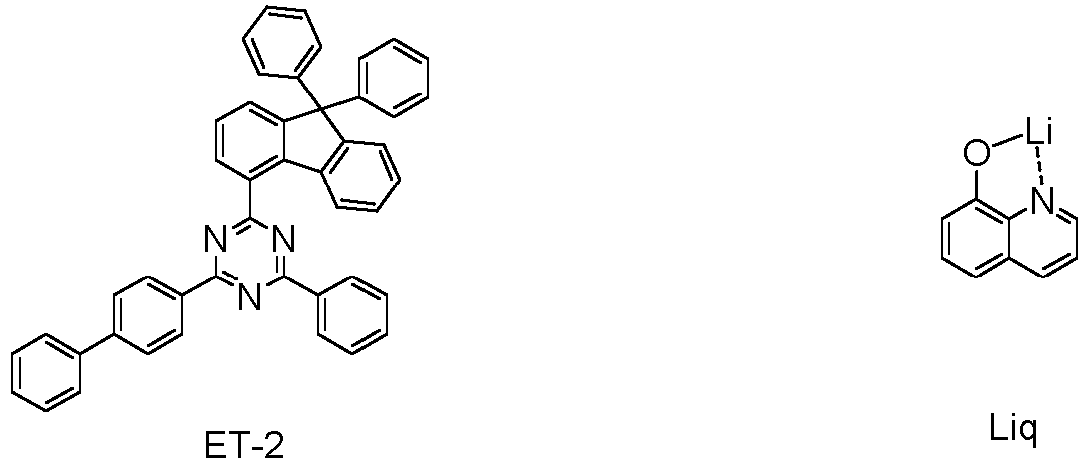
- A glass substrate of 25 mm × 75 mm × 1.1 mm with an ITO transparent electrode (anode) (manufactured by GEOMATEC Co., Ltd.) was ultrasonically cleaned in isopropyl alcohol for 5 minutes and then subjected to UV ozone cleaning for 30 minutes. The film thickness of the ITO was 130 nm.
- The cleaned glass substrate with the ITO transparent electrode was mounted on a substrate holder of a vacuum vapor deposition apparatus, and firstly, Compound HT-1 and Compound HA were vapor co-deposited on the surface having the transparent electrode formed thereon so as to cover the transparent electrode, thus forming a hole injecting layer with a film thickness of 10 nm. The mass ratio of Compound HT-1 and Compound HA (HT-I:HA) was 97:3.
- Subsequently, on the hole injecting layer, Compound HT-1 was vapor deposited to form a first hole transporting layer with a film thickness of 40 nm.
- Subsequently, on this first hole transporting layer, Compound Inv-1 was vapor deposited to form a second hole transporting layer with a film thickness of 5 nm.
- Subsequently, on this second hole transporting layer, Compound BH-1 (host material) and Compound BD-1 (dopant material) were vapor co-deposited to form a first light emitting layer with a film thickness of 10 nm. The mass ratio of Compound BH-1 and Compound BD-1 (BH-1:BD-1) was 99:1.
- Subsequently, on this first light emitting layer, Compound BH-2 (host material) and Compound BD-1 (dopant material) were vapor co-deposited to form a second light emitting layer with a film thickness of 10 nm. The mass ratio of Compound BH-2 and Compound BD-1 (BH-2:BD-1) was 99:1.
- Subsequently, on this light emitting layer, Compound ET-1 was vapor deposited to form a first electron transporting layer with a film thickness of 5 nm.
- Subsequently, on this first electron transporting layer, Compound ET-2 and Liq were vapor co-deposited to form a second electron transporting layer with a film thickness of 25 nm. The mass ratio of Compound ET-2 and Liq (ET-2:Liq) was 50:50.
- Subsequently, on this second electron transporting layer, Yb was vapor deposited to form an electron injecting electrode with a film thickness of 1 nm.
- Then, on this electron injecting electrode, metal Al was vapor deposited to form a metal cathode with a film thickness of 50 nm.
- The layer configuration of the organic EL device (I) of Example 1 thus obtained was as follows.
- ITO (130)/(HT-1:HA=97:3) (10)/HT-1 (40)/Inv-1 (5)/(BH-1:BD-1=99:1) (10)/(BH-2:BD-I =99: 1) (10)/ET-1 (5)/(ET-2:Liq=50:50) (25)/Yb (1)/Al (50)
- In the layer configuration, the numerals in parentheses each indicate the film thickness (nm), and the ratios are each a mass ratio.
- Each organic EL device (I) was produced in the same manner as in Example 1 except for using a comparative compound Ref-1 instead of the inventive compound Inv-1.
- The resulting organic EL device (I) was driven with a constant direct current at a current density of 50 mA/cm2, and the period of time until the luminance was reduced to 95% of the initial luminance was measured, and was defined as 95% lifetime (LT95).
- The result is shown in Table 1.
Table 1 Material of second hole transporting layer LT95(h) at 50mA/cm2 Example 1 Compound Inv-1 97 Comparative Example 1 Comparative Compound Ref-1 85 - As apparent from the results in Table 1, the Compound Inv-1 provides an organic EL device with a longer lifetime than that of the Comparative Compound Ref-1.
-


-

-


- A glass substrate of 25 mm × 75 mm × 1.1 mm with an ITO transparent electrode (anode) (manufactured by GEOMATEC Co., Ltd.) was ultrasonically cleaned in isopropyl alcohol for 5 minutes and then subjected to UV ozone cleaning for 30 minutes. The film thickness of the ITO was 130 nm.
- The cleaned glass substrate with the ITO transparent electrode was mounted on a substrate holder of a vacuum vapor deposition apparatus, and firstly, Compound HT-2 and Compound HA were vapor co-deposited on the surface having the transparent electrode formed thereon so as to cover the transparent electrode, thus forming a hole injecting layer with a film thickness of 10 nm. The mass ratio of Compound HT-2 and Compound HA (HT-2:HA) was 97:3.
- Subsequently, on the hole injecting layer, Compound HT-2 was vapor deposited to form a first hole transporting layer with a film thickness of 85 nm.
- Subsequently, on this first hole transporting layer, Compound Inv-4 was vapor deposited to form a second hole transporting layer with a film thickness of 5 nm.
- Subsequently, on this second hole transporting layer, Compound BH-3 (host material) and Compound BD-2 (dopant material) were vapor co-deposited to form a first light emitting layer with a film thickness of 20 nm. The mass ratio of Compound BH-3 and Compound BD-2 (BH-3:BD-2) was 99:1.
- Subsequently, on this light emitting layer, Compound ET-3 was vapor deposited to form a first electron transporting layer with a film thickness of 5 nm.
- Subsequently, on this first electron transporting layer, Compound ET-4 and Liq were vapor co-deposited to form a second electron transporting layer with a film thickness of 31 nm. The mass ratio of Compound ET-4 and Liq (ET-4:Liq) was 50:50.
- Subsequently, on this second electron transporting layer, Liq was vapor deposited to form an electron injecting electrode with a film thickness of 1 nm.
- Then, on this electron injecting electrode, metal Al was vapor deposited to form a metal cathode with a film thickness of 80 nm.
- The layer configuration of the organic EL device (II) of Example 2 thus obtained was as follows.
- ITO (130)/(HT-2:HA=97:3) (10)/HT-2 (85)/Inv-4 (5)/(BH-3:BD-2=99:1) (20)/ET-3 (5)/(ET-4:Liq=50:50) (31)/Liq (1)/Al (80)
- In the layer configuration, the numerals in parentheses each indicate the film thickness (nm), and the ratios are each a mass ratio.
- An organic EL device (II) was produced in the same manner as in Example 2 except for using the compounds shown in Table 2 instead of the Compound Inv-2.
- The 95% lifetime (LT95) of the resulting organic EL device (II) was measured in the same manner as the evaluation of the organic EL device (I). The results are shown in Table 2.
Table 2 Material of second hole transporting layer LT95(h) at 50mA/cm2 Example 2 Compound Inv-4 198 Example 3 Compound Inv-5 160 Example 4 Compound Inv-6 206 Example 5 Compound Inv-7 178 Example 6 Compound Inv-8 142 Example 7 Compound Inv-9 145 Example 8 Compound Inv-10 167 Example 9 Compound Inv-11 137 Example 10 Compound Inv-12 151 Example 11 Compound Inv-20 166 Comparative Example 2 Comparative Compound Ref-2 70 - As apparent from the results in Table 2, the Compounds Inv-4 to 12 and 20 provide an organic EL device with a longer lifetime than that of the Comparative Compound Ref-2.
-
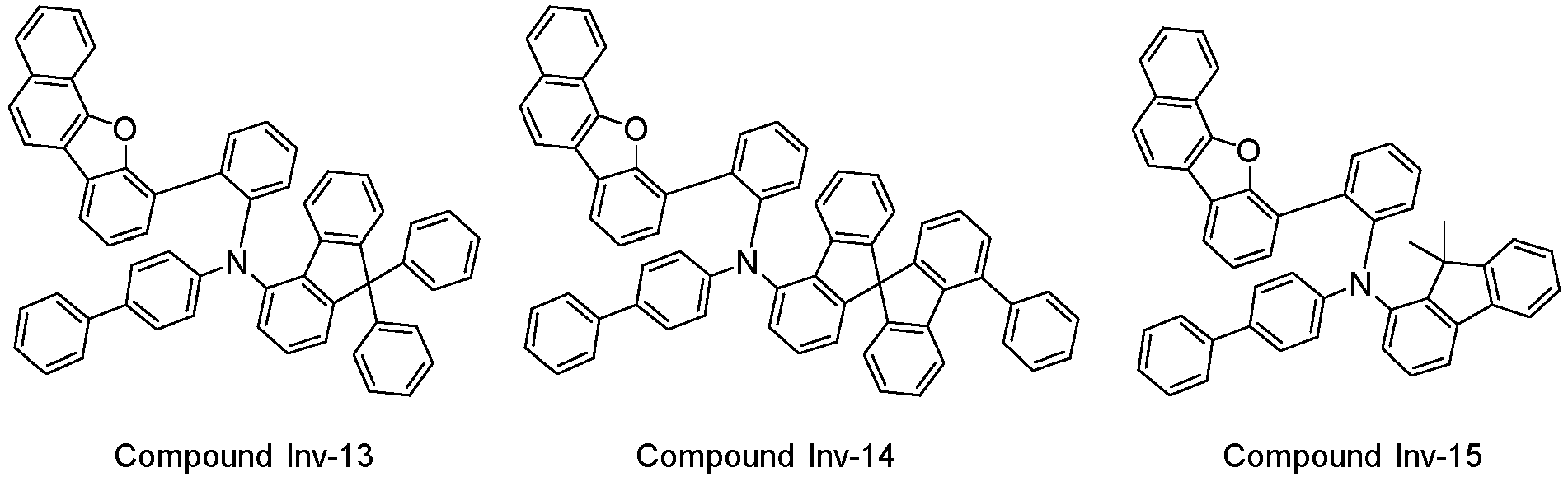


-

-

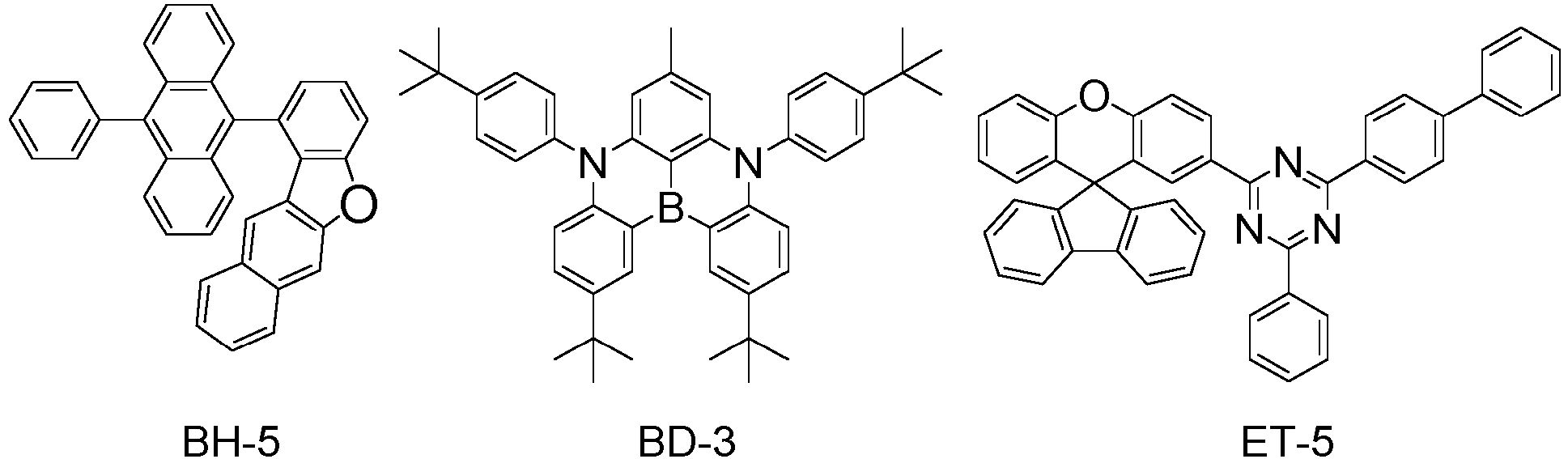

- A glass substrate of 25 mm × 75 mm × 1.1 mm with an ITO transparent electrode (anode) (manufactured by GEOMATEC Co., Ltd.) was ultrasonically cleaned in isopropyl alcohol for 5 minutes and then subjected to UV ozone cleaning for 30 minutes. The film thickness of the ITO was 130 nm.
- The cleaned glass substrate with the ITO transparent electrode was mounted on a substrate holder of a vacuum vapor deposition apparatus, and firstly, Compound HT-3 and Compound HA were vapor co-deposited on the surface having the transparent electrode formed thereon so as to cover the transparent electrode, thus forming a hole injecting layer with a film thickness of 10 nm. The mass ratio of Compound HT-3 and Compound HA (HT-3:HA) was 97:3.
- Subsequently, on the hole injecting layer, Compound HT-3 was vapor deposited to form a first hole transporting layer with a film thickness of 80 nm.
- Subsequently, on this first hole transporting layer, Compound Inv-13 was vapor deposited to form a second hole transporting layer with a film thickness of 7.5 nm.
- Subsequently, on this second hole transporting layer, a film of BH (host material):BD-3 (dopant material) with a film thickness of 20 nm was formed. This BH:BD-3 film functions as a light emitting layer. The BH [Compounds BH-4 and BH-5 (both host materials)] contained in the light emitting layer have a mass ratio of 3:2, and the concentration of BD-3 is 2% by mass with respect to the entire light emitting layer.
- Subsequently, on this light emitting layer, Compound ET-5 was vapor deposited to form a first electron transporting layer with a film thickness of 5 nm.
- Subsequently, on this first electron transporting layer, Compound ET-6 and Liq were vapor co-deposited to form a second electron transporting layer with a film thickness of 25 nm. The mass ratio of Compound ET-6 and Liq (ET-6:Liq) was 67:33.
- Subsequently, on this second electron transporting layer, Yb was vapor deposited to form an electron injecting electrode with a film thickness of 1 nm.
- Then, on this electron injecting electrode, metal Al was vapor deposited to form a metal cathode with a film thickness of 80 nm.
- The layer configuration of the organic EL device (III) of Example 12 thus obtained was as follows.
- ITO (130)/(HT-3:HA=97:3) (10)/HT-3 (80)/Inv-13 (7.5)/(BH-4:BH-5:BD-3=60:40:2 (20)/ET-5 (5)/ET-6:Liq=67:33) (25)/Yb (1)/Al (80)
- In the layer configuration, the numerals in parentheses each indicate the film thickness (nm), and the ratios are each a mass ratio.
- An organic EL device (III) was produced in the same manner as in Example 12 except for using the compounds shown in Table 3 instead of the Compound Inv-13.
- The 95% lifetime (LT95) of the resulting organic EL device (III) was measured in the same manner as the evaluation of the organic EL device (I). The results are shown in Table 3.
Table 3 Material of second hole transporting layer LT95(h) at 50mA/cm2 Example 12 Compound Inv-13 96 Example 13 Compound Inv-14 108 Example 14 Compound Inv-15 88 Example 15 Compound Inv-16 94 Example 16 Compound Inv-17 115 Example 17 Compound Inv-18 103 Example 18 Compound Inv-19 79 Comparative Example 3 Comparative Compound Ref-3 64 - As apparent from the results in Table 3, the Compounds Inv-13 to 19 provide an organic EL device with a longer lifetime than that of the Comparative Compound Ref-3.
-


-

- In an argon atmosphere, a mixture of 10.0 g (57.4 mmol) of 5-methoxy-1-naphthol, 50.2 g (287 mmol) of 1-bromo-2-fluorobenzene, 28.1 g (86.0 mmol) of cesium carbonate, and 287 mL of N-methyl-2-pyrrolidone was stirred at 145°C for 12 hours. After cooling to room temperature and adding water thereto, the reaction solution was extracted with toluene, and concentrated under reduced pressure. The resulting residue was purified by silica gel column chromatography to obtain 14.7 g of 1-(2-bromophenoxy)-5-methoxynaphthalene as a colorless liquid. The yield was 78%.
- In an argon atmosphere, a mixture of 14.7 g (44.8 mmol) of the resulting 1-(2-bromophenoxy)-5-methoxynaphthalene, 1.83 g (2.24 mmol) of a [1,1'-bis(diphenylphosphino)ferrocene]palladium(II) dichloride dichloromethane adduct, 21.9g (67.2mmol) of cesium carbonate, and 224 mL of N-methyl-2-pyrrolidone was stirred at 130°C for 5 hours. After cooling to room temperature and adding water thereto, the reaction solution was extracted with toluene, and concentrated under reduced pressure. The resulting residue was purified by silica gel column chromatography to obtain 8.0 g of 4-methoxybenzo[b]naphtho[2,1-d]furan as a white solid. The yield was 72%.
- In an argon atmosphere, after cooling a mixture of 2.48 g (10.0 mmol) of the resulting 4-methoxybenzo[b]naphtho[2,1-d]furan and 100 mL of dichloromethane to 0°C, 20 mL of 1.0 mol/L boron tribromide dichloromethane solution was added thereto, and the mixture was stirred at room temperature for 5 hours. After cooling to -78°C and adding water thereto, the reaction solution was extracted with dichloromethane, and concentrated under reduced pressure. The resulting residue was purified by silica gel column chromatography to obtain 2.13 g of benzo[b]naphtho[2,1-d]furan-4-ol as a white solid. The yield was 91%.
- In an argon atmosphere, a mixture of 1.17 g (5.0 mmol) of the resulting benzo[b]naphtho[2,1-d]furan-4-ol, 0.061 g (0.50 mmol) of N,N-dimethyl-4-aminopyridine, 10.0 mL (125 mmol) of pyridine, 1.01 mL (6.00 mmol) of trifluoromethanesulfonic anhydride, and 25 mL of dichloromethane was stirred at 0°C for 5 hours. After adding water thereto, the reaction solution was extracted with dichloromethane, and concentrated under reduced pressure. The resulting residue was purified by silica gel column chromatography to obtain 1.48 g of benzo[b]naphtho[2,1-d]furan-4-yl trifluoromethanesulfonate as a white solid. The yield was 81%.
-

- In an argon atmosphere, a mixture of 6.66 g (22.4 mmol) of 5-bromobenzo[b]naphtho[2,1-d]furan (raw material 1), 5.21 g (23.8 mmol) of 2-(4,4,5,5-tetramethyl-1,3, 2-dioxaborolan-2-yl)aniline (raw material 2), 0.205 g (0.224 mmol) of tris(dibenzylideneacetone)dipalladium(0), 0.427 g (0.897 mmol) of 2-dicyclohexylphosphino-2',4',6'-triisopropylbiphenyl (XPhos), 33.6 mL (67.2 mmol) of 2M aqueous potassium phosphate solution, and 149 mL of 1,4-dioxane was stirred at 110°C for 7 hours. The reaction solution was cooled to room temperature and concentrated under reduced pressure. The resulting residue was purified by silica gel column chromatography to obtain 6.01 g of Intermediate A-1 as a white solid. The yield was 87%.
- Intermediates A-2 and A-3 were obtained in the same manner as in Intermediate Synthetic Example 2 except for changing the
raw materials 1 and 2 to those shown in Table 4. The respective yields of Intermediates A-2 and A-3 are shown in Table 4.Table 4 Raw material 1 Raw material 2Intermediate Yield (%) Synthetic Example 2 


87 Synthetic Example 3 
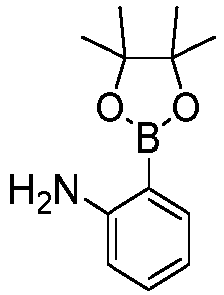

78 Synthetic Example 4 


70 -

- In an argon atmosphere, a mixture of 11.0 g (30.0 mmol) of 5-bromobenzo[b]naphtho[2,1-d]furan (raw material 1), 5.16 g (33.0 mmol) of 2-chlorophenylboronic acid (raw material 2), 1.04 g (0.90 mmol) of tetrakis(triphenylphosphine)palladium (0), 37.5 mL (75.0 mmol) of 2M aqueous sodium carbonate solution, and 100 mL of DME was refluxed at boiling point for 5 hours. The reaction solution was cooled to room temperature and concentrated under reduced pressure. The resulting residue was purified by silica gel column chromatography to obtain 8.15 g of Intermediate B-1 as a white solid. The yield was 83%.
- Intermediates B-2 to B-5 were obtained in the same manner as in Intermediate Synthetic Example 5 except for changing the
raw material 1 and 2 to those shown in Table 5. The respective yields of Intermediates B-2 to B-5 are shown in Table 5.Table 5 Raw material 1 Raw material 2Intermediate Yield (%) Synthetic Example 5 


83 Synthetic Example 6 


75 Synthetic Example 7 


69 Synthetic Example 8 


86 Synthetic Example 9 


74 -

- In an argon atmosphere, a mixture of 21.5 g (69.5 mmol) of Intermediate A-3 (raw material 1), 16.2 g (69.5 mmol) of 4-bromobiphenyl (raw material 2), 1.27 g (1.39 mmol) of tris(dibenzylideneacetone)dipalladium(0), 1.73 g (2.78 mmol) of BINAP, 7.35 g (76.0 mmol) of sodium-t-butoxide, and 460 mL of toluene was refluxed at boiling point for 7 hours. The reaction solution was cooled to room temperature and then concentrated under reduced pressure. The resulting residue was purified by silica gel column chromatography and recrystallization to obtain 26.2 g of Intermediate C-1 as a white solid. The yield was 82%.
- Intermediates C-2 to C-5 were obtained in the same manner as in Intermediate Synthetic Example 10 except for changing the
raw materials 1 and 2 to those shown in Table 6. The respective yields of Intermediates C-2 to C-5 are shown in Table 5.Table 6 Raw material 1 Raw material 2Intermediate Yield (%) Synthetic Example 10 


82 Synthetic Example 11 


77 Synthetic Example 12 


69 Synthetic Example 13 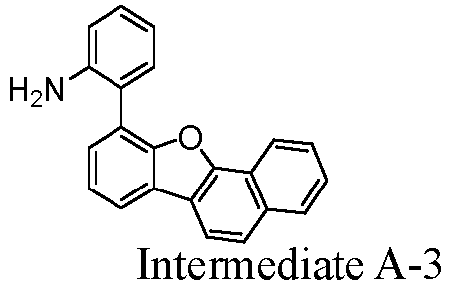


65 Synthetic Example 14 


72 -
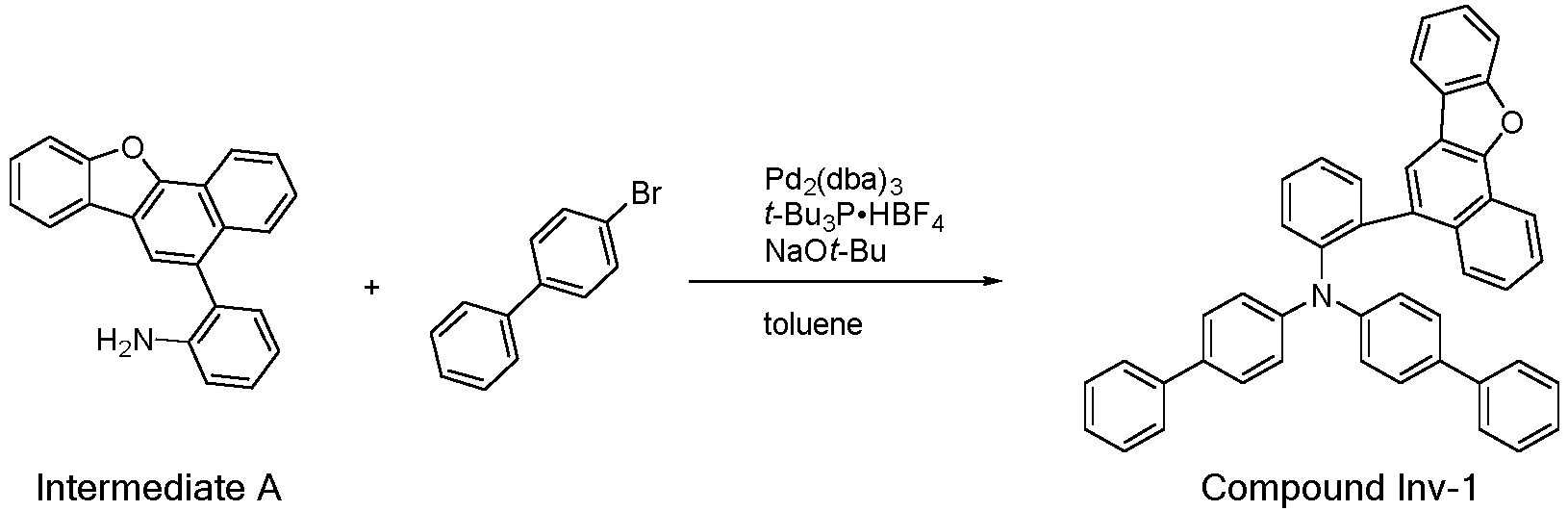
- In an argon atmosphere, a mixture of 3.09 g (10.0 mmol) of Intermediate A-1 (Intermediate 1), 4.90 g (21.0 mmol) of 4-bromobiphenyl (Intermediate 2), 0.366 g (0.400 mmol) of tris(dibenzylideneacetone)dipalladium(0), 0.464 g (1.60 mmol) of tri-tert-butylphosphonium tetrafluoroborate, 2.69 g (28.0 mmol) of sodium-t-butoxide, and 100 mL of toluene was refluxed at boiling point for 7 hours. The reaction solution was cooled to room temperature and then concentrated under reduced pressure. The resulting residue was purified by silica gel column chromatography and recrystallization to obtain 3.87 g of a white solid. The yield was 63%.
- The resulting substance was revealed as Compound Inv-1 by mass spectrometry, showing m/e=614 with respect to the molecular weight of 613.76.
- Inventive Compounds Inv-2 and Inv-12 were obtained in the same manner as in Synthetic Example 1-1 except for changing the
Intermediates 1 and 2 to those shown in Table 7. The respective yields of the Inventive Compounds Inv-2 and Inv-12 are shown in Table 7.Table 7 Intermediate 1 Intermediate 2Inventive compound Yield (%) Synthetic Example 1-1 


63 Synthetic Example 1-2 


67 Synthetic Example 1-3 


73 -

- In an argon atmosphere, a mixture of 3.45 g (10.5 mmol) of Intermediate B-1 (Intermediate 1), 3.21 g (21.0 mmol) of N-[1,1'-biphenyl]-4-yl[1,1'-biphenyl]-4-amine (Intermediate 2), 0.366 g (0.400 mmol) of tris(dibenzylideneacetone)dipalladium(0), 0.328 g (0.800 mmol) of 2-dicyclohexylphosphino-2',6'-dimethoxybiphenyl (SPhos), 4.2 mL of sodium t-pentoxide (40% toluene solution), and 67 mL of toluene was refluxed at boiling point for 7 hours. The reaction solution was cooled to room temperature and then concentrated under reduced pressure. The resulting residue was purified by silica gel column chromatography and recrystallization to obtain 4.16 g of a white solid. The yield was 68%.
- The resulting substance was revealed as Compound Inv-3 by mass spectrometry, showing m/e=614 with respect to the molecular weight of 613.76.
- Inventive Compounds Inv-4 to Inv-11 and Inv-13 to Inv-20 were obtained in the same manner as in Synthetic Example 2-1 except for changing the
Intermediates 1 and 2 to those shown in Tables 8 to 10. The respective yields of the Inventive Compounds Inv-4 to Inv-11 and Inv-13 to Inv-20 are shown in Tables 8 to 10.Table 8 Intermediate 1 Intermediate 2Compound Yield (%) Synthetic Example 2-1 


68 Synthetic Example 2-2 


61 Synthetic Example 2-3 


70 Synthetic Example 2-4 


78 Synthetic Example 2-5 


70 Synthetic Example 2-6 
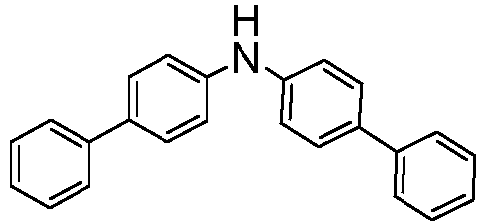

68 Table 9 Intermediate 1 Intermediate 2Compound Yield (%) Synthetic Example 2-7 

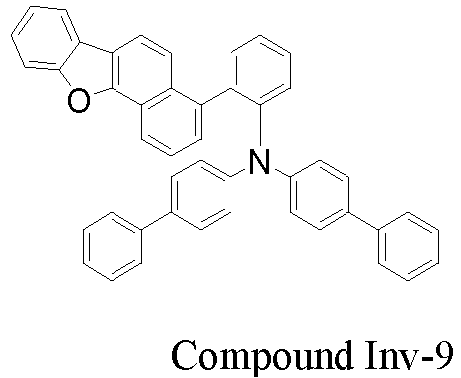
64 Synthetic Example 2-8 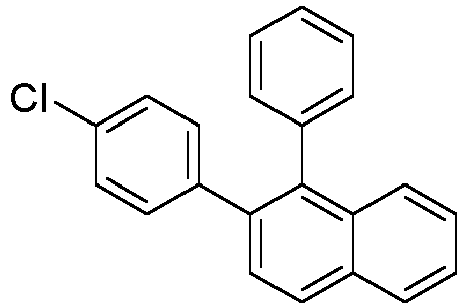


73 Synthetic Example 2-9 


69 Synthetic Example 2-10 


64 Synthetic Example 2-11 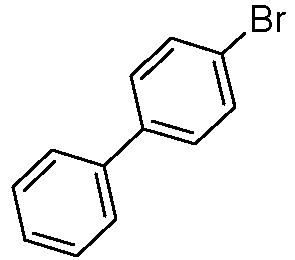
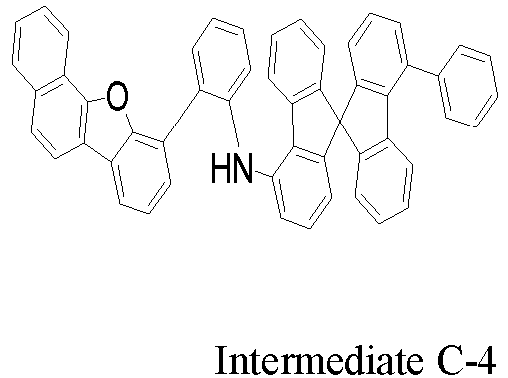

71 Synthetic Example 2-12 

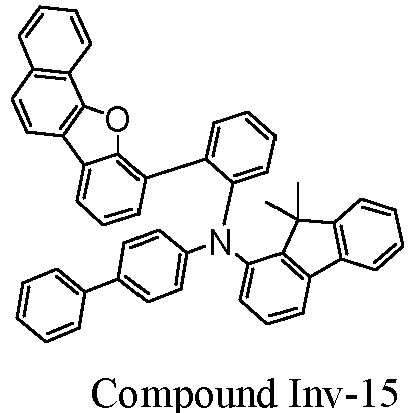
58 Table 10 Intermediate 1 Intermediate 2Compound Yield (%) Syntheti c Example 2-13 
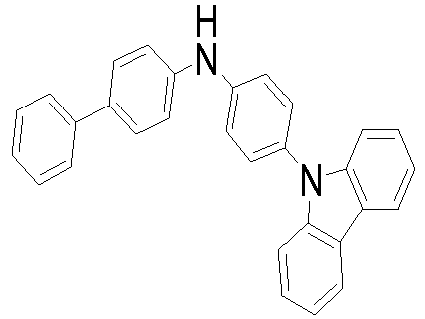

70 Syntheti c Example 2-14 


75 Syntheti c Example 2-15 


67 Syntheti c Example 2-16 


80 Syntheti c Example 2-17 


76 -
- 1, 11, 12: Organic EL device
- 2: Substrate
- 3: Anode
- 4: Cathode
- 5: Light emitting layer
- 5a: First light emitting layer
- 5b: Second light emitting layer
- 6: Hole transporting zone (hole transporting layer)
- 6a: Hole injecting layer
- 6b: First hole transporting layer
- 6c: Second hole transporting layer
- 6d: Third hole transporting layer
- 7: Electron transporting zone (Electron transporting layer)
- 7a: First electron transporting layer
- 7b: Second electron transporting layer
- 10, 20, 30: Light emitting unit


Claims (23)
- A compound represented by the following formula (1):
 N* is a central nitrogen atom,R1 to R4 are each independently a hydrogen atom, an unsubstituted alkyl group having 1 to 6 carbon atoms, or an unsubstituted aryl group having 6 to 12 ring carbon atoms,adjacent two selected from R1 to R4 are not bonded to each other, thus forming no ring,L1 to L4 are each independently a single bond, an unsubstituted arylene group having 6 to 30 ring carbon atoms or an unsubstituted divalent heterocyclic group having 5 to 30 ring atoms,Ar1 and Ar2 are each independently a substituted or unsubstituted aryl group having 6 to 30 ring carbon atoms constituted only of 6-membered rings, a substituted or unsubstituted heterocyclic group having 5 to 30 ring atoms, or a group represented by the following formula (a):
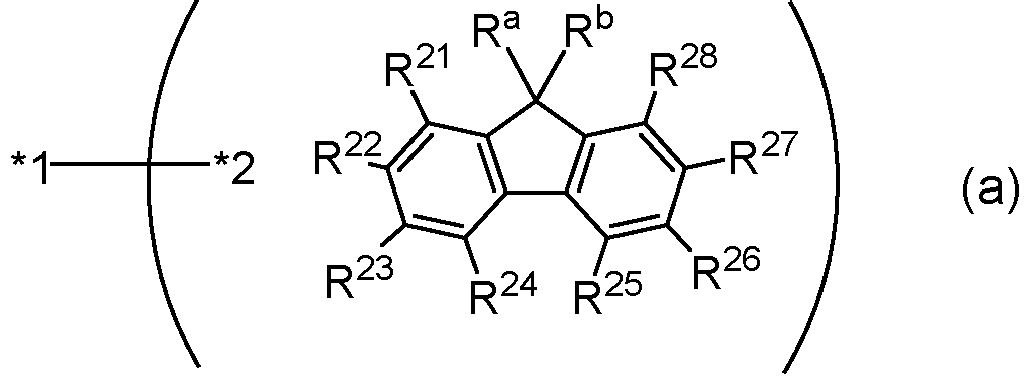 * 1 is a bonding site to L1 or L2,Ra and Rb are each independently a hydrogen atom, a substituted or unsubstituted alkyl group having 1 to 30 carbon atoms, a substituted or unsubstituted aryl group having 6 to 30 ring carbon atoms, or a substituted or unsubstituted heterocyclic group having 5 to 30 ring atoms,Ra and Rb may be bonded to each other to form a substituted or unsubstituted ring, or may not be bonded to each other, thus forming no ring,one selected from R21 to R28 is a single bond bonded to *2, and R21 to R28 that are not a single bond bonded to *2 are each independently a hydrogen atom, a substituted or unsubstituted alkyl group having 1 to 6 carbon atoms, a substituted or unsubstituted aryl group having 6 to 12 ring carbon atoms, or a substituted or unsubstituted heterocyclic group having 5 to 13 ring atoms,adjacent two selected from R21 to R28 that are not the single bond may be bonded to each other to form one or more unsubstituted benzene rings, or may not be bonded to each other, thus forming no ring,provided that when Ra and Rb are bonded to each other to form a substituted or unsubstituted spirofluorene ring with a carbon atom at site 9 of a fluorene skeleton, one selected from R22 to R27 is a single bond bonded to *2,when all of L1 to L4 are single bonds, Ar1 and Ar2 are groups represented by the formula (a), and R22 or R27 is a single bond bonded to *2, at least one selected from two Ra's and two Rb's is a substituted or unsubstituted aryl group having 6 to 30 ring carbon atoms;Ar3 is a group represented by the following formula (x):
 *3 is a bonding site to L4,R31 to R38, R41 to R44, and R51 to R58 are each independently a hydrogen atom, a halogen atom, a cyano group, a nitro group, a substituted or unsubstituted alkyl group having 1 to 50 carbon atoms, a substituted or unsubstituted alkenyl group having 2 to 50 carbon atoms, a substituted or unsubstituted alkynyl group having 2 to 50 carbon atoms, a substituted or unsubstituted cycloalkyl group having 3 to 50 ring carbon atoms, a group represented by - Si(R901)(R902)(R903), a group represented by -O-(R904), a group represented by -S-(R905), a group represented by -N(R906)(R907), a substituted or unsubstituted aryl group having 6 to 50 ring carbon atoms, or a substituted or unsubstituted heterocyclic group having 5 to 50 ring atoms,R901 to R907 are each independently a hydrogen atom, a substituted or unsubstituted alkyl group having 1 to 50 carbon atoms, a substituted or unsubstituted cycloalkyl group having 3 to 50 ring carbon atoms, a substituted or unsubstituted aryl group having 6 to 50 ring carbon atoms, or a substituted or unsubstituted heterocyclic group having 5 to 50 ring atoms,in the case where two or more groups represented by R901 exist, the two or more groups each represented by R901 are the same as or different from each other,in the case where two or more groups represented by R902 exist, the two or more groups each represented by R902 are the same as or different from each other,in the case where two or more groups represented by R903 exist, the two or more groups each represented by R903 are the same as or different from each other,in the case where two or more groups represented by R904 exist, the two or more groups each represented by R904 are the same as or different from each other,in the case where two or more groups represented by R905 exist, the two or more groups each represented by R905 are the same as or different from each other,in the case where two or more groups represented by R906 exist, the two or more groups each represented by R906 are the same as or different from each other,in the case where two or more groups represented by R907 exist, the two or more groups each represented by R907 are the same as or different from each other,m is 0 or 1, and n is 0 or 1,when m and n are 0, one of R31 and R32, R32 and R33, or R33 and R34 is a single bond bonded to *a, and the other is a single bond bonded to *b,one selected from R31 to R38 that are not a single bond bonded to *a and *b, and R41 to R44 is a single bond bonded to *4,when m is 1 and n is 0, one of R31 and R32, R32 and R33, or R33 and R34 is a single bond bonded to *a, and the other is a single bond bonded to *b,one of R35 and R36, R36 and R37, or R37 and R38 is a single bond bonded to *c, and the other is a single bond bonded to *d,one selected from R31 to R34 that are not a single bond bonded to *a and *b, R35 to R38 that are not a single bond bonded to *c and *d, R41 to R44, and R51 to R54 is a single bond bonded to *4,when m is 0 and n is 1, one of R31 and R32, R32 and R33, or R33 and R34 is a single bond bonded to *a, and the other is a single bond bonded to *b,one of R35 and R36, R36 and R37, or R37 and R38 is a single bond bonded to *e, and the other is a single bond bonded to *f,one selected from R31 to R34 that are not a single bond bonded to *a and *b, R35 to R38 that are not a single bond bonded to *e and *f, R41 to R44, and R55 to R58 is a single bond bonded to *4,when m is 1 and n is 1, one of R31 and R32, R32 and R33, or R33 and R34 is a single bond bonded to *a, and the other is a single bond bonded to *b,one in any one group of three groups, R35 and R36, R36 and R37, and R37 and R38, is a single bond bonded to *c, and the other is a single bond bonded to *d,one in any one group of the remaining two groups of R35 and R36, R36 and R37, or R37 and R38, is a single bond bonded to *e, and the other is a single bond bonded to *f,one selected from R31 to R34 that are not a single bond bonded to *a and *b, R35 to R38 that are not a single bond bonded to *c to *f, R41 to R44, and R51 to R58 is a single bond bonded to *4,provided that when L3 and L4 are a single bond, m and n are 0, R33 is a single bond bonded to *a, and R34 is a single bond bonded to *b, or R34 is a single bond bonded to *a and R33 is a single bond bonded to *b, one selected from R31, R32, R35 to R37, and R41 to R44 is a single bond bonded to *4,when L3 and L4 are a single bond, m and n are 0, R31 is a single bond bonded to *a, and R32 is a single bond bonded to *b, one selected from R33 to R38 and R42 to R44 is a single bond bonded to *4,when L3 and L4 are a single bond, m and n are 0, R32 is a single bond bonded to *a, and R31 is a single bond bonded to *b, one selected from R33 to R38 and R41 to R43 is a single bond bonded to *4;X1 is an oxygen atom or a sulfur atom.
 - The compound according to claim 1, wherein X1 is an oxygen atom.
- The compound according to claim 1 or 2, wherein m is 0.
- The compound according to any one of claims 1 to 3, wherein n is 0.
- The compound according to any one of claims 1 to 4, wherein Ar1 and Ar2 are each independently a substituted or unsubstituted aryl group having 6 to 30 ring carbon atoms constituted only of 6-membered rings, or a substituted or unsubstituted heterocyclic group having 5 to 30 ring atoms.
- The compound according to any one of claims 1 to 5, wherein L4 is a single bond.
- The compound according to any one of claims 1 to 6, wherein L3 is a single bond.
- The compound according to any one of claims 1 to 7, wherein Ar1 and Ar2 are each independently a group represented by any one of the following formulas (1a) to (1e):
 *21 is a bonding site to L1 or L2,R101 to R105 and R106 to R110 are each independently a hydrogen atom, an unsubstituted alkyl group having 1 to 6 carbon atoms, or an unsubstituted aryl group having 6 to 12 ring carbon atoms, provided that one selected from R101 to R105 is a single bond bonded to *22, and one selected from R106 to R110 is a single bond bonded to *23,adjacent two selected from R101 to R105 that are not the single bond are not bonded to each other, thus forming no ring,adjacent two selected from R106 to R110 that are not the single bond are not bonded to each other, thus forming no ring,k is 0 or 1, 1 is 0 or 1,k + 1 is an integer of 0 to 2,R111 to R115 are each independently a hydrogen atom, a substituted or unsubstituted alkyl group having 1 to 6 carbon atoms, a substituted or unsubstituted aryl group having 6 to 12 ring carbon atoms, or a substituted or unsubstituted heterocyclic group having 5 to 13 ring atoms,adjacent two selected from R111 to R115 may be bonded to each other to form one or more unsubstituted benzene rings, or may not be bonded to each other, thus forming no ring;
 *24 is a bonding site to L1 or L2,R121 to R128 are each independently a hydrogen atom, a substituted or unsubstituted alkyl group having 1 to 6 carbon atoms, or a substituted or unsubstituted aryl group having 6 to 12 ring carbon atoms,provided that one selected from R121 to R128 is a single bond bonded to *25, and adjacent two selected from R121 to R128 that are not the single bond are not bonded to each other, thus forming no ring;
 *26 is a bonding site to L1 or L2,R131 to R140 are each independently a hydrogen atom, a substituted or unsubstituted alkyl group having 1 to 6 carbon atoms, or a substituted or unsubstituted aryl group having 6 to 12 ring carbon atoms,provided that one selected from R131 to R140 is a single bond bonded to *27, and adjacent two selected from R131 to R140 that are not the single bond are not bonded to each other, thus forming no ring;
 *28 is a bonding site to L1 or L2,X2 is an oxygen atom, a sulfur atom, or NRA,RA is a substituted or unsubstituted alkyl group having 1 to 6 carbon atoms or a substituted or unsubstituted aryl group having 6 to 12 ring carbon atoms,R141 to R148 are each independently a hydrogen atom, a substituted or unsubstituted alkyl group having 1 to 6 carbon atoms, a substituted or unsubstituted aryl group having 6 to 12 ring carbon atoms, or a substituted or unsubstituted heterocyclic group having 5 to 13 ring atoms, provided that one selected from R141 to R148 and RA is a single bond bonded to *29,at least one adjacent two selected from R141 to R148 that are not the single bond may be bonded to each other to form one or more unsubstituted benzene rings, or may not be bonded to each other, thus forming no ring;
 *30 is a bonding site to L1 or L2,R151 to R155 are each independently a hydrogen atom, an unsubstituted alkyl group having 1 to 6 carbon atoms, or an unsubstituted phenyl group,provided that one selected from R151 to R155 is a single bond bonded to *31, and another one selected from R151 to R155 is a single bond bonded to *32,adjacent two selected from R151 to R155 that are neither a single bond bonded to *31 nor a single bond bonded to *32 are not bonded to each other, thus forming no ring,R161 to R165 and R171 to R175 are each independently a hydrogen atom or an unsubstituted alkyl group having 1 to 6 carbon atoms,provided that at least one adjacent two selected from R161 to R165 may be bonded to each other to form one or more unsubstituted benzene rings, or may not be bonded to each other, thus forming no ring,at least one adjacent two selected from R171 to R175 may be bonded to each other to form one or more unsubstituted benzene rings, or may not be bonded to each other, thus forming no ring.
 - The compound according to claim 8, wherein Ar1 and Ar2 are a group represented by any one of the formulas (1a), (1b) and (1d).
- The compound according to any one of claims 1 to 9, wherein R32 or R37 is a single bond bonded to *4.
- The compound according to any one of claims 1 to 10, wherein R1 to R4 is a hydrogen atom.
- The compound according to any one of claims 1 to 11, comprising at least one deuterium atom.
- A material for organic electroluminescent devices, the material comprising the compound according to any one of claims 1 to 12.
- A hole transporting layer material comprising the compound according to any one of claims 1 to 12.
- An organic electroluminescent device comprising a cathode, an anode, and an organic layer between the cathode and the anode, the organic layer including a light emitting layer, at least one layer of the organic layer containing the compound according to any one of claims 1 to 12.
- The organic electroluminescent device according to claim 15, wherein the organic layer comprises a hole transporting zone between the anode and the light emitting layer, the hole transporting zone containing the compound.
- The organic electroluminescent device according to claim 16, wherein the hole transporting zone comprises a first hole transporting layer on an anode side and a second hole transporting layer on a cathode side, one of the first hole transporting layer and the second hole transporting layer, or both of the first hole transporting layer and the second hole transporting layer containing the compound.
- The organic electroluminescent device according to claim 17, wherein the light emitting layer and the second hole transporting layer are in direct contact with each other.
- The organic electroluminescent device according to claim 17 or 18, wherein a total thickness of the first hole transporting layer and the second hole transporting layer is 30 nm or more and 150 nm or less.
- The organic electroluminescent device according to any one of claims 15 to 19, wherein the light emitting layer is a single layer.
- The organic electroluminescent device according to any one of claims 15 to 20, wherein the light emitting layer comprises a light emitting compound that shows fluorescence emission with a main peak wavelength of 500 nm or less.
- The organic electroluminescent device according to any one of claims 15 to 21, wherein the light emitting layer comprises a phosphorescent dopant material.
- An electronic instrument comprising the organic electroluminescent device according to any one of claims 15 to 22.
Applications Claiming Priority (2)
| Application Number | Priority Date | Filing Date | Title |
|---|---|---|---|
| JP2022065500 | 2022-04-12 | ||
| PCT/JP2023/014165 WO2023199832A1 (en) | 2022-04-12 | 2023-04-06 | Compound, material for organic electroluminescent elements, organic electroluminescent element, and electronic device |
Publications (2)
| Publication Number | Publication Date |
|---|---|
| EP4509498A1 true EP4509498A1 (en) | 2025-02-19 |
| EP4509498A4 EP4509498A4 (en) | 2025-11-12 |
Family
ID=88329677
Family Applications (1)
| Application Number | Title | Priority Date | Filing Date |
|---|---|---|---|
| EP23788251.9A Pending EP4509498A4 (en) | 2022-04-12 | 2023-04-06 | Connection, material for organic electroluminescent elements, organic electroluminescent element and electronic device |
Country Status (6)
| Country | Link |
|---|---|
| US (1) | US20240324450A1 (en) |
| EP (1) | EP4509498A4 (en) |
| JP (1) | JP7538360B2 (en) |
| KR (2) | KR102872346B1 (en) |
| CN (2) | CN121226297A (en) |
| WO (1) | WO2023199832A1 (en) |
Families Citing this family (3)
| Publication number | Priority date | Publication date | Assignee | Title |
|---|---|---|---|---|
| CN120682176A (en) * | 2022-05-20 | 2025-09-23 | 吉林奥来德光电材料股份有限公司 | Luminescence auxiliary material, preparation method and application thereof |
| WO2024214540A1 (en) * | 2023-04-11 | 2024-10-17 | 出光興産株式会社 | Compound, organic electroluminescent element, and electronic device |
| CN118812550A (en) * | 2024-06-19 | 2024-10-22 | 江苏科洛明新材料科技有限公司 | A preparation method of indole naphthopyran photochromic compound |
Family Cites Families (22)
| Publication number | Priority date | Publication date | Assignee | Title |
|---|---|---|---|---|
| KR101923171B1 (en) * | 2015-05-27 | 2018-11-28 | 덕산네오룩스 주식회사 | Compound for organic electric element, organic electric element comprising the same and electronic device thereof |
| KR102385190B1 (en) * | 2015-06-19 | 2022-04-12 | 덕산네오룩스 주식회사 | Compound for organic electric element, organic electric element comprising the same and electronic device thereof |
| KR101579490B1 (en) * | 2015-09-17 | 2015-12-22 | 덕산네오룩스 주식회사 | Compound for organic electronic element, organic electronic element using the same, and an electronic device thereof |
| CN110317184A (en) * | 2018-03-29 | 2019-10-11 | 江苏三月光电科技有限公司 | A kind of compound based on double dimethyl fluorenes, preparation method and applications |
| WO2019185061A1 (en) | 2018-03-29 | 2019-10-03 | 江苏三月光电科技有限公司 | Bis(dimethylfluorene)-based compound, preparation method therefor and use thereof |
| CN108689972A (en) | 2018-05-18 | 2018-10-23 | 长春海谱润斯科技有限公司 | One kind containing the aromatic amine compound and its organic electroluminescence device of 9,9 '-spiral shell, two fluorenes and dibenzofurans |
| CN111808085B (en) * | 2019-04-12 | 2023-11-07 | 北京鼎材科技有限公司 | A compound and its application, and an organic electroluminescent device containing the same |
| KR20210015615A (en) * | 2019-08-02 | 2021-02-10 | 덕산네오룩스 주식회사 | Organic electric device |
| WO2021025372A1 (en) * | 2019-08-02 | 2021-02-11 | 덕산네오룩스 주식회사 | Organic electronic device |
| US10840455B1 (en) * | 2019-09-06 | 2020-11-17 | Duk San Neolux Co., Ltd. | Compound for organic electronic element, organic electronic element using the same, and electronic device thereof |
| CN112430225B (en) | 2020-10-30 | 2022-05-17 | 陕西莱特光电材料股份有限公司 | Nitrogen-containing compound, electronic component, and electronic device |
| KR20250111244A (en) | 2020-11-05 | 2025-07-22 | 이데미쓰 고산 가부시키가이샤 | Compound, material for organic electroluminescent element, organic electroluminescent element, and electronic device |
| WO2022108141A1 (en) * | 2020-11-18 | 2022-05-27 | 엘티소재주식회사 | Compound and organic light-emitting device comprising same |
| KR102285859B1 (en) * | 2020-12-29 | 2021-08-04 | 덕산네오룩스 주식회사 | Compound for organic electronic element, organic electronic element using the same, and an electronic device thereof |
| KR20220105245A (en) * | 2021-01-19 | 2022-07-27 | 덕산네오룩스 주식회사 | Compound for organic electric element, organic electric element using the same, and an electronic device thereof |
| CN114907298B (en) * | 2021-02-09 | 2025-12-26 | 德山新勒克斯有限公司 | Compounds for use in organic electronic components, organic electronic components using these compounds, and electronic devices thereof. |
| CN115028540B (en) * | 2021-04-02 | 2023-10-10 | 陕西莱特光电材料股份有限公司 | Organic electroluminescent material, electronic element and electronic device |
| KR20220162928A (en) * | 2021-06-01 | 2022-12-09 | 덕산네오룩스 주식회사 | Compound for quantum dot luminescence element, quantum dot luminescence element using the same, and an electronic device thereof |
| CN113636943B (en) * | 2021-08-30 | 2024-03-15 | 上海钥熠电子科技有限公司 | Triarylamine compound and application thereof in organic electroluminescent display device |
| CN113620819B (en) * | 2021-09-08 | 2025-02-11 | 奥来德(上海)光电材料科技有限公司 | A heteroatom-containing condensed ring amine compound and its application |
| WO2023068794A1 (en) * | 2021-10-19 | 2023-04-27 | 머티어리얼사이언스 주식회사 | Organic compound and organic electroluminescent device including same |
| CN120682176A (en) * | 2022-05-20 | 2025-09-23 | 吉林奥来德光电材料股份有限公司 | Luminescence auxiliary material, preparation method and application thereof |
-
2023
- 2023-04-06 WO PCT/JP2023/014165 patent/WO2023199832A1/en not_active Ceased
- 2023-04-06 KR KR1020237036407A patent/KR102872346B1/en active Active
- 2023-04-06 CN CN202511436277.3A patent/CN121226297A/en active Pending
- 2023-04-06 EP EP23788251.9A patent/EP4509498A4/en active Pending
- 2023-04-06 US US18/558,390 patent/US20240324450A1/en active Pending
- 2023-04-06 KR KR1020257033981A patent/KR20250155064A/en active Pending
- 2023-04-06 CN CN202380011319.1A patent/CN117279901B/en active Active
- 2023-04-06 JP JP2023553214A patent/JP7538360B2/en active Active
Also Published As
| Publication number | Publication date |
|---|---|
| WO2023199832A1 (en) | 2023-10-19 |
| EP4509498A4 (en) | 2025-11-12 |
| JPWO2023199832A1 (en) | 2023-10-19 |
| JP7538360B2 (en) | 2024-08-21 |
| KR102872346B1 (en) | 2025-10-16 |
| KR20240133555A (en) | 2024-09-04 |
| CN117279901A (en) | 2023-12-22 |
| CN121226297A (en) | 2025-12-30 |
| KR20250155064A (en) | 2025-10-29 |
| US20240324450A1 (en) | 2024-09-26 |
| CN117279901B (en) | 2025-10-28 |
Similar Documents
| Publication | Publication Date | Title |
|---|---|---|
| EP4242200A2 (en) | Compound, material for organic electroluminescent element, organic electroluminescent element, and electronic device | |
| EP4129972A1 (en) | Compound, material for organic electroluminescent elements, organic electroluminescent element, and electronic device | |
| EP4043430A1 (en) | Compound, material for organic electroluminescent elements, organic electroluminescent element, and electronic device | |
| JP7538360B2 (en) | Compound, material for organic electroluminescence device, organic electroluminescence device, and electronic device | |
| EP4223743A1 (en) | Compound, material for organic electroluminescent elements, organic electroluminescent element, and electronic device | |
| EP4101851A1 (en) | Compound, material for organic electroluminescent elements, organic electroluminescent element, and electronic device | |
| EP4101847A1 (en) | Organic electroluminescent element and electronic device | |
| JP7592639B2 (en) | Compound, material for organic electroluminescence device, organic electroluminescence device and electronic device | |
| EP4043449A1 (en) | Compound, material for organic electroluminescent element, organic electroluminescent element, and electronic device | |
| JP2025148398A (en) | Compound, material for organic electroluminescence device, organic electroluminescence device, and electronic device | |
| WO2022250103A1 (en) | Compound, organic electroluminescent element material, organic electroluminescent element, and electronic device | |
| EP4712750A2 (en) | Compound, material for organic electroluminescent elements, organic electroluminescent element, and electronic device | |
| EP4043431A1 (en) | Compound, material for organic electroluminescent elements, organic electroluminescent element, and electronic device | |
| US20250234771A1 (en) | Compound, material for organic electroluminescence element, organic electroluminescence element, and electronic device | |
| EP4317126A1 (en) | Compound, material for organic electroluminescent elements, organic electroluminescent element, and electronic device | |
| EP4286379A1 (en) | Compound, material for organic electroluminescent element, organic electroluminescent element, and electronic appliance | |
| EP4276098A1 (en) | Compound, material for organic electroluminescent element, organic electroluminescent element, and electronic appliance | |
| KR20240019764A (en) | Compounds, materials for organic electroluminescent devices, organic electroluminescent devices and electronic devices | |
| KR20220120560A (en) | Compounds, materials for organic electroluminescent devices, organic electroluminescent devices and electronic devices | |
| US20250324847A1 (en) | Compound, material for organic electroluminescent elements, organic electroluminescent element, and electronic device | |
| US20240415010A1 (en) | Compound, organic electroluminescent element material, organic electroluminescent element, and electronic device | |
| US20240315131A1 (en) | Compound, organic electroluminescent element material, organic electroluminescent element, and electronic device | |
| WO2025074962A1 (en) | Compound, material for organic electroluminescent element, organic electroluminescent element, and electronic device | |
| WO2023182323A1 (en) | Compound, material for organic electroluminescent element, organic electroluminescent element, and electronic device | |
| KR20250144393A (en) | Compounds, materials for organic electroluminescent devices, organic electroluminescent devices and electronic devices |
Legal Events
| Date | Code | Title | Description |
|---|---|---|---|
| STAA | Information on the status of an ep patent application or granted ep patent |
Free format text: STATUS: THE INTERNATIONAL PUBLICATION HAS BEEN MADE |
|
| PUAI | Public reference made under article 153(3) epc to a published international application that has entered the european phase |
Free format text: ORIGINAL CODE: 0009012 |
|
| STAA | Information on the status of an ep patent application or granted ep patent |
Free format text: STATUS: REQUEST FOR EXAMINATION WAS MADE |
|
| 17P | Request for examination filed |
Effective date: 20231122 |
|
| AK | Designated contracting states |
Kind code of ref document: A1 Designated state(s): AL AT BE BG CH CY CZ DE DK EE ES FI FR GB GR HR HU IE IS IT LI LT LU LV MC ME MK MT NL NO PL PT RO RS SE SI SK SM TR |
|
| DAV | Request for validation of the european patent (deleted) | ||
| DAX | Request for extension of the european patent (deleted) | ||
| A4 | Supplementary search report drawn up and despatched |
Effective date: 20251015 |
|
| RIC1 | Information provided on ipc code assigned before grant |
Ipc: C07D 307/77 20060101AFI20251009BHEP Ipc: C07D 307/92 20060101ALI20251009BHEP Ipc: C07D 405/12 20060101ALI20251009BHEP Ipc: H10K 50/00 20230101ALI20251009BHEP Ipc: H10K 50/15 20230101ALI20251009BHEP Ipc: C09K 11/06 20060101ALI20251009BHEP Ipc: C07D 307/91 20060101ALI20251009BHEP Ipc: H05B 33/14 20060101ALI20251009BHEP Ipc: H10K 50/11 20230101ALI20251009BHEP Ipc: H10K 85/60 20230101ALI20251009BHEP Ipc: H10K 99/00 20230101ALI20251009BHEP |