EP4509495A1 - Novel pyridinium compound - Google Patents
Novel pyridinium compound Download PDFInfo
- Publication number
- EP4509495A1 EP4509495A1 EP23788356.6A EP23788356A EP4509495A1 EP 4509495 A1 EP4509495 A1 EP 4509495A1 EP 23788356 A EP23788356 A EP 23788356A EP 4509495 A1 EP4509495 A1 EP 4509495A1
- Authority
- EP
- European Patent Office
- Prior art keywords
- general formula
- heteroatom
- less
- compound
- atom
- Prior art date
- Legal status (The legal status is an assumption and is not a legal conclusion. Google has not performed a legal analysis and makes no representation as to the accuracy of the status listed.)
- Pending
Links
Classifications
-
- C—CHEMISTRY; METALLURGY
- C07—ORGANIC CHEMISTRY
- C07D—HETEROCYCLIC COMPOUNDS
- C07D213/00—Heterocyclic compounds containing six-membered rings, not condensed with other rings, with one nitrogen atom as the only ring hetero atom and three or more double bonds between ring members or between ring members and non-ring members
- C07D213/02—Heterocyclic compounds containing six-membered rings, not condensed with other rings, with one nitrogen atom as the only ring hetero atom and three or more double bonds between ring members or between ring members and non-ring members having three double bonds between ring members or between ring members and non-ring members
- C07D213/04—Heterocyclic compounds containing six-membered rings, not condensed with other rings, with one nitrogen atom as the only ring hetero atom and three or more double bonds between ring members or between ring members and non-ring members having three double bonds between ring members or between ring members and non-ring members having no bond between the ring nitrogen atom and a non-ring member or having only hydrogen or carbon atoms directly attached to the ring nitrogen atom
- C07D213/60—Heterocyclic compounds containing six-membered rings, not condensed with other rings, with one nitrogen atom as the only ring hetero atom and three or more double bonds between ring members or between ring members and non-ring members having three double bonds between ring members or between ring members and non-ring members having no bond between the ring nitrogen atom and a non-ring member or having only hydrogen or carbon atoms directly attached to the ring nitrogen atom with hetero atoms or with carbon atoms having three bonds to hetero atoms with at the most one bond to halogen, e.g. ester or nitrile radicals, directly attached to ring carbon atoms
- C07D213/78—Carbon atoms having three bonds to hetero atoms, with at the most one bond to halogen, e.g. ester or nitrile radicals
- C07D213/79—Acids; Esters
- C07D213/80—Acids; Esters in position 3
-
- C—CHEMISTRY; METALLURGY
- C07—ORGANIC CHEMISTRY
- C07D—HETEROCYCLIC COMPOUNDS
- C07D213/00—Heterocyclic compounds containing six-membered rings, not condensed with other rings, with one nitrogen atom as the only ring hetero atom and three or more double bonds between ring members or between ring members and non-ring members
- C07D213/02—Heterocyclic compounds containing six-membered rings, not condensed with other rings, with one nitrogen atom as the only ring hetero atom and three or more double bonds between ring members or between ring members and non-ring members having three double bonds between ring members or between ring members and non-ring members
- C07D213/04—Heterocyclic compounds containing six-membered rings, not condensed with other rings, with one nitrogen atom as the only ring hetero atom and three or more double bonds between ring members or between ring members and non-ring members having three double bonds between ring members or between ring members and non-ring members having no bond between the ring nitrogen atom and a non-ring member or having only hydrogen or carbon atoms directly attached to the ring nitrogen atom
- C07D213/60—Heterocyclic compounds containing six-membered rings, not condensed with other rings, with one nitrogen atom as the only ring hetero atom and three or more double bonds between ring members or between ring members and non-ring members having three double bonds between ring members or between ring members and non-ring members having no bond between the ring nitrogen atom and a non-ring member or having only hydrogen or carbon atoms directly attached to the ring nitrogen atom with hetero atoms or with carbon atoms having three bonds to hetero atoms with at the most one bond to halogen, e.g. ester or nitrile radicals, directly attached to ring carbon atoms
- C07D213/61—Halogen atoms or nitro radicals
-
- C—CHEMISTRY; METALLURGY
- C07—ORGANIC CHEMISTRY
- C07D—HETEROCYCLIC COMPOUNDS
- C07D213/00—Heterocyclic compounds containing six-membered rings, not condensed with other rings, with one nitrogen atom as the only ring hetero atom and three or more double bonds between ring members or between ring members and non-ring members
- C07D213/02—Heterocyclic compounds containing six-membered rings, not condensed with other rings, with one nitrogen atom as the only ring hetero atom and three or more double bonds between ring members or between ring members and non-ring members having three double bonds between ring members or between ring members and non-ring members
- C07D213/04—Heterocyclic compounds containing six-membered rings, not condensed with other rings, with one nitrogen atom as the only ring hetero atom and three or more double bonds between ring members or between ring members and non-ring members having three double bonds between ring members or between ring members and non-ring members having no bond between the ring nitrogen atom and a non-ring member or having only hydrogen or carbon atoms directly attached to the ring nitrogen atom
- C07D213/60—Heterocyclic compounds containing six-membered rings, not condensed with other rings, with one nitrogen atom as the only ring hetero atom and three or more double bonds between ring members or between ring members and non-ring members having three double bonds between ring members or between ring members and non-ring members having no bond between the ring nitrogen atom and a non-ring member or having only hydrogen or carbon atoms directly attached to the ring nitrogen atom with hetero atoms or with carbon atoms having three bonds to hetero atoms with at the most one bond to halogen, e.g. ester or nitrile radicals, directly attached to ring carbon atoms
- C07D213/78—Carbon atoms having three bonds to hetero atoms, with at the most one bond to halogen, e.g. ester or nitrile radicals
- C07D213/81—Amides; Imides
- C07D213/82—Amides; Imides in position 3
-
- Y—GENERAL TAGGING OF NEW TECHNOLOGICAL DEVELOPMENTS; GENERAL TAGGING OF CROSS-SECTIONAL TECHNOLOGIES SPANNING OVER SEVERAL SECTIONS OF THE IPC; TECHNICAL SUBJECTS COVERED BY FORMER USPC CROSS-REFERENCE ART COLLECTIONS [XRACs] AND DIGESTS
- Y02—TECHNOLOGIES OR APPLICATIONS FOR MITIGATION OR ADAPTATION AGAINST CLIMATE CHANGE
- Y02E—REDUCTION OF GREENHOUSE GAS [GHG] EMISSIONS, RELATED TO ENERGY GENERATION, TRANSMISSION OR DISTRIBUTION
- Y02E10/00—Energy generation through renewable energy sources
- Y02E10/50—Photovoltaic [PV] energy
- Y02E10/542—Dye sensitized solar cells
Definitions
- the present invention relates to a novel pyridinium compound.
- Pyridinium compounds are compounds containing cations derived from pyridine, and the compounds are chemically modified as necessary and used in various applications such as bleaching, agricultural chemicals, pharmaceuticals, sterilization, reagents for synthesis, catalysts and others.
- JP-A 2008-120699 discloses a pharmaceutical containing a specific pyridinium derivative formed of a naphthalene ring bonded to a pyridinium ring having an aryl group or the like bonded at position 1 thereof.
- JP-A S60-112761 discloses a specific novel pyridinium compound produced from a specific pyridinium compound.
- bleach activators may be used in combination with them to strengthen bleaching power.
- bleach activators such compounds as to react with hydrogen peroxide to produce organic peroxy acids (activated species) are known.
- the present invention provides a novel pyridinium compound.
- the present invention relates to a novel pyridinium compound represented by the general formula (1), (2) or (3) below.
- the novel pyridinium compounds represented by the general formula (1), (2) and (3) below are referred to as compounds (1), (2) and (3), respectively.
- X 11 is a halogen atom, X 11 being bonded to a carbon atom at position 2, 4 or 6 of the pyridine ring, and R 11 is an alkylene group with 1 or more and 24 or less carbons which may contain a heteroatom.
- X 21 is a halogen atom, X 21 being bonded to a carbon atom at position 2, 4 or 6 of the pyridine ring
- Z 21 is a group selected from -COO-R 22 , -CONH-R 23 and - CON(R 24 )(R 25 ), Z 21 being bonded to a carbon atom of the pyridine ring different from the carbon atom to which X 21 is bonded
- R 21 is an alkyl group with 3 or more and 24 or less carbons which may contain a heteroatom
- R 22 , R 23 , R 24 and R 25 each represent an alkyl group with 3 or more carbons which may contain a heteroatom
- a 21- is an anion.
- X 31 is a halogen atom, X 31 being bonded to a carbon atom at position 2, 4 or 6 of the pyridine ring, R 31 is a branched alkyl group with 10 or more and 24 or less carbons which may contain a heteroatom, and A 31- is an anion.
- a novel pyridinium compound is provided.
- the pyridinium compound of the present invention can be expected to be utilized as an efficacy enhancing agent for oxidizing agents, for example, peroxy acid oxidizing agents such as hydrogen peroxide and others, or the like.
- Compound (1) is a pyridinium compound represented by the above general formula (1).
- X 11 is a halogen atom, and X 11 is bonded to a carbon atom at position 2, 4 or 6 of the pyridine ring.
- the halogen atom include a fluorine atom, a chlorine atom, a bromine atom and an iodine atom, and a chlorine atom is preferable. Note that the position numbers of the pyridine ring are as follows:
- R 11 is an alkylene group with 1 or more and 24 or less carbons which may contain a heteroatom.
- R 11 has, for example, 2 or more and further 3 or more, and 20 or less, further 18 or less, further 16 or less, further 14 or less, further 12 or less, further 10 or less, further 8 or less, further 6 or less and further 4 or less carbons.
- the heteroatom include, for example, a nitrogen atom, an oxygen atom, a sulfur atom and a phosphorus atom.
- the number of carbons in R 11 may be a total number of carbons in the carbon chain excluding the heteroatom.
- R 11 may be an alkylene group with 1 or more and 24 or less carbons not containing a heteroatom.
- examples of -R 11 -SO 3 include, for example, -CH 2 -(CH 2 ) n11 -Y 1 -(CH 2 ) n12 -SO 3 .
- Y 1 is a single bond or a heteroatom
- n11 and n12 each represent an integer of 0 or more and 23 or less
- a total of n11 and n12 is 0 or more and 23 or less.
- Compound (1) can be synthesized, for example, by a reaction of a pyridine halide with a sultone. As illustrated in the Examples described later, compound (1) can be synthesized, for example, by reacting 2-chloropyridine with 1,3-propanesultone.
- the synthesis of compound (1) can be carried out in the absence of a solvent or in the presence of a reaction solvent.
- a reaction solvent for example, dichloromethane, dichloroethane, chloroform, diethyl ether, tetrahydrofuran, dioxane, diglyme, dimethoxyethane, cyclopentyl methyl ether, dibutyl ether, cyclohexane, acetone, acetonitrile, methyl ethyl ketone, ethyl acetate, dimethylformamide, benzene, toluene, xylene, trifluoromethylbenzene, nitrobenzene or the like can be used.
- a reaction temperature during the synthesis of compound (1) is preferably 0°C or more and more preferably 25°C or more, and preferably 100°C or less and more preferably 60°C or less from the viewpoint of improving a yield of product.
- Compound (2) is a pyridinium compound represented by the above general formula (2).
- X 21 is a halogen atom, and X 21 is bonded to a carbon atom at position 2, 4 or 6 of the pyridine ring.
- the halogen atom include a fluorine atom, a chlorine atom, a bromine atom and an iodine atom, and a chlorine atom is preferable.
- Z 21 is a group selected from -COO-R 22 , -CONH-R 23 and -CON(R 24 )(R 25 ), and Z 21 is bonded to a carbon atom of the pyridine ring different from the carbon atom to which X 21 is bonded.
- R 22 , R 23 , R 24 and R 25 each represent an alkyl group with 3 or more carbons which may contain a heteroatom.
- R 22 , R 23 , R 24 and R 25 each have, for example, 4 or more, further 8 or more and further 12 or more, and 24 or less, further 20 or less and further 18 or less carbons.
- heteroatom examples include, for example, a nitrogen atom, an oxygen atom, a sulfur atom and a phosphorus atom.
- R 22 , R 23 , R 24 and R 25 each represent an alkyl group containing a heteroatom
- the numbers of carbons in R 22 , R 23 , R 24 and R 25 may each be a total number of carbons in the carbon chain excluding the heteroatom.
- R 22 , R 23 , R 24 and R 25 may each be an alkyl group with the above number of carbons not containing a heteroatom.
- Z 21 is preferably a group selected from -COO-R 22 and -CONH-R 23 ,
- R 21 is an alkyl group with 3 or more and 24 or less carbons which may contain a heteroatom.
- R 21 has, for example, 4 or more, further 8 or more and further 12 or more, and 24 or less, further 20 or less and further 18 or less carbons.
- the heteroatom include, for example, a nitrogen atom, an oxygen atom, a sulfur atom and a phosphorus atom.
- R 21 is an alkyl group containing a heteroatom
- the number of carbons in R 21 may be a total number of carbons in the carbon chain excluding the heteroatom.
- R 21 may be an alkyl group with 3 or more and 24 or less carbons not containing a heteroatom.
- examples of -R 21 include, for example, -CH 2 -(CH 2 ) n21 -Y 2 -(CH 2 ) n22 -CH 3 .
- Y 2 is a single bond or a heteroatom
- n21 and n22 each represent an integer of 0 or more and 22 or less
- a total of n21 and n22 is 1 or more and 22 or less.
- a 21- is an anion.
- the anion of A 21- may be either an organic anion or an inorganic anion.
- Examples of the anion of A 21- include, for example, an anion which is a conjugate base of an acid with a pKa of 5 or less.
- anion of A 21- examples include, for example, sulfonic acid ions such as a trifluoromethanesulfonate ion ( - OTf), a para toluenesulfonate ion ( - OTs), a methanesulfonate ion ( - OMs) and others, alkyl sulfate ions such as a methyl sulfate ion ( - OSO 3 Me) and others, halide ions such as a chloride ion (Cl - ), a bromide ion (Br - ), an iodide ion (I - ) and others, fluoroborate ions such as a tetrafluoroborate ion (BF 4 - ) and others, fluorophosphate ions such as a hexafluorophosphate ion (PF 6 - ) and others, imide ions such as a bisul
- a compound of the general formula (2) in which Z 21 is -COO-R 22 can be synthesized, for example, by reacting 2 chloronicotinic acid chloride with an alcohol such as 1-butanol, dodecanol, 2-decyl-1-tetradecanol or the like to obtain an ester compound and quaternizing the ester compound with a quaternizing agent such as butyl trifluoromethanesulfonate, dodecyl trifluoromethanesulfonate or the like, as illustrated in the Examples described later.
- an alcohol such as 1-butanol, dodecanol, 2-decyl-1-tetradecanol or the like
- a quaternizing agent such as butyl trifluoromethanesulfonate, dodecyl trifluoromethanesulfonate or the like, as illustrated in the Examples described later.
- a compound of the general formula (2) in which Z 21 is -CONH-R 23 can be synthesized, for example, by reacting 2 chloronicotinic acid chloride with an alkyl amine such as butylamine or the like to obtain an amide compound and quaternizing the amide compound with a quaternizing agent such as butyl trifluoromethanesulfonate, dodecyl trifluoromethanesulfonate or the like, as illustrated in the Examples described later.
- a reaction solvent can be used for the synthesis of compound (2).
- the reaction solvent for example, dichloromethane, dichloroethane, chloroform, diethyl ether, tetrahydrofuran, dioxane, diglyme, dimethoxyethane, cyclopentyl methyl ether, dibutyl ether, cyclohexane, acetone, acetonitrile, methyl ethyl ketone, ethyl acetate, dimethylformamide, benzene, toluene, xylene, trifluoromethylbenzene, nitrobenzene or the like can be used.
- a reaction temperature during the synthesis of compound (2) is preferably 0°C or more and more preferably 25°C or more, and preferably 100°C or less and more preferably 60°C or less from the viewpoint of improving a yield of product.
- Compound (3) is a pyridinium compound represented by the above general formula (3).
- X 31 is a halogen atom, and X 31 is bonded to a carbon atom at position 2, 4 or 6 of the pyridine ring.
- the halogen atom include a fluorine atom, a chlorine atom, a bromine atom and an iodine atom, and a chlorine atom is preferable.
- R 31 is a branched alkyl group with 10 or more and 24 or less carbons which may contain a heteroatom.
- R 31 has, for example, 12 or more, further 16 or more and further 20 or more, and 28 or less, further 24 or less and further 22 or less carbons.
- the heteroatom include, for example, a nitrogen atom, an oxygen atom, a sulfur atom and a phosphorus atom.
- R 31 is an alkyl group containing a heteroatom
- the number of carbons in R 31 may be a total number of carbons in the carbon chain excluding the heteroatom.
- R 31 may be a branched alkyl group with 10 or more and 24 or less carbons not containing a heteroatom.
- R 31 is preferably a branched alkyl group having a methyl branch and further preferably a branched alkyl group having multiple methyl branches from the viewpoint of availability.
- examples of -R 31 include, for example, -CH 2 -R 311 -Y 3 -R 312 -CH 3 .
- Y 3 is a single bond or a heteroatom
- R 311 and R 312 each represent a single bond or an alkylene group
- a total number of carbons in R 311 and R 312 is 8 or more and 22 or less
- at least one of R 311 and R 312 is a branched alkylene group.
- a 31- is an anion.
- the anion of A 31- may be either an organic anion or an inorganic anion.
- Examples of the anion of A 31- include, for example, an anion which is a conjugate base of an acid with a pKa of 5 or less.
- anion of A 31- examples include, for example, sulfonic acid ions such as a trifluoromethanesulfonate ion ( - OTf), a para toluenesulfonate ion ( - OTs), a methanesulfonate ion ( - OMs) and others, alkyl sulfate ions such as a methyl sulfate ion ( - OSO 3 Me) and others, halide ions such as a chloride ion (Cl - ), a bromide ion (Br - ), an iodide ion (I - ) and others, fluoroborate ions such as a tetrafluoroborate ion (BF 4 - ) and others, fluorophosphate ions such as a hexafluorophosphate ion (PF 6 - ) and others, imide ions such as a bisul
- Compound (3) can be synthesized, for example, by reacting an alcohol such as 3,7-dimethyloctanol, 3,7,11,15-tetramethylhexadecanol or the like with trifluoromethanesulfonic anhydride to obtain a sulfonic ester and reacting the sulfonic ester with 2-chloropyridine, as illustrated in the Examples described later.
- an alcohol such as 3,7-dimethyloctanol, 3,7,11,15-tetramethylhexadecanol or the like
- trifluoromethanesulfonic anhydride to obtain a sulfonic ester and reacting the sulfonic ester with 2-chloropyridine, as illustrated in the Examples described later.
- a reaction solvent can be used for the synthesis of compound (3).
- the reaction solvent for example, dichloromethane, dichloroethane, chloroform, diethyl ether, tetrahydrofuran, dioxane, diglyme, dimethoxyethane, cyclopentyl methyl ether, dibutyl ether, cyclohexane, acetone, acetonitrile, methyl ethyl ketone, ethyl acetate, dimethylformamide, benzene, toluene, xylene, trifluoromethylbenzene, nitrobenzene or the like can be used.
- a reaction temperature during the synthesis of compound (3) is preferably 0°C or more and more preferably 25°C or more, and preferably 100°C or less and more preferably 60°C or less from the viewpoint of improving a yield of product.
- Compounds (1) to (3) of the present invention can be expected to be utilized directly or indirectly for applications such as, for example, bleaching, decolorization, reactants, washing, deodorization, antivirals, sterilization, spore killing and others in a wide variety of fields.
- compounds (1) to (3) of the present invention can be expected to be utilized directly or indirectly for each of the following:
- the present invention provides use of the novel pyridinium compound represented by the above general formula (1), the novel pyridinium compound represented by the above general formula (2) or the novel pyridinium compound represented by the above general formula (3) as an oxidative decomposition activator.
- the present invention provides use of the novel pyridinium compound represented by the above general formula (1), the novel pyridinium compound represented by the above general formula (2) or the novel pyridinium compound represented by the above general formula (3) in the production of an oxidative decomposition activator.
- the present invention provides use of the novel pyridinium compound represented by the above general formula (1), the novel pyridinium compound represented by the above general formula (2) or the novel pyridinium compound represented by the above general formula (3) in the production of an oxidizing agent.
- the present invention further provides an oxidative decomposition activator composed of the novel pyridinium compound represented by the above general formula (1), the novel pyridinium compound represented by the above general formula (2) or the novel pyridinium compound represented by the above general formula (3).
- the present invention provides use of the novel pyridinium compound represented by the above general formula (1), the novel pyridinium compound represented by the above general formula (2) or the novel pyridinium compound represented by the above general formula (3) as a bleach activator.
- the present invention provides use of the novel pyridinium compound represented by the above general formula (1), the novel pyridinium compound represented by the above general formula (2) or the novel pyridinium compound represented by the above general formula (3) in the production of a bleach activator.
- the present invention provides use of the novel pyridinium compound represented by the above general formula (1), the novel pyridinium compound represented by the above general formula (2) or the novel pyridinium compound represented by the above general formula (3) in the production of a bleaching agent.
- the present invention further provides a bleach activator composed of the novel pyridinium compound represented by the above general formula (1), the novel pyridinium compound represented by the above general formula (2) or the novel pyridinium compound represented by the above general formula (3).
- the subject compound (intermediate 1) was synthesized by the scheme below. The synthesis was performed using a 200-ml three neck eggplant flask.
- the obtained organic layer was washed with water and a saturated saline solution, and thereafter dried with anhydrous sodium sulfate and concentrated with a rotary evaporator to obtain a crude product.
- the subject compound (intermediate 2) was synthesized by the scheme below.
- the synthesis was performed using a 200-mL three neck eggplant flask.
- the subject compound (intermediate 3) was synthesized by the scheme below.
- the synthesis was performed using a 200-mL three neck eggplant flask.
- the obtained organic layer was washed with water and a saturated saline solution, and thereafter dried with anhydrous sodium sulfate and concentrated with a rotary evaporator to obtain a crude product.
- the subject compound (intermediate 4) was synthesized by the scheme below.
- the synthesis was performed using a 100-mL three neck eggplant flask.
- the obtained organic layer was washed with water and a saturated sodium chloride aqueous solution, and thereafter dried with anhydrous sodium sulfate.
- the subject compound (intermediate 5) was synthesized by the scheme below. The synthesis was performed using a 100-mL three neck eggplant flask.
- the subject compound (intermediate 6) was synthesized by the scheme below. The synthesis was performed using a 100-mL three neck eggplant flask.
- the subject compound (intermediate 7) was synthesized by the scheme below. The synthesis was performed using a 100-mL three neck eggplant flask.
- the subject compound (intermediate 8) was synthesized by the scheme below. The synthesis was performed using a 50-mL three neck eggplant flask.
- the subject compound (intermediate 9) was synthesized by the scheme below. The synthesis was performed using a 50-mL three neck eggplant flask.
- the subject compound was synthesized by the scheme below.
- the synthesis was performed using a 100-mL one neck eggplant flask.
- 1,3-propanesultone (4.04 g, 33.03 mmol, 0.75 eq.) was added to 2-chloropyridine (5 g, 44.03 mmol), and stirred at 60°C for 5 hours. Acetone was added to the reaction end solution, the formed crystals were filtered off, and drying under reduced pressure was carried out to obtain the subject compound in an amount of 4.98 g (21.14 mmol, yield 64%).
- the subject compound was synthesized by the scheme below.
- the synthesis was performed using a 100-mL one neck eggplant flask.
- the subject compound was synthesized by the scheme below.
- the synthesis was performed using a 100-mL one neck eggplant flask.
- the subject compound was synthesized by the scheme below.
- the synthesis was performed using a 100-mL one neck eggplant flask.
- the subject compound was synthesized by the scheme below.
- the synthesis was performed using a 200-mL one neck eggplant flask.
- the subject compound was synthesized by the scheme below.
- the synthesis was performed using a 200-mL one neck eggplant flask.
- the subject compound was synthesized by the scheme below.
- the synthesis was performed using a 100-mL one neck eggplant flask.
- the subject compound was synthesized by the scheme below.
- the synthesis was performed using a 100-mL one neck eggplant flask.
- the subject compound was synthesized by the scheme below.
- the synthesis was performed using a 100-mL one neck eggplant flask.
- the subject compound was synthesized by the scheme below.
- the synthesis was performed using a 50-mL one neck eggplant flask.
- the reagents used in examination example 1 were as follows:
- Oxidative decomposition activity was evaluated using 3-(2-chloropyridin-1-ium-1-yl)propane-1-sulfonate of example 1 (hereinafter referred to as the pyridinium compound of example 1).
- solution A A solution of 5.29 mM of the pyridinium compound of example 1 (which is referred to as solution A) was prepared using ion-exchanged water, a solution of 1765 mM of hydrogen peroxide (which is referred to as solution B) was prepared using ion-exchanged water and 30% hydrogen peroxide, and a solution of 1.32 mM of curcumin was prepared using ethanol.
- oxidative decomposition activity of the pyridinium compound of example 1 under the neutral condition was 100%.
- the HPLC conditions were as shown below. Note that, when the compounds of examples 2 to 10 are used in place of the pyridinium compound of example 1 and evaluated in the same manner, they are equal in obtained oxidative decomposition activity to the pyridinium compound of example 1.
Landscapes
- Chemical & Material Sciences (AREA)
- Organic Chemistry (AREA)
- Pyridine Compounds (AREA)
Abstract
The present invention is a novel pyridinium compound represented by the following general formula (1), (2) or (3):


wherein X11, X21 and X31 each represent a halogen atom, X11 X21 and X31 each being bonded to a carbon atom at position 2, 4 or 6 of the pyridine ring,
R11 is an alkylene group with 1 or more and 24 or less carbons which may contain a heteroatom,
Z21 is a group selected from -COO-R22, -CONH-R23 and -CON(R24)(R25), Z21 being bonded to a carbon atom of the pyridine ring different from the carbon atom to which X21 is bonded,
R21 is an alkyl group with 3 or more and 24 or less carbons which may contain a heteroatom,
R22, R23, R24 and R25 each represent an alkyl group with 3 or more carbons which may contain a heteroatom,
R31 is a branched alkyl group with 10 or more and 24 or less carbons which may contain a heteroatom, and
A21- and A31- each represent an anion.
R11 is an alkylene group with 1 or more and 24 or less carbons which may contain a heteroatom,
Z21 is a group selected from -COO-R22, -CONH-R23 and -CON(R24)(R25), Z21 being bonded to a carbon atom of the pyridine ring different from the carbon atom to which X21 is bonded,
R21 is an alkyl group with 3 or more and 24 or less carbons which may contain a heteroatom,
R22, R23, R24 and R25 each represent an alkyl group with 3 or more carbons which may contain a heteroatom,
R31 is a branched alkyl group with 10 or more and 24 or less carbons which may contain a heteroatom, and
A21- and A31- each represent an anion.
Description
- The present invention relates to a novel pyridinium compound.
- Pyridinium compounds are compounds containing cations derived from pyridine, and the compounds are chemically modified as necessary and used in various applications such as bleaching, agricultural chemicals, pharmaceuticals, sterilization, reagents for synthesis, catalysts and others.
-
JP-A 2008-120699 -
JP-A S60-112761 - On the other hand, while oxidizing agents such as hydrogen peroxide and others are used as so-called oxygen bleach, bleach activators may be used in combination with them to strengthen bleaching power. As bleach activators, such compounds as to react with hydrogen peroxide to produce organic peroxy acids (activated species) are known.
- It is considered that, if a novel compound that can be used as such a bleach activator as to react with hydrogen peroxide to produce an organic peroxy acid (activated species) can be provided, a more desirable situation in terms of design flexibility and others can be realized.
- The present invention provides a novel pyridinium compound.
- The present invention relates to a novel pyridinium compound represented by the general formula (1), (2) or (3) below. Hereinafter, the novel pyridinium compounds represented by the general formula (1), (2) and (3) below are referred to as compounds (1), (2) and (3), respectively.


- According to the present invention, a novel pyridinium compound is provided.
- The pyridinium compound of the present invention can be expected to be utilized as an efficacy enhancing agent for oxidizing agents, for example, peroxy acid oxidizing agents such as hydrogen peroxide and others, or the like.
- Compound (1) is a pyridinium compound represented by the above general formula (1).
- In the general formula (1), X11 is a halogen atom, and X11 is bonded to a carbon atom at position 2, 4 or 6 of the pyridine ring. Examples of the halogen atom include a fluorine atom, a chlorine atom, a bromine atom and an iodine atom, and a chlorine atom is preferable. Note that the position numbers of the pyridine ring are as follows:

- In the general formula (1), R11 is an alkylene group with 1 or more and 24 or less carbons which may contain a heteroatom. R11 has, for example, 2 or more and further 3 or more, and 20 or less, further 18 or less, further 16 or less, further 14 or less, further 12 or less, further 10 or less, further 8 or less, further 6 or less and further 4 or less carbons. Examples of the heteroatom include, for example, a nitrogen atom, an oxygen atom, a sulfur atom and a phosphorus atom. When R11 is an alkylene group containing a heteroatom, the number of carbons in R11 may be a total number of carbons in the carbon chain excluding the heteroatom. R11 may be an alkylene group with 1 or more and 24 or less carbons not containing a heteroatom.
- In the general formula (1), examples of -R11-SO3 include, for example, -CH2-(CH2)n11-Y1-(CH2)n12-SO3. Here, Y1 is a single bond or a heteroatom, n11 and n12 each represent an integer of 0 or more and 23 or less, and a total of n11 and n12 is 0 or more and 23 or less.
- Compound (1) can be synthesized, for example, by a reaction of a pyridine halide with a sultone. As illustrated in the Examples described later, compound (1) can be synthesized, for example, by reacting 2-chloropyridine with 1,3-propanesultone.
- The synthesis of compound (1) can be carried out in the absence of a solvent or in the presence of a reaction solvent. As the reaction solvent, for example, dichloromethane, dichloroethane, chloroform, diethyl ether, tetrahydrofuran, dioxane, diglyme, dimethoxyethane, cyclopentyl methyl ether, dibutyl ether, cyclohexane, acetone, acetonitrile, methyl ethyl ketone, ethyl acetate, dimethylformamide, benzene, toluene, xylene, trifluoromethylbenzene, nitrobenzene or the like can be used.
- A reaction temperature during the synthesis of compound (1) is preferably 0°C or more and more preferably 25°C or more, and preferably 100°C or less and more preferably 60°C or less from the viewpoint of improving a yield of product.
- After the reaction, processes such as extraction, purification, collection and others of compound (1) can be carried out as necessary, and for example, column chromatography, preparative TLC, recrystallization, wash with solvent and others can be used for those processes.
- Compound (2) is a pyridinium compound represented by the above general formula (2).
- In the general formula (2), X21 is a halogen atom, and X21 is bonded to a carbon atom at position 2, 4 or 6 of the pyridine ring. Examples of the halogen atom include a fluorine atom, a chlorine atom, a bromine atom and an iodine atom, and a chlorine atom is preferable.
- In the general formula (2), Z21 is a group selected from -COO-R22, -CONH-R23 and -CON(R24)(R25), and Z21 is bonded to a carbon atom of the pyridine ring different from the carbon atom to which X21 is bonded. R22, R23, R24 and R25 each represent an alkyl group with 3 or more carbons which may contain a heteroatom. R22, R23, R24 and R25 each have, for example, 4 or more, further 8 or more and further 12 or more, and 24 or less, further 20 or less and further 18 or less carbons. Examples of the heteroatom include, for example, a nitrogen atom, an oxygen atom, a sulfur atom and a phosphorus atom. When R22, R23, R24 and R25 each represent an alkyl group containing a heteroatom, the numbers of carbons in R22, R23, R24 and R25 may each be a total number of carbons in the carbon chain excluding the heteroatom. R22, R23, R24 and R25 may each be an alkyl group with the above number of carbons not containing a heteroatom. Z21 is preferably a group selected from -COO-R22 and -CONH-R23,
- In the general formula (2), R21 is an alkyl group with 3 or more and 24 or less carbons which may contain a heteroatom. R21 has, for example, 4 or more, further 8 or more and further 12 or more, and 24 or less, further 20 or less and further 18 or less carbons. Examples of the heteroatom include, for example, a nitrogen atom, an oxygen atom, a sulfur atom and a phosphorus atom. When R21 is an alkyl group containing a heteroatom, the number of carbons in R21 may be a total number of carbons in the carbon chain excluding the heteroatom. R21 may be an alkyl group with 3 or more and 24 or less carbons not containing a heteroatom.
- In the general formula (2), examples of -R21 include, for example, -CH2-(CH2)n21-Y2-(CH2)n22-CH3. Here, Y2 is a single bond or a heteroatom, n21 and n22 each represent an integer of 0 or more and 22 or less, and a total of n21 and n22 is 1 or more and 22 or less.
- In the general formula (2), A21- is an anion. The anion of A21- may be either an organic anion or an inorganic anion. Examples of the anion of A21- include, for example, an anion which is a conjugate base of an acid with a pKa of 5 or less. Examples of the anion of A21- include, for example, sulfonic acid ions such as a trifluoromethanesulfonate ion (-OTf), a para toluenesulfonate ion (-OTs), a methanesulfonate ion (-OMs) and others, alkyl sulfate ions such as a methyl sulfate ion (-OSO3Me) and others, halide ions such as a chloride ion (Cl-), a bromide ion (Br-), an iodide ion (I-) and others, fluoroborate ions such as a tetrafluoroborate ion (BF4 -) and others, fluorophosphate ions such as a hexafluorophosphate ion (PF6 -) and others, imide ions such as a bis(trifluoromethanesulfonyl)imide ion ((CF3SO2)2N-) and others, fluoroacetate ions such as a trifluoroacetate ion (CF3COO-) and others, or the like. A21- is preferably an anion selected from -OTf, -OSO3Me,-OTs, -OMs, Cl- and Br-.
- Of compound (2), a compound of the general formula (2) in which Z21 is -COO-R22 can be synthesized, for example, by reacting 2 chloronicotinic acid chloride with an alcohol such as 1-butanol, dodecanol, 2-decyl-1-tetradecanol or the like to obtain an ester compound and quaternizing the ester compound with a quaternizing agent such as butyl trifluoromethanesulfonate, dodecyl trifluoromethanesulfonate or the like, as illustrated in the Examples described later.
- Further, of compound (2), a compound of the general formula (2) in which Z21 is -CONH-R23 can be synthesized, for example, by reacting 2 chloronicotinic acid chloride with an alkyl amine such as butylamine or the like to obtain an amide compound and quaternizing the amide compound with a quaternizing agent such as butyl trifluoromethanesulfonate, dodecyl trifluoromethanesulfonate or the like, as illustrated in the Examples described later.
- A reaction solvent can be used for the synthesis of compound (2). As the reaction solvent, for example, dichloromethane, dichloroethane, chloroform, diethyl ether, tetrahydrofuran, dioxane, diglyme, dimethoxyethane, cyclopentyl methyl ether, dibutyl ether, cyclohexane, acetone, acetonitrile, methyl ethyl ketone, ethyl acetate, dimethylformamide, benzene, toluene, xylene, trifluoromethylbenzene, nitrobenzene or the like can be used.
- A reaction temperature during the synthesis of compound (2) is preferably 0°C or more and more preferably 25°C or more, and preferably 100°C or less and more preferably 60°C or less from the viewpoint of improving a yield of product.
- After the reaction, processes such as extraction, purification, collection and others of compound (2) can be carried out as necessary, and for example, column chromatography, preparative TLC, recrystallization, wash with solvent and others can be used for those processes.
- Compound (3) is a pyridinium compound represented by the above general formula (3).
- In the general formula (3), X31 is a halogen atom, and X31 is bonded to a carbon atom at position 2, 4 or 6 of the pyridine ring. Examples of the halogen atom include a fluorine atom, a chlorine atom, a bromine atom and an iodine atom, and a chlorine atom is preferable.
- In the general formula (3), R31 is a branched alkyl group with 10 or more and 24 or less carbons which may contain a heteroatom. R31 has, for example, 12 or more, further 16 or more and further 20 or more, and 28 or less, further 24 or less and further 22 or less carbons. Examples of the heteroatom include, for example, a nitrogen atom, an oxygen atom, a sulfur atom and a phosphorus atom. When R31 is an alkyl group containing a heteroatom, the number of carbons in R31 may be a total number of carbons in the carbon chain excluding the heteroatom. R31 may be a branched alkyl group with 10 or more and 24 or less carbons not containing a heteroatom. R31 is preferably a branched alkyl group having a methyl branch and further preferably a branched alkyl group having multiple methyl branches from the viewpoint of availability.
- In the general formula (3), examples of -R31 include, for example, -CH2-R311-Y3-R312-CH3. Here, Y3 is a single bond or a heteroatom, R311 and R312 each represent a single bond or an alkylene group, a total number of carbons in R311 and R312 is 8 or more and 22 or less, and at least one of R311 and R312 is a branched alkylene group.
- In the general formula (3), A31- is an anion. The anion of A31- may be either an organic anion or an inorganic anion. Examples of the anion of A31- include, for example, an anion which is a conjugate base of an acid with a pKa of 5 or less. Examples of the anion of A31- include, for example, sulfonic acid ions such as a trifluoromethanesulfonate ion (-OTf), a para toluenesulfonate ion (-OTs), a methanesulfonate ion (-OMs) and others, alkyl sulfate ions such as a methyl sulfate ion (-OSO3Me) and others, halide ions such as a chloride ion (Cl-), a bromide ion (Br-), an iodide ion (I-) and others, fluoroborate ions such as a tetrafluoroborate ion (BF4 -) and others, fluorophosphate ions such as a hexafluorophosphate ion (PF6 -) and others, imide ions such as a bis(trifluoromethanesulfonyl)imide ion ((CF3SO2)2N-) and others, fluoroacetate ions such as a trifluoroacetate ion (CF3COO-) and others, or the like. A31- is preferably an anion selected from -OTf, -OSO3Me,-OTs, -OMs, Cl- and Br-.
- Compound (3) can be synthesized, for example, by reacting an alcohol such as 3,7-dimethyloctanol, 3,7,11,15-tetramethylhexadecanol or the like with trifluoromethanesulfonic anhydride to obtain a sulfonic ester and reacting the sulfonic ester with 2-chloropyridine, as illustrated in the Examples described later.
- A reaction solvent can be used for the synthesis of compound (3). As the reaction solvent, for example, dichloromethane, dichloroethane, chloroform, diethyl ether, tetrahydrofuran, dioxane, diglyme, dimethoxyethane, cyclopentyl methyl ether, dibutyl ether, cyclohexane, acetone, acetonitrile, methyl ethyl ketone, ethyl acetate, dimethylformamide, benzene, toluene, xylene, trifluoromethylbenzene, nitrobenzene or the like can be used.
- A reaction temperature during the synthesis of compound (3) is preferably 0°C or more and more preferably 25°C or more, and preferably 100°C or less and more preferably 60°C or less from the viewpoint of improving a yield of product.
- After the reaction, processes such as extraction, purification, collection and others of compound (3) can be carried out as necessary, and for example, column chromatography, preparative TLC, recrystallization, wash with solvent and others can be used for those processes.
- Compounds (1) to (3) of the present invention can be expected to be utilized directly or indirectly for applications such as, for example, bleaching, decolorization, reactants, washing, deodorization, antivirals, sterilization, spore killing and others in a wide variety of fields. For example, compounds (1) to (3) of the present invention can be expected to be utilized directly or indirectly for each of the following:
- (I) applications such as bleaching of various types of pulp, deinking and bleaching of waste paper, and others in the pulp and paper industry;
- (II) applications such as bleaching of natural fibers such as cotton, wool, silk or the like and synthetic fibers or the like, and others in the textile industry;
- (III) applications such as raw materials for organic and inorganic peroxides, raw materials for organic compounds, raw materials for epoxy compounds, and others in the chemical engineering field;
- (IV) applications such as etching and cleaning of semiconductors or printed circuit boards, and others in the electronic engineering field;
- (V) applications such as deodorization, sterilization and decolorization treatments of sewage or industrial wastewater, soil improvement, and others in the pollution treatment field;
- (VI) applications such as oxidation of metals in refining processes, and others in the mining field;
- (VII) applications such as sterilization of initial product manufacturing equipment, sterilization of containers, bleaching of food, and others in the food field;
- (VIII) applications such as intermediate raw materials for pharmaceuticals, and others in the pharmaceutical field;
- (IX) applications such as surface treatment of metals, purification of plating solutions, and others in the metal finishing field; and
- (X) applications such as bleaching of wood, bleaching of decorative laminates, and others in the wood field.
- The present invention provides use of the novel pyridinium compound represented by the above general formula (1), the novel pyridinium compound represented by the above general formula (2) or the novel pyridinium compound represented by the above general formula (3) as an oxidative decomposition activator. The present invention provides use of the novel pyridinium compound represented by the above general formula (1), the novel pyridinium compound represented by the above general formula (2) or the novel pyridinium compound represented by the above general formula (3) in the production of an oxidative decomposition activator. The present invention provides use of the novel pyridinium compound represented by the above general formula (1), the novel pyridinium compound represented by the above general formula (2) or the novel pyridinium compound represented by the above general formula (3) in the production of an oxidizing agent. The present invention further provides an oxidative decomposition activator composed of the novel pyridinium compound represented by the above general formula (1), the novel pyridinium compound represented by the above general formula (2) or the novel pyridinium compound represented by the above general formula (3).
- Further, the present invention provides use of the novel pyridinium compound represented by the above general formula (1), the novel pyridinium compound represented by the above general formula (2) or the novel pyridinium compound represented by the above general formula (3) as a bleach activator. The present invention provides use of the novel pyridinium compound represented by the above general formula (1), the novel pyridinium compound represented by the above general formula (2) or the novel pyridinium compound represented by the above general formula (3) in the production of a bleach activator. The present invention provides use of the novel pyridinium compound represented by the above general formula (1), the novel pyridinium compound represented by the above general formula (2) or the novel pyridinium compound represented by the above general formula (3) in the production of a bleaching agent. The present invention further provides a bleach activator composed of the novel pyridinium compound represented by the above general formula (1), the novel pyridinium compound represented by the above general formula (2) or the novel pyridinium compound represented by the above general formula (3).
- The matters stated in compounds (1) to (3) of the present invention can be appropriately applied to these uses, oxidative decomposition activator and bleach activator.
- In addition to the aforementioned embodiments, the present invention discloses the aspects below.
- <1> A novel pyridinium compound represented by the following general formula (1), (2) or (3):

- wherein X11 is a halogen atom, X11 being bonded to a carbon atom at position 2, 4 or 6 of the pyridine ring, and R11 is an alkylene group with 1 or more and 24 or less carbons which may contain a heteroatom;

-

- wherein X11 is a halogen atom, X11 being bonded to a carbon atom at position 2, 4 or 6 of the pyridine ring, and R11 is an alkylene group with 1 or more and 24 or less carbons which may contain a heteroatom;
- <2> The compound according to <1>, wherein in the general formula (1), X11 is a halogen atom selected from a fluorine atom, a chlorine atom, a bromine atom and an iodine atom, and further a chlorine atom.
- <3> The compound according to <1> or <2>, wherein in the general formula (1), R11 has 2 or more and further 3 or more, and 20 or less, further 18 or less, further 16 or less, further 14 or less, further 12 or less, further 10 or less, further 8 or less, further 6 or less and further 4 or less carbons.
- <4> The compound according to any of <1> to <3>, wherein in the general formula (1), the heteroatom in R11 is at least one selected from a nitrogen atom, an oxygen atom, a sulfur atom and a phosphorus atom.
- <5> The compound according to any of <1> to <4>, wherein in the general formula (1), R11 is an alkylene group with 1 or more and 24 or less carbons not containing a heteroatom.
- <6> The compound according to any of <1> to <5>, wherein in the general formula (1), -R11-SO3 is -CH2-(CH2)n11-Y1-(CH2)n12-SO3, Y1 is a single bond or a heteroatom, n11 and n12 each represent an integer of 0 or more and 23 or less, and a total of n11 and n12 is 0 or more and 23 or less.
- <7> The compound according to any of <1> to <6>, wherein in the general formula (1), X11 is a chlorine atom, X11 being bonded to a carbon atom at position 2 or 6 of the pyridine ring, and R11 is an alkylene group with 3 carbons.
- <8> The compound according to any of <1> to <7>, wherein in the general formula (2), X21 is a halogen atom selected from a fluorine atom, a chlorine atom, a bromine atom and an iodine atom, and further a chlorine atom.
- <9> The compound according to any of <1> to <8>, wherein in the general formula (2), R22, R23, R24 and R25 each have 4 or more, further 8 or more and further 12 or more, and 24 or less, further 20 or less and further 18 or less carbons.
- <10> The compound according to any of <1> to <9>, wherein in the general formula (2), the heteroatoms in R22, R23, R24 and R25 are each at least one selected from a nitrogen atom, an oxygen atom, a sulfur atom and a phosphorus atom.
- <11> The compound according to any of <1> to <10>, wherein in the general formula (2), R22, R23, R24 and R25 each represent an alkyl group with the above number of carbons not containing a heteroatom.
- <12> The compound according to any of <1> to <11>, wherein in the general formula (2), Z21 is a group selected from -COO-R22 and -CONH-R23.
- <13> The compound according to any of <1> to <12>, wherein in the general formula (2), R21 has 4 or more, further 8 or more and further 12 or more, and 24 or less, further 20 or less and further 18 or less carbons.
- <14> The compound according to any of <1> to <13>, wherein in the general formula (2), the heteroatom in R21 is at least one selected from a nitrogen atom, an oxygen atom, a sulfur atom and a phosphorus atom.
- <15> The compound according to any of <1> to <13>, wherein in the general formula (2), R21 is an alkyl group with 3 or more and 24 or less carbons not containing a heteroatom.
- <16> The compound according to any of <1> to <14>, wherein in the general formula (2), -R21 is -CH2-(CH2)n21-Y2-(CH2)n22-CH3, Y2 is a single bond or a heteroatom, n21 and n22 each represent an integer of 0 or more and 22 or less, and a total of n21 and n22 is 1 or more and 22 or less.
- <17> The compound according to any of <1> to <16>, wherein in the general formula (2), A21- is an anion selected from an organic anion and an inorganic anion.
- <18> The compound according to any of <1> to <17>, wherein in the general formula (2), A21- is an anion which is a conjugate base of an acid with a pKa of 5 or less.
- <19> The compound according to any of <1> to <18>, wherein in the general formula (2), A21- is an anion selected from a sulfonic acid ion, an alkyl sulfate ion, a halide ion, a fluoroborate ion, a fluorophosphate ion, an imide ion and a fluoroacetate ion, and further an anion selected from a trifluoromethanesulfonate ion (-OTf), a para toluenesulfonate ion (-OTs), a methanesulfonate ion (-OMs), a methyl sulfate ion (-OSO3Me), a chloride ion (Cl-), a bromide ion (Br-), an iodide ion (I-), a tetrafluoroborate ion (BF4 -), a hexafluorophosphate ion (PF6 -), a bis(trifluoromethanesulfonyl)imide ion ((CF3SO2)2N-) and a trifluoroacetate ion (CF3COO-) .
- <20> The compound according to any of <1> to <19>, wherein in the general formula (2), A21- is an anion selected from -OTf, -OSO3Me, -OTs, -OMs, Cl- and Br-.
- <21> The compound according to any of <1> to <20>, wherein in the general formula (2), X21 is a chlorine atom, X21 being bonded to a carbon atom at position 2 of the pyridine ring, Z21 is a group selected from -COO-R22 and -CONH-R23, Z21 being bonded to a carbon atom of the pyridine ring different from the carbon atom to which X21 is bonded, R21 is a group selected from a butyl group, a dodecyl group and a tetracosyl group, and A21 is -OTf.
- <22> The compound according to any of <1> to <21>, wherein in the general formula (2), X21 is a chlorine atom, X21 being bonded to a carbon atom at position 2 of the pyridine ring, Z21 is -COO-R22, Z21 being bonded to a carbon atom of the pyridine ring different from the carbon atom to which X21 is bonded, R22 is a group selected from a butyl group, a dodecyl group and a 2-decyltetradecyl group, R21 is a group selected from a butyl group, a dodecyl group and a tetracosyl group, and A21 is -OTf.
- <23> The compound according to any of <1> to <22>, wherein in the general formula (2), X21 is a chlorine atom, X21 being bonded to a carbon atom at position 2 of the pyridine ring, Z21 is -COO-R22, in which R22 is a butyl group, Z21 being bonded to a carbon atom at position 3 of the pyridine ring, R21 is a dodecyl group, and A21 is-OTf.
- <24> The compound according to any of <1> to <22>, wherein in the general formula (2), X21 is a chlorine atom, X21 being bonded to a carbon atom at position 2 of the pyridine ring, Z21 is -COO-R22, in which R22 is a dodecyl group, Z21 being bonded to a carbon atom at position 3 of the pyridine ring, R21 is a dodecyl group, and A21 is -OTf.
- <25> The compound according to any of <1> to <22>, wherein in the general formula (2), X21 is a chlorine atom, X21 being bonded to a carbon atom at position 2 of the pyridine ring, Z21 is -COO-R22, in which R22 is a 2-decyltetradecyl group, Z21 being bonded to a carbon atom at position 3 of the pyridine ring, R21 is a dodecyl group, and A21 is -OTf.
- <26> The compound according to any of <1> to <22>, wherein in the general formula (2), X21 is a chlorine atom, X21 being bonded to a carbon atom at position 2 of the pyridine ring, Z21 is -COO-R22, in which R22 is a dodecyl group, Z21 being bonded to a carbon atom at position 3 of the pyridine ring, R21 is a butyl group, and A21 is -OTf.
- <27> The compound according to any of <1> to <22>, wherein in the general formula (2), X21 is a chlorine atom, X21 being bonded to a carbon atom at position 2 of the pyridine ring, Z21 is -COO-R22, in which R22 is a dodecyl group, Z21 being bonded to a carbon atom at position 3 of the pyridine ring, R21 is a tetracosyl group, and A21 is -OTf.
- <28> The compound according to any of <1> to <21>, wherein in the general formula (2), X21 is a chlorine atom, X21 being bonded to a carbon atom at position 2 of the pyridine ring, Z21 is -CONH-R23, Z21 being bonded to a carbon atom of the pyridine ring different from the carbon atom to which X21 is bonded, R23 is a butyl group, R21 is a group selected from a butyl group and a dodecyl group, and A21 is -OTf.
- <29> The compound according to any of <1> to <21>, wherein in the general formula (2), X21 is a chlorine atom, X21 being bonded to a carbon atom at position 2 of the pyridine ring, Z21 is -CONH-R23, in which R23 is a butyl group, Z21 being bonded to a carbon atom at position 3 of the pyridine ring, R21 is a butyl group, and A21 is -OTf.
- <30> The compound according to any of <1> to <21>, wherein in the general formula (2), X21 is a chlorine atom, X21 being bonded to a carbon atom at position 2 of the pyridine ring, Z21 is -CONH-R23, in which R23 is a butyl group, Z21 being bonded to a carbon atom at position 3 of the pyridine ring, R21 is a dodecyl group, and A21 is -OTf.
- <31> The compound according to any of <1> to <30>, wherein in the general formula (3), X31 is a halogen atom selected from a fluorine atom, a chlorine atom, a bromine atom and an iodine atom, and further a chlorine atom.
- <32> The compound according to any of <1> to <31>, wherein in the general formula (3), R31 has 12 or more, further 16 or more and further 20 or more, and 28 or less, further 24 or less and further 22 or less carbons.
- <33> The compound according to any of <1> to <32>, wherein in the general formula (3), the heteroatom in R31 is at least one selected from a nitrogen atom, an oxygen atom, a sulfur atom and a phosphorus atom.
- <34> The compound according to any of <1> to <33>, wherein in the general formula (3), R31 is a branched alkyl group with 10 or more and 24 or less carbons not containing a heteroatom, further a branched alkyl group with 10 or more and 24 or less carbons having a methyl branch, and further a branched alkyl group with 10 or more and 24 or less carbons having multiple methyl branches.
- <35> The compound according to any of <1> to <34>, wherein in the general formula (3), -R31 is -CH2-R311-Y3-R312-CH3, Y3 is a single bond or a heteroatom, R311 and R312 each represent a single bond or an alkylene group, a total number of carbons in R311 and R312 is 8 or more and 22 or less, and at least one of R311 and R312 is a branched alkylene group.
- <36> The compound according to any of <1> to <35>, wherein in the general formula (3), A31- is an anion selected from an organic anion and an inorganic anion.
- <37> The compound according to any of <1> to <36>, wherein in the general formula (3), A31- is an anion which is a conjugate base of an acid with a pKa of 5 or less.
- <38> The compound according to any of <1> to <37>, wherein in the general formula (3), A31- is an anion selected from a sulfonic acid ion, an alkyl sulfate ion, a halide ion, a fluoroborate ion, a fluorophosphate ion, an imide ion and a fluoroacetate ion, further an anion selected from a trifluoromethanesulfonate ion (-OTf), a para toluenesulfonate ion (-OTs), a methanesulfonate ion (-OMs), a methyl sulfate ion (-OSO3Me), a chloride ion (Cl-), a bromide ion (Br-), an iodide ion (I-), a tetrafluoroborate ion (BF4 -), a hexafluorophosphate ion (PF6 -), a bis(trifluoromethanesulfonyl)imide ion ((CF3SO2)2N-) and a trifluoroacetate ion (CF3COO-), and further an anion selected from -OTf, -OSO3Me, -OTs, -OMs, Cl- and Br-.
- <39> The compound according to any of <1> to <38>, wherein in the general formula (3), X31 is a chlorine atom, X31 being bonded to a carbon atom at position 2 or 6 of the pyridine ring, R31 is a 3,7-dimethyloctyl group, and A31 is -OTf.
- <40> The compound according to any of <1> to <38>, wherein in the general formula (3), X31 is a chlorine atom, X31 being bonded to a carbon atom at position 2 or 6 of the pyridine ring, R31 is a 3,7,11,15-tetramethylhexadecyl group, and A31 is -OTf.
- The conditions for NMR (1H NMR) measurements performed in synthesis examples and examples are as follows.
- · Device: VNMR 400MR DD2 (manufactured by Agilent Technologies, Inc.)
- · Measurement temperature: 25°C
- · Waiting time: 10 seconds
- · Number of times of integration: 8 times
- · Observation range: 6410.3 Hz
- · Pulse: 45°
- · Data point: 65536
- The subject compound (intermediate 1) was synthesized by the scheme below. The synthesis was performed using a 200-ml three neck eggplant flask.

- 2.32 g (31.25 mmol, 1.1 eq.) of 1-butanol was added to a solution obtained from 5 g (28.41 mmol) of 2-chloronicotinic acid chloride and dichloromethane (56.82 ml), and this was cooled to 0°C. 4.31 g of triethylamine (42.62 mol, 1.5 eq.) was added dropwise thereto, and stirred at room temperature (25°C) for 1 hour. After the reaction ended, a saturated ammonium chloride aqueous solution was added to the reaction solution to stop the reaction, and extraction was carried out with dichloromethane. The obtained organic layer was washed with water and a saturated saline solution, and thereafter dried with anhydrous sodium sulfate and concentrated with a rotary evaporator to obtain a crude product. The obtained crude product was purified with silica gel column chromatography (hexane: ethyl acetate = 4:1 -> 1:1) to obtain the subject compound (intermediate 1) in an amount of 5.95 g (27.85 mmol, yield 98%). The 1H NMR measurement results of the compound were as follows:
1H NMR (400 MHz, CDCl3) δ: 8.5 (1H, d, J = 4.8 Hz), 8.2 (1H, d, J = 8 Hz), 7.3 (1H, dd, J = 4.8, 8 Hz), 4.4 (2H, t, J = 6.4 Hz), 1.8-1.7 (2H, m), 1.5-1.4 (2H, m), 1.0 (3H, t, J = 7.6 Hz) ppm. - The subject compound (intermediate 2) was synthesized by the scheme below. The synthesis was performed using a 200-mL three neck eggplant flask.

- 3.55 g (19.04 mmol, 1.0 eq.) of dodecanol was added to a solution obtained from 3 g (19.04 mmol) of 2-chloronicotinic acid and dichloromethane (38.08 ml), and this was cooled to 0°C. 0.12 g (0.95 mmol, 0.05 eq.) of 4-dimethylaminopyridine (DMAP) and further 4.38 g (22.85 mmol, 1.2 eq.) of 1-(3-dimethylaminopropyl)-3-ethylcarbodiimide hydrochloride (EDCl) were added thereto, and stirred at room temperature (25°C) all night. After the reaction ended, a saturated ammonium chloride aqueous solution was added to the reaction solution to stop the reaction, and extraction was carried out with dichloromethane. The obtained organic layer was washed with water and a saturated saline solution, and thereafter dried with anhydrous sodium sulfate and concentrated with a rotary evaporator to obtain a crude product. The obtained crude product was purified with silica gel column chromatography (hexane: ethyl acetate = 4:1 -> 1:1) to obtain the subject compound (intermediate 2) in an amount of 6.1 g (18.71 mmol, yield 98%). The 1H NMR measurement results of the compound were as follows:
1H NMR (400 MHz, CDCl3) δ: 9.5 (1H, d, J = 6.4 Hz), 8.9 (1H, dd, J = 1.6, 8 Hz), 8.2 (1H, dd, J = 6, 7.6 Hz), 5.0 (2H, t, J = 7.6 Hz), 4.4 (2H, t, 6.8 Hz), 2.04-1.97 (2H, m), 1.87-1.77 (2H, m), 1.49-1.25 (11H, m), 0.90-0.86 (6H, m) ppm. - The subject compound (intermediate 3) was synthesized by the scheme below. The synthesis was performed using a 200-mL three neck eggplant flask.

- 11.08 g (31.25 mmol, 1.1 eq.) of 2-decyl-1-tetradecanol was added to a solution obtained from 5 g (28.41 mmol) of 2-chloronicotinic acid chloride and dichloromethane (56.82 ml), and this was cooled to 0°C. 4.31 g of triethylamine (42.62 mol, 1.5 eq.) was added dropwise thereto, and stirred at room temperature (25°C) for 1 hour. After the reaction ended, a saturated ammonium chloride aqueous solution was added to the reaction solution to stop the reaction, and extraction was carried out with dichloromethane. The obtained organic layer was washed with water and a saturated saline solution, and thereafter dried with anhydrous sodium sulfate and concentrated with a rotary evaporator to obtain a crude product. The obtained crude product was purified with silica gel column chromatography (hexane: ethyl acetate = 4:1 -> 1:1) to obtain the subject compound (intermediate 3) in an amount of 13.8 g (27.85 mmol, yield 98%). The 1H NMR measurement results of the compound were as follows:
1H NMR (400 MHz, CDCl3) δ: 8.51 (1H, dd, J = 2.4, 4.8 Hz), 8.12 (1H, dd, J = 2, 7.6 Hz), 7.33 (1H, dd, J = 4.4, 7.6 Hz), 4.28 (2H, d, 5.2 Hz), 1.79-1.76 (1H, m), 1.45-1.26 (40H, m), 0.88 (6H, t, J = 6.4 Hz) ppm. - The subject compound (intermediate 4) was synthesized by the scheme below. The synthesis was performed using a 100-mL three neck eggplant flask.

- A dichloromethane (56.82 ml) solution of 2-chloronicotinic acid chloride (5 g, 28.41 mmol) was cooled to 0°C, and 2.18 g of butylamine (29.83 mmol, 1.05 eq.), and then, 4.31 g of triethylamine (42.62 mol, 1.5 eq.), were added dropwise thereto, and stirred at room temperature (25°C) for 1 hour. After the reaction ended, a saturated ammonium chloride aqueous solution was added to the reaction solution to stop the reaction, and extraction was carried out with dichloromethane. The obtained organic layer was washed with water and a saturated sodium chloride aqueous solution, and thereafter dried with anhydrous sodium sulfate. The organic layer was concentrated with a rotary evaporator, and this was purified with column chromatography (hexane: ethyl acetate = 10:1 -> 3:1) to obtain the subject compound (intermediate 4) in an amount of 5.74 g (2.70 mmol, yield 95%). The 1H NMR measurement results of the compound were as follows:
1H NMR (400 MHz, CDCl3) δ: 8.5 (1H, d, J = 4.8 Hz), 8.1 (1H, d, J = 8 Hz), 7.4 (1H, dd, J = 4.8, 8 Hz), 6.5 (1H, s), 3.5(2H, q, J = 5.6, 7.2 Hz), 1.7-1.7 (2H, m), 1.6-1.4 (2H, m), 1.0 (3H, t, J = 7.6 Hz) ppm. - The subject compound (intermediate 5) was synthesized by the scheme below. The synthesis was performed using a 100-mL three neck eggplant flask.

- 1 g (13.5 mmol) of butanol and dichloromethane (27 ml) were added to the eggplant flask, and this was cooled to 0°C. After that, trifluoromethanesulfonic anhydride (5.71 g, 20.25 mmol, 1.5 eq.) and pyridine (1.17 g, 14.9 mmol, 1.1 eq.) were added dropwise in succession, and reacted at 0°C for 1 hour under stirring. After the reaction ended, hexane was added to the reaction end solution, and the formed crystals were filtered and removed. After the obtained filtrate was concentrated with an evaporator, hexane was added to the residue, and the organic layer was washed with water and a saturated saline solution. After the organic layer was dried with anhydrous sodium sulfate, the organic layer was concentrated with an evaporator, and the obtained residue (containing the subject compound) was used for a reaction without being purified.
- The subject compound (intermediate 6) was synthesized by the scheme below. The synthesis was performed using a 100-mL three neck eggplant flask.

- 1 g (5.36 mmol) of dodecanol and dichloromethane (10.7 ml) were added to the eggplant flask, and this was cooled to 0°C. After that, trifluoromethanesulfonic anhydride (2.27 g, 8.04 mmol, 1.5 eq.) and pyridine (0.47 g, 5.9 mmol, 1.1 eq.) were added dropwise in succession, and reacted at 0°C for 1 hour under stirring. After the reaction ended, hexane was added to the reaction end solution, and the formed crystals were filtered and removed. After the obtained filtrate was concentrated with an evaporator, hexane was added to the residue, and the organic layer was washed with water and a saturated saline solution. After the organic layer was dried with anhydrous sodium sulfate, the organic layer was concentrated with an evaporator, and the obtained residue (containing the subject compound) was used for a reaction without being purified.
- The subject compound (intermediate 7) was synthesized by the scheme below. The synthesis was performed using a 100-mL three neck eggplant flask.

- 1 g (6.32 mmol) of 3,7-dimethyloctanol and dichloromethane (12.6 ml) were added to the eggplant flask, and this was cooled to 0°C. After that, trifluoromethanesulfonic anhydride (2.67 g, 9.48 mmol, 1.5 eq.) and pyridine (0.55 g, 6.95 mmol, 1.1 eq.) were added dropwise in succession, and reacted at 0°C for 1 hour under stirring. After the reaction ended, hexane was added to the reaction solution, and the formed crystals were filtered and removed. After the obtained filtrate was concentrated with an evaporator, hexane was added to the residue, and the organic layer was washed with water and a saturated saline solution. After the organic layer was dried with anhydrous sodium sulfate, the organic layer was concentrated with an evaporator, and the obtained residue (containing the subject compound) was used for a reaction without being purified.
- The subject compound (intermediate 8) was synthesized by the scheme below. The synthesis was performed using a 50-mL three neck eggplant flask.

- 1 g (3.35 mmol) of 3,7,11,15-tetramethylhexadecanol and dichloromethane (6.7 ml) were added to the eggplant flask, and this was cooled to 0°C. After that, trifluoromethanesulfonic anhydride (1.42 g, 50.3 mmol, 1.5 eq.) and pyridine (0.29 g, 3.67 mmol, 1.1 eq.) were added dropwise in succession, and reacted at 0°C for 1 hour under stirring. After the reaction ended, hexane was added to the reaction end solution, and the formed crystals were filtered and removed. After the obtained filtrate was concentrated with an evaporator, hexane was added to the residue, and the organic layer was washed with water and a saturated saline solution. After the organic layer was dried with anhydrous sodium sulfate, the organic layer was concentrated with an evaporator, and the obtained residue (containing the subject compound) was used for a reaction without being purified.
- The subject compound (intermediate 9) was synthesized by the scheme below. The synthesis was performed using a 50-mL three neck eggplant flask.

- 1 g (2.82 mmol) of tetracosanol and dichloromethane (5.64 ml) were added to the eggplant flask, and this was cooled to 0°C. After that, trifluoromethanesulfonic anhydride (1.19 g, 4.23 mmol, 1.5 eq.) and pyridine (0.25 g, 3.1 mmol, 1.1 eq.) were added dropwise in succession, and reacted at 0°C for 1 hour under stirring. After the reaction ended, hexane was added to the reaction end solution, and the formed crystals were filtered and removed. After the obtained filtrate was concentrated with an evaporator, hexane was added to the residue, and the organic layer was washed with water and a saturated saline solution. After the organic layer was dried with anhydrous sodium sulfate, the organic layer was concentrated with an evaporator, and the obtained residue (containing the subject compound) was used for a reaction without being purified.
- The subject compound was synthesized by the scheme below. The synthesis was performed using a 100-mL one neck eggplant flask.

- 1,3-propanesultone (4.04 g, 33.03 mmol, 0.75 eq.) was added to 2-chloropyridine (5 g, 44.03 mmol), and stirred at 60°C for 5 hours. Acetone was added to the reaction end solution, the formed crystals were filtered off, and drying under reduced pressure was carried out to obtain the subject compound in an amount of 4.98 g (21.14 mmol, yield 64%). The 1H NMR measurement results of the compound were as follows:
1H NMR (400 MHz, D2O) δ: 9.0 (1H, d, J = 6.4 Hz), 8.5 (1H, t, J = 6.4 Hz), 8.2 (1H, d, J = 8.4 Hz), 8.0 (1H, t, J = 8.4 Hz), 5.0 (2H, t, J = 8 Hz), 3.1 (2H, t, J = 7.2 Hz), 2.5 (2H, m) ppm. - The subject compound was synthesized by the scheme below. The synthesis was performed using a 100-mL one neck eggplant flask.

- Dichloromethane (10.7 ml) and 1.03 g (4.82 mmol, 0.9 eq.) of intermediate 1 (butyl 2-chloronicotinate) synthesized in advance were added to intermediate 6 (dodecyl trifluoromethanesulfonate) obtained in a previous reaction, and stirred under reflux at 45°C (water bath temperature) for 24 hours. After the reaction ended, the reaction end solution was concentrated with an evaporator. Hexane was added to the obtained residue, and the formed crystals were collected. The obtained crystals were washed with diethyl ether to obtain the subject compound in an amount of 2.13 g (4.0 mmol, yield 83%). The 1H NMR measurement results of the compound were as follows:
1H NMR (400 MHz, CDCl3) δ: 9.45 (1H, dd, J = 1.6, 6 Hz), 8.88 (1H, dd, J = 1.6, 8 Hz), 8.24 (1H, dd, J = 6, 8 Hz), 4.90 (2H, t, J = 8 Hz), 4.44 (2H, t, 6.8 Hz), 2.03-1.95 (2H, m), 1.82-1.75 (2H, m), 1.52-1.26 (20H, m), 0.98 (3H, t, J = 7.2 Hz), 0.88 (3H, t, J = 6.8 Hz) ppm. - The subject compound was synthesized by the scheme below. The synthesis was performed using a 100-mL one neck eggplant flask.

- Dichloromethane (10.7 ml) and 1.57 g (4.82 mmol, 0.9 eq.) of intermediate 2 (dodecyl 2-chloronicotinate) synthesized in advance were added to intermediate 6 (dodecyl trifluoromethanesulfonate) obtained in a previous reaction, and stirred under reflux at 45°C (water bath temperature) for 24 hours. After the reaction ended, the reaction end solution was concentrated with an evaporator. Hexane was added to the obtained residue, and the formed crystals were collected. The obtained crystals were washed with diethyl ether to obtain the subject compound in an amount of 1.93 g (3.0 mmol, yield 62%). The 1H NMR measurement results of the compound were as follows:
1H NMR (400 MHz, CDCl3) δ: 9.59 (1H, dd, J = 1.6, 6.4 Hz), 8.83 (1H, dd, J = 1.6, 8 Hz), 8.20 (1H, dd, J = 6, 8 Hz), 4.97 (2H, t, J = 8 Hz), 4.45 (2H, t, 6.8 Hz), 2.05-1.97 (2H, m), 1.84-1.77 (2H, m), 1.47-1.21 (36H, m), 0.88 (6H, t, J = 6.8 Hz) ppm. - The subject compound was synthesized by the scheme below. The synthesis was performed using a 100-mL one neck eggplant flask.

- Dichloromethane (10.7 ml) and 2.4 g (4.82 mmol, 0.9 eq.) of intermediate 3 (2-decyltetradecyl 2-chloronicotinate) synthesized in advance were added to intermediate 6 (dodecyl trifluoromethanesulfonate) obtained in a previous reaction, and stirred under reflux at 45°C (water bath temperature) for 24 hours. After the reaction ended, the reaction end solution was concentrated with an evaporator. Hexane was added to the obtained residue, and the formed crystals were collected. The obtained crystals were washed with diethyl ether to obtain the subject compound in an amount of 2.0 g (2.46 mmol, yield 51%). The 1H NMR measurement results of the compound were as follows:
1H NMR (400 MHz, CDCl3) δ: 9.56 (1H, dd, J = 1.6, 6.4 Hz), 8.83 (1H, dd, J = 1.6, 8 Hz), 8.25 (1H, dd, J = 6.4, 8.4 Hz), 4.95 (2H, t, J = 7.6 Hz), 4.36 (2H, d, J = 5.6 Hz), 2.02-1.97 (2H, m), 1.81-1.78 (1H, m), 1.48-1.22 (61H, m), 0.90-0.86 (6H, m) ppm. - The subject compound was synthesized by the scheme below. The synthesis was performed using a 200-mL one neck eggplant flask.

- Dichloromethane (26.97 ml) and 3.95 g (12.14 mmol, 0.9 eq.) of intermediate 2 (dodecyl 2-chloronicotinate) synthesized in advance were added to intermediate 5 (butyl trifluoromethanesulfonate) obtained in a previous reaction, and stirred under reflux at 45°C (water bath temperature) for 24 hours. After the reaction ended, the reaction end solution was concentrated with an evaporator. Hexane was added to the obtained residue, and the formed crystals were collected. The obtained crystals were washed with diethyl ether to obtain the subject compound in an amount of 3.25 g (6.1 mmol, yield 50%). The 1H NMR measurement results of the compound were as follows:
1H NMR (400 MHz, CDCl3) δ: 9.50 (1H, dd, J = 1.6, 6 Hz), 8.82 (1H, dd, J = 1.6, 8 Hz), 8.24 (1H, dd, J = 6, 7.6 Hz), 4.94 (2H, t, J = 8 Hz), 4.43 (2H, t, 6.8 Hz), 2.03-1.95 (2H, m), 1.83-1.76 (2H, m), 1.53-1.21 (20H, m), 1.01 (3H, t, J = 7.2 Hz), 0.88 (3H, t, J = 6.4 Hz) ppm. - The subject compound was synthesized by the scheme below. The synthesis was performed using a 200-mL one neck eggplant flask.

- Dichloromethane (26.97 ml) and 3.95 g (12.14 mmol, 0.9 eq.) of intermediate 2 (dodecyl 2-chloronicotinate) synthesized in advance were added to intermediate 9 (tetracosyl trifluoromethanesulfonate) obtained in a previous reaction, and stirred under reflux at 45°C (water bath temperature) for 24 hours. After the reaction ended, the reaction end solution was concentrated with an evaporator. Hexane was added to the obtained residue, and the formed crystals were collected. The obtained crystals were washed with diethyl ether to obtain the subject compound in an amount of 7.3 g (9.0 mmol, yield 74%). The 1H NMR measurement results of the compound were as follows:
1H NMR (400 MHz, CDCl3) δ: 9.55 (1H, d, J = 6.4 Hz), 8.85 (1H, dd, J = 1.6, 8 Hz), 8.22 (1H, dd, J = 6, 7.6 Hz), 4.95 (2H, t, J = 7.6 Hz), 4.44 (2H, t, 6.8 Hz), 2.04-1.97 (2H, m), 1.87-1.77 (2H, m), 1.50-1.21 (60H, m), 0.88 (6H, t, J = 6.4 Hz) ppm. - The subject compound was synthesized by the scheme below. The synthesis was performed using a 100-mL one neck eggplant flask.

- Dichloromethane (10.7 ml) and 1.03 g (4.82 mmol, 0.9 eq.) of intermediate 4 (N-butyl-2-chloronicotinamide) synthesized in advance were added to intermediate 5 (butyl trifluoromethanesulfonate) obtained in a previous reaction, and stirred under reflux at 45°C (water bath temperature) for 24 hours. After the reaction ended, the reaction end solution was concentrated with an evaporator. Hexane was added to the obtained residue, and the formed crystals were collected. The obtained crystals were washed with diethyl ether to obtain the subject compound in an amount of 0.79 g (1.88 mmol, yield 39%). The 1H NMR measurement results of the compound were as follows:
1H NMR (400 MHz, CDCl3) δ: 9.00 (1H, dd, J = 1.2, 6.4 Hz), 8.38 (1H, dd, J = 1.2, 7.6 Hz), 8.02 (1H, t, J = 5.6 Hz), 7.96 (1H, td, J = 6.4, 7.6 Hz), 4.72 (2H, t, J = 7.6 Hz), 3.42 (2H, dd, J = 6.8, 12.8 Hz), 1.99-1.91 (2H, m), 1.64-1.57 (2H, m), 1.51-1.37 (4H, m), 1.01-0.93 (6H, m) ppm. - The subject compound was synthesized by the scheme below. The synthesis was performed using a 100-mL one neck eggplant flask.
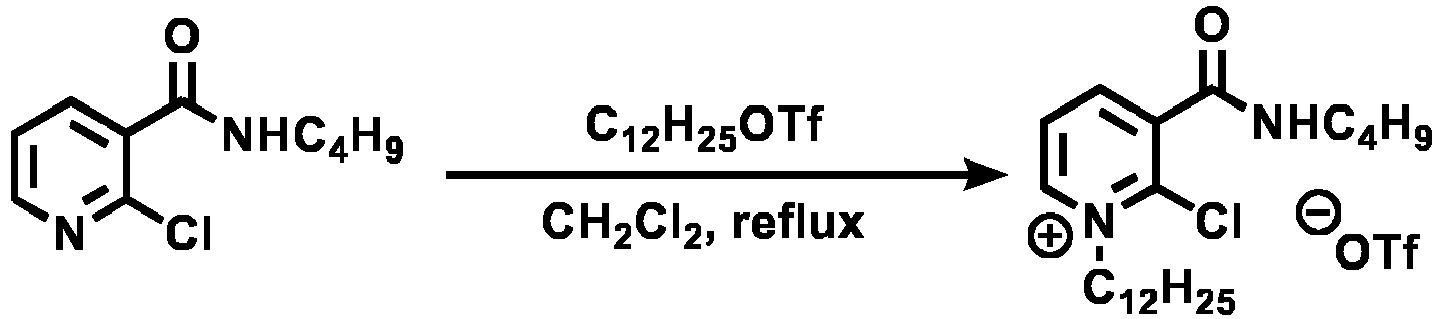
- Dichloromethane (10.7 ml) and 1.03 g (4.82 mmol, 0.9 eq.) of intermediate 4 (N-butyl-2-chloronicotinamide) synthesized in advance were added to intermediate 6 (dodecyl trifluoromethanesulfonate) obtained in a previous reaction, and stirred under reflux at 45°C (water bath temperature) for 24 hours. After the reaction ended, the reaction end solution was concentrated with an evaporator. Hexane was added to the obtained residue, and the formed crystals were collected. The obtained crystals were washed with diethyl ether to obtain the subject compound in an amount of 0.91 g (1.71 mmol, yield 35%). The 1H NMR measurement results of the compound were as follows:
1H NMR (400 MHz, CDCl3) δ: 8.99 (1H, dd, J = 1.2, 6 Hz), 8.37 (1H, dd, J = 1.2, 7.6 Hz), 8.04 (1H, t, J = 5.6 Hz), 7.95 (1H, dd, J = 6.4, 8 Hz), 4.71 (2H, t, J = 8 Hz), 3.42 (2H, dd, J = 6.8, 12.8 Hz), 2.03-1.92 (2H, m), 1.65-1.57 (2H, m), 1.46-1.24 (20H, m), 0.97-0.88 (6H, m) ppm. - The subject compound was synthesized by the scheme below. The synthesis was performed using a 100-mL one neck eggplant flask.

- Dichloromethane (7.62 ml) and 2-chloropyridine (0.6 g, 3.81 mmol) were added to 1.22 g (4.2 mmol, 1.1 eq.) of intermediate 7 (3,7-dimethyloctyl trifluoromethanesulfonate) obtained in a previous reaction, and stirred at 45°C for 24 hours. After the reaction ended, the reaction solution was concentrated with an evaporator to obtain the subject compound in an amount of 1.5 g (3.71 mmol, yield 97%). The 1H NMR measurement results of the compound were as follows:
1H NMR (400 MHz, CDCl3) δ: 9.1 (1H, d, J = 6 Hz), 8.5 (1H, t, J = 6.4 Hz), 8.1 (2H, m), 4.8 (2H, m), 1.9 (1H, m), 1.8 (1H, m), 1.6 (1H, m), 1.5 (1H, m), 1.4-1.2 (6H, m), 1.0 (3H, t, J = 6.8 Hz), 0.9 (6H, m) ppm. - The subject compound was synthesized by the scheme below. The synthesis was performed using a 50-mL one neck eggplant flask.

- Dichloromethane (6.7 ml) and 2-chloropyridine (0.35 g, 3.05 mmol) were added to 1.44 g (1.1 eq.) of intermediate 8 (3,7,11,15-tetramethylhexadecyl trifluoromethanesulfonate) obtained in a previous reaction, and stirred under reflux at 45°C (water bath temperature) for 24 hours. After the reaction ended, the reaction end solution was concentrated with an evaporator. The obtained residue was purified with preparative TLC to obtain the subject compound in an amount of 0.38 g (0.7 mmol, yield 23%). The 1H NMR measurement results of the compound were as follows:
1H NMR (400 MHz, CDCl3) δ: 9.24 (1H, dd, J = 1.6, 6 Hz), 8.52 (1H, dt, J = 1.6, 8.4 Hz), 8.1 (1H, t, J = 6, Hz), 8.04 (1H, dd, J = 1.2, 8 Hz), 4.82 (2H, m), 2.00-1.92 (1H, m), 1.84-1.74 (1H, m), 1.69-1.64 (1H, m), 1.57-1.47 (1H, m), 1.40-1.02 (20H, m), 0.90-0.84 (15H, m) ppm. - The reagents used in examination example 1 were as follows:
- · phosphoric acid (85%): manufactured by FUJIFILM Wako Pure Chemical Corporation
- · disodium hydrogen phosphate: manufactured by FUJIFILM Wako Pure Chemical Corporation
- · potassium dihydrogen phosphate: manufactured by FUJIFILM Wako Pure Chemical Corporation
- · ethanol (99.5%): manufactured by FUJIFILM Wako Pure Chemical Corporation
- · curcumin: manufactured by FUJIFILM Wako Pure Chemical Corporation
- · acetonitrile: manufactured by FUJIFILM Wako Pure Chemical Corporation
- · hydrogen peroxide (30%): manufactured by FUJIFILM Wako Pure Chemical Corporation
- Those shown in parenthesis are effective amounts. The amounts described below were expressed in terms of effective amounts.
- Oxidative decomposition activity was evaluated using 3-(2-chloropyridin-1-ium-1-yl)propane-1-sulfonate of example 1 (hereinafter referred to as the pyridinium compound of example 1).
- A solution of 5.29 mM of the pyridinium compound of example 1 (which is referred to as solution A) was prepared using ion-exchanged water, a solution of 1765 mM of hydrogen peroxide (which is referred to as solution B) was prepared using ion-exchanged water and 30% hydrogen peroxide, and a solution of 1.32 mM of curcumin was prepared using ethanol. 0.1 ml of solution B and 1 ml of solution A were added to 18.8 ml of a phosphate buffer solution adjusted to pH = 7.3 and stirred for 10 seconds, and then, 0.1 ml of the curcumin solution was added thereto and stirred for 10 minutes (the final concentrations of the pyridinium compound of example 1, hydrogen peroxide and curcumin were 0.264 mM, 8.824 mM and 0.0066 mM, respectively). The phosphate buffer solution with pH = 7.3 was prepared from disodium hydrogen phosphate and potassium dihydrogen phosphate. 10 minutes later, 0.5 ml of the reaction solution was taken, and 0.5 ml of a quenching liquid (0.5 M aqueous phosphate solution/acetonitrile = 1:1 (vol)) was added thereto to obtain a sample solution. This was quantified with HPLC to determine a remaining amount of curcumin.
- As a result of the quantification with HPLC, oxidative decomposition activity of the pyridinium compound of example 1 under the neutral condition was 100%. The HPLC conditions were as shown below. Note that, when the compounds of examples 2 to 10 are used in place of the pyridinium compound of example 1 and evaluated in the same manner, they are equal in obtained oxidative decomposition activity to the pyridinium compound of example 1.
-
- · Device
- SHIMADZU CBM-20A
- pump: LC-20A, UV-Vis detector: SPD-20A, PDA detector: SPD-M20A, column oven: CTO-20A, auto sampler: SIL-20A
- · Analysis conditions
column: L-column ODS, 150 mm × 4.6 mm, 5 µm (Chemicals Evaluation and Research Institute, Japan), oven temperature: 40°C, detector: UV (430 nm), injection volume: 10 µl, flow rate: 1.0 mL/min, mobile phase: A = 50 mM phosphoric acid, B = acetonitrile
Claims (8)
- A novel pyridinium compound represented by the following general formula (1), (2) or (3):
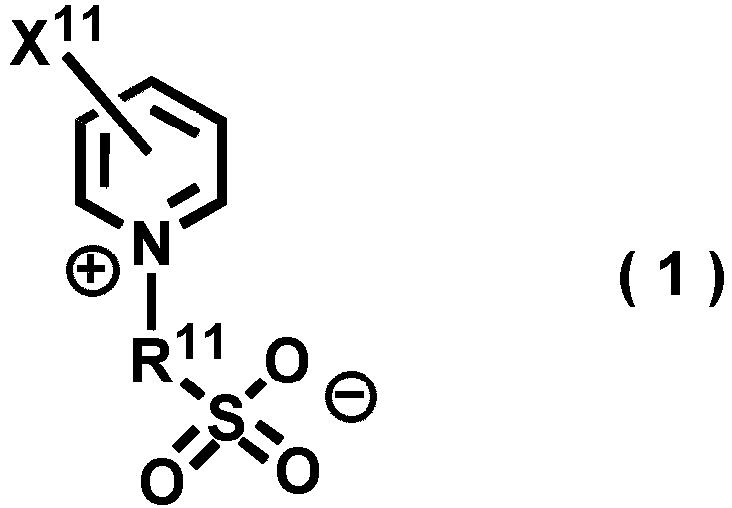 wherein X11 is a halogen atom, X11 being bonded to a carbon atom at position 2, 4 or 6 of the pyridine ring, and R11 is an alkylene group with 1 or more and 24 or less carbons which may contain a heteroatom;
 wherein X21 is a halogen atom, X21 being bonded to a carbon atom at position 2, 4 or 6 of the pyridine ring, Z21 is a group selected from -COO-R22, -CONH-R23 and - CON(R24)(R25), Z21 being bonded to a carbon atom of the pyridine ring different from the carbon atom to which X21 is bonded, R21 is an alkyl group with 3 or more and 24 or less carbons which may contain a heteroatom, R22, R23, R24 and R25 each represent an alkyl group with 3 or more carbons which may contain a heteroatom, and A21- is an anion; or
 wherein X31 is a halogen atom, X31 being bonded to a carbon atom at position 2, 4 or 6 of the pyridine ring, R31 is a branched alkyl group with 10 or more and 24 or less carbons which may contain a heteroatom, and A31- is an anion.
 - The compound according to claim 1, wherein in the general formula (1), -R11-SO3 is -CH2-(CH2)n11-Y1-(CH2)n12-SO3, Y1 is a single bond or a heteroatom, n11 and n12 each represent an integer of 0 or more and 23 or less, and a total of n11 and n12 is 0 or more and 23 or less.
- The compound according to claim 1 or 2, wherein in the general formula (2), -R21 is -CH2-(CH2)n21-Y2- (CH2)n22-CH3, Y2 is a single bond or a heteroatom, n21 and n22 each represent an integer of 0 or more and 22 or less, and a total of n21 and n22 is 1 or more and 22 or less.
- The compound according to any of claims 1 to 3, wherein in the general formula (3), -R31 is -CH2-R311-Y3-R312-CH3, Y3 is a single bond or a heteroatom, R311 and R312 each represent a single bond or an alkylene group, a total number of carbons in R311 and R312 is 8 or more and 22 or less, and at least one of R311 and R312 is a branched alkylene group.
- The compound according to any of claims 1 to 4, wherein in the general formula (1), R11 is an alkylene group with 1 or more and 24 or less carbons not containing a heteroatom.
- The compound according to any of claims 1 to 5, wherein in the general formula (2), R21 is an alkyl group with 3 or more and 24 or less carbons not containing a heteroatom.
- The compound according to any of claims 1 to 6, wherein in the general formula (2), Z21 is a group selected from -COO-R22 and -CONH-R23.
- The compound according to any of claims 1 to 7, wherein in the general formula (3), R31 is a branched alkyl group with 10 or more and 24 or less carbons not containing a heteroatom.
Applications Claiming Priority (2)
| Application Number | Priority Date | Filing Date | Title |
|---|---|---|---|
| JP2022066550 | 2022-04-13 | ||
| PCT/JP2023/014845 WO2023199938A1 (en) | 2022-04-13 | 2023-04-12 | Novel pyridinium compound |
Publications (1)
| Publication Number | Publication Date |
|---|---|
| EP4509495A1 true EP4509495A1 (en) | 2025-02-19 |
Family
ID=88329835
Family Applications (1)
| Application Number | Title | Priority Date | Filing Date |
|---|---|---|---|
| EP23788356.6A Pending EP4509495A1 (en) | 2022-04-13 | 2023-04-12 | Novel pyridinium compound |
Country Status (5)
| Country | Link |
|---|---|
| US (1) | US20250263379A1 (en) |
| EP (1) | EP4509495A1 (en) |
| JP (1) | JPWO2023199938A1 (en) |
| CN (1) | CN119013258A (en) |
| WO (1) | WO2023199938A1 (en) |
Family Cites Families (8)
| Publication number | Priority date | Publication date | Assignee | Title |
|---|---|---|---|---|
| JPS5850669B2 (en) * | 1980-02-07 | 1983-11-11 | 三菱製紙株式会社 | How to harden gelatin |
| JPS60112761A (en) | 1983-11-18 | 1985-06-19 | Fujisawa Pharmaceut Co Ltd | Novel ryridinium compound and production thereof |
| US5236822A (en) * | 1991-10-03 | 1993-08-17 | Eastman Kodak Company | Method and composition for hardening gelatin |
| JPH06337495A (en) * | 1993-05-28 | 1994-12-06 | Konica Corp | Silver halide photographic sensitive material |
| DE19618408A1 (en) * | 1996-05-08 | 1997-11-13 | Hoechst Ag | Cyanopyridinium compounds as bleach activators |
| JP2008120699A (en) | 2006-11-08 | 2008-05-29 | Pharma Ip | Novel pyridinium derivatives and medicines |
| DE102007047685A1 (en) * | 2007-10-04 | 2008-07-31 | Henkel Ag & Co. Kgaa | Product for lightening the color of keratinic fibers, especially hair, comprises an acylpyridinium derivative, an imidazole compound and hydrogen peroxide |
| JP5415789B2 (en) * | 2009-03-09 | 2014-02-12 | 学校法人 名城大学 | Fluorous condensing agent, method for separating fluorine component |
-
2023
- 2023-04-12 WO PCT/JP2023/014845 patent/WO2023199938A1/en not_active Ceased
- 2023-04-12 JP JP2024514981A patent/JPWO2023199938A1/ja active Pending
- 2023-04-12 US US18/856,458 patent/US20250263379A1/en active Pending
- 2023-04-12 EP EP23788356.6A patent/EP4509495A1/en active Pending
- 2023-04-12 CN CN202380033923.4A patent/CN119013258A/en active Pending
Also Published As
| Publication number | Publication date |
|---|---|
| US20250263379A1 (en) | 2025-08-21 |
| JPWO2023199938A1 (en) | 2023-10-19 |
| CN119013258A (en) | 2024-11-22 |
| WO2023199938A1 (en) | 2023-10-19 |
Similar Documents
| Publication | Publication Date | Title |
|---|---|---|
| DE3751973T2 (en) | Alkene compounds | |
| WO2017004164A1 (en) | Anionic surfactants | |
| Schmidtchen | Probing the design of a novel ditopic anion receptor | |
| Bakó et al. | Novel monoaza-and diazacrown ethers incorporating sugar units and their extraction ability towards picrate salts | |
| Chawla et al. | A novel calix [4] arene-based neutral semicarbazone receptor for anion recognition | |
| Luo et al. | P. R. China | |
| Murakami et al. | Syntheses of macrocyclic enzyme models. Part 4. Preparation and characterization of cationic octopus azaparacyclophanes | |
| US20250263379A1 (en) | Novel pyridinium compound | |
| Yan et al. | Mild and efficient synthesis of 5, 6-diamino-5, 6-dideoxy-1, 2-O-isopropylidene-3-O-methyl-β-l-idofuranose: precursor of the first carbohydrate-derived chiral Mn (III)–salen complex | |
| CN104530019A (en) | Method for synthesizing VE nicotinate | |
| Civitello et al. | The regioselective cleavage of aryl tosylates by electrochemical reduction | |
| Ballistreri et al. | Spectroscopic and structural properties of some molybdenum and tungsten polyoxoperoxo complexes. A comparison with mononuclear complexes | |
| CN117658963B (en) | A diastereomer of vitamin C derivative and its preparation and application | |
| CN102816153B (en) | Method for synthesizing vitamin E (VE) nicotinate | |
| Stolze et al. | Spin adduct formation from lipophilic EMPO-derived spin traps with various oxygen-and carbon-centered radicals | |
| US9228294B2 (en) | Activator for hydrogen peroxide and its application | |
| EP0000907B1 (en) | Process for the preparation of furanones and intermediate products in this process | |
| Song et al. | Potential bleach activators with improved imide hydrolytic stability | |
| Aerts et al. | The use of 1H NMR for yield determination in the regioselective epoxidation of squalene | |
| Christian et al. | Preparation of amphiphilic sucrose carbamates by reaction with alkyl isocyanates in water–alcohol mixtures | |
| CN104098611A (en) | Carbon atom bridged chain type multi-ferrocene compound synthesizing method | |
| Talanov et al. | Unusual conformational control of mobile mono-and diionizable calix [4] arene ligands by alkali metal cations | |
| Alsbaiee et al. | The face selectivity of 1, 3-dipolar cycloaddition reactions of 4-butyloxycarbonyl-3, 4, 5, 6-tetrahydropyridine 1-oxide | |
| Stolze et al. | Spin trapping experiments with different carbamoyl-substituted EMPO derivatives | |
| JP2025055844A (en) | New pyridinium compounds |
Legal Events
| Date | Code | Title | Description |
|---|---|---|---|
| STAA | Information on the status of an ep patent application or granted ep patent |
Free format text: STATUS: THE INTERNATIONAL PUBLICATION HAS BEEN MADE |
|
| PUAI | Public reference made under article 153(3) epc to a published international application that has entered the european phase |
Free format text: ORIGINAL CODE: 0009012 |
|
| STAA | Information on the status of an ep patent application or granted ep patent |
Free format text: STATUS: REQUEST FOR EXAMINATION WAS MADE |
|
| 17P | Request for examination filed |
Effective date: 20241001 |
|
| AK | Designated contracting states |
Kind code of ref document: A1 Designated state(s): AL AT BE BG CH CY CZ DE DK EE ES FI FR GB GR HR HU IE IS IT LI LT LU LV MC ME MK MT NL NO PL PT RO RS SE SI SK SM TR |
|
| DAV | Request for validation of the european patent (deleted) | ||
| DAX | Request for extension of the european patent (deleted) |