EP4507298A2 - Method for neural network-based video encoding and decoding, and video encoding apparatus - Google Patents
Method for neural network-based video encoding and decoding, and video encoding apparatus Download PDFInfo
- Publication number
- EP4507298A2 EP4507298A2 EP24193196.3A EP24193196A EP4507298A2 EP 4507298 A2 EP4507298 A2 EP 4507298A2 EP 24193196 A EP24193196 A EP 24193196A EP 4507298 A2 EP4507298 A2 EP 4507298A2
- Authority
- EP
- European Patent Office
- Prior art keywords
- smoothing
- temporal
- input image
- motion vector
- latent representation
- Prior art date
- Legal status (The legal status is an assumption and is not a legal conclusion. Google has not performed a legal analysis and makes no representation as to the accuracy of the status listed.)
- Pending
Links
Images










Classifications
-
- H—ELECTRICITY
- H04—ELECTRIC COMMUNICATION TECHNIQUE
- H04N—PICTORIAL COMMUNICATION, e.g. TELEVISION
- H04N19/00—Methods or arrangements for coding, decoding, compressing or decompressing digital video signals
- H04N19/42—Methods or arrangements for coding, decoding, compressing or decompressing digital video signals characterised by implementation details or hardware specially adapted for video compression or decompression, e.g. dedicated software implementation
-
- H—ELECTRICITY
- H04—ELECTRIC COMMUNICATION TECHNIQUE
- H04N—PICTORIAL COMMUNICATION, e.g. TELEVISION
- H04N19/00—Methods or arrangements for coding, decoding, compressing or decompressing digital video signals
- H04N19/10—Methods or arrangements for coding, decoding, compressing or decompressing digital video signals using adaptive coding
- H04N19/169—Methods or arrangements for coding, decoding, compressing or decompressing digital video signals using adaptive coding characterised by the coding unit, i.e. the structural portion or semantic portion of the video signal being the object or the subject of the adaptive coding
- H04N19/17—Methods or arrangements for coding, decoding, compressing or decompressing digital video signals using adaptive coding characterised by the coding unit, i.e. the structural portion or semantic portion of the video signal being the object or the subject of the adaptive coding the unit being an image region, e.g. an object
- H04N19/172—Methods or arrangements for coding, decoding, compressing or decompressing digital video signals using adaptive coding characterised by the coding unit, i.e. the structural portion or semantic portion of the video signal being the object or the subject of the adaptive coding the unit being an image region, e.g. an object the region being a picture, frame or field
-
- G—PHYSICS
- G06—COMPUTING OR CALCULATING; COUNTING
- G06N—COMPUTING ARRANGEMENTS BASED ON SPECIFIC COMPUTATIONAL MODELS
- G06N3/00—Computing arrangements based on biological models
- G06N3/02—Neural networks
- G06N3/04—Architecture, e.g. interconnection topology
-
- G—PHYSICS
- G06—COMPUTING OR CALCULATING; COUNTING
- G06T—IMAGE DATA PROCESSING OR GENERATION, IN GENERAL
- G06T9/00—Image coding
- G06T9/002—Image coding using neural networks
-
- H—ELECTRICITY
- H04—ELECTRIC COMMUNICATION TECHNIQUE
- H04N—PICTORIAL COMMUNICATION, e.g. TELEVISION
- H04N19/00—Methods or arrangements for coding, decoding, compressing or decompressing digital video signals
- H04N19/10—Methods or arrangements for coding, decoding, compressing or decompressing digital video signals using adaptive coding
- H04N19/102—Methods or arrangements for coding, decoding, compressing or decompressing digital video signals using adaptive coding characterised by the element, parameter or selection affected or controlled by the adaptive coding
- H04N19/103—Selection of coding mode or of prediction mode
- H04N19/105—Selection of the reference unit for prediction within a chosen coding or prediction mode, e.g. adaptive choice of position and number of pixels used for prediction
-
- H—ELECTRICITY
- H04—ELECTRIC COMMUNICATION TECHNIQUE
- H04N—PICTORIAL COMMUNICATION, e.g. TELEVISION
- H04N19/00—Methods or arrangements for coding, decoding, compressing or decompressing digital video signals
- H04N19/10—Methods or arrangements for coding, decoding, compressing or decompressing digital video signals using adaptive coding
- H04N19/102—Methods or arrangements for coding, decoding, compressing or decompressing digital video signals using adaptive coding characterised by the element, parameter or selection affected or controlled by the adaptive coding
- H04N19/117—Filters, e.g. for pre-processing or post-processing
-
- H—ELECTRICITY
- H04—ELECTRIC COMMUNICATION TECHNIQUE
- H04N—PICTORIAL COMMUNICATION, e.g. TELEVISION
- H04N19/00—Methods or arrangements for coding, decoding, compressing or decompressing digital video signals
- H04N19/10—Methods or arrangements for coding, decoding, compressing or decompressing digital video signals using adaptive coding
- H04N19/102—Methods or arrangements for coding, decoding, compressing or decompressing digital video signals using adaptive coding characterised by the element, parameter or selection affected or controlled by the adaptive coding
- H04N19/124—Quantisation
-
- H—ELECTRICITY
- H04—ELECTRIC COMMUNICATION TECHNIQUE
- H04N—PICTORIAL COMMUNICATION, e.g. TELEVISION
- H04N19/00—Methods or arrangements for coding, decoding, compressing or decompressing digital video signals
- H04N19/10—Methods or arrangements for coding, decoding, compressing or decompressing digital video signals using adaptive coding
- H04N19/102—Methods or arrangements for coding, decoding, compressing or decompressing digital video signals using adaptive coding characterised by the element, parameter or selection affected or controlled by the adaptive coding
- H04N19/13—Adaptive entropy coding, e.g. adaptive variable length coding [AVLC] or context adaptive binary arithmetic coding [CABAC]
-
- H—ELECTRICITY
- H04—ELECTRIC COMMUNICATION TECHNIQUE
- H04N—PICTORIAL COMMUNICATION, e.g. TELEVISION
- H04N19/00—Methods or arrangements for coding, decoding, compressing or decompressing digital video signals
- H04N19/10—Methods or arrangements for coding, decoding, compressing or decompressing digital video signals using adaptive coding
- H04N19/134—Methods or arrangements for coding, decoding, compressing or decompressing digital video signals using adaptive coding characterised by the element, parameter or criterion affecting or controlling the adaptive coding
- H04N19/136—Incoming video signal characteristics or properties
- H04N19/137—Motion inside a coding unit, e.g. average field, frame or block difference
- H04N19/139—Analysis of motion vectors, e.g. their magnitude, direction, variance or reliability
-
- H—ELECTRICITY
- H04—ELECTRIC COMMUNICATION TECHNIQUE
- H04N—PICTORIAL COMMUNICATION, e.g. TELEVISION
- H04N19/00—Methods or arrangements for coding, decoding, compressing or decompressing digital video signals
- H04N19/30—Methods or arrangements for coding, decoding, compressing or decompressing digital video signals using hierarchical techniques, e.g. scalability
- H04N19/31—Methods or arrangements for coding, decoding, compressing or decompressing digital video signals using hierarchical techniques, e.g. scalability in the temporal domain
-
- H—ELECTRICITY
- H04—ELECTRIC COMMUNICATION TECHNIQUE
- H04N—PICTORIAL COMMUNICATION, e.g. TELEVISION
- H04N19/00—Methods or arrangements for coding, decoding, compressing or decompressing digital video signals
- H04N19/50—Methods or arrangements for coding, decoding, compressing or decompressing digital video signals using predictive coding
- H04N19/503—Methods or arrangements for coding, decoding, compressing or decompressing digital video signals using predictive coding involving temporal prediction
- H04N19/51—Motion estimation or motion compensation
- H04N19/513—Processing of motion vectors
-
- H—ELECTRICITY
- H04—ELECTRIC COMMUNICATION TECHNIQUE
- H04N—PICTORIAL COMMUNICATION, e.g. TELEVISION
- H04N19/00—Methods or arrangements for coding, decoding, compressing or decompressing digital video signals
- H04N19/50—Methods or arrangements for coding, decoding, compressing or decompressing digital video signals using predictive coding
- H04N19/503—Methods or arrangements for coding, decoding, compressing or decompressing digital video signals using predictive coding involving temporal prediction
- H04N19/51—Motion estimation or motion compensation
- H04N19/547—Motion estimation performed in a transform domain
-
- H—ELECTRICITY
- H04—ELECTRIC COMMUNICATION TECHNIQUE
- H04N—PICTORIAL COMMUNICATION, e.g. TELEVISION
- H04N19/00—Methods or arrangements for coding, decoding, compressing or decompressing digital video signals
- H04N19/50—Methods or arrangements for coding, decoding, compressing or decompressing digital video signals using predictive coding
- H04N19/503—Methods or arrangements for coding, decoding, compressing or decompressing digital video signals using predictive coding involving temporal prediction
- H04N19/51—Motion estimation or motion compensation
- H04N19/56—Motion estimation with initialisation of the vector search, e.g. estimating a good candidate to initiate a search
-
- H—ELECTRICITY
- H04—ELECTRIC COMMUNICATION TECHNIQUE
- H04N—PICTORIAL COMMUNICATION, e.g. TELEVISION
- H04N19/00—Methods or arrangements for coding, decoding, compressing or decompressing digital video signals
- H04N19/60—Methods or arrangements for coding, decoding, compressing or decompressing digital video signals using transform coding
- H04N19/61—Methods or arrangements for coding, decoding, compressing or decompressing digital video signals using transform coding in combination with predictive coding
-
- H—ELECTRICITY
- H04—ELECTRIC COMMUNICATION TECHNIQUE
- H04N—PICTORIAL COMMUNICATION, e.g. TELEVISION
- H04N19/00—Methods or arrangements for coding, decoding, compressing or decompressing digital video signals
- H04N19/80—Details of filtering operations specially adapted for video compression, e.g. for pixel interpolation
-
- H—ELECTRICITY
- H04—ELECTRIC COMMUNICATION TECHNIQUE
- H04N—PICTORIAL COMMUNICATION, e.g. TELEVISION
- H04N19/00—Methods or arrangements for coding, decoding, compressing or decompressing digital video signals
- H04N19/85—Methods or arrangements for coding, decoding, compressing or decompressing digital video signals using pre-processing or post-processing specially adapted for video compression
Definitions
- the disclosure relates to a method and an apparatus for encoding and decoding data, and more particularly, to a method and an apparatus for neural network-based video encoding and decoding.
- an apparatus and method for neural network-based video encoding using bidirectional prediction and temporal layer information is provided.
- a method for neural network-based video encoding including: estimating a motion vector between an input image and a reference image based on a temporal layer of the input image; transforming the motion vector into a latent representation; scaling the latent representation of the motion vector based on the temporal layer of the input image; and obtaining a temporal context of the input image based on the scaled latent representation of the motion vector and the reference image.
- the reference image may include a first bidirectional reference image temporally before the input image and a second bidirectional reference image temporally after the input image
- the scaling based on the temporal layer may include scaling the latent representation of the motion vector by using a smaller quantization step for a higher temporal layer.
- the scaling based on the temporal layer may include scaling the latent representation of the motion vector by dividing the latent representation of the motion vector into quantization step determining parameters defined for the temporal layer.
- the method may further include: performing entropy encoding and entropy decoding on the latent representation of the motion vector; rescaling the scaled latent representation of the motion vector based on the temporal layer; and reconstructing motion vectors based on the rescaled latent representation of the motion vector, wherein the obtaining of the temporal context may include obtaining the temporal context based on the reconstructed motion vectors and the reference image.
- the rescaling based on the temporal layer may include multiplying the scaled latent representation of the motion vector by the quantization step determining parameters defined for the temporal layer.
- the method may further include: before performing the entropy encoding and entropy decoding, quantizing the scaled latent representation of the motion vector; and estimating a probability distribution of the latent representation of the motion vector.
- the obtaining of the temporal context may include: outputting a reference feature map by inputting the reference image into a feature extraction neural network, performing bilinear warping on the reference feature map based on the reconstructed motion vectors to output a warped reference feature map, inputting the warped reference feature map to a post-processing neural network, and inputting an output of the post-processing neural network to a context fusion network to output the temporal context.
- a method for neural network-based video encoding may include: estimating a motion vector between an input image and a reference image based on a temporal layer of the input image; transforming the motion vector into a latent representation; obtaining a temporal context of the input image based on the latent representation of the motion vector and the reference image; and performing a smoothing operation on the temporal context based on a smoothing object including at least one of the reference image, the input image, the motion vector, an input in the obtaining of the temporal context, an output in the obtaining of the temporal context, or an input or output of a sub-process in the obtaining of the temporal context.
- the reference image may include a first bidirectional reference image temporally before the input image and a second bidirectional reference image temporally after the input image.
- the performing of the smoothing may include: obtaining a smoothing level of the smoothing object for the temporal layer of the input image; generating a smoothing filter based on the smoothing level; and performing the smoothing on the smoothing object based on the smoothing filter.
- the obtaining of the smoothing level of the smoothing object may include obtaining a lower smoothing level for a lower temporal layer.
- the obtaining of the smoothing level of the smoothing object may include obtaining different smoothing levels depending on spatial positions.
- a method for neural network-based video decoding including: reconstructing a latent representation of a motion vector based on a first bitstream for the motion vector; rescaling the reconstructed latent representation of the motion vector based on a temporal layer; reconstructing the motion vector based on the rescaled latent representation of the motion vector; obtaining a temporal context based on the reconstructed motion vector and a reference image; and reconstructing an input image based on a second bitstream for the input image and the temporal context.
- the reference image may include a first bidirectional reference image temporally before the input image and a second bidirectional reference image temporally after the input image.
- the rescaling based on the temporal layer may include multiplying the latent representation of the motion vector by quantization step determining parameters defined for the temporal layer.
- the reconstructing of the input image may include: reconstructing a latent representation of the input image based on the second bitstream for the input image; rescaling the latent representation of the input image based on the temporal layer; and reconstructing the input image based on the rescaled latent representation of the input image and the temporal context.
- a method for neural network-based video decoding including: reconstructing a latent representation of a motion vector based on a first bitstream for the motion vector; obtaining a temporal context by using the motion vector and a reference image; performing smoothing by using, as a smoothing object, at least one of the reference image, the motion vector, an input in the obtaining of the temporal context, an output in the obtaining of the temporal context, and an input or output of a sub-process in the obtaining of the temporal context; and reconstructing the input image based on a second bitstream for an input image and the temporal context.
- the performing of the smoothing may include: obtaining different smoothing levels based on at least one of a temporal layer and a spatial position of the input image; generating a smoothing filter based on the smoothing level; and performing the smoothing on the smoothing object based on the smoothing filter.
- an electronic device including: a memory configured to store one or more instructions and a reference image; and a processor configured to execute the one or more instructions to: estimate a motion vector between an input image and the reference image based on the reference image, the input image, and a temporal layer of the input image; transform the motion vector into a latent representation; scale the latent representation of the motion vector based on the temporal layer of the input image; and obtain a temporal context of the input image based on the scaled latent representation of the motion vector and the reference image.
- a computer program product comprising instructions which, when the program is executed by a computer cause the computer to carry out the steps of any of the above method embodiments.
- Embodiments herein may be described and illustrated in terms of blocks which carry out a described function or functions. These blocks, which may be referred to herein as units, modules, or the like, may be physically implemented by analog and/or digital circuits such as logic gates, integrated circuits, microprocessors, microcontrollers, memory circuits, passive electronic components, active electronic components, optical components, hardwired circuits and the like, and may optionally be driven by a firmware.
- the circuits may, for example, be embodied in one or more semiconductor chips, or on substrate supports such as printed circuit boards and the like.
- the circuits constituting a block may be implemented by dedicated hardware, or by a processor (e.g., one or more programmed microprocessors and associated circuitry), or by a combination of dedicated hardware to perform some functions of the block and a processor to perform other functions of the block.
- Each block of the embodiments may be physically separated into two or more interacting and discrete blocks without departing from the scope of the disclosure.
- the blocks of the embodiments may be physically combined into more complex blocks without departing from the scope of the disclosure.
- the blocks which may be referred to herein as units, modules, or the like, may be software modules implemented by software codes, program codes, software instructions, or the like.
- the software blocks may be executed on one or more processors. According to an embodiment, the terms, such as "block”, “unit”, “module,” or the like, should be understood as a unit that performs at least one function or operation and that may be embodied as hardware, software, or a combination thereof.
- FIG. 1A is a flowchart illustrating a method for neural network-based video encoding according to an embodiment of the disclosure.
- the method may be performed by a video encoding apparatus based on neural network.
- a higher encoding performance may be achieved than a unidirectional prediction.
- a flow of the method for video encoding using bidirectional prediction will be described first, followed by a description of a method of using temporal layer information.
- the method may include estimating bidirectional motion vectors.
- the video encoding apparatus based on bidirectional prediction may estimate bidirectional motion vectors m f , m b by using bidirectional reference images x ⁇ f , x ⁇ b and an input image x t as input.
- the input image x t refers to an image to be encoded at a current time t in a sequence of images constituting a video.
- a reference image may refer to an already decoded image (e.g., a previous image) and/or an image referenced for encoding or decoding the input image x t .
- the bidirectional reference images refer to images before and/or after the time t of the input image x t .
- an image from before the time t of the input image may be referred to as a forward reference image x ⁇ f and an image from after the time t of the input image may be referred to as a backward reference image x ⁇ b .
- the method may include transforming bidirectional motion vectors into a latent representation.
- the bidirectional motion vectors m f , m b may be transformed into a latent representation g t of the bidirectional motion vectors by using a neural network.
- the neural network may include, but is not limited to, a Convolutional Neural Network (CNN) or the like.
- CNN Convolutional Neural Network
- the latent representation is an output of a neural network using an input image or motion information as input, and collectively refers to a latent feature, latent vector, and the like.
- the method may include performing entropy-encoding or entropy-decoding on the latent representation of the bidirectional motions vectors.
- the latent representation g t of the bidirectional motion vectors may be quantized and entropy-encoded to be represented as a bitstream b m of the bidirectional motion vectors and transmitted to a decoder, and by entropy-decoding the bitstream b m of the motion vectors, the quantized latent representation ⁇ t of the motion vectors may be reconstructed.
- the method may include reconstructing bidirectional motion vectors. For example, by using the quantized latent representation ⁇ t of the motion vectors, bidirectional motion vectors m ⁇ f , m ⁇ b may be reconstructed.
- the method may include creating or generating temporal context based on the latent representation of the bidirectional vectors. For example, by using the reconstructed bidirectional motion vectors m ⁇ f , m ⁇ b and the bidirectional reference images x ⁇ f , x ⁇ b , a bidirectional temporal context C t may be created.
- the bidirectional temporal context C t may be a feature map with a single resolution or a feature map with two or more resolutions, and may be prediction information about the input image x t for use in encoding and decoding the input image x t .
- the method may include transforming the input image into a latent representation based on the bidirectional temporal context.
- the input image x t may be transformed into a latent representation y t of the input image by transforming the input image into a latent representation based on the bidirectional temporal context C t .
- the method may include performing entropy-encoding or entropy-decoding on the latent representation of the input image.
- the latent representation y t of the input image may be entropy-encoded to be represented as a bitstream b x of the input image and transmitted to the decoder.
- a quantized latent representation ⁇ t of the input image may be reconstructed.
- the method may include reconstructing the input image based on the bidirectional temporal context. For example, by using the quantized latent representation ⁇ t of the input image, the input image x ⁇ t may be reconstructed. In this case, the bidirectional temporal context C t may be used as an additional input. The reconstructed image x ⁇ t may be used as a reference image for subsequent images.
- the method for video encoding using bidirectional prediction may further use a temporal layer l t .
- the method of using the temporal layer may include a method of scaling and rescaling according to a temporal layer and/or a method of smoothing according to a temporal layer.
- scaling according to a temporal layer may be performed on the latent representation g t of the bidirectional motion vectors at and/or on the latent representation y t of the input image at , and rescaling may be performed on the latent representation ⁇ t of the bidirectional motion vectors at and/or on the latent representation ⁇ t of the input image at .
- a comparative video encoding method different encoding methods and neural network models may be used for temporal layers. Such methods may require storing various neural network models for temporal layers, such that the video compression method is inefficient in terms of complexity such as memory efficiency and the like.
- scaling and rescaling may be performed according to temporal layers. In this case, a latent representation may be scaled differently depending on temporal layers.
- scaling is performed by dividing the latent representation into scale parameters that are determined differently for temporal layers, and after entropy-encoding and decoding are performed, rescaling is performed by multiplying the scaled latent representation by the previously determined scale parameters.
- smoothing according to temporal layers may be performed at all or some of positions . While FIG. 1 illustrates an example in which both scaling and smoothing are performed according to temporal layers, this is merely exemplary and the disclosure is not limited thereto, and scaling and smoothing may be performed selectively. Smoothing may be performed on various smoothing objects depending on the positions where smoothing is performed.
- the bidirectional motion vectors m f , m b are the smoothing objects.
- the smoothing is not limited thereto, and in addition to the smoothing positions illustrated in FIG. 1 , smoothing according to temporal layers may be performed between various neural networks used in operation 115 of creating a bidirectional temporal context based on the latent representation of the motion vectors.
- a neural network used for creating a bidirectional temporal context is trained to create a bidirectional temporal context that may improve average encoding performance for an input image to be learned.
- a motion vector is estimated incorrectly or in an example case in which a video contains complex motions
- neural networks trained to create the bidirectional temporal context may rather have an adverse effect on the encoding performance of individual input images.
- a distant reference image is used more than in a unidirectional prediction structure, thereby resulting in a significant decrease in encoding performance caused by the use of bidirectional temporal context which is not optimized for each temporal layer.
- smoothing is performed differently for temporal layers on temporal context or information for creating the temporal context, thereby creating a temporal context which is smoothed differently for temporal layers.
- a higher smoothing level may be used for a higher temporal layer, and a lower smoothing level may be used for a lower temporal layer.
- the incorrect temporal context may be regulated, thereby achieving higher encoding performance compared to common technology.
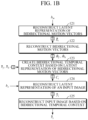
- FIG. 1B is a flowchart illustrating a method for neural network-based video decoding according to an embodiment of the disclosure.
- FIG. 1B an example of a method for video decoding using bidirectional prediction and/or temporal layer information, which is performed by a video decoding apparatus based on a neural network, will be described below.
- a method for video decoding using bidirectional prediction and/or temporal layer information which is performed by a video decoding apparatus based on a neural network.
- the method may include reconstructing a latent representation of the bidirectional motion vectors.
- the video decoding apparatus may reconstruct a latent representation ⁇ t of bidirectional motion vectors by using a bitstream b m for the bidirectional motion vectors.
- the video encoding apparatus may generate the bitstream b m for the bidirectional motion vectors by quantization and/or entropy encoding, as described above, for example, with reference to FIG. 1A .
- the latent representation of the motion vectors may be reconstructed, in which case entropy decoding may be performed with the mean and the standard deviation used in the entropy encoding process.
- the entropy decoding may be arithmetic decoding.
- the method may include reconstructing bidirectional motion vectors.
- the video decoding apparatus may reconstruct the bidirectional motion vectors m ⁇ f , m ⁇ b by using the latent representation ⁇ t of the bidirectional motion vectors.
- the method may include creating or generating a bidirectional temporal context based on the latent representation of the bidirectional motion vectors.
- the video decoding apparatus may create a temporal context by using the latent representation t of the bidirectional motion vectors m ⁇ f , m ⁇ b .
- the video decoding apparatus may create a bidirectional temporal context C t by using bidirectional reference images x ⁇ f , x ⁇ b .
- the method may include reconstructing the latent representation of an input image.
- the video decoding apparatus may reconstruct a latent representation ⁇ t of an input image by using a bitstream b x of the input image as input.
- the bitstream b x of the input image may be generated by quantization and/or entropy encoding in the video encoding process.
- the latent representation of the input image may be reconstructed, in which case entropy decoding may be performed with the mean and the standard deviation used in the entropy encoding process.
- the entropy decoding may be arithmetic decoding.
- the method may include reconstructing the input image based on the bidirectional temporal context.
- the video decoding apparatus may reconstruct an input image x ⁇ t based on a bidirectional temporal context by using the latent representation ⁇ t of the input image and a temporal context C t .
- the reconstructed image x ⁇ t may be used as a reference image for subsequent images.
- the method for video decoding using bidirectional prediction may further use a temporal layer.
- the method of using the temporal layer may include a scaling and rescaling method according to a temporal layer and/or a smoothing method according to a temporal layer, in which both the methods may be performed or either one of the methods may be performed selectively in the video decoding process.
- rescaling may be performed at positions on the latent representation of the bidirectional motion vectors and/or the latent representation of the input image. Rescaling may be performed by multiplying the latent representation, scaled after entropy decoding, by scale parameters (quantization step determining parameters) used in the video encoding process.
- smoothing may be performed by using, as a smoothing object, at least one of the reference images x ⁇ f , x ⁇ b , the motion vector, an input in the creating of the temporal context in operation 123, an output in the creating of the temporal context in operation 123, an input or output of a sub-process in the creating of the temporal context in operation 123.
- the smoothing may be performed according to temporal layers.
- smoothing according to temporal layers may be performed at all or some of positions . Smoothing may be performed on various smoothing objects depending on the positions where smoothing is performed.
- FIG. 2A is a flowchart illustrating a method for neural network-based video encoding according to another embodiment of the disclosure. The method may be performed by an apparatus configured to perform video encoding and/or decoding based on a neural network.
- the flowchart illustrates a method for video encoding by using an example in which smoothing is performed at an output position in operation 115 of creating a bidirectional temporal context based on a latent representation of the motion vector in FIG. 1A . While it is illustrated that the smoothing position is the output position in operation 115 of creating a bidirectional temporal context based on a latent representation of the motion vector, the smoothing position is not limited thereto and may be easily applied to other smoothing positions. That is, smoothing may be performed on the reference image, input image, motion vector, input in the operation of creating the temporal context, output in the operation of creating the temporal context, and input or output in the detailed operation of creating the temporal context.
- the method may include creating and generating bidirectional temporal context.
- the video encoding apparatus may output a bidirectional temporal context C t of an input image and/or a bitstream b m for a bidirectional motion vector by using bidirectional reference images x ⁇ f , x ⁇ b and a temporal layer l t of an input image.
- the input image x t refers to an image to be encoded at a current time t in a sequence of images constituting a video.
- the reference image refers to an already decoded image and an image referenced for encoding or decoding the input image x t .
- the bidirectional reference images refer to images before and/or after the time t of the input image x t , which are referred to as a forward reference image x ⁇ f and a backward reference image x ⁇ b , respectively. There may be one or more forward reference images and backward reference images, but for convenience of explanation, the following description will be given using an example in which there is one forward reference image and one backward reference image.
- the bidirectional temporal context C t may be a feature map with a single resolution or a feature map with two or more resolutions.
- the temporal layer l t refers to each layer in an example case in which images in a video are temporally layered so that higher-layer images may be encoded even without decoding lower-layer images.
- the method may include performing a smoothing operation the bidirectional temporal context.
- the video compression apparatus may perform smoothing on the bidirectional temporal context C t according to the temporal layer l t by using the bidirectional temporal context C t and the temporal layer l t of the input image, and may output a smoothed bidirectional temporal context C ⁇ t .
- the video compression apparatus may apply different smoothing levels to the bidirectional temporal context according to temporal layers and/or spatial positions in order to regulate incorrect temporal context which is caused by the use of bidirectional temporal context which is not optimized for each temporal layer.
- the video compression apparatus may apply a first smoothing level to a bidirectional temporal context corresponding to a first temporal layer, and a second smoothing level to a bidirectional temporal context corresponding to a second temporal layer.
- the first smoothing level may be different than the second smoothing level.
- the video compression apparatus may apply a first smoothing level to a bidirectional temporal context corresponding to a first spatial position, and a second smoothing level to a bidirectional temporal context corresponding to a second spatial position.
- the first spatial position may be different from the second spatial position.
- the spatial position may be a spatial region or a spatial area.
- the method may include performing an encoding or a decoding operation on the input image based on the bidirectional temporal context. For example, by using, as input, the smoothed bidirectional temporal context C ⁇ t and the input image x t , the video compression apparatus may perform encoding on the input image to output a bitstream b x , and if necessary, may perform decoding based on the smoothed bidirectional temporal context C ⁇ t and the bitstream b x to output a reconstructed image x ⁇ t .
- the reconstructed image x ⁇ t may be used as a reference image for encoding subsequent input images.
- FIG. 2B is a flowchart illustrating operation 200 of creating a bidirectional temporal context according to an embodiment of the disclosure.
- FIGS. 3A and 3B are diagrams explaining an example of scaling and rescaling according to a temporal layer. An example of operation 200 of creating a bidirectional temporal context will be described below with reference to FIGS. 2B , 3A , and 3B . As described above, scaling and rescaling may be selectively omitted.
- the method may include estimating bidirectional motion vectors. For example, by using an input image x t and bidirectional reference images x ⁇ f , x b , the video encoding apparatus may estimate bidirectional motion information between the input image x t and the respective reference images x ⁇ f , x ⁇ b .
- the input image x ⁇ t and the bidirectional reference images x ⁇ f , x ⁇ b are input to a neural network, and motion vectors m f , m b and/or pixel-wise optical flow may be output as motion information
- the method may include transforming the bidirectional motion vectors into a latent representation.
- the video compression apparatus may transform bidirectional motion vectors m f , m b into a latent representation g t of the bidirectional motion vectors.
- the bidirectional motion vectors m f , m b may be input to a neural network to be transformed into the latent representation g t .
- the neural network may include, but is not limited to a Convolutional Neural Network (CNN).
- CNN Convolutional Neural Network
- the latent representation is an output of a neural network using an input image or motion information as input, and collectively refers to a latent feature, latent vector, or the like.
- the method may include scaling the latent representation of the bidirectional motion vectors. For example, by using, as input, the latent representation g t of the bidirectional motion vectors m f , m b according to the temporal layer l t and the temporal layer l t of the input image, the video compression apparatus may scale the latent representation according to the temporal layer l t , and may output a scaled latent representation g t s of the bidirectional motion vectors.
- the same single neural network model may be used for the respective bidirectional motion vectors m f , m b , and scaling may be performed differently for each temporal layer.
- the latent representation may be scaled by using a single neural network, thereby improving memory efficiency compared to a typical method of using various neural network models according to temporal layers.
- the scaling may be performed by dividing the latent representation g t of the bidirectional motion vectors into predefined scale parameters according to temporal layers.
- Scaling of the latent representation according to temporal layers has an effect which is the same as or equivalent to an effect produced by adjusting a quantization step, such that the term "scale parameter" in the following description will be referred to as a "quantization step determining parameter.”
- the quantization step determining parameter may be learned in advance to determine an optimal quantization step for each temporal layer.
- the image is used as a reference image in many instances, and thus the image may be reconstructed with a higher picture quality level compared to an image in a lower temporal layer.
- a distance between the input image and the reference image is longer than a case in which an image is in a lower temporal layer than the higher temporal layer.
- the quantization step determining parameter may be learned to use a smaller quantization step for a higher temporal layer, and a larger quantization step for a lower temporal layer.
- a quantization step determining parameter set Q temp and a quantization step determining parameter q l t for the temporal layer l t of the input image may be defined as the following Equation 1.
- L denotes a total number of temporal layers.
- a highest temporal layer contains only an I-frame, i.e., an image to which a still image coding method is to be applied, but is not limited thereto.
- I denotes an I-frame
- B denotes a B-frame.
- the method may include quantizing the scaled latent representation of the bidirectional motion vectors. For example, by using the scaled latent representation g t s of the bidirectional motion vectors as input, quantization is performed on the scaled latent representation to output the quantized and scaled latent representation g ⁇ t s of the bidirectional motion vectors.
- the quantization may be performed using uniform quantization, i.e., a rounding operation, but is not limited thereto.
- the method may include estimating the probability distribution of the quantized and scaled latent representation of the bidirectional motion vectors. For example, by using the quantized and scaled latent representation g ⁇ t s of the bidirectional motion vectors as input, a probability distribution of the latent representation g ⁇ t s may be estimated for entropy encoding the latent representation g ⁇ t s .
- An entropy model may be used, and based on the assumption that the latent representation follows the distribution such as Laplacian distribution or Gaussian distribution, etc., the entropy model may output a mean ⁇ t g and a standard deviation ⁇ t g of the distribution.
- the method may include performing entropy encoding or decoding on the quantized and scaled latent representation of the bidirectional motion vectors.
- entropy encoding and entropy decoding may be performed on the quantized and scaled latent representation g ⁇ t s of the bidirectional motion vectors.
- entropy encoding may be performed on the latent representation g ⁇ t s to output a bitstream b m .
- entropy decoding may be performed with the mean ⁇ t g and the standard deviation ⁇ t g used in the entropy encoding process, to reconstruct the latent representation g ⁇ t s .
- the entropy encoding process is generally lossless encoding, such that the reconstructed latent representation g ⁇ t s is the same as an input g ⁇ t s of an entropy encoder.
- the entropy encoding and decoding may be performed using common arithmetic encoding and arithmetic decoding, etc., but is not limited thereto.
- the method may include performing a rescaling operation on the quantized and scaled latent representation of the bidirectional motion vectors. For example, by using, as input, the temporal layer l t of the input image and the quantized and scaled latent representation g ⁇ t s of the bidirectional motion vectors, rescaling is performed to return the latent representation to an original scale and output the rescaled latent representation ⁇ t of the bidirectional motion vectors.
- FIG. 3B is a diagram explaining an example of scaling and rescaling a latent representation for an l t -th temporal layer.
- scaling may be performed in operation 230 by dividing C number of channel maps into C number of parameters of the quantization step determining parameters q l t , which may be represented by the following Equation 2.
- C denotes the number of channels in the latent representation represented as a feature map
- H, W respectively denote the spatial height and width of the latent representation.
- Quantization (240) and entropy encoding (261) and decoding (262) are performed on the scaled latent representation y t s , and rescaling (270) may be performed by multiplying a quantization step determining parameter q l t , which is the same as that used in the scaling process, by the quantized and scaled latent representation y ⁇ t s .
- a quantized and rescaled latent representation ⁇ t is output.
- the rescaling may be represented by the following Equation 3.
- the method may include reconstructing bidirectional motion vectors. For example, by using the rescaled latent representation ⁇ t of the bidirectional motion vectors as input, the bidirectional motion vectors m ⁇ f , m ⁇ b may be reconstructed and output.
- a Convolutional Neural Network may be used, but the neural network is not limited thereto.
- the method may include creating or generating bidirectional temporal context based on the latent representation of the bidirectional motion vectors. For example, by using the reconstructed motion vectors m ⁇ f , m ⁇ b and the reference images x ⁇ f , x ⁇ b as input, a bidirectional temporal context C t for encoding the input image may be created and output.
- a motion compensation technique and Convolutional Neural Network may be used.
- the motion compensation technique may use bilinear warping, but is not limited thereto.
- FIG. 4 is a flowchart illustrating operation 400 of smoothing a bidirectional temporal context according to an embodiment of the disclosure.
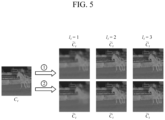
- FIG. 5 is a diagram explaining an example of smoothing a bidirectional temporal context according to a temporal layer.
- Operation 400 of smoothing a bidirectional temporal context in FIG. 4 may include operation 410 of determining a smoothing level S t for temporal layers l t , operation 420 of creating a smoothing filter F t , and smoothing operation 430.
- the smoothing filter may be a predefined filter, such as a Gaussian filter or a bilateral filter based on a Gaussian filter, or may be a trainable filter such as a Convolutional Neural Network, but is not limited thereto.
- the trainable filter may be used as the smoothing filter, multiple trainable filters may be trained differently for the temporal layers l t , and one of the trainable filters may be selected according to the temporal layers l t for use.
- the smoothing level S t may be a standard deviation, and if in an example case in which smoothing filter is a trainable filter, the filter may be the index of filters that are trained differently for the temporal layers.
- Operation 400 of smoothing a bidirectional temporal context will be described below based on an example of using a predefined smoothing filter as the smoothing filter.
- the method may include determining a smoothing level for the temporal layer. For example, by using the temporal layer l t of the input image as input, the video encoding apparatus may determine and output a smoothing level for smoothing a bidirectional temporal context C t .
- the Gaussian filter may be used, and a standard deviation for creating the Gaussian filter may be output as a smoothing level.
- the constant value may be used as it is as the standard deviation, or the standard deviation may be used by learning different parameters according to temporal layers.
- a higher smoothing level (large standard deviation) may be output for a higher temporal layer, and a lower smoothing level (small standard deviation) may be output for a lower temporal layer.
- different smoothing levels for a bidirectional temporal context may be determined according to spatial positions.
- information output during decoding in operation 260 may be used as spatial position information for smoothing.
- smoothing information for spatial positions may also be output.
- the method may include generating a smoothing filter. For example, by determining a parameter of the predefined filter by using the smoothing level S t determined in operation 410 as input, a smoothing filter F t to be applied to actual smoothing may be generated.
- the predefined filter may include, but is not limited to, for example, a Gaussian filter or a bilateral filter using a Gaussian kernel, etc.
- the method may include performing smoothing operation on bidirectional temporal context. For example, smoothing is performed on the bidirectional temporal context by using as input the smoothing filter generated in operation 420, and then the smoothed bidirectional temporal context C ⁇ t may be output.
- FIG. 5 is a diagram illustrating an example of a bidirectional temporal context which is smoothed by using different smoothing levels for different temporal layers or different spatial positions.
- arrow CD shows a result of applying a lower smoothing level to a lower temporal layer, i.e., as the temporal layer l t increases.
- arrow (2) of FIG. 5 shows a result of using different smoothing levels for spatial positions even in the same temporal layer, in which C t and C ⁇ t denote average values calculated for all channels for ease of visualization.
- the incorrect temporal context may be regulated, thereby achieving higher coding performance compared to common technology.
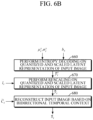
- FIGS. 6A and 6B are flowcharts illustrating operation 600 of encoding and/or decoding an input image according to an embodiment of the disclosure.
- the method may include transforming an input image into a latent representation based on the bidirectional temporal context. For example, by using an input image x ⁇ t and the smoothed bidirectional temporal context C ⁇ t as input, the video encoding device may transform the input image x t into a latent representation y t and output the latent representation.
- a Convolutional Neural Network may be used, and the smoothed bidirectional temporal context may be used instead of using a temporal context created from a unidirectional reference image.
- the method may include performing scaling on the latent representation of the input image. For example, by using, as input, the temporal layer l t of the input image and the latent representation y t of the input image, the video compression apparatus may perform scaling on the latent representation y t of the input image according to the temporal layers, and may output the scaled latent representation y t s of the input image. As illustrated in operation 230, the scaling may be performed by dividing the latent representation y t of the input image into quantization step determining parameters defined for the temporal layers.
- the method may include performing quantization on the scaled latent representation of the input image.
- the video compression apparatus may perform quantization on the scaled latent representation y t s of the input image and output the quantized and scaled latent representation y ⁇ t s of the input image.
- the quantization may be performed using uniform quantization, i.e., a typical rounding operation, but is not limited thereto.
- the method may include estimating the probability distribution of the quantized and scaled latent representation of the input image. For example, by using the quantized and scaled latent representation y ⁇ t s of the input image as input, the video compression apparatus may estimate a probability distribution of the latent representation y ⁇ t s for entropy encoding the latent representation y ⁇ t s .
- an entropy model may be used, and based on the assumption that the latent representation follows the distribution such as Laplacian distribution or Gaussian distribution, etc., the entropy model may output a mean ⁇ t y and a standard deviation ⁇ t y of the distribution.
- the method may include performing entropy encoding on the quantized and scaled latent representation of the input image. For example, by using, as input, the quantized and scaled latent representation y ⁇ t s of the input image and the mean ⁇ t y and the standard deviation ⁇ t y , the video compression apparatus may perform entropy encoding on the latent representation y ⁇ t s to output a bitstream b x .
- the entropy encoding may be arithmetic encoding.
- a process may be performed based on a result of the entropy encoding in operation 650.
- the method may include performing entropy decoding on the quantized and scaled latent representation the of input image. For example, by using, as input, the entropy-encoded bitstream b x and the mean ⁇ t y and the standard deviation ⁇ t y which are used in the entropy encoding process, the video compression apparatus may perform entropy decoding to reconstruct the latent representation y ⁇ t s
- the entropy encoding process in operation 650 is generally lossless encoding, such that the latent representation y ⁇ t s reconstructed in operation 660 may be the same as the latent representation y ⁇ t s which is an input of the entropy encoding.
- the entropy decoding may be arithmetic decoding, but is not limited thereto.
- the method may include performing a rescaling operation on the quantized and scaled latent representation of the input image. For example, by using, as input, the temporal layer l t of the input image and the quantized and scaled latent representation y ⁇ t s of the input image, the video compression apparatus may perform rescaling to return the scaled latent representation of the input image to an original scale, to output the rescaled latent representation ⁇ t of the input image .
- the rescaling may be performed in the same manner as the above operation 270.
- the method may include reconstructing the input image based on the bidirectional temporal context. For example, by using, as input, the rescaled latent representation ⁇ t of the input image and the smoothed bidirectional temporal context C ⁇ t , the video compression apparatus may reconstruct and output the input image x ⁇ t .
- a Convolutional Neural Network may be used, and the smoothed bidirectional temporal context may be used instead of using a temporal context created from a unidirectional reference image.
- the reconstructed image may be used as a reference image for subsequent images.
- FIG. 7 is a block diagram illustrating an electronic device according to an embodiment of the disclosure.
- the electronic device 700 includes a memory 710 and a processor 720.
- the electronic device 700 may include a video encoding device based on a neural network or a video decoding device based on a neural network which is configured to perform various examples of the above method for video encoding or video decoding.
- the electronic device 700 may be a device configured to perform both video encoding and video decoding.
- the electronic device may include, but is not limited to, a device such as an edge device which requires applications such as video encoding in an environment with limited computing resources, various image transmission/reception devices, such as mobile phones, TV, monitors, Internet of Things (IoT) devices, as well as cloud computing devices, and the like.
- IoT Internet of Things
- the memory 710 may store various instructions for image processing, such as video encoding, encoding, etc., and data associated with image processing (neural network, weight, quantization step determining parameter, reference image, reconstructed image, bitstream generated by encoding, etc.).
- the memory 710 may include Random Access Memory (RAM), such as Dynamic Random Access Memory (DRAM), Static Random Access Memory (SRAM), etc., Read-Only Memory (ROM), flash memory, cache memory, virtual memory, etc., but is not limited thereto.
- RAM Random Access Memory
- DRAM Dynamic Random Access Memory
- SRAM Static Random Access Memory
- ROM Read-Only Memory
- flash memory cache memory, virtual memory, etc., but is not limited thereto.
- the processor 720 may execute the instructions stored in the memory 710 and perform various video processing operations by referring to various data stored in the memory 710.
- the instructions may include one or more instructions configured to perform various embodiments of the aforementioned method for video encoding.
- the instructions may include creating a bidirectional temporal context of the input image by using, as input, the input image, bidirectional reference images, and temporal layers of the input image, smoothing the bidirectional temporal context by using the bidirectional temporal context and the temporal layer as input, and encoding and decoding the input image by using the smoothed bidirectional temporal context and the input image as input.
- the processor 720 may perform an overall control operation of the electronic device 700.
- the processor 720 may include at least one from among a central processing unit (CPU), a graphics processing unit (GPU), an accelerated processing unit (APU), a many integrated core (MIC), a digital signal processor (DSP), a neural processing unit (NPU), an hardware accelerator or a machine learning accelerator.
- the processor 720 may execute at least one program or instruction stored in a memory. For example, the processor 720 may perform a method according to one or more embodiments by executing at least one instruction stored in the memory.
- one or more operations may be performed by one processor, or performed by a plurality of processors.
- the first operation, the second operation, and the third operation may all be performed by a first processor, or the first operation and the second operation may be performed by the first processor (e.g., a generic-purpose processor) and the third operation may be performed by a second processor (e.g., an artificial intelligence dedicated processor).
- the first, second and third processor may be external to the terminal 200.
- the processor 720 may be realized as a single core processor that includes one core, or may be realized as at least one multicore processor that includes a plurality of cores (e.g., a homogeneous multicore or a heterogeneous multicore).
- the plurality of cores included in the multicore processor may respectively include a memory inside the processor such as a cache memory and an on-chip memory, and a common cache shared by the plurality of cores may be included in the multicore processor.
- the processor may refer to a system on chip (SoC), a single core processor, a multicore processor, or a core included in the single core processor or the multicore processor on which at least one processor and other electronic components are integrated, and the core described herein may be realized as the CPU, the GPU, the APU, the MIC, the DSP, the NPU, the hardware accelerator, the machine learning accelerator, or the like, but the embodiments of the disclosure are not limited thereto.
- SoC system on chip
- FIGS. 8A to 8I are diagrams explaining the video encoding and/or decoding process in detail according to an embodiment of the disclosure.
- FIG. 9A is a diagram illustrating an example of a context fusion network.
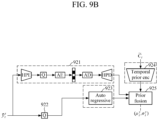
- FIG. 9B is a diagram illustrating an example of an entropy model for estimating a probability distribution.
- the electronic device 700 may include a video encoding device 800 and/or a video decoding device 800a. As illustrated herein, the video encoding device 800 and/or a video decoding device 800a may share components to use bidirectional prediction and temporal layer information.
- the video decoding device 800a may be provided as a separate hardware chip and/or software from the video encoding device 800.
- the video encoding device 800 may input an input image x t and bidirectional reference images x ⁇ f and x ⁇ b to a single motion vector estimation network 811, and may estimate a motion vector m f between a forward reference image x ⁇ f and the input mage x t , and a motion vector m b between a backward reference image x ⁇ b and the input image x t .
- various optical flow estimation neural networks may be used as the motion vector estimation network.
- the two motion vectors are concatenated, and a result of the concatenation may be input to a motion vector encoder (MV Enc) 812.
- the MV Enc may be based on a convolutional neural network and uses bidirectional motion vectors as input, such that the number of channels of the convolution layer may be doubled.
- a quantization step parameter q l t g is selected from a quantization step parameter set Q temp g according to the temporal layer l t of the input image, and by dividing the latent representation g t of the bidirectional motion vectors, output from the MV Enc 812, by the selected quantization step parameter in 813, the latent representation of the bidirectional motion vectors may be scaled according to the temporal layer.
- the scaled latent representation g ⁇ t s of the bidirectional motion vectors is quantized in 814, and a probability distribution of the quantized and scaled latent representation g ⁇ t s of the bidirectional motion vectors may be estimated using an entropy model 815.
- the entropy model may be an entropy model using hyperprior and autoregressive context and the like, but is not limited thereto.
- the quantized and scaled latent representation g ⁇ t s of the bidirectional motion vectors are encoded in AE 8161 and decoded in AD 8162.
- a bitstream b m for the latent representation of the bidirectional motion vectors is output, and decoding is performed using the bitstream b m and the probability distribution.
- a quantization step parameter q l t g is selected from a quantization step parameter set Q temp g by using the temporal layer l t of the input image, and rescaling according to the temporal layer may be performed by multiplying the selected quantization step parameter by the quantized and scaled latent representation of the bidirectional motion vectors in 817.
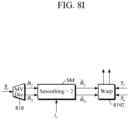
- the rescaled latent representation ⁇ t of the bidirectional motion vectors is input to a motion vector decoder (MV Decoder) in 818, and a forward motion vector m ⁇ f and a backward motion vector m ⁇ b may be reconstructed.
- the MV Decoder is based on a convolutional neural network, and the number of channels of the convolution layer is doubled in order to reconstruct all the bidirectional motion vectors.
- the MV Decoder may increase the number of channels and output smoothing information associated with spatial positions.
- a bidirectional temporal context C t is output in 819.
- the respective bidirectional reference images are input to the feature extractor 8191 to output a forward reference feature map x ⁇ f and a backward reference feature map x ⁇ b .
- the feature extractor 8191 may be a convolutional neural network.
- typical bilinear warping 8192 is performed on the forward reference feature map x ⁇ f , to output a warped forward reference feature map ⁇ f .
- warping may be performed on the backward motion vector m ⁇ b and the backward reference feature map x ⁇ b to output a warped backward reference feature map ⁇ b .
- the warped forward reference feature map and the warped backward reference feature map may pass through context refinement 8193 for post-processing, and may be output as a forward temporal context C f and a backward temporal context C b .
- the neural network for post-processing may be a convolutional neural network.
- the forward temporal context C f and the backward temporal context C b are input to a Context Fusion Network 8194 to output a bidirectional temporal context C t .
- the Context Fusion Network 8194 may include concatenation 911, convolution layers 912 and 914, and a nonlinear layer such as ReLU (e.g., LeakyReLU) 913.
- ReLU e.g., LeakyReLU
- k denotes horizontal and vertical sizes of the kernel
- C in denotes the number of input channels
- C out denotes the number of output channels
- s denotes the stride of the convolution.
- N denotes the number of channels in the forward temporal context and bidirectional temporal context.
- smoothing may be performed by using the temporal layer l t of the input image as input.
- a smoothing level S t for generating a smoothing filter may be output in 821.
- the Gaussian smoothing or bilateral filter based on a Gaussian kernel may be used, in which case a standard deviation for generating a smoothing filter may be output.
- a spatial position difference may be considered by Gaussian smoothing, and the bilateral filter may be used to consider not only the spatial position difference but also a difference in values input to a smoothing object.
- a smoothing filter for use in smoothing the bidirectional temporal context may be generated in 822.
- the smoothing filter may be generated by using a smoothing level S t according to the temporal layer, i.e., a standard deviation as input.
- S t a smoothing level
- K ⁇ K the value of K may be calculated as in, for example, Equation 4.
- ⁇ ⁇ ⁇ denotes a typical rounding operation.
- a Gaussian kernel F t based on the given smoothing level S t may be calculated as in Equation 5.
- Equation 5 ( k x , k y ) denotes a spatial position of the kernel.
- the smoothed bidirectional temporal context C ⁇ t is output in 823.
- a kernel with stride one may be multiplied for each spatial position of the bidirectional temporal context C t .
- a latent representation ⁇ t of the input image may be output by interchannel concatenation and contextual encoder (Enc) 831.
- a quantization step parameter q l t y may be selected from a quantization step parameter set Q temp y .
- the latent representation of the bidirectional motion vectors may be scaled according to the temporal layer.
- the scaled latent representation of the bidirectional motion vectors is quantized in 833, and a probability distribution, i.e., a mean ⁇ t y and a standard deviation ⁇ t y , of the quantized and scaled latent representation y ⁇ t s of the input image may be estimated by using an entropy model 834.
- the entropy model 834 may include a common hyperprior model 921, an autoregressive context model 923, a temporal prior encoder 924, and a prior fusion network 925.
- the quantized and scaled latent representation y ⁇ t s of the input image is input to the hyperprior model 921 and the autoregressive context model 923, to output hyperprior information and autoregressive context, respectively.
- the temporal prior encoder 924 may extract temporal prior information by using the smoothed bidirectional temporal context C ⁇ t as input.
- the prior fusion network 925 may output the mean ⁇ t y and the standard deviation ⁇ t y of the quantized and scaled latent representation y ⁇ t s of the input image, by using the temporal prior information, the hyperprior information, and the autoregressive context as input.
- the quantized and scaled latent representation y ⁇ t s of the input image is decoded in 8351, and a bitstream b x of the input image is output as a result.
- decoding is performed in 8352 by using the output bitstream b x and the mean ⁇ t y and the standard deviation ⁇ t y , followed by rescaling according to the temporal layer by multiplying the quantization step parameter q l t y according to the temporal layer l t of the input image by the quantized and scaled latent representation of the input image in 836, and then the smoothed bidirectional temporal context C ⁇ t and the input image x t are input to the contextual decoder 837 to output a reconstructed image x ⁇ t of the input image.
- the reconstructed image x ⁇ t is stored in the memory to be used as a reference image for encoding of subsequent input images.
- smoothing according to the temporal layer may be performed on the bidirectional temporal context C t in 821, 822, and 823, but may also be performed similarly at various other smoothing positions.
- arrows 1, 2, 3, 4, 5, 6, 7, 8, 9 indicate various smoothing positions.
- smoothing objects at each position are shown in Table 1 below.
- smoothing may be performed on each of the smoothing objects, or smoothing may be performed by concatenating the two objects into one.
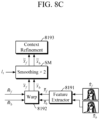
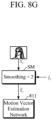
- FIGS. 8B to 8I are diagrams illustrating an example of performing smoothing at smoothing positions of 2 to 9.
- smoothing is performed by inputting the temporal layer l t and the smoothing objects to a smoothing module SM.
- the smoothing objects are bidirectional motion vectors m f , m b which are outputs of the motion vector estimation network 811, and smoothing is performed on each of the bidirectional motion vectors m f , m b by using the smoothing module SM, to obtain the smoothed bidirectional motion vectors m ⁇ f , m ⁇ b .
- the video decoding device 800a which is a neural network-based device, may reconstruct the motion vectors and create a bidirectional temporal context by using the bitstream b m for the latent representation of the bidirectional motion vectors generated by the video decoding device 800a and the bidirectional reference images, and may reconstruct the input image by using the bitstream b x for the input image and the bidirectional temporal context.
- rescaling and/or smoothing may be performed on the latent representation by using the temporal layer.
- the video encoding device is described in detail above, such that a redundant description thereof will be omitted.
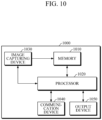
- FIG. 10 is a block diagram illustrating an electronic device according to another embodiment of the disclosure.
- an electronic device 1000 may include a memory 1010, a processor 1020, an image capturing device 1030, a communication device 1040, and an output device 1050.
- the memory 1010 and the processor 1020 are described in detail above, such that a description thereof will be omitted.
- the image capturing device 1030 may include a device, such as a camera and the like, for capturing still images or moving images, etc., and may store the captured images in the memory 1010 and transmit the images to the processor 1020.
- the image capturing device 1030 may include a lens assembly having one or more lenses, image sensors, a charge-coupled device (CCD sensor), image signal processors, and/or flashes.
- the lens assembly included in a camera module may collect light emanating from a subject to be imaged.
- the communication device 1040 may support establishment of a direct communication channel and/or a wireless communication channel between the electronic device 1000 and another electronic device, a server, or the sensor device within a network environment, and performing of communication via the established communication channel, by using various communication techniques.
- the direct communication channel may be a wired communication between the electronic device 1000 and another electronic device.
- the communication device 1040 may transmit the images captured by the image capturing device 1030, and/or the data (e.g., encoded video, etc.) processed by the processor 1020 to another electronic device.
- the communication device 1040 may receive a video to be processed from a cloud device or another electronic device, may store the received video in the memory 1010, and may transmit the video to the processor 1020 so that the processor 1020 may process the video.
- the output device 1050 may visually/non-visually output the images captured by the image capturing device 1030, and/or data processed by the processor 1020.
- the output device 1050 may include a sound output device, a display device (e.g., display), an audio module, and/or a haptic module.
- the output device 1050 may display a video processed by the processor 1020 and the like on the display, thereby improving user's video experience.
- the electronic device 1000 may further include a sensor device (e.g., acceleration sensor, gyroscope, magnetic field sensor, proximity sensor, illuminance sensor, fingerprint sensor, etc.) configured to detect various data, an input device (e.g., a microphone, a mouse, a keyboard, and/or a digital pen (e.g., a stylus pen, etc.), etc.) configured to receive instructions and/or data to be used from a user, and the like.
- a sensor device e.g., acceleration sensor, gyroscope, magnetic field sensor, proximity sensor, illuminance sensor, fingerprint sensor, etc.
- an input device e.g., a microphone, a mouse, a keyboard, and/or a digital pen (e.g., a stylus pen, etc.), etc.) configured to receive instructions and/or data to be used from a user, and the like.
- One or more embodiments of the disclosure described above can be realized as a computer-readable code written on a computer-readable recording medium.
- the computer-readable recording medium may be any type of recording device in which data is stored in a computer-readable manner.
- the method of encoding and/or decoding an image as illustrated according to various embodiments described above may be realized as a computer-readable code, which may be executed on one or more processors.
- the figures illustrate the operations of the methods in a particular according to one or more embodiments of the disclosure, the disclosure is not limited thereto, and as such, the order of operations may vary, one or more operations may be added, or one or more operations may be omitted according to various other embodiments.
- Examples of the computer-readable recording medium include a ROM, a RAM, a CD-ROM, a magnetic tape, a floppy disc, an optical data storage, and a carrier wave (e.g., data transmission through the Internet).
- the computer-readable recording medium can be distributed over a plurality of computer systems connected to a network so that a computer-readable code is written thereto and executed therefrom in a decentralized manner.
- Functional programs, codes, and code segments needed for realizing the present invention can be readily inferred by programmers of ordinary skill in the art to which the invention pertains.
Landscapes
- Engineering & Computer Science (AREA)
- Multimedia (AREA)
- Signal Processing (AREA)
- Physics & Mathematics (AREA)
- Theoretical Computer Science (AREA)
- General Physics & Mathematics (AREA)
- Artificial Intelligence (AREA)
- Evolutionary Computation (AREA)
- Data Mining & Analysis (AREA)
- Computational Linguistics (AREA)
- Biophysics (AREA)
- Biomedical Technology (AREA)
- General Health & Medical Sciences (AREA)
- Molecular Biology (AREA)
- Computing Systems (AREA)
- General Engineering & Computer Science (AREA)
- Life Sciences & Earth Sciences (AREA)
- Mathematical Physics (AREA)
- Software Systems (AREA)
- Health & Medical Sciences (AREA)
- Compression Or Coding Systems Of Tv Signals (AREA)
Abstract
Description
- The disclosure relates to a method and an apparatus for encoding and decoding data, and more particularly, to a method and an apparatus for neural network-based video encoding and decoding.
- Recently, the internet video market is continuously growing. However, since a type and/or a quality of services may be limited by network bandwidth, high-level video encoding technology is required. To this end, there has been proposed neural network-based video encoding technology capable of end-to-end training by replacing components of general video encoding technology with neural networks.
- According to one or more aspects of the disclosure, there is provided an apparatus and method for neural network-based video encoding using bidirectional prediction and temporal layer information.
- According to an aspect of the disclosure, there is provided a method for neural network-based video encoding, the method including: estimating a motion vector between an input image and a reference image based on a temporal layer of the input image; transforming the motion vector into a latent representation; scaling the latent representation of the motion vector based on the temporal layer of the input image; and obtaining a temporal context of the input image based on the scaled latent representation of the motion vector and the reference image.
- The reference image may include a first bidirectional reference image temporally before the input image and a second bidirectional reference image temporally after the input image
- The scaling based on the temporal layer may include scaling the latent representation of the motion vector by using a smaller quantization step for a higher temporal layer.
- The scaling based on the temporal layer may include scaling the latent representation of the motion vector by dividing the latent representation of the motion vector into quantization step determining parameters defined for the temporal layer.
- The method may further include: performing entropy encoding and entropy decoding on the latent representation of the motion vector; rescaling the scaled latent representation of the motion vector based on the temporal layer; and reconstructing motion vectors based on the rescaled latent representation of the motion vector, wherein the obtaining of the temporal context may include obtaining the temporal context based on the reconstructed motion vectors and the reference image.
- The rescaling based on the temporal layer may include multiplying the scaled latent representation of the motion vector by the quantization step determining parameters defined for the temporal layer.
- The method may further include: before performing the entropy encoding and entropy decoding, quantizing the scaled latent representation of the motion vector; and estimating a probability distribution of the latent representation of the motion vector.
- The obtaining of the temporal context may include: outputting a reference feature map by inputting the reference image into a feature extraction neural network, performing bilinear warping on the reference feature map based on the reconstructed motion vectors to output a warped reference feature map, inputting the warped reference feature map to a post-processing neural network, and inputting an output of the post-processing neural network to a context fusion network to output the temporal context.
- According to another aspect of the disclosure, there is provided a method for neural network-based video encoding, the method may include: estimating a motion vector between an input image and a reference image based on a temporal layer of the input image; transforming the motion vector into a latent representation; obtaining a temporal context of the input image based on the latent representation of the motion vector and the reference image; and performing a smoothing operation on the temporal context based on a smoothing object including at least one of the reference image, the input image, the motion vector, an input in the obtaining of the temporal context, an output in the obtaining of the temporal context, or an input or output of a sub-process in the obtaining of the temporal context.
- The reference image may include a first bidirectional reference image temporally before the input image and a second bidirectional reference image temporally after the input image.
- The performing of the smoothing may include: obtaining a smoothing level of the smoothing object for the temporal layer of the input image; generating a smoothing filter based on the smoothing level; and performing the smoothing on the smoothing object based on the smoothing filter.
- The obtaining of the smoothing level of the smoothing object may include obtaining a lower smoothing level for a lower temporal layer.
- The obtaining of the smoothing level of the smoothing object may include obtaining different smoothing levels depending on spatial positions.
- According to another aspect of the disclosure, there is provided a method for neural network-based video decoding, the method including: reconstructing a latent representation of a motion vector based on a first bitstream for the motion vector; rescaling the reconstructed latent representation of the motion vector based on a temporal layer; reconstructing the motion vector based on the rescaled latent representation of the motion vector; obtaining a temporal context based on the reconstructed motion vector and a reference image; and reconstructing an input image based on a second bitstream for the input image and the temporal context.
- The reference image may include a first bidirectional reference image temporally before the input image and a second bidirectional reference image temporally after the input image.
- The rescaling based on the temporal layer may include multiplying the latent representation of the motion vector by quantization step determining parameters defined for the temporal layer.
- The reconstructing of the input image may include: reconstructing a latent representation of the input image based on the second bitstream for the input image; rescaling the latent representation of the input image based on the temporal layer; and reconstructing the input image based on the rescaled latent representation of the input image and the temporal context.
- According to another aspect of the disclosure, there is provided a method for neural network-based video decoding, the method including: reconstructing a latent representation of a motion vector based on a first bitstream for the motion vector; obtaining a temporal context by using the motion vector and a reference image; performing smoothing by using, as a smoothing object, at least one of the reference image, the motion vector, an input in the obtaining of the temporal context, an output in the obtaining of the temporal context, and an input or output of a sub-process in the obtaining of the temporal context; and reconstructing the input image based on a second bitstream for an input image and the temporal context.
- The performing of the smoothing may include: obtaining different smoothing levels based on at least one of a temporal layer and a spatial position of the input image; generating a smoothing filter based on the smoothing level; and performing the smoothing on the smoothing object based on the smoothing filter.
- According to another aspect of the disclosure, there is provided an electronic device including: a memory configured to store one or more instructions and a reference image; and a processor configured to execute the one or more instructions to: estimate a motion vector between an input image and the reference image based on the reference image, the input image, and a temporal layer of the input image; transform the motion vector into a latent representation; scale the latent representation of the motion vector based on the temporal layer of the input image; and obtain a temporal context of the input image based on the scaled latent representation of the motion vector and the reference image.
- According to another aspect of the disclosure, there is provided a computer program product comprising instructions which, when the program is executed by a computer cause the computer to carry out the steps of any of the above method embodiments.
-
-
FIG. 1A is a flowchart illustrating a method for neural network-based video encoding according to an embodiment of the disclosure. -
FIG. 1B is a flowchart illustrating a method for neural network-based video decoding according to an embodiment of the disclosure. -
FIG. 2A is a flowchart illustrating a method for neural network-based video encoding according to another embodiment of the disclosure. -
FIG. 2B is a flowchart illustrating an operation of creating a bidirectional temporal context according to an embodiment of the disclosure. -
FIGS. 3A and3B are diagrams explaining an example of scaling and rescaling according to a temporal layer. -
FIG. 4 is a flowchart illustrating an operation of smoothing a bidirectional temporal context according to an embodiment of the disclosure. -
FIG. 5 is a diagram explaining an example of smoothing a bidirectional temporal context according to a temporal layer. -
FIG. 6A is a flowchart illustrating an operation of encoding an input image according to an embodiment of the disclosure. -
FIG. 6B is a flowchart illustrating an operation of decoding an input image according to an embodiment of the disclosure. -
FIG. 7 is a block diagram illustrating an electronic device according to an embodiment of the disclosure. -
FIGS. 8A to 8I are diagrams explaining the video encoding process in detail according to an embodiment of the disclosure. -
FIG. 9A is a diagram illustrating an example of a context fusion network. -
FIG. 9B is a diagram illustrating an example of an entropy model for estimating a probability distribution. -
FIG. 10 is a block diagram illustrating an electronic device according to another embodiment of the disclosure. - Details of other embodiments are included in the following detailed description and drawings. Advantages and features of the present invention, and a method of achieving the same will be more clearly understood from the following embodiments described in detail with reference to the accompanying drawings. Throughout the drawings and the detailed description, unless otherwise described, the same drawing reference numerals will be understood to refer to the same elements, features, and structures.
- It will be understood that, although the terms first, second, etc. may be used herein to describe various elements, these elements should not be limited by these terms. These terms are only used to distinguish one element from another. Any references to singular may include plural unless expressly stated otherwise. In addition, unless explicitly described to the contrary, an expression such as "comprising" or "including" will be understood to imply the inclusion of stated elements but not the exclusion of any other elements.
- Embodiments herein may be described and illustrated in terms of blocks which carry out a described function or functions. These blocks, which may be referred to herein as units, modules, or the like, may be physically implemented by analog and/or digital circuits such as logic gates, integrated circuits, microprocessors, microcontrollers, memory circuits, passive electronic components, active electronic components, optical components, hardwired circuits and the like, and may optionally be driven by a firmware. The circuits may, for example, be embodied in one or more semiconductor chips, or on substrate supports such as printed circuit boards and the like. The circuits constituting a block may be implemented by dedicated hardware, or by a processor (e.g., one or more programmed microprocessors and associated circuitry), or by a combination of dedicated hardware to perform some functions of the block and a processor to perform other functions of the block. Each block of the embodiments may be physically separated into two or more interacting and discrete blocks without departing from the scope of the disclosure. Likewise, the blocks of the embodiments may be physically combined into more complex blocks without departing from the scope of the disclosure. However, the disclosure is not limited thereto, and as such, the blocks, which may be referred to herein as units, modules, or the like, may be software modules implemented by software codes, program codes, software instructions, or the like. The software blocks may be executed on one or more processors. According to an embodiment, the terms, such as "block", "unit", "module," or the like, should be understood as a unit that performs at least one function or operation and that may be embodied as hardware, software, or a combination thereof.
- Expressions, such as "at least one of," for example, the expression, "at least one of a, b, and c," should be construed as including only a, only b, only c, both a and b, both a and c, both b and c, or all of a, b, and c.
-
FIG. 1A is a flowchart illustrating a method for neural network-based video encoding according to an embodiment of the disclosure. - Referring to
FIG. 1A , an example of a method for video encoding using bidirectional prediction and/or temporal layer information will be described below. According to an embodiment, the method may be performed by a video encoding apparatus based on neural network. By using the bidirectional prediction, a higher encoding performance may be achieved than a unidirectional prediction. A flow of the method for video encoding using bidirectional prediction will be described first, followed by a description of a method of using temporal layer information. - According to an embodiment, in
operation 111, the method may include estimating bidirectional motion vectors. For example, the video encoding apparatus based on bidirectional prediction may estimate bidirectional motion vectors mf , mb by using bidirectional reference images x̂f , x̂b and an input image xt as input. The input image xt refers to an image to be encoded at a current time t in a sequence of images constituting a video. According to an embodiment, a reference image may refer to an already decoded image (e.g., a previous image) and/or an image referenced for encoding or decoding the input image xt . The bidirectional reference images refer to images before and/or after the time t of the input image x t. For example, an image from before the time t of the input image may be referred to as a forward reference image x̂f and an image from after the time t of the input image may be referred to as a backward reference image x̂b. There may be one or more forward reference images and backward reference images, but for convenience of explanation, the following description will be given using an example in which there is one forward reference image and one backward reference image. - According to an embodiment, in
operation 112, the method may include transforming bidirectional motion vectors into a latent representation. For example, the bidirectional motion vectors mf ,mb may be transformed into a latent representation gt of the bidirectional motion vectors by using a neural network. The neural network may include, but is not limited to, a Convolutional Neural Network (CNN) or the like. Here, the latent representation is an output of a neural network using an input image or motion information as input, and collectively refers to a latent feature, latent vector, and the like. - According to an embodiment, in
operation 113, the method may include performing entropy-encoding or entropy-decoding on the latent representation of the bidirectional motions vectors. For example, the latent representation gt of the bidirectional motion vectors may be quantized and entropy-encoded to be represented as a bitstream bm of the bidirectional motion vectors and transmitted to a decoder, and by entropy-decoding the bitstream bm of the motion vectors, the quantized latent representation ĝt of the motion vectors may be reconstructed. - According to an embodiment, in
operation 114, the method may include reconstructing bidirectional motion vectors. For example, by using the quantized latent representation ĝt of the motion vectors, bidirectional motion vectors m̂f ,m̂b may be reconstructed. - According to an embodiment, in
operation 115, the method may include creating or generating temporal context based on the latent representation of the bidirectional vectors. For example, by using the reconstructed bidirectional motion vectors m̂f ,m̂b and the bidirectional reference images x̂f , x̂ b, a bidirectional temporal context Ct may be created. The bidirectional temporal context Ct may be a feature map with a single resolution or a feature map with two or more resolutions, and may be prediction information about the input image xt for use in encoding and decoding the input image xt . - According to an embodiment, in
operation 116, the method may include transforming the input image into a latent representation based on the bidirectional temporal context. For example, the input image xt may be transformed into a latent representation yt of the input image by transforming the input image into a latent representation based on the bidirectional temporal context Ct . - According to an embodiment, in
operation 117, the method may include performing entropy-encoding or entropy-decoding on the latent representation of the input image. For example, the latent representation yt of the input image may be entropy-encoded to be represented as a bitstream bx of the input image and transmitted to the decoder. According to an embodiment, by entropy-decoding the bitstream bx of the input image, a quantized latent representation ŷt of the input image may be reconstructed. - According to an embodiment, in
operation 118, the method may include reconstructing the input image based on the bidirectional temporal context. For example, by using the quantized latent representation ŷt of the input image, the input image x̂t may be reconstructed. In this case, the bidirectional temporal context Ct may be used as an additional input. The reconstructed image x̂t may be used as a reference image for subsequent images. - According to an embodiment, the method for video encoding using bidirectional prediction may further use a temporal layer lt . The method of using the temporal layer may include a method of scaling and rescaling according to a temporal layer and/or a method of smoothing according to a temporal layer.
- Referring to
FIG. 1A , scaling according to a temporal layer may be performed on the latent representation gt of the bidirectional motion vectors atand/or on the latent representation yt of the input image at , and rescaling may be performed on the latent representation ĝt of the bidirectional motion vectors at
 and/or on the latent representation ŷt of the input image at
 .
.
- In a comparative video encoding method, different encoding methods and neural network models may be used for temporal layers. Such methods may require storing various neural network models for temporal layers, such that the video compression method is inefficient in terms of complexity such as memory efficiency and the like. According to an embodiment, by using a single neural network model for temporal layers, scaling and rescaling may be performed according to temporal layers. In this case, a latent representation may be scaled differently depending on temporal layers. In the scaling according to the temporal layers, before uniform quantization is performed on the latent representation, scaling is performed by dividing the latent representation into scale parameters that are determined differently for temporal layers, and after entropy-encoding and decoding are performed, rescaling is performed by multiplying the scaled latent representation by the previously determined scale parameters.
- Referring to
FIG. 1A , smoothing according to temporal layers may be performed at all or some of positions. While
FIG. 1 illustrates an example in which both scaling and smoothing are performed according to temporal layers, this is merely exemplary and the disclosure is not limited thereto, and scaling and smoothing may be performed selectively. Smoothing may be performed on various smoothing objects depending on the positions where smoothing is performed. - In an example case in which smoothing is performed between
operation 111 of estimating the bidirectional motion vectors andoperation 112 of transforming the latent representation of the bidirectional motion vectors, the bidirectional motion vectors mf ,mb are the smoothing objects. However, the smoothing is not limited thereto, and in addition to the smoothing positions illustrated inFIG. 1 , smoothing according to temporal layers may be performed between various neural networks used inoperation 115 of creating a bidirectional temporal context based on the latent representation of the motion vectors. - Generally, a neural network used for creating a bidirectional temporal context is trained to create a bidirectional temporal context that may improve average encoding performance for an input image to be learned. However, in an example case in which a motion vector is estimated incorrectly or in an example case in which a video contains complex motions, there is a possibility that neural networks trained to create the bidirectional temporal context may rather have an adverse effect on the encoding performance of individual input images. For example, in Hierarchical B-frame encoding, a distant reference image is used more than in a unidirectional prediction structure, thereby resulting in a significant decrease in encoding performance caused by the use of bidirectional temporal context which is not optimized for each temporal layer.
- On the other hand, according to an embodiment of the disclosure, as a method of regulating the incorrect temporal context caused by the use of bidirectional temporal context which is not optimized for each temporal layer, smoothing is performed differently for temporal layers on temporal context or information for creating the temporal context, thereby creating a temporal context which is smoothed differently for temporal layers. A higher smoothing level may be used for a higher temporal layer, and a lower smoothing level may be used for a lower temporal layer. In this manner, the incorrect temporal context may be regulated, thereby achieving higher encoding performance compared to common technology.
-
FIG. 1B is a flowchart illustrating a method for neural network-based video decoding according to an embodiment of the disclosure. - Referring to
FIG. 1B , an example of a method for video decoding using bidirectional prediction and/or temporal layer information, which is performed by a video decoding apparatus based on a neural network, will be described below. For details on operations of the method for video decoding, reference may be made on corresponding operations thereof described throughout the specification. - According to an embodiment, in
operation 121, the method may include reconstructing a latent representation of the bidirectional motion vectors. For example, the video decoding apparatus may reconstruct a latent representation ĝt of bidirectional motion vectors by using a bitstream bm for the bidirectional motion vectors. The video encoding apparatus may generate the bitstream bm for the bidirectional motion vectors by quantization and/or entropy encoding, as described above, for example, with reference toFIG. 1A . By performing entropy decoding using the bitstream bm for the motion vectors, the latent representation of the motion vectors may be reconstructed, in which case entropy decoding may be performed with the mean and the standard deviation used in the entropy encoding process. The entropy decoding may be arithmetic decoding. - According to an embodiment, in
operation 122, the method may include reconstructing bidirectional motion vectors. For example, the video decoding apparatus may reconstruct the bidirectional motion vectors m̂ f, m̂b by using the latent representation ĝt of the bidirectional motion vectors. - According to an embodiment, in
operation 123, the method may include creating or generating a bidirectional temporal context based on the latent representation of the bidirectional motion vectors. For example, the video decoding apparatus may create a temporal context by using the latent representation t of the bidirectional motion vectors m̂f ,m̂b . In this case, the video decoding apparatus may create a bidirectional temporal context Ct by using bidirectional reference images x̂f ,x̂b . - According to an embodiment, in
operation 124, the method may include reconstructing the latent representation of an input image. For example, the video decoding apparatus may reconstruct a latent representation ŷt of an input image by using a bitstream bx of the input image as input. In this case, the bitstream bx of the input image may be generated by quantization and/or entropy encoding in the video encoding process. By performing entropy decoding using the bitstream bx of the input image, the latent representation of the input image may be reconstructed, in which case entropy decoding may be performed with the mean and the standard deviation used in the entropy encoding process. The entropy decoding may be arithmetic decoding. - According to an embodiment, in
operation 125, the method may include reconstructing the input image based on the bidirectional temporal context. For example, the video decoding apparatus may reconstruct an input image x̂t based on a bidirectional temporal context by using the latent representation ŷt of the input image and a temporal context Ct . The reconstructed image x̂t may be used as a reference image for subsequent images. - According to an embodiment, the method for video decoding using bidirectional prediction may further use a temporal layer. The method of using the temporal layer may include a scaling and rescaling method according to a temporal layer and/or a smoothing method according to a temporal layer, in which both the methods may be performed or either one of the methods may be performed selectively in the video decoding process.
- Referring to
FIG. 1B , in an example case in which scaling is performed during video encoding (at positionsin
FIG. 1A ), rescaling may be performed at positionson the latent representation of the bidirectional motion vectors and/or the latent representation of the input image. Rescaling may be performed by multiplying the latent representation, scaled after entropy decoding, by scale parameters (quantization step determining parameters) used in the video encoding process.
- According to an embodiment, smoothing may be performed by using, as a smoothing object, at least one of the reference images x̂f ,x̂b , the motion vector, an input in the creating of the temporal context in
operation 123, an output in the creating of the temporal context inoperation 123, an input or output of a sub-process in the creating of the temporal context inoperation 123. For example, the smoothing may be performed according to temporal layers. For example, referring toFIG. 1B , smoothing according to temporal layers may be performed at all or some of positions. Smoothing may be performed on various smoothing objects depending on the positions where smoothing is performed.
-
FIG. 2A is a flowchart illustrating a method for neural network-based video encoding according to another embodiment of the disclosure. The method may be performed by an apparatus configured to perform video encoding and/or decoding based on a neural network. InFIG. 2A , the flowchart illustrates a method for video encoding by using an example in which smoothing is performed at an output position inoperation 115 of creating a bidirectional temporal context based on a latent representation of the motion vector inFIG. 1A . While it is illustrated that the smoothing position is the output position inoperation 115 of creating a bidirectional temporal context based on a latent representation of the motion vector, the smoothing position is not limited thereto and may be easily applied to other smoothing positions. That is, smoothing may be performed on the reference image, input image, motion vector, input in the operation of creating the temporal context, output in the operation of creating the temporal context, and input or output in the detailed operation of creating the temporal context. - Although the following description will be focused on video encoding, the disclosure is not limited thereto, and as such, the description may also be applied to decoding.
- According to an embodiment, in
operation 200, the method may include creating and generating bidirectional temporal context. For example, the video encoding apparatus may output a bidirectional temporal context Ct of an input image and/or a bitstream bm for a bidirectional motion vector by using bidirectional reference images x̂f ,x̂b and a temporal layer lt of an input image. - The input image xt refers to an image to be encoded at a current time t in a sequence of images constituting a video. The reference image refers to an already decoded image and an image referenced for encoding or decoding the input image xt . The bidirectional reference images refer to images before and/or after the time t of the input image xt , which are referred to as a forward reference image x̂f and a backward reference image x̂b , respectively. There may be one or more forward reference images and backward reference images, but for convenience of explanation, the following description will be given using an example in which there is one forward reference image and one backward reference image. The bidirectional temporal context Ct may be a feature map with a single resolution or a feature map with two or more resolutions. The temporal layer lt refers to each layer in an example case in which images in a video are temporally layered so that higher-layer images may be encoded even without decoding lower-layer images.
- According to an embodiment, in
operation 400, the method may include performing a smoothing operation the bidirectional temporal context. For example, the video compression apparatus may perform smoothing on the bidirectional temporal context Ct according to the temporal layer lt by using the bidirectional temporal context Ct and the temporal layer lt of the input image, and may output a smoothed bidirectional temporal context C̃t . In this case, the video compression apparatus may apply different smoothing levels to the bidirectional temporal context according to temporal layers and/or spatial positions in order to regulate incorrect temporal context which is caused by the use of bidirectional temporal context which is not optimized for each temporal layer. According to an embodiment, the video compression apparatus may apply a first smoothing level to a bidirectional temporal context corresponding to a first temporal layer, and a second smoothing level to a bidirectional temporal context corresponding to a second temporal layer. Here, the first smoothing level may be different than the second smoothing level. According to an embodiment, the video compression apparatus may apply a first smoothing level to a bidirectional temporal context corresponding to a first spatial position, and a second smoothing level to a bidirectional temporal context corresponding to a second spatial position. Here, the first spatial position may be different from the second spatial position. For example, the spatial position may be a spatial region or a spatial area. - According to an embodiment, in
operation 600, the method may include performing an encoding or a decoding operation on the input image based on the bidirectional temporal context. For example, by using, as input, the smoothed bidirectional temporal context C̃t and the input image xt , the video compression apparatus may perform encoding on the input image to output a bitstream bx , and if necessary, may perform decoding based on the smoothed bidirectional temporal context C̃t and the bitstream bx to output a reconstructed image x̂t . The reconstructed image x̂t may be used as a reference image for encoding subsequent input images. -
FIG. 2B is aflowchart illustrating operation 200 of creating a bidirectional temporal context according to an embodiment of the disclosure.FIGS. 3A and3B are diagrams explaining an example of scaling and rescaling according to a temporal layer. An example ofoperation 200 of creating a bidirectional temporal context will be described below with reference toFIGS. 2B ,3A , and3B . As described above, scaling and rescaling may be selectively omitted. - According to an embodiment, in
operation 210, the method may include estimating bidirectional motion vectors. For example, by using an input image xt and bidirectional reference images x̂f ,xb , the video encoding apparatus may estimate bidirectional motion information between the input image xt and the respective reference images x̂f ,x̂ b. The input image x̂t and the bidirectional reference images x̂f ,x̂b are input to a neural network, and motion vectors mf ,mb and/or pixel-wise optical flow may be output as motion information - According to an embodiment, in operation 220, the method may include transforming the bidirectional motion vectors into a latent representation. For example, the video compression apparatus may transform bidirectional motion vectors mf ,mb into a latent representation gt of the bidirectional motion vectors. The bidirectional motion vectors mf ,mb may be input to a neural network to be transformed into the latent representation gt . For example, the neural network may include, but is not limited to a Convolutional Neural Network (CNN). Here, the latent representation is an output of a neural network using an input image or motion information as input, and collectively refers to a latent feature, latent vector, or the like.
- According to an embodiment, in
operation 230, the method may include scaling the latent representation of the bidirectional motion vectors. For example, by using, as input, the latent representation gt of the bidirectional motion vectors mf ,mb according to the temporal layer lt and the temporal layer lt of the input image, the video compression apparatus may scale the latent representation according to the temporal layer lt , and may output a scaled latent representation
- The same single neural network model may be used for the respective bidirectional motion vectors mf ,mb , and scaling may be performed differently for each temporal layer. According to an embodiment, the latent representation may be scaled by using a single neural network, thereby improving memory efficiency compared to a typical method of using various neural network models according to temporal layers.
- For example, the scaling may be performed by dividing the latent representation gt of the bidirectional motion vectors into predefined scale parameters according to temporal layers. Scaling of the latent representation according to temporal layers has an effect which is the same as or equivalent to an effect produced by adjusting a quantization step, such that the term "scale parameter" in the following description will be referred to as a "quantization step determining parameter." The quantization step determining parameter may be learned in advance to determine an optimal quantization step for each temporal layer. In a case in which an image is in a higher temporal layer, as a temporal layer value decreases, the image is used as a reference image in many instances, and thus the image may be reconstructed with a higher picture quality level compared to an image in a lower temporal layer. For example, in case in which the image is in the higher temporal layer, a distance between the input image and the reference image is longer than a case in which an image is in a lower temporal layer than the higher temporal layer. To this end, the quantization step determining parameter may be learned to use a smaller quantization step for a higher temporal layer, and a larger quantization step for a lower temporal layer.
- Assuming that there is a latent representation
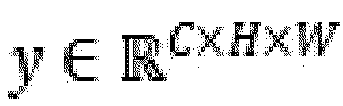
t for the temporal layer lt of the input image may be defined as the followingEquation 1. Here, L denotes a total number of temporal layers.
-
FIG. 3A is a diagram illustrating an example of using different quantization step determining parameters for four temporal layers (lt =0, 1, 2, 3) in a bidirectional prediction structure in which a Group Of Pictures (GOP) size is 12. For convenience of explanation, a highest temporal layer contains only an I-frame, i.e., an image to which a still image coding method is to be applied, but is not limited thereto. InFIG. 3A , I denotes an I-frame, and B denotes a B-frame. - Referring back to
FIG. 2B , according to an embodiment, inoperation 240, the method may include quantizing the scaled latent representation of the bidirectional motion vectors. For example, by using the scaled latent representation

- According to an embodiment, in
operation 250, the method may include estimating the probability distribution of the quantized and scaled latent representation of the bidirectional motion vectors. For example, by using the quantized and scaled latent representation


- According to an embodiment, in
operation 260, the method may include performing entropy encoding or decoding on the quantized and scaled latent representation of the bidirectional motion vectors. For example, entropy encoding and entropy decoding may be performed on the quantized and scaled latent representation


- According to an embodiment, in
operation 270, the method may include performing a rescaling operation on the quantized and scaled latent representation of the bidirectional motion vectors. For example, by using, as input, the temporal layer lt of the input image and the quantized and scaled latent representation
-
FIG. 3B is a diagram explaining an example of scaling and rescaling a latent representation for an l t-th temporal layer. - Referring to the
above Equation 1 andFIG. 3B , scaling may be performed inoperation 230 by dividing C number of channel maps into C number of parameters of the quantization step determining parameters qlt , which may be represented by the followingEquation 2.
- Herein, C denotes the number of channels in the latent representation represented as a feature map, and H, W respectively denote the spatial height and width of the latent representation.
- Quantization (240) and entropy encoding (261) and decoding (262) are performed on the scaled latent representation

t , which is the same as that used in the scaling process, by the quantized and scaled latent representation
Equation 3.
- By using the same neural network model, different quantization steps may be applied to images of different temporal layers, thereby encoding with different image quality levels for each temporal layer. In addition, only a small number of neural network parameters are stored in a memory and used, thereby improving memory efficiency.
- Referring back to
FIG. 2B , according to an embodiment, inoperation 280, the method may include reconstructing bidirectional motion vectors. For example, by using the rescaled latent representation ĝt of the bidirectional motion vectors as input, the bidirectional motion vectors m̂f ,m̂b may be reconstructed and output. In this case, a Convolutional Neural Network may be used, but the neural network is not limited thereto. - According to an embodiment, in
operation 290, the method may include creating or generating bidirectional temporal context based on the latent representation of the bidirectional motion vectors. For example, by using the reconstructed motion vectors m̂ f, m̂b and the reference images x̂f ,x̂b as input, a bidirectional temporal context Ct for encoding the input image may be created and output. In this case, a motion compensation technique and Convolutional Neural Network may be used. The motion compensation technique may use bilinear warping, but is not limited thereto. -
FIG. 4 is aflowchart illustrating operation 400 of smoothing a bidirectional temporal context according to an embodiment of the disclosure.FIG. 5 is a diagram explaining an example of smoothing a bidirectional temporal context according to a temporal layer. -
Operation 400 of smoothing a bidirectional temporal context inFIG. 4 may includeoperation 410 of determining a smoothing level St for temporal layers lt ,operation 420 of creating a smoothing filter F t , and smoothingoperation 430. - The smoothing filter may be a predefined filter, such as a Gaussian filter or a bilateral filter based on a Gaussian filter, or may be a trainable filter such as a Convolutional Neural Network, but is not limited thereto. In an example case in which the trainable filter is used as the smoothing filter, multiple trainable filters may be trained differently for the temporal layers lt, and one of the trainable filters may be selected according to the temporal layers lt for use. In an example case in which the Gaussian filter is used as the smoothing filter, the smoothing level St may be a standard deviation, and if in an example case in which smoothing filter is a trainable filter, the filter may be the index of filters that are trained differently for the temporal layers.
-
Operation 400 of smoothing a bidirectional temporal context will be described below based on an example of using a predefined smoothing filter as the smoothing filter. - According to an embodiment, in
operation 410, the method may include determining a smoothing level for the temporal layer. For example, by using the temporal layer lt of the input image as input, the video encoding apparatus may determine and output a smoothing level for smoothing a bidirectional temporal context Ct . - For example, the Gaussian filter may be used, and a standard deviation for creating the Gaussian filter may be output as a smoothing level. In this case, by determining a constant value according to the temporal layers, the constant value may be used as it is as the standard deviation, or the standard deviation may be used by learning different parameters according to temporal layers. A higher smoothing level (large standard deviation) may be output for a higher temporal layer, and a lower smoothing level (small standard deviation) may be output for a lower temporal layer. Even in the same temporal layer, different smoothing levels for a bidirectional temporal context may be determined according to spatial positions. In this case, information output during decoding in
operation 260 may be used as spatial position information for smoothing. During decoding inoperation 260, smoothing information for spatial positions may also be output. - According to an embodiment, in
operation 420, the method may include generating a smoothing filter. For example, by determining a parameter of the predefined filter by using the smoothing level St determined inoperation 410 as input, a smoothing filter F t to be applied to actual smoothing may be generated. The predefined filter may include, but is not limited to, for example, a Gaussian filter or a bilateral filter using a Gaussian kernel, etc. - According to an embodiment, in
operation 430, the method may include performing smoothing operation on bidirectional temporal context. For example, smoothing is performed on the bidirectional temporal context by using as input the smoothing filter generated inoperation 420, and then the smoothed bidirectional temporal context C̃t may be output. -
FIG. 5 is a diagram illustrating an example of a bidirectional temporal context which is smoothed by using different smoothing levels for different temporal layers or different spatial positions. For example, inFIG. 5 , arrow CD shows a result of applying a lower smoothing level to a lower temporal layer, i.e., as the temporal layer lt increases. In addition, arrow (2) ofFIG. 5 shows a result of using different smoothing levels for spatial positions even in the same temporal layer, in which Ct and C̃t denote average values calculated for all channels for ease of visualization. - Generally, there is a high probability that an incorrect temporal context is created for a higher temporal layer in which a distance between the input image and the reference image is long. According to an embodiment, by smoothing the temporal context differently for temporal layers, the incorrect temporal context may be regulated, thereby achieving higher coding performance compared to common technology.
-
FIGS. 6A and6B areflowcharts illustrating operation 600 of encoding and/or decoding an input image according to an embodiment of the disclosure. - Referring to
FIG. 6A , according to an embodiment, inoperation 610, the method may include transforming an input image into a latent representation based on the bidirectional temporal context. For example, by using an input image x̂t and the smoothed bidirectional temporal context C̃t as input, the video encoding device may transform the input image xt into a latent representation yt and output the latent representation. A Convolutional Neural Network may be used, and the smoothed bidirectional temporal context may be used instead of using a temporal context created from a unidirectional reference image. - According to an embodiment, in
operation 620, the method may include performing scaling on the latent representation of the input image. For example, by using, as input, the temporal layer lt of the input image and the latent representation yt of the input image, the video compression apparatus may perform scaling on the latent representation yt of the input image according to the temporal layers, and may output the scaled latent representation
operation 230, the scaling may be performed by dividing the latent representation yt of the input image into quantization step determining parameters defined for the temporal layers. - According to an embodiment, in
operation 630, the method may include performing quantization on the scaled latent representation of the input image. For example, the video compression apparatus may perform quantization on the scaled latent representation

- According to an embodiment, in
operation 640, the method may include estimating the probability distribution of the quantized and scaled latent representation of the input image. For example, by using the quantized and scaled latent representation


- According to an embodiment, in
operation 650, the method may include performing entropy encoding on the quantized and scaled latent representation of the input image. For example, by using, as input, the quantized and scaled latent representation


- Referring to
FIG. 6B , a process may be performed based on a result of the entropy encoding inoperation 650. - According to an embodiment, in operation 660, the method may include performing entropy decoding on the quantized and scaled latent representation the of input image. For example, by using, as input, the entropy-encoded bitstream bx and the mean


operation 650 is generally lossless encoding, such that the latent representation

- According to an embodiment, in
operation 670, the method may include performing a rescaling operation on the quantized and scaled latent representation of the input image. For example, by using, as input, the temporal layer lt of the input image and the quantized and scaled latent representation
above operation 270. - According to an embodiment, in
operation 680, the method may include reconstructing the input image based on the bidirectional temporal context. For example, by using, as input, the rescaled latent representation ŷt of the input image and the smoothed bidirectional temporal context C̃t , the video compression apparatus may reconstruct and output the input image x̂ t. In this case, a Convolutional Neural Network may be used, and the smoothed bidirectional temporal context may be used instead of using a temporal context created from a unidirectional reference image. The reconstructed image may be used as a reference image for subsequent images. -
FIG. 7 is a block diagram illustrating an electronic device according to an embodiment of the disclosure. - Referring to
FIG. 7 , theelectronic device 700 includes amemory 710 and aprocessor 720. - According to an embodiment, the
electronic device 700 may include a video encoding device based on a neural network or a video decoding device based on a neural network which is configured to perform various examples of the above method for video encoding or video decoding. According to an embodiment, theelectronic device 700 may be a device configured to perform both video encoding and video decoding. The electronic device may include, but is not limited to, a device such as an edge device which requires applications such as video encoding in an environment with limited computing resources, various image transmission/reception devices, such as mobile phones, TV, monitors, Internet of Things (IoT) devices, as well as cloud computing devices, and the like. - The
memory 710 may store various instructions for image processing, such as video encoding, encoding, etc., and data associated with image processing (neural network, weight, quantization step determining parameter, reference image, reconstructed image, bitstream generated by encoding, etc.). Thememory 710 may include Random Access Memory (RAM), such as Dynamic Random Access Memory (DRAM), Static Random Access Memory (SRAM), etc., Read-Only Memory (ROM), flash memory, cache memory, virtual memory, etc., but is not limited thereto. - The
processor 720 may execute the instructions stored in thememory 710 and perform various video processing operations by referring to various data stored in thememory 710. The instructions may include one or more instructions configured to perform various embodiments of the aforementioned method for video encoding. For example, the instructions may include creating a bidirectional temporal context of the input image by using, as input, the input image, bidirectional reference images, and temporal layers of the input image, smoothing the bidirectional temporal context by using the bidirectional temporal context and the temporal layer as input, and encoding and decoding the input image by using the smoothed bidirectional temporal context and the input image as input. - The
processor 720 according to one or more embodiments may perform an overall control operation of theelectronic device 700. - The
processor 720 may include at least one from among a central processing unit (CPU), a graphics processing unit (GPU), an accelerated processing unit (APU), a many integrated core (MIC), a digital signal processor (DSP), a neural processing unit (NPU), an hardware accelerator or a machine learning accelerator. Theprocessor 720 may execute at least one program or instruction stored in a memory. For example, theprocessor 720 may perform a method according to one or more embodiments by executing at least one instruction stored in the memory. - According to one or more embodiments of the disclosure, one or more operations may be performed by one processor, or performed by a plurality of processors. For example, when a first operation, a second operation, and a third operation are performed by the method according to one or more embodiments, the first operation, the second operation, and the third operation may all be performed by a first processor, or the first operation and the second operation may be performed by the first processor (e.g., a generic-purpose processor) and the third operation may be performed by a second processor (e.g., an artificial intelligence dedicated processor). According to an embodiment, at least one of the first, second and third processor may be external to the terminal 200.
- The
processor 720 may be realized as a single core processor that includes one core, or may be realized as at least one multicore processor that includes a plurality of cores (e.g., a homogeneous multicore or a heterogeneous multicore). In a case in which theprocessor 720 is realized as a multicore processor, the plurality of cores included in the multicore processor may respectively include a memory inside the processor such as a cache memory and an on-chip memory, and a common cache shared by the plurality of cores may be included in the multicore processor. - According to one or more embodiments of the disclosure, the processor may refer to a system on chip (SoC), a single core processor, a multicore processor, or a core included in the single core processor or the multicore processor on which at least one processor and other electronic components are integrated, and the core described herein may be realized as the CPU, the GPU, the APU, the MIC, the DSP, the NPU, the hardware accelerator, the machine learning accelerator, or the like, but the embodiments of the disclosure are not limited thereto.
-
FIGS. 8A to 8I are diagrams explaining the video encoding and/or decoding process in detail according to an embodiment of the disclosure.FIG. 9A is a diagram illustrating an example of a context fusion network.FIG. 9B is a diagram illustrating an example of an entropy model for estimating a probability distribution. - Referring to
FIG. 8A , the overall video encoding operation performed by theelectronic device 700 will be described below. Theelectronic device 700 may include avideo encoding device 800 and/or avideo decoding device 800a. As illustrated herein, thevideo encoding device 800 and/or avideo decoding device 800a may share components to use bidirectional prediction and temporal layer information. Thevideo decoding device 800a may be provided as a separate hardware chip and/or software from thevideo encoding device 800. - The
video encoding device 800 may input an input image xt and bidirectional reference images x̂f and x̂b to a single motionvector estimation network 811, and may estimate a motion vector m f between a forward reference image x̂f and the input mage xt , and a motion vector mb between a backward reference image x̂b and the input image xt . In this case, various optical flow estimation neural networks may be used as the motion vector estimation network. - Then, in order to transform the two motion vectors mf and mb , output from the motion
vector estimation network 811, into a latent representation gt of one bidirectional motion vector, the two motion vectors are concatenated, and a result of the concatenation may be input to a motion vector encoder (MV Enc) 812. The MV Enc may be based on a convolutional neural network and uses bidirectional motion vectors as input, such that the number of channels of the convolution layer may be doubled. - Subsequently, a quantization step parameter


MV Enc 812, by the selected quantization step parameter in 813, the latent representation of the bidirectional motion vectors may be scaled according to the temporal layer. - Next, the scaled latent representation


entropy model 815. The entropy model may be an entropy model using hyperprior and autoregressive context and the like, but is not limited thereto. - By using the probability distribution estimated by the
entropy model 815, for example, a mean


AE 8161 and decoded inAD 8162. As a result of the encoding, a bitstream bm for the latent representation of the bidirectional motion vectors is output, and decoding is performed using the bitstream bm and the probability distribution. - Then, a quantization step parameter


- Subsequently, the rescaled latent representation ĝt of the bidirectional motion vectors is input to a motion vector decoder (MV Decoder) in 818, and a forward motion vector m̂f and a backward motion vector m̂b may be reconstructed. In this case, the MV Decoder is based on a convolutional neural network, and the number of channels of the convolution layer is doubled in order to reconstruct all the bidirectional motion vectors. In addition, in order to perform smoothing differently depending on spatial positions, the MV Decoder may increase the number of channels and output smoothing information associated with spatial positions.
- Next, by using, as input, the reconstructed bidirectional motion vectors m̂f ,m̂b and the bidirectional reference images x̂f ,x̂b , a bidirectional temporal context Ct is output in 819.
- For example, the respective bidirectional reference images are input to the
feature extractor 8191 to output a forward reference feature map x̌f and a backward reference feature map x̌b . In this case, thefeature extractor 8191 may be a convolutional neural network. Subsequently, based on the forward motion vector m̂f , typicalbilinear warping 8192 is performed on the forward reference feature map x̌f , to output a warped forward reference feature map ẍf . Likewise, warping may be performed on the backward motion vector m̂b and the backward reference feature map x̌b to output a warped backward reference feature map ẍb . The warped forward reference feature map and the warped backward reference feature map may pass throughcontext refinement 8193 for post-processing, and may be output as a forward temporal context Cf and a backward temporal context Cb . In this case, the neural network for post-processing may be a convolutional neural network. Lastly, the forward temporal context Cf and the backward temporal context Cb are input to aContext Fusion Network 8194 to output a bidirectional temporal context Ct . - Referring to
FIG. 9A , theContext Fusion Network 8194 may include concatenation 911, convolution layers 912 and 914, and a nonlinear layer such as ReLU (e.g., LeakyReLU) 913. In the convolution layers Conv (k, C in , C out , s) 912 and 914, k denotes horizontal and vertical sizes of the kernel, C in denotes the number of input channels, C out denotes the number of output channels, and s denotes the stride of the convolution. InFIG. 9A , N denotes the number of channels in the forward temporal context and bidirectional temporal context. - Referring back to
FIG. 8A , smoothing may be performed by using the temporal layer lt of the input image as input. By using the temporal layer lt of the input image as input, a smoothing level St for generating a smoothing filter may be output in 821. - As a smoothing method, the Gaussian smoothing or bilateral filter based on a Gaussian kernel may be used, in which case a standard deviation for generating a smoothing filter may be output. In this case, in order to use a greater level of smoothing for a higher temporal layer, a monotonically decreasing smoothing level, such as s 1 = 10, s 2 = 5, and s 3 = 2.5 may be used for the temporal layer lt . A spatial position difference may be considered by Gaussian smoothing, and the bilateral filter may be used to consider not only the spatial position difference but also a difference in values input to a smoothing object.
- Then, a smoothing filter for use in smoothing the bidirectional temporal context may be generated in 822. Assuming that Gaussian smoothing is performed, the smoothing filter may be generated by using a smoothing level St according to the temporal layer, i.e., a standard deviation as input. By defining the smoothing level as St , and Gaussian kernel size as K × K, the value of K may be calculated as in, for example,
Equation 4.
- Herein,

- In an example case in which the value of K is given, a Gaussian kernel Ft based on the given smoothing level St may be calculated as in Equation 5. In this Equation, (kx ,ky ) denotes a spatial position of the kernel.

- Then, by using the bidirectional temporal context Ct and the smoothing filter, e.g., Gaussian kernel, as input, the smoothed bidirectional temporal context C̃t is output in 823. In this case, a kernel with stride one may be multiplied for each spatial position of the bidirectional temporal context Ct .
- Subsequently, by using, as input, the smoothed bidirectional temporal context C̃t and the input image xt , a latent representation ŷt of the input image may be output by interchannel concatenation and contextual encoder (Enc) 831.
- Next, by using the temporal layer lt of the input image as input, a quantization step parameter


- Then, the scaled latent representation of the bidirectional motion vectors is quantized in 833, and a probability distribution, i.e., a mean



entropy model 834. - Referring to
FIG. 9B , theentropy model 834 may include acommon hyperprior model 921, anautoregressive context model 923, a temporal prior encoder 924, and aprior fusion network 925. The quantized and scaled latent representation
hyperprior model 921 and theautoregressive context model 923, to output hyperprior information and autoregressive context, respectively. In addition, the temporal prior encoder 924 may extract temporal prior information by using the smoothed bidirectional temporal context C̃t as input. Theprior fusion network 925 may output the mean


- Referring back to
FIG. 8A , by using the mean

entropy model 834, the quantized and scaled latent representation
- Then, decoding is performed in 8352 by using the output bitstream bx and the mean


contextual decoder 837 to output a reconstructed image x̂t of the input image. The reconstructed image x̂t is stored in the memory to be used as a reference image for encoding of subsequent input images. - As described above, smoothing according to the temporal layer may be performed on the bidirectional temporal context Ct in 821, 822, and 823, but may also be performed similarly at various other smoothing positions.
- In
FIG. 8A ,arrows -
FIGS. 8B to 8I are diagrams illustrating an example of performing smoothing at smoothing positions of ② to ⑨. As illustrated herein, smoothing is performed by inputting the temporal layer lt and the smoothing objects to a smoothing module SM. In an example case in which the smoothing position is ⑧ ofFIG. 8A , the smoothing objects are bidirectional motion vectors mf , mb which are outputs of the motionvector estimation network 811, and smoothing is performed on each of the bidirectional motion vectors mf , mb by using the smoothing module SM, to obtain the smoothed bidirectional motion vectors m̃f , m̃b.[Table 1] Smoothing position Smoothing object Remark ① of FIG. 8A Output Ct of 8194 Perform smoothing on C t② of FIG. 8A Outputs Cf , Cb of 8193 Perform smoothing on each of Cf , C b③ of FIG. 8A Outputs ẍf , ẍb of 8192 Perform smoothing on each of ẍ f , & ④ of FIG. 8A Outputs x̌f , x̌b of 8191 Perform smoothing on each of x̌f , x̌b ⑤ of FIG. 8A Inputs x̂f , x̂b of 8191 Perform smoothing on each of x̂f , x̂b ⑥ of FIG. 8A Inputs x̂f , x̂b of 811 Perform smoothing on each of x̂f , x̂b ⑦ of FIG. 8A Input xt of 811 Perform smoothing on xt ⑧ of FIG. 8A Outputs mf , mb of 811 Perform smoothing on each of mf , mb ⑨of FIG. 8A Outputs m̂f , m̂b of 818 Perform smoothing on each of m̂f, m̂b - Referring back to
FIG. 8A , thevideo decoding device 800a, which is a neural network-based device, may reconstruct the motion vectors and create a bidirectional temporal context by using the bitstream bm for the latent representation of the bidirectional motion vectors generated by thevideo decoding device 800a and the bidirectional reference images, and may reconstruct the input image by using the bitstream bx for the input image and the bidirectional temporal context. In this case, rescaling and/or smoothing may be performed on the latent representation by using the temporal layer. The video encoding device is described in detail above, such that a redundant description thereof will be omitted. -
FIG. 10 is a block diagram illustrating an electronic device according to another embodiment of the disclosure. - Referring to
FIG. 10 , anelectronic device 1000 may include amemory 1010, aprocessor 1020, animage capturing device 1030, acommunication device 1040, and anoutput device 1050. Thememory 1010 and theprocessor 1020 are described in detail above, such that a description thereof will be omitted. - The
image capturing device 1030 may include a device, such as a camera and the like, for capturing still images or moving images, etc., and may store the captured images in thememory 1010 and transmit the images to theprocessor 1020. Theimage capturing device 1030 may include a lens assembly having one or more lenses, image sensors, a charge-coupled device (CCD sensor), image signal processors, and/or flashes. The lens assembly included in a camera module may collect light emanating from a subject to be imaged. - The
communication device 1040 may support establishment of a direct communication channel and/or a wireless communication channel between theelectronic device 1000 and another electronic device, a server, or the sensor device within a network environment, and performing of communication via the established communication channel, by using various communication techniques. For example, the direct communication channel may be a wired communication between theelectronic device 1000 and another electronic device. Thecommunication device 1040 may transmit the images captured by theimage capturing device 1030, and/or the data (e.g., encoded video, etc.) processed by theprocessor 1020 to another electronic device. In addition, thecommunication device 1040 may receive a video to be processed from a cloud device or another electronic device, may store the received video in thememory 1010, and may transmit the video to theprocessor 1020 so that theprocessor 1020 may process the video. - The
output device 1050 may visually/non-visually output the images captured by theimage capturing device 1030, and/or data processed by theprocessor 1020. Theoutput device 1050 may include a sound output device, a display device (e.g., display), an audio module, and/or a haptic module. Theoutput device 1050 may display a video processed by theprocessor 1020 and the like on the display, thereby improving user's video experience. - In addition, the
electronic device 1000 may further include a sensor device (e.g., acceleration sensor, gyroscope, magnetic field sensor, proximity sensor, illuminance sensor, fingerprint sensor, etc.) configured to detect various data, an input device (e.g., a microphone, a mouse, a keyboard, and/or a digital pen (e.g., a stylus pen, etc.), etc.) configured to receive instructions and/or data to be used from a user, and the like. - One or more embodiments of the disclosure described above can be realized as a computer-readable code written on a computer-readable recording medium. The computer-readable recording medium may be any type of recording device in which data is stored in a computer-readable manner. For example, the method of encoding and/or decoding an image as illustrated according to various embodiments described above may be realized as a computer-readable code, which may be executed on one or more processors. Although the figures illustrate the operations of the methods in a particular according to one or more embodiments of the disclosure, the disclosure is not limited thereto, and as such, the order of operations may vary, one or more operations may be added, or one or more operations may be omitted according to various other embodiments.
- Examples of the computer-readable recording medium include a ROM, a RAM, a CD-ROM, a magnetic tape, a floppy disc, an optical data storage, and a carrier wave (e.g., data transmission through the Internet). The computer-readable recording medium can be distributed over a plurality of computer systems connected to a network so that a computer-readable code is written thereto and executed therefrom in a decentralized manner. Functional programs, codes, and code segments needed for realizing the present invention can be readily inferred by programmers of ordinary skill in the art to which the invention pertains.
- The disclosure has been described herein with regard to preferred embodiments. However, it will be obvious to those skilled in the art that various changes and modifications can be made without changing technical conception and features of the disclosure. Thus, it is clear that the above-described embodiments are illustrative in all aspects and are not intended to limit the disclosure.
- Further embodiments are described in the following clauses:
-
Clause 1. A method for neural network-based video encoding, the method comprising: by using, as input, a reference image, an input image, and a temporal layer of the input image, estimating a motion vector between the input image and the reference image; transforming the motion vector into a latent representation; scaling the latent representation of the motion vector according to the temporal layer of the input image; and based on the scaled latent representation of the motion vector and the reference image, creating a temporal context of the input image. -
Clause 2. The method ofclause 1, wherein the reference image comprises bidirectional reference images temporally before and after the input image. -
Clause 3. The method ofclause 1, wherein the scaling according to the temporal layer comprises scaling the latent representation of the motion vector by using a smaller quantization step for a higher temporal layer. -
Clause 4. The method ofclause 1, wherein the scaling according to the temporal layer comprises scaling the latent representation of the motion vector by dividing the latent representation of the motion vector into quantization step determining parameters defined for the temporal layer. - Clause 5. The method of
clause 1, further comprising: performing entropy encoding and entropy decoding on the latent representation of the motion vector; rescaling the scaled latent representation of the motion vector according to the temporal layer; and reconstructing motion vectors based on the rescaled latent representation of the motion vector, wherein the creating of the temporal context comprises creating the temporal context based on the reconstructed motion vectors and the reference image. - Clause 6. The method of clause 5, wherein the rescaling according to the temporal layer comprises rescaling by multiplying the scaled latent representation of the motion vector by the quantization step determining parameters defined for the temporal layer.
- Clause 7. The method of clause 5, further comprising: before performing the entropy encoding and entropy decoding, quantizing the scaled latent representation of the motion vector; and estimating a probability distribution of the latent representation of the motion vector.
- Clause 8. The method of clause 5, wherein the creating of the temporal context comprises outputting a reference feature map by inputting the reference image into a feature extraction neural network, performing bilinear warping on the reference feature map based on the reconstructed motion vectors to output a warped reference feature map, inputting the warped reference feature map to a post-processing neural network, and inputting an output of the post-processing neural network to a context fusion network to output the temporal context.
- Clause 9. A method for neural network-based video encoding, the method comprising: by using, as input, a reference image, an input image, and a temporal layer of the input image, estimating a motion vector between the input image and the reference image; transforming the motion vector into a latent representation; based on the latent representation of the motion vector and the reference image, creating a temporal context of the input image; and performing smoothing by using, as a smoothing object, at least one of the reference image, the input image, the motion vector, an input in the creating of the temporal context, an output in the creating of the temporal context, and an input or output of a sub-process in the creating of the temporal context.
- Clause 10. The method of clause 9, wherein the reference image comprises bidirectional reference images temporally before and after the input image.
- Clause 11. The method of clause 9, wherein the performing of the smoothing comprises: determining a smoothing level of the smoothing object for the temporal layer of the input image; generating a predefined smoothing filter by using the determined smoothing level; and performing the smoothing on the smoothing object by using the generated smoothing filter.
-
Clause 12. The method of clause 11, wherein the determining of the smoothing level of the smoothing object comprises determining a lower smoothing level for a lower temporal layer. - Clause 13. The method of clause 11, wherein the determining of the smoothing level of the smoothing object comprises determining different smoothing levels depending on spatial positions.
-
Clause 14. A method for neural network-based video decoding, the method comprising: by using a first bitstream for a motion vector as input, reconstructing a latent representation of the motion vector; rescaling the reconstructed latent representation of the motion vector according to a temporal layer; reconstructing the motion vector by using the rescaled latent representation of the motion vector; creating a temporal context by using the reconstructed motion vector and a reference image; and by using a second bitstream for an input image and the temporal context as input, reconstructing the input image. - Clause 15. The method of
clause 14, wherein the reference image comprises bidirectional reference images temporally before and after the input image. - Clause 16. The method of
clause 14, wherein the rescaling according to the temporal layer comprises rescaling by multiplying the latent representation of the motion vector by quantization step determining parameters defined for the temporal layer. - Clause 17. The method of
clause 14, wherein the reconstructing of the input image comprises: by using the second bitstream for the input image as input, reconstructing a latent representation of the input image; rescaling the latent representation of the input image according to the temporal layer; and reconstructing the input image based on the rescaled latent representation of the input image and the temporal context. - Clause 18. A method for neural network-based video decoding, the method comprising: by using a first bitstream for a motion vector as input, reconstructing a latent representation of the motion vector; creating a temporal context by using the motion vector and a reference image; performing smoothing by using, as a smoothing object, at least one of the reference image, the motion vector, an input in the creating of the temporal context, an output in the creating of the temporal context, and an input or output of a sub-process in the creating of the temporal context; and by using a second bitstream for an input image and the temporal context as input, reconstructing the input image.
- Clause 19. The method of clause 18, wherein the performing of the smoothing comprises: determining different smoothing levels based on at least one of a temporal layer and a spatial position of the input image; generating a predefined smoothing filter by using the determined smoothing level; and performing the smoothing on the smoothing object by using the generated smoothing filter.
- Clause 20. An electronic device comprising: a memory configured to store one or more instructions and a reference image; and a processor configured to execute the one or more instructions to perform video encoding, wherein the one or more instructions are configured to: by using, as input, a reference image, an input image, and a temporal layer of the input image, estimate a motion vector between the input image and the reference image; transform the motion vector into a latent representation; scale the latent representation of the motion vector according to the temporal layer of the input image; and based on the scaled latent representation of the motion vector and the reference image, create a temporal context of the input image.
Claims (15)
- A method for neural network-based video encoding, the method comprising:estimating a motion vector between an input image and a reference image based on a temporal layer of the input image;transforming the motion vector into a latent representation;scaling the latent representation of the motion vector based on the temporal layer of the input image; andobtaining a temporal context of the input image based on the scaled latent representation of the motion vector and the reference image.
- The method of claim 1, wherein the scaling based on the temporal layer comprises scaling the latent representation of the motion vector by using a smaller quantization step for a higher temporal layer and/or by dividing the latent representation of the motion vector into quantization step determining parameters defined for the temporal layer.
- The method of any of the above claims , further comprising:performing entropy encoding and entropy decoding on the latent representation of the motion vector;rescaling the scaled latent representation of the motion vector based on the temporal layer; andreconstructing motion vectors based on the rescaled latent representation of the motion vector,wherein the obtaining of the temporal context comprises obtaining the temporal context based on the reconstructed motion vectors and the reference image,wherein preferably the rescaling based on the temporal layer comprises multiplying the scaled latent representation of the motion vector by the quantization step determining parameters defined for the temporal layer.
- The method of the previous claim, further comprising:before performing the entropy encoding and entropy decoding, quantizing the scaled latent representation of the motion vector; andestimating a probability distribution of the latent representation of the motion vector.
- The method of any of the above claims, wherein the obtaining of the temporal context comprises:outputting a reference feature map by inputting the reference image into a feature extraction neural network,performing bilinear warping on the reference feature map based on the reconstructed motion vectors to output a warped reference feature map,inputting the warped reference feature map to a post-processing neural network, andinputting an output of the post-processing neural network to a context fusion network to output the temporal context.
- A method for neural network-based video encoding, the method comprising:estimating a motion vector between an input image and a reference image based on a temporal layer of the input image;transforming the motion vector into a latent representation;obtaining a temporal context of the input image based on the latent representation of the motion vector and the reference image; andperforming a smoothing operation on the temporal context based on a smoothing object comprising at least one of the reference image, the input image, the motion vector, an input in the obtaining of the temporal context, an output in the obtaining of the temporal context, or an input or output of a sub-process in the obtaining of the temporal context.
- The method of the previous claim, wherein the performing of the smoothing comprises:obtaining a smoothing level of the smoothing object for the temporal layer of the input image;generating a smoothing filter based on the smoothing level; andperforming the smoothing on the smoothing object based on the smoothing filter.
- The method of the previous claim, wherein the obtaining of the smoothing level of the smoothing object comprises obtaining a lower smoothing level for a lower temporal layer and/or different smoothing levels depending on spatial positions.
- A method for neural network-based video decoding, the method comprising:reconstructing a latent representation of a motion vector based on a first bitstream for the motion vector ;rescaling the reconstructed latent representation of the motion vector based on a temporal layer;reconstructing the motion vector based on the rescaled latent representation of the motion vector;obtaining a temporal context based on the reconstructed motion vector and a reference image; andreconstructing an input image based on a second bitstream for the input image and the temporal context.
- The method of any of the above claims, wherein the reference image comprises a first bidirectional reference image temporally before the input image and a second bidirectional reference image temporally after the input image.
- The method of any of claim 9 or 10, wherein the rescaling based on the temporal layer comprises multiplying the latent representation and/or the scaled latent representation of the motion vector by quantization step determining parameters defined for the temporal layer.
- The method of any one of claims 9-11, wherein the reconstructing of the input image comprises:reconstructing a latent representation of the input image based on the second bitstream for the input image;rescaling the latent representation of the input image based on the temporal layer; andreconstructing the input image based on the rescaled latent representation of the input image and the temporal context.
- A method for neural network-based video decoding, the method comprising:reconstructing a latent representation of a motion vector based on a first bitstream for the motion vector;obtaining a temporal context by using the motion vector and a reference image;performing smoothing by using, as a smoothing object, at least one of the reference image, the motion vector, an input in the obtaining of the temporal context, an output in the obtaining of the temporal context, and an input or output of a sub-process in the obtaining of the temporal context; andreconstructing the input image based on a second bitstream for an input image and the temporal context.
- The method of claim 13, wherein the performing of the smoothing comprises:obtaining different smoothing levels based on at least one of a temporal layer and a spatial position of the input image;generating a smoothing filter based on at least one of the smoothing levels; andperforming the smoothing on the smoothing object based on the smoothing filter.
- An electronic device comprising:a memory configured to store one or more instructions and a reference image; anda processor configured to execute the one or more instructions to perform any of the above method claims.
Applications Claiming Priority (2)
| Application Number | Priority Date | Filing Date | Title |
|---|---|---|---|
| KR20230102601 | 2023-08-07 | ||
| KR1020230160501A KR20250021946A (en) | 2023-08-07 | 2023-11-20 | Method for video encoding and decoding based on neural network |
Publications (2)
| Publication Number | Publication Date |
|---|---|
| EP4507298A2 true EP4507298A2 (en) | 2025-02-12 |
| EP4507298A3 EP4507298A3 (en) | 2025-04-23 |
Family
ID=91782217
Family Applications (1)
| Application Number | Title | Priority Date | Filing Date |
|---|---|---|---|
| EP24193196.3A Pending EP4507298A3 (en) | 2023-08-07 | 2024-08-06 | Method for neural network-based video encoding and decoding, and video encoding apparatus |
Country Status (4)
| Country | Link |
|---|---|
| US (1) | US20250056024A1 (en) |
| EP (1) | EP4507298A3 (en) |
| CN (1) | CN119450071A (en) |
| TW (1) | TW202508283A (en) |
Family Cites Families (2)
| Publication number | Priority date | Publication date | Assignee | Title |
|---|---|---|---|---|
| US11895330B2 (en) * | 2021-01-25 | 2024-02-06 | Lemon Inc. | Neural network-based video compression with bit allocation |
| US20230051066A1 (en) * | 2021-07-27 | 2023-02-16 | Lemon Inc. | Partitioning Information In Neural Network-Based Video Coding |
-
2024
- 2024-05-22 CN CN202410639134.1A patent/CN119450071A/en active Pending
- 2024-06-04 US US18/733,379 patent/US20250056024A1/en active Pending
- 2024-06-19 TW TW113122676A patent/TW202508283A/en unknown
- 2024-08-06 EP EP24193196.3A patent/EP4507298A3/en active Pending
Also Published As
| Publication number | Publication date |
|---|---|
| US20250056024A1 (en) | 2025-02-13 |
| CN119450071A (en) | 2025-02-14 |
| TW202508283A (en) | 2025-02-16 |
| EP4507298A3 (en) | 2025-04-23 |
Similar Documents
| Publication | Publication Date | Title |
|---|---|---|
| CN114973049B (en) | Lightweight video classification method with unified convolution and self-attention | |
| TWI826160B (en) | Image encoding and decoding method and apparatus | |
| CN117321989A (en) | Independent localization of auxiliary information in image processing based on neural networks | |
| US11570465B2 (en) | Machine-learned in-loop predictor for video compression | |
| JP2025504783A (en) | An extended framework for point cloud compression | |
| US20250150640A1 (en) | Apparatus and method for image encoding and decoding | |
| CN114079779A (en) | Image processing method, intelligent terminal and storage medium | |
| JP7760756B2 (en) | Method and apparatus for encoding and decoding a region enhancement layer - Patents.com | |
| CN117441333A (en) | Configurable location for input auxiliary information to the image data processing neural network | |
| KR20240124304A (en) | A Hybrid Framework for Point Cloud Compression | |
| CN118842912A (en) | Encoding method, decoding method and related equipment | |
| Mehta et al. | Evrnet: Efficient video restoration on edge devices | |
| CN115471765B (en) | Semantic segmentation method, device and equipment for aerial image and storage medium | |
| EP4535785A1 (en) | Data encoding and decoding method and related device | |
| Grassi et al. | Object-oriented image analysis using the CNN universal machine: new analogic CNN algorithms for motion compensation, image synthesis, and consistency observation | |
| JP2024516550A (en) | Learning-Based Point Cloud Compression with Tearing Transform | |
| US20250056024A1 (en) | Method for neural network-based video encoding and decoding, and video encoding apparatus | |
| WO2025189889A1 (en) | Video processing method and apparatus, and related product | |
| CN118097495B (en) | Context enhancement methods, apparatus, devices and media | |
| Lee et al. | Feature map compression for video coding for machines based on receptive block based principal component analysis | |
| CN118575194A (en) | Scalable framework for point cloud compression | |
| CN117934495A (en) | Human body image segmentation method, device, computer equipment and readable storage medium | |
| EP4550783A1 (en) | Apparatus and method for image encoding and decoding | |
| KR20250021946A (en) | Method for video encoding and decoding based on neural network | |
| Chiang et al. | ANFPCGC++: Point Cloud Geometry Coding Using Augmented Normalizing Flows and Transformer-Based Entropy Model |
Legal Events
| Date | Code | Title | Description |
|---|---|---|---|
| PUAI | Public reference made under article 153(3) epc to a published international application that has entered the european phase |
Free format text: ORIGINAL CODE: 0009012 |
|
| STAA | Information on the status of an ep patent application or granted ep patent |
Free format text: STATUS: THE APPLICATION HAS BEEN PUBLISHED |
|
| AK | Designated contracting states |
Kind code of ref document: A2 Designated state(s): AL AT BE BG CH CY CZ DE DK EE ES FI FR GB GR HR HU IE IS IT LI LT LU LV MC ME MK MT NL NO PL PT RO RS SE SI SK SM TR |
|
| PUAL | Search report despatched |
Free format text: ORIGINAL CODE: 0009013 |
|
| AK | Designated contracting states |
Kind code of ref document: A3 Designated state(s): AL AT BE BG CH CY CZ DE DK EE ES FI FR GB GR HR HU IE IS IT LI LT LU LV MC ME MK MT NL NO PL PT RO RS SE SI SK SM TR |
|
| RIC1 | Information provided on ipc code assigned before grant |
Ipc: H04N 19/172 20140101ALI20250319BHEP Ipc: G06T 9/00 20060101ALI20250319BHEP Ipc: H04N 19/124 20140101AFI20250319BHEP |
|
| STAA | Information on the status of an ep patent application or granted ep patent |
Free format text: STATUS: REQUEST FOR EXAMINATION WAS MADE |
|
| 17P | Request for examination filed |
Effective date: 20251023 |