EP4506851A1 - Dialogue abstract generation method and apparatus, and model training method and device - Google Patents
Dialogue abstract generation method and apparatus, and model training method and device Download PDFInfo
- Publication number
- EP4506851A1 EP4506851A1 EP23778277.6A EP23778277A EP4506851A1 EP 4506851 A1 EP4506851 A1 EP 4506851A1 EP 23778277 A EP23778277 A EP 23778277A EP 4506851 A1 EP4506851 A1 EP 4506851A1
- Authority
- EP
- European Patent Office
- Prior art keywords
- dialogue
- model
- generating
- sub
- sentences
- Prior art date
- Legal status (The legal status is an assumption and is not a legal conclusion. Google has not performed a legal analysis and makes no representation as to the accuracy of the status listed.)
- Pending
Links
Images


Classifications
-
- G—PHYSICS
- G06—COMPUTING OR CALCULATING; COUNTING
- G06F—ELECTRIC DIGITAL DATA PROCESSING
- G06F16/00—Information retrieval; Database structures therefor; File system structures therefor
- G06F16/30—Information retrieval; Database structures therefor; File system structures therefor of unstructured textual data
- G06F16/34—Browsing; Visualisation therefor
- G06F16/345—Summarisation for human users
-
- G—PHYSICS
- G06—COMPUTING OR CALCULATING; COUNTING
- G06F—ELECTRIC DIGITAL DATA PROCESSING
- G06F40/00—Handling natural language data
- G06F40/20—Natural language analysis
- G06F40/279—Recognition of textual entities
- G06F40/284—Lexical analysis, e.g. tokenisation or collocates
-
- G—PHYSICS
- G06—COMPUTING OR CALCULATING; COUNTING
- G06F—ELECTRIC DIGITAL DATA PROCESSING
- G06F40/00—Handling natural language data
- G06F40/20—Natural language analysis
- G06F40/279—Recognition of textual entities
- G06F40/289—Phrasal analysis, e.g. finite state techniques or chunking
-
- G—PHYSICS
- G06—COMPUTING OR CALCULATING; COUNTING
- G06F—ELECTRIC DIGITAL DATA PROCESSING
- G06F40/00—Handling natural language data
- G06F40/30—Semantic analysis
-
- G—PHYSICS
- G06—COMPUTING OR CALCULATING; COUNTING
- G06F—ELECTRIC DIGITAL DATA PROCESSING
- G06F40/00—Handling natural language data
- G06F40/30—Semantic analysis
- G06F40/35—Discourse or dialogue representation
-
- G—PHYSICS
- G06—COMPUTING OR CALCULATING; COUNTING
- G06F—ELECTRIC DIGITAL DATA PROCESSING
- G06F40/00—Handling natural language data
- G06F40/40—Processing or translation of natural language
- G06F40/55—Rule-based translation
- G06F40/56—Natural language generation
-
- G—PHYSICS
- G06—COMPUTING OR CALCULATING; COUNTING
- G06N—COMPUTING ARRANGEMENTS BASED ON SPECIFIC COMPUTATIONAL MODELS
- G06N3/00—Computing arrangements based on biological models
- G06N3/02—Neural networks
- G06N3/08—Learning methods
Definitions
- the present disclosure relates to the field of dialogue summary generation, in particular to a method and apparatus for generating a summary of a dialogue, and a method and device for training a model.
- a method for generating a summary of a dialogue comprises: modeling semantic coherence of dialogue sentences by a contrastive learning mode to determine topic information of the dialogue and generate a model for generating the summary of the dialogue; and inputting a target dialogue into the model for generating the summary of the dialogue to obtain the summary of the target dialogue.
- the modeling the semantic coherence of dialogue sentences by the contrastive learning mode to determine the topic information of the dialogue and generate the model for generating the summary of the dialogue comprises: constructing a model for detecting the semantic coherence of the dialogue sentences, to model a switching relationship between different topics in the dialogue by learning the semantic coherence of dialogue sentences to obtain topic segmentation information of the dialogue; constructing a model for generating a sub-summary, to generate a sub-summary corresponding to each of topics of the dialogue; and constructing a model for generating a full-text summary, to generate a summary of full-text of the dialogue.
- the modeling the semantic coherence of dialogue sentences by the contrastive learning mode to determine the topic information of the dialogue and generate the model for generating the summary of the dialogue further comprises: performing model training on the model for detecting the semantic coherence of the dialogue sentences, the model for generating the sub-summary and the model for generating the full-text summary by using an alternating parameter updating mode.
- the performing model training on the model for detecting the semantic coherence of the dialogue sentences, the model for generating the sub-summary and the model for generating the full-text summary by using an alternating parameter updating mode comprises that: sequentially updating an objective function of the model for detecting the semantic coherence of the dialogue sentences, an objective function of the model for generating the sub-summary and an objective function of the model for generating the full-text summary, to train the model for detecting the semantic coherence of the dialogue sentences, the model for generating the sub-summary and the model for generating the full-text summary by using an alternating parameter updating mode in a training process; and taking the model for detecting the semantic coherence of the dialogue sentences and the model for generating the sub-summary as auxiliary tasks to improve the quality of generating the summary by the model for generating the full-text summary in the training process.
- the modeling the semantic coherence of dialogue sentences by the contrastive learning mode to determine the topic information of the dialogue and generate the model for generating the summary of the dialogue further comprises: pre-processing the dialogue; constructing corresponding model training data according to requirements of a model for understanding the dialogue, the model for generating the sub-summary and the model for generating the full-text summary; and constructing the model for understanding the dialogue, to semantically encode the dialogue; and training the model for understanding the dialogue.
- the pre-processing the dialogue comprises: adding speaker information to each of speech contents of different speakers in the dialogue, and splicing the speech contents of the different speakers together; and tokenizing the spliced dialogue by using a tokenizer of a pre-training model, and reserving a first predetermined number of words as a model input.
- the constructing the corresponding model training data according to the requirements of the model for understanding the dialogue, the model for generating the sub-summary and the model for generating the full-text summary comprises: taking a window constructed according to consecutive dialogue sentences in the dialogue as positive model training data, and taking data obtained by scrambling and splicing again dialogue sentences in window content as negative model training data, for the model for understanding the dialogue; generating corresponding positive model training data and negative model training data according to each topic of the dialogue, for the model for generating the sub-summary; and taking all content of the dialogue as a model input, and taking a complete summary as a model output, for the model for generating the full-text summary.
- the constructing the mode for detecting the coherence of the dialogue sentences, to model a switching relationship between different topics in the dialogue by learning the semantic coherence of dialogue sentences to obtain topic segmentation information of the dialogue comprises: calculating coherence scores of the positive model training data and the negative model training data of the mode for detecting the coherence of the dialogue sentences respectively; randomly selecting a second predetermined number of predetermined positive and negative pairs, and calculating a coherence loss based on contrastive learning in a training stage; and calculating an objective function of the mode for detecting the coherence of the dialogue sentences according to an edge contrastive loss.
- the constructing the model for generating the sub-summary, to generate the sub-summary corresponding to each of the topics of the dialogue comprises: modeling a sub-summary generation task as a sequence-to-sequence learning problem; determining the degree of irrelevance between a dialogue segment and a sub-summary in the sub-summary generation task; randomly selecting a third predetermined number of predetermined positive and negative pairs for training in a training stage; and determining an objective function of the model for generating the sub-summary according to a marginal loss function based on contrastive learning.
- the constructing a model for generating a full-text summary, to generate the summary of the full-text of the dialogue comprises: modeling a full-text summary generation task as a sequence-to-sequence learning problem; setting a training goal of the model for generating the full-text summary to learn an optimal model parameter and minimize a negative logarithmic likelihood function value; and determining an objective function of the model for generating the full-text summary.
- a method for training a model comprises: modeling semantic coherence of dialogue sentences by a contrastive learning mode to determine topic information of the dialogue and generate a model for generating a summary of the dialogue; and performing model training on the model for generating the summary of the dialogue by using an alternating parameter updating mode, so that the model for generating the summary of the dialogue outputs the summary of a target dialogue according to an input target dialogue.
- the modeling the semantic coherence of dialogue sentences by the contrastive learning mode to determine the topic information of the dialogue and generate the model for generating the summary of the dialogue comprises: constructing a model for detecting the semantic coherence of the dialogue sentences, to model a switching relationship between different topics in the dialogue by learning the semantic coherence of dialogue sentences to obtain topic segmentation information of the dialogue; constructing a model for generating a sub-summary, to generate a sub-summary corresponding to each of topics of the dialogue; and constructing a model for generating a full-text summary, to generate a summary of full-text of the dialogue.
- the performing model training on the model for generating the summary of the dialogue by using an alternating parameter updating mode comprises: sequentially updating an objective function of the model for detecting the semantic coherence of the dialogue sentences, an objective function of the model for generating the sub-summary and an objective function of the model for generating the full-text summary, to train the model for detecting the semantic coherence of the dialogue sentences, the model for generating the sub-summary and the model for generating the full-text summary by using an alternating parameter updating mode in a training process; and taking the model for detecting the semantic coherence of the dialogue sentences and the model for generating the sub-summary as auxiliary tasks to improve the quality of generating the summary by the model for generating the full-text summary in the training process.
- the modeling the semantic coherence of dialogue sentences by the contrastive learning mode to determine the topic information of the dialogue and generate the model for generating the summary of the dialogue further comprises: pre-processing the dialogue; constructing corresponding model training data according to requirements of a model for understanding the dialogue, the model for generating the sub-summary and the model for generating the full-text summary; and constructing the model for understanding the dialogue, to semantically encode the dialogue; and training the model for understanding the dialogue.
- the pre-processing the dialogue comprises: adding speaker information to each of speech contents of different speakers in the dialogue, and splicing the speech contents of the different speakers together; and tokenizing the spliced dialogue by using a tokenizer of a pre-training model, and reserving a first predetermined number of words as a model input.
- the constructing the corresponding model training data according to the requirements of the model for understanding the dialogue, the model for generating the sub-summary and the model for generating the full-text summary comprises: taking a window constructed according to consecutive dialogue sentences in the dialogue as positive model training data, and taking data obtained by scrambling and splicing again dialogue sentences in window content as negative model training data, for the model for understanding the dialogue; generating corresponding positive model training data and negative model training data according to each topic of the dialogue, for the model for generating the sub-summary; and taking all content of the dialogue as a model input, and taking a complete summary as a model output, for the model for generating the full-text summary.
- the constructing the mode for detecting the coherence of the dialogue sentences, to model a switching relationship between different topics in the dialogue by learning the semantic coherence of dialogue sentences to obtain topic segmentation information of the dialogue comprises: calculating coherence scores of the positive model training data and the negative model training data of the mode for detecting the coherence of the dialogue sentences respectively; randomly selecting a second predetermined number of predetermined positive and negative pairs, and calculating a coherence loss based on contrastive learning in a training stage; and calculating an objective function of the mode for detecting the coherence of the dialogue sentences according to an edge contrastive loss.
- the constructing the model for generating the sub-summary, to generate the sub-summary corresponding to each of the topics of the dialogue comprises: modeling a sub-summary generation task as a sequence-to-sequence learning problem; determining the degree of irrelevance between a dialogue segment and a sub-summary in the sub-summary generation task; randomly selecting a third predetermined number of predetermined positive and negative pairs for training in a training stage; and determining an objective function of the model for generating the sub-summary according to a marginal loss function based on contrastive learning.
- the constructing a model for generating a full-text summary, to generate the summary of the full-text of the dialogue comprises: modeling a full-text summary generation task as a sequence-to-sequence learning problem; setting a training goal of the model for generating the full-text summary to learn an optimal model parameter and minimize a negative logarithmic likelihood function value; and determining an objective function of the model for generating the full-text summary.
- an apparatus for generating a summary of a dialogue comprises: a model generating module configured to model semantic coherence of dialogue sentences by a contrastive learning mode to determine topic information of the dialogue and generate a model for generating the summary of the dialogue; and a dialogue summary determination module configured to input a target dialogue into the model for generating the summary of the dialogue to obtain the summary of the target dialogue.
- the apparatus is configured to perform the method according to any of the above-described embodiments.
- a device for training a model comprises: a model generation unit configured to model semantic coherence of dialogue sentences by a contrastive learning mode to determine topic information of the dialogue and generate a model for generating a summary of the dialogue; and a model training unit configured to perform model training on the model for generating the summary of the dialogue by using an alternating parameter updating mode, so that the model for generating the summary of the dialogue outputs the summary of a target dialogue according to an input target dialogue.
- the device is configured to perform the method according to any of the above-described embodiments.
- a computer device comprising: a memory configured to store instructions; and a processor configured to execute the instructions, so that the computer device performs the method for generating a summary of a dialogue according to any of the above-described embodiments and/or the method for training a model according to any of the above-described embodiments.
- a non-transitory computer-readable storage medium has computer instructions stored thereon that, when executed by a processor, implement the method for generating a summary of a dialogue according to any of the above-described embodiments and/or the method for training a model according to any of the above-described embodiments.
- any specific value shall be construed as being merely exemplary, rather than as being restrictive. Thus, other examples in the exemplary embodiments may have different values.
- the inventors have found through studies that the challenge of dialogue summary is attempted to be solved by using the internal information of a dialogue in the related art, for example, a topic characteristic of a dialogue (that is, a topic), a dialogue act and a dialogue stage.
- a topic characteristic of a dialogue that is, a topic
- a dialogue act and a dialogue stage.
- the model has proved the effectiveness of the dialogue-related information in terms of generating a dialogue summary, there are still the following problems: the method often requires additional manual annotation or prior algorithms to obtain information such as dialogue topic characteristics and dialogue acts, which is likely to consume a lot of labor and machine resources.
- This pipeline method of first obtaining the relevant information of a dialogue and then generating a dialogue summary may result in the transfer of an upstream mistake, which affects the effect of a downstream dialogue summary model.
- the present disclosure provides a method and apparatus for generating a summary of a dialogue and a method and device for training a model, which can implicitly learn the topic information of a dialogue content and generate a summary for different topics.
- the present disclosure will be explained below by specific embodiments.
- Fig. 1 is a schematic view of some embodiments of a method for generating a summary of a dialogue according to the present disclosure.
- the present embodiment may be performed by the apparatus for generating the summary of the dialogue according to the present disclosure or the computer device according to the present disclosure.
- the method may comprise at least one of the following steps.
- Step 100 the semantic coherence of dialogue sentences is modeled by a contrastive learning mode to determine the topic information of the dialogue and generate a model for generating the summary of the dialogue, wherein the dialogue may be a conversation.
- Step 200 a target dialogue is input into the model for generating the summary of the dialogue to obtain the summary information of the target dialogue, wherein the dialogue comprises a dialogue content.
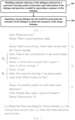
- Fig. 2 is a schematic view of a dialogue content and a summary in some embodiments of the present disclosure.
- the dialogue content has three topics in total, and the corresponding topic segments are marked with S 1 , S 2 and S 3 respectively.
- S 1 is "current situation” (lines 1 to 7 of Fig. 2 )
- S 2 is "arrival time” (lines 8 to 10 of Fig. 2 )
- S 3 is "food to eat” (lines 11 to 18 of Fig. 2 ).
- Lines 19 to 21 of Fig. 2 present a summary of each topic, and the main idea of each topic is summarized in one sentence, that is, t 1 represents the summary of S 1 , t 2 represents the summary of S 2 , and t 3 represents the summary of S 3 .
- sentences from the same topic are more coherent than sentences from different topics (for example, inter-topic segments S 4 or S 5 ).
- This reveals a potential relationship between the topic and the sentence coherence.
- the above-described embodiments of the present disclosure provide that the discourse coherence is modeled by a contrastive learning mode to implicitly capture the dialogue topic information.
- a model for detecting the semantic coherence of the dialogue sentences is constructed to push the model to attach more attention to segments that are more coherent and might contain prominent information from the same topic.
- a model for generating a sub-summary is introduced, which may identify the most prominent information and generate a corresponding summary by the model.
- the present disclosure can implicitly learn the topic information of a dialogue content, and generate summaries according to different topics without additional annotation.
- These two modules in the above-described embodiments of the present disclosure are both constructed by a contrastive learning mode without additional manual annotation or additional algorithm. These two modules in the above-described embodiments of the present disclosure may be combined with a full-text dialogue summary task through an alternate parameter updating strategy, so as to form a final model of the present disclosure.
- Step 100 in the embodiment of Fig. 1 may comprise: a method for training a model. That is, model training is performed on the model for generating the summary of the dialogue by using an alternating parameter updating mode.
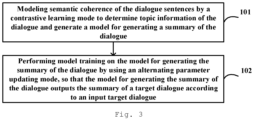
- Fig. 3 is a schematic view of some embodiments of a method for training a model according to the present disclosure.
- the present embodiment may be performed by a device for training a model according to the present disclosure, an apparatus for generating the summary of the dialogue according to the present disclosure or a computer device according to the present disclosure.
- the method for training a model according to the present disclosure or the method for generating the summary of the dialogue according to the present disclosure may comprise at least one of Steps 101 to 102.
- Step 101 the semantic coherence of dialogue sentences is modeled by a contrastive learning mode to determine the topic information of the dialogue and generate a model for generating the summary of the dialogue.
- Step 102 model training is performed on the model for generating the summary of the dialogue by using an alternating parameter updating mode, so that the model for generating the summary of the dialogue outputs the summary of a target dialogue according to an input target dialogue.
- Fig. 4 is a schematic view of other embodiments of a method for training a model according to the present disclosure.
- the present embodiment may be performed by a device for training a model according to the present disclosure, an apparatus for generating the summary of the dialogue according to the present disclosure or a computer device according to the present disclosure.
- the method for training a model according to the present disclosure or the method for generating the summary of the dialogue according to the present disclosure may comprise at least one of steps 110 to 170.
- Step 110 a dialogue content is pre-processed.
- the training data of a dialogue summary generation task comprises two parts, that is, a dialogue content and its corresponding summary.
- a dialogue content is mainly pre-processed.
- Step 110 may comprise at least one of Steps 111 to 112.
- Step 111 the speaker information is added to each of speech contents of different speakers in the dialogue content, and the speech contents of the different speakers are spliced together.
- Step 112 the spliced dialogue content is tokenized by a tokenizer of a pre-training model, and a first predetermined number of words are reserved as a model input.
- the tokenizer of the pre-training model may be Bart (Bidirectional and Auto-regressive Transformers).
- the pre-training model may be BART, STEP, Pegasus (Pre-training with Extracted Gap-sentences for Abstractive Summarization) and other models.
- the first predetermined number of words may be the first 1024 words.
- Step 120 different forms of model training data are constructed correspondingly according to the requirements of the model for understanding the dialogue, the model for generating the sub-summary and the model for generating the full-text summary.
- Step 120 may comprise at least one of Steps 121 to 123.
- Step 121 for the model for understanding the dialogue content, a window constructed according to consecutive dialogue sentences in the dialogue is taken as the positive model training data, and data obtained by scrambling and splicing again dialogue sentences in window content is taken as the negative model training data.
- Step 121 the model for understanding the dialogue content
- the training data is constructed according to the dialogue content, without involving a summary part.
- Step 121 may comprise: taking a window w constructed by k consecutive dialogue sentences as a positive, and scrambling and splicing again sentences in the window was a negative.
- a dialogue in Fig. 2 it is possible to select a window "Hania: I will be there around 7pm I guess: (Julia: I will be waiting!:* Hania: Great! which contains three consecutive dialogue sentences as a positive, and scramble and splice again sentences in the window to obtain "Hania: Great! Hania: I will be there around 7pm I guess: (Julia: I will be waiting!:*", so that the newly obtained sentence window is taken as a negative.
- Step 122 for the model for generating the sub-summary, corresponding positive model training data and negative model training data are generated for each topic of the dialogue content.
- Step 122 may comprise: constructing training data together by joining a dialogue content and a dialogue summary according to the model for generating the sub-summary.
- the summary of a long dialogue always consists of multiple sentences, each of which is regarded as a sub-summary.
- a dialogue may contain multiple topics, in the present disclosure, it is assumed that each sub-summary is related to a topic.
- the whole summary is divided into single sentences by sentence terminators (such as periods, question marks, exclamation marks, etc.), and each single sentence is a sub-summary.
- TD (t1,t2,...,tm)
- ti is a sub-summary
- m is the number of sub-summaries
- presents the number of sentences contained in a dialogue.
- Sipos may be retrieved from a dialogue D according to a ROUGE-2 recall score.
- training data ⁇ (Sipos,ti), (Sineg,ti) ⁇ has been constructed.
- the candidate collection W contains two candidates, that is a first candidate 1 "Hania: I will be there around 7pm I guess: (Julia: I will be waiting!:*", and a second candidate 2 "Julia: I will be waiting!:* Hania: Great.”.
- a sub-summary t 2 "She will get there around 7pm.” marked at the bottom of Fig. 2 , it is obtained that the first candidate 1 and its sub-summary have the highest score by using a ROUGE-2 recall score, which is selected as a positive.
- the second candidate 2 serves as a negative.
- the dialogue having the highest ROUGE score with this sub-summary is the part "Hania: I will be there around 7pm I guess: (Julia: I will be waiting!:* Hania: Great! marked in the figure.
- the dialogue of the first candidate 1 (as a model input) and its corresponding sub-summary (as a model input) constitute the positive training data.
- the sub-summary is still a model output. Description will be made by still taking a dialogue in Fig. 2 as an example. With a dialogue "Julia: Where are you ... Julia: I know how you feel love, I am sick of trains already: (" as a model input, and the sub-summary "She will get there around 7pm.” as a model output, this combination of an input and an output constitutes the negative training data.
- Step 122 may comprise: selecting a Rouge-2 recall score to match a sub-summary and a dialogue window in the case where the training data constructing module constructs training data for the sub-summary generating module.
- the Rouge-2 recall score using an automatic summarization evaluation mode may be replaced by a recall score using a BertScore mode.
- Step 123 for the model for generating the full-text summary, all the content of the dialogue is taken as a model input, and a complete summary is taken as a model output.
- Step 130 a model for understanding the dialogue is constructed to semantically encode the dialogue content, and the model for understanding the dialogue is trained.
- Step 130 may comprise: encoding the dialogue content into a semantic vector by using a network structure of Transformer encoder of BART. For example, given the content of a segment of dialogue D (obtained by the training data constructing module), in Step 130, the dialogue will be understood and the semantic representation vector E of the dialogue will be output.
- Step 140 a model for detecting the semantic coherence of the dialogue sentences is constructed to model a switching relationship between different topics in the dialogue by learning the semantic coherence of dialogue sentences to obtain topic segmentation information of the dialogue.
- the model for detecting the semantic coherence of the dialogue sentences is configured to detect the semantic coherence of a dialogue within the input dialogue content window.
- Step 140 may comprise at least one of Steps 141 to 143.
- Step 141 the coherence scores of the positive model training data and the negative model training data of the mode for detecting the coherence of the dialogue sentences are calculated respectively.
- Step 141 may comprise: according to the model for detecting the semantic coherence of the dialogue sentences, Step 120 and Step 130 may comprise: constructing a positive Spos and a negative Sneg based on an original dialogue content; inputting the positive and negative data into a dialogue understanding module to obtain respective semantic vector representations, which are marked as E pos c and E neg c respectively, as shown in the formula (1). Then, by way of the formula (2), it is possible to calculate respective coherence scores co, and calculate a normalized coherence score of the positive and the negative.
- w 1 , b 1 are both model parameters.
- the relevance scores of the positive and the negative may be calculated by way of the formula (2), in which a normalized coherence score of the positive and the negative is calculated by using a normalized characteristic of softmax.
- Step 142 a second predetermined number of predetermined positive and negative pairs are randomly selected, and a coherence loss is calculated based on contrastive learning.
- the second predetermined number may be N co .
- Step 142 may comprise: randomly selecting N co positive and negative pairs for a dialogue D during model training for the sake of simplicity. Then, a coherence loss value L co D is calculated based on contrastive learning, as shown in the formula (3).
- ⁇ co is a marginal coefficient, and in the present disclosure, it is desirable that the coherence score of a positive segment is greater than that of a negative segment.
- k, N co and ⁇ co are all hyperparameters.
- Step 143 an objective function of the mode for detecting the coherence of the dialogue sentences is calculated based on an edge contrastive loss.
- the objective function based on an edge contrast loss calculated by the dialogue sentence coherence module is shown in the formula (4).
- L co B 1 B ⁇ ⁇ D ,T D > ⁇ B 10 L co
- Step 150 the model for generating the sub-summary is constructed to generate a corresponding sub-summary for each topic of the dialogue.
- Step 150 may comprise at least one of Steps 151 to 154.
- Step 151 the sub-summary generation task is modeled as a sequence-to-sequence learning problem.
- Step 151 may comprise: determining a negative log-likelihood value in the case of positive and negative inputs according to the formula (5) and the formula (6).
- t j i refers to the j-th word in t i sub-summaries
- t 1 : j ⁇ 1 i represents all the words before the position j.
- ⁇ represents a model parameter
- S pos i and S neg i represent the inputs of a positive and a negative respectively.
- p t j i t 1 : j ⁇ 1 i represents the probability of generating t j i words on the basis of the first j words.
- Step 152 the degree of irrelevance between a dialogue segment and a sub-summary in the sub-summary generation task is determined.
- Step 152 may comprise: determining the degree of irrelevance between the dialogue segment and the sub-summary according to the formula (7), wherein the normalized score after the softmax layer may be regarded as an irrelevance score, and in the present disclosure, the degree of irrelevance between the dialogue segment and the sub-summary is represented by using a normalized score.
- Step 153 a third predetermined number of predetermined positive and negative pairs are randomly selected for training in a training stage.
- Step 153 may comprise: given a dialogue D and its corresponding summary T D , where T D contains m sub-summaries, at least m pairs of positives and negatives may be constructed as the training data.
- T D contains m sub-summaries, at least m pairs of positives and negatives may be constructed as the training data.
- N su N su ⁇ m is randomly selected in a training stage.
- Step 154 an objective function of the model for generating the sub-summary is determined according to a marginal loss function based on contrastive learning.
- Step 154 may comprise: constructing a marginal loss function based on contrastive learning for a dialogue D, as shown in the formula (8).
- ⁇ su is a marginal coefficient.
- ⁇ su in the present disclosure, it is desirable that the relevance score between a positive segment and a sub-summary is at least greater than the relevance score between the sub-summary and a negative segment.
- N su and ⁇ su are hyperparameters.
- L su B 1 B ⁇ ⁇ D ,T D > ⁇ B 11 L su D ,T D
- Step 160 the model for generating the full-text summary is constructed to generate a summary of the full-text of the dialogue.
- the model for generating the full-text summary is configured to use a dialogue and a corresponding full-text summary as training data.
- Step 160 may comprise at least one of Steps 161 to 163.
- Step 161 the full-text summary generation task is modeled as a sequence-to-sequence learning problem.
- Step 162 the training goal of the model for generating the full-text summary is set to learn an optimal model parameter and minimize a negative log-likelihood function value.
- dialogue sentences, which is added with its corresponding summary T D (y1, y2,...,y1
- y 1:i-1 represents the i-1-th annotation of the output sequence (that is, y i
- y 1:i-1 (y1,y2,...,yi-1)) .
- Step 163 an objective function of the model for generating the full-text summary is determined.
- L main B 1 B ⁇ ⁇ D ,T D > ⁇ B 12 L D ,T D
- Step 170 the model for detecting the semantic coherence of the dialogue sentences, the model for generating the sub-summary and the model for generating the full-text summary are joined by using an alternating parameter updating mode to perform model training.
- Step 170 may comprise at least one of Steps 171 to 172.
- Step 171 during the training process, parameters are sequentially updated by using an objective function of the model for detecting the semantic coherence of the dialogue sentences, an objective function of the model for generating the sub-summary and an objective function of the model for generating the full-text summary, to train the model for detecting the semantic coherence of the dialogue sentences, the model for generating the sub-summary and the model for generating the full-text summary in a training process.
- Step 172 during the training process, two goals based on contrastive learning serve as auxiliary tasks to improve the quality of generating a summary by the model for generating the full-text summary. That is, the model for detecting the semantic coherence of the dialogue sentences and the model for generating the sub-summary serve as auxiliary tasks to contribute to a main dialogue summary task in the training stage.
- the model for detecting the semantic coherence of the dialogue sentences and the model for generating the sub-summary serve as auxiliary tasks to help the model for generating the full-text summary to improve the quality of generating a summary.
- the backbone network structure of the present disclosure is a transformer network, which is mainly used to understand an input text and generate a corresponding summary.
- the transformer network structure may also be replaced by an end-to-end generation model based on RNN (Recurrent Neural Network) and CNN (Convolutional Neural Network).
- RNN Recurrent Neural Network
- CNN Convolutional Neural Network
- the pipeline method that is, a method of first obtaining the dialogue topic information and then generating a summary according to the topic information
- a contrastive learning mode based on the coherence of the dialogue is provided to implicitly model the topic information of the dialogue.
- sub-summary generation method is designed based on contrastive learning, which may effectively help the model to generate a sub-summary for the same topic of content after obtaining the topic information of the dialogue content.
- a positive and negative constructing method is used for the training data of the dialogue coherence detecting module and the sub-summary generating module.
- Fig. 5 is a schematic view of some embodiments of an apparatus for generating the summary of the dialogue according to the present disclosure.
- the apparatus for generating the summary of the dialogue according to the present disclosure may comprise a model generating module 51 and a dialogue summary determining module 52.
- the model generating module 51 is configured to model semantic coherence of dialogue sentences by a contrastive learning mode to determine topic information of the dialogue and generate a model for generating the summary of the dialogue.
- the model generating module 41 may be implemented as a device for training a model of the present disclosure.
- the dialogue summary determination module 52 is configured to input a target dialogue into the model for generating the summary of the dialogue to obtain the summary of the target dialogue.
- the apparatus for generating the summary of the dialogue is configured to perform operations to implement the method for generating the summary of the dialogue according to any of the above-described embodiments.
- Fig. 6 is a schematic view of some embodiments of a device for training a model according to the present disclosure.
- the device for training a model of the present disclosure may comprise a model generating unit 61 and a model training unit 62.
- the model generation unit 61 is configured to model semantic coherence of dialogue sentences by a contrastive learning mode to determine topic information of the dialogue and generate a model for generating a summary of the dialogue.
- the model training unit 62 is configured to perform model training on the model for generating the summary of the dialogue by using an alternating parameter updating mode, so that the model for generating the summary of the dialogue outputs the summary of a target dialogue according to an input target dialogue.
- Fig. 7 is a schematic view of other embodiments of a device for training a model according to the present disclosure.
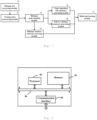
- the device for training a model of the present disclosure may comprise a dialogue pre-processing module 71, a training data constructing module 72, a dialogue understanding module 73, a dialogue sentence coherence detecting module 74, a topic dependent sub-summary generating module 75, a full-text dialogue summary generating module 76 and a multi-task learning module 77.
- the dialogue pre-processing module 71 is configured to pre-process a dialogue.
- the dialogue pre-processing module 71 may be configured to add speaker information to each of speech contents of different speakers in the dialogue, and splice the speech contents of the different speakers together; and tokenize the spliced dialogue by using a tokenizer of a pre-training model, and reserve a first predetermined number of words as a model input.
- the training data constructing module 72 is configured to construct the corresponding model training data according to the requirements of the model for understanding the dialogue, the model for generating the sub-summary and the model for generating the full-text summary.
- the training data constructing module 72 may be configured to take a window constructed according to consecutive dialogue sentences in the dialogue as positive model training data, and taking data obtained by scrambling and splicing again dialogue sentences in window content as negative model training data, for the model for understanding the dialogue; generate corresponding positive model training data and negative model training data according to each topic of the dialogue, for the model for generating the sub-summary; and take all content of the dialogue as a model input, and taking a complete summary as a model output, for the model for generating the full-text summary.
- the dialogue understanding module 73 is configured to construct the model for understanding the dialogue to semantically encode the dialogue and train the model for understanding the dialogue.
- the dialogue sentence coherence detecting module 74 is configured to construct a model for detecting the semantic coherence of the dialogue sentences, to model a switching relationship between different topics in the dialogue by learning the semantic coherence of dialogue sentences to obtain topic segmentation information of the dialogue.
- dialogue sentence coherence detecting module 74 may be configured to calculate coherence scores of the positive model training data and the negative model training data of the mode for detecting the coherence of the dialogue sentences respectively; randomly select a second predetermined number of predetermined positive and negative pairs, and calculating a coherence loss based on contrastive learning in a training stage; and calculate an objective function of the mode for detecting the coherence of the dialogue sentences according to an edge contrastive loss.
- the topic dependent sub-summary generating module 75 is configured to construct the model for generating the sub-summary, to generate the sub-summary corresponding to each of the topics of the dialogue.
- the topic dependent sub-summary generating module 75 may be configured to model a sub-summary generation task as a sequence-to-sequence learning problem; determine the degree of irrelevance between a dialogue segment and a sub-summary in the sub-summary generation task; randomly select a third predetermined number of predetermined positive and negative pairs for training in a training stage; and determine an objective function of the model for generating the sub-summary according to a marginal loss function based on contrastive learning.
- the full-text dialogue summary generating module 76 is configured to construct the model for generating the full-text summary, to generate a summary of full-text of the dialogue.
- the full-text dialogue summary generating module 76 may be configured to model a full-text summary generation task as a sequence-to-sequence learning problem; set a training goal of the model for generating the full-text summary to learn an optimal model parameter and minimize a negative logarithmic likelihood function value; and determine an objective function of the model for generating the full-text summary.
- the multi-task learning module 77 is configured to perform model training on model for detecting the semantic coherence of the dialogue sentences, the model for generating the sub-summary and the model for generating the full-text summary by using an alternating parameter updating mode.
- the multi-task learning module 77 may be configured to sequentially update parameters by using an objective function of the model for detecting the semantic coherence of the dialogue sentences, an objective function of the model for generating the sub-summary and an objective function of the model for generating the full-text summary, to train the model for detecting the semantic coherence of the dialogue sentences, the model for generating the sub-summary and the model for generating the full-text summary in a training process; and take the model for detecting the semantic coherence of the dialogue sentences and the model for generating the sub-summary as auxiliary tasks to improve the quality of generating the summary by the model for generating the full-text summary in the training process.
- the device for training a dialogue model is configured to perform the method for training the model according to any of the above-described embodiments.
- the apparatus for generating the summary of the dialogue and the device for training the model provided by the above-described embodiments of the present disclosure, based on the idea of contrastive learning, it is provided to model a switching relationship between different topics in a dialogue by learning semantic coherence, to implicitly obtain the topic segmentation information of a dialogue, and generate a summary for a dialogue of the same topic.
- additional annotation information or prior algorithms is not required.
- the pipeline method that is, a method of first obtaining the dialogue topic information and then generating a summary according to the topic information
- Fig. 8 is a schematic structural view of some embodiments of a computer device according to the present disclosure. As shown in Fig. 8 , the computer device comprises a memory 81 and a processor 82.
- the memory 81 is configured to store instructions, and the processor 82 is coupled to the memory 81.
- the processor 82 is configured to perform the method for generating the summary of the dialogue according to the above-described embodiments and/or the method for training a model according to any of the above-described embodiments based on the instructions stored in the memory.
- the computer device also comprises a communication interface 83 for information interaction with other devices.
- the computer device also comprises a bus 84, through which the processor 82, the communication interface 83 and the memory 81 communicate with each other.
- the memory 81 may comprise a high-speed RAM memory, and may also comprise a non-volatile memory, for example, at least one disk memory.
- the memory 81 may also be a memory array.
- the memory 81 may also be partitioned into blocks, which may be combined into a virtual volume according to certain rules.
- processor 82 may be a central processing unit CPU, or may be an application specific integrated circuit (ASIC), or one or more integrated circuits configured to implement the embodiments of the present disclosure.
- CPU central processing unit
- ASIC application specific integrated circuit
- a contrastive learning mode based on the coherence of a dialogue is provided to implicitly model the topic information of a dialogue.
- sub-summary generation method is designed based on contrastive learning, which may effectively help the model to generate a sub-summary for the same topic of content after obtaining the topic information of a dialogue.
- a positive and negative constructing method is used for the training data of the dialogue coherence detecting module and the sub-summary generating module.
- a non-transitory computer readable storage medium stores computer instructions that, when executed by a processor, implement the method for generating the summary of the dialogue according to any of the above-described embodiments and/or a method for training a model according to any of the above-described embodiments.
- the embodiments of the present disclosure may be provided as a method, device, or computer program product. Accordingly, the present disclosure may take the form of an entirely hardware embodiment, an entirely software embodiment, or a combination of software and hardware aspects. Moreover, the present disclosure may take the form of a computer program product embodied in one or more computer-usable non-transitory storage media (comprising but not limited to a disk memory, CD-ROM, an optical memory, and the like) containing computer usable program codes therein.
- each step and/or block of the flow charts and/or block views as well as a combination of steps and/or blocks of the flow charts and/or block views may be implemented by a computer program instruction.
- These computer program instructions may be provided to a processor of a general purpose computer, special purpose computer, an embedded processing machine, or other programmable data processing devices to produce a machine, such that the instructions executed by a processor of a computer or other programmable data processing devices produce a device for realizing a function designated in one or more steps of a flow chart and/or one or more blocks in a block view.
- These computer program instructions may also be stored in a computer readable memory that may guide a computer or other programmable data processing device to operate in a particular manner, such that the instructions stored in the computer readable memory produce a manufacture comprising an instruction device.
- the instruction device realizes a function designated in one or more steps in a flow chart or one or more blocks in a block view.
- These computer program instructions may also be loaded onto a computer or other programmable data processing devices, such that a series of operational steps are performed on a computer or other programmable device to produce a computer-implemented processing, such that the instructions executed on a computer or other programmable devices provide steps for realizing a function designated in one or more steps of the flow chart and/or one or more blocks in the block view.
- the apparatus for generating the summary of the dialogue described above may be implemented as a general purpose processor, a programmable logic controller (PLC), a digital signal processor (DSP), an application specific integrated circuit (ASIC), a field-programmable gate array (FPGA) or other programmable logic devices, discrete gates or transistor logic devices, discrete hardware assemblies or any proper combination thereof, which is configured to perform the functions described in the present application.
- PLC programmable logic controller
- DSP digital signal processor
- ASIC application specific integrated circuit
- FPGA field-programmable gate array
Landscapes
- Engineering & Computer Science (AREA)
- Theoretical Computer Science (AREA)
- Physics & Mathematics (AREA)
- General Engineering & Computer Science (AREA)
- General Physics & Mathematics (AREA)
- Health & Medical Sciences (AREA)
- Artificial Intelligence (AREA)
- Computational Linguistics (AREA)
- General Health & Medical Sciences (AREA)
- Audiology, Speech & Language Pathology (AREA)
- Data Mining & Analysis (AREA)
- Databases & Information Systems (AREA)
- Life Sciences & Earth Sciences (AREA)
- Biomedical Technology (AREA)
- Biophysics (AREA)
- Evolutionary Computation (AREA)
- Molecular Biology (AREA)
- Computing Systems (AREA)
- Mathematical Physics (AREA)
- Software Systems (AREA)
- Machine Translation (AREA)
- Information Retrieval, Db Structures And Fs Structures Therefor (AREA)
Abstract
Description
- The present application is based on and claims priority to
China Patent Application No. 202210338218.2 filed on April 1, 2022 - The present disclosure relates to the field of dialogue summary generation, in particular to a method and apparatus for generating a summary of a dialogue, and a method and device for training a model.
- Online communication has become an indispensable communication means in our daily work and life. In the era of information explosion, it is foremost to present the most prominent facts in a dialogue content, rather than redundant discourses, which is very useful for online customer service and meeting summary. Given the content of a segment of dialogue, the generated dialogue summary is intended to summarize and reiterate the content of the dialogue and only present the important content of the dialogue.
- According to one aspect of the present disclosure, a method for generating a summary of a dialogue is provided. The method comprises: modeling semantic coherence of dialogue sentences by a contrastive learning mode to determine topic information of the dialogue and generate a model for generating the summary of the dialogue; and inputting a target dialogue into the model for generating the summary of the dialogue to obtain the summary of the target dialogue.
- In some embodiments of the present disclosure, the modeling the semantic coherence of dialogue sentences by the contrastive learning mode to determine the topic information of the dialogue and generate the model for generating the summary of the dialogue, comprises: constructing a model for detecting the semantic coherence of the dialogue sentences, to model a switching relationship between different topics in the dialogue by learning the semantic coherence of dialogue sentences to obtain topic segmentation information of the dialogue; constructing a model for generating a sub-summary, to generate a sub-summary corresponding to each of topics of the dialogue; and constructing a model for generating a full-text summary, to generate a summary of full-text of the dialogue.
- In some embodiments of the present disclosure, the modeling the semantic coherence of dialogue sentences by the contrastive learning mode to determine the topic information of the dialogue and generate the model for generating the summary of the dialogue, further comprises: performing model training on the model for detecting the semantic coherence of the dialogue sentences, the model for generating the sub-summary and the model for generating the full-text summary by using an alternating parameter updating mode.
- In some embodiments of the present disclosure, the performing model training on the model for detecting the semantic coherence of the dialogue sentences, the model for generating the sub-summary and the model for generating the full-text summary by using an alternating parameter updating mode, comprises that: sequentially updating an objective function of the model for detecting the semantic coherence of the dialogue sentences, an objective function of the model for generating the sub-summary and an objective function of the model for generating the full-text summary, to train the model for detecting the semantic coherence of the dialogue sentences, the model for generating the sub-summary and the model for generating the full-text summary by using an alternating parameter updating mode in a training process; and taking the model for detecting the semantic coherence of the dialogue sentences and the model for generating the sub-summary as auxiliary tasks to improve the quality of generating the summary by the model for generating the full-text summary in the training process.
- In some embodiments of the present disclosure, the modeling the semantic coherence of dialogue sentences by the contrastive learning mode to determine the topic information of the dialogue and generate the model for generating the summary of the dialogue, further comprises: pre-processing the dialogue; constructing corresponding model training data according to requirements of a model for understanding the dialogue, the model for generating the sub-summary and the model for generating the full-text summary; and constructing the model for understanding the dialogue, to semantically encode the dialogue; and training the model for understanding the dialogue.
- In some embodiments of the present disclosure, the pre-processing the dialogue, comprises: adding speaker information to each of speech contents of different speakers in the dialogue, and splicing the speech contents of the different speakers together; and tokenizing the spliced dialogue by using a tokenizer of a pre-training model, and reserving a first predetermined number of words as a model input.
- In some embodiments of the present disclosure, the constructing the corresponding model training data according to the requirements of the model for understanding the dialogue, the model for generating the sub-summary and the model for generating the full-text summary, comprises: taking a window constructed according to consecutive dialogue sentences in the dialogue as positive model training data, and taking data obtained by scrambling and splicing again dialogue sentences in window content as negative model training data, for the model for understanding the dialogue; generating corresponding positive model training data and negative model training data according to each topic of the dialogue, for the model for generating the sub-summary; and taking all content of the dialogue as a model input, and taking a complete summary as a model output, for the model for generating the full-text summary.
- In some embodiments of the present disclosure, the constructing the mode for detecting the coherence of the dialogue sentences, to model a switching relationship between different topics in the dialogue by learning the semantic coherence of dialogue sentences to obtain topic segmentation information of the dialogue, comprises: calculating coherence scores of the positive model training data and the negative model training data of the mode for detecting the coherence of the dialogue sentences respectively; randomly selecting a second predetermined number of predetermined positive and negative pairs, and calculating a coherence loss based on contrastive learning in a training stage; and calculating an objective function of the mode for detecting the coherence of the dialogue sentences according to an edge contrastive loss.
- In some embodiments of the present disclosure, the constructing the model for generating the sub-summary, to generate the sub-summary corresponding to each of the topics of the dialogue, comprises: modeling a sub-summary generation task as a sequence-to-sequence learning problem; determining the degree of irrelevance between a dialogue segment and a sub-summary in the sub-summary generation task; randomly selecting a third predetermined number of predetermined positive and negative pairs for training in a training stage; and determining an objective function of the model for generating the sub-summary according to a marginal loss function based on contrastive learning.
- In some embodiments of the present disclosure, the constructing a model for generating a full-text summary, to generate the summary of the full-text of the dialogue, comprises: modeling a full-text summary generation task as a sequence-to-sequence learning problem; setting a training goal of the model for generating the full-text summary to learn an optimal model parameter and minimize a negative logarithmic likelihood function value; and determining an objective function of the model for generating the full-text summary.
- According to another aspect of the present disclosure, a method for training a model is provided. The method comprises: modeling semantic coherence of dialogue sentences by a contrastive learning mode to determine topic information of the dialogue and generate a model for generating a summary of the dialogue; and performing model training on the model for generating the summary of the dialogue by using an alternating parameter updating mode, so that the model for generating the summary of the dialogue outputs the summary of a target dialogue according to an input target dialogue.
- In some embodiments of the present disclosure, the modeling the semantic coherence of dialogue sentences by the contrastive learning mode to determine the topic information of the dialogue and generate the model for generating the summary of the dialogue, comprises: constructing a model for detecting the semantic coherence of the dialogue sentences, to model a switching relationship between different topics in the dialogue by learning the semantic coherence of dialogue sentences to obtain topic segmentation information of the dialogue; constructing a model for generating a sub-summary, to generate a sub-summary corresponding to each of topics of the dialogue; and constructing a model for generating a full-text summary, to generate a summary of full-text of the dialogue.
- In some embodiments of the present disclosure, the performing model training on the model for generating the summary of the dialogue by using an alternating parameter updating mode, comprises: sequentially updating an objective function of the model for detecting the semantic coherence of the dialogue sentences, an objective function of the model for generating the sub-summary and an objective function of the model for generating the full-text summary, to train the model for detecting the semantic coherence of the dialogue sentences, the model for generating the sub-summary and the model for generating the full-text summary by using an alternating parameter updating mode in a training process; and taking the model for detecting the semantic coherence of the dialogue sentences and the model for generating the sub-summary as auxiliary tasks to improve the quality of generating the summary by the model for generating the full-text summary in the training process.
- In some embodiments of the present disclosure, the modeling the semantic coherence of dialogue sentences by the contrastive learning mode to determine the topic information of the dialogue and generate the model for generating the summary of the dialogue, further comprises: pre-processing the dialogue; constructing corresponding model training data according to requirements of a model for understanding the dialogue, the model for generating the sub-summary and the model for generating the full-text summary; and constructing the model for understanding the dialogue, to semantically encode the dialogue; and training the model for understanding the dialogue.
- In some embodiments of the present disclosure, the pre-processing the dialogue, comprises: adding speaker information to each of speech contents of different speakers in the dialogue, and splicing the speech contents of the different speakers together; and tokenizing the spliced dialogue by using a tokenizer of a pre-training model, and reserving a first predetermined number of words as a model input.
- In some embodiments of the present disclosure, the constructing the corresponding model training data according to the requirements of the model for understanding the dialogue, the model for generating the sub-summary and the model for generating the full-text summary, comprises: taking a window constructed according to consecutive dialogue sentences in the dialogue as positive model training data, and taking data obtained by scrambling and splicing again dialogue sentences in window content as negative model training data, for the model for understanding the dialogue; generating corresponding positive model training data and negative model training data according to each topic of the dialogue, for the model for generating the sub-summary; and taking all content of the dialogue as a model input, and taking a complete summary as a model output, for the model for generating the full-text summary.
- In some embodiments of the present disclosure, the constructing the mode for detecting the coherence of the dialogue sentences, to model a switching relationship between different topics in the dialogue by learning the semantic coherence of dialogue sentences to obtain topic segmentation information of the dialogue, comprises: calculating coherence scores of the positive model training data and the negative model training data of the mode for detecting the coherence of the dialogue sentences respectively; randomly selecting a second predetermined number of predetermined positive and negative pairs, and calculating a coherence loss based on contrastive learning in a training stage; and calculating an objective function of the mode for detecting the coherence of the dialogue sentences according to an edge contrastive loss.
- In some embodiments of the present disclosure, the constructing the model for generating the sub-summary, to generate the sub-summary corresponding to each of the topics of the dialogue, comprises: modeling a sub-summary generation task as a sequence-to-sequence learning problem; determining the degree of irrelevance between a dialogue segment and a sub-summary in the sub-summary generation task; randomly selecting a third predetermined number of predetermined positive and negative pairs for training in a training stage; and determining an objective function of the model for generating the sub-summary according to a marginal loss function based on contrastive learning.
- In some embodiments of the present disclosure, the constructing a model for generating a full-text summary, to generate the summary of the full-text of the dialogue, comprises: modeling a full-text summary generation task as a sequence-to-sequence learning problem; setting a training goal of the model for generating the full-text summary to learn an optimal model parameter and minimize a negative logarithmic likelihood function value; and determining an objective function of the model for generating the full-text summary.
- According to another aspect of the present disclosure, an apparatus for generating a summary of a dialogue is provided. The apparatus comprises: a model generating module configured to model semantic coherence of dialogue sentences by a contrastive learning mode to determine topic information of the dialogue and generate a model for generating the summary of the dialogue; and a dialogue summary determination module configured to input a target dialogue into the model for generating the summary of the dialogue to obtain the summary of the target dialogue.
- In some embodiments of the present disclosure, the apparatus is configured to perform the method according to any of the above-described embodiments.
- According to another aspect of the present disclosure, a device for training a model is provided. The device comprises: a model generation unit configured to model semantic coherence of dialogue sentences by a contrastive learning mode to determine topic information of the dialogue and generate a model for generating a summary of the dialogue; and a model training unit configured to perform model training on the model for generating the summary of the dialogue by using an alternating parameter updating mode, so that the model for generating the summary of the dialogue outputs the summary of a target dialogue according to an input target dialogue.
- In some embodiments of the present disclosure, the device is configured to perform the method according to any of the above-described embodiments.
- According to another aspect of the present disclosure, a computer device is provided. The device comprises: a memory configured to store instructions; and a processor configured to execute the instructions, so that the computer device performs the method for generating a summary of a dialogue according to any of the above-described embodiments and/or the method for training a model according to any of the above-described embodiments.
- According to another aspect of the present disclosure, a non-transitory computer-readable storage medium is provided. Wherein, the non-transitory computer-readable storage medium has computer instructions stored thereon that, when executed by a processor, implement the method for generating a summary of a dialogue according to any of the above-described embodiments and/or the method for training a model according to any of the above-described embodiments.
- In order to more explicitly explain the technical solutions in the embodiments of the present disclosure or the relevant art, a brief introduction will be given below for the accompanying drawings required to be used in the description of the embodiments or the relevant art. It is obvious that, the accompanying drawings described as follows are merely some of the embodiments of the present disclosure. For those skilled in the art, other accompanying drawings may also be obtained according to such accompanying drawings on the premise that no inventive effort is involved.
-
Fig. 1 is a schematic view of some embodiments of a method for generating a summary of a dialogue according to the present disclosure. -
Fig. 2 is a schematic view of a dialogue and a summary in some embodiments of the present disclosure. -
Fig. 3 is a schematic view of some embodiments of a method for training a model according to the present disclosure. -
Fig. 4 is a schematic view of other embodiments of a method for training a model according to the present disclosure. -
Fig. 5 is a schematic view of some embodiments of an apparatus for generating the summary of the dialogue according to the present disclosure. -
Fig. 6 is a schematic view of some embodiments of a device for training a model according to the present disclosure. -
Fig. 7 is a schematic view of other embodiments of a device for training a model according to the present disclosure. -
Fig. 8 is a schematic structural view of some embodiments of a computer device according to the present disclosure. - The technical solution in the embodiments of the present disclosure will be explicitly and completely described below in conjunction with the accompanying drawings in the embodiments of the present disclosure. Apparently, the embodiments described are merely some of the embodiments of the present disclosure, rather than all of the embodiments. The following descriptions of at least one exemplary embodiment which are in fact merely illustrative, shall by no means serve as any delimitation on the present disclosure as well as its application or use. On the basis of the embodiments of the present disclosure, all the other embodiments obtained by those skilled in the art on the premise that no inventive effort is involved shall fall into the protection scope of the present disclosure.
- Unless otherwise specified, the relative arrangements, numerical expressions and numerical values of the components and steps expounded in these examples shall not limit the scope of the present invention.
- At the same time, it should be understood that, for ease of description, the dimensions of various parts shown in the accompanying drawings are not drawn according to actual proportional relations.
- The techniques, methods, and apparatuses known to those of ordinary skill in the relevant art might not be discussed in detail. However, the techniques, methods, and apparatuses shall be considered as a part of the granted description where appropriate.
- Among all the examples shown and discussed here, any specific value shall be construed as being merely exemplary, rather than as being restrictive. Thus, other examples in the exemplary embodiments may have different values.
- It is to be noted that: similar reference signs and letters present similar items in the following accompanying drawings, and therefore, once an item is defined in one accompanying drawing, it is necessary to make further discussion on the same in the subsequent accompanying drawings.
- The inventors have found through studies that the challenge of dialogue summary is attempted to be solved by using the internal information of a dialogue in the related art, for example, a topic characteristic of a dialogue (that is, a topic), a dialogue act and a dialogue stage. Although the model has proved the effectiveness of the dialogue-related information in terms of generating a dialogue summary, there are still the following problems: the method often requires additional manual annotation or prior algorithms to obtain information such as dialogue topic characteristics and dialogue acts, which is likely to consume a lot of labor and machine resources.
- The inventors have also found through studies that the results of the upstream prior algorithms and even the expert annotation in the related art might be erroneous. This pipeline method of first obtaining the relevant information of a dialogue and then generating a dialogue summary may result in the transfer of an upstream mistake, which affects the effect of a downstream dialogue summary model.
- In view of at least one of the above technical problems, the present disclosure provides a method and apparatus for generating a summary of a dialogue and a method and device for training a model, which can implicitly learn the topic information of a dialogue content and generate a summary for different topics. The present disclosure will be explained below by specific embodiments.
-
Fig. 1 is a schematic view of some embodiments of a method for generating a summary of a dialogue according to the present disclosure. Preferably, the present embodiment may be performed by the apparatus for generating the summary of the dialogue according to the present disclosure or the computer device according to the present disclosure. The method may comprise at least one of the following steps. - In
Step 100, the semantic coherence of dialogue sentences is modeled by a contrastive learning mode to determine the topic information of the dialogue and generate a model for generating the summary of the dialogue, wherein the dialogue may be a conversation. - In
Step 200, a target dialogue is input into the model for generating the summary of the dialogue to obtain the summary information of the target dialogue, wherein the dialogue comprises a dialogue content. -
Fig. 2 is a schematic view of a dialogue content and a summary in some embodiments of the present disclosure. As shown inFig. 2 , the dialogue content has three topics in total, and the corresponding topic segments are marked with S1, S2 and S3 respectively. S1 is "current situation" (lines 1 to 7 ofFig. 2 ), S2 is "arrival time" (lines 8 to 10 ofFig. 2 ), and S3 is "food to eat" (lines 11 to 18 ofFig. 2 ). Lines 19 to 21 ofFig. 2 present a summary of each topic, and the main idea of each topic is summarized in one sentence, that is, t1 represents the summary of S1, t2 represents the summary of S2, and t3 represents the summary of S3. - As shown in
Fig. 2 , sentences from the same topic (for example, a dialogue in S1, S2 or S3) are more coherent than sentences from different topics (for example, inter-topic segments S4 or S5). This reveals a potential relationship between the topic and the sentence coherence. Different from a structured text in which paragraphs or parts may be regarded as natural topic paragraphs, it is difficult to accurately divide dialogue topics. Based on an internal relationship between the topic and the discourse coherence, the above-described embodiments of the present disclosure provide that the discourse coherence is modeled by a contrastive learning mode to implicitly capture the dialogue topic information. In the above-described embodiments of the present disclosure, a model for detecting the semantic coherence of the dialogue sentences is constructed to push the model to attach more attention to segments that are more coherent and might contain prominent information from the same topic. - In addition, since the above-described embodiments of the present disclosure aim to generate a better summary for each topic in a dialogue, a model for generating a sub-summary is introduced, which may identify the most prominent information and generate a corresponding summary by the model.
- The present disclosure can implicitly learn the topic information of a dialogue content, and generate summaries according to different topics without additional annotation.
- These two modules in the above-described embodiments of the present disclosure are both constructed by a contrastive learning mode without additional manual annotation or additional algorithm. These two modules in the above-described embodiments of the present disclosure may be combined with a full-text dialogue summary task through an alternate parameter updating strategy, so as to form a final model of the present disclosure.
- In some embodiments of the present disclosure,
Step 100 in the embodiment ofFig. 1 may comprise: a method for training a model. That is, model training is performed on the model for generating the summary of the dialogue by using an alternating parameter updating mode. -
Fig. 3 is a schematic view of some embodiments of a method for training a model according to the present disclosure. Preferably, the present embodiment may be performed by a device for training a model according to the present disclosure, an apparatus for generating the summary of the dialogue according to the present disclosure or a computer device according to the present disclosure. As shown inFig. 3 , the method for training a model according to the present disclosure or the method for generating the summary of the dialogue according to the present disclosure (for example,Step 100 in the embodiment ofFig. 1 ) may comprise at least one ofSteps 101 to 102. - In
Step 101, the semantic coherence of dialogue sentences is modeled by a contrastive learning mode to determine the topic information of the dialogue and generate a model for generating the summary of the dialogue. - In
Step 102, model training is performed on the model for generating the summary of the dialogue by using an alternating parameter updating mode, so that the model for generating the summary of the dialogue outputs the summary of a target dialogue according to an input target dialogue. -
Fig. 4 is a schematic view of other embodiments of a method for training a model according to the present disclosure. Preferably, the present embodiment may be performed by a device for training a model according to the present disclosure, an apparatus for generating the summary of the dialogue according to the present disclosure or a computer device according to the present disclosure. As shown inFig. 4 , the method for training a model according to the present disclosure or the method for generating the summary of the dialogue according to the present disclosure (for example,Step 100 in the embodiment ofFig. 1 ) may comprise at least one ofsteps 110 to 170. - In
Step 110, a dialogue content is pre-processed. - In some embodiments of the present disclosure, as shown in
Fig. 2 , the training data of a dialogue summary generation task comprises two parts, that is, a dialogue content and its corresponding summary. InStep 110, a dialogue content is mainly pre-processed. - In some embodiments of the present disclosure,
Step 110 may comprise at least one of Steps 111 to 112. - In Step 111, the speaker information is added to each of speech contents of different speakers in the dialogue content, and the speech contents of the different speakers are spliced together.
- Description will be made by taking the first two sentences of the dialogue in
Fig. 2 as an example. The speaker "Julia" of the sentence "Where are you?" is added before the sentence, indicating that the sentence is said by Julia, to obtain "Julia: Where are you?" . The speaker "Hania" is added before the sentence "That's a good question, haha" , to obtain "Hania: that's a good question, haha" . The two sentences are spliced to obtain "Julia: Where are you? Hania: That' s a good question, haha" . - In Step 112, the spliced dialogue content is tokenized by a tokenizer of a pre-training model, and a first predetermined number of words are reserved as a model input.
- In some embodiments of the present disclosure, the tokenizer of the pre-training model may be Bart (Bidirectional and Auto-regressive Transformers).
- In some embodiments of the present disclosure, the pre-training model may be BART, STEP, Pegasus (Pre-training with Extracted Gap-sentences for Abstractive Summarization) and other models.
- In some embodiments of the present disclosure, the first predetermined number of words may be the first 1024 words.
- In
Step 120, different forms of model training data are constructed correspondingly according to the requirements of the model for understanding the dialogue, the model for generating the sub-summary and the model for generating the full-text summary. - In some embodiments of the present disclosure,
Step 120 may comprise at least one of Steps 121 to 123. - In Step 121, for the model for understanding the dialogue content, a window constructed according to consecutive dialogue sentences in the dialogue is taken as the positive model training data, and data obtained by scrambling and splicing again dialogue sentences in window content is taken as the negative model training data.
- In some embodiments of the present disclosure, in Step 121, the model for understanding the dialogue content, the training data is constructed according to the dialogue content, without involving a summary part.
- In some embodiments of the present disclosure, Step 121 may comprise: taking a window w constructed by k consecutive dialogue sentences as a positive, and scrambling and splicing again sentences in the window was a negative. Taking a dialogue in
Fig. 2 as an example, it is possible to select a window "Hania: I will be there around 7pm I guess: (Julia: I will be waiting!:* Hania: Great!" which contains three consecutive dialogue sentences as a positive, and scramble and splice again sentences in the window to obtain "Hania: Great! Hania: I will be there around 7pm I guess: (Julia: I will be waiting!:*", so that the newly obtained sentence window is taken as a negative. - In Step 122, for the model for generating the sub-summary, corresponding positive model training data and negative model training data are generated for each topic of the dialogue content.
- In some embodiments of the present disclosure, Step 122 may comprise: constructing training data together by joining a dialogue content and a dialogue summary according to the model for generating the sub-summary. The summary of a long dialogue always consists of multiple sentences, each of which is regarded as a sub-summary. Considering that a dialogue may contain multiple topics, in the present disclosure, it is assumed that each sub-summary is related to a topic. The whole summary is divided into single sentences by sentence terminators (such as periods, question marks, exclamation marks, etc.), and each single sentence is a sub-summary.
- In some embodiments of the present disclosure, for the convenience of description, given a segment of dialogue D=(u1,u2,...,u|D|), in the present disclosure, a corresponding target summary of this dialogue is presented here as TD=(t1,t2,...,tm), where each ti is a sub-summary, m is the number of sub-summaries, and |D| presents the number of sentences contained in a dialogue. Given a sub-summary, in the present disclosure, the most relevant segment Sipos may be retrieved from a dialogue D according to a ROUGE-2 recall score. Specifically, given an integer window size w∈[a, b] (0< a≤ b<|d|, where a and b are hyperparameters), it is possible to slide the window across the dialogue D, and slide the window from left to right by taking half a window size w/2 as a step size and obtain a collection W of candidate collection segments. Each candidate segment in the collection W is enumerated, and a ROUGE-2 recall score is calculated for the each candidate segment and a sub-summary. In this way, it is possible to obtain a dialogue segment with the highest score, which is selected as the most relevant segment of the sub-summary ti and used as a positive sample Sipos. A corresponding negative is randomly selected from the remaining candidates in the collection W, which is presented as Sineg.
- In some embodiments of the present disclosure, in the present disclosure, training data {(Sipos,ti), (Sineg,ti)} has been constructed. For the sake of simplicity, description will be made by taking S2 and t2 parts in the dialogue in
Fig. 2 as an example, that is, the dialogue D={Hania: I will be there around 7pm I guess: (Julia: I will be waiting!:* Hania: Great.}, and |D| is 3. In the present disclosure, if it is selected that the window size is w=2 and the step size is w/2=1, then the candidate collection W contains two candidates, that is a first candidate 1 "Hania: I will be there around 7pm I guess: (Julia: I will be waiting!:*", and a second candidate 2 "Julia: I will be waiting!:* Hania: Great.". For a sub-summary t2 "She will get there around 7pm." marked at the bottom ofFig. 2 , it is obtained that the first candidate 1 and its sub-summary have the highest score by using a ROUGE-2 recall score, which is selected as a positive. Moreover, the second candidate 2 serves as a negative. In other words, the dialogue having the highest ROUGE score with this sub-summary is the part "Hania: I will be there around 7pm I guess: (Julia: I will be waiting!:* Hania: Great!" marked in the figure. On such basis, the dialogue of the first candidate 1 (as a model input) and its corresponding sub-summary (as a model input) constitute the positive training data. In order to construct negative training data, it is only necessary to randomly choose another dialogue window as a model input, and the sub-summary is still a model output. Description will be made by still taking a dialogue inFig. 2 as an example. With a dialogue "Julia: Where are you ... Julia: I know how you feel love, I am sick of trains already: (" as a model input, and the sub-summary "She will get there around 7pm." as a model output, this combination of an input and an output constitutes the negative training data. - In some embodiments of the present disclosure, Step 122 may comprise: selecting a Rouge-2 recall score to match a sub-summary and a dialogue window in the case where the training data constructing module constructs training data for the sub-summary generating module.
- In some embodiments of the present disclosure, the Rouge-2 recall score using an automatic summarization evaluation mode may be replaced by a recall score using a BertScore mode.
- In Step 123, for the model for generating the full-text summary, all the content of the dialogue is taken as a model input, and a complete summary is taken as a model output.
- Taking the dialogue in
Fig. 2 as an example, all the content of the dialogue "Julia: Where are you ... Hania: Pizza always: D..." is taken as an input, and the dialogue summary "Hania has been... pizza for her." composed of three sentence summaries is taken as an output. - In
Step 130, a model for understanding the dialogue is constructed to semantically encode the dialogue content, and the model for understanding the dialogue is trained. - In some embodiments of the present disclosure,
Step 130 may comprise: encoding the dialogue content into a semantic vector by using a network structure of Transformer encoder of BART. For example, given the content of a segment of dialogue D (obtained by the training data constructing module), inStep 130, the dialogue will be understood and the semantic representation vector E of the dialogue will be output. - In
Step 140, a model for detecting the semantic coherence of the dialogue sentences is constructed to model a switching relationship between different topics in the dialogue by learning the semantic coherence of dialogue sentences to obtain topic segmentation information of the dialogue. - In some embodiments of the present disclosure, the model for detecting the semantic coherence of the dialogue sentences is configured to detect the semantic coherence of a dialogue within the input dialogue content window.
- In some embodiments of the present disclosure,
Step 140 may comprise at least one of Steps 141 to 143. - In Step 141, the coherence scores of the positive model training data and the negative model training data of the mode for detecting the coherence of the dialogue sentences are calculated respectively.
- In some embodiments of the present disclosure, Step 141 may comprise: according to the model for detecting the semantic coherence of the dialogue sentences,
Step 120 andStep 130 may comprise: constructing a positive Spos and a negative Sneg based on an original dialogue content; inputting the positive and negative data into a dialogue understanding module to obtain respective semantic vector representations, which are marked as


- In the formula (1), w1, b1 are both model parameters. In the above-described embodiments of the present disclosure, the relevance scores of the positive and the negative may be calculated by way of the formula (2), in which a normalized coherence score of the positive and the negative is calculated by using a normalized characteristic of softmax.
- In Step 142, a second predetermined number of predetermined positive and negative pairs are randomly selected, and a coherence loss is calculated based on contrastive learning.
- In some embodiments of the present disclosure, the second predetermined number may be Nco.
- In some embodiments of the present disclosure, Step 142 may comprise: randomly selecting Nco positive and negative pairs for a dialogue D during model training for the sake of simplicity. Then, a coherence loss value


- In the formula (3), δco is a marginal coefficient, and in the present disclosure, it is desirable that the coherence score of a positive segment is greater than that of a negative segment. k, Nco and δco are all hyperparameters.
- In Step 143, an objective function of the mode for detecting the coherence of the dialogue sentences is calculated based on an edge contrastive loss.
- In some embodiments of the present disclosure, Step 143 may comprise: given a batch of data, B=(< D1, TD1 >, < D2, TD1 >, ..., < D|B|, TD|B| >), where Di is the i-th dialogue, TDi is a summary corresponding to Di, and |B| is the number of data in this batch. The objective function based on an edge contrast loss calculated by the dialogue sentence coherence module is shown in the formula (4).

- In
Step 150, the model for generating the sub-summary is constructed to generate a corresponding sub-summary for each topic of the dialogue. - In some embodiments of the present disclosure,
Step 150 may comprise at least one of Steps 151 to 154. - In Step 151, the sub-summary generation task is modeled as a sequence-to-sequence learning problem.
- In some embodiments of the present disclosure, Step 151 may comprise: determining a negative log-likelihood value in the case of positive and negative inputs according to the formula (5) and the formula (6).


- In the formula (5) and the formula (6),


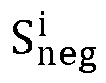


- In Step 152, the degree of irrelevance between a dialogue segment and a sub-summary in the sub-summary generation task is determined.
- In some embodiments of the present disclosure, Step 152 may comprise: determining the degree of irrelevance between the dialogue segment and the sub-summary according to the formula (7), wherein the normalized score after the softmax layer may be regarded as an irrelevance score, and in the present disclosure, the degree of irrelevance between the dialogue segment and the sub-summary is represented by using a normalized score.

- In Step 153, a third predetermined number of predetermined positive and negative pairs are randomly selected for training in a training stage.
- In some embodiments of the present disclosure, Step 153 may comprise: given a dialogue D and its corresponding summary TD, where TD contains m sub-summaries, at least m pairs of positives and negatives may be constructed as the training data. In order to simplify the calculation process, Nsu (Nsu <m) is randomly selected in a training stage.
- In Step 154, an objective function of the model for generating the sub-summary is determined according to a marginal loss function based on contrastive learning.
- In some embodiments of the present disclosure, Step 154 may comprise: constructing a marginal loss function based on contrastive learning for a dialogue D, as shown in the formula (8).

- In the formula (8), δsu is a marginal coefficient. By way of the coefficient δsu, in the present disclosure, it is desirable that the relevance score between a positive segment and a sub-summary is at least greater than the relevance score between the sub-summary and a negative segment. Nsu and δsu are hyperparameters.
- In some embodiments of the present disclosure, Step 154 may further comprise: determining a negative log-likelihood objective function according to the formula (9) for a batch of dialogue summary training data B= (< D1, TD1 >, < D2, TD2 >, ..., < D|B|, TD|B| >), where |B| is the number of data in the batch.

- In
Step 160, the model for generating the full-text summary is constructed to generate a summary of the full-text of the dialogue. - In some embodiments of the present disclosure, the model for generating the full-text summary is configured to use a dialogue and a corresponding full-text summary as training data.
- In some embodiments of the present disclosure,
Step 160 may comprise at least one of Steps 161 to 163. - In Step 161, the full-text summary generation task is modeled as a sequence-to-sequence learning problem.
- In Step 162, the training goal of the model for generating the full-text summary is set to learn an optimal model parameter and minimize a negative log-likelihood function value.
- In some embodiments of the present disclosure, Step 162 may comprise: given a dialogue D= (u1,u2,...,u|TD|), consisting of |D| dialogue sentences, which is added with its corresponding summary TD= (y1, y2,...,y1|TD|), consisting of |TD| sub-summaries, the goal of generating a full-text dialogue summary is to learn an optimal model parameter θ and minimize the following negative log-likelihood value, as shown in the formula (10).

- In the formula (10), yi|y1:i-1 represents the i-1-th annotation of the output sequence (that is, yi|y1:i-1 = (y1,y2,...,yi-1)) .
- In Step 163, an objective function of the model for generating the full-text summary is determined.
- In some embodiments of the present disclosure, Step 163 may comprise: for a certain batch of dialogue summary pairs B=( (D1, TD1〉 , 〈D2,TD2〉 ,..., 〈D|B|,TD|B|〉), the objective function based on a negative log-likelihood is calculated as shown in the formula (11).

- In
Step 170, the model for detecting the semantic coherence of the dialogue sentences, the model for generating the sub-summary and the model for generating the full-text summary are joined by using an alternating parameter updating mode to perform model training. - In some embodiments of the present disclosure,
Step 170 may comprise at least one of Steps 171 to 172. - In Step 171, during the training process, parameters are sequentially updated by using an objective function of the model for detecting the semantic coherence of the dialogue sentences, an objective function of the model for generating the sub-summary and an objective function of the model for generating the full-text summary, to train the model for detecting the semantic coherence of the dialogue sentences, the model for generating the sub-summary and the model for generating the full-text summary in a training process.
- In Step 172, during the training process, two goals based on contrastive learning serve as auxiliary tasks to improve the quality of generating a summary by the model for generating the full-text summary. That is, the model for detecting the semantic coherence of the dialogue sentences and the model for generating the sub-summary serve as auxiliary tasks to contribute to a main dialogue summary task in the training stage.
- In some embodiments of the present disclosure, during the training process, the model for detecting the semantic coherence of the dialogue sentences and the model for generating the sub-summary serve as auxiliary tasks to help the model for generating the full-text summary to improve the quality of generating a summary.
- In some embodiments of the present disclosure, after training is completed, these two models and their corresponding data pre-processing modules are unnecessary. When summary production is performed on a new dialogue (in
Step 200 in the embodiment ofFig. 1 ), in the present disclosure, it is only necessary that the dialogue understanding module and the full-text summary generating module perform understanding and summary production on the dialogue. - In some embodiments of the present disclosure, the backbone network structure of the present disclosure is a transformer network, which is mainly used to understand an input text and generate a corresponding summary.
- In some embodiments of the present disclosure, the transformer network structure may also be replaced by an end-to-end generation model based on RNN (Recurrent Neural Network) and CNN (Convolutional Neural Network).
- In the method for generating the summary of the dialogue and the method for training a model provided by the above-described embodiments of the present disclosure, based on the idea of contrastive learning, it is provided that a switching relationship between different topics in a dialogue is modeled by learning semantic coherence of dialogue sentences, to implicitly obtain the topic segmentation information of a dialogue, and generate a summary for the dialogue of the same topic. In the method according to the above-described embodiments of the present disclosure, additional annotation information or prior algorithms is not required.
- In the multi-task learning end-to-end summary generation method provided by the above-described embodiments of the present disclosure, it is possible to solve the technical problem that the pipeline method (that is, a method of first obtaining the dialogue topic information and then generating a summary according to the topic information) is present with an erroneous transfer shortcoming.
- In a dialogue summary generation scenario, for the tough problems that the dialogue topic information is difficult to obtain and the annotation involves an expensive cost, in the above-described embodiments of the present disclosure, a contrastive learning mode based on the coherence of the dialogue is provided to implicitly model the topic information of the dialogue.
- For different topics of dialogue content, in the above-described embodiments of the present disclosure, the concept of sub-summary is introduced and a sub-summary generation method is designed based on contrastive learning, which may effectively help the model to generate a sub-summary for the same topic of content after obtaining the topic information of the dialogue content.
- In the above-described embodiments of the present disclosure, a positive and negative constructing method is used for the training data of the dialogue coherence detecting module and the sub-summary generating module.
- In a multi-task learning mode joining two contrastive objective functions (that is, the objective functions of the dialogue sentence coherence detecting module and the sub-summary generating module) and the objective function of the full-text summary generating module according to the above-described embodiments of the present disclosure, it is possible to support the model to generate a dialogue summary in an end-to-end manner and avoid erroneous transfer.
-
Fig. 5 is a schematic view of some embodiments of an apparatus for generating the summary of the dialogue according to the present disclosure. As shown inFig. 5 , the apparatus for generating the summary of the dialogue according to the present disclosure may comprise amodel generating module 51 and a dialoguesummary determining module 52. - The
model generating module 51 is configured to model semantic coherence of dialogue sentences by a contrastive learning mode to determine topic information of the dialogue and generate a model for generating the summary of the dialogue. - In some embodiments of the present disclosure, the model generating module 41 may be implemented as a device for training a model of the present disclosure.
- The dialogue
summary determination module 52 is configured to input a target dialogue into the model for generating the summary of the dialogue to obtain the summary of the target dialogue. - In some embodiments of the present disclosure, the apparatus for generating the summary of the dialogue is configured to perform operations to implement the method for generating the summary of the dialogue according to any of the above-described embodiments.
-
Fig. 6 is a schematic view of some embodiments of a device for training a model according to the present disclosure. As shown inFig. 6 , the device for training a model of the present disclosure (for example, themodel generating module 51 in the embodiment ofFig. 5 ) may comprise amodel generating unit 61 and amodel training unit 62. - The
model generation unit 61 is configured to model semantic coherence of dialogue sentences by a contrastive learning mode to determine topic information of the dialogue and generate a model for generating a summary of the dialogue. - The
model training unit 62 is configured to perform model training on the model for generating the summary of the dialogue by using an alternating parameter updating mode, so that the model for generating the summary of the dialogue outputs the summary of a target dialogue according to an input target dialogue. -
Fig. 7 is a schematic view of other embodiments of a device for training a model according to the present disclosure. As shown inFig. 7 , the device for training a model of the present disclosure (for example, themodel generating module 51 in the embodiment ofFig. 5 ) may comprise adialogue pre-processing module 71, a trainingdata constructing module 72, adialogue understanding module 73, a dialogue sentencecoherence detecting module 74, a topic dependentsub-summary generating module 75, a full-text dialoguesummary generating module 76 and amulti-task learning module 77. - The
dialogue pre-processing module 71 is configured to pre-process a dialogue. - In some embodiments of the present disclosure, the
dialogue pre-processing module 71 may be configured to add speaker information to each of speech contents of different speakers in the dialogue, and splice the speech contents of the different speakers together; and tokenize the spliced dialogue by using a tokenizer of a pre-training model, and reserve a first predetermined number of words as a model input. - The training
data constructing module 72 is configured to construct the corresponding model training data according to the requirements of the model for understanding the dialogue, the model for generating the sub-summary and the model for generating the full-text summary. - In some embodiments of the present disclosure, the training
data constructing module 72 may be configured to take a window constructed according to consecutive dialogue sentences in the dialogue as positive model training data, and taking data obtained by scrambling and splicing again dialogue sentences in window content as negative model training data, for the model for understanding the dialogue; generate corresponding positive model training data and negative model training data according to each topic of the dialogue, for the model for generating the sub-summary; and take all content of the dialogue as a model input, and taking a complete summary as a model output, for the model for generating the full-text summary. - The
dialogue understanding module 73 is configured to construct the model for understanding the dialogue to semantically encode the dialogue and train the model for understanding the dialogue. - The dialogue sentence
coherence detecting module 74 is configured to construct a model for detecting the semantic coherence of the dialogue sentences, to model a switching relationship between different topics in the dialogue by learning the semantic coherence of dialogue sentences to obtain topic segmentation information of the dialogue. - In some embodiments of the present disclosure, dialogue sentence
coherence detecting module 74 may be configured to calculate coherence scores of the positive model training data and the negative model training data of the mode for detecting the coherence of the dialogue sentences respectively; randomly select a second predetermined number of predetermined positive and negative pairs, and calculating a coherence loss based on contrastive learning in a training stage; and calculate an objective function of the mode for detecting the coherence of the dialogue sentences according to an edge contrastive loss. - The topic dependent
sub-summary generating module 75 is configured to construct the model for generating the sub-summary, to generate the sub-summary corresponding to each of the topics of the dialogue. - In some embodiments of the present disclosure, the topic dependent
sub-summary generating module 75 may be configured to model a sub-summary generation task as a sequence-to-sequence learning problem; determine the degree of irrelevance between a dialogue segment and a sub-summary in the sub-summary generation task; randomly select a third predetermined number of predetermined positive and negative pairs for training in a training stage; and determine an objective function of the model for generating the sub-summary according to a marginal loss function based on contrastive learning. - The full-text dialogue
summary generating module 76 is configured to construct the model for generating the full-text summary, to generate a summary of full-text of the dialogue. - In some embodiments of the present disclosure, the full-text dialogue
summary generating module 76 may be configured to model a full-text summary generation task as a sequence-to-sequence learning problem; set a training goal of the model for generating the full-text summary to learn an optimal model parameter and minimize a negative logarithmic likelihood function value; and determine an objective function of the model for generating the full-text summary. - The
multi-task learning module 77 is configured to perform model training on model for detecting the semantic coherence of the dialogue sentences, the model for generating the sub-summary and the model for generating the full-text summary by using an alternating parameter updating mode. - In some embodiments of the present disclosure, the
multi-task learning module 77 may be configured to sequentially update parameters by using an objective function of the model for detecting the semantic coherence of the dialogue sentences, an objective function of the model for generating the sub-summary and an objective function of the model for generating the full-text summary, to train the model for detecting the semantic coherence of the dialogue sentences, the model for generating the sub-summary and the model for generating the full-text summary in a training process; and take the model for detecting the semantic coherence of the dialogue sentences and the model for generating the sub-summary as auxiliary tasks to improve the quality of generating the summary by the model for generating the full-text summary in the training process. - In some embodiments of the present disclosure, the device for training a dialogue model is configured to perform the method for training the model according to any of the above-described embodiments.
- In the apparatus for generating the summary of the dialogue and the device for training the model provided by the above-described embodiments of the present disclosure, based on the idea of contrastive learning, it is provided to model a switching relationship between different topics in a dialogue by learning semantic coherence, to implicitly obtain the topic segmentation information of a dialogue, and generate a summary for a dialogue of the same topic. In the apparatus for generating the summary of the dialogue according to the above-described embodiments of the present disclosure, additional annotation information or prior algorithms is not required.
- In the multi-task learning end-to-end summary generation method provided by the above-described embodiments of the present disclosure, it is possible to solve the technical problem that the pipeline method (that is, a method of first obtaining the dialogue topic information and then generating a summary according to the topic information) is present with an erroneous transfer shortcoming.
-
Fig. 8 is a schematic structural view of some embodiments of a computer device according to the present disclosure. As shown inFig. 8 , the computer device comprises amemory 81 and aprocessor 82. - The
memory 81 is configured to store instructions, and theprocessor 82 is coupled to thememory 81. Theprocessor 82 is configured to perform the method for generating the summary of the dialogue according to the above-described embodiments and/or the method for training a model according to any of the above-described embodiments based on the instructions stored in the memory. - As shown in
Fig. 8 , the computer device also comprises acommunication interface 83 for information interaction with other devices. At the same time, the computer device also comprises abus 84, through which theprocessor 82, thecommunication interface 83 and thememory 81 communicate with each other. - The
memory 81 may comprise a high-speed RAM memory, and may also comprise a non-volatile memory, for example, at least one disk memory. Thememory 81 may also be a memory array. Thememory 81 may also be partitioned into blocks, which may be combined into a virtual volume according to certain rules. - Further, the
processor 82 may be a central processing unit CPU, or may be an application specific integrated circuit (ASIC), or one or more integrated circuits configured to implement the embodiments of the present disclosure. - In a dialogue summary generation scenario, for the tough problems that the dialogue topic information is difficult to obtain and the annotation involves an expensive cost, in the above-described embodiments of the present disclosure, a contrastive learning mode based on the coherence of a dialogue is provided to implicitly model the topic information of a dialogue.
- For different topics of dialogue, in the above-described embodiments of the present disclosure, the concept of sub-summary is introduced and a sub-summary generation method is designed based on contrastive learning, which may effectively help the model to generate a sub-summary for the same topic of content after obtaining the topic information of a dialogue.
- In the above-described embodiments of the present disclosure, a positive and negative constructing method is used for the training data of the dialogue coherence detecting module and the sub-summary generating module.
- In a multi-task learning mode joining two contrastive objective functions (that is, the objective functions of the dialogue sentence coherence detecting module and the sub-summary generating module) and the objective function of the full-text summary generating module according to the above-described embodiments of the present disclosure, it is possible to support the model to generate a dialogue summary in an end-to-end manner and avoid erroneous transfer.
- According to another aspect of the present disclosure, a non-transitory computer readable storage medium is provided, wherein the computer readable storage medium stores computer instructions that, when executed by a processor, implement the method for generating the summary of the dialogue according to any of the above-described embodiments and/or a method for training a model according to any of the above-described embodiments.
- Those skilled in the art will appreciate that the embodiments of the present disclosure may be provided as a method, device, or computer program product. Accordingly, the present disclosure may take the form of an entirely hardware embodiment, an entirely software embodiment, or a combination of software and hardware aspects. Moreover, the present disclosure may take the form of a computer program product embodied in one or more computer-usable non-transitory storage media (comprising but not limited to a disk memory, CD-ROM, an optical memory, and the like) containing computer usable program codes therein.
- The present disclosure is described with reference to the flow charts and/or block views of the methods, devices (systems), and computer program products according to the embodiments of the present disclosure. It will be understood that each step and/or block of the flow charts and/or block views as well as a combination of steps and/or blocks of the flow charts and/or block views may be implemented by a computer program instruction. These computer program instructions may be provided to a processor of a general purpose computer, special purpose computer, an embedded processing machine, or other programmable data processing devices to produce a machine, such that the instructions executed by a processor of a computer or other programmable data processing devices produce a device for realizing a function designated in one or more steps of a flow chart and/or one or more blocks in a block view.
- These computer program instructions may also be stored in a computer readable memory that may guide a computer or other programmable data processing device to operate in a particular manner, such that the instructions stored in the computer readable memory produce a manufacture comprising an instruction device. The instruction device realizes a function designated in one or more steps in a flow chart or one or more blocks in a block view.
- These computer program instructions may also be loaded onto a computer or other programmable data processing devices, such that a series of operational steps are performed on a computer or other programmable device to produce a computer-implemented processing, such that the instructions executed on a computer or other programmable devices provide steps for realizing a function designated in one or more steps of the flow chart and/or one or more blocks in the block view.
- The apparatus for generating the summary of the dialogue described above may be implemented as a general purpose processor, a programmable logic controller (PLC), a digital signal processor (DSP), an application specific integrated circuit (ASIC), a field-programmable gate array (FPGA) or other programmable logic devices, discrete gates or transistor logic devices, discrete hardware assemblies or any proper combination thereof, which is configured to perform the functions described in the present application.
- Hitherto, the present disclosure has been described in detail. Some details well known in the art are not described in order to avoid obscuring the concept of the present disclosure. According to the above description, those skilled in the art would fully understand how to implement the technical solutions disclosed here.
- Those of ordinary skill in the art may understand that all or some of the steps in the above-described embodiments may be accomplished by hardware, or by programs to instruct relevant hardware. The programs may be stored in a non-transitory computer-readable storage medium. The storage medium as mentioned above may be read-only memory, magnetic disk or optical disk, and the like.
- Descriptions of the present disclosure, which are made for purpose of exemplification and description, are not absent with omissions or limit the present disclosure to the forms as disclosed. Many modifications and variations are apparent for those skilled in the art. The embodiments are selected and described in order to better explain the principles and actual application of the present disclosure, and enable those skilled in the art to understand the present disclosure to design various embodiments adapted to particular purposes and comprising various modifications.
Claims (25)
- A method for generating a summary of a dialogue, comprising:modeling semantic coherence of dialogue sentences by a contrastive learning mode to determine topic information of the dialogue and generate a model for generating the summary of the dialogue; andinputting a target dialogue into the model for generating the summary of the dialogue to obtain the summary of the target dialogue.
- The method according to claim 1, wherein the modeling the semantic coherence of dialogue sentences by the contrastive learning mode to determine the topic information of the dialogue and generate the model for generating the summary of the dialogue, comprises:constructing a model for detecting the semantic coherence of the dialogue sentences, to model a switching relationship between different topics in the dialogue by learning the semantic coherence of dialogue sentences to obtain topic segmentation information of the dialogue;constructing a model for generating a sub-summary, to generate a sub-summary corresponding to each of topics of the dialogue; andconstructing a model for generating a full-text summary, to generate a summary of full-text of the dialogue.
- The method according to claim 2, wherein the modeling the semantic coherence of dialogue sentences by the contrastive learning mode to determine the topic information of the dialogue and generate the model for generating the summary of the dialogue, further comprises:
performing model training on the model for detecting the semantic coherence of the dialogue sentences, the model for generating the sub-summary and the model for generating the full-text summary by using an alternating parameter updating mode. - The method according to claim 3, wherein the performing model training on the model for detecting the semantic coherence of the dialogue sentences, the model for generating the sub-summary and the model for generating the full-text summary by using an alternating parameter updating mode, comprises:sequentially updating parameters by using an objective function of the model for detecting the semantic coherence of the dialogue sentences, an objective function of the model for generating the sub-summary and an objective function of the model for generating the full-text summary, to train the model for detecting the semantic coherence of the dialogue sentences, the model for generating the sub-summary and the model for generating the full-text summary in a training process; andtaking the model for detecting the semantic coherence of the dialogue sentences and the model for generating the sub-summary as auxiliary tasks to improve the quality of generating the summary by the model for generating the full-text summary in the training process.
- The method according to any of claims 2 to 4, wherein the modeling the semantic coherence of dialogue sentences by the contrastive learning mode to determine the topic information of the dialogue and generate the model for generating the summary of the dialogue, further comprises:pre-processing the dialogue;constructing corresponding model training data according to requirements of a model for understanding the dialogue, the model for generating the sub-summary and the model for generating the full-text summary; andconstructing the model for understanding the dialogue, to semantically encode the dialogue, and training the model for understanding the dialogue.
- The method according to claim 5, wherein the pre-processing the dialogue, comprises:adding speaker information to each of speech contents of different speakers in the dialogue, and splicing the speech contents of the different speakers together; andtokenizing the spliced dialogue by using a tokenizer of a pre-training model, and reserving a first predetermined number of words as a model input.
- The method according to claim 5, wherein the constructing the corresponding model training data according to the requirements of the model for understanding the dialogue, the model for generating the sub-summary and the model for generating the full-text summary, comprises:taking a window constructed according to consecutive dialogue sentences in the dialogue as positive model training data, and taking data obtained by scrambling and splicing again dialogue sentences in window content as negative model training data, for the model for understanding the dialogue;generating corresponding positive model training data and negative model training data according to each topic of the dialogue, for the model for generating the sub-summary; andtaking all content of the dialogue as a model input, and taking a complete summary as a model output, for the model for generating the full-text summary.
- The method according to claim 6, wherein the constructing the mode for detecting the coherence of the dialogue sentences, to model a switching relationship between different topics in the dialogue by learning the semantic coherence of dialogue sentences to obtain topic segmentation information of the dialogue, comprises:calculating coherence scores of the positive model training data and the negative model training data of the mode for detecting the coherence of the dialogue sentences respectively;randomly selecting a second predetermined number of predetermined positive and negative pairs, and calculating a coherence loss based on contrastive learning in a training stage; andcalculating an objective function of the mode for detecting the coherence of the dialogue sentences according to an edge contrastive loss.
- The method according to claim 6, wherein the constructing the model for generating the sub-summary, to generate the sub-summary corresponding to each of the topics of the dialogue, comprises:modeling a sub-summary generation task as a sequence-to-sequence learning problem;determining the degree of irrelevance between a dialogue segment and a sub-summary in the sub-summary generation task;randomly selecting a third predetermined number of predetermined positive and negative pairs for training in a training stage; anddetermining an objective function of the model for generating the sub-summary according to a marginal loss function based on contrastive learning.
- The method according to claim 6, wherein the constructing a model for generating a full-text summary, to generate the summary of the full-text of the dialogue, comprises:modeling a full-text summary generation task as a sequence-to-sequence learning problem;setting a training goal of the model for generating the full-text summary to learn an optimal model parameter and minimize a negative logarithmic likelihood function value; anddetermining an objective function of the model for generating the full-text summary.
- A method for training a model, comprising:modeling semantic coherence of dialogue sentences by a contrastive learning mode to determine topic information of the dialogue and generate a model for generating a summary of the dialogue; andperforming model training on the model for generating the summary of the dialogue by using an alternating parameter updating mode, so that the model for generating the summary of the dialogue outputs the summary of a target dialogue according to an input target dialogue.
- The method according to claim 11, wherein the modeling the semantic coherence of dialogue sentences by the contrastive learning mode to determine the topic information of the dialogue and generate the model for generating the summary of the dialogue, comprises:constructing a model for detecting the semantic coherence of the dialogue sentences, to model a switching relationship between different topics in the dialogue by learning the semantic coherence of dialogue sentences to obtain topic segmentation information of the dialogue;constructing a model for generating a sub-summary, to generate a sub-summary corresponding to each of topics of the dialogue; andconstructing a model for generating a full-text summary, to generate a summary of full-text of the dialogue.
- The method according to claim 12, wherein the performing model training on the model for generating the summary of the dialogue by using an alternating parameter updating mode, comprises:sequentially updating parameters by using an objective function of the model for detecting the semantic coherence of the dialogue sentences, an objective function of the model for generating the sub-summary and an objective function of the model for generating the full-text summary, to train the model for generating the summary of the dialogue, wherein the model for generating the summary of the dialogue comprises the model for detecting the semantic coherence of the dialogue sentences, the model for generating the sub-summary and the model for generating the full-text summary in a training process; andtaking the model for detecting the semantic coherence of the dialogue sentences and the model for generating the sub-summary as auxiliary tasks to improve the quality of generating the summary by the model for generating the full-text summary in the training process.
- The method according to claim 12 or 13, wherein the modeling the semantic coherence of dialogue sentences by the contrastive learning mode to determine the topic information of the dialogue and generate the model for generating the summary of the dialogue, further comprises:pre-processing the dialogue;constructing corresponding model training data according to requirements of a model for understanding the dialogue, the model for generating the sub-summary and the model for generating the full-text summary; andconstructing the model for understanding the dialogue, to semantically encode the dialogue, and training the model for understanding the dialogue.
- The method according to claim 14, wherein the pre-processing the dialogue, comprises:adding speaker information to each of speech contents of different speakers in the dialogue, and splicing the speech contents of the different speakers together; andtokenizing the spliced dialogue by using a tokenizer of a pre-training model, and reserving a first predetermined number of words as a model input.
- The method according to claim 14, wherein the constructing the corresponding model training data according to the requirements of the model for understanding the dialogue, the model for generating the sub-summary and the model for generating the full-text summary, comprises:taking a window constructed according to consecutive dialogue sentences in the dialogue as positive model training data, and taking data obtained by scrambling and splicing again dialogue sentences in window content as negative model training data, for the model for understanding the dialogue;generating corresponding positive model training data and negative model training data according to each topic of the dialogue, for the model for generating the sub-summary; andtaking all content of the dialogue as a model input, and taking a complete summary as a model output, for the model for generating the full-text summary.
- The method according to claim 15, wherein the constructing the mode for detecting the coherence of the dialogue sentences, to model a switching relationship between different topics in the dialogue by learning the semantic coherence of dialogue sentences to obtain topic segmentation information of the dialogue, comprises:calculating coherence scores of the positive model training data and the negative model training data of the mode for detecting the coherence of the dialogue sentences respectively;randomly selecting a second predetermined number of predetermined positive and negative pairs, and calculating a coherence loss based on contrastive learning in a training stage; andcalculating an objective function of the mode for detecting the coherence of the dialogue sentences according to an edge contrastive loss.
- The method according to claim 15, wherein the constructing the model for generating the sub-summary, to generate the sub-summary corresponding to each of the topics of the dialogue, comprises:modeling a sub-summary generation task as a sequence-to-sequence learning problem;determining the degree of irrelevance between a dialogue segment and a sub-summary in the sub-summary generation task;randomly selecting a third predetermined number of predetermined positive and negative pairs for training in a training stage; anddetermining an objective function of the model for generating the sub-summary according to a marginal loss function based on contrastive learning.
- The method according to claim 15, wherein the constructing the model for generating the full-text summary, to generate the summary of the full-text of the dialogue, comprises:modeling a full-text summary generation task as a sequence-to-sequence learning problem;setting a training goal of the model for generating the full-text summary to learn an optimal model parameter and minimize a negative logarithmic likelihood function value; anddetermining an objective function of the model for generating the full-text summary.
- An apparatus for generating a summary of a dialogue, comprising:a model generating module configured to model semantic coherence of dialogue sentences by a contrastive learning mode to determine topic information of the dialogue and generate a model for generating the summary of the dialogue; anda dialogue summary determination module configured to input a target dialogue into the model for generating the summary of the dialogue to obtain the summary of the target dialogue.
- The apparatus for generating the summary of the dialogue according to claim 20, wherein the apparatus for generating the summary of the dialogue is configured to perform the method according to any of claims 1 to 10.
- A device for training a model, comprising:a model generation unit configured to model semantic coherence of dialogue sentences by a contrastive learning mode to determine topic information of the dialogue and generate a model for generating a summary of the dialogue; anda model training unit configured to perform model training on the model for generating the summary of the dialogue by using an alternating parameter updating mode, so that the model for generating the summary of the dialogue outputs the summary of a target dialogue according to an input target dialogue.
- The device according to claim 22, wherein the device is configured to perform the method according to any of claims 11 to 19.
- A computer device comprising:a memory configured to store instructions; anda processor configured to execute the instructions, so that the computer device performs the method according to any of claims 1 to 10 and/or the method according to any of claims 11 to 19.
- A non-transitory computer-readable storage medium, wherein the non-transitory computer-readable storage medium has computer instructions stored thereon that, when executed by a processor, implement the method according to any of claims 1 to 10 and/or the method according to any of claims 11 to 19.
Applications Claiming Priority (2)
| Application Number | Priority Date | Filing Date | Title |
|---|---|---|---|
| CN202210338218.2A CN116933801A (en) | 2022-04-01 | 2022-04-01 | Dialogue abstract generation method and device, model training method and device |
| PCT/CN2023/084642 WO2023185912A1 (en) | 2022-04-01 | 2023-03-29 | Dialogue abstract generation method and apparatus, and model training method and device |
Publications (2)
| Publication Number | Publication Date |
|---|---|
| EP4506851A1 true EP4506851A1 (en) | 2025-02-12 |
| EP4506851A4 EP4506851A4 (en) | 2025-07-09 |
Family
ID=88199301
Family Applications (1)
| Application Number | Title | Priority Date | Filing Date |
|---|---|---|---|
| EP23778277.6A Pending EP4506851A4 (en) | 2022-04-01 | 2023-03-29 | Method and device for generating a dialogue abstract and model training method and device |
Country Status (4)
| Country | Link |
|---|---|
| US (1) | US20250200096A1 (en) |
| EP (1) | EP4506851A4 (en) |
| CN (1) | CN116933801A (en) |
| WO (1) | WO2023185912A1 (en) |
Families Citing this family (2)
| Publication number | Priority date | Publication date | Assignee | Title |
|---|---|---|---|---|
| CN116383371A (en) * | 2023-02-20 | 2023-07-04 | 中移信息技术有限公司 | Abstract generation model training method and abstract generation method, device and equipment |
| CN119293347B (en) * | 2024-08-31 | 2025-11-11 | 福州大学 | Dialogue abstracting method and system based on theme enhancement and dialogue center |
Family Cites Families (8)
| Publication number | Priority date | Publication date | Assignee | Title |
|---|---|---|---|---|
| CN111368066B (en) * | 2018-12-06 | 2024-02-09 | 北京京东尚科信息技术有限公司 | Method, apparatus and computer readable storage medium for obtaining dialogue abstract |
| CN111639175B (en) * | 2020-05-29 | 2023-05-02 | 电子科技大学 | A self-supervised dialog text summarization method and system |
| CN111862977B (en) * | 2020-07-27 | 2021-08-10 | 北京嘀嘀无限科技发展有限公司 | Voice conversation processing method and system |
| US11232266B1 (en) * | 2020-07-27 | 2022-01-25 | Verizon Patent And Licensing Inc. | Systems and methods for generating a summary of a multi-speaker conversation |
| US11475210B2 (en) * | 2020-08-31 | 2022-10-18 | Twilio Inc. | Language model for abstractive summarization |
| CN112464658B (en) * | 2020-12-07 | 2022-08-09 | 上海交通大学 | Text abstract generation method, system, terminal and medium based on sentence fusion |
| CN113204627B (en) * | 2021-05-13 | 2022-08-23 | 哈尔滨工业大学 | Dialog summary generation system using DialloGPT as feature annotator |
| CN113919367A (en) * | 2021-09-09 | 2022-01-11 | 中国科学院自动化研究所 | Abstract acquisition method, device, equipment, medium and product |
-
2022
- 2022-04-01 CN CN202210338218.2A patent/CN116933801A/en active Pending
-
2023
- 2023-03-29 US US18/852,149 patent/US20250200096A1/en active Pending
- 2023-03-29 EP EP23778277.6A patent/EP4506851A4/en active Pending
- 2023-03-29 WO PCT/CN2023/084642 patent/WO2023185912A1/en not_active Ceased
Also Published As
| Publication number | Publication date |
|---|---|
| CN116933801A (en) | 2023-10-24 |
| WO2023185912A1 (en) | 2023-10-05 |
| US20250200096A1 (en) | 2025-06-19 |
| EP4506851A4 (en) | 2025-07-09 |
Similar Documents
| Publication | Publication Date | Title |
|---|---|---|
| Karanikolas et al. | Large language models versus natural language understanding and generation | |
| De Clercq et al. | All mixed up? Finding the optimal feature set for general readability prediction and its application to English and Dutch | |
| CN111898374B (en) | Text recognition methods, devices, storage media and electronic equipment | |
| Shah et al. | Arabic sentiment analysis and sarcasm detection using probabilistic projections-based variational switch transformer | |
| CN107133211A (en) | A kind of composition methods of marking based on notice mechanism | |
| US20170199878A1 (en) | Method and system for generating an architecture document for describing a system framework | |
| WO2022051436A1 (en) | Personalized learning system | |
| CN110825867B (en) | Similar text recommendation method, device, electronic device and storage medium | |
| George et al. | Conversational implicatures in English dialogue: Annotated dataset | |
| US20250200096A1 (en) | Method and apparatus for generating summary of dialogue, and method and device for training model | |
| US11823592B2 (en) | Virtual agent conducting interactive testing | |
| CN115934909A (en) | Common situation reply generation method, device, terminal and storage medium | |
| WO2025077885A1 (en) | Method and apparatus for text sentiment recognition, computer storage medium, and electronic device | |
| CN112434142B (en) | Method for marking training sample, server, computing equipment and storage medium | |
| Perera et al. | Sentiment analysis of code-mixed text: a comprehensive review | |
| US20240281710A1 (en) | Handling multi-loop feedback for machine learning model pipelines | |
| US20240281596A1 (en) | Edit attention management | |
| CN111191465B (en) | A question-answer matching method, device, equipment and storage medium | |
| Khamphakdee et al. | A framework for constructing Thai sentiment corpus using the cosine similarity technique | |
| Al Bashaireh et al. | Towards a new indicator for evaluating universities based on twitter sentiment analysis | |
| Gazzola et al. | Text complexity of open educational resources in Portuguese: mixing written and spoken registers in a multi-task approach | |
| Zhu et al. | YUN111@ Dravidian-CodeMix-FIRE2020: Sentiment Analysis of Dravidian Code Mixed Text. | |
| Alshahrani et al. | Word mover's distance for affect detection | |
| Kumar et al. | Automation of question-answer generation | |
| CN117076608A (en) | A script event prediction method and device based on text dynamic span that integrates external event knowledge |
Legal Events
| Date | Code | Title | Description |
|---|---|---|---|
| STAA | Information on the status of an ep patent application or granted ep patent |
Free format text: STATUS: THE INTERNATIONAL PUBLICATION HAS BEEN MADE |
|
| PUAI | Public reference made under article 153(3) epc to a published international application that has entered the european phase |
Free format text: ORIGINAL CODE: 0009012 |
|
| STAA | Information on the status of an ep patent application or granted ep patent |
Free format text: STATUS: REQUEST FOR EXAMINATION WAS MADE |
|
| 17P | Request for examination filed |
Effective date: 20241030 |
|
| AK | Designated contracting states |
Kind code of ref document: A1 Designated state(s): AL AT BE BG CH CY CZ DE DK EE ES FI FR GB GR HR HU IE IS IT LI LT LU LV MC ME MK MT NL NO PL PT RO RS SE SI SK SM TR |
|
| A4 | Supplementary search report drawn up and despatched |
Effective date: 20250605 |
|
| DAV | Request for validation of the european patent (deleted) | ||
| DAX | Request for extension of the european patent (deleted) | ||
| RIC1 | Information provided on ipc code assigned before grant |
Ipc: G06N 3/08 20230101ALI20250530BHEP Ipc: G06F 40/289 20200101ALI20250530BHEP Ipc: G06F 40/56 20200101ALI20250530BHEP Ipc: G06F 40/30 20200101ALI20250530BHEP Ipc: G06F 16/34 20250101ALI20250530BHEP Ipc: G06F 40/35 20200101AFI20250530BHEP |