EP4506427A1 - Aqueous ink for inkjet recording, fixing agent, inkjet recording method, inkjet recording device, and ink holding container - Google Patents
Aqueous ink for inkjet recording, fixing agent, inkjet recording method, inkjet recording device, and ink holding container Download PDFInfo
- Publication number
- EP4506427A1 EP4506427A1 EP23784711.6A EP23784711A EP4506427A1 EP 4506427 A1 EP4506427 A1 EP 4506427A1 EP 23784711 A EP23784711 A EP 23784711A EP 4506427 A1 EP4506427 A1 EP 4506427A1
- Authority
- EP
- European Patent Office
- Prior art keywords
- ink
- jet recording
- ink jet
- aqueous ink
- aqueous
- Prior art date
- Legal status (The legal status is an assumption and is not a legal conclusion. Google has not performed a legal analysis and makes no representation as to the accuracy of the status listed.)
- Pending
Links
Images
Classifications
-
- C—CHEMISTRY; METALLURGY
- C09—DYES; PAINTS; POLISHES; NATURAL RESINS; ADHESIVES; COMPOSITIONS NOT OTHERWISE PROVIDED FOR; APPLICATIONS OF MATERIALS NOT OTHERWISE PROVIDED FOR
- C09D—COATING COMPOSITIONS, e.g. PAINTS, VARNISHES OR LACQUERS; FILLING PASTES; CHEMICAL PAINT OR INK REMOVERS; INKS; CORRECTING FLUIDS; WOODSTAINS; PASTES OR SOLIDS FOR COLOURING OR PRINTING; USE OF MATERIALS THEREFOR
- C09D11/00—Inks
- C09D11/30—Inkjet printing inks
- C09D11/38—Inkjet printing inks characterised by non-macromolecular additives other than solvents, pigments or dyes
-
- C—CHEMISTRY; METALLURGY
- C09—DYES; PAINTS; POLISHES; NATURAL RESINS; ADHESIVES; COMPOSITIONS NOT OTHERWISE PROVIDED FOR; APPLICATIONS OF MATERIALS NOT OTHERWISE PROVIDED FOR
- C09D—COATING COMPOSITIONS, e.g. PAINTS, VARNISHES OR LACQUERS; FILLING PASTES; CHEMICAL PAINT OR INK REMOVERS; INKS; CORRECTING FLUIDS; WOODSTAINS; PASTES OR SOLIDS FOR COLOURING OR PRINTING; USE OF MATERIALS THEREFOR
- C09D11/00—Inks
- C09D11/02—Printing inks
- C09D11/10—Printing inks based on artificial resins
- C09D11/102—Printing inks based on artificial resins containing macromolecular compounds obtained by reactions other than those only involving unsaturated carbon-to-carbon bonds
- C09D11/104—Polyesters
-
- C—CHEMISTRY; METALLURGY
- C09—DYES; PAINTS; POLISHES; NATURAL RESINS; ADHESIVES; COMPOSITIONS NOT OTHERWISE PROVIDED FOR; APPLICATIONS OF MATERIALS NOT OTHERWISE PROVIDED FOR
- C09D—COATING COMPOSITIONS, e.g. PAINTS, VARNISHES OR LACQUERS; FILLING PASTES; CHEMICAL PAINT OR INK REMOVERS; INKS; CORRECTING FLUIDS; WOODSTAINS; PASTES OR SOLIDS FOR COLOURING OR PRINTING; USE OF MATERIALS THEREFOR
- C09D11/00—Inks
- C09D11/30—Inkjet printing inks
- C09D11/32—Inkjet printing inks characterised by colouring agents
- C09D11/322—Pigment inks
-
- B—PERFORMING OPERATIONS; TRANSPORTING
- B41—PRINTING; LINING MACHINES; TYPEWRITERS; STAMPS
- B41M—PRINTING, DUPLICATING, MARKING, OR COPYING PROCESSES; COLOUR PRINTING
- B41M5/00—Duplicating or marking methods; Sheet materials for use therein
- B41M5/0011—Pre-treatment or treatment during printing of the recording material, e.g. heating, irradiating
- B41M5/0017—Application of ink-fixing material, e.g. mordant, precipitating agent, on the substrate prior to printing, e.g. by ink-jet printing, coating or spraying
Definitions
- the present invention relates to an aqueous ink for ink jet recording, a fixing agent, an inkjet recording method, an inkjet recording device, and an ink storage container.
- Examples of an aqueous ink for ink jet recording generally include one described in Patent Literature 1.
- Patent Literature 1 JP2003-127351A
- an aqueous ink for ink jet recording is also required to reduce environmental impact thereof.
- an object of the present invention is to provide an aqueous ink for ink jet recording that can contribute to reducing environmental impact.
- an aqueous ink for ink jet recording contains: water; a coloring agent; and a fixing agent, in which the fixing agent contains a polylactic acid.
- the fixing agent contains a polylactic acid having biodegradability
- the aqueous ink for ink jet recording according to the present invention can contribute to reducing environmental impact.
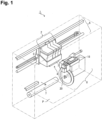
- FIGURE is a schematic perspective view showing a configuration of an example of an inkjet recording device according to the present invention.
- mass may be referred to as “weight” unless otherwise specified.
- mass ratio may be referred to as “weight ratio” unless otherwise specified, and “mass%” may be referred to as “wt%” unless otherwise specified.
- aqueous ink for ink jet recording (hereinafter, sometimes referred to as an "aqueous ink” or an “ink”) will be described.
- the aqueous ink according to the present invention contains water, a coloring agent, and a fixing agent, in which the fixing agent contains a polylactic acid.
- the coloring agent may include, for example, a pigment, or a dye.
- the pigment is not particularly limited, and examples thereof include carbon black, an inorganic pigment, and an organic pigment.
- examples of the carbon black include furnace black, lamp black, acetylene black, and channel black.
- examples of the inorganic pigment include titanium oxide, an iron oxide-based inorganic pigment, and a carbon black-based inorganic pigment.
- organic pigment examples include: azo pigments such as azo lake, an insoluble azo pigment, a condensed azo pigment, and a chelate azo pigment; polycyclic pigments such as a phthalocyanine pigment, a perylene and perinone pigment, an anthraquinone pigment, a quinacridone pigment, a dioxazine pigment, a thioindigo pigment, an isoindolinone pigment, and a quinophthalone pigment; dye lake pigments such as a basic dye lake pigment and an acid dye lake pigment; nitro pigments; nitroso pigments; and aniline black daylight fluorescent pigments. Other pigments may be used as long as the pigment can be dispersed in an aqueous phase.
- azo pigments such as azo lake, an insoluble azo pigment, a condensed azo pigment, and a chelate azo pigment
- polycyclic pigments such as a phthalocyanine pigment, a perylene and perinone pigment, an
- pigments include: C.I. Pigment Black 1, 6, and 7; C.I. Pigment Yellow 1, 2, 3, 12, 13, 14, 15, 16, 17, 55, 74, 78, 150, 151, 154, 180, 185, and 194; C.I. Pigment Orange 31 and 43; C.I. Pigment Red 2, 3, 5, 6, 7, 12, 15, 16, 48, 48:1, 53:1, 57, 57:1, 112, 122, 123, 139, 144, 146, 149, 150, 166, 168, 175, 176, 177, 178, 184, 185, 190, 202, 209, 221, 222, 224, and 238; C.I. Pigment Violet 19 and 196; C.I. Pigment Blue 1, 2, 3, 15, 15:1, 15:2, 15:3, 15:4, 16, 22, and 60; C.I. Pigment Green 7 and 36; and solid solutions of these pigments.
- the pigment may be, for example, one that is dispersed in a solvent using a resin dispersant (also referred to as a resin dispersion pigment).
- a resin dispersant for example, a general polymer dispersant (also referred to as a resin for pigment dispersion or a resin dispersant) may be used, and the resin dispersant may be prepared.
- the pigment in the aqueous ink according to the present invention, the pigment may be encapsulated with a polymer.
- the resin dispersant for example, those containing at least one of methacrylic acid and acrylic acid as a monomer can be used, and for example, a commercially available product may be used.
- the resin dispersant may be, for example, a block copolymer, a graft copolymer, or a random copolymer made of hydrophobic monomers such as styrene, a styrene derivative, vinylnaphthalene, a vinylnaphthalene derivative, aliphatic alcohol esters of ⁇ , ⁇ -ethylenically unsaturated carboxylic acids, or two or more monomers selected from the group consisting of acrylic acid, an acrylic acid derivative, maleic acid, a maleic acid derivative, itaconic acid, an itaconic acid derivative, fumaric acid, and a fumaric acid derivative, or a salt thereof.
- hydrophobic monomers such as styrene, a styrene derivative, vinylnaphthalene, a vinylnaphthalene derivative, aliphatic alcohol esters of ⁇ , ⁇ -ethylenically unsaturated carboxylic acids, or two or more monomers selected from the group consist
- Examples of the commercially available product include: “Joncryl (registered trademark) 611", “Joncryl (registered trademark) 60", “Joncryl (registered trademark) 586", “Joncryl (registered trademark) 687", “Joncryl (registered trademark) 63", and “Joncryl (registered trademark) HPD296” manufactured by Johnson Polymer Co., Ltd.; “Disperbyk 190” and “Disperbyk 191” manufactured by BYK; and “Solsperse 20000” and “Solsperse 27000” manufactured by Zeneca Corporation.
- Examples of a method for dispersing the pigment using the resin for pigment dispersion include dispersing the pigment using a dispersing device.
- the dispersing device used for dispersing the pigment is not particularly limited as long as the dispersing device is a general disperser, and examples thereof include a ball mill, a roll mill, and a sand mill (for example, a high-speed type sand mill).
- the pigment may be a self-dispersion type pigment.
- the self-dispersion type pigment can be dispersed in water without using a dispersant, for example, by introducing at least one of a hydrophilic functional group such as a carbonyl group, a hydroxy group, a carboxylic acid group, a sulfonic acid group, and a phosphoric acid group, and a salt thereof into pigment particles by chemical bonding, either directly or through other groups.
- a hydrophilic functional group such as a carbonyl group, a hydroxy group, a carboxylic acid group, a sulfonic acid group, and a phosphoric acid group
- a salt thereof such as a carbonyl group, a hydroxy group, a carboxylic acid group, a sulfonic acid group, and a phosphoric acid group
- a salt thereof such as a carbonyl group, a hydroxy group, a carboxylic acid group, a sulfonic acid group,
- the self-dispersion type pigment As a raw material of the self-dispersion type pigment, either an inorganic pigment or an organic pigment can be used.
- examples of the pigment suitable for the treatment include carbon black such as "MA8" and "MA100” manufactured by Mitsubishi Chemical Corporation.
- the self-dispersion type pigment may be, for example, a commercially available product.
- Examples of the commercially available product include: “CAB-O-JET (registered trademark) 200", “CAB-O-JET (registered trademark) 250C”, “CAB-O-JET (registered trademark) 260M”, “CAB-O-JET (registered trademark) 270Y”, “CAB-O-JET (registered trademark) 300", “CAB-O-JET (registered trademark) 400", “CAB-O-JET (registered trademark) 450C", “CAB-O-JET (registered trademark) 465M", and “CAB-O-JET (registered trademark) 470Y” manufactured by Cabot Corporation; “BONJET (registered trademark) BLACK CW-2” and “BONJET (registered trademark) BLACK CW-3” manufactured by ORIENT CHEMICAL INDUSTRIES CO., LTD; and “LIOJET (registered trademark) WD BLACK 002C” manufactured by TOYO INK CO., LTD.
- the fixing agent contains a polylactic acid.
- An origin of a raw material of the polylactic acid is not particularly limited, and the polylactic acid may be, for example, a plant-derived polylactic acid or a non-plant-derived (chemically synthesized) polylactic acid.
- the plant-derived polylactic acid is produced, for example, from starch or sugar. Using the plant-derived polylactic acid can also contribute to reducing CO2 emissions.
- the fixing agent may contain a component other than the polylactic acid.
- the component other than the polylactic acid is not particularly limited, and may be, for example, a fixing agent synthesized from a raw material derived from chemical synthesis.
- the fixing agent is for fixing the coloring agent to a recording medium.
- the recording medium is not particularly limited, and examples thereof include a recording sheet.
- the water may be ion exchange water, pure water, or the like.
- the water may be a main solvent.
- the term "main solvent” refers to the most abundant component among components constituting the solvent.
- a blending amount (water proportion) of the water with respect to a total amount of the aqueous ink is appropriately determined according to desired ink properties and the like.
- the water proportion may be, for example, the balance except for other components.
- the blending amount of the water is 50 mass% to 95 mass%, preferably 55 mass% to 90 mass%, and more preferably 60 mass% to 80 mass%.
- An addition amount of the polylactic acid to the total amount of the aqueous ink is not particularly limited, and for example, may be 2.5 mass% or more, or 3 mass% or more, and may be 10 mass% or less, 7 mass% or less, or 5 mass% or less.
- it is 2.5 wt% to 10 wt%, preferably 3 wt% to 10 wt%, and more preferably 3 wt% to 7 wt%.
- a mass ratio (A/B) of a content (A) of the pigment to a content (B) of the polylactic acid in the total amount of the aqueous ink is not particularly limited, and is, for example, 0.25 to 1.0, preferably 0.5 to 0.85, and more preferably 0.5 to 0.83.
- a viscosity of the aqueous ink may be, for example, 20 mPa s or less, 10 mPa s or less, 7 mPa ⁇ s or less, or 5 mPa ⁇ s or less, and may be 1 mPa ⁇ s or more, or 2 mPa ⁇ s or more. For example, it is 1 mPa ⁇ s to 20 mPa ⁇ s, and preferably 2 mPa ⁇ s to 10 mPa ⁇ s.
- the aqueous ink may further contain a wetting agent, for example.
- the wetting agent is not particularly limited, and examples thereof include: lower alcohols such as methyl alcohol, ethyl alcohol, n-propyl alcohol, isopropyl alcohol, n-butyl alcohol, sec-butyl alcohol, and tert-butyl alcohol; amides such as dimethylformamide and dimethylacetamide; ketones such as acetone; keto alcohols such as diacetone alcohol; ethers such as tetrahydrofuran and dioxane; polyethers such as a polyalkylene glycol; alkylene glycols; polyhydric alcohols such as glycerin, trimethylolpropane, and trimethylolethane; 2-pyrrolidone; N-methyl-2-pyrrolidone; and 1,3-dimethyl-2-imidazolidinone.
- lower alcohols such as methyl alcohol, ethyl alcohol, n-propyl alcohol, isopropyl alcohol, n-butyl alcohol, sec-butyl
- polyalkylene glycol examples include polyethylene glycol and polypropylene glycol.
- alkylene glycol examples include ethylene glycol, propylene glycol, butylene glycol, diethylene glycol, triethylene glycol, dipropylene glycol, tripropylene glycol, thiodiglycol, and hexylene glycol. These wetting agents may be used alone or in combination of two or more types thereof. Among them, alkylene glycols and polyhydric alcohols such as glycerin are preferred.
- the aqueous ink may further contain, for example, a surfactant.
- the surfactant is not particularly limited and may be appropriately selected depending on a purpose, and, for example, a commercially available product may be used. Specific examples of the surfactant include a silicone-based surfactant and an acetylene-based surfactant.
- silicone-based surfactant examples include "SILFACE (registered trademark) SAG002", “SILFACE (registered trademark) SAG005", and “SILFACE (registered trademark) SAG503A” manufactured by Nissin Chemical Industry Co., Ltd.
- Examples of a commercially available product of the acetylene-based surfactant include: "OLFINE (registered trademark) E1004", “OLFINE (registered trademark) E1008", and “OLFINE (registered trademark) E1010” manufactured by Nissin Chemical Industry Co., Ltd.; “SURFYNOL (registered trademark) 440", “SURFYNOL (registered trademark) 465", and “SURFYNOL (registered trademark) 485" manufactured by Air Products & Chemicals Inc.; and “Acetylenol (registered trademark) E40” and “Acetylenol (registered trademark) E100” manufactured by Kawaken Fine Chemicals Co., Ltd.
- the aqueous ink may contain other surfactants in addition to or instead of the silicone-based surfactant or the acetylene-based surfactant.
- the other surfactants include: nonionic surfactants “EMULGEN (registered trademark)” series, “RHEODOL (registered trademark)” series, “EMASOL (registered trademark)” series, “EXCEL (registered trademark)” series, “EMANON (registered trademark)” series, “AMIET (registered trademark)” series, and “AMINON (registered trademark)” series manufactured by Kao Corporation; nonionic surfactants “SORBON (registered trademark)” series manufactured by TOHO Chemical Industry Co., Ltd.; nonionic surfactants “DOBANOX (registered trademark)” series, “LEOCOL (registered trademark)” series, “LEOX (registered trademark)” series, "LAOL, LEOCOL (registered trademark)” series, “LIONOL (registered trademark
- the surfactant may be used alone or in combination of two or more types thereof.
- the aqueous ink may further contain, for example, an organic solvent as a solvent other than the water.
- an organic solvent as a solvent other than the water.
- a content of the organic solvent in the aqueous ink can be set to be low, or it can be set to contain no organic solvent.
- the aqueous ink may further contain an additive known in the related art, if necessary.
- the additive include a pH adjuster, a viscosity modifier, a surface tension regulator, and an antifungal agent.
- the viscosity modifier include polyvinyl alcohol, cellulose, and a water-soluble resin.
- a fixing agent according to the present invention is a fixing agent for an aqueous ink for ink jet recording, and contains a polylactic acid.
- the fixing agent according to the present invention contains a fixing agent component other than the polylactic acid, for example, the component in the aqueous ink other than the polylactic acid may be used.
- an ink storage container is an ink storage container containing an aqueous ink for ink jet recording, in which the aqueous ink is the aqueous ink for ink jet recording according to the present invention.
- the ink storage container for example, an ink storage container known in the related art can be used.
- the ink storage container include an ink cartridge, tank, and pouch.
- the ink jet recording device is an ink jet recording device including: an ink storage unit; and an ink ejection unit, in which an ink contained in the ink storage unit is ejected by the ink ejection unit, and the ink storage unit contains the aqueous ink for ink jet recording according to the present invention.
- FIGURE shows a configuration of an example of the inkjet recording device according to the present invention.
- an inkjet recording device 1 includes four ink storage units (ink cartridges 2), an ink ejection unit (inkjet head) 3, a head unit 4, a carriage 5, a drive unit 6, a platen roller 7, and a purge device 8 as main components.
- the four ink cartridges 2 each contain one color of aqueous ink of four colors: yellow, magenta, cyan, and black.
- aqueous ink is the aqueous ink according to the present invention.
- a set of four ink cartridges 2 is shown, but instead of this, an integrated ink cartridge which is partitioned so as to form an aqueous yellow ink storage unit, an aqueous magenta ink storage unit, an aqueous cyan ink storage unit, and an aqueous black ink storage unit therein may be used.
- an ink cartridge known in the related art can be used as a main body of the ink cartridge.
- the ink jet head 3 provided in the head unit 4 performs recording on a recording medium (for example, a recording sheet) P.
- the four ink cartridges 2 and the head unit 4 are mounted on the carriage 5.
- the drive unit 6 reciprocates the carriage 5 in a linear direction.
- a drive unit known in the related art can be used (see, for example, JP2008-246821A ).
- the platen roller 7 extends in a reciprocating direction of the carriage 5 and is disposed in a manner of facing the inkjet head 3.
- the ink jet head 3 is formed by stacking a plurality of thin plates made of a metal, for example. A through hole is formed in each of the thin plates. By stacking the plurality of thin plates in which the through hole is formed, a flow path for passing the aqueous ink is formed.
- the thin plates are bonded by, for example, an adhesive.
- the purge device 8 suctions a defective ink containing air bubbles and the like accumulated in the inkjet head 3.
- a purge device known in the related art can be used (see, for example, JP2008-246821A ).
- a wiper member 20 is disposed adjacent to the purge device 8 on a platen roller 7 side of the purge device 8.
- the wiper member 20 is formed in a spatula shape and wipes a nozzle forming surface of the ink jet head 3 as the carriage 5 moves.
- a cap 18 covers a plurality of nozzles of the ink jet head 3 to be returned to a reset position when recording is completed in order to prevent drying of the aqueous ink.
- each of the four ink cartridges 2 may be mounted on a carriage different from the head unit 4.
- each of the four ink cartridges 2 may be disposed and fixed in the inkjet recording device 1 without being mounted on the carriage 5.
- each of the four ink cartridges 2 and the head unit 4 mounted on the carriage 5 are connected by a tube or the like, and the aqueous ink is supplied from each of the four ink cartridges 2 to the head unit 4.
- four ink bottles each having a bottle shape may be used instead of the four ink cartridges 2. In this case, it is preferable that the ink bottle is provided with an injection port for injecting the ink from an outside to an inside.
- Ink jet recording using the ink jet recording device 1 is performed as follows, for example.
- the recording sheet P is fed from a sheet feeding cassette (not shown) provided on a lateral side or a lower side of the inkjet recording device 1.
- the recording sheet P is introduced between the ink jet head 3 and the platen roller 7.
- Predetermined recording is performed on the introduced recording sheet P with the aqueous ink ejected from the inkjet head 3. This ejection may be performed, for example, at a first ejection amount as described above, or may be performed at a second ejection amount when a specific condition is satisfied.
- the recording sheet P after the recording is discharged from the ink jet recording device 1.
- a sheet feeding mechanism and a sheet discharging mechanism for the recording sheet P are not shown.
- a serial type ink jet head is used, but the present invention is not limited thereto.
- the inkjet recording device may be a device using a line type ink jet head or roll to roll.
- an inkjet recording method is an inkjet recording method including a recording step of performing recording by ejecting an aqueous ink to a recording medium by an ink jet method, in which in the recording step, as the aqueous ink, the aqueous ink for ink jet recording according to the present invention is used.
- the ink jet recording method according to the present invention can be performed by, for example, using the ink jet recording device according to the present invention.
- the recording includes printing words, printing an image, or printing.
- a fixing resin A is synthesized by reacting a glycol with a polyisocyanate.
- the acid value was controlled by adjusting a blending ratio and functional groups such as a carboxy group and an amino group.
- the fixing resin A had an acid value of 48.
- the acid value was measured according to JIS K2501.
- Pure water was added to 20 mass% of a pigment (C.I. Pigment Blue 15:3) and 7 mass% of neutralized sodium hydroxide of a styrene-acrylic acid copolymer (acid value: 50 mgKOH/g, molecular weight: 10000) to make a total of 100 mass%, followed by stirring and mixing, to obtain a mixture.
- This mixture was charged into a wet sand mill filled with zirconia beads having a diameter of 0.3 mm and subjected to a dispersion treatment for 6 hours.
- the zirconia beads were removed using a separator, and the resultant was filtered through a cellulose acetate filter having a pore diameter of 3.0 ⁇ m to obtain a pigment dispersion liquid A.
- the styrene-acrylic acid copolymer is a water-soluble polymer that is generally used as a dispersant for pigments.
- aqueous ink compositions Table 1
- a coloring material coloring agent
- the coloring material was added to the ink solvent, followed by uniform mixing. Thereafter, the obtained mixture was filtered through a cellulose acetate type membrane filter (pore diameter: 3.00 ⁇ m) manufactured by TOYO ROSHI KAISHA, LTD. to obtain an aqueous ink for inkjet recording in each of Examples 1 to 7 and Comparative Examples 1 to 3 shown in Table 1.
- the viscosity was measured at 25°C using a viscometer (model: TVE-25 manufactured by Toki Sangyo Co., Ltd.) and evaluated according to the following evaluation criteria.
- a drawdown was performed on glossy photograph paper (BP71G manufactured by Brother Industries, Ltd.) to obtain an evaluation sample.
- Cellulose Tape registered trademark
- Nichiban Co., Ltd. was attached to the evaluation sample, which was then left at room temperature for 10 minutes and then peeled off at a constant speed.
- an optical density (OD value) at three locations in a peeling portion of the evaluation sample was measured using a spectrophotometer SpectroEye (light source: D50, viewing angle: 2°, ANSI-T) manufactured by X-Rite, and the average value was obtained and evaluated according to the following evaluation criteria.
- the aqueous ink whose viscosity was measured immediately after preparation was charged into a sealed container and stored for one week in an environment at a temperature of 60°C and a relative humidity of 40%.
- the viscosity of the evaluation sample thus prepared was measured, and the storage stability was evaluated according to the following evaluation criteria.
- the viscosity was measured at 25°C using a viscometer (model: TVE-25, manufactured by Toki Sangyo Co., Ltd.).
- the environmental friendliness in Table 1 was evaluated according to the following evaluation criteria. Note that, the environmental friendliness evaluation test was performed according to ASTM D5338 (ISO 14855).
- the volatile organic compound (VOC) in Table 1 was evaluated according to the following evaluation criteria.
- Example 1 Composition Environmental features Example 1 Example 2 Example 3 Example 4 Example 5 Example 6 Example 7 Solvent Water - Balance Balance Balance Balance Balance Balance Balance Methyl ethyl ketone Organic solvent having boiling point of 79.6°C (corresponding to VOC) Wetting agent Glycerin Prepared by hydrolysis of vegetable oils etc.
- Comparative Example 1 using a chemically synthesized fixing agent component is poorer in environmental friendliness than Examples.
- Comparative Example 2 using methyl ethyl ketone, which is a VOC since there is no difference in evaluation results between Comparative Example 2 using methyl ethyl ketone, which is a VOC, and Example 1, Example 1 using only water as a solvent is superior from the viewpoint of protecting the global environment.
- Comparative Example 3 containing no fixing agent is poor in fixability.
- An aqueous ink for ink jet recording containing:
- aqueous ink for ink jet recording according to Appendix 1, in which the water is a main solvent.
- aqueous ink for inkjet recording according to Appendix 1 or 2, in which the coloring agent contains a pigment.
- aqueous ink for ink jet recording according to any one of Appendixes 1 to 4, in which an addition amount of the polylactic acid is 3 mass% or more and 10 mass% or less with respect to a total amount of the aqueous ink for ink jet recording.
- aqueous ink for ink jet recording in which a mass ratio (A/B) of a content (A) of the pigment to a content (B) of the polylactic acid is 0.5 or more and 0.85 or less in a total amount of the aqueous ink for ink jet recording.
- aqueous ink for ink jet recording according to any one of Appendixes 1 to 6, in which the aqueous ink for ink jet recording has a viscosity of 10 mPa ⁇ s or less.
- a fixing agent for an aqueous ink for ink jet recording the fixing agent containing: a polylactic acid.
- An ink jet recording method including:
- An ink jet recording device including:
- An ink storage container containing an aqueous ink for ink jet recording in which the aqueous ink for ink jet recording is the aqueous ink for ink jet recording according to any one of Appendixes 1 to 7.
- the aqueous ink according to the present invention contains a polylactic acid as a fixing agent, and thus has good environmental friendliness.
- the aqueous ink according to the present invention is widely applicable to ink jet recording on various recording media.
Landscapes
- Chemical & Material Sciences (AREA)
- Life Sciences & Earth Sciences (AREA)
- Engineering & Computer Science (AREA)
- Materials Engineering (AREA)
- Wood Science & Technology (AREA)
- Organic Chemistry (AREA)
- Chemical Kinetics & Catalysis (AREA)
- Inks, Pencil-Leads, Or Crayons (AREA)
- Ink Jet (AREA)
- Ink Jet Recording Methods And Recording Media Thereof (AREA)
Abstract
Description
- The present invention relates to an aqueous ink for ink jet recording, a fixing agent, an inkjet recording method, an inkjet recording device, and an ink storage container.
- Examples of an aqueous ink for ink jet recording generally include one described in Patent Literature 1.
- Patent Literature 1:
JP2003-127351A - In response to increased awareness of environmental issues in recent years, an aqueous ink for ink jet recording is also required to reduce environmental impact thereof.
- Therefore, an object of the present invention is to provide an aqueous ink for ink jet recording that can contribute to reducing environmental impact.
- In order to achieve the above object, an aqueous ink for ink jet recording according to the present invention contains: water; a coloring agent; and a fixing agent, in which the fixing agent contains a polylactic acid.
- Since the fixing agent contains a polylactic acid having biodegradability, the aqueous ink for ink jet recording according to the present invention can contribute to reducing environmental impact.
- FIGURE is a schematic perspective view showing a configuration of an example of an inkjet recording device according to the present invention.
- In the present invention, "mass" may be referred to as "weight" unless otherwise specified. For example, "mass ratio" may be referred to as "weight ratio" unless otherwise specified, and "mass%" may be referred to as "wt%" unless otherwise specified.
- An aqueous ink for ink jet recording according to the present invention (hereinafter, sometimes referred to as an "aqueous ink" or an "ink") will be described. The aqueous ink according to the present invention contains water, a coloring agent, and a fixing agent, in which the fixing agent contains a polylactic acid.
- The coloring agent may include, for example, a pigment, or a dye.
- The pigment is not particularly limited, and examples thereof include carbon black, an inorganic pigment, and an organic pigment. Examples of the carbon black include furnace black, lamp black, acetylene black, and channel black. Examples of the inorganic pigment include titanium oxide, an iron oxide-based inorganic pigment, and a carbon black-based inorganic pigment. Examples of the organic pigment include: azo pigments such as azo lake, an insoluble azo pigment, a condensed azo pigment, and a chelate azo pigment; polycyclic pigments such as a phthalocyanine pigment, a perylene and perinone pigment, an anthraquinone pigment, a quinacridone pigment, a dioxazine pigment, a thioindigo pigment, an isoindolinone pigment, and a quinophthalone pigment; dye lake pigments such as a basic dye lake pigment and an acid dye lake pigment; nitro pigments; nitroso pigments; and aniline black daylight fluorescent pigments. Other pigments may be used as long as the pigment can be dispersed in an aqueous phase. Specific examples of these pigments include: C.I. Pigment Black 1, 6, and 7; C.I. Pigment Yellow 1, 2, 3, 12, 13, 14, 15, 16, 17, 55, 74, 78, 150, 151, 154, 180, 185, and 194; C.I. Pigment Orange 31 and 43; C.I. Pigment Red 2, 3, 5, 6, 7, 12, 15, 16, 48, 48:1, 53:1, 57, 57:1, 112, 122, 123, 139, 144, 146, 149, 150, 166, 168, 175, 176, 177, 178, 184, 185, 190, 202, 209, 221, 222, 224, and 238; C.I. Pigment Violet 19 and 196; C.I. Pigment Blue 1, 2, 3, 15, 15:1, 15:2, 15:3, 15:4, 16, 22, and 60; C.I. Pigment Green 7 and 36; and solid solutions of these pigments.
- The pigment may be, for example, one that is dispersed in a solvent using a resin dispersant (also referred to as a resin dispersion pigment). As the resin dispersant, for example, a general polymer dispersant (also referred to as a resin for pigment dispersion or a resin dispersant) may be used, and the resin dispersant may be prepared. In addition, in the aqueous ink according to the present invention, the pigment may be encapsulated with a polymer. As the resin dispersant, for example, those containing at least one of methacrylic acid and acrylic acid as a monomer can be used, and for example, a commercially available product may be used. The resin dispersant may be, for example, a block copolymer, a graft copolymer, or a random copolymer made of hydrophobic monomers such as styrene, a styrene derivative, vinylnaphthalene, a vinylnaphthalene derivative, aliphatic alcohol esters of α,β-ethylenically unsaturated carboxylic acids, or two or more monomers selected from the group consisting of acrylic acid, an acrylic acid derivative, maleic acid, a maleic acid derivative, itaconic acid, an itaconic acid derivative, fumaric acid, and a fumaric acid derivative, or a salt thereof. Examples of the commercially available product include: "Joncryl (registered trademark) 611", "Joncryl (registered trademark) 60", "Joncryl (registered trademark) 586", "Joncryl (registered trademark) 687", "Joncryl (registered trademark) 63", and "Joncryl (registered trademark) HPD296" manufactured by Johnson Polymer Co., Ltd.; "Disperbyk 190" and "Disperbyk 191" manufactured by BYK; and "Solsperse 20000" and "Solsperse 27000" manufactured by Zeneca Corporation.
- Examples of a method for dispersing the pigment using the resin for pigment dispersion include dispersing the pigment using a dispersing device. The dispersing device used for dispersing the pigment is not particularly limited as long as the dispersing device is a general disperser, and examples thereof include a ball mill, a roll mill, and a sand mill (for example, a high-speed type sand mill).
- The pigment may be a self-dispersion type pigment. The self-dispersion type pigment can be dispersed in water without using a dispersant, for example, by introducing at least one of a hydrophilic functional group such as a carbonyl group, a hydroxy group, a carboxylic acid group, a sulfonic acid group, and a phosphoric acid group, and a salt thereof into pigment particles by chemical bonding, either directly or through other groups. As the self-dispersion type pigment, for example, pigments treated by methods described in
JPH08-3498A JP2000-513396A JP2008-524400A JP2009-515007A JP2011-515535A - As described above, the fixing agent contains a polylactic acid. An origin of a raw material of the polylactic acid is not particularly limited, and the polylactic acid may be, for example, a plant-derived polylactic acid or a non-plant-derived (chemically synthesized) polylactic acid. The plant-derived polylactic acid is produced, for example, from starch or sugar. Using the plant-derived polylactic acid can also contribute to reducing CO2 emissions.
- The fixing agent may contain a component other than the polylactic acid. The component other than the polylactic acid is not particularly limited, and may be, for example, a fixing agent synthesized from a raw material derived from chemical synthesis.
- The fixing agent is for fixing the coloring agent to a recording medium. The recording medium is not particularly limited, and examples thereof include a recording sheet.
- The water may be ion exchange water, pure water, or the like.
- The water may be a main solvent. In the present invention, the term "main solvent" refers to the most abundant component among components constituting the solvent. A blending amount (water proportion) of the water with respect to a total amount of the aqueous ink is appropriately determined according to desired ink properties and the like. The water proportion may be, for example, the balance except for other components. For example, the blending amount of the water is 50 mass% to 95 mass%, preferably 55 mass% to 90 mass%, and more preferably 60 mass% to 80 mass%.
- An addition amount of the polylactic acid to the total amount of the aqueous ink is not particularly limited, and for example, may be 2.5 mass% or more, or 3 mass% or more, and may be 10 mass% or less, 7 mass% or less, or 5 mass% or less. For example, it is 2.5 wt% to 10 wt%, preferably 3 wt% to 10 wt%, and more preferably 3 wt% to 7 wt%.
- A mass ratio (A/B) of a content (A) of the pigment to a content (B) of the polylactic acid in the total amount of the aqueous ink is not particularly limited, and is, for example, 0.25 to 1.0, preferably 0.5 to 0.85, and more preferably 0.5 to 0.83.
- A viscosity of the aqueous ink may be, for example, 20 mPa s or less, 10 mPa s or less, 7 mPa·s or less, or 5 mPa·s or less, and may be 1 mPa·s or more, or 2 mPa·s or more. For example, it is 1 mPa·s to 20 mPa·s, and preferably 2 mPa·s to 10 mPa·s.
- The aqueous ink may further contain a wetting agent, for example.
- The wetting agent is not particularly limited, and examples thereof include: lower alcohols such as methyl alcohol, ethyl alcohol, n-propyl alcohol, isopropyl alcohol, n-butyl alcohol, sec-butyl alcohol, and tert-butyl alcohol; amides such as dimethylformamide and dimethylacetamide; ketones such as acetone; keto alcohols such as diacetone alcohol; ethers such as tetrahydrofuran and dioxane; polyethers such as a polyalkylene glycol; alkylene glycols; polyhydric alcohols such as glycerin, trimethylolpropane, and trimethylolethane; 2-pyrrolidone; N-methyl-2-pyrrolidone; and 1,3-dimethyl-2-imidazolidinone. Examples of the polyalkylene glycol include polyethylene glycol and polypropylene glycol. Examples of the alkylene glycol include ethylene glycol, propylene glycol, butylene glycol, diethylene glycol, triethylene glycol, dipropylene glycol, tripropylene glycol, thiodiglycol, and hexylene glycol. These wetting agents may be used alone or in combination of two or more types thereof. Among them, alkylene glycols and polyhydric alcohols such as glycerin are preferred.
- The aqueous ink may further contain, for example, a surfactant.
- The surfactant is not particularly limited and may be appropriately selected depending on a purpose, and, for example, a commercially available product may be used. Specific examples of the surfactant include a silicone-based surfactant and an acetylene-based surfactant.
- Examples of a commercially available product of the silicone-based surfactant include "SILFACE (registered trademark) SAG002", "SILFACE (registered trademark) SAG005", and "SILFACE (registered trademark) SAG503A" manufactured by Nissin Chemical Industry Co., Ltd.
- Examples of a commercially available product of the acetylene-based surfactant include: "OLFINE (registered trademark) E1004", "OLFINE (registered trademark) E1008", and "OLFINE (registered trademark) E1010" manufactured by Nissin Chemical Industry Co., Ltd.; "SURFYNOL (registered trademark) 440", "SURFYNOL (registered trademark) 465", and "SURFYNOL (registered trademark) 485" manufactured by Air Products & Chemicals Inc.; and "Acetylenol (registered trademark) E40" and "Acetylenol (registered trademark) E100" manufactured by Kawaken Fine Chemicals Co., Ltd.
- The aqueous ink may contain other surfactants in addition to or instead of the silicone-based surfactant or the acetylene-based surfactant. Examples of the other surfactants include: nonionic surfactants "EMULGEN (registered trademark)" series, "RHEODOL (registered trademark)" series, "EMASOL (registered trademark)" series, "EXCEL (registered trademark)" series, "EMANON (registered trademark)" series, "AMIET (registered trademark)" series, and "AMINON (registered trademark)" series manufactured by Kao Corporation; nonionic surfactants "SORBON (registered trademark)" series manufactured by TOHO Chemical Industry Co., Ltd.; nonionic surfactants "DOBANOX (registered trademark)" series, "LEOCOL (registered trademark)" series, "LEOX (registered trademark)" series, "LAOL, LEOCOL (registered trademark)" series, "LIONOL (registered trademark)" series, "CADENAX (registered trademark)" series, "LIONON (registered trademark)" series, and "LEOFAT (registered trademark)" series manufactured by Lion Corporation; anionic surfactants "EMAL (registered trademark)" series, "LATEMUL (registered trademark)" series, "VENOL (registered trademark)" series, "NEOPELEX (registered trademark)" series, NS SOAP, KS SOAP, OS SOAP, and "PELEX (registered trademark)" series manufactured by Kao Corporation; anionic surfactants "LIPOLAN (registered trademark)" series, "LIPON (registered trademark)" series, "SUNNOL (registered trademark)" series, "LIPOTAC (registered trademark) TE, ENAGICOL" series, "LIPAL (registered trademark)" series, and "LOTAT (registered trademark)" series manufactured by Lion Corporation; and cationic surfactants "CATIOGEN (registered trademark) ES-OW" and "CATIOGEN (registered trademark) ES-L" manufactured by DKS Co. Ltd.
- The surfactant may be used alone or in combination of two or more types thereof.
- The aqueous ink may further contain, for example, an organic solvent as a solvent other than the water. However, from the viewpoint of reducing a volatile organic compound (VOC), a content of the organic solvent in the aqueous ink can be set to be low, or it can be set to contain no organic solvent.
- The aqueous ink may further contain an additive known in the related art, if necessary. Examples of the additive include a pH adjuster, a viscosity modifier, a surface tension regulator, and an antifungal agent. Examples of the viscosity modifier include polyvinyl alcohol, cellulose, and a water-soluble resin.
- Next, a fixing agent according to the present invention is a fixing agent for an aqueous ink for ink jet recording, and contains a polylactic acid. When the fixing agent according to the present invention contains a fixing agent component other than the polylactic acid, for example, the component in the aqueous ink other than the polylactic acid may be used.
- Next, an ink storage container according to the present invention is an ink storage container containing an aqueous ink for ink jet recording, in which the aqueous ink is the aqueous ink for ink jet recording according to the present invention. As the ink storage container, for example, an ink storage container known in the related art can be used. Examples of the ink storage container include an ink cartridge, tank, and pouch.
- Next, an ink jet recording device and an ink jet recording method according to the present invention will be described.
- The ink jet recording device according to the present invention is an ink jet recording device including: an ink storage unit; and an ink ejection unit, in which an ink contained in the ink storage unit is ejected by the ink ejection unit, and the ink storage unit contains the aqueous ink for ink jet recording according to the present invention.
- FIGURE shows a configuration of an example of the inkjet recording device according to the present invention. As shown in the FIGURE, an inkjet recording device 1 includes four ink storage units (ink cartridges 2), an ink ejection unit (inkjet head) 3, a head unit 4, a
carriage 5, adrive unit 6, aplaten roller 7, and apurge device 8 as main components. - The four
ink cartridges 2 each contain one color of aqueous ink of four colors: yellow, magenta, cyan, and black. For example, at least one of the four color aqueous inks is the aqueous ink according to the present invention. In this example, a set of fourink cartridges 2 is shown, but instead of this, an integrated ink cartridge which is partitioned so as to form an aqueous yellow ink storage unit, an aqueous magenta ink storage unit, an aqueous cyan ink storage unit, and an aqueous black ink storage unit therein may be used. As a main body of the ink cartridge, for example, an ink cartridge known in the related art can be used. - The ink jet head 3 provided in the head unit 4 performs recording on a recording medium (for example, a recording sheet) P. The four
ink cartridges 2 and the head unit 4 are mounted on thecarriage 5. Thedrive unit 6 reciprocates thecarriage 5 in a linear direction. As thedrive unit 6, for example, a drive unit known in the related art can be used (see, for example,JP2008-246821A platen roller 7 extends in a reciprocating direction of thecarriage 5 and is disposed in a manner of facing the inkjet head 3. - The ink jet head 3 is formed by stacking a plurality of thin plates made of a metal, for example. A through hole is formed in each of the thin plates. By stacking the plurality of thin plates in which the through hole is formed, a flow path for passing the aqueous ink is formed. The thin plates are bonded by, for example, an adhesive.
- The
purge device 8 suctions a defective ink containing air bubbles and the like accumulated in the inkjet head 3. As thepurge device 8, for example, a purge device known in the related art can be used (see, for example,JP2008-246821A - A
wiper member 20 is disposed adjacent to thepurge device 8 on aplaten roller 7 side of thepurge device 8. Thewiper member 20 is formed in a spatula shape and wipes a nozzle forming surface of the ink jet head 3 as thecarriage 5 moves. In FIGURE, acap 18 covers a plurality of nozzles of the ink jet head 3 to be returned to a reset position when recording is completed in order to prevent drying of the aqueous ink. - In the ink jet recording device 1 in this example, the four
ink cartridges 2 are mounted on onecarriage 5 together with the head unit 4. However, the present invention is not limited thereto. In the ink jet recording device 1, each of the fourink cartridges 2 may be mounted on a carriage different from the head unit 4. In addition, each of the fourink cartridges 2 may be disposed and fixed in the inkjet recording device 1 without being mounted on thecarriage 5. In these aspects, for example, each of the fourink cartridges 2 and the head unit 4 mounted on thecarriage 5 are connected by a tube or the like, and the aqueous ink is supplied from each of the fourink cartridges 2 to the head unit 4. In addition, in these aspects, four ink bottles each having a bottle shape may be used instead of the fourink cartridges 2. In this case, it is preferable that the ink bottle is provided with an injection port for injecting the ink from an outside to an inside. - Ink jet recording using the ink jet recording device 1 is performed as follows, for example. First, the recording sheet P is fed from a sheet feeding cassette (not shown) provided on a lateral side or a lower side of the inkjet recording device 1. The recording sheet P is introduced between the ink jet head 3 and the
platen roller 7. Predetermined recording is performed on the introduced recording sheet P with the aqueous ink ejected from the inkjet head 3. This ejection may be performed, for example, at a first ejection amount as described above, or may be performed at a second ejection amount when a specific condition is satisfied. The recording sheet P after the recording is discharged from the ink jet recording device 1. In FIGURE, a sheet feeding mechanism and a sheet discharging mechanism for the recording sheet P are not shown. - In the device shown in FIGURE, a serial type ink jet head is used, but the present invention is not limited thereto. The inkjet recording device may be a device using a line type ink jet head or roll to roll.
- Next, an inkjet recording method according the present invention is an inkjet recording method including a recording step of performing recording by ejecting an aqueous ink to a recording medium by an ink jet method, in which in the recording step, as the aqueous ink, the aqueous ink for ink jet recording according to the present invention is used. The ink jet recording method according to the present invention can be performed by, for example, using the ink jet recording device according to the present invention. The recording includes printing words, printing an image, or printing.
- Next, Examples of the present invention will be described together with Comparative Examples. Note that the present invention is not limited or restricted by the following Examples and Comparative Examples.
- A fixing resin A is synthesized by reacting a glycol with a polyisocyanate. The acid value was controlled by adjusting a blending ratio and functional groups such as a carboxy group and an amino group. The fixing resin A had an acid value of 48. The acid value was measured according to JIS K2501.
- Pure water was added to 20 mass% of a pigment (C.I. Pigment Blue 15:3) and 7 mass% of neutralized sodium hydroxide of a styrene-acrylic acid copolymer (acid value: 50 mgKOH/g, molecular weight: 10000) to make a total of 100 mass%, followed by stirring and mixing, to obtain a mixture. This mixture was charged into a wet sand mill filled with zirconia beads having a diameter of 0.3 mm and subjected to a dispersion treatment for 6 hours. Thereafter, the zirconia beads were removed using a separator, and the resultant was filtered through a cellulose acetate filter having a pore diameter of 3.0 µm to obtain a pigment dispersion liquid A. Note that, the styrene-acrylic acid copolymer is a water-soluble polymer that is generally used as a dispersant for pigments.
- The components in aqueous ink compositions (Table 1) except for a coloring material (coloring agent) were mixed uniformly to obtain an ink solvent. Next, the coloring material was added to the ink solvent, followed by uniform mixing. Thereafter, the obtained mixture was filtered through a cellulose acetate type membrane filter (pore diameter: 3.00 µm) manufactured by TOYO ROSHI KAISHA, LTD. to obtain an aqueous ink for inkjet recording in each of Examples 1 to 7 and Comparative Examples 1 to 3 shown in Table 1.
- The (a) viscosity (inkjet ejection property), (b) fixability, and (c) storage stability of the aqueous ink in each of Examples 1 to 7 and Comparative Examples 1 to 3 were evaluated by the following methods.
- The viscosity was measured at 25°C using a viscometer (model: TVE-25 manufactured by Toki Sangyo Co., Ltd.) and evaluated according to the following evaluation criteria.
-
- A: the viscosity is 10.0 mPa·s or less
- B: the viscosity is more than 10.0 mPa·s
- A drawdown was performed on glossy photograph paper (BP71G manufactured by Brother Industries, Ltd.) to obtain an evaluation sample. After drying at room temperature for one day, Cellulose Tape (registered trademark) manufactured by Nichiban Co., Ltd. was attached to the evaluation sample, which was then left at room temperature for 10 minutes and then peeled off at a constant speed. Thereafter, an optical density (OD value) at three locations in a peeling portion of the evaluation sample was measured using a spectrophotometer SpectroEye (light source: D50, viewing angle: 2°, ANSI-T) manufactured by X-Rite, and the average value was obtained and evaluated according to the following evaluation criteria.
-
- A: a rate of decrease in optical density (OD value) from before peeling is 5% or less
- B: a rate of decrease in optical density (OD value) from before peeling is more than 5% and 10% or less
- C: a rate of decrease in optical density (OD value) from before peeling is more than 10%
- The aqueous ink whose viscosity was measured immediately after preparation was charged into a sealed container and stored for one week in an environment at a temperature of 60°C and a relative humidity of 40%. The viscosity of the evaluation sample thus prepared was measured, and the storage stability was evaluated according to the following evaluation criteria. The viscosity was measured at 25°C using a viscometer (model: TVE-25, manufactured by Toki Sangyo Co., Ltd.).
-
- A: a rate of change in viscosity after one week at 60°C is 5% or less
- B: a rate of change in viscosity after one week at 60°C is more than 5%
- The environmental friendliness in Table 1 was evaluated according to the following evaluation criteria. Note that, the environmental friendliness evaluation test was performed according to ASTM D5338 (ISO 14855).
- A: non-volatile components in the composition contain 60% or more of a raw material having biodegradability
- C: non-volatile components in the composition contain less than 60% of a raw material having biodegradability
- The volatile organic compound (VOC) in Table 1 was evaluated according to the following evaluation criteria.
- A: no organic solvent having a boiling point of 250°C or lower is contained
- C: an organic solvent having a boiling point of 250°C or lower is contained
- The aqueous ink composition and the evaluation result of the aqueous ink in each of Examples 1 to 7 and Comparative Examples 1 to 3 are shown in Table 1.
[Table 1] Composition Environmental features Example 1 Example 2 Example 3 Example 4 Example 5 Example 6 Example 7 Solvent Water - Balance Balance Balance Balance Balance Balance Balance Methyl ethyl ketone Organic solvent having boiling point of 79.6°C (corresponding to VOC) Wetting agent Glycerin Prepared by hydrolysis of vegetable oils etc. (having biodegradability) 5 5 5 5 5 20 5 Surfacta nt I OLFINE® E1010 - 0.4 0.4 0.4 0.4 0.4 0.4 Sunnol® NL-1430 Having partial biodegradability 1.4 Fixing agent Polylactic acid (B) Plant-based polymer prepared from corn, etc. (having biodegradability) 7 2.5 10 3 5 5 7 (Fixing resin A) (*1) - Colorin g agent (A) Pigment dispersion liquid A (*2) - 2.5 2.5 2.5 2.5 2.5 2.5 2.5 A/B 0.36 1.00 0.25 0.83 0.50 0.50 0.36 Proportion of raw material having biodegradability in non-volatile components in composition 81% 72% 84% 73% 78% 90% > 75% Effect Environmental friendliness A A A A A A A A: non-volatile components in composition contain 60% or more of raw material having biodegradability C: non-volatile components in composition contain less than 60% of raw material having biodegradability VOC A A A A A A A A: no organic solvent having boiling point of 250°C or lower is contained C: organic solvent having boiling point of 250°C or lower is contained Inkjet ejection property A A B A A B A A: viscosity is 10.0 mPa·s or less B: viscosity is more than 10.0 mPa·s Fixability A B A A A A A A: rate of decrease in optical density (OD value) from before peeling is 5% or less B: rate of decrease in optical density (OD value) from before peeling is more than 5% and 10% or less C: rate of decrease in optical density (OD value) from before peeling is more than 10% Storage stability B A B A A A B A: rate of change in viscosity after 1 w at 60°C is 5% or less B: rate of change in viscosity after 1 w at 60°C is more than 5% Composition Environmental features Comparative Example 1 Comparative Example 2 Comparative Example 3 Solvent Water - Balance Balance Methyl ethyl ketone Organic solvent having boiling point of 79.6°C (corresponding to VOC) Balance Wetting agent Glycerin Prepared by hydrolysis of vegetable oils etc. (having biodegradability) 5 5 5 Surfacta nt I OLFINE® E1010 - 0.4 0.4 0.4 Sunnol® NL-1430 Having partial biodegradability Fixing agent i Polylactic acid (B) Plant-based polymer prepared from corn, etc. (having biodegradability) 7 i (Fixing resin A) (*1) - 7 Colorin g agent (A) Pigment dispersion liquid A (*2) - 2.5 2.5 2.5 A/B 0.00 0.36 0.00 Proportion of raw material having biodegradability in non-volatile components in composition 34% 81% 63% Effect Environmental friendliness C A A A: non-volatile components in composition contain 60% or more of raw material having biodegradability C: non-volatile components in composition contain less than 60% of raw material having biodegradability VOC A C A A: no organic solvent having boiling point of 250°C or lower is contained C: organic solvent having boiling point of 250°C or lower is contained Inkjet ejection property A A A A: viscosity is 10.0 mPa·s or less B: viscosity is more than 10.0 mPa s Fixability A A C A: rate of decrease in optical density (OD value) from before peeling is 5% or less B: rate of decrease in optical density (OD value) from before peeling is more than 5% and 10% or less C: rate of decrease in optical density (OD value) from before peeling is more than 10% Storage stability A B A A: rate of change in viscosity after 1 w at 60°C is 5% or less B: rate of change in viscosity after 1 w at 60°C is more than 5% - As shown in Table 1, in Examples 1 to 7, the environmental friendliness and the VOC evaluation are "A" or more, and the fixability is "B" or more.
- In Examples 1 and 3 to 7 in which the addition amount of the polylactic acid with respect to the total amount of the aqueous ink is 3 mass% or more and 10 mass% or less, the fixability is more excellent than other Examples.
- In Examples 4 to 6 in which the mass ratio (A/B) of the content (A) of the pigment to the content (B) of the polylactic acid in the total amount of the aqueous ink is 0.5 or more and 0.85 or less, the fixability and the storage stability are more excellent than other Examples.
- In Examples 4 and 5 in which the viscosity of the aqueous ink is 10 mPa s or less, the fixability, the storage stability and the inkjet ejection property are more excellent than other Examples.
- On the other hand, the Comparative Example 1 using a chemically synthesized fixing agent component is poorer in environmental friendliness than Examples. In addition, since there is no difference in evaluation results between Comparative Example 2 using methyl ethyl ketone, which is a VOC, and Example 1, Example 1 using only water as a solvent is superior from the viewpoint of protecting the global environment. Comparative Example 3 containing no fixing agent is poor in fixability.
- A part or all of the above embodiment and Examples may be described as the following appendixes, but the present invention is not limited thereto.
- An aqueous ink for ink jet recording containing:
- water;
- a coloring agent; and
- a fixing agent, in which
- the fixing agent contains a polylactic acid. (Appendix 2)
- The aqueous ink for ink jet recording according to Appendix 1, in which the water is a main solvent.
- The aqueous ink for inkjet recording according to
Appendix 1 or 2, in which the coloring agent contains a pigment. - The aqueous ink for ink jet recording according to Appendix 3, in which the fixing agent is for fixing the pigment to a recording medium.
- The aqueous ink for ink jet recording according to any one of Appendixes 1 to 4, in which an addition amount of the polylactic acid is 3 mass% or more and 10 mass% or less with respect to a total amount of the aqueous ink for ink jet recording.
- The aqueous ink for ink jet recording according to Appendix 3 or 4, in which a mass ratio (A/B) of a content (A) of the pigment to a content (B) of the polylactic acid is 0.5 or more and 0.85 or less in a total amount of the aqueous ink for ink jet recording.
- The aqueous ink for ink jet recording according to any one of Appendixes 1 to 6, in which the aqueous ink for ink jet recording has a viscosity of 10 mPa·s or less.
- A fixing agent for an aqueous ink for ink jet recording, the fixing agent containing:
a polylactic acid. - An ink jet recording method including:
- a recording step of performing recording by ejecting an aqueous ink for ink jet recording to a recording medium by an ink jet method, in which
- in the recording step, as the aqueous ink for ink jet recording, the aqueous ink for ink jet recording according to any one of Appendixes 1 to 7 is used.
- An ink jet recording device including:
- an ink storage unit; and
- an ink ejection unit, in which
- an ink contained in the ink storage unit is ejected by the ink ejection unit, and
- the ink storage unit contains the aqueous ink for ink jet recording according to any one of Appendixes 1 to 7.
- An ink storage container containing an aqueous ink for ink jet recording, in which
the aqueous ink for ink jet recording is the aqueous ink for ink jet recording according to any one of Appendixes 1 to 7. - As described above, the aqueous ink according to the present invention contains a polylactic acid as a fixing agent, and thus has good environmental friendliness. The aqueous ink according to the present invention is widely applicable to ink jet recording on various recording media.
-
- 1
- inkjet recording device
- 2
- ink cartridge
- 3
- ink ejection unit (inkjet head)
- 4
- head unit
- 5
- carriage
- 6
- drive unit
- 7
- platen roller
- 8
- purge device
Claims (11)
- An aqueous ink for ink jet recording comprising:water;a coloring agent; anda fixing agent, whereinthe fixing agent contains a polylactic acid.
- The aqueous ink for ink jet recording according to claim 1, wherein the water is a main solvent.
- The aqueous ink for ink jet recording according to claim 1 or 2, wherein the coloring agent contains a pigment.
- The aqueous ink for ink jet recording according to claim 3, wherein the fixing agent is for fixing the pigment to a recording medium.
- The aqueous ink for ink jet recording according to claim 1 or 2, wherein an addition amount of the polylactic acid is 3 mass% or more and 10 mass% or less with respect to a total amount of the aqueous ink for ink jet recording.
- The aqueous ink for ink jet recording according to claim 3, wherein a mass ratio (A/B) of a content (A) of the pigment to a content (B) of the polylactic acid is 0.5 or more and 0.85 or less in a total amount of the aqueous ink for ink jet recording.
- The aqueous ink for inkjet recording according to claim 1 or 2, wherein the aqueous ink for ink jet recording has a viscosity of 10 mPa·s or less.
- A fixing agent for an aqueous ink for ink jet recording, the fixing agent comprising:
a polylactic acid. - An ink jet recording method comprising:a recording step of performing recording by ejecting an aqueous ink for inkjet recording to a recording medium by an ink jet method, whereinin the recording step, as the aqueous ink for ink jet recording, the aqueous ink for ink jet recording according to claim 1 or 2 is used.
- An ink jet recording device comprising:an ink storage unit; andan ink ejection unit, whereinan ink contained in the ink storage unit is ejected by the ink ejection unit, andthe ink storage unit contains the aqueous ink for ink jet recording according to claim 1 or 2.
- An ink storage container containing an aqueous ink for ink jet recording, wherein
the aqueous ink for ink jet recording is the aqueous ink for ink jet recording according to claim 1 or 2.
Applications Claiming Priority (2)
| Application Number | Priority Date | Filing Date | Title |
|---|---|---|---|
| JP2022064541A JP7885567B2 (en) | 2022-04-08 | 2022-04-08 | Water-based ink for inkjet recording, fixer, inkjet recording method, inkjet recording apparatus, and ink container. |
| PCT/JP2023/013544 WO2023195424A1 (en) | 2022-04-08 | 2023-03-31 | Aqueous ink for inkjet recording, fixing agent, inkjet recording method, inkjet recording device, and ink holding container |
Publications (2)
| Publication Number | Publication Date |
|---|---|
| EP4506427A1 true EP4506427A1 (en) | 2025-02-12 |
| EP4506427A4 EP4506427A4 (en) | 2026-04-15 |
Family
ID=88242986
Family Applications (1)
| Application Number | Title | Priority Date | Filing Date |
|---|---|---|---|
| EP23784711.6A Pending EP4506427A4 (en) | 2022-04-08 | 2023-03-31 | Aqueous ink for inkjet recording, fixative, inkjet recording method, inkjet recording device and ink reservoir |
Country Status (4)
| Country | Link |
|---|---|
| US (1) | US20250026945A1 (en) |
| EP (1) | EP4506427A4 (en) |
| JP (1) | JP7885567B2 (en) |
| WO (1) | WO2023195424A1 (en) |
Family Cites Families (29)
| Publication number | Priority date | Publication date | Assignee | Title |
|---|---|---|---|---|
| US4494994A (en) * | 1983-03-28 | 1985-01-22 | Seton Company | Surface active agent compositions containing polypeptides and lignin sulfonic acid |
| US5837045A (en) | 1996-06-17 | 1998-11-17 | Cabot Corporation | Colored pigment and aqueous compositions containing same |
| JP2002020663A (en) * | 2000-07-07 | 2002-01-23 | Upepo & Maji Inc | Novel ink composition |
| JP2003127351A (en) | 2001-10-26 | 2003-05-08 | Fuji Xerox Co Ltd | Inkjet recording method |
| US6946024B2 (en) * | 2002-05-15 | 2005-09-20 | Matsushita Electric Industrial Co. Ltd. | Ink composition for inkjet recording, ink cartridge, and recording apparatus |
| JP2004131559A (en) * | 2002-10-09 | 2004-04-30 | Brother Ind Ltd | Water-based ink for inkjet recording |
| KR20060093014A (en) | 2003-06-24 | 2006-08-23 | 가부시키가이샤 덴엔쵸후 로만 | Ink Receiving Layer formers and aqueous inks |
| EP1833932B1 (en) | 2004-12-17 | 2012-01-18 | Cabot Corporation | Method of preparing oxidized modified pigments and inkjet ink compositions comprising the same |
| US20090117276A1 (en) * | 2005-08-12 | 2009-05-07 | Yoshikatsu Ito | Method for ink jet printing on inorganic substrate |
| SG142371A1 (en) | 2005-10-31 | 2008-06-27 | Cabot Corp | Modified colorants and inkjet ink compositions comprising modified colorants |
| JP2007230017A (en) * | 2006-02-28 | 2007-09-13 | Brother Ind Ltd | Inkjet recording device |
| JP2008013657A (en) * | 2006-07-05 | 2008-01-24 | Sakata Corp | Biodegradable water-based printing ink composition |
| JP2008246821A (en) | 2007-03-30 | 2008-10-16 | Brother Ind Ltd | Pretreatment liquid, ink set, ink jet recording apparatus and ink jet recording method |
| JP5171131B2 (en) * | 2007-06-29 | 2013-03-27 | 富士フイルム株式会社 | Inkjet ink and method for producing the same, color filter and method for producing the same, display device, and method for forming functional film |
| BRPI0908448A2 (en) | 2008-03-17 | 2019-09-24 | Cabot Corp | modified pigments having reduced phosphate release, and inkjet ink dispersions and compositions thereof |
| JP2010174170A (en) * | 2009-01-30 | 2010-08-12 | Toyobo Co Ltd | Binder for polylactic acid-based aqueous ink, aqueous emulsion, and aqueous ink |
| CN101735692B (en) * | 2010-01-11 | 2012-02-01 | 武汉大学 | Waterborne edible jet ink and preparation method thereof |
| JP2012144629A (en) | 2011-01-12 | 2012-08-02 | Ricoh Co Ltd | Inkset and image forming method |
| FR2974811B1 (en) | 2011-05-05 | 2015-01-16 | Markem Imaje | LIQUID, BIODEGRADABLE, INK COMPOSITION FOR INKJET PRINTING. |
| JPWO2013042677A1 (en) * | 2011-09-20 | 2015-03-26 | 東洋紡株式会社 | Polylactic acid-based polyester resin, polylactic acid-based polyester resin aqueous dispersion, aqueous adhesive, and method for producing polylactic acid-based polyester resin aqueous dispersion |
| WO2013108884A1 (en) | 2012-01-20 | 2013-07-25 | 国立大学法人大阪大学 | Manufacturing method for complex polymer |
| WO2014024939A1 (en) * | 2012-08-09 | 2014-02-13 | 東洋紡株式会社 | Polylactic acid-type polyester resin, aqueous polylactic acid-type polyester resin dispersion, and method for producing aqueous polylactic acid-type polyester resin dispersion |
| US9193883B2 (en) | 2013-06-18 | 2015-11-24 | Xerox Corporation | Phase change ink containing polyester for improved image robustness |
| JP6394874B2 (en) * | 2014-09-16 | 2018-09-26 | セイコーエプソン株式会社 | Textile ink composition |
| JP2017101186A (en) | 2015-12-03 | 2017-06-08 | 株式会社ミマキエンジニアリング | Aqueous ink composition and aqueous ink composition for inkjet |
| JP6759074B2 (en) * | 2015-12-28 | 2020-09-23 | キヤノン株式会社 | Ink, ink cartridge, and inkjet recording method |
| JP6366669B2 (en) * | 2016-11-16 | 2018-08-01 | セーレン株式会社 | Inkjet ink set, method for producing printed matter, and printed matter |
| JP6531125B2 (en) * | 2017-02-20 | 2019-06-12 | セーレン株式会社 | Printed matter and method of producing printed matter |
| JP7066434B2 (en) * | 2017-03-10 | 2022-05-13 | キヤノン株式会社 | Water-based inks, ink cartridges, and inkjet recording methods |
-
2022
- 2022-04-08 JP JP2022064541A patent/JP7885567B2/en active Active
-
2023
- 2023-03-31 WO PCT/JP2023/013544 patent/WO2023195424A1/en not_active Ceased
- 2023-03-31 EP EP23784711.6A patent/EP4506427A4/en active Pending
-
2024
- 2024-10-07 US US18/907,680 patent/US20250026945A1/en active Pending
Also Published As
| Publication number | Publication date |
|---|---|
| EP4506427A4 (en) | 2026-04-15 |
| JP7885567B2 (en) | 2026-07-07 |
| US20250026945A1 (en) | 2025-01-23 |
| WO2023195424A1 (en) | 2023-10-12 |
| JP2023154904A (en) | 2023-10-20 |
Similar Documents
| Publication | Publication Date | Title |
|---|---|---|
| EP2036729B1 (en) | Ink set, ink cartridge set, ink jet recording method, recording unit and ink jet recording apparatus | |
| JP6432782B2 (en) | Water-based ink for ink-jet recording and ink cartridge | |
| EP4458915A1 (en) | Aqueous ink for ink jet recording, ink jet recording device, and ink jet recording method | |
| JP2005154549A (en) | Aqueous ink composition, ink jet recording method using the same, and recorded matter | |
| US8241414B2 (en) | Water-based ink for ink-jet recording, ink cartridge, and ink-jet recording apparatus | |
| EP4110879B1 (en) | Water-based ink for ink-jet recording | |
| US12134703B2 (en) | Water-based ink, printed recording medium, inkjet recording method, inkjet recording device, and ink storage container | |
| JP7786168B2 (en) | Water-based ink for ink-jet recording, ink-jet recording method, ink-jet recording apparatus, and ink container | |
| US20250026945A1 (en) | Aqueous ink, fixing agent, ink jet recording method, ink jet recording device, and ink storage container | |
| US9745485B2 (en) | Water-based ink for ink-jet recording, ink cartridge, and ink-jet recording method | |
| JP7351121B2 (en) | Water-based ink for inkjet recording | |
| US12516208B2 (en) | Water-based ink, inkjet recording method, inkjet recording device, ink storage container, and printed recording medium | |
| EP4506426A1 (en) | Water-based ink for inkjet recording, inkjet recording method, inkjet recording device, and ink storage container | |
| EP4234649A1 (en) | Water-based ink for inkjet recording, inkjet recording method, inkjet recording device, ink storage container, and printed recording medium | |
| EP4155079B1 (en) | Water-based ink for ink-jet recording and ink cartridge | |
| JP7351119B2 (en) | Water-based ink for inkjet recording | |
| JP7351118B2 (en) | Water-based ink for inkjet recording | |
| JP2005272625A (en) | Aqueous ink composition, ink jet recording method using the same, and recorded matter | |
| JP2021014538A (en) | Water-based ink for inkjet recording and ink set | |
| JP2005232233A (en) | Aqueous ink composition, ink jet recording method using the same, and recorded matter |
Legal Events
| Date | Code | Title | Description |
|---|---|---|---|
| STAA | Information on the status of an ep patent application or granted ep patent |
Free format text: STATUS: THE INTERNATIONAL PUBLICATION HAS BEEN MADE |
|
| PUAI | Public reference made under article 153(3) epc to a published international application that has entered the european phase |
Free format text: ORIGINAL CODE: 0009012 |
|
| STAA | Information on the status of an ep patent application or granted ep patent |
Free format text: STATUS: REQUEST FOR EXAMINATION WAS MADE |
|
| 17P | Request for examination filed |
Effective date: 20241008 |
|
| AK | Designated contracting states |
Kind code of ref document: A1 Designated state(s): AL AT BE BG CH CY CZ DE DK EE ES FI FR GB GR HR HU IE IS IT LI LT LU LV MC ME MK MT NL NO PL PT RO RS SE SI SK SM TR |
|
| P01 | Opt-out of the competence of the unified patent court (upc) registered |
Free format text: CASE NUMBER: APP_9676/2025 Effective date: 20250226 |
|
| DAV | Request for validation of the european patent (deleted) | ||
| DAX | Request for extension of the european patent (deleted) | ||
| REG | Reference to a national code |
Ref country code: DE Ref legal event code: R079 Free format text: PREVIOUS MAIN CLASS: C09D0011380000 Ipc: C09D0011104000 |
|
| A4 | Supplementary search report drawn up and despatched |
Effective date: 20260317 |
|
| RIC1 | Information provided on ipc code assigned before grant |
Ipc: C09D 11/104 20140101AFI20260311BHEP Ipc: C09D 11/38 20140101ALI20260311BHEP Ipc: C09D 11/322 20140101ALI20260311BHEP Ipc: B41M 5/00 20060101ALI20260311BHEP Ipc: B41J 2/01 20060101ALI20260311BHEP |