EP4506306A1 - Preparation method for lithium iron manganese phosphate, anode electrode material and lithium-ion battery - Google Patents
Preparation method for lithium iron manganese phosphate, anode electrode material and lithium-ion battery Download PDFInfo
- Publication number
- EP4506306A1 EP4506306A1 EP22934778.6A EP22934778A EP4506306A1 EP 4506306 A1 EP4506306 A1 EP 4506306A1 EP 22934778 A EP22934778 A EP 22934778A EP 4506306 A1 EP4506306 A1 EP 4506306A1
- Authority
- EP
- European Patent Office
- Prior art keywords
- lithium
- manganese
- source
- phosphate
- iron phosphate
- Prior art date
- Legal status (The legal status is an assumption and is not a legal conclusion. Google has not performed a legal analysis and makes no representation as to the accuracy of the status listed.)
- Pending
Links
Images


Classifications
-
- C—CHEMISTRY; METALLURGY
- C01—INORGANIC CHEMISTRY
- C01B—NON-METALLIC ELEMENTS; COMPOUNDS THEREOF; METALLOIDS OR COMPOUNDS THEREOF NOT COVERED BY SUBCLASS C01C
- C01B25/00—Phosphorus; Compounds thereof
- C01B25/16—Oxyacids of phosphorus; Salts thereof
- C01B25/26—Phosphates
- C01B25/265—General methods for obtaining phosphates
-
- C—CHEMISTRY; METALLURGY
- C01—INORGANIC CHEMISTRY
- C01B—NON-METALLIC ELEMENTS; COMPOUNDS THEREOF; METALLOIDS OR COMPOUNDS THEREOF NOT COVERED BY SUBCLASS C01C
- C01B25/00—Phosphorus; Compounds thereof
- C01B25/16—Oxyacids of phosphorus; Salts thereof
- C01B25/26—Phosphates
- C01B25/30—Alkali metal phosphates
-
- C—CHEMISTRY; METALLURGY
- C01—INORGANIC CHEMISTRY
- C01B—NON-METALLIC ELEMENTS; COMPOUNDS THEREOF; METALLOIDS OR COMPOUNDS THEREOF NOT COVERED BY SUBCLASS C01C
- C01B25/00—Phosphorus; Compounds thereof
- C01B25/16—Oxyacids of phosphorus; Salts thereof
- C01B25/26—Phosphates
- C01B25/37—Phosphates of heavy metals
- C01B25/377—Phosphates of heavy metals of manganese
-
- C—CHEMISTRY; METALLURGY
- C01—INORGANIC CHEMISTRY
- C01B—NON-METALLIC ELEMENTS; COMPOUNDS THEREOF; METALLOIDS OR COMPOUNDS THEREOF NOT COVERED BY SUBCLASS C01C
- C01B25/00—Phosphorus; Compounds thereof
- C01B25/16—Oxyacids of phosphorus; Salts thereof
- C01B25/26—Phosphates
- C01B25/45—Phosphates containing plural metal, or metal and ammonium
-
- H—ELECTRICITY
- H01—ELECTRIC ELEMENTS
- H01M—PROCESSES OR MEANS, e.g. BATTERIES, FOR THE DIRECT CONVERSION OF CHEMICAL ENERGY INTO ELECTRICAL ENERGY
- H01M10/00—Secondary cells; Manufacture thereof
- H01M10/05—Accumulators with non-aqueous electrolyte
- H01M10/052—Li-accumulators
- H01M10/0525—Rocking-chair batteries, i.e. batteries with lithium insertion or intercalation in both electrodes; Lithium-ion batteries
-
- H—ELECTRICITY
- H01—ELECTRIC ELEMENTS
- H01M—PROCESSES OR MEANS, e.g. BATTERIES, FOR THE DIRECT CONVERSION OF CHEMICAL ENERGY INTO ELECTRICAL ENERGY
- H01M4/00—Electrodes
- H01M4/02—Electrodes composed of, or comprising, active material
- H01M4/36—Selection of substances as active materials, active masses, active liquids
- H01M4/58—Selection of substances as active materials, active masses, active liquids of inorganic compounds other than oxides or hydroxides, e.g. sulfides, selenides, tellurides, halogenides or LiCoFy; of polyanionic structures, e.g. phosphates, silicates or borates
- H01M4/5825—Oxygenated metallic salts or polyanionic structures, e.g. borates, phosphates, silicates, olivines
-
- C—CHEMISTRY; METALLURGY
- C01—INORGANIC CHEMISTRY
- C01P—INDEXING SCHEME RELATING TO STRUCTURAL AND PHYSICAL ASPECTS OF SOLID INORGANIC COMPOUNDS
- C01P2002/00—Crystal-structural characteristics
- C01P2002/70—Crystal-structural characteristics defined by measured X-ray, neutron or electron diffraction data
- C01P2002/72—Crystal-structural characteristics defined by measured X-ray, neutron or electron diffraction data by d-values or two theta-values, e.g. as X-ray diagram
-
- C—CHEMISTRY; METALLURGY
- C01—INORGANIC CHEMISTRY
- C01P—INDEXING SCHEME RELATING TO STRUCTURAL AND PHYSICAL ASPECTS OF SOLID INORGANIC COMPOUNDS
- C01P2004/00—Particle morphology
- C01P2004/01—Particle morphology depicted by an image
- C01P2004/03—Particle morphology depicted by an image obtained by SEM
-
- C—CHEMISTRY; METALLURGY
- C01—INORGANIC CHEMISTRY
- C01P—INDEXING SCHEME RELATING TO STRUCTURAL AND PHYSICAL ASPECTS OF SOLID INORGANIC COMPOUNDS
- C01P2004/00—Particle morphology
- C01P2004/60—Particles characterised by their size
- C01P2004/61—Micrometer sized, i.e. from 1-100 micrometer
-
- C—CHEMISTRY; METALLURGY
- C01—INORGANIC CHEMISTRY
- C01P—INDEXING SCHEME RELATING TO STRUCTURAL AND PHYSICAL ASPECTS OF SOLID INORGANIC COMPOUNDS
- C01P2006/00—Physical properties of inorganic compounds
- C01P2006/10—Solid density
-
- C—CHEMISTRY; METALLURGY
- C01—INORGANIC CHEMISTRY
- C01P—INDEXING SCHEME RELATING TO STRUCTURAL AND PHYSICAL ASPECTS OF SOLID INORGANIC COMPOUNDS
- C01P2006/00—Physical properties of inorganic compounds
- C01P2006/11—Powder tap density
-
- H—ELECTRICITY
- H01—ELECTRIC ELEMENTS
- H01M—PROCESSES OR MEANS, e.g. BATTERIES, FOR THE DIRECT CONVERSION OF CHEMICAL ENERGY INTO ELECTRICAL ENERGY
- H01M4/00—Electrodes
- H01M4/02—Electrodes composed of, or comprising, active material
- H01M2004/026—Electrodes composed of, or comprising, active material characterised by the polarity
- H01M2004/028—Positive electrodes
-
- Y—GENERAL TAGGING OF NEW TECHNOLOGICAL DEVELOPMENTS; GENERAL TAGGING OF CROSS-SECTIONAL TECHNOLOGIES SPANNING OVER SEVERAL SECTIONS OF THE IPC; TECHNICAL SUBJECTS COVERED BY FORMER USPC CROSS-REFERENCE ART COLLECTIONS [XRACs] AND DIGESTS
- Y02—TECHNOLOGIES OR APPLICATIONS FOR MITIGATION OR ADAPTATION AGAINST CLIMATE CHANGE
- Y02E—REDUCTION OF GREENHOUSE GAS [GHG] EMISSIONS, RELATED TO ENERGY GENERATION, TRANSMISSION OR DISTRIBUTION
- Y02E60/00—Enabling technologies; Technologies with a potential or indirect contribution to GHG emissions mitigation
- Y02E60/10—Energy storage using batteries
Definitions
- the present invention relates to the technical field of lithium-ion battery preparation, and specifically to a method for preparing lithium manganese iron phosphate, a cathode material prepared by the lithium manganese iron phosphate, and a lithium-ion battery.
- Ternary cathode materials (lithium nickel cobalt manganate or lithium nickel cobalt aluminum oxide) are generally used to replace lithium cobaltate and are applied in the field of power batteries.
- Ternary cathode materials have low-temperature discharge performance, normal-temperature cycle performance, and high-temperature cycle performance, and have the highest energy density. It can be seen from the table that with the increase of nickel content, the gram capacity of the material gradually increases, but the thermal decomposition temperature of the material decreases, which leads to the decrease of the safety of lithium-ion batteries with the ternary cathode material system.
- low-nickel ternary materials such as 111 ternary materials (NCM111) have high cobalt content and are therefore expensive.
- NCM801010 Materials having a nickel content exceeding 70% (the ratio of the nickel content to the total content of nickel, cobalt, and manganese or aluminum), for example, high-nickel 811 ternary materials (NCM801010), require the introduction of an oxygen atmosphere during the sintering process and are therefore also expensive. In addition, cobalt and nickel are expensive because of their low abundance in the earth. Based on this, ternary materials are more suitable for medium-and high-end vehicles with long mile range.
- ternary cathode materials require oxygen to participate in the reaction.
- manufacturers sinter materials having a medium or low nickel content only in air, and sinter materials having a high nickel content (where the nickel content is greater than 0.7) in an oxygen atmosphere.
- high-nickel materials are sensitive to air humidity and are likely to absorb moisture and lead to the formation of lithium carbonate on the material surface, and packaging and coating of battery formulation have strict humidity requirements, labor costs of high-nickel materials are higher than those of medium-nickel materials.
- the safety accidents of long-range electric vehicles with high-nickel ternary materials have occurred frequently, which has led to the decline of the popularity of high-nickel ternary materials in the industry.
- Lithium manganate materials have obviously better safety performance than that of ternary cathode materials, have excellent low-temperature performance and rate performance and low costs, but have a low gram capacity (about 110 mAh/g) and a short cycle life, especially poor high-temperature cycle performance. Therefore, lithium manganate alone cannot be used as a cathode material.
- lithium-rich manganese-based materials have a specific capacity of up to 250 mAh/g when charged to 4.8 V, but their cycle performance is unstable.
- the mainstream mature commercial electrolyte solutions operate at 4.2 V, an electrolyte solution having an operating voltage of 4.3 to 4.4 V is used for single crystal ternary materials, and electrolyte solutions having an operating voltage of 5 V are not mature. Therefore, lithium-rich manganese-based materials are not widely used, and only a small amount of them are used for doping with lithium manganate to delay the rapid attenuation of lithium manganate in the early stage of cycle.
- Lithium iron phosphate is a common cathode material for lithium-ion batteries, which has a long cycle life and excellent safety performance. Due to its poor conductivity, lithium iron phosphate is fabricated into a small particle size in commercial applications to compensate for its rate performance. However, lithium iron phosphate with a small particle size also cannot discharge electricity at low temperature. In addition, because its discharge capacity is concentrated in the plateau zone, it is difficult to calibrate the state of charge with the voltage, resulting in poor user experiences. The compaction density of lithium iron phosphate is low, only 2.4 to 2.5 g/cm 3 .
- the compaction density of lithium manganate can reach 3.1 g/cm 3
- the compaction density of a ternary cathode material can reach 3.4 g/cm 3
- the nominal voltage of lithium iron phosphate batteries is only 3.2 V. Therefore, the volume energy density of lithium iron phosphate is very low.
- LiMnPO 4 , LiCoPO 4 , LiNiPO 4 , LiMnSiO 4 , LiFeSiO 4 , LiCoSiO 4 , and LiNiPSiO 4 are promising materials to replace lithium iron phosphate. Compared with silicate systems, phosphoric acid systems are more commercially mature.
- lithium manganese iron phosphate obtained through manganese or iron doping has the characteristics of both lithium manganese phosphate and lithium iron phosphate, and these three substances can also be classified into the same class of materials, and expressed by a chemical formula LiMn x Fe 1-x PO 4 .
- lithium manganese iron phosphate is already commercially mature, but its conductivity is worse than that of lithium iron phosphate, and its low-temperature discharge performance is weaker, so it has not been used as a cathode material alone.
- Lithium manganese iron phosphate has a plateau voltage of up to 4.1 V, a medium voltage of up to 3.9 V, the same gram capacity and cycle life as those of lithium iron phosphate, and extremely high safety performance in 4.2 to 4.3 V systems, and therefore can be doped into a ternary material to improve the safety performance of overcharge and nail penetration.
- methods for synthesis of lithium iron phosphate include a solid phase method and a liquid phase method.
- the liquid phase method mainly uses ferrous sulfate heptahydrate, phosphoric acid, and lithium hydroxide to hydrothermally generate lithium iron phosphate, lithium sulfate, and water, but requires high equipment costs and generally requires the use of three times the amount of lithium hydroxide as a precipitant. This leads to the extra consumption of 200% of the amount of lithium hydroxide, increasing the costs.
- the solid phase method includes ferrous oxalate, iron oxide red, and ferric phosphate methods.
- the reaction process of the ferrous oxalate method involves the generation of a large amount of carbon dioxide, which leads to high carbon loss, easy fluctuation of carbon content, poor product consistency, and low tap density of the product; and also involves the release of ammonia gas, which pollutes the environment.
- the costs of the iron oxide red method are low, and lithium iron phosphate synthesized by this method has a high density but low capacity.
- This method also involves the release of ammonia gas, which pollutes the environment.
- the ferric phosphate method does not involve the generation of ammonia gas, has an environmental-friendly production process and large output, and has become the mainstream production process.
- There are two methods for synthesizing ferric phosphate a ferrous sulfate method and an iron powder-phosphoric acid method. Both the two methods require the use of phosphoric acid and hydrogen peroxide and have high anti-corrosion requirements of equipment, resulting in high costs and great pressure on environmental protection.
- methods for synthesizing lithium manganese iron phosphate mainly include a solid phase method and a coprecipitation method.
- the solid phase method uses a manganese source, an iron source, a phosphorus source, and a lithium source for sintering, has a simple process, but cannot achieve high material performance. Therefore, the coprecipitation method is the mainstream.
- a manganese source, an iron source, and a complexing agent generate a precursor through coprecipitation, and the precursor reacts with a phosphorus source and a lithium source in solid or liquid phase to obtain lithium manganese iron phosphate, for example, as disclosed in Chinese Patent Application CN105047922A .
- the lithium iron phosphate material can be synthesized by a solid phase method or a liquid phase method.
- the solid phase method has a simple process, but cannot achieve high material performance; while the liquid phase method can achieve good performance but involves high costs and great pressure on environmental protection. Therefore, a new process is needed to synthesize a LiMn x Fe 1-x PO 4 material, to improve the performance of the material at low costs.
- the present invention provides a method for preparing lithium manganese iron phosphate, which can be used to prepare a lithium manganese iron phosphate material with high tap density, long cycle life, low costs, and high cost-effectiveness.
- the present invention also provides a cathode material prepared from the material and a lithium-ion battery.
- the method for preparing lithium manganese iron phosphate comprises the following steps:
- the solid phase method for synthesizing lithium manganese iron phosphate involves mixing a manganese source, an iron source, a phosphorus source, and a lithium source followed by sintering, has a simple process, but cannot achieve high material performance.
- the present invention provides a novel preparation method. In the method, first, a manganese source and an iron source are mixed and then sintered in solid phase, so that the manganese source and the iron source are thermally decomposed to obtain manganese iron oxide (Mn x Fe 1-x-y ) m O n .
- the manganese iron oxide (Mn x Fe 1-x-y ) m O n is mixed with a lithium source and a phosphorus source, and sintered in solid phase to obtain lithium manganese iron phosphate LiMn x Fe 1-x-y PO 4-z .
- the preparation method is also simple, can prepare lithium manganese iron phosphate at low costs, has the characteristics of high tap density and compaction density, high energy density, small specific surface area, low self-discharge rate and long cycle life, and is obviously superior to lithium manganese iron phosphate prepared by conventional solid phase and liquid phase methods. The main reason is as follows.
- manganese iron oxide i.e., a precursor of lithium manganese iron phosphate
- the true density of manganese iron oxide is higher than that of iron oxide but lower than that of manganese oxide, and the true density of iron oxide is higher than that of an iron salt such as ferrous sulfate.
- lithium manganese iron phosphate is synthesized.
- lithium manganese iron phosphate is synthesized by using an iron source, a manganese source, a lithium source, and a phosphorus source.
- the synthesized lithium manganese iron phosphate material has a low tap density and large specific surface area, and electrode plates prepared from this material has a low compaction density, low energy density, high self-discharge rate, and poor cycle performance.
- manganese iron carbonate or manganese iron hydroxide which has porous and fluffy morphology and low density, is obtained through coprecipitation.
- the lithium manganese iron phosphate material synthesized by coprecipitation of the manganese iron source, a lithium source, and a phosphorus source also has the characteristics of low tap density and large specific surface area, and electrode plates prepared from this material has a low compaction density, low energy density, high self-discharge rate, and poor cycle performance.
- the particles of the lithium manganese iron phosphate precursor, i.e., manganese iron oxide, synthesized by the method of the present invention have a primary large single crystal morphology and high true density, so the finally synthesized lithium manganese iron phosphate material can achieve a high tap density, high compaction density of electrode plates, high battery energy density, small specific surface area of the material, low self-discharge rate, and long cycle life.
- the manganese source may be various manganese compounds commonly used in the art, and is not limited in the present invention.
- the manganese source may or may not contain crystal water.
- the manganese source is selected from the group consisting of manganese sulfate, manganese carbonate, manganese acetate, manganese phosphate, manganese nitrate, manganese oxalate, and manganese citrate.
- the iron source may be various iron compounds commonly used in the art, and is not limited in the present invention.
- the iron source may or may not contain crystal water.
- the iron source is selected from the group consisting of ferrous sulfate, ferrous carbonate, ferrous acetate, ferrous phosphate, ferrous nitrate, ferrous oxalate, ferrous citrate, ferric sulfate, ferric carbonate, ferric acetate, ferric phosphate, ferric nitrate, ferric oxalate, and ferric citrate.
- the lithium source may be various lithium compounds commonly used in the art, and is not limited in the present invention.
- the lithium source is selected from the group consisting of lithium carbonate, lithium hydroxide, lithium phosphate, lithium oxalate, lithium acetate, lithium sulfate, lithium nitrate, and lithium chloride.
- the phosphorus source may be various phosphorus-containing compounds commonly used in the art, and is not limited in the present invention.
- the phosphorus source is selected from the group consisting of ammonium dihydrogen phosphate, diammonium hydrogen phosphate, sodium dihydrogen phosphate, disodium hydrogen phosphate, sodium tripolyphosphate, phosphoric acid, calcium phosphate, phosphate ester, lithium dihydrogen phosphate, iron phosphate, lithium phosphate, lithium dihydrogen phosphate, and manganese phosphate.
- the manganese source or the iron source may also be used alone.
- both lithium manganese phosphate and lithium manganese iron phosphate can be prepared (where the iron source is added in the step S3).
- both lithium iron phosphate and lithium manganese iron phosphate can be prepared (where the manganese source is added in the step S3).
- the iron source and/or the manganese source added in the step S3 is preferably an iron oxide and/or a manganese oxide.
- the amounts of the manganese source, the iron source, the lithium source, and the phosphorus source to be added are mainly determined based on the stoichiometric ratio of the synthesis reaction equation of manganese iron oxide (Mn x Fe 1-x-y ) m O n and lithium manganese iron phosphate LiMn x Fe 1-x-y PO 4 .
- one or more of a carbon source, an M source, and an N source are added during the solid-phase mixing; and after the solid phase sintering in the steps S2 and S4, manganese iron oxide (Mn x Fe 1-x-y M y ) m O n N z /C and lithium manganese iron phosphate LiMn x Fe 1-x-y M y PO 4-z N z /C are obtained respectively;
- the M source is a doped cation source and the N source is a doped anion source; and 0 ⁇ x ⁇ 1, 0 ⁇ y ⁇ 1, 0 ⁇ z ⁇ 0.1; 1:3.5 ⁇ m:(n+z) ⁇ 1:1, and preferably 1:2 ⁇ m:(n+z) ⁇ 1:1.
- Examples include FeO, Fe 2 O 3 , and Fe 3 O 4 , (Mn 0.5 Fe 1 ) 2 O 4 (MnFe 2 O 4 ), MnCE.
- the carbon source may be one or more of an organic carbon source and an inorganic carbon source.
- the carbon source is selected from the group consisting of sucrose, glucose, fructose, citric acid, phenolic resin, polyvinyl alcohol, polyethylene glycol, starch, carbon black, acetylene black, graphite, graphene, and conductive carbon tubes.
- the M source when added, a cation-doped lithium manganese iron phosphate material can be obtained.
- the M source may be a single cation source or a combination of multiple cation sources.
- the cation source includes one or more of elements selected from the group consisting of aluminum, magnesium, nickel, cobalt, titanium, copper, calcium, niobium, chromium, zinc, lanthanum, antimony, tellurium, strontium, tungsten, indium, and yttrium.
- an anion-doped lithium manganese iron phosphate material when the N source is added, an anion-doped lithium manganese iron phosphate material can be obtained.
- the N source may be a single anion source or a combination of multiple anion sources.
- the anion source includes one or more of elements such as fluorine and sulfur.
- materials such as olivine-type lithium manganese iron phosphate, layered lithium salt of polybasic acid, spinel-type lithium manganate, and layered manganese-rich lithium-based material can be obtained.
- a cathode material of the present invention is obtained by mixing one or more of the olivine-type lithium manganese iron phosphate, the layered lithium salt of polybasic acid, the spinel-type lithium manganate, and the layered manganese-rich lithium-based material.
- the present invention provides a lithium-ion battery, which comprises a cathode plate, an anode plate, an electrolyte solution, and a separator, wherein the cathode plate is prepared from the above cathode material.
- the present invention has the following beneficial effects:
- MnSO 4 ⁇ H 2 O was used as a manganese source and FeSO 4 ⁇ 7H 2 O was used as an iron source.
- the molar ratio of MnSO 4 ⁇ H 2 O to FeSO 4 ⁇ 7H 2 O was 9:1.
- the two materials were mixed in solid phase.
- the uniformly mixed materials were heated to 600°C and sintered in solid phase to obtain a lithium manganese iron phosphate precursor (Mn 0.9 Fe 0.1 ) 2 O 3 .
- the reaction equation was: 18MnSO 4 ⁇ H 2 O+2FeSO 4 ⁇ 7H 2 O ⁇ 10(Mn 0.9 Fe 0.1 ) 2 O 3 +20SO 2 ⁇ +32H 2 O ⁇ +5O 2 ⁇ .
- the black thick line in FIG. 1 denotes an X-ray diffraction (XRD) pattern of (Mn 0.9 Fe 0.1 ) 2 O 3 , i.e., the precursor of LiMn 0.9 Fe 0.1 PO 4 . It can be seen that the substance synthesized by this scheme corresponds well to the (Mn 0.983 Fe 0.017 ) 2 O 3 peak of colorimetric card PDF#24-0507.
- XRD X-ray diffraction
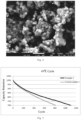
- FIG. 2 is an SEM image of (Mn 0.9 Fe 0.1 ) 2 O 3 , showing that this substance is a homogeneous substance with good morphology.
- the particle size and tap density of the material were measured.
- the D50 diameter was 6 ⁇ m, and the tap density was as high as 2.4 g/cm 3 . Therefore, the compound synthesized in this scheme was manganese iron oxide, not a simple mixture of manganese oxide and ferric oxide.
- FIG. 3 is a scanning electron microscopy (SEM) image of lithium manganese iron phosphate LiMn 0.9 Fe 0.1 PO 4 , showing that the morphology of the material was good.
- the particle size and tap density of the material were measured.
- the D50 diameter was 2 ⁇ m, and the tap density was as high as 1.5 g/cm 3 .
- MnSO 4 ⁇ H 2 O was used as a manganese source and FeSO 4 ⁇ 7H 2 O was used as an iron source.
- the molar ratio of MnSO 4 ⁇ H 2 O to FeSO 4 ⁇ 7H 2 O was 6:4. Then, the two materials were mixed in solid phase. The uniformly mixed materials were heated to 500°C and sintered in solid phase to obtain a lithium manganese iron phosphate precursor (Mn 0.6 Fe 0.4 ) 2 O 3 .
- the reaction equation was: 12MnSO 4 ⁇ H 2 O+8FeSO 4 ⁇ 7H 2 O ⁇ 10(Mn 0.6 Fe 0.4 ) 2 O 3 +20SO 2 ⁇ +68H 2 O ⁇ +5O 2 ⁇ .
- FIG. 4 is a scanning electron microscopy (SEM) image of lithium manganese iron phosphate LiMn 0.6 Fe 0.4 PO 4 . It can be seen from the image that the prepared lithium manganese iron phosphate material has a good morphology.
- the particle size, specific surface area, and tap density of the material were tested. The results showed that the D50 diameter of the material was 1.5 ⁇ m; the specific surface area of the material was 15 m 2 /g, much lower than the specific surface area of 20 m 2 /g of currently commonly used commercial materials; the tap density of the material was as high as 1.3 g/cm 3 , much higher than the tap density of 0.8 to 1.0 g/cm 3 of currently commonly used commercial materials; and the compaction density of the material was 2.8 g/cm 3 , much higher than the compaction density of 2.3 g/cm 3 of currently commonly used commercial materials.
- a higher compaction density allows for a high roll density of electrode plates, and as the thickness of electrode plates is reduced, a given battery case can accommodate more electrode plates, enabling the battery to have a higher energy density.
- the low specific surface area can reduce the content of binder, make the proportion of active substances higher, thereby further improving the energy density of the battery.
- the low specific surface area reduces the side reactions between the material and the electrolyte solution, and improves the storage performance and cycle life of the battery.
- a mixture of spinel-type lithium manganate LiMn 2 O 4 and the lithium manganese iron phosphate LiMn 0.6 Fe 0.4 PO 4 prepared in Example 2 was used as an active material of a cathode plate of a lithium-ion battery.
- the spinel-type lithium manganate material and the lithium manganese iron phosphate material respectively accounted for 80% and 20% of the active material.
- the cathode active material was mixed with a conductive agent and a binder to prepare a cathode slurry.
- Solid substances in the slurry included 97.2% of the active material, 1.7% of the conductive agent (conductive carbon black, conductive graphite, conductive carbon nanotubes, and graphene), and 1.1% of the binder (polyvinylidene fluoride).
- the content of a solvent N-methylpyrrolidone was adjusted so that the solid content of the slurry was about 75%.
- the evenly mixed slurry was respectively coated on surfaces of a current collector aluminum foil, which was then dried, rolled and cut to obtain a cathode plate.
- the cathode plate was assembled into a cylindrical full battery.
- the full battery was charged at 0.5 C and discharged at 1 C to test cycle performance.
- the cylindrical battery has a model of R34235, with a diameter of 34 mm and a height of 235 mm.
- a mixture of spinel-type lithium manganate LiMn 2 O 4 and a lithium manganese iron phosphate LiMn 0.6 Fe 0.4 PO 4 prepared by a conventional liquid phase method was used as an active material of a cathode plate of a lithium-ion battery.
- the spinel-type lithium manganate material and the lithium manganese iron phosphate material respectively accounted for 80% and 20% of the active material.
- the cathode active material was prepared into a cylindrical full battery according to the same method as in Example 3.
- the battery assembled from the lithium manganese iron phosphate synthesized in Example 2 can be cycled 1100 times, with an energy density of 140 Wh/kg.
- a battery assembled from the lithium manganese iron phosphate prepared by the conventional liquid phase method in Comparative Example 1 can be cycled 800 times, with an energy density of 130 Wh/kg.
- the improvement of cycle performance and energy density is mainly due to the high compaction density of the material.
- the battery was allowed to stand in the fully charged state at room temperature for 28 days. The capacity before standing was defined as 100%, the remaining capacity ratio after standing, and charge-discharge recovered capacity ratio can reflect the self-discharge of the battery and the side reactions between the material and the electrolyte solution.
- Mn 3 O 4 , lithium carbonate, and ammonium dihydrogen phosphate were mixed and milled, and sintered in solid phase at 600°C to obtain lithium manganese phosphate LiMnPO 4 .
- the reaction equation was: 4Mn 3 O 4 +6Li 2 CO 3 +12NH 4 H 2 PO 4 ⁇ 12LiMnPO 4 +6CO 2 ⁇ +12NH 3 ⁇ +12H 2 O ⁇ +5 O 2 ⁇ .
- Fe 2 O 3 , lithium carbonate, and ammonium dihydrogen phosphate were mixed and milled, and sintered in solid phase at 700°C to obtain lithium iron phosphate LiFePO 4 .
- the reaction equation was: Fe 2 O 3 +Li 2 CO 3 +2NH 4 H 2 PO 4 ⁇ 2LiFePO 4 +CO 2 ⁇ +2NH 3 ⁇ +2H 2 O ⁇ +O 2 ⁇ .
- MnSO 4 ⁇ H 2 O Industrial grade MnSO 4 ⁇ H 2 O, which was used as a manganese source, was milled to micron size by a sand mill, heated to 150°C so that manganese sulfate lost its crystal water, and then heated to 900°C for thermal decomposition to form a lithium manganese iron phosphate precursor Mn 3 O 4 .
- the overall reaction equation was: 3MnSO 4 ⁇ H 2 O ⁇ Mn 3 O 4 +3SO 2 ⁇ +3H 2 O ⁇ .
- Mn 3 O 4 , lithium carbonate, iron phosphate, and ammonium dihydrogen phosphate were mixed and milled, and sintered in solid phase at 600°C to obtain lithium manganese iron phosphate LiMn 0.6 Fe 0.4 PO 4 .
- reaction equation was: 6NH 4 H 2 PO 4 +2Mn 3 O 4 +5Li 2 CO 3 +4FePO 4 ⁇ 2H 2 O ⁇ 10LiMn 0.6 Fe 0.4 PO 4 +5CO 2 ⁇ +17H 2 O ⁇ +2O 2 ⁇ +6NH 3 ⁇ .
Landscapes
- Chemical & Material Sciences (AREA)
- Organic Chemistry (AREA)
- Inorganic Chemistry (AREA)
- Engineering & Computer Science (AREA)
- Chemical Kinetics & Catalysis (AREA)
- Electrochemistry (AREA)
- General Chemical & Material Sciences (AREA)
- Materials Engineering (AREA)
- Manufacturing & Machinery (AREA)
- Crystallography & Structural Chemistry (AREA)
- Battery Electrode And Active Subsutance (AREA)
- Secondary Cells (AREA)
Abstract
The invention provides a method for preparing lithium manganese iron phosphate, which includes the following steps: S1: mixing a manganese source and/or an iron source in solid phase to obtain a first mixture; S2: sintering the first mixture in solid phase at 300°C to 1200°C to obtain a manganese iron oxide (MnxFe1-x-y)mOn; S3: mixing the manganese iron oxide (MnxFe1-x-y)mOn with a lithium source, a phosphorus source, and optionally a manganese source and/or an iron source in solid phase to obtain a second mixture; and S4: sintering the second mixture in solid phase at 350°C to 900°C to obtain lithium manganese iron phosphate LiMnxFe1-x-yPO4, wherein 0≤x≤1, and 0≤y≤1. The method of the present invention can be used to prepare a lithium manganese iron phosphate material with high tap density, long cycle life, low costs, and high cost-effectiveness.
Description
- The present invention relates to the technical field of lithium-ion battery preparation, and specifically to a method for preparing lithium manganese iron phosphate, a cathode material prepared by the lithium manganese iron phosphate, and a lithium-ion battery.
- In lithium-ion batteries, the commonly used cathode materials are shown in Table 1 below:
Table 1 Material Voltage/V Actual specific capacity (mAh/g) Lithium iron phosphate 3.2 (2.5 to 3.8 V) 150 Lithium manganese iron phosphate LiMn0.6Fe0.4PO4 3.9 (2.7 to 4.3 V) 150 Lithium manganate 3.7 (2.7 to 4.3 V) 110 Lithium-rich manganese 3.7 (2.0 to 4.8 V) 120 to 300 Nickel 55 ternary(NCM550540) 3.6 (2.7 to 4.3 V) 175 622 ternary(NCM602020) 3.6 (2.7 to 4.3 V) 180 Nickel 65 ternary(NCM650530) 3.6 (2.7 to 4.3 V) 185 811 ternary(NCM801010) 3.6 (2.7 to 4.3 V) 200 - Ternary cathode materials (lithium nickel cobalt manganate or lithium nickel cobalt aluminum oxide) are generally used to replace lithium cobaltate and are applied in the field of power batteries. Ternary cathode materials have low-temperature discharge performance, normal-temperature cycle performance, and high-temperature cycle performance, and have the highest energy density. It can be seen from the table that with the increase of nickel content, the gram capacity of the material gradually increases, but the thermal decomposition temperature of the material decreases, which leads to the decrease of the safety of lithium-ion batteries with the ternary cathode material system. On the other hand, low-nickel ternary materials such as 111 ternary materials (NCM111) have high cobalt content and are therefore expensive. Materials having a nickel content exceeding 70% (the ratio of the nickel content to the total content of nickel, cobalt, and manganese or aluminum), for example, high-nickel 811 ternary materials (NCM801010), require the introduction of an oxygen atmosphere during the sintering process and are therefore also expensive. In addition, cobalt and nickel are expensive because of their low abundance in the earth. Based on this, ternary materials are more suitable for medium-and high-end vehicles with long mile range.
- The synthesis of ternary cathode materials requires oxygen to participate in the reaction. Generally, manufacturers sinter materials having a medium or low nickel content only in air, and sinter materials having a high nickel content (where the nickel content is greater than 0.7) in an oxygen atmosphere. In addition, because high-nickel materials are sensitive to air humidity and are likely to absorb moisture and lead to the formation of lithium carbonate on the material surface, and packaging and coating of battery formulation have strict humidity requirements, labor costs of high-nickel materials are higher than those of medium-nickel materials. In recent years, the safety accidents of long-range electric vehicles with high-nickel ternary materials have occurred frequently, which has led to the decline of the popularity of high-nickel ternary materials in the industry. At present, the pursuit of high-nickel ternary materials has gradually shifted to the use of medium-nickel ternary materials. With the progress of research and development and the pursuit of cost reduction in the market, the application of low-cobalt and cobalt-free ternary materials has been accelerated, and the cobalt content has been gradually reduced to 0.05 or even 0.03. However, since cobalt is naturally accompanied by nickel in minerals, pure nickel also contains 3% to 5% of cobalt, there is no need to spend costs to remove the cobalt content in high-nickel ternary materials. Lithium manganate materials have obviously better safety performance than that of ternary cathode materials, have excellent low-temperature performance and rate performance and low costs, but have a low gram capacity (about 110 mAh/g) and a short cycle life, especially poor high-temperature cycle performance. Therefore, lithium manganate alone cannot be used as a cathode material.
- As a representative of new cathode materials, lithium-rich manganese-based materials have a specific capacity of up to 250 mAh/g when charged to 4.8 V, but their cycle performance is unstable. At present, the mainstream mature commercial electrolyte solutions operate at 4.2 V, an electrolyte solution having an operating voltage of 4.3 to 4.4 V is used for single crystal ternary materials, and electrolyte solutions having an operating voltage of 5 V are not mature. Therefore, lithium-rich manganese-based materials are not widely used, and only a small amount of them are used for doping with lithium manganate to delay the rapid attenuation of lithium manganate in the early stage of cycle.
- Lithium iron phosphate is a common cathode material for lithium-ion batteries, which has a long cycle life and excellent safety performance. Due to its poor conductivity, lithium iron phosphate is fabricated into a small particle size in commercial applications to compensate for its rate performance. However, lithium iron phosphate with a small particle size also cannot discharge electricity at low temperature. In addition, because its discharge capacity is concentrated in the plateau zone, it is difficult to calibrate the state of charge with the voltage, resulting in poor user experiences. The compaction density of lithium iron phosphate is low, only 2.4 to 2.5 g/cm3. The compaction density of lithium manganate can reach 3.1 g/cm3, and the compaction density of a ternary cathode material can reach 3.4 g/cm3. In addition, the nominal voltage of lithium iron phosphate batteries is only 3.2 V. Therefore, the volume energy density of lithium iron phosphate is very low. Based on this, LiMnPO4, LiCoPO4, LiNiPO4, LiMnSiO4, LiFeSiO4, LiCoSiO4, and LiNiPSiO4 are promising materials to replace lithium iron phosphate. Compared with silicate systems, phosphoric acid systems are more commercially mature. Among the four elements of manganese, cobalt, nickel, and iron, cobalt and nickel are the most expensive, while manganese and iron are the most inexpensive. However, the conductivity of lithium manganese phosphate is extremely poor, which is worse than that of lithium iron phosphate. Doping manganese with lithium iron phosphate or doping iron with lithium manganese phosphate is to synthesize lithium manganese iron phosphate by using the high potential plateau of manganese and the structural stability of iron. Therefore, lithium manganese iron phosphate obtained through manganese or iron doping has the characteristics of both lithium manganese phosphate and lithium iron phosphate, and these three substances can also be classified into the same class of materials, and expressed by a chemical formula LiMnxFe1-xPO4. At present, lithium manganese iron phosphate is already commercially mature, but its conductivity is worse than that of lithium iron phosphate, and its low-temperature discharge performance is weaker, so it has not been used as a cathode material alone. Lithium manganese iron phosphate has a plateau voltage of up to 4.1 V, a medium voltage of up to 3.9 V, the same gram capacity and cycle life as those of lithium iron phosphate, and extremely high safety performance in 4.2 to 4.3 V systems, and therefore can be doped into a ternary material to improve the safety performance of overcharge and nail penetration.
- At present, methods for synthesis of lithium iron phosphate include a solid phase method and a liquid phase method. The liquid phase method mainly uses ferrous sulfate heptahydrate, phosphoric acid, and lithium hydroxide to hydrothermally generate lithium iron phosphate, lithium sulfate, and water, but requires high equipment costs and generally requires the use of three times the amount of lithium hydroxide as a precipitant. This leads to the extra consumption of 200% of the amount of lithium hydroxide, increasing the costs. The solid phase method includes ferrous oxalate, iron oxide red, and ferric phosphate methods. The reaction process of the ferrous oxalate method involves the generation of a large amount of carbon dioxide, which leads to high carbon loss, easy fluctuation of carbon content, poor product consistency, and low tap density of the product; and also involves the release of ammonia gas, which pollutes the environment. The costs of the iron oxide red method are low, and lithium iron phosphate synthesized by this method has a high density but low capacity. This method also involves the release of ammonia gas, which pollutes the environment. The ferric phosphate method does not involve the generation of ammonia gas, has an environmental-friendly production process and large output, and has become the mainstream production process. There are two methods for synthesizing ferric phosphate: a ferrous sulfate method and an iron powder-phosphoric acid method. Both the two methods require the use of phosphoric acid and hydrogen peroxide and have high anti-corrosion requirements of equipment, resulting in high costs and great pressure on environmental protection.
- At present, methods for synthesizing lithium manganese iron phosphate mainly include a solid phase method and a coprecipitation method. The solid phase method uses a manganese source, an iron source, a phosphorus source, and a lithium source for sintering, has a simple process, but cannot achieve high material performance. Therefore, the coprecipitation method is the mainstream. In the coprecipitation method, a manganese source, an iron source, and a complexing agent generate a precursor through coprecipitation, and the precursor reacts with a phosphorus source and a lithium source in solid or liquid phase to obtain lithium manganese iron phosphate, for example, as disclosed in Chinese Patent Application
CN105047922A . - It can be seen that no matter whether x=0 or x≠0 in LiMnxFe1-xPO4, the lithium iron phosphate material can be synthesized by a solid phase method or a liquid phase method. The solid phase method has a simple process, but cannot achieve high material performance; while the liquid phase method can achieve good performance but involves high costs and great pressure on environmental protection. Therefore, a new process is needed to synthesize a LiMnxFe1-xPO4 material, to improve the performance of the material at low costs.
- The present invention provides a method for preparing lithium manganese iron phosphate, which can be used to prepare a lithium manganese iron phosphate material with high tap density, long cycle life, low costs, and high cost-effectiveness. The present invention also provides a cathode material prepared from the material and a lithium-ion battery.
- The method for preparing lithium manganese iron phosphate provided by the present invention comprises the following steps:
- S1: mixing a manganese source and/or an iron source in solid phase to obtain a first mixture;
- S2: sintering the first mixture in solid phase at 300°C to 1200°C to obtain a manganese iron oxide (MnxFe1-x-y)mOn;
- S3: mixing the manganese iron oxide (MnxFe1-x-y)mOn with a lithium source, a phosphorus source, and optionally a manganese source and/or an iron source in solid phase to obtain a second mixture; and
- S4: sintering the second mixture in solid phase at 350°C to 900°C to obtain lithium manganese iron phosphate LiMnxFe1-x-yPO4,
- wherein 0≤x≤1, 0≤y≤1; 1:2< m:n <1:1, and 0< n <4.
- In the prior art, the solid phase method for synthesizing lithium manganese iron phosphate involves mixing a manganese source, an iron source, a phosphorus source, and a lithium source followed by sintering, has a simple process, but cannot achieve high material performance. On the basis of this, the present invention provides a novel preparation method. In the method, first, a manganese source and an iron source are mixed and then sintered in solid phase, so that the manganese source and the iron source are thermally decomposed to obtain manganese iron oxide (MnxFe1-x-y)mOn. Then, the manganese iron oxide (MnxFe1-x-y)mOn is mixed with a lithium source and a phosphorus source, and sintered in solid phase to obtain lithium manganese iron phosphate LiMnxFe1-x-yPO4-z. The preparation method is also simple, can prepare lithium manganese iron phosphate at low costs, has the characteristics of high tap density and compaction density, high energy density, small specific surface area, low self-discharge rate and long cycle life, and is obviously superior to lithium manganese iron phosphate prepared by conventional solid phase and liquid phase methods. The main reason is as follows. In the method of the present invention, manganese iron oxide, i.e., a precursor of lithium manganese iron phosphate, is synthesized first. The true density of manganese iron oxide is higher than that of iron oxide but lower than that of manganese oxide, and the true density of iron oxide is higher than that of an iron salt such as ferrous sulfate. Then, lithium manganese iron phosphate is synthesized. In contrast, in the conventional solid phase method, lithium manganese iron phosphate is synthesized by using an iron source, a manganese source, a lithium source, and a phosphorus source. Because of the existence of the low-density iron source, the synthesized lithium manganese iron phosphate material has a low tap density and large specific surface area, and electrode plates prepared from this material has a low compaction density, low energy density, high self-discharge rate, and poor cycle performance. In the conventional liquid phase method, manganese iron carbonate or manganese iron hydroxide, which has porous and fluffy morphology and low density, is obtained through coprecipitation. The lithium manganese iron phosphate material synthesized by coprecipitation of the manganese iron source, a lithium source, and a phosphorus source also has the characteristics of low tap density and large specific surface area, and electrode plates prepared from this material has a low compaction density, low energy density, high self-discharge rate, and poor cycle performance. In addition, the particles of the lithium manganese iron phosphate precursor, i.e., manganese iron oxide, synthesized by the method of the present invention have a primary large single crystal morphology and high true density, so the finally synthesized lithium manganese iron phosphate material can achieve a high tap density, high compaction density of electrode plates, high battery energy density, small specific surface area of the material, low self-discharge rate, and long cycle life.
- The manganese source may be various manganese compounds commonly used in the art, and is not limited in the present invention. The manganese source may or may not contain crystal water. Preferably, the manganese source is selected from the group consisting of manganese sulfate, manganese carbonate, manganese acetate, manganese phosphate, manganese nitrate, manganese oxalate, and manganese citrate.
- The iron source may be various iron compounds commonly used in the art, and is not limited in the present invention. The iron source may or may not contain crystal water. Preferably, the iron source is selected from the group consisting of ferrous sulfate, ferrous carbonate, ferrous acetate, ferrous phosphate, ferrous nitrate, ferrous oxalate, ferrous citrate, ferric sulfate, ferric carbonate, ferric acetate, ferric phosphate, ferric nitrate, ferric oxalate, and ferric citrate.
- The lithium source may be various lithium compounds commonly used in the art, and is not limited in the present invention. Preferably, the lithium source is selected from the group consisting of lithium carbonate, lithium hydroxide, lithium phosphate, lithium oxalate, lithium acetate, lithium sulfate, lithium nitrate, and lithium chloride.
- The phosphorus source may be various phosphorus-containing compounds commonly used in the art, and is not limited in the present invention. Preferably, the phosphorus source is selected from the group consisting of ammonium dihydrogen phosphate, diammonium hydrogen phosphate, sodium dihydrogen phosphate, disodium hydrogen phosphate, sodium tripolyphosphate, phosphoric acid, calcium phosphate, phosphate ester, lithium dihydrogen phosphate, iron phosphate, lithium phosphate, lithium dihydrogen phosphate, and manganese phosphate.
- In the step S1 of the present invention, the manganese source or the iron source may also be used alone. When the manganese source is used alone, both lithium manganese phosphate and lithium manganese iron phosphate can be prepared (where the iron source is added in the step S3). Similarly, when the iron source is used alone, both lithium iron phosphate and lithium manganese iron phosphate can be prepared (where the manganese source is added in the step S3). The iron source and/or the manganese source added in the step S3 is preferably an iron oxide and/or a manganese oxide.
- In the present invention, the amounts of the manganese source, the iron source, the lithium source, and the phosphorus source to be added are mainly determined based on the stoichiometric ratio of the synthesis reaction equation of manganese iron oxide (MnxFe1-x-y)mOn and lithium manganese iron phosphate LiMnxFe1-x-yPO4.
- Preferably, in the steps S1 and S3, one or more of a carbon source, an M source, and an N source are added during the solid-phase mixing; and after the solid phase sintering in the steps S2 and S4, manganese iron oxide (MnxFe1-x-yMy)mOnNz/C and lithium manganese iron phosphate LiMnxFe1-x-yMyPO4-zNz/C are obtained respectively; wherein, the M source is a doped cation source and the N source is a doped anion source; and 0≤x≤1, 0≤y≤1, 0≤z≤0.1; 1:3.5≤m:(n+z)≤1:1, and preferably 1:2<m:(n+z)<1:1. Examples include FeO, Fe2O3, and Fe3O4, (Mn0.5Fe1)2O4 (MnFe2O4), MnCE. In the present invention, when the carbon source is added, a carbon-coated lithium manganese iron phosphate material can be formed. The carbon source may be one or more of an organic carbon source and an inorganic carbon source. Preferably, the carbon source is selected from the group consisting of sucrose, glucose, fructose, citric acid, phenolic resin, polyvinyl alcohol, polyethylene glycol, starch, carbon black, acetylene black, graphite, graphene, and conductive carbon tubes.
- In the present invention, when the M source is added, a cation-doped lithium manganese iron phosphate material can be obtained. The M source may be a single cation source or a combination of multiple cation sources. Preferably, the cation source includes one or more of elements selected from the group consisting of aluminum, magnesium, nickel, cobalt, titanium, copper, calcium, niobium, chromium, zinc, lanthanum, antimony, tellurium, strontium, tungsten, indium, and yttrium.
- In the present invention, when the N source is added, an anion-doped lithium manganese iron phosphate material can be obtained. The N source may be a single anion source or a combination of multiple anion sources. Preferably, the anion source includes one or more of elements such as fluorine and sulfur.
- By means of the preparation method of the present invention, materials such as olivine-type lithium manganese iron phosphate, layered lithium salt of polybasic acid, spinel-type lithium manganate, and layered manganese-rich lithium-based material can be obtained.
- A cathode material of the present invention is obtained by mixing one or more of the olivine-type lithium manganese iron phosphate, the layered lithium salt of polybasic acid, the spinel-type lithium manganate, and the layered manganese-rich lithium-based material.
- The present invention provides a lithium-ion battery, which comprises a cathode plate, an anode plate, an electrolyte solution, and a separator, wherein the cathode plate is prepared from the above cathode material.
- Compared with the prior art, the present invention has the following beneficial effects:
- 1. The present invention provides a novel method for solid-phase synthesis of lithium manganese iron phosphate by improving the synthesis process. The lithium manganese iron phosphate material synthesized by the method has a high tap density, high compaction density and small specific surface area, and lithium-ion batteries prepared by the method have the characteristics of high energy density, low self-discharge rate, and long cycle life.
- 2. The lithium manganese iron phosphate material synthesized by the present invention has the advantages of low costs and high cost-effectiveness.
-
-
FIG. 1 is an XRD pattern of (Mn0.9Fe0.1)2O3 in Example 1 of the present invention; -
FIG. 2 is an SEM image of (Mn0.9Fe0.1)2O3 in Example 1 of the present invention; -
FIG. 3 is an SEM image of LiMn0.9Fe0.1PO4 in Example 1 of the present invention; -
FIG. 4 is an SEM image of LiMn0.9Fe0.1PO4 in Example 2 of the present invention; and -
FIG. 5 is a cyclic performance test diagram of cylindrical full batteries prepared in Example 3 and Comparative Example 1 of the present invention. - Unless otherwise defined, meanings of all technical and scientific terms used in this specification are the same as those usually understood by a person skilled in the art. Terms used in this specification are merely intended to describe objectives of specific embodiments, but are not intended to limit the present invention. The term "and/or" used herein includes any and all combinations of one or more of associated items listed.
- The present invention will be further described below in conjunction with the accompanying drawings and specific embodiments, so that those skilled in the art can better understand implement the present invention, but the embodiments described are not intended to limit the present invention.
- The methods given in examples below are all conventional methods, unless otherwise stated. The materials and reagents are all commercially available unless otherwise stated.
- MnSO4·H2O was used as a manganese source and FeSO4·7H2O was used as an iron source. The molar ratio of MnSO4·H2O to FeSO4·7H2O was 9:1. Then, the two materials were mixed in solid phase. The uniformly mixed materials were heated to 600°C and sintered in solid phase to obtain a lithium manganese iron phosphate precursor (Mn0.9Fe0.1)2O3. The reaction equation was:
18MnSO4·H2O+2FeSO4·7H2O→10(Mn0.9Fe0.1)2O3+20SO2↑+32H2O↑+5O2↑.
(Mn0.9Fe0.1)2O3, lithium carbonate, and ammonium dihydrogen phosphate were mixed and milled, and sintered in solid phase at 500°C to obtain lithium manganese iron phosphate LiMn0.9Fe0.1PO4. The reaction equation was: 2(Mn0.9Fe0.1)2O3+2Li2CO3+4NH4H2PO4→4LiMn0.9Fe0.1PO4+2CO2↑+4NH3↑ +6H2O↑+O2↑. - The black thick line in
FIG. 1 denotes an X-ray diffraction (XRD) pattern of (Mn0.9Fe0.1)2O3, i.e., the precursor of LiMn0.9Fe0.1PO4. It can be seen that the substance synthesized by this scheme corresponds well to the (Mn0.983Fe0.017)2O3 peak of colorimetric card PDF#24-0507. -
FIG. 2 is an SEM image of (Mn0.9Fe0.1)2O3, showing that this substance is a homogeneous substance with good morphology. The particle size and tap density of the material were measured. The D50 diameter was 6 µm, and the tap density was as high as 2.4 g/cm3. Therefore, the compound synthesized in this scheme was manganese iron oxide, not a simple mixture of manganese oxide and ferric oxide. -
FIG. 3 is a scanning electron microscopy (SEM) image of lithium manganese iron phosphate LiMn0.9Fe0.1PO4, showing that the morphology of the material was good. The particle size and tap density of the material were measured. The D50 diameter was 2 µm, and the tap density was as high as 1.5 g/cm3. - MnSO4·H2O was used as a manganese source and FeSO4·7H2O was used as an iron source. The molar ratio of MnSO4·H2O to FeSO4·7H2O was 6:4. Then, the two materials were mixed in solid phase. The uniformly mixed materials were heated to 500°C and sintered in solid phase to obtain a lithium manganese iron phosphate precursor (Mn0.6Fe0.4)2O3. The reaction equation was:
12MnSO4·H2O+8FeSO4·7H2O→10(Mn0.6Fe0.4)2O3+20SO2↑+68H2O↑+5O2↑.
(Mn0.6Fe0.4)2O3, lithium carbonate, and ammonium dihydrogen phosphate were mixed and milled, and sintered in solid phase at 500°C to obtain lithium manganese iron phosphate LiMn0.6Fe0.4PO4. The reaction equation was: 2(Mn0.6Fe0.4)2O3+2Li2CO3+4NH4H2PO4→4LiMn0.6Fe0.4PO4+2CO2↑+4NH3↑ + 6H2O↑+O2↑. -
FIG. 4 is a scanning electron microscopy (SEM) image of lithium manganese iron phosphate LiMn0.6Fe0.4PO4. It can be seen from the image that the prepared lithium manganese iron phosphate material has a good morphology. - The particle size, specific surface area, and tap density of the material were tested. The results showed that the D50 diameter of the material was 1.5 µm; the specific surface area of the material was 15 m2/g, much lower than the specific surface area of 20 m2/g of currently commonly used commercial materials; the tap density of the material was as high as 1.3 g/cm3, much higher than the tap density of 0.8 to 1.0 g/cm3 of currently commonly used commercial materials; and the compaction density of the material was 2.8 g/cm3, much higher than the compaction density of 2.3 g/cm3 of currently commonly used commercial materials. A higher compaction density allows for a high roll density of electrode plates, and as the thickness of electrode plates is reduced, a given battery case can accommodate more electrode plates, enabling the battery to have a higher energy density. In addition, the low specific surface area can reduce the content of binder, make the proportion of active substances higher, thereby further improving the energy density of the battery. Moreover, the low specific surface area reduces the side reactions between the material and the electrolyte solution, and improves the storage performance and cycle life of the battery.
- A mixture of spinel-type lithium manganate LiMn2O4 and the lithium manganese iron phosphate LiMn0.6Fe0.4PO4 prepared in Example 2 was used as an active material of a cathode plate of a lithium-ion battery. The spinel-type lithium manganate material and the lithium manganese iron phosphate material respectively accounted for 80% and 20% of the active material.
- The cathode active material was mixed with a conductive agent and a binder to prepare a cathode slurry. Solid substances in the slurry included 97.2% of the active material, 1.7% of the conductive agent (conductive carbon black, conductive graphite, conductive carbon nanotubes, and graphene), and 1.1% of the binder (polyvinylidene fluoride). The content of a solvent N-methylpyrrolidone was adjusted so that the solid content of the slurry was about 75%. The evenly mixed slurry was respectively coated on surfaces of a current collector aluminum foil, which was then dried, rolled and cut to obtain a cathode plate.
- The cathode plate was assembled into a cylindrical full battery. The full battery was charged at 0.5 C and discharged at 1 C to test cycle performance. The cylindrical battery has a model of R34235, with a diameter of 34 mm and a height of 235 mm.
- A mixture of spinel-type lithium manganate LiMn2O4 and a lithium manganese iron phosphate LiMn0.6Fe0.4PO4 prepared by a conventional liquid phase method was used as an active material of a cathode plate of a lithium-ion battery. As a contrast sample, the spinel-type lithium manganate material and the lithium manganese iron phosphate material respectively accounted for 80% and 20% of the active material.
- The cathode active material was prepared into a cylindrical full battery according to the same method as in Example 3.
- As shown in
FIG. 5 , for cycle fading to 70%, the battery assembled from the lithium manganese iron phosphate synthesized in Example 2 can be cycled 1100 times, with an energy density of 140 Wh/kg. A battery assembled from the lithium manganese iron phosphate prepared by the conventional liquid phase method in Comparative Example 1 can be cycled 800 times, with an energy density of 130 Wh/kg. The improvement of cycle performance and energy density is mainly due to the high compaction density of the material. The battery was allowed to stand in the fully charged state at room temperature for 28 days. The capacity before standing was defined as 100%, the remaining capacity ratio after standing, and charge-discharge recovered capacity ratio can reflect the self-discharge of the battery and the side reactions between the material and the electrolyte solution. The performance of the batteries of Example 3 and Comparative Example 1 before and after standing in the fully charged state at room temperature for 28 days was tested. The results are shown in Table 2 below.Table 2 Standing in the fully charged state at room temperature for 28 days Comparative Example 1 Example 3 Before standing 100.00% 100.00% Remaining 92.44% 94.79% Recovered 96.35% 98.05% - As can be seen from Table 2, in Comparative Example 1, the remaining capacity ratio of the battery after standing is 92.44%, and the recovery capacity ratio is 96.35%; in Example 3, the remaining capacity ratio of the battery after standing is 94.79%, and the recovery capacity ratio is 98.05%, both of which are better than those of the battery in Comparative Example 1, indicating that the material synthesized in the present invention has few side reactions with the electrolyte solution, which is mainly due to the small specific surface area of the material of Example 3.
- Industrial grade MnSO4·H2O, which was used as a manganese source, was milled to micron size by a sand mill, heated to 150°C so that manganese sulfate lost its crystal water, and then heated to 900°C for thermal decomposition to form a lithium manganese phosphate precursor Mn3O4. The overall reaction equation was:
3MnSO4·H2O→Mn3O4+3SO2↑+3H2O↑.
- Mn3O4, lithium carbonate, and ammonium dihydrogen phosphate were mixed and milled, and sintered in solid phase at 600°C to obtain lithium manganese phosphate LiMnPO4. The reaction equation was:
4Mn3O4+6Li2CO3+12NH4H2PO4→12LiMnPO4+6CO2↑+12NH3↑+12H2O↑+5 O2↑.
- Industrial grade FeSO4·7H2O, which was used as iron source, was milled to micron size by a sand mill, heated to 70°C to 98°C so that ferric sulfate began to lose crystal water and generate FeSO4·4H2O, then continued to be heated. At 86°C to 159°C, FeSO4·4H2O lost crystal water to form FeSO4·H2O, and lost all the crystal water at 227°C to 283°C to form FeSO4. Starting from 300°C, FeSO4 began to melt and prepare for thermal decomposition. Then, when heated to 653°C to 716°C, FeSO4 was thermal decomposed to form a lithium iron phosphate precursor Fe2O3. The overall reaction equation was:
4FeSO4·7H2O→2Fe2O3+4SO2↑+28H2O↑+O2↑.
- Fe2O3, lithium carbonate, and ammonium dihydrogen phosphate were mixed and milled, and sintered in solid phase at 700°C to obtain lithium iron phosphate LiFePO4. The reaction equation was:
Fe2O3+Li2CO3+2NH4H2PO4→2LiFePO4+CO2↑+2NH3↑+2H2O↑+O2↑.
- Industrial grade FeSO4·7H2O, which was used as an iron source, was milled to micron size by a sand mill, heated to 200°C so that iron sulfate lost its crystal water, and then heated to 1000°C for thermal decomposition to form a lithium manganese iron phosphate precursor Fe2O3. The overall reaction equation was:
4FeSO4·7H2O→2Fe2O3+4SO2↑+28H2O↑+O2↑.
- Fe2O3, lithium carbonate, manganese dihydrogen phosphate, and Mn2O3 were mixed and milled, and sintered in solid phase at 700°C to obtain lithium manganese iron phosphate LiFeMnPO4. The reaction equation was: 2Mn2O3+8Fe2O3+20Li2CO3+20Mn(H2PO4)2·2H2O→40LiMn0.6Fe0.4PO4+ 20CO2↑+80H2O↑+5O2↑.
- Industrial grade MnSO4·H2O, which was used as a manganese source, was milled to micron size by a sand mill, heated to 150°C so that manganese sulfate lost its crystal water, and then heated to 900°C for thermal decomposition to form a lithium manganese iron phosphate precursor Mn3O4. The overall reaction equation was: 3MnSO4·H2O→Mn3O4+3SO2↑+3H2O↑. Mn3O4, lithium carbonate, iron phosphate, and ammonium dihydrogen phosphate were mixed and milled, and sintered in solid phase at 600°C to obtain lithium manganese iron phosphate LiMn0.6Fe0.4PO4. The reaction equation was:
6NH4H2PO4+2Mn3O4+5Li2CO3+4FePO4·2H2O→10LiMn0.6Fe0.4PO4+5CO2↑ +17H2O↑+2O2↑+6NH3↑.
- The above-described embodiments are merely preferred embodiments for the purpose of fully illustrating the present invention, and the scope of the present invention is not limited thereto. Equivalent substitutions or modifications can be made by those skilled in the art based on the present invention, which are within the scope of the present invention as defined by the claims. The scope of the present invention is defined by the appended claims.
Claims (10)
- A method for preparing lithium manganese iron phosphate, comprising steps of:S1: mixing a manganese source and/or an iron source in solid phase to obtain a first mixture;S2: sintering the first mixture in solid phase at 300°C to 1200°C to obtain a manganese iron oxide (MnxFe1-x-y)mOn;S3: mixing the manganese iron oxide (MnxFe1-x-y)mOn with a lithium source, a phosphorus source, and optionally a manganese source and/or an iron source in solid phase to obtain a second mixture; andS4: sintering the second mixture in solid phase at 350°C to 900°C to obtain lithium manganese iron phosphate LiMnxFe1-x-yPO4,wherein 0≤x≤1, 0≤y≤1.
- The method for preparing lithium manganese iron phosphate according to claim 1, wherein the manganese source is selected from the group consisting of manganese sulfate, manganese carbonate, manganese acetate, manganese phosphate, manganese nitrate, manganese oxalate and manganese citrate, with or without crystal water.
- The method for preparing lithium manganese iron phosphate according to claim 1, wherein the iron source is selected from the group consisting of ferrous sulfate, ferrous carbonate, ferrous acetate, ferrous phosphate, ferrous nitrate, ferrous oxalate, ferrous citrate, ferric sulfate, ferric carbonate, ferric acetate, ferric phosphate, ferric nitrate, ferric oxalate and ferric citrate, with or without crystal water.
- The method for preparing lithium manganese iron phosphate according to claim 1, wherein the lithium source is selected from the group consisting of lithium carbonate, lithium hydroxide, lithium phosphate, lithium oxalate, lithium acetate, lithium sulfate, lithium nitrate, and lithium chloride.
- The method for preparing lithium manganese iron phosphate according to claim 1, wherein the phosphorus source is selected from the group consisting of ammonium dihydrogen phosphate, diammonium hydrogen phosphate, sodium dihydrogen phosphate, disodium hydrogen phosphate, sodium tripolyphosphate, phosphoric acid, calcium phosphate, phosphate ester, lithium dihydrogen phosphate, iron phosphate, lithium phosphate, lithium dihydrogen phosphate, and manganese phosphate.
- The method for preparing lithium manganese iron phosphate according to claim 1, wherein in the steps S1 and S3, one or more of a carbon source, an M source, and an N source are added during the solid-phase mixing; and after the solid phase sintering in the steps S2 and S4, manganese iron oxide (MnxFe1-x-yMy)mOnNz/C and lithium manganese iron phosphate LiMnxFe1-x-yMyPO4-zNz/C are obtained respectively;
wherein, the M source is a doped cation source and the N source is a doped anion source; and 0≤x≤1, 0≤y≤1, 0≤z≤0.1, and 1:3.5≤m:(n+z)≤1:1. - The method for preparing lithium manganese iron phosphate according to claim 6, wherein the carbon source is selected from the group consisting of sucrose, glucose, fructose, citric acid, phenolic resin, polyvinyl alcohol, polyethylene glycol, starch, carbon black, acetylene black, graphite, graphene, and conductive carbon tubes.
- The method for preparing lithium manganese iron phosphate according to claim 6, wherein the cation source includes one or more of aluminum, magnesium, nickel, cobalt, titanium, copper, calcium, niobium, chromium, zinc, lanthanum, antimony, tellurium, strontium, tungsten, indium, and yttrium, and the anion source includes fluorine or/and sulfur.
- A cathode material, obtained by mixing one or more of an olivine-type lithium manganese iron phosphate material, layered lithium salt of polybasic acid, spinel-type lithium manganate, and layered manganese-rich lithium-based material, wherein the olivine-type lithium manganese iron phosphate material, the layered lithium salt of polybasic acid, the spinel-type lithium manganate, and the layered manganese-rich lithium-based material are prepared by the method according to any one of the claims 1 to 8.
- A lithium ion battery, comprising a cathode plate, an anode plate, an electrolyte solution, and a separator, wherein the cathode plate is prepared from the cathode material according to claim 9.
Applications Claiming Priority (2)
| Application Number | Priority Date | Filing Date | Title |
|---|---|---|---|
| CN202210339154.8A CN114644328B (en) | 2022-04-01 | 2022-04-01 | Preparation method of lithium iron manganese phosphate, cathode material and lithium-ion battery |
| PCT/CN2022/128489 WO2023184960A1 (en) | 2022-04-01 | 2022-10-31 | Preparation method for lithium iron manganese phosphate, anode electrode material and lithium-ion battery |
Publications (2)
| Publication Number | Publication Date |
|---|---|
| EP4506306A1 true EP4506306A1 (en) | 2025-02-12 |
| EP4506306A4 EP4506306A4 (en) | 2026-05-06 |
Family
ID=81994913
Family Applications (1)
| Application Number | Title | Priority Date | Filing Date |
|---|---|---|---|
| EP22934778.6A Pending EP4506306A4 (en) | 2022-04-01 | 2022-10-31 | Preparation method for lithium iron manganese phosphate, anode electrode material and lithium-ion battery |
Country Status (6)
| Country | Link |
|---|---|
| US (1) | US20230322557A1 (en) |
| EP (1) | EP4506306A4 (en) |
| JP (1) | JP7602031B2 (en) |
| KR (1) | KR102894704B1 (en) |
| CN (1) | CN114644328B (en) |
| WO (1) | WO2023184960A1 (en) |
Families Citing this family (40)
| Publication number | Priority date | Publication date | Assignee | Title |
|---|---|---|---|---|
| CN114644328B (en) * | 2022-04-01 | 2023-10-20 | 星恒电源股份有限公司 | Preparation method of lithium iron manganese phosphate, cathode material and lithium-ion battery |
| CN114899394B (en) * | 2022-06-29 | 2023-12-19 | 蜂巢能源科技股份有限公司 | Modified lithium iron manganese phosphate positive electrode material and preparation method and application thereof |
| CN117716534B (en) * | 2022-07-15 | 2026-01-27 | 宁德时代新能源科技股份有限公司 | Lithium iron manganese phosphate positive electrode active material, preparation method thereof, positive electrode plate, secondary battery and power utilization device |
| JP7714109B2 (en) * | 2022-07-15 | 2025-07-28 | 香港時代新能源科技有限公司 | Continuous reaction system, manganese iron phosphate precursor, lithium manganese iron phosphate, and method for producing the same and secondary battery |
| CN114940485B (en) * | 2022-07-25 | 2022-10-28 | 蜂巢能源科技股份有限公司 | Lithium manganese iron phosphate precursor and preparation method and application thereof |
| CN115611254A (en) * | 2022-09-14 | 2023-01-17 | 衢州华友钴新材料有限公司 | Lithium manganese iron phosphate precursor, lithium manganese iron phosphate, preparation methods of lithium manganese iron phosphate precursor and lithium manganese iron phosphate, electrode and battery |
| CN115286044B (en) * | 2022-10-10 | 2022-12-27 | 星恒电源股份有限公司 | Positive electrode material, preparation method thereof and battery |
| CN116826040A (en) * | 2022-11-11 | 2023-09-29 | 中科致良新能源材料(浙江)有限公司 | A kind of ferromanganese phosphate with nanoporous structure and its preparation method and use |
| CN115893363A (en) * | 2022-12-14 | 2023-04-04 | 湖北亿纬动力有限公司 | Composite cathode material and preparation method and application thereof |
| CN116216678B (en) * | 2022-12-22 | 2024-06-14 | 宜都兴发化工有限公司 | Preparation method of lithium iron manganese phosphate anode material |
| CN115947328A (en) * | 2023-01-28 | 2023-04-11 | 浙江南都电源动力股份有限公司 | Preparation method of lithium iron manganese phosphate cathode material |
| CN116281927A (en) * | 2023-02-23 | 2023-06-23 | 无锡晶石新型能源股份有限公司 | A preparation method of single crystal high-pressure lithium manganese iron phosphate cathode material |
| CN116143100B (en) * | 2023-02-28 | 2025-03-07 | 广东邦普循环科技有限公司 | Modified lithium manganese iron phosphate positive electrode material and its precursor and preparation method, battery |
| CN116514088B (en) * | 2023-04-13 | 2025-03-28 | 西南大学 | Fluorine-indium co-doped lithium manganese iron phosphate positive electrode material and preparation method thereof |
| CN116598498A (en) * | 2023-04-28 | 2023-08-15 | 湖北亿纬动力有限公司 | A kind of lithium manganese iron phosphate cathode material and its preparation method and application |
| CN117208967B (en) * | 2023-11-07 | 2024-02-20 | 星恒电源股份有限公司 | Precursor material and preparation method thereof, lithium manganese iron phosphate positive electrode material and preparation method thereof, and lithium ion battery |
| CN117747767A (en) * | 2023-11-21 | 2024-03-22 | 湖北亿纬动力有限公司 | Lithium iron manganese phosphate material, preparation method of lithium iron manganese phosphate material, electrode plate and lithium battery |
| CN118004987B (en) * | 2023-12-27 | 2025-07-11 | 北京当升材料科技股份有限公司 | Lithium iron phosphate positive electrode material, preparation method thereof and lithium ion battery |
| CN117756184B (en) * | 2023-12-29 | 2025-04-11 | 兴星电子新材料(无锡)有限公司 | A preparation method of manganese ferrite and its application |
| WO2025152071A1 (en) * | 2024-01-17 | 2025-07-24 | 广东邦普循环科技有限公司 | Lithium manganese iron phosphate positive electrode material, and preparation method therefor and use thereof |
| CN117923453B (en) * | 2024-01-23 | 2026-04-17 | 湖南裕能新能源电池材料股份有限公司 | A lithium manganese iron phosphate, its preparation method and application |
| CN117923454B (en) * | 2024-01-25 | 2024-10-25 | 星恒电源股份有限公司 | Titanium aluminum lithium phosphate material, diaphragm, preparation method of diaphragm and battery |
| CN118145618A (en) * | 2024-02-29 | 2024-06-07 | 深圳市德方纳米科技股份有限公司 | Phosphate-based positive electrode material and preparation method and application thereof |
| CN118206096A (en) * | 2024-04-26 | 2024-06-18 | 江苏大学 | A method for preparing lithium iron phosphate/lithium iron manganese phosphate positive electrode material |
| CN118380568B (en) * | 2024-04-29 | 2026-04-07 | 江西师范大学 | Coated modified lithium iron manganese phosphate lithium ion battery anode material |
| CN118738257A (en) * | 2024-06-14 | 2024-10-01 | 格林美股份有限公司 | A coated lithium manganese iron phosphate material and its preparation method and application |
| WO2025260356A1 (en) * | 2024-06-21 | 2025-12-26 | 青美邦新能源材料有限公司 | Method for preparing lithium manganese iron phosphate material, lithium manganese iron phosphate material, and use |
| CN118619236A (en) * | 2024-06-27 | 2024-09-10 | 四川协鑫锂电科技有限公司 | A preparation method and application of iron manganese phosphate precursor |
| CN118658977B (en) * | 2024-06-27 | 2025-10-21 | 天津容百斯科兰德科技有限公司 | A lithium manganese iron phosphate positive electrode material and its preparation method and application |
| CN118479445B (en) * | 2024-07-16 | 2024-10-01 | 湖南裕能新能源电池材料股份有限公司 | Preparation method of injection type lithium iron manganese phosphate positive electrode material, electrode and lithium battery |
| CN118666263B (en) * | 2024-08-21 | 2024-11-29 | 河南科隆新能源股份有限公司 | Ferromanganese phosphate precursor, lithium iron manganese phosphate and preparation method and application thereof |
| CN118754090B (en) * | 2024-09-09 | 2025-01-28 | 浙江皓德新材料有限公司 | A positive electrode material precursor and preparation method thereof |
| CN119330322B (en) * | 2024-09-20 | 2025-08-26 | 金龙羽新能源(深圳)有限公司 | A lithium manganese iron phosphate composite material and its preparation method and application |
| WO2026071444A1 (en) * | 2024-09-26 | 2026-04-02 | 주식회사 엘지화학 | Lithium metal phosphate-based positive electrode active material and method for producing same |
| CN119324216B (en) * | 2024-10-21 | 2025-11-04 | 北京理工大学 | Preparation and application of a high-nickel layered cathode material coated with lithium iron sulfate |
| CN119118222B (en) * | 2024-11-08 | 2025-05-23 | 江门市科恒实业股份有限公司 | Middle-high nickel ternary positive electrode material powder, preparation method thereof and ternary positive electrode sheet |
| CN120136062A (en) * | 2025-03-12 | 2025-06-13 | 四川大学 | Preparation method of ultrafine lithium manganese iron phosphate nanoparticles embedded in a three-dimensional porous carbon framework |
| CN120681741B (en) * | 2025-07-09 | 2025-11-14 | 星恒电源(滁州)有限公司 | Method and device for preparing lithium manganese iron phosphate from waste lithium manganate and waste lithium iron phosphate |
| CN120736502A (en) * | 2025-09-02 | 2025-10-03 | 湖南裕能新能源电池材料股份有限公司 | Method for preparing lithium iron phosphate positive electrode material based on secondary sintering |
| CN121331804A (en) * | 2025-10-23 | 2026-01-13 | 湖南华兴锂电新能源有限责任公司 | A lithium manganese iron phosphate cathode material and its preparation method for pure power batteries |
Family Cites Families (19)
| Publication number | Priority date | Publication date | Assignee | Title |
|---|---|---|---|---|
| CN1897333A (en) * | 2005-07-14 | 2007-01-17 | 中南大学 | Production of lithium-ion battery positive-material lithium manganate and its precursor manganese oxide |
| JP5429980B2 (en) * | 2009-11-05 | 2014-02-26 | テイカ株式会社 | Method for producing carbon-olivine-type manganese iron phosphate lithium composite and positive electrode material for lithium ion battery |
| US20130029227A1 (en) * | 2011-07-26 | 2013-01-31 | Toyota Motor Engineering & Manufacturing North America, Inc. | Polyanion active materials and method of forming the same |
| CN102738465B (en) * | 2012-07-20 | 2014-10-29 | 重庆大学 | Preparation method of lithium iron manganese phosphate cathode composite material |
| CN104752715B (en) * | 2013-12-27 | 2018-03-13 | 比亚迪股份有限公司 | A kind of presoma and iron manganese phosphate for lithium and its preparation method and application |
| CN105514423A (en) * | 2014-10-17 | 2016-04-20 | 苏州艾美得新能源材料有限公司 | Preparation method of cathode material, cathode material, and battery |
| CN104466161A (en) * | 2014-11-27 | 2015-03-25 | 山东精工电子科技有限公司 | Solid phase synthesis method for lithium iron manganese phosphate material |
| CN104538628A (en) * | 2015-01-08 | 2015-04-22 | 湖州创亚动力电池材料有限公司 | LiMnxFel-xPO4 anode material preparation method and LiMnxFel-xPO4 anode material |
| CN104868123A (en) * | 2015-05-29 | 2015-08-26 | 中南大学 | A kind of preparation method of lithium-ion battery cathode material LiMn1/3Fe2/3PO4/C |
| CN105047922A (en) | 2015-07-20 | 2015-11-11 | 合肥国轩高科动力能源股份公司 | Carbon-coated lithium manganese ferric phosphoric acid cathode material and preparation method |
| CN109524634A (en) * | 2018-08-30 | 2019-03-26 | 宁波维科新能源科技有限公司 | A kind of lithium ion battery |
| CN110803691A (en) * | 2019-11-01 | 2020-02-18 | 浙江天能能源科技股份有限公司 | Lithium manganese iron phosphate cathode material and preparation method thereof |
| CN111933915A (en) * | 2020-09-14 | 2020-11-13 | 天津斯科兰德科技有限公司 | Lithium iron manganese phosphate positive electrode material and preparation method and application thereof |
| CN113072049B (en) * | 2021-03-26 | 2023-01-31 | 天津斯科兰德科技有限公司 | A kind of preparation method of high compacted density lithium manganese iron phosphate/carbon composite cathode material |
| CN113078323A (en) * | 2021-03-26 | 2021-07-06 | 天津斯科兰德科技有限公司 | Preparation method of composite multi-element iron phosphate manganese vanadium lithium cathode material |
| CN113683122B (en) * | 2021-08-19 | 2022-12-09 | 蜂巢能源科技有限公司 | Iron-manganese-based positive electrode material, and preparation method and application thereof |
| CN113929073A (en) * | 2021-10-14 | 2022-01-14 | 湖北万润新能源科技股份有限公司 | Preparation method of lithium iron manganese phosphate cathode material |
| CN114644328B (en) * | 2022-04-01 | 2023-10-20 | 星恒电源股份有限公司 | Preparation method of lithium iron manganese phosphate, cathode material and lithium-ion battery |
| CN114804056B (en) * | 2022-05-25 | 2023-08-15 | 湖北融通高科先进材料集团股份有限公司 | Carbon-coated high-capacity lithium iron manganese phosphate material and preparation method and application thereof |
-
2022
- 2022-04-01 CN CN202210339154.8A patent/CN114644328B/en active Active
- 2022-10-31 KR KR1020237021069A patent/KR102894704B1/en active Active
- 2022-10-31 JP JP2023524514A patent/JP7602031B2/en active Active
- 2022-10-31 WO PCT/CN2022/128489 patent/WO2023184960A1/en not_active Ceased
- 2022-10-31 EP EP22934778.6A patent/EP4506306A4/en active Pending
-
2023
- 2023-06-14 US US18/210,054 patent/US20230322557A1/en active Pending
Also Published As
| Publication number | Publication date |
|---|---|
| KR102894704B1 (en) | 2025-12-03 |
| US20230322557A1 (en) | 2023-10-12 |
| CN114644328A (en) | 2022-06-21 |
| CN114644328B (en) | 2023-10-20 |
| EP4506306A4 (en) | 2026-05-06 |
| JP7602031B2 (en) | 2024-12-17 |
| WO2023184960A1 (en) | 2023-10-05 |
| KR20230142698A (en) | 2023-10-11 |
| JP2024516049A (en) | 2024-04-12 |
Similar Documents
| Publication | Publication Date | Title |
|---|---|---|
| EP4506306A1 (en) | Preparation method for lithium iron manganese phosphate, anode electrode material and lithium-ion battery | |
| US10957903B2 (en) | Layered lithium-rich manganese-based cathode material with olivine structured LIMPO4 surface modification and preparation method thereof | |
| CN103515594B (en) | Lithium manganese phosphate/LiFePO4 Core-shell structure material that carbon is coated and preparation method thereof | |
| Pan et al. | Hydrothermal synthesis of well-dispersed LiMnPO4 plates for lithium ion batteries cathode | |
| CN105552344B (en) | A kind of based lithium-ion battery positive plate, lithium ion battery and preparation method thereof | |
| CN101268572B (en) | Method for producing positive electrode active material and nonaqueous electrolyte battery using same | |
| CN101941685B (en) | Preparation of spherical lithium iron phosphate material and lithium ion battery using spherical lithium iron phosphate material | |
| CN107482182B (en) | Carbon-coated ion-doped manganese phosphate lithium electrode material and preparation method thereof | |
| CN101339991B (en) | Composite coating modified high tap density lithium ion battery positive electrode material and its preparation method and application | |
| CN104743537A (en) | Preparation method for lithium iron phosphate/carbon composite positive material with high multiplying power | |
| CN102306776A (en) | Method for preparing cathode material of lithium ion battery | |
| CN102386412A (en) | A kind of positive electrode Li3V2(PO4)3/C composite material of lithium ion battery and preparation method thereof | |
| CN102832391B (en) | Preparation LiFe xm 1-xpO 4the method of/C lithium ion composite positive pole | |
| CN116565161A (en) | Lithium ion battery anode material, preparation method thereof and lithium ion battery application | |
| CN104485441B (en) | A kind of quaternary metal phosphate lithium ion battery cathode material and preparation method thereof | |
| JP5765644B2 (en) | Method for the preparation of a high voltage nanocomposite cathode (4.9V) for lithium ion batteries | |
| CN102205955A (en) | Preparation method for battery anode material LiMPO4 | |
| CN105932249A (en) | Preparation method for composite cathode material used for lithium ion battery | |
| CN120432532A (en) | A modified lithium manganese iron phosphate material, preparation method and application thereof, and lithium ion battery | |
| CN109980221A (en) | A kind of anode material for high-voltage lithium ion and its preparation method and application | |
| CN103178267A (en) | Method for preparing nano/microstructure lithium manganese phosphate/carbon composite cathode material | |
| CN102544483A (en) | Lithium-ion battery composite cathode material and preparation method thereof | |
| CN100418252C (en) | Preparation method of ferrous phosphate-based lithium salt of positive electrode active material of lithium ion secondary battery | |
| CN100490221C (en) | Composite doped modified lithium-ion battery anode material and its manufacture method | |
| Zhong et al. | Synthesis and characterization of triclinic structural LiVPO4F as possible 4.2 V cathode materials for lithium ion batteries |
Legal Events
| Date | Code | Title | Description |
|---|---|---|---|
| STAA | Information on the status of an ep patent application or granted ep patent |
Free format text: STATUS: THE INTERNATIONAL PUBLICATION HAS BEEN MADE |
|
| PUAI | Public reference made under article 153(3) epc to a published international application that has entered the european phase |
Free format text: ORIGINAL CODE: 0009012 |
|
| STAA | Information on the status of an ep patent application or granted ep patent |
Free format text: STATUS: REQUEST FOR EXAMINATION WAS MADE |
|
| 17P | Request for examination filed |
Effective date: 20240620 |
|
| AK | Designated contracting states |
Kind code of ref document: A1 Designated state(s): AL AT BE BG CH CY CZ DE DK EE ES FI FR GB GR HR HU IE IS IT LI LT LU LV MC ME MK MT NL NO PL PT RO RS SE SI SK SM TR |
|
| DAV | Request for validation of the european patent (deleted) | ||
| DAX | Request for extension of the european patent (deleted) |