EP4503760A1 - Method and apparatus for transmitting paging downlink control information and storage medium - Google Patents
Method and apparatus for transmitting paging downlink control information and storage medium Download PDFInfo
- Publication number
- EP4503760A1 EP4503760A1 EP22932759.8A EP22932759A EP4503760A1 EP 4503760 A1 EP4503760 A1 EP 4503760A1 EP 22932759 A EP22932759 A EP 22932759A EP 4503760 A1 EP4503760 A1 EP 4503760A1
- Authority
- EP
- European Patent Office
- Prior art keywords
- monitoring
- paging
- moment
- search space
- paging dci
- Prior art date
- Legal status (The legal status is an assumption and is not a legal conclusion. Google has not performed a legal analysis and makes no representation as to the accuracy of the status listed.)
- Pending
Links
Images


Classifications
-
- H—ELECTRICITY
- H04—ELECTRIC COMMUNICATION TECHNIQUE
- H04W—WIRELESS COMMUNICATION NETWORKS
- H04W68/00—User notification, e.g. alerting and paging, for incoming communication, change of service or the like
- H04W68/02—Arrangements for increasing efficiency of notification or paging channel
-
- H—ELECTRICITY
- H04—ELECTRIC COMMUNICATION TECHNIQUE
- H04L—TRANSMISSION OF DIGITAL INFORMATION, e.g. TELEGRAPHIC COMMUNICATION
- H04L5/00—Arrangements affording multiple use of the transmission path
- H04L5/003—Arrangements for allocating sub-channels of the transmission path
- H04L5/0053—Allocation of signalling, i.e. of overhead other than pilot signals
-
- H—ELECTRICITY
- H04—ELECTRIC COMMUNICATION TECHNIQUE
- H04L—TRANSMISSION OF DIGITAL INFORMATION, e.g. TELEGRAPHIC COMMUNICATION
- H04L5/00—Arrangements affording multiple use of the transmission path
- H04L5/0091—Signalling for the administration of the divided path, e.g. signalling of configuration information
- H04L5/0094—Indication of how sub-channels of the path are allocated
-
- H—ELECTRICITY
- H04—ELECTRIC COMMUNICATION TECHNIQUE
- H04W—WIRELESS COMMUNICATION NETWORKS
- H04W52/00—Power management, e.g. Transmission Power Control [TPC] or power classes
- H04W52/02—Power saving arrangements
- H04W52/0209—Power saving arrangements in terminal devices
- H04W52/0212—Power saving arrangements in terminal devices managed by the network, e.g. network or access point is leader and terminal is follower
- H04W52/0216—Power saving arrangements in terminal devices managed by the network, e.g. network or access point is leader and terminal is follower using a pre-established activity schedule, e.g. traffic indication frame
-
- H—ELECTRICITY
- H04—ELECTRIC COMMUNICATION TECHNIQUE
- H04W—WIRELESS COMMUNICATION NETWORKS
- H04W52/00—Power management, e.g. Transmission Power Control [TPC] or power classes
- H04W52/02—Power saving arrangements
- H04W52/0209—Power saving arrangements in terminal devices
- H04W52/0225—Power saving arrangements in terminal devices using monitoring of external events, e.g. the presence of a signal
- H04W52/0229—Power saving arrangements in terminal devices using monitoring of external events, e.g. the presence of a signal where the received signal is a wanted signal
- H04W52/0235—Power saving arrangements in terminal devices using monitoring of external events, e.g. the presence of a signal where the received signal is a wanted signal where the received signal is a power saving command
-
- H—ELECTRICITY
- H04—ELECTRIC COMMUNICATION TECHNIQUE
- H04W—WIRELESS COMMUNICATION NETWORKS
- H04W52/00—Power management, e.g. Transmission Power Control [TPC] or power classes
- H04W52/02—Power saving arrangements
- H04W52/0209—Power saving arrangements in terminal devices
- H04W52/0261—Power saving arrangements in terminal devices managing power supply demand, e.g. depending on battery level
- H04W52/0274—Power saving arrangements in terminal devices managing power supply demand, e.g. depending on battery level by switching on or off the equipment or parts thereof
- H04W52/028—Power saving arrangements in terminal devices managing power supply demand, e.g. depending on battery level by switching on or off the equipment or parts thereof switching on or off only a part of the equipment circuit blocks
-
- H—ELECTRICITY
- H04—ELECTRIC COMMUNICATION TECHNIQUE
- H04W—WIRELESS COMMUNICATION NETWORKS
- H04W72/00—Local resource management
- H04W72/04—Wireless resource allocation
- H04W72/044—Wireless resource allocation based on the type of the allocated resource
- H04W72/0446—Resources in time domain, e.g. slots or frames
-
- H—ELECTRICITY
- H04—ELECTRIC COMMUNICATION TECHNIQUE
- H04W—WIRELESS COMMUNICATION NETWORKS
- H04W72/00—Local resource management
- H04W72/20—Control channels or signalling for resource management
- H04W72/23—Control channels or signalling for resource management in the downlink direction of a wireless link, i.e. towards a terminal
-
- H—ELECTRICITY
- H04—ELECTRIC COMMUNICATION TECHNIQUE
- H04W—WIRELESS COMMUNICATION NETWORKS
- H04W76/00—Connection management
- H04W76/20—Manipulation of established connections
- H04W76/28—Discontinuous transmission [DTX]; Discontinuous reception [DRX]
-
- Y—GENERAL TAGGING OF NEW TECHNOLOGICAL DEVELOPMENTS; GENERAL TAGGING OF CROSS-SECTIONAL TECHNOLOGIES SPANNING OVER SEVERAL SECTIONS OF THE IPC; TECHNICAL SUBJECTS COVERED BY FORMER USPC CROSS-REFERENCE ART COLLECTIONS [XRACs] AND DIGESTS
- Y02—TECHNOLOGIES OR APPLICATIONS FOR MITIGATION OR ADAPTATION AGAINST CLIMATE CHANGE
- Y02D—CLIMATE CHANGE MITIGATION TECHNOLOGIES IN INFORMATION AND COMMUNICATION TECHNOLOGIES [ICT], I.E. INFORMATION AND COMMUNICATION TECHNOLOGIES AIMING AT THE REDUCTION OF THEIR OWN ENERGY USE
- Y02D30/00—Reducing energy consumption in communication networks
- Y02D30/70—Reducing energy consumption in communication networks in wireless communication networks
Definitions
- the present disclosure relates to wireless communication technologies, and in particular, to a method and apparatus for transmitting and monitoring paging downlink control information, and a storage medium.
- a wake-up signal may be used to indicate to wake up a user equipment (UE) to transition from a sleep state to a working state.
- a new paging mechanism may be introduced.
- the concept of the paging period is not emphasized, and it is not limited to that paging downlink control information (DCI) is sent on a corresponding paging frame (PF) / paging occasion (PO) of the user equipment, but the paging DCI may be sent by the network device according to the use requirements of the user equipment. Therefore, how to determine the monitoring occasion of the paging DCI is a problem to be solved.
- DCI downlink control information
- a method and apparatus for monitoring paging downlink control information, a device, and a storage medium are provided.
- a method for monitoring paging downlink control information, performed by a user equipment where the method includes:
- the user equipment determines the time domain position of the monitoring occasion for monitoring the paging DCI according to the time domain position for receiving the wake-up signal.
- the user equipment may accurately determine the time domain position of the monitoring occasion for monitoring the paging DCI, and receive the paging DCI in time.
- a monitoring occasion of the wake-up signal corresponding to the user equipment is periodically distributed in a time domain.
- the time domain position of the monitoring occasion for monitoring the paging DCI is after a first moment, and the first moment is a moment corresponding to a first time interval behind an end position of the time domain position for receiving the wake-up signal.
- the time domain position of the monitoring occasion for monitoring the paging DCI is before a second moment, and the second moment is a moment corresponding to a second time interval behind an end position of the time domain position for receiving the wake-up signal.
- a period of a paging search space for transmitting the paging DCI includes M * N monitoring occasions, where M is a quantity of SSBs actually sent by a network device, and N is an integer greater than zero.
- the monitoring occasion for monitoring the paging DCI at least includes M * H monitoring occasions after the first moment and closest to the first moment in a paging search space for transmitting the paging DCI, where M is a quantity of SSBs actually sent by a network device, and H is an integer greater than zero.
- the monitoring occasion for monitoring the paging DCI at least includes M * H monitoring occasions in one or more paging search space periods after the first moment and closest to the first moment in a paging search space for transmitting the paging DCI, a start time of the paging search space period is later than the first moment, M is a quantity of SSBs actually sent by a network device, and H is an integer greater than zero.
- the monitoring occasion for monitoring the paging DCI at least includes all paging occasions in a paging search space period after the first moment and closest to the first moment in a paging search space for transmitting the paging DCI, and a start time of the paging search space period is later than the first moment.
- receiving configuration information sent by the network device where the configuration information indicates a paging search space for transmitting the paging DCI.
- At least M monitoring occasions for monitoring the paging DCI are provided between the first moment and the second moment, where M is a quantity of SSBs actually sent by a network device.
- an interval between the first moment and the second moment is greater than or equal to a duration of a paging search space period.
- the monitoring occasion for monitoring the paging DCI includes at least one monitoring occasion in S paging search space periods after the first moment, where S is an integer greater than or equal to 1.
- the monitoring occasion for monitoring the paging DCI includes at least one monitoring occasion in S paging search space periods before the second moment, where S is an integer greater than or equal to 1.
- the method further includes: reporting capability information to a network device, where the capability information is used to indicate at least one of the first time interval or the second time interval.
- a method for monitoring paging downlink control information performed by a network device, where the method includes:
- the network device determines the time domain position of the monitoring occasion for monitoring the paging DCI according to the time domain position for receiving the wake-up signal. In a case that the paging DCI is not periodically sent due to use of the wake-up signal, the network device may accurately determine the time domain position of the monitoring occasion for sending the paging DCI, so that the user equipment receives the paging DCI in time.
- a monitoring occasion of the wake-up signal corresponding to the user equipment is periodically distributed in a time domain.
- the time domain position of the monitoring occasion for monitoring the paging DCI is after a first moment, and the first moment is a moment corresponding to a first time interval behind an end position of the time domain position for sending the wake-up signal.
- the time domain position of the monitoring occasion for monitoring the paging DCI is before a second moment, and the second moment is a moment corresponding to a second time interval behind an end position of the time domain position for receiving the wake-up signal.
- a period of a paging search space for transmitting the paging DCI includes M * N monitoring occasions, where M is a quantity of SSBs actually sent by the network device, and N is an integer greater than zero.
- the monitoring occasion for monitoring the paging DCI at least includes M * H monitoring occasions after the first moment and closest to the first moment in a paging search space for transmitting the paging DCI, where H is an integer greater than zero.
- the monitoring occasion for monitoring the paging DCI at least includes M * H monitoring occasions in one or more paging search space periods after the first moment and closest to the first moment in a paging search space for transmitting the paging DCI, a start time of the paging search space period is later than the first moment, M is a quantity of SSBs actually sent by the network device, and H is an integer greater than zero.
- the monitoring occasion for monitoring the paging DCI at least includes all paging occasions in a paging search space period after the first moment and closest to the first moment in a paging search space for transmitting the paging DCI, and a start time of the paging search space period is later than the first moment.
- At least M monitoring occasions for monitoring the paging DCI are provided between the first moment and the second moment, where M is a quantity of SSBs actually sent by the network device.
- an interval between the first moment and the second moment is greater than or equal to a duration of a paging search space period.
- the monitoring occasion for monitoring the paging DCI includes at least one monitoring occasion in S paging search space periods after the first moment, where S is an integer greater than or equal to 1.
- the monitoring occasion for monitoring the paging DCI includes at least one monitoring occasion in S paging search space periods before the second moment, where S is an integer greater than or equal to 1.
- receiving capability information reported by the user equipment where the capability information is used to indicate at least one of the first time interval and the second time interval.
- a communication apparatus may be configured to perform the steps performed by the user equipment in the first aspect or any possible design of the first aspect.
- the user equipment may implement the functions in the various methods by using a form of a hardware structure, a software module, or a hardware structure plus a software module.
- the communication apparatus may include a transceiving module and a processing module.
- the transceiving module is configured to receive a wake-up signal corresponding to the user equipment.
- the processing module is configured to determine a time domain position of a monitoring occasion for monitoring paging DCI according to a time domain position for receiving the wake-up signal.
- the transceiving module is further configured to monitor paging DCI corresponding to the user equipment at the time domain position of the monitoring occasion for monitoring the paging DCI.
- a communication apparatus may be configured to perform the steps performed by the user equipment in the second aspect or any possible design of the second aspect.
- the user equipment may implement the functions in the various methods by using a form of a hardware structure, a software module, or a hardware structure plus a software module.
- the communication apparatus may include a transceiving module and a processing module.
- the transceiving module is configured to send a wake-up signal corresponding to a user equipment to the user equipment.
- the processing module is configured to determine a time domain position of a monitoring occasion for sending paging DCI according to a time domain position for sending the wake-up signal.
- the transceiving module is further configured to send paging DCI corresponding to the user equipment at the time domain position of the monitoring occasion for monitoring the paging DCI.
- a communication apparatus including a processor and a memory, where the memory is configured to store a computer program, and the processor is configured to execute the computer program to implement the first aspect or any possible design of the first aspect.
- a communication apparatus including a processor and a memory, where the memory is configured to store a computer program, and the processor is configured to execute the computer program to implement the second aspect or any possible design of the second aspect.
- a computer-readable storage medium where the computer-readable storage medium stores an instruction (or referred to as a computer program, a program), and when the instruction is invoked and executed on a computer, the computer is enabled to perform the first aspect or any possible design of the first aspect.
- an instruction or referred to as a computer program, a program
- a computer-readable storage medium where the computer-readable storage medium stores an instruction (or referred to as a computer program, a program), and when the instruction is invoked and executed on a computer, the computer is enabled to perform the second aspect or any possible design of the second aspect.
- an instruction or referred to as a computer program, a program
- first, second, third, or the like may be used in the embodiments of the present disclosure to describe various information, these information should not be limited to these terms. These terms are only used to distinguish the same type of information from each other.
- first information may also be referred to as second information, and similarly, the second information may also be referred to as first information.
- the words “if” and “in case” as used here may be interpreted as “at the time” or “when” or “in response to determining”.
- the method for transmitting capability information may be applied to a wireless communication system 100, where the wireless communication system may include, but is not limited to, a network device 101 and a user equipment 102.
- the user equipment 102 is configured to support carrier aggregation, and the user equipment 102 may be connected to a plurality of carrier units of the network device 101, including a primary carrier unit and one or more secondary carrier units.
- the application scenario of the wireless communication system 100 includes but is not limited to a long term evolution (LTE) system, an LTE frequency division duplex (FDD) system, an LTE time division duplex (TDD) system, a worldwide interoperability for micro wave access (WiMAX) communication system, a cloud radio access network (CRAN) system, a future 5-th generation (5G) system, a new radio (NR) communication system, or a future evolved public land mobile network (PLMN) system, or the like.
- LTE long term evolution
- FDD frequency division duplex
- TDD LTE time division duplex
- WiMAX worldwide interoperability for micro wave access
- CDRF cloud radio access network
- 5G future 5-th generation
- NR new radio
- PLMN future evolved public land mobile network
- the user equipment 102 shown above may be a user equipment (UE), a terminal, an access terminal, a terminal unit, a terminal station, a mobile station (MS), a remote station, a remote terminal, a mobile terminal, a wireless communication device, a terminal agent, a user equipment, or the like.
- the user equipment 102 may have a wireless transceiving function, and may perform communication (for example, wireless communication) with one or more network devices 101 of one or more communication systems, and accept a network service provided by the network device 101, where the network device 101 includes but is not limited to the illustrated base station.
- the user equipment 102 may be a cellular telephone, a cordless telephone, a session initiation protocol (SIP) phone, a wireless local loop (WLL) station, a personal digital assistant (PDA) device, a handheld device having a wireless communication function, a computing device, or another processing device connected to a wireless modem, a vehicle-mounted device, a wearable device, a user equipment in a future 5G network, or a user equipment in a future evolved PLMN network, etc.
- SIP session initiation protocol
- WLL wireless local loop
- PDA personal digital assistant
- the network device 101 may be an access network device (or referred to as an access network station).
- the access network device refers to a device that provides a network access function, for example, a radio access network (RAN) base station, etc.
- the network device may specifically include a base station (BS) device, or include a base station device and a radio resource management device configured to control the base station device, etc.
- the network device may further include a relay station (a relay device), an access point, a base station in a future 5G network, a base station in a future evolved PLMN network, an NR base station, etc.
- the network device may be a wearable device or a vehicle-mounted device.
- the network device may also be a communication chip having a communication module.
- the network device 101 includes but is not limited to: a gnodeB (gNB) in a 5G, an evolved node B (eNB) in a LTE system, a radio network controller (RNC), a node B (NB) in a WCDMA system, a wireless controller in a CRAN system, a base station controller (BSC), a base transceiver station (BTS) in a GSM system or a CDMA system, a home base station, such as a home evolved nodeB, or a home node B (HNB), a baseband unit (BBU), a transmitting and receiving point (TRP), a transmitting point (TP), or mobile switching center, etc.
- a gnodeB gNB
- eNB evolved node B
- RNC radio network controller
- NB node B
- WCDMA wireless controller
- BSC base station controller
- BTS base transceiver station
- HNB home node B
- BBU baseband unit
- TRP transmitting
- the wake-up signal in the present disclosure may be a normal wake-up signal or a low-power-consumption wake-up signal.
- the full name of the low-power-consumption wake-up signal may be referred to as low-power WUS.
- the low-power-consumption wake-up signal is different from the normal wake-up signal in R 17.
- the low-power-consumption wake-up signal may correspond to a separate receiver, which may be referred to as a secondary transceiver, and the power consumption of the secondary receiver is much lower than the power consumption of a main receiver.
- the user equipment receives the low-power-consumption wake-up signal by using the low-power-consumption secondary receiver, and processes the uplink data and the downlink data by using the main transceiver.
- the normal wake-up signal needs to be received by the main transceiver.
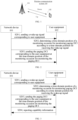
- FIG. 2 is a flowchart of a method for monitoring paging downlink control information according to an example embodiment. As shown in FIG. 2 , the method includes following steps.
- step S201 the network device sends a wake-up signal corresponding to the user equipment to the user equipment.
- step S202 the user equipment determines a time domain position of a monitoring occasion for monitoring the paging DCI according to a time domain position for receiving the wake-up signal.
- step S203 the user equipment monitors the paging DCI corresponding to the user equipment at the time domain position of the monitoring occasion for monitoring the paging DCI.
- the monitoring occasion of the wake-up signal corresponding to the user equipment is periodically distributed in the time domain, so that the user equipment periodically detects the monitoring occasion of the corresponding wake-up signal.
- the time domain position of the monitoring occasion for monitoring the paging DCI is after the first moment t1.
- the first moment t1 is a moment corresponding to a first time interval T1 behind the end position of the time domain position for receiving the wake-up signal.
- the time domain position of the monitoring occasion for monitoring the paging DCI is after a third moment t3.
- the third moment t3 is a moment corresponding to the first time interval T1 behind the start position of the time domain position for receiving the wake-up signal.
- the duration of the interval between the third moment t3 and the first moment t1 is the length of the monitoring occasion of the wake-up signal corresponding to the user equipment.
- the first time interval T1 is determined by a protocol, or the first time interval T1 may be determined according to a protocol agreement.
- a processing time is reserved for the user equipment to switch from receiving the wake-up signal to receiving the paging DCI.
- the time domain position of the monitoring occasion for monitoring the paging DCI is before the second moment t2.
- the second moment t2 is a moment corresponding to a second time interval T2 behind the end position of the time domain position for receiving the wake-up signal.
- the time domain position of the monitoring occasion for monitoring the paging DCI is before a fourth moment t4.
- the fourth moment t4 is a moment corresponding to the second time interval T2 behind the start position of the time domain position for receiving the wake-up signal.
- the duration of the interval between the fourth moment t4 and the second moment t2 is the length of the monitoring occasion of the wake-up signal corresponding to the user equipment.
- the second time interval T2 is determined by a protocol, or the second time interval T2 may be determined according to a protocol agreement.
- the user equipment is prevented from monitoring for a long time when the monitoring occasion for monitoring the paging DCI is not detected, so as to save the power consumption of the user equipment.
- the time domain position of the monitoring occasion for monitoring the paging DCI is after the first moment t1 and before the second moment t2.
- the first moment t1 is a moment corresponding to the first time interval T1 behind the end position of the time domain position for receiving the wake-up signal
- the second moment t2 is a moment corresponding to the second time interval T2 behind the end position of the time domain position for receiving the wake-up signal.
- a processing time may be reserved for the user equipment to switch from receiving the wake-up signal to receiving the paging DCI.
- the user equipment may be prevented from monitoring for a long time when the monitoring occasion for monitoring the paging DCI is not detected, so as to save the power consumption of the user equipment.
- the monitoring occasion for monitoring the paging DCI satisfies one of the following manners.
- the monitoring occasion for monitoring the paging DCI at least includes M * H monitoring occasions after the first moment and closest to the first moment in the paging search space for transmitting the paging DCI, where M is the quantity of SSBs actually sent by the network device, and H is an integer greater than zero.
- the monitoring occasion for monitoring the paging DCI only includes M * H monitoring occasions after the first moment and closest to the first moment in the paging search space for transmitting the paging DCI, so as to ensure that the operation of starting to monitor the paging DCI is later than the first moment.
- the monitoring occasion for monitoring the paging DCI at least includes M * H monitoring occasions in one or more paging search space periods after the first moment and closest to the first moment in the paging search space for transmitting the paging DCI, where the start time of the paging search space period is later than the first moment, M is the quantity of SSBs actually sent by the network device, and H is an integer greater than zero.
- the paging search space period is a period corresponding to the paging search space for transmitting the paging DCI.
- the period of the paging search space may refer to a search space periodicity, which indicates a time interval between two adjacent paging search spaces.
- N is an integer greater than zero, and the value of H is the same as a value of N.
- the monitoring occasion for monitoring the paging DCI only includes M * H monitoring occasions in a paging search space period after the first moment and closest to the first moment in the paging search space for transmitting the paging DCI, so as to ensure that the operation of starting to monitor the paging DCI is later than the first moment.
- the monitoring occasion for monitoring the paging DCI at least includes all paging occasions in a paging search space period after the first moment and closest to the first moment in the paging search space for transmitting the paging DCI, and the start time of the paging search space period is later than the first moment.
- the monitoring occasion for monitoring the paging DCI only includes all paging occasions in a paging search space period after the first moment and closest to the first moment in the paging search space for transmitting the paging DCI, and the start time of the paging search space period is later than the first moment.
- the monitoring occasion for monitoring the paging DCI satisfies one of the following manners.
- the monitoring occasion for monitoring the paging DCI at least includes M * H monitoring occasions before the second moment and closest to the second moment in the paging search space for transmitting the paging DCI, where M is the quantity of SSBs actually sent by the network device, and H is an integer greater than zero.
- the monitoring occasion for monitoring the paging DCI only includes M * H monitoring occasions before the second moment and closest to the second moment in the paging search space for transmitting the paging DCI.
- the monitoring occasion for monitoring the paging DCI at least includes M * H monitoring occasions in one or more paging search space periods before the second moment and closest to the second moment in the paging search space for transmitting the paging DCI, where the end time of the paging search space period is earlier than the second moment, M is the quantity of SSBs actually sent by the network device, and H is an integer greater than zero.
- the paging search space period is a period corresponding to the paging search space for transmitting the paging DCI.
- N is an integer greater than zero, and the value of H is the same as the value of N.
- the monitoring occasion for monitoring the paging DCI only includes M * H monitoring occasions in a paging search space period before the second moment and closest to the second moment in the paging search space for transmitting the paging DCI.
- the monitoring occasion for monitoring the paging DCI at least includes all paging occasions in a paging search space period before the second moment and closest to the second moment in the paging search space for transmitting the paging DCI, and the end time of the paging search space period is later than the second moment.
- the monitoring occasion for monitoring the paging DCI only includes all paging occasions in a paging search space period before the second moment and closest to the second moment in the paging search space for transmitting the paging DCI, and the start time of the paging search space period is later than the second moment.
- a period of the paging search space for transmitting the paging DCI includes M * N monitoring occasions, where M is the quantity of SSBs actually sent by the network device, and N is an integer greater than zero.
- a manner of obtaining the paging search space for transmitting the paging DCI is: receiving configuration information sent by the network device, where the configuration information indicates the paging search space for transmitting the paging DCI.
- At least M monitoring occasions for monitoring the paging DCI are provided between the first moment t1 and the second moment t2, where M is the quantity of SSBs actually sent by the network device, so as to ensure that the user equipment can cover each SSB beam actually sent by the network device in a set time period for monitoring the paging DCI.
- the interval between the first moment t1 and the second moment t2 is greater than or equal to a duration of a paging search space period, where the paging search space period is a period corresponding to the paging search space for transmitting the paging DCI, so as to ensure that the user equipment can cover each SSB beam actually sent by the network device in a set time period for monitoring the paging DCI.
- the monitoring occasion for monitoring the paging DCI includes at least one monitoring occasion in S paging search space periods after the first moment, where S is an integer greater than or equal to 1.
- the monitoring occasion for monitoring the paging DCI includes at least one monitoring occasion in S paging search space periods before the second moment, where S is an integer greater than or equal to 1.
- the value of S may be determined according to a protocol agreement.
- the method further includes step S204, in which the user equipment reports capability information to the network device, where the capability information is used to indicate at least one of the first time interval T1 or the second time interval T2.
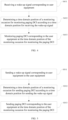
- FIG. 4 is a flowchart of a method for monitoring paging downlink control information according to an example embodiment. As shown in FIG. 4 , the method includes following steps.
- step S401 a wake-up signal corresponding to the user equipment is received.
- step S402 a time domain position of a monitoring occasion for monitoring the paging DCI is determined according to a time domain position for receiving the wake-up signal.
- step S403 the paging DCI corresponding to the user equipment is monitored at the time domain position of the monitoring occasion for monitoring the paging DCI.
- the monitoring occasion of the wake-up signal corresponding to the user equipment is periodically distributed in the time domain, so that the network device periodically sends the monitoring occasion of the corresponding wake-up signal.
- the time domain position of the monitoring occasion for monitoring the paging DCI is after the first moment t1
- the first moment t1 is a moment corresponding to the first time interval T1 behind the end position of the time domain position for receiving the wake-up signal.
- the time domain position of the monitoring occasion for monitoring the paging DCI is after the third moment t3, and the third moment t3 is a moment corresponding to the first time interval T1 behind the start position of the time domain position for receiving the wake-up signal.
- the duration of the interval between the third moment t3 and the first moment t1 is the length of the monitoring occasion of the wake-up signal corresponding to the user equipment.
- the first time interval T1 is determined by a protocol, or the first time interval T1 may be determined according to a protocol agreement.
- a processing time is reserved for the user equipment to switch from receiving the wake-up signal to receiving the paging DCI.
- the time domain position of the monitoring occasion for monitoring the paging DCI is before the second moment t2.
- the second moment t2 is a moment corresponding to the second time interval T2 behind the end position of the time domain position for receiving the wake-up signal.
- the time domain position of the monitoring occasion for monitoring the paging DCI is before a fourth moment t4.
- the fourth moment t4 is a moment corresponding to the second time interval T2 behind the start position of the time domain position for receiving the wake-up signal.
- the duration of the interval between the fourth moment t4 and the second moment t2 is the length of the monitoring occasion of the wake-up signal corresponding to the user equipment.
- the second time interval T2 is determined by a protocol, or the second time interval T2 may be determined according to a protocol agreement.
- the user equipment is prevented from monitoring for a long time when the monitoring occasion for monitoring the paging DCI is not detected, so as to save the power consumption of the user equipment.
- the time domain position of the monitoring occasion for monitoring the paging DCI is after the first moment t1 and before the second moment t2.
- the first moment t1 is a moment corresponding to the first time interval T1 behind the end position of the time domain position for receiving the wake-up signal
- the second moment t2 is a moment corresponding to the second time interval T2 behind the end position of the time domain position for receiving the wake-up signal.
- a processing time may be reserved for the user equipment to switch from receiving the wake-up signal to receiving the paging DCI.
- the user equipment may be prevented from monitoring for a long time when the monitoring occasion for monitoring the paging DCI is not detected, so as to save the power consumption of the user equipment.
- the monitoring occasion for monitoring the paging DCI satisfies one of the following manners.
- the monitoring occasion for monitoring the paging DCI at least includes M * H monitoring occasions after the first moment and closest to the first moment in the paging search space for transmitting the paging DCI, where M is the quantity of SSBs actually sent by the network device, and H is an integer greater than zero.
- the monitoring occasion for monitoring the paging DCI only includes M * H monitoring occasions after the first moment and closest to the first moment in the paging search space for transmitting the paging DCI, so as to ensure that the operation of starting to monitor the paging DCI is later than the first moment.
- the monitoring occasion for monitoring the paging DCI at least includes M * H monitoring occasions in one or more paging search space periods after the first moment and closest to the first moment in the paging search space for transmitting the paging DCI, where the start time of the paging search space period is later than the first moment, M is the quantity of SSBs actually sent by the network device, and H is an integer greater than zero.
- the paging search space period is a period corresponding to the paging search space for transmitting the paging DCI.
- N is an integer greater than zero, and the value of H is the same as the value of N.
- the monitoring occasion for monitoring the paging DCI only includes M * H monitoring occasions in a paging search space period after the first moment and closest to the first moment in the paging search space for transmitting the paging DCI, so as to ensure that the operation of starting to monitor the paging DCI is later than the first moment.
- the monitoring occasion for monitoring the paging DCI at least includes all paging occasions in a paging search space period after the first moment and closest to the first moment in the paging search space for transmitting the paging DCI, and the start time of the paging search space period is later than the first moment.
- the monitoring occasion for monitoring the paging DCI satisfies one of the following manners.
- the monitoring occasion for monitoring the paging DCI at least includes M * H monitoring occasions before the second moment and closest to the second moment in the paging search space for transmitting the paging DCI, where M is the quantity of SSBs actually sent by the network device, and H is an integer greater than zero.
- the monitoring occasion for monitoring the paging DCI only includes M * H monitoring occasions before the second moment and closest to the second moment in the paging search space for transmitting the paging DCI.
- the monitoring occasion for monitoring the paging DCI at least includes M * H monitoring occasions in one or more paging search space periods before the second moment and closest to the second moment in the paging search space for transmitting the paging DCI, where the end time of the paging search space period is earlier than the second moment, M is the quantity of SSBs actually sent by the network device, and H is an integer greater than zero.
- the paging search space period is a period corresponding to the paging search space for transmitting the paging DCI.
- N is an integer greater than zero, and the value of H is the same as the value of N.
- the monitoring occasion for monitoring the paging DCI only includes M * H monitoring occasions in a paging search space period before the second moment and closest to the second moment in the paging search space for transmitting the paging DCI.
- the monitoring occasion for monitoring the paging DCI at least includes all paging occasions in a paging search space period before the second moment and closest to the second moment in the paging search space for transmitting the paging DCI, and the end time of the paging search space period is later than the second moment.
- the monitoring occasion for monitoring the paging DCI only includes all paging occasions in a paging search space period before the second moment and closest to the second moment in the paging search space for transmitting the paging DCI, and the start time of the paging search space period is later than the second moment.
- the monitoring occasion for monitoring the paging DCI only includes all paging occasions in a paging search space period after the first moment and closest to the first moment in the paging search space for transmitting the paging DCI.
- a period of the paging search space for transmitting the paging DCI includes M * N monitoring occasions, where M is the quantity of SSBs actually sent by the network device, and N is an integer greater than zero.
- a manner of obtaining the paging search space for transmitting the paging DCI is: receiving configuration information sent by the network device, where the configuration information indicates the paging search space for transmitting the paging DCI.
- At least M monitoring occasions for monitoring the paging DCI are provided between the first moment t1 and the second moment t2, where M is the quantity of SSBs actually sent by the network device, so as to ensure that the user equipment can cover each SSB beam actually sent by the network device in a set time period for monitoring the paging DCI.
- the interval between the first moment t1 and the second moment t2 is greater than or equal to the duration of a paging search space period, where the paging search space period is a period corresponding to the paging search space for transmitting the paging DCI, so as to ensure that the user equipment can cover each SSB beam actually sent by the network device in a set time period for monitoring the paging DCI.
- the monitoring occasion for monitoring the paging DCI includes at least one monitoring occasion in S paging search space periods after the first moment, where S is an integer greater than or equal to 1.
- the monitoring occasion for monitoring the paging DCI includes at least one monitoring occasion in S paging search space periods before the second moment, where S is an integer greater than or equal to 1.
- the value of S may be determined according to a protocol agreement.
- the user equipment reports capability information to the network device, where the capability information is used to indicate at least one of the first time interval T1 or the second time interval T2, so that the network device sends the paging DCI based on the obtained first time interval T1 and/or the second time interval T2.
- the time domain position of the monitoring occasion for monitoring the paging DCI is determined according to the time domain position for receiving the wake-up signal. In a case that the paging DCI is not periodically sent due to use of the wake-up signal, the time domain position of the monitoring occasion for monitoring the paging DCI may be accurately determined, and the paging DCI may be received in time.
- FIG. 5 is a flowchart of a method for sending paging downlink control information according to an example embodiment. As shown in FIG. 5 , the method includes following steps.
- step S501 a wake-up signal corresponding to a user equipment is sent to the user equipment.
- step S502 a time domain position of a monitoring occasion for sending paging DCI is determined according to a time domain position for sending the wake-up signal;
- step S503 the paging DCI corresponding to the user equipment is sent at the time domain position of the monitoring occasion for monitoring the paging DCI.
- the monitoring occasion of the wake-up signal corresponding to the user equipment is periodically distributed in the time domain, so that the network device may periodically send the monitoring occasion of the corresponding wake-up signal.
- the time domain position of the monitoring occasion for monitoring the paging DCI is after the first moment, and the first moment is a moment corresponding to a first time interval behind the end position of the time domain position for sending the wake-up signal.
- the time domain position of the monitoring occasion for monitoring the paging DCI is after the first moment t1, and the first moment t1 is a moment corresponding to the first time interval T 1 behind the end position of the time domain position for receiving the wake-up signal.
- the time domain position of the monitoring occasion for monitoring the paging DCI is after the third moment t3, and the third moment t3 is a moment corresponding to the first time interval T1 behind the start position of the time domain position for receiving the wake-up signal.
- the duration of the interval between the third moment t3 and the first moment t1 is the length of the monitoring occasion of the wake-up signal corresponding to the user equipment.
- the first time interval T1 is determined by a protocol, or the first time interval T1 may be determined according to a protocol agreement.
- a processing time is reserved for the user equipment to switch from receiving the wake-up signal to receiving the paging DCI.
- the time domain position of the monitoring occasion for monitoring the paging DCI is before the second moment t2.
- the second moment t2 is a moment corresponding to the second time interval T2 behind the end position of the time domain position for receiving the wake-up signal.
- the time domain position of the monitoring occasion for monitoring the paging DCI is before a fourth moment t4.
- the fourth moment t4 is a moment corresponding to the second time interval T2 behind the start position of the time domain position for receiving the wake-up signal.
- the duration of the interval between the fourth moment t4 and the second moment t2 is the length of the monitoring occasion of the wake-up signal corresponding to the user equipment.
- the second time interval T2 is determined by a protocol, or the second time interval T2 may be determined according to a protocol agreement.
- the user equipment is prevented from monitoring for a long time when the monitoring occasion for monitoring the paging DCI is not detected, so as to save the power consumption of the user equipment.
- the time domain position of the monitoring occasion for monitoring the paging DCI is after the first moment t1 and before the second moment t2.
- the first moment t1 is a moment corresponding to the first time interval T1 behind the end position of the time domain position for receiving the wake-up signal
- the second moment t2 is a moment corresponding to the second time interval T2 behind the end position of the time domain position for receiving the wake-up signal.
- a processing time may be reserved for the user equipment to switch from receiving the wake-up signal to receiving the paging DCI.
- the user equipment may be prevented from monitoring for a long time when the monitoring occasion for monitoring the paging DCI is not detected, so as to save the power consumption of the user equipment.
- the monitoring occasion for monitoring the paging DCI at least includes M * H monitoring occasions after the first moment and closest to the first moment in the paging search space for transmitting the paging DCI, where H is an integer greater than zero.
- the monitoring occasion for monitoring the paging DCI at least includes M * H monitoring occasions in one or more paging search space periods after the first moment and closest to the first moment in the paging search space for transmitting the paging DCI, where the start time of the paging search space period is later than the first moment, M is the quantity of SSBs actually sent by the network device, and H is an integer greater than zero.
- the paging search space period is a period corresponding to the paging search space.
- H is N.
- the monitoring occasion for monitoring the paging DCI at least includes all paging occasions in a paging search space period after the first moment and closest to the first moment in the paging search space for transmitting the paging DCI, and the start time of the paging search space period is later than the first moment.
- a manner of notifying the user equipment of the paging search space is: sending configuration information to the user equipment, where the configuration information indicates the paging search space for transmitting the paging DCI.
- At least M monitoring occasions for monitoring the paging DCI are provided between the first moment and the second moment, where M is the quantity of SSBs actually sent by the network device.
- the interval between the first moment and the second moment is greater than or equal to the duration of a paging search space period, where the paging search space period is a period corresponding to the paging search space for transmitting the paging DCI.
- the monitoring occasion for monitoring the paging DCI includes at least one monitoring occasion in S paging search space periods after the first moment, where S is an integer greater than or equal to 1, and the paging search space period is a period corresponding to the paging search space for transmitting the paging DCI.
- the monitoring occasion for monitoring the paging DCI includes at least one monitoring occasion in S paging search space periods before the second moment, where S is an integer greater than or equal to 1, and the paging search space period is a period corresponding to the paging search space for transmitting the paging DCI.
- capability information reported by the user equipment is received, where the capability information is used to indicate at least one of the first time interval or the second time interval.
- the communication apparatus may have the functions of the user equipment 102 in the foregoing method embodiments, and is configured to perform the steps performed by the user equipment 102 provided in the foregoing embodiments.
- the function may be implemented by hardware, or by software, or by hardware executing corresponding software.
- the hardware or the software includes one or more modules corresponding to the foregoing functions.
- the communication apparatus 600 shown in FIG. 6 may be used as the user equipment 102 in the foregoing method embodiments, and perform the steps performed by the user equipment 102 in the foregoing method embodiments.
- the communication apparatus 600 includes a transceiving module 601 and a processing module 602.
- the transceiving module 601 is configured to receive a wake-up signal corresponding to the user equipment.
- the processing module 602 is configured to determine a time domain position of a monitoring occasion for monitoring the paging DCI according to a time domain position for receiving the wake-up signal.
- the transceiving module 601 is further configured to monitor the paging DCI corresponding to the user equipment at the time domain position of the monitoring occasion for monitoring the paging DCI.
- a monitoring occasion of the wake-up signal corresponding to the user equipment is periodically distributed in the time domain.
- the time domain position of the monitoring occasion for monitoring the paging DCI is after a first moment, and the first moment is a moment corresponding to a first time interval behind an end position of the time domain position for receiving the wake-up signal.
- the time domain position of the monitoring occasion for monitoring the paging DCI is before a second moment, and the second moment is a moment corresponding to a second time interval behind an end position of the time domain position for receiving the wake-up signal.
- a period of a paging search space for transmitting the paging DCI includes M * N monitoring occasions, where M is a quantity of SSBs actually sent by a network device, and N is an integer greater than zero.
- the monitoring occasion for monitoring the paging DCI at least includes M * H monitoring occasions after the first moment and closest to the first moment in a paging search space for transmitting the paging DCI, where M is a quantity of SSBs actually sent by a network device, and H is an integer greater than zero.
- the monitoring occasion for monitoring the paging DCI at least includes M * H monitoring occasions in one or more paging search space periods after the first moment and closest to the first moment in a paging search space for transmitting the paging DCI, where a start time of the paging search space period is later than the first moment, M is a quantity of SSBs actually sent by a network device, H is an integer greater than zero, and the paging search space period is a period corresponding to a paging search space for transmitting paging DCI.
- the monitoring occasion for monitoring the paging DCI at least includes all paging occasions in a paging search space period after the first moment and closest to the first moment in a paging search space for transmitting the paging DCI, where a start time of the paging search space period is later than the first moment, and the paging search space period is a period corresponding to the paging search space.
- the transceiving module 601 is further configured to receive configuration information sent by a network device, where the configuration information indicates a paging search space for transmitting the paging DCI.
- At least M monitoring occasions for monitoring the paging DCI are provided between the first moment and the second moment, where M is a quantity of SSBs actually sent by a network device.
- an interval between the first moment and the second moment is greater than or equal to a duration of a paging search space period, where the paging search space period is a period corresponding to a paging search space for transmitting the paging DCI.
- the monitoring occasion for monitoring the paging DCI includes at least one monitoring occasion in S paging search space periods after the first moment, where S is an integer greater than or equal to 1, and the paging search space period is a period corresponding to a paging search space for transmitting the paging DCI.
- the monitoring occasion for monitoring the paging DCI includes at least one monitoring occasion in S paging search space periods before the second moment, where S is an integer greater than or equal to 1, and the paging search space period is a period corresponding to a paging search space for transmitting the paging DCI.
- the transceiving module 601 is further configured to report capability information to a network device, where the capability information is used to indicate at least one of the first time interval or the second time interval.
- the structure of the communication apparatus may also be as shown in FIG. 7 .
- FIG. 7 is a block diagram of an apparatus 700 for transmitting paging downlink control information according to an example embodiment.
- the apparatus 700 may be a mobile phone, a computer, a digital broadcast terminal, a message transceiving device, a game console, a tablet device, a medical device, a fitness device, a personal digital assistant, or the like.
- the apparatus 700 may include one or more of the following components: a processing component 702, a memory 704, a power component 706, a multimedia component 708, an audio component 710, an input/output (I/O) interface 712, a sensor component 714, and a communication component 716.
- the processing component 702 typically controls overall operations of the apparatus 700, such as operations associated with display, telephone calls, data communications, camera operations, and recording operations.
- the processing component 702 may include one or more processors 720 to execute instructions to perform all or part of the steps of the above method.
- the processing component 702 may include one or more modules to facilitate interaction between the processing component 702 and other components.
- the processing component 702 may include a multimedia module to facilitate interaction between the multimedia component 708 and the processing component 702.
- the memory 704 is configured to store various types of data to support the operations of the apparatus 700. Examples of such data include instructions for any application or method operated on the apparatus 700, contact data, phonebook data, messages, pictures, videos, etc.
- the memory 704 may be implemented by any type of volatile or non-volatile storage device or a combination of them, such as a static random access memory (SRAM), an electrically erasable programmable read-only memory (EEPROM), an erasable programmable read-only memory (EPROM), a programmable read-only memory (PROM), a read-only memory (ROM), a magnetic memory, a flash memory, a magnetic disk, or an optical disk.
- SRAM static random access memory
- EEPROM electrically erasable programmable read-only memory
- EPROM erasable programmable read-only memory
- PROM programmable read-only memory
- ROM read-only memory
- magnetic memory a magnetic memory
- flash memory a flash memory
- magnetic disk or an optical disk
- the power component 706 provides power to various components of the apparatus 700.
- the power component 706 may include a power management system, one or more power sources, and other components associated with generating, managing, and distributing power for the apparatus 700.
- the multimedia component 708 includes a screen providing an output interface between the apparatus 700 and the user.
- the screen may include a liquid crystal display (LCD) and a touch panel (TP). If the screen includes the touch panel, the screen may be implemented as a touch screen to receive input signals from the user.
- the touch panel includes one or more touch sensors to sense touching, sliding, and gestures on the touch panel. The touch sensor may not only sense a boundary of a touching or sliding action, but also detect a duration and pressure associated with the touching or sliding action.
- the multimedia component 708 includes a front camera and/or a rear camera. The front camera and/or the rear camera may receive external multimedia data when the apparatus 700 is in an operation mode, such as a photographing mode or a video mode. Each of the front camera and the rear camera may be a fixed optical lens system or have a focal length and optical zoom capability.
- the audio component 710 is configured to output and/or input audio signals.
- the audio component 710 includes a microphone (MIC) configured to receive an external audio signal when the apparatus 700 is in an operation mode, such as a call mode, a recording mode, and a voice recognition mode.
- the received audio signal may be further stored in the memory 704 or transmitted via the communication component 716.
- the audio component 710 further includes a speaker to output audio signals.
- the I/O interface 712 provides an interface between the processing component 702 and a peripheral interface module, and the peripheral interface module may be a keyboard, a click wheel, a button, or the like.
- the button may include, but are not limited to, a home button, a volume button, a starting button, and a locking button.
- the sensor component 714 includes one or more sensors to provide status assessments of various aspects of the apparatus 700.
- the sensor component 714 may detect the on/off state of the apparatus 700, and the relative positioning of the components, such as the display and keypad of the apparatus 700.
- the sensor component 714 may also detect the position change of the apparatus 700 or one component of the apparatus 700, the presence or absence of contact by the user with the apparatus 700, the orientation or acceleration/deceleration of the apparatus 700, and the temperature change of the apparatus 700.
- the sensor component 714 may include a proximity sensor configured to detect the presence of nearby objects without any physical contact.
- the sensor component 714 may also include an optical sensor, such as a CMOS or CCD image sensor, for use in imaging applications.
- the sensor component 714 may further include an acceleration sensor, a gyroscope sensor, a magnetic sensor, a pressure sensor, or a temperature sensor.
- the communication component 716 is configured to facilitate wired or wireless communication between the apparatus 700 and other devices.
- the apparatus 700 may access a wireless network based on a communication standard, such as WiFi, 4G or 5G, or a combination of them.
- the communication component 716 receives a broadcast signal or broadcast associated information from an external broadcast management system via a broadcast channel.
- the communication component 716 further includes a near field communication (NFC) module to facilitate short-range communications.
- the NFC module may be implemented based on a radio frequency identification (RFID) technology, an infrared data association (IrDA) technology, an ultra-wideband (UWB) technology, a Bluetooth (BT) technology, and other technologies.
- RFID radio frequency identification
- IrDA infrared data association
- UWB ultra-wideband
- BT Bluetooth
- the apparatus 700 may be implemented by one or more application specific integrated circuits (ASICs), digital signal processors (DSPs), digital signal processing devices (DSPDs), programmable logic devices (PLDs), field programmable gate arrays (FPGAs), controllers, microcontrollers, microprocessors, or other electronic components for performing the methods described above.
- ASICs application specific integrated circuits
- DSPs digital signal processors
- DSPDs digital signal processing devices
- PLDs programmable logic devices
- FPGAs field programmable gate arrays
- controllers microcontrollers, microprocessors, or other electronic components for performing the methods described above.
- a non-transitory computer-readable storage medium including an instruction for example, the memory 704 including an instruction.
- the instruction may be executed by the processor 720 of the apparatus 700 to perform and complete the foregoing method.
- the non-transitory computer-readable storage medium may be a ROM, a random access memory (RAM), a CD-ROM, a magnetic tape, a floppy disk, an optical data storage device, or the like.
- the communication apparatus may have functions of the network device 101 in the foregoing method embodiments, and is configured to perform the steps performed by the network device 101 provided in the foregoing embodiments.
- the function may be implemented by hardware, or by software, or by hardware executing corresponding software.
- the hardware or the software includes one or more modules corresponding to the foregoing functions.
- the communication apparatus 800 shown in FIG. 8 may be used as the network device 101 in the foregoing method embodiments, and perform the steps performed by the network device 101 in the foregoing method embodiments.
- the communication apparatus 800 shown in FIG. 8 includes a transceiving module 801 and a processing module 802.
- the transceiving module 801 is configured to send a wake-up signal corresponding to a user equipment to the user equipment.
- the processing module 802 is configured to determine a time domain position of a monitoring occasion for sending the paging DCI according to a time domain position for sending the wake-up signal.
- the transceiving module 801 is configured to send the paging DCI corresponding to the user equipment at the time domain position of the monitoring occasion for monitoring the paging DCI.
- a monitoring occasion of a wake-up signal corresponding to the user equipment is periodically distributed in a time domain.
- the time domain position of the monitoring occasion for monitoring the paging DCI is after a first moment, and the first moment is a moment corresponding to a first time interval behind an end position of the time domain position for sending the wake-up signal.
- the time domain position of the monitoring occasion for monitoring the paging DCI is before a second moment, and the second moment is a moment corresponding to a second time interval behind an end position of the time domain position for receiving the wake-up signal.
- a period of a paging search space for transmitting the paging DCI includes M * N monitoring occasions, where M is a quantity of SSBs actually sent by the network device, and N is an integer greater than zero.
- the monitoring occasion for monitoring the paging DCI at least includes M * H monitoring occasions after the first moment and closest to the first moment in a paging search space for transmitting the paging DCI, where H is an integer greater than zero.
- the monitoring occasion for monitoring the paging DCI at least includes M * H monitoring occasions in one or more paging search space periods after the first moment and closest to the first moment in a paging search space for transmitting the paging DCI, where a start time of the paging search space period is later than the first moment, M is a quantity of SSBs actually sent by the network device, H is an integer greater than zero, and the paging search space period is a period corresponding to the paging search space.
- the monitoring occasion for monitoring the paging DCI at least includes all paging occasions in a paging search space period after the first moment and closest to the first moment in a paging search space for transmitting the paging DCI, and a start time of the paging search space period is later than the first moment.
- the transceiving module 801 is further configured to send configuration information to the user equipment, where the configuration information indicates a paging search space for transmitting the paging DCI.
- At least M monitoring occasions for monitoring the paging DCI are provided between the first moment and the second moment, where M is a quantity of SSBs actually sent by the network device.
- an interval between the first moment and the second moment is greater than or equal to a duration of a paging search space period, where the paging search space period is a period corresponding to a paging search space for transmitting the paging DCI.
- the monitoring occasion for monitoring the paging DCI includes at least one monitoring occasion in S paging search space periods after the first moment, where S is an integer greater than or equal to 1, and the paging search space period is a period corresponding to a paging search space for transmitting the paging DCI.
- the monitoring occasion for monitoring the paging DCI includes at least one monitoring occasion in S paging search space periods before the second moment, where S is an integer greater than or equal to 1, and the paging search space period is a period corresponding to a paging search space for transmitting the paging DCI.
- the transceiving module 801 is further configured to receive capability information reported by the user equipment, where the capability information is used to indicate at least one of the first time interval or the second time interval.
- the structure of the communication apparatus may also be as shown in FIG. 9 .
- the apparatus 900 includes a memory 901, a processor 902, a transceiving component 903, and a power component 906; where the memory 901 is coupled to the processor 902, and may be configured to store a program and data necessary for implementing each function by the communication apparatus 900.
- the processor 902 is configured to support the communication apparatus 900 in performing corresponding functions in the foregoing methods, and such functions may be implemented by invoking a program stored in the memory 901.
- the transceiving component 903 may be a wireless transceiver, and may be configured to support the communication apparatus 900 in receiving signaling and/or data and sending signaling and/or data through a wireless air interface.
- the transceiving component 903 may also be referred to as a transceiving unit or a communication unit.
- the transceiving component 903 may include a radio frequency component 904 and one or more antennas 905, where the radio frequency component 904 may be a remote radio unit (RRU), and may be specifically configured for transmission of radio frequency signals and conversion between a radio frequency signal and a baseband signal.
- the one or more antennas 905 may be specifically configured to radiate and receive radio frequency signals.
- the processor 902 may perform baseband processing on the data to be sent, and then output a baseband signal to the radio frequency unit.
- the radio frequency unit performs radio frequency processing on the baseband signal and then sends the radio frequency signal in the form of an electromagnetic wave through the antenna.
- the radio frequency unit receives the radio frequency signal through the antenna, converts the radio frequency signal into a baseband signal, and outputs the baseband signal to the processor 902.
- the processor 902 converts the baseband signal into data, and performs processing on the data.
- the user equipment determines the time domain position of the monitoring occasion for monitoring the paging DCI according to the time domain position for receiving the wake-up signal. In a case that the paging DCI is not periodically sent due to use of the wake-up signal, the user equipment may accurately determine the time domain position of the monitoring occasion for monitoring the paging DCI, and receive the paging DCI in time.
Landscapes
- Engineering & Computer Science (AREA)
- Signal Processing (AREA)
- Computer Networks & Wireless Communication (AREA)
- Mobile Radio Communication Systems (AREA)
Abstract
Description
- The present disclosure relates to wireless communication technologies, and in particular, to a method and apparatus for transmitting and monitoring paging downlink control information, and a storage medium.
- In some wireless communication technologies, a wake-up signal (WUS) may be used to indicate to wake up a user equipment (UE) to transition from a sleep state to a working state.
- In a scenario of using the WUS, a new paging mechanism may be introduced. In the new paging mechanism, the concept of the paging period is not emphasized, and it is not limited to that paging downlink control information (DCI) is sent on a corresponding paging frame (PF) / paging occasion (PO) of the user equipment, but the paging DCI may be sent by the network device according to the use requirements of the user equipment. Therefore, how to determine the monitoring occasion of the paging DCI is a problem to be solved.
- According to the present disclosure, there is provided a method and apparatus for monitoring paging downlink control information, a device, and a storage medium.
- According to a first aspect, there is provided a method for monitoring paging downlink control information, performed by a user equipment, where the method includes:
- receiving a wake-up signal corresponding to the user equipment;
- determining a time domain position of a monitoring occasion for monitoring paging DCI according to a time domain position for receiving the wake-up signal; and
- monitoring paging DCI corresponding to the user equipment at the time domain position of the monitoring occasion for monitoring the paging DCI.
- In the method, the user equipment determines the time domain position of the monitoring occasion for monitoring the paging DCI according to the time domain position for receiving the wake-up signal. In a case that the paging DCI is not periodically sent due to use of the wake-up signal, the user equipment may accurately determine the time domain position of the monitoring occasion for monitoring the paging DCI, and receive the paging DCI in time.
- In some possible implementations, a monitoring occasion of the wake-up signal corresponding to the user equipment is periodically distributed in a time domain.
- In some possible implementations, the time domain position of the monitoring occasion for monitoring the paging DCI is after a first moment, and the first moment is a moment corresponding to a first time interval behind an end position of the time domain position for receiving the wake-up signal.
- In some possible implementations, the time domain position of the monitoring occasion for monitoring the paging DCI is before a second moment, and the second moment is a moment corresponding to a second time interval behind an end position of the time domain position for receiving the wake-up signal.
- In some possible implementations, a period of a paging search space for transmitting the paging DCI includes M * N monitoring occasions, where M is a quantity of SSBs actually sent by a network device, and N is an integer greater than zero.
- In some possible implementations, the monitoring occasion for monitoring the paging DCI at least includes M * H monitoring occasions after the first moment and closest to the first moment in a paging search space for transmitting the paging DCI, where M is a quantity of SSBs actually sent by a network device, and H is an integer greater than zero.
- In some possible implementations, the monitoring occasion for monitoring the paging DCI at least includes M * H monitoring occasions in one or more paging search space periods after the first moment and closest to the first moment in a paging search space for transmitting the paging DCI, a start time of the paging search space period is later than the first moment, M is a quantity of SSBs actually sent by a network device, and H is an integer greater than zero.
- In some possible implementations, in response to a period of a paging search space including M * N monitoring occasions, His N.
- In some possible implementations, the monitoring occasion for monitoring the paging DCI at least includes all paging occasions in a paging search space period after the first moment and closest to the first moment in a paging search space for transmitting the paging DCI, and a start time of the paging search space period is later than the first moment.
- In some possible implementations, receiving configuration information sent by the network device, where the configuration information indicates a paging search space for transmitting the paging DCI.
- In some possible implementations, at least M monitoring occasions for monitoring the paging DCI are provided between the first moment and the second moment, where M is a quantity of SSBs actually sent by a network device.
- In some possible implementations, an interval between the first moment and the second moment is greater than or equal to a duration of a paging search space period.
- In some possible implementations, the monitoring occasion for monitoring the paging DCI includes at least one monitoring occasion in S paging search space periods after the first moment, where S is an integer greater than or equal to 1.
- In some possible implementations, the monitoring occasion for monitoring the paging DCI includes at least one monitoring occasion in S paging search space periods before the second moment, where S is an integer greater than or equal to 1.
- In some possible implementations, the method further includes:
reporting capability information to a network device, where the capability information is used to indicate at least one of the first time interval or the second time interval. - According to a second aspect, there is provided a method for monitoring paging downlink control information, performed by a network device, where the method includes:
- sending a wake-up signal corresponding to a user equipment to the user equipment;
- determining a time domain position of a monitoring occasion for sending paging DCI according to a time domain position for sending the wake-up signal; and
- sending paging DCI corresponding to the user equipment at the time domain position of the monitoring occasion for monitoring the paging DCI.
- In the method, the network device determines the time domain position of the monitoring occasion for monitoring the paging DCI according to the time domain position for receiving the wake-up signal. In a case that the paging DCI is not periodically sent due to use of the wake-up signal, the network device may accurately determine the time domain position of the monitoring occasion for sending the paging DCI, so that the user equipment receives the paging DCI in time.
- In some possible implementations, a monitoring occasion of the wake-up signal corresponding to the user equipment is periodically distributed in a time domain.
- In some possible implementations, the time domain position of the monitoring occasion for monitoring the paging DCI is after a first moment, and the first moment is a moment corresponding to a first time interval behind an end position of the time domain position for sending the wake-up signal.
- In some possible implementations, the time domain position of the monitoring occasion for monitoring the paging DCI is before a second moment, and the second moment is a moment corresponding to a second time interval behind an end position of the time domain position for receiving the wake-up signal.
- In some possible implementations, a period of a paging search space for transmitting the paging DCI includes M * N monitoring occasions, where M is a quantity of SSBs actually sent by the network device, and N is an integer greater than zero.
- In some possible implementations, the monitoring occasion for monitoring the paging DCI at least includes M * H monitoring occasions after the first moment and closest to the first moment in a paging search space for transmitting the paging DCI, where H is an integer greater than zero.
- In some possible implementations, the monitoring occasion for monitoring the paging DCI at least includes M * H monitoring occasions in one or more paging search space periods after the first moment and closest to the first moment in a paging search space for transmitting the paging DCI, a start time of the paging search space period is later than the first moment, M is a quantity of SSBs actually sent by the network device, and H is an integer greater than zero.
- In some possible implementations, in response to a period of a paging search space for transmitting the paging DCI includes M * N monitoring occasions, H is N.
- In some possible implementations, the monitoring occasion for monitoring the paging DCI at least includes all paging occasions in a paging search space period after the first moment and closest to the first moment in a paging search space for transmitting the paging DCI, and a start time of the paging search space period is later than the first moment.
- In some possible implementations, sending configuration information to the user equipment, where the configuration information indicates a paging search space for transmitting the paging DCI.
- In some possible implementations, at least M monitoring occasions for monitoring the paging DCI are provided between the first moment and the second moment, where M is a quantity of SSBs actually sent by the network device.
- In some possible implementations, an interval between the first moment and the second moment is greater than or equal to a duration of a paging search space period.
- In some possible implementations, the monitoring occasion for monitoring the paging DCI includes at least one monitoring occasion in S paging search space periods after the first moment, where S is an integer greater than or equal to 1.
- In some possible implementations, the monitoring occasion for monitoring the paging DCI includes at least one monitoring occasion in S paging search space periods before the second moment, where S is an integer greater than or equal to 1.
- In some possible implementations, receiving capability information reported by the user equipment, where the capability information is used to indicate at least one of the first time interval and the second time interval.
- According to a third aspect, there is provided a communication apparatus. The communication apparatus may be configured to perform the steps performed by the user equipment in the first aspect or any possible design of the first aspect. The user equipment may implement the functions in the various methods by using a form of a hardware structure, a software module, or a hardware structure plus a software module.
- When the communication apparatus shown in the first aspect is implemented by using the software module, the communication apparatus may include a transceiving module and a processing module.
- The transceiving module is configured to receive a wake-up signal corresponding to the user equipment.
- The processing module is configured to determine a time domain position of a monitoring occasion for monitoring paging DCI according to a time domain position for receiving the wake-up signal.
- The transceiving module is further configured to monitor paging DCI corresponding to the user equipment at the time domain position of the monitoring occasion for monitoring the paging DCI.
- According to a fourth aspect, there is provided a communication apparatus. The communication apparatus may be configured to perform the steps performed by the user equipment in the second aspect or any possible design of the second aspect. The user equipment may implement the functions in the various methods by using a form of a hardware structure, a software module, or a hardware structure plus a software module.
- When the communication apparatus shown in the second aspect is implemented by using the software module, the communication apparatus may include a transceiving module and a processing module.
- The transceiving module is configured to send a wake-up signal corresponding to a user equipment to the user equipment.
- The processing module is configured to determine a time domain position of a monitoring occasion for sending paging DCI according to a time domain position for sending the wake-up signal.
- The transceiving module is further configured to send paging DCI corresponding to the user equipment at the time domain position of the monitoring occasion for monitoring the paging DCI.
- According to a fifth aspect, there is provided a communication apparatus, including a processor and a memory, where the memory is configured to store a computer program, and the processor is configured to execute the computer program to implement the first aspect or any possible design of the first aspect.
- According to a sixth aspect, there is provided a communication apparatus, including a processor and a memory, where the memory is configured to store a computer program, and the processor is configured to execute the computer program to implement the second aspect or any possible design of the second aspect.
- According to a seventh aspect, there is provided a computer-readable storage medium, where the computer-readable storage medium stores an instruction (or referred to as a computer program, a program), and when the instruction is invoked and executed on a computer, the computer is enabled to perform the first aspect or any possible design of the first aspect.
- According to an eighth aspect, there is provided a computer-readable storage medium, where the computer-readable storage medium stores an instruction (or referred to as a computer program, a program), and when the instruction is invoked and executed on a computer, the computer is enabled to perform the second aspect or any possible design of the second aspect.
- It is to be understood that both the foregoing general description and the following detailed description are exemplary and explanatory only and are not restrictive of the disclosure.
- The accompanying drawings described here are used to provide a further understanding of the embodiments of the present disclosure and constitute a part of the present disclosure. The illustrative embodiments of the embodiments of the present disclosure and the description of them are used to explain the embodiments of the present disclosure, and do not constitute an improper limitation on the embodiments of the present disclosure. In the drawings:
- The accompanying drawings, which are incorporated in and constitute a part of the specification, illustrate embodiments consistent with the embodiments of the present disclosure and, together with the description, serve to explain the principles of the embodiments of the present disclosure.
-
FIG. 1 is a schematic architectural diagram of a wireless communication system according to an embodiment of the present disclosure; -
FIG. 2 is a schematic diagram of a method for transmitting paging downlink control information according to an example embodiment; -
FIG. 3 is a flowchart of a method for transmitting paging downlink control information according to an example embodiment; -
FIG. 4 is a flowchart of a method for monitoring paging downlink control information according to an example embodiment; -
FIG. 5 is a flowchart of a method for monitoring paging downlink control information according to an example embodiment; -
FIG. 6 is a structural diagram of an apparatus for monitoring paging downlink control information according to an example embodiment; -
FIG. 7 is a structural diagram of an apparatus for monitoring paging downlink control information according to an example embodiment; -
FIG. 8 is a structural diagram of an apparatus for sending paging downlink control information according to an example embodiment; -
FIG. 9 is a structural diagram of an apparatus for sending paging downlink control information according to an example embodiment. - The embodiments of the present disclosure are further described with reference to the accompanying drawings and specific embodiments.
- Example embodiments will be described in detail here, examples of which are illustrated in the accompanying drawings. The following description refers to the accompanying drawings in which the same numbers in different drawings represent the same or similar elements unless otherwise represented. The implementations described in the following example embodiments do not represent all implementations consistent with the embodiments of the present disclosure. By contrast, they are merely examples of apparatuses and methods consistent with some aspects of the present disclosure as detailed in the appended claims.
- Terms used in the embodiments of the present disclosure are merely for the purpose of describing particular embodiments, and are not intended to limit the embodiments of the present disclosure. The singular forms "a" and "the" used in the embodiments of the present disclosure and the appended claims are also intended to include plural forms, unless the context clearly indicates other meanings. It should also be understood that the term "and/or" as used here refers to and includes any or all possible combinations of one or more associated listed items.
- It should be understood that although the terms first, second, third, or the like, may be used in the embodiments of the present disclosure to describe various information, these information should not be limited to these terms. These terms are only used to distinguish the same type of information from each other. For example, without departing from the scope of the embodiments of the present disclosure, the first information may also be referred to as second information, and similarly, the second information may also be referred to as first information. Depending on the context, the words "if" and "in case" as used here may be interpreted as "at the time" or "when" or "in response to determining".
- Embodiments of the present disclosure are described in detail below, and examples of the embodiments are shown in the accompanying drawings, in which the same or similar reference numerals refer to the same or similar elements throughout. The embodiments described below with reference to the drawings are exemplary and are intended to explain the present disclosure and are not to be construed as limitations of the present disclosure.
- As shown in
FIG. 1 , the method for transmitting capability information provided by an embodiment of the present disclosure may be applied to awireless communication system 100, where the wireless communication system may include, but is not limited to, anetwork device 101 and auser equipment 102. Theuser equipment 102 is configured to support carrier aggregation, and theuser equipment 102 may be connected to a plurality of carrier units of thenetwork device 101, including a primary carrier unit and one or more secondary carrier units. - It should be understood that the foregoing
wireless communication system 100 may be applied to a low-frequency scenario or a high-frequency scenario. The application scenario of thewireless communication system 100 includes but is not limited to a long term evolution (LTE) system, an LTE frequency division duplex (FDD) system, an LTE time division duplex (TDD) system, a worldwide interoperability for micro wave access (WiMAX) communication system, a cloud radio access network (CRAN) system, a future 5-th generation (5G) system, a new radio (NR) communication system, or a future evolved public land mobile network (PLMN) system, or the like. - The
user equipment 102 shown above may be a user equipment (UE), a terminal, an access terminal, a terminal unit, a terminal station, a mobile station (MS), a remote station, a remote terminal, a mobile terminal, a wireless communication device, a terminal agent, a user equipment, or the like. Theuser equipment 102 may have a wireless transceiving function, and may perform communication (for example, wireless communication) with one ormore network devices 101 of one or more communication systems, and accept a network service provided by thenetwork device 101, where thenetwork device 101 includes but is not limited to the illustrated base station. - Among them, the
user equipment 102 may be a cellular telephone, a cordless telephone, a session initiation protocol (SIP) phone, a wireless local loop (WLL) station, a personal digital assistant (PDA) device, a handheld device having a wireless communication function, a computing device, or another processing device connected to a wireless modem, a vehicle-mounted device, a wearable device, a user equipment in a future 5G network, or a user equipment in a future evolved PLMN network, etc. - The
network device 101 may be an access network device (or referred to as an access network station). Among them, the access network device refers to a device that provides a network access function, for example, a radio access network (RAN) base station, etc. The network device may specifically include a base station (BS) device, or include a base station device and a radio resource management device configured to control the base station device, etc. The network device may further include a relay station (a relay device), an access point, a base station in a future 5G network, a base station in a future evolved PLMN network, an NR base station, etc. The network device may be a wearable device or a vehicle-mounted device. The network device may also be a communication chip having a communication module. - For example, the
network device 101 includes but is not limited to: a gnodeB (gNB) in a 5G, an evolved node B (eNB) in a LTE system, a radio network controller (RNC), a node B (NB) in a WCDMA system, a wireless controller in a CRAN system, a base station controller (BSC), a base transceiver station (BTS) in a GSM system or a CDMA system, a home base station, such as a home evolved nodeB, or a home node B (HNB), a baseband unit (BBU), a transmitting and receiving point (TRP), a transmitting point (TP), or mobile switching center, etc. - The wake-up signal in the present disclosure may be a normal wake-up signal or a low-power-consumption wake-up signal. In some examples, the full name of the low-power-consumption wake-up signal may be referred to as low-power WUS.
- The low-power-consumption wake-up signal is different from the normal wake-up signal in R 17. The low-power-consumption wake-up signal may correspond to a separate receiver, which may be referred to as a secondary transceiver, and the power consumption of the secondary receiver is much lower than the power consumption of a main receiver. The user equipment receives the low-power-consumption wake-up signal by using the low-power-consumption secondary receiver, and processes the uplink data and the downlink data by using the main transceiver. The normal wake-up signal needs to be received by the main transceiver.
- According to an embodiment of the present disclosure, there is provided a method for transmitting paging downlink control information.
FIG. 2 is a flowchart of a method for monitoring paging downlink control information according to an example embodiment. As shown inFIG. 2 , the method includes following steps. - In step S201, the network device sends a wake-up signal corresponding to the user equipment to the user equipment.
- In step S202, the user equipment determines a time domain position of a monitoring occasion for monitoring the paging DCI according to a time domain position for receiving the wake-up signal.
- In step S203, the user equipment monitors the paging DCI corresponding to the user equipment at the time domain position of the monitoring occasion for monitoring the paging DCI.
- In some possible implementations, the monitoring occasion of the wake-up signal corresponding to the user equipment is periodically distributed in the time domain, so that the user equipment periodically detects the monitoring occasion of the corresponding wake-up signal.
- In some possible implementations, the time domain position of the monitoring occasion for monitoring the paging DCI is after the first moment t1. The first moment t1 is a moment corresponding to a first time interval T1 behind the end position of the time domain position for receiving the wake-up signal.
- Alternatively, the time domain position of the monitoring occasion for monitoring the paging DCI is after a third moment t3. The third moment t3 is a moment corresponding to the first time interval T1 behind the start position of the time domain position for receiving the wake-up signal. Among them, the duration of the interval between the third moment t3 and the first moment t1 is the length of the monitoring occasion of the wake-up signal corresponding to the user equipment.
- Among them, the first time interval T1 is determined by a protocol, or the first time interval T1 may be determined according to a protocol agreement.
- By setting the first time interval T1, a processing time is reserved for the user equipment to switch from receiving the wake-up signal to receiving the paging DCI.
- In some possible implementations, the time domain position of the monitoring occasion for monitoring the paging DCI is before the second moment t2. The second moment t2 is a moment corresponding to a second time interval T2 behind the end position of the time domain position for receiving the wake-up signal.
- Alternatively, the time domain position of the monitoring occasion for monitoring the paging DCI is before a fourth moment t4. The fourth moment t4 is a moment corresponding to the second time interval T2 behind the start position of the time domain position for receiving the wake-up signal. Among them, the duration of the interval between the fourth moment t4 and the second moment t2 is the length of the monitoring occasion of the wake-up signal corresponding to the user equipment.
- Among them, the second time interval T2 is determined by a protocol, or the second time interval T2 may be determined according to a protocol agreement.
- By setting the second time interval T2, the user equipment is prevented from monitoring for a long time when the monitoring occasion for monitoring the paging DCI is not detected, so as to save the power consumption of the user equipment.
- In some possible implementations, the time domain position of the monitoring occasion for monitoring the paging DCI is after the first moment t1 and before the second moment t2. The first moment t1 is a moment corresponding to the first time interval T1 behind the end position of the time domain position for receiving the wake-up signal, and the second moment t2 is a moment corresponding to the second time interval T2 behind the end position of the time domain position for receiving the wake-up signal.
- By setting the first time interval T1 and the second time interval T2, a processing time may be reserved for the user equipment to switch from receiving the wake-up signal to receiving the paging DCI. In addition, the user equipment may be prevented from monitoring for a long time when the monitoring occasion for monitoring the paging DCI is not detected, so as to save the power consumption of the user equipment.
- In some possible implementations, the monitoring occasion for monitoring the paging DCI satisfies one of the following manners.
- In manner 1, the monitoring occasion for monitoring the paging DCI at least includes M * H monitoring occasions after the first moment and closest to the first moment in the paging search space for transmitting the paging DCI, where M is the quantity of SSBs actually sent by the network device, and H is an integer greater than zero.
- In an example, the monitoring occasion for monitoring the paging DCI only includes M * H monitoring occasions after the first moment and closest to the first moment in the paging search space for transmitting the paging DCI, so as to ensure that the operation of starting to monitor the paging DCI is later than the first moment.
- In manner 2, the monitoring occasion for monitoring the paging DCI at least includes M * H monitoring occasions in one or more paging search space periods after the first moment and closest to the first moment in the paging search space for transmitting the paging DCI, where the start time of the paging search space period is later than the first moment, M is the quantity of SSBs actually sent by the network device, and H is an integer greater than zero. Among them, the paging search space period is a period corresponding to the paging search space for transmitting the paging DCI. Among them, the period of the paging search space may refer to a search space periodicity, which indicates a time interval between two adjacent paging search spaces.
- In an example, when M * N monitoring occasions are included in a period of the paging search space, N is an integer greater than zero, and the value of H is the same as a value of N.
- In an example, the monitoring occasion for monitoring the paging DCI only includes M * H monitoring occasions in a paging search space period after the first moment and closest to the first moment in the paging search space for transmitting the paging DCI, so as to ensure that the operation of starting to monitor the paging DCI is later than the first moment.
- In manner 3, the monitoring occasion for monitoring the paging DCI at least includes all paging occasions in a paging search space period after the first moment and closest to the first moment in the paging search space for transmitting the paging DCI, and the start time of the paging search space period is later than the first moment.
- In an example, the monitoring occasion for monitoring the paging DCI only includes all paging occasions in a paging search space period after the first moment and closest to the first moment in the paging search space for transmitting the paging DCI, and the start time of the paging search space period is later than the first moment.
- In some possible implementations, the monitoring occasion for monitoring the paging DCI satisfies one of the following manners.
- In manner 1, the monitoring occasion for monitoring the paging DCI at least includes M * H monitoring occasions before the second moment and closest to the second moment in the paging search space for transmitting the paging DCI, where M is the quantity of SSBs actually sent by the network device, and H is an integer greater than zero.
- In an example, the monitoring occasion for monitoring the paging DCI only includes M * H monitoring occasions before the second moment and closest to the second moment in the paging search space for transmitting the paging DCI.
- In manner 2, the monitoring occasion for monitoring the paging DCI at least includes M * H monitoring occasions in one or more paging search space periods before the second moment and closest to the second moment in the paging search space for transmitting the paging DCI, where the end time of the paging search space period is earlier than the second moment, M is the quantity of SSBs actually sent by the network device, and H is an integer greater than zero. Among them, the paging search space period is a period corresponding to the paging search space for transmitting the paging DCI.
- In an example, when M * N monitoring occasions are included in a period of the paging search space, N is an integer greater than zero, and the value of H is the same as the value of N.
- In an example, the monitoring occasion for monitoring the paging DCI only includes M * H monitoring occasions in a paging search space period before the second moment and closest to the second moment in the paging search space for transmitting the paging DCI.
- In manner 3, the monitoring occasion for monitoring the paging DCI at least includes all paging occasions in a paging search space period before the second moment and closest to the second moment in the paging search space for transmitting the paging DCI, and the end time of the paging search space period is later than the second moment.
- In an example, the monitoring occasion for monitoring the paging DCI only includes all paging occasions in a paging search space period before the second moment and closest to the second moment in the paging search space for transmitting the paging DCI, and the start time of the paging search space period is later than the second moment.
- In some possible implementations, a period of the paging search space for transmitting the paging DCI includes M * N monitoring occasions, where M is the quantity of SSBs actually sent by the network device, and N is an integer greater than zero.
- In some possible implementations, a manner of obtaining the paging search space for transmitting the paging DCI is: receiving configuration information sent by the network device, where the configuration information indicates the paging search space for transmitting the paging DCI.
- In some possible implementations, at least M monitoring occasions for monitoring the paging DCI are provided between the first moment t1 and the second moment t2, where M is the quantity of SSBs actually sent by the network device, so as to ensure that the user equipment can cover each SSB beam actually sent by the network device in a set time period for monitoring the paging DCI.
- In some possible implementations, the interval between the first moment t1 and the second moment t2 is greater than or equal to a duration of a paging search space period, where the paging search space period is a period corresponding to the paging search space for transmitting the paging DCI, so as to ensure that the user equipment can cover each SSB beam actually sent by the network device in a set time period for monitoring the paging DCI.
- In some possible implementations, the monitoring occasion for monitoring the paging DCI includes at least one monitoring occasion in S paging search space periods after the first moment, where S is an integer greater than or equal to 1.
- In some possible implementations, the monitoring occasion for monitoring the paging DCI includes at least one monitoring occasion in S paging search space periods before the second moment, where S is an integer greater than or equal to 1.
- In an example, the value of S may be determined according to a protocol agreement.
- In some possible implementations, as shown in
FIG. 3 , the method further includes step S204, in which the user equipment reports capability information to the network device, where the capability information is used to indicate at least one of the first time interval T1 or the second time interval T2. - According to an embodiment of the present disclosure, there is provided a method for monitoring paging downlink control information, performed by the
user equipment 102.FIG. 4 is a flowchart of a method for monitoring paging downlink control information according to an example embodiment. As shown inFIG. 4 , the method includes following steps. - In step S401, a wake-up signal corresponding to the user equipment is received.
- In step S402, a time domain position of a monitoring occasion for monitoring the paging DCI is determined according to a time domain position for receiving the wake-up signal.
- In step S403, the paging DCI corresponding to the user equipment is monitored at the time domain position of the monitoring occasion for monitoring the paging DCI.
- In some possible implementations, the monitoring occasion of the wake-up signal corresponding to the user equipment is periodically distributed in the time domain, so that the network device periodically sends the monitoring occasion of the corresponding wake-up signal.
- In some possible implementations, the time domain position of the monitoring occasion for monitoring the paging DCI is after the first moment t1, the first moment t1 is a moment corresponding to the first time interval T1 behind the end position of the time domain position for receiving the wake-up signal.
- Alternatively, the time domain position of the monitoring occasion for monitoring the paging DCI is after the third moment t3, and the third moment t3 is a moment corresponding to the first time interval T1 behind the start position of the time domain position for receiving the wake-up signal. Among them, the duration of the interval between the third moment t3 and the first moment t1 is the length of the monitoring occasion of the wake-up signal corresponding to the user equipment.
- Among them, the first time interval T1 is determined by a protocol, or the first time interval T1 may be determined according to a protocol agreement.
- By setting the first time interval T1, a processing time is reserved for the user equipment to switch from receiving the wake-up signal to receiving the paging DCI.
- In some possible implementations, the time domain position of the monitoring occasion for monitoring the paging DCI is before the second moment t2. The second moment t2 is a moment corresponding to the second time interval T2 behind the end position of the time domain position for receiving the wake-up signal.
- Alternatively, the time domain position of the monitoring occasion for monitoring the paging DCI is before a fourth moment t4. The fourth moment t4 is a moment corresponding to the second time interval T2 behind the start position of the time domain position for receiving the wake-up signal. Among them, the duration of the interval between the fourth moment t4 and the second moment t2 is the length of the monitoring occasion of the wake-up signal corresponding to the user equipment.
- Among them, the second time interval T2 is determined by a protocol, or the second time interval T2 may be determined according to a protocol agreement.
- By setting the second time interval T2, the user equipment is prevented from monitoring for a long time when the monitoring occasion for monitoring the paging DCI is not detected, so as to save the power consumption of the user equipment.
- In some possible implementations, the time domain position of the monitoring occasion for monitoring the paging DCI is after the first moment t1 and before the second moment t2. The first moment t1 is a moment corresponding to the first time interval T1 behind the end position of the time domain position for receiving the wake-up signal, and the second moment t2 is a moment corresponding to the second time interval T2 behind the end position of the time domain position for receiving the wake-up signal.
- By setting the first time interval T1 and the second time interval T2, a processing time may be reserved for the user equipment to switch from receiving the wake-up signal to receiving the paging DCI. In addition, the user equipment may be prevented from monitoring for a long time when the monitoring occasion for monitoring the paging DCI is not detected, so as to save the power consumption of the user equipment.
- In some possible implementations, the monitoring occasion for monitoring the paging DCI satisfies one of the following manners.
- In manner 1, the monitoring occasion for monitoring the paging DCI at least includes M * H monitoring occasions after the first moment and closest to the first moment in the paging search space for transmitting the paging DCI, where M is the quantity of SSBs actually sent by the network device, and H is an integer greater than zero.
- In an example, the monitoring occasion for monitoring the paging DCI only includes M * H monitoring occasions after the first moment and closest to the first moment in the paging search space for transmitting the paging DCI, so as to ensure that the operation of starting to monitor the paging DCI is later than the first moment.
- In manner 2, the monitoring occasion for monitoring the paging DCI at least includes M * H monitoring occasions in one or more paging search space periods after the first moment and closest to the first moment in the paging search space for transmitting the paging DCI, where the start time of the paging search space period is later than the first moment, M is the quantity of SSBs actually sent by the network device, and H is an integer greater than zero. Among them, the paging search space period is a period corresponding to the paging search space for transmitting the paging DCI.
- In an example, when M * N monitoring occasions are included in a period of the paging search space, N is an integer greater than zero, and the value of H is the same as the value of N.
- In an example, the monitoring occasion for monitoring the paging DCI only includes M * H monitoring occasions in a paging search space period after the first moment and closest to the first moment in the paging search space for transmitting the paging DCI, so as to ensure that the operation of starting to monitor the paging DCI is later than the first moment.
- In manner 3, the monitoring occasion for monitoring the paging DCI at least includes all paging occasions in a paging search space period after the first moment and closest to the first moment in the paging search space for transmitting the paging DCI, and the start time of the paging search space period is later than the first moment.
- In some possible implementations, the monitoring occasion for monitoring the paging DCI satisfies one of the following manners.
- In manner 1, the monitoring occasion for monitoring the paging DCI at least includes M * H monitoring occasions before the second moment and closest to the second moment in the paging search space for transmitting the paging DCI, where M is the quantity of SSBs actually sent by the network device, and H is an integer greater than zero.
- In an example, the monitoring occasion for monitoring the paging DCI only includes M * H monitoring occasions before the second moment and closest to the second moment in the paging search space for transmitting the paging DCI.
- In manner 2, the monitoring occasion for monitoring the paging DCI at least includes M * H monitoring occasions in one or more paging search space periods before the second moment and closest to the second moment in the paging search space for transmitting the paging DCI, where the end time of the paging search space period is earlier than the second moment, M is the quantity of SSBs actually sent by the network device, and H is an integer greater than zero. Among them, the paging search space period is a period corresponding to the paging search space for transmitting the paging DCI.
- In an example, when M * N monitoring occasions are included in a period of the paging search space, N is an integer greater than zero, and the value of H is the same as the value of N.
- In an example, the monitoring occasion for monitoring the paging DCI only includes M * H monitoring occasions in a paging search space period before the second moment and closest to the second moment in the paging search space for transmitting the paging DCI.
- In manner 3, the monitoring occasion for monitoring the paging DCI at least includes all paging occasions in a paging search space period before the second moment and closest to the second moment in the paging search space for transmitting the paging DCI, and the end time of the paging search space period is later than the second moment.
- In an example, the monitoring occasion for monitoring the paging DCI only includes all paging occasions in a paging search space period before the second moment and closest to the second moment in the paging search space for transmitting the paging DCI, and the start time of the paging search space period is later than the second moment.
- In an example, the monitoring occasion for monitoring the paging DCI only includes all paging occasions in a paging search space period after the first moment and closest to the first moment in the paging search space for transmitting the paging DCI.
- In some possible implementations, a period of the paging search space for transmitting the paging DCI includes M * N monitoring occasions, where M is the quantity of SSBs actually sent by the network device, and N is an integer greater than zero.
- In some possible implementations, a manner of obtaining the paging search space for transmitting the paging DCI is: receiving configuration information sent by the network device, where the configuration information indicates the paging search space for transmitting the paging DCI.
- In some possible implementations, at least M monitoring occasions for monitoring the paging DCI are provided between the first moment t1 and the second moment t2, where M is the quantity of SSBs actually sent by the network device, so as to ensure that the user equipment can cover each SSB beam actually sent by the network device in a set time period for monitoring the paging DCI.
- In some possible implementations, the interval between the first moment t1 and the second moment t2 is greater than or equal to the duration of a paging search space period, where the paging search space period is a period corresponding to the paging search space for transmitting the paging DCI, so as to ensure that the user equipment can cover each SSB beam actually sent by the network device in a set time period for monitoring the paging DCI.
- In some possible implementations, the monitoring occasion for monitoring the paging DCI includes at least one monitoring occasion in S paging search space periods after the first moment, where S is an integer greater than or equal to 1.
- In some possible implementations, the monitoring occasion for monitoring the paging DCI includes at least one monitoring occasion in S paging search space periods before the second moment, where S is an integer greater than or equal to 1.
- In an example, the value of S may be determined according to a protocol agreement.
- In some possible implementations, the user equipment reports capability information to the network device, where the capability information is used to indicate at least one of the first time interval T1 or the second time interval T2, so that the network device sends the paging DCI based on the obtained first time interval T1 and/or the second time interval T2.
- In the embodiments of the present disclosure, the time domain position of the monitoring occasion for monitoring the paging DCI is determined according to the time domain position for receiving the wake-up signal. In a case that the paging DCI is not periodically sent due to use of the wake-up signal, the time domain position of the monitoring occasion for monitoring the paging DCI may be accurately determined, and the paging DCI may be received in time.
- According to an embodiment of the present disclosure, there is provided a method for sending paging downlink control information, performed by the
network device 101.FIG. 5 is a flowchart of a method for sending paging downlink control information according to an example embodiment. As shown inFIG. 5 , the method includes following steps. - In step S501, a wake-up signal corresponding to a user equipment is sent to the user equipment.
- In step S502, a time domain position of a monitoring occasion for sending paging DCI is determined according to a time domain position for sending the wake-up signal;
In step S503, the paging DCI corresponding to the user equipment is sent at the time domain position of the monitoring occasion for monitoring the paging DCI. - In some possible implementations, the monitoring occasion of the wake-up signal corresponding to the user equipment is periodically distributed in the time domain, so that the network device may periodically send the monitoring occasion of the corresponding wake-up signal.
- In some possible implementations, the time domain position of the monitoring occasion for monitoring the paging DCI is after the first moment, and the first moment is a moment corresponding to a first time interval behind the end position of the time domain position for sending the wake-up signal.
- In some possible implementations, the time domain position of the monitoring occasion for monitoring the paging DCI is after the first moment t1, and the first moment t1 is a moment corresponding to the first time interval T 1 behind the end position of the time domain position for receiving the wake-up signal.
- Alternatively, the time domain position of the monitoring occasion for monitoring the paging DCI is after the third moment t3, and the third moment t3 is a moment corresponding to the first time interval T1 behind the start position of the time domain position for receiving the wake-up signal. Among them, the duration of the interval between the third moment t3 and the first moment t1 is the length of the monitoring occasion of the wake-up signal corresponding to the user equipment.
- Among them, the first time interval T1 is determined by a protocol, or the first time interval T1 may be determined according to a protocol agreement.
- By setting the first time interval T1, a processing time is reserved for the user equipment to switch from receiving the wake-up signal to receiving the paging DCI.
- In some possible implementations, the time domain position of the monitoring occasion for monitoring the paging DCI is before the second moment t2. The second moment t2 is a moment corresponding to the second time interval T2 behind the end position of the time domain position for receiving the wake-up signal.
- Alternatively, the time domain position of the monitoring occasion for monitoring the paging DCI is before a fourth moment t4. The fourth moment t4 is a moment corresponding to the second time interval T2 behind the start position of the time domain position for receiving the wake-up signal. Among them, the duration of the interval between the fourth moment t4 and the second moment t2 is the length of the monitoring occasion of the wake-up signal corresponding to the user equipment.
- Among them, the second time interval T2 is determined by a protocol, or the second time interval T2 may be determined according to a protocol agreement.
- By setting the second time interval T2, the user equipment is prevented from monitoring for a long time when the monitoring occasion for monitoring the paging DCI is not detected, so as to save the power consumption of the user equipment.
- In some possible implementations, the time domain position of the monitoring occasion for monitoring the paging DCI is after the first moment t1 and before the second moment t2. The first moment t1 is a moment corresponding to the first time interval T1 behind the end position of the time domain position for receiving the wake-up signal, and the second moment t2 is a moment corresponding to the second time interval T2 behind the end position of the time domain position for receiving the wake-up signal.
- By setting the first time interval T1 and the second time interval T2, a processing time may be reserved for the user equipment to switch from receiving the wake-up signal to receiving the paging DCI. In addition, the user equipment may be prevented from monitoring for a long time when the monitoring occasion for monitoring the paging DCI is not detected, so as to save the power consumption of the user equipment.
- In some possible implementations, the monitoring occasion for monitoring the paging DCI at least includes M * H monitoring occasions after the first moment and closest to the first moment in the paging search space for transmitting the paging DCI, where H is an integer greater than zero.
- In some possible implementations, the monitoring occasion for monitoring the paging DCI at least includes M * H monitoring occasions in one or more paging search space periods after the first moment and closest to the first moment in the paging search space for transmitting the paging DCI, where the start time of the paging search space period is later than the first moment, M is the quantity of SSBs actually sent by the network device, and H is an integer greater than zero. The paging search space period is a period corresponding to the paging search space.
- In an example, in response to M * N monitoring occasions being included in a period of the paging search space for transmitting the paging DCI, H is N.
- In some possible implementations, the monitoring occasion for monitoring the paging DCI at least includes all paging occasions in a paging search space period after the first moment and closest to the first moment in the paging search space for transmitting the paging DCI, and the start time of the paging search space period is later than the first moment.
- In some possible implementations, a manner of notifying the user equipment of the paging search space is: sending configuration information to the user equipment, where the configuration information indicates the paging search space for transmitting the paging DCI.
- In some possible implementations, at least M monitoring occasions for monitoring the paging DCI are provided between the first moment and the second moment, where M is the quantity of SSBs actually sent by the network device.
- In some possible implementations, the interval between the first moment and the second moment is greater than or equal to the duration of a paging search space period, where the paging search space period is a period corresponding to the paging search space for transmitting the paging DCI.
- In some possible implementations, the monitoring occasion for monitoring the paging DCI includes at least one monitoring occasion in S paging search space periods after the first moment, where S is an integer greater than or equal to 1, and the paging search space period is a period corresponding to the paging search space for transmitting the paging DCI.
- In some possible implementations, the monitoring occasion for monitoring the paging DCI includes at least one monitoring occasion in S paging search space periods before the second moment, where S is an integer greater than or equal to 1, and the paging search space period is a period corresponding to the paging search space for transmitting the paging DCI.
- In some possible implementations, capability information reported by the user equipment is received, where the capability information is used to indicate at least one of the first time interval or the second time interval.
- Based on the same concept as the foregoing method embodiments, according to an embodiment of the present disclosure, there is further provided a communication apparatus. The communication apparatus may have the functions of the
user equipment 102 in the foregoing method embodiments, and is configured to perform the steps performed by theuser equipment 102 provided in the foregoing embodiments. The function may be implemented by hardware, or by software, or by hardware executing corresponding software. The hardware or the software includes one or more modules corresponding to the foregoing functions. - In a possible implementation, the
communication apparatus 600 shown inFIG. 6 may be used as theuser equipment 102 in the foregoing method embodiments, and perform the steps performed by theuser equipment 102 in the foregoing method embodiments. - The
communication apparatus 600 includes atransceiving module 601 and aprocessing module 602. - The
transceiving module 601 is configured to receive a wake-up signal corresponding to the user equipment. - The
processing module 602 is configured to determine a time domain position of a monitoring occasion for monitoring the paging DCI according to a time domain position for receiving the wake-up signal. - The
transceiving module 601 is further configured to monitor the paging DCI corresponding to the user equipment at the time domain position of the monitoring occasion for monitoring the paging DCI. - In some possible implementations, a monitoring occasion of the wake-up signal corresponding to the user equipment is periodically distributed in the time domain.
- In some possible implementations, the time domain position of the monitoring occasion for monitoring the paging DCI is after a first moment, and the first moment is a moment corresponding to a first time interval behind an end position of the time domain position for receiving the wake-up signal.
- In some possible implementations, the time domain position of the monitoring occasion for monitoring the paging DCI is before a second moment, and the second moment is a moment corresponding to a second time interval behind an end position of the time domain position for receiving the wake-up signal.
- In some possible implementations, a period of a paging search space for transmitting the paging DCI includes M * N monitoring occasions, where M is a quantity of SSBs actually sent by a network device, and N is an integer greater than zero.
- In some possible implementations, the monitoring occasion for monitoring the paging DCI at least includes M * H monitoring occasions after the first moment and closest to the first moment in a paging search space for transmitting the paging DCI, where M is a quantity of SSBs actually sent by a network device, and H is an integer greater than zero.
- In some possible implementations, the monitoring occasion for monitoring the paging DCI at least includes M * H monitoring occasions in one or more paging search space periods after the first moment and closest to the first moment in a paging search space for transmitting the paging DCI, where a start time of the paging search space period is later than the first moment, M is a quantity of SSBs actually sent by a network device, H is an integer greater than zero, and the paging search space period is a period corresponding to a paging search space for transmitting paging DCI.
- In some possible implementations, in response to a period of a paging search space including M * N monitoring occasions, His N.
- In some possible implementations, the monitoring occasion for monitoring the paging DCI at least includes all paging occasions in a paging search space period after the first moment and closest to the first moment in a paging search space for transmitting the paging DCI, where a start time of the paging search space period is later than the first moment, and the paging search space period is a period corresponding to the paging search space.
- In some possible implementations, the
transceiving module 601 is further configured to receive configuration information sent by a network device, where the configuration information indicates a paging search space for transmitting the paging DCI. - In some possible implementations, at least M monitoring occasions for monitoring the paging DCI are provided between the first moment and the second moment, where M is a quantity of SSBs actually sent by a network device.
- In some possible implementations, an interval between the first moment and the second moment is greater than or equal to a duration of a paging search space period, where the paging search space period is a period corresponding to a paging search space for transmitting the paging DCI.
- In some possible implementations, the monitoring occasion for monitoring the paging DCI includes at least one monitoring occasion in S paging search space periods after the first moment, where S is an integer greater than or equal to 1, and the paging search space period is a period corresponding to a paging search space for transmitting the paging DCI.
- In some possible implementations, the monitoring occasion for monitoring the paging DCI includes at least one monitoring occasion in S paging search space periods before the second moment, where S is an integer greater than or equal to 1, and the paging search space period is a period corresponding to a paging search space for transmitting the paging DCI.
- In some possible implementations, the
transceiving module 601 is further configured to report capability information to a network device, where the capability information is used to indicate at least one of the first time interval or the second time interval. - When the communication apparatus is the
user equipment 102, the structure of the communication apparatus may also be as shown inFIG. 7 . -
FIG. 7 is a block diagram of anapparatus 700 for transmitting paging downlink control information according to an example embodiment. For example, theapparatus 700 may be a mobile phone, a computer, a digital broadcast terminal, a message transceiving device, a game console, a tablet device, a medical device, a fitness device, a personal digital assistant, or the like. - Referring to
FIG. 7 , theapparatus 700 may include one or more of the following components: aprocessing component 702, amemory 704, apower component 706, amultimedia component 708, anaudio component 710, an input/output (I/O)interface 712, asensor component 714, and acommunication component 716. - The
processing component 702 typically controls overall operations of theapparatus 700, such as operations associated with display, telephone calls, data communications, camera operations, and recording operations. Theprocessing component 702 may include one ormore processors 720 to execute instructions to perform all or part of the steps of the above method. In addition, theprocessing component 702 may include one or more modules to facilitate interaction between theprocessing component 702 and other components. For example, theprocessing component 702 may include a multimedia module to facilitate interaction between themultimedia component 708 and theprocessing component 702. - The
memory 704 is configured to store various types of data to support the operations of theapparatus 700. Examples of such data include instructions for any application or method operated on theapparatus 700, contact data, phonebook data, messages, pictures, videos, etc. Thememory 704 may be implemented by any type of volatile or non-volatile storage device or a combination of them, such as a static random access memory (SRAM), an electrically erasable programmable read-only memory (EEPROM), an erasable programmable read-only memory (EPROM), a programmable read-only memory (PROM), a read-only memory (ROM), a magnetic memory, a flash memory, a magnetic disk, or an optical disk. - The
power component 706 provides power to various components of theapparatus 700. Thepower component 706 may include a power management system, one or more power sources, and other components associated with generating, managing, and distributing power for theapparatus 700. - The
multimedia component 708 includes a screen providing an output interface between theapparatus 700 and the user. In some embodiments, the screen may include a liquid crystal display (LCD) and a touch panel (TP). If the screen includes the touch panel, the screen may be implemented as a touch screen to receive input signals from the user. The touch panel includes one or more touch sensors to sense touching, sliding, and gestures on the touch panel. The touch sensor may not only sense a boundary of a touching or sliding action, but also detect a duration and pressure associated with the touching or sliding action. In some embodiments, themultimedia component 708 includes a front camera and/or a rear camera. The front camera and/or the rear camera may receive external multimedia data when theapparatus 700 is in an operation mode, such as a photographing mode or a video mode. Each of the front camera and the rear camera may be a fixed optical lens system or have a focal length and optical zoom capability. - The
audio component 710 is configured to output and/or input audio signals. For example, theaudio component 710 includes a microphone (MIC) configured to receive an external audio signal when theapparatus 700 is in an operation mode, such as a call mode, a recording mode, and a voice recognition mode. The received audio signal may be further stored in thememory 704 or transmitted via thecommunication component 716. In some embodiments, theaudio component 710 further includes a speaker to output audio signals. - The I/
O interface 712 provides an interface between theprocessing component 702 and a peripheral interface module, and the peripheral interface module may be a keyboard, a click wheel, a button, or the like. The button may include, but are not limited to, a home button, a volume button, a starting button, and a locking button. - The
sensor component 714 includes one or more sensors to provide status assessments of various aspects of theapparatus 700. For example, thesensor component 714 may detect the on/off state of theapparatus 700, and the relative positioning of the components, such as the display and keypad of theapparatus 700. Thesensor component 714 may also detect the position change of theapparatus 700 or one component of theapparatus 700, the presence or absence of contact by the user with theapparatus 700, the orientation or acceleration/deceleration of theapparatus 700, and the temperature change of theapparatus 700. Thesensor component 714 may include a proximity sensor configured to detect the presence of nearby objects without any physical contact. Thesensor component 714 may also include an optical sensor, such as a CMOS or CCD image sensor, for use in imaging applications. In some embodiments, thesensor component 714 may further include an acceleration sensor, a gyroscope sensor, a magnetic sensor, a pressure sensor, or a temperature sensor. - The
communication component 716 is configured to facilitate wired or wireless communication between theapparatus 700 and other devices. Theapparatus 700 may access a wireless network based on a communication standard, such as WiFi, 4G or 5G, or a combination of them. In an example embodiment, thecommunication component 716 receives a broadcast signal or broadcast associated information from an external broadcast management system via a broadcast channel. In an example embodiment, thecommunication component 716 further includes a near field communication (NFC) module to facilitate short-range communications. For example, the NFC module may be implemented based on a radio frequency identification (RFID) technology, an infrared data association (IrDA) technology, an ultra-wideband (UWB) technology, a Bluetooth (BT) technology, and other technologies. - In an example embodiment, the
apparatus 700 may be implemented by one or more application specific integrated circuits (ASICs), digital signal processors (DSPs), digital signal processing devices (DSPDs), programmable logic devices (PLDs), field programmable gate arrays (FPGAs), controllers, microcontrollers, microprocessors, or other electronic components for performing the methods described above. - In an example embodiment, there is further provided a non-transitory computer-readable storage medium including an instruction, for example, the
memory 704 including an instruction. The instruction may be executed by theprocessor 720 of theapparatus 700 to perform and complete the foregoing method. For example, the non-transitory computer-readable storage medium may be a ROM, a random access memory (RAM), a CD-ROM, a magnetic tape, a floppy disk, an optical data storage device, or the like. - Based on the same concept as the foregoing method embodiments, according to an embodiment of the present disclosure, there is further provided a communication apparatus. The communication apparatus may have functions of the
network device 101 in the foregoing method embodiments, and is configured to perform the steps performed by thenetwork device 101 provided in the foregoing embodiments. The function may be implemented by hardware, or by software, or by hardware executing corresponding software. The hardware or the software includes one or more modules corresponding to the foregoing functions. - In a possible implementation, the
communication apparatus 800 shown inFIG. 8 may be used as thenetwork device 101 in the foregoing method embodiments, and perform the steps performed by thenetwork device 101 in the foregoing method embodiments. - The
communication apparatus 800 shown inFIG. 8 includes atransceiving module 801 and aprocessing module 802. - The
transceiving module 801 is configured to send a wake-up signal corresponding to a user equipment to the user equipment. - The
processing module 802 is configured to determine a time domain position of a monitoring occasion for sending the paging DCI according to a time domain position for sending the wake-up signal. - The
transceiving module 801 is configured to send the paging DCI corresponding to the user equipment at the time domain position of the monitoring occasion for monitoring the paging DCI. - In some possible implementations, a monitoring occasion of a wake-up signal corresponding to the user equipment is periodically distributed in a time domain.
- In some possible implementations, the time domain position of the monitoring occasion for monitoring the paging DCI is after a first moment, and the first moment is a moment corresponding to a first time interval behind an end position of the time domain position for sending the wake-up signal.
- In some possible implementations, the time domain position of the monitoring occasion for monitoring the paging DCI is before a second moment, and the second moment is a moment corresponding to a second time interval behind an end position of the time domain position for receiving the wake-up signal.
- In some possible implementations, a period of a paging search space for transmitting the paging DCI includes M * N monitoring occasions, where M is a quantity of SSBs actually sent by the network device, and N is an integer greater than zero.
- In some possible implementations, the monitoring occasion for monitoring the paging DCI at least includes M * H monitoring occasions after the first moment and closest to the first moment in a paging search space for transmitting the paging DCI, where H is an integer greater than zero.
- In some possible implementations, the monitoring occasion for monitoring the paging DCI at least includes M * H monitoring occasions in one or more paging search space periods after the first moment and closest to the first moment in a paging search space for transmitting the paging DCI, where a start time of the paging search space period is later than the first moment, M is a quantity of SSBs actually sent by the network device, H is an integer greater than zero, and the paging search space period is a period corresponding to the paging search space.
- In some possible implementations, in response to a period of a paging search space for transmitting the paging DCI includes M * N monitoring occasions, H is N.
- In some possible implementations, the monitoring occasion for monitoring the paging DCI at least includes all paging occasions in a paging search space period after the first moment and closest to the first moment in a paging search space for transmitting the paging DCI, and a start time of the paging search space period is later than the first moment.
- In some possible implementations, the
transceiving module 801 is further configured to send configuration information to the user equipment, where the configuration information indicates a paging search space for transmitting the paging DCI. - In some possible implementations, at least M monitoring occasions for monitoring the paging DCI are provided between the first moment and the second moment, where M is a quantity of SSBs actually sent by the network device.
- In some possible implementations, an interval between the first moment and the second moment is greater than or equal to a duration of a paging search space period, where the paging search space period is a period corresponding to a paging search space for transmitting the paging DCI.
- In some possible implementations, the monitoring occasion for monitoring the paging DCI includes at least one monitoring occasion in S paging search space periods after the first moment, where S is an integer greater than or equal to 1, and the paging search space period is a period corresponding to a paging search space for transmitting the paging DCI.
- In some possible implementations, the monitoring occasion for monitoring the paging DCI includes at least one monitoring occasion in S paging search space periods before the second moment, where S is an integer greater than or equal to 1, and the paging search space period is a period corresponding to a paging search space for transmitting the paging DCI.
- In some possible implementations, the
transceiving module 801 is further configured to receive capability information reported by the user equipment, where the capability information is used to indicate at least one of the first time interval or the second time interval. - When the communication apparatus is the
network device 101, the structure of the communication apparatus may also be as shown inFIG. 9 . As shown inFIG. 9 , theapparatus 900 includes amemory 901, aprocessor 902, atransceiving component 903, and apower component 906; where thememory 901 is coupled to theprocessor 902, and may be configured to store a program and data necessary for implementing each function by thecommunication apparatus 900. Theprocessor 902 is configured to support thecommunication apparatus 900 in performing corresponding functions in the foregoing methods, and such functions may be implemented by invoking a program stored in thememory 901. Thetransceiving component 903 may be a wireless transceiver, and may be configured to support thecommunication apparatus 900 in receiving signaling and/or data and sending signaling and/or data through a wireless air interface. Thetransceiving component 903 may also be referred to as a transceiving unit or a communication unit. Thetransceiving component 903 may include aradio frequency component 904 and one ormore antennas 905, where theradio frequency component 904 may be a remote radio unit (RRU), and may be specifically configured for transmission of radio frequency signals and conversion between a radio frequency signal and a baseband signal. The one ormore antennas 905 may be specifically configured to radiate and receive radio frequency signals. - When the
communication apparatus 900 needs to send data, theprocessor 902 may perform baseband processing on the data to be sent, and then output a baseband signal to the radio frequency unit. The radio frequency unit performs radio frequency processing on the baseband signal and then sends the radio frequency signal in the form of an electromagnetic wave through the antenna. When data is sent to thecommunication apparatus 900, the radio frequency unit receives the radio frequency signal through the antenna, converts the radio frequency signal into a baseband signal, and outputs the baseband signal to theprocessor 902. Theprocessor 902 converts the baseband signal into data, and performs processing on the data. - Other embodiments of the embodiments of the present disclosure will be apparent to those skilled in the art from consideration of the specification and practice of the invention disclosed here. The present application is intended to cover any variations, uses, or adaptations of the present disclosure following the general principles of the present disclosure and including common general knowledge and conventional technical means in the art not disclosed in the present disclosure. It is intended that the specification and embodiments are considered as examples only, with a true scope and spirit of the embodiments of the present disclosure being indicated by the following claims.
- It should be understood that the embodiments of the present disclosure are not limited to the precise structures that have been described above and shown in the accompanying drawings, and various modifications and changes may be made without departing from the scope of the present disclosure. The scope of the embodiments of the present disclosure is limited only by the appended claims.
- The user equipment determines the time domain position of the monitoring occasion for monitoring the paging DCI according to the time domain position for receiving the wake-up signal. In a case that the paging DCI is not periodically sent due to use of the wake-up signal, the user equipment may accurately determine the time domain position of the monitoring occasion for monitoring the paging DCI, and receive the paging DCI in time.
Claims (36)
- A method for monitoring paging downlink control information, performed by a user equipment, and comprising:receiving a wake-up signal corresponding to the user equipment;determining a time domain position of a monitoring occasion for monitoring paging DCI according to a time domain position for receiving the wake-up signal; andmonitoring paging DCI corresponding to the user equipment at the time domain position of the monitoring occasion for monitoring the paging DCI.
- The method according to claim 1, wherein,
a monitoring occasion of the wake-up signal corresponding to the user equipment is periodically distributed in a time domain. - The method according to claim 1, wherein,
the time domain position of the monitoring occasion for monitoring the paging DCI is after a first moment, and the first moment is a moment corresponding to a first time interval behind an end position of the time domain position for receiving the wake-up signal. - The method according to claim 1 or 3, wherein,
the time domain position of the monitoring occasion for monitoring the paging DCI is before a second moment, and the second moment is a moment corresponding to a second time interval behind an end position of the time domain position for receiving the wake-up signal. - The method according to claim 3, wherein,
a period of a paging search space for transmitting the paging DCI comprises M * N monitoring occasions, wherein M is a quantity of SSBs actually sent by a network device, and N is an integer greater than zero. - The method according to claim 3 or 5, wherein,
the monitoring occasion for monitoring the paging DCI at least comprises M * H monitoring occasions after the first moment and closest to the first moment in a paging search space for transmitting the paging DCI, wherein M is a quantity of SSBs actually sent by a network device, and H is an integer greater than zero. - The method according to claim 3, wherein,
the monitoring occasion for monitoring the paging DCI at least comprises M * H monitoring occasions in one or more paging search space periods after the first moment and closest to the first moment in a paging search space for transmitting the paging DCI, a start time of the paging search space period is later than the first moment, M is a quantity of SSBs actually sent by a network device, and H is an integer greater than zero. - The method according to claim 6 or 7, wherein,
in response to a period of a paging search space comprising M * N monitoring occasions, HisN. - The method according to claim 3, wherein,
the monitoring occasion for monitoring the paging DCI at least comprises all paging occasions in a paging search space period after the first moment and closest to the first moment in a paging search space for transmitting the paging DCI, and a start time of the paging search space period is later than the first moment. - The method according to any one of claims 5 to 9, wherein,
receiving configuration information sent by the network device, wherein the configuration information indicates a paging search space for transmitting the paging DCI. - The method according to claim 4, wherein,
at least M monitoring occasions for monitoring the paging DCI are provided between the first moment and the second moment, wherein M is a quantity of SSBs actually sent by a network device. - The method according to claim 4, wherein,
an interval between the first moment and the second moment is greater than or equal to a duration of a paging search space period. - The method according to claim 3 or 4, wherein,
the monitoring occasion for monitoring the paging DCI comprises at least one monitoring occasion in S paging search space periods after the first moment, wherein S is an integer greater than or equal to 1. - The method according to claim 4, wherein,
the monitoring occasion for monitoring the paging DCI comprises at least one monitoring occasion in S paging search space periods before the second moment, wherein S is an integer greater than or equal to 1. - The method according to claim 4, wherein the method further comprises:
reporting capability information to a network device, wherein the capability information is used to indicate at least one of the first time interval or the second time interval. - A method for sending paging downlink control information, performed by a network device, and comprising:sending a wake-up signal corresponding to a user equipment to the user equipment;determining a time domain position of a monitoring occasion for sending paging DCI according to a time domain position for sending the wake-up signal; andsending paging DCI corresponding to the user equipment at the time domain position of the monitoring occasion for monitoring the paging DCI.
- The method according to claim 16, wherein,
a monitoring occasion of the wake-up signal corresponding to the user equipment is periodically distributed in a time domain. - The method according to claim 16, wherein,
the time domain position of the monitoring occasion for monitoring the paging DCI is after a first moment, and the first moment is a moment corresponding to a first time interval behind an end position of the time domain position for sending the wake-up signal. - The method according to claim 16 or 18, wherein,
the time domain position of the monitoring occasion for monitoring the paging DCI is before a second moment, and the second moment is a moment corresponding to a second time interval behind an end position of the time domain position for receiving the wake-up signal. - The method according to claim 16, wherein,
a period of a paging search space for transmitting the paging DCI comprises M * N monitoring occasions, wherein M is a quantity of SSBs actually sent by the network device, and N is an integer greater than zero. - The method according to claim 18, wherein,
the monitoring occasion for monitoring the paging DCI at least comprises M * H monitoring occasions after the first moment and closest to the first moment in a paging search space for transmitting the paging DCI, wherein H is an integer greater than zero. - The method according to claim 18, wherein,
the monitoring occasion for monitoring the paging DCI at least comprises M * H monitoring occasions in one or more paging search space periods after the first moment and closest to the first moment in a paging search space for transmitting the paging DCI, a start time of the paging search space period is later than the first moment, M is a quantity of SSBs actually sent by the network device, and H is an integer greater than zero. - The method according to claim 21 or 22, wherein,
in response to a period of a paging search space for transmitting the paging DCI comprises M * N monitoring occasions, H is N. - The method according to claim 18, wherein,
the monitoring occasion for monitoring the paging DCI at least comprises all paging occasions in a paging search space period after the first moment and closest to the first moment in a paging search space for transmitting the paging DCI, and a start time of the paging search space period is later than the first moment. - The method according to any one of claims 20 to 24, wherein,
sending configuration information to the user equipment, wherein the configuration information indicates a paging search space for transmitting the paging DCI. - The method according to claim 19, wherein,
at least M monitoring occasions for monitoring the paging DCI are provided between the first moment and the second moment, wherein M is a quantity of SSBs actually sent by the network device. - The method according to claim 19, wherein,
an interval between the first moment and the second moment is greater than or equal to a duration of a paging search space period. - The method according to claim 18, wherein,
the monitoring occasion for monitoring the paging DCI comprises at least one monitoring occasion in S paging search space periods after the first moment, wherein S is an integer greater than or equal to 1. - The method according to claim 18 or 19, wherein,
the monitoring occasion for monitoring the paging DCI comprises at least one monitoring occasion in S paging search space periods before the second moment, wherein S is an integer greater than or equal to 1. - The method according to claim 19, wherein the method further comprises:
receiving capability information reported by the user equipment, wherein the capability information is used to indicate at least one of the first time interval and the second time interval. - A communication apparatus, configured in a user equipment, and comprising:a transceiving module, configured to receive a wake-up signal corresponding to the user equipment; anda processing module, configured to determine a time domain position of a monitoring occasion for monitoring paging DCI according to a time domain position for receiving the wake-up signal;wherein the transceiving module is further configured to monitor paging DCI corresponding to the user equipment at the time domain position of the monitoring occasion for monitoring the paging DCI.
- A communication apparatus, configured in a network device, wherein,a transceiving module, configured to send a wake-up signal corresponding to a user equipment to the user equipment; anda processing module, configured to determine a time domain position of a monitoring occasion for sending paging DCI according to a time domain position for sending the wake-up signal;wherein the transceiving module is further configured to send paging DCI corresponding to the user equipment at the time domain position of the monitoring occasion for monitoring the paging DCI.
- A communication apparatus, comprising a processor and a memory, wherein,the memory is configured to store a computer program; andthe processor is configured to execute the computer program to implement the method according to any one of claims 1 to 15.
- A communication apparatus, comprising a processor and a memory, wherein,the memory is configured to store a computer program; andthe processor is configured to execute the computer program to implement the method according to any one of claims 16 to 30.
- A computer-readable storage medium, storing an instruction that, when invoked and executed on a computer, enables the computer to execute the method according to any one of claims 1 to 15.
- A computer-readable storage medium, storing an instruction that, when invoked and executed on a computer, enables the computer to execute the method according to any one of claims 16 to 30.
Applications Claiming Priority (1)
| Application Number | Priority Date | Filing Date | Title |
|---|---|---|---|
| PCT/CN2022/083193 WO2023178698A1 (en) | 2022-03-25 | 2022-03-25 | Method and apparatus for transmitting paging downlink control information and storage medium |
Publications (2)
| Publication Number | Publication Date |
|---|---|
| EP4503760A1 true EP4503760A1 (en) | 2025-02-05 |
| EP4503760A4 EP4503760A4 (en) | 2025-04-23 |
Family
ID=88099679
Family Applications (1)
| Application Number | Title | Priority Date | Filing Date |
|---|---|---|---|
| EP22932759.8A Pending EP4503760A4 (en) | 2022-03-25 | 2022-03-25 | Method and device for transmitting paging downlink control information and storage medium |
Country Status (4)
| Country | Link |
|---|---|
| US (1) | US20250261165A1 (en) |
| EP (1) | EP4503760A4 (en) |
| CN (1) | CN117136590A (en) |
| WO (1) | WO2023178698A1 (en) |
Family Cites Families (10)
| Publication number | Priority date | Publication date | Assignee | Title |
|---|---|---|---|---|
| CN113891437B (en) * | 2017-03-24 | 2024-04-26 | Lg电子株式会社 | Method and wireless device for receiving paging message |
| CN108924913A (en) * | 2017-03-31 | 2018-11-30 | 电信科学技术研究院 | A kind of information sends, channel-monitoring processing method and processing device |
| WO2020060696A1 (en) * | 2018-09-18 | 2020-03-26 | Futurewei Technologies, Inc. | Apparatus and methods for signaling in power save mode |
| US12389332B2 (en) * | 2019-01-10 | 2025-08-12 | Telefonaktiebolaget Lm Ericsson (Publ) | Wake-up signal (WUS) controlled actions |
| US11764932B2 (en) * | 2019-08-30 | 2023-09-19 | Qualcomm Incorporated | Time-dependent adaptation of a wake-up signal configuration |
| WO2021138917A1 (en) * | 2020-01-10 | 2021-07-15 | 华为技术有限公司 | Paging method and apparatus |
| CN112020882B (en) * | 2020-07-24 | 2022-06-17 | 北京小米移动软件有限公司 | Power-saving signal processing method and device, communication equipment and storage medium |
| WO2022027323A1 (en) * | 2020-08-05 | 2022-02-10 | 北京小米移动软件有限公司 | Method and device for paging information processing, and storage medium |
| WO2022031540A1 (en) * | 2020-08-07 | 2022-02-10 | Intel Corporation | Ue power saving in idle/inactive state |
| CN113873641B (en) * | 2021-09-27 | 2024-07-16 | 展讯通信(上海)有限公司 | A method, device, medium and equipment for receiving a paging message |
-
2022
- 2022-03-25 WO PCT/CN2022/083193 patent/WO2023178698A1/en not_active Ceased
- 2022-03-25 US US18/849,269 patent/US20250261165A1/en active Pending
- 2022-03-25 CN CN202280000835.XA patent/CN117136590A/en active Pending
- 2022-03-25 EP EP22932759.8A patent/EP4503760A4/en active Pending
Also Published As
| Publication number | Publication date |
|---|---|
| US20250261165A1 (en) | 2025-08-14 |
| CN117136590A (en) | 2023-11-28 |
| WO2023178698A1 (en) | 2023-09-28 |
| EP4503760A4 (en) | 2025-04-23 |
Similar Documents
| Publication | Publication Date | Title |
|---|---|---|
| US20250220581A1 (en) | Method and device for monitoring wake-up signal and readable storage medium | |
| US20250159610A1 (en) | Method and apparatus for transmitting wake-up signal, and readable storage medium | |
| US20250168770A1 (en) | Method and apparatus for determining whether to monitor and storage medium | |
| US20250150810A1 (en) | Terminal capability transmission method and apparatus, and readable storage medium | |
| EP4629719A1 (en) | Method and apparatus for transmitting paging message, and readable storage medium | |
| EP4513975A1 (en) | Method and apparatus for transmitting information of signal quality threshold value, and readable storage medium | |
| US20250358745A1 (en) | Method and apparatus for waking up network device, device and storage medium | |
| US20240357562A1 (en) | Method for transmitting time-frequency resource configuration information, communication apparatus and non-transitory computer-readable storage medium | |
| EP4503759A1 (en) | Method and apparatus for transmitting paging search space configuration information, and storage medium | |
| US20250317852A1 (en) | Method and apparatus for awakening network device, device, and storage medium | |
| EP4554288A1 (en) | Method and apparatus for transmitting instruction information, and readable storage medium | |
| EP4486013A1 (en) | Method and device for monitoring wake-up signal, and readable storage medium | |
| EP4465718A1 (en) | Method and apparatus for determining channel access mode, and storage medium | |
| EP4503760A1 (en) | Method and apparatus for transmitting paging downlink control information and storage medium | |
| EP4456599A1 (en) | Measurement method and apparatus, device, and readable storage medium | |
| EP4554153A1 (en) | Measurement method and apparatus, and device and readable storage medium | |
| EP4618629A1 (en) | Network device wakeup method and apparatus, device, and storage medium | |
| CN114402668B (en) | A method, device and readable storage medium for determining the first paging frame corresponding to the paging warning indication PEI | |
| EP4641984A1 (en) | Method and apparatus for transmitting wake-up signal, and readable storage medium | |
| EP4525487A1 (en) | Method and apparatus for transmitting measurement capability of user equipment, and readable storage medium | |
| US20250081203A1 (en) | Monitoring method and device, and readable storage medium | |
| US20250185021A1 (en) | Method and apparatus for transmitting downlink control information, device, and storage medium | |
| EP4489486A1 (en) | Method and apparatus for transmitting wake up signal, and device and readable storage medium | |
| US20250062873A1 (en) | Method and apparatus for determining pilot, and readable storage medium | |
| US20240172232A1 (en) | Method and apparatus for transmitting scheduling interval information, and readable storage medium |
Legal Events
| Date | Code | Title | Description |
|---|---|---|---|
| STAA | Information on the status of an ep patent application or granted ep patent |
Free format text: STATUS: THE INTERNATIONAL PUBLICATION HAS BEEN MADE |
|
| PUAI | Public reference made under article 153(3) epc to a published international application that has entered the european phase |
Free format text: ORIGINAL CODE: 0009012 |
|
| STAA | Information on the status of an ep patent application or granted ep patent |
Free format text: STATUS: REQUEST FOR EXAMINATION WAS MADE |
|
| 17P | Request for examination filed |
Effective date: 20241024 |
|
| AK | Designated contracting states |
Kind code of ref document: A1 Designated state(s): AL AT BE BG CH CY CZ DE DK EE ES FI FR GB GR HR HU IE IS IT LI LT LU LV MC MK MT NL NO PL PT RO RS SE SI SK SM TR |
|
| REG | Reference to a national code |
Ref country code: DE Ref legal event code: R079 Free format text: PREVIOUS MAIN CLASS: H04W0052020000 Ipc: H04W0068020000 |
|
| A4 | Supplementary search report drawn up and despatched |
Effective date: 20250324 |
|
| RIC1 | Information provided on ipc code assigned before grant |
Ipc: H04W 72/23 20230101ALN20250318BHEP Ipc: H04W 76/28 20180101ALN20250318BHEP Ipc: H04L 5/00 20060101ALI20250318BHEP Ipc: H04W 52/02 20090101ALI20250318BHEP Ipc: H04W 68/02 20090101AFI20250318BHEP |
|
| DAV | Request for validation of the european patent (deleted) | ||
| DAX | Request for extension of the european patent (deleted) |