EP4503617A1 - Live streaming media data processing method, system and apparatus, and computer device - Google Patents
Live streaming media data processing method, system and apparatus, and computer device Download PDFInfo
- Publication number
- EP4503617A1 EP4503617A1 EP23844987.0A EP23844987A EP4503617A1 EP 4503617 A1 EP4503617 A1 EP 4503617A1 EP 23844987 A EP23844987 A EP 23844987A EP 4503617 A1 EP4503617 A1 EP 4503617A1
- Authority
- EP
- European Patent Office
- Prior art keywords
- streaming media
- coding
- live streaming
- data
- slicing
- Prior art date
- Legal status (The legal status is an assumption and is not a legal conclusion. Google has not performed a legal analysis and makes no representation as to the accuracy of the status listed.)
- Pending
Links
Images



Classifications
-
- H—ELECTRICITY
- H04—ELECTRIC COMMUNICATION TECHNIQUE
- H04N—PICTORIAL COMMUNICATION, e.g. TELEVISION
- H04N21/00—Selective content distribution, e.g. interactive television or video on demand [VOD]
- H04N21/20—Servers specifically adapted for the distribution of content, e.g. VOD servers; Operations thereof
- H04N21/23—Processing of content or additional data; Elementary server operations; Server middleware
- H04N21/234—Processing of video elementary streams, e.g. splicing of video streams or manipulating encoded video stream scene graphs
- H04N21/23406—Processing of video elementary streams, e.g. splicing of video streams or manipulating encoded video stream scene graphs involving management of server-side video buffer
-
- H—ELECTRICITY
- H04—ELECTRIC COMMUNICATION TECHNIQUE
- H04N—PICTORIAL COMMUNICATION, e.g. TELEVISION
- H04N19/00—Methods or arrangements for coding, decoding, compressing or decompressing digital video signals
- H04N19/42—Methods or arrangements for coding, decoding, compressing or decompressing digital video signals characterised by implementation details or hardware specially adapted for video compression or decompression, e.g. dedicated software implementation
- H04N19/436—Methods or arrangements for coding, decoding, compressing or decompressing digital video signals characterised by implementation details or hardware specially adapted for video compression or decompression, e.g. dedicated software implementation using parallelised computational arrangements
-
- H—ELECTRICITY
- H04—ELECTRIC COMMUNICATION TECHNIQUE
- H04N—PICTORIAL COMMUNICATION, e.g. TELEVISION
- H04N21/00—Selective content distribution, e.g. interactive television or video on demand [VOD]
- H04N21/20—Servers specifically adapted for the distribution of content, e.g. VOD servers; Operations thereof
- H04N21/21—Server components or server architectures
- H04N21/218—Source of audio or video content, e.g. local disk arrays
- H04N21/2187—Live feed
-
- H—ELECTRICITY
- H04—ELECTRIC COMMUNICATION TECHNIQUE
- H04N—PICTORIAL COMMUNICATION, e.g. TELEVISION
- H04N21/00—Selective content distribution, e.g. interactive television or video on demand [VOD]
- H04N21/20—Servers specifically adapted for the distribution of content, e.g. VOD servers; Operations thereof
- H04N21/23—Processing of content or additional data; Elementary server operations; Server middleware
- H04N21/231—Content storage operation, e.g. caching movies for short term storage, replicating data over plural servers, prioritizing data for deletion
- H04N21/23106—Content storage operation, e.g. caching movies for short term storage, replicating data over plural servers, prioritizing data for deletion involving caching operations
-
- H—ELECTRICITY
- H04—ELECTRIC COMMUNICATION TECHNIQUE
- H04N—PICTORIAL COMMUNICATION, e.g. TELEVISION
- H04N21/00—Selective content distribution, e.g. interactive television or video on demand [VOD]
- H04N21/20—Servers specifically adapted for the distribution of content, e.g. VOD servers; Operations thereof
- H04N21/23—Processing of content or additional data; Elementary server operations; Server middleware
- H04N21/234—Processing of video elementary streams, e.g. splicing of video streams or manipulating encoded video stream scene graphs
- H04N21/2343—Processing of video elementary streams, e.g. splicing of video streams or manipulating encoded video stream scene graphs involving reformatting operations of video signals for distribution or compliance with end-user requests or end-user device requirements
-
- H—ELECTRICITY
- H04—ELECTRIC COMMUNICATION TECHNIQUE
- H04N—PICTORIAL COMMUNICATION, e.g. TELEVISION
- H04N21/00—Selective content distribution, e.g. interactive television or video on demand [VOD]
- H04N21/80—Generation or processing of content or additional data by content creator independently of the distribution process; Content per se
- H04N21/83—Generation or processing of protective or descriptive data associated with content; Content structuring
- H04N21/845—Structuring of content, e.g. decomposing content into time segments
- H04N21/8456—Structuring of content, e.g. decomposing content into time segments by decomposing the content in the time domain, e.g. in time segments
Definitions
- the present disclosure relates to the field of computer technologies, and in particular, to a live streaming media data processing method, system, and apparatus, a computer device, a storage medium, and a computer program product.
- live streaming forms are increasingly diversified.
- sites of contents such as product display, related conferences, background introduction, scheme evaluation, online surveys, dialogue interviews, online training, games, entertainment may be posted on the Internet.
- An effect of live streaming activities is enhanced by using characteristics of the Internet such as intuition, speediness, a desirable expression form, rich content, and strong interaction.
- audio/video technologies an amount of data in a streaming media such as audio/video in live video streaming sharply increases, which has increasingly high requirements for computing power of real-time coding. Therefore, playing may be stalled during live video streaming, which affects live streaming.
- a live streaming media data processing method, system, and apparatus a computer device, a computer-readable storage medium, and a computer program product are provided.
- the present disclosure provides a live streaming media data processing method, performed by a computer device.
- the method includes:
- the present disclosure provides a live streaming media data processing system.
- the system includes: a slicing server, a merging server, and a coding server cluster including at least two coding servers;
- the present disclosure further provides a live streaming media data processing apparatus.
- the apparatus includes:
- the present disclosure further provides a computer device.
- the computer device includes a memory and a processor, the memory having a computer-readable instruction stored therein, and the processor, when executing the computer-readable instruction, implementing the operations of the foregoing live streaming media data processing method.
- the present disclosure further provides a computer-readable storage medium.
- the computer-readable storage medium has a computer-readable instruction stored thereon, the computer-readable instruction, when executed by a processor, implementing the operations of the foregoing live streaming media data processing method.
- the present disclosure further provides a computer program product.
- the computer program product includes a computer-readable instruction, the computer-readable instruction, when executed by a processor, implementing the operations of the foregoing live streaming media data processing method.
- Embodiments of the present disclosure may be applied to various scenarios, including but not limited to cloud technology, artificial intelligence, intelligent transportation, assisted driving, and the like.
- a live streaming media data processing method provided in all embodiments (including the embodiments of both the claims and the specification (herein sometimes referred to as "all embodiments") of the present disclosure may be applied to an application environment shown in FIG. 1 .
- a terminal includes a first terminal 1021 and a second terminal 1022.
- the first terminal 1021 communicates with a slicing server 104 through a network
- the second terminal 1022 communicates with a merging server 108 through the network
- a coding server 106 respectively communicates with the slicing server 104 and the merging server 108 through the network.
- a data storage system may store data to be processed in a corresponding server.
- the data storage system may be integrated on the corresponding server, or may be arranged on the cloud or another server.
- a live streamer may collect live streaming media data through the first terminal 1021, and transmits the collected live streaming media data to the slicing server 104.
- the slicing server 104 caches live streaming media source data transmitted by the first terminal 1021. When a streaming media duration of the cached live streaming media source data reaches a target caching duration, slicing of the cached live streaming media source data based on a preset slicing granularity is triggered to obtain a plurality of independently codable streaming media segments, and the plurality of streaming media segments are transmitted to at least two coding servers 106.
- At least two coding servers 106 whose overall coding rate is not less than a frame rate of the live streaming media source data perform parallel coding on the streaming media segments obtained through the slicing, and transmit the obtained respective pieces of coded video data of the coding servers to the merging server 108.
- the merging server 108 merges the respective pieces of coded video data of the coding servers to obtain coded live streaming media data for transmission to a live streaming client.
- the merging server 108 may transmit the merged coded live streaming media data to each second terminal 1022, so that the second terminal 1022 decodes the coded live streaming media data for playing. An audience user may watch live video streaming through the second terminal 1022.
- the terminal including the first terminal 1021 and the second terminal 1022 may be, but is not limited to, various desktop computers, notebook computers, smartphones, tablet computers, Internet of Things devices, and portable wearable devices.
- An Internet of Thing device may be a smart speaker, a smart television, a smart air conditioner, a smart onboard device, or the like.
- the portable wearable device may be a smartwatch, a smart bracelet, a head-mounted device, and the like.
- Each of the servers such as the slicing server 104, the coding server 106, and the merging server 108 may be an independent physical server, or may be a server cluster formed by a plurality of physical servers or a distributed system, and may further be a cloud server providing basic cloud computing services such as cloud service, a cloud database, cloud computing, a cloud function, cloud storage, a network service, cloud communication, a middleware service, a domain name service, a security service, a CDN, and a big data and artificial intelligence platform.
- the terminal and the server may be directly or indirectly connected through wired or wireless communication, which is not limited herein in the present disclosure.
- a live streaming media data processing method is provided.
- the method is performed by a computer device.
- an example in which the method is applied to the various servers in FIG. 1 is used for description.
- the method includes the following operations.
- Operation 202 Cache live streaming media source data, and slice, in response to a streaming media duration of the cached live streaming media source data reaching a target caching duration, the cached live streaming media source data based on a preset slicing granularity, to obtain a plurality of independently codable streaming media segments, a numerical value of the target caching duration being greater than a numerical value of the preset slicing granularity.
- a streaming media technology is a technology of compressing a series of media data and transmitting the data in segments in a streaming manner, to implement real-time transmission of audio/video on a network for viewing.
- Live streaming media is streaming media generated during live video streaming
- the live streaming media source data is original streaming media data directly generated by a live streamer terminal during live streaming.
- the streaming media duration is a cumulative duration of the cached live streaming media source data during caching of the live streaming media source data.
- the target caching duration is a preset caching duration that needs to be achieved. The target caching duration may be set based on an actual requirement, to ensure that parallel coding can be performed through a plurality of coding servers.
- a slicing granularity is a duration of a single slice during slicing of the live streaming media source data.
- the target caching duration is positively correlated with the preset slicing granularity.
- a finer preset slicing granularity indicates a larger numerical value of the target caching duration.
- more live streaming media source data needs to be cached before slicing is triggered. Therefore, the numerical value of the target caching duration is greater than the numerical value of the preset slicing granularity.
- the streaming media segment is an independently codable slice segment obtained after the live streaming media source data is sliced.
- Each streaming media segment is an independently codable segment, which can avoid cross influence between different streaming media segments, thereby ensuring that the merged coded video data can be played smoothly and clearly.
- a server may cache live streaming media source data generated by the live streamer terminal.
- the server collects statistics about the streaming media duration of the cached live streaming media source data.
- the streaming media duration reaches the preset target caching duration, it indicates that the server has cached a sufficient amount of live streaming media source data, and a plurality of coding servers may be allowed to perform parallel coding.
- the server slices the cached live streaming media source data based on the preset slicing granularity, which may specifically perform slicing at an equal duration based on the preset slicing granularity, to obtain a plurality of independently codable streaming media segments with a same duration.
- the target caching duration is positively correlated with the preset slicing granularity.
- the slicing granularity may be set based on an actual requirement, for example, may be 0.5 seconds, 1 second, or 2 seconds.
- the corresponding target caching duration may be set, so that the target caching duration is positively correlated with the preset slicing granularity. For example, when the preset slicing granularity is 1 second, the target caching duration may be set to 12 seconds, and when the preset slicing granularity is 0.5 seconds, the target caching duration may be set to 6 seconds.
- the numerical value of the target caching duration is greater than the numerical value of the preset slicing granularity, which may be specifically an integer multiple of the numerical value of the preset slicing granularity.
- a specific multiple relationship may be determined based on a quantity of coding servers that participate in parallel coding. For example, if K coding servers are arranged, to satisfy parallel coding by the K coding servers, a streaming media duration that needs to be cached is at least K times the preset slicing granularity, thereby ensuring that at least one piece of streaming media data at a preset slicing granularity can be allocated to each of the K coding servers for coding, thereby implementing parallel coding by the K coding servers.
- Operation 204 code, in parallel, by using at least two coding servers, the plurality of streaming media segments obtained through the slicing, to generate respective pieces of coded video data corresponding to the coding servers, a combined coding rate of the at least two coding servers being not less than a frame rate of the live streaming media source data.
- the coding server is a server configured to perform video coding processing. At least two coding servers are arranged, so that parallel coding may be performed by using the at least two coding servers.
- each coding server may code the streaming media segment allocated thereto. For example, if 12 streaming media segments are obtained, and a slicing granularity of each streaming media segment is 1 second, i.e., a duration of each streaming media segment is 1 second, the streaming media segments may be respectively coded by using 12 coding servers, so that the 12 coding servers simultaneously code the 12 streaming media segments obtained through the slicing, to obtain the respective pieces of coded video data of the 12 streaming media segments, each corresponding to one of the 12 coding servers.
- the coded video data is a video coding result obtained by coding the streaming media segment by the coding server.
- the streaming media segment may be compressed through coding, to reduce a data volume of the streaming media segment and obtain coded video data that is convenient for transmission and storage.
- the overall coding rate is a coding rate of the coding servers as a whole during parallel coding.
- the frame rate of the live streaming media source data is a quantity of pictures generated by the live streaming media source data per unit time.
- parallel coding is performed, by using the at least two coding servers, on the streaming media segments obtained through the slicing, and each of the coding servers obtains a respective piece of coded video data corresponding to one of the plurality of streaming media segments.
- the quantity of the coding servers matches a quantity of the streaming media segments obtained through the slicing.
- the quantity of the coding servers that trigger parallel coding per unit time is the same as the quantity of the streaming media segments sliced per unit time. Therefore, parallel coding may be performed on each streaming media segment sliced per unit time by using different coding servers, which can improve coding efficiency.
- the overall coding rate of the at least two coding servers that perform parallel coding is not less than the frame rate of the live streaming media source data, so that the overall coding rate of parallel coding can match the frame rate of the live streaming media source data, which avoids stuttering as a result of the coding efficiency problem during live streaming, and ensures smooth playing of live streaming media, thereby ensuring live streaming.
- Operation 206 Merge the respective pieces of coded video data to obtain coded live streaming media data for transmission to a live streaming client.
- the coded live streaming media data is a coding and merging result obtained by merging the respective pieces of coded video data obtained by the coding servers.
- the coded live streaming media data is configured for transmission to the live streaming client to be played in the live streaming client.
- the server may merge the respective pieces of coded video data of the coding servers to obtain the coded live streaming media data transmitted to the live streaming client, thereby implementing coding of the live streaming media data.
- the merging of the respective pieces of coded video data of the coding servers and the slicing of the cached live streaming media source data based on the preset slicing granularity may be performed by the same server or different servers.
- the slicing of the cached live streaming media source data based on the preset slicing granularity may be performed by the slicing server
- parallel coding of the streaming media segments obtained through the slicing may be performed by a plurality of coding servers
- the merging of the respective pieces of coded video data of the coding servers may be performed by the merging server.
- the slicing server and the merging server may be arranged as the same server, or may be different servers arranged separately.
- the live streaming media data processing method when the streaming media duration of the cached live streaming media source data reaches the target caching duration, slicing of the cached live streaming media source data is triggered based on the preset slicing granularity, to obtain the plurality of independently codable streaming media segments.
- the at least two coding servers whose overall coding rate is not less than the frame rate of the live streaming media source data, parallel coding is performed on the streaming media segments obtained through the slicing, and the obtained respective pieces of coded video data corresponding to the coding servers is merged to obtain the coded live streaming media data for transmission to the live streaming client.
- the streaming media duration of the cached live streaming media source data reaches the target caching duration, and the overall coding rate of the at least two coding servers is not less than the frame rate of the live streaming media source data, it can be ensured that processing efficiency of parallel coding performed on the streaming media segments obtained through the slicing by using the at least two coding servers matches the frame rate of the live streaming media source data, which avoids stuttering as a result of the coding efficiency problem during live streaming, thereby ensuring live streaming.
- the preset slicing granularity includes (e.g., is) the integer multiple of the granularity of the preset GOP.
- a GOP is an interval between two intra-coded image frames during video coding.
- the intra-coded image frame is an image frame that can be coded only by using information of a current frame without referring to another image frame.
- the preset slicing granularity is the integer multiple of the granularity of the preset GOP, which can ensure that the streaming media segments sliced based on the preset slicing granularity are all independently codable slice segments.
- the streaming media duration of the cached live streaming media source data may be measured, and it indicates that the current cached live streaming media source data has been able to support a plurality of coding servers for parallel coding when the streaming media duration reaches the preset target caching duration.
- the server slices the cached live streaming media source data based on the integer multiple of the granularity of the preset GOP, to obtain the plurality of independently codable streaming media segments.
- each GOP may be independently coded.
- the live streaming media source data is sliced based on the integer multiple of the granularity of the GOP, which may ensure that the plurality of streaming media segments obtained through the slicing are independently codable, which is beneficial to ensure a playing effect of the coded live streaming media data.
- the server slices the cached live streaming media source data based on the integer multiple of the granularity of the preset GOP, which can ensure that the plurality of streaming media segments obtained through the slicing are independently codable segments, so that coding and decoding of the streaming media segments are effectively isolated, which is beneficial to ensure the playing effect of the coded live streaming media data.
- Slicing at an equal granularity means that segments are sliced at the same granularity.
- the granularity is 1 second or 0.5 seconds.
- the live streaming media slice data is slice segments obtained by slicing the cached live streaming media source data at an equal granularity.
- Each live streaming media slice data is obtained through slicing at an equal granularity.
- each live streaming media slice data has the same duration.
- Each live streaming media slice data is obtained through slicing based on the integer multiple of the granularity of the preset GOP.
- each live streaming media slice data is an independently codable slice segment.
- a container format is also referred to as a container, which means putting a coded and compressed video track and audio track into a file in a specific format.
- the container format may include a head/tail identifier and video description information to identify a video included in the container format.
- the container format may include various formats such as avi, flv, MP4, rmvb, mkv, or ts.
- the target packaging format is a preset packaging format.
- the server slices the cached live streaming media source data at an equal granularity based on the integer multiple of the granularity of the preset GOP, to obtain the plurality of independently codable streaming media slice data.
- Each live streaming media slice data has the same duration.
- the server queries for a preset target packaging format, and respectively packages the plurality of pieces of live streaming media slice data separately based on the target packaging format, to obtain a plurality of streaming media segments in the target packaging format.
- the server re-packages the live streaming media slice data obtained through slicing in the target packaging format, to obtain a plurality of streaming media segments in a packaging format that is the target packaging format, for example, a plurality of streaming media segments in a packaging format that is the ts format.
- a target quantity of streaming media segments are provided.
- the coding, in parallel, by using at least two coding servers, the plurality of streaming media segments obtained through the slicing, to generate respective pieces of coded video data corresponding to the coding servers includes: coding in parallel, by using at least the target quantity of coding servers, the plurality of streaming media segments obtained through the slicing, to generate the respective pieces of coded video data each corresponding to one of the at least the target quantity of coding servers, an overall coding rate (a combined coding rate) of the at least the target quantity of coding servers being not less than a frame rate of the live streaming media source data.
- the target quantity of streaming media segments are provided.
- the target quantity of streaming media segments are obtained through slicing.
- the target quantity is positively correlated with the frame rate of the live streaming media source data, and is negatively correlated with an independent coding rate of the coding server.
- a higher frame rate of the live streaming media source data indicates a larger target quantity
- a higher independent coding rate of the coding server indicates a smaller target quantity.
- the independent coding rate is a coding rate when a single coding server performs coding independently.
- an overall coding rate of a plurality of coding servers is obtained by summing respective independent coding rates of the coding servers, higher respective independent coding rates of the coding servers lead to fewer coding servers (i.e., fewer streaming media segments to be partitioned) that may be used for implementing parallel coding in a case that the same overall coding rate is ensured.
- a higher frame rate of live streaming media source data indicates a larger amount of streaming media source data that needs to be processed per unit time to ensure live streaming, and indicates a higher overall coding rate of the plurality of coding servers that is required.
- the respective independent coding rates of the coding servers are fixed, more coding servers are required for parallel coding, i.e., a larger quantity of streaming media segments need to be partitioned.
- a quantity of coding servers is not less than a quantity of streaming media segments.
- Each streaming media segment may correspond to one coding server, so that parallel coding is performed on the streaming media segments by using the at least the target quantity of coding servers.
- the overall coding rate of the at least the target quantity of coding servers is not less than the frame rate of the live streaming media source data.
- the overall coding rate of the plurality of coding servers is higher than or equal to the frame rate of the live streaming media source data. In this way, the coding efficiency for the live streaming media source data can match the frame rate, and stuttering as a result of the coding efficiency problem may be avoided, thereby ensuring live streaming.
- the target quantity of coding servers whose overall coding rate is not less than the frame rate of the live streaming media source data
- parallel encoding is performed on the streaming media segments obtained through the slicing, to generate the respective pieces of coded video data of the coding servers.
- the coding efficiency for the live streaming media source data can match the frame rate, the stuttering as a result of the coding efficiency problem may be avoided, and a delay is reduced, thereby ensuring live streaming.
- the plurality of streaming media segments are in a target packaging format.
- the performing, by using at least two coding servers, parallel coding on the streaming media segments obtained through the slicing, to generate respective pieces of coded video data of the coding servers includes the following operations:
- Operation 302 Perform, by using at least two coding servers, parallel unpackaging and decoding on the plurality of streaming media segments in the target packaging format that are obtained through the slicing, to obtain pieces of streaming media data.
- Operation 304 Perform parallel coding on the respective pieces of streaming media data by using the at least two coding servers, to obtain respective coded segments of the at least two coding servers.
- parallel coding is performed on the respective pieces of streaming media data by using the coding servers.
- the parallel coding may be performed by using a preset coding algorithm such as the H.265 coding algorithm, to obtain the respective coded segments of the coding servers.
- the coded segment is a coding result segment obtained after video coding is performed on the streaming media data.
- Operation 306 Perform parallel packaging on the respective coded segments based on the target packaging format by using the coding servers, to obtain the respective pieces of coded video data of the coding servers.
- parallel packaging is performed on the obtained respective coded segments based on the target packaging format by using the coding servers, i.e., the coded segments are packaged again based on the target packaging format, to obtain the respective pieces of coded video data of the coding servers.
- the coded video data and the streaming media segment are both in the target packaging format.
- the streaming media segments in the target packaging format are unpackaged and decoded and then coded by the coding server, and the coded segments obtained through coding are packaged into the target packaging format again, to obtain the coded video data in the target packaging format.
- the coded video data is packaged into the same target packaging format as the streaming media segments, it is convenient to manage the coded video data, thereby facilitating improvement of processing efficiency of the live streaming media data.
- the live streaming media data processing method further includes: obtaining the preset slicing granularity configured for processing of the live streaming media source data; determining a live streaming processing delay based on the preset slicing granularity, the frame rate of the live streaming media source data, and independent coding rates of the at least two coding servers; and determining the target caching duration based on the live streaming processing delay, the target caching duration being not less than the live streaming processing delay.
- the preset slicing granularity may be preset before the live streaming media source data is processed, for example, preset to 1 second or 0.5 seconds or another slicing granularity.
- the live streaming processing delay is a live streaming delay caused through processing of the live streaming media data.
- a frame rate of the live streaming media source data is 60 frames per second (FPS, a refresh rate)
- the independent coding rate of the coding server is 5 FPS.
- the preset slicing granularity is 1 second
- FPS is a definition in the field of images, and is a quantity of frames of pictures transmitted per second.
- FPS is a quantity of pictures in an animation or a video transmitted or played per second.
- FPS is a measure of an amount of information for storing and displaying dynamic videos.
- a larger quantity of frames per second leads to smooth actions to be displayed.
- the live streaming processing delay is positively correlated with the preset slicing granularity and the frame rate of the live streaming media source data, and the live streaming processing delay is negatively correlated with the independent coding rates of the coding servers.
- a larger preset slicing granularity or a higher frame rate of the live streaming media source data indicates a longer live streaming processing delay.
- a higher independent coding rate of the coding server indicates a shorter live streaming processing delay.
- the live streaming processing delay is calculated based on the preset slicing granularity, the frame rate of the live streaming media source data, and the independent coding rates of the coding servers.
- a duration for processing the streaming media segments during parallel coding by the coding servers may be determined based on the preset slicing granularity.
- a frame rate of a coding output may be determined based on the frame rate of the live streaming media source data.
- the overall coding rate may be determined based on the respective independent coding rates of the coding servers.
- a higher frame rate of the live streaming media source data indicates a larger amount of data that needs to be coded per unit time, and a longer corresponding coding time, i.e., a longer live streaming processing delay.
- Higher respective independent coding rates of the coding servers indicate a higher overall coding rate of the plurality of coding servers, and a shorter time required for processing the same amount of data, i.e., a shorter live streaming processing delay.
- the server may obtain the preset slicing granularity configured for processing the live streaming media source data, which may be flexibly configured based on an actual requirement.
- a larger preset slicing granularity indicates a longer duration of the streaming media segment obtained through slicing.
- the server determines the frame rate of the live streaming media source data, and the independent coding rate of the coding server, and calculates the live streaming processing delay based on the preset slicing granularity, the frame rate, and the independent coding rate.
- the live streaming processing delay is positively correlated with the preset slicing granularity and the frame rate of the live streaming media source data, and the live streaming processing delay is negatively correlated with the independent coding rate of the coding server.
- the live streaming processing delay may be reduced by increasing the independent coding rate of the coding server or reducing the preset slicing granularity.
- the server determines the target caching duration based on the live streaming processing delay, so that the target caching duration is not less than the live streaming processing delay, thereby ensuring that the cached live streaming media source data can cover the live streaming processing delay and preventing stuttering during live streaming video playing. For example, when the live streaming processing delay is 12 seconds, the target caching duration set by the server may be greater than or equal to 12 seconds.
- the server determines the live streaming processing delay based on the preset slicing granularity, the frame rate of the live streaming media source data, and the independent coding rate of the coding server, and determines the target caching duration based on the live streaming processing delay, so that the target caching duration is not less than the live streaming processing delay. In this way, it can be ensured that the cached live streaming media source data can cover the live streaming processing delay, stuttering during live streaming video playing can be prevented, a delay of transmission of the streaming media data during live streaming can be reduced, thereby ensuring live streaming.
- the merging the respective pieces of coded video data of the at least two coding servers to obtain coded live streaming media data includes: merging the respective pieces of coded video data of the coding servers based on a timestamp sequence of the respective pieces of coded video data, to obtain merged coded data; and converting a packaging format of the merged coded data, to obtain coded live streaming media data that is consistent with a packaging format suitable for live streaming transmission.
- the timestamp sequence is a sequence of generation times of pieces of coded live streaming media data corresponding to the respective pieces of coded video data.
- the merged coded data is merged data obtained by merging the respective pieces of coded video data.
- the live streaming transmission packaging format is a packaging format for transmission of the live streaming media.
- the packaging format may be HTTP live streaming (HLS) and dynamic adaptive streaming over HTTP (DASH).
- HLS is a dynamic adaptive bitrate technology
- an HLS file includes an M3U8 index file, a TS media part file, and a key encrypted string file.
- DASH is HTTP-based dynamic adaptive streaming. Similar to the HLS protocol, DASH enables high-quality streaming media to perform transmission through the HTTP protocol by using an adaptive bitrate streaming technology.
- the server may determine the timestamp sequence of the respective pieces of coded video data of the coding servers, and merge the respective pieces of coded video data in sequence based on the timestamp sequence, to obtain merged coded data.
- the timestamp of a piece of coded video data in the timestamp sequence may be a timestamp of the first frame in the first group of pictures of a piece of coded live streaming media data corresponding to the piece of coded video data.
- the timestamp of a piece of coded video data may also be included in a streaming media segment corresponding to the piece of coded video data.
- the server performs packaging format conversion on the merged coded data, to obtain the coded live streaming media data that is consistent with the live streaming transmission packaging format.
- the coded live streaming media data is consistent with the live streaming transmission packaging format, so that the coded live streaming media data can be effectively transmitted to the live streaming client for playing.
- the live streaming media data processing method further includes: transmitting the coded live streaming media data to a live streaming client through a content delivery network (CDN) to be played on the live streaming client.
- CDN content delivery network
- the CDN is a new network content service system, which is constructed based on the Internet Protocol (IP) network and provides content distribution and services based on efficiency requirements, quality requirements, and a content order of content access and application.
- IP Internet Protocol
- the CDN represents a high-quality and efficient network application service mode with a distinct network order that is constructed based on the network.
- the server transmits the coded live streaming media data to the live streaming client through the CDN, to play the coded live streaming data in real time on the live streaming client.
- the server performs packaging format conversion on the merged coded data, to obtain the coded live streaming media data that is consistent with the live streaming transmission packaging format, and transmits the coded live streaming media data to the live streaming client through the CDN for playing, which may ensure real-time playing of the live streaming media.
- the live streaming media data processing method further includes: determining a maximum overall coding rate of at least two coding servers; and adjusting a quantity of the at least two coding servers when it is determined that the maximum overall coding rate does not match a numerical value of the frame rate of the live streaming media source data, so that the maximum overall coding rate of the at least two coding servers after adjustment matches the numerical value of the frame rate of the live streaming media source data.
- the maximum overall coding rate refers to a maximum coding rate that the at least two coding servers can achieve during parallel coding.
- the maximum overall coding rate is related to computing performance of the coding servers, and is also related to resource occupation states of the coding servers.
- the maximum overall coding rate may be a real-time overall coding rate of the at least two coding servers.
- the coding servers in different resource occupation states may correspond to different maximum overall coding rates.
- the server may determine the maximum overall coding rate of the at least two coding servers, which may be specifically determined based on the independent coding rates of the at least two coding servers, and may also determine the maximum overall coding rate based on the resource occupancy states of the at least two coding servers.
- the server compares the maximum overall coding rate with the frame rate of the live streaming media source data.
- the server may adjust the quantity of coding servers, for example, may increase the quantity of coding servers, so that the maximum overall coding rate of the coding servers after adjustment matches the frame rate of the live streaming media source data. In this way, real-time processing on the live streaming media source data can be implemented.
- the server may increase the quantity of coding servers to increase the maximum overall coding rate, thereby ensuring live streaming. If the maximum overall coding rate is greater than the frame rate of the live streaming media source data, the server may decrease the quantity of coding servers, to reduce the maximum overall coding rate and save operation resources.
- the server may enable the maximum overall coding rate to match the frame rate of the live streaming media source data by adjusting the quantity of coding servers. In this way, the live streaming can be ensured, and the operation resources can be saved.
- the at least two coding servers respectively perform, by using coding operations, parallel coding on the streaming media segments obtained through the slicing.
- the coding operations include: dividing video frames of the streaming media segments to obtain respective coding units (CUs) of the video frames; predicting the respective CUs of the video frames to obtain predicted values, and obtaining respective pieces of residual data of the CUs based on obtained predicted values; and coding the respective pieces of residual data of the video frames, to obtain coded video data of the streaming media segments.
- CUs coding units
- the coding servers respectively perform coding on the respective streaming media segments through the coding operations.
- the CU is a basic unit that performs predictive coding.
- the residual data may be obtained based on a difference between the CU and a corresponding predicted value thereof.
- the coding server may partition the video frames in the streaming media segments to obtain the respective CUs of the video frames.
- Each video frame in the streaming media segment may be partitioned into a plurality of CUs.
- the coding server predicts the respective CUs of the video frames, and may specifically perform prediction based on prediction units (PUs) in the CUs, to obtain the predicted values corresponding to the CUs.
- the coding server obtains pieces of residual data of the CUs based on the obtained predicted values.
- the coding server may determine the difference between the CU and the corresponding predicted value thereof, and obtain the pieces of residual data based on the difference.
- the coding server may code the respective pieces of residual data of the video frames, to obtain the coded video data of the streaming media segments.
- the coding server partitions the video frames in the streaming media segments into the CUs, and determines the pieces of residual data of the CUs based on the predicted values obtained by predicting the CUs.
- the residual data is coded to obtain the coded video data of the streaming media segments. In this way, coding is performed based on the difference between the video frames to implement compression of the video frames, thereby reducing a data volume of the coded video data.
- the CU includes the PU.
- the predicting the respective CUs of the video frames, and obtaining pieces of residual data of the CUs based on obtained predicted values includes: predicting the respective PUs of the video frames based on a target prediction mode, to obtain pieces of predicted data, the target prediction mode being determined from an intra-frame prediction mode and an inter-frame prediction mode; determining original residuals of the CUs based on the pieces of predicted data predicted for the PUs and the PUs; and performing data transformation on the original residuals of the CUs, to obtain the pieces of residual data of the CUs.
- the CU includes the PU.
- the PU specifies all prediction modes of the CU. Prediction-related information is defined in the PU. Specifically, for example, a direction of the intra-frame prediction, a segmentation manner of the inter-frame prediction, motion vector prediction, and a reference image index number for inter-frame prediction all fall within a category of the PU.
- the target prediction mode is a prediction manner in which the PU performs prediction, and the target prediction mode is determined from the intra-frame prediction and the inter-frame prediction.
- the intra-frame prediction is a prediction mode in which a current coding block is predicted by using surrounding reconstructed pixel values through a spatial correlation of an image.
- the inter-frame prediction is a prediction mode in which temporal redundancy of video information is eliminated through coding methods of motion estimation (ME) and motion compensation (MC) by using a correlation between consecutive images, to perform prediction by using a previously coded reconstructed frame as a reference frame.
- the predicted data is a prediction result obtained by predicting the PU.
- the original residual is an original difference between the predicted data and the PU. Through data transformation on the original residual, for example, discrete cosine transform (DCT) and quantization processing, the residual data is obtained.
- DCT discrete cosine transform
- the coding server determines the PU in the CU, and predicts the respective PUs of the video frames based on the target prediction mode to obtain the pieces of predicted data.
- the PU may be predicted based on the intra-frame prediction or the inter-frame prediction, to obtain the predicted data.
- the coding server may determine the original residuals of the CUs based on the pieces of predicted data and the PUs.
- the coding server may determine the differences between the pieces of predicted data and the PUs, and obtain the original residuals of the CUs based on the difference.
- the coding server performs data transformation on the original residuals of the CUs, for example, performs DCT and quantization processing, to obtain the pieces of residual data of the CUs. Coding is performed based on the pieces of residual data to obtain the coded video data of the streaming media segments, thereby implementing coding of the streaming media segments.
- the coding server performs prediction based on the intra-frame prediction or the inter-frame prediction through the PU in the CU, and determines the original residuals of the CUs based on the obtained pieces of predicted data and the PUs.
- the coding server performs data transformation on the original residuals of the CUs, to obtain the pieces of residual data of the CUs, so that coding may be performed based on the pieces of residual data of the CUs to implement compression on the video frames, thereby reducing the data volume of the coded video data.
- the present disclosure further provides an application scenario.
- the foregoing live streaming media data processing method is applied to the application scenario.
- application of the live streaming media data processing method in the application scenario is as follows:
- a live streamer performs live video streaming through a terminal.
- the terminal transmits collected live streaming media source data to a live streaming server.
- the live streaming server caches the live streaming media source data, and slices the cached live streaming media source data based on a preset slicing granularity in response to a streaming media duration of the cached live streaming media source data reaching a target caching duration, to obtain a plurality of independently codable streaming media segments.
- the target caching duration is positively correlated with the preset slicing granularity.
- the live streaming server transmits the plurality of streaming media segments to a coding server cluster, to code, in parallel, by using at least two coding servers in the coding server cluster, the plurality of streaming media segments obtained through the slicing to generate respective pieces of coded video data corresponding to the coding servers.
- An overall coding rate (a combined coding rate) of the at least two coding servers is not less than a frame rate of the live streaming media source data.
- the coding servers in the coding server cluster respectively transmit the respective pieces of coded video data obtained through coding to the live streaming server.
- the live streaming server merges the respective pieces of coded video data of the coding servers to obtain coded live streaming media data, and transmits the coded live streaming media data to a live streaming client to be played on the live streaming client.
- the present disclosure further provides an application scenario.
- the foregoing live streaming media data processing method is applied to the application scenario.
- application of the live streaming media data processing method in the application scenario is as follows:
- live streaming media data includes audio/video data during live streaming.
- a video is a main carrier for information presentation and dissemination. It is predicted that in the future, at least 80% of network traffic of an individual consumer and at least 70% of industry application traffic are all video data.
- a video technology is undergoing an evolution from high definition (HD) (1080P) to ultra high definition (UHD). Picture resolutions of 4K (4096 ⁇ 2160 pixels) UHD and 8K (7680 ⁇ 4320 pixels) UHD are respectively 4 times and 16 times that of HD.
- HD high definition
- UHD ultra high definition
- the UHD video industry is a related economic activity focusing on collection, production, transmission, and presentation of UHD videos.
- the UHD video industry is to effectively drive replacement and upgrading of terminal products and update of production and broadcast devices, drive development of industries such as upstream chips and panels, and promote broadband network investment and construction, commercial use of the 5 th generation mobile communication technology (5G) network, and service development.
- 5G 5 th generation mobile communication technology
- the UHD videos include two specifications: 4K and 8K, which support a total of 9 frame rates: 23.976 fps, 24 fps, 25 fps, 29.97 fps, 30 fps, 50 fps, 59.94 fps, 60 fps, and 120 fps.
- Real-time coding of UHD videos (4K/8K/16K (15360 ⁇ 8640 pixels)) is always a pain point in the industry.
- Resolution pixels of 4K and 8K UHD videos are respectively 4 times and 16 times that of 1080P, and the 4K/8K FPS is substantially 60 FPS+, therefore resulting in coding computing power that is dozens of times relative to 1080P.
- 1080P is commonly used, and only a small number of long videos support 4K video sources.
- all of the videos adopt offline long video coding.
- 4K/8K live streaming is hardly seen, and is occasionally implemented through specialized coding devices.
- specialized 8K coding devices for 8K channels cost a lot. Computing power requirements for real-time coding of the UHD videos and high costs of professional devices hinder the development of the UHD live streaming industry.
- CVM cloud virtual machine
- the definition of the UHD video comes from video picture resolutions of 4K and above.
- merely increasing the resolution cannot fully reflect improvement of visual effects.
- the video resolution of HD is 1280*720 pixels
- the video resolution of full HD is 1920*1080 pixels
- the video resolution of quad HD is 256*1440 pixels
- the video resolution of 4K UHD is 3840*2160 pixels
- the video resolution of 5K UHD+ is 5120*2880 pixels
- the video resolution of 8K UHD is 7680*4320 pixels.
- the UHD video includes two specifications: 4K and 8K.
- 4K refers to 4K UHD (UHD4K) with a horizontal resolution of 3840, a vertical resolution of 2160, an aspect ratio of 16:9, and a total quantity of pixels of about 8.3 million.
- 8K refers to 8K UHD (UHD8K) with a horizontal resolution of 7680, a vertical resolution of 4320, an aspect ratio of 16:9, and a total quantity of pixels of about 33.2 million.
- 16K UHD (15360x8640, 130 million pixels) is also applied and explored in some metaverse virtual reality (VR) scenarios, and the latest video coding standards AV2 and VVC may also support 16K coding.
- the UHD video supports a total of 9 frame rates: 23.976 fps, 24 fps, 25 fps, 29.97 fps, 30 fps, 50 fps, 59.94 fps, 60 fps, and 120 fps.
- an interlaced-scan field coding manner has been removed from the ITU standard, and only a progressive-scan frame coding manner is retained.
- the ITU increases original 8 bits to 10 bits and 12 bits.
- the specification of 10 bits is used for 4K UHD, and the specification of 12 bits is used for 8K UHD.
- the foregoing improvements further improve fluency, an extraordinarily feeling, and color gradation of the UHD video.
- the audio/video is unpackaged (libavformat demultiplexing (demuxing, which is an operation where demultiplexers (Demuxers) read a media file and split it into chunks of data (packets)), and the unpackaged coded data is decoded (libavcodec decoding).
- the decoded audio/video data may be coded (libavcodec encoding).
- the coding and decoding support various formats such as H.264/H.265/AV1/H.266.
- the coded audio/video data is packaged (libavcodec multiplexing (muxing, which is an operation where multiplexers (Muxers) take encoded data in the form of AVpackets and write it into files or other output bytestreams in the specified container format)) and then outputted, which may be specifically packaged into various packaging formats such as Mp4/MOV/T5.
- coding enhancement (libavfilter apply effects) may also be performed on the decoded audio/video data, and the audio/video data after the coding enhancement is successively coded and packaged, to obtain the outputted coded audio/video data.
- the coding enhancement may specifically include various processes such as super resolution/frame insertion, standard dynamic range (SDR)/high dynamic range (HDR), text watermarking, denoising/deburring, debouncing, color enhancement, subtitle adding, splicing, and CSS sprites.
- Computing power of audio/video processing is mainly embodied in a coding stage. Pixels of resolutions of 4K and 8K UHD videos are respectively 4 times and 16 times those of 1080P, and the 4K/8K FPS is substantially a high refresh rate of 60FPS+, therefore resulting in a requirement for coding computing power that is dozens of times relative to 1080P.
- H.265/H.266/AV1 supports 4K/8K coding
- H.265 is used as an example.
- a frame of an image is transmitted to a coder and partitioned into coding tree units (CTU) based on a block size of 64x64, and then CUs are obtained through depth partitioning.
- Each of the CUs includes a PU and a transform unit (TU).
- Each PU is predicted to obtain a predicted value.
- the predicted value is subtracted from inputted image data to obtain a residual, then DCT and quantization are performed to obtain a residual coefficient, and the residual coefficient is transmitted to an entropy coding module to output a bit stream.
- inverse quantization and inverse transformation are performed on the residual coefficient to obtain a residual value of a reconstructed image, and the residual value and the predicted value are added together to obtain the reconstructed image.
- the reconstructed image enters a reference frame queue after in-loop filtering, and is used as a next frame of a reference image. In this way, coding backward is performed successively.
- PUs are compared to find an optimal partitioning mode, and then the optimal partitioning mode is compared with intra-and inter-frame modes to find an optimal prediction mode for a current CU.
- adaptive transform Residual Quad-Tree Transform, RQT
- RQT Residual Quad-Tree Transform
- the frame of the image is partitioned into CUs, and PUs and TUs corresponding to the CUs, to perform prediction through the PUs.
- a frame of a video image may also be coded into one or more slices. Each slice includes an integer quantity of macroblocks.
- each slice includes at least one macroblock, and includes macroblocks of the entire image at most.
- the slice is intended to limit spread and transmission of an error code, so that the coding slices remain independent of each other.
- a macroblock is a basic unit for coding.
- a coding image first needs to be partitioned into a plurality of blocks before processing.
- the macroblock is composed of an integer quantity of blocks.
- a reference frame F'n After deblocking (DB) filtering and sample adaptive offset (SAO) filtering are performed on the reconstructed image, a reference frame F'n is obtained.
- the reference frame F'n serves as a next frame of a reference image.
- ME and MC are performed based on a reference frame F'n-1, to obtain an inter-frame prediction result.
- intra-frame prediction intra-frame prediction selection is performed based on the current frame Fn, to implement intra-frame prediction and obtain an intra-frame prediction result.
- a predicted value of the current frame Fn is obtained through comparison of the inter-frame prediction result with the intra-frame prediction result.
- H.265 uses the widely accepted hybrid coding framework (which includes four coding parts: intra-frame coding, inter-frame coding, transformation, and quantization) that has been used since H.263, for example, intra-frame prediction and inter-frame prediction based on MC, transformation coding, and high-performance entropy coding.
- H.265 adopts a large quantity of innovative technologies, for example, a flexible partitioning structure and a residual coding structure based on a large-sized quadtree, adaptive motion parameter coding, and adaptive in-loop filtering.
- the new technologies improve the coding efficiency of H.265.
- the CU is the most basic square CU.
- a size of the CU may range from 8*8 to 64*64 of the LCU.
- the PU is a basic unit for the intra-frame prediction and the inter-frame prediction, and a size thereof may range from 4x4 to 64x64.
- H.265 further provides asymmetric modes (asymmetric motion partition, AMP), including 2NxnU, 2NxnD, nLx2N, and nRx2N.
- the uppercase English letters represent positions of partitioning blocks having relatively small side lengths.
- the TU is a basic unit for the transformation and quantization process. A shape of the TU depends on the partitioning mode of the PU. When the PU is a square, the TU is also a square with a size in a range of 4 ⁇ 4 to 32 ⁇ 32. When the PU is not a square, the TU is not a square either, and a size thereof is 32 ⁇ 8, 8 ⁇ 32, 16 ⁇ 4, or 4 ⁇ 16.
- Each CU includes one or more TUs, but partitioning of the TU needs to be performed within the quadtree of the CU. As shown in FIG. 7 , CUs are obtained through depth partitioning of the CTU.
- the CU includes a PU and a TU.
- Partitioning modes of the PU include 2Nx2N, NxN, 2NxN, Nx2N, 2NxnU, 2NxNd, nLx2N, and nRx2N, and the like.
- Partitioning modes for the TU are to partition and not to partition.
- a coder needs to perform engineering performance acceleration, such as multithreading and assembly instruction acceleration, and on the other hand, the coder may also crop video standard algorithms. For example, in the H.265 coding process, cropping and skipping are performed on partitioning of CUs, PUs, and TUs, and intra-frame and inter-frame prediction for different video scenarios. Finally, a specific loss may occur in a performance parameter bd-rate of a video coding algorithm. However, some compromises may be made between engineering performance and a compression rate, to implement coding of UHD videos on a general-purpose server.
- live streaming media data is generally processed through distributed cluster scheduling including slicing, coding, and merging, in which module servers are scheduled and allocated for processing based on cluster load scheduling.
- a video source is a 4K/8K UHD video, which may specifically include a video in a format such as MP4/MOV/TS/MKV.
- a slicing server slices a UHD video source based on a multiple of a granularity of a GOP.
- the duration (granularity) of the GOP is an overall duration of video frames between two instantaneous decoder refresh (IDR) frames.
- SPS sequence parameter set
- PPS picture parameter set
- NAL units of the SPS and the PPS are usually located at a start position of an entire bit stream.
- the two structures may also appear in the middle of the bit stream, and a main reason may be that a decoder needs to start decoding in the middle of the bit stream and a coder changes parameters of the bit stream during coding.
- the PPS stores some coding-related parameters such as an entropy coding type, a quantity of slices, whether to perform weight prediction, and quantization and filtering parameters in a current video segment of the NAL unit.
- images are organized in a sequence.
- a first image in a sequence is referred to as an IDR image.
- the IDR images are all I frame images.
- An IDR image causes a decoded picture buffer (DPB) to be emptied, while an I frame does not.
- the DPB is the decoded picture buffer.
- DPB is the decoded picture buffer.
- this buffer is referred to as the DPB.
- Decoded images are cached in the DPB and used as reference images for subsequent frames. Therefore, the decoder needs to manage the images in the DPB according to a specific rule.
- the IDR images are definitely I frame images, but the I frame images are not necessarily IDR images.
- a large quantity of I frame images may exist in a sequence, and images after the I frame images may use an image between the I frame images as motion reference.
- a large quantity of I frame images may exist in a sequence, and images after the I frame images may use an image between the I frame images as motion reference.
- a P frame is a forward predictive coding frame. The P frame represents a difference between a current frame and a previous key frame (or the P frame), and a difference defined in the current frame needs to be superimposed with a previously cached picture during decoding to generate a final picture.
- a B frame is a bidirectional predictive interpolation coding frame. The B frame is a bidirectional difference frame. In other words, the B frame records a difference between the current frame and previous and forward frames. The B frame may be used as a reference frame for other B frames, or may not be used as the reference frame for other B frames.
- the GOP is an interval between two I frames
- the slicing server re-packages slices into video segments in a TS format.
- a merging server re-packages the TS video segments generated from the parallel sliced video coding in an HLS/DASH packaging format.
- HLS/DASH live streaming video contents are transmitted in a packaging format of packaged TS parts, to facilitate parallel independent coding and outputting by the slice segment coding servers.
- contents that are packaged into one video stream packaging format such as RTMP/FLV/WebRTC contents
- problems with packaging format code compatibility may occur during final merging into a signal stream for outputting.
- the video contents may also be re- packaged in various packaging formats such as RTMP/FLV/WebRTC.
- the CDN distributes the re-packaged HLS/DASH UHD video for live streaming to users for watching.
- a basic idea of the CDN is to avoid bottlenecks and links on the Internet as far as possible that may possibly affect a data transmission speed and stability, to achieve faster and more stable content transmission.
- a CDN system can redirect a user request to a service node closest to the user based on comprehensive information such as a network traffic, connection and load conditions of each node, a distance to the user, and a response time in real time.
- the purpose is to enable the user to obtain required content nearby, alleviate a condition of network congestion, and increase the response speed of visiting a website by the user.
- real-time 8K video coding may be stably performed at 60 FPS.
- all embodiments of the present disclosure further provide a live streaming media data processing system for implementing the foregoing live streaming media data processing method.
- An implementation solution to the problem provided by the system is similar to the implementation described in the foregoing method. Therefore, for specific limitations in one or more live streaming media data processing system embodiments provided below, reference may be made to the limitations on the live streaming media data processing method in the above. Details are not described herein again.
- a live streaming media data processing system 1000 includes: a slicing server 1002, a merging server 1006, and a coding server cluster 1004 including at least two coding servers.
- the slicing server 1002 is configured to cache live streaming media source data, and slice the cached live streaming media data based on a preset slicing granularity in response to a streaming media duration of the cached live streaming media source data reaching a target caching duration, to obtain a plurality of independently codable streaming media segments, a numerical value of the target caching duration being greater than a numerical value of the preset slicing granularity.
- the coding server cluster 1004 is configured to code, in parallel, by using at least two coding servers, the plurality of streaming media segments obtained through the slicing, to generate respective pieces of coded video data of the coding servers.
- the merging server 1006 is configured to merge the respective pieces of coded video data of the at least two coding servers to obtain coded live streaming media data for transmission to a live streaming client.
- the preset slicing granularity includes an integer multiple of a granularity of a preset GOP.
- the slicing server 1002 is further configured to: measure the streaming media duration of the cached live streaming media source data; and slice, when the streaming media duration reaches a preset target caching duration, the cached live streaming media source data based on the integer multiple of the granularity of the preset GOPs, to obtain the plurality of independently codable streaming media segments.
- all embodiments of the present disclosure further provides a live streaming media data processing apparatus for implementing the foregoing live streaming media data processing method.
- An implementation solution to the problem provided by the apparatus is similar to the implementation described in the foregoing method. Therefore, for specific limitations in one or more live streaming media data processing apparatus embodiments provided below, reference may be made to the limitations on the live streaming media data processing method in the above. Details are not described herein again.
- a live streaming media data processing apparatus 1100 including a live streaming slicing module 1102, a parallel segment coding module 1104, and a coded data merging module 1106.
- the live streaming slicing module 1102 is configured to cache live streaming media source data, and slice the cached live streaming media source data based on a preset slicing granularity in response to a streaming media duration of the cached live streaming media source data reaching a target caching duration, to obtain a plurality of independently codable streaming media segments, a numerical value of the target caching duration being greater than a numerical value of the preset slicing granularity.
- the parallel segment coding module 1104 is configured to code, in parallel, by using at least two coding servers, the plurality of streaming media segments obtained through the slicing, to generate respective pieces of coded video data corresponding to the coding servers, an overall coding rate of the at least two coding servers being not less than a frame rate of the live streaming media source data.
- the coded data merging module 1106 is configured to merge the respective pieces of coded video data to obtain coded live streaming media data for transmission to a live streaming client.
- the preset slicing granularity includes an integer multiple of a granularity of a preset GOP.
- the live streaming slicing module 1102 includes a cache statistics module and a cache slicing module.
- the cache statistics module is configured to measure the streaming media duration of the cached live streaming media source data.
- the cache slicing module is configured to slice, when the streaming media duration reaches a preset target caching duration, the cached live streaming media source data based on the integer multiple of the granularity of the preset GOPs, to obtain the plurality of independently codable streaming media segments.
- the cache slicing module includes an equal granularity slicing module and a slice packaging module.
- the equal granularity slicing module is configured to slice the cached live streaming media source data at an equal granularity based on the integer multiple of the granularity of the preset GOP, to obtain a plurality of pieces of independently codable live streaming media slice data with the same duration.
- the slice packaging module is configured to respectively package the plurality of pieces of live streaming media slice data based on a target packaging format, to obtain the plurality of streaming media segments in the target packaging format.
- a target quantity of streaming media segments are provided.
- the parallel segment coding module 1104 is further configured to code, in parallel, by using at least the target quantity of coding servers, the plurality of streaming media segments obtained through the slicing, to generate respective pieces of coded video data each corresponding to one of the at least the target quantity of the coding servers, an overall coding rate of the at least the target quantity of coding servers being not less than a frame rate of the live streaming media source data.
- the parallel segment coding module 1104 includes a data restoration module, a coding module, and a coded segment packaging module.
- the data restoration module is configured to perform, by using the at least two coding servers, parallel unpackaging and coding on streaming media segments in the target packaging format that are obtained through the slicing, to obtain streaming media data.
- the coding module is configured to perform parallel coding on the respective streaming media data by using the coding servers, to obtain respective coded segments of the coding servers.
- the coded segment packaging module is configured to perform parallel packaging on the respective coded segments based on the target packaging format by using the coding servers, to obtain the respective pieces of coded video data of the coding servers.
- the apparatus further includes a slicing granularity obtaining module, a live streaming delay determination module, and a caching duration determination module.
- the slicing granularity obtaining module is configured to obtain a preset slicing granularity configured for processing the live streaming media source data.
- the live streaming delay determination module is configured to determine a live streaming processing delay based on the preset slicing granularity, the frame rate of the live streaming media source data, and an independent coding rate of the coding server.
- the caching duration determination module is configured to determine the target caching duration based on the live streaming processing delay, the target caching duration being not less than the live streaming processing delay.
- the coded data merging module 1106 is further configured to: merge the respective pieces of coded video data of the coding servers based on a timestamp sequence of the respective pieces of coded video data, to obtain merged coded data; and converting a packaging format of the merged coded data, to obtain coded live streaming media data that is consistent with a packaging format suitable for live streaming transmission.
- the apparatus further includes a data transmission module, configured to transmit the coded live streaming media data to the live streaming client through a CDN to be played on the live streaming client.
- the apparatus further includes a server quantity adjustment module, configured to: determine a maximum overall coding rate of the at least two coding servers; and adjust a quantity of the at least two coding servers when it is determined that the maximum overall coding rate does not match a numerical value of the frame rate of the live streaming media source data, so that a maximum overall coding rate of the coding servers after the adjustment matches the numerical value of the frame rate of the live streaming media source data.
- a server quantity adjustment module configured to: determine a maximum overall coding rate of the at least two coding servers; and adjust a quantity of the at least two coding servers when it is determined that the maximum overall coding rate does not match a numerical value of the frame rate of the live streaming media source data, so that a maximum overall coding rate of the coding servers after the adjustment matches the numerical value of the frame rate of the live streaming media source data.
- the apparatus further includes a CU obtaining module, a prediction module, and a residual coding module.
- the CU obtaining module is configured to partition video frames of the streaming media segments to obtain respective CUs of the video frames.
- the prediction module is configured to predict the respective CUs of the video frames to obtain predicted values, and obtain pieces of residual data of the CUs based on the obtained predicted values.
- the residual coding module is configured to code the respective pieces of residual data of the video frames, to obtain pieces of coded video data of the streaming media segments.
- the CU includes a PU.
- the prediction module is further configured to: predict the respective PUs of the video frames based on a target prediction mode, to obtain pieces of predicted data, the target prediction mode being determined from an intra-frame prediction mode and an inter-frame prediction mode; determine original residuals of the CUs based on the pieces of predicted data predicted for the PUs and the PUs; and perform data transformation on the original residuals of the CUs, to obtain the pieces of residual data of the CUs.
- All or some of the modules in the foregoing live streaming media data processing apparatus may be implemented by software, hardware, or a combination thereof.
- the foregoing modules may be built in or independent of a processor of a computer device in a form of hardware, or may be stored in a memory of the computer device in a form of software, so that the processor invokes each of the foregoing modules to perform an operation corresponding to the module.
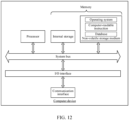
- a computer device may be a server. An internal structure diagram of the server may be shown in FIG. 12 .
- the computer device includes a processor, a memory, an input/output (I/O for short) interface, and a communication interface.
- the processor, the memory, and the I/O interface are connected through a system bus, and the communication interface is connected to the system bus through the I/O interface.
- the processor of the computer device is configured to provide computing and control capabilities.
- the memory of the computer device includes a non-volatile storage medium and an internal memory.
- the nonvolatile storage medium has an operating system, a computer-readable instruction, and a database stored therein.
- the internal memory provides an environment for running of the operating system and the computer-readable instruction in the non-volatile storage medium.
- the database of the computer device is configured to store live streaming media data.
- the I/O interface of the computer device is configured to exchange information between the processor and an external device.
- the communication interface of the computer device is configured to connect to and communicate with an external terminal through a network.
- the computer-readable instruction when executed by the processor, implements a live streaming media data processing method.
- FIG. 12 is merely a block diagram of a partial structure related to the solution in the present disclosure, and does not constitute a limitation on the computer device to which the solution in the present disclosure is applied.
- the computer device may include more components or fewer components than those shown in the figure, or some merged components, or different component arrangements.
- a computer device including a memory and a processor.
- the memory has a computer-readable instruction stored therein.
- the processor when executing the computer-readable instruction, implements the operations in the foregoing method embodiments.
- a computer-readable storage medium having a computer-readable instruction stored therein, the computer-readable instruction, when executed by a processor, implementing the operations in the foregoing method embodiments.
- a computer program product including a computer-readable instruction, the computer-readable instruction, when executed by a processor, implementing the operations in the foregoing method embodiments.
- User information including but not limited to user equipment information, user personal information, and the like
- data including but not limited to data for analysis, stored data, displayed data, and the like
- the collection, use, and processing of relevant data need to comply with the relevant laws, regulations, and standards of relevant countries and regions.
- a person of ordinary skill in the art may understand that all or some of processes of the method in the foregoing embodiments may be performed by using a computer-readable instruction to instruct relevant hardware.
- the computer-readable instruction may be stored in a non-volatile computer-readable storage medium.
- the processes of the foregoing method embodiments may be included.
- Any reference to the memory, the database, or other media used in the embodiments provided in the present disclosure may include at least one of a non-volatile memory and a volatile memory.
- the non-volatile memory may include a read-only memory (ROM), a magnetic tape, a floppy disk, a flash memory, an optical memory, a high density embedded non-volatile memory, a resistive random access memory (ReRAM), a magnetoresistive RAM (MRAM), a ferroelectric RAM (FRAM), a phase change memory (PCM), a graphene memory, and the like.
- the volatile memory may include a RAM, an external cache memory, or the like.
- the RAM may have various forms, such as a static RAM (SRAM) or a dynamic RAM (DRAM).
- SRAM static RAM
- DRAM dynamic RAM
- the database involved in the embodiments provided in the present disclosure may include at least one of a relational database and a non-relational database.
- the non-relational database may include, but is not limited to, a block-chain-based distributed database.
- the processor involved in the embodiments provided in the present disclosure may be, but is not limited to, a general-purpose processor, a central processing unit, a graphics processing unit, a digital signal processor, a programmable logic device, a data processing logic device based on quantum computing, or the like.
Landscapes
- Engineering & Computer Science (AREA)
- Multimedia (AREA)
- Signal Processing (AREA)
- Databases & Information Systems (AREA)
- Computing Systems (AREA)
- Theoretical Computer Science (AREA)
- Two-Way Televisions, Distribution Of Moving Picture Or The Like (AREA)
- Compression Or Coding Systems Of Tv Signals (AREA)
Abstract
Description
- This application claims priority to
Chinese Patent Application No. 2022109045479, filed with the China National Intellectual Property Administration on July 29, 2022 - The present disclosure relates to the field of computer technologies, and in particular, to a live streaming media data processing method, system, and apparatus, a computer device, a storage medium, and a computer program product.
- With the development of computer technologies, live streaming forms are increasingly diversified. Through live video streaming, sites of contents such as product display, related conferences, background introduction, scheme evaluation, online surveys, dialogue interviews, online training, games, entertainment may be posted on the Internet. An effect of live streaming activities is enhanced by using characteristics of the Internet such as intuition, speediness, a desirable expression form, rich content, and strong interaction. With the development of audio/video technologies, an amount of data in a streaming media such as audio/video in live video streaming sharply increases, which has increasingly high requirements for computing power of real-time coding. Therefore, playing may be stalled during live video streaming, which affects live streaming.
- According to various embodiments provided in the present disclosure, a live streaming media data processing method, system, and apparatus, a computer device, a computer-readable storage medium, and a computer program product are provided.
- According to a first aspect, the present disclosure provides a live streaming media data processing method, performed by a computer device. The method includes:
- caching live streaming media source data;
- slicing, in response to a streaming media duration of the cached live streaming media source data reaching a target caching duration, the cached live streaming media source data based on a preset slicing granularity, to obtain a plurality of independently codable streaming media segments, wherein a numerical value of the target caching duration is greater than a numerical value of the preset slicing granularity;
- coding, in parallel, by using at least two coding servers, the plurality of streaming media segments obtained through the slicing, to generate respective pieces of coded video data corresponding to the at least two coding servers, a combined coding rate of the at least two coding servers being not less than a frame rate of the live streaming media source data; and
- merging the respective pieces of coded video data to obtain coded live streaming media data for transmission to a live streaming client.
- According to a second aspect, the present disclosure provides a live streaming media data processing system. The system includes: a slicing server, a merging server, and a coding server cluster including at least two coding servers;
- the slicing server being configured to cache live streaming media data, and slice, in response to a streaming media duration of the cached live streaming media data reaching a target caching duration, the cached live streaming media data based on a preset slicing granularity, to obtain a plurality of independently codable streaming media segments, wherein a numerical value of the target caching duration is greater than a numerical value of the preset slicing granularity;
- the coding server cluster being configured to code, in parallel, by using at least two coding servers, the plurality of streaming media segments obtained through the slicing, to generate respective pieces of coded video data corresponding to the at least two coding servers; and
- the merging server being configured to merge the respective pieces of coded video data to obtain coded live streaming media data for transmission to a live streaming client.
- According to a third aspect, the present disclosure further provides a live streaming media data processing apparatus. The apparatus includes:
- a live streaming slicing module, configured to cache live streaming media source data, and slice, in response to a streaming media duration of the cached live streaming media source data reaching a target caching duration, the cached live streaming media source data based on a preset slicing granularity, to obtain a plurality of independently codable streaming media segments, wherein a numerical value of the target caching duration is greater than a numerical value of the preset slicing granularity;
- a parallel segment coding module, configured to code, in parallel, by using at least two coding servers, the plurality of streaming media segments obtained through the slicing, to generate respective pieces of coded video data corresponding to the at least two coding servers, a combined coding rate of the at least two coding servers being not less than a frame rate of the live streaming media source data; and
- a coded data merging module, configured to merge the respective pieces of coded video data, to obtain coded live streaming media data for transmission to a live streaming client.
- According to a fourth aspect, the present disclosure further provides a computer device. The computer device includes a memory and a processor, the memory having a computer-readable instruction stored therein, and the processor, when executing the computer-readable instruction, implementing the operations of the foregoing live streaming media data processing method.
- According to a fifth aspect, the present disclosure further provides a computer-readable storage medium. The computer-readable storage medium has a computer-readable instruction stored thereon, the computer-readable instruction, when executed by a processor, implementing the operations of the foregoing live streaming media data processing method.
- According to a sixth aspect, the present disclosure further provides a computer program product. The computer program product includes a computer-readable instruction, the computer-readable instruction, when executed by a processor, implementing the operations of the foregoing live streaming media data processing method.
- Details of one or more embodiments of the present disclosure are provided in the following accompanying drawings and descriptions. Other features, objectives, and advantages of the present disclosure become apparent from the specification, the accompanying drawings, and the claims.
-
-
FIG. 1 is a diagram of an application environment of a live streaming media data processing method according to all embodiments. -
FIG. 2 is a schematic flowchart of a live streaming media data processing method according to all embodiments. -
FIG. 3 is a schematic flowchart of parallel coding processing according to all embodiments. -
FIG. 4 is a schematic diagram of video resolution comparison according to all embodiments. -
FIG. 5 is a schematic flowchart of audio/video processing according to all embodiments. -
FIG. 6 is a schematic flowchart of video coding processing according to all embodiments. -
FIG. 7 is a schematic diagram of partitioning of a coding tree unit (CTU) according to all embodiments. -
FIG. 8 is a schematic flowchart of a live streaming media data processing method according to all embodiments. -
FIG. 9 is a schematic diagram of an interface for ultra high definition video live streaming according to all embodiments. -
FIG. 10 is a structural block diagram of a live streaming media data processing system according to all embodiments. -
FIG. 11 is a structural block diagram of a live streaming media data processing apparatus according to all embodiments. -
FIG. 12 is an internal structure diagram of a computer device according to all embodiments. - To make objectives, technical solutions, and advantages of the present disclosure clearer, the present disclosure is further described in detail below with reference to accompanying drawings and embodiments. The specific embodiments described herein are merely intended to explain the present disclosure, but are not intended to limit the present disclosure.
- Embodiments of the present disclosure may be applied to various scenarios, including but not limited to cloud technology, artificial intelligence, intelligent transportation, assisted driving, and the like. Specifically, a live streaming media data processing method provided in all embodiments (including the embodiments of both the claims and the specification (herein sometimes referred to as "all embodiments") of the present disclosure may be applied to an application environment shown in
FIG. 1 . A terminal includes afirst terminal 1021 and asecond terminal 1022. Thefirst terminal 1021 communicates with a slicing server 104 through a network, thesecond terminal 1022 communicates with a merging server 108 through the network, and acoding server 106 respectively communicates with the slicing server 104 and the merging server 108 through the network. A data storage system may store data to be processed in a corresponding server. The data storage system may be integrated on the corresponding server, or may be arranged on the cloud or another server. A live streamer may collect live streaming media data through thefirst terminal 1021, and transmits the collected live streaming media data to the slicing server 104. The slicing server 104 caches live streaming media source data transmitted by thefirst terminal 1021. When a streaming media duration of the cached live streaming media source data reaches a target caching duration, slicing of the cached live streaming media source data based on a preset slicing granularity is triggered to obtain a plurality of independently codable streaming media segments, and the plurality of streaming media segments are transmitted to at least twocoding servers 106. At least twocoding servers 106 whose overall coding rate is not less than a frame rate of the live streaming media source data perform parallel coding on the streaming media segments obtained through the slicing, and transmit the obtained respective pieces of coded video data of the coding servers to the merging server 108. The merging server 108 merges the respective pieces of coded video data of the coding servers to obtain coded live streaming media data for transmission to a live streaming client. The merging server 108 may transmit the merged coded live streaming media data to eachsecond terminal 1022, so that thesecond terminal 1022 decodes the coded live streaming media data for playing. An audience user may watch live video streaming through thesecond terminal 1022. - The terminal including the
first terminal 1021 and the second terminal 1022 may be, but is not limited to, various desktop computers, notebook computers, smartphones, tablet computers, Internet of Things devices, and portable wearable devices. An Internet of Thing device may be a smart speaker, a smart television, a smart air conditioner, a smart onboard device, or the like. The portable wearable device may be a smartwatch, a smart bracelet, a head-mounted device, and the like. Each of the servers such as the slicing server 104, thecoding server 106, and the merging server 108 may be an independent physical server, or may be a server cluster formed by a plurality of physical servers or a distributed system, and may further be a cloud server providing basic cloud computing services such as cloud service, a cloud database, cloud computing, a cloud function, cloud storage, a network service, cloud communication, a middleware service, a domain name service, a security service, a CDN, and a big data and artificial intelligence platform. The terminal and the server may be directly or indirectly connected through wired or wireless communication, which is not limited herein in the present disclosure. - In all embodiments, as shown in
FIG. 2 , a live streaming media data processing method is provided. The method is performed by a computer device. In the embodiments, an example in which the method is applied to the various servers inFIG. 1 is used for description. The method includes the following operations. - Operation 202: Cache live streaming media source data, and slice, in response to a streaming media duration of the cached live streaming media source data reaching a target caching duration, the cached live streaming media source data based on a preset slicing granularity, to obtain a plurality of independently codable streaming media segments, a numerical value of the target caching duration being greater than a numerical value of the preset slicing granularity.
- A streaming media technology is a technology of compressing a series of media data and transmitting the data in segments in a streaming manner, to implement real-time transmission of audio/video on a network for viewing. Live streaming media is streaming media generated during live video streaming, and the live streaming media source data is original streaming media data directly generated by a live streamer terminal during live streaming. The streaming media duration is a cumulative duration of the cached live streaming media source data during caching of the live streaming media source data. The target caching duration is a preset caching duration that needs to be achieved. The target caching duration may be set based on an actual requirement, to ensure that parallel coding can be performed through a plurality of coding servers. A slicing granularity is a duration of a single slice during slicing of the live streaming media source data. The target caching duration is positively correlated with the preset slicing granularity. To be specific, a finer preset slicing granularity indicates a larger numerical value of the target caching duration. To be specific, more live streaming media source data needs to be cached before slicing is triggered. Therefore, the numerical value of the target caching duration is greater than the numerical value of the preset slicing granularity. The streaming media segment is an independently codable slice segment obtained after the live streaming media source data is sliced. Each streaming media segment is an independently codable segment, which can avoid cross influence between different streaming media segments, thereby ensuring that the merged coded video data can be played smoothly and clearly.
- Specifically, when a live streamer triggers live video streaming, a server may cache live streaming media source data generated by the live streamer terminal. The server collects statistics about the streaming media duration of the cached live streaming media source data. When the streaming media duration reaches the preset target caching duration, it indicates that the server has cached a sufficient amount of live streaming media source data, and a plurality of coding servers may be allowed to perform parallel coding. The server slices the cached live streaming media source data based on the preset slicing granularity, which may specifically perform slicing at an equal duration based on the preset slicing granularity, to obtain a plurality of independently codable streaming media segments with a same duration. The target caching duration is positively correlated with the preset slicing granularity. The slicing granularity may be set based on an actual requirement, for example, may be 0.5 seconds, 1 second, or 2 seconds. Based on the set slicing granularity, the corresponding target caching duration may be set, so that the target caching duration is positively correlated with the preset slicing granularity. For example, when the preset slicing granularity is 1 second, the target caching duration may be set to 12 seconds, and when the preset slicing granularity is 0.5 seconds, the target caching duration may be set to 6 seconds. The numerical value of the target caching duration is greater than the numerical value of the preset slicing granularity, which may be specifically an integer multiple of the numerical value of the preset slicing granularity. A specific multiple relationship may be determined based on a quantity of coding servers that participate in parallel coding. For example, if K coding servers are arranged, to satisfy parallel coding by the K coding servers, a streaming media duration that needs to be cached is at least K times the preset slicing granularity, thereby ensuring that at least one piece of streaming media data at a preset slicing granularity can be allocated to each of the K coding servers for coding, thereby implementing parallel coding by the K coding servers.
- Operation 204: code, in parallel, by using at least two coding servers, the plurality of streaming media segments obtained through the slicing, to generate respective pieces of coded video data corresponding to the coding servers, a combined coding rate of the at least two coding servers being not less than a frame rate of the live streaming media source data.
- The coding server is a server configured to perform video coding processing. At least two coding servers are arranged, so that parallel coding may be performed by using the at least two coding servers. During the parallel coding, each coding server may code the streaming media segment allocated thereto. For example, if 12 streaming media segments are obtained, and a slicing granularity of each streaming media segment is 1 second, i.e., a duration of each streaming media segment is 1 second, the streaming media segments may be respectively coded by using 12 coding servers, so that the 12 coding servers simultaneously code the 12 streaming media segments obtained through the slicing, to obtain the respective pieces of coded video data of the 12 streaming media segments, each corresponding to one of the 12 coding servers. The coded video data is a video coding result obtained by coding the streaming media segment by the coding server. The streaming media segment may be compressed through coding, to reduce a data volume of the streaming media segment and obtain coded video data that is convenient for transmission and storage. The overall coding rate is a coding rate of the coding servers as a whole during parallel coding. The frame rate of the live streaming media source data is a quantity of pictures generated by the live streaming media source data per unit time.
- Specifically, parallel coding is performed, by using the at least two coding servers, on the streaming media segments obtained through the slicing, and each of the coding servers obtains a respective piece of coded video data corresponding to one of the plurality of streaming media segments. The quantity of the coding servers matches a quantity of the streaming media segments obtained through the slicing. In a specific application, the quantity of the coding servers that trigger parallel coding per unit time is the same as the quantity of the streaming media segments sliced per unit time. Therefore, parallel coding may be performed on each streaming media segment sliced per unit time by using different coding servers, which can improve coding efficiency. The overall coding rate of the at least two coding servers that perform parallel coding is not less than the frame rate of the live streaming media source data, so that the overall coding rate of parallel coding can match the frame rate of the live streaming media source data, which avoids stuttering as a result of the coding efficiency problem during live streaming, and ensures smooth playing of live streaming media, thereby ensuring live streaming.
- Operation 206: Merge the respective pieces of coded video data to obtain coded live streaming media data for transmission to a live streaming client.
- The coded live streaming media data is a coding and merging result obtained by merging the respective pieces of coded video data obtained by the coding servers. The coded live streaming media data is configured for transmission to the live streaming client to be played in the live streaming client. Specifically, the server may merge the respective pieces of coded video data of the coding servers to obtain the coded live streaming media data transmitted to the live streaming client, thereby implementing coding of the live streaming media data. In a specific application, the merging of the respective pieces of coded video data of the coding servers and the slicing of the cached live streaming media source data based on the preset slicing granularity may be performed by the same server or different servers. For example, the slicing of the cached live streaming media source data based on the preset slicing granularity may be performed by the slicing server, parallel coding of the streaming media segments obtained through the slicing may be performed by a plurality of coding servers, and the merging of the respective pieces of coded video data of the coding servers may be performed by the merging server. The slicing server and the merging server may be arranged as the same server, or may be different servers arranged separately.
- According to the live streaming media data processing method, when the streaming media duration of the cached live streaming media source data reaches the target caching duration, slicing of the cached live streaming media source data is triggered based on the preset slicing granularity, to obtain the plurality of independently codable streaming media segments. By using the at least two coding servers whose overall coding rate is not less than the frame rate of the live streaming media source data, parallel coding is performed on the streaming media segments obtained through the slicing, and the obtained respective pieces of coded video data corresponding to the coding servers is merged to obtain the coded live streaming media data for transmission to the live streaming client. During processing of the live streaming media data, if the streaming media duration of the cached live streaming media source data reaches the target caching duration, and the overall coding rate of the at least two coding servers is not less than the frame rate of the live streaming media source data, it can be ensured that processing efficiency of parallel coding performed on the streaming media segments obtained through the slicing by using the at least two coding servers matches the frame rate of the live streaming media source data, which avoids stuttering as a result of the coding efficiency problem during live streaming, thereby ensuring live streaming.
- In all embodiments, the preset slicing granularity includes an integer multiple of a granularity of a preset group of pictures (GOP). The slicing, in response to a streaming media duration of the cached live streaming media source data reaching a target caching duration, the cached live streaming media source data based on a preset slicing granularity, to obtain a plurality of independently codable streaming media segments includes: measuring the streaming media duration of the cached live streaming media source data; slicing, when the streaming media duration reaches a preset target caching duration, the cached live streaming media source data based on the integer multiple of the granularity of the preset GOPs, to obtain the plurality of independently codable streaming media segments.
- The preset slicing granularity includes (e.g., is) the integer multiple of the granularity of the preset GOP. A GOP is an interval between two intra-coded image frames during video coding. The intra-coded image frame is an image frame that can be coded only by using information of a current frame without referring to another image frame. The preset slicing granularity is the integer multiple of the granularity of the preset GOP, which can ensure that the streaming media segments sliced based on the preset slicing granularity are all independently codable slice segments.
- Specifically, when the server caches the live streaming media source data, the streaming media duration of the cached live streaming media source data may be measured, and it indicates that the current cached live streaming media source data has been able to support a plurality of coding servers for parallel coding when the streaming media duration reaches the preset target caching duration. The server slices the cached live streaming media source data based on the integer multiple of the granularity of the preset GOP, to obtain the plurality of independently codable streaming media segments. During the coding, each GOP may be independently coded. The live streaming media source data is sliced based on the integer multiple of the granularity of the GOP, which may ensure that the plurality of streaming media segments obtained through the slicing are independently codable, which is beneficial to ensure a playing effect of the coded live streaming media data.
- In the embodiments, the server slices the cached live streaming media source data based on the integer multiple of the granularity of the preset GOP, which can ensure that the plurality of streaming media segments obtained through the slicing are independently codable segments, so that coding and decoding of the streaming media segments are effectively isolated, which is beneficial to ensure the playing effect of the coded live streaming media data.
- In all embodiments, the slicing the cached live streaming media source data based on the integer multiple of the granularity of the preset GOP, to obtain the plurality of independently codable streaming media segments includes: slicing the cached live streaming media source data at an equal granularity based on the integer multiple of the granularity of the preset GOP, to obtain a plurality of pieces of independently codable live streaming media slice data with a same duration; and respectively packaging the plurality of pieces of live streaming media slice data based on a target packaging format, to obtain a plurality of streaming media segments in the target container format.
- Slicing at an equal granularity means that segments are sliced at the same granularity. For example, the granularity is 1 second or 0.5 seconds. The live streaming media slice data is slice segments obtained by slicing the cached live streaming media source data at an equal granularity. Each live streaming media slice data is obtained through slicing at an equal granularity. To be specific, each live streaming media slice data has the same duration. Each live streaming media slice data is obtained through slicing based on the integer multiple of the granularity of the preset GOP. To be specific, each live streaming media slice data is an independently codable slice segment. A container format is also referred to as a container, which means putting a coded and compressed video track and audio track into a file in a specific format. As a container for a coded video, the container format may include a head/tail identifier and video description information to identify a video included in the container format. The container format may include various formats such as avi, flv, MP4, rmvb, mkv, or ts. The target packaging format is a preset packaging format.
- Specifically, the server slices the cached live streaming media source data at an equal granularity based on the integer multiple of the granularity of the preset GOP, to obtain the plurality of independently codable streaming media slice data. Each live streaming media slice data has the same duration. The server queries for a preset target packaging format, and respectively packages the plurality of pieces of live streaming media slice data separately based on the target packaging format, to obtain a plurality of streaming media segments in the target packaging format. The server re-packages the live streaming media slice data obtained through slicing in the target packaging format, to obtain a plurality of streaming media segments in a packaging format that is the target packaging format, for example, a plurality of streaming media segments in a packaging format that is the ts format.
- In the embodiments, the server slices the cached live streaming media source data at an equal granularity based on the integer multiple of the granularity of the preset GOP, which can ensure that the plurality of independently codable streaming media segments obtained through the slicing are segments with the same duration, and the live streaming media slice data obtained through slicing is packaged into the plurality of streaming media segments in the target packaging format, so that coding and decoding of the streaming media segments are effectively isolated, which is beneficial to ensure the playing effect of the coded live streaming media data.
- In all embodiments, a target quantity of streaming media segments are provided. The coding, in parallel, by using at least two coding servers, the plurality of streaming media segments obtained through the slicing, to generate respective pieces of coded video data corresponding to the coding servers includes: coding in parallel, by using at least the target quantity of coding servers, the plurality of streaming media segments obtained through the slicing, to generate the respective pieces of coded video data each corresponding to one of the at least the target quantity of coding servers, an overall coding rate (a combined coding rate) of the at least the target quantity of coding servers being not less than a frame rate of the live streaming media source data.
- The target quantity of streaming media segments are provided. To be specific, the target quantity of streaming media segments are obtained through slicing. The target quantity is positively correlated with the frame rate of the live streaming media source data, and is negatively correlated with an independent coding rate of the coding server. To be specific, a higher frame rate of the live streaming media source data indicates a larger target quantity, and a higher independent coding rate of the coding server indicates a smaller target quantity. The independent coding rate is a coding rate when a single coding server performs coding independently. When the target caching duration is fixed, an overall duration of a plurality of partitioned streaming media segments is fixed. If an overall coding rate of a plurality of coding servers is obtained by summing respective independent coding rates of the coding servers, higher respective independent coding rates of the coding servers lead to fewer coding servers (i.e., fewer streaming media segments to be partitioned) that may be used for implementing parallel coding in a case that the same overall coding rate is ensured. In addition, a higher frame rate of live streaming media source data indicates a larger amount of streaming media source data that needs to be processed per unit time to ensure live streaming, and indicates a higher overall coding rate of the plurality of coding servers that is required. In a case that the respective independent coding rates of the coding servers are fixed, more coding servers are required for parallel coding, i.e., a larger quantity of streaming media segments need to be partitioned.
- Specifically, when the parallel coding is performed by using the plurality of coding servers, parallel coding is performed, by using at least the target quantity of coding servers, on the streaming media segments obtained through the slicing, to generate the respective pieces of coded video data of the coding servers. To be specific, a quantity of coding servers is not less than a quantity of streaming media segments. Each streaming media segment may correspond to one coding server, so that parallel coding is performed on the streaming media segments by using the at least the target quantity of coding servers. The overall coding rate of the at least the target quantity of coding servers is not less than the frame rate of the live streaming media source data. To be specific, the overall coding rate of the plurality of coding servers is higher than or equal to the frame rate of the live streaming media source data. In this way, the coding efficiency for the live streaming media source data can match the frame rate, and stuttering as a result of the coding efficiency problem may be avoided, thereby ensuring live streaming.
- In the embodiments, by using at least the target quantity of coding servers whose overall coding rate is not less than the frame rate of the live streaming media source data, parallel encoding is performed on the streaming media segments obtained through the slicing, to generate the respective pieces of coded video data of the coding servers. In this way, the coding efficiency for the live streaming media source data can match the frame rate, the stuttering as a result of the coding efficiency problem may be avoided, and a delay is reduced, thereby ensuring live streaming.
- In all embodiments, the plurality of streaming media segments are in a target packaging format. As shown in
FIG. 3 , the performing, by using at least two coding servers, parallel coding on the streaming media segments obtained through the slicing, to generate respective pieces of coded video data of the coding servers includes the following operations: - Operation 302: Perform, by using at least two coding servers, parallel unpackaging and decoding on the plurality of streaming media segments in the target packaging format that are obtained through the slicing, to obtain pieces of streaming media data.
- The plurality of streaming media segments are in the target packaging format. To be specific, the plurality of streaming media segments are individually packaged into the target packaging format. Unpackaging refers to removal of a packaging format to obtain coded video data. Decoding means decoding and restoring the coded video data to video data. Specifically, parallel unpackaging and decoding are performed, by using the at least two coding servers, on the streaming media segments in the target packaging format that are obtained through the slicing, and each coding server performs unpackaging and decoding on the plurality of streaming media segments allocated to the coding server, to obtain the pieces of streaming media data each corresponding to one of the plurality of streaming media segments. The streaming media data is sliced data that is not coded or packaged.
- Operation 304: Perform parallel coding on the respective pieces of streaming media data by using the at least two coding servers, to obtain respective coded segments of the at least two coding servers.
- Specifically, parallel coding is performed on the respective pieces of streaming media data by using the coding servers. Specifically, the parallel coding may be performed by using a preset coding algorithm such as the H.265 coding algorithm, to obtain the respective coded segments of the coding servers. The coded segment is a coding result segment obtained after video coding is performed on the streaming media data.
- Operation 306: Perform parallel packaging on the respective coded segments based on the target packaging format by using the coding servers, to obtain the respective pieces of coded video data of the coding servers.
- Specifically, parallel packaging is performed on the obtained respective coded segments based on the target packaging format by using the coding servers, i.e., the coded segments are packaged again based on the target packaging format, to obtain the respective pieces of coded video data of the coding servers. The coded video data and the streaming media segment are both in the target packaging format.
- In the embodiments, the streaming media segments in the target packaging format are unpackaged and decoded and then coded by the coding server, and the coded segments obtained through coding are packaged into the target packaging format again, to obtain the coded video data in the target packaging format. Through packaging the coded video data into the same target packaging format as the streaming media segments, it is convenient to manage the coded video data, thereby facilitating improvement of processing efficiency of the live streaming media data.
- In all embodiments, the live streaming media data processing method further includes: obtaining the preset slicing granularity configured for processing of the live streaming media source data; determining a live streaming processing delay based on the preset slicing granularity, the frame rate of the live streaming media source data, and independent coding rates of the at least two coding servers; and determining the target caching duration based on the live streaming processing delay, the target caching duration being not less than the live streaming processing delay.
- The preset slicing granularity may be preset before the live streaming media source data is processed, for example, preset to 1 second or 0.5 seconds or another slicing granularity. The live streaming processing delay is a live streaming delay caused through processing of the live streaming media data. For example, a frame rate of the live streaming media source data is 60 frames per second (FPS, a refresh rate), and the independent coding rate of the coding server is 5 FPS. If the preset slicing granularity is 1 second, the live streaming processing delay may be 60* 1/5 = 12 seconds. FPS is a definition in the field of images, and is a quantity of frames of pictures transmitted per second. Generally speaking, FPS is a quantity of pictures in an animation or a video transmitted or played per second. FPS is a measure of an amount of information for storing and displaying dynamic videos. A larger quantity of frames per second leads to smooth actions to be displayed. The live streaming processing delay is positively correlated with the preset slicing granularity and the frame rate of the live streaming media source data, and the live streaming processing delay is negatively correlated with the independent coding rates of the coding servers. To be specific, a larger preset slicing granularity or a higher frame rate of the live streaming media source data indicates a longer live streaming processing delay. A higher independent coding rate of the coding server indicates a shorter live streaming processing delay.
- Specifically, the live streaming processing delay is calculated based on the preset slicing granularity, the frame rate of the live streaming media source data, and the independent coding rates of the coding servers. A duration for processing the streaming media segments during parallel coding by the coding servers may be determined based on the preset slicing granularity. A frame rate of a coding output may be determined based on the frame rate of the live streaming media source data. The overall coding rate may be determined based on the respective independent coding rates of the coding servers. When other parameters are fixed, a larger preset slicing granularity indicates a larger amount of data that needs to be processed during parallel coding by the coding servers, and a longer live streaming processing delay. A higher frame rate of the live streaming media source data indicates a larger amount of data that needs to be coded per unit time, and a longer corresponding coding time, i.e., a longer live streaming processing delay. Higher respective independent coding rates of the coding servers indicate a higher overall coding rate of the plurality of coding servers, and a shorter time required for processing the same amount of data, i.e., a shorter live streaming processing delay.
- Specifically, the server may obtain the preset slicing granularity configured for processing the live streaming media source data, which may be flexibly configured based on an actual requirement. A larger preset slicing granularity indicates a longer duration of the streaming media segment obtained through slicing. The server determines the frame rate of the live streaming media source data, and the independent coding rate of the coding server, and calculates the live streaming processing delay based on the preset slicing granularity, the frame rate, and the independent coding rate. In a specific implementation, the live streaming processing delay may be calculated by using a formula of the live streaming processing delay = the preset slicing granularity*the frame rate/the independent coding rate. The live streaming processing delay is positively correlated with the preset slicing granularity and the frame rate of the live streaming media source data, and the live streaming processing delay is negatively correlated with the independent coding rate of the coding server. To be specific, when the frame rate of the live streaming media source data is certain, the live streaming processing delay may be reduced by increasing the independent coding rate of the coding server or reducing the preset slicing granularity. The server determines the target caching duration based on the live streaming processing delay, so that the target caching duration is not less than the live streaming processing delay, thereby ensuring that the cached live streaming media source data can cover the live streaming processing delay and preventing stuttering during live streaming video playing. For example, when the live streaming processing delay is 12 seconds, the target caching duration set by the server may be greater than or equal to 12 seconds.
- In the embodiments, the server determines the live streaming processing delay based on the preset slicing granularity, the frame rate of the live streaming media source data, and the independent coding rate of the coding server, and determines the target caching duration based on the live streaming processing delay, so that the target caching duration is not less than the live streaming processing delay. In this way, it can be ensured that the cached live streaming media source data can cover the live streaming processing delay, stuttering during live streaming video playing can be prevented, a delay of transmission of the streaming media data during live streaming can be reduced, thereby ensuring live streaming.
- In all embodiments, the merging the respective pieces of coded video data of the at least two coding servers to obtain coded live streaming media data includes: merging the respective pieces of coded video data of the coding servers based on a timestamp sequence of the respective pieces of coded video data, to obtain merged coded data; and converting a packaging format of the merged coded data, to obtain coded live streaming media data that is consistent with a packaging format suitable for live streaming transmission.
- The timestamp sequence is a sequence of generation times of pieces of coded live streaming media data corresponding to the respective pieces of coded video data. The merged coded data is merged data obtained by merging the respective pieces of coded video data. The live streaming transmission packaging format is a packaging format for transmission of the live streaming media. For example, the packaging format may be HTTP live streaming (HLS) and dynamic adaptive streaming over HTTP (DASH). HLS is a dynamic adaptive bitrate technology, and an HLS file includes an M3U8 index file, a TS media part file, and a key encrypted string file. DASH is HTTP-based dynamic adaptive streaming. Similar to the HLS protocol, DASH enables high-quality streaming media to perform transmission through the HTTP protocol by using an adaptive bitrate streaming technology.
- Specifically, the server may determine the timestamp sequence of the respective pieces of coded video data of the coding servers, and merge the respective pieces of coded video data in sequence based on the timestamp sequence, to obtain merged coded data. The timestamp of a piece of coded video data in the timestamp sequence may be a timestamp of the first frame in the first group of pictures of a piece of coded live streaming media data corresponding to the piece of coded video data. The timestamp of a piece of coded video data may also be included in a streaming media segment corresponding to the piece of coded video data.
- The server performs packaging format conversion on the merged coded data, to obtain the coded live streaming media data that is consistent with the live streaming transmission packaging format. The coded live streaming media data is consistent with the live streaming transmission packaging format, so that the coded live streaming media data can be effectively transmitted to the live streaming client for playing.
- Further, the live streaming media data processing method further includes: transmitting the coded live streaming media data to a live streaming client through a content delivery network (CDN) to be played on the live streaming client.
- The CDN is a new network content service system, which is constructed based on the Internet Protocol (IP) network and provides content distribution and services based on efficiency requirements, quality requirements, and a content order of content access and application. The CDN represents a high-quality and efficient network application service mode with a distinct network order that is constructed based on the network. Specifically, the server transmits the coded live streaming media data to the live streaming client through the CDN, to play the coded live streaming data in real time on the live streaming client.
- In the embodiments, the server performs packaging format conversion on the merged coded data, to obtain the coded live streaming media data that is consistent with the live streaming transmission packaging format, and transmits the coded live streaming media data to the live streaming client through the CDN for playing, which may ensure real-time playing of the live streaming media.
- In all embodiments, the live streaming media data processing method further includes: determining a maximum overall coding rate of at least two coding servers; and adjusting a quantity of the at least two coding servers when it is determined that the maximum overall coding rate does not match a numerical value of the frame rate of the live streaming media source data, so that the maximum overall coding rate of the at least two coding servers after adjustment matches the numerical value of the frame rate of the live streaming media source data.
- The maximum overall coding rate refers to a maximum coding rate that the at least two coding servers can achieve during parallel coding. The maximum overall coding rate is related to computing performance of the coding servers, and is also related to resource occupation states of the coding servers. To be specific, the maximum overall coding rate may be a real-time overall coding rate of the at least two coding servers. The coding servers in different resource occupation states may correspond to different maximum overall coding rates.
- Specifically, the server may determine the maximum overall coding rate of the at least two coding servers, which may be specifically determined based on the independent coding rates of the at least two coding servers, and may also determine the maximum overall coding rate based on the resource occupancy states of the at least two coding servers. The server compares the maximum overall coding rate with the frame rate of the live streaming media source data. If it is determined that the maximum overall coding rate does not match the frame rate of the live streaming media source data, for example, if it is determined that a numerical value of the maximum overall coding rate is less than the numerical value of the frame rate of the live streaming media source data, the server may adjust the quantity of coding servers, for example, may increase the quantity of coding servers, so that the maximum overall coding rate of the coding servers after adjustment matches the frame rate of the live streaming media source data. In this way, real-time processing on the live streaming media source data can be implemented. In a specific application, if the server determines that the maximum overall coding rate is less than the frame rate of the live streaming media source data, the server may increase the quantity of coding servers to increase the maximum overall coding rate, thereby ensuring live streaming. If the maximum overall coding rate is greater than the frame rate of the live streaming media source data, the server may decrease the quantity of coding servers, to reduce the maximum overall coding rate and save operation resources.
- In the embodiments, when the maximum overall coding rate of the at least two coding servers does not match the frame rate of the live streaming media source data, the server may enable the maximum overall coding rate to match the frame rate of the live streaming media source data by adjusting the quantity of coding servers. In this way, the live streaming can be ensured, and the operation resources can be saved.
- In all embodiments, the at least two coding servers respectively perform, by using coding operations, parallel coding on the streaming media segments obtained through the slicing. The coding operations include: dividing video frames of the streaming media segments to obtain respective coding units (CUs) of the video frames; predicting the respective CUs of the video frames to obtain predicted values, and obtaining respective pieces of residual data of the CUs based on obtained predicted values; and coding the respective pieces of residual data of the video frames, to obtain coded video data of the streaming media segments.
- During parallel coding on the streaming media segments obtained through the slicing by using at least two coding servers, the coding servers respectively perform coding on the respective streaming media segments through the coding operations. The CU is a basic unit that performs predictive coding. The residual data may be obtained based on a difference between the CU and a corresponding predicted value thereof.
- Specifically, the coding server may partition the video frames in the streaming media segments to obtain the respective CUs of the video frames. Each video frame in the streaming media segment may be partitioned into a plurality of CUs. The coding server predicts the respective CUs of the video frames, and may specifically perform prediction based on prediction units (PUs) in the CUs, to obtain the predicted values corresponding to the CUs. The coding server obtains pieces of residual data of the CUs based on the obtained predicted values. Specifically, the coding server may determine the difference between the CU and the corresponding predicted value thereof, and obtain the pieces of residual data based on the difference. The coding server may code the respective pieces of residual data of the video frames, to obtain the coded video data of the streaming media segments.
- In the embodiments, the coding server partitions the video frames in the streaming media segments into the CUs, and determines the pieces of residual data of the CUs based on the predicted values obtained by predicting the CUs. The residual data is coded to obtain the coded video data of the streaming media segments. In this way, coding is performed based on the difference between the video frames to implement compression of the video frames, thereby reducing a data volume of the coded video data.
- In all embodiments, the CU includes the PU. The predicting the respective CUs of the video frames, and obtaining pieces of residual data of the CUs based on obtained predicted values includes: predicting the respective PUs of the video frames based on a target prediction mode, to obtain pieces of predicted data, the target prediction mode being determined from an intra-frame prediction mode and an inter-frame prediction mode; determining original residuals of the CUs based on the pieces of predicted data predicted for the PUs and the PUs; and performing data transformation on the original residuals of the CUs, to obtain the pieces of residual data of the CUs.
- The CU includes the PU. The PU specifies all prediction modes of the CU. Prediction-related information is defined in the PU. Specifically, for example, a direction of the intra-frame prediction, a segmentation manner of the inter-frame prediction, motion vector prediction, and a reference image index number for inter-frame prediction all fall within a category of the PU. The target prediction mode is a prediction manner in which the PU performs prediction, and the target prediction mode is determined from the intra-frame prediction and the inter-frame prediction. The intra-frame prediction is a prediction mode in which a current coding block is predicted by using surrounding reconstructed pixel values through a spatial correlation of an image. The inter-frame prediction is a prediction mode in which temporal redundancy of video information is eliminated through coding methods of motion estimation (ME) and motion compensation (MC) by using a correlation between consecutive images, to perform prediction by using a previously coded reconstructed frame as a reference frame. The predicted data is a prediction result obtained by predicting the PU. The original residual is an original difference between the predicted data and the PU. Through data transformation on the original residual, for example, discrete cosine transform (DCT) and quantization processing, the residual data is obtained.
- Specifically, the coding server determines the PU in the CU, and predicts the respective PUs of the video frames based on the target prediction mode to obtain the pieces of predicted data. Specifically, the PU may be predicted based on the intra-frame prediction or the inter-frame prediction, to obtain the predicted data. The coding server may determine the original residuals of the CUs based on the pieces of predicted data and the PUs. For example, the coding server may determine the differences between the pieces of predicted data and the PUs, and obtain the original residuals of the CUs based on the difference. The coding server performs data transformation on the original residuals of the CUs, for example, performs DCT and quantization processing, to obtain the pieces of residual data of the CUs. Coding is performed based on the pieces of residual data to obtain the coded video data of the streaming media segments, thereby implementing coding of the streaming media segments.
- In the embodiments, the coding server performs prediction based on the intra-frame prediction or the inter-frame prediction through the PU in the CU, and determines the original residuals of the CUs based on the obtained pieces of predicted data and the PUs. The coding server performs data transformation on the original residuals of the CUs, to obtain the pieces of residual data of the CUs, so that coding may be performed based on the pieces of residual data of the CUs to implement compression on the video frames, thereby reducing the data volume of the coded video data.
- The present disclosure further provides an application scenario. The foregoing live streaming media data processing method is applied to the application scenario. Specifically, application of the live streaming media data processing method in the application scenario is as follows:
- A live streamer performs live video streaming through a terminal. The terminal transmits collected live streaming media source data to a live streaming server. The live streaming server caches the live streaming media source data, and slices the cached live streaming media source data based on a preset slicing granularity in response to a streaming media duration of the cached live streaming media source data reaching a target caching duration, to obtain a plurality of independently codable streaming media segments. The target caching duration is positively correlated with the preset slicing granularity. The live streaming server transmits the plurality of streaming media segments to a coding server cluster, to code, in parallel, by using at least two coding servers in the coding server cluster, the plurality of streaming media segments obtained through the slicing to generate respective pieces of coded video data corresponding to the coding servers. An overall coding rate (a combined coding rate) of the at least two coding servers is not less than a frame rate of the live streaming media source data. The coding servers in the coding server cluster respectively transmit the respective pieces of coded video data obtained through coding to the live streaming server. The live streaming server merges the respective pieces of coded video data of the coding servers to obtain coded live streaming media data, and transmits the coded live streaming media data to a live streaming client to be played on the live streaming client.
- The present disclosure further provides an application scenario. The foregoing live streaming media data processing method is applied to the application scenario. Specifically, application of the live streaming media data processing method in the application scenario is as follows:
- In the embodiments, live streaming media data includes audio/video data during live streaming. A video is a main carrier for information presentation and dissemination. It is predicted that in the future, at least 80% of network traffic of an individual consumer and at least 70% of industry application traffic are all video data. Currently, a video technology is undergoing an evolution from high definition (HD) (1080P) to ultra high definition (UHD). Picture resolutions of 4K (4096×2160 pixels) UHD and 8K (7680×4320 pixels) UHD are respectively 4 times and 16 times that of HD. The UHD video industry is a related economic activity focusing on collection, production, transmission, and presentation of UHD videos. The development of the UHD video industry is to effectively drive replacement and upgrading of terminal products and update of production and broadcast devices, drive development of industries such as upstream chips and panels, and promote broadband network investment and construction, commercial use of the 5th generation mobile communication technology (5G) network, and service development. Based on the standards of the international telecommunication union (ITU), the UHD videos include two specifications: 4K and 8K, which support a total of 9 frame rates: 23.976 fps, 24 fps, 25 fps, 29.97 fps, 30 fps, 50 fps, 59.94 fps, 60 fps, and 120 fps. Real-time coding of UHD videos (4K/8K/16K (15360×8640 pixels)) is always a pain point in the industry. Resolution pixels of 4K and 8K UHD videos are respectively 4 times and 16 times that of 1080P, and the 4K/8K FPS is substantially 60 FPS+, therefore resulting in coding computing power that is dozens of times relative to 1080P. Currently, in the video industry, 1080P is commonly used, and only a small number of long videos support 4K video sources. However, all of the videos adopt offline long video coding. In the live streaming industry, 4K/8K live streaming is hardly seen, and is occasionally implemented through specialized coding devices. However, specialized 8K coding devices for 8K channels cost a lot. Computing power requirements for real-time coding of the UHD videos and high costs of professional devices hinder the development of the UHD live streaming industry.
- Based on this, according to the live streaming media data processing method provided in the embodiments, high-FPS (>=60) coding may be performed for
live streaming UHD 4K/8K/16K videos by using a distributed general-purpose cloud virtual machine (CVM) architecture, to realize low-cost high-quality coding for live streaming UHD videos, which facilitates promotion of industry development, and has a good application prospect in the closed circuit television (CCTV) and over the top (OTT) industries. - Specifically, regarding the definition of the UHD video by the ITU, the definition of the UHD video comes from video picture resolutions of 4K and above. However, merely increasing the resolution cannot fully reflect improvement of visual effects. It is necessary to simultaneously break through technologies in six dimensions of high resolution, high frame rate, high color depth, wide color gamut, high dynamic range, and three-dimensional sound, to bring a subversive, more infectious, and immersive presence experience. As shown in
FIG. 4 , during comparison of video resolutions, the video resolution of HD is 1280*720 pixels, the video resolution of full HD is 1920*1080 pixels, the video resolution of quad HD is 256*1440 pixels, the video resolution of 4K UHD is 3840*2160 pixels, the video resolution of 5K UHD+ is 5120*2880 pixels, and the video resolution of 8K UHD is 7680*4320 pixels. Based on the standards of the ITU, the UHD video includes two specifications: 4K and 8K. 4K refers to 4K UHD (UHD4K) with a horizontal resolution of 3840, a vertical resolution of 2160, an aspect ratio of 16:9, and a total quantity of pixels of about 8.3 million. 8K refers to 8K UHD (UHD8K) with a horizontal resolution of 7680, a vertical resolution of 4320, an aspect ratio of 16:9, and a total quantity of pixels of about 33.2 million. In addition, 16K UHD (15360x8640, 130 million pixels) is also applied and explored in some metaverse virtual reality (VR) scenarios, and the latest video coding standards AV2 and VVC may also support 16K coding. In the ITU specification, the UHD video supports a total of 9 frame rates: 23.976 fps, 24 fps, 25 fps, 29.97 fps, 30 fps, 50 fps, 59.94 fps, 60 fps, and 120 fps. With the huge improvement in the network bandwidth and the coding computing power, an interlaced-scan field coding manner has been removed from the ITU standard, and only a progressive-scan frame coding manner is retained. In terms of color depth, the ITU increases original 8 bits to 10 bits and 12 bits. The specification of 10 bits is used for 4K UHD, and the specification of 12 bits is used for 8K UHD. The foregoing improvements further improve fluency, an exquisite feeling, and color gradation of the UHD video. - Further, as shown in
FIG. 5 , in a process of processing audio/video, after the audio/video to be processed is inputted, the audio/video is unpackaged (libavformat demultiplexing (demuxing, which is an operation where demultiplexers (Demuxers) read a media file and split it into chunks of data (packets)), and the unpackaged coded data is decoded (libavcodec decoding). The decoded audio/video data may be coded (libavcodec encoding). The coding and decoding support various formats such as H.264/H.265/AV1/H.266. The coded audio/video data is packaged (libavcodec multiplexing (muxing, which is an operation where multiplexers (Muxers) take encoded data in the form of AVpackets and write it into files or other output bytestreams in the specified container format)) and then outputted, which may be specifically packaged into various packaging formats such as Mp4/MOV/T5. In addition, coding enhancement (libavfilter apply effects) may also be performed on the decoded audio/video data, and the audio/video data after the coding enhancement is successively coded and packaged, to obtain the outputted coded audio/video data. The coding enhancement may specifically include various processes such as super resolution/frame insertion, standard dynamic range (SDR)/high dynamic range (HDR), text watermarking, denoising/deburring, debouncing, color enhancement, subtitle adding, splicing, and CSS sprites. Computing power of audio/video processing is mainly embodied in a coding stage. Pixels of resolutions of 4K and 8K UHD videos are respectively 4 times and 16 times those of 1080P, and the 4K/8K FPS is substantially a high refresh rate of 60FPS+, therefore resulting in a requirement for coding computing power that is dozens of times relative to 1080P. H.265/H.266/AV1 supports 4K/8K coding, and the latest video coding standard H.266/AV2 supports 16K coding. Real-time coding of 4K/8K UHD videos is always a pain point in the industry. - Further, for video coding, H.265 is used as an example. A frame of an image is transmitted to a coder and partitioned into coding tree units (CTU) based on a block size of 64x64, and then CUs are obtained through depth partitioning. Each of the CUs includes a PU and a transform unit (TU). Each PU is predicted to obtain a predicted value. The predicted value is subtracted from inputted image data to obtain a residual, then DCT and quantization are performed to obtain a residual coefficient, and the residual coefficient is transmitted to an entropy coding module to output a bit stream. In addition, inverse quantization and inverse transformation are performed on the residual coefficient to obtain a residual value of a reconstructed image, and the residual value and the predicted value are added together to obtain the reconstructed image. The reconstructed image enters a reference frame queue after in-loop filtering, and is used as a next frame of a reference image. In this way, coding backward is performed successively. During prediction, starting from a largest CU (LCU), partitioning is performed at each layer based on a quadtree, and is continued layer by layer in a downward direction, and recursive computation is performed. First, partitioning is performed from top to bottom. A 64x64 block is first partitioned into four 32x32 sub-CUs starting from depth=0. Then one of the 32x32 sub-CUs continues to be partitioned into four 16x16 sub-CUs, and so on, until depth=3 and a size of the CU is 8x8. Then trimming is performed from bottom to top. Values of RDcost (denoted as cost1) of four 8x8 CUs are summed, and the sum is compared with those of RDcost (denoted as cost2) of the 16x16 CU at a corresponding previous level. If cost1 is less than cost2, partitioning of the 8x8 CUs is retained. Otherwise, trimming upward is continued, and comparison is performed layer by layer. Finally, an optimal depth partitioning case of the CUs is found. PU prediction is divided into intra-frame prediction and inter-frame prediction. First, in the same prediction type, different PUs are compared to find an optimal partitioning mode, and then the optimal partitioning mode is compared with intra-and inter-frame modes to find an optimal prediction mode for a current CU. In addition, adaptive transform (Residual Quad-Tree Transform, RQT) based on the quadtree is performed on the CUs to find an optimal TU mode. Finally, the frame of the image is partitioned into CUs, and PUs and TUs corresponding to the CUs, to perform prediction through the PUs. In addition, a frame of a video image may also be coded into one or more slices. Each slice includes an integer quantity of macroblocks. To be specific, each slice includes at least one macroblock, and includes macroblocks of the entire image at most. The slice is intended to limit spread and transmission of an error code, so that the coding slices remain independent of each other. A macroblock is a basic unit for coding. A coding image first needs to be partitioned into a plurality of blocks before processing. The macroblock is composed of an integer quantity of blocks.
- As shown in
FIG. 6 , when a current frame Fn is inputted for coding, prediction is performed based on the current frame Fn to obtain a predicted value, and the predicted value is subtracted from the current frame Fn to obtain a residual. Transformation and quantization are successively performed on the residual to obtain a residual coefficient, and entropy coding is performed on the residual coefficient to obtain a coding result of the current frame Fn. In addition, inverse quantization and inverse transformation are performed on the residual coefficient to obtain a residual value of a reconstructed image, and the residual value of the reconstructed image and the predicted value of the current frame Fn are added together to obtain the reconstructed image. After deblocking (DB) filtering and sample adaptive offset (SAO) filtering are performed on the reconstructed image, a reference frame F'n is obtained. The reference frame F'n serves as a next frame of a reference image. Further, during specific prediction, when inter-frame prediction is performed on the current frame Fn, ME and MC are performed based on a reference frame F'n-1, to obtain an inter-frame prediction result. During intra-frame prediction, intra-frame prediction selection is performed based on the current frame Fn, to implement intra-frame prediction and obtain an intra-frame prediction result. A predicted value of the current frame Fn is obtained through comparison of the inter-frame prediction result with the intra-frame prediction result. - Further, there are 8 partitioning modes for a PU, and 2 partitioning modes for a TU, i.e., to partition and not to partition. H.265 still uses the widely accepted hybrid coding framework (which includes four coding parts: intra-frame coding, inter-frame coding, transformation, and quantization) that has been used since H.263, for example, intra-frame prediction and inter-frame prediction based on MC, transformation coding, and high-performance entropy coding. Compared with the previous coding standard, H.265 adopts a large quantity of innovative technologies, for example, a flexible partitioning structure and a residual coding structure based on a large-sized quadtree, adaptive motion parameter coding, and adaptive in-loop filtering. The new technologies improve the coding efficiency of H.265. The CU is the most basic square CU. A size of the CU may range from 8*8 to 64*64 of the LCU. The PU is a basic unit for the intra-frame prediction and the inter-frame prediction, and a size thereof may range from 4x4 to 64x64. In addition to the partitioning methods of symmetric modes (symmetric motion partition, SMP) such as 2Nx2N, NxN, 2NxN, and Nx2N similar to H.264, H.265 further provides asymmetric modes (asymmetric motion partition, AMP), including 2NxnU, 2NxnD, nLx2N, and nRx2N. The uppercase English letters represent positions of partitioning blocks having relatively small side lengths. The TU is a basic unit for the transformation and quantization process. A shape of the TU depends on the partitioning mode of the PU. When the PU is a square, the TU is also a square with a size in a range of 4×4 to 32×32. When the PU is not a square, the TU is not a square either, and a size thereof is 32×8, 8×32, 16×4, or 4×16. Each CU includes one or more TUs, but partitioning of the TU needs to be performed within the quadtree of the CU. As shown in
FIG. 7 , CUs are obtained through depth partitioning of the CTU. The CU includes a PU and a TU. Partitioning modes of the PU include 2Nx2N, NxN, 2NxN, Nx2N, 2NxnU, 2NxNd, nLx2N, and nRx2N, and the like. Partitioning modes for the TU are to partition and not to partition. - H.265 uses HM16.8 as an example to code a 1080P sequence. 0.03 frames per second are coded in a 2M bandwidth. If a 10-minute video with a frame rate of 30 fps is coded at this speed, 10*30/0.03 = 10000 minutes, about 166.67 hours are needed. This coding speed cannot be applied to engineering products. On the one hand, a coder needs to perform engineering performance acceleration, such as multithreading and assembly instruction acceleration, and on the other hand, the coder may also crop video standard algorithms. For example, in the H.265 coding process, cropping and skipping are performed on partitioning of CUs, PUs, and TUs, and intra-frame and inter-frame prediction for different video scenarios. Finally, a specific loss may occur in a performance parameter bd-rate of a video coding algorithm. However, some compromises may be made between engineering performance and a compression rate, to implement coding of UHD videos on a general-purpose server.
- Specifically, according to the live streaming media data processing method provided in the embodiments, as shown in
FIG. 8 , live streaming media data is generally processed through distributed cluster scheduling including slicing, coding, and merging, in which module servers are scheduled and allocated for processing based on cluster load scheduling. Specifically, a video source is a 4K/8K UHD video, which may specifically include a video in a format such as MP4/MOV/TS/MKV. A slicing server slices a UHD video source based on a multiple of a granularity of a GOP. The duration (granularity) of the GOP is an overall duration of video frames between two instantaneous decoder refresh (IDR) frames. Since information of a sequence parameter set (SPS) and a picture parameter set (PPS) of video frames of a GOP is independent from that of video frames of another GOP, when slicing is performed based on the multiple of the granularity of the GOP, and an obtained video may be played normally. If slicing is not performed based on the multiple of the granularity of the GOP, random video slicing and decoding may cause a problem of a blurred screen and the like. The SPS has a set of global parameters of a coded video sequence stored therein. The so-called coded video sequence is a sequence composed of structures of coded frame-by-frame pixel data of an original video. Parameters on which the coded data of each frame depends are stored in the PPS. Generally, NAL units of the SPS and the PPS are usually located at a start position of an entire bit stream. However, in some special cases, the two structures may also appear in the middle of the bit stream, and a main reason may be that a decoder needs to start decoding in the middle of the bit stream and a coder changes parameters of the bit stream during coding. The PPS stores some coding-related parameters such as an entropy coding type, a quantity of slices, whether to perform weight prediction, and quantization and filtering parameters in a current video segment of the NAL unit. - In a video coding algorithm such as H.264/H.265/H.266/AV1, images are organized in a sequence. A first image in a sequence is referred to as an IDR image. The IDR images are all I frame images. An IDR image causes a decoded picture buffer (DPB) to be emptied, while an I frame does not. The DPB is the decoded picture buffer. During video decoding, several most recent reference frames need to be cached, and this buffer is referred to as the DPB. Decoded images are cached in the DPB and used as reference images for subsequent frames. Therefore, the decoder needs to manage the images in the DPB according to a specific rule. The IDR images are definitely I frame images, but the I frame images are not necessarily IDR images. A large quantity of I frame images may exist in a sequence, and images after the I frame images may use an image between the I frame images as motion reference. A large quantity of I frame images may exist in a sequence, and images after the I frame images may use an image between the I frame images as motion reference. A P frame is a forward predictive coding frame. The P frame represents a difference between a current frame and a previous key frame (or the P frame), and a difference defined in the current frame needs to be superimposed with a previously cached picture during decoding to generate a final picture. A B frame is a bidirectional predictive interpolation coding frame. The B frame is a bidirectional difference frame. In other words, the B frame records a difference between the current frame and previous and forward frames. The B frame may be used as a reference frame for other B frames, or may not be used as the reference frame for other B frames. The GOP is an interval between two I frames.
- The slicing server re-packages slices into video segments in a TS format. Real-time parallel coding is performed on the generated sliced video segments through a plurality of slice segment coding servers. Since a source is sliced into TS video segments, a plurality of slice segment coding servers are needed to perform parallel coding. Assuming that an FPS of the source video is F, a length of the slice is 1 second, and a minimum coding speed of the slice segment coding server is X FPS, a total live streaming delay D >= F/X. To be specific, before starting slicing, a video buffer with a length of >= D needs to be accumulated before coding, to ensure that a total FPS of a subsequent coding cluster is >= the original FPS of the video, so that no stuttering is generated.
- Further, a merging server re-packages the TS video segments generated from the parallel sliced video coding in an HLS/DASH packaging format. HLS/DASH live streaming video contents are transmitted in a packaging format of packaged TS parts, to facilitate parallel independent coding and outputting by the slice segment coding servers. In a case of contents that are packaged into one video stream packaging format, such as RTMP/FLV/WebRTC contents, problems with packaging format code compatibility may occur during final merging into a signal stream for outputting. In addition, if a compatibility requirement is satisfied, in addition to HLS/DASH, the video contents may also be re- packaged in various packaging formats such as RTMP/FLV/WebRTC. Finally, the CDN distributes the re-packaged HLS/DASH UHD video for live streaming to users for watching. A basic idea of the CDN is to avoid bottlenecks and links on the Internet as far as possible that may possibly affect a data transmission speed and stability, to achieve faster and more stable content transmission. Through an intelligent virtual network layer based on the existing Internet formed by placing node servers everywhere in the network, a CDN system can redirect a user request to a service node closest to the user based on comprehensive information such as a network traffic, connection and load conditions of each node, a distance to the user, and a response time in real time. The purpose is to enable the user to obtain required content nearby, alleviate a condition of network congestion, and increase the response speed of visiting a website by the user. In a specific application, as shown in
FIG. 9 , during real-time coding and live streaming of an 8K video, real-time 8K video coding may be stably performed at 60 FPS. - Although the operations in the flowcharts involved in the embodiments described above are displayed in sequence as indicated by arrows, these operations are not necessarily performed in sequence as indicated by the arrows. Unless otherwise explicitly specified in the present disclosure, execution of the operations is not strictly limited, and the operations may be performed in another sequence. Moreover, at least some of the operations in the flowcharts involved in the embodiments described above may include a plurality of operations or a plurality of stages. The operations or stages are not necessarily performed at the same moment but may be performed at different moments. These operations or stages are not necessarily successively performed, but may be performed alternately with other operations or at least part of operations of other operations or stages.
- Based on the same inventive concept, all embodiments of the present disclosure further provide a live streaming media data processing system for implementing the foregoing live streaming media data processing method. An implementation solution to the problem provided by the system is similar to the implementation described in the foregoing method. Therefore, for specific limitations in one or more live streaming media data processing system embodiments provided below, reference may be made to the limitations on the live streaming media data processing method in the above. Details are not described herein again.
- In all embodiments, as shown in
FIG. 10 , a live streaming mediadata processing system 1000 is provided. The system includes: a slicingserver 1002, a mergingserver 1006, and a coding server cluster 1004 including at least two coding servers. - The slicing
server 1002 is configured to cache live streaming media source data, and slice the cached live streaming media data based on a preset slicing granularity in response to a streaming media duration of the cached live streaming media source data reaching a target caching duration, to obtain a plurality of independently codable streaming media segments, a numerical value of the target caching duration being greater than a numerical value of the preset slicing granularity. - The coding server cluster 1004 is configured to code, in parallel, by using at least two coding servers, the plurality of streaming media segments obtained through the slicing, to generate respective pieces of coded video data of the coding servers.
- The merging
server 1006 is configured to merge the respective pieces of coded video data of the at least two coding servers to obtain coded live streaming media data for transmission to a live streaming client. - In all embodiments, the preset slicing granularity includes an integer multiple of a granularity of a preset GOP. The slicing
server 1002 is further configured to: measure the streaming media duration of the cached live streaming media source data; and slice, when the streaming media duration reaches a preset target caching duration, the cached live streaming media source data based on the integer multiple of the granularity of the preset GOPs, to obtain the plurality of independently codable streaming media segments. - In all embodiments, a target quantity of streaming media segments are provided. The coding server cluster 1004 is further configured to code, in parallel, by using at least the target quantity of coding servers, the plurality of streaming media segments obtained through the slicing, to generate the respective pieces of coded video data each corresponding to one of the at least the target quantity of coding servers, an overall coding rate of the at least the target quantity of coding servers being not less than a frame rate of the live streaming media source data.
- Based on the same inventive concept, all embodiments of the present disclosure further provides a live streaming media data processing apparatus for implementing the foregoing live streaming media data processing method. An implementation solution to the problem provided by the apparatus is similar to the implementation described in the foregoing method. Therefore, for specific limitations in one or more live streaming media data processing apparatus embodiments provided below, reference may be made to the limitations on the live streaming media data processing method in the above. Details are not described herein again.
- In all embodiments, as shown in
FIG. 11 , a live streaming media data processing apparatus 1100 is provided, including a livestreaming slicing module 1102, a parallelsegment coding module 1104, and a codeddata merging module 1106. - The live
streaming slicing module 1102 is configured to cache live streaming media source data, and slice the cached live streaming media source data based on a preset slicing granularity in response to a streaming media duration of the cached live streaming media source data reaching a target caching duration, to obtain a plurality of independently codable streaming media segments, a numerical value of the target caching duration being greater than a numerical value of the preset slicing granularity. - The parallel
segment coding module 1104 is configured to code, in parallel, by using at least two coding servers, the plurality of streaming media segments obtained through the slicing, to generate respective pieces of coded video data corresponding to the coding servers, an overall coding rate of the at least two coding servers being not less than a frame rate of the live streaming media source data. - The coded
data merging module 1106 is configured to merge the respective pieces of coded video data to obtain coded live streaming media data for transmission to a live streaming client. - In all embodiments, the preset slicing granularity includes an integer multiple of a granularity of a preset GOP. The live
streaming slicing module 1102 includes a cache statistics module and a cache slicing module. The cache statistics module is configured to measure the streaming media duration of the cached live streaming media source data. The cache slicing module is configured to slice, when the streaming media duration reaches a preset target caching duration, the cached live streaming media source data based on the integer multiple of the granularity of the preset GOPs, to obtain the plurality of independently codable streaming media segments. - In all embodiments, the cache slicing module includes an equal granularity slicing module and a slice packaging module. The equal granularity slicing module is configured to slice the cached live streaming media source data at an equal granularity based on the integer multiple of the granularity of the preset GOP, to obtain a plurality of pieces of independently codable live streaming media slice data with the same duration. The slice packaging module is configured to respectively package the plurality of pieces of live streaming media slice data based on a target packaging format, to obtain the plurality of streaming media segments in the target packaging format.
- In all embodiments, a target quantity of streaming media segments are provided. The parallel
segment coding module 1104 is further configured to code, in parallel, by using at least the target quantity of coding servers, the plurality of streaming media segments obtained through the slicing, to generate respective pieces of coded video data each corresponding to one of the at least the target quantity of the coding servers, an overall coding rate of the at least the target quantity of coding servers being not less than a frame rate of the live streaming media source data. - In all embodiments, the plurality of streaming media segments are in a target packaging format. The parallel
segment coding module 1104 includes a data restoration module, a coding module, and a coded segment packaging module. The data restoration module is configured to perform, by using the at least two coding servers, parallel unpackaging and coding on streaming media segments in the target packaging format that are obtained through the slicing, to obtain streaming media data. The coding module is configured to perform parallel coding on the respective streaming media data by using the coding servers, to obtain respective coded segments of the coding servers. The coded segment packaging module is configured to perform parallel packaging on the respective coded segments based on the target packaging format by using the coding servers, to obtain the respective pieces of coded video data of the coding servers. - In all embodiments, the apparatus further includes a slicing granularity obtaining module, a live streaming delay determination module, and a caching duration determination module. The slicing granularity obtaining module is configured to obtain a preset slicing granularity configured for processing the live streaming media source data. The live streaming delay determination module is configured to determine a live streaming processing delay based on the preset slicing granularity, the frame rate of the live streaming media source data, and an independent coding rate of the coding server. The caching duration determination module is configured to determine the target caching duration based on the live streaming processing delay, the target caching duration being not less than the live streaming processing delay.
- In all embodiments, the coded
data merging module 1106 is further configured to: merge the respective pieces of coded video data of the coding servers based on a timestamp sequence of the respective pieces of coded video data, to obtain merged coded data; and converting a packaging format of the merged coded data, to obtain coded live streaming media data that is consistent with a packaging format suitable for live streaming transmission. The apparatus further includes a data transmission module, configured to transmit the coded live streaming media data to the live streaming client through a CDN to be played on the live streaming client. - In all embodiments, the apparatus further includes a server quantity adjustment module, configured to: determine a maximum overall coding rate of the at least two coding servers; and adjust a quantity of the at least two coding servers when it is determined that the maximum overall coding rate does not match a numerical value of the frame rate of the live streaming media source data, so that a maximum overall coding rate of the coding servers after the adjustment matches the numerical value of the frame rate of the live streaming media source data.
- In all embodiments, the apparatus further includes a CU obtaining module, a prediction module, and a residual coding module. The CU obtaining module is configured to partition video frames of the streaming media segments to obtain respective CUs of the video frames. The prediction module is configured to predict the respective CUs of the video frames to obtain predicted values, and obtain pieces of residual data of the CUs based on the obtained predicted values. The residual coding module is configured to code the respective pieces of residual data of the video frames, to obtain pieces of coded video data of the streaming media segments.
- In all embodiments, the CU includes a PU. The prediction module is further configured to: predict the respective PUs of the video frames based on a target prediction mode, to obtain pieces of predicted data, the target prediction mode being determined from an intra-frame prediction mode and an inter-frame prediction mode; determine original residuals of the CUs based on the pieces of predicted data predicted for the PUs and the PUs; and perform data transformation on the original residuals of the CUs, to obtain the pieces of residual data of the CUs.
- All or some of the modules in the foregoing live streaming media data processing apparatus may be implemented by software, hardware, or a combination thereof. The foregoing modules may be built in or independent of a processor of a computer device in a form of hardware, or may be stored in a memory of the computer device in a form of software, so that the processor invokes each of the foregoing modules to perform an operation corresponding to the module.
- In all embodiments, a computer device is provided. The computer device may be a server. An internal structure diagram of the server may be shown in
FIG. 12 . The computer device includes a processor, a memory, an input/output (I/O for short) interface, and a communication interface. The processor, the memory, and the I/O interface are connected through a system bus, and the communication interface is connected to the system bus through the I/O interface. The processor of the computer device is configured to provide computing and control capabilities. The memory of the computer device includes a non-volatile storage medium and an internal memory. The nonvolatile storage medium has an operating system, a computer-readable instruction, and a database stored therein. The internal memory provides an environment for running of the operating system and the computer-readable instruction in the non-volatile storage medium. The database of the computer device is configured to store live streaming media data. The I/O interface of the computer device is configured to exchange information between the processor and an external device. The communication interface of the computer device is configured to connect to and communicate with an external terminal through a network. The computer-readable instruction, when executed by the processor, implements a live streaming media data processing method. - A person skilled in the art may understand that, the structure shown in
FIG. 12 is merely a block diagram of a partial structure related to the solution in the present disclosure, and does not constitute a limitation on the computer device to which the solution in the present disclosure is applied. Specifically, the computer device may include more components or fewer components than those shown in the figure, or some merged components, or different component arrangements. - In all embodiments, a computer device is further provided, including a memory and a processor. The memory has a computer-readable instruction stored therein. The processor, when executing the computer-readable instruction, implements the operations in the foregoing method embodiments.
- In all embodiments, a computer-readable storage medium is provided, having a computer-readable instruction stored therein, the computer-readable instruction, when executed by a processor, implementing the operations in the foregoing method embodiments.
- In all embodiments, a computer program product is provided, including a computer-readable instruction, the computer-readable instruction, when executed by a processor, implementing the operations in the foregoing method embodiments.
- User information (including but not limited to user equipment information, user personal information, and the like) and data (including but not limited to data for analysis, stored data, displayed data, and the like) involved in the present disclosure are all information and data authorized by users or fully authorized by all parties. The collection, use, and processing of relevant data need to comply with the relevant laws, regulations, and standards of relevant countries and regions.
- A person of ordinary skill in the art may understand that all or some of processes of the method in the foregoing embodiments may be performed by using a computer-readable instruction to instruct relevant hardware. The computer-readable instruction may be stored in a non-volatile computer-readable storage medium. When the computer-readable instruction is executed, the processes of the foregoing method embodiments may be included. Any reference to the memory, the database, or other media used in the embodiments provided in the present disclosure may include at least one of a non-volatile memory and a volatile memory. The non-volatile memory may include a read-only memory (ROM), a magnetic tape, a floppy disk, a flash memory, an optical memory, a high density embedded non-volatile memory, a resistive random access memory (ReRAM), a magnetoresistive RAM (MRAM), a ferroelectric RAM (FRAM), a phase change memory (PCM), a graphene memory, and the like. The volatile memory may include a RAM, an external cache memory, or the like. As a description rather than a limitation, the RAM may have various forms, such as a static RAM (SRAM) or a dynamic RAM (DRAM). The database involved in the embodiments provided in the present disclosure may include at least one of a relational database and a non-relational database. The non-relational database may include, but is not limited to, a block-chain-based distributed database. The processor involved in the embodiments provided in the present disclosure may be, but is not limited to, a general-purpose processor, a central processing unit, a graphics processing unit, a digital signal processor, a programmable logic device, a data processing logic device based on quantum computing, or the like.
- Technical features of the foregoing embodiments may be combined in different manners to form other embodiments. To make the description concise, not all possible combinations of the technical features in the foregoing embodiments are described. However, the combinations of these technical features are considered as falling within the scope recorded in this specification provided that no conflict exists.
- The foregoing embodiments merely express several implementations of the present disclosure. The descriptions thereof are relatively specific and detailed, but cannot be understood as limitations to the scope of the present disclosure. For a person of ordinary skill in the art, some transformations and improvements may be made without departing from the idea of the present disclosure. These transformations and improvements belong to the protection scope of the present disclosure. Therefore, the protection scope of the present disclosure shall be subject to the appended claims.
Claims (17)
- A live streaming media data processing method, performed by a computer device, characterized by the method comprising:caching live streaming media source data;slicing, in response to a streaming media duration of the cached live streaming media source data reaching a target caching duration, the cached live streaming media source data based on a preset slicing granularity, to obtain a plurality of independently codable streaming media segments, wherein a numerical value of the target caching duration is greater than a numerical value of the preset slicing granularity;coding, in parallel, by using at least two coding servers, the plurality of streaming media segments obtained through the slicing, to generate respective pieces of coded video data corresponding to the at least two coding servers, a combined coding rate of the at least two coding servers being not less than a frame rate of the live streaming media source data; andmerging the respective pieces of coded video data to obtain coded live streaming media data for transmission to a live streaming client.
- The method according to claim 1, characterized in that the preset slicing granularity comprises an integer multiple of a granularity of a preset group of pictures, and the slicing comprises:measuring the streaming media duration of the cached live streaming media source data; andslicing, in response to the streaming media duration reaching a preset target caching duration, the cached live streaming media source data based on the integer multiple of the granularity of the preset group of pictures, to obtain the plurality of independently codable streaming media segments.
- The method according to claim 2, characterized in that the slicing the cached live streaming media source data based on the integer multiple of the granularity of the preset group of pictures, to obtain the plurality of independently codable streaming media segments comprises:slicing the cached live streaming media source data at an equal granularity based on the integer multiple of the granularity of the preset group of pictures, to obtain a plurality of pieces of independently codable live streaming media slice data with a same duration; andrespectively packaging the plurality of pieces of live streaming media slice data based on a target packaging format, to obtain the plurality of streaming media segments in the target packaging format.
- The method according to claim 1, characterized in that a quantity of the plurality of streaming media segments is a target quantity, and the coding comprises:coding, in parallel, by using at least the target quantity of coding servers, the plurality of streaming media segments obtained through the slicing, to generate the respective pieces of coded video data each corresponding to one of the at least the target quantity of coding servers,wherein a combined coding rate of the at least the target quantity of coding servers is not less than the frame rate of the live streaming media source data.
- The method according to claim 1, characterized in that the plurality of streaming media segments are in a target packaging format, and the coding comprises:performing, by using the at least two coding servers, parallel unpackaging and decoding on the plurality of streaming media segments in the target packaging format that are obtained through the slicing, to obtain pieces of streaming media data;performing parallel coding on the respective pieces of streaming media data by using the at least two coding servers, to obtain respective coded segments of the at least two coding servers; andperforming parallel packaging on the respective coded segments based on the target packaging format by using the at least two coding servers, to obtain the respective pieces of coded video data of the at least two coding servers.
- The method according to claim 1, characterized by further comprising:obtaining the preset slicing granularity configured for processing of the live streaming media source data;determining a live streaming processing delay based on the preset slicing granularity, the frame rate of the live streaming media source data, and independent coding rates of the at least two coding servers; anddetermining the target caching duration to be not less than the live streaming processing delay.
- The method according to claim 1, characterized in that the merging comprises:merging the respective pieces of coded video data of the at least two coding servers based on a timestamp sequence of the respective pieces of coded video data, to obtain merged coded data; andconverting a packaging format of the merged coded data, to obtain coded live streaming media data that is consistent with a packaging format suitable for live streaming transmission; andthe method further comprises:
transmitting the coded live streaming media data to the live streaming client through a content delivery network, CDN, to be played on the live streaming client. - The method according to any one of claims 1 to 7, characterized by further comprising:determining a maximum overall coding rate of the at least two coding servers; andadjusting a quantity of the at least two coding servers when it is determined that the maximum overall coding rate does not match a numerical value of the frame rate of the live streaming media source data, so that the maximum overall coding rate of the at least two coding servers after adjustment matches the numerical value of the frame rate of the live streaming media source data.
- The method according to any one of claims 1 to 7, characterized in that the at least two coding servers are respectively configured to code, in parallel, by using coding operations, the plurality of streaming media segments obtained through the slicing, the coding operations comprising:respectively dividing video frames of the streaming media segments to obtain respective coding units, CUs, of the video frames;predicting the respective CUs of the video frames to obtain predicted values, and obtaining respective pieces of residual data of the respective CUs based on the obtained predicted values; andcoding the respective pieces of residual data of the video frames, to obtain pieces of coded video data of the streaming media segments.
- The method according to claim 9, characterized in that the respective CUs comprise respective prediction units, PUs, and the predicting comprises:predicting the respective PUs of the video frames based on a target prediction mode, to obtain pieces of predicted data, the target prediction mode being determined from an intra-frame prediction mode and an inter-frame prediction mode;determining original residuals of the respective CUs based on the pieces of predicted data predicted for the PUs and the PUs; andperforming data transformation on the original residuals of the respective CUs, to obtain the respective pieces of residual data of the respective CUs.
- A live streaming media data processing system, characterized by comprising: a slicing server, a merging server, and a coding server cluster comprising at least two coding servers;the slicing server being configured to cache live streaming media data, and slice, in response to a streaming media duration of the cached live streaming media data reaching a target caching duration, the cached live streaming media data based on a preset slicing granularity, to obtain a plurality of independently codable streaming media segments, wherein a numerical value of the target caching duration is greater than a numerical value of the preset slicing granularity;the coding server cluster being configured to code, in parallel, by using at least two coding servers, the plurality of streaming media segments obtained through the slicing, to generate respective pieces of coded video data corresponding to the at least two coding servers; andthe merging server being configured to merge the respective pieces of coded video data to obtain coded live streaming media data for transmission to a live streaming client.
- The system according to claim 11, characterized in that the preset slicing granularity comprises an integer multiple of a granularity of a preset group of pictures; and
the slicing server is further configured to: measure the streaming media duration of the cached live streaming media source data; and slice, in response to the streaming media duration reaching a preset target caching duration, the cached live streaming media source data based on the integer multiple of the granularity of the preset group of pictures, to obtain the plurality of independently codable streaming media segments. - The system according to claim 11 or 12, characterized in that a quantity of the plurality of streaming media segments is a target quantity; and
the coding server cluster is further configured to code, in parallel, by using at least the target quantity of coding servers, the plurality of streaming media segments obtained through the slicing, to generate respective pieces of coded video data of the at least the target quantity of coding servers, a combined coding rate of at least the target quantity of coding servers being not less than the frame rate of the live streaming media source data. - A live streaming media data processing apparatus, characterized by comprising:a live streaming slicing module, configured to cache live streaming media source data, and slice, in response to a streaming media duration of the cached live streaming media source data reaching a target caching duration, the cached live streaming media source data based on a preset slicing granularity, to obtain a plurality of independently codable streaming media segments, wherein a numerical value of the target caching duration is greater than a numerical value of the preset slicing granularity;a parallel segment coding module, configured to code, in parallel, by using at least two coding servers, the plurality of streaming media segments obtained through the slicing, to generate respective pieces of coded video data of the at least two coding servers, a combined coding rate of the at least two coding servers being not less than a frame rate of the live streaming media source data; anda coded data merging module, configured to merge the respective pieces of coded video data of the at least two coding servers, to obtain coded live streaming media data for transmission to a live streaming client.
- A computer device, comprising a memory and a processor, the memory having a computer-readable instruction stored therein, and the processor, characterized by when executing the computer-readable instruction, implementing the operations of the method according to any one of claims 1 to 10.
- A computer-readable storage medium, having a computer-readable instruction stored thereon, characterized by the computer-readable instruction, when executed by a processor, implementing the operations of the method according to any one of claims 1 to 10.
- A computer program product, comprising a computer-readable instruction, characterized by the computer-readable instruction, when executed by a processor, implementing the operations of the method according to any one of claims 1 to 10.
Applications Claiming Priority (2)
| Application Number | Priority Date | Filing Date | Title |
|---|---|---|---|
| CN202210904547.9A CN115278302B (en) | 2022-07-29 | 2022-07-29 | Live streaming media data processing method, system, device and computer equipment |
| PCT/CN2023/094147 WO2024021772A1 (en) | 2022-07-29 | 2023-05-15 | Live streaming media data processing method, system and apparatus, and computer device |
Publications (2)
| Publication Number | Publication Date |
|---|---|
| EP4503617A1 true EP4503617A1 (en) | 2025-02-05 |
| EP4503617A4 EP4503617A4 (en) | 2025-06-11 |
Family
ID=83772064
Family Applications (1)
| Application Number | Title | Priority Date | Filing Date |
|---|---|---|---|
| EP23844987.0A Pending EP4503617A4 (en) | 2022-07-29 | 2023-05-15 | Method, system and apparatus for processing live streaming media data and computing device |
Country Status (4)
| Country | Link |
|---|---|
| US (1) | US12489932B2 (en) |
| EP (1) | EP4503617A4 (en) |
| CN (1) | CN115278302B (en) |
| WO (1) | WO2024021772A1 (en) |
Families Citing this family (5)
| Publication number | Priority date | Publication date | Assignee | Title |
|---|---|---|---|---|
| CN115278302B (en) | 2022-07-29 | 2025-02-14 | 腾讯科技(深圳)有限公司 | Live streaming media data processing method, system, device and computer equipment |
| CN115914681B (en) * | 2022-11-14 | 2024-11-05 | 北京奇艺世纪科技有限公司 | Video interruption processing method, device, equipment, storage medium and program product |
| CN117499720A (en) * | 2023-11-10 | 2024-02-02 | 广州凯迪云信息科技有限公司 | A method and system for improving image live broadcast quality |
| CN118354108B (en) * | 2024-06-18 | 2024-08-16 | 北京宏数科技有限公司 | Method for pushing live video stream through 5G public network |
| CN119835461A (en) * | 2024-12-30 | 2025-04-15 | 中电信人工智能科技(北京)有限公司 | Video live broadcast data output method, device, processor and storage medium |
Family Cites Families (14)
| Publication number | Priority date | Publication date | Assignee | Title |
|---|---|---|---|---|
| US20050223131A1 (en) * | 2004-04-02 | 2005-10-06 | Goekjian Kenneth S | Context-based direct memory access engine for use with a memory system shared by devices associated with multiple input and output ports |
| CN103650501B (en) * | 2011-08-25 | 2017-10-27 | 太阳专利托管公司 | The method and apparatus for being encoded, being extracted and being decoded to video using tiles code scheme |
| JP2017195477A (en) * | 2016-04-19 | 2017-10-26 | キヤノン株式会社 | Image processing apparatus and image processing method |
| CN107197296B (en) * | 2017-06-22 | 2019-08-13 | 华中科技大学 | A HEVC parallel encoding method and system based on COStream |
| JP6694905B2 (en) * | 2018-03-13 | 2020-05-20 | 株式会社日立国際電気 | Video coding apparatus and video coding method |
| CN109862357A (en) * | 2019-01-09 | 2019-06-07 | 深圳威尔视觉传媒有限公司 | Cloud game image encoding method, device, equipment and the storage medium of low latency |
| CN109831676A (en) * | 2019-03-18 | 2019-05-31 | 北京奇艺世纪科技有限公司 | A kind of video data handling procedure and device |
| US12058335B2 (en) * | 2019-11-22 | 2024-08-06 | Lg Electronics Inc. | Image coding method based on entry point-related information in video or image coding system |
| CN110933436A (en) * | 2019-12-17 | 2020-03-27 | 展讯通信(上海)有限公司 | Image coding method, device, computer equipment and storage medium |
| CN111294612B (en) * | 2020-01-22 | 2021-05-28 | 腾讯科技(深圳)有限公司 | Multimedia data processing method, system and storage medium |
| CN114257839A (en) * | 2020-09-23 | 2022-03-29 | 京东方科技集团股份有限公司 | Video encoding device, video decoding device, video playing system and video playing method |
| CN112929583B (en) * | 2021-05-10 | 2021-07-23 | 北京小鸟科技股份有限公司 | Method and system for synchronously recording and replaying original signal source based on large-screen window |
| CN114173145A (en) * | 2021-12-08 | 2022-03-11 | 四川启睿克科技有限公司 | HLS protocol-based dynamic code rate low-delay live broadcast method |
| CN115278302B (en) * | 2022-07-29 | 2025-02-14 | 腾讯科技(深圳)有限公司 | Live streaming media data processing method, system, device and computer equipment |
-
2022
- 2022-07-29 CN CN202210904547.9A patent/CN115278302B/en active Active
-
2023
- 2023-05-15 EP EP23844987.0A patent/EP4503617A4/en active Pending
- 2023-05-15 WO PCT/CN2023/094147 patent/WO2024021772A1/en not_active Ceased
-
2024
- 2024-04-24 US US18/644,232 patent/US12489932B2/en active Active
Also Published As
| Publication number | Publication date |
|---|---|
| US12489932B2 (en) | 2025-12-02 |
| EP4503617A4 (en) | 2025-06-11 |
| CN115278302A (en) | 2022-11-01 |
| US20240283986A1 (en) | 2024-08-22 |
| WO2024021772A1 (en) | 2024-02-01 |
| CN115278302B (en) | 2025-02-14 |
Similar Documents
| Publication | Publication Date | Title |
|---|---|---|
| EP4503617A1 (en) | Live streaming media data processing method, system and apparatus, and computer device | |
| CN114208170B (en) | Intra-frame refresh and error tracking based on feedback information | |
| US8107524B2 (en) | Adaptive bandwidth footprint matching for multiple compressed video streams in a fixed bandwidth network | |
| Petrangeli et al. | An http/2-based adaptive streaming framework for 360 virtual reality videos | |
| KR102317938B1 (en) | Division video distributed decoding method and system for tiled streaming | |
| KR102304687B1 (en) | Image processing device and method | |
| EP3780624A1 (en) | Method for processing image and device therefor | |
| CN113038128B (en) | Data transmission method and device, electronic equipment and storage medium | |
| EP2858350A1 (en) | Method and apparatus for multilayer video encoding for random access, and method and apparatus for multilayer video decoding for random access | |
| CN105340271A (en) | Multi-layer video coding method for random access and device therefor, and multi-layer video decoding method for random access and device therefor | |
| CN111212025B (en) | Method and device for transmitting network self-adaptive video stream | |
| US20230142928A1 (en) | Transform-based image coding method and device therefor | |
| EP3179724A1 (en) | Video encoding/decoding method and device for controlling reference image data according to reference frequency | |
| CN112166606A (en) | Method for processing image and apparatus thereof | |
| EP3057319A1 (en) | Adaptive resolution video decoder | |
| Zare et al. | HEVC-compliant viewport-adaptive streaming of stereoscopic panoramic video | |
| US12101489B2 (en) | Supporting view direction based random access of bitstream | |
| EP4354868A1 (en) | Media data processing method and related device | |
| HK40076048A (en) | Live streaming media data processing method, system, apparatus, and computer device | |
| HK40076048B (en) | Live streaming media data processing method, system, apparatus, and computer device | |
| JP2023509684A (en) | Video decoding method and apparatus for coding video information including picture header | |
| EP4425932A1 (en) | Methods, systems, and apparatuses for detecting blockiness in content | |
| JP5367687B2 (en) | Data distribution system, data distribution apparatus, and data distribution method | |
| HK40045497A (en) | Data transmission method, device, electronic equipment and storage medium | |
| HK40045497B (en) | Data transmission method, device, electronic equipment and storage medium |
Legal Events
| Date | Code | Title | Description |
|---|---|---|---|
| STAA | Information on the status of an ep patent application or granted ep patent |
Free format text: STATUS: THE INTERNATIONAL PUBLICATION HAS BEEN MADE |
|
| PUAI | Public reference made under article 153(3) epc to a published international application that has entered the european phase |
Free format text: ORIGINAL CODE: 0009012 |
|
| STAA | Information on the status of an ep patent application or granted ep patent |
Free format text: STATUS: REQUEST FOR EXAMINATION WAS MADE |
|
| 17P | Request for examination filed |
Effective date: 20241031 |
|
| AK | Designated contracting states |
Kind code of ref document: A1 Designated state(s): AL AT BE BG CH CY CZ DE DK EE ES FI FR GB GR HR HU IE IS IT LI LT LU LV MC ME MK MT NL NO PL PT RO RS SE SI SK SM TR |
|
| A4 | Supplementary search report drawn up and despatched |
Effective date: 20250513 |
|
| RIC1 | Information provided on ipc code assigned before grant |
Ipc: H04N 21/234 20110101AFI20250507BHEP |
|
| DAV | Request for validation of the european patent (deleted) | ||
| DAX | Request for extension of the european patent (deleted) |