EP4503224A1 - Electrolyte for rechargeable lithium battery and rechargeable lithium battery including the same - Google Patents
Electrolyte for rechargeable lithium battery and rechargeable lithium battery including the same Download PDFInfo
- Publication number
- EP4503224A1 EP4503224A1 EP24170958.3A EP24170958A EP4503224A1 EP 4503224 A1 EP4503224 A1 EP 4503224A1 EP 24170958 A EP24170958 A EP 24170958A EP 4503224 A1 EP4503224 A1 EP 4503224A1
- Authority
- EP
- European Patent Office
- Prior art keywords
- organic solvent
- aqueous organic
- carbonate
- electrolyte
- lithium battery
- Prior art date
- Legal status (The legal status is an assumption and is not a legal conclusion. Google has not performed a legal analysis and makes no representation as to the accuracy of the status listed.)
- Pending
Links
Images
Classifications
-
- H—ELECTRICITY
- H01—ELECTRIC ELEMENTS
- H01M—PROCESSES OR MEANS, e.g. BATTERIES, FOR THE DIRECT CONVERSION OF CHEMICAL ENERGY INTO ELECTRICAL ENERGY
- H01M10/00—Secondary cells; Manufacture thereof
- H01M10/05—Accumulators with non-aqueous electrolyte
- H01M10/056—Accumulators with non-aqueous electrolyte characterised by the materials used as electrolytes, e.g. mixed inorganic/organic electrolytes
- H01M10/0564—Accumulators with non-aqueous electrolyte characterised by the materials used as electrolytes, e.g. mixed inorganic/organic electrolytes the electrolyte being constituted of organic materials only
- H01M10/0566—Liquid materials
-
- H—ELECTRICITY
- H01—ELECTRIC ELEMENTS
- H01M—PROCESSES OR MEANS, e.g. BATTERIES, FOR THE DIRECT CONVERSION OF CHEMICAL ENERGY INTO ELECTRICAL ENERGY
- H01M10/00—Secondary cells; Manufacture thereof
- H01M10/05—Accumulators with non-aqueous electrolyte
- H01M10/052—Li-accumulators
-
- H—ELECTRICITY
- H01—ELECTRIC ELEMENTS
- H01M—PROCESSES OR MEANS, e.g. BATTERIES, FOR THE DIRECT CONVERSION OF CHEMICAL ENERGY INTO ELECTRICAL ENERGY
- H01M10/00—Secondary cells; Manufacture thereof
- H01M10/05—Accumulators with non-aqueous electrolyte
- H01M10/052—Li-accumulators
- H01M10/0525—Rocking-chair batteries, i.e. batteries with lithium insertion or intercalation in both electrodes; Lithium-ion batteries
-
- H—ELECTRICITY
- H01—ELECTRIC ELEMENTS
- H01M—PROCESSES OR MEANS, e.g. BATTERIES, FOR THE DIRECT CONVERSION OF CHEMICAL ENERGY INTO ELECTRICAL ENERGY
- H01M10/00—Secondary cells; Manufacture thereof
- H01M10/05—Accumulators with non-aqueous electrolyte
- H01M10/056—Accumulators with non-aqueous electrolyte characterised by the materials used as electrolytes, e.g. mixed inorganic/organic electrolytes
- H01M10/0564—Accumulators with non-aqueous electrolyte characterised by the materials used as electrolytes, e.g. mixed inorganic/organic electrolytes the electrolyte being constituted of organic materials only
- H01M10/0566—Liquid materials
- H01M10/0567—Liquid materials characterised by the additives
-
- H—ELECTRICITY
- H01—ELECTRIC ELEMENTS
- H01M—PROCESSES OR MEANS, e.g. BATTERIES, FOR THE DIRECT CONVERSION OF CHEMICAL ENERGY INTO ELECTRICAL ENERGY
- H01M10/00—Secondary cells; Manufacture thereof
- H01M10/05—Accumulators with non-aqueous electrolyte
- H01M10/056—Accumulators with non-aqueous electrolyte characterised by the materials used as electrolytes, e.g. mixed inorganic/organic electrolytes
- H01M10/0564—Accumulators with non-aqueous electrolyte characterised by the materials used as electrolytes, e.g. mixed inorganic/organic electrolytes the electrolyte being constituted of organic materials only
- H01M10/0566—Liquid materials
- H01M10/0568—Liquid materials characterised by the solutes
-
- H—ELECTRICITY
- H01—ELECTRIC ELEMENTS
- H01M—PROCESSES OR MEANS, e.g. BATTERIES, FOR THE DIRECT CONVERSION OF CHEMICAL ENERGY INTO ELECTRICAL ENERGY
- H01M10/00—Secondary cells; Manufacture thereof
- H01M10/05—Accumulators with non-aqueous electrolyte
- H01M10/056—Accumulators with non-aqueous electrolyte characterised by the materials used as electrolytes, e.g. mixed inorganic/organic electrolytes
- H01M10/0564—Accumulators with non-aqueous electrolyte characterised by the materials used as electrolytes, e.g. mixed inorganic/organic electrolytes the electrolyte being constituted of organic materials only
- H01M10/0566—Liquid materials
- H01M10/0569—Liquid materials characterised by the solvents
-
- H—ELECTRICITY
- H01—ELECTRIC ELEMENTS
- H01M—PROCESSES OR MEANS, e.g. BATTERIES, FOR THE DIRECT CONVERSION OF CHEMICAL ENERGY INTO ELECTRICAL ENERGY
- H01M4/00—Electrodes
- H01M4/02—Electrodes composed of, or comprising, active material
- H01M4/36—Selection of substances as active materials, active masses, active liquids
- H01M4/48—Selection of substances as active materials, active masses, active liquids of inorganic oxides or hydroxides
- H01M4/52—Selection of substances as active materials, active masses, active liquids of inorganic oxides or hydroxides of nickel, cobalt or iron
- H01M4/523—Selection of substances as active materials, active masses, active liquids of inorganic oxides or hydroxides of nickel, cobalt or iron for non-aqueous cells
-
- H—ELECTRICITY
- H01—ELECTRIC ELEMENTS
- H01M—PROCESSES OR MEANS, e.g. BATTERIES, FOR THE DIRECT CONVERSION OF CHEMICAL ENERGY INTO ELECTRICAL ENERGY
- H01M4/00—Electrodes
- H01M4/02—Electrodes composed of, or comprising, active material
- H01M4/36—Selection of substances as active materials, active masses, active liquids
- H01M4/48—Selection of substances as active materials, active masses, active liquids of inorganic oxides or hydroxides
- H01M4/52—Selection of substances as active materials, active masses, active liquids of inorganic oxides or hydroxides of nickel, cobalt or iron
- H01M4/525—Selection of substances as active materials, active masses, active liquids of inorganic oxides or hydroxides of nickel, cobalt or iron of mixed oxides or hydroxides containing iron, cobalt or nickel for inserting or intercalating light metals, e.g. LiNiO2, LiCoO2 or LiCoOxFy
-
- H—ELECTRICITY
- H01—ELECTRIC ELEMENTS
- H01M—PROCESSES OR MEANS, e.g. BATTERIES, FOR THE DIRECT CONVERSION OF CHEMICAL ENERGY INTO ELECTRICAL ENERGY
- H01M4/00—Electrodes
- H01M4/02—Electrodes composed of, or comprising, active material
- H01M4/36—Selection of substances as active materials, active masses, active liquids
- H01M4/58—Selection of substances as active materials, active masses, active liquids of inorganic compounds other than oxides or hydroxides, e.g. sulfides, selenides, tellurides, halogenides or LiCoFy; of polyanionic structures, e.g. phosphates, silicates or borates
- H01M4/583—Carbonaceous material, e.g. graphite-intercalation compounds or CFx
-
- H—ELECTRICITY
- H01—ELECTRIC ELEMENTS
- H01M—PROCESSES OR MEANS, e.g. BATTERIES, FOR THE DIRECT CONVERSION OF CHEMICAL ENERGY INTO ELECTRICAL ENERGY
- H01M4/00—Electrodes
- H01M4/02—Electrodes composed of, or comprising, active material
- H01M4/36—Selection of substances as active materials, active masses, active liquids
- H01M4/58—Selection of substances as active materials, active masses, active liquids of inorganic compounds other than oxides or hydroxides, e.g. sulfides, selenides, tellurides, halogenides or LiCoFy; of polyanionic structures, e.g. phosphates, silicates or borates
- H01M4/583—Carbonaceous material, e.g. graphite-intercalation compounds or CFx
- H01M4/587—Carbonaceous material, e.g. graphite-intercalation compounds or CFx for inserting or intercalating light metals
-
- H—ELECTRICITY
- H01—ELECTRIC ELEMENTS
- H01M—PROCESSES OR MEANS, e.g. BATTERIES, FOR THE DIRECT CONVERSION OF CHEMICAL ENERGY INTO ELECTRICAL ENERGY
- H01M4/00—Electrodes
- H01M4/02—Electrodes composed of, or comprising, active material
- H01M2004/026—Electrodes composed of, or comprising, active material characterised by the polarity
- H01M2004/027—Negative electrodes
-
- H—ELECTRICITY
- H01—ELECTRIC ELEMENTS
- H01M—PROCESSES OR MEANS, e.g. BATTERIES, FOR THE DIRECT CONVERSION OF CHEMICAL ENERGY INTO ELECTRICAL ENERGY
- H01M4/00—Electrodes
- H01M4/02—Electrodes composed of, or comprising, active material
- H01M2004/026—Electrodes composed of, or comprising, active material characterised by the polarity
- H01M2004/028—Positive electrodes
-
- H—ELECTRICITY
- H01—ELECTRIC ELEMENTS
- H01M—PROCESSES OR MEANS, e.g. BATTERIES, FOR THE DIRECT CONVERSION OF CHEMICAL ENERGY INTO ELECTRICAL ENERGY
- H01M2300/00—Electrolytes
- H01M2300/0017—Non-aqueous electrolytes
- H01M2300/0025—Organic electrolyte
- H01M2300/0028—Organic electrolyte characterised by the solvent
- H01M2300/0037—Mixture of solvents
-
- H—ELECTRICITY
- H01—ELECTRIC ELEMENTS
- H01M—PROCESSES OR MEANS, e.g. BATTERIES, FOR THE DIRECT CONVERSION OF CHEMICAL ENERGY INTO ELECTRICAL ENERGY
- H01M2300/00—Electrolytes
- H01M2300/0017—Non-aqueous electrolytes
- H01M2300/0025—Organic electrolyte
- H01M2300/0028—Organic electrolyte characterised by the solvent
- H01M2300/0037—Mixture of solvents
- H01M2300/004—Three solvents
-
- H—ELECTRICITY
- H01—ELECTRIC ELEMENTS
- H01M—PROCESSES OR MEANS, e.g. BATTERIES, FOR THE DIRECT CONVERSION OF CHEMICAL ENERGY INTO ELECTRICAL ENERGY
- H01M2300/00—Electrolytes
- H01M2300/0017—Non-aqueous electrolytes
- H01M2300/0025—Organic electrolyte
- H01M2300/0028—Organic electrolyte characterised by the solvent
- H01M2300/0037—Mixture of solvents
- H01M2300/0042—Four or more solvents
-
- Y—GENERAL TAGGING OF NEW TECHNOLOGICAL DEVELOPMENTS; GENERAL TAGGING OF CROSS-SECTIONAL TECHNOLOGIES SPANNING OVER SEVERAL SECTIONS OF THE IPC; TECHNICAL SUBJECTS COVERED BY FORMER USPC CROSS-REFERENCE ART COLLECTIONS [XRACs] AND DIGESTS
- Y02—TECHNOLOGIES OR APPLICATIONS FOR MITIGATION OR ADAPTATION AGAINST CLIMATE CHANGE
- Y02E—REDUCTION OF GREENHOUSE GAS [GHG] EMISSIONS, RELATED TO ENERGY GENERATION, TRANSMISSION OR DISTRIBUTION
- Y02E60/00—Enabling technologies; Technologies with a potential or indirect contribution to GHG emissions mitigation
- Y02E60/10—Energy storage using batteries
Definitions
- One or more embodiments of the present disclosure relate to an electrolyte for a rechargeable lithium battery and a rechargeable lithium battery including the same.
- Rechargeable lithium batteries are attracting attention as a driving power source for information technology (IT) devices because they are relatively lightweight and have relatively high energy density.
- the electrolyte implemented in rechargeable lithium batteries widely and most often to date, is one utilizing a carbonate-based non-aqueous organic solvent, which is a solvent with a high tendency to electrochemically oxidize and decompose under high charging voltage conditions.
- a carbonate-based non-aqueous organic solvent which is a solvent with a high tendency to electrochemically oxidize and decompose under high charging voltage conditions.
- electrolytes utilizing carbonate-based non-aqueous organic solvents may cause side reactions on the surface of the positive electrode to form a resistance layer. Electrolytes utilizing these solvents may also cause complications such as gas generation and electrolyte depletion, continuously impairing the cycle-life characteristics of rechargeable lithium batteries.
- aspects of example embodiments are directed toward an electrolyte for a rechargeable lithium battery in which oxidative decomposition of a non-aqueous organic solvent is suppressed or reduced, e.g., even if the charging voltage is increased. Additional aspects will be set forth in part in the description which follows and, in part, will be apparent from the description, or may be learned by practice of the presented embodiments of the disclosure.
- the present invention provides an electrolyte for a rechargeable lithium battery including a non-aqueous organic solvent and a lithium salt.
- the non-aqueous organic solvent includes 10 volume percentage (vol%) to 30 vol% of a non-aqueous organic solvent represented by Chemical Formula 1, based on a total amount of the non-aqueous organic solvent:
- each X is the same or different and is independently be a hydrogen atom or a fluorine atom.
- the non-aqueous organic solvent may include 10 vol% to 20 vol% of the non-aqueous organic solvent represented by Chemical Formula 1, based on a total amount of the non-aqueous organic solvent.
- all X may be fluorine atoms (e.g., each X is a fluorine atom).
- the non-aqueous organic solvent may further include a carbonate-based non-aqueous organic solvent, an ester-based non-aqueous organic solvent, or a combination thereof.
- the carbonate-based non-aqueous organic solvent may include a cyclic carbonate-based non-aqueous organic solvent including ethylene carbonate (EC), propylene carbonate (PC), butylene carbonate (BC), or a combination thereof; and a chain carbonate-based non-aqueous organic solvent including dimethyl carbonate (DMC), diethyl carbonate (DEC), dipropyl carbonate (DPC), methylpropyl carbonate (MPC), ethylpropyl carbonate (EPC), methylethyl carbonate (MEC), or a combination thereof.
- a cyclic carbonate-based non-aqueous organic solvent including ethylene carbonate (EC), propylene carbonate (PC), butylene carbonate (BC), or a combination thereof
- a chain carbonate-based non-aqueous organic solvent including dimethyl carbonate (DMC), diethyl carbonate (DEC), dipropyl carbonate (DPC), methylpropyl carbonate (MPC), ethy
- the ester-based non-aqueous organic solvent may include methyl acetate, ethyl acetate, n-propyl acetate, dimethylacetate, methylpropionate, ethylpropionate, propylpropionate (PP), decanolide, mevalonolactone, valerolactone, caprolactone, or a combination thereof.
- the non-aqueous organic solvent may include a carbonate-based non-aqueous organic solvent and an ester-based non-aqueous organic solvent in a volume ratio of 1:2 to 1:3.
- the carbonate-based non-aqueous organic solvent may include ethylene carbonate (EC) and propylene carbonate (PC).
- EC ethylene carbonate
- PC propylene carbonate
- the ester-based non-aqueous organic solvent may include propyl propionate (PP).
- the lithium salt may include at least one (e.g., one, two, or more) selected from among LiPF 6 , LiBF 4 , LiSbF 6 , LiAsF 6 , LiClO 4 , LiAlO 2 , LiAlCl 4 , LiPO 2 F 2 , LiCl, Lil, LiN(SO 3 C 2 F 5 ) 2 , Li(FSO 2 ) 2 N (lithium bis(fluorosulfonyl)imide (LiFSI), LiC 4 F 9 SO 3 , LiN(C x F 2x+1 SO 2 )(C y F 2y+1 SO 2 ) (x and y are integers from 1 to 20), lithium trifluoromethane sulfonate, lithium tetrafluoroethanesulfonate, lithium difluorobis(oxalato)phosphate (LiDFOB), and lithium bis(oxalato)borate (LiBOB).
- LiPF 6 LiBF
- the electrolyte may further include a carbonate-based additive, a sultone-based additive, a nitrile-based additive, a lithium salt-based additive, or a combination thereof.
- a rechargeable lithium battery includes a positive electrode including a positive electrode active material; a negative electrode including a negative electrode active material; and the electrolyte.
- the rechargeable lithium battery may have a charging voltage of greater than or equal to about 4.45 V.
- the positive electrode active material may include lithium cobalt oxide.
- the negative electrode active material may include graphite.
- the electrolyte for a rechargeable lithium battery suppresses oxidative decomposition of the non-aqueous organic solvent even if the charging voltage is increased, thereby implementing a rechargeable lithium battery with high capacity.
- the term "and/or” includes any and all combinations of one or more of the associated listed items. Expressions such as "at least one of,” if preceding a list of elements, modify the entire list of elements and do not modify the individual elements of the list.
- first,” “second,” and “third” may be utilized herein to describe one or more suitable elements, components, regions, layers, and/or sections, these elements, components, regions, layers, and/or sections should not be limited by these terms. These terms are only utilized to distinguish one element, component, region, layer, or section from another region, layer, or section. Thus, a first element, component, region, layer, or section described herein may be termed a second element, component, region, layer, or section without departing from the teachings of the present specification.
- the expressions "at least one of a to c,” “at least one of a, b or c,” and “at least one of a, b and/or c" may indicate only a, only b, only c, both (e.g., simultaneously) a and b, both (e.g., simultaneously) a and c, both (e.g., simultaneously) b and c, all of a, b, and c, or variations thereof.
- the term “and/or” includes any and all combinations of one or more of the associated listed items.
- particle diameter refers to an average diameter if particles are spherical and refers to an average major axis length if particles are non-spherical.
- a particle diameter of particles may be measured utilizing a particle size analyzer (PSA).
- a "particle diameter” of particles is, for example, an "average particle diameter.”
- An average particle diameter refers to, for example, a median particle diameter (D50).
- the median particle diameter (D50) is a particle size corresponding to a 50 % cumulative volume if a particle size distribution measured through a laser diffraction method is calculated from particles having a smaller particle size.
- a "particle diameter" or an “average particle diameter” may be measured from a transmission electron microscope (TEM) image, a scanning electron microscope (SEM) image, and/or the like.
- TEM transmission electron microscope
- SEM scanning electron microscope
- D50 refers to a particle size corresponding to a 50 % cumulative volume if a particle size distribution measured through a laser diffraction method is calculated from particles having a smaller particle size.
- D90 refers to a particle size corresponding to a 90 % cumulative volume if a particle size distribution measured through a laser diffraction method is calculated from particles having a smaller particle size.
- D10 refers to a particle size corresponding to a 10 % cumulative volume if a particle size distribution measured through a laser diffraction method is calculated from particles having a smaller particle size.
- group may refer to a group (i.e., column) of elements in the periodic table of the elements according to the International Union of Pure and Applied Chemistry ("IUPAC") Groups 1-18 group classification system.
- group may refer to a chemical functional group, e.g., an "alkyl group.”
- electrode active material refers to an electrode material that may undergo lithiation and delithiation.
- negative electrode active material refers to a negative electrode material that may undergo lithiation and delithiation.
- lithiumate and “lithiating” as utilized herein refer to a process of adding lithium to an electrode active material.
- delivery and “delithiating” as utilized herein refer to a process of removing lithium from an electrode active material.
- charge and “charging” as utilized herein refer to a process of providing electrochemical energy to a battery.
- discharge and “discharging” as utilized herein refer to a process of removing electrochemical energy from a battery.
- positive electrode refers to an electrode at which electrochemical reduction and lithiation occur during a discharging process.
- negative electrode refers to an electrode at which electrochemical oxidation and delithiation occur during a discharging process.
- the electrolyte implemented widely, and most often to date is an electrolyte utilizing a carbonate-based non-aqueous organic solvent.
- the carbonate-based non-aqueous organic solvent has a high tendency to electrochemically oxidize and decompose under high charging voltage conditions, causing one or more undesirable side reactions.
- an electrolyte for a rechargeable lithium battery including a non-aqueous organic solvent and a lithium salt, wherein the non-aqueous organic solvent includes a non-aqueous organic solvent represented by Chemical Formula 1, based on a total amount of the non-aqueous organic solvent:
- each X may be the same or different and may independently be a hydrogen atom or a fluorine atom.
- the non-aqueous organic solvent represented by Chemical Formula 1 may be N, N-Dimethyltrifluoromethanesulfonamide (DMTMSA).
- DMTMSA N, N-Dimethyltrifluoromethanesulfonamide
- the non-aqueous organic solvent includes 10 vol% to 30 vol%, preferably 10 vol% to 20 vol%, of the non-aqueous organic solvent represented by Chemical Formula 1, based on a total amount of the non-aqueous organic solvent.
- the non-aqueous organic solvent functions (e.g., serves) as a medium for transmitting ions taking part in the electrochemical reaction of a battery.
- the non-aqueous organic solvent represented by Chemical Formula 1 avoids oxidative decomposition (e.g., suppresses oxidative decomposition of the non-aqueous organic solvent) under high voltage charging conditions (e.g., even if the charging voltage is increased).
- a rechargeable lithium battery with high capacity may be implemented by utilizing the non-aqueous organic solvent represented by Chemical Formula 1.
- the non-aqueous organic solvent represented by Chemical Formula 1 has higher electrochemical stability than the non-aqueous organic solvent represented by Chemical Formula 2.
- each X may be the same or different and may independently be a hydrogen atom or a fluorine atom (e.g., N,N-diethyltrifluoromethanesulfonamide, DETMSA). Due to the higher electrochemical stability of the non-aqueous organic solvent represented by Chemical Formula 1, side reactions are reduced even if the charge and discharge cycles of the rechargeable lithium battery are repeated. This may be confirmed from analysis of a battery capacity retention rate, or an amount of decomposition products of lithium salt, and/or the like, after a long charge and discharge cycle of a rechargeable lithium battery.
- the non-aqueous organic solvent includes the non-aqueous organic solvent represented by Chemical Formula 1 as an "auxiliary solvent” relative to the total amount of the non-aqueous organic solvent.
- auxiliary solvent refers to a solvent that is included in less than 50 vol% relative to the total amount of the non-aqueous organic solvent and functions to assist the (e.g., remaining) "main solvent.”
- non-aqueous organic solvent represented by Chemical Formula 1 is utilized in excessive amounts as the "main solvent,” it may undergo reduction-decomposition with the negative electrode and thus reduce capacity, but if utilized in small amounts as the "auxiliary solvent,” it may improve solvent oxidation resistance and improve high-voltage performance.
- the non-aqueous organic solvent further includes a "main solvent.”
- the main solvent may be or include a carbonate-based non-aqueous organic solvent, an ester-based non-aqueous organic solvent, or a combination thereof.
- the carbonate-based non-aqueous organic solvent may be a cyclic carbonate-based non-aqueous organic solvent or a chain carbonate-based non-aqueous organic solvent.
- the carbonate-based non-aqueous organic solvent may be a cyclic carbonate-based non-aqueous organic solvent including ethylene carbonate (EC), propylene carbonate (PC), butylene carbonate (BC), or a combination thereof; and a chain carbonate-based non-aqueous organic solvent including at least one selected from among dimethyl carbonate (DMC), diethyl carbonate (DEC), dipropyl carbonate (DPC), methylpropyl carbonate (MPC), ethylpropyl carbonate (EPC), methylethyl carbonate (MEC), and/or combinations thereof.
- DMC dimethyl carbonate
- DEC diethyl carbonate
- DPC dipropyl carbonate
- MEC methylpropyl carbonate
- MEC methylethyl carbonate
- the ester-based non-aqueous organic solvent may include methyl acetate, ethyl acetate, n-propyl acetate, dimethylacetate, methylpropionate, ethylpropionate, propylpropionate (PP), decanolide, mevalonolactone, valerolactone, caprolactone, or a combination thereof.
- the non-aqueous organic solvent as the "main solvent” may include a carbonate-based non-aqueous organic solvent and an ester-based non-aqueous organic solvent in a volume ratio of about 1:2 to about 1:3.
- the carbonate-based non-aqueous organic solvent may include ethylene carbonate (EC) and propylene carbonate (PC); and the ester-based non-aqueous organic solvent may include propylpropionate (PP).
- the lithium salt dissolved in the organic solvent supplies lithium ions in a battery, enables a general (i.e., basic or suitable) operation of a rechargeable lithium battery, and improves transportation of the lithium ions between positive and negative electrodes.
- Representative examples of the lithium salt may include at least one (e.g., or more) selected from among LiPF 6 , LiBF 4 , LiSbF 6 , LiAsF 6 , LiClO 4 , LiAlO 2 , LiAlCl 4 , LiPO 2 F 2 , LiCl, Lil, LiN(SO 3 C 2 F 5 ) 2 , Li(FSO 2 ) 2 N (lithium bis(fluorosulfonyl)imide (LiFSI), LiC 4 F 9 SO 3 , LiN(C x F 2x+1 SO 2 )(C y F 2y+1 SO 2 ) (wherein x and y are integers from 1 to 20), lithium trifluoromethane sulfonate, lithium
- the lithium salt may be utilized in a concentration in a range of about 0.1 M to about 2.0 M. If the concentration of lithium salt is within the disclosed range, the electrolyte has appropriate or suitable ion conductivity and viscosity, and thus excellent or suitable performance may be achieved and lithium ions may move effectively.
- the electrolyte may further include a carbonate-based additive, a sultone-based additive, a nitrile-based additive, a lithium salt-based additive, or a combination thereof to improve battery cycle-life.
- the carbonate-based additive may include vinylethylene carbonate (VEC), vinylene carbonate, or an ethylene carbonate-based compound.
- VEC vinylethylene carbonate
- vinylene carbonate vinylene carbonate
- ethylene carbonate-based compound an ethylene carbonate-based compound
- ethylene carbonate-based compound may include fluoroethylene carbonate (FEC), difluoroethylene carbonate, chloroethylene carbonate, dichloroethylene carbonate, bromoethylene carbonate, dibromoethylene carbonate, nitroethylene carbonate, and/or cyanoethylene carbonate.
- FEC fluoroethylene carbonate
- difluoroethylene carbonate chloroethylene carbonate
- dichloroethylene carbonate bromoethylene carbonate
- dibromoethylene carbonate dibromoethylene carbonate
- nitroethylene carbonate nitroethylene carbonate
- cyanoethylene carbonate cyanoethylene carbonate
- the nitrile-based additive may include a dinitrile-based compound, a polynitrile-based compound, or a combination thereof.
- dinitrile-based compound may include succinonitrile (SN), glutaronitrile, adiponitrile (AN), pimelonitrile, octandinitrile, nonandinitrile, caprylnitrile, ethylene glycol (bispropionitrile) ether (nitrile ether), fumaronitrile, and/or the like.
- polynitrile-based compound may include 1, 3, 6-hexanetrinitrile (HTCN), 1, 2, 6-hexanetrinitrile, 1, 3, 5-pentanetrinitrile, nonantrinitrile, 1, 3, 5-benzotrinitrile, 2, 4, 6-trifluorobenzene-1, 3,5-trinitrile, 1, 3, 5-cyclohexanetrinitrile, 1, 2, 3-propionitrile, 1, 3, 5-benztricyano, 1, 2, 3-tris (2-cyanoxy) propane, and/or the like.
- HTCN 6-hexanetrinitrile
- HTCN 1, 2, 6-hexanetrinitrile, 1, 3, 5-pentanetrinitrile, nonantrinitrile, 1, 3, 5-benzotrinitrile, 2, 4, 6-trifluorobenzene-1, 3,5-trinitrile, 1, 3, 5-cyclohexanetrinitrile, 1, 2, 3-propionitrile, 1, 3, 5-benztricyano, 1, 2, 3-tris (2-cyanoxy) propane, and
- the sulfone-based additive may include propene sultone (PST), propane sultone (PS), and/or the like; and the lithium salt-based additive may include lithium tetrafluoroborate (LiBF 4 ), lithium difluorophosphate (LiPO 2 F 2 ), lithium difluoro(fluoromalonato)borate (LFMB), and/or the like.
- PST propene sultone
- PS propane sultone
- LFMB lithium difluoro(fluoromalonato)borate
- Some example embodiments provide a rechargeable lithium battery including a positive electrode including a positive electrode active material; a negative electrode containing a negative electrode active material; and the aforementioned electrolyte.
- oxidative decomposition of the non-aqueous organic solvent may be suppressed or reduced even if the charging voltage is increased, and the capacity may be increased.
- the rechargeable lithium battery may have a charging voltage of greater than or equal to about 4.45 V, or greater than or equal to about 4.5 V.
- the positive electrode active material may be a compound capable of reversibly intercalating and deintercalating lithium (a lithiated intercalation compound).
- a lithiated intercalation compound For example, one or more types (kinds) of composite oxides of lithium and a metal selected from cobalt, manganese, nickel, and combinations thereof may be utilized.
- the composite oxide may be a lithium transition metal composite oxide, and specific examples may include lithium nickel-based oxide, lithium cobalt-based oxide, lithium manganese-based oxide, lithium iron phosphate-based compound, cobalt-free nickel-manganese-based oxide, or a combination thereof.
- the positive electrode active material may be a high nickel-based positive electrode active material having a nickel content of about 80 mol% or more based on 100 mol% of metals excluding lithium in the lithium transition metal composite oxide.
- the nickel content in the high nickel-based positive electrode active material may be about 85 mol% or more, about 90 mol% or more, about 91 mol% or more, or about 94 mol% or more and about 99 mol% or less based on 100 mol% of metals excluding lithium.
- High-nickel-based positive electrode active materials can achieve high capacity and can be applied to a high-capacity, high-density rechargeable lithium battery.
- A may be Ni, Co, Mn, or a combination thereof;
- X may be Al, Ni, Co, Mn, Cr, Fe, Mg, Sr, V, a rare earth element, or a combination thereof;
- D may be O, F, S, P, or a combination thereof;
- G may be Al, Cr, Mn, Fe, Mg, La, Ce, Sr, V, or a combination thereof;
- Q may be Ti, Mo, Mn, or a combination thereof;
- Z may be Cr, V, Fe, Sc, Y, or a combination thereof; and
- L 1 may be Mn, Al, or a combination thereof.
- the positive electrode for a rechargeable lithium battery may include a current collector and a positive electrode active material layer formed on the current collector.
- the positive electrode active material layer includes a positive electrode active material and may further include a binder and/or a conductive material.
- a content of the positive electrode active material may be about 90 wt% to about 99.5 wt% based on 100 wt% of the positive electrode active material layer.
- the positive electrode active material layer may further include a binder and a conductive material.
- each content of the binder and the conductive material may be about 0.5 wt% to about 5 wt% based on 100% by weight of the positive electrode active material layer.
- the binder serves to ensure that the positive electrode active material particles adhere to each other and also to adhere the positive electrode active material to the current collector.
- Representative examples of the binder may include polyvinyl alcohol, carboxymethyl cellulose, hydroxypropyl cellulose, diacetyl cellulose, polyvinyl chloride, carboxylated polyvinyl chloride, polyvinyl fluoride, an ethylene oxide-containing polymer, polyvinylpyrrolidone, polyurethane, polytetrafluoroethylene, polyvinylidene fluoride, polyethylene, polypropylene, a styrene-butadiene rubber, a (meth)acrylated styrene-butadiene rubber, an epoxy resin, a (meth)acrylic resin, polyester resin, and/or nylon, but are not limited thereto.
- the conductive material is utilized to impart conductivity to the electrode, and in the battery being configured, any electronically conductive material can be utilized as long as it does not cause chemical change.
- the conductive material may include a carbon-based material such as natural graphite, artificial graphite, carbon black, acetylene black, Ketjen black, a carbon fiber, a carbon nanofiber, and/or a carbon nanotube; a metal-based material including copper, nickel, aluminum, silver, and/or the like and in the form of a metal powder or a metal fiber; a conductive polymer such as a polyphenylene derivative; or a mixture thereof.
- Al may be utilized as the current collector, but is not limited thereto.
- the negative electrode active material may be a material that reversibly intercalates/deintercalates lithium ions, a lithium metal, a lithium metal alloy, a material capable of doping and dedoping lithium, or a transition metal oxide.
- the material that reversibly intercalates/deintercalates lithium ions may be a carbon-based negative electrode active material, for example crystalline carbon, amorphous carbon or a combination thereof.
- crystalline carbon may include graphite such as irregular, plate-shaped, flake, spherical or fibrous natural graphite or artificial graphite
- amorphous carbon may include soft carbon or hard carbon, a mesophase pitch carbonized product, calcined coke, and/or the like.
- the lithium metal alloy may include an alloy including lithium and a metal selected from among Na, K, Rb, Cs, Fr, Be, Mg, Ca, Sr, Si, Sb, Pb, In, Zn, Ba, Ra, Ge, Al, and Sn.
- a Si-based negative electrode active material or a Sn-based negative electrode active material may be utilized as a material capable of doping and dedoping lithium.
- the Si-based negative electrode active material may include silicon, a silicon-carbon composite, SiOx (0 ⁇ x ⁇ 2), a Si-Q alloy (wherein Q is an element selected from an alkali metal, an alkaline earth metal, a Group 13 element, Group 14 element (excluding Si), Group 15 element, Group 16 element, a transition metal, a rare earth element, and a combination thereof, for example Mg, Ca, Sr, Ba, Ra, Sc, Y, Ti, Zr, Hf, Rf, V, Nb.
- the Sn-based negative electrode active material may be Sn, SnO 2 , a Sn alloy, or a combination thereof.
- the silicon-carbon composite may be a composite of silicon and amorphous carbon.
- An average particle diameter (D 50 ) of the silicon-carbon composite particles may be, for example, about 0.5 micrometer ( ⁇ m) to about 20 ⁇ m.
- the silicon-carbon composite may be in the form of silicon particles and amorphous carbon coated on the surface of the silicon particles.
- it may include a secondary particle (core) in which silicon primary particles are assembled and an amorphous carbon coating layer (shell) on the surface of the secondary particle.
- the amorphous carbon may also be provided between the silicon primary particles, and for example, the silicon primary particles may be coated with amorphous carbon.
- the secondary particles may exist dispersed in an amorphous carbon matrix.
- the silicon-carbon composite may further include crystalline carbon.
- the silicon-carbon composite may include a core including crystalline carbon and silicon particles and an amorphous carbon coating layer on the surface of the core.
- the crystalline carbon may be artificial graphite, natural graphite, or a combination thereof.
- the amorphous carbon may include soft carbon or hard carbon, a mesophase pitch carbonized product, and calcined coke.
- a content of silicon may be about 10 wt% to about 50 wt%, and a content of amorphous carbon may be about 50 wt% to about 90 wt% based on 100 wt% of the silicon-carbon composite.
- a content of silicon may be about 10 wt% to about 50 wt%, and a content of crystalline carbon may be about 10 wt% to about 70 wt%, and a content of amorphous carbon may be about 20 wt% to about 40 wt% based on 100 wt% of the silicon-carbon composite.
- a thickness of the amorphous carbon coating layer may be about 5 nanometer (nm) to about 100 nm.
- An average particle diameter (D 50 ) of the silicon particles (i.e., silicon primary particles) may be about 10 nm to about 1 ⁇ m, or about 10 nm to about 200 nm.
- the silicon particles (i.e., silicon primary particles) may exist as silicon alone, in the form of a silicon alloy, or in an oxidized form.
- the oxidized form of silicon may be represented by SiO x (0 ⁇ x ⁇ 2).
- an atomic content ratio of Si:O which indicates a degree of oxidation in the oxidized form of silicon, may be about 99:1 to about 33:67.
- an average particle diameter (D 50 ) indicates a particle where an accumulated volume is about 50 vol% in a particle size distribution.
- the Si-based negative electrode active material or Sn-based negative electrode active material may be utilized by mixing with a carbon-based negative electrode active material. If utilizing a mixture of Si-based negative electrode active material or Sn-based negative electrode active material and carbon-based negative electrode active material, a mixing ratio may be about 1:99 to about 90:10 by weight.
- a negative electrode for a rechargeable lithium battery includes a current collector and a negative electrode active material layer on the current collector.
- the negative electrode active material layer includes a negative electrode active material and may further include a binder and/or a conductive material.
- a content of the negative electrode active material may be about 95 wt% to about 99.5 wt% based on 100 wt% of the negative electrode active material layer.
- a content of the binder may be about 0.5 wt% to about 5 wt% based on 100 wt% of the negative electrode active material layer.
- a content of the binder may be about 0.5 wt% to about 5 wt% based on 100 wt% of the negative electrode active material layer.
- the negative electrode active material layer may include about 90 wt% to about 99 wt% of the negative electrode active material, about 0.5 wt% to about 5 wt% of the binder, and about 0.5 wt% to about 5 wt% of the conductive material.
- the binder serves to adhere the negative electrode active material particles to each other and also helps the negative electrode active material to adhere to the current collector.
- the binder may be a non-aqueous binder, an aqueous binder, a dry binder, or a combination thereof.
- the non-aqueous binder may include polyvinyl chloride, carboxylated polyvinyl chloride, polyvinyl fluoride, an ethylene propylene copolymer, polystyrene, polyurethane, polytetrafluoroethylene, polyvinylidene fluoride, polyethylene, polypropylene, polyamide-imide, polyimide, or a combination thereof.
- the aqueous binder may be selected from among a styrene-butadiene rubber, a (meth)acrylated styrene-butadiene rubber, a (meth)acrylonitrile-butadiene rubber, a (meth)acrylic rubber, a butyl rubber, a fluorine rubber, polyethylene oxide, polyvinylpyrrolidone, polyepichlorohydrin, polyphosphazene, poly(meth)acrylonitrile, an ethylene propylene diene copolymer, polyvinylpyridine, chlorosulfonated polyethylene, latex, a polyester resin, a (meth)acrylic resin, a phenol resin, an epoxy resin, polyvinyl alcohol, and combinations thereof.
- an aqueous binder may further include a cellulose-based compound capable of imparting viscosity.
- a cellulose-based compound capable of imparting viscosity.
- this cellulose-based compound one or more types (kinds) of carboxymethyl cellulose, hydroxypropylmethyl cellulose, methyl cellulose, or an alkali metal salt thereof may be utilized.
- the alkali metal may be Na, K, and/or Li.
- the dry binder may be a polymer material capable of being fiberized, and may be, for example, polytetrafluoroethylene, polyvinylidene fluoride, a polyvinylidene fluoride-hexafluoropropylene copolymer, polyethylene oxide, or a combination thereof.
- the conductive material is utilized to impart conductivity to the electrode, and in the battery being configured, any electronically conductive material can be utilized as long as it does not cause chemical change.
- Specific examples may include carbon-based materials such as natural graphite, artificial graphite, carbon black, acetylene black, Ketjen black, a carbon fiber, a carbon nanofiber, and/or a carbon nanotube; a metal-based material including copper, nickel, aluminum, silver, and/or the like in the form of a metal powder or a metal fiber; a conductive polymer such as a polyphenylene derivative; or a mixture thereof.
- the negative electrode current collector may be selected from among a copper foil, a nickel foil, a stainless steel foil, a titanium foil, a nickel foam, a copper foam, a polymer substrate coated with a conductive metal, and combinations thereof.
- the rechargeable lithium battery may further include a separator between the negative electrode and the positive electrode, depending on a type or kind of the rechargeable lithium battery.
- the separator may be or include polyethylene, polypropylene, polyvinylidene fluoride, and multi-layers thereof such as a polyethylene/polypropylene double-layered separator, a polyethylene/polypropylene/polyethylene triple-layered separator, and/or a polypropylene/polyethylene/polypropylene triple-layered separator.
- the separator may include a porous substrate and a coating layer containing an organic material, an inorganic material, or a combination thereof on one or both (e.g., simultaneously) surfaces of the porous substrate.
- the porous substrate may be a polymer film formed of any one selected from among polyolefin such as polyethylene and polypropylene, polyester such as polyethylene terephthalate and polybutylene terephthalate, polyacetal, polyamide, polyimide, polycarbonate, polyether ketone, polyaryl ether ketone, polyetherimide, polyamideimide, polybenzimidazole, polyethersulfone, polyphenylene oxide, a cyclic olefin copolymer, polyphenylene sulfide, polyethylene naphthalate, a glass fiber, Teflon, and polytetrafluoroethylene, or a copolymer or a mixture of two or more of them.
- polyolefin such as polyethylene and polypropylene
- polyester such as polyethylene terephthalate and polybutylene terephthalate
- polyacetal polyamide, polyimide, polycarbonate, polyether ketone, polyaryl ether ketone,
- the porous substrate may have a thickness of about 1 ⁇ m to about 40 ⁇ m, for example about 1 ⁇ m to about 30 ⁇ m, about 1 ⁇ m to about 20 ⁇ m, about 5 ⁇ m to about 15 ⁇ m, or about 10 ⁇ m to about 15 ⁇ m.
- the organic material may include a (meth)acryl-based copolymer including a first structural unit derived from (meth)acrylamide, and a second structural unit including at least one of a structural unit derived from (meth)acrylic acid or (meth)acrylate, and a structural unit derived from (meth)acrylamidosulfonic acid or a salt thereof.
- the inorganic material may include inorganic particles selected from among Al 2 O 3 , SiO 2 , TiO 2 , SnO 2 , CeO 2 , MgO, NiO, CaO, GaO, ZnO, ZrO 2 , Y 2 O 3 , SrTiO 3 , BaTiO 3 , Mg(OH) 2 , boehmite, and a combination thereof, but is not limited thereto.
- An average particle diameter (D 50 ) of the inorganic particles may be about 1 nm to about 2000 nm, for example, about 100 nm to about 1000 nm, or about 100 nm to about 700 nm.
- the organic material and the inorganic material may be mixed in one coating layer or may exist in a stacked form of a coating layer including an organic material and a coating layer including an inorganic material.
- a thickness of the coating layer may be each about 0.5 ⁇ m to about 20 ⁇ m, for example, about 1 ⁇ m to about 10 ⁇ m, or about 1 ⁇ m to about 5 ⁇ m.
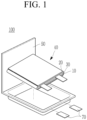
- FIG. 1 is a schematic view showing a rechargeable lithium battery according to some example embodiments.
- the rechargeable lithium battery 100 includes an electrode assembly 40 including a separator 30 interposed between the positive electrode 10 and the negative electrode 20, and a case 50 in which the electrode assembly 40 is housed.
- the positive electrode 10, the negative electrode 20, and the separator 30 may be impregnated with an electrolyte.
- the rechargeable lithium battery 100 may further include an electrode tab 70 that serves as an electrical path for guiding the current generated in the electrode assembly 40 to the outside as shown in FIG. 1 .
- the content “M” of the lithium salt represents an amount (mol) of the lithium salt in a volume (L) of the entire electrolyte (lithium salt+non-aqueous organic solvent+additive).
- the content “vol%” of the non-aqueous organic solvent is based on 100% by volume of the total non-aqueous organic solvent.
- the content “wt%” of the above additive is based on 100 wt% of the total electrolyte (i.e., lithium salt+non-aqueous organic solvent+additive).
- LiCoO 2 as a positive electrode active material, polyvinylidene fluoride as a binder, and Ketjen black as a conductive material were mixed respectively in a weight ratio of 98.5:0.75:0.75, and then, dispersed in N-methyl pyrrolidone to prepare a positive electrode active material slurry.
- the positive electrode active material slurry was coated on a 14 ⁇ m-thick Al foil, dried at 110 °C, and pressed to manufacture a positive electrode.
- Artificial graphite and a Si-C composite in a weight ratio of 93:7 was prepared as a negative electrode active material.
- the negative electrode active material, a styrene-butadiene rubber binder, and carboxylmethyl cellulose in a weight ratio of 97:1:2 were dispersed in distilled water to prepare a negative electrode active material slurry.
- the negative electrode active material slurry was coated on a 10 ⁇ m-thick Cu foil, dried at 100 °C, and pressed to manufacture a negative electrode.
- An electrode assembly was manufactured by assembling the manufactured positive electrode and negative electrode and a 25 ⁇ m-thick polyethylene separator, the electrode assembly was positioned (e.g., accommodated) in a pouch, and a 2032 coin-type or kind rechargeable lithium battery cell was manufactured by injecting the electrolyte of the Example 1 (e.g., into the cell).
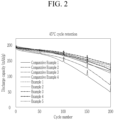
- Capacity retention rate [Discharge capacity at n th cycle / Discharge capacity at 1 st cycle] X 100 Table 2 Comparative Examples Examples 1 2 3 4 1 2 3 4 5 50 th cycle (%) 93.5 94.3 91.0 91.6 94.6 92.5 93.8 95.0 94.7 100 th cycle (%) 84.3 89.2 82.2 78.0 88.9 87.0 87.9 90.4 88.5 200 th cycle (%) 58.3 57.8 37.1 26.5 66.1 63.0 62.7 71.2 68.9
- the non-aqueous organic solvent represented by Chemical Formula 1 (in particular DMTMSA) has a greater (e.g., higher) electrochemical stability than not only carbonate-based non-aqueous organic solvents but also N,N-diethyltrifluoromethanesulfonamide (DETMSA).
- the non-aqueous organic solvent represented by Chemical Formula 1 may reduce side reactions even if the charge and discharge cycle of the rechargeable lithium battery cells are repeated (e.g., 200 or more times).
- the positive electrode was disassembled and analyzed by X-ray photoelectron spectroscopy (XPS), and it was confirmed whether the decomposition products of the lithium salt in the electrolyte were attached to the surface of the negative electrode.
- XPS X-ray photoelectron spectroscopy
- the non-aqueous organic solvent represented by Chemical Formula 1 reduces side reactions on the surface of the positive electrode better than not only carbonate-based non-aqueous organic solvents but also N,N-diethyltrifluoromethanesulfonamide (DETMSA).
Landscapes
- Chemical & Material Sciences (AREA)
- Chemical Kinetics & Catalysis (AREA)
- Electrochemistry (AREA)
- General Chemical & Material Sciences (AREA)
- Inorganic Chemistry (AREA)
- Engineering & Computer Science (AREA)
- Manufacturing & Machinery (AREA)
- Physics & Mathematics (AREA)
- Condensed Matter Physics & Semiconductors (AREA)
- General Physics & Mathematics (AREA)
- Materials Engineering (AREA)
- Secondary Cells (AREA)
Abstract
An electrolyte for a rechargeable lithium battery and a rechargeable lithium battery including the electrolyte are provided. The electrolyte includes a non-aqueous organic solvent and a lithium salt, and the non-aqueous organic solvent includes 10 to 30 vol% of a non-aqueous organic solvent represented by Chemical Formula 1, based on a total amount of the non-aqueous organic solvent:andwherein, in Chemical Formula 1, each X is the same or different and independently a hydrogen atom or a fluorine atom.
Description
- One or more embodiments of the present disclosure relate to an electrolyte for a rechargeable lithium battery and a rechargeable lithium battery including the same.
- Rechargeable lithium batteries are attracting attention as a driving power source for information technology (IT) devices because they are relatively lightweight and have relatively high energy density.
- Furthermore, as information technology (IT) devices become increasingly more high-performance, rechargeable lithium batteries have also become more high-capacity. In order to implement rechargeable lithium batteries with high capacity, it is necessary to increase the charging voltage, but an electrolyte suitable for these applications has not been properly proposed.
- The electrolyte implemented in rechargeable lithium batteries widely and most often to date, is one utilizing a carbonate-based non-aqueous organic solvent, which is a solvent with a high tendency to electrochemically oxidize and decompose under high charging voltage conditions. For example, electrolytes utilizing carbonate-based non-aqueous organic solvents may cause side reactions on the surface of the positive electrode to form a resistance layer. Electrolytes utilizing these solvents may also cause complications such as gas generation and electrolyte depletion, continuously impairing the cycle-life characteristics of rechargeable lithium batteries.
- Aspects of example embodiments are directed toward an electrolyte for a rechargeable lithium battery in which oxidative decomposition of a non-aqueous organic solvent is suppressed or reduced, e.g., even if the charging voltage is increased. Additional aspects will be set forth in part in the description which follows and, in part, will be apparent from the description, or may be learned by practice of the presented embodiments of the disclosure.
- The invention is defined by the appended claims. The description that follows is subjected to this limitation. Any disclosure lying outside the scope of said claims is only intended for illustrative as well as comparative purposes.
- The present invention provides an electrolyte for a rechargeable lithium battery including a non-aqueous organic solvent and a lithium salt. The non-aqueous organic solvent includes 10 volume percentage (vol%) to 30 vol% of a non-aqueous organic solvent represented by Chemical Formula 1, based on a total amount of the non-aqueous organic solvent:

- In
Chemical Formula 1, each X is the same or different and is independently be a hydrogen atom or a fluorine atom. - The non-aqueous organic solvent may include 10 vol% to 20 vol% of the non-aqueous organic solvent represented by Chemical Formula 1, based on a total amount of the non-aqueous organic solvent.
- In
Chemical Formula 1, all X may be fluorine atoms (e.g., each X is a fluorine atom). - The non-aqueous organic solvent may further include a carbonate-based non-aqueous organic solvent, an ester-based non-aqueous organic solvent, or a combination thereof.
- The carbonate-based non-aqueous organic solvent may include a cyclic carbonate-based non-aqueous organic solvent including ethylene carbonate (EC), propylene carbonate (PC), butylene carbonate (BC), or a combination thereof; and a chain carbonate-based non-aqueous organic solvent including dimethyl carbonate (DMC), diethyl carbonate (DEC), dipropyl carbonate (DPC), methylpropyl carbonate (MPC), ethylpropyl carbonate (EPC), methylethyl carbonate (MEC), or a combination thereof.
- The ester-based non-aqueous organic solvent may include methyl acetate, ethyl acetate, n-propyl acetate, dimethylacetate, methylpropionate, ethylpropionate, propylpropionate (PP), decanolide, mevalonolactone, valerolactone, caprolactone, or a combination thereof.
- The non-aqueous organic solvent may include a carbonate-based non-aqueous organic solvent and an ester-based non-aqueous organic solvent in a volume ratio of 1:2 to 1:3.
- The carbonate-based non-aqueous organic solvent may include ethylene carbonate (EC) and propylene carbonate (PC).
- The ester-based non-aqueous organic solvent may include propyl propionate (PP).
- The lithium salt may include at least one (e.g., one, two, or more) selected from among LiPF6, LiBF4, LiSbF6, LiAsF6, LiClO4, LiAlO2, LiAlCl4, LiPO2F2, LiCl, Lil, LiN(SO3C2F5)2, Li(FSO2)2N (lithium bis(fluorosulfonyl)imide (LiFSI), LiC4F9SO3, LiN(CxF2x+1SO2)(CyF2y+1SO2) (x and y are integers from 1 to 20), lithium trifluoromethane sulfonate, lithium tetrafluoroethanesulfonate, lithium difluorobis(oxalato)phosphate (LiDFOB), and lithium bis(oxalato)borate (LiBOB).
- The electrolyte may further include a carbonate-based additive, a sultone-based additive, a nitrile-based additive, a lithium salt-based additive, or a combination thereof.
- In some example embodiments, a rechargeable lithium battery includes a positive electrode including a positive electrode active material; a negative electrode including a negative electrode active material; and the electrolyte.
- The rechargeable lithium battery may have a charging voltage of greater than or equal to about 4.45 V.
- The positive electrode active material may include lithium cobalt oxide.
- The negative electrode active material may include graphite.
- The electrolyte for a rechargeable lithium battery according to some example embodiments suppresses oxidative decomposition of the non-aqueous organic solvent even if the charging voltage is increased, thereby implementing a rechargeable lithium battery with high capacity.
-
-
FIG. 1 is a schematic view showing a rechargeable lithium battery according to one or more embodiments of the present disclosure. -
FIG. 2 is results of charge and discharge experiments for a rechargeable lithium battery according to one or more embodiments of the present disclosure. - Hereinafter, a rechargeable lithium battery according to some embodiments will be described in more detail with reference to the accompanying drawings, wherein like reference numerals refer to like elements throughout, and duplicative descriptions thereof may not be provided. In this regard, the present embodiments may be modified to have different forms and should not be construed as being limited to the descriptions set forth herein. Accordingly, the embodiments are merely described by referring to the drawings, to explain aspects of the present description. However, these embodiments are only examples, and the present disclosure is not limited thereto, but rather the present disclosure is defined by the scope of claims.
- As utilized herein, the term "and/or" includes any and all combinations of one or more of the associated listed items. Expressions such as "at least one of," if preceding a list of elements, modify the entire list of elements and do not modify the individual elements of the list.
- If it is described that an element is "on," "connected to," or "coupled to" another element, it will be understood that the element may be provided directly on another element or still another element may be interposed therebetween. On the other hand, if it is described that an element is "directly on" another element, still another element is not interposed therebetween.
- It will be understood that, although the terms "first," "second," and "third" may be utilized herein to describe one or more suitable elements, components, regions, layers, and/or sections, these elements, components, regions, layers, and/or sections should not be limited by these terms. These terms are only utilized to distinguish one element, component, region, layer, or section from another region, layer, or section. Thus, a first element, component, region, layer, or section described herein may be termed a second element, component, region, layer, or section without departing from the teachings of the present specification.
- As utilized herein, the singular forms "a," "an," and "the" are intended to include the plural forms, including "at least one," unless the content clearly indicates otherwise. As used herein, expressions such as "at least one,", "one of," and "selected from," if preceding a list of elements, should not be construed as being limited to the singular, but may modify the entire list of elements and do not modify the individual elements of the list. For example, the expressions "at least one of a to c," "at least one of a, b or c," and "at least one of a, b and/or c" may indicate only a, only b, only c, both (e.g., simultaneously) a and b, both (e.g., simultaneously) a and c, both (e.g., simultaneously) b and c, all of a, b, and c, or variations thereof.
- As utilized herein, the term "and/or" includes any and all combinations of one or more of the associated listed items. The terms "include," "includes," "including," "comprise," "comprises," "comprising," "having," "has," and/or "have" if utilized in the detailed description, specify a presence of stated features, regions, integers, steps, operations, elements, and/or components, but do not preclude the presence or addition of one or more other features, regions, integers, steps, operations, elements, components, and/or groups thereof.
- As used herein, the terms "use," "using," and "used" may be considered synonymous with the terms "utilize," "utilizing," and "utilized," respectively.
- Unless otherwise defined, all terms (including chemical, technical and scientific terms) utilized herein have the same meaning as commonly understood by one of ordinary skill in the art to which the present disclosure belongs. In some embodiments, it will be further understood that terms, such as those defined in commonly utilized dictionaries, should be interpreted as having a meaning that is consistent with their meaning in the context of the relevant art and the present disclosure, and will not be interpreted in an idealized or overly formal sense unless expressly so defined herein.
- In this context, "consisting essentially of" means that any additional components will not materially affect the chemical, physical, optical or electrical properties of the semiconductor film.
- As utilized herein, the term "particle diameter" of particles refers to an average diameter if particles are spherical and refers to an average major axis length if particles are non-spherical. A particle diameter of particles may be measured utilizing a particle size analyzer (PSA). A "particle diameter" of particles is, for example, an "average particle diameter." An average particle diameter refers to, for example, a median particle diameter (D50). The median particle diameter (D50) is a particle size corresponding to a 50 % cumulative volume if a particle size distribution measured through a laser diffraction method is calculated from particles having a smaller particle size. In some embodiments, a "particle diameter" or an "average particle diameter" may be measured from a transmission electron microscope (TEM) image, a scanning electron microscope (SEM) image, and/or the like.
- D50 refers to a particle size corresponding to a 50 % cumulative volume if a particle size distribution measured through a laser diffraction method is calculated from particles having a smaller particle size.
- D90 refers to a particle size corresponding to a 90 % cumulative volume if a particle size distribution measured through a laser diffraction method is calculated from particles having a smaller particle size.
- D10 refers to a particle size corresponding to a 10 % cumulative volume if a particle size distribution measured through a laser diffraction method is calculated from particles having a smaller particle size.
- In some embodiments, the term "group" may refer to a group (i.e., column) of elements in the periodic table of the elements according to the International Union of Pure and Applied Chemistry ("IUPAC") Groups 1-18 group classification system. In some embodiments, the term "group" may refer to a chemical functional group, e.g., an "alkyl group."
- The term "electrode active material" as utilized herein refers to an electrode material that may undergo lithiation and delithiation.
- The term "negative electrode active material" as utilized herein refers to a negative electrode material that may undergo lithiation and delithiation.
- The terms "lithiate" and "lithiating" as utilized herein refer to a process of adding lithium to an electrode active material.
- The terms "delithiate" and "delithiating" as utilized herein refer to a process of removing lithium from an electrode active material.
- The terms "charge" and "charging" as utilized herein refer to a process of providing electrochemical energy to a battery.
- The terms "discharge" and "discharging" as utilized herein refer to a process of removing electrochemical energy from a battery.
- The term "positive electrode" as utilized herein refers to an electrode at which electrochemical reduction and lithiation occur during a discharging process.
- The term "negative electrode" as utilized herein refers to an electrode at which electrochemical oxidation and delithiation occur during a discharging process.
- As previously described, the electrolyte implemented widely, and most often to date, is an electrolyte utilizing a carbonate-based non-aqueous organic solvent. However, the carbonate-based non-aqueous organic solvent has a high tendency to electrochemically oxidize and decompose under high charging voltage conditions, causing one or more undesirable side reactions.
- According to the present invention, there is provided an electrolyte for a rechargeable lithium battery including a non-aqueous organic solvent and a lithium salt, wherein the non-aqueous organic solvent includes a non-aqueous organic solvent represented by
Chemical Formula 1, based on a total amount of the non-aqueous organic solvent:
- In
Chemical Formula 1, each X may be the same or different and may independently be a hydrogen atom or a fluorine atom. For example, the non-aqueous organic solvent represented byChemical Formula 1 may be N, N-Dimethyltrifluoromethanesulfonamide (DMTMSA). The non-aqueous organic solvent includes 10 vol% to 30 vol%, preferably 10 vol% to 20 vol%, of the non-aqueous organic solvent represented byChemical Formula 1, based on a total amount of the non-aqueous organic solvent. - The non-aqueous organic solvent functions (e.g., serves) as a medium for transmitting ions taking part in the electrochemical reaction of a battery.
- Compared to the carbonate-based non-aqueous organic solvent, the non-aqueous organic solvent represented by
Chemical Formula 1 avoids oxidative decomposition (e.g., suppresses oxidative decomposition of the non-aqueous organic solvent) under high voltage charging conditions (e.g., even if the charging voltage is increased). Thus, a rechargeable lithium battery with high capacity may be implemented by utilizing the non-aqueous organic solvent represented byChemical Formula 1. - Furthermore, the non-aqueous organic solvent represented by
Chemical Formula 1 has higher electrochemical stability than the non-aqueous organic solvent represented byChemical Formula 2. InChemical Formula 2, each X may be the same or different and may independently be a hydrogen atom or a fluorine atom (e.g., N,N-diethyltrifluoromethanesulfonamide, DETMSA). Due to the higher electrochemical stability of the non-aqueous organic solvent represented byChemical Formula 1, side reactions are reduced even if the charge and discharge cycles of the rechargeable lithium battery are repeated. This may be confirmed from analysis of a battery capacity retention rate, or an amount of decomposition products of lithium salt, and/or the like, after a long charge and discharge cycle of a rechargeable lithium battery.
- The non-aqueous organic solvent includes the non-aqueous organic solvent represented by
Chemical Formula 1 as an "auxiliary solvent" relative to the total amount of the non-aqueous organic solvent. Herein, the "auxiliary solvent" refers to a solvent that is included in less than 50 vol% relative to the total amount of the non-aqueous organic solvent and functions to assist the (e.g., remaining) "main solvent." - Ifthe non-aqueous organic solvent represented by
Chemical Formula 1 is utilized in excessive amounts as the "main solvent," it may undergo reduction-decomposition with the negative electrode and thus reduce capacity, but if utilized in small amounts as the "auxiliary solvent," it may improve solvent oxidation resistance and improve high-voltage performance. - The non-aqueous organic solvent further includes a "main solvent." In some embodiments, the main solvent may be or include a carbonate-based non-aqueous organic solvent, an ester-based non-aqueous organic solvent, or a combination thereof.
- The carbonate-based non-aqueous organic solvent may be a cyclic carbonate-based non-aqueous organic solvent or a chain carbonate-based non-aqueous organic solvent. For example, the carbonate-based non-aqueous organic solvent may be a cyclic carbonate-based non-aqueous organic solvent including ethylene carbonate (EC), propylene carbonate (PC), butylene carbonate (BC), or a combination thereof; and a chain carbonate-based non-aqueous organic solvent including at least one selected from among dimethyl carbonate (DMC), diethyl carbonate (DEC), dipropyl carbonate (DPC), methylpropyl carbonate (MPC), ethylpropyl carbonate (EPC), methylethyl carbonate (MEC), and/or combinations thereof. Additionally, if utilizing a carbonate-based solvent, the cyclic carbonate and chain carbonate may be mixed and utilized. For example, cyclic carbonate and chain carbonate may be mixed at a volume ratio of about 1:1 to about 1:9.
- The ester-based non-aqueous organic solvent may include methyl acetate, ethyl acetate, n-propyl acetate, dimethylacetate, methylpropionate, ethylpropionate, propylpropionate (PP), decanolide, mevalonolactone, valerolactone, caprolactone, or a combination thereof.
- The non-aqueous organic solvent as the "main solvent" may include a carbonate-based non-aqueous organic solvent and an ester-based non-aqueous organic solvent in a volume ratio of about 1:2 to about 1:3. Herein, the carbonate-based non-aqueous organic solvent may include ethylene carbonate (EC) and propylene carbonate (PC); and the ester-based non-aqueous organic solvent may include propylpropionate (PP).
- The lithium salt dissolved in the organic solvent supplies lithium ions in a battery, enables a general (i.e., basic or suitable) operation of a rechargeable lithium battery, and improves transportation of the lithium ions between positive and negative electrodes. Representative examples of the lithium salt may include at least one (e.g., or more) selected from among LiPF6, LiBF4, LiSbF6, LiAsF6, LiClO4, LiAlO2, LiAlCl4, LiPO2F2, LiCl, Lil, LiN(SO3C2F5)2, Li(FSO2)2N (lithium bis(fluorosulfonyl)imide (LiFSI), LiC4F9SO3, LiN(CxF2x+1SO2)(CyF2y+1SO2) (wherein x and y are integers from 1 to 20), lithium trifluoromethane sulfonate, lithium tetrafluoroethanesulfonate, lithium difluorobis(oxalato)phosphate (LiDFOB) and lithium bis(oxalato)borate (LiBOB).
- The lithium salt may be utilized in a concentration in a range of about 0.1 M to about 2.0 M. If the concentration of lithium salt is within the disclosed range, the electrolyte has appropriate or suitable ion conductivity and viscosity, and thus excellent or suitable performance may be achieved and lithium ions may move effectively.
- The electrolyte may further include a carbonate-based additive, a sultone-based additive, a nitrile-based additive, a lithium salt-based additive, or a combination thereof to improve battery cycle-life.
- The carbonate-based additive may include vinylethylene carbonate (VEC), vinylene carbonate, or an ethylene carbonate-based compound.
- Representative examples of the ethylene carbonate-based compound may include fluoroethylene carbonate (FEC), difluoroethylene carbonate, chloroethylene carbonate, dichloroethylene carbonate, bromoethylene carbonate, dibromoethylene carbonate, nitroethylene carbonate, and/or cyanoethylene carbonate.
- The nitrile-based additive may include a dinitrile-based compound, a polynitrile-based compound, or a combination thereof.
- Representative examples of the dinitrile-based compound may include succinonitrile (SN), glutaronitrile, adiponitrile (AN), pimelonitrile, octandinitrile, nonandinitrile, caprylnitrile, ethylene glycol (bispropionitrile) ether (nitrile ether), fumaronitrile, and/or the like.
- Representative examples of the polynitrile-based compound may include 1, 3, 6-hexanetrinitrile (HTCN), 1, 2, 6-hexanetrinitrile, 1, 3, 5-pentanetrinitrile, nonantrinitrile, 1, 3, 5-benzotrinitrile, 2, 4, 6-trifluorobenzene-1, 3,5-trinitrile, 1, 3, 5-cyclohexanetrinitrile, 1, 2, 3-propionitrile, 1, 3, 5-benztricyano, 1, 2, 3-tris (2-cyanoxy) propane, and/or the like.
- The sulfone-based additive may include propene sultone (PST), propane sultone (PS), and/or the like; and the lithium salt-based additive may include lithium tetrafluoroborate (LiBF4), lithium difluorophosphate (LiPO2F2), lithium difluoro(fluoromalonato)borate (LFMB), and/or the like.
- Some example embodiments provide a rechargeable lithium battery including a positive electrode including a positive electrode active material; a negative electrode containing a negative electrode active material; and the aforementioned electrolyte.
- In the rechargeable lithium battery including the disclosed electrolyte, oxidative decomposition of the non-aqueous organic solvent may be suppressed or reduced even if the charging voltage is increased, and the capacity may be increased.
- For example, the rechargeable lithium battery may have a charging voltage of greater than or equal to about 4.45 V, or greater than or equal to about 4.5 V.
- The positive electrode active material may be a compound capable of reversibly intercalating and deintercalating lithium (a lithiated intercalation compound). For example, one or more types (kinds) of composite oxides of lithium and a metal selected from cobalt, manganese, nickel, and combinations thereof may be utilized.
- The composite oxide may be a lithium transition metal composite oxide, and specific examples may include lithium nickel-based oxide, lithium cobalt-based oxide, lithium manganese-based oxide, lithium iron phosphate-based compound, cobalt-free nickel-manganese-based oxide, or a combination thereof.
- As an example, the positive electrode active material may be a high nickel-based positive electrode active material having a nickel content of about 80 mol% or more based on 100 mol% of metals excluding lithium in the lithium transition metal composite oxide. The nickel content in the high nickel-based positive electrode active material may be about 85 mol% or more, about 90 mol% or more, about 91 mol% or more, or about 94 mol% or more and about 99 mol% or less based on 100 mol% of metals excluding lithium. High-nickel-based positive electrode active materials can achieve high capacity and can be applied to a high-capacity, high-density rechargeable lithium battery.
- As an example, at least one compound represented by any of the following chemical formulas selected from among LiaA1-bXbO2-cDc (0.90 ≤ a ≤ 1.8, 0 ≤ b ≤ 0.5, 0 ≤ c ≤ 0.05); LiaMn2-bXbO4-cDc (0.90 ≤ a ≤ 1.8, 0 ≤ b ≤ 0.5, 0 ≤ c ≤ 0.05); LiaNi1-b-cCobXcO2-αDα (0.90 ≤ a ≤ 1.8, 0 ≤ b ≤ 0.5, 0 ≤ c ≤0.5, 0 < α < 2);LiaNi1-b-cMnbXcO2-αDα (0.90 ≤ a ≤ 1.8, 0 ≤ b ≤ 0.5, 0 ≤ c ≤ 0.5, 0 < α < 2);LiaNibCocL1 dGeO2(0.90 ≤ a ≤ 1.8, 0 ≤ b ≤ 0.9, 0 ≤ c ≤ 0.5, 0 ≤ d ≤ 0.5, 0 ≤ e ≤ 0.1); LiaNiGbO2 (0.90 ≤ a ≤ 1.8, 0.001 ≤ b ≤ 0.1); LiaCoGbO2 (0.90 ≤ a ≤ 1.8, 0.001 ≤ b ≤ 0.1); LiaMn1-bGbO2 (0.90 ≤ a ≤ 1.8, 0.001 ≤ b ≤ 0.1); LiaMn2GbO4 (0.90 ≤ a ≤1.8, 0.001 ≤ b ≤ 0.1); LiaMn1-gGgPO4 (0.90 ≤ a ≤ 1.8, 0 ≤ g ≤ 0.5); Li(3-f)Fe2(PO4)3 (0 ≤ f ≤ 2); and LiaFePO4 (0.90 ≤ a ≤ 1.8) may be utilized as the positive electrode active material.
- In the above chemical formulas, A may be Ni, Co, Mn, or a combination thereof; X may be Al, Ni, Co, Mn, Cr, Fe, Mg, Sr, V, a rare earth element, or a combination thereof; D may be O, F, S, P, or a combination thereof; G may be Al, Cr, Mn, Fe, Mg, La, Ce, Sr, V, or a combination thereof; Q may be Ti, Mo, Mn, or a combination thereof; Z may be Cr, V, Fe, Sc, Y, or a combination thereof; and L1 may be Mn, Al, or a combination thereof.
- The positive electrode for a rechargeable lithium battery may include a current collector and a positive electrode active material layer formed on the current collector. The positive electrode active material layer includes a positive electrode active material and may further include a binder and/or a conductive material.
- A content of the positive electrode active material may be about 90 wt% to about 99.5 wt% based on 100 wt% of the positive electrode active material layer.
- In some example embodiments, the positive electrode active material layer may further include a binder and a conductive material. At this time, each content of the binder and the conductive material may be about 0.5 wt% to about 5 wt% based on 100% by weight of the positive electrode active material layer.
- The binder serves to ensure that the positive electrode active material particles adhere to each other and also to adhere the positive electrode active material to the current collector. Representative examples of the binder may include polyvinyl alcohol, carboxymethyl cellulose, hydroxypropyl cellulose, diacetyl cellulose, polyvinyl chloride, carboxylated polyvinyl chloride, polyvinyl fluoride, an ethylene oxide-containing polymer, polyvinylpyrrolidone, polyurethane, polytetrafluoroethylene, polyvinylidene fluoride, polyethylene, polypropylene, a styrene-butadiene rubber, a (meth)acrylated styrene-butadiene rubber, an epoxy resin, a (meth)acrylic resin, polyester resin, and/or nylon, but are not limited thereto.
- The conductive material is utilized to impart conductivity to the electrode, and in the battery being configured, any electronically conductive material can be utilized as long as it does not cause chemical change. Examples of the conductive material may include a carbon-based material such as natural graphite, artificial graphite, carbon black, acetylene black, Ketjen black, a carbon fiber, a carbon nanofiber, and/or a carbon nanotube; a metal-based material including copper, nickel, aluminum, silver, and/or the like and in the form of a metal powder or a metal fiber; a conductive polymer such as a polyphenylene derivative; or a mixture thereof.
- Al may be utilized as the current collector, but is not limited thereto.
- The negative electrode active material may be a material that reversibly intercalates/deintercalates lithium ions, a lithium metal, a lithium metal alloy, a material capable of doping and dedoping lithium, or a transition metal oxide.
- The material that reversibly intercalates/deintercalates lithium ions may be a carbon-based negative electrode active material, for example crystalline carbon, amorphous carbon or a combination thereof. Examples of the crystalline carbon may include graphite such as irregular, plate-shaped, flake, spherical or fibrous natural graphite or artificial graphite, and examples of the amorphous carbon may include soft carbon or hard carbon, a mesophase pitch carbonized product, calcined coke, and/or the like.
- The lithium metal alloy may include an alloy including lithium and a metal selected from among Na, K, Rb, Cs, Fr, Be, Mg, Ca, Sr, Si, Sb, Pb, In, Zn, Ba, Ra, Ge, Al, and Sn.
- A Si-based negative electrode active material or a Sn-based negative electrode active material may be utilized as a material capable of doping and dedoping lithium. The Si-based negative electrode active material may include silicon, a silicon-carbon composite, SiOx (0 < x ≤ 2), a Si-Q alloy (wherein Q is an element selected from an alkali metal, an alkaline earth metal, a Group 13 element, Group 14 element (excluding Si), Group 15 element, Group 16 element, a transition metal, a rare earth element, and a combination thereof, for example Mg, Ca, Sr, Ba, Ra, Sc, Y, Ti, Zr, Hf, Rf, V, Nb. , Ta, Db, Cr, Mo, W, Sg, Tc, Re, Bh, Fe, Pb, Ru, Os, Hs, Rh, Ir, Pd, Pt, Cu, Ag, Au, Zn, Cd, B, Al , Ga, Sn, In, Tl, Ge, P, As, Sb, Bi, S, Se, Te, Po, and a combination thereof), or a combination thereof. The Sn-based negative electrode active material may be Sn, SnO2, a Sn alloy, or a combination thereof.
- The silicon-carbon composite may be a composite of silicon and amorphous carbon. An average particle diameter (D50) of the silicon-carbon composite particles may be, for example, about 0.5 micrometer (µm) to about 20 µm. According to some example embodiments, the silicon-carbon composite may be in the form of silicon particles and amorphous carbon coated on the surface of the silicon particles. For example, it may include a secondary particle (core) in which silicon primary particles are assembled and an amorphous carbon coating layer (shell) on the surface of the secondary particle. The amorphous carbon may also be provided between the silicon primary particles, and for example, the silicon primary particles may be coated with amorphous carbon. The secondary particles may exist dispersed in an amorphous carbon matrix.
- The silicon-carbon composite may further include crystalline carbon. For example, the silicon-carbon composite may include a core including crystalline carbon and silicon particles and an amorphous carbon coating layer on the surface of the core. The crystalline carbon may be artificial graphite, natural graphite, or a combination thereof. The amorphous carbon may include soft carbon or hard carbon, a mesophase pitch carbonized product, and calcined coke.
- If the silicon-carbon composite includes silicon and amorphous carbon, a content of silicon may be about 10 wt% to about 50 wt%, and a content of amorphous carbon may be about 50 wt% to about 90 wt% based on 100 wt% of the silicon-carbon composite. In some embodiments, if the composite includes silicon, amorphous carbon, and crystalline carbon, a content of silicon may be about 10 wt% to about 50 wt%, and a content of crystalline carbon may be about 10 wt% to about 70 wt%, and a content of amorphous carbon may be about 20 wt% to about 40 wt% based on 100 wt% of the silicon-carbon composite.
- Additionally, a thickness of the amorphous carbon coating layer may be about 5 nanometer (nm) to about 100 nm. An average particle diameter (D50) of the silicon particles (i.e., silicon primary particles) may be about 10 nm to about 1 µm, or about 10 nm to about 200 nm. The silicon particles (i.e., silicon primary particles) may exist as silicon alone, in the form of a silicon alloy, or in an oxidized form. In some embodiments, the oxidized form of silicon may be represented by SiOx (0<x<2).. In some embodiments, an atomic content ratio of Si:O, which indicates a degree of oxidation in the oxidized form of silicon, may be about 99:1 to about 33:67. In the present specification, as utilized herein, if a definition is not otherwise provided, an average particle diameter (D50) indicates a particle where an accumulated volume is about 50 vol% in a particle size distribution.
- The Si-based negative electrode active material or Sn-based negative electrode active material may be utilized by mixing with a carbon-based negative electrode active material. If utilizing a mixture of Si-based negative electrode active material or Sn-based negative electrode active material and carbon-based negative electrode active material, a mixing ratio may be about 1:99 to about 90:10 by weight.
- A negative electrode for a rechargeable lithium battery includes a current collector and a negative electrode active material layer on the current collector. The negative electrode active material layer includes a negative electrode active material and may further include a binder and/or a conductive material.
- A content of the negative electrode active material may be about 95 wt% to about 99.5 wt% based on 100 wt% of the negative electrode active material layer. A content of the binder may be about 0.5 wt% to about 5 wt% based on 100 wt% of the negative electrode active material layer. A content of the binder may be about 0.5 wt% to about 5 wt% based on 100 wt% of the negative electrode active material layer. For example, the negative electrode active material layer may include about 90 wt% to about 99 wt% of the negative electrode active material, about 0.5 wt% to about 5 wt% of the binder, and about 0.5 wt% to about 5 wt% of the conductive material.
- The binder serves to adhere the negative electrode active material particles to each other and also helps the negative electrode active material to adhere to the current collector. The binder may be a non-aqueous binder, an aqueous binder, a dry binder, or a combination thereof.
- The non-aqueous binder may include polyvinyl chloride, carboxylated polyvinyl chloride, polyvinyl fluoride, an ethylene propylene copolymer, polystyrene, polyurethane, polytetrafluoroethylene, polyvinylidene fluoride, polyethylene, polypropylene, polyamide-imide, polyimide, or a combination thereof.
- The aqueous binder may be selected from among a styrene-butadiene rubber, a (meth)acrylated styrene-butadiene rubber, a (meth)acrylonitrile-butadiene rubber, a (meth)acrylic rubber, a butyl rubber, a fluorine rubber, polyethylene oxide, polyvinylpyrrolidone, polyepichlorohydrin, polyphosphazene, poly(meth)acrylonitrile, an ethylene propylene diene copolymer, polyvinylpyridine, chlorosulfonated polyethylene, latex, a polyester resin, a (meth)acrylic resin, a phenol resin, an epoxy resin, polyvinyl alcohol, and combinations thereof.
- If an aqueous binder is utilized as the negative electrode binder, it may further include a cellulose-based compound capable of imparting viscosity. As this cellulose-based compound, one or more types (kinds) of carboxymethyl cellulose, hydroxypropylmethyl cellulose, methyl cellulose, or an alkali metal salt thereof may be utilized. The alkali metal may be Na, K, and/or Li.
- The dry binder may be a polymer material capable of being fiberized, and may be, for example, polytetrafluoroethylene, polyvinylidene fluoride, a polyvinylidene fluoride-hexafluoropropylene copolymer, polyethylene oxide, or a combination thereof.
- The conductive material is utilized to impart conductivity to the electrode, and in the battery being configured, any electronically conductive material can be utilized as long as it does not cause chemical change. Specific examples may include carbon-based materials such as natural graphite, artificial graphite, carbon black, acetylene black, Ketjen black, a carbon fiber, a carbon nanofiber, and/or a carbon nanotube; a metal-based material including copper, nickel, aluminum, silver, and/or the like in the form of a metal powder or a metal fiber; a conductive polymer such as a polyphenylene derivative; or a mixture thereof.
- The negative electrode current collector may be selected from among a copper foil, a nickel foil, a stainless steel foil, a titanium foil, a nickel foam, a copper foam, a polymer substrate coated with a conductive metal, and combinations thereof.
- The rechargeable lithium battery may further include a separator between the negative electrode and the positive electrode, depending on a type or kind of the rechargeable lithium battery. Examples of the separator may be or include polyethylene, polypropylene, polyvinylidene fluoride, and multi-layers thereof such as a polyethylene/polypropylene double-layered separator, a polyethylene/polypropylene/polyethylene triple-layered separator, and/or a polypropylene/polyethylene/polypropylene triple-layered separator.
- The separator may include a porous substrate and a coating layer containing an organic material, an inorganic material, or a combination thereof on one or both (e.g., simultaneously) surfaces of the porous substrate.
- The porous substrate may be a polymer film formed of any one selected from among polyolefin such as polyethylene and polypropylene, polyester such as polyethylene terephthalate and polybutylene terephthalate, polyacetal, polyamide, polyimide, polycarbonate, polyether ketone, polyaryl ether ketone, polyetherimide, polyamideimide, polybenzimidazole, polyethersulfone, polyphenylene oxide, a cyclic olefin copolymer, polyphenylene sulfide, polyethylene naphthalate, a glass fiber, Teflon, and polytetrafluoroethylene, or a copolymer or a mixture of two or more of them.
- The porous substrate may have a thickness of about 1 µm to about 40 µm, for example about 1 µm to about 30 µm, about 1 µm to about 20 µm, about 5 µm to about 15 µm, or about 10 µm to about 15 µm.
- The organic material may include a (meth)acryl-based copolymer including a first structural unit derived from (meth)acrylamide, and a second structural unit including at least one of a structural unit derived from (meth)acrylic acid or (meth)acrylate, and a structural unit derived from (meth)acrylamidosulfonic acid or a salt thereof.
- The inorganic material may include inorganic particles selected from among Al2O3, SiO2, TiO2, SnO2, CeO2, MgO, NiO, CaO, GaO, ZnO, ZrO2, Y2O3, SrTiO3, BaTiO3, Mg(OH)2, boehmite, and a combination thereof, but is not limited thereto. An average particle diameter (D50) of the inorganic particles may be about 1 nm to about 2000 nm, for example, about 100 nm to about 1000 nm, or about 100 nm to about 700 nm.
- The organic material and the inorganic material may be mixed in one coating layer or may exist in a stacked form of a coating layer including an organic material and a coating layer including an inorganic material.
- A thickness of the coating layer may be each about 0.5 µm to about 20 µm, for example, about 1 µm to about 10 µm, or about 1 µm to about 5 µm.
- The rechargeable lithium battery may be classified into cylindrical, prismatic, pouch, coin, and/or the like depending on its shape.
FIG. 1 is a schematic view showing a rechargeable lithium battery according to some example embodiments. Referring toFIG. 1 , therechargeable lithium battery 100 includes anelectrode assembly 40 including aseparator 30 interposed between thepositive electrode 10 and thenegative electrode 20, and acase 50 in which theelectrode assembly 40 is housed. Thepositive electrode 10, thenegative electrode 20, and theseparator 30 may be impregnated with an electrolyte. Therechargeable lithium battery 100 may further include anelectrode tab 70 that serves as an electrical path for guiding the current generated in theelectrode assembly 40 to the outside as shown inFIG. 1 . - Hereinafter, examples and comparative examples of the present invention will be described. The following present invention is not limited to the following examples.
- Mixed electrolytes were prepared as shown in Table 1.
Table 1 Lithium salt (M) Non-aqueous organic solvent (vol%) Additive (wt%) LiPF6 EC PC PP DETMSA DMTMSA Comp. Ex. 1 1.3 10 15 75 - - FEC 7%, VEC 1%, LiBF4 0.2%,PS 3%,SN 2%,HTCN 3%, LFMB 0.2%Comp. Ex. 2 1.3 10 15 65 10 - Comp. Ex. 3 1.3 10 15 55 20 - Comp. Ex. 4 1.3 10 15 25 - 50 Ex. 1 1.3 10 15 65 - 10 Ex. 2 1.3 10 15 60 15 Ex. 3 1.3 10 15 55 - 20 Ex. 4 1.3 10 15 50 - 25 Ex. 5 1.3 10 15 45 - 30 - In Table 1, in the composition of the electrolyte, the content "M" of the lithium salt represents an amount (mol) of the lithium salt in a volume (L) of the entire electrolyte (lithium salt+non-aqueous organic solvent+additive). The content "vol%" of the non-aqueous organic solvent is based on 100% by volume of the total non-aqueous organic solvent. The content "wt%" of the above additive is based on 100 wt% of the total electrolyte (i.e., lithium salt+non-aqueous organic solvent+additive).
- LiCoO2 as a positive electrode active material, polyvinylidene fluoride as a binder, and Ketjen black as a conductive material were mixed respectively in a weight ratio of 98.5:0.75:0.75, and then, dispersed in N-methyl pyrrolidone to prepare a positive electrode active material slurry.
- The positive electrode active material slurry was coated on a 14 µm-thick Al foil, dried at 110 °C, and pressed to manufacture a positive electrode.
- Artificial graphite and a Si-C composite in a weight ratio of 93:7 was prepared as a negative electrode active material. The negative electrode active material, a styrene-butadiene rubber binder, and carboxylmethyl cellulose in a weight ratio of 97:1:2 were dispersed in distilled water to prepare a negative electrode active material slurry.
- The negative electrode active material slurry was coated on a 10 µm-thick Cu foil, dried at 100 °C, and pressed to manufacture a negative electrode.
- An electrode assembly was manufactured by assembling the manufactured positive electrode and negative electrode and a 25 µm-thick polyethylene separator, the electrode assembly was positioned (e.g., accommodated) in a pouch, and a 2032 coin-type or kind rechargeable lithium battery cell was manufactured by injecting the electrolyte of the Example 1 (e.g., into the cell).
- After performing a formation step for the rechargeable lithium battery cells of Examples 1 to 5 (Ex. 1 to Ex. 5) and Comparative Examples 1 to 4 (Comp. Ex. 1 to Comp. Ex. 4), constant current charging was performed at 25 °C at a current of 1.5 C rate until the voltage reached 4.53 V (vs. Li), and then in constant voltage mode, was cut off at a current of 0.075 C rate while maintaining 4.53 V. Subsequently, the cells were discharged at a constant current of a 0.75 C rate to a voltage of 3.0 V (vs. Li). This charge/discharge cycle was repeated 200 times.
- In all the charge and discharge cycles, a pause of 10 minutes was set by every charge/discharge cycle.
- The results of the charge and discharge experiments are shown in Table 2 and
FIG. 2 . The capacity retention rate in the nth cycle is defined byEquation 1.Capacity retention rate = [Discharge capacity at nth cycle / Discharge capacity at 1st cycle] X 100Table 2 Comparative Examples Examples 1 2 3 4 1 2 3 4 5 50th cycle (%) 93.5 94.3 91.0 91.6 94.6 92.5 93.8 95.0 94.7 100th cycle (%) 84.3 89.2 82.2 78.0 88.9 87.0 87.9 90.4 88.5 200th cycle (%) 58.3 57.8 37.1 26.5 66.1 63.0 62.7 71.2 68.9 - According to Table 2, as the charge and discharge cycle of the rechargeable lithium battery cells continues, the cycle-life of Comparative Examples 1 to 4 decreases (e.g., rapidly) compared to Examples 1 to 5.
- The results shown in Table 2 indicate that the non-aqueous organic solvent represented by Chemical Formula 1 (in particular DMTMSA) has a greater (e.g., higher) electrochemical stability than not only carbonate-based non-aqueous organic solvents but also N,N-diethyltrifluoromethanesulfonamide (DETMSA). For example, the non-aqueous organic solvent represented by
Chemical Formula 1 may reduce side reactions even if the charge and discharge cycle of the rechargeable lithium battery cells are repeated (e.g., 200 or more times). - After the high-temperature cycle-life of the rechargeable lithium battery cell, the positive electrode was disassembled and analyzed by X-ray photoelectron spectroscopy (XPS), and it was confirmed whether the decomposition products of the lithium salt in the electrolyte were attached to the surface of the negative electrode.
- Representatively, Comparative Examples 1 to 3 and Examples 1 and 3 were checked, and the results are shown in Table 3.
Table 3 (unit: wt%) Comparative Examples Examples 1 2 3 1 3 C 12.6 15.6 22.6 8.4 12.8 O 51.9 51.9 50.3 61.3 57.4 F 34.0 30.1 23.4 29.4 28.3 P 1.5 2.4 3.7 0.8 1.6 - According to Table 3, compared to Comparative Examples 1 to 3, the detected amounts of F and P, which are decomposition products of lithium salt (LiPF6), were reduced (e.g., small) in Examples 1 and 3.
- From these results, it may be confirmed that the non-aqueous organic solvent represented by Chemical Formula 1 (in particular DMTMSA) reduces side reactions on the surface of the positive electrode better than not only carbonate-based non-aqueous organic solvents but also N,N-diethyltrifluoromethanesulfonamide (DETMSA).
-
- 100: rechargeable lithium battery
- 10: positive electrode
- 20: negative electrode
- 30: separator
- 40: electrode assembly
- 50: case
- 70: electrode tab
Claims (15)
- An electrolyte for a rechargeable lithium battery (100), the electrolyte comprisinga non-aqueous organic solvent and a lithium salt,wherein the non-aqueous organic solvent comprises 10 vol% to 30 vol% of a non-aqueous organic solvent represented by Chemical Formula 1, based on a total amount of the non-aqueous organic solvent:
 wherein, in Chemical Formula 1,each X is the same or different and is independently a hydrogen atom or a fluorine atom.
 - The electrolyte as claimed in claim 1, wherein
the non-aqueous organic solvent comprises 10 vol% to 20 vol% of the non-aqueous organic solvent represented by Chemical Formula 1, based on the total amount of the non-aqueous organic solvent. - The electrolyte as claimed in claim 1 or 2, wherein
in Chemical Formula 1, all X are fluorine atoms. - The electrolyte as claimed in any one of the preceding claims, wherein
the non-aqueous organic solvent further comprises a carbonate-based non-aqueous organic solvent, an ester-based non-aqueous organic solvent, or a combination thereof. - The electrolyte as claimed in claim 4, whereinthe carbonate-based non-aqueous organic solvent comprises at least one selected from among a cyclic carbonate-based non-aqueous organic solvent and a chain carbonate-based non-aqueous organic solvent; andwherein the cyclic carbonate-based non-aqueous organic solvent comprises ethylene carbonate (EC), propylene carbonate (PC), butylene carbonate (BC), or a combination thereof; andthe chain carbonate-based non-aqueous organic solvent comprises dimethyl carbonate (DMC), diethyl carbonate (DEC), dipropyl carbonate (DPC), methylpropyl carbonate (MPC), ethylpropyl carbonate (EPC), methylethyl carbonate (MEC), or a combination thereof.
- The electrolyte as claimed in claim 5, wherein
the carbonate-based non-aqueous organic solvent comprises ethylene carbonate (EC) and propylene carbonate (PC). - The electrolyte as claimed in claim 4, wherein
the ester-based non-aqueous organic solvent comprises methyl acetate, ethyl acetate, n-propyl acetate, dimethylacetate, methylpropionate, ethylpropionate, propylpropionate (PP), decanolide, mevalonolactone, valerolactone, caprolactone, or a combination thereof. - The electrolyte as claimed in claim 7, wherein
the ester-based non-aqueous organic solvent comprises propylpropionate (PP). - The electrolyte as claimed in claim 4, wherein
the non-aqueous organic solvent comprises the carbonate-based non-aqueous organic solvent and the ester-based non-aqueous organic solvent in a volume ratio of 1:2 to 1:3. - The electrolyte as claimed in any one of the preceding claims, wherein
the lithium salt comprises at least one selected from among LiPF6, LiBF4, LiSbF6, LiAsF6, LiClO4, LiAlO2, LiAlCl4, LiPO2F2, LiCl, Lil, LiN(SO3C2F5)2, Li(FSO2)2N (lithium bis(fluorosulfonyl)imide (LiFSI), LiC4F9SO3, LiN(CxF2x+1SO2)(CyF2y+1SO2) (x and y are integers from 1 to 20), lithium trifluoromethane sulfonate, lithium tetrafluoroethanesulfonate, lithium difluorobis(oxalato)phosphate (LiDFOB), and lithium bis(oxalato)borate (LiBOB). - The electrolyte as claimed in any one of the preceding claims, wherein
the electrolyte further comprises a carbonate-based additive, a sultone-based additive, a nitrile-based additive, a lithium salt-based additive, or a combination thereof. - A rechargeable lithium battery (100), comprisinga positive electrode (10) comprising a positive electrode active material;a negative electrode (20) comprising a negative electrode active material; and the electrolyte as claimed in any one of the preceding claims.
- The rechargeable lithium battery as claimed in claim 12, wherein
the rechargeable lithium battery has a charging voltage of greater than or equal to 4.45 V. - The rechargeable lithium battery as claimed in claim 12, wherein
the positive electrode active material comprises a lithium cobalt oxide. - The rechargeable lithium battery as claimed in claim 12, wherein the negative electrode active material comprises graphite.
Applications Claiming Priority (1)
| Application Number | Priority Date | Filing Date | Title |
|---|---|---|---|
| KR1020230100658A KR20250019486A (en) | 2023-08-01 | 2023-08-01 | Electrolyte for rechargeable lithium battery and rechargeable lithium battery including the same |
Publications (1)
| Publication Number | Publication Date |
|---|---|
| EP4503224A1 true EP4503224A1 (en) | 2025-02-05 |
Family
ID=90789356
Family Applications (1)
| Application Number | Title | Priority Date | Filing Date |
|---|---|---|---|
| EP24170958.3A Pending EP4503224A1 (en) | 2023-08-01 | 2024-04-18 | Electrolyte for rechargeable lithium battery and rechargeable lithium battery including the same |
Country Status (4)
| Country | Link |
|---|---|
| US (1) | US20250046874A1 (en) |
| EP (1) | EP4503224A1 (en) |
| KR (1) | KR20250019486A (en) |
| CN (1) | CN119447478A (en) |
Citations (2)
| Publication number | Priority date | Publication date | Assignee | Title |
|---|---|---|---|---|
| CN116315071A (en) * | 2023-04-04 | 2023-06-23 | 上海交通大学绍兴新能源与分子工程研究院 | A wide temperature solid electrolyte |
| US20230238582A1 (en) * | 2022-01-27 | 2023-07-27 | Toyota Motor Engineering & Manufacturing North America, Inc. | Non-aqueous electrolytes for batteries |
-
2023
- 2023-08-01 KR KR1020230100658A patent/KR20250019486A/en active Pending
- 2023-10-17 US US18/488,930 patent/US20250046874A1/en active Pending
-
2024
- 2024-04-18 EP EP24170958.3A patent/EP4503224A1/en active Pending
- 2024-06-18 CN CN202410783481.1A patent/CN119447478A/en active Pending
Patent Citations (2)
| Publication number | Priority date | Publication date | Assignee | Title |
|---|---|---|---|---|
| US20230238582A1 (en) * | 2022-01-27 | 2023-07-27 | Toyota Motor Engineering & Manufacturing North America, Inc. | Non-aqueous electrolytes for batteries |
| CN116315071A (en) * | 2023-04-04 | 2023-06-23 | 上海交通大学绍兴新能源与分子工程研究院 | A wide temperature solid electrolyte |
Also Published As
| Publication number | Publication date |
|---|---|
| CN119447478A (en) | 2025-02-14 |
| KR20250019486A (en) | 2025-02-10 |
| US20250046874A1 (en) | 2025-02-06 |
Similar Documents
| Publication | Publication Date | Title |
|---|---|---|
| US8318344B2 (en) | Negative electrode for lithium battery and lithium battery including the same | |
| EP4589673A1 (en) | Positive electrodes and rechargeable lithium batteries including the same | |
| EP4492496B1 (en) | Rechargeable lithium battery | |
| EP4512779A1 (en) | Positive electrode active material, preparation method thereof, positive electrode, and rechargeable lithium batteries | |
| EP4492495A1 (en) | Electrolyte and rechargeable lithium battery including the same | |
| EP4475250A1 (en) | Electrolyte for rechargeable lithium battery and rechargeable lithium battery including the same | |
| EP4503225A1 (en) | Electrolyte for rechargeable lithium battery and rechargeable lithium battery including the same | |
| EP4704184A1 (en) | Method for charging rechargeable lithium battery | |
| US20250046874A1 (en) | Electrolyte for rechargeable lithium battery and rechargeable lithium battery including the same | |
| EP4475268B1 (en) | Rechargeable lithium battery | |
| EP4597598A1 (en) | Negative electrode for rechargeable lithium battery and rechargeable lithium battery including the same | |
| EP4645437A1 (en) | Negative electrode for rechargeable lithium battery, and rechargeable lithium battery including the same | |
| EP4654279A1 (en) | Positive electrode active materials, preparation methods of positive electrode active materials, positive electrodes, and rechargeable lithium batteries | |
| EP4507051A2 (en) | Rechargeable lithium battery | |
| KR102964601B1 (en) | Positive active material, preparation method thereof, positive electrode, and rechargeable lithium batteries | |
| EP4704202A1 (en) | Electrode for rechargeable lithium battery and rechargeable lithium battery including the same | |
| US20250323250A1 (en) | Negative electrode active materials, preparation methods thereof, negative electrodes, and rechargeable lithium batteries including same | |
| US20240413341A1 (en) | Electrode for rechargeable lithium battery and rechargeable lithium battery including the same | |
| US20260066492A1 (en) | Electrode for rechargeable lithium battery and rechargeable lithium battery including the same | |
| EP4593100A1 (en) | Positive electrode active materials, preparation methods thereof, positive electrodes, and rechargeable lithium batteries | |
| EP4475226A2 (en) | Rechargeable lithium battery | |
| EP4697402A1 (en) | Negative electrode for rechargeable lithium battery and rechargeable lithium battery including same | |
| EP4525087A1 (en) | Additive, electrolyte for rechargeable lithium battery, and rechargeable lithium battery | |
| US20260045547A1 (en) | Electrolyte for rechargeable lithium battery and rechargeable lithium battery including the same | |
| US20250343235A1 (en) | Negative electrodes for rechargeable lithium batteries, and rechargeable lithium batteries including same |
Legal Events
| Date | Code | Title | Description |
|---|---|---|---|
| PUAI | Public reference made under article 153(3) epc to a published international application that has entered the european phase |
Free format text: ORIGINAL CODE: 0009012 |
|
| STAA | Information on the status of an ep patent application or granted ep patent |
Free format text: STATUS: REQUEST FOR EXAMINATION WAS MADE |
|
| 17P | Request for examination filed |
Effective date: 20240418 |
|
| AK | Designated contracting states |
Kind code of ref document: A1 Designated state(s): AL AT BE BG CH CY CZ DE DK EE ES FI FR GB GR HR HU IE IS IT LI LT LU LV MC ME MK MT NL NO PL PT RO RS SE SI SK SM TR |