EP4503187A1 - Positive electrode active material for nonaqueous electrolyte secondary batteries - Google Patents
Positive electrode active material for nonaqueous electrolyte secondary batteries Download PDFInfo
- Publication number
- EP4503187A1 EP4503187A1 EP22935696.9A EP22935696A EP4503187A1 EP 4503187 A1 EP4503187 A1 EP 4503187A1 EP 22935696 A EP22935696 A EP 22935696A EP 4503187 A1 EP4503187 A1 EP 4503187A1
- Authority
- EP
- European Patent Office
- Prior art keywords
- composite oxide
- positive electrode
- active material
- oxide
- crystal structure
- Prior art date
- Legal status (The legal status is an assumption and is not a legal conclusion. Google has not performed a legal analysis and makes no representation as to the accuracy of the status listed.)
- Pending
Links
Images


Classifications
-
- C—CHEMISTRY; METALLURGY
- C01—INORGANIC CHEMISTRY
- C01G—COMPOUNDS CONTAINING METALS NOT COVERED BY SUBCLASSES C01D OR C01F
- C01G45/00—Compounds of manganese
- C01G45/20—Compounds containing manganese, with or without oxygen or hydrogen, and containing one or more other elements
- C01G45/22—Compounds containing manganese, with or without oxygen or hydrogen, and containing two or more other elements
-
- H—ELECTRICITY
- H01—ELECTRIC ELEMENTS
- H01M—PROCESSES OR MEANS, e.g. BATTERIES, FOR THE DIRECT CONVERSION OF CHEMICAL ENERGY INTO ELECTRICAL ENERGY
- H01M10/00—Secondary cells; Manufacture thereof
- H01M10/05—Accumulators with non-aqueous electrolyte
- H01M10/058—Construction or manufacture
-
- H—ELECTRICITY
- H01—ELECTRIC ELEMENTS
- H01M—PROCESSES OR MEANS, e.g. BATTERIES, FOR THE DIRECT CONVERSION OF CHEMICAL ENERGY INTO ELECTRICAL ENERGY
- H01M4/00—Electrodes
- H01M4/02—Electrodes composed of, or comprising, active material
- H01M4/36—Selection of substances as active materials, active masses, active liquids
- H01M4/48—Selection of substances as active materials, active masses, active liquids of inorganic oxides or hydroxides
- H01M4/50—Selection of substances as active materials, active masses, active liquids of inorganic oxides or hydroxides of manganese
- H01M4/505—Selection of substances as active materials, active masses, active liquids of inorganic oxides or hydroxides of manganese of mixed oxides or hydroxides containing manganese for inserting or intercalating light metals, e.g. LiMn2O4 or LiMn2OxFy
-
- H—ELECTRICITY
- H01—ELECTRIC ELEMENTS
- H01M—PROCESSES OR MEANS, e.g. BATTERIES, FOR THE DIRECT CONVERSION OF CHEMICAL ENERGY INTO ELECTRICAL ENERGY
- H01M4/00—Electrodes
- H01M4/02—Electrodes composed of, or comprising, active material
- H01M4/36—Selection of substances as active materials, active masses, active liquids
- H01M4/48—Selection of substances as active materials, active masses, active liquids of inorganic oxides or hydroxides
- H01M4/52—Selection of substances as active materials, active masses, active liquids of inorganic oxides or hydroxides of nickel, cobalt or iron
- H01M4/525—Selection of substances as active materials, active masses, active liquids of inorganic oxides or hydroxides of nickel, cobalt or iron of mixed oxides or hydroxides containing iron, cobalt or nickel for inserting or intercalating light metals, e.g. LiNiO2, LiCoO2 or LiCoOxFy
-
- C—CHEMISTRY; METALLURGY
- C01—INORGANIC CHEMISTRY
- C01P—INDEXING SCHEME RELATING TO STRUCTURAL AND PHYSICAL ASPECTS OF SOLID INORGANIC COMPOUNDS
- C01P2002/00—Crystal-structural characteristics
- C01P2002/50—Solid solutions
- C01P2002/52—Solid solutions containing elements as dopants
-
- C—CHEMISTRY; METALLURGY
- C01—INORGANIC CHEMISTRY
- C01P—INDEXING SCHEME RELATING TO STRUCTURAL AND PHYSICAL ASPECTS OF SOLID INORGANIC COMPOUNDS
- C01P2002/00—Crystal-structural characteristics
- C01P2002/70—Crystal-structural characteristics defined by measured X-ray, neutron or electron diffraction data
- C01P2002/72—Crystal-structural characteristics defined by measured X-ray, neutron or electron diffraction data by d-values or two theta-values, e.g. as X-ray diagram
-
- C—CHEMISTRY; METALLURGY
- C01—INORGANIC CHEMISTRY
- C01P—INDEXING SCHEME RELATING TO STRUCTURAL AND PHYSICAL ASPECTS OF SOLID INORGANIC COMPOUNDS
- C01P2002/00—Crystal-structural characteristics
- C01P2002/70—Crystal-structural characteristics defined by measured X-ray, neutron or electron diffraction data
- C01P2002/76—Crystal-structural characteristics defined by measured X-ray, neutron or electron diffraction data by a space-group or by other symmetry indications
-
- C—CHEMISTRY; METALLURGY
- C01—INORGANIC CHEMISTRY
- C01P—INDEXING SCHEME RELATING TO STRUCTURAL AND PHYSICAL ASPECTS OF SOLID INORGANIC COMPOUNDS
- C01P2006/00—Physical properties of inorganic compounds
- C01P2006/40—Electric properties
-
- H—ELECTRICITY
- H01—ELECTRIC ELEMENTS
- H01M—PROCESSES OR MEANS, e.g. BATTERIES, FOR THE DIRECT CONVERSION OF CHEMICAL ENERGY INTO ELECTRICAL ENERGY
- H01M4/00—Electrodes
- H01M4/02—Electrodes composed of, or comprising, active material
- H01M2004/026—Electrodes composed of, or comprising, active material characterised by the polarity
- H01M2004/028—Positive electrodes
-
- Y—GENERAL TAGGING OF NEW TECHNOLOGICAL DEVELOPMENTS; GENERAL TAGGING OF CROSS-SECTIONAL TECHNOLOGIES SPANNING OVER SEVERAL SECTIONS OF THE IPC; TECHNICAL SUBJECTS COVERED BY FORMER USPC CROSS-REFERENCE ART COLLECTIONS [XRACs] AND DIGESTS
- Y02—TECHNOLOGIES OR APPLICATIONS FOR MITIGATION OR ADAPTATION AGAINST CLIMATE CHANGE
- Y02E—REDUCTION OF GREENHOUSE GAS [GHG] EMISSIONS, RELATED TO ENERGY GENERATION, TRANSMISSION OR DISTRIBUTION
- Y02E60/00—Enabling technologies; Technologies with a potential or indirect contribution to GHG emissions mitigation
- Y02E60/10—Energy storage using batteries
Definitions
- a non-aqueous electrolyte secondary battery As a secondary battery having a high output and a high energy density, a non-aqueous electrolyte secondary battery has been widely used, in which the non-aqueous electrolyte secondary battery includes a positive electrode, a negative electrode, and a non-aqueous electrolyte, and performs charging and discharging by moving lithium ions and the like between the positive electrode and the negative electrode.
- Patent Literature 1 discloses, as a positive electrode active material used in a non-aqueous electrolyte secondary battery, a composite oxide that has a crystal structure belonging to a space group Fm-3m, contains lithium and molybdenum, and is substantially free of chromium.
- Patent Literature 1 JP 2017-202954 A
- the positive electrode 11 includes a positive electrode current collector and a positive electrode mixture layer disposed on the positive electrode current collector.
- a foil of a metal stable in a potential range of the positive electrode such as aluminum, a film in which the metal is disposed on a surface layer, or the like can be used.
- a thickness of the positive electrode current collector is preferably, for example, in a range of greater than or equal to 1 ⁇ m and less than or equal to 20 ⁇ m.
- the crystal structure may have vacancies in which Li atoms, TM atoms, and M atoms are not disposed.
- having vacancies means that vacancies not filled with Li atoms, TM atoms, and M atoms are present in the composite oxide in the positive electrode active material taken out immediately after manufacture or by disassembling the secondary battery in a discharged state.
- a molar ratio of the vacancies is preferably greater than or equal to 0.05 and less than or equal to 0.25.
- x, tm, y, and f preferably satisfy, for example, 1.0 ⁇ x ⁇ 1.4, 0.4 ⁇ tm ⁇ 1.0, 0 ⁇ y ⁇ 0.2, and 0.2 ⁇ f ⁇ 0.6 in that a higher discharge voltage can be obtained.
- non-transition metal (M) contained in the composite oxide examples include Al, Mg, Sb, Bi, Ca, Sr, Mg, K, Ga, Sn, and Zn, and Ga and Mg are more preferable.
- the composite oxide contains, for example, Mn, from the viewpoint of being able to obtain a higher discharge voltage or improving the discharge capacity, and preferably contains at least one element of five elements of Gd, Ce, and Nb, which are the transition metals (TM), and Mg and Ga, which are the non-transition metals (M), and more preferably contains at least three elements of the five elements.
- a molar ratio of each of Mg, Gd, Ce, Nb, and Ga in the composite oxide is preferably greater than 0 and less than or equal to 0.025.
- lithium fluoride may be used as a lithium source
- a transition metal fluoride such as molybdenum fluoride may be used as a transition metal-containing compound as an additive element source
- a non-transition metal fluoride such as magnesium fluoride may be used as a non-transition metal-containing compound as an additive element source.
- the positive electrode active material may be composed of only the composite oxide, but may contain an active material other than the composite oxide.
- the other active material include a composite oxide represented by Li x MO y (M represents at least one kind of transition metal) (Li x CoO 2 , Li x NiO 2 , Li x MnO 2 , Li x Ni ⁇ Co (1- ⁇ ) O 2 , Li x Ni ⁇ Mn ⁇ Co (1- ⁇ - ⁇ ) O 2 , or the like having a layered ⁇ -NaFeO 2 -type crystal structure, or Li x Mn 2 O 4 , Li x Ni ⁇ Mn (2- ⁇ ) O 4 , or the like having a spinel-type crystal structure), and a polyanion compound represented by Li w M' x (XO y ) z (M' represents at least one kind of transition metal, and X represents, for example, P, Si, B, V, or the like) (LiFePO 4 , LiMnPO 4
- the negative electrode 12 includes, for example, a negative electrode current collector such as a metal foil and a negative electrode mixture layer formed on the negative electrode current collector.
- the negative electrode current collector may be, for example, a foil of a metal, such as copper, that is stable in a potential range of the negative electrode, a film in which the metal is disposed on its surface layer.
- the negative electrode mixture layer contains, for example, a negative electrode active material, a binding agent, and the like.
- a porous sheet having an ion permeation property and an insulation property is used for the separator 13.
- the porous sheet include a fine porous thin film, a woven fabric, and a non-woven fabric.
- an olefin-based resin such as polyethylene or polypropylene, cellulose, and the like are preferable.
- the separator 13 may be a laminate including a cellulose fiber layer and a thermoplastic resin fiber layer formed of an olefin-based resin or the like, and the separator 13 may have a surface coated with an aramid resin or the like.
- Lithium fluoride (LiF), lithium manganate (LiMnO 2 ), manganese(III) oxide (Mn 2 O 3 ), lithium peroxide (Li 2 O 2 ), magnesium oxide (MgO), gadolinium oxide (Gd 2 O 3 ), and cerium oxide (CeO 2 ) were used as starting sources of a composite oxide, and the compounds were weighed and mixed so that a molar ratio of Li:Mn:Mg:Gd:Ce:F was 1.225:0.705:0.005:0.01:0.005:0.6.
- the mixed powder was charged into a planetary ball mill (Premium-Line P7 manufactured by Fritsch GmbH, rotation speed: 600 rpm, container: 45 mL pot formed of zirconia, ball: ⁇ 3 mm ball formed of zirconia) and treated in an Ar-atmosphere at room temperature for 35 hours (after 1 hour of the operation, a cycle of pausing for 10 minutes was repeated 35 times).
- a composite oxide represented by Li 1.225 Mn 0.705 Mg 0.005 Gd 0.01 Ce 0.005 O 1.4 F 0.6 was obtained.
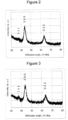
- the obtained composite oxide was subjected to powder X-ray diffraction measurement, and the results are illustrated in FIG. 2 .
- the crystal structure of the composite oxide belonged to a space group Fm-3m.
- the conditions of the powder X-ray diffraction measurement are as described above (the same conditions are applied to other Examples and Comparative Examples).
- NMP N-methyl-2-pyrrolidone
- LiPF 6 Lithium hexafluorophosphate
- FEC fluoroethylene carbonate
- FMP methyl propionate
- Electrode leads were attached to the metal lithium as the positive electrode and the negative electrode, respectively. Then, an electrode assembly with a separator interposed between the positive electrode and the negative electrode was produced, the electrode assembly was housed in an aluminum laminate film, and the non-aqueous electrolyte was injected and sealed. This was used as a test cell (non-aqueous electrolyte secondary battery) of Example 1.
- a composite oxide represented by Li 1.225 Mn 0.7 Mg 0.01 Ga 0.01 Nb 0.005 O 1.4 F 0.6 was obtained in the same operation as that of Example 1, except that lithium fluoride (LiF), lithium manganate (LiMnO 2 ), manganese(III) oxide (Mn 2 O 3 ), lithium peroxide (Li 2 O 2 ), magnesium oxide (MgO), gallium oxide (Ga 2 O 3 ), and niobium oxide (Nb 2 O 5 ) were used as starting sources of a composite oxide, and the compounds were weighed so that a molar ratio of Li:Mn:Mg:Ga:Nb:F was 1.225:0.7:0.01:0.01:0.005:0.6.
- the obtained composite oxide was subjected to powder X-ray diffraction measurement and crystal structure analysis, and as a result, it was confirmed that the crystal structure of the composite oxide belonged to a space group Fm-3m.
- Example 2 a test cell was manufactured in the same manner as that of Example 1 using the composite oxide represented by Li 1.225 Mn 0.7 Mg 0.01 Ga 0.01 Nb 0.005 O 1.4 F 0.6 .
- a composite oxide represented by Li 1.143 Mn 0.765 Mg 0.02 Nb 0.01 Ce 0.005 O 1.553 F 0.447 was obtained in the same operation as that of Example 1, except that lithium fluoride (LiF), lithium manganate (LiMnO 2 ), manganese(III) oxide (Mn 2 O 3 ), lithium peroxide (Li 2 O 2 ), magnesium oxide (MgO), niobium oxide (Nb 2 O 5 ), and cerium oxide (CeO 2 ) were used as starting sources of a composite oxide, and the compounds were weighed so that a molar ratio of Li:Mn:Mg:Nb:Ce:F was 1.143:0.765:0.02:0.01:0.005:0.447.
- the obtained composite oxide was subjected to powder X-ray diffraction measurement and crystal structure analysis, and as a result, it was confirmed that the crystal structure of the composite oxide belonged to a space group Fm-3m.
- Example 2 a test cell was manufactured in the same manner as that of Example 1 using the composite oxide represented by Li 1.143 Mn 0.765 Mg 0.02 Nb 0.01 Ce 0.005 O 1.553 F 0.447 .
- a composite oxide represented by Li 1.168 Mn 0.755 Gd 0.005 Nb 0.01 Ce 0.005 O 1.553 F 0.447 was obtained in the same operation as that of Example 1, except that lithium fluoride (LiF), lithium manganate (LiMnO 2 ), manganese(III) oxide (Mn 2 O 3 ), lithium peroxide (Li 2 O 2 ), gadolinium oxide (Gd 2 O 3 ), niobium oxide (Nb 2 O 5 ), and cerium oxide (CeO 2 ) were used as starting sources of a composite oxide, and the compounds were weighed so that a molar ratio of Li:Mn:Gd:Nb:Ce:F was 1.168:0.755:0.005:0.01:0.005:0.447.
- the obtained composite oxide was subjected to powder X-ray diffraction measurement and crystal structure analysis, and as a result, it was confirmed that the crystal structure of the composite oxide belonged to a space group Fm-3m.
- Example 2 a test cell was manufactured in the same manner as that of Example 1 using the composite oxide represented by Li 1.168 Mn 0.755 Gd 0.005 Nb 0.01 Ce 0.005 O 1.553 F 0.447 .
- a composite oxide represented by Li 1.175 Mn 0.76 Ga 0.005 Nb 0.005 Ce 0.005 O 1.55 F 0.45 was obtained in the same operation as that of Example 1, except that lithium fluoride (LiF), lithium manganate (LiMnO 2 ), manganese(III) oxide (Mn 2 O 3 ), lithium peroxide (Li 2 O 2 ), gallium oxide (Ga 2 O 3 ), niobium oxide (Nb 2 O 5 ), and cerium oxide (CeO 2 ) were used as starting sources of a composite oxide, and the compounds were weighed so that a molar ratio of Li:Mn:Ga:Nb:Ce:F was 1.175:0.76:0.005:0.005:0.005:0.45.
- the obtained composite oxide was subjected to powder X-ray diffraction measurement and crystal structure analysis, and as a result, it was confirmed that the crystal structure of the composite oxide belonged to a space group Fm-3m.
- Example 2 a test cell was manufactured in the same manner as that of Example 1 using the composite oxide represented by Li 1.175 Mn 0.76 Ga 0.005 Nb 0.005 Ce 0.005 O 1.55 F 0.45 .
- a composite oxide represented by Li 1.2 Mn 0.685 Ga 0.005 Nb 0.005 Ce 0.005 O 1.5 F 0.5 was obtained in the same operation as that of Example 1, except that lithium fluoride (LiF), lithium manganate (LiMnO 2 ), manganese(III) oxide (Mn 2 O 3 ), lithium peroxide (Li 2 O 2 ), gallium oxide (Ga 2 O 3 ), niobium oxide (Nb 2 O 5 ), and cerium oxide (CeO 2 ) were used as starting sources of a composite oxide, and the compounds were weighed so that a molar ratio of Li:Mn:Ga:Nb:Ce:F was 1.2:0.685:0.005:0.005:0.5.
- the obtained composite oxide was subjected to powder X-ray diffraction measurement and crystal structure analysis, and as a result, it was confirmed that the crystal structure of the composite oxide belonged to a space group Fm-3m.
- Example 2 a test cell was manufactured in the same manner as that of Example 1 using the composite oxide represented by Li 1.2 Mn 0.685 Ga 0.005 Nb 0.005 Ce 0.005 O 1.5 F 0.5 .
- a composite oxide represented by Li 1.175 Mn 0.7 Mg 0.025 Ga 0.025 Ce 0.025 O 1.55 F 0.45 was obtained in the same operation as that of Example 1, except that lithium fluoride (LiF), lithium manganate (LiMnO 2 ), manganese(III) oxide (Mn 2 O 3 ), lithium peroxide (Li 2 O 2 ), magnesium oxide (MgO), gallium oxide (Ga 2 O 3 ), and cerium oxide (CeO 2 ) were used as starting sources of a composite oxide, and the compounds were weighed so that a molar ratio of Li:Mn:Mg:Ga:Ce:F was 1.175:0.7:0.025:0.025:0.025:0.45.
- the obtained composite oxide was subjected to powder X-ray diffraction measurement and crystal structure analysis, and as a result, it was confirmed that the crystal structure of the composite oxide belonged to a space group Fm-3m.
- Example 2 a test cell was manufactured in the same manner as that of Example 1 using the composite oxide represented by Li 1.175 Mn 0.7 Mg 0.025 Ga 0.025 Ce 0.025 O 1.55 F 0.45 .
- a composite oxide represented by Li 1.192 Mn 0.73 Gd 0.005 Nb 0.01 Ce 0.005 O 1.702 F 0.208 was obtained in the same operation as that of Example 1, except that lithium fluoride (LiF), lithium manganate (LiMnO 2 ), manganese(III) oxide (Mn 2 O 3 ), lithium peroxide (Li 2 O 2 ), gadolinium oxide (Gd 2 O 3 ), niobium oxide (Nb 2 O 5 ), and cerium oxide (CeO 2 ) were used as starting sources of a composite oxide, and the compounds were weighed so that a molar ratio of Li:Mn:Gd:Nb:Ce:F was 1.192:0.73:0.005:0.01:0.005:0.298.
- the obtained composite oxide was subjected to powder X-ray diffraction measurement and crystal structure analysis, and as a result, it was confirmed that the crystal structure of the composite oxide belonged to a space group Fm-3m.
- Example 2 a test cell was manufactured in the same manner as that of Example 1 using the composite oxide represented by Li 1.192 Mn 0.73 Gd 0.005 Nb 0.01 Ce 0.005 O 1.702 F 0.298 .
- a composite oxide represented by Li 1.2 Mn 0.735 Mg 0.005 Ga 0.005 Nb 0.005 O 1.7 F 0.3 was obtained in the same operation as that of Example 1, except that lithium fluoride (LiF), lithium manganate (LiMnO 2 ), manganese(III) oxide (Mn 2 O 3 ), lithium peroxide (Li 2 O 2 ), magnesium oxide (MgO), gallium oxide (Ga 2 O 3 ), and niobium oxide (Nb 2 O 5 ) were used as starting sources of a composite oxide, and the compounds were weighed so that a molar ratio of Li:Mn:Mg:Ga:Nb:F was 1.2:0.735:0.005:0.005:0.3.
- the obtained composite oxide was subjected to powder X-ray diffraction measurement and crystal structure analysis, and as a result, it was confirmed that the crystal structure of the composite oxide belonged to a space group Fm-3m.
- Example 2 a test cell was manufactured in the same manner as that of Example 1 using the composite oxide represented by Li 1.2 Mn 0.735 Mg 0.005 Ga 0.005 Nb 0.005 O 1.7 F 0.3 .
- a composite oxide represented by Li 1.25 Mn 0.73 Mg 0.005 Gd 0.005 Nb 0.01 O 1.702 F 0.298 was obtained in the same operation as that of Example 1, except that lithium fluoride (LiF), lithium manganate (LiMnO 2 ), manganese(III) oxide (Mn 2 O 3 ), lithium peroxide (Li 2 O 2 ), magnesium oxide (MgO), gadolinium oxide (Gd 2 O 3 ), and niobium oxide (Nb 2 O 5 ) were used as starting sources of a composite oxide, and the compounds were weighed so that a molar ratio of Li:Mn:Mg:Gd:Nb:F was 1.25:0.73:0.005:0.005:0.01:0.298.
- the obtained composite oxide was subjected to powder X-ray diffraction measurement and crystal structure analysis, and as a result, it was confirmed that the crystal structure of the composite oxide belonged to a space group Fm-3m.
- Example 2 a test cell was manufactured in the same manner as that of Example 1 using the composite oxide represented by Li 1.25 Mn 0.73 Mg 0.005 Gd 0.005 Nb 0.01 O 1.702 F 0.208 .
- a composite oxide represented by Li 1.15 Mn 0.785 Mg 0.005 Nb 0.005 Ce 0.005 O 1.8 F 0.2 was obtained in the same operation as that of Example 1, except that lithium fluoride (LiF), lithium manganate (LiMnO 2 ), manganese(III) oxide (Mn 2 O 3 ), lithium peroxide (Li 2 O 2 ), magnesium oxide (MgO), niobium oxide (Nb 2 O 5 ), and cerium oxide (CeO 2 ) were used as starting sources of a composite oxide, and the compounds were weighed so that a molar ratio of Li:Mn:Mg:Nb:Ce:F was 1.15:0.785:0.005:0.005:0.005:0.2.
- the obtained composite oxide was subjected to powder X-ray diffraction measurement, and the results are illustrated in FIG. 3 .
- the crystal structure of the composite oxide belonged to a space group Fm-3m.
- the conditions for the powder X-ray diffraction measurement were as described above.
- Example 2 a test cell was manufactured in the same manner as that of Example 1 using the composite oxide represented by Li 1.15 Mn 0.785 Mg 0.005 Nb 0.005 Ce 0.005 O 1.8 F 0.2 .
- a composite oxide represented by Li 1.25 Mn 0.485 Ga 0.005 Nb 0.005 Ce 0.005 O 1.5 F 0.5 was obtained in the same operation as that of Example 1, except that lithium fluoride (LiF), lithium manganate (LiMnO 2 ), manganese(III) oxide (Mn 2 O 3 ), lithium peroxide (Li 2 O 2 ), gallium oxide (Ga 2 O 3 ), niobium oxide (Nb 2 O 5 ), and cerium oxide (CeO 2 ) were used as starting sources of a composite oxide, and the compounds were weighed so that a molar ratio of Li:Mn:Ga:Nb:Ce:F was 1.25:0.485:0.005:0.005:0.5.
- the obtained composite oxide was subjected to powder X-ray diffraction measurement, and the results are illustrated in FIG. 4 .
- the crystal structure of the composite oxide belonged to a space group Fm-3m.
- Example 2 a test cell was manufactured in the same manner as that of Example 1 using the composite oxide represented by Li 1.25 Mn 0.485 Ga 0.005 Nb 0.005 Ce 0.005 O 1.5 F 0.5 .
- a composite oxide represented by Li 1.25 Mn 0.45 Mg 0.025 Ce 0.025 O 1.5 F 0.5 was obtained in the same operation as that of Example 1, except that lithium fluoride (LiF), lithium manganate (LiMnO 2 ), manganese(III) oxide (Mn 2 O 3 ), lithium peroxide (Li 2 O 2 ), magnesium oxide (MgO), and cerium oxide (CeO 2 ) were used as starting sources of a composite oxide, and the compounds were weighed so that a molar ratio of Li:Mn:Mg:Ce:F was 1.25:0.45:0.025:0.025:0.5.
- the obtained composite oxide was subjected to powder X-ray diffraction measurement and crystal structure analysis, and as a result, it was confirmed that the crystal structure of the composite oxide belonged to a space group Fm-3m.
- Example 2 a test cell was manufactured in the same manner as that of Example 1 using the composite oxide represented by Li 1.25 Mn 0.45 Mg 0.025 Ce 0.025 O 1.5 F 0.5 .
- a composite oxide represented by Li 1.667 Mn 0.333 O 0.667 F 1.333 was obtained in the same operation as that of Example 1, except that lithium fluoride (LiF), lithium manganate (LiMnO 2 ), manganese(III) oxide (Mn 2 O 3 ), and lithium peroxide (Li 2 O 2 ) were used as starting sources of a composite oxide, and the compounds were weighed so that a molar ratio of Li:Mn:F was 1.667:0.333:1.333.
- the obtained composite oxide was subjected to powder X-ray diffraction measurement and crystal structure analysis, and as a result, it was confirmed that the crystal structure of the composite oxide belonged to Fm-3m.
- a composite oxide represented by Li 1.2 Mn 0.6 Ti 0.2 O 1.8 F 0.2 was obtained in the same operation as that of Example 1, except that lithium fluoride (LiF), lithium manganate (LiMnO 2 ), manganese(III) oxide (Mn 2 O 3 ), lithium peroxide (Li 2 O 2 ), and titanium dioxide (TiO 2 ) were used as starting sources of a composite oxide, and the compounds were weighed so that a molar ratio of Li:Mn:Ti:F was 1.2:0.6:0.2:0.2.
- the obtained composite oxide was subjected to powder X-ray diffraction measurement and crystal structure analysis, and as a result, it was confirmed that the crystal structure of the composite oxide belonged to Fm-3m.
- Example 2 a test cell was manufactured in the same manner as that of Example 1 using the composite oxide represented by Li 1.2 Mn 0.6 Ti 0.2 O 1.8 F 0.2 .
- a composite oxide represented by LiMnO 2 was obtained in the same manner as that of Example 1, except that LiMnO 2 was used as the composite oxide.
- the obtained composite oxide was subjected to powder X-ray diffraction measurement and crystal structure analysis, and as a result, it was confirmed that the crystal structure of the composite oxide belonged to Fm-3m.
- Example 2 a test cell was manufactured in the same manner as that of Example 1 using the composite oxide represented by LiMnO 2 .
- a composite oxide represented by Li 1.1 Mn 0.6 O 1.3 F 0.7 was obtained in the same operation as that of Example 1, except that lithium fluoride (LiF), lithium manganate (LiMnO 2 ), manganese(III) oxide (Mn 2 O 3 ), and lithium peroxide (Li 2 O 2 ) were used as starting sources of a composite oxide, and the compounds were weighed so that a molar ratio of Li:Mn:F was 1.1:0.6:0.7.
- the obtained composite oxide was subjected to powder X-ray diffraction measurement and crystal structure analysis, and as a result, it was confirmed that the crystal structure of the composite oxide belonged to Fm-3m.
- Example 2 a test cell was manufactured in the same manner as that of Example 1 using the composite oxide represented by Li 1.1 Mn 0.6 O 1.3 F 0.7 .
- a composite oxide represented by Li 1.14 Mn 0.86 O 1.3 F 0.7 was obtained in the same operation as that of Example 1, except that lithium fluoride (LiF), lithium manganate (LiMnO 2 ), manganese(III) oxide (Mn 2 O 3 ), and lithium peroxide (Li 2 O 2 ) were used as starting sources of a composite oxide, and the compounds were weighed so that a molar ratio of Li:Mn:F was 1.14:0.86:0.7.
- the obtained composite oxide was subjected to powder X-ray diffraction measurement and crystal structure analysis, and as a result, it was confirmed that the crystal structure of the composite oxide belonged to Fm-3m.
- Example 2 a test cell was manufactured in the same manner as that of Example 1 using the composite oxide represented by Li 1.14 Mn 0.86 O 1.3 F 0.7 .
- test cells of the respective Examples and the respective Comparative Examples were subjected to constant current charge at a constant current of 0.1 C under a temperature environment of 25°C until a battery voltage reached 4.95 V, and subjected to constant voltage charge at 4.95 V until a current value reached 0.05 C. Thereafter, the test cell was subjected to constant current discharge at a constant current of 0.1 C until a battery voltage reached 2.5 V. Then, a value obtained by dividing the total amount of power at the time of discharge by the total current was obtained as a discharge voltage. In addition, the discharge capacity (mAh/g) at the time of performing the constant current discharge was determined.
- FIGS. 5 and 6 illustrate charge and discharge curves of Example 1 and Example 11, respectively. From these drawings, it was confirmed that in Examples described in the present invention, a high discharge voltage was exhibited and a high discharge capacity was obtained. In the other Examples 2 to 10, the same charge and discharge curves were obtained, and therefore, the excellent results as shown in Table 1 were obtained.
- FIG. 7 illustrates a charge and discharge curve of Comparative Example 1. As can be seen from the drawing, in Comparative Example 1, the discharge voltage is low, and only a low discharge capacity is obtained. In the other Comparative Examples 2 to 7, the same charge and discharge curves were obtained, and the results shown in Table 1 were inferior to those of Examples.
Landscapes
- Chemical & Material Sciences (AREA)
- Inorganic Chemistry (AREA)
- Organic Chemistry (AREA)
- Chemical Kinetics & Catalysis (AREA)
- Electrochemistry (AREA)
- General Chemical & Material Sciences (AREA)
- Engineering & Computer Science (AREA)
- Manufacturing & Machinery (AREA)
- Battery Electrode And Active Subsutance (AREA)
Abstract
Description
- The present disclosure relates to a technique of a positive electrode active material for a non-aqueous electrolyte secondary battery.
- As a secondary battery having a high output and a high energy density, a non-aqueous electrolyte secondary battery has been widely used, in which the non-aqueous electrolyte secondary battery includes a positive electrode, a negative electrode, and a non-aqueous electrolyte, and performs charging and discharging by moving lithium ions and the like between the positive electrode and the negative electrode.
- For example,
Patent Literature 1 discloses, as a positive electrode active material used in a non-aqueous electrolyte secondary battery, a composite oxide that has a crystal structure belonging to a space group Fm-3m, contains lithium and molybdenum, and is substantially free of chromium. - Patent Literature 1:
JP 2017-202954 A - An object of the present disclosure is to provide a positive electrode active material for a non-aqueous electrolyte secondary battery having a high discharge voltage.
- A positive electrode active material for a non-aqueous electrolyte secondary battery according to an aspect of the present disclosure is a composite oxide that has a crystal structure belonging to a space group Fm-3m and is represented by a general formula: LixTMtmMyO2-fFf, and in the general formula, TM represents a transition metal, M represents a non-transition metal, x, tm, y, and f satisfy 1.75 ≤ x + tm + y ≤ 2 and 0 < f ≤ 0.7, and when Q = 2 × tm × {1 - (1 - f/2)5}, 0.8 ≤ Q ≤ 1.5 is satisfied.
- According to an aspect of the present disclosure, it is possible to provide a positive electrode active material for a non-aqueous electrolyte secondary battery having a high discharge voltage.
-
-
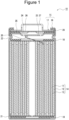
FIG. 1 is a cross-sectional view of a non-aqueous electrolyte secondary battery as an example of an embodiment. -
FIG. 2 is a view showing an X-ray diffraction result of Example 1. -
FIG. 3 is a view showing an X-ray diffraction result of Example 11. -
FIG. 4 is a view showing an X-ray diffraction result of Comparative Example 1. -
FIG. 5 is a view showing a charge and discharge curve of Example 1. -
FIG. 6 is a view showing a charge and discharge curve of Example 11. -
FIG. 7 is a view showing a charge and discharge curve of Comparative Example 1. - Hereinafter, an example of a non-aqueous electrolyte secondary battery using a positive electrode active material for a non-aqueous electrolyte secondary battery of the present disclosure will be described.
-
FIG. 1 is a cross-sectional view of a non-aqueous electrolyte secondary battery as an example of an embodiment. A non-aqueous electrolytesecondary battery 10 illustrated inFIG. 1 includes awound electrode assembly 14 formed by wounding a positive electrode 11 and anegative electrode 12 with aseparator 13 interposed between the positive electrode 11 and thenegative electrode 12, a non-aqueous electrolyte,insulating plates electrode assembly 14, respectively, and abattery case 15 housing the members. Thebattery case 15 includes acase body 16 and asealing assembly 17 for closing an opening of thecase body 16. Note that, instead of thewound electrode assembly 14, another form of an electrode assembly such as a stacked electrode assembly in which a positive electrode and a negative electrode are alternately stacked with a separator interposed therebetween may be applied. In addition, examples of thebattery case 15 include metal cases having a cylindrical shape, a square shape, a coin shape, a button shape, or the like, and resin cases (laminated batteries) formed by lamination with a resin sheet. - The non-aqueous electrolyte contains, for example, a non-aqueous solvent and an electrolyte salt dissolved in the non-aqueous solvent. Examples of the non-aqueous solvent include esters, ethers, nitriles, amides, and a mixed solvent of two or more thereof. The non-aqueous solvent may contain a halogen-substituted product in which at least some hydrogens in these solvents are substituted with halogen atoms such as fluorine. Examples of the electrolyte salt include lithium salts such as LiPF6. Note that the non-aqueous electrolyte is not limited to the liquid electrolyte, and may be a solid electrolyte using a gel polymer or the like.
- The
case body 16 is, for example, a bottomed cylindrical metal container. Agasket 28 is provided between thecase body 16 and thesealing assembly 17 to secure a sealing property of the inside of the battery. Thecase body 16 has, for example, a projectingportion 22 in which a part of a side part thereof projects inside for supporting thesealing assembly 17. The projectingportion 22 is preferably formed in an annular shape along a circumferential direction of thecase body 16, and supports thesealing assembly 17 on an upper surface thereof. - The
sealing assembly 17 has a structure in which afilter 23, alower vent member 24, aninsulating member 25, anupper vent member 26, and acap 27 are sequentially stacked from theelectrode assembly 14. Each member constituting thesealing assembly 17 has, for example, a disk shape or a ring shape, and the respective members except for the insulatingmember 25 are electrically connected to each other. Thelower vent member 24 and theupper vent member 26 are connected to each other at the respective central parts thereof, and theinsulating member 25 is interposed between the respective circumferential parts of thevent members secondary battery 10 is increased by heat generation due to an internal short circuit or the like, for example, thelower vent member 24 is deformed so as to push theupper vent member 26 up toward thecap 27 side and is broken, and thus, a current pathway between thelower vent member 24 and theupper vent member 26 is cut off. When the internal pressure is further increased, theupper vent member 26 is broken, and gas is discharged through an opening of thecap 27. - In the non-aqueous electrolyte
secondary battery 10 illustrated inFIG. 1 , apositive electrode lead 20 attached to the positive electrode 11 extends through a through-hole of theinsulating plate 18 toward a side of thesealing assembly 17, and anegative electrode lead 21 attached to thenegative electrode 12 extends through the outside of theinsulating plate 19 toward the bottom side of thecase body 16. Thepositive electrode lead 20 is connected to a lower surface of thefilter 23 that is a bottom plate of thesealing assembly 17 by welding or the like, and thecap 27 that is a top plate of thesealing assembly 17 electrically connected to thefilter 23 serves as a positive electrode terminal. Thenegative electrode lead 21 is connected to a bottom inner surface of thecase body 16 by welding or the like, and thecase body 16 serves as a negative electrode terminal. - Hereinafter, the positive electrode 11, the
negative electrode 12, and theseparator 13 will be described in detail. - The positive electrode 11 includes a positive electrode current collector and a positive electrode mixture layer disposed on the positive electrode current collector. As the positive electrode current collector, a foil of a metal stable in a potential range of the positive electrode, such as aluminum, a film in which the metal is disposed on a surface layer, or the like can be used. A thickness of the positive electrode current collector is preferably, for example, in a range of greater than or equal to 1 µm and less than or equal to 20 µm.
- It is preferable that the positive electrode mixture layer contains a positive electrode active material and further contains a binding agent, a conductive agent, or the like. A thickness of the positive electrode mixture layer is preferably, for example, in a range of greater than or equal to 10 µm and less than or equal to 300 µm.
- The positive electrode 11 is obtained by, for example, applying a positive electrode mixture slurry containing a positive electrode active material, a binding agent, a conductive agent, and the like onto a positive electrode current collector, drying the positive electrode current collector to form a positive electrode mixture layer on the positive electrode current collector, and rolling the positive electrode mixture layer.
- The positive electrode active material includes a composite oxide having a crystal structure belonging to a space group Fm-3m.
- The crystal structure belonging to the space group Fm-3m means having a peak attributable to the space group Fm-3m in a diffraction pattern obtained by X-ray diffraction (XRD) measurement. Note that "-3" in the space group "Fm-3m" represents a target element of a 3-fold rotation-inversion axis, and should be originally indicated by adding "3" with an upper bar "-". The X-ray diffraction pattern of the composite oxide can be performed by powder X-ray diffraction measurement using an X-ray diffractometer ("MiniFlexII" manufactured by Rigaku Corporation) with a radiation source of CuKα rays, a tube voltage of 40 kV, and a tube current of 15 mA. In this case, the diffracted X-ray passes through a Kβ filter having a thickness of 30 µm and is detected by a high-speed one-dimensional detector (D/teX Ultra 2). In addition, a sampling width is 0.02°, a scan speed is 10°/min, a divergence slit width is 0.625°, a light receiving slit width is 13 mm (OPEN), and a scattering slit width is 8 mm. Then, the crystal structure of the composite oxide can be identified by Rietveld analysis using a "RIETAN-FP" program (F. Izumi and K. Momma, Solid State Phenom., 130, 15-20 (2007)) based on the obtained X-ray diffraction pattern. Note that the X-ray diffractometer is not limited to the above apparatus, and the X-ray source is also not limited. The X-ray diffraction measurement conditions are not limited to the above conditions. In addition, a method for analyzing the obtained X-ray diffraction pattern is not limited to the above method.
- The composite oxide having a crystal structure belonging to a space group Fm-3m is represented by a general formula: LixTMtmMyO2-fFf, and in the general formula, TM represents a transition metal, M represents a non-transition metal, x, tm, y, and f satisfy 1.75 ≤ x + tm + y ≤ 2 and 0 < f ≤ 0.7, and when Q = 2 × tm × {1 - (1 - f/2)5}, 0.8 ≤ Q ≤ 1.5 is satisfied. Here, Q represents the number of oxygen bonded to the transition metal bonded to fluorine. By using such a composite oxide, a discharge voltage of the positive electrode active material can be increased. Note that the crystal structure may have vacancies in which Li atoms, TM atoms, and M atoms are not disposed. Here, having vacancies means that vacancies not filled with Li atoms, TM atoms, and M atoms are present in the composite oxide in the positive electrode active material taken out immediately after manufacture or by disassembling the secondary battery in a discharged state. A molar ratio of the vacancies is preferably greater than or equal to 0.05 and less than or equal to 0.25.
- In the general formula, x, tm, y, and f preferably satisfy, for example, 1.0 < x ≤ 1.4, 0.4 ≤ tm < 1.0, 0 ≤ y ≤ 0.2, and 0.2 ≤ f ≤ 0.6 in that a higher discharge voltage can be obtained.
- The composite oxide preferably contains Mn as the transition metal (TM) in that, for example, a higher discharge voltage can be obtained or a discharge capacity can be improved, and in the general formula, a molar ratio tm_Mn of Mn in tm preferably is 0.6 < tm_Mn < 0.8.
- The composite oxide preferably contains, for example, Mn and a transition metal other than Mn from the viewpoint of being able to obtain a higher discharge voltage or improving the discharge capacity. Examples of the transition metal other than Mn include Ni, Co, Fe, Ti, Y, Zr, Nb, Mo, Sc, W, V, Gd, Ce, and Ta, and Ce, Gd, and Nb are more preferable.
- Examples of the non-transition metal (M) contained in the composite oxide include Al, Mg, Sb, Bi, Ca, Sr, Mg, K, Ga, Sn, and Zn, and Ga and Mg are more preferable.
- The composite oxide contains, for example, Mn, from the viewpoint of being able to obtain a higher discharge voltage or improving the discharge capacity, and preferably contains at least one element of five elements of Gd, Ce, and Nb, which are the transition metals (TM), and Mg and Ga, which are the non-transition metals (M), and more preferably contains at least three elements of the five elements. In addition, a molar ratio of each of Mg, Gd, Ce, Nb, and Ga in the composite oxide is preferably greater than 0 and less than or equal to 0.025.
- Confirmation of the composition of the composite oxide can be performed by, for example, Rietveld analysis on parameters obtained by inductively coupled plasma emission spectrometry, X-ray photoelectron spectroscopy, and powder X-ray diffraction.
- A method for producing the composite oxide is not particularly limited, and may be a known method in synthesis of a positive electrode active material, and the composite oxide can be obtained by, for example, treating a lithium source, an additive element source, a fluorine source, or the like by a mechanochemical method. The mechanochemical method (also referred to as a mechanochemical treatment or the like) refers to a synthesis method using a mechanochemical reaction. The mechanochemical reaction refers to a chemical reaction such as a crystallization reaction, a solid solution reaction, or a phase transition reaction using high energy locally generated by mechanical energy such as friction or compression in a process of crushing a solid substance. Examples of an apparatus for performing the mechanochemical method include a pulverizer and a disperser such as a ball mill, a bead mill, a vibration mill, a turbo mill, a mechano-fusion, or a disk mill. Among them, a ball mill is preferable. The mechanochemical treatment may be performed in an inert gas atmosphere such as argon gas, or may be performed in an oxygen-containing atmosphere or the like.
- Examples of the lithium source include lithium carbonate and lithium hydroxide. The additive element source is a transition metal-containing compound and a non-transition metal-containing compound, and is, for example, a transition metal-containing oxide or hydroxide, a non-transition metal-containing oxide or hydroxide, a transition metal- or non-transition metal-containing composite oxide or hydroxide, and the like. The fluorine source is a fluoride such as lithium fluoride, molybdenum fluoride, or magnesium fluoride. Note that lithium fluoride may be used as a lithium source, a transition metal fluoride such as molybdenum fluoride may be used as a transition metal-containing compound as an additive element source, and a non-transition metal fluoride such as magnesium fluoride may be used as a non-transition metal-containing compound as an additive element source.
- The composite oxide obtained by the mechanochemical treatment may be subjected to a heat treatment. A heating temperature is not particularly limited, and may be, for example, in a range of greater than or equal to 500°C and less than or equal to 1,000°C. In addition, a heating time is not particularly limited, and is, for example, greater than or equal to 1 hour and less than or equal to 20 hours. The heating may be performed in an inert gas atmosphere such as argon gas, or may be performed in an oxygen-containing atmosphere or the like.
- The positive electrode active material may be composed of only the composite oxide, but may contain an active material other than the composite oxide. Examples of the other active material include a composite oxide represented by LixMOy (M represents at least one kind of transition metal) (LixCoO2, LixNiO2, LixMnO2, LixNiαCo(1-α)O2, LixNiαMnβCo(1-α-β)O2, or the like having a layered α-NaFeO2-type crystal structure, or LixMn2O4, LixNiαMn(2-α)O4, or the like having a spinel-type crystal structure), and a polyanion compound represented by LiwM'x(XOy)z (M' represents at least one kind of transition metal, and X represents, for example, P, Si, B, V, or the like) (LiFePO4, LiMnPO4, LiNiPO4, LiCoPO4, Li3V2(PO4)3, Li2MnSiO4, Li2CoPO4F, or the like).
- A content of the composite oxide that has a crystal structure belonging to a space group Fm-3m and is represented by a general formula: LixTMtmMyO2-fFf, in which in the general formula, TM represents a transition metal, M represents a non-transition metal, x, tm, y, and f satisfy 1.75 ≤ x + tm + y ≤ 2 and 0 < f ≤ 0.7, and when Q = 2 × tm × {1 - (1 - f/2)5}, 0.8 ≤ Q ≤ 1.5 is satisfied, is preferably greater than or equal to 50 mass%, more preferably greater than or equal to 70 mass%, and still more preferably greater than or equal to 90 mass%, with respect to a total mass of the positive electrode active material.
- Examples of the conductive agent contained in the positive electrode mixture layer include carbon powders such as carbon black, acetylene black, Ketjenblack, and graphite, and these conductive agents may be used alone or in combination of two or more thereof.
- As the binding agent contained in the positive electrode mixture layer, for example, a fluorine-based resin such as polytetrafluoroethylene (PTFE) or polyvinylidene fluoride (PVdF), PAN, a polyimide-based resin, an acrylic resin, a polyolefin-based resin, styrenebutadiene rubber (SBR), CMC or a salt thereof, a polyacrylic acid (PAA) or a salt thereof (PAA-Na, PAA-K, or the like), polyvinyl alcohol (PVA), and the like can be used. These materials may be used alone or in combination of two or more thereof.
- The
negative electrode 12 includes, for example, a negative electrode current collector such as a metal foil and a negative electrode mixture layer formed on the negative electrode current collector. The negative electrode current collector may be, for example, a foil of a metal, such as copper, that is stable in a potential range of the negative electrode, a film in which the metal is disposed on its surface layer. The negative electrode mixture layer contains, for example, a negative electrode active material, a binding agent, and the like. - The negative electrode active material contained in the negative electrode mixture layer is not particularly limited as long as it is a material capable of occluding and releasing lithium ions, and examples thereof include a carbon material, and an element capable of forming an alloy with lithium or a compound containing the element. As the carbon material, graphites such as natural graphite, non-graphitizable carbon, and artificial graphite, cokes, and the like can be used. Examples of the element capable of forming an alloy with lithium and the compound containing the element include silicon and tin, and silicon oxide and tin oxide formed by combining silicon and tin with oxygen. In addition to the above, a material having a higher charge-discharge potential with respect to metal lithium such as lithium titanate than a carbon material or the like can also be used. The binding agent contained in the negative electrode mixture layer may be the same as that in the positive electrode.
- For example, a porous sheet having an ion permeation property and an insulation property is used for the
separator 13. Specific examples of the porous sheet include a fine porous thin film, a woven fabric, and a non-woven fabric. As a material of theseparator 13, an olefin-based resin such as polyethylene or polypropylene, cellulose, and the like are preferable. Theseparator 13 may be a laminate including a cellulose fiber layer and a thermoplastic resin fiber layer formed of an olefin-based resin or the like, and theseparator 13 may have a surface coated with an aramid resin or the like. - Hereinafter, the present disclosure will be further described with reference to Examples, but the present disclosure is not limited to these Examples.
- Lithium fluoride (LiF), lithium manganate (LiMnO2), manganese(III) oxide (Mn2O3), lithium peroxide (Li2O2), magnesium oxide (MgO), gadolinium oxide (Gd2O3), and cerium oxide (CeO2) were used as starting sources of a composite oxide, and the compounds were weighed and mixed so that a molar ratio of Li:Mn:Mg:Gd:Ce:F was 1.225:0.705:0.005:0.01:0.005:0.6. The mixed powder was charged into a planetary ball mill (Premium-Line P7 manufactured by Fritsch GmbH, rotation speed: 600 rpm, container: 45 mL pot formed of zirconia, ball: ϕ3 mm ball formed of zirconia) and treated in an Ar-atmosphere at room temperature for 35 hours (after 1 hour of the operation, a cycle of pausing for 10 minutes was repeated 35 times). In this way, a composite oxide represented by Li1.225Mn0.705Mg0.005Gd0.01Ce0.005O1.4F0.6 was obtained.
- The obtained composite oxide was subjected to powder X-ray diffraction measurement, and the results are illustrated in
FIG. 2 . As a result of analyzing the crystal structure, it was confirmed that the crystal structure of the composite oxide belonged to a space group Fm-3m. The conditions of the powder X-ray diffraction measurement are as described above (the same conditions are applied to other Examples and Comparative Examples). - 70 parts by mass of the composite oxide, 20 parts by mass of acetylene black, and 10 parts by mass of polyvinylidene fluoride were mixed in terms of proportion, and N-methyl-2-pyrrolidone (NMP) was used as a dispersion medium to prepare a slurry for a positive electrode mixture layer. Next, the slurry for a positive electrode mixture layer was applied to an aluminum foil having a thickness of 15 µm and dried, and the obtained coating film was rolled to manufacture a positive electrode in which a positive electrode mixture layer was formed on both surfaces of the aluminum foil.
- Lithium hexafluorophosphate (LiPF6) was dissolved in a mixed solvent obtained by mixing fluoroethylene carbonate (FEC) and methyl propionate (FMP) at a volume ratio of 1:3 so that a concentration thereof was 1 mol/liter to prepare a non-aqueous electrolyte.
- Electrode leads were attached to the metal lithium as the positive electrode and the negative electrode, respectively. Then, an electrode assembly with a separator interposed between the positive electrode and the negative electrode was produced, the electrode assembly was housed in an aluminum laminate film, and the non-aqueous electrolyte was injected and sealed. This was used as a test cell (non-aqueous electrolyte secondary battery) of Example 1.
- A composite oxide represented by Li1.225Mn0.7Mg0.01Ga0.01Nb0.005O1.4F0.6 was obtained in the same operation as that of Example 1, except that lithium fluoride (LiF), lithium manganate (LiMnO2), manganese(III) oxide (Mn2O3), lithium peroxide (Li2O2), magnesium oxide (MgO), gallium oxide (Ga2O3), and niobium oxide (Nb2O5) were used as starting sources of a composite oxide, and the compounds were weighed so that a molar ratio of Li:Mn:Mg:Ga:Nb:F was 1.225:0.7:0.01:0.01:0.005:0.6. The obtained composite oxide was subjected to powder X-ray diffraction measurement and crystal structure analysis, and as a result, it was confirmed that the crystal structure of the composite oxide belonged to a space group Fm-3m.
- Then, a test cell was manufactured in the same manner as that of Example 1 using the composite oxide represented by Li1.225Mn0.7Mg0.01Ga0.01Nb0.005O1.4F0.6.
- A composite oxide represented by Li1.143Mn0.765Mg0.02Nb0.01Ce0.005O1.553F0.447 was obtained in the same operation as that of Example 1, except that lithium fluoride (LiF), lithium manganate (LiMnO2), manganese(III) oxide (Mn2O3), lithium peroxide (Li2O2), magnesium oxide (MgO), niobium oxide (Nb2O5), and cerium oxide (CeO2) were used as starting sources of a composite oxide, and the compounds were weighed so that a molar ratio of Li:Mn:Mg:Nb:Ce:F was 1.143:0.765:0.02:0.01:0.005:0.447. The obtained composite oxide was subjected to powder X-ray diffraction measurement and crystal structure analysis, and as a result, it was confirmed that the crystal structure of the composite oxide belonged to a space group Fm-3m.
- Then, a test cell was manufactured in the same manner as that of Example 1 using the composite oxide represented by Li1.143Mn0.765Mg0.02Nb0.01Ce0.005O1.553F0.447.
- A composite oxide represented by Li1.168Mn0.755Gd0.005Nb0.01Ce0.005O1.553F0.447 was obtained in the same operation as that of Example 1, except that lithium fluoride (LiF), lithium manganate (LiMnO2), manganese(III) oxide (Mn2O3), lithium peroxide (Li2O2), gadolinium oxide (Gd2O3), niobium oxide (Nb2O5), and cerium oxide (CeO2) were used as starting sources of a composite oxide, and the compounds were weighed so that a molar ratio of Li:Mn:Gd:Nb:Ce:F was 1.168:0.755:0.005:0.01:0.005:0.447. The obtained composite oxide was subjected to powder X-ray diffraction measurement and crystal structure analysis, and as a result, it was confirmed that the crystal structure of the composite oxide belonged to a space group Fm-3m.
- Then, a test cell was manufactured in the same manner as that of Example 1 using the composite oxide represented by Li1.168Mn0.755Gd0.005Nb0.01Ce0.005O1.553F0.447.
- A composite oxide represented by Li1.175Mn0.76Ga0.005Nb0.005Ce0.005O1.55F0.45 was obtained in the same operation as that of Example 1, except that lithium fluoride (LiF), lithium manganate (LiMnO2), manganese(III) oxide (Mn2O3), lithium peroxide (Li2O2), gallium oxide (Ga2O3), niobium oxide (Nb2O5), and cerium oxide (CeO2) were used as starting sources of a composite oxide, and the compounds were weighed so that a molar ratio of Li:Mn:Ga:Nb:Ce:F was 1.175:0.76:0.005:0.005:0.005:0.45. The obtained composite oxide was subjected to powder X-ray diffraction measurement and crystal structure analysis, and as a result, it was confirmed that the crystal structure of the composite oxide belonged to a space group Fm-3m.
- Then, a test cell was manufactured in the same manner as that of Example 1 using the composite oxide represented by Li1.175Mn0.76Ga0.005Nb0.005Ce0.005O1.55F0.45.
- A composite oxide represented by Li1.2Mn0.685Ga0.005Nb0.005Ce0.005O1.5F0.5 was obtained in the same operation as that of Example 1, except that lithium fluoride (LiF), lithium manganate (LiMnO2), manganese(III) oxide (Mn2O3), lithium peroxide (Li2O2), gallium oxide (Ga2O3), niobium oxide (Nb2O5), and cerium oxide (CeO2) were used as starting sources of a composite oxide, and the compounds were weighed so that a molar ratio of Li:Mn:Ga:Nb:Ce:F was 1.2:0.685:0.005:0.005:0.005:0.5. The obtained composite oxide was subjected to powder X-ray diffraction measurement and crystal structure analysis, and as a result, it was confirmed that the crystal structure of the composite oxide belonged to a space group Fm-3m.
- Then, a test cell was manufactured in the same manner as that of Example 1 using the composite oxide represented by Li1.2Mn0.685Ga0.005Nb0.005Ce0.005O1.5F0.5.
- A composite oxide represented by Li1.175Mn0.7Mg0.025Ga0.025Ce0.025O1.55F0.45 was obtained in the same operation as that of Example 1, except that lithium fluoride (LiF), lithium manganate (LiMnO2), manganese(III) oxide (Mn2O3), lithium peroxide (Li2O2), magnesium oxide (MgO), gallium oxide (Ga2O3), and cerium oxide (CeO2) were used as starting sources of a composite oxide, and the compounds were weighed so that a molar ratio of Li:Mn:Mg:Ga:Ce:F was 1.175:0.7:0.025:0.025:0.025:0.45. The obtained composite oxide was subjected to powder X-ray diffraction measurement and crystal structure analysis, and as a result, it was confirmed that the crystal structure of the composite oxide belonged to a space group Fm-3m.
- Then, a test cell was manufactured in the same manner as that of Example 1 using the composite oxide represented by Li1.175Mn0.7Mg0.025Ga0.025Ce0.025O1.55F0.45.
- A composite oxide represented by Li1.192Mn0.73Gd0.005Nb0.01Ce0.005O1.702F0.208 was obtained in the same operation as that of Example 1, except that lithium fluoride (LiF), lithium manganate (LiMnO2), manganese(III) oxide (Mn2O3), lithium peroxide (Li2O2), gadolinium oxide (Gd2O3), niobium oxide (Nb2O5), and cerium oxide (CeO2) were used as starting sources of a composite oxide, and the compounds were weighed so that a molar ratio of Li:Mn:Gd:Nb:Ce:F was 1.192:0.73:0.005:0.01:0.005:0.298. The obtained composite oxide was subjected to powder X-ray diffraction measurement and crystal structure analysis, and as a result, it was confirmed that the crystal structure of the composite oxide belonged to a space group Fm-3m.
- Then, a test cell was manufactured in the same manner as that of Example 1 using the composite oxide represented by Li1.192Mn0.73Gd0.005Nb0.01Ce0.005O1.702F0.298.
- A composite oxide represented by Li1.2Mn0.735Mg0.005Ga0.005Nb0.005O1.7F0.3 was obtained in the same operation as that of Example 1, except that lithium fluoride (LiF), lithium manganate (LiMnO2), manganese(III) oxide (Mn2O3), lithium peroxide (Li2O2), magnesium oxide (MgO), gallium oxide (Ga2O3), and niobium oxide (Nb2O5) were used as starting sources of a composite oxide, and the compounds were weighed so that a molar ratio of Li:Mn:Mg:Ga:Nb:F was 1.2:0.735:0.005:0.005:0.005:0.3. The obtained composite oxide was subjected to powder X-ray diffraction measurement and crystal structure analysis, and as a result, it was confirmed that the crystal structure of the composite oxide belonged to a space group Fm-3m.
- Then, a test cell was manufactured in the same manner as that of Example 1 using the composite oxide represented by Li1.2Mn0.735Mg0.005Ga0.005Nb0.005O1.7F0.3.
- A composite oxide represented by Li1.25Mn0.73Mg0.005Gd0.005Nb0.01O1.702F0.298 was obtained in the same operation as that of Example 1, except that lithium fluoride (LiF), lithium manganate (LiMnO2), manganese(III) oxide (Mn2O3), lithium peroxide (Li2O2), magnesium oxide (MgO), gadolinium oxide (Gd2O3), and niobium oxide (Nb2O5) were used as starting sources of a composite oxide, and the compounds were weighed so that a molar ratio of Li:Mn:Mg:Gd:Nb:F was 1.25:0.73:0.005:0.005:0.01:0.298. The obtained composite oxide was subjected to powder X-ray diffraction measurement and crystal structure analysis, and as a result, it was confirmed that the crystal structure of the composite oxide belonged to a space group Fm-3m.
- Then, a test cell was manufactured in the same manner as that of Example 1 using the composite oxide represented by Li1.25Mn0.73Mg0.005Gd0.005Nb0.01O1.702F0.208.
- A composite oxide represented by Li1.15Mn0.785Mg0.005Nb0.005Ce0.005O1.8F0.2 was obtained in the same operation as that of Example 1, except that lithium fluoride (LiF), lithium manganate (LiMnO2), manganese(III) oxide (Mn2O3), lithium peroxide (Li2O2), magnesium oxide (MgO), niobium oxide (Nb2O5), and cerium oxide (CeO2) were used as starting sources of a composite oxide, and the compounds were weighed so that a molar ratio of Li:Mn:Mg:Nb:Ce:F was 1.15:0.785:0.005:0.005:0.005:0.2. The obtained composite oxide was subjected to powder X-ray diffraction measurement, and the results are illustrated in
FIG. 3 . As a result of analyzing the crystal structure, it was confirmed that the crystal structure of the composite oxide belonged to a space group Fm-3m. The conditions for the powder X-ray diffraction measurement were as described above. - Then, a test cell was manufactured in the same manner as that of Example 1 using the composite oxide represented by Li1.15Mn0.785Mg0.005Nb0.005Ce0.005O1.8F0.2.
- A composite oxide represented by Li1.25Mn0.485Ga0.005Nb0.005Ce0.005O1.5F0.5 was obtained in the same operation as that of Example 1, except that lithium fluoride (LiF), lithium manganate (LiMnO2), manganese(III) oxide (Mn2O3), lithium peroxide (Li2O2), gallium oxide (Ga2O3), niobium oxide (Nb2O5), and cerium oxide (CeO2) were used as starting sources of a composite oxide, and the compounds were weighed so that a molar ratio of Li:Mn:Ga:Nb:Ce:F was 1.25:0.485:0.005:0.005:0.005:0.5. The obtained composite oxide was subjected to powder X-ray diffraction measurement, and the results are illustrated in
FIG. 4 . As a result of analyzing the crystal structure, it was confirmed that the crystal structure of the composite oxide belonged to a space group Fm-3m. - Then, a test cell was manufactured in the same manner as that of Example 1 using the composite oxide represented by Li1.25Mn0.485Ga0.005Nb0.005Ce0.005O1.5F0.5.
- A composite oxide represented by Li1.25Mn0.45Mg0.025Ce0.025O1.5F0.5 was obtained in the same operation as that of Example 1, except that lithium fluoride (LiF), lithium manganate (LiMnO2), manganese(III) oxide (Mn2O3), lithium peroxide (Li2O2), magnesium oxide (MgO), and cerium oxide (CeO2) were used as starting sources of a composite oxide, and the compounds were weighed so that a molar ratio of Li:Mn:Mg:Ce:F was 1.25:0.45:0.025:0.025:0.5. The obtained composite oxide was subjected to powder X-ray diffraction measurement and crystal structure analysis, and as a result, it was confirmed that the crystal structure of the composite oxide belonged to a space group Fm-3m.
- Then, a test cell was manufactured in the same manner as that of Example 1 using the composite oxide represented by Li1.25Mn0.45Mg0.025Ce0.025O1.5F0.5.
- A composite oxide represented by Li1.667Mn0.333O0.667F1.333 was obtained in the same operation as that of Example 1, except that lithium fluoride (LiF), lithium manganate (LiMnO2), manganese(III) oxide (Mn2O3), and lithium peroxide (Li2O2) were used as starting sources of a composite oxide, and the compounds were weighed so that a molar ratio of Li:Mn:F was 1.667:0.333:1.333. The obtained composite oxide was subjected to powder X-ray diffraction measurement and crystal structure analysis, and as a result, it was confirmed that the crystal structure of the composite oxide belonged to Fm-3m.
- Then, a test cell was manufactured in the same manner as that of Example 1 using the composite oxide represented by Li1.667Mn0.333O0.667F1.333.
- A composite oxide represented by Li1.2Mn0.6Ti0.2O1.8F0.2 was obtained in the same operation as that of Example 1, except that lithium fluoride (LiF), lithium manganate (LiMnO2), manganese(III) oxide (Mn2O3), lithium peroxide (Li2O2), and titanium dioxide (TiO2) were used as starting sources of a composite oxide, and the compounds were weighed so that a molar ratio of Li:Mn:Ti:F was 1.2:0.6:0.2:0.2. The obtained composite oxide was subjected to powder X-ray diffraction measurement and crystal structure analysis, and as a result, it was confirmed that the crystal structure of the composite oxide belonged to Fm-3m.
- Then, a test cell was manufactured in the same manner as that of Example 1 using the composite oxide represented by Li1.2Mn0.6Ti0.2O1.8F0.2.
- A composite oxide represented by LiMnO2 was obtained in the same manner as that of Example 1, except that LiMnO2 was used as the composite oxide. The obtained composite oxide was subjected to powder X-ray diffraction measurement and crystal structure analysis, and as a result, it was confirmed that the crystal structure of the composite oxide belonged to Fm-3m.
- Then, a test cell was manufactured in the same manner as that of Example 1 using the composite oxide represented by LiMnO2.
- A composite oxide represented by Li1.1Mn0.6O1.3F0.7 was obtained in the same operation as that of Example 1, except that lithium fluoride (LiF), lithium manganate (LiMnO2), manganese(III) oxide (Mn2O3), and lithium peroxide (Li2O2) were used as starting sources of a composite oxide, and the compounds were weighed so that a molar ratio of Li:Mn:F was 1.1:0.6:0.7. The obtained composite oxide was subjected to powder X-ray diffraction measurement and crystal structure analysis, and as a result, it was confirmed that the crystal structure of the composite oxide belonged to Fm-3m.
- Then, a test cell was manufactured in the same manner as that of Example 1 using the composite oxide represented by Li1.1Mn0.6O1.3F0.7.
- A composite oxide represented by Li1.14Mn0.86O1.3F0.7 was obtained in the same operation as that of Example 1, except that lithium fluoride (LiF), lithium manganate (LiMnO2), manganese(III) oxide (Mn2O3), and lithium peroxide (Li2O2) were used as starting sources of a composite oxide, and the compounds were weighed so that a molar ratio of Li:Mn:F was 1.14:0.86:0.7. The obtained composite oxide was subjected to powder X-ray diffraction measurement and crystal structure analysis, and as a result, it was confirmed that the crystal structure of the composite oxide belonged to Fm-3m.
- Then, a test cell was manufactured in the same manner as that of Example 1 using the composite oxide represented by Li1.14Mn0.86O1.3F0.7.
- Each of the test cells of the respective Examples and the respective Comparative Examples was subjected to constant current charge at a constant current of 0.1 C under a temperature environment of 25°C until a battery voltage reached 4.95 V, and subjected to constant voltage charge at 4.95 V until a current value reached 0.05 C. Thereafter, the test cell was subjected to constant current discharge at a constant current of 0.1 C until a battery voltage reached 2.5 V. Then, a value obtained by dividing the total amount of power at the time of discharge by the total current was obtained as a discharge voltage. In addition, the discharge capacity (mAh/g) at the time of performing the constant current discharge was determined.
- In Table 1, the compositions of the composite oxides, the values of x + tm + y of the compositions (LixTMtmMyO2-fFf: TM represents a transition metal and M represents a non-transition metal), the values of f, the values of 2 × tm × {1 - (1 - f/2)5} = Q, and the results of the discharge capacity and the discharge voltage of the respective Examples and the respective Comparative Examples are summarized.
[Table 1] Composite oxide LixTMtmMyO2-fFf (TM: transition metal, M: non-transition metal) Test results Composition x + y + tm f Q Discharge capacity (mAh/g) Discharge voltage (V) Example 1 Li1.225Mn0.705Mg0.005Gd0.01Ce0.005O1.4F0.6 1.95 0.6 1.20 281.3 3.562 Example 2 Li1.225Mn0.7Mg0.01Ga0.01Nb0.005O1.4F0.6 1.95 0.6 1.17 290.9 3.548 Example 3 Li1.143Mn0.765Mg0.02Nb0.01Ce0.005O1.553F0.447 1.943 0.447 1.12 296.7 3.536 Example 4 Li1.168Mn0.755Gd0.005Nb0.01Ce0.005O1.553F0.447 1.943 0.447 1.11 302.3 3.540 Example 5 Li1.175Mn0.76Ga0.005Nb0.005Ce0.005O1.55F0.45 1.95 0.45 1.11 285.5 3.539 Example 6 Li1.2Mn0.685Ga0.005Nb0.005Ce0.005O1.5F0.5 1.9 0.5 1.06 311.3 3.537 Example 7 Li1.175Mn0.7Mg0.025Ga0.025Ce0.025O1.55F0.45 1.95 0.45 1.04 292.9 3.517 Example 8 Li1.192Mn0.73Gd0.005Nb0.01Ce0.005O1.702F0.208 1.942 0.298 0.83 318.5 3.498 Example 9 Li1.2Mn0.735Mg0.005Ga0.005Nb0.005O1.7F0.3 1.95 0.3 0.82 319.7 3.500 Example 10 Li1.25Mn0.73Mg0.005Gd0.005Nb0.01O1.702F0.298 2 0.298 0.82 311.2 3.447 Example 11 Li1.15Mn0.785Mg0.005Nb0.005Ce0.005O1.8F0.2 1.95 0.2 0.80 302.1 3.488 Comparative Example 1 Li1.25Mn0.485Ga0.005Nb0.005Ce0.005O1.5F0.5 1.75 0.5 0.76 169.9 3.287 Comparative Example 2 Li1.25Mn0.45Mg0.025Ce0.025O1.5F0.5 1.75 0.5 0.72 126.6 3.205 Comparative Example 3 Li1.667Mn0.333O0.667F1.333 1.993 1.333 0.66 25.0 3.250 Comparative Example 4 Li1.2Mn0.6Ti0.2O1.8F0.2 2 0.2 0.66 246.0 3.341 Comparative Example 5 LiMnO2 2 0 0 165.9 3.398 Comparative Example 6 Li1.1Mn0.6O1.3F0.7 1.7 0.7 1.06 183.8 3.378 Comparative Example 7 Li1.14Mn0.86O1.3F0.7 2 0.7 1.52 218.7 3.419 - In all of Examples 1 to 11, a higher discharge voltage was exhibited and a higher discharge capacity was obtained, compared to Comparative Examples 1 to 7. From these results, it can be said that a high discharge voltage can be obtained by using a composite oxide that has a crystal structure belonging to a space group Fm-3m and is represented by a general formula: LixTMtmMyO2-fFf, in which in the general formula, TM represents a transition metal, M represents a non-transition metal, x, tm, y, and f satisfy 1.75 ≤ x + tm + y ≤ 2 and 0 < f ≤ 0.7, and when Q = 2 × tm × {1 - (1 - f/2)5}, 0.8 ≤ Q ≤ 1.5 is satisfied.
-
FIGS. 5 and6 illustrate charge and discharge curves of Example 1 and Example 11, respectively. From these drawings, it was confirmed that in Examples described in the present invention, a high discharge voltage was exhibited and a high discharge capacity was obtained. In the other Examples 2 to 10, the same charge and discharge curves were obtained, and therefore, the excellent results as shown in Table 1 were obtained. On the other hand,FIG. 7 illustrates a charge and discharge curve of Comparative Example 1. As can be seen from the drawing, in Comparative Example 1, the discharge voltage is low, and only a low discharge capacity is obtained. In the other Comparative Examples 2 to 7, the same charge and discharge curves were obtained, and the results shown in Table 1 were inferior to those of Examples. -
- 10
- Non-aqueous electrolyte secondary battery
- 11
- Positive electrode
- 12
- Negative electrode
- 13
- Separator
- 14
- Electrode assembly
- 15
- Battery case
- 16
- Case body
- 17
- Sealing assembly
- 18, 19
- Insulating plate
- 20
- Positive electrode lead
- 21
- Negative electrode lead
- 22
- Projecting portion
- 23
- Filter
- 24
- Lower vent member
- 25
- Insulating member
- 26
- Upper vent member
- 27
- Cap
- 28
- Gasket
Claims (7)
- A positive electrode active material for a non-aqueous electrolyte secondary battery, wherein the positive electrode active material is a composite oxide that has a crystal structure belonging to a space group Fm-3m and is represented by a general formula: LixTMtmMyO2-fFf, and in the general formula, TM represents a transition metal, M represents a non-transition metal, x, tm, y, and f satisfy 1.75 ≤ x + tm + y ≤ 2 and 0 < f ≤ 0.7, and when Q = 2 × tm × {1 - (1 - f/2)5}, 0.8 ≤ Q ≤ 1.5 is satisfied.
- The positive electrode active material for a non-aqueous electrolyte secondary battery according to claim 1, wherein in the general formula, x, tm, y, and f satisfy 1.0 < x ≤ 1.4, 0.4 ≤ tm < 1.0, 0 ≤ y ≤ 0.2, and 0.2 ≤ f ≤ 0.6.
- The positive electrode active material for a non-aqueous electrolyte secondary battery according to claim 1 or 2, wherein the composite oxide contains Mn as the transition metal (TM), and
in the general formula, a molar ratio tm_Mn of Mn in tm is 0.6 < tm_Mn < 0.8. - The positive electrode active material for a non-aqueous electrolyte secondary battery according to claim 3, wherein the composite oxide contains Mn and a transition metal other than Mn as the transition metal (TM).
- The positive electrode active material for a non-aqueous electrolyte secondary battery according to claim 3, wherein the composite oxide contains at least one element of five elements of Gd, Ce, and Nb, which are the transition metals (TM), and Mg and Ga, which are the non-transition metals (M).
- The positive electrode active material for a non-aqueous electrolyte secondary battery according to claim 3, wherein the composite oxide contains at least three elements of five elements of Gd, Ce, and Nb, which are the transition metals (TM), and Mg and Ga, which are the non-transition metals (M).
- The positive electrode active material for a non-aqueous electrolyte secondary battery according to claim 5 or 6, wherein a molar ratio B of each of Mg, Gd, Ce, Nb, and Ga in the composite oxide is 0 <B ≤ 0.025.
Applications Claiming Priority (2)
| Application Number | Priority Date | Filing Date | Title |
|---|---|---|---|
| JP2022058486 | 2022-03-31 | ||
| PCT/JP2022/045645 WO2023188567A1 (en) | 2022-03-31 | 2022-12-12 | Positive electrode active material for nonaqueous electrolyte secondary batteries |
Publications (2)
| Publication Number | Publication Date |
|---|---|
| EP4503187A1 true EP4503187A1 (en) | 2025-02-05 |
| EP4503187A4 EP4503187A4 (en) | 2025-12-10 |
Family
ID=88199973
Family Applications (1)
| Application Number | Title | Priority Date | Filing Date |
|---|---|---|---|
| EP22935696.9A Pending EP4503187A4 (en) | 2022-03-31 | 2022-12-12 | POSITIVE ELECTRODE ACTIVE MATERIAL FOR SECONDARY BATTERIES WITH AHYDRATE-FREE ELECTROLYTE |
Country Status (5)
| Country | Link |
|---|---|
| US (1) | US20250226403A1 (en) |
| EP (1) | EP4503187A4 (en) |
| JP (1) | JPWO2023188567A1 (en) |
| CN (1) | CN118901152A (en) |
| WO (1) | WO2023188567A1 (en) |
Family Cites Families (5)
| Publication number | Priority date | Publication date | Assignee | Title |
|---|---|---|---|---|
| JP6609217B2 (en) | 2016-05-11 | 2019-11-20 | 株式会社Gsユアサ | Composite oxide, positive electrode active material for non-aqueous electrolyte secondary battery, positive electrode for non-aqueous electrolyte secondary battery, non-aqueous electrolyte secondary battery, and method for producing composite oxide |
| CN110199419B (en) * | 2017-03-06 | 2022-08-23 | 松下知识产权经营株式会社 | Positive electrode active material and battery |
| US10978706B2 (en) * | 2017-09-19 | 2021-04-13 | The Regents Of The University Of California | Cation-disordered rocksalt lithium metal oxides and oxyfluorides and methods of making same |
| JPWO2022070896A1 (en) * | 2020-09-30 | 2022-04-07 | ||
| CN116325228A (en) * | 2020-09-30 | 2023-06-23 | 松下知识产权经营株式会社 | Cathode active material for secondary battery and secondary battery |
-
2022
- 2022-12-12 WO PCT/JP2022/045645 patent/WO2023188567A1/en not_active Ceased
- 2022-12-12 US US18/847,835 patent/US20250226403A1/en active Pending
- 2022-12-12 CN CN202280093700.2A patent/CN118901152A/en active Pending
- 2022-12-12 EP EP22935696.9A patent/EP4503187A4/en active Pending
- 2022-12-12 JP JP2024511215A patent/JPWO2023188567A1/ja active Pending
Also Published As
| Publication number | Publication date |
|---|---|
| EP4503187A4 (en) | 2025-12-10 |
| WO2023188567A1 (en) | 2023-10-05 |
| CN118901152A (en) | 2024-11-05 |
| US20250226403A1 (en) | 2025-07-10 |
| JPWO2023188567A1 (en) | 2023-10-05 |
Similar Documents
| Publication | Publication Date | Title |
|---|---|---|
| JP5115891B2 (en) | Non-aqueous secondary battery comprising a positive electrode active material and a positive electrode including the same | |
| EP3327835B1 (en) | Positive electrode active material and battery | |
| JP6096985B1 (en) | Nonaqueous electrolyte battery and battery pack | |
| JP2010129471A (en) | Cathode active material and nonaqueous electrolyte battery | |
| JP2000077071A (en) | Nonaqueous electrolyte secondary battery | |
| CN111226332A (en) | Positive electrode active material for nonaqueous electrolyte secondary battery, method for producing same, nonaqueous electrolyte secondary battery, and method for producing same | |
| KR20200056235A (en) | Positive active material, method of manufacturing the same and rechargeable lithium battery incluidng the same | |
| Gómez-Cámer et al. | Antimony based negative electrodes for next generation Li-ion batteries | |
| WO2015102091A1 (en) | Electrode and nonaqueous electrolyte battery | |
| KR20180080315A (en) | Positive electrode active material for lithium ion secondary battery, production method thereof, and lithium ion secondary battery | |
| US20120100431A1 (en) | Cathode active material and nonaqueous secondary battery including cathode having the cathode active material | |
| JP2021082420A (en) | Negative electrode active material, negative electrode and battery cell | |
| JP5168829B2 (en) | Positive electrode active material and non-aqueous electrolyte battery | |
| JP2008060033A (en) | Positive electrode active material, positive electrode and non-aqueous electrolyte secondary battery using the same, and method for producing positive electrode active material | |
| JP2001176546A (en) | Film-sheathed non-aqueous electrolyte secondary batatery | |
| EP4503188A1 (en) | Positive electrode active material for nonaqueous electrolyte secondary batteries | |
| JP2022176525A (en) | Negative electrode active material, negative electrode, and battery cell | |
| JP6911545B2 (en) | Negative electrode and non-aqueous electrolyte power storage element | |
| EP4503187A1 (en) | Positive electrode active material for nonaqueous electrolyte secondary batteries | |
| EP4503189A1 (en) | Positive electrode active material for nonaqueous electrolyte secondary batteries | |
| EP4053081B1 (en) | Positive electrode active material for secondary battery, and secondary battery | |
| JP7473527B2 (en) | Positive electrode active material for lithium ion secondary battery, method for producing positive electrode active material for lithium ion secondary battery, lithium ion secondary battery | |
| CN119895593A (en) | Positive electrode material for lithium ion secondary battery, method for producing same, positive electrode for lithium ion secondary battery, and lithium ion secondary battery | |
| WO2020202350A1 (en) | Electrode, battery, and battery pack | |
| EP4485575A1 (en) | Positive electrode active material for nonaqueous electrolyte secondary battery, and nonaqueous electrolyte secondary battery |
Legal Events
| Date | Code | Title | Description |
|---|---|---|---|
| STAA | Information on the status of an ep patent application or granted ep patent |
Free format text: STATUS: THE INTERNATIONAL PUBLICATION HAS BEEN MADE |
|
| PUAI | Public reference made under article 153(3) epc to a published international application that has entered the european phase |
Free format text: ORIGINAL CODE: 0009012 |
|
| STAA | Information on the status of an ep patent application or granted ep patent |
Free format text: STATUS: REQUEST FOR EXAMINATION WAS MADE |
|
| 17P | Request for examination filed |
Effective date: 20241010 |
|
| AK | Designated contracting states |
Kind code of ref document: A1 Designated state(s): AL AT BE BG CH CY CZ DE DK EE ES FI FR GB GR HR HU IE IS IT LI LT LU LV MC ME MK MT NL NO PL PT RO RS SE SI SK SM TR |
|
| DAV | Request for validation of the european patent (deleted) | ||
| DAX | Request for extension of the european patent (deleted) | ||
| REG | Reference to a national code |
Ref country code: DE Ref legal event code: R079 Free format text: PREVIOUS MAIN CLASS: H01M0004505000 Ipc: C01G0045220000 |
|
| A4 | Supplementary search report drawn up and despatched |
Effective date: 20251106 |
|
| RIC1 | Information provided on ipc code assigned before grant |
Ipc: C01G 45/22 20250101AFI20251031BHEP Ipc: H01M 4/505 20100101ALI20251031BHEP Ipc: H01M 4/525 20100101ALI20251031BHEP Ipc: H01M 10/058 20100101ALI20251031BHEP Ipc: H01M 4/02 20060101ALN20251031BHEP |