EP4502877A1 - Model training method, model training program, and information processing device - Google Patents
Model training method, model training program, and information processing device Download PDFInfo
- Publication number
- EP4502877A1 EP4502877A1 EP22935494.9A EP22935494A EP4502877A1 EP 4502877 A1 EP4502877 A1 EP 4502877A1 EP 22935494 A EP22935494 A EP 22935494A EP 4502877 A1 EP4502877 A1 EP 4502877A1
- Authority
- EP
- European Patent Office
- Prior art keywords
- data
- confidence level
- processed data
- pieces
- training
- Prior art date
- Legal status (The legal status is an assumption and is not a legal conclusion. Google has not performed a legal analysis and makes no representation as to the accuracy of the status listed.)
- Pending
Links
Images




Classifications
-
- G—PHYSICS
- G06—COMPUTING OR CALCULATING; COUNTING
- G06N—COMPUTING ARRANGEMENTS BASED ON SPECIFIC COMPUTATIONAL MODELS
- G06N20/00—Machine learning
-
- G—PHYSICS
- G06—COMPUTING OR CALCULATING; COUNTING
- G06F—ELECTRIC DIGITAL DATA PROCESSING
- G06F21/00—Security arrangements for protecting computers, components thereof, programs or data against unauthorised activity
- G06F21/50—Monitoring users, programs or devices to maintain the integrity of platforms, e.g. of processors, firmware or operating systems
- G06F21/57—Certifying or maintaining trusted computer platforms, e.g. secure boots or power-downs, version controls, system software checks, secure updates or assessing vulnerabilities
- G06F21/577—Assessing vulnerabilities and evaluating computer system security
-
- G—PHYSICS
- G06—COMPUTING OR CALCULATING; COUNTING
- G06N—COMPUTING ARRANGEMENTS BASED ON SPECIFIC COMPUTATIONAL MODELS
- G06N3/00—Computing arrangements based on biological models
- G06N3/02—Neural networks
- G06N3/04—Architecture, e.g. interconnection topology
- G06N3/045—Combinations of networks
-
- G—PHYSICS
- G06—COMPUTING OR CALCULATING; COUNTING
- G06N—COMPUTING ARRANGEMENTS BASED ON SPECIFIC COMPUTATIONAL MODELS
- G06N3/00—Computing arrangements based on biological models
- G06N3/02—Neural networks
- G06N3/04—Architecture, e.g. interconnection topology
- G06N3/0475—Generative networks
-
- G—PHYSICS
- G06—COMPUTING OR CALCULATING; COUNTING
- G06N—COMPUTING ARRANGEMENTS BASED ON SPECIFIC COMPUTATIONAL MODELS
- G06N3/00—Computing arrangements based on biological models
- G06N3/02—Neural networks
- G06N3/08—Learning methods
Definitions
- the present invention relates to a model training method, a model training program, and an information processing apparatus.
- membership estimation attack for example, it is estimated whether or not data focused on by an attacker is included in training data of a machine learning model as an attack target.
- the pseudo data may be generated by adding noise to basic data, or may be generated by machine learning from the basic data.
- a technique of sorting the training data is known.
- a training data sorting device for sorting out the training data that may shorten a training time is known (see Patent Document 1).
- a characteristic of being hardly estimated whether or not specific data is included in the training data may be referred to as resistance to a membership estimation attack.
- Various kinds of pseudo data may include data that affects the resistance to the membership estimation attack (hereinafter abbreviated as "membership estimation resistance").
- a machine learning model is trained by dividing pseudo data into several groups, and evaluation of each group is repeated by checking the membership estimation resistance of each group. Such processing is performed several times by changing the grouping method, and data commonly used in a low-resistance model is specified as data that lowers the membership estimation resistance and is excluded from the training data.
- an object of the present invention is to efficiently generate a machine learning model having membership estimation resistance.
- this model training method causes a computer to execute a process including: inputting a plurality of pieces of processed data, each of which is associated with a ground truth label and each of which is different from basic data, to a first class classification model trained using the basic data associated with the ground truth label to obtain a confidence level of the ground truth label for each of the plurality of pieces of processed data; specifying the processed data that corresponds to the confidence level lower than a first reference value; and training a new class classification model using the specified processed data as training data.
- a machine learning model having membership estimation resistance may be efficiently generated.
- FIG. 1 is a diagram exemplifying a hardware configuration of an information processing apparatus 1 as an example of an embodiment.
- the information processing apparatus 1 includes, as constituent elements, a processor 11, a memory 12, a storage device 13, a graphic processing device 14, an input interface 15, an optical drive device 16, a device coupling interface 17, and a network interface 18, for example.
- Those constituent elements 11 to 18 are configured to be communicable with each other via a bus 19.
- the information processing apparatus 1 is an exemplary computer.
- the processor (control unit) 11 controls the entire information processing apparatus 1.
- the processor 11 may be a multiprocessor.
- the processor 11 may be any one of a central processing unit (CPU), a micro processing unit (MPU), a digital signal processor (DSP), an application specific integrated circuit (ASIC), a programmable logic device (PLD), a field programmable gate array (FPGA), and a graphics processing unit (GPU).
- the processor 11 may be a combination of two or more types of elements of the CPU, MPU, DSP, ASIC, PLD, FPGA, and GPU.
- the processor 11 executes a control program (model training program 13a) to implement a function as the training processing unit 100 exemplified in FIG. 2 .
- the information processing apparatus 1 executes the model training program 13a and an operating system (OS) program recorded in a computer-readable non-transitory recording medium to implement the function as the training processing unit 100.
- OS operating system
- Programs in which processing content to be executed by the information processing apparatus 1 is described may be recorded in various kinds of recording media.
- the model training program 13a to be executed by the information processing apparatus 1 may be stored in the storage device 13.
- the processor 11 loads at least a part of the model training program 13a in the storage device 13 into the memory 12, and executes the loaded model training program 13a.
- model training program 13a to be executed by the information processing apparatus 1 may be recorded in a non-transitory portable recording medium, such as an optical disk 16a, a memory device 17a, a memory card 17c, or the like.
- the model training program 13a stored in the portable recording medium may be executed after being installed in the storage device 13 under the control of the processor 11, for example.
- the processor 11 may directly read the model training program 13a from the portable recording medium to execute it.
- the memory 12 is a storage memory including a read only memory (ROM) and a random access memory (RAM).
- the RAM of the memory 12 is used as a main storage device of the information processing apparatus 1.
- the RAM temporarily stores at least a part of the OS program and the control program to be executed by the processor 11.
- the memory 12 stores various types of data needed for processing by the processor 11.
- the storage device 13 is a storage device such as a hard disk drive (HDD), a solid state drive (SSD), a storage class memory (SCM), or the like, and stores various types of data.
- the storage device 13 is used as an auxiliary storage device of the present information processing apparatus 1.
- the storage device 13 stores the OS program, the control program, and various types of data.
- the control program includes the model training program 13a.
- a semiconductor storage device such as an SCM, a flash memory, or the like may be used as the auxiliary storage device.
- redundant arrays of inexpensive disks RAID may be configured using a plurality of the storage devices 13.
- the storage device 13 may store various types of data obtained or generated by a third training execution unit 101, a basic data acquisition unit 102, a pseudo data acquisition unit 103, a first training execution unit 104, a second training execution unit 105, and a specific training data generation unit 106 to be described later.
- the graphic processing device 14 is coupled to a monitor 14a.
- the graphic processing device 14 displays an image on a screen of the monitor 14a in accordance with an instruction from the processor 11.
- Examples of the monitor 14a include a display device using a cathode ray tube (CRT), a liquid crystal display device, and the like.
- the input interface 15 is coupled to a keyboard 15a and a mouse 15b.
- the input interface 15 transmits signals sent from the keyboard 15a and the mouse 15b to the processor 11.
- the mouse 15b is an exemplary pointing device, and another pointing device may be used. Examples of the another pointing device include a touch panel, a tablet, a touch pad, a track ball, and the like.
- the optical drive device 16 reads data recorded in the optical disk 16a using laser light or the like.
- the optical disk 16a is a non-transitory portable recording medium in which data is recorded in a readable manner by reflection of light. Examples of the optical disk 16a include a digital versatile disc (DVD), a DVD-RAM, a compact disc read only memory (CD-ROM), a CD-recordable (R)/rewritable (RW), and the like.
- the device coupling interface 17 is a communication interface for coupling a peripheral device to the information processing apparatus 1.
- the memory device 17a and a memory reader/writer 17b may be coupled to the device coupling interface 17.
- the memory device 17a is a non-transitory recording medium equipped with a function of communicating with the device coupling interface 17, and is, for example, a universal serial bus (USB) memory.
- the memory reader/writer 17b writes data to the memory card 17c, or reads data from the memory card 17c.
- the memory card 17c is a card-type non-transitory recording medium.
- the network interface 18 is coupled to a network (not illustrated).
- the network interface 18 may be coupled to another information processing apparatus, a communication device, and the like via the network.
- data related to a disease or the like may be input via the network.
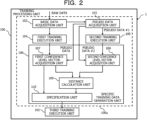
- FIG. 2 is a diagram exemplifying a functional configuration of the information processing apparatus 1 as an example of the embodiment. As illustrated in FIG. 2 , the information processing apparatus 1 has the function as the training processing unit 100.
- the processor 11 executes the control program (model training program 13a) to implement the function as the training processing unit 100.
- the training processing unit 100 implements a learning process (training process) in machine learning using training data.
- the information processing apparatus 1 functions as a training apparatus that trains a machine learning model with the training processing unit 100.
- the training processing unit 100 includes the third training execution unit 101 that implements a training process in machine learning using training data (teaching data) to which a ground truth label is assigned.
- the training processing unit 100 includes a data sorting unit 100a that sorts (specifies) training data to be input to the third training execution unit 101.
- the "ground truth label" may be ground truth information assigned to individual pieces of data.
- the training data to be input to the third training execution unit 101 may be a plurality of pieces of pseudo data generated by adding noise or the like to raw data to protect against a membership estimation attack.
- the "pseudo data" is an example of processed data obtained by processing original data.
- the data sorting unit 100a removes data that affects membership estimation resistance, that is, data that lowers the membership estimation resistance, from among the plurality of pieces of pseudo data.
- the data sorting unit 100a sorts out training data to be used for a new class classification model (third class classification model C) to be trained in the third training execution unit 101.
- a class classification model is a machine learning model for classifying data into a plurality of classes.
- the machine learning model may be, for example, a deep learning model (deep neural network).
- the neural network may be a hardware circuit, or may be a virtual network by software that connects individual layers virtually constructed on a computer program by the processor 11 or the like.
- the data sorting unit 100a may include the basic data acquisition unit 102, the pseudo data acquisition unit 103, the first training execution unit 104, the second training execution unit 105, and the specific training data generation unit 106.
- the basic data acquisition unit 102 obtains basic data.
- the basic data is data (teaching data) associated with a ground truth label.
- the basic data is training data to be used by the first training execution unit 104 to implement a training process in machine learning.
- the basic data may be data generated (processed) based on the collected unprocessed raw data, or may be the raw data itself. However, the basic data is preferably data processed based on the raw data rather than the raw data itself.
- the raw data is data having a degree of confidentiality equal to or higher than a predetermined level, such as disease-related data, it is preferable not to use the raw data itself for training as much as possible from the viewpoint of maintaining confidentiality.
- the raw data may be used as the basic data depending on the content of data.
- the basic data acquisition unit 102 may obtain the basic data generated by an external device, or may generate the basic data in the information processing apparatus 1.
- the pseudo data acquisition unit 103 obtains a plurality of pieces of pseudo data.
- the pseudo data acquisition unit 103 may generate the pseudo data based on the raw data.
- Each piece of the pseudo data is an example of the processed data generated (processed) based on the collected unprocessed raw data.
- the pseudo data acquisition unit 103 may generate the pseudo data using various known methods.
- the pseudo data may be generated by adding noise to the raw data.
- the pseudo data acquisition unit 103 may generate each piece of the pseudo data by adding random noise to the raw data.
- the noise may be Gaussian noise or Laplace noise.
- each piece of the pseudo data may be data obtained by processing the basic data.
- the pseudo data acquisition unit 103 may train a generation model by machine learning such as a generative adversarial network (GAN) with raw data, and may generate pseudo data using the trained model. Furthermore, the pseudo data acquisition unit 103 may generate the pseudo data using dynamic programming (DP).
- GAN generative adversarial network
- DP dynamic programming
- a processing degree of each piece of the pseudo data may be larger than the processing degree of the basic data.
- the processing degree means a degree of processing from the raw data. As an example, the processing degree is larger as the noise added to the raw data is larger.
- Each of the plurality of pieces of pseudo data is associated with a ground truth label. However, each of the plurality of pieces of pseudo data is different from the basic data.
- the plurality of pieces of pseudo data includes training data (teaching data) to be used by the second training execution unit 105 to implement the training process in machine learning.
- the pseudo data acquisition unit 103 may obtain pseudo data generated by a device outside the information processing apparatus 1, or may generate pseudo data in the information processing apparatus 1. In particular, the pseudo data acquisition unit 103 may generate a plurality of pieces of pseudo data in the information processing apparatus 1 based on the basic data obtained by the basic data acquisition unit 102.
- the first training execution unit 104 carries out training of a first class classification model A (model A: see FIG. 4 ) using the basic data as training data, and generates a trained first class classification model A.
- the first class classification model A is an example of the first class classification model.
- the basic data is configured as a combination of input data x and correct output data y.
- the first training execution unit 104 preferably carries out training of the first class classification model A using a plurality of pieces of basic data.
- the first training execution unit 104 may carry out the training of the first class classification model A using a known method.
- the training of the first class classification model A carried out by the first training execution unit 104 using the basic data may be referred to as first training.
- the class classification model before being trained by the first training execution unit 104 may be an empty machine learning model.
- the machine learning model may be simply referred to as a model.
- the second training execution unit 105 carries out training of a second class classification model B (model B) using a plurality of pieces of pseudo data as training data, and generates a trained second class classification model B.
- the second class classification model B is an exemplary second class classification model.
- each of the plurality of pieces of pseudo data is configured as a combination of the input data x and the correct output data y.
- the second training execution unit 105 may carry out the training of the second class classification model B using a known method.
- the second training execution unit 105 may train the second class classification model B (e.g., model B1: see FIG. 3 ) using, as training data, two or more pieces of first pseudo data (e.g., pseudo data #1 to be described later: see FIG. 3 ) among the plurality of pieces of pseudo data.
- the second class classification model B e.g., model B1: see FIG. 3
- two or more pieces of first pseudo data e.g., pseudo data #1 to be described later: see FIG. 3
- the training of the second class classification model B carried out by the second training execution unit 105 using the plurality of pieces of pseudo data may be referred to as second training.
- the class classification model before being trained by the second training execution unit 105 may be an empty machine learning model same as the class classification model before being trained by the first training execution unit 104.
- the second training execution unit 105 may train a plurality of (e.g., two) second class classification models B (e.g., models B1 and B2) using the pseudo data as training data, and may generate a plurality of trained second class classification models B.
- a plurality of (e.g., two) second class classification models B e.g., models B1 and B2
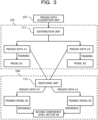
- FIG. 3 is a diagram for explaining exemplary processing of the second training execution unit 105 and second confidence level vector acquisition unit 108 in the information processing apparatus 1 as an example of the embodiment.
- the second training execution unit 105 trains the two second class classification models B1 and B2.
- the second training execution unit 105 may include a distribution unit 111.
- the distribution unit 111 distributes the plurality of pieces of pseudo data obtained from the pseudo data acquisition unit 103 into a plurality of groups.
- the distribution unit 111 may randomly distribute the plurality of pieces of pseudo data into the plurality of groups.
- the pseudo data is distributed to pseudo data #1 (first conversion data) belonging to one group and to pseudo data #2 (second conversion data) belonging to another group different from the one group.
- the pseudo data may be distributed into three or more groups.
- Each of the pseudo data #1 and the pseudo data #2 includes two or more pieces of pseudo data.
- the second training execution unit 105 trains the second class classification model B1 using the pseudo data #1.
- the second training execution unit 105 trains the second class classification model B2 using the pseudo data #2.
- the specific training data generation unit 106 illustrated in FIG. 2 specifies (sorts out, generates) training data to be used by the third training execution unit 101 to implement the training process in the machine learning.
- the specific training data generation unit 106 may remove data that may lower the membership estimation resistance from among the plurality of pieces of pseudo data.
- the specific training data generation unit 106 may specify the training data that maintains the membership estimation resistance from among the plurality of pieces of pseudo data.
- the specific training data generation unit 106 may sort out the training data of the third training execution unit 101 using the trained first class classification model A, the trained second class classification model B, and the plurality of pieces of pseudo data to be evaluated.
- the specific training data generation unit 106 may obtain the trained first class classification model A, the trained second class classification model B, and the plurality of pieces of pseudo data to be evaluated from the outside of the information processing apparatus 1.
- the functions as the basic data acquisition unit 102, the pseudo data acquisition unit 103, the first training execution unit 104, and the second training execution unit 105 may be provided in a device outside the present information processing apparatus 1.
- the specific training data generation unit 106 includes a first confidence level vector acquisition unit 107, a second confidence level vector acquisition unit 108, a distance calculation unit 109, and a specification unit 110.
- the first confidence level vector acquisition unit 107 inputs a plurality of pieces of pseudo data to the first class classification model A to obtain a first confidence level vector VA for each of the plurality of pieces of pseudo data.
- the generation of the first confidence level vector VA is one of inference processing using the trained first class classification model A, and is referred to as first inference.
- the confidence level vector includes, as an element, a confidence level of each label, which is a data determination result by a class classification model.
- a "label” may be an item for classifying data by a class classification model.
- a confidence level is a probability that a set of data of interest and a label (item) is correct.
- the class classification model classifies the input data into four elements, for example, individual labels of an element (A), an element (B), an element (C), and an element (D), the confidence level is calculated for each label. Moreover, a confidence level of the ground truth label of the input data is calculated. The confidence level vector includes the confidence level of each label as an element.
- the first confidence level vector acquisition unit 107 is an exemplary confidence level acquisition unit that obtains a confidence level of the ground truth label for each of a plurality of pieces of pseudo data by inputting the plurality of pieces of pseudo data to the first class classification model A.
- the second confidence level vector acquisition unit 108 obtains, for each of two or more pieces of second processed data, a second confidence level vector VB having a confidence level of each of a plurality of labels, which is a determination result, as an element.
- the generation of the second confidence level vector VB is one of inference processing using the trained second class classification model B, and is referred to as second inference.
- the second confidence level vector acquisition unit 108 inputs pseudo data to the second class classification model B to perform inference, and obtains the second confidence level vector VB.
- the second confidence level vector acquisition unit 108 inputs pseudo data to each of those plurality of second class classification models B to perform inference, and obtains the second confidence level vector VB.
- the second confidence level vector acquisition unit 108 may include a switching unit 112.
- the switching unit 112 exchanges (swaps) the pseudo data to be input to the respective second class classification models B1 and B2 between a training phase and an evaluation phase.
- the switching unit 112 inputs, as pseudo data to be evaluated, the pseudo data #2 to the second class classification model B1 trained using the pseudo data #1.
- the switching unit 112 inputs, as pseudo data to be evaluated, the pseudo data #1 to the second class classification model B2 trained using the pseudo data #2.
- the switching unit 112 exchanging the pseudo data to be input to the second class classification models B1 and B2 between the training phase and the evaluation phase, it becomes possible to avoid evaluation of the pseudo data #1 same as that in the training phase by the second class classification model B1 trained using the pseudo data #1. Likewise, it becomes possible to avoid evaluation of the pseudo data #2 same as that at the time of training by the second class classification model B2 trained using the pseudo data #2.
- the confidence level of the ground truth label in the second confidence level vector VB becomes higher beyond necessity due to over-training or the like, and the distance
- the membership estimation resistance may be easily evaluated based on the distance
- the switching unit 112 exchanging (swapping) the pseudo data to be input to the respective second class classification models B1 and B2
- the membership estimation resistance may be evaluated for the entire pseudo data #1 and pseudo data #2.
- the second confidence level vector acquisition unit 108 may use the second class classification models B1 and B2 (see FIG. 3 ) trained using two or more pieces of the first pseudo data (e.g., pseudo data #1 and #2: see FIG. 3 ) among the plurality of pieces of pseudo data.
- the second confidence level vector acquisition unit 108 inputs two or more pieces of second pseudo data (e.g., pseudo data #1 and #2 to be described later: see FIG. 3 ) among the plurality of pieces of pseudo data to the trained second class classification models B2 and B1 (see FIG. 3 ) to generate the second confidence level vector VB (see FIG. 4 ).
- the first pseudo data (e.g., pseudo data #1) and the second pseudo data (e.g., pseudo data #2) may be different from each other.
- the distance calculation unit 109 illustrated in FIG. 2 obtains a distance between the first confidence level vector VA and the second confidence level vector VB.
- the distance may be a Kullback-Leibler (KL) distance, or may be an L1 distance (also referred to as a Manhattan distance).
- KL Kullback-Leibler
- L1 distance also referred to as a Manhattan distance.
- the first confidence level vector VA is VA(p1, ..., pn) (where p1, ..., pn represent confidence levels of individual labels in the first confidence level vector VA).
- the second confidence level vector VB is VB(q1, ..., qn) (where q1, ..., qn represent confidence levels of individual labels in the second confidence level vector VB).
- between the first confidence level vector VA and the second confidence level vector VB is given by the following expression (1). sqrt p 1 ⁇ q 1 2 + ... + pn ⁇ qn 2
- the specification unit 110 specifies the pseudo data to be input to the third training execution unit 101 from among the plurality of pieces of pseudo data.
- the specification unit 110 may specify the pseudo data based on the first confidence level vector VA.
- the specification unit 110 may specify the pseudo data based on the first confidence level vector VA.
- the specification unit 110 determines whether or not the confidence level of the ground truth label of the first confidence level vector VA is lower than a first reference value.
- the specification unit 110 may specify the pseudo data corresponding to the confidence level lower than the first reference value as data that does not adversely affect the membership estimation resistance.
- the pseudo data specified as the data that does not adversely affect the membership estimation resistance in this manner may be used as training data for training the third class classification model C (model C) using the third training execution unit 101.
- the first reference value may be a predetermined threshold.
- the specification unit 110 may further specify the pseudo data based on the distance
- the specification unit 110 may specify, as the training data for the third class classification model C, pseudo data that satisfies a condition that the confidence level of the ground truth label of the first confidence level vector VA is lower than the first reference value or that the distance
- the specification unit 110 removes, from the plurality of pieces of pseudo data, pseudo data in which the confidence level of the ground truth label of the first confidence level vector VA is equal to or higher than the first reference value and the distance
- may lower the membership estimation resistance. Therefore, the specification unit 110 is enabled to remove and forestall the pseudo data that may lower the membership estimation resistance.
- the specification unit 110 may specify the corresponding pseudo data as the training data for the third class classification model C.
- the third training execution unit 101 trains the third class classification model C using the pseudo data specified by the specification unit 110 as training data.
- the third class classification model C is a model actually used for estimation.
- Each piece of the pseudo data specified by the specification unit 110 is configured as, for example, a combination of the input data x and the correct output data y.
- the training of the third class classification model C carried out by the third training execution unit 101 using a plurality of pieces of specified pseudo data may be referred to as third training.
- the class classification model before being trained by the third training execution unit 101 may be an empty machine learning model same as the class classification model at a previous stage before being trained by the first training execution unit 104 or the second training execution unit 105.
- FIG. 4 is a diagram for explaining processing contents of the first training execution unit 104, the second training execution unit 105, the first confidence level vector acquisition unit 107, and the second confidence level vector acquisition unit 108 in the information processing apparatus 1 as an example of the embodiment.
- FIG. 4 illustrates an exemplary case where the second training execution unit 105 trains the two second class classification models B1 and B2 and the second confidence level vector acquisition unit 108 obtains the second confidence level vector VB using those plurality of second class classification models B1 and B2.
- the processing contents are roughly divided into a process #1 and a process #2.
- the process #1 is a training phase of the first class classification model A and the second class classification models B1 and B2.
- the process #2 is an evaluation phase of the pseudo data #1 and #2.
- the evaluation phase is an example of an inference phase by the first class classification model A and the second class classification models B1 and B2.
- the process #1 includes the first training and the second training.
- the first training execution unit 104 trains the first class classification model A using the basic data as training data.
- the second training execution unit 105 trains the second class classification model B1 using the pseudo data #1 as training data.
- the second training execution unit 105 further trains, in the second training, the second class classification model B2 using the pseudo data #2 as training data.
- the process #2 includes the first inference and the second inference.
- the first confidence level vector acquisition unit 107 inputs the pseudo data (both the pseudo data #1 and the pseudo data #2) to the trained first class classification model A to obtain the first confidence level vector VA.
- the second confidence level vector acquisition unit 108 inputs the pseudo data #1 to the trained second class classification model B2. As a result, the second confidence level vector acquisition unit 108 obtains the second confidence level vector VB for the pseudo data #1.
- the second confidence level vector acquisition unit 108 inputs the pseudo data #2 to the trained second class classification model B1. As a result, the second confidence level vector acquisition unit 108 obtains the second confidence level vector VB for the pseudo data #2.
- the second confidence level vector acquisition unit 108 is enabled to obtain the second confidence level vector VB for the pseudo data (both the pseudo data #1 and the pseudo data #2).
- the specification unit 110 removes the pseudo data in which the confidence level of the ground truth label of the first confidence level vector VA is equal to or higher than the first reference value and the distance
- the specification unit 110 may determine the pseudo data that affects the membership estimation resistance based on the confidence level of the ground truth label and the distance
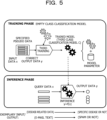
- FIG. 5 is a diagram illustrating an outline of the training phase and the inference phase of the class classification model in the information processing apparatus 1 as an example of the embodiment.
- the process illustrated in FIG. 5 includes a training phase.
- the training phase includes third training for training the third class classification model C using the pseudo data specified by the process illustrated in FIG. 4 as training data.
- the third class classification model C is a new class classification model, and is a model actually used in the inference phase.
- the third training execution unit 101 sets parameters of the machine learning model by training an empty machine learning model using the specified pseudo data as training data.
- the third class classification model C In the inference phase, when query data x to be subject to class classification is input to the third class classification model C, the third class classification model C outputs a class classification result as output data y.
- the information processing apparatus 1 may be utilized as a device that infers whether or not there is a suspicion of a specific disease by inputting, as query data x, disease-related data or the like to the third class classification model C in the inference phase.
- the information processing apparatus 1 is not limited to this case, and may be utilized as various class classification devices such as a device that infers whether or not e-mail text is spam.
- a method for training a class classification model (machine learning model) in the information processing apparatus 1 as an example of the embodiment configured as described above will be described with reference to a flowchart (steps S1 to S5) illustrated in FIG. 6 .
- step S1 the pseudo data acquisition unit 103 generates a plurality of pieces of pseudo data.
- the pseudo data acquisition unit 103 may generate the plurality of pieces of pseudo data based on the basic data.
- Information included in the pseudo data is stored in a predetermined storage area such as the storage device 13.
- step S2 the first training execution unit 104 executes the first training for training the first class classification model A using the basic data as training data.
- the empty class classification model before executing the first training may be stored in the storage device 13 in advance.
- the trained first class classification model A may be stored in the storage device 13.
- step S3 the second training execution unit 105 executes the second training for training the second class classification model B (B1 and B2) using the plurality of pieces of pseudo data as training data.
- the empty class classification model before executing the second training may be stored in the storage device 13 in advance.
- step S4 the data sorting unit 100a specifies (sorts out) the pseudo data to be input to the third training execution unit 101 to train the third class classification model C.
- the first confidence level vector acquisition unit 107 inputs the plurality of pieces of pseudo data to the first class classification model A to generate a first confidence level vector VA for each of the plurality of pieces of pseudo data.
- the first confidence level vector VA may include, as an element, a confidence level of each of a plurality of labels, which is a determination result.
- the first confidence level vector VA includes the confidence level of the ground truth label.
- the specification unit 110 specifies the pseudo data based on at least one of the confidence level of the ground truth label inferred by the first class classification model A and the distance
- step S5 the third training execution unit 101 executes the third training for training the third class classification model C using the pseudo data specified in step S4 as training data.
- the third class classification model C trained in this manner has the membership estimation resistance.
- the pseudo data acquisition unit 103 may obtain a plurality of pieces of pseudo data generated by a device outside the information processing apparatus 1. Furthermore, the information processing apparatus 1 may obtain the first class classification model A and the second class classification model B generated by a device outside the information processing apparatus 1. In those cases, the processing of steps S1, S2, and S3 may be omitted.
- FIG. 7 is a flowchart (steps S11 to S18) for explaining a first example of a method for specifying the pseudo data in the information processing apparatus 1 as an example of the embodiment.
- a flowchart illustrated in FIG. 7 is an example of the processing of step S4 in FIG. 6 .
- step S11 the first class classification model A trained using only the basic data and the second class classification model B trained using only the pseudo data are prepared.
- the data sorting unit 100a determines whether unevaluated pseudo data remains (step S12). As a result of the determination, if no unevaluated pseudo data remains (see NO route of step S12), the process for specifying the pseudo data is terminated. If unevaluated pseudo data remains (see YES route of step S12), the process proceeds to step S13.
- the first confidence level vector acquisition unit 107 selects one piece of the unevaluated pseudo data from among the plurality of pieces of pseudo data.
- the first confidence level vector acquisition unit 107 inputs the selected pseudo data to the first class classification model A to perform inference, thereby obtaining the first confidence level vector VA.
- the first confidence level vector VA includes the confidence level of the ground truth label.
- step S14 the second confidence level vector acquisition unit 108 inputs the pseudo data selected in step S13 to the second class classification model B to perform inference, thereby obtaining the second confidence level vector VB.
- the second confidence level vector VB may be obtained by preparing a plurality of second class classification models B1 and B2 and exchanging (swapping) the pseudo data to be input to the respective second class classification models B1 and B2 between the training case and the evaluation case, as illustrated in FIG. 4 .
- step S15 the specification unit 110 determines whether the confidence level of the ground truth label in the first confidence level vector VA is equal to or higher than the first reference value. If the confidence level of the ground truth label is equal to or higher than the first reference value (see YES route of step S15), the process proceeds to step S16. On the other hand, if the confidence level of the ground truth label is lower than the first reference value (see NO route of step S15), the process proceeds to step S17.
- step S16 the specification unit 110 determines whether or not the distance
- step S17 the specification unit 110 specifies the pseudo data as the training data for the third class classification model C, and the process returns to step S12.
- the pseudo data is specified as the training data when the confidence level of the ground truth label of the first confidence level vector VA is lower than the first reference value and when the distance
- step S18 the specification unit 110 excludes the pseudo data from the training data for the third class classification model C, and the process returns to step S12.
- the pseudo data is excluded from the training data when the confidence level of the ground truth label of the first confidence level vector VA is equal to or higher than the first reference value and the distance
- FIG. 8 is a flowchart (steps S21 to S28) for explaining a second example of the method for specifying the pseudo data in the information processing apparatus 1 as an example of the embodiment.
- a flowchart illustrated in FIG. 8 is another example of the processing of step S4 in FIG. 6 .
- steps S21 to S24 is similar to the process of steps S11 to S14 in FIG. 7 , and descriptions of each processing will be omitted.
- step S25 the specification unit 110 determines whether the confidence level of the ground truth label in the first confidence level vector VA is equal to or higher than the first reference value. If the confidence level of the ground truth label is lower than the first reference value (see NO route of step S25), the process proceeds to step S26. On the other hand, if the confidence level of the ground truth label is equal to or higher than the first reference value (see YES route of step S25), the process proceeds to step S28.
- step S26 the specification unit 110 determines whether or not the distance
- step S27 the specification unit 110 specifies the pseudo data as the training data for the third class classification model C, and the process returns to step S22.
- the pseudo data is specified as the training data when the confidence level of the ground truth label of the first confidence level vector VA is lower than the first reference value and the distance
- step S28 the specification unit 110 excludes the pseudo data from the training data for the third class classification model C, and the process returns to step S22.
- the process returns to step S22.
- the confidence level of the ground truth label of the first confidence level vector VA is equal to or higher than the first reference value or the distance
- is equal to or smaller than the second reference value.
- Information included in each of the first class classification model A, the second class classification model B, and the third class classification model C is stored in a predetermined storage area such as the storage device 13.
- a computer executes the processing of inputting a plurality of pieces of pseudo data to the first class classification model A trained using the basic data associated with the ground truth label and obtaining the confidence level of the ground truth label for each of the plurality of pieces of pseudo data. Then, the computer executes the processing of specifying the pseudo data corresponding to the confidence level lower than the first reference value. The computer executes the processing of training the third class classification model C, which is a new class classification model, using the specified pseudo data as training data.
- the third class classification model C is trained by removing the pseudo data that affects the membership estimation resistance.
- a machine learning model having the membership estimation resistance may be generated.
- the basic data and the processed data are generated based on the collected unprocessed raw data.
- the processing degree of the processed data from the raw data is larger than that of the basic data.
- the information processing apparatus 1 executes the processing of generating the first confidence level vector VA having a confidence level of each of a plurality of labels, which is a determination result, as an element for each of the plurality of pieces of pseudo data by inputting the plurality of pieces of pseudo data to the first class classification model A.
- the information processing apparatus 1 inputs two or more pieces of the pseudo data #2 (second pseudo data) different from the pseudo data #1 to the second class classification model B1 trained using two or more pieces of the pseudo data #1 (first pseudo data) among the plurality of pieces of pseudo data.
- the information processing apparatus 1 generates the second confidence level vector VB having a confidence level of each of a plurality of labels, which is a determination result, as an element for each of the two or more pieces of second processed data. Then, the information processing apparatus 1 executes the processing of obtaining the distance
- the pseudo data may be specified as training data by performing a close examination using the distance
- is a value larger than the second reference value may be specified as the training data.
- the pseudo data that affects the membership estimation resistance may be removed.
- each configuration and each processing of the present embodiment may be selected or omitted as needed, or may be appropriately combined.
- the switching unit 112 performs control such that the pseudo data to be input to each second class classification model B is different between the training phase and the evaluation phase.
Landscapes
- Engineering & Computer Science (AREA)
- Theoretical Computer Science (AREA)
- Physics & Mathematics (AREA)
- Software Systems (AREA)
- Mathematical Physics (AREA)
- Artificial Intelligence (AREA)
- Data Mining & Analysis (AREA)
- Evolutionary Computation (AREA)
- Computing Systems (AREA)
- General Engineering & Computer Science (AREA)
- General Physics & Mathematics (AREA)
- Biomedical Technology (AREA)
- Health & Medical Sciences (AREA)
- Life Sciences & Earth Sciences (AREA)
- Biophysics (AREA)
- Computational Linguistics (AREA)
- General Health & Medical Sciences (AREA)
- Molecular Biology (AREA)
- Medical Informatics (AREA)
- Computer Vision & Pattern Recognition (AREA)
- Information Retrieval, Db Structures And Fs Structures Therefor (AREA)
Abstract
Description
- The present invention relates to a model training method, a model training program, and an information processing apparatus.
- In recent years, systems using machine learning have been rapidly developed and used. Meanwhile, security problems unique to the systems using machine learning have also been found. For example, a membership estimation attack is known as one of the security problems.
- In the membership estimation attack, for example, it is estimated whether or not data focused on by an attacker is included in training data of a machine learning model as an attack target.
- As a defensive measure against the membership estimation attack, a technique of training a machine learning model using pseudo data as training data is known. The pseudo data may be generated by adding noise to basic data, or may be generated by machine learning from the basic data.
- Note that a technique of sorting the training data is known. As an example, a training data sorting device for sorting out the training data that may shorten a training time is known (see Patent Document 1).
- A characteristic of being hardly estimated whether or not specific data is included in the training data may be referred to as resistance to a membership estimation attack. Various kinds of pseudo data may include data that affects the resistance to the membership estimation attack (hereinafter abbreviated as "membership estimation resistance").
- Conventionally, a machine learning model is trained by dividing pseudo data into several groups, and evaluation of each group is repeated by checking the membership estimation resistance of each group. Such processing is performed several times by changing the grouping method, and data commonly used in a low-resistance model is specified as data that lowers the membership estimation resistance and is excluded from the training data.
-
- Patent Document 1:
Japanese Laid-open Patent Publication No. 2021-107970 - Patent Document 2:
Japanese Laid-open Patent Publication No. 2019-159961 - Patent Document 3:
U.S. Patent Application Publication No. 2007/0143284 - However, it takes a lot of time for calculation to specify the data that lowers the membership estimation resistance based on such conventional technique. Thus, there is a problem that it is difficult to efficiently train a machine learning model to improve the membership estimation resistance.
- In one aspect, an object of the present invention is to efficiently generate a machine learning model having membership estimation resistance.
- In view of the above, this model training method causes a computer to execute a process including: inputting a plurality of pieces of processed data, each of which is associated with a ground truth label and each of which is different from basic data, to a first class classification model trained using the basic data associated with the ground truth label to obtain a confidence level of the ground truth label for each of the plurality of pieces of processed data; specifying the processed data that corresponds to the confidence level lower than a first reference value; and training a new class classification model using the specified processed data as training data.
- According to an embodiment, a machine learning model having membership estimation resistance may be efficiently generated.
-
-
FIG. 1 is a diagram exemplifying a hardware configuration of an information processing apparatus as an example of an embodiment. -
FIG. 2 is a diagram exemplifying a functional configuration of the information processing apparatus as an example of the embodiment. -
FIG. 3 is a diagram for explaining an example of a second training execution unit and a second confidence level vector acquisition unit in the information processing apparatus as an example of the embodiment. -
FIG. 4 is a diagram for explaining processing contents in the information processing apparatus as an example of the embodiment. -
FIG. 5 is a diagram illustrating an outline of a training phase and an inference phase of a class classification model in the information processing apparatus as an example of the embodiment. -
FIG. 6 is a flowchart for explaining a model training method in the information processing apparatus as an example of the embodiment. -
FIG. 7 is a flowchart for explaining a first example of a method for specifying pseudo data in the information processing apparatus as an example of the embodiment. -
FIG. 8 is a flowchart for explaining a second example of the method for specifying pseudo data in the information processing apparatus as an example of the embodiment. - Hereinafter, an embodiment of the present model training method, model training program, and information processing apparatus will be described with reference to the drawings. Note that the embodiment to be described below is merely an example, and there is no intention to exclude application of various modifications and techniques not explicitly described in the embodiment. In other words, the present embodiment may be variously modified and implemented in a range without departing from the spirit thereof. In addition, each drawing is not intended to include only constituent elements illustrated in the drawings, and may include another function and the like.
-
FIG. 1 is a diagram exemplifying a hardware configuration of aninformation processing apparatus 1 as an example of an embodiment. - As illustrated in
FIG. 1 , theinformation processing apparatus 1 includes, as constituent elements, aprocessor 11, amemory 12, astorage device 13, a graphic processing device 14, aninput interface 15, anoptical drive device 16, adevice coupling interface 17, and anetwork interface 18, for example. Thoseconstituent elements 11 to 18 are configured to be communicable with each other via abus 19. Theinformation processing apparatus 1 is an exemplary computer. - The processor (control unit) 11 controls the entire
information processing apparatus 1. Theprocessor 11 may be a multiprocessor. For example, theprocessor 11 may be any one of a central processing unit (CPU), a micro processing unit (MPU), a digital signal processor (DSP), an application specific integrated circuit (ASIC), a programmable logic device (PLD), a field programmable gate array (FPGA), and a graphics processing unit (GPU). Furthermore, theprocessor 11 may be a combination of two or more types of elements of the CPU, MPU, DSP, ASIC, PLD, FPGA, and GPU. - The
processor 11 executes a control program (model training program 13a) to implement a function as thetraining processing unit 100 exemplified inFIG. 2 . - For example, the
information processing apparatus 1 executes themodel training program 13a and an operating system (OS) program recorded in a computer-readable non-transitory recording medium to implement the function as thetraining processing unit 100. - Programs in which processing content to be executed by the
information processing apparatus 1 is described may be recorded in various kinds of recording media. For example, themodel training program 13a to be executed by theinformation processing apparatus 1 may be stored in thestorage device 13. Theprocessor 11 loads at least a part of themodel training program 13a in thestorage device 13 into thememory 12, and executes the loadedmodel training program 13a. - Furthermore, the
model training program 13a to be executed by the information processing apparatus 1 (processor 11) may be recorded in a non-transitory portable recording medium, such as anoptical disk 16a, amemory device 17a, amemory card 17c, or the like. Themodel training program 13a stored in the portable recording medium may be executed after being installed in thestorage device 13 under the control of theprocessor 11, for example. Furthermore, theprocessor 11 may directly read themodel training program 13a from the portable recording medium to execute it. - The
memory 12 is a storage memory including a read only memory (ROM) and a random access memory (RAM). The RAM of thememory 12 is used as a main storage device of theinformation processing apparatus 1. The RAM temporarily stores at least a part of the OS program and the control program to be executed by theprocessor 11. Furthermore, thememory 12 stores various types of data needed for processing by theprocessor 11. - The
storage device 13 is a storage device such as a hard disk drive (HDD), a solid state drive (SSD), a storage class memory (SCM), or the like, and stores various types of data. Thestorage device 13 is used as an auxiliary storage device of the presentinformation processing apparatus 1. Thestorage device 13 stores the OS program, the control program, and various types of data. The control program includes themodel training program 13a. - A semiconductor storage device such as an SCM, a flash memory, or the like may be used as the auxiliary storage device. Furthermore, redundant arrays of inexpensive disks (RAID) may be configured using a plurality of the
storage devices 13. - Furthermore, the
storage device 13 may store various types of data obtained or generated by a thirdtraining execution unit 101, a basicdata acquisition unit 102, a pseudodata acquisition unit 103, a firsttraining execution unit 104, a secondtraining execution unit 105, and a specific trainingdata generation unit 106 to be described later. - The graphic processing device 14 is coupled to a
monitor 14a. The graphic processing device 14 displays an image on a screen of themonitor 14a in accordance with an instruction from theprocessor 11. Examples of themonitor 14a include a display device using a cathode ray tube (CRT), a liquid crystal display device, and the like. - The
input interface 15 is coupled to akeyboard 15a and amouse 15b. Theinput interface 15 transmits signals sent from thekeyboard 15a and themouse 15b to theprocessor 11. Note that themouse 15b is an exemplary pointing device, and another pointing device may be used. Examples of the another pointing device include a touch panel, a tablet, a touch pad, a track ball, and the like. - The
optical drive device 16 reads data recorded in theoptical disk 16a using laser light or the like. Theoptical disk 16a is a non-transitory portable recording medium in which data is recorded in a readable manner by reflection of light. Examples of theoptical disk 16a include a digital versatile disc (DVD), a DVD-RAM, a compact disc read only memory (CD-ROM), a CD-recordable (R)/rewritable (RW), and the like. - The
device coupling interface 17 is a communication interface for coupling a peripheral device to theinformation processing apparatus 1. For example, thememory device 17a and a memory reader/writer 17b may be coupled to thedevice coupling interface 17. Thememory device 17a is a non-transitory recording medium equipped with a function of communicating with thedevice coupling interface 17, and is, for example, a universal serial bus (USB) memory. The memory reader/writer 17b writes data to thememory card 17c, or reads data from thememory card 17c. Thememory card 17c is a card-type non-transitory recording medium. - The
network interface 18 is coupled to a network (not illustrated). Thenetwork interface 18 may be coupled to another information processing apparatus, a communication device, and the like via the network. For example, data related to a disease or the like may be input via the network. -
FIG. 2 is a diagram exemplifying a functional configuration of theinformation processing apparatus 1 as an example of the embodiment. As illustrated inFIG. 2 , theinformation processing apparatus 1 has the function as thetraining processing unit 100. - In the
information processing apparatus 1, theprocessor 11 executes the control program (model training program 13a) to implement the function as thetraining processing unit 100. - The
training processing unit 100 implements a learning process (training process) in machine learning using training data. In other words, theinformation processing apparatus 1 functions as a training apparatus that trains a machine learning model with thetraining processing unit 100. - The
training processing unit 100 includes the thirdtraining execution unit 101 that implements a training process in machine learning using training data (teaching data) to which a ground truth label is assigned. In the present example, thetraining processing unit 100 includes adata sorting unit 100a that sorts (specifies) training data to be input to the thirdtraining execution unit 101. The "ground truth label" may be ground truth information assigned to individual pieces of data. - The training data to be input to the third
training execution unit 101 may be a plurality of pieces of pseudo data generated by adding noise or the like to raw data to protect against a membership estimation attack. The "pseudo data" is an example of processed data obtained by processing original data. - The
data sorting unit 100a removes data that affects membership estimation resistance, that is, data that lowers the membership estimation resistance, from among the plurality of pieces of pseudo data. Thedata sorting unit 100a sorts out training data to be used for a new class classification model (third class classification model C) to be trained in the thirdtraining execution unit 101. - A class classification model is a machine learning model for classifying data into a plurality of classes. The machine learning model may be, for example, a deep learning model (deep neural network). The neural network may be a hardware circuit, or may be a virtual network by software that connects individual layers virtually constructed on a computer program by the
processor 11 or the like. - As illustrated in
FIG. 2 , thedata sorting unit 100a may include the basicdata acquisition unit 102, the pseudodata acquisition unit 103, the firsttraining execution unit 104, the secondtraining execution unit 105, and the specific trainingdata generation unit 106. - The basic
data acquisition unit 102 obtains basic data. The basic data is data (teaching data) associated with a ground truth label. The basic data is training data to be used by the firsttraining execution unit 104 to implement a training process in machine learning. - The basic data may be data generated (processed) based on the collected unprocessed raw data, or may be the raw data itself. However, the basic data is preferably data processed based on the raw data rather than the raw data itself. When the raw data is data having a degree of confidentiality equal to or higher than a predetermined level, such as disease-related data, it is preferable not to use the raw data itself for training as much as possible from the viewpoint of maintaining confidentiality. However, the raw data may be used as the basic data depending on the content of data.
- The basic
data acquisition unit 102 may obtain the basic data generated by an external device, or may generate the basic data in theinformation processing apparatus 1. - The pseudo
data acquisition unit 103 obtains a plurality of pieces of pseudo data. The pseudodata acquisition unit 103 may generate the pseudo data based on the raw data. - Each piece of the pseudo data is an example of the processed data generated (processed) based on the collected unprocessed raw data. The pseudo
data acquisition unit 103 may generate the pseudo data using various known methods. For example, the pseudo data may be generated by adding noise to the raw data. As an example, the pseudodata acquisition unit 103 may generate each piece of the pseudo data by adding random noise to the raw data. The noise may be Gaussian noise or Laplace noise. As an example, each piece of the pseudo data may be data obtained by processing the basic data. - Furthermore, the pseudo
data acquisition unit 103 may train a generation model by machine learning such as a generative adversarial network (GAN) with raw data, and may generate pseudo data using the trained model. Furthermore, the pseudodata acquisition unit 103 may generate the pseudo data using dynamic programming (DP). - A processing degree of each piece of the pseudo data may be larger than the processing degree of the basic data. The processing degree means a degree of processing from the raw data. As an example, the processing degree is larger as the noise added to the raw data is larger.
- Each of the plurality of pieces of pseudo data is associated with a ground truth label. However, each of the plurality of pieces of pseudo data is different from the basic data. The plurality of pieces of pseudo data includes training data (teaching data) to be used by the second
training execution unit 105 to implement the training process in machine learning. - The pseudo
data acquisition unit 103 may obtain pseudo data generated by a device outside theinformation processing apparatus 1, or may generate pseudo data in theinformation processing apparatus 1. In particular, the pseudodata acquisition unit 103 may generate a plurality of pieces of pseudo data in theinformation processing apparatus 1 based on the basic data obtained by the basicdata acquisition unit 102. - The first
training execution unit 104 carries out training of a first class classification model A (model A: seeFIG. 4 ) using the basic data as training data, and generates a trained first class classification model A. The first class classification model A is an example of the first class classification model. For example, the basic data is configured as a combination of input data x and correct output data y. The firsttraining execution unit 104 preferably carries out training of the first class classification model A using a plurality of pieces of basic data. The firsttraining execution unit 104 may carry out the training of the first class classification model A using a known method. - The training of the first class classification model A carried out by the first
training execution unit 104 using the basic data may be referred to as first training. Furthermore, the class classification model before being trained by the firsttraining execution unit 104 may be an empty machine learning model. The machine learning model may be simply referred to as a model. - The second
training execution unit 105 carries out training of a second class classification model B (model B) using a plurality of pieces of pseudo data as training data, and generates a trained second class classification model B. The second class classification model B is an exemplary second class classification model. For example, each of the plurality of pieces of pseudo data is configured as a combination of the input data x and the correct output data y. The secondtraining execution unit 105 may carry out the training of the second class classification model B using a known method. - The second
training execution unit 105 may train the second class classification model B (e.g., model B1: seeFIG. 3 ) using, as training data, two or more pieces of first pseudo data (e.g.,pseudo data # 1 to be described later: seeFIG. 3 ) among the plurality of pieces of pseudo data. - The training of the second class classification model B carried out by the second
training execution unit 105 using the plurality of pieces of pseudo data may be referred to as second training. Furthermore, the class classification model before being trained by the secondtraining execution unit 105 may be an empty machine learning model same as the class classification model before being trained by the firsttraining execution unit 104. - Furthermore, the second
training execution unit 105 may train a plurality of (e.g., two) second class classification models B (e.g., models B1 and B2) using the pseudo data as training data, and may generate a plurality of trained second class classification models B. -
FIG. 3 is a diagram for explaining exemplary processing of the secondtraining execution unit 105 and second confidence levelvector acquisition unit 108 in theinformation processing apparatus 1 as an example of the embodiment. - In the example illustrated in
FIG. 3 , the secondtraining execution unit 105 trains the two second class classification models B1 and B2. The secondtraining execution unit 105 may include adistribution unit 111. Thedistribution unit 111 distributes the plurality of pieces of pseudo data obtained from the pseudodata acquisition unit 103 into a plurality of groups. Thedistribution unit 111 may randomly distribute the plurality of pieces of pseudo data into the plurality of groups. - In the example illustrated in
FIG. 3 , the pseudo data is distributed to pseudo data #1 (first conversion data) belonging to one group and to pseudo data #2 (second conversion data) belonging to another group different from the one group. However, the pseudo data may be distributed into three or more groups. Each of thepseudo data # 1 and thepseudo data # 2 includes two or more pieces of pseudo data. - The second
training execution unit 105 trains the second class classification model B1 using thepseudo data # 1. The secondtraining execution unit 105 trains the second class classification model B2 using thepseudo data # 2. - The specific training
data generation unit 106 illustrated inFIG. 2 specifies (sorts out, generates) training data to be used by the thirdtraining execution unit 101 to implement the training process in the machine learning. The specific trainingdata generation unit 106 may remove data that may lower the membership estimation resistance from among the plurality of pieces of pseudo data. The specific trainingdata generation unit 106 may specify the training data that maintains the membership estimation resistance from among the plurality of pieces of pseudo data. - The specific training
data generation unit 106 may sort out the training data of the thirdtraining execution unit 101 using the trained first class classification model A, the trained second class classification model B, and the plurality of pieces of pseudo data to be evaluated. - Note that the specific training
data generation unit 106 may obtain the trained first class classification model A, the trained second class classification model B, and the plurality of pieces of pseudo data to be evaluated from the outside of theinformation processing apparatus 1. In this case, the functions as the basicdata acquisition unit 102, the pseudodata acquisition unit 103, the firsttraining execution unit 104, and the secondtraining execution unit 105 may be provided in a device outside the presentinformation processing apparatus 1. - As illustrated in
FIG. 2 , the specific trainingdata generation unit 106 includes a first confidence levelvector acquisition unit 107, a second confidence levelvector acquisition unit 108, adistance calculation unit 109, and aspecification unit 110. - The first confidence level
vector acquisition unit 107 inputs a plurality of pieces of pseudo data to the first class classification model A to obtain a first confidence level vector VA for each of the plurality of pieces of pseudo data. The generation of the first confidence level vector VA is one of inference processing using the trained first class classification model A, and is referred to as first inference. - The confidence level vector includes, as an element, a confidence level of each label, which is a data determination result by a class classification model. A "label" may be an item for classifying data by a class classification model. A confidence level is a probability that a set of data of interest and a label (item) is correct.
- As an example, when the class classification model classifies the input data into four elements, for example, individual labels of an element (A), an element (B), an element (C), and an element (D), the confidence level is calculated for each label. Moreover, a confidence level of the ground truth label of the input data is calculated. The confidence level vector includes the confidence level of each label as an element.
- The first confidence level
vector acquisition unit 107 is an exemplary confidence level acquisition unit that obtains a confidence level of the ground truth label for each of a plurality of pieces of pseudo data by inputting the plurality of pieces of pseudo data to the first class classification model A. - The second confidence level
vector acquisition unit 108 obtains, for each of two or more pieces of second processed data, a second confidence level vector VB having a confidence level of each of a plurality of labels, which is a determination result, as an element. The generation of the second confidence level vector VB is one of inference processing using the trained second class classification model B, and is referred to as second inference. - The second confidence level
vector acquisition unit 108 inputs pseudo data to the second class classification model B to perform inference, and obtains the second confidence level vector VB. - When the second
training execution unit 105 trains a plurality of second class classification models B, the second confidence levelvector acquisition unit 108 inputs pseudo data to each of those plurality of second class classification models B to perform inference, and obtains the second confidence level vector VB. - The second confidence level
vector acquisition unit 108 may include aswitching unit 112. Theswitching unit 112 exchanges (swaps) the pseudo data to be input to the respective second class classification models B1 and B2 between a training phase and an evaluation phase. - In the example illustrated in
FIG. 3 , theswitching unit 112 inputs, as pseudo data to be evaluated, thepseudo data # 2 to the second class classification model B1 trained using thepseudo data # 1. On the other hand, theswitching unit 112 inputs, as pseudo data to be evaluated, thepseudo data # 1 to the second class classification model B2 trained using thepseudo data # 2. - As described above, by the
switching unit 112 exchanging the pseudo data to be input to the second class classification models B1 and B2 between the training phase and the evaluation phase, it becomes possible to avoid evaluation of thepseudo data # 1 same as that in the training phase by the second class classification model B1 trained using thepseudo data # 1. Likewise, it becomes possible to avoid evaluation of thepseudo data # 2 same as that at the time of training by the second class classification model B2 trained using thepseudo data # 2. - When the same data is used in the training phase and the evaluation phase, the confidence level of the ground truth label in the second confidence level vector VB becomes higher beyond necessity due to over-training or the like, and the distance |VA - VB| may not reflect the membership estimation resistance. According to the configuration of
FIG. 3 , the membership estimation resistance may be easily evaluated based on the distance |VA - VB|. - By the
switching unit 112 exchanging (swapping) the pseudo data to be input to the respective second class classification models B1 and B2, the membership estimation resistance may be evaluated for the entirepseudo data # 1 andpseudo data # 2. - In order to generate the second confidence level vector VB, the second confidence level
vector acquisition unit 108 may use the second class classification models B1 and B2 (seeFIG. 3 ) trained using two or more pieces of the first pseudo data (e.g.,pseudo data # 1 and #2: seeFIG. 3 ) among the plurality of pieces of pseudo data. - The second confidence level
vector acquisition unit 108 inputs two or more pieces of second pseudo data (e.g.,pseudo data # 1 and #2 to be described later: seeFIG. 3 ) among the plurality of pieces of pseudo data to the trained second class classification models B2 and B1 (seeFIG. 3 ) to generate the second confidence level vector VB (seeFIG. 4 ). The first pseudo data (e.g., pseudo data #1) and the second pseudo data (e.g., pseudo data #2) may be different from each other. - The
distance calculation unit 109 illustrated inFIG. 2 obtains a distance between the first confidence level vector VA and the second confidence level vector VB. - The distance may be a Kullback-Leibler (KL) distance, or may be an L1 distance (also referred to as a Manhattan distance). As an example, it is assumed that the first confidence level vector VA is VA(p1, ..., pn) (where p1, ..., pn represent confidence levels of individual labels in the first confidence level vector VA). It is assumed that the second confidence level vector VB is VB(q1, ..., qn) (where q1, ..., qn represent confidence levels of individual labels in the second confidence level vector VB).
- The KL distance |VA - VB| between the first confidence level vector VA and the second confidence level vector VB is given by the following expression (1).

- The L1 distance |VA - VB| between the first confidence level vector VA and the second confidence level vector VB is given by the following expression (2).

- The
specification unit 110 specifies the pseudo data to be input to the thirdtraining execution unit 101 from among the plurality of pieces of pseudo data. Thespecification unit 110 may specify the pseudo data based on the first confidence level vector VA. - As an example, the
specification unit 110 may specify the pseudo data based on the first confidence level vector VA. Thespecification unit 110 determines whether or not the confidence level of the ground truth label of the first confidence level vector VA is lower than a first reference value. Thespecification unit 110 may specify the pseudo data corresponding to the confidence level lower than the first reference value as data that does not adversely affect the membership estimation resistance. The pseudo data specified as the data that does not adversely affect the membership estimation resistance in this manner may be used as training data for training the third class classification model C (model C) using the thirdtraining execution unit 101. The first reference value may be a predetermined threshold. - The
specification unit 110 may further specify the pseudo data based on the distance |VA - VB| between the first confidence level vector VA and the second confidence level vector VB. For example, thespecification unit 110 determines whether or not the distance |VA - VB| is a value larger than a second reference value. Thespecification unit 110 may specify pseudo data in which the distance |VA - VB| is larger than the second reference value as data that does not adversely affect the membership estimation resistance even if the pseudo data corresponds to the confidence level equal to or higher than the first reference value. Thespecification unit 110 may use the pseudo data specified as the data that does not adversely affect the membership estimation resistance in this manner as the training data for training the third class classification model C. That is, thespecification unit 110 may specify, as the training data for the third class classification model C, pseudo data that satisfies a condition that the confidence level of the ground truth label of the first confidence level vector VA is lower than the first reference value or that the distance |VA - VB| is a value larger than the second reference value. - In other words, in the present embodiment, the
specification unit 110 removes, from the plurality of pieces of pseudo data, pseudo data in which the confidence level of the ground truth label of the first confidence level vector VA is equal to or higher than the first reference value and the distance |VA - VB| is equal to or smaller than the second reference value. The pseudo data that increases the confidence level of the ground truth label of the first confidence level vector VA and decreases the distance |VA - VB| may lower the membership estimation resistance. Therefore, thespecification unit 110 is enabled to remove and forestall the pseudo data that may lower the membership estimation resistance. - However, only when the confidence level of the ground truth label of the first confidence level vector VA is lower than the first reference value and the distance |VA - VB| is a value larger than the second reference value, the
specification unit 110 may specify the corresponding pseudo data as the training data for the third class classification model C. - The third
training execution unit 101 trains the third class classification model C using the pseudo data specified by thespecification unit 110 as training data. The third class classification model C is a model actually used for estimation. Each piece of the pseudo data specified by thespecification unit 110 is configured as, for example, a combination of the input data x and the correct output data y. - The training of the third class classification model C carried out by the third
training execution unit 101 using a plurality of pieces of specified pseudo data may be referred to as third training. Furthermore, the class classification model before being trained by the thirdtraining execution unit 101 may be an empty machine learning model same as the class classification model at a previous stage before being trained by the firsttraining execution unit 104 or the secondtraining execution unit 105. -
FIG. 4 is a diagram for explaining processing contents of the firsttraining execution unit 104, the secondtraining execution unit 105, the first confidence levelvector acquisition unit 107, and the second confidence levelvector acquisition unit 108 in theinformation processing apparatus 1 as an example of the embodiment. - This
FIG. 4 illustrates an exemplary case where the secondtraining execution unit 105 trains the two second class classification models B1 and B2 and the second confidence levelvector acquisition unit 108 obtains the second confidence level vector VB using those plurality of second class classification models B1 and B2. - In this example illustrated in
FIG. 4 , the processing contents are roughly divided into aprocess # 1 and aprocess # 2. Theprocess # 1 is a training phase of the first class classification model A and the second class classification models B1 and B2. Theprocess # 2 is an evaluation phase of thepseudo data # 1 and #2. The evaluation phase is an example of an inference phase by the first class classification model A and the second class classification models B1 and B2. - The
process # 1 includes the first training and the second training. In the first training, the firsttraining execution unit 104 trains the first class classification model A using the basic data as training data. In the second training, the secondtraining execution unit 105 trains the second class classification model B1 using thepseudo data # 1 as training data. The secondtraining execution unit 105 further trains, in the second training, the second class classification model B2 using thepseudo data # 2 as training data. - The
process # 2 includes the first inference and the second inference. In the first inference, the first confidence levelvector acquisition unit 107 inputs the pseudo data (both thepseudo data # 1 and the pseudo data #2) to the trained first class classification model A to obtain the first confidence level vector VA. - In the second inference, the second confidence level
vector acquisition unit 108 inputs thepseudo data # 1 to the trained second class classification model B2. As a result, the second confidence levelvector acquisition unit 108 obtains the second confidence level vector VB for thepseudo data # 1. - In the second inference, the second confidence level
vector acquisition unit 108 inputs thepseudo data # 2 to the trained second class classification model B1. As a result, the second confidence levelvector acquisition unit 108 obtains the second confidence level vector VB for thepseudo data # 2. - In this manner, the second confidence level
vector acquisition unit 108 is enabled to obtain the second confidence level vector VB for the pseudo data (both thepseudo data # 1 and the pseudo data #2). - The
specification unit 110 removes the pseudo data in which the confidence level of the ground truth label of the first confidence level vector VA is equal to or higher than the first reference value and the distance |VA - VB| between the first confidence level vector VA and the second confidence level vector VB is equal to or smaller than the second reference value. Thespecification unit 110 may determine the pseudo data that affects the membership estimation resistance based on the confidence level of the ground truth label and the distance |VA - VB|. In other words, thespecification unit 110 specifies the pseudo data to be used by the thirdtraining execution unit 101 as the training data for training the third class classification model C. -
FIG. 5 is a diagram illustrating an outline of the training phase and the inference phase of the class classification model in theinformation processing apparatus 1 as an example of the embodiment. - The process illustrated in
FIG. 5 includes a training phase. The training phase includes third training for training the third class classification model C using the pseudo data specified by the process illustrated inFIG. 4 as training data. The third class classification model C is a new class classification model, and is a model actually used in the inference phase. - The third
training execution unit 101 sets parameters of the machine learning model by training an empty machine learning model using the specified pseudo data as training data. - In the inference phase, when query data x to be subject to class classification is input to the third class classification model C, the third class classification model C outputs a class classification result as output data y.
- For example, the
information processing apparatus 1 according to the present embodiment may be utilized as a device that infers whether or not there is a suspicion of a specific disease by inputting, as query data x, disease-related data or the like to the third class classification model C in the inference phase. However, theinformation processing apparatus 1 is not limited to this case, and may be utilized as various class classification devices such as a device that infers whether or not e-mail text is spam. - A method for training a class classification model (machine learning model) in the
information processing apparatus 1 as an example of the embodiment configured as described above will be described with reference to a flowchart (steps S1 to S5) illustrated inFIG. 6 . - In step S1, the pseudo
data acquisition unit 103 generates a plurality of pieces of pseudo data. The pseudodata acquisition unit 103 may generate the plurality of pieces of pseudo data based on the basic data. Information included in the pseudo data is stored in a predetermined storage area such as thestorage device 13. - In step S2, the first
training execution unit 104 executes the first training for training the first class classification model A using the basic data as training data. The empty class classification model before executing the first training may be stored in thestorage device 13 in advance. The trained first class classification model A may be stored in thestorage device 13. - In step S3, the second
training execution unit 105 executes the second training for training the second class classification model B (B1 and B2) using the plurality of pieces of pseudo data as training data. The empty class classification model before executing the second training may be stored in thestorage device 13 in advance. - In step S4, the
data sorting unit 100a specifies (sorts out) the pseudo data to be input to the thirdtraining execution unit 101 to train the third class classification model C. - Specifically, the first confidence level
vector acquisition unit 107 inputs the plurality of pieces of pseudo data to the first class classification model A to generate a first confidence level vector VA for each of the plurality of pieces of pseudo data. The first confidence level vector VA may include, as an element, a confidence level of each of a plurality of labels, which is a determination result. In particular, the first confidence level vector VA includes the confidence level of the ground truth label. - Likewise, the second confidence level
vector acquisition unit 108 inputs the plurality of pieces of pseudo data to the second class classification model B to generate a second confidence level vector VB for each of the plurality of pieces of pseudo data. - The
specification unit 110 specifies the pseudo data based on at least one of the confidence level of the ground truth label inferred by the first class classification model A and the distance |VA - VB|. - In step S5, the third
training execution unit 101 executes the third training for training the third class classification model C using the pseudo data specified in step S4 as training data. The third class classification model C trained in this manner has the membership estimation resistance. - Note that the pseudo
data acquisition unit 103 may obtain a plurality of pieces of pseudo data generated by a device outside theinformation processing apparatus 1. Furthermore, theinformation processing apparatus 1 may obtain the first class classification model A and the second class classification model B generated by a device outside theinformation processing apparatus 1. In those cases, the processing of steps S1, S2, and S3 may be omitted. -
FIG. 7 is a flowchart (steps S11 to S18) for explaining a first example of a method for specifying the pseudo data in theinformation processing apparatus 1 as an example of the embodiment. A flowchart illustrated inFIG. 7 is an example of the processing of step S4 inFIG. 6 . - In step S11, the first class classification model A trained using only the basic data and the second class classification model B trained using only the pseudo data are prepared.
- The
data sorting unit 100a determines whether unevaluated pseudo data remains (step S12). As a result of the determination, if no unevaluated pseudo data remains (see NO route of step S12), the process for specifying the pseudo data is terminated. If unevaluated pseudo data remains (see YES route of step S12), the process proceeds to step S13. - In step S13, the first confidence level
vector acquisition unit 107 selects one piece of the unevaluated pseudo data from among the plurality of pieces of pseudo data. The first confidence levelvector acquisition unit 107 inputs the selected pseudo data to the first class classification model A to perform inference, thereby obtaining the first confidence level vector VA. The first confidence level vector VA includes the confidence level of the ground truth label. - In step S14, the second confidence level
vector acquisition unit 108 inputs the pseudo data selected in step S13 to the second class classification model B to perform inference, thereby obtaining the second confidence level vector VB. Note that, in the processing of step S14, the second confidence level vector VB may be obtained by preparing a plurality of second class classification models B1 and B2 and exchanging (swapping) the pseudo data to be input to the respective second class classification models B1 and B2 between the training case and the evaluation case, as illustrated inFIG. 4 . - In step S15, the
specification unit 110 determines whether the confidence level of the ground truth label in the first confidence level vector VA is equal to or higher than the first reference value. If the confidence level of the ground truth label is equal to or higher than the first reference value (see YES route of step S15), the process proceeds to step S16. On the other hand, if the confidence level of the ground truth label is lower than the first reference value (see NO route of step S15), the process proceeds to step S17. - In step S16, the
specification unit 110 determines whether or not the distance |VA - VB| between the first confidence level vector VA and the second confidence level vector VB is equal to or smaller than the second reference value. If the distance |VA - VB| is a value larger than the second reference value (see NO route of step S16), the process proceeds to step S17. If the distance |VA - VB| is equal to or smaller than the second reference value (see YES route of step S16), the process proceeds to step S18. - In step S17, the
specification unit 110 specifies the pseudo data as the training data for the third class classification model C, and the process returns to step S12. Thus, the pseudo data is specified as the training data when the confidence level of the ground truth label of the first confidence level vector VA is lower than the first reference value and when the distance |VA - VB| is a value larger than the second reference value even if the confidence level is equal to or higher than the first reference value. - In step S18, the
specification unit 110 excludes the pseudo data from the training data for the third class classification model C, and the process returns to step S12. Thus, the pseudo data is excluded from the training data when the confidence level of the ground truth label of the first confidence level vector VA is equal to or higher than the first reference value and the distance |VA - VB| is equal to or smaller than the second reference value. -
FIG. 8 is a flowchart (steps S21 to S28) for explaining a second example of the method for specifying the pseudo data in theinformation processing apparatus 1 as an example of the embodiment. A flowchart illustrated inFIG. 8 is another example of the processing of step S4 inFIG. 6 . - In
FIG. 8 , the process of steps S21 to S24 is similar to the process of steps S11 to S14 inFIG. 7 , and descriptions of each processing will be omitted. - In step S25, the
specification unit 110 determines whether the confidence level of the ground truth label in the first confidence level vector VA is equal to or higher than the first reference value. If the confidence level of the ground truth label is lower than the first reference value (see NO route of step S25), the process proceeds to step S26. On the other hand, if the confidence level of the ground truth label is equal to or higher than the first reference value (see YES route of step S25), the process proceeds to step S28. - In step S26, the
specification unit 110 determines whether or not the distance |VA - VB| between the first confidence level vector VA and the second confidence level vector VB is equal to or smaller than the second reference value. If the distance |VA - VB| is a value larger than the second reference value (see NO route of step S26), the process proceeds to step S27. If the distance |VA - VB| is equal to or smaller than the second reference value (see YES route of step S26), the process proceeds to step S28. - In step S27, the
specification unit 110 specifies the pseudo data as the training data for the third class classification model C, and the process returns to step S22. Thus, the pseudo data is specified as the training data when the confidence level of the ground truth label of the first confidence level vector VA is lower than the first reference value and the distance |VA - VB| is a value larger than the second reference value. - In step S28, the
specification unit 110 excludes the pseudo data from the training data for the third class classification model C, and the process returns to step S22. Thus, it is excluded from the training data when the confidence level of the ground truth label of the first confidence level vector VA is equal to or higher than the first reference value or the distance |VA - VB| is equal to or smaller than the second reference value. - Information included in each of the first class classification model A, the second class classification model B, and the third class classification model C is stored in a predetermined storage area such as the
storage device 13. - In the method according to the embodiment, a computer executes the processing of inputting a plurality of pieces of pseudo data to the first class classification model A trained using the basic data associated with the ground truth label and obtaining the confidence level of the ground truth label for each of the plurality of pieces of pseudo data. Then, the computer executes the processing of specifying the pseudo data corresponding to the confidence level lower than the first reference value. The computer executes the processing of training the third class classification model C, which is a new class classification model, using the specified pseudo data as training data.
- According to the method described above, the third class classification model C is trained by removing the pseudo data that affects the membership estimation resistance. As a result, a machine learning model having the membership estimation resistance may be generated.
- Furthermore, the basic data and the processed data are generated based on the collected unprocessed raw data. The processing degree of the processed data from the raw data is larger than that of the basic data. Thus, since each of the plurality of pieces of pseudo data is input to the first class classification model A trained using the basic data closer to the raw data, the pseudo data that affects the membership estimation resistance may be effectively removed.
- Furthermore, the
information processing apparatus 1 executes the processing of generating the first confidence level vector VA having a confidence level of each of a plurality of labels, which is a determination result, as an element for each of the plurality of pieces of pseudo data by inputting the plurality of pieces of pseudo data to the first class classification model A. Theinformation processing apparatus 1 inputs two or more pieces of the pseudo data #2 (second pseudo data) different from thepseudo data # 1 to the second class classification model B1 trained using two or more pieces of the pseudo data #1 (first pseudo data) among the plurality of pieces of pseudo data. As a result, theinformation processing apparatus 1 generates the second confidence level vector VB having a confidence level of each of a plurality of labels, which is a determination result, as an element for each of the two or more pieces of second processed data. Then, theinformation processing apparatus 1 executes the processing of obtaining the distance |VA - VB| between the first confidence level vector VA and the second confidence level vector VB. Theinformation processing apparatus 1 executes the processing of specifying, among the pieces of pseudo data, the pseudo data in which the confidence level of the ground truth label of the first confidence level vector VA is equal to or higher than the first reference value and the distance is larger than the second reference value. - According to the method described above, even when the confidence level of the ground truth label of the first confidence level vector VA becomes equal to or higher than the first reference value due to some noise or the like, the pseudo data may be specified as training data by performing a close examination using the distance |VA - VB|.
- Furthermore, the pseudo data in which the confidence level of the ground truth label of the first confidence level vector VA is lower than the first reference value and the distance |VA - VB| is a value larger than the second reference value may be specified as the training data. In this case, the pseudo data that affects the membership estimation resistance may be removed.
- The disclosed technique is not limited to the embodiment described above, and various modifications may be made without departing from the gist of the present embodiment. For example, each configuration and each processing of the present embodiment may be selected or omitted as needed, or may be appropriately combined.
- For example, while the example of using the pseudo data as training data and using the two second class classification models B1 and B2 has been described in the embodiment described above, it is not limited to this, and three or more second class classification models B may be used.
- Also in this case, the
switching unit 112 performs control such that the pseudo data to be input to each second class classification model B is different between the training phase and the evaluation phase. -
- 1
- Information processing apparatus
- 11
- Processor
- 12
- Memory
- 13
- Storage device
- 13a
- Model training program
- 14
- Graphic processing device
- 14a
- Monitor
- 15
- Input interface
- 15a
- Keyboard
- 15b
- Mouse
- 16
- Optical drive device
- 16a
- Optical disk
- 17
- Device coupling interface
- 17a
- Memory device
- 17b
- Memory reader/writer
- 17c
- Memory card
- 18
- Network interface
- 19
- Bus
- 100
- Training processing unit
- 100a
- Data sorting unit
- 101
- Third training execution unit
- 102
- Basic data acquisition unit
- 103
- Pseudo data acquisition unit
- 104
- First training execution unit
- 105
- Second training execution unit
- 106
- Specific training data generation unit
- 107
- First confidence level vector acquisition unit
- 108
- Second confidence level vector acquisition unit
- 109
- Distance calculation unit
- 110
- Specification unit
- 111
- Distribution unit
- 112
- Switching unit
Claims (12)
- A model training method for causing a computer to execute a process comprising:inputting a plurality of pieces of processed data, each of which is associated with a ground truth label and each of which is different from basic data, to a first class classification model trained using the basic data associated with the ground truth label to obtain a confidence level of the ground truth label for each of the plurality of pieces of processed data;specifying the processed data that corresponds to the confidence level lower than a first reference value; andtraining a new class classification model using the specified processed data as training data.
- The model training method according to claim 1, whereinthe basic data and the processed data are generated based on collected unprocessed raw data, anda processing degree of the processed data from the raw data is larger than the processing degree of the basic data.
- The model training method according to claim 1 or 2, the method causing the computer to execute the process further comprising:inputting the plurality of pieces of processed data to the first class classification model to generate, for each of the plurality of pieces of processed data, a first confidence level vector that has a confidence level of each of a plurality of labels, which is a determination result, as an element;inputting, to a second class classification model trained using two or more pieces of first processed data among the plurality of pieces of processed data, two or more pieces of second processed data different from the first processed data among the plurality of pieces of processed data to generate, for each of the two or more pieces of second processed data, a second confidence level vector that has a confidence level of each of a plurality of labels, which is a determination result, as an element;obtaining a distance between the first confidence level vector and the second confidence level vector;specifying, as the training data to be used to train the new class classification model, the second processed data in which the confidence level of the ground truth label of the first confidence level vector is equal to or higher than the first reference value and the distance is larger than a second reference value among the two or more pieces of second processed data; andtraining the new class classification model using the specified training data.
- The model training method according to claim 1 or 2, the method causing the computer to execute the process further comprising:inputting the plurality of pieces of processed data to the first class classification model to generate, for each of the plurality of pieces of processed data, a first confidence level vector that has a confidence level of each of a plurality of labels, which is a determination result, as an element;inputting, to a second class classification model trained using two or more pieces of first processed data among the plurality of pieces of processed data, two or more pieces of second processed data different from the first processed data among the plurality of pieces of processed data to generate, for each of the two or more pieces of second processed data, a second confidence level vector that has a confidence level of each of a plurality of labels, which is a determination result, as an element;obtaining a distance between the first confidence level vector and the second confidence level vector;specifying, among the two or more pieces of second processed data, the second processed data in which the confidence level of the ground truth label of the first confidence level vector is lower than the first reference value and the distance is larger than a second reference value; andtraining the new class classification model using the specified second processed data as the training data.
- A model training program for causing a computer to execute a process comprising:inputting a plurality of pieces of processed data, each of which is associated with a ground truth label and each of which is different from basic data, to a first class classification model trained using the basic data associated with the ground truth label to obtain a confidence level of the ground truth label for each of the plurality of pieces of processed data;specifying the processed data that corresponds to the confidence level lower than a first reference value; andtraining a new class classification model using the specified processed data as training data.
- The model training program according to claim 5, whereinthe basic data and the processed data are generated based on collected unprocessed raw data, anda processing degree of the processed data from the raw data is larger than the processing degree of the basic data.
- The model training program according to claim 5 or 6, the program causing the computer to execute the process further comprising:inputting the plurality of pieces of processed data to the first class classification model to generate, for each of the plurality of pieces of processed data, a first confidence level vector that has a confidence level of each of a plurality of labels, which is a determination result, as an element;inputting, to a second class classification model trained using two or more pieces of first processed data among the plurality of pieces of processed data, two or more pieces of second processed data different from the first processed data among the plurality of pieces of processed data to generate, for each of the two or more pieces of second processed data, a second confidence level vector that has a confidence level of each of a plurality of labels, which is a determination result, as an element;obtaining a distance between the first confidence level vector and the second confidence level vector;specifying, as the training data to be used to train the new class classification model, the second processed data in which the confidence level of the ground truth label of the first confidence level vector is equal to or higher than the first reference value and the distance is larger than a second reference value among the two or more pieces of second processed data; andtraining the new class classification model using the specified training data.
- The model training program according to claim 5 or 6, the program causing the computer to execute the process further comprising:inputting the plurality of pieces of processed data to the first class classification model to generate, for each of the plurality of pieces of processed data, a first confidence level vector that has a confidence level of each of a plurality of labels, which is a determination result, as an element;inputting, to a second class classification model trained using two or more pieces of first processed data among the plurality of pieces of processed data, two or more pieces of second processed data different from the first processed data among the plurality of pieces of processed data to generate, for each of the two or more pieces of second processed data, a second confidence level vector that has a confidence level of each of a plurality of labels, which is a determination result, as an element;obtaining a distance between the first confidence level vector and the second confidence level vector;specifying, among the two or more pieces of second processed data, the second processed data in which the confidence level of the ground truth label of the first confidence level vector is lower than the first reference value and the distance is larger than a second reference value; andtraining the new class classification model using the specified second processed data as the training data.
- An information processing apparatus comprising:
a control unit configured to:input a plurality of pieces of processed data, each of which is associated with a ground truth label and each of which is different from basic data, to a first class classification model trained using the basic data associated with the ground truth label;obtain a confidence level of the ground truth label for each of the plurality of pieces of processed data;specify the processed data that corresponds to the confidence level lower than a first reference value; andtrain a new class classification model using the specified processed data as training data. - The information processing apparatus according to claim 9, whereinthe basic data and the processed data are generated based on collected unprocessed raw data, anda processing degree of the processed data from the raw data is larger than the processing degree of the basic data.
- The information processing apparatus according to claim 9 or 10, wherein the control unit:inputs the plurality of pieces of processed data to the first class classification model;generate, for each of the plurality of pieces of processed data, a first confidence level vector that has a confidence level of each of a plurality of labels, which is a determination result, as an element;inputs, to a second class classification model trained using two or more pieces of first processed data among the plurality of pieces of processed data, two or more pieces of second processed data different from the first processed data among the plurality of pieces of processed data;generate, for each of the two or more pieces of second processed data, a second confidence level vector that has a confidence level of each of a plurality of labels, which is a determination result, as an element;obtain a distance between the first confidence level vector and the second confidence level vector;specify, as the training data to be used to train the new class classification model, the second processed data in which the confidence level of the ground truth label of the first confidence level vector is equal to or higher than the first reference value and the distance is larger than a second reference value among the two or more pieces of second processed data; andtrain the new class classification model using the specified training data.
- The information processing apparatus according to claim 9 or 10, wherein the control unit:input the plurality of pieces of processed data to the first class classification model;generate, for each of the plurality of pieces of processed data, a first confidence level vector that has a confidence level of each of a plurality of labels, which is a determination result, as an element;input, to a second class classification model trained using two or more pieces of first processed data among the plurality of pieces of processed data, two or more pieces of second processed data different from the first processed data among the plurality of pieces of processed data;generate, for each of the two or more pieces of second processed data, a second confidence level vector that has a confidence level of each of a plurality of labels, which is a determination result, as an element;obtain a distance between the first confidence level vector and the second confidence level vector;specify, among the two or more pieces of second processed data, the second processed data in which the confidence level of the ground truth label of the first confidence level vector is lower than the first reference value and the distance is larger than a second reference value; andtrain the new class classification model using the specified second processed data as the training data.
Applications Claiming Priority (1)
| Application Number | Priority Date | Filing Date | Title |
|---|---|---|---|
| PCT/JP2022/016770 WO2023188354A1 (en) | 2022-03-31 | 2022-03-31 | Model training method, model training program, and information processing device |
Publications (2)
| Publication Number | Publication Date |
|---|---|
| EP4502877A1 true EP4502877A1 (en) | 2025-02-05 |
| EP4502877A4 EP4502877A4 (en) | 2025-05-21 |
Family
ID=88200375
Family Applications (1)
| Application Number | Title | Priority Date | Filing Date |
|---|---|---|---|
| EP22935494.9A Pending EP4502877A4 (en) | 2022-03-31 | 2022-03-31 | Model training method, model training program and information processing device |
Country Status (5)
| Country | Link |
|---|---|
| US (1) | US20250005361A1 (en) |
| EP (1) | EP4502877A4 (en) |
| JP (1) | JP7743921B2 (en) |
| CN (1) | CN118946897A (en) |
| WO (1) | WO2023188354A1 (en) |
Family Cites Families (3)
| Publication number | Priority date | Publication date | Assignee | Title |
|---|---|---|---|---|
| KR100750886B1 (en) | 2005-12-09 | 2007-08-22 | 한국전자통신연구원 | Learning data building device and method |
| JP6766839B2 (en) | 2018-03-14 | 2020-10-14 | オムロン株式会社 | Inspection system, image identification system, identification system, classifier generation system, and learning data generation device |
| JP7460366B2 (en) | 2019-12-27 | 2024-04-02 | 川崎重工業株式会社 | Training data selection device, robot system, and training data selection method |
-
2022
- 2022-03-31 JP JP2024511098A patent/JP7743921B2/en active Active
- 2022-03-31 CN CN202280094107.XA patent/CN118946897A/en active Pending
- 2022-03-31 EP EP22935494.9A patent/EP4502877A4/en active Pending
- 2022-03-31 WO PCT/JP2022/016770 patent/WO2023188354A1/en not_active Ceased
-
2024
- 2024-09-16 US US18/886,539 patent/US20250005361A1/en active Pending
Also Published As
| Publication number | Publication date |
|---|---|
| CN118946897A (en) | 2024-11-12 |
| US20250005361A1 (en) | 2025-01-02 |
| JPWO2023188354A1 (en) | 2023-10-05 |
| WO2023188354A1 (en) | 2023-10-05 |
| EP4502877A4 (en) | 2025-05-21 |
| JP7743921B2 (en) | 2025-09-25 |
Similar Documents
| Publication | Publication Date | Title |
|---|---|---|
| Attenberg et al. | Beat the machine: Challenging humans to find a predictive model's “unknown unknowns” | |
| EP3462386B1 (en) | Learning data selection program, learning data selection method, and learning data selection device | |
| US20230108446A1 (en) | Software categorization based on knowledge graph and machine learning techniques | |
| JP7189922B2 (en) | Information processing device, information processing method and information processing program | |
| JP7225874B2 (en) | Model output program, model output method and model output device | |
| Shenavarmasouleh et al. | Drdr: Automatic masking of exudates and microaneurysms caused by diabetic retinopathy using mask r-cnn and transfer learning | |
| CN113282751A (en) | Log classification method and device | |
| Yayli et al. | Deep learning in gonarthrosis classification: a comparative study of model architectures and single vs. multi-model methods | |
| US12493687B2 (en) | Classification model evaluation | |
| US20220215228A1 (en) | Detection method, computer-readable recording medium storing detection program, and detection device | |
| WO2024013939A1 (en) | Machine learning program, machine learning method, and information processing device | |
| US20250005361A1 (en) | Model training method, computer-readable recording medium storing model training program, and information processing apparatus | |
| EP4350585A1 (en) | Machine learning program, machine learning method, and machine learning device | |
| EP4361900A1 (en) | Method for partitioning multiple qubit observables, program for partitioning multiple qubit observables, and information processing device | |
| JP2023552881A (en) | Design space reduction device, control method, and program | |
| EP4693176A1 (en) | Condition prediction method, program, and device | |
| EP3975112A1 (en) | Object detection device, object detection method, program, and recording medium | |
| Pratama et al. | Measuring Resampling Methods on Imbalanced Educational Dataset’s Classification Performance | |
| EP4036776B1 (en) | Information processing program, information processing method, and information processing apparatus | |
| US10467258B2 (en) | Data categorizing system, method, program software and recording medium therein | |
| Jin et al. | Ta3: Testing against adversarial attacks on machine learning models | |
| JP7547956B2 (en) | Method and program for determining edges to be corrected | |
| WO2023127062A1 (en) | Data generation method, machine learning method, information processing device, data generation program, and machine learning program | |
| Medeiros et al. | An Empirical Study On Software Metrics and Machine Learning to Identify Untrustworthy Code | |
| JP2023183079A (en) | Training data generation program, training data generation method, and information processing device |
Legal Events
| Date | Code | Title | Description |
|---|---|---|---|
| STAA | Information on the status of an ep patent application or granted ep patent |
Free format text: STATUS: THE INTERNATIONAL PUBLICATION HAS BEEN MADE |
|
| PUAI | Public reference made under article 153(3) epc to a published international application that has entered the european phase |
Free format text: ORIGINAL CODE: 0009012 |
|
| STAA | Information on the status of an ep patent application or granted ep patent |
Free format text: STATUS: REQUEST FOR EXAMINATION WAS MADE |
|
| 17P | Request for examination filed |
Effective date: 20240913 |
|
| AK | Designated contracting states |
Kind code of ref document: A1 Designated state(s): AL AT BE BG CH CY CZ DE DK EE ES FI FR GB GR HR HU IE IS IT LI LT LU LV MC MK MT NL NO PL PT RO RS SE SI SK SM TR |
|
| A4 | Supplementary search report drawn up and despatched |
Effective date: 20250417 |
|
| RIC1 | Information provided on ipc code assigned before grant |
Ipc: G06N 3/0475 20230101ALN20250411BHEP Ipc: G06N 3/045 20230101ALN20250411BHEP Ipc: G06F 21/50 20130101ALN20250411BHEP Ipc: G06N 3/08 20230101ALN20250411BHEP Ipc: G06N 20/00 20190101AFI20250411BHEP |
|
| DAV | Request for validation of the european patent (deleted) | ||
| DAX | Request for extension of the european patent (deleted) |