EP4502873A1 - Method and system for solving optimization problems - Google Patents
Method and system for solving optimization problems Download PDFInfo
- Publication number
- EP4502873A1 EP4502873A1 EP23188588.0A EP23188588A EP4502873A1 EP 4502873 A1 EP4502873 A1 EP 4502873A1 EP 23188588 A EP23188588 A EP 23188588A EP 4502873 A1 EP4502873 A1 EP 4502873A1
- Authority
- EP
- European Patent Office
- Prior art keywords
- classical
- quantum
- constraints
- solutions
- linear
- Prior art date
- Legal status (The legal status is an assumption and is not a legal conclusion. Google has not performed a legal analysis and makes no representation as to the accuracy of the status listed.)
- Pending
Links
Images
Classifications
-
- G—PHYSICS
- G06—COMPUTING OR CALCULATING; COUNTING
- G06N—COMPUTING ARRANGEMENTS BASED ON SPECIFIC COMPUTATIONAL MODELS
- G06N10/00—Quantum computing, i.e. information processing based on quantum-mechanical phenomena
- G06N10/20—Models of quantum computing, e.g. quantum circuits or universal quantum computers
-
- G—PHYSICS
- G06—COMPUTING OR CALCULATING; COUNTING
- G06F—ELECTRIC DIGITAL DATA PROCESSING
- G06F17/00—Digital computing or data processing equipment or methods, specially adapted for specific functions
- G06F17/10—Complex mathematical operations
- G06F17/11—Complex mathematical operations for solving equations, e.g. nonlinear equations, general mathematical optimization problems
-
- G—PHYSICS
- G06—COMPUTING OR CALCULATING; COUNTING
- G06N—COMPUTING ARRANGEMENTS BASED ON SPECIFIC COMPUTATIONAL MODELS
- G06N10/00—Quantum computing, i.e. information processing based on quantum-mechanical phenomena
- G06N10/60—Quantum algorithms, e.g. based on quantum optimisation, quantum Fourier or Hadamard transforms
-
- G—PHYSICS
- G06—COMPUTING OR CALCULATING; COUNTING
- G06N—COMPUTING ARRANGEMENTS BASED ON SPECIFIC COMPUTATIONAL MODELS
- G06N5/00—Computing arrangements using knowledge-based models
- G06N5/01—Dynamic search techniques; Heuristics; Dynamic trees; Branch-and-bound
Definitions
- the invention relates to a computer implemented method for obtaining one or more optimal solutions to a given classical constrained optimization problem and a hybrid quantum-classical computer system implementing such method.
- Quantum optimization is a very active field of research.
- the current generation of quantum computing hardware devices is still limited in sizes and subject to noise.
- the usefulness of these so-called noisy intermedia scale quantum (NISQ) devices for application problems is currently being tested and evaluated on many real-world application problems.
- NISQ noisy intermedia scale quantum
- phase Hamiltonian also called cost Hamiltonian
- QUBO quadratic unconstrained binary optimization
- phase Hamiltonians are mostly limited to very low-order polynomials in the decision variables (typically linear and quadratic terms) and also the number of non-local interactions between different variables cannot be arbitrarily high, due to the limited connectivity of the hardware devices' couplings.
- auxiliary qubits or qudits are used for measuring the constraints violation and altering the unitary gate operation in the PQC conditioned on the measured results.
- Inequality constraints are usually first transformed into equality constraints by introducing additional slack variables and then these are added to the cost function via quadratic penalty terms.
- the optimization problem is increased in size, i.e. the number of search variables increases, due to the addition of the auxiliary slack variables, which increases its complexity and difficulty.
- VQE Variational quantum eigensolver
- Multiobjective variational quantum optimization for constrained problems an application to Cash Management
- arXiv:2302.04196 a VQE quantum circuit is employed and coupled to a classical NSGA-II algorithm.
- two objective functions are calculated classically from the quantum state prepared by the quantum apparatus: 1) the cost function that implements the actual minimization goal and 2) the probability to find feasible solutions in the final state.
- the target is to arrive at an optimal solution point, where the probability to find feasible solutions is very close to one and the cost function is minimized.
- this method handles the constraints and the classical two-objective optimization is used to explore the search space of feasible and infeasible solutions and zoom in the feasible subspace.
- the current invention addresses the above mentioned problem to find solutions of realistic real world problems, specifically known from the energy management domain, on current and future quantum hardware devices employing a quantum-classical approach according to the method and computer system defined in the independent claims.
- the invention encompasses the utilization of the quantum superposition, which is inherent to quantum states, as a resource to encode one or more solutions of a classical optimization algorithm.
- the one or more optimal solutions are found and provide optimized values (optimal or close to optimal values) of a cost function C(x) that is a linear or non-linear function of one or more decision variables x , and where the one or more optimal solutions fulfills one or more constraints.
- the constraints are defined by functions of the decision variables x , which indicate the fulfillment of the constraint by attaining certain ranges of function values and that have a linear or non-linear complex functional form.
- the quantum circuit that implements such a quantum superposition is designed in a way that surrogate phase operators are able to efficiently handle the non-linear cost functions and non-linear constraints.
- the hybrid quantum-classical computer system comprises a quantum computation component and a classical computation component.
- the quantum computation component and the classical computation component may be realized as two separate entities being capable of exchanging information. Alternatively, they may be integrated into one device.
- the quantum computation component is configured to realize or implement a PQC by implementing a unitary quantum operation U( ⁇ ) that acts on a plurality of N qubits or qudits and that is parametrized by freely choosable parameters ⁇ , and that generates a N -qubit or N -qudit quantum state
- the classical computation component is configured to run a classical optimization algorithm by generating parameter values ⁇ t and providing them to the quantum computation component, initiate the execution of the PQC and the preparation of the state
- ⁇ ⁇ t ⁇ , receive a set of N M ⁇ 1 classical solutions x ⁇ t , m m 1 N M which are encoded in the state
- both components together are used to solve the classical constraint linear or non-linear optimization problem by iteration.
- the one or more optimized solutions x opt are obtained in the classical computation component by selecting the one or more classical solutions x ⁇ t,m corresponding to an optimal or near to optimal value (optimized value) of the cost function calculated in the iterative procedure that fulfills all the one or more constraints.
- the classical computation component is further configured to update an archive based on the set of parameters ⁇ t , the set of classical solutions and the corresponding representative values of the cost function and of the one or more constraints.
- ⁇ ⁇ ⁇ as superpositions, are extracted at each iteration by sampling from the quantum state
- ⁇ ⁇ ⁇ , i.e. sampling x from a Born rule probability P ( x , ⁇ t )
- ⁇ ⁇ ⁇ as superpositions are extracted at each iteration by performing a full state tomography comprising estimating on the quantum computation component an spectral weight ⁇ ⁇ t,m with which each basis state
- ⁇ ⁇ t ⁇ , which is given by the absolute square of the overlap ⁇ ⁇ t,m
- calculating a representative value for the cost function and a representative value for each of the one or more constraints for the quantum state of the PQC with parameters ⁇ t based on the respective calculated values in the set of evaluated solutions comprises taking the set of N M classical solutions and calculating a weighted average for the cost function and a weighted average over a magnitude of one or more equality violation functions and/or one or more inequality violating functions, where each violation function comprises a function that violates a respective constraint.
- calculating on the classical computation component the representative value for the cost function and the representative value for each of the one or more constraints for the quantum state of the PQC with parameters ⁇ t based on the respective calculated values in the set of evaluated solutions comprises taking the set of N M classical solutions and determining a solution that occurs most frequently as where ⁇ a ; b is the Kronecker delta, and taking the value of the cost function and the value of the one or more constraints corresponding to the solution that occurs most frequently x ⁇ t ⁇ as the respective representative values.
- calculating the representative value for the cost function and the representative value for each of the one or more constraints for the quantum state of the PQC with parameters ⁇ t based on the respective calculated values in the set of evaluated solutions further comprises performing a penalty function method, where the penalty function method comprises calculating a total penalized representative cost function value based on the representative value for the cost function and based on a weighted sum of the one or more representative values of the equality violation functions and/or a weighted sum of the one or more representative values of the inequality violation functions, where each weighted sum comprises a respective penalty factor, each penalty factor being a real and positive, and where each penalty factor is set by the penalty function method on the classical optimization algorithm.
- the method and hybrid quantum-classical computer system may further be applied to solve an electric vehicle charging optimization problem of a fleet of N EV electric vehicles (EVs) where the target is to minimize an electricity cost, the electricity cost being composed of a contribution of cost from buying and selling electricity at the spot market when charging and discharging the EVs and a contribution from a peak charging power necessary over a complete charging schedule, where the one or more constraints comprise one or more of: respecting a minimal limit and maximal limit for the battery state of charge of each EV, fulfilling an energy demand of each EV, and respecting fuse limits of the charging infrastructure at each time slot.
- EVs electric vehicles
- the proposed computer implemented method and hybrid quantum-classical computer system target to solve for the solution of optimization problems which have highly non-linear cost functions and have arbitrary many inequality and equality constraints, which can also have arbitrary non-linear forms.
- inventive method and system according to this invention devise a scalable approach that does not lead to overhead in terms of auxiliary qubits/qudit, qubit/qudit-interactions or qubit/qudit-slack variables for large problems with many constraints.
- this invention eliminates the need to formulate the problem as a QUBO problem, which is typically required for the current state-of-the-art approaches, thereby offering a scalable approach to complex realistic, typically highly non-linear optimization problems with many typically also highly non-linear constrains on current and future quantum hardware devices.
- the claimed system and method implement a hybrid quantum-classical optimization or sampling approach comprising a PQC that may be executed on a universal or special-purpose quantum computing device or quantum simulator and that is coupled to a classical computer which performs a classical parameter estimation and optimization algorithm to minimize the cost function, thereby obtaining an optimal or near-optimal solution or samples of solutions of the original problem.
- representative values of the cost function and the constraint functions for the quantum state of the PQC can be generated and subsequently used by a classical optimizer routine to steer the optimization toward increasing the probability to find feasible solutions.
- the representative values represent the quality (in terms of cost function value) and feasibility (indicated by the amount of constraint violation) of the solutions represented by said superpositions in the quantum state of the PQC.
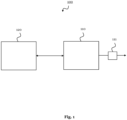
- Fig. 1 shows a schematic view of a hybrid quantum-classical computer system 100 according to a preferred embodiment of the invention.
- the hybrid quantum-classical computer system 100 comprises a classical computation component 110 and a quantum computation component 120.
- the classical computation component 110 may be a classical computer
- the quantum computation component 120 may be a universal or special-purpose purpose quantum computing device or quantum simulator.
- the quantum computation component 120 and the classical computation component 110 may be realized as two separate entities being capable of exchanging information. Alternatively, they may be integrated into one device.
- Both components 120, 1120 are configured to transfer and receive information from the respective other component such that a shared computation can be achieved in order to solve a classical constraint linear or non-linear optimization problem, that is, obtaining and providing with one or more optimal solutions x opt 111 to the classical constraint linear or non-linear optimization problem, each of which is specified and identified by a set of parameters ⁇ t, opt .
- the one or more optimal solutions provide the best performance, or at least sufficiently good performance, of the problem to be solved so that said optimal solutions give minimal values, or at least sufficiently low values, of a cost function C ( x ) .
- the cost function C(x) is an arbitrary function of one or more decision variables x , i.e., it can be linear, polynomial with arbitrary degree or any other non-linear function.
- the solutions x for the optimization problem must fulfill one or more constraints.
- each of the equality constraints f i ( x ) and each of the inequality constraints g j ( x ) comprises an arbitrary linear or non-linear complex functional form.
- a solution x of the classical constraint linear or non-linear optimization problem is determined by a set of parameters ⁇ t . Further, each solution x is encoded by a quantum state
- x ⁇ ⁇ x',x where ⁇ x',x is the Kronecker delta.
- This encoding means that all possible solutions to the classical constraint linear or non-linear optimization problem are represented by the measurement basis states of the quantum computation component.
- a general quantum state is a superposition of all basis states, i.e., a superposition of all possible solutions to the classical problem,
- the invention utilizes a PQC on the quantum computation component 120, which employs unitary gate operations that are applied to a predefined fixed initial state
- Such an application of the unitary gate operations leads to a quantum state defined in Equation (3):
- ⁇ ⁇ U ⁇
- this state encodes a full population of N S solutions candidates of the original problem, as expressed in Equation (4):
- x i ⁇ + ⁇ j N S + 1 D H ⁇ j
- the first sum comprises basis states with large weights and represents the full population, and the second sum is negligibly small, i.e.
- a basis-state selection method for example full state tomography, classical shadows or measurement-based sampling, allows a full set of solutions to be extracted from the quantum state, as will be explained later in this description.
- the quantum computation component 120 is configured to realize (or implement) a PQC by implementing the unitary quantum operation U ( ⁇ ) , also referred to in this description as unitary operator, comprising one or more surrogate phase operators as follows.
- P surrogate,l ( ⁇ l,P ) is diagonal in the measurement basis, in the sense that the measurement basis states
- x ⁇ p l ⁇ l , P x
- the Hermitian surrogate phase operator P surrogate, l ( ⁇ l,P ) in each layer comprises the sum of elementary one-, two-, or higher order qubit gate operators or one-, two-, or higher order qudit gate operators, which can be efficiently implemented on the quantum computation component 120, where the coefficients of the terms in the sum are given by the freely choosable parameter set ⁇ l,P .
- the mixing unitaries in each layer, ⁇ e -i Ml ( ⁇ l,M ) comprise the freely choosable parameters ⁇ l,M and are generated by mixing operators M l in each layer.
- the mixing operators M l do not commute with the surrogate phase operators, i.e. [ M l ( ⁇ l,M ), P surrogate, l ( ⁇ l,P )] ⁇ 0, ⁇ l, k and, thus, the mixing operators generate transitions between the measurement basis states, i.e. M l
- x s ⁇ ⁇ j m l , sj
- the surrogate phase operators P surrogate,l ( ⁇ l,P ) in each layer act on the plurality of N qubits or qudits, and are implemented with one or more single-qubit angular momentum operators or one or more single-qudit angular momentum operators as in Equation (9):
- d is the number of local quantum levels for each qubit or qudit, and comprises one or more measurement basis states
- x ⁇ 1 2 s z , ⁇
- the classical computation component 110 and the quantum computation component 120 are configured to transfer and receive information from the respective other component such that are jointly used to solve a classical constraint linear or non-linear optimization problem by performing an iterative procedure.
- the classical computation component 110 and the quantum computation component 120 are configured as follows.
- the classical computation component 110 generates a set of parameters ⁇ t using the classical optimization algorithm, and subsequently sends it to the quantum computation component 120.
- the classical optimization algorithm may comprise, for example and not as a limitation, a single-objective black-box optimization algorithm.
- the set of parameters ⁇ t may comprise the parameter sets ⁇ l,M and ⁇ l,P that are be used by the classical computation component 110 when executing the PQC. Additionally or alternatively, the set of parameters ⁇ t may comprise one or more parameters that define, or may be comprised in, the cost function C ( x ) and/or that that define, or may be comprised in, each of the one or more quality constraints f i ( x ) and/or each of the inequality constraints g j ( x ). Additionally or alternatively, the set of parameters ⁇ t may comprise one or more parameters that define, or may be comprised in, the solutions x of the classical optimization problem.
- the quantum computation component 120 may initiate the execution of the PQC and the preparation of the state
- ⁇ ⁇ t ⁇ U ( ⁇ t )
- the quantum computation component 120 uses a basis-state selection method to select a set of N M ⁇ 1 classical solutions, from the one quantum state
- the basis-state selection method performed on the quantum computation component 120 may extract N M basis states from the quantum state
- the basis-state selection method at each iteration t is performed by sampling from the quantum state
- ⁇ ⁇ t ⁇ , i.e. sampling x from the Born rule probability P ( x , ⁇ t )
- This comprises measuring repeatedly, on the quantum computation component 120, the one quantum state
- the basis-state selection method which extracts N M basis states from the quantum state
- ⁇ ⁇ t ⁇ , which is given by the absolute square of the overlap ⁇ ⁇ t,m
- any suitable technique can be used by the quantum computation component 120 to perform the basis-state selection.
- the quantum computation device 120 is further configured to send the set of selected solutions to the classical computation component 110.
- the classical computation component 110 is configured to calculate a value of the cost function, a value of each of the one or more equality constraints and/or a value of each of the inequality constraints for each of the N M selected classical solutions x ⁇ t,m .
- the classical computation component 110 is configured to add the calculated values to a set of N M evaluated solutions.
- the classical computation component 110 is further configured to feed back the one or more representative values for the cost function and for the one or more constraints to the classical optimization algorithm.
- calculating the representative value for the cost function C ⁇ ( ⁇ t ) and the representative values for each of the one or more constraints, f ⁇ i ( ⁇ t ) and/or g ⁇ j ( ⁇ t ), based on the respective calculated values in the set of evaluated solutions comprises taking the set of N M classical solutions finding the one solution that occurs most frequently, as given in Equation (12): where ⁇ a ; b is the Kronecker delta, and using this solution to arrive at representative values for the cost function and the constraint functions for the PQC at iteration t by taking, from the set of evaluated solutions, the value of the cost function and the value of each of the one or more constraints corresponding to x ⁇ t ⁇ as the respective representative values.
- Equations (13) to (15) The representative values for the cost function, for each of the one or more equality constraint functions and for each of the one or more inequality constraint functions for the PQC at iteration t are given in Equations (13) to (15) respectively:
- Equations (13) to (15) respectively:
- Each violation function comprises a function that violates a respective constraint, that is, a solution x violates the equality constraint i if f i ( x ) ⁇ 0, and the solution x violates the inequality constraint j if g j ( x ) > 0.
- calculating the representative value for the cost function and the representative value for each of the one or more constraints for the quantum state of the PQC with parameters ⁇ t further comprises performing, by the classical computation component 110, a penalty function method.
- the penalty function method comprises calculating a total penalized representative cost function value C ⁇ total ( ⁇ t ) based on the representative value for the cost function and based on a weighted sum of the one or more representative values of the equality violation functions and/or a weighted sum of the one or more representative values of the inequality violation functions, given in Equation (19):
- Each of the one or more penalty factors are set by the penalty function method used in the classical optimization algorithm.
- the hybrid quantum-classical computer system 100 and the method according to this invention can efficiently handle constraints linear or non-linear optimization problems with non-linear equality and inequality constraints, such as a constrained optimization by linear approximation (COBYLA), evolutionary strategies (ES), particle-swarm optimization (PSO), or the penalty-based method above.
- COBYLA linear approximation
- ES evolutionary strategies
- PSO particle-swarm optimization
- the classical computation component 110 is configured to update an internal state of the classical optimization algorithm using the one or more representative values.
- the classical computation component 110 is configured to update an archive based on the set of parameters ⁇ t , the set of classical solutions and the corresponding representative values of the cost function and of the one or more constraints.
- Updating the archive based on the set of parameters ⁇ t , the set of classical solutions and the corresponding representative values of the cost function and of the one or more constraints comprises adding to the archive , after each iteration t is completed, one or more of: the set of parameters ⁇ t used in the iteration t, the set of N M classical solutions the set of evaluated solutions, the representative values of the cost function, and the representative values of the one or more equality constraints and/or of the one or more inequality constraints.
- the classical computation component 110 is configured to determine or check whether a stop criterion for the iterative procedure is met. If the stop criterion is not met, both the classical computation component 110 and the quantum computation component 120 are configured to perform a next iteration, t ⁇ t + 1 and to repeat the steps explained above.
- the classical computation component 110 is further configured to obtain the one or more optimal solutions x opt 111 after the last iteration have been completed by selecting the one or more classical solutions x ⁇ t,m that correspond to an optimal or near to optimal value of the cost function, or of the representative value of the cost function, calculated in the iterative procedure and that therefore fulfill the one or more constraints.
- Selecting the one or more classical solutions x ⁇ t ,m corresponding to an optimal or near to optimal value of the cost function or of the representative value of the cost function may comprise choosing from the archive one or more solutions that have a corresponding value of the evaluated cost function and/or a corresponding representative value of the cost function that optimizes the classical constraint linear or non-linear optimization problem.
- the classical computation component 110 may provide the one or more optimal solutions x opt 111 as a final result.
- the final result provided by the classical computation component 110 may further comprise (not shown in Fig. 1 ) one or more of: an optimal set of parameters ⁇ t , opt , the optimal value of the cost function or an optimal representative value of the cost function, the one or more values or representative values of the constraints corresponding to the optimal value of the cost function.
- the optimal set of parameters ⁇ t , opt may comprise the set of parameters ⁇ t corresponding to the one or more optimal solutions x opt 111 .
- each equality constraint and each inequality constraint comprises a linear or non-linear complex functional form, according to the preferred embodiment of the invention.
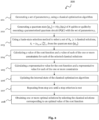
- the method 200 may be performed by the hybrid quantum-classical computer system 1 of Fig. 1 .
- the method 200 comprises performing an iterative procedure, where each iteration t comprises a step 201 of generating a set of parameters ⁇ t on a classical computation component 110 using a classical optimization algorithm, and sending the set of parameters ⁇ t to a quantum computation component 120.
- the iterative procedure comprises a step 202 of generating, on the quantum computation component 120, a quantum state
- ⁇ ⁇ t ⁇ U ( ⁇ t )
- ⁇ ⁇ t ⁇ , and sending the selected set to the classical computation component 110, is comprised.
- the classical computation component 110 calculates a value of the cost function and a value of each of the one or more constraints for each of the N M selected classical solution x ⁇ t,m , and adds the calculated values to a set of evaluated solutions.
- the iterative procedure further comprises a step 205 of calculating, on the classical computation component 110, a representative value for the cost function and a representative value for each of the one or more constraints for the quantum state of the PQC with parameters ⁇ t based on the respective calculated values in the set of evaluated solutions, and feeding back the one or more representative values to the classical optimization algorithm.
- a step 206 of updating, in the classical computation component 110, an internal state of the classical optimization algorithm using the one or more representative values is comprised.
- the iterative procedure comprises a step 207 of repeating the iterative procedure from step 201 onwards, until a stopping criterion is fulfilled.
- the method 200 comprises a step 208 of obtaining the one or more optimal solutions x opt 111 after the latest iteration have been completed by selecting the one or more classical solutions x ⁇ t,m corresponding to an optimal or near to optimal value of the cost function, or of the representative value of the cost function, calculated in the iterative procedure and that fulfill the one or more constraints.
- the method 200 further comprises, updating on the classical computation component 110 an archive based on the set of parameters ⁇ t , the set of classical solutions and the corresponding representative values of the cost function and of the one or more constraints.
- the method 200 is further characterized in that the surrogate phase operators P surrogate, l ( ⁇ l , P ) in each layer of the PQC act on the plurality of N qubits or qudits, and are implemented with one or more single-qubit angular momentum operators or single-qudit angular momentum operators, as explained above according to the embodiments of the hybrid quantum-classical computer system 100. The details are not repeated again.
- the basis-state selection method is performed by sampling from the quantum state
- the basis-state selection method is performed by full state tomography from the quantum state
- the step of calculating 205 the representative value for the cost function and the representative value for each of the one or more constraints for the quantum state of the PQC with parameters ⁇ t based on the respective calculated values in the set of evaluated solutions comprises taking the set of N M classical solutions and determining a solution that occurs most frequently x ⁇ t ⁇ , as explained above for the different embodiments of the hybrid quantum-classical computer system 100, and further taking the value of the cost function and the value of the one or more constraints corresponding to the solution that occurs most frequently x ⁇ t ⁇ as the respective representative values
- the step of calculating 205 the representative value for the cost function and the representative value for each of the one or more constraints for the quantum state of the PQC with parameters ⁇ t based on the respective calculated values in the set of evaluated solutions comprises taking the set of N M classical solutions and calculating a weighted average for the cost function and a weighted average over a magnitude of one or more equality violation functions and/or one or more inequality violating functions, where each violation function comprises a function that violates a respective constraint.
- the step of calculating 205 the representative value for the cost function and the representative value for each of the one or more constraints for the quantum state of the PQC with parameters ⁇ t based on the respective calculated values in the set of evaluated solutions comprises calculating a total penalized representative cost function value based on the representative value for the cost function and based on a weighted sum of the one or more representative values of the equality violation functions and/or a weighted sum of the one or more representative values of the inequality violation functions, where each weighted sum comprises a respective penalty factor, each penalty factor being a real and positive, and where each penalty factor is set by the penalty function method on the classical optimization algorithm.
- the method 200 further comprises actions according to the described aforementioned embodiments of the hybrid quantum-classical computer system 100. Details are not repeated again. Hence, the method 200 achieves the same advantages as the hybrid quantum-classical computer system 100.
- the first example concerns to the operation of a fleet of electric vehicles (EVs), which constitutes an archetypical optimization problem with several challenges.
- the central aspect of this operation is to provide a service to the customer such that for all vehicles, the requests of the customers can be fulfilled whilst reducing the electricity cost for charging all EVs as much as possible.
- the target is to find the optimal charging schedule of the fleet of N EV EVs over N T time slots.
- the search variable x defines a charging schedule of the complete EV fleet.
- each integer l n,s determines a charging power level of vehicle n in time slot s, and where each of the charging levels amounts to charging with a physical electrical power p l with p 1 ⁇ p 2 ⁇ ... ⁇ p d , where the values p l are fixed but arbitrary.
- the actual power levels p l range from negative values, which corresponds to discharging the EV and selling the corresponding electricity to the grid, to positive values, which implies charging the EV and buying the electricity from the grid.
- Equation (21) The overall target is the minimization of the cost for the electricity which is expressed by the objective function or cost function given in Equation (21):
- the first term of Eq. (21) represents an electricity cost for the complete charging schedule and the function P s p gives the price for buying (or selling) energy from (to) the grid at time slot s with charging power p .
- the second term represents a peak charging power over the complete schedule at any time, which typically has a big contribution to the total electricity cost for company facilities and, thus, should be minimized.
- P 0 is a cost parameter that specifies the actual cost of the peak charging power, and that is given as part of the problem setup.
- E n,max is a maximum value for the battery SOC of a vehicle n.
- the proposed invention enables the treatment of such problems by replacing the cost Hamiltonian typically used in a PQC by a highly parametrizable surrogate Hamiltonian which can be realized in hardware efficiently. Also it allows for the treatment of the many constraints efficiently without increasing the size of the problem or, for example, without adding interaction terms to the phase Hamiltonian.
- Each qudit of the quantum computation component 120 is set up to have d local quantum states, i.e. d local levels and each of these local states represents one charging power level l n,s ⁇ [0, ..., d - 1] of one EV n ⁇ [1, ..., N EV ] in one time slot s ⁇ [1, ..., N T ] .
- the basis states are exemplary given by Equation (28) as:
- x ⁇
- the quantum computation component 120 that executes the PQC, prepares the state given for example in Equation (29),
- ⁇ 0 ⁇ where the initial state
- ⁇ 0 ⁇ 1 D H ⁇ x
- x ⁇ , where D H d NEV NT is a dimensionality of the Hilbert space for N EV EVs and N T time slots, and where each time slot can be in one of d charging levels, encoded by N EV ⁇ N T qudits where each qudit has d quantum states, i.e., each qudit has local dimensionality d.
- the mixing unitaries in each layer, ⁇ e -iMl ( ⁇ l ) are generated by freely parametrizable mixing operators, M l ( ⁇ l ), which may comprise any form that can be efficiently implementable on the quantum computation component 120 and must only fulfil a requirement that they do not commute with the phase operators, i.e., [ M l ,P surrogate ] ⁇ 0, ⁇ l for the general parameter sets ( ⁇ l ,a l ,b l ) .
- the mixing operators generate transitions between the measurement basis states, M l
- x s ⁇ ⁇ j m l,sj
- the method executed on the claimed hybrid quantum-classical computer system 100 comprises the following steps.
- a classical optimization algorithm such as a stochastic gradient descent (SGD) is initiated on the classical computation component 110.
- SGD stochastic gradient descent
- an archive may be initiated on the classical computation component 110 where search parameters, possible classical solutions and corresponding values of the cost function can be stored.
- the quantum computation component 120 may be configured such that the measurement basis represents classical solutions, exemplary as in Eq. (28).
- the final result is extracted from the archive and the charging schedule with the lowest or best possible value for the electricity cost, which fulfills the given constraint as best as possible, is obtained as the optimal solution x opt .
- the PQC used in this invention is effective in producing good solutions, since it uses a surrogate phase operator that is efficiently implementable on current quantum hardware and which is still flexible enough to generate quantum states where multiple solutions are in a linear superposition but can be assigned varying amplitudes. This allows the implementation of the process of identifying representative values for the classical cost and constraint functions, where a classical optimizer can then adjust the parameters of the PQC to single out the best or close to best solutions which also fulfill the constraints, as best as possible.
- the second application example regards a Markowitz portfolio optimization.
- the target of Markowitz portfolio optimization is to manage a portfolio of financial assets over a period of time such that an expected return is maximized, while at the same time an expected risk is minimized (see e.g., " Solving the Optimal Trading Trajectory Problem Using a Quantum Annealer", IEEE Journal of Selected Topics in Signal Processing 10(6), 1053-1060, (2016) doi: 10.1109/JSTSP.2016.2574703 , " Computational aspects of alternative portfolio selection models in the presence of discrete asset choice constraints", Quantitative finance 1(5), 489-501 (2001 ), or " Dynamic portfolio optimization with real datasets using quantum processors and quantum-inspired tensor networks” Phys. Rev. Research 4, 013006 (2022 ) for recent introductions).
- rebalancing i.e., changing the portfolio composition
- rebalancing i.e., changing the portfolio composition
- Equation (53) gives an accumulated overall expected return for the complete portfolio over the considered time horizon where the transaction cost enter as a nonlinear function.
- a distribution of assets has to fulfil two types of constraints.
- the second type of constraint is specified as one inequality constraint and assures that a total expected risk is below a given value R, given in Equation (55):
- Equation (55) gives a measure for the risk since assets which have a large covariance, i.e., which vary together in a correlated way, reduce the number of independent assets in the portfolio and thus reduce the variability and stability of the whole portfolio.
- x ⁇
- the measurement basis states are eigenstates of the z-angular momentum operators L z ; n,s and the eigenvalues are the shares of the asset in the portfolio, as expressed in Equation (57): L z ; n , s + d ⁇ 1 2
- ⁇ 1,1 , ⁇ 2,1 , ... ⁇ N Assets , 1 , ⁇ 1,2 , ... , ⁇ n , s , ... , ⁇ N Assets , N T ⁇ ⁇ n , s
- ⁇ 1,1 , ⁇ 2,1 , ... ⁇ N Assets , 1 , ⁇ 1,2 , ... , ⁇ n , s , ... , ⁇ N Assets , N T ⁇ ⁇ n , s
- the quantum computation component 120 which executes the PQC, prepares a state using one layer given in Equation (3), i.e.
- ⁇ U ( ⁇ )
- ⁇ 0 ⁇ , which acts on the N
- ⁇ 0 ⁇ is given by the equal superposition of all possible states of Equation (58):
- ⁇ 0 ⁇ 1 D H ⁇ x
- x ⁇ , where D H d NAssets NT is the dimensionality of the Hilbert space for N Assets assets and N T time slots, and where the share of each asset can bet between zero and d - 1, which are encoded by N Assets ⁇ N T qudits with local dimension d.
- the unitary operation has the form given in Equation (59):
- U ⁇ e ⁇ i X ⁇ M e ⁇ i P surrogate ⁇ P which comprises a mixing term ⁇ e -i X ( ⁇ M ) and a surrogate phase operator ⁇ e -i Psurrogate ( ⁇ P) .
- the mixing unitary comprises freely choosable parameters ⁇ M ; n , s ⁇ R , and it is generated by a Hermitian mixing operator, which in this example comprises the sum over all x-angular momentum operators of each qudit, as in Equation (60):
- L x ; n,s The action of L x ; n,s is given by the action of the x-angular momentum operators, see Equation (61): L x ; n , s
- ⁇ 1,1 , ... , ⁇ n , s , ... , ⁇ N Assets , N T ⁇ 1 2 d ⁇ ⁇ n , s ⁇ 2 ⁇ n , s + 2
- the surrogate phase unitary has freely choosable parameters ⁇ P ; n , s ⁇ R and it is generated by a Hermitian phase operator which in this example comprises the sum over all z-angular momentum operators of each qudit in Equation (62):
- the quantum circuit prepares the following state given in Equation (63):
- the proposed method and hybrid quantum-classical computer system execute the following steps.
- a classical optimization algorithm which can handle constraints such as a COBYLA, is initiated on the classical computation component 110.
- an archive is initiated on the classical computation component 110, where the search parameters, possible (or candidate) solutions and corresponding values of the objective functions can be stored.
- the quantum computation component 120 is configured such that the measurement basis represents classical solutions as depicted in Eq. (56) and the quantum circuit produces the parametrized quantum state in Eq. (63) with the corresponding gate operations of Eqs. (59), (60) and (62).
- the optimization is stopped and the portfolio configuration with the largest expected return and thereby satisfying the constraints in total investment and expected risk is subsequently selected from the archive and further returned as the final (optimal) solution x opt 111.
- the final results x opt 111 comprise the optimal or near to optimal portfolio strategy that meets the requirement that the total investment at each time is given by a fixed value K and the total expected risk is below a given value R.
- the proposed method and hybrid quantum-classical computer system utilizing the PQC is effective in producing good solutions for the portfolio problem since the surrogate phase operators have the ability to produce a large variety of solutions in the quantum state of the PQC. Further, the basis-state selection method along with the method to determine appropriate representative cost and constraint function values allows for the classical optimizer to converge toward feasible solutions with near-optimal expected return.
Landscapes
- Engineering & Computer Science (AREA)
- Physics & Mathematics (AREA)
- General Physics & Mathematics (AREA)
- Theoretical Computer Science (AREA)
- Mathematical Physics (AREA)
- Data Mining & Analysis (AREA)
- Pure & Applied Mathematics (AREA)
- Computational Mathematics (AREA)
- Mathematical Analysis (AREA)
- Mathematical Optimization (AREA)
- General Engineering & Computer Science (AREA)
- Software Systems (AREA)
- Computing Systems (AREA)
- Evolutionary Computation (AREA)
- Condensed Matter Physics & Semiconductors (AREA)
- Artificial Intelligence (AREA)
- Operations Research (AREA)
- Algebra (AREA)
- Databases & Information Systems (AREA)
- Management, Administration, Business Operations System, And Electronic Commerce (AREA)
Abstract
Description
- The invention relates to a computer implemented method for obtaining one or more optimal solutions to a given classical constrained optimization problem and a hybrid quantum-classical computer system implementing such method.
- Quantum optimization is a very active field of research. The current generation of quantum computing hardware devices is still limited in sizes and subject to noise. The usefulness of these so-called noisy intermedia scale quantum (NISQ) devices for application problems is currently being tested and evaluated on many real-world application problems.
- Conventional hybrid quantum-classical approaches employ a unitary circuit, potentially subject to environmental noise or dissipation, which uses a phase Hamiltonian (also called cost Hamiltonian) which depends on, or is expressed as, a function of the objective function of the original classical optimization problem. The vast majority of current approaches start by re-formulating the original problem and transforming it into the form of a quadratic unconstrained binary optimization (QUBO) problem. However, current functional forms which can be handled efficiently with hybrid quantum optimization approaches on current and future quantum hardware devices are very limited, thus strongly limiting the types of problems, i.e., the functional form of the objective functions for the optimization problems, to be solved.
- Although details may vary between different types of quantum hardware platforms, the phase Hamiltonians are mostly limited to very low-order polynomials in the decision variables (typically linear and quadratic terms) and also the number of non-local interactions between different variables cannot be arbitrarily high, due to the limited connectivity of the hardware devices' couplings.
- The current state of the art approaches for solving optimization problems having several constraints using quantum devices are hybrid quantum-classical algorithms as described for example in "Quantum Approximate Optimization with Hard and Soft Constraints", Proceedings of the Second International Workshop on Post Moores Era Supercomputing, pp. 15-21, and "From the quantum approximate optimization algorithm to a quantum alternating operator ansatz", Algorithms 12 (2019). These approaches employ a parametrized quantum circuit (PQC) that is designed such that the variations induced on the measurement basis states, typically done by a so-called mixing unitary, preserve the constraints and when the initial state in the PQC meets all constraints, the unitary operation of the PQC does not leave the feasible solutions set and does not lead to a violation of the constraints. Devising such constraint-preserving unitary operations can nevertheless be done efficiently only for very few problems, and the unitary operations have to be specifically designed for each problem.
- In "Quantum approximate optimization algorithm for qudit systems", Phys. Rev. A 107, 062410 (2023), auxiliary qubits or qudits are used for measuring the constraints violation and altering the unitary gate operation in the PQC conditioned on the measured results.
- Other approaches add equality constraints to the cost Hamiltonian as penalty terms, which are quadratic in the constraint-defining equation. However, adding quadratic penalties to the cost function may lead to an all-to-all or at least long-ranged coupling between the variables used in the constraint-defining equation, and may lead to higher order terms due to the squaring operation.
- Inequality constraints are usually first transformed into equality constraints by introducing additional slack variables and then these are added to the cost function via quadratic penalty terms. However, the optimization problem is increased in size, i.e. the number of search variables increases, due to the addition of the auxiliary slack variables, which increases its complexity and difficulty.
- Methods based on augmented Lagrangian optimization and dual formulation utilizing Hubbard-Stratonovich transformation are considered for example in "Solving Inequality-Constrained Binary Optimization Problems on Quantum Annealer", arXiv:2012.06119", "Breaking limitation of quantum annealer in solving optimization problems under constraints", Scientific Reports 10, 3126, https://doi.org/10.1038/s41598-020-60022-5", "Applying the Hubbard-Stratonovich Transformation to Solve Scheduling Problems Under Inequality Constraints With Quantum Annealing", Front. Phys. 9, doi: 10.3389/fphy.2021.730685, and "Approaches to Constrained Quantum Approximate Optimization", SN Computer Science 4, 183. Those methods transform the original problem to a dual formulation, which have many additional parameters and which are similar to the original problem, but avoid the quadratic overhead in the constraint handling. However, solving one original problem instance requires to solve many different dual optimization problems, increasing the effort substantially.
- Variational quantum eigensolver (VQE) approaches, given for example in "The variational quantum eigensolver: a review of methods and best practices", Physics Reports, 986, 1-128, utilize different types of unitary operators. However, there are no explicit methods for including realistic constraints into VQE. If constraints are considered, they are included by one of two ways: a) designing a variational quantum circuit that does not leave the feasible space of solutions, i.e. employing constraint preserving unitary operations in the quantum circuit, or b) by including the constraints only in the classical optimization routine.
- In "Multiobjective variational quantum optimization for constrained problems: an application to Cash Management", arXiv:2302.04196, a VQE quantum circuit is employed and coupled to a classical NSGA-II algorithm. With this approach two objective functions are calculated classically from the quantum state prepared by the quantum apparatus: 1) the cost function that implements the actual minimization goal and 2) the probability to find feasible solutions in the final state. The target is to arrive at an optimal solution point, where the probability to find feasible solutions is very close to one and the cost function is minimized. In such, this method handles the constraints and the classical two-objective optimization is used to explore the search space of feasible and infeasible solutions and zoom in the feasible subspace.
- Despite the problems being attacked becoming more realistic in nature, current solutions either do not explicitly consider constrained problems or employ one of the state-of-the-art methods mentioned above. Further, some of them are solved using purely classical computers.
- There is still a need to address optimization problems including several linear or non-linear constraints in an efficient manner using both classical and quantum hardware devices.
- The current invention addresses the above mentioned problem to find solutions of realistic real world problems, specifically known from the energy management domain, on current and future quantum hardware devices employing a quantum-classical approach according to the method and computer system defined in the independent claims.
- The dependent claims define advantageous aspects and features.
- The invention encompasses the utilization of the quantum superposition, which is inherent to quantum states, as a resource to encode one or more solutions of a classical optimization algorithm. The one or more optimal solutions are found and provide optimized values (optimal or close to optimal values) of a cost function C(x) that is a linear or non-linear function of one or more decision variables x, and where the one or more optimal solutions fulfills one or more constraints. The constraints are defined by functions of the decision variables x, which indicate the fulfillment of the constraint by attaining certain ranges of function values and that have a linear or non-linear complex functional form. Further, the quantum circuit that implements such a quantum superposition is designed in a way that surrogate phase operators are able to efficiently handle the non-linear cost functions and non-linear constraints.
- A method and a hybrid quantum-classical computer system for obtaining one or more optimized solutions xopt to a given classical constraint linear or non-linear optimization problem, where each solution is specified and identified by a set of parameters γt, opt, where the one or more optimized solutions provide optimized values of a cost function C(x), the cost function C(x) being a linear or non-linear function of one or more decision variables x, and where the one or more optimal solutions fulfill one or more constraints, the one or more constraints comprising a set of one or more equality constraints defined by fi (x) = 0 with i = 1, ... , NEq and/or a set of one or more inequality constraints defined by gj (x) ≤ 0 with j = 1, .. , NInEq, where each equality constraint and each inequality constraint comprises a linear or non-linear complex functional form, are provided and are comprised of the following components and method steps: The hybrid quantum-classical computer system comprises a quantum computation component and a classical computation component. The quantum computation component and the classical computation component may be realized as two separate entities being capable of exchanging information. Alternatively, they may be integrated into one device. The quantum computation component is configured to realize or implement a PQC by implementing a unitary quantum operation U(γ) that acts on a plurality of N qubits or qudits and that is parametrized by freely choosable parameters γ, and that generates a N-qubit or N-qudit quantum state |ψγ ) by applying the unitary quantum operator to a previously defined N-qubit or qudit initial state |ψ 0〉, i.e. |ψγ ) = U(γ)|ψ 0〉, which can be decomposed into a measurement basis of the quantum computation component, and each measurement basis state |x〉 encodes one classical solution x of a classical constraint linear or non-linear optimization problem. The classical computation component is configured to run a classical optimization algorithm by generating parameter values γt and providing them to the quantum computation component, initiate the execution of the PQC and the preparation of the state |ψγt 〉, receive a set of NM ≥ 1 classical solutions

- At each iteration t the following steps are performed:
- a. generating a set of parameters γt on the classical computation component using a classical optimization algorithm and sending them to the quantum computation component,
- b. on the quantum computation component, generating a quantum state |ψγt 〉 = U(γt )|ψ 0〉 of the plurality of N qubits or qudits by executing the PQC with the set of parameters γt , where the one quantum state |ψγt 〉 represents a set of NS different classical solutions of the classical constraint linear or non-linear optimization problem by the capability of quantum superposition of many basis states representing classical solutions,
- c. using a basis-state selection method to select a set of NM ≥ 1 classical solutions,


- d. on the classical computation component, calculating a value of the cost function and a value of each of the one or more constraints for each of the NM selected classical solution xγt,m , and adding the calculated values to a set of evaluated solutions,
- e. calculating a representative value for the cost function and a representative value for each of the one or more constraints for the quantum state of the PQC with parameters γt based on the respective calculated values in the set of evaluated solutions, and feeding back the one or more representative values to the classical optimization algorithm,
- f. updating an internal state of the classical optimization algorithm using the one or more representative values,
- g. repeating the process from step a. onwards, until a stopping criterion is fulfilled.
- After the latest iteration has been completed, the one or more optimized solutions xopt are obtained in the classical computation component by selecting the one or more classical solutions xγt,m corresponding to an optimal or near to optimal value (optimized value) of the cost function calculated in the iterative procedure that fulfills all the one or more constraints.
- According to a preferred embodiment, the classical computation component is further configured to update an archive based on the set of parameters γt , the set of classical solutions

- According to a preferred embodiment, the quantum computation component realizes the PQC by implementing the unitary quantum operation U(γ), which is composed of NL layers with different choosable sets of parameters


- According to a preferred embodiment, the surrogate phase operators Psurrogate,l (γl,P ) in each layer act on the plurality of N qubits or qudits, and are implemented with one or more single-qubit angular momentum operators or single-qudit angular momentum operators as

- In a preferred embodiment the NS basis states which represent the set of solutions and which are encoded in the quantum state |ψγ 〉 as superpositions, are extracted at each iteration by sampling from the quantum state |ψγ 〉, i.e. sampling x from a Born rule probability P(x, γt ) = |〈x|ψγt 〉|2, comprising measuring repeatedly, on the quantum computation component, the one quantum state |ψγt 〉, and adding for each measured state |xγt,m 〉 a classical solution xγt,m to the set of selected states


- According to another preferred embodiment, the NS basis states which represent the set of solutions and which are encoded in the quantum state |ψγ 〉 as superpositions, are extracted at each iteration by performing a full state tomography comprising estimating on the quantum computation component an spectral weight ξγt,m with which each basis state |xm 〉 contributes to the final state |ψγt 〉, which is given by the absolute square of the overlap ξγt,m = |〈xm |ψγt 〉|2, further selecting NM classical solution states that have the largest spectral weights, and then adding them to the set of selected solutions

- According to preferred embodiment, calculating a representative value for the cost function and a representative value for each of the one or more constraints for the quantum state of the PQC with parameters γt based on the respective calculated values in the set of evaluated solutions comprises taking the set

- According to an alternative preferred embodiment, calculating on the classical computation component the representative value for the cost function and the representative value for each of the one or more constraints for the quantum state of the PQC with parameters γt based on the respective calculated values in the set of evaluated solutions comprises taking the set



- According to a preferred embodiment, calculating the representative value for the cost function and the representative value for each of the one or more constraints for the quantum state of the PQC with parameters γt based on the respective calculated values in the set of evaluated solutions further comprises performing a penalty function method, where the penalty function method comprises calculating a total penalized representative cost function value based on the representative value for the cost function and based on a weighted sum of the one or more representative values of the equality violation functions and/or a weighted sum of the one or more representative values of the inequality violation functions, where each weighted sum comprises a respective penalty factor, each penalty factor being a real and positive, and where each penalty factor is set by the penalty function method on the classical optimization algorithm.
- The method and hybrid quantum-classical computer system may further be applied to solve an electric vehicle charging optimization problem of a fleet of NEV electric vehicles (EVs) where the target is to minimize an electricity cost, the electricity cost being composed of a contribution of cost from buying and selling electricity at the spot market when charging and discharging the EVs and a contribution from a peak charging power necessary over a complete charging schedule, where the one or more constraints comprise one or more of: respecting a minimal limit and maximal limit for the battery state of charge of each EV, fulfilling an energy demand of each EV, and respecting fuse limits of the charging infrastructure at each time slot.
- According to this implementation, a search variable x defines the charging schedule over NT time slots of the fleet of EVs, where x is composed of ND = NEVNT discrete integer variables,

- The method and hybrid quantum-classical computer system according to one of the above described configurations may be applied to obtain optimal compositions of portfolios of financial assets as formulated by the constraint Markowitz model of Modern portfolio theory, where the target is to find the compositions of a portfolio over time as specified by one or more integer variables

- The invention will now be further described with reference to the attached drawings, in which
- Fig. 1
- shows a schematic of a hybrid quantum-classical computer system according to a preferred implementation of the invention.
- Fig. 2
- shows a schematic of a flowchart for a method performed by a hybrid quantum-classical computer system according to the preferred implementation of the invention.
- The proposed computer implemented method and hybrid quantum-classical computer system target to solve for the solution of optimization problems which have highly non-linear cost functions and have arbitrary many inequality and equality constraints, which can also have arbitrary non-linear forms. In particular, the inventive method and system according to this invention devise a scalable approach that does not lead to overhead in terms of auxiliary qubits/qudit, qubit/qudit-interactions or qubit/qudit-slack variables for large problems with many constraints.
- Further, this invention eliminates the need to formulate the problem as a QUBO problem, which is typically required for the current state-of-the-art approaches, thereby offering a scalable approach to complex realistic, typically highly non-linear optimization problems with many typically also highly non-linear constrains on current and future quantum hardware devices.
- The claimed system and method implement a hybrid quantum-classical optimization or sampling approach comprising a PQC that may be executed on a universal or special-purpose quantum computing device or quantum simulator and that is coupled to a classical computer which performs a classical parameter estimation and optimization algorithm to minimize the cost function, thereby obtaining an optimal or near-optimal solution or samples of solutions of the original problem.
- Further, by using the superposition of classical solutions in the quantum state of the PQC, representative values of the cost function and the constraint functions for the quantum state of the PQC can be generated and subsequently used by a classical optimizer routine to steer the optimization toward increasing the probability to find feasible solutions. The representative values represent the quality (in terms of cost function value) and feasibility (indicated by the amount of constraint violation) of the solutions represented by said superpositions in the quantum state of the PQC.
- According to this description, the expression "classical" always refers to known computation as performed in the past using digital computer systems only.
- In this description the terms classical optimization algorithm and classical optimizer may be used interchangeably. Further, the terms unitary operation and unitary may be used interchangeably. Moreover, in this description, an unitary operation is achieved by a respective unitary operator.
-
Fig. 1 shows a schematic view of a hybrid quantum-classical computer system 100 according to a preferred embodiment of the invention. - The hybrid quantum-
classical computer system 100 comprises aclassical computation component 110 and aquantum computation component 120. Theclassical computation component 110 may be a classical computer, and thequantum computation component 120 may be a universal or special-purpose purpose quantum computing device or quantum simulator. - The
quantum computation component 120 and theclassical computation component 110 may be realized as two separate entities being capable of exchanging information. Alternatively, they may be integrated into one device. - Both
components 120, 1120 are configured to transfer and receive information from the respective other component such that a shared computation can be achieved in order to solve a classical constraint linear or non-linear optimization problem, that is, obtaining and providing with one or more optimal solutions xopt 111 to the classical constraint linear or non-linear optimization problem, each of which is specified and identified by a set of parameters γt, opt. - The one or more optimal solutions provide the best performance, or at least sufficiently good performance, of the problem to be solved so that said optimal solutions give minimal values, or at least sufficiently low values, of a cost function C(x). The cost function C(x) is an arbitrary function of one or more decision variables x, i.e., it can be linear, polynomial with arbitrary degree or any other non-linear function.
- Further, the solutions x for the optimization problem must fulfill one or more constraints. The one or more constraints comprise a set of one or more equality constraints and/or a set of one or more inequality constrains, given in Equations (1) and (2) respectively:


- The functional dependence of each of the equality constraints fi (x) and each of the inequality constraints gj (x) comprises an arbitrary linear or non-linear complex functional form.
- A solution x of the classical constraint linear or non-linear optimization problem is determined by a set of parameters γt. Further, each solution x is encoded by a quantum state |x〉, which can be a qubit (i.e., a quantum two-level system) or qudit (i.e., a quantum multi-level system). Each of those states is a basis state in a measurement basis of the quantum computation component and they fulfil the orthonormality condition 〈x'|x〉 = δx',x where δx',x is the Kronecker delta.
- This encoding means that all possible solutions to the classical constraint linear or non-linear optimization problem are represented by the measurement basis states of the quantum computation component. One advantage of using a quantum computation component for approaching this problem is given by the fact that a general quantum state is a superposition of all basis states, i.e., a superposition of all possible solutions to the classical problem, |φ〉 =


- The invention utilizes a PQC on the
quantum computation component 120, which employs unitary gate operations that are applied to a predefined fixed initial state |ψ 0〉. Such an application of the unitary gate operations leads to a quantum state defined in Equation (3):
- According to the invention, this state encodes a full population of NS solutions candidates of the original problem, as expressed in Equation (4):


- A basis-state selection method, for example full state tomography, classical shadows or measurement-based sampling, allows a full set of solutions to be extracted from the quantum state, as will be explained later in this description.
- Referring to
Fig. 1 , thequantum computation component 120 is configured to realize (or implement) a PQC by implementing the unitary quantum operation U(γ), also referred to in this description as unitary operator, comprising one or more surrogate phase operators as follows. The unitary quantum operation U(γ) according to this invention is composed of NL layers with different choosable sets of parameters


- The Hermitian surrogate phase operator Psurrogate,l (γl,P ) is diagonal in the measurement basis, in the sense that the measurement basis states |x) are simultaneous eigenstates of the surrogate phase operators, as expressed in Equation (8):


- Further, the Hermitian surrogate phase operator Psurrogate, l (γl,P ) in each layer comprises the sum of elementary one-, two-, or higher order qubit gate operators or one-, two-, or higher order qudit gate operators, which can be efficiently implemented on the
quantum computation component 120, where the coefficients of the terms in the sum are given by the freely choosable parameter set γl,P. - The mixing unitaries in each layer, ~ e -i Ml(γl,M), comprise the freely choosable parameters γl,M and are generated by mixing operators Ml in each layer. The mixing operators Ml do not commute with the surrogate phase operators, i.e. [Ml (γl,M ), Psurrogate, l (γl,P )] ≠ 0, ∀ l, k and, thus, the mixing operators generate transitions between the measurement basis states, i.e. Ml |xs 〉 = Σ j m l,sj |xj 〉.
- In an embodiment, the surrogate phase operators Psurrogate,l (γl,P ) in each layer act on the plurality of N qubits or qudits, and are implemented with one or more single-qubit angular momentum operators or one or more single-qudit angular momentum operators as in Equation (9):

- In Eq. (9), Lz,α is a z-component of the angular momentum operator of a qubit or qudit α of total angular momentum S = (d - 1)/2 where d is the number of local quantum levels for each qubit or qudit, and comprises one or more measurement basis states |x〉 of the
quantum computation component 120 as eigenstates, that is,
- Referring to
Fig. 1 , theclassical computation component 110 and thequantum computation component 120 are configured to transfer and receive information from the respective other component such that are jointly used to solve a classical constraint linear or non-linear optimization problem by performing an iterative procedure. - At each iteration t, the
classical computation component 110 and thequantum computation component 120 are configured as follows. - The
classical computation component 110 generates a set of parameters γt using the classical optimization algorithm, and subsequently sends it to thequantum computation component 120. The classical optimization algorithm may comprise, for example and not as a limitation, a single-objective black-box optimization algorithm. - The set of parameters γt may comprise the parameter sets γl,M and γl,P that are be used by the
classical computation component 110 when executing the PQC. Additionally or alternatively, the set of parameters γt may comprise one or more parameters that define, or may be comprised in, the cost function C(x) and/or that that define, or may be comprised in, each of the one or more quality constraints fi (x) and/or each of the inequality constraints gj (x). Additionally or alternatively, the set of parameters γt may comprise one or more parameters that define, or may be comprised in, the solutions x of the classical optimization problem. - Upon receiving the set of parameters γt , the
quantum computation component 120 may initiate the execution of the PQC and the preparation of the state |ψγt 〉. That is, thequantum computation component 120 generates the quantum state |ψγt 〉 = U(γt )|ψ 0〉 of a plurality of N qubits or qudits by executing the PQC with surrogate phase unitaries and mixing unitaries as explained above, with the set of parameters γt. - The one quantum state |ψγt 〉 represents a set of NS different classical solutions

- Next, the
quantum computation component 120 uses a basis-state selection method to select a set of NM ≥ 1 classical solutions,

- That is, the basis-state selection method performed on the
quantum computation component 120 may extract NM basis states from the quantum state |ψγt 〉 at each iteration t. - In an embodiment, the basis-state selection method at each iteration t is performed by sampling from the quantum state |ψγt 〉, i.e. sampling x from the Born rule probability P(x, γt ) = |〈x|ψγt 〉|2. This comprises measuring repeatedly, on the
quantum computation component 120, the one quantum state |ψγt 〉, and adding for each measured state |xγt,m 〉 a classical solution xγt,m to the set of selected states

- Alternatively, in an embodiment, the basis-state selection method, which extracts NM basis states from the quantum state |ψγt 〉 at iteration t, is performed by the
quantum computation component 120 by estimating a full state tomography. This comprises estimating an spectral weight ξγt,m with which each basis state |xm 〉 contributes to the final state |ψγt 〉, which is given by the absolute square of the overlap ξγt,m = |〈xm |ψγt 〉|2, further selecting NM classical solution states that have the largest spectral weights, and then adding them to the set of selected solutions
- Alternatively, in another embodiment, any suitable technique can be used by the
quantum computation component 120 to perform the basis-state selection. - The
quantum computation device 120 is further configured to send the set of selected solutions
classical computation component 110. - Next, the
classical computation component 110 is configured to calculate a value of the cost function, a value of each of the one or more equality constraints and/or a value of each of the inequality constraints for each of the NM selected classical solutions xγt,m . - In other words, the
classical computation component 110 evaluates the cost function and each of the one or more constraints using each one of the classical solutions xγt,m in the set
- Further, the
classical computation component 110 is configured to add the calculated values to a set of NM evaluated solutions. - Thereafter, the
classical computation component 110 is configured to calculate a representative value for the cost function, C̃(γt ), and a representative value for each of the one or more constraints, comprising a representative value for each of the one or more equality constraints,


- The
classical computation component 110 is further configured to feed back the one or more representative values for the cost function and for the one or more constraints to the classical optimization algorithm. - In an embodiment, calculating the representative value for the cost function C̃(γt ) and the representative values for each of the one or more constraints, f̃i (γt ) and/or g̃j (γt ), based on the respective calculated values in the set of evaluated solutions comprises taking the set of NM classical solutions


- The representative values for the cost function, for each of the one or more equality constraint functions and for each of the one or more inequality constraint functions for the PQC at iteration t are given in Equations (13) to (15) respectively:


- Alternatively, in an embodiment, calculating the representative value for the cost function C̃(γt ) and the representative values for each of the one or more constraints, f̃i (γt ) and/or g̃j (γ t ), based on the respective calculated values in the set of evaluated solutions comprises taking the set


- Each violation function comprises a function that violates a respective constraint, that is, a solution x violates the equality constraint i if fi (x) ≠ 0, and the solution x violates the inequality constraint j if gj (x) > 0.
- The weighted average over the magnitude of each of the one or more equality violation functions and the weighted average over the magnitude of each of the one or more inequality violating functions are given in Equations (17) and (18) respectively:


- In an embodiment, calculating the representative value for the cost function and the representative value for each of the one or more constraints for the quantum state of the PQC with parameters γt further comprises performing, by the
classical computation component 110, a penalty function method. - The penalty function method comprises calculating a total penalized representative cost function value C̃total (γt ) based on the representative value for the cost function and based on a weighted sum of the one or more representative values of the equality violation functions and/or a weighted sum of the one or more representative values of the inequality violation functions, given in Equation (19):


- Thereby, the hybrid quantum-
classical computer system 100 and the method according to this invention can efficiently handle constraints linear or non-linear optimization problems with non-linear equality and inequality constraints, such as a constrained optimization by linear approximation (COBYLA), evolutionary strategies (ES), particle-swarm optimization (PSO), or the penalty-based method above. - Next, the
classical computation component 110 is configured to update an internal state of the classical optimization algorithm using the one or more representative values. - Further, the
classical computation component 110 is configured to update an archivebased on the set of parameters γt , the set of classical solutions

- Updating the archivebased on the set of parameters γt , the set of classical solutions

 , after each iteration t is completed, one or more of: the set of parameters γt used in the iteration t, the set of NM classical solutions

- Thereafter, the
classical computation component 110 is configured to determine or check whether a stop criterion for the iterative procedure is met. If the stop criterion is not met, both theclassical computation component 110 and thequantum computation component 120 are configured to perform a next iteration, t → t + 1 and to repeat the steps explained above. - If the stop criterion is met, the iterative procedure is terminated and the
classical computation component 110 is further configured to obtain the one or more optimal solutions xopt 111 after the last iteration have been completed by selecting the one or more classical solutions xγt,m that correspond to an optimal or near to optimal value of the cost function, or of the representative value of the cost function, calculated in the iterative procedure and that therefore fulfill the one or more constraints. - Selecting the one or more classical solutions x γt,m corresponding to an optimal or near to optimal value of the cost function or of the representative value of the cost function, may comprise choosing from the archiveone or more solutions that have a corresponding value of the evaluated cost function and/or a corresponding representative value of the cost function that optimizes the classical constraint linear or non-linear optimization problem.

- Then, the
classical computation component 110 may provide the one or more optimal solutions xopt 111 as a final result. - The final result provided by the
classical computation component 110 may further comprise (not shown inFig. 1 ) one or more of: an optimal set of parameters γ t, opt, the optimal value of the cost function or an optimal representative value of the cost function, the one or more values or representative values of the constraints corresponding to the optimal value of the cost function. - The optimal set of parameters γ t, opt may comprise the set of parameters γt corresponding to the one or more optimal solutions xopt 111.
-
Fig. 2 shows a schematic view of a flowchart for amethod 200 for obtaining one or more optimal solutions xopt to a given classical constraint linear or non-linear optimization problem, where each solution is specified and identified by a set of parameters γt, opt, where the one or more optimal solutions provide optimal values of a cost function C(x), the cost function C(x) being a linear or non-linear function of one or more decision variables x, and where the one or more optimal solutions fulfill one or more constraints, the one or more constraints comprising a set of one or more equality constraints fi (x) = 0 with i = 1, ... , NEq and/or a set of one or more inequality constraints gj (x) ≤ 0 with j = 1,.. , NInEq, where each equality constraint and each inequality constraint comprises a linear or non-linear complex functional form, according to the preferred embodiment of the invention. Themethod 200 may be performed by the hybrid quantum-classical computer system 1 ofFig. 1 . - The
method 200 comprises performing an iterative procedure, where each iteration t comprises astep 201 of generating a set of parameters γt on aclassical computation component 110 using a classical optimization algorithm, and sending the set of parameters γt to aquantum computation component 120. - Then, the iterative procedure comprises a
step 202 of generating, on thequantum computation component 120, a quantum state |ψγt 〉 = U(γt )|ψ 0〉 of a plurality of N qubits or qudits by executing a PQC with the set of parameters γt , where the one quantum state |ψγt 〉 represents a set of NS different classical solutions of the classical constraint linear or non-linear optimization problem by means of a quantum superposition in the quantum state, as explained above according to the embodiments of the hybrid quantum-classical computer system 100. - Next, a
step 203 of using, on thequantum computation component 120, a basis-state selection method to select a set of NM ≥ 1 classical solutions,

classical computation component 110, is comprised. - Further, in a
step 204, theclassical computation component 110 calculates a value of the cost function and a value of each of the one or more constraints for each of the NM selected classical solution x γt,m, and adds the calculated values to a set of evaluated solutions. - The iterative procedure further comprises a
step 205 of calculating, on theclassical computation component 110, a representative value for the cost function and a representative value for each of the one or more constraints for the quantum state of the PQC with parameters γt based on the respective calculated values in the set of evaluated solutions, and feeding back the one or more representative values to the classical optimization algorithm. - Next, a
step 206 of updating, in theclassical computation component 110, an internal state of the classical optimization algorithm using the one or more representative values is comprised. - Further, the iterative procedure comprises a
step 207 of repeating the iterative procedure fromstep 201 onwards, until a stopping criterion is fulfilled. - Thereafter, the
method 200 comprises astep 208 of obtaining the one or more optimal solutions xopt 111 after the latest iteration have been completed by selecting the one or more classical solutions x γt,m corresponding to an optimal or near to optimal value of the cost function, or of the representative value of the cost function, calculated in the iterative procedure and that fulfill the one or more constraints. - The
method 200 further comprises, updating on theclassical computation component 110 an archivebased on the set of parameters γt , the set of classical solutions and the corresponding representative values of the cost function and of the one or more constraints.
- In a preferred embodiment, the
method 200 is characterized in that the PQC implements the unitary quantum operator U(γ) that acts on the plurality of N qubits or qudits, where unitary quantum operator U(γ) is composed of NL layers with different choosable sets of parameters γ =
classical computer system 100. The details are not repeated again here. - The
method 200 is further characterized in that the surrogate phase operators Psurrogate, l (γ l,P ) in each layer of the PQC act on the plurality of N qubits or qudits, and are implemented with one or more single-qubit angular momentum operators or single-qudit angular momentum operators, as explained above according to the embodiments of the hybrid quantum-classical computer system 100. The details are not repeated again. - In an embodiment of the
method 200, the basis-state selection method is performed by sampling from the quantum state |ψγt 〉, comprising measuring repeatedly the one quantum state |ψγt 〉, and adding for each measured state |xγt,m 〉 a classical solution xγt,m corresponding to the set of selected states

- In another embodiment of the
method 200, the basis-state selection method is performed by full state tomography from the quantum state |ψγt 〉 where a set of weights of each basis state is determined, and the basis states corresponding to a subset of the NM largest weights is selected and added to the set of selected states,
- In an embodiment, the step of calculating 205 the representative value for the cost function and the representative value for each of the one or more constraints for the quantum state of the PQC with parameters γt based on the respective calculated values in the set of evaluated solutions comprises taking the set


classical computer system 100, and further taking the value of the cost function and the value of the one or more constraints corresponding to the solution that occurs most frequently
- Alternatively, in another embodiment, the step of calculating 205 the representative value for the cost function and the representative value for each of the one or more constraints for the quantum state of the PQC with parameters γt based on the respective calculated values in the set of evaluated solutions comprises taking the set

- In an embodiment, the step of calculating 205 the representative value for the cost function and the representative value for each of the one or more constraints for the quantum state of the PQC with parameters γt based on the respective calculated values in the set of evaluated solutions comprises calculating a total penalized representative cost function value based on the representative value for the cost function and based on a weighted sum of the one or more representative values of the equality violation functions and/or a weighted sum of the one or more representative values of the inequality violation functions, where each weighted sum comprises a respective penalty factor, each penalty factor being a real and positive, and where each penalty factor is set by the penalty function method on the classical optimization algorithm. The details regarding the total penalized representative cost function value, the weighted sum of the one or more representative values of the equality violation functions, and the weighted sum of the one or more representative values of the inequality violation functions were explained above for the embodiment of the hybrid quantum-
classical computer system 100. - The
method 200 further comprises actions according to the described aforementioned embodiments of the hybrid quantum-classical computer system 100. Details are not repeated again. Hence, themethod 200 achieves the same advantages as the hybrid quantum-classical computer system 100. - Hereinafter, the invention will be described for two different implementation examples, which are typical for constrained linear or non-linear optimization problems.
- The first example concerns to the operation of a fleet of electric vehicles (EVs), which constitutes an archetypical optimization problem with several challenges. The central aspect of this operation is to provide a service to the customer such that for all vehicles, the requests of the customers can be fulfilled whilst reducing the electricity cost for charging all EVs as much as possible.
- In one formulation of the problem, the target is to find the optimal charging schedule of the fleet of NEV EVs over NT time slots. The search variable x defines a charging schedule of the complete EV fleet. A schedule consists of NEV · NT discrete integer variables given in Equation (20),

- The actual power levels p ℓ range from negative values, which corresponds to discharging the EV and selling the corresponding electricity to the grid, to positive values, which implies charging the EV and buying the electricity from the grid.
- The overall target is the minimization of the cost for the electricity which is expressed by the objective function or cost function given in Equation (21):

- The first term of Eq. (21) represents an electricity cost for the complete charging schedule and the function


- The customer needs are reflected in a constraint that the state of charge (SOC) of the battery of each EV after the charging, i.e. in time slot NT, is at least the minimum required by the user, En,min, as indicated in Equation (22):


- In addition, there are technical constraints to be fulfilled as well. For one, a total charging power in each time slot must be within predefined bounds in order to not trigger any fuses, as given in Equations (24) and (25):


- The problem described so far cannot be handled in its generality with current state of the art variational approaches utilizing parametrized quantum circuits coupled to a classical optimization component. First, the non-linearity of the cost function is not expressible efficiently in terms of the elementary operators of the quantum computation component (i.e., quantum hardware). Typically, a cost Hamiltonian would be expanded into elementary (unitary) operators and a subsequent Trotterization of the unitary operators in the quantum circuit is necessary. This leads to a very deep circuit that is not feasible on near to mid-term quantum devices. Additionally, the large numbers of inequality constraints, see for example Eq. (22) and Eqs. (24) to (26), cannot be efficiently incorporated into the state-of-the-art approaches.
- The proposed invention enables the treatment of such problems by replacing the cost Hamiltonian typically used in a PQC by a highly parametrizable surrogate Hamiltonian which can be realized in hardware efficiently. Also it allows for the treatment of the many constraints efficiently without increasing the size of the problem or, for example, without adding interaction terms to the phase Hamiltonian.
- In the exemplary EV charging problem, the encoding into the quantum formulation is as follows: Each qudit of the
quantum computation component 120 is set up to have d local quantum states, i.e. d local levels and each of these local states represents one charging power level ℓn,s ∈ [0, ..., d - 1] of one EV n ∈ [1, ..., NEV ] in one time slot s ∈ [1, ..., NT ]. The basis states are exemplary given by Equation (28) as:
- One advantage of using a
quantum computation component 120 for approaching this problem is given by the fact that a general quantum state in this basis is naturally a superposition of all possible solutions to the problem, i.e., |φ〉 = Σ x cx |x), with complex coefficients
- The
quantum computation component 120 that executes the PQC, prepares the state given for example in Equation (29),

- In this example, the unitary in each layer l has the form given in Equation (31):


- The surrogate phase operator is formulated with the z-component of the angular momentum operators of each qudit, as for example in Equation (32):


- The mixing unitaries in each layer, ~ e -iMl(γl) , are generated by freely parametrizable mixing operators, Ml (γl ), which may comprise any form that can be efficiently implementable on the
quantum computation component 120 and must only fulfil a requirement that they do not commute with the phase operators, i.e., [Ml,Psurrogate ] ≠ 0, ∀ l for the general parameter sets (γl,al,bl ). Thus, the mixing operators generate transitions between the measurement basis states, Ml |xs 〉 = Σ jml,sj |xj 〉. - In this exemplary implementation, the mixing operators may be given by a sum over all x-angular momentum operators of each qudit variable, as exemplary given in Equation (33):

- In a simple but representative case, the quantum circuit has only one layer, NL = 1, and a solution which is encoded by the quantum state of the PQC is extracted from the quantum circuit by drawing from a probability distribution of Equation (34):


- The method executed on the claimed hybrid quantum-
classical computer system 100 according to this invention, comprises the following steps. A classical optimization algorithm such as a stochastic gradient descent (SGD) is initiated on theclassical computation component 110. - The search parameters of this classical optimizer are given by the parameters for the PQC, i.e.,


- Additionally, an archivemay be initiated on the

classical computation component 110 where search parameters, possible classical solutions and corresponding values of the cost function can be stored. - Further, the
quantum computation component 120 may be configured such that the measurement basis represents classical solutions, exemplary as in Eq. (28). - Then, an iteration counter is initialized with t = 0 and the following steps are iterated:
- i) Based on its internal state, the classical optimization algorithm generates a set of parameter values γ = {γn,s,an,s,bk,n,s,r } and the
classical computation component 110 sends these parameter values to thequantum computation component 120. - ii) The
quantum computation component 120 receives the parameter set γ = an,s, and adjusts the unitary gate operators according to Eq. (31), where the phase and mixing operators are given by Eqs. (32) and (33), respectively. - iii) The
quantum computation component 120 executes the PQC by applying the unitary operator on the initial state as specified in Eq. (29), thereby preparing the quantum state |ψ({γn,s,an,s,bk,n,s,r })〉. - iv) The resulting quantum state |ψ({γn,s,an,s,bk,n,s,r })〉 may be then measured on the
quantum computation component 120 and thereby projected onto the measurement basis, as given in Equation (36):


- v) Then, the classical cost of Eq. (21) and all the constraint functions of Eq. (22) and Eqs. (24) to (26) are evaluated for this classical solution, see Equations (39) to (44):


- vi) In this exemplary implementation, the cost function value and the constraint function values, Eqs. (39) to (44), are used to calculate the representative value for the cost function and the representative value for each of the constraint functions by taking the values from this one measurement, given in Equations (46) to (51):


- vii) Next, the total penalized cost function is calculated from these representative values and is given in Equation (52):

- viii) Then, the total penalized representative value of the cost function, C̃total (γ), the representative values of the constraint functions g̃(γ) = {g̃ 1,n (γ),gj,s (γ)g̃j,n,s (γ)}, the corresponding measured solution, i.e. the schedule xγ,m , and the parameters used by the PQC in the current iteration, γ = {γn,s ,an,s,bk,n,s,r }, are added to the archive,

- ix) The total penalized representative value for the cost function, C̃total(y), and the representative values of the constraint functions g̃(γ) are fed back into the classical optimization algorithm. Based on the current and all previous values (i.e., values calculated in the previous iterations) of the cost function and their corresponding parameters values, the classical optimizer updates its internal state.
- x) Thereafter, a convergence criterion is checked on the
classical computation component 110. This can be, for example, whether a maximally allowed number of cost function evaluations has been reached. If the convergence criterion is met, the iterative procedure is stopped and the schedule with the best value for the cost function is selected from the archiveand returned as the final solution. If the convergence criterion is not met, the process is repeated for a next iteration from step i) above.
- After running the claimed method on the claimed hybrid quantum-classical computer system, the final result is extracted from the archiveand the charging schedule with the lowest or best possible value for the electricity cost, which fulfills the given constraint as best as possible, is obtained as the optimal solution xopt.

- The PQC used in this invention is effective in producing good solutions, since it uses a surrogate phase operator that is efficiently implementable on current quantum hardware and which is still flexible enough to generate quantum states where multiple solutions are in a linear superposition but can be assigned varying amplitudes. This allows the implementation of the process of identifying representative values for the classical cost and constraint functions, where a classical optimizer can then adjust the parameters of the PQC to single out the best or close to best solutions which also fulfill the constraints, as best as possible.
- The second application example regards a Markowitz portfolio optimization. The target of Markowitz portfolio optimization is to manage a portfolio of financial assets over a period of time such that an expected return is maximized, while at the same time an expected risk is minimized (see e.g., "Solving the Optimal Trading Trajectory Problem Using a Quantum Annealer", IEEE Journal of Selected Topics in Signal Processing 10(6), 1053-1060, (2016) doi: 10.1109/JSTSP.2016.2574703, "Computational aspects of alternative portfolio selection models in the presence of discrete asset choice constraints", Quantitative finance 1(5), 489-501 (2001), or "Dynamic portfolio optimization with real datasets using quantum processors and quantum-inspired tensor networks" Phys. Rev. Research 4, 013006 (2022) for recent introductions).
- Technically, the problem consists of determining the compositions of a portfolio of financial assets as specified by the variables


- The cost function objective of this problem is given by an expected return given in Equation (53)

- Equation (53) gives an accumulated overall expected return for the complete portfolio over the considered time horizon where the transaction cost enter as a nonlinear function.
- A distribution of assets has to fulfil two types of constraints. The first type of constraints are given by equality constraints, which state that at each time step a total investment is always a same value given by K, as expressed in Equation (54):

- The second type of constraint is specified as one inequality constraint and assures that a total expected risk is below a given value R, given in Equation (55):

- Here, Σ nm,s denotes the covariance of assets n and m at time s. Equation (55) gives a measure for the risk since assets which have a large covariance, i.e., which vary together in a correlated way, reduce the number of independent assets in the portfolio and thus reduce the variability and stability of the whole portfolio.
- The constraint portfolio optimization problem is approached with the proposed method and hybrid computer system by representing the integer variables describing the shares in the portfolios,


- In this example, the
quantum computation component 120 which executes the PQC, prepares a state using one layer given in Equation (3), i.e. |ψ〉 = U(γ)|ψ 0〉, which acts on the N = - NAssets NT qudits and where the unitary operation U is freely parametrizable with a set of parameters γ. The initial state of the circuit |ψ 0〉 is given by the equal superposition of all possible states of Equation (58):

- In this example, the unitary operation has the form given in Equation (59):

- The mixing unitary comprises freely choosable parameters



- The surrogate phase unitary has freely choosable parameters


- Putting it all together, the quantum circuit prepares the following state given in Equation (63):

- This parametrized quantum state depends on ND = 2NAssetNT parameters

- The proposed method and hybrid quantum-classical computer system execute the following steps. First, a classical optimization algorithm (), which can handle constraints such as a COBYLA, is initiated on the

classical computation component 110. The search parameters of this classical optimizer are given by the ND = 2NAssetNT parameters of the PQC, i.e.,
- Additionally, an archiveis initiated on the

classical computation component 110, where the search parameters, possible (or candidate) solutions and corresponding values of the objective functions can be stored. - Second, the
quantum computation component 120 is configured such that the measurement basis represents classical solutions as depicted in Eq. (56) and the quantum circuit produces the parametrized quantum state in Eq. (63) with the corresponding gate operations of Eqs. (59), (60) and (62). - Then, an iteration counter is initialized with t = 0 and the following steps are iterated:
- i) Based on its internal state, the classical optimizer algorithm generates a set of search parameter values as in Equation (64):

classical computation component 110 sends these parameter values to thequantum computation component 120. - ii) The
quantum computation component 120 receives the parameter set γt and adjusts its unitary gate operators such that it produces the quantum state |ψ(γt )〉 specified by Eq. (63). That is, thequantum computation component 120 executes the quantum circuit and produces that state. - iii) In this example, the basis-state selection method is performed to select a set of classical solutions from the quantum state by measuring the quantum state on the quantum computation component NM times and thereby projecting it onto one measurement basis state in each measurement, as expressed in Equation (65):

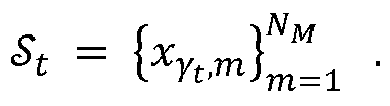
- iv) The set of classical solutions

classical computation component 110 and there, the classical cost function of Eq (53) and the constraint functions of Eqs (54) and (55) are evaluated for each solution, which gives the set of evaluated solutions given in Eq. (66):
- v) From this set of evaluated solutions, the representative value of the cost function for the quantum state |ψ(γt )〉 is calculated as the average given in Equation (16), specifically stated in Eq. (67):


- vi) The representative values are then fed back into the classical optimization algorithm, as expressed in Equation (70):

- vii) Further, all relevant parameters and evaluated function values are added to the archive , i.e.


- viii) Then, a convergence criterion is checked on the
classical computation component 110. This can be, for example, whether the maximally allowed number of cost function evaluations has been reached. If the convergence criterion is not met, the iterative process is repeated from step i) above for a next iteration t → t + 1. - If the convergence criterion is met the optimization is stopped and the portfolio configuration with the largest expected return and thereby satisfying the constraints in total investment and expected risk is subsequently selected from the archiveand further returned as the final (optimal)

solution x opt 111. - In other words, the final results xopt 111 comprise the optimal or near to optimal portfolio strategy that meets the requirement that the total investment at each time is given by a fixed value K and the total expected risk is below a given value R.
- The proposed method and hybrid quantum-classical computer system utilizing the PQC is effective in producing good solutions for the portfolio problem since the surrogate phase operators have the ability to produce a large variety of solutions in the quantum state of the PQC. Further, the basis-state selection method along with the method to determine appropriate representative cost and constraint function values allows for the classical optimizer to converge toward feasible solutions with near-optimal expected return.
Claims (13)
- A computer implemented method (200) for obtaining one or more optimal solutions xopt to a given classical constraint linear or non-linear optimization problem, where each solution is specified and identified by a set of parameters γt,opt, where the one or more optimal solutions provide optimal values of a cost function C(x), the cost function C(x) being a linear or non-linear function of one or more decision variables x, and where the one or more optimal solutions fulfill one or more constraints, the one or more constraints comprising a set of one or more equality constraints fi (x) = 0 with i = 1, ..., NEq and/or a set of one or more inequality constraints gj (x) ≤ 0 with j = 1,.., NInEq, where each equality constraint and each inequality constraint comprises a linear or non-linear complex functional form, the method comprising:
performing an iterative procedure, where each iteration t comprises the following steps:- generating (201) a set of parameters γt on a classical computation component using a classical optimization algorithm and sending the set of parameters γt to a quantum computation component;- on the quantum computation component, generating (202) a quantum state |ψγt 〉 = U(γt )|ψ 0〉 of a plurality of N qubits or qudits by executing a parameterized quantum circuit, PQC, with the set of parameters γt , where the one quantum state |ψγt 〉 comprises a linear superposition of quantum states, the linear superposition of quantum states representing a set of NS different classical solutions of the classical constraint linear or non-linear optimization problem;- on the quantum computation component, using (203) a basis-state selection method to select a set of NM ≥ 1 classical solutions,
 - on the classical computation component, calculating (204) a value of the cost function and a value of each of the one or more constraints for each of the NM selected classical solutions xγt,m , and adding the calculated values to a set of evaluated solutions;- calculating (205) a representative value for the cost function and a representative value for each of the one or more constraints for the quantum state of a parameterized quantum circuit, PQC, with parameters γt based on the respective calculated values in the set of evaluated solutions, and feeding back the one or more representative values to the quantum computation component;- updating (206) an internal state of the classical optimization algorithm using the one or more representative values;- repeating (207) the iterative procedure from step (201) onwards, until a stopping criterion is fulfilled;and the method further comprises:
obtaining (208) the one or more optimal solutions xopt after the latest iteration has been completed by selecting the one or more classical solutions xγt,m corresponding to an optimized value of the cost function calculated in the iterative procedure and that fulfill the one or more constraints. - The method (200) according to claim 1,
characterized in that
in addition to updating (206) the internal state of the classical optimization algorithm, an archiveis updated based on the set of parameters γt , the set of classical solutions and the corresponding representative values of the cost function and of the one or more constraints.
- The method (200) according to claim 1 or 2,
characterized in thatthe PQC implements a unitary quantum operator U(γ) that acts on the plurality of N qubits or qudits, the unitary quantum operator U(γ) being composed of NL layers with different choosable sets of parameters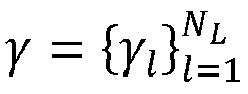
 and where each layer l comprises multiple mixing operators and multiple surrogate phase operators with separately choosable parameter sets γl,M and γl,P respectively, and the unitary operator in each layer of U(γ) has the form
 where the surrogate phase unitaries in each layer, ~ e -i Psurrogate, l(γ), are generated by a Hermitian surrogate phase operator P surrogate, l( γ l,P) that is parametrized with the freely choosable parameter sets γl,P ;and where the Hermitian surrogate operator P surrogate, l( γ l,P) in each layer comprise the sum of elementary one-qubit gate operators, two-qubit gate operators or higher-order qubit gate operators, or one-qudit gate operators, two-qudit gate operators or higher-order qudit gate operators, all of which are efficiently implementable on the quantum computation component (120), and where the coefficients of the terms in the sum are given by the freely choosable parameter set γl,P ;and where the mixing unitaries in each layer, ~ e -i Ml(γl,M), comprise the freely choosable parameters γl,M and are generated by mixing operators Ml in each layer, where the mixing operators do not commute with the surrogate phase operators.
 - The method (200) according to any of claims 1 to 3
characterized in thatthe surrogate phase operators P surrogate, l( γ l,P) in each layer act on the plurality of N qubits or qudits, and are implemented with one or more single-qubit angular momentum operators or single-qudit angular momentum operators as where γl,P,α and γl,P,α,β with α, β = 1, ..., N are freely choosable parameter sets indexing all the N qubits or qudits, and the choosable parameter sets γl,P,α,β acting as interaction matrix elements are symmetric, γ l,P,α,β= γl,P,β,α ;and where Lz,α is a z-component of the angular momentum operator of a qubit or qudit α of total angular momentum S = (d - 1)/2, where d is a number of quantum states for each qubit or qudit, and comprises one or more measurement basis states |x〉 of the quantum computation component as eigenstates.
 - The method (200) according to any of claims 1 to 4
characterized in thatthe basis-state selection method is performed by sampling from the quantum state |ψγt 〉, comprising:measuring repeatedly the one quantum state |ψγt 〉, and adding for each measured state |xγt,m 〉 a classical solution xγt,m corresponding to the set of selected states

- The method (200) according to any of claims 1 to 4,
characterized in that
the basis-state selection method is performed by full state tomography from the quantum state |ψγt 〉 where a set of weights of each basis state is determined, and the basis states corresponding to a subset of the NM largest weights is selected and added to the set of selected states,
- The method (200) according to any of claims 1 to 6,
characterized in thatcalculating (205) a representative value for the cost function and a representative value for each of the one or more constraints for the quantum state of the PQC with parameters γt based on the respective calculated values in the set of evaluated solutions comprises:taking the set
 where δa;b is the Kronecker delta, and taking the value of the cost function and the value of the one or more constraints corresponding to the solution that occurs most frequently
- The method (200) according to any of claims 1 to 6,
characterized in thatcalculating (205) a representative value for the cost function and a representative value for each of the one or more constraints for the quantum state of the PQC with parameters γt based on the respective calculated values in the set of evaluated solutions comprises:taking the set
- The method (200) according to any of claims 1 to 7,
characterized in thatcalculating (205) a representative value for the cost function and a representative value for each of the one or more constraints for the quantum state of the PQC with parameters γt based on the respective calculated values in the set of evaluated solutions further comprises performing a penalty function method, where the penalty function method comprises:calculating a total penalized representative cost function value based on the representative value for the cost function and based on a weighted sum of the one or more representative values of the equality violation functions and/or a weighted sum of the one or more representative values of the inequality violation functions, where each weighted sum comprises a respective penalty factor, each penalty factor being a real and positive, and where each penalty factor is set by the penalty function method on the classical optimization algorithm. - The method (200) according to any of claims 1 to 9
characterized in that
the classical constraint linear or non-linear optimization problem is an electric vehicle charging optimization problem of a fleet of NEV electric vehicles, EVs, where the target is to minimize an electricity cost, the electricity cost being composed of a contribution of cost from buying and selling electricity at the spot market when charging and discharging the EVs and a contribution from a peak charging power necessary over a complete charging schedule, where the one or more constraints comprise one or more of: respecting a minimal limit and maximal limit for the battery state of charge of each EV, fulfilling an energy demand of each EV, and respecting fuse limits of the charging infrastructure at each time slot. - The method (200) according to claim 10
characterized in thata search variable x defines the charging schedule over NT time slots of the fleet of EVs, where x is composed of ND = NEVNT discrete integer variables, where each integer variable can have only one of d values, ℓn,s ∈ [0,1, ..., d - 1], which specifies the charging power level of vehicle n in time slot s, where each charging power level amounts to charging with physical electrical power pℓ with p 1 < p 2 < ... < pd , where a value of the electrical power pℓ is predetermined.
 - The method (200) according to any of claims 1 to 9,
characterized in that
the method (200) is implemented to obtain optimal compositions of portfolios of financial assets as formulated by the constraint Markowitz model of Modern portfolio theory, where the target is to find the compositions of a portfolio over time as specified by one or more integer variables
- A hybrid quantum-classical computer system (100) comprisinga quantum computation component (120) configured to realize a parametrized quantum circuit PQC by implementing a unitary quantum operation U(γ) that acts on a plurality of N qubits or qudits and that is parametrized by freely choosable parameters γ and which generates a N-qubit or N-qudit quantum state |ψγ 〉 by applying the unitary quantum operator to a previously defined N-qubit or N-qudit initial state |ψ 0〉, i.e. |ψγ 〉 = U(γ)|ψ 0〉, which can be decomposed into a measurement basis of the quantum computation component, and each measurement basis state |x〉 encodes one classical solution x of a classical constraint linear or non-linear optimization problem;and a classical computation component (110) configured to run a classical optimization algorithm by generating parameter values γt and provide the generated parameters values to the quantum computation component (120), initiate the execution of the PQC and the preparation of the quantum state |ψγt 〉, receive a set of set of NM ≥ 1 classical solutions from the quantum computation component as a result, calculate a value of a cost function, a value of each of one or more equality constraints and a value of each of one or more inequality constraints for each classical solution xγt,m,where both modules (110, 120) together are used to solve the classical constraint linear or non-linear optimization problem according to any one of the claims 1 to 12.
Priority Applications (2)
| Application Number | Priority Date | Filing Date | Title |
|---|---|---|---|
| EP23188588.0A EP4502873A1 (en) | 2023-07-31 | 2023-07-31 | Method and system for solving optimization problems |
| US18/789,722 US20250045346A1 (en) | 2023-07-31 | 2024-07-31 | Method and System for Solving Optimization Problems |
Applications Claiming Priority (1)
| Application Number | Priority Date | Filing Date | Title |
|---|---|---|---|
| EP23188588.0A EP4502873A1 (en) | 2023-07-31 | 2023-07-31 | Method and system for solving optimization problems |
Publications (1)
| Publication Number | Publication Date |
|---|---|
| EP4502873A1 true EP4502873A1 (en) | 2025-02-05 |
Family
ID=87551227
Family Applications (1)
| Application Number | Title | Priority Date | Filing Date |
|---|---|---|---|
| EP23188588.0A Pending EP4502873A1 (en) | 2023-07-31 | 2023-07-31 | Method and system for solving optimization problems |
Country Status (2)
| Country | Link |
|---|---|
| US (1) | US20250045346A1 (en) |
| EP (1) | EP4502873A1 (en) |
Families Citing this family (2)
| Publication number | Priority date | Publication date | Assignee | Title |
|---|---|---|---|---|
| CN120110544B (en) * | 2025-03-13 | 2025-12-02 | 北京邮电大学 | Feedback-based iterative approach to resource allocation in optical networks that integrates quantum and classical computing |
| CN121727916B (en) * | 2025-12-10 | 2026-08-07 | 中国科学院声学研究所 | Waveform optimization method and system for underwater sound detection communication integrated system |
-
2023
- 2023-07-31 EP EP23188588.0A patent/EP4502873A1/en active Pending
-
2024
- 2024-07-31 US US18/789,722 patent/US20250045346A1/en active Pending
Non-Patent Citations (11)
Also Published As
| Publication number | Publication date |
|---|---|
| US20250045346A1 (en) | 2025-02-06 |
Similar Documents
| Publication | Publication Date | Title |
|---|---|---|
| US20250045346A1 (en) | Method and System for Solving Optimization Problems | |
| Benedetti et al. | Hardware-efficient variational quantum algorithms for time evolution | |
| Passarelli et al. | Counterdiabatic driving in the quantum annealing of the p-spin model: A variational approach | |
| Zhou et al. | Quantum approximate optimization algorithm: Performance, mechanism, and implementation on near-term devices | |
| Alexandru et al. | Sign problem and Monte Carlo calculations beyond Lefschetz thimbles | |
| Pezzè et al. | Quantum phase estimation algorithm with Gaussian spin states | |
| WO2021022217A1 (en) | Quantum system and method for solving bayesian phase estimation problems | |
| Wan et al. | Mixed quantum-classical molecular dynamics: Aspects of the multithreads algorithm | |
| Liu et al. | Quantum algorithms for inverse participation ratio estimation in multiqubit and multiqudit systems | |
| EP4485292A1 (en) | Method and system for solving problems with multiple conflicting objectives | |
| US20230169383A1 (en) | Methods and systems for quantum computational chemistry modeling | |
| Freitas et al. | Neural network operations and Susuki–Trotter evolution of neural network states | |
| Kea et al. | Leveraging knapsack QAOA approach for optimal electric vehicle charging | |
| CN118863078B (en) | A method, device, medium and electronic device for constructing a variable quantum circuit | |
| CN117010516B (en) | A method and apparatus for determining the Hamiltonian of a target system | |
| Useche et al. | Quantum measurement classification with qudits: DH Useche et al. | |
| Mishra et al. | Classically computing performance bounds on depolarized quantum circuits | |
| CN116862004B (en) | Method, device and medium for calculating target system energy by utilizing quantum chemistry | |
| Huang et al. | An empirical study of optimizers for quantum machine learning | |
| Liu et al. | A comparison on constrain encoding methods for quantum approximate optimization algorithm | |
| Ou et al. | Improving neural network performance for solving quantum sign structure | |
| Ziqing | Algebraic Stability and Cosmological Structure C, Information-Algebraic Dynamics and the Emergent Uniqueness of G2 Manifold Compactification | |
| Chen et al. | A united framework with multi-operator evolutionary algorithms and interior point method for efficient single objective optimisation problem solving | |
| Gupta et al. | A quantum approach for stochastic constrained binary optimization | |
| Headley et al. | Path Integral Approach to Quantum Fisher Information |
Legal Events
| Date | Code | Title | Description |
|---|---|---|---|
| PUAI | Public reference made under article 153(3) epc to a published international application that has entered the european phase |
Free format text: ORIGINAL CODE: 0009012 |
|
| STAA | Information on the status of an ep patent application or granted ep patent |
Free format text: STATUS: THE APPLICATION HAS BEEN PUBLISHED |
|
| AK | Designated contracting states |
Kind code of ref document: A1 Designated state(s): AL AT BE BG CH CY CZ DE DK EE ES FI FR GB GR HR HU IE IS IT LI LT LU LV MC ME MK MT NL NO PL PT RO RS SE SI SK SM TR |
|
| STAA | Information on the status of an ep patent application or granted ep patent |
Free format text: STATUS: REQUEST FOR EXAMINATION WAS MADE |
|
| 17P | Request for examination filed |
Effective date: 20250312 |
|
| GRAP | Despatch of communication of intention to grant a patent |
Free format text: ORIGINAL CODE: EPIDOSNIGR1 |
|
| STAA | Information on the status of an ep patent application or granted ep patent |
Free format text: STATUS: GRANT OF PATENT IS INTENDED |
|
| RIC1 | Information provided on ipc code assigned before grant |
Ipc: G06N 10/60 20220101AFI20260509BHEP Ipc: G06N 10/20 20220101ALI20260509BHEP Ipc: G06N 5/01 20230101ALN20260509BHEP |
|
| INTG | Intention to grant announced |
Effective date: 20260522 |
|
| GRAJ | Information related to disapproval of communication of intention to grant by the applicant or resumption of examination proceedings by the epo deleted |
Free format text: ORIGINAL CODE: EPIDOSDIGR1 |
|
| STAA | Information on the status of an ep patent application or granted ep patent |
Free format text: STATUS: REQUEST FOR EXAMINATION WAS MADE |
|
| INTC | Intention to grant announced (deleted) |