EP4502865A1 - Communication control method for communication device, article management equipment, and article management system - Google Patents
Communication control method for communication device, article management equipment, and article management system Download PDFInfo
- Publication number
- EP4502865A1 EP4502865A1 EP23779051.4A EP23779051A EP4502865A1 EP 4502865 A1 EP4502865 A1 EP 4502865A1 EP 23779051 A EP23779051 A EP 23779051A EP 4502865 A1 EP4502865 A1 EP 4502865A1
- Authority
- EP
- European Patent Office
- Prior art keywords
- communication
- antenna
- tag
- communication device
- wireless device
- Prior art date
- Legal status (The legal status is an assumption and is not a legal conclusion. Google has not performed a legal analysis and makes no representation as to the accuracy of the status listed.)
- Pending
Links
Images






Classifications
-
- H—ELECTRICITY
- H04—ELECTRIC COMMUNICATION TECHNIQUE
- H04W—WIRELESS COMMUNICATION NETWORKS
- H04W4/00—Services specially adapted for wireless communication networks; Facilities therefor
- H04W4/80—Services using short range communication, e.g. near-field communication [NFC], radio-frequency identification [RFID] or low energy communication
-
- G—PHYSICS
- G06—COMPUTING OR CALCULATING; COUNTING
- G06K—GRAPHICAL DATA READING; PRESENTATION OF DATA; RECORD CARRIERS; HANDLING RECORD CARRIERS
- G06K19/00—Record carriers for use with machines and with at least a part designed to carry digital markings
- G06K19/06—Record carriers for use with machines and with at least a part designed to carry digital markings characterised by the kind of the digital marking, e.g. shape, nature, code
- G06K19/067—Record carriers with conductive marks, printed circuits or semiconductor circuit elements, e.g. credit or identity cards also with resonating or responding marks without active components
- G06K19/07—Record carriers with conductive marks, printed circuits or semiconductor circuit elements, e.g. credit or identity cards also with resonating or responding marks without active components with integrated circuit chips
- G06K19/073—Special arrangements for circuits, e.g. for protecting identification code in memory
- G06K19/07309—Means for preventing undesired reading or writing from or onto record carriers
- G06K19/07318—Means for preventing undesired reading or writing from or onto record carriers by hindering electromagnetic reading or writing
- G06K19/07327—Passive means, e.g. Faraday cages
-
- G—PHYSICS
- G06—COMPUTING OR CALCULATING; COUNTING
- G06K—GRAPHICAL DATA READING; PRESENTATION OF DATA; RECORD CARRIERS; HANDLING RECORD CARRIERS
- G06K19/00—Record carriers for use with machines and with at least a part designed to carry digital markings
- G06K19/06—Record carriers for use with machines and with at least a part designed to carry digital markings characterised by the kind of the digital marking, e.g. shape, nature, code
- G06K19/067—Record carriers with conductive marks, printed circuits or semiconductor circuit elements, e.g. credit or identity cards also with resonating or responding marks without active components
- G06K19/07—Record carriers with conductive marks, printed circuits or semiconductor circuit elements, e.g. credit or identity cards also with resonating or responding marks without active components with integrated circuit chips
- G06K19/0701—Record carriers with conductive marks, printed circuits or semiconductor circuit elements, e.g. credit or identity cards also with resonating or responding marks without active components with integrated circuit chips at least one of the integrated circuit chips comprising an arrangement for power management
-
- G—PHYSICS
- G06—COMPUTING OR CALCULATING; COUNTING
- G06K—GRAPHICAL DATA READING; PRESENTATION OF DATA; RECORD CARRIERS; HANDLING RECORD CARRIERS
- G06K19/00—Record carriers for use with machines and with at least a part designed to carry digital markings
- G06K19/06—Record carriers for use with machines and with at least a part designed to carry digital markings characterised by the kind of the digital marking, e.g. shape, nature, code
- G06K19/067—Record carriers with conductive marks, printed circuits or semiconductor circuit elements, e.g. credit or identity cards also with resonating or responding marks without active components
- G06K19/07—Record carriers with conductive marks, printed circuits or semiconductor circuit elements, e.g. credit or identity cards also with resonating or responding marks without active components with integrated circuit chips
- G06K19/0701—Record carriers with conductive marks, printed circuits or semiconductor circuit elements, e.g. credit or identity cards also with resonating or responding marks without active components with integrated circuit chips at least one of the integrated circuit chips comprising an arrangement for power management
- G06K19/0707—Record carriers with conductive marks, printed circuits or semiconductor circuit elements, e.g. credit or identity cards also with resonating or responding marks without active components with integrated circuit chips at least one of the integrated circuit chips comprising an arrangement for power management the arrangement being capable of collecting energy from external energy sources, e.g. thermocouples, vibration, electromagnetic radiation
- G06K19/0708—Record carriers with conductive marks, printed circuits or semiconductor circuit elements, e.g. credit or identity cards also with resonating or responding marks without active components with integrated circuit chips at least one of the integrated circuit chips comprising an arrangement for power management the arrangement being capable of collecting energy from external energy sources, e.g. thermocouples, vibration, electromagnetic radiation the source being electromagnetic or magnetic
-
- G—PHYSICS
- G06—COMPUTING OR CALCULATING; COUNTING
- G06K—GRAPHICAL DATA READING; PRESENTATION OF DATA; RECORD CARRIERS; HANDLING RECORD CARRIERS
- G06K19/00—Record carriers for use with machines and with at least a part designed to carry digital markings
- G06K19/06—Record carriers for use with machines and with at least a part designed to carry digital markings characterised by the kind of the digital marking, e.g. shape, nature, code
- G06K19/067—Record carriers with conductive marks, printed circuits or semiconductor circuit elements, e.g. credit or identity cards also with resonating or responding marks without active components
- G06K19/07—Record carriers with conductive marks, printed circuits or semiconductor circuit elements, e.g. credit or identity cards also with resonating or responding marks without active components with integrated circuit chips
- G06K19/0701—Record carriers with conductive marks, printed circuits or semiconductor circuit elements, e.g. credit or identity cards also with resonating or responding marks without active components with integrated circuit chips at least one of the integrated circuit chips comprising an arrangement for power management
- G06K19/0707—Record carriers with conductive marks, printed circuits or semiconductor circuit elements, e.g. credit or identity cards also with resonating or responding marks without active components with integrated circuit chips at least one of the integrated circuit chips comprising an arrangement for power management the arrangement being capable of collecting energy from external energy sources, e.g. thermocouples, vibration, electromagnetic radiation
- G06K19/0708—Record carriers with conductive marks, printed circuits or semiconductor circuit elements, e.g. credit or identity cards also with resonating or responding marks without active components with integrated circuit chips at least one of the integrated circuit chips comprising an arrangement for power management the arrangement being capable of collecting energy from external energy sources, e.g. thermocouples, vibration, electromagnetic radiation the source being electromagnetic or magnetic
- G06K19/0709—Record carriers with conductive marks, printed circuits or semiconductor circuit elements, e.g. credit or identity cards also with resonating or responding marks without active components with integrated circuit chips at least one of the integrated circuit chips comprising an arrangement for power management the arrangement being capable of collecting energy from external energy sources, e.g. thermocouples, vibration, electromagnetic radiation the source being electromagnetic or magnetic the source being an interrogation field
-
- G—PHYSICS
- G06—COMPUTING OR CALCULATING; COUNTING
- G06K—GRAPHICAL DATA READING; PRESENTATION OF DATA; RECORD CARRIERS; HANDLING RECORD CARRIERS
- G06K19/00—Record carriers for use with machines and with at least a part designed to carry digital markings
- G06K19/06—Record carriers for use with machines and with at least a part designed to carry digital markings characterised by the kind of the digital marking, e.g. shape, nature, code
- G06K19/067—Record carriers with conductive marks, printed circuits or semiconductor circuit elements, e.g. credit or identity cards also with resonating or responding marks without active components
- G06K19/07—Record carriers with conductive marks, printed circuits or semiconductor circuit elements, e.g. credit or identity cards also with resonating or responding marks without active components with integrated circuit chips
- G06K19/077—Constructional details, e.g. mounting of circuits in the carrier
-
- G—PHYSICS
- G06—COMPUTING OR CALCULATING; COUNTING
- G06K—GRAPHICAL DATA READING; PRESENTATION OF DATA; RECORD CARRIERS; HANDLING RECORD CARRIERS
- G06K19/00—Record carriers for use with machines and with at least a part designed to carry digital markings
- G06K19/06—Record carriers for use with machines and with at least a part designed to carry digital markings characterised by the kind of the digital marking, e.g. shape, nature, code
- G06K19/067—Record carriers with conductive marks, printed circuits or semiconductor circuit elements, e.g. credit or identity cards also with resonating or responding marks without active components
- G06K19/07—Record carriers with conductive marks, printed circuits or semiconductor circuit elements, e.g. credit or identity cards also with resonating or responding marks without active components with integrated circuit chips
- G06K19/077—Constructional details, e.g. mounting of circuits in the carrier
- G06K19/07749—Constructional details, e.g. mounting of circuits in the carrier the record carrier being capable of non-contact communication, e.g. constructional details of the antenna of a non-contact smart card
- G06K19/07771—Constructional details, e.g. mounting of circuits in the carrier the record carrier being capable of non-contact communication, e.g. constructional details of the antenna of a non-contact smart card the record carrier comprising means for minimising adverse effects on the data communication capability of the record carrier, e.g. minimising Eddy currents induced in a proximate metal or otherwise electromagnetically interfering object
-
- G—PHYSICS
- G06—COMPUTING OR CALCULATING; COUNTING
- G06K—GRAPHICAL DATA READING; PRESENTATION OF DATA; RECORD CARRIERS; HANDLING RECORD CARRIERS
- G06K7/00—Methods or arrangements for sensing record carriers, e.g. for reading patterns
- G06K7/10—Methods or arrangements for sensing record carriers, e.g. for reading patterns by electromagnetic radiation, e.g. optical sensing; by corpuscular radiation
- G06K7/10009—Methods or arrangements for sensing record carriers, e.g. for reading patterns by electromagnetic radiation, e.g. optical sensing; by corpuscular radiation sensing by radiation using wavelengths larger than 0.1 mm, e.g. radio-waves or microwaves
- G06K7/10158—Methods or arrangements for sensing record carriers, e.g. for reading patterns by electromagnetic radiation, e.g. optical sensing; by corpuscular radiation sensing by radiation using wavelengths larger than 0.1 mm, e.g. radio-waves or microwaves methods and means used by the interrogation device for reliably powering the wireless record carriers using an electromagnetic interrogation field
- G06K7/10168—Methods or arrangements for sensing record carriers, e.g. for reading patterns by electromagnetic radiation, e.g. optical sensing; by corpuscular radiation sensing by radiation using wavelengths larger than 0.1 mm, e.g. radio-waves or microwaves methods and means used by the interrogation device for reliably powering the wireless record carriers using an electromagnetic interrogation field the powering being adversely affected by environmental influences, e.g. unwanted energy loss in the interrogation signal due to metallic or capacitive objects in the proximity of the interrogation device or in the proximity of the interrogated record carrier
-
- G—PHYSICS
- G06—COMPUTING OR CALCULATING; COUNTING
- G06Q—INFORMATION AND COMMUNICATION TECHNOLOGY [ICT] SPECIALLY ADAPTED FOR ADMINISTRATIVE, COMMERCIAL, FINANCIAL, MANAGERIAL OR SUPERVISORY PURPOSES; SYSTEMS OR METHODS SPECIALLY ADAPTED FOR ADMINISTRATIVE, COMMERCIAL, FINANCIAL, MANAGERIAL OR SUPERVISORY PURPOSES, NOT OTHERWISE PROVIDED FOR
- G06Q30/00—Commerce
- G06Q30/02—Marketing; Price estimation or determination; Fundraising
- G06Q30/0201—Market modelling; Market analysis; Collecting market data
- G06Q30/0203—Market surveys; Market polls
-
- G—PHYSICS
- G06—COMPUTING OR CALCULATING; COUNTING
- G06K—GRAPHICAL DATA READING; PRESENTATION OF DATA; RECORD CARRIERS; HANDLING RECORD CARRIERS
- G06K19/00—Record carriers for use with machines and with at least a part designed to carry digital markings
- G06K19/06—Record carriers for use with machines and with at least a part designed to carry digital markings characterised by the kind of the digital marking, e.g. shape, nature, code
- G06K19/067—Record carriers with conductive marks, printed circuits or semiconductor circuit elements, e.g. credit or identity cards also with resonating or responding marks without active components
- G06K19/07—Record carriers with conductive marks, printed circuits or semiconductor circuit elements, e.g. credit or identity cards also with resonating or responding marks without active components with integrated circuit chips
- G06K19/0716—Record carriers with conductive marks, printed circuits or semiconductor circuit elements, e.g. credit or identity cards also with resonating or responding marks without active components with integrated circuit chips at least one of the integrated circuit chips comprising a sensor or an interface to a sensor
- G06K19/0717—Record carriers with conductive marks, printed circuits or semiconductor circuit elements, e.g. credit or identity cards also with resonating or responding marks without active components with integrated circuit chips at least one of the integrated circuit chips comprising a sensor or an interface to a sensor the sensor being capable of sensing environmental conditions such as temperature history or pressure
-
- H—ELECTRICITY
- H02—GENERATION; CONVERSION OR DISTRIBUTION OF ELECTRIC POWER
- H02J—ELECTRIC POWER NETWORKS; CIRCUIT ARRANGEMENTS OR SYSTEMS FOR SUPPLYING OR DISTRIBUTING ELECTRIC POWER; SYSTEMS FOR STORING ELECTRIC ENERGY
- H02J50/00—Circuit arrangements or systems for wireless supply or distribution of electric power
- H02J50/001—Energy harvesting or scavenging
-
- Y—GENERAL TAGGING OF NEW TECHNOLOGICAL DEVELOPMENTS; GENERAL TAGGING OF CROSS-SECTIONAL TECHNOLOGIES SPANNING OVER SEVERAL SECTIONS OF THE IPC; TECHNICAL SUBJECTS COVERED BY FORMER USPC CROSS-REFERENCE ART COLLECTIONS [XRACs] AND DIGESTS
- Y02—TECHNOLOGIES OR APPLICATIONS FOR MITIGATION OR ADAPTATION AGAINST CLIMATE CHANGE
- Y02D—CLIMATE CHANGE MITIGATION TECHNOLOGIES IN INFORMATION AND COMMUNICATION TECHNOLOGIES [ICT], I.E. INFORMATION AND COMMUNICATION TECHNOLOGIES AIMING AT THE REDUCTION OF THEIR OWN ENERGY USE
- Y02D30/00—Reducing energy consumption in communication networks
- Y02D30/70—Reducing energy consumption in communication networks in wireless communication networks
Definitions
- the present invention relates to a communication control method for a communication device, an item management device, and an item management system.
- Energy harvesting has been conventionally known as a technique of converting, into electric power, energy that exists in the environment and whose examples include sunlight, vibration, heat, and an electromagnetic field.
- FIG. 3 in Japanese Patent Application Laid-Open Publication (Translation of PCT Application) No. 2020-525928 describes energy harvesting of converting a surrounding electromagnetic field into electric power.
- the electromagnetic field of a predetermined frequency input from an antenna is converted into a usable AC voltage, the AC voltage is rectified to generate a DC output, and the generated DC output is supplied to an electric charge storage unit constituted by a capacitor.
- the inventors of the present application has conceived the idea of detecting a specific event by shielding or un-shielding radio waves with a metal-containing member.
- This radio waves are emitted by a communication device that implements an energy harvesting technique of converting a surrounding electromagnetic field into electric power. Examples of the specific event include an event that a cover is placed on an item to which the communication device is attached, an event that an item coupled to the communication device is picked up, and the like.
- the inventors have further researched the event detection to find a problem existing in responsiveness in the event detection using the communication device that implements the energy harvesting technique. That is, the problem occurs in a case where radio waves emitted by the communication device are shielded by the metal-containing member, and then, the shielding by the metal-containing member is cleared away. In that case, it takes time for radio waves to be emitted from the communication device after the shielding is cleared away, and thus, occurrence of an event cannot be detected timely.
- an object of the present invention is to improve communication responsiveness to shielding or un-shielding against radio waves emitted by a communication device that implements an energy harvesting technique.
- An aspect of the present invention provides a communication control method for a communication device that includes a plurality of antennas and a capacitor, the plurality of antennas including a communication antenna for communicating with a wireless device and an energy acquisition antenna for acquiring energy from surrounding radio waves, the capacitor being charged based on energy acquired by the energy acquisition antenna, wherein the communication device communicates with the wireless device when a voltage of the capacitor is equal to or higher than a predetermined value.
- This method includes:
- An aspect of the present invention can improve communication responsiveness to shielding or un-shielding against radio waves emitted by a communication device that implements an energy harvesting technique.
- item means a tangible object such as a product, a manufactured item, a semi-manufactured item (an item at an intermediate stage in course of being manufactured), or a mock-up.
- a sales promotion product referred to also as a point-of-sale material (POSM)).
- metal-containing member is not limited to a member containing a single metallic element, and also encompasses a member containing a compound that includes metallic elements.
- a sales promotion product is arranged in a store in such a way as to be allowed to be tried out.
- the product management system is configured to automatically measure the time points and frequency at which a customer picks up the sales promotion product, thereby efficiently acquiring useful marketing information.
- the sales promotion product (hereinafter, referred to simply as "product") is, but not limited to, preferably a product that customers feel like picking up and trying out.
- the sales promotion product is, but not limited to, an electric shaver, a digital camera, a video camera, or a smartphone, for example.
- the applicable products can widely encompass stationery such as a pencil case and a fountain pen, a perfume, cosmetics such as a lipstick and a foundation, a portable game console, home appliances such as a handy cleaner, a laundry softener, and even a fragrance sample.
- FIG. 1 illustrates a state where six electric shavers as POSM products 7-1 to 7-6 are displayed on a product shelf 3 in such a way that the electric shavers are allowed to be tried out.
- FIG. 2 is a side view of the product shelf 3 on which the products are placed.
- the products 7-1 to 7-6 are written as "products 7" when the products 7-1 to 7-6 are referred to in common.
- the six products 7-1 to 7-6 are accommodated in recesses H-1 to H-6 provided in the holders 30 of the product shelf 3, respectively.
- Labels PL1 to PL6 are arranged near the respective holders, for product explanation to customers.
- the recesses H-1 to H-6 are written as "recesses H" when the recesses H-1 to H-6 are referred to in common.
- FIG. 2 illustrates a state (solid lines) where the product 7 is not held by the holder 30 and a state (imaginary lines) where the product 7 is detached from the holder 30, in a comparative manner, concerning the one product 7.
- the product shelf 3 includes legs 34, a base 33 supported by the legs 34, and the holder 30 fixed onto the base 33.
- the holder 30 includes a support portion 31 and a backrest portion 32.
- the support portion 31 is provided for supporting a bottom of the product 7.
- the recess H is formed on the support portion 31.
- the backrest portion 32 is a plate-shaped member that extends upward from the support portion 31. The backrest portion 32 can support a back portion of the product 7.
- one end of a cord 15 (one example of the linear member) is attached to the bottom of the product 7.
- An opposite end of the cord 15 is attached to a cord winding device 10 (one example of an item attachment device).
- the cord winding device 10 is fixed to the base 33 of the product shelf 3.
- the fixing method is not limited, and may be any of known fixing methods including fastening by double-sided tape, an adhesive, or a screw, for example.
- the cord 15 and the cord winding device 10 are provided for each product 7. Accordingly, when the six products 7 are displayed as illustrated in FIG. 1 , six sets of the cord 15 and the cord winding device 10 are provided.
- the cord winding device 10 can wind the cord 15 and enables the cord 15 to be pulled out in such a way as to be extendable and retractable.
- a length of the cord 15 is set to an extent that allows a customer to sufficiently try out the product 7 when the customer picks up the product 7.
- the cord 15 is pulled out from the cord winding device 10, and the product 7 can be detached from the holder 30 in a state where the cord 15 is attached to the product 7.
- the cord 15 is wound by the cord winding device 10.
- an Internet-of-things (IoT) tag T (one example of the communication device) is attached to a plate 5.
- the plate 5 is fixed to the cord 15.
- the IoT tag is one example of an energy-harvesting communication device that collects radio waves in a surrounding environment and converts the collected radio waves into electric power, and that includes a capacitor storing the electric power.
- the IoT tag does not include a battery.
- the IoT tag T is referred to simply as the tag T.
- the tag T stores tag ID that differs for each product 7 connected to the cord 15 to which the tag T is attached.
- the tag ID is identification information of the tag T.
- the maximum communication distance of the tag T is, but not limited to, a value in a range from 3 meters to 10 meters, for example.
- the tag T is configured to make wireless communication with low electric power consumption.
- Examples of a communication protocol for the tag T include Bluetooth (registered trademark) Low Energy (hereinafter, BLE), Bluetooth (registered trademark), and ZigBee (registered trademark). The following describes an exemplified case where the communication is made by BLE.
- the tag T When the tag T is based on the standard of BLE, the tag T broadcasts an advertising packet (hereinafter, referred to simply as "packet") at a predetermined interval (e.g., every short period of approximately 1 second to approximately 10 seconds).
- packet an advertising packet
- the packet transmitted by the tag T includes at least the tag ID.
- a wireless device 2 for making BLE communication with the tag T associated with each product 7 is arranged near the product shelf 3.
- the wireless device 2 is a gateway device that can communicate with a tag management server (described below) via a network.
- the wireless device 2 is arranged at a position where the wireless device 2 can receive packets transmitted from the respective tags in cases where the products are not arranged at the respective holders. In other words, the wireless device 2 is arranged by taking into consideration a radio wave output of each of the tags.
- an installation location of the wireless device 2 can be set arbitrarily.
- a reference tag Tref is preferably arranged on the product shelf 3.
- the reference tag Tref is a tag for reference, and is a device having the same configuration as that of the tag T associated with each product 7.
- the reference tag Tref may be arranged at any location as long as the reference tag Tref can communicate with the wireless device 2 regardless of whether the products 7-1 to 7-6 are held by the associated holders.
- the reference tag Tref is provided for determining whether the wireless device 2 is operating normally. Particularly, as described below, in a state where all of the products 7-1 to 7-6 are held by the holders, the wireless device 2 cannot receive radio waves emitted from the tag T associated with each product 7 in some cases, and thus, it is difficult to determine whether the system is operating normally, if the reference tag Tref is not provided.
- the reference tag Tref that can communicate with the wireless device 2 regardless of whether the products 7-1 to 7-6 are held by the associated holders is provided. Thereby, it can be determined whether the system is operating normally.
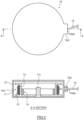
- FIG. 3 illustrates a plan view of the cord winding device 10 and the A-A sectional view.
- the cord winding device 10 is substantially disk-shaped, and includes a periphery at which a protrusion 10d is provided.
- a penetration hole 10da for pulling out and winding the cord 15 is formed in the protrusion 10d.
- the cord winding device 10 includes a cord winding portion 13 and a spiral spring 14 (one example of a biasing member).
- the cord winding portion 13 and the spiral spring 14 are provided in an accommodation space defined by a lower case 11 and an upper case 12.
- the cord winding portion 13 is configured to be rotatable around a spring support portion 11c.
- the spring support portion 11c protrudes from the center of a bottom of the lower case 11.
- One end of the cord 15 is attached to the cord winding portion 13.
- An outer peripheral groove 13d for winding the cord 15 is formed on the cord winding portion 13.
- the spiral spring 14 includes one end supported by the spring support portion 11c.
- the spiral spring 14 is wound up.
- the biasing force acts in the direction (one example of a first direction) from the bottom of the product 7 toward the protrusion 10d of the cord winding device 10.
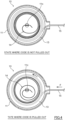
- FIG. 4 illustrates plan views of the cord winding device 10 in a state where the cord 15 is not pulled out and in a state where the cord 15 is pulled out.
- FIG. 4 illustrates sections of the cord winding device 10. As illustrated in FIG. 4 , in the state where the cord 15 is not pulled out, the spiral spring 14 is not wound up, and the restoring force of the spiral spring 14 does not act on the cord 15 or slightly acts on the cord 15. Meanwhile, in the state where the cord 15 is pulled out, the spiral spring 14 is wound up by pulling-out of the cord 15, and the restoring force F of the spiral spring 14 acts in the direction of winding the cord 15.
- FIG. 5 includes a plan view, an arrow view, and a partially cutaway cross-sectional view of the accommodation member 9.
- the accommodation member 9 is a member for accommodating the plate 5 to which the tag T is attached.
- the cord 15 is inserted through the accommodation member 9 as illustrated in FIG. 2 .
- the accommodation member 9 has a flat-plate form.
- the accommodation member 9 forms a cavity 9H inside.
- the plate 5 can be accommodated in the cavity 9H.
- the accommodation member 9 forms an opening 91a and an opening 91b.
- the plate 5 to which the tag T is attached enters into or exits from the cavity 9H through the opening 91a.
- the cord 15 passes through the opening 91b.
- a body 91 of the accommodation member 9 includes a bottom portion 911 and an upper portion 912 joined to each other to thereby form the cavity 9H.
- the bottom portion 911 and the upper portion 912 are made of resin for example, and are joined to each other by welding for example.
- the metal-containing members 92 are provided, in the cavity 9H, on each of the bottom portion 911 and the upper portion 912 of the body 91.
- the metal-containing members 92 are arranged near the centers of the bottom portion 911 and the upper portion 912 in the illustrated example as can be seen in the arrow view taken in the direction of the arrow X.
- the metal-containing member 92 is, for example, a metal-deposited sheet including a transparent PET film, an aluminum vapor deposition layer (coating), a base material, and an adhesive that are layered on each other in this order.
- the metal-containing member 92 may be configured by sticking a foil sheet to a base material, or may be an aluminum foil.
- the metal-containing member 92 is provided for selectively blocking communication of a communication antenna 42 of the tag T on the plate 5 when the plate 5 is accommodated in the accommodation member 9.
- the metal-containing member 92 is provided for exerting the electromagnetic shielding function of the metal-containing member 92 on the communication antenna 42.
- a height of the cavity 9H is substantially uniform in the accommodation member 9 illustrated in FIG. 5 , but is not limited to this.
- a height of the cavity 9H in a part at and near the opening 91a may be larger than a height of the cavity 9H in a remaining part to increase an area of the opening 91a. Thereby, the plate 5 can be smoothly accommodated into the cavity 9H.
- FIG. 6 illustrates positional relations between the tag T and the accommodation member 9 in a state where the cord 15 is not pulled out from the cord winding device 10 and in a state where the cord 15 is pulled out from the cord winding device 10.
- FIG. 6 illustrates the accommodation member 9 in a state where the upper portion 912 of the body 91 is removed in such a way that an inside of the accommodation member 9 can be seen clearly.
- FIG. 7 is an enlarged sectional view illustrating the B-B section in FIG. 6 in an enlarged manner.
- the plate 5 is attached to the cord 15.
- the cord 15 may be fixed in a pair of holes formed in the plate 5 as illustrated in the drawing, or the cord 15 may be fixed to one surface of the plate 5 by adhesive tape or the like.
- the tag T is stuck to one surface of the plate 5.
- the plate 5 is preferably made of hard cardboard or a plastic material of a relatively high rigidity in such a way that the tag T can smoothly enter an inside of the accommodation member 9 and can smoothly exit from the accommodation member 9.
- the tag T includes the communication antenna 42, a pair of harvesting antennas 43, and an IC chip electrically connected to each of the antennas.
- the communication antenna 42 and a pair of the harvesting antennas 43 are each formed of conductive metal foil in a predetermined pattern.
- Each of the antennas and the IC chip of the tag T is mounted on a film-shaped base material. An adhesive is applied to the base material, and the tag T is stuck to the one surface of the plate 5 by the adhesive.
- FIG. 7 illustrates only the communication antenna 42 as the tag T.
- the communication antenna 42 is an antenna for transmitting and receiving signals to and from the wireless device 2 in accordance with the BLE standard.
- the harvesting antenna 43 is an antenna that receives surrounding radio waves for energy harvesting.
- the harvesting antenna 43 is one example of an energy acquisition antenna.
- the cord winding device 10, the tag T, and the accommodation member 9 constitute an item management device according to one embodiment.
- the cord 15 When the product 7 is held by the holder 30, the cord 15 is in a state of being wound around the cord winding device 10 without being pulled out. In this state, as illustrated in FIG. 6 , the plate 5 attached to the cord 15 has been accommodated into the accommodation member 9 by the restoring force for the cord 15 that is generated by the cord winding device 10. The restoring force acting on the plate 5 causes the accommodation member 9 to be drawn to the protrusion 10d of the cord winding device 10.
- the communication antenna 42 of the tag T overlaps with the metal-containing members 92, but the harvesting antennas 43 of the tag T do not overlap with the metal-containing members 92.
- the communication antenna 42 of the tag T is covered with the metal-containing member 92 via the plate 5, and is close to the metal-containing members 92. Thereby, the electromagnetic shielding function of the metal-containing member 92 is selectively exerted only on the communication antenna 42 among the communication antenna 42 and a pair of the harvesting antennas 43.
- the cord 15 is in a state of being pulled out from the cord winding device 10.
- the plate 5 attached to the cord 15 has exited from the accommodation member 9, and the tag T on the plate 5 is exposed.
- the electromagnetic shielding function of the metal-containing member 92 is not exerted on the communication antenna 42 of the tag T, and thus, the tag T can communicate with the wireless device 2.
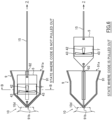
- FIG. 8 illustrates positional relations between the tag T and the accommodation member 9 in a state where the cord 15 is not pulled out from the cord winding device 10 and in a state where the cord 15 is pulled out from the cord winding device 10.
- FIG. 8 differs from FIG. 6 in that a metal-containing member 92A of an accommodation member 9A illustrated in FIG. 8 is wider than the metal-containing member 92 of the accommodation member 9 in FIG. 6 .
- a pair of the harvesting antennas 43 of the tag T partially overlap with the metal-containing member 92A.
- reception performance of the harvesting antennas 43 is not significantly degraded.
- FIG. 9 is a block diagram illustrating an internal configuration of each device in the product management system 1 according to the present embodiment.
- the product management system 1 includes the wireless device 2 and the tag management server 6 (one example of a measurement device).
- the tag management server 6 can communicate with the wireless device 2 via the network NW.
- the network NW is, but not limited to, a local area network (LAN), a wide area network (WAN), a mobile communication network, the Internet, or the like, for example.
- the wireless device 2 functions as a BLE wireless terminal that receives packets from the tag T and the reference tag Tref by the BLE communication.
- the wireless device 2 transmits the tag ID included in the received packet to the tag management server 6.
- the tag T and the reference tag Tref When the tag T and the reference tag Tref are in a state of being able to normally transmit packets, the tag T and the reference tag Tref each transmit a packet at a predetermined interval. In response to this, the wireless device 2 also transmits the tag ID to the tag management server 6 at the predetermined interval.
- the tag T includes a control unit 41, the communication antenna 42, the harvesting antennas 43, a harvesting unit 44, a voltage control unit 45, and an RF communication unit 46.
- the control unit 41, the harvesting unit 44, the voltage control unit 45, and the RF communication unit 46 are mounted in the IC chip.
- the configuration of the reference tag Tref which is not illustrated in FIG. 10 , is the same as that of the tag T.
- the control unit 41 includes a microprocessor and a memory 411.
- the control unit 41 controls the entire tag T.
- the memory 411 includes one or both of a random-access memory (RAM) and a read-only memory (ROM).
- the memory 411 stores programs executed by the microprocessor, and stores the tag ID that is identification information unique to the tag T.
- the harvesting unit 44 harvests electric power from radio waves (e.g., radio waves generated by the surrounding wireless communication) in the surrounding environment received by the harvesting antennas 43.
- the harvesting unit 44 stores the generated electric power in an internal capacitor 442.
- the harvesting unit 44 converts the radio signals received by the harvesting antennas 43 into a DC voltage by a voltage multiplier 441, and then stores the DC voltage in a capacitor 442.
- the voltage multiplier 441 may be, but not limited to, a Dickson voltage multiplier circuit (charge pump), for example.
- the capacitor 442 may be one (i.e., an on-die capacitor) configured on a semiconductor chip, or may be one formed separately from a semiconductor chip.
- Radio waves used by the harvesting antennas 43 for electric power generation are radio waves in a plurality of different frequency bands within a wide frequency band.
- Examples of such radio waves include radio waves generated by the wireless communication in the frequency bands used in mobile communication systems of what are called 3G to 5G and the like, radio waves generated by the wireless communication in the frequency bands used in the communication standards such as Bluetooth (registered trademark) and Wi-Fi (registered trademark), radio waves generated by the wireless communication in the 2.4-GHz band represented by the communication protocols such as ZigBee (registered trademark), Thread, and the like, and radio waves generated by the wireless communication in the frequency bands (e.g., the 900-MHz band and the 13.56-MHz band) used in the RFID.
- the frequency bands e.g., the 900-MHz band and the 13.56-MHz band
- the voltage control unit 45 supplies an operation voltage to the control unit 41 and the RF communication unit 46.
- the voltage control unit 45 monitors a voltage of the capacitor 442, and switches an power mode, depending on the monitored result.
- the voltage control unit 45 sets the power mode to be a first mode of operating only the minimum circuitry. In this case, the control unit 41 and the RF communication unit 46 cease generation of a packet, transmission of a radio signal, and the like.
- the voltage control unit 45 sets the power mode to be a second mode of executing a normal processing routine. In this case, the control unit 41 and the RF communication unit 46 perform various pieces of processing including generation of a packet and transmission of a radio signal.
- the RF communication unit 46 applies predetermined digital modulation (e.g., the Gaussian frequency shift keying (GFSK)) to a transmission-target packet (baseband signal). Then, the RF communication unit 46 applies orthogonal modulation to the digital-modulated packet, and sends the high-frequency signal (a signal in the 2.4-GHz frequency band in a case of BLE) to the communication antenna 42.
- predetermined digital modulation e.g., the Gaussian frequency shift keying (GFSK)
- GFSK Gaussian frequency shift keying
- the communication antenna 42 transmits the high-frequency radio signal (packet) sent by the RF communication unit 46.
- the tag T may include a sensor that detects movement of the tag T or an ambient temperature.
- the packet transmitted from the tag T to the wireless device 2 includes data detected by the sensor.
- the wireless device 2 includes a control unit 21, an antenna 22, an RF communication unit 23, and a communication unit 24.
- the control unit 21 is constituted mainly by a microprocessor.
- the control unit 21 controls the entire wireless device 2. For example, when the control unit 21 acquires tag ID from a packet received from the tag T, the control unit 21 controls the communication unit 24 to transmit the acquired tag ID to the tag management server 6. When the packet includes data detected by the sensor of the tag T, the tag ID and the detected data are transmitted to the tag management server 6 in association with each other.
- the RF communication unit 23 demodulates the radio signal received by the antenna 22 from the tag T to convert the radio signal into the baseband signal. Then, the RF communication unit 23 applies predetermined digital demodulation to the baseband signal to receive the packet. In order to transmit a beacon signal from the antenna 22, the RF communication unit 23 applies orthogonal modulation to a baseband signal of a predetermined pattern, for example, and sends the orthogonalmodulated signal to the antenna 22.
- the communication unit 24 functions as a communication interface for communicating with the tag management server 6.
- the tag management server 6 includes a control unit 61, a storage 62, and a communication unit 63, for example.
- the control unit 61 is constituted mainly by a microprocessor.
- the control unit 61 controls the entire tag management server 6.
- the storage 62 includes a large-scale storage device such as a hard disk drive (HDD).
- the storage 62 stores a tag database (tag DB).
- the tag database includes the tag ID of the tag T and a product code of the product 7 that is held by the recess H and that is associated with the tag T, in such a way that the tag ID is associated with the product code.
- the storage 62 also stores the tag ID of the reference tag Tref.
- the communication unit 63 functions as a communication interface for communicating with the wireless device 2.
- the control unit 61 executes a server program. Thereby, when the wireless device 2 receives packets transmitted by the tag T and the reference tag Tref and including the tag IDs, the control unit 61 acquires, from the wireless device 2, the tag IDs included in the packets.
- control unit 61 Each time the control unit 61 acquires, from the wireless device 2, the tag ID included in the tag database, the control unit 61 records, in the storage 62, as a tag detection log, the acquired tag ID and a time point at which the control unit 61 acquires the tag ID. In other words, the control unit 61 acquires a result of whether the wireless device 2 can communicate with the tag T over time. Based on the tag detection logs, the control unit 61 performs processing of totaling the number of times the tag is detected, for each predetermined time period. Thus, the control unit 61 measures a frequency at which the product of the specific product code is picked up by a customer. At this time, the product code associated with the tag ID is identified by referring to the tag database.
- a timing of performing the totaling processing can be arbitrarily set.
- a result of whether the wireless device 2 can communicate with the tag T over time is recorded as tag detection logs during opening hours of the store in one day. Then, at a timing after the opening hours end, the totaling processing is performed based on the tag detection logs.
- the control unit 61 functions as a measurement device that measures a frequency at which the wireless device 2 becomes able to communicate with the tag T (i.e., a frequency at which the associated product 7 is picked up by a customer), based on the results of whether the wireless device 2 can communicate with the tag T.
- control unit 61 each time the control unit 61 acquires the tag ID of the reference tag Tref from the wireless device 2, the control unit 61 records, in the storage 62, as a tag detection log, the acquired tag ID and a time point at which the control unit 61 acquires the tag ID.
- the reference tag Tref is not shielded.
- the control unit 61 can acquire the tag ID of the reference tag Tref at the predetermined interval at which the reference tag Tref transmits a packet.
- the control unit 61 determines that the wireless device 2 is malfunctioning, and notifies an unillustrated administrator terminal of the determined result.
- the cord 15 is in a state of being wound around the cord winding device 10 without being pulled out.
- the electromagnetic shielding function of the metal-containing member 92 is selectively exerted only on the communication antenna 42 among the communication antenna 42 and a pair of the harvesting antennas 43.
- the harvesting antennas 43 are not shielded, and thus, the harvesting antennas 43 can receive surrounding radio waves and keep a voltage of the capacitor 442 (refer to FIG. 9 ) equal to or higher than the predetermined value. Accordingly, the second mode of executing the normal processing routine can be maintained.
- the communication control method for the tag T includes the following steps of:
- the metal-containing member 92 selectively shields only the communication antenna 42 among a plurality of the antennas of the tag T.
- a voltage of the capacitor 442 can be kept equal to or higher than the predetermined value, and the tag T can be maintained in a state of executing the normal processing routine.
- the tag T can transmit a packet to the wireless device 2 immediately after the communication antenna 42 is stopped from being shielded by the metal-containing member 92.
- the communication control method for the tag T according to one embodiment can improve communication responsiveness to shielding or un-shielding against radio waves emitted by the tag T.
- the tag T includes the sensor, even while the communication antenna 42 is shielded, the sensor may operate and store, in the memory, the detected data for each detection time point. In this case, after the communication antenna 42 is stopped from being shielded, the tag T transmits, to the wireless device 2, a packet including the detection time points and the detected data acquired while the communication antenna 42 is shielded.
- the metal-containing member provided at the accommodation member may take a variety of forms.
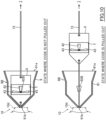
- FIG. 10 illustrates positional relations between the tag T and an accommodation member 9B in a state where the cord is not pulled out and in a state where the cord is pulled out, for the accommodation member 9B including a metal-containing member 92B having a shape different from that illustrated in FIG. 6 .
- the metal-containing member 92B illustrated in FIG. 10 has a shape that conforms to a shape of the communication antenna 42 of the tag T.
- the metal-containing member 92B covers only the communication antenna 42 in a state where the plate 5 is accommodated in the accommodation member 9B.
- the metal-containing member may take a variety of forms, depending on a form of the communication antenna of the tag T.
- FIG. 11 illustrates positional relations between the IoT tag and the accommodation member in a state where the code is not pulled out and in a state where the code is pulled out, when the IoT tag on the plate 5 is placed in an orientation different from that in FIG. 8 .
- the band-shaped metal-containing member 92A can effectively cover the communication antenna 42 without covering the harvesting antennas 43.
- a stuck position of the tag T on the plate 5 may be appropriately adjusted from the standpoint of effectively covering only the communication antenna 42.
- the present invention is not limited to the above-described embodiments.
- the above-described embodiments can be variously improved or modified within a range that does not depart from the essence of the present invention.
- a POSM is cited as an example of an item, and the described system is one that measures a frequency at which the POSM is picked up by a customer in the store.
- an application example of the communication control method for the communication device according to the present invention is not limited to this.
- a system may be configured in such a way that the tag is stuck to a cover of a container, and closing of the cover results in that the metal-containing member selectively covers only the communication antenna of the tag. Thereby, the system can accurately measure the timings and frequency at which the container is used.
- the tag includes a temperature sensor, the system can collect data of temperatures when the container is used.
- the radio wave shield member is not limited to one that shields radio waves emitted from the communication antenna 42 of the tag T, and may be a radio wave absorbing body that absorbs radio waves emitted from the communication antenna 42.
- the radio wave absorbing body is not particularly limited.
- Examples of the radio wave absorbing body include a body (that includes foaming polystyrene as a base material and uses ohmic loss of carbon) formed of a combination of carbon and foaming polystyrene, a body (that uses magnetic loss of ferrite) formed of a combination of ferrite and an inorganic material, a body formed of a combination of carbon and foaming polyethylene, a body (e.g., formed of a mixture of synthetic rubber and ferrite powder, or a mixture of synthetic rubber and carbonyl iron powder) formed of a combination of a magnetic material and synthetic rubber, a ferrite sintered body, a body formed of a combination of glass cloth reinforced aluminum foil and an electrically conductive adhesive layer, and a body including a layer of a dielectric material.
- the electromagnetic shield member may be a member that changes a frequency of radio waves emitted from the communication antenna 42, to an unintended frequency causing communication with the wireless device 2 to become impossible.
- the electromagnetic shield member may be a member that superimposes noise on radio waves emitted from the communication antenna 42, in such a way as to inhibit communication with the wireless device 2.
- the present invention is related to the patent application of Japanese Patent Application No. 2022-60052 filed with the Japan Patent Office on March 31, 2022 , the entire contents of which are incorporated by reference into the description of the present application.
Landscapes
- Engineering & Computer Science (AREA)
- Physics & Mathematics (AREA)
- Computer Hardware Design (AREA)
- Microelectronics & Electronic Packaging (AREA)
- Electromagnetism (AREA)
- General Physics & Mathematics (AREA)
- Theoretical Computer Science (AREA)
- Toxicology (AREA)
- Business, Economics & Management (AREA)
- Health & Medical Sciences (AREA)
- Computer Networks & Wireless Communication (AREA)
- Strategic Management (AREA)
- Finance (AREA)
- Development Economics (AREA)
- Accounting & Taxation (AREA)
- Artificial Intelligence (AREA)
- Entrepreneurship & Innovation (AREA)
- Signal Processing (AREA)
- General Health & Medical Sciences (AREA)
- Computer Vision & Pattern Recognition (AREA)
- Power Engineering (AREA)
- General Engineering & Computer Science (AREA)
- Computer Security & Cryptography (AREA)
- Data Mining & Analysis (AREA)
- Game Theory and Decision Science (AREA)
- Economics (AREA)
- Marketing (AREA)
- General Business, Economics & Management (AREA)
- Near-Field Transmission Systems (AREA)
- Warehouses Or Storage Devices (AREA)
Abstract
Description
- The present invention relates to a communication control method for a communication device, an item management device, and an item management system.
- Energy harvesting has been conventionally known as a technique of converting, into electric power, energy that exists in the environment and whose examples include sunlight, vibration, heat, and an electromagnetic field.
- For example,
FIG. 3 inJapanese Patent Application Laid-Open Publication (Translation of PCT Application) No. 2020-525928 - Incidentally, when a metal-containing member containing a metal substance and a communication device such as a wireless tag are caused to close to each other, or when the communication device is covered with the metal-containing member, radio waves emitted by the communication device is shielded by the metal-containing member. As a result, the communication generally becomes impossible. In view of the above, the inventors of the present application has conceived the idea of detecting a specific event by shielding or un-shielding radio waves with a metal-containing member. This radio waves are emitted by a communication device that implements an energy harvesting technique of converting a surrounding electromagnetic field into electric power. Examples of the specific event include an event that a cover is placed on an item to which the communication device is attached, an event that an item coupled to the communication device is picked up, and the like.
- However, the inventors have further researched the event detection to find a problem existing in responsiveness in the event detection using the communication device that implements the energy harvesting technique. That is, the problem occurs in a case where radio waves emitted by the communication device are shielded by the metal-containing member, and then, the shielding by the metal-containing member is cleared away. In that case, it takes time for radio waves to be emitted from the communication device after the shielding is cleared away, and thus, occurrence of an event cannot be detected timely.
- In view of the above, an object of the present invention is to improve communication responsiveness to shielding or un-shielding against radio waves emitted by a communication device that implements an energy harvesting technique.
- An aspect of the present invention provides a communication control method for a communication device that includes a plurality of antennas and a capacitor, the plurality of antennas including a communication antenna for communicating with a wireless device and an energy acquisition antenna for acquiring energy from surrounding radio waves, the capacitor being charged based on energy acquired by the energy acquisition antenna, wherein the communication device communicates with the wireless device when a voltage of the capacitor is equal to or higher than a predetermined value.
- This method includes:
- blocking communication of the communication device with the wireless device by causing a metal-containing member to be close to the communication antenna among the plurality of antennas, or by covering at least a part of the communication antenna with the metal-containing member;
- charging the capacitor by the communication device, based on energy acquired by the energy acquisition antenna, regardless of whether the communication device can communicate with the wireless device, and thereby keeping a voltage of the capacitor equal to or higher than the predetermined value; and
- resuming communication of the communication device with the wireless device when the metal-containing member is stopped from being close to the communication antenna or when at least a part of the communication antenna is stopped from being covered with the metal-containing member.
- An aspect of the present invention can improve communication responsiveness to shielding or un-shielding against radio waves emitted by a communication device that implements an energy harvesting technique.
-
-
FIG. 1 illustrates an application example of a product management system according to one embodiment, and illustrates a state where products are placed on a product shelf. -
FIG. 2 is a side view of the product shelf on which the products are placed, in the system application example illustrated inFIG. 1 . -
FIG. 3 illustrates a structure of a cord winding device in the product management system according to one embodiment. -
FIG. 4 illustrates sectional views of the cord winding device illustrated inFIG. 3 , in a state where a cord is not pulled out and in a state where the cord is pulled out. -
FIG. 5 illustrates a shape of an accommodation member. -
FIG. 6 illustrates positional relations between an IoT tag and the accommodation member in a state where the cord is not pulled out and in a state where the cord is pulled out, in the product management system according to one embodiment. -
FIG. 7 is an enlarged cross-sectional view illustrating the B-B section inFIG. 6 . -
FIG. 8 illustrates positional relations between the IoT tag and the accommodation member in a state where the cord is not pulled out and in a state where the cord is pulled out, for the accommodation member including a metal-containing member whose shape is different from that inFIG. 6 . -
FIG. 9 is a block diagram illustrating an internal configuration of each device in the product management system according to one embodiment. -
FIG. 10 illustrates positional relations between the IoT tag and the accommodation member in a state where the cord is not pulled out and in a state where the cord is pulled out, for the accommodation member including a metal-containing member whose shape is different from that inFIG. 6 . -
FIG. 11 illustrates positional relations between the IoT tag and the accommodation member in a state where the code is not pulled out and in a state where the code is pulled out, when the IoT tag on a plate is placed in an orientation different from that inFIG. 8 . - In the present disclosure, "item" means a tangible object such as a product, a manufactured item, a semi-manufactured item (an item at an intermediate stage in course of being manufactured), or a mock-up. One example of an item cited in the following embodiments is a sales promotion product (referred to also as a point-of-sale material (POSM)).
- In the present disclosure, "metal-containing member" is not limited to a member containing a single metallic element, and also encompasses a member containing a compound that includes metallic elements.
- The following more specifically describes a product management system according to one embodiment with reference to the drawings, using an electric shaver as an example of a product.
- In the product management system according to one embodiment, a sales promotion product (POSM) is arranged in a store in such a way as to be allowed to be tried out. The product management system is configured to automatically measure the time points and frequency at which a customer picks up the sales promotion product, thereby efficiently acquiring useful marketing information.
- The sales promotion product (hereinafter, referred to simply as "product") is, but not limited to, preferably a product that customers feel like picking up and trying out. The sales promotion product is, but not limited to, an electric shaver, a digital camera, a video camera, or a smartphone, for example. The applicable products can widely encompass stationery such as a pencil case and a fountain pen, a perfume, cosmetics such as a lipstick and a foundation, a portable game console, home appliances such as a handy cleaner, a laundry softener, and even a fragrance sample.
-
FIG. 1 illustrates a state where six electric shavers as POSM products 7-1 to 7-6 are displayed on aproduct shelf 3 in such a way that the electric shavers are allowed to be tried out.FIG. 2 is a side view of theproduct shelf 3 on which the products are placed. In the following description, the products 7-1 to 7-6 are written as "products 7" when the products 7-1 to 7-6 are referred to in common. - As illustrated in
FIG. 1 , the six products 7-1 to 7-6 are accommodated in recesses H-1 to H-6 provided in theholders 30 of theproduct shelf 3, respectively. Labels PL1 to PL6 are arranged near the respective holders, for product explanation to customers. In the following description, the recesses H-1 to H-6 are written as "recesses H" when the recesses H-1 to H-6 are referred to in common. -
FIG. 2 illustrates a state (solid lines) where theproduct 7 is not held by theholder 30 and a state (imaginary lines) where theproduct 7 is detached from theholder 30, in a comparative manner, concerning the oneproduct 7. - As illustrated in
FIG. 2 , theproduct shelf 3 includeslegs 34, abase 33 supported by thelegs 34, and theholder 30 fixed onto thebase 33. - The
holder 30 includes asupport portion 31 and abackrest portion 32. Thesupport portion 31 is provided for supporting a bottom of theproduct 7. The recess H is formed on thesupport portion 31. Thebackrest portion 32 is a plate-shaped member that extends upward from thesupport portion 31. Thebackrest portion 32 can support a back portion of theproduct 7. - As illustrated in
FIG. 2 , one end of a cord 15 (one example of the linear member) is attached to the bottom of theproduct 7. An opposite end of thecord 15 is attached to a cord winding device 10 (one example of an item attachment device). In one embodiment, thecord winding device 10 is fixed to thebase 33 of theproduct shelf 3. The fixing method is not limited, and may be any of known fixing methods including fastening by double-sided tape, an adhesive, or a screw, for example. - The
cord 15 and thecord winding device 10 are provided for eachproduct 7. Accordingly, when the sixproducts 7 are displayed as illustrated inFIG. 1 , six sets of thecord 15 and thecord winding device 10 are provided. - The
cord winding device 10 can wind thecord 15 and enables thecord 15 to be pulled out in such a way as to be extendable and retractable. A length of thecord 15 is set to an extent that allows a customer to sufficiently try out theproduct 7 when the customer picks up theproduct 7. When a customer picks up theproduct 7 at theholder 30, thecord 15 is pulled out from thecord winding device 10, and theproduct 7 can be detached from theholder 30 in a state where thecord 15 is attached to theproduct 7. When theproduct 7 is returned to theholder 30, thecord 15 is wound by thecord winding device 10. - As illustrated in
FIG. 2 , an Internet-of-things (IoT) tag T (one example of the communication device) is attached to aplate 5. Theplate 5 is fixed to thecord 15. - The IoT tag is one example of an energy-harvesting communication device that collects radio waves in a surrounding environment and converts the collected radio waves into electric power, and that includes a capacitor storing the electric power. The IoT tag does not include a battery. In the following description, the IoT tag T is referred to simply as the tag T.
- The tag T stores tag ID that differs for each
product 7 connected to thecord 15 to which the tag T is attached. The tag ID is identification information of the tag T. - The maximum communication distance of the tag T is, but not limited to, a value in a range from 3 meters to 10 meters, for example. The tag T is configured to make wireless communication with low electric power consumption. Examples of a communication protocol for the tag T include Bluetooth (registered trademark) Low Energy (hereinafter, BLE), Bluetooth (registered trademark), and ZigBee (registered trademark). The following describes an exemplified case where the communication is made by BLE.
- When the tag T is based on the standard of BLE, the tag T broadcasts an advertising packet (hereinafter, referred to simply as "packet") at a predetermined interval (e.g., every short period of approximately 1 second to approximately 10 seconds). The packet transmitted by the tag T includes at least the tag ID.
- As illustrated in
FIG. 1 , awireless device 2 for making BLE communication with the tag T associated with eachproduct 7 is arranged near theproduct shelf 3. As described below, thewireless device 2 is a gateway device that can communicate with a tag management server (described below) via a network. As illustrated inFIG. 2 , thewireless device 2 is arranged at a position where thewireless device 2 can receive packets transmitted from the respective tags in cases where the products are not arranged at the respective holders. In other words, thewireless device 2 is arranged by taking into consideration a radio wave output of each of the tags. - As the
wireless device 2 is depicted by the imaginary lines inFIG. 1 , an installation location of thewireless device 2 can be set arbitrarily. - As illustrated in
FIG. 1 , a reference tag Tref is preferably arranged on theproduct shelf 3. The reference tag Tref is a tag for reference, and is a device having the same configuration as that of the tag T associated with eachproduct 7. - The reference tag Tref may be arranged at any location as long as the reference tag Tref can communicate with the
wireless device 2 regardless of whether the products 7-1 to 7-6 are held by the associated holders. The reference tag Tref is provided for determining whether thewireless device 2 is operating normally. Particularly, as described below, in a state where all of the products 7-1 to 7-6 are held by the holders, thewireless device 2 cannot receive radio waves emitted from the tag T associated with eachproduct 7 in some cases, and thus, it is difficult to determine whether the system is operating normally, if the reference tag Tref is not provided. In view of the above, the reference tag Tref that can communicate with thewireless device 2 regardless of whether the products 7-1 to 7-6 are held by the associated holders is provided. Thereby, it can be determined whether the system is operating normally. - Next, a configuration of the
cord winding device 10 is described with reference toFIG. 3 andFIG. 4 .FIG. 3 illustrates a plan view of thecord winding device 10 and the A-A sectional view. As illustrated inFIG. 3 , thecord winding device 10 is substantially disk-shaped, and includes a periphery at which aprotrusion 10d is provided. A penetration hole 10da for pulling out and winding thecord 15 is formed in theprotrusion 10d. - As illustrated in the A-A section, the
cord winding device 10 includes acord winding portion 13 and a spiral spring 14 (one example of a biasing member). Thecord winding portion 13 and thespiral spring 14 are provided in an accommodation space defined by alower case 11 and anupper case 12. Thecord winding portion 13 is configured to be rotatable around aspring support portion 11c. Thespring support portion 11c protrudes from the center of a bottom of thelower case 11. One end of thecord 15 is attached to thecord winding portion 13. An outerperipheral groove 13d for winding thecord 15 is formed on thecord winding portion 13. - The
spiral spring 14 includes one end supported by thespring support portion 11c. When thecord winding portion 13 rotates around thespring support portion 11c and thecord 15 is pulled out, thespiral spring 14 is wound up. Thus, when thecord 15 is pulled out, the biasing force is generated in a direction of winding thecord 15. As illustrated inFIG. 2 , the biasing force acts in the direction (one example of a first direction) from the bottom of theproduct 7 toward theprotrusion 10d of thecord winding device 10. -
FIG. 4 illustrates plan views of thecord winding device 10 in a state where thecord 15 is not pulled out and in a state where thecord 15 is pulled out.FIG. 4 illustrates sections of thecord winding device 10. As illustrated inFIG. 4 , in the state where thecord 15 is not pulled out, thespiral spring 14 is not wound up, and the restoring force of thespiral spring 14 does not act on thecord 15 or slightly acts on thecord 15. Meanwhile, in the state where thecord 15 is pulled out, thespiral spring 14 is wound up by pulling-out of thecord 15, and the restoring force F of thespiral spring 14 acts in the direction of winding thecord 15. - Next, a configuration of an accommodation member 9 (one example of a device accommodation part) is described with reference to
FIG. 5. FIG. 5 includes a plan view, an arrow view, and a partially cutaway cross-sectional view of theaccommodation member 9. - The
accommodation member 9 is a member for accommodating theplate 5 to which the tag T is attached. Thecord 15 is inserted through theaccommodation member 9 as illustrated inFIG. 2 . - As illustrated in the plan view and the arrow view of
FIG. 5 , theaccommodation member 9 has a flat-plate form. Theaccommodation member 9 forms acavity 9H inside. Theplate 5 can be accommodated in thecavity 9H. Theaccommodation member 9 forms anopening 91a and anopening 91b. Theplate 5 to which the tag T is attached enters into or exits from thecavity 9H through theopening 91a. Thecord 15 passes through theopening 91b. Abody 91 of theaccommodation member 9 includes abottom portion 911 and anupper portion 912 joined to each other to thereby form thecavity 9H. Thebottom portion 911 and theupper portion 912 are made of resin for example, and are joined to each other by welding for example. - As can be clearly seen in the partially cutaway cross-sectional view in
FIG. 5 , the metal-containingmembers 92 are provided, in thecavity 9H, on each of thebottom portion 911 and theupper portion 912 of thebody 91. The metal-containingmembers 92 are arranged near the centers of thebottom portion 911 and theupper portion 912 in the illustrated example as can be seen in the arrow view taken in the direction of the arrow X. - The metal-containing
member 92 is, for example, a metal-deposited sheet including a transparent PET film, an aluminum vapor deposition layer (coating), a base material, and an adhesive that are layered on each other in this order. The metal-containingmember 92 may be configured by sticking a foil sheet to a base material, or may be an aluminum foil. - The metal-containing
member 92 is provided for selectively blocking communication of acommunication antenna 42 of the tag T on theplate 5 when theplate 5 is accommodated in theaccommodation member 9. Thus, the metal-containingmember 92 is provided for exerting the electromagnetic shielding function of the metal-containingmember 92 on thecommunication antenna 42. - A height of the
cavity 9H is substantially uniform in theaccommodation member 9 illustrated inFIG. 5 , but is not limited to this. A height of thecavity 9H in a part at and near theopening 91a may be larger than a height of thecavity 9H in a remaining part to increase an area of theopening 91a. Thereby, theplate 5 can be smoothly accommodated into thecavity 9H. - Next, a relation between the
plate 5 to which the tag T is attached and theaccommodation member 9 in theproduct management system 1 is described with reference toFIG. 6 andFIG. 7 . -
FIG. 6 illustrates positional relations between the tag T and theaccommodation member 9 in a state where thecord 15 is not pulled out from thecord winding device 10 and in a state where thecord 15 is pulled out from thecord winding device 10.FIG. 6 illustrates theaccommodation member 9 in a state where theupper portion 912 of thebody 91 is removed in such a way that an inside of theaccommodation member 9 can be seen clearly.FIG. 7 is an enlarged sectional view illustrating the B-B section inFIG. 6 in an enlarged manner. - As illustrated in
FIG. 6 , theplate 5 is attached to thecord 15. Although a method for attaching thecord 15 to theplate 5 is not particularly limited, thecord 15 may be fixed in a pair of holes formed in theplate 5 as illustrated in the drawing, or thecord 15 may be fixed to one surface of theplate 5 by adhesive tape or the like. - The tag T is stuck to one surface of the
plate 5. Theplate 5 is preferably made of hard cardboard or a plastic material of a relatively high rigidity in such a way that the tag T can smoothly enter an inside of theaccommodation member 9 and can smoothly exit from theaccommodation member 9. - The tag T includes the
communication antenna 42, a pair ofharvesting antennas 43, and an IC chip electrically connected to each of the antennas. Thecommunication antenna 42 and a pair of theharvesting antennas 43 are each formed of conductive metal foil in a predetermined pattern. Each of the antennas and the IC chip of the tag T is mounted on a film-shaped base material. An adhesive is applied to the base material, and the tag T is stuck to the one surface of theplate 5 by the adhesive.FIG. 7 illustrates only thecommunication antenna 42 as the tag T. - The
communication antenna 42 is an antenna for transmitting and receiving signals to and from thewireless device 2 in accordance with the BLE standard. Theharvesting antenna 43 is an antenna that receives surrounding radio waves for energy harvesting. Theharvesting antenna 43 is one example of an energy acquisition antenna. - The
cord winding device 10, the tag T, and theaccommodation member 9 constitute an item management device according to one embodiment. - When the
product 7 is held by theholder 30, thecord 15 is in a state of being wound around thecord winding device 10 without being pulled out. In this state, as illustrated inFIG. 6 , theplate 5 attached to thecord 15 has been accommodated into theaccommodation member 9 by the restoring force for thecord 15 that is generated by thecord winding device 10. The restoring force acting on theplate 5 causes theaccommodation member 9 to be drawn to theprotrusion 10d of thecord winding device 10. - As illustrated in
FIG. 6 , when theplate 5 is accommodated in theaccommodation member 9, thecommunication antenna 42 of the tag T overlaps with the metal-containingmembers 92, but theharvesting antennas 43 of the tag T do not overlap with the metal-containingmembers 92. As illustrated in the cross-sectional view ofFIG. 7 , thecommunication antenna 42 of the tag T is covered with the metal-containingmember 92 via theplate 5, and is close to the metal-containingmembers 92. Thereby, the electromagnetic shielding function of the metal-containingmember 92 is selectively exerted only on thecommunication antenna 42 among thecommunication antenna 42 and a pair of theharvesting antennas 43. - Meanwhile, when the
product 7 is detached from theholder 30, thecord 15 is in a state of being pulled out from thecord winding device 10. In this state, theplate 5 attached to thecord 15 has exited from theaccommodation member 9, and the tag T on theplate 5 is exposed. Thereby, the electromagnetic shielding function of the metal-containingmember 92 is not exerted on thecommunication antenna 42 of the tag T, and thus, the tag T can communicate with thewireless device 2. - Similarly to
FIG. 6 ,FIG. 8 illustrates positional relations between the tag T and theaccommodation member 9 in a state where thecord 15 is not pulled out from thecord winding device 10 and in a state where thecord 15 is pulled out from thecord winding device 10.FIG. 8 differs fromFIG. 6 in that a metal-containingmember 92A of anaccommodation member 9A illustrated inFIG. 8 is wider than the metal-containingmember 92 of theaccommodation member 9 inFIG. 6 . InFIG. 8 , in a state where thecord 15 is not pulled out, i.e., in a state where theplate 5 is accommodated in theaccommodation member 9A, a pair of theharvesting antennas 43 of the tag T partially overlap with the metal-containingmember 92A. However, even when a pair of theharvesting antennas 43 of the tag T partially overlap with the metal-containingmember 92A, reception performance of theharvesting antennas 43 is not significantly degraded. - Next, a configuration of each device in the
product management system 1 according to one embodiment is described with reference toFIG. 9 . -
FIG. 9 is a block diagram illustrating an internal configuration of each device in theproduct management system 1 according to the present embodiment. - As illustrated in
FIG. 9 , theproduct management system 1 includes thewireless device 2 and the tag management server 6 (one example of a measurement device). Thetag management server 6 can communicate with thewireless device 2 via the network NW. The network NW is, but not limited to, a local area network (LAN), a wide area network (WAN), a mobile communication network, the Internet, or the like, for example. - The
wireless device 2 functions as a BLE wireless terminal that receives packets from the tag T and the reference tag Tref by the BLE communication. When thewireless device 2 receives a packet from each of the tags, thewireless device 2 transmits the tag ID included in the received packet to thetag management server 6. - When the tag T and the reference tag Tref are in a state of being able to normally transmit packets, the tag T and the reference tag Tref each transmit a packet at a predetermined interval. In response to this, the
wireless device 2 also transmits the tag ID to thetag management server 6 at the predetermined interval. - Referring to
FIG. 9 , the tag T includes acontrol unit 41, thecommunication antenna 42, theharvesting antennas 43, aharvesting unit 44, avoltage control unit 45, and anRF communication unit 46. Thecontrol unit 41, theharvesting unit 44, thevoltage control unit 45, and theRF communication unit 46 are mounted in the IC chip. Although the following describes the configuration of the tag T, the configuration of the reference tag Tref, which is not illustrated inFIG. 10 , is the same as that of the tag T. - The
control unit 41 includes a microprocessor and a memory 411. Thecontrol unit 41 controls the entire tag T. The memory 411 includes one or both of a random-access memory (RAM) and a read-only memory (ROM). The memory 411 stores programs executed by the microprocessor, and stores the tag ID that is identification information unique to the tag T. - The
harvesting unit 44 harvests electric power from radio waves (e.g., radio waves generated by the surrounding wireless communication) in the surrounding environment received by theharvesting antennas 43. Theharvesting unit 44 stores the generated electric power in aninternal capacitor 442. In the present embodiment, for example, theharvesting unit 44 converts the radio signals received by theharvesting antennas 43 into a DC voltage by a voltage multiplier 441, and then stores the DC voltage in acapacitor 442. The voltage multiplier 441 may be, but not limited to, a Dickson voltage multiplier circuit (charge pump), for example. Thecapacitor 442 may be one (i.e., an on-die capacitor) configured on a semiconductor chip, or may be one formed separately from a semiconductor chip. - Radio waves used by the
harvesting antennas 43 for electric power generation are radio waves in a plurality of different frequency bands within a wide frequency band. Examples of such radio waves include radio waves generated by the wireless communication in the frequency bands used in mobile communication systems of what are called 3G to 5G and the like, radio waves generated by the wireless communication in the frequency bands used in the communication standards such as Bluetooth (registered trademark) and Wi-Fi (registered trademark), radio waves generated by the wireless communication in the 2.4-GHz band represented by the communication protocols such as ZigBee (registered trademark), Thread, and the like, and radio waves generated by the wireless communication in the frequency bands (e.g., the 900-MHz band and the 13.56-MHz band) used in the RFID. - The
voltage control unit 45 supplies an operation voltage to thecontrol unit 41 and theRF communication unit 46. Thevoltage control unit 45 monitors a voltage of thecapacitor 442, and switches an power mode, depending on the monitored result. - For example, when a voltage of the
capacitor 442 is lower than a predetermined value, thevoltage control unit 45 sets the power mode to be a first mode of operating only the minimum circuitry. In this case, thecontrol unit 41 and theRF communication unit 46 cease generation of a packet, transmission of a radio signal, and the like. When a voltage of thecapacitor 442 becomes equal to or higher than the predetermined value by charging thecapacitor 442, thevoltage control unit 45 sets the power mode to be a second mode of executing a normal processing routine. In this case, thecontrol unit 41 and theRF communication unit 46 perform various pieces of processing including generation of a packet and transmission of a radio signal. - The
RF communication unit 46 applies predetermined digital modulation (e.g., the Gaussian frequency shift keying (GFSK)) to a transmission-target packet (baseband signal). Then, theRF communication unit 46 applies orthogonal modulation to the digital-modulated packet, and sends the high-frequency signal (a signal in the 2.4-GHz frequency band in a case of BLE) to thecommunication antenna 42. - The
communication antenna 42 transmits the high-frequency radio signal (packet) sent by theRF communication unit 46. - The tag T may include a sensor that detects movement of the tag T or an ambient temperature. In this case, the packet transmitted from the tag T to the
wireless device 2 includes data detected by the sensor. - As illustrated in
FIG. 9 , thewireless device 2 includes acontrol unit 21, an antenna 22, anRF communication unit 23, and acommunication unit 24. - The
control unit 21 is constituted mainly by a microprocessor. Thecontrol unit 21 controls theentire wireless device 2. For example, when thecontrol unit 21 acquires tag ID from a packet received from the tag T, thecontrol unit 21 controls thecommunication unit 24 to transmit the acquired tag ID to thetag management server 6. When the packet includes data detected by the sensor of the tag T, the tag ID and the detected data are transmitted to thetag management server 6 in association with each other. - The
RF communication unit 23 demodulates the radio signal received by the antenna 22 from the tag T to convert the radio signal into the baseband signal. Then, theRF communication unit 23 applies predetermined digital demodulation to the baseband signal to receive the packet. In order to transmit a beacon signal from the antenna 22, theRF communication unit 23 applies orthogonal modulation to a baseband signal of a predetermined pattern, for example, and sends the orthogonalmodulated signal to the antenna 22. - The
communication unit 24 functions as a communication interface for communicating with thetag management server 6. - As illustrated in
FIG. 9 , thetag management server 6 includes acontrol unit 61, astorage 62, and acommunication unit 63, for example. - The
control unit 61 is constituted mainly by a microprocessor. Thecontrol unit 61 controls the entiretag management server 6. - The
storage 62 includes a large-scale storage device such as a hard disk drive (HDD). Thestorage 62 stores a tag database (tag DB). The tag database includes the tag ID of the tag T and a product code of theproduct 7 that is held by the recess H and that is associated with the tag T, in such a way that the tag ID is associated with the product code. Thestorage 62 also stores the tag ID of the reference tag Tref. - The
communication unit 63 functions as a communication interface for communicating with thewireless device 2. - The
control unit 61 executes a server program. Thereby, when thewireless device 2 receives packets transmitted by the tag T and the reference tag Tref and including the tag IDs, thecontrol unit 61 acquires, from thewireless device 2, the tag IDs included in the packets. - Each time the
control unit 61 acquires, from thewireless device 2, the tag ID included in the tag database, thecontrol unit 61 records, in thestorage 62, as a tag detection log, the acquired tag ID and a time point at which thecontrol unit 61 acquires the tag ID. In other words, thecontrol unit 61 acquires a result of whether thewireless device 2 can communicate with the tag T over time. Based on the tag detection logs, thecontrol unit 61 performs processing of totaling the number of times the tag is detected, for each predetermined time period. Thus, thecontrol unit 61 measures a frequency at which the product of the specific product code is picked up by a customer. At this time, the product code associated with the tag ID is identified by referring to the tag database. - A timing of performing the totaling processing can be arbitrarily set. In one example, a result of whether the
wireless device 2 can communicate with the tag T over time is recorded as tag detection logs during opening hours of the store in one day. Then, at a timing after the opening hours end, the totaling processing is performed based on the tag detection logs. In other words, thecontrol unit 61 functions as a measurement device that measures a frequency at which thewireless device 2 becomes able to communicate with the tag T (i.e., a frequency at which the associatedproduct 7 is picked up by a customer), based on the results of whether thewireless device 2 can communicate with the tag T. - Similarly, each time the
control unit 61 acquires the tag ID of the reference tag Tref from thewireless device 2, thecontrol unit 61 records, in thestorage 62, as a tag detection log, the acquired tag ID and a time point at which thecontrol unit 61 acquires the tag ID. - As illustrated in
FIG. 1 , the reference tag Tref is not shielded. Thus, unless thewireless device 2 is malfunctioning, thecontrol unit 61 can acquire the tag ID of the reference tag Tref at the predetermined interval at which the reference tag Tref transmits a packet. When thecontrol unit 61 cannot acquire the tag ID of the reference tag Tref at the predetermined interval, thecontrol unit 61 determines that thewireless device 2 is malfunctioning, and notifies an unillustrated administrator terminal of the determined result. - Next, operation of the item management device according to one embodiment is described with reference again to
FIG. 6 . - As described above, when the
product 7 is held by theholder 30, thecord 15 is in a state of being wound around thecord winding device 10 without being pulled out. In this state, the electromagnetic shielding function of the metal-containingmember 92 is selectively exerted only on thecommunication antenna 42 among thecommunication antenna 42 and a pair of theharvesting antennas 43. For this reason, even when the tag T transmits a packet from thecommunication antenna 42, the packet is shielded by the metal-containingmember 92, or a transmission frequency becomes significantly small. Meanwhile, theharvesting antennas 43 are not shielded, and thus, theharvesting antennas 43 can receive surrounding radio waves and keep a voltage of the capacitor 442 (refer toFIG. 9 ) equal to or higher than the predetermined value. Accordingly, the second mode of executing the normal processing routine can be maintained. - When the
product 7 held by theholder 30 is detached from theholder 30, thecord 15 is pulled out from thecord winding device 10, and the tag T on theplate 5 is exposed. In this case, a voltage of thecapacitor 442 has been kept equal to or higher than the predetermined value since the tag T was accommodated in theaccommodation member 9. Thus, a packet can be transmitted from thecommunication antenna 42 immediately after the tag T of theplate 5 becomes exposed. In other words, communication of the tag T with thewireless device 2 can be resumed in a practically nonproblematic short time after thecommunication antenna 42 is stopped from being covered with the metal-containingmember 92. - As described above, the communication control method for the tag T in one embodiment includes the following steps of:
- (i) blocking communication of the tag T with the
wireless device 2 by causing the metal-containingmember 92 to be close to thecommunication antenna 42 among a plurality of the antennas of the tag T, or by covering at least a part of thecommunication antenna 42 with the metal-containingmember 92; - (ii) charging the
capacitor 442 by the tag T, based on energy harvested by theharvesting antennas 43, regardless of whether the tag T can communicate with thewireless device 2, and thereby keeping a voltage of thecapacitor 442 equal to or higher than the predetermined value; and - (iii) resuming communication of the tag T with the
wireless device 2 when the metal-containingmember 92 is stopped from being close to thecommunication antenna 42 or when at least a part of thecommunication antenna 42 is stopped from being covered with the metal-containingmember 92. - In this manner, the metal-containing
member 92 selectively shields only thecommunication antenna 42 among a plurality of the antennas of the tag T. Thus, even while thecommunication antenna 42 is shielded, a voltage of thecapacitor 442 can be kept equal to or higher than the predetermined value, and the tag T can be maintained in a state of executing the normal processing routine. For this reason, the tag T can transmit a packet to thewireless device 2 immediately after thecommunication antenna 42 is stopped from being shielded by the metal-containingmember 92. In other words, the communication control method for the tag T according to one embodiment can improve communication responsiveness to shielding or un-shielding against radio waves emitted by the tag T. - When the tag T includes the sensor, even while the
communication antenna 42 is shielded, the sensor may operate and store, in the memory, the detected data for each detection time point. In this case, after thecommunication antenna 42 is stopped from being shielded, the tag T transmits, to thewireless device 2, a packet including the detection time points and the detected data acquired while thecommunication antenna 42 is shielded. - The metal-containing member provided at the accommodation member may take a variety of forms.
-
FIG. 10 illustrates positional relations between the tag T and anaccommodation member 9B in a state where the cord is not pulled out and in a state where the cord is pulled out, for theaccommodation member 9B including a metal-containingmember 92B having a shape different from that illustrated inFIG. 6 . The metal-containingmember 92B illustrated inFIG. 10 has a shape that conforms to a shape of thecommunication antenna 42 of the tag T. The metal-containingmember 92B covers only thecommunication antenna 42 in a state where theplate 5 is accommodated in theaccommodation member 9B. - As exemplified in
FIG. 10 , the metal-containing member may take a variety of forms, depending on a form of the communication antenna of the tag T. - Arrangement of the tag T may be adjusted on the
plate 5 in order to effectively cover thecommunication antenna 42 of the tag T. For example,FIG. 11 illustrates positional relations between the IoT tag and the accommodation member in a state where the code is not pulled out and in a state where the code is pulled out, when the IoT tag on theplate 5 is placed in an orientation different from that inFIG. 8 . In the state where theplate 5 illustrated inFIG. 11 is accommodated in theaccommodation member 9A. the band-shaped metal-containingmember 92A can effectively cover thecommunication antenna 42 without covering theharvesting antennas 43. In other words, a stuck position of the tag T on theplate 5 may be appropriately adjusted from the standpoint of effectively covering only thecommunication antenna 42. - Although the embodiments of the communication control method for the communication device, the item management device, and the item management system according to the present invention are described above, the present invention is not limited to the above-described embodiments. The above-described embodiments can be variously improved or modified within a range that does not depart from the essence of the present invention.
- In the above-described embodiment, a POSM is cited as an example of an item, and the described system is one that measures a frequency at which the POSM is picked up by a customer in the store. However, an application example of the communication control method for the communication device according to the present invention is not limited to this. In another application example, a system may be configured in such a way that the tag is stuck to a cover of a container, and closing of the cover results in that the metal-containing member selectively covers only the communication antenna of the tag. Thereby, the system can accurately measure the timings and frequency at which the container is used. When the tag includes a temperature sensor, the system can collect data of temperatures when the container is used.
- In the above-described case in the above-described embodiment, communication of the tag T with the
wireless device 2 is blocked by causing the metal-containing member to be close to thecommunication antenna 42 of the tag T or by covering at least a part of thecommunication antenna 42 with the metal-containing member. However, there is no limitation to this. - Even in a case of using radio waves shield member instead of the metal member, communication of the tag T with the
wireless device 2 is blocked by causing the radio wave shield member to be close to thecommunication antenna 42 of the tag T or by covering at least a part of thecommunication antenna 42 with the radio wave shield member, so that the similar effect can be achieved. - The radio wave shield member is not limited to one that shields radio waves emitted from the
communication antenna 42 of the tag T, and may be a radio wave absorbing body that absorbs radio waves emitted from thecommunication antenna 42. - The radio wave absorbing body is not particularly limited. Examples of the radio wave absorbing body include a body (that includes foaming polystyrene as a base material and uses ohmic loss of carbon) formed of a combination of carbon and foaming polystyrene, a body (that uses magnetic loss of ferrite) formed of a combination of ferrite and an inorganic material, a body formed of a combination of carbon and foaming polyethylene, a body (e.g., formed of a mixture of synthetic rubber and ferrite powder, or a mixture of synthetic rubber and carbonyl iron powder) formed of a combination of a magnetic material and synthetic rubber, a ferrite sintered body, a body formed of a combination of glass cloth reinforced aluminum foil and an electrically conductive adhesive layer, and a body including a layer of a dielectric material.
- The electromagnetic shield member may be a member that changes a frequency of radio waves emitted from the
communication antenna 42, to an unintended frequency causing communication with thewireless device 2 to become impossible. The electromagnetic shield member may be a member that superimposes noise on radio waves emitted from thecommunication antenna 42, in such a way as to inhibit communication with thewireless device 2. - The present invention is related to the patent application of
Japanese Patent Application No. 2022-60052 filed with the Japan Patent Office on March 31, 2022
Claims (7)
- A communication control method for a communication device that includes a plurality of antennas and a capacitor, the plurality of antennas including a communication antenna for communicating with a wireless device and an energy acquisition antenna for acquiring energy from surrounding radio waves, the capacitor being charged based on energy acquired by the energy acquisition antenna, wherein the communication device communicates with the wireless device when a voltage of the capacitor is equal to or higher than a predetermined value,
the method comprising:blocking communication of the communication device with the wireless device by causing a metal-containing member to be close to the communication antenna among the plurality of antennas, or by covering at least a part of the communication antenna with the metal-containing member;charging the capacitor by the communication device, based on energy acquired by the energy acquisition antenna, regardless of whether the communication device can communicate with the wireless device, and thereby keeping a voltage of the capacitor equal to or higher than the predetermined value; andresuming communication of the communication device with the wireless device, when the metal-containing member is stopped from being close to the communication antenna, or when at least a part of the communication antenna is stopped from being covered with the metal-containing member. - The communication control method according to claim 1, wherein the communication device includes a sensor that detects movement of the communication device or an ambient temperature, and
the method comprising, by the wireless device, communicating with the communication device, and thereby acquiring data detected by the sensor. - The communication control method according to claim 1 or 2, wherein
communication between the communication device and the wireless device is made in accordance with Bluetooth (registered trademark) Low Energy. - A communication control method for a communication device that includes a plurality of antennas and a capacitor, the plurality of antennas including a communication antenna for communicating with a wireless device and an energy acquisition antenna for acquiring energy from surrounding radio waves, the capacitor being charged based on energy acquired by the energy acquisition antenna, wherein the communication device communicates with the wireless device when a voltage of the capacitor is equal to or higher than a predetermined value,
the method comprising:blocking communication of the communication device with the wireless device by causing a radio wave shield member to be close to the communication antenna among the plurality of antennas, or by covering at least a part of the communication antenna with the radio wave shield member;charging the capacitor by the communication device, based on energy acquired by the energy acquisition antenna, regardless of whether the communication device can communicate with the wireless device, and thereby keeping a voltage of the capacitor equal to or higher than the predetermined value; andresuming communication of the communication device with the wireless device when the radio wave shield member is stopped from being close to the communication antenna or when at least a part of the communication antenna is stopped from being covered with the radio wave shield member. - The communication control method according to claim 4, wherein
the radio wave shield member is a radio wave absorbing body. - An item management device comprising:an item attachment device including a linear member and a biasing member, the linear member having one end that is attached to an item, the biasing member biasing the linear member from the one end in a first direction;a communication device attached to the linear member; anda device accommodation part that can accommodate the communication device and includes a metal-containing member fixed inside, whereinthe communication device comprises a plurality of antennas and a capacitor, the plurality of antennas including a communication antenna for communicating with a wireless device and an energy acquisition antenna for acquiring energy from surrounding radio waves, the capacitor being charged based on energy acquired by the energy acquisition antenna, wherein the communication device communicates with the wireless device when a voltage of the capacitor is equal to or higher than a predetermined value,when external force is not applied to the item against biasing force in the first direction generated by the biasing member, the communication device is accommodated in the device accommodation part, and when external force is applied to the item against the biasing force in the first direction generated by the biasing member, the communication device is enabled to exit from the device accommodation part, andthe item management device is configured in such a way that when the communication device is accommodated in the device accommodating part, the communication antenna among the plurality of antennas is close to the metal-containing member, or at least a part of the communication antenna is covered with the metal-containing member.
- An item management system comprising:the item management device according to claim 6;a wireless device wirelessly communicating with the communication device; anda measurement device configured to acquire a result of whether communication by the wireless device with the communication device is possible over time, and, based on the result, measure a frequency at which the wireless device is able to communicate with the communication device.
Applications Claiming Priority (2)
| Application Number | Priority Date | Filing Date | Title |
|---|---|---|---|
| JP2022060052A JP7797288B2 (en) | 2022-03-31 | 2022-03-31 | Communication control method for communication device, article management instrument, and article management system |
| PCT/JP2023/006261 WO2023189021A1 (en) | 2022-03-31 | 2023-02-21 | Communication control method for communication device, article management equipment, and article management system |
Publications (2)
| Publication Number | Publication Date |
|---|---|
| EP4502865A1 true EP4502865A1 (en) | 2025-02-05 |
| EP4502865A4 EP4502865A4 (en) | 2025-07-16 |
Family
ID=88200468
Family Applications (1)
| Application Number | Title | Priority Date | Filing Date |
|---|---|---|---|
| EP23779051.4A Pending EP4502865A4 (en) | 2022-03-31 | 2023-02-21 | Communication control method for a communication device, article management equipment, and article management system |
Country Status (4)
| Country | Link |
|---|---|
| US (1) | US20250181875A1 (en) |
| EP (1) | EP4502865A4 (en) |
| JP (2) | JP7797288B2 (en) |
| WO (1) | WO2023189021A1 (en) |
Families Citing this family (1)
| Publication number | Priority date | Publication date | Assignee | Title |
|---|---|---|---|---|
| JP7797177B2 (en) * | 2021-11-19 | 2026-01-13 | 株式会社サトー | Inventory management system, inventory management method |
Family Cites Families (15)
| Publication number | Priority date | Publication date | Assignee | Title |
|---|---|---|---|---|
| US6121544A (en) * | 1998-01-15 | 2000-09-19 | Petsinger; Julie Ann | Electromagnetic shield to prevent surreptitious access to contactless smartcards |
| US7336174B1 (en) * | 2001-08-09 | 2008-02-26 | Key Control Holding, Inc. | Object tracking system with automated system control and user identification |
| JP4542498B2 (en) | 2005-10-26 | 2010-09-15 | 株式会社日立製作所 | Product management server and product management method |
| CA2647904C (en) * | 2006-03-31 | 2013-05-28 | Checkpoint Systems, Inc. | System and method for securing and displaying items for merchandising |
| US7523870B2 (en) * | 2006-10-04 | 2009-04-28 | Assa Abloy Ab | RFID card retention assembly |
| JP5128898B2 (en) | 2007-10-23 | 2013-01-23 | 株式会社岡村製作所 | Product display device |
| JP2009179969A (en) | 2008-01-29 | 2009-08-13 | Sogo Keibi Hosho Co Ltd | Key holder |
| JP2011053873A (en) * | 2009-09-01 | 2011-03-17 | Toshiba Tec Corp | Radio tag |
| GB201607576D0 (en) | 2016-04-29 | 2016-06-15 | Novus Comm Ltd | Tracking system |
| CN106373304B (en) * | 2016-08-16 | 2018-07-31 | 杭州朗鸿科技股份有限公司 | Antitheft displaying device and method |
| CA3025921A1 (en) * | 2017-12-01 | 2019-06-01 | Sennco Solutions, Inc. | Product display and inventory monitoring |
| US10592862B1 (en) * | 2018-11-01 | 2020-03-17 | Sennco Solutions, Inc. | Timestamp-based security device registration |
| JP7475146B2 (en) | 2020-01-10 | 2024-04-26 | サトーホールディングス株式会社 | Item management system and item management method |
| JP7506496B2 (en) | 2020-03-16 | 2024-06-26 | サトーホールディングス株式会社 | Information processing system, information processing method, and program |
| JP6928294B1 (en) | 2020-10-02 | 2021-09-01 | 千住金属工業株式会社 | Solder paste |
-
2022
- 2022-03-31 JP JP2022060052A patent/JP7797288B2/en active Active
-
2023
- 2023-02-21 WO PCT/JP2023/006261 patent/WO2023189021A1/en not_active Ceased
- 2023-02-21 EP EP23779051.4A patent/EP4502865A4/en active Pending
- 2023-02-21 US US18/845,231 patent/US20250181875A1/en active Pending
-
2025
- 2025-12-24 JP JP2025280172A patent/JP2026042810A/en active Pending
Also Published As
| Publication number | Publication date |
|---|---|
| JP2026042810A (en) | 2026-03-11 |
| JP7797288B2 (en) | 2026-01-13 |
| WO2023189021A1 (en) | 2023-10-05 |
| JP2023150783A (en) | 2023-10-16 |
| EP4502865A4 (en) | 2025-07-16 |
| US20250181875A1 (en) | 2025-06-05 |
Similar Documents
| Publication | Publication Date | Title |
|---|---|---|
| Costanzo et al. | Energizing 5G: Near-and far-field wireless energy and data trantransfer as an enabling technology for the 5G IoT | |
| Clerckx et al. | Toward 1G mobile power networks: RF, signal, and system designs to make smart objects autonomous | |
| US8466792B2 (en) | Portable radio frequency identification system | |
| US10158401B2 (en) | Intelligent network sensor system | |
| JP2026042810A (en) | Goods management equipment | |
| Costanzo et al. | Energy autonomous UWB localization | |
| US12563371B2 (en) | Item managing apparatus, item managing system, and item managing method | |
| SG190718A1 (en) | Attachable device support with a communication means | |
| EP3238140A1 (en) | Method and apparatus for energy harvest from a proximity coupling device | |
| EP4455934A1 (en) | Location detection and tracking using ambient electromagnetic power harvesting | |
| Alves et al. | Wireless RF Energy Transfer in the Massive IoT Era: Towards Sustainable Zero-energy Networks | |
| EP4488874B1 (en) | Item management system, item management method, item detection instrument, and item detection device | |
| GB2622088A (en) | Adaptive configuration of multistatic tag backscatter | |
| Loubet et al. | Wirelessly powered battery-free sensing nodes for internet of things applications | |
| Thangarajan et al. | Static: Low frequency energy harvesting and power transfer for the internet of things | |
| Iannello et al. | Energy management policies for passive RFID sensors with RF-energy harvesting | |
| KR101074596B1 (en) | Rfid tag for metallic materials | |
| Lim et al. | Adaptive power controllable retrodirective array system for wireless sensor server applications | |
| Sangare et al. | RF energy harvesting networks: Existing techniques and hardware technology | |
| JP7797177B2 (en) | Inventory management system, inventory management method | |
| US20250193637A1 (en) | Energizer-aided positioning of ambient devices in an electronic shelf label (esl) system | |
| CN104680105B (en) | Wireless device with embedded RFID | |
| JP2023125948A (en) | Goods management equipment | |
| EP4566490A1 (en) | Article management system, article management method, and article detection instrument | |
| JP2024035269A (en) | Article management system, detection method, detection tool |
Legal Events
| Date | Code | Title | Description |
|---|---|---|---|
| STAA | Information on the status of an ep patent application or granted ep patent |
Free format text: STATUS: THE INTERNATIONAL PUBLICATION HAS BEEN MADE |
|
| PUAI | Public reference made under article 153(3) epc to a published international application that has entered the european phase |
Free format text: ORIGINAL CODE: 0009012 |
|
| STAA | Information on the status of an ep patent application or granted ep patent |
Free format text: STATUS: REQUEST FOR EXAMINATION WAS MADE |
|
| 17P | Request for examination filed |
Effective date: 20240902 |
|
| AK | Designated contracting states |
Kind code of ref document: A1 Designated state(s): AL AT BE BG CH CY CZ DE DK EE ES FI FR GB GR HR HU IE IS IT LI LT LU LV MC ME MK MT NL NO PL PT RO RS SE SI SK SM TR |
|
| DAV | Request for validation of the european patent (deleted) | ||
| DAX | Request for extension of the european patent (deleted) | ||
| A4 | Supplementary search report drawn up and despatched |
Effective date: 20250616 |
|
| RIC1 | Information provided on ipc code assigned before grant |
Ipc: G06K 19/07 20060101AFI20250610BHEP Ipc: A47F 7/00 20060101ALI20250610BHEP Ipc: G06K 7/10 20060101ALI20250610BHEP Ipc: G06Q 30/0203 20230101ALI20250610BHEP |
|
| RAP3 | Party data changed (applicant data changed or rights of an application transferred) |
Owner name: SATO CORPORATION |