EP4502673A1 - Polymerizable composition for optical article and optical article - Google Patents
Polymerizable composition for optical article and optical article Download PDFInfo
- Publication number
- EP4502673A1 EP4502673A1 EP23780913.2A EP23780913A EP4502673A1 EP 4502673 A1 EP4502673 A1 EP 4502673A1 EP 23780913 A EP23780913 A EP 23780913A EP 4502673 A1 EP4502673 A1 EP 4502673A1
- Authority
- EP
- European Patent Office
- Prior art keywords
- meth
- optical article
- acrylate
- composition
- polymerizable composition
- Prior art date
- Legal status (The legal status is an assumption and is not a legal conclusion. Google has not performed a legal analysis and makes no representation as to the accuracy of the status listed.)
- Pending
Links
Images

Classifications
-
- C—CHEMISTRY; METALLURGY
- C09—DYES; PAINTS; POLISHES; NATURAL RESINS; ADHESIVES; COMPOSITIONS NOT OTHERWISE PROVIDED FOR; APPLICATIONS OF MATERIALS NOT OTHERWISE PROVIDED FOR
- C09K—MATERIALS FOR MISCELLANEOUS APPLICATIONS, NOT PROVIDED FOR ELSEWHERE
- C09K9/00—Tenebrescent materials, i.e. materials for which the range of wavelengths for energy absorption is changed as a result of excitation by some form of energy
- C09K9/02—Organic tenebrescent materials
-
- G—PHYSICS
- G02—OPTICS
- G02B—OPTICAL ELEMENTS, SYSTEMS OR APPARATUS
- G02B5/00—Optical elements other than lenses
- G02B5/20—Filters
- G02B5/22—Absorbing filters
- G02B5/23—Photochromic filters
-
- C—CHEMISTRY; METALLURGY
- C08—ORGANIC MACROMOLECULAR COMPOUNDS; THEIR PREPARATION OR CHEMICAL WORKING-UP; COMPOSITIONS BASED THEREON
- C08F—MACROMOLECULAR COMPOUNDS OBTAINED BY REACTIONS ONLY INVOLVING CARBON-TO-CARBON UNSATURATED BONDS
- C08F2/00—Processes of polymerisation
- C08F2/44—Polymerisation in the presence of compounding ingredients, e.g. plasticisers, dyestuffs, fillers
-
- C—CHEMISTRY; METALLURGY
- C08—ORGANIC MACROMOLECULAR COMPOUNDS; THEIR PREPARATION OR CHEMICAL WORKING-UP; COMPOSITIONS BASED THEREON
- C08F—MACROMOLECULAR COMPOUNDS OBTAINED BY REACTIONS ONLY INVOLVING CARBON-TO-CARBON UNSATURATED BONDS
- C08F2/00—Processes of polymerisation
- C08F2/46—Polymerisation initiated by wave energy or particle radiation
- C08F2/48—Polymerisation initiated by wave energy or particle radiation by ultraviolet or visible light
- C08F2/50—Polymerisation initiated by wave energy or particle radiation by ultraviolet or visible light with sensitising agents
-
- C—CHEMISTRY; METALLURGY
- C08—ORGANIC MACROMOLECULAR COMPOUNDS; THEIR PREPARATION OR CHEMICAL WORKING-UP; COMPOSITIONS BASED THEREON
- C08F—MACROMOLECULAR COMPOUNDS OBTAINED BY REACTIONS ONLY INVOLVING CARBON-TO-CARBON UNSATURATED BONDS
- C08F220/00—Copolymers of compounds having one or more unsaturated aliphatic radicals, each having only one carbon-to-carbon double bond, and only one being terminated by only one carboxyl radical or a salt, anhydride ester, amide, imide or nitrile thereof
- C08F220/02—Monocarboxylic acids having less than ten carbon atoms; Derivatives thereof
- C08F220/10—Esters
- C08F220/12—Esters of monohydric alcohols or phenols
- C08F220/16—Esters of monohydric alcohols or phenols of phenols or of alcohols containing two or more carbon atoms
- C08F220/18—Esters of monohydric alcohols or phenols of phenols or of alcohols containing two or more carbon atoms with acrylic or methacrylic acids
- C08F220/1804—C4-(meth)acrylate, e.g. butyl (meth)acrylate, isobutyl (meth)acrylate or tert-butyl (meth)acrylate
-
- C—CHEMISTRY; METALLURGY
- C08—ORGANIC MACROMOLECULAR COMPOUNDS; THEIR PREPARATION OR CHEMICAL WORKING-UP; COMPOSITIONS BASED THEREON
- C08F—MACROMOLECULAR COMPOUNDS OBTAINED BY REACTIONS ONLY INVOLVING CARBON-TO-CARBON UNSATURATED BONDS
- C08F220/00—Copolymers of compounds having one or more unsaturated aliphatic radicals, each having only one carbon-to-carbon double bond, and only one being terminated by only one carboxyl radical or a salt, anhydride ester, amide, imide or nitrile thereof
- C08F220/02—Monocarboxylic acids having less than ten carbon atoms; Derivatives thereof
- C08F220/10—Esters
- C08F220/12—Esters of monohydric alcohols or phenols
- C08F220/16—Esters of monohydric alcohols or phenols of phenols or of alcohols containing two or more carbon atoms
- C08F220/18—Esters of monohydric alcohols or phenols of phenols or of alcohols containing two or more carbon atoms with acrylic or methacrylic acids
- C08F220/1812—C12-(meth)acrylate, e.g. lauryl (meth)acrylate
-
- C—CHEMISTRY; METALLURGY
- C08—ORGANIC MACROMOLECULAR COMPOUNDS; THEIR PREPARATION OR CHEMICAL WORKING-UP; COMPOSITIONS BASED THEREON
- C08F—MACROMOLECULAR COMPOUNDS OBTAINED BY REACTIONS ONLY INVOLVING CARBON-TO-CARBON UNSATURATED BONDS
- C08F222/00—Copolymers of compounds having one or more unsaturated aliphatic radicals, each having only one carbon-to-carbon double bond, and at least one being terminated by a carboxyl radical and containing at least one other carboxyl radical in the molecule; Salts, anhydrides, esters, amides, imides, or nitriles thereof
- C08F222/10—Esters
- C08F222/1006—Esters of polyhydric alcohols or polyhydric phenols
- C08F222/102—Esters of polyhydric alcohols or polyhydric phenols of dialcohols, e.g. ethylene glycol di(meth)acrylate or 1,4-butanediol dimethacrylate
-
- C—CHEMISTRY; METALLURGY
- C08—ORGANIC MACROMOLECULAR COMPOUNDS; THEIR PREPARATION OR CHEMICAL WORKING-UP; COMPOSITIONS BASED THEREON
- C08F—MACROMOLECULAR COMPOUNDS OBTAINED BY REACTIONS ONLY INVOLVING CARBON-TO-CARBON UNSATURATED BONDS
- C08F222/00—Copolymers of compounds having one or more unsaturated aliphatic radicals, each having only one carbon-to-carbon double bond, and at least one being terminated by a carboxyl radical and containing at least one other carboxyl radical in the molecule; Salts, anhydrides, esters, amides, imides, or nitriles thereof
- C08F222/10—Esters
- C08F222/1006—Esters of polyhydric alcohols or polyhydric phenols
- C08F222/106—Esters of polycondensation macromers
- C08F222/1063—Esters of polycondensation macromers of alcohol terminated polyethers
-
- C—CHEMISTRY; METALLURGY
- C08—ORGANIC MACROMOLECULAR COMPOUNDS; THEIR PREPARATION OR CHEMICAL WORKING-UP; COMPOSITIONS BASED THEREON
- C08F—MACROMOLECULAR COMPOUNDS OBTAINED BY REACTIONS ONLY INVOLVING CARBON-TO-CARBON UNSATURATED BONDS
- C08F290/00—Macromolecular compounds obtained by polymerising monomers on to polymers modified by introduction of aliphatic unsaturated end or side groups
- C08F290/02—Macromolecular compounds obtained by polymerising monomers on to polymers modified by introduction of aliphatic unsaturated end or side groups on to polymers modified by introduction of unsaturated end groups
- C08F290/06—Polymers provided for in subclass C08G
- C08F290/062—Polyethers
-
- C—CHEMISTRY; METALLURGY
- C08—ORGANIC MACROMOLECULAR COMPOUNDS; THEIR PREPARATION OR CHEMICAL WORKING-UP; COMPOSITIONS BASED THEREON
- C08F—MACROMOLECULAR COMPOUNDS OBTAINED BY REACTIONS ONLY INVOLVING CARBON-TO-CARBON UNSATURATED BONDS
- C08F290/00—Macromolecular compounds obtained by polymerising monomers on to polymers modified by introduction of aliphatic unsaturated end or side groups
- C08F290/08—Macromolecular compounds obtained by polymerising monomers on to polymers modified by introduction of aliphatic unsaturated end or side groups on to polymers modified by introduction of unsaturated side groups
- C08F290/14—Polymers provided for in subclass C08G
- C08F290/148—Polysiloxanes
-
- C—CHEMISTRY; METALLURGY
- C08—ORGANIC MACROMOLECULAR COMPOUNDS; THEIR PREPARATION OR CHEMICAL WORKING-UP; COMPOSITIONS BASED THEREON
- C08K—Use of inorganic or non-macromolecular organic substances as compounding ingredients
- C08K5/00—Use of organic ingredients
- C08K5/04—Oxygen-containing compounds
- C08K5/15—Heterocyclic compounds having oxygen in the ring
- C08K5/151—Heterocyclic compounds having oxygen in the ring having one oxygen atom in the ring
- C08K5/1545—Six-membered rings
-
- C—CHEMISTRY; METALLURGY
- C09—DYES; PAINTS; POLISHES; NATURAL RESINS; ADHESIVES; COMPOSITIONS NOT OTHERWISE PROVIDED FOR; APPLICATIONS OF MATERIALS NOT OTHERWISE PROVIDED FOR
- C09D—COATING COMPOSITIONS, e.g. PAINTS, VARNISHES OR LACQUERS; FILLING PASTES; CHEMICAL PAINT OR INK REMOVERS; INKS; CORRECTING FLUIDS; WOODSTAINS; PASTES OR SOLIDS FOR COLOURING OR PRINTING; USE OF MATERIALS THEREFOR
- C09D135/00—Coating compositions based on homopolymers or copolymers of compounds having one or more unsaturated aliphatic radicals, each having only one carbon-to-carbon double bond, and at least one being terminated by a carboxyl radical, and containing at least another carboxyl radical in the molecule, or of salts, anhydrides, esters, amides, imides or nitriles thereof; Coating compositions based on derivatives of such polymers
- C09D135/02—Homopolymers or copolymers of esters
-
- C—CHEMISTRY; METALLURGY
- C09—DYES; PAINTS; POLISHES; NATURAL RESINS; ADHESIVES; COMPOSITIONS NOT OTHERWISE PROVIDED FOR; APPLICATIONS OF MATERIALS NOT OTHERWISE PROVIDED FOR
- C09D—COATING COMPOSITIONS, e.g. PAINTS, VARNISHES OR LACQUERS; FILLING PASTES; CHEMICAL PAINT OR INK REMOVERS; INKS; CORRECTING FLUIDS; WOODSTAINS; PASTES OR SOLIDS FOR COLOURING OR PRINTING; USE OF MATERIALS THEREFOR
- C09D4/00—Coating compositions, e.g. paints, varnishes or lacquers, based on organic non-macromolecular compounds having at least one polymerisable carbon-to-carbon unsaturated bond ; Coating compositions, based on monomers of macromolecular compounds of groups C09D183/00 - C09D183/16
-
- C—CHEMISTRY; METALLURGY
- C09—DYES; PAINTS; POLISHES; NATURAL RESINS; ADHESIVES; COMPOSITIONS NOT OTHERWISE PROVIDED FOR; APPLICATIONS OF MATERIALS NOT OTHERWISE PROVIDED FOR
- C09D—COATING COMPOSITIONS, e.g. PAINTS, VARNISHES OR LACQUERS; FILLING PASTES; CHEMICAL PAINT OR INK REMOVERS; INKS; CORRECTING FLUIDS; WOODSTAINS; PASTES OR SOLIDS FOR COLOURING OR PRINTING; USE OF MATERIALS THEREFOR
- C09D4/00—Coating compositions, e.g. paints, varnishes or lacquers, based on organic non-macromolecular compounds having at least one polymerisable carbon-to-carbon unsaturated bond ; Coating compositions, based on monomers of macromolecular compounds of groups C09D183/00 - C09D183/16
- C09D4/06—Organic non-macromolecular compounds having at least one polymerisable carbon-to-carbon unsaturated bond in combination with a macromolecular compound other than an unsaturated polymer of groups C09D159/00 - C09D187/00
-
- C—CHEMISTRY; METALLURGY
- C09—DYES; PAINTS; POLISHES; NATURAL RESINS; ADHESIVES; COMPOSITIONS NOT OTHERWISE PROVIDED FOR; APPLICATIONS OF MATERIALS NOT OTHERWISE PROVIDED FOR
- C09D—COATING COMPOSITIONS, e.g. PAINTS, VARNISHES OR LACQUERS; FILLING PASTES; CHEMICAL PAINT OR INK REMOVERS; INKS; CORRECTING FLUIDS; WOODSTAINS; PASTES OR SOLIDS FOR COLOURING OR PRINTING; USE OF MATERIALS THEREFOR
- C09D5/00—Coating compositions, e.g. paints, varnishes or lacquers, characterised by their physical nature or the effects produced; Filling pastes
- C09D5/29—Coating compositions, e.g. paints, varnishes or lacquers, characterised by their physical nature or the effects produced; Filling pastes for multicolour effects
-
- G—PHYSICS
- G02—OPTICS
- G02C—SPECTACLES; SUNGLASSES OR GOGGLES INSOFAR AS THEY HAVE THE SAME FEATURES AS SPECTACLES; CONTACT LENSES
- G02C7/00—Optical parts
- G02C7/02—Lenses; Lens systems ; Methods of designing lenses
-
- G—PHYSICS
- G02—OPTICS
- G02C—SPECTACLES; SUNGLASSES OR GOGGLES INSOFAR AS THEY HAVE THE SAME FEATURES AS SPECTACLES; CONTACT LENSES
- G02C7/00—Optical parts
- G02C7/10—Filters, e.g. for facilitating adaptation of the eyes to the dark; Sunglasses
-
- G—PHYSICS
- G02—OPTICS
- G02C—SPECTACLES; SUNGLASSES OR GOGGLES INSOFAR AS THEY HAVE THE SAME FEATURES AS SPECTACLES; CONTACT LENSES
- G02C7/00—Optical parts
- G02C7/10—Filters, e.g. for facilitating adaptation of the eyes to the dark; Sunglasses
- G02C7/102—Photochromic filters
Definitions
- the present invention relates to a polymerizable composition for an optical article and an optical article.
- a photochromic compound is a compound having a property of developing a color under emission of light in a wavelength range having photoresponsivity and fading without light emission (photochromic properties).
- photochromic properties As a method of imparting photochromic properties to an optical article such as a spectacle lens, a method in which a coating containing a photochromic compound and a polymerizable compound is provided on a substrate, and the coating is cured to form a cured layer having photochromic properties (photochromic layer) may be exemplified (for example, refer to PTL 1).
- the optical article having the above photochromic properties it is desirable for the optical article having the above photochromic properties to exhibit a fast fading rate after color development upon exposure to light outdoors and the like.
- examples of properties required for the optical article include excellent weather resistance.
- there is a trade-off relationship between a fading rate and weather resistance there is a trade-off relationship between a fading rate and weather resistance, and it is difficult to achieve both a fast fading rate and excellent weather resistance in the related art.
- An object of one aspect of the present invention is to provide a polymerizable composition for an optical article that can form a photochromic layer having a fast fading rate and excellent weather resistance.
- compositions for an optical article
- the two or more (meth)acrylates include at least a multifunctional (meth)acrylate containing a polyalkylene glycol moiety and having a molecular weight of 500 or more (hereinafter referred to as a "component A").
- component A a multifunctional (meth)acrylate containing a polyalkylene glycol moiety and having a molecular weight of 500 or more
- component A the (meth)acryloyl group content in the polymerizable composition for an optical article is 3.50 mmol/g or more.
- a photochromic compound undergoes structural change through an excited state when it receives light such as sunlight.
- the structure after structural change due to light emission may be called a "colored component.”
- the structure before light emission may be called a "colorless component.”
- colorless component is not limited to being completely colorless, and includes a case in which the color is lighter than that of the colored component. After the colored component undergoes structural change due to light emission and a color is developed, when the rate of structural change from the colored component to the colorless component is faster, the fading rate is faster.
- the rate of structural change is faster.
- a flexible matrix is considered desirable.
- the inventors speculate that the component A can contribute to making the matrix flexible. Specifically, it is thought that the reason why a flexible matrix can be formed by the component A is that the molecular weight of the component A is 500 or more and the component A has a polyalkylene glycol moiety.
- the inventors speculate that the (meth)acryloyl group content of 3.50 mmol/g or more in the composition contributes to formation of a rigid polymer network between molecules in a matrix formed from such a composition.
- the present invention is not limited to the speculations described in this specification.
- a polymerizable composition for an optical article that can form a photochromic layer having a fast fading rate and excellent weather resistance after color development upon exposure to light.
- an optical article having a photochromic layer having a fast fading rate and excellent weather resistance after color development upon exposure to light it is possible to provide an optical article having a photochromic layer having a fast fading rate and excellent weather resistance after color development upon exposure to light.
- Fig. 1 shows a graph in which the ⁇ Darkness values are plotted against the (meth)acryloyl group content in polymerizable compositions of examples and comparative examples.
- the polymerizable composition is a composition containing a polymerizable compound.
- the polymerizable compound is a compound having a polymerizable group.
- the polymerizable composition for an optical article according to one aspect of the present invention is a polymerizable composition used for producing an optical article, and may be a coating composition for an optical article, and more specifically, a coating composition for forming a photochromic layer of an optical article.
- the coating composition for an optical article is a composition applied to a substrate for producing an optical article. Examples of optical articles include various lenses such as a spectacle lens and a goggles lens, a visor (cap) part of a sun visor, and a shield member of a helmet.
- a spectacle lens produced by applying the composition to a lens substrate becomes a spectacle lens having a photochromic layer and can exhibit photochromic properties.
- (meth)acrylate refers to both an acrylate and a methacrylate.
- An “acrylate” is a compound having one or more acryloyl groups in one molecule.
- a “methacrylate” is a compound having one or more methacryloyl groups in one molecule.
- the number of functional groups of the (meth)acrylate is the number of groups selected from the group consisting of acryloyl groups and methacryloyl groups contained in one molecule.
- a "methacrylate" contains only a methacryloyl group as a (meth)acryloyl group, and something that contains an acryloyl group and a methacryloyl group as (meth)acryloyl groups is an acrylate.
- the acryloyl group may be contained in the form of an acryloyloxy group
- the methacryloyl group may be contained in the form of a methacryloyloxy group.
- (meth)acryloyl group refers to both an acryloyl group and a methacryloyl group
- (meth)acryloyloxy group refers to both an acryloyloxy group and a methacryloyloxy group.
- the groups described may have substituents or may be unsubstituted.
- substituents include an alkyl group (for example, a linear alkyl group having 1 to 6 carbon atoms or a branched alkyl group having 1 to 6 carbon atoms), a hydroxyl group, an alkoxy group (for example, an alkoxy group having 1 to 6 carbon atoms), a halogen atom (for example, a fluorine atom, a chlorine atom, and a bromine atom), a cyano group, an amino group, a nitro group, an acyl group, a carboxy group, an aryl group, and a polyether group.
- an alkyl group for example, a linear alkyl group having 1 to 6 carbon atoms or a branched alkyl group having 1 to 6 carbon atoms
- a hydroxyl group for example, an alkoxy group having 1 to 6 carbon atoms
- a halogen atom for example, a fluorine atom, a chlorine atom, and a bromine atom
- linear alkyl group or branched alkyl group does not include a cycloalkyl group.
- the linear alkyl group or branched alkyl group may be unsubstituted or may have a substituent. It is allowable for the linear alkyl group or branched alkyl group to have a cycloalkyl group (for example, a cyclohexyl group) as a substituent. In one aspect, it is preferable that the linear alkyl group or branched alkyl group not include a cycloalkyl group as a substituent.
- the (meth)acryloyl group content of the composition is 3.50 mmol/g or more, preferably 3.55 mmol/g or more, more preferably 3.60 mmol/g or more, still more preferably 3.65 mmol/g or more, yet more preferably 3.70 mmol/g or more, and yet more preferably 3.75 mmol/g or more.
- the (meth)acryloyl group content of the composition may be, for example, 5.00 mmol/g or less, 4.50 mmol/g or less or 4.00 mmol/g or less, or may exceed the values exemplified here.
- the "(meth)acryloyl group content" of the polymerizable composition containing (meth)acrylates is calculated as follows. Based on the mass, the content of each (meth)acrylate is calculated based on a total amount of "1" of (meth)acrylates contained in the polymerizable composition. For each (meth)acrylate, "the (meth)acryloyl group content ⁇ the content” is calculated. The sum of the values calculated thus for all (meth)acrylates contained in the polymerizable composition is the (meth)acryloyl group content of the polymerizable composition.
- the composition contains two or more (meth)acrylates as polymerizable compounds, and the two or more (meth)acrylates include at least a multifunctional (meth)acrylate containing a polyalkylene glycol moiety and having a molecular weight of 500 or more (component A).
- the component A is a multifunctional (meth)acrylate containing a polyalkylene glycol moiety and having a molecular weight of 500 or more.
- polyalkylene glycol moiety refers to a substructure represented by the following Formula 2:
- R represents an alkylene group
- n represents the number of repetitions of alkoxy groups represented by RO and is 2 or more. * indicates a bonding position at which the substructure represented by Formula 2 is bonded to an adjacent atom.
- the number of carbon atoms of the alkylene group represented by R may be 1 or more or 2 or more, and may be, for example, 5 or less or 4 or less.
- Specific examples of alkylene groups represented by R include an ethylene group, a propylene group, and a tetramethylene group.
- n is 2 or more, and may be, for example, 30 or less, 25 or less or 20 or less.
- the component A may have the above substructure in which R represents an ethylene group, that is, have a polyethylene glycol moiety.
- the component A may have the above substructure in which R represents a propylene group, that is, have a polypropylene glycol moiety.
- the molecular weight of the component A is 500 or more.
- a theoretical molecular weight calculated from the structural formula determined by structural analysis of the compound or the material preparation ratio during production is used.
- the molecular weight of the component A is 500 or more, preferably 510 or more, more preferably 520 or more, preferably 550 or more, more preferably 570 or more, still more preferably 600 or more, still more preferably 630 or more, and yet more preferably 650 or more.
- the molecular weight of the component A is preferably, for example, 2000 or less, 1500 or less, 1200 or less, 1000 or less, or 800 or less, in order to increase the hardness of the photochromic layer.
- the component A is a multifunctional (meth)acrylate, and may be, for example, a difunctional, trifunctional, tetrafunctional or pentafunctional (meth)acrylate, and is preferably a bifunctional or trifunctional (meth)acrylate.
- the component A may contain, as a (meth)acryloyl group, only an acryloyl group, only a methacryloyl group, or an acryloyl group and a methacryloyl group. That is, the component A may be an acrylate or a methacrylate.
- the component A may be an acyclic multifunctional (meth)acrylate.
- acyclic means that a component does not include a cyclic structure.
- cyclic means that a component includes a cyclic structure.
- the acyclic multifunctional (meth)acrylate is a di- or higher functional (meth)acrylate including no cyclic structure.
- Specific examples of such components A include polyalkylene glycol di(meth)acrylate represented by the following Formula 3.
- R 1 and R 2 each independently represent a hydrogen atom or a methyl group
- R represents an alkylene group
- n represents the number of repetitions of alkoxy groups represented by RO and is 2 or more.
- R and n are described above for the substructure represented by Formula 2.
- the polyalkylene glycol di(meth)acrylate represented by Formula 3 may contain, as a (meth)acryloyl group, only an acryloyl group, only a methacryloyl group, or an acryloyl group and a methacryloyl group.
- polyalkylene glycol di(meth)acrylates represented by Formula 3 include polyethylene glycol di(meth)acrylate, polypropylene glycol di(meth)acrylate, and polytetramethylene glycol di(meth)acrylate.
- components A include tri(meth)acrylate represented by the following Formula 4.
- the tri(meth)acrylate represented by Formula 4 may contain, as a (meth)acryloyl group, only an acryloyl group, only a methacryloyl group, or an acryloyl group and a methacryloyl group.
- R 40 , R 41 , R 44 , R 45 , R 47 and R 48 each independently represent an alkylene group
- R 43 represents an alkyl group
- R 42 , R 46 and R 49 each independently represent a hydrogen atom or a methyl group.
- n1 represents the number of repetitions of alkoxy groups represented by OR 41 and is 2 or more.
- n2 represents the number of repetitions of alkoxy groups represented by OR 45 , and is 2 or more.
- n3 represents the number of repetitions of alkoxy groups represented by OR 48 and is 2 or more.
- R 41 , R 45 and R 48 in Formula 4 are as described above for R in Formula 2.
- n1, n2 and n3 in Formula 4 are as described above for n in Formula 2.
- R 41 , R 45 and R 48 may be the same, or two or three thereof may be different from each other. The same applies to n1, n2 and n3.
- R 12 , R 46 and R 49 each independently represent a hydrogen atom or a methyl group.
- the tri(meth)acrylate represented by Formula 4 may contain, as a (meth)acryloyl group, only an acryloyl group, only a methacryloyl group, or an acryloyl group and a methacryloyl group.
- the number of carbon atoms of the alkyl group represented by R 43 may be 1 or more or 2 or more, and may be, for example, 5 or less or 4 or less.
- the alkyl group represented by R 43 may be a linear alkyl group or a branched alkyl group. Specific examples of alkyl groups represented by R 43 include a methyl group and an ethyl group.
- R 40 , R 44 and R 47 each independently represent an alkylene group.
- the number of carbon atoms of such an alkylene group may be 1 or more or 2 or more, and may be, for example, 5 or less or 4 or less. Specific examples thereof include an ethylene group, a propylene group, and a tetramethylene group.
- tri(meth)acrylates represented by Formula 4 include trimethylolpropane polyoxyethylene ether tri(meth)acrylate.
- a (meth)acrylate having a high proportion of (meth)acryloyl groups in the molecule is preferable.
- a monofunctional (meth)acrylate having a low molecular weight is preferable, and a monofunctional (meth)acrylate having a molecular weight of 150 or less is more preferable.
- the monofunctional (meth)acrylate having a molecular weight of 150 or less may be a cyclic monofunctional (meth)acrylate or an acyclic monofunctional (meth)acrylate.
- a cyclic monofunctional (meth)acrylate having a molecular weight of 150 or less include glycidyl(meth)acrylate.
- Specific examples of acyclic monofunctional (meth)acrylates having a molecular weight of 150 or less include n-butyl(meth)acrylate.
- the molecular weight of the monofunctional (meth)acrylate having a molecular weight of 150 or less may be, for example, 100 or more, but is not limited thereto.
- a (meth)acrylate having a high proportion of (meth)acryloyl groups in the molecule is preferable.
- a multifunctional (meth)acrylate having a smaller molecular weight than the component A is also preferable.
- a multifunctional (meth)acrylate having more functional groups than the multifunctional (meth)acrylate used as the component A is also preferable.
- the molecular weight of such a multifunctional (meth)acrylate is preferably less than 500, 400 or less, 300 or less or 200 or less.
- the molecular weight may be, for example, 100 or more, but is not limited thereto.
- multifunctional (meth)acrylates include deca- or higher (for example, deca- or higher and pentadeca- or lower) multifunctional (meth)acrylates.
- Specific examples include poly[(3-methacryloyloxypropyl)silsesquioxane] derivatives described in the example section to be described below.
- compositions examples include a monofunctional (meth)acrylate represented by the following Formula 1 (hereinafter referred to as a "component B") and a difunctional (meth)acrylate represented by the following Formula 5 (hereinafter referred to as a "component C").
- component B a monofunctional (meth)acrylate represented by the following Formula 1
- component C a difunctional (meth)acrylate represented by the following Formula 5
- the composition may be a polymerizable composition containing one or more (meth)acrylates selected from the group consisting of a monofunctional (meth)acrylate represented by the following Formula 1 and a difunctional (meth)acrylate represented by the following Formula 5.
- the composition may be a polymerizable composition that does not contain one or more (meth)acrylates selected from the group consisting of a monofunctional (meth)acrylate represented by the following Formula 1 and a difunctional (meth)acrylate represented by the following Formula 5.
- the composition may contain the component B as a monofunctional (meth)acrylate having a molecular weight of 150 or less.
- the component B is a monofunctional (meth)acrylate represented by the following Formula 1.
- R 10 represents a hydrogen atom or a methyl group.
- the monofunctional (meth)acrylate represented by Formula 1 may be an acrylate or a methacrylate.
- R 11 represents a linear alkyl group having 3 or more carbon atoms or a branched alkyl group having 3 or more carbon atoms. These alkyl groups may be unsubstituted or may have a substituent.
- the substituent is not particularly limited, and for example, the various substituents described above may be exemplified.
- the number of carbon atoms of the linear or branched alkyl group represented by R 11 is 3 or more, preferably 4 or more, more preferably 5 or more, and still more preferably 6 or more, 7 or more, 8 or more, 9 or more, 10 or more, and 11 or more in that order.
- the number of carbon atoms is preferably 15 or less, more preferably 14 or less, and still more preferably 13 or less and 12 or less in that order.
- the molecular weight of the monofunctional (meth)acrylate represented by Formula 1 may be, for example, 100 or more, or may be, for example, 300 or less. However, the molecular weight is not limited to the above range. As described above, in one aspect, the monofunctional (meth)acrylate represented by Formula 1 may be a monofunctional (meth)acrylate having a molecular weight of 150 or less. Specific examples of monofunctional (meth)acrylates represented by Formula 1 include n-butyl(meth)acrylate, 2-ethylhexyl(meth)acrylate, isodecyl(meth)acrylate, and n-lauryl(meth)acrylate.
- the component C is a (meth)acrylate represented by the following Formula 5:
- R 3 and R 4 each independently represent a hydrogen atom or a methyl group, and m represents an integer of 1 or more. m may be 1 or more, and may be, for example, 10 or less, 9 or less, 8 or less, 7 or less or 6 or less.
- the molecular weight of the component C may be, for example, 400 or less, and in order to further increase the coloring density of the photochromic layer, the molecular weight is preferably 350 or less, more preferably 300 or less, and still more preferably 250 or less. In addition, the molecular weight of the component C may be for example, 100 or more, 150 or more or 200 or more.
- the component C may contain, as a (meth)acryloyl group, only an acryloyl group, only a methacryloyl group, or an acryloyl group and a methacryloyl group.
- Specific examples of components C include 1,9-nonanediol di(meth)acrylate, 1,6-hexanediol di(meth)acrylate, and 1,10-decanediol di(meth)acrylate.
- the content of the component A is preferably 50 mass% or more, more preferably 55 mass% or more, and still more preferably 60 mass% or more based on a total amount of 100 mass% of the polymerizable compounds contained in the composition.
- the component A may be a component whose proportion is the largest among the plurality of polymerizable compounds contained in the composition.
- the content of the component A may be 90 mass% or less, 85 mass% or less or 80 mass% or less based on a total amount of 100 mass% of the polymerizable compounds contained in the composition.
- the composition may contain only one type of component A in one aspect, and may contain two or more types thereof in another aspect. When the composition contains two or more types of components A, the content of the component A is a total content of two or more types thereof. This similarly applies to the contents of other components.
- the composition may contain the various (meth)acrylates described above in an amount such that the (meth)acryloyl group content of the composition is 3.50 mmol/g or more.
- the composition contains preferably 5 mass% or more, more preferably 10 mass% or more, and still more preferably 15 mass% or more of the monofunctional (meth)acrylate having a molecular weight of 150 or less, based on a total amount of 100 mass% of the polymerizable compounds contained in the composition.
- the content of the monofunctional (meth)acrylate having a molecular weight of 150 or less is preferably 30 mass% or less and more preferably 25 mass% or less based on a total amount of 100 mass% of the polymerizable compounds contained in the composition.
- the content of the polymerizable compound in the composition may be, for example, 80 mass% or more, 85 mass% or more or 90 mass% or more based on a total amount of 100 mass% of the composition.
- the content of the polymerizable compound in the composition may be, for example, 99 mass% or less, 95 mass% or less, 90 mass% or less or 85 mass% or less based on a total amount of 100 mass% of the composition.
- the "total amount of the composition” is a total amount of all components excluding a solvent in the composition containing the solvent.
- the composition may or may not contain a solvent. When the composition contains a solvent, any solvent in an arbitrary amount can be used as a usable solvent as long as it does not inhibit progress of the polymerization reaction of the polymerizable composition.
- the composition contains a photochromic compound together with the polymerizable compound.
- a photochromic compound contained in the composition known compounds exhibiting photochromic properties can be used.
- the photochromic compound can exhibit photochromic properties with respect to, for example, ultraviolet rays.
- photochromic compounds include compounds having a known framework that exhibits photochromic properties, such as azobenzenes, spiropyrans, spirooxazines, naphthopyrans, indenonaphthopyrans, phenanthropyrans, hexaallylbisimidazoles, donor-acceptor Stenhouse adducts (DASA), salicylidene anilines, dihydropyrenes, anthracene dimers, fulgides, diarylethenes, phenoxynaphthacenequinones, and stilbenes.
- azobenzenes such as azobenzenes, spiropyrans, spirooxazines, naphthopyrans, indenonaphthopyrans, phenanthropyrans, hexaallylbisimidazoles, donor-acceptor Stenhouse adducts (DASA), salicylidene anilines, dihydropyrenes,
- photochromic compounds include fulgimide compounds, spirooxazine compounds, chromene compounds, and indeno-fused naphthopyran compounds.
- examples of photochromic compounds include one or more selected from the group consisting of photochromic compounds represented by General Formula A, photochromic compounds represented by General Formula B and photochromic compounds represented by General Formula C described in WO 2022/138966 .
- the photochromic compounds may be used alone or two or more thereof may be used in combination.
- the content of the photochromic compounds of the composition may be, for example, about 0.1 to 15 mass%, based on a total amount of 100 mass% of the composition, but the content is not limited to this range.
- the composition may contain one or more types of various additives that can be generally added to the polymerizable composition in an arbitrary content in addition to the polymerizable compound and the photochromic compound.
- additives that can be added to the composition may include a polymerization initiator that allows a polymerization reaction to progress.
- the polymerization initiator a known polymerization initiator can be used, and a radical polymerization initiator is preferable, and it is more preferable that only a radical polymerization initiator be contained as a polymerization initiator.
- a photopolymerization initiator or a thermal polymerization initiator can be used, and in order for a polymerization reaction to progress in a short time, a photopolymerization initiator is preferable.
- photoradical polymerization initiators include benzoin ketals such as 2,2-dimethoxy-1,2-diphenylethane-1-one; ⁇ -hydroxyketones such as 1-hydroxycyclohexylphenyl ketone, 2-hydroxy-2-methyl-1-phenylpropan-1-one, and 1-[4-(2-hydroxyethoxy)phenyl]-2-hydroxy-2-methyl-1-propane-1-one; ⁇ -aminoketones such as 2-benzyl-2-dimethylamino-1-(4-morpholinophenyl)-butane-1-one, and 1,2-methyl-1-[4-(methylthio)phenyl]-2-morpholinopropan-1-one; oxime esters such as 1-[(4-phenylthio)phenyl]-1,2-octadione-2-(benzoyl)oxime; phosphine oxides such as bis(2,4,6-trimethylbenzoyl)phenylphosphine oxide,
- substituents on the aryl groups of two triarylimidazole moieties may provide the same symmetric compound, or may provide different asymmetric compounds.
- a thioxanthone compound and a tertiary amine may be combined such as a combination of diethylthioxanthone and dimethylaminobenzoic acid.
- ⁇ -hydroxyketone and phosphine oxide are preferable.
- the content of the polymerization initiator may be, for example, in a range of 0.1 to 5 mass% based on a total amount of 100 mass% of the composition.
- additives that can be generally added to the composition containing a photochromic compound, for example, additives such as a surfactant, an antioxidant, a radical scavenger, a light stabilizer, a UV absorbing agent, an anti-coloring agent, an antistatic agent, a fluorescent dye, a dye, a pigment, a fragrance, a plasticizer, and a silane coupling agent in an arbitrary amount can be additionally added to the composition.
- additives such as a surfactant, an antioxidant, a radical scavenger, a light stabilizer, a UV absorbing agent, an anti-coloring agent, an antistatic agent, a fluorescent dye, a dye, a pigment, a fragrance, a plasticizer, and a silane coupling agent in an arbitrary amount can be additionally added to the composition.
- additives such as a surfactant, an antioxidant, a radical scavenger, a light stabilizer, a UV absorbing agent, an anti-coloring agent, an antistatic agent,
- composition can be prepared by simultaneously or sequentially mixing the various components described above in any order.
- One aspect of the present invention relates to an optical article including a substrate and a photochromic layer obtained by curing the composition.
- the optical article can have a photochromic layer on a substrate selected according to the type of the optical article.
- a spectacle lens substrate may be a plastic lens substrate or a glass lens substrate.
- the glass lens substrate may be, for example, a lens substrate made of inorganic glass.
- the lens substrate is preferably a plastic lens substrate because it is lightweight, hard to break, and easy to handle.
- plastic lens substrates examples include (meth)acrylic resins, styrene resins, polycarbonate resins, allyl resins, allyl carbonate resins such as diethylene glycol bis(allyl carbonate) resins (CR-39), vinyl resins, polyester resins, polyether resins, urethane resins obtained by reacting an isocyanate compound with a hydroxy compound such as diethylene glycol, thiourethane resins obtained by reacting an isocyanate compound with a polythiol compound, and a cured product (generally referred to as a transparent resin) obtained by curing a curable composition containing a (thio)epoxy compound having one or more disulfide bonds in the molecule.
- a transparent resin cured product obtained by curing a curable composition containing a (thio)epoxy compound having one or more disulfide bonds in the molecule.
- an undyed substrate may be used or a dyed substrate (dyed lens) may be used.
- the refractive index of the lens substrate may be, for example, about 1.50 to 1.75.
- the refractive index of the lens substrate is not limited to the above range, and may be within the above range, or may be above or below outside the above range.
- the refractive index is a refractive index for light having a wavelength of 500 nm.
- the lens substrate may be a lens having refractive power (so-called prescription lens) or a lens having no refractive power (so-called no-prescription lens).
- the photochromic layer of the optical article can be formed by directly applying the composition onto the surface of the substrate or indirectly applying the composition onto the surface of the substrate with one or more other layers, and performing a curing treatment on the applied composition.
- other layers include a primer layer for improving the adhesion between the photochromic layer and the substrate.
- a primer layer is known.
- known coating methods such as a spin coating method and a dip coating method can be used, and a spin coating method is preferable in consideration of coating uniformity.
- the curing treatment may be light emission and/or heat treatment, and light emission is preferable in order for the curing reaction to progress in a short time.
- Curing treatment conditions may be determined according to the types of various components (polymerizable compounds, polymerization initiators and the like described above) contained in the composition, and the formulation of the composition.
- the thickness of the photochromic layer formed in this manner is, for example, preferably in a range of 5 to 80 um, and in order to exhibit better photochromic properties, the thickness is more preferably in a range of 20 to 60 um, still more preferably in a range of 20 to 50 um, and yet more preferably in a range of 25 to 45 um.
- the viscosity at a temperature of 25°C is preferably 20 mPa ⁇ s or more.
- the viscosity at a temperature of 25°C may be, for example, 50 mPa ⁇ s or less or 40 mPa ⁇ s or less.
- the viscosity of the composition may be a viscosity exceeding the values exemplified here.
- the optical article having the photochromic layer may or may not have one or more functional layers in addition to the photochromic layer.
- functional layers include layers known as functional layers of the optical article such as a protective layer, an antireflection layer, a water-repellent or hydrophilic anti-fouling layer, and an antifogging layer for improving the durability of the optical article.
- One aspect of the optical article is a spectacle lens.
- a goggles lens, a visor (cap) part of a sun visor, a shield member of a helmet, and the like may be exemplified.
- a curing treatment is performed on the applied composition to form a photochromic layer, it is possible to obtain an optical article having an anti-glare function.
- One aspect of the present invention relates to eyeglasses including a spectacle lens, which is one aspect of the optical article.
- the details of the spectacle lens included in the eyeglasses are described above.
- the photochromic compound contained in the photochromic layer develops a color when hit with sunlight outdoors and an anti-glare effect can be exhibited like sunglasses, and when returned to indoors, the photochromic compound can fade to restore transmission.
- Known techniques can be applied to the configuration of the frame and the like for the eyeglasses.
- the following photochromic compound indeno-fused naphthopyran compound represented by the structural formula described in U.S. Patent No. 6296785
- a photoradical polymerization initiator bis(2,4,6-trimethylbenzoyl)phenylphosphine oxide (Omnirad 819, commercially available from IGM Resin B. V.)
- an antioxidant bis[3-(3-tert-butyl-4-hydroxy-5-methylphenyl)propionic acid][ethylenebis(oxyethylene)]
- a light stabilizer bis(1,2,2,6,6-pentamethyl-4-piperidyl) sebacate
- Example 1 34 mPa ⁇ s
- Example 2 30 mPa-s
- Comparative Example 1 25 mPa ⁇ s
- Comparative Example 2 23 mPa ⁇ s.
- a plastic lens substrate (product name HI-LUX; center thickness 2.2 mm, radius 70 mm, S0.00, commercially available from Hoya Corporation) was washed with pure water and dried. Then, the coating composition for forming a photochromic layer prepared above is applied to the convex surface (object-side surface) of the plastic lens substrate by a spin coating method. Spin coating was performed by the method described in Japanese Patent Application Publication No. 2005-218994 . Then, the composition applied onto the plastic lens substrate was irradiated with ultraviolet rays (a wavelength of 405 nm) in a nitrogen atmosphere (an oxygen concentration of 500 ppm or less), and the composition was cured to form a photochromic layer. The thickness of the formed photochromic layer was 40 um. A photochromic layer having excellent uniformity in thickness could be formed using each composition for forming a photochromic layer having the above viscosity.
- the transmittance after 60 s of fading was measured 60 seconds after light emission was stopped (hereinafter referred to as "transmittance after 60 s of fading").
- Fig. 1 shows a graph in which the ⁇ Darkness values are plotted against the (meth)acryloyl group content in the polymerizable compositions of the examples and comparative examples.
- Fig. 1 also shows an approximation line obtained by the least squares method.
- the inventors thought that the multifunctional (meth)acrylate (trimethylolpropane polyoxyethylene ether trimethacrylate, polypropylene glycol dimethacrylate) corresponding to the component A contributes to making the spectacle lenses of Examples 1 and 2 exhibit a fast fading rate.
- the weather resistance it was confirmed from the graph shown in Fig. 1 that there was a correlation between the (meth)acryloyl group content of the composition and ⁇ Darkness, and when the (meth)acryloyl group content of the composition was set to 3.50 mmol/g or more, ⁇ Darkness could be 6.0% or less.
Landscapes
- Chemical & Material Sciences (AREA)
- Health & Medical Sciences (AREA)
- Organic Chemistry (AREA)
- Physics & Mathematics (AREA)
- Polymers & Plastics (AREA)
- Medicinal Chemistry (AREA)
- Chemical Kinetics & Catalysis (AREA)
- Ophthalmology & Optometry (AREA)
- General Physics & Mathematics (AREA)
- Optics & Photonics (AREA)
- Engineering & Computer Science (AREA)
- Materials Engineering (AREA)
- General Health & Medical Sciences (AREA)
- Life Sciences & Earth Sciences (AREA)
- Wood Science & Technology (AREA)
- Eyeglasses (AREA)
- Addition Polymer Or Copolymer, Post-Treatments, Or Chemical Modifications (AREA)
Abstract
There is provided a polymerizable composition for an optical article, including two or more (meth)acrylates and a photochromic compound. The two or more (meth)acrylates include at least a multifunctional (meth)acrylate containing a polyalkylene glycol moiety and having a molecular weight of 500 or more, and the (meth)acryloyl group content in the polymerizable composition for an optical article is 3.50 mmol/g or more.
Description
- The present invention relates to a polymerizable composition for an optical article and an optical article.
- A photochromic compound is a compound having a property of developing a color under emission of light in a wavelength range having photoresponsivity and fading without light emission (photochromic properties). As a method of imparting photochromic properties to an optical article such as a spectacle lens, a method in which a coating containing a photochromic compound and a polymerizable compound is provided on a substrate, and the coating is cured to form a cured layer having photochromic properties (photochromic layer) may be exemplified (for example, refer to PTL 1).
- [PTL 1]
WO 2003/011967 - It is desirable for the optical article having the above photochromic properties to exhibit a fast fading rate after color development upon exposure to light outdoors and the like. In addition, examples of properties required for the optical article include excellent weather resistance. However, according to the studies performed by the inventors, there is a trade-off relationship between a fading rate and weather resistance, and it is difficult to achieve both a fast fading rate and excellent weather resistance in the related art.
- An object of one aspect of the present invention is to provide a polymerizable composition for an optical article that can form a photochromic layer having a fast fading rate and excellent weather resistance.
- One aspect of the present invention relates to a polymerizable composition for an optical article (hereinafter simply referred to as a "composition") containing two or more (meth)acrylates and a photochromic compound. The two or more (meth)acrylates include at least a multifunctional (meth)acrylate containing a polyalkylene glycol moiety and having a molecular weight of 500 or more (hereinafter referred to as a "component A"). In addition, the (meth)acryloyl group content in the polymerizable composition for an optical article is 3.50 mmol/g or more.
- As an example, a photochromic compound undergoes structural change through an excited state when it receives light such as sunlight. The structure after structural change due to light emission may be called a "colored component." On the other hand, the structure before light emission may be called a "colorless component." Here, regarding the colorless component, "colorless" is not limited to being completely colorless, and includes a case in which the color is lighter than that of the colored component. After the colored component undergoes structural change due to light emission and a color is developed, when the rate of structural change from the colored component to the colorless component is faster, the fading rate is faster. It is thought that, in the photochromic layer, when molecular motion of the photochromic compound is easier in the matrix formed by the polymerization reaction of the polymerizable compound, the rate of structural change is faster. In order to increase such a rate, a flexible matrix is considered desirable. In relation to the above point, the inventors speculate that the component A can contribute to making the matrix flexible. Specifically, it is thought that the reason why a flexible matrix can be formed by the component A is that the molecular weight of the component A is 500 or more and the component A has a polyalkylene glycol moiety.
- In addition, the inventors speculate that the (meth)acryloyl group content of 3.50 mmol/g or more in the composition contributes to formation of a rigid polymer network between molecules in a matrix formed from such a composition. The inventors think that the reason why the composition can form a photochromic layer having excellent weather resistance is that diffusion of active species that can cause a decrease in weather resistance can be inhibited in a matrix having a rigid polymer network.
- Thus, the inventors think that, using the composition, it is possible to form a photochromic layer having a fast fading rate and excellent weather resistance. However, the present invention is not limited to the speculations described in this specification.
- According to one aspect of the present invention, it is possible to provide a polymerizable composition for an optical article that can form a photochromic layer having a fast fading rate and excellent weather resistance after color development upon exposure to light. In addition, according to one aspect of the present invention, it is possible to provide an optical article having a photochromic layer having a fast fading rate and excellent weather resistance after color development upon exposure to light.
- [
Fig. 1 ]
Fig. 1 shows a graph in which the ΔDarkness values are plotted against the (meth)acryloyl group content in polymerizable compositions of examples and comparative examples. - Hereinafter, a polymerizable composition for an optical article according to one aspect of the present invention will be described in more detail.
- In the present invention and this specification, the polymerizable composition is a composition containing a polymerizable compound. The polymerizable compound is a compound having a polymerizable group. The polymerizable composition for an optical article according to one aspect of the present invention is a polymerizable composition used for producing an optical article, and may be a coating composition for an optical article, and more specifically, a coating composition for forming a photochromic layer of an optical article. The coating composition for an optical article is a composition applied to a substrate for producing an optical article. Examples of optical articles include various lenses such as a spectacle lens and a goggles lens, a visor (cap) part of a sun visor, and a shield member of a helmet. For example, a spectacle lens produced by applying the composition to a lens substrate becomes a spectacle lens having a photochromic layer and can exhibit photochromic properties.
- In the present invention and this specification, "(meth)acrylate" refers to both an acrylate and a methacrylate. An "acrylate" is a compound having one or more acryloyl groups in one molecule. A "methacrylate" is a compound having one or more methacryloyl groups in one molecule. The number of functional groups of the (meth)acrylate is the number of groups selected from the group consisting of acryloyl groups and methacryloyl groups contained in one molecule. In the present invention and this specification, a "methacrylate" contains only a methacryloyl group as a (meth)acryloyl group, and something that contains an acryloyl group and a methacryloyl group as (meth)acryloyl groups is an acrylate. The acryloyl group may be contained in the form of an acryloyloxy group, and the methacryloyl group may be contained in the form of a methacryloyloxy group. The "(meth)acryloyl group" described below refers to both an acryloyl group and a methacryloyl group, and "(meth)acryloyloxy group" refers to both an acryloyloxy group and a methacryloyloxy group. In addition, unless otherwise specified, the groups described may have substituents or may be unsubstituted. When a group has a substituent, examples of substituents include an alkyl group (for example, a linear alkyl group having 1 to 6 carbon atoms or a branched alkyl group having 1 to 6 carbon atoms), a hydroxyl group, an alkoxy group (for example, an alkoxy group having 1 to 6 carbon atoms), a halogen atom (for example, a fluorine atom, a chlorine atom, and a bromine atom), a cyano group, an amino group, a nitro group, an acyl group, a carboxy group, an aryl group, and a polyether group. In addition, for a group having a substituent, "the number of carbon atoms" is the number of carbon atoms of a part containing no substituents. In addition, in the present invention and this specification, "linear alkyl group or branched alkyl group" does not include a cycloalkyl group. The linear alkyl group or branched alkyl group may be unsubstituted or may have a substituent. It is allowable for the linear alkyl group or branched alkyl group to have a cycloalkyl group (for example, a cyclohexyl group) as a substituent. In one aspect, it is preferable that the linear alkyl group or branched alkyl group not include a cycloalkyl group as a substituent.
- In order to improve weather resistance, the (meth)acryloyl group content of the composition is 3.50 mmol/g or more, preferably 3.55 mmol/g or more, more preferably 3.60 mmol/g or more, still more preferably 3.65 mmol/g or more, yet more preferably 3.70 mmol/g or more, and yet more preferably 3.75 mmol/g or more. The (meth)acryloyl group content of the composition may be, for example, 5.00 mmol/g or less, 4.50 mmol/g or less or 4.00 mmol/g or less, or may exceed the values exemplified here.
- The "(meth)acryloyl group content" of the polymerizable composition containing (meth)acrylates is calculated as follows.
Based on the mass, the content of each (meth)acrylate is calculated based on a total amount of "1" of (meth)acrylates contained in the polymerizable composition.
For each (meth)acrylate, "the (meth)acryloyl group content×the content" is calculated. The sum of the values calculated thus for all (meth)acrylates contained in the polymerizable composition is the (meth)acryloyl group content of the polymerizable composition. - The composition contains two or more (meth)acrylates as polymerizable compounds, and the two or more (meth)acrylates include at least a multifunctional (meth)acrylate containing a polyalkylene glycol moiety and having a molecular weight of 500 or more (component A).
- Hereinafter, the component A will be described in more detail.
- The component A is a multifunctional (meth)acrylate containing a polyalkylene glycol moiety and having a molecular weight of 500 or more. In the present invention and this specification, the "polyalkylene glycol moiety" refers to a substructure represented by the following Formula 2:

- In
Formula 2, R represents an alkylene group, n represents the number of repetitions of alkoxy groups represented by RO and is 2 or more. * indicates a bonding position at which the substructure represented byFormula 2 is bonded to an adjacent atom. The number of carbon atoms of the alkylene group represented by R may be 1 or more or 2 or more, and may be, for example, 5 or less or 4 or less. Specific examples of alkylene groups represented by R include an ethylene group, a propylene group, and a tetramethylene group. n is 2 or more, and may be, for example, 30 or less, 25 or less or 20 or less. In one aspect, the component A may have the above substructure in which R represents an ethylene group, that is, have a polyethylene glycol moiety. In addition, in one aspect, the component A may have the above substructure in which R represents a propylene group, that is, have a polypropylene glycol moiety. - The molecular weight of the component A is 500 or more. In the present invention and this specification, for the molecular weight of the polymer, a theoretical molecular weight calculated from the structural formula determined by structural analysis of the compound or the material preparation ratio during production is used. The molecular weight of the component A is 500 or more, preferably 510 or more, more preferably 520 or more, preferably 550 or more, more preferably 570 or more, still more preferably 600 or more, still more preferably 630 or more, and yet more preferably 650 or more. The molecular weight of the component A is preferably, for example, 2000 or less, 1500 or less, 1200 or less, 1000 or less, or 800 or less, in order to increase the hardness of the photochromic layer.
- The component A is a multifunctional (meth)acrylate, and may be, for example, a difunctional, trifunctional, tetrafunctional or pentafunctional (meth)acrylate, and is preferably a bifunctional or trifunctional (meth)acrylate. The component A may contain, as a (meth)acryloyl group, only an acryloyl group, only a methacryloyl group, or an acryloyl group and a methacryloyl group. That is, the component A may be an acrylate or a methacrylate.
- In one aspect, the component A may be an acyclic multifunctional (meth)acrylate. In the present invention and this specification, "acyclic" means that a component does not include a cyclic structure. On the other hand, "cyclic" means that a component includes a cyclic structure. The acyclic multifunctional (meth)acrylate is a di- or higher functional (meth)acrylate including no cyclic structure. Specific examples of such components A include polyalkylene glycol di(meth)acrylate represented by the following
Formula 3. -

- In
Formula 3, R1 and R2 each independently represent a hydrogen atom or a methyl group, R represents an alkylene group, and n represents the number of repetitions of alkoxy groups represented by RO and is 2 or more. R and n are described above for the substructure represented byFormula 2. The polyalkylene glycol di(meth)acrylate represented byFormula 3 may contain, as a (meth)acryloyl group, only an acryloyl group, only a methacryloyl group, or an acryloyl group and a methacryloyl group. Specific examples of polyalkylene glycol di(meth)acrylates represented byFormula 3 include polyethylene glycol di(meth)acrylate, polypropylene glycol di(meth)acrylate, and polytetramethylene glycol di(meth)acrylate. - In addition, specific examples of components A include tri(meth)acrylate represented by the following Formula 4. The tri(meth)acrylate represented by Formula 4 may contain, as a (meth)acryloyl group, only an acryloyl group, only a methacryloyl group, or an acryloyl group and a methacryloyl group.
-


- In Formula 4, R40, R41, R44, R45, R47 and R48 each independently represent an alkylene group, R43 represents an alkyl group, R42, R46 and R49 each independently represent a hydrogen atom or a methyl group. n1 represents the number of repetitions of alkoxy groups represented by OR41 and is 2 or more. n2 represents the number of repetitions of alkoxy groups represented by OR45, and is 2 or more. n3 represents the number of repetitions of alkoxy groups represented by OR48 and is 2 or more.
- Hereinafter, Formula 4 will be described in more detail.
- R41, R45 and R48 in Formula 4 are as described above for R in
Formula 2. n1, n2 and n3 in Formula 4 are as described above for n inFormula 2. In Formula 4, R41, R45 and R48 may be the same, or two or three thereof may be different from each other. The same applies to n1, n2 and n3. - R12, R46 and R49 each independently represent a hydrogen atom or a methyl group. The tri(meth)acrylate represented by Formula 4 may contain, as a (meth)acryloyl group, only an acryloyl group, only a methacryloyl group, or an acryloyl group and a methacryloyl group.
- The number of carbon atoms of the alkyl group represented by R43 may be 1 or more or 2 or more, and may be, for example, 5 or less or 4 or less. The alkyl group represented by R43 may be a linear alkyl group or a branched alkyl group. Specific examples of alkyl groups represented by R43 include a methyl group and an ethyl group.
- R40, R44 and R47 each independently represent an alkylene group. The number of carbon atoms of such an alkylene group may be 1 or more or 2 or more, and may be, for example, 5 or less or 4 or less. Specific examples thereof include an ethylene group, a propylene group, and a tetramethylene group.
- Specific examples of tri(meth)acrylates represented by Formula 4 include trimethylolpropane polyoxyethylene ether tri(meth)acrylate.
- In order to increase the (meth)acryloyl group content of the polymerizable composition containing (meth)acrylates, a (meth)acrylate having a high proportion of (meth)acryloyl groups in the molecule is preferable. In this regard, a monofunctional (meth)acrylate having a low molecular weight is preferable, and a monofunctional (meth)acrylate having a molecular weight of 150 or less is more preferable. The monofunctional (meth)acrylate having a molecular weight of 150 or less may be a cyclic monofunctional (meth)acrylate or an acyclic monofunctional (meth)acrylate. Specific examples of a cyclic monofunctional (meth)acrylate having a molecular weight of 150 or less include glycidyl(meth)acrylate. Specific examples of acyclic monofunctional (meth)acrylates having a molecular weight of 150 or less include n-butyl(meth)acrylate. The molecular weight of the monofunctional (meth)acrylate having a molecular weight of 150 or less may be, for example, 100 or more, but is not limited thereto.
- As described above, in order to increase the (meth)acryloyl group content of the polymerizable composition containing (meth)acrylates, a (meth)acrylate having a high proportion of (meth)acryloyl groups in the molecule is preferable. In this regard, a multifunctional (meth)acrylate having a smaller molecular weight than the component A is also preferable. As such a multifunctional (meth)acrylate, a multifunctional (meth)acrylate having more functional groups than the multifunctional (meth)acrylate used as the component A is also preferable. The molecular weight of such a multifunctional (meth)acrylate is preferably less than 500, 400 or less, 300 or less or 200 or less. The molecular weight may be, for example, 100 or more, but is not limited thereto. In addition, examples of such multifunctional (meth)acrylates include deca- or higher (for example, deca- or higher and pentadeca- or lower) multifunctional (meth)acrylates. Specific examples include poly[(3-methacryloyloxypropyl)silsesquioxane] derivatives described in the example section to be described below.
- Examples of (meth)acrylates that can be contained in the composition include a monofunctional (meth)acrylate represented by the following Formula 1 (hereinafter referred to as a "component B") and a difunctional (meth)acrylate represented by the following Formula 5 (hereinafter referred to as a "component C"). In one aspect, the composition may be a polymerizable composition containing one or more (meth)acrylates selected from the group consisting of a monofunctional (meth)acrylate represented by the following Formula 1 and a difunctional (meth)acrylate represented by the following Formula 5. In other aspect, the composition may be a polymerizable composition that does not contain one or more (meth)acrylates selected from the group consisting of a monofunctional (meth)acrylate represented by the following Formula 1 and a difunctional (meth)acrylate represented by the following Formula 5. In one aspect, the composition may contain the component B as a monofunctional (meth)acrylate having a molecular weight of 150 or less.
- The component B is a monofunctional (meth)acrylate represented by the following Formula 1.
-

- Hereinafter, Formula 1 will be described in more detail.
- In Formula 1, R10 represents a hydrogen atom or a methyl group. The monofunctional (meth)acrylate represented by Formula 1 may be an acrylate or a methacrylate.
- R11 represents a linear alkyl group having 3 or more carbon atoms or a branched alkyl group having 3 or more carbon atoms. These alkyl groups may be unsubstituted or may have a substituent. The substituent is not particularly limited, and for example, the various substituents described above may be exemplified. The number of carbon atoms of the linear or branched alkyl group represented by R11 is 3 or more, preferably 4 or more, more preferably 5 or more, and still more preferably 6 or more, 7 or more, 8 or more, 9 or more, 10 or more, and 11 or more in that order. On the other hand, in consideration of the solubility of the photochromic compound in the composition, the number of carbon atoms is preferably 15 or less, more preferably 14 or less, and still more preferably 13 or less and 12 or less in that order.
- The molecular weight of the monofunctional (meth)acrylate represented by Formula 1 may be, for example, 100 or more, or may be, for example, 300 or less. However, the molecular weight is not limited to the above range. As described above, in one aspect, the monofunctional (meth)acrylate represented by Formula 1 may be a monofunctional (meth)acrylate having a molecular weight of 150 or less. Specific examples of monofunctional (meth)acrylates represented by Formula 1 include n-butyl(meth)acrylate, 2-ethylhexyl(meth)acrylate, isodecyl(meth)acrylate, and n-lauryl(meth)acrylate.
- The component C is a (meth)acrylate represented by the following Formula 5:

- In Formula 5, R3 and R4 each independently represent a hydrogen atom or a methyl group, and m represents an integer of 1 or more. m may be 1 or more, and may be, for example, 10 or less, 9 or less, 8 or less, 7 or less or 6 or less.
- The molecular weight of the component C may be, for example, 400 or less, and in order to further increase the coloring density of the photochromic layer, the molecular weight is preferably 350 or less, more preferably 300 or less, and still more preferably 250 or less. In addition, the molecular weight of the component C may be for example, 100 or more, 150 or more or 200 or more.
- The component C may contain, as a (meth)acryloyl group, only an acryloyl group, only a methacryloyl group, or an acryloyl group and a methacryloyl group. Specific examples of components C include 1,9-nonanediol di(meth)acrylate, 1,6-hexanediol di(meth)acrylate, and 1,10-decanediol di(meth)acrylate.
- In the composition, the content of the component A is preferably 50 mass% or more, more preferably 55 mass% or more, and still more preferably 60 mass% or more based on a total amount of 100 mass% of the polymerizable compounds contained in the composition. In one aspect, the component A may be a component whose proportion is the largest among the plurality of polymerizable compounds contained in the composition. In addition, the content of the component A may be 90 mass% or less, 85 mass% or less or 80 mass% or less based on a total amount of 100 mass% of the polymerizable compounds contained in the composition. The composition may contain only one type of component A in one aspect, and may contain two or more types thereof in another aspect. When the composition contains two or more types of components A, the content of the component A is a total content of two or more types thereof. This similarly applies to the contents of other components.
- The composition may contain the various (meth)acrylates described above in an amount such that the (meth)acryloyl group content of the composition is 3.50 mmol/g or more. For example, the composition contains preferably 5 mass% or more, more preferably 10 mass% or more, and still more preferably 15 mass% or more of the monofunctional (meth)acrylate having a molecular weight of 150 or less, based on a total amount of 100 mass% of the polymerizable compounds contained in the composition. In addition, the content of the monofunctional (meth)acrylate having a molecular weight of 150 or less is preferably 30 mass% or less and more preferably 25 mass% or less based on a total amount of 100 mass% of the polymerizable compounds contained in the composition.
- The content of the polymerizable compound in the composition (that is, a total content of a plurality of polymerizable compounds) may be, for example, 80 mass% or more, 85 mass% or more or 90 mass% or more based on a total amount of 100 mass% of the composition. In addition, the content of the polymerizable compound in the composition may be, for example, 99 mass% or less, 95 mass% or less, 90 mass% or less or 85 mass% or less based on a total amount of 100 mass% of the composition. In the present invention and this specification, regarding the content, the "total amount of the composition" is a total amount of all components excluding a solvent in the composition containing the solvent. The composition may or may not contain a solvent. When the composition contains a solvent, any solvent in an arbitrary amount can be used as a usable solvent as long as it does not inhibit progress of the polymerization reaction of the polymerizable composition.
- The composition contains a photochromic compound together with the polymerizable compound. As the photochromic compound contained in the composition, known compounds exhibiting photochromic properties can be used. The photochromic compound can exhibit photochromic properties with respect to, for example, ultraviolet rays. Examples of photochromic compounds include compounds having a known framework that exhibits photochromic properties, such as azobenzenes, spiropyrans, spirooxazines, naphthopyrans, indenonaphthopyrans, phenanthropyrans, hexaallylbisimidazoles, donor-acceptor Stenhouse adducts (DASA), salicylidene anilines, dihydropyrenes, anthracene dimers, fulgides, diarylethenes, phenoxynaphthacenequinones, and stilbenes. Preferable examples of photochromic compounds include fulgimide compounds, spirooxazine compounds, chromene compounds, and indeno-fused naphthopyran compounds. In addition, examples of photochromic compounds include one or more selected from the group consisting of photochromic compounds represented by General Formula A, photochromic compounds represented by General Formula B and photochromic compounds represented by General Formula C described in
WO 2022/138966 . The photochromic compounds may be used alone or two or more thereof may be used in combination. The content of the photochromic compounds of the composition may be, for example, about 0.1 to 15 mass%, based on a total amount of 100 mass% of the composition, but the content is not limited to this range. - The composition may contain one or more types of various additives that can be generally added to the polymerizable composition in an arbitrary content in addition to the polymerizable compound and the photochromic compound. Examples of additives that can be added to the composition may include a polymerization initiator that allows a polymerization reaction to progress.
- For example, regarding the polymerization initiator, a known polymerization initiator can be used, and a radical polymerization initiator is preferable, and it is more preferable that only a radical polymerization initiator be contained as a polymerization initiator. In addition, regarding the polymerization initiator, a photopolymerization initiator or a thermal polymerization initiator can be used, and in order for a polymerization reaction to progress in a short time, a photopolymerization initiator is preferable. Examples of photoradical polymerization initiators include benzoin ketals such as 2,2-dimethoxy-1,2-diphenylethane-1-one; α-hydroxyketones such as 1-hydroxycyclohexylphenyl ketone, 2-hydroxy-2-methyl-1-phenylpropan-1-one, and 1-[4-(2-hydroxyethoxy)phenyl]-2-hydroxy-2-methyl-1-propane-1-one; α-aminoketones such as 2-benzyl-2-dimethylamino-1-(4-morpholinophenyl)-butane-1-one, and 1,2-methyl-1-[4-(methylthio)phenyl]-2-morpholinopropan-1-one; oxime esters such as 1-[(4-phenylthio)phenyl]-1,2-octadione-2-(benzoyl)oxime; phosphine oxides such as bis(2,4,6-trimethylbenzoyl)phenylphosphine oxide, bis(2,6-dimethoxybenzoyl)-2,4,4-trimethylpentyl phosphine oxide, and 2,4,6-trimethylbenzoyldiphenylphosphine oxide; 2,4,5-triarylimidazole dimers such as 2-(o-chlorophenyl)-4,5-diphenylimidazole dimer, 2-(o-chlorophenyl)-4,5-di(methoxyphenyl)imidazole dimer, 2-(o-fluorophenyl)-4,5-diphenylimidazole dimer, 2-(o-methoxyphenyl)-4,5-diphenylimidazole dimer, and 2-(p-methoxyphenyl)-4,5-diphenylimidazole dimer; benzophenone compounds such as benzophenone, N,N'-tetramethyl-4,4'-diaminobenzophenone, N,N'-tetraethyl-4,4'-diaminobenzophenone, and 4-methoxy-4'-dimethylaminobenzophenone; quinone compounds such as 2-ethylanthraquinone, phenanthrenequinone, 2-tert-butylanthraquinone, octamethylanthraquinone, 1,2-benzanthraquinone, 2,3-benzanthraquinone, 2-phenylanthraquinone, 2,3-diphenylanthraquinone, 1-chloroanthraquinone, 2-methylanthraquinone, 1,4-naphthoquinone, 9,10-phenanthraquinone, 2-methyl-1,4-naphthoquinone, and 2,3-dimethylanthraquinone; benzoin ethers such as benzoin methyl ether, benzoin ethyl ether, and benzoin phenyl ether; benzoin compounds such as benzoin, methyl benzoin, and ethyl benzoin; benzyl compounds such as benzyl dimethyl ketal; acridine compounds such as 9-phenylacridine, 1,7-bis(9,9'-acridinyl heptane); and N-phenylglycine, and coumarin. In addition, in the 2,4,5-triarylimidazole dimer, substituents on the aryl groups of two triarylimidazole moieties may provide the same symmetric compound, or may provide different asymmetric compounds. In addition, a thioxanthone compound and a tertiary amine may be combined such as a combination of diethylthioxanthone and dimethylaminobenzoic acid. Among these, in consideration of curability, transparency and heat resistance, α-hydroxyketone and phosphine oxide are preferable. The content of the polymerization initiator may be, for example, in a range of 0.1 to 5 mass% based on a total amount of 100 mass% of the composition.
- Known additives that can be generally added to the composition containing a photochromic compound, for example, additives such as a surfactant, an antioxidant, a radical scavenger, a light stabilizer, a UV absorbing agent, an anti-coloring agent, an antistatic agent, a fluorescent dye, a dye, a pigment, a fragrance, a plasticizer, and a silane coupling agent in an arbitrary amount can be additionally added to the composition. Known compounds can be used as these additives.
- The composition can be prepared by simultaneously or sequentially mixing the various components described above in any order.
- One aspect of the present invention relates to an optical article including a substrate and a photochromic layer obtained by curing the composition.
- Hereinafter, the optical article will be described in more detail.
- The optical article can have a photochromic layer on a substrate selected according to the type of the optical article. As an example of the substrate, a spectacle lens substrate may be a plastic lens substrate or a glass lens substrate. The glass lens substrate may be, for example, a lens substrate made of inorganic glass. The lens substrate is preferably a plastic lens substrate because it is lightweight, hard to break, and easy to handle. Examples of plastic lens substrates include (meth)acrylic resins, styrene resins, polycarbonate resins, allyl resins, allyl carbonate resins such as diethylene glycol bis(allyl carbonate) resins (CR-39), vinyl resins, polyester resins, polyether resins, urethane resins obtained by reacting an isocyanate compound with a hydroxy compound such as diethylene glycol, thiourethane resins obtained by reacting an isocyanate compound with a polythiol compound, and a cured product (generally referred to as a transparent resin) obtained by curing a curable composition containing a (thio)epoxy compound having one or more disulfide bonds in the molecule. As the lens substrate, an undyed substrate (colorless lens) may be used or a dyed substrate (dyed lens) may be used. The refractive index of the lens substrate may be, for example, about 1.50 to 1.75. However, the refractive index of the lens substrate is not limited to the above range, and may be within the above range, or may be above or below outside the above range. In the present invention and this specification, the refractive index is a refractive index for light having a wavelength of 500 nm. In addition, the lens substrate may be a lens having refractive power (so-called prescription lens) or a lens having no refractive power (so-called no-prescription lens).
- The spectacle lens may include various lenses such as a single focus lens, a multifocal lens, and a progressive power lens. The type of the lens is determined by the surface shape of both sides of the lens substrate. In addition, the surface of the lens substrate may be a convex surface, a concave surface, or a flat surface. In a general lens substrate and spectacle lens, the object-side surface is a convex surface and the eyeball-side surface is a concave surface. However, the present invention is not limited thereto. The photochromic layer may be generally provided on the object-side surface of the lens substrate, or may be provided on the eyeball-side surface.
- The photochromic layer of the optical article can be formed by directly applying the composition onto the surface of the substrate or indirectly applying the composition onto the surface of the substrate with one or more other layers, and performing a curing treatment on the applied composition. Examples of other layers include a primer layer for improving the adhesion between the photochromic layer and the substrate. Such a primer layer is known. As the coating method, known coating methods such as a spin coating method and a dip coating method can be used, and a spin coating method is preferable in consideration of coating uniformity. The curing treatment may be light emission and/or heat treatment, and light emission is preferable in order for the curing reaction to progress in a short time. Curing treatment conditions may be determined according to the types of various components (polymerizable compounds, polymerization initiators and the like described above) contained in the composition, and the formulation of the composition. The thickness of the photochromic layer formed in this manner is, for example, preferably in a range of 5 to 80 um, and in order to exhibit better photochromic properties, the thickness is more preferably in a range of 20 to 60 um, still more preferably in a range of 20 to 50 um, and yet more preferably in a range of 25 to 45 um. Regarding the viscosity of the composition, in order to form a photochromic layer having a thickness in a preferable range and excellent uniformity in thickness, the viscosity at a temperature of 25°C is preferably 20 mPa·s or more. The viscosity at a temperature of 25°C may be, for example, 50 mPa·s or less or 40 mPa·s or less. However, in order to improve uniformity of the thickness of the photochromic layer, the viscosity of the composition may be a viscosity exceeding the values exemplified here.
- The optical article having the photochromic layer may or may not have one or more functional layers in addition to the photochromic layer. Examples of functional layers include layers known as functional layers of the optical article such as a protective layer, an antireflection layer, a water-repellent or hydrophilic anti-fouling layer, and an antifogging layer for improving the durability of the optical article.
- One aspect of the optical article is a spectacle lens. In addition, as one aspect of the optical article, a goggles lens, a visor (cap) part of a sun visor, a shield member of a helmet, and the like may be exemplified. When the composition is applied to such a substrate for an optical article and a curing treatment is performed on the applied composition to form a photochromic layer, it is possible to obtain an optical article having an anti-glare function.
- One aspect of the present invention relates to eyeglasses including a spectacle lens, which is one aspect of the optical article. The details of the spectacle lens included in the eyeglasses are described above. When the eyeglasses include such a spectacle lens, for example, the photochromic compound contained in the photochromic layer develops a color when hit with sunlight outdoors and an anti-glare effect can be exhibited like sunglasses, and when returned to indoors, the photochromic compound can fade to restore transmission. Known techniques can be applied to the configuration of the frame and the like for the eyeglasses.
- Hereinafter, the present invention will be described in more detail with reference to examples. However, the present invention is not limited to embodiments shown in examples.
- In a plastic container, components shown in Table 1 were mixed in the amounts shown in Table 1.
- In the mixture of the polymerizable compound obtained in this manner, the following photochromic compound (indeno-fused naphthopyran compound represented by the structural formula described in
U.S. Patent No. 6296785 ), a photoradical polymerization initiator (bis(2,4,6-trimethylbenzoyl)phenylphosphine oxide (Omnirad 819, commercially available from IGM Resin B. V.)), an antioxidant (bis[3-(3-tert-butyl-4-hydroxy-5-methylphenyl)propionic acid][ethylenebis(oxyethylene)]), and a light stabilizer (bis(1,2,2,6,6-pentamethyl-4-piperidyl) sebacate) were mixed and sufficiently stirred. Then, defoaming was performed with a rotation/revolution type stirring defoaming device. Accordingly, a polymerizable composition for an optical article (coating composition for forming a photochromic layer) was prepared. The content of the component based on a total amount of 100 mass% of the composition was 94.9 mass% for the mixture of the polymerizable compounds, 3 mass% for the photochromic compound, 0.3 mass% for the photoradical polymerization initiator, 0.9 mass% for the antioxidant, and 0.9 mass% for the light stabilizer. -


[Table 1] Molecular weight (Meth)acryloyl group content [mmol/g] Comparative Example 1 Comparative Example2 Example 1 Example 2 Trimethylolpropane polyoxyethylene ether trimethacrylate 1264 2.4 65 65 56 65 n-Laurylmethacrylate 254 3.9 20 20 5 1,9-Nonanediol dimethacrylate 296 6.8 10 5 n-butyl methacrylate 142 7.0 20 20 Poly[(3-methacryloyloxypropyl)silsesquioxane] derivatives 179 5.6 5 5 5 1,2,2,6,6-Pentamethyl-4-piperidyl methacrylate 239 4.2 10 Polypropylene dimethacrylate 561 3.6 24 (unit: parts by mass) -

-
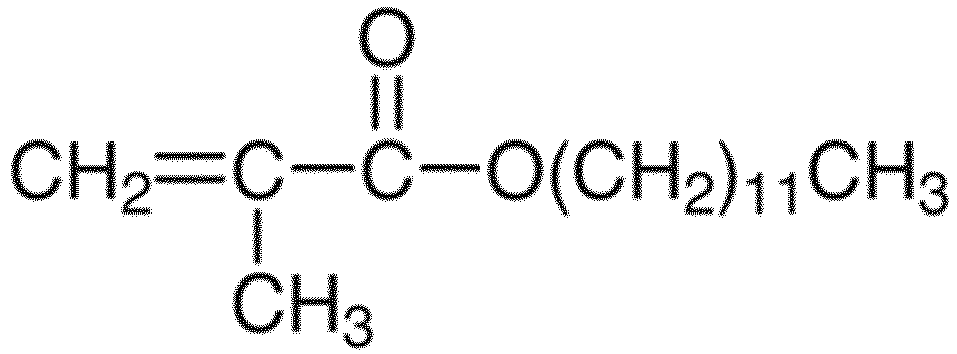
-

-

-

-

- The viscosity of the compositions for forming a photochromic layer of Examples 1 and 2 and Comparative Examples 1 and 2 was measured by the following method.
- Using a viscometer (VM-100A, commercially available from Sekonic Corporation), the liquid level of the sample was adjusted and fixed so that it was about 2 to 3 mm from the end of the detection terminal, and the viscosity at a liquid temperature of 25°C was measured. The measured viscosity was Example 1: 34 mPa·s, Example 2: 30 mPa-s, Comparative Example 1: 25 mPa·s, and Comparative Example 2: 23 mPa·s.
- A plastic lens substrate (product name HI-LUX; center thickness 2.2 mm, radius 70 mm, S0.00, commercially available from Hoya Corporation) was washed with pure water and dried. Then, the coating composition for forming a photochromic layer prepared above is applied to the convex surface (object-side surface) of the plastic lens substrate by a spin coating method. Spin coating was performed by the method described in
Japanese Patent Application Publication No. 2005-218994 - In this manner, a spectacle lens having a photochromic layer was produced.
- For each spectacle lens photochromic layer (a cured layer obtained by curing the polymerizable composition) of the examples and comparative examples, light was emitted to the surface of the photochromic layer through an aeromass filter using a xenon lamp for 15 minutes (900 seconds), and the photochromic compound in the photochromic layer was caused to develop a color. The transmittance (measurement wavelength: 550 nm) during color development was measured with a spectrophotometer (commercially available from Otsuka Electronics Co., Ltd.). The light emission was performed so that irradiances and tolerances of irradiances specified in JIS T7333: 2005 were values shown in the following Table 2. The transmittance measured in this manner is called a "transmittance during color development."
[Table 2] Wavelength range(nm) Irradiance (W/m2) Tolerance of irradiance (W/m2) 300~340 <2.5 - 340~380 5.6 ±1.5 380~420 12 ±3.0 420~460 12 ±3.0 460~500 26 ±2.6 - After measuring the transmittance during color development, the transmittance was measured 60 seconds after light emission was stopped (hereinafter referred to as "transmittance after 60 s of fading"). The fading rate (unit: %/sec) was calculated by the calculation formula: fading rate=[(transmittance after 60 s of fading-transmittance during color development)/60]. It can be said that the higher the value of the fading rate obtained in this manner, the faster the fading rate.
- The weather resistance of the spectacle lenses of the examples and comparative examples was evaluated by the weather resistance test method described in ISO 8980-3: 2013. In the weather resistance evaluation result, the amount of change in transmittance during color development (hereinafter referred to as ΔDarkness) was obtained, and when the ΔDarkness value is 6.0% or less, it can be said that the weather resistance is excellent.
- The above results are shown in Table 3. In addition,
Fig. 1 shows a graph in which the ΔDarkness values are plotted against the (meth)acryloyl group content in the polymerizable compositions of the examples and comparative examples.Fig. 1 also shows an approximation line obtained by the least squares method.[Table 3] (Meth)acryloyl group content [mmol / g] Fading rate [%/s] Weather resistance Δ Darkness [%] Comparative Example 1 3.04 0. 43 10.4 Comparative Example 2 3.30 0. 43 7.6 Example 1 3.61 0.40 4.6 Example 2 3. 78 0. 43 3.9 - Based on the results shown in Table 3, it was confirmed that the spectacle lenses of Examples 1 and 2 exhibited a fading rate equivalent to that of the spectacle lenses of Comparative Examples 1 and 2 and had excellent weather resistance. That is, it was confirmed that the spectacle lenses of Examples 1 and 2 could achieve both a fast fading rate and excellent weather resistance.
- The inventors thought that the multifunctional (meth)acrylate (trimethylolpropane polyoxyethylene ether trimethacrylate, polypropylene glycol dimethacrylate) corresponding to the component A contributes to making the spectacle lenses of Examples 1 and 2 exhibit a fast fading rate. Regarding the weather resistance, it was confirmed from the graph shown in
Fig. 1 that there was a correlation between the (meth)acryloyl group content of the composition and ΔDarkness, and when the (meth)acryloyl group content of the composition was set to 3.50 mmol/g or more, ΔDarkness could be 6.0% or less. - Finally, the above aspects will be summarized.
-
- [1] A polymerizable composition for an optical article, including two or more (meth)acrylates and a photochromic compound, wherein the two or more (meth)acrylates include at least a multifunctional (meth)acrylate containing a polyalkylene glycol moiety and having a molecular weight of 500 or more, and the (meth)acryloyl group content in the polymerizable composition for an optical article is 3.50 mmol/g or more.
- [2] The polymerizable composition for an optical article according to [1],
wherein the two or more (meth)acrylates include a monofunctional (meth)acrylate having a molecular weight of 150 or less. - [3] The polymerizable composition for an optical article according to [1] or [2],
wherein the polyalkylene glycol moiety of the component A is selected from the group consisting of a polyethylene glycol moiety and a polypropylene glycol moiety. - [4] The polymerizable composition for an optical article according to any one of [1] to [3],
wherein the component A is a bifunctional or trifunctional (meth)acrylate. - [5] The polymerizable composition for an optical article according to any one of [1] to [4],
wherein the viscosity at a temperature of 25°C is 20 mPa·s or more. - [6] An optical article including a substrate and a photochromic layer obtained by curing the polymerizable composition for an optical article according to any one of [1] to [5].
- [7] The optical article according to [6], which is a spectacle lens.
- [8] The optical article according to [6], which is a goggle lens.
- [9] The optical article according to [6], which is a visor part of a sun visor.
- [10] The optical article according to [6], which is a shield member of a helmet.
- [11] Eyeglasses including the spectacle lens according to [7].
- Two or more of the various aspects and various forms described in this specification may be combined in arbitrary combinations.
- The embodiments disclosed herein are only examples in all respects and should not be considered as restrictive. The scope of the present invention is not limited to the above description, but is defined by the scope of claims, and is intended to encompass equivalents to the scope of claims and all modifications within the scope of the claims.
- The present invention is beneficial in the technical fields of eyeglasses, goggles, sun visors, helmets and the like.
Claims (14)
- A polymerizable composition for an optical article, comprising:two or more (meth)acrylates; anda photochromic compound,wherein the two or more (meth)acrylates include at least a multifunctional (meth)acrylate containing a polyalkylene glycol moiety and having a molecular weight of 500 or more, andwherein the (meth)acryloyl group content in the polymerizable composition for an optical article is 3.50 mmol/g or more.
- The polymerizable composition for an optical article according to claim 1,
wherein the two or more (meth)acrylates include a monofunctional (meth)acrylate having a molecular weight of 150 or less. - The polymerizable composition for an optical article according to claim 1,
wherein the polyalkylene glycol moiety of the component A is selected from the group consisting of a polyethylene glycol moiety and a polypropylene glycol moiety. - The polymerizable composition for an optical article according to claim 2,
wherein the polyalkylene glycol moiety of the component A is selected from the group consisting of a polyethylene glycol moiety and a polypropylene glycol moiety. - The polymerizable composition for an optical article according to claim 1,
wherein the component A is a bifunctional or trifunctional (meth)acrylate. - The polymerizable composition for an optical article according to claim 2,
wherein the component A is a bifunctional or trifunctional (meth)acrylate. - The polymerizable composition for an optical article according to claim 3,
wherein the component A is a bifunctional or trifunctional (meth)acrylate. - The polymerizable composition for an optical article according to claim 4,
wherein the component A is a bifunctional or trifunctional (meth)acrylate. - The polymerizable composition for an optical article according to any one of claims 1 to 8,
wherein the viscosity at a temperature of 25°C is 20 mPa·s or more. - An optical article comprising:a substrate; anda photochromic layer obtained by curing the polymerizable composition for an optical article according to any one of claims 1 to 8.
- The optical article according to claim 10,
wherein the viscosity of the polymerizable composition for an optical article at a temperature of 25°C is 20 mPa·s or more. - The optical article according to claim 10, which is a spectacle lens.
- The optical article according to claim 10, which is a goggle lens, a visor part of a sun visor or a shield member of a helmet.
- Eyeglasses comprising the spectacle lens according to claim 12.
Applications Claiming Priority (2)
| Application Number | Priority Date | Filing Date | Title |
|---|---|---|---|
| JP2022058879 | 2022-03-31 | ||
| PCT/JP2023/013259 WO2023190905A1 (en) | 2022-03-31 | 2023-03-30 | Polymerizable composition for optical article and optical article |
Publications (1)
| Publication Number | Publication Date |
|---|---|
| EP4502673A1 true EP4502673A1 (en) | 2025-02-05 |
Family
ID=88202865
Family Applications (1)
| Application Number | Title | Priority Date | Filing Date |
|---|---|---|---|
| EP23780913.2A Pending EP4502673A1 (en) | 2022-03-31 | 2023-03-30 | Polymerizable composition for optical article and optical article |
Country Status (6)
| Country | Link |
|---|---|
| US (1) | US20250188342A1 (en) |
| EP (1) | EP4502673A1 (en) |
| JP (1) | JP7805444B2 (en) |
| KR (1) | KR20240150484A (en) |
| CN (1) | CN119096174A (en) |
| WO (1) | WO2023190905A1 (en) |
Families Citing this family (2)
| Publication number | Priority date | Publication date | Assignee | Title |
|---|---|---|---|---|
| CN122003627A (en) * | 2023-10-11 | 2026-05-08 | 株式会社德山 | Curable composition, cured product, laminate, optical article, lens, glasses, and photochromic optical article |
| WO2025182863A1 (en) * | 2024-02-28 | 2025-09-04 | 株式会社トクヤマ | Curable composition, cured body, laminate, optical article, lens, and spectacles |
Family Cites Families (9)
| Publication number | Priority date | Publication date | Assignee | Title |
|---|---|---|---|---|
| JP3949225B2 (en) * | 1997-06-10 | 2007-07-25 | 株式会社トクヤマ | Photochromic curable composition |
| US6296785B1 (en) | 1999-09-17 | 2001-10-02 | Ppg Industries Ohio, Inc. | Indeno-fused photochromic naphthopyrans |
| WO2003011967A1 (en) * | 2001-07-27 | 2003-02-13 | Tokuyama Corporation | Curable composition, cured article obtained therefrom, and photochromic optical material and process for producing the same |
| JP4229853B2 (en) | 2004-02-06 | 2009-02-25 | Hoya株式会社 | Application method and spectacle lens manufacturing method |
| CN101633805A (en) | 2008-07-24 | 2010-01-27 | Icf科技有限公司 | Ink for colored filter, colored filter and method for manufacturing colored filter |
| JP6963514B2 (en) * | 2018-01-24 | 2021-11-10 | 株式会社トクヤマ | A (meth) acrylate compound and a photochromic curable composition containing the (meth) acrylate compound. |
| JP7429119B2 (en) * | 2019-12-27 | 2024-02-07 | ホヤ レンズ タイランド リミテッド | Polymerizable composition for optical articles and optical articles |
| CN114829539B (en) * | 2020-02-28 | 2024-09-06 | 株式会社德山 | Photochromic curable composition and photochromic optical article |
| EP4733304A2 (en) | 2020-12-24 | 2026-04-29 | HOYA Lens Thailand Ltd. | Photochromic compound, photochromic composition, photochromic article, and eyeglasses |
-
2023
- 2023-03-30 KR KR1020247030833A patent/KR20240150484A/en active Pending
- 2023-03-30 US US18/846,162 patent/US20250188342A1/en active Pending
- 2023-03-30 WO PCT/JP2023/013259 patent/WO2023190905A1/en not_active Ceased
- 2023-03-30 EP EP23780913.2A patent/EP4502673A1/en active Pending
- 2023-03-30 CN CN202380028611.4A patent/CN119096174A/en active Pending
- 2023-03-30 JP JP2024512817A patent/JP7805444B2/en active Active
Also Published As
| Publication number | Publication date |
|---|---|
| CN119096174A (en) | 2024-12-06 |
| US20250188342A1 (en) | 2025-06-12 |
| JP7805444B2 (en) | 2026-01-23 |
| JPWO2023190905A1 (en) | 2023-10-05 |
| KR20240150484A (en) | 2024-10-15 |
| WO2023190905A1 (en) | 2023-10-05 |
Similar Documents
| Publication | Publication Date | Title |
|---|---|---|
| EP3950853A1 (en) | Coating composition for optical article, spectacle lens, spectacles, method for producing spectacle lens, optical article, and method for producing optical article | |
| EP4692867A1 (en) | Photochromic article, spectacles, and method for producing photochromic article | |
| JP7596076B2 (en) | Photochromic Articles and Glasses | |
| JP5259407B2 (en) | Photochromic article containing dendritic polymer acrylate | |
| US20220289878A1 (en) | Polymerizable composition for optical article and optical article | |
| US20250188342A1 (en) | Polymerizable composition for optical article and optical article | |
| US12378347B2 (en) | Polymerizable composition for optical article and optical article | |
| US20220220240A1 (en) | Polymerizable composition for forming protective layer on photochromic article, photochromic article and eyeglasses | |
| JP7308293B2 (en) | Method for manufacturing optical article | |
| EP3951481A1 (en) | Coating composition for optical articles, spectacle lens, eyeglasses, method for manufacturing spectacle lens, optical article, and method for manufacturing optical article | |
| JP7805443B2 (en) | Polymerizable composition for optical article and optical article | |
| EP4553547A1 (en) | Photochromic article, and method for producing photochromic article | |
| EP4502665A1 (en) | Manufacturing method for optical article | |
| WO2025249536A1 (en) | Curable composition for forming protective layer on photochromic article, photochromic article, and eyeglasses | |
| US20240124633A1 (en) | Method of producing polymerizable composition and method of producing photochromic article |
Legal Events
| Date | Code | Title | Description |
|---|---|---|---|
| STAA | Information on the status of an ep patent application or granted ep patent |
Free format text: STATUS: THE INTERNATIONAL PUBLICATION HAS BEEN MADE |
|
| PUAI | Public reference made under article 153(3) epc to a published international application that has entered the european phase |
Free format text: ORIGINAL CODE: 0009012 |
|
| STAA | Information on the status of an ep patent application or granted ep patent |
Free format text: STATUS: REQUEST FOR EXAMINATION WAS MADE |
|
| 17P | Request for examination filed |
Effective date: 20240916 |
|
| AK | Designated contracting states |
Kind code of ref document: A1 Designated state(s): AL AT BE BG CH CY CZ DE DK EE ES FI FR GB GR HR HU IE IS IT LI LT LU LV MC ME MK MT NL NO PL PT RO RS SE SI SK SM TR |
|
| DAV | Request for validation of the european patent (deleted) | ||
| DAX | Request for extension of the european patent (deleted) |