EP4502598A2 - Method for evaluating abrasion resistance of a rubber composition and rubber composition - Google Patents
Method for evaluating abrasion resistance of a rubber composition and rubber composition Download PDFInfo
- Publication number
- EP4502598A2 EP4502598A2 EP24185900.8A EP24185900A EP4502598A2 EP 4502598 A2 EP4502598 A2 EP 4502598A2 EP 24185900 A EP24185900 A EP 24185900A EP 4502598 A2 EP4502598 A2 EP 4502598A2
- Authority
- EP
- European Patent Office
- Prior art keywords
- rubber composition
- mass
- rubber
- fractal dimension
- abrasion resistance
- Prior art date
- Legal status (The legal status is an assumption and is not a legal conclusion. Google has not performed a legal analysis and makes no representation as to the accuracy of the status listed.)
- Pending
Links
Images
Classifications
-
- C—CHEMISTRY; METALLURGY
- C08—ORGANIC MACROMOLECULAR COMPOUNDS; THEIR PREPARATION OR CHEMICAL WORKING-UP; COMPOSITIONS BASED THEREON
- C08L—COMPOSITIONS OF MACROMOLECULAR COMPOUNDS
- C08L9/00—Compositions of homopolymers or copolymers of conjugated diene hydrocarbons
- C08L9/06—Copolymers with styrene
-
- G—PHYSICS
- G01—MEASURING; TESTING
- G01N—INVESTIGATING OR ANALYSING MATERIALS BY DETERMINING THEIR CHEMICAL OR PHYSICAL PROPERTIES
- G01N23/00—Investigating or analysing materials by the use of wave or particle radiation, e.g. X-rays or neutrons, not covered by groups G01N3/00 – G01N17/00, G01N21/00 or G01N22/00
- G01N23/20—Investigating or analysing materials by the use of wave or particle radiation, e.g. X-rays or neutrons, not covered by groups G01N3/00 – G01N17/00, G01N21/00 or G01N22/00 by using diffraction of the radiation by the materials, e.g. for investigating crystal structure; by using scattering of the radiation by the materials, e.g. for investigating non-crystalline materials; by using reflection of the radiation by the materials
-
- G—PHYSICS
- G01—MEASURING; TESTING
- G01N—INVESTIGATING OR ANALYSING MATERIALS BY DETERMINING THEIR CHEMICAL OR PHYSICAL PROPERTIES
- G01N33/00—Investigating or analysing materials by specific methods not covered by groups G01N1/00 - G01N31/00
- G01N33/44—Resins; Plastics; Rubber; Leather
- G01N33/445—Rubber
-
- B—PERFORMING OPERATIONS; TRANSPORTING
- B60—VEHICLES IN GENERAL
- B60C—VEHICLE TYRES; TYRE INFLATION; TYRE CHANGING; CONNECTING VALVES TO INFLATABLE ELASTIC BODIES IN GENERAL; DEVICES OR ARRANGEMENTS RELATED TO TYRES
- B60C1/00—Tyres characterised by the chemical composition or the physical arrangement or mixture of the composition
-
- B—PERFORMING OPERATIONS; TRANSPORTING
- B60—VEHICLES IN GENERAL
- B60C—VEHICLE TYRES; TYRE INFLATION; TYRE CHANGING; CONNECTING VALVES TO INFLATABLE ELASTIC BODIES IN GENERAL; DEVICES OR ARRANGEMENTS RELATED TO TYRES
- B60C1/00—Tyres characterised by the chemical composition or the physical arrangement or mixture of the composition
- B60C1/0016—Compositions of the tread
-
- B—PERFORMING OPERATIONS; TRANSPORTING
- B60—VEHICLES IN GENERAL
- B60C—VEHICLE TYRES; TYRE INFLATION; TYRE CHANGING; CONNECTING VALVES TO INFLATABLE ELASTIC BODIES IN GENERAL; DEVICES OR ARRANGEMENTS RELATED TO TYRES
- B60C11/00—Tyre tread bands; Tread patterns; Anti-skid inserts
- B60C11/0008—Tyre tread bands; Tread patterns; Anti-skid inserts characterised by the tread rubber
-
- C—CHEMISTRY; METALLURGY
- C08—ORGANIC MACROMOLECULAR COMPOUNDS; THEIR PREPARATION OR CHEMICAL WORKING-UP; COMPOSITIONS BASED THEREON
- C08C—TREATMENT OR CHEMICAL MODIFICATION OF RUBBERS
- C08C19/00—Chemical modification of rubber
- C08C19/22—Incorporating nitrogen atoms into the molecule
-
- C—CHEMISTRY; METALLURGY
- C08—ORGANIC MACROMOLECULAR COMPOUNDS; THEIR PREPARATION OR CHEMICAL WORKING-UP; COMPOSITIONS BASED THEREON
- C08C—TREATMENT OR CHEMICAL MODIFICATION OF RUBBERS
- C08C19/00—Chemical modification of rubber
- C08C19/25—Incorporating silicon atoms into the molecule
-
- C—CHEMISTRY; METALLURGY
- C08—ORGANIC MACROMOLECULAR COMPOUNDS; THEIR PREPARATION OR CHEMICAL WORKING-UP; COMPOSITIONS BASED THEREON
- C08C—TREATMENT OR CHEMICAL MODIFICATION OF RUBBERS
- C08C19/00—Chemical modification of rubber
- C08C19/30—Addition of a reagent which reacts with a hetero atom or a group containing hetero atoms of the macromolecule
- C08C19/42—Addition of a reagent which reacts with a hetero atom or a group containing hetero atoms of the macromolecule reacting with metals or metal-containing groups
- C08C19/44—Addition of a reagent which reacts with a hetero atom or a group containing hetero atoms of the macromolecule reacting with metals or metal-containing groups of polymers containing metal atoms exclusively at one or both ends of the skeleton
-
- C—CHEMISTRY; METALLURGY
- C08—ORGANIC MACROMOLECULAR COMPOUNDS; THEIR PREPARATION OR CHEMICAL WORKING-UP; COMPOSITIONS BASED THEREON
- C08K—Use of inorganic or non-macromolecular organic substances as compounding ingredients
- C08K5/00—Use of organic ingredients
- C08K5/54—Silicon-containing compounds
- C08K5/548—Silicon-containing compounds containing sulfur
-
- G—PHYSICS
- G01—MEASURING; TESTING
- G01N—INVESTIGATING OR ANALYSING MATERIALS BY DETERMINING THEIR CHEMICAL OR PHYSICAL PROPERTIES
- G01N1/00—Sampling; Preparing specimens for investigation
- G01N1/28—Preparing specimens for investigation including physical details of (bio-)chemical methods covered elsewhere, e.g. G01N33/50, C12Q
-
- G—PHYSICS
- G01—MEASURING; TESTING
- G01N—INVESTIGATING OR ANALYSING MATERIALS BY DETERMINING THEIR CHEMICAL OR PHYSICAL PROPERTIES
- G01N23/00—Investigating or analysing materials by the use of wave or particle radiation, e.g. X-rays or neutrons, not covered by groups G01N3/00 – G01N17/00, G01N21/00 or G01N22/00
- G01N23/005—Investigating or analysing materials by the use of wave or particle radiation, e.g. X-rays or neutrons, not covered by groups G01N3/00 – G01N17/00, G01N21/00 or G01N22/00 by using neutrons
-
- G—PHYSICS
- G01—MEASURING; TESTING
- G01N—INVESTIGATING OR ANALYSING MATERIALS BY DETERMINING THEIR CHEMICAL OR PHYSICAL PROPERTIES
- G01N23/00—Investigating or analysing materials by the use of wave or particle radiation, e.g. X-rays or neutrons, not covered by groups G01N3/00 – G01N17/00, G01N21/00 or G01N22/00
- G01N23/20—Investigating or analysing materials by the use of wave or particle radiation, e.g. X-rays or neutrons, not covered by groups G01N3/00 – G01N17/00, G01N21/00 or G01N22/00 by using diffraction of the radiation by the materials, e.g. for investigating crystal structure; by using scattering of the radiation by the materials, e.g. for investigating non-crystalline materials; by using reflection of the radiation by the materials
- G01N23/201—Investigating or analysing materials by the use of wave or particle radiation, e.g. X-rays or neutrons, not covered by groups G01N3/00 – G01N17/00, G01N21/00 or G01N22/00 by using diffraction of the radiation by the materials, e.g. for investigating crystal structure; by using scattering of the radiation by the materials, e.g. for investigating non-crystalline materials; by using reflection of the radiation by the materials by measuring small-angle scattering
-
- G—PHYSICS
- G01—MEASURING; TESTING
- G01N—INVESTIGATING OR ANALYSING MATERIALS BY DETERMINING THEIR CHEMICAL OR PHYSICAL PROPERTIES
- G01N23/00—Investigating or analysing materials by the use of wave or particle radiation, e.g. X-rays or neutrons, not covered by groups G01N3/00 – G01N17/00, G01N21/00 or G01N22/00
- G01N23/20—Investigating or analysing materials by the use of wave or particle radiation, e.g. X-rays or neutrons, not covered by groups G01N3/00 – G01N17/00, G01N21/00 or G01N22/00 by using diffraction of the radiation by the materials, e.g. for investigating crystal structure; by using scattering of the radiation by the materials, e.g. for investigating non-crystalline materials; by using reflection of the radiation by the materials
- G01N23/201—Investigating or analysing materials by the use of wave or particle radiation, e.g. X-rays or neutrons, not covered by groups G01N3/00 – G01N17/00, G01N21/00 or G01N22/00 by using diffraction of the radiation by the materials, e.g. for investigating crystal structure; by using scattering of the radiation by the materials, e.g. for investigating non-crystalline materials; by using reflection of the radiation by the materials by measuring small-angle scattering
- G01N23/202—Investigating or analysing materials by the use of wave or particle radiation, e.g. X-rays or neutrons, not covered by groups G01N3/00 – G01N17/00, G01N21/00 or G01N22/00 by using diffraction of the radiation by the materials, e.g. for investigating crystal structure; by using scattering of the radiation by the materials, e.g. for investigating non-crystalline materials; by using reflection of the radiation by the materials by measuring small-angle scattering using neutrons
-
- B—PERFORMING OPERATIONS; TRANSPORTING
- B60—VEHICLES IN GENERAL
- B60C—VEHICLE TYRES; TYRE INFLATION; TYRE CHANGING; CONNECTING VALVES TO INFLATABLE ELASTIC BODIES IN GENERAL; DEVICES OR ARRANGEMENTS RELATED TO TYRES
- B60C11/00—Tyre tread bands; Tread patterns; Anti-skid inserts
- B60C11/24—Wear-indicating arrangements
- B60C11/246—Tread wear monitoring systems
-
- B—PERFORMING OPERATIONS; TRANSPORTING
- B60—VEHICLES IN GENERAL
- B60C—VEHICLE TYRES; TYRE INFLATION; TYRE CHANGING; CONNECTING VALVES TO INFLATABLE ELASTIC BODIES IN GENERAL; DEVICES OR ARRANGEMENTS RELATED TO TYRES
- B60C11/00—Tyre tread bands; Tread patterns; Anti-skid inserts
- B60C11/0008—Tyre tread bands; Tread patterns; Anti-skid inserts characterised by the tread rubber
- B60C2011/0016—Physical properties or dimensions
-
- C—CHEMISTRY; METALLURGY
- C08—ORGANIC MACROMOLECULAR COMPOUNDS; THEIR PREPARATION OR CHEMICAL WORKING-UP; COMPOSITIONS BASED THEREON
- C08L—COMPOSITIONS OF MACROMOLECULAR COMPOUNDS
- C08L2205/00—Polymer mixtures characterised by other features
- C08L2205/02—Polymer mixtures characterised by other features containing two or more polymers of the same C08L -group
- C08L2205/025—Polymer mixtures characterised by other features containing two or more polymers of the same C08L -group containing two or more polymers of the same hierarchy C08L, and differing only in parameters such as density, comonomer content, molecular weight, structure
-
- G—PHYSICS
- G01—MEASURING; TESTING
- G01N—INVESTIGATING OR ANALYSING MATERIALS BY DETERMINING THEIR CHEMICAL OR PHYSICAL PROPERTIES
- G01N2223/00—Investigating materials by wave or particle radiation
- G01N2223/05—Investigating materials by wave or particle radiation by diffraction, scatter or reflection
- G01N2223/054—Investigating materials by wave or particle radiation by diffraction, scatter or reflection small angle scatter
-
- G—PHYSICS
- G01—MEASURING; TESTING
- G01N—INVESTIGATING OR ANALYSING MATERIALS BY DETERMINING THEIR CHEMICAL OR PHYSICAL PROPERTIES
- G01N2223/00—Investigating materials by wave or particle radiation
- G01N2223/10—Different kinds of radiation or particles
- G01N2223/101—Different kinds of radiation or particles electromagnetic radiation
- G01N2223/1016—X-ray
-
- G—PHYSICS
- G01—MEASURING; TESTING
- G01N—INVESTIGATING OR ANALYSING MATERIALS BY DETERMINING THEIR CHEMICAL OR PHYSICAL PROPERTIES
- G01N2223/00—Investigating materials by wave or particle radiation
- G01N2223/10—Different kinds of radiation or particles
- G01N2223/106—Different kinds of radiation or particles neutrons
-
- G—PHYSICS
- G01—MEASURING; TESTING
- G01N—INVESTIGATING OR ANALYSING MATERIALS BY DETERMINING THEIR CHEMICAL OR PHYSICAL PROPERTIES
- G01N2223/00—Investigating materials by wave or particle radiation
- G01N2223/60—Specific applications or type of materials
- G01N2223/627—Specific applications or type of materials tyres
-
- G—PHYSICS
- G01—MEASURING; TESTING
- G01N—INVESTIGATING OR ANALYSING MATERIALS BY DETERMINING THEIR CHEMICAL OR PHYSICAL PROPERTIES
- G01N2223/00—Investigating materials by wave or particle radiation
- G01N2223/60—Specific applications or type of materials
- G01N2223/634—Specific applications or type of materials wear behaviour, roughness
Definitions
- the present invention relates to a method for evaluating the abrasion resistance of rubber compositions and a rubber composition.
- a conventionally known method for evaluating the abrasion resistance of a tire includes preparing a vulcanized rubber for testing abrasion resistance using a formulation which is identical to that of a tread rubber of the tire and then subjecting the vulcanized rubber to wear with an indoor abrasion tester such as a Lambourne abrasion tester to evaluate the abrasion resistance (see, Patent Literature 1).
- the vulcanized rubber for testing abrasion resistance may have different properties from those of the tire tread rubber which is the subject of evaluation due to differences in the vulcanization conditions, etc. This causes a difference between the abrasion resistance predicted by the conventional evaluation method and the abrasion resistance determined by actually mounting the tire as the subject of evaluation on a vehicle and driving the vehicle.
- Patent Literature 1 JP 2005-308447 A
- the present invention aims to solve the problem and provide a highly accurate method for evaluating the abrasion resistance of rubber compositions.
- a mass fractal dimension D which is obtained by performing X-ray scattering measurement or neutron scattering measurement in a specific region to obtain a scattering intensity curve and then fitting a specific formula to the scattering intensity curve, highly correlates with the abrasion resistance of a rubber composition, and also found that the smaller the mass fractal dimension is D tends to provide better abrasion resistance.
- the filler network is excessively developed (i.e., the smaller the mass fractal dimension is)
- the abrasion resistance is thus improved.
- the present invention relates to a method for evaluating abrasion resistance of a rubber composition by X-ray scattering measurement or neutron scattering measurement, the method including
- the present invention relates to a method for evaluating abrasion resistance of a rubber composition by X-ray scattering measurement or neutron scattering measurement.
- the method includes performing X-ray scattering measurement or neutron scattering measurement in a region q expressed by the Formula 1 to obtain a scattering intensity curve I (q) , fitting the Formula 2 to the scattering intensity curve I (q) to obtain a mass fractal dimension D, and evaluating the abrasion resistance of the rubber composition based on the mass fractal dimension D.
- This method can highly accurately evaluate the abrasion resistance of rubber compositions. Specifically, the technique of evaluating the abrasion resistance using a practical vehicle needs to produce tires to be subjected to a driving test and is therefore disadvantageous in terms of time and cost.
- the method of the present invention can accurately evaluate the abrasion resistance in a short time and at a low cost by the simple technique of preparing a rubber test piece (rubber composition) and irradiating it with X-rays or neutrons.
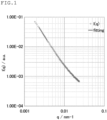
- FIG. 1 shows examples of a scattering intensity curve obtained by SANS measurement and a result of fitting.
- the present invention relates to a method for evaluating abrasion resistance of a rubber composition by X-ray scattering measurement or neutron scattering measurement, the method including performing X-ray scattering measurement or neutron scattering measurement in a region q expressed by the Formula 1 to obtain a scattering intensity curve I (q) , fitting the Formula 2 to the scattering intensity curve I (q) to obtain a mass fractal dimension D, and evaluating the abrasion resistance of the rubber composition based on the mass fractal dimension D.
- the X-ray scattering measurement in the method may suitably be small-angle X-ray scattering (SAXS) measurement (scattering angle: typically 10 degrees or smaller) in which a rubber composition is irradiated with X-rays to measure the scattering intensity.
- SAXS small-angle X-ray scattering
- the structural information of a substance may be obtained by measuring the X-rays scattered at small scattering angles among the scattered X-rays resulting from the irradiation of the substance with X-rays. This measurement enables analysis of ordered structures on the order of a few nanometers such as microphase-separated structures of polymer materials.
- the SAXS measurement desirably measures an X-ray scattering profile with a high S/N ratio.
- X-rays radiated from a synchrotron preferably have a brilliance of at least 10 10 (photons/s/mrad 2 /mm 2 /0.1%bw).
- the symbol bw denotes the band width of X-rays radiated from a synchrotron.
- Examples of such a synchrotron include the beamlines BL03XU and BL20XU of the large synchrotron radiation facility "SPring-8" belonging to Japan Synchrotron Radiation Research Institute.
- the brilliance (photons/s/mrad 2 /mm 2 /0.1%bw) of the X-rays is preferably 10 10 or higher, more preferably 10 12 or higher.
- the upper limit is not limited, and the intensity of X-rays used is preferably low enough not to cause radiation damage.
- the number of photons (photons/s) in the X-rays is preferably 10 7 or more, more preferably 10 9 or more.
- the upper limit is not limited, and the intensity of X-rays used is preferably low enough not to cause radiation damage.
- the neutron scattering measurement in the method may suitably be small-angle neutron scattering (SANS) measurement (scattering angle: typically 10 degrees or smaller) in which a rubber composition is irradiated with neutrons to measure the scattering intensity.
- SANS small-angle neutron scattering
- the structural information of a substance may be obtained by measuring the neutrons scattered at small scattering angles among the scattered neutrons resulting from the irradiation of the substance with neutrons. This measurement enables analysis of ordered structures on the order of a few nanometers such as microphase-separated structures of polymer materials.
- the SANS measurement may employ known magnetic structure-based techniques or deuteration techniques.
- deuteration techniques for example, a polymer material may be swollen in a deuterated solvent, and the polymer material in equilibrium in the deuterated solvent may be irradiated with neutrons to measure the scattering intensity.
- the neutrons for use in the neutron scattering measurement such as SANS may be obtained from, for example, the SANS-J beamline at the JRR-3 research reactor belonging to Japan Atomic Energy Agency, Independent Administrative Agency.
- the neutron flux density (neutrons/cm 2 /s) of the neutrons is preferably 10 3 or higher, more preferably 10 4 or higher.
- the upper limit is not limited, and the neutron flux density used is preferably low enough not to cause radiation damage.
- X-ray scattering measurement or neutron scattering measurement is performed in a region q expressed by the following Formula 1. Since a larger region q (nm -1 ) gives the information of a finer molecular structure, the X-ray scattering measurement or neutron scattering measurement is performed preferably in a region q of 10 nm -1 or smaller, more preferably in a region q of 5 ⁇ 10 -2 nm -1 or smaller, particularly preferably in a region q of 2 ⁇ 10 -3 nm -1 or larger and 5 ⁇ 10 -3 nm -1 or smaller.
- q 4 ⁇ sin ⁇ / 2 ⁇ ( ⁇ :scattering angle, ⁇ :wavelength of X-rays or neutrons)
- the X-rays scattered in the SAXS measurement are detected by an X-ray detector, and an image is generated by an image processor or the like using the X-ray detection data from the X-ray detector.
- Examples of the X-ray detector include two-dimensional detectors such as X-ray films, nuclear emulsion plates, X-ray image pickup tubes, X-ray fluorescent amplifiers, X-ray image intensifiers, X-ray imaging plates, X-ray CCDs, and X-ray amorphous materials; and line sensor one-dimensional detectors.
- the X-ray detector may be appropriately selected depending on the type or conditions of the polymer material to be analyzed or other factors.
- the image processor may appropriately be a common one that can generate X-ray scattering images based on the X-ray detection data from the X-ray detector.
- the SANS measurement may also be performed based on the same principle as in the SAXS measurement.
- the neutrons scattered are detected by a neutron detector, and an image is generated by an image processor or the like using the neutron detection data from the neutron detector.
- the neutron detector may be a known two-dimensional detector or one-dimensional detector
- the image processor may be a known one that can generate neutron scattering images. These devices may be appropriately selected.
- a rubber composition is subjected to a measurement such as SAXS measurement or SANS measurement to obtain a scattering intensity curve.
- the scattering intensity curve is analyzed by the method below, whereby a mass fractal dimension D can be determined.
- the mass fractal dimension D determined by the fitting is assumed to be derived from the reinforcing agent and/or the inorganic filler.
- the mass fractal dimension D highly correlates with abrasion resistance, and a smaller D provides better abrasion resistance.
- a rubber composition having a D value of less than 2.30 can be considered as having excellent abrasion resistance.
- the D is preferably 2.25 or less, more preferably 2.20 or less, still more preferably 2.17 or less, further preferably 2.15 or less, furthermore preferably 2.12 or less.
- the D is 1 ⁇ D ⁇ 3 and therefore the lower limit of the D is 1.00.
- mass fractal dimension D in the present invention means the degree of filling by substances in a unit volume.
- the mass fractal dimension D of a filler-containing rubber composition refers to the degree of filling by the filler in a unit volume, which is presumed as the degree of development of the filler network.
- the filler network is excessively developed (i.e., the smaller the mass fractal dimension is), the more the micro-scale sacrificial fracture increases, presumably reducing macro-scale fractures (i.e., abrasion).
- the mass fractal dimension D can be controlled by the types and amounts of chemicals in the rubber composition, such as rubber components, fillers, and silane coupling agents.
- the mass fractal dimension can be reduced by selecting the types of silane coupling agents to vary the dispersion of silica.
- the mass fractal dimension D can be reduced by using the modified rubber described below as a rubber component, reducing the amount of the modified rubber, or using a mercapto silane coupling agent as a silane coupling agent.
- the rubber composition (rubber material) used in the method of the present invention preferably contains a rubber component and a filler.
- the weight average molecular weight of the rubber component usable in the rubber composition is preferably 50,000 or more, more preferably 150,000 or more, still more preferably 200,000 or more, particularly preferably 270,000 or more, while it is preferably 2,000,000 or less, more preferably 1,500,000 or less, still more preferably 1,000,000 or less.
- the weight average molecular weight (Mw) and number average molecular weight (Mn) can be determined by gel permeation chromatography (GPC) (GPC-8000 series available from Tosoh Corporation, detector: differential refractometer, column: TSKgel SuperMultipore HZ-M available from Tosoh Corporation) and the determined values are calibrated with polystyrene standards.
- GPC gel permeation chromatography
- the rubber component usable in the rubber composition may be either unmodified rubbers or modified rubbers. To reduce the mass fractal dimension D of the rubber composition, modified rubbers are preferred.
- the modified rubbers may be rubbers having a functional group interactive with filler such as silica.
- Examples include a chain end-modified rubber obtained by modifying at least one chain end of a rubber with a compound (modifier) having the above functional group (i.e., a chain end-modified rubber terminated with the functional group); a backbone-modified rubber having the functional group in the backbone; a backbone- and chain end-modified rubber having the functional group in both the backbone and a chain end (e.g., a backbone- and chain end-modified rubber in which the backbone has the functional group and at least one chain end is modified with the modifier); and a chain end-modified rubber into which a hydroxy or epoxy group has been introduced by modification (coupling) with a polyfunctional compound having two or more epoxy groups in the molecule.
- a chain end-modified rubber obtained by modifying at least one chain end of a rubber with a compound (modifier) having the above functional group (i.e., a chain end
- Examples of the functional group include an amino group, an amide group, a silyl group, an alkoxysilyl group, an isocyanate group, an imino group, an imidazole group, a urea group, an ether group, a carbonyl group, an oxycarbonyl group, a mercapto group, a sulfide group, a disulfide group, a sulfonyl group, a sulfinyl group, a thiocarbonyl group, an ammonium group, an imide group, a hydrazo group, an azo group, a diazo group, a carboxyl group, a nitrile group, a pyridyl group, an alkoxy group, a hydroxyl group, an oxy group, and an epoxy group.
- These functional groups may be substituted. Preferred among these are amino groups (preferably amino groups whose hydrogen atom is replaced with a C1-C6 alkyl group), alkoxy groups (preferably C1-C6 alkoxy groups), and alkoxysilyl groups (preferably C1-C6 alkoxysilyl groups).
- the rubber component usable in the rubber composition include diene-based rubbers.
- diene-based rubbers include isoprene-based rubbers, polybutadiene rubber (BR), styrene-butadiene rubber (SBR), styrene-isoprene-butadiene rubber (SIBR), ethylene-propylene-diene rubber (EPDM), chloroprene rubber (CR), and acrylonitrile-butadiene rubber (NBR).
- examples of the rubber component also include butyl-based rubbers and fluororubbers. These may be used alone or in combinations of two or more. Modified or hydrogenated products of these rubbers are also usable. Rubbers extended with oils, resins, liquid rubber components, etc.
- the rubber composition preferably contains a diene-based rubber, more preferably contains at least one selected from the group consisting of isoprene-based rubbers, BR, and SBR, more preferably contains at least one selected from the group consisting of BR and SBR, still more preferably contains SBR, further preferably contains BR and SBR.
- modified rubber examples include "a polymer which is obtained by copolymerizing a conjugated diene compound and/or an aromatic vinyl compound with a nitrogen-containing compound represented by the following formula: (wherein R 1 and R 2 each represent a hydrogen atom, a group represented by the following formula: or a group represented by the following formula: and at least one of R 1 and R 2 is not a hydrogen atom;
- the amount of isoprene-based rubbers, if present, in the rubber composition based on 100% by mass of the rubber component is preferably 5% by mass or more, more preferably 10% by mass or more, while it is preferably 30% by mass or less, more preferably 20% by mass or less.
- the amount of BR, if present, in the rubber composition based on 100% by mass of the rubber component is preferably 5% by mass or more, more preferably 15% by mass or more, still more preferably 20% by mass or more, further preferably 30% by mass or more, while it is preferably 60% by mass or less, more preferably 40% by mass or less.
- the amount of SBR, if present, in the rubber composition based on 100% by mass of the rubber component is preferably 40% by mass or more, more preferably 60% by mass or more, while it is preferably 95% by mass or less, more preferably 85% by mass or less, still more preferably 80% by mass or less, further preferably 70% by mass or less.
- fillers usable in the rubber composition include carbon atom-based fillers and inorganic fillers.
- examples of usable carbon atom-based fillers include carbon black.
- examples of usable inorganic fillers include silica, metal sulfates, silicon carbide, and compounds resented by the following formula: mM ⁇ xSiO y ⁇ zH 2 O wherein M represents at least one metal selected from the group consisting of Al, Mg, Ti, Ca, and Zr, or an oxide or hydroxide of the metal; m represents an integer of 1 to 5; x represents an integer of 0 to 10; y represents an integer of 2 to 5; and z represents an integer of 0 to 10.
- Examples of the compounds represented by the formula include alumina, alumina hydrate, aluminum hydroxide, magnesium hydroxide, talc, titanium white, titanium black, calcium oxide, calcium hydroxide, aluminum calcium oxide, clay, pyrophyllite, bentonite, aluminum silicate, calcium silicate, aluminum calcium silicate, magnesium silicate, zirconium, and zirconium oxide.
- One type of these fillers may be used alone or two or more of these may be used in combination.
- the rubber composition preferably contains carbon black and/or silica, more preferably contains silica.
- Non-limiting examples of carbon black include N134, N110, N220, N234, N219, N339, N330, N326, N351, N550, and N762.
- Usable commercial products are available from Asahi Carbon Co., Ltd., Cabot Japan K.K., Tokai Carbon Co., Ltd., Mitsubishi Chemical Corporation, Lion Corporation, NSCC Carbon Co., Ltd., Columbia Carbon, etc. These may be used alone or in combinations of two or more.
- the nitrogen adsorption specific surface area (N 2 SA) of carbon black is preferably 75 m 2 /g or more, more preferably 95 m 2 /g or more, while it is preferably 120 m 2 /g or less, more preferably 100 m 2 /g or less.
- N 2 SA is within the range indicated above, the advantageous effect tends to be better achieved.
- the N 2 SA of the carbon black can be determined in accordance with JIS K 6217-2:2001.
- the amount of carbon black, if present, in the rubber composition per 100 parts by mass of the rubber component is preferably 1 part by mass or more, more preferably 3 parts by mass or more, while it is preferably 20 parts by mass or less, more preferably 10 parts by mass or less.
- silica examples include dry silica (anhydrous silicic acid) and wet silica (hydrous silicic acid). Wet silica is preferred among these because it contains a large number of silanol groups.
- Usable commercial products are available from Evonik Degussa, Tosoh Silica Corporation, Solvay Japan, Tokuyama Corporation, etc. These may be used alone or in combinations of two or more.
- the nitrogen adsorption specific surface area (N 2 SA) of silica is preferably 50 m 2 /g or more, more preferably 100 m 2 /g or more, while it is preferably 250 m 2 /g or less, more preferably 220 m 2 /g or less.
- N 2 SA is within the range indicated above, the advantageous effect tends to be better achieved.
- the N 2 SA of silica is measured by the BET method in accordance with ASTM D3037-81.
- the amount of silica, if present, in the rubber composition per 100 parts by mass of the rubber component is preferably 30 parts by mass or more, more preferably 60 parts by mass or more, while it is preferably 120 parts by mass or less, more preferably 100 parts by mass or less.
- the amount of fillers per 100 parts by mass of the rubber component in the rubber composition is preferably 30 parts by mass or more, more preferably 60 parts by mass or more, while it is preferably 120 parts by mass or less, more preferably 100 parts by mass or less.
- the rubber composition which contains silica preferably further contains a silane coupling agent.
- silane coupling agents include sulfide silane coupling agents such as bis(3-triethoxysilylpropyl)tetrasulfide, bis(2-triethoxysilylethyl)tetrasulfide, bis(4-triethoxysilylbutyl)tetrasulfide, bis(3-trimethoxysilylpropyl)tetrasulfide, bis(2-trimethoxysilylethyl)tetrasulfide, bis(2-triethoxysilylethyl)trisulfide, bis(4-trimethoxysilylbutyl)trisulfide, bis(3-triethoxysilylpropyl)disulfide, bis(2-triethoxysilylethyl)disulfide, bis(4-triethoxysilylbutyl)disulfide, bis(3-trimethoxysilylpropyl)d
- mercapto silane coupling agents are preferred among these.
- Usable commercial products are available from Evonik, Momentive, Shin-Etsu Silicone, Tokyo Chemical Industry Co., Ltd., AZmax. Co., Dow Corning Toray Co., Ltd., etc. These may be used alone or in combinations of two or more.
- the amount of silane coupling agents per 100 parts by mass of silica is preferably 1 part by mass or more, more preferably 3 parts by mass or more, still more preferably 4 parts by mass or more, while it is preferably 10 parts by mass or less, more preferably 7 parts by mass or less.
- the rubber composition may contain sulfur.
- sulfur examples include those commonly used in the rubber industry, such as powdered sulfur, precipitated sulfur, colloidal sulfur, insoluble sulfur, highly dispersible sulfur, and soluble sulfur.
- the amount of sulfur per 100 parts by mass of the rubber component in the rubber composition is preferably 1.0 parts by mass or more, more preferably 1.3 parts by mass or more.
- the amount is preferably 7.0 parts by mass or less, more preferably 5.0 parts by mass or less.
- the rubber composition may contain vulcanization accelerators.
- vulcanization accelerators include benzothiazole vulcanization accelerators such as 2-mercaptobenzothiazole, di-2-benzothiazolyl disulfide, and N-cyclohexyl-2-benzothiazylsulfenamide; thiuram vulcanization accelerators such as tetramethylthiuram disulfide (TMTD), tetrabenzylthiuram disulfide (TBzTD), and tetrakis(2-ethylhexyl)thiuram disulfide (TOT-N); sulfenamide vulcanization accelerators such as N-cyclohexyl-2-benzothiazole sulfenamide, N-t-butyl-2-benzothiazolylsulfenamide, N-oxyethylene-2-benzothiazole sulfenamide, and N,N'-diisopropyl-2-benzothiazole sulfenamide; and guanidine
- the amount of vulcanization accelerators per 100 parts by mass of the rubber component in the rubber composition is preferably 0.5 parts by mass or more, more preferably 1.0 parts by mass or more.
- the upper limit is preferably 8.0 parts by mass or less, more preferably 6.0 parts by mass or less.
- the rubber composition may contain other agents such as plasticizers (oils, liquid polymers, resins, etc.), antioxidants, stearic acid, zinc oxide, waxes, and releasing agents.
- the rubber composition (rubber material) can be produced by a method including kneading the components with a rubber kneading machine such as an open roll mill or a Banbury mixer and then vulcanizing the kneaded mixture.
- a rubber kneading machine such as an open roll mill or a Banbury mixer
- the kneading conditions may be appropriate known kneading conditions, for example, as follows.
- the kneading temperature is preferably 100°C or higher, more preferably 120°C or higher, while it is preferably 180°C or lower, more preferably 170°C or lower.
- the kneading temperature is preferably 80°C or higher, while it is preferably 120°C or lower, more preferably 110°C or lower.
- the composition obtained after kneading vulcanizing agents and vulcanization accelerators is usually vulcanized by press vulcanization, for example.
- the vulcanization temperature is preferably 140°C or higher, more preferably 150°C or higher, while it is preferably 190°C or lower, more preferably 185°C or lower.
- the method of the present invention can highly accurately evaluate abrasion resistance and therefore can be suitably used to evaluate the abrasion resistance of a tire component such as a tread.
- the tire can be produced by extruding and processing the rubber composition before vulcanization into the shape of a tread or the like, molding the processed product on a tire building machine by a usual method, assembling the workpiece with other tire components to form an unvulcanized tire (green tire), and heating and pressuring the unvulcanized tire in a vulcanizer.
- a 100-ml container sufficiently purged with nitrogen was charged with 50 ml of cyclohexane, 4.1 ml of pyrrolidine, and 8.9 ml of divinylbenzene. Then, 0.7 ml of a 1.6 M solution of n-butyllithium in hexane was added thereto at 0°C, followed by stirring. After one hour, isopropanol was added to terminate the reaction. The reaction mixture was extraction-purified, whereby a monomer (1) was obtained.
- a 1000-ml pressure-resistant container sufficiently purged with nitrogen was charged with 600 ml of cyclohexane, 12.6 ml of styrene, 71.0 ml of butadiene, 0.06 g of the monomer (1), and 0.11 ml of tetramethylethylenediamine. Then, 0.2 ml of a 1.6 M solution of n-butyllithium in hexane was added thereto at 40°C, followed by stirring. After three hours, 0.5 ml of a modifier was added and the mixture was stirred. After one hour, 3 ml of isopropanol was added to terminate the polymerization. To the reaction solution was added 1 g of 2,6-tert-butyl-p-cresol. The resulting mixture was subjected to reprecipitation with methanol. The precipitate was heated and dried, whereby a polymer (1) was obtained.
- a polymer (2) was obtained in the same manner as described for the polymer (1), except that the amount of the monomer (1) was 0.17 g.
- a polymer (3) was obtained in the same manner as described for the polymer (1), except that the amount of the monomer (1) was 0.29 g.
- the unvulcanized rubber composition was extruded and molded into the shape of a tread with an extruder equipped with a mouthpiece with a predetermined shape and then assembled with other tire components to form an unvulcanized tire.
- the unvulcanized tire was press-vulcanized at 170°C for 12 minutes, whereby a test tire (tire size: 195/65R15) was produced.
- the test tire was mounted on every wheel of a front-engine, front-wheel-drive car made in Japan. After driving 8,000 km, the groove depth in the tire tread portion was measured. A distance that caused a 1 mm decrease in tire groove depth was calculated and expressed as an index using the following formula. A higher index indicates better abrasion resistance.
- Table 1 revealed that the mass fractal dimension D highly correlates with abrasion resistance, and a smaller D provides better abrasion resistance.
- the unvulcanized rubber composition was extruded and molded into the shape of a tread with an extruder equipped with a mouthpiece with a predetermined shape and then assembled with other tire components to form an unvulcanized tire.
- the unvulcanized tire was press-vulcanized at 170°C for 12 minutes, whereby a test tire (tire size: 195/65R15) was produced.
- the test tire is mounted on every wheel of a front-engine, front-wheel-drive car made in Japan. After driving 8,000 km, the groove depth in the tire tread portion was measured. A distance that caused a 1 mm decrease in tire groove depth was calculated and expressed as an index using the following formula. A higher index indicates better abrasion resistance.
- Exemplary embodiments of the present invention include the following.
- Embodiment 1 A method for evaluating abrasion resistance of a rubber composition by X-ray scattering measurement or neutron scattering measurement, the method including
- Embodiment 2 The method for evaluating abrasion resistance of a rubber composition according to Embodiment 1, wherein the region q is 2 ⁇ 10 -3 to 5 ⁇ 10 -3 nm -1 .
- Embodiment 3 The method for evaluating abrasion resistance of a rubber composition according to Embodiment 1 or 2, wherein the rubber composition contains a diene-based rubber and a filler.
- Embodiment 4 The method for evaluating abrasion resistance of a rubber composition according to any combination with any one of Embodiments 1 to 3, wherein the rubber composition is a tire rubber composition.
- Embodiment 6 The rubber composition according to Embodiment 5, wherein the mass fractal dimension D is 2.20 or less.
- Embodiment 7 The rubber composition according to Embodiment 5, wherein the mass fractal dimension D is 2.15 or less.
- Embodiment 8 The rubber composition according to any combination with any one of Embodiments 5 to 7, wherein the region q is 2 ⁇ 10 -3 to 5 ⁇ 10 -3 nm -1 .
- Embodiment 9 The rubber composition according to any combination with any one of Embodiments 5 to 8, containing a rubber component including a diene-based rubber and a filler.
- Embodiment 10 The rubber composition according to Embodiment 9,
- Embodiment 11 The rubber composition according to Embodiment 9 or 10, further containing a mercapto silane coupling agent.
- Embodiment 12 The rubber composition according to any combination with any one of Embodiments 5 to 11, which is a tire rubber composition.
Landscapes
- Chemical & Material Sciences (AREA)
- Health & Medical Sciences (AREA)
- Life Sciences & Earth Sciences (AREA)
- Physics & Mathematics (AREA)
- Analytical Chemistry (AREA)
- Biochemistry (AREA)
- General Health & Medical Sciences (AREA)
- General Physics & Mathematics (AREA)
- Immunology (AREA)
- Pathology (AREA)
- Medicinal Chemistry (AREA)
- Chemical Kinetics & Catalysis (AREA)
- Polymers & Plastics (AREA)
- Organic Chemistry (AREA)
- Engineering & Computer Science (AREA)
- Crystallography & Structural Chemistry (AREA)
- Mechanical Engineering (AREA)
- General Chemical & Material Sciences (AREA)
- Food Science & Technology (AREA)
- Compositions Of Macromolecular Compounds (AREA)
- Analysing Materials By The Use Of Radiation (AREA)
Abstract

Description
- The present invention relates to a method for evaluating the abrasion resistance of rubber compositions and a rubber composition.
- A conventionally known method for evaluating the abrasion resistance of a tire includes preparing a vulcanized rubber for testing abrasion resistance using a formulation which is identical to that of a tread rubber of the tire and then subjecting the vulcanized rubber to wear with an indoor abrasion tester such as a Lambourne abrasion tester to evaluate the abrasion resistance (see, Patent Literature 1).
- In the conventional method, however, the vulcanized rubber for testing abrasion resistance may have different properties from those of the tire tread rubber which is the subject of evaluation due to differences in the vulcanization conditions, etc. This causes a difference between the abrasion resistance predicted by the conventional evaluation method and the abrasion resistance determined by actually mounting the tire as the subject of evaluation on a vehicle and driving the vehicle.
- Patent Literature 1:
JP 2005-308447 A - The present invention aims to solve the problem and provide a highly accurate method for evaluating the abrasion resistance of rubber compositions.
- The present inventor made intensive studies and found that a mass fractal dimension D, which is obtained by performing X-ray scattering measurement or neutron scattering measurement in a specific region to obtain a scattering intensity curve and then fitting a specific formula to the scattering intensity curve, highly correlates with the abrasion resistance of a rubber composition, and also found that the smaller the mass fractal dimension is D tends to provide better abrasion resistance. Here, the less the filler network is excessively developed (i.e., the smaller the mass fractal dimension is), the more the micro-scale sacrificial fracture increases, reducing macro-scale fractures (i.e., abrasion). Presumably, the abrasion resistance is thus improved.
- Specifically, the present invention relates to a method for evaluating abrasion resistance of a rubber composition by X-ray scattering measurement or neutron scattering measurement, the method including
- performing X-ray scattering measurement or neutron scattering measurement in a region q expressed by the following
Formula 1 to obtain a scattering intensity curve I(q), - fitting the following Formula 2 to the scattering intensity curve I(q) to obtain a mass fractal dimension D, and
- evaluating the abrasion resistance of the rubber composition based on the mass fractal dimension D,

- (Θ:scattering angle, X:wavelength of X-rays or neutrons)

- (D: mass fractal dimension)
- (Θ:scattering angle, X:wavelength of X-rays or neutrons)
- The present invention relates to a method for evaluating abrasion resistance of a rubber composition by X-ray scattering measurement or neutron scattering measurement. The method includes performing X-ray scattering measurement or neutron scattering measurement in a region q expressed by the
Formula 1 to obtain a scattering intensity curve I(q), fitting the Formula 2 to the scattering intensity curve I(q) to obtain a mass fractal dimension D, and evaluating the abrasion resistance of the rubber composition based on the mass fractal dimension D. This method can highly accurately evaluate the abrasion resistance of rubber compositions. Specifically, the technique of evaluating the abrasion resistance using a practical vehicle needs to produce tires to be subjected to a driving test and is therefore disadvantageous in terms of time and cost. In contrast, the method of the present invention can accurately evaluate the abrasion resistance in a short time and at a low cost by the simple technique of preparing a rubber test piece (rubber composition) and irradiating it with X-rays or neutrons. -
FIG. 1 shows examples of a scattering intensity curve obtained by SANS measurement and a result of fitting. - The present invention relates to a method for evaluating abrasion resistance of a rubber composition by X-ray scattering measurement or neutron scattering measurement, the method including performing X-ray scattering measurement or neutron scattering measurement in a region q expressed by the
Formula 1 to obtain a scattering intensity curve I(q), fitting the Formula 2 to the scattering intensity curve I(q) to obtain a mass fractal dimension D, and evaluating the abrasion resistance of the rubber composition based on the mass fractal dimension D. - The X-ray scattering measurement in the method may suitably be small-angle X-ray scattering (SAXS) measurement (scattering angle: typically 10 degrees or smaller) in which a rubber composition is irradiated with X-rays to measure the scattering intensity. In the small-angle X-ray scattering measurement, the structural information of a substance may be obtained by measuring the X-rays scattered at small scattering angles among the scattered X-rays resulting from the irradiation of the substance with X-rays. This measurement enables analysis of ordered structures on the order of a few nanometers such as microphase-separated structures of polymer materials.
- To obtain detailed molecular structural information, the SAXS measurement desirably measures an X-ray scattering profile with a high S/N ratio. Thus, X-rays radiated from a synchrotron preferably have a brilliance of at least 1010 (photons/s/mrad2/mm2/0.1%bw). The symbol bw denotes the band width of X-rays radiated from a synchrotron. Examples of such a synchrotron include the beamlines BL03XU and BL20XU of the large synchrotron radiation facility "SPring-8" belonging to Japan Synchrotron Radiation Research Institute.
- The brilliance (photons/s/mrad2/mm2/0.1%bw) of the X-rays is preferably 1010 or higher, more preferably 1012 or higher. The upper limit is not limited, and the intensity of X-rays used is preferably low enough not to cause radiation damage.
- The number of photons (photons/s) in the X-rays is preferably 107 or more, more preferably 109 or more. The upper limit is not limited, and the intensity of X-rays used is preferably low enough not to cause radiation damage.
- The neutron scattering measurement in the method may suitably be small-angle neutron scattering (SANS) measurement (scattering angle: typically 10 degrees or smaller) in which a rubber composition is irradiated with neutrons to measure the scattering intensity. In the small-angle neutron scattering measurement, the structural information of a substance may be obtained by measuring the neutrons scattered at small scattering angles among the scattered neutrons resulting from the irradiation of the substance with neutrons. This measurement enables analysis of ordered structures on the order of a few nanometers such as microphase-separated structures of polymer materials.
- The SANS measurement may employ known magnetic structure-based techniques or deuteration techniques. In deuteration techniques, for example, a polymer material may be swollen in a deuterated solvent, and the polymer material in equilibrium in the deuterated solvent may be irradiated with neutrons to measure the scattering intensity. Examples of deuterated solvents for swelling polymer materials include heavy water, deuterated hexane, deuterated toluene, deuterated chloroform, deuterated methanol, deuterated DMSO ((D3C)2S=O), deuterated tetrahydrofuran, deuterated acetonitrile, deuterated dichloromethane, deuterated benzene, and deuterated N,N-dimethylformamide.
- The neutrons for use in the neutron scattering measurement such as SANS may be obtained from, for example, the SANS-J beamline at the JRR-3 research reactor belonging to Japan Atomic Energy Agency, Independent Administrative Agency.
- To obtain a neutron scattering profile with a high S/N ratio as in SAXS measurement, the neutron flux density (neutrons/cm2/s) of the neutrons is preferably 103 or higher, more preferably 104 or higher. The upper limit is not limited, and the neutron flux density used is preferably low enough not to cause radiation damage.
- In the method, X-ray scattering measurement or neutron scattering measurement is performed in a region q expressed by the following
Formula 1. Since a larger region q (nm-1) gives the information of a finer molecular structure, the X-ray scattering measurement or neutron scattering measurement is performed preferably in a region q of 10 nm-1 or smaller, more preferably in a region q of 5 × 10⁻² nm-1 or smaller, particularly preferably in a region q of 2 × 10⁻³ nm-1 or larger and 5 × 10⁻³ nm-1 or smaller.
- The X-rays scattered in the SAXS measurement are detected by an X-ray detector, and an image is generated by an image processor or the like using the X-ray detection data from the X-ray detector.
- Examples of the X-ray detector include two-dimensional detectors such as X-ray films, nuclear emulsion plates, X-ray image pickup tubes, X-ray fluorescent amplifiers, X-ray image intensifiers, X-ray imaging plates, X-ray CCDs, and X-ray amorphous materials; and line sensor one-dimensional detectors. The X-ray detector may be appropriately selected depending on the type or conditions of the polymer material to be analyzed or other factors.
- The image processor may appropriately be a common one that can generate X-ray scattering images based on the X-ray detection data from the X-ray detector.
- The SANS measurement may also be performed based on the same principle as in the SAXS measurement. The neutrons scattered are detected by a neutron detector, and an image is generated by an image processor or the like using the neutron detection data from the neutron detector. Similarly as above, the neutron detector may be a known two-dimensional detector or one-dimensional detector, and the image processor may be a known one that can generate neutron scattering images. These devices may be appropriately selected.
- A rubber composition is subjected to a measurement such as SAXS measurement or SANS measurement to obtain a scattering intensity curve. The scattering intensity curve is analyzed by the method below, whereby a mass fractal dimension D can be determined.
- As shown in
FIG. 1 , the following Formula 2 is fitted to a scattering intensity curve I(q) obtained by SAXS measurement or SANS measurement. Then, a mass fractal dimension D as a fitting parameter can be determined by least squares.
- For example, in the case of a rubber composition that contains, in the molecular structure, at least one carbon black, a reinforcing agent such as silica, and/or an inorganic filler represented by the general formula mM•xSiOy•zH2O (wherein M represents at least one selected from the group consisting of a metal selected from aluminum, magnesium, titanium, calcium, and zirconium, oxides or hydroxides of the metals, hydrates of the foregoing, and carbonates of the metals, and m, x, y, and z are each a constant), the mass fractal dimension D determined by the fitting is assumed to be derived from the reinforcing agent and/or the inorganic filler.
- As described above, the mass fractal dimension D highly correlates with abrasion resistance, and a smaller D provides better abrasion resistance. In particular, a rubber composition having a D value of less than 2.30 can be considered as having excellent abrasion resistance. The D is preferably 2.25 or less, more preferably 2.20 or less, still more preferably 2.17 or less, further preferably 2.15 or less, furthermore preferably 2.12 or less. In principle, the D is 1 ≤ D ≤ 3 and therefore the lower limit of the D is 1.00.
- Here, the term "mass fractal dimension D" in the present invention means the degree of filling by substances in a unit volume. The mass fractal dimension D of a filler-containing rubber composition refers to the degree of filling by the filler in a unit volume, which is presumed as the degree of development of the filler network.
- The less the filler network is excessively developed (i.e., the smaller the mass fractal dimension is), the more the micro-scale sacrificial fracture increases, presumably reducing macro-scale fractures (i.e., abrasion).
- The mass fractal dimension D can be controlled by the types and amounts of chemicals in the rubber composition, such as rubber components, fillers, and silane coupling agents. The mass fractal dimension can be reduced by selecting the types of silane coupling agents to vary the dispersion of silica.
- Specifically, the mass fractal dimension D can be reduced by using the modified rubber described below as a rubber component, reducing the amount of the modified rubber, or using a mercapto silane coupling agent as a silane coupling agent.
- The rubber composition (rubber material) used in the method of the present invention preferably contains a rubber component and a filler.
- The weight average molecular weight of the rubber component usable in the rubber composition is preferably 50,000 or more, more preferably 150,000 or more, still more preferably 200,000 or more, particularly preferably 270,000 or more, while it is preferably 2,000,000 or less, more preferably 1,500,000 or less, still more preferably 1,000,000 or less.
- Herein, the weight average molecular weight (Mw) and number average molecular weight (Mn) can be determined by gel permeation chromatography (GPC) (GPC-8000 series available from Tosoh Corporation, detector: differential refractometer, column: TSKgel SuperMultipore HZ-M available from Tosoh Corporation) and the determined values are calibrated with polystyrene standards.
- The rubber component usable in the rubber composition may be either unmodified rubbers or modified rubbers. To reduce the mass fractal dimension D of the rubber composition, modified rubbers are preferred.
- The modified rubbers may be rubbers having a functional group interactive with filler such as silica. Examples include a chain end-modified rubber obtained by modifying at least one chain end of a rubber with a compound (modifier) having the above functional group (i.e., a chain end-modified rubber terminated with the functional group); a backbone-modified rubber having the functional group in the backbone; a backbone- and chain end-modified rubber having the functional group in both the backbone and a chain end (e.g., a backbone- and chain end-modified rubber in which the backbone has the functional group and at least one chain end is modified with the modifier); and a chain end-modified rubber into which a hydroxy or epoxy group has been introduced by modification (coupling) with a polyfunctional compound having two or more epoxy groups in the molecule.
- Examples of the functional group include an amino group, an amide group, a silyl group, an alkoxysilyl group, an isocyanate group, an imino group, an imidazole group, a urea group, an ether group, a carbonyl group, an oxycarbonyl group, a mercapto group, a sulfide group, a disulfide group, a sulfonyl group, a sulfinyl group, a thiocarbonyl group, an ammonium group, an imide group, a hydrazo group, an azo group, a diazo group, a carboxyl group, a nitrile group, a pyridyl group, an alkoxy group, a hydroxyl group, an oxy group, and an epoxy group. These functional groups may be substituted. Preferred among these are amino groups (preferably amino groups whose hydrogen atom is replaced with a C1-C6 alkyl group), alkoxy groups (preferably C1-C6 alkoxy groups), and alkoxysilyl groups (preferably C1-C6 alkoxysilyl groups).
- Specific examples of the rubber component usable in the rubber composition include diene-based rubbers. Examples of diene-based rubbers include isoprene-based rubbers, polybutadiene rubber (BR), styrene-butadiene rubber (SBR), styrene-isoprene-butadiene rubber (SIBR), ethylene-propylene-diene rubber (EPDM), chloroprene rubber (CR), and acrylonitrile-butadiene rubber (NBR). Examples of the rubber component also include butyl-based rubbers and fluororubbers. These may be used alone or in combinations of two or more. Modified or hydrogenated products of these rubbers are also usable. Rubbers extended with oils, resins, liquid rubber components, etc. are usable as well. To reduce the mass fractal dimension D of the rubber composition, the rubber composition preferably contains a diene-based rubber, more preferably contains at least one selected from the group consisting of isoprene-based rubbers, BR, and SBR, more preferably contains at least one selected from the group consisting of BR and SBR, still more preferably contains SBR, further preferably contains BR and SBR.
- Specific examples of the modified rubber include "a polymer which is obtained by copolymerizing a conjugated diene compound and/or an aromatic vinyl compound with a nitrogen-containing compound represented by the following formula:


- R3 represents a hydrogen atom or a C1-C4 hydrocarbon group;
- X represents a saturated ring-forming part consisting of (CR8R9)l, (CR10R11)m-NR12-(CR13R14)n, (CR10R11)m-O-(CR13R14)n, or (CR10R11)m-S-(CR13R14)n, X being optionally substituted with a group represented by the following formula:


- Z represents a saturated ring-forming part consisting of (CR8R9)l, (CR10R11)m-NR12-(CR13R14)n, (CR10R11)m-O-(CR13R14)n, or (CR10R11)m-S-(CR13R14)n;
- R4 to R7 are the same as or different from each other and each represent a hydrogen atom, a C1-C30 aliphatic hydrocarbon group, a C3-C30 alicyclic hydrocarbon group, a C5-C30 aromatic hydrocarbon group, or a heterocyclic group with 3 to 30 ring member atoms;
- R0 and R8 to R14 are the same as or different from each other and each represent a hydrogen atom, a C1-C30 aliphatic hydrocarbon group, a C3-C30 alicyclic hydrocarbon group, or a C5-C30 aromatic hydrocarbon group;
- l represents an integer of 3 to 10; and
- m and n each represent an integer of 1 to 9), the polymer having at least one modified end modified by a modifier having a functional group with at least one atom selected from a nitrogen atom, an oxygen atom, and a silicon atom" described in
JP 2010-116554 A - The amount of isoprene-based rubbers, if present, in the rubber composition based on 100% by mass of the rubber component is preferably 5% by mass or more, more preferably 10% by mass or more, while it is preferably 30% by mass or less, more preferably 20% by mass or less.
- To reduce the mass fractal dimension D of the rubber composition, the amount of BR, if present, in the rubber composition based on 100% by mass of the rubber component is preferably 5% by mass or more, more preferably 15% by mass or more, still more preferably 20% by mass or more, further preferably 30% by mass or more, while it is preferably 60% by mass or less, more preferably 40% by mass or less.
- To reduce the mass fractal dimension D of the rubber composition, the amount of SBR, if present, in the rubber composition based on 100% by mass of the rubber component is preferably 40% by mass or more, more preferably 60% by mass or more, while it is preferably 95% by mass or less, more preferably 85% by mass or less, still more preferably 80% by mass or less, further preferably 70% by mass or less.
- Examples of fillers usable in the rubber composition include carbon atom-based fillers and inorganic fillers. Examples of usable carbon atom-based fillers include carbon black. Examples of usable inorganic fillers include silica, metal sulfates, silicon carbide, and compounds resented by the following formula:
mM·xSiOy·zH2O
wherein M represents at least one metal selected from the group consisting of Al, Mg, Ti, Ca, and Zr, or an oxide or hydroxide of the metal; m represents an integer of 1 to 5; x represents an integer of 0 to 10; y represents an integer of 2 to 5; and z represents an integer of 0 to 10. - Examples of the compounds represented by the formula include alumina, alumina hydrate, aluminum hydroxide, magnesium hydroxide, talc, titanium white, titanium black, calcium oxide, calcium hydroxide, aluminum calcium oxide, clay, pyrophyllite, bentonite, aluminum silicate, calcium silicate, aluminum calcium silicate, magnesium silicate, zirconium, and zirconium oxide.
- One type of these fillers may be used alone or two or more of these may be used in combination.
- The rubber composition preferably contains carbon black and/or silica, more preferably contains silica.
- Non-limiting examples of carbon black include N134, N110, N220, N234, N219, N339, N330, N326, N351, N550, and N762. Usable commercial products are available from Asahi Carbon Co., Ltd., Cabot Japan K.K., Tokai Carbon Co., Ltd., Mitsubishi Chemical Corporation, Lion Corporation, NSCC Carbon Co., Ltd., Columbia Carbon, etc. These may be used alone or in combinations of two or more.
- The nitrogen adsorption specific surface area (N2SA) of carbon black is preferably 75 m2/g or more, more preferably 95 m2/g or more, while it is preferably 120 m2/g or less, more preferably 100 m2/g or less. When the N2SA is within the range indicated above, the advantageous effect tends to be better achieved.
- Here, the N2SA of the carbon black can be determined in accordance with JIS K 6217-2:2001.
- To reduce the mass fractal dimension D of the rubber composition, the amount of carbon black, if present, in the rubber composition per 100 parts by mass of the rubber component is preferably 1 part by mass or more, more preferably 3 parts by mass or more, while it is preferably 20 parts by mass or less, more preferably 10 parts by mass or less.
- Examples of silica include dry silica (anhydrous silicic acid) and wet silica (hydrous silicic acid). Wet silica is preferred among these because it contains a large number of silanol groups. Usable commercial products are available from Evonik Degussa, Tosoh Silica Corporation, Solvay Japan, Tokuyama Corporation, etc. These may be used alone or in combinations of two or more.
- The nitrogen adsorption specific surface area (N2SA) of silica is preferably 50 m2/g or more, more preferably 100 m2/g or more, while it is preferably 250 m2/g or less, more preferably 220 m2/g or less. When the N2SA is within the range indicated above, the advantageous effect tends to be better achieved.
- The N2SA of silica is measured by the BET method in accordance with ASTM D3037-81.
- To reduce the mass fractal dimension D of the rubber composition, the amount of silica, if present, in the rubber composition per 100 parts by mass of the rubber component is preferably 30 parts by mass or more, more preferably 60 parts by mass or more, while it is preferably 120 parts by mass or less, more preferably 100 parts by mass or less.
- The amount of fillers (total amount of carbon atom-based fillers such as carbon black, silica, metal sulfates, silicon carbide, and inorganic fillers such as compounds represented by the above formula) per 100 parts by mass of the rubber component in the rubber composition is preferably 30 parts by mass or more, more preferably 60 parts by mass or more, while it is preferably 120 parts by mass or less, more preferably 100 parts by mass or less.
- The rubber composition which contains silica preferably further contains a silane coupling agent.
- Non-limiting examples of silane coupling agents include sulfide silane coupling agents such as bis(3-triethoxysilylpropyl)tetrasulfide, bis(2-triethoxysilylethyl)tetrasulfide, bis(4-triethoxysilylbutyl)tetrasulfide, bis(3-trimethoxysilylpropyl)tetrasulfide, bis(2-trimethoxysilylethyl)tetrasulfide, bis(2-triethoxysilylethyl)trisulfide, bis(4-trimethoxysilylbutyl)trisulfide, bis(3-triethoxysilylpropyl)disulfide, bis(2-triethoxysilylethyl)disulfide, bis(4-triethoxysilylbutyl)disulfide, bis(3-trimethoxysilylpropyl)disulfide, bis(2-trimethoxysilylethyl)disulfide, bis(4-trimethoxysilylbutyl)disulfide, 3-trimethoxysilylpropyl-N,N-dimethylthiocarbamoyltetrasulfide, 2-triethoxysilylethyl-N,N-dimethylthiocarbamoyltetrasulfide, and 3-triethoxysilylpropyl methacrylate monosulfide; mercapto silane coupling agents such as 3-mercaptopropyltrimethoxysilane, 2-mercaptoethyltriethoxysilane, and NXT and NXT-Z both available from Momentive; vinyl silane coupling agents such as vinyltriethoxysilane and vinyltrimethoxysilane; amino silane coupling agents such as 3-aminopropyltriethoxysilane and 3-aminopropyltrimethoxysilane; glycidoxy silane coupling agents such as γ-glycidoxypropyltriethoxysilane and γ-glycidoxypropyltrimethoxysilane; nitro silane coupling agents such as 3-nitropropyltrimethoxysilane and 3-nitropropyltriethoxysilane; and chloro silane coupling agents such as 3-chloropropyltrimethoxysilane and 3-chloropropyltriethoxysilane. To reduce the mass fractal dimension D of the rubber composition, mercapto silane coupling agents are preferred among these. Usable commercial products are available from Evonik, Momentive, Shin-Etsu Silicone, Tokyo Chemical Industry Co., Ltd., AZmax. Co., Dow Corning Toray Co., Ltd., etc. These may be used alone or in combinations of two or more.
- The amount of silane coupling agents per 100 parts by mass of silica is preferably 1 part by mass or more, more preferably 3 parts by mass or more, still more preferably 4 parts by mass or more, while it is preferably 10 parts by mass or less, more preferably 7 parts by mass or less.
- The rubber composition may contain sulfur.
- Examples of sulfur include those commonly used in the rubber industry, such as powdered sulfur, precipitated sulfur, colloidal sulfur, insoluble sulfur, highly dispersible sulfur, and soluble sulfur.
- The amount of sulfur per 100 parts by mass of the rubber component in the rubber composition is preferably 1.0 parts by mass or more, more preferably 1.3 parts by mass or more. The amount is preferably 7.0 parts by mass or less, more preferably 5.0 parts by mass or less.
- The rubber composition may contain vulcanization accelerators.
- Examples of vulcanization accelerators include benzothiazole vulcanization accelerators such as 2-mercaptobenzothiazole, di-2-benzothiazolyl disulfide, and N-cyclohexyl-2-benzothiazylsulfenamide; thiuram vulcanization accelerators such as tetramethylthiuram disulfide (TMTD), tetrabenzylthiuram disulfide (TBzTD), and tetrakis(2-ethylhexyl)thiuram disulfide (TOT-N); sulfenamide vulcanization accelerators such as N-cyclohexyl-2-benzothiazole sulfenamide, N-t-butyl-2-benzothiazolylsulfenamide, N-oxyethylene-2-benzothiazole sulfenamide, and N,N'-diisopropyl-2-benzothiazole sulfenamide; and guanidine vulcanization accelerators such as diphenylguanidine, diorthotolylguanidine, and orthotolylbiguanidine. These may be used alone or in combinations of two or more.
- The amount of vulcanization accelerators per 100 parts by mass of the rubber component in the rubber composition is preferably 0.5 parts by mass or more, more preferably 1.0 parts by mass or more. The upper limit is preferably 8.0 parts by mass or less, more preferably 6.0 parts by mass or less.
- The rubber composition may contain other agents such as plasticizers (oils, liquid polymers, resins, etc.), antioxidants, stearic acid, zinc oxide, waxes, and releasing agents.
- For example, the rubber composition (rubber material) can be produced by a method including kneading the components with a rubber kneading machine such as an open roll mill or a Banbury mixer and then vulcanizing the kneaded mixture.
- The kneading conditions may be appropriate known kneading conditions, for example, as follows. In a base kneading step of kneading additives other than vulcanizing agents (cross-linking agents) and vulcanization accelerators, the kneading temperature is preferably 100°C or higher, more preferably 120°C or higher, while it is preferably 180°C or lower, more preferably 170°C or lower. In a final kneading step of kneading vulcanizing agents and vulcanization accelerators, the kneading temperature is preferably 80°C or higher, while it is preferably 120°C or lower, more preferably 110°C or lower. The composition obtained after kneading vulcanizing agents and vulcanization accelerators is usually vulcanized by press vulcanization, for example. The vulcanization temperature is preferably 140°C or higher, more preferably 150°C or higher, while it is preferably 190°C or lower, more preferably 185°C or lower.
- The method of the present invention can highly accurately evaluate abrasion resistance and therefore can be suitably used to evaluate the abrasion resistance of a tire component such as a tread. In the case of producing a pneumatic tire using the rubber composition, the tire can be produced by extruding and processing the rubber composition before vulcanization into the shape of a tread or the like, molding the processed product on a tire building machine by a usual method, assembling the workpiece with other tire components to form an unvulcanized tire (green tire), and heating and pressuring the unvulcanized tire in a vulcanizer.
- The present invention is specifically described below based on examples, but the present invention is not limited to the examples.
- The chemicals used in the below-described syntheses of monomer (1) and polymers (1) to (3) are listed below.
- Cyclohexane: product of KANTO CHEMICAL CO., INC.
- Pyrrolidine: product of KANTO CHEMICAL CO., INC.
- Divinylbenzene: product of Sigma-Aldrich
- 1.6 M solution of n-Butyllithium in hexane: product of KANTO CHEMICAL CO., INC.
- Isopropanol: product of KANTO CHEMICAL CO., INC.
- Styrene: product of KANTO CHEMICAL CO., INC.
- Butadiene: product of TAKACHIHO CHEMICAL INDUSTRIAL CO., LTD.
- Tetramethylethylenediamine: product of KANTO CHEMICAL CO., INC.
- Modifier: 3-(N,N-dimethylaminopropyl)trimethoxysilane available from AZmax. Co
- 2,6-Tert-butyl-p-cresol: product of Ouchi Shinko Chemical Industrial Co., Ltd.
- Methanol: product of KANTO CHEMICAL CO., INC.
- A 100-ml container sufficiently purged with nitrogen was charged with 50 ml of cyclohexane, 4.1 ml of pyrrolidine, and 8.9 ml of divinylbenzene. Then, 0.7 ml of a 1.6 M solution of n-butyllithium in hexane was added thereto at 0°C, followed by stirring. After one hour, isopropanol was added to terminate the reaction. The reaction mixture was extraction-purified, whereby a monomer (1) was obtained.
- A 1000-ml pressure-resistant container sufficiently purged with nitrogen was charged with 600 ml of cyclohexane, 12.6 ml of styrene, 71.0 ml of butadiene, 0.06 g of the monomer (1), and 0.11 ml of tetramethylethylenediamine. Then, 0.2 ml of a 1.6 M solution of n-butyllithium in hexane was added thereto at 40°C, followed by stirring. After three hours, 0.5 ml of a modifier was added and the mixture was stirred. After one hour, 3 ml of isopropanol was added to terminate the polymerization. To the reaction solution was added 1 g of 2,6-tert-butyl-p-cresol. The resulting mixture was subjected to reprecipitation with methanol. The precipitate was heated and dried, whereby a polymer (1) was obtained.
- A polymer (2) was obtained in the same manner as described for the polymer (1), except that the amount of the monomer (1) was 0.17 g.
- A polymer (3) was obtained in the same manner as described for the polymer (1), except that the amount of the monomer (1) was 0.29 g.
- The chemicals used in the formulations are listed below.
- BR: BR150B available from Ube Industries, Ltd.
- Polymers (1) to (3): polymers synthesized by the above methods
- Silica: ULTRASIL VN3 (N2SA: 175 m2/g) available from Evonik Degussa
- Silane coupling agent 1: Si69 available from Evonik Degussa
- Silane coupling agent 2: NXT-Z45 available from Momentive
- Oil: Diana Process AH-24 available from Idemitsu Kosan Co., Ltd.
- Stearic acid: stearic acid "TSUBAKI" available from NOF Corporation
- Antioxidant: NOCRAC 6C (N-(1,3-dimethylbutyl)-N'-phenyl-p-phenylenediamine) available from Ouchi Shinko Chemical Industrial Co., Ltd.
- Wax: SUNNOC wax available from Ouchi Shinko Chemical Industrial Co., Ltd
- Sulfur: powdered sulfur available from Tsurumi Chemical Industry Co., Ltd.
- Vulcanization accelerator 1: NOCCELER CZ (N-cyclohexyl-2-benzothiazolylsulfenamide) available from Ouchi Shinko Chemical Industrial Co., Ltd.
- Vulcanization accelerator 2: NOCCELER D (N,N-diphenylguanidine) available from Ouchi Shinko Chemical Industrial Co., Ltd.
- According to the formulation shown in Table 1, materials other than sulfur and vulcanization accelerators were kneaded with a 1.7-L Banbury mixer at 150°C for five minutes. Subsequently, the sulfur and the vulcanization accelerators were added and then kneaded with an open roll mill at about 80°C for three minutes to obtain an unvulcanized rubber composition. The unvulcanized rubber composition was press-vulcanized at 170°C for 12 minutes to obtain a vulcanized rubber composition.
- Separately, the unvulcanized rubber composition was extruded and molded into the shape of a tread with an extruder equipped with a mouthpiece with a predetermined shape and then assembled with other tire components to form an unvulcanized tire. The unvulcanized tire was press-vulcanized at 170°C for 12 minutes, whereby a test tire (tire size: 195/65R15) was produced.
- The vulcanized rubber composition and the test tire obtained above were evaluated as described below. Table 1 shows the results.
- An about 1-mm-thick sheet-like sample (the vulcanized rubber composition) that had been swollen in toluene for 12 hours was attached to a sample holder. The sample was irradiated with X-rays in a region q expressed by the Formula 1 (region q: 2 × 10⁻³ to 5 × 10⁻³ nm-1) at room temperature. A scattering intensity curve obtained by the measurement with BL03XU and a scattering intensity curve obtained by the measurement with BL20XU were combined by least squares. The two curves were combined by shifting the scattering intensity curve obtained with BL20XU at smaller angles while the scattering intensity curve obtained with BL03XU at wider angles was fixed. Thus, a scattering intensity curve I(q) was obtained by SAXS measurement. The scattering intensity curve I(q) was fitted with the Formula 2. Then, a mass fractal dimension D as a fitting parameter was determined by least squares.
- (SAXS apparatus)
SAXS: SAXS measurement apparatus provided with the beamlines BL03XU and BL20XU of the large synchrotron radiation facility "SPring-8" belonging to Japan Synchrotron Radiation Research Institute - (Measurement conditions)
- Brilliance of X-rays: 5 × 10¹² photons/s/mrad2/mm2/0.1%bw
- Number of photons in X-rays: 2 × 10⁹ photons/s
- Energy of X-rays: 8 keV (BL03XU), 23 keV (BL20XU)
- Distance between sample and detector: 3 m (BL03XU), 160 m (BL20XU)
- (Detector)
Two-dimensional detector (image intensifier and CCD camera) - The test tire was mounted on every wheel of a front-engine, front-wheel-drive car made in Japan. After driving 8,000 km, the groove depth in the tire tread portion was measured. A distance that caused a 1 mm decrease in tire groove depth was calculated and expressed as an index using the following formula. A higher index indicates better abrasion resistance.
(Driving distance causing 1 mm decrease in tire groove of each composition/Driving distance causing 1 mm decrease in tire groove of composition 1) × 100 [Table 1] Composition 1 2 3 4 5 Formulation (parts by mass) BR 15 15 30 30 30 Polymer (1) 85 70 Polymer (2) 85 70 Polymer (3) 70 Silica 75 75 75 75 75 Silane coupling agent 15 5 Silane coupling agent 2 5 5 5 Oil 20 20 20 20 20 Stearic acid 2 2 2 2 2 Antioxidant 1 1 1 1 1 Wax 1 1 1 1 1 Sulfur 1.5 1.5 1.5 1.5 1.5 Vulcanization accelerator 11 1 1 1 1 Vulcanization accelerator 2 0.5 0.5 0.5 0.5 0.5 Abrasion resistance Actual vehicle test 100 112 120 122 130 Mass fractal dimension D 2.49 2.40 2.30 2.25 2.17 - Table 1 revealed that the mass fractal dimension D highly correlates with abrasion resistance, and a smaller D provides better abrasion resistance.
- According to the formulation shown in Table 2, materials other than sulfur and vulcanization accelerators were kneaded with a 1.7-L Banbury mixer at 150°C for five minutes. Subsequently, the sulfur and the vulcanization accelerators were added and then kneaded with an open roll mill at about 80°C for three minutes to obtain an unvulcanized rubber composition. The unvulcanized rubber composition was press-vulcanized at 170°C for 12 minutes to obtain a vulcanized rubber composition.
- Separately, the unvulcanized rubber composition was extruded and molded into the shape of a tread with an extruder equipped with a mouthpiece with a predetermined shape and then assembled with other tire components to form an unvulcanized tire. The unvulcanized tire was press-vulcanized at 170°C for 12 minutes, whereby a test tire (tire size: 195/65R15) was produced.
- The vulcanized rubber composition and the test tire obtained above were evaluated as described below. Table 2 shows the results.
- An about 1-mm-thick sheet-like sample (the vulcanized rubber composition) that had been swollen in toluene for 12 hours was attached to a sample holder. The sample was irradiated with X-rays in a region q expressed by the Formula 1 (region q: 2 × 10⁻³ to 5 × 10⁻³ nm-1) at room temperature. A scattering intensity curve obtained by the measurement with BL03XU and a scattering intensity curve obtained by the measurement with BL20XU were combined by least squares. The two curves were combined by shifting the scattering intensity curve obtained with BL20XU at smaller angles while the scattering intensity curve obtained with BL03XU at wider angles was fixed. Thus, a scattering intensity curve I(q) was obtained by SAXS measurement. The scattering intensity curve I(q) was fitted with the Formula 2. Then, a mass fractal dimension D as a fitting parameter was determined by least squares.
- (SAXS apparatus)
SAXS: SAXS measurement apparatus provided with the beamlines BL03XU and BL20XU of the large synchrotron radiation facility "SPring-8" belonging to Japan Synchrotron Radiation Research Institute - (Measurement conditions)
- Brilliance of X-rays: 5 × 10¹²
photons/s/mrad2/mm2/0.1%bw - Number of photons in X-rays: 2 × 10⁹ photons/s
- Energy of X-rays: 8 keV (BL03XU), 23 keV (BL20XU)
- Distance between sample and detector: 3 m (BL03XU), 160 m (BL20XU)
- Brilliance of X-rays: 5 × 10¹²
- (Detector)
Two-dimensional detector (image intensifier and CCD camera) - The test tire is mounted on every wheel of a front-engine, front-wheel-drive car made in Japan. After driving 8,000 km, the groove depth in the tire tread portion was measured. A distance that caused a 1 mm decrease in tire groove depth was calculated and expressed as an index using the following formula. A higher index indicates better abrasion resistance.
(Driving distance causing 1 mm decrease in tire groove of each composition/Driving distance causing 1 mm decrease in tire groove of composition 16) × 100 [Table 2] Composition 11 12 13 14 15 16 Formulation (parts by mass) BR 30 30 30 15 15 30 Polymer (1) 85 70 Polymer (2) 70 20 85 Polymer (3) 70 50 Silica 75 75 75 75 75 75 Silane coupling agent 15 5 Silane coupling agent 2 5 5 5 5 Oil 20 20 20 20 20 20 Stearic acid 2 2 2 2 2 2 Antioxidant 1 1 1 1 1 1 Wax 1 1 1 1 1 1 Sulfur 1.5 1.5 1.5 1.5 1.5 1.5 Vulcanization accelerator 11 1 1 1 1 1 Vulcanization accelerator 2 0.5 0.5 0.5 0.5 0.5 0.5 Abrasion resistance Actual vehicle test 102 108 115 83 93 100 Mass fractal dimension D 2.25 2.17 2.12 2.49 2.40 2.30 - Exemplary embodiments of the present invention include the following.
-
Embodiment 1. A method for evaluating abrasion resistance of a rubber composition by X-ray scattering measurement or neutron scattering measurement, the method including - performing X-ray scattering measurement or neutron scattering measurement in a region q expressed by the following
Formula 1 to obtain a scattering intensity curve I(q), - fitting the following Formula 2 to the scattering intensity curve I(q) to obtain a mass fractal dimension D, and
- evaluating the abrasion resistance of the rubber composition based on the mass fractal dimension D,

- (Θ:scattering angle, λ:wavelength of X-rays or neutrons)

- (D: mass fractal dimension)
- (Θ:scattering angle, λ:wavelength of X-rays or neutrons)
- Embodiment 2. The method for evaluating abrasion resistance of a rubber composition according to
Embodiment 1,
wherein the region q is 2 × 10⁻³ to 5 × 10⁻³ nm-1. - Embodiment 3. The method for evaluating abrasion resistance of a rubber composition according to
Embodiment 1 or 2,
wherein the rubber composition contains a diene-based rubber and a filler. - Embodiment 4. The method for evaluating abrasion resistance of a rubber composition according to any combination with any one of
Embodiments 1 to 3,
wherein the rubber composition is a tire rubber composition. - Embodiment 5. A rubber composition having a mass fractal dimension D of less than 2.30,
the mass fractal dimension D being determined by performing X-ray scattering measurement or neutron scattering measurement in a region q expressed by the followingFormula 1 to obtain a scattering intensity curve I(q) and fitting the following Formula 2 to the scattering intensity curve I(q),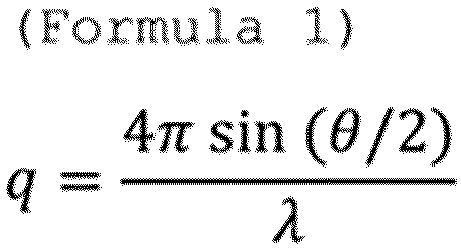

- Embodiment 6. The rubber composition according to Embodiment 5,
wherein the mass fractal dimension D is 2.20 or less. - Embodiment 7. The rubber composition according to Embodiment 5,
wherein the mass fractal dimension D is 2.15 or less. - Embodiment 8. The rubber composition according to any combination with any one of Embodiments 5 to 7,
wherein the region q is 2 × 10⁻³ to 5 × 10⁻³ nm-1. - Embodiment 9. The rubber composition according to any combination with any one of Embodiments 5 to 8, containing a rubber component including a diene-based rubber and a filler.
- Embodiment 10. The rubber composition according to Embodiment 9,
- wherein the diene-based rubber includes styrene-butadiene rubber, and
- the styrene-butadiene rubber is contained in an amount of 40 to 80% by mass based on 100% by mass of the rubber component.
- Embodiment 11. The rubber composition according to Embodiment 9 or 10, further containing a mercapto silane coupling agent.
- Embodiment 12. The rubber composition according to any combination with any one of Embodiments 5 to 11, which is a tire rubber composition.
Claims (12)
- A method for evaluating abrasion resistance of a rubber composition by X-ray scattering measurement or neutron scattering measurement, the method comprisingperforming X-ray scattering measurement or neutron scattering measurement in a region q expressed by the following Formula 1 to obtain a scattering intensity curve I(q),fitting the following Formula 2 to the scattering intensity curve I(q) to obtain a mass fractal dimension D, andevaluating the abrasion resistance of the rubber composition based on the mass fractal dimension D,
 (Θ:scattering angle, λ:wavelength of X-rays or neutrons)
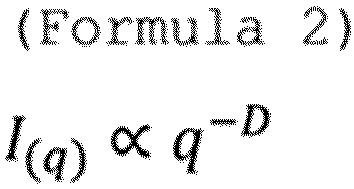 (D: mass fractal dimension)
 - The method for evaluating abrasion resistance of a rubber composition according to claim 1,
wherein the region q is 2 × 10⁻³ to 5 × 10⁻³ nm-1. - The method for evaluating abrasion resistance of a rubber composition according to claim 1 or 2,
wherein the rubber composition contains a diene-based rubber and a filler. - The method for evaluating abrasion resistance of a rubber composition according to any one of claims 1 to 3,
wherein the rubber composition is a tire rubber composition. - A rubber composition having a mass fractal dimension D of less than 2.30,
the mass fractal dimension D being determined by performing X-ray scattering measurement or neutron scattering measurement in a region q expressed by the following Formula 1 to obtain a scattering intensity curve I(q) and fitting the following Formula 2 to the scattering intensity curve I(q),

- The rubber composition according to claim 5,
wherein the mass fractal dimension D is 2.20 or less. - The rubber composition according to claim 5,
wherein the mass fractal dimension D is 2.15 or less. - The rubber composition according to any one of claims 5 to 7,
wherein the region q is 2 × 10⁻³ to 5 × 10⁻³ nm-1. - The rubber composition according to any one of claims 5 to 8, comprising a rubber component including a diene-based rubber and a filler.
- The rubber composition according to claim 9,wherein the diene-based rubber includes styrene-butadiene rubber, andthe styrene-butadiene rubber is contained in an amount of 40 to 80% by mass based on 100% by mass of the rubber component.
- The rubber composition according to claim 9 or 10, further comprising a mercapto silane coupling agent.
- The rubber composition according to any one of claims 5 to 11, which is a tire rubber composition.
Applications Claiming Priority (2)
| Application Number | Priority Date | Filing Date | Title |
|---|---|---|---|
| JP2023126284 | 2023-08-02 | ||
| JP2024065529A JP2025022734A (en) | 2023-08-02 | 2024-04-15 | Method for evaluating abrasion resistance of rubber composition and rubber composition |
Publications (2)
| Publication Number | Publication Date |
|---|---|
| EP4502598A2 true EP4502598A2 (en) | 2025-02-05 |
| EP4502598A3 EP4502598A3 (en) | 2025-04-02 |
Family
ID=91810254
Family Applications (1)
| Application Number | Title | Priority Date | Filing Date |
|---|---|---|---|
| EP24185900.8A Pending EP4502598A3 (en) | 2023-08-02 | 2024-07-02 | Method for evaluating abrasion resistance of a rubber composition and rubber composition |
Country Status (3)
| Country | Link |
|---|---|
| US (1) | US20250043117A1 (en) |
| EP (1) | EP4502598A3 (en) |
| CN (1) | CN119438263A (en) |
Citations (2)
| Publication number | Priority date | Publication date | Assignee | Title |
|---|---|---|---|---|
| JP2005308447A (en) | 2004-04-19 | 2005-11-04 | Yokohama Rubber Co Ltd:The | Tire abrasion lifetime prediction method |
| JP2010116554A (en) | 2008-10-16 | 2010-05-27 | Sumitomo Rubber Ind Ltd | Rubber composition and tire using the same |
Family Cites Families (2)
| Publication number | Priority date | Publication date | Assignee | Title |
|---|---|---|---|---|
| JP2016030789A (en) * | 2014-07-29 | 2016-03-07 | 横浜ゴム株式会社 | Pneumatic tire |
| JP6838294B2 (en) * | 2016-06-09 | 2021-03-03 | 住友ゴム工業株式会社 | Rubber composition and its manufacturing method |
-
2024
- 2024-07-02 EP EP24185900.8A patent/EP4502598A3/en active Pending
- 2024-07-11 US US18/769,797 patent/US20250043117A1/en active Pending
- 2024-07-15 CN CN202410944918.5A patent/CN119438263A/en active Pending
Patent Citations (2)
| Publication number | Priority date | Publication date | Assignee | Title |
|---|---|---|---|---|
| JP2005308447A (en) | 2004-04-19 | 2005-11-04 | Yokohama Rubber Co Ltd:The | Tire abrasion lifetime prediction method |
| JP2010116554A (en) | 2008-10-16 | 2010-05-27 | Sumitomo Rubber Ind Ltd | Rubber composition and tire using the same |
Also Published As
| Publication number | Publication date |
|---|---|
| CN119438263A (en) | 2025-02-14 |
| EP4502598A3 (en) | 2025-04-02 |
| US20250043117A1 (en) | 2025-02-06 |
Similar Documents
| Publication | Publication Date | Title |
|---|---|---|
| EP3045898B1 (en) | Method for evaluating chipping resistance of polymeric material | |
| EP3395866A1 (en) | Rubber composition for tires, method for preparing rubber composition for tires, and tire | |
| JP5027175B2 (en) | Method for measuring reaction amount of silane coupling agent in silica | |
| EP3549978B1 (en) | Rubber composition for tire and tire | |
| EP3348425B1 (en) | Pneumatic tire and crosslinked rubber composition | |
| CN108349313B (en) | Pneumatic tire and cross-linked rubber composition | |
| EP3567076A1 (en) | Vulcanized rubber composition and pneumatic tire | |
| CN108349311B (en) | Pneumatic tire and cross-linked rubber composition | |
| JP5940431B2 (en) | Reaction evaluation method of silane coupling agent in silica compounding | |
| EP4502598A2 (en) | Method for evaluating abrasion resistance of a rubber composition and rubber composition | |
| JP2020100784A (en) | Rubber composition manufacturing method and tire manufacturing method | |
| CN108136847B (en) | Pneumatic tire and crosslinked rubber composition | |
| JP2025022734A (en) | Method for evaluating abrasion resistance of rubber composition and rubber composition | |
| JP7450323B2 (en) | Rubber composition and its manufacturing method | |
| CN108349312B (en) | Pneumatic tire and crosslinked rubber composition | |
| JP2020100786A (en) | Method for producing rubber composition and method for manufacturing tire | |
| JP5214104B2 (en) | Rubber composition for tire | |
| JP2024024531A (en) | Method for measuring reaction amount of silane coupling agent | |
| JP2023036522A (en) | Chemical bonding evaluation method |
Legal Events
| Date | Code | Title | Description |
|---|---|---|---|
| PUAI | Public reference made under article 153(3) epc to a published international application that has entered the european phase |
Free format text: ORIGINAL CODE: 0009012 |
|
| STAA | Information on the status of an ep patent application or granted ep patent |
Free format text: STATUS: THE APPLICATION HAS BEEN PUBLISHED |
|
| AK | Designated contracting states |
Kind code of ref document: A2 Designated state(s): AL AT BE BG CH CY CZ DE DK EE ES FI FR GB GR HR HU IE IS IT LI LT LU LV MC ME MK MT NL NO PL PT RO RS SE SI SK SM TR |
|
| RIC1 | Information provided on ipc code assigned before grant |
Ipc: G01N 23/202 20060101ALI20250122BHEP Ipc: G01N 23/201 20180101ALI20250122BHEP Ipc: C08L 21/00 20060101ALI20250122BHEP Ipc: G01N 33/44 20060101AFI20250122BHEP |
|
| PUAL | Search report despatched |
Free format text: ORIGINAL CODE: 0009013 |
|
| AK | Designated contracting states |
Kind code of ref document: A3 Designated state(s): AL AT BE BG CH CY CZ DE DK EE ES FI FR GB GR HR HU IE IS IT LI LT LU LV MC ME MK MT NL NO PL PT RO RS SE SI SK SM TR |
|
| RIC1 | Information provided on ipc code assigned before grant |
Ipc: G01N 23/202 20060101ALI20250224BHEP Ipc: G01N 23/201 20180101ALI20250224BHEP Ipc: C08L 21/00 20060101ALI20250224BHEP Ipc: G01N 33/44 20060101AFI20250224BHEP |
|
| P01 | Opt-out of the competence of the unified patent court (upc) registered |
Free format text: CASE NUMBER: APP_12455/2025 Effective date: 20250313 |
|
| STAA | Information on the status of an ep patent application or granted ep patent |
Free format text: STATUS: REQUEST FOR EXAMINATION WAS MADE |
|
| 17P | Request for examination filed |
Effective date: 20250710 |