EP4502543A1 - Step counting method and apparatus - Google Patents
Step counting method and apparatus Download PDFInfo
- Publication number
- EP4502543A1 EP4502543A1 EP23778374.1A EP23778374A EP4502543A1 EP 4502543 A1 EP4502543 A1 EP 4502543A1 EP 23778374 A EP23778374 A EP 23778374A EP 4502543 A1 EP4502543 A1 EP 4502543A1
- Authority
- EP
- European Patent Office
- Prior art keywords
- acceleration
- preset time
- time period
- accelerations
- user
- Prior art date
- Legal status (The legal status is an assumption and is not a legal conclusion. Google has not performed a legal analysis and makes no representation as to the accuracy of the status listed.)
- Pending
Links
Images

Classifications
-
- G—PHYSICS
- G01—MEASURING; TESTING
- G01C—MEASURING DISTANCES, LEVELS OR BEARINGS; SURVEYING; NAVIGATION; GYROSCOPIC INSTRUMENTS; PHOTOGRAMMETRY OR VIDEOGRAMMETRY
- G01C22/00—Measuring distance traversed on the ground by vehicles, persons, animals or other moving solid bodies, e.g. using odometers, using pedometers
- G01C22/006—Pedometers
-
- A—HUMAN NECESSITIES
- A61—MEDICAL OR VETERINARY SCIENCE; HYGIENE
- A61B—DIAGNOSIS; SURGERY; IDENTIFICATION
- A61B5/00—Measuring for diagnostic purposes; Identification of persons
- A61B5/103—Measuring devices for testing the shape, pattern, colour, size or movement of the body or parts thereof, for diagnostic purposes
- A61B5/11—Measuring movement of the entire body or parts thereof, e.g. head or hand tremor or mobility of a limb
- A61B5/1118—Determining activity level
Definitions
- This application belongs to the field of terminal technologies, and specifically, to a step counting method and apparatus.
- An existing step counting algorithm usually collects, by using an acceleration sensor, acceleration data when a user walks, and calculates a quantity of walking steps of the user based on the collected acceleration data.
- the quantity of walking steps of the user may be calculated with reference to similarity of periodicities of four steps in the acceleration data.
- impulses of three axes of an acceleration in the collected acceleration data are stable and do not frequently change directions and turns. In this type of scenario, the quantity of steps calculated by using the existing step counting algorithm is accurate.
- An existing step counting method has shortcomings such as low accuracy of a calculated quantity of steps and high power consumption in some scenarios such as mountain climbing, rock climbing, walking on an uneven road, or hiking in the wilderness with a weak signal.
- Embodiments of this application provide a step counting method and apparatus, to resolve problems such as low accuracy of a calculated quantity of steps and high power consumption in some scenarios such as mountain climbing, rock climbing, walking on an uneven road, or hiking in the wilderness with a weak signal that an existing step counting method has.
- an embodiment of this application provides a step counting method, including:
- an embodiment of this application further provides a step counting apparatus, including:
- an embodiment of this application provides an electronic device, where the electronic device includes a processor and a memory, the memory stores a program or an instruction executable on the processor, and the program or the instruction, when executed by the processor, implement the steps of the step counting method according to the first aspect.
- an embodiment of this application provides a readable storage medium, where the readable storage medium stores a program or an instruction, and the program or the instruction, when executed by a processor, implement the steps of the step counting method according to the first aspect.
- an embodiment of this application provides a chip, where the chip includes a processor and a communication interface, the communication interface is coupled to the processor, and the processor is configured to run a program or an instruction, to implement the step counting method according to the first aspect.
- an embodiment of this application provides a computer program product, where the program product is stored in a storage medium, and the program product is executed by at least one processor, to implement the step counting method according to the first aspect.
- the change in motion of the user may be determined based on the first acceleration, the second acceleration, and the third acceleration of the three axes of the acceleration sensor in the terminal device carried by the user.
- the change in motion is large, such as when the user hikes in the wilderness with a weak signal or performs some sports whose similarity of periodicities of steps is low, namely, sports with poor movement smoothness, such as mountain climbing, rock climbing, or walking on an uneven road
- the actual quantity of steps of the user within the preset time period may be determined directly based on resultant accelerations of accelerations of the three axes in the terminal device carried by the user within the preset time period and the gravitational acceleration.
- using the step counting method may further avoid the need to locate and identify the user by using a GPS module when a signal is weak. This reduces unnecessary power consumption.
- first and second are used to distinguish similar objects, but are unnecessarily used to describe a specific sequence or order. It may be understood that the data used in such a way is interchangeable in proper circumstances, so that embodiments of this application can be implemented in other sequences than the sequence illustrated or described herein.
- objects distinguished by “first” and “second” are usually of a type, and the number of objects is not limited. For example, a first object may be one or more than one.
- “and/or” means at least one of the connected objects, and the character “/" generally indicates an "or” relationship between associated objects.
- An execution entity of the method may be, but is not limited to, a wearable device such as a smart bracelet or a smart watch, or at least one of user terminals such as a mobile phone and a tablet computer that can be configured to perform the method provided in embodiments of this application.
- the execution entity of the method is a terminal device that can perform the method. It may be understood that, the execution entity of the method being a terminal device is merely an example description, and should not be understood as a limitation to the method.
- the step counting method provided in this application includes: first, obtaining a first acceleration, a second acceleration, and a third acceleration of three axes of an acceleration sensor in a terminal device within a preset time period, where the first acceleration, the second acceleration, and the third acceleration are perpendicular to each other in an acceleration direction; then, determining a change in motion of a user within the preset time period based on the first acceleration, the second acceleration, and the third acceleration within the preset time period; and finally, in a case that the change in motion of the user within the preset time period is greater than or equal to a preset variance threshold, determining a quantity of steps of the user within the preset time period based on a resultant acceleration of the first acceleration, the second acceleration, and the third acceleration within the preset time period and a gravitational acceleration.
- the change in motion of the user may be determined based on the first acceleration, the second acceleration, and the third acceleration of the three axes of the acceleration sensor in the terminal device carried by the user.
- the change in motion is large, such as when the user hikes in the wilderness with a weak signal or performs some sports whose similarity of periodicities of steps is low, namely, sports with poor movement smoothness, such as mountain climbing, rock climbing, or walking on an uneven road
- the actual quantity of steps of the user within the preset time period may be determined directly based on resultant accelerations of accelerations of the three axes in the terminal device carried by the user within the preset time period and the gravitational acceleration.
- using the step counting method may further avoid the need to locate and identify the user by using a global positioning system (Global Positioning System, GPS) module when a signal is weak. This reduces unnecessary power consumption.
- GPS Global Positioning System
- S110 Obtain a first acceleration, a second acceleration, and a third acceleration of three axes of an acceleration sensor in a terminal device within a preset time period, where the first acceleration, the second acceleration, and the third acceleration are perpendicular to each other in an acceleration direction.
- the first acceleration, the second acceleration, and the third acceleration of the three axes of the acceleration sensor may be accelerations of x, y, and z axes respectively of the acceleration sensor.
- the first acceleration, the second acceleration, and the third acceleration of the three axes of the acceleration sensor in the terminal device of the user within a latest preset time period may be obtained, for example, the first acceleration, the second acceleration, and the third acceleration of the three axes of the acceleration sensor within latest 20s may be obtained, to determine whether the user performs a jumping action, and then determine movement smoothness of the user. In this way, it is determined whether to calculate the quantity of steps by using the similarity of the periodicities of the adjacent steps, or to calculate the quantity of steps by using the step counting method proposed in embodiments of this application.
- S120 Determine a change in motion of the user within the preset time period based on the first acceleration, the second acceleration, and the third acceleration within the preset time period.
- the change in motion of the user within the preset time period is determined based on the first acceleration, the second acceleration, and the third acceleration of the three axes within the preset time period, and then the step counting method is determined, to more accurately calculate the actual quantity of steps of the user.
- the user when performing some sports whose similarity of periodicities of steps is low, the user often performs some intermittent jumping actions. In other words, when the user performs the jumping actions, possibility that the movement smoothness of the user is poor is also great.
- whether the user performs some jumping actions within the preset time period may be first determined, and then the movement smoothness of the user within the preset time period is further determined after determining that the user may perform some jumping actions.
- the determining a change in motion of the user within the preset time period based on the first acceleration, the second acceleration, and the third acceleration within the preset time period includes:
- the resultant acceleration of the first acceleration, the second acceleration, and the third acceleration at the designated sampling point within the preset time period is determined based on the first acceleration x, the second acceleration y, and the third acceleration z within the preset time period.
- the resultant acceleration may be obtained by taking a root of a sum of squares of the first acceleration, the second acceleration, and the third acceleration at the designated sampling point within the preset time period.
- the resultant acceleration of the first acceleration, the second acceleration, and the third acceleration at each of the designated sampling points within the preset time period is x 2 + y 2 + z 2 .
- the designated sampling point within the preset time period may be selected based on actual needs. For example, latest N sampling points (namely, N sampling points that are sorted later in time when the sampling points are sorted based on an order of time) within the preset time period may be selected, where N is a positive integer.
- the determining, based on the resultant acceleration at the designated sampling point within the preset time period, whether the user performs a jumping action within the preset time period includes:
- a value of the resultant acceleration of the first acceleration, the second acceleration, and the third acceleration of the three axes of the acceleration sensor in the terminal device should be consistent with a value of a gravitational acceleration.
- the gravitational acceleration may be subtracted from the resultant acceleration of the first acceleration, the second acceleration, and the third acceleration of the three axes to obtain a difference between the resultant acceleration and the gravitational acceleration, and then determining is further performed on the difference.
- the movement energy at the designated moment may be defined as an average value of a square of a difference between resultant accelerations of first accelerations, second accelerations, and third accelerations of three axes at the first eight sampling points that are adjacent to the designated moment and the gravitational acceleration.
- the first accelerations, the second accelerations, and the third accelerations of the three axes at the first eight sampling points are respectively expressed as (x1, y1, z1), (x2, y2, z2), ..., and (x8, y8, z8).
- the movement energy at the designated moment is greater than or equal to the preset energy threshold and the second-order difference of the resultant acceleration at the designated moment is not greater than the preset threshold, the movement energy at the sampling point within the preset time range before and after the designated moment is determined.
- the preset energy threshold may be set to 20, and the preset threshold may be set to -10.
- the second-order difference of the resultant acceleration at the designated moment is a first-order difference of a first-order difference of the resultant acceleration at the designated moment.
- the first-order difference of the resultant acceleration at the designated moment is a previous resultant acceleration at the designated moment minus the resultant acceleration at the designated moment.
- the second-order difference of the resultant acceleration at the designated moment is a first-order difference of the previous resultant acceleration at the designated moment minus the first-order difference of the resultant acceleration at the designated moment.
- determining the movement energy at the sampling point within the preset time range before and after the designated moment may specifically determine movement energy at a sampling point within a preset range before and after the designated moment. For example, if the preset time range is 3s and a sampling frequency is 25 Hz, there are 25 sampling points per second, and the movement energy at the sampling point within the preset time range before and after the designated moment is movement energy at 75 sampling points within 3 seconds before and after the designated moment.
- whether the user is in a state of performing a jumping action at the designated moment may be determined based on a fluctuation amplitude of the movement energy at the sampling point within the preset time range before and after the designated moment.
- whether the user is in the state of performing the jumping action at the designated moment may be determined based on a quantity of sampling points whose movement energy is less than 0.5 among the 75 sampling points within the 3 seconds before and after the designated moment. Specifically, it may be set that the quantity of sampling points whose movement energy is less than 0.5 among the 75 sampling points within the 3 seconds before and after the designated moment is greater than or equal to 15.
- FIG. 2 is a schematic curve diagram of a first acceleration, a second acceleration, and a third acceleration of three axes of an acceleration sensor and resultant accelerations thereof when a user performs a jumping action in a step counting method according to an embodiment of this application.
- FIG. 2 it may be learnt that an acceleration value of the user is stable in a period of time before and after the user performs the jumping action, that is, a change in motion is small.
- the determining a change in motion of the user within the preset time period based on the first acceleration, the second acceleration, and the third acceleration within the preset time period includes:
- the first accelerations, the second accelerations, and the third accelerations of the three axes at the plurality of sampling points are determined from the first acceleration, the second acceleration, and the third acceleration of the three axes within the preset time period.
- the first accelerations, the second accelerations, and the third accelerations of the three axes at the plurality of sampling points (such as 10 sampling points) in a latest period of time (such as within 20s) may be determined from the first acceleration, the second acceleration, and the third acceleration of the three axes within the preset time period.
- accelerations (Ax1, Ax2, ..., and Ax10, Ay1, Ay2, ..., and Ay10, Az1, Az2, ..., and Az10) of the three axes every 2s in the latest 20s may be determined. Considering that it often takes 2s for a common user to take a complete step, an interval of 2s may be selected as one sampling point.
- the determining the change in motion of the user within the preset time period based on the variance of the first-order differences of the resultant accelerations of the first accelerations, the second accelerations, and the third accelerations of the three axes at the plurality of sampling points includes:
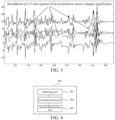
- FIG. 3 is a schematic curve diagram of accelerations of three axes of an acceleration sensor and resultant accelerations thereof when movement smoothness changes in a step counting method according to an embodiment of this application. It may be learnt from FIG. 3 that, a change in motion of a y-axis of the acceleration sensor is large.
- S 130 In a case that a change in motion of a user within a preset time period is greater than or equal to a preset variance threshold, determine a quantity of steps of the user within the preset time period based on a resultant acceleration of a first acceleration, a second acceleration, and a third acceleration within the preset time period and a gravitational acceleration.
- the change in motion of the user within the preset time period is greater than or equal to the preset variance threshold, it may be determined that the change in motion of the user within the preset time period is large.
- the quantity of steps of the user within the preset time period may be determined based on the resultant acceleration of the first acceleration, the second acceleration, and the third acceleration of the three axes within the preset time period.
- the determining a quantity of steps of the user within the preset time period based on a resultant acceleration of a first acceleration, a second acceleration, and a third acceleration within the preset time period and a gravitational acceleration includes:
- a sampling frequency is 25 Hz.
- a quantity of sampling points per second is 25, and considering that the user often completes a step within two seconds, a quantity of steps of the user within latest two seconds within the preset time period may be determined based on cubes of differences between resultant accelerations at 50 sampling points within the latest two seconds within the preset time period and the gravitational acceleration. It is assumed that the cubes that are of the differences between the resultant accelerations at the 50 sampling points within the latest two seconds within the preset time period and the gravitational acceleration and that are sorted based on an order of time are: 5, 25, 55, 90, 30, -20, -10, 8, 30, 70, -5, and the like.
- the determining the quantity of steps of the user within the preset time period based on a cube of a difference between each of the resultant accelerations at the plurality of sampling points within the preset time period and the gravitational acceleration includes:
- a sum of a last set of values that are positive and continuous in time is recorded as step N.
- a set threshold is 125
- a quantity that is greater than 125 in step 1 to step N may be considered as the quantity of steps of the user within the preset time period.
- a limit quantity of steps of a person during walking and running is four steps per second, if the quantity of steps exceeds eight steps within two seconds, an output is eight steps.
- the quantity of steps within the preset time period is greater than a value of the preset time period multiplied by four, the quantity of steps of the user within the preset time period is determined based on the quantity of steps within the preset time period multiplied by four.
- the actual quantity of steps of the user may be calculated in a normal step counting method.
- a low-pass filter may be used to filter accelerations of the three axes of the acceleration sensor and the resultant accelerations (four axes in total) thereof to obtain an output result; and then, features such as peaks, troughs, height differences, and time differences in accelerations of the four axes are searched after filtering is performed, and features such as a deviation of four adjacent peaks and troughs are calculated.
- a preset deviation threshold may be 0.15. If the diff is not greater than the preset deviation threshold, it may be determined that the actual quantity of steps of the user is calculated in the normal step counting method.
- the change in motion of the user may be determined based on the first acceleration, the second acceleration, and the third acceleration of the three axes of the acceleration sensor in the terminal device carried by the user.
- the change in motion is large, such as when the user hikes in the wilderness with a weak signal or performs some sports whose similarity of periodicities of steps is low, namely, sports with poor movement smoothness, such as mountain climbing, rock climbing, or walking on an uneven road
- the actual quantity of steps of the user within the preset time period may be determined directly based on resultant accelerations of accelerations of the three axes in the terminal device carried by the user within the preset time period and the gravitational acceleration.
- using the step counting method may further avoid the need to locate and identify the user by using a GPS module when a signal is weak. This reduces unnecessary power consumption.
- an execution entity may be a step counting apparatus.
- the step counting apparatus performs the step counting method is used as an example, to describe the step counting apparatus provided in embodiments of this application.
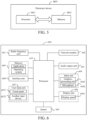
- FIG. 4 is a schematic diagram of a structure of a step counting apparatus 400 according to an embodiment of this application. The following components are included.
- An obtaining unit 401 is configured to obtain a first acceleration, a second acceleration, and a third acceleration of three axes of an acceleration sensor in a terminal device within a preset time period, where the first acceleration, the second acceleration, and the third acceleration are perpendicular to each other in an acceleration direction;
- the second determining unit 403 is configured to:
- the second determining unit 403 is configured to:
- the first determining unit 402 is configured to:
- the first determining unit 402 is configured to:
- the first determining unit 402 is configured to:
- the change in motion of the user may be determined based on the first acceleration, the second acceleration, and the third acceleration of the three axes of the acceleration sensor in the terminal device carried by the user.
- the change in motion is large, such as when the user hikes in the wilderness with a weak signal or performs some sports whose similarity of periodicities of steps is low, namely, sports with poor movement smoothness, such as mountain climbing, rock climbing, or walking on an uneven road
- the actual quantity of steps of the user within the preset time period may be determined directly based on resultant accelerations of accelerations of the three axes in the terminal device carried by the user within the preset time period and the gravitational acceleration.
- using the step counting method may further avoid the need to locate and identify the user by using a GPS module when a signal is weak. This reduces unnecessary power consumption.
- the step counting apparatus in embodiments of this application may be an electronic device, or may be a component in the electronic device, for example, an integrated circuit or a chip.
- the electronic device may be a terminal, or may be a device other than the terminal.
- the electronic device may be a mobile phone, a tablet computer, a notebook computer, a handheld computer, a vehicle-mounted electronic device, a mobile internet device (Mobile Internet Device, MID), an augmented reality (augmented reality, AR)/virtual reality (virtual reality, VR) device, a robot, a wearable device, an ultra-mobile personal computer (ultra-mobile personal computer, UMPC), a netbook, a personal digital assistant (personal digital assistant, PDA), or the like, or the electronic device may be a server, a network attached storage (network attached storage, NAS), a personal computer (personal computer, PC), a television (television, TV), a cash machine, a self-service machine, or the like. This is not specifically limited in embodiments of this application.
- the step counting apparatus in embodiments of this application may be an apparatus having an operating system.
- the operating system may be an Android (Android) operating system, may be an ios operating system, or may be another possible operating system. This is not specifically limited in embodiments of this application.
- the step counting apparatus provided in embodiments of this application may implement various processes of the method embodiments in FIG. 1 to FIG. 3 . This is not described in detail herein again to avoid repetition.
- embodiments of this application further provide an electronic device M05, including a processor M51, a memory M52.
- the memory M52 stores a program or an instruction executable on the processor M51, and the program or the instruction, when executed by the processor M51, implement the various processes of the step counting method embodiment, and may implement the same technical effect. This is not described in detail herein again to avoid repetition.
- the electronic device in embodiments of this application includes the mobile electronic device and the non-mobile electronic device.
- FIG. 6 is a schematic diagram of a hardware structure of an electronic device according to an embodiment of this application.
- the electronic device 600 includes, but is not limited to, components such as a radio frequency unit 601, a network module 602, an audio output unit 603, an input unit 604, a sensor 605, a display unit 606, a user input unit 607, an interface unit 608, a memory 609, and a processor 610.
- components such as a radio frequency unit 601, a network module 602, an audio output unit 603, an input unit 604, a sensor 605, a display unit 606, a user input unit 607, an interface unit 608, a memory 609, and a processor 610.
- the electronic device 600 may further include the power supply (such as a battery) for supplying power to the components.
- the power supply may be logically connected to the processor 610 by a power management system, thereby implementing functions such as charging, discharging, and power consumption management by using the power management system.
- An electronic structure shown in FIG. 6 does not constitute a limitation to the electronic device, and the electronic device may include more or fewer components than those shown in the figure, or some components may be combined, or a different component deployment may be used, and details are not repeated.
- the processor 610 obtains a first acceleration, a second acceleration, and a third acceleration of three axes of an acceleration sensor in a terminal device within a preset time period, where the first acceleration, the second acceleration, and the third acceleration are perpendicular to each other in an acceleration direction; determines a change in motion of a user within the preset time period based on the first acceleration, the second acceleration, and the third acceleration within the preset time period; and in a case that the change in motion of the user within the preset time period is greater than or equal to a preset variance threshold, determines a quantity of steps of the user within the preset time period based on a resultant acceleration of the first acceleration, the second acceleration, and the third acceleration within the preset time period and a gravitational acceleration.
- the processor 610 is further configured to: determine resultant accelerations of first accelerations, second accelerations, and third accelerations at a plurality of sampling points within the preset time period; and determine the quantity of steps of the user within the preset time period based on a cube of a difference between each of the resultant accelerations at the plurality of sampling points within the preset time period and the gravitational acceleration.
- the processor 610 is further configured to: determine a plurality of sets of values that are positive and continuous in time from the cube of the difference between each of resultant accelerations at the plurality of sampling points within the preset time period and the gravitational acceleration; determine, from the plurality of sets of values, a quantity of target sets of values among which a sum of each set of values is greater than a set threshold; and determine the quantity of steps of the user within the preset time period based on the quantity of target sets of values.
- the processor 610 is further configured to: determine a resultant acceleration of a first acceleration, a second acceleration, and a third acceleration at a designated sampling point within the preset time period based on the first acceleration, the second acceleration, and the third acceleration within the preset time period; determine, based on the resultant acceleration at the designated sampling point within the preset time period, whether the user performs a jumping action within the preset time period; and in a case that the user performs the jumping action within the preset time period, determine the change in motion of the user within the preset time period based on the first acceleration, the second acceleration, and the third acceleration within the preset time period.
- the processor 610 is further configured to: determine first accelerations, second accelerations, and third accelerations at a plurality of sampling points from the first acceleration, the second acceleration, and the third acceleration within the preset time period, where the plurality of sampling points are evenly distributed within the preset time period; determine resultant accelerations of the first accelerations, the second accelerations, and the third accelerations at the plurality of sampling points based on the first accelerations, the second accelerations, and the third accelerations at the plurality of sampling points; determine a variance of first-order differences of the resultant accelerations at the plurality of sampling points; and determine the change in motion of the user within the preset time period based on the variance of the first-order differences of the resultant accelerations at the plurality of sampling points.
- the processor 610 is further configured to: determine movement energy at a designated moment based on a resultant acceleration at a designated quantity of designated sampling points, where the designated quantity of designated sampling points is a sampling point before the designated moment within the preset time period; and in a case that the movement energy at the designated moment is greater than or equal to a preset energy threshold and a second-order difference of a resultant acceleration at the designated moment is not greater than a preset threshold, determine, based on movement energy at a sampling point within a preset time range before and after the designated moment, whether the user performs the jumping action within the preset time period.
- the change in motion of the user may be determined based on the first acceleration, the second acceleration, and the third acceleration of the three axes of the acceleration sensor in the terminal device carried by the user.
- the change in motion is large, such as when the user hikes in the wilderness with a weak signal or performs some sports whose similarity of periodicities of steps is low, namely, sports with poor movement smoothness, such as mountain climbing, rock climbing, or walking on an uneven road
- the actual quantity of steps of the user within the preset time period may be determined directly based on resultant accelerations of accelerations of the three axes in the terminal device carried by the user within the preset time period and the gravitational acceleration.
- using the step counting method may further avoid the need to locate and identify the user by using a GPS module when a signal is weak. This reduces unnecessary power consumption.
- the input unit 604 may include a graphics processing unit (Graphics Processing Unit, GPU) 6041 and a microphone 6042.
- the graphics processing unit 6041 performs processing on image data of a static picture or a video that is obtained by an image acquisition apparatus (for example, a camera) in a video acquisition mode or an image acquisition mode.
- the display unit 606 may include a display panel 6061, and the display panel 6061 may be configured by using a liquid crystal display, an organic light-emitting diode, or the like.
- the user input unit 607 includes at least one of a touch panel 6071 and another input device 6072.
- the touch panel 6071 is also referred to as a touchscreen.
- the touch panel 6071 may include two parts: a touch detection apparatus and a touch processor.
- the another input device 6072 may include, but not limited to, a physical keyboard, a functional key (such as a volume control key or a switch key), a track ball, a mouse, and a joystick, which are not described herein in detail.
- the memory 609 may be configured to store a software program and various data.
- the memory 609 may mainly include a first storage area storing a program or an instruction and a second storage area storing data.
- the first storage area may store an operating system, an application program or an instruction required by at least one function (such as a sound playback function and an image display function), and the like.
- the memory 609 may include a volatile memory or a non-volatile memory, or the memory 609 may include both a volatile memory and a non-volatile memory.
- the non-volatile memory may be a read-only memory (Read-Only Memory, ROM), a programmable read-only memory (Programmable ROM, PROM), an erasable programmable read-only memory (Erasable PROM, EPROM), an electrically erasable programmable read-only memory (Electrically EPROM, EEPROM), or a flash memory.
- ROM Read-Only Memory
- PROM programmable read-only memory
- Erasable PROM Erasable PROM
- EPROM electrically erasable programmable read-only memory
- EEPROM electrically erasable programmable read-only memory
- the volatile memory may be a random access memory (Random Access Memory, RAM), a static random access memory (Static RAM, SRAM), a dynamic random access memory (Dynamic RAM, DRAM), a synchronous dynamic random access memory (Synchronous DRAM, SDRAM), a double data rate synchronous dynamic random access memory (Double Data Rate SDRAM, DDRSDRAM), an enhanced synchronous dynamic random access memory (Enhanced SDRAM, ESDRAM), a synch link dynamic random access memory (Synch link DRAM, SLDRAM), and a direct rambus random access memory (Direct Rambus RAM, DR RAM).
- RAM Random Access Memory
- SRAM static random access memory
- DRAM dynamic random access memory
- DRAM synchronous dynamic random access memory
- SDRAM double data rate synchronous dynamic random access memory
- Enhanced SDRAM, ESDRAM enhanced synchronous dynamic random access memory
- Synch link DRAM, SLDRAM synch link dynamic random access memory
- Direct Rambus RAM Direct Rambus RAM, DR RAM
- the processor 610 may include one or more processing units; and optionally, the processor 610 integrates an application processor and a modem processor.
- the application processor mainly processes operations relating to an operating system, a user interface, an application program, and the like.
- the modem processor mainly processes a wireless communication signal, such as a baseband processor. It may be understood that, the foregoing modem processor may also not be integrated into the processor 610.
- Embodiments of this application further provide a readable storage medium, where the readable storage medium stores a program or an instruction.
- the program or the instruction when executed by a processor, implements various processes of the step counting method embodiment, and may implement the same technical effect. This is not described in detail herein again to avoid repetition.
- the processor is a processor in the electronic device described in the foregoing embodiment.
- the readable storage medium includes a computer-readable storage medium, for example, a read-only memory (Read-Only Memory, ROM), a random access memory (Random Access Memory, RAM), a magnetic disk, or an optical disc.
- Embodiments of this application further provide a chip.
- the chip includes a processor and a communication interface.
- the communication interface is coupled to the processor.
- the processor is configured to run a program or an instruction, to implement various processes of the step counting method embodiment, and may implement the same technical effect. This is not described in detail herein again to avoid repetition.
- the chip mentioned in embodiments of this application may be further referred to as a system-level chip, a system chip, a chip system, a system-on-chip, or the like.
- Embodiments of this application provide a computer program product, where the program product is stored in a storage medium, and the program product is executed by at least one processor, to implement various processes of the step counting method embodiment, and may implement the same technical effect. This is not described in detail herein again to avoid repetition.
- the foregoing embodiment methods may be implemented by using software in combination with a necessary universal hardware platform. Certainly, the embodiment methods may also be implemented by using hardware, but the former is a better implementation in many cases. Based on such an understanding, the technical solutions of this application essentially, or the part contributing to the related art, may be presented in the form of a computer software product.
- the computer software product is stored in a storage medium (for example, a ROM/RAM, a magnetic disk, or an optical disc) including several instructions to enable a terminal (which may be a mobile phone, a computer, a server, an air conditioner, a network device, or the like) to perform the methods described in embodiments of this application.
Landscapes
- Health & Medical Sciences (AREA)
- Engineering & Computer Science (AREA)
- Physics & Mathematics (AREA)
- General Physics & Mathematics (AREA)
- Radar, Positioning & Navigation (AREA)
- Remote Sensing (AREA)
- Life Sciences & Earth Sciences (AREA)
- Biophysics (AREA)
- Medical Informatics (AREA)
- Dentistry (AREA)
- Physiology (AREA)
- Pathology (AREA)
- Biomedical Technology (AREA)
- Heart & Thoracic Surgery (AREA)
- Oral & Maxillofacial Surgery (AREA)
- Molecular Biology (AREA)
- Surgery (AREA)
- Animal Behavior & Ethology (AREA)
- General Health & Medical Sciences (AREA)
- Public Health (AREA)
- Veterinary Medicine (AREA)
- Measurement Of The Respiration, Hearing Ability, Form, And Blood Characteristics Of Living Organisms (AREA)
Abstract
Description
- The present invention claims priority to
Chinese Patent Application No. 202210329620.4, entitled "STEP COUNTING METHOD AND APPARATUS", and filed with the China National Intellectual Property Administration on March 31, 2022 - This application belongs to the field of terminal technologies, and specifically, to a step counting method and apparatus.
- An existing step counting algorithm usually collects, by using an acceleration sensor, acceleration data when a user walks, and calculates a quantity of walking steps of the user based on the collected acceleration data. When the user walks or runs on a flat road, since similarity of periodicities of adjacent steps of the user is high, the quantity of walking steps of the user may be calculated with reference to similarity of periodicities of four steps in the acceleration data. In addition, impulses of three axes of an acceleration in the collected acceleration data are stable and do not frequently change directions and turns. In this type of scenario, the quantity of steps calculated by using the existing step counting algorithm is accurate.
- But in some special scenarios, such as mountain climbing, rock climbing, walking on an uneven road, or hiking in the wilderness with a weak signal, similarity of periodicities of steps of the user is very low. As a result, accuracy of a quantity of steps calculated by using the existing step counting algorithm is low.
- In a process of implementing this application, the inventor discovers that there are at least the following problems in the conventional technology: An existing step counting method has shortcomings such as low accuracy of a calculated quantity of steps and high power consumption in some scenarios such as mountain climbing, rock climbing, walking on an uneven road, or hiking in the wilderness with a weak signal.
- Embodiments of this application provide a step counting method and apparatus, to resolve problems such as low accuracy of a calculated quantity of steps and high power consumption in some scenarios such as mountain climbing, rock climbing, walking on an uneven road, or hiking in the wilderness with a weak signal that an existing step counting method has.
- To resolve the foregoing technical problems, this application is implemented as follows:
- According to a first aspect, an embodiment of this application provides a step counting method, including:
- obtaining a first acceleration, a second acceleration, and a third acceleration of three axes of an acceleration sensor in a terminal device within a preset time period, where the first acceleration, the second acceleration, and the third acceleration are perpendicular to each other in an acceleration direction;
- determining a change in motion of a user within the preset time period based on the first acceleration, the second acceleration, and the third acceleration within the preset time period; and
- in a case that the change in motion of the user within the preset time period is greater than or equal to a preset variance threshold, determining a quantity of steps of the user within the preset time period based on a resultant acceleration of the first acceleration, the second acceleration, and the third acceleration within the preset time period and a gravitational acceleration.
- According to a second aspect, an embodiment of this application further provides a step counting apparatus, including:
- an obtaining unit, configured to obtain a first acceleration, a second acceleration, and a third acceleration of three axes of an acceleration sensor in a terminal device within a preset time period, where the first acceleration, the second acceleration, and the third acceleration are perpendicular to each other in an acceleration direction;
- a first determining unit, configured to determine a change in motion of a user within the preset time period based on the first acceleration, the second acceleration, and the third acceleration within the preset time period; and
- a second determining unit, configured to: in a case that the change in motion of the user within the preset time period is greater than or equal to a preset variance threshold, determine a quantity of steps of the user within the preset time period based on a resultant acceleration of the first acceleration, the second acceleration, and the third acceleration within the preset time period and a gravitational acceleration.
- According to a third aspect, an embodiment of this application provides an electronic device, where the electronic device includes a processor and a memory, the memory stores a program or an instruction executable on the processor, and the program or the instruction, when executed by the processor, implement the steps of the step counting method according to the first aspect.
- According to a fourth aspect, an embodiment of this application provides a readable storage medium, where the readable storage medium stores a program or an instruction, and the program or the instruction, when executed by a processor, implement the steps of the step counting method according to the first aspect.
- According to a fifth aspect, an embodiment of this application provides a chip, where the chip includes a processor and a communication interface, the communication interface is coupled to the processor, and the processor is configured to run a program or an instruction, to implement the step counting method according to the first aspect.
- According to a sixth aspect, an embodiment of this application provides a computer program product, where the program product is stored in a storage medium, and the program product is executed by at least one processor, to implement the step counting method according to the first aspect.
- In embodiments of this application, the change in motion of the user may be determined based on the first acceleration, the second acceleration, and the third acceleration of the three axes of the acceleration sensor in the terminal device carried by the user. In addition, when the change in motion is large, such as when the user hikes in the wilderness with a weak signal or performs some sports whose similarity of periodicities of steps is low, namely, sports with poor movement smoothness, such as mountain climbing, rock climbing, or walking on an uneven road, the actual quantity of steps of the user within the preset time period may be determined directly based on resultant accelerations of accelerations of the three axes in the terminal device carried by the user within the preset time period and the gravitational acceleration. In addition, using the step counting method may further avoid the need to locate and identify the user by using a GPS module when a signal is weak. This reduces unnecessary power consumption.
- To describe the technical solutions in embodiments of this application more clearly, the following briefly describes the accompanying drawings for describing embodiments of this application. It is clear that the accompanying drawings in the following description show merely some embodiments of this application, and a person of ordinary skill in the art may still derive other drawings from these accompanying drawings without creative efforts.
-
FIG. 1 is a schematic flowchart of implementation of a step counting method according to an embodiment of this application; -
FIG. 2 is a schematic curve diagram of accelerations of three axes of an acceleration sensor and resultant accelerations thereof when a user performs a jumping action in a step counting method according to an embodiment of this application; -
FIG. 3 is a schematic curve diagram of accelerations of three axes of an acceleration sensor and resultant accelerations thereof when movement smoothness changes in a step counting method according to an embodiment of this application; -
FIG. 4 is a schematic diagram of a structure of a step counting apparatus according to an embodiment of this application; -
FIG. 5 is a schematic diagram of a hardware structure of an electronic device according to an embodiment of this application; and -
FIG. 6 is a schematic diagram of a structure of an electronic device according to an embodiment of this application. - The technical solutions in embodiments of this application are clearly described below with reference to the accompanying drawings in embodiments of this application. Apparently, the described embodiments are merely some rather than all of embodiments of this application. All other embodiments obtained by a person of ordinary skill in the art based on embodiments of this application shall fall within the protection scope of this application.
- The specification and claims of this application, and terms "first" and "second" are used to distinguish similar objects, but are unnecessarily used to describe a specific sequence or order. It may be understood that the data used in such a way is interchangeable in proper circumstances, so that embodiments of this application can be implemented in other sequences than the sequence illustrated or described herein. In addition, objects distinguished by "first" and "second" are usually of a type, and the number of objects is not limited. For example, a first object may be one or more than one. In addition, in the specification and claims, "and/or" means at least one of the connected objects, and the character "/" generally indicates an "or" relationship between associated objects.
- A step counting method provided in embodiments of this application is described in detail below by using specific embodiments and application scenarios with reference to the accompanying drawings.
- To resolve problems such as low accuracy of a calculated quantity of steps and high power consumption in some scenarios such as mountain climbing, rock climbing, walking on an uneven road, or hiking in the wilderness with a weak signal that an existing step counting method has, this application provides a step counting method. An execution entity of the method may be, but is not limited to, a wearable device such as a smart bracelet or a smart watch, or at least one of user terminals such as a mobile phone and a tablet computer that can be configured to perform the method provided in embodiments of this application.
- For ease of description, an implementation of the method is introduced below by using an example in which the execution entity of the method is a terminal device that can perform the method. It may be understood that, the execution entity of the method being a terminal device is merely an example description, and should not be understood as a limitation to the method.
- Specifically, the step counting method provided in this application includes: first, obtaining a first acceleration, a second acceleration, and a third acceleration of three axes of an acceleration sensor in a terminal device within a preset time period, where the first acceleration, the second acceleration, and the third acceleration are perpendicular to each other in an acceleration direction; then, determining a change in motion of a user within the preset time period based on the first acceleration, the second acceleration, and the third acceleration within the preset time period; and finally, in a case that the change in motion of the user within the preset time period is greater than or equal to a preset variance threshold, determining a quantity of steps of the user within the preset time period based on a resultant acceleration of the first acceleration, the second acceleration, and the third acceleration within the preset time period and a gravitational acceleration.
- In embodiments of this application, the change in motion of the user may be determined based on the first acceleration, the second acceleration, and the third acceleration of the three axes of the acceleration sensor in the terminal device carried by the user. In addition, when the change in motion is large, such as when the user hikes in the wilderness with a weak signal or performs some sports whose similarity of periodicities of steps is low, namely, sports with poor movement smoothness, such as mountain climbing, rock climbing, or walking on an uneven road, the actual quantity of steps of the user within the preset time period may be determined directly based on resultant accelerations of accelerations of the three axes in the terminal device carried by the user within the preset time period and the gravitational acceleration. In addition, using the step counting method may further avoid the need to locate and identify the user by using a global positioning system (Global Positioning System, GPS) module when a signal is weak. This reduces unnecessary power consumption.
- The following describes an implementation process of the method in detail with reference to a schematic flowchart of specific implementation of the step counting method shown in
FIG. 1 . The following steps are included. - S110: Obtain a first acceleration, a second acceleration, and a third acceleration of three axes of an acceleration sensor in a terminal device within a preset time period, where the first acceleration, the second acceleration, and the third acceleration are perpendicular to each other in an acceleration direction.
- Specifically, the first acceleration, the second acceleration, and the third acceleration of the three axes of the acceleration sensor may be accelerations of x, y, and z axes respectively of the acceleration sensor.
- It should be understood that, when the user performs some sports such as mountain climbing, rock climbing, or walking on an uneven road whose similarity of periodicities of steps is low, it is often difficult to accurately calculate the actual quantity of steps of the user in an existing manner of calculating the quantity of steps by using the similarity of the periodicities of the adjacent steps. In embodiments of this application, to resolve this problem, the first acceleration, the second acceleration, and the third acceleration of the three axes of the acceleration sensor in the terminal device of the user within a latest preset time period may be obtained, for example, the first acceleration, the second acceleration, and the third acceleration of the three axes of the acceleration sensor within latest 20s may be obtained, to determine whether the user performs a jumping action, and then determine movement smoothness of the user. In this way, it is determined whether to calculate the quantity of steps by using the similarity of the periodicities of the adjacent steps, or to calculate the quantity of steps by using the step counting method proposed in embodiments of this application.
- S120: Determine a change in motion of the user within the preset time period based on the first acceleration, the second acceleration, and the third acceleration within the preset time period.
- It should be understood that, when the user performs sports such as mountain climbing, rock climbing, or walking on an uneven road whose similarity of periodicities of steps is low, the movement stability of the user is often poor. In embodiments of this application, on this basis, the change in motion of the user within the preset time period is determined based on the first acceleration, the second acceleration, and the third acceleration of the three axes within the preset time period, and then the step counting method is determined, to more accurately calculate the actual quantity of steps of the user.
- Optionally, when performing some sports whose similarity of periodicities of steps is low, the user often performs some intermittent jumping actions. In other words, when the user performs the jumping actions, possibility that the movement smoothness of the user is poor is also great. In embodiments of this application, on this basis, whether the user performs some jumping actions within the preset time period may be first determined, and then the movement smoothness of the user within the preset time period is further determined after determining that the user may perform some jumping actions. The determining a change in motion of the user within the preset time period based on the first acceleration, the second acceleration, and the third acceleration within the preset time period includes:
- determining a resultant acceleration of a first acceleration, a second acceleration, and a third acceleration at a designated sampling point within the preset time period based on the first acceleration, the second acceleration, and the third acceleration within the preset time period;
- determining, based on the resultant acceleration at the designated sampling point within the preset time period, whether the user performs a jumping action within the preset time period; and
- in a case that the user performs the jumping action within the preset time period, determining the change in motion of the user within the preset time period based on the first acceleration, the second acceleration, and the third acceleration within the preset time period.
- The resultant acceleration of the first acceleration, the second acceleration, and the third acceleration at the designated sampling point within the preset time period is determined based on the first acceleration x, the second acceleration y, and the third acceleration z within the preset time period. Specifically, the resultant acceleration may be obtained by taking a root of a sum of squares of the first acceleration, the second acceleration, and the third acceleration at the designated sampling point within the preset time period. In other words, the resultant acceleration of the first acceleration, the second acceleration, and the third acceleration at each of the designated sampling points within the preset time period is

- Optionally, the determining, based on the resultant acceleration at the designated sampling point within the preset time period, whether the user performs a jumping action within the preset time period includes:
- determining movement energy at a designated moment based on a resultant acceleration at a designated quantity of designated sampling points, where the designated quantity of designated sampling points is a sampling point before the designated moment within the preset time period; and
- in a case that the movement energy at the designated moment is greater than or equal to a preset energy threshold and a second-order difference of a resultant acceleration at the designated moment is not greater than a preset threshold, determining, based on movement energy at a sampling point within a preset time range before and after the designated moment, whether the user performs the jumping action within the preset time period.
- It should be understood that, when the terminal device is in a static state or a smooth movement state, a value of the resultant acceleration of the first acceleration, the second acceleration, and the third acceleration of the three axes of the acceleration sensor in the terminal device should be consistent with a value of a gravitational acceleration. To accurately determine movement smoothness of the terminal device, the gravitational acceleration may be subtracted from the resultant acceleration of the first acceleration, the second acceleration, and the third acceleration of the three axes to obtain a difference between the resultant acceleration and the gravitational acceleration, and then determining is further performed on the difference.
- For example, the movement energy at the designated moment may be defined as an average value of a square of a difference between resultant accelerations of first accelerations, second accelerations, and third accelerations of three axes at the first eight sampling points that are adjacent to the designated moment and the gravitational acceleration. Specifically, the first accelerations, the second accelerations, and the third accelerations of the three axes at the first eight sampling points are respectively expressed as (x1, y1, z1), (x2, y2, z2), ..., and (x8, y8, z8). The resultant accelerations of the first accelerations, the second accelerations, and the third accelerations of the three axes at the first eight sampling points that are adjacent to the designated moment are


- For example, if the movement energy at the designated moment is greater than or equal to the preset energy threshold and the second-order difference of the resultant acceleration at the designated moment is not greater than the preset threshold, the movement energy at the sampling point within the preset time range before and after the designated moment is determined. Specifically, the preset energy threshold may be set to 20, and the preset threshold may be set to -10. The second-order difference of the resultant acceleration at the designated moment is a first-order difference of a first-order difference of the resultant acceleration at the designated moment. The first-order difference of the resultant acceleration at the designated moment is a previous resultant acceleration at the designated moment minus the resultant acceleration at the designated moment. The second-order difference of the resultant acceleration at the designated moment is a first-order difference of the previous resultant acceleration at the designated moment minus the first-order difference of the resultant acceleration at the designated moment.
- For example, determining the movement energy at the sampling point within the preset time range before and after the designated moment may specifically determine movement energy at a sampling point within a preset range before and after the designated moment. For example, if the preset time range is 3s and a sampling frequency is 25 Hz, there are 25 sampling points per second, and the movement energy at the sampling point within the preset time range before and after the designated moment is movement energy at 75 sampling points within 3 seconds before and after the designated moment.
- It should be understood that, within the preset time range before and after the user performs a jumping action, the user is often in a static or slightly fluctuating state. Therefore, whether the user is in a state of performing a jumping action at the designated moment may be determined based on a fluctuation amplitude of the movement energy at the sampling point within the preset time range before and after the designated moment. For example, whether the user is in the state of performing the jumping action at the designated moment may be determined based on a quantity of sampling points whose movement energy is less than 0.5 among the 75 sampling points within the 3 seconds before and after the designated moment. Specifically, it may be set that the quantity of sampling points whose movement energy is less than 0.5 among the 75 sampling points within the 3 seconds before and after the designated moment is greater than or equal to 15. In other words, it is determined whether the user is in the state of performing the jumping action at the designated moment.
FIG. 2 is a schematic curve diagram of a first acceleration, a second acceleration, and a third acceleration of three axes of an acceleration sensor and resultant accelerations thereof when a user performs a jumping action in a step counting method according to an embodiment of this application. InFIG. 2 , it may be learnt that an acceleration value of the user is stable in a period of time before and after the user performs the jumping action, that is, a change in motion is small. - Optionally, the determining a change in motion of the user within the preset time period based on the first acceleration, the second acceleration, and the third acceleration within the preset time period includes:
- determining first accelerations, second accelerations, and third accelerations at a plurality of sampling points from the first acceleration, the second acceleration, and the third acceleration within the preset time period, where the plurality of sampling points are evenly distributed within the preset time period;
- determining resultant accelerations of the first accelerations, the second accelerations, and the third accelerations at the plurality of sampling points based on the first accelerations, the second accelerations, and the third accelerations at the plurality of sampling points;
- determining a variance of a first-order difference of the resultant accelerations at the plurality of sampling points; and
- determining the change in motion of the user within the preset time period based on the variance of the first-order differences of the resultant accelerations at the plurality of sampling points.
- For example, the first accelerations, the second accelerations, and the third accelerations of the three axes at the plurality of sampling points are determined from the first acceleration, the second acceleration, and the third acceleration of the three axes within the preset time period. Specifically, the first accelerations, the second accelerations, and the third accelerations of the three axes at the plurality of sampling points (such as 10 sampling points) in a latest period of time (such as within 20s) may be determined from the first acceleration, the second acceleration, and the third acceleration of the three axes within the preset time period. For example, accelerations (Ax1, Ax2, ..., and Ax10, Ay1, Ay2, ..., and Ay10, Az1, Az2, ..., and Az10) of the three axes every 2s in the latest 20s may be determined. Considering that it often takes 2s for a common user to take a complete step, an interval of 2s may be selected as one sampling point.
- Then, based on the first accelerations, the second accelerations, and the third accelerations (Ax1, Ax2, ..., and Ax10, Ay1, Ay2, ..., and Ay10, Az1, Az2, ..., and Az10) of the three axes at the foregoing 10 sampling points, the resultant accelerations (Aa1, Aa2, ..., and Aa10) of the first accelerations, the second accelerations, and the third accelerations of the three axes at the plurality of sampling points are determined, where


- The determining the change in motion of the user within the preset time period based on the variance of the first-order differences of the resultant accelerations of the first accelerations, the second accelerations, and the third accelerations of the three axes at the plurality of sampling points includes:
- determining that the change in motion of the user within the preset time period is great in a case that the variance of the first-order differences of the resultant accelerations of the first accelerations, the second accelerations, and the third accelerations of the three axes at the plurality of sampling points is greater than a preset variance threshold;
- determining a relationship between the variance of the first-order differences of the first accelerations, the second accelerations, and the third accelerations of the three axes at the plurality of sampling points and corresponding preset variance thresholds of the three axes in a case that the variance of the first-order differences of the resultant accelerations of the first accelerations, the second accelerations, and the third accelerations of the three axes at the plurality of sampling points is less than the preset variance threshold; and
- determining that the change in motion of the user within the preset time period is great in a case that in the variance of the first-order differences of the first accelerations, the second accelerations, and the third accelerations of the three axes at the plurality of sampling points, there is a variance of first-order differences of accelerations of one or more axes that is greater than the corresponding preset variance threshold.
- Based on the corresponding preset variance thresholds of the three axes, one variance threshold may be set for each axis. In other words, a preset variance threshold of an x-axis, a preset variance threshold of a y-axis, and a preset variance threshold of a z-axis may be set respectively, or a unified preset variance threshold may be set, which may be set based on an actual situation.
FIG. 3 is a schematic curve diagram of accelerations of three axes of an acceleration sensor and resultant accelerations thereof when movement smoothness changes in a step counting method according to an embodiment of this application. It may be learnt fromFIG. 3 that, a change in motion of a y-axis of the acceleration sensor is large. - S 130: In a case that a change in motion of a user within a preset time period is greater than or equal to a preset variance threshold, determine a quantity of steps of the user within the preset time period based on a resultant acceleration of a first acceleration, a second acceleration, and a third acceleration within the preset time period and a gravitational acceleration.
- Specifically, if the change in motion of the user within the preset time period is greater than or equal to the preset variance threshold, it may be determined that the change in motion of the user within the preset time period is large. In this case, the quantity of steps of the user within the preset time period may be determined based on the resultant acceleration of the first acceleration, the second acceleration, and the third acceleration of the three axes within the preset time period.
- Optionally, the determining a quantity of steps of the user within the preset time period based on a resultant acceleration of a first acceleration, a second acceleration, and a third acceleration within the preset time period and a gravitational acceleration includes:
- determining resultant accelerations of first accelerations, second accelerations, and third accelerations at a plurality of sampling points within the preset time period; and
- determining the quantity of steps of the user within the preset time period based on a cube of a difference between each of the resultant accelerations at the plurality of sampling points within the preset time period and the gravitational acceleration.
- For example, an example in which a sampling frequency is 25 Hz is used. A quantity of sampling points per second is 25, and considering that the user often completes a step within two seconds, a quantity of steps of the user within latest two seconds within the preset time period may be determined based on cubes of differences between resultant accelerations at 50 sampling points within the latest two seconds within the preset time period and the gravitational acceleration. It is assumed that the cubes that are of the differences between the resultant accelerations at the 50 sampling points within the latest two seconds within the preset time period and the gravitational acceleration and that are sorted based on an order of time are: 5, 25, 55, 90, 30, -20, -10, 8, 30, 70, -5, and the like.
- Optionally, the determining the quantity of steps of the user within the preset time period based on a cube of a difference between each of the resultant accelerations at the plurality of sampling points within the preset time period and the gravitational acceleration includes:
- determining a plurality of sets of values that are positive and continuous in time from the cube of the difference between each of the resultant accelerations at the plurality of sampling points within the preset time period and the gravitational acceleration;
- determining, from the plurality of sets of values, a quantity of target sets of values among which a sum of each set of values is greater than a set threshold; and
- determining the quantity of steps of the user within the preset time period based on the quantity of target sets of values.
- After obtaining the cubes that are of the differences between the resultant accelerations at the 50 sampling points within the latest two seconds within the preset time period and the gravitational acceleration and that are sorted based on an order of time being: 5, 25, 55, 90, 30, -20, -10, 8, 30, 70, -5, and the like, a sum of a first set of values that are positive and continuous in time is 5+25+55+90+30=205, which is recorded as step 1, a sum of a second set of values that are positive and continuous in time is 8+30+70=108, which is recorded as step 2, ..., and a sum of a last set of values that are positive and continuous in time is recorded as step N. Assuming that a set threshold is 125, a quantity that is greater than 125 in step 1 to step N may be considered as the quantity of steps of the user within the preset time period.
- Optionally, since a limit quantity of steps of a person during walking and running is four steps per second, if the quantity of steps exceeds eight steps within two seconds, an output is eight steps. In other words, if the quantity of steps within the preset time period is greater than a value of the preset time period multiplied by four, the quantity of steps of the user within the preset time period is determined based on the quantity of steps within the preset time period multiplied by four.
- Optionally, if the change in motion of the user within the preset time period is greater than or equal to the preset variance threshold, or the user does not perform a jumping action within the preset time period, the actual quantity of steps of the user may be calculated in a normal step counting method. Specifically, a low-pass filter may be used to filter accelerations of the three axes of the acceleration sensor and the resultant accelerations (four axes in total) thereof to obtain an output result; and then, features such as peaks, troughs, height differences, and time differences in accelerations of the four axes are searched after filtering is performed, and features such as a deviation of four adjacent peaks and troughs are calculated.
- In a calculation process of the deviation, a maximum value point and a minimum value point are respectively determined as a possible peak and a possible trough from acceleration data of the filtered four axes, then, a height increment dy1 (namely, an amplitude of the peak minus an amplitude of the trough) from the trough to the peak and a height increment dy2 from a next trough to a next peak are calculated, and then, an absolute value of a deviation diff=(dy2-dy1)/(dy2+dy1) is calculated. The greater the value of the deviation diff, the greater the deviation. For example, a preset deviation threshold may be 0.15. If the diff is not greater than the preset deviation threshold, it may be determined that the actual quantity of steps of the user is calculated in the normal step counting method.
- According to the step counting method provided in embodiments of this application, the change in motion of the user may be determined based on the first acceleration, the second acceleration, and the third acceleration of the three axes of the acceleration sensor in the terminal device carried by the user. In addition, when the change in motion is large, such as when the user hikes in the wilderness with a weak signal or performs some sports whose similarity of periodicities of steps is low, namely, sports with poor movement smoothness, such as mountain climbing, rock climbing, or walking on an uneven road, the actual quantity of steps of the user within the preset time period may be determined directly based on resultant accelerations of accelerations of the three axes in the terminal device carried by the user within the preset time period and the gravitational acceleration. In addition, using the step counting method may further avoid the need to locate and identify the user by using a GPS module when a signal is weak. This reduces unnecessary power consumption.
- It should be noted that, in the step counting method provided in embodiments of this application, an execution entity may be a step counting apparatus. In embodiments of this application, that the step counting apparatus performs the step counting method is used as an example, to describe the step counting apparatus provided in embodiments of this application.
-
FIG. 4 is a schematic diagram of a structure of astep counting apparatus 400 according to an embodiment of this application. The following components are included. - An obtaining
unit 401 is configured to obtain a first acceleration, a second acceleration, and a third acceleration of three axes of an acceleration sensor in a terminal device within a preset time period, where the first acceleration, the second acceleration, and the third acceleration are perpendicular to each other in an acceleration direction; - a first determining
unit 402 is configured to determine a change in motion of a user within the preset time period based on the first acceleration, the second acceleration, and the third acceleration within the preset time period; and - a second determining
unit 403 is configured to: in a case that the change in motion of the user within the preset time period is greater than or equal to a preset variance threshold, determine a quantity of steps of the user within the preset time period based on a resultant acceleration of the first acceleration, the second acceleration, and the third acceleration within the preset time period and a gravitational acceleration. - Optionally, in an implementation, the second determining
unit 403 is configured to: - determine resultant accelerations of first accelerations, second accelerations, and third accelerations at a plurality of sampling points within the preset time period; and
- determine the quantity of steps of the user within the preset time period based on a cube of a difference between each of the resultant accelerations at the plurality of sampling points within the preset time period and the gravitational acceleration.
- Optionally, in an implementation, the second determining
unit 403 is configured to: - determine a plurality of sets of values that are positive and continuous in time from the cube of the difference between each of the resultant accelerations at the plurality of sampling points within the preset time period and the gravitational acceleration;
- determine, from the plurality of sets of values, a quantity of target sets of values among which a sum of each set of values is greater than a set threshold; and
- determine the quantity of steps of the user within the preset time period based on the quantity of target sets of values.
- Optionally, in an implementation, the first determining
unit 402 is configured to: - determine a resultant acceleration of a first acceleration, a second acceleration, and a third acceleration at a designated sampling point within the preset time period based on the first acceleration, the second acceleration, and the third acceleration within the preset time period;
- determine, based on the resultant acceleration at the designated sampling point within the preset time period, whether the user performs a jumping action within the preset time period; and
- in a case that the user performs the jumping action within the preset time period, determine the change in motion of the user within the preset time period based on the first acceleration, the second acceleration, and the third acceleration within the preset time period.
- Optionally, in an implementation, the first determining
unit 402 is configured to: - determine first accelerations, second accelerations, and third accelerations at a plurality of sampling points from the first acceleration, the second acceleration, and the third acceleration within the preset time period, where the plurality of sampling points are evenly distributed within the preset time period;
- determine resultant accelerations of the first accelerations, the second accelerations, and the third accelerations at the plurality of sampling points based on the first accelerations, the second accelerations, and the third accelerations at the plurality of sampling points;
- determine a variance of first-order differences of the resultant accelerations at the plurality of sampling points; and
- determine the change in motion of the user within the preset time period based on the variance of the first-order differences of the resultant accelerations at the plurality of sampling points.
- Optionally, in an implementation, the first determining
unit 402 is configured to: - determine movement energy at a designated moment based on a resultant acceleration at a designated quantity of designated sampling points, where the designated quantity of designated sampling points is a sampling point before the designated moment within the preset time period; and
- in a case that the movement energy at the designated moment is greater than or equal to a preset energy threshold and a second-order difference of a resultant acceleration at the designated moment is not greater than a preset threshold, determine, based on movement energy at a sampling point within a preset time range before and after the designated moment, whether the user performs the jumping action within the preset time period.
- According to the step counting apparatus provided in embodiments of this application, the change in motion of the user may be determined based on the first acceleration, the second acceleration, and the third acceleration of the three axes of the acceleration sensor in the terminal device carried by the user. In addition, when the change in motion is large, such as when the user hikes in the wilderness with a weak signal or performs some sports whose similarity of periodicities of steps is low, namely, sports with poor movement smoothness, such as mountain climbing, rock climbing, or walking on an uneven road, the actual quantity of steps of the user within the preset time period may be determined directly based on resultant accelerations of accelerations of the three axes in the terminal device carried by the user within the preset time period and the gravitational acceleration. In addition, using the step counting method may further avoid the need to locate and identify the user by using a GPS module when a signal is weak. This reduces unnecessary power consumption.
- The step counting apparatus in embodiments of this application may be an electronic device, or may be a component in the electronic device, for example, an integrated circuit or a chip. The electronic device may be a terminal, or may be a device other than the terminal. For example, the electronic device may be a mobile phone, a tablet computer, a notebook computer, a handheld computer, a vehicle-mounted electronic device, a mobile internet device (Mobile Internet Device, MID), an augmented reality (augmented reality, AR)/virtual reality (virtual reality, VR) device, a robot, a wearable device, an ultra-mobile personal computer (ultra-mobile personal computer, UMPC), a netbook, a personal digital assistant (personal digital assistant, PDA), or the like, or the electronic device may be a server, a network attached storage (network attached storage, NAS), a personal computer (personal computer, PC), a television (television, TV), a cash machine, a self-service machine, or the like. This is not specifically limited in embodiments of this application.
- The step counting apparatus in embodiments of this application may be an apparatus having an operating system. The operating system may be an Android (Android) operating system, may be an ios operating system, or may be another possible operating system. This is not specifically limited in embodiments of this application.
- The step counting apparatus provided in embodiments of this application may implement various processes of the method embodiments in
FIG. 1 to FIG. 3 . This is not described in detail herein again to avoid repetition. - Optionally, as shown in
FIG. 5 , embodiments of this application further provide an electronic device M05, including a processor M51, a memory M52. The memory M52 stores a program or an instruction executable on the processor M51, and the program or the instruction, when executed by the processor M51, implement the various processes of the step counting method embodiment, and may implement the same technical effect. This is not described in detail herein again to avoid repetition. - It should be noted that, the electronic device in embodiments of this application includes the mobile electronic device and the non-mobile electronic device.
-
FIG. 6 is a schematic diagram of a hardware structure of an electronic device according to an embodiment of this application. - The
electronic device 600 includes, but is not limited to, components such as aradio frequency unit 601, anetwork module 602, anaudio output unit 603, aninput unit 604, asensor 605, adisplay unit 606, a user input unit 607, aninterface unit 608, amemory 609, and aprocessor 610. - A person skilled in the art may understand that the
electronic device 600 may further include the power supply (such as a battery) for supplying power to the components. The power supply may be logically connected to theprocessor 610 by a power management system, thereby implementing functions such as charging, discharging, and power consumption management by using the power management system. An electronic structure shown inFIG. 6 does not constitute a limitation to the electronic device, and the electronic device may include more or fewer components than those shown in the figure, or some components may be combined, or a different component deployment may be used, and details are not repeated. - The
processor 610 obtains a first acceleration, a second acceleration, and a third acceleration of three axes of an acceleration sensor in a terminal device within a preset time period, where the first acceleration, the second acceleration, and the third acceleration are perpendicular to each other in an acceleration direction; determines a change in motion of a user within the preset time period based on the first acceleration, the second acceleration, and the third acceleration within the preset time period; and in a case that the change in motion of the user within the preset time period is greater than or equal to a preset variance threshold, determines a quantity of steps of the user within the preset time period based on a resultant acceleration of the first acceleration, the second acceleration, and the third acceleration within the preset time period and a gravitational acceleration. - Optionally, the
processor 610 is further configured to: determine resultant accelerations of first accelerations, second accelerations, and third accelerations at a plurality of sampling points within the preset time period; and determine the quantity of steps of the user within the preset time period based on a cube of a difference between each of the resultant accelerations at the plurality of sampling points within the preset time period and the gravitational acceleration. - Optionally, the
processor 610 is further configured to: determine a plurality of sets of values that are positive and continuous in time from the cube of the difference between each of resultant accelerations at the plurality of sampling points within the preset time period and the gravitational acceleration; determine, from the plurality of sets of values, a quantity of target sets of values among which a sum of each set of values is greater than a set threshold; and determine the quantity of steps of the user within the preset time period based on the quantity of target sets of values. - Optionally, the
processor 610 is further configured to: determine a resultant acceleration of a first acceleration, a second acceleration, and a third acceleration at a designated sampling point within the preset time period based on the first acceleration, the second acceleration, and the third acceleration within the preset time period; determine, based on the resultant acceleration at the designated sampling point within the preset time period, whether the user performs a jumping action within the preset time period; and in a case that the user performs the jumping action within the preset time period, determine the change in motion of the user within the preset time period based on the first acceleration, the second acceleration, and the third acceleration within the preset time period. - Optionally, the
processor 610 is further configured to: determine first accelerations, second accelerations, and third accelerations at a plurality of sampling points from the first acceleration, the second acceleration, and the third acceleration within the preset time period, where the plurality of sampling points are evenly distributed within the preset time period; determine resultant accelerations of the first accelerations, the second accelerations, and the third accelerations at the plurality of sampling points based on the first accelerations, the second accelerations, and the third accelerations at the plurality of sampling points; determine a variance of first-order differences of the resultant accelerations at the plurality of sampling points; and determine the change in motion of the user within the preset time period based on the variance of the first-order differences of the resultant accelerations at the plurality of sampling points. - Optionally, the
processor 610 is further configured to: determine movement energy at a designated moment based on a resultant acceleration at a designated quantity of designated sampling points, where the designated quantity of designated sampling points is a sampling point before the designated moment within the preset time period; and in a case that the movement energy at the designated moment is greater than or equal to a preset energy threshold and a second-order difference of a resultant acceleration at the designated moment is not greater than a preset threshold, determine, based on movement energy at a sampling point within a preset time range before and after the designated moment, whether the user performs the jumping action within the preset time period. - An electronic device provided in embodiments of this application is used. The change in motion of the user may be determined based on the first acceleration, the second acceleration, and the third acceleration of the three axes of the acceleration sensor in the terminal device carried by the user. In addition, when the change in motion is large, such as when the user hikes in the wilderness with a weak signal or performs some sports whose similarity of periodicities of steps is low, namely, sports with poor movement smoothness, such as mountain climbing, rock climbing, or walking on an uneven road, the actual quantity of steps of the user within the preset time period may be determined directly based on resultant accelerations of accelerations of the three axes in the terminal device carried by the user within the preset time period and the gravitational acceleration. In addition, using the step counting method may further avoid the need to locate and identify the user by using a GPS module when a signal is weak. This reduces unnecessary power consumption.
- It should be understood that, in embodiments of this application, the
input unit 604 may include a graphics processing unit (Graphics Processing Unit, GPU) 6041 and amicrophone 6042. Thegraphics processing unit 6041 performs processing on image data of a static picture or a video that is obtained by an image acquisition apparatus (for example, a camera) in a video acquisition mode or an image acquisition mode. Thedisplay unit 606 may include adisplay panel 6061, and thedisplay panel 6061 may be configured by using a liquid crystal display, an organic light-emitting diode, or the like. The user input unit 607 includes at least one of atouch panel 6071 and anotherinput device 6072. Thetouch panel 6071 is also referred to as a touchscreen. Thetouch panel 6071 may include two parts: a touch detection apparatus and a touch processor. The anotherinput device 6072 may include, but not limited to, a physical keyboard, a functional key (such as a volume control key or a switch key), a track ball, a mouse, and a joystick, which are not described herein in detail. - The
memory 609 may be configured to store a software program and various data. Thememory 609 may mainly include a first storage area storing a program or an instruction and a second storage area storing data. The first storage area may store an operating system, an application program or an instruction required by at least one function (such as a sound playback function and an image display function), and the like. In addition, thememory 609 may include a volatile memory or a non-volatile memory, or thememory 609 may include both a volatile memory and a non-volatile memory. The non-volatile memory may be a read-only memory (Read-Only Memory, ROM), a programmable read-only memory (Programmable ROM, PROM), an erasable programmable read-only memory (Erasable PROM, EPROM), an electrically erasable programmable read-only memory (Electrically EPROM, EEPROM), or a flash memory. The volatile memory may be a random access memory (Random Access Memory, RAM), a static random access memory (Static RAM, SRAM), a dynamic random access memory (Dynamic RAM, DRAM), a synchronous dynamic random access memory (Synchronous DRAM, SDRAM), a double data rate synchronous dynamic random access memory (Double Data Rate SDRAM, DDRSDRAM), an enhanced synchronous dynamic random access memory (Enhanced SDRAM, ESDRAM), a synch link dynamic random access memory (Synch link DRAM, SLDRAM), and a direct rambus random access memory (Direct Rambus RAM, DR RAM). Thememory 609 in embodiments of this application includes but is not limited to these memories and any other suitable types of memories. - The
processor 610 may include one or more processing units; and optionally, theprocessor 610 integrates an application processor and a modem processor. The application processor mainly processes operations relating to an operating system, a user interface, an application program, and the like. The modem processor mainly processes a wireless communication signal, such as a baseband processor. It may be understood that, the foregoing modem processor may also not be integrated into theprocessor 610. - Embodiments of this application further provide a readable storage medium, where the readable storage medium stores a program or an instruction. The program or the instruction, when executed by a processor, implements various processes of the step counting method embodiment, and may implement the same technical effect. This is not described in detail herein again to avoid repetition.
- The processor is a processor in the electronic device described in the foregoing embodiment. The readable storage medium includes a computer-readable storage medium, for example, a read-only memory (Read-Only Memory, ROM), a random access memory (Random Access Memory, RAM), a magnetic disk, or an optical disc.
- Embodiments of this application further provide a chip. The chip includes a processor and a communication interface. The communication interface is coupled to the processor. The processor is configured to run a program or an instruction, to implement various processes of the step counting method embodiment, and may implement the same technical effect. This is not described in detail herein again to avoid repetition.
- It should be understood that, the chip mentioned in embodiments of this application may be further referred to as a system-level chip, a system chip, a chip system, a system-on-chip, or the like.
- Embodiments of this application provide a computer program product, where the program product is stored in a storage medium, and the program product is executed by at least one processor, to implement various processes of the step counting method embodiment, and may implement the same technical effect. This is not described in detail herein again to avoid repetition.
- It should be noted that, the terms "include", "comprise" or any other variants mean to cover the non-exclusive inclusion, so that the processes, methods, objects, or apparatuses which include a series of elements not only include those elements, but also include other elements which are not clearly listed, or include inherent elements of the processes, methods, objects, or apparatuses. Without more limitations, elements defined by the sentence "including one" does not exclude that there are still other same elements in the processes, methods, objects, or apparatuses. In addition, it should be noted that, the scope of the methods and apparatuses in the implementations of this application is not limited to performing functions in the order shown or discussed, and may further include performing functions in a substantially simultaneous manner or in a reverse order according to the functions involved, for example, the described methods may be performed in an order different from the order described, and various steps may be added, omitted, or combined. In addition, features described with reference to some examples may be combined in other examples.
- Through the foregoing description on the implementations, a person skilled in the art can clearly learn that the foregoing embodiment methods may be implemented by using software in combination with a necessary universal hardware platform. Certainly, the embodiment methods may also be implemented by using hardware, but the former is a better implementation in many cases. Based on such an understanding, the technical solutions of this application essentially, or the part contributing to the related art, may be presented in the form of a computer software product. The computer software product is stored in a storage medium (for example, a ROM/RAM, a magnetic disk, or an optical disc) including several instructions to enable a terminal (which may be a mobile phone, a computer, a server, an air conditioner, a network device, or the like) to perform the methods described in embodiments of this application.
- Although embodiments of this application have been described above with reference to the accompanying drawings, this application is not limited to the specific implementations described above, and the specific implementations described above are merely examples and not limitative. A person of ordinary skill in the art may make various variations under the teaching of this application without departing from the spirit of this application and the protection scope of the claims, and such variations shall all fall within the protection scope of this application.
Claims (17)
- A step counting method, comprising:obtaining a first acceleration, a second acceleration, and a third acceleration of three axes of an acceleration sensor in a terminal device within a preset time period, wherein the first acceleration, the second acceleration, and the third acceleration are perpendicular to each other in an acceleration direction;determining a change in motion of a user within the preset time period based on the first acceleration, the second acceleration, and the third acceleration within the preset time period; andin a case that the change in motion of the user within the preset time period is greater than or equal to a preset variance threshold, determining a quantity of steps of the user within the preset time period based on a resultant acceleration of the first acceleration, the second acceleration, and the third acceleration within the preset time period and a gravitational acceleration.
- The method according to claim 1, wherein the determining a quantity of steps of the user within the preset time period based on a resultant acceleration of the first acceleration, the second acceleration, and the third acceleration within the preset time period and a gravitational acceleration comprises:determining resultant accelerations of first accelerations, second accelerations, and third accelerations at a plurality of sampling points within the preset time period; anddetermining the quantity of steps of the user within the preset time period based on a cube of a difference between each of the resultant accelerations at the plurality of sampling points within the preset time period and the gravitational acceleration.
- The method according to claim 2, wherein the determining the quantity of steps of the user within the preset time period based on a cube of a difference between each of the resultant accelerations at the plurality of sampling points within the preset time period and the gravitational acceleration comprises:determining a plurality of sets of values that are positive and continuous in time from the cube of the difference between each of the resultant accelerations at the plurality of sampling points within the preset time period and the gravitational acceleration;determining, from the plurality of sets of values, a quantity of target sets of values among which a sum of each set of values is greater than a set threshold; anddetermining the quantity of steps of the user within the preset time period based on the quantity of target sets of values.
- The method according to claim 1, wherein the determining a change in motion of a user within the preset time period based on the first acceleration, the second acceleration, and the third acceleration within the preset time period comprises:determining a resultant acceleration of a first acceleration, a second acceleration, and a third acceleration at a designated sampling point within the preset time period based on the first acceleration, the second acceleration, and the third acceleration within the preset time period;determining, based on the resultant acceleration at the designated sampling point within the preset time period, whether the user performs a jumping action within the preset time period; andin a case that the user performs the jumping action within the preset time period, determining the change in motion of the user within the preset time period based on the first acceleration, the second acceleration, and the third acceleration within the preset time period.
- The method according to claim 1 or 4, wherein the determining a change in motion of a user within the preset time period based on the first acceleration, the second acceleration, and the third acceleration within the preset time period comprises:determining first accelerations, second accelerations, and third accelerations at a plurality of sampling points from the first acceleration, the second acceleration, and the third acceleration within the preset time period, wherein the plurality of sampling points are evenly distributed within the preset time period;determining resultant accelerations of the first accelerations, the second accelerations, and the third accelerations at the plurality of sampling points based on the first accelerations, the second accelerations, and the third accelerations at the plurality of sampling points;determining a variance of first-order differences of the resultant accelerations at the plurality of sampling points; anddetermining the change in motion of the user within the preset time period based on the variance of the first-order differences of the resultant accelerations at the plurality of sampling points.
- The method according to claim 4, wherein the determining, based on the resultant acceleration at the designated sampling point within the preset time period, whether the user performs a jumping action within the preset time period comprises:determining movement energy at a designated moment based on a resultant acceleration at a designated quantity of designated sampling points, wherein the designated quantity of designated sampling points is a sampling point before the designated moment within the preset time period; andin a case that the movement energy at the designated moment is greater than or equal to a preset energy threshold and a second-order difference of a resultant acceleration at the designated moment is not greater than a preset threshold, determining, based on movement energy at a sampling point within a preset time range before and after the designated moment, whether the user performs the jumping action within the preset time period.
- A step counting apparatus, comprising:an obtaining unit, configured to obtain a first acceleration, a second acceleration, and a third acceleration of three axes of an acceleration sensor in a terminal device within a preset time period, wherein the first acceleration, the second acceleration, and the third acceleration are perpendicular to each other in an acceleration direction;a first determining unit, configured to determine a change in motion of a user within the preset time period based on the first acceleration, the second acceleration, and the third acceleration within the preset time period; anda second determining unit, configured to: in a case that the change in motion of the user within the preset time period is greater than or equal to a preset variance threshold, determine a quantity of steps of the user within the preset time period based on a resultant acceleration of the first acceleration, the second acceleration, and the third acceleration within the preset time period and a gravitational acceleration.
- The apparatus according to claim 7, wherein the second determining unit is configured to:determine resultant accelerations of first accelerations, second accelerations, and third accelerations at a plurality of sampling points within the preset time period; anddetermine the quantity of steps of the user within the preset time period based on a cube of a difference between each of the resultant accelerations at the plurality of sampling points within the preset time period and the gravitational acceleration.
- The apparatus according to claim 8, wherein the second determining unit is configured to:determine a plurality of sets of values that are positive and continuous in time from the cube of the difference between each of the resultant accelerations at the plurality of sampling points within the preset time period and the gravitational acceleration;determine, from the plurality of sets of values, a quantity of target sets of values among which a sum of each set of values is greater than a set threshold; anddetermine the quantity of steps of the user within the preset time period based on the quantity of target sets of values.
- The apparatus according to claim 7, wherein the first determining unit is configured to:determine a resultant acceleration of a first acceleration, a second acceleration, and a third acceleration at a designated sampling point within the preset time period based on the first acceleration, the second acceleration, and the third acceleration within the preset time period;determine, based on the resultant acceleration at the designated sampling point within the preset time period, whether the user performs a jumping action within the preset time period; andin a case that the user performs the jumping action within the preset time period, determine the change in motion of the user within the preset time period based on the first acceleration, the second acceleration, and the third acceleration within the preset time period.
- The apparatus according to claim 7 or 10, wherein the first determining unit is configured to:determine first accelerations, second accelerations, and third accelerations at a plurality of sampling points from the first acceleration, the second acceleration, and the third acceleration within the preset time period, wherein the plurality of sampling points are evenly distributed within the preset time period;determine resultant accelerations of the first accelerations, the second accelerations, and the third accelerations at the plurality of sampling points based on the first accelerations, the second accelerations, and the third accelerations at the plurality of sampling points;determine a variance of first-order differences of the resultant accelerations at the plurality of sampling points; anddetermine the change in motion of the user within the preset time period based on the variance of the first-order differences of the resultant accelerations at the plurality of sampling points.
- The apparatus according to claim 10, wherein the first determining unit is configured to:determine movement energy at a designated moment based on a resultant acceleration at a designated quantity of designated sampling points, wherein the designated quantity of designated sampling points is a sampling point before the designated moment within the preset time period; andin a case that the movement energy at the designated moment is greater than or equal to a preset energy threshold and a second-order difference of a resultant acceleration at the designated moment is not greater than a preset threshold, determine, based on movement energy at a sampling point within a preset time range before and after the designated moment, whether the user performs the jumping action within the preset time period.
- An electronic device, comprising a processor and a memory, wherein the memory stores a program or an instruction executable on the processor, and the program or the instruction, when executed by the processor, implement the steps of the step counting method according to any one of claims 1 to 6.
- A readable storage medium, wherein the readable storage medium stores a program or an instruction, and the program or the instruction, when executed by a processor, implement the steps of the step counting method according to any one of claims 1 to 6.
- A chip, wherein the chip comprises a processor and a communication interface, the communication interface is coupled to the processor, and the processor is configured to run a program or an instruction, to implement the steps of the step counting method according to any one of claims 1 to 6.
- A computer program product, wherein the program product is executed by at least one processor to implement the steps of the step counting method according to any one of claims 1 to 6.
- An electronic device, wherein the electronic device is configured to perform the steps of the step counting method according to any one of claims 1 to 6.
Applications Claiming Priority (2)
| Application Number | Priority Date | Filing Date | Title |
|---|---|---|---|
| CN202210329620.4A CN114719883B (en) | 2022-03-31 | 2022-03-31 | Step counting method and device |
| PCT/CN2023/085075 WO2023186009A1 (en) | 2022-03-31 | 2023-03-30 | Step counting method and apparatus |
Publications (2)
| Publication Number | Publication Date |
|---|---|
| EP4502543A1 true EP4502543A1 (en) | 2025-02-05 |
| EP4502543A4 EP4502543A4 (en) | 2026-02-11 |
Family
ID=82240813
Family Applications (1)
| Application Number | Title | Priority Date | Filing Date |
|---|---|---|---|
| EP23778374.1A Pending EP4502543A4 (en) | 2022-03-31 | 2023-03-30 | STEP COUNTING METHOD AND DEVICE |
Country Status (4)
| Country | Link |
|---|---|
| US (1) | US20250020484A1 (en) |
| EP (1) | EP4502543A4 (en) |
| CN (1) | CN114719883B (en) |
| WO (1) | WO2023186009A1 (en) |
Families Citing this family (2)
| Publication number | Priority date | Publication date | Assignee | Title |
|---|---|---|---|---|
| CN114719883B (en) * | 2022-03-31 | 2025-07-11 | 维沃移动通信有限公司 | Step counting method and device |
| CN114692691B (en) * | 2022-03-31 | 2025-05-06 | 维沃移动通信有限公司 | Motion state recognition method, device, electronic device and storage medium |
Family Cites Families (15)
| Publication number | Priority date | Publication date | Assignee | Title |
|---|---|---|---|---|
| US6826477B2 (en) * | 2001-04-23 | 2004-11-30 | Ecole Polytechnique Federale De Lausanne (Epfl) | Pedestrian navigation method and apparatus operative in a dead reckoning mode |
| JP4981349B2 (en) * | 2006-04-25 | 2012-07-18 | パナソニック株式会社 | Pedometer |
| JP4644274B2 (en) * | 2008-07-29 | 2011-03-02 | 京セラ株式会社 | Portable device, step count method, and gravity direction detection method |
| JP5216825B2 (en) * | 2010-09-03 | 2013-06-19 | 京セラ株式会社 | Portable device, step count method, gravity direction detection method, step count program, and gravity direction detection program |
| CN102445214B (en) * | 2011-09-20 | 2014-03-05 | 杭州电子科技大学 | Step counting method based on 3D (three-dimensional) gravity sensor of intelligent mobile phone |
| CN104197952B (en) * | 2014-09-02 | 2017-06-30 | 百度在线网络技术(北京)有限公司 | A kind of user's walking step-recording method, device and mobile terminal |
| CN106225803A (en) * | 2016-07-20 | 2016-12-14 | 浪潮软件集团有限公司 | A Step Counting Method Based on Triaxial Accelerator |
| CN106491138B (en) * | 2016-10-26 | 2019-04-09 | 歌尔科技有限公司 | A kind of motion state detection method and device |
| CN107421560A (en) * | 2017-07-31 | 2017-12-01 | 青岛真时科技有限公司 | A kind of step-recording method, device and wrist type pedometer |
| CN109141465B (en) * | 2018-07-19 | 2021-06-22 | 歌尔科技有限公司 | Step counting method, wearable device and computer readable storage medium |
| CN111006683A (en) * | 2019-11-27 | 2020-04-14 | 青岛歌尔智能传感器有限公司 | Step counting device and step counting method thereof, controller and readable storage medium |
| CN111854738A (en) * | 2020-06-22 | 2020-10-30 | 厦门亿联网络技术股份有限公司 | Human motion state detection method and device based on three-axis accelerometer |
| CN111879333B (en) * | 2020-07-30 | 2022-09-20 | 歌尔科技有限公司 | Motion determination method, determination device, and computer-readable storage medium |
| CN114034313B (en) * | 2021-11-10 | 2024-04-02 | 广东乐心医疗电子股份有限公司 | Step counting method and device |
| CN114719883B (en) * | 2022-03-31 | 2025-07-11 | 维沃移动通信有限公司 | Step counting method and device |
-
2022
- 2022-03-31 CN CN202210329620.4A patent/CN114719883B/en active Active
-
2023
- 2023-03-30 EP EP23778374.1A patent/EP4502543A4/en active Pending
- 2023-03-30 WO PCT/CN2023/085075 patent/WO2023186009A1/en not_active Ceased
-
2024
- 2024-09-27 US US18/899,165 patent/US20250020484A1/en active Pending
Also Published As
| Publication number | Publication date |
|---|---|
| CN114719883B (en) | 2025-07-11 |
| EP4502543A4 (en) | 2026-02-11 |
| WO2023186009A1 (en) | 2023-10-05 |
| CN114719883A (en) | 2022-07-08 |
| US20250020484A1 (en) | 2025-01-16 |
Similar Documents
| Publication | Publication Date | Title |
|---|---|---|
| US20250020484A1 (en) | Step counting method and apparatus | |
| US11565181B2 (en) | Virtual object control method and apparatus, computer device, and storage medium | |
| Tian et al. | Pedestrian dead reckoning for MARG navigation using a smartphone | |
| CN110986930B (en) | Equipment positioning method and device, electronic equipment and storage medium | |
| US20170003133A1 (en) | Applying a correct factor derivative method for determining an orientation of a portable electronic device based on sense gravitation component linear accelerate filter data obtained | |
| CN109959379A (en) | Localization method and electronic equipment | |
| KR20160025687A (en) | Wearable watch and display method thereof | |
| US20240281995A1 (en) | Pose estimation method and apparatus, device and medium | |
| CN111382701B (en) | Motion capture method, motion capture device, electronic equipment and computer readable storage medium | |
| US20250076972A1 (en) | Motion capture method and apparatus, electronic device, and storage medium | |
| US12602892B2 (en) | Wallpaper display method and apparatus, and electronic device | |
| CN112767434B (en) | Step size acquisition method and electronic device | |
| Pryss et al. | Enabling tracks in location-based smart mobile augmented reality applications | |
| CN110809083B (en) | Mobile terminal information reminding method, mobile terminal and storage medium | |
| CN112911363B (en) | Track video generation method, terminal device and computer readable storage medium | |
| CN114660927A (en) | Control method and device of photoelectric pod | |
| CN113033388A (en) | Detection tracking method and device | |
| CN113407046B (en) | User action recognition method and device, electronic equipment and storage medium | |
| WO2023207989A1 (en) | Method and apparatus for controlling virtual object, and device and storage medium | |
| CN112817012B (en) | Positioning method and device, electronic equipment and readable storage medium | |
| CN119148252B (en) | Geomagnetic sensor calibration methods, devices and electronic equipment | |
| CN115355877B (en) | Altitude determining method, altitude determining device, electronic equipment and storage medium | |
| CN120593778B (en) | Lightweight navigation method, device, equipment and storage medium | |
| CN118916583B (en) | Data processing methods, apparatus and electronic equipment | |
| CN117676005A (en) | Abnormal data correction method, device, electronic equipment and readable storage medium |
Legal Events
| Date | Code | Title | Description |
|---|---|---|---|
| STAA | Information on the status of an ep patent application or granted ep patent |
Free format text: STATUS: THE INTERNATIONAL PUBLICATION HAS BEEN MADE |
|
| PUAI | Public reference made under article 153(3) epc to a published international application that has entered the european phase |
Free format text: ORIGINAL CODE: 0009012 |
|
| STAA | Information on the status of an ep patent application or granted ep patent |
Free format text: STATUS: REQUEST FOR EXAMINATION WAS MADE |
|
| 17P | Request for examination filed |
Effective date: 20241031 |
|
| AK | Designated contracting states |
Kind code of ref document: A1 Designated state(s): AL AT BE BG CH CY CZ DE DK EE ES FI FR GB GR HR HU IE IS IT LI LT LU LV MC ME MK MT NL NO PL PT RO RS SE SI SK SM TR |
|
| DAV | Request for validation of the european patent (deleted) | ||
| DAX | Request for extension of the european patent (deleted) | ||
| RIC1 | Information provided on ipc code assigned before grant |
Ipc: G01C 22/00 20060101AFI20251009BHEP Ipc: A61B 5/11 20060101ALI20251009BHEP |
|
| A4 | Supplementary search report drawn up and despatched |
Effective date: 20260109 |
|
| RIC1 | Information provided on ipc code assigned before grant |
Ipc: G01C 22/00 20060101AFI20260102BHEP Ipc: A61B 5/11 20060101ALI20260102BHEP |