EP4502122A1 - Lubricant composition - Google Patents
Lubricant composition Download PDFInfo
- Publication number
- EP4502122A1 EP4502122A1 EP23780205.3A EP23780205A EP4502122A1 EP 4502122 A1 EP4502122 A1 EP 4502122A1 EP 23780205 A EP23780205 A EP 23780205A EP 4502122 A1 EP4502122 A1 EP 4502122A1
- Authority
- EP
- European Patent Office
- Prior art keywords
- lubricating oil
- oil composition
- group
- mass
- extreme pressure
- Prior art date
- Legal status (The legal status is an assumption and is not a legal conclusion. Google has not performed a legal analysis and makes no representation as to the accuracy of the status listed.)
- Withdrawn
Links
Classifications
-
- C—CHEMISTRY; METALLURGY
- C10—PETROLEUM, GAS OR COKE INDUSTRIES; TECHNICAL GASES CONTAINING CARBON MONOXIDE; FUELS; LUBRICANTS; PEAT
- C10M—LUBRICATING COMPOSITIONS; USE OF CHEMICAL SUBSTANCES EITHER ALONE OR AS LUBRICATING INGREDIENTS IN A LUBRICATING COMPOSITION
- C10M137/00—Lubricating compositions characterised by the additive being an organic non-macromolecular compound containing phosphorus
- C10M137/02—Lubricating compositions characterised by the additive being an organic non-macromolecular compound containing phosphorus having no phosphorus-to-carbon bond
- C10M137/04—Phosphate esters
- C10M137/10—Thio derivatives
- C10M137/105—Thio derivatives not containing metal
-
- C—CHEMISTRY; METALLURGY
- C10—PETROLEUM, GAS OR COKE INDUSTRIES; TECHNICAL GASES CONTAINING CARBON MONOXIDE; FUELS; LUBRICANTS; PEAT
- C10M—LUBRICATING COMPOSITIONS; USE OF CHEMICAL SUBSTANCES EITHER ALONE OR AS LUBRICATING INGREDIENTS IN A LUBRICATING COMPOSITION
- C10M167/00—Lubricating compositions characterised by the additive being a mixture of a macromolecular compound, a non-macromolecular compound and a compound of unknown or incompletely defined constitution, each of these compounds being essential
-
- C—CHEMISTRY; METALLURGY
- C10—PETROLEUM, GAS OR COKE INDUSTRIES; TECHNICAL GASES CONTAINING CARBON MONOXIDE; FUELS; LUBRICANTS; PEAT
- C10M—LUBRICATING COMPOSITIONS; USE OF CHEMICAL SUBSTANCES EITHER ALONE OR AS LUBRICATING INGREDIENTS IN A LUBRICATING COMPOSITION
- C10M101/00—Lubricating compositions characterised by the base-material being a mineral or fatty oil
-
- C—CHEMISTRY; METALLURGY
- C10—PETROLEUM, GAS OR COKE INDUSTRIES; TECHNICAL GASES CONTAINING CARBON MONOXIDE; FUELS; LUBRICANTS; PEAT
- C10M—LUBRICATING COMPOSITIONS; USE OF CHEMICAL SUBSTANCES EITHER ALONE OR AS LUBRICATING INGREDIENTS IN A LUBRICATING COMPOSITION
- C10M129/00—Lubricating compositions characterised by the additive being an organic non-macromolecular compound containing oxygen
- C10M129/02—Lubricating compositions characterised by the additive being an organic non-macromolecular compound containing oxygen having a carbon chain of less than 30 atoms
- C10M129/04—Hydroxy compounds
- C10M129/10—Hydroxy compounds having hydroxy groups bound to a carbon atom of a six-membered aromatic ring
-
- C—CHEMISTRY; METALLURGY
- C10—PETROLEUM, GAS OR COKE INDUSTRIES; TECHNICAL GASES CONTAINING CARBON MONOXIDE; FUELS; LUBRICANTS; PEAT
- C10M—LUBRICATING COMPOSITIONS; USE OF CHEMICAL SUBSTANCES EITHER ALONE OR AS LUBRICATING INGREDIENTS IN A LUBRICATING COMPOSITION
- C10M133/00—Lubricating compositions characterised by the additive being an organic non-macromolecular compound containing nitrogen
- C10M133/02—Lubricating compositions characterised by the additive being an organic non-macromolecular compound containing nitrogen having a carbon chain of less than 30 atoms
- C10M133/04—Amines, e.g. polyalkylene polyamines; Quaternary amines
-
- C—CHEMISTRY; METALLURGY
- C10—PETROLEUM, GAS OR COKE INDUSTRIES; TECHNICAL GASES CONTAINING CARBON MONOXIDE; FUELS; LUBRICANTS; PEAT
- C10M—LUBRICATING COMPOSITIONS; USE OF CHEMICAL SUBSTANCES EITHER ALONE OR AS LUBRICATING INGREDIENTS IN A LUBRICATING COMPOSITION
- C10M137/00—Lubricating compositions characterised by the additive being an organic non-macromolecular compound containing phosphorus
- C10M137/02—Lubricating compositions characterised by the additive being an organic non-macromolecular compound containing phosphorus having no phosphorus-to-carbon bond
- C10M137/04—Phosphate esters
- C10M137/10—Thio derivatives
-
- C—CHEMISTRY; METALLURGY
- C10—PETROLEUM, GAS OR COKE INDUSTRIES; TECHNICAL GASES CONTAINING CARBON MONOXIDE; FUELS; LUBRICANTS; PEAT
- C10M—LUBRICATING COMPOSITIONS; USE OF CHEMICAL SUBSTANCES EITHER ALONE OR AS LUBRICATING INGREDIENTS IN A LUBRICATING COMPOSITION
- C10M159/00—Lubricating compositions characterised by the additive being of unknown or incompletely defined constitution
- C10M159/12—Reaction products
- C10M159/18—Complexes with metals
-
- C—CHEMISTRY; METALLURGY
- C10—PETROLEUM, GAS OR COKE INDUSTRIES; TECHNICAL GASES CONTAINING CARBON MONOXIDE; FUELS; LUBRICANTS; PEAT
- C10M—LUBRICATING COMPOSITIONS; USE OF CHEMICAL SUBSTANCES EITHER ALONE OR AS LUBRICATING INGREDIENTS IN A LUBRICATING COMPOSITION
- C10M169/00—Lubricating compositions characterised by containing as components a mixture of at least two types of ingredient selected from base-materials, thickeners or additives, covered by the preceding groups, each of these compounds being essential
- C10M169/04—Mixtures of base-materials and additives
-
- C—CHEMISTRY; METALLURGY
- C10—PETROLEUM, GAS OR COKE INDUSTRIES; TECHNICAL GASES CONTAINING CARBON MONOXIDE; FUELS; LUBRICANTS; PEAT
- C10M—LUBRICATING COMPOSITIONS; USE OF CHEMICAL SUBSTANCES EITHER ALONE OR AS LUBRICATING INGREDIENTS IN A LUBRICATING COMPOSITION
- C10M2203/00—Organic non-macromolecular hydrocarbon compounds and hydrocarbon fractions as ingredients in lubricant compositions
- C10M2203/10—Petroleum or coal fractions, e.g. tars, solvents, bitumen
- C10M2203/102—Aliphatic fractions
- C10M2203/1025—Aliphatic fractions used as base material
-
- C—CHEMISTRY; METALLURGY
- C10—PETROLEUM, GAS OR COKE INDUSTRIES; TECHNICAL GASES CONTAINING CARBON MONOXIDE; FUELS; LUBRICANTS; PEAT
- C10M—LUBRICATING COMPOSITIONS; USE OF CHEMICAL SUBSTANCES EITHER ALONE OR AS LUBRICATING INGREDIENTS IN A LUBRICATING COMPOSITION
- C10M2207/00—Organic non-macromolecular hydrocarbon compounds containing hydrogen, carbon and oxygen as ingredients in lubricant compositions
- C10M2207/02—Hydroxy compounds
- C10M2207/023—Hydroxy compounds having hydroxy groups bound to carbon atoms of six-membered aromatic rings
-
- C—CHEMISTRY; METALLURGY
- C10—PETROLEUM, GAS OR COKE INDUSTRIES; TECHNICAL GASES CONTAINING CARBON MONOXIDE; FUELS; LUBRICANTS; PEAT
- C10M—LUBRICATING COMPOSITIONS; USE OF CHEMICAL SUBSTANCES EITHER ALONE OR AS LUBRICATING INGREDIENTS IN A LUBRICATING COMPOSITION
- C10M2207/00—Organic non-macromolecular hydrocarbon compounds containing hydrogen, carbon and oxygen as ingredients in lubricant compositions
- C10M2207/02—Hydroxy compounds
- C10M2207/023—Hydroxy compounds having hydroxy groups bound to carbon atoms of six-membered aromatic rings
- C10M2207/026—Hydroxy compounds having hydroxy groups bound to carbon atoms of six-membered aromatic rings with tertiary alkyl groups
-
- C—CHEMISTRY; METALLURGY
- C10—PETROLEUM, GAS OR COKE INDUSTRIES; TECHNICAL GASES CONTAINING CARBON MONOXIDE; FUELS; LUBRICANTS; PEAT
- C10M—LUBRICATING COMPOSITIONS; USE OF CHEMICAL SUBSTANCES EITHER ALONE OR AS LUBRICATING INGREDIENTS IN A LUBRICATING COMPOSITION
- C10M2207/00—Organic non-macromolecular hydrocarbon compounds containing hydrogen, carbon and oxygen as ingredients in lubricant compositions
- C10M2207/02—Hydroxy compounds
- C10M2207/023—Hydroxy compounds having hydroxy groups bound to carbon atoms of six-membered aromatic rings
- C10M2207/027—Neutral salts thereof
-
- C—CHEMISTRY; METALLURGY
- C10—PETROLEUM, GAS OR COKE INDUSTRIES; TECHNICAL GASES CONTAINING CARBON MONOXIDE; FUELS; LUBRICANTS; PEAT
- C10M—LUBRICATING COMPOSITIONS; USE OF CHEMICAL SUBSTANCES EITHER ALONE OR AS LUBRICATING INGREDIENTS IN A LUBRICATING COMPOSITION
- C10M2207/00—Organic non-macromolecular hydrocarbon compounds containing hydrogen, carbon and oxygen as ingredients in lubricant compositions
- C10M2207/26—Overbased carboxylic acid salts
- C10M2207/262—Overbased carboxylic acid salts derived from hydroxy substituted aromatic acids, e.g. salicylates
-
- C—CHEMISTRY; METALLURGY
- C10—PETROLEUM, GAS OR COKE INDUSTRIES; TECHNICAL GASES CONTAINING CARBON MONOXIDE; FUELS; LUBRICANTS; PEAT
- C10M—LUBRICATING COMPOSITIONS; USE OF CHEMICAL SUBSTANCES EITHER ALONE OR AS LUBRICATING INGREDIENTS IN A LUBRICATING COMPOSITION
- C10M2209/00—Organic macromolecular compounds containing oxygen as ingredients in lubricant compositions
- C10M2209/02—Macromolecular compounds obtained by reactions only involving carbon-to-carbon unsaturated bonds
- C10M2209/08—Macromolecular compounds obtained by reactions only involving carbon-to-carbon unsaturated bonds containing monomers having an unsaturated radical bound to a carboxyl radical, e.g. acrylate type
- C10M2209/084—Acrylate; Methacrylate
-
- C—CHEMISTRY; METALLURGY
- C10—PETROLEUM, GAS OR COKE INDUSTRIES; TECHNICAL GASES CONTAINING CARBON MONOXIDE; FUELS; LUBRICANTS; PEAT
- C10M—LUBRICATING COMPOSITIONS; USE OF CHEMICAL SUBSTANCES EITHER ALONE OR AS LUBRICATING INGREDIENTS IN A LUBRICATING COMPOSITION
- C10M2215/00—Organic non-macromolecular compounds containing nitrogen as ingredients in lubricant Compositions
- C10M2215/02—Amines, e.g. polyalkylene polyamines; Quaternary amines
-
- C—CHEMISTRY; METALLURGY
- C10—PETROLEUM, GAS OR COKE INDUSTRIES; TECHNICAL GASES CONTAINING CARBON MONOXIDE; FUELS; LUBRICANTS; PEAT
- C10M—LUBRICATING COMPOSITIONS; USE OF CHEMICAL SUBSTANCES EITHER ALONE OR AS LUBRICATING INGREDIENTS IN A LUBRICATING COMPOSITION
- C10M2215/00—Organic non-macromolecular compounds containing nitrogen as ingredients in lubricant Compositions
- C10M2215/02—Amines, e.g. polyalkylene polyamines; Quaternary amines
- C10M2215/06—Amines, e.g. polyalkylene polyamines; Quaternary amines having amino groups bound to carbon atoms of six-membered aromatic rings
- C10M2215/064—Di- and triaryl amines
-
- C—CHEMISTRY; METALLURGY
- C10—PETROLEUM, GAS OR COKE INDUSTRIES; TECHNICAL GASES CONTAINING CARBON MONOXIDE; FUELS; LUBRICANTS; PEAT
- C10M—LUBRICATING COMPOSITIONS; USE OF CHEMICAL SUBSTANCES EITHER ALONE OR AS LUBRICATING INGREDIENTS IN A LUBRICATING COMPOSITION
- C10M2215/00—Organic non-macromolecular compounds containing nitrogen as ingredients in lubricant Compositions
- C10M2215/086—Imides [having hydrocarbon substituents containing less than thirty carbon atoms]
-
- C—CHEMISTRY; METALLURGY
- C10—PETROLEUM, GAS OR COKE INDUSTRIES; TECHNICAL GASES CONTAINING CARBON MONOXIDE; FUELS; LUBRICANTS; PEAT
- C10M—LUBRICATING COMPOSITIONS; USE OF CHEMICAL SUBSTANCES EITHER ALONE OR AS LUBRICATING INGREDIENTS IN A LUBRICATING COMPOSITION
- C10M2215/00—Organic non-macromolecular compounds containing nitrogen as ingredients in lubricant Compositions
- C10M2215/22—Heterocyclic nitrogen compounds
- C10M2215/223—Five-membered rings containing nitrogen and carbon only
-
- C—CHEMISTRY; METALLURGY
- C10—PETROLEUM, GAS OR COKE INDUSTRIES; TECHNICAL GASES CONTAINING CARBON MONOXIDE; FUELS; LUBRICANTS; PEAT
- C10M—LUBRICATING COMPOSITIONS; USE OF CHEMICAL SUBSTANCES EITHER ALONE OR AS LUBRICATING INGREDIENTS IN A LUBRICATING COMPOSITION
- C10M2219/00—Organic non-macromolecular compounds containing sulfur, selenium or tellurium as ingredients in lubricant compositions
- C10M2219/04—Organic non-macromolecular compounds containing sulfur, selenium or tellurium as ingredients in lubricant compositions containing sulfur-to-oxygen bonds, i.e. sulfones, sulfoxides
- C10M2219/044—Sulfonic acids, Derivatives thereof, e.g. neutral salts
-
- C—CHEMISTRY; METALLURGY
- C10—PETROLEUM, GAS OR COKE INDUSTRIES; TECHNICAL GASES CONTAINING CARBON MONOXIDE; FUELS; LUBRICANTS; PEAT
- C10M—LUBRICATING COMPOSITIONS; USE OF CHEMICAL SUBSTANCES EITHER ALONE OR AS LUBRICATING INGREDIENTS IN A LUBRICATING COMPOSITION
- C10M2219/00—Organic non-macromolecular compounds containing sulfur, selenium or tellurium as ingredients in lubricant compositions
- C10M2219/04—Organic non-macromolecular compounds containing sulfur, selenium or tellurium as ingredients in lubricant compositions containing sulfur-to-oxygen bonds, i.e. sulfones, sulfoxides
- C10M2219/046—Overbased sulfonic acid salts
-
- C—CHEMISTRY; METALLURGY
- C10—PETROLEUM, GAS OR COKE INDUSTRIES; TECHNICAL GASES CONTAINING CARBON MONOXIDE; FUELS; LUBRICANTS; PEAT
- C10M—LUBRICATING COMPOSITIONS; USE OF CHEMICAL SUBSTANCES EITHER ALONE OR AS LUBRICATING INGREDIENTS IN A LUBRICATING COMPOSITION
- C10M2223/00—Organic non-macromolecular compounds containing phosphorus as ingredients in lubricant compositions
- C10M2223/02—Organic non-macromolecular compounds containing phosphorus as ingredients in lubricant compositions having no phosphorus-to-carbon bonds
- C10M2223/04—Phosphate esters
- C10M2223/041—Triaryl phosphates
-
- C—CHEMISTRY; METALLURGY
- C10—PETROLEUM, GAS OR COKE INDUSTRIES; TECHNICAL GASES CONTAINING CARBON MONOXIDE; FUELS; LUBRICANTS; PEAT
- C10M—LUBRICATING COMPOSITIONS; USE OF CHEMICAL SUBSTANCES EITHER ALONE OR AS LUBRICATING INGREDIENTS IN A LUBRICATING COMPOSITION
- C10M2223/00—Organic non-macromolecular compounds containing phosphorus as ingredients in lubricant compositions
- C10M2223/02—Organic non-macromolecular compounds containing phosphorus as ingredients in lubricant compositions having no phosphorus-to-carbon bonds
- C10M2223/04—Phosphate esters
- C10M2223/047—Thioderivatives not containing metallic elements
-
- C—CHEMISTRY; METALLURGY
- C10—PETROLEUM, GAS OR COKE INDUSTRIES; TECHNICAL GASES CONTAINING CARBON MONOXIDE; FUELS; LUBRICANTS; PEAT
- C10M—LUBRICATING COMPOSITIONS; USE OF CHEMICAL SUBSTANCES EITHER ALONE OR AS LUBRICATING INGREDIENTS IN A LUBRICATING COMPOSITION
- C10M2290/00—Mixtures of base materials or thickeners or additives
-
- C—CHEMISTRY; METALLURGY
- C10—PETROLEUM, GAS OR COKE INDUSTRIES; TECHNICAL GASES CONTAINING CARBON MONOXIDE; FUELS; LUBRICANTS; PEAT
- C10N—INDEXING SCHEME ASSOCIATED WITH SUBCLASS C10M RELATING TO LUBRICATING COMPOSITIONS
- C10N2010/00—Metal present as such or in compounds
- C10N2010/04—Groups 2 or 12
-
- C—CHEMISTRY; METALLURGY
- C10—PETROLEUM, GAS OR COKE INDUSTRIES; TECHNICAL GASES CONTAINING CARBON MONOXIDE; FUELS; LUBRICANTS; PEAT
- C10N—INDEXING SCHEME ASSOCIATED WITH SUBCLASS C10M RELATING TO LUBRICATING COMPOSITIONS
- C10N2020/00—Specified physical or chemical properties or characteristics, i.e. function, of component of lubricating compositions
- C10N2020/01—Physico-chemical properties
- C10N2020/02—Viscosity; Viscosity index
-
- C—CHEMISTRY; METALLURGY
- C10—PETROLEUM, GAS OR COKE INDUSTRIES; TECHNICAL GASES CONTAINING CARBON MONOXIDE; FUELS; LUBRICANTS; PEAT
- C10N—INDEXING SCHEME ASSOCIATED WITH SUBCLASS C10M RELATING TO LUBRICATING COMPOSITIONS
- C10N2030/00—Specified physical or chemical properties which is improved by the additive characterising the lubricating composition, e.g. multifunctional additives
- C10N2030/02—Pour-point; Viscosity index
-
- C—CHEMISTRY; METALLURGY
- C10—PETROLEUM, GAS OR COKE INDUSTRIES; TECHNICAL GASES CONTAINING CARBON MONOXIDE; FUELS; LUBRICANTS; PEAT
- C10N—INDEXING SCHEME ASSOCIATED WITH SUBCLASS C10M RELATING TO LUBRICATING COMPOSITIONS
- C10N2030/00—Specified physical or chemical properties which is improved by the additive characterising the lubricating composition, e.g. multifunctional additives
- C10N2030/04—Detergent property or dispersant property
-
- C—CHEMISTRY; METALLURGY
- C10—PETROLEUM, GAS OR COKE INDUSTRIES; TECHNICAL GASES CONTAINING CARBON MONOXIDE; FUELS; LUBRICANTS; PEAT
- C10N—INDEXING SCHEME ASSOCIATED WITH SUBCLASS C10M RELATING TO LUBRICATING COMPOSITIONS
- C10N2030/00—Specified physical or chemical properties which is improved by the additive characterising the lubricating composition, e.g. multifunctional additives
- C10N2030/06—Oiliness; Film-strength; Anti-wear; Resistance to extreme pressure
-
- C—CHEMISTRY; METALLURGY
- C10—PETROLEUM, GAS OR COKE INDUSTRIES; TECHNICAL GASES CONTAINING CARBON MONOXIDE; FUELS; LUBRICANTS; PEAT
- C10N—INDEXING SCHEME ASSOCIATED WITH SUBCLASS C10M RELATING TO LUBRICATING COMPOSITIONS
- C10N2030/00—Specified physical or chemical properties which is improved by the additive characterising the lubricating composition, e.g. multifunctional additives
- C10N2030/10—Inhibition of oxidation, e.g. anti-oxidants
-
- C—CHEMISTRY; METALLURGY
- C10—PETROLEUM, GAS OR COKE INDUSTRIES; TECHNICAL GASES CONTAINING CARBON MONOXIDE; FUELS; LUBRICANTS; PEAT
- C10N—INDEXING SCHEME ASSOCIATED WITH SUBCLASS C10M RELATING TO LUBRICATING COMPOSITIONS
- C10N2030/00—Specified physical or chemical properties which is improved by the additive characterising the lubricating composition, e.g. multifunctional additives
- C10N2030/40—Low content or no content compositions
- C10N2030/43—Sulfur free or low sulfur content compositions
-
- C—CHEMISTRY; METALLURGY
- C10—PETROLEUM, GAS OR COKE INDUSTRIES; TECHNICAL GASES CONTAINING CARBON MONOXIDE; FUELS; LUBRICANTS; PEAT
- C10N—INDEXING SCHEME ASSOCIATED WITH SUBCLASS C10M RELATING TO LUBRICATING COMPOSITIONS
- C10N2030/00—Specified physical or chemical properties which is improved by the additive characterising the lubricating composition, e.g. multifunctional additives
- C10N2030/52—Base number [TBN]
-
- C—CHEMISTRY; METALLURGY
- C10—PETROLEUM, GAS OR COKE INDUSTRIES; TECHNICAL GASES CONTAINING CARBON MONOXIDE; FUELS; LUBRICANTS; PEAT
- C10N—INDEXING SCHEME ASSOCIATED WITH SUBCLASS C10M RELATING TO LUBRICATING COMPOSITIONS
- C10N2040/00—Specified use or application for which the lubricating composition is intended
- C10N2040/02—Bearings
-
- C—CHEMISTRY; METALLURGY
- C10—PETROLEUM, GAS OR COKE INDUSTRIES; TECHNICAL GASES CONTAINING CARBON MONOXIDE; FUELS; LUBRICANTS; PEAT
- C10N—INDEXING SCHEME ASSOCIATED WITH SUBCLASS C10M RELATING TO LUBRICATING COMPOSITIONS
- C10N2040/00—Specified use or application for which the lubricating composition is intended
- C10N2040/04—Oil-bath; Gear-boxes; Automatic transmissions; Traction drives
Definitions
- the present invention relates to a lubricating oil composition.
- Hydraulic equipment installed in construction machinery such as hydraulic excavators, cranes, wheel loaders, and bulldozers, as well as gears and bearings installed in drive apparatus, are required to operate under high pressure, high temperature, high speed, and heavy load.
- a lubricating oil composition used as a power transmission medium in these apparatus is required to have wear resistance that does not impair the performance of the apparatus even when used for a long period of time under high pressure, high temperature, high speed, and heavy load.
- PTL 1 proposes a lubricating oil composition used in hydraulic equipment such as construction machinery with an operating pressure of 30 MPa or more, which contains a hindered phenol-based antioxidant, an imide compound, and an extreme pressure agent.
- PTL 1 describes that the lubricating oil composition is capable of exhibiting good sludge suppression properties and wear resistance properties evaluated by scoring resistance and seizure resistance over a long period of time.
- phosphate treatment has been sometimes applied to sliding parts of apparatus to improve wear resistance and the like; however, a sliding member that has been subjected to such phosphate treatment may have different wear properties in the presence of a lubricating oil composition from that of a sliding member not subjected to such treatment.
- An object of the present invention is to provide a lubricating oil composition with excellent wear resistance.
- a lubricating oil composition containing an overbased metal detergent, a sulfur-phosphorus extreme pressure agent having a carboxylic acid ester group, and a sulfur-phosphorus extreme pressure agent having a carboxy group at an end.
- the present invention provides the following [1] and [2].
- lower limit values and upper limit values described in stages for preferred numerical ranges can be independently combined.
- the expression of "preferably 10 to 90, more preferably 30 to 60” can mean “10 to 60” by combining “the preferable lower limit value (10)” and “the more preferable upper limit value (60)”.
- numerical values with the expressions of "or more”, “or less”, “less than”, and “more than” regarding the recitation of numerical ranges can be arbitrarily combined.
- a lubricating oil composition of the present embodiment contains a base oil (A), an overbased metal detergent (B), a sulfur-phosphorus extreme pressure agent (C) having a carboxylic acid ester group, and a sulfur-phosphorus extreme pressure agent (D) having a carboxy group at an end.
- the "base oil (A)”, the “overbased metal detergent (B)”, the “sulfur-phosphorus extreme pressure agent (C) having a carboxylic acid ester group”, and the “sulfur-phosphorus extreme pressure agent (D) having a carboxy group at an end” will also be referred to as “component (A)”, “component (B)”, “component (C)”, and “component (D)”, respectively.
- the lubricating oil composition of the present embodiment may be composed of only the “component (A)", the “component (B)”, the “component (C)”, and the “component (D)”; however, within a range that does not impair the effects of the present invention, the lubricating oil composition may contain additional components other than the "component (A)", the “component (B)", the “component (C)", and the “component (D)".
- a total content of the "component (A)", the “component (B)", the “component (C)”, and the “component (D)” is preferably 70.0% by mass or more, more preferably 80.0% by mass or more, even more preferably 90.0% by mass or more, and still more preferably 95.0% by mass or more, based on a whole amount of the lubricating oil composition.
- the upper limit value of the total content of the component (A), the component (B), the component (C), and the component (D) may be adjusted in balance with additional components other than the component (A), the component (B), the component (C), and the component (D), and is preferably 99.8% by mass or less, more preferably 99.5% by mass or less, and still more preferably 99.0% by mass or less, based on the whole amount of the lubricating oil composition.
- the base oil (A), the overbased metal detergent (B), the sulfur-phosphorus extreme pressure agent (C) having a carboxylic acid ester group, the sulfur-phosphorus extreme pressure agent (D) having a carboxy group at an end, and further additional components will be described in detail.
- base oil (A) one or more selected from mineral oils and synthetic oils conventionally used as base oils of lubricating oil can be used without any particular restrictions.
- mineral oil examples include atmospheric pressure residual oils obtained by atmospheric distillation of crude oils such as paraffinic crude oils, intermediate base crude oils, and naphthenic crude oils; distillate oils obtained by vacuum distillation of these atmospheric residual oils; and mineral oils obtained by subjecting the distillate oils to one or more refining treatments such as solvent de-asphalting, solvent extraction, hydrocracking, solvent dewaxing, catalytic dewaxing, and hydro-refining.
- the synthetic oil examples include poly- ⁇ -olefins such as an ⁇ -olefin homopolymer and an ⁇ -olefin copolymer (for example, ⁇ -olefin copolymers having 8 to 14 carbon atoms such as an ethylene- ⁇ -olefin copolymer); isoparaffines; various esters such as a polyol ester and a dibasic acid ester; various ethers such as polyphenyl ether; polyalkylene glycols; alkylbenzenes; alkylnaphthalenes; and GTL base oils obtained by isomerization of wax (GasToLiqiuds (GTL) wax) produced from natural gas by the Fischer-Tropsch process and the like.
- GTL Garnier wax
- the mineral oil may be used alone or a plurality of kinds of the mineral oils may be used in combination
- the synthetic oil may be used alone or a plurality of kinds of the synthetic oils may be used in combination
- one or more mineral oils may be used in combination with one or more synthetic oils.
- the base oil (A) is preferably one or more selected from base oils classified into Groups II, III, and IV in the American Petroleum Institute (API) base oil category, and more preferably one or more selected from base oils classified into Groups II and III.
- API American Petroleum Institute
- the kinematic viscosity of the base oil (A) at 40°C is preferably 10 mm 2 /s to 150 mm 2 /s, more preferably 15 mm 2 /s to 100 mm 2 /s, even more preferably 20 mm 2 /s to 70 mm 2 /s, and particularly preferably 30 mm 2 /s to 60 mm 2 /s.
- the 40°C kinematic viscosity of the base oil (A) is 10 mm 2 /s or more, it is easy to obtain a lubricating oil composition with a high flash point and excellent lubricating performance.
- the 40°C kinematic viscosity of the base oil (A) is 150 mm 2 /s or less, the viscous resistance at low temperatures does not become so large, making it easier to maintain good machine operation.
- the viscosity index of the base oil (A) is preferably 80 or more, more preferably 90 or more, even more preferably 100 or more, and still more preferably 105 or more.
- the viscosity index of the base oil (A) is within the above range, changes in viscosity due to temperature changes can be suppressed, making it easier to form an oil film at high temperatures and to improve wear resistance.
- the base oil (A) is a mixed base oil containing two or more kinds of base oils
- the 40°C kinematic viscosity and the viscosity index of the mixed base oil are preferably within the above ranges.
- the 40°C kinematic viscosity and the viscosity index mean values measured or determined in accordance with JIS K 2283:2000.
- the base oil (A) preferably contains mineral oil.
- the content of the mineral oil based on the whole amount of the base oil (A) is preferably 50% by mass or more, more preferably 70% by mass or more, and even more preferably 90% by mass or more.
- the content of the base oil (A) is preferably 80.0% by mass to 99.5% by mass, more preferably 83.0% by mass to 99.0% by mass, and even more preferably 85.0% by mass to 98.8% by mass, based on the whole amount of the lubricating oil composition.
- the overbased metal detergent (B) means a metal detergent made by reacting a metal with an acidic organic compound and containing an excess amount of metal than the stoichiometric amount required to neutralize the metal and the acidic organic compound.
- overbased metal detergent (B) those having a base number of 100 mgKOH/g or more as measured by the perchloric acid method in accordance with JIS K 2501:2003 are preferably used, those having a base number of 150 to 600 mgKOH/g are more preferred, and those having a base number of 200 to 500 mgKOH/g are even more preferred.
- the overbased metal detergent (B) is preferably one or more selected from an alkaline earth metal sulfonate, an alkaline earth metal phenate, and an alkaline earth metal salicylate, and more preferably one or more selected from calcium sulfonate, calcium phenate, and calcium salicylate.
- the overbased metal detergent (B) is particularly preferably one or more selected from an overbased calcium sulfonate with a base number of 100 mgKOH/g or more and an overbased calcium salicylates with a base number of 100 mgKOH/g or more, from the viewpoint of easily improving the wear resistance.
- overbased calcium sulfonate with a base number of 100 mgKOH/g or more and the overbased calcium salicylates with a base number of 100 mgKOH/g or more may be used in combination, but are preferably used alone.
- the content of metal atoms derived from the overbased metal detergent (B) in the lubricating oil composition of the present embodiment is, based on the whole amount of the lubricating oil composition, preferably 5 ppm by mass to 1,000 ppm by mass, more preferably 10 ppm by mass to 980 ppm by mass, and even more preferably 15 ppm by mass to 970 ppm by mass.
- the content of the overbased metal detergent (B) in the lubricating oil composition of the present embodiment is preferably 0.01% by mass to 0.53% by mass, more preferably 0.01% by mass to 0.52% by mass, and even more preferably 0.01% by mass to 0.51% by mass, based on the whole amount of the lubricating oil composition.
- sulfur-phosphorus extreme pressure agent (C) having a carboxylic acid ester group a thiophosphoric acid ester having a carboxylic acid ester group is preferably used, and a thiophosphoric acid ester represented by the following general formula (1) is particularly preferably used.
- R 1 to R 3 each independently represent a hydrocarbon group having 3 to 20 carbon atoms
- L 1 represents a linear or branched alkylene group having 1 to 8 carbon atoms.
- L 1 is preferably a linear or branched alkylene group having 1 to 8 carbon atoms, and more preferably a linear or branched alkylene group having 2 to 4 carbon atoms.
- preferred examples thereof include -CH 2 CH 2 -, -CH 2 CH(CH 3 )-, -CH 2 CH(CH 2 CH 3 )-, CH 2 CH(CH 3 )CH 2 -, and - CH 2 CH(CH 2 CH 2 CH 3 )-, where -CH 2 CH 2 -, -CH 2 CH(CH 3 )-, and -CH 2 CH(CH 3 )CH 2 - are more preferred, and -CH 2 CH 2 - is even more preferred.
- R 1 to R 3 each independently are preferably a linear or branched alkyl group having 1 to 8 carbon atoms, and specifically, those selected from the group consisting of a methyl group, an ethyl group, an n-propyl group, an isopropyl group, a butyl group, an isobutyl group, a tert-butyl group, a pentyl group, an isopentyl group, a hexyl group, 2-ethylbutyl group, 1-methylpentyl group, 1,3-dimethyl butyl group, and 2-ethylhexyl group are preferred.
- a linear or branched alkyl group having 2 to 5 carbon atoms is more preferred, and an ethyl group or an isobutyl group is even more preferred.
- the sulfur-phosphorus extreme pressure agent (C) having a carboxylic acid ester group may be used alone or may be used in combination of two or more thereof.
- the content of the sulfur-phosphorus extreme pressure agent (C) having a carboxylic acid ester group in the lubricating oil composition of the present embodiment is preferably 0.01% by mass to 1.0% by mass, more preferably 0.05% by mass to 0.80% by mass, and even more preferably 0.10% by mass to 0.50% by mass, based on the whole amount of the lubricating oil composition.
- the lubricating oil composition When the content of the sulfur-phosphorus extreme pressure agent (C) having a carboxylic acid ester group is equal to or more than the above lower limit value, the lubricating oil composition will have excellent wear resistance, and when the content is equal to or less than the above upper limit value, sludge generation will be easily suppressed.
- a thiophosphoric acid ester having a carboxy group at an end is preferably used, and a thiophosphoric acid ester represented by the following general formula (2) is particularly preferably used.
- R 4 and R 5 each independently represent a hydrocarbon group having 3 to 20 carbon atoms
- L 2 represents a linear or branched alkylene group having 1 to 8 carbon atoms.
- L 2 is preferably a linear or branched alkylene group having 1 to 8 carbon atoms, and more preferably a linear or branched alkylene group having 2 to 4 carbon atoms.
- preferred examples thereof include -CH 2 CH 2 -, -CH 2 CH(CH 3 )-, -CH 2 CH(CH 2 CH 3 )-, CH 2 CH(CH 3 )CH 2 -, and - CH 2 CH(CH 2 CH 2 CH 3 )-, where -CH 2 CH(CH 3 )-, and -CH 2 CH(CH 3 )CH 2 - are more preferred, and -CH 2 CH(CH 3 )- is even more preferred.
- R 4 and R 5 each independently are preferably a linear or branched alkyl group having 1 to 8 carbon atoms, and specifically, those selected from the group consisting of a methyl group, an ethyl group, an n-propyl group, an isopropyl group, a butyl group, an isobutyl group, a tert-butyl group, a pentyl group, an isopentyl group, a hexyl group, 2-ethylbutyl group, 1-methylpentyl group, 1,3-dimethyl butyl group, and 2-ethylhexyl group are preferred.
- a linear or branched alkyl group having 2 to 5 carbon atoms is more preferred, and an isobutyl group is even more preferred.
- the sulfur-phosphorus extreme pressure agent (D) having a carboxy group at an end may be used alone or may be used in combination of two or more thereof.
- the content of the sulfur-phosphorus extreme pressure agent (D) having a carboxy group at an end in the lubricating oil composition of the present embodiment is, based on the whole amount of the lubricating oil composition, preferably 0.01% by mass or more, more preferably 0.03% by mass or more, even more preferably 0.04% by mass or more, and still more preferably 0.05% by mass or more, and is preferably 0.50% by mass or less, more preferably 0.20% by mass or less, even more preferably 0.12% by mass or less, and still more preferably 0.08% by mass or less.
- upper limit values and lower limit values can be arbitrarily combined, and specifically, the content thereof is preferably 0.01% by mass to 0.50% by mass, more preferably 0.03% by mass to 0.20% by mass, even more preferably 0.04% by mass to 0.12% by mass, and still more preferably 0.05% by mass to 0.08% by mass.
- the lubricating oil composition When the content of the sulfur-phosphorus extreme pressure agent (D) having a carboxy group at an end is equal to or more than the above lower limit value, the lubricating oil composition will have excellent wear resistance, and when the content is equal to or less than the above upper limit value, sludge generation will be easily suppressed.
- the ratio between the content of the overbased metal detergent (B) and the content of the sulfur-phosphorus extreme pressure agent (C) having a carboxylic acid ester group is, in terms of a mass ratio of the content of the component (B) to a total content of the component (B) and the component (C), preferably 5 to 50% by mass, more preferably 15 to 40% by mass, and even more preferably 20 to 40% by mass.
- the ratio between the content of the overbased metal detergent (B) and the content of the sulfur-phosphorus extreme pressure agent (D) having a carboxy group at an end is, in terms of a mass ratio of the content of the component (B) to a total content of the component (B) and the component (D), preferably 40 to 80% by mass, more preferably 45 to 75% by mass, and even more preferably 50 to 70% by mass.
- the lubricating oil composition of the present embodiment is required to contain both the sulfur-phosphorus extreme pressure agent (C) having a carboxylic acid ester group and the sulfur-phosphorus extreme pressure agent (D) having a carboxy group at an end, and in the case where these are not contained, the solubility in the base oil will be poor and the necessary extreme pressure performance will not be obtained.
- the content of the overbased metal detergent (B) is, in terms of a mass ratio of the content of the component (B) to a total content of the component (B), the component (C) and the component (D), preferably 10 to 60% by mass, more preferably 15 to 45% by mass, and even more preferably 20 to 35% by mass.
- the ratio between the content of the sulfur-phosphorus extreme pressure agent (C) having a carboxylic acid ester group and the content of the sulfur-phosphorus extreme pressure agent (D) having a carboxy group at an end is, in terms of a mass ratio of the content of the component (C) to a total content of the component (C) and the component (D), preferably 50 to 95% by mass, more preferably 55 to 85% by mass, and even more preferably 60 to 80% by mass.
- the above ratio is equal to or more than the above lower limit value from the viewpoint of solubility of the component (D), and it is more preferable that the ratio is equal to or less than the above upper limit value from the viewpoint of extreme pressure properties and wear resistance.
- the lubricating oil composition of the present embodiment further contains a hindered phenol-based antioxidant.
- the hindered phenol-based antioxidant is preferably one or more selected from 2,6-di-tert-butylphenol and 2,6-di-tert-butyl-p-cresol, and particularly preferably 2,6-di-tert-butyl-p-cresol.
- the content of the hindered phenol-based antioxidant in the lubricating oil composition of the present embodiment is preferably 0.05% by mass to 1.0% by mass, more preferably 0.10% by mass to 0.80% by mass, and even more preferably 0.20% by mass to 0.60% by mass, based on the whole amount of the lubricating oil composition.
- the lubricating oil composition of the present embodiment further contains an amine-based antioxidant.
- the lubricating oil composition contains an amine-based antioxidant, the sludge suppressing properties can be further easily improved.
- the amine-based antioxidant is preferably a compound represented by the following general formula (e1), for example.
- Ar 1 -NH-Ar 2 (e1) Ar 1 -NH-Ar 2 (e1)
- Ar 1 and Ar 2 each independently are an aryl group having 6 to 24 carbon atoms selected from a phenyl group, an alkyl-substituted phenyl group substituted with an alkyl group, an aralkyl-substituted phenyl group substituted with an aralkyl group, naphthyl group and an alkyl-substituted naphthyl group substituted with an alkyl group.
- the amine-based antioxidant is preferably one selected from the group consisting of phenyl- ⁇ -naphthylamines represented by the following general formula (e1-1) and diphenylamines represented by the general formula (e1-2).
- R e11 is a hydrogen atom or an alkyl group having 1 to 18 carbon atoms.
- R e21 and R e22 each independently are selected from a hydrogen atom, an alkyl group having 1 to 18 carbon atoms, and an aralkyl group having 7 to 18 carbon atoms.
- R e11 is preferably a hydrogen atom or an alkyl group having 1 to 12 carbon atoms, and R e11 is preferably arranged in a para position.
- R e21 and R e22 each independently are selected from a hydrogen atom, an alkyl group having 4 to 12 carbon atoms, and an ⁇ , ⁇ -dimethylbenzyl group. In addition, it is more preferable that both of them are arranged in the para position.
- amine-based antioxidant examples include dioctyldiphenylamine, phenyl- ⁇ -naphthylamine, diphenylamine, dinonyldiphenylamine, monobutylphenylmonoctylphenylamine, p-t-octylphenyl-1-naphthylamine, and 4,4'-bis( ⁇ , ⁇ -dimethylbenzyl)diphenylamine.
- a diamine-based antioxidant can also be used as the amine-based antioxidant.
- Specific examples thereof include N-isopropyl-N'-phenyl-p-phenylenediamine, N-(1,3- dimethylbutyl)-N'-phenyl-p-phenylenediamine, N,N'-di-2-naphthyl-p-phenylenediamine, and N-phenyl-N'-(1,3-dimethylbutyl)-p-phenylenediamine.
- the amine-based antioxidant may be used alone or may be used in combination of two or more thereof.
- the content of the amine-based antioxidant in the lubricating oil composition of the present embodiment is preferably 0.01% by mass to 0.20% by mass, more preferably 0.02% by mass to 0.10% by mass, and even more preferably 0.03% by mass to 0.08% by mass, based on the whole amount of the lubricating oil composition.
- the lubricating oil composition of the present embodiment preferably further contains one or more imide compounds selected from the group consisting of a monoimide compound and a bisimide compound.
- imide compounds selected from the group consisting of a monoimide compound and a bisimide compound.
- the monoimide compound is preferably one or more selected from the group consisting of an alkenyl succinic acid monoimide compound and an alkyl succinic acid monoimide compound.
- the bisimide compound is preferably one or more selected from the group consisting of an alkenyl succinic acid bisimide compound and an alkyl succinic acid bisimide compound.
- the monoimide compound is preferably one or more selected from the group consisting of an alkenyl succinic acid monoimide compound and an alkyl succinic acid monoimide compound.
- the alkenyl succinic acid monoimide compound and the alkyl succinic acid monoimide compound are preferably compounds represented by the following general formula (c1), for example.
- the bisimide compound is preferably one or more selected from the group consisting of an alkenyl succinic acid bisimide compound and an alkyl succinic acid bisimide compound.
- the alkenyl succinic acid bisimide compound and the alkyl succinic acid bisimide compound are preferably compounds represented by the following general formula (c2), for example.
- R c11 is an alkenyl group or an alkyl group
- R c12 is an alkylene group having 1 to 6 carbon atoms
- n1 is an integer of 1 to 20.
- a plurality of R c12 's may be the same as or different from each other.
- R c21 and R c24 each independently are an alkenyl group or an alkyl group
- R c22 and R c23 each independently are an alkylene group having 1 to 6 carbon atoms
- n2 is an integer of 0 to 20.
- a plurality of R c22 's may be the same as or different from each other.
- the alkenyl group or alkyl group that can be selected as R c11 preferably has a mass average molecular weight (Mw) of 2,000 to 10,000, from the viewpoint of improving the solubility in the base oil (A) and more easily exhibiting the effects of the present invention, more preferably 3,000 to 9,000, and even more preferably 4,000 to 8,000.
- Mw mass average molecular weight
- the alkenyl group or alkyl group that can be selected as R c21 and R c24 preferably has a mass average molecular weight (Mw) of 500 to 8,000, from the viewpoint of improving the solubility in the base oil (A) and more easily exhibiting the effects of the present invention, more preferably 600 to 4,000, and even more preferably 700 to 2,000.
- Mw mass average molecular weight
- Examples of the alkenyl group that can be selected as R c11 , R c21 , and R c24 include a polybutenyl group, a polyisobutenyl group, and an ethylene-propylene copolymer, and examples of the alkyl group include those obtained by hydrogenating these.
- the polybutenyl group a mixture of 1-butene and isobutene or one obtained by polymerizing high-purity isobutene is preferably used.
- the alkenyl group is preferably a polybutenyl group or an isobutenyl group, and examples of the alkyl group include those obtained by hydrogenating a polybutenyl group or an isobutenyl group.
- the groups that can be selected as R c11 , R c21 , and R c24 are preferably alkenyl groups, and among the alkenyl groups, polybutenyl groups are more preferable.
- the alkylene group having 1 to 6 carbon atoms that can be selected as R c12 , R c22 , and R c23 is preferably a methylene group; various ethylene groups such as 1,1-ethylene groups and 1,2-ethylene groups; various propylene groups such as 1,3-propylene, 1,2-propylene, and 2,2-propylene; various butylene groups; various pentylene groups; and various hexylene groups.
- the alkylene group that can be selected as R c12 , R c22 , and R c23 preferably has 2 to 5 carbon atoms, more preferably 2 to 4 carbon atoms, and even more preferably 2 or 3 carbon atoms.
- n1 in the above general formula (c1) is preferably 2 to 15, more preferably 3 to 10, even more preferably 3 to 5, and still more preferably 3 or 4.
- n2 in the above general formula (c2) is preferably 1 to 15, more preferably 2 to 10, even more preferably 2 to 5, and still more preferably 3 or 4.
- the alkenyl succinic acid monoimide, alkyl succinic acid monoimide, alkenyl succinic acid bisimide, or alkyl succinic acid bisimide can usually be produced by reacting an alkenyl succinic anhydride obtained from a reaction between a polyolefin and a maleic anhydride, or an alkyl succinic anhydride obtained by hydrogenating the same, with a polyamine.
- the monoimide and bisimide can be respectively produced by changing the reaction ratio of the alkenyl succinic anhydride or the alkyl succinic anhydride and the polyamine.
- olefin monomer forming the polyolefin one or more types selected from ⁇ -olefins having 2 to 8 carbon atoms can be mixed and used; however, a mixture of isobutene and 1-butene can be suitably used.
- examples of the polyamine include diamines such as ethylene diamine, propylene diamine, butylene diamine, and pentylene diamine, and polyalkylene polyamines such as diethylenetriamine, triethylene tetramine, tetraethylene pentamine, pentaethylene hexamine, di(methylethylene) triamine, dibutylene triamine, tributylene tetramine, and pentapentylene hexamine.
- diamines such as ethylene diamine, propylene diamine, butylene diamine, and pentylene diamine
- polyalkylene polyamines such as diethylenetriamine, triethylene tetramine, tetraethylene pentamine, pentaethylene hexamine, di(methylethylene) triamine, dibutylene triamine, tributylene tetramine, and pentapentylene hexamine.
- a total content of the monoimide compound and the bisimide compound is preferably 0.10% by mass to 0.50% by mass, more preferably0.13% by mass to 0.40% by mass, even more preferably 0.15% by mass to 0.35% by mass, and still more preferably 0.17% by mass to 0.30% by mass, based on the whole amount of the lubricating oil composition.
- the content ratio of the monoimide compound and the bisimide compound [monoimide compound content/bisimide compound content] is, in terms of mass ratio, preferably more than 0 to 2/1, more preferably 1/3 to 3/2, and even more preferably 2/3 to 3/2.
- the lubricating oil composition of the present embodiment further contains a phosphorus-based extreme pressure agent (hereinafter sometimes referred to as "phosphorus-based extreme pressure agent”) that does not contain a sulfur atom.
- phosphorus-based extreme pressure agent a phosphorus-based extreme pressure agent that does not contain a sulfur atom.
- the lubricating oil composition contains the above extreme pressure agent, the lubricating oil composition can have even more excellent wear resistance.
- Preferred examples of the phosphorus-based extreme pressure agent include phosphate ester compounds such as phosphate esters, acid phosphate esters, phosphite esters, and hydrogen phosphite esters, and amine salts of the phosphate ester compounds. More specifically, preferred examples of these phosphate esters, acid phosphate esters, phosphite esters, and hydrogen phosphite esters include phosphate esters represented by the following general formula (d1-1), acid phosphate esters represented by the general formula (d1-2), phosphite esters represented by the general formula (d1-3), and hydrogen phosphite esters represented by the general formulas (d1-4) and (d1-5), respectively.
- phosphate ester compounds such as phosphate esters, acid phosphate esters, phosphite esters, and hydrogen phosphite esters, and amine salts of the phosphate ester compounds. More specifically, preferred examples of these phosphate esters
- the phosphorous-based extreme pressure agent may be used alone or may be used in combination of two or more thereof.
- R d11 , R d21 , R d31 , R d41 , and R d51 each independently represent a hydrocarbon group having 1 to 30 carbon atoms.
- Preferred examples of the hydrocarbon group include an alkyl group, an alkenyl group, an aryl group, and an arylalkyl group, from the viewpoint of obtaining more excellent wear resistance.
- R d11 , R d21 , R d31 , R d41 , and R d51 are alkyl groups
- the carbon number is, from the viewpoint of obtaining more excellent wear resistance and also considering ease of acquisition and the like, preferably 2 to 20, and more preferably 2 to 10.
- the alkyl group may be linear, branched, or cyclic; however, in further consideration of ease of acquisition and the like, the alkyl group is preferably linear or branched.
- R d11 , R d21 , R d31 , R d41 , and R d51 are alkenyl groups
- the carbon number is, from the viewpoint of obtaining more excellent wear resistance and also considering ease of acquisition and the like, preferably 2 to 20, and more preferably 2 to 10.
- the alkenyl group may be linear, branched, or cyclic, and is preferably linear or branched.
- R d11 , R d21 , R d31 , R d41 , and R d51 are aryl groups
- the carbon number is, from the viewpoint of obtaining more excellent seizure resistance and wear resistance and also considering ease of acquisition and the like, preferably 6 to 20, and more preferably 6 to 15.
- R d11 , R d21 , R d31 , R d41 , and R d51 are arylalkyl groups
- the carbon number is, from the viewpoint of obtaining more excellent seizure resistance and wear resistance and also considering ease of acquisition and the like, preferably 6 to 20, and more preferably 6 to 15.
- a plurality of R d11 's, R a31 's, and R d51 's may be the same as or different from each other, and when there are a plurality of R d21 's and R d41 's, they may be the same as or different from each other.
- n 2 represents 1 or 2
- m 4 represents 1 or 2.
- Examples of the phosphate esters represented by the general formula (d1-1) include triphenyl phosphate, tricresyl phosphate, benzyl diphenyl phosphate, ethyl diphenyl phosphate, tributyl phosphate, ethyl dibutyl phosphate, tert-butylphenyl diphenyl phosphate, di-tert-butylphenyl monophenyl phosphate, cresyl diphenyl phosphate, dicresyl monophenyl phosphate , ethylphenyl diphenyl phosphate, diethylphenyl monophenyl phosphate, triethylphenyl phosphate, trihexyl phosphate, tri(2-ethylhexyl) phosphate, tridecyl phosphate, trilauryl phosphate, trimyristyl phosphate, tripalmityl phosphate, tristeary
- Examples of the acid phosphate esters represented by the general formula (d1-2) include mono(di)ethyl acid phosphate, mono(di)n-propyl acid phosphate, mono(di)2-ethylhexyl acid phosphate, mono(di)butyl acid phosphate, mono(di)oleyl acid phosphate, mono(di)isodecyl acid phosphate, mono(di)lauryl acid phosphate, mono(di)stearyl acid phosphate, and mono(di)isostearyl acid phosphate.
- Examples of the phosphite ester represented by the general formula (d1-3) include triethyl phosphite, tributyl phosphite, triphenyl phosphite, tricresyl phosphite, tri(nonylphenyl) phosphite, tri(2-ethylhexyl) phosphite, tridecyl phosphite, trilauryl phosphite, triisooctyl phosphite, diphenylisodecyl phosphite, tristearyl phosphite, and trioleylphosphite.
- Examples of the hydrogen phosphite esters represented by the general formulas (d1-4) and (d1-5) include mono(di)ethyl hydrogen phosphite, mono(di)-n-propyl hydrogen phosphite, mono(di)-n-butyl hydrogen phosphite, mono(di)-2-ethylhexyl hydrogen phosphite, mono(di)lauryl hydrogen phosphite, mono(di)oleyl hydrogen phosphite, mono(di)stearyl hydrogen phosphite, and mono(di)phenyl hydrogen phosphite.
- examples of amine salts of the phosphate ester compounds such as phosphate esters, acid phosphate esters, phosphite esters, and hydrogen phosphite esters include amine salts formed from these phosphate ester compounds and amines.
- examples of amines used to form amine salts include primary amines, secondary amines, tertiary amines, and polyalkylene amines, and examples of the primary amines, secondary amines, and tertiary amines include amines represented by the following general formula (d1-6).
- R d61 represents a hydrocarbon group having 1 to 30 carbon atoms.
- the hydrocarbon group is an alkyl group, it may be a hydroxyalkyl group in which at least one of the hydrogen atoms of the alkyl group is substituted with a hydroxy group.
- R a61 is preferably an alkyl group having 6 to 18 carbon atoms, an alkenyl group having 6 to 18 carbon atoms, an aryl group having 6 to 18 ring carbon atoms, an arylalkyl group having 7 to 18 carbon atoms, or a hydroxyalkyl group having 6 to 18 carbon atoms, and among these, an alkyl group having 6 to 18 carbon atoms is more preferable.
- m 6 is 1, 2 or 3; when m 6 is 1, it is a primary amine, when m 6 is 2, it is a secondary amine, and when m 6 is 3, it is a tertiary amine.
- polyalkylene amines examples include ethylenediamine, diethylenetriamine, triethylenetetramine, tetraethylenepentamine, pentaethylenehexamine, hexaethyleneheptamine, heptaethyleneoctamine, tetrapropylenepentamine, and hexabutyleneheptamine.
- amine salts of phosphate esters and acid phosphate esters it is preferable to use one or more selected from the group consisting of amine salts of phosphate esters and acid phosphate esters.
- the phosphate ester is preferably a compound represented by the above general formula (d1-1), and more preferably a compound represented by the following general formula (d1-1a).
- R d71 to R d73 each independently are an alkyl group having 1 to 12 carbon atoms.
- p1 to p3 each independently are an integer of 0 to 5.
- R d71 to R d73 each independently are preferably an alkyl group having 1 to 10 carbon atoms, more preferably an alkyl group having 1 to 6 carbon atoms, and even more preferably an alkyl group having 1 to 4 carbon atoms.
- p1 to p3 each independently are an integer of 0 to 1.
- the alkyl group that can be selected as R d71 to R d73 is preferably a tert-butyl group.
- the content of the phosphorus-based extreme pressure agent is preferably 0.01% by mass to 1.00% by mass, more preferably 0.05% by mass to 0.60% by mass, and even more preferably 0.10% by mass to 0.40% by mass, based on the whole amount of the lubricating oil composition.
- the content of the phosphorus-based extreme pressure agent is equal to or more than the above lower limit value, a lubricating oil composition with excellent wear resistance can be easily obtained. Moreover, when the content of the phosphorus-based extreme pressure agent is equal to or less than the above upper limit value, sludge generation can be easily suppressed.
- the lubricating oil composition of the present embodiment may further contain an additional extreme pressure agent other than the sulfur-phosphorus extreme pressure agent (C) having a carboxylic acid ester group, the sulfur-phosphorus extreme pressure agent (D) having a carboxy group at an end, and a phosphorus-based extreme pressure agent.
- Examples of the additional extreme pressure agent include an organometallic extreme pressure agent and a sulfur-based extreme pressure agent.
- organometallic extreme pressure agent examples include one or more selected from an organomolybdenum compound such as molybdenum dialkyldithiocarbamate (MoDTC) and molybdenum dialkyldithiophosphate (MoDTP), and an organic zinc compound such as zinc dialkyldithiocarbamate (ZnDTC) and zinc dialkyldithiophosphate (ZnDTP).
- organomolybdenum compound such as molybdenum dialkyldithiocarbamate (MoDTC) and molybdenum dialkyldithiophosphate (MoDTP)
- organic zinc compound such as zinc dialkyldithiocarbamate (ZnDTC) and zinc dialkyldithiophosphate (ZnDTP).
- sulfur-based extreme pressure agent examples include one or more selected from sulfurized fats and oils, sulfurized fatty acids, sulfurized esters, sulfurized olefins, monosulfides, polysulfides, dihydrocarbyl polysulfides, thiadiazole compounds, alkylthiocarbamoyl compounds, thiocarbamate compounds, thioterpene compounds, and dialkylthiodipropionate compounds.
- the lubricating oil composition of the present embodiment preferably has a small content of the organometallic extreme pressure agent and the sulfur-based extreme pressure agent.
- the contents of the organometallic extreme pressure agent and the sulfur-based extreme pressure agent each are preferably less than 0.1% by mass, more preferably less than 0.01% by mass, even more preferably less than 0.001% by mass, and still more preferably containing no organometallic extreme pressure agent or sulfur-based extreme pressure agent, based on the whole amount of the lubricating oil composition.
- the lubricating oil composition of the present embodiment may contain an additional additive for lubricating oil other than the above components as long as the effects of the present invention are not impaired.
- Examples of the additive for lubricating oil include a viscosity index improver, a pour point depressant, a rust inhibitor, a metal deactivator, an anti-foaming agent, and an antioxidant other than the above-mentioned hindered phenol-based antioxidant and the amine-based antioxidant.
- additives for lubricating oil may be used alone or may be used in combination of two or more thereof.
- an additive such as a viscosity index improver and an anti-foaming agent may be in a form of a solution in which the additive is diluted with and dissolved in part of the base oil (A), taking into consideration handleability and the solubility in the base oil (A).
- the above-described content of the additive such as an anti-foaming agent and a viscosity index improver means a content in terms of active ingredient (in terms of resin content) excluding the diluent oil, in the present description.
- the viscosity index improver examples include polymers such as a non-dispersant-type polymethacrylate, a dispersant-type polymethacrylate, an olefinic copolymer (e.g., an ethylene-propylene copolymer), a dispersant-type olefinic copolymer, and a styrene-based copolymer (e.g., a styrene-diene copolymer and a styrene-isoprene copolymer).
- polymers such as a non-dispersant-type polymethacrylate, a dispersant-type polymethacrylate, an olefinic copolymer (e.g., an ethylene-propylene copolymer), a dispersant-type olefinic copolymer, and a styrene-based copolymer (e.g., a styrene-diene
- the content of the viscosity index improver in terms of resin content is preferably 0.01 to 10% by mass, more preferably 0.02 to 5.0% by mass, and even more preferably 0.03 to 2.0% by mass, based on the whole amount of the lubricating oil composition.
- the pour point depressant examples include polymethacrylate having a mass average molecular weight of about 50,000 to 150,000.
- the content of the pour point depressant is preferably 0.01 to 5% by mass, and more preferably 0.02 to 2% by mass, based on the whole amount of the lubricating oil composition.
- rust inhibitor examples include metal sulfonates, alkylbenzene sulfonates, dinonylnaphthalene sulfonates, organic phosphite esters, organic phosphate esters, organic sulfonic acid metal salts, organic phosphoric acid metal salts, alkenyl succinic acid esters, and alkenyl succinic acid polyhydric alcohol esters.
- the content of the rust inhibitor is preferably 0.01 to 10.0% by mass, and more preferably 0.03 to 5.0% by mass, based on the whole amount of the lubricating oil composition.
- the metal deactivator examples include a benzotriazole compound, a tolyltriazole compound, a thiadiazole compound, an imidazole compound, and a pyrimidine compound.
- the content of the metal deactivator is preferably 0.001 to 1.0% by mass, and more preferably 0.005 to 0.50% by mass, based on the whole amount of the lubricating oil composition.
- anti-foaming agent examples include a silicone anti-foaming agent, a fluorine-based anti-foaming agent such as fluorosilicone oil and a fluoroalkyl ether, and a polyacrylate-based anti-foaming agent.
- the content of the anti-foaming agent in terms of resin content is preferably 0.0001 to 0.1% by mass, and more preferably 0.0010 to 0.0300% by mass, based on the whole amount of the lubricating oil composition.
- antioxidant other than the hindered phenol-based antioxidant and the amine-based antioxidant examples include a metal-based antioxidant and a sulfur-based antioxidant.
- the content of the metal-based antioxidant and the sulfur-based antioxidant is preferably small.
- the contents of the metal-based antioxidant and the sulfur-based antioxidant each are preferably less than 0.1% by mass, more preferably less than 0.01% by mass, even more preferably less than 0.001% by mass, and still more preferably containing no metal-based antioxidant or sulfur-based antioxidant, based on the whole amount of the lubricating oil composition.
- the kinematic viscosity at 40°C of the lubricating oil composition of the present embodiment is preferably 19.8 mm 2 /s to 165 mm 2 /s, more preferably 28.8 mm 2 /s to 110 mm 2 /s, and even more preferably 41.4 mm 2 /s to 74.8 mm 2 /s.
- the 40°C kinematic viscosity of the lubricating oil composition is 19.8 mm 2 /s or more, it is easy to obtain a lubricating oil composition with a high flash point and excellent lubricating performance.
- the 40°C kinematic viscosity of the lubricating oil composition is 110 mm 2 /s or less, the viscous resistance at low temperatures does not become so large, making it easier to maintain good operation of hydraulic equipment.
- the viscosity index of the lubricating oil composition of the present embodiment is preferably 80 or more, more preferably 90 or more, even more preferably 100 or more, and still more preferably 105 or more.
- the time required for the coefficient of friction to exceed 0.30 in the SRV friction test measured under the following conditions is 35.0 minutes or more, more preferably 40.0 minutes or more, and even more preferably 45.0 minutes or more.
- Abreak-in operation was performed for 1 minute at a load of 50 N using an SRV testing machine (manufactured by Optimol) and using the prepared lubricating oil composition. Thereafter, a friction test was performed while sliding under the following conditions, and the time required for the coefficient of friction to exceed 0.30 was measured.
- the method for producing the lubricating oil composition of the present invention is not particularly limited, and is a method for producing a lubricating oil composition including a step of mixing the base oil (A), the overbased metal detergent (B), the sulfur-phosphorus extreme pressure agent (C) having a carboxylic acid ester group, and the sulfur-phosphorus extreme pressure agent (D) having a carboxy group at an end.
- the method for mixing the above components is not particularly limited, and examples thereof include a method including a step of blending the component (B), the component (C), and the component (D) into the base oil (A).
- the component (B), the component (C), and the component (D) may be blended into the base oil (A) simultaneously or separately.
- Each component may also be blended in a form of a solution (dispersion) with the addition of dilution oil or other substances. After blending each component, it is preferable to stir and uniformly disperse the components by a known method.
- the lubricating oil composition of the present embodiment can be used in an apparatus such as hydraulic equipment, gear oil, and bearings.
- the lubricating oil composition can be suitably used in apparatus such as hydraulic equipment, gear mechanisms, and bearings that are equipped with a sliding member having a phosphate coating on at least a part of a sliding surface.
- the calcium content and phosphorus content of the lubricating oil composition were measured using an ICP plasma emission spectrometer.
- the acid value of the lubricating oil composition was measured in accordance with JIS K 2501:2003 (indicator method).
- the base number of the lubricating oil composition was measured in accordance with JIS K 2501:2003 (hydrochloric acid method).
- Base oils and various additives shown below were thoroughly mixed in blending amounts (% by mass) shown in Table 1 to prepare lubricating oil compositions respectively.
- a compound represented by the following formula was used as the sulfur-phosphorus extreme pressure agent (C) having a carboxylic acid ester group.
- the compound represented by the above formula is a compound in which L 2 is - CH 2 CH(CH 3 )- and R 4 and R 5 are an isobutyl group in the general formula (2).
- the mass average molecular weight of polybutenyl groups is a value obtained by measuring the mass average molecular weight (Mw) of polybutene, which is a raw material for the polybutenyl group, under the following conditions and evaluating the measured result as a mass average molecular weight (Mw) in terms of standard polystyrene.
- Abreak-in operation was performed for 1 minute at a load of 50 N using an SRV testing machine (manufactured by Optimol) and using the prepared lubricating oil composition. Thereafter, a friction test was performed while sliding under the following conditions, and the time required for the coefficient of friction to exceed 0.30 was measured.
- the wear resistance of the lubricating oil composition was evaluated under the following test conditions in accordance with ASTM D 4172. The results were expressed as a wear mark diameter (mm) of a test hard ball.
- the wear mark diameters in Examples 1 to 4 were 0.37 to 0.43 mm, whereas the wear mark diameters in Comparative Examples 1 to 3 were 0.37 to 0.46 mm.
Landscapes
- Chemical & Material Sciences (AREA)
- Chemical Kinetics & Catalysis (AREA)
- General Chemical & Material Sciences (AREA)
- Oil, Petroleum & Natural Gas (AREA)
- Organic Chemistry (AREA)
- Lubricants (AREA)
Abstract
Description
- The present invention relates to a lubricating oil composition.
- Hydraulic equipment installed in construction machinery such as hydraulic excavators, cranes, wheel loaders, and bulldozers, as well as gears and bearings installed in drive apparatus, are required to operate under high pressure, high temperature, high speed, and heavy load.
- Therefore, a lubricating oil composition used as a power transmission medium in these apparatus is required to have wear resistance that does not impair the performance of the apparatus even when used for a long period of time under high pressure, high temperature, high speed, and heavy load.
- For example, PTL 1 proposes a lubricating oil composition used in hydraulic equipment such as construction machinery with an operating pressure of 30 MPa or more, which contains a hindered phenol-based antioxidant, an imide compound, and an extreme pressure agent.
- PTL 1 describes that the lubricating oil composition is capable of exhibiting good sludge suppression properties and wear resistance properties evaluated by scoring resistance and seizure resistance over a long period of time.
- PTL 1:
JP 2021-161289 A - In recent years, there has been a trend towards higher performance in the above apparatus, such as higher pressure, smaller size, higher speed, and higher precision, and therefore, the performance requirements for the lubricating oil composition used are becoming more severe.
- From this point of view, in recent years, phosphate treatment has been sometimes applied to sliding parts of apparatus to improve wear resistance and the like; however, a sliding member that has been subjected to such phosphate treatment may have different wear properties in the presence of a lubricating oil composition from that of a sliding member not subjected to such treatment.
- Nevertheless, such consideration is not sufficiently conducted in PTL 1.
- An object of the present invention is to provide a lubricating oil composition with excellent wear resistance.
- As a result of extensive studies, an inventor of the present invention has discovered that the above problems can be solved by a lubricating oil composition containing an overbased metal detergent, a sulfur-phosphorus extreme pressure agent having a carboxylic acid ester group, and a sulfur-phosphorus extreme pressure agent having a carboxy group at an end.
- Specifically, the present invention provides the following [1] and [2].
- [1] A lubricating oil composition containing a base oil (A), an overbased metal detergent (B), a sulfur-phosphorus extreme pressure agent (C) having a carboxylic acid ester group, and a sulfur-phosphorus extreme pressure agent (D) having a carboxy group at an end.
- [2] A lubrication method for lubricating an apparatus equipped with a sliding member having a phosphate coating on at least a part of a sliding surface using the lubricating oil composition according to the above [1].
- According to the present invention, it is possible to provide a lubricating oil composition with excellent wear resistance.
- In the present description, lower limit values and upper limit values described in stages for preferred numerical ranges (for example, ranges of content) can be independently combined. For example, the expression of "preferably 10 to 90, more preferably 30 to 60" can mean "10 to 60" by combining "the preferable lower limit value (10)" and "the more preferable upper limit value (60)". Similarly, in the present description, numerical values with the expressions of "or more", "or less", "less than", and "more than" regarding the recitation of numerical ranges can be arbitrarily combined.
- A lubricating oil composition of the present embodiment contains a base oil (A), an overbased metal detergent (B), a sulfur-phosphorus extreme pressure agent (C) having a carboxylic acid ester group, and a sulfur-phosphorus extreme pressure agent (D) having a carboxy group at an end.
- In the following explanation, the "base oil (A)", the "overbased metal detergent (B)", the "sulfur-phosphorus extreme pressure agent (C) having a carboxylic acid ester group", and the "sulfur-phosphorus extreme pressure agent (D) having a carboxy group at an end" will also be referred to as "component (A)", "component (B)", "component (C)", and "component (D)", respectively.
- The lubricating oil composition of the present embodiment may be composed of only the "component (A)", the "component (B)", the "component (C)", and the "component (D)"; however, within a range that does not impair the effects of the present invention, the lubricating oil composition may contain additional components other than the "component (A)", the "component (B)", the "component (C)", and the "component (D)".
- In the lubricating oil composition of the present embodiment, from the viewpoint of more easily improving the effects of the present invention, a total content of the "component (A)", the "component (B)", the "component (C)", and the "component (D)" is preferably 70.0% by mass or more, more preferably 80.0% by mass or more, even more preferably 90.0% by mass or more, and still more preferably 95.0% by mass or more, based on a whole amount of the lubricating oil composition.
- The upper limit value of the total content of the component (A), the component (B), the component (C), and the component (D) may be adjusted in balance with additional components other than the component (A), the component (B), the component (C), and the component (D), and is preferably 99.8% by mass or less, more preferably 99.5% by mass or less, and still more preferably 99.0% by mass or less, based on the whole amount of the lubricating oil composition.
- Hereinafter, the base oil (A), the overbased metal detergent (B), the sulfur-phosphorus extreme pressure agent (C) having a carboxylic acid ester group, the sulfur-phosphorus extreme pressure agent (D) having a carboxy group at an end, and further additional components will be described in detail.
- As the base oil (A), one or more selected from mineral oils and synthetic oils conventionally used as base oils of lubricating oil can be used without any particular restrictions.
- Examples of the mineral oil include atmospheric pressure residual oils obtained by atmospheric distillation of crude oils such as paraffinic crude oils, intermediate base crude oils, and naphthenic crude oils; distillate oils obtained by vacuum distillation of these atmospheric residual oils; and mineral oils obtained by subjecting the distillate oils to one or more refining treatments such as solvent de-asphalting, solvent extraction, hydrocracking, solvent dewaxing, catalytic dewaxing, and hydro-refining.
- Examples of the synthetic oil include poly-α-olefins such as an α-olefin homopolymer and an α-olefin copolymer (for example, α-olefin copolymers having 8 to 14 carbon atoms such as an ethylene-α-olefin copolymer); isoparaffines; various esters such as a polyol ester and a dibasic acid ester; various ethers such as polyphenyl ether; polyalkylene glycols; alkylbenzenes; alkylnaphthalenes; and GTL base oils obtained by isomerization of wax (GasToLiqiuds (GTL) wax) produced from natural gas by the Fischer-Tropsch process and the like.
- As the base oil (A), the mineral oil may be used alone or a plurality of kinds of the mineral oils may be used in combination, and the synthetic oil may be used alone or a plurality of kinds of the synthetic oils may be used in combination. In addition, one or more mineral oils may be used in combination with one or more synthetic oils.
- From the viewpoint of further improving the oxidation stability of the lubricating oil composition, the base oil (A) is preferably one or more selected from base oils classified into Groups II, III, and IV in the American Petroleum Institute (API) base oil category, and more preferably one or more selected from base oils classified into Groups II and III.
- The kinematic viscosity of the base oil (A) at 40°C (hereinafter also referred to as "40°C kinematic viscosity") is preferably 10 mm2/s to 150 mm2/s, more preferably 15 mm2/s to 100 mm2/s, even more preferably 20 mm2/s to 70 mm2/s, and particularly preferably 30 mm2/s to 60 mm2/s.
- When the 40°C kinematic viscosity of the base oil (A) is 10 mm2/s or more, it is easy to obtain a lubricating oil composition with a high flash point and excellent lubricating performance.
- Furthermore, when the 40°C kinematic viscosity of the base oil (A) is 150 mm2/s or less, the viscous resistance at low temperatures does not become so large, making it easier to maintain good machine operation.
- The viscosity index of the base oil (A) is preferably 80 or more, more preferably 90 or more, even more preferably 100 or more, and still more preferably 105 or more. When the viscosity index of the base oil (A) is within the above range, changes in viscosity due to temperature changes can be suppressed, making it easier to form an oil film at high temperatures and to improve wear resistance.
- In addition, when the base oil (A) is a mixed base oil containing two or more kinds of base oils, the 40°C kinematic viscosity and the viscosity index of the mixed base oil are preferably within the above ranges.
- In the present description, the 40°C kinematic viscosity and the viscosity index mean values measured or determined in accordance with JIS K 2283:2000.
- The base oil (A) preferably contains mineral oil. When the base oil (A) contains mineral oil, the content of the mineral oil based on the whole amount of the base oil (A) is preferably 50% by mass or more, more preferably 70% by mass or more, and even more preferably 90% by mass or more.
- In the lubricating oil composition of the present embodiment, the content of the base oil (A) is preferably 80.0% by mass to 99.5% by mass, more preferably 83.0% by mass to 99.0% by mass, and even more preferably 85.0% by mass to 98.8% by mass, based on the whole amount of the lubricating oil composition.
- The overbased metal detergent (B) means a metal detergent made by reacting a metal with an acidic organic compound and containing an excess amount of metal than the stoichiometric amount required to neutralize the metal and the acidic organic compound.
- Specifically, as the overbased metal detergent (B), those having a base number of 100 mgKOH/g or more as measured by the perchloric acid method in accordance with JIS K 2501:2003 are preferably used, those having a base number of 150 to 600 mgKOH/g are more preferred, and those having a base number of 200 to 500 mgKOH/g are even more preferred.
- From the viewpoint of improving the wear resistance of the lubricating oil composition, the overbased metal detergent (B) is preferably one or more selected from an alkaline earth metal sulfonate, an alkaline earth metal phenate, and an alkaline earth metal salicylate, and more preferably one or more selected from calcium sulfonate, calcium phenate, and calcium salicylate.
- The overbased metal detergent (B) is particularly preferably one or more selected from an overbased calcium sulfonate with a base number of 100 mgKOH/g or more and an overbased calcium salicylates with a base number of 100 mgKOH/g or more, from the viewpoint of easily improving the wear resistance.
- In addition, the overbased calcium sulfonate with a base number of 100 mgKOH/g or more and the overbased calcium salicylates with a base number of 100 mgKOH/g or more may be used in combination, but are preferably used alone.
- From the viewpoint of more easily exhibiting the effects of the present invention, the content of metal atoms derived from the overbased metal detergent (B) in the lubricating oil composition of the present embodiment is, based on the whole amount of the lubricating oil composition, preferably 5 ppm by mass to 1,000 ppm by mass, more preferably 10 ppm by mass to 980 ppm by mass, and even more preferably 15 ppm by mass to 970 ppm by mass.
- The content of the overbased metal detergent (B) in the lubricating oil composition of the present embodiment is preferably 0.01% by mass to 0.53% by mass, more preferably 0.01% by mass to 0.52% by mass, and even more preferably 0.01% by mass to 0.51% by mass, based on the whole amount of the lubricating oil composition.
- As the sulfur-phosphorus extreme pressure agent (C) having a carboxylic acid ester group, a thiophosphoric acid ester having a carboxylic acid ester group is preferably used, and a thiophosphoric acid ester represented by the following general formula (1) is particularly preferably used.

- In the above general formula (1), R1 to R3 each independently represent a hydrocarbon group having 3 to 20 carbon atoms, and L1 represents a linear or branched alkylene group having 1 to 8 carbon atoms.
- From the viewpoint of improving solubility in base oil, L1 is preferably a linear or branched alkylene group having 1 to 8 carbon atoms, and more preferably a linear or branched alkylene group having 2 to 4 carbon atoms. Specifically, preferred examples thereof include -CH2CH2-, -CH2CH(CH3)-, -CH2CH(CH2CH3)-, CH2CH(CH3)CH2-, and - CH2CH(CH2CH2CH3)-, where -CH2CH2-, -CH2CH(CH3)-, and -CH2CH(CH3)CH2- are more preferred, and -CH2CH2- is even more preferred.
- In addition, from the viewpoint of achieving good extreme pressure performance and good solubility in base oil, R1 to R3 each independently are preferably a linear or branched alkyl group having 1 to 8 carbon atoms, and specifically, those selected from the group consisting of a methyl group, an ethyl group, an n-propyl group, an isopropyl group, a butyl group, an isobutyl group, a tert-butyl group, a pentyl group, an isopentyl group, a hexyl group, 2-ethylbutyl group, 1-methylpentyl group, 1,3-dimethyl butyl group, and 2-ethylhexyl group are preferred. Among these, a linear or branched alkyl group having 2 to 5 carbon atoms is more preferred, and an ethyl group or an isobutyl group is even more preferred.
- The sulfur-phosphorus extreme pressure agent (C) having a carboxylic acid ester group may be used alone or may be used in combination of two or more thereof.
- The content of the sulfur-phosphorus extreme pressure agent (C) having a carboxylic acid ester group in the lubricating oil composition of the present embodiment is preferably 0.01% by mass to 1.0% by mass, more preferably 0.05% by mass to 0.80% by mass, and even more preferably 0.10% by mass to 0.50% by mass, based on the whole amount of the lubricating oil composition.
- When the content of the sulfur-phosphorus extreme pressure agent (C) having a carboxylic acid ester group is equal to or more than the above lower limit value, the lubricating oil composition will have excellent wear resistance, and when the content is equal to or less than the above upper limit value, sludge generation will be easily suppressed.
- As the sulfur-phosphorus extreme pressure agent (D) having a carboxy group at an end, a thiophosphoric acid ester having a carboxy group at an end is preferably used, and a thiophosphoric acid ester represented by the following general formula (2) is particularly preferably used.
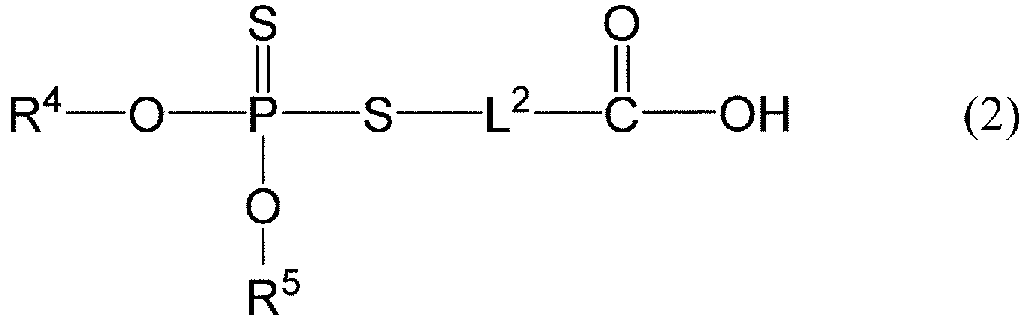
- In the above general formula (2), R4 and R5 each independently represent a hydrocarbon group having 3 to 20 carbon atoms, and L2 represents a linear or branched alkylene group having 1 to 8 carbon atoms.
- From the viewpoint of improving solubility in base oil, L2 is preferably a linear or branched alkylene group having 1 to 8 carbon atoms, and more preferably a linear or branched alkylene group having 2 to 4 carbon atoms. Specifically, preferred examples thereof include -CH2CH2-, -CH2CH(CH3)-, -CH2CH(CH2CH3)-, CH2CH(CH3)CH2-, and - CH2CH(CH2CH2CH3)-, where -CH2CH(CH3)-, and -CH2CH(CH3)CH2- are more preferred, and -CH2CH(CH3)- is even more preferred.
- In addition, from the viewpoint of achieving good extreme pressure performance and good solubility in base oil, R4 and R5 each independently are preferably a linear or branched alkyl group having 1 to 8 carbon atoms, and specifically, those selected from the group consisting of a methyl group, an ethyl group, an n-propyl group, an isopropyl group, a butyl group, an isobutyl group, a tert-butyl group, a pentyl group, an isopentyl group, a hexyl group, 2-ethylbutyl group, 1-methylpentyl group, 1,3-dimethyl butyl group, and 2-ethylhexyl group are preferred. Among these, a linear or branched alkyl group having 2 to 5 carbon atoms is more preferred, and an isobutyl group is even more preferred.
- The sulfur-phosphorus extreme pressure agent (D) having a carboxy group at an end may be used alone or may be used in combination of two or more thereof.
- The content of the sulfur-phosphorus extreme pressure agent (D) having a carboxy group at an end in the lubricating oil composition of the present embodiment is, based on the whole amount of the lubricating oil composition, preferably 0.01% by mass or more, more preferably 0.03% by mass or more, even more preferably 0.04% by mass or more, and still more preferably 0.05% by mass or more, and is preferably 0.50% by mass or less, more preferably 0.20% by mass or less, even more preferably 0.12% by mass or less, and still more preferably 0.08% by mass or less. These upper limit values and lower limit values can be arbitrarily combined, and specifically, the content thereof is preferably 0.01% by mass to 0.50% by mass, more preferably 0.03% by mass to 0.20% by mass, even more preferably 0.04% by mass to 0.12% by mass, and still more preferably 0.05% by mass to 0.08% by mass.
- When the content of the sulfur-phosphorus extreme pressure agent (D) having a carboxy group at an end is equal to or more than the above lower limit value, the lubricating oil composition will have excellent wear resistance, and when the content is equal to or less than the above upper limit value, sludge generation will be easily suppressed.
- The ratio between the content of the overbased metal detergent (B) and the content of the sulfur-phosphorus extreme pressure agent (C) having a carboxylic acid ester group is, in terms of a mass ratio of the content of the component (B) to a total content of the component (B) and the component (C), preferably 5 to 50% by mass, more preferably 15 to 40% by mass, and even more preferably 20 to 40% by mass.
- The ratio between the content of the overbased metal detergent (B) and the content of the sulfur-phosphorus extreme pressure agent (D) having a carboxy group at an end is, in terms of a mass ratio of the content of the component (B) to a total content of the component (B) and the component (D), preferably 40 to 80% by mass, more preferably 45 to 75% by mass, and even more preferably 50 to 70% by mass.
- The lubricating oil composition of the present embodiment is required to contain both the sulfur-phosphorus extreme pressure agent (C) having a carboxylic acid ester group and the sulfur-phosphorus extreme pressure agent (D) having a carboxy group at an end, and in the case where these are not contained, the solubility in the base oil will be poor and the necessary extreme pressure performance will not be obtained.
- The content of the overbased metal detergent (B) is, in terms of a mass ratio of the content of the component (B) to a total content of the component (B), the component (C) and the component (D), preferably 10 to 60% by mass, more preferably 15 to 45% by mass, and even more preferably 20 to 35% by mass.
- The ratio between the content of the sulfur-phosphorus extreme pressure agent (C) having a carboxylic acid ester group and the content of the sulfur-phosphorus extreme pressure agent (D) having a carboxy group at an end is, in terms of a mass ratio of the content of the component (C) to a total content of the component (C) and the component (D), preferably 50 to 95% by mass, more preferably 55 to 85% by mass, and even more preferably 60 to 80% by mass.
- It is preferable that the above ratio is equal to or more than the above lower limit value from the viewpoint of solubility of the component (D), and it is more preferable that the ratio is equal to or less than the above upper limit value from the viewpoint of extreme pressure properties and wear resistance.
- It is preferable that the lubricating oil composition of the present embodiment further contains a hindered phenol-based antioxidant.
- The hindered phenol-based antioxidant is preferably one or more selected from 2,6-di-tert-butylphenol and 2,6-di-tert-butyl-p-cresol, and particularly preferably 2,6-di-tert-butyl-p-cresol.
- From the viewpoint of sludge suppressing properties, the content of the hindered phenol-based antioxidant in the lubricating oil composition of the present embodiment is preferably 0.05% by mass to 1.0% by mass, more preferably 0.10% by mass to 0.80% by mass, and even more preferably 0.20% by mass to 0.60% by mass, based on the whole amount of the lubricating oil composition.
- It is preferable that the lubricating oil composition of the present embodiment further contains an amine-based antioxidant. When the lubricating oil composition contains an amine-based antioxidant, the sludge suppressing properties can be further easily improved.
- The amine-based antioxidant is preferably a compound represented by the following general formula (e1), for example.
Ar1-NH-Ar2 (e1)
- In the above general formula (e1), Ar1 and Ar2 each independently are an aryl group having 6 to 24 carbon atoms selected from a phenyl group, an alkyl-substituted phenyl group substituted with an alkyl group, an aralkyl-substituted phenyl group substituted with an aralkyl group, naphthyl group and an alkyl-substituted naphthyl group substituted with an alkyl group.
- Further, more specifically, the amine-based antioxidant is preferably one selected from the group consisting of phenyl-α-naphthylamines represented by the following general formula (e1-1) and diphenylamines represented by the general formula (e1-2).

- In the above general formula (e1-1), Re11 is a hydrogen atom or an alkyl group having 1 to 18 carbon atoms.

- In the above general formula (e1-2), Re21 and Re22 each independently are selected from a hydrogen atom, an alkyl group having 1 to 18 carbon atoms, and an aralkyl group having 7 to 18 carbon atoms.
- In the phenyl-α-naphthylamines represented by the above general formula (e1-1), Re11 is preferably a hydrogen atom or an alkyl group having 1 to 12 carbon atoms, and Re11 is preferably arranged in a para position.
- Furthermore, in the diphenylamines represented by the above general formula (e1-2), Re21 and Re22 each independently are selected from a hydrogen atom, an alkyl group having 4 to 12 carbon atoms, and an α,α-dimethylbenzyl group. In addition, it is more preferable that both of them are arranged in the para position.
- Specific examples of the amine-based antioxidant include dioctyldiphenylamine, phenyl-α-naphthylamine, diphenylamine, dinonyldiphenylamine, monobutylphenylmonoctylphenylamine, p-t-octylphenyl-1-naphthylamine, and 4,4'-bis(α,α-dimethylbenzyl)diphenylamine.
- In addition to the above, a diamine-based antioxidant can also be used as the amine-based antioxidant. Specific examples thereof include N-isopropyl-N'-phenyl-p-phenylenediamine, N-(1,3- dimethylbutyl)-N'-phenyl-p-phenylenediamine, N,N'-di-2-naphthyl-p-phenylenediamine, and N-phenyl-N'-(1,3-dimethylbutyl)-p-phenylenediamine.
- The amine-based antioxidant may be used alone or may be used in combination of two or more thereof.
- From the viewpoint of more easily exhibiting the effects of the present invention, the content of the amine-based antioxidant in the lubricating oil composition of the present embodiment is preferably 0.01% by mass to 0.20% by mass, more preferably 0.02% by mass to 0.10% by mass, and even more preferably 0.03% by mass to 0.08% by mass, based on the whole amount of the lubricating oil composition.
- The lubricating oil composition of the present embodiment preferably further contains one or more imide compounds selected from the group consisting of a monoimide compound and a bisimide compound. When the lubricating oil composition contains an imide compound, the oxidation stability and sludge suppressing properties of the lubricating oil composition can be further easily improved.
- Specifically, the monoimide compound is preferably one or more selected from the group consisting of an alkenyl succinic acid monoimide compound and an alkyl succinic acid monoimide compound.
- Moreover, the bisimide compound is preferably one or more selected from the group consisting of an alkenyl succinic acid bisimide compound and an alkyl succinic acid bisimide compound.
- As mentioned above, the monoimide compound is preferably one or more selected from the group consisting of an alkenyl succinic acid monoimide compound and an alkyl succinic acid monoimide compound. The alkenyl succinic acid monoimide compound and the alkyl succinic acid monoimide compound are preferably compounds represented by the following general formula (c1), for example.
- Moreover, the bisimide compound is preferably one or more selected from the group consisting of an alkenyl succinic acid bisimide compound and an alkyl succinic acid bisimide compound. The alkenyl succinic acid bisimide compound and the alkyl succinic acid bisimide compound are preferably compounds represented by the following general formula (c2), for example.


- In the above general formula (c1), Rc11 is an alkenyl group or an alkyl group, Rc12 is an alkylene group having 1 to 6 carbon atoms, and n1 is an integer of 1 to 20. In addition, when n1 is 2 or more, a plurality of Rc12's may be the same as or different from each other.
- In the above general formula (c2), Rc21 and Rc24 each independently are an alkenyl group or an alkyl group, Rc22 and Rc23 each independently are an alkylene group having 1 to 6 carbon atoms, and n2 is an integer of 0 to 20. In addition, when n2 is 2 or more, a plurality of Rc22's may be the same as or different from each other.
- The alkenyl group or alkyl group that can be selected as Rc11 preferably has a mass average molecular weight (Mw) of 2,000 to 10,000, from the viewpoint of improving the solubility in the base oil (A) and more easily exhibiting the effects of the present invention, more preferably 3,000 to 9,000, and even more preferably 4,000 to 8,000.
- On the other hand, the alkenyl group or alkyl group that can be selected as Rc21 and Rc24 preferably has a mass average molecular weight (Mw) of 500 to 8,000, from the viewpoint of improving the solubility in the base oil (A) and more easily exhibiting the effects of the present invention, more preferably 600 to 4,000, and even more preferably 700 to 2,000.
- Examples of the alkenyl group that can be selected as Rc11, Rc21, and Rc24 include a polybutenyl group, a polyisobutenyl group, and an ethylene-propylene copolymer, and examples of the alkyl group include those obtained by hydrogenating these. As the polybutenyl group, a mixture of 1-butene and isobutene or one obtained by polymerizing high-purity isobutene is preferably used. Among these, the alkenyl group is preferably a polybutenyl group or an isobutenyl group, and examples of the alkyl group include those obtained by hydrogenating a polybutenyl group or an isobutenyl group.
- In the lubricating oil composition of the present embodiment, from the viewpoint of more easily exhibiting the effects of the present invention, the groups that can be selected as Rc11, Rc21, and Rc24 are preferably alkenyl groups, and among the alkenyl groups, polybutenyl groups are more preferable.
- From the viewpoint of improving the solubility in the base oil (A) and more easily exhibiting the effects of the present invention, the alkylene group having 1 to 6 carbon atoms that can be selected as Rc12, Rc22, and Rc23 is preferably a methylene group; various ethylene groups such as 1,1-ethylene groups and 1,2-ethylene groups; various propylene groups such as 1,3-propylene, 1,2-propylene, and 2,2-propylene; various butylene groups; various pentylene groups; and various hexylene groups.
- Moreover, from the same viewpoint, the alkylene group that can be selected as Rc12, Rc22, and Rc23 preferably has 2 to 5 carbon atoms, more preferably 2 to 4 carbon atoms, and even more preferably 2 or 3 carbon atoms.
- From the viewpoint of improving the solubility in the base oil (A) and more easily exhibiting the effects of the present invention, n1 in the above general formula (c1) is preferably 2 to 15, more preferably 3 to 10, even more preferably 3 to 5, and still more preferably 3 or 4.
- From the viewpoint of improving solubility of the component (C2) represented by the above general formula (c2) in base oil and more easily exhibiting the effects of the present invention, n2 in the above general formula (c2) is preferably 1 to 15, more preferably 2 to 10, even more preferably 2 to 5, and still more preferably 3 or 4.
- The alkenyl succinic acid monoimide, alkyl succinic acid monoimide, alkenyl succinic acid bisimide, or alkyl succinic acid bisimide can usually be produced by reacting an alkenyl succinic anhydride obtained from a reaction between a polyolefin and a maleic anhydride, or an alkyl succinic anhydride obtained by hydrogenating the same, with a polyamine. The monoimide and bisimide can be respectively produced by changing the reaction ratio of the alkenyl succinic anhydride or the alkyl succinic anhydride and the polyamine.
- As an olefin monomer forming the polyolefin, one or more types selected from α-olefins having 2 to 8 carbon atoms can be mixed and used; however, a mixture of isobutene and 1-butene can be suitably used.
- On the other hand, examples of the polyamine include diamines such as ethylene diamine, propylene diamine, butylene diamine, and pentylene diamine, and polyalkylene polyamines such as diethylenetriamine, triethylene tetramine, tetraethylene pentamine, pentaethylene hexamine, di(methylethylene) triamine, dibutylene triamine, tributylene tetramine, and pentapentylene hexamine.
- In the lubricating oil composition of the present embodiment, from the viewpoint of more easily exhibiting the effects of the present invention, a total content of the monoimide compound and the bisimide compound is preferably 0.10% by mass to 0.50% by mass, more preferably0.13% by mass to 0.40% by mass, even more preferably 0.15% by mass to 0.35% by mass, and still more preferably 0.17% by mass to 0.30% by mass, based on the whole amount of the lubricating oil composition.
- In the lubricating oil composition of the present embodiment, from the viewpoint of more easily exhibiting the effects of the present invention, the content ratio of the monoimide compound and the bisimide compound [monoimide compound content/bisimide compound content] is, in terms of mass ratio, preferably more than 0 to 2/1, more preferably 1/3 to 3/2, and even more preferably 2/3 to 3/2.
- It is preferable that the lubricating oil composition of the present embodiment further contains a phosphorus-based extreme pressure agent (hereinafter sometimes referred to as "phosphorus-based extreme pressure agent") that does not contain a sulfur atom.
- When the lubricating oil composition contains the above extreme pressure agent, the lubricating oil composition can have even more excellent wear resistance.
- Preferred examples of the phosphorus-based extreme pressure agent include phosphate ester compounds such as phosphate esters, acid phosphate esters, phosphite esters, and hydrogen phosphite esters, and amine salts of the phosphate ester compounds. More specifically, preferred examples of these phosphate esters, acid phosphate esters, phosphite esters, and hydrogen phosphite esters include phosphate esters represented by the following general formula (d1-1), acid phosphate esters represented by the general formula (d1-2), phosphite esters represented by the general formula (d1-3), and hydrogen phosphite esters represented by the general formulas (d1-4) and (d1-5), respectively.
- The phosphorous-based extreme pressure agent may be used alone or may be used in combination of two or more thereof.


- In the general formulas (d1-1) to (d1-5), Rd11, Rd21, Rd31, Rd41, and Rd51 each independently represent a hydrocarbon group having 1 to 30 carbon atoms. Preferred examples of the hydrocarbon group include an alkyl group, an alkenyl group, an aryl group, and an arylalkyl group, from the viewpoint of obtaining more excellent wear resistance.
- When Rd11, Rd21, Rd31, Rd41, and Rd51 are alkyl groups, the carbon number is, from the viewpoint of obtaining more excellent wear resistance and also considering ease of acquisition and the like, preferably 2 to 20, and more preferably 2 to 10. The alkyl group may be linear, branched, or cyclic; however, in further consideration of ease of acquisition and the like, the alkyl group is preferably linear or branched.
- When Rd11, Rd21, Rd31, Rd41, and Rd51 are alkenyl groups, the carbon number is, from the viewpoint of obtaining more excellent wear resistance and also considering ease of acquisition and the like, preferably 2 to 20, and more preferably 2 to 10. The alkenyl group may be linear, branched, or cyclic, and is preferably linear or branched.
- When Rd11, Rd21, Rd31, Rd41, and Rd51 are aryl groups, the carbon number is, from the viewpoint of obtaining more excellent seizure resistance and wear resistance and also considering ease of acquisition and the like, preferably 6 to 20, and more preferably 6 to 15.
- When Rd11, Rd21, Rd31, Rd41, and Rd51 are arylalkyl groups, the carbon number is, from the viewpoint of obtaining more excellent seizure resistance and wear resistance and also considering ease of acquisition and the like, preferably 6 to 20, and more preferably 6 to 15.
- A plurality of Rd11's, Ra31's, and Rd51's may be the same as or different from each other, and when there are a plurality of Rd21's and Rd41's, they may be the same as or different from each other.
- Furthermore, in the general formula (d1-2), m2 represents 1 or 2, and in the general formula (d1-4), m4 represents 1 or 2.
- Examples of the phosphate esters represented by the general formula (d1-1) include triphenyl phosphate, tricresyl phosphate, benzyl diphenyl phosphate, ethyl diphenyl phosphate, tributyl phosphate, ethyl dibutyl phosphate, tert-butylphenyl diphenyl phosphate, di-tert-butylphenyl monophenyl phosphate, cresyl diphenyl phosphate, dicresyl monophenyl phosphate , ethylphenyl diphenyl phosphate, diethylphenyl monophenyl phosphate, triethylphenyl phosphate, trihexyl phosphate, tri(2-ethylhexyl) phosphate, tridecyl phosphate, trilauryl phosphate, trimyristyl phosphate, tripalmityl phosphate, tristearyl phosphate, and trioleyl phosphate.
- Examples of the acid phosphate esters represented by the general formula (d1-2) include mono(di)ethyl acid phosphate, mono(di)n-propyl acid phosphate, mono(di)2-ethylhexyl acid phosphate, mono(di)butyl acid phosphate, mono(di)oleyl acid phosphate, mono(di)isodecyl acid phosphate, mono(di)lauryl acid phosphate, mono(di)stearyl acid phosphate, and mono(di)isostearyl acid phosphate.
- Examples of the phosphite ester represented by the general formula (d1-3) include triethyl phosphite, tributyl phosphite, triphenyl phosphite, tricresyl phosphite, tri(nonylphenyl) phosphite, tri(2-ethylhexyl) phosphite, tridecyl phosphite, trilauryl phosphite, triisooctyl phosphite, diphenylisodecyl phosphite, tristearyl phosphite, and trioleylphosphite.
- Examples of the hydrogen phosphite esters represented by the general formulas (d1-4) and (d1-5) include mono(di)ethyl hydrogen phosphite, mono(di)-n-propyl hydrogen phosphite, mono(di)-n-butyl hydrogen phosphite, mono(di)-2-ethylhexyl hydrogen phosphite, mono(di)lauryl hydrogen phosphite, mono(di)oleyl hydrogen phosphite, mono(di)stearyl hydrogen phosphite, and mono(di)phenyl hydrogen phosphite.
- In addition, examples of amine salts of the phosphate ester compounds such as phosphate esters, acid phosphate esters, phosphite esters, and hydrogen phosphite esters include amine salts formed from these phosphate ester compounds and amines. Here, examples of amines used to form amine salts include primary amines, secondary amines, tertiary amines, and polyalkylene amines, and examples of the primary amines, secondary amines, and tertiary amines include amines represented by the following general formula (d1-6).

- In the general formula (d1-6), Rd61 represents a hydrocarbon group having 1 to 30 carbon atoms. When the hydrocarbon group is an alkyl group, it may be a hydroxyalkyl group in which at least one of the hydrogen atoms of the alkyl group is substituted with a hydroxy group.
- Ra61 is preferably an alkyl group having 6 to 18 carbon atoms, an alkenyl group having 6 to 18 carbon atoms, an aryl group having 6 to 18 ring carbon atoms, an arylalkyl group having 7 to 18 carbon atoms, or a hydroxyalkyl group having 6 to 18 carbon atoms, and among these, an alkyl group having 6 to 18 carbon atoms is more preferable.
- Further, m6 is 1, 2 or 3; when m6 is 1, it is a primary amine, when m6 is 2, it is a secondary amine, and when m6 is 3, it is a tertiary amine.
- Examples of the polyalkylene amines include ethylenediamine, diethylenetriamine, triethylenetetramine, tetraethylenepentamine, pentaethylenehexamine, hexaethyleneheptamine, heptaethyleneoctamine, tetrapropylenepentamine, and hexabutyleneheptamine.
- Among these, from the viewpoint of imparting more excellent wear resistance to the lubricating oil composition, it is preferable to use one or more selected from the group consisting of amine salts of phosphate esters and acid phosphate esters.
- The phosphate ester is preferably a compound represented by the above general formula (d1-1), and more preferably a compound represented by the following general formula (d1-1a).

- In the general formula (d1-1a) above, Rd71 to Rd73 each independently are an alkyl group having 1 to 12 carbon atoms. p1 to p3 each independently are an integer of 0 to 5.
- Among the compounds represented by the above general formula (d1-1a), from the viewpoint of more easily exhibiting the effects of the present invention, Rd71 to Rd73 each independently are preferably an alkyl group having 1 to 10 carbon atoms, more preferably an alkyl group having 1 to 6 carbon atoms, and even more preferably an alkyl group having 1 to 4 carbon atoms.
- Further, it is preferable that p1 to p3 each independently are an integer of 0 to 1.
- Here, when a phosphate ester is used alone, it is preferable that one or two of p1 to p3 are 0 and the rest is 1. Further, in this case, the alkyl group that can be selected as Rd71 to Rd73 is preferably a tert-butyl group.
- In the lubricating oil composition of the present embodiment, the content of the phosphorus-based extreme pressure agent is preferably 0.01% by mass to 1.00% by mass, more preferably 0.05% by mass to 0.60% by mass, and even more preferably 0.10% by mass to 0.40% by mass, based on the whole amount of the lubricating oil composition.
- When the content of the phosphorus-based extreme pressure agent is equal to or more than the above lower limit value, a lubricating oil composition with excellent wear resistance can be easily obtained. Moreover, when the content of the phosphorus-based extreme pressure agent is equal to or less than the above upper limit value, sludge generation can be easily suppressed.
- The lubricating oil composition of the present embodiment may further contain an additional extreme pressure agent other than the sulfur-phosphorus extreme pressure agent (C) having a carboxylic acid ester group, the sulfur-phosphorus extreme pressure agent (D) having a carboxy group at an end, and a phosphorus-based extreme pressure agent.
- Examples of the additional extreme pressure agent include an organometallic extreme pressure agent and a sulfur-based extreme pressure agent.
- Examples of the organometallic extreme pressure agent include one or more selected from an organomolybdenum compound such as molybdenum dialkyldithiocarbamate (MoDTC) and molybdenum dialkyldithiophosphate (MoDTP), and an organic zinc compound such as zinc dialkyldithiocarbamate (ZnDTC) and zinc dialkyldithiophosphate (ZnDTP).
- Examples of the sulfur-based extreme pressure agent include one or more selected from sulfurized fats and oils, sulfurized fatty acids, sulfurized esters, sulfurized olefins, monosulfides, polysulfides, dihydrocarbyl polysulfides, thiadiazole compounds, alkylthiocarbamoyl compounds, thiocarbamate compounds, thioterpene compounds, and dialkylthiodipropionate compounds.
- However, the lubricating oil composition of the present embodiment preferably has a small content of the organometallic extreme pressure agent and the sulfur-based extreme pressure agent. Specifically, the contents of the organometallic extreme pressure agent and the sulfur-based extreme pressure agent each are preferably less than 0.1% by mass, more preferably less than 0.01% by mass, even more preferably less than 0.001% by mass, and still more preferably containing no organometallic extreme pressure agent or sulfur-based extreme pressure agent, based on the whole amount of the lubricating oil composition.
- The lubricating oil composition of the present embodiment may contain an additional additive for lubricating oil other than the above components as long as the effects of the present invention are not impaired.
- Examples of the additive for lubricating oil include a viscosity index improver, a pour point depressant, a rust inhibitor, a metal deactivator, an anti-foaming agent, and an antioxidant other than the above-mentioned hindered phenol-based antioxidant and the amine-based antioxidant.
- These additives for lubricating oil may be used alone or may be used in combination of two or more thereof.
- In the present description, an additive such as a viscosity index improver and an anti-foaming agent may be in a form of a solution in which the additive is diluted with and dissolved in part of the base oil (A), taking into consideration handleability and the solubility in the base oil (A). In such a case, the above-described content of the additive such as an anti-foaming agent and a viscosity index improver means a content in terms of active ingredient (in terms of resin content) excluding the diluent oil, in the present description.
- Examples of the viscosity index improver include polymers such as a non-dispersant-type polymethacrylate, a dispersant-type polymethacrylate, an olefinic copolymer (e.g., an ethylene-propylene copolymer), a dispersant-type olefinic copolymer, and a styrene-based copolymer (e.g., a styrene-diene copolymer and a styrene-isoprene copolymer).
- When the lubricating oil composition of the present embodiment contains a viscosity index improver, the content of the viscosity index improver in terms of resin content is preferably 0.01 to 10% by mass, more preferably 0.02 to 5.0% by mass, and even more preferably 0.03 to 2.0% by mass, based on the whole amount of the lubricating oil composition.
- Examples of the pour point depressant include polymethacrylate having a mass average molecular weight of about 50,000 to 150,000. When the lubricating oil composition according to one embodiment of the present invention contains a pour point depressant, the content of the pour point depressant is preferably 0.01 to 5% by mass, and more preferably 0.02 to 2% by mass, based on the whole amount of the lubricating oil composition.
- Examples of the rust inhibitor include metal sulfonates, alkylbenzene sulfonates, dinonylnaphthalene sulfonates, organic phosphite esters, organic phosphate esters, organic sulfonic acid metal salts, organic phosphoric acid metal salts, alkenyl succinic acid esters, and alkenyl succinic acid polyhydric alcohol esters.
- When the lubricating oil composition of the present embodiment contains a rust inhibitor, the content of the rust inhibitor is preferably 0.01 to 10.0% by mass, and more preferably 0.03 to 5.0% by mass, based on the whole amount of the lubricating oil composition.
- Examples of the metal deactivator include a benzotriazole compound, a tolyltriazole compound, a thiadiazole compound, an imidazole compound, and a pyrimidine compound.
- When the lubricating oil composition of the present embodiment contains a metal deactivator, the content of the metal deactivator is preferably 0.001 to 1.0% by mass, and more preferably 0.005 to 0.50% by mass, based on the whole amount of the lubricating oil composition.
- Examples of the anti-foaming agent include a silicone anti-foaming agent, a fluorine-based anti-foaming agent such as fluorosilicone oil and a fluoroalkyl ether, and a polyacrylate-based anti-foaming agent.
- When the lubricating oil composition of the present embodiment contains an anti-foaming agent, the content of the anti-foaming agent in terms of resin content is preferably 0.0001 to 0.1% by mass, and more preferably 0.0010 to 0.0300% by mass, based on the whole amount of the lubricating oil composition.
- Examples of the antioxidant other than the hindered phenol-based antioxidant and the amine-based antioxidant include a metal-based antioxidant and a sulfur-based antioxidant.
- In addition, from the viewpoint of more easily exhibiting the effects of the present invention, the content of the metal-based antioxidant and the sulfur-based antioxidant is preferably small.
- Specifically, the contents of the metal-based antioxidant and the sulfur-based antioxidant each are preferably less than 0.1% by mass, more preferably less than 0.01% by mass, even more preferably less than 0.001% by mass, and still more preferably containing no metal-based antioxidant or sulfur-based antioxidant, based on the whole amount of the lubricating oil composition.
- The kinematic viscosity at 40°C of the lubricating oil composition of the present embodiment is preferably 19.8 mm2/s to 165 mm2/s, more preferably 28.8 mm2/s to 110 mm2/s, and even more preferably 41.4 mm2/s to 74.8 mm2/s.
- When the 40°C kinematic viscosity of the lubricating oil composition is 19.8 mm2/s or more, it is easy to obtain a lubricating oil composition with a high flash point and excellent lubricating performance.
- Furthermore, when the 40°C kinematic viscosity of the lubricating oil composition is 110 mm2/s or less, the viscous resistance at low temperatures does not become so large, making it easier to maintain good operation of hydraulic equipment.
- The viscosity index of the lubricating oil composition of the present embodiment is preferably 80 or more, more preferably 90 or more, even more preferably 100 or more, and still more preferably 105 or more.
- In the lubricating oil composition of the present embodiment, it is preferable that the time required for the coefficient of friction to exceed 0.30 in the SRV friction test measured under the following conditions is 35.0 minutes or more, more preferably 40.0 minutes or more, and even more preferably 45.0 minutes or more.
- Abreak-in operation was performed for 1 minute at a load of 50 N using an SRV testing machine (manufactured by Optimol) and using the prepared lubricating oil composition. Thereafter, a friction test was performed while sliding under the following conditions, and the time required for the coefficient of friction to exceed 0.30 was measured.
- · Ball: SUJ2 coated with manganese phosphate
- · Disc: SUJ2
- · Load: 200 N
- · Amplitude: 0.1 mm
- · Frequency: 100 Hz
- · Temperature: 100°C
- · Test time: maximum 2 hours
- The method for producing the lubricating oil composition of the present invention is not particularly limited, and is a method for producing a lubricating oil composition including a step of mixing the base oil (A), the overbased metal detergent (B), the sulfur-phosphorus extreme pressure agent (C) having a carboxylic acid ester group, and the sulfur-phosphorus extreme pressure agent (D) having a carboxy group at an end.
- The method for mixing the above components is not particularly limited, and examples thereof include a method including a step of blending the component (B), the component (C), and the component (D) into the base oil (A). The component (B), the component (C), and the component (D) may be blended into the base oil (A) simultaneously or separately. The same applies to components other than the component (B), the component (C), and the component (D). Each component may also be blended in a form of a solution (dispersion) with the addition of dilution oil or other substances. After blending each component, it is preferable to stir and uniformly disperse the components by a known method.
- The lubricating oil composition of the present embodiment can be used in an apparatus such as hydraulic equipment, gear oil, and bearings. Preferably, among these, the lubricating oil composition can be suitably used in apparatus such as hydraulic equipment, gear mechanisms, and bearings that are equipped with a sliding member having a phosphate coating on at least a part of a sliding surface.
- Therefore, according to the present invention, the following methods for using are provided.
- · A method of using the lubricating oil composition of the present embodiment in an apparatus such as hydraulic equipment, gear oil, and bearings.
- · A method of using the lubricating oil composition of the present invention in an apparatus equipped with a sliding member having a phosphate coating on at least a part of a sliding surface.
- The present invention will be more specifically described by the following Examples; however, the present invention is not limited to the following Examples.
- The measurement of each property of each raw material used in each of Examples and Comparative Examples and the lubricating oil composition of each of Examples and Comparative Examples was performed according to the following procedure.
- Measurement and determination were performed in accordance with JIS K 2283:2000.
- The calcium content and phosphorus content of the lubricating oil composition were measured using an ICP plasma emission spectrometer.
- The acid value of the lubricating oil composition was measured in accordance with JIS K 2501:2003 (indicator method).
- The base number of the lubricating oil composition was measured in accordance with JIS K 2501:2003 (hydrochloric acid method).
- Base oils and various additives shown below were thoroughly mixed in blending amounts (% by mass) shown in Table 1 to prepare lubricating oil compositions respectively.
- Details of the base oils and various additives used in Examples 1 to 4 and Comparative Examples 1 to 3 are as follows.
-
- . Base oil 1: mineral oil that is classified into Group II in API base oil category and has been subjected to a hydrogenation refining treatment (kinematic viscosity at 40°C = 30.60 mm2/s, kinematic viscosity at 100°C = 5.285 mm2/s, viscosity index = 104).
- · Base oil 2: mineral oil that is classified into Group II in API base oil category and has been subjected to a hydrogenation refining treatment (kinematic viscosity at 40°C = 90.51 mm2/s, kinematic viscosity at 100°C = 10.89 mm2/s, viscosity index = 107).
-
- · Ca sulfonate: overbased calcium sulfonate, base number: 294 mgKOH/g, content of calcium atom: 12.0% by mass.
- · Ca salicylate: overbased calcium salicylate, base number: 219 mgKOH/g, content of calcium atom: 8.0% by mass.
- · Ca phenate: overbased calcium phenate, base number: 366 mgKOH/g, content of calcium atom: 14.3% by mass.
-
- · Ca sulfonate: neutral calcium sulfonate, base number: 11.3 mgKOH/g, content of calcium atom: 2.15% by mass.
- A compound represented by the following formula was used as the sulfur-phosphorus extreme pressure agent (C) having a carboxylic acid ester group.

- A compound represented by the following formula was used.

- The compound represented by the above formula is a compound in which L2 is - CH2CH(CH3)- and R4 and R5 are an isobutyl group in the general formula (2).
-
- · Monoimide compound: a polybutenyl succinic acid monoimide compound having a mass average molecular weight (Mw) of polybutenyl groups of 6,300, a nitrogen atom content of 1.75% by mass, and a base number of 40.0 mgKOH/g.
- · Bisimide compound: a polybutenyl succinic acid bisimide compound having a mass average molecular weight (Mw) of polybutenyl groups of 1,000, a nitrogen atom content of 1.15% by mass, and a base number of 19.5 mgKOH/g.
- The mass average molecular weight of polybutenyl groups is a value obtained by measuring the mass average molecular weight (Mw) of polybutene, which is a raw material for the polybutenyl group, under the following conditions and evaluating the measured result as a mass average molecular weight (Mw) in terms of standard polystyrene.
- · SEC device: HLC-8220GPC manufactured by Tosoh Corporation
- · Column: TSKguardcolumn HXL-H + TSKgel GMH-XL 2 pieces + G2000H-XL 1 piece manufactured by Tosoh Corporation
- · Solvent: tetrahydrofuran (special grade without stabilizers, manufactured by Wako Pure Chemical Corporation)
- · Detector: differential refractive index (RI) detector, UV detector
- · Concentration: 0.1 w/v%
- · Injection volume: 100 µL
- · Flow rate: 1.0 mL/min
- · Column temperature: 40°C
- · Standard sample for calibration curve: TSK standard polystyrene manufactured by Tosoh Corporation
- · Analysis software: GPC-8020 model II
-
- · Phosphorus-based extreme pressure agent: tricresyl phosphate
- · Pour point depressant: polymethacrylate with a mass average molecular weight (Mw) of 69,000
- · Hindered phenol-based antioxidant: 2,6-di-tert-butyl-p-cresol
- · Amine-based antioxidant: monobutylphenyl monooctylphenylamine
- · Metal deactivator: N-dialkylaminomethylbenzotriazole
- · Anti-foaming agent: polyacrylate-based anti-foaming agent (active ingredient concentration: 5% by mass or less)
- Regarding the lubricating oil compositions obtained in Examples 1 to 4 and Comparative Examples 1 to 3, the various physical property values described above were measured, and the following SRV friction test and shell wear test were also conducted. The results are shown in Table 1.
- Abreak-in operation was performed for 1 minute at a load of 50 N using an SRV testing machine (manufactured by Optimol) and using the prepared lubricating oil composition. Thereafter, a friction test was performed while sliding under the following conditions, and the time required for the coefficient of friction to exceed 0.30 was measured.
- · Ball material: SUJ2 coated with manganese phosphate
- · Disc material: SUJ2
- · Load: 200 N
- · Amplitude: 0.1 mm
- · Frequency: 100 Hz
- · Temperature: 100°C
- · Test time: maximum 2 hours
- Using a shell wear tester, the wear resistance of the lubricating oil composition was evaluated under the following test conditions in accordance with ASTM D 4172. The results were expressed as a wear mark diameter (mm) of a test hard ball.
- · Load: 294 N
- · Rotation speed: 1,200 rpm
- · Temperature: 50°C
- · Test time: 30 minutes
- The following can be seen from Table 1.
- It can be seen that in the lubricating oil compositions of Examples 1 to 4, the time required for the coefficient of friction to exceed 0.30 in the SRV friction test was 37.0 minutes or more, and the lubricating oil compositions have excellent wear resistance when a sliding member having a phosphate coating was used. In particular, in Examples 1 and 2, the above-mentioned required time was 49.0 minutes or more, which shows that the wear resistance is more excellent when a sliding member having a phosphate coating was used.
- In contrast, in the lubricating oil compositions of Comparative examples 1 to 3, in which any of the overbased metal detergent (B), the sulfur-phosphorus extreme pressure agent (C) having a carboxylic acid ester group, and the sulfur-phosphorus extreme pressure agent (D) having a carboxy group at an end is not blended, the time required for the coefficient of friction to exceed 0.30 in the SRV friction test was 33.0 minutes or less.
- Further, in the shell wear test, the wear mark diameters in Examples 1 to 4 were 0.37 to 0.43 mm, whereas the wear mark diameters in Comparative Examples 1 to 3 were 0.37 to 0.46 mm.
| Example 1 | Example 2 | Example 3 | Example 4 | |||
| Composition of lubricating oil composition (% by mass) | Base oil (A) | Base oil 1 | 60.92 | 60.92 | 60.89 | 60.92 |
| Base oil 2 | 37.45 | 37.45 | 37.45 | 37.45 | ||
| Overbased metal detergent (B) | Ca sulfonate | 0.10 | 0.10 | |||
| Ca salicylate | 0.10 | |||||
| Ca phenate | 0.10 | |||||
| Neutral metal detergent (B') | Ca sulfonate | |||||
| Sulfur-phosphorus extreme pressure agent (C) having a carboxylic acid ester group | 0.20 | 0.20 | 0.20 | 0.20 | ||
| Sulfur-phosphorus extreme pressure agent (D) having a carboxy group at an end | 0.07 | 0.07 | 0.10 | 0.07 | ||
| Imide compound | Monoimide compound | 0.10 | 0.10 | 0.10 | 0.10 | |
| Bisimide compound | 0.10 | 0.10 | 0.10 | 0.10 | ||
| Phosphorus-based extreme pressure agent | 0.20 | 0.20 | 0.20 | 0.20 | ||
| Pour point depressant | 0.30 | 0.30 | 0.30 | 0.30 | ||
| Hindered phenol-based antioxidant | 0.40 | 0.40 | 0.40 | 0.40 | ||
| Amine-based antioxidant | 0.05 | 0.05 | 0.05 | 0.05 | ||
| Metal deactivator | 0.01 | 0.01 | 0.01 | 0.01 | ||
| Anti-foaming agent | 0.10 | 0.10 | 0.10 | 0.10 | ||
| Total | 100.00 | 100.00 | 100.00 | 100.00 | ||
| Physical properties | 40°C kinematic viscosity | mm2/s | 46.36 | 46.56 | 46.47 | 46.50 |
| 100°C kinematic viscosity | mm2/s | 7.018 | 7.066 | 7.055 | 7.062 | |
| Viscosity index | 109 | 110 | 110 | 110 | ||
| Acid value | mgKOH/g | 0.12 | 0.12 | 0.18 | 0.12 | |
| Base number | mgKOH/g | 0.33 | 0.25 | 0.34 | 0.37 | |
| Calcium content | ppm by mass | 128 | 85 | 129 | 135 | |
| Phosphorus content | ppm by mass | 422 | 424 | 452 | 421 | |
| Evaluation | SRV friction test | minute | 49.0 | 49.1 | 37.0 | 37.4 |
| Shell wear test | mm | 0.43 | 0.39 | 0.37 | 0.40 | |
| Comparative Example 1 | Comparative Example 2 | Comparative Example 3 | ||||
| Composition of lubricating oil composition (% by mass) | Base oil (A) | Base oil 1 | 60.92 | 61.12 | 60.99 | |
| Base oil 2 | 37.45 | 37.45 | 37.45 | |||
| Overbased metal detergent (B) | Ca sulfonate | 0.10 | 0.10 | |||
| Ca salicylate | ||||||
| Ca phenate | ||||||
| Neutral metal detergent (B') | Ca sulfonate | 0.10 | ||||
| Sulfur-phosphorus extreme pressure agent (C) having a carboxylic acid ester group | 0.20 | 0.20 | ||||
| Sulfur-phosphorus extreme pressure agent (D) having a carboxy group at an end | 0.07 | 0.07 | ||||
| Imide compound | Monoimide compound | 0.10 | 0.10 | 0.10 | ||
| Bisimide compound | 0.10 | 0.10 | 0.10 | |||
| Phosphorus-based extreme pressure agent | 0.20 | 0.20 | 0.20 | |||
| Pour point depressant | 0.30 | 0.30 | 0.30 | |||
| Hindered phenol-based antioxidant | 0.40 | 0.40 | 0.40 | |||
| Amine-based antioxidant | 0.05 | 0.05 | 0.05 | |||
| Metal deactivator | 0.01 | 0.01 | 0.01 | |||
| Anti-foaming agent | 0.10 | 0.10 | 0.10 | |||
| Total | 100.00 | 100.00 | 100.00 | |||
| Physical properties | 40°C kinematic viscosity | mm2/s | 46.54 | 46.78 | 46.73 | |
| 100°C kinematic viscosity | mm2/s | 7.063 | 7.084 | 7.058 | ||
| Viscosity index | 110 | 109 | 109 | |||
| Acid value | mgKOH/g | 0.16 | 0.11 | 0.03 | ||
| Base number | mgKOH/g | 0.08 | 0.34 | 0.35 | ||
| Calcium content | ppm by mass | 23 | 127 | 130 | ||
| Phosphorus content | ppm by mass | 423 | 232 | 361 | ||
| Evaluation | SRV friction test | minute | 33.0 | 30.1 | 19.4 | |
| Shell wear test | mm | 0.37 | 0.37 | 0.46 | ||
Claims (13)
- A lubricating oil composition comprising a base oil (A), an overbased metal detergent (B), a sulfur-phosphorus extreme pressure agent (C) having a carboxylic acid ester group, and a sulfur-phosphorus extreme pressure agent (D) having a carboxy group at an end.
- The lubricating oil composition according to claim 1, wherein the overbased metal detergent (B) is one or more selected from an overbased calcium sulfonate with a base number of 100 mgKOH/g or more and an overbased calcium salicylates with a base number of 100 mgKOH/g or more.
- The lubricating oil composition according to claim 1 or 2, wherein the sulfur-phosphorus extreme pressure agent (C) having a carboxylic acid ester group is a thiophosphoric acid ester having a carboxylic acid ester group.
- The lubricating oil composition according to any one of claims 1 to 3, wherein the sulfur-phosphorus extreme pressure agent (C) having a carboxylic acid ester group is a thiophosphoric acid ester represented by the following general formula (1),

- The lubricating oil composition according to any one of claims 1 to 4, wherein the sulfur-phosphorus extreme pressure agent (D) having a carboxy group at an end is a thiophosphoric acid ester having a carboxy group at an end.
- The lubricating oil composition according to any one of claims 1 to 5, wherein the sulfur-phosphorus extreme pressure agent (D) having a carboxy group at an end is a thiophosphoric acid ester represented by the following general formula (2),

- The lubricating oil composition according to any one of claims 1 to 6, wherein a ratio between a content of the sulfur-phosphorus extreme pressure agent (C) having a carboxylic acid ester group and a content of the sulfur-phosphorus extreme pressure agent (D) having a carboxy group at an end is, in terms of a mass ratio of the content of the component (C) to a total content of the component (C) and component (D), 50 to 95% by mass.
- The lubricating oil composition according to any one of claims 1 to 7, wherein an organometallic extreme pressure agent has a content of less than 0.1% by mass based on a whole amount of a hydraulic oil composition.
- The lubricating oil composition according to any one of claims 1 to 8, further comprising a hindered phenol-based antioxidant.
- The lubricating oil composition according to any one of claims 1 to 9, further comprising an amine-based antioxidant.
- The lubricating oil composition according to any one of claims 1 to 10, further comprising an imide compound.
- The lubricating oil composition according to any one of claims 1 to 11, used in an apparatus equipped with a sliding member having a phosphate coating on at least a part of a sliding surface.
- A lubrication method for lubricating an apparatus equipped with a sliding member having a phosphate coating on at least a part of a sliding surface using the lubricating oil composition according to any one of claims 1 to 12.
Applications Claiming Priority (2)
| Application Number | Priority Date | Filing Date | Title |
|---|---|---|---|
| JP2022061337A JP2023151621A (en) | 2022-03-31 | 2022-03-31 | lubricating oil composition |
| PCT/JP2023/011901 WO2023190195A1 (en) | 2022-03-31 | 2023-03-24 | Lubricant composition |
Publications (1)
| Publication Number | Publication Date |
|---|---|
| EP4502122A1 true EP4502122A1 (en) | 2025-02-05 |
Family
ID=88201505
Family Applications (1)
| Application Number | Title | Priority Date | Filing Date |
|---|---|---|---|
| EP23780205.3A Withdrawn EP4502122A1 (en) | 2022-03-31 | 2023-03-24 | Lubricant composition |
Country Status (5)
| Country | Link |
|---|---|
| US (1) | US20260008975A1 (en) |
| EP (1) | EP4502122A1 (en) |
| JP (1) | JP2023151621A (en) |
| CN (1) | CN118974223A (en) |
| WO (1) | WO2023190195A1 (en) |
Family Cites Families (10)
| Publication number | Priority date | Publication date | Assignee | Title |
|---|---|---|---|---|
| JP3422544B2 (en) * | 1993-11-30 | 2003-06-30 | 東燃ゼネラル石油株式会社 | Lubricating oil composition |
| JP5475981B2 (en) * | 2007-12-12 | 2014-04-16 | 昭和シェル石油株式会社 | Lubricating oil composition |
| JP5455480B2 (en) * | 2009-07-15 | 2014-03-26 | 昭和シェル石油株式会社 | Lubricating oil composition |
| JP5396299B2 (en) * | 2010-02-08 | 2014-01-22 | Jx日鉱日石エネルギー株式会社 | Continuously variable base oil composition |
| JP6088238B2 (en) * | 2012-12-19 | 2017-03-01 | 出光興産株式会社 | Lubricating oil composition for rotary compressor |
| JP6261080B2 (en) * | 2013-06-19 | 2018-01-17 | コスモ石油ルブリカンツ株式会社 | Hydraulic fluid composition |
| US9499765B2 (en) * | 2015-03-23 | 2016-11-22 | Chevron Japan Ltd. | Lubricating oil compositions for construction machines |
| JP6467377B2 (en) * | 2016-06-29 | 2019-02-13 | 株式会社Adeka | Lubricating composition and engine oil composition comprising the lubricating composition |
| JP7318164B2 (en) * | 2016-12-14 | 2023-08-01 | 出光興産株式会社 | Lubricating oil composition, lubricating method and gear |
| JP7132880B2 (en) * | 2019-03-29 | 2022-09-07 | 出光興産株式会社 | lubricating oil composition |
-
2022
- 2022-03-31 JP JP2022061337A patent/JP2023151621A/en active Pending
-
2023
- 2023-03-24 CN CN202380031474.XA patent/CN118974223A/en active Pending
- 2023-03-24 WO PCT/JP2023/011901 patent/WO2023190195A1/en not_active Ceased
- 2023-03-24 US US18/849,216 patent/US20260008975A1/en active Pending
- 2023-03-24 EP EP23780205.3A patent/EP4502122A1/en not_active Withdrawn
Also Published As
| Publication number | Publication date |
|---|---|
| WO2023190195A1 (en) | 2023-10-05 |
| CN118974223A (en) | 2024-11-15 |
| US20260008975A1 (en) | 2026-01-08 |
| JP2023151621A (en) | 2023-10-16 |
Similar Documents
| Publication | Publication Date | Title |
|---|---|---|
| EP3196278B1 (en) | Lubricating oil composition and method for manufacturing said lubricating oil composition | |
| EP3279294B1 (en) | Gasoline engine lubricant oil composition and manufacturing method therefor | |
| EP3279298B2 (en) | Lubricating oil composition and method for reducing friction in internal combustion engines | |
| EP3950905B1 (en) | Lubricating oil composition | |
| EP3279293A1 (en) | Lubricant composition | |
| EP4317370B1 (en) | Lubricant composition | |
| EP3693447A1 (en) | Gear oil composition for automobile, and lubrication method | |
| US11384310B2 (en) | Lubricating oil composition and production method therefor | |
| EP3425030B1 (en) | Lubricating oil composition, lubricating method, and transmission | |
| EP3425031B1 (en) | Lubricating oil composition, lubricating method, and transmission | |
| US20260008975A1 (en) | Lubricant composition | |
| US11820954B2 (en) | Lubricant composition for transmission, production method thereof, lubricating method using lubricant composition for transmission, and transmission | |
| WO2022209942A1 (en) | Lubricant composition | |
| EP4130214B1 (en) | Lubricant composition | |
| JP7132880B2 (en) | lubricating oil composition | |
| EP4289919A1 (en) | Lubricant composition |
Legal Events
| Date | Code | Title | Description |
|---|---|---|---|
| STAA | Information on the status of an ep patent application or granted ep patent |
Free format text: STATUS: THE INTERNATIONAL PUBLICATION HAS BEEN MADE |
|
| PUAI | Public reference made under article 153(3) epc to a published international application that has entered the european phase |
Free format text: ORIGINAL CODE: 0009012 |
|
| STAA | Information on the status of an ep patent application or granted ep patent |
Free format text: STATUS: REQUEST FOR EXAMINATION WAS MADE |
|
| 17P | Request for examination filed |
Effective date: 20240926 |
|
| AK | Designated contracting states |
Kind code of ref document: A1 Designated state(s): AL AT BE BG CH CY CZ DE DK EE ES FI FR GB GR HR HU IE IS IT LI LT LU LV MC ME MK MT NL NO PL PT RO RS SE SI SK SM TR |
|
| DAV | Request for validation of the european patent (deleted) | ||
| DAX | Request for extension of the european patent (deleted) | ||
| STAA | Information on the status of an ep patent application or granted ep patent |
Free format text: STATUS: THE APPLICATION HAS BEEN WITHDRAWN |
|
| 18W | Application withdrawn |
Effective date: 20251112 |