EP4502120A1 - Lubricant composition - Google Patents
Lubricant composition Download PDFInfo
- Publication number
- EP4502120A1 EP4502120A1 EP23779714.7A EP23779714A EP4502120A1 EP 4502120 A1 EP4502120 A1 EP 4502120A1 EP 23779714 A EP23779714 A EP 23779714A EP 4502120 A1 EP4502120 A1 EP 4502120A1
- Authority
- EP
- European Patent Office
- Prior art keywords
- mass
- lubricating oil
- less
- oil composition
- component
- Prior art date
- Legal status (The legal status is an assumption and is not a legal conclusion. Google has not performed a legal analysis and makes no representation as to the accuracy of the status listed.)
- Pending
Links
Classifications
-
- C—CHEMISTRY; METALLURGY
- C10—PETROLEUM, GAS OR COKE INDUSTRIES; TECHNICAL GASES CONTAINING CARBON MONOXIDE; FUELS; LUBRICANTS; PEAT
- C10M—LUBRICATING COMPOSITIONS; USE OF CHEMICAL SUBSTANCES EITHER ALONE OR AS LUBRICATING INGREDIENTS IN A LUBRICATING COMPOSITION
- C10M169/00—Lubricating compositions characterised by containing as components a mixture of at least two types of ingredient selected from base-materials, thickeners or additives, covered by the preceding groups, each of these compounds being essential
- C10M169/04—Mixtures of base-materials and additives
-
- C—CHEMISTRY; METALLURGY
- C10—PETROLEUM, GAS OR COKE INDUSTRIES; TECHNICAL GASES CONTAINING CARBON MONOXIDE; FUELS; LUBRICANTS; PEAT
- C10M—LUBRICATING COMPOSITIONS; USE OF CHEMICAL SUBSTANCES EITHER ALONE OR AS LUBRICATING INGREDIENTS IN A LUBRICATING COMPOSITION
- C10M101/00—Lubricating compositions characterised by the base-material being a mineral or fatty oil
- C10M101/02—Petroleum fractions
-
- C—CHEMISTRY; METALLURGY
- C10—PETROLEUM, GAS OR COKE INDUSTRIES; TECHNICAL GASES CONTAINING CARBON MONOXIDE; FUELS; LUBRICANTS; PEAT
- C10M—LUBRICATING COMPOSITIONS; USE OF CHEMICAL SUBSTANCES EITHER ALONE OR AS LUBRICATING INGREDIENTS IN A LUBRICATING COMPOSITION
- C10M105/00—Lubricating compositions characterised by the base-material being a non-macromolecular organic compound
- C10M105/08—Lubricating compositions characterised by the base-material being a non-macromolecular organic compound containing oxygen
- C10M105/32—Esters
- C10M105/38—Esters of polyhydroxy compounds
-
- C—CHEMISTRY; METALLURGY
- C10—PETROLEUM, GAS OR COKE INDUSTRIES; TECHNICAL GASES CONTAINING CARBON MONOXIDE; FUELS; LUBRICANTS; PEAT
- C10M—LUBRICATING COMPOSITIONS; USE OF CHEMICAL SUBSTANCES EITHER ALONE OR AS LUBRICATING INGREDIENTS IN A LUBRICATING COMPOSITION
- C10M111/00—Lubrication compositions characterised by the base-material being a mixture of two or more compounds covered by more than one of the main groups C10M101/00 - C10M109/00, each of these compounds being essential
- C10M111/02—Lubrication compositions characterised by the base-material being a mixture of two or more compounds covered by more than one of the main groups C10M101/00 - C10M109/00, each of these compounds being essential at least one of them being a non-macromolecular organic compound
-
- C—CHEMISTRY; METALLURGY
- C10—PETROLEUM, GAS OR COKE INDUSTRIES; TECHNICAL GASES CONTAINING CARBON MONOXIDE; FUELS; LUBRICANTS; PEAT
- C10M—LUBRICATING COMPOSITIONS; USE OF CHEMICAL SUBSTANCES EITHER ALONE OR AS LUBRICATING INGREDIENTS IN A LUBRICATING COMPOSITION
- C10M133/00—Lubricating compositions characterised by the additive being an organic non-macromolecular compound containing nitrogen
- C10M133/02—Lubricating compositions characterised by the additive being an organic non-macromolecular compound containing nitrogen having a carbon chain of less than 30 atoms
- C10M133/38—Heterocyclic nitrogen compounds
- C10M133/40—Six-membered ring containing nitrogen and carbon only
-
- C—CHEMISTRY; METALLURGY
- C10—PETROLEUM, GAS OR COKE INDUSTRIES; TECHNICAL GASES CONTAINING CARBON MONOXIDE; FUELS; LUBRICANTS; PEAT
- C10M—LUBRICATING COMPOSITIONS; USE OF CHEMICAL SUBSTANCES EITHER ALONE OR AS LUBRICATING INGREDIENTS IN A LUBRICATING COMPOSITION
- C10M2203/00—Organic non-macromolecular hydrocarbon compounds and hydrocarbon fractions as ingredients in lubricant compositions
- C10M2203/10—Petroleum or coal fractions, e.g. tars, solvents, bitumen
- C10M2203/1006—Petroleum or coal fractions, e.g. tars, solvents, bitumen used as base material
-
- C—CHEMISTRY; METALLURGY
- C10—PETROLEUM, GAS OR COKE INDUSTRIES; TECHNICAL GASES CONTAINING CARBON MONOXIDE; FUELS; LUBRICANTS; PEAT
- C10M—LUBRICATING COMPOSITIONS; USE OF CHEMICAL SUBSTANCES EITHER ALONE OR AS LUBRICATING INGREDIENTS IN A LUBRICATING COMPOSITION
- C10M2203/00—Organic non-macromolecular hydrocarbon compounds and hydrocarbon fractions as ingredients in lubricant compositions
- C10M2203/10—Petroleum or coal fractions, e.g. tars, solvents, bitumen
- C10M2203/102—Aliphatic fractions
-
- C—CHEMISTRY; METALLURGY
- C10—PETROLEUM, GAS OR COKE INDUSTRIES; TECHNICAL GASES CONTAINING CARBON MONOXIDE; FUELS; LUBRICANTS; PEAT
- C10M—LUBRICATING COMPOSITIONS; USE OF CHEMICAL SUBSTANCES EITHER ALONE OR AS LUBRICATING INGREDIENTS IN A LUBRICATING COMPOSITION
- C10M2207/00—Organic non-macromolecular hydrocarbon compounds containing hydrogen, carbon and oxygen as ingredients in lubricant compositions
- C10M2207/02—Hydroxy compounds
- C10M2207/023—Hydroxy compounds having hydroxy groups bound to carbon atoms of six-membered aromatic rings
- C10M2207/026—Hydroxy compounds having hydroxy groups bound to carbon atoms of six-membered aromatic rings with tertiary alkyl groups
-
- C—CHEMISTRY; METALLURGY
- C10—PETROLEUM, GAS OR COKE INDUSTRIES; TECHNICAL GASES CONTAINING CARBON MONOXIDE; FUELS; LUBRICANTS; PEAT
- C10M—LUBRICATING COMPOSITIONS; USE OF CHEMICAL SUBSTANCES EITHER ALONE OR AS LUBRICATING INGREDIENTS IN A LUBRICATING COMPOSITION
- C10M2207/00—Organic non-macromolecular hydrocarbon compounds containing hydrogen, carbon and oxygen as ingredients in lubricant compositions
- C10M2207/28—Esters
- C10M2207/281—Esters of (cyclo)aliphatic monocarboxylic acids
-
- C—CHEMISTRY; METALLURGY
- C10—PETROLEUM, GAS OR COKE INDUSTRIES; TECHNICAL GASES CONTAINING CARBON MONOXIDE; FUELS; LUBRICANTS; PEAT
- C10M—LUBRICATING COMPOSITIONS; USE OF CHEMICAL SUBSTANCES EITHER ALONE OR AS LUBRICATING INGREDIENTS IN A LUBRICATING COMPOSITION
- C10M2207/00—Organic non-macromolecular hydrocarbon compounds containing hydrogen, carbon and oxygen as ingredients in lubricant compositions
- C10M2207/28—Esters
- C10M2207/282—Esters of (cyclo)aliphatic oolycarboxylic acids
-
- C—CHEMISTRY; METALLURGY
- C10—PETROLEUM, GAS OR COKE INDUSTRIES; TECHNICAL GASES CONTAINING CARBON MONOXIDE; FUELS; LUBRICANTS; PEAT
- C10M—LUBRICATING COMPOSITIONS; USE OF CHEMICAL SUBSTANCES EITHER ALONE OR AS LUBRICATING INGREDIENTS IN A LUBRICATING COMPOSITION
- C10M2207/00—Organic non-macromolecular hydrocarbon compounds containing hydrogen, carbon and oxygen as ingredients in lubricant compositions
- C10M2207/28—Esters
- C10M2207/282—Esters of (cyclo)aliphatic oolycarboxylic acids
- C10M2207/2825—Esters of (cyclo)aliphatic oolycarboxylic acids used as base material
-
- C—CHEMISTRY; METALLURGY
- C10—PETROLEUM, GAS OR COKE INDUSTRIES; TECHNICAL GASES CONTAINING CARBON MONOXIDE; FUELS; LUBRICANTS; PEAT
- C10M—LUBRICATING COMPOSITIONS; USE OF CHEMICAL SUBSTANCES EITHER ALONE OR AS LUBRICATING INGREDIENTS IN A LUBRICATING COMPOSITION
- C10M2207/00—Organic non-macromolecular hydrocarbon compounds containing hydrogen, carbon and oxygen as ingredients in lubricant compositions
- C10M2207/28—Esters
- C10M2207/283—Esters of polyhydroxy compounds
-
- C—CHEMISTRY; METALLURGY
- C10—PETROLEUM, GAS OR COKE INDUSTRIES; TECHNICAL GASES CONTAINING CARBON MONOXIDE; FUELS; LUBRICANTS; PEAT
- C10M—LUBRICATING COMPOSITIONS; USE OF CHEMICAL SUBSTANCES EITHER ALONE OR AS LUBRICATING INGREDIENTS IN A LUBRICATING COMPOSITION
- C10M2207/00—Organic non-macromolecular hydrocarbon compounds containing hydrogen, carbon and oxygen as ingredients in lubricant compositions
- C10M2207/28—Esters
- C10M2207/283—Esters of polyhydroxy compounds
- C10M2207/2835—Esters of polyhydroxy compounds used as base material
-
- C—CHEMISTRY; METALLURGY
- C10—PETROLEUM, GAS OR COKE INDUSTRIES; TECHNICAL GASES CONTAINING CARBON MONOXIDE; FUELS; LUBRICANTS; PEAT
- C10M—LUBRICATING COMPOSITIONS; USE OF CHEMICAL SUBSTANCES EITHER ALONE OR AS LUBRICATING INGREDIENTS IN A LUBRICATING COMPOSITION
- C10M2207/00—Organic non-macromolecular hydrocarbon compounds containing hydrogen, carbon and oxygen as ingredients in lubricant compositions
- C10M2207/28—Esters
- C10M2207/287—Partial esters
- C10M2207/289—Partial esters containing free hydroxy groups
-
- C—CHEMISTRY; METALLURGY
- C10—PETROLEUM, GAS OR COKE INDUSTRIES; TECHNICAL GASES CONTAINING CARBON MONOXIDE; FUELS; LUBRICANTS; PEAT
- C10M—LUBRICATING COMPOSITIONS; USE OF CHEMICAL SUBSTANCES EITHER ALONE OR AS LUBRICATING INGREDIENTS IN A LUBRICATING COMPOSITION
- C10M2207/00—Organic non-macromolecular hydrocarbon compounds containing hydrogen, carbon and oxygen as ingredients in lubricant compositions
- C10M2207/28—Esters
- C10M2207/287—Partial esters
- C10M2207/289—Partial esters containing free hydroxy groups
- C10M2207/2895—Partial esters containing free hydroxy groups used as base material
-
- C—CHEMISTRY; METALLURGY
- C10—PETROLEUM, GAS OR COKE INDUSTRIES; TECHNICAL GASES CONTAINING CARBON MONOXIDE; FUELS; LUBRICANTS; PEAT
- C10M—LUBRICATING COMPOSITIONS; USE OF CHEMICAL SUBSTANCES EITHER ALONE OR AS LUBRICATING INGREDIENTS IN A LUBRICATING COMPOSITION
- C10M2215/00—Organic non-macromolecular compounds containing nitrogen as ingredients in lubricant Compositions
- C10M2215/02—Amines, e.g. polyalkylene polyamines; Quaternary amines
- C10M2215/04—Amines, e.g. polyalkylene polyamines; Quaternary amines having amino groups bound to acyclic or cycloaliphatic carbon atoms
-
- C—CHEMISTRY; METALLURGY
- C10—PETROLEUM, GAS OR COKE INDUSTRIES; TECHNICAL GASES CONTAINING CARBON MONOXIDE; FUELS; LUBRICANTS; PEAT
- C10M—LUBRICATING COMPOSITIONS; USE OF CHEMICAL SUBSTANCES EITHER ALONE OR AS LUBRICATING INGREDIENTS IN A LUBRICATING COMPOSITION
- C10M2215/00—Organic non-macromolecular compounds containing nitrogen as ingredients in lubricant Compositions
- C10M2215/02—Amines, e.g. polyalkylene polyamines; Quaternary amines
- C10M2215/06—Amines, e.g. polyalkylene polyamines; Quaternary amines having amino groups bound to carbon atoms of six-membered aromatic rings
- C10M2215/064—Di- and triaryl amines
-
- C—CHEMISTRY; METALLURGY
- C10—PETROLEUM, GAS OR COKE INDUSTRIES; TECHNICAL GASES CONTAINING CARBON MONOXIDE; FUELS; LUBRICANTS; PEAT
- C10M—LUBRICATING COMPOSITIONS; USE OF CHEMICAL SUBSTANCES EITHER ALONE OR AS LUBRICATING INGREDIENTS IN A LUBRICATING COMPOSITION
- C10M2215/00—Organic non-macromolecular compounds containing nitrogen as ingredients in lubricant Compositions
- C10M2215/086—Imides [having hydrocarbon substituents containing less than thirty carbon atoms]
-
- C—CHEMISTRY; METALLURGY
- C10—PETROLEUM, GAS OR COKE INDUSTRIES; TECHNICAL GASES CONTAINING CARBON MONOXIDE; FUELS; LUBRICANTS; PEAT
- C10M—LUBRICATING COMPOSITIONS; USE OF CHEMICAL SUBSTANCES EITHER ALONE OR AS LUBRICATING INGREDIENTS IN A LUBRICATING COMPOSITION
- C10M2215/00—Organic non-macromolecular compounds containing nitrogen as ingredients in lubricant Compositions
- C10M2215/22—Heterocyclic nitrogen compounds
- C10M2215/221—Six-membered rings containing nitrogen and carbon only
-
- C—CHEMISTRY; METALLURGY
- C10—PETROLEUM, GAS OR COKE INDUSTRIES; TECHNICAL GASES CONTAINING CARBON MONOXIDE; FUELS; LUBRICANTS; PEAT
- C10M—LUBRICATING COMPOSITIONS; USE OF CHEMICAL SUBSTANCES EITHER ALONE OR AS LUBRICATING INGREDIENTS IN A LUBRICATING COMPOSITION
- C10M2215/00—Organic non-macromolecular compounds containing nitrogen as ingredients in lubricant Compositions
- C10M2215/24—Organic non-macromolecular compounds containing nitrogen as ingredients in lubricant Compositions having hydrocarbon substituents containing thirty or more carbon atoms, e.g. nitrogen derivatives of substituted succinic acid
- C10M2215/30—Heterocyclic compounds
-
- C—CHEMISTRY; METALLURGY
- C10—PETROLEUM, GAS OR COKE INDUSTRIES; TECHNICAL GASES CONTAINING CARBON MONOXIDE; FUELS; LUBRICANTS; PEAT
- C10M—LUBRICATING COMPOSITIONS; USE OF CHEMICAL SUBSTANCES EITHER ALONE OR AS LUBRICATING INGREDIENTS IN A LUBRICATING COMPOSITION
- C10M2223/00—Organic non-macromolecular compounds containing phosphorus as ingredients in lubricant compositions
- C10M2223/02—Organic non-macromolecular compounds containing phosphorus as ingredients in lubricant compositions having no phosphorus-to-carbon bonds
- C10M2223/04—Phosphate esters
- C10M2223/045—Metal containing thio derivatives
-
- C—CHEMISTRY; METALLURGY
- C10—PETROLEUM, GAS OR COKE INDUSTRIES; TECHNICAL GASES CONTAINING CARBON MONOXIDE; FUELS; LUBRICANTS; PEAT
- C10M—LUBRICATING COMPOSITIONS; USE OF CHEMICAL SUBSTANCES EITHER ALONE OR AS LUBRICATING INGREDIENTS IN A LUBRICATING COMPOSITION
- C10M2227/00—Organic non-macromolecular compounds containing atoms of elements not provided for in groups C10M2203/00, C10M2207/00, C10M2211/00, C10M2215/00, C10M2219/00 or C10M2223/00 as ingredients in lubricant compositions
- C10M2227/06—Organic compounds derived from inorganic acids or metal salts
- C10M2227/066—Organic compounds derived from inorganic acids or metal salts derived from Mo or W
-
- C—CHEMISTRY; METALLURGY
- C10—PETROLEUM, GAS OR COKE INDUSTRIES; TECHNICAL GASES CONTAINING CARBON MONOXIDE; FUELS; LUBRICANTS; PEAT
- C10M—LUBRICATING COMPOSITIONS; USE OF CHEMICAL SUBSTANCES EITHER ALONE OR AS LUBRICATING INGREDIENTS IN A LUBRICATING COMPOSITION
- C10M2229/00—Organic macromolecular compounds containing atoms of elements not provided for in groups C10M2205/00, C10M2209/00, C10M2213/00, C10M2217/00, C10M2221/00 or C10M2225/00 as ingredients in lubricant compositions
- C10M2229/02—Unspecified siloxanes; Silicones
-
- C—CHEMISTRY; METALLURGY
- C10—PETROLEUM, GAS OR COKE INDUSTRIES; TECHNICAL GASES CONTAINING CARBON MONOXIDE; FUELS; LUBRICANTS; PEAT
- C10N—INDEXING SCHEME ASSOCIATED WITH SUBCLASS C10M RELATING TO LUBRICATING COMPOSITIONS
- C10N2030/00—Specified physical or chemical properties which is improved by the additive characterising the lubricating composition, e.g. multifunctional additives
- C10N2030/02—Pour-point; Viscosity index
-
- C—CHEMISTRY; METALLURGY
- C10—PETROLEUM, GAS OR COKE INDUSTRIES; TECHNICAL GASES CONTAINING CARBON MONOXIDE; FUELS; LUBRICANTS; PEAT
- C10N—INDEXING SCHEME ASSOCIATED WITH SUBCLASS C10M RELATING TO LUBRICATING COMPOSITIONS
- C10N2030/00—Specified physical or chemical properties which is improved by the additive characterising the lubricating composition, e.g. multifunctional additives
- C10N2030/04—Detergent property or dispersant property
-
- C—CHEMISTRY; METALLURGY
- C10—PETROLEUM, GAS OR COKE INDUSTRIES; TECHNICAL GASES CONTAINING CARBON MONOXIDE; FUELS; LUBRICANTS; PEAT
- C10N—INDEXING SCHEME ASSOCIATED WITH SUBCLASS C10M RELATING TO LUBRICATING COMPOSITIONS
- C10N2030/00—Specified physical or chemical properties which is improved by the additive characterising the lubricating composition, e.g. multifunctional additives
- C10N2030/08—Resistance to extreme temperature
-
- C—CHEMISTRY; METALLURGY
- C10—PETROLEUM, GAS OR COKE INDUSTRIES; TECHNICAL GASES CONTAINING CARBON MONOXIDE; FUELS; LUBRICANTS; PEAT
- C10N—INDEXING SCHEME ASSOCIATED WITH SUBCLASS C10M RELATING TO LUBRICATING COMPOSITIONS
- C10N2030/00—Specified physical or chemical properties which is improved by the additive characterising the lubricating composition, e.g. multifunctional additives
- C10N2030/10—Inhibition of oxidation, e.g. anti-oxidants
-
- C—CHEMISTRY; METALLURGY
- C10—PETROLEUM, GAS OR COKE INDUSTRIES; TECHNICAL GASES CONTAINING CARBON MONOXIDE; FUELS; LUBRICANTS; PEAT
- C10N—INDEXING SCHEME ASSOCIATED WITH SUBCLASS C10M RELATING TO LUBRICATING COMPOSITIONS
- C10N2030/00—Specified physical or chemical properties which is improved by the additive characterising the lubricating composition, e.g. multifunctional additives
- C10N2030/40—Low content or no content compositions
- C10N2030/45—Ash-less or low ash content
-
- C—CHEMISTRY; METALLURGY
- C10—PETROLEUM, GAS OR COKE INDUSTRIES; TECHNICAL GASES CONTAINING CARBON MONOXIDE; FUELS; LUBRICANTS; PEAT
- C10N—INDEXING SCHEME ASSOCIATED WITH SUBCLASS C10M RELATING TO LUBRICATING COMPOSITIONS
- C10N2030/00—Specified physical or chemical properties which is improved by the additive characterising the lubricating composition, e.g. multifunctional additives
- C10N2030/72—Extended drain
-
- C—CHEMISTRY; METALLURGY
- C10—PETROLEUM, GAS OR COKE INDUSTRIES; TECHNICAL GASES CONTAINING CARBON MONOXIDE; FUELS; LUBRICANTS; PEAT
- C10N—INDEXING SCHEME ASSOCIATED WITH SUBCLASS C10M RELATING TO LUBRICATING COMPOSITIONS
- C10N2040/00—Specified use or application for which the lubricating composition is intended
- C10N2040/25—Internal-combustion engines
-
- C—CHEMISTRY; METALLURGY
- C10—PETROLEUM, GAS OR COKE INDUSTRIES; TECHNICAL GASES CONTAINING CARBON MONOXIDE; FUELS; LUBRICANTS; PEAT
- C10N—INDEXING SCHEME ASSOCIATED WITH SUBCLASS C10M RELATING TO LUBRICATING COMPOSITIONS
- C10N2040/00—Specified use or application for which the lubricating composition is intended
- C10N2040/29—Hybrid or electric engines
Definitions
- the present invention relates to a lubricating oil composition, an internal combustion engine filled with the lubricating oil composition, and a method for using the lubricating oil composition.
- Patent Literature 1 discloses a lubricating oil composition for internal combustion engines of hybrid vehicles wherein a 100N hydro-refined mineral oil contains a hindered amine compound, an amine antioxidant, a metal-based detergent, and an organic zinc dithiophosphate, and the hindered amine compound and the amine antioxidant are contained at a predetermined ratio.
- Patent Literature 1 Japanese Patent Laid-Open No. 2016-180069
- the present inventors have found that the above problem can be solved by preparing a lubricating oil composition comprising a predetermined amount of a hindered amine compound with respect to a base oil comprising an ester base oil.
- the present invention discloses the following embodiments.
- the lubricating oil composition of a preferred embodiment of the present invention has excellent high temperature detergency and long-drain properties, and in a more preferred embodiment, in addition to these characteristics, can retain excellent long-drain properties even when there is water contamination. Therefore, the lubricating oil composition of one embodiment of the present invention can be preferably used for lubrication of the internal combustion engine of a hybrid system.
- the upper limit and the lower limit can be arbitrarily combined.
- the range of "30 to 80” and the range of "40 to 100” are also included in the numerical range described in the present specification.
- the description of "60 to 100" as the numerical range described in the present specification means a range of "60 or more (60 or more than 60) and 100 or less (100 or less than 100)".
- the numerical range from the lower limit value to the upper limit value can be defined by appropriately selecting from each option and combining them arbitrarily.
- kinematic viscosity and the viscosity index mean values measured and calculated in accordance with JIS K2283:2000.
- the content of nitrogen atoms (N) means a value measured in accordance with JIS K2609:1998.
- the lubricating oil composition of one embodiment of the present invention contains a base oil (A) containing an ester base oil (A1), and a hindered amine compound (B), with the content of the component (B) being 0.60 to 10.0 mass% based on the total amount of the lubricating oil composition.
- the present inventors believed that the performance of the hindered amine compound (B) was not sufficiently demonstrated in conventional lubricating oil compositions, and after various studies on means to effectively demonstrate the performance of the hindered amine compound (B), they have found that the high temperature detergency and long-drain properties can be dramatically improved by combining a predetermined amount or more of the hindered amine compound (B) with respect to an ester base oil (A1) as the base oil (A). This effect may be attributed to the high solubility of the hindered amine compound (B) in the ester base oil (A1).
- the lubricating oil composition of one embodiment of the present invention can have dramatically improved high temperature detergency and long-drain properties by using the ester base oil (A1) and the hindered amine compound (B) in combination, and blending 0.60 mass% or more of the hindered amine compound (B).
- the lubricating oil composition of one embodiment of the present invention has the characteristic of being able to retain good long-drain properties even when there is water contamination.
- This characteristic is particularly useful for the lubrication of the internal combustion engine of hybrid systems having an internal combustion engine and an electromotor as power sources.
- the internal combustion engines of hybrid vehicles which are powered by an internal combustion engine and an electromotor, spend more time stopped, even when the vehicle is in use, which can cause condensation to form inside the crankcase. Therefore, the lubricating oil compositions used in hybrid systems such as hybrid vehicles are prone to water contamination, and the water can cause a decrease in long-drain properties.
- the lubricating oil composition of one embodiment of the present invention more effectively expresses the performance of the hindered amine compound (B), and therefore can retain good long-drain properties even when there is water contamination, which is a factor in degradation.
- the lubricating oil composition of one embodiment of the present invention may further contain an antioxidant (C) that does not correspond to the component (B) .
- the lubricating oil composition of one embodiment of the present invention may further contain a lubricating oil additive other than the above components (B) to (C) as long as the effects of the present invention are not impaired.
- the total content of the components (A) and (B) is preferably 60 mass% or more, more preferably 65 mass% or more, still more preferably 70 mass% or more, still much more preferably 75 mass% or more, and particularly preferably 80 mass% or more, and may be 100 mass% or less, 99.99 mass% or less, 99.90 mass% or less, 99.50 mass% or less, 99.0 mass% or less, 98.0 mass% or less, 97.0 mass% or less, 95.0 mass% or less, 92.0 mass% or less, or 90.0 mass% or less, based on the total amount (100 mass%) of the lubricating oil composition.
- the total content of the components (A), (B), and (C) is preferably 60 mass% or more, more preferably 65 mass% or more, still more preferably 70 mass% or more, still much more preferably 75 mass% or more, and particularly preferably 80 mass% or more, and may be 100 mass% or less, 99.99 mass% or less, 99.90 mass% or less, 99.50 mass% or less, 99.0 mass% or less, 98.0 mass% or less, 97.0 mass% or less, 95.0 mass% or less, or 92.0 mass% or less, based on the total amount (100 mass%) of the lubricating oil composition.
- the lubricating oil composition of one embodiment of the present invention contains a base oil (A) containing an ester base oil (A1).
- a lubricating oil composition in which the performance of the hindered amine compound (B) is effectively expressed, and with improved high temperature detergency and long-drain properties, can be obtained.
- the component (A) used in one embodiment of the present invention may be composed of only the ester base oil (A1), or may be a mixed base oil containing a base oil other than the ester base oil (A1).
- the content of the component (A) is preferably 40 mass% or more, more preferably 50 mass% or more, still more preferably 60 mass% or more, still much more preferably 70 mass% or more, and particularly preferably 80 mass% or more, and may be 99.4 mass% or less, 99.0 mass% or less, 97.0 mass% or less, 95.0 mass% or less, 92.0 mass% or less, or 90.0 mass% or less, based on the total amount (100 mass%) of the lubricating oil composition.
- Examples of the component (A1) used in one embodiment of the present invention include one or more selected from polyol esters, diesters, and monoesters.
- the component (A1) used in one embodiment of the present invention preferably contains one or more selected from a polyol ester (A11) and diester (A12).
- the total content ratio of the components (A11) and (A12) in the component (A1) used in one embodiment of the present invention is preferably 50 to 100 mass%, more preferably 60 to 100 mass%, more preferably 70 to 100 mass%, still more preferably 80 to 100 mass%, still much more preferably 90 to 100 mass%, and particularly preferably 95 to 100 mass%, based on the total amount (100 mass%) of the component (A) contained in the lubricating oil composition.
- the polyol ester (A11) used in one embodiment of the present invention may be a full ester or partial ester of a polyol.
- the polyol from which the polyol ester (A11) is derived is preferably an aliphatic polyol, and examples thereof include dihydric alcohols such as ethylene glycol, diethylene glycol, triethylene glycol, propylene glycol, trimethylene glycol, tetramethylene glycol, and neopentyl glycol; trihydric alcohols such as glycerol, trimethylolethane, and trimethylolpropane; and polyhydric (tetrahydric or more) alcohols such as diglycerol, triglycerol, pentaerythritol, dipentaerythritol, mannitol, and sorbitol.
- dihydric alcohols such as ethylene glycol, diethylene glycol, triethylene glycol, propylene glycol, trimethylene glycol, tetramethylene glycol, and neopentyl glycol
- trihydric alcohols such as glycerol, trimethylolethane
- the hydrocarbyl group constituting the polyol ester (A11) is preferably an alkyl group or an alkenyl group having 6 to 30 carbon atoms, and more preferably an alkyl group or an alkenyl group having 12 to 24 carbon atoms.
- hydrocarbyl group examples include a hexyl group, an octyl group, a decyl group, a dodecyl group, a tetradecyl group, a hexadecyl group, a heptadecyl group, an octadecyl group, a hexenyl group, an octenyl group, a decenyl group, a dodecenyl group, a tetradecenyl group, a hexadecenyl group, and an octadecenyl group.
- alkyl and alkenyl groups may be straight-chain alkyl and alkenyl groups or may be branched chain alkyl and alkenyl groups.
- full esters of polyols which are polyol esters (A11)
- polyol esters (A11) include neopentyl glycol dilaurate, neopentyl glycol dimyristate, neopentyl glycol dipalmitate, neopentyl glycol distearate, neopentyl glycol diisostearate, trimethylolpropane trilaurate, trimethylolpropane trimyristate, trimethylolpropane tripalmitate, trimethylolpropane tristearate, trimethylolpropane triisostearate, glycerol trilaurate, glycerol tristearate, and glycerol triisostearate.
- the partial ester of polyol which is a polyol ester (A11), has at least one hydroxyl group remaining, and examples thereof include neopentyl glycol monolaurate, neopentyl glycol monomyristate, neopentyl glycol monopalmitate, neopentyl glycol monostearate, neopentyl glycol monoisostearate, trimethylolpropane mono(or di)laurate, trimethylolpropane mono(or di)myristate, trimethylolpropane mono(or di)palmitate, trimethylolpropane mono(or di)stearate, trimethylolpropane mono(or di)isostearate, glycerol mono(or di)laurate, glycerol mono(or di)stearate, and glycerol mono(or di)isostearate.
- Examples of the diester (A12) used in one embodiment of the present invention include esters of monohydric alcohols with dibasic acids such as adipic acid, azelaic acid, sebacic acid, and dodecanedioic acid.
- the number of carbon atoms of the dibasic acid from which the diester (A12) is derived may be, for example, 4 or more, 5 or more, 6 or more, 8 or more, or 10 or more, and may be 36 or less, 30 or less, 27 or less, 24 or less, or 20 or less.
- the number of carbon atoms of the alcohol residue constituting the diester (A12) may be, for example, 1 or more, 4 or more, 6 or more, or 8 or more, and may be 30 or less, 26 or less, 22 or less, or 20 or less.
- the kinematic viscosity of the component (A1) used in one embodiment of the present invention at 40°C is preferably 3 to 120 mm 2 /s, more preferably 5 to 100 mm 2 /s, still more preferably 7 to 70 mm 2 /s, still much more preferably 8.5 to 50 mm 2 /s, and particularly preferably 10 to 30 mm 2 /s.
- the viscosity index of the component (A1) used in one embodiment of the present invention is preferably 70 or more, more preferably 90 or more, still more preferably 100 or more, still much more preferably 110 or more, and particularly preferably 120 or more.
- the kinematic viscosity and the viscosity index of the mixed oil are preferably in the above ranges.
- the content ratio of the component (A1) in the component (A) is, from the viewpoint of obtaining a lubricating oil composition in which the performance of the component (B) is more effectively expressed, and with further improved high temperature detergency and long-drain properties, preferably 10 mass% or more, more preferably 20 mass% or more, more preferably 30 mass% or more, more preferably 40 mass% or more, still more preferably 50 mass% or more, still more preferably 60 mass% or more, still much more preferably 70 mass% or more, and particularly preferably 80 mass% or more, and furthermore, may be 85 mass% or more, 90 mass% or more, or 95 mass% or more, and 100 mass% or less, 97 mass% or less, 95 mass% or less, 92 mass% or less, or 90 mass% or less, based on the total amount (100 mass%) of the component (A) contained in the lubricating oil composition.
- the content of the component (A1) is, from the viewpoint of obtaining a lubricating oil composition in which the performance of the component (B) is more effectively expressed, and with further improved high temperature detergency and long-drain properties, preferably 15 mass% or more, more preferably 25 mass% or more, more preferably 35 mass% or more, still more preferably 45 mass% or more, still more preferably 55 mass% or more, still much more preferably 65 mass% or more, and particularly preferably 75 mass% or more, and may be 99.4 mass% or less, 99.0 mass% or less, 97.0 mass% or less, 95.0 mass% or less, 92.0 mass% or less, or 90.0 mass% or less, based on the total amount (100 mass%) of the lubricating oil composition.
- the component (A) used in one embodiment of the present invention may contain a base oil other than the ester base oil (A1).
- Examples of the other base oil include one or more selected from mineral oils and synthetic oils other than the component (A1).
- mineral oils examples include atmospheric residues obtained by subjecting crude oils, such as paraffinic crude oil, intermediate base crude oil and naphthenic crude oil, to atmospheric distillation; distillates obtained by subjecting these atmospheric residues to vacuum distillation; and refined oils obtained by subjecting the distillates to one or more of refining treatments, such as solvent deasphalting, solvent extraction, hydrocracking, solvent dewaxing, catalytic dewaxing, and hydrorefining.
- the synthetic oils include poly- ⁇ -olefins, such as an ⁇ -olefin homopolymer and an ⁇ -olefin copolymer (for example, an ⁇ -olefin copolymer having 8 to 14 carbon atoms such as an ethylene- ⁇ -olefin copolymer); isoparaffin; polyalkylene glycol; ether oils, such as polyphenyl ether; alkylbenzene; alkylnaphthalene; and synthetic oil (GTL) obtained by isomerizing wax (GTL WAX (Gas To Liquids WAX)) produced from natural gas through Fischer-Tropsch process or the like.
- GTL WAX Gas To Liquids WAX
- the base oil other than the component (A1) used in one embodiment of the present invention is preferably one or more selected from mineral oils classified in Group II and Group III of API (American Petroleum Institute) base oil categories, and synthetic oils other than the component (A1).
- the kinematic viscosity of the base oil other than the component (A1) used in one embodiment of the present invention at 40°C is preferably 3 to 130 mm 2 /s, more preferably 5 to 100 mm 2 /s, still more preferably 7 to 80 mm 2 /s, still much more preferably 8.5 to 50 mm 2 /s, and particularly preferably 10 to 30 mm 2 /s.
- the viscosity index of the base oil other than the component (A1) used in one embodiment of the present invention is preferably 70 or more, more preferably 90 or more, still more preferably 100 or more, still much more preferably 110 or more, and particularly preferably 120 or more.
- the kinematic viscosity and the viscosity index of the mixed oil are preferably in the above ranges.
- the base oil other than component (A1) used in one embodiment of the present invention can also be selected in accordance with the properties to be imparted to the lubricating oil composition.
- a mineral oil (A2) is preferably contained from the viewpoint of obtaining a lubricating oil composition that can effectively suppress the swelling of resin materials.
- the content ratio by mass of the component (A1) to the component (A2), [(A1)/(A2)], may be, from the viewpoint of obtaining a lubricating oil composition in which the performance of the component (B) is more effectively expressed, and with further improved high temperature detergency and long-drain properties, 10/90 or more, 15/85 or more, 20/80 or more, 25/75 or more, 30/70 or more, 35/65 or more, 40/60 or more, 45/55 or more, 50/50 or more, 55/45 or more, 60/40 or more, 65/35 or more, 70/30 or more, 75/25 or more, or 80/20 or more, and from the viewpoint of obtaining a lubricating oil composition that can effectively suppress the swelling of resin materials, it may be 99/1 or less, 95/5 or less, 90/10 or less, 85/15 or less, 80
- the content ratio of the component (A2) in the component (A) is, from the viewpoint of obtaining a lubricating oil composition in which the performance of the component (B) is more effectively expressed, and with further improved high temperature detergency and long-drain properties, preferably 90 mass% or less, more preferably 80 mass% or less, more preferably 70 mass% or less, more preferably 60 mass% or less, still more preferably 50 mass% or less, still more preferably 40 mass% or less, still much more preferably 30 mass% or less, and particularly preferably 20 mass% or less, and furthermore, may be 15 mass% or less, 10 mass% or less, 5 mass% or less, less than 2 mass%, or less than 1 mass%, and 0 mass% or more, more than 0 mass%, 1 mass% or more, 3 mass% or more, 5 mass% or more, 8 mass% or more, or 10 mass% or more, based on the total amount (100 mass%) of the component (A) contained
- the content of the component (A2) may be 0 mass% or more, more than 0 mass%, 1 mass% or more, 5 mass% or more, 10 mass% or more, 15 mass% or more, 20 mass% or more, 25 mass% or more, or 30 mass% or more, and may be 65 mass% or less, 60 mass% or less, 55 mass% or less, 50 mass% or less, 45 mass% or less, 40 mass% or less, 35 mass% or less, 30 mass% or less, 25 mass% or less, 20 mass% or less, 15 mass% or less, 10 mass% or less, 5 mass% or less, less than 2 mass%, or less than 1 mass%, based on the total amount (100 mass%) of the lubricating oil composition.
- the lubricating oil composition of one embodiment of the present invention contains 0.60 to 10.0 mass% of a hindered amine compound as the component (B) based on the total amount of the lubricating oil composition.
- the lubricating oil composition of one embodiment of the present invention can have dramatically improved high temperature detergency and long-drain properties, and in particular, can retain good long-drain properties even when there is water contamination, which is a factor in degradation.
- the content of the component (B) is less than 0.60 mass%, it becomes difficult to sufficiently improve the long-drain properties particularly when there is water contamination.
- the content of the component (B) is more than 10.0 mass%, the high temperature detergency may decrease.
- the component (B) used in one embodiment of the present invention may be used singly, or may be used in combination of two or more.
- the content of the component (B) is, from the viewpoint of obtaining a lubricating oil composition with better long-drain properties even when there is water contamination, preferably 0.70 mass% or more, more preferably 1.00 mass% or more, more preferably 1.20 mass% or more, more preferably 1.50 mass% or more, more preferably 1.70 mass% or more, still more preferably 2.00 mass% or more, still more preferably 2.20 mass% or more, still more preferably 2.50 mass% or more, still more preferably 3.00 mass% or more, still much more preferably 4.00 mass% or more, still much more preferably 5.00 mass% or more, and particularly preferably 5.50 mass% or more, and from the viewpoint of obtaining a lubricating oil composition with good high temperature detergency, it is preferably 10.0 mass% or less, more preferably 9.50 mass% or less, more preferably 9.00 mass% or less, still more preferably 8.50 mass% or less, still more preferably 8.00 mass
- the content of the component (B) in terms of nitrogen atoms in the lubricating oil composition of one embodiment of the present invention is, from the viewpoint of obtaining a lubricating oil composition with better long-drain properties even when there is water contamination, preferably more than 0.05 mass%, more preferably 0.07 mass% or more, more preferably 0.10 mass% or more, still more preferably 0.12 mass% or more, still more preferably 0.15 mass% or more, still much more preferably 0.17 mass% or more, and particularly preferably 0.20 mass% or more, and from the viewpoint of obtaining a lubricating oil composition with good high temperature detergency, it is preferably 0.60 mass% or less, more preferably 0.50 mass% or less, more preferably 0.45 mass% or less, more preferably 0.42 mass% or less, still more preferably 0.40 mass% or less, still more preferably 0.37 mass% or less, still more preferably 0.35 mass% or less, still much more preferably 0.32 mass% or less, and particularly preferably 0.30 mass% or less
- the content of the component (B) based on the total 100 parts by mass of the component (A) is, from the viewpoint of obtaining a lubricating oil composition with better long-drain properties even when there is water contamination, preferably 1.0 part by mass or more, more preferably 1.5 parts by mass or more, more preferably 2.0 parts by mass or more, more preferably 2.5 parts by mass or more, more preferably 3.0 parts by mass or more, still more preferably 3.5 parts by mass or more, still more preferably 4.0 parts by mass or more, still more preferably 4.5 parts by mass or more, still more preferably 5.0 parts by mass or more, still much more preferably 5.5 parts by mass or more, and particularly preferably 6.0 parts by mass or more, and it is preferably 50.0 parts by mass or less, more preferably 40.0 parts by mass or less, more preferably 30.0 parts by mass or less, more preferably 25.0 parts by mass or less, more preferably 20.0 parts by mass or less, still more preferably 18.
- the content of the component (B) based on the total 100 parts by mass of the component (A1) is, from the viewpoint of obtaining a lubricating oil composition with better long-drain properties even when there is water contamination, preferably 2.5 parts by mass or more, more preferably 3.0 parts by mass or more, more preferably 3.5 parts by mass or more, still more preferably 4.0 parts by mass or more, still more preferably 4.5 parts by mass or more, still much more preferably 5.0 parts by mass or more, still much more preferably 5.5 parts by mass or more, and particularly preferably 6.0 parts by mass or more, and it is preferably 50.0 parts by mass or less, more preferably 40.0 parts by mass or less, more preferably 30.0 parts by mass or less, more preferably 25.0 parts by mass or less, more preferably 20.0 parts by mass or less, still more preferably 18.0 parts by mass or less, still more preferably 16.0 parts by mass or less, still more preferably 14.0 parts by mass or less,
- the hindered amine compound used as the component (B) may be a compound containing the structure represented by the following formula (b-0).
- *1 and *2 represent a position of bonding with another atom.
- the component (B) used in one embodiment of the present invention preferably contains one or more selected from a compound (B1) represented by the following general formula (b-1) and a compound (B2) represented by the following general formula (b-2).
- R b1 is each independently a hydrogen atom, an alkyl group having 1 to 10 carbon atoms, or an alkoxy group having 1 to 10 carbon atoms.
- R b2 is a hydrogen atom, an alkyl group having 1 to 20 carbon atoms, a cycloalkyl group having 3 to 18 ring-forming carbon atoms, an aryl group having 6 to 18 ring-forming carbon atoms, a hydroxyl group, an amino group, or a group represented by -O-CO-R b3 (R b3 is a hydrogen atom or a hydrocarbon group having 1 to 20 carbon atoms).
- Z is an alkylene group having 1 to 20 carbon atoms, a cycloalkylene group having 3 to 18 ring-forming carbon atoms, an arylene group having 6 to 18 ring-forming carbon atoms, an oxygen atom, a sulfur atom, or a group represented by -O-CO-(CH 2 ) n -CO-O- (n is an integer of 1 to 20) .
- alkyl groups that can be selected as R b1 include a methyl group, an ethyl group, a propyl group (n-propyl group and isopropyl group), a butyl group (n-butyl group, s-butyl group, t-butyl group, isobutyl group), a pentyl group, a hexyl group, a 2-ethylhexyl group, a heptyl group, an octyl group, a nonyl group, and a decyl group.
- These alkyl groups may be straight-chain alkyl groups or may be branched chain alkyl groups.
- the number of carbon atoms of the alkyl groups that can be selected as R b1 is preferably 1 to 10, more preferably 1 to 6, and still more preferably 1 to 3.
- alkoxy groups examples include a methoxy group, an ethoxy group, a propoxy group (n-propoxy group and isopropoxy group), a butoxy group (n-butoxy group, s-butoxy group, t-butoxy group, and isobutoxy group), a pentyloxy group, a hexyloxy group, a 2-ethylhexyloxy group, a heptyloxy group, an octyloxy group, a nonyloxy group, a decyloxy group, and a group represented by -(CH 2 ) n - (n is an integer of 1 to 20).
- These alkoxy groups may be straight-chain alkoxy groups or may be branched chain alkoxy groups.
- the number of carbon atoms of the alkoxy groups that can be selected as R b1 is preferably 1 to 10, more preferably 1 to 6, and still more preferably 1 to 3.
- alkyl groups that can be selected as R b2 include the aforementioned alkyl groups having 1 to 10 carbon atoms that can be selected as R b1 , as well as an undecyl group, a dodecyl group, a tridecyl group, a tetradecyl group, a hexadecyl group, and an octadecyl group.
- These alkyl groups may be straight-chain alkyl groups or may be branched chain alkyl groups.
- the number of carbon atoms of the alkyl groups that can be selected as R b2 is preferably 1 to 20, more preferably 3 to 18, still more preferably 6 to 16, and still much more preferably 8 to 14.
- Examples of the cycloalkyl groups that can be selected as R b2 include a cyclopropyl group, a cyclobutyl group, a cyclopentyl group, a cyclohexyl group, a cycloheptyl group, a cyclooctyl group, and an adamantyl group.
- the number of ring-forming carbon atoms of the cycloalkyl groups that can be selected as R b2 is preferably 3 to 18, more preferably 5 to 15, and still more preferably 6 to 12.
- Examples of the aryl groups that can be selected as R b2 include a phenyl group, a naphthyl group, an anthryl group, a phenanthryl group, a biphenyl group, a terphenyl group, and a phenylnaphthyl group.
- the number of ring-forming carbon atoms of the aryl groups that can be selected as R b2 is preferably 6 to 18, more preferably 6 to 15, and still more preferably 6 to 12.
- alkylene groups that can be selected as Z include a methylene group, a 1,1-ethylene group, a 1,2-ethylene group, various propylene groups such as 1,3-propylene, 1,2-propylene, and 2,2-propylene, various butylene groups, various pentylene groups, various hexylene groups, various heptylene groups, various octylene groups, various nonylene groups, various decylene groups, various undecylene groups, various dodecylene groups, various tridecylene groups, various tetradecylene groups, various pentadecylene groups, various hexadecylene groups, various heptadecylene groups, and various octadecylene groups.
- Examples of the cycloalkylene groups that can be selected as Z include a cyclopropylene group, a cyclobutylene group, a cyclopentylene group, a cyclohexylene group, a cycloheptylene group, a cyclooctylene group, and an adamantylene group.
- arylene groups that can be selected as Z include a phenylene group, a naphthylene group, an anthrylene group, a phenanthrylene group, a biphenylene group, and a terphenylene group.
- the component (B) used in one embodiment of the present invention more preferably contains one or more selected from a compound (B11) represented by the following general formula (b-11) and a compound (B21) represented by the following general formula (b-21).
- R b1 is each independently a hydrogen atom or an alkyl group having 1 to 10 carbon atoms. Specific examples of the alkyl groups that can be selected as R b1 and the preferred range of the number of carbon atoms is as previously described.
- R b3 is a hydrogen atom or a hydrocarbon group having 1 to 20 carbon atoms.
- n is an integer of 1 to 20.
- Examples of the hydrocarbon groups that can be selected as R b3 include an alkyl group having 1 to 20 carbon atoms, an alkenyl group having 2 to 20 carbon atoms, a cycloalkyl group having 3 to 18 ring-forming carbon atoms optionally substituted with an alkyl group having 1 to 10 carbon atoms, an aryl group having 6 to 18 ring-forming carbon atoms optionally substituted with an alkyl group having 1 to 10 carbon atoms, and an arylalkyl group having 7 to 19 carbon atoms.
- the alkyl groups may be straight-chain alkyl groups or may be branched chain alkyl groups.
- the alkenyl groups may be straight-chain alkenyl groups or may be branched chain alkenyl groups.
- Examples of the alkyl groups, cycloalkyl groups and aryl groups that can be selected as R b3 include the same groups as the alkyl groups, cycloalkyl groups and aryl groups that can be selected as R b2 .
- alkenyl groups that can be selected as R b3 include an ethenyl group (vinyl group), a propenyl group, a butenyl group, a pentenyl group, a hexenyl group, a heptenyl group, an octenyl group, a nonenyl group, a decenyl group, a dodecenyl group, a tridecenyl group, a tetradecenyl group, a pentadecenyl group, a hexadecenyl group, and an octadecenyl group (oleyl group) .
- arylalkyl groups that can be selected as R b3 include a phenylmethyl group, a phenylethyl group, a naphthylmethyl group, and a naphthylethyl group.
- R b3 is preferably an alkyl group having 1 to 20 carbon atoms or an alkenyl group having 2 to 20 carbon atoms, and more preferably an alkyl group having 1 to 20 carbon atoms.
- the number of carbon atoms of the alkyl groups that can be selected as R b3 is preferably 3 to 20, more preferably 4 to 18, still more preferably 6 to 16, and still much more preferably 8 to 14.
- the number of carbon atoms of the alkenyl groups that can be selected as R b3 is preferably 2 to 20, more preferably 3 to 18, and still more preferably 6 to 16.
- the component (B) used in one embodiment of the present invention preferably contains at least a compound (B1) represented by the general formula (b-1), and more preferably contains at least a compound (B11) represented by the general formula (b-11).
- the content ratio of the component (B1) or (B11) in the component (B) is preferably 40 to 100 mass% or more, more preferably 50 to 100 mass%, more preferably 60 to 100 mass%, still more preferably 70 to 100 mass%, still more preferably 80 to 100 mass%, still much more preferably 90 to 100 mass%, and particularly preferably 95 to 100 mass%, based on the total amount (100 mass%) of the component (B) contained in the lubricating oil composition, from the viewpoint of obtaining a lubricating oil composition having further improved high temperature detergency and long-drain properties.
- the lubricating oil composition of one embodiment of the present invention may contain an antioxidant that does not correspond to the component (B) as the component (C).
- Examples of the component (C) used in one embodiment of the present invention include an amine antioxidant other than a hindered amine compound, a phenolic antioxidant, a sulfur antioxidant, and a phosphorus antioxidant.
- the component (C) may be used singly, or may be used in combination of two or more.
- the component (C) used in one embodiment of the present invention preferably contains one or more selected from an amine antioxidant (C1) other than a hindered amine compound and a phenolic antioxidant (C2), and more preferably contains both component (C1) and component (C2).
- the total content ratio of the components (C1) and (C2) in the component (C) used in one embodiment of the present invention is preferably 60 to 100 mass%, more preferably 70 to 100 mass%, more preferably 80 to 100 mass%, still more preferably 85 to 100 mass%, still much more preferably 90 to 100 mass%, and particularly preferably 95 to 100 mass%, based on the total amount (100 mass%) of the component (C) contained in the lubricating oil composition.
- the content ratio by mass of the component (C1) to the component (C2), [(C1)/(C2)], is preferably 0.10 to 5.0, more preferably 0.15 to 3.0, more preferably 0.20 to 1.0, still more preferably 0.25 to 0.90, still much more preferably 0.30 to 0.80, and particularly preferably 0.35 to 0.70.
- Examples of the component (C1) used in one embodiment of the present invention include a diphenylamine antioxidant, such as diphenylamine, and alkylated diphenylamine having an alkyl group with 3 to 20 (preferably 6 to 16, more preferably 8 to 12) carbon atoms; and a naphthylamine antioxidant such as ⁇ -naphthylamine, phenyl- ⁇ -naphthylamine, and substituted phenyl- ⁇ -naphthylamine having an alkyl group with 3 to 20 (preferably 6 to 16, more preferably 8 to 12) carbon atoms.
- a diphenylamine antioxidant such as diphenylamine, and alkylated diphenylamine having an alkyl group with 3 to 20 (preferably 6 to 16, more preferably 8 to 12) carbon atoms
- a naphthylamine antioxidant such as ⁇ -naphthylamine, phenyl- ⁇ -naphthylamine, and substituted
- Examples of the component (C2) used in one embodiment of the present invention include a monophenolic antioxidant such as 2,6-di-t-butylphenol, 2,6-di-t-butyl-4-methylphenol, 2,6-di-t-butyl-4-ethylphenol, isooctyl-3-(3,5-di-t-butyl-4-hydroxyphenyl)propionate, octadecyl-3-(3,5-di-t-butyl-4-hydroxyphenyl)propionate, and benzenepropanoic acid-3,5-bis(1,1-dimethylethyl)-4-hydroxyalkyl ester; and a diphenolic antioxidant such as 4,4'-methylenebis(2,6-dit-butylphenol), 2,2'-methylenebis(4-ethyl-6-t-butylphenol) and thiodiethylenebis[3-(3,5-di-t-butyl-4-hydroxyphenyl
- the content of the component (C) is preferably 0.01 mass% or more, more preferably 0.05 mass% or more, more preferably 0.10 mass% or more, still more preferably 0.30 mass% or more, still more preferably 0.50 mass% or more, still much more preferably 0.60 mass% or more, and particularly preferably 0.70 mass% or more, and furthermore, may be 0.75 mass% or more, 0.80 mass% or more, 0.85 mass% or more, or 0.90 mass% or more, and 10.0 mass% or less, 8.0 mass% or less, 6.0 mass% or less, 5.0 mass% or less, 4.0 mass% or less, 3.0 mass% or less, or 2.0 mass% or less, based on the total amount (100 mass%) of the lubricating oil composition.
- the content of the component (C) based on the total 100 parts by mass of the component (B) is preferably 1.0 part by mass or more, more preferably 3.0 parts by mass or more, more preferably 5.0 parts by mass or more, still more preferably 7.0 parts by mass or more, still more preferably 10 parts by mass or more, still much more preferably 12 parts by mass or more, and particularly preferably 14 parts by mass or more, and it is preferably 100 parts by mass or less, more preferably 80 parts by mass or less, more preferably 60 parts by mass or less, still more preferably 50 parts by mass or less, still much more preferably 40 parts by mass or less, still much more preferably 35 parts by mass or less, and particularly preferably 30 parts by mass or less.
- the content of the component (C1) is preferably 0.01 mass% or more, more preferably 0.05 mass% or more, still more preferably 0.10 mass% or more, still much more preferably 0.15 mass% or more, and particularly preferably 0.20 mass% or more, and may be 5.0 mass% or less, 4.0 mass% or less, 3.0 mass% or less, 2.0 mass% or less, 1.0 mass% or less, 0.80 mass% or less, 0.60 mass% or less, or 0.40 mass% or less, based on the total amount (100 mass%) of the lubricating oil composition.
- the content of the component (C1) in terms of nitrogen atoms is preferably 0.001 mass% or more, more preferably 0.003 mass% or more, still more preferably 0.005 mass% or more, still much more preferably 0.007 mass% or more, and particularly preferably 0.009 mass% or more, and may be 1.0 mass% or less, 0.50 mass% or less, 0.20 mass% or less, 0.10 mass% or less, 0.08 mass% or less, 0.05 mass% or less, or 0.03 mass% or less, based on the total amount (100 mass%) of the lubricating oil composition.
- the content of the component (C1) based on the total 100 parts by mass of the component (B) is preferably 0.1 parts by mass or more, more preferably 1.0 part by mass or more, more preferably 2.0 parts by mass or more, still more preferably 3.0 parts by mass or more, still much more preferably 4.0 parts by mass or more, and particularly preferably 5.0 parts by mass or more, and it is preferably 50 parts by mass or less, more preferably 40 parts by mass or less, more preferably 30 parts by mass or less, still more preferably 20 parts by mass or less, still much more preferably 15 parts by mass or less, still much more preferably 9.0 parts by mass or less, and particularly preferably 7.5 parts by mass or less.
- the content of the component (C2) is preferably 0.01 mass% or more, more preferably 0.05 mass% or more, more preferably 0.10 mass% or more, still more preferably 0.20 mass% or more, still much more preferably 0.30 mass% or more, and particularly preferably 0.40 mass% or more, and may be 5.0 mass% or less, 4.0 mass% or less, 3.0 mass% or less, 2.0 mass% or less, or 1.0 mass% or less, based on the total amount (100 mass%) of the lubricating oil composition.
- the content of the component (C2) based on the total 100 parts by mass of the component (B) is preferably 1.0 part by mass or more, more preferably 3.0 parts by mass or more, more preferably 5.0 parts by mass or more, still more preferably 7.0 parts by mass or more, still much more preferably 9.0 parts by mass or more, and particularly preferably 10.0 parts by mass or more, and it is preferably 60 parts by mass or less, more preferably 50 parts by mass or less, more preferably 40 parts by mass or less, still more preferably 30 parts by mass or less, still much more preferably 25 parts by mass or less, still much more preferably 20 parts by mass or less, and particularly preferably 16 parts by mass or less.
- the lubricating oil composition of one embodiment of the present invention may or may not further contain a metal-based detergent.
- the metal-based detergent may be used singly, or may be used in combination of two or more.
- metal-based detergent used in one embodiment of the present invention include metal salt compounds of organic acids containing a metal atom selected from alkali metals and alkaline earth metals, with specific examples including metal salicylates, metal phenates, and metal sulfonates containing a metal atom selected from alkali metals and alkaline earth metals.
- the metal atom contained in the metal-based detergent is preferably sodium, calcium, magnesium, or barium, and more preferably calcium, from the viewpoint of obtaining a lubricating oil composition having further improved high temperature detergency.
- the metal-based detergent may be either a neutral salt, a basic salt, an overbased salt, or a mixture thereof.
- the total base number of the metal-based detergent is preferably 0 to 600 mg KOH/g.
- the total base number of the metal-based detergent is preferably 10 to 600 mg KOH/g, more preferably 20 to 500 mg KOH/g.
- base number means a base number measured by perchloric acid method in accordance with JIS K2501 "Petroleum products and lubricants - Determination of neutralization number", 7.
- the content of the metal-based detergent in terms of metal atoms may be 50 ppm by mass or more, 100 ppm by mass or more, or 150 ppm by mass or more, and may be 3000 ppm by mass or less, 1000 ppm by mass or less, 700 ppm by mass or less, 500 ppm by mass or less, or 400 ppm by mass or less, based on the total amount (100 mass%) of the lubricating oil composition.
- the high temperature detergency of the lubricating oil composition can be improved.
- the lubricating oil composition of one embodiment of the present invention contains 0.60 mass% or more of the component (B), which is sufficiently dissolved by using the component (A), excellent high temperature detergency can be exhibited even if the content of the metal-based detergent is small or nil.
- the metal-based detergent can be a factor in the decrease in long-drain properties (particularly the decrease in long-drain properties when there is water contamination)
- the content of the metal-based detergent is preferably as small as possible from the viewpoint of having good long-drain properties.
- the content of the metal-based detergent in terms of metal atoms in the lubricating oil composition of one embodiment of the present invention is preferably less than 50 ppm by mass, more preferably less than 40 ppm by mass, more preferably less than 30 ppm by mass, still more preferably less than 20 ppm by mass, still more preferably less than 10 ppm by mass, still much more preferably less than 5 ppm by mass, and particularly preferably less than 2 ppm by mass, based on the total amount (100 mass%) of the lubricating oil composition.
- the lubricating oil composition of one embodiment of the present invention contains 0.60 mass% or more of the component (B), which is sufficiently dissolved by using the component (A), excellent high temperature detergency can be exhibited.
- the content of metal atoms such as alkali metal atoms and alkaline earth metal atoms mean values measured in accordance with JPI-5S-38-92.
- the lubricating oil composition of one embodiment of the present invention may further contain other lubricating oil additive other than the components (B) to (C) when needed as long as the effects of the present invention are not impaired.
- lubricating oil additives examples include a pour point depressant, a viscosity index improver, a friction modifier, an anti-wear agent, an extreme pressure agent, a metal deactivator, an oil agent, an ashless dispersant, an anti-rust agent, and an anti-foaming agent.
- lubricating oil additives may be each used singly, or may be each used in combination of two or more.
- the contents of these lubricating oil additives can be each appropriately adjusted as long as the effects of the present invention are not impaired, and the contents of the additives are each independently usually 0.001 to 15 mass%, preferably 0.005 to 10 mass%, and more preferably 0.01 to 5 mass%, based on the total amount (100 mass%) of the lubricating oil composition.
- the lubricating oil composition of one embodiment of the present invention may further contain a pour point depressant.
- the pour point depressant may be used singly, or may be used in combination of two or more.
- pour point depressants used in one embodiment of the present invention include an ethylenevinyl acetate copolymer, a condensate of chlorinated paraffin and naphthalene, a condensate of chlorinated paraffin and phenol, polymethacrylate, and polyalkylstyrene.
- the mass-average molecular weight (Mw) of the pour point depressant used in one embodiment of the present invention may be 5,000 or more, 7,000 or more, 10,000 or more, 15,000 or more, 20,000 or more, 25,000 or more, 30,000 or more, 35,000 or more, 40,000 or more, 45,000 or more, 50,000 or more, 55,000 or more, or 60,000 or more, and may be 150,000 or less, 120,000 or less, 100,000 or less, 90,000 or less, or 80,000 or less.
- the lubricating oil composition of one embodiment of the present invention may further contain a viscosity index improver.
- the viscosity index improver may be used singly, or may be used in combination of two or more.
- examples of the viscosity index improvers used in one embodiment of the present invention include polymers such as non-dispersed polymethacrylate, dispersed polymethacrylate, an olefin copolymer (e.g., ethylene-propylene copolymer), a dispersed olefin copolymer, and a styrene copolymer (e.g., styrene-diene copolymer and styrene-isoprene copolymer).
- an olefin copolymer e.g., ethylene-propylene copolymer
- a dispersed olefin copolymer e.g., ethylene-propylene copolymer
- styrene copolymer e.g., styrene-diene copolymer and styrene-isoprene copolymer
- the weight-average molecular weight (Mw) of the viscosity index improver used in one embodiment of the present invention may be 5,000 or more, 7,000 or more, 10,000 or more, 15,000 or more, or 20,000 or more, and may be 1,000,000 or less, 700,000 or less, 500,000 or less, 300,000 or less, 200,000 or less, 100,000 or less, or 50,000 or less.
- the lubricating oil composition of one embodiment of the present invention may further contain a friction modifier or an anti-wear agent.
- the friction modifier or anti-wear agent may be used singly, or may be used in combination of two or more.
- Examples of the friction modifiers and anti-wear agents used in one embodiment of the present invention include sulfur compounds such as a sulfurized olefin, a dialkyl polysulfide, a diarylalkyl polysulfide, and a diaryl polysulfide; phosphorous compounds such as a phosphoric acid ester, a thiophosphoric acid ester, a phosphorous acid ester, an alkylhydrogen phosphite, an amine salt of phosphoric acid ester, and an amine salt of phosphorous acid ester; organic molybdenum compounds such as molybdenum dithiocarbamate (MoDTC), molybdenum dithiophosphate (MoDTP), and an amine salt of molybdic acid; organic zinc compounds such as zinc dithiophosphate (ZnDTP) and zinc dithiocarbamate (ZnDTC); and ashless friction modifiers such as an amine compound, a fatty acid ester, a fatty acid
- the lubricating oil composition of one embodiment of the present invention may further contain an extreme pressure agent.
- the extreme pressure agent may be used singly, or may be used in combination of two or more.
- Examples of the extreme pressure agents used in one embodiment of the present invention include sulfur compounds such as a sulfurized olefin, a dialkyl polysulfide, a diarylalkyl polysulfide, and a diaryl polysulfide; and phosphorous compounds such as a phosphoric acid ester, a thiophosphoric acid ester, a phosphorous acid ester, an alkylhydrogen phosphite, an amine salt of phosphoric acid ester, and an amine salt of phosphorous acid ester.
- sulfur compounds such as a sulfurized olefin, a dialkyl polysulfide, a diarylalkyl polysulfide, and a diaryl polysulfide
- phosphorous compounds such as a phosphoric acid ester, a thiophosphoric acid ester, a phosphorous acid ester, an alkylhydrogen phosphite, an amine salt of phosphoric acid ester, and an amine
- the lubricating oil composition of one embodiment of the present invention may further contain a metal deactivator.
- the metal deactivator may be used singly, or may be used in combination of two or more.
- metal deactivators used in one embodiment of the present invention include benzotriazole, a triazole derivative, a benzotriazole derivative, and a thiadiazole derivative.
- the lubricating oil composition of one embodiment of the present invention may further contain an oil agent.
- the oil agent may be used singly, or may be used in combination of two or more.
- oil agents used in one embodiment of the present invention include aliphatic saturated and unsaturated monocarboxylic acids such as stearic acid and oleic acid; polymerized fatty acids such as a dimer acid and a hydrogenated dimer acid; hydroxy fatty acids such as ricinoleic acid and 12-hydroxystearic acid; aliphatic saturated and unsaturated monoalcohols such as a lauryl alcohol and an oleyl alcohol; aliphatic saturated and unsaturated monoamines such as a stearylamine and an oleylamine; and aliphatic saturated and unsaturated monocarboxylic acid amides such as a lauramide and an oleamide.
- monocarboxylic acids such as stearic acid and oleic acid
- polymerized fatty acids such as a dimer acid and a hydrogenated dimer acid
- hydroxy fatty acids such as ricinoleic acid and 12-hydroxystearic acid
- the lubricating oil composition of one embodiment of the present invention may further contain an ashless dispersant from the viewpoint of having good dispersing ability.
- the ashless dispersant may be used singly, or may be used in combination of two or more.
- the ashless dispersant used in one embodiment of the present invention is preferably an alkenyl succinimide, and examples thereof include an alkenyl bis-succinimide represented by the following general formula (f-1) and an alkenyl monosuccinimide represented by the following general formula (f-2).
- R f1 , R f2 and R f3 are each independently an alkenyl group having a mass-average molecular weight (Mw) of 500 to 3000 (preferably 900 to 2500).
- Examples of the alkenyl groups that can be selected as R f1 , R f2 and R f3 include a polybutenyl group, a polyisobutenyl group, and an ethylene-propylene copolymer, and among these, a polybutenyl group or a polyisobutenyl group is preferable.
- a f1 , A f2 and A f3 are each independently an alkylene group having 2 to 5 carbon atoms.
- the compound represented by the aforementioned general formula (f-1) or (f-2) may be a modified alkenyl succinimide reacted with one or more selected from a boron compound, an alcohol, an aldehyde, a ketone, an alkylphenol, a cyclic carbonate, an epoxy compound, an organic acid, and the like.
- the lubricating oil composition of one embodiment of the present invention may further contain an anti-rust agent.
- the anti-rust agent may be used singly, or may be used in combination of two or more.
- the lubricating oil composition of one embodiment of the present invention may further contain an anti-foaming agent.
- the anti-foaming agent may be used singly, or may be used in combination of two or more.
- anti-foaming agents used in one embodiment of the present invention include an alkyl silicone anti-foaming agent, a fluorosilicone anti-foaming agent, and a fluoroalkyl ether anti-foaming agent.
- the method for producing a lubricating oil composition of one embodiment of the present invention is not particularly limited, but from the viewpoint of productivity, the method is preferably a method having a step of adding the aforementioned component (B), and if needed, the components (C) to (D) and the other lubricating oil additives, to the base oil (A).
- the kinematic viscosity of the lubricating oil composition of one embodiment of the present invention at 40°C is preferably 10 to 120 mm 2 /s, more preferably 15 to 100 mm 2 /s, still more preferably 20 to 80 mm 2 /s, still much more preferably 25 to 70 mm 2 /s, and particularly preferably 27 to 60 mm 2 /s.
- the kinematic viscosity of the lubricating oil composition of one embodiment of the present invention at 100°C is preferably 2.5 to 20.0 mm 2 /s, more preferably 4.0 to 18.0 mm 2 /s, still more preferably 5.0 to 16.0 mm 2 /s, still much more preferably 6.0 to 14.0 mm 2 /s, and particularly preferably 7.0 to 12.0 mm 2 /s.
- the viscosity index of the lubricating oil composition of one embodiment of the present invention is preferably 80 or more, more preferably 100 or more, more preferably 120 or more, still more preferably 150 or more, still much more preferably 170 or more, and particularly preferably 200 or more.
- the oxidation induction time (OIT) for the lubricating oil composition of one embodiment of the present invention is preferably 50 minutes or more, more preferably 60 minutes or more, more preferably 70 minutes or more, still more preferably 90 minutes or more, still more preferably 100 minutes or more, still much more preferably 120 minutes or more, and particularly preferably 150 minutes or more.
- the merit rating for the lubricating oil composition of one embodiment of the present invention is preferably 7.0 or more, more preferably 7.5 or more, more preferably 8.0 or more, still more preferably 8.5 or more, still much more preferably 9.0 or more, and particularly preferably 9.5 or more.
- the lubricating oil composition of one embodiment of the present invention has excellent high temperature detergency and long-drain properties, and in addition to these characteristics, can retain excellent long-drain properties even when there is water contamination.
- the lubricating oil composition of one embodiment of the present invention can be applied to various apparatuses that can exhibit the above characteristics, but it can be suitably used for lubrication between parts in an internal combustion engine, and particularly for lubrication between parts in an internal combustion engine of a hybrid system having an internal combustion engine and an electromotor as power sources.
- the present invention can also provide the following [I] and [II].
- the hybrid system described in the above [I] and [II] is a mechanism having an internal combustion engine and an electromotor as power sources.
- Examples of the hybrid system described in the above [I] and [II] include hybrid vehicles, hybrid motorcycles, hybrid trains, and hybrid ships.
- the internal combustion engine of the above [I] is filled with the aforementioned lubricating oil composition of one embodiment of the present invention, and is an apparatus installed in a hybrid system together with an electric motor, which is an electromotor.
- the method for lubricating an internal combustion engine of the above [II] specifies the application of the aforementioned lubricating oil composition of one embodiment of the present invention to an internal combustion engine installed in a hybrid system, but the lubricating oil composition may also be applied to an electric motor, which is an electromotor.
- the present invention discloses the following embodiments.
- the kinematic viscosity and viscosity index were measured and calculated in accordance with JIS K2283:2000.
- the content was measured in accordance with JIS K2609:1998.
- a base oil and various additives were added and mixed in amounts shown in Tables 1 to 2, thereby preparing each lubricating oil composition.
- Phenolic antioxidant (2) Benzene propanoic acid-3,5-bis(1,1-dimethylethyl)-4-hydroxyalkyl ester.
- ZnDTP zinc dithiophosphate
- ZnDTP zinc dithiophosphate
- the prepared lubricating oil compositions were used to perform an ISOT test for 168 hours with the addition of pure water while injecting NOx gas under the following test conditions, and thereby prepared degraded oils.
- PDSC Pressure differential scanning calorimetry
- the degraded oils prepared in the test for evaluating long-drain properties of the above (1) were used to perform a hot tube test in accordance with JPI-5S-55-99 at a test temperature of 240°C.
- the degree of color change of the glass tube after the test was evaluated on a 21-point scale from 0 (black) to 10 (colorless) (merit rating) in 0.5 increments. It can be said that the higher the score is, the better the high temperature detergency of the lubricating oil composition becomes. In the present Example, the lubricating oil composition was considered to have good high temperature detergency when the score was 7.0 or more.
- Example 1 Example 2
- Example 3 Example 4
- Example 6 Composition of lubricating oil composition
- Component (A1) Polyol ester mass% 86.70 83.90 60.00 40.00 20.00 - Diester mass% - - - - - 83.90
- Base oil other than component (A1) 100N mineral oil mass% 23.90 43.90 63.90 - PAO(4cst) mass% - - - - - - PAO(6cst) mass% - - - - - Component (B) Hindered amine compound mass% 2.80 5.60 5.60 5.60 5.60 5.60 5.60 5.60
- Table 1 indicates that the lubricating oil compositions prepared in Examples 1 to 6 have excellent high temperature detergency, as well as good long-drain properties when there is water contamination, as a result of containing the components (A1) and (B).
- Table 2 indicates that the lubricating oil compositions prepared in Comparative Examples 1 to 6 were inferior in at least one of the long-drain properties and high temperature detergency as a result of not containing at least one of the components (A1) and (B).
Landscapes
- Chemical & Material Sciences (AREA)
- Oil, Petroleum & Natural Gas (AREA)
- Chemical Kinetics & Catalysis (AREA)
- General Chemical & Material Sciences (AREA)
- Organic Chemistry (AREA)
- Health & Medical Sciences (AREA)
- Emergency Medicine (AREA)
- Engineering & Computer Science (AREA)
- Lubricants (AREA)
Abstract
Description
- The present invention relates to a lubricating oil composition, an internal combustion engine filled with the lubricating oil composition, and a method for using the lubricating oil composition.
- In recent years, environmental regulations on a global scale have become increasingly strict, particularly the situation surrounding automobiles, with increasingly stringent fuel economy regulations, exhaust gas regulations, and the like. The background to this is environmental issues such as global warming and resource conservation due to concerns about the depletion of oil resources. Under these recent circumstances, the production ratio of hybrid vehicles, which are powered by an internal combustion engine in combination with an electromotor, has been increasing in order to reduce air pollution caused by exhaust gases from vehicles.
- Incidentally, while the same engine oils as the lubricating oils for the internal combustion engine of conventional vehicles powered solely by an internal combustion engine have been used as lubricating oils for the internal combustion engine of hybrid vehicles, the development of lubricating oils for internal combustion engines adapted to the use environment of hybrid vehicles is being pursued.
- For example, Patent Literature 1 discloses a lubricating oil composition for internal combustion engines of hybrid vehicles wherein a 100N hydro-refined mineral oil contains a hindered amine compound, an amine antioxidant, a metal-based detergent, and an organic zinc dithiophosphate, and the hindered amine compound and the amine antioxidant are contained at a predetermined ratio.
- Patent Literature 1:
Japanese Patent Laid-Open No. 2016-180069 - Under these circumstances, there is a need for a lubricating oil composition that can be suitably used for the internal combustion engine of hybrid systems having an internal combustion engine and an electromotor as power sources, with further improved characteristics such as high temperature detergency and long-drain properties.
- As a result of extensive studies, the present inventors have found that the above problem can be solved by preparing a lubricating oil composition comprising a predetermined amount of a hindered amine compound with respect to a base oil comprising an ester base oil. Specifically, the present invention discloses the following embodiments.
- [1] A lubricating oil composition comprising: a base oil (A) comprising an ester base oil (A1); and a hindered amine compound (B),
wherein a content of the component (B) is 0.60 to 10.0 mass% based on the total amount of the lubricating oil composition. - [2] An internal combustion engine, which is installed in a hybrid system, and is filled with the lubricating oil composition according to the above [1].
- [3] A method for lubricating an internal combustion engine, wherein the lubricating oil composition according to the above [1] is applied to an internal combustion engine installed in a hybrid system.
- The lubricating oil composition of a preferred embodiment of the present invention has excellent high temperature detergency and long-drain properties, and in a more preferred embodiment, in addition to these characteristics, can retain excellent long-drain properties even when there is water contamination. Therefore, the lubricating oil composition of one embodiment of the present invention can be preferably used for lubrication of the internal combustion engine of a hybrid system.
- Regarding the numerical range described in the present specification, the upper limit and the lower limit can be arbitrarily combined. For example, with the description "preferably 30 to 100, more preferably 40 to 80" as a numerical range, the range of "30 to 80" and the range of "40 to 100" are also included in the numerical range described in the present specification.
- In addition, for example, the description of "60 to 100" as the numerical range described in the present specification means a range of "60 or more (60 or more than 60) and 100 or less (100 or less than 100)".
- Furthermore, in defining the upper limit values and lower limit values described in the present specification, the numerical range from the lower limit value to the upper limit value can be defined by appropriately selecting from each option and combining them arbitrarily.
- In addition, the various requirements described in the present specification as preferred embodiments can be combined in multiple combinations.
- In the present specification, the kinematic viscosity and the viscosity index mean values measured and calculated in accordance with JIS K2283:2000.
- The content of nitrogen atoms (N) means a value measured in accordance with JIS K2609:1998.
- The lubricating oil composition of one embodiment of the present invention contains a base oil (A) containing an ester base oil (A1), and a hindered amine compound (B), with the content of the component (B) being 0.60 to 10.0 mass% based on the total amount of the lubricating oil composition.
- The present inventors believed that the performance of the hindered amine compound (B) was not sufficiently demonstrated in conventional lubricating oil compositions, and after various studies on means to effectively demonstrate the performance of the hindered amine compound (B), they have found that the high temperature detergency and long-drain properties can be dramatically improved by combining a predetermined amount or more of the hindered amine compound (B) with respect to an ester base oil (A1) as the base oil (A). This effect may be attributed to the high solubility of the hindered amine compound (B) in the ester base oil (A1).
- In other words, the lubricating oil composition of one embodiment of the present invention can have dramatically improved high temperature detergency and long-drain properties by using the ester base oil (A1) and the hindered amine compound (B) in combination, and blending 0.60 mass% or more of the hindered amine compound (B).
- In addition, the lubricating oil composition of one embodiment of the present invention has the characteristic of being able to retain good long-drain properties even when there is water contamination.
- This characteristic is particularly useful for the lubrication of the internal combustion engine of hybrid systems having an internal combustion engine and an electromotor as power sources. For example, compared to the internal combustion engines of conventional vehicles, the internal combustion engines of hybrid vehicles, which are powered by an internal combustion engine and an electromotor, spend more time stopped, even when the vehicle is in use, which can cause condensation to form inside the crankcase. Therefore, the lubricating oil compositions used in hybrid systems such as hybrid vehicles are prone to water contamination, and the water can cause a decrease in long-drain properties.
- By contrast, the lubricating oil composition of one embodiment of the present invention more effectively expresses the performance of the hindered amine compound (B), and therefore can retain good long-drain properties even when there is water contamination, which is a factor in degradation.
- The lubricating oil composition of one embodiment of the present invention may further contain an antioxidant (C) that does not correspond to the component (B) .
- The lubricating oil composition of one embodiment of the present invention may further contain a lubricating oil additive other than the above components (B) to (C) as long as the effects of the present invention are not impaired.
- In the lubricating oil composition of one embodiment of the present invention, the total content of the components (A) and (B) is preferably 60 mass% or more, more preferably 65 mass% or more, still more preferably 70 mass% or more, still much more preferably 75 mass% or more, and particularly preferably 80 mass% or more, and may be 100 mass% or less, 99.99 mass% or less, 99.90 mass% or less, 99.50 mass% or less, 99.0 mass% or less, 98.0 mass% or less, 97.0 mass% or less, 95.0 mass% or less, 92.0 mass% or less, or 90.0 mass% or less, based on the total amount (100 mass%) of the lubricating oil composition.
- In the lubricating oil composition of one embodiment of the present invention, the total content of the components (A), (B), and (C) is preferably 60 mass% or more, more preferably 65 mass% or more, still more preferably 70 mass% or more, still much more preferably 75 mass% or more, and particularly preferably 80 mass% or more, and may be 100 mass% or less, 99.99 mass% or less, 99.90 mass% or less, 99.50 mass% or less, 99.0 mass% or less, 98.0 mass% or less, 97.0 mass% or less, 95.0 mass% or less, or 92.0 mass% or less, based on the total amount (100 mass%) of the lubricating oil composition.
- Details of the components contained in the lubricating oil composition of one embodiment of the present invention will be described hereinafter.
- The lubricating oil composition of one embodiment of the present invention contains a base oil (A) containing an ester base oil (A1). By containing the ester base oil (A1), a lubricating oil composition in which the performance of the hindered amine compound (B) is effectively expressed, and with improved high temperature detergency and long-drain properties, can be obtained.
- The component (A) used in one embodiment of the present invention may be composed of only the ester base oil (A1), or may be a mixed base oil containing a base oil other than the ester base oil (A1).
- In the lubricating oil composition of one embodiment of the present invention, the content of the component (A) is preferably 40 mass% or more, more preferably 50 mass% or more, still more preferably 60 mass% or more, still much more preferably 70 mass% or more, and particularly preferably 80 mass% or more, and may be 99.4 mass% or less, 99.0 mass% or less, 97.0 mass% or less, 95.0 mass% or less, 92.0 mass% or less, or 90.0 mass% or less, based on the total amount (100 mass%) of the lubricating oil composition.
- Examples of the component (A1) used in one embodiment of the present invention include one or more selected from polyol esters, diesters, and monoesters.
- Of these, from the viewpoint of obtaining a lubricating oil composition in which the performance of the component (B) is more effectively expressed, and with further improved high temperature detergency and long-drain properties, the component (A1) used in one embodiment of the present invention preferably contains one or more selected from a polyol ester (A11) and diester (A12).
- From the viewpoint of obtaining a lubricating oil composition in which the performance of the component (B) is more effectively expressed, and with further improved high temperature detergency and long-drain properties, the total content ratio of the components (A11) and (A12) in the component (A1) used in one embodiment of the present invention is preferably 50 to 100 mass%, more preferably 60 to 100 mass%, more preferably 70 to 100 mass%, still more preferably 80 to 100 mass%, still much more preferably 90 to 100 mass%, and particularly preferably 95 to 100 mass%, based on the total amount (100 mass%) of the component (A) contained in the lubricating oil composition.
- The polyol ester (A11) used in one embodiment of the present invention may be a full ester or partial ester of a polyol.
- The polyol from which the polyol ester (A11) is derived is preferably an aliphatic polyol, and examples thereof include dihydric alcohols such as ethylene glycol, diethylene glycol, triethylene glycol, propylene glycol, trimethylene glycol, tetramethylene glycol, and neopentyl glycol; trihydric alcohols such as glycerol, trimethylolethane, and trimethylolpropane; and polyhydric (tetrahydric or more) alcohols such as diglycerol, triglycerol, pentaerythritol, dipentaerythritol, mannitol, and sorbitol.
- The hydrocarbyl group constituting the polyol ester (A11) is preferably an alkyl group or an alkenyl group having 6 to 30 carbon atoms, and more preferably an alkyl group or an alkenyl group having 12 to 24 carbon atoms.
- Specific examples of the hydrocarbyl group include a hexyl group, an octyl group, a decyl group, a dodecyl group, a tetradecyl group, a hexadecyl group, a heptadecyl group, an octadecyl group, a hexenyl group, an octenyl group, a decenyl group, a dodecenyl group, a tetradecenyl group, a hexadecenyl group, and an octadecenyl group.
- These alkyl and alkenyl groups may be straight-chain alkyl and alkenyl groups or may be branched chain alkyl and alkenyl groups.
- Examples of full esters of polyols, which are polyol esters (A11), include neopentyl glycol dilaurate, neopentyl glycol dimyristate, neopentyl glycol dipalmitate, neopentyl glycol distearate, neopentyl glycol diisostearate, trimethylolpropane trilaurate, trimethylolpropane trimyristate, trimethylolpropane tripalmitate, trimethylolpropane tristearate, trimethylolpropane triisostearate, glycerol trilaurate, glycerol tristearate, and glycerol triisostearate.
- The partial ester of polyol, which is a polyol ester (A11), has at least one hydroxyl group remaining, and examples thereof include neopentyl glycol monolaurate, neopentyl glycol monomyristate, neopentyl glycol monopalmitate, neopentyl glycol monostearate, neopentyl glycol monoisostearate, trimethylolpropane mono(or di)laurate, trimethylolpropane mono(or di)myristate, trimethylolpropane mono(or di)palmitate, trimethylolpropane mono(or di)stearate, trimethylolpropane mono(or di)isostearate, glycerol mono(or di)laurate, glycerol mono(or di)stearate, and glycerol mono(or di)isostearate.
- Examples of the diester (A12) used in one embodiment of the present invention include esters of monohydric alcohols with dibasic acids such as adipic acid, azelaic acid, sebacic acid, and dodecanedioic acid.
- The number of carbon atoms of the dibasic acid from which the diester (A12) is derived may be, for example, 4 or more, 5 or more, 6 or more, 8 or more, or 10 or more, and may be 36 or less, 30 or less, 27 or less, 24 or less, or 20 or less.
- The number of carbon atoms of the alcohol residue constituting the diester (A12) may be, for example, 1 or more, 4 or more, 6 or more, or 8 or more, and may be 30 or less, 26 or less, 22 or less, or 20 or less.
- The kinematic viscosity of the component (A1) used in one embodiment of the present invention at 40°C is preferably 3 to 120 mm2/s, more preferably 5 to 100 mm2/s, still more preferably 7 to 70 mm2/s, still much more preferably 8.5 to 50 mm2/s, and particularly preferably 10 to 30 mm2/s.
- The viscosity index of the component (A1) used in one embodiment of the present invention is preferably 70 or more, more preferably 90 or more, still more preferably 100 or more, still much more preferably 110 or more, and particularly preferably 120 or more.
- When a mixed oil that is a combination of two or more base oils is used as the component (A1) in one embodiment of the present invention, the kinematic viscosity and the viscosity index of the mixed oil are preferably in the above ranges.
- In the lubricating oil composition of one embodiment of the present invention, the content ratio of the component (A1) in the component (A) is, from the viewpoint of obtaining a lubricating oil composition in which the performance of the component (B) is more effectively expressed, and with further improved high temperature detergency and long-drain properties, preferably 10 mass% or more, more preferably 20 mass% or more, more preferably 30 mass% or more, more preferably 40 mass% or more, still more preferably 50 mass% or more, still more preferably 60 mass% or more, still much more preferably 70 mass% or more, and particularly preferably 80 mass% or more, and furthermore, may be 85 mass% or more, 90 mass% or more, or 95 mass% or more, and 100 mass% or less, 97 mass% or less, 95 mass% or less, 92 mass% or less, or 90 mass% or less, based on the total amount (100 mass%) of the component (A) contained in the lubricating oil composition.
- In the lubricating oil composition of one embodiment of the present invention, the content of the component (A1) is, from the viewpoint of obtaining a lubricating oil composition in which the performance of the component (B) is more effectively expressed, and with further improved high temperature detergency and long-drain properties, preferably 15 mass% or more, more preferably 25 mass% or more, more preferably 35 mass% or more, still more preferably 45 mass% or more, still more preferably 55 mass% or more, still much more preferably 65 mass% or more, and particularly preferably 75 mass% or more, and may be 99.4 mass% or less, 99.0 mass% or less, 97.0 mass% or less, 95.0 mass% or less, 92.0 mass% or less, or 90.0 mass% or less, based on the total amount (100 mass%) of the lubricating oil composition.
- The component (A) used in one embodiment of the present invention may contain a base oil other than the ester base oil (A1).
- Examples of the other base oil include one or more selected from mineral oils and synthetic oils other than the component (A1).
- Examples of the mineral oils include atmospheric residues obtained by subjecting crude oils, such as paraffinic crude oil, intermediate base crude oil and naphthenic crude oil, to atmospheric distillation; distillates obtained by subjecting these atmospheric residues to vacuum distillation; and refined oils obtained by subjecting the distillates to one or more of refining treatments, such as solvent deasphalting, solvent extraction, hydrocracking, solvent dewaxing, catalytic dewaxing, and hydrorefining.
- Examples of the synthetic oils include poly-α-olefins, such as an α-olefin homopolymer and an α-olefin copolymer (for example, an α-olefin copolymer having 8 to 14 carbon atoms such as an ethylene-α-olefin copolymer); isoparaffin; polyalkylene glycol; ether oils, such as polyphenyl ether; alkylbenzene; alkylnaphthalene; and synthetic oil (GTL) obtained by isomerizing wax (GTL WAX (Gas To Liquids WAX)) produced from natural gas through Fischer-Tropsch process or the like.
- The base oil other than the component (A1) used in one embodiment of the present invention is preferably one or more selected from mineral oils classified in Group II and Group III of API (American Petroleum Institute) base oil categories, and synthetic oils other than the component (A1).
- The kinematic viscosity of the base oil other than the component (A1) used in one embodiment of the present invention at 40°C is preferably 3 to 130 mm2/s, more preferably 5 to 100 mm2/s, still more preferably 7 to 80 mm2/s, still much more preferably 8.5 to 50 mm2/s, and particularly preferably 10 to 30 mm2/s.
- The viscosity index of the base oil other than the component (A1) used in one embodiment of the present invention is preferably 70 or more, more preferably 90 or more, still more preferably 100 or more, still much more preferably 110 or more, and particularly preferably 120 or more.
- When a mixed oil that is a combination of two or more base oils is used as the other base oil in one embodiment of the present invention, the kinematic viscosity and the viscosity index of the mixed oil are preferably in the above ranges.
- The base oil other than component (A1) used in one embodiment of the present invention can also be selected in accordance with the properties to be imparted to the lubricating oil composition. For example, a mineral oil (A2) is preferably contained from the viewpoint of obtaining a lubricating oil composition that can effectively suppress the swelling of resin materials.
- In the lubricating oil composition of one embodiment of the present invention, when the component (A) contains an ester base oil (A1) and a mineral oil (A2), the content ratio by mass of the component (A1) to the component (A2), [(A1)/(A2)], may be, from the viewpoint of obtaining a lubricating oil composition in which the performance of the component (B) is more effectively expressed, and with further improved high temperature detergency and long-drain properties, 10/90 or more, 15/85 or more, 20/80 or more, 25/75 or more, 30/70 or more, 35/65 or more, 40/60 or more, 45/55 or more, 50/50 or more, 55/45 or more, 60/40 or more, 65/35 or more, 70/30 or more, 75/25 or more, or 80/20 or more, and from the viewpoint of obtaining a lubricating oil composition that can effectively suppress the swelling of resin materials, it may be 99/1 or less, 95/5 or less, 90/10 or less, 85/15 or less, 80/20 or less, 75/25 or less, 70/30 or less, 65/35 or less, 60/40 or less, 55/45 or less, 50/50 or less, 45/55 or less, 40/60 or less, 35/65 or less, or 30/70 or less.
- In the lubricating oil composition of one embodiment of the present invention, the content ratio of the component (A2) in the component (A) is, from the viewpoint of obtaining a lubricating oil composition in which the performance of the component (B) is more effectively expressed, and with further improved high temperature detergency and long-drain properties, preferably 90 mass% or less, more preferably 80 mass% or less, more preferably 70 mass% or less, more preferably 60 mass% or less, still more preferably 50 mass% or less, still more preferably 40 mass% or less, still much more preferably 30 mass% or less, and particularly preferably 20 mass% or less, and furthermore, may be 15 mass% or less, 10 mass% or less, 5 mass% or less, less than 2 mass%, or less than 1 mass%, and 0 mass% or more, more than 0 mass%, 1 mass% or more, 3 mass% or more, 5 mass% or more, 8 mass% or more, or 10 mass% or more, based on the total amount (100 mass%) of the component (A) contained in the lubricating oil composition.
- In the lubricating oil composition of one embodiment of the present invention, the content of the component (A2) may be 0 mass% or more, more than 0 mass%, 1 mass% or more, 5 mass% or more, 10 mass% or more, 15 mass% or more, 20 mass% or more, 25 mass% or more, or 30 mass% or more, and may be 65 mass% or less, 60 mass% or less, 55 mass% or less, 50 mass% or less, 45 mass% or less, 40 mass% or less, 35 mass% or less, 30 mass% or less, 25 mass% or less, 20 mass% or less, 15 mass% or less, 10 mass% or less, 5 mass% or less, less than 2 mass%, or less than 1 mass%, based on the total amount (100 mass%) of the lubricating oil composition.
- The lubricating oil composition of one embodiment of the present invention contains 0.60 to 10.0 mass% of a hindered amine compound as the component (B) based on the total amount of the lubricating oil composition.
- Because it contains 0.60 mass% or more of the hindered amine compound (B), the lubricating oil composition of one embodiment of the present invention can have dramatically improved high temperature detergency and long-drain properties, and in particular, can retain good long-drain properties even when there is water contamination, which is a factor in degradation. On the other hand, when the content of the component (B) is less than 0.60 mass%, it becomes difficult to sufficiently improve the long-drain properties particularly when there is water contamination. In addition, when the content of the component (B) is more than 10.0 mass%, the high temperature detergency may decrease.
- The component (B) used in one embodiment of the present invention may be used singly, or may be used in combination of two or more.
- In the lubricating oil composition of one embodiment of the present invention, the content of the component (B) is, from the viewpoint of obtaining a lubricating oil composition with better long-drain properties even when there is water contamination, preferably 0.70 mass% or more, more preferably 1.00 mass% or more, more preferably 1.20 mass% or more, more preferably 1.50 mass% or more, more preferably 1.70 mass% or more, still more preferably 2.00 mass% or more, still more preferably 2.20 mass% or more, still more preferably 2.50 mass% or more, still more preferably 3.00 mass% or more, still much more preferably 4.00 mass% or more, still much more preferably 5.00 mass% or more, and particularly preferably 5.50 mass% or more, and from the viewpoint of obtaining a lubricating oil composition with good high temperature detergency, it is preferably 10.0 mass% or less, more preferably 9.50 mass% or less, more preferably 9.00 mass% or less, still more preferably 8.50 mass% or less, still more preferably 8.00 mass% or less, still much more preferably 7.5 mass% or less, and particularly preferably 7.00 mass% or less, based on the total amount (100 mass%) of the lubricating oil composition.
- The content of the component (B) in terms of nitrogen atoms in the lubricating oil composition of one embodiment of the present invention is, from the viewpoint of obtaining a lubricating oil composition with better long-drain properties even when there is water contamination, preferably more than 0.05 mass%, more preferably 0.07 mass% or more, more preferably 0.10 mass% or more, still more preferably 0.12 mass% or more, still more preferably 0.15 mass% or more, still much more preferably 0.17 mass% or more, and particularly preferably 0.20 mass% or more, and from the viewpoint of obtaining a lubricating oil composition with good high temperature detergency, it is preferably 0.60 mass% or less, more preferably 0.50 mass% or less, more preferably 0.45 mass% or less, more preferably 0.42 mass% or less, still more preferably 0.40 mass% or less, still more preferably 0.37 mass% or less, still more preferably 0.35 mass% or less, still much more preferably 0.32 mass% or less, and particularly preferably 0.30 mass% or less, based on the total amount (100 mass%) of the lubricating oil composition.
- In the lubricating oil composition of one embodiment of the present invention, the content of the component (B) based on the total 100 parts by mass of the component (A) is, from the viewpoint of obtaining a lubricating oil composition with better long-drain properties even when there is water contamination, preferably 1.0 part by mass or more, more preferably 1.5 parts by mass or more, more preferably 2.0 parts by mass or more, more preferably 2.5 parts by mass or more, more preferably 3.0 parts by mass or more, still more preferably 3.5 parts by mass or more, still more preferably 4.0 parts by mass or more, still more preferably 4.5 parts by mass or more, still more preferably 5.0 parts by mass or more, still much more preferably 5.5 parts by mass or more, and particularly preferably 6.0 parts by mass or more, and it is preferably 50.0 parts by mass or less, more preferably 40.0 parts by mass or less, more preferably 30.0 parts by mass or less, more preferably 25.0 parts by mass or less, more preferably 20.0 parts by mass or less, still more preferably 18.0 parts by mass or less, still more preferably 16.0 parts by mass or less, still more preferably 14.0 parts by mass or less, still more preferably 12.0 parts by mass or less, still much more preferably 10.0 parts by mass or less, and particularly preferably 9.0 parts by mass or less.
- In the lubricating oil composition of one embodiment of the present invention, the content of the component (B) based on the total 100 parts by mass of the component (A1) is, from the viewpoint of obtaining a lubricating oil composition with better long-drain properties even when there is water contamination, preferably 2.5 parts by mass or more, more preferably 3.0 parts by mass or more, more preferably 3.5 parts by mass or more, still more preferably 4.0 parts by mass or more, still more preferably 4.5 parts by mass or more, still much more preferably 5.0 parts by mass or more, still much more preferably 5.5 parts by mass or more, and particularly preferably 6.0 parts by mass or more, and it is preferably 50.0 parts by mass or less, more preferably 40.0 parts by mass or less, more preferably 30.0 parts by mass or less, more preferably 25.0 parts by mass or less, more preferably 20.0 parts by mass or less, still more preferably 18.0 parts by mass or less, still more preferably 16.0 parts by mass or less, still more preferably 14.0 parts by mass or less, still more preferably 12.0 parts by mass or less, still much more preferably 10.0 parts by mass or less, and particularly preferably 9.0 parts by mass or less.
- In one embodiment of the present invention, the hindered amine compound used as the component (B) may be a compound containing the structure represented by the following formula (b-0).

- In the above formula, *1 and *2 represent a position of bonding with another atom.
- The component (B) used in one embodiment of the present invention preferably contains one or more selected from a compound (B1) represented by the following general formula (b-1) and a compound (B2) represented by the following general formula (b-2).
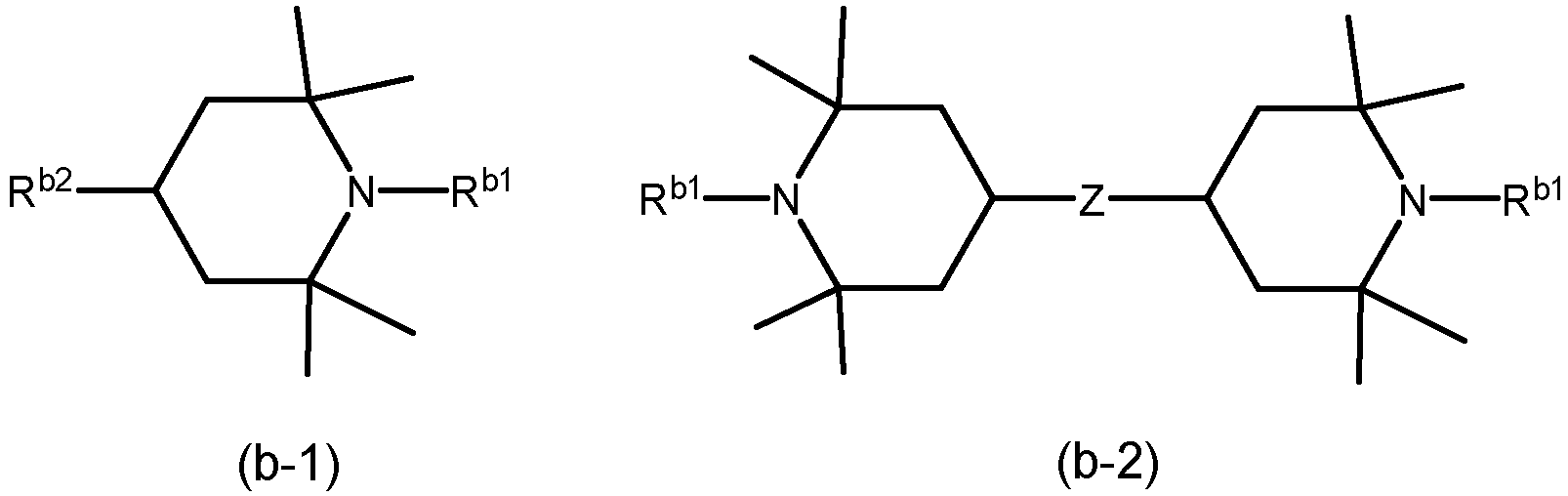
- In the above general formulae (b-1) and (b-2), Rb1 is each independently a hydrogen atom, an alkyl group having 1 to 10 carbon atoms, or an alkoxy group having 1 to 10 carbon atoms.
- In the above general formula (b-1), Rb2 is a hydrogen atom, an alkyl group having 1 to 20 carbon atoms, a cycloalkyl group having 3 to 18 ring-forming carbon atoms, an aryl group having 6 to 18 ring-forming carbon atoms, a hydroxyl group, an amino group, or a group represented by -O-CO-Rb3 (Rb3 is a hydrogen atom or a hydrocarbon group having 1 to 20 carbon atoms).
- In the above general formula (b-2), Z is an alkylene group having 1 to 20 carbon atoms, a cycloalkylene group having 3 to 18 ring-forming carbon atoms, an arylene group having 6 to 18 ring-forming carbon atoms, an oxygen atom, a sulfur atom, or a group represented by -O-CO-(CH2)n-CO-O- (n is an integer of 1 to 20) .
- Examples of the alkyl groups that can be selected as Rb1 include a methyl group, an ethyl group, a propyl group (n-propyl group and isopropyl group), a butyl group (n-butyl group, s-butyl group, t-butyl group, isobutyl group), a pentyl group, a hexyl group, a 2-ethylhexyl group, a heptyl group, an octyl group, a nonyl group, and a decyl group. These alkyl groups may be straight-chain alkyl groups or may be branched chain alkyl groups.
- The number of carbon atoms of the alkyl groups that can be selected as Rb1 is preferably 1 to 10, more preferably 1 to 6, and still more preferably 1 to 3.
- Examples of the alkoxy groups that can be selected as Rb1 include a methoxy group, an ethoxy group, a propoxy group (n-propoxy group and isopropoxy group), a butoxy group (n-butoxy group, s-butoxy group, t-butoxy group, and isobutoxy group), a pentyloxy group, a hexyloxy group, a 2-ethylhexyloxy group, a heptyloxy group, an octyloxy group, a nonyloxy group, a decyloxy group, and a group represented by -(CH2)n- (n is an integer of 1 to 20). These alkoxy groups may be straight-chain alkoxy groups or may be branched chain alkoxy groups.
- The number of carbon atoms of the alkoxy groups that can be selected as Rb1 is preferably 1 to 10, more preferably 1 to 6, and still more preferably 1 to 3.
- Examples of the alkyl groups that can be selected as Rb2 include the aforementioned alkyl groups having 1 to 10 carbon atoms that can be selected as Rb1, as well as an undecyl group, a dodecyl group, a tridecyl group, a tetradecyl group, a hexadecyl group, and an octadecyl group. These alkyl groups may be straight-chain alkyl groups or may be branched chain alkyl groups.
- The number of carbon atoms of the alkyl groups that can be selected as Rb2 is preferably 1 to 20, more preferably 3 to 18, still more preferably 6 to 16, and still much more preferably 8 to 14.
- Examples of the cycloalkyl groups that can be selected as Rb2 include a cyclopropyl group, a cyclobutyl group, a cyclopentyl group, a cyclohexyl group, a cycloheptyl group, a cyclooctyl group, and an adamantyl group.
- The number of ring-forming carbon atoms of the cycloalkyl groups that can be selected as Rb2 is preferably 3 to 18, more preferably 5 to 15, and still more preferably 6 to 12.
- Examples of the aryl groups that can be selected as Rb2 include a phenyl group, a naphthyl group, an anthryl group, a phenanthryl group, a biphenyl group, a terphenyl group, and a phenylnaphthyl group.
- The number of ring-forming carbon atoms of the aryl groups that can be selected as Rb2 is preferably 6 to 18, more preferably 6 to 15, and still more preferably 6 to 12.
- Examples of the alkylene groups that can be selected as Z include a methylene group, a 1,1-ethylene group, a 1,2-ethylene group, various propylene groups such as 1,3-propylene, 1,2-propylene, and 2,2-propylene, various butylene groups, various pentylene groups, various hexylene groups, various heptylene groups, various octylene groups, various nonylene groups, various decylene groups, various undecylene groups, various dodecylene groups, various tridecylene groups, various tetradecylene groups, various pentadecylene groups, various hexadecylene groups, various heptadecylene groups, and various octadecylene groups.
- Examples of the cycloalkylene groups that can be selected as Z include a cyclopropylene group, a cyclobutylene group, a cyclopentylene group, a cyclohexylene group, a cycloheptylene group, a cyclooctylene group, and an adamantylene group.
- Examples of the arylene groups that can be selected as Z include a phenylene group, a naphthylene group, an anthrylene group, a phenanthrylene group, a biphenylene group, and a terphenylene group.
- The component (B) used in one embodiment of the present invention more preferably contains one or more selected from a compound (B11) represented by the following general formula (b-11) and a compound (B21) represented by the following general formula (b-21).
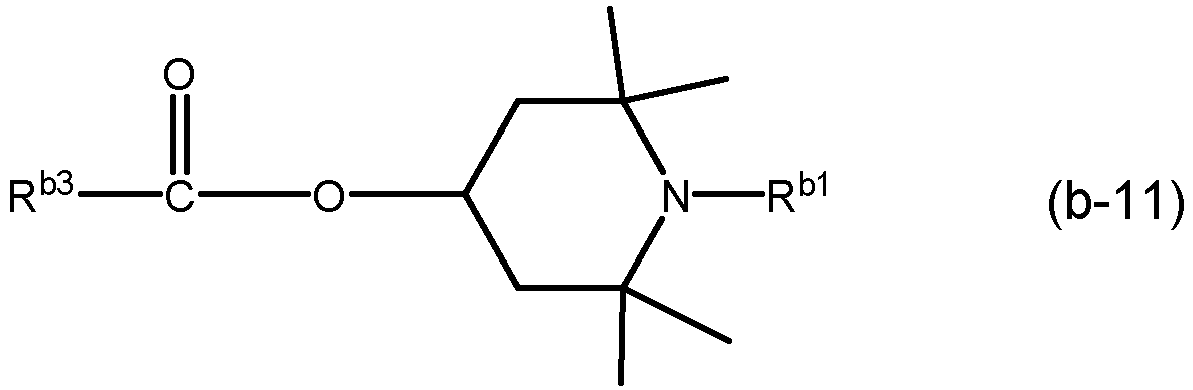

- In the above general formulae (b-11) and (b-21), Rb1 is each independently a hydrogen atom or an alkyl group having 1 to 10 carbon atoms. Specific examples of the alkyl groups that can be selected as Rb1 and the preferred range of the number of carbon atoms is as previously described.
- In the above general formula (b-11), Rb3 is a hydrogen atom or a hydrocarbon group having 1 to 20 carbon atoms.
- In the above general formula (b-21), n is an integer of 1 to 20.
- Examples of the hydrocarbon groups that can be selected as Rb3 include an alkyl group having 1 to 20 carbon atoms, an alkenyl group having 2 to 20 carbon atoms, a cycloalkyl group having 3 to 18 ring-forming carbon atoms optionally substituted with an alkyl group having 1 to 10 carbon atoms, an aryl group having 6 to 18 ring-forming carbon atoms optionally substituted with an alkyl group having 1 to 10 carbon atoms, and an arylalkyl group having 7 to 19 carbon atoms.
- The alkyl groups may be straight-chain alkyl groups or may be branched chain alkyl groups. The alkenyl groups may be straight-chain alkenyl groups or may be branched chain alkenyl groups.
- Examples of the alkyl groups, cycloalkyl groups and aryl groups that can be selected as Rb3 include the same groups as the alkyl groups, cycloalkyl groups and aryl groups that can be selected as Rb2.
- Examples of the alkenyl groups that can be selected as Rb3 include an ethenyl group (vinyl group), a propenyl group, a butenyl group, a pentenyl group, a hexenyl group, a heptenyl group, an octenyl group, a nonenyl group, a decenyl group, a dodecenyl group, a tridecenyl group, a tetradecenyl group, a pentadecenyl group, a hexadecenyl group, and an octadecenyl group (oleyl group) .
- Examples of the arylalkyl groups that can be selected as Rb3 include a phenylmethyl group, a phenylethyl group, a naphthylmethyl group, and a naphthylethyl group.
- Of these, Rb3 is preferably an alkyl group having 1 to 20 carbon atoms or an alkenyl group having 2 to 20 carbon atoms, and more preferably an alkyl group having 1 to 20 carbon atoms.
- The number of carbon atoms of the alkyl groups that can be selected as Rb3 is preferably 3 to 20, more preferably 4 to 18, still more preferably 6 to 16, and still much more preferably 8 to 14.
- The number of carbon atoms of the alkenyl groups that can be selected as Rb3 is preferably 2 to 20, more preferably 3 to 18, and still more preferably 6 to 16.
- The component (B) used in one embodiment of the present invention preferably contains at least a compound (B1) represented by the general formula (b-1), and more preferably contains at least a compound (B11) represented by the general formula (b-11).
- In the lubricating oil composition of one embodiment of the present invention, the content ratio of the component (B1) or (B11) in the component (B) is preferably 40 to 100 mass% or more, more preferably 50 to 100 mass%, more preferably 60 to 100 mass%, still more preferably 70 to 100 mass%, still more preferably 80 to 100 mass%, still much more preferably 90 to 100 mass%, and particularly preferably 95 to 100 mass%, based on the total amount (100 mass%) of the component (B) contained in the lubricating oil composition, from the viewpoint of obtaining a lubricating oil composition having further improved high temperature detergency and long-drain properties.
- From the viewpoint of obtaining a lubricating oil composition having further improved high temperature detergency and long-drain properties, the lubricating oil composition of one embodiment of the present invention may contain an antioxidant that does not correspond to the component (B) as the component (C).
- Examples of the component (C) used in one embodiment of the present invention include an amine antioxidant other than a hindered amine compound, a phenolic antioxidant, a sulfur antioxidant, and a phosphorus antioxidant.
- The component (C) may be used singly, or may be used in combination of two or more.
- The component (C) used in one embodiment of the present invention preferably contains one or more selected from an amine antioxidant (C1) other than a hindered amine compound and a phenolic antioxidant (C2), and more preferably contains both component (C1) and component (C2).
- The total content ratio of the components (C1) and (C2) in the component (C) used in one embodiment of the present invention is preferably 60 to 100 mass%, more preferably 70 to 100 mass%, more preferably 80 to 100 mass%, still more preferably 85 to 100 mass%, still much more preferably 90 to 100 mass%, and particularly preferably 95 to 100 mass%, based on the total amount (100 mass%) of the component (C) contained in the lubricating oil composition.
- When the component (C) used in one embodiment of the present invention contains both components (C1) and (C2), the content ratio by mass of the component (C1) to the component (C2), [(C1)/(C2)], is preferably 0.10 to 5.0, more preferably 0.15 to 3.0, more preferably 0.20 to 1.0, still more preferably 0.25 to 0.90, still much more preferably 0.30 to 0.80, and particularly preferably 0.35 to 0.70.
- Examples of the component (C1) used in one embodiment of the present invention include a diphenylamine antioxidant, such as diphenylamine, and alkylated diphenylamine having an alkyl group with 3 to 20 (preferably 6 to 16, more preferably 8 to 12) carbon atoms; and a naphthylamine antioxidant such as α-naphthylamine, phenyl-α-naphthylamine, and substituted phenyl-α-naphthylamine having an alkyl group with 3 to 20 (preferably 6 to 16, more preferably 8 to 12) carbon atoms.
- Examples of the component (C2) used in one embodiment of the present invention include a monophenolic antioxidant such as 2,6-di-t-butylphenol, 2,6-di-t-butyl-4-methylphenol, 2,6-di-t-butyl-4-ethylphenol, isooctyl-3-(3,5-di-t-butyl-4-hydroxyphenyl)propionate, octadecyl-3-(3,5-di-t-butyl-4-hydroxyphenyl)propionate, and benzenepropanoic acid-3,5-bis(1,1-dimethylethyl)-4-hydroxyalkyl ester; and a diphenolic antioxidant such as 4,4'-methylenebis(2,6-dit-butylphenol), 2,2'-methylenebis(4-ethyl-6-t-butylphenol) and thiodiethylenebis[3-(3,5-di-t-butyl-4-hydroxyphenyl)propionate].
- In the lubricating oil composition of one embodiment of the present invention, the content of the component (C) is preferably 0.01 mass% or more, more preferably 0.05 mass% or more, more preferably 0.10 mass% or more, still more preferably 0.30 mass% or more, still more preferably 0.50 mass% or more, still much more preferably 0.60 mass% or more, and particularly preferably 0.70 mass% or more, and furthermore, may be 0.75 mass% or more, 0.80 mass% or more, 0.85 mass% or more, or 0.90 mass% or more, and 10.0 mass% or less, 8.0 mass% or less, 6.0 mass% or less, 5.0 mass% or less, 4.0 mass% or less, 3.0 mass% or less, or 2.0 mass% or less, based on the total amount (100 mass%) of the lubricating oil composition.
- In the lubricating oil composition of one embodiment of the present invention, the content of the component (C) based on the total 100 parts by mass of the component (B) is preferably 1.0 part by mass or more, more preferably 3.0 parts by mass or more, more preferably 5.0 parts by mass or more, still more preferably 7.0 parts by mass or more, still more preferably 10 parts by mass or more, still much more preferably 12 parts by mass or more, and particularly preferably 14 parts by mass or more, and it is preferably 100 parts by mass or less, more preferably 80 parts by mass or less, more preferably 60 parts by mass or less, still more preferably 50 parts by mass or less, still much more preferably 40 parts by mass or less, still much more preferably 35 parts by mass or less, and particularly preferably 30 parts by mass or less.
- In the lubricating oil composition of one embodiment of the present invention, the content of the component (C1) is preferably 0.01 mass% or more, more preferably 0.05 mass% or more, still more preferably 0.10 mass% or more, still much more preferably 0.15 mass% or more, and particularly preferably 0.20 mass% or more, and may be 5.0 mass% or less, 4.0 mass% or less, 3.0 mass% or less, 2.0 mass% or less, 1.0 mass% or less, 0.80 mass% or less, 0.60 mass% or less, or 0.40 mass% or less, based on the total amount (100 mass%) of the lubricating oil composition.
- In the lubricating oil composition of one embodiment of the present invention, the content of the component (C1) in terms of nitrogen atoms is preferably 0.001 mass% or more, more preferably 0.003 mass% or more, still more preferably 0.005 mass% or more, still much more preferably 0.007 mass% or more, and particularly preferably 0.009 mass% or more, and may be 1.0 mass% or less, 0.50 mass% or less, 0.20 mass% or less, 0.10 mass% or less, 0.08 mass% or less, 0.05 mass% or less, or 0.03 mass% or less, based on the total amount (100 mass%) of the lubricating oil composition.
- In the lubricating oil composition of one embodiment of the present invention, the content of the component (C1) based on the total 100 parts by mass of the component (B) is preferably 0.1 parts by mass or more, more preferably 1.0 part by mass or more, more preferably 2.0 parts by mass or more, still more preferably 3.0 parts by mass or more, still much more preferably 4.0 parts by mass or more, and particularly preferably 5.0 parts by mass or more, and it is preferably 50 parts by mass or less, more preferably 40 parts by mass or less, more preferably 30 parts by mass or less, still more preferably 20 parts by mass or less, still much more preferably 15 parts by mass or less, still much more preferably 9.0 parts by mass or less, and particularly preferably 7.5 parts by mass or less.
- In the lubricating oil composition of one embodiment of the present invention, the content of the component (C2) is preferably 0.01 mass% or more, more preferably 0.05 mass% or more, more preferably 0.10 mass% or more, still more preferably 0.20 mass% or more, still much more preferably 0.30 mass% or more, and particularly preferably 0.40 mass% or more, and may be 5.0 mass% or less, 4.0 mass% or less, 3.0 mass% or less, 2.0 mass% or less, or 1.0 mass% or less, based on the total amount (100 mass%) of the lubricating oil composition.
- In the lubricating oil composition of one embodiment of the present invention, the content of the component (C2) based on the total 100 parts by mass of the component (B) is preferably 1.0 part by mass or more, more preferably 3.0 parts by mass or more, more preferably 5.0 parts by mass or more, still more preferably 7.0 parts by mass or more, still much more preferably 9.0 parts by mass or more, and particularly preferably 10.0 parts by mass or more, and it is preferably 60 parts by mass or less, more preferably 50 parts by mass or less, more preferably 40 parts by mass or less, still more preferably 30 parts by mass or less, still much more preferably 25 parts by mass or less, still much more preferably 20 parts by mass or less, and particularly preferably 16 parts by mass or less.
- The lubricating oil composition of one embodiment of the present invention may or may not further contain a metal-based detergent.
- If a metal-based detergent is contained, the metal-based detergent may be used singly, or may be used in combination of two or more.
- Examples of the metal-based detergent used in one embodiment of the present invention include metal salt compounds of organic acids containing a metal atom selected from alkali metals and alkaline earth metals, with specific examples including metal salicylates, metal phenates, and metal sulfonates containing a metal atom selected from alkali metals and alkaline earth metals.
- The metal atom contained in the metal-based detergent is preferably sodium, calcium, magnesium, or barium, and more preferably calcium, from the viewpoint of obtaining a lubricating oil composition having further improved high temperature detergency.
- In one embodiment of the present invention, the metal-based detergent may be either a neutral salt, a basic salt, an overbased salt, or a mixture thereof.
- The total base number of the metal-based detergent is preferably 0 to 600 mg KOH/g.
- In one embodiment of the present invention, if the metal-based detergent is a basic salt or an overbased salt, the total base number of the metal-based detergent is preferably 10 to 600 mg KOH/g, more preferably 20 to 500 mg KOH/g.
- In the present specification, the "base number" means a base number measured by perchloric acid method in accordance with JIS K2501 "Petroleum products and lubricants - Determination of neutralization number", 7.
- In the lubricating oil composition of one embodiment of the present invention, the content of the metal-based detergent in terms of metal atoms may be 50 ppm by mass or more, 100 ppm by mass or more, or 150 ppm by mass or more, and may be 3000 ppm by mass or less, 1000 ppm by mass or less, 700 ppm by mass or less, 500 ppm by mass or less, or 400 ppm by mass or less, based on the total amount (100 mass%) of the lubricating oil composition.
- Generally, by containing a metal-based detergent, the high temperature detergency of the lubricating oil composition can be improved. However, since the lubricating oil composition of one embodiment of the present invention contains 0.60 mass% or more of the component (B), which is sufficiently dissolved by using the component (A), excellent high temperature detergency can be exhibited even if the content of the metal-based detergent is small or nil. In addition, as the metal-based detergent can be a factor in the decrease in long-drain properties (particularly the decrease in long-drain properties when there is water contamination), the content of the metal-based detergent is preferably as small as possible from the viewpoint of having good long-drain properties.
- From the viewpoint of obtaining a lubricating oil composition with better long-drain properties even when there is water contamination, the content of the metal-based detergent in terms of metal atoms in the lubricating oil composition of one embodiment of the present invention is preferably less than 50 ppm by mass, more preferably less than 40 ppm by mass, more preferably less than 30 ppm by mass, still more preferably less than 20 ppm by mass, still more preferably less than 10 ppm by mass, still much more preferably less than 5 ppm by mass, and particularly preferably less than 2 ppm by mass, based on the total amount (100 mass%) of the lubricating oil composition.
- Even if the content of the metal-based detergent is limited as described above, since the lubricating oil composition of one embodiment of the present invention contains 0.60 mass% or more of the component (B), which is sufficiently dissolved by using the component (A), excellent high temperature detergency can be exhibited.
- In the present specification, the content of metal atoms such as alkali metal atoms and alkaline earth metal atoms mean values measured in accordance with JPI-5S-38-92.
- The lubricating oil composition of one embodiment of the present invention may further contain other lubricating oil additive other than the components (B) to (C) when needed as long as the effects of the present invention are not impaired.
- Examples of such lubricating oil additives include a pour point depressant, a viscosity index improver, a friction modifier, an anti-wear agent, an extreme pressure agent, a metal deactivator, an oil agent, an ashless dispersant, an anti-rust agent, and an anti-foaming agent.
- These lubricating oil additives may be each used singly, or may be each used in combination of two or more.
- The contents of these lubricating oil additives can be each appropriately adjusted as long as the effects of the present invention are not impaired, and the contents of the additives are each independently usually 0.001 to 15 mass%, preferably 0.005 to 10 mass%, and more preferably 0.01 to 5 mass%, based on the total amount (100 mass%) of the lubricating oil composition.
- The lubricating oil composition of one embodiment of the present invention may further contain a pour point depressant. The pour point depressant may be used singly, or may be used in combination of two or more.
- Examples of the pour point depressants used in one embodiment of the present invention include an ethylenevinyl acetate copolymer, a condensate of chlorinated paraffin and naphthalene, a condensate of chlorinated paraffin and phenol, polymethacrylate, and polyalkylstyrene.
- The mass-average molecular weight (Mw) of the pour point depressant used in one embodiment of the present invention may be 5,000 or more, 7,000 or more, 10,000 or more, 15,000 or more, 20,000 or more, 25,000 or more, 30,000 or more, 35,000 or more, 40,000 or more, 45,000 or more, 50,000 or more, 55,000 or more, or 60,000 or more, and may be 150,000 or less, 120,000 or less, 100,000 or less, 90,000 or less, or 80,000 or less.
- The lubricating oil composition of one embodiment of the present invention may further contain a viscosity index improver. The viscosity index improver may be used singly, or may be used in combination of two or more.
- Examples of the viscosity index improvers used in one embodiment of the present invention include polymers such as non-dispersed polymethacrylate, dispersed polymethacrylate, an olefin copolymer (e.g., ethylene-propylene copolymer), a dispersed olefin copolymer, and a styrene copolymer (e.g., styrene-diene copolymer and styrene-isoprene copolymer).
- The weight-average molecular weight (Mw) of the viscosity index improver used in one embodiment of the present invention may be 5,000 or more, 7,000 or more, 10,000 or more, 15,000 or more, or 20,000 or more, and may be 1,000,000 or less, 700,000 or less, 500,000 or less, 300,000 or less, 200,000 or less, 100,000 or less, or 50,000 or less.
- The lubricating oil composition of one embodiment of the present invention may further contain a friction modifier or an anti-wear agent. The friction modifier or anti-wear agent may be used singly, or may be used in combination of two or more.
- Examples of the friction modifiers and anti-wear agents used in one embodiment of the present invention include sulfur compounds such as a sulfurized olefin, a dialkyl polysulfide, a diarylalkyl polysulfide, and a diaryl polysulfide; phosphorous compounds such as a phosphoric acid ester, a thiophosphoric acid ester, a phosphorous acid ester, an alkylhydrogen phosphite, an amine salt of phosphoric acid ester, and an amine salt of phosphorous acid ester; organic molybdenum compounds such as molybdenum dithiocarbamate (MoDTC), molybdenum dithiophosphate (MoDTP), and an amine salt of molybdic acid; organic zinc compounds such as zinc dithiophosphate (ZnDTP) and zinc dithiocarbamate (ZnDTC); and ashless friction modifiers such as an amine compound, a fatty acid ester, a fatty acid amide, a fatty acid, an aliphatic alcohol, an aliphatic ether, an urea compound, and a hydrazide compound.
- The lubricating oil composition of one embodiment of the present invention may further contain an extreme pressure agent. The extreme pressure agent may be used singly, or may be used in combination of two or more.
- Examples of the extreme pressure agents used in one embodiment of the present invention include sulfur compounds such as a sulfurized olefin, a dialkyl polysulfide, a diarylalkyl polysulfide, and a diaryl polysulfide; and phosphorous compounds such as a phosphoric acid ester, a thiophosphoric acid ester, a phosphorous acid ester, an alkylhydrogen phosphite, an amine salt of phosphoric acid ester, and an amine salt of phosphorous acid ester.
- The lubricating oil composition of one embodiment of the present invention may further contain a metal deactivator. The metal deactivator may be used singly, or may be used in combination of two or more.
- Examples of the metal deactivators used in one embodiment of the present invention include benzotriazole, a triazole derivative, a benzotriazole derivative, and a thiadiazole derivative.
- The lubricating oil composition of one embodiment of the present invention may further contain an oil agent. The oil agent may be used singly, or may be used in combination of two or more.
- Examples of the oil agents used in one embodiment of the present invention include aliphatic saturated and unsaturated monocarboxylic acids such as stearic acid and oleic acid; polymerized fatty acids such as a dimer acid and a hydrogenated dimer acid; hydroxy fatty acids such as ricinoleic acid and 12-hydroxystearic acid; aliphatic saturated and unsaturated monoalcohols such as a lauryl alcohol and an oleyl alcohol; aliphatic saturated and unsaturated monoamines such as a stearylamine and an oleylamine; and aliphatic saturated and unsaturated monocarboxylic acid amides such as a lauramide and an oleamide.
- The lubricating oil composition of one embodiment of the present invention may further contain an ashless dispersant from the viewpoint of having good dispersing ability. The ashless dispersant may be used singly, or may be used in combination of two or more.
- The ashless dispersant used in one embodiment of the present invention is preferably an alkenyl succinimide, and examples thereof include an alkenyl bis-succinimide represented by the following general formula (f-1) and an alkenyl monosuccinimide represented by the following general formula (f-2).


- In the above general formulae (f-1) and (f-2), Rf1, Rf2 and Rf3 are each independently an alkenyl group having a mass-average molecular weight (Mw) of 500 to 3000 (preferably 900 to 2500).
- Examples of the alkenyl groups that can be selected as Rf1, Rf2 and Rf3 include a polybutenyl group, a polyisobutenyl group, and an ethylene-propylene copolymer, and among these, a polybutenyl group or a polyisobutenyl group is preferable.
- Af1, Af2 and Af3 are each independently an alkylene group having 2 to 5 carbon atoms.
- x1 is an integer of 0 to 10, preferably an integer of 1 to 4, and more preferably 2 or 3.
- x2 is an integer of 1 to 10, preferably an integer of 2 to 5, and more preferably 3 or 4.
- The compound represented by the aforementioned general formula (f-1) or (f-2) may be a modified alkenyl succinimide reacted with one or more selected from a boron compound, an alcohol, an aldehyde, a ketone, an alkylphenol, a cyclic carbonate, an epoxy compound, an organic acid, and the like.
- The lubricating oil composition of one embodiment of the present invention may further contain an anti-rust agent. The anti-rust agent may be used singly, or may be used in combination of two or more.
- Examples of the anti-rust agents used in one embodiment of the present invention include a fatty acid, an alkenyl succinic acid half ester, a fatty acid soap, an alkyl sulfonic acid salt, a polyhydric alcohol fatty acid ester, a fatty acid amine, oxidized paraffin, and an alkyl polyoxyethylene ether.
- The lubricating oil composition of one embodiment of the present invention may further contain an anti-foaming agent. The anti-foaming agent may be used singly, or may be used in combination of two or more.
- Examples of the anti-foaming agents used in one embodiment of the present invention include an alkyl silicone anti-foaming agent, a fluorosilicone anti-foaming agent, and a fluoroalkyl ether anti-foaming agent.
- The method for producing a lubricating oil composition of one embodiment of the present invention is not particularly limited, but from the viewpoint of productivity, the method is preferably a method having a step of adding the aforementioned component (B), and if needed, the components (C) to (D) and the other lubricating oil additives, to the base oil (A).
- The kinematic viscosity of the lubricating oil composition of one embodiment of the present invention at 40°C is preferably 10 to 120 mm2/s, more preferably 15 to 100 mm2/s, still more preferably 20 to 80 mm2/s, still much more preferably 25 to 70 mm2/s, and particularly preferably 27 to 60 mm2/s.
- The kinematic viscosity of the lubricating oil composition of one embodiment of the present invention at 100°C is preferably 2.5 to 20.0 mm2/s, more preferably 4.0 to 18.0 mm2/s, still more preferably 5.0 to 16.0 mm2/s, still much more preferably 6.0 to 14.0 mm2/s, and particularly preferably 7.0 to 12.0 mm2/s.
- The viscosity index of the lubricating oil composition of one embodiment of the present invention is preferably 80 or more, more preferably 100 or more, more preferably 120 or more, still more preferably 150 or more, still much more preferably 170 or more, and particularly preferably 200 or more.
- The oxidation induction time (OIT) for the lubricating oil composition of one embodiment of the present invention, as measured by performing a test for evaluating the long-drain properties as described in Examples described later, is preferably 50 minutes or more, more preferably 60 minutes or more, more preferably 70 minutes or more, still more preferably 90 minutes or more, still more preferably 100 minutes or more, still much more preferably 120 minutes or more, and particularly preferably 150 minutes or more.
- The merit rating for the lubricating oil composition of one embodiment of the present invention, obtained by performing a hot tube test as described in Examples described later and evaluating the degree of color change, is preferably 7.0 or more, more preferably 7.5 or more, more preferably 8.0 or more, still more preferably 8.5 or more, still much more preferably 9.0 or more, and particularly preferably 9.5 or more.
- The lubricating oil composition of one embodiment of the present invention has excellent high temperature detergency and long-drain properties, and in addition to these characteristics, can retain excellent long-drain properties even when there is water contamination.
- Therefore, the lubricating oil composition of one embodiment of the present invention can be applied to various apparatuses that can exhibit the above characteristics, but it can be suitably used for lubrication between parts in an internal combustion engine, and particularly for lubrication between parts in an internal combustion engine of a hybrid system having an internal combustion engine and an electromotor as power sources.
- When the aforementioned characteristics of the lubricating oil composition of one embodiment of the present invention are taken into consideration, the present invention can also provide the following [I] and [II].
- [I] An internal combustion engine, which is installed in a hybrid system, and is filled with the aforementioned lubricating oil composition of one embodiment of the present invention.
- [II] A method for lubricating an internal combustion engine, wherein the aforementioned lubricating oil composition of one embodiment of the present invention is applied to an internal combustion engine installed in a hybrid system.
- The hybrid system described in the above [I] and [II] is a mechanism having an internal combustion engine and an electromotor as power sources.
- Examples of the hybrid system described in the above [I] and [II] include hybrid vehicles, hybrid motorcycles, hybrid trains, and hybrid ships.
- The internal combustion engine of the above [I] is filled with the aforementioned lubricating oil composition of one embodiment of the present invention, and is an apparatus installed in a hybrid system together with an electric motor, which is an electromotor.
- In addition, the method for lubricating an internal combustion engine of the above [II] specifies the application of the aforementioned lubricating oil composition of one embodiment of the present invention to an internal combustion engine installed in a hybrid system, but the lubricating oil composition may also be applied to an electric motor, which is an electromotor.
- As described above, the present invention discloses the following embodiments.
- [1] A lubricating oil composition comprising: a base oil (A) comprising an ester base oil (A1); and a hindered amine compound (B),
wherein a content of the component (B) is 0.60 to 10.0 mass% based on the total amount of the lubricating oil composition. - [2] The lubricating oil composition according to the above [1], wherein a content ratio of the component (A1) is 10 to 100 mass% based on the total amount of the component (A).
- [3] The lubricating oil composition according to the above [1] or [2], wherein the component (A1) comprises one or more selected from a polyol ester (A11) and diester (A12).
- [4] The lubricating oil composition according to any one of the above [1] to [3], wherein the component (A) comprises an ester base oil (A1) and optionally a mineral oil (A2),
wherein a content ratio of the mineral oil (A2) is 90 mass% or less based on the total amount of the component (A). - [5] The lubricating oil composition according to any one of the above [1] to [3], wherein the component (A) comprises an ester base oil (A1) and optionally a mineral oil (A2),
wherein a content ratio of the mineral oil (A2) is 40 mass% or less based on the total amount of the component (A). - [6] The lubricating oil composition according to the above [4] or [5], wherein the component (A) comprises an ester base oil (A1) and a mineral oil (A2).
- [7] The lubricating oil composition according to any one of the above [1] to [6], wherein the content of the component (B) based on the total 100 parts by mass of the component (A) is 2.5 parts by mass or more and 50.0 parts by mass or less.
- [8] The lubricating oil composition according to any one of the above [1] to [7], wherein the content of the component (B) is 2.50 to 10.0 mass% based on the total amount of the lubricating oil composition.
- [9] The lubricating oil composition according to any one of the above [1] to [6], further comprising an antioxidant (C) that does not correspond to the component (B) .
- [10] The lubricating oil composition according to the above [9], wherein the component (C) comprises one or more selected from an amine antioxidant (C1) other than a hindered amine compound and a phenolic antioxidant (C2).
- [11] The lubricating oil composition according to the above [9] or [10], wherein a content of the component (C) based on the total 100 parts by mass of the component (B) is 1.0 part by mass or more and 100 parts by mass or less.
- [12] The lubricating oil composition according to any one of the above [1] to [11], wherein a content of a metal-based detergent in terms of metal atoms is less than 50 ppm by mass based on the total amount of the lubricating oil composition.
- [13] The lubricating oil composition according to any one of the above [1] to [12], being used for lubrication of an internal combustion engine of a hybrid system.
- [14] An internal combustion engine, which is installed in a hybrid system, and is filled with the lubricating oil composition according to any one of the above [1] to [13] .
- [15] A method for lubricating an internal combustion engine, wherein the lubricating oil composition according to any one of the above [1] to [13] is applied to an internal combustion engine installed in a hybrid system.
- Next, the present invention will be described in much more detail with reference to Examples, but the present invention is in no way limited to these Examples. Measuring methods for various properties are as follows.
- The kinematic viscosity and viscosity index were measured and calculated in accordance with JIS K2283:2000.
- The contents were measured in accordance with JPI-5S-38-92.
- The content was measured in accordance with JIS K2609:1998.
- Measurements were made using a gel permeation chromatograph (HPLC Model 1260 manufactured by Agilent) under the following conditions and the values measured in terms of standard polystyrene were used.
-
- Column: Two serially connected "Shodex LF404."
- Column temperature: 35°C
- Developing solvent: Chloroform
- Flow rate: 0.3 mL/min
- A base oil and various additives were added and mixed in amounts shown in Tables 1 to 2, thereby preparing each lubricating oil composition.
- Details of each component used in the preparation of the lubricating oil composition are as follows.
- "Polyol ester": Polyol ester corresponding to the component (A11), kinematic viscosity at 40°C = 20 mm2/s, kinematic viscosity at 100°C = 4 mm2/s, viscosity index = 139.
- "Diester": Diester corresponding to the component (A12), kinematic viscosity at 40°C = 20 mm2/s, kinematic viscosity at 100°C = 3 mm2/s, viscosity index = 153.
- "100N mineral oil": Paraffinic mineral oil classified in Group III of the API base oil categories, kinematic viscosity at 40°C = 20 mm2/s, kinematic viscosity at 100°C = 4 mm2/s, viscosity index = 122.
- "PAO (4 cst)": Poly-α-olefin, kinematic viscosity at 100°C = 4 mm2/s, viscosity index = 124.
- "PAO (6 cst)": Poly-α-olefin, kinematic viscosity at 100°C = 6 mm2/s, viscosity index = 132.
- "Hindered amine compound": 2,2,6,6-Tetramethylpiperidin-4-yl dodecanoate, compound in which Rb1 = hydrogen atom and Rb3 = -C11H23 in the aforementioned general formula (b-11), corresponds to the component (B11), nitrogen atom content = 4.13 mass%.
- "Amine antioxidant other than the component (B)": Dinonyldiphenylamine, nitrogen atom content = 3.6 mass%. "Phenolic antioxidant (1)": Thiodiethylenebis[3-(3,5-dit-butyl-4-hydroxyphenyl)propionate].
- "Phenolic antioxidant (2)": Benzene propanoic acid-3,5-bis(1,1-dimethylethyl)-4-hydroxyalkyl ester.
- "Additive mixture (1)": Additive mixture containing an organic molybdenum-based friction modifier, a zinc dithiophosphate (ZnDTP) friction modifier, a boron-modified polyimide, a non-boron modified polyimide, glyceryl monooleate, a silicone anti-foaming agent, a pour point depressant (Mw = 70,000), a viscosity index improver (Mw = 400,000), and the like.
- "Additive mixture (2)": Additive mixture containing a calcium-based detergent, an organic molybdenum-based friction modifier, a zinc dithiophosphate (ZnDTP) friction modifier, a boron-modified polyimide, a non-boron modified polyimide, glyceryl monooleate, a silicone anti-foaming agent, a pour point depressant (Mw = 70,000), a viscosity index improver (Mw = 400,000), and the like.
- Regarding the lubricating oil compositions prepared, the kinematic viscosity, viscosity index, and the content of Ca atoms were measured or calculated, and the following evaluation tests were carried out. The results of them are set forth in Tables 1 and 2.
- The prepared lubricating oil compositions were used to perform an ISOT test for 168 hours with the addition of pure water while injecting NOx gas under the following test conditions, and thereby prepared degraded oils.
-
- Testing machine: ISOT TESTER manufactured by Yoshida Kagaku Kikai Co.,Ltd.
- Internal volume of test container: 500 mL
- Amount of lubricating oil composition used: 300 mL
- Amount of NOx gas: 2,000 ppm by volume based on the total amount of supplied gas
- Amount of pure water added: 5 vol% based on the total amount of the lubricating oil composition, added every 24 hours
- Agitation speed: 800 r/min
- Test temperature (cycle): (1) 4 hours at 60°C, (2) 2 hours at 95°C, (3) 12 hours at 120°C, and (4) 6 hours at 60°C was counted as one cycle and repeated.
- Pressure differential scanning calorimetry (PDSC) was performed on the above degraded oils at 180°C and 200 psig oxygen (not flow) in accordance with ASTM D6186-88 to measure the oxidation induction time (OIT), which is the time from the start of measurement to autoxidation. It can be said that the longer the oxidation induction time is, the better the long-drain properties of the lubricating oil composition become. In the present Example, the lubricating oil composition was considered to have good long-drain properties when the oxidation induction time was 50 minutes or more.
- The degraded oils prepared in the test for evaluating long-drain properties of the above (1) were used to perform a hot tube test in accordance with JPI-5S-55-99 at a test temperature of 240°C. The degree of color change of the glass tube after the test was evaluated on a 21-point scale from 0 (black) to 10 (colorless) (merit rating) in 0.5 increments. It can be said that the higher the score is, the better the high temperature detergency of the lubricating oil composition becomes. In the present Example, the lubricating oil composition was considered to have good high temperature detergency when the score was 7.0 or more.
-
Table 1 Example 1 Example 2 Example 3 Example 4 Example 5 Example 6 Composition of lubricating oil composition Component (A1) Polyol ester mass% 86.70 83.90 60.00 40.00 20.00 - Diester mass% - - - - - 83.90 Base oil other than component (A1) 100N mineral oil mass% 23.90 43.90 63.90 - PAO(4cst) mass% - - - - - - PAO(6cst) mass% - - - - - - Component (B) Hindered amine compound mass% 2.80 5.60 5.60 5.60 5.60 5.60 Component (C) Amine antioxidant other than component (B) mass% 0.30 0.30 0.30 0.30 0.30 0.30 Phenolic antioxidant (1) mass% 0.15 0.15 0.15 0.15 0.15 0.15 Phenolic antioxidant (2) mass% 0.50 0.50 0.50 0.50 0.50 0.50 Other additives Additive mixture (1) mass% 9.55 9.55 9.55 9.55 9.55 9.55 Additive mixture (2) mass% - - - - - - Total mass% 100.00 100.00 100.00 100.00 100.00 100.00 Content of component (B) based on the total 100 parts by mass of component (A1) part by mass 3.23 6.67 9.33 14.00 28.00 6.67 Content of N derived from component (B) mass% 0.12 0.23 0.23 0.23 0.23 0.23 Content of N derived from amine antioxidant other than component (B) mass% 0.011 0.011 0.011 0.011 0.011 0.011 Properties of lubricating oil composition Kinematic viscosity at 40°C mm2/s 47.43 47.46 44.30 41.67 37.35 29.69 Kinematic viscosity at 100°C mm2/s 10.11 10.12 9.560 9.172 8.466 7.650 Viscosity index - 208 208 208 211 214 245 Content of Ca in lubricating oil composition ppm by mass 2> 2> 2> 2> 2> 2> Evaluation points Test for evaluating long-drain properties OIT of degraded oil min 126 170 104 78 67 155 Hot tube test (240°C) Score - 9.5 9.5 9.0 8.5 8.0 9.5 -
Table 2 Comparative Example 1 Comparative Example 2 Comparative Example 3 Comparative Example 4 Comparative Example 5 Comparative Example 6 Composition of lubricating oil composition Component (A1) Polyol ester mass% - - - - - - Diester mass% - - - - - - Base oil other than component (A1) 100N mineral oil mass% 87.51 81.35 78.55 PAO(4cst) mass% - - - 74.38 73.69 71.31 PAO(6cst) mass% - - - 13.13 13.01 12.59 Component (B) Hindered amine compound mass% - 2.80 5.60 - 2.80 5.60 Component (C) Amine antioxidant other than component (B) mass% 0.30 0.30 0.30 0.30 0.30 0.30 Phenolic antioxidant (1) mass% 0.15 0.50 0.50 0.15 0.15 0.15 Phenolic antioxidant (2) mass% 0.50 5.50 5.50 0.50 0.50 0.50 Other additives Additive mixture (1) mass% - 9.55 9.55 - 9.55 9.55 Additive mixture (2) mass% 11.54 - - 11.54 - - Total mass% 100.00 100.00 100.00 100.00 100.00 100.00 Content of component (B) based on the total 100 parts by mass of component (A1) part by mass - - - - - - Content of N derived from component (B) mass% - 0.12 0.23 - 0.12 0.23 Content of N derived from amine antioxidant other than component (B) mass% 0.011 0.011 0.011 0.011 0.011 0.011 Properties of lubricating oil composition Kinematic viscosity at 40°C mm2/s 34.58 32.66 32.81 32.40 29.99 30.06 Kinematic viscosity at 100°C mm2/s 7.93 7.694 7.745 7.381 7.022 7.063 Viscosity index - 212 218 219 205 209 210 Content of Ca in lubricating oil composition ppm by mass 1940 2> 2> 1950 2> 2> Evaluation points Test for evaluating long-drain properties OIT of degraded oil min 37 70 91 45 65 103 Hot tube test (240°C) Score - 8.0 5.5 5.5 7.5 5.0 5.0 - Table 1 indicates that the lubricating oil compositions prepared in Examples 1 to 6 have excellent high temperature detergency, as well as good long-drain properties when there is water contamination, as a result of containing the components (A1) and (B). On the other hand, Table 2 indicates that the lubricating oil compositions prepared in Comparative Examples 1 to 6 were inferior in at least one of the long-drain properties and high temperature detergency as a result of not containing at least one of the components (A1) and (B).
Claims (15)
- A lubricating oil composition comprising: a base oil (A) comprising an ester base oil (A1); and a hindered amine compound (B),
wherein a content of the component (B) is 0.60 to 10.0 mass% based on the total amount of the lubricating oil composition. - The lubricating oil composition according to claim 1, wherein a content ratio of the component (A1) is 10 to 100 mass% based on the total amount of the component (A).
- The lubricating oil composition according to claim 1 or 2, wherein the component (A1) comprises one or more selected from a polyol ester (A11) and diester (A12).
- The lubricating oil composition according to any one of claims 1 to 3, wherein the component (A) comprises an ester base oil (A1) and optionally a mineral oil (A2),
wherein a content ratio of the mineral oil (A2) is 90 mass% or less based on the total amount of the component (A). - The lubricating oil composition according to any one of claims 1 to 3, wherein the component (A) comprises an ester base oil (A1) and optionally a mineral oil (A2),
wherein a content ratio of the mineral oil (A2) is 40 mass% or less based on the total amount of the component (A). - The lubricating oil composition according to claim 4 or 5, wherein the component (A) comprises an ester base oil (A1) and a mineral oil (A2).
- The lubricating oil composition according to any one of claims 1 to 6, wherein the content of the component (B) based on the total 100 parts by mass of the component (A) is 2.5 parts by mass or more and 50.0 parts by mass or less.
- The lubricating oil composition according to any one of claims 1 to 7, wherein the content of the component (B) is 2.50 to 10.0 mass% based on the total amount of the lubricating oil composition.
- The lubricating oil composition according to any one of claims 1 to 6, further comprising an antioxidant (C) that does not correspond to the component (B).
- The lubricating oil composition according to claim 9, wherein the component (C) comprises one or more selected from an amine antioxidant (C1) other than a hindered amine compound and a phenolic antioxidant (C2).
- The lubricating oil composition according to claim 9 or 10, wherein a content of the component (C) based on the total 100 parts by mass of the component (B) is 1.0 part by mass or more and 100 parts by mass or less.
- The lubricating oil composition according to any one of claims 1 to 11, wherein a content of a metal-based detergent in terms of metal atoms is less than 50 ppm by mass based on the total amount of the lubricating oil composition.
- The lubricating oil composition according to any one of claims 1 to 12, being used for lubrication of an internal combustion engine of a hybrid system.
- An internal combustion engine, which is installed in a hybrid system, and is filled with the lubricating oil composition according to any one of claims 1 to 13.
- A method for lubricating an internal combustion engine, wherein the lubricating oil composition according to any one of claims 1 to 13 is applied to an internal combustion engine installed in a hybrid system.
Applications Claiming Priority (2)
| Application Number | Priority Date | Filing Date | Title |
|---|---|---|---|
| JP2022060211 | 2022-03-31 | ||
| PCT/JP2023/010505 WO2023189696A1 (en) | 2022-03-31 | 2023-03-17 | Lubricant composition |
Publications (2)
| Publication Number | Publication Date |
|---|---|
| EP4502120A1 true EP4502120A1 (en) | 2025-02-05 |
| EP4502120A4 EP4502120A4 (en) | 2026-03-11 |
Family
ID=88201740
Family Applications (1)
| Application Number | Title | Priority Date | Filing Date |
|---|---|---|---|
| EP23779714.7A Pending EP4502120A4 (en) | 2022-03-31 | 2023-03-17 | LUBRICANT COMPOSITION |
Country Status (5)
| Country | Link |
|---|---|
| US (1) | US20250051680A1 (en) |
| EP (1) | EP4502120A4 (en) |
| JP (1) | JPWO2023189696A1 (en) |
| CN (1) | CN118946652A (en) |
| WO (1) | WO2023189696A1 (en) |
Family Cites Families (14)
| Publication number | Priority date | Publication date | Assignee | Title |
|---|---|---|---|---|
| US5073278A (en) * | 1988-07-18 | 1991-12-17 | Ciba-Geigy Corporation | Lubricant composition |
| US5268113A (en) * | 1989-07-07 | 1993-12-07 | Ciba-Geigy Corporation | Lubricant composition |
| AU2002258183A1 (en) * | 2001-05-15 | 2002-11-25 | Matsushita Electric Industrial Co., Ltd. | Lubricant composition and analysis method for same |
| JP3573125B2 (en) * | 2001-11-05 | 2004-10-06 | 松下電器産業株式会社 | Motor and motor built-in device |
| EP2181184A1 (en) * | 2007-08-24 | 2010-05-05 | E. I. du Pont de Nemours and Company | Lubrication oil compositions |
| JP5407312B2 (en) * | 2008-12-10 | 2014-02-05 | 日本精工株式会社 | Grease composition and rolling bearing |
| JP2012162657A (en) * | 2011-02-08 | 2012-08-30 | Nsk Ltd | Grease composition and rolling bearing for motor |
| US9783758B2 (en) * | 2013-01-22 | 2017-10-10 | Citizen Watch Co., Ltd. | Lubricating oil composition for timepiece and timepiece |
| EP2949734B1 (en) * | 2013-01-22 | 2017-06-28 | Citizen Watch Co., Ltd. | Clock lubricating-oil composition and clock |
| CN105229128B (en) * | 2013-05-20 | 2018-07-06 | 出光兴产株式会社 | Lubricating oil composition |
| JP6278872B2 (en) * | 2014-09-25 | 2018-02-14 | 株式会社Adeka | Lubricating oil additive composition and lubricating oil composition containing the same |
| JP6690108B2 (en) | 2015-03-24 | 2020-04-28 | 出光興産株式会社 | Lubricating oil composition for internal combustion engine of hybrid vehicle |
| JP7155661B2 (en) * | 2018-06-26 | 2022-10-19 | 住友金属鉱山株式会社 | thermal grease |
| CN112930389B (en) * | 2018-11-06 | 2022-11-25 | 引能仕株式会社 | Lubricating oil composition |
-
2023
- 2023-03-17 CN CN202380030923.9A patent/CN118946652A/en active Pending
- 2023-03-17 EP EP23779714.7A patent/EP4502120A4/en active Pending
- 2023-03-17 JP JP2024511809A patent/JPWO2023189696A1/ja active Pending
- 2023-03-17 US US18/851,105 patent/US20250051680A1/en active Pending
- 2023-03-17 WO PCT/JP2023/010505 patent/WO2023189696A1/en not_active Ceased
Also Published As
| Publication number | Publication date |
|---|---|
| EP4502120A4 (en) | 2026-03-11 |
| CN118946652A (en) | 2024-11-12 |
| JPWO2023189696A1 (en) | 2023-10-05 |
| WO2023189696A1 (en) | 2023-10-05 |
| US20250051680A1 (en) | 2025-02-13 |
Similar Documents
| Publication | Publication Date | Title |
|---|---|---|
| EP3279298B2 (en) | Lubricating oil composition and method for reducing friction in internal combustion engines | |
| EP2883946B1 (en) | Lubricant composition for internal combustion engine | |
| EP3511398B1 (en) | Gasoline engine lubricant oil composition and manufacturing method therefor | |
| US11193080B2 (en) | Lubricating oil composition | |
| EP3495463A1 (en) | Lubricant composition | |
| EP3275978A1 (en) | Lubricant composition for gasoline engines and method for producing same | |
| EP3950905B1 (en) | Lubricating oil composition | |
| EP3279299A1 (en) | Lubricating oil composition for internal combustion engine | |
| JPWO2011158595A1 (en) | Lubricating oil composition for internal combustion engines | |
| EP3388500A1 (en) | Lubricant composition | |
| US8557751B2 (en) | Lubricant composition | |
| EP4083173B1 (en) | Lubricating oil composition | |
| EP3037507A1 (en) | Lubricating oil composition for shock absorber | |
| EP4317370B1 (en) | Lubricant composition | |
| EP3492568A1 (en) | Lubricant composition | |
| EP3766948A1 (en) | Lubricating oil composition | |
| EP4177323A1 (en) | Lubricating oil composition, shock absorber, and method for using lubricating oil composition | |
| EP3425030B1 (en) | Lubricating oil composition, lubricating method, and transmission | |
| US20250051680A1 (en) | Lubricant composition | |
| EP1878784B1 (en) | Long-life fuel-saving engine oil composition | |
| EP4001382B1 (en) | Lubricating oil composition | |
| US12286601B2 (en) | Lubricating oil composition, buffer and method for using lubricating oil composition | |
| EP4502121A1 (en) | Lubricant composition | |
| EP4317385A1 (en) | Lubricating oil composition | |
| EP4001383A1 (en) | Lubricant oil composition, method for producing lubricant oil composition, and method for lubricating transmission gear or reduction gear |
Legal Events
| Date | Code | Title | Description |
|---|---|---|---|
| STAA | Information on the status of an ep patent application or granted ep patent |
Free format text: STATUS: THE INTERNATIONAL PUBLICATION HAS BEEN MADE |
|
| PUAI | Public reference made under article 153(3) epc to a published international application that has entered the european phase |
Free format text: ORIGINAL CODE: 0009012 |
|
| STAA | Information on the status of an ep patent application or granted ep patent |
Free format text: STATUS: REQUEST FOR EXAMINATION WAS MADE |
|
| 17P | Request for examination filed |
Effective date: 20241029 |
|
| AK | Designated contracting states |
Kind code of ref document: A1 Designated state(s): AL AT BE BG CH CY CZ DE DK EE ES FI FR GB GR HR HU IE IS IT LI LT LU LV MC ME MK MT NL NO PL PT RO RS SE SI SK SM TR |
|
| DAV | Request for validation of the european patent (deleted) | ||
| DAX | Request for extension of the european patent (deleted) | ||
| A4 | Supplementary search report drawn up and despatched |
Effective date: 20260210 |
|
| RIC1 | Information provided on ipc code assigned before grant |
Ipc: C10M 169/04 20060101AFI20260204BHEP Ipc: C10N 30/00 20060101ALI20260204BHEP Ipc: C10N 30/04 20060101ALI20260204BHEP Ipc: C10N 40/25 20060101ALI20260204BHEP Ipc: C10M 101/02 20060101ALI20260204BHEP Ipc: C10M 105/32 20060101ALI20260204BHEP Ipc: C10M 105/36 20060101ALI20260204BHEP Ipc: C10M 105/38 20060101ALI20260204BHEP Ipc: C10M 129/10 20060101ALI20260204BHEP Ipc: C10M 133/12 20060101ALI20260204BHEP Ipc: C10M 133/40 20060101ALI20260204BHEP |