EP4501980A1 - Method for producing fluorine-containing copolymer - Google Patents
Method for producing fluorine-containing copolymer Download PDFInfo
- Publication number
- EP4501980A1 EP4501980A1 EP23779647.9A EP23779647A EP4501980A1 EP 4501980 A1 EP4501980 A1 EP 4501980A1 EP 23779647 A EP23779647 A EP 23779647A EP 4501980 A1 EP4501980 A1 EP 4501980A1
- Authority
- EP
- European Patent Office
- Prior art keywords
- polymerization
- atom
- formula
- fluorine
- independently
- Prior art date
- Legal status (The legal status is an assumption and is not a legal conclusion. Google has not performed a legal analysis and makes no representation as to the accuracy of the status listed.)
- Pending
Links
Classifications
-
- C—CHEMISTRY; METALLURGY
- C08—ORGANIC MACROMOLECULAR COMPOUNDS; THEIR PREPARATION OR CHEMICAL WORKING-UP; COMPOSITIONS BASED THEREON
- C08F—MACROMOLECULAR COMPOUNDS OBTAINED BY REACTIONS ONLY INVOLVING CARBON-TO-CARBON UNSATURATED BONDS
- C08F2/00—Processes of polymerisation
- C08F2/12—Polymerisation in non-solvents
- C08F2/16—Aqueous medium
- C08F2/18—Suspension polymerisation
-
- C—CHEMISTRY; METALLURGY
- C08—ORGANIC MACROMOLECULAR COMPOUNDS; THEIR PREPARATION OR CHEMICAL WORKING-UP; COMPOSITIONS BASED THEREON
- C08F—MACROMOLECULAR COMPOUNDS OBTAINED BY REACTIONS ONLY INVOLVING CARBON-TO-CARBON UNSATURATED BONDS
- C08F14/00—Homopolymers and copolymers of compounds having one or more unsaturated aliphatic radicals, each having only one carbon-to-carbon double bond, and at least one being terminated by a halogen
- C08F14/18—Monomers containing fluorine
- C08F14/26—Tetrafluoroethene
-
- C—CHEMISTRY; METALLURGY
- C08—ORGANIC MACROMOLECULAR COMPOUNDS; THEIR PREPARATION OR CHEMICAL WORKING-UP; COMPOSITIONS BASED THEREON
- C08F—MACROMOLECULAR COMPOUNDS OBTAINED BY REACTIONS ONLY INVOLVING CARBON-TO-CARBON UNSATURATED BONDS
- C08F210/00—Copolymers of unsaturated aliphatic hydrocarbons having only one carbon-to-carbon double bond
- C08F210/02—Ethene
-
- C—CHEMISTRY; METALLURGY
- C08—ORGANIC MACROMOLECULAR COMPOUNDS; THEIR PREPARATION OR CHEMICAL WORKING-UP; COMPOSITIONS BASED THEREON
- C08F—MACROMOLECULAR COMPOUNDS OBTAINED BY REACTIONS ONLY INVOLVING CARBON-TO-CARBON UNSATURATED BONDS
- C08F214/00—Copolymers of compounds having one or more unsaturated aliphatic radicals, each having only one carbon-to-carbon double bond, and at least one being terminated by a halogen
- C08F214/18—Monomers containing fluorine
- C08F214/26—Tetrafluoroethene
- C08F214/265—Tetrafluoroethene with non-fluorinated comonomers
Definitions
- fluorine-based polymers have been polymer materials excellent in heat resistance, solvent resistance, chemical resistance, and the like, and have been therefore utilized in various applications by taking advantage of such features.
- Known examples of methods of producing fluorine-based polymers include polymerization methods such as solution polymerization methods, suspension polymerization methods, and emulsification polymerization methods.
- Patent Literature 1 describes a production method including adding a fluorine-containing surfactant as a dispersion stabilizer in the case of producing a fluorine-containing copolymer by suspension polymerization using a polymerization medium containing water and a solvent selected from a perfluorocarbon, a hydrofluorocarbon, or a perfluorocarbon containing a hetero atom.
- Patent Literature 1 Japanese Patent Application Laid-Open ( JP-A) No. H08-333408
- Patent Literature 1 A method of more efficiently obtaining a fluorine-containing copolymer is desired.
- a method of producing a fluorine-containing copolymer of which the polymerization rate is higher than those of conventional fluorine-containing copolymers is provided.
- the present disclosure includes the following aspects.
- a method of producing a fluorine-containing copolymer of which the polymerization rate is higher than those of conventional fluorine-containing copolymers is provided.
- a numerical range expressed by "x to y” means a range including the values of x and y as the minimum and maximum values, respectively.
- the upper or lower limit value expressed in a certain numerical range may be replaced by the upper or lower limit value in another numerical range expressed in a stepwise manner.
- the upper or lower limit value expressed in a certain numerical range may be replaced by values described in Examples.
- the amount of each component means, unless otherwise specified, the total amount of the plural kinds of substances.
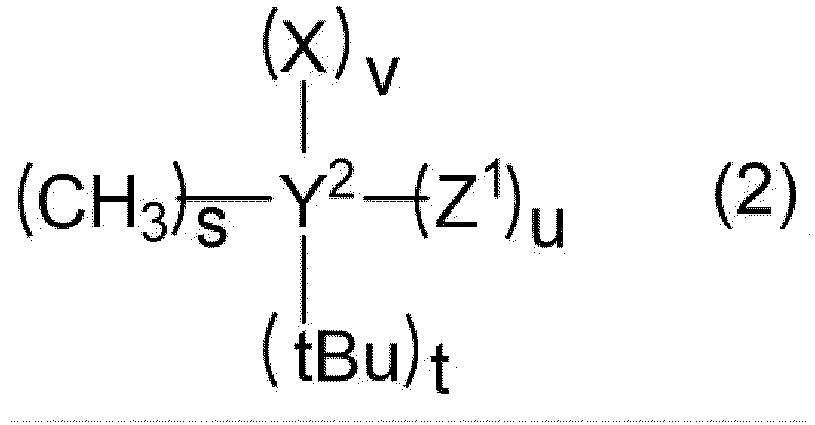
- a method of producing a fluorine-containing copolymer of the present disclosure is a method including performing suspension polymerization by using monomers including ethylene and tetrafluoroethylene in a polymerization medium including water and a polymerization solvent A that is not compatible with water and that is at least one kind selected from the group consisting of compounds represented by the following Formulae 1 to 3.
- Y 1 represents a nitrogen atom or an oxygen atom
- tBu means a tert-butyl group.
- each A 1 independently represents a hydrogen atom, a methyl group, a tert-butyl group, -OR, or -NR 2
- each A 2 independently represents a methyl group, a tert-butyl group, -OR, or -NR 2
- each R independently represents a methyl group or a tert-butyl group
- * represents a binding site
- the polymerization is performed in the polymerization medium including water and the polymerization solvent A that is not compatible with water and that is at least one kind selected from the group consisting of the compounds represented by Formulae 1 to 3.
- Each polymerization solvent A has a low chain-transfer property. Therefore, it is presumed that the polymerization of the monomers including ethylene and tetrafluoroethylene proceeds smoothly.
- the polymerization medium includes at least one polymerization solvent A selected from the group consisting of the compounds represented by Formulae 1 to 3.
- Y 1 represents a nitrogen atom or an oxygen atom.
- Y 1 is an oxygen atom
- n is 1 or more.
- Each Z 1 is independently a group represented by any one of the following Formulae T1 to T6.
- each A 1 independently represents a hydrogen atom, a methyl group, a tert-butyl group, -OR, or -NR 2
- each A 2 independently represents a methyl group, a tert-butyl group, -OR, or -NR 2
- each R independently represents a methyl group or a tert-butyl group
- * represents a binding site
- Y 1 is preferably an oxygen atom from the viewpoint of enhancing a polymerization rate and increasing a molecular weight.
- (p, m, n, k) is preferably (0, 1, 1, 0) or (1, 0, 1, 0) as a combination of p, m, n, and k.
- each Z 1 is independently a group represented by any one of Formulae T1 to T6, preferably a group represented by any one of Formulae T1 to T3, and more preferably a group represented by Formula T1, from the viewpoint of enhancing a polymerization rate.
- each A 1 independently represents a hydrogen atom, a methyl group, a tert-butyl group, -OR, or -NR 2
- each A 2 independently represents a methyl group, a tert-butyl group, -OR, or -NR 2
- each R independently represents a methyl group or a tert-butyl group.
- each A 1 independently represents a methyl group, a tert-butyl group, -OR, or -NR 2
- each A 2 independently represents a methyl group, a tert-butyl group, -OR, or -NR 2
- each R independently represents a methyl group or a tert-butyl group.
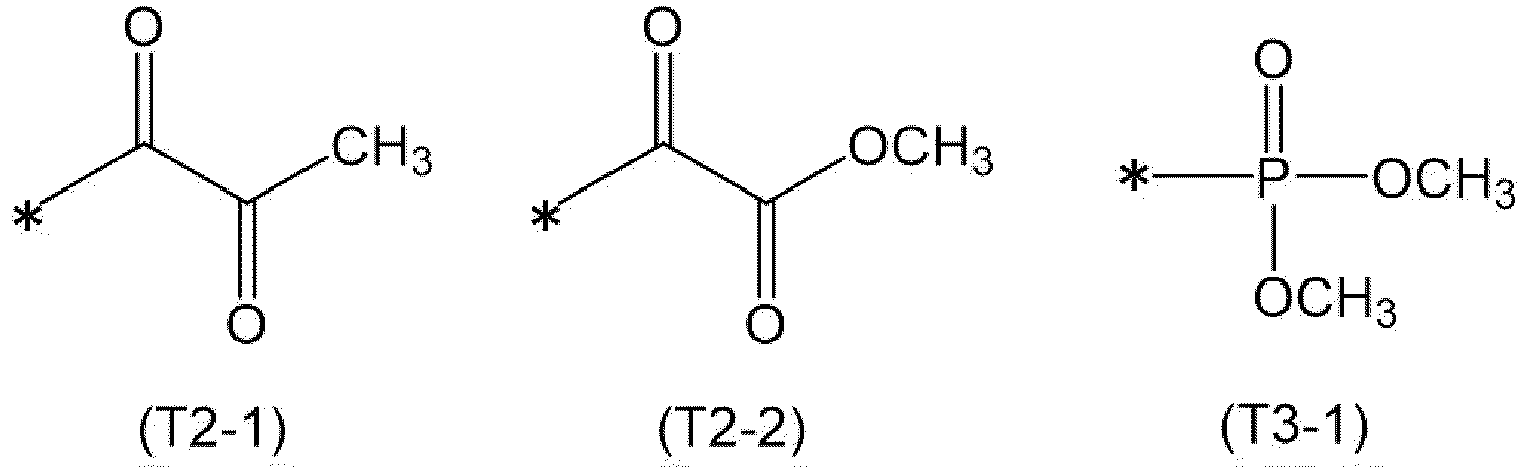
- examples of Z 1 include the following compounds.
- Y 2 represents a carbon atom, a silicon atom, a phosphorus atom, or a sulfur atom.
- u is 1 or more.
- Each X independently represents a chlorine atom or a bromine atom.
- Each Z 1 is independently a group represented by any one of the following Formulae T1 to T6.
- (s, t, u, v) is preferably (3, 0, 1, 0) in a case in which Y 2 is a carbon atom, and (s, t, u, v) is preferably (0, 3, 0, 0) in a case in which Y 2 is a phosphorus atom.
- Y 2 is preferably a carbon atom, a silicon atom, or a sulfur atom, more preferably to a carbon atom or a silicon atom, and still more preferably a carbon atom from the viewpoint of enhancing a polymerization rate and increasing a molecular weight.
- X is preferably a chlorine atom from the viewpoint of enhancing a polymerization rate.
- each Z 1 is independently a group represented by any one of Formulae T1 to T6, preferably a group represented by any one of Formulae T1 to T3, and more preferably a group represented by Formula T1 from the viewpoint of enhancing a polymerization rate.
- each A 1 independently represents a hydrogen atom, a methyl group, a tert-butyl group, -OR, or -NR 2
- each A 2 independently represents a methyl group, a tert-butyl group, -OR, or -NR 2
- each R independently represents a methyl group or a tert-butyl group.
- each A 1 independently represents a methyl group, a tert-butyl group, -OR, or -NR 2
- each A 2 independently represents a methyl group, a tert-butyl group, -OR, or -NR 2
- each R independently represents a methyl group or a tert-butyl group.
- Examples of Z 1 in the compound represented by Formula 2 include those similar to Z 1 in the compound represented by Formula 1.
- Y 3 represents a carbon atom or a silicon atom.
- Each of R 1 to R 4 independently represents a methyl group, a tert-butyl group, or a tert-butoxy group.
- Y 3 is preferably a carbon atom from the viewpoint of enhancing a polymerization rate and increasing a molecular weight.
- R 1 to R 4 are preferably methyl groups from the viewpoint of enhancing a polymerization rate and increasing a molecular weight.
- a compound corresponding to the compound represented by Formula 1 and corresponding to the compound represented by Formula 2 is regarded as the compound represented by Formula 1. In other words, it is considered that the compound represented by Formula 2 does not include the compound represented by Formula 1.
- a compound corresponding to the compound represented by Formula 1 and corresponding to the compound represented by Formula 3 is regarded as the compound represented by Formula 1. In other words, it is considered that the compound represented by Formula 3 does not include the compound represented by Formula 1.
- methyl pivalate and tert-butyl pivalate are regarded as compounds represented by Formula 1 in spite of corresponding to the compound represented by Formula 1 and corresponding to the compound represented by Formula 2.
- the compound represented by Formula 2 includes neither methyl pivalate nor tert-butyl pivalate.
- Di-tert-butyl ether is regarded as the compound represented by Formula 1 in spite of corresponding to the compound represented by Formula 1 and corresponding to the compound represented by Formula 3.
- the compound represented by Formula 3 does not include di-tert-butyl ether.
- the polymerization solvent A is a solvent that is not compatible with water from the viewpoint of performing suspension polymerization. Whether or not the polymerization solvent A is a solvent that is not compatible with water is determined by the following method.
- water and the solvent to be determined are put in an airtight container so that the mass ratio thereof (water: solvent to be determined) is 10: 7.
- the water and the solvent are shaken for 1 minute under ordinary pressure at 25°C, and then left to stand for 10 minutes. It is determined that the solvent to be determined is a solvent that is not compatible with water in a case in which, after 10 minutes, the water and the solvent to be determined are separated into two phases. From the viewpoint of performing suspension polymerization, it is necessary that the polymerization medium is separated into two phases.
- the polymerization medium includes water.
- the water is not particularly limited, and preferably includes no impurity.
- Examples of the water include distilled water, ion-exchanged water, and pure water.
- the proportion of water to the polymerization solvent is from 10% by volume to 80% by volume. A case in which the proportion of water is 80% by volume or less is advantageous from the viewpoint of a polymerization rate.
- the proportion of the volume of water to the polymerization solvent A is preferably from 10% by volume to 80 % by volume, and more preferably from 30% by volume to 60% by volume from the viewpoint of a polymerization rate, heat removal, and the easiness of stirring.
- a case in which the above-described proportion is 10% by volume or more is advantageous from the viewpoint of heat removal and stirring.
- a case in which the above-described proportion is 80% by volume or less is advantageous from the viewpoint of a polymerization rate.
- the polymerization medium may include an additional polymerization solvent other than the polymerization solvent A and water.
- the polymerization medium does not include another polymerization solvent, and it is preferable that the polymerization medium consists of the polymerization solvent A and water.
- polymerization solvents examples include: aromatic hydrocarbon solvents such as benzene, toluene, and xylene; sulfoxide-based solvents such as dimethylsulfoxide (DMSO); ketone-based solvents such as acetone and 2-butanone(methylethylketone); ether-based solvents such as tetrahydrofuran (THF) and dioxane; ester-based solvents such as ethyl acetate; alcohol-based solvents such as tert-butyl alcohol; and halogen-based solvents such as hexafluoroisopropanol, chloroform, 1H-perfluorohexane, 1H,1H,1H,2H,2H-perfluorooctane, 1,3-bis(trifluoromethyl)benzene, 1,4-bis(trifluoromethyl)benzene, benzotrifluoride, chlorobenzene, and 1,2-dichlor
- the fluorine-containing copolymer obtained by the method of producing the fluorine-containing copolymer of the present disclosure includes a structural unit derived from ethylene (hereinafter also referred to as "E unit”) and a structural unit derived from tetrafluoroethylene (hereinafter also referred to as "TFE unit").
- the monomers used in the polymerization may include an additional monomer other than ethylene and tetrafluoroethylene.
- the fluorine-containing copolymer may include an additional structural unit other than the E unit and the TFE unit.
- additional monomers other than ethylene and tetrafluoroethylene include the following monomers (1) to (7).
- Such an additional monomer may be one, or may be two or more.
- each of X 11 and Y 11 is independently a hydrogen atom or a fluorine atom, and n is an integer from 2 to 8.
- Monomer (2) fluoroolefin including a hydrogen atom in an ethylenically unsaturated group such as vinylidene fluoride, vinyl fluoride, trifluoroethylene, or hexafluoro isobutylene.
- Monomer (3) fluoroolefin including no hydrogen atom in an ethylenically unsaturated group such as hexafluoropropylene (excluding TFE).
- Monomer (4) perfluoro (alkyl vinyl ether) such as perfluoro(methyl vinyl ether), perfluoro(ethyl vinyl ether), perfluoro(propyl vinyl ether), or perfluoro(butyl vinyl ether).
- Monomer (6) fluorine-containing monomer having an aliphatic ring structure, such as perfluoro(2,2-dimethyl-1,3-dioxole), 2,2,4-trifluoro-5-trifluoromethoxy-1,3-dioxole, or perfluoro(2-methylene-4-methyl-1,3-dioxolane).
- Monomer (7) monomer having a polar functional group and having no fluorine atom (hereinafter also referred to as "monomer containing polar functional group”.
- polar functional groups examples include a hydroxyl group, a carboxy group, an epoxy group, and an acid anhydride residue.
- the polar functional group is preferably an acid anhydride residue.
- Examples of such monomers containing polar functional groups include: vinyl ether having a hydroxyl group and an epoxy group; unsaturated carboxylic acids (for example, maleic acid, itaconic acid, citraconic acid, and undecylenic acid); and unsaturated multivalent carboxylic acid anhydrides (for example, maleic anhydride, itaconic anhydride, citraconic anhydride, and himic anhydride).
- unsaturated carboxylic acids for example, maleic acid, itaconic acid, citraconic acid, and undecylenic acid
- unsaturated multivalent carboxylic acid anhydrides for example, maleic anhydride, itaconic anhydride, citraconic anhydride, and himic anhydride.
- the monomer (1) is preferred in view of favorable reactivity with ethylene and tetrafluoroethylene.
- the content of additional monomer in the monomers used in the polymerization is preferably from 0.001% by mol to 20% by mol, more preferably from 0.1% by mol to 15% by mol, and still more preferably from 0.2% by mol to 5% by mol with respect to the total amount of the monomers.
- the additional monomer is the monomer (7)
- the content thereof is preferably from 0.01% by mol to 5% by mol, more preferably from 0.05% by mol to 3% by mol, and still more preferably from 0.1% by mol to 1% by mol.
- the molar ratio between the contents of ethylene and tetrafluoroethylene is preferably from 20/80 to 80/20, more preferably from 70/30 to 30/70, and still more preferably from 50/50 to 35/65.
- a polymerization initiator in order to initiate polymerization reaction.
- the polymerization initiator is preferably a radical polymerization initiator.
- the radical polymerization initiator include: azo compounds such as azobisisobutyronitrile and 2,2'-azobis(4-methoxy-2,4-dimethylvaleronitrile); peroxydicarbonates such as diisopropyl peroxydicarbonate; peroxy esters such as tert-butyl peroxypivalate, tert-butyl peroxyisobutyrate, and tert-butyl peroxyacetate; non-fluorine-based diacyl peroxides such as diisobutyryl peroxide, octanoyl peroxide, benzoyl peroxide, and lauroyl peroxide; fluorine-containing diacyl peroxides such as (Z(CF 2 ) p COO) 2 (Z is a hydrogen atom, a fluorine atom, or a chlorine atom, and p is an integer from 1 to 10
- Examples of the chain transfer agent include: alcohols such as methanol, ethanol, 2,2,2-trifluoroethanol, 2,2,3,3-tetrafluoropropanol, 1,1,1,3,3,3-hexafluoroisopropanol, and 2,2,3,3,3-pentafluoropropanol; hydrocarbons such as n-pentane, n-hexane, and cyclohexane; hydrofluorocarbons such as CF 2 H 2 ; ketones such as acetone; mercaptans such as methyl mercaptan; esters such as methyl acetate and ethyl acetate; and ethers such as diethyl ether and methylethyl ether.
- alcohols such as methanol, ethanol, 2,2,2-trifluoroethanol, 2,2,3,3-tetrafluoropropanol, 1,1,1,3,3,3-hexafluoroisopropanol, and 2,2,3,3,3-
- the polymerization in the method of producing a fluorine-containing copolymer of the present disclosure is suspension polymerization.
- a suspension polymerization method is a polymerization method in which a monomer is polymerized in a state in which the monomer is suspended in a polymerization medium containing water.
- the suspension polymerization is distinguished from solution polymerization in which a monomer is polymerized in a state in which the monomer is dissolved in a polymerization medium.
- the polymerization reaction is allowed to proceed by, for example, continuously or intermittently adding the monomers including ethylene and tetrafluoroethylene into the polymerization medium.
- 0.5 ⁇ M sol ⁇ S/M mon ⁇ 1.0 is satisfied in a case in which the substance amount (mol) of polymerization solvent A is M sol , the total solubility (mol/mol) of the ethylene and the tetrafluoroethylene with respect to the polymerization solvent A is S, and the total substance amount (mol) of the ethylene and the tetrafluoroethylene, dissolved in the polymerization solvent excluding the water, is M mon , in any stage during polymerization.
- the phrase "during polymerization" in the present disclosure refers to a period in which a fluorine-containing copolymer including ethylene and tetrafluoroethylene is generated.
- M sol ⁇ S/M mon is 1.0 in a case in which the polymerization medium consists of the polymerization solvent A and water and does not include any polymerization medium other than the polymerization solvent A and the water.
- M sol ⁇ S/M mon is less than 1.0 in a case in which the polymerization medium includes a polymerization medium other than the polymerization solvent A and water.
- M sol ⁇ S/M mon is from 0.5 to 1.0.
- M sol ⁇ S/M mon is more preferably from 0.7 to 1.0, and still more preferably from 0.85 to 1.0.
- M sol representing the substance amount of the polymerization solvent A is calculated using the following equation.
- M sol (mol) weight (g) of polymerization solvent A/molecular weight of polymerization solvent A
- the total solubility S of ethylene and tetrafluoroethylene with respect to the polymerization solvent A is calculated by the following method.
- the vapor pressure P sol of the polymerization solvent A is measured.
- P sol is set at a pressure indicated by putting a polymerization medium in an autoclave that includes a stirring machine and is made of stainless steel, performing freezing degassing twice, and then keeping the internal temperature of a reactor at a predetermined temperature T.
- T means a liquid-phase temperature.
- the temperature of a gas-phase portion is considered to be equal to the liquid-phase temperature.
- the weighed polymerization solvent A is put in the autoclave that includes the stirring machine and is made of stainless steel.
- the substance amount M' (mol) of the polymerization solvent A is calculated based on the weight (g) of the weighed polymerization solvent A.
- a weighed mixed gas of ethylene and tetrafluoroethylene is put in the autoclave that includes the stirring machine and is made of stainless steel.
- the loading amount M all (mol) of mixed gas of ethylene and tetrafluoroethylene is calculated, using the weight W (g) of the weighed mixed gas, based on the following equation.
- M all W / 28 x + 100 y
- volume V of the gas-phase portion of the autoclave that includes the stirring machine and is made of stainless steel is calculated based on the following equation.
- V volume of autoclave that includes stirring machine and is made of stainless steel - volume of polymerization solvent A
- M g (mol) of mixed gas of ethylene and tetrafluoroethylene, present in the gas-phase portion of the autoclave that includes the stirring machine and is made of stainless steel is calculated based on the following equation.
- R means a gas constant.
- M g P mon V / RT
- M' mon (mol) of mixed gas of ethylene and tetrafluoroethylene, dissolved in the polymerization solvent A is calculated based on the following equation.
- M ′ mon M all ⁇ M g
- the total substance amount M mon of ethylene and tetrafluoroethylene dissolved in the polymerization medium excluding water is calculated by the following method.
- the vapor pressure P' sol of the polymerization medium excluding water is measured.
- P' sol is set at a pressure indicated by putting a polymerization medium excluding water in an autoclave that includes a stirring machine and is made of stainless steel, performing freezing degassing twice, and then keeping the internal temperature of a reactor at a predetermined temperature T.
- T means a liquid-phase temperature.
- the temperature of a gas-phase portion is considered to be equal to the liquid-phase temperature.
- a weighed mixed gas of ethylene and tetrafluoroethylene is put in the autoclave that includes the stirring machine and is made of stainless steel.
- the loading amount M' all (mol) of mixed gas of ethylene and tetrafluoroethylene is calculated, using the weight W' (g) of the weighed mixed gas, based on the following equation.
- M ′ all W ′ / 28 x + 100 y
- P' mon of the mixed gas of ethylene and tetrafluoroethylene is calculated based on the following equation.
- P ′ mon P ′ all ⁇ P ′ sol
- V' volume of the gas-phase portion of the autoclave that includes the stirring machine and is made of stainless steel - volume of polymerization medium
- M' g (mol) of mixed gas of ethylene and tetrafluoroethylene, present in the gas-phase portion of the autoclave that includes the stirring machine and is made of stainless steel is calculated based on the following equation.
- R means a gas constant.
- M ′ g P ′ mon ⁇ V ′ / RT
- M mon M ′ all ⁇ M ′ g
- a polymerization temperature is preferably from 0°C to 100°C, and more preferably from 20°C to 90°C.
- a polymerization pressure is preferably from 0.1 MPaG to 10 MPaG, and more preferably from 0.5 MPaG to 3 MPaG.
- Polymerization time is preferably from 1 hour to 30 hours, and more preferably from 2 hours to 20 hours.
- DMC dimethyl carbonate
- the reactor was spontaneously cooled below room temperature, followed by discharging unreacted ethylene and tetrafluoroethylene.
- the obtained polymer in the slurry state was put in methanol, followed by filtering a precipitate.
- the precipitate was dried in a vacuum oven at 40°C for 12 hours.
- 8.3 g of a copolymer of ethylene and tetrafluoroethylene was obtained.
- a copolymer of ethylene, tetrafluoroethylene, and perfluorobutylethylene was obtained by a method similar to that in Example 1 except that the loading amounts of polymerization media were changed to 120 mL (1.4 mol) of dimethyl carbonate and 480 mL (26.7 mmol) of ion-exchanged water, the loading amount of polymerization initiator was changed to 7.3 mg (0.04 mmol), and 2.2 g of perfluorobutylethylene (8.9 mmol) which was a monomer was also loaded in the case of loading dimethyl carbonate and ion-exchanged water which were the polymerization media.
- a copolymer of ethylene, tetrafluoroethylene, and perfluorobutylethylene was obtained by a method similar to that in Example 2 except that the loading amounts of polymerization media were changed to 300 mL (3.6 mol) of dimethyl carbonate and 300 mL (16.7 mmol) of ion-exchanged water, and the loading amount of polymerization initiator was changed to 18.3 mg (0.11 mmol).
- a copolymer of ethylene, tetrafluoroethylene, and perfluorobutylethylene was obtained by a method similar to that in Example 2 except that the loading amounts of polymerization media were changed to 480 mL (5.7 mol) of dimethyl carbonate and 120 mL (6.7 mmol) of ion-exchanged water, and the loading amount of polymerization initiator was changed to 29.3 mg (0.17 mmol).
- a copolymer of ethylene, tetrafluoroethylene, and perfluorobutylethylene was obtained by a method similar to that in Example 3 except that a polymerization initiator was changed to 2,2'-azobis(4-methoxy-2,4-dimethylvaleronitrile) (product name "V70", manufactured by FUJIFILM Wako Pure Chemical Corporation, "AMVN” in the table), and a polymerization temperature was changed to 35°C.
- a copolymer of ethylene, tetrafluoroethylene, and perfluorobutylethylene was obtained by a method similar to that in Example 3 except that a polymerization initiator was changed to tert-butylperoxypivalate (product name "PERBUTYL PV", manufactured by NOF CORPORATION, "PBPV” in the table), and a polymerization temperature was changed to 66°C.
- a copolymer of ethylene and tetrafluoroethylene was obtained by a method similar to that in Example 1 except that polymerization media were changed to di-tert-butylcarbonate ("Boc 2 O” in the table) and water, a polymerization initiator was changed to diisopropyl peroxydicarbonate (product name "PEROYL IPP", manufactured by NOF CORPORATION, "IPP" in the table), and a polymerization temperature was changed to 45°C.
- Di-tert-butylcarbonate corresponds to the compound represented by Formula 1, in Formula 1, Y 1 is an oxygen atom, p is 0, m is 1, n is 1, k is 0, Z 1 is a group represented by T1, and A 1 is -OR, and R is a tert-butyl group in T1.
- a copolymer of ethylene and tetrafluoroethylene was obtained by a method similar to that in Example 1 except that polymerization media were changed to methyl pivalate ("MePiv" in the table) and water.
- Methyl pivalate corresponds to the compound represented by Formula 1, in Formula 1, Y 1 is an oxygen atom, p is 1, m is 0, n is 1, k is 0, Z 1 is a group represented by T1, and A 1 is a tert-butyl group in T1.
- a copolymer of ethylene and tetrafluoroethylene was obtained by a method similar to that in Example 5 except that polymerization media were changed to tri-tert-butylphosphine ("TTBP" in the table) and water, and a polymerization temperature was changed to 35°C.
- TTBP tri-tert-butylphosphine
- Tri-tert-butylphosphine corresponds to the compound represented by Formula 2, and, in Formula 2, Y 2 is a phosphorus atom, s is 0, t is 3, u is 0, and v is 0.
- a copolymer of ethylene and tetrafluoroethylene was obtained by a method similar to that in Example 1 except that polymerization media were changed to tetramethylsilane ("TMS" in the table) and water, and a polymerization temperature was changed to 25°C.
- TMS tetramethylsilane
- Tetramethylsilane corresponds to the compound represented by Formula 3, and, in Formula 3, Y 3 is a silicon atom, and R 1 to R 4 are methyl groups.
- a copolymer of ethylene and tetrafluoroethylene was obtained by a method similar to that in Example 1 except that polymerization media were changed to neopentane and water, and a polymerization temperature was changed to 20°C.
- Neopentane corresponds to the compound represented by Formula 3, and, in Formula 3, Y 3 is a carbon atom, and R 1 to R 4 are methyl groups.
- a copolymer of ethylene and tetrafluoroethylene was obtained by a method similar to that in Example 1 except that polymerization media were changed to water and di-tert-butylketone subjected to distillation purification.
- Di-tert-butylketone corresponds to the compound represented by Formula 2, in Formula 2, Y 2 is a carbon atom, s is 3, t is 0, u is 1, v is 0, Z 1 is a group represented by T1, and A 1 is a tert-butyl group in T1.
- a copolymer of ethylene and tetrafluoroethylene was obtained by a method similar to that in Example 1 except that polymerization media were changed to 2-chloro-2,4,4-trimethyl-3-pentanone and water.
- 2-Chloro-2,4,4-trimethyl-3-pentanone corresponds to the compound represented by Formula 2, in Formula 2, Y 2 is a carbon atom, s is 2, t is 0, u is 1, v is 1, X is a chlorine atom, Z 1 is a group represented by T1, and A 1 is a tert-butyl group in T1.
- Example 2 Obtainment of a copolymer of ethylene and tetrafluoroethylene was attempted by a method similar to that in Example 1 except that polymerization media were changed to tert-butyl methyl ether ("TBME" in the table) and water. However, the copolymer was not obtained. Tert-butyl methyl ether does not correspond to the polymerization solvent A.
- Polymerization velocities in the production methods in Examples 1 to 16 and the melt flow rate values (MFR values) of the copolymers obtained in Examples 1 to 16 were measured.
- M sol ⁇ S/M mon in a case in which the substance amount (mol) of polymerization solvent A was M sol , the total solubility (mol/mol) of ethylene and tetrafluoroethylene with respect to a polymerization solvent A was S, and the total substance amount (mol) of ethylene and tetrafluoroethylene, dissolved in the polymerization solvent excluding water, was M mon , during polymerization, was calculated.
- a measurement method and a calculation method are as follows. Values that were unable to be measured are indicated by "-" in the table.
- the polymerization velocities were calculated based on the following equation.
- Polymerization rate (g/h ⁇ L) yield (g) of obtained copolymer/ f polymerization time (h) ⁇ volume (L) of polymerization solvent ⁇
- the polymerization solvent described in the above equation does not include any polymerization initiator.
- the mass (g) of copolymer flowing from an orifice having a diameter of 2.095 mm and a length of 8.000 mm for 10 minutes was measured using a thermal hydraulics evaluation apparatus (product name "Flowtester CFT-100EX", manufactured by SHIMADZU CORPORATION) under conditions of a temperature of 297°C and a load of 49.0 N according to ASTM D3159, and was regarded as MFR (g/10 min).
- M sol which was the substance amount (mol) of polymerization solvent A, the total solubility S (mol/mol) of ethylene and tetrafluoroethylene with respect to a polymerization solvent A, and the total substance amount (mol) M mon of ethylene and tetrafluoroethylene, dissolved in a polymerization medium excluding water, were calculated as described above. Then, M sol ⁇ S/M mon was calculated using M sol , S, and M mon .
- the suspension polymerization was performed using the monomers including ethylene and tetrafluoroethylene in the polymerization medium including water and the polymerization solvent A that was not compatible with water and that was at least one kind selected from the group consisting of the compounds represented by Formulae 1 to 3, the proportion of water to the polymerization medium was from 10% by volume to 80% by volume, and therefore, it was found that the polymerization velocities were higher than conventional polymerization velocities.
Landscapes
- Chemical & Material Sciences (AREA)
- Health & Medical Sciences (AREA)
- Chemical Kinetics & Catalysis (AREA)
- Medicinal Chemistry (AREA)
- Polymers & Plastics (AREA)
- Organic Chemistry (AREA)
- Addition Polymer Or Copolymer, Post-Treatments, Or Chemical Modifications (AREA)
Abstract

Description
- The present disclosure relates to a method of producing a fluorine-containing copolymer.
- In recent years, fluorine-based polymers have been polymer materials excellent in heat resistance, solvent resistance, chemical resistance, and the like, and have been therefore utilized in various applications by taking advantage of such features.
- Known examples of methods of producing fluorine-based polymers include polymerization methods such as solution polymerization methods, suspension polymerization methods, and emulsification polymerization methods.
- For example, Patent Literature 1 describes a production method including adding a fluorine-containing surfactant as a dispersion stabilizer in the case of producing a fluorine-containing copolymer by suspension polymerization using a polymerization medium containing water and a solvent selected from a perfluorocarbon, a hydrofluorocarbon, or a perfluorocarbon containing a hetero atom.
- Patent Literature 1: Japanese Patent Application Laid-Open (
JP-A) No. H08-333408 - However, a polymerization rate is low in the production method described in Patent Literature 1. A method of more efficiently obtaining a fluorine-containing copolymer is desired.
- In accordance with an embodiment of the present invention, a method of producing a fluorine-containing copolymer of which the polymerization rate is higher than those of conventional fluorine-containing copolymers is provided.
- The present disclosure includes the following aspects.
- <1> A method of producing a fluorine-containing copolymer, the method including performing suspension polymerization by using monomers including ethylene and tetrafluoroethylene in a polymerization medium including water and a polymerization solvent A that is not compatible with water and that is at least one kind selected from a group consisting of compounds represented by the following Formulae 1 to 3, wherein a proportion of water to the polymerization medium is from 10% by volume to 80% by volume,


- wherein in Formula 1, Y1 represents a nitrogen atom or an oxygen atom,
- in a case in which Y1 is a nitrogen atom, each of p, m, n, and k is independently an integer satisfying p + m ≥ 1 and p + m + n + k = 3,
- in a case in which Y1 is an oxygen atom, k is 0, each of p, m, n, and k is independently an integer satisfying p + m ≥ 1 and p + m + n = 2,
- in a case in which p is 1 or more, n is 1 or more,
- in Formula 2, Y2 represents a carbon atom, a silicon atom, a phosphorus atom, or a sulfur atom,
- in a case in which Y2 is a carbon atom or a silicon atom, each of s, t, u, and v is independently an integer satisfying s + t ≥ 1 and s + t + u + v = 4,
- in a case in which Y2 is a phosphorus atom, each of s, t, u, and v is independently an integer satisfying s + t ≥ 1 and s + t + u + v = 3,
- in a case in which Y2 is a sulfur atom, each of s, t, u, and v is independently an integer satisfying s + t ≥ 1 and s + t + u + v = 2,
- in a case in which s is 1 or more, u is 1 or more,
- each X independently represents a chlorine atom or a bromine atom,
- in Formulae 1 and 2, each Z1 is independently a group represented by any one of the following Formulae T1 to T6,
- in Formula 3, Y3 represents a carbon atom or a silicon atom, and
- each of R1 to R4 independently represents a methyl group, a tert-butyl group, or a tert-butoxy group,


- wherein in Formulae T1 to T6, each A1 independently represents a hydrogen atom, a methyl group, a tert-butyl group, -OR, or -NR2, each A2 independently represents a methyl group, a tert-butyl group, -OR, or -NR2, each R independently represents a methyl group or a tert-butyl group, and * represents a binding site.
- <2> The method of producing a fluorine-containing copolymer according to <1>, wherein in Formula 2, Y2 represents a carbon atom, a silicon atom, or a sulfur atom.
- <3> The method of producing a fluorine-containing copolymer according to <1>, wherein in Formula 2, Y2 represents a carbon atom or a silicon atom.
- <4> The method of producing a fluorine-containing copolymer according to any one of <1> to <3>, wherein in Formula 2, X represents a chlorine atom.
- <5> The method of producing a fluorine-containing copolymer according to any one of <1> to <4>, wherein in Formulae T1 to T6, each A1 independently represents a methyl group, a tert-butyl group, -OR, or -NR2, each A2 independently represents a methyl group, a tert-butyl group, -OR, or -NR2, and each R independently represents a methyl group or a tert-butyl group.
- <6> The method of producing a fluorine-containing copolymer according to any one of <1> to <5>, wherein in Formulae 1 and 2, each Z1 is independently a group represented by any one of Formulae T1 to T3.
- <7> The method of producing a fluorine-containing copolymer according to any one of <1> to <6>, wherein in Formulae 1 and 2, each Z1 is independently a group represented by any one of Formula T1.
- <8> The method of producing a fluorine-containing copolymer according to any one of <1> to <7>, wherein in Formula 3, Y3 represents a carbon atom.
- <9> The method of producing a fluorine-containing copolymer according to any one of <1> to <8>, wherein 0.5 ≤ Msol × S/Mmon ≤ 1.0 is satisfied in a case in which a substance amount (mol) of polymerization solvent A is Msol, a total solubility (mol/mol) of the ethylene and the tetrafluoroethylene with respect to the polymerization solvent A is S, and a total substance amount (mol) of the ethylene and the tetrafluoroethylene, dissolved in the polymerization solvent excluding the water, is Mmon, in any stage during polymerization.
- In accordance with the present disclosure, a method of producing a fluorine-containing copolymer of which the polymerization rate is higher than those of conventional fluorine-containing copolymers is provided.
- In the present disclosure, a numerical range expressed by "x to y" means a range including the values of x and y as the minimum and maximum values, respectively.
- In a numerical range expressed in a stepwise manner in the present disclosure, the upper or lower limit value expressed in a certain numerical range may be replaced by the upper or lower limit value in another numerical range expressed in a stepwise manner. In a numerical range expressed in the present disclosure, the upper or lower limit value expressed in a certain numerical range may be replaced by values described in Examples.
- In the present disclosure, a combination of two or more preferred aspects is more preferred aspect.
- In the present disclosure, in a case in which plural kinds of substances corresponding to each component exist, the amount of each component means, unless otherwise specified, the total amount of the plural kinds of substances.
- A method of producing a fluorine-containing copolymer of the present disclosure is a method including performing suspension polymerization by using monomers including ethylene and tetrafluoroethylene in a polymerization medium including water and a polymerization solvent A that is not compatible with water and that is at least one kind selected from the group consisting of compounds represented by the following Formulae 1 to 3.


- In Formula 1, Y1 represents a nitrogen atom or an oxygen atom,
- in a case in which Y1 is a nitrogen atom, each of p, m, n, and k is independently an integer satisfying p + m ≥ 1 and p + m + n + k = 3,
- in a case in which Y1 is an oxygen atom, k is 0, each of p, m, n, and k is independently an integer satisfying p + m ≥ 1 and p + m + n = 2,
- in a case in which p is 1 or more, n is 1 or more,
- in Formula 2, Y2 represents a carbon atom, a silicon atom, a phosphorus atom, or a sulfur atom,
- in a case in which Y2 is a carbon atom or a silicon atom, each of s, t, u, and v is independently an integer satisfying s + t ≥ 1 and s + t + u + v = 4,
- in a case in which Y2 is a phosphorus atom, each of s, t, u, and v is independently an integer satisfying s + t ≥ 1 and s + t + u + v = 3,
- in a case in which Y2 is a sulfur atom, each of s, t, u, and v is independently an integer satisfying s + t ≥ 1 and s + t + u + v = 2,
- in a case in which s is 1 or more, u is 1 or more,
- each X independently represents a chlorine atom or a bromine atom,
- in Formulae 1 and 2, each Z1 is independently a group represented by any one of the following Formulae T1 to T6,
- in Formula 3, Y3 represents a carbon atom or a silicon atom, and
- each of R1 to R4 independently represents a methyl group, a tert-butyl group, or a tert-butoxy group.
- In Formulae 1 and 2, "tBu" means a tert-butyl group.


- In Formulae T1 to T6, each A1 independently represents a hydrogen atom, a methyl group, a tert-butyl group, -OR, or -NR2, each A2 independently represents a methyl group, a tert-butyl group, -OR, or -NR2, each R independently represents a methyl group or a tert-butyl group, and * represents a binding site.
- In the case of using the method of producing a fluorine-containing copolymer of the present disclosure, polymerization proceeds at a higher polymerization rate than those of conventional fluorine-containing copolymers, and the fluorine-containing copolymer can be obtained. The present inventors presume that the reason that such an effect can be exerted is as follows.
- In the method of producing a fluorine-containing copolymer of the present disclosure, the polymerization is performed in the polymerization medium including water and the polymerization solvent A that is not compatible with water and that is at least one kind selected from the group consisting of the compounds represented by Formulae 1 to 3. Each polymerization solvent A has a low chain-transfer property. Therefore, it is presumed that the polymerization of the monomers including ethylene and tetrafluoroethylene proceeds smoothly.
- The method of producing a fluorine-containing copolymer and the fluorine-containing copolymer of the present disclosure is described in detail below.
- The polymerization medium includes at least one polymerization solvent A selected from the group consisting of the compounds represented by Formulae 1 to 3.
-
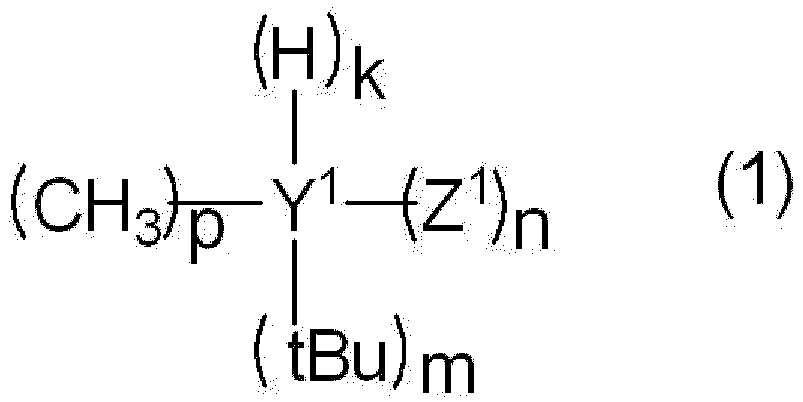
- In Formula 1, Y1 represents a nitrogen atom or an oxygen atom.
- In a case in which Y1 is a nitrogen atom, each of p, m, n, and k is independently an integer satisfying p + m ≥ 1 and p + m + n + k = 3.
- In a case in which Y1 is an oxygen atom, k is 0, each of p, m, n, and k is independently an integer satisfying p + m ≥ 1 and p + m + n = 2.
- In a case in which p is 1 or more, n is 1 or more.
- Each Z1 is independently a group represented by any one of the following Formulae T1 to T6.
- In Formulae T1 to T6, each A1 independently represents a hydrogen atom, a methyl group, a tert-butyl group, -OR, or -NR2, each A2 independently represents a methyl group, a tert-butyl group, -OR, or -NR2, each R independently represents a methyl group or a tert-butyl group, and * represents a binding site.


- Examples of combinations of p, m, n, and k in Formula 1 include the following aspects:
- in a case in which Y1 is a nitrogen atom,
- (p, m, n, k) = (0, 1, 2, 0), (1, 0, 2, 0), (0, 2, 0, 1), (0, 2, 1, 0), (1, 1, 1, 0), or (0, 3, 0, 0); and
- in a case in which Y1 is an oxygen atom,
- (p, m, n, k) = (0, 1, 1, 0), (1, 0, 1, 0), or (0, 2, 0, 0).
- In Formula 1, Y1 is preferably an oxygen atom from the viewpoint of enhancing a polymerization rate and increasing a molecular weight. Especially, (p, m, n, k) is preferably (0, 1, 1, 0) or (1, 0, 1, 0) as a combination of p, m, n, and k.
- In a case in which n is 1 or more, each Z1 is independently a group represented by any one of Formulae T1 to T6, preferably a group represented by any one of Formulae T1 to T3, and more preferably a group represented by Formula T1, from the viewpoint of enhancing a polymerization rate.
- In Formulae T1 to T6, each A1 independently represents a hydrogen atom, a methyl group, a tert-butyl group, -OR, or -NR2, each A2 independently represents a methyl group, a tert-butyl group, -OR, or -NR2, and each R independently represents a methyl group or a tert-butyl group. Especially, it is preferable that each A1 independently represents a methyl group, a tert-butyl group, -OR, or -NR2, each A2 independently represents a methyl group, a tert-butyl group, -OR, or -NR2, and each R independently represents a methyl group or a tert-butyl group.
- In the compound represented by Formula 1, examples of Z1 include the following compounds.

- Specific examples of the compound represented by Formula 1 are described below, but the compound represented by Formula 1 is not limited thereto.


-
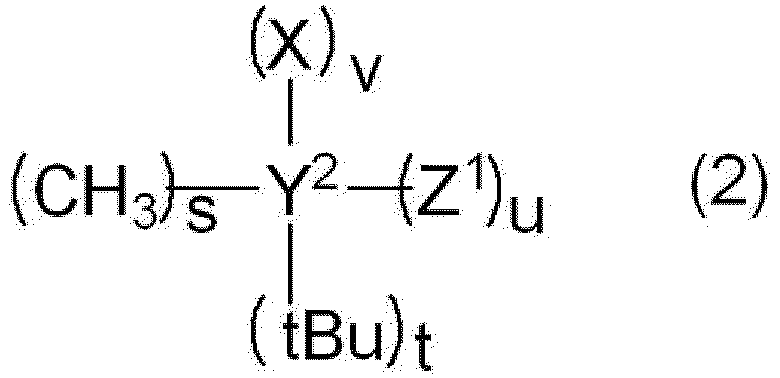
- In Formula 2, Y2 represents a carbon atom, a silicon atom, a phosphorus atom, or a sulfur atom.
- In a case in which Y2 is a carbon atom or a silicon atom, each of s, t, u, and v is independently an integer satisfying s + t ≥ 1 and s + t + u + v = 4.
- In a case in which Y2 is a phosphorus atom, each of s, t, u, and v is independently an integer satisfying s + t ≥ 1 and s + t + u + v = 3.
- In a case in which Y2 is a sulfur atom, each of s, t, u, and v is independently an integer satisfying s + t ≥ 1 and s + t + u + v = 2.
- In a case in which s is 1 or more, u is 1 or more.
- Each X independently represents a chlorine atom or a bromine atom.
- Each Z1 is independently a group represented by any one of the following Formulae T1 to T6.
- Examples of combinations of s, t, u, and v in Formula 2 include the following aspects:
- in a case in which Y2 is a carbon atom or a silicon atom,
- (s, t, u, v) = (0, 1, 0, 3), (0, 1, 1, 2), (0, 1, 2, 1), (0, 1, 3, 0), (1, 0, 1, 2), (1, 0, 2, 1), (1, 0, 3, 0), (0, 2, 0, 2), (0, 2, 1, 1), (0, 2, 2, 0), (1, 1, 1, 1), (1, 1, 2, 0), (2, 0, 1, 1), (2, 0, 2, 0), (0, 3, 0, 1), (0, 3, 1, 0), (1, 2, 1, 0), (2, 1, 1, 0), or (3, 0, 1, 0);
- in a case in which Y2 is a phosphorus atom,
- (s, t, u, v) = (0, 1, 0, 2), (0, 1, 1, 1), (0, 1, 2, 0), (1, 0, 1, 1), (1, 0, 2, 0), (0, 2, 0, 1), (0, 2, 1, 0), (1, 1, 1, 0), (2, 0, 1, 0), or (0, 3, 0, 0); and
- in a case in which Y2 is a sulfur atom,
- (s, t, u, v) = (0, 1, 0, 1), (0, 1, 1, 0), (1, 0, 1, 0), or (0, 2, 0, 0).
- As combinations of s, t, u, and v, especially, (s, t, u, v) is preferably (3, 0, 1, 0) in a case in which Y2 is a carbon atom, and (s, t, u, v) is preferably (0, 3, 0, 0) in a case in which Y2 is a phosphorus atom.
- In Formula 2, Y2 is preferably a carbon atom, a silicon atom, or a sulfur atom, more preferably to a carbon atom or a silicon atom, and still more preferably a carbon atom from the viewpoint of enhancing a polymerization rate and increasing a molecular weight.
- In Formula 2, X is preferably a chlorine atom from the viewpoint of enhancing a polymerization rate.
- In a case in which u is 1 or more, each Z1 is independently a group represented by any one of Formulae T1 to T6, preferably a group represented by any one of Formulae T1 to T3, and more preferably a group represented by Formula T1 from the viewpoint of enhancing a polymerization rate.
- In Formulae T1 to T6, each A1 independently represents a hydrogen atom, a methyl group, a tert-butyl group, -OR, or -NR2, each A2 independently represents a methyl group, a tert-butyl group, -OR, or -NR2, and each R independently represents a methyl group or a tert-butyl group. Especially, it is preferable that each A1 independently represents a methyl group, a tert-butyl group, -OR, or -NR2, each A2 independently represents a methyl group, a tert-butyl group, -OR, or -NR2, and each R independently represents a methyl group or a tert-butyl group.
- Examples of Z1 in the compound represented by Formula 2 include those similar to Z1 in the compound represented by Formula 1.
- Specific examples of the compound represented by Formula 2 are described below, without limitation to such compounds represented by Formula 2.


-

- In Formula 3, Y3 represents a carbon atom or a silicon atom.
- Each of R1 to R4 independently represents a methyl group, a tert-butyl group, or a tert-butoxy group.
- Specific examples of the compound represented by Formula 3 are described below, but the compound represented by Formula 3 is not limited thereto.


- In Formula 3, Y3 is preferably a carbon atom from the viewpoint of enhancing a polymerization rate and increasing a molecular weight.
- In Formula 3, R1 to R4 are preferably methyl groups from the viewpoint of enhancing a polymerization rate and increasing a molecular weight.
- In the polymerization solvent A, a compound corresponding to the compound represented by Formula 1 and corresponding to the compound represented by Formula 2 is regarded as the compound represented by Formula 1. In other words, it is considered that the compound represented by Formula 2 does not include the compound represented by Formula 1. In the polymerization solvent A, a compound corresponding to the compound represented by Formula 1 and corresponding to the compound represented by Formula 3 is regarded as the compound represented by Formula 1. In other words, it is considered that the compound represented by Formula 3 does not include the compound represented by Formula 1.
- For example, methyl pivalate and tert-butyl pivalate are regarded as compounds represented by Formula 1 in spite of corresponding to the compound represented by Formula 1 and corresponding to the compound represented by Formula 2. In other words, it is considered that the compound represented by Formula 2 includes neither methyl pivalate nor tert-butyl pivalate. Di-tert-butyl ether is regarded as the compound represented by Formula 1 in spite of corresponding to the compound represented by Formula 1 and corresponding to the compound represented by Formula 3. In other words, it is considered that the compound represented by Formula 3 does not include di-tert-butyl ether.
- The polymerization solvent A is a solvent that is not compatible with water from the viewpoint of performing suspension polymerization. Whether or not the polymerization solvent A is a solvent that is not compatible with water is determined by the following method.
- First, water and the solvent to be determined are put in an airtight container so that the mass ratio thereof (water: solvent to be determined) is 10: 7. The water and the solvent are shaken for 1 minute under ordinary pressure at 25°C, and then left to stand for 10 minutes. It is determined that the solvent to be determined is a solvent that is not compatible with water in a case in which, after 10 minutes, the water and the solvent to be determined are separated into two phases. From the viewpoint of performing suspension polymerization, it is necessary that the polymerization medium is separated into two phases.
- The polymerization medium includes water.
- The water is not particularly limited, and preferably includes no impurity. Examples of the water include distilled water, ion-exchanged water, and pure water.
- The proportion of water to the polymerization solvent is from 10% by volume to 80% by volume. A case in which the proportion of water is 80% by volume or less is advantageous from the viewpoint of a polymerization rate.
- The proportion of the volume of water to the polymerization solvent A is preferably from 10% by volume to 80 % by volume, and more preferably from 30% by volume to 60% by volume from the viewpoint of a polymerization rate, heat removal, and the easiness of stirring. A case in which the above-described proportion is 10% by volume or more is advantageous from the viewpoint of heat removal and stirring. In contrast, a case in which the above-described proportion is 80% by volume or less is advantageous from the viewpoint of a polymerization rate.
- In the method of producing a fluorine-containing copolymer of the present disclosure, the polymerization medium may include an additional polymerization solvent other than the polymerization solvent A and water. However, from the viewpoint of enhancing a polymerization rate, it is preferable that the polymerization medium does not include another polymerization solvent, and it is preferable that the polymerization medium consists of the polymerization solvent A and water.
- Examples of such other polymerization solvents include: aromatic hydrocarbon solvents such as benzene, toluene, and xylene; sulfoxide-based solvents such as dimethylsulfoxide (DMSO); ketone-based solvents such as acetone and 2-butanone(methylethylketone); ether-based solvents such as tetrahydrofuran (THF) and dioxane; ester-based solvents such as ethyl acetate; alcohol-based solvents such as tert-butyl alcohol; and halogen-based solvents such as hexafluoroisopropanol, chloroform, 1H-perfluorohexane, 1H,1H,1H,2H,2H-perfluorooctane, 1,3-bis(trifluoromethyl)benzene, 1,4-bis(trifluoromethyl)benzene, benzotrifluoride, chlorobenzene, and 1,2-dichlorobenzene.
- In the method of producing a fluorine-containing copolymer of the present disclosure, monomers including ethylene and tetrafluoroethylene are polymerized. In other words, the fluorine-containing copolymer obtained by the method of producing the fluorine-containing copolymer of the present disclosure includes a structural unit derived from ethylene (hereinafter also referred to as "E unit") and a structural unit derived from tetrafluoroethylene (hereinafter also referred to as "TFE unit").
- The monomers used in the polymerization may include an additional monomer other than ethylene and tetrafluoroethylene. In other words, the fluorine-containing copolymer may include an additional structural unit other than the E unit and the TFE unit.
- Examples of such additional monomers other than ethylene and tetrafluoroethylene include the following monomers (1) to (7). Such an additional monomer may be one, or may be two or more.
- Monomer (1): compound represented by CH2 = CX11 (CF2)nY11.
- However, each of X11 and Y11 is independently a hydrogen atom or a fluorine atom, and n is an integer from 2 to 8.
- Monomer (2): fluoroolefin including a hydrogen atom in an ethylenically unsaturated group such as vinylidene fluoride, vinyl fluoride, trifluoroethylene, or hexafluoro isobutylene.
- Monomer (3): fluoroolefin including no hydrogen atom in an ethylenically unsaturated group such as hexafluoropropylene (excluding TFE).
- Monomer (4): perfluoro (alkyl vinyl ether) such as perfluoro(methyl vinyl ether), perfluoro(ethyl vinyl ether), perfluoro(propyl vinyl ether), or perfluoro(butyl vinyl ether).
- Monomer (5): perfluoro(vinyl alkenyl ether) that has two ethylenically unsaturated bonds and can be cyclically polymerized, such as CF2=CFOCF2CF=CF2 or CF2=CFO(CF2)2CF=CF2.
- Monomer (6): fluorine-containing monomer having an aliphatic ring structure, such as perfluoro(2,2-dimethyl-1,3-dioxole), 2,2,4-trifluoro-5-trifluoromethoxy-1,3-dioxole, or perfluoro(2-methylene-4-methyl-1,3-dioxolane).
- Monomer (7): monomer having a polar functional group and having no fluorine atom (hereinafter also referred to as "monomer containing polar functional group".
- Examples of such polar functional groups include a hydroxyl group, a carboxy group, an epoxy group, and an acid anhydride residue. Especially, the polar functional group is preferably an acid anhydride residue.
- Examples of such monomers containing polar functional groups include: vinyl ether having a hydroxyl group and an epoxy group; unsaturated carboxylic acids (for example, maleic acid, itaconic acid, citraconic acid, and undecylenic acid); and unsaturated multivalent carboxylic acid anhydrides (for example, maleic anhydride, itaconic anhydride, citraconic anhydride, and himic anhydride).
- In the above-described monomers (1) to (7), the monomer (1) is preferred in view of favorable reactivity with ethylene and tetrafluoroethylene. Specific examples of the monomer (1) include CH2=CF(CF2)2F, CH2=CF(CF2)3F, CH2=CF(CF2)4F, CH2=CF(CF2)5F, CH2=CF(CF2)8F, CH2=CF(CF2)2H, CH2=CF(CF2)3H, CH2=CF(CF2)4H, CH2=CF(CF2)5H, CH2=CF(CF2)8H, CH2=CH(CF2)2F, CH2=CH(CF2)3F, CH2=CH(CF2)4F, CH2=CH(CF2)5F, CH2=CH(CF2)6F, CH2=CH(CF2)8F, CH2=CH(CF2)2H, CH2=CH(CF2)3H, CH2=CH(CF2)4H, CH2=CH(CF2)5H, and CH2=CH(CF2)8H. Especially, the monomer (1) is preferably CH2=CH(CF2)nF. The integer n in the monomer (1) is from 2 to 8, preferably from 3 to 7, and more preferably from 4 to 6.
- The content of additional monomer in the monomers used in the polymerization is preferably from 0.001% by mol to 20% by mol, more preferably from 0.1% by mol to 15% by mol, and still more preferably from 0.2% by mol to 5% by mol with respect to the total amount of the monomers. In a case in which the additional monomer is the monomer (7), the content thereof is preferably from 0.01% by mol to 5% by mol, more preferably from 0.05% by mol to 3% by mol, and still more preferably from 0.1% by mol to 1% by mol.
- The molar ratio between the contents of ethylene and tetrafluoroethylene (ethylene/tetrafluoroethylene) is preferably from 20/80 to 80/20, more preferably from 70/30 to 30/70, and still more preferably from 50/50 to 35/65.
- In the method of producing a fluorine-containing copolymer of the present disclosure, it is preferable to use a polymerization initiator in order to initiate polymerization reaction.
- The polymerization initiator is preferably a radical polymerization initiator. Examples of the radical polymerization initiator include: azo compounds such as azobisisobutyronitrile and 2,2'-azobis(4-methoxy-2,4-dimethylvaleronitrile); peroxydicarbonates such as diisopropyl peroxydicarbonate; peroxy esters such as tert-butyl peroxypivalate, tert-butyl peroxyisobutyrate, and tert-butyl peroxyacetate; non-fluorine-based diacyl peroxides such as diisobutyryl peroxide, octanoyl peroxide, benzoyl peroxide, and lauroyl peroxide; fluorine-containing diacyl peroxides such as (Z(CF2)pCOO)2 (Z is a hydrogen atom, a fluorine atom, or a chlorine atom, and p is an integer from 1 to 10); perfluoro-tert-butyl peroxide; and inorganic peroxides such as potassium persulfate, sodium persulfate, and ammonium persulfate.
- In the method of producing a fluorine-containing copolymer of the present disclosure, the polymerization reaction may be performed in the presence of a chain transfer agent. The presence of the chain transfer agent facilitates adjustment of the molecular weight of the produced fluorine-containing polymer.
- Examples of the chain transfer agent include: alcohols such as methanol, ethanol, 2,2,2-trifluoroethanol, 2,2,3,3-tetrafluoropropanol, 1,1,1,3,3,3-hexafluoroisopropanol, and 2,2,3,3,3-pentafluoropropanol; hydrocarbons such as n-pentane, n-hexane, and cyclohexane; hydrofluorocarbons such as CF2H2; ketones such as acetone; mercaptans such as methyl mercaptan; esters such as methyl acetate and ethyl acetate; and ethers such as diethyl ether and methylethyl ether.
- The polymerization in the method of producing a fluorine-containing copolymer of the present disclosure is suspension polymerization. A suspension polymerization method is a polymerization method in which a monomer is polymerized in a state in which the monomer is suspended in a polymerization medium containing water. The suspension polymerization is distinguished from solution polymerization in which a monomer is polymerized in a state in which the monomer is dissolved in a polymerization medium.
- In the method of producing a fluorine-containing copolymer of the present disclosure, the polymerization reaction is allowed to proceed by, for example, continuously or intermittently adding the monomers including ethylene and tetrafluoroethylene into the polymerization medium.
- In the method of producing a fluorine-containing copolymer of the present disclosure, it is preferable that 0.5 ≤ Msol × S/Mmon ≤ 1.0 is satisfied in a case in which the substance amount (mol) of polymerization solvent A is Msol, the total solubility (mol/mol) of the ethylene and the tetrafluoroethylene with respect to the polymerization solvent A is S, and the total substance amount (mol) of the ethylene and the tetrafluoroethylene, dissolved in the polymerization solvent excluding the water, is Mmon, in any stage during polymerization.
- The phrase "during polymerization" in the present disclosure refers to a period in which a fluorine-containing copolymer including ethylene and tetrafluoroethylene is generated.
- Msol × S/Mmon is 1.0 in a case in which the polymerization medium consists of the polymerization solvent A and water and does not include any polymerization medium other than the polymerization solvent A and the water. Msol × S/Mmon is less than 1.0 in a case in which the polymerization medium includes a polymerization medium other than the polymerization solvent A and water.
- Chain transfer caused by the polymerization medium is suppressed to improve a polymerization rate in a case in which Msol × S/Mmon is from 0.5 to 1.0. From the viewpoint of further improving a polymerization rate, Msol × S/Mmon is more preferably from 0.7 to 1.0, and still more preferably from 0.85 to 1.0.
- Msol representing the substance amount of the polymerization solvent A is calculated using the following equation.
Msol (mol) = weight (g) of polymerization solvent A/molecular weight of polymerization solvent A - As the weight of the polymerization solvent A, a value obtained by measuring the weight under atmospheric pressure is adopted.
- The total solubility S of ethylene and tetrafluoroethylene with respect to the polymerization solvent A is calculated by the following method.
- First, the vapor pressure Psol of the polymerization solvent A is measured. Psol is set at a pressure indicated by putting a polymerization medium in an autoclave that includes a stirring machine and is made of stainless steel, performing freezing degassing twice, and then keeping the internal temperature of a reactor at a predetermined temperature T. T means a liquid-phase temperature. The temperature of a gas-phase portion is considered to be equal to the liquid-phase temperature.
- The weighed polymerization solvent A is put in the autoclave that includes the stirring machine and is made of stainless steel. The substance amount M' (mol) of the polymerization solvent A is calculated based on the weight (g) of the weighed polymerization solvent A.
- Then, a weighed mixed gas of ethylene and tetrafluoroethylene is put in the autoclave that includes the stirring machine and is made of stainless steel. In such a case, a mixture ratio (molar ratio) between ethylene and tetrafluoroethylene is set at ethylene: tetrafluoroethylene = x: y. The loading amount Mall (mol) of mixed gas of ethylene and tetrafluoroethylene is calculated, using the weight W (g) of the weighed mixed gas, based on the following equation.

- In a case in which time sufficiently elapses and pressure becomes constant, the pressure is regarded as a total pressure Pall.
- The partial pressure Pmon of the mixed gas of ethylene and tetrafluoroethylene is calculated based on the following equation.

- The volume V of the gas-phase portion of the autoclave that includes the stirring machine and is made of stainless steel is calculated based on the following equation.
V = volume of autoclave that includes stirring machine and is made of stainless steel - volume of polymerization solvent A - The substance amount Mg (mol) of mixed gas of ethylene and tetrafluoroethylene, present in the gas-phase portion of the autoclave that includes the stirring machine and is made of stainless steel, is calculated based on the following equation. R means a gas constant.

- The substance amount M'mon (mol) of mixed gas of ethylene and tetrafluoroethylene, dissolved in the polymerization solvent A, is calculated based on the following equation.

- The total solubility S of ethylene and tetrafluoroethylene with respect to the polymerization solvent A is calculated based on the following equation.

- The total substance amount Mmon of ethylene and tetrafluoroethylene dissolved in the polymerization medium excluding water is calculated by the following method.
- First, the vapor pressure P'sol of the polymerization medium excluding water is measured. P'sol is set at a pressure indicated by putting a polymerization medium excluding water in an autoclave that includes a stirring machine and is made of stainless steel, performing freezing degassing twice, and then keeping the internal temperature of a reactor at a predetermined temperature T. T means a liquid-phase temperature. The temperature of a gas-phase portion is considered to be equal to the liquid-phase temperature.
- Then, a weighed mixed gas of ethylene and tetrafluoroethylene is put in the autoclave that includes the stirring machine and is made of stainless steel. In such a case, a mixture ratio (molar ratio) between ethylene and tetrafluoroethylene is set at ethylene: tetrafluoroethylene = x: y. The loading amount M'all (mol) of mixed gas of ethylene and tetrafluoroethylene is calculated, using the weight W' (g) of the weighed mixed gas, based on the following equation.

- In a case in which time sufficiently elapses and pressure becomes constant, the pressure is regarded as a total pressure P'all.
- The partial pressure P'mon of the mixed gas of ethylene and tetrafluoroethylene is calculated based on the following equation.

- The volume V' of the gas-phase portion of the autoclave that includes the stirring machine and is made of stainless steel is calculated based on the following equation.
V' = volume of autoclave that includes stirring machine and is made of stainless steel - volume of polymerization medium - The substance amount M'g (mol) of mixed gas of ethylene and tetrafluoroethylene, present in the gas-phase portion of the autoclave that includes the stirring machine and is made of stainless steel, is calculated based on the following equation. R means a gas constant.

- The substance amount Mmon (mol) of mixed gas of ethylene and tetrafluoroethylene, dissolved in the polymerization medium excluding water, is calculated based on the following equation.

- In the method of producing a fluorine-containing copolymer of the present disclosure, a polymerization temperature is preferably from 0°C to 100°C, and more preferably from 20°C to 90°C. A polymerization pressure is preferably from 0.1 MPaG to 10 MPaG, and more preferably from 0.5 MPaG to 3 MPaG. Polymerization time is preferably from 1 hour to 30 hours, and more preferably from 2 hours to 20 hours.
- The present disclosure is further specifically described below with reference to Examples. However, the present disclosure is not limited to Examples below without departing from the gist of the present disclosure.
- An autoclave that had an internal volume of 1000 mL, included a stirring machine, and was made of stainless steel was put in an ice-water bath and kept for 10 minutes, 300 mL (3.6 mol) of dimethyl carbonate ("DMC" in a table) and 300 mL (16.7 mol) of ion-exchanged water were loaded, and freezing degassing was performed twice.
- Stirring was performed while increasing an internal temperature to 30°C, and a mixed gas of ethylene and tetrafluoroethylene as monomers (ethylene: tetrafluoroethylene (molar ratio) = 50: 50) was press-fitted so that the internal pressure of a reactor was 1.5 MPaG. Further, 18.3 mg (0.11 mmol) of diisobutyryl peroxide (product name "PEROYL IB", manufactured by NOF CORPORATION, "IBPO" in the table) was press-fitted as a polymerization initiator, and the resultant was stirred at 500 rpm (500 revolutions per minute) for 3 hours while keeping the internal temperature at 30°C. As a result, a polymer including a copolymer of ethylene and tetrafluoroethylene was obtained in a slurry state.
- The reactor was spontaneously cooled below room temperature, followed by discharging unreacted ethylene and tetrafluoroethylene.
- The obtained polymer in the slurry state was put in methanol, followed by filtering a precipitate. The precipitate was dried in a vacuum oven at 40°C for 12 hours. Thus, 8.3 g of a copolymer of ethylene and tetrafluoroethylene was obtained.
- Dimethyl carbonate corresponds to the compound represented by Formula 1, in Formula 1, Y1 is an oxygen atom, p is 1, m is 0, n is 1, k is 0, Z1 is a group represented by T1, and A1 is -OR, and R is a methyl group in T1.
- A copolymer of ethylene, tetrafluoroethylene, and perfluorobutylethylene was obtained by a method similar to that in Example 1 except that the loading amounts of polymerization media were changed to 120 mL (1.4 mol) of dimethyl carbonate and 480 mL (26.7 mmol) of ion-exchanged water, the loading amount of polymerization initiator was changed to 7.3 mg (0.04 mmol), and 2.2 g of perfluorobutylethylene (8.9 mmol) which was a monomer was also loaded in the case of loading dimethyl carbonate and ion-exchanged water which were the polymerization media.
- A copolymer of ethylene, tetrafluoroethylene, and perfluorobutylethylene was obtained by a method similar to that in Example 2 except that the loading amounts of polymerization media were changed to 300 mL (3.6 mol) of dimethyl carbonate and 300 mL (16.7 mmol) of ion-exchanged water, and the loading amount of polymerization initiator was changed to 18.3 mg (0.11 mmol).
- A copolymer of ethylene, tetrafluoroethylene, and perfluorobutylethylene was obtained by a method similar to that in Example 2 except that the loading amounts of polymerization media were changed to 480 mL (5.7 mol) of dimethyl carbonate and 120 mL (6.7 mmol) of ion-exchanged water, and the loading amount of polymerization initiator was changed to 29.3 mg (0.17 mmol).
- A copolymer of ethylene, tetrafluoroethylene, and perfluorobutylethylene was obtained by a method similar to that in Example 3 except that a polymerization initiator was changed to 2,2'-azobis(4-methoxy-2,4-dimethylvaleronitrile) (product name "V70", manufactured by FUJIFILM Wako Pure Chemical Corporation, "AMVN" in the table), and a polymerization temperature was changed to 35°C.
- A copolymer of ethylene, tetrafluoroethylene, and perfluorobutylethylene was obtained by a method similar to that in Example 3 except that a polymerization initiator was changed to tert-butylperoxypivalate (product name "PERBUTYL PV", manufactured by NOF CORPORATION, "PBPV" in the table), and a polymerization temperature was changed to 66°C.
- A copolymer of ethylene and tetrafluoroethylene was obtained by a method similar to that in Example 1 except that polymerization media were changed to di-tert-butylcarbonate ("Boc2O" in the table) and water, a polymerization initiator was changed to diisopropyl peroxydicarbonate (product name "PEROYL IPP", manufactured by NOF CORPORATION, "IPP" in the table), and a polymerization temperature was changed to 45°C.
- Di-tert-butylcarbonate corresponds to the compound represented by Formula 1, in Formula 1, Y1 is an oxygen atom, p is 0, m is 1, n is 1, k is 0, Z1 is a group represented by T1, and A1 is -OR, and R is a tert-butyl group in T1.
- A copolymer of ethylene and tetrafluoroethylene was obtained by a method similar to that in Example 1 except that polymerization media were changed to methyl pivalate ("MePiv" in the table) and water.
- Methyl pivalate corresponds to the compound represented by Formula 1, in Formula 1, Y1 is an oxygen atom, p is 1, m is 0, n is 1, k is 0, Z1 is a group represented by T1, and A1 is a tert-butyl group in T1.
- A copolymer of ethylene and tetrafluoroethylene was obtained by a method similar to that in Example 5 except that polymerization media were changed to tri-tert-butylphosphine ("TTBP" in the table) and water, and a polymerization temperature was changed to 35°C.
- Tri-tert-butylphosphine corresponds to the compound represented by Formula 2, and, in Formula 2, Y2 is a phosphorus atom, s is 0, t is 3, u is 0, and v is 0.
- A copolymer of ethylene and tetrafluoroethylene was obtained by a method similar to that in Example 1 except that polymerization media were changed to tetramethylsilane ("TMS" in the table) and water, and a polymerization temperature was changed to 25°C.
- Tetramethylsilane corresponds to the compound represented by Formula 3, and, in Formula 3, Y3 is a silicon atom, and R1 to R4 are methyl groups.
- A copolymer of ethylene and tetrafluoroethylene was obtained by a method similar to that in Example 1 except that polymerization media were changed to a mixture (substance quantitative ratio of 85: 15) ("DMC/MEK = 85/15" in the table) of dimethyl carbonate and methyl ethyl ketone ("MEK" in the table), and water.
- A copolymer of ethylene and tetrafluoroethylene was obtained by a method similar to that in Example 1 except that polymerization media were changed to a mixture (substance quantitative ratio of 70: 30) ("DMC/MEK = 70/30" in the table) of dimethyl carbonate and methyl ethyl ketone ("MEK" in the table), and water.
- A copolymer of ethylene and tetrafluoroethylene was obtained by a method similar to that in Example 1 except that polymerization media were changed to a mixture of methyl pivalate and dimethyl carbonate (substance quantitative ratio of 50: 50) ("MePiv/DMC = 50/50" in the table), and water.
- A copolymer of ethylene and tetrafluoroethylene was obtained by a method similar to that in Example 1 except that polymerization media were changed to neopentane and water, and a polymerization temperature was changed to 20°C.
- Neopentane corresponds to the compound represented by Formula 3, and, in Formula 3, Y3 is a carbon atom, and R1 to R4 are methyl groups.
- A copolymer of ethylene and tetrafluoroethylene was obtained by a method similar to that in Example 1 except that polymerization media were changed to water and di-tert-butylketone subjected to distillation purification.
- Di-tert-butylketone corresponds to the compound represented by Formula 2, in Formula 2, Y2 is a carbon atom, s is 3, t is 0, u is 1, v is 0, Z1 is a group represented by T1, and A1 is a tert-butyl group in T1.
- A copolymer of ethylene and tetrafluoroethylene was obtained by a method similar to that in Example 1 except that polymerization media were changed to 2-chloro-2,4,4-trimethyl-3-pentanone and water.
- 2-Chloro-2,4,4-trimethyl-3-pentanone corresponds to the compound represented by Formula 2, in Formula 2, Y2 is a carbon atom, s is 2, t is 0, u is 1, v is 1, X is a chlorine atom, Z1 is a group represented by T1, and A1 is a tert-butyl group in T1.
- Obtainment of a copolymer of ethylene, tetrafluoroethylene, and perfluorobutylethylene was attempted by a method similar to that in Example 2 except that the loading amounts of polymerization media were changed to 60 mL (0.71 mol) of dimethyl carbonate and 540 mL (30.0 mmol) of ion-exchanged water, and the loading amount of polymerization initiator was changed to 3.7 mg (0.02 mmol). However, the copolymer was not obtained.
- Obtainment of a copolymer of ethylene and tetrafluoroethylene was attempted by a method similar to that in Example 1 except that polymerization media were changed to diethyl ketone and water. However, the copolymer was not obtained. Diethyl ketone does not correspond to the polymerization solvent A.
- Obtainment of a copolymer of ethylene and tetrafluoroethylene was attempted by a method similar to that in Example 1 except that polymerization media were changed to tert-butyl methyl ether ("TBME" in the table) and water. However, the copolymer was not obtained. Tert-butyl methyl ether does not correspond to the polymerization solvent A.
- Polymerization velocities in the production methods in Examples 1 to 16 and the melt flow rate values (MFR values) of the copolymers obtained in Examples 1 to 16 were measured. Msol × S/Mmon, in a case in which the substance amount (mol) of polymerization solvent A was Msol, the total solubility (mol/mol) of ethylene and tetrafluoroethylene with respect to a polymerization solvent A was S, and the total substance amount (mol) of ethylene and tetrafluoroethylene, dissolved in the polymerization solvent excluding water, was Mmon, during polymerization, was calculated. A measurement method and a calculation method are as follows. Values that were unable to be measured are indicated by "-" in the table.
- The polymerization velocities were calculated based on the following equation.
- Polymerization rate (g/h·L) = yield (g) of obtained copolymer/ f polymerization time (h) ·volume (L) of polymerization solvent}
- The polymerization solvent described in the above equation does not include any polymerization initiator.
- The mass (g) of copolymer flowing from an orifice having a diameter of 2.095 mm and a length of 8.000 mm for 10 minutes was measured using a thermal hydraulics evaluation apparatus (product name "Flowtester CFT-100EX", manufactured by SHIMADZU CORPORATION) under conditions of a temperature of 297°C and a load of 49.0 N according to ASTM D3159, and was regarded as MFR (g/10 min).
- First, Msol which was the substance amount (mol) of polymerization solvent A, the total solubility S (mol/mol) of ethylene and tetrafluoroethylene with respect to a polymerization solvent A, and the total substance amount (mol) Mmon of ethylene and tetrafluoroethylene, dissolved in a polymerization medium excluding water, were calculated as described above. Then, Msol × S/Mmon was calculated using Msol, S, and Mmon.
- The kinds of monomers, polymerization media, and polymerization initiators, and polymerization velocities and MFRs were set forth in Table 1. "Binary" is described in the case of using ethylene and tetrafluoroethylene as monomers, and "Ternary" is described in the case of using ethylene, tetrafluoroethylene, and perfluorobutylethylene as monomers.
[Table 1] Monomers Polymerization medium A Proportion of water to polymerization solvent [% by volume] Polymerization initiator Polymerization rate [g/(L·h)] MFR [g/10 min] Msol × S/Mmon Polymerization temperature [°C] Example 1 Binary DMC 50 IBPO 9.2 0.1 0.99 30 Example 2 Ternary DMC 80 IBPO 0.9 4.6 0.99 30 Example 3 Ternary DMC 50 IBPO 4.2 4.6 0.99 30 Example 4 Ternary DMC 20 IBPO 5.9 4.6 0.99 30 Example 5 Ternary DMC 50 AMVN 2.9 5.0 0.99 35 Example 6 Ternary DMC 50 PBPV 4.7 12.0 0.99 66 Example 7 Binary Boc2O 50 IPP 1.3 5.9 0.99 45 Example 8 Binary MePiv 50 IBPO 1.1 9.1 0.99 30 Example 9 Binary TTBP 50 IPP 14.0 2.8 0.99 35 Example 10 Binary TMS 50 IBPO 12.5 7.9 0.99 25 Example 11 Binary DMC/MEK=85/15 50 IBPO 4.0 58.7 0.84 30 Example 12 Binary DMC/MEK=70/30 50 IBPO 1.0 - 0.69 30 Example 13 Binary MePiv/DMC=50/50 50 IBPO 6.8 6.5 0.99 30 Example 14 Binary neopentane 50 IBPO 7.5 4.5 0.99 20 Example 15 Binary di-tert-butylketone 50 IBPO 27.3 1.2 0.99 30 Example 16 Binary 2-chloro-2,4,4-trimethyl-3-pentanone 50 IBPO 41.6 2.3 0.99 30 Example 17 Ternary DMC 90 IBPO - - 0.99 30 Example 18 Binary diethyl ketone 50 IBPO - - 0.99 30 Example 19 Binary TBME 50 IBPO - - 0.99 30 - As set forth in Table 1, in Examples 1 to 16, the suspension polymerization was performed using the monomers including ethylene and tetrafluoroethylene in the polymerization medium including water and the polymerization solvent A that was not compatible with water and that was at least one kind selected from the group consisting of the compounds represented by Formulae 1 to 3, the proportion of water to the polymerization medium was from 10% by volume to 80% by volume, and therefore, it was found that the polymerization velocities were higher than conventional polymerization velocities.
- The entire content of the disclosure by
Japanese Patent Application No. 2022-061017 filed on March 31, 2022
Claims (9)
- A method of producing a fluorine-containing copolymer, the method comprising performing suspension polymerization using monomers comprising ethylene and tetrafluoroethylene in a polymerization medium comprising water and a polymerization solvent A that is not compatible with water and that is at least one kind selected from the group consisting of compounds represented by the following Formulae 1 to 3,wherein a proportion of water to the polymerization medium is from 10% by volume to 80% by volume:


 wherein, in Formula 1, Y1 represents a nitrogen atom or an oxygen atom,in a case in which Y1 is a nitrogen atom, each of p, m, n, and k is independently an integer satisfying p + m ≥ 1 and p + m + n + k = 3,in a case in which Y1 is an oxygen atom, k is 0, and each of p, m, n, and k is independently an integer satisfying p + m ≥ 1 and p + m + n = 2,in a case in which p is 1 or more, n is 1 or more,in Formula 2, Y2 represents a carbon atom, a silicon atom, a phosphorus atom, or a sulfur atom,in a case in which Y2 is a carbon atom or a silicon atom, each of s, t, u, and v is independently an integer satisfying s + t ≥ 1 and s + t + u + v = 4,in a case in which Y2 is a phosphorus atom, each of s, t, u, and v is independently an integer satisfying s + t ≥ 1 and s + t + u + v = 3,in a case in which Y2 is a sulfur atom, each of s, t, u, and v is independently an integer satisfying s + t ≥ 1 and s + t + u + v = 2,in a case in which s is 1 or more, u is 1 or more,each X independently represents a chlorine atom or a bromine atom,in Formulae 1 and 2, each Z1 is independently a group represented by any one of the following Formulae T1 to T6,in Formula 3, Y3 represents a carbon atom or a silicon atom, andeach of R1 to R4 independently represents a methyl group, a tert-butyl group, or a tert-butoxy group:
 wherein, in Formulae T1 to T6, each A1 independently represents a hydrogen atom, a methyl group, a tert-butyl group, -OR, or -NR2, each A2 independently represents a methyl group, a tert-butyl group, -OR, or -NR2, each R independently represents a methyl group or a tert-butyl group, and * represents a binding site.
 - The method of producing a fluorine-containing copolymer according to claim 1, wherein, in Formula 2, Y2 represents a carbon atom, a silicon atom, or a sulfur atom.
- The method of producing a fluorine-containing copolymer according to claim 1, wherein, in Formula 2, Y2 represents a carbon atom or a silicon atom.
- The method of producing a fluorine-containing copolymer according to any one of claims 1 to 3, wherein, in Formula 2, X represents a chlorine atom.
- The method of producing a fluorine-containing copolymer according to any one of claims 1 to 4, wherein, in Formulae T1 to T6, each A1 independently represents a methyl group, a tert-butyl group, -OR, or -NR2, each A2 independently represents a methyl group, a tert-butyl group, -OR, or -NR2, and each R independently represents a methyl group or a tert-butyl group.
- The method of producing a fluorine-containing copolymer according to any one of claims 1 to 5, wherein, in Formulae 1 and 2, each Z1 is independently a group represented by any one of Formulae T1 to T3.
- The method of producing a fluorine-containing copolymer according to any one of claims 1 to 6, wherein, in Formulae 1 and 2, each Z1 is independently a group represented by Formula T1.
- The method of producing a fluorine-containing copolymer according to any one of claims 1 to 7, wherein in Formula 3, Y3 represents a carbon atom.
- The method of producing a fluorine-containing copolymer according to any one of claims 1 to 8, wherein 0.5 ≤ Msol × S/Mmon ≤ 1.0 is satisfied in a case in which a substance amount (mol) of polymerization solvent A is Msol, a total solubility (mol/mol) of the ethylene and the tetrafluoroethylene with respect to the polymerization solvent A is S, and a total substance amount (mol) of the ethylene and the tetrafluoroethylene, dissolved in the polymerization solvent excluding the water, is Mmon, in any stage during polymerization.
Applications Claiming Priority (2)
| Application Number | Priority Date | Filing Date | Title |
|---|---|---|---|
| JP2022061017 | 2022-03-31 | ||
| PCT/JP2023/010197 WO2023189629A1 (en) | 2022-03-31 | 2023-03-15 | Method for producing fluorine-containing copolymer |
Publications (2)
| Publication Number | Publication Date |
|---|---|
| EP4501980A1 true EP4501980A1 (en) | 2025-02-05 |
| EP4501980A4 EP4501980A4 (en) | 2026-04-08 |
Family
ID=88201668
Family Applications (1)
| Application Number | Title | Priority Date | Filing Date |
|---|---|---|---|
| EP23779647.9A Pending EP4501980A4 (en) | 2022-03-31 | 2023-03-15 | METHOD FOR PRODUCING A FLUORINE-CONTAINING COPOLYMER |
Country Status (5)
| Country | Link |
|---|---|
| US (1) | US20250026866A1 (en) |
| EP (1) | EP4501980A4 (en) |
| JP (1) | JPWO2023189629A1 (en) |
| CN (1) | CN118946609A (en) |
| WO (1) | WO2023189629A1 (en) |
Family Cites Families (8)
| Publication number | Priority date | Publication date | Assignee | Title |
|---|---|---|---|---|
| US3449305A (en) * | 1966-03-01 | 1969-06-10 | Du Pont | Interpolymers of vinylidene fluoride |
| JPH08311128A (en) * | 1995-05-22 | 1996-11-26 | Asahi Glass Co Ltd | Method for producing fluoropolymer |
| JPH08333408A (en) * | 1995-06-07 | 1996-12-17 | Asahi Glass Co Ltd | Method for producing fluorine-containing copolymer |
| JPH11128711A (en) * | 1997-10-24 | 1999-05-18 | Asahi Glass Co Ltd | Stirrer |
| JP6075452B2 (en) * | 2013-06-26 | 2017-02-08 | ダイキン工業株式会社 | Composition, polymeric porous membrane and hydrophilizing agent |
| WO2019093433A1 (en) * | 2017-11-10 | 2019-05-16 | ダイキン工業株式会社 | Ethylene/tetrafluoroethylene copolymer |
| KR20220045460A (en) | 2020-10-05 | 2022-04-12 | 현대자동차주식회사 | A cathode material manufacturing method and a cathode comprising a cathode material manufactured through the method |
| WO2022149531A1 (en) * | 2021-01-08 | 2022-07-14 | Agc株式会社 | Fluorine-containing copolymer production method and fluorine-containing copolymer |
-
2023
- 2023-03-15 CN CN202380030929.6A patent/CN118946609A/en active Pending
- 2023-03-15 JP JP2024511774A patent/JPWO2023189629A1/ja active Pending
- 2023-03-15 WO PCT/JP2023/010197 patent/WO2023189629A1/en not_active Ceased
- 2023-03-15 EP EP23779647.9A patent/EP4501980A4/en active Pending
-
2024
- 2024-09-30 US US18/901,991 patent/US20250026866A1/en active Pending
Also Published As
| Publication number | Publication date |
|---|---|
| EP4501980A4 (en) | 2026-04-08 |
| US20250026866A1 (en) | 2025-01-23 |
| JPWO2023189629A1 (en) | 2023-10-05 |
| WO2023189629A1 (en) | 2023-10-05 |
| CN118946609A (en) | 2024-11-12 |
Similar Documents
| Publication | Publication Date | Title |
|---|---|---|
| EP2651989B1 (en) | Microemulsions and fluoropolymers made using microemulsions | |
| EP1153946B1 (en) | Process for producing fluoropolymer | |
| EP1141047B1 (en) | Fluoromonomer polymerization | |
| EP1621558B1 (en) | Perfluoroelastomers | |
| US6346587B1 (en) | Method for the production of partially fluorinated fluoropolymers | |
| JP2012508296A (en) | Fluoroolefin polymerization | |
| EP4269452A1 (en) | Method for producing fluoropolymer | |
| CN109790250B (en) | Monomer composition and method for producing fluoropolymer | |
| EP0747404B1 (en) | Method for producing a fluorine-containing copolymer | |
| US20250145744A1 (en) | Method for producing fluorine-containing copolymer | |
| US20250026866A1 (en) | Method for producing fluorine-containing copolymer | |
| JP7852513B2 (en) | Method for producing fluorine-containing copolymers and fluorine-containing copolymers | |
| US5310836A (en) | Process for synthesizing fluoropolymers | |
| JPH0718002A (en) | Method for producing fluorine-containing copolymer | |
| JPH06322028A (en) | Production of vinylidene fluoride polymer | |
| EP4556498A1 (en) | Method for producing fluorine-containing copolymer | |
| CA2345461A1 (en) | Method for producing a fast crosslinkable fluororubber | |
| RU2432366C1 (en) | Low-molecular ternary copolymers of vinylidene fluoride and monomer containing fluorosulphate group | |
| US20180118858A1 (en) | Process for producing fluorinated polymer | |
| JPH06136008A (en) | Production of fluorine-containing polymer | |
| EP3342790B1 (en) | Method for producing fluorine-containing polymer |
Legal Events
| Date | Code | Title | Description |
|---|---|---|---|
| STAA | Information on the status of an ep patent application or granted ep patent |
Free format text: STATUS: THE INTERNATIONAL PUBLICATION HAS BEEN MADE |
|
| PUAI | Public reference made under article 153(3) epc to a published international application that has entered the european phase |
Free format text: ORIGINAL CODE: 0009012 |
|
| STAA | Information on the status of an ep patent application or granted ep patent |
Free format text: STATUS: REQUEST FOR EXAMINATION WAS MADE |
|
| 17P | Request for examination filed |
Effective date: 20241002 |
|
| AK | Designated contracting states |
Kind code of ref document: A1 Designated state(s): AL AT BE BG CH CY CZ DE DK EE ES FI FR GB GR HR HU IE IS IT LI LT LU LV MC ME MK MT NL NO PL PT RO RS SE SI SK SM TR |
|
| DAV | Request for validation of the european patent (deleted) | ||
| DAX | Request for extension of the european patent (deleted) | ||
| A4 | Supplementary search report drawn up and despatched |
Effective date: 20260305 |
|
| RIC1 | Information provided on ipc code assigned before grant |
Ipc: C08F 214/26 20060101AFI20260227BHEP Ipc: C08F 2/18 20060101ALI20260227BHEP Ipc: C08F 210/02 20060101ALI20260227BHEP |
|
| GRAP | Despatch of communication of intention to grant a patent |
Free format text: ORIGINAL CODE: EPIDOSNIGR1 |
|
| STAA | Information on the status of an ep patent application or granted ep patent |
Free format text: STATUS: GRANT OF PATENT IS INTENDED |