-
The invention relates to a peptidomimetic of formula I and to a pharmaceutical composition thereof for its use as a medicament and, particularly, for its use as antiviral, such as for the treatment of SARS-CoV-2 infections.
BACKGROUND ART
-
COVID-19 disease caused by the severe acute respiratory syndrome coronavirus-2 (SARS-CoV-2), was declared a pandemic by the World Health Organization (WHO) at the beginning of 2020. The extent of the global pandemic due to COVID-19 has a significant impact on our lives, and the scientific community started looking for vaccines and antiviral to fait against the virus. The SARS-Cov-2 main protease (Mpro, or 3CL) plays a pivotal role in processing CoV-encoded polyproteins necessary for replication and transcription, and thus this protease is recognized as an attractive antiviral target (Chellapandi P, et al., Genomics insights of SARS-CoV-2 (COVID-19) into target-based drug discovery. Med. Chem. Res. 2020; 29(10):1777-1791; Gao K, et al., Perspectives on SARS-CoV-2 Main Protease Inhibitors. J. Med. Chem. 2021; 64 (23): 16922-16955; Sergio Algar, et al. SARS-CoV-2 main protease inhibitors: what is moving in the field of peptide and peptidomimetics? J. Pepetide Sci. 2023, e3467).
-
WO 2021/250648 A1 describes nirmatrelvir antiviral,
WO 2021/207632 A1 discloses ritonavir antiviral and
WO 2022/119756 A1 describes boceprevir antiviral, all of them conformationally restricted at the central part of the molecule (P2), and useful for the treatment of SARS-CoV-2.
-
WO 2022/020242 A1 describes new functionalized azepine peptide derivatives useful for the treatment and prevention of SARS-CoV-2 disease by inhibiting M
pro.
-
Accordingly, it would be desirable to have new conformationally restricted amino acid derivatives for P2 which were decorated with suitable moieties to mimic P1 and P3 residues in peptide substrates, which may have potent Mpro inhibitory activity and significantly reduced SARS-CoV-2 proliferation in A539-ACE2 cell cultures, with better properties than the antivirals described by the documents cited above.
-
All viruses, including SARS-CoV-2 that caused COVID-19, change over time, and some of these changes may affect the easy of spread, disease severity, efficacy of vaccines, as well as the development of therapeutic medicines and diagnostic devices. The SARS-CoV-2 virus is unceasingly mutating, especially in the Spike protein, crucial for viral entry, but also some mutants of the Mpro disturb Paxlovid effectiveness (Wang L, et al. Rebound after Paxlovid and Molnupiravir during January-June 2022. medRxiv 2022 (preprint); Service RF. Bad News for Paxlovid? Resistance May Be Coming. Science 2022; 377 (6602): 138-139).
-
Therefore, being able to advance in new antivirals with cross-resistance with nirmatrelvir is a need to address future combats against coronavirus outbreaks.
SUMMARY OF THE INVENTION
-
The present invention relates to a series of peptidomimetic molecules able to inhibit the SARS-CoV-2 main protease (Mpro, or 3CL) in vitro activity and the viral replication in cell cultures.
-
Mpro plays a pivotal role in processing CoV-encoded polyproteins necessary for replication and transcription, and thus this protease is recognized as an attractive antiviral target. In fact, one out of two approved drugs to date, nirmatrelvir (figure 1), is a potent inhibitor of SARS-CoV-2 Mpro. This drug has a conformationally restricted amino acid derivative at the central part of the molecule (P2).
-
Accordingly, a first aspect of the present invention relates to a compound of formula
I:
or a pharmaceutical salt thereof, wherein:
- n is 0 or 1;
- R1 is a group selected from -CN, -CHO or -CH=CH-COOCH2Ph;
- R2 is a -C1-C4 alkyl group which is optionally substituted by one -Cy1;
- Cy1 is a 5 or 6 membered heterocycle, which is saturated, partially saturated, or aromatic, which comprises 1 or 2 heteroatoms in its structure selected from N, O or S, and which is optionally oxidized forming a -CO group in any available position.
- R3 is selected from -CH2-CH(Me)2, -CH2-Ph optionally substituted by -OH or -O-tBu, -C1-C4 alkyl substituted by -NHBoc or -NH3Cl,
- R4 is -C1-C4 alkyl;
- R5 is a group selected from -CH(Me)2, -C(Me)3 or -C1-C4 alkyl substituted by -NHSO2NHCO2Me, -NHBoc or -NH3Cl; and
- R6 is selected from -COOMe, -COCH2OPh-Me, -COOCH2CHF2, -COCF3, -COOCH2Ph, -COOC(Me)3,
or -CONHC(Me)3.
-
All possible stereoisomers and the therapeutically acceptable salts are included in the definition of the compounds of formula I.
-
In another embodiment the invention relates to the compound of formula
I as defined above, wherein R
2 is selected from a group methyl, ethyl, n-propyl, n-butyl,
and
-
In another embodiment the invention relates to the compound of formula I as defined above, wherein R4 is a methyl group.
-
In another embodiment the invention relates to the compound of formula I as defined above, wherein n is 0.
-
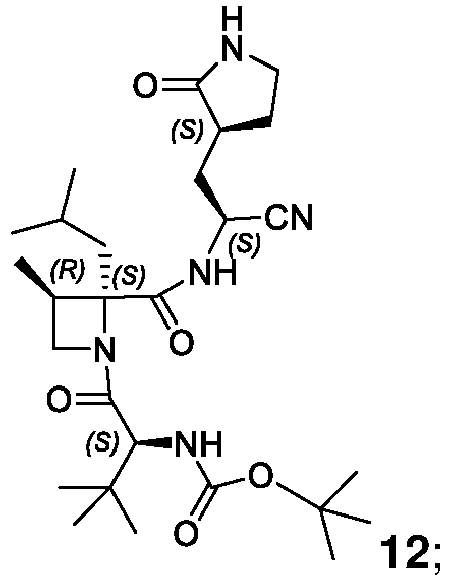
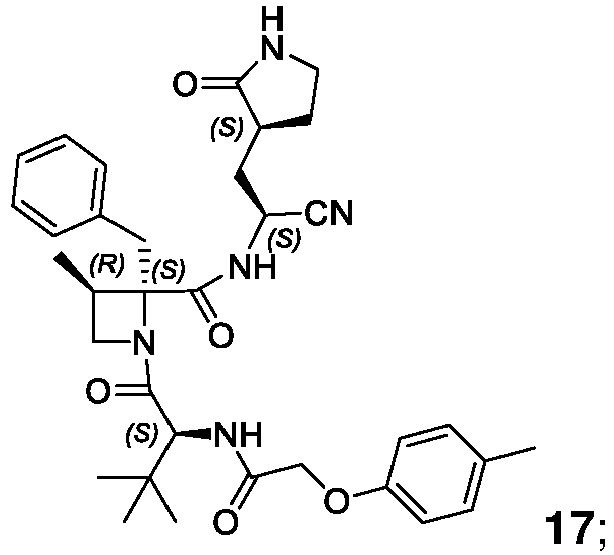
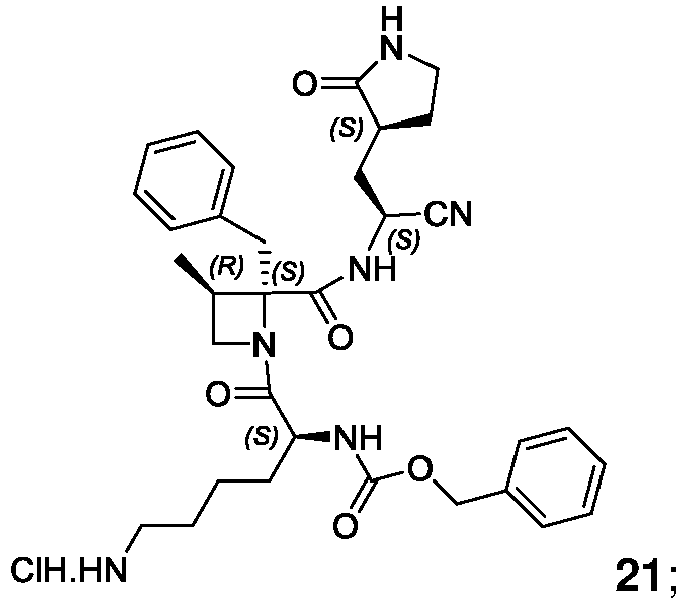
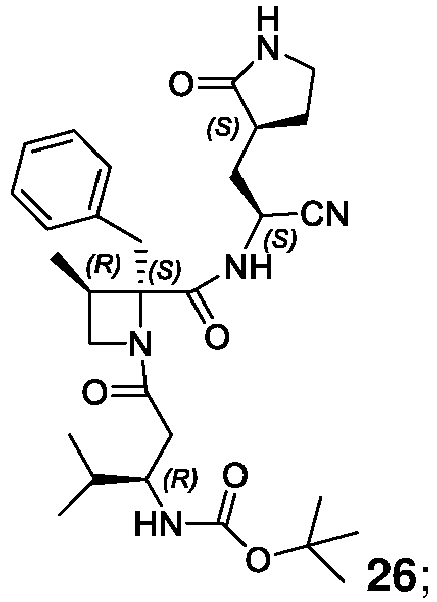
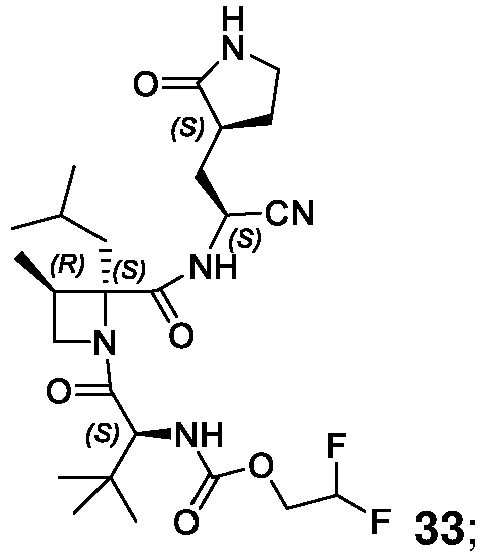
In another embodiment the invention relates to the compound of formula I as defined above, selected from:
and
-
Another aspect of this invention relates to a pharmaceutical composition, which comprises a compound of formula I or a pharmaceutically acceptable salt thereof and one or more pharmaceutically acceptable excipients.
-
Another aspect of the invention relates to a compound of formula I as defined above, for use as medicament.
-
Another aspect of the invention relates to a compound of formula I as defined above, for use for the treatment of a viral infection, and preferably for the treatment of SARS-CoV-2 viral infection.
-
Another aspect of the present invention relates to the use of a compound of formula I or a pharmaceutically acceptable salt thereof for the manufacture of a medicament.
-
Another aspect of the present invention relates to the use of a compound of formula I or a pharmaceutically acceptable salt thereof for the manufacture of a medicament for the treatment of a viral infection, and preferably for the treatment of SARS-CoV-2 viral infection.
-
Another aspect of the present invention relates to a method of treating a disease, in a subject in need thereof, especially a human being, which comprises administering to said subject an effective amount of a compound of formula I or a pharmaceutically acceptable salt thereof.
-
Another aspect of the present invention relates to a method of treating a viral infection, preferably SARS-CoV-2 viral infection, in a subject in need thereof, especially a human being, which comprises administering to said subject an effective amount of a compound of formula I or a pharmaceutically acceptable salt thereof.
-
In the above definitions, the term C1-C4 alkyl, as a group or part of a group, means a straight or branched alkyl chain which contains from 1 to 4 carbon atoms and includes the groups methyl, ethyl, propyl, isopropyl, butyl, isobutyl, sec-butyl and tert-butyl.
-
The compounds of the present invention may form salts. There is no limitation on the type of salt that can be used, provided that these are pharmaceutically acceptable when used for therapeutic purposes. The term pharmaceutically acceptable salt refers to those salts which are, according to medical judgment, suitable for use in contact with the tissues of humans and other mammals without undue toxicity, irritation, allergic response and the like. Pharmaceutically acceptable salts are well known in the art.
-
The salts of a compound of formula I can be obtained during the final isolation and purification of the compounds of the invention or can be prepared by treating a compound of formula I with a sufficient amount of the desired acid or base to give the salt in a conventional manner. The salts of the compounds of formula I can be converted into other salts of the compounds of formula I by ion exchange using ionic exchange resins.
-
The compounds of formula I and their salts may differ in some physical properties, but they are equivalent for the purposes of the present invention. All salts of the compounds of formula I are included within the scope of the invention.
-
The compounds of the present invention may form complexes with solvents in which they are reacted or from which they are precipitated or crystallized. These complexes are known as solvates. As used herein, the term solvate refers to a complex of variable stoichiometry formed by a solute (a compound of formula I or a salt thereof) and a solvent. Examples of solvents include pharmaceutically acceptable solvents such as water, ethanol and the like. A complex with water is known as a hydrate. Solvates of compounds of the invention (or salts thereof), including hydrates, are included within the scope of the invention.
-
The compounds of formula I may exist in different physical forms, i.e. amorphous and crystalline forms. Moreover, the compounds of the invention may have the ability to crystallize in more than one form, a characteristic which is known as polymorphism. Polymorphs can be distinguished by various physical properties well known in the art such as X-ray diffraction pattern, melting point or solubility. All physical forms of the compounds of formula I, including all polymorphic forms ("polymorphs") thereof, are included within the scope of the invention.
-
Some of the compounds of the present invention may exist as several diastereoisomers and/or several optical isomers. Diastereoisomers can be separated by conventional techniques such as chromatography or fractional crystallization. Optical isomers can be resolved by conventional techniques of optical resolution to give optically pure isomers. This resolution can be carried out on any chiral synthetic intermediate or on products of formula I. Optically pure isomers can also be individually obtained using enantiospecific synthesis. The present invention covers all individual isomers as well as mixtures thereof (for example racemic mixtures or mixtures of diastereomers), whether obtained by synthesis or by physically mixing them.
-
The present invention also relates to a pharmaceutical composition that comprises a compound of the present invention (or a pharmaceutically acceptable salt or solvate thereof) and one or more pharmaceutically acceptable excipients. The excipients must be "acceptable" in the sense of being compatible with the other ingredients of the composition and not deleterious to the recipients thereof.
-
The compounds of the present invention can be administered in the form of any pharmaceutical formulation, the nature of which, as it is well known, will depend upon the nature of the active compound and its route of administration. Any route of administration may be used, for example oral, parenteral, nasal, ocular, rectal and topical administration.
-
Solid compositions for oral administration include tablets, granulates and capsules. In any case the manufacturing method is based on a simple mixture, dry granulation or wet granulation of the active compound with excipients. These excipients can be, for example, diluents such as lactose, microcrystalline cellulose, mannitol or calcium hydrogenphosphate; binding agents such as for example starch, gelatin or povidone; disintegrants such as sodium carboxymethyl starch or sodium croscarmellose; and lubricating agents such as for example magnesium stearate, stearic acid or talc. Tablets can be additionally coated with suitable excipients by using known techniques with the purpose of delaying their disintegration and absorption in the gastrointestinal tract and thereby provide a sustained action over a longer period, or simply to improve their organoleptic properties or their stability. The active compound can also be incorporated by coating onto inert pellets using natural or synthetic film-coating agents. Soft gelatin capsules are also possible, in which the active compound is mixed with water or an oily medium, for example coconut oil, mineral oil or olive oil.
-
Powders and granulates for the preparation of oral suspensions by the addition of water can be obtained by mixing the active compound with dispersing or wetting agents; suspending agents and preservatives. Other excipients can also be added, for example sweetening, flavouring and colouring agents.
-
Liquid forms for oral administration include emulsions, solutions, suspensions, syrups and elixirs containing commonly-used inert diluents, such as purified water, ethanol, sorbitol, glycerol, polyethylene glycols (macrogols) and propylene glycol. Said compositions can also contain coadjuvants such as wetting, suspending, sweetening, flavouring agents, preservatives and buffers.
-
Injectable preparations, according to the present invention, for parenteral administration, comprise sterile solutions, suspensions or emulsions, in an aqueous or non-aqueous solvent such as propylene glycol, polyethylene glycol or vegetable oils. These compositions can also contain coadjuvants, such as wetting, emulsifying, dispersing agents and preservatives. They may be sterilized by any known method or prepared as sterile solid compositions, which will be dissolved in water or any other sterile injectable medium immediately before use. It is also possible to start from sterile materials and keep them under these conditions throughout all the manufacturing process.
-
For the rectal administration, the active compound can be preferably formulated as a suppository on an oily base, such as for example vegetable oils or solid semisynthetic glycerides, or on a hydrophilic base such as polyethylene glycols (macrogol).
-
The compounds of the invention can also be formulated for their topical application for the treatment of pathologies occurring in zones or organs accessible through this route, such as eyes, skin and the intestinal tract. Formulations include creams, lotions, gels, powders, solutions and patches wherein the compound is dispersed or dissolved in suitable excipients.
-
For the nasal administration or for inhalation, the compound can be formulated as an aerosol and it can be conveniently released using suitable propellants.
-
The dosage and frequency of doses will depend upon the nature and severity of the disease to be treated, the age, the general condition and body weight of the patient, as well as the particular compound administered and the route of administration, among other factors.
-
Unless otherwise defined, all technical and scientific terms used herein have the same meaning as commonly understood by one of ordinary skilled in the art to which this invention belongs. Methods and materials similar or equivalent to those described herein can be used in the practice of the present invention. Throughout the description and claims the word "comprise" and its variations are not intended to exclude other technical features, additives, components, or steps. Additional objects, advantages and features of the invention will become apparent to those skilled in the art upon examination of the description or may be learned by practice of the invention. The following examples and drawings are provided by way of illustration and are not intended to be limiting of the present invention.
BRIEF DESCRIPTION OF THE DRAWINGS
-
- Fig. 1 . Shows isolated enzyme Mpro inhibition by compound 18.
- Fig. 2 . Shows isolated enzyme Mpro inhibition by compound 31.
Examples
General procedures for the preparation of Key Intermediates (1-82)
-
-
Scheme 5 illustrates the synthetic sequence followed for the preparation of compounds of general formula I. α-Cyano peptidomimetics may be obtained through the transformation of the corresponding C-terminal α-amides using POCl
3 or the Burgess reagent, while the C-terminal α-aldehydes may be achieved by partial reduction of α-methoxycarbonyl with DIBAL, or by oxidation of CN or Dess-martin oxidation of alcohols.
-
Reactions were monitored either by TLC and/or analytic HPLC (UV, detection, 220 nm). Flash columns, filled with silica gel Merck 60 (230-400), solid-phase extraction cartridges, or centrifugal circular chromatography (CCC), plates coated with silica gel Merck 60 gipshating, were used for chromatographic separations. A reversed-phase column, Sunfire C18 (4.6 × 50 mm, 3.5 µm), a flux of 1 mL/min, and mixtures of CH3CN, phase A, and H2O, phase B, both containing 0.01% formic acid, were used for analytical HPLCs. Mass spectra, in electrospray, positive mode, were obtained on a Waters Micro mass ZQ spectrometer. High resolution mass spectrum (ESI-HRMS) was recorded on an Agilent 6520 Q-TOF instrument. Optical rotations for final compounds were measured in a polarimeter Perkin Elmer 141 apparatus. NMR spectra were recorded in a Brucker-400 (400 MHz) spectrometer, operating at 400 and 100 MHz for 1H and 13C experiments, respectively or a Varian System 500, operating at 500 and 125 MHz for 1H and 13C experiments. Chemical shifts are expressed in ppm and coupling constants in Hz).
-
General Procedure for the Synthesis of N-p-methoxybenzyl Amino Acid Derivatives. A solution of H-L-Leu-OMe·HCl, H-L-Phe-OMe·HCl, H-L-Tyr(tBu)-OMe·HCl, H-L-Trp(Boc)-OMe (1.0 eq) or H-Lys(Boc)-OMe in MeOH (2mL/mmol) was successively treated with TEA (1.0 eq) and p-methoxybenzaldehyde (1.2 eq). After the mixture was stirred at rt for 1.5 h, NaBH4 (2.0 eq) was added in portions, and the stirring continued for 30 min. Then, the solvent was evaporated under vacuum, the residue was dissolved in EtOAc, and washed with H2O and brine. The organic layer was dried over Na2SO4, and, after evaporation, the resulting residue was purified on a silica gel column as specified in each case.
-
N-(p-Pmb)-L-Leu-OMe (1) and N-(p-Pmb)-L-Phe-OMe (2) were prepared as described (Guillermo Gerona Navarro, et al. Entry to new conformationally constrained amino acids. First synthesis of 3-unsubstituted 4-alkyl-4-carboxy-2-azetidinone derivatives via an intramolecular N-α-C-α -cyclization strategy. J. Org. Chem. 2001, 66, pp. 3538 - 3547).
N-(p-Pmb)-L-Tyr(tBu)-OMe (3)
-
Syrup. Yield: 76% (from H-L-Tyr(tBu)-OMe·HCl). Eluents: EtOAc:hexane (2:8). HPLC (tR, min): 4.95 (gradient from 20 to 95% of A, in 10 min). 1H NMR (400 MHz, CDCl3): δ 7.14 (m, 2H, C6H4), 7.05 (d, J = 8.4 Hz, 2H, C6H4), 6.90 (d, J = 8.4 Hz, 2H, C6H4), 6.81 (d, J= 8.6 Hz, 2H, C6H4), 3.81-3.74 (m, 4H, NHCH 2, OCH3), 3.65-3.57 (m, 4H, NHCH 2, COOCH3), 3.52 (m, 1H, α-H Tyr), 2.94-2.91 (m, 2H, β-HTyr), 1.33 (s, 9H, C(CH3)3). 13C (100 MHz, CDCl3): δ 174.8 (CO), 158.9, 154.2, 132.1, 131.0, 129.8, 129.7, 124.3, 113.9 (Ar), 78.5 (C(CH3)3), 62.0 (Cα Tyr), 55.4 (OCH3), 51.8, 51.4 (NHCH2, CO2 CH3), 39.0 (Cβ Tyr), 29.0 (C(CH3)3). MS (ES)+: 372.3 [M+H]+.
N-(p-Pmb)-L-Trp(Boc)-OMe (4)
-
Syrup. Yield: 68% (from HCl.H-Trp(Boc)-OMe). Eluents: EtOAc:hexane (3:7). HPLC (tR, min): 6.17 (gradient from 20 to 95% of A, in 10 min). 1H NMR (400 MHz, CDCl3): δ 8.04 (d, J = 7.4 Hz, 1H, CH In), 7.42-7.38 (m, 2H, CH In), 7.25-7.21 (m, 1H, H In), 7.16-7.10 (m, 3H, C6H4, CH Ind), 6.72 (d, J = 8.6 Hz, 2H, C6H4), 3.73-3.70 (m, 4H, α-H Trp, OCH3), 3.60-3.56 (m, 5H, NHCH 2, CO2CH3), 3.08-2.97 (m, 2H, β-H Trp), 1.59 (s, 9H, C(CH3)3). 13C (100 MHz, CDCl3): δ 174.7 (CO), 159.0 (C Ar), 149.8 (CO Boc), 135.5, 130.9, 130.5 (C Ar), 129.8 (CH Ar), 124.6, 124.3, 122.6, 119.1 (CH In), 116.0 (C In), 115.4 (CH In), 113.9 (CH Ar), 83.7 (C(CH3)3), 60.4 (Cα Trp), 55.4 (OCH3), 52.1 (CO2 CH3), 51.5 (NHCH2), 28.9 (Cβ Trp), 28.4 (C(CH3)3). MS (ES)+: 439.3 [M+H]+.
N-(p-Pmb)-L-Lys(Boc)-OMe (5)
-
Syrup. Yield: 76% (from H-L-Lys(Boc)-OMe·HCl). Eluents: EtOAc:hexane (1:2). HPLC (tR, min): 5.96 (gradient from 20 to 95% of A, in 10 min). 1H NRM (400 MHz, CDCl3): δ 7.22 (d, J = 8.6 Hz, 2H, C6H4), 6.84 (d, J = 8.6 Hz, 2H, C6H4), 4.54 (br s, 1H, NHBoc), 3.78 (s, 3H, OMe), 3.71 (d, J= 12.7 Hz, 1H, NHCH 2), 3.70 (s, 3H, OMe), 3.54 (d, J = 12.7 Hz, 1H, NHCH 2), 3.23 (t, J = 6.7 Hz, 1H, α-H Lys), 3.08 (m, 2H, ε-H Lys), 1.62 (m, 2H, β-H Lys), 1.43 (s, 9H, C(CH3)3), 1.42-1.33 (m, 4H, γ,δ-H Lys). 13C (100 MHz, CDCl3): δ 176.1 (CO), 158.8 (Ar), 156.1 (CO, NHBoc), 132.0, 129.6, 113.9 (Ar), 79.2 (C(CH3)3), 60.5 (Cα Lys), 55.4 (OCH3), 51.8, 51.7 (NHCH2, CO2CH3), 40.4 (Cε Lys), 33.2 (Cβ Lys), 29.9 (Cδ Lys), 28.5 (C(CH3)3), 28.1 (Cγ Lys). MS (ES)+: 381,2 [M+H]+.
N-(p-Pmb)-L-Ala(Cy)-OMe (6)
-
Syrup. Yield: 58% (from H-L-Ala(Cy)-OMe.HCl). Eluents: EtOAc:hexane (1:9). HPLC (tR, min): 5.80 (gradient from 10 to 95% of A, in 10 min). 1H NMR (400 MHz, CDCl3): δ 7.23 (d, J = 8.6 Hz, 2H, C6H4), 6.84 (d, J = 8.6 Hz, 2H, C6H4),
3.79 (s, 3H, OCH3), 3.74 (d, J= 12.8 Hz, 1H, NHCH 2), 3.71 (s, 3H, OCH3), 3.55 (d, J = 12.8 Hz, 1H, NHCH 2), 3.32 (t, J = 7.0 Hz, 1H, α-H), 1.72-1.56 (m, 5H, 2, 3, 4, 5, 6-H Cy), 1.48-1.44 (m, 3H, β-H, 1-H Cy), 1.27-1.08 (m, 3H, 3, 4, 5-H Cy), 0.93-0.77 (m, 2H, 2, 3-H Cy). 13C (100 MHz, CDCl3): δ 176.7 (CO), 158.8, 132.1, 129.6, 113.8 (Ar), 58.4 (Cα), 55.4 (OCH3), 51.7, 51.6 (NHCH2, CO2CH3), 41.4 (Cβ), 34.3 (C1 Cy), 33.6, 32.9 (C2-, C6- Cy), 26.6, 26.3, 26.2 (C3-, C4-, C5- Cy). MS (ES)+: 306.3 [M+H]+.
-
General Procedure for the Synthesis of N-Chloropropionyl Amino Acid Derivatives. PPh3 (2.2 eq) was added to a solution of (S)-2-chloropropionic acid (2.0 eq) or (R)-2-chloropropionic acid (2.0 eq) and Cl3CCN (3.1 mL, 30.66 mmol) in THF (6mL/mmol) at 0 ºC, and the reaction mixture was stirred for 30 min. Then, it was added dropwise to the reaction mixture of N-p-methoxybenzyl-L-Xaa-OMe (1.0 eq) and propylene oxide (20 eq) in THF (2 mL/mmol). After stirring for 24 h, the solvent was evaporated to dryness. The residue was purified by column chromatography on silica gel using the solvent system specified.
N-[(S)-2-Chloropropionyl]-N-(p-Pmb)-L-Leu-OMe (7)
-
Syrup. Yield: 70% (from N-(p-Pmb)-L-Leu-OMe, 1). Eluents: Acetone:DCM (1:200). HPLC: tR= 8.40 min (gradient from 30 to 95% of A, in 10 min). 1H NMR (400 MHz, CDCl3, two rotamers, Mr/mr = 1:0.14): δ major rotamer 7.14 (d, J = 8.7 Hz, 2H, C6H4), 6.87 (d, J = 8.7 Hz, 2H, C6H4), 4.99 (dd, J = 8.1, 6.6 Hz, 1H, α-H), 4.69 (d, J = 17.1 Hz, 1H, NCH2), 4.53 (d, J = 17.1 Hz, 1H, NCH2), 4.49 (q, J = 6.5 Hz, 1H, 2-H), 3.80 (s, 3H, OCH3), 3.52 (s, 3H, CO2CH3), 1.85 (m, 1H, β-H), 1.62 (d, J = 6.6 Hz, 3H, 3-H), 1.59-1.52 (m, 2H, β-H, γ-H), 0.89 (d, J = 6.4 Hz, 3H, δ-H), 0.85 (d, J = 6.4 Hz, 3H, δ-H). 13C NMR (100 MHz, CDCl3, major rotamer): δ 171.7, 170.5 (CO), 159.3, 128.4, 127.8, 114.3 (Ar), 55.7 (Cα), 55.4 (OCH3), 52.1 (CO2 CH3), 50.3 (C2), 48.6 (NCH2), 38.5 (Cβ), 25.0 (Cy), 22.9, 22.3 (Cδ ), 21.0 (C3). MS (ES)+: 378.2 [M+Na]+.
-
N-[(S)-2-Chloropropionyl]-N-(p-Pmb)-L-Phe -OMe (8) was prepared as described (Paula Pérez-Faginas, et al. Exceptional Stereoselectivity in the Synthesis of 1,3,4-Trisubstituted 4-Carboxy β-Lactam Derivatives from Amino Acids. Org. Lett. 2007, 9, 1593-1596).
N-[(S)-2-Chloropropionyl]-N-(p-Pmb)-L-Tyr( t Bu)-OMe (9)
-
Syrup. Yield: 81% (from N-(p-Pmb)-L-Tyr(tBu)-OMe, 3). Eluents: EtOAc:hexane (15:85). HPLC (tR, min): 5.52 (gradient from 60 to 95% of A, in 10 min). 1H NMR (400 MHz, CDCl3): δ 7.03-6.98 (m, 4H, C6H4), 6.91 (d, J = 8.5 Hz, 2H, C6H4), 6.81 (d, J = 8.7 Hz, 2H, C6H4), 4.51 (d, J= 16.1 Hz, 1H, NCH2), 4.47 (q, J = 6.4 Hz, 1H, 2-H), 4.36 (dd, J = 9.5, 5.9 Hz, 1H, α-H), 3.89 (d, J = 16.1 Hz, 1H, NCH2), 3.79 (s, 3H, OCH3), 3.61 (s, 3H, CO2CH3), 3.29 (dd, J = 14.1, 5.9 Hz, 1H, β-H), 3.19 (dd, J = 14.1, 9.5 Hz, 1H, β-H), 1.66 (d, J = 6.5 Hz, 3H, 3-H), 1.33 (s, 9H, C(CH3)3). 13C (100 MHz, CDCl3): δ 170.5, 169.6 (COO, CO), 159.4, 154.3, 132.6, 129.9, 129.0, 127.3, 124.5, 114.2 (Ar), 78.6 (OC(CH3)3), 60.2 (Cα), 55.4 (OCH3), 52.3 (CO2 CH3), 51.3 (NCH2), 50.0 (C2), 34.4 (Cβ), 29.0 (C(CH3)3), 21.2 (C3). MS (ES)+: 484.2 [M+Na]+.
N-[(S)-2-Chloropropionyl]-N-(p-Pmb)-L-Trp(Boc)-OMe (10)
-
Syrup. Yield: 81% (from N-(p-Pmb)-L-Trp(Boc)-OMe, 4). Eluents: EtOAc:hexane (15:85). HPLC (tR, min): 6.55 (gradient from 60 to 95% of A, in 10 min). 1H NMR (400 MHz, CDCl3): δ 8.11 (d, J = 7.5 Hz, 1H, In), 7.36-7.28 (m, 3H, In), 7.20-7.16 (m, 1H, In), 6.86 (d, J= 8.8 Hz, 2H, C6H4), 6.67 (d, J= 8.7 Hz, 2H, C6H4), 4.51 (q, J = 6.5 Hz, 1H, 2-H), 4.43 (m, 1H, α-H), 4.40 (d, J = 16.0 Hz, 1H, NCH2), 4.24 (d, J = 16.2, 1H, NCH2), 3.75 (s, 3H, OCH3), 3.64 (s, 3H, CO2CH3), 3.40 (d, J = 7.4 Hz, 2H, β-Trp), 1.71 (d, J = 6.5 Hz, 3H, 3-H), 1.66 (s, 9H, C(CH3)3). 13C (100 MHz, CDCl3): δ 170.5, 169.6 (COO, CO), 159.3 (C6H4), 149.7 (CO Boc), 135.5, 130.5 (In), 128.9, 127.0 (C6H4), 124.6, 124.4, 122.6, 118.9, 116.4, 115.4 (In), 113.9 (C6H4), 83.7 (C(CH3)3), 59.3 (Cα), 55.3 (OCH3), 52.4 (CO2 CH3), 51.8 (NCH2), 50.1 (C2), 28.4 (C(CH3)3), 24.4 (Cβ), 21.2 (C3). MS (ES)+: 551.0 [M+H]+.
N-[(S)-2-Chloropropionyl]-N-(p-Pmb)-L-Lys-OMe (11)
-
Syrup. Yield: 94% (from N-(p-Pmb)-L-Lys-OMe, 5). Eluents: EtOAc:hexane (1:2). HPLC: tR= 9.88 min (gradient from 10 to 95% of A, in 10 min). 1H NMR (400 MHz, CDCl3, two rotamers, Mr/mr = 1:0.16): δ major rotamer 7.09 (d, J = 8.7 Hz, 2H, C6H4), 6.82 (d, J = 8.7 Hz, 2H, C6H4), 4.75 (dd, J = 8.7, 6.1 Hz, 1H, α-H), 4.64 (d, J = 17.0 Hz, 1H, NCH2), 4.46 (m, 1H, 2-H), 4.44 (d, J= 12.7 Hz, 1H, NCH2), 3.73 (s, 3H, OMe), 3.45 (s, 3H, CO2Me), 2.99 (m, 2H, ε-H), 1.92 (m, 1H, β-H), 1.72 (m, 1H, β-H), 1.56 (d, J = 6.5 Hz, 3H, 3-H), 1.37 (m, 11H, C(CH3)3, δ-H), 1.22 (m, 2H, γ-H). 13C NMR (100 MHz, CDCl3, major rotamer): δ 171.0, 170.3 (CO), 159.2 (Ar), 155.9 (CO, NHBoc), 128.0, 127.8, 114.1 (Ar), 78.8 (C(CH3)3, 57.1 (Cα), 55.2 (OCH3), 51.8 (CO2 CH3), 50.0 (C2), 48.8 (NCH2), 40.1 (Cε), 29.4 (Cβ), 28.9 (Cδ), 28.4 (C(CH3)3), 23.1 (Cγ), 20.8 (C3). MS (ES)+: 493.1 [M+H]+.
N-[(S)-2-Chloropropionyl]-N-(p-Pmb)-L-Ala(Cy)-OMe (12)
-
Syrup. Yield: 98% (from N-(p-Pmb)-L-Ala(Cy)-OMe 6). Eluents: EtOAc:hexane (13:87). HPLC: tR= 5.04 min (gradient from 60 to 95% of A, in 10 min). 1H NMR (400 MHz, CDCl3, two rotamers, Mr/mr = 1:0.14): δ major rotamer 7.14 (d, J = 8.6 Hz, 2H, C6H4), 6.88 (d, J = 8.6 Hz, 2H, C6H4), 5.03 (dd, J = 8.6, 6.2 Hz, 1H, α-H), 4.69 (d, J = 17.1 Hz, 1H, NCH2), 4.51 (d, J = 17.1 Hz, 1H, NCH2), 4.49 (q, J = 6.5 Hz, 1H, 2-H), 3.80 (s, 3H, OCH3), 3.52 (s, 3H, CO2CH3), 1.86 (ddd, J = 14.5, 8.3, 6.2 Hz, 1H, β-H), 1.75-1.52 (m, 9H, 3-H, 2, 3, 4, 5, 6-H Cy, β-H), 1.25-1.05 (m, 4H, 1, 3, 4, 5 -H Cy), 0.92-0.77 (m, 2H, 2, 6-H Cy). 13C NMR (100 MHz, CDCl3, major rotamer): δ 171.8, 170.5 (CO), 159.3, 128.5, 127.8, 114.3 (Ar), 55.5 (OCH3), 55.1 (Cα), 52.1 (CO2 CH3), 50.3 (C2), 48.6 (NCH2), 37.1 (Cβ), 34.3 (C1 Cy), 33.6, 32.9 (C2-, C6- Cy), 26.5, 26.4, 26.1 (C3-, C4-, C5- Cy), 20.9 (C3). MS (ES)+: 418.2 [M+Na]+.
N-[(R)-2-Chloropropionyl]-N-(p-Pmb)-L-Leu-OMe (25)
-
Syrup. Yield: 72% (from N-(p-Pmb)-L-Leu-OMe, 1). Eluents: Acetone:DCM (1:200). HPLC: tR= 8.41 min (gradient from 30 to 95% of A, in 10 min).. 1H NMR (400 MHz, CDCl3, two rotamers, Mr/mr = 1:0.4): δ major rotamer 7.19 (d, J = 8.7 Hz, 2H, C6H4), 6.90 (d, J = 8.7 Hz, 2H, C6H4), 4.85 (d, J = 17.3 Hz, 1H, NCH2), 4.58 (t, J = 6.8 Hz, 1H, α-H), 4.47 (q, J = 6.6 Hz, 1H, 2-H), 4.42 (d, J = 17.3 Hz, 1H, NCH2), 3.81 (s, 3H, OCH3), 3.69 (s, 3H, CO2CH3), 1.90 (m, 1H, β-H), 1.62 (d, J = 6.6 Hz, 3H, 3-H), 1.59-1.50 (m, 2H, β-H, γ-H), 0.90 (d, J = 6.5 Hz, 3H, δ-H), 0.78 (d, J = 6.4 Hz, 3H, δ-H). 13C NMR (100 MHz, CDCl3, major rotamer): δ 171.8, 170.3 (CO), 159.4, 128.7, 127.8, 114.5 (Ar), 57.7 (Cα), 55.5 (OCH3), 52.3 (CO2 CH3), 50.4 (NCH2), 50.1 (C2), 38.2 (CP), 25.4 (Cy) 22.6, 22.5 (Cδ), 20.9 (C3). MS (ES)+: 378.2 [M+Na]+.
General Procedure for the Synthesis of 2-Oxoazetidine Amino Acid Derivatives.
-
A solution of the corresponding N-p-methoxybenzyl-N-chloropropionyl derivative (1.0 eq) in dry CH3CN (2mL/mmol) was treated with BTPP (1.5 eq) and stirred at rt until disappearance of the starting material. After evaporation of the solvent, the residue was extracted with EtOAc, and the extract was washed with 1M HCl, H2O and brine. The organic layer was dried over Na2SO4 and then, after evaporation, the resulting residue was purified on a silica gel column as specified in each case.
(3S,4S)-4-isobutyl-1-(p-methoxy)benzyl-4-methoxycarbonyl-3-methyl-2-oxoazetidine (13)
-
Syrup. Yield: 77% (from 7). Eluents: EtOAc:hexane (1:2). HPLC: tR= 8.28 min (gradient from 10 to 95% of A, in 10 min). [α]D = -39.36 (c 0.76, CHCl3). 1H NMR (400 MHz, CDCl3): δ 7.23 (d, J = 8.7 Hz, 2H, C6H4), 6.84 (d, J = 8.7 Hz, 2H, C6H4), 4.67 (d, J = 15.6 Hz, 1H, NCH2), 4.22 (d, J = 15.6 Hz, 1H, NCH2), 3.78 (s, 3H, OCH3), 3.70 (s, 3H, CO2CH3), 3.15 (q, J = 7.5 Hz, 1H, 3-H), 1.81 (m, 1H, CH, i Bu), 1.61 (m, 2H, CH2, i Bu), 1.19 (d, J= 7.5 Hz, 3H, 3-CH3), 0.76 (d, J = 6.5 Hz, 6H, CH3, i Bu). 13C NMR (100 MHz, CDCl3): δ 172.1 (CO), 170.0 (C2), 159.0, 129.55, 129.5, 114.0 (Ar), 68.4 (C4), 55.4 (OCH3), 54.6 (1-CH2), 52.0 (CO2 CH3), 44.9 (CH2, i Bu), 44.5 (C3), 24.9, 24.7 (CH3, i Bu), 22.4 (CH, i Bu) 10.7 (3-CH3). MS (ES)+: 320.1 [M+H]+.
(3R,4R)-4-isobutyl-1-p-methoxybenzyl-4-methoxycarbonyl-3-methyl-2-oxoazetidine (26)
-
Syrup. Yield: 78% (from 25). Eluents: EtOAc:hexane (1:2). HPLC: tR= 8.28 min (gradient from 10 to 95% of A, in 10 min). [α]D = 39.68 (c 0.75, CHCl3). 1H NMR (400 MHz, CDCl3 and 13C NMR (100 MHz, CDCl3): δ identical to its enantiomer 13 MS (ES)+: 320.1 [M+H]+.
-
(35.45) -4-Benzyl-4-methoxycarbonyl-1-p-methoxybenzyl-3-methyl-2-oxoazetidine (14) was prepared from 8 as described in Paula Pérez-Faginas, et al. Exceptional Stereoselectivity in the Synthesis of 1,3,4-Trisubstituted 4-Carboxy β-Lactam Derivatives from Amino Acids. Org. Lett. 2007, 9, 1593-1596.
(3S,4S)-4-(tert-Butoxy)benzyl-1-p-methoxybenzyl-4-methoxycarbonyl-3-methyl-2-oxoazetidine (15)
-
Syrup. Yield: 77% (from 9). Eluents: EtOAc:hexane (3:7). HPLC (tR, min): 8.74 (gradient from 40 to 95% of A, in 10 min). 1H NMR (400 MHz, CDCl3): δ 7.12 (d, J = 8.6 Hz, 2H, C6H4), 6.86-6.80 (m, 6H, C6H4), 4.38 (d, J= 15.4 Hz, 1H, 1-CH2), 4.10 (d, J = 15.4 Hz, 1H, 1-CH2), 3.79 (s, 3H, OCH3), 3.69 (s, 3H, CO2CH3), 3.31 (d, J = 14.5 Hz, 1H, 4-CH2), 3.15 (q, J = 7.5 Hz, 1H, H3), 3.04 (d, J = 14.5 Hz, 1H, 4-CH2), 1.32 (s, 9H, OC(CH3)3), 1.14 (d, J = 7.5 Hz, 3H, 3-CH3), 13C (100 MHz, CDCl3): δ 171.9 (CO), 169.8 (C2), 160.0, 154.7, 130.6, 130.1, 129.9, 129.1, 124.2, 113.9 (Ar), 78.6 (OC(CH3)3), 69.3 (C4), 55.4 (OCH3), 53.9 (1-CH2), 52.2 (CO2 CH3), 45.6 (C3), 40.2 (4-CH2), 29.0 (C(CH3)3), 10.2 (3-CH3). MS (ES)+: 426.3 [M+Na]+.
(35,4 S)-1- p-Meth oxybenzyl-4-methoxycarbonyl-3-methyl-4-[(1- tert-butoxycarbonyl)indol-3-yl]methyl-2-oxoazetidine (16)
-
Syrup. Yield: 73% (from 10). Eluents: EtOAc:hexane (3:7). HPLC (tR, min): 9.07 (gradient from 40 to 95% of A, in 10 min). 1H NMR (400 MHz, CDCl3): δ 8.07 (d, J = 8.4 Hz, 1H, 7-In), 7.35 (dt, J = 7.7, 1.0 Hz, 1H, 4-In), 7.29 (ddd, J = 8.5, 7.3, 1.3 Hz, 1H, 6-In), 7.19 (td, J = 7.5, 1.1 Hz 1H, 5-In), 7.13 (d, J = 8.6 Hz, 2H, C6H4), 7.09 (s, 1H, 2-In), 6.76 (d, J = 8.7 Hz, 2H, C6H4), 4.51 (d, J = 15.2 Hz, 1H, 1-CH2), 4.22 (d, J = 15.2 Hz, 1H, 1-CH2), 3.76 (s, 3H, OCH3), 3.74 (s, 3H, CO2CH3), 3.29 (d, J = 15.5 Hz, 1H, 4-CH2), 3.19-3.14 (m, 2H, 4-CH2, H3), 1.67 (s, 9H, C(CH3)3). 13C (100 MHz, CDCl3): δ 172.1 (CO), 169.8 (C2), 159.1 (Ar), 149.6 (CO2 t Bu), 135.1, 131.1 (In), 130.0, 128.5 (C6H4), 124.7, 124.6, 122.8, 118.5, 115.4 (In), 114.0 (C6H4), 113.9 (In), 83.9 (OC(CH3)3), 68.5 (C4), 55.3 (OCH3), 53.7 (1-CH2), 52.4 (CO2 CH3), 45.2 (C3), 29.0 (4-CH2), 28.3 (C(CH3)3), 10.2 (3-CH3). MS (ES)+: 515.1 [M+Na]+.
(3S,4S)-1-(p-Methoxy)benzyl-4-[(tert-butoxycarbonyl)amino]butyl-4-methoxy-carbonyl-3-methyl-2-oxoazetidine (17)
-
Syrup. Yield: 72% (from 11). Eluents: EtOAc:hexane (1:2). HPLC: tR= 5.25 min (gradient from 40 to 95% of A, in 10 min). 1H NMR (400 MHz, CDCl3): δ 7.20 (d, J = 8.6 Hz, 2H, C6H4), 6.83 (d, J = 8.6 Hz, 2H. C6H4), 4.74 (d, J = 15.3 Hz, 1H, NCH2), 4.35 (br s, 1H, NHBoc), 4.08 (d, J = 15.4 Hz, 1H, NCH2), 3.77 (s, 3H, OMe), 3.72 (s, 3H, CO2Me), 3.11 (q, J = 7.5 Hz, 1H, 3-H), 2.85 (m, 2H, 4'-H), 1.69 (m, 2H, 1'-H), 1.41 (s, 9H, C(CH3)3), 1.13 (d, J = 7.6 Hz, 3H, 3-CH3), 1.10-1.05 (m, 3H, 3'-H, 2'-H), 0.96 (m, 1H, 2'-H). 13C NMR (100 MHz, CDCl3): δ 171.9 (CO), 169.5 (C2), 159.2, 129.8, 128.1, 114.0 (Ar), 79.2 (C(CH3)3), 68.8 (OCH2), 55.4 (OCH3), 53.0 (3-H), 52.2 (CO2 CH3), 44.7 (NCH2), 40.1 (C4'), 34.1 (C1'), 29.9 (C3'), 44.5 (C3), 28.5 (C(CH3)3), 21.4 (C2'), 10.3 (3-CH3). MS (ES)+: 435.1 [M+H]+.
(3S,4S)-1-(p-Methoxy)benzyl-4-cyclohexylmethyl-4-methoxycarbonyl-3-methyl-2-oxoazetidine (18)
-
Syrup. Yield: 78% (from 12). Eluents: EtOAc:hexane (21:79). HPLC: tR= 7.89 min (gradient from 40 to 95% of A, in 10 min). 1H NMR (400 MHz, CDCl3): δ 7.22 (d, J = 8.7 Hz, 2H, C6H4), 6.84 (d, J = 8.7 Hz, 2H, C6H4), 4.71 (d, J = 15.6 Hz, 1H, 1-CH2), 4.18 (d, J = 15.6 Hz, 1H, 1-CH2), 3.78 (s, 3H, OCH3), 3.70 (s, 3H, CO2CH3), 3.13 (q, J = 7.5 Hz, 1H, 3-H), 1.70 (d, J = 6.3 Hz, 2H, 4-CH2), 1.59-1.47 (m, 3H, 3, 4, 5-H Cy), 1.38-1.27 (m, 2H, 2, 6-H Cy), 1.18 (m, 1H, 1-H Cy), 1.17 (d, J = 7.5 Hz, 3H, 3-CH3), 1.06-0.97 (m, 3H, 3, 4, 5-H Cy), 0.84-0.70 (m, 2H, 2, 6-H Cy). 13C NMR (100 MHz, CDCl3): δ 172.2 (CO), 170.1 (C2), 159.0, 129.7, 129.5, 114.0 (Ar), 68.3 (C4), 55.4 (OCH3), 54.6 (C3), 52.0 (CO2 CH3), 44.8 (1-CH2), 43.1 (4-CH2), 35.2 (C2-, C6-Cy), 34.1 (C1 Cy), 33.2 (C2-, C6- Cy), 26.35, 26.3, 26.1 (C3-, C4-, C5- Cy), 10.6 (3-CH3). MS (ES)+: 360.1 [M+H]+.
-
General method for the β-lactam reduction. A solution of the corresponding azetidinone (1.0 eq) in dry THF (2mL/mmol) was added, under Ar atmosphere, tris(triphenyl-phosphine)rhodium(I) carbonyl hydride (0.01 eq) and diphenylsilane (2.5 eq). After 16 h of reaction at rt, the solvent was evaporated to give a residue that was dissolved in Et2O and washed twice with 1 M HCl. The aqueous layer was treated with 2 N NaOH to pH 10 and extracted with EtOAc. The organic layer was washed with brine and dried over Na2SO4. The solvent was evaporated under reduced pressure and the resulting residue was purified on a silica gel column as specified in each case.
p-Methoxybenzyl-(αS, β'R)-Azl-OMe (MA-1474) (19)
-
Syrup. Yield: 86% (from 13). Eluents: EtOAc:hexane (1:10). HPLC: tR= 3.32 min (gradient from 10 to 95% of A, in 10 min). [α]D = -6.23 (c 1.55, CHCl3).1H NMR (400 MHz, CDCl3): δ 7.24 (d, J = 8.6 Hz, 2H, C6H4), 6.84 (d, J = 8.7 Hz, 2H, C6H4), 3.99 (d, J = 13.3 Hz, 1H, NCH2), 3.79 (s, 3H, OCH3), 3.75 (s, 3H, CO2CH3), 3.66 (d, J = 13.3 Hz, 1H, NCH2), 3.25 (dd, J = 7.5, 5.8 Hz, γ'-H), 2.85 (dd, J = 7.5, 5.8 Hz, γ'-H), 2.51 (m, 1H, β'-H), 1.91-1.81 (m, 3H, β-H, γ-H), 1.05 (d, J = 7.1 Hz, 3H, β'-CH3), 0.95 (d, J = 6.3 Hz, 3H, δ-H), 0.90 (d, J = 6.3 Hz, 3H, δ-H). 13C NMR (100 MHz, CDCl3): δ 174.4 (CO), 158.6, 131.8, 129.6, 113.7 (Ar), 75.7 (Cα), 56.7 (Cγ'), 55.5 (OCH3), 55.4 (CO2 CH3), 50.9 (NCH2), 46.3 (Cβ'), 37.1 (Cβ), 22.9 (Cγ), 24.6, 23.3 (Cδ), 15.3 (β'-CH3). MS (ES)+: 306.2 [M+H]+.
p-Methoxybenzyl- (αR, β'S)-Azl-OMe (27)
-
Syrup. Yield: 82% (from 26). Eluents: EtOAc:hexane (1:2). HPLC: tR= 3.32 min (gradient from 10 to 95% of A, in 10 min). [α]D = 5.73 (c 0.71, CHCl3). 1H NMR (400 MHz, CDCl3) and and 13C NMR (100 MHz, CDCl3): δ identical to those of its enantiomer 16. MS (ES)+: 306.2 [M+H]+.
p-Methoxybenzyl-(αR, β'S)-Azf-OMe (20)
-
Syrup. Yield: 86% (from 14). Eluents: EtOAc:hexane (8:1). HPLC: tR= 6.19 min (gradient from 10 to 95% of A, in 10 min). 1H NMR (400 MHz, CDCl3): δ 7.30-7.18 (m, 7H, C6H4, Ph), 6.84 (d, J = 8.9 Hz, 2H, C6H4), 3.84 (d, J = 13.3 Hz, 1H, NCH2), 3.82 (s, 3H, OCH3), 3.79 (s, 3H, CO2CH3), 3.78 (d, J = 13.3 Hz, 1H, NCH2), 3.30-3.27 (m, 2H, γ'-H, β-H), 3.07 (d, J = 13.3 Hz, 1H, β-H), 2.90 2.90 (dd, J = 8.2, 5.6 Hz, 1H, γ'-H), 2.64 (m, 1H, β'-H), 1.00 (d, J= 6.9 Hz, 3H, β'-CH3), 13C NMR (100 MHz, CDCl3): δ 173.6 (CO), 158.5, 137.4, 131.7, 130.6, 129.5, 128.1, 126.5 113.7 (Ar), 77.0 (Cα), 57.0 (Cγ'), 55.4 (OCH3), 55.1 (NCH2), 51.0 (OCH3), 43.9 (Cβ'), 36.6 (Cβ), 22.9 (Cγ), 14.7 (β'-CH3). MS (ES)+: 340.3 [M+H]+.
p-Methoxybenzyl-(αS,β'R)-Azy(tBu)-OMe (21).
-
Syrup. Yield: 60% (from 15) Eluents: EtOAc:hexane (1:9). HPLC (tR, min): 3.89 (gradient from 30 to 95% of A, in 10 min). 1H NMR (400 MHz, CDCl3): δ 7.17-7.14 (m, 4H, C6H4), 6.87 (d, J= 8.5 Hz, 2H, C6H4), 6.81 (d, J= 8.7 Hz, 2H, C6H4), 3.81 (s, 3H, OCH3), 3.80 (d, J = 13.2 Hz, 1H, NCH2), 3.79 (s, 3H, CO2CH3), 3.31-3.26 (m, NCH2, y'-H), 3.21 (d, J = 13.4 Hz, 1H, β-H), 2.99 (d, J = 13.4 Hz, 1H, β-H), 2.88 (dd, J = 8.2, 5.6 Hz, 1H, γ'-H), 2.60 (h, J= 7.2 Hz, 1H, β'-H), 1.30 (s, 9H, CH3 t Bu), 0.97 (d, J= 7.1 Hz, 3H, β'-CH3), 13C (100 MHz, CDCl3): δ 173.7 (CO), 158.5, 154.0, 132.3 131.8, 130.9, 129.5, 123.9, 113.7 (Ar), 78.3 (OC(CH3)3), 77.4 (Cα), 57.1 (Cγ'), 55.4 (OCH3), 55.2 (NCH2), 51.0 (CO2 CH3), 43.5 (Cβ'), 36.8 (Cβ), 29.0 (OC(CH3)3), 14.7 (β'-CH3). MS (ES)+: 412.4 [M+H]+.
p-Methoxybenzyl-(αS, β'R)-Azw(Boc)-OMe (22)
-
Syrup. Yield: 80% (from 16). Eluents: EtOAc:hexane (8:92). HPLC (tR, min): 6.97 (gradient from 30 to 95% of A, in 10 min). 1H NMR (400 MHz, CDCl3): δ 8.11 (d, J = 8.2 Hz, 1H, 7-In), 7.62 (d, J= 7.7 Hz, 1H, 4-In), 7.47 (s, 1H, 2-In), 7.28 (m, 1H, 6In), 7.20 (m, 1H, 5-In), 7.13 (d, J= 8.5 Hz, 2H, C6H4), 6.79 (d, J= 8.6 Hz, 2H, C6H4), 3.86 (d, J = 13.1 Hz, 1H, NCH2), 3.80 (s, 3H, OCH3), 3.78 (s, 3H, CO2CH3), 3.45 (d, J = 13.1 Hz, 1H, NCH2), 3.29 (dd, J = 7.4, 5.8 Hz, 1H, γ'-H), 3.22 (m, 2H, β-H), 2.92 (dd, J = 7.9, 5.7 Hz, 1H, γy'-H), 2.64 (q, J = 7.2 Hz, 1H, β'-H), 1.64 (s, 9H, C(CH3)3), 1.01 (d, J= 7.0 Hz, 3H, β'-CH3), 13C (100 MHz, CDCl3): δ 173.5 (CO), 158.5 (C6H4), 149.9 (NCOO), 135.2, 131.7, 131.4 (C6H4, In), 129.7 (C6H4), 124.8, 124.3, 122.5, 119.6, 116.2, 115.2 (In), 113.6 (C6H4), 83.4 (C(CH3)3), 77.4 (Cα), 56.9 (Cγ), 55.4 (OCH3), 55.0 (NCH2), 51.1 (CO2 CH3), 36.1 (Cβ'), 32.2 (Cβ), 28.4 (C(CH3)3), 14.8 (β'-CH3). MS (ES)+: 497.3 [M+H]+.
p-Methoxybenzyl-(αS, β'R)-Azk(Boc)-OMe (23)
-
Syrup. Yield: 53% (from 17). Eluents: EtOAc:hexane (1:2). HPLC: tR= 6.27 min (gradient from 5 to 95% of A, in 10 min).
-
1H NMR (400 MHz, CDCl3): δ 7.23 (m, 2H, C6H4), 6.83 (d, J = 8.6 Hz, 2H, C6H4), 4.55 (m, 1H, ε-NH), 3,87 (m, 1H, N-CH2), 3.79-3,77 (m, 6H, OMe), 3.61 (m, 1H, N-CH2), 3.27 (m, 1H, y'-H), 3.10 (m, 2H, ε-H), 2.92 (m, 1H, y'-H), 2.49 (m, 1H, β'-H), 1.81 (m, 2H, β-H), 1.44 (m, 12H, C(CH3)3, γ-H, δ-H), 1.28 (m, 1H, γ-H), 1.03 (d, J = 7.0 Hz, 3H, β'-CH3), 13C NMR (100 MHz, CDCl3): 173.8 (CO), 158.1 (Ar), 156.1 (NHCOO), 133.4, 129.7, 127.7, 113.7 (Ar), 79.2 (C(CH3)3), 77.2 (Cα), 56.6 (Cy'), 55.4 (OMe, N-CH2), 51.1 (CO2Me), 40.4 (Cε), 36.6 (Cβ), 35,7 (Cβ'), 30.6 (Cδ), 28.6 (C(CH3)3), 21,7 (Cγ), 15.1 (β'-CH3). MS (ES)+: 421.2 [M+H]+.
p-Methoxybenzyl-(αS, β'R)-Aza(Cy)-OMe (24)
-
Syrup. Yield: 70% (from 18). Eluents: EtOAc:hexane (22:78). HPLC: tR= 6.93 min (gradient from 5 to 95% of A, in 10 min). 1H NMR (400 MHz, CDCl3): δ 7.24 (d, J = 8.6 Hz, 2H, C6H4), 6.84 (d, J = 8.6 Hz, 2H, C6H4), 3.97 (d, J = 13.2 Hz, 1H, NCH2), 3.79 (s, 3H, OCH3), 3.75 (s, 3H, CO2CH3), 3.63 (d, J = 13.2 Hz, 1H, NCH2), 3.25 (dd, J = 7.5, 5.8 Hz, 1H, y'-H), 2.85 (dd, J = 7.5, 5.8 Hz, 1H, γ'-H), 2.50 (m, 1H, β'-H), 1.84 (dd, J = 13.9, 7.6 Hz, 1H, β-H), 1.76 (dd, J = 13.9, 4.6 Hz, 1H, β-H), 1.71-1.57 (m, 5H, 2, 3, 4, 5, 6-H Cy), 1.54 (m, 1H, 1-H Cy), 1.28-1.09 (m, 3H, 3, 4, 5-H Cy), 1.04 (d, J = 7.1 Hz, 3H, β'-CH3), 1.00-0.83 (m, 2H, 2, 6-H Cy). 13C NMR (100 MHz, CDCl3): δ 174.5 (CO), 158.6, 131.8, 129.7, 113.8 (Ar), 75.6 (Cα), 56.7 (Cy'), 55.5 (NCH2), 55.4 (OCH3), 50.9 (CO2 CH3), 44.9 (Cβ), 37.1 (Cβ' Aza), 35.2, 34.1 (C2-, C6- Cy), 34.1 (C1 Cy), 26.6, 26.55, 26.5 (C3-, C4-, C5- Cy), 15.2 (β'-CH3).MS (ES)+: 346.2 [M+H]+.
General Procedures for the Synthesis of Dipeptide Derivatives
-
Method A. A solution of the corresponding 1-(p-methoxy)benzylazetidine (1.0 eq) in MeOH (10 mL/mmol) was successively added HCl 12 M (1.0 eq) and Pd(OH)2 (20%w/w). The obtained suspension was hydrogenated at 50 °C and 40 psi of pressure for 16 h. After filtration of the catalyst, the solvent was evaporated to dryness and the final azetidine hydrochloride was lyophilized. To a solution of the resulting azetidine hydrochloride (1.0 eq) in THF (5mL/mmol), TEA (2.2 eq), PyBrop (1.2 eq) and Z-Val-OH were added and the reaction mixture was stirred at rt for 24-48 h. After that time, the solvent was evaporated under reduced pressure and the residue was redissolved in EtOAc, washed with a 10% citric acid solution, a 10% NaHCO3 solution and brine. The organic layer was dried over Na2SO4, filtered and the solvent was evaporated under reduced pressure. The resulting residue was purified on a silica gel column as specified in each case.
-
Method B. The suspension containing 1-(p-methoxy)benzylazetidine (1.0 eq), HCl 12 M (1.0 eq) and Pd(OH)2 (20%w/w) in MeOH (10 mL/mmol) was hydrogenated as described in method A above. To a solution of Z-Val-OH, Z-Tbg-OH, Boc-Tbg-OH, Boc-β-Val-OH , Z-Lys(Boc)-OH or Boc-Lys(Z)-OH (1.2 eq), HATU (1.2 eq) was added, at 0 ºC, and the mixture was stirred for 10 min at this temperature. Then, the corresponding azetidine hydrochloride (1.0 eq) was added and finally, DIPEA (2.2 eq) was added dropwise and the reaction was stirred overnight at rt. Then, the workup was carried out as in method A above.
-
Method C. Pd(OH)2 (20%w/w) was added a solution of the corresponding 1-(p-methoxy)benzylazetidine (1.0 eq) in MeOH (10 mL/mmol). The obtained suspension was hydrogenated as specified in method A above, but without HCl. To a solution of the corresponding Z-Val-OH or Z-Tbg-OH (1.2 eq) in THF (5mL/mmol), HATU (1.2 eq) was added, at 0 ºC, and the mixture was stirred for 10 min at this temperature. Then, the corresponding azetidine (1.0 eq) was added and finally, DIPEA (1.2 eq) was added dropwise and the reaction was stirred overnight at rt. Then, the workup was carried out as in method A above.
Z-L-Val-(αS,β'R)-Azl-OMe (28)
-
Syrup. Yield: 70% (method A, from 19 and Z-L-Val-OH). Eluents: EtOAc:hexane (3:1). HPLC: tR= 9.29 min (gradient from 10 to 95% of A, in 10 min). 1H NMR (400 MHz, CDCl3): δ 7.33 (s, 5H, Ph), 5.34 (d, J = 9.5 Hz, 1H, α-NH Val), 5.08 (s, 2H, OCH2), 4.34 (t, J = 8.3 Hz, 1H, γ'-H Azl), 3.96 (dd, J = 9.5, 7.1 Hz, 1H, α-H Val), 3.74 (s, 3H, CO2CH3), 3.70 (m, 1H, γ'-H Azl), 2.79 (m, 1H, β'-H Azl), 2.12-1.85 (m, 4H, β-H Azl, γ-H Azl, β-H Val), 1.05 (d, J = 7.1 Hz, 3H, β'-CH3), 1.04 (d, J = 6.8 Hz, 3H, γ-H Val), 0.97 (d, J = 6.8 Hz, 3H, γ-H Val), 0.96 (d, J = 6.7 Hz, 3H, δ-H Azl), 0.88 (d, J = 6.7 Hz, 3H, δ-H Azl). 13C NMR (100 MHz, CDCl3): δ 170.91, 170,9 (CO), 156.5 (NHCOO), 136.6, 128.6, 128.2, 128.0 (Ar), 75.6 (Cα Azl), 66.9 (OCH2), 55.9 (Cα Val), 54.0 (Cγ' Azl), 52.0 (OCH3), 42.3 (Cβ Azl), 32.2 (Cβ' Azl), 30.8 (Cβ Val), 25.2 (Cγ' Azl), 24.6, 23.3 (Cδ Azl), 19.3, 17.8 (Cγ Val), 14.9 (β'-CH3). MS (ES)+: 419.3 [M+H]+.
Z-L-Val-(αR,β'S)-Azl-OMe (29)
-
Syrup. Yield: 81% (method A, from 27 and Z-L-Val-OH). Eluents: EtOAc:hexane (3:1). HPLC: tR= 9.57 min (gradient from 10 to 95% of A, in 10 min). 1H NMR (400 MHz, CDCl3): δ 7.37-7.28 (m, 5H, Ph), 5.40 (d, J = 9.3 Hz, 1H, α-NH Val), 5.11 (s, 2H, OCH2), 4.12-4.05 (m, 2H, α-Val, γ'-H Azl), 3.90 (t, J = 7.6 Hz, 1H, γ'-H Azl), 3.66 (s, 3H, CO2CH3), 2.79 (m, 1H, β'-H Azl), 2.08-1.86 (m, 4H, β-H Azl, γ'-H Azl, β-H Val), 1.01 (d, J = 7.1 Hz, 3H, β'-CH3), 0.98 (d, J = 6.4 Hz, 3H, γ-H Val), 0.97 (d, J = 6.4 Hz, 3H, γ-H Val), 0.95 (d, J = 6.8 Hz, 3H, δ-H Azl), 0.91 (d, J = 6.8 Hz, 3H, δ-H Azl). 13C NMR (100 MHz, CDCl3): δ 172.2 (COO), 170.8 (CON), 156.5 (NHCOO), 136.7, 128.6, 128.2, 128.0 (Ar), 76.1 (Cα Azl), 66.9 (OCH2), 55.8 (Cα Val), 54.3 (Cγ' Azl), 51.9 (OCH3), 43.1 (Cβ Azl), 32.7 (Cβ' Azl), 31.3 (Cβ Val), 25.0 (Cγ Azl), 24.9, 23.8 (Cδ Azl), 19.5, 17.6 (Cγ Val), 14.3 (β'-CH3).MS (ES)+: 419.3 [M+H]+.
Z-L-Val-(αS,β'R)-Azf-OMe (30)
-
Syrup. Yield: 60% (method B, from 20 and Z-L-Val-OH). Eluents: EtOAc:hexane (4:6). HPLC (tR, min): 9.37 (gradient from 10 to 95% of A, in 10 min). 1H NMR (400 MHz, CDCl3): δ 7.41-7.32 (m, 5H, Ph Z), 7.21-7.13 (m, 5H, Ph), 5.46 (d, J = 9.6 Hz, 1H, α-NH Val), 5.12 (m, 2H, OCH2), 3.86 (dd, J = 9.6, 7.4 Hz, 1H, α-H Val), 3.82 (s, 3H, OCH3), 3.70 (d, J = 14.2 Hz, 1H, β-H Azf), 3.53 (t, J = 8.2 Hz, 1H, γ'-H Azf) 3.47 (m, 1H, γ'-H Azf), 3.10 (d, J = 14.3 Hz, 1H, β-H Azf), 2.63 (m, 1H, β'-H Azf), 2.03 (dq, J = 13.7, 6.8 Hz, 1H, β-H Val), 1.05 (d J = 6.8 Hz, 3H, β'-CH3), 1.03 (d, J = 6.8 Hz, 3H, γ-H Val), 0.97 (d, J = 6.8 Hz, 3H, γ-H Val). 13C (100 MHz, CDCl3): δ 171.3, 170.6 (CO), 156.2 (NHCOO), 136.6, 135.6, 131.0, 128.7, 128.34, 128.29, 128.1, 127.1 (Ar), 74.9 (Cα Azf), 67.0 (OCH2), 55.8 (Cα Val), 53.8 (Cγ' Azf), 52.4 (OCH3), 37.7 (Cβ Azf), 31.1 (Cβ Val), 29.9 (Cβ' Azf), 19.1, 17.9 (Cγ Val), 14.6 (β'-CH3). MS (ES)+: 453.2 [M+H]+; 475.1 [M+Na]+.
Z-L-Val-(αS, β'R)-Azy-OMe (31)
-
Syrup. Yield: 73% (method B, from 21 and Z-L-Val-OH). Eluents: EtOAc:hexane (35:65). HPLC (tR, min): 8.65 (gradient from 15 to 95% of A, in 10 min). 1H NMR (400 MHz, CDCl3): δ 7.46-7.34 (m, 5H, Ph), 6.98 (d, J= 8.5Hz, 2H, C6H4), 6.50 (d, J = 8.5 Hz, 2H, C6H4), 5.47 (d, J = 9.6 Hz, 1H, α-NH Val), 5.20 (d, J = 12.4 Hz, 1H, OCH2), 5.07 (d, J = 12.3 Hz, 1H, OCH2), 3.82 (m, 1H, α-H Val), 3.80 (s, 3H, OCH3), 3.61 (d, J = 14.4 Hz, 1H, β-H Azy), 3.53 (t, J = 8.2 Hz, 1H, γ'-H Azy), 3.45 (dd, J = 7.8, 6.0 Hz, 1H, γ'-H Azy), 3.00 (d, J = 14.4 Hz, 1H, β-H Azy), 2.60 (dq, J = 13.9, 7.0 Hz, 1H, β'-H Azy), 2.00 (m, 1H, β-H Val), 1.04 (d, J = 7.0 Hz, β'-CH3), 1.03 (d, J = 6.7 Hz, 3H, γ-H Val), 0.97 (d, J = 6.7 Hz, 3H, γ-H Val). 13C (100 MHz, CDCl3): δ 171.3, 170.7 (CO), 156.2 (NHCOO), 154.7, 137.0, 132.1, 128.8, 128.4, 128.3, 127.5, 115.2 (Ar), 75.1 (Cα Azy), 66.9 (OCH2), 55.9 (Cα Val), 53.8 (Cγ' Azy), 52.3 (OCH3), 36.8 (Cβ Azy), 31.2 (Cβ Val), 29.8 (Cβ' Azy), 19.1, 18.0 (Cγ Val), 14.7 (β'-CH3). MS (ES)+: 469.24 [M+H]+; 491.1 [M+Na]+.
Z-L-Val-(αS, β'R)-Azy(tBu)-OMe (32)
-
Syrup. Yield: 83% (method C, from 21 and Z-L-Val-OH). Eluents: EtOAc:hexane (35:65). HPLC (tR, min): 9.10 (gradient from 40% to 95% of A, in 10 min. 1H NMR (400 MHz, CDCl3): δ 7.39-7.31 (m, 5H, Ph), 7.05 (d, J = 8.4 Hz, 2H, C6H4), 6.86 (d, J = 8.5 Hz, 2H, C6H4), 5.43 (d, J = 9.6 Hz, 1H, α-NH Val), 5.09 (d, J = 12.4 Hz, 2H, OCH2), 5.03 (d, J = 12.4 Hz, 2H, OCH2), 3.82 (dd, J = 9.6, 7.1 Hz, 1H, α-H Val), 3.81 (s, 3H, OCH3), 3.66 (d, J = 14.3 Hz, 1H, β-H Azy), 3.53 (t, J = 8.2 Hz, 1H, γ'-H Azy), 3.45 (dd, J = 7.8, 6.1 Hz, 1H, γ'-H Azy), 3.07 (d, J = 14.4 Hz, 1H, β-H Azy), 2.62 (m, J = 1H, β'-H Azy), 2.02 (m, 1H, β-H Val), 1.31 (OC(CH3)3), 1.04 (m, 6H, γ-H Val, β'-CH3), 0.96 (d, J = 6.8 Hz, 3H, γ-H Val). 13C (100 MHz, CDCl3): δ 171.3, 170.7 (CO), 156.1 (NHCOO), 154.5, 136.6, 131.4, 130.4, 128.7, 128.3, 127.9, 124.0 (Ar), 78.5 (OC(CH3)3), 75.0 (Cα Azy), 67.0 (OCH2), 55.8 (Cα Val), 53.8 (Cγ' Azy), 52.3 (OCH3), 37.0 (Cβ Azy), 31.2 (Cβ Val), 29.9 (Cβ' Azy), 29.0 (OC(CH3)3), 19.1, 17.9 (Cγ Val), 14.7 (β'-CH3). MS (ES)+: 525.21 [M+H]+.
Z-L-Val-(αS,β'R)-Azw(Boc)-OMe (33)
-
Syrup. Yield: 50% (method B, from 22 and Z-L-Val-OH). Eluents: EtOAc:hexane (1:3). HPLC: tR= 9.04 min (gradient from 50 to 95% of A, in 10 min). 1H NMR (400 MHz, CDCl3): δ 7.53-7.12 (m, 10H, Ph, In), 5.45 (d, J = 9.3 Hz, 1H, α-NH Val), 5.13 (d, J = 12.3 Hz, 1H, OCH2), 5.00 (d, J = 12.3 Hz, 1H, OCH2), 3.93 (m, 1H, α-H Val), 3.84 (s, 3H, OCH3), 3.80 (d, J = 15.3 Hz, 1H, β-H Azw), 3.74 (m, 1H, γ'-H Azw), 3.54 (m, 1H, γ'-H Azw), 2.73 (m, 1H, β'-H Azw), 2.05 (m,1H, β-H Val), 1.65 (s, 9H, C(CH 3)3), 1.04 (d, J = 7.2 Hz, 3H, β'-CH3), 1.02 (d, J = 6.1 Hz, 3H, γ-H Val), 0.96 (d, J = 6.8 Hz, 3H, γ-H Val). 13C NMR (100 MHz, CDCl3): δ 171.1, 170.7 (CO), 156.1 (NHCOO Z), 149.8 (NHCOO, Boc), 136.7, 131.8, 128.8, 128.6, 128.2, 128.1, 125.8, 124.5, 122.7, 119.2, 115.3, 114.7 (Ar), 83.9 (C(CH3)3), 75.3 (Cα Azw), 67.0 (OCH2), 55.7 (Cα Val), 54.0 (Cγ' Azw), 52.4 (OCH3), 31.2 (Cβ Val), 30.9 (Cβ' Azw), 28.3 (C(CH3)3), 27.8 (Cβ Azw), 19.3, 17.5 (Cγ Val), 14.6 (β'-CH3).MS (ES)+: 592.2 [M+H]+.
Boc-L-Tbg-(αS,β'R)-Azl-OMe (34)
-
Syrup. Yield: 83% (method B, from 19 and Boc-Tbg-OH). Eluents: EtOAc:hexane (1:9). HPLC: tR= 8.10 min (gradient from 40 to 95% of A, in 10 min). 1H NMR (400 MHz, CDCl3): δ
-
5.15 (d, J = 10.2 Hz, 1H, α-NH Tbg), 4.39 (t, J = 8.3 Hz, 1H, γ'-H Azl), 3.87 (d, J = 10.2 Hz, 1H, α-H Tbg), 3.73 (s, 3H, OMe), 3.70 (m, 1H, γ'-H Azl), 2.78 (m, 1H, β'-H Azl), 2.16 (m, 1H, β-H Azl), 1.90 (m , 2H, β-H Azl, γ-H Azl), 1.40 (s, 9H, C(CH3)3), 1.04 (d, J = 7.4 Hz, 3H, β'-CH3), 1.03 (s, 9H, γ-H Tbg), 0.97 (d, J = 6.6 Hz, 3H, δ-H Azl), 0.89 (d, J = 6.6 Hz, 3H, δ-H Azl). 13C NMR (100 MHz, CDCl3): δ, 171.2, 171.1 (CO), 155.9 (NHCO), 79.5 (C(CH3)3), 75.3 (Cα Azl), 56.5 (Cα Tbg), 54.6 (Cγ' Azl), 51.9 (OCH3), 41.5 (Cβ Azl), 35.0 (Cβ Tbg), 31.3 (Cβ' Azl), 28.5 (C(CH3)3), 26.4 (Cγ Tbg), 25.3 (Cδ Azl), 24.5 (Cy, Azl), 23.4 (Cδ Azl), 15.1 (β'-CH3). MS (ES)+: 399.0 [M+H]+.
Z-L-Tbg-(αS,β'R)-Azf-OMe (35)
-
Syrup. Yield: 82% (method B, from 20 and Z-L-Tbg-OH). Eluents: EtOAc:hexane (4:6). HPLC (tR, min): 8.52 (gradient from 40 to 95% of A, in 10 min). 1H NMR (400 MHz, CDCl3): δ 7.44-7.33 (m, 5H, Ph Z), 7.15-7.07 (m, 5H, Ph), 5.56 (d, J = 10.0 Hz, 1H, α-NH Tbg), 5.17 (d, J = 12.2 Hz, 1H, OCH2), 5.11 (d, J = 12.2 Hz, 1H, OCH2), 3.83 (m, 1H, α-H Tbg), 3.82 (s, 3H, OCH3), 3.74 (d, J = 14.1 Hz, 1H, β-H Azf), 3.51-3.44 (m, 2H, γ'-H Azf), 3.08 (d, J = 14.2 Hz, 1H, β-H Azf), 2.59 (m, 1H, β'-H Azf), 1.05 (d, J = 6.5 Hz, 3H, β'-CH3), 1.04 (s, 9H, γ-H Tbg). 13C (100 MHz, CDCl3): δ 170.9, 170.6 (CO), 156.1 (NHCO), 130.9, 128.8, 128.4, 128.33, 128.28, 127.1 (Ar), 77.4 (Cα Azf), 67.1 (OCH2), 57.1 (Cα Tbg), 54.3 (Cγ' Azf), 52.3 (OCH3), 37.5 (Cβ Azf), 35.6 (Cβ Tbg), 29.6 (Cβ' Azf), 26.3 (Cγ Tbg), 14.7 (β'-CH3). MS (ES)+: 467.2 [M+H]+; 489.2 [M+Na]+.
Boc-L-Tbg-(αS, β'R)-Azf-OMe (36)
-
Syrup. Yield: 10% (method A), 91% (method B) (from 20 and Boc-Tbg-OH). Eluents: EtOAc:hexane (5:1). HPLC: tR= 9.91 min (gradient from 30 to 95% of A, in 10 min). 1H NMR (400 MHz, CDCl3): δ 7.29-7.15 (m, 5H, Ph), 5.34 (d, J = 9.9 Hz, 1H, α-NH Tbg), 3.82 (s, 3H, OCH3), 3.80 (d, J = 9.7 Hz, 1H, α-H Tbg), 3.77 (d, J = 14.1 Hz, 1H, β-H Azf), 3.48 (m, 2H, γ'-H Azf), 3.10 (d, J = 14.2 Hz, 1H, β-H Azf), 2.56 (m, 1H, β'-H Azf), 1.48 (s, 9H, C(CH 3)3 Boc), 1.04 (d, J = 7.0 Hz, 3H, β'-CH3), 1.03 (s, 9H, γ-H Tbg). 13C NMR (100 MHz, CDCl3): δ 171.2, 170.7 (CO), 156.5 (NHCOO), 135.8, 131.0, 128.4, 127.1 (Ar), 79.5 (C(CH3)3), 74.6 (Cα Azf), 56.5 (Cα Tbg), 54.3 (Cγ' Azf), 52.3 (OCH3), 37.4 (Cβ Azf), 35.8 (Cβ Tbg), 29.6 (Cβ' Azf), 28.6 (C(CH3)3), 26.3 (Cγ Tbg), 14.8 (β'-CH3). MS (ES)+: 455.3 [M+Na]+.
Boc-L-Lys(Z)-(αS,β'R)-Azf-OMe (37)
-
Syrup. Yield: 46% (method HATU, from 20 and Boc-Lys(Z)-OH). Eluents: EtOAc:hexane (1:2). HPLC: tR= 9.43 min (gradient from 30 to 95% of A, in 10 min). 1H NMR (400 MHz, CDCl3): δ 7.34-7.16 (m, 10H, Ar), 5.25 (d, J = 8.7 Hz, 1H, α-NH Lys), 5.12 (br s, 1H, ε-NH Lys), 5.08 (s, 2H, OCH2), 4.04 (m, 1H, α-H Lys), 3.74 (s, 3H, OMe), 3.68 (d, J = 14.3 Hz, 1H, β-H Azf), 3.51 (t, J = 8.2 Hz, 1H, γ'-H Azf), 3.43 (t, J= 7.0 Hz, 1H, γ'-H Azf), 3.21 (m, 2H, ε-H Lys), 3.10 (d, J = 14.3 Hz, 1H, β-H Azf), 2.63 (q, J = 8.2, 7.0 Hz, 1H, β'-H Azf), 1.74 (m, 1H, β-H Lys), 1.61-1.49 (m, 3H, β, δ-H Lys), 1.45 (s, 9H, C(CH3)3), 1.41 (m, 2H, γ-H Lys), 1.02 (d, J = 7.1 Hz, 3H, β'-CH3). 13C NMR (100 MHz, CDCl3): δ 171.8, 170.7 (CO), 156.6, 155.5 (NHCOO, Boc,Z), 136.8, 135.7, 131.0, 128.6, 128.4, 128.35, 128.3, 127.1 (Ar), 79.8 (C(CH3)3), 75.3 (Cα Azf), 66.7 (OCH2), 53.7 (Cγ' Azf), 52.5 (OMe), 49.9 (Cα Lys), 40.8 (Cε Lys), 37.8 (Cβ Azf), 32.0 (Cβ Lys), 30.1 (Cβ' Azf), 29.7 (Cδ Lys), 28.5 (C(CH3)3), 22.0 (Cγ Lys), 14.5 (β'-CH3). MS (ES)+: 582.4 [M+H]+.
Z-L-Lys(Boc)-(αS,β'R)-Azf-OMe (38)
-
Syrup. Yield: 55% (method B, from 20 and Z-Lys(Boc)-OH). Eluents: EtOAc:hexane (1:1). HPLC: tR= 8.15 min (gradient from 40 to 95% of A, in 10 min). 1H NMR (400 MHz, CDCl3): δ 7.38-7.13 (m, 10H, Ar), 5.52 (d, J = 8.7 Hz, 1H, α-NH Lys), 5.14 (d, J = 12.3 Hz, 1H, OCH2), 5.09 (d, J = 12.3 Hz, OCH2), 4.73 (br s, 1H, ε-NH Lys), 4.08 (m,2H, α-H Lys), 3.85 (s, 3H, OMe), 3.68 (d, J = 14.2 Hz, 1H, β-H Azf), 3.52 (t, J = 7.1 Hz, 1H, γ'-H Azf), 3.45 (t, J = 7.1 Hz, 1H, γ'-H Azf), 3.11 (m, 2H, ε-H Lys), 2.64 (m, 1H, β'-H Azf), 1.79 (m, 1H, β-H Lys), 1.61 (m, 1H, β-H Lys), 1.51-1.39 (m, 13H, C(CH3)3, γ,δ-H Lys), 1.04 (d, J = 7.2 Hz, 3H, β'-CH3), 13C NMR (100 MHz, CDCl3): δ 171.3, 170.6 (CO), 156.2, 155.9 (NHCOO, Boc,Z), 136.5, 135.6, 131.0, 128.7, 128.4, 128.3, 128.1, 127.1 (Ar), 79.2 (C(CH3)3), 75.2 (Cα Azf), 67.0 (OCH2), 53.4 (Cγ' Azf), 52.5 (OMe), 50.5 (Cα Lys), 40.3 (Cε Lys), 37.8 (Cβ Azf), 31.9 (Cβ Lys), 30.0 (Cβ' Azk), 29.7 (Cδ Lys), 28.6 (C(CH3)3), 22.0 (Cγ Lys), 14.5 (β'-CH3). MS (ES)+: 604.3 [M+Na]+.
Z-L-Tbg-(αS,β'R)-Azk(Boc)-OMe (39)
-
Syrup. Yield: 84% (method C, from 23 and Z-Tbg-OH). Eluents: EtOAc:hexane (1:3). HPLC: tR= 9,26 min (gradient from 30 to 95% of A, in 10 min). 1H NMR (400 MHz, CDCl3): δ 7.35-7.32 (m, 5H, Ph), 5.49 (br s, 1H, ε-NH Azk), 5.12 (d, J = 12.5 Hz, 1H, OCH2), 5.08 (d, J= 12.3 Hz, 1H, OCH2), 4.82 (brs, 1H, α-NH Tbg), 4.34 (t, J = 8.3 Hz, 1H, γ'-H Azk), 3.95 (d, J = 9.7 Hz, 1H, α-H Tbg), 3.75 (s, 3H, OMe), 3.71 (m, 1H, γ'-H Azk), 3.13 (m, 1H, ε-H Azk), 3.03 (m, 1H, ε-H Azk), 2.69 (q, J = 7.3 Hz, 1H, β'-H Azk), 2.24 (m, 1H, β-H Azk), 1.94-1.85 (m, 2H, β-H Azk, δ-H Azk), 1.51 (m, 1H, γ-H Azk), 1.46-1.42 (m, 10H,C(CH3)3, δ-H Azk), 1.22 (m, 1H, γ-H Azk), 1.05 (m, 10H, γ-H Tbg, β'-CH3), 13C NMR (100 MHz, CDCl3): δ 170.9, 170.8 (CO), 156.6, 156.2 (NHCOO, Boc, Z), 136.5, 128.7, 128.2, 128.1 (Ar), 79.2 (C(CH3)3), 75.1 (Cα Azk), 67.0 (OCH2), 57.3 (Cα Tbg), 54.6 (Cγ' Azk), 52.1 (OMe), 39.8 (Cε Azk), 35.1 ( Cβ Tbg), 32.5 (Cβ Azk), 31.2 (Cβ' Azk), 29.4 (Cδ Azk), 28.5 (C(CH3)3), 26.3 (Cγ Tbg), 20.1 (Cγ Azk), 15.0 (β'-CH3). MS (ES)+: 548.2 [M+H]+.
Boc-L-Val-(αS, β'R)- Aza(Cy)-OMe (40)
-
Syrup. Yield: 81% (method B, from 24 and Boc-L-Val-OH). Eluents: EtOAc:hexane (1:4). HPLC (tR, min): 4.86 (gradient from 60 to 95% of A, in 10 min). 1H NMR (400 MHz, CDCl3): δ 5.14 (d, J = 9.6 Hz, 1H, α-NH Val), 4.33 (t, J = 8.3 Hz, 1H, γ'-H Aza), 3.89 (dd, J = 9.6, 7.2 Hz, 1H, α-H Val), 3.73 (s, 3H, OCH3), 3.68 (dd, J = 8.0, 6.7 Hz, 1H, γ'-H Aza), 2.77 (m, 1H, β'-H Aza), 2.10 (dd, J = 15.0, 6.7 Hz, 1H, β-H Aza), 1.98 (m, 1H, β-H Val), 1.90 (dd, J = 15.0, 4.5 Hz, 1H, β-H Aza), 1.73-1.61 (m, 2H, 2, 6-H Cy), 1.58 (m, 1H, 1-H Cy), 1.42 (s, 9H, C(CH3)3), 1.31-1.07 (m, 5H, 2, 3, 4, 5, 6-H Cy), 1.04 (d, J = 7.4 Hz, 3H, β'-CH3), 1.01 (d, J = 6.7 Hz, 3H, γ-H Val), 0.95 (d, J = 6.8 Hz, 3H, γ-H Val). 13C (100 MHz, CDCl3): δ 171.4, 171.0 (CO), 155.9 (NHCOO), 79.5 (C(CH3)3), 75.5 (Cα Aza), 55.3 (Cα Val), 54.0 (Cγ' Aza), 52.0 (OCH3), 41.1 (Cβ Aza), 35.6, 34.1 (C2-, C6- Cy), 33.8 (C1 Cy), 32.3 (CP'Aza), 30.8 (Cβ Val), 28.5 (C(CH3)3), 26.5, 26.4, 26.3 (C3-, C4-, C5- Cy), 19.3, 17.9 (Cγ Val), 14.9 (β'-CH3). MS (ES)+: 425.4 [M+H]+.
Boc-L-Tbg-(αS, β'R)-Aza(Cy)-OMe (41)
-
Syrup. Yield: 58% (method B, from 24) and Boc-L-Tbg-OH). Eluents: EtOAc:hexane (1:4). HPLC (tR, min): 10.14 (gradient from 40 to 95% of A, in 10 min). 1H NMR (400 MHz, CDCl3): δ 5.19 (d, J = 9.6 Hz, 1H, α-NH Tbg), 4.35 (t, J = 8.3 Hz, 1H, γ'-H Aza), 3.90 (d, J = 10.0 Hz, 1H, α-H Tbg), 3.74 (s, 3H, OMe), 3.71 (m, 1H, γ'-H Aza), 2.76 (m, 1H, β'-H Aza), 2.15 (dd, J = 15.0, 6.5 Hz, 1H, β-H Aza). 1.89 (dd, J = 15.0, 4.5 Hz, 1H, β-H Aza), 1.79-1.59 (m, 6H, 1, 2, 3, 4, 5, 6-H Cy), 1.29-1.09 (m, 3H, 3, 4, 5-H Cy), 1.08-1.07 (m 2H, 2, 6-H Cy), 1.04 (d, J = 7.8 Hz, 3H, β'-CH3), 1.02 (s, 9H, γ-H Tbg). 13C (100 MHz, CDCl3): δ 171.1, 170.9 (CO), 155.8 (NHCOO), 79.5 (C(CH3)3), 75.3 (Cα Aza), 56.5 (Cα Tbg), 54.6 (Cγ' Aza), 51.9 (OCH3), 40.3 (Cβ Aza), 35.7, 35.3 (C2- , C6- Cy), 34.1 (C1 Cy), 33.7 (Cβ Tbg), 31.6 (CP'Aza), 28.5 (C(CH3)3), 26.6, 26.5, 26.4 (C3-, C4-, C5- Cy), 26.3 (Cγ Tbg), 15.1 (β'-CH3).MS (ES)+: 439.3 [M+H]+.
Boc-L-β-Val-(αS,β'R)-Azf-OMe (42)
-
Syrup. Yield: 64% (method B, from 20 and (R)-3-((tert-butoxycarbonyl)amino)-4-methylpentanoic acid). Eluents: EtOAc:hexane (1:5). HPLC: tR= 8.87 min (gradient from 30 to 95% of A, in 10 min). 1H NMR (400 MHz, CDCl3): δ 7.35-7.18 (m, 5H, Ph), 5.54 (br s, 2H, 1-H, β-NH β-Val), 3.8 (s, 3H, OMe), 3.64 (d, J = 14.2 Hz, 1H, β-H Azf), 3.46 (t, J = 7.0 Hz, 1H, γ'-H Azf), 3.33 (t, J = 8.0 Hz, 1H, γ'-H Azf), 3.11 (d, J = 14.2 Hz, 1H, β-H Azf), 2.60 (q, J = 7.3 Hz, 1H, β'-H Azf), 2.33 (dd, J = 15.4, 5.0 Hz, 1H, α-H β-Val), 2.16 (dd, J = 15.3, 5.2 Hz, 1H, α-H β-Val), 2.03 (m, 1H, β-H β-Val), 1.44 (s, 9H, C(CH3)3), 1.03 (d, J = 7.1 Hz, 3H, β'-CH3), 0.94 (d, J = 7.1 Hz, 3H, γ-H β-Val), 0.93 (d, J = 7.1 Hz, 3H, γ-H β-Val). 13C NMR (100 MHz, CDCl3): δ 171.1, 170.8 (CO), 155.9 (NHCOO), 136.1, 131.0, 128.4, 127.0 (Ar), 78.9 (C(CH3)3), 74.9 (Cα Azf), 53.8 (Cγ' Azf), 53.7 (Cβ β-Val), 52.3 (OMe), 37.9 (Cβ Azf), 33.1 (Cα β-Val), 31.1 (Cγ β-Val), 29.6 (Cβ' Azf), 28.6 (C(CH3)3), 19.8 (Cδ β-Val), 19.2 (Cδ β-Val), 14.3 (β'-CH3). MS (ES)+: 433.3 [M+H]+.
General Procedure for the Synthesis of tripeptides Derivatives.
-
A solution of the corresponding 2-methoxycarbonyl dipeptide derivatives (1.0 eq) in MeOH/THF (1:2) (5/10 mL/mmol) was treated with 2 N NaOH (1.5 eq) and stirred at rt until disappearance of the starting material (24-72h). Then, the solvent was evaporated to dryness, and the residue was dissolved in H2O and washed with EtOAc. The aqueous phase was acidified with 1 M HCl to pH 3 and extracted with EtOAc. This second organic phase was separated, dried over Na2SO4 and evaporated to dryness to afford the corresponding carboxylic acid, which was used in the following coupling without further purification.
-
Method D. The corresponding dipeptide carboxylic acid (1.0 eq) was dissolved in THF (5 mL/mmol) and H-L-Ala(3S-2-oxopyrrolidin-3-yl)-NH2.HCl or H-L-Ala(3S-2-oxopyrrolidin-3-yl)-OMe.HCl (1.2 eq), PyBrop (1.2 eq) and TEA (2.4 eq) were added. After being stirred for 24 h at rt, the solvent was evaporated under vacuum, the residue was dissolved in CH2Cl2, and washed successively with a solution of citric acid (10%), NaHCOs (10%), H2O, and brine. The organic phase was dried over Na2SO4 and evaporated to dryness. The resulting residue was purified by column chromatography on silica gel as specified in each case.
-
Method E. To a solution of the corresponding carboxylic acid (1.0 eq) in DMF (5 mL/mmol) or THF (5mL/mmol), HATU (1.2 eq) was added, at 0 ºC, and the mixture was stirred for 5 min at this temperature. Then, H-L-Ala(3S-2-oxopyrrolidin-3-yl)-NH2.HCl, H-L-Ala(3S-2-oxopyrrolidin-3-yl)-OMe.HCl, H-His(Trt)-OMe.HCl or H-Nle-OMe.HCl (1.2 eq) was added and stirred 10 min at this temperature, and finally, DIPEA (2.4 eq) was added dropwise and the reaction was stirred overnight at rt. The solvent was evaporated under reduced pressure and the residue was redissolved in EtOAc or CH2Cl2, washed with 10% citric acid, 10% NaHCOs solution and brine. The organic layer was dried over Na2SO4, filtered and the solvent was evaporated under reduced pressure. The resulting residue was purified on a silica gel column, as specified in each case.
-
Method F. The corresponding methoxycarbonyl tripeptide derivative (0.15 mmol) was treated with excess 7N NH3/MeOH (4 mL) and stirred ar rt until disapearance of the starting material. Then, the reaction was evaporated to dryness and the crude liophylized (ACN/H2O, 1:2). Purification as specified in each case.
Z-L-Val-(αS,β'R)-Azl-L-Ala(3S-2-oxopyrrolidin-3-yl)-NH2 (43)
-
Syrup. Yield: 72% (method D, from 28). Eluents: MeOH:DCM (1:20). HPLC: tR= 6.76 min (gradient from 10 to 95% of A, in 10 min). 1H NMR (400 MHz, CDCl3): δ 8.26 (d, J = 7.0 Hz, 1H, α-NH Ala), 7.49 (br s, 1H, CONH2), 7.25 (s, 5H, Ph), 6.87 (br s, 1H, CONH2), 6.78 (br s, 1H, 1-H), 6.38 (d, J = 9.2 Hz, α-NH Val), 5.07 (d, J = 12.4 Hz, 1H, OCH2), 5.03 (d, J = 12.4 Hz, 1H, OCH2), 4.55 (t, J = 8.8 Hz, 1H, γ'-H Azl), 4.47 (m, 1H, α-H Ala), 4.04 (m, 1H, α-H Val), 3.77 (m, 1H, γ'-H Azl), 3.32 (m, 2H, 5-H), 2.65 (m, 1H, 3-H), 2.39-2.34 (m, 2H, β'-H Azl, 4-H), 2.16-1.96 (m, 1H, β-H Ala, β-H Val), 1.91-1.74 (m, 3H, β-H Ala, γ-H Azl, 4-H), 1.12 (d, J = 7.1 Hz, 3H, β'-CH3), 0.97 (d, J = 6.8 Hz, 3H, γ-H Val), 0.93 (d, J = 6.8 Hz, 3H, γ-H Val), 0.90 (d, J = 6.8 Hz, 3H, δ-H Azl), 0.80 (d, J = 6.6 Hz, 3H, δ-H Azl). 13C NMR (100 MHz, CDCl3): δ 180.5, 175.3, 173.0, 170.8 (CO), 156.0 (NHCOO), 136.6, 128.5, 128.1, 127.9 (Ar), 77.9 (Cα Azl), 66.9 (OCH2), 56.4 (Cα Val), 54.6 (Cγ' Azl), 53.9 (Cα Ala), 42.1 (Cβ Azl), 40.8 (C5), 39.7 (C3), 32.7 (Cβ Ala), 31.5 (Cβ' Azl), 29.6 (Cβ Val), 29.3 (C4), 25. 25.4 (Cδ Azl), 24.0 (Cγ Azl), 23.9 (Cδ Azl), 19.6 (Cγ Val), 17.9 (Cγ Val), 15.5 (β'-CH3).. MS (ES)+: 558.3 [M+H]+.
Z-L-Val-(αS,β'R)-Azl-L-Ala(3S-2-oxopyrrolidin-3-yl)-NH2 (44)
-
Syrup. Yield: 70% (method D, from 29). Eluents: MeOH:DCM (1:20). HPLC: tR= 6.78 min (gradient from 10 to 95% of A, in 10 min). 1H NMR (400 MHz, CDCl3): δ 8.15 (d, J = 7.4 Hz, 1H, α-NH Ala), 7.38-7.28 (m, 5H, Ph), 7.09 (br s, 1H, CONH2), 5.99 (br s, 1H, CONH2), 5.97 (brs, α-NH Val), 5.96 (br s, 1H, 1-NH), 5.16 (d, J = 12.2 Hz, 1H, OCH2), 5.11 (d, J = 12.2 Hz, 1H, OCH2), 4.55 (m, 1H, α-H Ala), 4.19 (t, J = 8.5 Hz, 1H, α-H Val), 4.04 (m, 2H, γ'-H Azl), 3.23 (m, 2H, H5), 2.66 (m, 1H, H3), 2.50 (m, 1H, β'-H Azl), 2.31-1.71 (m, 8H, 4-H, β-H Ala, β-Azl, γ-Azl), 1.17 (d, J = 7.1 Hz, 3H, β'-CH3), 1.01 (d, J = 7.0 Hz, 3H, γ-H Val), 0.98 (d, J = 7.0 Hz, 3H, γ-H Val), 0.96 (d, J = 7.0 Hz, 3H, δ-H Azl), 0.95 (d, J = 7.0 Hz, 3H, δ-H Azl). 13C NMR (100 MHz, CDCl3): δ 179.9, 174.3, 172.3, 170.9 (CO), 157.2 (NHCO), 136.4, 128.7, 128.3, 128.1 (Ar), 77.9 (Cα Azl), 67.3 (OCH2), 56.6 (Cα Val), 54.0 (Cγ' Azl), 51.8 (Cα Val), 44.9 (CβAzl), 40.4 (C5), 37.5 (C3), 34.3 (Cβ Ala), 33.1 (Cβ' Azl), 30.5 (Cβ Val), 28.0 (C4), 25.1, 25.0 (Cδ Azl), 23.6 (Cγ Azl), 19.5, 18.3 (Cγ Val), 16.0 (β'-CH3). MS (ES)+: 580.3 [M+Na]+.
Z-L-Val-(αS, β'R)-Azf-Ala(3S-2-oxopyrrolidin-3-yl)-NH2 (45)
-
Syrup. Yield: 70% (method E, from 30). Eluents: MeOH:DCM: (1:9). HPLC (tR, min): 6.88 (gradient from 10 to 95% of A, in 10 min). 1H NMR (400 MHz, CDCl3): δ 8.55 (d, J = 6.5 Hz, 1H, α-NH Ala), 7.55 (s, 1H, α-CONH2), 7.41-7.30 (m, 5H, Ph), 7.18-7.08 (m, 5H, Ph), 5.88 (s, 1H, 1-H), 5.82 (s, 1H, α-CONH2), 5.68 (d, J = 9.3 Hz, α-NH Val), 5.17 (d, J = 12.4 Hz, 1H, OCH2), 5.12 (d, J= 12.3 Hz, 1H, OCH2), 4.52 (ddd, J = 11.4, 6.4, 4.7 Hz, 1H, α-H Ala), 4.03 (dd, J = 9.3, 5.5 Hz, 1H, α-H Val), 3.55 (d, J = 14.2 Hz, 1H, β-H Azf), 3.47 (dd, J = 8.4, 4.8 Hz, 1H, γ'-H Azf), 3.37 (m, 2H, 5-H), 3.31 (t, J = 8.4 Hz, 1H, γ'-H Azf), 3.22 (d, J = 14.3 Hz, 1H, β-H Azf), 2.60 (m, 1H, β'-H Azf), 2.48-2.39 (m, 2H, 3-H, 4-H), 2.24-2.16 (m, 2H, β-H Val, β-H Ala), 1.98-1.88 (m, 2H, β-H Ala , 4-H), 1.12 (d, J = 7.2 Hz, 3H, β'-CH3), 0.98 (d, J = 6.8 Hz, 3H, γ-H Val), 0.89 (d, J = 6.7 Hz, 3H, γ-H Val). 13C (100 MHz, CDCl3): δ 180.3, 174.7, 173.3, 170.3 (CO), 156.4 (COO), 136.6, 135.7, 130.9, 128.7, 128.5, 128.3, 128.2, 127.2 (Ar), 77.4 (Cα Azf), 67.2 (OCH2), 56.2 (Cα Val), 54.1 (Cα Ala), 53.8 (Cγ' Azf), 40.9 (C5), 39.6 (C3), 37.7 (Cβ Azf), 32.7 (Cβ Ala), 30.2 (Cβ Val), 30.1 (Cβ' Azf), 29.4 (C4), 19.9, 17.2 (Cγ Val), 15.2 (β'-CH3). MS (ES)+: 592.3 [M+H]+.
Z-L-Val-(αS, β'R)-Azy-LAla(3S-2-oxopyrrolidin-3-yl)-NH2 (46)
-
Syrup. Yield: 73% (method E, from 31). Eluents: MeOH:DCM (1:9). HPLC (tR, min): 7.06 (gradient from 10 to 95% of A, in 10 min). 1H NMR (400 MHz, CDCl3): δ 8.58 (d, J = 6.5 Hz, 1H, α-NH Ala), 7.55 (s, 1H, α-CONH2 Ala), 7.40-7.28 (m, 5H, Ph), 6.90 (d, J = 8.4 Hz, 2H, C6H4), 6.55 (d, J = 8.4 Hz, 2H, C6H4), 6.43 (s, 1H, 1-H), 6.19 (s, 1H, α-CONH2 Ala), 6.04 (d, J = 9.1 Hz, α-NH Val), 5.15 (m, 2H, OCH2), 4.58 (m, 1H, α-H Ala), 4.06 (dd, J = 9.5, 6.0 Hz, 1H, α-H Val), 3.50-3.30 (m, 5H, β-H Azy, γ'-H Azy, 5-H), 3.10 (d, J = 14.5 Hz, 1H, β-H Azy), 2.50 (m, 1H, β'H Azy), 2.43-2.36 (m, 2H, H3, 4-H), 2.21-2.17 (m, 2H, β-H Val, β-H Ala), 1.93-1.84 (m, 2H, β-H Ala, 4-H), 1.09 (d, J = 7.2 Hz, 3H, β'-CH3), 0.98, 0.89 (d, J = 6.7 Hz, 3H, γ-H Val). 13C (100 MHz, CDCl3): δ 180.5, 175.1, 173.4, 170.5 (CO), 156.5 (NHCOO), 155.0, 136.9, 131.9, 128.7, 128.31, 128.26, 127.3, 115.6 (Ar), 76.9 (Cα Azy), 67.1 (OCH2), 56.0 (Cα Val), 54.4 (Cα Ala), 54.0 (Cγ' Azy), 41.0 (C5), 39.9 (C3), 37.0 (Cβ Azy), 32.6 (Cβ Ala), 30.1 (Cβ Val), 30.0 (Cβ' Azy), 29.5 (C4), 19.8, 17.2 (Cγ Val), 15.1 (β'-CH3). MS (ES)+: 608.4 [M+H]+.
Z-L-Val-(αS, β'R)-Azy(tBu)-L-Ala(3S-2-oxopyrrolidin-3-yl)-NH2 (47)
-
Syrup. Yield: 72% (method E, from 32). Eluents: MeOH:DCM (17:83). HPLC (tR, min): 8.91 (gradient from 10 to 95% of A, in 10 min). 1H NMR (400 MHz, CDCl3): δ 8.47 (d, J = 6.7 Hz, 1H, α-NH Ala), 7.50 (s, 1H, α-CONH2 Ala), 7.40-7.28 (m, 5H, Ph), 7.02 (d, J = 8.4 Hz, 2H, C6H4), 6.85 (d, J = 8.4 Hz, 2H, C6H4), 5.89 (s, 1H, 1-H), 5.87 (s, 1H, α-CONH2 Ala), 5.76 (d, J = 9.2 Hz, α-NH Val), 5.16 (s, 2H, OCH2), 4.52 (ddd, J = 11.5, 6.7, 4.7 Hz, 1H, α-H Ala), 4.04 (dd, J = 9.2, 5.5 Hz, 1H, α-H Val), 3.54 (d, J = 14.4 Hz, 1H, β-H Azy), 3.45 (d, J = 8.3, 4.6 Hz, 1H, γ'-H Azy), 3.38-3.29 (m, 3H, γ'-H Azy, 5-H), 3.19 (d, J = 14.5 Hz, 1H, β-H Azy), 2.60 (dq, J = 11.9, 7.1 Hz, 1H, β'-H Azy), 2.46-2.37 (m, 2H, 3-H, 4-H), 2.23-2.15 (m, 2H, β-H Val, β-H Ala), 1.99-1.86 (m, 2H, β-H Ala, 4-H), 1,31 (s, 9H, C(CH3)3), 1.11 (d, J = 7.2 Hz, 3H, β'-CH3), 0.97 (d, J = 6.8 Hz, 3H, γ-H Val), 0.88 (d, J = 6.7 Hz, 3H, γ-H Val). 13C (100 MHz, CDCl3): δ 180.2, 174.5, 173.3, 170.4 (CO), 156.4 (NHCOO), 154.6, 136.7, 131.4, 130.4, 128.7, 128.2, 127.9, 124.2 (Ar), 78.5 (C(CH3)3), 77.0 (Cα Azy), 67.1 (OCH2), 56.4 (Cα Val), 54.0, 53.9 (Cα Ala, Cy' Azy), 40.8 (C5), 39.5 (C3), 37.0 (Cβ Azy), 32.8 (Cβ Ala), 30.2 (Cβ Val), 30.0 (Cβ' Azy), 29.2 (C4), 19.0 (OC(CH3)3), 19.9, 17.2 (Cγ Val), 15.2 (β'-CH3). MS (ES)+: 664.35 [M+H]+.
Z-L-Val-(αS,β'R)-Azw-L-Ala(3S-2-oxopyrrolidin-3-yl)-NH2 (48)
-
Syrup. Yield: 50% (method E, from 33). Eluents: MeOH:DCM (1:15). HPLC: tR= 5.56 min (gradient 30 to 95% of A, in 10 min). 1H NMR (400 MHz, CDCl3): δ 8.48 (d, J = 6.9 Hz, 1H, α-NH Ala), 7.58-7.03 (m, 11H, Ph, NH In), 6.49 (br s, 1H, α-CONH2 Ala), 6.37 (d, J = 9.9 Hz, α-NH Val), 6.32 (br s, 1H, α-CONH2 Ala), 5.83 (br s, 1H,1-H), 5.32 (d, J = 12.5 Hz, 1H, OCH2), 5.05 (d, J = 12.5 Hz, 1H, OCH2), 4.56 (m, 1H, α-H Ala), 4.09 (m, 1H, α-H Val), 3.58 (d, J = 15.2 Hz, 1H, β-H Azw), 3.52 (d, J = 15.2 Hz, 1H, β-H Azw), 3.39-3.28 (m, 4H, 5-H, γ'-H Azl), 2.59 (m, 1H, H3), 2.39-2.34 (m, 2H, β'-H Azl, 4-H), 2.27-2.19 (m, 2H, β-H Val, β-H Ala), 1.94-1.86 (m, 2H, 4-H, β-H Ala), 1.08 (d, J = 7.1 Hz, 3H, β'-CH3), 0.98, 0.90 (d, J = 6.8 Hz, 3H, γ-H Val). 13C NMR (100 MHz, CDCl3): δ 180.3, 174.8, 174.1, 170.6 (CO), 156.8 (NHCOO), 137.5, 135.8. 129.0, 128.7, 128.55, 128.5, 125.0, 121.8, 119.6, 118.7, 111.4, 108.9 (Ar), 78.6 (Cα Azw), 67.0 (OCH2), 56.1 (Cα Val), 54.2 (Cα Ala), 54.0 (Cγ' Azl), 40.8 (C5), 39.5 (C3), 32.6 (Cβ Ala), 30.1 (Cβ Val), 29.4 (C4), 27.4 (Cβ Azw), 19.9, 16.9 (Cγ Val), 15.3 (β'-CH3). MS (ES)+: 631.4 [M+H]+.
Boc-L-Tbg-(αS,β'R)-Azl-L-Ala(3S-2-oxopyrrolidin-3-yl)-NH2 (49)
-
Syrup. Yield: 55% (method E, from 34). Eluents: MeOH:DCM (1:20). HPLC: tR= 7.43 min (gradient from 15 to 95% of A, in 10 min). 1H NMR (400 MHz, CDCl3): δ 8.00 (d, J = 7.7 Hz, 1H, α-NH Ala), 7.35 (br s, 1H, CONH2), 5.67 (br s, 1H, 1-H), 5.42 (br s, 1H, CONH2), 5.11 (d, J = 9.6 Hz, 1H, α-NH Tbg), 4.64 (q, J = 7.8 Hz, 1H, α-H Ala), 4.51 (t, J = 8.5 Hz, 1H, γ'-H Azl), 3.93 (d, J = 9.7 Hz, 1H, , α-H Tbg), 3.65 (m, 1H, γ'-H Azl), 3.36 (M, 2H, 5'-H), 2.66 (m, 1H, 3-H), 2.47-2.36 (m, 3H, β'-H Azl, 4-H, γ-H Azl), 2.15-1.98 (m, 2H, β-H Azl), 1.86 (m, 1H, 4-H), 1.43 (s, 9H, C(CH3)3), 1.19 (d, J = 7.1 Hz, 3H, β'-CH3), 1.04 (s, 9H, Cγ Tbg), 0.96, 0.92 (d, J = 6.6 Hz, 3H, δ-H Azl). 13C NMR (100 MHz, CDCl3): δ 179.8, 173.8, 173.2, 171.1 (CO), 156.0 (NHCOO), 80.1 (C(CH3)3), 77.7 (Cα Azl), 57.4 (Cα Tbg), 54.9 (Cγ' Azl), 52.0 (Cα Ala), 42.8 (Cβ Azl), 40.7 (C5), 38.4 (C3), 34.5 ( Cβ Tbg), 33.6 (Cβ Ala), 32.2 (Cβ' Azl), 28.5 (C(CH3)3), 28.4 (C4), 26.5 (Cγ Tbg), 25.2 (Cδ Azl), 24.4 (Cy, Azl), 23.7 (Cδ Azl), 16.4 (β'-CH3). MS (ES)+: 538.3 [M+H]+.
Z-L-Tbg-(αS, β'R)-Azf-L-Ala(3S-2-oxopyrrolidin-3-yl)-NH2 (50)
-
Syrup. Yield: 75% (method E, from 35). Eluents: MeOH:DCM (1:9). HPLC (tR, min): 7.92 (gradient from 15 to 95% of A, in 10 min). 1H NMR (400 MHz, CDCl3): δ 8.00 (d, J = 6.5 Hz, 1H, α-NH Ala), 7.51 (s, 1H, α-CONH2 Ala), 7.43-7.32 (m, 5H, Ph), 7.15-7.08 (m, 5H, Ph), 6.07 (s, 1H, 1-H), 5.71 (s, 1H, α-CONH2 Ala), 5.57 (d, J = 9.5 Hz, α-NH Tbg), 5.15 (s, 2H, OCH2), 4.69-4.64 (m, 1H, α-H Ala), 3.91 (d, J = 9.6, 1H, α-H Tbg), 3.61 (d, J = 14.1 Hz, 1H, β-H Azf), 3.42-3.31 (m, 4H, γ'-H Azf, 5-H), 3.18 (d, J = 14.2 Hz, 1H, β-H Azf), 2.60 (m, 1H, β'-H Azf), 2.50-2.40 (m, 2H, 3-H, 4-H), 2.20-1.88 (m, 3H, 4-H, β-H Ala), 1.15 (d, J = 6.9 Hz, 3H, γ'-CH3 Azf), 1.03 (s, 9H, γ-H Tbg). 13C (100 MHz, CDCl3): δ 180.0, 174.0, 172.8, 170.5 (CO), 156.1 (NHCOO), 136.4, 135.5, 130.9, 128.8, 128.4, 128.3, 127.2 (Ar), 77.5 (Cα Azf), 67.3 (OCH2), 58.0 (Cα Tbg), 54.5 (Cα Ala), 52.8 (Cγ' Azf), 40.8 (C5), 39.8 (C3), 38.1 (Cβ Azf), 35.5 (Cβ Tbg), 33.5 (Cβ Ala), 30.0 (Cβ' Azf), 28.7 (C4), 26.5 (Cγ Tbg), 15.7 (β'-CH3). MS (ES)+: 606.4 [M+H]+.
Boc-L-Tbg-(αS,β'R)-Azf -L-Ala(3S-2-oxopyrrolidin-3-yl)-NH2 (51)
-
Syrup. Yield: 37% (method D), 72% (method E) (from 36). Eluents: MeOH:DCM (1:20). HPLC: tR= 7.07 min (gradient from 10 to 95% of A, in 10 min). 1H NMR (400 MHz, CDCl3): δ 8.09 (d, J = 7.4 Hz, 1H, α-NH Ala), 7.48 (br s, 1H, CONH2), 7.31-7.17 (m, 5H, Ph), 5.69 (br s, 1H,1-H), 5.46 (br s, 1H, CONH2), 5.20 (d, J = 9.7 Hz, 1H, α-NH Tbg), 4.65 (m, 1H, α-H Ala), 3.88 (d, J = 9.7 Hz, 1H, α-H Tbg), 3.64 (d, J = 14.2 Hz, 1H, β-H Azf), 3.42-3.30 (m, 4H, 5-H, γ'-H Azf), 3.21 (d, J = 14.2 Hz, 1H, β-H Azf), 2.57 (m, 1H, 3-H), 2.49-2.37 (m, 2H, β'-H Azf, 4-H), 2.06 (m, 2H, β-H Ala), 1.90 (m, 1H, 4-H), 1.47 (s, 9H, C(CH3)3 Boc), 1.15 (d, J = 7.1 Hz, 3H, β'-CH3). 1.02 (s, 9H, γ-H Tbg). 13C NMR (100 MHz, CDCl3): δ 179.7, 173.9, 173.0, 170.5 (CO), 155.4 (NHCOO), 135.8, 131.0, 128.5, 127.2 (Ar), 80.0 (C(CH3)3 Boc), 77.3 (Cα Azf), 57.4 (Cα Tbg), 54.5 (Cγ' Azf), 52.9 (Cα Ala), 40.5 (C5), 38.7 (C3), 38.1 (Cβ' Azf), 35.6 (Cβ Tbg), 33.5 (Cβ Ala), 30.1 (Cβ Azf), 28.8 (C4), 28.6 (C(CH3)3 Boc), 26.5 (Cγ Tbg), 15.7 (β'-CH3). MS (ES)+: 572.3 [M+H]+.
Boc-L-Lys(Z)-(αS,β'R)-Azf-L-Ala(3S-2-oxopyrrolidin-3-yl)-NH2 (52)
-
Syrup. Yield: 45% (method E, from 37). Eluents: MeOH:DCM (1:20). HPLC: tR= 8.53 min (gradient from 15 to 95% of A, in 10 min). 1H NMR (400 MHz, CDCl3): δ 8.89 (br s, 1H, α-NH Ala), 7.71 (br s, 1H, α-CONH2 Ala), 7.37-7.12 (m, 10H, Ar), 6.71 (br s, 1H, α-CONH2 Ala), 5.83 (br s, 1H,1-H), 5.22 (d, J = 8.7 Hz, 1H, ε-NH Lys), 5.21 (brs, 1H, α-NH Lys), 5.07 (s, 2H, OCH2), 4.52 (m, 1H, α-H Ala), 4.07 (m, 1H, α-H Lys), 3.56 (d, J = 14.3 Hz, 1H, β-H Azf), 3.41 (dd, J = 8.2, 4.5 Hz, 1H, γ'-H Azf), 3.32-3.15 (m, 6H, 5-H, γ'-H Azf, β-H Azf, ε-H Lys), 2.60 (m, 1H, β'-H Azf), 2.46-2.36 (m, 2H, 3-H, 4-H), 2.19(m, 1H, β-H Ala), 2.08-1.80 (m, 4H, β-H Ala, β-H Lys, 4-H), 1.64-1.49 (m, 4H, δ-H Lys, γ-H Lys), 1.48 (s, 9H, C(CH3)3), 1.12 (d, J = 7.1 Hz, 3H, β'-CH3), 13C NMR (100 MHz, CDCl3): δ 175.2, 175.1, 173.6, 170.1 (CO), 156.5, 156.4 (NHCOO, Boc, Z), 136.6, 136.0, 131.0, 128.7, 128.5, 128.4, 128.2, 127.2 (Ar), 80.0 (C(CH3)3), 76.4 (Cα Azf), 66.9 (OCH2), 54.2 (Cα Ala), 53.8 (Cγ' Azf), 50.5 (Cα Lys), 41.0 (C5), 40.6 (Cε Lys), 39.5 (C3), 37.5 (Cβ Azf), 32.4 (Cβ Ala), 30.1 (Cβ' Azf), 29.55 (Cβ Lys), 29.5 (Cδ Lys), 28.5 (C(CH3)3), 28.5 (C4), 22.2 (Cγ Lys), 15.2 (β'-CH3). MS (ES)+: 721.4 [M+H]+.
Z-L-Lys(Boc)-(αS,β'R)-Azf-L-Ala(3S-2-oxopyrrolidin-3-yl)-NH2 (53)
-
Syrup. Yield: 77% (method E, from 38). Eluents: MeOH:DCM (1:20). HPLC: tR= 8.42 min (gradient from 15 to 95% of A, in 10 min). 1H NMR (400 MHz, CDCl3): δ 9.32 (br s, 1H, α-NH Ala), 7.49 (br s, 1H, α-CONH2 Ala), 7.42-7.10 (m, 10H, Ar), 5.83 (br s, 1H, α-CONH2 Ala), 5.81 (br s, 2H,1-H, α-NH Lys), 5.18 (d, J = 12.3 Hz, 1H, OCH2), 5.11 (d, J = 12.3 Hz, 1H, OCH2), 4.70 (br s, 1H, ε-NH Lys), 4.47 (m, 1H, α-H Ala), 4.09 (m, 1H, α-H Lys), 3.54 (d, J = 14.3 Hz, 1H, β-H Azf), 3.42 (dd, J = 8.2, 4.7 Hz, 1H, γ'-H Azf). 3.37 (m, 2H, 5-H), 3.27 (d, J = 14.3 Hz, 1H, β-H Azf), 3.27 (m, 1H, γ'-H Azf), 3.12 (m, 2H, ε-H Lys), 2.59 (m, 1H, β'-H Azf), 2.45-2.37 (m, 2H, 3-H, 4-H), 2.23 (m, 1H, β-H Ala), 2.12-1.82 (m, 4H, β-H Ala, β-H Lys, 4-H), 1.57-1.42 (m, 4H, δ-H Lys, γ-H Lys), 1.41 (s,9H, C(CH3)3), 1.11 (d, J = 7.2 Hz, 3H, β'-CH3), 13C NMR (100 MHz, CDCl3): δ 180.8, 175.4, 173.7, 170.1 (CO), 156.5, 156.4 (NHCOO, Boc, Z), 136.8, 135.8, 130.9, 128.6, 128.4, 128.2, 128.0, 127.1 (Ar), 79.5 (C(CH3)3), 76.6 (Cα Azf), 66.9 (OCH2), 54.5 (Cα Ala), 53.8 (Cγ' Azf), 51.0 (Cα Lys), 41.3 (C5), 40.1 (Cε Lys), 39.7 (C3), 37.4 (Cβ Azf), 32.6 (Cβ Ala), 30.2 (Cβ' Azf), 29.9 (Cβ Lys), 29.7 (Cδ Lys), 28.5 (C(CH3)3), 28.5 (C4), 22.5 (Cγ Lys), 15.1 (β'-CH3). MS (ES)+: 721.3 [M+H]+.
Z-L-Tbg-(αS,β'R)-Azk(Boc)-L-Ala(3S-2-oxopyrrolidin-3-yl)-NH2 (54)
-
Syrup. Yield: 63% (method E, from 39). Eluents: MeOH:DCM (1:15). HPLC: tR= 6.36 min (gradient from 30 to 95% of A, in 10 min). 1H NMR (400 MHz, CDCl3): δ 8.00 (brs, 1H, α-NH Ala), 7.35 (br s, 1H, CONH2), 7.34 (m, 5H, Ph), 5.76 (br s, 1H, CONH2), 5.54 (brs, 1H, ε-NH Azk), 5.50 (br s, 1H, 1-H), 5.15 (d, J = 12.5 Hz, 1H, OCH2), 5.12 (d, J = 12.3 Hz, 1H, OCH2), 4.77 (brs, 1H, α-NH Tbg), 4.59 (q, J = 7.6 Hz, 1H, α-H Ala), 4.40 (t, J = 8.6 Hz, 1H, γ'-H Azk), 4.02 (d, J = 9.3 Hz, 1H, α-H Tbg), 3.71 (m, 1H, γ'-H Azk), 3.36 (m, 2H, 5-H), 3.06 (m, 2H, ε-Azk), 2.58 (m, 1H, β'-H Azk), 2.46-2.34 (m, 2H, 3-H, 4-H), 2.13 (m, 1H, β-H Ala), 2.12-1.96 (m, 3H, β-H Ala, δ-H Azk), 1.89 (m, 1H, 4-H), 1.46 (m, 2H, β-H Azk), 1.42 (s, 9H, C(CH3)3), 1.17 (m, 2H, γ-H Azk), 1.14 (d, J = 7.0 Hz, 3H, β'-CH3), 1.06 (s, 9H, γ-H Tbg), 13C NMR (100 MHz, CDCl3): δ 179.9, 174.0, 173.0, 170.9 (CO), 156.7 (NHCO)O, 136.4, 128.7, 128.4, 128.2 (Ar), 79.4 (C(CH3)3), 76.4 (Cα Azk), 67.3 (OCH2), 58.4 (Cα Tbg), 55.0 (Cγ' Azk), 52.6 (Cα Ala), 40.7 (C5), 39.9 (Cε Azk), 38.7 (C3), 34.6 (Cβ Tbg), 33.2 (Cβ Ala), 33.0 (Cδ Azk), 31.1 ( Cβ' Azk), 29.7 (Cβ Azk), 28.8 (C4), 28.6 (C(CH3)3), 26.6 (Cγ Tbg), 19.9 (Cγ Azk), 15.9 (β'-CH3). MS (ES)+: 687.4 [M+H]+.
Z-L-Val-(αS,β'R)-Azf-L-Ala(3S-2-oxopyrrolidin-3-yl)-OMe (55)
-
Syrup. Yield: 44% (method E, from 30). Eluents: MeOH:DCM (1:9). HPLC (tR, min): 7.83 (gradient from 10 to 95% of A, in 10 min). 1H NMR (400 MHz, CDCl3): δ 8.33 (d, J = 7.7 Hz, 1H, α-NH Ala), 7.43-7.29 (m, 5H, Ph), 7.20-7.09 (m, 5H, Ph), 5.90 (s, 1H, 1-NH), 5.54 (d, J = 9.4 Hz, 1H, α-NH Val), 5.19 (d, J = 12.3 Hz, 2H, OCH2), 5.12 (d, J = 12.4 Hz, 2H, OCH2), 4.67 (ddd, J = 10.9, 7.7, 4.0 Hz, 1H, α-H Ala), 3.88 (dd, J = 9.4, 6.6 Hz, 1H, α-H Val), 3.77 (OCH3), 3.66 (d, J = 13.9 Hz, 1H, β-H Azf), 3.40-3.29 (m, 2H, γ'-H Azf), 3.20-3.13 (m, 2H, 5-H), 3.02 (d, J = 13.9 Hz, 1H, β-H Azf), 2.67-2.57 (m, 1H, β'-H Azf), 2.53-2.28 (m, 2H, 3-H, 4-H), 2.22 (ddd, J = 14.1, 10.5, 3.8 Hz, 1H, β-H Ala), 2.01-1.85 (m, 3H, β-H Val, β-H Ala, 4-H), 1.22 (d, J = 7.1 Hz, 3H, β'-CH3), 0.97 (d, J = 6.8 Hz, 3H, γ-H Val), 0.95 (d, J = 6.7 Hz, 3H, γ-H Val). 13C (100 MHz, CDCl3): δ 179.2, 173.9, 172.12, 172.08 (CO), 156.1 (NHCOO), 136.6, 135.0, 130.8, 128.7, 128.6, 128.3, 128.2, 127.4 (Ar), 77.9 (Cα Azf), 67.1 (OCH2), 56.0 (Cα Val), 53.8 (Cα Ala), 52.7 (Cγ' Azf), 51.1 (OCH3), 40.5 (C5), 39.1 (C3), 38.4 (Cβ Azf), 34.5 (Cβ Ala), 31.6 (Cβ Val), 30.8 (Cβ' Azf), 29.8 (C4), 19.3, 17.7 (Cγ Val), 17.0 (β'-CH3). MS (ES)+: 607.4 [M+H]+.
Boc-L-Tbg-(αS,β'R)-Azf-L-Ala(3S-2-oxopyrrolidin-3-yl)-OMe (56)
-
Syrup. Yield: 86% (method E, from 36). Eluents: MeOH:DCM (1:40). HPLC: tR= 9.13 min (gradient from 10 to 95% of A, in 10 min). 1H NMR (400 MHz, CDCl3): δ 8.39 (d, J = 7.8 Hz, 1H, α-NH Ala), 7.29-7.17 (m, 5H, Ph), 5.79 (br s, 1H, 1-H), 5.42 (d, J = 9.9 Hz, 1H, α-NH Tbg), 4.66 (m, 1H, α-H Ala), 3.81 (d, J = 9.9 Hz, 1H, α-H Tbg), 3.77 (s, 3H, OCH3), 3.71 (d, J = 14.0 Hz, 1H, β-H Azf), 3.32 (m, 2H, 5-H), 3.19 (m, 2H, γ'-H Azf), 3.02 (d, J = 14.0 Hz, 1H, β-H Azf), 2.58-2.33 (m, 3H, 3-H, β'-H Azf, 4-H), 2.23 (m, 1H, β-H Ala), 1.93-1.82 (m, 2H, β-H Ala, 4-H), 1.44 (s, 9H, C(CH3)3 Boc), 1.20 (d, J = 7.1 Hz, 3H, β'-CH3). 1.00 (s, 9H, γ-H Tbg). 13C NMR (100 MHz, CDCl3): δ 179.0, 173.6, 172.3, 172.1 (CO), 155.3 (NHCOO), 135.2, 130.8, 128.6, 127.3 (Ar), 79.7 (C(CH3)3 Boc), 77.7 (Cα Azf), 56.9 (Cα Tbg), 54.4 (Cγ' Azf), 52.7 (OCH3), 51.1 (Cα Ala), 40.2 (C5), 39.0 (C3), 38.2 (Cβ Azf), 35.9 (Cβ Tbg), 34.6 (Cβ Ala), 30.5 (CP' Azf ), 28.6 (C(CH3)3), 28.2 (C4), 26.4 (Cγ Tbg), 17.1 (β'-CH3). MS (ES)+: 587.4 [M+H]+.
Z-L-Tbg-(αS,β'R)-Azf-L-His(Trt)-OMe (57)
-
Syrup. Yield: 65% (method E, from 35). Eluents: MeOH:DCM (1:60). HPLC: tR= 7.68 min (gradient from 40 to 95% of A, in 10 min). 1H NMR (400 MHz, CDCl3): δ 8.03 (d, J = 7.5 Hz, 1H, α-NH His), 7.44-7.02 (m, 26H, Ar, His), 6.62 (br s, 1H, 2-H His), 5.59 (d, J = 9.7 Hz, 1H, α-NH Tbg), 5.19 (d, J = 12.3 Hz, 1H, OCH2), 5.13 (d, J = 12.4 Hz, OCH2), 4.88 (m, 1H, α-H His), 3.78 (d, J = 8.2 Hz, 1H, α-H Tbg), 3.66 (d, J = 14.0 Hz, 1H, β-H Azf), 3.60 (s, 3H, OMe), 3.16 (m, 4H, γ'-H Azf, β-H His), 3.05 (d, J = 13.9 Hz, 1H, β-H Azf), 2.54 (m, 2H, β'-H Azf), 1.19 (d, J = 7.1 Hz, 3H, β'-CH3), 0.91 (s, 9H, γ-H Tbg). 13C NMR (100 MHz, CDCl3): δ 172.7, 171.5, 170.7 (CO), 155.9 (NHCOO), 142.2, 138.3, 136.5, 135.5, 130.8, 129.8, 128.8, 128.4, 128.3, 128.1, 127.2, 119.7 (Ar), 77.0 (Cα Azf), 67.1 (OCH2), 57.4 (Cα Tbg), 54.3 (Cγ' Azf), 53.1 (Cα His), 52.3 (OMe), 38.3 (Cβ Azf), 35.8 (Cβ Tbg), 30.45, (Cβ His), 30,4 (Cβ' Azf), 26.4 (Cγ Tbg), 16.3 (β'-CH3). MS (ES)+: 847.4 [M+H]+.
Z-L-Tbg-(αS,β'R)-Azf-L-His(Trt)-NH2 (58)
-
Syrup. Yield: 86% (method F, from 57). The crude was lyophylized in ACN/H2O, 1:2. HPLC: tR= 6.17 min (gradient from 40 to 95% of A, in 10 min). 1H NMR (400 MHz, CDCl3): δ 8.10 (d, J = 8.3 Hz, 1H, α-NH His), 7.42-7.07 (m, 26H, Ar, 5-H His), 6.70 (s, 1H, 2-H His), 5.63 (brs, 1H, CONH2), 5.60 (brs, 1H, CONH2), 5.34 (br s, 1H, α-NH Tbg), 5.18 (d, J = 12.3 Hz, 1H, OCH2), 5.14 (d, J = 12.3 Hz, 1H, OCH2), 4.96 (m , 1H, α-H His), 3.84 (d, J = 9.8 Hz, 1H, α-H Tbg), 3.61 (d, J = 14.2 Hz, 1H, β-H Azf), 3.90-3.16 (m, 4H, β-H Azf, β-H His, γ'-H Azf), 2.95 (dd, J = 14.8, 5.2 Hz, 1H, β-H His), 2.57 (m,1H, β'-H Azf), 1.17 (d, J = 7.1 Hz, 3H, β'-CH3), 0.91 (s, 9H, γ-H Tbg). 13C NMR (100 MHz, CDCl3): δ 173.6, 173.4, 169.6 (CO), 155.9 (NHCOO), 142.3, 138.6, 136.9, 136.4, 135.7, 130.8, 129.8, 128.8, 128.7, 128.6, 128.5, 128.4, 128.3, 127.2, 119.9 (Ar), 75.6 (Cα Azf), 67.2 (OCH2), 57.9 (Cα Tbg), 54.7 (Cγ' Azf), 53.2 (Cα His), 37.6 (Cβ Azf), 35.9 (Cβ Tbg), 30.2 (Cβ' Azf), 29.9 (Cβ His), 26.5 (Cγ Tbg), 15.7 (β'-CH3). MS (ES)+: 831.3 [M+H]+.
Boc-L-Tbg-(αS,β'R)-Azl-L-Nle-OMe (59)
-
Syrup. Yield: 73% (Method E, from 34). Eluents: MeOH:DCM (1:20). HPLC: tR= 4.39 min (gradient from 70 to 95% of A, in 10 min). 1H NMR (400 MHz, CDCl3): δ 8.69 (d, J = 7.7 Hz, 1H, α-NH Nle), 5.14 (d, J = 10.0 Hz, 1H, α-NH Tbg), 4.46 (m, 2H, α-Nle, γ'-H Azl), 3.88 (d, J = 9.9 Hz, α-H Tbg), 3.69 (s, 3H, OMe), 3.45 (dd, J = 8.4, 4.4 Hz, γ'-H Azl), 2.58 (m 1H, β'-H Azl), 2.23 (m, 1H, β-H Azl), 1.90-1.70 (m, 3H, β-H Azl, γ-H Azl, β-H Nle), 1.66 (m, 1H, β-H Nle), 1.29 (s, 9H, C(CH3)3), 1.29 (m (4-H, γ,δ-H Nle), 1.27 (d, J = 7.0 Hz, 3H, β'-CH3), 1.00 (s, 9H, γ-H Tbg), 0.91 (d, J = 6.3 Hz, 3H, δ-H Azl), 0.90 (d, J = 6.3 Hz, 3H, δ-H Azl), 0.85 (m, 3H, ε-H Nle). 13C NMR (100 MHz, CDCl3): δ 173.5, 172.6, 172.0 (CO), 156.0 (NHCOO), 79.9 (C, Boc), 78.2 (Cα Azf), 56.9 (Cα Tbg), 54.7 (Cγ' Azl), 52.4 (Cα Nle), 52.2 (OMe), 44.2 (Cβ Azl), 34,6 (Cβ Tbg), 33.8 (Cβ' Azl), 32.0 (Cβ Nle), 28.4 (C(CH 3)3), 27.7 (Cγ Nle), 26.4 (Cγ Tbg), 24.9 (Cδ Azl), 24.6 (Cγ Azl), 23.2 (Cδ Azl), 22.5 (Cδ Nle), 17.6 (β'-CH3), 13.9 (Cε Nle). MS (ES)+: 512.0 [M+H]+.
Boc-L-Tbg-(αS,β'R)-Azl-L-Nle-NH2 (60)
-
Syrup. Yield: 88% (method F, from 59). The crude was lyophylized in ACN/H2O, 1:2. HPLC: tR= 8.49 min (gradient from 30 to 95% of A, in 10 min). 1H NMR (400 MHz, CDCl3): δ 7.86 (d, J = 8.7 Hz, 1H, α-NH Nle), 6.65 (br s, 1H, CONH2), 5.46 (br s, 1H, CONH2), 5.12 (d, J = 9.3 Hz, 1H, α-NH Tbg), 4.52 (t, J = 8.4 Hz, 1H, Hy' Azl), 4.45 (m 1H, α-Nle), 3.90 (d, J = 9.2 Hz, α-H Tbg), 3.52 (dd, J = 8.6, 4.5 Hz, γ'-H Azl), 2.54 (m 1H, β'-H Azl), 2.16 (dd, J = 14.5, 4.6 Hz, 1H, β-H Azl), 1.96 (dd, J = 14.4, 7.5 Hz, 1H, β-H Azl) 1.92 (m (1H, (β-H Nle), 1.82 (m, 1H, γ-H Azl), 1.62 (m, 1H, β-H Nle), 1.43 (s, 9H, CH3 Boc), 1.30 (m (4-H, γ,δ-H Nle), 1.20 (d, J = 7.1 Hz, 3H, β'-CH3), 1.03 (s, 9H, γ-H Tbg), 0.95 (d, J = 6.6 Hz, 3H, δ-H Azl), 0.92 (d, J = 6.5 Hz, 3H, δ-H Azl), 0.89 (m, 3H, ε-H Nle). 13C NMR (100 MHz, CDCl3): δ 174.4, 173.6, 171.3 (CO), 156.0 (NHCOO), 80.2 (C, Boc), 78.4 (Cα Azf), 57.9 (Cα Tbg), 55.1 (Cγ' Azl), 53.1 (Cα Nle), 43.6 (Cβ Azl), 34,5 (Cβ Tbg), 33.0 (Cβ' Azl), 31.5 (Cβ Nle), 28.4 (C(CH3)3), 28.1 (Cγ Nle), 26.5 (Cγ Tbg), 25.1 (Cδ Azl), 24.6 (Cγ Azl), 23.6 (Cδ Azl), 22.5 (Cδ Nle), 17.1 (β'-CH3), 14.0 (Cε Nle). MS (ES)+: 497.0 [M+H]+.
Boc-L-Val-(αS,β'R)-Aza(Cy)-Ala(3S-2-oxopyrrolidin-3-yl)-NH2 (61)
-
Syrup. Yield: 51% (method E, from (40)). Eluents: MeOH:DCM (1:10). HPLC: tR= 6.52 min (gradient from 30 to 95% of A, in 10 min). 1H NMR (400 MHz, CDCl3): δ 8.33 (d, J = 7.2 Hz, 1H, α-NH Ala), 7.44 (br s, 1H, α-CONH2), 6.08 (br s, 1H, α-CONH2), 5.76 (br s, 1H, 1-H), 5.19 (d, J = 9.0 Hz, 1H, α-NH Val), 4.53 (m, 1H, α-H Ala), 4.42 (t, J = 8.7 Hz, 1H, γ'-H Aza), 4.02 (dd, J = 9.0, 6.6 Hz, 1H, α-H, Val), 3.74 (dd, J = 8.7, 5.1 Hz, 1H, γ'-H Aza), 3.37 (m, 2H, 5-H), 2.66 (m 1H, β'-H Aza), 2.47-2.37 (m, 2H, 3-H, 4-H), 2.18-2.05 (m, 2H, β-H Ala, β-H Val), 204 (m, 2H, β-H Aza), 1.98-1.85 (m, 2H, 4-H, β-H Ala), 1.73-1.62 (m, 5H, 2, 3, 4, 5, 6-H Cy), 1.59 (m, 1H, 1-H Cy), 1.42 (s, 9H, C(CH 3)), 1.31-1.07 (m, 5H, 2, 3, 4, 5, 6-H Cy), 1.14 (d, J= 7.1 Hz, 3H, β'-CH3), 1.10-1.06 (m, 2H, 2, 6-H Cy), 0.99 (d, J = 6.7 Hz, 3H, γ-H Val), 0.93 (d, J = 6.8 Hz, 3H, γ-H Val). 13C NMR (100 MHz, CDCl3): δ 180.2, 174.6, 173.1, 171.0 (CO), 156.0 (NHCOO), 80.0 (C(CH3)), 77.0 (Cα Aza), 56.2 (Cα Val), 54.4 (Cγ' Aza), 53.1 (Cα Ala), 41.3 (Cβ Aza), 41.0 (C5), 39.2 (C3), 35.8, 34.5 (C2-, C6- Cy), 33.6 (C1 Cy), 32.9 (Cβ Ala), 32.2 (CP'Aza), 30.0 (Cβ Val), 28.9 (C4), 28.5 (C(CH3)), 26.5, 26.4, 26.2 (C3-, C4-, C5- Cy), 19.7, 17.7 (Cγ Val), 15.9 (β'-CH3). MS (ES)+: 564.3 [M+H]+.
Boc-L-Tbg-(αS,β'R)-Aza(Cy)-Ala(3S-2-oxopyrrolidin-3-yl)-NH2 (62)
-
Syrup. Yield: 70% (method E, from (41)). Eluents: MeOH:DCM (1:30). HPLC: tR= 6.85 min (gradient from 30 to 95% of A, in 10 min). 1H NMR (400 MHz, CDCl3): δ 8.04 (d, J = 7.7 Hz, 1H, α-NH Ala), 7.39 (br s, 1H, α-CONH2), 5.98 (br s, 1H, α-CONH2), 5.57 (br s, 1H, 1-H), 5.11 (d, J = 9.3 Hz, 1H, α-NH Tbg), 4.63 (q, J = 7.8 Hz, 1H, α-H Ala), 4.44 (t, J = 8.7 Hz, 1H, γ'-H Aza), 3.93 (d, J = 9.2 Hz, 1H, α-H, Tbg), 3.65 (dd, J = 8.7, 5.0 Hz, 1H, γ'-H Aza), 3.36 (m, 2H, 5-H), 2.64 (m 1H, β'-H Aza), 2.48-2.35 (m, 2H, 3-H, 4-H), 2.10-1.84 (m, 5H, β-H Ala, β-H Aza, 4-H), 1.72-1.52 (m, 5H, 2, 3, 4, 5, 6-H Cy), 1.48 (m, 1H, 1-H Cy), 1.44 (s, 9H, (C(CH3)), 1.26-1.19 (m, 3H, 3, 4, 5-H Cy), 1.17 (d, J = 7.1 Hz, 3H, β'-CH3), 1.03 (s, 9H, γ-H Tbg), 1.02-0.91 (m, 2H, 2, 6-H Cy). 13C NMR (100 MHz, CDCl3): δ 179.8, 174.0, 172.9, 171.0 (CO), 155.9 (NHCOO), 80.2 (C(CH3)), 77.0 (Cα Aza), 57.8 (Cα Tbg), 55.0 (Cy' Aza), 52.1 (Cα Ala), 41.6 (Cβ Aza), 40.7 (C5), 38.5 (C3), 35.6 (Cβ Tbg), 34.8, 34.5 (C2-, C6- Cy), 33.7 (C1 Cy), 33.6 (Cβ Ala), 32.4 (Cβ'Aza), 28.5 (C4), 28.4 (C(CH3)), 26.55 (Cy Tbg), 26.5, 26.4, 26.2 (C3-, C4-, C5- Cy), 16.3 (β'-CH3). MS (ES)+: 578.4 [M+H]+.
Boc-D-β-Val-(αS,β'R)-Azf-L-Ala(3S-2-oxopyrrolidin-3-yl)-NH2 (63)
-
Syrup. Yield: 54% (method E, from 42) Eluents: MeOH:DCM (1:15). HPLC: tR= 7.82 min (gradient from 15 to 95% of A, in 10 min). 1H NMR (400 MHz, CDCl3): δ 8.93 (br s, 1H, α-NH Ala), 7.65 (br s, 1H, α-CONH2 Ala), 7.32-7.18 (m, 5H, Ph), 6.03 (br s, 1H, α-CONH2 Ala), 5.38 (br s, 2H, 1-H, α-NH β-Val), 4.44 (m, 1H, α-H Ala), 3.90 (m, 1H, α-H β-Val), 3.56 (d, J = 14.2 Hz, 1H, β-H Azf), 3.41-3.36 (m, 3H, γ'-H Azf, 5-H), 3.04 (t, J = 8.2 Hz, 1H, γ'-H Azf), 2.56 (m, 1H, β'-H Azf), 2.49 (m, 2H, β-H Azf, β-H Ala), 2.19 (m, 2H, β-H, β-Val), 2.07-1.90 (m, 2H, γ-H, 3-H, β-H Ala), 1.43 (s, 9H, C(CH3)3), 1.11 (d, J = 7.1 Hz, 3H, β'-CH3), 0.91 (d, J = 7.1 Hz, 3H, δ-H β-Val), 0.90 (d, J = 7.1 Hz, 3H, δ-H β-Val). 13C NMR (100 MHz, CDCl3): δ 181.1, 174.8, 172.3, 170.2 (CO), 156.2 (NHCOO), 136.5, 131.0, 128.4, 127.0 (Ar), 79.4 (C(CH3)3), 76.0 (Cα Azf), 54.3 (Cα Ala), 53.4 (Cy' Azf), 52.4 (Cα β-Val), 41.1 (C5), 39.6 (C3), 37.6 (Cβ Azf), 33.2 (Cβ Ala), 32.2 (Cα β-Val), 32.0 (Cβ β-Val), 29.5 (Cβ' Azf ), 29.4 (C4), 28.6 (C(CH3)3), 18.8, 18.5 (CH3 β-Val), 15.3 (β'-CH3). MS (ES)+: 572.3 [M+H]+.
General Procedure for the Synthesis of modified N- and C-terminal Substituted Tripeptide Derivatives.
-
- First step from Z-derivatives: A solution of the corresponding Z-derivative (1.0 eq) in MeOH (10 mL/mmol) was successively added 12 M HCl (1.0 eq) and Pd/C (20% w/w). The suspension was hydrogenated at rt and atmospheric pressure for 4-6 h. After filtration of the catalyst, the solvent was evaporated and the product dissolved in H2O/acetonitrile and lyophilized to be used in the methods below.
- First step from Boc derivatives: Boc-protected tripeptide derivative 50 (202 mg, 0.34 mmol,) was treated with a 4M Dioxane/HCl solution (0.39 mL) and stirred at rt for 3 h. Then the solution was evaporated to dryness by coevaporating several times with CH2Cl2 and lyophilized in H2O/acetonitrile. Yield 161mg (90 %).
-
Method G. The resulting N-terminal amino hydrochloride (1.0 eq) was redissolved in dry THF (5 mL/mmol), and successively treated with PyBrop (1.2 eq), trifuoracetic acid (1.2 eq) and TEA (2.2 eq). After being stirred for 24 h at rt, the solvent was evaporated under vacuum, the residue was extracted with CH2Cl2, and the extract was washed successively with a solution of citric acid (10%), NaHCO3 (10%), and brine. The organic phase was dried over Na2SO4 and evaporated to dryness. The residue was purified by chromatography on silica gel as specified in each case.
-
Method H. To a 0º C solution of N-terminal amino hydrochloride (1eq) in MeOH (5 mL/mmol) was added TEA (3.9 eq), followed by ethyl trifluoroacetate (1.6 eq) and stirred for 16h. Then, the solvent was evaporated under vacuum, the residue was extracted with CH2Cl2, and the extract was washed with H2O and brine. The organic phase was dried over Na2SO4 and evaporated to dryness. The residue was purified by chromatography on silica gel as specified in each case.
-
Method I. The resulting hydrochloride derivative (1.0 eq) was redissolved in dry CH2Cl2 (5 mL/mmol) was successively treated with TEA (1.0 eq), DMAP (0.1 eq), and di-tert-butyldicarbonate (1.1 eq), and stirring overnight. Then the solvent was evaporated to dryness, and the residue was purified on a silica gel as specified.
-
Method J. The resulting amino hydrochloride derivative (1.0 eq) was dissolved in anhydrous THF (5 mL/mmol) and TEA (1.0 eq) was added and the mixture was stirred at rt for 5 min. Then, propylene oxide (15 eq) and cyclopropanecarbonyl chloride, or methylchloroformate (1.5 eq), or 2,2-difluroethylchloroformate (1.2 eq) were added at 0 ºC dropwise, and the reaction was stirred at this temperature for 2h. After that time, saturated NaHCOs solution was added and extracted with DCM (x2). The organic phase was washed with brine, dried over Na2SO4 and filtered. The solvent was evaporated under reduced pressure and the residue was purified on a silica gel column, as specified.
-
Method K. To a solution (4-methylphenoxy)acetic acid in THF (5 mL/mmol), HATU (1.2 eq) was added at 0 ºC and the mixture was stirred for 10 min at this temperature. Then, the hydrochloride derivative (1.0 eq) and DIPEA (2.4 eq) were added. The reaction mixture was stirred at rt overnight. The solvent was evaporated under reduced pressure. The residue was redissolved in EtOAc, washed with 10% citric acid solution, a 10% NaHCOs solution and brine. The organic layer was dried over Na2SO4, filtered and evaporated, and the residue was purified on a silica gel column, as specified.
-
Method L. Compound 60 (210 mg, 0.42 mmol) was treated with 4M HCl/dioxane (0.48 mL) and stirred at rt for 3h. The acid was evaporated and the crude sample lyophilized. The obtained compound was dissolved in THF (1 mL) and tretated with TEA (0,063 mL, 0,45 mmol) and tert-butylisocyanate (0,059 mL, 0.050 mmol), and the mixture stirred for 1h. The solvent was evaporated, and the residue was dissolven in DCM and successively washed with H2O and brine. The organic layer was dried over Na2SO4, filtered and evaporated. The resulting residue was purified on a silica gel column, using the indicated eluent mixture.
Trifluoroacetyl-L-Val-(αS,βR)-Azl-L-Ala(3S-2-oxopyrrolidin-3-yl)-NH2 (64)
-
Syrup. Yield: 36% (method G, from 43). Eluents: MeOH:DCM (1:25). HPLC: tR= 5.95 min (gradient from 10% to 95% of A, in 10 min). 1H NMR (400 MHz, CDCl3): δ 8.38 (d, J = 6.7 Hz, 1H, α-NH Ala), 7.58 (d, J = 9.0 Hz, 1H, α-NH Val ), 7.40 (br s, 1H, α-CONH2), 6.05 (br s, 1H,α-CONH2), 5.86 (br s, 1H, 1-H), 4.54 (m, 1H, α-H Ala), 4.45 (t, J = 8.7 Hz, 1H, γ'-H Azl), 4.38 (dd, J = 9.0, 6.8 Hz, 1H, α-H Val), 3.83 (dd, J = 8.7, 5.3 Hz, 1H, γ'-H Azl), 3.44 (m, 2H, 5-H), 2.73 (m, 1H, β-H Val), 2.43 (m, 2H, 3-H, 4-H), 2.29 (m, 1H, β'-H Azl), 2.16-1.98 (m, 3H, β-H Ala, β-H Azl), 1.96-1.87 (m, 2H, 4-H, β-H Ala), 1.80 (m, 1H, γ-H Azl), 1.16 (d, J = 7.2 Hz, 3H, β'-CH3), 1.03 (d, J = 6.8 Hz, 3H, γ-H Val), 0.98 (d, J = 6.8 Hz, 3H, γ-H Val), 0.95 (d, J = 6.8 Hz, 3H, δ-H Azl), 0.85 (d, J = 6.8 Hz, 3H, δ-H Azl). 13C NMR (100 MHz, MeOD): δ 181.6, 176.3, 172.8, 172.3 (CO), 159.0 (q, J = 37.1 Hz, COCF3), 116.0 (q, J = 287 Hz, CF3), 78.6 (Cα Azl), 56.9 (Cα Val), 55.5 (Cγ' Azl), 53.7 (Cα Ala), 44.0 (Cβ Azl), 41.5 (C5), 40.3 (C3), 35.1 (Cβ Ala), 33.7 (Cβ Val), 30.3 (Cβ' Azl), 29.3 (C4), 25.4 (Cδ Azl), 25.3 (Cγ Azl), 24.1 (Cδ Azl), 19.6, 18.8 (Cγ Val), 16.2 (β'-CH3). MS (ES)+: 520.2 [M+H]+.
Trifluoroacetyl-L-Val-(αR,βS)-Azl-L-Ala(3S-2-oxopyrrolidin-3-yl)-NH2 (65)
-
Syrup. Yield: 35% (method H, from 44). Eluents: MeOH:DCM (1:25). HPLC: tR= 5.96 min (gradient from 10 to 95% of A, in 10 min). 1H NMR (400 MHz, CDCl3): δ 8.22 (d, J = 6.4 Hz, 1H, α-NH Ala), 8.07 (d, J = 7.0 Hz, 1H, α-NHVal), 6.96 (brs, 1H, α-CONH2), 5.94 (brs, 1H, α-CONH2), 5.88 (brs, 1H, 1-H), 4.41 (m, 1H,α-H Ala), 4.16 (m, 1H, α-H Val), 4.14 (t, J = 8.6 Hz, 1H, γ'-H Azl), 3.76 (dd, J = 8.7, 5.3 Hz, 1H, γ'H Azl), 3.26 (m, 2H, 5-H), 2.63 (m, 1H, β'-H Azl), 2.44 (m, 1H, 3-H), 2.28 (m, 1H, β-H Ala), 2.14-1.90 (m, 3H, β-H Ala, β-H Azl, β-H Val, 4-H), 1.86-1.72 (m, 2H, 4-H, γ-H Azl), 1.11 (d, J = 7.1 Hz, 3H, β'-CH3), 0.95 (d, J = 6.8 Hz, 3H, γ-H Val), 0.91 (d, J = 6.6 Hz, 6H, γ-H Val), 0.90 (d, J = 6.6 Hz, 3H, δ-H Azl), 0.85 (d, J = 6.8 Hz, 3H, δ-H Azl). 13C NMR (100 MHz, CDCl3): δ 180.2, 174.3, 170.7, 170.6 (CO), 158.9 (q, J = 37.2 Hz, COCF3), 117.4 (q, J = 287 Hz, CF3), 78.2 (Cα Azl), 55.5 (Cα Val), 54.1 (Cγ' Azl), 52.4 (Cα Ala), 44.5 (Cβ Azl), 40.6 (C5), 37.8 (C3), 34.2 (Cβ Val), 33.0 (Cβ Ala), 30.4 (Cβ' Azl), 28.3 (C4), 25.0 (Cγ Azl), 25.0, 24,7, 23.7 (Cδ Azl), 19.6, 17.9 (Cγ Val ), 15.7 (β'-CH3). MS (ES)+: 520.3 [M+H]+.
Trifluoroacetyl-L-Val-(αS,β'R)-Azf-L-Ala(3S-2-oxopyrrolidin-3-yl)-NH2 (66)
-
Syrup. Yield: 36% (method H, from 45). Eluents: MeOH:DCM (1:15). HPLC (tR, min): 7.57 (gradient from 10 to 95% of A, in 10 min). 1H NMR (400 MHz, CDCl3): δ 8.69 (d, J = 6.2 Hz, 1H, α-NH Ala), 7.57 (d, J = 9.2 Hz, 1H, α-NH Val), 7.43 (br s, 1H, α-CONH2), 7.28-7.04 (m, 5H, Ar), 6.02 (br s, 1H, α-CONH2), 5.85 (br s, 1H, 1-H), 4.52 (m, 1H, α-H Ala), 4.32 (dd, J = 9.3, 5.3 Hz, 1H, α-H Val), 3.54 (d, J = 14.3 Hz, 1H, β-H Azf), 3.49 (m, 1H, γ'-H Azf), 3.38 (m, 2H, 5-H), 3.28 (m, 1H, γ'-H Azf), 3.23 (d, J = 14.3 Hz, 1H, β-H Azf), 2.65 (m, 1H, 3-H), 2.48-2.40 (m, 2H, β'-H Azf, 4-H), 2.33 (m, 1H, β-H Val), 2.22 (m 1H, β-H Ala), 1.94-1.86 (m, 2H, β-H Ala, 4-H), 1.14 (d, J = 7.2 Hz, 3H, β'-CH3), 0.98 (d, J = 6.8 Hz, 3H, γ-H Val), 0.92 (d, J = 6.8 Hz, 3H, γ-H Val). 13C (100 MHz, CDCl3): 180.3, 174.5, 171.5, 170.0 (CO), 157.8 (q, J = 37.0 Hz, COCF3), 135.5, 130.7, 128.7, 127.5 (C Ar), 117.5 (q, J = 287 Hz, CF3), 77.4 (Cα Azf), 54.4 (Cα Val), 54.3 (Cα Ala), 53.7 (Cγ' Azf), 40.9 (C5), 39.7 (C3), 39.7 (Cβ Azf), 32.7 (Cβ Ala), 30.3 (Cβ' Azf), 29.9 (Cβ Val), 29.6 (C4), 19.9, 17.0 (Cγ Val), 15.1 (β'-CH3). MS (ES)+: 554.2 [M+H]+.
Trifluoroacetyl-L-Tbg-(αS,β'R)-Azf-L-Ala(3S-2-oxopyrrolidin-3-yl)-NH2 (67)
-
Syrup. Yield: 10% (method H, from 51). Eluents: MeOH:DCM (1:15). HPLC: tR= 7.32 min (gradient from 15 to 95% of A, in 10 min). 1H NMR (400 MHz, MeOD): δ 7.26-7.17 (m, 5H, Ph), 4.54 (m, 1H, α-H Tbg ), 4.30 (s, J = 9.7 Hz, 1H, α-H Ala), 3.62 (d, J = 13.9 Hz, 1H, β-H Azf), 3.49 (dd, J = 8.3, 4.9 Hz, 1H, γ'-H Azf), 3.31 (m, 2H, 5-H), 3.22 (t, J = 8.4 Hz, 1H, γ'-H Azf), 3.12 (d, J = 13.9 Hz, 1H, β-H Azf), 2.64 (m, 1H, 3'-H), 2.52 (m, 1H, β'-H Azf), 2.45 (m, 1H, 4-H), 2.13 (m, 1H, β-H Ala). 1.90-1.79 (m, 2H, β-H Ala, 4-H), 1.17 (d, J = 7.1 Hz, 3H, β'-CH3), 1.07 (s, 9H, γ-H Tbg). 13C NMR (100 MHz, MeOD): δ 181.6, 176.2, 172.4, 171.9 (CO), 159.3 (q, J = 37.0 Hz, COCF3), 136.7, 131.8, 129.4, 128.2 (Ar), 116.2 (q, J = 285 Hz, CF3), 78.1 (Cα Azf), 57.2 (Cα Tbg), 55.6 (Cγ' Azf), 53.5 (Cα Ala), 41.5 (C5), 40.2 (C3), 39.0 (Cβ Azf), 36.8 (Cβ Tbg), 35.5 (Cβ Ala), 31.2 (Cβ' Azf), 29.3 (C4), 26.8 (Cγ Tbg), 16.0 (β'-CH3). MS (ES)+: 568.2 [M+H]+.
Boc-L-Val-(αS,β'R)-Azf-L-Ala(3S-2-oxopyrrolidin-3-yl)-NH2 (68)
-
Yield: 50% (method I, from 45). Eluents: MeOH:DCM (1:70). HPLC: tR= 8.02 min (gradient from 10 to 95% of A, in 10 min). 1H NMR (400 MHz, CDCl3): δ 8.62 (d, J = 6.6 Hz, 1H, α-NH Ala), 7.53 (br s, 1H, α-CONH2), 7.31-7.14 (m, 5H, Ph), 5.64 (br s, 1H, α-CONH2), 5.47 (br s, 1H,1-H), 5.19 (d, J = 9.4 Hz, 1H, α-NH Val), 4.52 (m, 1H, α-H Ala), 4.01 (dd, J = 9.3, 5.0 Hz, 1H, α-H, Val), 3.59 (d, J = 14.2 Hz, 1H, β-H Azf), 3.45 (dd, J = 8.4, 4.6 Hz, 1H, γ'-H Azf), 3.36 (m, 2H, 5-H), 3.24 (m, 2H, β-H Azf, γ'-H Azf), 2.60 (m, 1H, 3-H), 2.47-2.37 (m, 2H, 4-H, β'-H Azf), 2.24-2.15 (m, 2H, β-H Ala, β-H Val), 1.98-1.84 (m, 2H, β-H Ala, 4-H), 1.49 (s, 9H, C(CH 3)), 1.13 (d, J = 7.2 Hz, 3H, β'-CH3), 0.97 (d, J = 6.8 Hz, 3H, γ-H Val), 0.88 (d, J = 6.6 Hz, 3H, γ-HVal). 13C NMR (100 MHz, CDCl3): δ 180.1, 174.5, 173.6, 170.4 (CO), 155.8 (NHCOO), 135.9, 131.0, 128.6, 127.3 (Ar), 79.9 (C(CH3)), 77.0 (Cα Azf), 55.7 (Cα Val), 54.2 (Cα Ala), 53.7 (Cγ' Azf), 40.7 (C5), 39.5 (C3), 37.6 (Cβ Azf), 32.7 (Cβ Ala), 30.2 (Cβ Val, Cβ' Azf), 29.5 (C4), 28.5 (C(CH3)), 19.9, 17.1 (Cγ Val), 15.2 (β'-CH3). MS (ES)+: 558.3 [M+H]+.
Cyclopropylcarbonyl-L-Val-(αS,β'R)-Azf-L-Ala(3S-2-oxopyrrolidin-3-yl)-NH2. (69)
-
Syrup. Yield: 99% (method J, from 45). Eluents: MeOH:DCM: (1:9). HPLC (tR, min): 6.64 (gradient from 10% to 95% of A, in 10 min). 1H NMR (400 MHz, CDCl3): δ 8.55 (d, J = 6.0 Hz, 1H, α-NH Ala), 8.01 (d, J = 8.5 Hz, 1H, α-NH Val), 7.53 (s, 2H, α-CONH2 Ala), 7.23-7.21 (m, 3H, Ph), 7.08-7.06 (m, 2H, Ph), 6.42 (s, 1H, 1-H), 4.52-4.48 (m, 2H, α-H Ala, α-H Val), 3.53-3.50 (m, 3H, γ'-H Azf, β-H Azf), 3.38-3.36 (m, 2H, 5-H), 3.23 (d, J = 14.3 Hz, 1H, β-H Azf), 2.56-2.39 (m, 3H, β'-H Azf, 3-H, 4-H), 2.27-2.21 (m, 2H, β-H Ala, β-H Val), 1.95-1.86 (m, 2H, β-H Ala, 4-H), 1.84-1.78 (m, 1H, CH cPr), 1.10 (d, J = 6.7 Hz, 3H, β'-CH3), 1.00-0.89 (m, 10H, γ-H Val, CH2cPr). 13C (100 MHz, CDCl3): 180.4, 175.6, 174.3, 174.1, 170.5 (CO), 135.6, 130.9, 128.7, 127.1 (Ar), 77.4 (Cα Azf), 54.6 (Cα Val), 54.1 (Cα Ala), 53.7 (Cγ' Azf), 41.0 (C5), 40.1 (C3), 37.8 (Cβ Azf), 32.5 (Cβ Ala), 30.0, 29.9 (Cβ Val, Cβ' Azf), 29.5 (C4), 19.8, 17.2 (Cγ Val), 15.10 (β'-CH3), 14.2 (CHcPr), 7,8, 7.6 (CH2cPr). MS (ES)+: 526.2 [M+H]+.
p-Tolyloxyacetyl-L-Tbg-(αS,β'R)-Azf-L-Ala(3S-2-oxopyrrolidin-3-yl)-NH2 (70)
-
Syrup. Yield: 69% (method K, from 51). Eluents: MeOH:DCM (1:9). HPLC (tR, min): 8.32 (gradient from 10 to 95% of A, in 10 min). 1H NMR (400 MHz, CDCl3): δ 8.14 (d, J = 7.0 Hz, 1H, α-NH Ala), 7.53 (s, 1H, α-CONH2), 7.21-7.13 (m, 8H, Ph, C6H4, α-NH Tbg), 6.90 (d, J = 8.7 Hz, 2H, C6H4), 5.84 (s, 1H, 1-H), 5.55 (s, 1H, α-CONH2), 4.66 (dt, J = 9.5, 6.7 Hz, 1H, α-H Ala), 4.55 (d, J = 14.9 Hz, 2H, OCH2), 4.49 (d, J = 15.0 Hz, 1H, OCH2), 4.31 (d, J = 10.0 Hz, α-H Tbg), 3.63 (d, J = 14.2 Hz, 1H, β-H Azf), 3.48 (d, J = 8.4, 4.7 Hz, 1H, γ'-H Azf), 3.43-3.33 (m, 3H, 5-H, γ'-H Azf), 3.20 (d, J = 14.2 Hz, 1H, β-H Azf), 2.63 (m, 1H, β'-H Azf), 2.52-2.39 (m, 2H, 3-H, 4-H), 2.31 (s, 3H, CH 3Ph), 2.13-2.01 (m, 2H, β-H Ala), 1.93-1.88 (m, 1H, 4-H), 1.16 (d, J = 7.1 Hz. 3H, β'-CH3), 1.02 (s, 9H, γ-H Tbg). 13C (100 MHz, CDCl3): δ 179.9, 173.9, 172.0, 170.5, 167.8 (CO), 155.1, 135.6, 131.9, 131.0, 130.4, 128.4, 127.3, 114.7 (Ar), 77.4 (Cα Azf), 67.4 (OCH2), 54.9 (Cα Tbg), 54.5 (Cγ' Azf), 53.0 (Cα Ala), 40.7 (C5), 38.8 (C3), 38.1 (Cβ Azf), 35.6 (Cβ Tbg), 35.5 (Cβ Ala), 29.9 (Cβ' Azf), 28.9 (C4), 26.5 (Cγ Tbg), 20.6 (CH3Ph), 15.6 (β'-CH3). MS (ES)+: 620.4 [M+H]+.
Methoxycarbonyl-L-Tbg-(αS,β'R)-Azf-L-Ala(3S-2-oxopyrrolidin-3-yl)-NH2 (71)
-
Syrup. Yield: 80% (method J, from 51). Eluents: MeOH:DCM (1:9). HPLC (tR, min): 6.77 (gradient from 10 to 95% of A, in 10 min). 1H NRM (400 MHz, CDCl3): δ 7.96 (d, J = 7.3 Hz, 1H, α-NH Ala), 7.50 (s, 1H, α-CONH2 Ala), 7.23-7.21 (m, 3H, Ph), 7.16-7.14 (m, 2H, Ph), 5.79 (s, 1H, 1-H), 5.73 (s, 1H, α-CONH2 Ala), 5.61 (d, J = 9.8 Hz, α-NH Tbg), 4.67 (m, 1H, α-H Ala), 3.90 (d, J= 9.8, 1H, α-H Tbg), 3.74 (s, 3H, OCH3), 3.63 (d, J = 14.2 Hz, 1H, β-H Azf), 3.46-3.34 (m, 4H, γ'-H Azf, 5-H), 3.21 (d, J = 14.2 Hz, 1H, β-H Azf), 2.62 (m, 1H, β'-H Azf), 2.50-2.39 (m, 2H, 3-H, 4-H), 2.15-1.99 (m, 2H, β-H Ala), 1.99-1.87 (m, 1H, 4-H), 1.16 (d, J= 7.1 Hz, 3H, β'-CH3), 1.03 (s, 9H, γ-H Tbg). 13C (100 MHz, CDCl3): δ 179.8, 174.0, 173.1, 170.4 (CO), 156.1 (COO), 135.6, 131.0, 128.4, 127.2 (Ar), 77.4 (Cα Azf), 57.8 (Cα Tbg), 54.5 (Cγ' Azf), 52.9 (Cα Ala), 52.6 (OCH3), 40.6 (C5), 38.8 (C3), 38.1 (Cβ Azf), 35.3 (Cβ Tbg), 33.4 (Cβ Ala), 29.9 (Cβ' Azf), 28.8 (C4), 26.4 (Cγ Tbg), 15.6 (β'-CH3). MS (ES)+: 530.3 [M+H]+.
Methyloxycarbonyl-L-Tbg-(αS,β'R)-Azf-LAla(3S-2-oxopyrrolidin-3-yl)-OMe (72)
-
Syrup. Yield: 66% (method J, from 56). Eluents: MeOH:DCM (1:25). HPLC: tR= 8.46 min (gradient from 10 to 95% of A, in 10 min). 1H NMR (400 MHz, CDCl3): δ 8.29 (d, J = 7.7 Hz, 1H, α-NH Ala), 7.27-7.15 (m, 5H, Ph), 5.78 (br s, 1H, 1-H), 5.55 (d, J = 9.9 Hz, 1H, α-NH Tbg), 4.66 (m, 1H, α-H Ala), 3.83 (d, J = 9.9 Hz, 1H, α-H Tbg), 3.77 (s, 3H, OCH3), 3.75 (s, 3H, CO2CH3), 3.70 (d, J = 13.8 Hz, 1H, β-H Azf), 3.32 (m, 2H, 5-H), 3.20 (m, 2H, γ'-H Azf), 3.02 (d, J = 13.8 Hz, 1H, β-H Azf), 2.59 (m, 1H, 3-H), 2.47 (m, 1H, 4-H), 2.39 (m, 1H, β'-H Azf), 2.23 (m, 1H, β-H Ala), 1.94-1.83 (m, 2H, β-H Ala,4-H), 1.22 (d, J = 7.0 Hz, 3H, β'-CH3), 1.01 (s, 9H, γ-H Tbg). 13C NMR (100 MHz, CDCl3): δ 178.9, 173.5, 172.15, 172,14 (CO), 156.6 (NHCOO), 135.1, 130.9, 128.5, 127.4 (Ar), 77.6 (C(CH3)), 77.4 (Cα Azf), 57.4 (Cα Tbg), 54.4 (Cγ' Azf), 52.7, 52.5 (OCH3), 51.1 (Cα Ala), 40.2 (C5), 39.0 (Cβ Azf), 38.2 (C3), 35.6 (Cβ Tbg), 34.7(CβAzf), 30.4 (Cβ' Azf), 28.3 (C4), 26.3 (Cγ Tbg), 17.1 (β'-CH3). MS (ES)+: 545.2 [M+H]+.
2,2-Difluoroethyloxycarbonyl-L-Tbg-(αS,β'R)-Azf-L-Ala(3S-2-oxopyrrolidin-3-yl)-OMe (73)
-
Syrup. Yield: 74% (method J, from 56). Eluents: MeOH:DCM (1:20). HPLC: tR= 7.82 min (gradient from 15 to 95% of A, in 10 min). 1H NMR (400 MHz, CDCl3): δ 8.26 (d, J = 7.6 Hz, 1H, α-NH Ala), 7.26-7.15 (m, 5H, Ph), 5.99 (tt, J = 55.3, 4.1 Hz, 1H, CHF2), 5.82 (br s, 1H, 1-H), 5.73 (d, J = 9.8 Hz, 1H, α- NH Tbg), 4.66 (m, 1H, α-H Ala), 4.31 (m, 2H, OCH2), 3.81 (d, J = 9.8 Hz, 1H, α-H Tbg), 3.69 (d, J = 13.9 Hz, 1H, β-H Azf), 3.34 (m, 2H, 5-H), 3.20 (d, J = 6.2 Hz, 2H, γ'-H Azf), 3.04 (d, J = 13.9 Hz, 1H, β-H Azf), 2.62 (m,1H, β'-H Azf), 2.53-2.37 (m, 3H, 4-H, 3-H), 2.22 (m, 1H, β-H Ala), 1.92-1.83 (m, 3H, 4-H, β-H Ala), 1.22 (d, J = 7.0 Hz, 3H, β'-CH3), 1.02 (s, 9H, γ-H Tbg).13C NMR (100 MHz, CDCl3): δ 179.0, 172.8, 172.1, 172,0 (CO), 154.9 (NHCOO), 135.1, 130.9, 128.5, 127.4 (Ar), 113.10 (t, J = 241.3 Hz, CHF2), 77.7 (Cα Azf), 63.5 (t, J = 29.4 Hz, OCH2), 57.7 (Cα Tbg), 54.4 (Cγ' Azf), 52.7 (OMe), 51.1 (Cα Ala), 40.3 (C5), 39.0 (Cβ Azf), 38.3 (C3), 35.9 (Cβ Tbg), 34.7 (Cβ Ala), 30.5 (Cβ' Azf), 28.2 (C4), 26.3 (Cγ Tbg), 17.0 (β'-CH3). MS (ES)+: 595.3 [M+H]+.
2,2-Difluoroethyloxycarbonyl-L-Tbg-(αS,β'R)-Azf-L-Ala(3S-2-oxopyrrolidin-3-yl)-NH2 (74)
-
Syrup. Yield: 74% (method J, from 51). Eluents: MeOH:DCM (1:15). HPLC: tR= 6.96 min (gradient from 15 to 95% of A, in 10 min). 1H NMR (400 MHz, CDCl3): δ 8.05 (d, J = 7.2 Hz, 1H, α-NH Ala), 7.61 (br s, 1H, α-CONH2 Ala), 7.26-7.15 (m, 5H, Ph), 5.98 (tt, J = 54.9, 3.7 Hz, 1H, OCH2), 5.91 (br s, 1H, α-CONH2 Ala), 5.73 (br s, 1H, 1-H), 5.58 (d, J= 9.3 Hz, 1H, α- NH Tbg), 4.68 (m, 1H, α-H Ala), 4.33 (m, 2H, OCH2), 3.87 (d, J = 9.3 Hz, 1H, α-H Tbg), 3.62 (d, J = 14.2 Hz, 1H, β-H Azf), 3.47-3.34 (m, 4H, 5-H, γ'-H Azf), 3.22 (d, J = 14.2 Hz, 1H, β-H Azf), 2.65 (m, 1H, 3-H), 2.54-2.39 (m, 2H, 4-H, β'-H Azf), 2.07 (m, 1H, β-H Ala), 1.89 (m, 1H, 4-H), 1.16 (d, J = 7.1 Hz, 3H, β'-CH3), 1.03 (s, 9H, γ-H Tbg).13C NMR (100 MHz, CDCl3): δ 179.9, 174.1, 172.3, 170.4 (CO), 155.2 (NHCOO), 135.6, 131.0, 128.5, 127.3 (Ar), 113.1 (t, J = 241.3 Hz, CHF2), 78.1 (Cα Azf), 63.5 ((t, J = 28.7 Hz, OCH2), 58.7 (Cα Tbg), 54.6 (Cγ' Azf), 52.7 (Cα Ala), 40.8 (C5), 38.7 (Cβ Azf), 38.3 (C3), 35.4 (Cβ Tbg), 33.4 (Cβ Ala), 30.0 (Cβ' Azf), 28.7 (C4), 26.5 (Cγ Tbg), 15.6 (β'-CH3). MS (ES)+: 580.3 [M+H]+.
t BuNHCO-L-Tbg-(αS,β'R)-Azl-L-Nle-NH2 (75)
-
Syrup. Yield: 71% (method L, from 59). Eluents: EtOAc:hexane (2:3). HPLC: tR= 7.41 min (gradient from 30 to 95% of A, in 10 min). 1H NMR (400 MHz, CDCl3): δ 7.65 (br s, 1H, CONH2), 7.33 (br s, 1H, CONH2), 6.80 (d, J = 10.1 Hz, 1H, α-NH Nle), 6.32 (br s, 2H, NHCONH), 4.69 (t, J = 8.5 Hz, 1H, Hy' Azl), 4.45 (ddd, J = 10.0, 8.6, 3.9 Hz, 1H, α-Nle), 4.13 (s, 1H, α-H Tbg), 3.54 (dd, J = 8.4, 4.0 Hz, γ'-H Azl), 2.64 (m 1H, β'-H Azl), 2.16 (dd, J = 14.7, 4.9 Hz, 1H, β-H Azl), 2.01 (dd, J = 14.7, 7.0 Hz, 1H, β-H Azl), 1.93-1.80 (m, 2H, β-H Nle, γ-H Azl), 1.63 (ddd, J = 11.8, 8.5, 6.1 Hz, 1H, β-H Nle), 1.30 (m, 4H, γ,δ-H Nle),1.27 (s, 9H, CH3 N t Bu), 1.23 (d, J = 7.1 Hz, 3H, β'-CH3), 1.00 (s, 9H, γ-H Tbg), 0.93 (d, J = 6.6 Hz, 3H, δ-H Azl), 0.90 (d, J = 6.6 Hz, 3H, δ-H Azl), 0.88 (t, J = 7.1 Hz, 3H, ε-H Nle). 13C NMR (100 MHz, CDCl3): δ 176.7, 176.1, 169.9 (CO), 157.8 (NHCONH), 79.1 (Cα Azf), 56.8 (Cα Tbg), 55.1 (Cγ' Azl), 52.8 (Cα Nle), 50.1 (NHC(CH3)3) 43.7 (Cβ Azl), 34,2 (Cβ Tbg), 32.9 (Cβ' Azl), 31.8 (Cβ Nle), 29.5 (NHC(CH3)3), 27.8 (Cγ Nle), 26.8 (Cγ Tbg), 25.2 (Cδ Azl), 24.6 (Cγ Azl), 24.0 (Cδ Azl), 22.3 (Cδ Nle), 16.7 (β'-CH3), 14.0 (Cε Nle). MS (ES)+: 496.0 [M+H]+.
2,2-Difluoroethyloxycarbonyl-L-Tbg-(αS,β'R)-Azl-L-Ala(3S-2-oxopyrrolidin-3-yl)-NH2 (76)
-
Syrup. Yield: 88% (method H, from (49)). Eluents: MeOH:DCM (1:15). HPLC: tR= 6.74 min (gradient from 15 to 95% of A, in 10 min). 1H NMR (400 MHz, CDCl3): δ 7.96 (d, J = 7.5 Hz, 1H, α-NH Ala), 7.40 (br s, 1H, α-CONH2), 6.13 (br s, 1H, α-CONH2), 5.88 (br s, 1H, 1-H), 5.86 (tt, J = 54.9, 3.8 Hz, 1H, CHF2), 5.78 (d, J = 9.3 Hz, 1H, α- NH Tbg), 4.63 (q, J = 7.8 Hz, 1H, α-H Ala), 4.46 (t, J = 8.6 Hz, 1H, γ'-H Azl), 4.28 (m, 2H, OCH2), 3.98 (d, J = 9.3 Hz, 1H, α-H Tbg), 3.70 (dd, J = 8.7, 5.2 Hz, 1H, γ'-H Azl), 3.36 (m, 2H, 5-H), 2.67 (m, 1H, β'-H Azl), 2.48-2.34 (m, 2H, 4-H, 3-H), 2.11 (dd, J = 14.8, 4.8 Hz, 1H, β-H Azl), 2.05-1.92 (m, 3H, β-H Azl, 2-H), 1.93-1.78 (m, 2H, 4-H, γ-H Azl), 1.17 (d, J = 7.1 Hz, 3H, β'-CH3), 1.05 (s, 9H, γ-H Tbg), 0.97 (d, J = 6.6 Hz, 3H, δ-H Azl), 0.88 (d, J = 6.7 Hz, 3H, δ-H Azl). 13C NMR (100 MHz, CDCl3): δ 179.9, 174.0, 172.1, 170.7 (CO), 155.7 (NHCOO), 113.0 (t, J = 241.3 Hz, CHF2), 77.8 (Cα Aza), 63.3 (t, J = 28.6 Hz, OCH2), 58.7 (Cα Tbg), 55.0 (Cγ' Aza), 52.3 (Cα Ala), 42.5 (Cβ Azl), 40.6 (C5), 38.5 (C3), 34.7 (Cβ Tbg), 33.5 (Cβ'Azl), 32.0 (Cβ Ala), 28.5 (C4), 26.5 (Cγ Tbg), 25.3 (Cγ Val), 24.3 (Cβ Val), 23.6 (Cγ Val), 16.1 (β'-CH3). MS (ES)+: 546.2 [M+H]+.
Trifluoroacetyl-L-Tbg-(αS,β'R)-Aza(Cy)-L-Ala(3S-2-oxopyrrolidin-3-yl)-NH2 (77)
-
Syrup. Yield: 16% (method G, from (62)). Eluents: MeOH:DCM (1:8). HPLC: tR= 7.32 min (gradient from 30 to 95% of A, in 10 min). 1H NMR (400 MHz, MeOD): δ 4.51 (dd, J = 10.5, 4.6 Hz, 1H, α-H Ala), 4.40-4.35 (m, 2H, α-H Tbg, γ'-H Aza), 3.74 (dd, J = 8.6, 5.2 Hz, 1H, γ'-H Aza), 3.31 (m, 2H, 5-H), 2.68 (m, 1H, β'-H Aza), 2.51-2.35 (m, 2H, 3-H, 4-H), 2.10 (m, 1H, β-H Ala), 2.00 (m, 2H, β-H Aza), 1.90 (m, 1H, 4-H), 1.77 (m, 1H, β-H Ala), 1.72-1.55 (m, 5H, 2, 3, 4, 5, 6-H Cy), 1.53 (m, 1H, 1-H Cy), 1.34-1.19 (m 3H, m, 3H, 3, 4, 5-H Cy), 1.18 (d, J = 7.0 Hz, 3H, β'-CH3), 1.09 (s, 9H, γ-H Tbg), 1.07-1.03 (m, 2H, 2,6-H Cy). 13C NMR (100 MHz, MeOD): δ 181.6, 176.1, 172.9, 171.7 (CO), 159.2 (q, J = 37.0 Hz, COCF3), 116.2 (q, J = 285 Hz, CF3), 78.7 (Cα Aza), 57.7 (Cα Tbg), 56.1 (Cγ' Aza), 53.0 (Cα Ala), 42.5 (Cβ Aza), 41.5 (C5), 40.1 (C3), 36.7 (Cβ Tbg), 36.0, 35.6 (C2-, C6- Cy), 35.5 (Cβ Ala), 34.9 (C1 Cy), 33.6 (CP'Aza), 29.1 (C4), 27.5, 27.3, 27.2 (C3-, C4-, C5- Cy), 26.8 (Cγ Tbg), 16.4 (β'-CH3). MS (ES)+: 574.3 [M+H]+.
2,2-Difluoroethyloxycarbonyl-L-Tbg-(αS,β'R)-Aza(Cy)-L-Ala(3S-2-oxopyrrolidin-3-yl)-NH2 (78)
-
Syrup. Yield: 69% (method H, from 62). Eluents: MeOH:DCM (1:15). HPLC: tR= 5.77 min (gradient from 30 to 95% of A, in 10 min). 1H NMR (400 MHz, CDCl3): δ 7.88 (d, J = 7.7 Hz, 1H, α-NH Ala), 7.37 (br s, 1H, α-CONH2), 6.01 (br s, 1H, α-CONH2), 5.92 (tt, J = 54.9, 3.8 Hz, 1H, CHF2), 5.57 (br s, 1H, 1-H), 5.73 (d, J = 9.1 Hz, 1H, α- NH Tbg), 4.63 (m, 1H, α-H Ala), 4.44 (t, J = 8.6 Hz, 1H, γ'-H Aza), 4.31 (td, J = 14.0, 3.9 Hz, 2H, OCH2), 3.98 (d, J = 9.1 Hz, 1H, α-H Tbg), 3.71 (dd, J = 8.7, 5.3 Hz, 1H, γ'-H Aza), 3.35 (m, 2H, 5-H), 2.66 (m, 1H, β'-H Aza), 2.46-2.34(m, 2H, 4-H, 3-H), 2.07-2.00 (m, 4H, β-H Ala, β-H Aza), 1.93-1.76 (m, 1H, 4-H), 1.74-1.53 (m, 5H, 2, 3, 4, 5, 6-H Cy), 1.45 (m, 1H, 1-H Cy), 1.31-1.19 (m 3H, m, 3H, 3, 4, 5-H Cy), 1.16 (d, J = 7.2 Hz, 3H, β'-CH3), 1.06 (s, 9H, γ-H Tbg), 1.02-0.80 (m, 2H, 2,6-H Cy). 13C NMR (100 MHz, CDCl3): δ 179.9, 174.1, 172.0, 170.8 (CO), 155.6 (NHCOO), 113.1 (t, J = 241.2 Hz, CHF2), 77.8 (Cα Aza), 63.4 (t, J = 28.6 Hz, OCH2), 58.9 (Cα Tbg), 55.2 (Cγ' Aza), 52.4 (Cα Ala), 41.1 (Cβ Aza), 40.6 (C5), 38.7 (C3), 35.7 (Cβ Tbg), 34.8, 34.6 (C2-, C6- Cy), 33.6 (C1 Cy), 33.4 (Cβ Ala), 32.0 (CP'Aza), 28.6 (C4), 26.6 (Cγ Tbg), 26.55, 26.5, 26.2 (C3-, C4-, C5- Cy), 16.0 (β'-CH3).MS (ES)+: 586.3 [M+H]+.
2,2-Difluoroethyloxycarbonyl-L-Val-(αS,β'R)-Azf-Ala(3S-2-oxopyrrolidin-3-yl)-NH2 (79)
-
Syrup. Yield: 75% (method J, from 45). Eluents: MeOH:DCM (1:10). HPLC: tR= 6.43 min (gradient from 15 to 95% of A, in 10 min). 1H NMR (400 MHz, CDCl3): δ 8.60 (d, J = 6.2 Hz, 1H, α-NH Ala), 7.60 (br s, 1H, α-CONH2 Ala), 7.26-7.13 (m, 5H, Ph), 6.99 (br s, 1H, α-CONH2 Ala), 6.89 (d, J = 9.6 Hz, 1H, α-NH Val), 6.01 (tt, 1H, J = 55.1, 3.8 Hz, CHF2), 6.00 (br s, 1H, 1-H), 4.44 (m, 1H, α-H Ala), 4.34 (m, 2H, OCH2), 4.01 (dd, J = 9.6, 6.8 Hz, 1H, α-H Val), 3.56 (m, 1H, γ'-H Azf), 3.45-3.31 (m, 4H, β-H Azf, 5-H, γ'-H Azf), 3.19 (d, J = 14.3 Hz, 1H, β-H Azf), 2.56 (m, 1H, 3-H), 2.44-2.36 (m, 2H, 4-H, β'-H Azf), 2.23-2.14 (m, 1H, β-H Ala, β-H Val), 1.92-1.79 (m, 2H, β-H Ala, β-H Val), 1.09 (d, J = 7.2 Hz, 3H, β'-CH3), 0.95 (d, J = 6.8 Hz, 3H, γ-H Val), 0.86 (d, J = 6.7 Hz, 3H, γ-H Val). 13C NMR (100 MHz, CDCl3): δ 180.7, 175.6, 173.0, 170.4 (CO), 155.6 (NHCOO), 135.6, 130.9, 128.5, 126.9 (Ar), 113.3 (t, J = 241.4 Hz, CHF2), 76.3 (Cα Azf), 63.3 (t, J = 28.8 Hz, OCH2), 56.3 (Cα Val), 54.8 (Cα Ala), 54.1 (Cγ' Azf), 41.0 (C5), 40.3 (C3), 37.7 (Cβ Azf), 32.2 (Cβ Ala), 29.8 (Cβ Val), 29.7 (Cβ' Azf), 29.6 (C4), 19.6, 17.3 (Cγ Val), 14.9 (β'-CH3).MS (ES)+: 566.3 [M+H]+.
General Procedures for the Synthesis of C-terminal α-Hydroxymethyl Derivatives.
-
To a stirred solution of methoxy carbonyl derivatives (1 eq) in dry THF (10 mL/mmol) was added LiBH4 (5 eq) at 0 °C under an Argon atmosphere. The reaction mixture was stirred at 0 °C for 1 h. The reaction was quenched by the drop wise addition of 1.0 M HCl (aq) (1.2 mL) with cooling in an ice bath. The solution was diluted with ethyl acetate and H2O. The organic layer was washed with brine and dried over Na2SO4. Then the solvent was evaporated to dryness, and the residue was purified on a silica gel as specified in each case.
Boc-L-Tbg-(αS,β'R)-Azf-NH-25-3-(3'S-2'-oxopyrrolidin-3'-yl)-propan-1-lo (80)
-
Syrup. Yield: 50% (from 56). Eluents: MeOH:DCM (1:15). HPLC: tR= 8.56 min (gradient from 10 to 95% of A, in 10 min). 1H NMR (400 MHz, CDCl3): δ 7.41 (d, J = 8.5 Hz, 1H, 2-NH), 7.31-7.16 (m, 5H, Ph), 5.97 (br s, 1H, OH), 5.91 (br s, 1H, 1'-H), 5.29 (d, J = 9.5 Hz, 1H, α-NH Tbg), 4.12 (m, 1H, 2-H), 3.82 (d, J = 9.5 Hz, 1H, α-H Tbg), 3.71 (dd, J = 11.6, 5.6 Hz,, 1H, 1-H), 3.61 (d, J = 14.1 Hz, 1H, β-H Azf), 3.56 (dd, J = 11.6, 5.6 Hz,, 1H, 1-H1), 3.36-3.21 (m, 4H, 5'-H, y'-H Azf), 3.17 (d, J = 14.1 Hz, 1H, β-H Azf), 2.55(m, 1H,β'-H Azf), 2.48-2.37 (m, 2H, 3'-H, 4'-H), 2.05 (m, 1H, β-H Ala), 1.85 (m, 1H, 4'-H), 1.57 (m, 1H, 3-H Ala), 1.49 (s, 9H, C(CH 3)), 1.19 (d, J = 7.1 Hz, 3H, β'-CH3), 0.98 (s, 9H, γ-H Tbg). 13C NMR (100 MHz, CDCl3): δ 180.2, 173.4, 171.2 (CO), 155.4 (NHCOO), 135.6, 130.9, 128.6, 127.3 (Ar), 80.0 (C(CH3)), 78.2 (Ca Azf), 65.10 (C1), 57.6 (Ca Tbg), 54.6 (Cy' Azf), 50.4 (C2), 40.4 (C5'), 39.0 (Cβ Azf), 38.3 (C3'), 35.7 (Cβ Tbg), 32.4 (C3 Ala), 30.4 (Cβ' Azf), 28.6 (C(CH3)), 28.5 (C4'), 26.5 (Cy Tbg), 16.5 (β'-CH3). MS (ES)+: 559.4 [M+H]+.
Methyloxycarbonyl-L-Tbg-(αS,β'R)-Azf-NH-2S-3-[(3'S-2'-oxopyrrolidin-3'-yl)-propan-1-ol (81)
-
Syrup. Yield: 60% (from 72). Eluents: MeOH:DCM (1:15). HPLC: tR= 6.77 min (gradient from 10 to 95% of A, in 10 min). 1H NMR (400 MHz, CDCl3): δ 7.36 (d, J = 8.5 Hz, 1H, 2-NH), 7.26-7.14 (m, 5H, Ph), 6.0 (br s, 1H,1-H), 5.53 (d, J = 9.8 Hz, 1H, α-NH Tbg), 4.13 (m, 1H, 2-H), 3.84 (d, J = 9.8 Hz, 1H, α-H Tbg), 3.77 (s, 3H, OCH3), 3.61 (m, 2H, 1-H), 3.61 (d, J= 14.0 Hz, 1H, β-H Azf), 3.32 (m, 2H, 5'-H), 3.24 (m, 2H, γ'-H Azf), 3.15 (d, J = 14.0 Hz, 1H, β-H Azf), 2.59 (m, 1H, β'-H Azf), 2.50-2.36 (m, 2H, 3'-H, 4'-H), 2.06 (m, 1H, β-H Ala), 1.85 (m, 1H, 4'-H), 1.20 (d, J = 7.1 Hz, 3H, β'-CH3). 0.99 (s, 9H, γ-H Tbg). 13C NMR (100 MHz, CDCl3): δ 180.2, 173.4, 171.1 (CO), 156.7 (NHCOO), 135.4, 130.9, 128.5, 127.3 (Ar), 77.9 (Ca Azf), 65.1 (C1), 57.6 (Ca Tbg), 54.5 (Cγ' Azf), 52.6 (OCH3), 50.3 (C2), 40.4 (C5'), 38.9 (Cβ Azf), 38.3 (C3), 35.4 (Cβ Tbg), 32.4 (C3'), 30.2 (CP' Azf), 28.4 (C4'), 26.4 (Cγ Tbg), 16.5 (β'-CH3). MS (ES)+: 517.2 [M+H]+.
2,2-Difluoroethyloxycarbonyl-L-Tbg-(αS,β'R)-Azf-NH-2S-3-[(3'S-2'-oxopyrrolidin-3'-yl)-propan-1-ol (82)
-
Syrup. Yield: 69 % (from 73). Eluents: MeOH:DCM (1:20). HPLC: tR= 6.88 min (gradient from 15 to 95% of A, in 10 min). 1H NMR (400 MHz, CDCl3): δ 7.38 (d, J = 8.5 Hz, 1H, 2-NH), 7.27-7.15 (m, 5H, Ph), 5.98 (tt, J = 55.1, 3.9 Hz, 1H, OCH2) 5.92 (brs, 1H, 1'-H), 5.71 (m, 2H, OCH2), 4.13 (m, 1H, 2-H), 3.82 (d, J= 9.6 Hz, 1H, α-NH Tbg), 3.74 (dd, J = 11.7, 3.8 Hz, 1H, 1-H), 3.61 (d, J = 14.1 Hz, 1H, β-H Azf), 3.56 (dd, J = 11.7, 3.8 Hz, 1H, 1-H), 3.34 (m, 2H, 5'-H), 3.26 (m, 2H, y'-H Azf), 3.16 (d, J = 14.1 Hz, 1H, β-H Azf), 2.61 (m, 1H, β'-H Azf), 3.34 (m, 2H, 5'-H), 2.48-2.33 (m, 2H, 3-H, 4'-H), 2.06 (m, 1H, 3-H), 1.92 (m, 1H, 3-H), 1.89 (m, 1H, 4'-H), 1.21 (d, J = 7.1 Hz, 3H, β'-CH3), 1.00 (s, 9H, γ-H Tbg).13C NMR (100 MHz, CDCl3): δ 180.2, 172.7, 171.0, 155.0 (CO), 135.4, 130.8, 128.4, 127.4 (Ar), 113.1 (t, J = 241.3 Hz, CHF2), 78.0 (Ca Azf), 65.1 (C1), 63.5 (t, J = 29.1 Hz, OCH2), 58.1 (Ca Tbg), 54.6 (Cγ' Azf), 50.3 (C2), 40.4 (C5'), 39.0 (Cβ Azf), 38.3 (C3'), 35.6 (Cβ Tbg), 32.4 (C3), 30.3 (CP' Azf), 28.5 (C4'), 26.4 (Cy Tbg), 16.5 (β'-CH3). MS (ES)+: 567.2 [M+H]+.
General procedures for the synthesis of the invention's compounds
General Procedure for the Synthesis of C-terminal α-Cyano Peptidomimetics.
-
Method M. POCl3 (1.1 eq) was added dropwise, under Ar atmosphere, to the reaction mixture of the corresponding tripeptide amide derivative (1 eq) in dry dichloromethane (4 mL/mmol) and TEA (3.3 eq). The reaction mixture was stirred at 0 ºC for 30 min and then at rt for an additional 1 h. Then, the mixture was cooled in an ice bath and quenched by adding saturated aqueous NaHCO3. After the gas evolution ceased, the organic layer was separated and washed with saturated aqueous NaHCO3, and brine, dried over Na2SO4 and finally, purified on centrifugal circular chromatography using the solvent system specified in each case.
-
Method N. A solution of the corresponding tripeptide amide derivative (1 eq) in dry dichloromethane (5mL/mmol) was added methyl N-(triethylammoniosulfonyl)carbamate, inner salt (Burgess reagent, 2.5 eq). The reaction mixture was stirred at rt for 2h. Then, the reaction was quenched with saturated aqueous NaHCOs, and brine. The organic phase was separated, dried over Na2SO4 and evaporated to dryness. The residue was purified using silica gel and the solvent system specified in each case.
-
Método O. A solution of the Z-derivative 46 (70 mg, 0.097 mmol) in MeOH (20 mL) was added Pd/C (14 mg, 20% w/w). The suspension was hydrogenated at rt and atmospheric pressure for 3 h. After filtration of the catalyst, the solvent was evaporated. The residue was dissolved in DCM and, then, converted in the corresponding CN derivative following Method L.
General Procedures for the Synthesis of C-terminal α-Aldehyde Peptidomimetics.
-
Method P. To a solution of the corresponding C-terminal hydroxymethyl derivative (1.0 eq) in anhydrous DCM (5 mL/mmol), 1M DIBAL solution in toluene was added, at -78 ºC, and the reaction mixture was stirred for 3h at this temperature. Then, MeOH was added at -78 ºC to quench the reaction. 1M HCl solution was added and stirred for 30 min at rt. The mixture was extracted with DCM, and the organic layer was washed with brine and dried over Na2SO4. The solvent was evaporated under reduced pressure, and the residue was purified on centrifugal circular chromatography, silica gel, using the solvent system specified in each case.
-
Method Q. To a solution of the corresponding hydroxymethyl tripeptide derivative (1 eq) in dry CH2Cl2 (7 mL/mmol) was added NaHCOs (4 eq) and 1,1,1-Tris(acetyloxy)-1,1-dihydro-1,2-benziodoxol-3-(1H)-one (Dess-Martin reagent, 3 eq). The resulting mixture was stirred at rt for 3 h. Then the reaction was quenched with a saturated NaHCOs solution and a 10 % Na2S2O3 solution. The layers were separated. The organic layer was then washed with brine, dried over anhydrous Na2SO4 and concentrated under vacuum.
-
Method R. The corresponding hydroxymethyl tripeptide derivative (1 eq) was dissolved in dry CH2Cl2 (9 mL/mmol), and treated with Dess-Martin Periodinane (1.5 eq) at rt. The reaction mixture was then stirred at rt, exposed to the atmosphere, for 2.5 h. The reaction mixture was then quenched by addition of 1.2 mL of 10% Na2S2O3(aq) solutionfollowed by stirring for 15 min. The layers were then separated and the organic phase was washed with 10% Na2S2O3(aq) solution, saturated NaHCO3 solution, H2O and brine. The DCM layer was then dried over Na2SO4 and concentrated. The resulting residue was purified on centrifugal circular chromatography over silica gel using the solvent system specified in each case.
EXAMPLE 1
Z-L-Val-(αR,β'S)-Azl-NH-[(1S)-cyano-2-[(3S)-2'-oxopyrrolidin-3'-yl]ethane
-
-
Syrup. Yield: 49% (method M, from intermediate 43). Eluents: MeOH:DCM (1:25). HPLC: tR= 7.89 min (gradient from 10 to 95% of A, in 10 min). [αD]=-46.29 (c 0.10, CHCl3). 1H NMR (400 MHz, CDCl3): δ 9.08 (d, J = 7.7 Hz, 1H, 1-NH), 7.34 (m, 5H, Ph), 5.72 (br s, 1H, 1'-H), 5.29 (d, J = 9.5 Hz, α-NH Val), 5.10 (s, 2H, OCH2), 4.99 (q, J = 7.9 Hz, 1H, 1-H), 4.46 (t, J = 8.4 Hz, 1H, γ'-Azl), 3.91 (dd, J = 7.8 Hz, 1H, α-Val), 3.47 (m, 1H, y'-Azl), 3.34 (m, 2H, 5'-H), 2.61 (m, 1H, P'-Azl), 2.51-2.41 (m, 2H, 3'-H, 4'-H), 2.25 (m, 2H, 2-H), 1.96-1.87 (m, 3H, γ-H Azl, β-H Val, β-H Azl), 1.82- 1.74 (m, 2H, 4'-H, β-H Azl), 1.30 (d, J = 7.1 Hz, 3H, β'-CH3), 0.96 (d, J = 6.7 Hz, 3H, γ-H Val), 0.95 (d, J = 6.8 Hz, 3H, γ-H Val), 0.94 (d, J = 6.8 Hz, 6H, δ-H Azl). 13C NMR (100 MHz, CDCl3): δ 178.1, 173.7, 171.6 (CO), 156.5 (CO, NHZ), 136.3, 128.6, 128.4, 128.1 (Ar), 118.3 (CN), 77.9 (Ca Azl), 67.3 (OCH2), 56.4 (Ca Val), 54.3 (Cy' Azl), 44.9 (Cβ Azl), 40.3 (C5'), 39.3 (C1), 37.8 (C3'), 34.7 (CP' Azl), 34.5 (C2), 31.0 (Cβ Val), 28.4 (C4), 24.8 (Cy Azl), 24.7 (Cδ Azl), 23.2 (Cδ Azl), 19.3, 18.2 (Cy Val), 17.5 (β'-CH3). MS (ES)+: 540.3 [M+H]+. Exact Mass calculated for C29H41N5O5. 539.3108; found: 539.3096.
EXAMPLE 2
Z-L-Val-(αR,β'S)-Azl-NH-[(1S)-1-cyano-2-[(3S)-2'-oxopyrrolidin-3'-yl]ethane
-
-
Syrup. Yield: 50% (method N, from intermediate 44). Eluents: MeOH:DCM (1:25). HPLC: tR= 8.22 min (gradient from 10 to 95% of A, in 10 min). [αD] = +33.53 (c 0.10, CHCl3). 1H NMR (400 MHz, CDCl3): δ 8.51 (d, J = 7.4Hz, 1H, 1-NH), 7.49-7.29 (m, 5H, Ph), 5.65 (br s, 1H, 1'-H), 5.42 (d, J = 6.4 Hz, α-NH Val), 5.23, 5.19 (d, J = 12.4 Hz, 1H, OCH2), 4.99 (m, 1H, 1-H), 4.22 (t, J = 8.5 Hz, 1H, γ'-H Azl), 3.88-3.80 (m, 2H, α-H Val, γ'-H Azl), 3.24 (m, 2H, 5'-H), 2.72 (m, 1H, β'-H Azl), 2.54-2.38 (m, 2H, 3'-H, 2-H), 2.36-2.26 (m, 2H, 4'-H), 2.11-1.93 (m, 3H, β-H Val, β-H Azl), 1.92-1.82 (m, 2H, 2-H, γ-H Azl), 1.76 (m, 1H, 4'-H), 1.21 (d, J = 7.1 Hz, 3H, β'-CH3), 1.02 (d, J = 6.7 Hz, 3H, γ-H Val), 0.97 (m, 6H, γ-H Val, δ-H Azl), 0.95 (d, J = 6.8 Hz, 3H, δ-H Azl). 13C NMR (100 MHz, CDCl3): δ 178.6, 171.6, 170.4 (CO), 157.0 (NHCOO), 136.2, 128.6, 128.5 (Ar), 118.8 (CN), 77.3 (Ca Azl), 67.7 (OCH2), 56.4 (Ca Val), 54.2 (Cy' Azl), 44.1 (Cβ Azl), 40.3 (C5'), 38.9 (C1), 37.3 (C3'), 34.2 (Cβ' Azl), 33.7 (C2), 30.4 (Cβ Val), 28.1 (C4'), 25.1 (Cδ Azl ), 25.0 (Cγ-Azl), 23.7 (Cδ Azl), 19.5, 18.2 (Cy Val), 15.5 (β'-CH3). MS (ES)+: 540.3 [M+H]+. Exact Mass calculated for C29H41N5O5: 539.3108; found: 539.3097.
EXAMPLE 3
Trifluoroacetyl-L-Val-(αS,β'R)-Azl-NH-[(1S)-1-cyano-2-[(3'S)-2'-oxopyrrolidin-3'-yl]ethane
-
-
Syrup. Yield: 71% (method M, from intermediate 56). Eluents: Acetone:DCM (1:1). HPLC: tR= 7.32 min (gradient from 10 to 95% of A, in 10 min). [αD]= -95.87 (c 0.12, CHCl3). 1H NMR (400 MHz, CDCl3): δ 8.96 (d, J = 6.7 Hz, 1H, 1-NH), 7.50 (d, J = 8.2 Hz, 1H, α-NH Val), 5.73 (br s, 1H, 1'-H), 4.74 (m, 1H, 1-H), 4.38 (dd, J = 8.2, 5.5 Hz, 1H, α-H Val), 4.25 (t, J = 8.6 Hz, 1H, γ'-H Azl), 3.82 (dd, J = 8.6, 6.1 Hz, 1H, γ'-H Azl), 3.54 (m, 2H, 5'-H), 2.79 (m, 1H, β'-H Azl), 2.62 (m,1, 3'-H), 2.50 (m, 1H, 4'-H), 2.42 (m, 1H, 2-H), 2.30-1.80 (m, 6H, 4'-H, 2-H, γ-H Azl, β-H Val, β-H Azl), 1.23 (d, J = 7.1 Hz, 3H, β'-CH3), 1.03, 0.99 (d, J = 6.8 Hz, 3H, γ-H Val), 0.96, 0.94 (d, J = 6.8 Hz, 3H, δ-H Azl). 13C NMR (100 MHz, CDCl3): δ 179.3, 170.5, 169.6 (CO), 157.3 (q, J = 37.0 Hz, COCF3), 118.3 (CN), 114.7 (q, J = 286.9 Hz, CF3), 78.6 (Ca Azl), 55.1 (Ca Val), 54.2 (Cy' Azl), 43.2 (Cβ Azl), 40.7 (C5'), 40.2 (C1), 37.9 (C3'), 34.0 (CP' Azl), 33.2 (C2), 30.7 (Cβ Val), 28.7 (C4'), 25.1 (Cδ Azl), 24.8 (Cy Azl), 23.8 (Cδ Azl), 19.9, 17.3 (Cγ Val), 15.4 (β'-CH3). MS (ES)+: 502.2 [M+H]+. Exact Mass calculated for C23H34 F3N5O4: 501.2563; found: 501.2558.
EXAMPLE 4
Trifluoroacetyl-L-Val-(αR,β'S)-Azl-NH-[(1S)-1-cyano-2-[(3'S)-2'-oxopyrrolidin-3'-yl]ethane
-
-
Syrup. Yield: 73% (method N, from intermediate 57). Acetone:DCM (1:1). HPLC: tR= 7.32 min (gradient from 10 to 95% of A, in 10 min). [αD] = +40.28 (c 0.46, CHCl3)1. H NMR (400 MHz, CDCl3): δ 8.82 (d, J = 7.4 Hz, 1H, 1-NH), 6.86 (d, J = 8.8 Hz, 1H, α-NH Val), 5.53 (br s, 1H, 1'-H), 4.97 (q, J = 7.9 Hz, 1H, 1-H), 4.40 (t, J = 8.4 Hz, 1H, γ'-H Azl), 4.26 (dd, J = 8.8, 7.3 Hz, 1H, α-H Val), 3.55 (dd, J = 8.4, 4.9 Hz, 1H, γ'-H Azl), 3.37 (m, 2H, 5'-H), 2.68 (m, 1H, β'-H Azl), 2.68 (m, 1H , β'-H), 2.55-2.38 (m, 3H, 2-H, 3'-H, 4'-H), 2.28 (m, 1H, 2-H), 2.15-1.99 (m, 4H, β-H Azl, γ-H Azl, β-H Val), 1.94-1.80 (m, 2H, β-H Azl, 2-H, 4'-H), 1.32 (d, J = 7.1 Hz, 3H, β'-CH3), 1.02, 0.98 (d, J = 6.8 Hz, 6H, γ-H Val), 0.97 and 0.95 (d, J = 6.8 Hz, 6H, δ-H Azl). 13C NMR (100 MHz, CDCl3): δ 178.1, 171.4, 171.1 (CO), 157.4 (q, J = 37.0 Hz, COCF3), 118.2 (CN), 114.6 (q, J = 286.9 Hz, CF3), 78.0 (Cα Azl), 54.8 (Cα Val), 54.3 (Cy' Azl), 44.5 (Cβ Azl), 40.3 (C5'), 39.5 (C1), 37.9 (C3'), 34.5 (CP' Azl ), 34.4 (C2), 31.3 (Cβ Val), 28.6 (C4'), 24.8 (Cδ Azl), 24.7 (Cγ-Azl), 23.1 (Cδ Azl),19.3, 17.9 (Cy Val), 17.1 (β'-CH3). MS (ES)+: 502.2 [M+H]+. Exact Mass calculated for C23H34 F3N5O4: 501.2563; found: 501.2552.
EXAMPLE 5
Z-L-Val-(αS,β'R)-Azf-NH[(1S)-1-cyano-2-[(3S)-2-oxopyrrolidin-3-yl]ethane.
-
-
Syrup. Yield: 56% (method N, from intermediate 45). Eluents: MeOH:DCM (1:9). HPLC (tR, min): 7.93 (gradient from 10 to 95% of A, in 10 min). [αD] = -25.45 (c 0.10, CHCl3). 1H NMR (400 MHz, CDCl3): δ 8.83 (d, J = 7.4 Hz, 1H, 1-NH), 7.43-7.32 (m, 5H, Ph), 7.22-7.11 (m, 5H, Ph), 5.84 (s, 1H, 1'-H), 5.39 (d, J= 9.3 Hz, α-NH Val), 5.18 (d, J = 12.3 Hz, 1H, OCH2), 5.13 (d, J = 12.3 Hz, 1H, OCH2), 4.52 (q, J = 7.8 Hz, 1H, 1-H), 3.86 (dd, J = 9.3, 7.2 Hz, 1H, α-H Val), 3.56 (d, J = 13.9 Hz, 1H, β-H Azf), 3.38-3.34 (m, 3H, 5'-H, γ'-H Azf), 3.20 (dd, J = 8.2, 4.2 Hz, 1H, γ'-H Azf), 3.06 (d, J = 13.9 Hz, 1H, β-H Azf), 2.62 (m, 1H, β'-H Azf), 2.54-2.45 (m, 2H, 3'-H, 4'-H), 2.29 (ddd, J = 13.9, 8.0, 5.8 Hz, 1H, 2-H), 2.00-1.86 (m, 3H, 2-H, 4'-H, β-H Val), 1.21 (d, J= 7.2 Hz, 3H, β'-CH3), 0.95-0.92 (m, 6H, γ-H Val). 13C (100 MHz, CDCl3): δ 178.4, 174.0, 171.7 (CO), 156.1 (NHCOO), 136.4, 134.6, 130.6, 128.8, 128.6, 128.4, 128.3, 127.6 (Ar), 118.2 (CN), 77.8 (Cα Azf), 67.2 (OCH2), 56.2 (Cα Val), 53.9 (Cy' Azf), 40.5 (C1), 39.9 (C5'), 39.6 (Cβ Azf), 38.0 (C3'), 34.3 (C2), 31.5 (Cβ Val), 31.3 (Cβ' Azf), 28.5 (C4'), 19.3, 17.9 (Cy Val), 16.8 (β'-CH3). MS (ES)+: 574.2 [M+H]+. Exact mass calculated for C32H39N5O5: 573.2943; found: 573.2951.
EXAMPLE 6
Boc-L-Val-(αS,β'R)-Azf-NH-[(1S)-1-cyano-2-[(3'S)-2'-oxopyrrolidin-3'-yl]ethane
-
-
Syrup. Yield: 50% (method N, from intermediate 60). Eluents: MeOH:DCM (1:25). HPLC: tR= 9.13 min (gradient from 10 to 95% of A, in 10 min). [αD]= -64.18 (c 0.10, CHCl3). 1H NMR (400 MHz, CDCl3): δ 8.89 (d, J = 7.5 Hz, 1H, 1-NH), 7.32-7.16 (m, 5H, Ph), 5.79 (br s, 1H, 1'-H), 5.12 (d, J = 9.3 Hz, 1H, α-NH Val), 5.00 (q, J = 7.9 Hz, 1H, 1-H), 3.84 (dd, J = 9.4, 6.7 Hz, 1H, α-H Val), 3.58 (d, J = 13.9 Hz, 1H, β-H Azf), 3.41-3.31 (m, 3H, γ'-H Azf, 5'-H), 3.19 (dd, J = 8.2, 4.1 Hz, 1H, γ'-H Azf), 3.08 (d, J = 13.9 Hz, 1H, β-H Azf), 2.60 (m, 1H, β'-H Azf), 2.48 (m, 2H, 4'-H,3'-H ), 2.29 (m, 1H, 2-H), 1.98-1.83 (m, 3H, 2-H, 4'-H, β-H Val), 1.50 (s, 9H, C(CH3)), 1.22 (d, J = 7.1 Hz, 3H, β'-CH3), 0.93, 0.92 (d, J = 7.0 Hz, 6H, γ-H Val). 13C NMR (100 MHz, CDCl3): δ 178.2, 174.4, 171.8 (CO), 155.7 (NHCOO), 134.8, 130.7, 128.7, 127.6 (Ar), 118.2 (CN), 80.0 (C(CH3)), 77.9 (Ca Azf), 55.7 (Ca Val), 53.9 (Cy' Azf), 40.4 (C5'), 40.1 (Cβ Azf), 39.6 (C3'), 37.9 (C1), 34.4 (C2), 31.6 (CP' Azf ), 31.2 (Cβ Val), 28.5 (C(CH3) ), 28.4 (C4'), 19.4, 17.8 (Cy Val), 16.9 (β'-CH3). MS (ES)+: 540.3 [M+H]+. ]+. Exact Mass calculated for C29H41N5O5: 539.3108; found: 539.3099.
EXAMPLE 7
Trifluoroacetyl-L-Val-(αS,β'R)-Azf-NH-[(1S)-1-cyano-2-[(3'S)-2'-oxopyrrolidin-3'-yl]ethane
-
-
Syrup. Yield: 50% (method N, from intermediate 58). Eluents: MeOH:DCM (1:20). HPLC: tR= 8.49 min (gradient from 10 to 95% of A, in 10 min). [αD]=-55.12 (c 0.14, CHCl3). 1H NMR (400 MHz, CDCl3): δ 8.75 (d, J = 7.0 Hz, 1H, 1-NH), 7.27-7.08 (m, 5H, Ph), 7.00 (d, J = 9.1 Hz, 1H, α-NH Val), 5.66 (br s, 1H, 1'-H), 5.00 (dt, J = 8.8, 7.2 Hz, 1H, 1-H), 4.15 (dd, J = 9.1, 6.9 Hz, 1H, α-H Val), 3.58 (d, J = 13.9 Hz, 1H, β-H Azf), 3.41-3.22 (m, 4H, γ'-H Azf, 5'-H), 3.08 (d, J = 13.9 Hz, 1H, β-H Azf), 2.68 (m, 1H, 3'-H), 2.54-2.41 (m, 2H, H4', β'-H Azf), 2.30 (m, 1H, 2-H), 2.11-1.85 (m, 3H, 2-H, 4'-H, β-H Val), 1.23 (d, J = 7.1 Hz, 3H, β'-CH3), 1.00,0.95 (d, J = 6.8 Hz, 6H, γ-H Val). 13C NMR (100 MHz, CDCl3): δ 178.4, 171.8, 171.1 (CO), 157.5 (q, J = 37.0 Hz, COCF3), 134.6, 130.5, 128.7, 127.8 (Ar), 118.2 (CN), 114.6 (q, J = 286.9 Hz, CF3), 77.8 (Ca Azf), 54.5 (Ca Val), 53.9 (Cy' Azf), 40.5 (C5'), 40.0 (C1), 39.5 (Cβ Azf), 38.1 ( C3'), 34.1 (C2), 31.5 (CP' Azf), 31.4 (Cβ Val), 28.7 (C4'), 19.3, 17.7 (Cy Val), 16.4 (β'-CH3). MS (ES)+: 536.1 [M+H]+. Exact Mass calculated for C26H32F3N5O4: 535.2406; found: 535.2395.
EXAMPLE 8
Cyclopropylcarbonyl-L-Val-(αS,β'R)-Azf-NH[(1S)-1-cyano-2-[(3'S)-2'-oxopyrrolidin-3'-yl]ethane
-
-
Syrup. Yield: 15% (method N, from intermediate 61). Eluents: MeOH:DCM (1:9). HPLC (tR, min): 6.32 (gradient from 10 to 95% of A, in 10 min). [αD] = -147.06 (c 0.10, CHCl3). 1H NMR (400 MHz, CDCl3): δ 8.90 (d, J = 7.6 Hz, 1H, 1-NH), 7.29-7.25 (m, 3H, Ph), 7.15-7.13 (m, 2H, Ph), 6.34 (d, J = 8.9 Hz, 1H, α-NH Val), 5.99 (s, 1H, 1'-H), 5.00 (q, J = 7.9 Hz, 1H, 1-H), 4.19 (dd, J = 9.0, 7.7 Hz, 1H, α-H Val), 3.56 (d, J = 13.9 Hz, 1H, β-H Azf), 3.52 (t, J = 8.3 Hz, 1H, γ'-H Azf), 3.40-3.31 (m, 2H, 5'-H), 3.24 (dd, J = 8.3, 4.2 Hz, 1H, y'-H Azf), 3.09 (d, J = 13.9 Hz, 1H, β-H Azf), 2.59 (dtd, J = 8.3, 7.1, 4.2 Hz, 1H, β'-H Azf), 2.51-2.43 (m, 2H, 3'-H, 4'-H), 2.29 (ddd, J = 14.1, 8.2, 5.8 Hz, 1H, 2-H), 1.99-1.86 (m, 3H, β-H Val, 2-H, 4'-H), 1.49 (tt, J = 7.9, 4.6 Hz, 1H, CH cPr), 1.21 (d, J = 7.1 Hz, 1H, β'-CH3), 1.04-0.99 (m, 2H, CH2 cPr), 0.94, 0.93 (d, J = 6.7 Hz, 6H, γ-H Val), 0.84 (m, 2H, CH2 Cpr). 13C (100 MHz, CDCl3): 178.3, 174.1, 173.3, 171.7 (CO), 134.7, 130.6, 128.7, 127.6 (Ar), 118.2 (CN), 78.1 (Cα Azf), 54.2 (Cα Val), 54.0 (Cγ' Azf), 40.5 (C5'), 40.3 (Cβ Azf), 39.5 (C1), 37.9 (C3'), 34.4 (C2), 31.8 (CP' Azf), 31.4 (Cβ Val), 28.4 (C4'), 19.3, 18.2 (Cγ Val), 16.8 (β'-CH3), 14.8(CH cPr), 7,8, 7.7 (CH2 cPr). MS (ES)+: 508.2 [M+H]+. Mass calculated for C28H37N5O4. 507.2838; found: 507.2846.
EXAMPLE 9
Z-L-Val-(αS,β'R)-Azy-NH[(1S)-1-cyano-2-[(3'S)-2'-oxopyrrolidin-3'-yl]ethane
-
-
Syrup. Yield: 40% (method N, from intermediate 46). Eluents: MeOH:DCM (1:9). HPLC (tR, min): 7.93 (gradient from 10 to 95% of A, in 10 min). [αD] = -12.31 (c 0.10, CHCl3). 1H NMR (400 MHz, CDCl3): δ 8.80 (d, J = 6.5 Hz, 1H, 1-NH), 7.44-7.35 (m, 5H, Ph), 6.96 (d, J = 7.3 Hz, 2H, C6H4), 6.54 (d, J= 7.2 Hz, 2H, C6H4), 5.87 (s, 1H, 1'-H), 5.59 (d, J = 9.3 Hz, α-NH Val), 5.20 (d, J = 12.3 Hz, 1H, OCH2), 5.12 (d, J = 12.2 Hz, 1H, OCH2), 4.95 (q, J = 8.2 Hz, 1H, 1-H), 3.85 (m, 1H, α-H Val), 3.46 (d, J = 14.0 Hz, 1H, β-H Azy), 3.40-3.34 (m, 3H, 5'-H, γ'-H Azy), 3.20 (dd, J = 8.4, 4.1 Hz, 1H, γ'-H Azy), 2.96 (d, J = 13.9 Hz, 1H, β-H Azy), 2.59 (m, 1H, β'-H Azy), 2.51-2.42 (m, 2H, 3'-H, 4'-H), 2.29 (m, 1H, 2-H), 1.99-1.88 (m, 3H, 2-H, 4'-H, β-H Val), 1.21 (d, J = 7.0 Hz, 3H, β'-CH3), 0.93 (m, 6H, γ-H Val).13C (100 MHz, CDCl3): δ 178.4, 173.9, 171.7 (CO), 156.2 (NHCOO), 155.3, 136.7, 131.7, 128.8, 128.4, 128.1, 126.2 (Ar), 118.2 (CN), 115.5 (Ar), 78.0 (Ca Azy), 67.2 (OCH2), 56.1 (Cα Val), 53.9 (Cy' Azy), 40.4 (C5'), 39.6 (C1), 39.1 (Cβ Azy), 37.9 (C3'), 34.2 (C2), 31.4, 31.3 (Cβ Val, Cβ' Azy), 28.4 (C4'), 19.2, 17.8 (Cy Val), 16.8 (β'-CH3). MS (ES)+: 590.2 [M+H]+. Mass calculated for C32H39N5O6: 589.29; found: 589.2309.
EXAMPLE 10
Z-L-Val-(αS,β'R)-Azy( t Bu)-NH[(1S)-1-cyano-2-[(3'S)-2'-oxopyrrolidin-3'-yl]ethane
-
-
Syrup. Yield: 60% (method N, from intermediate 47). Eluents: MeOH:DCM (1:20). HPLC (tR, min): 9.89 (gradient from 10 to 95% of A, in 10 min). [αD] = +140.80 (c 0.11, CHCl3). 1H NMR (400 MHz, CDCl3): δ 8.83 (d, J = 7.5 Hz, 1H, 1-NH), 7.42-7.30 (m, 5H, Ph), 7.03 (d, J = 8.4 Hz, 2H, C6H4), 6.85 (d, J = 8.4 Hz, 2H, C6H4), 5.90 (s, 1H, 1'-H), 5.41 (d, J = 9.4 Hz, α-NH Val), 5.16 (m, 2H, OCH2), 4.98 (q, J = 7.9 Hz, 1H, 1-H), 3.87 (dd, J = 9.4, 7.1, 1H, α-H Val), 3.53 (d, J = 14.0 Hz, 1H, β-H Azy), 3.38-3.33 (m, 3H, 5'-H, γ'-H Azy), 3.21 (dd, J = 8.2, 4.2 Hz, 1H, γ'-H Azy), 3.01 (d, J = 14.1 Hz, 1H, β-H Azf), 2.65-2.56 (m, 1H, β'-H Azf), 2.53-2.43 (m, 2H, 3'-H, 4'-H), 2.28 (ddd, J = 14.0, 8.1, 5.9 Hz, 1H, 2-H), 1.99-1.85 (m, 3H, 2-H, 4'-H, β-H Val), 1.31 (OC(CH3)3), 1.21 (d, J = 7.0 Hz, 3H, β'-CH3), 0.93 (t, J = 7.3 Hz, 6H, γ-H Val). 13C (100 MHz, CDCl3): δ 178.4, 173.9, 171.8 (CO), 156.1 (COO), 154.9, 136.5, 131.1, 129.4, 128.8, 128.4, 128.0, 124.2 (Ar), 118.2 (CN), 78.6 (OC(CH3)3), 77.9 (Ca Azf), 67.2 (OCH2), 56.2 (Ca Val), 54.0 (Cy' Azf), 40.4 (C5'), 39.6 (C1), 39.2 (Cβ Azf), 37.9 (C3'), 34.3 (C2), 31.4, 31.3 (Cβ Val, Cβ' Azf), 29.0 (OC(CH3)3), 28.4 (C4'), 19.2, 17.9 (Cγ Val), 16.8 (β'-CH3). MS (ES)+: 646.43 [M+H]+. Exact mass calculated for C36H47N5O6: 645,3526; found:645.3534.
EXAMPLE 11
Z-L-Val-(αS,β'R)-Azw-NH-[(1S)-1-cyano-2-[(3'S)-2'-oxopyrrolidin-3'-yl]ethane
-
-
Syrup. Yield: 70% (method N, from intermediate 48). Eluents: MeOH:DCM (1:20). HPLC: tR= 6.91 min (gradient from 30% to 95% of A, in 10 min). [αD] = +229.14 (c 0.11, CHCl3). 1H NMR (400 MHz, CDCl3): δ 8.70 (d, J = 7.5 Hz, 1H, 1-NH), 7.59-6.64 (m, 11H, Ar, NH-In), 5.68 (br s, 1H, 1-H), 5.47 (d, J = 9.5 Hz, α-NH Val), 5.30 (s, 2H, OCH2), 3.87 (dd, J = 9.6, 6.6 Hz, 1H, α-H Val), 3.61 (d, J = 14.9 Hz, 1H, β-H Azw), 3.35 (m, 2H, 5'-H), 3.29 8(d, J = 14.9 Hz, 1H, β-H Azw), 3.25 (m, 1H, γ'-H Azw), 3.12 (m, 1H, γ'-H Azw), 2.62 (m, 1H, 3'-H), 2.50-2.44 (m, 2H, P'-H Azl, 4'-H), 2.30 (m, 1H, 2-H), 2.02-1.84 (m, 3H, 2-H, β-H Val, 4'-H), 1.17 (d, J = 7.1 Hz, 3H, β'-CH3), 0.95 (d, J = 6.8 Hz, 3H, γ-H Val), 0.95 (d, J = 6.8 Hz, 3H, γ-H Val). 13C NMR (100 MHz, CDCl3): δ 178.2, 174.2, 172.1 (CO), 156.2 (COO), 137.2, 135.8, 129.0, 128.7, 128.6, 128.4, 124.7, 122.1, 119.8, 118.5 (Ar), 118.3 (CN), 111.5, 108.3 (Ar), 79.1 (Ca Azw), 67.1 (OCH2), 56.1 (Ca Val), 54.3 (Cy' Azw), 40.4 (C5'), 39.6 (C3'), 37.9 (C1), 34.4 (C2), 31.9 (CP' Azw), 31.3 (Cβ Val), 29.7 (C4'), 28.5 (Cβ Azw), 19.3, 17.7 (Cγ Val), 16.9 (β'-CH3). MS (ES)+: 613.4 [M+H]+. Exact Mass calculated for C34H46N6O5: 612.3060; found: 612.3052.
EXAMPLE 12
Boc-L-Tbg-(αS,β'R)-Azl-NH-[(1S)-1-cyano-2-[(3S)-2-oxopyrrolidin-3-yl]ethane
-
-
Syrup. Yield: 74% (method N, from intermediate 49). Eluents: MeOH:DCM (1:20). HPLC: tR= 8.78 min (gradient from 15 to 95% of A, in 10 min). [αD] = -262.05 (c 0.13, CHCl3). 1H NMR (400 MHz, CDCl3): δ 9.16 (d, J = 7.7 Hz, 1H, 1-NH), 5.82 (s, 1H, 1'-H), 5.07 (d, J = 9.8 Hz, 1H, NHBoc), 4.99 (q, J = 7.9 Hz, 1H, 1-H), 4.52 (t, J = 8.3 Hz, 1H, γ'-Azl), 3.86 (d, J = 9.7 Hz, 1H, α-Tbg), 3.47 (dd, J = 8.4, 4.3 Hz, 1H, γ'-Azl), 3.36 (m, 2H, 5'-H), 2.59 (m 1H, 3'-H), 2.52-2.44 (m, 2H, P'-Azl, 4'-H), 2.30-2.20 (m, 2H, β-H Azl, 2-H), 1.94-1.76 (m, 4H, β-H Azl, 2-H, 4'-H, γ-H Azl,), 1.43 (s, 9H, C(CH3)3), 1.29 (d, J = 7.1 Hz, 3H, β'-CH3), 1.00 (s, 9H, γ-H Tbg), 0.94 (m, 6H, δ-H Azl, δ-H Azl). 13C NMR (100 MHz, CDCl3): δ 178.1, 174.1, 171.9 (CO), 156.1 (NCOO), 118.3 (CN), 80.2 (C(CH3)3), 77.9 (Cα Azl), 57.1 (Cα Tbg), 54.8 (Cγ' Azl), 44.6 (Cβ Azl), 40.3 (C5'), 39.2 (C1), 37.8 ( C3'), 34.5 (Cβ Tbg), 34.5 (C2), 34.2 (Cβ' Azl), 28.4 (C4'), 28.4 (C(CH3)3), 24.8 (Cy Azl), 26.5 (Cy Tbg), 24.7, 23.2 (Cδ Azl), 17.5 (β'-CH3). MS (ES)+: 520.3 [M+H]+. Exact mass calculated for C27H45N5O5. 519.334.21; found: 519.3435.
EXAMPLE 13
Z-L-Tbg-(αS,β'R)-Azf-NH[(1S)-1-cyano-2-[(3'S)-2-oxopyrrolidin-3-yl]ethane.
-
-
Syrup. Yield: 60% (method N, from intermediate 50). Eluents: MeOH:DCM (1:9). HPLC (tR, min): 9.84 (gradient from 10 to 95% of A, in 10 min). [αD] = -41.67 (c 0.10, CHCl3). 1H NMR (400 MHz, CDCl3): δ 8.82 (d, J = 7.5 Hz, 1H, 1-NH), 7.45-7.32 (m, 5H, Ph), 7.15-7.19 (m, 1H, Ph), 7.12-7.07 (m, 4H, Ph), 6.07 (s, 1H, 1'-H), 5.54 (d, J = 9.8 Hz, α-NH Tbg), 5.19 (d, J = 12.2 Hz, 1H, OCH2), 5.14 (d, J= 12.2 Hz, 1H, OCH2), 4.99 (q, J = 7.9 Hz, 1H, 1-H), 3.85 (d, J= 9.8, 1H, α-H Tbg), 3.58 (d, J= 13.8 Hz, 1H, β-H Azf), 3.39-3.31 (m, 3H, γ'-H Azf, 5'-H), 3.22 (dd, J = 8.1, 4.1 Hz, 1H, γ'-H Azf), 3.03 (d, J = 13.8 Hz, 1H, β-H Azf), 2.63-2.54 (m, 1H, β'-H Azf), 2.52-2.43 (m, 2H, 3'-H, 4'-H), 2.29 (ddd, J = 14.1, 8.1, 6.0 Hz, 1H, 2-H), 1.98-1.86 (m, 2H, 4'-H, 2-H), 1.21 (d, J = 7.1 Hz, 3H, β'-CH3), 0.98 (s, 9H, γ-H Tbg). 13C (100 MHz, CDCl3): δ 178.4, 173.4, 171.8 (CO), 156.0 (NHCOO), 136.4, 134.6, 130.6, 128.8, 128.54, 128.51, 128.4, 127.5 (Ar), 118.2 (CN), 77.4 (Cα Azf), 67.3 (OCH2), 57.5 (Cα Tbg), 54.6 (Cy' Azf), 40.4 (C5'), 39.7, 39.6 (Cβ Azf, C1), 37.9 (C3'), 35.5 (Cβ Tbg), 34.4 (C2), 31.1 (Cβ' Azf), 28.4 (C4'), 26.4 (Cγ Tbg), 16.9 (β'-CH3). MS (ES)+: 588.3 [M+H]+. Mass calculated for C33H41N5O5: 587.3105; found: 587.3108.
EXAMPLE 14
Boc-L-Tbg-(αS,β'R)Azf-NH-[(1S)-1-cyano-2-[(3'S)-2'-oxopyrrolidin-3'-yl]ethane
-
-
Syrup. Yield: 87% (method N, from intermediate 51). Eluents: MeOH:DCM (1:20). HPLC: tR= 8.29 min (gradient from 10% to 95% of A, in 10 min). [αD] = -33.28 (c 0.12, CHCl3). 1H NMR (400 MHz, CDCl3): δ 8.91 (d, J = 7.6 Hz, 1H, 1-NH), 7.32-7.15 (m, 5H, Ph), 5.57 (br s, 1H, 1'-H), 5.25 (d, J = 9.7 Hz, 1H, α-NH Tbg), 5.00 (q, J = 7.9 Hz, 1H, 1-H), 3.82 (d, J = 9.8 Hz, 1H, α-H Tbg), 3.60 (d, J = 13.8 Hz, 1H, β-H Azf), 3.45-3.34 (m, 3H, 5'-H, γ'-H Azf), 3.23 (dd, J = 8.2, 4.0 Hz, 1H, γ'-H Azf), 3.08 (d, J = 13.8 Hz, 1H, β -H Azf), 2.56 (m, 1H, 3'-H), 2.49 (m, 2H, β'-H Azf, 4'-H), 2.30 (m, 1H, 2-H), 1.92 (m, 2H, 4'-H, 2-H), 1.51 (s, 9H, C(CH3)), 1.21 (d, J = 7.1 Hz, 3H, β'-CH3), 0.98 (s, 9H, γ-H Tbg). 13C NMR (100 MHz, CDCl3): δ 178.0 173.8, 171.9 (CO), 155.4 (NHCOO), 134.8, 130.7, 128.6, 127.5 (Ar), 118.3 (CN), 80.0 (C(CH3), 77.8 (Cα Azf), 57.1 (Cα Tbg), 54.6 (Cy' Azf), 40.3 (C5'), 40.0 (Cβ Azf), 39.9 (C1), 37.8 (C3'), 35.6 (Cβ Tbg), 34.5 (C2), 31.3 (Cβ' Azf), 28.6 (C(CH3)), 28.5 (C4'), 26.4 (Cγ Tbg), 17.0 (β'-CH3). MS (ES)+: 554.3 [M+H]+. Exact Mass calculated for C30H43N5O5. 553.3264; found: 553.3258.
EXAMPLE 15
Trifluoroacetyl-L-Tbg-(αS,β'R)-Azf-NH-[(1S)-1-cyano-2-[(3S)-2-oxopyrrolidin-3-yl]ethane
-
-
Syrup. Yield: 11% (method N, from intermediate 59). Eluents: MeOH:DCM (1:20). HPLC: tR= 8.43 min (gradient from 15% to 95% of A, in 10 min). [αD] = -138.95 (c 0.10, CHCl3). 1H NMR (500 MHz, CDCl3): δ 8.73 (d, J = 7.0 Hz, 1H, 1-NH), 7.29-7.08 (m, 5H, Ph), 6.99 (d, J = 9.6 Hz, 1H, α-NH Tbg), 5.55 (br s, 1H, 1'-H), 4.96 (m, 1H, 1-H), 4.14 (d, J = 9.6 Hz, 1H, α-H Tbg), 3.60 (d, J = 13.9 Hz, 1H, β-H Azf), 3.39 (m, 2H, 5'-H), 3.27 (m, 2H, γ'-H Azf), 3.04 (d, J = 13.9 Hz, 1H, β-H Azf), 2.66 (m, 1H, β'-H Azf), 2.54-2.47 (m, 2H, 3'-H, 4'-H), 2.31 (m, 1H, 2-H), 2.00 (m, 1H, 2-H), 1.93 (m, 3H, 4'-H), 1.23 (d, J = 7.1 Hz, 3H, β-CH3), 1.03 (s, 9H, γ-H Tbg). 13C NMR (125MHz, CDCl3): δ 178.3, 171.2, 171.3 (CO), 156.5 (q, J = 37.0 Hz, COCF3), 134.5, 130.5, 128.7, 127.9 (Ar), 118.2 (CN), 114.6 (q, J = 286.9 Hz, CF3), 77.8 (Cα Azf), 55.9 (Cα Tbg), 54.7 (Cy' Azf), 40.5 (C5'), 40.0 (C1) 39.2 (Cβ Azf), 38.0 (C3'), 36.3 (Cβ Tbg), 34.2 (C2), 31.1 (Cβ' Azf), 28.7 (C4'), 26.4 (Cγ Tbg), 16.5 (β'-CH3). MS (ES)+: 550.2 [M+H]+. Exact Mass calculated for C27H34F3N5O4: 549.2563; found: 549.2571.
EXAMPLE 16
Methyloxycarbonyl-L-Tbg-(αS,β'R)-Azf-NH[(1S)-1-cyano-2-[(3'S)-2'-oxopyrrolidin-3'-yl]ethane.
-
-
Syrup. Yield: 58% (method M, from intermediate 63). Eluents: MeOH:DCM (1:9). HPLC (tR, min): 7.44 (gradient from 15 to 95% of A, in 10 min). [αD] = -60.68 (c 0.10, CHCl3). 1H NRM (400 MHz, CDCl3): δ 8.83 (d, J = 7.6 Hz, 1H, 1-NH), 7.29-7.21 (m, 3H, Ph), 7.16-7.14 (m, 2H, Ph), 5.91 (s, 1H, 1'-H), 5.45 (d, J = 9.8 Hz, α-NH Tbg), 5.00 (m, 1H, 1-H), 3.83 (d, J = 9.9, 1H, α-H Tbg), 3.76 (s, 3H, OCH3), 3.59 (d, J = 13.9 Hz, 1H, β-H Azf), 3.40-3.31 (m, 3H, γ'-H Azf, 5'-H), 3.24 (dd, J = 8.2, 4.2 Hz, 1H, γ'-H Azf), 3.05 (d, J = 13.8 Hz, 1H, β-H Azf), 2.65-2.53 (m, 1H, β'-H Azf), 2.55-2.44 (m, 2H, 3'-H, 4'-H), 2.29 (ddd, J = 14.0, 8.0, 6.0 Hz, 1H, 2-H), 1.99-1.86 (m, 2H, 4'-H, 2-H), 1.22 (d, J= 7.1 Hz, 3H, β'-CH3), 0.98 (s, 9H, γ-H Tbg). 13C (100 MHz, CDCl3): δ 178.3, 173.6, 171.8 (CO), 156.7 (COO), 134.6, 130.7, 128.6, 127.6 (Ar), 118.3 (CN), 77.4 (Cα Azf), 57.4 (Cα Tbg), 54.6 (Cy' Azf), 52.6 (OCH3), 40.4 (C5'), 39.7 (Cβ Azf), 39.6 (C1), 37.9 (C3'), 35.3 (Cβ Tbg), 34.4 (C2), 31.1 (CP' Azf), 28.5 (C4'), 26.3 (Cy Tbg), 16.9 (β'-CH3). MS (ES)+: 512.3 [M+H]+. Mass calculated for C27H37N5O5: 511.2785; found: 511.2795.
EXAMPLE 17
p-Tolyloxyacetyl-L-Tbg-(αS,β'R)-Azf-NH[(1S)-1-cyano-2-[(3S)-2-oxopyrrolidin-3-yl]ethane
-
-
Syrup. Yield: 70% (method M, from intermediate 62). Eluents: MeOH:DCM (1:9). HPLC (tR, min): 9.29 (gradient from 10 to 95% of A, in 10 min). [αD] = -54.84 (c 0.10, CHCl3). 1H NMR (400 MHz, CDCl3): δ 8.84 (d, J = 7.3 Hz, 1H, 1-NH), 7.23-7.12 (m, 8H, Ph, C6H4, α-NH Tbg), 6.91 (d, J = 8.6 Hz, 2H, C6H4), 5.85 (s, 1H, 1'-H), 5.00 (q, J = 7.6Hz, 1H, 1-H), 4.59 (d, J = 15.0 Hz, 2H, OCH2), 4.53 (d, J = 15.0 Hz, 2H, OCH2), 4.23 (d, J = 9.8, 1H, α-H Tbg), 3.59 (d, J = 13.8 Hz, 1H, β-H Azf), 3.42-3.33 (m, 3H, γ'-H Azf, 5'-H), 3.28 (dd, J = 8.2, 4.2 Hz, 1H, γ'H -Azf), 3.06 (d, J = 13.9 Hz, 1H, β-H Azf), 2.61 (m, 1H, β'-H Azf), 2.53-2.46 (m, 2H, 3'-H, 4'-H), 2.35-2.23 (m, 4H, 2-H, CH 3Ph), 2.01-1.88 (m, 2H, 2-H, 4'-H), 1.23 (d, J= 7.1 Hz, 3H, β'-CH3), 0.97 (s, 9H, γ-H Tbg). 13C (100 MHz, CDCl3): δ 178.3, 172.8, 171.7, 167.8 (CO), 155.2, 134.6, 131.9, 130.7, 130.4, 128.5, 127.6 (Ar), 118.3 (CN), 114.8 (Ar), 77.4 (Cα Azf), 67.6 (OCH2), 54.8 (Cα Tbg), 54.6 (Cy' Azf), 40.4 (C5'), 39.7 (Cβ Azf), 39.6 (C1), 37.9 (C3'), 35.8 (Cβ Tbg), 34.4 (C2), 31.2 (Cβ' Azf), 28.5 (C4'), 26.4 (Cγ Tbg), 20.7 (CH3Ph), 16.9 (β'-CH3). MS (ES)+: 602.4 [M+H]+. Exact mass calculated for C34H43N5O5: 601.3265; found: 601.3264.
EXAMPLE 18
2,2-Difluoroethyloxycarbonyl-L-Tbg-(aS,β'R)-Azf-NH-[(1S)-1-cyano-2-[(3S)-2-oxopyrrolidin-3-yl]ethane
-
-
Syrup. Yield: 59% (method N, from intermediate 60). Eluents: MeOH:DCM (1:15). HPLC: tR= 8.02 min (gradient from 15% to 95% of A, in 10 min). [αD] = -43.62 (c 0.11, CHCl3). 1H NMR (400 MHz, CDCl3): δ 8.78 (d, J= 7.5 Hz, 1H, 1-NH), 7.29-7.13 (m, 5H, Ph), 6.00 (tt, J = 55.1, 4.0 Hz, 1H, CHF2), 5.79 (br s, 1H, 1'-H), 5.60 (d, J = 9.8 Hz, α-NH Tbg), 4.99 (q, J= 7.8 Hz, 1H, 1-H), 4.32 (m, 2H, OCH2), 3.81 (d, J= 9.9 Hz, 1H, α-H Tbg), 3.60 (d, J = 13.9 Hz, 1H, β-H Azf), 3.41-3.26 (m, 4H, 5'-H, γ'-H Azf), 3.06 (d, J = 13.9 Hz, 1H, β-H Azf), 2.63 (m, 1H, 3'-H), 2.54-2.44 (m, 2H, β'-H Azf, 4'-H), 2.30 (m, 1H, 2-H), 2.00-1.88 (m, 2H, 2-H, 4'-H), 1.23 (d, J = 7.1 Hz, 3H, β-CH3), 1.00 (s, 9H, γ-H Tbg).13C NMR (100MHz, CDCl3): δ 178.3, 172.9, 171.6 (CO), 155.0 (NHCOO), 134.7, 130.7, 128.5, 127.6 (Ar), 118.2 (CN), 113.1 (t, J = 241.4 Hz, CHF2), 77.8 (Cα Azf), 63.50 (t, J = 29.3 Hz, OCH2), 57.7 (Cα Tbg), 54.6 (Cy' Azf), 40.5 (C5'), 39.72 (C1), 39.7 (Cβ Azf), 38.0 ( C3'), 35.6 (Cβ Tbg), 34.4 (C2), 31.1 (CP' Azf), 28.5 (C4'), 26.3 (Cγ Tbg), 16.8 (β'-CH3). MS (ES)+: 562.3 [M+H]+. Exact Mass calculated for C28H37F2N5O5: 561.2763; found: 561.2768.
EXAMPLE 19
N-(Methoxycarbonyl)sulfamoyl)-L-Lys(Boc)-(αS,β'R)-Azf-NH-[(1S)-1-cyano-2-[(3S)-2-oxopyrrolidin-3-yl]ethane
-
-
Syrup. Yield: 36% (method N, from intermediate 52). Eluents: MeOH:DCM (1:15). HPLC: tR= 7.86 min (gradient from 15 to 95% of A, in 10 min). [αD] = -27.85 (c 1.05, CHCl3). 1H NMR (400 MHz, CDCl3): δ 8.58 (d, J= 7.8 Hz, 1H, 1-NH), 7.31-7.15 (m, 5H, Ar), 6.52 (br s, 5H, Ar), 6.36 (t, J = 6.1 Hz, 1H, NHSO2NH), 5.34 (d, J = 8.8 Hz, 1H, NHBoc), 4.92 (m, 1H, 1-H), 4.04 (m, 1H, α-H Lys), 3.76 (s, 3H, OMe), 3.59 (d, J = 13.9 Hz, 1H, β-H Azf), 3.35 (m, 2H, γ'-H Azf, 5'-H), 3.25 (dd, J = 8.3, 4.5 Hz, 1H, γ'-H Azf), 3.11 (d, J = 14.0 Hz, 1H, β-H Azf), 3.05 (m, 1H, 5'-H), 2.61 (m, 1H, β'-H Azf), 2.50-2.39 (m, 3H, 3'-H, 4'-H, 2-H), 1.96-1.83 (m, 2H, 4'-H, 2-H), 1.75-1.49 (m, 4H, β-H Lys, δ-H Lys), 1.47 (s, 9H, , (C(CH3)3),1.38 (m, 2H, γ-H Lys), 1.18 (d, J = 7.1 Hz, 3H, β'-CH3),13C NMR (100 MHz, CDCl3): δ 179.6, 174.0, 171.5 (CO), 155.3 (NHCOO), 152.6 (CO2Me), 134.9, 130.8, 128.6, 127.5 (Ar), 118.4 (CN), 80.1 (C(CH3)3), 77.7 (Cα Azf), 53.6 (Cy' Azf), 53,5 (OMe), 50.3 (Cα Lys), 43.0 (C5'), 40.8 (Cε Lys), 39.3 (Cβ Azf), 39.2 (C1), 38.5 ( C3'), 34.3 (C2), 31.6 (Cβ Lys), 31.3 (CP' Azf), 28.6 (C4'), 28.5 (C(CH3)3), 28.2 (Cδ Lys), 21.9 (Cγ Lys), 16.4 (β'-CH3). MS (ES)+: 706.4 [M+Na]+. Exact mass calculated for C32H47N7O9S: 705,3156; found: 705.3151.
EXAMPLE 20
Z-L-Lys(Boc)-(αS,β'R)-Azf-NH-[(1S)-1-cyano-2-[(3S)-2-oxopyrrolidin-3-yl]ethane
-
-
Syrup. Yield: 75% (method N, from intermediate 53). Eluents: MeOH:DCM (1:20). HPLC: tR= 9.16 min (gradient from 15 to 95% of A, in 10 min). [αD] = +265.82 (c 0.10, CHCl3). 1H NMR (400 MHz, CDCl3): δ 8.97 (br s, 1H, 1-NH), 7.40-7.13 (m, 10H, Ar), 6.53 (brs, 1H,1'-H), 5.52 (d, J = 8.6 Hz, 1H, α-NH Lys), 5.16 (d, J = 12.3 Hz, 1H, OCH2), 5.18 (d, J = 12.3 Hz, 1H, OCH2), 5.10 (d, J = 12.3 Hz, 1H, OCH2), 4.82 (m, 1H, 1-H), 4.04 (m, 1H, α-H Lys), 3.63 (d, J = 14.1 Hz, 1H, β-H Azf), 3.36 (m, 2H, 5'-H), 3.30 (t, J = 8.2 Hz, 1H, γ'-H Azf), 3.22 (m, 1H, γ'-H Azf), 3.15 (d, J = 14.1 Hz, 1H, β-H Azf), 3.10 (m, 2H, ε-H Lys), 2.62 (m, 1H, 3'-H), 2.48-2.38 (m, 2H, β'-H Azf, 4'-H), 2.33 (m, 1H, 2-H), 2.33 (m, 1H, 2-H), 1.95-1.70 (m, 2H, β-H Lys, 4'-H), 1.60-1.44 (m, 3H, β-H Lys, δ-H Lys), 1.42 (m, 2H, γ-H Lys), 1.41 (s, 9H, (C(CH3)3), 1.12 (d, J = 7.1 Hz, 3H, β'-CH3). 13C NMR (100 MHz, CDCl3): δ 178.8, 173.3, 171.3 (CO), 156.6, 156.0 (NHCOO), 136.5, 135.3, 130.9, 128.7, 128.5, 128.4, 128.2, 127.1 (Ar), 118.2 (CN), 79.5 (C(CH3)3), 77.3 (Cα Azf), 67.1 (OCH2), 53.7 (Cy' Azf), 51.3 (Cα Lys), 40.6 (C5'), 40.4 (Cε Lys), 40.2 (C1), 38.8 ( C3'), 38.6 (Cβ Azf), 33.7 (C2), 31.5 (CP' Azf), 30.9 (Cβ Lys), 29.2 (Cδ Lys), 29.0 (C4'), 28.6 (C(CH3)3), 22.3 (Cγ Lys), 16.1 (β'-CH3). MS (ES)+: 725.4 [M+Na]+. Exact mass calculated for C38H56N6O5: 702,3741; found: 702.3752.
EXAMPLE 21
Z-L-Lys-(αS,β'R)-Azf-NH-[(1S)-1-cyano-2-[(3S)-2-oxopyrrolidin-3-yl]ethane
-
-
Compound of example 20 (61 mg, 0.087 mmol) was dissolved in trifluoroethanol (1 mL). The stirred solution is cooled in an ice bath and TMSCI (16 µL) is added dropwise. The mixture was same temperature until the reaction completion (4h). Then the reaction was evaporated to dryness (yield crude: 75% (41 mg) and was purified by semipreparative RPHPLC-MS (Waters 2545) coupled to a mass spectrometer 3100 detector, using a SUNFIRETM column C18 (5µ, 10x150 mm) and a flux of 8 mL/min with a gradient of CH3CN (0.1% HCO2H) [Solvent A]:H2O (0.1% HCO2H) [Solvent B] as mobile phase using a gradient from 30 to 50% of A, in 10 min. HPLC: tR= 5.98 min (gradient from 10 to 95% of A, in 10 min). [αD] = -172.04 (c 0.10, H2O). 1H NMR (400 MHz,D2O): δ 8.32 (br s, 1H, 1-NH), 7.33-7.09 (m, 10H, Ar), 6.97 (br s, 1H,1'-H), 5.06 (d, J = 12.8 Hz, 1H, OCH2), 4.95 (d, J = 12.8 Hz, 1H, OCH2), 4.85 (m, 1H, α-NH Lys), 4.80 (m, 1H, 1-H), 3.85 (dd, J = 9.1, 5.1 Hz, α-H Lys), 3.36 (d, J = 14.0 Hz, 1H, β-H Azf), 3.31-3.15 (m, 4H, γ'-H Azf, 5'-H), 3.05 (d, J = 14.0 Hz, 1H, β-H Azf), 2.79 (m, 2H, ε-H Lys), 2.69 (m, 1 H, β'-H Azf), 2.52 (m, 1H, 3'-H), 2.29-2.20 (m, 2H, 4'-H, 2-H), 1.94 (m, 1H, 2-H), 1.78 (m, 1H, 4'-H), 1.64-1.43 (m, 4H, β-H Lys, δ-H Lys), 1.28 (m, 2H, γ-H Lys), 0.92 (d, J= 7.1 Hz, 3H, β'-CH3), 13C NMR (100 MHz, D2O): δ 180.9, 172.9, 171.0 (CO), 156.7, (NHCOO), 136.4, 134,7, 130.9, 130.8, 128.8, 128.6, 128.4, 127.3 (Ar), 118.3 (CN), 75.6 (Cα Azf), 67.0 (OCH2), 54.2 (Cy' Azf), 51.7 (Cα Lys), 40.6 (C5'), 39.4 (Cε Lys), 39.3 (C1), 38.0 (Cβ Azf), 38.0 ( C3'), 32.3 (C2), 30.9 (CP' Azf), 29.4 (Cβ Lys), 29.3 (Cδ Lys), 26.5 (C4'), 21.8 (Cγ Lys), 14.0 (β'-CH3). MS (ES)+: 603.4 [M+H]+. Exact Mass calculated for C33H42N6O5: 6602,3216; found: 602.3217.
EXAMPLE 22
Z-L-Tbg-(αS,β'R)-Azk(Boc)-NH-[(1S)-1-cyano-2-[(3S)-2-oxopyrrolidin-3-yl]ethane
-
-
Syrup. Yield: 73% (method N, from intermediate 54). Eluents: MeOH:DCM (1:20). HPLC: tR= 7.64 min (gradient from 30 to 95% of A, in 10 min). [αD] = -91.80 (c 0.10, CHCl3). 1H NMR (400 MHz, CDCl3): δ 8.77 (d, J = 7.9 Hz, 1H, 1-NH), 7.37-7.22 (m, 5H, Ph), 6.05 (brs, 1H, ε-NH Azk), 5.42 (d, J = 8.6 Hz, 1H, α-NH Tbg), 5.10 (m, 2H, OCH2), 4.88 (m, 1H, 1-H), 4.38 (t, J = 8.3 Hz, 1H, γ'-Azk), 3.94 (d, J = 8.6 Hz, 1H, α-H Tbg), 3.55 (m, 1H, γ'-Azk), 3.37 (m, 2H, ε-H Azk), 2.57 (m, 1H, 3'-H), 2.51-2.40 (m, 2H, P'-Azk, 4'-H), 2.27 (m, 1H, 2-H), 2.05 (m, 2H, δ-H Azk), 2.00-1.79 (m, 2H, 4'-H, 2-H), 1.46-1.39 (m, 12H, C(CH3)3, β-H Azk, γ-H Azk), 1.28 (m, 1H, γ-H Azk), 1.23 (d, J = 7.1 Hz, 3H, β'-CH3), 1.01 (s, 9H, γ-H Tbg), 13C NMR (100 MHz, CDCl3): δ 178.6, 173.0, 171.6 (CO), 156.5, 156.3 (NHCOO), 136.3, 128.7, 128.4, 128.2 (Ar), 118.4 (CN), 79.4 (C(CH3)3), 77.4 (Cα Azk), 67.2 (OCH2), 57.7 (Cα Tbg), 54.9 (Cγ' Azk), 40.6 (C5'), 40.3 (Cε Azk), 39.7 (C1), 38.1 (C3'), 34.8 (Cδ Azk), 33.8 (C2), 32.6 (CP' Azk), 29.7 (Cβ Azk), 28.6 (C4', C(CH3)3), 26.5 (Cγ Tbg), 20.7 (Cγ Azk), 16.7 (β'-CH3). MS (ES)+: 691.3 [M+Na]+. Exact Mass calculated for C35H52N6O7: 668.3897; found: 668.3901.
EXAMPLE 23
Z-L-Tbg-(αS,β'R')-Azk-NH-[(1S)-1-cyano-2-[(3S)-2-oxopyrrolidin-3-yl]ethane
-
-
Compound of example 22 (55 mg, 0.082 momol) was dissolved in trifluoroethanol (1 mL). The stirred solution is cooled in an ice bath and TMSCI (15 µL) is added dropwise. The mixture was same temperature until the reaction completion (2h). Then the reaction was evaporated to dryness (yield crude: 61% (30 mg) and was purified by semipreparative RPHPLC-MS (Waters 2545) coupled to a mass spectrometer 3100 detector, using a SUNFIRETM column C18 (5µ, 10x150 mm) and a flux of 8 mL/min with a gradient of CH3CN (0.1% HCO2H) [Solvent A]:H2O (0.1% HCO2H) [Solvent B] as mobile phase using a gradient from 20 to 45% of A, in 10 min). HPLC: tR= 5.75 min (gradient from 100 to 95% of A, in 10 min). [αD] = -152.85 (c 0.10, H2O). 1H NMR (500 MHz, D2O): δ 8.45 (brs, 1H, 1-NH), 7.46-7.38 (m, 5H, Ph), 6.05 (brs, 1H, ε-NH Azk), 5.58 (d, J = 8.6 Hz, 1H, α-NH Tbg), 5.16 (d, J = 12.9 Hz, 1H, OCH2), 5.11 (d, J = 12.9 Hz, 1H, OCH2), 4.88 (m, 1H, 1-H), ), 3.82 (m, 1H, α-H Tbg), 3.42-3.30 (m, 3H, γ'-Azk, 4'-H), 3.13 (dd, J = 13.7, 6.4 Hz, 1H, γ'-Azk,), 2.77 (m, 2H, ε-H Azk), 2.84 (m, 1H, P'-Azk), 2.77 (m, 1H, 3'-H), 2.35 (m, 2H, 4'-H), 2.21 (m, 1H, 2-H), 2.04 (m 2H, δ-H Azk), 1.90 (m, 1H, 2-H), 1.66-1.57 (m, 2H, β-H Azk), 1.06-0.96 (m, 14H, β'-CH3, γ-H Tbg, γ-H Azk). 13C NMR (125 MHz, D2O): δ 180.8, 179.3, 171.1 (CO), 157.8 (NHCOO), 136.7, 128.8, 128.3, 127.3 (Ar), 118.7 (CN), 76.9 (Cα Azk), 67.0 (OCH2), 64.1 (Cα Tbg), 54.7 (Cy' Azk), 43.6 (C5'), 40.65 (Cε Azk), 40.6 (C1) 39.1 (C3'), 38.2 (Cβ' Azk), 38.0 (Cδ Azk), 37.8 (Cβ Tbg), 33.3 (C2), 32.5 (Cβ' Azk), 26.5 (Cγ Tbg), 25.9 (C4'), 25.85 (Cβ Azk), 25.8 (Cγ Azk), 16.4 (β'-CH3). MS (ES)+: 569.4 [M+H]+. Exact mass calculated for C36H44N6O5: 568.3373; found: 568.3361.
EXAMPLE 24
Z-L-Tbg-(αS,β'R)-Azf-NH-[(1S)-1-cyano-2-[(3S)-1H-imidazol-4-yl]ethane
-
-
A solution of trityl histidine derivative of intermediate 57 (0.10 mmol, 88 mg) in DCM (1.4 mL), at 0º C, was successively treated with TIPS (0.20 mmol, 43 µL) and TFA (2.0 mmol, 0.16 mL). After the mixture reaction was stirred at rt for 4 h, then the solvent was evaporated under vacuum and lyophilized. The solution of deprotected trityl derivative (0.10 mmol, 74 mg) in dry DCM (0.5 mL), under Ar atmosphere and at 0 ºC, was successively treated with TEA (0.43 mmol, 63 µL) and POCl3 was added dropwise (0.11 mmol, 11µL). The reaction mixture was stirred at 0 ºC for 30 min and then at rt for an additional 1h. Then, the mixture was cooled in an ice bath and quenched by adding saturated aqueous NaHCOs. After the gas evolution subsided, the organic layer was separated and washed with saturated aqueous NaHCOs, H2O and brine, dried over Na2SO4 and finally, purified on a silica and using as eluents MeOH:DCM (1:20). 13 mg of cyano derivative 23 was obtained (Yield: 22%). HPLC: tR= 6.87 min (gradient from10 to 95% of A, in 10 min). [αD] = -10.93 (c 0.10, CHCl3). 1H NMR (400 MHz, CDCl3): δ 8.76 (d, J= 7.8 Hz, 1H, α-1-NH), 7.67 (s, 1H, 2-H Im), 7.44-7.06 (m, 10H, Ar), 7.04 (s, 1H, 5-H Im), 5.56 (d, J= 9.7 Hz, 1H, α-NH Tbg), 5.19 (d, J = 12.2 Hz, 1H, OCH2), 5.14 (d, J = 12.2 Hz, 1H, OCH2), 5.10 (m, 1H, 1-H), 3.84 (d, J = 9.7 Hz, 1H, α-H Tbg), 3.59 (d, J = 13.8 Hz, 1H, β-H Azf), 3.34 (t, J = 8.2 Hz, 1H, γ'-H Azf), 3.24 (dd, J = 8.2, 4.4 Hz, 1H, γ'-H Azf), 3.17 (d, J = 6.6 Hz, 2H, 2-H), 3.09 (d, J= 13.8 Hz, 1H, γ'-H Azf), 2.59 (m, 1H, β'-H Azf), 1.16 (d, J= 7.1 Hz, 3H, β'-CH3), 0.98 (s, 9H, γ-H Tbg).13C NMR (100 MHz, CDCl3): δ 173.1, 171.3 (CO), 156.0 (NHCO), 136.4, 135.2, 134.8, 133.4, 130.7, 128.8, 128.5, 128.4, 127.5, 118.1, 115.9 (Ar), 77.3 (Cα Azf), 67.3 (OCH2), 57.6 (Cα Tbg), 54.6 (Cy' Azf), 41.3 (C1), 39.2 (Cβ Azf), 35.5 (Cβ Tbg), 30.9 (Cβ' Azf), 30.7 (C2), 26.4 (Cγ Tbg), 16.4 (β'-CH3). MS (ES)+: 571.3 [M+H]+. Exact mass calculated for C32H38N6O4: 570.2955; found: 570.2955.
EXAMPLE 25
t BuNHCO-L-Tbg-(αS,β'R)-Azl-NH-[(1S)-1-cyano]pentane
-
-
Syrup. Yield: 65% (Method N, from intermediate 67). Eluents: EtOAc:hexane (2:1). HPLC: tR = 6.72 min (gradient from 50 to 95% of A, in 10 min). [αD] = -77.70 (c 0.10, CHCl3). 1H NMR (400 MHz, CDCl3): δ 9.21 (d, J = 8.1 Hz, 1H, 1-NH), 4.72(dt, J = 8.1, 6.9 Hz, 1H, 1-H), 4.60 (t, J = 8.4 Hz, 1H, Hy' Azl), 4.02 (s, 1H, α-H Tbg), 3.54 (dd, J = 8.5, 4.2 Hz, γ'-H Azl), 2.57 (m, β'-H Azl), 2.27 (m, 1H, β-H Azl), 1.78 (m, 4H, β-H Azl, γ-H Azl, 2-H), 1.45 (m, 2H, 3-H), 1.39 (m, 2H, 4-H), 1.32 (s, 9H, CH3 N t Bu), H, 1.29 (d, J = 7.1 Hz, 3H, β'-CH3), 0.99 (s, 9H, γ-H Tbg), 0.95 (d, J = 6.1 Hz, 3H, δ-H Azl), 0.90 (m, 6H, δ-H Azl, 5-H). 1H NMR (400 MHz, (CD3)2CO): δ 9.08 (d, J= 8.0 Hz, 1H, 1-NH), 5.51 (s, 1H, NH t Bu), 5.42 (d, J = 9.1, 1H, α-NH Tbg ), 4.63 (dt, J = 8.0, 6.89 Hz, 1H, 1-H), 4.48 (t, J = 8.4 Hz, 1H, Hy' Azl), 3.84 (d, J = 9.1 1H, α-H Tbg), 3.44 (dd, J = 8.6, 4.3 Hz, γ'-H Azl), 2.44 (m, β'-H Azl), 2.07 (m, 1H, β-H Azl), 1.71 (m, 4H, β-H Azl, γ-H Azl, 2-H), 1.34 (m, 2H, 3-H), 1.25 (m, 2H, 4-H), 1.17 (s, 9H, γ-H Tbg), 1.10 (d, J= 7.1 Hz, 3H, β'-CH3), 0.88 (s, 9H, γ-H Tbg), 0.80 (m, 9H, δ-H Azl, 5-H).13C NMR (100 MHz, CDCl3): δ 175.0, 171.9 (CO), 157.0 (NHCONH), 118.6 (CN), 78.0 (Cα Azl), 56.3 (Cα Tbg), 54.9 (Cy' Azl), 50.9 (C N t Bu), 44.8 (Cβ Azl), 40.0 (C1), 34,4 (Cβ Tbg), 34.3 (CP' Azl), 32.7 (C2), 29.5 (CH3 N t Bu), 27.5 (C3), 26.5 (Cγ Tbg), 24.73 (Cδ Azl), 24.70 (Cγ Azl), 23.2 (Cδ Azl), 22.2 (C4), 17.7 (y'-CH3), 13.9 (C5). MS (ES)+: 478.0 [M+H]+. Exact Mass calculated for C26H47N5O3: 477.3679; found: 477.3684.
EXAMPLE 26
Boc-L-β-Val-(αS,β'R)-Azf-NH-[(1S)-1-cyano-2-[(3S)-2-oxopyrrolidin-3-yl]ethane
-
-
Syrup. Yield: 38% (method N, from intermediate 63). Eluents: MeOH:DCM (1:20). HPLC: tR= 7.20 min (gradient from 30 to 95% of A, in 10 min). [αD] = -10.74 (c 0.23, CHCl3). 1H NMR (400 MHz, CDCl3): δ 8.85 (d, J= 7.0 Hz, 1H, 1-NH), 7.34-7.19 (m, 6H, Ph, α-NH β-Val), 6.00 (br s, 1H, 1'-H), 4.92 (m, 1H, 1-H), 3.70 (m, 1H, α-H β-Val), 3.61 (d, J = 13.9 Hz, 1H, β-H Azf), 3.40 (m, 2H, 5'-H), 3.13 (d, J = 13.9 Hz, 1H, β-H Azf), 3.11 (m 1H, γ'-H Azf), 3.02 (t, J = 8.1 Hz, 1H, γ'-H Azf), 2.58 (m. 2H, 3'-H, β'-H Azf), 2.39 (m, 1H, 2-H), 2.23-1.89 (m, 5H, β-H β-Val, γ-H β-Val, 2-H), 1.46 (s, 9H, (C(CH3)3), 1.18 (d, J = 7.1 Hz, 3H, β'-CH3), 0.93 (d, J = 7.1 Hz, 3H, δ-H β-Val), 0.91 (d, J = 7.1 Hz, 3H, δ-H β-Val). 13C NMR (100 MHz, CDCl3): δ 178.8, 173.4, 171.5 (CO), 156.2 (NHCOO), 135.7, 130.9, 128.5, 127.3 (Ar), 118.1 (CN). 79.6 (C(CH3)3), 77.4 (Cα Azf), 53.6 (C1), 53.5 (Cy' Azf), 40.5 (C5'), 39.8 (Cα β-Val), 38.9 (Cβ Azf), 38.1 (C3'), 34.8 (C2), 33.9 (Cβ β-Val), 31.7 (Cγ β-Val), 30.7 (Cβ' Azf), 28.7 (C(CH3)3), 28.4 (C4'), 19.4 (Cδ β-Val), 18.6 (Cδ β-Val), 16.4 (β'-CH3). MS (ES)+: 554.2 [M+H]+. Exact Mass calculated for C30H43N5O5: 553.3264; found: 553.3266.
EXAMPLE 27
Z-L-Val-(αS,β'R)-Azl-L-Ala(3S-2-oxopyrrolidin-3-yl)-H
-
-
Syrup. Yield: 15% method P, from compound of example 1). Eluents: MeOH:DCM (1:15). HPLC: tR= 6.98 min (gradient from 10 to 95% of A, in 10 min). [αD] = -60.41 (c 0.10, CHCl3). 1H NMR (500 MHz, CDCl3): δ 9.58 (s, 1H, CHO), 8.77 (d, J = 7.1 Hz, 1H, α-NH Ala), 7.34 (s, 5H, Ph), 5.46 (br s, 1H, 1 -H), 5.32 (d, J = 8.7 Hz, α-NH Val), 5.10 (s, 2H, OCH2), 4.48 (m, 1H, α-H Val), 4.45 (t, J = 8.3 Hz, 1H, γ'-H Azl), 3.97 (dd, J = 9.2, 7.5 Hz, 1H, α-H Ala), 3.51 (m, 1H, γ'-H Azl), 3.34 (m, 2H, 5-H), 2.65 (m, 1H, β'-H Azl), 2.50-2.30 (m, 2H, 3-H, 4-H), 2.26 (dd, J = 14.0, 4.1, β-H Azl), 2.04 (m, 2H, β-H Ala), 1.99-1.73 (m, 4H, γ-H Azl, β-H Val, β-H Azl, 4-H), 1.28 (d, J = 7.1 Hz, 3H, β'-CH3), 0.98 (d, J = 6.7 Hz, 3H, γ-H Val), 0.96 (d, J = 6.7 Hz, 3H, γ-H Val), 0.94 (d, J = 6.5 Hz, 3H, δ-H Azl), 0.92 (d, J = 6.5 Hz, 3H, δ-H Azl). 13C NMR (125 MHz, CDCl3): δ 198.8 (CHO), 178.7, 173.1, 172.2 (CO), 156.1 (NHCOO), 136.2, 128.5, 128.2, 127.9 (Ar), 77.9 (Cα Azl), 67.0 (OCH2), 57.1 (Cα Val), 56.1 (Cα Ala), 54.0 (Cy' Azl), 44.3 (Cβ Azl), 40.0 (C5), 37.6 (C3), 33.9 (Cβ' Azl), 30.9 (Cβ Val), 30.6 (Cβ Ala), 28.3 (C4), 24.8 (Cy- Azl), 24.7, 23.1 (Cδ Azl), 19.1, 18.0 (Cγ Val), 17.2 (β'-CH3). MS (ES)+: 543.3 [M+H]+. Exact Mass calculated for C29H42N4O6: 542.3104; found: 542.3087.
EXAMPLE 28
Z-L-Val-(αS,β'R)-Azf-L-Ala(3S-2-oxopyrrolidin-3-yl)-H
-
-
Syrup. Yield: 20% (method P, from intermediate 55). Eluents: MeOH:DCM (1:9). HPLC: tR= 7.82 min (gradient from 10 to 95% of A, in 10 min). [αD] = -60.98 (c 0.10, CHCl3). 1H NRM (400 MHz, CDCl3): δ 9.60 (s, 1H, α-CHO Ala), 8.54 (d, J = 6.6 Hz, 1H, α-NH Ala), 7.42-7.31 (m, 5H, Ph), 7.20-7.10 (m, 5H, Ph), 5.75 (s, 1H, 1-H), 5.49 (d, J = 9.4 Hz, α-NH Val), 5.18 (d, J = 12.3 Hz, 1H, OCH2), 5.12 (d, J = 12.3 Hz, 1H, OCH2), 4.52 (m, 1H, α-H Ala), 3.90 (dd, J = 9.4, 6.6 Hz, 1H, α-H Val), 3.67 (d, J= 13.9 Hz, 1H, β-H Azf), 3.39-3.18 (m, 4H, 5-H, γ'-H Azf), 3.09 (d, J = 13.9 Hz, 1H, β-H Azf), 2.62 (m, 1H, β'-H Azf), 2.49-2.40 (m, 2H, 3-H, 4-H), 2.09-1.84 (m, 5H, β-H Val, β-H Ala, 4-H), 1.20 (d, J = 7.1 Hz, 3H, β'-CH3), 0.97 (d, J = 6.7 Hz, 3H, γ-H Val), 0.93 (d, J = 6.8 Hz, 3H, γ-H Val). 13C (100 MHz, CDCl3): δ 198.9 (CHO), 179.3, 173.6, 172.2 (CO), 156.2 (NHCOO), 136.6, 135.2, 130.8, 128.8, 128.6, 128.4, 128.2, 127.4 (Ar), 77.6 (Cα Azf), 67.1 (OCH2), 57.7 (Cα Val), 56.2 (Cα Ala), 53.8 (Cy' Azf), 40.6 (C5), 39.2 (C3), 38.2 (Cβ Azf), 31.3 (Cβ Ala), 30.8 (Cβ Val), 30.7 (CP' Azf), 28.6 (C4), 19.4, 17.7 (Cγ Val), 16.6 (β'-CH3). MS (ES)+: 577.4 [M+H]+. Mass calculated for C32H46N4O6: 576.2931; found: 576.2948.
EXAMPLE 29
Boc-L-Tbg-(αS,β'R')-Azf-L-Ala(3S-2-oxopyrrolidin-3-yl)-H
-
-
Syrup. Yield: 21% (method Q), 60% (method R, from intermediate 80). Eluents: MeOH:DCM (1:20). HPLC: tR= 8.54 min (gradient from 10 to 95% of A, in 10 min). [αD] = -85.63 (c 0.10, CHCl3). 1H NMR (400 MHz, CDCl3): δ 9.62 (s, 1H, CHO), 8.54 (d, J = 6.9 Hz, 1H, α-NH Ala), 7.30-7.17 (m, 5H, Ph), 5.78 (br s, 1H, 1-H), 5.37 (d, J = 9.8 Hz, 1H, α-NH Tbg), 4.56 (m, 1H, α-H Ala), 3.83 (d, J = 9.8 Hz, 1H, α-H Tbg), 3.71 (d, J = 13.9 Hz, 1H, β-H Azf), 3.38-3.20 (m, 4H, 5-H, γ'-H Azf), 3.08 (d, J = 13.8 Hz, 1H, β-H Azf), 2.57 (m, 1H, 3-H), 2.48-2.39 (m, 2H, β'-H Azf, 4-H), 2.07 (m, 1H, β-H Ala), 1.97 (m, 1H, 4-H), 1.92 (m, 1H, β-H Ala), 1.49 (s, 9H, C(CH3)3), 1.21 (d, J = 7.1 Hz, 3H, β'-CH3), 1.00 (s, 9H, γ-H Tbg). 13C (100 MHz, CDCl3): δ 198.7 (CHO), 179.0, 173.5, 172.5 (CO), 155.4 (NHCOO), 135.2, 130.8, 128.6, 127.4 (Ar), 77.6 (Cα Azf), 57.5 (Cα Tbg), 57.0 (Cy' Azf), 54.5 (Cα Ala), 40.3 (C5), 39.3 (Cβ Azf), 37.8 (CP' Azf), 35.8 (Cβ Tbg), 30.8 (Cβ Ala), 30.6 (C3), 28.6 (C4), 28.5 (C(CH3)3), 26.4 (CγTbg), 16.9 (β'-CH3). MS (ES)+: 557.4 [M+H]+. Exact Mass calculated for C36H44N4O6: 556.3261; found: 556.3253.
EXAMPLE 30
Methyloxycarbonyl-L-Tbg-(αS,β'R)-Azf-L-Ala(3S-2-oxopyrrolidin-3-yl)-CHO
-
-
Syrup. Yield: 62% (method Q, from intermediate 81). Eluents: MeOH:DCM (1:15). HPLC: tR= 6.51 min (gradient from 10 to 95% of A, in 10 min). [αD] = -60.67 (c 0.12, CHCl3). 1H NMR (400 MHz, CDCl3): δ 9.62 (s, 1H, CHO), 8.45 (d, J = 6.8 Hz, 1H, α-NH Ala), 7.28-7.12 (m, 5H, Ph), 6.62 (d, J= 9.1 Hz, 1H, α-NH Tbg), 5.66 (br s, 1H, 1-H), 4.58 (m, 1H, α-H Ala), 3.84 (d, J = 9.9 Hz, 1H, α-H Tbg), 3.75 (s, 3H, OCH3), 3.71 (d, J = 13.8 Hz, 1H, β-H Azf),3.43-3.21 (m, 4H, 5-H, γ'-H Azf), 3.08 (d, J = 13.9 Hz, 1H, β-H Azf), 2.61 (m, 1H, 3-H), 2.50-2.34 (m, 2H, β'-H Azf, 4-H), 2.18 (m, 1H, β-H Ala), 2.00 (m, 1H, β-H Ala), 1.88 (m, 1H, 4-H), 1.22 (d, J = 7.1 Hz, 3H, β'-CH3), 1.01 (s, 9H, γ-H Tbg). 13C (100 MHz, CDCl3): δ 198.7 (CHO), 179.0, 173.5, 172.5 (CO), 155.4 (NHCOO), 135.2, 130.8, 128.6, 127.4 (Ar), 77.6 (Cα Azf), 57.5 (Cα Tbg), 57.0 (Cy' Azf), 54.5 (Cα Ala), 52.6 (OMe), 40.3 (C5), 39.3 (Cβ Azf), 37.8 (C3), 35.8 (Cβ Tbg), 30.8 (Cβ Ala), 30.6 (CP' Azf), 28.6 (C4), 28.5 (C(CH3)3), 26.4 (Cγ Tbg), 16.9 (β'-CH3). MS (ES)+: 515.3 [M+H]+. Exact Mass calculated for C27H38N4O6: 514.2791; found: 514.2793.
EXAMPLE 31
2,2-Difluoroethyloxycarbonyl-L-Tbg-(αS,β'R)-Azf-L-Ala(3S-2-oxopyrrolidin-3-yl)-H
-
-
Syrup. Yield: 56 % (method R, from intermediate 82). Eluents: MeOH:DCM (1:20). HPLC: tR= 6.65 min (gradient from 15 to 95% of A, in 10 min). [αD] = -26.03 (c 0.10, CHCl3). 1H NMR (400 MHz, CDCl3): δ 9.62 (s, 1H, CHO), 8.42 (d, J = 6.7 Hz, α-NH Ala), 7.26-7.15 (m, 5H, Ph), 5.99 (tt, J = 55.1, 4.0 Hz, CHF2), 5.75 (brs, 1H, 5-H), 5.70 (d, J = 9.8 Hz, 1H, α-NH Tbg), 4.58 (m, 1H, α-H Ala), 4.31 (m, 2H, OCH2),3.82 (d, J = 9.8 Hz, 1H, α-H Tbg), 3.71 (d, J = 13.9 Hz, 1H, β-H Azf), 3.35-3.27 (m, 4H, 5-H, γ'-H Azf), 3.09 (d, J = 13.9 Hz, 1H, β-H Azf), 2.64 (m, 1H, 3-H), 2.49-2.41 (m, 2H, β'-H Azf, 4-H), 2.00 (m, 2H, β-H Ala), 1.89 (m, 1H, 4-H), 1.22 (d, J = 7.1 Hz, 3H, β'-CH3), 1.01 (s, 9H, γ-H Tbg).13C NMR (100 MHz, CDCl3): δ 198.5, 179.2, 172.6, 172.1 (CO), 154.9 (NHCOO), 135.1, 130.9, 128.5, 127.5 (Ar), 113.10 (t, J = 241.3 Hz, CHF2), 77.4 (Cα Azf), 63.5 (t, J = 29.3 Hz, OCH2), 57.8 (Cα Tbg), 57.6 (Cα Ala), 54.5 (Cy' Azf), 40.4 (C5), 39.2 ( C3), 37.9 (Cβ Azf), 35.8 (Cβ Tbg), 30.8 (Cβ Ala), 30.5 (Cβ' Azf), 28.6 (C4), 26.3 (Cγ Tbg), 16.7 (β'-CH3). MS (ES)+: 565.2 [M+H]+. Exact Mass calculated for C28H38F2N4O6: 564,2759; found: 564.2749.
EXAMPLE 32
Boc-L-Tbg-(αS,β'R)-Azf-NH-[(3S)-(1-benzyloxyrcarbonyl-)-4-[(3S)-2'-oxopyrrolidin-3'-yl-1,2-E-butene
-
-
A solution of the compound of example 29 (0.027mmol) in dry THF (0.5 mL) was added, under Ar atmosphere, benzyl(triphenylphosphoranylidene)acetate (33 mg, 0.081 mmol). After 2 h of reaction at rt, the solvent was evaporated and purified on centrifugal circular chromatography using silica gel and the solvent system specified. Syrup. Yield: 60%. Eluents: MeOH:DCM (1:20). HPLC: tR= 9.44 min (gradient from 30 to 95% of A, in 10 min). [αD] = -54.62 (c 0.10, CHCl3). 1H NMR (400 MHz, CDCl3): δ 7.99 (d, J = 8.9 Hz, 1H, 3-NH), 7.38-7.15 (m, 10H, Ph), 6.96 (dd, J = 15.7, 5.0 Hz, 1H, 2-H), 6.17 (dd, J = 15.7, 1.7 Hz, 1H, 1-H), 5.59 (br s, 1H, 1'-H), 5.32 (d, J = 9.9 Hz, 1H, α-NH Tbg), 5.20 (s, 2H, OCH2), 4.78 (m, 1H, 3-H), 3.83 (d, J = 9.8 Hz, 1H, α-H Tbg), 3.64 (d, J = 13.8 Hz, 1H, β-H Azf), 3.37-3.27 (m, 3H, 5'-H, γ'-H Azf), 3.19 (dd, J = 8.3, 4.0 Hz, 1H, γ'-H Azf), 3.08 (d, J = 13.9 Hz, 1H, β-H Azf), 2.53 (m, 1H, H3'), 2.46-2.33 (m, 2H, P'-HAzf, H4'), 2.06 (m, 1H, 4-H), 1.84 (m, 1H, 4'-H4), 1.62 (m, 1H, 4-H), 1.50 (s, 9H, C(CH 3)3), 1.21 (d, J = 7.1 Hz, 3H, β'-CH3), 0.97 (s, 9H,γ-H Tbg). 13C NMR (100 MHz, CDCl3): δ 179.1, 173.8, 171.6, 166.1 (CO), 155.4 (COO), 147.6 (C2), 136.1, 135.2, 130.8, 128.7, 128.6,128.4, 128.3, 127.4 (Ar), 121.3 (C1), 79.9 (C(CH3)3), 78.2 (Cα Azf), 66.5 (OCH2), 56.9 (Cα Tbg), 54.5 (Cy' Azf), 48.3 (C3), 40.4 (C5'), 39.7 (C3'), 38.3 (Cβ Azf), 36.3 (Cβ Tbg), 35.7 (C4), 30.8 (CP' Azf ), 28.6 (C(CH3)3), 28.4 (C4'), 26.4 (Cγ Tbg), 17.1 (β'-CH3). MS (ES)+: 689.5 [M+H]+. Exact Mass calculated for C39H52N4O7: 688.3836; found: 688.3826.
EXAMPLE 33
2,2-Difluoroethyloxycarbonyl-L-Tbg-(αS,β'R)-Azl-NH-[(1S)-1-cyano-2-[(3S)-2-oxopyrrolidin-3-yl]ethane
-
-
Syrup. Yield: 74% (method L, from 76). Eluents: MeOH:DCM (1:30). HPLC: tR= 7.90 min (gradient from 15% to 95% of A, in 10 min). [αD] = -138.41 (c 0.23, CHCl3). 1H NMR (400 MHz, CDCl3): δ 9.01 (d, J = 7.6 Hz, 1H, 1-NH), 5.92 (tt, J = 55.1, 4.0 Hz, 1H, CHF2), 5.88 (br s, 1H, 1'-H), 5.47 (d, J = 9.5 Hz, 1H, α-NH Tbg), 4.99 (q, J = 7.8 Hz, 1H, 1-H), 4.43 (t, J = 8.4 Hz, 1H, γ'-H Azl), 4.26 (td, J = 13.6, 4.1 Hz, 1H, OCH2), 3.91 (d, J = 9.6 Hz, 1H, α-H Tbg), 3.51 (dd, J = 8.4, 4.5 Hz, 1H, γ'-H Azl), 3.36 (m, 2H, 5'-H), 2.61 (m, 1H, β'-H Azl), 2.53-2.43 (m, 2H, 3'-H, 4'-H), 2.28-2.21 (m, 2H, β-H Azl, 2-H), 1.91 (m, 1H, 2-H), 1.83-1.74 (m, 2H, β-H Azl, γ-H Azl), 1.30 (d, J = 7.0 Hz, 3H, β'-CH3), 1.01 (s, 9H, γ-H Tbg), 0.95 (d, J = 6.3 Hz, 3H, δ-H Azl), 0.94 (d, J = 6.3 Hz, 3H, δ-H Azl). 13C NMR (100MHz, CDCl3): δ 178.1, 172.9, 171.6 (CO), 155.4 (NHCOO), 118.3 (CN), 113.0 (t, J = 241.4 Hz, CHF2), 77.8 (Cα Azl), 63.4 (t, J = 29.5 Hz, OCH2), 57.7 (Cα Tbg), 54.9 (Cy' Azl), 44.4 (Cβ Azl), 40.4 (C5'), 39.3 (C1), 37.8 (C3'), 34.9 (Cβ Tbg), 34.5 (C2), 34.2 (CP'Aza), 28.4 (C4'), 26.4 (Cγ Tbg), 26.75 (Cγ Azl), 26.75 (Cδ Azl), 23.1 (Cδ Azl), 17.4 (β'-CH3). MS (ES)+: 528.2[M+H]+. Exact Mass calculated for C25H39F2N5O5: 527.2919; found: 527.2918.
EXAMPLE 34
Boc-L-Tbg-(aS,β'R)-Azl-NH-[(1S)-1-cyano]pentane
-
-
Syrup. Yield: 81% (method L, from 60). Eluents: MeOH:DCM (1:50). HPLC: tR= 6.61 min (gradient from 60 to 95% of A, in 10 min). [αD] = -144.63 (c 0.94, CHCl3). 1H NMR (400 MHz, CDCl3): δ 9.18 (d, J = 8.0 Hz, 1H, 1-NH), 5.07 (d, J = 9.8 Hz, 1H, α-NH Tbg), 4.69 (q, J = 7.2 Hz, 1H, 1-H), 4.52 (t, J = 8.3 Hz, 1H, γ'-H Azl), 3.86 (d, J = 9.8 Hz, 1H, α-H Tbg), 3.44 (dd, J = 8.3, 4.2 Hz, 1H, γ'-H Azl), 2.57 (m, 1H, β'-H Azl), 2.26 (q, J = 8.0 Hz, 1H, β-H Azl), 1.84-1.71 (m, 4H, β-H Azl, 2-H, γ-H Azl), 1.49-1.44 (m, 5H, 2-H, 3-H, 4-H), 1.43 (s, 9H, C(CH3)), 1.35 (m, 1H, 4-H), 1.30 (d, J = 7.1 Hz, 3H, β'-CH3), 0.99 (s, 9H, γ-H Tbg), 0.95 (d, J = 6.1 Hz, 3H, δ-H Azl,) 0.93-0.88 (m, 9H, δ-H Azl, 5-H). 13C NMR (100 MHz, CDCl3): δ 174.1, 171.9 (CO), 156.0 (NHCOO), 118.5 (CN), 80.2 C(CH3)), 78.0 (Cα Azl), 57.0 (Cα Tbg), 54.8 (Cy' Azl), 44.8 (Cβ Azl), 40.1 (C1), 34.4 (Cβ Tbg), 34.3 (CP' Azl), 32.6 (C2), 28.4 (C(CH3)), 27.5 (C3), 26.4 (Cγ Tbg), 24.73 (Cδ Azl), 24.70 (Cγ Azl), 23.2 (Cδ Azl), 22.1 (C4), 17.6 (β'-CH3), 13.9 (C5). MS (ES)+: 479.3 [M+H]+. Exact Mass calculated for C26H46N4O4:478.3519; found: 478.3496
EXAMPLE 35
Boc-L-Tbg-(αS,β'R)-Aza(Cy)-NH-[(1S)-1-cyano-2-[(3'S)-2'-oxopyrrolidin-3'-yl]ethane
-
-
Syrup. Yield: 94% (method L, from 62). Eluents: MeOH:DCM (1:20). HPLC: tR= 8.62 min (gradient from 30 to 95% of A, in 10 min). [αD] = -111.67 (c 1.25, CHCl3). 1H NMR (400 MHz, CDCl3): δ 9.18 (d, J = 7.9 Hz, 1H, 1-NH), 5.70 (br s, 1H, 1'-H), 5.07 (d, J = 9.7 Hz, 1H, α-NH Tbg), 4.99 (q, J = 8.0 Hz, 1H, 1-H), 4.49 (t, J = 8.3 Hz, 1H, γ'-H Aza) 3.86 (d, J = 9.7 Hz, 1H, α-H Tbg), 3.46 (dd, J = 8.4, 4.3 Hz, 1H, γ'-H Aza), 3.35 (m, 2H, 5'-H), 2.55 (m, 1H, β'-H Aza), 2.49-2.42 (m, 2H, 3'-H, 4'-H), 2.27 (m, 1H, β-H Ala), 2.20 (dd, J = 14.2, 4.4 Hz, 1H, β'-H Aza), 1.94-1.74 (m, 3H, β'-H Aza, β-H Ala, 4'-H), 1.74-1.52 (m, 5H, 2, 3, 4, 5, 6-H Cy), 1.47 (m, 1H, 1-H Cy), 1.44 (s, 9H, C(CH3)), 1.29 (d, J = 7.1 Hz, 3H, β'-CH3), 1.25-1.07 (m, 3H, 3, 4, 5-H Cy), 0.99 (s, 9H, γ-H Tbg), 0.96-0.80 (m, 2H 2, 6-H Cy). 13C NMR (100 MHz, CDCl3): δ 178.1, 174.0, 171.8 (CO), 156.0 (NHCOO), 118.3 (CN), 80.2 (C(CH3)), 77.7 (Cα Aza), 57.2 (Cα Tbg), 54.8 (Cγ' Aza), 43.4 (Cβ Aza), 40.3 (C5'), 39.2 (C1), 37.8 (C3'), 34.9 (C2-, C6- Cy), 34.6 (C2), 34.5 (Cβ'Aza), 34.4 (C2-, C6- Cy), 34.1 (Cβ Tbg), 33.8 (C1 Cy), 28.45 (C4'), 28.4 (C(CH3)), 26.5 (Cγ Tbg), 26.4, 26.35, 26.3 (C3-, C4-, C5- Cy), 17.5 (β'-CH3). MS (ES)+: 560.3 [M+H]+. Exact Mass calculated for C30H49N5O5. 559.3734; found: 559.3715.
EXAMPLE 36
Boc-L-Val-(αS,β'R)-Aza(Cy)-NH-[(1S)-1-cyano-2-[(3'S)-2'-oxopyrrolidin-3'-yl]ethane
-
-
Syrup. Yield: 68% (method L, from 61). Eluents: MeOH:DCM (1:20). HPLC: tR= 8.17 min (gradient from 30 to 95% of A, in 10 min). [αD] = -69.30 (c 0.21, CHCl3). 1H NMR (400 MHz, CDCl3): δ 9.15 (d, J = 7.9 Hz, 1H, 1-NH), 5.76 (br s, 1H, 1'-H), 5.02-4.95 (m, 2H, α-NH Val, 1-H), 4.48 (t, J= 8.3 Hz, 1H, γ'-H Aza), 3.83 (t, J = 8.5 Hz, 1H, α-H Val), 3.44 (dd, J = 8.4, 4.4 Hz, 1H, γ'-H Aza), 3.35 (m, 2H, 5'-H), 2.58 (m, 1H, β'-H Aza), 2.52-2.40 (m, 2H, 3'-H, 4'-H), 2.23 (m, 1H, β'-H Aza), 2.19 (dd, J = 14.2, 4.3 Hz, 1H, β-H Ala), 1.93-1.76 (m, 3H, β'-H Aza, β-H Ala, β-H Val, 4'-H), 1.70-1.54 (m, 5H, 2, 3, 4, 5, 6-H Cy), 1.49 (m, 1H, 1-H Cy). 1.47 (s, 9H, C(CH3)), 1.28 (d, J = 7.2 Hz, 3H, β'-CH3), 1.25-1.07 (m, 3H, 3, 4, 5-H Cy), 0.96 (d, J = 7.0 Hz, 3H, γ-H Val), 0.94 (d, J= 7.1 Hz, 3H, γ-H Val), 0.92-0.76 (m, 2H 2, 6-H Cy). 13C NMR (100 MHz, CDCl3): δ 178.1, 174.3, 171.7 (CO), 155.9 (NHCOO), 118.3 (CN), 80.1 (C(CH3)), 77.8 (Cα Aza), 56.0 (Cα Val), 54.2 (Cy' Aza), 43.9 (Cβ Aza), 40.3 (C5'), 39.2 (C1), 37.8 (C3'), 34.9 (C2), 34.7 (C2-, C6- Cy), 34.6 (CP'Aza), 34.0 (C2-, C6- Cy), 33.9 (C1 Cy), 30.8 (Cβ Val), 28.45 (C4'), 28.4 (C(CH3)), 26.4, 26.3, 26.2 (C3-, C4-, C5- Cy), 19.3, 18.3 (Cγ Val), 16.3 (β'-CH3). MS (ES)+: 546.3 [M+H]+. Exact Mass calculated for C29H47N5O5: 545.3577; found: 545.3574.
EXAMPLE 37
2,2-Difluoroethyloxycarbonyl-L-Tbg-(αS,β'R)-Aza(Cy)-NH-[(1S)-1-cyano-2-[(3S)-2-oxopyrrolidin-3-yl]ethane
-
-
Syrup. Yield: 68% (method L, from 78). Eluents: MeOH:DCM (1:20). HPLC: tR= 7.37 min (gradient from 30% to 95% of A, in 10 min). [αD] =-105.35 (c 0.22, CHCl3). 1H NMR (400 MHz, CDCl3): δ 8.96 (d, J = 7.7 Hz, 1H, 1-NH), 5.97 (tt, J = 55.1, 4.0 Hz, 1H, CHF2), 5.75 (br s, 1H, 1'-H ), 5.45 (d, J= 9.6 Hz, 1H, α-NH Tbg), 4.99 (q, J= 7.9 Hz, 1H, 1-H), 4.42 (t, J = 8.3 Hz, 1H, γ'-H Aza), 4.26 (qd, J = 13.8, 4.1 Hz, 2H, OCH2), 3.92 (d, J = 9.6 Hz, 1H, α-H Tbg), 3.50 (dd, J = 8.4, 4.5 Hz, 1H, γ'-H Aza), 3.35 (m, 2H, 5'-H), 2.59 (m, 1H, β'-H Aza), 2.52-2.42 (m, 2H, 3'-H, 4'-H), 2.26 (ddd, J = 13.5, 7.8, 5.5 Hz, 1H, 2-H), 2.14 (dd, J = 14.3, 4.4 Hz, 1H, β-H Aza), 1.95-1.81 (m 2H, 2-H, β-H Aza), 1.77-1.54 (m, 5H, 2, 3, 4, 5, 6-H Cy), 1.47 (m 1H, 1-H Cy), 1.29 (d, J = 7.1 Hz, 3H, β-CH3), 1.25-1.03 (m, 3H, 3, 4, 5-H Cy), 1.01 (s, 9H, γ-H Tbg), 0.99-0.90 (m, 2H, 2, 6-H Cy). 13C NMR (100MHz, CDCl3): δ 178.1, 172.8, 171.7 (CO), 155.3 (NHCOO), 118.3 (CN), 113.0 (t, J = 241.4 Hz, CHF2), 77.7 (Cα Aza), 63.4 (t, J = 29.5 Hz, OCH2), 57.8 (Cα Tbg), 54.9 (Cy' Aza), 43.2 (Cβ Aza), 40.4 (C5'), 39.3 (C1), 39.70 (Cβ Aza), 37.8 ( C3'), 35.05, 35.0 (C2-, C6- Cy), 34.15 (C2), 34.1 (CP'Aza), 34.1 (Cβ Tbg), 33.8 (C1 Cy), 28.4 (C4'), 26.45 (Cγ Tbg), 26.4, 26.3, 26.2 (C3-, C4-, C5- Cy), 17.4 (β'-CH3). MS (ES)+: 568.3[M+H]+. Exact Mass calculated for C28H43F2N5O5: 567.3232; found: 567.3210.
EXAMPLE 38
Trifluoroacetyl-L-Tbg-(αS,β'R)-Aza(Cy)-NH-[(1S)-1-cyano-2-[(3S)-2-oxopyrrolidin-3-yl]ethane
-
-
Syrup. Yield: 35% (method L, from 77). Eluents: MeOH:DCM (1:20). HPLC: tR= 7.98 min (gradient from 30% to 95% of A, in 10 min). [αD] =-91.42 (c 0.20, CHCl3). 1H NMR (500 MHz, CDCl3): δ 8.77 (d, J = 7.5 Hz, 1H, 1-NH), 6.84 (d, J = 9.4 Hz, 1H, α-NH Tbg), 5.63 (br s, 1H, 1'-H), 4.96 (q, J = 7.9 Hz, 1H, 1-H), 4.40 (t, J = 8.4 Hz, 1H, γ'-H Aza), 4.27 (d, J = 9.4 Hz, 1H, α-H Tbg), 3.57 (dd, J = 8.4, 4.8 Hz, 1H, γ'-H Aza), 3.37 (m, 2H, 5'-H), 2.65 (m, 1H, β'-H Aza), 2.52-2.43 (m, 2H, 3'-H, 4'-H), 2.27 (m, 1H, 2-H), 2.06 (dd, J = 14.4, 4.4 Hz, 1H, β-H Aza), 1.97-1.84 (m, 3H, 2-H, β-H Aza, 4'-H), 1.74-1.49 (m, 5H, 2, 3, 4, 5, 6-H Cy), 1.46 (m, 1H, 1-H Cy), 1.28 (d, J = 7.2 Hz, 3H, β'-CH3), 1.23-1.09 (m, 3H, 3, 4, 5-H Cy), 1.04 (s, 9H, γ-H Tbg), 1.00-0.86 (m, 2H 2, 6-H Cy). 13C NMR (125 MHz, CDCl3): δ 178.1, 171.4, 171.0 (CO), 157.1 (q, J = 38.0 Hz, COCF3), 118.2 (CN), 115.9 (q, J = 288.0 Hz, CF3), 77.8 (Cα Aza), 56.0 (Cα Tbg), 55.0 (Cy' Aza), 42.7 (Cβ Aza), 40.4 (C5'), 39.5 (C1) 37.9 (C3'), 35.6 (Cβ Tbg), 35.2, 34.4 (C2-, C6- Cy), 34.1 (C2), 33.9 (CP'Aza), 33.8 (C1 Cy), 28.5 (C4'), 26.4 (Cγ Tbg), 26.4, 26.3, 26.2 (C3-, C4-, C5- Cy), 17.1 (β'-CH3). MS (ES)+: 556.3 [M+H]+. Exact Mass calculated for C27H46F3N5O4: 555.3032; found: 555.3031.
EXAMPLE 39
2,2-Difluoroethyloxycarbonyl-L-Val-(αS,β'R)-Azf-NH-[(1S)-1-cyano-2-[(3S)-2-oxopyrrolidin-3-yl]ethane
-
-
Syrup. Yield: 67% (method N, from 79). Eluents: MeOH:DCM (1:20). HPLC: tR= 7.58 min (gradient from 15 to 95% of A, in 10 min). [αD] = -85.54 (c 1.00, CHCl3). 1H NMR (400 MHz, CDCl3): δ 8.78 (d, J= 7.4 Hz, 1H, 1-NH), 7.27-7.13 (m, 5H, Ph), 6.24 (br s, 1H, 1'-H),5.98 (tt, J = 55.1, 4.0 Hz, 1H, CHF2), 5.67 (d, J = 9.4 Hz, 1H, α-NH Val), 4.98 (q, J = 7.8 Hz, 1H, 1-H), 4.30 (m, 2H, OCH2), 3.82 (dd, J = 9.4, 7.1 Hz, 1H, α-H Val), 3.58 (d, J = 13.9 Hz, 1H, β-H Azf), 3.40-3.30 (m, 3H, 5'-H, γ'-H Azf), 3.24 (dd, J = 8.1, 4.3 Hz, 1H, γ'-H Azf), 3.07 (d, J = 13.9 Hz, 1H, β-H Azf), 2.65 (m, 1H, 3'-H), 2.59-2.42 (m, 2H, β'-H Azf, 4'-H), 2.28 (m, 1H, 2-H), 1.99-1.83 (m, 3H, β-H Val, 2-H, 4'-H), 1.22 (d, J = 7.0 Hz, 3H, β'-CH3), 0.95 (d, J = 6.7 Hz, 3H, β-H Val), 0.93 (d, J = 6.7 Hz, 3H, β-H Val). 13C NMR (100MHz, CDCl3): δ 178.6, 173.4, 171.5 (CO), 155.1 (NHCOO), 134.7, 130.7, 128.5, 127.6 (Ar), 118.2 (CN), 113.1 (t, J = 241.3 Hz, CHF2), 77.6 (Cα Azf), 63.4 (t, J= 29.3 Hz, OCH2), 56.4 (Cα Val), 53.9 (Cγ' Azf), 40.6 (C5'), 39.7 (Cβ Azf), 39.6 (C1), 38.1 (C3'), 34.2 (C2), 31.4 (CP' Azf), 31.1 (Cβ Val), 28.4 (C4'), 19.2, 17.8 (Cγ Val), 16.6 (β'-CH3). MS (ES)+: 548.4 [M+H]+. Exact Mass calculated for C27H35F2N5O5: 547.2606; found: 547.2607.
EXAMPLE 40
In vitro evaluation for the inhibition of the isolated SARS-CoV-2 Mpro protein
-
Compounds of the present patent have been evaluated in vitro for the inhibion of the isolated SARS-CoV-2 Mpro protein. The screening for the inhibitory concentration fifty (IC50) of each compound against 3CL protease, 3CL Protease Untagged (SARS-CoV-2) Assay Kit (#78042-1, BPS Bioscience, San Diego, CA, USA) was used, according to manufacturer's instructions. Briefly, stock solutions at different concentration of new peptidomimetics were prepared using Assay buffer (20 mM Tris, 100 mM NaCl, 1 mM EDTA, and 1 mM DTT, pH 7.3). The final concentration of DMSO in this assay did not exceed 1%. 30 µL of diluted SARSCoV-2 3CL protease, at the final concentration of 15 ng was added to each well except "Blanks". GC376, a well known 3CL protease inhibitor, was used as inhibitor control. After adding 10 µL test inhibitor at different concentrations to each well, the mixtures were preincubate for 30 min at room temperature with slow shaking. Afterward, the reaction was started by adding the substrate (10 µL, 200 pM), dissolved in the reaction buffer to 50 µL final volume, at a concentration of 40 µM. Then the plates were sealed and incubated for 4 h at room temperature with slow shaking. Fluorescence intensity (Fi) was measured with a CLARIO star Plus, exciting at a wavelength of 360 nm and detecting at a wavelength of 460 nm. Each sample was assayed in three separate experiments performed in duplicate.
Known Mpro inhibitor (GC-376) and the antiviral nirmatrelvir (PF-07321332) have been used for obtaining comparative in vitro biological data between them and the compounds of the invention.
-
Figures 1 and 2 depicted isolated enzyme Mpro inhibition by two representative examples: example 18 and Example 31, respectively.
-
In vitro biological data of the compounds of the invention are summarized on following tables (table 1: assay in isolated SARS-CoV-2 M
pro; table 2: inhibition of proliferation of SARS-CoV2 in A549-ACE2 cells; and table 3: inhibition of proliferation of VSV; table 4: inhibition of proliferation of HCV).
Table 1: | EXAMPLE | IC50, mean±SD, µM or (% of inhibition at 10 µM) |
| 1 | 1.99 ± 1.00 |
| 2 | (0%) |
| 3 | 2.58 ± 0.48 |
| 4 | (0%) |
| 5 | 0.13 ± 0.03 |
| 6 | 0.07± 0.01 |
| 7 | 0.20 ± 0.03 |
| 8 | 0.39 ± 0.05 |
| 9 | 6.43± 0.53 |
| 10 | (9%) |
| 11 | 4.74±0.81 |
| 12 | 4.70±0.76 |
| 13 | 0.31±0,04 |
| 14 | 0.30± 0.03 |
| 15 | 2.40±0,93 |
| 16 | 0.94±0.17 |
| 17 | 1,03±0,03 |
| 18 | 0.54±0,12 |
| 19 | 0.51±0,09 |
| 20 | 0.42±0,08 |
| 21 | 3,66±1,59 |
| 22 | (16%) |
| 23 | (0%) |
| 24 | (10%) |
| 25 | (0%) |
| 26 | (28%) |
| 27 | 0.077±0.02 |
| 28 | 0.005± 0.002 |
| 29 | 0.027±0.006 |
| 30 | 0.048±0.004 |
| 31 | 0.024±0.002 |
| 32 | (40%) |
| 33 | 5.94 ± 0.69 |
| 34 | (0%) |
| 35 | 1,05 ± 0.12 |
| 36 | 0.19 ± 0.01 |
| 37 | 1,22 ± 0.08 |
| 38 | 2.36 ± 0.75 |
| GC376 | 0.032 ± 0.02 |
| PF-07321332 | 0.0037 ± 0.0008 |
EXAMPLE 41
Evaluation of the ability of compounds to inhibit SARS-CoV-2 replication.
-
Evaluation of the ability of compounds to inhibit SARS-CoV-2 replication in A549-ACE2 cell cultures was also measured. A549-ACE2 cells were seeded onto 96-well plates (2×10⁴ cells/well). Compounds were diluted from stock solutions in complete media (DMEM) supplemented with 10 mM HEPES, 1X non-essential amino acids (gibco), 100 U/ml penicillin-streptomycin (GIBCO) and 2 % fetal bovine serum (heat-inactivated at 56 °C for 30 min)) to achieve the desired concentration. SARS-CoV-2 stock strain NL/2020 (kindly provided by Dr. R. Molenkamp, Erasmus University Medical Center Rotterdam) was diluted to achieve a multiplicity of infection (MOI) of 0.005. A549-ACE2 cell monolayers were inoculated at MOI 0.005 in the presence of a wide range of compound concentrations from 50 to 0.78 µM. Forty-eight hours later cells were fixed by 20 minutes' incubation with a 4 % formaldehyde-PBS solution. After extensive washes with PBS, infection efficiency was evaluated by the detection of intracellular SARS-CoV-2 N protein accumulation by immunofluorescence microscopy. Nuclei were stained using DAPI (4',6-diamidino-2-phenylindole) dye. Automated imaging was carried out in a SparkCyto (Tecan) multimode plate reader. The total intensity signal present in vehicle-treated (DMSO) conditions was used as reference (100 %). EC50 and EC90 values were calculated from normalized data and are shown in Table 2.
-
To evaluate the cytotoxicity profile of the compounds MTT assays were performed in A549-ACE2 cells. Uninfected cells were incubated with a range of compound concentrations (from 100 to 1 µM) for forty-eight hours, time at which the MTT substrate [3-(4,5-dimethylthiazol-2-yl)-2,5-diphenyltetrazolium bromide] was added and the formation of formazan precipitates was evaluated two hours later, using a colorimetric readout. Vehicle-treated (DMSO) cells were used as reference (100 %). CC
50 values were calculated from normalized data and are shown in Table 2.
Table 2: | Example | EC50 (µM) | EC90 (µM) | CC50 (µM) MTT |
| 1 | 5 | 20 | >100 |
| 3 | 10 | 32 | 100 |
| 5 | 1 | 6 | >100 |
| 6 | 1 | 3 | >100 |
| 7 | 2 | 12 | >100 |
| 8 | 8 | 31 | >100 |
| 11 | 31 | 48 | >100 |
| 12 | 29 | >50 | 100 |
| 13 | 4 | 15 | >100 |
| 14 | 1 | 3 | >100 |
| 15 | 2 | 13 | >100 |
| 16 | 3 | 20 | >100 |
| 17 | 3 | 18 | 100 |
| 18 | 4 | 7 | >100 |
| 20 | 7 | 18 | 100 |
| 24 | 18 | 40 | >100 |
| 27 | 1 | 5 | >100 |
| 28 | 2 | 12 | >100 |
| 29 | 1 | 2 | >100 |
| 30 | 15 | 25 | >100 |
| 31 | 3 | 11 | >100 |
| 33 | 16 | >25 | >100 |
| 35 | 3 | 20 | >100 |
| 36 | 2 | 4 | >100 |
| 37 | 4 | 22 | >100 |
| 38 | 25 | >25 | >100 |
| 39 | 0,4 | 2 | >50 |
| PF-07321332 | <0.2 | <0.2 | 100 |
EXAMPLE 42
Analysis of the effect on VSV infection
-
To characterize the antiviral spectrum of selected compounds of the family, A549-ACE2 cell monolayers were infected with a GFP-expressing recombinant vesicular stomatitis virus (VSV-GFP) at MOI 0.01 in the presence of a wide range of compound concentrations (50 to 0.4 µM). Brequinar, a DHODH inhibitor with broad-spectrum antiviral activity was used as positive inhibition control. Sixteen hours later cells were fixed by 20 minutes' incubation with a 4 % formaldehyde-PBS solution. After extensive washes with PBS, infection efficiency was evaluated by the detection of GFP accumulation by fluorescence microscopy. Nuclei were stained using DAPI (4',6-diamidino-2-phenylindole) dye. Automated imaging was carried out in a SparkCyto (Tecan) multimode plate reader. The total intensity signal present in vehicle-treated (DMSO) conditions was used as reference (100 %). EC
50 and EC
90 values were calculated from normalized data and are shown in Table 3. Results showed that compound concentrations that inhibit SARS-CoV-2 propagation are not able to control VSV-GFP infection suggesting that compounds display a selective antiviral activity towards SARS-CoV-2.
Table 3: | Example | EC50 (µM) | EC90 (µM) | CC50 (µM) |
| 6 | >50 | >50 | >50 |
| 14 | >50 | >50 | >50 |
| 25 | >50 | >50 | >50 |
| 27 | >50 | >50 | >50 |
| 29 | >50 | >50 | >50 |
| 27 | >50 | >50 | >50 |
| 36 | >50 | >50 | >50 |
| Brequinar | <0.6 | <0.6 | >50 |
EXAMPLE 43
Analysis of the effect on HCV infection
-
To further characterize the antiviral spectrum of the compounds, we tested their ability to interfere with hepatitis C virus infection, using a trans-complemented infectious particle reporter system (HCVtcp), which mimics a single cycle infection experiment and enables evaluating overall infection efficiency using a luciferase readout (10.1128/JVI.00118-08). Glecaprevir, a clinically approved HCV NS3/4A protease inhibitor was used as control to testify for the ability of the assay to reveal viral protease inhibitors.
Table 4 | Example | EC50 (µM) | EC90 (µM) | CC50 (µM) |
| 6 | >50 | >50 | >50 |
| 14 | >50 | >50 | >50 |
| 25 | 42 | >50 | >50 |
| 29 | >50 | >50 | >50 |
| 34 | 45 | >50 | >50 |
| 36 | 42 | >50 | >50 |
| Glecaprevir | <0.06 | <0.06 | >50 |


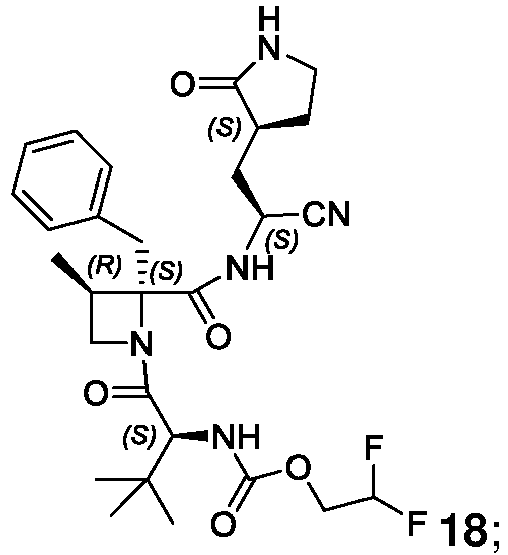


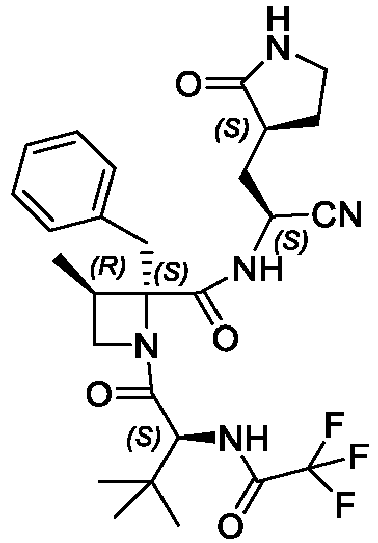

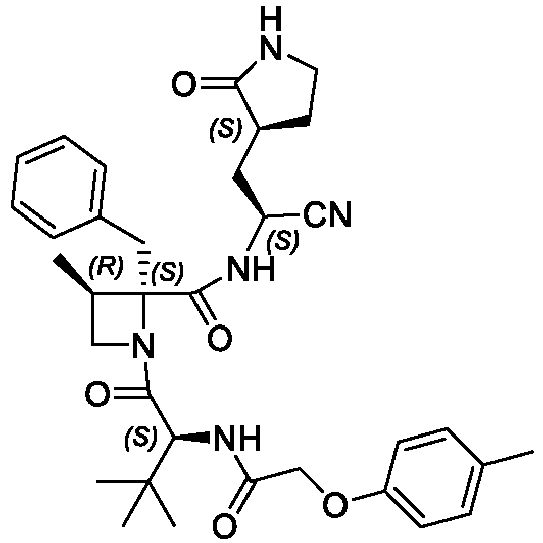


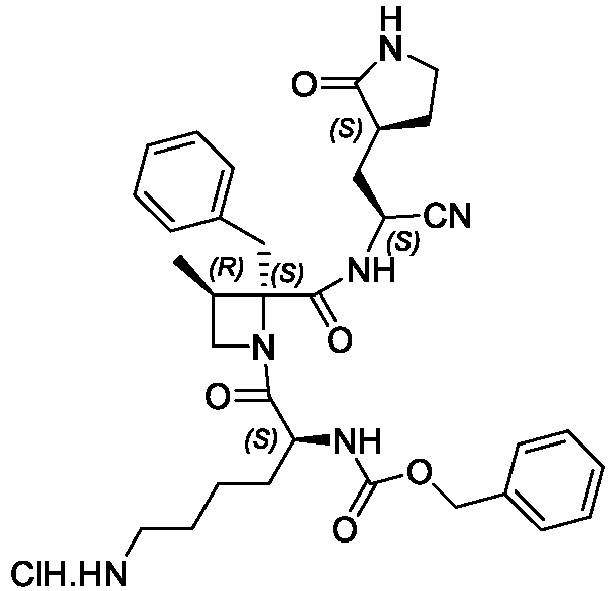


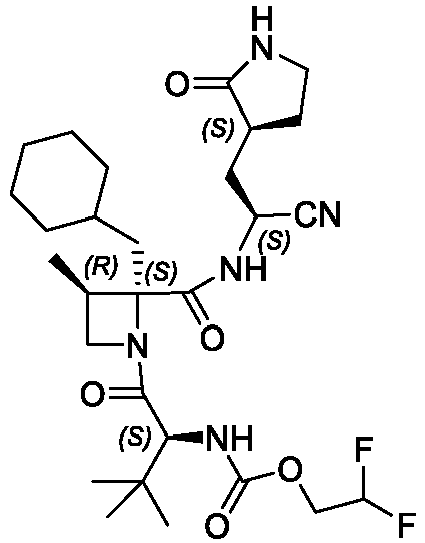


 n is 0 or 1;R1 is a group selected from -CN, -CHO or -CH=CH-COOCH2Ph;R2 is a -C1-C4 alkyl group which is optionally substituted by one -Cy1;Cy1 is a 5 or 6 membered heterocycle, which is saturated, partially saturated, or aromatic, which comprises 1 or 2 heteroatoms in its structure selected from N, O or S, and which is optionally oxidized forming a -CO group in any available position.R3 is selected from -CH2-CH(Me)2, -CH2-Ph optionally substituted by -OH or -O-tBu, -C1-C4 alkyl substituted by -NHBoc or -NH3Cl,
 R4 is -C1-C4 alkyl;R5 is a group selected from -CH(Me)2, -C(Me)3 or -C1-C4 alkyl substituted by -NHSO2NHCO2Me, -NHBoc or -NH3Cl; andR6 is selected from -COOMe, -COCH2OPh-(4-Me), -COOCH2CHF2, -COCF3, -COOCH2Ph, -COOC (Me)3,