EP4501873A1 - Yttrium aluminosilicate glass, preparation method therefor, and electronic device - Google Patents
Yttrium aluminosilicate glass, preparation method therefor, and electronic device Download PDFInfo
- Publication number
- EP4501873A1 EP4501873A1 EP23841858.6A EP23841858A EP4501873A1 EP 4501873 A1 EP4501873 A1 EP 4501873A1 EP 23841858 A EP23841858 A EP 23841858A EP 4501873 A1 EP4501873 A1 EP 4501873A1
- Authority
- EP
- European Patent Office
- Prior art keywords
- glass
- aluminosilicate glass
- yttrium
- yttrium aluminosilicate
- temperature
- Prior art date
- Legal status (The legal status is an assumption and is not a legal conclusion. Google has not performed a legal analysis and makes no representation as to the accuracy of the status listed.)
- Granted
Links
Images


Classifications
-
- C—CHEMISTRY; METALLURGY
- C03—GLASS; MINERAL OR SLAG WOOL
- C03B—MANUFACTURE, SHAPING, OR SUPPLEMENTARY PROCESSES
- C03B19/00—Other methods of shaping glass
- C03B19/02—Other methods of shaping glass by casting molten glass, e.g. injection moulding
-
- C—CHEMISTRY; METALLURGY
- C03—GLASS; MINERAL OR SLAG WOOL
- C03C—CHEMICAL COMPOSITION OF GLASSES, GLAZES OR VITREOUS ENAMELS; SURFACE TREATMENT OF GLASS; SURFACE TREATMENT OF FIBRES OR FILAMENTS MADE FROM GLASS, MINERALS OR SLAGS; JOINING GLASS TO GLASS OR OTHER MATERIALS
- C03C3/00—Glass compositions
- C03C3/04—Glass compositions containing silica
- C03C3/062—Glass compositions containing silica with less than 40% silica by weight
- C03C3/064—Glass compositions containing silica with less than 40% silica by weight containing boron
- C03C3/068—Glass compositions containing silica with less than 40% silica by weight containing boron containing rare earths
-
- C—CHEMISTRY; METALLURGY
- C03—GLASS; MINERAL OR SLAG WOOL
- C03C—CHEMICAL COMPOSITION OF GLASSES, GLAZES OR VITREOUS ENAMELS; SURFACE TREATMENT OF GLASS; SURFACE TREATMENT OF FIBRES OR FILAMENTS MADE FROM GLASS, MINERALS OR SLAGS; JOINING GLASS TO GLASS OR OTHER MATERIALS
- C03C3/00—Glass compositions
- C03C3/04—Glass compositions containing silica
- C03C3/076—Glass compositions containing silica with 40% to 90% silica, by weight
- C03C3/095—Glass compositions containing silica with 40% to 90% silica, by weight containing rare earths
-
- C—CHEMISTRY; METALLURGY
- C03—GLASS; MINERAL OR SLAG WOOL
- C03C—CHEMICAL COMPOSITION OF GLASSES, GLAZES OR VITREOUS ENAMELS; SURFACE TREATMENT OF GLASS; SURFACE TREATMENT OF FIBRES OR FILAMENTS MADE FROM GLASS, MINERALS OR SLAGS; JOINING GLASS TO GLASS OR OTHER MATERIALS
- C03C2203/00—Production processes
- C03C2203/10—Melting processes
-
- C—CHEMISTRY; METALLURGY
- C03—GLASS; MINERAL OR SLAG WOOL
- C03C—CHEMICAL COMPOSITION OF GLASSES, GLAZES OR VITREOUS ENAMELS; SURFACE TREATMENT OF GLASS; SURFACE TREATMENT OF FIBRES OR FILAMENTS MADE FROM GLASS, MINERALS OR SLAGS; JOINING GLASS TO GLASS OR OTHER MATERIALS
- C03C2203/00—Production processes
- C03C2203/50—After-treatment
- C03C2203/52—Heat-treatment
Definitions
- This application relates to the field of glass technologies, and specifically, to yttrium aluminosilicate glass, a preparation method, and an electronic device.
- a display cover plate, a rear battery cover, a camera protection cover plate, and the like of an electronic product are made of a glass material. This poses higher requirements on flexural strength, scratch resistance, and drop resistance of the glass material.
- aluminate glass or silicate glass is often used as the glass material.
- a glass former in the aluminate glass is Al 2 O 3 , which has a small glass forming interval, and is highly susceptible to an external additive. Consequently, undesirable phenomena such as crystallization and phase splitting occur.
- the silicate glass has excellent glass forming properties, mechanical properties are poor because a bulk density (V i ), a high elastic modulus coefficient (E i ), and a high specific modulus coefficient (S i ) of a component of the silicate glass are low. Therefore, surface hardness, flexural strength, fracture toughness properties, and the like of the aluminate glass and the silicate glass are low, and cannot meet an actual application requirement.
- This application provides yttrium aluminosilicate glass, a preparation method, and an electronic device, to resolve a problem that surface hardness, flexural strength, fracture toughness properties, and the like of aluminate glass and silicate glass are low, and cannot meet an actual application requirement.
- this application provides yttrium aluminosilicate glass.
- the yttrium aluminosilicate glass includes the following components:
- yttrium aluminosilicate glass an oxide with a high bulk density, a high elastic modulus coefficient, and a high specific modulus coefficient is introduced into a glass system, and components and a component configuration are properly adjusted and controlled.
- a glass forming capability is strong, and a structure density and strength of the glass are high. This improves drop resistance and mechanical properties such as Vickers hardness, Mohs hardness, and a Young's modulus of the glass.
- the yttrium aluminosilicate glass has a high light transmittance in a visible light band, and may be widely used in portable and wearable electronic devices.
- the yttrium aluminosilicate glass can perform high-efficiency ion exchange chemical strengthening. This helps improve a depth of an ion exchange layer and increase deep stress, thereby improving scratch resistance and drop resistance.
- a glass forming capability, Vickers hardness, and a Young's modulus can be improved. This helps prepare high-strength yttrium aluminosilicate glass.
- a mole percentage of ZrO 2 is 1-15%.
- Vickers hardness and toughness of the yttrium aluminosilicate glass can be improved, and a high visible light transmittance and high flexural strength can be maintained.
- a mole percentage of B 2 O 3 is 2-10%.
- properties such as surface hardness, flexural strength, and fracture toughness of the glass can be improved. This helps prepare high-strength yttrium aluminosilicate glass.
- a light transmittance of the yttrium aluminosilicate glass in a visible light band is greater than or equal to 88%.
- a Young's modulus of the yttrium aluminosilicate glass is greater than 100 GPa.
- Vickers hardness of the yttrium aluminosilicate glass is greater than 6.87 GPa.
- Mohs hardness of the yttrium aluminosilicate glass is greater than or equal to 7 and less than or equal to 9.
- this application provides an yttrium aluminosilicate glass preparation method, specifically including the following steps:
- yttrium aluminosilicate glass preparation method based on a silicate system, oxides with high bulk densities, high elastic modulus coefficients, and high specific modulus coefficients are introduced. Components and a component configuration are properly adjusted and controlled, so that the manufactured yttrium aluminosilicate glass has a high transmittance, and mechanical properties such as surface hardness, fracture strength, and fracture toughness of the glass are improved.
- a preparation process is simple, costs are low, and application to industrial production is easy.
- a temperature of the mold is 500 ⁇ 600°C.
- the preset rate is 1 ⁇ 10°C/h.
- the raw materials include: 9.08 g SiO 2 , 24.46 g Al 2 O 3 , 8.06 g MgO, 22.57 g Y 2 O 3 , 2.00 g TiO 2 , 4.31 g ZrO 2 , 6.36 g Na 2 CO 3 , 1.48 g Li 2 CO 3 , 0.69 g K 2 CO 3 , 1.79 g H 3 BO 3 , 1.38 g BaCO 3 , 0.15 g SrCO 3 , 0.33 g La 2 O 3 , and 0.29 g Sb 2 O 3 .
- the method specifically includes the following steps:
- this application provides application of the yttrium aluminosilicate glass in an electronic device, a building material, and transportation equipment.
- the yttrium aluminosilicate glass provided in this application is not only applicable to electronic devices, but also applicable to fields such as transportation and building.
- the yttrium aluminosilicate glass may be specifically used for protection glass in fields such as transportation vehicles, household appliances, and building, for example, protection glass of a display or a meter protection cover.
- this application provides an electronic device, including a display cover plate.
- the display cover plate uses the yttrium aluminosilicate glass in the first aspect.
- the electronic device further includes a rear battery cover, and the rear battery cover uses the yttrium aluminosilicate glass in the first aspect.
- the electronic device further includes a camera component and a camera protection cover plate, the camera protection cover plate covers the camera component, and the camera protection cover plate uses the yttrium aluminosilicate glass in the first aspect.
- one or more of the display cover plate, the rear battery cover, and the camera protection cover plate of the electronic device provided in this application may use the foregoing yttrium aluminosilicate glass.
- An electronic device 100 in embodiments of this application may be an electronic device that includes a glass material, for example, a mobile phone, a vehicle-mounted device (also referred to as an on-board unit), a tablet computer, a notebook computer, an ultra-mobile personal computer (ultra-mobile personal computer, UMPC), a handheld computer, a netbook, a personal digital assistant (personal digital assistant, PDA), a wearable electronic device, or a virtual reality device. This is not limited in embodiments of this application.
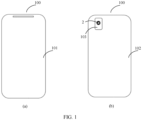
- FIG. 1 is a front view of the mobile phone.
- the electronic device 100 includes a display cover plate 101 on a front side.
- b in FIG. 1 is a rear view of the mobile phone. Still refer to FIG. 1 .
- the electronic device 100 further includes a rear battery cover 102 on a rear side.
- the display cover plate 101 covers a display panel, to isolate and protect the display panel, so as to avoid damage to the display panel caused by an external thing or force.
- the display panel is configured to display an image, a video, and the like.
- the display panel may be a liquid crystal display (liquid crystal display, LCD), an organic light-emitting diode (organic light-emitting diode, OLED), an active-matrix organic light-emitting diode (active-matrix organic light emitting diode, AMOLED), a flexible light-emitting diode (flex light-emitting diode, FLED), a Miniled, a MicroLed, a MicrooLed, a quantum dot light-emitting diode (quantum dot light emitting diodes, QLED), or the like.
- LCD liquid crystal display
- OLED organic light-emitting diode
- AMOLED active-matrix organic light-emitting diode
- FLED flexible light-emitting diode
- Miniled a MicroLed, a MicrooLed, a quantum dot light-emitting diode (quantum dot light emitting diodes, QLED), or the like.
- the display cover plate 101 and/or the rear battery cover 102 are/is made of yttrium aluminosilicate glass, and are/is transparent in a visible light band.
- the yttrium aluminosilicate glass provided in this application has good properties such as hardness, flexural strength, and fracture toughness, and improved properties such as scratch resistance and drop resistance. Therefore, the yttrium aluminosilicate glass is less likely to be damaged.
- the display cover plate 101 has a high light transmittance, and therefore does not affect use of the display panel below the display cover plate. It should be noted that the display cover plate 101 and the rear battery cover 102 may be completely made of the yttrium alumino silicate glass, or may be partially made of the yttrium aluminosilicate glass.
- the electronic device 100 may further include other necessary components such as a processor, an external memory interface, an internal memory, a universal serial bus (universal serial bus, USB) interface, a charging management module, a power management module, a battery, an antenna, a mobile communication module, a wireless communication module, an audio module, a speaker, a receiver, a microphone, a headset jack, a sensor module, a button, a motor, an indicator, and a camera.
- the electronic device 100 further includes a camera component 2 and a camera protection cover plate 103.
- the camera protection cover plate 103 covers the camera component 2, and the camera protection cover plate 103 may be made of the yttrium aluminosilicate glass. It should be noted that the camera protection cover plate 103 may be partially made of the yttrium aluminosilicate glass, or may be completely made of the yttrium aluminosilicate glass.
- a disposing position of the camera protection cover plate 103 may be determined based on a disposing position of the camera component 2.
- the camera protection cover plate may be located on a front side of the electronic device 100, or may be located on a rear side of the electronic device 100.
- the camera protection cover plate 103 may be disposed in an appropriate position on the front side or the rear side of the electronic device 100. This depends on a position of the camera component 2 in the electronic device 100.
- the camera protection cover plate 103 may be separated from the display cover plate 101 or the rear battery cover 102.
- the camera protection cover plate may be integrated with the display cover plate 101 or the rear battery cover 102.
- any one, any two, or all of the display cover plate 101, the rear battery cover 102, and the camera protection cover plate 103 in the electronic device 100 may be made of the yttrium aluminosilicate glass.
- the yttrium aluminosilicate glass provided in this application has a high light transmittance and excellent mechanical properties such as Vickers hardness, Mohs hardness, and a Young's modulus, can improve reliability of an electronic device product, and can meet optical requirements of display and photographing of the display cover plate and the camera protection cover plate.
- the yttrium aluminosilicate glass provided in this application is further described below.
- a glass material commonly used in an electronic device is aluminate glass or silicate glass.
- a glass former in the aluminate glass is Al 2 O 3 , which has a small glass forming interval and a low machining property, and is highly susceptible to an external additive. Consequently, undesirable phenomena such as crystallization and phase splitting occur.
- the silicate glass has excellent glass forming properties, mechanical properties are poor because a bulk density (V i ), a high elastic modulus coefficient (E i ), and a high specific modulus coefficient (S i ) of a component of the silicate glass are low.
- oxides with high bulk densities, high elastic modulus coefficients, and high specific modulus coefficients are introduced into the yttrium aluminosilicate glass provided in this application.
- Mechanical properties such as Vickers hardness, Mohs hardness, and a Young's modulus are improved by properly adjusting and controlling components and a component configuration, so that high-strength yttrium aluminosilicate glass is obtained.
- the yttrium aluminosilicate glass specifically includes the following components: SiO 2 20-50%; Al 2 O 3 15-40%; MgO 10-35%; Y 2 O 3 5-35%; TiO 2 0.1-15%; ZrO 2 0.1-15%; Na 2 O 0.1-15%; Li 2 O 0.1-15%; K 2 O 0.1-15%; B 2 O 3 0.1-10%; BaO 0.1-10%; SrO 0.1-10%; Sb 2 O 3 0.1-10%; and La 2 O 3 0.1-10%.
- a relationship between the components in the yttrium aluminosilicate glass is controlled, and in particular, a relationship between Li 2 O, Na 2 O, K 2 O, ZrO 2 , and B 2 O 3 is controlled, to perform high-efficiency ion exchange chemical strengthening, so as to improve a structure density and strength of the glass, so that mechanical properties such as Vickers hardness, Mohs hardness, and a Young's modulus of the glass are improved.
- Table 1 is a schematic table of main oxide components of the foregoing yttrium aluminosilicate glass and bulk densities (Vi), elastic modulus coefficients (Ei), specific modulus coefficients (Si), and mole content of the main oxide components.
- Vi yttrium aluminosilicate glass and bulk densities
- Ei elastic modulus coefficients
- Si specific modulus coefficients
- Mo mole content of the main oxide components.
- Oxides with high bulk densities, high elastic modulus coefficients, and high specific modulus coefficients that are introduced in this application include: MgO, TiO 2 , ZrO 2 , Al 2 O 3 , and Y 2 O 3 .
- the foregoing oxide components are introduced and properly adjusted and controlled, so that it is ensured that the yttrium aluminosilicate glass has higher Vickers hardness, higher Mohs hardness, and a higher Young's modulus, thereby reducing a penetration depth of a sharp object.
- a crack tip is bent and passivated, and crack work is increased, so that crack propagation is effectively suppressed. Drop resistance of the glass is further improved while the crack propagation is suppressed.
- SiO 2 is used as a skeleton component of a glass network structure.
- Content of SiO 2 directly affects development of the network structure, and greatly affects an overall property of the glass.
- Higher content of SiO 2 in the glass system indicates a denser glass network structure, higher mechanical strength, a smaller thermal expansion coefficient, and better heat resistance, dielectric property, and chemical stability.
- a mole percentage of SiO 2 in the yttrium aluminosilicate glass in this application is preferably 20-50%.
- Al 2 O 3 is a network intermediate, and participates in network structure forming, to strengthen the network structure.
- introduction of Al 2 O 3 increases viscosity of hightemperature molten glass, so that a material property of the glass is shortened, and forming difficulty increases.
- Al 2 O 3 greatly affects subsequent ion exchange for the yttrium aluminosilicate glass. Therefore, when content of Al 2 O 3 is excessively high, especially when the content of Al 2 O 3 is higher than that of alkali metal, Al 3+ exists as a network modifier, a coordination number increases, and the network structure tends to increase. That is, excessively high content of Al 2 O 3 adversely affects an ion exchange effect.
- a mole percentage of Al 2 O 3 in the yttrium aluminosilicate glass in this application is preferably 15-40%.
- MgO has two coordination states in the glass, and can form a [MgO 4 ] tetrahedron and a [MgO 6 ] octahedron. Generally, most of MgO is located in the [MgO 6 ] octahedron and acts as a network modifier. Only when content an alkali metal oxide is high and oxides such as Al 2 O 3 and B 2 O 3 are not included, a Mg 2+ ion may be located in the [MgO 4 ] tetrahedron. Introduction of MgO properly increases surface compressive stress of chemically strengthened glass obtained after ion exchange, but reduces a depth of a compressive stress layer.
- a mole percentage of MgO in the yttrium aluminosilicate glass in this application is preferably 10-35%.
- a function of B 2 O 3 in the glass is to reduce a melting temperature and improve a forming property of the glass.
- B 2 O 3 in the glass has two existence forms: a [BO 3 ] trihedron and a [BO 4 ] tetrahedron.
- Na + preferentially performs charge compensation for a [AlO 4 ] tetrahedron
- superfluous Na + performs charge compensation for [BO 4 ] to form a tetrahedron.
- B 2 O 3 exists in a form of a [BO 3 ] trihedron. Based on this, to meet a property requirement, a mole percentage of B 2 O 3 in the yttrium aluminosilicate glass in this application is preferably 2-10%.
- ZrO 2 As a common nucleation agent, ZrO 2 has relatively high content. This helps improve a Young's modulus and Vickers hardness. However, solubility of ZrO 2 in the glass is limited, and excessively high content causes devitrification of the glass. Based on this, to meet a property requirement, a mole percentage of ZrO 2 in the yttrium aluminosilicate glass provided in this application is preferably 1-15%. Further, properties such as average hardness, fracture strength, and fracture toughness of the manufactured yttrium aluminosilicate glass are improved, to adjust properties such as scratch resistance and drop resistance of the glass.
- ZrO 2 in the yttrium aluminosilicate glass in this application can deflect a microcrack propagation path, so that drop resistance of the glass is further improved. It may also be learned from property detection parameters of the yttrium aluminosilicate glass in subsequent embodiments that the yttrium aluminosilicate glass in embodiments of this application has higher Vickers hardness and better fracture toughness.
- the alkali metal oxide Na 2 O is a main network modifier and is also a main participant in ion exchange.
- Content of Na 2 O in the glass system not only greatly affects the network structure of the glass, but also greatly affects an ion exchange process.
- a cation with high field strength for example, Li + , B 3+ , or Be 2+
- the content of ZrO 2 needs to have an appropriate interval.
- a mole percentage of Li 2 O+Na 2 O+K 2 O in the yttrium aluminosilicate glass in this application is preferably 0.3% ⁇ 5Li 2 O+Na 2 O+K 2 O ⁇ 15%.
- a mole percentage of Li 2 O+Na 2 O is preferably 4% ⁇ Li 2 O+Na 2 O ⁇ 37%, and a mole percentage of K 2 O is preferably 0.1-15%. Therefore, after chemical strengthening is performed on the yttrium aluminosilicate glass in embodiments of this application, chemically strengthened glass with better properties such as surface hardness, flexural strength, and fracture toughness can be obtained.
- the yttrium aluminosilicate glass may further include a clarifying agent, for example, Sb 2 O 3 .
- Sb 2 O 3 may be decomposed at a high temperature in a glass melting process, and gas is generated through gasification or viscosity of molten glass is reduced, so that bubbles in the molten glass are eliminated.
- the glass presents light yellow due to an internal vacancy defect.
- a coloring problem of the glass can be resolved by adding Sb 2 O 3 , so that the glass is colorless and transparent.
- a mole percentage of Sb 2 O 3 in the yttrium aluminosilicate glass in this application is preferably 0.1-10%. Further, a better melting effect can be achieved by adding Sb 2 O 3 .
- This application further provides a preparation method for the foregoing yttrium aluminosilicate glass.
- the method specifically includes the following steps S100 to S103.
- components of the raw materials include SiO 2 , Al 2 O 3 , MgO, Y 2 O 3 , TiO 2 , ZrO 2 , Na 2 O, Li 2 O, K 2 O, B 2 O 3 , BaO, SrO, Sb 2 O 3 , and La 2 O 3 . It should be noted that the raw materials may be mixed based on the foregoing configuration.
- components of the foregoing raw materials and the manufactured yttrium aluminosilicate glass are all represented by a reference mole percentage of an oxide.
- the raw material may be another form of material including the foregoing oxide. Therefore, a finally obtained oxide needs only to meet a configuration condition of the foregoing oxide.
- the raw materials may include: 19.08 g SiO 2 , 24.46 g Al 2 O 3 , 8.06 g MgO, 22.57 g Y 2 O 3 , 2.00 g TiO 2 , 4.31 g ZrO 2 , 6.36 g Na 2 CO 3 , 1.48 g Li 2 CO 3 , 0.69 g K 2 CO 3 , 1.79 g H 3 BO 3 , 1.38 g BaCO 3 , 0.15 g SrCO 3 , 0.33 g La 2 O 3 , and 0.29 g Sb 2 O 3 .
- the raw materials are placed in a drum-type ball mill for full grinding and even mixing, to obtain the powder mixture. Then, the powder mixture is heated at a high temperature and molten. After the powder mixture is molten, the mechanical mixture of the raw materials is converted into a complex melt, that is, the molten glass. After the molten glass is obtained, the molten glass needs to be molded in the mold to obtain the glass former. It should be noted that a production process of the glass former is a process of converting the molten glass into a product with a geometric shape. Finally, the glass former is annealed.
- Annealing mainly means that the glass former is placed in an annealing kiln, and is cooled down at a low speed after specific time, to reduce or eliminate, as much as possible, thermal stress generated in the glass.
- an appropriate quantity of alkali metal oxides and glass formers are introduced to reduce a glass melting temperature, and further improve a glass forming capability.
- the yttrium aluminosilicate glass provided in this application may also be used in fields such as building and transportation.
- the yttrium aluminosilicate glass may be used in a building material as a glass window, a glass countertop, or the like, or may be used in transportation equipment as a window of a transportation vehicle (a car, a train, a plane, or the like).
- components of the yttrium aluminosilicate glass are different.
- Content of each component is represented by a mole percentage (mol%).
- an yttrium aluminosilicate glass preparation method in each embodiment may be the foregoing preparation method, and details are not described herein again.
- Property comparison is performed on the yttrium aluminosilicate glass made in the foregoing Embodiment 1 to Embodiment 11.
- Property test items include: Vickers hardness, a Young's modulus, Mohs hardness, and a light transmittance.
- Table 3 Test item Vickers hardness Young's modulus Mohs hardness Embodiment 1 7.65 GPa 122.56 GPa Greater than 7 and less than 8 Embodiment 2 7.61 GPa 130.34 GPa Greater than 7 and less than 8 Embodiment 3 7.85 GPa 125.55 GPa Greater than 7 and less than 8 Embodiment 4 7.95 GPa 127.65 GPa Greater than 7 and less than 8 Embodiment 5 8.34 GPa 130.65 GPa Greater than 7 and less than 8 Embodiment 6 8.63 GPa 140.65 GPa Greater than 8 and less than 9 Embodiment 7 9.35 GPa 160.00 GPa Greater than 8 and less than 9 Embodiment 8 6.87 GPa 120.00 GPa Greater than 7 and less than 8 Embodiment 9 8.73 GPa 132.12 GPa Greater than 8 and less than 9 Embodiment 10 8.779 GPa 136.77 GPa Greater than
- the Young's modulus of the yttrium aluminosilicate glass provided in this application is greater than 100 GPa, and is preferably greater than 160 GPa.
- the Vickers hardness is greater than 6.87 GPa, and is preferably greater than 9.35 GPa.
- the Mohs hardness is greater than or equal to 7 and less than or equal to 9.
- the yttrium aluminosilicate glass manufactured by adding oxide content with a high bulk density, a high elastic modulus coefficient, and a high specific modulus coefficient to a silicate system has high Vickers hardness, high Mohs hardness, and a high Young's modulus.
- a structure density and strength of the glass are improved, and a penetration depth of a sharp object can be reduced.
- compressive stress introduced by the yttrium aluminosilicate glass through ion exchange in embodiments of this application can suppress crack propagation. This further improves drop resistance of the glass.
- the yttrium aluminosilicate glass is transparent in a visible light band, and has a high transmittance.
- FIG. 4 shows light transmittance curves of yttrium aluminosilicate glass according to Embodiment 2, Embodiment 4, and Embodiment 6 of this application. Refer to FIG. 4 .
- a light transmittance of yttrium aluminosilicate glass in a visible light band 380 nm-780 nm
- a visible light band 380 nm-780 nm
- FIG. 5 is a diagram of a test on Vickers hardness of yttrium aluminosilicate glass according to Embodiment 7 of this application.
- the obtained average length d of the diagonals of the indentation is substituted into a first formula to calculate Vickers hardness, and obtained Vickers hardness is 7.65 GPa.
- Hv is the Vickers hardness
- P is applied load
- d is the average length of the diagonals of the indentation
- ⁇ 136°.
- a in FIG. 6 is a micrograph of Mohs hardness-based scratches on yttrium aluminosilicate glass according to Embodiment 1 of this application. Refer to a in FIG. 6 .
- a Mohs hardness test is performed on the yttrium aluminosilicate glass in Embodiment 1 by using a level-7 Mohs hardness pen, and it can be learned that there is no scratch on a surface of the yttrium aluminosilicate glass in Embodiment 1.
- b in FIG. 6 is a micrograph of Mohs hardness-based scratches on yttrium aluminosilicate glass according to Embodiment 1 of this application.
- a Mohs hardness test is performed on the yttrium aluminosilicate glass in Embodiment 1 by using a level-8 Mohs hardness pen, and it can be learned that there are scratches on a surface of the yttrium aluminosilicate glass in Embodiment 1. Therefore, Mohs hardness of the yttrium aluminosilicate glass in Embodiment 1 is greater than 7 and less than 8.
- c in FIG. 6 is a micrograph of Mohs hardness-based scratches on yttrium aluminosilicate glass according to Embodiment 6 of this application. Refer to c in FIG. 6 .
- a Mohs hardness test is performed on the yttrium aluminosilicate glass in Embodiment 6 by using a level-8 Mohs hardness pen, and it can be learned that there is no scratch on a surface of the yttrium aluminosilicate glass in Embodiment 6.
- d in FIG. 6 is a micrograph of Mohs hardness-based scratches on yttrium aluminosilicate glass according to Embodiment 6 of this application.
- a Mohs hardness test is performed on the yttrium aluminosilicate glass in Embodiment 6 by using a level-9 Mohs hardness pen, and it can be learned that there are scratches on a surface of the yttrium aluminosilicate glass in Embodiment 6. Therefore, Mohs hardness of the yttrium aluminosilicate glass in Embodiment 6 is greater than 8 and less than 9.
- sequence numbers of processes do not mean a sequence of execution.
- the sequence of execution of the processes should be determined according to functions and internal logic of the processes, and should not constitute any limitation on an implementation process of embodiments of this application.
Landscapes
- Chemical & Material Sciences (AREA)
- Engineering & Computer Science (AREA)
- Materials Engineering (AREA)
- Organic Chemistry (AREA)
- Life Sciences & Earth Sciences (AREA)
- Chemical Kinetics & Catalysis (AREA)
- General Chemical & Material Sciences (AREA)
- Geochemistry & Mineralogy (AREA)
- Manufacturing & Machinery (AREA)
- Glass Compositions (AREA)
Abstract
Description
- This application claims priority to
Chinese Patent Application No. 202210856670.8, filed with the China National Intellectual Property Administration on July 20, 2022 - This application relates to the field of glass technologies, and specifically, to yttrium aluminosilicate glass, a preparation method, and an electronic device.
- With rapid development of the electronic information industry, electronic products such as mobile phones, bracelets, and tablet computers increasingly become essential for daily life. With consumers' ultimate pursuit for product appearance, sizes of displays of electronic products gradually increase, and new forms such as 3D models, foldable screens, and scroll screens emerge. Usually, a display cover plate, a rear battery cover, a camera protection cover plate, and the like of an electronic product are made of a glass material. This poses higher requirements on flexural strength, scratch resistance, and drop resistance of the glass material.
- At present, aluminate glass or silicate glass is often used as the glass material. A glass former in the aluminate glass is Al2O3, which has a small glass forming interval, and is highly susceptible to an external additive. Consequently, undesirable phenomena such as crystallization and phase splitting occur. Although the silicate glass has excellent glass forming properties, mechanical properties are poor because a bulk density (Vi), a high elastic modulus coefficient (Ei), and a high specific modulus coefficient (Si) of a component of the silicate glass are low. Therefore, surface hardness, flexural strength, fracture toughness properties, and the like of the aluminate glass and the silicate glass are low, and cannot meet an actual application requirement.
- This application provides yttrium aluminosilicate glass, a preparation method, and an electronic device, to resolve a problem that surface hardness, flexural strength, fracture toughness properties, and the like of aluminate glass and silicate glass are low, and cannot meet an actual application requirement.
- According to a first aspect, this application provides yttrium aluminosilicate glass. For representation by a reference mole percentage of an oxide, the yttrium aluminosilicate glass includes the following components:
- SiO2 20-50%;
- Al2O3 15-40%;
- MgO 10-35%;
- Y2O3 5-35%;
- TiO2 0.1-15%;
- ZrO2 0.1-15%;
- Na2O 0.1-15%;
- Li2O 0.1-15%;
- K2O 0.1-15%;
- B2O3 0.1-10%;
- BaO 0.1-10%;
- SrO 0.1-10%;
- Sb2O3 0.1-10%; and
- La2O3 0.1-10%.
- In the foregoing provided yttrium aluminosilicate glass, an oxide with a high bulk density, a high elastic modulus coefficient, and a high specific modulus coefficient is introduced into a glass system, and components and a component configuration are properly adjusted and controlled. A glass forming capability is strong, and a structure density and strength of the glass are high. This improves drop resistance and mechanical properties such as Vickers hardness, Mohs hardness, and a Young's modulus of the glass. In addition, the yttrium aluminosilicate glass has a high light transmittance in a visible light band, and may be widely used in portable and wearable electronic devices.
- In an optional implementation, for representation by a reference mole percentage of an oxide, 0.3%≦5Li2O+Na2O+K2O≦15%.
- In this implementation, the yttrium aluminosilicate glass can perform high-efficiency ion exchange chemical strengthening. This helps improve a depth of an ion exchange layer and increase deep stress, thereby improving scratch resistance and drop resistance.
- In an optional implementation, for representation by a reference mole percentage of an oxide, 40%≦Al2O3+MgO+Y2O3≦60%.
- In this implementation, a glass forming capability, Vickers hardness, and a Young's modulus can be improved. This helps prepare high-strength yttrium aluminosilicate glass.
- In an optional implementation, for representation by a reference mole percentage of an oxide, a mole percentage of ZrO2 is 1-15%.
- In this implementation, Vickers hardness and toughness of the yttrium aluminosilicate glass can be improved, and a high visible light transmittance and high flexural strength can be maintained.
- In an optional implementation, for representation by a reference mole percentage of an oxide, a mole percentage of B2O3 is 2-10%.
- In this implementation, properties such as surface hardness, flexural strength, and fracture toughness of the glass can be improved. This helps prepare high-strength yttrium aluminosilicate glass.
- In an optional implementation, a light transmittance of the yttrium aluminosilicate glass in a visible light band is greater than or equal to 88%.
- In an optional implementation, a Young's modulus of the yttrium aluminosilicate glass is greater than 100 GPa.
- In an optional implementation, Vickers hardness of the yttrium aluminosilicate glass is greater than 6.87 GPa.
- In an optional implementation, Mohs hardness of the yttrium aluminosilicate glass is greater than or equal to 7 and less than or equal to 9.
- According to a second aspect, this application provides an yttrium aluminosilicate glass preparation method, specifically including the following steps:
- mixing raw materials required for meeting the yttrium aluminosilicate glass in the first aspect, to obtain a powder mixture after mixing;
- melting the powder mixture for 2~3 h at a temperature of 1400~1600°C, and stirring the mixture evenly to obtain molten glass;
- pouring the molten glass into a preheated mold for molding, to obtain a glass former; and
- after heat preservation is performed on the glass former for 3~5 h at a temperature of 650~850°C, cooling down to an indoor temperature at a preset rate to obtain the yttrium aluminosilicate glass.
- According to the foregoing provided yttrium aluminosilicate glass preparation method, based on a silicate system, oxides with high bulk densities, high elastic modulus coefficients, and high specific modulus coefficients are introduced. Components and a component configuration are properly adjusted and controlled, so that the manufactured yttrium aluminosilicate glass has a high transmittance, and mechanical properties such as surface hardness, fracture strength, and fracture toughness of the glass are improved. In addition, a preparation process is simple, costs are low, and application to industrial production is easy.
- In an optional implementation, a temperature of the mold is 500~600°C.
- In an optional implementation, the preset rate is 1∼10°C/h.
- In an optional implementation, for representation by a mass ratio of the yttrium aluminosilicate glass, the raw materials include: 9.08 g SiO2, 24.46 g Al2O3, 8.06 g MgO, 22.57 g Y2O3, 2.00 g TiO2, 4.31 g ZrO2, 6.36 g Na2CO3, 1.48 g Li2CO3, 0.69 g K2CO3, 1.79 g H3BO3, 1.38 g BaCO3, 0.15 g SrCO3, 0.33 g La2O3, and 0.29 g Sb2O3.
- In an optional implementation, the method specifically includes the following steps:
- mixing the raw materials, to obtain a powder mixture after mixing;
- melting the powder mixture for 2 h at a temperature of 1560°C, and stirring the mixture evenly to obtain molten glass;
- pouring the molten glass into the mold that has been preheated to a temperature of 550°C for molding, to obtain a glass former; and
- after heat preservation is performed on the glass former for 2 h at a temperature of 720°C, cooling down to an indoor temperature at a preset rate of 5°C/h to obtain the yttrium aluminosilicate glass.
- In an optional implementation, this application provides application of the yttrium aluminosilicate glass in an electronic device, a building material, and transportation equipment.
- The yttrium aluminosilicate glass provided in this application is not only applicable to electronic devices, but also applicable to fields such as transportation and building. The yttrium aluminosilicate glass may be specifically used for protection glass in fields such as transportation vehicles, household appliances, and building, for example, protection glass of a display or a meter protection cover.
- According to a third aspect, this application provides an electronic device, including a display cover plate. The display cover plate uses the yttrium aluminosilicate glass in the first aspect.
- In an optional implementation, the electronic device further includes a rear battery cover, and the rear battery cover uses the yttrium aluminosilicate glass in the first aspect.
- In an optional implementation, the electronic device further includes a camera component and a camera protection cover plate, the camera protection cover plate covers the camera component, and the camera protection cover plate uses the yttrium aluminosilicate glass in the first aspect.
- In an implementation provided in this application, one or more of the display cover plate, the rear battery cover, and the camera protection cover plate of the electronic device provided in this application may use the foregoing yttrium aluminosilicate glass.
- To describe technical solutions of this application more clearly, the following briefly describes accompanying drawings used in embodiments. It is clear that a person of ordinary skill in the art may still derive other accompanying drawings from these accompanying drawings without creative efforts.
-
FIG. 1 is a diagram of a structure of an electronic device according to an embodiment of this application; -
FIG. 2 is a diagram of property comparison between aluminate glass, silicate glass, and yttrium aluminosilicate glass according to an embodiment of this application; -
FIG. 3 is a schematic flowchart of an yttrium aluminosilicate glass preparation method according to an embodiment of this application; -
FIG. 4 shows light transmittance curves of yttrium aluminosilicate glass according toEmbodiment 2,Embodiment 4, andEmbodiment 6 of this application; -
FIG. 5 is a diagram of a test on Vickers hardness of yttrium aluminosilicate glass according to Embodiment 7 of this application; and -
FIG. 6 is a micrograph of Mohs hardness-based scratches on yttrium aluminosilicate glass according toEmbodiment 1 andEmbodiment 6 of this application. - To make the technical solutions of this application more comprehensible for a person skilled in the art, the following clearly and completely describes the technical solutions in embodiments of this application with reference to the accompanying drawings in embodiments of this application. It is clear that the described embodiments are merely some rather than all of embodiments of this application. Based on embodiments of this application, all other embodiments obtained by a person of ordinary skill in the art without creative efforts shall fall within the protection scope of this application.
- An
electronic device 100 in embodiments of this application may be an electronic device that includes a glass material, for example, a mobile phone, a vehicle-mounted device (also referred to as an on-board unit), a tablet computer, a notebook computer, an ultra-mobile personal computer (ultra-mobile personal computer, UMPC), a handheld computer, a netbook, a personal digital assistant (personal digital assistant, PDA), a wearable electronic device, or a virtual reality device. This is not limited in embodiments of this application. - Using a mobile phone as an example of the foregoing
electronic device 100, a inFIG. 1 is a front view of the mobile phone. Refer toFIG. 1 . Theelectronic device 100 includes adisplay cover plate 101 on a front side. b inFIG. 1 is a rear view of the mobile phone. Still refer toFIG. 1 . Theelectronic device 100 further includes arear battery cover 102 on a rear side. Thedisplay cover plate 101 covers a display panel, to isolate and protect the display panel, so as to avoid damage to the display panel caused by an external thing or force. The display panel is configured to display an image, a video, and the like. The display panel may be a liquid crystal display (liquid crystal display, LCD), an organic light-emitting diode (organic light-emitting diode, OLED), an active-matrix organic light-emitting diode (active-matrix organic light emitting diode, AMOLED), a flexible light-emitting diode (flex light-emitting diode, FLED), a Miniled, a MicroLed, a MicrooLed, a quantum dot light-emitting diode (quantum dot light emitting diodes, QLED), or the like. - The
display cover plate 101 and/or therear battery cover 102 are/is made of yttrium aluminosilicate glass, and are/is transparent in a visible light band. The yttrium aluminosilicate glass provided in this application has good properties such as hardness, flexural strength, and fracture toughness, and improved properties such as scratch resistance and drop resistance. Therefore, the yttrium aluminosilicate glass is less likely to be damaged. In addition, thedisplay cover plate 101 has a high light transmittance, and therefore does not affect use of the display panel below the display cover plate. It should be noted that thedisplay cover plate 101 and therear battery cover 102 may be completely made of the yttrium alumino silicate glass, or may be partially made of the yttrium aluminosilicate glass. - The
electronic device 100 may further include other necessary components such as a processor, an external memory interface, an internal memory, a universal serial bus (universal serial bus, USB) interface, a charging management module, a power management module, a battery, an antenna, a mobile communication module, a wireless communication module, an audio module, a speaker, a receiver, a microphone, a headset jack, a sensor module, a button, a motor, an indicator, and a camera. - In some implementations of this application, still referring to b in
FIG. 1 , theelectronic device 100 further includes acamera component 2 and a cameraprotection cover plate 103. The cameraprotection cover plate 103 covers thecamera component 2, and the cameraprotection cover plate 103 may be made of the yttrium aluminosilicate glass. It should be noted that the cameraprotection cover plate 103 may be partially made of the yttrium aluminosilicate glass, or may be completely made of the yttrium aluminosilicate glass. - In some implementations of this application, a disposing position of the camera
protection cover plate 103 may be determined based on a disposing position of thecamera component 2. For example, the camera protection cover plate may be located on a front side of theelectronic device 100, or may be located on a rear side of theelectronic device 100. In addition, the cameraprotection cover plate 103 may be disposed in an appropriate position on the front side or the rear side of theelectronic device 100. This depends on a position of thecamera component 2 in theelectronic device 100. - In some implementations of this application, the camera
protection cover plate 103 may be separated from thedisplay cover plate 101 or therear battery cover 102. Alternatively, the camera protection cover plate may be integrated with thedisplay cover plate 101 or therear battery cover 102. - In some implementations of this application, any one, any two, or all of the
display cover plate 101, therear battery cover 102, and the cameraprotection cover plate 103 in theelectronic device 100 may be made of the yttrium aluminosilicate glass. The yttrium aluminosilicate glass provided in this application has a high light transmittance and excellent mechanical properties such as Vickers hardness, Mohs hardness, and a Young's modulus, can improve reliability of an electronic device product, and can meet optical requirements of display and photographing of the display cover plate and the camera protection cover plate. - The yttrium aluminosilicate glass provided in this application is further described below.
- Refer to
FIG. 2 . Currently, a glass material commonly used in an electronic device is aluminate glass or silicate glass. A glass former in the aluminate glass is Al2O3, which has a small glass forming interval and a low machining property, and is highly susceptible to an external additive. Consequently, undesirable phenomena such as crystallization and phase splitting occur. Although the silicate glass has excellent glass forming properties, mechanical properties are poor because a bulk density (Vi), a high elastic modulus coefficient (Ei), and a high specific modulus coefficient (Si) of a component of the silicate glass are low. Based on a silicate glass system, oxides with high bulk densities, high elastic modulus coefficients, and high specific modulus coefficients are introduced into the yttrium aluminosilicate glass provided in this application. Mechanical properties such as Vickers hardness, Mohs hardness, and a Young's modulus are improved by properly adjusting and controlling components and a component configuration, so that high-strength yttrium aluminosilicate glass is obtained. - In some implementations of this application, for representation by a reference mole percentage of an oxide, the yttrium aluminosilicate glass specifically includes the following components: SiO2 20-50%; Al2O3 15-40%; MgO 10-35%; Y2O3 5-35%; TiO2 0.1-15%; ZrO2 0.1-15%; Na2O 0.1-15%; Li2O 0.1-15%; K2O 0.1-15%; B2O3 0.1-10%; BaO 0.1-10%; SrO 0.1-10%; Sb2O3 0.1-10%; and La2O3 0.1-10%.
- In this application, a relationship between the components in the yttrium aluminosilicate glass is controlled, and in particular, a relationship between Li2O, Na2O, K2O, ZrO2, and B2O3 is controlled, to perform high-efficiency ion exchange chemical strengthening, so as to improve a structure density and strength of the glass, so that mechanical properties such as Vickers hardness, Mohs hardness, and a Young's modulus of the glass are improved.
- In some implementations of this application, Table 1 is a schematic table of main oxide components of the foregoing yttrium aluminosilicate glass and bulk densities (Vi), elastic modulus coefficients (Ei), specific modulus coefficients (Si), and mole content of the main oxide components. Refer to Table 1. Oxides with high bulk densities, high elastic modulus coefficients, and high specific modulus coefficients that are introduced in this application include: MgO, TiO2, ZrO2, Al2O3, and Y2O3. The foregoing oxide components are introduced and properly adjusted and controlled, so that it is ensured that the yttrium aluminosilicate glass has higher Vickers hardness, higher Mohs hardness, and a higher Young's modulus, thereby reducing a penetration depth of a sharp object. In addition, a crack tip is bent and passivated, and crack work is increased, so that crack propagation is effectively suppressed. Drop resistance of the glass is further improved while the crack propagation is suppressed.
Table 1 Component Bulk density (Vi) Elastic modulus coefficient (Ei)/(GPa/mol) Specific modulus coefficient (Si)/(MN m/kg mol) Mole content mol% SiO2 0.541 73.0 32.8 20~50 Al2O3 0.832 173.8 43.8 15~40 MgO 0.731 138.6 38.7 10~35 Y2O3 0.865 237.7140 40.8 5~35 TiO2 0.779 151.2 35.5 0.1~15 ZrO2 0.846 192.2 32.6 0.1~15 Na2O 0.410 30.2 13.3 0.1~15 Li2O 0.539 87.4 43.4 0.1~15 K2O 0.463 22.0 9.5 0.1~15 B2O3 0.541 83.4 33.9 0.1~10 BaO 0.533 43.2 7.6 0.1~10 SrO 0.548 53.2 11.3 0.1~10 La2O3 0.568 77.0 11.8 0.1~10 - Specifically, in the foregoing yttrium aluminosilicate glass system, SiO2 is used as a skeleton component of a glass network structure. Content of SiO2 directly affects development of the network structure, and greatly affects an overall property of the glass. Higher content of SiO2 in the glass system indicates a denser glass network structure, higher mechanical strength, a smaller thermal expansion coefficient, and better heat resistance, dielectric property, and chemical stability. However, if the content of SiO2 is excessively high, melt viscosity of the glass is high, and glass forming is difficult. To meet a property requirement, a mole percentage of SiO2 in the yttrium aluminosilicate glass in this application is preferably 20-50%.
- Al2O3 is a network intermediate, and participates in network structure forming, to strengthen the network structure. In addition, introduction of Al2O3 increases viscosity of hightemperature molten glass, so that a material property of the glass is shortened, and forming difficulty increases. In addition, Al2O3 greatly affects subsequent ion exchange for the yttrium aluminosilicate glass. Therefore, when content of Al2O3 is excessively high, especially when the content of Al2O3 is higher than that of alkali metal, Al3+ exists as a network modifier, a coordination number increases, and the network structure tends to increase. That is, excessively high content of Al2O3 adversely affects an ion exchange effect. Based on this, to meet a property requirement, a mole percentage of Al2O3 in the yttrium aluminosilicate glass in this application is preferably 15-40%.
- MgO has two coordination states in the glass, and can form a [MgO4] tetrahedron and a [MgO6] octahedron. Generally, most of MgO is located in the [MgO6] octahedron and acts as a network modifier. Only when content an alkali metal oxide is high and oxides such as Al2O3 and B2O3 are not included, a Mg2+ ion may be located in the [MgO4] tetrahedron. Introduction of MgO properly increases surface compressive stress of chemically strengthened glass obtained after ion exchange, but reduces a depth of a compressive stress layer. Based on this, a mole percentage of MgO in the yttrium aluminosilicate glass in this application is preferably 10-35%. In addition, to meet glass properties of the yttrium aluminosilicate glass, a mole percentage of Al2O3+MgO+Y2O3 in the yttrium aluminosilicate glass in this application is preferably 40%≦Al2O3+MgO+Y2O3=60%.
- A function of B2O3 in the glass is to reduce a melting temperature and improve a forming property of the glass. B2O3 in the glass has two existence forms: a [BO3] trihedron and a [BO4] tetrahedron. When the glass includes both Al2O3 and B2O3, Na+ preferentially performs charge compensation for a [AlO4] tetrahedron, and superfluous Na+ performs charge compensation for [BO4] to form a tetrahedron. Otherwise, B2O3 exists in a form of a [BO3] trihedron. Based on this, to meet a property requirement, a mole percentage of B2O3 in the yttrium aluminosilicate glass in this application is preferably 2-10%.
- As a common nucleation agent, ZrO2 has relatively high content. This helps improve a Young's modulus and Vickers hardness. However, solubility of ZrO2 in the glass is limited, and excessively high content causes devitrification of the glass. Based on this, to meet a property requirement, a mole percentage of ZrO2 in the yttrium aluminosilicate glass provided in this application is preferably 1-15%. Further, properties such as average hardness, fracture strength, and fracture toughness of the manufactured yttrium aluminosilicate glass are improved, to adjust properties such as scratch resistance and drop resistance of the glass. In addition, ZrO2 in the yttrium aluminosilicate glass in this application can deflect a microcrack propagation path, so that drop resistance of the glass is further improved. It may also be learned from property detection parameters of the yttrium aluminosilicate glass in subsequent embodiments that the yttrium aluminosilicate glass in embodiments of this application has higher Vickers hardness and better fracture toughness.
- The alkali metal oxide Na2O is a main network modifier and is also a main participant in ion exchange. Content of Na2O in the glass system not only greatly affects the network structure of the glass, but also greatly affects an ion exchange process. As described above, when the content of Na2O is small, a cation with high field strength (for example, Li+, B3+, or Be2+) interferes with an ion exchange effect. Therefore, the content of ZrO2 needs to have an appropriate interval. Based on this, to meet a chemical strengthening requirement, a mole percentage of Li2O+Na2O+K2O in the yttrium aluminosilicate glass in this application is preferably 0.3%≦5Li2O+Na2O+K2O≦15%. A mole percentage of Li2O+Na2O is preferably 4%≦Li2O+Na2O≦37%, and a mole percentage of K2O is preferably 0.1-15%. Therefore, after chemical strengthening is performed on the yttrium aluminosilicate glass in embodiments of this application, chemically strengthened glass with better properties such as surface hardness, flexural strength, and fracture toughness can be obtained.
- In some implementations of this application, the yttrium aluminosilicate glass may further include a clarifying agent, for example, Sb2O3. Sb2O3 may be decomposed at a high temperature in a glass melting process, and gas is generated through gasification or viscosity of molten glass is reduced, so that bubbles in the molten glass are eliminated. In addition, during preparation, the glass presents light yellow due to an internal vacancy defect. A coloring problem of the glass can be resolved by adding Sb2O3, so that the glass is colorless and transparent. Based on this, to meet a property requirement, a mole percentage of Sb2O3 in the yttrium aluminosilicate glass in this application is preferably 0.1-10%. Further, a better melting effect can be achieved by adding Sb2O3.
- This application further provides a preparation method for the foregoing yttrium aluminosilicate glass. Refer to
FIG. 3 . The method specifically includes the following steps S100 to S103. - S100: Mix raw materials to obtain a powder mixture.
- S101: Melt the powder mixture for 2~3 h at a temperature of 1400~1600°C, and stir the mixture evenly to obtain molten glass.
- S102: Pour the molten glass into a mold that has been preheated to a temperature of 500~600°C for molding, to obtain a glass former.
- S103: After heat preservation is performed on the glass former for 3~5 h at a temperature of 650~850°C, cool down to an indoor temperature at a preset rate of 1~10°C/h to obtain yttrium aluminosilicate glass.
- In some implementations of this application, components of the raw materials include SiO2, Al2O3, MgO, Y2O3, TiO2, ZrO2, Na2O, Li2O, K2O, B2O3, BaO, SrO, Sb2O3, and La2O3. It should be noted that the raw materials may be mixed based on the foregoing configuration.
- It should be noted that, in this application, components of the foregoing raw materials and the manufactured yttrium aluminosilicate glass are all represented by a reference mole percentage of an oxide. However, in an actual preparation process, the raw material may be another form of material including the foregoing oxide. Therefore, a finally obtained oxide needs only to meet a configuration condition of the foregoing oxide.
- In an implementation, for representation by a mass ratio of the yttrium aluminosilicate glass, the raw materials may include: 19.08 g SiO2, 24.46 g Al2O3, 8.06 g MgO, 22.57 g Y2O3, 2.00 g TiO2, 4.31 g ZrO2, 6.36 g Na2CO3, 1.48 g Li2CO3, 0.69 g K2CO3, 1.79 g H3BO3, 1.38 g BaCO3, 0.15 g SrCO3, 0.33 g La2O3, and 0.29 g Sb2O3.
- In some implementations of this application, after the raw materials are accurately weighed, the raw materials are placed in a drum-type ball mill for full grinding and even mixing, to obtain the powder mixture. Then, the powder mixture is heated at a high temperature and molten. After the powder mixture is molten, the mechanical mixture of the raw materials is converted into a complex melt, that is, the molten glass. After the molten glass is obtained, the molten glass needs to be molded in the mold to obtain the glass former. It should be noted that a production process of the glass former is a process of converting the molten glass into a product with a geometric shape. Finally, the glass former is annealed. Annealing mainly means that the glass former is placed in an annealing kiln, and is cooled down at a low speed after specific time, to reduce or eliminate, as much as possible, thermal stress generated in the glass. In the preparation method provided in this application, an appropriate quantity of alkali metal oxides and glass formers are introduced to reduce a glass melting temperature, and further improve a glass forming capability.
- In addition, the yttrium aluminosilicate glass provided in this application may also be used in fields such as building and transportation. For example, the yttrium aluminosilicate glass may be used in a building material as a glass window, a glass countertop, or the like, or may be used in transportation equipment as a window of a transportation vehicle (a car, a train, a plane, or the like).
- To better understand the technical solutions and technical effects of this application, the following further describes 11 embodiments. In different embodiments, components of the yttrium aluminosilicate glass are different. For details, refer to Table 2. Content of each component is represented by a mole percentage (mol%).

- It should be noted that an yttrium aluminosilicate glass preparation method in each embodiment may be the foregoing preparation method, and details are not described herein again.
- For components of raw materials, refer to Table 2. A specific preparation process is as follows:
- S111: SiO2, Al2O3, MgO, Y2O3, TiO2, ZrO2, Na2CO3, Li2CO3, K2CO3, H3BO3, BaCO3, SrCO3, La2O3, and Sb2O3 are mainly used as raw materials. The raw materials are weighted and taken based on the following masses: 12.01 g SiO2, 15.29 g Al2O3, 4.03 g MgO, 11.29 g Y2O3, 7.98 g TiO2, 12.32 g ZrO2, 7.42 g Na2CO3, 4.44 g Li2CO3, 6.91 g K2CO3, 7.06 g H3BO3, 7.69 g BaCO3, 2.95 g SrCO3, 0.33 g La2O3, and 0.29 g Sb2O3. The raw materials are placed in a drum-type ball mill for full grinding and even mixing to obtain a powder mixture.
- S112: Melt the powder mixture for 2 h at a temperature of 1520°C, and stir the mixture evenly to obtain even molten glass.
- S113: Pour the molten glass into a mold that has been preheated to a temperature of 550°C for molding, to obtain a glass former.
- S114: After heat preservation is performed on the glass former for 2 h at a temperature of 690°C, cool down to an indoor temperature at a preset rate of 3°C/h, to obtain yttrium aluminosilicate glass.
- For components of raw materials, refer to Table 2. A specific preparation process is as follows:
- S211: SiO2, Al2O3, MgO, Y2O3, TiO2, ZrO2, Na2CO3, Li2CO3, K2CO3, H3BO3, BaCO3, SrCO3, La2O3, and Sb2O3 are mainly used as raw materials. The raw materials are weighted and taken based on the following masses: 10.28 g SiO2, 40.77 g Al2O3, 4.03 g MgO, 11.29 g Y2O3, 1.60 g TiO2, 2.46 g ZrO2, 5.30 g Na2CO3, 2.22 g Li2CO3, 2.76 g K2CO3, 0.60 g H3BO3, 0.2 g BaCO3, 0.15 g SrCO3, 32.57 g La2O3, and 0.87 g Sb2O3. The raw materials are placed in a drum-type ball mill for full grinding and even mixing to obtain a powder mixture.
- S212: Melt the powder mixture for 3 h at a temperature of 1600°C, and stir the mixture evenly to obtain even molten glass.
- S213: Pour the molten glass into a mold that has been preheated to a temperature of 550°C for molding, to obtain a glass former.
- S214: After heat preservation is performed on the glass former for 3 h at a temperature of 720°C, cool down to an indoor temperature at a preset rate of 1°C/h to obtain yttrium aluminosilicate glass.
- For components of raw materials, refer to Table 2. A specific preparation process is as follows:
- S311: SiO2, Al2O3, MgO, Y2O3, TiO2, ZrO2, Na2CO3, Li2CO3, K2CO3, H3BO3, BaCO3, SrCO3, La2O3, and Sb2O3 are mainly used as raw materials. The raw materials are weighted and taken based on the following masses: 9.06 g SiO2, 16.31 g Al2O3, 4.43 g MgO, 79.00 g Y2O3, 0.80 g TiO2, 2.46 g ZrO2, 2.12 g Na2CO3, 1.48 g Li2CO3, 0.28 g K2CO3, 11.96 g H3BO3, 0.39 g BaCO3, 0.44 g SrCO3, 0.33 g La2O3, and 0.58 g Sb2O3. The raw materials are placed in a drum-type ball mill for full grinding and even mixing to obtain a powder mixture.
- S312: Melt the powder mixture for 3 h at a temperature of 1550°C, and stir the mixture evenly to obtain even molten glass.
- S313: Pour the molten glass into a mold that has been preheated to a temperature of 550°C for molding, to obtain a glass former.
- S314: After heat preservation is performed on the glass former for 3 h at a temperature of 710°C, cool down to an indoor temperature at a preset rate of 1°C/h to obtain yttrium aluminosilicate glass.
- For components of raw materials, refer to Table 2. A specific preparation process is as follows:
- S411: SiO2, Al2O3, MgO, Y2O3, TiO2, ZrO2, Na2CO3, Li2CO3, K2CO3, H3BO3, BaCO3, SrCO3, La2O3, and Sb2O3 are mainly used as raw materials. The raw materials are weighted and taken based on the following masses: 13.09 g SiO2, 16.31 g Al2O3, 4.43 g MgO, 13.54 g Y2O3, 11.98 g TiO2, 18.48 g ZrO2, 5.30 g Na2CO3, 2.96 g Li2CO3, 1.38 g K2CO3, 1.20 g H3BO3, 1.97 g BaCO3, 5.61 g SrCO3, 0.33 g La2O3, and 0.29 g Sb2O3. The raw materials are placed in a drum-type ball mill for full grinding and even mixing to obtain a powder mixture.
- S412: Melt the powder mixture for 2 h at a temperature of 1550°C, and stir the mixture evenly to obtain even molten glass.
- S413: Pour the molten glass into a mold that has been preheated to a temperature of 550°C for molding, to obtain a glass former.
- S414: After heat preservation is performed on the glass former for 3 h at a temperature of 700°C, cool down to an indoor temperature at a preset rate of 1°C/h to obtain yttrium aluminosilicate glass.
- For components of raw materials, refer to Table 2. A specific preparation process is as follows:
- S511: SiO2, Al2O3, MgO, Y2O3, TiO2, ZrO2, Na2CO3, Li2CO3, K2CO3, H3BO3, BaCO3, SrCO3, La2O3, and Sb2O3 are mainly used as raw materials. The raw materials are weighted and taken based on the following masses: 12.99 g SiO2, 16.31 g Al2O3, 4.43 g MgO, 13.54 g Y2O3, 0.80 g TiO2, 1.23 g ZrO2, 15.89 g Na2CO3, 11.10 g Li2CO3, 9.67 g K2CO3, 1.91 g H3BO3, 3.95 g BaCO3, 4.43 g SrCO3, 0.65 g La2O3, and 0.58 g Sb2O3. The raw materials are placed in a drum-type ball mill for full grinding and even mixing to obtain a powder mixture.
- S512: Melt the powder mixture for 3 h at a temperature of 1550°C, and stir the mixture evenly to obtain even molten glass.
- S513: Pour the molten glass into a mold that has been preheated to a temperature of 550°C for molding, to obtain a glass former.
- S514: After heat preservation is performed on the glass former for 3 h at a temperature of 710°C, cool down to an indoor temperature at a preset rate of 4°C/h to obtain yttrium aluminosilicate glass.
- For components of raw materials, refer to Table 2. A specific preparation process is as follows:
- S611: SiO2, Al2O3, MgO, Y2O3, TiO2, ZrO2, Na2CO3, Li2CO3, K2CO3, H3BO3, BaCO3, SrCO3, La2O3, and Sb2O3 are mainly used as raw materials. The raw materials are weighted and taken based on the following masses: 19.08 g SiO2, 24.46 g Al2O3, 8.06 g MgO, 22.57 g Y2O3, 2.00 g TiO2, 4.31 g ZrO2, 6.36 g Na2CO3, 1.48 g Li2CO3, 0.69 g K2CO3, 1.79 g H3BO3, 1.38 g BaCO3, 0.15 g SrCO3, 0.33 g La2O3, and 0.29 g Sb2O3. The raw materials are placed in a drum-type ball mill for full grinding and even mixing to obtain a powder mixture.
- S612: Melt the powder mixture for 2 h at a temperature of 1560°C, and stir the mixture evenly to obtain even molten glass.
- S613: Pour the molten glass into a mold that has been preheated to a temperature of 550°C for molding, to obtain a glass former.
- S614: After heat preservation is performed on the glass former for 2 h at a temperature of 720°C, cool down to an indoor temperature at a preset rate of 5°C/h to obtain yttrium aluminosilicate glass.
- For components of raw materials, refer to Table 2. A specific preparation process is as follows:
- S711: SiO2, Al2O3, MgO, Y2O3, TiO2, ZrO2, Na2CO3, Li2CO3, K2CO3, H3BO3, BaCO3, SrCO3, La2O3, and Sb2O3 are mainly used as raw materials. The raw materials are weighted and taken based on the following masses: 21.39 g SiO2, 15.29 g Al2O3, 14.10 g MgO, 11.29 g Y2O3, 0.08 g TiO2, 0.12 g ZrO2, 2.12 g Na2CO3, 0.74 g Li2CO3, 1.38 g K2CO3, 0.60 g H3BO3, 19.73 g BaCO3, 0.15 g SrCO3, 0.33 g La2O3, and 0.29 g Sb2O3. The raw materials are placed in a drum-type ball mill for full grinding and even mixing to obtain a powder mixture.
- S712: Melt the powder mixture for 3 h at a temperature of 1560°C, and stir the mixture evenly to obtain even molten glass.
- S713: Pour the molten glass into a mold that has been preheated to a temperature of 550°C for molding, to obtain a glass former.
- S714: After heat preservation is performed on the glass former for 2 h at a temperature of 720°C, cool down to an indoor temperature at a preset rate of 5°C/h to obtain yttrium aluminosilicate glass.
- For components of raw materials, refer to Table 2. A specific preparation process is as follows:
- S811: SiO2, Al2O3, MgO, Y2O3, TiO2, ZrO2, Na2CO3, Li2CO3, K2CO3, H3BO3, BaCO3, SrCO3, La2O3, and Sb2O3 are mainly used as raw materials. The raw materials are weighted and taken based on the following masses: 24.79 g SiO2, 16.31 g Al2O3, 4.83 g MgO, 22.57 g Y2O3, 0.80 g TiO2, 1.23 g ZrO2, 2.12 g Na2CO3, 0.74 g Li2CO3, 20.72 g K2CO3, 0.84 g H3BO3, 1.97 g BaCO3, 0.15 g SrCO3, 0.33 g La2O3, and 0.29 g Sb2O3. The raw materials are placed in a drum-type ball mill for full grinding and even mixing to obtain a powder mixture.
- S812: Melt the powder mixture for 3 h at a temperature of 1540°C, and stir the mixture evenly to obtain even molten glass.
- S813: Pour the molten glass into a mold that has been preheated to a temperature of 550°C for molding, to obtain a glass former.
- S814: After heat preservation is performed on the glass former for 2 h at a temperature of 710°C, cool down to an indoor temperature at a preset rate of 10°C/h to obtain yttrium aluminosilicate glass.
- For components of raw materials, refer to Table 2. A specific preparation process is as follows:
- S911: SiO2, Al2O3, MgO, Y2O3, TiO2, ZrO2, Na2CO3, Li2CO3, K2CO3, H3BO3, BaCO3, SrCO3, La2O3, and Sb2O3 are mainly used as raw materials. The raw materials are weighted and taken based on the following masses: 35.06 g SiO2, 15.29 g Al2O3, 4.03 g MgO, 11.29 g Y2O3, 0.80 g TiO2, 2.46 g ZrO2, 3.71 g Na2CO3, 2.22 g Li2CO3, 0.14 g K2CO3, 0.12 g H3BO3, 0.20 g BaCO3, 14.76 g SrCO3, 0.33 g La2O3, and 0.29 g Sb2O3. The raw materials are placed in a drum-type ball mill for full grinding and even mixing to obtain a powder mixture.
- S912: Melt the powder mixture for 2 h at a temperature of 1540°C, and stir the mixture evenly to obtain even molten glass.
- S913: Pour the molten glass into a mold that has been preheated to a temperature of 600°C for molding, to obtain a glass former.
- S914: After heat preservation is performed on the glass former for 2 h at a temperature of 710°C, cool down to an indoor temperature at a preset rate of 3°C/h to obtain yttrium aluminosilicate glass.
- For components of raw materials, refer to Table 2. A specific preparation process is as follows:
- S1011: SiO2, Al2O3, MgO, Y2O3, TiO2, ZrO2, Na2CO3, Li2CO3, K2CO3, H3BO3, BaCO3, SrCO3, La2O3, and Sb2O3 are mainly used as raw materials. The raw materials are weighted and taken based on the following masses: 30.04 g SiO2, 15.29 g Al2O3, 4.03 g MgO, 11.29 g Y2O3, 0.80 g TiO2, 2.46 g ZrO2, 3.71 g Na2CO3, 0.07 g Li2CO3, 4.15 g K2CO3, 0.12 g H3BO3, 0.20 g BaCO3, 14.76 g SrCO3, 0.19 g La2O3, and 0.29 g Sb2O3.
- S1012: Melt the powder mixture for 2.5 h at a temperature of 1540°C, and stir the mixture evenly to obtain even molten glass.
- S1013: Pour the molten glass into a mold that has been preheated to a temperature of 600°C for molding, to obtain a glass former.
- S1014: After heat preservation is performed on the glass former for 6 h at a temperature of 700°C, cool down to an indoor temperature at a preset rate of 5°C/h to obtain yttrium aluminosilicate glass.
- For components of raw materials, refer to Table 2. A specific preparation process is as follows:
- S1111: SiO2, Al2O3, MgO, Y2O3, TiO2, ZrO2, Na2CO3, Li2CO3, K2CO3, H3BO3, BaCO3, SrCO3, La2O3, and Sb2O3 are mainly used as raw materials. The raw materials are weighted and taken based on the following masses: 12.02 g SiO2, 40.79 g Al2O3, 4.03 g MgO, 11.29 g Y2O3, 1.6 g TiO2, 2.46 g ZrO2, 0.11 g Na2CO3, 2.22 g Li2CO3, 2.76 g K2CO3, 0.62 g H3BO3, 9.87 g BaCO3, 14.76 g SrCO3, 16.69 g La2O3, and 0.29 g Sb2O3.
- S1112: Melt the powder mixture for 5 h at a temperature of 1530°C, and stir the mixture evenly to obtain even molten glass.
- S1113: Pour the molten glass into a mold that has been preheated to a temperature of 650°C for molding, to obtain a glass former.
- S1114: After heat preservation is performed on the glass former for 2 h at a temperature of 750°C, cool down to an indoor temperature at a preset rate of 4°C/h to obtain yttrium aluminosilicate glass.
- Property comparison is performed on the yttrium aluminosilicate glass made in the foregoing
Embodiment 1 to Embodiment 11. Property test items include: Vickers hardness, a Young's modulus, Mohs hardness, and a light transmittance. - A test result is shown in Table 3.
Table 3 Test item Vickers hardness Young's modulus Mohs hardness Embodiment 1 7.65 GPa 122.56 GPa Greater than 7 and less than 8 Embodiment 27.61 GPa 130.34 GPa Greater than 7 and less than 8 Embodiment 3 7.85 GPa 125.55 GPa Greater than 7 and less than 8 Embodiment 47.95 GPa 127.65 GPa Greater than 7 and less than 8 Embodiment 5 8.34 GPa 130.65 GPa Greater than 7 and less than 8 Embodiment 68.63 GPa 140.65 GPa Greater than 8 and less than 9 Embodiment 7 9.35 GPa 160.00 GPa Greater than 8 and less than 9 Embodiment 8 6.87 GPa 120.00 GPa Greater than 7 and less than 8 Embodiment 9 8.73 GPa 132.12 GPa Greater than 8 and less than 9 Embodiment 10 8.779 GPa 136.77 GPa Greater than 8 and less than 9 Embodiment 11 8.642 GPa 129.12 GPa Greater than 8 and less than 9 - It can be learned from the test result in Table 3 that the Young's modulus of the yttrium aluminosilicate glass provided in this application is greater than 100 GPa, and is preferably greater than 160 GPa. The Vickers hardness is greater than 6.87 GPa, and is preferably greater than 9.35 GPa. The Mohs hardness is greater than or equal to 7 and less than or equal to 9. The yttrium aluminosilicate glass manufactured by adding oxide content with a high bulk density, a high elastic modulus coefficient, and a high specific modulus coefficient to a silicate system has high Vickers hardness, high Mohs hardness, and a high Young's modulus. Therefore, a structure density and strength of the glass are improved, and a penetration depth of a sharp object can be reduced. In addition, compressive stress introduced by the yttrium aluminosilicate glass through ion exchange in embodiments of this application can suppress crack propagation. This further improves drop resistance of the glass.
- In some implementations of this application, the yttrium aluminosilicate glass is transparent in a visible light band, and has a high transmittance.
FIG. 4 shows light transmittance curves of yttrium aluminosilicate glass according toEmbodiment 2,Embodiment 4, andEmbodiment 6 of this application. Refer toFIG. 4 . InEmbodiment 2,Embodiment 4, andEmbodiment 6, a light transmittance of yttrium aluminosilicate glass in a visible light band (380 nm-780 nm) reaches 88% or more, so that an application requirement in fields such as a display of an electronic device can be met. -
FIG. 5 is a diagram of a test on Vickers hardness of yttrium aluminosilicate glass according to Embodiment 7 of this application. Refer toFIG. 5 . Lengths of diagonals of an indentation on a surface of the yttrium aluminosilicate glass in Embodiment 7 are respectively: d1=15.45 µm and d2=14.72 µm. Then, it is learned that an average length of the diagonals of the indentation is d=15.085 µm. The obtained average length d of the diagonals of the indentation is substituted into a first formula to calculate Vickers hardness, and obtained Vickers hardness is 7.65 GPa. The first formula is as follows:
- Hv is the Vickers hardness; P is applied load; d is the average length of the diagonals of the indentation; and θ=136°.
- a in
FIG. 6 is a micrograph of Mohs hardness-based scratches on yttrium aluminosilicate glass according toEmbodiment 1 of this application. Refer to a inFIG. 6 . In this application, a Mohs hardness test is performed on the yttrium aluminosilicate glass inEmbodiment 1 by using a level-7 Mohs hardness pen, and it can be learned that there is no scratch on a surface of the yttrium aluminosilicate glass inEmbodiment 1. - b in
FIG. 6 is a micrograph of Mohs hardness-based scratches on yttrium aluminosilicate glass according toEmbodiment 1 of this application. Refer to b inFIG. 6 . In this application, a Mohs hardness test is performed on the yttrium aluminosilicate glass inEmbodiment 1 by using a level-8 Mohs hardness pen, and it can be learned that there are scratches on a surface of the yttrium aluminosilicate glass inEmbodiment 1. Therefore, Mohs hardness of the yttrium aluminosilicate glass inEmbodiment 1 is greater than 7 and less than 8. - c in
FIG. 6 is a micrograph of Mohs hardness-based scratches on yttrium aluminosilicate glass according toEmbodiment 6 of this application. Refer to c inFIG. 6 . In this application, a Mohs hardness test is performed on the yttrium aluminosilicate glass inEmbodiment 6 by using a level-8 Mohs hardness pen, and it can be learned that there is no scratch on a surface of the yttrium aluminosilicate glass inEmbodiment 6. - d in
FIG. 6 is a micrograph of Mohs hardness-based scratches on yttrium aluminosilicate glass according toEmbodiment 6 of this application. Refer to d inFIG. 6 . In this application, a Mohs hardness test is performed on the yttrium aluminosilicate glass inEmbodiment 6 by using a level-9 Mohs hardness pen, and it can be learned that there are scratches on a surface of the yttrium aluminosilicate glass inEmbodiment 6. Therefore, Mohs hardness of the yttrium aluminosilicate glass inEmbodiment 6 is greater than 8 and less than 9. - It may be understood that various numbers in embodiments of this application are merely used for differentiation for ease of description, and are not used to limit the scope of embodiments of this application. It may be understood that in embodiments of this application, sequence numbers of processes do not mean a sequence of execution. The sequence of execution of the processes should be determined according to functions and internal logic of the processes, and should not constitute any limitation on an implementation process of embodiments of this application.
- The foregoing embodiments are merely used to describe the technical solutions of this application, but not limit the technical solutions of this application. Although this application is described in detail with reference to the foregoing embodiments, persons of ordinary skill in the art should understand that they may still modify the technical solutions described in the foregoing embodiments, or perform equivalent replacement on some technical features. However, these modifications or replacements do not make the essence of the corresponding technical solutions depart from the spirit and scope of the technical solutions in embodiments of this application.
Claims (18)
- Yttrium aluminosilicate glass, wherein for representation by a reference mole percentage of an oxide, the yttrium aluminosilicate glass comprises the following components:SiO2 20-50%;Al2O3 15-40%;MgO 10-35%;Y2O3 5-35%;TiO2 0.1-15%;ZrO2 0.1-15%;Na2O 0.1-15%;Li2O 0.1-15%;K2O 0.1-15%;B2O3 0.1-10%;BaO 0.1-10%;SrO 0.1-10%;Sb2O3 0.1-10%; andLa2O3 0.1-10%.
- The yttrium aluminosilicate glass according to claim 1, wherein for representation by a reference mole percentage of an oxide, 0.3%≦5Li2O+Na2O+K2O≦15%.
- The yttrium aluminosilicate glass according to claim 1 or 2, wherein for representation by a reference mole percentage of an oxide, 40%≦5Al2O3+MgO+Y2O3≦60%.
- The yttrium aluminosilicate glass according to any one of claims 1-3, wherein for representation by a reference mole percentage of an oxide, a mole percentage of ZrO2 is 1-15%.
- The yttrium aluminosilicate glass according to any one of claims 1-4, wherein for representation by a reference mole percentage of an oxide, a mole percentage of B2O3 is 2-10%.
- The yttrium aluminosilicate glass according to any one of claims 1-5, wherein a light transmittance of the yttrium alumino silicate glass in a visible light band is greater than or equal to 88%.
- The yttrium aluminosilicate glass according to any one of claims 1-5, wherein a Young's modulus of the yttrium aluminosilicate glass is greater than 100 GPa.
- The yttrium aluminosilicate glass according to any one of claims 1-5, wherein Vickers hardness of the yttrium aluminosilicate glass is greater than 6.87 GPa.
- The yttrium aluminosilicate glass according to any one of claims 1-5, wherein Mohs hardness of the yttrium aluminosilicate glass is greater than or equal to 7 and less than or equal to 9.
- An yttrium aluminosilicate glass preparation method, specifically comprising the following steps:mixing raw materials required for meeting the yttrium aluminosilicate glass according to any one of claims 1-9, to obtain a powder mixture after mixing;melting the powder mixture for 2~3 h at a temperature of 1400~1600°C, and stirring the mixture evenly to obtain molten glass;pouring the molten glass into a preheated mold for molding, to obtain a glass former; andafter heat preservation is performed on the glass former for 3~5 h at a temperature of 650~850°C, cooling down to an indoor temperature at a preset rate to obtain the yttrium aluminosilicate glass.
- The method according to claim 10, wherein a temperature of the mold is 500~600°C.
- The method according to claim 11, wherein the preset rate is 1~10°C/h.
- The method according to claim 12, wherein for representation by a mass ratio of the yttrium aluminosilicate glass, the raw materials comprise: 19.08 g SiO2, 24.46 g Al2O3, 8.06 g MgO, 22.57 g Y2O3, 2.00 g TiO2, 4.31 g ZrO2, 6.36 g Na2CO3, 1.48 g Li2CO3, 0.69 g K2CO3, 1.79 g H3BO3, 1.38 g BaCO3, 0.15 g SrCO3, 0.33 g La2O3, and 0.29 g Sb2O3.
- The method according to claim 13, specifically comprising the following steps:mixing the raw materials, to obtain a powder mixture after mixing;melting the powder mixture for 2 h at a temperature of 1560°C, and stirring the mixture evenly to obtain molten glass;pouring the molten glass into a mold that has been preheated to a temperature of 550°C for molding, to obtain a glass former; andafter heat preservation is performed on the glass former for 2 h at a temperature of 720°C, cooling down to an indoor temperature at a preset rate of 5°C/h to obtain the yttrium aluminosilicate glass.
- Application of the yttrium aluminosilicate glass according to any one of claims 1-9 in an electronic device, a building material, and transportation equipment.
- An electronic device, comprising a display cover plate, wherein the display cover plate uses the yttrium aluminosilicate glass according to any one of claims 1-9.
- The electronic device according to claim 16, further comprising a rear battery cover, wherein the rear battery cover uses the yttrium aluminosilicate glass according to any one of claims 1-9.
- The electronic device according to claim 16, further comprising a camera component and a camera protection cover plate, wherein the camera protection cover plate covers the camera component, and the camera protection cover plate uses the yttrium aluminosilicate glass according to any one of claims 1-9.
Applications Claiming Priority (2)
| Application Number | Priority Date | Filing Date | Title |
|---|---|---|---|
| CN202210856670.8A CN117486486A (en) | 2022-07-20 | 2022-07-20 | Yttrium aluminosilicate glass, preparation method and electronic equipment |
| PCT/CN2023/092002 WO2024016788A1 (en) | 2022-07-20 | 2023-05-04 | Yttrium aluminosilicate glass, preparation method therefor, and electronic device |
Publications (3)
| Publication Number | Publication Date |
|---|---|
| EP4501873A1 true EP4501873A1 (en) | 2025-02-05 |
| EP4501873A4 EP4501873A4 (en) | 2025-08-13 |
| EP4501873B1 EP4501873B1 (en) | 2026-02-25 |
Family
ID=89616969
Family Applications (1)
| Application Number | Title | Priority Date | Filing Date |
|---|---|---|---|
| EP23841858.6A Active EP4501873B1 (en) | 2022-07-20 | 2023-05-04 | Yttrium aluminosilicate glass, preparation method therefor, and electronic device |
Country Status (4)
| Country | Link |
|---|---|
| US (1) | US20250282671A1 (en) |
| EP (1) | EP4501873B1 (en) |
| CN (1) | CN117486486A (en) |
| WO (1) | WO2024016788A1 (en) |
Family Cites Families (15)
| Publication number | Priority date | Publication date | Assignee | Title |
|---|---|---|---|---|
| JP3950203B2 (en) * | 1996-09-04 | 2007-07-25 | Hoya株式会社 | Glass with high specific modulus |
| CN1207086A (en) * | 1996-09-04 | 1999-02-03 | 保谷株式会社 | Glass for information recording medium substrate and glass substrate |
| JP3965228B2 (en) * | 1997-08-12 | 2007-08-29 | Hoya株式会社 | Chemically tempered glass substrate and manufacturing method thereof |
| JP2001076336A (en) * | 1999-09-08 | 2001-03-23 | Hoya Corp | Glass substrate for information recording medium and information recording medium using the same |
| JP4273620B2 (en) * | 2000-03-24 | 2009-06-03 | 旭硝子株式会社 | Substrate glass |
| JP4726400B2 (en) * | 2003-05-29 | 2011-07-20 | コニカミノルタオプト株式会社 | Manufacturing method of glass substrate |
| US11081133B2 (en) * | 2016-11-14 | 2021-08-03 | Hoya Corporation | Glass for magnetic recording medium substrate, magnetic recording medium substrate, magnetic recording medium and glass spacer for magnetic recording and reproducing apparatus |
| WO2018199046A1 (en) * | 2017-04-28 | 2018-11-01 | Agc株式会社 | Chemically strengthened glass, and glass for chemical strengthening purposes |
| EP4276079A3 (en) * | 2017-06-29 | 2024-01-10 | Nippon Sheet Glass Co., Ltd. | Glass composition and glass product using same |
| CN110831907A (en) * | 2017-07-04 | 2020-02-21 | Agc株式会社 | Glass ball |
| CN111587230A (en) * | 2018-01-22 | 2020-08-25 | Agc株式会社 | Ultraviolet-transmitting glass and molded article |
| WO2019191480A1 (en) * | 2018-03-29 | 2019-10-03 | Corning Incorporated | Glasses having high fracture toughness |
| CN110436788A (en) * | 2019-08-21 | 2019-11-12 | 成都光明光电股份有限公司 | Glass ceramics, glass ceramics product and manufacturing method thereof |
| CN112851113B (en) * | 2019-11-27 | 2022-04-15 | 成都光明光电股份有限公司 | Glass composition |
| CN114538784A (en) * | 2020-07-10 | 2022-05-27 | 巨石集团有限公司 | High-modulus glass fiber composition and glass fiber and composite material thereof |
-
2022
- 2022-07-20 CN CN202210856670.8A patent/CN117486486A/en active Pending
-
2023
- 2023-05-04 EP EP23841858.6A patent/EP4501873B1/en active Active
- 2023-05-04 US US18/862,736 patent/US20250282671A1/en active Pending
- 2023-05-04 WO PCT/CN2023/092002 patent/WO2024016788A1/en not_active Ceased
Also Published As
| Publication number | Publication date |
|---|---|
| WO2024016788A9 (en) | 2024-04-11 |
| CN117486486A (en) | 2024-02-02 |
| WO2024016788A1 (en) | 2024-01-25 |
| US20250282671A1 (en) | 2025-09-11 |
| EP4501873A4 (en) | 2025-08-13 |
| EP4501873B1 (en) | 2026-02-25 |
Similar Documents
| Publication | Publication Date | Title |
|---|---|---|
| CN110217994B (en) | Microcrystalline glass for chemical strengthening, chemically strengthened glass, application thereof, and electronic device | |
| US20240182354A1 (en) | Crack-resistant glass-ceramic articles and methods for making the same | |
| US12103886B2 (en) | Aluminosilicate microcrystalline glass, and manufacturing method and product thereof | |
| US20240217871A1 (en) | Low warping tempered microcrystalline glass, preparation method therefor and application thereof | |
| CN110217996B (en) | Microcrystalline glass and preparation method and terminal thereof | |
| EP2415724B1 (en) | Glass suitable for chemically toughening and chemically toughened glass | |
| KR20220065854A (en) | Lithium-zirconium-based aluminosilicate glass, tempered glass, manufacturing method thereof and display device | |
| CN108726876B (en) | Ion-exchangeable aluminum opaque glass and method for making same | |
| US20110092353A1 (en) | Durable glass-ceramic housings/enclosures for electronic device | |
| CN111592225A (en) | Lithium-aluminum silicate nanocrystalline transparent ceramic, preparation method thereof and product | |
| CN107840570A (en) | Alumina silicate glass and preparation method thereof, electronic equipment | |
| CN111018346A (en) | Low viscosity, high alumina glass and its preparation method and application | |
| KR20200036810A (en) | Composition for glass, alkaline earth aluminum silicate glass and its manufacturing method and application | |
| CN116143402B (en) | Aluminosilicate glass, strengthened glass and applications | |
| JP7842391B2 (en) | Microcrystalline glass, chemically strengthened microcrystalline glass, cover glass, and electronic equipment | |
| US12410089B2 (en) | Protective glass plate with the property of impact stress resistance | |
| EP4650329A1 (en) | Glass ceramic and preparation method therefor, glass cover plate, and electronic device | |
| EP4501873B1 (en) | Yttrium aluminosilicate glass, preparation method therefor, and electronic device | |
| CN113880438B (en) | Glass ceramics and terminal | |
| EP3611140A1 (en) | Aluminosilicate glass, chemically strengthened glass, and applications thereof | |
| CN119461811B (en) | Method for preparing ultrathin aluminosilicate glass | |
| EP4549410A1 (en) | Microcrystalline glass, preparation method, microcrystalline glass product, and electronic device | |
| EP4276078A1 (en) | Electronic device | |
| WO2024041019A1 (en) | Modified glass, preparation method and electronic device | |
| US20240002275A1 (en) | Phase-Separated Glass and Preparation Method Thereof, Tempered Glass and Preparation Method Thereof, Housing of Electronic Device, Display of Electronic Device, and Electronic Device |
Legal Events
| Date | Code | Title | Description |
|---|---|---|---|
| STAA | Information on the status of an ep patent application or granted ep patent |
Free format text: STATUS: THE INTERNATIONAL PUBLICATION HAS BEEN MADE |
|
| PUAI | Public reference made under article 153(3) epc to a published international application that has entered the european phase |
Free format text: ORIGINAL CODE: 0009012 |
|
| STAA | Information on the status of an ep patent application or granted ep patent |
Free format text: STATUS: REQUEST FOR EXAMINATION WAS MADE |
|
| 17P | Request for examination filed |
Effective date: 20241025 |
|
| AK | Designated contracting states |
Kind code of ref document: A1 Designated state(s): AL AT BE BG CH CY CZ DE DK EE ES FI FR GB GR HR HU IE IS IT LI LT LU LV MC ME MK MT NL NO PL PT RO RS SE SI SK SM TR |
|
| A4 | Supplementary search report drawn up and despatched |
Effective date: 20250710 |
|
| RIC1 | Information provided on ipc code assigned before grant |
Ipc: C03C 3/095 20060101AFI20250704BHEP Ipc: C03C 3/062 20060101ALI20250704BHEP |
|
| GRAP | Despatch of communication of intention to grant a patent |
Free format text: ORIGINAL CODE: EPIDOSNIGR1 |
|
| STAA | Information on the status of an ep patent application or granted ep patent |
Free format text: STATUS: GRANT OF PATENT IS INTENDED |
|
| DAV | Request for validation of the european patent (deleted) | ||
| DAX | Request for extension of the european patent (deleted) | ||
| INTG | Intention to grant announced |
Effective date: 20251001 |
|
| GRAS | Grant fee paid |
Free format text: ORIGINAL CODE: EPIDOSNIGR3 |
|
| GRAA | (expected) grant |
Free format text: ORIGINAL CODE: 0009210 |
|
| STAA | Information on the status of an ep patent application or granted ep patent |
Free format text: STATUS: THE PATENT HAS BEEN GRANTED |
|
| AK | Designated contracting states |
Kind code of ref document: B1 Designated state(s): AL AT BE BG CH CY CZ DE DK EE ES FI FR GB GR HR HU IE IS IT LI LT LU LV MC ME MK MT NL NO PL PT RO RS SE SI SK SM TR |
|
| REG | Reference to a national code |
Ref country code: CH Ref legal event code: F10 Free format text: ST27 STATUS EVENT CODE: U-0-0-F10-F00 (AS PROVIDED BY THE NATIONAL OFFICE) Effective date: 20260225 Ref country code: GB Ref legal event code: FG4D |
|
| REG | Reference to a national code |
Ref country code: DE Ref legal event code: R096 Ref document number: 602023012760 Country of ref document: DE |
|
| REG | Reference to a national code |
Ref country code: IE Ref legal event code: FG4D |
|
| REG | Reference to a national code |
Ref country code: NL Ref legal event code: FP |