EP4501820A1 - Conveyor belt operation monitoring sytem - Google Patents
Conveyor belt operation monitoring sytem Download PDFInfo
- Publication number
- EP4501820A1 EP4501820A1 EP24191714.5A EP24191714A EP4501820A1 EP 4501820 A1 EP4501820 A1 EP 4501820A1 EP 24191714 A EP24191714 A EP 24191714A EP 4501820 A1 EP4501820 A1 EP 4501820A1
- Authority
- EP
- European Patent Office
- Prior art keywords
- belt
- data
- operating conditions
- sensor assembly
- computer readable
- Prior art date
- Legal status (The legal status is an assumption and is not a legal conclusion. Google has not performed a legal analysis and makes no representation as to the accuracy of the status listed.)
- Pending
Links
Images







Classifications
-
- B—PERFORMING OPERATIONS; TRANSPORTING
- B65—CONVEYING; PACKING; STORING; HANDLING THIN OR FILAMENTARY MATERIAL
- B65G—TRANSPORT OR STORAGE DEVICES, e.g. CONVEYORS FOR LOADING OR TIPPING, SHOP CONVEYOR SYSTEMS OR PNEUMATIC TUBE CONVEYORS
- B65G43/00—Control devices, e.g. for safety, warning or fault-correcting
- B65G43/02—Control devices, e.g. for safety, warning or fault-correcting detecting dangerous physical condition of load carriers, e.g. for interrupting the drive in the event of overheating
-
- B—PERFORMING OPERATIONS; TRANSPORTING
- B65—CONVEYING; PACKING; STORING; HANDLING THIN OR FILAMENTARY MATERIAL
- B65G—TRANSPORT OR STORAGE DEVICES, e.g. CONVEYORS FOR LOADING OR TIPPING, SHOP CONVEYOR SYSTEMS OR PNEUMATIC TUBE CONVEYORS
- B65G17/00—Conveyors having an endless traction element, e.g. a chain, transmitting movement to a continuous or substantially-continuous load-carrying surface or to a series of individual load-carriers; Endless-chain conveyors in which the chains form the load-carrying surface
- B65G17/06—Conveyors having an endless traction element, e.g. a chain, transmitting movement to a continuous or substantially-continuous load-carrying surface or to a series of individual load-carriers; Endless-chain conveyors in which the chains form the load-carrying surface having a load-carrying surface formed by a series of interconnected, e.g. longitudinal, links, plates, or platforms
- B65G17/061—Conveyors having an endless traction element, e.g. a chain, transmitting movement to a continuous or substantially-continuous load-carrying surface or to a series of individual load-carriers; Endless-chain conveyors in which the chains form the load-carrying surface having a load-carrying surface formed by a series of interconnected, e.g. longitudinal, links, plates, or platforms the load carrying surface being formed by profiles, rods, bars, rollers or the like attached to a single traction element
-
- B—PERFORMING OPERATIONS; TRANSPORTING
- B65—CONVEYING; PACKING; STORING; HANDLING THIN OR FILAMENTARY MATERIAL
- B65G—TRANSPORT OR STORAGE DEVICES, e.g. CONVEYORS FOR LOADING OR TIPPING, SHOP CONVEYOR SYSTEMS OR PNEUMATIC TUBE CONVEYORS
- B65G17/00—Conveyors having an endless traction element, e.g. a chain, transmitting movement to a continuous or substantially-continuous load-carrying surface or to a series of individual load-carriers; Endless-chain conveyors in which the chains form the load-carrying surface
- B65G17/30—Details; Auxiliary devices
-
- B—PERFORMING OPERATIONS; TRANSPORTING
- B65—CONVEYING; PACKING; STORING; HANDLING THIN OR FILAMENTARY MATERIAL
- B65G—TRANSPORT OR STORAGE DEVICES, e.g. CONVEYORS FOR LOADING OR TIPPING, SHOP CONVEYOR SYSTEMS OR PNEUMATIC TUBE CONVEYORS
- B65G21/00—Supporting or protective framework or housings for endless load-carriers or traction elements of belt or chain conveyors
- B65G21/16—Supporting or protective framework or housings for endless load-carriers or traction elements of belt or chain conveyors for conveyors having endless load-carriers movable in curved paths
- B65G21/18—Supporting or protective framework or housings for endless load-carriers or traction elements of belt or chain conveyors for conveyors having endless load-carriers movable in curved paths in three-dimensionally curved paths
-
- B—PERFORMING OPERATIONS; TRANSPORTING
- B65—CONVEYING; PACKING; STORING; HANDLING THIN OR FILAMENTARY MATERIAL
- B65G—TRANSPORT OR STORAGE DEVICES, e.g. CONVEYORS FOR LOADING OR TIPPING, SHOP CONVEYOR SYSTEMS OR PNEUMATIC TUBE CONVEYORS
- B65G23/00—Driving gear for endless conveyors; Belt- or chain-tensioning arrangements
- B65G23/44—Belt or chain tensioning arrangements
-
- G—PHYSICS
- G01—MEASURING; TESTING
- G01C—MEASURING DISTANCES, LEVELS OR BEARINGS; SURVEYING; NAVIGATION; GYROSCOPIC INSTRUMENTS; PHOTOGRAMMETRY OR VIDEOGRAMMETRY
- G01C19/00—Gyroscopes; Turn-sensitive devices using vibrating masses; Turn-sensitive devices without moving masses; Measuring angular rate using gyroscopic effects
- G01C19/02—Rotary gyroscopes
-
- G—PHYSICS
- G01—MEASURING; TESTING
- G01L—MEASURING FORCE, STRESS, TORQUE, WORK, MECHANICAL POWER, MECHANICAL EFFICIENCY, OR FLUID PRESSURE
- G01L5/00—Apparatus for, or methods of, measuring force, work, mechanical power, or torque, specially adapted for specific purposes
- G01L5/04—Apparatus for, or methods of, measuring force, work, mechanical power, or torque, specially adapted for specific purposes for measuring tension in flexible members, e.g. ropes, cables, wires, threads, belts or bands
- G01L5/10—Apparatus for, or methods of, measuring force, work, mechanical power, or torque, specially adapted for specific purposes for measuring tension in flexible members, e.g. ropes, cables, wires, threads, belts or bands using electrical means
-
- G—PHYSICS
- G01—MEASURING; TESTING
- G01P—MEASURING LINEAR OR ANGULAR SPEED, ACCELERATION, DECELERATION, OR SHOCK; INDICATING PRESENCE, ABSENCE, OR DIRECTION, OF MOVEMENT
- G01P15/00—Measuring acceleration; Measuring deceleration; Measuring shock, i.e. sudden change of acceleration
- G01P15/18—Measuring acceleration; Measuring deceleration; Measuring shock, i.e. sudden change of acceleration in two or more dimensions
-
- B—PERFORMING OPERATIONS; TRANSPORTING
- B65—CONVEYING; PACKING; STORING; HANDLING THIN OR FILAMENTARY MATERIAL
- B65G—TRANSPORT OR STORAGE DEVICES, e.g. CONVEYORS FOR LOADING OR TIPPING, SHOP CONVEYOR SYSTEMS OR PNEUMATIC TUBE CONVEYORS
- B65G2203/00—Indexing code relating to control or detection of the articles or the load carriers during conveying
- B65G2203/02—Control or detection
- B65G2203/0266—Control or detection relating to the load carrier(s)
-
- B—PERFORMING OPERATIONS; TRANSPORTING
- B65—CONVEYING; PACKING; STORING; HANDLING THIN OR FILAMENTARY MATERIAL
- B65G—TRANSPORT OR STORAGE DEVICES, e.g. CONVEYORS FOR LOADING OR TIPPING, SHOP CONVEYOR SYSTEMS OR PNEUMATIC TUBE CONVEYORS
- B65G2203/00—Indexing code relating to control or detection of the articles or the load carriers during conveying
- B65G2203/02—Control or detection
- B65G2203/0266—Control or detection relating to the load carrier(s)
- B65G2203/0275—Damage on the load carrier
-
- B—PERFORMING OPERATIONS; TRANSPORTING
- B65—CONVEYING; PACKING; STORING; HANDLING THIN OR FILAMENTARY MATERIAL
- B65G—TRANSPORT OR STORAGE DEVICES, e.g. CONVEYORS FOR LOADING OR TIPPING, SHOP CONVEYOR SYSTEMS OR PNEUMATIC TUBE CONVEYORS
- B65G2203/00—Indexing code relating to control or detection of the articles or the load carriers during conveying
- B65G2203/02—Control or detection
- B65G2203/0266—Control or detection relating to the load carrier(s)
- B65G2203/0283—Position of the load carrier
-
- B—PERFORMING OPERATIONS; TRANSPORTING
- B65—CONVEYING; PACKING; STORING; HANDLING THIN OR FILAMENTARY MATERIAL
- B65G—TRANSPORT OR STORAGE DEVICES, e.g. CONVEYORS FOR LOADING OR TIPPING, SHOP CONVEYOR SYSTEMS OR PNEUMATIC TUBE CONVEYORS
- B65G2203/00—Indexing code relating to control or detection of the articles or the load carriers during conveying
- B65G2203/02—Control or detection
- B65G2203/0266—Control or detection relating to the load carrier(s)
- B65G2203/0291—Speed of the load carrier
-
- B—PERFORMING OPERATIONS; TRANSPORTING
- B65—CONVEYING; PACKING; STORING; HANDLING THIN OR FILAMENTARY MATERIAL
- B65G—TRANSPORT OR STORAGE DEVICES, e.g. CONVEYORS FOR LOADING OR TIPPING, SHOP CONVEYOR SYSTEMS OR PNEUMATIC TUBE CONVEYORS
- B65G2203/00—Indexing code relating to control or detection of the articles or the load carriers during conveying
- B65G2203/04—Detection means
- B65G2203/042—Sensors
-
- B—PERFORMING OPERATIONS; TRANSPORTING
- B65—CONVEYING; PACKING; STORING; HANDLING THIN OR FILAMENTARY MATERIAL
- B65G—TRANSPORT OR STORAGE DEVICES, e.g. CONVEYORS FOR LOADING OR TIPPING, SHOP CONVEYOR SYSTEMS OR PNEUMATIC TUBE CONVEYORS
- B65G2207/00—Indexing codes relating to constructional details, configuration and additional features of a handling device, e.g. Conveyors
- B65G2207/24—Helical or spiral conveying path
Definitions
- the present disclosure is directed to a conveyor belt operation monitoring system and, more particularly, to a conveyor system with one or more belt-integrated onboard sensors and at least one offboard data-receiving module.
- Conveyor belts are often operated in harsh conditions, including high and/or low temperatures, humidity, dust, and/or debris.
- the complexity of the belt path can also add to the difficulty in operation.
- failures in belt operation can be costly, time consuming, and generally inconvenient.
- the present disclosure is directed to systems and methods for addressing one or more of the issues described above.
- the disclosed system is configured for collecting data regarding belt operating conditions in order to observe trends and prevent more significant belt operating malfunctions.
- the system includes one or more belt-integrated onboard sensors and at least one offboard data receiving module.
- the disclosed system includes at least one onboard sensor assembly including a variety of sensors, including a tension sensor (load cell), a gyroscopic sensor configured to detect belt angle in three axes, and an acceleration sensor configured to detect belt acceleration along the same three axes.
- the disclosed system is configured to collect data with these onboard sensors and then transmit the data to an offboard controller for processing. Anomalies can be detected, and alerts / alarms activated so that steps can be taken to alleviate the issues causing the anomalies.
- the present disclosure is directed to a sensor assembly for a conveyor belt, comprising: a load cell attachable to a link of a modular conveyor belt and configured to measure tension in the belt and a housing.
- the housing may include a first cavity configured to receive at least a portion of the load cell, and a second cavity configured to receive one or more electronic components.
- the present disclosure is directed to a tension sensing system for a conveyor belt, comprising: a first link pivotally connectable to other links of the conveyor belt and a sensor assembly attached to the first link.
- the sensor assembly may include a load cell attachable to the first link and configured to measure tension in the belt, and a housing having a first cavity configured to receive at least a portion of the load cell.
- the present disclosure is directed to a conveyor belt, comprising: a plurality of links connected by a plurality of connecting rods, the plurality of links including at least a first link; a sensor assembly attached to the first link, the sensor assembly including: a load cell attachable to the first link and configured to measure tension in the belt; and a housing having a first cavity configured to receive at least a portion of the load cell.
- the present disclosure is directed to a sensor assembly for a conveyor belt, comprising: one or more sensors configured to be integrated with the belt and collect data regarding belt operating conditions; and an onboard controller including a device processor and a non-transient computer readable medium.
- the computer readable medium having stored thereon instructions, executable by the processor, to perform the following functions: receiving data from the one or more sensors; and transmitting the data to an offboard controller.
- the present disclosure is directed to a receiver module for a conveyor belt data collection system, comprising: a housing located offboard from the belt and configured to be positioned proximate to a conveyor belt; a belt interface unit including an offboard controller including a device processor and a non-transient computer readable medium.
- the computer readable medium having stored thereon instructions, executable by the processor, to perform the following functions: receiving data regarding belt operating conditions transmitted by an onboard controller integrated with the belt.
- the present disclosure is directed to a conveyor belt operation monitoring system, comprising: one or more sensors configured to be integrated with the belt and collect data regarding belt operating conditions; and an onboard controller including a first device processor and a first non-transient computer readable medium.
- the computer readable medium having stored thereon instructions, executable by the processor, to perform the following functions: receiving data from the one or more sensors; and transmitting the data to an offboard controller; and at least one receiving module including a belt interface unit, the belt interface unit including an offboard controller including a second device processor and a second non-transient computer readable medium having stored thereon instructions, executable by the processor, to perform the following functions: receiving the data transmitted by the onboard controller.
- a central rotating drum includes drive elements that include a drive face for engaging with the conveyor belt.
- the drive face on the drive element may be adjacent a contoured surface of the drive element, such as a rib that protrudes from the drum or a surface of the drive element.
- the rib may provide improved geometry for the drive face and also may smooth the travel of the conveyor belt up or down the spiral, particularly when the rib itself has varying height above the drum surface.
- the conveyor belt may also include a provision to enhance the engagement with the rib, such as a protrusion or a tab with a flat surface for better contact with the drive face.
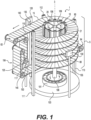
- FIG. 1 shows an embodiment of a spiral conveyor system 1 that may utilize at least one contoured drive element drive system.
- Spiral conveyor systems such as spiral conveyor system 1 are well known in the art.
- Spiral conveyor system 1 may include a conveyor belt 15 that is configured to travel a spiral column 5 around a driving drum 10.
- driving drum 10 may include one or more drive elements 20 that engage with conveyor belt 15 for a positive drive system, where the frictional and/or geometric engagement of the drive elements 20 with conveyor belt 15 impart forward motion to conveyor belt 15.
- driving drum 10 and the edge of conveyor belt 15 may include provisions that engage with each other to transfer driving force from the turning drum to the conveyor belt.
- Drum 10 may be configured to rotate at various RPM (revolutions per minute), but may be configured to turn at low RPM. The precise speed may depend upon factors such as the height of spiral column 5, the length of belt 15, and the intended use of the system, such as to establish a particular cooking, baking, or freezing time. In some embodiments, drum 10 may turn at 15 RPM or less. In some embodiments, drum 10 may turn at 10 RPM or less. In some embodiments, drum 10 may turn at 4 RPM or less. In some embodiments, drum 10 may turn at a rate between 0.1 RPM and 10 RPM, inclusive.
- Drum 10 may be generally cylindrical in shape and may, in some embodiments, include a cylindrical surface.
- the cylindrical surface may be a continuous cylindrical drum surface formed of sheet metal, or may have a discontinuous surface formed of individual vertical drive elements extending between and connecting circular support bands arranged about the center axis of the drum, or may be a combination of sheet metal and vertical bars as shown in FIG. 1 .
- Other construction is contemplated to provide a suitable cylindrical surface for guiding an inside edge of belt 15 through spiral column 5.
- Drive elements 20 may comprise a rib attached to the sheet metal surface of the drum, such as in the embodiments shown in FIG. 1 , or to a cage bar, for example where the rib extends from a surface of a cage bar cap.
- Drive elements 20 may also comprise a cap or covering, such as to provide the contoured surface and/or for improved wear properties.
- a bottom bearing 101 may be provided in, on, or associated with a motor, gearbox, and/or a conveyor frame. As is known in the art, a bottom bearing 101 is provided to reduce rotational friction between the motor and/or base 103 and shaft 106 while supporting radial and axial loads. Bearings and their functionality are generally well known and understood in the art.
- Conveyor belt 15 may be modular and include links and connecting rods.
- An exemplary modular belt implementing links and connecting rods is shown and discussed in Neely et al., U.S. Patent No. 9,884,723, issued February 6, 2018 , and entitled Spiral Conveyor System, the entirety of which is incorporated herein by reference.
- Conveyor belt 15 may be any type of endless belt known in the art. Conveyor belt 15 may be made from metal, plastic, composites, ceramics, combinations of these materials, or any other type of conveyor belt material known in the art. The particular material may be selected based on factors such as temperature exposure (baking, freezing, room temperature conveying), required tension, length of the belt, ability to clean and/or disinfect the belt, etc. In some embodiments, such as the embodiment shown in FIG. 1 , belt 15 may be an upgoing belt, where belt 15 travels from a bottom 64 of spiral column 5 to a top 63 of spiral column 5. In other embodiments, the direction of travel may be downgoing, where belt 15 travels from top 63 to bottom 64. Belt paths at top 63 and bottom 64 may be aligned as shown or arranged at an angle with respect to each other about a central axis 3 of drum 10.
- a conveyor belt 15 enters at one end of drum 10, typically bottom 64.
- Conveyor belt 15 may be fed into the system 1 off of two rollers or sprockets positioned on an axle.
- Conveyor belt 15 travels through stacked helical tiers around the center drum 10.
- Conveyor belt 15 then exits at the opposite end of drum 10, typically near top 63.
- Conveyor belt 15 may be an endless belt 15, in which case conveyor belt 15 is fed back to the axle/sprocket at the other end of drum 10 (e.g., in one embodiment, belt 15 travels back to bottom 64 of drum 10 after exiting at top 63 of drum 10.) In any embodiment, however, the system may be upgoing (traveling from bottom to top) or downgoing (traveling from top to bottom).
- the gearing and optional weighting of belt 15 at the entrance and/or exit points of spiral 5 may be configured to assist in controlling tension in belt 15 as belt 15 moves through the system 1.
- system 1 may include a take-up sprocket 115 configured to pull belt 15 out of spiral column 5. Take-up sprocket 115 may be located at or after the first terminal roller.
- Take-up sprocket 115 may be independently driven, such as with a motor.
- the motor may be a constant torque motor so that the tension in belt 15 may be controlled within a desired range.
- a weighted take-up roller 117 may be provided to assist in maintaining the belt tension along return path 104 and to remove slack belt from the system. Proper tension in belt 15 may inhibit operational issues such as slippage of belt 15 with respect to drum 10, belt flip-up, or difficulty feeding belt 15 into or out of the helical stack.
- the first tier 80 of belt 15 at the entrance end has a first larger radius and the last tier of belt 15 at the exit end has a second smaller radius.
- FIG. 1 shows two different tiers, first tier 80 and second tier 90, of belt 15 made of links and elongated rods that connect the links together.
- Drum 10 may have a first radius supporting first tier 80 and a second smaller radius supporting second tier 90. The first radius may be at a lower position on drum 10 than the second radius.
- Belt 15 may be held at either radius by engagement of the circumferential support surfaces of belt 15 with circumferential support surfaces of the drive elements 20.
- the spiral may include general support posts, such as a first post 111, a second post 112, and a third post 113, as shown in FIG. 1 .
- the spiral may have any suitable number of posts, which may be positioned as needed for a structurally sound construction.
- belt 15 may include at least one sensor assembly.
- the system may include a first sensor assembly 140, a second sensor assembly 150, and a third sensor assembly 155. It will be understood that the belt may include any desired number of sensor assemblies, including a single sensor assembly or multiple sensor assemblies.
- one or more receiver modules may be located along the path of the belt system.
- FIG. 1 shows three receiver modules, including a first receiver module 120, a second receiver module 125, and a third receiver module 130.
- the system may have any suitable number of receiver modules, including a single receiver module or multiple receiver modules.
- the number of receiver modules may be chosen based on various factors, such as the overall size of the belt system, the complexity of the belt system, the amount of data collected, etc.
- a plurality of receiving modules may form a mesh network. The more sensor assemblies and receiving modules in a system, the more data can be collected, more frequently, with further reach of communications.
- Each receiver module may include a belt interface unit.
- first receiver module 120 may include a first belt interface unit 135.
- second receiver module 125 may include a second belt interface unit 145.
- Third receiver module 130 is facing the other way, and thus, the third belt interface unit is not shown in FIG. 1 . It will be understood that the configuration and arrangement of the receiver modules and belt interface units as depicted in FIG. 1 is schematic only. Those having ordinary skill in the art will recognize suitable configurations and arrangements for these components.
- the system may perform various functions.
- the belt interface unit may charge a power source in the sensor assembly via inductive charging.
- the belt interface unit may receive data transmitted by the sensor assembly. It will be understood that one all belt interface units may perform the same function in a given system. For example, in some cases, all of the belt interface units may perform the inductive charging function, but only a single belt interface unit may collect data. It will be understood that as many or as few belt interface units may perform the charging and/or data collection functions as desired.
- FIG. 2 is a schematic exploded view of an onboard sensor assembly for a conveyor belt.
- a sensor assembly 200 may include a link 205, a housing 210, and a load cell 215 attachable to link 205 (e.g., with a fastener 220) and configured to measure tension in the belt.
- Housing 210 includes a first cavity 225 configured to receive at least a portion of load cell 215, and a second cavity 230 configured to receive one or more electronic components (shown in FIG. 2 as an electronics pod 235).
- Sensor assembly 200 also includes an electronics cavity cover 240, which is removably attachable via a plurality of fasteners 245 (e.g., screws).
- FIG. 3 is a second schematic perspective view of the onboard sensor assembly shown in FIG. 2 .
- sensor assembly 200 may be pivotally attached to other links of the belt via connecting rods.
- a leading connecting rod 300 is shown, as well as a trailing connecting rod 305.
- Leading connecting rod 300 extends along a leading rod axis 310
- trailing connecting rod extends along a trailing rod axis 315.
- Leading rod axis 310 and trailing rod axis 315 extend substantially parallel to a horizontal axis 320 of sensor assembly 200.
- the angle of axis 310 may vary with respect to the sensor assembly because the openings at the leading end of the sensor assembly components are ovalized/slotted in order to permit the belt to turn.
- a vertical axis 325 extends perpendicular to horizontal axis 320, and a longitudinal axis 330 extends in a fore-aft direction, parallel to the direction of belt travel (indicated by an arrow 335) and perpendicular to both horizontal axis 320 and vertical axis 325.
- a conveyor belt according to the disclosed invention may include a plurality of links connected by a plurality of connecting rods, the plurality of links including at least a first link, and a sensor assembly attached to the first link.
- a first end of the load cell is attached to the lateral extension of link 205 with fastener 220 and a second end of the load cell includes an opening through which one of the connecting rods extends such that the load cell is configured to detect elongation of the second leg of the link due to tension in the conveyor belt.
- FIG. 4 is a schematic perspective view of the electronics housing from the sensor assembly shown in FIG. 2 .
- housing 210 includes a leading side 400 and a trailing side 405.
- housing 210 includes a first portion 410 configured to receive the load cell, and a second portion 415 configured to receive the electronics pod.
- FIG. 5 is a second schematic perspective view of the electronics housing shown in FIG. 4 .
- housing 210 includes a thru-hole 500 configured to accommodate wiring between the load cell and the electronics pod.
- first portion 410 of housing 210 includes a first leading rod opening 505 and a first trailing rod opening 510.
- second portion 415 of housing 210 includes a second leading rod opening 515 and a second trailing rod opening 520. These four openings are configured to receive connecting rods (see FIG. 3 ).
- first leading rod opening 505 and second leading rod opening 515 may be ovalized/slotted in order to permit the belt to be a turn-curve belt.
- FIG. 6 is a third schematic perspective view of the electronics housing shown in FIG. 4 .
- FIG. 6 better illustrates cavity 225, thru-hole 500, first leading rod opening 505, and first trailing rod opening 510.
- FIG. 7 is a schematic perspective view of the electronics pod from the onboard sensor assembly shown in FIG. 2 .
- electronics pod 235 may include a sensor pack 700 containing one or more sensors, such as electronics associated with the load cell, a gyroscopic (angle) sensor, and/or an accelerometer.
- electronics pod 235 includes at least one power source, such as a battery or capacitor.
- pod 235 includes a first capacitor 705 and a second capacitor 710.
- Capacitors are beneficial to use over batteries for several reasons. First, capacitors charge faster than batteries. Since the sensor assembly passes quickly past the receiving modules, there is limited time for the inductive charging to occur. Therefore, the capacitors maximize the amount of charging that can be accomplished in that short period of time. Second, capacitors drain less than batteries do in cold temperatures. Since the disclosed conveyors may be utilized in cold temperatures, the extra performance of the capacitors in cold temperatures is beneficial. The same is true for higher temperatures, in which capacitors are more stable than batteries. Again, since the disclosed belt systems can be used in high temperature environments, capacitors have an advantage over batteries.
- FIG. 8 is a schematic exploded view of the link and load cell assembly from the onboard sensor assembly shown in FIG. 2 .
- link 205 may be substantially U-shaped, including a first leg 800, a second leg 805, and a connecting portion 810 extending between first leg 800 and second leg 805.
- Link 205 also includes a first leading rod opening 815 and a first trailing rod opening 820 in first leg 800.
- link 205 includes a second leading rod opening (not shown) opposite first leading rod opening 815 (see second leading rod opening 1005 in FIG. 10 ), and a second trailing rod opening 825.
- link 205 includes a lateral extension 830 with a cavity or receptacle 835 configured to receive at least a portion of load cell 215.
- lateral extension 830 includes a threaded opening 840 configured to receive fastener 220 (through a fastener opening 845 in load cell 215) to secure load cell 215 to link 205.
- FIG. 9 is another schematic exploded view of the link and load cell assembly.
- link 205 is substantially U-shaped.
- load cell 215 includes a thru-hole 900.
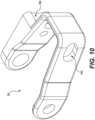
- FIG. 10 is a schematic perspective view of the link portion of the assembly shown in FIG. 2 .
- link 205 includes a concave portion 1000 configured to accommodate a connecting rod.
- FIG. 10 also illustrates a second leading rod opening 1005 discussed above. As shown, second leading rod opening 1005 may be ovalized/slotted to permit the belt to be a turn-curve belt.
- FIG. 11 is a second schematic view of the link.
- connecting portion 810 of link 205 includes a groove 1100 on the trailing side to accommodate a connecting rod. Groove 1100 provides stability to the assembly during belt movement.
- FIG. 12 is a third schematic view of the link.
- FIG. 12 provides a better view of concave portion 1000, as well as first trailing rod opening 820 and receptacle 835. As shown in FIG. 12 , at least a portion of first trailing rod opening 820 and receptacle 835 may intersect.
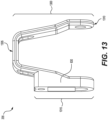
- FIG. 13 is a fourth schematic view of the link. Again, the U-shaped configuration of link 205 is illustrated.
- the lateral extension may be shorter than the overall length of link 205. As shown, the overall length 1300 of link 205 extends between a leading end 1305 and a trailing end 1310 of link 205. A length 1315 of lateral extension 830 is considerably shorter than overall length 1300. Because of this arrangement, the leading connecting rod does not pass through the load cell. This provides a more stable strain measurement.
- the load cell has a first end and a second end, in which the first end includes an opening through which a fastener may be inserted in order to attach the first end of the load cell to a body of the link, and the second end of the load cell has a second opening configured to receive a connecting rod of the belt.
- FIG. 14 is a schematic perspective view of a load cell from the sensor assembly shown in FIG. 2 .
- Load cell 215 may include the fastener opening 845 discussed previously at a leading end of load cell 215, as well as a rod opening 1400 at a trailing end of load cell 215. (See also FIGS. 8-9 .)
- FIG. 15 is another schematic view of the load cell.
- FIG. 15 provides an improved view of thru-hole 900 through load cell 215.
- FIG. 16 is a block diagram illustrating onboard components of a data collection system according to an exemplary embodiment.
- the system may include an on-belt electronics pod 1600.
- pod 1600 may include tension sensor electronics 1630 related to the load cell.
- the raw load cell data may simply be received by the electronics pod.
- pod 1600 may include a location sensor 1635 or electronic equipment configured to facilitate the location of the sensor assembly along the belt path.
- the system may utilize the belt speed and elapsed time (e.g., since the last time the sensor assembly passed a receiving module) to calculate how far along the belt path the sensor assembly is at a given time.
- pod 1600 includes a gyroscopic sensor 1640 configured to detect belt angle in three axes. For example, if the sensor assembly is detected to be oriented at a non-horizontal angle about the longitudinal axis (the fore-aft axis extending along the direction of belt travel), this may indicate belt "flip-up" where a portion of the belt may be flipped upward from its proper horizontal position.
- pod 1600 includes an acceleration sensor 1645 configured to detect belt acceleration along the same three axes. For example, detecting fluctuations in the acceleration of the belt along the longitudinal axis may indicate surging. Further, by detecting belt angle in three axes and belt acceleration along three axes, this provides six values which, collectively can be analyzed to determine many other aspects of belt operation.
- Pod 1600 also includes one or more capacitors 1650.
- Capacitors 1650 may have any of the characteristics described above with respect to first capacitor 705 and second capacitor 710.
- pod 1600 may include an onboard controller 1605.
- Controller 1605 may include various computing and communications hardware, such as servers, circuitry, displays, etc. Further, controller 1605 includes a device processor 1610 and a non-transitory computer readable medium 1615 including instructions executable by device processor 1610 to perform the processes discussed herein, such as receiving and transmitting data.
- the onboard components are configured to operate at a relatively low voltage. This permits the system to continue to operate when the charge of the capacitors is low, thus maximizing the usage of the capacitors.
- the onboard controller is configured to function with a power supply in the range of approximately 0.1 to approximately 5.5 volts. In some embodiments, the onboard controller is configured to function with a power supply of less than approximately 5.5 volts.
- the non-transitory computer readable medium may include any suitable computer readable medium, such as a memory, e.g., RAM, ROM, flash memory, or any other type of memory known in the art.
- the non-transitory computer readable medium may include, for example, an electronic storage device, a magnetic storage device, an optical storage device, an electromagnetic storage device, a semiconductor storage device, or any suitable combination of such devices.
- non-transitory computer readable medium may include a portable computer diskette, a floppy disk, a hard disk, a read-only memory (ROM), a random access memory (RAM), a static random access memory (SRAM), a portable compact disc read-only memory (CD-ROM), an erasable programmable read-only memory (EPROM or Flash memory), a digital versatile disk (DVD), a memory stick, and any suitable combination of these exemplary media.
- ROM read-only memory
- RAM random access memory
- SRAM static random access memory
- CD-ROM compact disc read-only memory
- EPROM or Flash memory erasable programmable read-only memory
- DVD digital versatile disk
- memory stick any suitable combination of these exemplary media.
- a non-transitory computer readable medium is not to be construed as being transitory signals, such as radio waves or other freely propagating electromagnetic waves, electromagnetic waves propagating through a waveguide or other transmission media (e.g., light pulses passing through a fiber-optic cable), or electrical signals transmitted through a wire.
- Instructions stored on the non-transitory computer readable medium for carrying out operations of the present invention may be instruction-set-architecture (ISA) instructions, assembler instructions, machine instructions, machine dependent instructions, microcode, firmware instructions, configuration data for integrated circuitry, state-setting data, or source code or object code written in any of one or more programming languages, including an object oriented programming language such as Smalltalk, C++, or suitable language, and procedural programming languages, such as the "C" programming language or similar programming languages.
- ISA instruction-set-architecture
- Controller 1605 may include networking hardware configured to interface with other nodes of a network, such as a LAN, WLAN, or other networks.
- controller 1605 may be configured to receive data from a plurality of sources and communicate information to one or more external destinations.
- controller 1605 may include a receiver 1620 and a transmitter 1625. (It will be appreciated that, in some embodiments, the receiver and transmitter may be combined in a transceiver.)
- Any suitable communication platforms and/or protocols may be utilized for communication between controller 1605 and other components of the system. Since the various sources of information may each have their own platform and/or protocol, the system may be configured to interface with each platform and/or protocol to receive the data.
- computer readable medium 1615 of controller 1605 includes instructions, executable by processor 1610, to receive data from the one or more sensors and transmit the data to an offboard controller 1700.
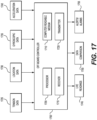
- FIG. 17 is a block diagram illustrating offboard components of the data collection system, i.e., components found in or otherwise associated with the receiving module. Similar to onboard controller 1605, offboard controller 1700 may include a device processor 1705, a non-transitory computer readable medium 1710, a receiver 1715, and a transmitter 1720. The features and characteristics of controller 1700 and its components may be similar to those discussed above with respect to onboard controller 1605.
- the receiver module also includes equipment configured to inductively charge a power source onboard the belt as the belt passes by the receiver module. That is, the receiver module includes inductive charging equipment configured to inductively charge the capacitors in the electronics pod onboard the belt.
- offboard controller 1700 may be configured to receive tension data 1725, location data 1730, gyroscopic data 1735, and/or acceleration data 1740, all from onboard controller 1605. Offboard controller 1700 may collect this data and perform one or more processing steps. For example, in some cases, offboard controller may be configured to produce live readings 1745 of the collected data or parameters determined based on the data. Such live readings may be produced via a screen or graphical user interface for the customer and/or system manufacturer.
- offboard controller 1700 may be configured to perform one or more comparisons between data (1750). For example, current data can be compared to previously collected data to observe trends. Such trends may be indicative of wear or other malfunctions, enabling action to be taken before the malfunctioning belt reaches a catastrophic failure.
- offboard controller 1700 may be configured to activate one or more alerts or alarms (1755) if a measured parameter falls outside of a predetermined range. For example, if the belt tension is detected to be above a predetermined threshold, an alert may be generated so that the system can be checked. Similarly, if the belt angle and/or belt acceleration falls outside of a predetermined range, an alert may be generated.
- the thresholds may be dynamic instead of static. For example, because of the nature of a spiral system, the tension on the belt typically increases as the belt ascends the spiral. Therefore, the threshold may be dynamic, where a lower tension is needed to trigger an alert near the bottom of the spiral, and a higher tension is needed near the top of the spiral to generate an alert. For similar reasons, the range of acceptable belt acceleration may also be dynamic, since the belt is expected to accelerate in different amounts and in different directions at different portions of the belt path.
- a system "fingerprint" may be produced at any given time.
- the overall fingerprint may be compared to a previously recorded fingerprint.
- FIG. 18 is a flowchart illustrating a method of monitoring belt tension. It will be understood that the order of operations discussed may vary slightly. As shown in FIG. 18 , location data is collected at step 1800 while belt tension is detected at step 1805. The location data is downloaded/transmitted to the offboard controller at step 1810 and the measured tension is downloaded/transmitted to the offboard controller at step 1815. In some embodiments, the tension data may be buffered prior to transmitting offboard. This reduces the amount of memory required for the overall collection of data. This reduces the required size of the electronics pod, which is beneficial for packaging. For similar reasons, the system may also be configured to buffer other types of data before transmitting.
- a dynamic tension threshold is selected, and at step 1825, an evaluation is made as to whether the measured tension exceeds the threshold at the corresponding location based on the location data collected. If yes, an alarm is generated at step 1830, and the system continues to monitor the tension of the belt. If not, then the system merely continues to monitor the operation of the belt.
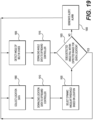
- FIG. 19 is a flowchart illustrating a method of monitoring belt angle. Similar to FIG. 18 above, location data is collected at step 1900 while belt angle is detected at step 1905. Then, the location data is downloaded/transmitted offboard at step 1910 and the angle data is downloaded/transmitted offboard at step 1915. Dynamic angular thresholds (i.e., an acceptable range of angular values) are determined at step 1920 based on the location data, and an evaluation is made at step 1925 as to whether the detected angle falls within an acceptable range. It will be understood that this evaluation is made in all three axes. If the belt angle falls outside of the expected range in any of the three axes, an alert is generated at step 1930.
- Dynamic angular thresholds i.e., an acceptable range of angular values
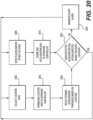
- FIG. 20 is a flowchart illustrating a method of monitoring belt acceleration.
- Location data is collected at step 2000 while belt acceleration is detected at step 2005. Then, the location data is downloaded/transmitted offboard at step 2010 and the acceleration data is downloaded/transmitted offboard at step 2015.
- Dynamic acceleration thresholds i.e., an acceptable range of acceleration values
- an evaluation is made at step 2020 based on the location data, and an evaluation is made at step 2025 as to whether the detected acceleration falls within an acceptable range. It will be understood that this evaluation is made in all three axes. If the belt acceleration falls outside of the expected range along any of the three axes, an alert is generated at step 2030.
- artificial intelligence may include any known methods in machine learning and related fields.
- artificial intelligence may include systems and methods used in deep learning and machine vision.
Landscapes
- Engineering & Computer Science (AREA)
- Mechanical Engineering (AREA)
- Physics & Mathematics (AREA)
- General Physics & Mathematics (AREA)
- Radar, Positioning & Navigation (AREA)
- Remote Sensing (AREA)
- Control Of Conveyors (AREA)
Abstract
A sensor assembly for a conveyor belt includes a load cell attachable to a link of a modular conveyor belt and configured to measure tension in the belt and a housing. The housing may include a first cavity configured to receive at least a portion of the load cell, and a second cavity configured to receive one or more electronic components.
Description
- The present disclosure is directed to a conveyor belt operation monitoring system and, more particularly, to a conveyor system with one or more belt-integrated onboard sensors and at least one offboard data-receiving module.
- Conveyor belts are often operated in harsh conditions, including high and/or low temperatures, humidity, dust, and/or debris. In addition, the complexity of the belt path can also add to the difficulty in operation. Also, failures in belt operation can be costly, time consuming, and generally inconvenient.
- The present disclosure is directed to systems and methods for addressing one or more of the issues described above.
- The disclosed system is configured for collecting data regarding belt operating conditions in order to observe trends and prevent more significant belt operating malfunctions. To that end, the system includes one or more belt-integrated onboard sensors and at least one offboard data receiving module. For example, the disclosed system includes at least one onboard sensor assembly including a variety of sensors, including a tension sensor (load cell), a gyroscopic sensor configured to detect belt angle in three axes, and an acceleration sensor configured to detect belt acceleration along the same three axes. The disclosed system is configured to collect data with these onboard sensors and then transmit the data to an offboard controller for processing. Anomalies can be detected, and alerts / alarms activated so that steps can be taken to alleviate the issues causing the anomalies.
- In one aspect, the present disclosure is directed to a sensor assembly for a conveyor belt, comprising: a load cell attachable to a link of a modular conveyor belt and configured to measure tension in the belt and a housing. The housing may include a first cavity configured to receive at least a portion of the load cell, and a second cavity configured to receive one or more electronic components.
- In another aspect, the present disclosure is directed to a tension sensing system for a conveyor belt, comprising: a first link pivotally connectable to other links of the conveyor belt and a sensor assembly attached to the first link. The sensor assembly may include a load cell attachable to the first link and configured to measure tension in the belt, and a housing having a first cavity configured to receive at least a portion of the load cell.
- In another aspect, the present disclosure is directed to a conveyor belt, comprising: a plurality of links connected by a plurality of connecting rods, the plurality of links including at least a first link; a sensor assembly attached to the first link, the sensor assembly including: a load cell attachable to the first link and configured to measure tension in the belt; and a housing having a first cavity configured to receive at least a portion of the load cell.
- In another aspect, the present disclosure is directed to a sensor assembly for a conveyor belt, comprising: one or more sensors configured to be integrated with the belt and collect data regarding belt operating conditions; and an onboard controller including a device processor and a non-transient computer readable medium. The computer readable medium having stored thereon instructions, executable by the processor, to perform the following functions: receiving data from the one or more sensors; and transmitting the data to an offboard controller.
- In another aspect, the present disclosure is directed to a receiver module for a conveyor belt data collection system, comprising: a housing located offboard from the belt and configured to be positioned proximate to a conveyor belt; a belt interface unit including an offboard controller including a device processor and a non-transient computer readable medium. The computer readable medium having stored thereon instructions, executable by the processor, to perform the following functions: receiving data regarding belt operating conditions transmitted by an onboard controller integrated with the belt.
- In another aspect, the present disclosure is directed to a conveyor belt operation monitoring system, comprising: one or more sensors configured to be integrated with the belt and collect data regarding belt operating conditions; and an onboard controller including a first device processor and a first non-transient computer readable medium. The computer readable medium having stored thereon instructions, executable by the processor, to perform the following functions: receiving data from the one or more sensors; and transmitting the data to an offboard controller; and at least one receiving module including a belt interface unit, the belt interface unit including an offboard controller including a second device processor and a second non-transient computer readable medium having stored thereon instructions, executable by the processor, to perform the following functions: receiving the data transmitted by the onboard controller.
- Other systems, methods, features, and advantages of the disclosure will be, or will become, apparent to one of ordinary skill in the art upon examination of the following figures and detailed description. It is intended that all such additional systems, methods, features, and advantages be included within this description and this summary, be within the scope of the disclosure, and be protected by the following claims.
- The invention can be better understood with reference to the following drawings and description. The components in the figures are not necessarily to scale, emphasis instead being placed upon illustrating the principles of the invention. Moreover, in the figures, like reference numerals designate corresponding parts throughout the different views.
-
FIG. 1 is a schematic illustration of a spiral conveyor system according to an exemplary embodiment; -
FIG. 2 is a schematic exploded view of an onboard sensor assembly for a conveyor belt; -
FIG. 3 is a second schematic perspective view of the onboard sensor assembly shown inFIG. 2 ; and -
FIG. 4 is a schematic perspective view of an electronics housing from the sensor assembly shown inFIG. 2 ; -
FIG. 5 is a second schematic perspective view of the electronics housing shown inFIG. 4 ; -
FIG. 6 is a third schematic perspective view of the electronics housing shown inFIG. 4 ; -
FIG. 7 is a schematic perspective view of an electronics pod from the onboard sensor assembly shown inFIG. 2 ; -
FIG. 8 is a schematic exploded view of a link and load cell assembly from the onboard sensor assembly shown inFIG. 2 ; -
FIG. 9 is another schematic exploded view of the link and load cell assembly; -
FIG. 10 is a schematic perspective view of the link portion of the assembly shown inFIG. 2 ; -
FIG. 11 is a second schematic view of the link; -
FIG. 12 is a third schematic view of the link; -
FIG. 13 is a fourth schematic view of the link; -
FIG. 14 is a schematic perspective view of a load cell from the sensor assembly shown inFIG. 2 ; -
FIG. 15 is another schematic view of the load cell; -
FIG. 16 is a block diagram illustrating onboard components of a data collection system according to an exemplary embodiment; -
FIG. 17 is a block diagram illustrating offboard components of the data collection system; -
FIG. 18 is a flowchart illustrating a method of monitoring belt tension; -
FIG. 19 is a flowchart illustrating a method of monitoring belt angle; and -
FIG. 20 is a flowchart illustrating a method of monitoring belt acceleration. - For clarity, the detailed descriptions herein describe certain exemplary embodiments. A positive drive spiral conveyor system is shown. However, the disclosure in this application may be applied to any suitable conveyor system. That is, systems other than positive drive and non-spiral systems may implement the disclosed sensor array/system.
- The spiral conveyor system discussed below is generally a positive drive system, where a drive element comes into direct contact with the conveyor belt to propel the conveyor belt in a travel direction. In the systems discussed below, a central rotating drum includes drive elements that include a drive face for engaging with the conveyor belt. The drive face on the drive element may be adjacent a contoured surface of the drive element, such as a rib that protrudes from the drum or a surface of the drive element. The rib may provide improved geometry for the drive face and also may smooth the travel of the conveyor belt up or down the spiral, particularly when the rib itself has varying height above the drum surface. The conveyor belt may also include a provision to enhance the engagement with the rib, such as a protrusion or a tab with a flat surface for better contact with the drive face.
-
FIG. 1 shows an embodiment of a spiral conveyor system 1 that may utilize at least one contoured drive element drive system. Spiral conveyor systems such as spiral conveyor system 1 are well known in the art. Spiral conveyor system 1 may include aconveyor belt 15 that is configured to travel a spiral column 5 around adriving drum 10. In some embodiments, drivingdrum 10 may include one ormore drive elements 20 that engage withconveyor belt 15 for a positive drive system, where the frictional and/or geometric engagement of thedrive elements 20 withconveyor belt 15 impart forward motion toconveyor belt 15. In some embodiments, drivingdrum 10 and the edge ofconveyor belt 15 may include provisions that engage with each other to transfer driving force from the turning drum to the conveyor belt. -
Drum 10 may be configured to rotate at various RPM (revolutions per minute), but may be configured to turn at low RPM. The precise speed may depend upon factors such as the height of spiral column 5, the length ofbelt 15, and the intended use of the system, such as to establish a particular cooking, baking, or freezing time. In some embodiments, drum 10 may turn at 15 RPM or less. In some embodiments, drum 10 may turn at 10 RPM or less. In some embodiments, drum 10 may turn at 4 RPM or less. In some embodiments, drum 10 may turn at a rate between 0.1 RPM and 10 RPM, inclusive. -
Drum 10 may be rotated using any method known in the art, such as with a motor (not shown) positioned proximate abase 103 of spiral conveyor system 1. The motor may transfer the power it generates to drum 10 using any mechanism known in the art. In some embodiments, such as the embodiment shown inFIG. 1 , known systems, such as chains and gear boxes to control the transfer of power from the motor toshaft 106, may be provided.Shaft 106 may be any type of drive shaft known in art, such as an elongated metal pole that extends frombase 103 to the top of spiral column 5 along drumcentral axis 3. One or more struts such asstrut 109 may attachshaft 106 to drum 10 to transfer the rotational force ofshaft 106 to drum 10.Drum 10 may be generally cylindrical in shape and may, in some embodiments, include a cylindrical surface. The cylindrical surface may be a continuous cylindrical drum surface formed of sheet metal, or may have a discontinuous surface formed of individual vertical drive elements extending between and connecting circular support bands arranged about the center axis of the drum, or may be a combination of sheet metal and vertical bars as shown inFIG. 1 . Other construction is contemplated to provide a suitable cylindrical surface for guiding an inside edge ofbelt 15 through spiral column 5. Driveelements 20 may comprise a rib attached to the sheet metal surface of the drum, such as in the embodiments shown inFIG. 1 , or to a cage bar, for example where the rib extends from a surface of a cage bar cap. Driveelements 20 may also comprise a cap or covering, such as to provide the contoured surface and/or for improved wear properties. - A bottom bearing 101 may be provided in, on, or associated with a motor, gearbox, and/or a conveyor frame. As is known in the art, a bottom bearing 101 is provided to reduce rotational friction between the motor and/or
base 103 andshaft 106 while supporting radial and axial loads. Bearings and their functionality are generally well known and understood in the art. -
Conveyor belt 15 may be modular and include links and connecting rods. An exemplary modular belt implementing links and connecting rods is shown and discussed in Neely et al.,U.S. Patent No. 9,884,723, issued February 6, 2018 -
Conveyor belt 15 may be any type of endless belt known in the art.Conveyor belt 15 may be made from metal, plastic, composites, ceramics, combinations of these materials, or any other type of conveyor belt material known in the art. The particular material may be selected based on factors such as temperature exposure (baking, freezing, room temperature conveying), required tension, length of the belt, ability to clean and/or disinfect the belt, etc. In some embodiments, such as the embodiment shown inFIG. 1 ,belt 15 may be an upgoing belt, wherebelt 15 travels from a bottom 64 of spiral column 5 to a top 63 of spiral column 5. In other embodiments, the direction of travel may be downgoing, wherebelt 15 travels from top 63 tobottom 64. Belt paths at top 63 and bottom 64 may be aligned as shown or arranged at an angle with respect to each other about acentral axis 3 ofdrum 10. - In use, a
conveyor belt 15 enters at one end ofdrum 10, typically bottom 64.Conveyor belt 15 may be fed into the system 1 off of two rollers or sprockets positioned on an axle.Conveyor belt 15 travels through stacked helical tiers around thecenter drum 10.Conveyor belt 15 then exits at the opposite end ofdrum 10, typically neartop 63.Conveyor belt 15 may be anendless belt 15, in whichcase conveyor belt 15 is fed back to the axle/sprocket at the other end of drum 10 (e.g., in one embodiment,belt 15 travels back tobottom 64 ofdrum 10 after exiting attop 63 ofdrum 10.) In any embodiment, however, the system may be upgoing (traveling from bottom to top) or downgoing (traveling from top to bottom). The gearing and optional weighting ofbelt 15 at the entrance and/or exit points of spiral 5 may be configured to assist in controlling tension inbelt 15 asbelt 15 moves through the system 1. For example, system 1 may include a take-upsprocket 115 configured to pullbelt 15 out of spiral column 5. Take-upsprocket 115 may be located at or after the first terminal roller. Take-upsprocket 115 may be independently driven, such as with a motor. In some embodiments, the motor may be a constant torque motor so that the tension inbelt 15 may be controlled within a desired range. In some embodiments, a weighted take-uproller 117 may be provided to assist in maintaining the belt tension alongreturn path 104 and to remove slack belt from the system. Proper tension inbelt 15 may inhibit operational issues such as slippage ofbelt 15 with respect to drum 10, belt flip-up, ordifficulty feeding belt 15 into or out of the helical stack. - In some embodiments, the
first tier 80 ofbelt 15 at the entrance end (e.g., bottom 64) has a first larger radius and the last tier ofbelt 15 at the exit end has a second smaller radius. For example,FIG. 1 shows two different tiers,first tier 80 andsecond tier 90, ofbelt 15 made of links and elongated rods that connect the links together.Drum 10 may have a first radius supportingfirst tier 80 and a second smaller radius supportingsecond tier 90. The first radius may be at a lower position ondrum 10 than the second radius.Belt 15 may be held at either radius by engagement of the circumferential support surfaces ofbelt 15 with circumferential support surfaces of thedrive elements 20. - The spiral may include general support posts, such as a
first post 111, asecond post 112, and athird post 113, as shown inFIG. 1 . The spiral may have any suitable number of posts, which may be positioned as needed for a structurally sound construction. - In addition, components of a belt data collection system may be incorporated into the belt path. For example, as discussed in greater detail below, one or more sensor arrays may be integrated with the belt in order to facilitate collection of data, such as tension data, angle data, acceleration data, etc. As shown,
belt 15 may include at least one sensor assembly. As shown inFIG. 1 , the system may include afirst sensor assembly 140, asecond sensor assembly 150, and athird sensor assembly 155. It will be understood that the belt may include any desired number of sensor assemblies, including a single sensor assembly or multiple sensor assemblies. - In addition, one or more receiver modules may be located along the path of the belt system. For example,
FIG. 1 shows three receiver modules, including afirst receiver module 120, asecond receiver module 125, and athird receiver module 130. It will be understood that the system may have any suitable number of receiver modules, including a single receiver module or multiple receiver modules. The number of receiver modules may be chosen based on various factors, such as the overall size of the belt system, the complexity of the belt system, the amount of data collected, etc. In some embodiments, a plurality of receiving modules may form a mesh network. The more sensor assemblies and receiving modules in a system, the more data can be collected, more frequently, with further reach of communications. - Each receiver module may include a belt interface unit. For example,
first receiver module 120 may include a firstbelt interface unit 135. In addition,second receiver module 125 may include a secondbelt interface unit 145.Third receiver module 130 is facing the other way, and thus, the third belt interface unit is not shown inFIG. 1 . It will be understood that the configuration and arrangement of the receiver modules and belt interface units as depicted inFIG. 1 is schematic only. Those having ordinary skill in the art will recognize suitable configurations and arrangements for these components. - When a sensor assembly passes by first
belt interface unit 135, the system may perform various functions. For example, the belt interface unit may charge a power source in the sensor assembly via inductive charging. Alternatively, or additionally, the belt interface unit may receive data transmitted by the sensor assembly. It will be understood that one all belt interface units may perform the same function in a given system. For example, in some cases, all of the belt interface units may perform the inductive charging function, but only a single belt interface unit may collect data. It will be understood that as many or as few belt interface units may perform the charging and/or data collection functions as desired. -
FIG. 2 is a schematic exploded view of an onboard sensor assembly for a conveyor belt. As shown inFIG. 2 , asensor assembly 200 may include alink 205, ahousing 210, and aload cell 215 attachable to link 205 (e.g., with a fastener 220) and configured to measure tension in the belt.Housing 210 includes afirst cavity 225 configured to receive at least a portion ofload cell 215, and asecond cavity 230 configured to receive one or more electronic components (shown inFIG. 2 as an electronics pod 235).Sensor assembly 200 also includes anelectronics cavity cover 240, which is removably attachable via a plurality of fasteners 245 (e.g., screws). -
FIG. 3 is a second schematic perspective view of the onboard sensor assembly shown inFIG. 2 . As shown inFIG. 3 ,sensor assembly 200 may be pivotally attached to other links of the belt via connecting rods. For example, a leading connectingrod 300 is shown, as well as a trailing connectingrod 305. Leading connectingrod 300 extends along a leadingrod axis 310, and trailing connecting rod extends along a trailingrod axis 315. Leadingrod axis 310 and trailingrod axis 315 extend substantially parallel to ahorizontal axis 320 ofsensor assembly 200. Although it will be understood that the angle ofaxis 310 may vary with respect to the sensor assembly because the openings at the leading end of the sensor assembly components are ovalized/slotted in order to permit the belt to turn. - As also shown in
FIG. 3 , avertical axis 325 extends perpendicular tohorizontal axis 320, and alongitudinal axis 330 extends in a fore-aft direction, parallel to the direction of belt travel (indicated by an arrow 335) and perpendicular to bothhorizontal axis 320 andvertical axis 325. - Accordingly, a conveyor belt according to the disclosed invention may include a plurality of links connected by a plurality of connecting rods, the plurality of links including at least a first link, and a sensor assembly attached to the first link.
- As shown in
FIG. 3 , a first end of the load cell is attached to the lateral extension oflink 205 withfastener 220 and a second end of the load cell includes an opening through which one of the connecting rods extends such that the load cell is configured to detect elongation of the second leg of the link due to tension in the conveyor belt. -
FIG. 4 is a schematic perspective view of the electronics housing from the sensor assembly shown inFIG. 2 . As shown inFIG. 4 ,housing 210 includes aleading side 400 and a trailingside 405. In addition,housing 210 includes afirst portion 410 configured to receive the load cell, and asecond portion 415 configured to receive the electronics pod. -
FIG. 5 is a second schematic perspective view of the electronics housing shown inFIG. 4 . As shown inFIG. 5 ,housing 210 includes a thru-hole 500 configured to accommodate wiring between the load cell and the electronics pod. In addition,first portion 410 ofhousing 210 includes a firstleading rod opening 505 and a first trailingrod opening 510. Further,second portion 415 ofhousing 210 includes a secondleading rod opening 515 and a secondtrailing rod opening 520. These four openings are configured to receive connecting rods (seeFIG. 3 ). As shown inFIG. 5 , first leadingrod opening 505 and secondleading rod opening 515 may be ovalized/slotted in order to permit the belt to be a turn-curve belt. -
FIG. 6 is a third schematic perspective view of the electronics housing shown inFIG. 4 .FIG. 6 better illustratescavity 225, thru-hole 500, first leadingrod opening 505, and first trailingrod opening 510. -
FIG. 7 is a schematic perspective view of the electronics pod from the onboard sensor assembly shown inFIG. 2 . As shown inFIG. 7 ,electronics pod 235 may include asensor pack 700 containing one or more sensors, such as electronics associated with the load cell, a gyroscopic (angle) sensor, and/or an accelerometer. In addition,electronics pod 235 includes at least one power source, such as a battery or capacitor. As shown inFIG. 7 ,pod 235 includes afirst capacitor 705 and asecond capacitor 710. - Capacitors are beneficial to use over batteries for several reasons. First, capacitors charge faster than batteries. Since the sensor assembly passes quickly past the receiving modules, there is limited time for the inductive charging to occur. Therefore, the capacitors maximize the amount of charging that can be accomplished in that short period of time. Second, capacitors drain less than batteries do in cold temperatures. Since the disclosed conveyors may be utilized in cold temperatures, the extra performance of the capacitors in cold temperatures is beneficial. The same is true for higher temperatures, in which capacitors are more stable than batteries. Again, since the disclosed belt systems can be used in high temperature environments, capacitors have an advantage over batteries.
-
FIG. 8 is a schematic exploded view of the link and load cell assembly from the onboard sensor assembly shown inFIG. 2 . As shown inFIG. 8 , link 205 may be substantially U-shaped, including afirst leg 800, asecond leg 805, and a connectingportion 810 extending betweenfirst leg 800 andsecond leg 805.Link 205 also includes a firstleading rod opening 815 and a first trailingrod opening 820 infirst leg 800. Also, link 205 includes a second leading rod opening (not shown) opposite first leading rod opening 815 (see secondleading rod opening 1005 inFIG. 10 ), and a secondtrailing rod opening 825. - As also shown in
FIG. 8 , link 205 includes alateral extension 830 with a cavity orreceptacle 835 configured to receive at least a portion ofload cell 215. In addition,lateral extension 830 includes a threadedopening 840 configured to receive fastener 220 (through afastener opening 845 in load cell 215) to secureload cell 215 to link 205. -
FIG. 9 is another schematic exploded view of the link and load cell assembly. As shown inFIG. 9 , link 205 is substantially U-shaped. As also shown inFIG. 9 ,load cell 215 includes a thru-hole 900. -
FIG. 10 is a schematic perspective view of the link portion of the assembly shown inFIG. 2 . As shown inFIG. 10 , link 205 includes aconcave portion 1000 configured to accommodate a connecting rod. In addition,FIG. 10 also illustrates a secondleading rod opening 1005 discussed above. As shown, second leadingrod opening 1005 may be ovalized/slotted to permit the belt to be a turn-curve belt. -
FIG. 11 is a second schematic view of the link. As shown inFIG. 11 , connectingportion 810 oflink 205 includes agroove 1100 on the trailing side to accommodate a connecting rod.Groove 1100 provides stability to the assembly during belt movement. -
FIG. 12 is a third schematic view of the link.FIG. 12 provides a better view ofconcave portion 1000, as well as first trailingrod opening 820 andreceptacle 835. As shown inFIG. 12 , at least a portion of first trailingrod opening 820 andreceptacle 835 may intersect. -
FIG. 13 is a fourth schematic view of the link. Again, the U-shaped configuration oflink 205 is illustrated. In addition, as shown inFIG. 13 , the lateral extension may be shorter than the overall length oflink 205. As shown, theoverall length 1300 oflink 205 extends between aleading end 1305 and a trailingend 1310 oflink 205. Alength 1315 oflateral extension 830 is considerably shorter thanoverall length 1300. Because of this arrangement, the leading connecting rod does not pass through the load cell. This provides a more stable strain measurement. - The load cell has a first end and a second end, in which the first end includes an opening through which a fastener may be inserted in order to attach the first end of the load cell to a body of the link, and the second end of the load cell has a second opening configured to receive a connecting rod of the belt.
-
FIG. 14 is a schematic perspective view of a load cell from the sensor assembly shown inFIG. 2 .Load cell 215 may include thefastener opening 845 discussed previously at a leading end ofload cell 215, as well as arod opening 1400 at a trailing end ofload cell 215. (See alsoFIGS. 8-9 .) -
FIG. 15 is another schematic view of the load cell.FIG. 15 provides an improved view of thru-hole 900 throughload cell 215. -
FIG. 16 is a block diagram illustrating onboard components of a data collection system according to an exemplary embodiment. As shown inFIG. 16 , the system may include an on-belt electronics pod 1600. In some embodiments,pod 1600 may includetension sensor electronics 1630 related to the load cell. In other embodiments, the raw load cell data may simply be received by the electronics pod. In addition,pod 1600 may include alocation sensor 1635 or electronic equipment configured to facilitate the location of the sensor assembly along the belt path. For example, in some embodiments, the system may utilize the belt speed and elapsed time (e.g., since the last time the sensor assembly passed a receiving module) to calculate how far along the belt path the sensor assembly is at a given time. - In addition,
pod 1600 includes agyroscopic sensor 1640 configured to detect belt angle in three axes. For example, if the sensor assembly is detected to be oriented at a non-horizontal angle about the longitudinal axis (the fore-aft axis extending along the direction of belt travel), this may indicate belt "flip-up" where a portion of the belt may be flipped upward from its proper horizontal position. Similarly,pod 1600 includes anacceleration sensor 1645 configured to detect belt acceleration along the same three axes. For example, detecting fluctuations in the acceleration of the belt along the longitudinal axis may indicate surging. Further, by detecting belt angle in three axes and belt acceleration along three axes, this provides six values which, collectively can be analyzed to determine many other aspects of belt operation. -
Pod 1600 also includes one ormore capacitors 1650.Capacitors 1650 may have any of the characteristics described above with respect tofirst capacitor 705 andsecond capacitor 710. - In addition,
pod 1600 may include anonboard controller 1605.Controller 1605 may include various computing and communications hardware, such as servers, circuitry, displays, etc. Further,controller 1605 includes adevice processor 1610 and a non-transitory computer readable medium 1615 including instructions executable bydevice processor 1610 to perform the processes discussed herein, such as receiving and transmitting data. - The onboard components are configured to operate at a relatively low voltage. This permits the system to continue to operate when the charge of the capacitors is low, thus maximizing the usage of the capacitors. In some embodiments, the onboard controller is configured to function with a power supply in the range of approximately 0.1 to approximately 5.5 volts. In some embodiments, the onboard controller is configured to function with a power supply of less than approximately 5.5 volts.
- The non-transitory computer readable medium may include any suitable computer readable medium, such as a memory, e.g., RAM, ROM, flash memory, or any other type of memory known in the art. In some embodiments, the non-transitory computer readable medium may include, for example, an electronic storage device, a magnetic storage device, an optical storage device, an electromagnetic storage device, a semiconductor storage device, or any suitable combination of such devices. More specific examples of the non-transitory computer readable medium may include a portable computer diskette, a floppy disk, a hard disk, a read-only memory (ROM), a random access memory (RAM), a static random access memory (SRAM), a portable compact disc read-only memory (CD-ROM), an erasable programmable read-only memory (EPROM or Flash memory), a digital versatile disk (DVD), a memory stick, and any suitable combination of these exemplary media. A non-transitory computer readable medium, as used herein, is not to be construed as being transitory signals, such as radio waves or other freely propagating electromagnetic waves, electromagnetic waves propagating through a waveguide or other transmission media (e.g., light pulses passing through a fiber-optic cable), or electrical signals transmitted through a wire.
- Instructions stored on the non-transitory computer readable medium for carrying out operations of the present invention may be instruction-set-architecture (ISA) instructions, assembler instructions, machine instructions, machine dependent instructions, microcode, firmware instructions, configuration data for integrated circuitry, state-setting data, or source code or object code written in any of one or more programming languages, including an object oriented programming language such as Smalltalk, C++, or suitable language, and procedural programming languages, such as the "C" programming language or similar programming languages.
- Aspects of the present disclosure are described in association with figures illustrating flowcharts and/or block diagrams of methods, apparatus (systems), and computing products. It will be understood that each block of the flowcharts and/or block diagrams can be implemented by computer readable instructions. The flowcharts and block diagrams in the figures illustrate the architecture, functionality, and operation of possible implementations of various disclosed embodiments. Accordingly, each block in the flowchart or block diagrams may represent a module, segment, or portion of instructions. In some implementations, the functions set forth in the figures and claims may occur in an alternative order than listed and/or illustrated.
-
Controller 1605 may include networking hardware configured to interface with other nodes of a network, such as a LAN, WLAN, or other networks. In Further,controller 1605 may be configured to receive data from a plurality of sources and communicate information to one or more external destinations. Accordingly,controller 1605 may include areceiver 1620 and atransmitter 1625. (It will be appreciated that, in some embodiments, the receiver and transmitter may be combined in a transceiver.) - Any suitable communication platforms and/or protocols may be utilized for communication between
controller 1605 and other components of the system. Since the various sources of information may each have their own platform and/or protocol, the system may be configured to interface with each platform and/or protocol to receive the data. - In some embodiments, computer readable medium 1615 of
controller 1605 includes instructions, executable byprocessor 1610, to receive data from the one or more sensors and transmit the data to anoffboard controller 1700. -
FIG. 17 is a block diagram illustrating offboard components of the data collection system, i.e., components found in or otherwise associated with the receiving module. Similar toonboard controller 1605, offboardcontroller 1700 may include adevice processor 1705, a non-transitory computer readable medium 1710, areceiver 1715, and atransmitter 1720. The features and characteristics ofcontroller 1700 and its components may be similar to those discussed above with respect toonboard controller 1605. - It will be noted that the receiver module also includes equipment configured to inductively charge a power source onboard the belt as the belt passes by the receiver module. That is, the receiver module includes inductive charging equipment configured to inductively charge the capacitors in the electronics pod onboard the belt.
- As shown in
FIG. 17 ,offboard controller 1700 may be configured to receivetension data 1725,location data 1730,gyroscopic data 1735, and/oracceleration data 1740, all fromonboard controller 1605.Offboard controller 1700 may collect this data and perform one or more processing steps. For example, in some cases, offboard controller may be configured to producelive readings 1745 of the collected data or parameters determined based on the data. Such live readings may be produced via a screen or graphical user interface for the customer and/or system manufacturer. - Alternatively, or additionally,
offboard controller 1700 may be configured to perform one or more comparisons between data (1750). For example, current data can be compared to previously collected data to observe trends. Such trends may be indicative of wear or other malfunctions, enabling action to be taken before the malfunctioning belt reaches a catastrophic failure. - Alternatively, or additionally,
offboard controller 1700 may be configured to activate one or more alerts or alarms (1755) if a measured parameter falls outside of a predetermined range. For example, if the belt tension is detected to be above a predetermined threshold, an alert may be generated so that the system can be checked. Similarly, if the belt angle and/or belt acceleration falls outside of a predetermined range, an alert may be generated. - Because the operational data is collected alongside location data, the thresholds may be dynamic instead of static. For example, because of the nature of a spiral system, the tension on the belt typically increases as the belt ascends the spiral. Therefore, the threshold may be dynamic, where a lower tension is needed to trigger an alert near the bottom of the spiral, and a higher tension is needed near the top of the spiral to generate an alert. For similar reasons, the range of acceptable belt acceleration may also be dynamic, since the belt is expected to accelerate in different amounts and in different directions at different portions of the belt path. In addition, with respect to belt angle, since the belt not only travels horizontally, but also vertically and along a slope (within the spiral), and in some cases even with a banking (e.g., around corners), the expected angle of the belt varies around the belt path. Therefore, when considering the acceptability of a measured belt angle, a dynamic expectation of what the angle should be is used.
- Further, by collecting data about the belt path, and documenting the location at which each piece of data is recorded, a system "fingerprint" may be produced at any given time. In some cases, the overall fingerprint may be compared to a previously recorded fingerprint.
-
FIG. 18 is a flowchart illustrating a method of monitoring belt tension. It will be understood that the order of operations discussed may vary slightly. As shown inFIG. 18 , location data is collected atstep 1800 while belt tension is detected atstep 1805. The location data is downloaded/transmitted to the offboard controller atstep 1810 and the measured tension is downloaded/transmitted to the offboard controller atstep 1815. In some embodiments, the tension data may be buffered prior to transmitting offboard. This reduces the amount of memory required for the overall collection of data. This reduces the required size of the electronics pod, which is beneficial for packaging. For similar reasons, the system may also be configured to buffer other types of data before transmitting. - At
step 1820, a dynamic tension threshold is selected, and atstep 1825, an evaluation is made as to whether the measured tension exceeds the threshold at the corresponding location based on the location data collected. If yes, an alarm is generated atstep 1830, and the system continues to monitor the tension of the belt. If not, then the system merely continues to monitor the operation of the belt. -
FIG. 19 is a flowchart illustrating a method of monitoring belt angle. Similar toFIG. 18 above, location data is collected atstep 1900 while belt angle is detected atstep 1905. Then, the location data is downloaded/transmitted offboard atstep 1910 and the angle data is downloaded/transmitted offboard atstep 1915. Dynamic angular thresholds (i.e., an acceptable range of angular values) are determined atstep 1920 based on the location data, and an evaluation is made atstep 1925 as to whether the detected angle falls within an acceptable range. It will be understood that this evaluation is made in all three axes. If the belt angle falls outside of the expected range in any of the three axes, an alert is generated atstep 1930. -
FIG. 20 is a flowchart illustrating a method of monitoring belt acceleration. Location data is collected atstep 2000 while belt acceleration is detected atstep 2005. Then, the location data is downloaded/transmitted offboard atstep 2010 and the acceleration data is downloaded/transmitted offboard atstep 2015. Dynamic acceleration thresholds (i.e., an acceptable range of acceleration values) are determined atstep 2020 based on the location data, and an evaluation is made atstep 2025 as to whether the detected acceleration falls within an acceptable range. It will be understood that this evaluation is made in all three axes. If the belt acceleration falls outside of the expected range along any of the three axes, an alert is generated atstep 2030. - The embodiments discussed herein may make use of methods and systems in artificial intelligence to improve efficiency and effectiveness of the disclosed systems. As used herein, "artificial intelligence" may include any known methods in machine learning and related fields. As examples, artificial intelligence may include systems and methods used in deep learning and machine vision.
- While various embodiments have been described, the description is intended to be exemplary, rather than limiting, and it will be apparent to those of ordinary skill in the art that many more embodiments and implementations are possible that are within the scope of the embodiments. Although many possible combinations of features are shown in the accompanying figures and discussed in this detailed description, many other combinations of the disclosed features are possible. Any feature of any embodiment may be used in combination with, or substituted for, any other feature or element in any other embodiment unless specifically restricted. Therefore, it will be understood that any of the features shown and/or discussed in the present disclosure may be implemented together in any suitable combination. Accordingly, the embodiments are not to be restricted except in light of the attached claims and their equivalents. Also, various modifications and changes may be made within the scope of the attached claims.
Claims (15)
- A sensor assembly for a conveyor belt, comprising:one or more sensors configured to be integrated with the belt and collect data regarding belt operating conditions; andan onboard controller including a device processor and a non-transient computer readable medium having stored thereon instructions, executable by the processor, to perform the following functions:receiving data from the one or more sensors; andtransmitting the data to an offboard controller.
- The sensor assembly of claim 1, wherein the data regarding belt operating conditions includes belt tension data.
- The sensor assembly of claim 1, wherein the computer readable medium further includes instructions to buffer the tension data prior to transmitting the tension data to the offboard controller.
- The sensor assembly of claim 1, wherein the data regarding belt operating conditions includes belt angle data,
wherein, in particular, the data regarding belt operating conditions includes belt angle data about three different axes. - The sensor assembly of claim 1, wherein the data regarding belt operating conditions includes belt acceleration data,
wherein, in particular, the data regarding belt operating conditions includes belt acceleration data along three different axes. - The sensor assembly of claim 5, wherein the onboard controller is configured to function with a power supply of less than approximately 5.5 volts; and
wherein, in particular, the onboard controller is configured to function with a power supply in the range of approximately 0.1 to approximately 5.5 volts. - A receiver module for a conveyor belt data collection system, comprising:a housing located offboard from the belt and configured to be positioned proximate to a conveyor belt;a belt interface unit including an offboard controller including a device processor and a non-transient computer readable medium having stored thereon instructions, executable by the processor, to perform the following functions:
receiving data regarding belt operating conditions transmitted by an onboard controller integrated with the belt. - The receiver module of claim 7, further including equipment configured to inductively charge a power source onboard the belt as the belt passes by the receiver module.
- The receiver module of claim 7, wherein the data regarding belt operating conditions includes belt tension data.
- The receiver module of claim 9, wherein the computer readable medium further includes instructions to activate an alert if the tension data exceeds a predetermined threshold; and
wherein the predetermined threshold is a dynamic threshold that varies depending on a location at which the tension data was collected along a path of the conveyor belt. - The receiver module of claim 7, wherein the data regarding belt operating conditions includes belt angle data,
wherein, in particular, the data regarding belt operating conditions includes belt angle data about three different axes. - The receiver module of claim 11, wherein the computer readable medium further includes instructions to activate an alert if the belt angle data falls outside a predetermined range; and
wherein the predetermined range is a dynamic range that varies depending on a location at which the belt angle data was collected along a path of the conveyor belt. - The receiver module of claim 7, wherein the data regarding belt operating conditions includes belt acceleration data,wherein, in particular, the data regarding belt operating conditions includes belt acceleration data along three different axes,
and/orwherein, in particular, the computer readable medium further includes instructions to activate an alert if the belt acceleration data falls outside a predetermined range; andwherein the predetermined range is a dynamic range that varies depending on a location at which the belt acceleration data was collected along a path of the conveyor belt. - A conveyor belt operation monitoring system, comprising:one or more sensors configured to be integrated with the belt and collect data regarding belt operating conditions; andan onboard controller including a first device processor and a first non-transient computer readable medium having stored thereon instructions, executable by the processor, to perform the following functions:receiving data from the one or more sensors; andtransmitting the data to an offboard controller; andat least one receiving module including a belt interface unit, the belt interface unit including an offboard controller including a second device processor and a second non-transient computer readable medium having stored thereon instructions, executable by the processor, to perform the following functions:receiving the data transmitted by the onboard controller.
- The system of claim 14, wherein more than one receiving module is provided about the path of the belt,
wherein, in particular, the system includes a mesh network of receiving modules.
Applications Claiming Priority (1)
| Application Number | Priority Date | Filing Date | Title |
|---|---|---|---|
| US18/364,693 US12404113B2 (en) | 2023-08-03 | 2023-08-03 | Conveyor belt operation monitoring system |
Publications (1)
| Publication Number | Publication Date |
|---|---|
| EP4501820A1 true EP4501820A1 (en) | 2025-02-05 |
Family
ID=92142165
Family Applications (1)
| Application Number | Title | Priority Date | Filing Date |
|---|---|---|---|
| EP24191714.5A Pending EP4501820A1 (en) | 2023-08-03 | 2024-07-30 | Conveyor belt operation monitoring sytem |
Country Status (6)
| Country | Link |
|---|---|
| US (2) | US12404113B2 (en) |
| EP (1) | EP4501820A1 (en) |
| JP (1) | JP2025022764A (en) |
| KR (1) | KR20250020325A (en) |
| CA (1) | CA3241867A1 (en) |
| MX (1) | MX2024009015A (en) |
Cited By (1)
| Publication number | Priority date | Publication date | Assignee | Title |
|---|---|---|---|---|
| US12545525B2 (en) * | 2023-08-03 | 2026-02-10 | Ashworth Bros., Inc. | Conveyor belt operation monitoring system |
Families Citing this family (1)
| Publication number | Priority date | Publication date | Assignee | Title |
|---|---|---|---|---|
| US12384628B2 (en) * | 2023-05-09 | 2025-08-12 | Intelligrated Headquarters, Llc | Methods, systems, and assemblies for power generation for a material handling system |
Citations (9)
| Publication number | Priority date | Publication date | Assignee | Title |
|---|---|---|---|---|
| EP1362003B1 (en) * | 2001-02-23 | 2006-04-19 | RENOLD Plc | A load monitoring system for use with a load conveyor |
| WO2012071198A2 (en) * | 2010-11-22 | 2012-05-31 | Laitram, L.L.C. | Energy-harvesting conveyor belts and methods |
| WO2013066627A1 (en) * | 2011-10-31 | 2013-05-10 | Laitram, L.L.C. | Conveyor belt with antenna |
| EP2471727B1 (en) * | 2008-02-06 | 2013-09-18 | Laitram, L.L.C. | Apparatus and method for sensing tension in a modular conveyor belt |
| US9884723B2 (en) | 2015-07-24 | 2018-02-06 | Ashworth Bros., Inc. | Spiral conveyor system |
| WO2019045043A1 (en) * | 2017-09-01 | 2019-03-07 | 株式会社椿本チエイン | Abnormality-sensing system, abnormality-sensing device, abnormality-sensing method, computer program, and chain |
| EP3539906A1 (en) * | 2018-03-16 | 2019-09-18 | Habasit AG | Load-sensing module assembly for a modular conveyor belt |
| EP2488428B1 (en) * | 2009-10-14 | 2021-11-17 | Laitram, LLC | Use of a conveyor belt in a method for monitoring the temperature of products |
| EP2635512B1 (en) * | 2010-11-02 | 2022-06-29 | Laitram, LLC | Conveyor system, belt, and method using accelerometers |
Family Cites Families (24)
| Publication number | Priority date | Publication date | Assignee | Title |
|---|---|---|---|---|
| GB2142146B (en) | 1983-06-21 | 1986-07-16 | Coal Ind | Sensing conveyor belt tension remotely |
| US4566339A (en) | 1983-12-23 | 1986-01-28 | Southern Systems, Inc. | Chain pull monitor system |
| US5207108A (en) | 1991-06-07 | 1993-05-04 | Tassic William P | Transducer for sensing tension loading of a conveyor chain |
| JP2004333321A (en) | 2003-05-08 | 2004-11-25 | Tokai Rika Co Ltd | Tension detection device |
| WO2007015619A1 (en) | 2005-08-01 | 2007-02-08 | Tobeone Company Limited | Automatic speed control apparatus for treadmill and control method thereof |
| DE102008053715A1 (en) * | 2008-10-29 | 2010-05-12 | Khs Ag | transport system |
| GB2469816B (en) * | 2009-04-28 | 2012-10-31 | Joy Mm Delaware Inc | Conveyor sensor arrangement |
| US8387777B2 (en) | 2009-10-06 | 2013-03-05 | Ecolab Usa Inc. | Conveyor chain tension monitor |
| DE102011106383B4 (en) | 2011-07-04 | 2014-08-28 | Honigmann Industrielle Elektronik Gmbh | Tensile force measuring device |
| US9004271B2 (en) | 2011-08-25 | 2015-04-14 | Laitram, L.L.C. | Weighing system using a conveyor belt with load cells |
| CN104736459B (en) | 2012-10-26 | 2018-06-05 | 莱特拉姆有限责任公司 | Mandatory driving low-tension transmission conveyer |
| ES2822381T3 (en) | 2013-04-26 | 2021-04-30 | Laitram Llc | Spiral conveyor with controlled collection |
| US8950277B2 (en) | 2013-05-21 | 2015-02-10 | Fedex Ground, Inc. | Tension gauge apparatus and systems and methods for measuring belt tension |
| US10145770B2 (en) * | 2015-07-29 | 2018-12-04 | Frost Tech Llc | Chain wear monitoring device |
| GB2545168A (en) | 2015-12-01 | 2017-06-14 | D & G Mech Solutions Ltd | An improved conveyer weigh cell module |
| WO2017117354A1 (en) | 2015-12-30 | 2017-07-06 | Laitram, L.L.C. | Control system for detecting and correcting an imbalance in a conveyor system |
| IT201800010292A1 (en) | 2018-11-13 | 2020-05-13 | System Plast S R L | System and procedure for measuring the coefficient of friction on a walking belt. |
| JP7040487B2 (en) | 2019-03-20 | 2022-03-23 | 株式会社ダイフク | Goods transport equipment |
| US11927247B2 (en) | 2019-04-26 | 2024-03-12 | The University Of Newcastle | Clamp, system and method for measuring tension in a conveyor belt |
| DE102019116534B3 (en) | 2019-06-18 | 2020-07-23 | Thiele Gmbh & Co. Kg | Chain force measurement on chain conveyors |
| EP3854745B1 (en) | 2020-01-21 | 2023-12-20 | Otis Elevator Company | Drive belt montoring for passenger conveyors |
| DE102020101941A1 (en) | 2020-01-28 | 2021-08-12 | Voith Patent Gmbh | Belt conveyor with a sensor device and sensor device and method for the detection of operating states of idlers |
| CN116745223A (en) | 2020-12-15 | 2023-09-12 | 食品加工机械技术公司 | Systems and methods for controlling conveyor system tension |
| US12515885B2 (en) | 2021-07-05 | 2026-01-06 | Cicsa S.R.L. | Conveyor system with system for detecting the state of wear and tear and/or defects and respective method |
-
2023
- 2023-08-03 US US18/364,693 patent/US12404113B2/en active Active
-
2024
- 2024-06-17 CA CA3241867A patent/CA3241867A1/en active Pending
- 2024-07-01 JP JP2024106453A patent/JP2025022764A/en active Pending
- 2024-07-19 MX MX2024009015A patent/MX2024009015A/en unknown
- 2024-07-29 KR KR1020240100261A patent/KR20250020325A/en active Pending
- 2024-07-30 EP EP24191714.5A patent/EP4501820A1/en active Pending
-
2025
- 2025-08-30 US US19/315,526 patent/US20260001726A1/en active Pending
Patent Citations (9)
| Publication number | Priority date | Publication date | Assignee | Title |
|---|---|---|---|---|
| EP1362003B1 (en) * | 2001-02-23 | 2006-04-19 | RENOLD Plc | A load monitoring system for use with a load conveyor |
| EP2471727B1 (en) * | 2008-02-06 | 2013-09-18 | Laitram, L.L.C. | Apparatus and method for sensing tension in a modular conveyor belt |
| EP2488428B1 (en) * | 2009-10-14 | 2021-11-17 | Laitram, LLC | Use of a conveyor belt in a method for monitoring the temperature of products |
| EP2635512B1 (en) * | 2010-11-02 | 2022-06-29 | Laitram, LLC | Conveyor system, belt, and method using accelerometers |
| WO2012071198A2 (en) * | 2010-11-22 | 2012-05-31 | Laitram, L.L.C. | Energy-harvesting conveyor belts and methods |
| WO2013066627A1 (en) * | 2011-10-31 | 2013-05-10 | Laitram, L.L.C. | Conveyor belt with antenna |
| US9884723B2 (en) | 2015-07-24 | 2018-02-06 | Ashworth Bros., Inc. | Spiral conveyor system |
| WO2019045043A1 (en) * | 2017-09-01 | 2019-03-07 | 株式会社椿本チエイン | Abnormality-sensing system, abnormality-sensing device, abnormality-sensing method, computer program, and chain |
| EP3539906A1 (en) * | 2018-03-16 | 2019-09-18 | Habasit AG | Load-sensing module assembly for a modular conveyor belt |
Cited By (1)
| Publication number | Priority date | Publication date | Assignee | Title |
|---|---|---|---|---|
| US12545525B2 (en) * | 2023-08-03 | 2026-02-10 | Ashworth Bros., Inc. | Conveyor belt operation monitoring system |
Also Published As
| Publication number | Publication date |
|---|---|
| JP2025022764A (en) | 2025-02-14 |
| MX2024009015A (en) | 2025-03-07 |
| US20260001726A1 (en) | 2026-01-01 |
| KR20250020325A (en) | 2025-02-11 |
| US12404113B2 (en) | 2025-09-02 |
| US20250042669A1 (en) | 2025-02-06 |
| CA3241867A1 (en) | 2025-06-18 |
Similar Documents
| Publication | Publication Date | Title |
|---|---|---|
| EP4501820A1 (en) | Conveyor belt operation monitoring sytem | |
| JP5561735B2 (en) | Apparatus and method for detecting the local state of a modular conveyor belt | |
| JP7384807B2 (en) | Apparatus and method for monitoring conveyor systems | |
| CN100471784C (en) | Passenger conveying device and step for inspection and maintenance of the device | |
| AU2018202736A1 (en) | An Idler, A Method for Monitoring a Plurality of Idlers, and a Conveyor System | |
| WO2017189485A1 (en) | A perishable product condition system including an ad-hoc wireless mesh network of detectors | |
| EP2800219A1 (en) | Cable system | |
| CA2867048A1 (en) | Vibration detection system, apparatus and method | |
| CN209560693U (en) | Etting breakage monitoring device and monitor and alarm system | |
| US20050109581A1 (en) | Methods and systems to facilitate spiral conveyance | |
| EP4501819A1 (en) | Conveyor belt operation monitoring system | |
| EP2951380B1 (en) | Device for assisting in the raising and/or lowering of a person | |
| AU2021398595A1 (en) | System and method for controlling conveyor system tension | |
| BR102024015755A2 (en) | CONVEYOR BELT OPERATION MONITORING SYSTEM | |
| BR102024015741A2 (en) | CONVEYOR BELT OPERATION MONITORING SYSTEM | |
| KR200261132Y1 (en) | Feed supply apparatus for barn | |
| CN117702825A (en) | Pile foundation detection system, method, electronic equipment and storage medium | |
| CN121799804A (en) | A corn storage early warning warehouse |
Legal Events
| Date | Code | Title | Description |
|---|---|---|---|
| PUAI | Public reference made under article 153(3) epc to a published international application that has entered the european phase |
Free format text: ORIGINAL CODE: 0009012 |
|
| STAA | Information on the status of an ep patent application or granted ep patent |
Free format text: STATUS: REQUEST FOR EXAMINATION WAS MADE |
|
| 17P | Request for examination filed |
Effective date: 20240730 |
|
| AK | Designated contracting states |
Kind code of ref document: A1 Designated state(s): AL AT BE BG CH CY CZ DE DK EE ES FI FR GB GR HR HU IE IS IT LI LT LU LV MC ME MK MT NL NO PL PT RO RS SE SI SK SM TR |