EP4501277A1 - Set of artificial teeth - Google Patents
Set of artificial teeth Download PDFInfo
- Publication number
- EP4501277A1 EP4501277A1 EP23779026.6A EP23779026A EP4501277A1 EP 4501277 A1 EP4501277 A1 EP 4501277A1 EP 23779026 A EP23779026 A EP 23779026A EP 4501277 A1 EP4501277 A1 EP 4501277A1
- Authority
- EP
- European Patent Office
- Prior art keywords
- artificial teeth
- artificial
- teeth
- lower jaw
- tooth
- Prior art date
- Legal status (The legal status is an assumption and is not a legal conclusion. Google has not performed a legal analysis and makes no representation as to the accuracy of the status listed.)
- Pending
Links
Images



Classifications
-
- A—HUMAN NECESSITIES
- A61—MEDICAL OR VETERINARY SCIENCE; HYGIENE
- A61C—DENTISTRY; APPARATUS OR METHODS FOR ORAL OR DENTAL HYGIENE
- A61C13/00—Dental prostheses; Making same
- A61C13/08—Artificial teeth; Making same
- A61C13/097—Artificial teeth; Making same characterised by occlusal profiles, i.e. chewing contact surfaces
-
- A—HUMAN NECESSITIES
- A61—MEDICAL OR VETERINARY SCIENCE; HYGIENE
- A61C—DENTISTRY; APPARATUS OR METHODS FOR ORAL OR DENTAL HYGIENE
- A61C13/00—Dental prostheses; Making same
- A61C13/34—Making or working of models, e.g. preliminary castings, trial dentures; Dowel pins [4]
Definitions
- the present disclosure relates to a group of artificial teeth which includes plural artificial teeth and is for making up dentures.
- a lingualized occlusion is one form of the occlusion of a group of artificial teeth which has plural artificial teeth and make up dentures.
- a group of artificial teeth is configured in such a way that only the lingual cusps of the maxillary posterior teeth come into contact with the mandibular posterior teeth in a maximal intercuspal position (centric occlusal position) and an eccentric occlusal position (lateral occlusal position; posture after a lateral sliding movement).
- This brings about effects such that: dentures are stabilized because this guides an occlusal force to the lingual side; masticatory efficiency is improved; and dentures can be prevented from tilting because this causes a lateral occlusal pressure to be applied by the median side. Therefore, the lingualized occlusion may be applied to, for example, patients requiring complete dentures who suffer from marked residual ridge resorption.
- Patent literatures 1 and 2 disclose a group of artificial teeth which is applicable not only to a full-balanced occlusion, but also to a lingualized occlusion.
- An object of the present disclosure is to provide a group of artificial teeth which provides dentures with high stability in a lingualized occlusion.
- the present application discloses a group of artificial teeth having plural artificial teeth on each of upper and lower jaw sides, the upper and lower jaw sides being in an occlusal style based on a lingualized occlusion, wherein in artificial teeth belonging to posterior teeth parts among the plural artificial teeth on the upper and lower jaw sides, buccal convexity of artificial teeth on the upper jaw side is in a form of convexity suitable in the lingualized occlusion, in a centric occlusal position, a lingual cusp of each of the artificial teeth on the upper jaw side is fit in a central fossa of each of artificial teeth on the lower jaw side, a ratio represented by W 2 /W 1 is 0.9 to 1.22 where W 1 is a width of a lingual cusp of one of the artificial teeth, the one corresponding to a maxillary first molar tooth, and W 2 is a width of a pit of one of the artificial teeth in a buccolingual direction, the one corresponding to a mandibular first m
- the group of artificial teeth may be configured in such a way that ⁇ 2 - ⁇ 1 is 15° to 32° where ⁇ 1 is an angle formed by the lingual cusp of the artificial tooth corresponding to the maxillary first molar tooth, and ⁇ 2 is an angle formed by inclination of the pit of the artificial tooth corresponding to the mandibular first molar tooth.
- a group of artificial teeth can provide dentures with high occlusal stability in a lingualized occlusion.
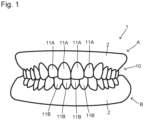
- Fig. 1 is a front view of dentures 1 including a group of artificial teeth 10 according to one embodiment.
- Fig. 2 shows the dentures 1 separated into an upper jaw A (upper side in Fig. 2 ) and a lower jaw B (lower side in Fig. 2 ) on the occlusal surfaces sides.
- the group of artificial teeth 10 of the present disclosure comprises plural artificial teeth 11.
- artificial teeth corresponding to an anterior teeth part a central incisor, a lateral incisor and a canine
- a posterior teeth part a first premolar, a second premolar, a first molar, a second molar and a third molar
- the present disclosure is not limited to this as long as a part of them is included.
- the sign A is added thereto
- the sign B is added thereto (for example, an artificial tooth on the upper jaw side is expressed with 11A, and an artificial tooth on the lower jaw side is expressed with 11B).
- the artificial teeth 11 are formed from a ceramic, or a synthetic resin, or a composite material thereof, and are fixed to denture bases 2 that are made from a resin and modeled on gingival parts.
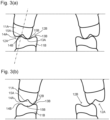
- Fig. 3 schematically shows the occlusal condition of artificial teeth 11 belonging to the posterior teeth parts in a centric occlusal position ( Fig. 3(a) ), and the occlusal condition of the artificial teeth 11 belonging to the posterior teeth parts in a lateral occlusal position ( Fig. 3(b) ).
- the group of artificial teeth 10 of the present embodiment are configured so that only lingual cusps 13A of maxillary artificial teeth 11A belonging to the posterior teeth parts come into contact with mandibular artificial teeth 11B belonging to the posterior teeth parts in a centric occlusal position and in a lateral occlusal position, that is, provides a lingualized occlusion.
- the artificial teeth 11 included in the group of artificial teeth 10 of the present disclosure have the following structure.
- the artificial teeth 11 each have a rugged occlusal surface 12.
- a convex lingual cusp 13, a convex buccal cusp 14, and a pit 15 that is the hollow between the lingual cusp 13 and the buccal cusp 14 are formed on this occlusal surface 12.
- the group of artificial teeth 10 of the present disclosure is designed to be suitable to be lingualized, and thus, as shown by IVa in Fig. 4(a) , is configured to have a suitable buccal convexity in the condition of a lingualized occlusion.
- the maxillary artificial teeth 11A belonging to the posterior teeth parts allow the buccal surfaces thereof to be expressed naturally from artificial teeth 11A belonging to the anterior teeth parts to enhance aesthetics.
- Such suitable convexities of the artificial teeth also contribute to marginal sealing.
- the sealed margin contributes to the suction of the dentures, and as a result, the stability of the dentures can be achieved.
- the lingual cusp 13A of each of the maxillary artificial teeth 11A belonging to the posterior teeth parts comes into contact with the inner surface of a pit 15B of each of the mandibular artificial teeth 11B belonging to the posterior teeth parts at two or more parts in a centric occlusal position.
- Fig. 5 is an explanatory view. Fig. 5 shows the contact condition between a maxillary artificial tooth 11A and a mandibular artificial tooth 11B which belong to posterior teeth parts in a centric occlusal position.
- the lingual cusp 13A of the maxillary artificial tooth 11A belonging to a posterior teeth part comes into contact with the inner side of the central fossa in the pit 15B of the mandibular artificial tooth 11B belonging to a posterior teeth part at two parts of P and Q, which are at the inner side of the pit 15B of the mandibular artificial tooth 11B.
- This stably leads to a centric occlusal position, and thus, can achieve the stability of the dentures, and improve masticatory efficiency.
- the contact at the two parts P and Q has been described as an example.
- the contact may be at three or more parts.
- Either P or Q may be the tip of the lingual cusp 13A of the maxillary artificial tooth 11A, but P and Q may include no tip.
- any one of the parts may include the tip, but the parts may include no tip of the lingual cusp 13A.
- a conventional aspect is such that only the tip of the lingual cusp of each maxillary artificial tooth belonging to the posterior teeth parts comes into contact with the pit of each mandibular artificial tooth belonging to the posterior teeth parts in a lingualized occlusion.
- a specific aspect for bringing the tip of the lingual cusp of each maxillary artificial tooth belonging to the posterior teeth parts into contact with the pit of each mandibular artificial tooth belonging to the posterior teeth parts at plural parts in a centric occlusal position is not particularly limited.
- the relation between a tip angle ( ⁇ 1 ) of the lingual cusp 13A of each of the maxillary artificial teeth 11A belonging to the posterior teeth parts, and an inclination angle ( ⁇ 2 ) of the pit 15B of each of the mandibular artificial teeth 11B belonging to the posterior teeth parts may be adjusted for the contact at plural parts as described above.
- Fig. 6 is an explanatory view.
- Fig. 6 is an exploded view of the maxillary artificial tooth 11A and the mandibular artificial tooth 11B of Fig. 5 with additional lines.
- the tip angle ⁇ 1 is the tip angle of the lingual cusp 13A of the maxillary artificial tooth 11A belonging to a posterior teeth part.
- the tip angle ⁇ 1 is obtained from the angle formed by the line L 1 defined by the inner bevel of the lingual cusp, and the line L 2 defined by the outer bevel of the lingual cusp on an extracted cross section of the lingual cusp 13A of the target maxillary artificial tooth 11A.
- the inclination angle ⁇ 2 is the angle showing the spread of the pit 15B of the mandibular artificial tooth 11B that is paired with the maxillary artificial tooth 11A having a tip angle of ⁇ 1 .
- the inclination angle ⁇ 2 is obtained from the angle formed by the line L 3 defined by the inner bevel of the mandibular buccal cusp, and the line L 4 defined by the inner bevel of the mandibular lingual cusp on an extracted cross section of the pit 15B of the target mandibular artificial tooth 11B.
- ⁇ 1 of the artificial tooth corresponding to the first molar tooth of the upper jaw and ⁇ 2 of the artificial tooth corresponding to the first molar tooth of the lower jaw are such that ⁇ 2 - ⁇ 1 is 15° to 32°.
- the distance between the tip of a buccal cusp 14B and the tip of a lingual cusp 13B in the pit 15B of each mandibular artificial tooth 11B belonging to the posterior teeth parts for the lingual cusp 13A of each maxillary artificial tooth 11A belonging to the posterior teeth parts is longer than that in a conventional group of artificial teeth which provides a lingualized occlusion.
- Fig. 6 includes the additional lines for the description.
- the ratio (W 2 /W 1 ) of the distance W 1 that is the width of the lingual cusp of the artificial tooth 11A corresponding to the first molar tooth of the upper jaw, and the width W 2 of the pit 15B of the artificial tooth 11B corresponding to the first molar tooth of the lower jaw in the buccolingual direction is set in 0.9 to 1.22.
- each maxillary artificial tooth 11A belonging to the posterior teeth parts makes it easy for the lingual cusp 13A of each maxillary artificial tooth 11A belonging to the posterior teeth parts to come to the inner side of the pit 15B of each mandibular artificial tooth 11B belonging to the posterior teeth parts even in the lateral movement(s) of (an) upper and/or lower jaw(s), tapping, etc., so that a stable occlusion can be obtained.
- the chewing cycle elongates, which can improve masticatory efficiency.
- Fig. 7 is an explanatory view. Fig. 7 shows the mandibular artificial tooth 11B belonging to a posterior teeth part on the occlusal surface 12B side (top), and on the mesial side (bottom).
- the ratio (S k /S j ) of S k to S j is set in 0.85 to 0.95 where S j is the area surrounded by the ridges of the buccal and lingual edges that pass the buccal and lingual cusp tips, and the mesial and distal marginal ridges, and S k is the area inside the external margin of the pit 15B which is shown by the dotted line (line connecting the tips of the cusps) on the occlusal surface when the mandibular artificial tooth 11B is viewed on the occlusal surface 12B side.
- each maxillary artificial tooth 11A belonging to the posterior teeth parts makes it easy for the lingual cusp 13A of each maxillary artificial tooth 11A belonging to the posterior teeth parts to enter the pit 15B of each mandibular posterior tooth 11B even in the lateral movement(s) of (an) upper and/or lower jaw(s), tapping, etc., so that a stable occlusion can be obtained.
- the chewing cycle elongates, which can improve masticatory efficiency.
- the aforementioned group of artificial teeth can be provided as a group of artificial teeth.
- the aforementioned group of artificial teeth can be provided as a prosthesis that is obtained by uniting the group of artificial teeth and a gingiva into one body and that has the shape of teeth which reproduces the inside of an oral cavity, and as a partial denture base or a denture base including the aforementioned combination of the upper and lower jaws of the group of artificial teeth. Any of these forms includes the group of artificial teeth of the present disclosure.
Landscapes
- Health & Medical Sciences (AREA)
- Oral & Maxillofacial Surgery (AREA)
- Dentistry (AREA)
- Epidemiology (AREA)
- Life Sciences & Earth Sciences (AREA)
- Animal Behavior & Ethology (AREA)
- General Health & Medical Sciences (AREA)
- Public Health (AREA)
- Veterinary Medicine (AREA)
- Dental Prosthetics (AREA)
- Dental Tools And Instruments Or Auxiliary Dental Instruments (AREA)
Abstract
Description
- The present disclosure relates to a group of artificial teeth which includes plural artificial teeth and is for making up dentures.
- A lingualized occlusion is one form of the occlusion of a group of artificial teeth which has plural artificial teeth and make up dentures. In the lingualized occlusion, a group of artificial teeth is configured in such a way that only the lingual cusps of the maxillary posterior teeth come into contact with the mandibular posterior teeth in a maximal intercuspal position (centric occlusal position) and an eccentric occlusal position (lateral occlusal position; posture after a lateral sliding movement). This brings about effects such that: dentures are stabilized because this guides an occlusal force to the lingual side; masticatory efficiency is improved; and dentures can be prevented from tilting because this causes a lateral occlusal pressure to be applied by the median side. Therefore, the lingualized occlusion may be applied to, for example, patients requiring complete dentures who suffer from marked residual ridge resorption.
-
Patent literatures 1 and 2 disclose a group of artificial teeth which is applicable not only to a full-balanced occlusion, but also to a lingualized occlusion. -
- [Patent Literature 1]
JP 2017-209406 A - [Patent Literature 2]
Japanese Translation of PCT Application No. 2021-525592 - In the lingualized occlusion, only the lingual cusps of the maxillary posterior teeth are occluded with the central fossae of the mandibular posterior teeth. However, when general artificial teeth are arranged to form dentures that provide a lingualized occlusion, the problem such that the stability of the dentures decreases arises in addition to the problem of the deterioration in aesthetics because: it is necessary to incline the teeth axes for occluding only the lingual cusps of the maxillary posterior teeth, which results in the vicinities of the cusp tips on the maxillary buccal sides in the form of protruding to the buccal sides, and thus, the lateral surfaces on the buccal sides (convexities) are necessary to be shaved, which results in the vicinity of each cervical part on the maxillary buccal sides in a concave form, so that the vicinity has the lack of a convexity. In cases of an unstable jaw position and an unstable temporomandibular joint, the upper and lower positional relationship does not converge on one point, and thus, becomes unstable, which cannot be treated with artificial teeth of narrow occlusal surfaces, which is problematic.
- An object of the present disclosure is to provide a group of artificial teeth which provides dentures with high stability in a lingualized occlusion.
- The present application discloses a group of artificial teeth having plural artificial teeth on each of upper and lower jaw sides, the upper and lower jaw sides being in an occlusal style based on a lingualized occlusion, wherein in artificial teeth belonging to posterior teeth parts among the plural artificial teeth on the upper and lower jaw sides, buccal convexity of artificial teeth on the upper jaw side is in a form of convexity suitable in the lingualized occlusion, in a centric occlusal position, a lingual cusp of each of the artificial teeth on the upper jaw side is fit in a central fossa of each of artificial teeth on the lower jaw side, a ratio represented by W2/W1 is 0.9 to 1.22 where W1 is a width of a lingual cusp of one of the artificial teeth, the one corresponding to a maxillary first molar tooth, and W2 is a width of a pit of one of the artificial teeth in a buccolingual direction, the one corresponding to a mandibular first molar tooth, and a ratio represented by Sk/Sj is 0.85 to 0.95 where, when the artificial tooth corresponding to the mandibular first molar tooth is viewed from an occlusal surface, Sj is an area surrounded by ridges of buccal and lingual edges that pass buccal and lingual cusp tips in the occlusal surface, and mesial and distal marginal ridges, and Sk is an area surrounded by an edge of the pit in the occlusal surface.
- The group of artificial teeth may be configured in such a way that θ2 - θ1 is 15° to 32° where θ1 is an angle formed by the lingual cusp of the artificial tooth corresponding to the maxillary first molar tooth, and θ2 is an angle formed by inclination of the pit of the artificial tooth corresponding to the mandibular first molar tooth.
- According to the present disclosure, a group of artificial teeth can provide dentures with high occlusal stability in a lingualized occlusion.
-
- [
Fig. 1] Fig. 1 is a front view of dentures 1 including a group ofartificial teeth 10. - [
Fig. 2] Fig. 2 shows an upper jaw A and a lower jaw B on the occlusal surfaces sides. - [
Fig. 3] Fig. 3 shows the postures ofartificial teeth 11A andartificial teeth 11B which belong to the posterior teeth parts in a centric occlusal position (Fig. 3(a) ) and in a lateral occlusal position (Fig. 3(b) ). - [
Fig. 4] Fig. 4(a) illustrates buccal convexity of maxillaryartificial teeth 11A belonging to a posterior teeth part in the present embodiment.Fig. 4(b) shows buccal convexity of maxillary artificial teeth belonging to a posterior teeth part in the conventional. - [
Fig. 5] Fig. 5 illustrates a contact state of artificial teeth 11 belonging to posterior teeth parts in a centric occlusal position. - [
Fig. 6] Fig. 6 illustrates a form of a maxillaryartificial tooth 11A and a mandibularartificial tooth 11B which belong to the posterior teeth parts. - [
Fig. 7] Fig. 7 illustrates a form of the mandibularartificial tooth 11B belonging to a posterior teeth part. -
Fig. 1 is a front view of dentures 1 including a group ofartificial teeth 10 according to one embodiment.Fig. 2 shows the dentures 1 separated into an upper jaw A (upper side inFig. 2 ) and a lower jaw B (lower side inFig. 2 ) on the occlusal surfaces sides. - As can be seen from these drawings, the group of
artificial teeth 10 of the present disclosure comprises plural artificial teeth 11. In this embodiment, as the artificial teeth 11, artificial teeth corresponding to an anterior teeth part (a central incisor, a lateral incisor and a canine) and a posterior teeth part (a first premolar, a second premolar, a first molar, a second molar and a third molar) are included on each right and left side on each of the upper jaw A and the lower jaw B. The present disclosure is not limited to this as long as a part of them is included. - For distinguishing between the upper and lower jaws, when a part on the upper jaw side is described, the sign A is added thereto, and when a part on the lower jaw side is described, the sign B is added thereto (for example, an artificial tooth on the upper jaw side is expressed with 11A, and an artificial tooth on the lower jaw side is expressed with 11B).
- The artificial teeth 11 are formed from a ceramic, or a synthetic resin, or a composite material thereof, and are fixed to
denture bases 2 that are made from a resin and modeled on gingival parts. -
Fig. 3 schematically shows the occlusal condition of artificial teeth 11 belonging to the posterior teeth parts in a centric occlusal position (Fig. 3(a) ), and the occlusal condition of the artificial teeth 11 belonging to the posterior teeth parts in a lateral occlusal position (Fig. 3(b) ). As can be seen fromFig. 3 , the group ofartificial teeth 10 of the present embodiment are configured so that onlylingual cusps 13A of maxillaryartificial teeth 11A belonging to the posterior teeth parts come into contact with mandibularartificial teeth 11B belonging to the posterior teeth parts in a centric occlusal position and in a lateral occlusal position, that is, provides a lingualized occlusion. - The artificial teeth 11 included in the group of
artificial teeth 10 of the present disclosure have the following structure. - Here, the artificial teeth 11 each have a rugged occlusal surface 12. On each posterior tooth, a convex
lingual cusp 13, a convex buccal cusp 14, and a pit 15 that is the hollow between thelingual cusp 13 and the buccal cusp 14 are formed on this occlusal surface 12. - In a lingualized occlusion, as shown by the dashed dotted line in
Fig. 3(a) , it is necessary to incline the tooth axis of each maxillaryartificial tooth 11A belonging to the posterior teeth parts in such a way that the closer to anocclusal surface 12A, the closer to the buccal side. In contrast, since cervicobuccal parts are in concave forms, patients feel uncomfortable on the maxillary buccal sides, and/or have some problem with the dentures in stability when the dentures degrade in marginal sealing property. Not only the problem on occlusion, but also a cosmetic problem because of bumps caused by the differences in the convexity from anterior teeth to posterior teeth as shown by IVb inFig. 4(b) arises. - Conventional artificial teeth have problems as described above because it is necessary that the maxillary lingual cusps occlude, but the maxillary buccal cusps not occlude (be separate). The group of
artificial teeth 10 of the present disclosure is designed to be suitable to be lingualized, and thus, as shown by IVa inFig. 4(a) , is configured to have a suitable buccal convexity in the condition of a lingualized occlusion. - According to this, the maxillary
artificial teeth 11A belonging to the posterior teeth parts allow the buccal surfaces thereof to be expressed naturally fromartificial teeth 11A belonging to the anterior teeth parts to enhance aesthetics. Such suitable convexities of the artificial teeth also contribute to marginal sealing. The sealed margin contributes to the suction of the dentures, and as a result, the stability of the dentures can be achieved. - In the group of
artificial teeth 10 of the present embodiment, thelingual cusp 13A of each of the maxillaryartificial teeth 11A belonging to the posterior teeth parts comes into contact with the inner surface of apit 15B of each of the mandibularartificial teeth 11B belonging to the posterior teeth parts at two or more parts in a centric occlusal position.Fig. 5 is an explanatory view.Fig. 5 shows the contact condition between a maxillaryartificial tooth 11A and a mandibularartificial tooth 11B which belong to posterior teeth parts in a centric occlusal position. - As can be seen from
Fig. 5 , in a centric occlusal position, thelingual cusp 13A of the maxillaryartificial tooth 11A belonging to a posterior teeth part comes into contact with the inner side of the central fossa in thepit 15B of the mandibularartificial tooth 11B belonging to a posterior teeth part at two parts of P and Q, which are at the inner side of thepit 15B of the mandibularartificial tooth 11B. This stably leads to a centric occlusal position, and thus, can achieve the stability of the dentures, and improve masticatory efficiency. - Here, the contact at the two parts P and Q has been described as an example. The contact may be at three or more parts. Either P or Q may be the tip of the
lingual cusp 13A of the maxillaryartificial tooth 11A, but P and Q may include no tip. Similarly, when the contact is at three or more parts, any one of the parts may include the tip, but the parts may include no tip of thelingual cusp 13A. - A conventional aspect is such that only the tip of the lingual cusp of each maxillary artificial tooth belonging to the posterior teeth parts comes into contact with the pit of each mandibular artificial tooth belonging to the posterior teeth parts in a lingualized occlusion.
- The occlusal surfaces have complex unevenness. Thus, a specific aspect for bringing the tip of the lingual cusp of each maxillary artificial tooth belonging to the posterior teeth parts into contact with the pit of each mandibular artificial tooth belonging to the posterior teeth parts at plural parts in a centric occlusal position is not particularly limited. As one approach among such aspects, the relation between a tip angle (θ1) of the
lingual cusp 13A of each of the maxillaryartificial teeth 11A belonging to the posterior teeth parts, and an inclination angle (θ2) of thepit 15B of each of the mandibularartificial teeth 11B belonging to the posterior teeth parts may be adjusted for the contact at plural parts as described above.Fig. 6 is an explanatory view.Fig. 6 is an exploded view of the maxillaryartificial tooth 11A and the mandibularartificial tooth 11B ofFig. 5 with additional lines. - The tip angle θ1 is the tip angle of the
lingual cusp 13A of the maxillaryartificial tooth 11A belonging to a posterior teeth part. The tip angle θ1 is obtained from the angle formed by the line L1 defined by the inner bevel of the lingual cusp, and the line L2 defined by the outer bevel of the lingual cusp on an extracted cross section of thelingual cusp 13A of the target maxillaryartificial tooth 11A. - In contrast, the inclination angle θ2 is the angle showing the spread of the
pit 15B of the mandibularartificial tooth 11B that is paired with the maxillaryartificial tooth 11A having a tip angle of θ1. The inclination angle θ2 is obtained from the angle formed by the line L3 defined by the inner bevel of the mandibular buccal cusp, and the line L4 defined by the inner bevel of the mandibular lingual cusp on an extracted cross section of thepit 15B of the target mandibularartificial tooth 11B. - For bringing the tip of the lingual cusp of an artificial tooth corresponding to the first molar tooth of the upper jaw into contact with the pit of an artificial tooth corresponding to the first molar tooth of the lower jaw at plural parts in a centric occlusal position, θ1 of the artificial tooth corresponding to the first molar tooth of the upper jaw and θ2 of the artificial tooth corresponding to the first molar tooth of the lower jaw are such that θ2 - θ1 is 15° to 32°.
- In the group of
artificial teeth 10 of the present embodiment, the distance between the tip of abuccal cusp 14B and the tip of alingual cusp 13B in thepit 15B of each mandibularartificial tooth 11B belonging to the posterior teeth parts for thelingual cusp 13A of each maxillaryartificial tooth 11A belonging to the posterior teeth parts is longer than that in a conventional group of artificial teeth which provides a lingualized occlusion.Fig. 6 includes the additional lines for the description. - As can be seen from
Fig. 6 , the ratio (W2/W1) of the distance W1 that is the width of the lingual cusp of theartificial tooth 11A corresponding to the first molar tooth of the upper jaw, and the width W2 of thepit 15B of theartificial tooth 11B corresponding to the first molar tooth of the lower jaw in the buccolingual direction (distance between the tip of thebuccal cusp 14B and the tip of thelingual cusp 13B in thepit 15B of theartificial tooth 11B corresponding to the mandibular first molar tooth) is set in 0.9 to 1.22. - This makes it easy for the
lingual cusp 13A of each maxillaryartificial tooth 11A belonging to the posterior teeth parts to come to the inner side of thepit 15B of each mandibularartificial tooth 11B belonging to the posterior teeth parts even in the lateral movement(s) of (an) upper and/or lower jaw(s), tapping, etc., so that a stable occlusion can be obtained. In addition, the chewing cycle elongates, which can improve masticatory efficiency. - In the group of
artificial teeth 10 of the present embodiment, the opening of thepit 15B of each mandibularartificial tooth 11B belonging to the posterior teeth parts is formed to be large.Fig. 7 is an explanatory view.Fig. 7 shows the mandibularartificial tooth 11B belonging to a posterior teeth part on theocclusal surface 12B side (top), and on the mesial side (bottom). - As can be seen from
Fig. 7 , in the present embodiment, the ratio (Sk/Sj) of Sk to Sj is set in 0.85 to 0.95 where Sj is the area surrounded by the ridges of the buccal and lingual edges that pass the buccal and lingual cusp tips, and the mesial and distal marginal ridges, and Sk is the area inside the external margin of thepit 15B which is shown by the dotted line (line connecting the tips of the cusps) on the occlusal surface when the mandibularartificial tooth 11B is viewed on theocclusal surface 12B side. - This makes it easy for the
lingual cusp 13A of each maxillaryartificial tooth 11A belonging to the posterior teeth parts to enter thepit 15B of eachmandibular posterior tooth 11B even in the lateral movement(s) of (an) upper and/or lower jaw(s), tapping, etc., so that a stable occlusion can be obtained. In addition, the chewing cycle elongates, which can improve masticatory efficiency. - The aforementioned group of artificial teeth can be provided as a group of artificial teeth. Other than this, the aforementioned group of artificial teeth can be provided as a prosthesis that is obtained by uniting the group of artificial teeth and a gingiva into one body and that has the shape of teeth which reproduces the inside of an oral cavity, and as a partial denture base or a denture base including the aforementioned combination of the upper and lower jaws of the group of artificial teeth. Any of these forms includes the group of artificial teeth of the present disclosure.
-
- 1 dentures
- 10 group of artificial teeth
- 11 artificial teeth
- 12 occlusal surface
- 13 lingual cusp
- 14 buccal cusp
- 15 pit
Claims (2)
- A group of artificial teeth having plural artificial teeth on each of upper and lower jaw sides, the upper and lower jaw sides being in an occlusal style based on a lingualized occlusion, whereinin artificial teeth belonging to posterior teeth parts among the plural artificial teeth on the upper and lower jaw sides,buccal convexity of artificial teeth on the upper jaw side is in a form of convexity suitable in the lingualized occlusion,in a centric occlusal position, a lingual cusp of each of the artificial teeth on the upper jaw side is fit in a central fossa of each of artificial teeth on the lower jaw side,a ratio represented by W2/W1 is 0.9 to 1.22 where W1 is a width of a lingual cusp of one of the artificial teeth, the one corresponding to a first molar tooth on the upper jaw side, and W2 is a width of a pit of one of the artificial teeth in a buccolingual direction, the one corresponding to a first molar tooth on the lower jaw side, anda ratio represented by Sk/Sj is 0.85 to 0.95 where, when the artificial tooth corresponding to the first molar tooth on the lower jaw side is viewed from an occlusal surface, Sj is an area surrounded by ridges of buccal and lingual edges that pass buccal and lingual cusp tips, and mesial and distal marginal ridges in the occlusal surface, and Sk is an area surrounded by an edge of the pit in the occlusal surface.
- The group of artificial teeth according to claim 1, wherein
θ2 - θ1 is 15° to 32° where θ1 is an angle formed by the lingual cusp of the artificial tooth corresponding to the first molar tooth on the upper jaw side, and θ2 is an angle formed by inclination of the pit of the artificial tooth corresponding to the first molar tooth on the lower jaw side.
Applications Claiming Priority (2)
| Application Number | Priority Date | Filing Date | Title |
|---|---|---|---|
| JP2022055852A JP2023148030A (en) | 2022-03-30 | 2022-03-30 | artificial teeth group |
| PCT/JP2023/005979 WO2023188996A1 (en) | 2022-03-30 | 2023-02-20 | Set of artificial teeth |
Publications (2)
| Publication Number | Publication Date |
|---|---|
| EP4501277A1 true EP4501277A1 (en) | 2025-02-05 |
| EP4501277A4 EP4501277A4 (en) | 2026-04-01 |
Family
ID=88200392
Family Applications (1)
| Application Number | Title | Priority Date | Filing Date |
|---|---|---|---|
| EP23779026.6A Pending EP4501277A4 (en) | 2022-03-30 | 2023-02-20 | ARTIFICIAL DENTURES |
Country Status (6)
| Country | Link |
|---|---|
| US (1) | US20250366961A1 (en) |
| EP (1) | EP4501277A4 (en) |
| JP (1) | JP2023148030A (en) |
| KR (1) | KR20230160332A (en) |
| CN (1) | CN117440787A (en) |
| WO (1) | WO2023188996A1 (en) |
Family Cites Families (8)
| Publication number | Priority date | Publication date | Assignee | Title |
|---|---|---|---|---|
| JP2002177301A (en) * | 2000-12-17 | 2002-06-25 | Gc Dental Products Corp | Artificial molars |
| JP2003135489A (en) * | 2001-11-08 | 2003-05-13 | Shiken:Kk | Artificial teeth and dentures with them |
| JP4338649B2 (en) * | 2003-05-01 | 2009-10-07 | ヘレウスクルツァージャパン株式会社 | Artificial teeth |
| WO2008129673A1 (en) * | 2007-04-18 | 2008-10-30 | Kabushiki Kaisha Shofu | Artificial teeth |
| JP2013135875A (en) * | 2013-02-25 | 2013-07-11 | Shofu Inc | Artificial tooth |
| GB2532060B (en) * | 2014-11-07 | 2020-09-16 | Davis Schottlander & Davis Ltd | Artificial teeth |
| JP6708856B2 (en) | 2016-05-27 | 2020-06-10 | 株式会社ジーシーデンタルプロダクツ | Artificial molar arrangement jig |
| WO2019232327A1 (en) | 2018-06-01 | 2019-12-05 | Dentsply Sirona Inc. | Methods of digitally designing artificial teeth |
-
2022
- 2022-03-30 JP JP2022055852A patent/JP2023148030A/en active Pending
-
2023
- 2023-02-20 KR KR1020237036007A patent/KR20230160332A/en active Pending
- 2023-02-20 EP EP23779026.6A patent/EP4501277A4/en active Pending
- 2023-02-20 WO PCT/JP2023/005979 patent/WO2023188996A1/en not_active Ceased
- 2023-02-20 US US18/852,233 patent/US20250366961A1/en active Pending
- 2023-02-20 CN CN202380012187.4A patent/CN117440787A/en active Pending
Also Published As
| Publication number | Publication date |
|---|---|
| JP2023148030A (en) | 2023-10-13 |
| CN117440787A (en) | 2024-01-23 |
| EP4501277A4 (en) | 2026-04-01 |
| WO2023188996A1 (en) | 2023-10-05 |
| US20250366961A1 (en) | 2025-12-04 |
| KR20230160332A (en) | 2023-11-23 |
Similar Documents
| Publication | Publication Date | Title |
|---|---|---|
| US20140322671A1 (en) | Artificial tooth, a jig for arranging the same, an arrangement method of the same and a denture | |
| CN106687067A (en) | Dental appliance with repositioning jaw elements | |
| US5326262A (en) | Method of making cuspless artificial dentition | |
| US5501598A (en) | Dental tooth system | |
| CN109640875B (en) | Denture systems and prostheses used in denture systems | |
| JP2002177301A (en) | Artificial molars | |
| US6935861B2 (en) | Sets of posterior teeth | |
| US11266486B2 (en) | Positioning handle and occlusal locks for removable prosthesis | |
| JP2004049915A (en) | Bridge apparatus of setting type pairing fixation | |
| CN115581533A (en) | A full-mouth adsorption denture device with mechanical retention | |
| JPH08280713A (en) | Denture set | |
| US20250366961A1 (en) | Group of artificial teeth | |
| JP4546572B1 (en) | Artificial molar | |
| JPH11290347A (en) | Artificial molars | |
| EP4501278A1 (en) | Set of artificial teeth | |
| US12370018B2 (en) | Orthodontic aligner with bulges | |
| JPH11342139A (en) | Artificial molar set for denture | |
| KR102353106B1 (en) | Ready-made Zirconia Crown Space Maintainer For Dentition of Permanent Tooth, And Install Method Using The Same | |
| CN111698963B (en) | Defective tooth supplementary type dental prosthesis | |
| CN103841918B (en) | Artificial tooth | |
| EP3470011B1 (en) | Denture system | |
| JP6239181B1 (en) | Partial denture | |
| Vig | Splinting bars and maxillary indirect retainers for removable partial dentures | |
| JP2002165812A (en) | Method of making denture | |
| TWM611754U (en) | Shell-shaped dental appliance, dental appliance kit and dental appliance device |
Legal Events
| Date | Code | Title | Description |
|---|---|---|---|
| STAA | Information on the status of an ep patent application or granted ep patent |
Free format text: STATUS: THE INTERNATIONAL PUBLICATION HAS BEEN MADE |
|
| PUAI | Public reference made under article 153(3) epc to a published international application that has entered the european phase |
Free format text: ORIGINAL CODE: 0009012 |
|
| STAA | Information on the status of an ep patent application or granted ep patent |
Free format text: STATUS: REQUEST FOR EXAMINATION WAS MADE |
|
| 17P | Request for examination filed |
Effective date: 20241010 |
|
| AK | Designated contracting states |
Kind code of ref document: A1 Designated state(s): AL AT BE BG CH CY CZ DE DK EE ES FI FR GB GR HR HU IE IS IT LI LT LU LV MC ME MK MT NL NO PL PT RO RS SE SI SK SM TR |
|
| DAV | Request for validation of the european patent (deleted) | ||
| DAX | Request for extension of the european patent (deleted) | ||
| A4 | Supplementary search report drawn up and despatched |
Effective date: 20260303 |
|
| RIC1 | Information provided on ipc code assigned before grant |
Ipc: A61C 13/097 20060101AFI20260225BHEP Ipc: A61C 13/34 20060101ALI20260225BHEP |