EP4498728A1 - Audio playback method and device - Google Patents
Audio playback method and device Download PDFInfo
- Publication number
- EP4498728A1 EP4498728A1 EP24152829.8A EP24152829A EP4498728A1 EP 4498728 A1 EP4498728 A1 EP 4498728A1 EP 24152829 A EP24152829 A EP 24152829A EP 4498728 A1 EP4498728 A1 EP 4498728A1
- Authority
- EP
- European Patent Office
- Prior art keywords
- ble
- audio playback
- playback device
- ble audio
- bonded
- Prior art date
- Legal status (The legal status is an assumption and is not a legal conclusion. Google has not performed a legal analysis and makes no representation as to the accuracy of the status listed.)
- Withdrawn
Links
Images



Classifications
-
- H—ELECTRICITY
- H04—ELECTRIC COMMUNICATION TECHNIQUE
- H04R—LOUDSPEAKERS, MICROPHONES, GRAMOPHONE PICK-UPS OR LIKE ACOUSTIC ELECTROMECHANICAL TRANSDUCERS; ELECTRIC HEARING AIDS; PUBLIC ADDRESS SYSTEMS
- H04R3/00—Circuits for transducers
- H04R3/12—Circuits for transducers for distributing signals to two or more loudspeakers
-
- G—PHYSICS
- G06—COMPUTING OR CALCULATING; COUNTING
- G06F—ELECTRIC DIGITAL DATA PROCESSING
- G06F3/00—Input arrangements for transferring data to be processed into a form capable of being handled by the computer; Output arrangements for transferring data from processing unit to output unit, e.g. interface arrangements
- G06F3/16—Sound input; Sound output
- G06F3/162—Interface to dedicated audio devices, e.g. audio drivers, interface to CODECs
-
- H—ELECTRICITY
- H04—ELECTRIC COMMUNICATION TECHNIQUE
- H04M—TELEPHONIC COMMUNICATION
- H04M1/00—Substation equipment, e.g. for use by subscribers
- H04M1/60—Substation equipment, e.g. for use by subscribers including speech amplifiers
- H04M1/6033—Substation equipment, e.g. for use by subscribers including speech amplifiers for providing handsfree use or a loudspeaker mode in telephone sets
- H04M1/6041—Portable telephones adapted for handsfree use
- H04M1/6058—Portable telephones adapted for handsfree use involving the use of a headset accessory device connected to the portable telephone
- H04M1/6066—Portable telephones adapted for handsfree use involving the use of a headset accessory device connected to the portable telephone including a wireless connection
-
- H—ELECTRICITY
- H04—ELECTRIC COMMUNICATION TECHNIQUE
- H04R—LOUDSPEAKERS, MICROPHONES, GRAMOPHONE PICK-UPS OR LIKE ACOUSTIC ELECTROMECHANICAL TRANSDUCERS; ELECTRIC HEARING AIDS; PUBLIC ADDRESS SYSTEMS
- H04R29/00—Monitoring arrangements; Testing arrangements
- H04R29/001—Monitoring arrangements; Testing arrangements for loudspeakers
- H04R29/002—Loudspeaker arrays
-
- H—ELECTRICITY
- H04—ELECTRIC COMMUNICATION TECHNIQUE
- H04W—WIRELESS COMMUNICATION NETWORKS
- H04W36/00—Hand-off or reselection arrangements
- H04W36/03—Reselecting a link using a direct mode connection
- H04W36/035—Reselecting a link using a direct mode connection in self-organising networks
-
- H—ELECTRICITY
- H04—ELECTRIC COMMUNICATION TECHNIQUE
- H04W—WIRELESS COMMUNICATION NETWORKS
- H04W36/00—Hand-off or reselection arrangements
- H04W36/24—Reselection being triggered by specific parameters
- H04W36/30—Reselection being triggered by specific parameters by measured or perceived connection quality data
- H04W36/304—Reselection being triggered by specific parameters by measured or perceived connection quality data due to measured or perceived resources with higher communication quality
-
- H—ELECTRICITY
- H04—ELECTRIC COMMUNICATION TECHNIQUE
- H04W—WIRELESS COMMUNICATION NETWORKS
- H04W36/00—Hand-off or reselection arrangements
- H04W36/24—Reselection being triggered by specific parameters
- H04W36/32—Reselection being triggered by specific parameters by location or mobility data, e.g. speed data
- H04W36/322—Reselection being triggered by specific parameters by location or mobility data, e.g. speed data by location data
-
- H—ELECTRICITY
- H04—ELECTRIC COMMUNICATION TECHNIQUE
- H04R—LOUDSPEAKERS, MICROPHONES, GRAMOPHONE PICK-UPS OR LIKE ACOUSTIC ELECTROMECHANICAL TRANSDUCERS; ELECTRIC HEARING AIDS; PUBLIC ADDRESS SYSTEMS
- H04R2420/00—Details of connection covered by H04R, not provided for in its groups
- H04R2420/01—Input selection or mixing for amplifiers or loudspeakers
-
- H—ELECTRICITY
- H04—ELECTRIC COMMUNICATION TECHNIQUE
- H04R—LOUDSPEAKERS, MICROPHONES, GRAMOPHONE PICK-UPS OR LIKE ACOUSTIC ELECTROMECHANICAL TRANSDUCERS; ELECTRIC HEARING AIDS; PUBLIC ADDRESS SYSTEMS
- H04R2420/00—Details of connection covered by H04R, not provided for in its groups
- H04R2420/07—Applications of wireless loudspeakers or wireless microphones
-
- H—ELECTRICITY
- H04—ELECTRIC COMMUNICATION TECHNIQUE
- H04W—WIRELESS COMMUNICATION NETWORKS
- H04W36/00—Hand-off or reselection arrangements
- H04W36/16—Performing reselection for specific purposes
- H04W36/18—Performing reselection for specific purposes for allowing seamless reselection, e.g. soft reselection
- H04W36/185—Performing reselection for specific purposes for allowing seamless reselection, e.g. soft reselection using make before break
-
- H—ELECTRICITY
- H04—ELECTRIC COMMUNICATION TECHNIQUE
- H04W—WIRELESS COMMUNICATION NETWORKS
- H04W4/00—Services specially adapted for wireless communication networks; Facilities therefor
- H04W4/80—Services using short range communication, e.g. near-field communication [NFC], radio-frequency identification [RFID] or low energy communication
-
- H—ELECTRICITY
- H04—ELECTRIC COMMUNICATION TECHNIQUE
- H04W—WIRELESS COMMUNICATION NETWORKS
- H04W84/00—Network topologies
- H04W84/18—Self-organising networks, e.g. ad-hoc networks or sensor networks
Definitions
- This disclosure relates to an audio playback method and device for Bluetooth Low Energy (BLE) systems.
- BLE Bluetooth Low Energy
- Bluetooth low energy is a wireless personal area network which is part of the Bluetooth specification.
- the Bluetooth LE Audio specification standardizes audio transmission with BLE Systems. Such Bluetooth Low Energy systems allow a single BLE audio source device to transmit audio streams to multiple BLE audio receiver devices such as BLE loudspeakers or headphones. Conversely a single BLE audio receiver device may be connected to multiple audio source devices.
- An audio playback method for a Bluetooth low energy, BLE comprising a BLE audio source device having at least two BLE transceivers, a plurality of BLE audio playback devices configured to be bonded to the BLE audio source device, a first BLE audio playback device of the plurality of BLE audio playback devices configured to initially have an active connection to the BLE audio source device, the method comprising: sending audio data from the BLE audio source device to the first BLE audio playback device; determining a metric of an active connection signal transmitted from the first BLE audio playback device to the BLE audio source device ; determining a metric of a bonded connection signal transmitted from a second BLE audio playback device of the plurality of BLE audio playback devices to the BLE audio source device; determining whether to handover the active connection to the second BLE audio playback device depending on at least the bonded connection signal metric; and in response to determining to handover
- the BLE audio source device is configured as a scanner
- the first and second BLE audio playback devices are configured to transmit advertiser, ADV, packets
- the method further comprises: receiving the ADV packets by the BLE audio source device from the first and second BLE audio playback devices; and determining the active connection signal metric and the bonded connection signal metric from the ADV packets.
- determining the active connection signal metric and the bonded connection signal metric comprises determining a received signal strength indication (RSSI) of the respective connection.
- RSSI received signal strength indication
- determining whether to handover the active connection to the second BLE audio playback device further comprises: comparing a bonded connection RSSI to a RSSI proximity threshold value; and determining that the second BLE audio playback device is a better candidate for audio playback than the first BLE audio playback device if the bonded connection RSSI is above the RSSI proximity threshold value.
- determining the active connection signal metric and the bonded connection signal metric comprises determining a time-of-flight (ToF) of the respective connection signal.
- ToF time-of-flight
- determining whether to handover the active connection to the second BLE audio playback device further comprises: comparing a bonded connection time-of-flight, ToF, to a ToF proximity threshold value; and determining that the second BLE audio playback device is a better candidate for audio playback than the first BLE audio playback device if the bonded connection ToF is less than the ToF proximity threshold value.
- determining the active connection signal metric and the bonded connection signal metric comprises determining an angle-of-arrival of the respective connection signal.
- determining whether to handover the active connection to the second BLE audio playback device further comprises: detecting a change in the angle-of-arrival of the bonded connection signal in response to at least one of the bonded signal RSSI being less than a RSSI proximity threshold value and the bonded signal ToF being greater than a ToF proximity threshold value.
- determining whether to handover the active connection to the second BLE audio playback device further comprises: comparing the bonded connection signal RSSI with the active connection signal RSSI.
- determining whether to handover the active connection to the second BLE audio playback device further comprises: comparing the bonded connection signal ToF with the active connection signal ToF.
- determining the active connection signal metric and the bonded connection signal metric comprises determining a signal-to-noise ratio, SNR, of the respective connection signal.
- a Bluetooth low energy, BLE, audio source device comprising two BLE transceivers and configured to be bonded to a plurality BLE audio playback devices, and to initially have an active connection to a first BLE audio playback device of a plurality of BLE audio playback, BLE audio source device configured to: send audio data to the first BLE audio playback device; determine a metric of an active connection signal received from the first BLE audio playback device; determine a metric of a bonded connection signal received from a second BLE audio playback device of the plurality of BLE audio playback devices ; determine whether to handover the active connection to the second BLE audio playback device depending on at least the bonded connection signal metric; and in response to determining to handover the active connection to the second BLE audio playback device, the BLE audio source device is further configured to hand over the active connection to the second BLE audio playback device by: initiating a connection request to the second BLE audio playback device; and sending audio data to the second
- the BLE audio source device is configured to: receive advertiser (ADV) packets from the first and second BLE audio playback devices; and determine the active connection signal metric and the bonded connection signal metric from the ADV packets.
- ADV advertiser
- the active connection signal metric and the bonded connection signal metric comprises at least one of a received signal strength indication, RSSI, a time-of-flight, ToF, an angle-of-arrival, and a signal to noise ratio, SNR, of the respective connection signal.
- the BLE audio source device is configured to determine whether to handover the active connection to the second BLE audio playback device by: comparing a bonded connection RSSI to a RSSI proximity threshold value; and further configured to determine that the second BLE audio playback device is a better candidate for audio playback than the first BLE audio playback device if the bonded connection RSSI is above the RSSI proximity threshold value.
- the BLE audio source device is configured to determine whether to handover the active connection to the second BLE audio playback device by: comparing a bonded connection time-of-flight, ToF, to a ToF proximity threshold value; and further configured to determine that the second BLE audio playback device is a better candidate for audio playback than the first BLE audio playback device if the bonded connection ToF is less than the ToF proximity threshold value.
- the BLE audio source device is configured to determine whether to handover the active connection to the second BLE audio playback device by: detecting a change in the angle-of-arrival of the bonded connection signal in response to at least one of a bonded connection signal RSSI being less than a RSSI proximity threshold value and a bonded connection signal ToF being greater than a ToF proximity threshold value.
- the BLE audio source device is configured to determine whether to handover the active connection to the second BLE audio playback device by: comparing a bonded connection signal RSSI with an active connection signal RSSI.
- the BLE audio source device is configured to determine whether to handover the active connection to the second BLE audio playback device by: comparing a bonded connection signal ToF with an active connection signal ToF.
- a BLE audio system may include embodiments of the BLE audio source device wirelessly coupled to a plurality BLE audio playback devices.
- FIGs 1A, 1B, 1C shows a connection handover event for an audio BLE system 100.
- the audio BLE system 100 includes an audio source device 114, which as illustrated is a mobile phone, and audio receiver devices 102, 104, 106 which may be BLE loudspeakers. Audio receiver devices may also be referred to herein as BLE audio playback devices.
- the audio source device 114 has a BLE transceiver (not shown).
- the audio receiver devices 102, 104, 106 may for example be located in different rooms.
- the audio source device 114 has an active Bluetooth connection 110 to the audio receiver device 104 via the BLE transceiver.
- the other audio receiver devices 102, 106 are bonded (i.e.
- the audio source device 114 may determine a metric for the monitored connections 108, 112.
- a metric for example may include but is not limited to angle-of-arrival (AoA), received signal strength indication (RSSI), time-of-flight (ToF), and signal-to-noise ratio (SNR) of the active connection signal and bonded connection signal received respectively from the audio receiver devices 102, 106.
- a metric for example may include but is not limited to angle-of-arrival (AoA), received signal strength indication (RSSI), time-of-flight (ToF), and signal-to-noise ratio (SNR) of the active connection signal and bonded connection signal received respectively from the audio receiver devices 102, 106.
- the connection change criteria has been met which may for example be the due to the location of the audio source device 114 changing, for example by the user moving to a different room.
- a connection 112 between the audio source device 114 and audio receiver device 106 becomes a new active connection.
- the active connection 110 between the audio source device 114 and the audio receiver device 104 remains until the new active connection 112 is established for example by being reported by the Bluetooth software stack via a call-back containing the event information to establish the new connection.
- the term Bluetooth software stack, or Bluetooth stack as used herein may be considered as referring to software that is an implementation of the Bluetooth protocol stack. The information provided in the callback are standardized but the method of implementation may be different.
- the new active connection 112 has been established, the previous active connection 110 is dropped as shown in Figure 1C .
- the audio receiver device 104 may remain bonded to the audio source device and the connection 110 can still be monitored.
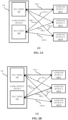
- FIGS. 2A, 2B , 2C shows an audio BLE system 150 according to an embodiment in different modes of operation.
- a BLE audio source device 162 may have a first BLE transceiver 152 and a second BLE transceiver 154 each having the same Bluetooth device ID.
- the first BLE transceiver 152 has N connections 156-1, 156-2, 156-N with respective audio receiver devices 160-1, 160-2, 160-N for example loudspeakers or other audio rendering devices.
- the second BLE transceiver 154 has N connections 158-1, 158-2, 158-N with respective audio receiver devices 160-1, 160-2, 160-N.
- the solid line 156-1 denotes the active audio connection.
- the remaining connections shown as dashed lines are BLE connections which may be monitored by the respective BLE transceiver 152, 154.
- the audio source device 162 is connected via Bluetooth LE to at most N audio receiver devices.
- the audio source device 162 only plays the audio information to the audio receiving device that has the best connection determined from the metric. For example, this may be the connection which has one or more of the highest value of RSSI, the shortest value of ToF, and the highest SNR value which as illustrated is audio receiver device 160-1.
- the audio source device 162 may constantly monitor the metrics of the connections 156, 158 and determine which is the next device to be used for rendering audio information. Once the metrics drop under a predefined threshold the connection with the respective audio rendering device may be closed and the device is free to be used by other Bluetooth LE devices.
- FIG. 3 shows a method of audio playback for a BLE system 200 according to an embodiment.
- a sound source device for example audio source device 114, 162 may be connected to sound playback device, for example audio receiver device 160-1, 104.
- the Sound Source Device has the BLE role of Scanner and connected to a Sound Playback Device which has the BLE Role of Advertiser with Services Advertised including for example 0x110B Audio Sink, 0x1112 Headset - Audio Gateway, 0x111F Hands free Audio Gateway.
- the sound source device sends audio information such as music or speech.
- the connection 156-1 may be made using a first BLE transceiver, for example BLE transceiver 152.
- a candidate device for example audio receiver device 106, 160-2 may be discovered in radio range of the audio source device by detecting advertiser (ADV) packets.
- the audio source device may continue sending data to the connected device while monitoring ADV packets for the next candidate devices.
- the method may determine whether the candidate device is a better candidate for audio playback than the current device. If it is not a better candidate, the method returns to step 204. If the candidate device is better, then in step 210 a connection request is initiated to the next candidate receiver device.
- connection may be initiated from the second BLE transceiver, for example BLE transceiver 154.
- connection to the current receiver device for example connection 156-1 is kept active until the connection complete status (the Bluetooth CONN_COMPLETE event) is received.
- the audio data is played back simultaneously on both the current BLE audio playback device for example audio receiver 104, 160-1 and the candidate audio receivers 106, 160-2. This status is illustrated for example in figures 1B , 2B for BLE audio systems 100, 150.
- step 214 the audio data is transmitted via the new connection, for example connection 158-2 while the old device connection is monitored for metrics.
- the audio is played on the audio receiver device 160-2 and stopped on audio receiver device 160-1.
- the old (previous) audio receiver device 160-1 is kept bonded and monitored
- Figure 4 shows a method 250 of determining whether a better candidate than the current connection exists which may be used for example to implement step 208 in method 200.
- the method determine if the candidate device has audio playback services. This may be implemented for example by extracting services supported by the Candidate Device from the ADV packet. If neither 0x110B AudioSink, 0x1112 Headset - Audio Gateway, 0x111F HandsfreeAudioGateway or any other "audio playing services" are detected, the method 250 ends and may return for example to step 204 in method 200. If audio playing services are detected, the method may proceed to step 254 where check is made to determine whether device is already in use.
- the method may end and may return for example to step 204 in method 200. Otherwise, from step 254 the method may proceed to step 256 where a comparison is made between the RSSI and a RSSI proximity threshold value which may be for example above -50 dBm. If the RSSI is not above the RSSI proximity threshold value the method proceeds to step 260. If the RSSI is above the RSSI proximity threshold value the method proceeds to step 258 where a comparison is made between the ToF and a ToF proximity threshold value which may be 200 ⁇ s. If the time-of-flight is not below the proximity threshold, the method proceeds to step 260. Otherwise in step 262, the method determines whether the device is a headset is on the user's head for example through sensors available on the headset. If the headset is on the user's head, the method proceeds to initiate a new connection for example step 204 in method 200. Otherwise, the method 250 ends and may return for example to step 204 in method 200.
- a RSSI proximity threshold value which may be for example above -50 dBm. If
- step 260 the method checks whether the angle of arrival for the device has changed. If it has not changed, the method 250 ends and may return for example to step 204 in method 200. Otherwise from step 260, the method proceeds to step 264 and checks whether the device RSSI is greater than the current device RSSI. If the device RSSI is not greater than the current device RSSI, the method 250 ends and may return for example to step 204 in method 200. Otherwise from step 264, the method proceeds to step 266 and checks whether the device time-of-flight (ToF) is less than the current device ToF. If the device ToF is not less than the current device ToF, the method 250 ends and may return for example to step 204 in method 200.
- ToF device time-of-flight
- step 26 the method proceeds to initiate a new connection for example step 210 in method 200.
- Checking the angle of arrival may detect when the user is in between two playback devices. Even if the proximity threshold is not met in steps 254,258, determining the movement of the user using the angle of arrival may indicate a potential switch to a new playback device which is then initiated dependent on RSSI and ToF metrics.
- Embodiments of the disclosure propose a method to switch audio streams between audio playback devices automatically without any perceived audio sound loss.
- Touch-less handover refers to the fact that the switching action happens between two transceivers: one is sending the audio playback, the other transceiver is used for scanning without any type of user intervention using a human machine interface (HMI) such as a button, touch element.
- HMI human machine interface
- Switching between the two transceivers is taken: when a decision is taken when the underlying stack signals connection complete.
- the switching between the two transceivers happens, the previous connection is severed, but the device is kept into the bonding table and monitored by the scanning transceiver While living in multi-room housing / apartment, it is cumbersome to manually select the playing device for audio information.
- Embodiments of the BLE system and method allow rendering the audio stream on the audio playback-enabled device that is closer to the audio source device.
- Embodiments described herein may use the BLE connections mechanism (acquire/release) for selecting the next device to be used for audio rendering. This implies that the audio source device has (at least) two radio transceivers, which allow it to "talk" to N devices, as if they're separate devices. One of the radio transceivers keeps the connection active, while the second transceiver may implement the method presented herein.
- Methods may use the Bluetooth LE algorithm which allows up to N audio rendering devices also referred to as audio playback devices be connected to an audio playing device which manages the connections and selects which rendering device receives the audio stream.
- the set of instructions/method steps described above are implemented as functional and software instructions embodied as a set of executable instructions which are effected on a computer or machine which is programmed with and controlled by said executable instructions. Such instructions are loaded for execution on a processor (such as one or more CPUs).
- processor includes microprocessors, microcontrollers, processor modules or subsystems (including one or more microprocessors or microcontrollers), or other control or computing devices.
- a processor can refer to a single component or to plural components.
- the set of instructions/methods illustrated herein and data and instructions associated therewith are stored in respective storage devices, which are implemented as one or more non-transient machine or computer-readable or computer-usable storage media or mediums.
- Such computer-readable or computer usable storage medium or media is (are) considered to be part of an article (or article of manufacture).
- An article or article of manufacture can refer to any manufactured single component or multiple components.
- the non-transient machine or computer usable media or mediums as defined herein excludes signals, but such media or mediums may be capable of receiving and processing information from signals and/or other transient mediums.
- Example embodiments of the material discussed in this specification can be implemented in whole or in part through network, computer, or data based devices and/or services. These may include cloud, internet, intranet, mobile, desktop, processor, look-up table, microcontroller, consumer equipment, infrastructure, or other enabling devices and services. As may be used herein and in the claims, the following non-exclusive definitions are provided.
- one or more instructions or steps discussed herein are automated.
- the terms automated or automatically mean controlled operation of an apparatus, system, and/or process using computers and/or mechanical/electrical devices without the necessity of human intervention, observation, effort and/or decision.
Landscapes
- Engineering & Computer Science (AREA)
- Signal Processing (AREA)
- Computer Networks & Wireless Communication (AREA)
- Physics & Mathematics (AREA)
- Health & Medical Sciences (AREA)
- General Health & Medical Sciences (AREA)
- Acoustics & Sound (AREA)
- Otolaryngology (AREA)
- Theoretical Computer Science (AREA)
- Multimedia (AREA)
- Audiology, Speech & Language Pathology (AREA)
- Human Computer Interaction (AREA)
- General Engineering & Computer Science (AREA)
- General Physics & Mathematics (AREA)
- Mobile Radio Communication Systems (AREA)
Abstract
An audio playback method for a Bluetooth low energy (BLE) system is described. The BLE system includes at least two BLE audio playback devices configured to be bonded to a BLE audio source device having two BLE transceivers. A first BLE audio playback device of the plurality of BLE audio playback devices may initially have an active connection to the BLE audio source device. The method includes sending audio data from the BLE audio source device to the first BLE audio playback device. A metric of an active connection signal and a bonded connection signal is determined. The method determines whether a second BLE audio playback device is a better candidate for audio playback than the first BLE audio playback device depending on at least the bonded connection signal metric. If it is a better candidate, the active connection is handed over to the second BLE audio playback device.
Description
- This disclosure relates to an audio playback method and device for Bluetooth Low Energy (BLE) systems.
- Bluetooth low energy is a wireless personal area network which is part of the Bluetooth specification. The Bluetooth LE Audio specification standardizes audio transmission with BLE Systems. Such Bluetooth Low Energy systems allow a single BLE audio source device to transmit audio streams to multiple BLE audio receiver devices such as BLE loudspeakers or headphones. Conversely a single BLE audio receiver device may be connected to multiple audio source devices.
- Aspects of the disclosure are defined in the accompanying claims. In a first aspect, there is defined An audio playback method for a Bluetooth low energy, BLE, system comprising a BLE audio source device having at least two BLE transceivers, a plurality of BLE audio playback devices configured to be bonded to the BLE audio source device, a first BLE audio playback device of the plurality of BLE audio playback devices configured to initially have an active connection to the BLE audio source device, the method comprising: sending audio data from the BLE audio source device to the first BLE audio playback device; determining a metric of an active connection signal transmitted from the first BLE audio playback device to the BLE audio source device ; determining a metric of a bonded connection signal transmitted from a second BLE audio playback device of the plurality of BLE audio playback devices to the BLE audio source device; determining whether to handover the active connection to the second BLE audio playback device depending on at least the bonded connection signal metric; and in response to determining to handover the active connection to the second BLE audio playback: handing over the active connection to the second BLE audio playback device by: initiating a connection request to the second BLE audio playback device; sending audio data to the second BLE audio playback device while simultaneously sending data to the first BLE audio playback device; and, in response to a connection complete status, stopping sending audio data to the first BLE audio playback device.
- In some embodiments, the BLE audio source device is configured as a scanner, the first and second BLE audio playback devices are configured to transmit advertiser, ADV, packets, and wherein the method further comprises: receiving the ADV packets by the BLE audio source device from the first and second BLE audio playback devices; and determining the active connection signal metric and the bonded connection signal metric from the ADV packets.
- In some embodiments, determining the active connection signal metric and the bonded connection signal metric comprises determining a received signal strength indication (RSSI) of the respective connection.
- In some embodiments, determining whether to handover the active connection to the second BLE audio playback device further comprises: comparing a bonded connection RSSI to a RSSI proximity threshold value; and determining that the second BLE audio playback device is a better candidate for audio playback than the first BLE audio playback device if the bonded connection RSSI is above the RSSI proximity threshold value.
- In some embodiments, determining the active connection signal metric and the bonded connection signal metric comprises determining a time-of-flight (ToF) of the respective connection signal.
- In some embodiments, determining whether to handover the active connection to the second BLE audio playback device further comprises: comparing a bonded connection time-of-flight, ToF, to a ToF proximity threshold value; and determining that the second BLE audio playback device is a better candidate for audio playback than the first BLE audio playback device if the bonded connection ToF is less than the ToF proximity threshold value. In some embodiments, determining the active connection signal metric and the bonded connection signal metric comprises determining an angle-of-arrival of the respective connection signal.
- In some embodiments, determining whether to handover the active connection to the second BLE audio playback device further comprises: detecting a change in the angle-of-arrival of the bonded connection signal in response to at least one of the bonded signal RSSI being less than a RSSI proximity threshold value and the bonded signal ToF being greater than a ToF proximity threshold value.
- In some embodiments, determining whether to handover the active connection to the second BLE audio playback device further comprises: comparing the bonded connection signal RSSI with the active connection signal RSSI.
- In some embodiments, determining whether to handover the active connection to the second BLE audio playback device further comprises: comparing the bonded connection signal ToF with the active connection signal ToF.
- In some embodiments, determining the active connection signal metric and the bonded connection signal metric comprises determining a signal-to-noise ratio, SNR, of the respective connection signal.
- In a second aspect, there is defined a Bluetooth low energy, BLE, audio source device comprising two BLE transceivers and configured to be bonded to a plurality BLE audio playback devices, and to initially have an active connection to a first BLE audio playback device of a plurality of BLE audio playback, BLE audio source device configured to: send audio data to the first BLE audio playback device; determine a metric of an active connection signal received from the first BLE audio playback device; determine a metric of a bonded connection signal received from a second BLE audio playback device of the plurality of BLE audio playback devices ; determine whether to handover the active connection to the second BLE audio playback device depending on at least the bonded connection signal metric; and in response to determining to handover the active connection to the second BLE audio playback device, the BLE audio source device is further configured to hand over the active connection to the second BLE audio playback device by: initiating a connection request to the second BLE audio playback device; and sending audio data to the second BLE audio playback device while simultaneously sending data to the first audio device; and in response to a connection complete signal, stopping sending audio data to the first BLE audio playback device.
- In some embodiments, the BLE audio source device is configured to: receive advertiser (ADV) packets from the first and second BLE audio playback devices; and determine the active connection signal metric and the bonded connection signal metric from the ADV packets.
- In some embodiments, the active connection signal metric and the bonded connection signal metric comprises at least one of a received signal strength indication, RSSI, a time-of-flight, ToF, an angle-of-arrival, and a signal to noise ratio, SNR, of the respective connection signal.
- In some embodiments, the BLE audio source device is configured to determine whether to handover the active connection to the second BLE audio playback device by: comparing a bonded connection RSSI to a RSSI proximity threshold value; and further configured to determine that the second BLE audio playback device is a better candidate for audio playback than the first BLE audio playback device if the bonded connection RSSI is above the RSSI proximity threshold value.
- In some embodiments, the BLE audio source device is configured to determine whether to handover the active connection to the second BLE audio playback device by: comparing a bonded connection time-of-flight, ToF, to a ToF proximity threshold value; and further configured to determine that the second BLE audio playback device is a better candidate for audio playback than the first BLE audio playback device if the bonded connection ToF is less than the ToF proximity threshold value.
- In some embodiments, the BLE audio source device is configured to determine whether to handover the active connection to the second BLE audio playback device by: detecting a change in the angle-of-arrival of the bonded connection signal in response to at least one of a bonded connection signal RSSI being less than a RSSI proximity threshold value and a bonded connection signal ToF being greater than a ToF proximity threshold value.
- In some embodiments, the BLE audio source device is configured to determine whether to handover the active connection to the second BLE audio playback device by: comparing a bonded connection signal RSSI with an active connection signal RSSI.
- In some embodiments, the BLE audio source device is configured to determine whether to handover the active connection to the second BLE audio playback device by: comparing a bonded connection signal ToF with an active connection signal ToF.
- A BLE audio system may include embodiments of the BLE audio source device wirelessly coupled to a plurality BLE audio playback devices.
- In the figures and description like reference numerals refer to like features. Embodiments are now described in detail, by way of example only, illustrated by the accompanying drawings in which:
-
Figures 1A, 1B, and 1C shows a BLE system including a BLE audio source device according to an embodiment. -
Figures 2A, 2B , and2C shows a BLE audio source device according to an embodiment. -
Figure 3 Shows an audio playback method for a BLE system according to an embodiment. -
Figure 4 Shows an audio playback method for a BLE system according to an embodiment. - It should be noted that the Figures are diagrammatic and not drawn to scale. Relative dimensions and proportions of parts of these Figures have been shown exaggerated or reduced in size, for the sake of clarity and convenience in the drawings. The same reference signs are generally used to refer to corresponding or similar features in modified and different embodiments
-
Figures 1A, 1B, 1C shows a connection handover event for anaudio BLE system 100. Theaudio BLE system 100 includes anaudio source device 114, which as illustrated is a mobile phone, andaudio receiver devices audio source device 114 has a BLE transceiver (not shown). Theaudio receiver devices figure 1A , theaudio source device 114 has an active Bluetoothconnection 110 to theaudio receiver device 104 via the BLE transceiver. The otheraudio receiver devices audio source device 114 and therespective connections audio source device 114. Theaudio source device 114 may determine a metric for the monitoredconnections audio receiver devices figure 1B the connection change criteria has been met which may for example be the due to the location of theaudio source device 114 changing, for example by the user moving to a different room. As illustrated infigure 1B , aconnection 112 between theaudio source device 114 andaudio receiver device 106 becomes a new active connection. Theactive connection 110 between theaudio source device 114 and theaudio receiver device 104 remains until the newactive connection 112 is established for example by being reported by the Bluetooth software stack via a call-back containing the event information to establish the new connection The term Bluetooth software stack, or Bluetooth stack as used herein may be considered as referring to software that is an implementation of the Bluetooth protocol stack. The information provided in the callback are standardized but the method of implementation may be different. Once the newactive connection 112 has been established, the previousactive connection 110 is dropped as shown inFigure 1C . Theaudio receiver device 104 may remain bonded to the audio source device and theconnection 110 can still be monitored. -
Figures 2A, 2B ,2C shows anaudio BLE system 150 according to an embodiment in different modes of operation. Referring first tofigure 2A , a BLEaudio source device 162 may have afirst BLE transceiver 152 and asecond BLE transceiver 154 each having the same Bluetooth device ID. Thefirst BLE transceiver 152 has N connections 156-1, 156-2, 156-N with respective audio receiver devices 160-1, 160-2, 160-N for example loudspeakers or other audio rendering devices. Similarly thesecond BLE transceiver 154 has N connections 158-1, 158-2, 158-N with respective audio receiver devices 160-1, 160-2, 160-N. As illustrated, the solid line 156-1 denotes the active audio connection. The remaining connections shown as dashed lines are BLE connections which may be monitored by therespective BLE transceiver - In operation the
audio source device 162 is connected via Bluetooth LE to at most N audio receiver devices. Theaudio source device 162 only plays the audio information to the audio receiving device that has the best connection determined from the metric. For example, this may be the connection which has one or more of the highest value of RSSI, the shortest value of ToF, and the highest SNR value which as illustrated is audio receiver device 160-1. - The
audio source device 162 may constantly monitor the metrics of theconnections - An example method of operation of the BL audio system is illustrated in
figures 3 and4 .Figure 3 shows a method of audio playback for aBLE system 200 according to an embodiment. Instep 202, a sound source device for exampleaudio source device example BLE transceiver 152. In step 204 a candidate device, for exampleaudio receiver device 106, 160-2 may be discovered in radio range of the audio source device by detecting advertiser (ADV) packets. Instep 206 the audio source device may continue sending data to the connected device while monitoring ADV packets for the next candidate devices. Instep 208 the method may determine whether the candidate device is a better candidate for audio playback than the current device. If it is not a better candidate, the method returns to step 204. If the candidate device is better, then in step 210 a connection request is initiated to the next candidate receiver device. This connection may be initiated from the second BLE transceiver, forexample BLE transceiver 154. Instep 212 the connection to the current receiver device for example connection 156-1 is kept active until the connection complete status (the Bluetooth CONN_COMPLETE event) is received. The audio data is played back simultaneously on both the current BLE audio playback device forexample audio receiver 104, 160-1 and thecandidate audio receivers 106, 160-2. This status is illustrated for example infigures 1B ,2B forBLE audio systems - In
step 214 the audio data is transmitted via the new connection, for example connection 158-2 while the old device connection is monitored for metrics. Instep 216 the audio is played on the audio receiver device 160-2 and stopped on audio receiver device 160-1. The old (previous) audio receiver device 160-1 is kept bonded and monitored -
Figure 4 shows amethod 250 of determining whether a better candidate than the current connection exists which may be used for example to implementstep 208 inmethod 200. Instep 252, the method determine if the candidate device has audio playback services. This may be implemented for example by extracting services supported by the Candidate Device from the ADV packet. If neither 0x110B AudioSink, 0x1112 Headset - Audio Gateway, 0x111F HandsfreeAudioGateway or any other "audio playing services" are detected, themethod 250 ends and may return for example to step 204 inmethod 200. If audio playing services are detected, the method may proceed to step 254 where check is made to determine whether device is already in use. If the device is already in use, the method may end and may return for example to step 204 inmethod 200. Otherwise, fromstep 254 the method may proceed to step 256 where a comparison is made between the RSSI and a RSSI proximity threshold value which may be for example above -50 dBm. If the RSSI is not above the RSSI proximity threshold value the method proceeds to step 260. If the RSSI is above the RSSI proximity threshold value the method proceeds to step 258 where a comparison is made between the ToF and a ToF proximity threshold value which may be 200 µs. If the time-of-flight is not below the proximity threshold, the method proceeds to step 260. Otherwise instep 262, the method determines whether the device is a headset is on the user's head for example through sensors available on the headset. If the headset is on the user's head, the method proceeds to initiate a new connection forexample step 204 inmethod 200. Otherwise, themethod 250 ends and may return for example to step 204 inmethod 200. - Returning to step 260, the method checks whether the angle of arrival for the device has changed. If it has not changed, the
method 250 ends and may return for example to step 204 inmethod 200. Otherwise fromstep 260, the method proceeds to step 264 and checks whether the device RSSI is greater than the current device RSSI. If the device RSSI is not greater than the current device RSSI, themethod 250 ends and may return for example to step 204 inmethod 200. Otherwise fromstep 264, the method proceeds to step 266 and checks whether the device time-of-flight (ToF) is less than the current device ToF. If the device ToF is not less than the current device ToF, themethod 250 ends and may return for example to step 204 inmethod 200. Otherwise from step 26, the method proceeds to initiate a new connection forexample step 210 inmethod 200. Checking the angle of arrival may detect when the user is in between two playback devices. Even if the proximity threshold is not met in steps 254,258, determining the movement of the user using the angle of arrival may indicate a potential switch to a new playback device which is then initiated dependent on RSSI and ToF metrics. - Embodiments of the disclosure propose a method to switch audio streams between audio playback devices automatically without any perceived audio sound loss. Touch-less handover refers to the fact that the switching action happens between two transceivers: one is sending the audio playback, the other transceiver is used for scanning without any type of user intervention using a human machine interface (HMI) such as a button, touch element. Switching between the two transceivers is taken: when a decision is taken when the underlying stack signals connection complete. When the switching between the two transceivers happens, the previous connection is severed, but the device is kept into the bonding table and monitored by the scanning transceiver While living in multi-room housing / apartment, it is cumbersome to manually select the playing device for audio information. Embodiments of the BLE system and method allow rendering the audio stream on the audio playback-enabled device that is closer to the audio source device. Embodiments described herein may use the BLE connections mechanism (acquire/release) for selecting the next device to be used for audio rendering. This implies that the audio source device has (at least) two radio transceivers, which allow it to "talk" to N devices, as if they're separate devices. One of the radio transceivers keeps the connection active, while the second transceiver may implement the method presented herein. Methods may use the Bluetooth LE algorithm which allows up to N audio rendering devices also referred to as audio playback devices be connected to an audio playing device which manages the connections and selects which rendering device receives the audio stream.
- An audio playback method for a Bluetooth low energy (BLE) system is described. The BLE system includes at least two BLE audio playback devices configured to be bonded to a BLE audio source device having two BLE transceivers. A first BLE audio playback device of the plurality of BLE audio playback devices may initially have an active connection to the BLE audio source device. The method includes sending audio data from the BLE audio source device to the first BLE audio playback device. A metric of an active connection signal and a bonded connection signal is determined. The method determines whether a second BLE audio playback device is a better candidate for audio playback than the first BLE audio playback device depending on at least the bonded connection signal metric. If it is a better candidate, the active connection is handed over to the second BLE audio playback device.
- In some example embodiments the set of instructions/method steps described above are implemented as functional and software instructions embodied as a set of executable instructions which are effected on a computer or machine which is programmed with and controlled by said executable instructions. Such instructions are loaded for execution on a processor (such as one or more CPUs). The term processor includes microprocessors, microcontrollers, processor modules or subsystems (including one or more microprocessors or microcontrollers), or other control or computing devices. A processor can refer to a single component or to plural components.
- In other examples, the set of instructions/methods illustrated herein and data and instructions associated therewith are stored in respective storage devices, which are implemented as one or more non-transient machine or computer-readable or computer-usable storage media or mediums. Such computer-readable or computer usable storage medium or media is (are) considered to be part of an article (or article of manufacture). An article or article of manufacture can refer to any manufactured single component or multiple components. The non-transient machine or computer usable media or mediums as defined herein excludes signals, but such media or mediums may be capable of receiving and processing information from signals and/or other transient mediums.
- Example embodiments of the material discussed in this specification can be implemented in whole or in part through network, computer, or data based devices and/or services. These may include cloud, internet, intranet, mobile, desktop, processor, look-up table, microcontroller, consumer equipment, infrastructure, or other enabling devices and services. As may be used herein and in the claims, the following non-exclusive definitions are provided.
- In one example, one or more instructions or steps discussed herein are automated. The terms automated or automatically (and like variations thereof) mean controlled operation of an apparatus, system, and/or process using computers and/or mechanical/electrical devices without the necessity of human intervention, observation, effort and/or decision.
- Although the appended claims are directed to particular combinations of features, it should be understood that the scope of the disclosure of the present invention also includes any novel feature or any novel combination of features disclosed herein either explicitly or implicitly or any generalisation thereof, whether or not it relates to the same invention as presently claimed in any claim and whether or not it mitigates any or all of the same technical problems as does the present invention.
- Features which are described in the context of separate embodiments may also be provided in combination in a single embodiment. Conversely, various features which are, for brevity, described in the context of a single embodiment, may also be provided separately or in any suitable sub combination.
- The applicant hereby gives notice that new claims may be formulated to such features and/or combinations of such features during the prosecution of the present application or of any further application derived therefrom.
- For the sake of completeness it is also stated that the term "comprising" does not exclude other elements or steps, the term "a" or "an" does not exclude a plurality, a single processor or other unit may fulfil the functions of several means recited in the claims and reference signs in the claims shall not be construed as limiting the scope of the claims.
Claims (15)
- An audio playback method for a Bluetooth low energy, BLE, system comprising a BLE audio source device having at least two BLE transceivers, a plurality of BLE audio playback devices configured to be bonded to the BLE audio source device, a first BLE audio playback device of the plurality of BLE audio playback devices configured to initially have an active connection to the BLE audio source device, the method comprising:sending audio data from the BLE audio source device to the first BLE audio playback device;determining a metric of an active connection signal transmitted from the first BLE audio playback device to the BLE audio source device ;determining a metric of a bonded connection signal transmitted from a second BLE audio playback device of the plurality of BLE audio playback devices to the BLE audio source device;determining whether to handover the active connection to the second BLE audio playback device depending on at least the bonded connection signal metric; andin response to determining to handover the active connection to the second BLE audio playback: :
handing over the active connection to the second BLE audio playback device by:initiating a connection request to the second BLE audio playback device;sending audio data to the second BLE audio playback device while simultaneously sending data to the first BLE audio playback device; and, in response to a connection complete status, stopping sending audio data to the first BLE audio playback device. - The audio playback method of claim 1, wherein the BLE audio source device is configured as a scanner, the first and second BLE audio playback devices are configured to transmit advertiser, ADV, packets, and wherein the method further comprises:receiving the ADV packets by the BLE audio source device from the first and second BLE audio playback devices; andthe BLE audio source device determining the active connection signal metric and the bonded connection signal metric from the ADV packets.
- The audio playback method of any preceding claim, wherein determining the active connection signal metric and the bonded connection signal metric comprises determining a received signal strength indication, RSSI, of the respective connection.
- The audio playback method of claim 3, wherein determining whether to handover the active connection to the second BLE audio playback device further comprises:comparing a bonded connection RSSI to a RSSI proximity threshold value; anddetermining that the second BLE audio playback device is a better candidate for audio playback than the first BLE audio playback device if the bonded connection RSSI is above the RSSI proximity threshold value.
- The audio playback method of any of claims 3 or 4, wherein determining the active connection signal metric and the bonded connection signal metric comprises determining a time-of-flight, ToF, of the respective connection signal.
- The audio playback method of claim 5, wherein determining whether to handover the active connection to the second BLE audio playback device further comprises:comparing a bonded connection time-of-flight, ToF, to a ToF proximity threshold value; anddetermining that the second BLE audio playback device is a better candidate for audio playback than the first BLE audio playback device if the bonded connection ToF is less than the ToF proximity threshold value.
- The audio playback method of any of claims 4 or 6, wherein determining the active connection signal metric and the bonded connection signal metric comprises determining an angle-of-arrival of the respective connection signal.
- The audio playback method of claim 7, wherein determining whether to handover the active connection to the second BLE audio playback device further comprises:
detecting a change in the angle-of-arrival of the bonded connection signal in response to at least one of the bonded signal RSSI being less than a RSSI proximity threshold value and the bonded signal ToF being greater than a ToF proximity threshold value. - The audio playback method of claim 8, wherein determining whether to handover the active connection to the second BLE audio playback device further comprises:
comparing the bonded connection signal RSSI with the active connection signal RSSI. - The audio playback method of claim 8 or 9, wherein determining whether to handover the active connection to the second BLE audio playback device further comprises:
comparing the bonded connection signal ToF with the active connection signal ToF. - The audio playback method of any of claims 3 to 10, wherein determining the active connection signal metric and the bonded connection signal metric comprises determining a signal-to-noise ratio, SNR, of the respective connection signal.
- A Bluetooth low energy, BLE, audio source device comprising two BLE transceivers and configured to be bonded to a plurality BLE audio playback devices, and to initially have an active connection to a first BLE audio playback device of a plurality of BLE audio playback, BLE audio source device configured to:send audio data to the first BLE audio playback device;determine a metric of an active connection signal received from the first BLE audio playback device;determine a metric of a bonded connection signal received from a second BLE audio playback device of the plurality of BLE audio playback devices ;determine whether to handover the active connection to the second BLE audio playback device depending on at least the bonded connection signal metric; andin response to determining to handover the active connection to the second BLE audio playback device, the BLE audio source device is further configured to hand over the active connection to the second BLE audio playback device by:initiating a connection request to the second BLE audio playback device; andsending audio data to the second BLE audio playback device while simultaneously sending data to the first audio device; andin response to a connection complete signal, stopping sending audio data to the first BLE audio playback device.
- The BLE audio source device of claim 12 further configured to:receive advertiser, ADV, packets from the first and second BLE audio playback devices; anddetermine the active connection signal metric and the bonded connection signal metric from the ADV packets.
- The BLE audio source device of claim 12 or 13, wherein the active connection signal metric and the bonded connection signal metric comprises at least one of a received signal strength indication, RSSI, a time-of-flight, ToF, an angle-of-arrival, and a signal to noise ratio, SNR, of the respective connection signal.
- The BLE audio source device of claim 14, further configured to determine whether to handover the active connection to the second BLE audio playback device by:
comparing a bonded connection RSSI to a RSSI proximity threshold value; and further configured to determine that the second BLE audio playback device is a better candidate for audio playback than the first BLE audio playback device if the bonded connection RSSI is above the RSSI proximity threshold value.
Applications Claiming Priority (1)
| Application Number | Priority Date | Filing Date | Title |
|---|---|---|---|
| RO202300395 | 2023-07-24 |
Publications (1)
| Publication Number | Publication Date |
|---|---|
| EP4498728A1 true EP4498728A1 (en) | 2025-01-29 |
Family
ID=89662168
Family Applications (1)
| Application Number | Title | Priority Date | Filing Date |
|---|---|---|---|
| EP24152829.8A Withdrawn EP4498728A1 (en) | 2023-07-24 | 2024-01-19 | Audio playback method and device |
Country Status (2)
| Country | Link |
|---|---|
| US (1) | US20250039605A1 (en) |
| EP (1) | EP4498728A1 (en) |
Citations (4)
| Publication number | Priority date | Publication date | Assignee | Title |
|---|---|---|---|---|
| EP2934030A1 (en) * | 2014-04-08 | 2015-10-21 | Nokia Technologies OY | Method, apparatus, and computer program product for seamless switching of communication connection |
| US20160112839A1 (en) * | 2014-10-20 | 2016-04-21 | Samsung Electronics Co., Ltd. | Device searching method and electronic device supporting the same |
| US20180091965A1 (en) * | 2016-09-23 | 2018-03-29 | Apple Inc. | Broadcasting a Device State in a Wireless Communication Network |
| US20180115858A1 (en) * | 2016-10-21 | 2018-04-26 | Qualcomm Incorporated | Systems and methods for connecting wireless communication devices |
Family Cites Families (2)
| Publication number | Priority date | Publication date | Assignee | Title |
|---|---|---|---|---|
| US11038937B1 (en) * | 2020-03-06 | 2021-06-15 | Sonos, Inc. | Hybrid sniffing and rebroadcast for Bluetooth networks |
| CN118120292A (en) * | 2021-10-21 | 2024-05-31 | 高通股份有限公司 | Changing the way of carrying |
-
2024
- 2024-01-19 EP EP24152829.8A patent/EP4498728A1/en not_active Withdrawn
- 2024-07-05 US US18/764,862 patent/US20250039605A1/en active Pending
Patent Citations (4)
| Publication number | Priority date | Publication date | Assignee | Title |
|---|---|---|---|---|
| EP2934030A1 (en) * | 2014-04-08 | 2015-10-21 | Nokia Technologies OY | Method, apparatus, and computer program product for seamless switching of communication connection |
| US20160112839A1 (en) * | 2014-10-20 | 2016-04-21 | Samsung Electronics Co., Ltd. | Device searching method and electronic device supporting the same |
| US20180091965A1 (en) * | 2016-09-23 | 2018-03-29 | Apple Inc. | Broadcasting a Device State in a Wireless Communication Network |
| US20180115858A1 (en) * | 2016-10-21 | 2018-04-26 | Qualcomm Incorporated | Systems and methods for connecting wireless communication devices |
Also Published As
| Publication number | Publication date |
|---|---|
| US20250039605A1 (en) | 2025-01-30 |
Similar Documents
| Publication | Publication Date | Title |
|---|---|---|
| CN105872654B (en) | Bluetooth connection switching method, device and system in audio playing system | |
| CN107529126B (en) | Robustness based on NFMI | |
| EP3122066B1 (en) | Audio enhancement via opportunistic use of microphones | |
| CN104025559B (en) | Transport Audio Routing in Integrated Distribution Networks | |
| US20150195649A1 (en) | Method for proximity based audio device selection | |
| US20190200175A1 (en) | Electronic accessory incorporating dynamic user-controlled audio muting capabilities, related methods and communications terminal | |
| CN112035086B (en) | Audio playing method and device | |
| EP4013085B1 (en) | Relay device for voice commands to be processed by a voice assistant, voice assistant and wireless network | |
| CN108712778B (en) | Channel selection method and related product | |
| EP3068150B1 (en) | Method and device for controlling device | |
| EP3560238A1 (en) | Switching between network media based on connection quality | |
| EP3474511B1 (en) | DEVICE AND METHOD FOR AUTOMATIC SWITCHING OF A BLUETOOTH STREAMING MULTIMEDIA DEVICE | |
| JP7791353B2 (en) | Proximity-based connectivity for Bluetooth devices | |
| CN110189753A (en) | Baffle Box of Bluetooth and its control method, system and storage medium | |
| US8041299B2 (en) | Communication base system and method of using the same | |
| EP2802101B1 (en) | Generating a warning message if a portable device associated with a wireless audio conferencing system is not charging | |
| WO2018156103A1 (en) | Audio signal routing to audio devices | |
| CN105161111A (en) | Bluetooth connection-based voice recognition method and device | |
| US20060234756A1 (en) | Method for selecting base station | |
| WO2016080536A1 (en) | Content playback device, content playback method, and content playback program | |
| US20250039605A1 (en) | Audio playback method and device | |
| JP6177618B2 (en) | Information processing apparatus, information system, and computer program | |
| CN105812905A (en) | A playback control method and device in an audio and video playback system | |
| US9894472B2 (en) | Apparatus and method for receiving an audio signal | |
| JP2020031368A (en) | Terminal device, communication method, program |
Legal Events
| Date | Code | Title | Description |
|---|---|---|---|
| PUAI | Public reference made under article 153(3) epc to a published international application that has entered the european phase |
Free format text: ORIGINAL CODE: 0009012 |
|
| STAA | Information on the status of an ep patent application or granted ep patent |
Free format text: STATUS: THE APPLICATION HAS BEEN PUBLISHED |
|
| AK | Designated contracting states |
Kind code of ref document: A1 Designated state(s): AL AT BE BG CH CY CZ DE DK EE ES FI FR GB GR HR HU IE IS IT LI LT LU LV MC ME MK MT NL NO PL PT RO RS SE SI SK SM TR |
|
| STAA | Information on the status of an ep patent application or granted ep patent |
Free format text: STATUS: THE APPLICATION IS DEEMED TO BE WITHDRAWN |
|
| 18D | Application deemed to be withdrawn |
Effective date: 20250730 |