EP4498636A1 - Quantum key distribution (qkd) method, qkd end-node and qkd network - Google Patents
Quantum key distribution (qkd) method, qkd end-node and qkd network Download PDFInfo
- Publication number
- EP4498636A1 EP4498636A1 EP23188376.0A EP23188376A EP4498636A1 EP 4498636 A1 EP4498636 A1 EP 4498636A1 EP 23188376 A EP23188376 A EP 23188376A EP 4498636 A1 EP4498636 A1 EP 4498636A1
- Authority
- EP
- European Patent Office
- Prior art keywords
- qkd
- node
- key
- remote
- local
- Prior art date
- Legal status (The legal status is an assumption and is not a legal conclusion. Google has not performed a legal analysis and makes no representation as to the accuracy of the status listed.)
- Pending
Links
Images


Classifications
-
- H—ELECTRICITY
- H04—ELECTRIC COMMUNICATION TECHNIQUE
- H04L—TRANSMISSION OF DIGITAL INFORMATION, e.g. TELEGRAPHIC COMMUNICATION
- H04L9/00—Cryptographic mechanisms or cryptographic arrangements for secret or secure communications; Network security protocols
- H04L9/08—Key distribution or management, e.g. generation, sharing or updating, of cryptographic keys or passwords
- H04L9/0816—Key establishment, i.e. cryptographic processes or cryptographic protocols whereby a shared secret becomes available to two or more parties, for subsequent use
- H04L9/0852—Quantum cryptography
- H04L9/0855—Quantum cryptography involving additional nodes, e.g. quantum relays, repeaters, intermediate nodes or remote nodes
-
- H—ELECTRICITY
- H04—ELECTRIC COMMUNICATION TECHNIQUE
- H04L—TRANSMISSION OF DIGITAL INFORMATION, e.g. TELEGRAPHIC COMMUNICATION
- H04L9/00—Cryptographic mechanisms or cryptographic arrangements for secret or secure communications; Network security protocols
- H04L9/08—Key distribution or management, e.g. generation, sharing or updating, of cryptographic keys or passwords
- H04L9/0816—Key establishment, i.e. cryptographic processes or cryptographic protocols whereby a shared secret becomes available to two or more parties, for subsequent use
- H04L9/0852—Quantum cryptography
-
- H—ELECTRICITY
- H04—ELECTRIC COMMUNICATION TECHNIQUE
- H04L—TRANSMISSION OF DIGITAL INFORMATION, e.g. TELEGRAPHIC COMMUNICATION
- H04L9/00—Cryptographic mechanisms or cryptographic arrangements for secret or secure communications; Network security protocols
- H04L9/08—Key distribution or management, e.g. generation, sharing or updating, of cryptographic keys or passwords
- H04L9/0816—Key establishment, i.e. cryptographic processes or cryptographic protocols whereby a shared secret becomes available to two or more parties, for subsequent use
- H04L9/0819—Key transport or distribution, i.e. key establishment techniques where one party creates or otherwise obtains a secret value, and securely transfers it to the other(s)
- H04L9/0822—Key transport or distribution, i.e. key establishment techniques where one party creates or otherwise obtains a secret value, and securely transfers it to the other(s) using key encryption key
-
- H—ELECTRICITY
- H04—ELECTRIC COMMUNICATION TECHNIQUE
- H04L—TRANSMISSION OF DIGITAL INFORMATION, e.g. TELEGRAPHIC COMMUNICATION
- H04L9/00—Cryptographic mechanisms or cryptographic arrangements for secret or secure communications; Network security protocols
- H04L9/08—Key distribution or management, e.g. generation, sharing or updating, of cryptographic keys or passwords
- H04L9/0816—Key establishment, i.e. cryptographic processes or cryptographic protocols whereby a shared secret becomes available to two or more parties, for subsequent use
- H04L9/0819—Key transport or distribution, i.e. key establishment techniques where one party creates or otherwise obtains a secret value, and securely transfers it to the other(s)
- H04L9/0827—Key transport or distribution, i.e. key establishment techniques where one party creates or otherwise obtains a secret value, and securely transfers it to the other(s) involving distinctive intermediate devices or communication paths
-
- H—ELECTRICITY
- H04—ELECTRIC COMMUNICATION TECHNIQUE
- H04L—TRANSMISSION OF DIGITAL INFORMATION, e.g. TELEGRAPHIC COMMUNICATION
- H04L9/00—Cryptographic mechanisms or cryptographic arrangements for secret or secure communications; Network security protocols
- H04L9/08—Key distribution or management, e.g. generation, sharing or updating, of cryptographic keys or passwords
- H04L9/0816—Key establishment, i.e. cryptographic processes or cryptographic protocols whereby a shared secret becomes available to two or more parties, for subsequent use
- H04L9/0838—Key agreement, i.e. key establishment technique in which a shared key is derived by parties as a function of information contributed by, or associated with, each of these
-
- H—ELECTRICITY
- H04—ELECTRIC COMMUNICATION TECHNIQUE
- H04L—TRANSMISSION OF DIGITAL INFORMATION, e.g. TELEGRAPHIC COMMUNICATION
- H04L9/00—Cryptographic mechanisms or cryptographic arrangements for secret or secure communications; Network security protocols
- H04L9/08—Key distribution or management, e.g. generation, sharing or updating, of cryptographic keys or passwords
- H04L9/0861—Generation of secret information including derivation or calculation of cryptographic keys or passwords
Definitions
- the present invention relates to providing secure communication based on quantum key distribution (QKD), and in particular to quantum key distribution, QKD, methods, a quantum key distribution, QKD, end-node, a quantum key distribution, QKD, network, the use of the above for secure communication, and a computer-readable medium.
- QKD quantum key distribution
- QKD Quantum key distribution
- Another approach to improve QKD networks in terms of resisting untrusted nodes is based on multipath key distribution.
- this approach requires x+1 disjoint path to prevent x relay nodes from e.g. eavesdropping information.
- Another approach relies on a satellite network to deploy a QKD network, in which the satellite is a trusted node between non-adjacent ground nodes.
- the satellite knows two intermediate keys used, and therefore the final key.
- a quantum key distribution (QKD) method is applied to a QKD end-node.
- the method comprises locally generating a local key, and dividing the local key into a first local key part and a second local key part.
- the method further comprises receiving, via a ground-based first path, remote key information including an encrypted remote key generated by a remote, further QKD end-node.
- the method comprises receiving, via a satellite-based second path, a first remote key part of the remote key.
- the method comprises performing decryption on the remote key information using the first remote key part to obtain a second remote key part of the remote key.
- the method further comprises combining the second remote key part and the second local key part with each other to obtain a secret key.
- the present disclosure provides a reliable solution for enabling QKD for secure communication even over a distance that may rely on using one or more untrusted intermediate nodes. While previous solutions required ground devices to be in the line-of-sight of a satellite of a QKD network limiting the accessible distance range on the surface of the earth to typically 1000 km, the proposed solution enables distance of more than 1000°km, so that long-distance communication is possible. Further, the proposed solution allows deployment of a QKD network among a set of untrusted QKD nodes and/or non-QKD nodes. Also, this solution allows two QKD devices, e.g.
- the proposed solution makes use of two paths, i.e. the first and the second path, wherein none of these paths has access to the secret key that may be used for an end-to-end communication. Further, the proposed solution does not require a quantum satellite. Rather, a satellite used in the second path may also be a regular satellite, e.g. using bent-pipe communication.
- the proposed solution does not require deployment of QKD nodes in all elements of the path, particularly of the first path, allowing for faster deployment of a QKD network at lower costs. Also, the proposed solution does not require deployment of third-party quantum devices, such as a quantum computer or the like, to generate the secret key to use in the end-to-end communication.
- quantum key distribution may be understood as a secured communication method that relies on a cryptographic protocol involving components of quantum mechanics.
- QKD may be used to generate, produce, etc. and distribute a key, i.e. the secret key.
- the secret key may be shared among two devices, e.g. end-devices, end-nodes, particularly QKD end-nodes, or the like, and/or applications or the like running on those devices, etc.
- This secret key may then be used with any suitable and/or chosen encryption algorithm to encrypt and decrypt a message, data, or the like to be transmitted between the two devices, etc., i.e. to provide secure end-to-end communication. Due to the encryption using the secret key, the encrypted messages, data, etc. may be transmitted over a standard communication channel without compromising security.
- the above method may be applied to both such end-devices, i.e. QKD end-nodes.
- the further QKD end-node may also be referred to as second QKD end-node.
- the local key of one QKD end-node i.e. a first QKD end-node
- the underlying principle of obtaining the secret key remains the same, and as a result both have a shared and/or common secret key when the method is carried out.
- a QKD node such as a QKD end-node, a QKD neighbor-node, and/or a QKD intermediate node, may be implemented based on any suitable QKD protocol, wherein BB84 or BB92 are merely examples and the solution described herein may also be used with other QKD protocols.
- At least some of the QKD nodes may comprise a quantum channel and a classical channel.
- a non-QKD node may comprise only a classical channel, and may also be referred to as a classic node.
- the QKD end-nodes are to share the same secret key.
- the QKD end-nodes may be associated with a respective application or the like requiring and/or requesting secure end-to-end communication. Using the shared secret key at both QKD end-nodes, and/or at both applications etc., for encryption / decryption allows secure end-to-end communication. Further, the QKD end-node(s) may be either sender or receiver of the local key, remote key, remote key information, local key information, etc., depending on which part of the whole QKD procedure is considered. In particular, each QKD end-node generates its own local key and processes it in the same way for sending a part of the local key via the second path or local key information to the respective other QKD end-node. Likewise, each QKD end-node receives from the respective other QKD end-node a part of a correspondingly generated remote key, which may also be referred to as another local key that has been generated remotely, and corresponding remote key information.
- the local key may be a quantum key. It may be locally-generated by using quantum computer or the like.
- the end-node may generate the local key using a local quantum channel that may be established with a QKD neighbor-node or the like. It is noted that dividing a key into two parts may be understood as forming two halves, or as any other suitable division.
- remote key information and/or “local key information” may be understood as key-related information that includes the respective key in only encrypted form, so that the key cannot be accessed without decryption. That is, there is no element, e.g. any node, of the first path that could be aware of the respective complete remote key and/or local key, as this is only transmitted in encrypted form.
- any suitable encryption algorithm may be used, provided that this may be decrypted on the respective receiver side on the basis of the received key information.
- additive ciphers As an illustrative example, a XOR cipher may be used.
- the remote key information and/or local key information may be generated by performing a corresponding XOR operation on the first local key part and the second local key part, or the first remote key part and second remote key part respectively, to obtain the respective local key information and/or remote key information.
- a corresponding XOR-operation may be performed on the received remote key information and the first remote key part to obtain the second remote key part of the remote key. For example, this XOR-operation may be performed bit-by-bit.
- the combining the second remote key part and second local key part with each other may be understood as any suitable processing, operation, or the like capable of generating the desired secret key.
- this may include one or more mathematical or computational operations, concatenating the second key parts, or the like.
- the first path may include a number of nodes arranged between the two QKD end-nodes, formed as e.g. QKD neighbor-nodes, QKD intermediate, nodes, or non-QKD nodes.
- the number of nodes may be an integer equal or greater than 1.
- the number of nodes may be arranged successively along the first path.
- a QKD neighbor-node may be understood as QKD node that is arranged directly adjacent to the QKD end-node.
- a QKD intermediate-node may be understood as a QKD node that is arranged not directly adjacent to the QKD end-node, but may be adjacent to the QKD neighbor-node.
- the non-QKD node may comprise only a classical channel to other, adjacent nodes but no quantum channel.
- the satellite may be a classical satellite, e.g. a regular bent-pipe satellite. It may provide coverage to all QKD nodes deployed on the ground, e.g. in the first path.
- the second path may comprise only one satellite, wherein configurations comprising multiple satellites may also be conceivable.
- the secret key may be provided to a local application, or any other requesting entity associated with the QKD end-node and/or further QKD end-node, for establishing secure communication to a corresponding remote application of the further QKD end-node using the secret key.
- the secret key obtained at each QKD end-node may be made available for establishing secure communication with encryption (and corresponding decryption) of messages, data, or the like, to be transmitted therebetween.
- the locally generating of the local key may comprise generating the local key as a quantum key by using a local quantum channel with a QKD - neighbor-node arranged adjacent to the QKD end-node in the first path.
- the QKD neighbor-node may be different from the further end-node.
- the QKD end-node and its adjacent neighbor-node may have established a local quantum channel. Using this local quantum channel, the respective local key may be generated.
- the method may further comprise performing encryption on the first local key part and the second local key part to obtain local key information including the encrypted local key. Further, the method may comprise providing the local key information via the first path.
- the local key information may also be referred to as the remote key information when considered from the further QKD end-node's perspective.
- the encryption may be performed by any suitable encryption algorithm. However, as an illustrative example, the above-mentioned XOR operation may be performed.
- the local key information may be provided via a classical channel of the first path.
- the local key information also be referred to as the remote key information when considered from the further QKD end-node's perspective, itself is encrypted, it may be transmitted over a classic network without compromising security.
- the method may further comprise providing the first local key part via the second path. As merely a part of the local key is transmitted, security is not compromised if the satellite is untrusted.
- the first local key part may be provided via a classical channel of the second path. As merely a part of the local key is transmitted, it may be transmitted over a classic network without compromising security.
- the first local key part may be provided after elapse of a random interval of time from or after providing the local key information.
- the parts of the keys transmitted may be marked as related, for example, by a common index or the like. Waiting for the interval of time further increases security in the most unlikely event that both paths would be compromised.
- a quantum key distribution (QKD) method that is applied to a QKD network comprising a first QKD end-node and a second QKD end-node arranged remotely from the first QKD end-node.
- the method comprises obtaining, by the first QKD end-node, a secret key by carrying out the method of the first aspect, wherein the first QKD end-node acts as the QKD end-node and the second QKD end-node acts as the remote QKD end-node.
- the method comprises obtaining, by the second QKD end-node, the secret key by carrying out the method of the first aspect, wherein the second QKD end-node acts as the QKD end-node and the first QKD end-node acts as the remote QKD end-node.
- the method according to the first aspect may be applied to each of two QKD end-nodes. This allows to obtain the same secret key at both QKD end-nodes. As a result, e.g. an application associated with the respective QKD end-nodes may use the secret key that is common to both QKD end-nodes to establish secure communication to each other using the secret key.
- a quantum key distribution (QKD) end-node comprising a first interface circuitry configured to receive, via a ground-based first path, remote key information including an encrypted remote key generated by a remote, further QKD end-node. Further, the QKD end-node comprises second interface circuitry configured to receive, via a satellite-based second path, a first remote key part of the remote key. In addition, the QKD end-node comprises processing circuitry that is configured to locally generate a local key, and divide the local key into a first local key part and a second local key part.
- QKD quantum key distribution
- the processing circuitry is further configured to perform decryption on the remote key information using the first remote key part to obtain a second remote key part of the remote key.
- the processing circuitry is configured to combine the second remote key part and the second local key part with each other to obtain a secret key.
- the propose QKD end-node may be configured to carry out the method of the first aspect. Therefore, reference is additionally made to the first aspect.
- the first interface circuitry may be a hardware interface comprising a port or the like for coupling to optical fibers and/or establishing a quantum channel. Further, for coupling with a classical channel, the first interface circuitry may comprise a corresponding network port or the like.
- the second interface circuitry may comprise a satellite transceiver or the like.
- the processing circuitry may be implemented using one or more of an application specific integrated circuit (ASIC), a field programmable gate array (FPGA), a processor executing software, a microprocessor, a CPU, or other circuitry.
- the processing circuitry is coupled with the hf transceiver. Further, the processing circuitry is coupled with the at least one network interface.
- the processing circuitry may also be coupled to other components of the software-defined radio, such as a power supply, a memory, or the like.
- the functionalities, operations, methods, etc. of the processing circuitry described herein may be implemented by corresponding instructions, such as computer program instructions, or the like. These instructions may be stored in a memory of the software-defined radio that may be coupled to the processing circuitry. Executing the instructions by the processing circuitry may cause the processing circuitry to perform the functionalities, operations, methods, etc. described herein.
- the processing circuitry may be operated using an operating system, such as Linux or the like.
- a quantum key distribution (QKD) network comprising a first QKD end-node according to the third aspect. Further, the network comprises a second QKD end-node according to the third aspect, arranged remotely from the first QKD end-node.
- the QKD network further comprises a first QKD neighbor-node arranged in the first path adjacent and connected to the first QKD end-node.
- the QKD network comprises a second QKD neighbor-node arranged in the first path adjacent and connected to the second QKD end-node.
- the first QKD neighbor-node and the second QKD neighbor-node each have a respective quantum channel with the respective first QKD neighbor-node or second QKD neighbor-node to generate the respective local key.
- the QKD network may be configured to carry out the methods according to the first aspect and/or the second aspect, so that reference is made to the first and second aspect.
- the QKD network may further comprise a number of QKD or non-QKD intermediate-nodes successively arranged along the first path between the first QKD neighbor-node and the second QKD neighbor-node.
- each of the number of QKD or non-QKD intermediate-nodes may be configured to pass on the remote key information and/or local key information to a next one of the number of QKD or non-QKD intermediate-nodes towards the respective first QKD end-node or second QKD end-node via a classical channel.
- each of the number of QKD or non-QKD intermediate-nodes may be configured to individually decrypt and encrypt the remote key information and/or local key information and pass it on along the first path.
- each QKD intermediate-node and/or QKD neighbor-node, and/or non-QKD (intermediate) node may be configured to decrypt the key information received from the preceding node and to encrypt the key information again and transmit it to the next, subsequent QKD node.
- the respective transmission between the nodes may be carried out via a classical channel.
- the QKD network may include the Satellite used in the second path. However, since this may be a regular satellite, it may also be provided by third parties and does not necessarily have to be part of the QKD network itself.
- a fifth aspect relates to the use of the QKD methods, QKD end-nodes, QKD networks according to any one of the first to fourth aspect to obtain a secret key and establish secure end-to-end communication between two QKD end-nodes using the secret key.
- the secret key is respectively obtained at both ends of the end-to-end communication.
- the secure communication may be established via a classical channel, as the communication is encrypted using the secret key.
- the present disclosure can be used even with a set of untrusted intermediate nodes, as the secret key is not leaked thereto.
- a computer-readable medium having stored thereon a computer program comprising instructions to cause processing circuitry of a quantum key distribution (QKD) end-node to carry out the method according to the first aspect, and/or to carry out the method according to the second aspect.
- QKD quantum key distribution
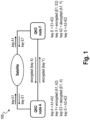
- Fig. 1 illustrates in a block diagram an exemplary quantum key distribution (QKD) network 100.
- the QKD network 100 comprises a first QKD end-node denoted as "QKD Node A", and a second QKD end-node denoted as "QKD Node F" arranged remotely from QKD Node A.
- QKD Node A and QKD Node F are connected to each other via a first path that is ground-based, and a second path that is satellite-based.
- QKD Node A and the QKD Node F are configured to perform the operations described below, which are basically the same at both ends, but with correspondingly inverted key information used.
- QKD Node A this is configured to locally generate a local key A and to divide the local key A into a first local key part A1 and a second local key part A2. Further, QKD Node A is configured to receive, via the first path, remote key information X that includes an encryption of a remote key E generated by QKD Node F. In addition, QKD Node A is configured to receive, via the second path, a first remote key part E1 of the remote key E. QKD Node A is further configured to perform decryption on the remote key information X using the first remote key part E1 to obtain a second remote key part E2 of the remote key E. Further, QKD Node A is configured to combine the second remote key part E2 and the second local key part A2 with each other to obtain a secret key S.
- QKD Node F this is configured to locally generate a local key E and to divide the local key E into a first local key part E1 and a second local key part E2. Further, QKD Node F is configured to receive, via the first path, remote key information Y that includes an encryption of a remote key A generated by QKD Node A. It is understood that the remote key A corresponds to the above local key A, when considered from QKD Node A's perspective. In other words, QKD Node A is now the remote QKD node for QKD Node F, and vice versa. In addition, QKD Node F is configured to receive, via the second path, a first remote key part A1 of the remote key A.
- QKD Node F is further configured to perform decryption on the remote key information Y using the first remote key part A1 to obtain a second remote key part A2 of the remote key A. Further, QKD Node F is configured to combine the second remote key part A2 and the second local key part E2 with each other to obtain the secret key S, which is the same as obtained by QKD Node A as described above.
- both QKD Node A and QKD Node F i.e. the QKD end-nodes of the QKD network 100, share the same secret key S.
- This secret key S may then be used by e.g. an application associated with QKD Node A and QKD Node F to establish a secure, encrypted communication, respectively using the secret key S for encryption and decryption.
- Local key A is locally generated by QKD node A and then divided into two local key parts A1 and A2.
- Local key A may also be referred to as the remote key as received by QKD node F.
- local key E is locally generated by QKD node F and then divided into two local key parts E1 and E2.
- Local key E may also be referred to as the remote key as received by QKD node A.
- Key Y is generated by QKD node A and includes an encryption of local key A.
- Key X is generated by QKD node F and includes an encryption of local key E.
- Key (part) E2 is obtained by QKD node A by decrypting key X using key part E1.
- Key (part) A2 is obtained by QKD node F by decrypting key Y using key part A1.
- the respective key S which is the same for QKD node A and QKD node F, is obtained by combining the respective second key parts, i.e. key parts A2 and E2, with each other.
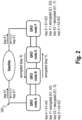
- Fig. 2 illustrates another exemplary configuration of the QKD network 100.
- QKD Node A and QKD Node F serving as QKD end-nodes.
- QKD node B a first QKD neighbor-node
- QKD node E a second QKD neighbor-node
- QKD node B is arranged adjacent, i.e. subsequent, to QKD node A in the first path, and connected thereto via a quantum channel and a classical channel, each indicated in Fig. 2 by a respective connecting solid line.
- QKD node E is arranged adjacent, i.e. preceding, to QKD node F in the first path, and connected thereto via a quantum channel and a classical channel, each indicated in Fig. 2 by a respective connecting solid line.
- each of QKD node A and QKD node F is configured to generate the respective local key A or local key E as a quantum key by using the local quantum channel with the respective QKD node B or QKD node E, i.e. QKD neighboring-node.
- QKD node B and QKD node E may be directly connected to each other by a classical channel, or may be indirectly connected via a number of further nodes, such as QKD intermediate-nodes, or non-QKD (intermediate) nodes, each of which forms a hop within the first path.
- further nodes such as QKD intermediate-nodes, or non-QKD (intermediate) nodes, each of which forms a hop within the first path.
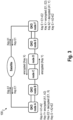
- Fig. 3 illustrates yet another exemplary configuration of the QKD network 100.
- QKD Node A and QKD Node F serving as QKD end-nodes
- QKD node B and QKD node E there is provided a first intermediate-node denoted as "node C”
- a second intermediate-node denoted as "node D”.
- Node C is arranged adjacent, i.e. subsequent, to QKD node B in the first path, and connected thereto via a classical channel, indicated in Fig. 3 by a respective connecting solid line.
- Node D is arranged adjacent, i.e.
- node C and node D are connected to each other by a classical channel, indicated in Fig. 3 by a connecting solid line.
- node C and node D may be non-QKB nodes, or may be QKB-nodes, and may also be referred to as intermediate nodes.
- the QKD network 100 comprises more hops than in the above configurations.
- key X and key Y each include encrypted information, i.e. an encryption of the respective key A or key E
- QKD node A and QKD node F may exchange those keys X and Y respectively via a classical network.
- Fig. 4 illustrates another exemplary implementation of the QKD network 100.
- node C and node D are each configured as a QKD node.
- each of the number of QKD intermediate-nodes and/or at least one QKD neighbor-node, i.e. QKD node B, QKD node C, QKD node D, and QKD node E is configured to individually decrypt and encrypt the respective remote key information X and Y and/or respective local key information and pass it on along the first path.
- each QKD intermediate-node and/or QKD neighbor-node may be configured to decrypt the key information received from the preceding node and to encrypt the key information again and transmit it to the next, subsequent QKD node.
- the respective transmission between the nodes may be carried out via a classical channel.
- the respective encryption may be generated by using the quantum channel established with the respective adjacent and/or neighboring node.
- each intermediary node i.e. QKD nodes B, C, D and E, perform the same operation of decrypting the respectively transmitted key x or key Y from the classical channel from the previous neighbor, and encrypting the respective key X or key Y to be transmitted in the classical channel to the next neighbor, thereby further enhancing security.
- the respective encryption may be generated by using the quantum channel established with the respective adjacent and/or neighboring node.
- Fig. 5 illustrates an exemplary application scenario for the secret key S obtained in each of QKD node A and QKD node F.
- the secret key S commonly obtained at both ends may be provided to, for example, an application associated with the respective QKD node A and/or QKD node F.
- Each application may be configured to use the secret key S to establish a secure communication with encryption.
- Fig. 6 illustrates in a block diagram an exemplary configuration of QKD end-node, e.g. QKD node A and/or QKD node F.
- QKD node A and/or QKD node F comprises first interface circuitry 210 configured to receive, via a ground-based first path, remote key information including an encrypted remote key generated by a remote, further QKD end-node. Further, QKD node A and/or QKD node F comprises second interface circuitry 220 configured to receive, via a satellite-based second path, a first remote key part of the remote key.
- QKD node A and/or QKD node F comprises processing circuitry 230 that is configured to locally generate a local key, and divide the local key into a first local key part and a second local key part, to perform decryption on the remote key information using the first remote key part to obtain a second remote key part of the remote key, and to combine the second remote key part and the second local key part with each other to obtain a secret key.
- the first interface circuitry 210, the second interface circuitry 220 and the processing circuitry 230 may be operatively and/or communicatively coupled to each other.
- Fig. 7 illustrates in a flow chart a quantum key distribution, (QKD) method 300.
- the method 300 is applied to a QKD end-node, e.g. QKD node A and/or QKD node F.
- the method comprises locally generating 310 a local key, e.g. local key and/or local key E, and dividing the local key into a first local key part and a second local key part. Further, the method 300 comprises receiving 320, via a ground-based first path, remote key information, e.g. remote key information X and/or remote key information Y, including an encrypted remote key generated by a remote, further QKD end-node. In addition, the method 300 comprises receiving 330, via a satellite-based second path, a first remote key part, e.g. remote key part A1 and/or remote key part E1, of the remote key.
- a first remote key part e.g. remote key part A1 and/or remote key part E1
- the method 300 comprises performing 340 decryption on the remote key information using the first remote key part to obtain a second remote key part of the remote key.
- the method 300 comprises combining 350 the second remote key part and the second local key part with each other to obtain a secret key, e.g. secret key S.
- Fig. 8 illustrates in a flow chart a quantum key distribution, (QKD) method 400.
- the method 300 is applied to a to a QKD network, e.g. QKD network 100.
- the method 400 comprises obtaining 410, by the first QKD end-node, e.g. QKD node A and/or QKD node F, a secret key by carrying out the above method 300, wherein the first QKD end-node acts as the QKD end-node and the second QKD end-node acts as the remote QKD end-node.
- the method 400 comprises obtaining 420, by the second QKD end-node, e.g. QKD node A and/or QKD node F, the secret key, e.g. secret key S, by carrying out the above method 300, wherein the second QKD end-node acts as the QKD end-node and the first QKD end-node acts as the remote QKD end-node.
Landscapes
- Engineering & Computer Science (AREA)
- Computer Security & Cryptography (AREA)
- Computer Networks & Wireless Communication (AREA)
- Signal Processing (AREA)
- Physics & Mathematics (AREA)
- Electromagnetism (AREA)
- Theoretical Computer Science (AREA)
- Optical Communication System (AREA)
Abstract
The present invention relates to a quantum key distribution, QKD, method, applied to a QKD end-node (A; F). The method comprises locally generating a local key (A; E), and dividing the local key (A, E) into a first local key part (A1; E1) and a second local key part (A2; E2). The method further comprises receiving, via a ground-based first path, remote key information (X; Y) in-cluding an encrypted remote key (A1, A2; E1, E2) generated by a remote, further QKD end-node (A; F). In addition, the method comprises receiving, via a satellite-based second path, a first remote key part (A1; E1) of the remote key (A; E). Furthermore, the method comprises performing decryption on the remote key information (X; Y) using the first remote key part (A1; E1) to obtain a second remote key part (A2; E2) of the remote key (A; E). The method further comprises combining the second remote key part (A2; E2) and the second local key part (A2; E2) with each other to obtain a secret key (5).
Description
- The present invention relates to providing secure communication based on quantum key distribution (QKD), and in particular to quantum key distribution, QKD, methods, a quantum key distribution, QKD, end-node, a quantum key distribution, QKD, network, the use of the above for secure communication, and a computer-readable medium.
- Quantum key distribution (QKD) can ensure deployment of secure communication by leveraging quantum mechanics. However, a communication distance between QKD adjacent nodes is limited.
- D. Elkouss, J. Martinez-Mateo, A. Ciurana, and V. Martin, Secure optical networks based on quantum key distribution and weakly trusted repeaters, Journal of Optical Communications and Networking 5, 316 (2013) describes repeaters, such as quantum relays, i.e. devices configured to forward quantum bits without measurement or cloning, to extend the communication distance.
- Further, M. Peev et al., The secoqc quantum key distribution network in Vienna, New Journal of Physics 11, 075001 (2009) describes using trusted relays to extend the communication distance.
- At the same time, however, security is crucial in a QKD network, which may be compromised, for example, if intermediate trusted relays betray or are cracked by attackers. In end-to-end key distribution, trusted relays have access to all the data that is transmitted. If a relay leaks information or is controlled by an attacker, all messages passing through the relay will not be secure anymore.
- To achieve key distribution in the presence of untrusted nodes, previous solutions mainly focused on two approaches, namely using Measurement-Device Independent QKD (MDI-QKD) or Twin-Field QKD (TF-QKD). Although these approaches allow for reducing the number of trusted relays, they still require trusted relays to extend the QKD distance because they do not allow direct connection of two untrusted nodes.
- H.-K. Lo, M. Curty, and B. Qi, Measurement-device-independent quantum key distribution, Phys. Rev. Lett. 108, 130503 (2012) relates to MDI-QKD.
- G.-J. Fan-Yuan, F.-Y. Lu, 8. Wang, Z.-Q. Yin, D.-Y. He, W. Chen, 2. Zhou, Z.-H. Wang, J. Teng, G.-C. Guo, et al., Robust and adaptable quantum key distribution network without trusted nodes, Optica 9, 812 (2022) relates to MDI-QKD.
- M. Lucamarini, Z. L. Yuan, J. F. Dynes, and A. J. Shields, Overcoming the rate-distance limit of quantum key distribution without quantum repeaters, Nature 557, 400-403 (2018) relates to TF-QKD.
- Another approach to improve QKD networks in terms of resisting untrusted nodes is based on multipath key distribution. However, this approach requires x+1 disjoint path to prevent x relay nodes from e.g. eavesdropping information.
- H. Zhou, K. Lv, L. Huang, and X. Ma, Quantum network: Security assessment and key management, IEEE/ACM Transactions on Networking 30, 1328-1339 (2022) relates to such multipath key distribution.
- Another approach relies on a satellite network to deploy a QKD network, in which the satellite is a trusted node between non-adjacent ground nodes. However, in this approach, the satellite knows two intermediate keys used, and therefore the final key.
- Bruno Huttner et al., Long-range QKD without trusted nodes is not possible with current technology, npj quantum information, September 2022, relates to such satellite network.
- In view of the above, it would be beneficial if there is a reliable method, apparatus, network, or the like for enabling QKD for secure communication even over a distance that may rely on using one or more untrusted intermediate nodes.
- This demand is met by the subject-matter of the appended independent claims. Further embodiments are subject-matter of the appended dependent claims.
- According to a first aspect, there is provided a quantum key distribution (QKD) method. The method is applied to a QKD end-node. The method comprises locally generating a local key, and dividing the local key into a first local key part and a second local key part. The method further comprises receiving, via a ground-based first path, remote key information including an encrypted remote key generated by a remote, further QKD end-node. In addition, the method comprises receiving, via a satellite-based second path, a first remote key part of the remote key. Further, the method comprises performing decryption on the remote key information using the first remote key part to obtain a second remote key part of the remote key. The method further comprises combining the second remote key part and the second local key part with each other to obtain a secret key.
- The present disclosure provides a reliable solution for enabling QKD for secure communication even over a distance that may rely on using one or more untrusted intermediate nodes. While previous solutions required ground devices to be in the line-of-sight of a satellite of a QKD network limiting the accessible distance range on the surface of the earth to typically 1000 km, the proposed solution enables distance of more than 1000°km, so that long-distance communication is possible. Further, the proposed solution allows deployment of a QKD network among a set of untrusted QKD nodes and/or non-QKD nodes. Also, this solution allows two QKD devices, e.g. QKD end-nodes, to share a secret key created within that QKD system, while all the other nodes in the path, i.e. the first path, arranged between the two QKD devices are not aware of the secret key used. In other words, the proposed solution makes use of two paths, i.e. the first and the second path, wherein none of these paths has access to the secret key that may be used for an end-to-end communication. Further, the proposed solution does not require a quantum satellite. Rather, a satellite used in the second path may also be a regular satellite, e.g. using bent-pipe communication. In addition, the proposed solution does not require deployment of QKD nodes in all elements of the path, particularly of the first path, allowing for faster deployment of a QKD network at lower costs. Also, the proposed solution does not require deployment of third-party quantum devices, such as a quantum computer or the like, to generate the secret key to use in the end-to-end communication.
- As used herein, quantum key distribution (QKD) may be understood as a secured communication method that relies on a cryptographic protocol involving components of quantum mechanics. QKD may be used to generate, produce, etc. and distribute a key, i.e. the secret key. In this way, the secret key may be shared among two devices, e.g. end-devices, end-nodes, particularly QKD end-nodes, or the like, and/or applications or the like running on those devices, etc. This secret key may then be used with any suitable and/or chosen encryption algorithm to encrypt and decrypt a message, data, or the like to be transmitted between the two devices, etc., i.e. to provide secure end-to-end communication. Due to the encryption using the secret key, the encrypted messages, data, etc. may be transmitted over a standard communication channel without compromising security.
- Accordingly, the above method may be applied to both such end-devices, i.e. QKD end-nodes. The further QKD end-node may also be referred to as second QKD end-node. The local key of one QKD end-node, i.e. a first QKD end-node, may be understood as the remote key of the respective other QKD end-node, i.e. a second QKD end-node, and vice versa. However, the underlying principle of obtaining the secret key remains the same, and as a result both have a shared and/or common secret key when the method is carried out.
- Further, as used herein, a QKD node, such as a QKD end-node, a QKD neighbor-node, and/or a QKD intermediate node, may be implemented based on any suitable QKD protocol, wherein BB84 or BB92 are merely examples and the solution described herein may also be used with other QKD protocols. At least some of the QKD nodes may comprise a quantum channel and a classical channel. In contrast thereto, a non-QKD node may comprise only a classical channel, and may also be referred to as a classic node. In addition, the QKD end-nodes are to share the same secret key. The QKD end-nodes may be associated with a respective application or the like requiring and/or requesting secure end-to-end communication. Using the shared secret key at both QKD end-nodes, and/or at both applications etc., for encryption / decryption allows secure end-to-end communication. Further, the QKD end-node(s) may be either sender or receiver of the local key, remote key, remote key information, local key information, etc., depending on which part of the whole QKD procedure is considered. In particular, each QKD end-node generates its own local key and processes it in the same way for sending a part of the local key via the second path or local key information to the respective other QKD end-node. Likewise, each QKD end-node receives from the respective other QKD end-node a part of a correspondingly generated remote key, which may also be referred to as another local key that has been generated remotely, and corresponding remote key information.
- Further, by way of example, the local key may be a quantum key. It may be locally-generated by using quantum computer or the like. In at least some embodiments, the end-node may generate the local key using a local quantum channel that may be established with a QKD neighbor-node or the like. It is noted that dividing a key into two parts may be understood as forming two halves, or as any other suitable division.
- As used herein, "remote key information" and/or "local key information" may be understood as key-related information that includes the respective key in only encrypted form, so that the key cannot be accessed without decryption. That is, there is no element, e.g. any node, of the first path that could be aware of the respective complete remote key and/or local key, as this is only transmitted in encrypted form. For encrypting the respective local key and/or remote key, any suitable encryption algorithm may be used, provided that this may be decrypted on the respective receiver side on the basis of the received key information. Merely by way of example, reference is made to additive ciphers. As an illustrative example, a XOR cipher may be used. Thereby, the remote key information and/or local key information may be generated by performing a corresponding XOR operation on the first local key part and the second local key part, or the first remote key part and second remote key part respectively, to obtain the respective local key information and/or remote key information. With the knowledge of the second remote key part, i.e. the local key part of the respective sending QKD end-node, received via the second path, a corresponding XOR-operation may be performed on the received remote key information and the first remote key part to obtain the second remote key part of the remote key. For example, this XOR-operation may be performed bit-by-bit.
- The combining the second remote key part and second local key part with each other may be understood as any suitable processing, operation, or the like capable of generating the desired secret key. For example, this may include one or more mathematical or computational operations, concatenating the second key parts, or the like.
- Further, as used herein, the first path may include a number of nodes arranged between the two QKD end-nodes, formed as e.g. QKD neighbor-nodes, QKD intermediate, nodes, or non-QKD nodes. Thereby, the number of nodes may be an integer equal or greater than 1. The number of nodes may be arranged successively along the first path. A QKD neighbor-node may be understood as QKD node that is arranged directly adjacent to the QKD end-node. A QKD intermediate-node may be understood as a QKD node that is arranged not directly adjacent to the QKD end-node, but may be adjacent to the QKD neighbor-node. The non-QKD node may comprise only a classical channel to other, adjacent nodes but no quantum channel.
- The satellite may be a classical satellite, e.g. a regular bent-pipe satellite. It may provide coverage to all QKD nodes deployed on the ground, e.g. in the first path. The second path may comprise only one satellite, wherein configurations comprising multiple satellites may also be conceivable.
- According to an embodiment, the secret key may be provided to a local application, or any other requesting entity associated with the QKD end-node and/or further QKD end-node, for establishing secure communication to a corresponding remote application of the further QKD end-node using the secret key. In other words, the secret key obtained at each QKD end-node may be made available for establishing secure communication with encryption (and corresponding decryption) of messages, data, or the like, to be transmitted therebetween.
- In an embodiment, the locally generating of the local key may comprise generating the local key as a quantum key by using a local quantum channel with a QKD - neighbor-node arranged adjacent to the QKD end-node in the first path. Thereby, the QKD neighbor-node may be different from the further end-node. For example, the QKD end-node and its adjacent neighbor-node may have established a local quantum channel. Using this local quantum channel, the respective local key may be generated.
- According to an embodiment, the method may further comprise performing encryption on the first local key part and the second local key part to obtain local key information including the encrypted local key. Further, the method may comprise providing the local key information via the first path.. As explained above, the local key information may also be referred to as the remote key information when considered from the further QKD end-node's perspective. As mentioned above, the encryption may be performed by any suitable encryption algorithm. However, as an illustrative example, the above-mentioned XOR operation may be performed.
- In an embodiment, the local key information may be provided via a classical channel of the first path. As the local key information, also be referred to as the remote key information when considered from the further QKD end-node's perspective, itself is encrypted, it may be transmitted over a classic network without compromising security.
- According to an embodiment, the method may further comprise providing the first local key part via the second path. As merely a part of the local key is transmitted, security is not compromised if the satellite is untrusted.
- In an embodiment, the first local key part may be provided via a classical channel of the second path. As merely a part of the local key is transmitted, it may be transmitted over a classic network without compromising security.
- According to an embodiment, the first local key part may be provided after elapse of a random interval of time from or after providing the local key information. The parts of the keys transmitted may be marked as related, for example, by a common index or the like. Waiting for the interval of time further increases security in the most unlikely event that both paths would be compromised.
- According to second aspect, there is provided a quantum key distribution (QKD) method that is applied to a QKD network comprising a first QKD end-node and a second QKD end-node arranged remotely from the first QKD end-node. The method comprises obtaining, by the first QKD end-node, a secret key by carrying out the method of the first aspect, wherein the first QKD end-node acts as the QKD end-node and the second QKD end-node acts as the remote QKD end-node. Further, the method comprises obtaining, by the second QKD end-node, the secret key by carrying out the method of the first aspect, wherein the second QKD end-node acts as the QKD end-node and the first QKD end-node acts as the remote QKD end-node.
- As described above, the method according to the first aspect may be applied to each of two QKD end-nodes. This allows to obtain the same secret key at both QKD end-nodes. As a result, e.g. an application associated with the respective QKD end-nodes may use the secret key that is common to both QKD end-nodes to establish secure communication to each other using the secret key.
- According to a third aspect, there is provided a quantum key distribution (QKD) end-node. The QKD end-node comprises a first interface circuitry configured to receive, via a ground-based first path, remote key information including an encrypted remote key generated by a remote, further QKD end-node. Further, the QKD end-node comprises second interface circuitry configured to receive, via a satellite-based second path, a first remote key part of the remote key. In addition, the QKD end-node comprises processing circuitry that is configured to locally generate a local key, and divide the local key into a first local key part and a second local key part. The processing circuitry is further configured to perform decryption on the remote key information using the first remote key part to obtain a second remote key part of the remote key. In addition, the processing circuitry is configured to combine the second remote key part and the second local key part with each other to obtain a secret key.
- The propose QKD end-node may be configured to carry out the method of the first aspect. Therefore, reference is additionally made to the first aspect.
- For example, the first interface circuitry may be a hardware interface comprising a port or the like for coupling to optical fibers and/or establishing a quantum channel. Further, for coupling with a classical channel, the first interface circuitry may comprise a corresponding network port or the like. By way of example, the second interface circuitry may comprise a satellite transceiver or the like.
- Further, by way of example, the processing circuitry may be implemented using one or more of an application specific integrated circuit (ASIC), a field programmable gate array (FPGA), a processor executing software, a microprocessor, a CPU, or other circuitry. The processing circuitry is coupled with the hf transceiver. Further, the processing circuitry is coupled with the at least one network interface. The processing circuitry may also be coupled to other components of the software-defined radio, such as a power supply, a memory, or the like. The functionalities, operations, methods, etc. of the processing circuitry described herein may be implemented by corresponding instructions, such as computer program instructions, or the like. These instructions may be stored in a memory of the software-defined radio that may be coupled to the processing circuitry. Executing the instructions by the processing circuitry may cause the processing circuitry to perform the functionalities, operations, methods, etc. described herein. The processing circuitry may be operated using an operating system, such as Linux or the like.
- According to a fourth aspect, there is provided a quantum key distribution (QKD) network. The QKD network comprises a first QKD end-node according to the third aspect. Further, the network comprises a second QKD end-node according to the third aspect, arranged remotely from the first QKD end-node. The QKD network further comprises a first QKD neighbor-node arranged in the first path adjacent and connected to the first QKD end-node. In addition, the QKD network comprises a second QKD neighbor-node arranged in the first path adjacent and connected to the second QKD end-node. Thereby, the first QKD neighbor-node and the second QKD neighbor-node each have a respective quantum channel with the respective first QKD neighbor-node or second QKD neighbor-node to generate the respective local key.
- The QKD network may be configured to carry out the methods according to the first aspect and/or the second aspect, so that reference is made to the first and second aspect.
- According to an embodiment, the QKD network may further comprise a number of QKD or non-QKD intermediate-nodes successively arranged along the first path between the first QKD neighbor-node and the second QKD neighbor-node. Thereby, each of the number of QKD or non-QKD intermediate-nodes may be configured to pass on the remote key information and/or local key information to a next one of the number of QKD or non-QKD intermediate-nodes towards the respective first QKD end-node or second QKD end-node via a classical channel.
- In an embodiment, each of the number of QKD or non-QKD intermediate-nodes may be configured to individually decrypt and encrypt the remote key information and/or local key information and pass it on along the first path. For example, each QKD intermediate-node and/or QKD neighbor-node, and/or non-QKD (intermediate) node, may be configured to decrypt the key information received from the preceding node and to encrypt the key information again and transmit it to the next, subsequent QKD node. The respective transmission between the nodes may be carried out via a classical channel.
- According to an embodiment, the QKD network may include the Satellite used in the second path. However, since this may be a regular satellite, it may also be provided by third parties and does not necessarily have to be part of the QKD network itself.
- A fifth aspect relates to the use of the QKD methods, QKD end-nodes, QKD networks according to any one of the first to fourth aspect to obtain a secret key and establish secure end-to-end communication between two QKD end-nodes using the secret key. As described herein, the secret key is respectively obtained at both ends of the end-to-end communication. The secure communication may be established via a classical channel, as the communication is encrypted using the secret key. The present disclosure can be used even with a set of untrusted intermediate nodes, as the secret key is not leaked thereto.
- According to a sixth aspect, a computer-readable medium having stored thereon a computer program comprising instructions to cause processing circuitry of a quantum key distribution (QKD) end-node to carry out the method according to the first aspect, and/or to carry out the method according to the second aspect.
- The embodiments and improvements above can be combined in any reasonable way. Further embodiments, improvements, and implementations of the present invention further comprise combinations of previously or subsequently mentioned features of the present invention even if said combinations have not been explicitly mentioned. In particular, a person skilled in the art will add single features to the respective base aspects of the invention.
- The present invention is explained in more detail below with reference to the embodiments shown in the schematic figures:
- Fig. 1
- illustrates in a block diagram an exemplary quantum key distribution (QKD) network according to an embodiment;
- Fig. 2
- illustrates in a block diagram an exemplary quantum key distribution (QKD) network according to an embodiment;
- Fig. 3
- illustrates in a block diagram an exemplary quantum key distribution (QKD) network according to an embodiment;
- Fig. 4
- illustrates in a block diagram an exemplary quantum key distribution (QKD) network according to an embodiment;
- Fig. 5
- illustrates in a block diagram an exemplary application scenario of the quantum key distribution (QKD) according to an embodiment;
- Fig. 6
- illustrates schematically an exemplary configuration of a quantum key distribution (QKD) end-node;
- Fig. 7
- illustrates in a flow chart a quantum key distribution (QKD) method according to an embodiment; and
- Fig. 8
- illustrates in a flow chart a quantum key distribution (QKD) method according to an embodiment.
- The drawings shown here are meant to impart an extended understanding of the embodiments of the present invention. They illustrate embodiments and serve in conjunction with the description to explain principles and concepts of the present invention. Further embodiments and a number of the stated advantages are revealed in view of the drawings. The features of the drawings are not necessarily shown to scale.
- In the figures of the drawing, elements, features and components which are identical, functionally identical and of identical action are denoted in each case by the same reference designations unless stated otherwise.
-
Fig. 1 illustrates in a block diagram an exemplary quantum key distribution (QKD)network 100. TheQKD network 100 comprises a first QKD end-node denoted as "QKD Node A", and a second QKD end-node denoted as "QKD Node F" arranged remotely from QKD Node A. QKD Node A and QKD Node F are connected to each other via a first path that is ground-based, and a second path that is satellite-based. - QKD Node A and the QKD Node F are configured to perform the operations described below, which are basically the same at both ends, but with correspondingly inverted key information used.
- Referring first to QKD Node A, this is configured to locally generate a local key A and to divide the local key A into a first local key part A1 and a second local key part A2. Further, QKD Node A is configured to receive, via the first path, remote key information X that includes an encryption of a remote key E generated by QKD Node F. In addition, QKD Node A is configured to receive, via the second path, a first remote key part E1 of the remote key E. QKD Node A is further configured to perform decryption on the remote key information X using the first remote key part E1 to obtain a second remote key part E2 of the remote key E. Further, QKD Node A is configured to combine the second remote key part E2 and the second local key part A2 with each other to obtain a secret key S.
- Likewise, now referring to QKD Node F, this is configured to locally generate a local key E and to divide the local key E into a first local key part E1 and a second local key part E2. Further, QKD Node F is configured to receive, via the first path, remote key information Y that includes an encryption of a remote key A generated by QKD Node A. It is understood that the remote key A corresponds to the above local key A, when considered from QKD Node A's perspective. In other words, QKD Node A is now the remote QKD node for QKD Node F, and vice versa. In addition, QKD Node F is configured to receive, via the second path, a first remote key part A1 of the remote key A. QKD Node F is further configured to perform decryption on the remote key information Y using the first remote key part A1 to obtain a second remote key part A2 of the remote key A. Further, QKD Node F is configured to combine the second remote key part A2 and the second local key part E2 with each other to obtain the secret key S, which is the same as obtained by QKD Node A as described above.
- In this way, both QKD Node A and QKD Node F, i.e. the QKD end-nodes of the
QKD network 100, share the same secret key S. This secret key S may then be used by e.g. an application associated with QKD Node A and QKD Node F to establish a secure, encrypted communication, respectively using the secret key S for encryption and decryption. - In summary, the following keys are used and/or generated in the
QKD network 100. Local key A is locally generated by QKD node A and then divided into two local key parts A1 and A2. Local key A may also be referred to as the remote key as received by QKD node F. Likewise, local key E is locally generated by QKD node F and then divided into two local key parts E1 and E2. Local key E may also be referred to as the remote key as received by QKD node A. Key Y is generated by QKD node A and includes an encryption of local key A. Key X is generated by QKD node F and includes an encryption of local key E. Key (part) E2 is obtained by QKD node A by decrypting key X using key part E1. Key (part) A2 is obtained by QKD node F by decrypting key Y using key part A1. The respective key S, which is the same for QKD node A and QKD node F, is obtained by combining the respective second key parts, i.e. key parts A2 and E2, with each other. -
Fig. 2 illustrates another exemplary configuration of theQKD network 100. Again, there are the above QKD Node A and QKD Node F serving as QKD end-nodes. In addition, there is provided a first QKD neighbor-node denoted as "QKD node B", and a second QKD neighbor-node denoted as "QKD node E". QKD node B is arranged adjacent, i.e. subsequent, to QKD node A in the first path, and connected thereto via a quantum channel and a classical channel, each indicated inFig. 2 by a respective connecting solid line. Likewise, QKD node E is arranged adjacent, i.e. preceding, to QKD node F in the first path, and connected thereto via a quantum channel and a classical channel, each indicated inFig. 2 by a respective connecting solid line. - While in the
QKD network 100 according toFig. 1 , the local key A and/or local key E may be generated by e.g. a quantum computer or any other suitable quantum key generation mechanism, in theQKD network 100 according toFig. 2 , each of QKD node A and QKD node F is configured to generate the respective local key A or local key E as a quantum key by using the local quantum channel with the respective QKD node B or QKD node E, i.e. QKD neighboring-node. - QKD node B and QKD node E may be directly connected to each other by a classical channel, or may be indirectly connected via a number of further nodes, such as QKD intermediate-nodes, or non-QKD (intermediate) nodes, each of which forms a hop within the first path.
-
Fig. 3 illustrates yet another exemplary configuration of theQKD network 100. Again, there are the above QKD Node A and QKD Node F serving as QKD end-nodes, and QKD node B and QKD node E. In addition, there is provided a first intermediate-node denoted as "node C", and a second intermediate-node denoted as "node D". Node C is arranged adjacent, i.e. subsequent, to QKD node B in the first path, and connected thereto via a classical channel, indicated inFig. 3 by a respective connecting solid line. Likewise, Node D is arranged adjacent, i.e. preceding, to QKD node E in the first path, and connected thereto via a classical channel, indicated inFig. 3 by a connecting solid line. Node C and node D are connected to each other by a classical channel, indicated inFig. 3 by a connecting solid line. For example, node C and node D may be non-QKB nodes, or may be QKB-nodes, and may also be referred to as intermediate nodes. - Accordingly, in this exemplary configuration the
QKD network 100 comprises more hops than in the above configurations. As key X and key Y each include encrypted information, i.e. an encryption of the respective key A or key E, QKD node A and QKD node F may exchange those keys X and Y respectively via a classical network. -
Fig. 4 illustrates another exemplary implementation of theQKD network 100. Here, node C and node D are each configured as a QKD node. Further, each of the number of QKD intermediate-nodes and/or at least one QKD neighbor-node, i.e. QKD node B, QKD node C, QKD node D, and QKD node E, is configured to individually decrypt and encrypt the respective remote key information X and Y and/or respective local key information and pass it on along the first path. For example, each QKD intermediate-node and/or QKD neighbor-node may be configured to decrypt the key information received from the preceding node and to encrypt the key information again and transmit it to the next, subsequent QKD node. The respective transmission between the nodes may be carried out via a classical channel. The respective encryption may be generated by using the quantum channel established with the respective adjacent and/or neighboring node. - In other words, each intermediary node, i.e. QKD nodes B, C, D and E, perform the same operation of decrypting the respectively transmitted key x or key Y from the classical channel from the previous neighbor, and encrypting the respective key X or key Y to be transmitted in the classical channel to the next neighbor, thereby further enhancing security. The respective encryption may be generated by using the quantum channel established with the respective adjacent and/or neighboring node.
-
Fig. 5 illustrates an exemplary application scenario for the secret key S obtained in each of QKD node A and QKD node F. As described herein, the secret key S commonly obtained at both ends may be provided to, for example, an application associated with the respective QKD node A and/or QKD node F. Each application may be configured to use the secret key S to establish a secure communication with encryption. -
Fig. 6 illustrates in a block diagram an exemplary configuration of QKD end-node, e.g. QKD node A and/or QKD node F. - Accordingly, QKD node A and/or QKD node F comprises
first interface circuitry 210 configured to receive, via a ground-based first path, remote key information including an encrypted remote key generated by a remote, further QKD end-node. Further, QKD node A and/or QKD node F comprisessecond interface circuitry 220 configured to receive, via a satellite-based second path, a first remote key part of the remote key. In addition, QKD node A and/or QKD node F comprises processingcircuitry 230 that is configured to locally generate a local key, and divide the local key into a first local key part and a second local key part, to perform decryption on the remote key information using the first remote key part to obtain a second remote key part of the remote key, and to combine the second remote key part and the second local key part with each other to obtain a secret key. Thefirst interface circuitry 210, thesecond interface circuitry 220 and theprocessing circuitry 230 may be operatively and/or communicatively coupled to each other. -
Fig. 7 illustrates in a flow chart a quantum key distribution, (QKD)method 300. Themethod 300 is applied to a QKD end-node, e.g. QKD node A and/or QKD node F. - The method comprises locally generating 310 a local key, e.g. local key and/or local key E, and dividing the local key into a first local key part and a second local key part. Further, the
method 300 comprises receiving 320, via a ground-based first path, remote key information, e.g. remote key information X and/or remote key information Y, including an encrypted remote key generated by a remote, further QKD end-node. In addition, themethod 300 comprises receiving 330, via a satellite-based second path, a first remote key part, e.g. remote key part A1 and/or remote key part E1, of the remote key. Furthermore, themethod 300 comprises performing 340 decryption on the remote key information using the first remote key part to obtain a second remote key part of the remote key. In addition, themethod 300 comprises combining 350 the second remote key part and the second local key part with each other to obtain a secret key, e.g. secret key S. -
Fig. 8 illustrates in a flow chart a quantum key distribution, (QKD)method 400. Themethod 300 is applied to a to a QKD network,e.g. QKD network 100. - The
method 400 comprises obtaining 410, by the first QKD end-node, e.g. QKD node A and/or QKD node F, a secret key by carrying out theabove method 300, wherein the first QKD end-node acts as the QKD end-node and the second QKD end-node acts as the remote QKD end-node. Further, themethod 400 comprises obtaining 420, by the second QKD end-node, e.g. QKD node A and/or QKD node F, the secret key, e.g. secret key S, by carrying out theabove method 300, wherein the second QKD end-node acts as the QKD end-node and the first QKD end-node acts as the remote QKD end-node. -
- 100
- quantum key distribution (QKD) network
- QKD node A
- QKD end-node
- QKD node F
- QKD end-node
- QKD node B
- QKD neighbor-node
- QKD node E
- QKD neighbor-node
- (QKD) node C
- QKD or non-QKD intermediate node
- (QKD) node D
- QKD or non-QKD intermediate node
- key A, key E
- local key and/or remote key
- key A1, key E1
- first local key part and/or first remote key part
- key A2, key E2
- second local key part and/or second remote key part
- key X, key Y
- key with encryption of key A (e.g. A1 +A2) and/or key E (E1+E2)
- key S
- secret key
- 210
- first interface circuitry
- 220
- second interface circuitry
- 230
- processing circuitry
- 300
- method
- 400
- method
Claims (15)
- A quantum key distribution, QKD, method, applied to a QKD end-node (A; F), the method comprising:locally generating a local key (A; E), and dividing the local key (A, E) into a first local key part (A1; E1) and a second local key part (A2; E2);receiving, via a ground-based first path, remote key information (X; Y) including an encrypted remote key (A1, A2; E1, E2) generated by a remote,further QKD end-node (A; F);receiving, via a satellite-based second path, a first remote key part (A1; E1) of the remote key (A; E);performing decryption on the remote key information (X; Y) using the first remote key part (A1; E1) to obtain a second remote key part (A2; E2) of the remote key (A; E); andcombining the second remote key part (A2; E2) and the second local key part (A2; E2) with each other to obtain a secret key (S).
- The QKD method of claim 1, wherein the secret key (S) is provided to a local application for establishing secure communication to a corresponding remote application of the further QKD end-node (A; F) using the secret key (S).
- The QKD method of claim 1 or 2, wherein the locally generating of the local key comprises:generating the local key (A; E) as a quantum key by using a local quantum channel with a QKD neighbor-node (B; E) arranged adjacent to the QKD end-node in the first path;wherein the QKD neighbor-node (B; E) is different from the further end-node (A; F).
- The QKD method of any one of the preceding claims, further comprising:performing encryption on the first local key part (A1; E1) and the second local key part (A1; E2) to obtain local key information (X; Y) including the encrypted local key (A, A1, A2; E, E1, E2); andproviding the local key information (X; Y) via the first path.
- The QKD method of claim 4, wherein the local key information (X; Y) is provided via a classical channel of the first path.
- The QKD method of any one of the preceding claims, further comprising:
providing the first local key part (A1; E1) via the second path. - The QKD method of claim 6, wherein the first local key part (A1; E1) is provided via a classical channel of the second path.
- The QKD method of claim 6 or 7 when dependent on claim 4 or 5, wherein the first local key part (A1; E1) is provided after elapse of a random interval of time from or after providing the local key information (X; Y).
- A quantum key distribution, QKD, method, applied to a QKD network comprising a first QKD end-node and a second QKD end-node arranged remotely from the first QKD end-node, the method comprising:obtaining, by the first QKD end-node, a secret key by carrying out the method of any one of the preceding claims, wherein the first QKD end-node acts as the QKD end-node and the second QKD end-node acts as the remote QKD end-node; andobtaining, by the second QKD end-node, the secret key by carrying out the method of any one of the preceding claims, wherein the second QKD end-node acts as the QKD end-node and the first QKD end-node acts as the remote QKD end-node.
- A quantum key distribution, QKD, end-node (A; F) comprising:first interface circuitry (210) configured to receive, via a ground-based first path, remote key information including an encrypted remote key generated by a remote, further QKD end-node;second interface circuitry (220) configured to receive, via a satellite-based second path, a first remote key part of the remote key; andprocessing circuitry (230) configured to:locally generate a local key, and divide the local key into a first local key part and a second local key part; andperform decryption on the remote key information using the first remote key part to obtain a second remote key part of the remote key; andcombine the second remote key part and the second local key part with each other to obtain a secret key.
- A quantum key distribution, QKD, network (100), comprising:a first QKD end-node (A) according to claim 10;a second QKD end-node (F) according to claim 10, arranged remotely from the first QKD end-node;a first QKD neighbor-node (B) arranged in the first path adjacent and connected to the first QKD end-node (A); anda second QKD neighbor-node (E) arranged in the first path adjacent andconnected to the second QKD end-node (F);wherein the first QKD neighbor-node (B) and the second QKD neighbor-node each have a respective quantum channel with the respective first QKD neighbor-node (B) or second QKD neighbor-node € to generate the respective local key (A; E).
- The QKD network of claim 11, further comprising:a number of QKD or non-QKD intermediate-nodes (C; D) successively arranged along the first path between the first QKD neighbor-node (B) andthe second QKD neighbor-node (E);wherein each of the number of QKD or non-QKD intermediate-nodes (C; D) is configured to pass on the remote key information and/or local key information to a next one of the number of QKD or non-QKD intermediate-nodes towards the respective first QKD end-node (A) or second QKD end-node (F) via a classical channel.
- The QKD network of claim 11 or 12, wherein each of the number of QKD or non-QKD intermediate-nodes (C; D) and/or at least one QKD neighbor-node (B; E) is configured to individually decrypt and encrypt the remote key information (X; Y) and/or local key information (X; Y) and pass it on along the first path.
- The use of the quantum key distribution, QKD, method according to any one of claims 1 to 8, or of the quantum key distribution, QKD, method according to 9, or of the quantum key distribution, QKD, end-node according to claim 10, or of the quantum key distribution, QKD, network according to any one of claim 11 to 13 to obtain a secret key to establish secure end-to-end communication between two QKD end-nodes using the secret key.
- A computer-readable medium having stored thereon a computer program comprising instructions to cause processing circuitry of a quantum key distribution, QKD, end-node to carry out the method according to any one of claims 1 to 8, and/or to carry out the method according to claim 9.
Priority Applications (2)
| Application Number | Priority Date | Filing Date | Title |
|---|---|---|---|
| EP23188376.0A EP4498636A1 (en) | 2023-07-28 | 2023-07-28 | Quantum key distribution (qkd) method, qkd end-node and qkd network |
| US18/772,648 US20250038970A1 (en) | 2023-07-28 | 2024-07-15 | Quantum key distribution (qkd) method, qkd end-node and qkd network |
Applications Claiming Priority (1)
| Application Number | Priority Date | Filing Date | Title |
|---|---|---|---|
| EP23188376.0A EP4498636A1 (en) | 2023-07-28 | 2023-07-28 | Quantum key distribution (qkd) method, qkd end-node and qkd network |
Publications (1)
| Publication Number | Publication Date |
|---|---|
| EP4498636A1 true EP4498636A1 (en) | 2025-01-29 |
Family
ID=87519904
Family Applications (1)
| Application Number | Title | Priority Date | Filing Date |
|---|---|---|---|
| EP23188376.0A Pending EP4498636A1 (en) | 2023-07-28 | 2023-07-28 | Quantum key distribution (qkd) method, qkd end-node and qkd network |
Country Status (2)
| Country | Link |
|---|---|
| US (1) | US20250038970A1 (en) |
| EP (1) | EP4498636A1 (en) |
Citations (2)
| Publication number | Priority date | Publication date | Assignee | Title |
|---|---|---|---|---|
| US20210044433A1 (en) * | 2019-05-03 | 2021-02-11 | Quantumxchange, Inc. | Method of operation of a trusted node software in a quantum key distribution system |
| WO2022182371A1 (en) * | 2021-02-25 | 2022-09-01 | Oracle International Corporation | Secure distribution of entropy |
Family Cites Families (3)
| Publication number | Priority date | Publication date | Assignee | Title |
|---|---|---|---|---|
| US7565689B2 (en) * | 2005-06-08 | 2009-07-21 | Research In Motion Limited | Virtual private network for real-time data |
| CN111559975B (en) * | 2020-07-15 | 2020-11-06 | 凯莱英生命科学技术(天津)有限公司 | Continuous synthesis method and application of piperidine-4-ethyl formate |
| WO2022211731A1 (en) * | 2021-03-30 | 2022-10-06 | Speqtral Pte. Ltd. | Secure symmetric key distribution |
-
2023
- 2023-07-28 EP EP23188376.0A patent/EP4498636A1/en active Pending
-
2024
- 2024-07-15 US US18/772,648 patent/US20250038970A1/en active Pending
Patent Citations (2)
| Publication number | Priority date | Publication date | Assignee | Title |
|---|---|---|---|---|
| US20210044433A1 (en) * | 2019-05-03 | 2021-02-11 | Quantumxchange, Inc. | Method of operation of a trusted node software in a quantum key distribution system |
| WO2022182371A1 (en) * | 2021-02-25 | 2022-09-01 | Oracle International Corporation | Secure distribution of entropy |
Non-Patent Citations (7)
| Title |
|---|
| BRUNO HUTTNER ET AL., LONG-RANGE QKD WITHOUT TRUSTED NODES IS NOT POSSIBLE WITH CURRENT TECHNOLOGY, September 2022 (2022-09-01) |
| D. ELKOUSSJ. MARTINEZ-MATEOA. CIURANAV. MARTIN: "Secure optical networks based on quantum key distribution and weakly trusted repeaters", JOURNAL OF OPTICAL COMMUNICATIONS AND NETWORKING, vol. 5, 2013, pages 316, XP011499961, DOI: 10.1364/JOCN.5.000316 |
| G.-J. FAN-YUANF.-Y. LU8. WANGZ.-QYIN, D.-YHE, W. CHENZHOUZ.-H. WANGJ. TENGG.-C. GUO ET AL.: "Robust and adaptable quantum key distribution network without trusted nodes", OPTICA, vol. 9, 2022, pages 812 |
| H. ZHOUK. LVL. HUANGX. MA: "Quantum network: Security assessment and key management", IEEE/ACM TRANSACTIONS ON NETWORKING, vol. 30, 2022, pages 1328 - 1339 |
| H.-K. LOM. CURTYB. QI: "Measurement-device-independent quantum key distribution", PHYS. REV. LETT., vol. 108, 2012, pages 130503 |
| M. LUCAMARINIZ. L. YUANJ. F. DYNESA. J. SHIELDS: "Overcoming the rate-distance limit of quantum key distribution without quantum repeaters", NATURE, vol. 557, 2018, pages 400 - 403 |
| M. PEEV ET AL.: "The secoqc quantum key distribution network in Vienna", NEW JOURNAL OF PHYSICS, vol. 11, 2009, pages 075001 |
Also Published As
| Publication number | Publication date |
|---|---|
| US20250038970A1 (en) | 2025-01-30 |
Similar Documents
| Publication | Publication Date | Title |
|---|---|---|
| US20240178994A1 (en) | Secure symmetric key distribution | |
| EP4432598A1 (en) | Blockchain network security communication method based on quantum key | |
| US20060059343A1 (en) | Key expansion for qkd | |
| WO2023082600A1 (en) | Quantum key-based blockchain network and data secure transmission method | |
| US12519629B2 (en) | Key exchange protocol for satellite based quantum network | |
| US20220294618A1 (en) | Improvements to qkd methods | |
| US20140233739A1 (en) | Method for adding nodes to a quantum key distribution system | |
| US12120224B2 (en) | Method and system for performing a secure key relay of an encryption key | |
| CN108270553B (en) | Trusted repeater, and secret key encryption method, device and system of quantum communication network | |
| GB2604665A (en) | Key exchange using a quantum key distribution protocol | |
| US12483396B2 (en) | Key exchange protocol for satellite based quantum network | |
| JP2024535356A (en) | System and method for generating secure private keys - Patents.com | |
| Kong | Challenges of routing in quantum key distribution networks with trusted nodes for key relaying | |
| EP4427396A1 (en) | Quantum-secured communication | |
| GB2586235A (en) | Improvements to QKD methods | |
| CA3254530A1 (en) | Method and device for sharing secret keys in a network comprising a satellite | |
| CN118555567A (en) | A satellite proxy re-encryption communication system based on zero conversion | |
| Rani et al. | Obfuscated quantum and post-quantum cryptography | |
| US20250038970A1 (en) | Quantum key distribution (qkd) method, qkd end-node and qkd network | |
| Ahmadian et al. | Demonstration of classical and hybrid solutions for lightpath security using quantum keys | |
| Neal | Q-stream: A practical system for operational perfect secrecy | |
| Malathy et al. | Quantum Cryptographic Techniques | |
| CN114760051B (en) | A key synchronization method and system | |
| CN116684091B (en) | Relay multi-level data blockchain sharing method and system based on quantum key distribution | |
| EP4550715A1 (en) | Qkd system and method with increased bandwidth |
Legal Events
| Date | Code | Title | Description |
|---|---|---|---|
| PUAI | Public reference made under article 153(3) epc to a published international application that has entered the european phase |
Free format text: ORIGINAL CODE: 0009012 |
|
| STAA | Information on the status of an ep patent application or granted ep patent |
Free format text: STATUS: THE APPLICATION HAS BEEN PUBLISHED |
|
| AK | Designated contracting states |
Kind code of ref document: A1 Designated state(s): AL AT BE BG CH CY CZ DE DK EE ES FI FR GB GR HR HU IE IS IT LI LT LU LV MC ME MK MT NL NO PL PT RO RS SE SI SK SM TR |
|
| STAA | Information on the status of an ep patent application or granted ep patent |
Free format text: STATUS: REQUEST FOR EXAMINATION WAS MADE |
|
| 17P | Request for examination filed |
Effective date: 20250729 |