EP4498077A1 - Voltammetric method for determining thymoquinone - Google Patents
Voltammetric method for determining thymoquinone Download PDFInfo
- Publication number
- EP4498077A1 EP4498077A1 EP24188463.4A EP24188463A EP4498077A1 EP 4498077 A1 EP4498077 A1 EP 4498077A1 EP 24188463 A EP24188463 A EP 24188463A EP 4498077 A1 EP4498077 A1 EP 4498077A1
- Authority
- EP
- European Patent Office
- Prior art keywords
- thymoquinone
- sample
- solution
- electrode
- potential
- Prior art date
- Legal status (The legal status is an assumption and is not a legal conclusion. Google has not performed a legal analysis and makes no representation as to the accuracy of the status listed.)
- Granted
Links
Images

Classifications
-
- G—PHYSICS
- G01—MEASURING; TESTING
- G01N—INVESTIGATING OR ANALYSING MATERIALS BY DETERMINING THEIR CHEMICAL OR PHYSICAL PROPERTIES
- G01N27/00—Investigating or analysing materials by the use of electric, electrochemical, or magnetic means
- G01N27/26—Investigating or analysing materials by the use of electric, electrochemical, or magnetic means by investigating electrochemical variables; by using electrolysis or electrophoresis
- G01N27/416—Systems
- G01N27/48—Systems using polarography, i.e. measuring changes in current under a slowly-varying voltage
-
- G—PHYSICS
- G01—MEASURING; TESTING
- G01N—INVESTIGATING OR ANALYSING MATERIALS BY DETERMINING THEIR CHEMICAL OR PHYSICAL PROPERTIES
- G01N33/00—Investigating or analysing materials by specific methods not covered by groups G01N1/00 - G01N31/00
- G01N33/02—Food
- G01N33/03—Edible oils or edible fats
Definitions
- the subject matter of an invention is voltammetric method for determination of thymoquinone.
- Tymoquinone is a strong phytochemical antioxidant. It has been proven that it effectively neutralizes ROS (reactive forms of oxygen), and thus can eliminate the adverse health effects resulting from their increased levels. Compounds with antioxidant properties therefore indirectly exhibit anticancer, hepatoprotective and also other properties. Therefore, research is currently being conducted on using such compounds as an alternative to substances used, for example, in chemotherapy, which may help reduce its harmful effects. Additionally, the potential effectiveness of thymoquinone in the treatment of allergic asthma, liver disease or diabetes has been proven. Therefore, it is extremely important to precisely determine thymoquinone in samples of various origins.
- the technical problem solved by the present invention is to provide an universal method for determining thymoquinone in samples of various origins, where thymoquinone is contained in a sample of a polar or non-polar nature, i.e. water or oil.
- a platinum electrode 3, a saturated silver chloride electrode 4, a boron-doped diamond electrode 5, and a magnetic stirrer 6 were successively introduced into the electrochemical cell. Measurements were carried out using a potentiostat 7, which allows operation in three-electrode systems.
- thymoquinone with a concentration of 0.001 mol/L, which was prepared by weighing 8.21 mg of the analyte, quantitatively transferring the substance to a 50 ml volumetric flask and filling up to volume with distilled water. The solution was then mixed and set aside for 48 hours. Initially, steps were taken as described in point 1). Then, aliquots of the thymoquinone standard solution were added to the electrochemical cell with the supporting electrolyte so that its concentration in the electrochemical cell ranged from 0.07 ⁇ mol/L to 70.0 ⁇ mol/L. After each addition of the standard solution, a voltammogram was recorded. Then the values of the peak current were measured. The peak current corresponding to the thymoquinone content is visible at a potential of -220mV.
- a platinum electrode 3, a silver chloride electrode 4, a amalgam film electrode 5, and a magnetic stirrer 6 were successively introduced into the electrochemical cell. Measurements were carried out using a potentiostat 7, which allows operation in three-electrode systems. All three electrodes were connected to potentiostat 7, each to a dedicated connection.
- the supporting electrolyte solution 1 was deoxidized each time before the measurement for five minutes, using argon supplied to the electrochemical cell from the gas cylinder 8, which is the gas source, via tube 9. The solution was stirred during deoxidation.
- a voltammogram was recorded in the potential range from -0.05V to -1.2V, which constitutes the blank.
- the required parameters of the SWV technique are an amplitude of 25 mV, a step potential of 4 mV, and a frequency of 25 Hz.
- sample solution To determine thymoquinone, it is necessary to prepare a food sample. For this purpose, 5.0 mg of oil was weighed and placed in a 5 ml volumetric flask, filled up to the volume and mixed. The solution obtained in this way is called the sample solution.
- thymoquinone with a concentration of 0.001 mol/L, which was prepared by weighing 8.21 mg of the analyte, quantitatively transferring the substance to a 50 ml volumetric flask and filling it up to the volume with methanol. The solution was then mixed. Determining the thymoquinone content in a sample requires recording four voltammograms.
- the first voltammogram is the voltammogram of the sample, to be recorded it was placed in an electrochemical cell 1 containing 9.5mL of the supporting electrolyte 2, 0.5mL of the sample solution. After recording the voltammogram, the peak current was measured. The peak current corresponding to the thymoquinone content is visible at a potential of -165 mV. The current value for the sample ranges from 2.8 ⁇ 10 -7 A to 3.2 x 10 -7 A.
- the second voltammogram was recorded by adding 1 portion of the standard thymoquinone solution containing 50 nanomoles of thymoquinone to the electrochemical cell. After recording the second voltammogram, the peak current was measured at a potential of -165 mV.
Landscapes
- Chemical & Material Sciences (AREA)
- Life Sciences & Earth Sciences (AREA)
- Health & Medical Sciences (AREA)
- Physics & Mathematics (AREA)
- Chemical Kinetics & Catalysis (AREA)
- Electrochemistry (AREA)
- Molecular Biology (AREA)
- Analytical Chemistry (AREA)
- Biochemistry (AREA)
- General Health & Medical Sciences (AREA)
- General Physics & Mathematics (AREA)
- Immunology (AREA)
- Pathology (AREA)
- Investigating Or Analysing Biological Materials (AREA)
Abstract
[2] R. Ahmad, et al., Food Chem 309 (2020) 125740
[3] M. Iqbal, et al., Open Access Scientific Reports (2) (2013) 655
[4] RM Soliman, et al., Acta Pharm 70(3) (2020) 325-342
[5] GM Hadad, et al., J Chromatogr Sci 52(7) (2014) 617-23
[6] OA Ghosheh, et al., J Pharm Biomed Anal 19(5) (1999) 757-62
[7] E. Shawky, et al., J Chromatogr B Analyt Technol Biomed Life Sci 1087-1088 (2018) 108-117;
[8] RM Velho-Pereira, et al., Phytochem Anal 22(4) (2011) 367-73
[9] A. Michelitsch, et al., Phytochem Anal 14(4) (2003) 224-7
[10] Ahmad, et al., J Chromatogr Sci 58(7) (2020) 629-635;
[11] A. Ahmad, et al., Acta Chromatographica 27(3) (2015) 435-448
[12] HM Marzouk, et al., Microchemical Journal 159 (2020) 105472
[13] GM Hadad, et al., J AOAC Int 95(4) (2012) 1043-7)
[14] M. Iqbal, et al., Open Access Scientific Reports (2) (2013) 655
[15] M. Alkharfy, et al., J Chromatogr Sci 58(7) (2020) 629-635
[16] RM Soliman, et al., Acta Pharm 70(3) (2020) 325-342
[17] GM Hadad, et al., J Chromatogr Sci 52(7) (2014) 617-23
[18] OA Ghosheh, et al., J Pharm Biomed Anal 19(5) (1999) 757-62
[19] A. Ahmad, at al., Acta Chromatographica 27(3) (2015) 435-448
[20] HM Marzouk, et al., Microchemical Journal 159 (2020) 105472
[21] R. Ahmad, et al., Food Chem 309 (2020) 125740
[22] GM Hadad, et al., J AOAC Int 95(4) (2012) 1043-7
[23] Al Foudah, et al., Phytochem Anal 33(2) (2022) 184-193
[24] E. Shawky, et al., J Chromatogr B Analyt Technol Biomed Life Sci 1087-1088 (2018) 108-117
[25] RM Velho-Pereira, et al., Phytochem Anal 22(4) (2011) 367-73
[26] A. Michelitsch, A. Rittmannsberger, A simple differential pulse polarographic method for the determination of thymoquinone in black seed oil, Phytochem Anal, 14 (2003) 224-227 .
Description
- The subject matter of an invention is voltammetric method for determination of thymoquinone.
- Tymoquinone is a strong phytochemical antioxidant. It has been proven that it effectively neutralizes ROS (reactive forms of oxygen), and thus can eliminate the adverse health effects resulting from their increased levels. Compounds with antioxidant properties therefore indirectly exhibit anticancer, hepatoprotective and also other properties. Therefore, research is currently being conducted on using such compounds as an alternative to substances used, for example, in chemotherapy, which may help reduce its harmful effects. Additionally, the potential effectiveness of thymoquinone in the treatment of allergic asthma, liver disease or diabetes has been proven. Therefore, it is extremely important to precisely determine thymoquinone in samples of various origins.
- To date, several examples of the analytical determination of thymoquinone in various types of samples are known in the literature. Methods have been developed for the determination of this compound in plant extracts [1], black cumin seeds [2-3], oils pressed from seeds [4-9], but also in rat plasma [10-11] and pharmaceutical preparations [12-13]. The vast majority of developed procedures use chromatographic techniques, mainly high-performance liquid chromatography (HPLC) [14-22], but also thin-layer chromatography (TLC) and its variant - high-performance thin-layer chromatography (HPTLC) [23-25]. The developed chromatographic procedures differ in the method of analyte detection, some use traditional UV-Vis detectors, others use more advanced MS, DAD or fluorescence detectors. In addition, they differ in the way samples are prepared for analysis, with most papers presenting the authors' sample preparation procedures.
- Apart from the above-mentioned methods using chromatographic techniques, only one procedure based on electrochemical techniques is known in the literature. More specifically, it is about polarographic determination of thymoquinone using a mercury electrode [26]. The mentioned polarographic procedure is based on the use of the differential pulse polarography (DPP) technique. The authors of this publication prove the electrochemical activity of thymoquinone in a wide range of pH of the supporting electrolyte. They declared that they had tested several types of buffer in order to select the optimal composition of the supporting electrolyte for analyses. They test Britton-Robinson buffers, Sorensen buffers and acetate buffers (with different concentrations of H + ions), but always in the presence of methanol, and the volume ratio of methanol to the buffer solution is 7:3 (v/v). After selecting the optimal electrolyte, which was Sorensen's methanol buffer at pH 8.5 (7:3 v/v), a linear dependence of the thymoquinone peak current on the thymoquinone concentration was plotted, and on its basis the detection and quantification limits of the method were determined. In the final step, the authors of the publication describe the practical use of the developed procedure for direct determination of thymoquinone in oil samples.
- In the state of the art there is no method for determining thymoquinone that would be universally applicable, i.e. suitable for determining the level of thymoquinone in samples of various origins.
- The technical problem solved by the present invention is to provide an universal method for determining thymoquinone in samples of various origins, where thymoquinone is contained in a sample of a polar or non-polar nature, i.e. water or oil.
- The subject of the invention is a method for determining thymoquinone using the square wave voltammetry (SWV) technique, characterized in that it includes steps where
- in the first step, equal volumes of acetic acid, boric acid and phosphoric acid are mixed at a concentration of 0.04 mol/L and adjusted to a pH in the range of 9.0-10.0, preparing a buffer solution which constitutes the supporting electrolyte (2);
- in the second step, a sample solution is prepared for analysis
- for samples in which the medium (M) is oil - a solution of a food sample of the oil under test, is made by dissolving the oil in ethanol in a volumetric flask, then filled up to volume with ethanol to the mark with ethanol and stirred;
- for samples in which the medium (M) is water or a water-soluble solvent - the sample solution is made by dissolving thymoquinone in water;
- in the third step, the electrochemical cell (1) is filled with the supporting electrolyte (2) and a magnetic stirrer (6), a platinum electrode (3) as an auxiliary electrode, a saturated silver chloride electrode (4) as a reference electrode and a working electrode (5) are introduced successively , where the electrode reaction of thymoquinone reduction takes place at the working electrode surface (5);
- in the fourth step, all three electrodes are connected to the potentiostat (7), each to a dedicated connection, and then the supporting electrolyte solution (2) is deoxidized for five minutes before measurement, using argon from the gas cylinder (8) constituting the gas source connected to electrochemical cell (1) with a supply tube (9), and the solution is mixed during deoxidation using a magnetic stirrer (6);
- in the fifth step, voltammograms are recorded with the determination of current reference values for standard solutions of known thymoquinone concentrations, whereby
- for samples in which the medium (M) is oil, the recording of voltammograms includes steps where:
- a) voltammogram is recorded for pure supporting electrolyte, without any additives, constituting the blank;
- b) the voltammogram of the sample, prepared in the second step, is recorded and the peak current is measured at a potential of -165mV;
- c) a standard thymoquinone solution, which is a solution of thymoquinone in methanol, is added to the electrochemical cell (1) and the peak current is measured at a potential of -165 mV;
- d) step c) is repeated twice using additions of the standard thymoquinone solution containing the same amount of thymoquinone as in step c);
- e) from the peak current values obtained in points b)-d) the curve is plotted for /p = f (Xtym), where
- /p denotes peak current at a potential of -165 mV and
- X tym denotes the amount of moles or grams of added thymoquinone;
- f) the point of intersection of the obtained curve of step e) with the horizontal axis is read, and based on the obtained X tym , the content of thymoquinone in the electrochemical cell (1) and in the sample is calculated;
- g) then steps a)-f) are repeated three times and based on the results obtained, the average content of thymoquinone in the sample is calculated;
step potential 4 mV and frequency 25 Hz; - for samples in which the medium (M) is water or a water-soluble solvent, recording of voltammograms includes steps where:
- h) voltammogram is recorded for pure supporting electrolyte, without any additives, constituting the blank;
- i) a standard thymoquinone solution, which is a solution of thymoquinone in water, is added to the electrochemical cell (1) and peak current is measured at a potential of -220 mV;
- j) then step i) is repeated minimum five times, recording voltammograms for the increasing concentration of thymoquinone in the electrochemical cell, which is created by the addition of the standard thymoquinone solution, and each time the peak current is measured at a potential of -220mV;
- k) steps h)- j) are repeated three times to obtain three measurement series;
- I) then the relationship /p =f(cTym) is determined, where:
- /p denotes averaged from three measurement series, the value of the peak current at a potential of -220mV for a given thymoquinone concentration,
- cTym - thymoquinone concentration in the electrochemical cell, and a equation of calibration curve is determined.
- m) then the voltammogram for the sample prepared in the second step is recorded and the peak current is measured at a potential of -220mV;
- n) the value of the peak current obtained in step m) is substituted into the equation from step I) as /p, calculating the concentration of thymoquinone in the electrochemical cell and then the content in the sample;
- o) then steps m)-n) are repeated twice and, based on the results obtained, the average content of thymoquinone in the sample is calculated;
- for samples in which the medium (M) is oil, the recording of voltammograms includes steps where:
- In the method according to the invention, the pH of the supporting electrolyte is adjusted to the appropriate pH using sodium or potassium hydroxide solutions.
- In one of the variants of the method according to the invention, in the first step the pH of the supporting electrolyte is adjusted to pH equal to 9.0 with 0.2M sodium hydroxide, where in the second step the working electrode (5) is a diamond electrode doped with boron, with the medium (M) being water or a water-soluble solvent.
- In another variant of the method according to the invention, in the first step the pH of the supporting electrolyte is adjusted to pH equal to 10.0 with 0.2M potassium hydroxide, where in the second step the working electrode (5) is an amalgam film electrode , with the medium (M) being oil.
- In the method according to the invention, the electrode reaction constituting the basis of the electrochemical process carried out, consist of the reduction of the analyte, which takes place on a boron-doped diamond electrode or an amalgam film electrode. Both the working, reference and auxiliary electrodes are connected to the potentiostat, each to a dedicated connection.
- The advantage of the method according to the invention is that enables direct determination of thymoquinone in aqueous solutions or in solutions based on water-soluble solvents or in oil samples after dissolving the sample in ethanol, without the need for preliminary sample preparation. The analysis is simple, very fast, and meets the principles of green chemistry, as measurements mainly use aqueous solutions, and organic solvents are used in an amount of no more than 0.5ml per single experiment. Additionally, the presented method according to the invention is based on the use of an electrolyte without toxic solvents. Moreover, as shown in the example carried out for a sample in which the medium (M) is water or a water-soluble solvent, the R2 coefficient obtained for the straight line is 0.9999, which guarantees excellent precision, accuracy and correctness of the measurement.
- The subject of the invention is illustrated in the figures in which:
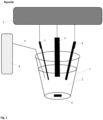
- Fig. 1
- shows a diagram of a electrochemical cell;
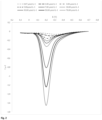
- Fig. 2
- shows voltammograms recorded for increasing concentration of the thymoquinone standard solution for example 1;
- Fig. 3
- shows a calibration curve for example 1;
- Fig. 4
- shows the voltammogram obtained for the test sample (discussed in Example 2);
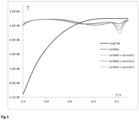
- Fig. 5
- shows voltammograms recorded for the blank, for the sample and for increasing concentration of the thymoquinone standard solution, according to example 2;
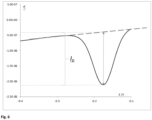
- Fig. 6
- shows how the peak current is measured.
- Determination of thymoquinone in a sample of an aqueous solution.
-
Electrochemical cell 1 with a capacity of 15 ml, made of glass, was placed with 10 ml of the supportingelectrolyte solution 2, which is an equimolar solution of acetic acid, boric acid and phosphoric acid at a concentration of 0.04 mol/L, adjusted to pH = 9.0 with 0.2 mol/L sodium hydroxide solution. Aplatinum electrode 3, a saturatedsilver chloride electrode 4, a boron-dopeddiamond electrode 5, and amagnetic stirrer 6 were successively introduced into the electrochemical cell. Measurements were carried out using apotentiostat 7, which allows operation in three-electrode systems. All three electrodes were connected topotentiostat 7, each to a dedicated connection The supportingelectrolyte 2 was deoxidized each time before the measurement for five minutes, using argon supplied to the electrochemical cell from thegas cylinder 8, which is the gas source, viatube 9. The solution was stirred during deoxidation. In the solution prepared in this way, using the square wave voltammetry technique, a voltammogram was recorded in the potential range from 0.1V to - 0.7V, which constitutes the blank. The required parameters of the SWV technique are an amplitude of 30 m V, a step potential of 5 V, and a frequency of 25 Hz. - To perform the determination according to the method, it is necessary to use a standard solution of thymoquinone with a concentration of 0.001 mol/L, which was prepared by weighing 8.21 mg of the analyte, quantitatively transferring the substance to a 50 ml volumetric flask and filling up to volume with distilled water. The solution was then mixed and set aside for 48 hours. Initially, steps were taken as described in point 1). Then, aliquots of the thymoquinone standard solution were added to the electrochemical cell with the supporting electrolyte so that its concentration in the electrochemical cell ranged from 0.07 µmol/L to 70.0 µmol/L. After each addition of the standard solution, a voltammogram was recorded. Then the values of the peak current were measured. The peak current corresponding to the thymoquinone content is visible at a potential of -220mV.
- Three measurement series were performed, obtaining peak currents for thymoquinone concentrations ranging from 0.07 µmol/L to 70.0 µmol/L. The obtained results of the peak currents for individual concentrations were averaged.
- From the averaged peak current values the relationship was prepared I p =f(cTym), where:
- I p denotes peak current at a potential of -220mV
- cTym denotes concentration of thymoquinone in the electrochemical cell.
- For I p =f(cTym ), equation of the calibration curve was found.
- 50 µL of the sample was added to the electrochemical cell placed with the supporting electrolyte, then the voltammogram was recorded and the peak current was measured. The peak current corresponding to the thymoquinone content is visible at a potential of -220 mV. The value of the peak current for the sample was within the range of calibration curve. Then, using the equation of the calibration curve prepared as described in point 2), substituting the /p value for the value of the peak current of the sample, the concentration of thymoquinone in the electrochemical cell and then in the sample was calculated.
- Determination of thymoquinone in an oil sample.
-
Electrochemical cell 1 with a capacity of 15 ml, made of glass, was placed with 9.5 ml of the supportingelectrolyte solution 2, which is an equimolar solution of acetic acid, boric acid and phosphoric acid at a concentration of 0.04 mol/L, adjusted to pH = 10.0 with 0.2 mol/L hydroxide sodium solution. Aplatinum electrode 3, asilver chloride electrode 4, aamalgam film electrode 5, and amagnetic stirrer 6 were successively introduced into the electrochemical cell. Measurements were carried out using apotentiostat 7, which allows operation in three-electrode systems. All three electrodes were connected topotentiostat 7, each to a dedicated connection. The supportingelectrolyte solution 1 was deoxidized each time before the measurement for five minutes, using argon supplied to the electrochemical cell from thegas cylinder 8, which is the gas source, viatube 9. The solution was stirred during deoxidation. In the solution prepared in this way, using the square wave voltammetry technique, a voltammogram was recorded in the potential range from -0.05V to -1.2V, which constitutes the blank. The required parameters of the SWV technique are an amplitude of 25 mV, a step potential of 4 mV, and a frequency of 25 Hz. - To determine thymoquinone, it is necessary to prepare a food sample. For this purpose, 5.0 mg of oil was weighed and placed in a 5 ml volumetric flask, filled up to the volume and mixed. The solution obtained in this way is called the sample solution.
- To perform the determination according to the method, it is necessary to use a standard solution of thymoquinone with a concentration of 0.001 mol/L, which was prepared by weighing 8.21 mg of the analyte, quantitatively transferring the substance to a 50 ml volumetric flask and filling it up to the volume with methanol. The solution was then mixed. Determining the thymoquinone content in a sample requires recording four voltammograms.
- The first voltammogram is the voltammogram of the sample, to be recorded it was placed in an
electrochemical cell 1 containing 9.5mL of the supportingelectrolyte 2, 0.5mL of the sample solution. After recording the voltammogram, the peak current was measured. The peak current corresponding to the thymoquinone content is visible at a potential of -165 mV. The current value for the sample ranges from 2.8 × 10 -7 A to 3.2 x 10 -7 A. - The second voltammogram was recorded by adding 1 portion of the standard thymoquinone solution containing 50 nanomoles of thymoquinone to the electrochemical cell. After recording the second voltammogram, the peak current was measured at a potential of -165 mV.
- The third and fourth voltammograms were recorded analogously after subsequent additions of the standard thymoquinone solution. The entire sequence of steps described in
points - I p denotes peak current at a potential of -165mV,
- ntym wz denotes the amount of moles of thymoquinone added to the electrochemical cell.
- Then, using the obtained equations, the content of thymoquinone in the electrochemical cell and then in the sample was calculated. The obtained thymoquinone content results were averaged.
- For the analyzed oil sample, thymoquinone content was determined to be 8.13 ± 0.34 (n=3) mg/ml, while the thymoquinone content determined using the reference method for the same sample was 8.20 ± 0.45 (n=3).
Claims (4)
- A method for determining thymoquinone by square wave voltammetry (SWV), characterized in that it includes steps where- in the first step, equal volumes of acetic acid, boric acid and phosphoric acid are mixed at a concentration of 0.04 mol/L and adjusted to pH in the range of 9.0-10.0 to prepare a buffer solution, which is the supporting electrolyte (2);- in the second step, a sample solution is prepared for analysis• for samples in which the medium (M) is oil - a solution of a food sample of the tested oil is prepared by dissolving the oil in ethanol in a volumetric flask, then filled up to volume with ethanol and mixed• for samples in which the medium (M) is water or a water-soluble solvent - the sample solution is prepared by dissolving thymoquinone in water;- in the third step, the electrochemical cell (1) is placed with the supporting electrolyte (2) and a magnetic stirrer (6), a platinum electrode (3) as an auxiliary electrode, a saturated silver chloride electrode (4) as a reference electrode and a working electrode (5) are introduced successively, where the electrode reaction of thymoquinone reduction takes place at the working electrode surface (5);- in the fourth step, all three electrodes were connected to the potentiostat (7), each to a dedicated connection, and then the supporting electrolyte (2) is deoxidized for five minutes before measurement, using argon from the gas cylinder (8) constituting the gas source connected to electrochemical cell (1) with a supply tube (9), and the solution is mixed during deoxidation using a magnetic stirrer (6);- in the fifth step, voltammograms are recorded with the determination of current reference values for standard solutions of known thymoquinone concentrations, and• for samples in which the medium (M) is oil, the recording of voltammograms includes steps where:a) voltammogram is recorded for pure supporting electrolyte, without any additives, constituting a blank;b) the voltammogram of the sample, prepared in the second step, is recorded and the peak current is measured at a potential of -165mV;c) a standard thymoquinone solution, which is a solution of thymoquinone in methanol, is added to the electrochemical cell (1) and the peak current is measured at a potential of -165 mV;d) step c) is repeated twice using additions of the standard thymoquinone solution containing the same amount of thymoquinone as added in step c);e) from the peak current values obtained in points b)-d) the curve /p= f (Xtym ), is plotted, where:/p denotes peak current at a potential of -165 mV andX tym denotes the amount of moles or grams of added thymoquinone;f) the point of intersection of the obtained curve of step e) is read , and based on the obtained X tym , the content of thymoquinone in the electrochemical cell (1) and the sample is calculated;g) then steps a)-f) are repeated three times and, based on the results obtained, the average content of thymoquinone in the sample is calculated;, wherein all voltammograms are recorded in the potential range from -0.05V to -1.2V, with the SWV technique parameters being: amplitude 25 mV, step potential 4 mV and frequency 25 Hz;• for samples in which the medium (M) is water or a water-soluble solvent, recording of voltammograms includes steps where:h) voltammogram is recorded for pure supporting electrolyte, without any additives, constituting the blank;i) a standard thymoquinone solution, which is a solution of thymoquinone in water, is added to the electrochemical cell (1) and the peak current is measured at a potential of -220mV ;j) then step i) is repeated minimum five times, recording voltammograms for the increasing concentration of thymoquinone in the electrochemical cell, which is created by the addition of the standard thymoquinone solution, and each time the peak current is measured at a potential of -220mV;k) steps h)-j) are repeated three times to obtain three measurement series ;I) then an relationship /p=f(cTym ), is determined where:/p denotes averaged value of the current increment at a potential of -220mV from three measurement series,cTym denotes thymoquinone concentration in the electrochemical cell;
and equation of calibration curve is determined;m) then the voltammogram of the sample prepared in the second step is recorded and the peak current is measured at a potential of -220mV;n) the value of the peak current obtained in step m) is substituted into the equation from step I) as /p, calculating the concentration of thymoquinone in the electrochemical cell and then the content in the sample;o) then steps m)-n) are repeated twice and, based on the results obtained, the average content of thymoquinone in the sample is calculated;, wherein all voltammograms are recorded in the potential range from 0.1V to -0.7V, with the SWV technique parameters being: amplitude 30mV, step potential 5mV and frequency 25Hz. - The method according to claim 1, characterized in that the pH of the supporting electrolyte is adjusted to the appropriate pH using sodium or potassium hydroxide solutions.
- Method according to claim 2, characterized in that in the first step the pH of the supporting electrolyte is adjusted to pH equal to 9.0 with 0.2M sodium hydroxide, where in the second step the working electrode (5) is a boron doped diamond electrode, and the medium (M) is water or a water-soluble solvent.
- Method according to claim 2, characterized in that in the first step the pH of the supporting electrolyte is adjusted to pH equal to 10.0 with 0.2M potassium hydroxide, where in the second step the working electrode (5) is an amalgam film electrode, with the medium (M) being oil.
Applications Claiming Priority (2)
| Application Number | Priority Date | Filing Date | Title |
|---|---|---|---|
| PL445674A PL247830B1 (en) | 2023-07-25 | 2023-07-25 | Method for determining thymoquinone in aqueous solutions or solutions based on water-soluble solvents |
| PL447056A PL447056A1 (en) | 2023-12-11 | 2023-12-11 | Method for determining thymoquinone in edible oils |
Publications (3)
| Publication Number | Publication Date |
|---|---|
| EP4498077A1 true EP4498077A1 (en) | 2025-01-29 |
| EP4498077C0 EP4498077C0 (en) | 2025-10-29 |
| EP4498077B1 EP4498077B1 (en) | 2025-10-29 |
Family
ID=92593403
Family Applications (1)
| Application Number | Title | Priority Date | Filing Date |
|---|---|---|---|
| EP24188463.4A Active EP4498077B1 (en) | 2023-07-25 | 2024-07-12 | Voltammetric method for determining thymoquinone |
Country Status (1)
| Country | Link |
|---|---|
| EP (1) | EP4498077B1 (en) |
-
2024
- 2024-07-12 EP EP24188463.4A patent/EP4498077B1/en active Active
Non-Patent Citations (3)
| Title |
|---|
| KISHWAR FARAH: "Cyclic Voltammetric Studies of Thymoquinone with Iron (III)", vol. 56, no. 2, 6 March 2013 (2013-03-06), pages 59 - 69, XP093223402, Retrieved from the Internet <URL:https://typeset.io/pdf/cyclic-voltammetric-studies-of-thymoquinone-with-1ron-111-4v1l416u0z.pdf> * |
| MICHELITSCH ASTRID ET AL: "A simple differential pulse polarographic method for the determination of thymoquinone in black seed oil", vol. 14, no. 4, 1 July 2003 (2003-07-01), Hoboken, USA, pages 224 - 227, XP093223517, ISSN: 0958-0344, Retrieved from the Internet <URL:https://analyticalsciencejournals.onlinelibrary.wiley.com/doi/pdfdirect/10.1002/pca.707> DOI: 10.1002/pca.707 * |
| RITA PETRUCCI ET AL: "Cyclic voltammetry, spectroelectrochemistry and electron spin resonance as combined tools to study thymoquinone in aprotic medium", ELECTROCHIMICA ACTA, ELSEVIER, AMSTERDAM, NL, vol. 60, 22 November 2011 (2011-11-22), pages 230 - 238, XP028353914, ISSN: 0013-4686, [retrieved on 20111122], DOI: 10.1016/J.ELECTACTA.2011.11.055 * |
Also Published As
| Publication number | Publication date |
|---|---|
| EP4498077C0 (en) | 2025-10-29 |
| EP4498077B1 (en) | 2025-10-29 |
Similar Documents
| Publication | Publication Date | Title |
|---|---|---|
| Freitas et al. | A portable electrochemical method for cocaine quantification and rapid screening of common adulterants in seized samples | |
| Milardovic et al. | Use of DPPH⋅| DPPH redox couple for biamperometric determination of antioxidant activity | |
| Fu et al. | Determination of adenosine phosphate by co-electroosmotic capillary electrophoresis with amperometric detection | |
| Dmukhailo et al. | Rapid and straightforward electrochemical approach for the determination of the toxic food azo dye tartrazine using sensors based on silver solid amalgam | |
| Levent et al. | Voltammetric Behavior of Testosterone on Bismuth Film Electrode: Highly Sensitive Determination in Pharmaceuticals and Human Urine by Square‐Wave Adsorptive Stripping Voltammetry | |
| Aboul-Kasim | Anodic adsorptive voltammetric determination of the vitamin B1 (thiamine) | |
| Piech et al. | Sensitive and fast determination of papaverine by adsorptive stripping voltammetry on renewable mercury film electrode | |
| Quintino et al. | Fast BIA-amperometric determination of isoniazid in tablets | |
| Yiğit et al. | Square-wave adsorptive stripping voltammetric determination of hesperidin using a boron-doped diamond electrode | |
| Yardım et al. | Electrochemical behavior and electroanalytical determination of indole‐3‐acetic acid phytohormone on a boron‐doped diamond electrode | |
| Alghamdi | Voltammetric analysis of montelukast sodium in commercial tablet and biological samples using the hanging mercury drop electrode | |
| Ghoneim et al. | Assay of anti-coagulant drug warfarin sodium in pharmaceutical formulation and human biological fluids by square-wave adsorptive cathodic stripping voltammetry | |
| Al-Ghamdi et al. | Electrochemical determination of rosiglitazone by square-wave adsorptive stripping voltammetry method | |
| Gupta et al. | Adsorption of pyrantel pamoate on mercury from aqueous solutions: studies by stripping voltammetry | |
| Bahgat et al. | Challenging electroanalytical method for the determination of mirabegron in biological samples and pharmaceutical formulations | |
| Rabiee et al. | A simple electroanalytical methodology for determination of natamycin by cathodic stripping voltammetry in dairy products | |
| Wang et al. | Adsorptive stripping voltammetry of sex hormones at the static mercury drop electrode | |
| Oliveira et al. | Square-wave adsorptive voltammetry of dexamethasone: redox mechanism, kinetic properties, and electroanalytical determinations in multicomponent formulations | |
| Ghoneim et al. | Adsorptive cathodic stripping voltammetric assay of the estrogen drug ethinylestradiol in pharmaceutical formulation and human plasma at a mercury electrode | |
| Lv et al. | On-line galvanic cell generated electrochemiluminescence determination of acyclovir based on the flow injection sampling | |
| EP4498077B1 (en) | Voltammetric method for determining thymoquinone | |
| Brahman et al. | Adsorptive stripping voltammetric study of vitamin B1 at multi-walled carbon nanotube paste electrode | |
| Suciu et al. | Determination of cadmium by differential pulse adsorptive stripping voltammetry | |
| Yilmaz et al. | Electrochemical oxidation of prednisolone at glassy carbon electrode and its quantitative determination in human serum and tablets by Osteryoung square wave voltammetry | |
| CN112461975A (en) | Method for detecting coenzyme content in feed additive |
Legal Events
| Date | Code | Title | Description |
|---|---|---|---|
| PUAI | Public reference made under article 153(3) epc to a published international application that has entered the european phase |
Free format text: ORIGINAL CODE: 0009012 |
|
| STAA | Information on the status of an ep patent application or granted ep patent |
Free format text: STATUS: REQUEST FOR EXAMINATION WAS MADE |
|
| 17P | Request for examination filed |
Effective date: 20240807 |
|
| AK | Designated contracting states |
Kind code of ref document: A1 Designated state(s): AL AT BE BG CH CY CZ DE DK EE ES FI FR GB GR HR HU IE IS IT LI LT LU LV MC ME MK MT NL NO PL PT RO RS SE SI SK SM TR |
|
| GRAP | Despatch of communication of intention to grant a patent |
Free format text: ORIGINAL CODE: EPIDOSNIGR1 |
|
| STAA | Information on the status of an ep patent application or granted ep patent |
Free format text: STATUS: GRANT OF PATENT IS INTENDED |
|
| INTG | Intention to grant announced |
Effective date: 20250708 |
|
| GRAS | Grant fee paid |
Free format text: ORIGINAL CODE: EPIDOSNIGR3 |
|
| GRAA | (expected) grant |
Free format text: ORIGINAL CODE: 0009210 |
|
| STAA | Information on the status of an ep patent application or granted ep patent |
Free format text: STATUS: THE PATENT HAS BEEN GRANTED |
|
| AK | Designated contracting states |
Kind code of ref document: B1 Designated state(s): AL AT BE BG CH CY CZ DE DK EE ES FI FR GB GR HR HU IE IS IT LI LT LU LV MC ME MK MT NL NO PL PT RO RS SE SI SK SM TR |
|
| REG | Reference to a national code |
Ref country code: CH Ref legal event code: F10 Free format text: ST27 STATUS EVENT CODE: U-0-0-F10-F00 (AS PROVIDED BY THE NATIONAL OFFICE) Effective date: 20251029 Ref country code: GB Ref legal event code: FG4D |
|
| REG | Reference to a national code |
Ref country code: IE Ref legal event code: FG4D |
|
| REG | Reference to a national code |
Ref country code: DE Ref legal event code: R096 Ref document number: 602024001094 Country of ref document: DE |
|
| U01 | Request for unitary effect filed |
Effective date: 20251124 |
|
| U07 | Unitary effect registered |
Designated state(s): AT BE BG DE DK EE FI FR IT LT LU LV MT NL PT RO SE SI Effective date: 20251202 |
|
| PG25 | Lapsed in a contracting state [announced via postgrant information from national office to epo] |
Ref country code: ES Free format text: LAPSE BECAUSE OF FAILURE TO SUBMIT A TRANSLATION OF THE DESCRIPTION OR TO PAY THE FEE WITHIN THE PRESCRIBED TIME-LIMIT Effective date: 20251029 |
|
| PG25 | Lapsed in a contracting state [announced via postgrant information from national office to epo] |
Ref country code: NO Free format text: LAPSE BECAUSE OF FAILURE TO SUBMIT A TRANSLATION OF THE DESCRIPTION OR TO PAY THE FEE WITHIN THE PRESCRIBED TIME-LIMIT Effective date: 20260129 |
|
| PG25 | Lapsed in a contracting state [announced via postgrant information from national office to epo] |
Ref country code: HR Free format text: LAPSE BECAUSE OF FAILURE TO SUBMIT A TRANSLATION OF THE DESCRIPTION OR TO PAY THE FEE WITHIN THE PRESCRIBED TIME-LIMIT Effective date: 20251029 |
|
| PG25 | Lapsed in a contracting state [announced via postgrant information from national office to epo] |
Ref country code: RS Free format text: LAPSE BECAUSE OF FAILURE TO SUBMIT A TRANSLATION OF THE DESCRIPTION OR TO PAY THE FEE WITHIN THE PRESCRIBED TIME-LIMIT Effective date: 20260129 |
|
| PG25 | Lapsed in a contracting state [announced via postgrant information from national office to epo] |
Ref country code: IS Free format text: LAPSE BECAUSE OF FAILURE TO SUBMIT A TRANSLATION OF THE DESCRIPTION OR TO PAY THE FEE WITHIN THE PRESCRIBED TIME-LIMIT Effective date: 20260228 |
|
| PG25 | Lapsed in a contracting state [announced via postgrant information from national office to epo] |
Ref country code: PL Free format text: LAPSE BECAUSE OF FAILURE TO SUBMIT A TRANSLATION OF THE DESCRIPTION OR TO PAY THE FEE WITHIN THE PRESCRIBED TIME-LIMIT Effective date: 20251029 |
|
| U20 | Renewal fee for the european patent with unitary effect paid |
Year of fee payment: 3 Effective date: 20260518 |
|
| PG25 | Lapsed in a contracting state [announced via postgrant information from national office to epo] |
Ref country code: SM Free format text: LAPSE BECAUSE OF FAILURE TO SUBMIT A TRANSLATION OF THE DESCRIPTION OR TO PAY THE FEE WITHIN THE PRESCRIBED TIME-LIMIT Effective date: 20251029 |
|
| PG25 | Lapsed in a contracting state [announced via postgrant information from national office to epo] |
Ref country code: CZ Free format text: LAPSE BECAUSE OF FAILURE TO SUBMIT A TRANSLATION OF THE DESCRIPTION OR TO PAY THE FEE WITHIN THE PRESCRIBED TIME-LIMIT Effective date: 20251029 |
|
| PG25 | Lapsed in a contracting state [announced via postgrant information from national office to epo] |
Ref country code: SK Free format text: LAPSE BECAUSE OF FAILURE TO SUBMIT A TRANSLATION OF THE DESCRIPTION OR TO PAY THE FEE WITHIN THE PRESCRIBED TIME-LIMIT Effective date: 20251029 |