EP4497935A1 - Variable geometry exhaust nozzle - Google Patents
Variable geometry exhaust nozzle Download PDFInfo
- Publication number
- EP4497935A1 EP4497935A1 EP24184577.5A EP24184577A EP4497935A1 EP 4497935 A1 EP4497935 A1 EP 4497935A1 EP 24184577 A EP24184577 A EP 24184577A EP 4497935 A1 EP4497935 A1 EP 4497935A1
- Authority
- EP
- European Patent Office
- Prior art keywords
- flap
- exhaust nozzle
- exhaust
- rotation
- moveable
- Prior art date
- Legal status (The legal status is an assumption and is not a legal conclusion. Google has not performed a legal analysis and makes no representation as to the accuracy of the status listed.)
- Pending
Links
Images



Classifications
-
- F—MECHANICAL ENGINEERING; LIGHTING; HEATING; WEAPONS; BLASTING
- F02—COMBUSTION ENGINES; HOT-GAS OR COMBUSTION-PRODUCT ENGINE PLANTS
- F02K—JET-PROPULSION PLANTS
- F02K1/00—Plants characterised by the form or arrangement of the jet pipe or nozzle; Jet pipes or nozzles peculiar thereto
- F02K1/002—Plants characterised by the form or arrangement of the jet pipe or nozzle; Jet pipes or nozzles peculiar thereto with means to modify the direction of thrust vector
- F02K1/006—Plants characterised by the form or arrangement of the jet pipe or nozzle; Jet pipes or nozzles peculiar thereto with means to modify the direction of thrust vector within one plane only
-
- F—MECHANICAL ENGINEERING; LIGHTING; HEATING; WEAPONS; BLASTING
- F01—MACHINES OR ENGINES IN GENERAL; ENGINE PLANTS IN GENERAL; STEAM ENGINES
- F01N—GAS-FLOW SILENCERS OR EXHAUST APPARATUS FOR MACHINES OR ENGINES IN GENERAL; GAS-FLOW SILENCERS OR EXHAUST APPARATUS FOR INTERNAL-COMBUSTION ENGINES
- F01N13/00—Exhaust or silencing apparatus characterised by constructional features
- F01N13/08—Other arrangements or adaptations of exhaust conduits
- F01N13/10—Other arrangements or adaptations of exhaust conduits of exhaust manifolds
-
- F—MECHANICAL ENGINEERING; LIGHTING; HEATING; WEAPONS; BLASTING
- F01—MACHINES OR ENGINES IN GENERAL; ENGINE PLANTS IN GENERAL; STEAM ENGINES
- F01N—GAS-FLOW SILENCERS OR EXHAUST APPARATUS FOR MACHINES OR ENGINES IN GENERAL; GAS-FLOW SILENCERS OR EXHAUST APPARATUS FOR INTERNAL-COMBUSTION ENGINES
- F01N13/00—Exhaust or silencing apparatus characterised by constructional features
- F01N13/18—Construction facilitating manufacture, assembly, or disassembly
-
- F—MECHANICAL ENGINEERING; LIGHTING; HEATING; WEAPONS; BLASTING
- F02—COMBUSTION ENGINES; HOT-GAS OR COMBUSTION-PRODUCT ENGINE PLANTS
- F02K—JET-PROPULSION PLANTS
- F02K1/00—Plants characterised by the form or arrangement of the jet pipe or nozzle; Jet pipes or nozzles peculiar thereto
- F02K1/06—Varying effective area of jet pipe or nozzle
- F02K1/12—Varying effective area of jet pipe or nozzle by means of pivoted flaps
- F02K1/1207—Varying effective area of jet pipe or nozzle by means of pivoted flaps of one series of flaps hinged at their upstream ends on a fixed structure
-
- F—MECHANICAL ENGINEERING; LIGHTING; HEATING; WEAPONS; BLASTING
- F02—COMBUSTION ENGINES; HOT-GAS OR COMBUSTION-PRODUCT ENGINE PLANTS
- F02K—JET-PROPULSION PLANTS
- F02K1/00—Plants characterised by the form or arrangement of the jet pipe or nozzle; Jet pipes or nozzles peculiar thereto
- F02K1/06—Varying effective area of jet pipe or nozzle
- F02K1/12—Varying effective area of jet pipe or nozzle by means of pivoted flaps
- F02K1/1261—Varying effective area of jet pipe or nozzle by means of pivoted flaps of one series of flaps hinged at their upstream ends on a substantially axially movable structure
-
- F—MECHANICAL ENGINEERING; LIGHTING; HEATING; WEAPONS; BLASTING
- F05—INDEXING SCHEMES RELATING TO ENGINES OR PUMPS IN VARIOUS SUBCLASSES OF CLASSES F01-F04
- F05D—INDEXING SCHEME FOR ASPECTS RELATING TO NON-POSITIVE-DISPLACEMENT MACHINES OR ENGINES, GAS-TURBINES OR JET-PROPULSION PLANTS
- F05D2250/00—Geometry
- F05D2250/30—Arrangement of components
- F05D2250/31—Arrangement of components according to the direction of their main axis or their axis of rotation
- F05D2250/311—Arrangement of components according to the direction of their main axis or their axis of rotation the axes being in line
-
- F—MECHANICAL ENGINEERING; LIGHTING; HEATING; WEAPONS; BLASTING
- F05—INDEXING SCHEMES RELATING TO ENGINES OR PUMPS IN VARIOUS SUBCLASSES OF CLASSES F01-F04
- F05D—INDEXING SCHEME FOR ASPECTS RELATING TO NON-POSITIVE-DISPLACEMENT MACHINES OR ENGINES, GAS-TURBINES OR JET-PROPULSION PLANTS
- F05D2250/00—Geometry
- F05D2250/30—Arrangement of components
- F05D2250/33—Arrangement of components symmetrical
-
- F—MECHANICAL ENGINEERING; LIGHTING; HEATING; WEAPONS; BLASTING
- F05—INDEXING SCHEMES RELATING TO ENGINES OR PUMPS IN VARIOUS SUBCLASSES OF CLASSES F01-F04
- F05D—INDEXING SCHEME FOR ASPECTS RELATING TO NON-POSITIVE-DISPLACEMENT MACHINES OR ENGINES, GAS-TURBINES OR JET-PROPULSION PLANTS
- F05D2250/00—Geometry
- F05D2250/40—Movement of components
- F05D2250/41—Movement of components with one degree of freedom
-
- F—MECHANICAL ENGINEERING; LIGHTING; HEATING; WEAPONS; BLASTING
- F05—INDEXING SCHEMES RELATING TO ENGINES OR PUMPS IN VARIOUS SUBCLASSES OF CLASSES F01-F04
- F05D—INDEXING SCHEME FOR ASPECTS RELATING TO NON-POSITIVE-DISPLACEMENT MACHINES OR ENGINES, GAS-TURBINES OR JET-PROPULSION PLANTS
- F05D2250/00—Geometry
- F05D2250/70—Shape
- F05D2250/71—Shape curved
-
- F—MECHANICAL ENGINEERING; LIGHTING; HEATING; WEAPONS; BLASTING
- F05—INDEXING SCHEMES RELATING TO ENGINES OR PUMPS IN VARIOUS SUBCLASSES OF CLASSES F01-F04
- F05D—INDEXING SCHEME FOR ASPECTS RELATING TO NON-POSITIVE-DISPLACEMENT MACHINES OR ENGINES, GAS-TURBINES OR JET-PROPULSION PLANTS
- F05D2250/00—Geometry
- F05D2250/90—Variable geometry
-
- F—MECHANICAL ENGINEERING; LIGHTING; HEATING; WEAPONS; BLASTING
- F05—INDEXING SCHEMES RELATING TO ENGINES OR PUMPS IN VARIOUS SUBCLASSES OF CLASSES F01-F04
- F05D—INDEXING SCHEME FOR ASPECTS RELATING TO NON-POSITIVE-DISPLACEMENT MACHINES OR ENGINES, GAS-TURBINES OR JET-PROPULSION PLANTS
- F05D2260/00—Function
- F05D2260/50—Kinematic linkage, i.e. transmission of position
- F05D2260/56—Kinematic linkage, i.e. transmission of position using cams or eccentrics
Definitions
- the present disclosure relates to an exhaust nozzle for a gas turbine engine.
- variable geometry exhaust nozzles comprise exhaust flaps that may be individually controlled to vary the exit area of the exhaust nozzle.
- Variable geometry exhaust nozzles may be used to maximise the production of thrust at high nozzle pressure ratios and to provide thrust vectoring. Thrust vectoring may also be provided by independently controlling the exhaust flaps. In such arrangements, when opposing exhaust flaps are moved synchronously, there is a change in the exit area of the gas turbine engine which may be undesirable. When opposing exhaust flaps are moved asynchronously, both the exit area of the gas turbine engine and the thrust vector are changed, resulting in thrust loss or an unintended vector.
- an exhaust nozzle for a gas turbine engine comprising:
- a centreline of the first moveable slot extends along a first moveable arc having a centre that is offset from the first axis of rotation.
- the exhaust duct may comprise a first static slot configured to slidably receive the first pin.
- a centreline of the first static slot extends along a first static arc having a centre that is coincident with the first axis of rotation.
- the first static slot is formed in a side wall of the exhaust nozzle.
- the side wall of the exhaust nozzle may partially define the exhaust gas passageway.
- the exhaust nozzle may comprise a first actuator configured to move the first moveable cam and thereby cause the first flap to be actuated between the first inner position and the first outer position.
- the exhaust nozzle may comprise a side wall partially defining the exhaust gas passageway, wherein the side wall is disposed between at least a part of the first actuator and the exhaust gas passageway.
- the exhaust nozzle may comprise a second flap rotatably coupled to the exhaust duct for rotation about a second axis of rotation.
- the first and second flaps may at least in part define the exhaust gas passageway.
- the second flap may comprise a second pin.
- the exhaust nozzle may comprise a second moveable cam having a second moveable slot configured to slidably receive the second pin.
- the exhaust nozzle may be configured such that movement of the second moveable cam causes the second flap to be moved about the second axis of rotation between a second inner position and a second outer position.
- a centreline of the second moveable slot may extend along a second moveable arc having a centre that is offset from the first and second axes of rotation.
- the first actuator is configured to move the second moveable cam and thereby cause the second flap to be actuated between the second inner position and the second outer position.
- first moveable cam and the second moveable cam form at least part of an integral moveable cam structure such that the first moveable cam and the second moveable cam are configured to move in unison.
- the exhaust nozzle may comprise a second actuator configured to move the second moveable cam and thereby cause the second flap to be actuated between the second inner position and the second outer position.
- the exhaust duct may comprise a second static slot configured to slidably receive the second pin.
- a centreline of the second static slot extends along a second static arc having a centre that is coincident with the first and second axes of rotation.
- the second static slot is formed in a side wall of the exhaust nozzle.
- the side wall of the exhaust nozzle may partially define the exhaust gas passageway.
- the exhaust nozzle further comprises a first roller rotatably coupled to the exhaust duct and the first flap comprises a first bearing surface configured to bear against the first roller during rotational movement of the first flap about the first axis of rotation.
- the first bearing surface may form part of a first curved surface having a central axis that is coaxial with the first axis of rotation.
- the exhaust nozzle further comprises a second roller rotatably coupled to the exhaust duct and the second flap comprises a second bearing surface configured to bear against the second roller during rotational movement of the second flap about the second axis of rotation.
- the second bearing surface may form part of a second curved surface having a central axis that is coaxial with the first and second axes of rotation.
- Each curved surface may be a cylindrical surface.
- the radius of the first cylindrical surface may be equal to the radius of the second cylindrical surface.
- the exhaust duct comprises a first side wall and a second side wall.
- the exhaust nozzle may further comprise a first shaft extending between the first side wall and the second side wall that rotatably supports the first roller.
- the exhaust nozzle may further comprise a second shaft extending between the first side wall and the second side wall that rotatably supports the second roller.
- the radius of the first moveable arc is equal to the radius of the second moveable arc.
- first pin and the first roller are circumferentially separated with respect to the first axis of rotation. It may also be that the second pin and the second roller are circumferentially separated with respect to the second axis of rotation.
- the first flap may comprise a first control surface that in part defines the exhaust gas passageway.
- the second flap may comprise a second control surface that in part defines the exhaust gas passageway.
- the first control surface and the second control surface may be reflections of each other.
- first flap and the second flap are convergent-divergent flaps, such that the first flap and the second flap define a convergent-divergent nozzle.
- first flap and the second flap are convergent flaps, such that the first flap and the second flap define a convergent nozzle.
- a system comprising: an exhaust nozzle in accordance with the first aspect and a controller, wherein the controller is configured to, in a variable geometry mode of operation, control the first actuator to actuate the first and second flaps at a same rate of angular rotation and in different rotational directions about the first and second axes of rotation.
- a system comprising: an exhaust nozzle in accordance with the first aspect and a controller, wherein the controller is configured to, in a vectoring mode of operation, control the first and second actuators to actuate the first and second flaps at a same rate of angular rotation and in the same rotational direction about the first and second axes of rotation.
- controller is configured to, in a variable geometry mode of operation, control the first and second actuators to actuate the first and second flaps at different rates of angular rotation and/or in different rotational directions about the first and second axes of rotation.
- an exhaust nozzle for a gas turbine engine comprising:
- a gas turbine engine comprising: an exhaust nozzle in accordance with the first aspect or in accordance with the fourth aspect; or a system in accordance with the second aspect or in accordance with the third aspect.
- Figure 1 shows a ducted fan gas turbine engine 10 having a principal and rotational axis X-X.
- the engine comprises, in axial flow series, an air intake 11, a propulsive fan 12, an intermediate-pressure compressor 13, a high-pressure compressor 14, a combustor 15, a high-pressure turbine 16, an intermediate pressure turbine 17, a low-pressure turbine 18 and a core engine exhaust nozzle 19.
- a nacelle 21 generally surrounds the gas turbine engine 10 and defines the intake 11, a bypass duct 22 and a bypass exhaust nozzle 23.
- air entering the intake 11 is accelerated by the fan 12 to produce two air flows: a first air flow A into the intermediate pressure compressor 13 and a second air flow B which passes through the bypass duct 22 to provide propulsive thrust.
- the intermediate-pressure compressor 13 compresses the air flow A directed into it before delivering that air to the high-pressure compressor 14 where further compression takes place.
- the compressed air exhausted from the high-pressure compressor 14 is directed into the combustor 15 where it is mixed with fuel and the mixture combusted.
- the resultant hot combustion products then expand through, and thereby drive the high, intermediate and low-pressure turbines 16, 17, 18 before being exhausted through the core engine exhaust nozzle 19 to provide additional propulsive thrust.
- the high, intermediate and low-pressure turbines respectively drive the high and intermediate pressure compressors 14, 13 and the fan 12 by suitable interconnecting shafts.
- the gas turbine engine 10 further comprises an exhaust nozzle 30.
- the exhaust nozzle 30 is disposed at a rear end of the gas turbine engine 10 and generally comprises an exhaust duct 32, a first flap 34 (also referred to as a petal) and a second flap 36.
- the exhaust duct 32 is configured to receive an exhaust flow of gas from the combustor 15 (i.e., the first air flow A after it has passed through the combustor 15).
- the exhaust duct is further configured to receive the second air flow B after it has passed through the bypass duct 22.
- the first and second flaps 34, 36 in part define an exhaust gas passageway 38 configured to convey the exhaust flow of gas to an exterior 40 of the gas turbine engine 10.
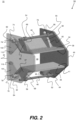
- FIG 2 is a perspective view of a first example exhaust nozzle 30 suitable for use as the exhaust nozzle 30 in the gas turbine engine 10 of Figure 1 .
- the exhaust duct 32 comprises a first side wall 42 and a second side wall 44.
- the first and second side walls 42, 44 are spaced apart from each other.
- the first flap 34 is disposed between the first and second side walls 42, 44 in an upper portion of the exhaust nozzle 30.
- the second flap 36 is disposed between the first and second side walls 42, 44 in a lower portion of the exhaust nozzle 30.
- the first and second flaps 34, 36 seal against the first and second side walls 42, 44 by means of a conformal controlled gap.
- the first flap 34 comprises a first control surface 39 and the second flap 36 comprises a second control surface 41.
- the first control surface 39 and the second control surface 41 in part define (along with the first and second side walls 42, 44) the exhaust gas passageway 38.
- the first and second control surfaces 39, 41 are geometrically similar and are reflections of each
- a first shaft or tiebar 46 extends between the first and second side walls 42, 44 in an upper portion of the exhaust nozzle 30.
- a second shaft or tiebar 48 extends between the first and second side walls 42, 44 in a lower portion of the exhaust nozzle 30.
- a first roller 54 is rotatably supported by the first shaft 46 and a second roller 56 is rotatably supported by the second shaft 48.
- a third roller 50 is rotatably supported by the first shaft 46 and a fourth roller 52 is rotatably supported by the second shaft 48.
- the first flap 34 comprises a first cam track or flange 66 that protrudes from the respective control surface to define a first bearing surface 68.
- the second flap 36 comprises a second cam track or flange 67 that similarly protrudes from the respective control surface to define a second bearing surface 69.
- the second cam track 67 and second bearing surface 69 are located on the second flap 36 in corresponding positions to the first cam track 66 and first bearing surface 68.
- the first flap 34 further comprises a third cam track 58 that defines a third bearing surface 60.
- the second flap 36 further comprises a fourth cam track 62 that defines a fourth bearing surface 64.
- the fourth cam track 62 and bearing surface 64 are located on the second flap 36 in corresponding positions to the third cam track 58 and third bearing surface 60.
- the first side wall 42 comprises a first static slot 74 in an upper portion of the exhaust nozzle 30.
- the first side wall 42 further comprises a second static slot in a lower portion of the exhaust nozzle 30.
- the second side wall 44 comprises a third static slot 78 in an upper portion of the exhaust nozzle 30.
- the second side wall 44 further comprises a fourth static slot in a lower portion of the exhaust nozzle 30 (not shown by Figure 2 ).
- the first flap 34 comprises a first pin 82 that is slidably received by the first static slot 74.
- the second flap 36 comprises a second pin 84 that is slidably received by the second static slot.
- the first flap 34 further comprises a third pin 86 that is slidably received by the third static slot 78.
- the second flap 36 further comprises a fourth pin 88 that is slidably received by the fourth slot 80 (not shown by Figure 2 ). Further features of the first example exhaust nozzle 30 shown and not shown in Figure 2 are now described with reference to Figures 3 to 6
- Figure 3 is a side view of the first example exhaust nozzle 30 shown by Figure 2 in a non-vectored dry-thrust configuration.
- the non-vectored dry-thrust configuration of the exhaust nozzle 30 is suitable for use when the engine 10 is operating dry (e.g., without reheat) and vectoring of thrust produced by the engine 10 away from a direction parallel to the rotational axis X-X is not intended.
- the first flap 34 is rotatably coupled to the exhaust duct 32 for rotation about a first axis of rotation 118 and the second flap 36 is rotatably coupled to the exhaust duct 32 for rotation about a second axis of rotation 120 that is coaxial (i.e. aligned) with the first axis of rotation 118.
- the first and second axes of rotation 118, 120 may be defined so as to give the optimal expansion ratio between the throat and exit of the exhaust nozzle 30.
- the first flap 34 comprises a convergent portion and a divergent portion. Accordingly, the first flap 34 is a convergent-divergent flap.
- the second flap 36 comprises a convergent portion and a divergent portion. Accordingly, the second flap 36 is also a convergent-divergent flap.
- the first and second flaps 34, 36 therefore define a convergent-divergent nozzle, but in other examples may have an alternative configuration that does not define a convergent-divergent nozzle.
- the first bearing surface 68 forms part of a first curved surface 122 having a central axis 124 that is coaxial with the first and second axes of rotation 118, 120.
- the second bearing surface 69 forms part of a second curved surface 126 having a central axis 128 that is coaxial with the first and second axes of rotation 118, 120.
- each curved surface 122, 126 is a cylindrical surface 122, 126 and the radius of the first cylindrical surface 122 is equal to the radius of the second cylindrical surface 126. Accordingly, the first and second cylindrical surfaces 122, 126 are coincident.
- a centreline of the first static slot 74 extends at least part way along a first static arc 130 having a centre 132 that is coincident with the first and second axes of rotation 118, 120.
- a centreline of the second static slot 76 extends at least part way along a second static arc 134 having a centre 136 that is coincident with the first and second axes of rotation 118, 120. Accordingly, the static slots 74, 76 have corresponding curved shapes.
- the radius of the first static arc 130 is equal to the radius of the second static arc 134. Accordingly, the first and second static arcs 130, 134 lie on a single circle.
- the first pin 82 and the first roller 54 are circumferentially separated with respect to the first axis of rotation 118.
- the second pin 84 and the second roller 56 are circumferentially separated with respect to the second axis of rotation 120.
- the exhaust nozzle 30 comprises a first moveable cam element 142 and a second moveable cam element 144.
- the first moveable cam element 142 is rotatably coupled to the first wall 42 at a first pivot 112
- the second moveable cam element 144 is rotatably coupled to the first wall 42 at a second pivot 116.
- the first and second pivots 112, 116 may not be located in the first wall 42.
- the first and second pivots 112, 116 may be located at other fixed positions within the exhaust nozzle 30.
- the first moveable cam element 142 comprises a first moveable slot 74* which is configured to slidably receive the first pin 82.
- the first pin 82 extends through both the first static slot 74 and the first moveable slot 74* so as to partially constrain the relative positions of each.
- the second moveable cam element 144 comprises a second moveable slot 76* which is configured to slidably receive the second pin 84.
- the second pin 84 extends through both the second static slot 76 and the second moveable slot 76* so as to partially constrain the relative positions of each.
- a centreline of the first moveable slot 74* extends at least part way along a first moveable arc 130* having a centre 132*.
- a centreline of the second moveable slot 76* extends at least part way along a second moveable arc 134* having a centre 136*. Accordingly, each moveable slot 74*, 76* has a curved shape. In this example, the radius of the first moveable arc 130* is equal to the radius of the second moveable arc 134*.
- the exhaust nozzle 30 also comprises a first actuator 104 and a second actuator 106.
- the first actuator 104 is generally configured to move the first moveable cam element 142 and thereby cause the first flap 34 to be moved
- the second actuator 106 is generally configured to move the second moveable cam element 142 and thereby cause the second flap 36 to be moved.
- the first actuator 104 is a rotary-type actuator (e.g., including an electric motor) and a driving portion 104' of the first actuator 104 is pivotally coupled to the first moveable cam element 142 at the first pivot 112.
- the second actuator 106 is a rotary-type actuator (e.g., an including electric motor) and a driving portion 106' of the second actuator 106 is pivotally coupled to the second moveable cam element 144 at the second pivot 116.
- the or each actuator 104, 106 may be a linear-type actuator (e.g., including an electromagnetic solenoid or a hydraulic cylinder) and the driving end of the or each actuator may be coupled to the respectively moveable cam element 142, 144 other than at the pivot 112, 116.
- the first actuator 104 is able to actuate the first flap 34 about the first axis of rotation 118 through a plurality of first intermediate positions between a first inner position and a first outer position.
- first inner position need not be the innermost position that the first flap 34 is able to be actuated to and the first outer position need not be the outermost position that the first flap 34 is able to be actuated to.
- first pin 82 slides along the first static slot 74 and the first bearing surface 68 bears against the first roller 54.
- the first roller 54 constrains the motion of the first flap 34 to a predetermined path, such that movement of the first pin 82 along the first static slot 74 causes the first flap 34 to undertake a predetermined compound movement of translation and rotation with one degree of freedom (i.e., so that each position of the first pin 82 along the first static slot 74 corresponds maps to a single respective translational and rotational position of the first flap 34).
- the first flap 34 has been positioned (by means of the first actuator 104 positioning the first moveable cam element 142) at a first intermediate position between the first inner position and the first outer position.
- the second actuator 106 is able to actuate the second flap 36 about the second axis of rotation 120 through a similar plurality of second intermediate positions in the same way.
- the first and second flaps 34, 36 can be actuated to the positions shown in Figure 3 in the non-vectored dry-thrust configuration. Examples of various additional combinations of positions that the first and second flaps 34, 36 can be actuated to in other configurations are described below with reference to Figures 4 to 6 .
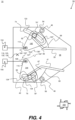
- Figure 4 is a side view of the first example exhaust nozzle 30 shown by Figure 2 in a vectored dry-thrust configuration.
- the vectored dry-thrust configuration of the exhaust nozzle 30 is suitable for use when the engine 10 is operating dry and vectoring of thrust produced by the engine 10 away from a direction parallel to the rotational axis X-X is intended.
- the first flap 34 has been positioned (by means of the first actuator 104 positioning the first moveable cam element 142) at a first inner position in which the first flap 34 has been rotated approximately 6° closer to the principal rotational axis X-X of the gas turbine engine 10 compared to the first intermediate position shown by Figure 3 ; and the second flap 36 has been positioned (by means of the second actuator 106 positioning the first moveable cam element 144) at a second intermediate position in which the second flap 36 has been rotated approximately 6° further from the principal rotational axis X-X of the gas turbine engine 10 compared to the second intermediate position shown by Figure 3 .
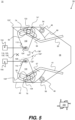
- Figure 5 is a side view of the first example exhaust nozzle 30 shown by Figure 2 in a non-vectored wet-thrust configuration.
- the non-vectored wet-thrust configuration of the exhaust nozzle 30 is suitable for use when the engine 10 is operating wet (e.g., with reheat) and vectoring of thrust produced by the engine 10 away from a direction parallel to the rotational axis X-X is intended.
- the first flap 34 has been positioned (by means of the first actuator 104 positioning the first moveable cam element 142) at a first intermediate position in which the first flap 34 has been positioned relatively far away from the principal rotational axis X-X of the gas turbine engine 10 compared to the first intermediate position of the non-vectored dry-thrust configuration shown by Figure 3 and the second flap 36 has been positioned (by means of the second actuator 106 positioning the second moveable cam element 144) at a second intermediate position in which the second flap 36 has been positioned relatively far away from the principal rotational axis X-X of the gas turbine engine 10 compared to the second intermediate position of the non-vectored dry-thrust configuration shown by Figure 3 .
- a minimum cross-sectional area of the exhaust gas passageway 38 is therefore greater in the non-vectored wet-thrust configuration shown by Figure 5 than in the non-vectored dry-thrust configuration shown by Figure 3 .
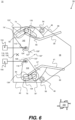
- Figure 6 is a side view of the first example exhaust nozzle 30 shown by Figure 2 in a vectored wet-thrust configuration.
- the vectored dry-thrust configuration of the exhaust nozzle 30 is suitable for use when the engine 10 is operating wet and vectoring of thrust produced by the engine 10 away from a direction parallel to the rotational axis X-X is intended.
- the first flap 34 has been positioned (by means of the first actuator 104 positioning the first moveable cam element 142) at a first outer position in which the first flap 34 has been rotated approximately 6° further from to the principal rotational axis X-X of the gas turbine engine 10 compared to the first intermediate position shown by Figure 5 and the second flap 36 has been positioned (by means of the second actuator 106 positioning the first moveable cam element 144) at a second intermediate position in which the second flap 36 has been rotated approximately 6° closer to from the principal rotational axis X-X of the gas turbine engine 10 compared to the second intermediate position shown by Figure 5 .
- the position of the centre 132* of the first moveable arc 130* varies between each of the positions shown in Figures 3 to 6 .
- the position of the centre 132* moves along a first trace 133* as the first cam element 142 (and therefore the first movable slot 74*) is moved between the positions shown in each of Figures 3 to 6 .
- the centre 132* is offset from the first axis of rotation 118.
- the position of the centre 136* of the second moveable arc 134* varies between each of the positions shown in Figures 3 to 5 .
- the position of the centre 136* moves along a second trace 137* as the second cam element 144 (and therefore the second movable slot 76*) is moved between the positions shown in each of Figures 3 to 6 .
- the centre 136* is offset from the second axis of rotation 120.
- Figure 7 is a side view of a second example exhaust nozzle 30 in a dry-thrust configuration.
- the dry-thrust configuration of the exhaust nozzle 30 is suitable for use when the engine 10 is operating dry (e.g., without reheat).
- Figure 8 is a side view of the second example exhaust nozzle 30 in a wet-thrust configuration.
- the wet-thrust configuration of the exhaust nozzle 30 is suitable for use when the engine 10 is operating wet (e.g., with reheat).
- the second example exhaust nozzle 30 is generally similar to the first example exhaust nozzle 30 described above with reference to Figures 2 to 6 , with like reference numerals denoting common features.
- the first moveable cam element 142 and the second moveable cam element 144 form part of a moveable integral cam structure 140 in the second example exhaust nozzle 30 shown by Figures 7 and 8 .
- the first moveable cam element 142 is configured to move in unison with the second moveable cam element 144 and vice versa.
- the second example exhaust nozzle comprises a single actuator 104 which is generally configured to move the integral cam structure 140 and thereby cause both the first flap 34 and the second flap 36 to be moved in accordance with the movement of the first moveable cam element 142 and the second moveable cam element 144.
- the single actuator 104 is a linear-type actuator (e.g., including an electromagnetic solenoid or a hydraulic cylinder) and a driving portion 104' of the single actuator 104 is fixed to the moveable integral cam structure 140.
- the first flap 34 and the second flap 36 have each been positioned (by means of the single actuator 104 positioning the integral moveable cam structure 140) at respective inner positions in which the flaps 34, 36 have been positioned relatively close to the principal rotational axis X-X of the gas turbine engine.
- the first flap 34 and the second flap 36 have each been positioned (by means of the single actuator 104 positioning the integral moveable cam structure 140) at respective outer positions in which the flaps 34, 36 have been positioned relatively far from the principal rotational axis X-X of the gas turbine engine.
- a minimum cross-sectional area of the exhaust gas passageway 38 is therefore greater in the wet-thrust configuration shown by Figure 8 than in the dry-thrust configuration shown by Figure 7 .
- a controller 200 may be functionally provided to the exhaust nozzle 30, as shown in each of Figures 3 to 8 .
- the controller 200 may be included as part of a system 31 which also includes the exhaust nozzle 30.
- the or each actuator 104, 106 is positioned on a side of the exhaust nozzle 30. That is, the or each actuator 104, 106 is positioned within the exhaust nozzle 30 such that the first side wall 42 is disposed between at least part of (e.g., the driving portion of) the or each actuator 104, 106 and the exhaust gas passageway 38. In particular, the or each actuator 104, 106 may be directly or indirectly mounted to the XX.
- an actuator for moving a flap of the exhaust nozzle was positioned on a top or a bottom of the exhaust nozzle (that is, was positioned within the exhaust nozzle such that the flap was disposed between at least part of the actuator and an exhaust gas passageway of the exhaust nozzle).
- the or each actuator 104, 106 being positioned on the side of the exhaust nozzle 30 is associated with a more compact exhaust nozzle 30 and/or an exhaust nozzle 30 which may be more easily integrated within a gas turbine engine 10 and/or an airframe to which the gas turbine engine 10 is incorporated.
- each actuator 104, 106 being positioned on the side of the exhaust nozzle 30 rather than on the top and/or the bottom of the exhaust nozzle 30 may enable the use of more lightweight components (e.g., for the or each flap and/or the or each actuator) and therefore enable a mass of the exhaust nozzle 30 to be lowered.
- a pressure load imposed by each flap 34, 36 on the corresponding pin 82, 84 is at least partially opposed (e.g., reacted to) by strain in the structure(s) surrounding the respective slots 74, 74*, 76, 76 rather than by being largely (e.g., entirely) opposed by a force provided by the actuator(s) 104, 106.
- This enables actuator(s) 104, 106 having a relatively lower load rating to be selected for use in the exhaust nozzle 30, which is associated with a reduced size and/or mass of the actuator(s) and therefore a reduced mass of the exhaust nozzle 30 and/or increase ease of incorporation of the exhaust nozzle 30 within a gas turbine engine 10 or an airframe.
- the curved shape of the or each moveable slot 74*, 76* has the effect of smoothing a profile of the load applied to (and by) the actuators 104, 106 between the inner and outer positions of the flaps 34, 36, especially as a result of the combination with the curved shape of each static slot 74, 76 and the centres 132*, 136* of each moveable slot 74*, 76* being offset from offset from the first and second axes of rotation 118, 120 (throughout the range of positions of each flap 34, 36).
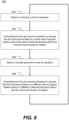
- FIG 9 is a flowchart of an example method 500 of operating an exhaust nozzle 30 in accordance with the present disclosure.
- the controller 200 may be configured to operate the exhaust nozzle 30 by carrying out the example method 500.
- the method 500 comprises a first step 502.
- the controller 200 selects a vectoring mode of operation.
- the method 500 proceeds to a second step 504.
- the controller 200 controls the first and second actuators 104, 106 to actuate the first and second flaps 34, 36 at the same rate of angular rotation in the same rotational direction about the first and second axes of rotation 118, 120. This results in thrust vectoring. Since the first and second flaps 34, 36 rotate about a common axis 118, 120, the geometry of the exhaust gas passageway 38 stays the same as the first and second flaps 34, 36 rotate (i.e. the exhaust nozzle 30 does not have variable geometry).
- a third step 506 is carried out.
- the controller 200 selects a variable geometry mode of operation.
- the method 500 proceeds to the fourth step 508.
- the controller 200 controls the first and second actuators 104, 106 to actuate the first and second flaps 34, 36 at a different rate of angular rotation and/or in different rotational directions about the first and second axes of rotation 118, 120. This modifies the geometry of the exhaust gas passageway 38 and thus changes the expansion ratio.
- the method 500 then proceeds back to the first step 502.
- the controller 200 can control the first and second actuators 104, 106 to actuate the first and second flaps 34, 36 at the same rate in opposite directions. This varies the geometry of the exhaust nozzle 30 without changing the direction of the centreline of the exhaust gas passageway 38 (and, thus, without carrying out thrust vectoring).
- the controller 200 can control the first and second actuators 104, 106 to actuate the first and second flaps 34, 36 at different rates in different directions. This varies the geometry of the exhaust nozzle 30 while also changing the direction of the centreline of the exhaust gas passageway 38 (and, thus, also carrying out thrust vectoring). It will be appreciated that in the fourth step 508, one of the rates of rotation may be zero.
- the controller 200 can control the first and second actuators 104, 106 to actuate the first and second flaps 34, 36 at different rates in the same direction. This varies the geometry of the exhaust nozzle 30 while also changing the direction of the centreline of the exhaust gas passageway 38 (and, thus, also carrying out thrust vectoring). It will be appreciated that in the fourth step 508, one of the rates of rotation may be zero.
- the method 500 starts at the first step 502, it may instead start at the second, third or fourth steps 504, 506, 508.
- the exhaust nozzle 30 may be configured to be operated in only a single mode of operation (e.g., the vectoring mode of operation or the variable geometry mode of operation).
- the controller 200 may only be configured to operate the exhaust nozzle 30 in only the variable geometry mode of operation. If so, the controller 200 controls the single actuator 104 to actuate the first and second flaps 34, 36 at the same rates of angular rotation but in different directions around the respective axes of rotation 118, 120 by virtue of the integral cam structure 140.
- the first flap is rotatably coupled to the exhaust duct 32 directly.
- the rotatable couplings between the first and second flaps and the exhaust duct 32 may instead be indirect rotatable couplings. That is, the first flap may be rotatably coupled to the exhaust duct 32 via intermediate components and the second flap may be rotatably coupled to the exhaust duct 32 via intermediate components.
Landscapes
- Engineering & Computer Science (AREA)
- Chemical & Material Sciences (AREA)
- Combustion & Propulsion (AREA)
- Mechanical Engineering (AREA)
- General Engineering & Computer Science (AREA)
- Supercharger (AREA)
Abstract
There is described an exhaust nozzle 30 for a gas turbine engine 10. The exhaust nozzle 30 comprises an exhaust duct 32 and a first flap 34. The exhaust duct 32 is configured to receive an exhaust flow of gas from a combustor 15 of the gas turbine engine 10. The first flap 34 is rotatably coupled to the exhaust duct 32 for rotation about a first axis of rotation 118. Further, the first flap 34 at least in part defines an exhaust gas passageway 38 configured to convey the exhaust flow of gas to an exterior 40 of the gas turbine engine 10. Additionally, the first flap 34 comprises a first pin 82. The exhaust nozzle 30 comprises a first moveable cam 142 having a first moveable slot 74* configured to slidably receive the first pin 82. The exhaust nozzle 30 is configured such that movement of the first moveable cam 142 causes the first flap 34 to be moved about the first axis of rotation 118 between a first inner position and a first outer position.
Description
- The present disclosure relates to an exhaust nozzle for a gas turbine engine.
- It is known for gas turbine engines to have variable geometry exhaust nozzles. Such variable geometry exhaust nozzles comprise exhaust flaps that may be individually controlled to vary the exit area of the exhaust nozzle. Variable geometry exhaust nozzles may be used to maximise the production of thrust at high nozzle pressure ratios and to provide thrust vectoring. Thrust vectoring may also be provided by independently controlling the exhaust flaps. In such arrangements, when opposing exhaust flaps are moved synchronously, there is a change in the exit area of the gas turbine engine which may be undesirable. When opposing exhaust flaps are moved asynchronously, both the exit area of the gas turbine engine and the thrust vector are changed, resulting in thrust loss or an unintended vector.
- It is therefore desirable to provide an improved exhaust nozzle and method of operating an exhaust nozzle that overcomes some or all of these issues.
- According to a first aspect of the present disclosure, there is provided an exhaust nozzle for a gas turbine engine, the exhaust nozzle comprising:
- an exhaust duct configured to receive an exhaust flow of gas from a combustor of the gas turbine engine; and
- a first flap rotatably coupled to the exhaust duct for rotation about a first axis of rotation;
- wherein the first flap at least in part defines an exhaust gas passageway configured to convey the exhaust flow of gas to an exterior of the gas turbine engine,
- wherein the first flap comprises a first pin,
- wherein the exhaust nozzle comprises a first moveable cam having a first moveable slot configured to slidably receive the first pin, and
- wherein the exhaust nozzle is configured such that movement of the first moveable cam causes the first flap to be moved about the first axis of rotation between a first inner position and a first outer position.
- It may be that a centreline of the first moveable slot extends along a first moveable arc having a centre that is offset from the first axis of rotation.
- The exhaust duct may comprise a first static slot configured to slidably receive the first pin.
- It may be that a centreline of the first static slot extends along a first static arc having a centre that is coincident with the first axis of rotation.
- It may be that the first static slot is formed in a side wall of the exhaust nozzle. The side wall of the exhaust nozzle may partially define the exhaust gas passageway.
- The exhaust nozzle may comprise a first actuator configured to move the first moveable cam and thereby cause the first flap to be actuated between the first inner position and the first outer position.
- The exhaust nozzle may comprise a side wall partially defining the exhaust gas passageway, wherein the side wall is disposed between at least a part of the first actuator and the exhaust gas passageway.
- The exhaust nozzle may comprise a second flap rotatably coupled to the exhaust duct for rotation about a second axis of rotation. The first and second flaps may at least in part define the exhaust gas passageway. The second flap may comprise a second pin. The exhaust nozzle may comprise a second moveable cam having a second moveable slot configured to slidably receive the second pin. The exhaust nozzle may be configured such that movement of the second moveable cam causes the second flap to be moved about the second axis of rotation between a second inner position and a second outer position. A centreline of the second moveable slot may extend along a second moveable arc having a centre that is offset from the first and second axes of rotation.
- It may be that the first actuator is configured to move the second moveable cam and thereby cause the second flap to be actuated between the second inner position and the second outer position.
- It may be that the first moveable cam and the second moveable cam form at least part of an integral moveable cam structure such that the first moveable cam and the second moveable cam are configured to move in unison.
- The exhaust nozzle may comprise a second actuator configured to move the second moveable cam and thereby cause the second flap to be actuated between the second inner position and the second outer position.
- The exhaust duct may comprise a second static slot configured to slidably receive the second pin.
- It may be that a centreline of the second static slot extends along a second static arc having a centre that is coincident with the first and second axes of rotation.
- It may be that the second static slot is formed in a side wall of the exhaust nozzle. The side wall of the exhaust nozzle may partially define the exhaust gas passageway.
- It may be that the exhaust nozzle further comprises a first roller rotatably coupled to the exhaust duct and the first flap comprises a first bearing surface configured to bear against the first roller during rotational movement of the first flap about the first axis of rotation. The first bearing surface may form part of a first curved surface having a central axis that is coaxial with the first axis of rotation.
- It may also be that the exhaust nozzle further comprises a second roller rotatably coupled to the exhaust duct and the second flap comprises a second bearing surface configured to bear against the second roller during rotational movement of the second flap about the second axis of rotation. The second bearing surface may form part of a second curved surface having a central axis that is coaxial with the first and second axes of rotation.
- Each curved surface may be a cylindrical surface. The radius of the first cylindrical surface may be equal to the radius of the second cylindrical surface.
- It may be that the exhaust duct comprises a first side wall and a second side wall. The exhaust nozzle may further comprise a first shaft extending between the first side wall and the second side wall that rotatably supports the first roller. The exhaust nozzle may further comprise a second shaft extending between the first side wall and the second side wall that rotatably supports the second roller.
- It may be that the radius of the first moveable arc is equal to the radius of the second moveable arc.
- It may be that the first pin and the first roller are circumferentially separated with respect to the first axis of rotation. It may also be that the second pin and the second roller are circumferentially separated with respect to the second axis of rotation.
- The first flap may comprise a first control surface that in part defines the exhaust gas passageway. The second flap may comprise a second control surface that in part defines the exhaust gas passageway. The first control surface and the second control surface may be reflections of each other.
- It may be that the first flap and the second flap are convergent-divergent flaps, such that the first flap and the second flap define a convergent-divergent nozzle.
- It may be that the first flap and the second flap are convergent flaps, such that the first flap and the second flap define a convergent nozzle.
- According to a second aspect of the present disclosure, there is provided a system comprising: an exhaust nozzle in accordance with the first aspect and a controller, wherein the controller is configured to, in a variable geometry mode of operation, control the first actuator to actuate the first and second flaps at a same rate of angular rotation and in different rotational directions about the first and second axes of rotation.
- According to a third aspect of the present disclosure, there is provided a system comprising: an exhaust nozzle in accordance with the first aspect and a controller, wherein the controller is configured to, in a vectoring mode of operation, control the first and second actuators to actuate the first and second flaps at a same rate of angular rotation and in the same rotational direction about the first and second axes of rotation.
- It may be that the controller is configured to, in a variable geometry mode of operation, control the first and second actuators to actuate the first and second flaps at different rates of angular rotation and/or in different rotational directions about the first and second axes of rotation.
- According to a fourth aspect of the present disclosure, there is provided an exhaust nozzle for a gas turbine engine, the exhaust nozzle comprising:
- an exhaust duct configured to receive an exhaust flow of gas from a combustor of the gas turbine engine;
- a first flap rotatably coupled to the exhaust duct for rotation about a first axis of rotation;
- a side wall; and
- a first actuator configured to cause the first flap to be moved about the first axis of rotation between a first inner position and a first outer position;
- wherein the first flap and the side wall at least in part define an exhaust gas passageway configured to convey the exhaust flow of gas to an exterior of the gas turbine engine, and
- wherein the side wall is disposed between at least a part of the first actuator and the exhaust gas passageway.
- According to a fifth aspect there is provided a gas turbine engine comprising: an exhaust nozzle in accordance with the first aspect or in accordance with the fourth aspect; or a system in accordance with the second aspect or in accordance with the third aspect.
- Embodiments will now be described by way of example only with reference to the accompanying drawings, which are purely schematic and not to scale, and in which:
-
Figure 1 is a cross-sectional view of an example gas turbine engine and an exhaust nozzle; -
Figure 2 is a perspective view of a first example exhaust nozzle in isolation; -
Figure 3 is a side view of the first example exhaust nozzle in a non-vectored dry-thrust configuration; -
Figure 4 is a side view of the first example exhaust nozzle in a vectored dry-thrust configuration; -
Figure 5 is a side view of the first example exhaust nozzle in a non-vectored wet-thrust configuration; -
Figure 6 is a side view of the first example exhaust nozzle in a vectored wet-thrust configuration; -
Figure 7 is a side view of a second example exhaust nozzle in a dry-thrust configuration; -
Figure 8 is a side view of the second example exhaust nozzle in a wet-thrust configuration; -
Figure 9 is a flowchart which shows a method of operating an exhaust nozzle in accordance with the present disclosure. -
Figure 1 shows a ducted fangas turbine engine 10 having a principal and rotational axis X-X. The engine comprises, in axial flow series, an air intake 11, apropulsive fan 12, an intermediate-pressure compressor 13, a high-pressure compressor 14, acombustor 15, a high-pressure turbine 16, anintermediate pressure turbine 17, a low-pressure turbine 18 and a core engine exhaust nozzle 19. Anacelle 21 generally surrounds thegas turbine engine 10 and defines the intake 11, abypass duct 22 and abypass exhaust nozzle 23. - During operation, air entering the intake 11 is accelerated by the
fan 12 to produce two air flows: a first air flow A into theintermediate pressure compressor 13 and a second air flow B which passes through thebypass duct 22 to provide propulsive thrust. The intermediate-pressure compressor 13 compresses the air flow A directed into it before delivering that air to the high-pressure compressor 14 where further compression takes place. - The compressed air exhausted from the high-
pressure compressor 14 is directed into thecombustor 15 where it is mixed with fuel and the mixture combusted. The resultant hot combustion products then expand through, and thereby drive the high, intermediate and low-pressure turbines intermediate pressure compressors fan 12 by suitable interconnecting shafts. - The
gas turbine engine 10 further comprises anexhaust nozzle 30. Theexhaust nozzle 30 is disposed at a rear end of thegas turbine engine 10 and generally comprises anexhaust duct 32, a first flap 34 (also referred to as a petal) and asecond flap 36. Theexhaust duct 32 is configured to receive an exhaust flow of gas from the combustor 15 (i.e., the first air flow A after it has passed through the combustor 15). The exhaust duct is further configured to receive the second air flow B after it has passed through thebypass duct 22. The first andsecond flaps exhaust gas passageway 38 configured to convey the exhaust flow of gas to anexterior 40 of thegas turbine engine 10. -
Figure 2 is a perspective view of a firstexample exhaust nozzle 30 suitable for use as theexhaust nozzle 30 in thegas turbine engine 10 ofFigure 1 . As shown, theexhaust duct 32 comprises afirst side wall 42 and asecond side wall 44. The first andsecond side walls first flap 34 is disposed between the first andsecond side walls exhaust nozzle 30. Thesecond flap 36 is disposed between the first andsecond side walls exhaust nozzle 30. The first andsecond flaps second side walls first flap 34 comprises afirst control surface 39 and thesecond flap 36 comprises asecond control surface 41. Thefirst control surface 39 and thesecond control surface 41 in part define (along with the first andsecond side walls 42, 44) theexhaust gas passageway 38. The first andsecond control surfaces - A first shaft or
tiebar 46 extends between the first andsecond side walls exhaust nozzle 30. A second shaft ortiebar 48 extends between the first andsecond side walls exhaust nozzle 30. Afirst roller 54 is rotatably supported by thefirst shaft 46 and asecond roller 56 is rotatably supported by thesecond shaft 48. In addition, athird roller 50 is rotatably supported by thefirst shaft 46 and afourth roller 52 is rotatably supported by thesecond shaft 48. Thefirst flap 34 comprises a first cam track orflange 66 that protrudes from the respective control surface to define afirst bearing surface 68. Thesecond flap 36 comprises a second cam track orflange 67 that similarly protrudes from the respective control surface to define asecond bearing surface 69. Thesecond cam track 67 andsecond bearing surface 69 are located on thesecond flap 36 in corresponding positions to thefirst cam track 66 andfirst bearing surface 68. Thefirst flap 34 further comprises athird cam track 58 that defines athird bearing surface 60. Thesecond flap 36 further comprises afourth cam track 62 that defines afourth bearing surface 64. Thefourth cam track 62 and bearingsurface 64 are located on thesecond flap 36 in corresponding positions to thethird cam track 58 andthird bearing surface 60. - The
first side wall 42 comprises a firststatic slot 74 in an upper portion of theexhaust nozzle 30. Thefirst side wall 42 further comprises a second static slot in a lower portion of theexhaust nozzle 30. Thesecond side wall 44 comprises a thirdstatic slot 78 in an upper portion of theexhaust nozzle 30. Thesecond side wall 44 further comprises a fourth static slot in a lower portion of the exhaust nozzle 30 (not shown byFigure 2 ). Thefirst flap 34 comprises afirst pin 82 that is slidably received by the firststatic slot 74. Thesecond flap 36 comprises asecond pin 84 that is slidably received by the second static slot. Thefirst flap 34 further comprises athird pin 86 that is slidably received by the thirdstatic slot 78. Thesecond flap 36 further comprises a fourth pin 88 that is slidably received by the fourth slot 80 (not shown byFigure 2 ). Further features of the firstexample exhaust nozzle 30 shown and not shown inFigure 2 are now described with reference toFigures 3 to 6 . -
Figure 3 is a side view of the firstexample exhaust nozzle 30 shown byFigure 2 in a non-vectored dry-thrust configuration. The non-vectored dry-thrust configuration of theexhaust nozzle 30 is suitable for use when theengine 10 is operating dry (e.g., without reheat) and vectoring of thrust produced by theengine 10 away from a direction parallel to the rotational axis X-X is not intended. As described in further detail below, thefirst flap 34 is rotatably coupled to theexhaust duct 32 for rotation about a first axis of rotation 118 and thesecond flap 36 is rotatably coupled to theexhaust duct 32 for rotation about a second axis of rotation 120 that is coaxial (i.e. aligned) with the first axis of rotation 118. The first and second axes of rotation 118, 120 may be defined so as to give the optimal expansion ratio between the throat and exit of theexhaust nozzle 30. - The
first flap 34 comprises a convergent portion and a divergent portion. Accordingly, thefirst flap 34 is a convergent-divergent flap. Likewise, thesecond flap 36 comprises a convergent portion and a divergent portion. Accordingly, thesecond flap 36 is also a convergent-divergent flap. The first andsecond flaps - As shown in
Figure 3 , thefirst bearing surface 68 forms part of a firstcurved surface 122 having a central axis 124 that is coaxial with the first and second axes of rotation 118, 120. Thesecond bearing surface 69 forms part of a secondcurved surface 126 having a central axis 128 that is coaxial with the first and second axes of rotation 118, 120. In the example ofFigure 5 , eachcurved surface cylindrical surface cylindrical surface 122 is equal to the radius of the secondcylindrical surface 126. Accordingly, the first and secondcylindrical surfaces static slot 74 extends at least part way along a firststatic arc 130 having acentre 132 that is coincident with the first and second axes of rotation 118, 120. A centreline of the secondstatic slot 76 extends at least part way along a secondstatic arc 134 having acentre 136 that is coincident with the first and second axes of rotation 118, 120. Accordingly, thestatic slots static arc 130 is equal to the radius of the secondstatic arc 134. Accordingly, the first and secondstatic arcs first pin 82 and thefirst roller 54 are circumferentially separated with respect to the first axis of rotation 118. Similarly, thesecond pin 84 and thesecond roller 56 are circumferentially separated with respect to the second axis of rotation 120. - The
exhaust nozzle 30 comprises a firstmoveable cam element 142 and a secondmoveable cam element 144. The firstmoveable cam element 142 is rotatably coupled to thefirst wall 42 at afirst pivot 112, whereas the secondmoveable cam element 144 is rotatably coupled to thefirst wall 42 at asecond pivot 116. In other examples, the first andsecond pivots first wall 42. For instance, the first andsecond pivots exhaust nozzle 30. The firstmoveable cam element 142 comprises a firstmoveable slot 74* which is configured to slidably receive thefirst pin 82. Thefirst pin 82 extends through both the firststatic slot 74 and the firstmoveable slot 74* so as to partially constrain the relative positions of each. Similarly, the secondmoveable cam element 144 comprises a secondmoveable slot 76* which is configured to slidably receive thesecond pin 84. Thesecond pin 84 extends through both the secondstatic slot 76 and the secondmoveable slot 76* so as to partially constrain the relative positions of each. - A centreline of the first
moveable slot 74* extends at least part way along a firstmoveable arc 130* having acentre 132*. A centreline of the secondmoveable slot 76* extends at least part way along a secondmoveable arc 134* having acentre 136*. Accordingly, eachmoveable slot 74*, 76* has a curved shape. In this example, the radius of the firstmoveable arc 130* is equal to the radius of the secondmoveable arc 134*. - The
exhaust nozzle 30 also comprises afirst actuator 104 and asecond actuator 106. Thefirst actuator 104 is generally configured to move the firstmoveable cam element 142 and thereby cause thefirst flap 34 to be moved, whereas thesecond actuator 106 is generally configured to move the secondmoveable cam element 142 and thereby cause thesecond flap 36 to be moved. In the example ofFigure 3 , thefirst actuator 104 is a rotary-type actuator (e.g., including an electric motor) and a driving portion 104' of thefirst actuator 104 is pivotally coupled to the firstmoveable cam element 142 at thefirst pivot 112. Likewise, in the example ofFigure 3 , thesecond actuator 106 is a rotary-type actuator (e.g., an including electric motor) and a driving portion 106' of thesecond actuator 106 is pivotally coupled to the secondmoveable cam element 144 at thesecond pivot 116. However, it will be appreciated that other actuator-types are suitable for use as thefirst actuator 104 and/or thesecond actuator 106. For instance, the or each actuator 104, 106 may be a linear-type actuator (e.g., including an electromagnetic solenoid or a hydraulic cylinder) and the driving end of the or each actuator may be coupled to the respectivelymoveable cam element pivot - During operation of the exhaust nozzle 30 (e.g., to move the
flaps 34, 36), thefirst actuator 104 is able to actuate thefirst flap 34 about the first axis of rotation 118 through a plurality of first intermediate positions between a first inner position and a first outer position. It will be appreciated that the first inner position need not be the innermost position that thefirst flap 34 is able to be actuated to and the first outer position need not be the outermost position that thefirst flap 34 is able to be actuated to. During actuation of thefirst flap 34, thefirst pin 82 slides along the firststatic slot 74 and thefirst bearing surface 68 bears against thefirst roller 54. Thefirst roller 54 constrains the motion of thefirst flap 34 to a predetermined path, such that movement of thefirst pin 82 along the firststatic slot 74 causes thefirst flap 34 to undertake a predetermined compound movement of translation and rotation with one degree of freedom (i.e., so that each position of thefirst pin 82 along the firststatic slot 74 corresponds maps to a single respective translational and rotational position of the first flap 34). In the non-vectored dry-thrust configuration shown byFigure 3 , thefirst flap 34 has been positioned (by means of thefirst actuator 104 positioning the first moveable cam element 142) at a first intermediate position between the first inner position and the first outer position. - During operation of the
exhaust nozzle 30, thesecond actuator 106 is able to actuate thesecond flap 36 about the second axis of rotation 120 through a similar plurality of second intermediate positions in the same way. - The first and
second flaps Figure 3 in the non-vectored dry-thrust configuration. Examples of various additional combinations of positions that the first andsecond flaps Figures 4 to 6 . -
Figure 4 is a side view of the firstexample exhaust nozzle 30 shown byFigure 2 in a vectored dry-thrust configuration. The vectored dry-thrust configuration of theexhaust nozzle 30 is suitable for use when theengine 10 is operating dry and vectoring of thrust produced by theengine 10 away from a direction parallel to the rotational axis X-X is intended. In the vectored dry-thrust configuration, thefirst flap 34 has been positioned (by means of thefirst actuator 104 positioning the first moveable cam element 142) at a first inner position in which thefirst flap 34 has been rotated approximately 6° closer to the principal rotational axis X-X of thegas turbine engine 10 compared to the first intermediate position shown byFigure 3 ; and thesecond flap 36 has been positioned (by means of thesecond actuator 106 positioning the first moveable cam element 144) at a second intermediate position in which thesecond flap 36 has been rotated approximately 6° further from the principal rotational axis X-X of thegas turbine engine 10 compared to the second intermediate position shown byFigure 3 . -
Figure 5 is a side view of the firstexample exhaust nozzle 30 shown byFigure 2 in a non-vectored wet-thrust configuration. The non-vectored wet-thrust configuration of theexhaust nozzle 30 is suitable for use when theengine 10 is operating wet (e.g., with reheat) and vectoring of thrust produced by theengine 10 away from a direction parallel to the rotational axis X-X is intended. In the non-vectored wet-thrust configuration, thefirst flap 34 has been positioned (by means of thefirst actuator 104 positioning the first moveable cam element 142) at a first intermediate position in which thefirst flap 34 has been positioned relatively far away from the principal rotational axis X-X of thegas turbine engine 10 compared to the first intermediate position of the non-vectored dry-thrust configuration shown byFigure 3 and thesecond flap 36 has been positioned (by means of thesecond actuator 106 positioning the second moveable cam element 144) at a second intermediate position in which thesecond flap 36 has been positioned relatively far away from the principal rotational axis X-X of thegas turbine engine 10 compared to the second intermediate position of the non-vectored dry-thrust configuration shown byFigure 3 . A minimum cross-sectional area of theexhaust gas passageway 38 is therefore greater in the non-vectored wet-thrust configuration shown byFigure 5 than in the non-vectored dry-thrust configuration shown byFigure 3 . -
Figure 6 is a side view of the firstexample exhaust nozzle 30 shown byFigure 2 in a vectored wet-thrust configuration. The vectored dry-thrust configuration of theexhaust nozzle 30 is suitable for use when theengine 10 is operating wet and vectoring of thrust produced by theengine 10 away from a direction parallel to the rotational axis X-X is intended. In the vectored wet-thrust configuration, thefirst flap 34 has been positioned (by means of thefirst actuator 104 positioning the first moveable cam element 142) at a first outer position in which thefirst flap 34 has been rotated approximately 6° further from to the principal rotational axis X-X of thegas turbine engine 10 compared to the first intermediate position shown byFigure 5 and thesecond flap 36 has been positioned (by means of thesecond actuator 106 positioning the first moveable cam element 144) at a second intermediate position in which thesecond flap 36 has been rotated approximately 6° closer to from the principal rotational axis X-X of thegas turbine engine 10 compared to the second intermediate position shown byFigure 5 . - The position of the
centre 132* of the firstmoveable arc 130* varies between each of the positions shown inFigures 3 to 6 . In particular, the position of thecentre 132* moves along afirst trace 133* as the first cam element 142 (and therefore the firstmovable slot 74*) is moved between the positions shown in each ofFigures 3 to 6 . Throughout the range of first intermediate positions and at both the first inner position and the first outer position of thefirst flap 34, thecentre 132* is offset from the first axis of rotation 118. Similarly, the position of thecentre 136* of the secondmoveable arc 134* varies between each of the positions shown inFigures 3 to 5 . Namely, the position of thecentre 136* moves along asecond trace 137* as the second cam element 144 (and therefore the secondmovable slot 76*) is moved between the positions shown in each ofFigures 3 to 6 . Throughout the range of second intermediate positions and at both the second inner position and the second outer position of thesecond flap 36, thecentre 136* is offset from the second axis of rotation 120. -
Figure 7 is a side view of a secondexample exhaust nozzle 30 in a dry-thrust configuration. The dry-thrust configuration of theexhaust nozzle 30 is suitable for use when theengine 10 is operating dry (e.g., without reheat). -
Figure 8 is a side view of the secondexample exhaust nozzle 30 in a wet-thrust configuration. The wet-thrust configuration of theexhaust nozzle 30 is suitable for use when theengine 10 is operating wet (e.g., with reheat). - The second
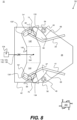
example exhaust nozzle 30 is generally similar to the firstexample exhaust nozzle 30 described above with reference toFigures 2 to 6 , with like reference numerals denoting common features. However, in contrast to the firstexample exhaust nozzle 30, the firstmoveable cam element 142 and the secondmoveable cam element 144 form part of a moveableintegral cam structure 140 in the secondexample exhaust nozzle 30 shown byFigures 7 and8 . By virtue of being integral parts of the moveableintegral cam structure 140, the firstmoveable cam element 142 is configured to move in unison with the secondmoveable cam element 144 and vice versa. In addition, the second example exhaust nozzle comprises asingle actuator 104 which is generally configured to move theintegral cam structure 140 and thereby cause both thefirst flap 34 and thesecond flap 36 to be moved in accordance with the movement of the firstmoveable cam element 142 and the secondmoveable cam element 144. In the example ofFigures 7 and8 , thesingle actuator 104 is a linear-type actuator (e.g., including an electromagnetic solenoid or a hydraulic cylinder) and a driving portion 104' of thesingle actuator 104 is fixed to the moveableintegral cam structure 140. - In the dry-thrust configuration of the second
example exhaust nozzle 30 shown byFigure 7 , thefirst flap 34 and thesecond flap 36 have each been positioned (by means of thesingle actuator 104 positioning the integral moveable cam structure 140) at respective inner positions in which theflaps example exhaust nozzle 30 shown byFigure 8 , thefirst flap 34 and thesecond flap 36 have each been positioned (by means of thesingle actuator 104 positioning the integral moveable cam structure 140) at respective outer positions in which theflaps exhaust gas passageway 38 is therefore greater in the wet-thrust configuration shown byFigure 8 than in the dry-thrust configuration shown byFigure 7 . Acontroller 200 may be functionally provided to theexhaust nozzle 30, as shown in each ofFigures 3 to 8 . Thecontroller 200 may be included as part of asystem 31 which also includes theexhaust nozzle 30. - In both of the
example exhaust nozzles 30 described above, the or each actuator 104, 106 is positioned on a side of theexhaust nozzle 30. That is, the or each actuator 104, 106 is positioned within theexhaust nozzle 30 such that thefirst side wall 42 is disposed between at least part of (e.g., the driving portion of) the or each actuator 104, 106 and theexhaust gas passageway 38. In particular, the or each actuator 104, 106 may be directly or indirectly mounted to the XX. In a previously-considered exhaust nozzle, an actuator for moving a flap of the exhaust nozzle was positioned on a top or a bottom of the exhaust nozzle (that is, was positioned within the exhaust nozzle such that the flap was disposed between at least part of the actuator and an exhaust gas passageway of the exhaust nozzle). The or each actuator 104, 106 being positioned on the side of theexhaust nozzle 30 is associated with a morecompact exhaust nozzle 30 and/or anexhaust nozzle 30 which may be more easily integrated within agas turbine engine 10 and/or an airframe to which thegas turbine engine 10 is incorporated. In addition, the or each actuator 104, 106 being positioned on the side of theexhaust nozzle 30 rather than on the top and/or the bottom of theexhaust nozzle 30 may enable the use of more lightweight components (e.g., for the or each flap and/or the or each actuator) and therefore enable a mass of theexhaust nozzle 30 to be lowered. - In use, a pressure load imposed by each
flap corresponding pin respective slots exhaust nozzle 30, which is associated with a reduced size and/or mass of the actuator(s) and therefore a reduced mass of theexhaust nozzle 30 and/or increase ease of incorporation of theexhaust nozzle 30 within agas turbine engine 10 or an airframe. In addition, the curved shape of the or eachmoveable slot 74*, 76* has the effect of smoothing a profile of the load applied to (and by) theactuators flaps static slot centres 132*, 136* of eachmoveable slot 74*, 76* being offset from offset from the first and second axes of rotation 118, 120 (throughout the range of positions of eachflap 34, 36). This results in a reduction in the load applied to the actuator(s) 104, 106 at various points between the inner and outer positions of theflaps -
Figure 9 is a flowchart of anexample method 500 of operating anexhaust nozzle 30 in accordance with the present disclosure. Thecontroller 200 may be configured to operate theexhaust nozzle 30 by carrying out theexample method 500. Themethod 500 comprises a first step 502. In the first step 502, thecontroller 200 selects a vectoring mode of operation. Upon the vectoring mode of operation having been selected, themethod 500 proceeds to asecond step 504. In thesecond step 504, thecontroller 200 controls the first andsecond actuators second flaps second flaps exhaust gas passageway 38 stays the same as the first andsecond flaps exhaust nozzle 30 does not have variable geometry). - Following the
second step 504, athird step 506 is carried out. In thethird step 506, thecontroller 200 selects a variable geometry mode of operation. Upon the variable geometry mode having been selected, themethod 500 proceeds to thefourth step 508. In thefourth step 508, thecontroller 200 controls the first andsecond actuators second flaps exhaust gas passageway 38 and thus changes the expansion ratio. Themethod 500 then proceeds back to the first step 502. - In the
fourth step 508, thecontroller 200 can control the first andsecond actuators second flaps exhaust nozzle 30 without changing the direction of the centreline of the exhaust gas passageway 38 (and, thus, without carrying out thrust vectoring). - Alternatively, in the
fourth step 508, thecontroller 200 can control the first andsecond actuators second flaps exhaust nozzle 30 while also changing the direction of the centreline of the exhaust gas passageway 38 (and, thus, also carrying out thrust vectoring). It will be appreciated that in thefourth step 508, one of the rates of rotation may be zero. - Alternatively, in the
fourth step 508, thecontroller 200 can control the first andsecond actuators second flaps exhaust nozzle 30 while also changing the direction of the centreline of the exhaust gas passageway 38 (and, thus, also carrying out thrust vectoring). It will be appreciated that in thefourth step 508, one of the rates of rotation may be zero. - Although it has been described that the
method 500 starts at the first step 502, it may instead start at the second, third orfourth steps exhaust nozzle 30 may be configured to be operated in only a single mode of operation (e.g., the vectoring mode of operation or the variable geometry mode of operation). In particular, if thecontroller 200 is configured to operate the secondexample exhaust nozzle 30 described above with respect toFigures 7 to 8 , thecontroller 200 may only be configured to operate theexhaust nozzle 30 in only the variable geometry mode of operation. If so, thecontroller 200 controls thesingle actuator 104 to actuate the first andsecond flaps integral cam structure 140. - In the foregoing description, the first flap is rotatably coupled to the
exhaust duct 32 directly. However, it will be appreciated that the rotatable couplings between the first and second flaps and theexhaust duct 32 may instead be indirect rotatable couplings. That is, the first flap may be rotatably coupled to theexhaust duct 32 via intermediate components and the second flap may be rotatably coupled to theexhaust duct 32 via intermediate components.
Claims (15)
- An exhaust nozzle (30) for a gas turbine engine (10), the exhaust nozzle (30) comprising:an exhaust duct (32) configured to receive an exhaust flow of gas from a combustor (15) of the gas turbine engine (10); anda first flap (34) rotatably coupled to the exhaust duct (32) for rotation about a first axis of rotation (118);wherein the first flap (34) at least in part defines an exhaust gas passageway (38) configured to convey the exhaust flow of gas to an exterior (40) of the gas turbine engine (10),wherein the first flap (34) comprises a first pin (82),wherein the exhaust nozzle (30) comprises a first moveable cam (142) having a first moveable slot (74*) configured to slidably receive the first pin (82), andwherein the exhaust nozzle (30) is configured such that movement of the first moveable cam (142) causes the first flap (34) to be moved about the first axis of rotation (118) between a first inner position and a first outer position.
- The exhaust nozzle (30) of Claim 1, wherein a centreline of the first moveable slot (74*) extends along a first moveable arc (130*) having a centre (132*) that is offset from the first axis of rotation (118).
- The exhaust nozzle (30) of Claim 1 or Claim 2, wherein the exhaust duct (32) comprises a first static slot (74) configured to slidably receive the first pin (82).
- The exhaust nozzle (30) of Claim 3, wherein the first static slot (74) is formed in a side wall (42, 44) of the exhaust nozzle (30), and wherein the side wall (42, 44) of the exhaust nozzle (30) partially defines the exhaust gas passageway (38).
- The exhaust nozzle (30) of any one of the preceding claims, comprising a first actuator (104) configured to move the first moveable cam (142) and thereby cause the first flap (34) to be actuated between the first inner position and the first outer position.
- The exhaust nozzle (30) of Claim 5, comprising a side wall (42, 44) partially defining the exhaust gas passageway (38), wherein the side wall (42, 44) is disposed between at least a part of the first actuator (104) and the exhaust gas passageway (38).
- The exhaust nozzle (30) of any one of the preceding claims, comprising a second flap (36) rotatably coupled to the exhaust duct (32) for rotation about a second axis of rotation (120),wherein the first and second flaps (34, 36) at least in part define the exhaust gas passageway (38),wherein the second flap (36) comprises a second pin (84),wherein the exhaust nozzle (30) comprises a second moveable cam (144) having a second moveable slot (76*) configured to slidably receive the second pin (84),wherein the exhaust nozzle (30) is configured such that movement of the second moveable cam (144) causes the second flap (36) to be moved about the second axis of rotation (120) between a second inner position and a second outer position,wherein a centreline of the second moveable slot (76*) extends along a second moveable arc (134*) having a centre (136*) that is offset from the first and second axes of rotation (118, 120).
- The exhaust nozzle (30) of both Claim 5 and Claim 7, wherein the first actuator (104) is configured to move the second moveable cam (144) and thereby cause the second flap (36) to be actuated between the second inner position and the second outer position.
- The exhaust nozzle (30) of Claim 7 or Claim 8, wherein the first moveable cam (142) and the second moveable cam (144) form at least part of an integral moveable cam structure (140) such that the first moveable cam (142) and the second moveable cam (144) are configured to move in unison.
- The exhaust nozzle (30) of Claim 7, comprising a second actuator (106) configured to move the second moveable cam (144) and thereby cause the second flap (36) to be actuated between the second inner position and the second outer position.
- The exhaust nozzle (30) of any one of Claims 7 to 10, wherein the exhaust nozzle (30) further comprises a first roller (54) rotatably coupled to the exhaust duct (32) and the first flap (34) comprises a first bearing surface (68) configured to bear against the first roller (54) during rotational movement of the first flap (34) about the first axis of rotation (118), wherein the first bearing surface (68) forms part of a first curved surface (122) having a central axis (124) that is coaxial with the first axis of rotation (118).
- The exhaust nozzle (30) of any one of Claims 7 to 11, wherein the first flap (34) and the second flap (36) are convergent-divergent flaps, such that the first flap (34) and the second flap (36) define a convergent-divergent nozzle.
- A system (31) comprising: the exhaust nozzle (30) of claim 8 or claim 9 and optionally any of claims 11 to 16 and a controller, wherein the controller is configured to, in a variable geometry mode of operation, control the first actuator (104) to actuate the first and second flaps (34, 36) at a same rate of angular rotation and in different rotational directions about the first and second axes of rotation (118, 120).
- A system (31) comprising: the exhaust nozzle (30) of Claim 10 and optionally Claim 11 or Claim 12 and a controller, wherein the controller is configured to, in a vectoring mode of operation, control the first and second actuators (104, 106) to actuate the first and second flaps (34, 36) at a same rate of angular rotation and in the same rotational direction about the first and second axes of rotation (118, 120).
- The system (31) of Claim 14, wherein the controller is configured to, in a variable geometry mode of operation, control the first and second actuators (104, 106) to actuate the first and second flaps (34, 36) at different rates of angular rotation and/or in different rotational directions about the first and second axes of rotation (118, 120).
Applications Claiming Priority (1)
| Application Number | Priority Date | Filing Date | Title |
|---|---|---|---|
| GBGB2311299.8A GB202311299D0 (en) | 2023-07-24 | 2023-07-24 | An exhaust nozzle |
Publications (1)
| Publication Number | Publication Date |
|---|---|
| EP4497935A1 true EP4497935A1 (en) | 2025-01-29 |
Family
ID=87852125
Family Applications (1)
| Application Number | Title | Priority Date | Filing Date |
|---|---|---|---|
| EP24184577.5A Pending EP4497935A1 (en) | 2023-07-24 | 2024-06-26 | Variable geometry exhaust nozzle |
Country Status (3)
| Country | Link |
|---|---|
| US (1) | US12320285B2 (en) |
| EP (1) | EP4497935A1 (en) |
| GB (1) | GB202311299D0 (en) |
Citations (3)
| Publication number | Priority date | Publication date | Assignee | Title |
|---|---|---|---|---|
| US2969641A (en) * | 1955-10-17 | 1961-01-31 | Gen Electric | Aerodynamic nozzle |
| US2999354A (en) * | 1956-07-18 | 1961-09-12 | Curtiss Wright Corp | Variable area nozzle |
| US4000854A (en) * | 1975-10-02 | 1977-01-04 | General Electric Company | Thrust vectorable exhaust nozzle |
Family Cites Families (14)
| Publication number | Priority date | Publication date | Assignee | Title |
|---|---|---|---|---|
| US4196856A (en) * | 1977-11-25 | 1980-04-08 | The Boeing Company | Variable geometry convergent divergent exhaust nozzle |
| US4310121A (en) * | 1980-05-30 | 1982-01-12 | The United States Of America As Represented By The Secretary Of The Air Force | Exhaust nozzle actuation assembly |
| US4361281A (en) | 1980-07-07 | 1982-11-30 | General Electric Company | Exhaust nozzle |
| US4587806A (en) * | 1981-05-11 | 1986-05-13 | United Technologies Corporation | Area two-dimensional converging/diverging nozzle |
| US4447009A (en) * | 1981-12-28 | 1984-05-08 | United Technologies Corporation | Three-dimensional axially translatable convergent/divergent nozzle assembly |
| US4690329A (en) * | 1984-11-02 | 1987-09-01 | United Technologies Corporation | Exhaust nozzle coupled with reverser exhaust door |
| US5092525A (en) * | 1984-11-02 | 1992-03-03 | United Technologies Corporation | Exhaust nozzle with reverser exhaust door mechanism |
| US4753392A (en) * | 1984-11-02 | 1988-06-28 | United Technologies Corporation | Two dimensional gas turbine engine exhaust nozzle |
| FR2608680B1 (en) | 1986-12-17 | 1989-03-17 | Snecma | ADJUSTABLE TWO-DIMENSIONAL NOZZLE, ESPECIALLY FOR AN AIRPLANE REACTOR |
| US5201800A (en) * | 1990-02-26 | 1993-04-13 | General Electric Company | Method for discharging combustion gases from an exhaust nozzle |
| US5103639A (en) | 1990-02-26 | 1992-04-14 | General Electric Company | Exhaust nozzle having variable contour exhaust flap |
| US5199643A (en) * | 1992-04-13 | 1993-04-06 | Rozmus Walter J | Model aircraft variable geometry nozzle |
| GB202213335D0 (en) * | 2022-09-13 | 2022-10-26 | Rolls Royce Plc | An exhaust nozzle and a method of operating an exhaust nozzle |
| GB202213334D0 (en) * | 2022-09-13 | 2022-10-26 | Rolls Royce Plc | A variable-geometry convergent-divergent exhaust nozzle |
-
2023
- 2023-07-24 GB GBGB2311299.8A patent/GB202311299D0/en not_active Ceased
-
2024
- 2024-06-26 EP EP24184577.5A patent/EP4497935A1/en active Pending
- 2024-07-17 US US18/775,672 patent/US12320285B2/en active Active
Patent Citations (3)
| Publication number | Priority date | Publication date | Assignee | Title |
|---|---|---|---|---|
| US2969641A (en) * | 1955-10-17 | 1961-01-31 | Gen Electric | Aerodynamic nozzle |
| US2999354A (en) * | 1956-07-18 | 1961-09-12 | Curtiss Wright Corp | Variable area nozzle |
| US4000854A (en) * | 1975-10-02 | 1977-01-04 | General Electric Company | Thrust vectorable exhaust nozzle |
Also Published As
| Publication number | Publication date |
|---|---|
| US20250035027A1 (en) | 2025-01-30 |
| GB202311299D0 (en) | 2023-09-06 |
| US12320285B2 (en) | 2025-06-03 |
Similar Documents
| Publication | Publication Date | Title |
|---|---|---|
| US8806850B2 (en) | Thrust vectorable fan variable area nozzle for a gas turbine engine fan nacelle | |
| JPS6157461B2 (en) | ||
| EP3620698B1 (en) | Globe butterfly valve | |
| JP4658542B2 (en) | Method and apparatus for a flade engine nozzle | |
| EP4242444B1 (en) | Thrust reverser for variable area nozzle | |
| EP3315753B1 (en) | Thrust vectoring nozzle | |
| EP4242445B1 (en) | Variable area nozzle assembly and method for operating a variable area nozzle assembly | |
| EP3816423B1 (en) | An exhaust nozzle for a gas turbine engine | |
| EP4339444A1 (en) | An exhaust nozzle and a method of operating an exhaust nozzle | |
| EP1995442B1 (en) | Turbine engine valve assembly | |
| EP4497935A1 (en) | Variable geometry exhaust nozzle | |
| EP3495650B1 (en) | Method of varying an annular fan exit area of a gas turbine engine | |
| EP4339443A1 (en) | A variable-geometry convergent-divergent exhaust nozzle | |
| US12480458B2 (en) | Gas turbine engine ducting system having a plurality of spherical joints | |
| US12429012B2 (en) | Turbojet engine rear portion having an augmented A9/A8 nozzle area ratio | |
| US12018628B2 (en) | Turbojet engine rear part comprising a nozzle having flaps comprising levers that are movable by means of upstream and downstream bearing walls | |
| EP4686820A1 (en) | Propulsion machine comprising a sealing module |
Legal Events
| Date | Code | Title | Description |
|---|---|---|---|
| PUAI | Public reference made under article 153(3) epc to a published international application that has entered the european phase |
Free format text: ORIGINAL CODE: 0009012 |
|
| STAA | Information on the status of an ep patent application or granted ep patent |
Free format text: STATUS: THE APPLICATION HAS BEEN PUBLISHED |
|
| AK | Designated contracting states |
Kind code of ref document: A1 Designated state(s): AL AT BE BG CH CY CZ DE DK EE ES FI FR GB GR HR HU IE IS IT LI LT LU LV MC ME MK MT NL NO PL PT RO RS SE SI SK SM TR |
|
| STAA | Information on the status of an ep patent application or granted ep patent |
Free format text: STATUS: REQUEST FOR EXAMINATION WAS MADE |
|
| 17P | Request for examination filed |
Effective date: 20250724 |