EP4497806A1 - Schmierfett - Google Patents
Schmierfett Download PDFInfo
- Publication number
- EP4497806A1 EP4497806A1 EP23188084.0A EP23188084A EP4497806A1 EP 4497806 A1 EP4497806 A1 EP 4497806A1 EP 23188084 A EP23188084 A EP 23188084A EP 4497806 A1 EP4497806 A1 EP 4497806A1
- Authority
- EP
- European Patent Office
- Prior art keywords
- lubricating grease
- polyalphaolefin
- semi
- grease
- acid
- Prior art date
- Legal status (The legal status is an assumption and is not a legal conclusion. Google has not performed a legal analysis and makes no representation as to the accuracy of the status listed.)
- Granted
Links
Images
Classifications
-
- C—CHEMISTRY; METALLURGY
- C10—PETROLEUM, GAS OR COKE INDUSTRIES; TECHNICAL GASES CONTAINING CARBON MONOXIDE; FUELS; LUBRICANTS; PEAT
- C10M—LUBRICATING COMPOSITIONS; USE OF CHEMICAL SUBSTANCES EITHER ALONE OR AS LUBRICATING INGREDIENTS IN A LUBRICATING COMPOSITION
- C10M169/00—Lubricating compositions characterised by containing as components a mixture of at least two types of ingredient selected from base-materials, thickeners or additives, covered by the preceding groups, each of these compounds being essential
- C10M169/06—Mixtures of thickeners and additives
-
- C—CHEMISTRY; METALLURGY
- C10—PETROLEUM, GAS OR COKE INDUSTRIES; TECHNICAL GASES CONTAINING CARBON MONOXIDE; FUELS; LUBRICANTS; PEAT
- C10M—LUBRICATING COMPOSITIONS; USE OF CHEMICAL SUBSTANCES EITHER ALONE OR AS LUBRICATING INGREDIENTS IN A LUBRICATING COMPOSITION
- C10M2201/00—Inorganic compounds or elements as ingredients in lubricant compositions
- C10M2201/10—Compounds containing silicon
- C10M2201/102—Silicates
- C10M2201/1026—Silicates used as thickening agents
-
- C—CHEMISTRY; METALLURGY
- C10—PETROLEUM, GAS OR COKE INDUSTRIES; TECHNICAL GASES CONTAINING CARBON MONOXIDE; FUELS; LUBRICANTS; PEAT
- C10M—LUBRICATING COMPOSITIONS; USE OF CHEMICAL SUBSTANCES EITHER ALONE OR AS LUBRICATING INGREDIENTS IN A LUBRICATING COMPOSITION
- C10M2201/00—Inorganic compounds or elements as ingredients in lubricant compositions
- C10M2201/10—Compounds containing silicon
- C10M2201/102—Silicates
- C10M2201/103—Clays; Mica; Zeolites
- C10M2201/1036—Clays; Mica; Zeolites used as thickening agents
-
- C—CHEMISTRY; METALLURGY
- C10—PETROLEUM, GAS OR COKE INDUSTRIES; TECHNICAL GASES CONTAINING CARBON MONOXIDE; FUELS; LUBRICANTS; PEAT
- C10M—LUBRICATING COMPOSITIONS; USE OF CHEMICAL SUBSTANCES EITHER ALONE OR AS LUBRICATING INGREDIENTS IN A LUBRICATING COMPOSITION
- C10M2201/00—Inorganic compounds or elements as ingredients in lubricant compositions
- C10M2201/10—Compounds containing silicon
- C10M2201/105—Silica
- C10M2201/1056—Silica used as thickening agents
-
- C—CHEMISTRY; METALLURGY
- C10—PETROLEUM, GAS OR COKE INDUSTRIES; TECHNICAL GASES CONTAINING CARBON MONOXIDE; FUELS; LUBRICANTS; PEAT
- C10M—LUBRICATING COMPOSITIONS; USE OF CHEMICAL SUBSTANCES EITHER ALONE OR AS LUBRICATING INGREDIENTS IN A LUBRICATING COMPOSITION
- C10M2205/00—Organic macromolecular hydrocarbon compounds or fractions, whether or not modified by oxidation as ingredients in lubricant compositions
- C10M2205/02—Organic macromolecular hydrocarbon compounds or fractions, whether or not modified by oxidation as ingredients in lubricant compositions containing acyclic monomers
- C10M2205/026—Butene
-
- C—CHEMISTRY; METALLURGY
- C10—PETROLEUM, GAS OR COKE INDUSTRIES; TECHNICAL GASES CONTAINING CARBON MONOXIDE; FUELS; LUBRICANTS; PEAT
- C10M—LUBRICATING COMPOSITIONS; USE OF CHEMICAL SUBSTANCES EITHER ALONE OR AS LUBRICATING INGREDIENTS IN A LUBRICATING COMPOSITION
- C10M2205/00—Organic macromolecular hydrocarbon compounds or fractions, whether or not modified by oxidation as ingredients in lubricant compositions
- C10M2205/02—Organic macromolecular hydrocarbon compounds or fractions, whether or not modified by oxidation as ingredients in lubricant compositions containing acyclic monomers
- C10M2205/028—Organic macromolecular hydrocarbon compounds or fractions, whether or not modified by oxidation as ingredients in lubricant compositions containing acyclic monomers containing aliphatic monomers having more than four carbon atoms
-
- C—CHEMISTRY; METALLURGY
- C10—PETROLEUM, GAS OR COKE INDUSTRIES; TECHNICAL GASES CONTAINING CARBON MONOXIDE; FUELS; LUBRICANTS; PEAT
- C10M—LUBRICATING COMPOSITIONS; USE OF CHEMICAL SUBSTANCES EITHER ALONE OR AS LUBRICATING INGREDIENTS IN A LUBRICATING COMPOSITION
- C10M2205/00—Organic macromolecular hydrocarbon compounds or fractions, whether or not modified by oxidation as ingredients in lubricant compositions
- C10M2205/16—Paraffin waxes; Petrolatum, e.g. slack wax
- C10M2205/166—Paraffin waxes; Petrolatum, e.g. slack wax used as thickening agent
-
- C—CHEMISTRY; METALLURGY
- C10—PETROLEUM, GAS OR COKE INDUSTRIES; TECHNICAL GASES CONTAINING CARBON MONOXIDE; FUELS; LUBRICANTS; PEAT
- C10M—LUBRICATING COMPOSITIONS; USE OF CHEMICAL SUBSTANCES EITHER ALONE OR AS LUBRICATING INGREDIENTS IN A LUBRICATING COMPOSITION
- C10M2207/00—Organic non-macromolecular hydrocarbon compounds containing hydrogen, carbon and oxygen as ingredients in lubricant compositions
- C10M2207/10—Carboxylix acids; Neutral salts thereof
- C10M2207/12—Carboxylix acids; Neutral salts thereof having carboxyl groups bound to acyclic or cycloaliphatic carbon atoms
- C10M2207/125—Carboxylix acids; Neutral salts thereof having carboxyl groups bound to acyclic or cycloaliphatic carbon atoms having hydrocarbon chains of eight up to twenty-nine carbon atoms, i.e. fatty acids
- C10M2207/127—Carboxylix acids; Neutral salts thereof having carboxyl groups bound to acyclic or cycloaliphatic carbon atoms having hydrocarbon chains of eight up to twenty-nine carbon atoms, i.e. fatty acids polycarboxylic
- C10M2207/1276—Carboxylix acids; Neutral salts thereof having carboxyl groups bound to acyclic or cycloaliphatic carbon atoms having hydrocarbon chains of eight up to twenty-nine carbon atoms, i.e. fatty acids polycarboxylic used as thickening agent
-
- C—CHEMISTRY; METALLURGY
- C10—PETROLEUM, GAS OR COKE INDUSTRIES; TECHNICAL GASES CONTAINING CARBON MONOXIDE; FUELS; LUBRICANTS; PEAT
- C10M—LUBRICATING COMPOSITIONS; USE OF CHEMICAL SUBSTANCES EITHER ALONE OR AS LUBRICATING INGREDIENTS IN A LUBRICATING COMPOSITION
- C10M2207/00—Organic non-macromolecular hydrocarbon compounds containing hydrogen, carbon and oxygen as ingredients in lubricant compositions
- C10M2207/10—Carboxylix acids; Neutral salts thereof
- C10M2207/12—Carboxylix acids; Neutral salts thereof having carboxyl groups bound to acyclic or cycloaliphatic carbon atoms
- C10M2207/125—Carboxylix acids; Neutral salts thereof having carboxyl groups bound to acyclic or cycloaliphatic carbon atoms having hydrocarbon chains of eight up to twenty-nine carbon atoms, i.e. fatty acids
- C10M2207/128—Carboxylix acids; Neutral salts thereof having carboxyl groups bound to acyclic or cycloaliphatic carbon atoms having hydrocarbon chains of eight up to twenty-nine carbon atoms, i.e. fatty acids containing hydroxy groups; Ethers thereof
- C10M2207/1285—Carboxylix acids; Neutral salts thereof having carboxyl groups bound to acyclic or cycloaliphatic carbon atoms having hydrocarbon chains of eight up to twenty-nine carbon atoms, i.e. fatty acids containing hydroxy groups; Ethers thereof used as thickening agents
-
- C—CHEMISTRY; METALLURGY
- C10—PETROLEUM, GAS OR COKE INDUSTRIES; TECHNICAL GASES CONTAINING CARBON MONOXIDE; FUELS; LUBRICANTS; PEAT
- C10M—LUBRICATING COMPOSITIONS; USE OF CHEMICAL SUBSTANCES EITHER ALONE OR AS LUBRICATING INGREDIENTS IN A LUBRICATING COMPOSITION
- C10M2207/00—Organic non-macromolecular hydrocarbon compounds containing hydrogen, carbon and oxygen as ingredients in lubricant compositions
- C10M2207/28—Esters
- C10M2207/283—Esters of polyhydroxy compounds
- C10M2207/2835—Esters of polyhydroxy compounds used as base material
-
- C—CHEMISTRY; METALLURGY
- C10—PETROLEUM, GAS OR COKE INDUSTRIES; TECHNICAL GASES CONTAINING CARBON MONOXIDE; FUELS; LUBRICANTS; PEAT
- C10M—LUBRICATING COMPOSITIONS; USE OF CHEMICAL SUBSTANCES EITHER ALONE OR AS LUBRICATING INGREDIENTS IN A LUBRICATING COMPOSITION
- C10M2207/00—Organic non-macromolecular hydrocarbon compounds containing hydrogen, carbon and oxygen as ingredients in lubricant compositions
- C10M2207/28—Esters
- C10M2207/285—Esters of aromatic polycarboxylic acids
- C10M2207/2855—Esters of aromatic polycarboxylic acids used as base material
-
- C—CHEMISTRY; METALLURGY
- C10—PETROLEUM, GAS OR COKE INDUSTRIES; TECHNICAL GASES CONTAINING CARBON MONOXIDE; FUELS; LUBRICANTS; PEAT
- C10M—LUBRICATING COMPOSITIONS; USE OF CHEMICAL SUBSTANCES EITHER ALONE OR AS LUBRICATING INGREDIENTS IN A LUBRICATING COMPOSITION
- C10M2207/00—Organic non-macromolecular hydrocarbon compounds containing hydrogen, carbon and oxygen as ingredients in lubricant compositions
- C10M2207/28—Esters
- C10M2207/30—Complex esters, i.e. compounds containing at leasst three esterified carboxyl groups and derived from the combination of at least three different types of the following five types of compounds: monohydroxyl compounds, polyhydroxy xompounds, monocarboxylic acids, polycarboxylic acids or hydroxy carboxylic acids
- C10M2207/301—Complex esters, i.e. compounds containing at leasst three esterified carboxyl groups and derived from the combination of at least three different types of the following five types of compounds: monohydroxyl compounds, polyhydroxy xompounds, monocarboxylic acids, polycarboxylic acids or hydroxy carboxylic acids used as base material
-
- C—CHEMISTRY; METALLURGY
- C10—PETROLEUM, GAS OR COKE INDUSTRIES; TECHNICAL GASES CONTAINING CARBON MONOXIDE; FUELS; LUBRICANTS; PEAT
- C10M—LUBRICATING COMPOSITIONS; USE OF CHEMICAL SUBSTANCES EITHER ALONE OR AS LUBRICATING INGREDIENTS IN A LUBRICATING COMPOSITION
- C10M2209/00—Organic macromolecular compounds containing oxygen as ingredients in lubricant compositions
- C10M2209/10—Macromolecular compoundss obtained otherwise than by reactions only involving carbon-to-carbon unsaturated bonds
- C10M2209/103—Polyethers, i.e. containing di- or higher polyoxyalkylene groups
- C10M2209/105—Polyethers, i.e. containing di- or higher polyoxyalkylene groups of alkylene oxides containing three carbon atoms only
- C10M2209/1055—Polyethers, i.e. containing di- or higher polyoxyalkylene groups of alkylene oxides containing three carbon atoms only used as base material
-
- C—CHEMISTRY; METALLURGY
- C10—PETROLEUM, GAS OR COKE INDUSTRIES; TECHNICAL GASES CONTAINING CARBON MONOXIDE; FUELS; LUBRICANTS; PEAT
- C10M—LUBRICATING COMPOSITIONS; USE OF CHEMICAL SUBSTANCES EITHER ALONE OR AS LUBRICATING INGREDIENTS IN A LUBRICATING COMPOSITION
- C10M2215/00—Organic non-macromolecular compounds containing nitrogen as ingredients in lubricant Compositions
- C10M2215/10—Amides of carbonic or haloformic acids
- C10M2215/102—Ureas; Semicarbazides; Allophanates
- C10M2215/1026—Ureas; Semicarbazides; Allophanates used as thickening material
-
- C—CHEMISTRY; METALLURGY
- C10—PETROLEUM, GAS OR COKE INDUSTRIES; TECHNICAL GASES CONTAINING CARBON MONOXIDE; FUELS; LUBRICANTS; PEAT
- C10M—LUBRICATING COMPOSITIONS; USE OF CHEMICAL SUBSTANCES EITHER ALONE OR AS LUBRICATING INGREDIENTS IN A LUBRICATING COMPOSITION
- C10M2217/00—Organic macromolecular compounds containing nitrogen as ingredients in lubricant compositions
- C10M2217/04—Macromolecular compounds from nitrogen-containing monomers obtained otherwise than by reactions only involving carbon-to-carbon unsaturated bonds
- C10M2217/044—Polyamides
- C10M2217/0446—Polyamides used as thickening agents
-
- C—CHEMISTRY; METALLURGY
- C10—PETROLEUM, GAS OR COKE INDUSTRIES; TECHNICAL GASES CONTAINING CARBON MONOXIDE; FUELS; LUBRICANTS; PEAT
- C10M—LUBRICATING COMPOSITIONS; USE OF CHEMICAL SUBSTANCES EITHER ALONE OR AS LUBRICATING INGREDIENTS IN A LUBRICATING COMPOSITION
- C10M2219/00—Organic non-macromolecular compounds containing sulfur, selenium or tellurium as ingredients in lubricant compositions
- C10M2219/04—Organic non-macromolecular compounds containing sulfur, selenium or tellurium as ingredients in lubricant compositions containing sulfur-to-oxygen bonds, i.e. sulfones, sulfoxides
- C10M2219/044—Sulfonic acids, Derivatives thereof, e.g. neutral salts
- C10M2219/0445—Sulfonic acids, Derivatives thereof, e.g. neutral salts used as thickening agents
-
- C—CHEMISTRY; METALLURGY
- C10—PETROLEUM, GAS OR COKE INDUSTRIES; TECHNICAL GASES CONTAINING CARBON MONOXIDE; FUELS; LUBRICANTS; PEAT
- C10N—INDEXING SCHEME ASSOCIATED WITH SUBCLASS C10M RELATING TO LUBRICATING COMPOSITIONS
- C10N2010/00—Metal present as such or in compounds
- C10N2010/02—Groups 1 or 11
-
- C—CHEMISTRY; METALLURGY
- C10—PETROLEUM, GAS OR COKE INDUSTRIES; TECHNICAL GASES CONTAINING CARBON MONOXIDE; FUELS; LUBRICANTS; PEAT
- C10N—INDEXING SCHEME ASSOCIATED WITH SUBCLASS C10M RELATING TO LUBRICATING COMPOSITIONS
- C10N2010/00—Metal present as such or in compounds
- C10N2010/04—Groups 2 or 12
-
- C—CHEMISTRY; METALLURGY
- C10—PETROLEUM, GAS OR COKE INDUSTRIES; TECHNICAL GASES CONTAINING CARBON MONOXIDE; FUELS; LUBRICANTS; PEAT
- C10N—INDEXING SCHEME ASSOCIATED WITH SUBCLASS C10M RELATING TO LUBRICATING COMPOSITIONS
- C10N2020/00—Specified physical or chemical properties or characteristics, i.e. function, of component of lubricating compositions
- C10N2020/01—Physico-chemical properties
- C10N2020/011—Cloud point
-
- C—CHEMISTRY; METALLURGY
- C10—PETROLEUM, GAS OR COKE INDUSTRIES; TECHNICAL GASES CONTAINING CARBON MONOXIDE; FUELS; LUBRICANTS; PEAT
- C10N—INDEXING SCHEME ASSOCIATED WITH SUBCLASS C10M RELATING TO LUBRICATING COMPOSITIONS
- C10N2020/00—Specified physical or chemical properties or characteristics, i.e. function, of component of lubricating compositions
- C10N2020/01—Physico-chemical properties
- C10N2020/02—Viscosity; Viscosity index
-
- C—CHEMISTRY; METALLURGY
- C10—PETROLEUM, GAS OR COKE INDUSTRIES; TECHNICAL GASES CONTAINING CARBON MONOXIDE; FUELS; LUBRICANTS; PEAT
- C10N—INDEXING SCHEME ASSOCIATED WITH SUBCLASS C10M RELATING TO LUBRICATING COMPOSITIONS
- C10N2020/00—Specified physical or chemical properties or characteristics, i.e. function, of component of lubricating compositions
- C10N2020/01—Physico-chemical properties
- C10N2020/04—Molecular weight; Molecular weight distribution
-
- C—CHEMISTRY; METALLURGY
- C10—PETROLEUM, GAS OR COKE INDUSTRIES; TECHNICAL GASES CONTAINING CARBON MONOXIDE; FUELS; LUBRICANTS; PEAT
- C10N—INDEXING SCHEME ASSOCIATED WITH SUBCLASS C10M RELATING TO LUBRICATING COMPOSITIONS
- C10N2030/00—Specified physical or chemical properties which is improved by the additive characterising the lubricating composition, e.g. multifunctional additives
- C10N2030/68—Shear stability
-
- C—CHEMISTRY; METALLURGY
- C10—PETROLEUM, GAS OR COKE INDUSTRIES; TECHNICAL GASES CONTAINING CARBON MONOXIDE; FUELS; LUBRICANTS; PEAT
- C10N—INDEXING SCHEME ASSOCIATED WITH SUBCLASS C10M RELATING TO LUBRICATING COMPOSITIONS
- C10N2030/00—Specified physical or chemical properties which is improved by the additive characterising the lubricating composition, e.g. multifunctional additives
- C10N2030/72—Extended drain
-
- C—CHEMISTRY; METALLURGY
- C10—PETROLEUM, GAS OR COKE INDUSTRIES; TECHNICAL GASES CONTAINING CARBON MONOXIDE; FUELS; LUBRICANTS; PEAT
- C10N—INDEXING SCHEME ASSOCIATED WITH SUBCLASS C10M RELATING TO LUBRICATING COMPOSITIONS
- C10N2040/00—Specified use or application for which the lubricating composition is intended
- C10N2040/02—Bearings
-
- C—CHEMISTRY; METALLURGY
- C10—PETROLEUM, GAS OR COKE INDUSTRIES; TECHNICAL GASES CONTAINING CARBON MONOXIDE; FUELS; LUBRICANTS; PEAT
- C10N—INDEXING SCHEME ASSOCIATED WITH SUBCLASS C10M RELATING TO LUBRICATING COMPOSITIONS
- C10N2040/00—Specified use or application for which the lubricating composition is intended
- C10N2040/04—Oil-bath; Gear-boxes; Automatic transmissions; Traction drives
-
- C—CHEMISTRY; METALLURGY
- C10—PETROLEUM, GAS OR COKE INDUSTRIES; TECHNICAL GASES CONTAINING CARBON MONOXIDE; FUELS; LUBRICANTS; PEAT
- C10N—INDEXING SCHEME ASSOCIATED WITH SUBCLASS C10M RELATING TO LUBRICATING COMPOSITIONS
- C10N2040/00—Specified use or application for which the lubricating composition is intended
- C10N2040/32—Wires, ropes or cables lubricants
-
- C—CHEMISTRY; METALLURGY
- C10—PETROLEUM, GAS OR COKE INDUSTRIES; TECHNICAL GASES CONTAINING CARBON MONOXIDE; FUELS; LUBRICANTS; PEAT
- C10N—INDEXING SCHEME ASSOCIATED WITH SUBCLASS C10M RELATING TO LUBRICATING COMPOSITIONS
- C10N2040/00—Specified use or application for which the lubricating composition is intended
- C10N2040/38—Conveyors or chain belts
-
- C—CHEMISTRY; METALLURGY
- C10—PETROLEUM, GAS OR COKE INDUSTRIES; TECHNICAL GASES CONTAINING CARBON MONOXIDE; FUELS; LUBRICANTS; PEAT
- C10N—INDEXING SCHEME ASSOCIATED WITH SUBCLASS C10M RELATING TO LUBRICATING COMPOSITIONS
- C10N2050/00—Form in which the lubricant is applied to the material being lubricated
- C10N2050/10—Form in which the lubricant is applied to the material being lubricated semi-solid; greasy
-
- C—CHEMISTRY; METALLURGY
- C10—PETROLEUM, GAS OR COKE INDUSTRIES; TECHNICAL GASES CONTAINING CARBON MONOXIDE; FUELS; LUBRICANTS; PEAT
- C10N—INDEXING SCHEME ASSOCIATED WITH SUBCLASS C10M RELATING TO LUBRICATING COMPOSITIONS
- C10N2070/00—Specific manufacturing methods for lubricant compositions
Definitions
- the invention relates to a lubricating grease that has increased shear stability, as well as its use for lubricating the surfaces of sliding partners.
- the invention further relates to a method for producing a tribological system using the lubricating grease, as well as a tribological system that contains the lubricating grease.
- Lubricants are essential components of many industrial processes where two or more surfaces move in close contact.
- the range of applications for lubricants is very wide and includes, among others, automotive lubricants, lubricants for two-stroke and four-stroke gasoline engines, lubricants for diesel engines, gas engine oils, gas turbine oils, automatic transmission fluids, gear oils, etc.
- Lubricants can be in the form of lubricating oils or lubricating greases.
- Industrial lubricating oils include industrial gear oils, pneumatic tool lubricants, high-temperature oils, air and gas compressor oils for all types of compressors, machine tool oils, textile oils, steam turbine oils, hydraulic fluids, paper machine oils, food machine oils, steam cylinder oils, metalworking fluids for metal cutting, metal rolling, metal drawing, metal forging and metal stamping.
- lubricating greases also contain one or more thickeners.
- Lubricating greases usually contain a variety of substances (e.g. additives, thickeners, oils, auxiliary materials, polymers) to regulate the lubricating grease properties and adapt the lubricating grease effect on the component.
- substances e.g. additives, thickeners, oils, auxiliary materials, polymers
- Greases are often used to lubricate bearings.
- Bearings are machine elements for guiding components that move against each other.
- Machine elements are components that are used in different machines and devices each fulfil the same or similar functions and therefore always exist in the same or similar form.
- Bearings can be differentiated according to the degree of freedom of possible movement, namely radial bearings, axial bearings, radial axial bearings and linear bearings. Bearings can also be differentiated according to the principle of operation. In linear bearings, the components moving against each other touch directly, in rolling bearings the moving components do not touch directly but are separated by rolling elements.
- Rolling bearings can be roller bearings or ball bearings. Roller bearings can be needle bearings, cylindrical roller bearings, tapered roller bearings and spherical roller bearings. Bearings are usually filled with lubricating grease during manufacture, which is held in the bearing or guide by suitable sealing elements.
- Shear stability is a mechanical value derived from structural stability. Shear stress leads to a mostly irreversible destruction or change of the lubricating grease. Shear stability indicates the resistance of the lubricating grease consistency to shear stress. Low shear stability is expressed in a high or rapid decrease in the consistency of the lubricating grease under shear stress.
- highly viscous base oil components are used to achieve a high base oil viscosity in greases.
- polymers can be used in lubricating greases. These are generally used to improve the viscosity/temperature behavior, to increase viscosity and adhesive behavior (tackifier) or to thicken the grease.
- a fat composition which contains polyamide oligomers as thickeners.
- EP 17050209 B1 and EP 1721959 A2 describe the use of microgels as carriers of additives, e.g. in lubricating greases and as rheology additives.
- EP 1099717 A1 describes the use of star-shaped polymers to improve the viscosity index of lubricating greases.
- WO 2012/055821 A1 describes the use of polymer fibers as thickeners for lubricating greases.
- EP 079559701 A1 describes the combination of polymers with melting points >200 °C with co- and homopolymers of propylene as thickeners.
- EP 1730256 B1 describes functionalized polymers as a thickener component.
- US 8975218 B2 describes the combination of two polymers (ethylene-propylene copolymer with styrene-isoprene copolymer) in a lithium soap grease to reduce oil separation at high temperatures.
- EP 0942063 B1 describes the combination of a polyolefin component, such as polypropylene, with a rubber component as a thickener for lubricating greases.
- One object of the invention is to provide a lubricating grease which has a high shear stability and in the production of which existing manufacturing processes and lubricating grease concepts can be retained.
- the lubricating grease comprises semi-crystalline polyalphaolefin with a degree of crystallinity of 15% to 45%.
- the enthalpy of fusion of the semi-crystalline polyalphaolefin is first determined using DIN EN ISO 11357-3:2018 and the resulting enthalpy of fusion is divided by 2.93 J/g.
- the value 2.93 J/g results from the enthalpy of fusion of 100% crystalline polyethylene (UHMWPE).
- the crystallinity of the semi-crystalline polyalphaolefin is therefore related to 100% crystalline polyethylene.
- the enthalpy of fusion of 100% crystalline polyethylene can be determined using ASTM F 2625-10 (2016). This gives a melting enthalpy of 293 J/g.
- the melting enthalpy of the polyalphaolefin determined using DIN EN ISO 11357-3:2018 is divided by the melting enthalpy of 100% crystalline polyethylene, i.e. by 293 J/g, and multiplied by 100. This corresponds to a division by 2.93 J/g.
- the semi-crystalline polyalphaolefin according to the invention has at least one melting peak, measured according to DIN EN ISO 11357-3:2018, above 10°C. This distinguishes it from the conventional polyalphaolefins used as base oils.
- a partially crystalline polyalphaolefin with a crystallinity of 15% to 45% in combination with a thickener selected from urea thickeners, metal complex soaps, in particular lithium complex soaps, aluminum complex soaps, calcium complex soaps, metal simple soaps of the elements of the first main group of the periodic table, in particular lithium simple soaps and mixtures makes it possible to improve the shear stability of lubricating greases.
- the thickeners used according to the invention in combination with the partially crystalline polyalphaolefin lead to significantly increased shear stability, while the combination of a calcium soap as a thickener with partially crystalline polyalphaolefin leads to no improvement but, on the contrary, to a deterioration in the shear stability.
- the observed shear stability-improving effect is due to the fact that semi-crystalline polyalphaolefins with a degree of crystallization of 15% to 45% in combination with the selected thickeners can create structuring properties or improve structuring properties already present in the lubricating grease.
- Preferred semi-crystalline polyalphaolefins have a degree of crystallization of 20% to 35%, determined by determining the enthalpy of fusion of the semi-crystalline polyalphaolefin, based on DIN EN ISO 11357-3:2018, and dividing it by 2.93 J/g.
- Suitable partially crystalline polyalphaolefins include oligomers and/or polymers of ⁇ -olefin.
- Partially crystalline polyalphaolefins with a crystallinity of 15% to 45% can be produced, for example, by oligomerization or polymerization of a starting material comprising ⁇ -olefin and internal olefin.
- the degree of crystallinity can be adjusted, as is known to the person skilled in the art, for example by suitable selection of the starting materials, in particular the chain length of the alphaolefins used, their proportions, the catalysts and/or the reaction conditions.
- the different types of semi-crystalline polyalphaolefins can differ in their crystallinity - provided that this is 15% to 45% for each type (determined by determining the enthalpy of fusion of the polyalphaolefin using DIN EN ISO 11357-3:2018 (April 2019) and dividing it by 2.93 J/g).
- the different semi-crystalline polyalphaolefins can also differ in other parameters, such as molecular weight, chain length and/or degree of branching.
- the semi-crystalline polyalphaolefin can be prepared by polymerization or oligomerization of an olefin-containing starting material comprising ⁇ -olefin and/or internal olefin.
- the olefin ( ⁇ -olefin and/or internal olefin) that can be used to prepare the semi-crystalline polyalphaolefin preferably has at least 14 carbon atoms.
- the olefin has 14 to 50 carbon atoms, preferably from 14 to 44, more preferably from 14 to 30, more preferably from 16 to 50 carbon atoms, more preferably from 16 to 44, more preferably from 16 to 30 and in particular from 20 to 24 carbon atoms.
- the R radicals are preferably alkyl with 14 to 50 carbon atoms, independently of one another.
- Suitable ⁇ -olefins include, for example, 1-tetradecene, 1-pentadecene, 1-hexadecene, 1-heptadecene, 1-octadecene, 1-nonadecene, 1-eicosene, 1-docosene and 1-tetradocosene. Mixtures of these substances are normally used.
- the ⁇ -olefin can be linear or branched.
- the olefin can be produced by a variety of processes, for example by polymerizing olefins such as ethylene in the presence of Ziegler-type catalysts.
- An internal olefin has at least one double bond within the molecule. Examples are ⁇ -olefins or ⁇ -olefins.
- the starting material may also comprise other conventional components for polymerizable compositions, for example polymerization catalysts.
- the polymerization of the olefin-containing starting material can be carried out by a conventional process, provided that a semi-crystalline Polyalphaolefin with a crystallinity of 15% to 45% is obtained.
- Suitable methods include radical polymerization (using conventional radical methods such as thermal decomposition, photoinitiation, electrochemical initiation, etc. and using chemical radical initiators such as azo or diazo compounds, peroxides or hydroperoxides, etc.), coordination polymerization, etc.
- a particularly preferred semi-crystalline polyalphaolefin has an acid number according to ASTM D664-18e1 of 10 mg KOH/g to 120 mg KOH/g, preferably 40 mg KOH/g to 100 mg KOH/g.
- the acid number is due to acid groups contained in the polyalphaolefin. In practical tests, such semi-crystalline polyalphaolefins have proven to be particularly effective.
- a particularly preferred partially crystalline polyalphaolefin is a mixture of at least two different partially crystalline polyalphaolefins, wherein at least one partially crystalline polyalphaolefin has an acid number according to ASTM D664-18e1 of 10 mg KOH/g to 120 mg KOH/g, preferably from 40 mg KOH/g to 100 mg KOH/g, and at least one other partially crystalline polyalphaolefin has an acid number according to ASTM D664-18e1 of less than 10 mg KOH/g.
- a particularly preferred semi-crystalline polyalphaolefin is Vybar ® C-6112 ® , available from Baker Hughes Incorporated (Baker Petrolite Polymers Division).
- a partially crystalline polyalphaolefin preferred according to the invention has a molecular weight Mn, measured according to DIN 55672-1:2016-03, of more than 2500 g/mol, for example from 2500 g/mol to 37000 g/mol, more preferably from 2500 g/mol to 5600 g/mol, in particular from Mn 3000 g/mol to Mn 5600 g/mol.
- the semi-crystalline polyalphaolefin is waxy at room temperature (20°C).
- the semi-crystalline polyalphaolefin has a solidification point according to DIN ISO 2207:1983-12 between 60°C and about 90°C.
- the viscosity of the semi-crystalline polyalphaolefin at 100°C can be between 30 cPs and 1800 cPs, preferably at 100°C between about 80 and 220 cPs, measured according to ASTM D3236-15(2021).
- the amount of the semi-crystalline polyalphaolefin is preferably in the range of 1 wt.% to 25 wt.%, more preferably in the range of 3 wt.% to 20 wt.%, in particular in the range of 3 wt.% to 10 wt.%, in each case based on the total weight of the lubricating grease.
- the lubricating grease comprises at least one thickener b) selected from urea thickeners, metal complex soaps, in particular lithium complex soaps, aluminum complex soaps, calcium complex soaps, metal simple soaps of the elements of the first main group of the periodic table, in particular lithium simple soaps, and mixtures thereof.
- Preferred thickeners b) are selected from urea thickeners, lithium complex soaps, lithium simple soaps and mixtures thereof.
- Thickeners are solid substances that are almost or completely insoluble in the base oils (insoluble solids) and have a thickening effect.
- lubricating greases can be made from lubricating oils.
- Lubricating greases are compositions that contain a liquid phase (at room temperature 20°C) and solids. The consistency of lubricating greases can be determined using a standardized measuring method in the form of the so-called worked penetration according to DIN ISO 2137 (2020). The worked penetration is measured after the lubricating grease has been worked in a grease kneader or grease walker using a penetrometer as the penetration depth of a standard cone under defined conditions.
- NLGI National Lubricating Grease Institute
- DIN 51818 (1.12 1981 a defined NLGI class
- lubricating greases according to the invention preferably have a worked penetration of 85 to 475, more preferably 220 to 400 cone penetration in 0.1 mm.
- the lubricating grease contains a urea thickener.
- the advantage of urea thickeners is that they can also be used at high application temperatures.
- the urea thickener is preferably a reaction product of organic mono-, di-, tri- and/or higher-functional isocyanates with aliphatic and/or aromatic mono-, di-, tri- and/or higher-functional organic amines and/or mixtures thereof.
- the urea thickener is an alkylated and/or arylated (oligo)urea.
- Preferred urea thickeners are the reaction products of at least one diisocyanate with at least one amine selected from monoamines, polyamines and mixtures thereof.
- the diisocyanate is preferably selected from 2,4-diisocyanatotoluene, 2,6-diisocyanatotoluene, 4,4'-diisocyanatodiphenylmethane, 2,4'-diisocyanatophenylmethane, 4,4'-diisocyanatodiphenyl, 4,4'-diisocyanato-3-3'-dimethylphenyl, 4,4'-diisocyanato-3,3'-dimethylphenylmethane and mixtures thereof.
- the urea thickener is a reaction product of a diisocyanate, preferably 2,4-diisocyanatotoluene, 2,6-diisocyanatotoluene, 4,4'-diisocyanatodiphenylmethane, 2,4'-diisocyanatodiphenylmethane, 4,4'-diisocyanatodiphenyl, 4,4'-diisocyanato-3,3'-dimethyldiphenyl, 4,4'-diisocyanato-3,3'-dimethylphenylmethane, which can be used individually or in combination with an amine of the general formula (H 2 N) 1 R e , where R e is a C 6 -C 14 aryl, C 1 -C 22 alkyl, C 3 -C 22 cycloalkyl or C 1 -C 22 alkylene radical, which can be used individually or in combination.
- the urea thickener is a reaction product of 2,4-diisocyanatotoluene, 2,6-diisocyanatotoluene and/or 4,4'-diisocyanatodiphenylmethane, preferably a mixture of 2,4-diisocyanatotoluene and 2,6-diisocyanatotoluene or preferably a mixture of 2,4-diisocyanatotoluene, 2,6-diisocyanatotoluene and 4,4'-diisocyanatodiphenylmethane or preferably of 4,4'-diisocyanatodiphenylmethane with an amine of the general formula (H 2 N) 1 R e , where R e is a C 6 -C 14 aryl, C 1 -C 22 alkyl, C 3 -C 22 cycloalkyl or C 1 -C 22 al
- the lubricating grease contains as thickener b) metal complex soaps and/or metal simple soaps, wherein the metal simple soaps are metal simple soaps of the elements of the first main group of the periodic table.
- metal complex soaps are metal simple soaps of the elements of the first main group of the periodic table.
- calcium complex soaps, aluminum complex soaps, lithium complex soaps, lithium simple soaps and/or mixtures thereof are preferred.
- Preferred esters for components e) and f) are, independently of one another, methyl esters and/or triglycerides.
- Preferred metal bases are metal hydroxides, preferably lithium hydroxide, calcium hydroxide and/or metal alcoholates, preferably aluminum alcoholates.
- the aliphatic monocarboxylic acid component e) is preferably selected from saturated or unsaturated C 12 -C 22 monocarboxylic acids, saturated or unsaturated C 12 -C 22 hydroxymonocarboxylic acids and their esters and mixtures.
- the monocarboxylic acids and hydroxymonocarboxylic acids e) are selected from lauric acid, myristic acid, palmitic acid, stearic acid, arachidic acid, myristoleic acid, palmitoleic acid, oleic acid, linoleic acid, arachidonic acid, behenic acid, stearic acid, hydroxystearic acid, preferably 12-hydroxystearic acid, 17-hydroxystearic acid, 2-hydroxytetradecanoic acid, 3-hydroxytetradecanoic acid, 2-hydroxyhexadecanoic acid, 3-hydroxyhexadecanoic acid, sebacic acid monostearylamide, terephthalic acid monostearylamide, their esters, in particular methyl esters and/or triglycerides and mixtures thereof.
- the carboxylic acid component e) contains a mixture of different carboxylic acids and/or their esters.
- the complexing agent f) is preferably selected from saturated or unsaturated C 1 -C 3 -monocarboxylic acids, saturated or unsaturated C 2 -C 36 -dicarboxylic acids, preferably C 4 -C 36 -dicarboxylic acids, in particular C 2 -C 16 -dicarboxylic acids, saturated or unsaturated C 4 -C 60 -tricarboxylic acids, preferably C 4 -C 36 -tricarboxylic acids, saturated or unsaturated C 6 -C 60 -carboxylic acids with 4 or more carboxylic acid groups, preferably with 4 carboxylic acid groups, saturated or unsaturated C 2 -C 8 hydroxymonocarboxylic acids, C 4 -C 36 arylcarboxylic acids, their esters, in particular their methyl esters and/or triglycerides, inorganic acids, in particular boric acid, phosphoric acid and organophosphoric acids and mixtures thereof.
- the complexing agent f) is selected from saturated or unsaturated C 1 -C 3 -monocarboxylic acids, saturated or unsaturated C 2 -C 36 -dicarboxylic acids, preferably C 4 -C 36 -dicarboxylic acids, in particular C 2 -C 16 -dicarboxylic acids, saturated or unsaturated C 4 -C 60 -tricarboxylic acids, preferably C 4 -C 36 -tricarboxylic acids, saturated or unsaturated C 6 -C 60 -carboxylic acids with 4 or more carboxylic acid groups, preferably with 4 carboxylic acid groups, saturated or unsaturated C 2 -C 8 -hydroxymonocarboxylic acids, C 4 -C 36 -arylcarboxylic acids, their esters, in particular their methyl esters and/or triglycerides, and mixtures thereof.
- dicarboxylic acids f) are adipic acid, sebacic acid, azelaic acid, 3-tert-butyladipic acid and their esters and mixtures.
- hydroxybenzoic acids e.g. salicylic acid, 3-hydroxybenzoic acid, 4-hydroxybenzoic acid, 2-hydroxy-4-hexylbenzoic acid, 2,5-dihydroxybenzoic acid, 2,6-dihydroxybenzoic acid, 4-hydroxy-4-methoxybenzoic acid.
- C 1 -C 3 monocarboxylic acids are lactic acid, acetic acid and/or propionic acid.
- the complexing agent f) is selected from aliphatic C 1 -C 3 monocarboxylic acids, aliphatic C 4 -C 36 dicarboxylic acids, aliphatic C 4 -C 36 tricarboxylic acids, C 4 -C 36 arylcarboxylic acids, their esters, in particular their methyl esters and/or triglycerides, and mixtures thereof.
- the complexing agent f) is selected from acetic acid, propionic acid, lactic acid, salicylic acid, benzoic acid; azelaic acid, sebacic acid, suberic acid, terephthalic acid, dodecanedioic acid, higher functional carboxylic acids with 3 or more, preferably 3 to 4 carboxylic acid groups, where the number of carbon groups can be 6 to 60, preferably citric acid and trimer acids, their esters, in particular their methyl esters and/or triglycerides, and mixtures thereof.
- the complexing agent f) is selected from acetic acid, propionic acid, lactic acid, salicylic acid, benzoic acid, azelaic acid, sebacic acid, dodecanedioic acid, their esters, in particular their methyl esters and/or triglycerides, and mixtures thereof.
- the complexing agent f) is selected from azelaic acid, sebacic acid, their esters, in particular their methyl esters and/or triglycerides, and mixtures thereof.
- Preferred inorganic acids f) are boric acid, phosphoric acid and organophosphoric acid.
- the aliphatic monocarboxylic acid component e) and the complexing agent f) can independently of one another have further functionalities, preferably alcoholic hydroxide groups and/or acid amide groups, with the proviso that the monocarboxylic acid component e) has at most one acid group or ester group.
- Metal complex soaps are preferably produced from mixtures of different acids and/or their esters, since the technically available products usually contain such mixtures.
- the advantage of using lithium complex soaps is that they can give the lubricating grease high dropping points, good water resistance and wide operating temperature ranges.
- the lubricating grease therefore contains lithium complex soaps.
- Preferred lithium complex soaps contain lithium 12-hydroxystearate in combination with dilithium azelate and/or in combination with dilithium sebacate.
- the metal complex soap is a lithium complex soap which contains lithium salts of 12-hydroxystearic acid combined with azelaic acid or sebacic acid, in particular 12-hydroxystearic acid combined with azelaic acid.
- the lubricating grease contains aluminum complex soaps and/or calcium complex soaps.
- Preferred aluminum complex soaps contain aluminum stearate and aluminum benzoate.
- Preferred calcium complex soaps contain calcium monostearyl sebacate in combination with calcium sebacate.
- the lubricating grease contains metal simple soaps of the elements of the first main group of the periodic table, in particular lithium simple soaps.
- Metal simple soaps can be produced from fatty acids and/or fatty acid esters by reacting with metal bases.
- no complexing agents are used to produce metal simple soaps, in particular no complexing agents selected from saturated or unsaturated C1-C3 monocarboxylic acids, saturated or unsaturated C2-C36 dicarboxylic acids, preferably C4-C36 dicarboxylic acids, in particular C2-C16 dicarboxylic acids, saturated or unsaturated C4-C60 tricarboxylic acids, preferably C4-C36 tricarboxylic acids, saturated or unsaturated C6-C60 carboxylic acids with 4 or more carboxylic acid groups, preferably with 4 carboxylic acid groups, saturated or unsaturated C2-C8 hydroxy monocarboxylic acids, C4-C36 arylcarboxylic acids, their esters, in particular their methyl esters and/or triglycerides, inorganic acids, in particular boric acid, phosphoric acid and organophosphoric
- metal simple soaps contain carboxylate only in the form of monofunctional carboxylate.
- Metal simple soaps are preferably produced from mixtures of different carboxylic acids and/or their esters, since the technically available products usually contain such mixtures.
- Suitable metal simple soaps are prepared by reacting a metal base (such as a hydroxide, alcoholate, oxide or carbonate) with at least one aliphatic monocarboxylic acid component having 4 to 36 carbon atoms, preferably 4 to 24 carbon atoms, in particular 10 to 32 carbon atoms, preferably selected from unsaturated or saturated C 4 -C 24 monocarboxylic acids, preferably stearic acid, hydroxystearic acid, in particular 12-hydroxystearic acid, palmitic acid, oleic acid, sebacic acid monostearylamide, terephthalic acid monostearylamide, their esters, in particular methyl esters and/or triglycerides and mixtures.
- a metal base such as a hydroxide, alcoholate, oxide or carbonate
- at least one aliphatic monocarboxylic acid component having 4 to 36 carbon atoms, preferably 4 to 24 carbon atoms, in particular 10 to 32 carbon atoms, preferably selected from unsaturated or saturated C
- lithium simple soaps are lithium salts of stearic acid, in particular lithium 12-hydroxystearate.
- the lubricating grease comprises 50 wt.% to 95.8 wt.%, preferably 50 wt.% to 92 wt.%, more preferably from 60 wt.% to 92 wt.%, even more preferably from 70 wt.% to 90 wt.%, based on the total weight of the lubricating grease, base oil.
- a base oil is defined as the base fluids commonly used for the production of lubricating greases, in particular oils belonging to groups I, II, II+, III, IV or V after the Classification of the American Petroleum Institute (API) [NLGI Spokesman, N. Samman, Volume 70, Number 11, p.14ff ] can be assigned.
- Particularly preferred base oils are selected from the group consisting of esters, ethers, mineral oils, synthetic hydrocarbons, in particular polyalphaolefin and/or polyisobutylenes, natural hydrocarbons, native oils and derivatives of native oils, silicone oils, and/or mixtures thereof.
- the base oil is different from the semi-crystalline polyalphaolefin.
- the base oil is not a polyalphaolefin with at least one melting peak, measured using DIN EN ISO 11357-3:2018, above 10°C and/or not a polyalphaolefin with a degree of crystallinity of 15% to 45%, wherein the degree of crystallinity of the semi-crystalline polyalphaolefin is determined by determining the enthalpy of fusion of the semi-crystalline polyalphaolefin, using DIN EN ISO 11357-3:2018, and dividing it by 2.93 J/g.
- the semi-crystalline polyalphaolefin is not to be regarded as a base oil.
- the base oil can be polyalphaolefin or contain polyalphaolefin (polyalphaolefin base oil), provided that the polyalphaolefin is different from the semi-crystalline polyalphaolefin.
- Polyalphaolefin base oil preferably has no melting peak, measured using DIN EN ISO 11357-3:2018, above 10° and/or no degree of crystallinity of 15% to 45%, whereby the degree of crystallinity of the semi-crystalline polyalphaolefin is determined by determining the enthalpy of fusion of the semi-crystalline polyalphaolefin using DIN EN ISO 11357-3:2018 and dividing it by 2.93 J/g.
- Polyalphaolefin base oil can be distinguished from semi-crystalline polyalphaolefin based on its melting behavior.
- Particularly preferred base oils according to the invention are esters, ethers, mineral oils, synthetic hydrocarbons, preferably polyalphaolefin base oil, in particular metallocene-catalyzed polyalphaolefin base oils (mPAO base oils), and/or mixtures thereof.
- mPAO base oils metallocene-catalyzed polyalphaolefin base oils
- Particularly preferred base oils according to the invention are esters, ethers, synthetic hydrocarbons, preferably polyalphaolefin base oil, in particular metallocene-catalyzed polyalphaolefin base oils (mPAO base oils) and/or mixtures thereof.
- mPAO base oils metallocene-catalyzed polyalphaolefin base oils
- the lubricating grease contains as base oil at least one ester selected from pentaerythritol esters, dipentaerythritol esters, trimellitic acid esters, hemimellitic acid esters, pyromellitic acid esters, estolides, dimer acid esters, trimer acid esters, trimethylolpropane esters (TMP esters), neopentyl glycol esters, dicarboxylic acid esters and mixtures thereof.
- ester selected from pentaerythritol esters, dipentaerythritol esters, trimellitic acid esters, hemimellitic acid esters, pyromellitic acid esters, estolides, dimer acid esters, trimer acid esters, trimethylolpropane esters (TMP esters), neopentyl glycol esters, dicarboxylic acid esters and mixtures thereof.
- esters are carboxylic acid esters, in particular monoesters, diesters, triesters, tetraesters, pentaesters, polyesters, aromatic esters and mixtures thereof.
- the carboxylic acid esters preferably have a chain length of C4 to C22.
- esters are selected from the group consisting of an ester of an aromatic and/or aliphatic di-, tri- or tetracarboxylic acid with one or a mixture of C 7 -C 22 alcohols, an ester of trimethylolpropane, pentaerythritol or dipentaerythritol with aliphatic C 7 to C 22 carboxylic acids, C 18 dimer acid esters with C 7 to C 22 alcohols, and complex esters and estolides.
- the base oil is further preferably selected from ethers, preferably polyphenyl ether, diaryl ether, triaryl ether, polytetrahydrofuran (poly-THF) and/or polyglycols, preferably homo- and/or copolymers of ethylene oxide, propylene oxide, 1,2-butylene oxide, preferably started with monoalcohols, dialcohols, trialcohols, water and/or higher-hydric alcohols with 4, 5 or more alcoholic OH groups.
- Suitable higher-hydric alcohols are, for example, pentaerythritol and dipentaerythritol.
- the lubricating grease according to the invention contains at least one ether selected from polyalkylene glycols (PAG) as a base oil.
- Suitable poly(alkylene) glycols (PAG) are homopolymers, copolymers and mixtures (blends) thereof.
- the term copolymer also refers to polymers that are made up of three, four or more different monomers (terpolymers, quaterpolymers, etc.).
- Suitable poly(alkylene) glycols are polyethylene glycols, polypropylene glycols, polybutylene glycols and copolymers of two or more different alkylene oxide copolymers.
- Suitable Alkylene oxides for the preparation of poly(alkylene) glycols are, for example, ethylene oxide, propylene oxide, epichlorohydrin, 1,2- and 2,3-butylene oxide.
- Suitable examples of copolymers are copolymers of ethylene oxide and propylene oxide, copolymers of ethylene oxide and butylene oxide and copolymers of ethylene oxide, propylene oxide and at least one butylene oxide.
- the alkylene oxide copolymers can contain the copolymerized alkylene oxide units in randomly distributed form or in the form of blocks.
- Particularly preferred polyalkylene glycols are polypropylene oxide and/or copolymers of ethylene oxide and propylene oxide.
- PFPE oils Linear or branched perfluoropolyether oils (PFPE oils) are also suitable as base oils. Suitable oils include perfluoropolyethers (PFPE) with the formula: R A -(O-CF 2 ) v -(OC 2 F 4 ) w -(OC 3 F 6 ) x -(O-CFCF 3 ) y -(O-CF 2 CF(CF 3 )) z -OR B where R A and R B are identical or different and are selected from -CF 3 , -C 2 F 5 and -C 3 F 7 , and v, w, x, y, z are integers from ⁇ 0 to 500. PFPE oils are sold, for example, under the brand names Aflunox ® , Krytox ® , Fomblin ® and Demnum ® .
- Synthetic hydrocarbons, mineral oils and mixtures thereof are also advantageously suitable as base oils.
- the synthetic hydrocarbons are different from the semi-crystalline polyalphaolefin used according to the invention.
- the synthetic hydrocarbons preferably have no melting peak, measured using DIN EN ISO 11357-3:2018, above 10°C and/or no degree of crystallinity of 15% to 45%, whereby the degree of crystallinity of the semi-crystalline polyalphaolefin is determined by determining the enthalpy of melting of the semi-crystalline polyalphaolefin using DIN EN ISO 11357-3:2018 and dividing it by 2.93 J/g.
- Polyalphaolefin base oil can be distinguished from semi-crystalline polyalphaolefin based on its melting behavior.
- Group III oils are also suitable as base oils.
- Group III oils hydrocracked synthetic oils
- Group III oils are synthetic hydrocarbons made from petroleum base oils that are produced entirely by hydrocracking, hydroisomerization and hydrodesulfurization. They contain at least 90 percent saturated compounds and a maximum of 0.03 percent sulfur, as well as a viscosity index of at least 120.
- GTL oils gas to liquids oils
- base oils are also suitable as base oils.
- GTL oils are based on synthesis gas from hydrogen and carbon monoxide, from which longer-chain hydrocarbons are produced using Fischer-Tropsch synthesis.
- Preferred synthetic hydrocarbons are polyalphaolefin base oils.
- polyalphaolefin base oils are different from the partially crystalline polyalphaolefin used in the invention.
- Polyalphaolefin base oils are also referred to as Group IV oils and generally have a viscosity index in the range from 125 to 200.
- Polyalphaolefin base oils can be produced catalytically from ethylene using known processes, with alphaolefins with a longer chain length initially resulting as an intermediate product. From this, the polyalphaolefin base oils are essentially synthesized by oligomerization, usually resulting in isoparaffins with a different number of side chains of equal length.
- the synthesis can be carried out by acid-catalyzed (conventional) or metallocene-catalyzed olefin polymerization (mPAO).
- Conventional polyalphaolefin base oils have a high degree of isomerization, whereas metallocene oligomerization results in products that are essentially free of isomerization.
- Suitable polyalphaolefin base oils are, for example, the oligomers, preferably the dimers, trimers, tetramers, pentamers and higher oligomers with more than 5 repeat units of alphaolefins, and mixtures of these oligomers.
- the alphaolefins used to produce the polyalphaolefin base oils are preferably selected from C 8 -C 14 alphaolefins, in particular 1-octene, 1-decene, 1-dodecene and mixtures thereof.
- Polyalphaolefin base oils are generally mixtures of oligomers or polymers produced from an ⁇ -olefin or isomerized ⁇ -olefin.
- Silicone oils are also suitable as base oils. Dimethylsilicone oils and/or phenylmethylsilicone oils are preferred as base oils.
- the base oil is a fluorine-free base oil, preferably selected from pentaerythritol esters, dipentaerythritol esters, trimellitic acid esters, hemimellitic acid esters, pyromellitic acid esters, estolides, dimer acid esters, trimer acid esters, dicarboxylic acid esters, diaryl ethers, polyglycols, synthetic hydrocarbons, conventional polyalphaolefin base oils (PAO base oils), metallocene-catalyzed polyalphaolefin base oils (mPAO base oils); mineral oils, untreated and chemically modified vegetable oils, Group III oils, dimethylsilicone oils and mixtures.
- PAO base oils conventional polyalphaolefin base oils
- mPAO base oils metallocene-catalyzed polyalphaolefin base oils
- mineral oils untreated and chemically modified vegetable oils, Group III oils, dimethylsilicone oils and mixtures.
- Preferred ethers are homo- and/or copolymers of ethylene oxide, propylene oxide, 1,2-butylene oxide and/or tetrahydrofuran (THF), preferably started with monoalcohols, dialcohols and trialcohols.
- Preferred synthetic hydrocarbons are alkylated naphthalenes and polyalphaolefin base oils.
- the base oil preferably has a kinematic viscosity, determined according to ASTM-D-7042, September 2014 edition, at 40°C of less than 20,000 mm 2 /s, preferably from 10 mm 2 /s to 2000 mm 2 /s and in particular from 15 mm 2 /s to 1000 mm 2 /s and/or a kinematic viscosity, determined according to ASTM-D-7042, September 2014 edition, at 100°C of 1 mm 2 /s to 2000 mm 2 /s.
- Preferred polyalphaolefin base oil has a kinematic viscosity, determined according to ASTM-D-7042, September 2014 edition, at 40°C of 10 mm 2 /s to 15,000 mm 2 /s, preferably from 15 mm 2 /s to 10,000 mm 2 /s, in particular 15 mm 2 /s to 1300 mm 2 /s.
- polyisobutylene base oil has a kinematic viscosity, determined according to ASTM-D-7042, September 2014 edition, at 100° of 25 mm 2 /s to 15,000 mm 2 /s, preferably from 100 mm 2 /s to 2000 mm 2 /s, in particular 200 mm 2 /s to 1000 mm 2 /s.
- the base oil is selected from the group consisting of esters, preferably dipentaerythritol esters, trimellitic acid esters, hemimellitic acid esters, pyromellitic acid esters, estolides, pentaerythritol esters, dimer acid esters, trimer acid esters, TMP esters, Dicarboxylic acid esters, each with a kinematic viscosity at 40°C determined according to ASTM-D-7042, September 2014 edition of 100 mm 2 /s to 1200 mm 2 /s; ethers, preferably polytetrahydrofuran (poly-THF), polyphenyl ethers, diaryl ethers, triaryl ethers, linear or branched perfluoropolyether oils, each with a kinematic viscosity at 40°C determined according to ASTM-D-7042, September 2014 edition of 20 mm 2 /s to 1200 mm 2
- esters preferably dipentaery
- the lubricating grease may comprise the thickener b) and the semi-crystalline polyalphaolefin c) as well as various other additives d).
- a component used as a further additive in the lubricating grease according to the invention has several effects, e.g. as a thickener and friction coefficient modifier, and is accordingly also referred to in this application as an additive for several purposes, it is fully attributed in terms of quantity to each of these additive components.
- the lubricating grease contains 0.5 to 43% by weight, preferably 1% by weight to 30% by weight, more preferably 3% by weight to 25% by weight, based on the total weight of the lubricating grease, at least one additive d) different from the thickener b) and the partially crystalline polyalphaolefin c), in particular at least one solid lubricant (d1), at least one further thickener (d2) different from the thickener b) and/or at least one auxiliary substance (d3).
- the lubricating grease contains 1 wt.% to 10 wt.%, based on the total weight of the lubricating grease, of at least one solid lubricant (d1).
- Solid lubricants (d1) can in particular be PTFE, metal oxides, metal carbonates, in particular calcium carbonate, metal phosphates, graphite, boron nitride, molybdenum disulfide and mixtures thereof.
- the lubricating grease contains 1 wt.% to 10 wt.%, based on the total weight of the lubricating grease, of at least one further thickener (d2) different from b), preferably selected from aluminum monosoaps, calcium sulfonates, bentonites, amorphous silica, hydrophobized amorphous silica, silicates, polyimides and mixtures thereof.
- d2 further thickener
- the lubricating grease contains 0.5 wt.% to 23 wt.%, based on the total weight of the lubricating grease, of at least one auxiliary substance (d3).
- Auxiliary substances can be antioxidants, corrosion inhibitors, high-pressure additives, wear inhibitors, metal deactivators, in particular non-ferrous metal deactivators, for example chelating agents, pour point improvers, VI improvers, radical scavengers, UV stabilizers, reaction layer formers, adhesion improvers, electrical conductivity improvers, in particular ionic liquids, additives for reducing oil separation and mixtures thereof.
- metal deactivators in particular non-ferrous metal deactivators, for example chelating agents, pour point improvers, VI improvers, radical scavengers, UV stabilizers, reaction layer formers, adhesion improvers, electrical conductivity improvers, in particular ionic liquids, additives for reducing oil separation and mixtures thereof.
- Corrosion inhibitors neutralize acidic reaction products, e.g. from the oxidation of the base oil or additive degradation. This reduces or prevents corrosive attack.
- Suitable corrosion inhibitors are the salts of various acids, such as sulfonates, naphthenates, carboxylates, amine phosphates, succinic acid semiesters or partial polyol esters.
- the corrosion inhibitor is preferably selected from calcium sulfonates, preferably "overbased" calcium sulfonates with a base number (TBN) of 100 to 500 mg KOH/g, phosphates (partially) neutralized with amines, alkylated Ca-naphthalene sulfonates, oxazoline derivatives, imidazole derivatives, succinic acid semiesters, benzotriazole, N-alkylated benzotriazoles and mixtures thereof.
- TBN base number
- the lubricating grease preferably contains at least one corrosion inhibitor d3) in an amount of at least 0.1% by weight, particularly preferably at least 0.5% by weight, in particular at least 1.0% by weight, based on the total weight of the lubricating grease.
- the lubricating grease according to the invention may contain at least one antioxidant as auxiliary substance (d3).
- Antioxidants increase resistance to aging caused by oxidative and/or thermal stress at the lubrication point. Oxidation can produce acids and oil-insoluble components that form contaminants that can settle on the lubrication point.
- Suitable antioxidants are aromatic amine antioxidants such as alkylated phenyl-alpha-naphthylamine, dialkyldiphenylamine, aralkylated diphenylamine, hindered phenols such as butylhydroxytoluene (BHT), bis-2,6-di-t-butylphenol derivatives, sulfur-containing hindered phenols, sulfur-containing hindered bisphenol and mixtures thereof.
- aromatic amine antioxidants such as alkylated phenyl-alpha-naphthylamine, dialkyldiphenylamine, aralkylated diphenylamine, hindered phenols such as butylhydroxytoluene (BHT), bis-2,6-di-t-butylphenol derivatives, sulfur-containing hindered phenols, sulfur-containing hindered bisphenol and mixtures thereof.
- aromatic amine antioxidants such as alkylated phenyl-alpha-naphthy
- the lubricating grease according to the invention preferably contains at least one antioxidant in an amount of at least 0.1% by weight, particularly preferably at least 0.5% by weight, in particular at least 1.0% by weight, based on the total weight of the lubricant composition.
- the lubricating grease according to the invention can contain at least one metal deactivator (additive for protection against metal influences) as auxiliary substance (d3).
- metals such as copper and its compounds, are catalysts for the formation of peroxides and thus contribute to oxidation.
- Suitable metal deactivators are chelating agents that passivate the metal surface.
- Non-limiting examples of metal deactivators are triazoles or thiadiazoles, especially aryltriazoles, such as benzotriazole and tolyltriazole, alkyl derivatives of such triazoles and benzothiadiazoles such as R(C6H3)N2S, where R is H or C1 to C10 alkyl.
- the lubricating grease according to the invention preferably contains at least one metal deactivator in an amount of at least 0.1% by weight, particularly preferably at least 0.5% by weight, in particular at least 1.0% by weight, based on the total weight of the lubricant composition.
- the lubricating grease according to the invention can contain at least one anti-wear agent as auxiliary substance (d3).
- Wear protection agents are used to prevent wear caused by tribological processes, such as fluid and mixed friction
- the anti-wear agent is preferably selected from amine-neutralized phosphates, alkylated and non-alkylated triaryl phosphates, alkylated and non-alkylated triaryl thiophosphates, Zn, Mo or W dialkyldithiophosphates, Zn, Mo or W diaryldithiophosphates, carbamates, thiocarbamates, Zn, Mo or W dithiocarbamates, dimercaptothiadiazole, organoborates, organophosphites and mixtures thereof.
- VI improvers are olefin copolymers, polyalkyl methacrylates and dispersing olefin copolymers.
- the lubricating grease according to the invention preferably contains at least one VI improver in an amount of at least 0.1% by weight, particularly preferably at least 0.5% by weight, in particular at least 1.0% by weight, based on the total weight of the lubricant composition.
- the lubricating grease according to the invention can contain at least one extreme pressure additive as auxiliary substance (d3).
- High-pressure additives act as covering layer formers and/or surface-active substances.
- Preferred high-pressure additives are selected from thiophosphates, such as zinc dithiophosphate, molybdenum oxide sulfide dithiophosphate, molybdenum amine compounds, sulfur compounds, such as sulfurized oils and fats, sulfurized fatty acids, sulfurized fatty acid esters, alkylated polysulfides and mixtures thereof.
- the lubricating grease according to the invention preferably contains at least one high-pressure additive in an amount of at least 0.1% by weight, particularly preferably at least 0.5% by weight, in particular at least 1.0% by weight, based on the total weight of the lubricant composition.
- the lubricating grease according to the invention can contain at least one poise improver as auxiliary substance (d3).
- Preferred additives for improving the pour point are selected from linear or branched, alkylated, acrylated and/or aliphatic polymers, copolymers, which can be used individually or in combination.
- a specific example of a pour point depressant is polyalkyl methacrylate.
- the lubricating grease according to the invention contains at least one pour point improver in an amount of at least 0.1% by weight, particularly preferably at least 0.5 wt.%, in particular at least 1.0 wt.%, based on the total weight of the lubricant composition.
- the lubricating grease according to the invention can contain at least one adhesion improver as auxiliary substance (d3).
- Preferred additives to improve adhesion are selected from long-chain polar polymers which give the oil or grease increased adhesion to the surface to be lubricated.
- the lubricating grease according to the invention preferably contains at least one adhesion improver in an amount of at least 0.1% by weight, particularly preferably at least 0.5% by weight, in particular at least 1.0% by weight, based on the total weight of the lubricant composition.
- the proportion of auxiliary substances d3) in the lubricating grease according to the invention is preferably 0.5% by weight to 23% by weight, more preferably 0.5% by weight to 20% by weight, even more preferably 1% by weight to 18% by weight and in particular 1.5% by weight to 12% by weight, based on the total weight of the lubricating grease.
- Auxiliary substances in the form of phosphorus-, sulfur-containing, nitrogen-containing and/or oxygen-containing compounds, polymers and/or mixtures thereof are preferably used.
- excipients are aromatic amines, phenols, in particular alkylated phenols, triazoles such as benzotriazoles, tolyltriazoles, esters, in particular sulphurised fatty acid esters, glycerol mono- or di-esters, sorbitan esters, thiadiazoles, dithiocarbamates, in particular molybdenum dithiocarbamates, phosphates, in particular thiophosphates, oligomeric phosphates, oligomeric thiophosphates, dithiophosphates, zinc dialkyldithiophosphates, molybdenum dithiophosphates, amine phosphates, trialkyl phosphates, triaryl phosphates, phosphites, metal salts, carboxylic acids, polymers, in particular polymethacrylates, olefin copolymers and/or mixtures thereof.
- triazoles such as benzotriazoles, tolyltriazo
- excipients d3) are aromatic amines, alkylated phenols, thiadiazoles, dithiocarbamates, triaryl phosphates, amine phosphates, benzotriazoles and/or mixtures thereof.
- Aromatic amines preferred according to the invention are styrenated diphenylamine, phenyl-alpha-naphthylamine, phenyl-beta-naphthylamine, octylated and/or butylated diphenylamine, in particular p,p ⁇ -dioctyldiphenylamine, nonylated diphenylamine.
- the lubricating grease contains diphenylamine, in particular p,p ⁇ -dioctyldiphenylamine, as antioxidants.
- a tribological system is generally a technical system that enables, influences or prevents movement through contact and that includes as essential components the pairs of active surfaces involved in a tribological load and the load collective acting on them.
- a tribological system includes at least one base body that is in contact and relative movement with at least one counter body.
- the load collective includes the load applied to the bodies as well as the movement conditions, the state of friction and the temperature.
- the lubricating grease according to the invention is located between the two bodies.
- a tribological system specifically refers to a system in which friction occurs as a result of the relative movement of surfaces acting on one another, and lubrication to minimize wear caused by the stress on the surfaces as a result of friction.
- the lubricating grease according to the invention reduces wear and ensures the function of parts that are subject to frictional forces.
- Typical tribological systems for the use of the lubricating grease according to the invention are bearings, chains, compressors, gears, etc.
- the lubricating grease according to the invention is ideally suited as a lubricant, in particular as a lifetime lubricant, in a tribological system.
- a further subject matter of the invention is a tribological system, in particular designed as a bearing, chain, compressor and/or gear, which contains the lubricating grease according to the invention.
- Preferred embodiments for the tribological system according to the invention include the embodiments described with respect to the lubricating grease according to the invention, mutatis mutandis.
- the lubricating grease according to the invention can be used for a wide variety of bearings, i.e. rolling bearings and/or plain bearings.
- bearings i.e. rolling bearings and/or plain bearings.
- Preferred rolling bearings and/or plain bearings are selected from radial bearings, axial bearings, radial axial bearings and/or linear bearings.
- Rolling bearings are particularly preferred because they are particularly suitable for lifetime lubrication.
- Rolling bearings can be roller bearings or ball bearings.
- Roller bearings can be needle bearings, cylindrical roller bearings, tapered roller bearings or spherical roller bearings.
- Ball bearings can be deep groove ball bearings, angular contact ball bearings, self-aligning ball bearings and/or axial ball bearings.
- the tribological system is designed as a rolling bearing which contains a lubricating grease according to the invention, wherein the lubricating grease has an upper service temperature determined according to DIN 51825:2004-06 at 3000 rpm, 1500 15 N load and installation position B of at least 100°C, preferably from 100°C to 200°C, more preferably from 120°C to 200°C.
- the upper service temperature is reached when at least 50% of a bearing collective (at least 5 test bearings) achieves a running time of at least 100 h at the test temperature.
- the lubricating grease according to the invention is used for the lubrication of plain bearings, in particular chains, valves, fittings, in particular gas fittings, actuators, pneumatic cylinders, seals, valves and/or rolling bearings, in particular Roller bearings such as needle bearings, cylindrical roller bearings, tapered roller bearings, spherical roller bearings or ball bearings such as deep groove ball bearings, angular contact ball bearings, self-aligning ball bearings and/or thrust ball bearings are used.
- plain bearings in particular chains, valves, fittings, in particular gas fittings, actuators, pneumatic cylinders, seals, valves and/or rolling bearings
- Roller bearings such as needle bearings, cylindrical roller bearings, tapered roller bearings, spherical roller bearings or ball bearings such as deep groove ball bearings, angular contact ball bearings, self-aligning ball bearings and/or thrust ball bearings are used.
- a preferred object is a tribological system lubricated for life with the lubricating grease according to the invention, in particular a bearing, a chain, a compressor and/or a transmission lubricated for life with the lubricating grease according to the invention.
- lubricating grease according to the invention for the lifetime lubrication of tribological systems, in particular of tribological systems in industrial applications and/or automotive applications.
- Preferred embodiments for the uses according to the invention include the embodiments described with respect to the lubricating grease according to the invention, mutatis mutandis.
- lifetime lubricated or “lifetime lubrication” means that the tribological system is equipped with the lubricating grease once and that the lubricating grease does not need to be replaced or renewed until the end of the planned service life.
- the invention further relates to the use of the lubricating grease according to the invention for lubricating tribological systems which are in contact with foodstuffs, for example of working equipment in food processing which contains gears, rolling and plain bearings, such as chains for transport in freezing tunnels and conveyor belts, pneumatic cylinders, seals.
- the invention further relates to the use of the lubricating grease according to the invention for lubricating tribological systems that are in contact with drinking water, such as valves and fittings, for gas and (drinking) water fittings; and/or for lubricating tribological systems in which an application spectrum in the temperature range from below -60°C to over 160°C is necessary.
- the invention further relates to the use of the lubricating grease according to the invention for lubricating components in the automotive sector which have rolling or plain bearings, such as ball screw drives in automotive steering applications, actuators, gears, plastic gears, seals, in particular seals in sunroofs, brake boosters and/or linear guides.
- rolling or plain bearings such as ball screw drives in automotive steering applications, actuators, gears, plastic gears, seals, in particular seals in sunroofs, brake boosters and/or linear guides.
- the lubricating grease according to the invention is also excellently suited for lubricating the surfaces of sliding partners. Its advantageous properties are particularly effective when lubricating the surfaces of sliding partners containing steel, non-ferrous metals and/or plastics.
- Another object of the invention is a method for producing a tribological system in which the lubricating grease according to the invention is introduced between sliding partners moving against each other.
- Preferred embodiments for the methods according to the invention include the embodiments described with respect to the lubricating grease according to the invention.
- a lifetime-lubricated tribological system is produced.
- the tribological system is designed as a rolling bearing.
- the introduction of the lubricating grease between the sliding partners moving against each other is carried out by means of a central lubrication system, an individual lubrication system, preferably a splash lubrication system, injection lubrication, for example by means of a lubricating grease gun and/or a drop feed system.
- Preferred embodiments of the method according to the invention comprise the preferred embodiments described for the lubricating grease according to the invention, mutatis mutandis.
- the method can also comprise the addition of further substances such as additives, solid lubricants and further thickeners.
- Another object of the present invention is a lubricating grease which is produced by the process according to the invention.
- a further subject matter of the present invention comprises the use of a semi-crystalline polyalphaolefin having at least one melting peak, measured according to DIN EN ISO 11357-3:2018 above 10°C and a degree of crystallinity of 15% to 45%, wherein the degree of crystallinity of the semi-crystalline polyalphaolefin is determined by determining the enthalpy of fusion of the semi-crystalline polyalphaolefin, according to DIN EN ISO 11357-3:2018, and dividing it by 2.93 J/g, in combination with a thickener selected from urea thickeners, metal complex soaps, in particular lithium complex soaps, aluminum complex soaps, Calcium complex soaps, metal simple soaps of the elements of the first main group of the periodic table, in particular lithium simple soaps and mixtures thereof for generating shear stability in lubricating oils and/or for increasing the shear stability of lubricating greases.
- a thickener selected from urea thickeners, metal complex soaps, in particular lithium complex soap
- Another object of the present invention comprises a method for adding additives to lubricating oils and/or lubricating greases, comprising the introduction of a semi-crystalline polyalphaolefin with at least one melting peak, measured according to DIN EN ISO 11357-3:2018 above 10°C and a degree of crystallinity of 15% to 45%, wherein the degree of crystallinity of the semi-crystalline polyalphaolefin is determined by determining the enthalpy of fusion of the semi-crystalline polyalphaolefin, according to DIN EN ISO 11357-3:2018, and dividing it by 2.93 J/g, in combination with a thickener selected from urea thickeners, metal complex soaps, in particular lithium complex soaps, aluminum complex soaps, calcium complex soaps, metal simple soaps of the elements of the first main group of the periodic table, in particular lithium simple soaps and mixtures thereof into lubricating oils and/or lubricating greases.
- a thickener selected from urea thickeners,
- the process can be used to create shear stability in lubricating oils and/or increase the shear stability of lubricating greases.
- Preferred embodiments of the methods according to the invention include preferred embodiments described for the lubricating grease according to the invention, mutatis mutandis.
- the crystallinity of the polyalphaolefin is determined by determining its melting enthalpy according to DIN EN ISO 11357-3:2018 and dividing it by 2.93 J/g.
- Option 1 linearly interpolated baseline
- DIN EN ISO 11357-3:2018 is used to determine the baseline.
- the melting enthalpy is determined in the 2nd heating run If more than one melting process occurs, the melting enthalpies determined in this way are summed up.
- option 1 linearly interpolated baseline
- DIN EN ISO 11357-3:2018 is used.
- the enthalpy of fusion is determined in the 2nd heating run.
- the 6th segment is used for the evaluation.
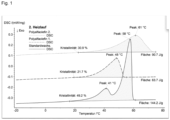
- Fig. 1 The DSC curves of the substances investigated are shown: The parameters determined by DSC are shown in the table below. Partially crystalline polyalphaolefin 1 Partially crystalline polyalphaolefin 2 paraffin wax enthalpy of fusion [J/g] according to DSC 63.67 90.65 144.2 Crystallinity, % based on PE-ideal crystalline, according to DSC 21.73 30.94 49.21 Melting range [°C] according to DSC, 20 - 53 20 - 75°C 15 - 60°C
- paraffin wax has a crystallinity above 45%.
- Base grease 1 is produced with the composition shown in the table below using calcium 12-hydroxystearate as a thickener, and from this the non-inventive lubricating grease 1 is produced by adding the polyalphaolefin Vybar ® C-6112 (polyalphaolefin 2).
- polyalphaolefin 2 polyalphaolefin 2
- the semi-crystalline polyalphaolefin is incorporated by mixing at 1500 rpm for 10 minutes using a Speedmixer DAC 700.1 FVZ from Hauschild and then homogenizing on a three-roll mill (two rolling passes). Both the base grease and the lubricating grease are examined with regard to dropping point, oil separation and their cone penetration (comparative of fresh grease and grease after rolling) is measured. The results are shown in the table below.
- Designation base fat 1 Grease 1 (not according to the invention) composition
- Base oil 80 wt.% mixture of complex ester/pentaerythritol ester, viscosity approx. 600 mm 2 /sec; 6% thickener calcium 12-hydroxystearate, 14 wt.% additives
- the base grease 2 is produced with the composition shown in the table below using calcium 12-hydroxystearate as a thickener and from this the non-inventive lubricating grease 2 is produced by adding the semi-crystalline polyalphaolefin 2 (Vybar ® C-6112). Both the base grease and the lubricating grease are examined with regard to dropping point, oil separation and their cone penetration (comparative of fresh grease and grease after rolling) is measured. The results are shown in the table below.
- Designation base fat 2 Grease 2 (not according to the invention) composition Base oil: TMP ester/ C16 and C18 carboxylic acid 90%, 6% Base grease 2 with 5 % semi-crystalline polyalphaolefin (Vybar ® C-6112) Thickener calcium 12-hydroxystearate, 4% additives Dropping point, DIN ISO 2176 [°C] 142.7 121.5 Oil separation DIN 51817, 40°C/168h, [%] 3.98 9.36 Shell Roll test, ASTM, D 1831, test condition 2 h, 80°C Cone penetration of fresh grease, ASTM D1403, 1/4 cone [1/10mm], penetration value according to D1403 to standard cone value 264 316 Cone penetration of the grease after rolling in the Shell Roll Tester, ASTM D1403, 1/4 cone [1/10mm], penetration value according to D1403 to the value of the standard cone 350 >385, too liquid Difference between cone penetration of grease after rolling and penetration of fresh grease [1/10 mm] 86 not predictable Effect of addition of semi-crystalline polyalphaolefin
- the base fat 3 with the composition shown in the table below is prepared using calcium 12-hydroxystearate as thickener and from this the non-inventive lubricating grease 3 is prepared by adding the semi-crystalline polyalphaolefin Vybar ® C-6112. Both the base grease and the lubricating grease are examined with regard to dropping point, oil separation and their cone penetration (comparative of fresh grease and grease after rolling) is measured. The results are shown in the table below. Designation base fat 3 Grease 3 (not according to the invention) composition Base oil: 70%, TMP ester/ C16 and C18 carboxylic acid, 12% polyisobutylene, V100 approx.
- the base grease 4 is produced with the composition shown in the table below using a lithium complex soap and the lubricating grease 4 according to the invention is produced from this by adding the polyalphaolefin Vybar ® C-6112. Both the base grease and the lubricating grease are examined with regard to dropping point, oil separation and their cone penetration (comparative of fresh grease and grease after rolling) is measured. The results are shown in the table below.
- the base grease 5 is produced with the composition shown in the table below using a urea thickener and the lubricating grease 5 according to the invention is produced from this by adding the semi-crystalline polyalphaolefin 2 (Vybar ® C-6112). Both the base grease and the lubricating grease are examined with regard to dropping point, oil separation and their cone penetration (comparative of fresh grease and grease after rolling) is measured. The results are shown in the table below. Designation base fat 5 Grease 5 (according to the invention) composition Base oil: 85% Base fat 5 with 5 % semi-crystalline Trimellitic acid ester with C9 - C11 alcohols, V 40 approx. 72 mm 2 /sec.
- the base grease 6 is prepared with the composition shown in the table below using a lithium complex soap as a thickener and from this the lubricating grease 6 according to the invention is prepared by adding the semi-crystalline polyalphaolefin 2, Vybar ® C-6112. Both the base grease and the lubricating grease are examined with regard to dropping point, oil separation and their cone penetration (comparative fresh fat and fat after rolling) was measured. The results are shown in the table below.
- Designation base fat 6 Grease 6 (according to the invention), with 5 % Vybar ® C-6112 composition
- Base oil 82%
- Polypropylene glycol, V40 50 mm 2 /s, 9 % lithium complex thickener from azelaic acid and 12-hydroxystearic acid, 2 % solid lubricant, 7 % additives
- Shell Roll test ASTM, D 1831, test condition 2 h, 80°C Cone penetration of fresh grease, ASTM D1403, 1/4 cone [1/10mm], penetration value according to D1403 to standard cone value 298 298 Cone penetration of the grease after rolling in the Shell Roll Tester, ASTM D1403, 1/4 cone [1/10mm], penetration value according to D1403 to the value of
- the lithium simple soap grease has a lithium 12-hydroxystearate content of 8.6 wt.% and 1 wt.% amine antioxidant.
- the base oil is a mixture of PAO 4 and mPAO 300, the kinematic viscosity at 40°C is 1000 mm 2 /s.
- the non-inventive grease 8b which does not contain any semi-crystalline polyalphaolefin, shows a softening of 63 units in the Shell Roll test.
- the inventive compositions 8a, 8c-8k which contain the semi-crystalline polyalphaolefins individually or in combination and in different concentrations, show a lower softening in the Shell Roll test in all cases.
- the semi-crystalline polyalphaolefin 2 Vybar ® C 6112
- the softening can be controlled and, for example, set to almost 0, see 8k.
- Aluminium complex grease (11% thickener content, containing benzoic acid and stearic acid as acid components), base oil PAO 6.
- mixture Aluminum complex fat (%) Partially crystalline polyalphaolefin 1 Vybar TM 260 (%) Partially crystalline polyalphaolefin 2, Vybar ® C 6112 (%)
- Penetration fresh (1/10 mm) Penetration according to Shell-Roller after (1/10 mm)
- Penetration Delta (1/10 mm) 9a 90.00 5.00 5.00 208 211 3 9b 95.00 5.00 0.00 211 238 27 9c 95.00 0.00 5.00 223 253 30 9d 95.00 2.50 2.50 238 230 -8 9e 100.00 0.00 0.00 241 305 64
- the non-inventive grease 9e which does not contain any semi-crystalline polyalphaolefin, shows a softening of 64 units in the Shell Roll test.
- the inventive compositions 9a - 9d which contain the semi-crystalline polyalphaolefins individually or in combination and in different concentrations, show a lower softening in the Shell Roll test in all cases.
- the two semi-crystalline polyalphaolefins are similarly effective (cf. 9b and 9c).
- a lithium soap grease was used as base grease, with lithium 12-hydroxystearate content: 8.6%), 1% amine antioxidant, base oil mixture PAO 4 and mPAO 300, kinematic viscosity at 40°C 1000 mm 2 /s. mixture paraffin wax (%) Partially crystalline polyalphaolefin 2, Vybar ® C 6112 (%) Penetration fresh (1/10 mm) Penetration according to Shell-Roller after 50h/80°C (1/10 mm) Delta penetration ((1/10 mm) 50h/80°C Mixture 10a 0.00 2.50 241 274 33 Mixture 10b 2.50 0.00 230 395 165 Mixture 10c 0.00 0.00 268 388 120
- the softening after the test over 50 h is significantly increased for the non-inventive paraffin wax (mixture 1b) compared to the starting material (10c), while the inventive sample 10a shows a significantly lower softening.
- the base grease 11 is produced with the composition shown in the table below using a calcium complex soap as a thickener and the lubricating grease 11 according to the invention is produced from this by adding the semi-crystalline polyalphaolefin 2 (Vybar ® C-6112). Both the base grease and the lubricating grease 11 are examined with regard to dropping point, oil separation and their cone penetration (comparative of fresh grease and grease after rolling) is measured. The results are shown in the table below.
- Designation base fat 11 Grease11 (according to the invention), with 5 % Vybar ® C-6112 composition
- Shell Roll test ASTM, D 1831, test condition 2 h, 80°C Cone penetration of fresh grease, ASTM D1403, 1/4 cone [1/10mm], penetration value according to D1403 to standard cone value 274 264 Cone penetration of the grease after rolling in the Shell Roll Tester, ASTM D1403, 1/4 cone [1/10mm], penetration value according to D1403 to the value of the standard cone 328 238 Difference between cone penetration of grease after rolling and
Landscapes
- Chemical & Material Sciences (AREA)
- Chemical Kinetics & Catalysis (AREA)
- General Chemical & Material Sciences (AREA)
- Oil, Petroleum & Natural Gas (AREA)
- Organic Chemistry (AREA)
- Lubricants (AREA)
Abstract
a) 50 Gew.% bis 95,8 Gew.%, bezogen auf das Gesamtgewicht des Schmierfetts, wenigstens ein Grundöl,
b) 4 Gew.% bis 20 Gew.%, bezogen auf das Gesamtgewicht des Schmierfetts, wenigstens ein Verdickungsmittel, ausgewählt aus Harnstoffverdickern, Metallkomplexseifen, insbesondere Lithiumkomplexseifen, Aluminiumkomplexseifen, Calciumkomplexseifen, Metalleinfachseifen der Elemente der ersten Hauptgruppe des Periodensystems, insbesondere Lithiumeinfachseifen und Gemischen hiervon,
c) 0,2 Gew.% bis 40 Gew.%, bezogen auf das Gesamtgewicht des Schmierfetts, wenigstens ein teilkristallines Polyalphaolefin mit mindestens einem Schmelzpeak, gemessen anhand DIN EN ISO 11357-3:2018 oberhalb von 10°C und einem Kristallinitätsgrad von 15% bis 45%, wobei der Kristallinitätsgrad des teilkristallinen Polyalphaolefins bestimmt wird, indem die Schmelzenthalpie des teilkristallinen Polyalphaolefins anhand DIN EN ISO 11357-3:2018 ermittelt und durch 2,93 J/g dividiert wird.
Description
- Die Erfindung betrifft ein Schmierfett, das eine erhöhte Scherstabilität aufweist, sowie seine Verwendung zum Schmieren der Oberflächen von Gleitpartnern. Die Erfindung betrifft ferner ein Verfahren zur Herstellung eines tribologischen Systems unter Verwendung des Schmierfetts, sowie ein Tribologisches System, das das Schmierfett enthält.
- Schmierstoffe sind wesentliche Bestandteile vieler industrieller Prozesse, bei denen sich zwei oder mehr Oberflächen in engem Kontakt bewegen. Das Anwendungsspektrum für Schmierstoffe ist sehr breit und umfasst unter anderem Kfz-Schmiermittel, Schmiermittel für Zweitakt- und Viertakt-Benzinmotoren, Schmiermittel für Dieselmotoren, Gasmotorenöle, Gasturbinenöle, Automatikgetriebeflüssigkeiten, Getriebeöle usw.
- Schmierstoffe können als Schmieröle oder als Schmierfette ausgebildet sein. Industrielle Schmieröle umfassen unter anderem industrielle Getriebeöle, pneumatische Werkzeugschmierungsmittel, Hochtemperaturöle, Luft- und Gaskompressoröle für alle Arten von Kompressoren, Werkzeugmaschinenöle, Textilöle, Dampfturbinenöle, Hydraulikflüssigkeiten, Papiermaschinenöle, Lebensmittelmaschinenöle, Dampfzylinderöle, Metallbearbeitungsflüssigkeiten zum Metallschneiden, Metallwalzen, Metallziehen, Metallschmieden und Metallprägen. Schmierfette umfassen zusätzlich zum Schmieröl noch einen oder mehrere Verdicker.
- Schmierfette beinhalten in der Regel eine Vielzahl von Substanzen (z.B. Additive, Verdicker, Öle, Hilfsstoffe, Polymere) zur Regulierung der Schmierfetteigenschaften und Anpassung der Schmierfettwirkung am Bauteil.
- Schmierfette werden oft zur Schmierung von Lagern eingesetzt.
- Lager sind Maschinenelemente zum Führen gegeneinander beweglicher Bauteile. Maschinenelemente sind Bauteile, die in unterschiedlichen Maschinen und Geräten jeweils gleiche oder ähnliche Funktionen erfüllen und daher immer wieder in gleicher oder ähnlicher Form vorliegen. Lager können bezüglich des Freiheitsgrades der möglichen Bewegung unterschieden werden, und zwar in Radiallager, Axiallager, Radialachslager und Linearlager. Lager können auch bezüglich des Wirkprinzips unterschieden werden. Bei Linearlagern berühren sich die sich gegeneinander bewegenden Bauteile direkt, bei Wälzlagern berühren sich die sich bewegenden Bauteile nicht direkt sondern sind durch Wälzkörper getrennt. Wälzlager können Rollenlager oder Kugellager sein. Rollenlager können als Nadellager, Zylinderrollenlager, Kegelrollenlager und Pendelrollenlager vorliegen. Lager werden bei der Herstellung in der Regel mit einer Schmierfettfüllung versehen, die durch geeignete Dichtelemente im Lager bzw. in der Führung gehalten wird.
- Ein wesentliches Kriterium von Schmierfetten ist ihre Scherstabilität. Scherstabilität ist eine von der Strukturstabilität abgeleitete mechanische Größe. Scherende Belastung führt zu einer meist irreversiblen Zerstörung bzw. Veränderung des Schmierfetts. Die Scherstabilität gibt die Widerstandsfähigkeit der Schmierfett-Konsistenz gegen scherende Belastung an. Eine geringe Scherstabilität äußert sich in einer hohen bzw. schnellen Abnahme der Konsistenz des Schmierfetts bei scherender Belastung.
- Die Folgen von Konsistenzerniedrigung sind negative Effekte auf die Schmierfilmdicke, Tragfähigkeit und die Zunahme von Verschleiß am Bauteil sowie eine Verringerung der Lebensdauer des Schmierfetts und der geschmierten Bauteile.
- Zur Erhöhung der Scherstabiltät wird in der Praxis derzeit auf modifizierte Herstellprozesse oder auf spezielle scherstabile Verdickerkonzepte zurückgegriffen, die zu einer Erhöhung der Grundölviskosität bei Fetten führen.
- So werden zur Einstellung einer hohen Grundölviskosität bei Fetten beispielsweise hochviskose Grundöl-Komponenten eingesetzt.
- Die Verwendung spezifischer Additive zur Verbesserung der Scherstabilität ist in der Praxis dagegen nicht üblich. Deren Existenz wäre jedoch wünschenswert, da hierdurch die bestehenden Herstellprozesse und Schmierfettkonzepte beibehalten und auch Grundöle mit einer niedrigen Grundviskosität eingesetzt werden könnten.
- Es ist bekannt in Schmierfetten Polymere einzusetzen. Diese dienen in der Regel der Verbesserung des Viskositäts/Temperatur-Verhaltens, der Steigerung von Viskosität und dem Haft-Verhalten (Tackifier) oder auch zur Verdickung.
- Aus der
DE 10 2017 222 515 A1 ist eine Fettzusammensetzung bekannt, die Polyamid-Oligomere als Verdicker enthält. -
EP 17050209 B1 EP 1721959 A2 beschreiben die Verwendung von Mikrogelen als Träger von Additiven z.B. in Schmierfetten und als Rheologie-Additiv. -
EP 1099717 A1 beschreibt die Verwendung von sternförmigen Polymeren zur Verbesserung des Viskositätsindexes von Schmierfetten. -
WO 2012/055821 A1 beschreibt die Verwendung von Polymerfasern als Verdicker für Schmierfette. -
EP 079559701 A1 -
EP 1730256 B1 beschreibt funktionalisierte Polymere als Verdickerbestandteil. -
US 8975218 B2 beschreibt die Kombination von zwei Polymeren (Ethylen-Propylen-Copolymer mit Styrol-Isopren-Copolymer) in einem Lithiumseifenfett zur Reduktion der Ölabscheidung bei hohen Temperaturen. -
EP 0942063 B1 beschreibt die Kombination einer Polyolefinkomponente, wie Polypropylen, mit einer Kautschukkomponente als Verdicker für Schmierfette. - Keine der genannten Druckschriften bietet ein Konzept zur Erhöhung der Scherstabilität von Schmierfetten mittels einer Additivierung.
- Der Erfindung liegt als eine Aufgabe zugrunde ein Schmierfett bereitzustellen, das eine hohe Scherstabilität aufweist und bei dessen Herstellung bestehende Herstellprozesse und Schmierfettkonzepte beibehalten werden können.
- Diese Aufgabe wird gelöst durch ein Schmierfett enthaltend
- a) 50 Gew.% bis 95,8 Gew.%, bezogen auf das Gesamtgewicht des Schmierfetts, wenigstens ein Grundöl,
- b) 4 Gew.% bis 20 Gew.%, bezogen auf das Gesamtgewicht des Schmierfetts, wenigstens ein Verdickungsmittel, ausgewählt aus Harnstoffverdickern, Metallkomplexseifen, insbesondere Lithiumkomplexseifen, Aluminiumkomplexseifen, Calciumkomplexseifen, Metalleinfachseifen der Elemente der ersten Hauptgruppe des Periodensystems, insbesondere Lithiumeinfachseifen und Gemischen hiervon,
- c) 0,2 Gew.% bis 40 Gew.%, bezogen auf das Gesamtgewicht des Schmierfetts, wenigstens ein teilkristallines Polyalphaolefin mit mindestens einem Schmelzpeak, gemessen anhand DIN EN ISO 11357-3:2018 oberhalb von 10°C und einem Kristallinitätsgrad von 15% bis 45%, wobei der Kristallinitätsgrad des teilkristallinen Polyalphaolefins bestimmt wird, indem die Schmelzenthalpie des teilkristallinen Polyalphaolefins anhand DIN EN ISO 11357-3:2018 ermittelt und durch 2,93 J/g dividiert wird.
- In einer bevorzugten Ausführungsform enthält das Schmierfett
- a) 50 Gew.% bis 92 Gew.%, bezogen auf das Gesamtgewicht des Schmierfetts, wenigstens ein Grundöl,
- b) 4 Gew.% bis 20 Gew.%, bezogen auf das Gesamtgewicht des Schmierfetts, wenigstens ein Verdickungsmittel ausgewählt aus Harnstoffverdickern, Metallkomplexseifen, insbesondere Lithiumkomplexseifen, Aluminiumkomplexseifen, Calciumkomplexseifen, Metalleinfachseifen der Elemente der ersten Hauptgruppe des Periodensystems, insbesondere Lithiumeinfachseifen und Gemischen hiervon,
- c) 0,2 Gew.% bis 40 Gew.%, bezogen auf das Gesamtgewicht des Schmierfetts, wenigstens ein teilkristallines Polyalphaolefin mit mindestens einem Schmelzpeak, gemessen anhand DIN EN ISO 11357-3:2018 oberhalb von 10°C und einem Kristallinitätsgrad von 15% bis 45%, wobei der Kristallinitätsgrad des teilkristallinen Polyalphaolefins bestimmt wird, indem die Schmelzenthalpie des teilkristallinen Polyalphaolefins anhand DIN EN ISO 11357-3:2018 ermittelt und durch 2,93 J/g dividiert wird,
- d) 0,5 Gew.% bis 43 Gew.% bezogen auf das Gesamtgewicht des Schmierfetts, wenigstens ein von b) und c) verschiedenes Additiv, insbesondere wenigstens einen Festschmierstoff (d1), wenigstens ein weiteres Verdickungsmittel (d2) und/oder wenigstens einen Hilfsstoff (d3).
- In einer weiteren bevorzugten Ausführungsform umfasst das Schmierfett
- a) 50 Gew.% bis 92 Gew.%, bezogen auf das Gesamtgewicht des Schmierfetts, wenigstens ein Grundöl,
- b) 4 Gew.% bis 20 Gew.% bezogen auf das Gesamtgewicht des Schmierfetts, wenigstens ein Verdickungsmittel, ausgewählt aus Harnstoffverdicker, Metallkomplexseifen, insbesondere Lithiumkomplexseifen, Aluminiumkomplexseifen, Calciumkomplexseifen, Metalleinfachseifen der Elemente der ersten Hauptgruppe des Periodensystems, insbesondere Lithiumeinfachseifen und Gemischen hiervon,
- c) 0,2 Gew.% bis 40 Gew.%, bezogen auf das Gesamtgewicht des Schmierfetts, wenigstens ein teilkristallines Polyalphaolefin mit mindestens einem Schmelzpeak, gemessen anhand DIN EN ISO 11357-3:2018 oberhalb von 10°C und einem Kristallinitätsgrad von 15% bis 45%, wobei der Kristallinitätsgrad des teilkristallinen Polyalphaolefins bestimmt wird, indem die Schmelzenthalpie des teilkristallinen Polyalphaolefins anhand DIN EN ISO 11357-3:2018 ermittelt und durch 2,93 J/g dividiert wird,
- d) 0,5 bis 43 Gew.% bezogen auf das Gesamtgewicht des Schmierfetts, wenigstens ein von b) und c) verschiedenes weiteres Additiv umfassend
- d1) 1 Gew.% bis 10 Gew.%, bezogen auf das Gesamtgewicht des Schmierfetts, wenigstens einen Festschmierstoff, und/oder
- d2) 1 Gew.% bis 10 Gew.%, bezogen auf das Gesamtgewicht des Schmierfetts, wenigstens ein weiteres Verdickungsmittel, vorzugsweise ausgewählt aus Aluminiumeinfachseifen, Calciumsulfonaten, Bentoniten, amorphe Kieselsäure, hydrophobierte amorphe Kieselsäure, Silikaten, Polyimiden und Gemischen hiervon, und/oder
- d3) 0,5 Gew.% bis 23 Gew.%, bezogen auf das Gesamtgewicht des Schmierfetts, wenigstens einen Hilfsstoff, vorzugsweise ausgewählt aus Antioxidantien, Korrosionsschutzmittel, Hochdruckadditive, Verschleißschutzmittel, Metalldesaktivatoren, insbesondere Buntmetalldesaktivatoren, beispielsweise Chelatbildner, Pourpoint-Verbesserer, VI Verbesserer, Radikalfänger, UV-Stabilisatoren, Reaktionsschichtbildner, Haftverbesserer, Verbesserer der elektrischen Leitfähigkeit, Additive zur Reduktion der Ölabscheidung und Gemische hiervon.
- Erfindungsgemäß weist das Schmierfett teilkristallines Polyalphaolefin mit einem Kristallinitätsgrad von 15% bis 45% auf. Zur Bestimmung des Kristallinitätsgrads des teilkristallinen Polyalphaolefins wird zunächst die Schmelzenthalpie des teilkristallinen Polyalphaolefins anhand DIN EN ISO 11357-3:2018 ermittelt und die erhaltene Schmelzenthalpie durch 2,93 J/g dividiert.
- Der Wert 2,93 J/g ergibt sich aus der Schmelzenthalpie von 100% kristallinem Polyethylen (UHMWPE). Die Kristallinität des teilkristallinen Polyalphaolefins wird also auf 100% kristallines Polyethylen bezogen. Die Schmelzenthalpie von 100% kristallinem Polyethylen kann anhand der ASTM F 2625-10 (2016) bestimmt werden. Hierbei erhält man eine Schmelzenthalpie von 293 J/g. Für die Bezugnahmen der Kristallinität des teilkristallinen Polyalphaolefins auf 100% kristallines Polyethylen (UHMWPE) wird die anhand DIN EN ISO 11357-3:2018 ermittelte Schmelzenthalpie des Polyalphaolefins durch die Schmelzenthalpie von 100% kristallinem Polyethylen, d.h. durch 293 J/g dividiert, und mit 100 multipliziert. Dies entspricht einer Division durch 2,93 J/g.
- Das erfindungsgemäße teilkristalline Polyalphaolefin weist mindestens einen Schmelzpeak, gemessen anhand DIN EN ISO 11357-3:2018 oberhalb von 10°C auf. Hierdurch unterscheidet es sich von den herkömmlichen als Grundölen verwendeten Polyalphaolefinen.
- Erfindungsgemäß wurde überraschend gefunden, dass es die Verwendung eines teilkristallinen Polyalphaolefins mit einer Kristallinität von 15% bis 45% in Kombination mit einem Verdickungsmittel ausgewählt aus Harnstoffverdicker, Metallkomplexseifen, insbesondere Lithiumkomplexseifen, Aluminiumkomplexseifen, Calciumkomplexseifen, Metalleinfachseifen der Elemente der ersten Hauptgruppe des Periodensystems, insbesondere Lithiumeinfachseifen und Gemischen ermöglicht, die Scherstabilität von Schmierfetten zu verbessern. So wurde in praktischen Versuchen überraschenderweise gefunden, dass die erfindungsgemäß verwendeten Verdickungsmittel in Kombination mit dem teilkristallinen Polyalphaolefin zu einer signifikant erhöhten Scherstabilität führen, während die Kombination einer Calciumseife als Verdickungsmittel mit teilkristallinem Polyalphaolefin zu keiner Verbesserung sondern im Gegenteil zu einer Verschlechterung der Scherstabilität führt.
- Ohne sich auf einen Mechanismus festzulegen wird vermutet, dass der beobachtete scherstabilitätsverbessernde Effekt dadurch zustande kommt, dass teilkristalline Polyalpaolefine mit einem Kristallisationsgrad von 15% bis 45% in Kombination mit den ausgewählten Verdickungsmitteln strukturgebende Eigenschaften erzeugen oder bereits im Schmierfett vorhandene strukturgebende Eigenschaften verbessern können.
- Es wird weiter vermutet, dass Polyalpaolefine mit einem Kristallisationsgrad außerhalb des beanspruchten Bereichs keinen scherstabilitätserhöhenden Effekt haben, da sie keine Wechselwirkungen mit den Verdickungsmitteln eingehen. So scheinen Polyalpaolefine mit einem Kristallisationsgrad unterhalb von 15 % vor allem Wechselwirkungen mit dem Grundöl aber nicht mit den Verdickungsmitteln einzugehen und Polyalpaolefine mit einem Kristallisationsgrad oberhalb von 45 % weder mit dem Grundöl noch mit dem Verdickungsmittel signifikante Wechselwirkungen einzugehen.
- Bevorzugte teilkristalline Polyalpaolefine weisen einen Kristallisationsgrad von 20 % bis 35 % auf, bestimmt indem die Schmelzenthalpie des teilkristallinen Polyalphaolefins, anhand DIN EN ISO 11357-3:2018, ermittelt und durch 2,93 J/g dividiert wird.
- Geeignete teilkristalline Polyalphaolefine umfassen Oligomere und/oder Polymere von α-Olefin. Teilkristalline Polyalphaolefine mit einer Kristallinität von 15% bis 45% können beispielsweise hergestellt werden durch Oligomerisation oder Polymerisation eines Ausgangsmaterials umfassend α-Olefin und internes Olefin. Der Kristallinitätsgrad kann dabei, wie dem Fachmann bekannt ist, beispielsweise durch geeignete Auswahl der Ausgangsmaterialien, insbesondere der Kettenlänge der eingesetzten Alphaolefine, ihrer Mengenverhältnisse, der Katalysatoren und/oder der Reaktionsbedingungen eingestellt werden.
- Erfindungsgemäß einsetzbare teilkristalline Polyalphaolefine sind auch kommerziell verfügbar, beispielsweise unter dem Markennamen Vybar® 260 oder Vybar® C-6112. Teilkristalline Polyalphaolefine, wie Vybar® 260, werden auch in der
US 2004/0040200 A1 und in derUS 4 224 204 A beschrieben. Das erfindungsgemäß eingesetzte teilkristalline Polyalphaolefin mit einer Kristallinität von 15 % bis 45 % kann lediglich eine einzige Art teilkristallines Polyalphaolefin oder verschiedene Arten teilkristalliner Polyalphaolefine enthalten. Dabei können sich die verschiedenen Arten teilkristalliner Polyalphaolefine in ihrer Kristallinität unterscheiden - sofern diese für jede Art 15 % bis 45 % beträgt (bestimmt, indem die Schmelzenthalpie des Polyalphaolefins anhand DIN EN ISO 11357-3:2018 (April 2019) ermittelt und durch 2,93 J/g dividiert wird). Die verschiedenen teilkristallinen Polyalphaolefine können sich auch in anderen Parametern, beispielsweise Molekulargewicht, Kettenlänge und/oder Verzweigungsgrad unterscheiden. - Wie oben dargelegt, kann das teilkristalline Polyalphaolefin hergestellt werden durch Polymerisation oder Oligomerisation eines Olefin enthaltenden Ausgangsmaterials umfassend α-Olefin und/oder internes Olefin.
- Das zur Herstellung des teilkristallinen Polyalphaolefins verwendbare Olefin (α-Olefin und/oder internes Olefin) weist vorzugsweise mindestens 14 Kohlenstoffatome auf. Vorzugsweise weist das Olefin 14 bis 50 Kohlenstoffatome, bevorzugt von 14 bis 44, noch bevorzugter von 14 bis 30, noch bevorzugter 16 bis 50 Kohlenstoffatome, noch bevorzugter von 16 bis 44, noch bevorzugter von 16 bis 30 und insbesondere von 20 bis 24 Kohlenstoffatome auf.
- Das α-Olefin kann die Struktur RCH=CH2 oder R2C=CH2 aufweisen. Dabei sind die Reste R unabhängig voneinander bevorzugt Alkyl mit 14 bis 50 Kohlenstoffen. Bevorzugt enthält das Ausgangsmaterial α-Olefin der Struktur RCH=CH2. Geeignetes α-Olefin umfasst zum Beispiel 1-Tetradecen, 1-Pentadecen, 1-Hexadecen, 1-Heptadecen, 1-Octadecen, 1-Nonadecen, 1-Eicosen, 1-Docosen und 1-Tetradocosen. Normalerweise werden Gemische dieser Substanzen verwendet. Das α-Olefin kann linear oder verzweigt sein.
- Das Olefin kann mit den verschiedensten Verfahren, beispielsweise durch Polymerisieren von Olefinen wie Ethylen in Gegenwart von Katalysatoren vom Ziegler-Typ hergestellt werden.
- Ein internes Olefin weist mindestens eine Doppelbindung innerhalb des Moleküls auf. Beispiele sind β-Olefine oder γ-Olefine.
- Das Ausgangsmaterial kann auch weitere übliche Komponenten für polymerisierbare Zusammensetzungen, beispielsweise Polymerisationskatalysatoren, aufweisen.
- Die Polymerisation des Olefin enthaltenden Ausgangsmaterials kann mit einem herkömmlichen Verfahren durchgeführt werden, sofern ein teilkristallines Polyalphaolefin mit einer Kristallinität von 15% bis 45% erhalten wird. Geeignete Verfahren umfassen radikalische Polymerisation (unter Verwendung herkömmlicher radikalischer Verfahren wie thermischer Zersetzung, Photoinitiierung, elektrochemischer Initiierung usw. und unter Verwendung chemischer radikalischer Initiatoren wie Azo- oder Diazoverbindungen, Peroxide oder Hydroperoxide etc.), Koordinationspolymerisation etc.
- Ein besonders bevorzugtes teilkristallines Polyalphaolefin weist eine Säurezahl nach ASTM D664-18e1 von 10 mg KOH/g bis 120 mg KOH/g, bevorzugt von 40 mg KOH/g bis 100 mg KOH/g, auf. Die Säurezahl ist auf Säuregruppen zurückzuführen, die im Polyalphaolefin enthalten sind. In praktischen Versuchen haben sich solche teilkristalline Polyalphaolefine als besonders wirksam erwiesen.
- Ein besonders bevorzugtes teilkristallines Polyalphaolefin ist ein Gemisch von mindestens zwei verschiedenen teilkristallinen Polyalphaolefinen, wobei mindestens ein teilkristallines Polyalphaolefin eine Säurezahl nach ASTM D664-18e1 von 10 mg KOH/g bis 120 mg KOH/g, bevorzugt von 40 mg KOH/g bis 100 mg KOH/g, aufweist und mindestens ein anderes teilkristallines Polyalphaolefin eine Säurezahl nach ASTM D664-18e1 von unter 10 mg KOH/g aufweist.
- Ein besonders bevorzugtes teilkristallines Polyalphaolefin, ist Vybar® C-6112 ®, erhältlich von Baker Hughes Incorporated (Baker Petrolite Polymers Division).
- Ein erfindungsgemäß bevorzugtes teilkristallines Polyalphaolefin weist ein Molekulargewicht Mn, gemessen nach DIN 55672-1:2016-03 von mehr als 2500 g/mol, beispielsweise von 2500 g/mol bis 37000 g/mol, noch bevorzugter von 2500 g/mol bis 5600 g/mol, insbesondere von Mn 3000 g/mol bis Mn 5600 g/mol auf.
- Bevorzugt ist das teilkristalline Polyalphaolefin bei Raumtemperatur (20°C) wachsartig. In einer bevorzugten Ausführungsform der Erfindung hat das teilkristalline Polyalphaolefin einen Erstarrungspunkt nach DIN ISO 2207:1983-12 zwischen 60°C und etwa 90°C. Ferner kann die Viskosität des teilkristallinen Polyalphaolefins bei 100°C zwischen 30 cPs und 1800 cPs, vorzugsweise bei 100°C zwischen etwa 80 und 220 cPs, gemessen nach ASTM D3236-15(2021) liegen.
- Die Menge des teilkristallinen Polyalphaolefins liegt vorzugsweise im Bereich von 1 Gew.% bis 25 Gew.%, noch bevorzugter im Bereich von 3 Gew.% bis 20 Gew.%, insbesondere im Bereich von 3 Gew.% bis 10 Gew.%, jeweils bezogen auf das Gesamtgewicht des Schmierfetts.
- Erfindungsgemäß weist das Schmierfett wenigstens ein Verdickungsmittel b) auf ausgewählt aus Harnstoffverdicker, Metallkomplexseifen, insbesondere Lithiumkomplexseifen, Aluminiumkomplexseifen, Calciumkomplexseifen, Metalleinfachseifen der Elemente der ersten Hauptgruppe des Periodensystems, insbesondere Lithiumeinfachseifen und Gemischen hiervon.
- Bevorzugte Verdickungsmittel b) sind ausgewählt aus Harnstoffverdicker, Lithiumkomplexseifen, Lithiumeinfachseifen und Gemischen hiervon.
- Verdickungsmittel sind feste, in den Grundölen nahezu oder völlig unlösliche Substanzen (unlösliche Feststoffe), die verdickend wirken. Durch den Zusatz von Verdickungsmitteln können aus Schmierölen Schmierfette hergestellt werden. Schmierfette sind Zusammensetzungen, die eine (bei Raumtemperatur 20°C) flüssige Phase und Feststoffe enthalten. Die Konsistenz von Schmierfetten lässt sich anhand eines standardisierten Messverfahrens in Form der sogenannten Walkpenetration nach DIN ISO 2137 (2020) ermitteln. Die Walkpenetration wird nach dem Walken des Schmierfetts in einem Fettkneter bzw. Schmierfettwalker mit Hilfe eines Penetrometers gemessen als die Eindringtiefe eines Standardkonus unter definierten Bedingungen. Die Zuordnung der gemessenen Konuspenetration zu einer definierten NLGI-Klasse (NLGI = National Lubricating Grease Institute) erfolgt dann nach DIN 51818 (1.12 1981). Erfindungsgemäße Schmierfette weisen bei der Messung nach DIN ISO 2137 (2020) bevorzugt eine Walkpenetration von 85 bis 475, noch bevorzugter von 220 bis 400 Konuspenetration in 0,1 mm auf.
- Bevorzugt beträgt der Anteil des Verdickungsmittels b), bezogen auf das Gesamtgewicht des Schmierfetts von 6 Gew.% bis 18 Gew.%, noch bevorzugter von 8 Gew.% bis 15 Gew.%.
- In einer bevorzugten Ausführungsform enthält das Schmierfett einen Harnstoffverdicker. Vorteilhaft an Harnstoffverdickern ist, dass sie auch bei hohen Anwendungstemperaturen verwendet werden können. Bevorzugt ist der Harnstoffverdicker ein Reaktionsprodukt von organischen Mono-, Di-, Tri- und/oder höherfunktionellen Isocyanaten mit aliphatischen und/oder aromatischen Mono-, Di-, Tri- und/oder höherfunktionellen organischen Aminen und/oder Gemische hiervon.
- In einer bevorzugten Ausführungsform ist der Harnstoffverdicker ein alkylierter und/oder arylierter (Oligo)Harnstoff. Bevorzugte Harnstoffverdicker sind die Reaktionsprodukte aus wenigstens einem Diisocyanat mit wenigstens einem Amin, ausgewählt unter Monoaminen, Polyaminen und Mischungen davon. Bevorzugt ist das Diisocyanat ausgewählt unter 2,4-Diisocyanatotoluol, 2,6-Diisocyanatotoluol, 4,4`-Diisocyanatodiphenylmethan, 2,4`-Diisocyanatophenylmethan, 4,4'-Diisocyanatodiphenyl, 4,4`-Diisocyanato-3-3`-dimethylphenyl, 4,4'-Diisocyanato-3,3'-dimethylphenylmethan und Mischungen davon.
- Vorzugsweise ist das Amin ausgewählt aus Monoaminen der Formel Ra 2N-Rb, Diaminen der Formel Ra 2N-Rc-NRa 2 und Mischungen davon, wobei
- Ra
- unabhängig ausgewählt ist aus Wasserstoff, linearem oder verzweigtem C1-C22-Alkyl und C6-C14-Aryl,
- Rb
- unabhängig ausgewählt ist aus linearen oder verzweigten C1-C22-Alkyl- und C6-C14-Arylresten,
- Rc
- eine zweiwertige verbrückende Gruppe ist, die vorzugsweise aus C1-C22-Alkylen und C6-C14-Arylen ausgewählt ist.
- Ein bevorzugter Harnstoffverdicker ist ein Reaktionsprodukt aus wenigstens einem Diisocyanat, vorzugsweise 2,4-Diisocyanatotoluol, 2,6-Diisocyanatotoluol, 4,4'-Diisocyanatodiphenylmethan, 2,4'-Diisocyantodiphenylmethan, 4,4'-Diisocyanatodiphenyl, 4,4'-Diisocyanato-3,3'-dimethyldiphenyl, 4,4'-Diisocyanato-3,3'-dimethylphenylmethan, die einzeln oder in Kombination verwendet werden können, mit einem Amin oder Diamin der allgemeinen Formel (H2N)xRd, wobei x = 1 oder 2 ist, und Rd ein C6-C14-Aryl-, C1-C22-Alkyl-, C3-C22-Cycloalkyl- oder C1-C22-Alkylenrest ist, die einzeln oder in Kombination verwendet werden können.
- In einer besonders bevorzugten Ausführungsform ist der Harnstoffverdicker ein Reaktionsprodukt aus einem Diisocyanat, vorzugsweise 2,4-Diisocyanatotoluol, 2,6-Diisocyanatotoluol, 4,4'-Diisocyanatodiphenylmethan 2,4'-Diisocyantodiphenylmethan, 4,4'-Diisocyanatodiphenyl, 4,4'-Diisocyanato-3,3'-dimethyldiphenyl, 4,4'-Diisocyanato-3,3'-dimethylphenylmethan, die einzeln oder in Kombination verwendet werden können mit einem Amin der allgemeinen Formel (H2N)1Re, wobei Re ein C6-C14-Aryl-, C1-C22-Alkyl-, C3-C22-Cycloalkyl- oder C1-C22-Alkylenrest ist, die einzeln oder in Kombination verwendet werden können.
- In einer besonders bevorzugten Ausführungsform ist der Harnstoffverdicker ein Reaktionsprodukt aus 2,4-Diisocyanatotoluol, 2,6-Diisocyanatotoluol und/oder 4,4'-Diisocyanatodiphenylmethan, bevorzugt einer Mischung von 2,4-Diisocyanatotoluol und 2,6-Diisocyanatotoluol oder bevorzugt einer Mischung von 2,4-Diisocyanatotoluol, 2,6-Diisocyanatotoluol und 4,4'-Diisocyanatodiphenylmethan oder bevorzugt von 4,4'-Diisocyanatodiphenylmethan mit einem Amin der allgemeinen Formel (H2N)1Re, wobei Re ein C6-C14-Aryl-, C1-C22-Alkyl-, C3-C22-Cycloalkyl- oder C1-C22-Alkylenrest ist, die einzeln oder in Kombination verwendet werden können.
- In einer weiteren bevorzugten Ausführungsform enthält das Schmierfett als Verdickungsmittel b) Metallkomplexseifen und/oder Metalleinfachseifen, wobei die Metalleinfachseifen Metalleinfachseifen der Elemente der ersten Hauptgruppe des Periodensystems sind. Erfindungsgemäß bevorzugt sind dabei Calciumkomplexseifen, Aluminiumkomplexseifen, Lithiumkomplexseifen, Lithiumeinfachseifen und/oder Gemische hiervon.
- Geeignete Metallkomplexseifen können erhalten werden durch Reaktion einer Metallbase (wie ein Hydroxid, Alkoholat, Oxid oder Carbonat) mit
- e) mindestens einer aliphatischen Monocarbonsäurekomponente, ausgewählt aus ungesättigten oder gesättigten C10-C32-Monocarbonsäuren oder ungesättigten oder gesättigten C10-C32-Hydroxy-Monocarbonsäuren und Derivaten, der genannten C10-C32-Monocarbonsäuren und C10-C32-HydroxyMonocarbonsäuren, bevorzugt deren Ester und Mischungen und
- f) mindestens einem Komplexierungsmittel.
- Bevorzugte Ester sind für die Komponente e) und f) unabhängig voneinander Methylester und/oder Triglyceride. Bevorzugte Metallbasen sind Metallhydroxide, vorzugsweise Lithiumhydroxid, Calciumhydroxid und/oder Metallalkoholate, vorzugsweise Aluminiumalkoholate.
- Die aliphatische Monocarbonsäurekomponente e) ist vorzugsweise ausgewählt aus gesättigten oder ungesättigten C12-C22-Monocarbonsäuren, gesättigten oder ungesättigten C12-C22-Hydroxymonocarbonsäuren und deren Ester und Mischungen. Insbesondere sind die Monocarbonsäuren und Hydroxymonocarbonsäuren e) ausgewählt aus Laurinsäure, Myristinsäure, Palmitinsäure, Stearinsäure, Arachidinsäure, Myristoleinsäure, Palmitoleinsäure, Ölsäure, Linolsäure, Arachidonsäure, Behensäure, Stearinsäure, Hydroxystearinsäure, vorzugsweise 12-Hydroxystearinsäure, 17-Hydroxystearinsäure, 2-Hydroxytetradecansäure, 3-Hydroxytetradecansäure, 2-Hydroxyhexadecansäure, 3-Hydroxyhexadecansäure, Sebazinsäuremonostearylamid, Terephthalsäuremonostearylamid, deren Ester, , insbesondere Methylestern und/oder Triglyceriden und deren Mischungen.
- Weiter besonders bevorzugt enthält die Carbonsäurekomponente e) ein Gemisch verschiedener Carbonsäuren und/oder deren Estern.
- Das Komplexierungsmittel f) ist vorzugsweise ausgewählt aus gesättigten oder ungesättigten C1-C3-Monocarbonsäuren, gesättigten oder ungesättigten C2-C36-Dicarbonsäuren, bevorzugt C4-C36-Dicarbonsäuren, insbesondere C2-C16-Dicarbonsäuren, gesättigten oder ungesättigten C4-C60-Tricarbonsäuren, vorzugsweise C4-C36-Tricarbonsäuren, gesättigten oder ungesättigten C6-C60-Carbonsäuren mit 4 oder mehr Carbonsäuregruppen, vorzugsweise mit 4 Carbonsäuregruppen, gesättigten oder ungesättigten C2-C8-HydroxyMonocarbonsäuren, C4-C36-Arylcarbonsäuren, deren Ester, insbesondere deren Methylester und/oder Triglyceride, anorganischen Säuren, insbesondere Borsäure, Phosphorsäure und Organophosphorsäuren und Gemischen davon.
- Weiter bevorzugt ist das Komplexierungsmittel f) ausgewählt aus gesättigten oder ungesättigten C1-C3-Monocarbonsäuren, gesättigten oder ungesättigten C2-C36-Dicarbonsäuren, bevorzugt C4-C36-Dicarbonsäuren, insbesondere C2-C16-Dicarbonsäuren, gesättigten oder ungesättigten C4-C60-Tricarbonsäuren, vorzugsweise C4-C36-Tricarbonsäuren, gesättigten oder ungesättigten C6-C60-Carbonsäuren mit 4 oder mehr Carbonsäuregruppen, vorzugsweise mit 4 Carbonsäuregruppen, gesättigten oder ungesättigten C2-C8-HydroxyMonocarbonsäuren, C4-C36-Arylcarbonsäuren, deren Ester, insbesondere deren Methylester und/oder Triglyceride, und Gemischen davon.
- Als Dicarbonsäuren f) eignen sich insbesondere Adipinsäure, Sebacinsäure, Azelainsäure, 3-tert.-Butyladipinsäure sowie deren Ester und Gemische. Besonders geeignet als Komponente f) sind auch Hydroxybenzoesäuren, z. B. Salicylsäure, 3-Hydroxybenzoesäure, 4-Hydroxybenzoesäure, 2-Hydroxy-4-hexylbenzoesäure, 2,5-Dihydroxybenzoesäure, 2,6-Dihydroxybenzoesäure, 4-Hydroxy-4-methoxybenzoesäure. Als C1-C3-Monocarbonsäure eignet sich insbesondere Milchsäure, Essigsäure und/oder Propionsäure.
- In einer besonders bevorzugten Ausführungsform, ist das Komplexierungsmittel f) ausgewählt aus aliphatischen C1-C3-Monocarbonsäuren, aliphatischen C4-C36-Dicarbonsäuren, aliphatischen C4-C36-Tricarbonsäuren, C4-C36-Arylcarbonsäuren, deren Estern, insbesondere deren Methylester und/oder Triglyceride, und Gemischen hiervon.
- In einer weiteren besonders bevorzugten Ausführungsform, ist das Komplexierungsmittel f) ausgewählt aus Essigsäure, Propionsäure, Milchsäure, Salicylsäure, Benzoesäure; Azelainsäure, Sebazinsäure, Korksäure, Terephthalsäure, Dodecandisäure, höherfunktionalen Carbonsäuren mit 3 oder mehr, vorzugsweise 3 bis 4 Carbonsäuregruppen, wobei die Anzahl an Kohlenstoffgruppen 6 bis 60 betragen kann, bevorzugt Zitronensäure und Trimersäuren, deren Estern, insbesondere deren Methylester und/oder Triglyceride, und Gemischen hiervon.
- In einer weiteren besonders bevorzugten Ausführungsform, ist das Komplexierungsmittel f) ausgewählt aus Essigsäure, Propionsäure, Milchsäure, Salicylsäure, Benzoesäure, Azelainsäure, Sebacinsäure, Dodecandisäure deren Estern, insbesondere deren Methylester und/oder Triglyceride, und Gemischen hiervon.
- In einer weiteren besonders bevorzugten Ausführungsform, ist das Komplexierungsmittel f) ausgewählt aus Azelainsäure, Sebacinsäure, deren Estern, insbesondere deren Methylester und/oder Triglyceride, und Gemischen hiervon.
- Bevorzugte anorganische Säuren f) sind Borsäure, Phosphorsäure und Organophosphorsäure.
- Die aliphatische Monocarbonsäurekomponente e) und das Komplexierungsmittel f) können unabhängig voneinander weitere Funktionalitäten, vorzugsweise alkoholische Hydroxidgruppen und/oder Säureamidgruppen aufweisen, mit der Maßgabe dass die Monocarbonsäurekomponente e) höchstens eine Säuregruppe oder Estergruppe aufweist.
- Besonders bevorzugte Metallkomplexseifen können erhalten werden durch Reaktion von einer Metallbase ausgewählt aus Lithiumhydroxid, Calciumhydroxid und/oder Metallalkoholaten, vorzugsweise Aluminiumalkoholaten, mit
- e) mindestens einer aliphatischen Monocarbonsäurekomponente, ausgewählt aus ungesättigten oder gesättigten C10-C23 Monocarbonsäuren, vorzugsweise Stearinsäure, Hydroxystearinsäure, insbesondere 12-Hydroxystearinsäure, Palmitinsäure, Ölsäure, Sebazinsäuremonostearylamid, Terephthalsäuremonostearylamid, deren Estern, insbesondere deren Methylester und/oder Triglyceride, und Gemischen hiervon, und
- f) mindestens einem Komplexierungsmittel, ausgewählt aus Essigsäure, Propionsäure, Milchsäure, Salicylsäure, Benzoesäure, Azelainsäure, Sebacinsäure, Dodecandisäure deren Estern, insbesondere deren Methylester und/oder Triglyceride, und Gemischen hiervon.
- Metallkomplexseifen werden bevorzugt ausgehend von Gemischen verschiedener Säuren und/oder deren Estern hergestellt, da die technisch verfügbaren Produkte in der Regel derartige Gemische enthalten.
- In einer weiteren bevorzugten Ausführungsform ist die Metallkomplexseife hergestellt durch Reaktion einer Metallbase mit
- e1) mindestens einer aliphatischen Monocarbonsäurekomponente ausgewählt aus ungesättigten oder gesättigten C10-C32-Monocarbonsäuren, deren Estern, insbesondere Methylestern und/oder Triglyceriden und/oder Gemischen, und
- e2) mindestens einer von e1) verschiedenen aliphatischen ungesättigten oder gesättigten C10-C32 Monocarbonsäure, vorzugsweise Stearinsäure, Hydroxystearinsäure, insbesondere 12-Hydroxystearinsäure, Palmitinsäure, Ölsäure, Sebazinsäuremonostearylamid und/oder Terephthalsäuremonostearylamid, deren Estern, insbesondere Methylestern und/oder Triglyceriden und Gemischen, und
- f) mindestens einem Komplexierungsmittel ausgewählt aus ungesättigten oder gesättigten C4-C36 Dicarbonsäuren, vorzugsweise Azelainsäure, Sebazinsäure, Korksäure, Terephthalsäure, Dodecandisäure, mindestens einer ungesättigten oder gesättigten höherfunktionalen Carbonsäuren mit 3 oder mehr, vorzugsweise 3 bis 4 Carbonsäuregruppen, wobei die Anzahl an Kohlenstoffgruppen 6 bis 60 betragen kann, wie bevorzugt Zitronensäure und Trimersäure, deren Estern, insbesondere Methylestern und/oder Triglyceriden und Gemischen.
- Vorteilhaft an der Verwendung von Lithiumkomplexseifen ist, dass sie dem Schmierfett hohe Tropfpunkte, eine gute Wasserbeständigkeit und weite Einsatztemperaturbereiche verleihen können. Mithin enthält das Schmierfett in einer bevorzugten Ausführungsform Lithiumkomplexseifen.
- Bevorzugte Lithiumkomplexseifen enthalten Lithium-12-Hydroxystearat in Kombination mit Dilithiumazelat und/oder in Kombination mit Dilithiumsebacat. Ganz besonders bevorzugt ist die Metallkomplexseife eine Lithiumkomplexseife, die Lithiumsalze von 12-Hydroxystearinsäure kombiniert mit Azelainsäure oder Sebacinsäure, insbesondere 12-Hydroxystearinsäure kombiniert mit Azelainsäure aufweist.
- In einer ebenfalls bevorzugten Ausführungsform enthält das Schmierfett Aluminiumkomplexseifen und/oder Calciumkomplexseifen. Bevorzugte Aluminiumkomplexseifen enthalten Aluminiumstearat und Aluminiumbenzoat. Bevorzugte Calciumkomplexseifen enthalten Calciummonostearylsebacat in Kombination mit Calciumsebacat.
- In einer ebenfalls bevorzugten Ausführungsform enthält das Schmierfett Metalleinfachseifen der Elemente der ersten Hauptgruppe des Periodensystems, insbesondere Lithiumeinfachseifen.
- Metalleinfachseifen können hergestellt werden aus Fettsäuren und/oder Fettsäureestern durch Umsetzen mit Metallbasen. Im Unterschied zu Metallkomplexseifen werden zur Herstellung von Metalleinfachseifen keine Komplexierungsmittel, insbesondere keine Komplexierungsmittel ausgewählt aus gesättigten oder ungesättigten C1-C3-Monocarbonsäuren, gesättigten oder ungesättigten C2-C36-Dicarbonsäuren, bevorzugt C4-C36-Dicarbonsäuren, insbesondere C2-C16-Dicarbonsäuren, gesättigten oder ungesättigten C4-C60-Tricarbonsäuren, vorzugsweise C4-C36-Tricarbonsäuren, gesättigten oder ungesättigten C6-C60-Carbonsäuren mit 4 oder mehr Carbonsäuregruppen, vorzugsweise mit 4 Carbonsäuregruppen, gesättigten oder ungesättigten C2-C8-Hydroxy-Monocarbonsäuren, C4-C36-Arylcarbonsäuren, deren Ester, insbesondere deren Methylester und/oder Triglyceride, anorganischen Säuren, insbesondere Borsäure, Phosphorsäure und Organophosphorsäuren, und Gemischen davon eingesetzt.
- Vorzugsweise enthalten Metalleinfachseifen Carboxylat nur in Form von monofunktionellem Carboxylat.
- Metalleinfachseifen werden bevorzugt ausgehend von Gemischen verschiedener Carbonsäuren und/oder deren Estern hergestellt, da die technisch verfügbaren Produkte in der Regel derartige Gemische enthalten.
- Geeignete Metalleinfachseifen werden hergestellt durch Reaktion einer Metallbase (wie ein Hydroxid, Alkoholat, Oxid oder Carbonat) mit mindestens einer aliphatischen Monocarbonsäurekomponente mit 4 bis 36 Kohlenstoffatomen, bevorzugt 4 bis 24 Kohlenstoffatomen, insbesondere 10 bis 32 Kohlenstoffatomen, vorzugsweise ausgewählt aus ungesättigten oder gesättigten C4-C24 Monocarbonsäuren, vorzugsweise Stearinsäure, Hydroxystearinsäure, insbesondere 12-Hydroxystearinsäure, Palmitinsäure, Ölsäure, Sebazinsäuremonostearylamid, Terephthalsäuremonostearylamid, deren Estern, insbesondere Methylestern und/oder Triglyceriden und Gemischen.
- Besonders bevorzugte Lithiumeinfachseifen sind Lithiumsalze von Stearinsäure, insbesondere Lithium-12-hydroxystearat.
- Erfindungsgemäß weist das Schmierfett 50 Gew.% bis 95,8 Gew.%, bevorzugt 50 Gew.% bis 92 Gew.%, noch bevorzugter von 60 Gew.% bis 92 Gew.% noch bevorzugter von 70 Gew.% bis 90 Gew.%, bezogen auf das Gesamtgewicht des Schmierfetts, Grundöl auf.
- Unter einem Grundöl sind die üblichen für die Herstellung von Schmierfetten verwendeten Basisflüssigkeiten, insbesondere Öle, die den Gruppen I, II, II+, III, IV oder V nach der Klassifizierung des American Petroleum Institute (API) [NLGI Spokesman, N. Samman, Volume 70, Number 11, S.14ff] zugeordnet werden können, zu verstehen. Besonders bevorzugte Grundöle sind ausgewählt aus der Gruppe bestehend aus Estern, Ethern, Mineralölen, synthetischen Kohlenwasserstoffen, insbesondere Polyalphaolefin und/oder Polyisobutylene, natürlichen Kohlenwasserstoffen, nativen Ölen und Derivaten von nativen Ölen, Silikonölen, und/oder Gemischen hiervon. Das Grundöl ist verschieden von dem teilkristallinen Polyalphaolefin. Bevorzugt ist das Grundöl kein Polyalphaolefin mit mindestens einem Schmelzpeak, gemessen anhand DIN EN ISO 11357-3:2018, oberhalb von 10°C und/oder kein Polyalphaolefin mit einem Kristallinitätsgrad von 15% bis 45%, wobei der Kristallinitätsgrad des teilkristallinen Polyalphaolefins bestimmt wird, indem die Schmelzenthalpie des teilkristallinen Polyalphaolefins, anhand DIN EN ISO 11357-3:2018, ermittelt und durch 2,93 J/g dividiert wird.
- Das teilkristalline Polyalphaolefin ist erfindungsgemäß nicht als Grundöl anzusehen. Das Grundöl kann aber Polyalphaolefin sein oder Polyalphaolefin enthalten (Polyalphaolefin-Grundöl), sofern das Polyalphaolefin von dem teilkristallinen Polyalphaolefin verschieden ist. Polyalphaolefin-Grundöl weist bevorzugt keinen Schmelzpeak, gemessen anhand DIN EN ISO 11357-3:2018 oberhalb von 10° auf und/oder keinen Kristallinitätsgrad von 15% bis 45%, wobei der Kristallinitätsgrad des teilkristallinen Polyalphaolefins bestimmt wird, indem die Schmelzenthalpie des teilkristallinen Polyalphaolefins anhand DIN EN ISO 11357-3:2018 ermittelt und durch 2,93 J/g dividiert wird. Polyalphaolefin-Grundöl kann aufgrund seines Schmelzverhaltens von teilkristallinem Polyalphaolefin unterschieden werden.
- Erfindungsgemäß besonders bevorzugte Grundöle sind Ester, Ether, Mineralöle, synthetische Kohlenwasserstoffe, bevorzugt Polyalphaolefin-Grundöl, insbesondere Metallocen-katalysierte Polyalphaolefingrundöle (mPAO-Grundöle), und/oder Gemische hiervon.
- Erfindungsgemäß insbesondere bevorzugte Grundöle sind Ester, Ether, synthetische Kohlenwasserstoffe, vorzugsweise Polyalphaolefin-Grundöl, insbesondere Metallocen-katalysierte Polyalphaolefingrundöle (mPAO-Grundöle) und/oder Gemische hiervon.
- In einer speziellen Ausführungsform enthält das Schmierfett als Grundöl wenigstens einen Ester, ausgewählt unter Pentaerytritestern, Dipentaerythritestern, Trimellitsäureestern, Hemimellitsäureestern, Pyromellitsäureestern, Estoliden, Dimersäureester, Trimersäureester, Trimethylolpropanestern (TMP-Estern), Neopentylglycolestern, Dicarbonsäureestern und Mischungen davon.
- Bevorzugte Ester sind Carbonsäureester, insbesondere Monoester, Diester, Triester, Tetraester, Pentaester, Polyester, aromatische Ester und Gemische hiervon. Die Carbonsäureester weisen bevorzugt eine Kettenlänge von C4 bis C22 auf.
- Besonders bevorzugte Ester sind ausgewählt aus der Gruppe bestehend aus einem Ester einer aromatischen und/oder aliphatischen Di-, Tri- oder Tetracarbonsäure mit einem oder in Mischung vorliegenden C7-C22-Alkoholen, aus einem Ester von Trimethylolpropan, Pentaerythrit oder Dipentaerythrit mit aliphatischen C7-bis C22-Carbonsäuren, C18-Dimersäureester mit C7- bis C22-Alkoholen, sowie Komplexestern und Estoliden.
- Weiter bevorzugt ist das Grundöl ausgewählt unter Ethern, bevorzugt Polyphenylether, Diarylether, Triarylether, Polytetrahydrofuran (Poly-THF) und/oder Polyglycolen, bevorzugt Homo- und/oder Copolymere von Ethylenoxid, Propylenoxid, 1,2-Butylenoxid, vorzugsweise gestartet mit Monoalkoholen, Dialkoholen, Trialkoholen, Wasser und/oder höherwertigen Alkoholen mit 4, 5 oder mehr alkoholischen OH-Gruppen. Geeignete höherwertige Alkohole sind z.B. Pentaerytritol und Dipentaerythritol.
- In einer speziellen Ausführungsform enthält das erfindungsgemäße Schmierfett als Grundöl wenigstens einen Ether, ausgewählt unter Polyalkylenglycolen (PAG). Geeignete Poly(alkylen)glykole (PAG) sind Homopolymere, Copolymere und Mischungen (Blends) davon. Im Sinne der Erfindung bezeichnet der Begriff Copolymer auch Polymere, die aus drei, vier oder mehr verschiedenen Monomeren aufgebaut sind (Terpolymere, Quaterpolymere usw.). Geeignete Poly(alkylen)glykole sind Polyethylenglykole, Polypropylenglykole, Polybutylenglykole, und Copolymere aus zwei oder mehreren verschiedenen Alkylenoxid-Copolymeren. Geeignete Alkylenoxide zur Herstellung von Poly(alkylen)glykolen sind z. B. Ethylenoxid, Propylenoxid, Epichlorhydrin, 1,2- und 2,3-Butylenoxid. Geeignete Beispiele für Copolymere sind Copolymere von Ethylenoxid und Propylenoxid, Copolymere von Ethylenoxid und Butylenoxid und Copolymere von Ethylenoxid, Propylenoxid und mindestens einem Butylenoxid. Die Alkylenoxid-Copolymere können die copolymerisierten Alkylenoxid-Einheiten in zufällig verteilter Form oder in Form von Blöcken enthalten.
- Besonders bevorzugte Polyalkylenglycole sind Polypropylenoxid und/oder Copolymere von Ethylenoxid und Propylenoxid.
- Als Grundöle eignen sich weiterhin vorteilhaft lineare oder verzweigte Perfluoropolyetherölen (PFPE-Ölen). Geeignet sind z.B. Perfluorpolyether (PFPE) der Formel:
RA-(O-CF2)v-(O-C2F4)w-(O-C3F6)x-(O-CFCF3)y-(O-CF2CF(CF3))z-O-RB
wobei RA und RB identisch oder verschieden sind und ausgewählt sind unter -CF3, -C2F5 und -C3F7, und v, w, x, y, z ganze Zahlen von ≥ 0 bis 500 sind. PFPE-Öle werden beispielsweise unter dem Markennamen Aflunox®, Krytox®, Fomblin® und Demnum® vertrieben. - Als Grundöle eignen sich weiterhin vorteilhaft synthetische Kohlenwasserstoffe, Mineralöle und Mischungen davon. Die synthetischen Kohlenwasserstoffe sind dabei verschieden von dem erfindungsgemäß verwendeten teilkristallinen Polyalphaolefin. Vorzugsweise weisen die synthetischen Kohlenwasserstoffe keinen Schmelzpeak, gemessen anhand DIN EN ISO 11357-3:2018 oberhalb von 10°C auf und/oder keinen Kristallinitätsgrad von 15% bis 45%, wobei der Kristallinitätsgrad des teilkristallinen Polyalphaolefins bestimmt wird, indem die Schmelzenthalpie des teilkristallinen Polyalphaolefins anhand DIN EN ISO 11357-3:2018 ermittelt und durch 2,93 J/g dividiert wird. Polyalphaolefin-Grundöl kann aufgrund seines Schmelzverhaltens von teilkristallinem Polyalphaolefin unterschieden werden.
- Als Grundöle eignen sich weiterhin vorteilhaft Gruppe III Öle. Gruppe III Öle (hydrogecrackte synthetische Öle) sind synthetische Kohlenwasserstoffe aus Petroleum-Basisölen, die vollständig durch Hydrocracken, Hydroisomerisierung und Hydrodesulfurierung hergestellt werden. Sie weisen mindestens 90 Prozent gesättigte Verbindungen und maximal 0,03 Prozent Schwefel sowie einen Viskositätsindex von mindestens 120 auf.
- Als Grundöle eignen sich weiterhin vorteilhaft GTL Öle (Gas to liquids Öle). GTL Öle basieren auf Synthesegas aus Wasserstoff und Kohlenmonoxid, aus dem mittels Fischer-Tropsch-Synthese längerkettige Kohlenwasserstoffe hergestellt werden.
- Bevorzugte synthetische Kohlenwasserstoffe sind Polyalphaolefin-Grundöle. Wie oben erläutert sind Polyalphaolefin-Grundöle verschieden von dem erfindungsgemäß verwendeten teilkristallinen Polyalphaolefin. Polyalphaolefin-Grundöle werden auch als Gruppe IV Öle bezeichnet und haben in der Regel einen Viskositätsindex im Bereich von 125 bis 200. Polyalphaolefin-Grundöle können nach bekannten Verfahren katalytisch aus Ethylen hergestellt werden, wobei als Zwischenprodukt zunächst Alphaolefine mit größerer Kettenlänge resultieren. Hieraus werden die Polyalphaolefin-Grundöle im Wesentlichen durch Oligomerisierung synthetisiert, wobei in der Regel Isoparaffine mit einer unterschiedlichen Anzahl von gleichlangen Seitenketten entstehen. Die Synthese kann durch säurekatalysierte (konventionelle) oder Metallocen-katalysierte Olefinpolymerisation (mPAO) erfolgen. Konventionelle Polyalphaolefin-Grundöle weisen einen hohen Isomerisierungsgrad auf, wohingegen bei der Metallocen-Oligomerisierung Produkte resultieren, die im Wesentlichen frei von Isomerisierung sind. Geeignete Polyalphaolefin-Grundöle sind z.B. die Oligomere, vorzugsweise die Dimere, Trimere, Tetramere, Pentamere und höheren Oligomere mit mehr als 5 Wiederholungseinheiten von Alphaolefinen, und Gemische dieser Oligomere. Die zur Herstellung der Polyalphaolefin-Grundöle eingesetzten Alphaolefine sind vorzugsweise ausgewählt unter C8-C14-Alphaolefinen, insbesondere 1-Octen, 1-Decen, 1-Dodecen und Mischungen davon. Polyalphaolefin-Grundöle sind in der Regel Gemische von Oligomeren oder Polymeren, die aus einem α-Olefin oder isomerisierten α-Olefin hergestellt werden.
- Als Grundöle eignen sich weiterhin vorteilhaft Silikonöle. Bevorzugt werden als Grundöle Dimethylsilikonöle und/oder Phenylmethylsilikonöle eingesetzt.
- In einer speziellen Ausführungsform der Erfindung ist das Grundöl ein fluorfreies Grundöl, vorzugsweise ausgewählt unter Pentaerythritestern, Dipentaerythritestern, Trimellitsäureestern, Hemimellitsäureestern, Pyromellitsäureestern, Estoliden, Dimersäureestern, Trimersäureestern, Dicarbonsäureestern Diarylethern, Polyglycolen, synthetischen Kohlenwasserstoffen, konventionellen Polyalphaolefingrundölen (PAO-Grundölen), Metallocen-katalysierten Polyalphaolefingrundölen (mPAO-Grundölen); Mineralölen, unbehandelte und chemisch modifizierte pflanzliche Öle, Gruppe III Ölen, Dimethylsilikonölen und Mischungen. Bevorzugte Ether sind Homo- und/oder Copolymere von Ethylenoxid, Propylenoxid, 1,2-Butylenoxid und/oder Tetrahydrofuran(THF), vorzugsweise gestartet mit Monoalkoholen, Dialkoholen und Trialkoholen. Bevorzugte synthetische Kohlenwasserstoffe sind alkylierte Naphthaline und Polyalphaolefingrundöle.
- Bevorzugt weist das Grundöl eine kinematische Viskosität, bestimmt nach ASTM-D-7042, Ausgabe September 2014, bei 40°C von weniger als 20000 mm2/s, vorzugsweise von 10 mm2/s bis 2000 mm2/s und insbesondere von 15 mm2/s bis 1000 mm2/s auf und/oder eine kinematische Viskosität, bestimmt nach ASTM-D-7042, Ausgabe September 2014, bei 100°C von 1 mm2/s bis 2000 mm2/s auf.
- Bevorzugtes Polyalphaolefin-Grundöl weist eine kinematische Viskosität, bestimmt nach ASTM-D-7042, Ausgabe September 2014, bei 40°C von 10 mm2/s bis 15000 mm2/s, bevorzugt von 15 mm2/s bis 10000 mm2/s, insbesondere 15 mm2/s bis 1300 mm2/s auf. Ebenfalls bevorzugtes Polyisobutylen-Grundöl weist eine kinematische Viskosität, bestimmt nach ASTM-D-7042, Ausgabe September 2014, bei 100° von 25 mm2/s bis 15000 mm2/s, bevorzugt von 100mm2/s bis 2000 mm2/s , insbesondere 200 mm2/s bis 1000 mm2/s auf.
- In einer weiteren bevorzugten Ausführungsform der Erfindung ist das Grundöl ausgewählt aus der Gruppe bestehend aus Estern, bevorzugt Dipentaerythritester, Trimellithsäureester, Hemimellithsäureester, Pyromellitsäureester, Estoliden, Pentaerytritester, Dimersäureester, Trimersäureester, TMP-Ester, Dicarbonsäureester, jeweils mit einer kinematischen Viskosität bei 40°C bestimmt nach ASTM-D-7042, Ausgabe September 2014 von 100 mm2/s bis 1200 mm2/s; Ethern, bevorzugt Polytetrahydrofuran(Poly-THF), Polyphenylether, Diarylether, Triarylether, linearen oder verzweigten Perfluorpolyetherölen, jeweils mit einer kinematischen Viskosität bei 40°C bestimmt nach ASTM-D-7042-Ausgabe September 2014 von 20 mm2/s bis 1200 mm2/s; Polyglycolen, bevorzugt Homo- und/oder Copolymere von Ethylenoxid, Propylenoxid, 1,2-Butylenoxid, vorzugsweise gestartet mit Wasser, Monoalkoholen, Dialkoholen und/oder Trialkoholen, jeweils mit einer kinematischen Viskosität bei 40°C bestimmt nach ASTM-D-7042-Ausgabe September 2014 von 20 mm2/s bis 46000 mm2/s; synthetischen Kohlenwasserstoffen, bevorzugt alkylierte Naphthaline, Polyalphaolefin-Grundöle (PAO-Grundöle), metallocene Polyalphaolefin-Grundöle (mPAO-Grundöle), jeweils mit einer kinematischen Viskosität bei 40°C bestimmt nach ASTM-D-7042-Ausgabe September 2014 von 10 mm2/s bis 20000 mm2/s; Gruppe III Ölen mit einer kinematischen Viskosität bei 40°C bestimmt nach ASTM-D-7042-Ausgabe September 2014 von 10 mm2/s bis 100 mm2/s, Dimethylsiliconölen, arylierten Silikonölen bevorzugt Alkylarylsilikonöle, insbesondere Methyl/Aryl-Silikonöle und vollständig arylierte Silikonöle, jeweils mit einer kinematischen Viskosität bei 40°C bestimmt nach ASTM-D-7042-Ausgabe September 2014 von 10 mm2/s bis 1200 mm2/s und/oder jeweils mit einer kinematischen Viskosität bei 25°C bestimmt nach DIN 53019, Ausgabe 2008.09 von 20 bis 2000000 mm2/s, die einzeln oder in Kombination verwendet werden können.
- Das Schmierfett kann von dem Verdickungsmittel b) und dem teilkristallinen Polyalphaolefin c) verschiedene weitere Additive d) umfassen.
- Weist eine in dem erfindungsgemäßen Schmierfett als weiteres Additiv eingesetzte Komponente mehrere Wirkungen auf, z.B. als Verdicker und Reibwertveränderer und wird sie in dieser Anmeldung entsprechend auch als Additiv für mehrere Zwecke genannt, so wird sie mengenmäßig jeder dieser Additivkomponenten voll zugerechnet.
- Das Schmierfett enthält in einer bevorzugten Ausführungsform 0,5 bis 43 Gew.%, bevorzugt 1 Gew.% bis 30 Gew.%, noch bevorzugter 3 Gew.% bis 25 Gew.%, bezogen auf das Gesamtgewicht des Schmierfetts, wenigstens ein von dem Verdickungsmittel b) und dem teilkristallinen Polyalphaolefin c) verschiedenes Additiv d), insbesondere wenigstens einen Festschmierstoff (d1), wenigstens ein weiteres von dem Verdickungsmittel b) verschiedenes Verdickungsmittel (d2) und/oder wenigstens einen Hilfsstoff (d3).
- Besonders bevorzugt enthält das Schmierfett 0,5 Gew.% bis 43 Gew.%, bezogen auf das Gesamtgewicht des Schmierfetts, wenigstens ein von b) und c) verschiedenes weiteres Additiv d) umfassend
- d1) 1 Gew.% bis 10 Gew.%, bezogen auf das Gesamtgewicht des Schmierfetts, wenigstens einen Festschmierstoff, und/oder
- d2) 1 Gew.% bis 10 Gew.% bezogen auf das Gesamtgewicht des Schmierfetts, wenigstens ein weiteres von b) verschiedenes Verdickungsmittel, vorzugsweise ausgewählt aus Aluminiumeinfachseifen, Calciumsulfonaten, Bentoniten, amorphe Kieselsäure, hydrophobierte amorphe Kieselsäure, Silikaten, Polyimiden, und Gemischen hiervon, und/oder
- d3) 0,5 Gew.% bis 23 Gew.% bezogen auf das Gesamtgewicht des Schmierfetts, wenigstens einen Hilfsstoff.
- In einer bevorzugten Ausführungsform enthält das Schmierfett 1 Gew.% bis 10 Gew.%, bezogen auf das Gesamtgewicht des Schmierfetts wenigstens einen Festschmierstoff (d1). Festschmierstoffe (d1) können insbesondere PTFE, Metalloxide, Metallcarbonate, insbesondere Calciumcarbonat, Metallphosphate, Graphit, Bornitrid, Molybdändisulfid und Gemische hiervon sein.
- In einer weiteren bevorzugten Ausführungsform enthält das Schmierfett 1 Gew.% bis 10 Gew.%, bezogen auf das Gesamtgewicht des Schmierfetts, wenigstens ein weiteres von b) verschiedenes Verdickungsmittel (d2), vorzugsweise ausgewählt aus Aluminiumeinfachseifen, Calciumsulfonaten, Bentoniten, amorphe Kieselsäure, hydrophobierte amorphe Kieselsäure, Silikaten, Polyimiden und Gemischen hiervon.
- In einer weiteren bevorzugten Ausführungsform enthält das Schmierfett 0,5 Gew.% bis 23 Gew.%, bezogen auf das Gesamtgewicht des Schmierfetts, wenigstens einen Hilfsstoff (d3).
- Hilfsstoffe können Antioxidantien, Korrosionsschutzmittel, Hochdruckadditive, Verschleißschutzmittel, Metalldesaktivatoren, insbesondere Buntmetalldesaktivatoren, beispielsweise Chelatbildner, Pourpoint-Verbesserer, VI Verbesserer, Radikalfänger, UV-Stabilisatoren, Reaktionsschichtbildner, Haftverbesserer, Verbesserer der elektrischen Leitfähigkeit, insbesondere Ionische Flüssigkeiten, Additive zur Reduktion der Ölabscheidung und Gemische hiervon sein.
- Das erfindungsgemäße Schmierfett kann wenigstens ein Korrosionsschutzmittel als Hilfsstoff (d3) enthalten.
- Korrosionsschutzmittel neutralisieren saure Reaktionsprodukte, z.B. aus der Oxidation des Basisöls oder einem Additivabbau. So wird ein korrosiver Angriff abgeschwächt oder verhindert. Geeignete Korrosionsschutzmittel sind die Salze verschiedener Säuren, wie zum Beispiel Sulfonate, Naphthenate, Carboxylate, Aminphosphate, Bernsteinsäurehalbester oder partielle Polyolester. Das Korrosionsschutzmittel ist vorzugsweise ausgewählt unter Calciumsulfonaten, bevorzugt "overbased" Calcium Sulfonaten mit einer Basenzahl (TBN) von 100 bis 500 mg KOH/g, mit Aminen (teil)neutralisierten Phosphaten, alkylierten Ca-Naphthalinsulfonaten, Oxazolin-Derivaten, Imidazol-Derivaten, Bernsteinsäurehalbestern, Benzotriazol, N-alkylierten Benzotriazolen und Mischungen davon.
- Bevorzugt enthält das Schmierfett wenigstens ein Korrosionsschutzmittel d3) in einer Menge von wenigstens 0,1 Gew.%, besonders bevorzugt wenigstens 0,5 Gew.%, insbesondere wenigstens 1,0 Gew.%, bezogen auf das Gesamtgewicht des Schmierfetts.
- Das erfindungsgemäße Schmierfett kann wenigstens ein Antioxidans als Hilfsstoff (d3) enthalten.
- Antioxidantien führen zu einer Steigerung der Widerstandsfähigkeit gegen Alterung durch oxidative und/oder thermische Belastungen an der Schmierstelle. Durch Oxidation können Säuren und ölunlösliche Bestandteile entstehen, die Verunreinigungen bilden, welche sich auf der Schmierstelle absetzen können.
- Geeignete Antioxidationsmittel sind aromatische aminische Antioxidantien, wie alkyliertes Phenyl-alpha-Naphthylamin, Dialkyldiphenylamin, aralkylatiertes Diphenylamin, sterisch gehinderte Phenole, wie Butylhydroxytoluol (BHT), Bis-2,6-di-t-butylphenolderivate, Schwefel enthaltende gehinderte Phenole, Schwefel enthaltendes gehindertes Bisphenol und Mischungen davon.
- Bevorzugt enthält das erfindungsgemäße Schmierfett wenigstens ein Antioxidationsmittel in einer Menge von wenigstens 0,1 Gew.%, besonders bevorzugt wenigstens 0,5 Gew.%, insbesondere wenigstens 1,0 Gew.%, bezogen auf das Gesamtgewicht der Schmierstoffzusammensetzung.
- Das erfindungsgemäße Schmierfett kann wenigstens einen Metalldesaktivator (Additiv zum Schutz gegen Metalleinflüsse) als Hilfsstoff (d3) enthalten.
- Verschiedene Metalle, wie Kupfer und seine Verbindungen sind Katalysatoren für die Bildung von Peroxiden und tragen damit zur Oxidation bei. Geeignete Metalldesaktivatoren sind Chelatbildner, die die Metalloberfläche passivieren. Nicht einschränkende Beispiele für Metalldesaktivatoren sind Triazole oder Thiadiazole, speziell Aryltriazole, wie Benzotriazol und Tolyltriazol, Alkylderivate derartiger Triazole und Benzothiadiazole wie R(C6H3)N2S, wobei R für H oder C1- bis C10-Alkyl steht.
- Bevorzugt enthält das erfindungsgemäße Schmierfett wenigstens einen Metalldesaktivator in einer Menge von wenigstens 0,1 Gew.%, besonders bevorzugt wenigstens 0,5 Gew.%, insbesondere wenigstens 1,0 Gew.%, bezogen auf das Gesamtgewicht der Schmierstoffzusammensetzung.
- Das erfindungsgemäße Schmierfett kann wenigstens ein Verschleißschutzmittel als Hilfsstoff (d3) enthalten.
- Verschleißschutzmittel dienen dazu Verschleiß durch tribologische Prozesse, wie z. B. Flüssigkeits- und Mischreibung zu verhindern
- Das Verschleißschutzmittel ist vorzugsweise ausgewählt unter mit Aminen neutralisierten Phosphaten, alkylierten und nicht alkylierten Triarylphosphaten, alkylierten und nicht alkylierten Triarylthiophosphaten, Zn-, Mo- oder W-dialkyldithiophosphaten, Zn-, Mo- oder W-diaryldithiophosphaten, Carbamaten, Thiocarbamaten, Zn-, Mo- oder W-dithiocarbamaten, Dimercaptothiadiazol, Organoboraten, Organophosphiten und Mischungen davon.
- Bevorzugt enthält das erfindungsgemäße Schmierfett wenigstens ein Verschleißschutzmittel in einer Menge von wenigstens 0,1 Gew.%, besonders bevorzugt wenigstens 0,5 Gew.%, insbesondere wenigstens 1,0 Gew.%, bezogen auf das Gesamtgewicht der Schmierstoffzusammensetzung.
- Das erfindungsgemäße Schmierfett kann wenigstens einen Viskositätsindex-Verbesserer (VI-Verbesserer) als Hilfsstoff (d3) enthalten.
- Beispiele für VI-Verbesserer sind Olefincopolymere, Polyalkylmethacrylate und dispergierend wirkende Olefincopolymere.
- Bevorzugt enthält das erfindungsgemäße Schmierfett wenigstens einen VI-Verbesserer in einer Menge von wenigstens 0,1 Gew.%, besonders bevorzugt wenigstens 0,5 Gew.%, insbesondere wenigstens 1,0 Gew.%, bezogen auf das Gesamtgewicht der Schmierstoffzusammensetzung.
- Das erfindungsgemäße Schmierfett kann wenigstens ein Hochdruckaditiv (extreme pressure additive) als Hilfsstoff (d3) enthalten.
- Hochdruckadditive wirken als Deckschichtbildner und/oder oberflächenaktive Substanzen. Bevorzugte Hochdruckadditive sind ausgewählt unter Thiophosphaten, wie Zinkdithiophosphat, Molybdänoxidsulfiddithiophosphat, Molybdänaminverbindungen, Schwefelverbindungen, wie geschwefelten Ölen und Fetten, geschwefelten Fettsäuren, geschwefelten Fettsäureestern, alkylierten Polysulfiden und Mischungen davon.
- Bevorzugt enthält das erfindungsgemäße Schmierfett wenigstens ein Hochdruckadditiv in einer Menge von wenigstens 0,1 Gew.%, besonders bevorzugt wenigstens 0,5 Gew.%, insbesondere wenigstens 1,0 Gew.%, bezogen auf das Gesamtgewicht der Schmierstoffzusammensetzung.
- Das erfindungsgemäße Schmierfett kann wenigstens einen Poupoint-Verbesserer als Hilfsstoff (d3) enthalten.
- Bevorzugte Additive zur Verbesserung des Pourpoints sind ausgewählt unter linearen oder verzweigten, alkylierten, acrylierten und/oder aliphatischen Polymeren, Copolymeren, die einzeln oder in Kombination verwendet werden können. Ein spezielles Beispiel für einen Pourpoint-Erniedriger ist Polyalkylmethacrylat.
- Bevorzugt enthält das erfindungsgemäße Schmierfett wenigstens einen Pourpoint-Verbesserer in einer Menge von wenigstens 0,1 Gew.%, besonders bevorzugt wenigstens 0,5 Gew.%, insbesondere wenigstens 1,0 Gew.%, bezogen auf das Gesamtgewicht der Schmierstoffzusammensetzung.
- Das erfindungsgemäße Schmierfett kann wenigstens einen Haftfähigkeits-Verbesserer als Hilfsstoff (d3) enthalten.
- Bevorzugte Additive zur Verbesserung der Haftfähigkeit sind ausgewählt unter langkettigen polaren Polymeren, die dem Öl oder Fett eine erhöhte Haftfähigkeit auf der zu schmierenden Oberfläche verleihen.
- Bevorzugt enthält das erfindungsgemäße Schmierfett wenigstens einen Haftfähigkeits-Verbesserer in einer Menge von wenigstens 0,1 Gew.%, besonders bevorzugt wenigstens 0,5 Gew.%, insbesondere wenigstens 1,0 Gew.%, bezogen auf das Gesamtgewicht der Schmierstoffzusammensetzung.
- Sofern vorhanden beträgt der Anteil an Hilfsstoffen d3) in dem erfindungsgemäßen Schmierfett vorzugsweise 0,5 Gew.% bis 23 Gew.%, noch bevorzugter 0,5 Gew.% bis 20 Gew.%, noch bevorzugter 1 Gew.% bis 18 Gew.% und insbesondere 1,5 Gew.% bis 12 Gew.%, bezogen auf das Gesamtgewicht des Schmierfetts. Bevorzugt werden Hilfsstoffe in Form von phosphor-, schwefelhaltigen, stickstoffhaltigen und/oder sauerstoffhaltigen Verbindungen, Polymeren und/oder Gemischen davon eingesetzt. Besonders bevorzugte Hilfsstoffe sind aromatische Amine, Phenole, insbesondere alkylierte Phenole, Triazole wie Benzotriazole, Tolyltriazole, Ester insbesondere geschwefelte Fettsäureester, Glycerin-mono- oder di-ester, Sorbitanester, Thiadiazole, Dithiocarbamate, insbesondere Molybdändithiocarbamate, Phosphate, insbesondere Thiophosphate, oligomere Phosphate, oligomere Thiophosphate, Dithiophosphate, Zinkdialkyldithiophosphate, Molybdändithiophosphate, Aminphosphate,Trialkylphosphate, Triarylphosphate, Phosphite, Metallsalze, Carbonsäuren, Polymere, insbesondere Polymethacrylate, Olefincopolymere und/oder Gemische davon.
- Besonders bevorzugte Hilfsstoffe d3) sind aromatische Amine, alkylierte Phenole, Thiadiazole, Dithiocarbamate, Triarylphosphate, Aminphosphate, Benzotriazole und/oder deren Gemische.
- Erfindungsgemäß bevorzugte aromatische Amine sind styrolisiertes Diphenylamin, Phenyl-alpha-naphthylamin, Phenyl-beta-naphthylamin, octyliertes und/oder butyliertes Diphenylamin, insbesondere p,p`-Dioctyldiphenylamin, nonyliertes Diphenylamin. Mithin weist das Schmierfett in einer besonders bevorzugten Ausführungsform der Erfindung Diphenylamin, insbesondere p,p`-Dioctyldiphenylamin als Antioxidanten auf.
- Ein tribologisches System ist ganz allgemein ein technisches System, welches Bewegung durch Kontakte ermöglicht, beeinflusst oder verhindert und das als wesentliche Komponenten die an einer tribologischen Beanspruchung beteiligten Wirkflächenpaare und das auf diese einwirkende Beanspruchungskollektiv umfasst. Typischerweise umfasst ein tribologisches System wenigstens einen Grundkörper, der sich in Kontakt und Relativbewegung mit wenigstens einem Gegenkörper befindet. Das Beanspruchungskollektiv umfasst die auf die Körper aufgebrachte Belastung sowie die Bewegungsverhältnisse, den Reibungszustand und die Temperatur. Zwischen den beiden Körpern befindet sich in einer Ausführungsform das erfindungsgemäße Schmierfett.
- Im Rahmen der Erfindung bezeichnet ein tribologisches System speziell ein System, bei dem Reibung infolge der Relativbewegung von aufeinander einwirkenden Oberflächen entsteht, und einer Schmierung, um Verschleiß durch die Beanspruchung der Oberflächen infolge der Reibung zu minimieren. Das erfindungsgemäße Schmierfett reduziert den Verschleiß und sichert die Funktion von Teilen, auf die Reibungskräfte einwirken. Typische tribologische Systeme für den Einsatz des erfindungsgemäßen Schmierfetts sind Lager, Ketten, Kompressoren, Getriebe, etc.
- Die erfindungsgemäße Schmierfett eignet sich hervorragend als Schmierstoff, insbesondere als Lebensdauerschmierstoff, in einem tribologischen System.
- Insofern ist ein weiterer Gegenstand der Erfindung ein tribologisches System, insbesondere ausgebildet als Lager, Kette, Kompressor und/oder Getriebe, das das erfindungsgemäße Schmierfett enthält.
- Bevorzugte Ausführungsformen für das erfindungsgemäße tribologische System umfassen die in Bezug auf das erfindungsgemäße Schmierfett beschriebenen Ausführungsformen mutatis mutandis.
- Das erfindungsgemäße Schmierfett kann für die verschiedensten Lager, d.h. Wälzlager und/oder Gleitlager eingesetzt werden. Bevorzugte Wälzlager und/oder Gleitlager sind ausgewählt aus Radiallagern, Axiallagern, Radialachslagern und/oder Linearlagern.
- Besonders bevorzugt sind Wälzlager, da sie besonders geeignet zur Lebensdauerschmierung sind. Wälzlager können Rollenlager oder Kugellager sein. Rollenlager können als Nadellager, Zylinderrollenlager, Kegelrollenlager oder Pendelrollenlager vorliegen. Kugellager können sein Rillenkugellager, Schrägkugellager, Pendelkugellager und/oder Axialkugellager.
- In einer besonders bevorzugten Ausführungsform ist das tribologische Systeme als Wälzlager ausgebildet, das ein erfindungsgemäßes Schmierfett enthält, wobei das Schmierfett eine obere Gebrauchstemperatur bestimmt nach DIN 51825:2004-06 bei 3000 rpm, 1500 15 N Last und Einbaulage B von mindestens 100°C, vorzugsweise von 100°C bis 200°C noch bevorzugter von 120°C bis 200°C aufweist.
- Die obere Gebrauchstemperatur ist erreicht, wenn bei der Prüftemperatur mindestens 50% eines Lagerkollektivs (mindestens 5 Prüflager) eine Laufzeit von mindestens 100 h erreicht.
- In einer weiteren speziellen Ausführungsform der Erfindung wird das erfindungsgemäße Schmierfett zur Schmierung von Gleitlagern, insbesondere von Ketten, Ventilen, Armaturen, insbesondere Gasarmaturen, Aktuatoren, Pneumatikzylindern, Dichtungen, Ventilen und/oder von Wälzlagern, insbesondere Rollenlagern wie Nadellagern, Zylinderrollenlagern, Kegelrollenlagern, Pendelrollenlagern oder Kugellagern wie Rillenkugellagern, Schrägkugellagern, Pendelkugellagern und/oder Axialkugellagern verwendet.
- Ein bevorzugter Gegenstand ist ein mit dem erfindungsgemäßen Schmierfett lebensdauergeschmiertes tribologisches Systeme, insbesondere ein mit dem erfindungsgemäßen Schmierfett lebensdauergeschmiertes Lager, eine Kette, ein Kompressor und/oder ein Getriebe.
- Ebenfalls bevorzugt ist die Verwendung des erfindungsgemäßen Schmierfetts zur Lebensdauerschmierung von tribologischen Systemen, insbesondere von tribologischen Systemen in Industrieanwendungen und/oder Automobilanwendungen.
- Bevorzugte Ausführungsformen für die erfindungsgemäßen Verwendungen umfassen die in Bezug auf das erfindungsgemäße Schmierfett beschriebenen Ausführungsformen mutatis mutandis.
- Dabei ist unter dem Begriff "lebensdauergeschmiert" bzw. "Lebensdauerschmierung" zu verstehen, dass das tribologische Systeme einmalig mit dem Schmierfett ausgestattet wird und dass das Schmierfett bis zum Ende der geplanten Nutzungsdauer nicht ausgetauscht oder erneuert werden muss.
- Die Erfindung betrifft ferner die Verwendung des erfindungsgemäßen Schmierfetts zur Schmierung von tribologischen Systemen, die in Kontakt mit Lebensmitteln stehen, beispielsweise von Arbeitsgeräten in der Lebensmittelverarbeitung, die Getriebe, Wälz- und Gleitlager enthalten, wie Ketten zum Transport in Gefriertunneln und Förderbändern, Pneumatikzylindern, Dichtungen.
- Die Erfindung betrifft ferner die Verwendung des erfindungsgemäßen Schmierfetts zur Schmierung von tribologischen Systemen, die in Kontakt mit Trinkwasser stehen, wie Ventilen und Fittings, für Gas- und (Trink)wasserarmaturen; und/oder zum Schmieren von tribologischen Systemen, bei denen ein Anwendungsspektrum im Temperaturbereich von unter -60°C bis über 160°C, notwendig ist
- Die Erfindung betrifft ferner die Verwendung des erfindungsgemäßen Schmierfetts zum Schmieren von Komponenten im Automobil-Bereich, die Wälz- oder Gleitlager aufweisen, wie Kugelgewindeantrieben in Automobil-Lenkanwendungen, Aktuatoren; Getrieben, Kunststoffgetrieben, Dichtungen, insbesondere Dichtungen in Schiebedächern, Bremskraftverstärkern und/oder Linearführungen.
- Das erfindungsgemäße Schmierfett eignet sich ferner hervorragend zum Schmieren der Oberflächen von Gleitpartnern. Besonders gut kommen ihre vorteilhaften Eigenschaften zum Tragen, wenn die Oberflächen von Stahl, Buntmetall und/oder Kunststoffe enthaltenden Gleitpartnern geschmiert werden.
- Ein weiterer Gegenstand der Erfindung ist ein Verfahren zur Herstellung eines tribologischen Systems, in dem das erfindungsgemäße Schmierfett zwischen sich gegeneinander bewegende Gleitpartner eingebracht wird.
- Bevorzugte Ausführungsformen für die erfindungsgemäßen Verfahren umfassen die in Bezug auf das erfindungsgemäße Schmierfett beschriebenen Ausführungsformen.
- Besonders bevorzugt wird ein lebensdauergeschmiertes tribologisches System hergestellt. Ebenfalls besonders bevorzugt ist das tribologische System als Wälzlager ausgebildet.
- Bevorzugt erfolgt das Einbringen des Schmierfetts zwischen die sich gegeneinander bewegenden Gleitpartner mittels einer Zentralschmierung, einer Einzelschmierung, vorzugsweise einer Tauchschmierung, Einspritzschmierung, beispielsweise mittels einer Schmierfettpistole und/oder eines Tropfenzufuhrsystems.
- Die vorliegende Erfindung betrifft auch ein Verfahren zur Herstellung eines Schmierfetts, vorzugsweise eines Schmierfetts gemäß einer oder mehrerer der hier beschriebenen Ausführungsformen, umfassend folgende Schritte:
- A) Bereitstellen eines Grundfettes umfassend
- A1) 50 Gew.% bis 95,8 Gew.%, bezogen auf das Gesamtgewicht des Schmierfetts, wenigstens ein Grundöl,
- A2) 4 Gew.% bis 20 Gew.%, bezogen auf das Gesamtgewicht des Schmierfetts, wenigstens ein Verdickungsmittel, ausgewählt aus Harnstoffverdickern, Metallkomplexseifen, insbesondere Lithiumkomplexseifen, Aluminiumkomplexseifen, Calciumkomplexseifen, Metalleinfachseifen der Elemente der ersten Hauptgruppe des Periodensystems, insbesondere Lithiumeinfachseifen und Gemischen hiervon;
- B) Einmischen von 0,2 Gew.% bis 40 Gew.%, bezogen auf das Gesamtgewicht des Schmierfetts, wenigstens ein teilkristallines Polyalphaolefin mit mindestens einem Schmelzpeak, gemessen anhand DIN EN ISO 11357-3:2018 oberhalb von 10°C und einem Kristallinitätsgrad von 15% bis 45%, wobei der Kristallinitätsgrad des teilkristallinen Polyalphaolefins bestimmt wird, indem die Schmelzenthalpie des teilkristallinen Polyalphaolefins, anhand DIN EN ISO 11357-3:2018, ermittelt und durch 2,93 J/g dividiert wird, in das Grundfett, wodurch das Schmierfett erhalten wird.
- Bevorzugte Ausführungsformen des erfindungsgemäßen Verfahrens umfassen für das erfindungsgemäße Schmierfett beschriebene bevorzugte Ausführungsformen mutatis mutandis. Beispielsweise kann das Verfahren auch die Zugabe weiterer Substanzen wie Additive, Festschmierstoffe und weiterer Verdickungsmittel umfassen.
- Ein weiterer Gegenstand der vorliegenden Erfindung ist ein Schmierfett, das mit dem erfindungsgemäßen Verfahren hergestellt wird.
- Ein weiterer Gegenstand der vorliegenden Erfindung umfasst die Verwendung eines teilkristallinen Polyalphaolefins mit mindestens einem Schmelzpeak, gemessen anhand DIN EN ISO 11357-3:2018 oberhalb von 10°C und einem Kristallinitätsgrad von 15% bis 45%, wobei der Kristallinitätsgrad des teilkristallinen Polyalphaolefins bestimmt wird, indem die Schmelzenthalpie des teilkristallinen Polyalphaolefins, anhand DIN EN ISO 11357-3:2018, ermittelt und durch 2,93 J/g dividiert wird, in Kombination mit einem Verdickungsmittel, ausgewählt aus Harnstoffverdicker, Metallkomplexseifen, insbesondere Lithiumkomplexseifen, Aluminiumkomplexseifen, Calciumkomplexseifen, Metalleinfachseifen der Elemente der ersten Hauptgruppe des Periodensystems, insbesondere Lithiumeinfachseifen und Gemischen hiervon zur Erzeugung von Scherstabilität in Schmierölen und/oder zur Erhöhung der Scherstabilität von Schmierfetten.
- Ein weiterer Gegenstand der vorliegenden Erfindung umfasst ein Verfahren zur Additivierung von Schmierölen und/oder Schmierfetten umfassend das Einbringen eines teilkristallinen Polyalphaolefins mit mindestens einem Schmelzpeak, gemessen anhand DIN EN ISO 11357-3:2018 oberhalb von 10°C und einem Kristallinitätsgrad von 15% bis 45%, wobei der Kristallinitätsgrad des teilkristallinen Polyalphaolefins bestimmt wird, indem die Schmelzenthalpie des teilkristallinen Polyalphaolefins, anhand DIN EN ISO 11357-3:2018, ermittelt und durch 2,93 J/g dividiert wird, in Kombination mit einem Verdickungsmittel, ausgewählt aus Harnstoffverdicker, Metallkomplexseifen, insbesondere Lithiumkomplexseifen, Aluminiumkomplexseifen, Calciumkomplexseifen, Metalleinfachseifen der Elemente der ersten Hauptgruppe des Periodensystems, insbesondere Lithiumeinfachseifen und Gemischen hiervon in Schmieröle und/oder Schmierfette.
- Mit dem Verfahren kann in den Schmierölen Scherstabilität erzeugt und/oder die Scherstabilität von Schmierfetten erhöht werden.
- Bevorzugte Ausführungsformen der erfindungsgemäßen Verfahren umfassen für das erfindungsgemäße Schmierfett beschriebene bevorzugte Ausführungsformen mutatis mutandis.
- Die Kristallinität des Polyalphaolefins wird bestimmt, indem seine Schmelzenthalpie anhand DIN EN ISO 11357-3:2018 ermittelt und durch 2,93 J/g dividiert wird. Für die Bestimmung des Basislinie wird die Möglichkeit 1 (Linear interpolierte Basislinie) DIN EN ISO 11357-3:2018 genommen. Die Schmelzenthalpie wird im 2. Heizlauf bestimmt. Sollte mehr als ein Schmelzvorgang auftreten, so wird über die so ermittelten Schmelzenthalpien aufsummiert.
- Im Folgenden wird die Erfindung anhand mehrerer nicht beschränkender Beispiele näher erläutert.
- Es wird die Kristallinität zweier teilkristalliner Polyalphaolefine und eines Paraffinwachses bestimmt. Die Basisdaten der untersuchten Materialien sind in der nachfolgenden Tabelle dargestellt.
Teilkristallines Polyalpha-olefin 1 Teilkristallines Polyalphaolefin 2 Paraffinwachs Handelsname Vybar TM 260 Vybar C-6112 Sasolwachs 5205 chemische Zusammensetzung PAO CAS: 68527-08-2 Alkene, C>10 α-, polymd. Säurezahl <10 mg KOH/g Säurefuntionalisiertes teilkristallines PAO Säurezahl 80 mg KOH/g Iso-Paraffin-Wachs + AO Komplexe Kombination von Kohlenwasserstoffen, bestehend überwiegend aus geradkettigen gesättigten Kohlenwasserstoffen mit Kohlenstoffzahlen im Bereich von C20 bis C50. CAS-NR. 64742-43-4 Molmasse Mn [g/mol] DIN 55672-1:2016-03 5560 3000 - Molmasse Mw [g/mol] DIN 55672-1:2016-03 36700 15000 - Kettenlänge des Monomers C 22 - - Nadelpenetration 25°C [1/10 mm] ASTM D1321-16a 7 bis 17 5 bis 10 14 bis 22 Erstarrungspunkt nach DIN ISO 2207:1983-12 83°C 75°C 55°C - Zur Bestimmung der Kristallinität der untersuchten Substanzen wird zunächst die Schmelzenthalpie anhand DIN EN ISO 11357-3:2018 mittels DSC ermittelt. Es werden folgende Parameter verwendet:
- DSC Instrument der Netzsch Gerätebau GmbH Phoenix 204 F1
- Aluminiumtiegel (25 µl) mit zweifach perforiertem Deckel
- Einwage 10 +/- 0,3 mg
- Temperaturprogramm (Spülgas N2 mit 20 ml/min):
- 1 Segment 30°C bis -50°C (mit 20 K/min)
- 2 Segment isotherm bei -50°C für 15 min
- 3 Segment -50°C bis 75°C (mit 2 K/min)
- 4 Segment 75°C bis -50°C (mit 20 K/min)
- 5 Segment isotherm bei -50°C für 15 min
- 6 Segment -50°C bis 75°C (mit 2 K/min)
- Für die Bestimmung der Basislinie wird die Möglichkeit 1 (Linear interpolierte Basislinie) DIN EN ISO 11357-3:2018 genommen. Die Schmelzenthalpie wird im 2. Heizlauf bestimmt. Für die Auswertung wird das 6 Segment verwendet.
- In
Fig. 1 sind die DSC-Kurven der untersuchten Substanzen gezeigt:
Die durch DSC ermittelten Parameter sind in der nachfolgenden Tabelle gezeigt.Teilkristallines Polyalphaolefin 1 Teilkristallines Polyalphaolefin 2 Paraffinwachs Schmelzenthalpie [J/g] nach DSC 63,67 90,65 144,2 Kristallinität, % bezogen auf PE-ideal kristallin, nach DSC 21,73 30,94 49,21 Schmelzbereich [°C] nach DSC, 20 - 53 20 - 75°C 15 - 60°C - Es zeigt sich, dass das Paraffinwachs eine Kristallinität oberhalb von 45% aufweist.
- Es wird das Basisfett 1 mit der in der nachfolgenden Tabelle gezeigten Zusammensetzung unter Verwendung von Calcium-12-Hydroxystearat als Verdicker hergestellt und aus diesem durch Zugabe des Polyalphaolefins Vybar® C-6112 (Polyalphaolefin 2) das nicht erfindungsgemäße Schmierfett 1 hergestellt. Die Einarbeitung des teilkristallinen Polyaphaolefins erfolgt bei diesem und allen nachfolgenden Beispielen durch Mischen bei 1500 rpm für 10 min mit einem Speedmixer DAC 700.1 FVZ von der Fa. Hauschild und anschließendes Homogenisieren über einen Dreiwalzenstuhl (zwei Walzgänge).Sowohl das Basisfett als auch das Schmierfett werden im Hinblick auf Tropfpunkt, Ölabscheidung untersucht und ihre Konuspenetration (vergleichend Frischfett und Fett nach Walkung) gemessen. Die Ergebnisse sind in der nachfolgenden Tabelle gezeigt.
Bezeichnung Basisfett 1 Schmierfett 1 (nicht erfindungsgemäß) Zusammensetzung Grundöl: 80 Gew.% Gemisch Komplexester/Pentaerythritester, Viskosität ca. 600 mm2/sec; 6 % Verdicker Calcium-12-Hydroxystearat, 14 Gew.% Additive Basisfett 1 mit 5 Gew.% Teilkristallines Polyalphaolefin 2 (Vybar® C 6112) Tropfpunkt, DIN ISO 2176 [°C] 141,7 140,5 Ölabscheidung DIN 51817, 40°C/168h, [%] 2,01 1,17 Shell Roll test, ASTM, D 1831, Testbedingung 2 h, 80°C Konuspenetration des Frischfettes, ASTM D1403, 1/4 Konus [1/10mm], 334 330 Penetrationswert gemäß D1403 auf Wert des Standardkonus Konuspenetration des Fettes nach Walkung im Shell Roll Tester, ASTM D1403, 1/4 Konus [1/10mm], Penetrationswert gemäß D1403 auf Wert des Standardkonus 361 411 Differenz Konuspenetration Penetration Fett nach Walkung - Penetration Frischfett [1/10 mm] 27 81 Effekt durch Zugabe des teilkristallinen Polyalphaolefins auf Differenz der Konuspenetration Frischfett/gewalktes Fett Das teilkristalline Polyalphaolefin verstärkt die Erweichung um 54 Einheiten - Es zeigt sich, dass die Zugabe des teilkristallinem Polyalphaolefins zu dem Calciumeinfachseifen verdickten Grundfett die Scherstabilität des Grundfetts verringert.
- Es wird das Basisfett 2 mit der in der nachfolgenden Tabelle gezeigten Zusammensetzung unter Verwendung von Calcium-12-Hydroxystearat als Verdicker hergestellt und aus diesem durch Zugabe des teilkristallinen Polyalphaolefins 2 (Vybar® C-6112) das nicht erfindungsgemäße Schmierfett 2. Sowohl das Basisfett als auch die Schmierfett werden im Hinblick auf Tropfpunkt, Ölabscheidung untersucht und ihre Konuspenetration (vergleichend Frischfett und Fett nach Walkung) gemessen. Die Ergebnisse sind in der nachfolgenden Tabelle gezeigt.
Bezeichnung Basisfett 2 Schmierfett 2 (nicht erfindungsgemäß) Zusammensetzung Grundöl: TMP ester/ C16 und C18 Carbonsäure 90 %, 6 % Basisfett 2 mit 5 % teilkristallinem Polyalphaolefin (Vybar® C-6112) Verdicker Calcium-12-hydroxystearat, 4 % Additive Tropfpunkt, DIN ISO 2176 [°C] 142,7 121,5 Ölabscheidung DIN 51817, 40°C/168h, [%] 3,98 9,36 Shell Roll test, ASTM, D 1831, Testbedingung 2 h, 80°C Konuspenetration des Frischfettes, ASTM D1403, 1/4 Konus [1/10mm], Penetrationswert gemäß D1403 auf Wert des Standardkonus 264 316 Konuspenetration des Fettes nach Walkung im Shell Roll Tester, ASTM D1403, 1/4 Konus [1/10mm], Penetrationswert gemäß D1403 auf Wert des Standardkonus 350 >385, zu flüssig Differenz Konuspenetration Fett nach Walkung - Penetration Frischfett [1/10 mm] 86 nicht berechenbar Effekt durch Zugabe des teilkristallinen Polyalphaolefins auf Differenz der Konuspenetration Frischfett/gewalktes Fett Die Zugabe des teilkristallinen Polyalphaolefins führt sowohl beim Frischfett als auch im Walkexperiment zu einer starken Erweichung - Es zeigt sich, dass die Zugabe des teilkristallinen Polyalphaolefins zu dem Calciumeinfach-Seifen verdickten Grundfett sowohl im Frischfett als auch im Walkexperiment zu einer starken Erweichung führt.
- Es wird das Basisfett 3 mit der in der nachfolgenden Tabelle gezeigten Zusammensetzung unter Verwendung von Calcium-12-Hydroxystearat als Verdicker hergestellt und aus diesem durch Zugabe des teilkristallinen Polyalphaolefins Vybar® C-6112 das nicht erfindungsgemäße Schmierfett 3. Sowohl das Basisfett als auch das Schmierfett werden im Hinblick auf Tropfpunkt, Ölabscheidung untersucht und ihre Konuspenetration (vergleichend Frischfett und Fett nach Walkung) gemessen. Die Ergebnisse sind in der nachfolgenden Tabelle gezeigt.
Bezeichnung Basisfett 3 Schmierfett 3 (nicht erfindungsgemäß) Zusammensetzung Grundöl: 70 %, TMP ester/ C16 und C18 Carbonsäure, 12 % Polyisobutylen, V100 ca. 400 mm2/s, Verdicker 5 % Calcium-12-hydroxystearat und 6 % hydrophobiertes Aerosil mit 100m2/g Oberfläche, 7 % Additive Basisfett 3 mit 5 % teilkristallines Polyalphaolefin 2, Vybar® C-6112 Tropfpunkt, DIN ISO 2176 [°C] 239,9 205,4 Ölabscheidung DIN 51817, 40°C/168h, [%] 1,48 1,45 Shell Roll test, ASTM, D 1831, Testbedingung 2 h, 80°C Konuspenetration des Frischfettes, ASTM D1403, 1/4 Konus [1/10mm], Penetrationswert gemäß D1403 auf Wert des Standardkonus 278 342 Konuspenetration des Fettes nach Walkung im Shell Roll Tester, ASTM D1403, 1/4 Konus [1/10mm], Penetrationswert gemäß D1403 auf Wert des Standardkonus 305 354 Differenz Konuspenetration Fett nach Walkung - Penetration Frischfett [1/10 mm] 27 12 Effekt durch Zugabe des teilkristallinen Polyalphaolefins auf Differenz der Konuspenetration Frischfett/gewalktes Fett Die Zugabe des teilkristallinem Polyalphaolefins führt zu einer Reduzierung des Tropfpunktes und zu einer Erweichung des Frischfettes - Es zeigt sich, dass die Zugabe des teilkristallinen Polyalphaolefins zu einer Reduzierung des Tropfpunktes führt.
- Es wird das Basisfett 4 mit der in der nachfolgenden Tabelle gezeigten Zusammensetzung unter Verwendung einer Lithiumkomplexseife hergestellt und aus diesem durch Zugabe des Polyalphaolefins Vybar® C-6112 das erfindungsgemäße Schmierfett 4. Sowohl das Basisfett als auch das Schmierfett werden im Hinblick auf Tropfpunkt, Ölabscheidung untersucht und ihre Konuspenetration (vergleichend Frischfett und Fett nach Walkung) gemessen. Die Ergebnisse sind in der nachfolgenden Tabelle gezeigt.
Bezeichnung Basisfett 4 Schmierfett 4 (erfindungsgemäß) Zusammensetzung Grundöl: 85 % Basisfett 4 mit 5 % teilkristallines Mineralöl/PAO im Massenverhältnis 1:1, V 40 = 140 mm2/s, 10% Lithiumkomplexseife aus Azelainsäure und 12-Hydroxystearinsäure, 5 % Additive Polyalphaolefin 2; (Vybar® C-6112) Tropfpunkt, DIN ISO 2176 [°C] >= 300 >= 300 Ölabscheidung DIN 51817, 40°C/168h, [%] Shell Roll test, ASTM, D 1831, Testbedingung 2 h, 80°C 6,26 4,88 Konuspenetration des Frischfettes, ASTM D1403, 1/4 Konus [1/10mm], Penetrationswert gemäß D1403 auf Wert des Standardkonus 328 268 Konuspenetration des Fettes nach Walkung im Shell Roll Tester, ASTM D1403, 1/4 Konus [1/10mm], Penetrationswert gemäß D1403 auf Wert des Standardkonus 361 249 Differenz Konuspenetration Fett nach Walkung - Penetration Frischfett [1/10 mm] 33 -19 Effekt durch Zugabe des teilkristallinen Polyalphaolefins auf Differenz der Konuspenetration Frischfett/gewalktes Fett Das teilkristalline Polyalphaolefin führt überraschenderweise zu einer niedrigeren Penetration des Frischfettes und reduziert die Ölabscheidung. Im Shell Roll Test ergibt sich eine Verfestigung beim gewalkten Fett im Vergleich zur Frischfettprobe. - Es zeigt sich, dass die Zugabe des teilkristallinen Polyalphaolefins zum Basisfett 4, das eine Lithiumkomplexseife enthält, überraschenderweise zu einer niedrigeren Penetration des erfindungsgemäßen Schmierfetts als Frischfett führt und auch die Ölabscheidung reduziert wird. Sogar im Shell Roll Test ergibt sich eine Verfestigung bei dem gewalkten Schmierfett im Vergleich zum Frischfett. Das Basisfett 4 zeigt dagegen eine Erweichung. Die Verfestigung des erfindungsgemäßen Schmierfetts 4 im Shell Roll Versuch ist insbesondere deshalb überraschend, da bei der niedrigen Ausgangspenetration eine eher stärkere Erweichung zu erwarten war.
- Es wird das Basisfett 5 mit der in der nachfolgenden Tabelle gezeigten Zusammensetzung unter Verwendung eines Harnstoffverdickers hergestellt und aus diesem durch Zugabe des teilkristallinen Polyalphaolefins 2 (Vybar® C-6112) das erfindungsgemäße Schmierfett 5. Sowohl das Basisfett als auch das Schmierfett werden im Hinblick auf Tropfpunkt, Ölabscheidung untersucht und ihre Konuspenetration (vergleichend Frischfett und Fett nach Walkung) gemessen. Die Ergebnisse sind in der nachfolgenden Tabelle gezeigt.
Bezeichnung Basisfett 5 Schmierfett 5 (erfindungsgemäß) Zusammensetzung Grundöl: 85 % Basisfett 5 mit 5 % teilkristallines Trimellithsäureester mit C9 - C11 Alkoholen, V 40 ca. 72 mm2/sec. 11 % Harnstoffverdicker basierend auf MDI/TDI Gemisch umgesetzt mit Amingemisch enthaltend aromatische, aliphatische gesättigte und aliphatisch ungesättigte Amine, 4 % Additive Polyalphaolefin,(Vybar® C-6112) Tropfpunkt, DIN ISO 2176 [°C] 276,2 268,8 Ölabscheidung DIN 51817, 40°C/168h, [%] 2,13 1,06 Shell Roll test, ASTM, D 1831, Testbedingung 2 h, 80°C Konuspenetration des Frischfettes, ASTM D1403, 1/4 Konus [1/10mm], Penetrationswert gemäß D1403 auf Wert des Standardkonus 268 253 Konuspenetration des Fettes nach Walkung im Shell Roll Tester, ASTM D1403, 1/4 Konus [1/10mm], Penetrationswert gemäß D1403 auf Wert des Standardkonus 354 278 Differenz Konuspenetration Fett nach Walkung - Penetration Frischfett [1/10 mm] 86 25 Effekt durch Zugabe des teilkristallinen Polyalphaolefins auf Differenz der Konuspenetration Frischfett/gewalktes Fett Das teilkristalline Polyalphaolefin führt zu einer deutlichen Reduktion der Erweichung des Harnstoff Fettes beim Shell Roll Test - Es zeigt sich, dass die Zugabe des teilkristallinen Polyalphaolefins zum Basisfett 5 überraschenderweise zu einer deutlichen Reduktion der Erweichung des Harnstoff Fettes beim Shell Roll Test führt.
- Es wird das Basisfett 6 mit der in der nachfolgenden Tabelle gezeigten Zusammensetzung unter Verwendung einer Lithium-Komplexseife als Verdicker hergestellt und aus diesem durch Zugabe des teilkristallinen Polyalphaolefins 2, Vybar® C-6112 das erfindungsgemäße Schmierfett 6. Sowohl das Basisfett als auch das Schmierfett werden im Hinblick auf Tropfpunkt, Ölabscheidung untersucht und ihre Konuspenetration (vergleichend Frischfett und Fett nach Walkung) gemessen. Die Ergebnisse sind in der nachfolgenden Tabelle gezeigt.
Bezeichnung Basisfett 6 Schmierfett 6 (erfindungsgemäß), mit 5 % Vybar® C-6112 Zusammensetzung Grundöl:82 % Basisfett 6 mit 5 % teilkristallines Polyalphaolefin 2, (Vybar® C-6112) Polypropylenglykol, V40 = 50 mm2/s, 9 % Lithiumkomplexverdicker aus Azelainsäure und 12-Hydroxystearinsäure, 2 % Festschmierstoff, 7 % Additive Tropfpunkt, DIN ISO 2176 [°C] >= 300 >= 300 Ölabscheidung DIN 51817, 40°C/168h, [%] 2,36 3,88 Shell Roll test, ASTM, D 1831, Testbedingung 2 h, 80°C Konuspenetration des Frischfettes, ASTM D1403, 1/4 Konus [1/10mm], Penetrationswert gemäß D1403 auf Wert des Standardkonus 298 298 Konuspenetration des Fettes nach Walkung im Shell Roll Tester, ASTM D1403, 1/4 Konus [1/10mm], Penetrationswert gemäß D1403 auf Wert des Standardkonus 365 358 Differenz Konuspenetration Fett nach Walkung - Penetration Frischfett [1/10 mm] 67 60 Effekt durch Zugabe des teilkristallinen Polyalphaolefins auf Differenz der Konuspenetration Frischfett/gewalktes Fett Das teilkristalline Polyalphaolefin führt zu einer Reduktion der Erweichung des Lithiumkomplexseifen verdickten Fettes beim Shell Roll Test - Es zeigt sich, dass die Zugabe des Polyalphaolefins zum Basisfett 6 überraschenderweise zu einer Reduktion der Erweichung des Lithiumkomplexseifen verdickten Fettes beim Shell Roll Test führt.
- Das Lithium-Einfach-Seifen-Fett hat einen Gehalt Lithium-12-hydroxystearat von 8,6 Gew.% und 1 Gew.% aminischem Antioxidant, Das Grundöl ist ein Gemisch PAO 4 und mPAO 300, die kinematische Viskosität bei 40°C liegt bei 1000 mm2/s.
Mischung Li-Einfachseifenfett Gehalt Teilkristallines Polyalphaolefin 1, Vybar TM 260 (%) Teilkristallines Polyalphaolefin 2 Vybar® C 6112 (%) Penetration frisch (1/10 mm) Penetration nach Shell-Roll Test (1/10 mm) 2h/80°C Penetration Delta (1/10 mm) 8 a 97,50 0,00 2,50 274 238 -36 8 b 100,00 0,00 0,00 271 334 63 8c 95,00 2,50 2,50 290 268 -22 8d 95,00 5,00 0,00 278 298 20 8e 92,50 5,00 2,50 290 253 -37 8f 95,00 2,50 2,50 301 268 -33 8g 95,00 0,00 5,00 290 238 -52 8h 92,50 2,50 5,00 316 278 -38 8i 97,50 2,50 0,00 271 316 45 8j 90,00 5,00 5,00 316 282 -34 8k 97,50 1,25 1,25 282 278 -4 - Das nicht erfindungsgemäße Fett 8b, das kein teilkristallines Polyalphaolefin enthält, zeigt im Shell Rolltest eine Erweichung von 63 Einheiten. Die erfindungsgemäßen Zusammensetzungen 8a, 8c-8k, welche die teilkristallinen Polyalphaolefine einzeln oder in Kombination und in unterschiedlichen Konzentrationen enthalten, zeigen in allen Fällen eine geringere Erweichung bei dem Shell Roll Test. Dabei zeigt sich z.B. beim Vergleich von 8i mit 8a, dass das teilkristalline Polyalphaolefin 2 (Vybar® C 6112) deutlich größere Effekte in diesem Grundfett zeigt als das teilkristalline Polyalphaolefin 1 (Vybar TM 260). Durch geeignete Auswahl der Einsatzmengen kann die Erweichung gesteuert werden und beispielsweise auf nahezu 0 eingestellt werden, siehe 8k.
- Aluminium-Komplex-Fett (11% Verdickeranteil, enthaltend Benzoesäure und Stearinsäure als Säurekomponenten), Grundöl PAO 6.
Mischung Aluminium-komplex Fett (%) Teilkristallines Polyalphaolefin 1 Vybar TM 260 (%) Teilkristalline Polyalphaolefin 2, Vybar® C 6112 (%) Penetration frisch (1/10 mm) Penetration nach Shell-Roller nach (1/10 mm) Penetration Delta (1/10 mm) 9a 90,00 5,00 5,00 208 211 3 9b 95,00 5,00 0,00 211 238 27 9c 95,00 0,00 5,00 223 253 30 9d 95,00 2,50 2,50 238 230 -8 9e 100,00 0,00 0,00 241 305 64 - Das nicht erfindungsgemäße Fett 9e, das kein teilkristallines Polyalphaolefin enthält, zeigt im Shell Rolltest eine Erweichung von 64 Einheiten. Die erfindungsgemäßen Zusammensetzungen 9a - 9d, welche die teilkristallinen Polyalphaolefine einzeln oder in Kombination und in unterschiedlichen Konzentrationen enthalten, zeigen in allen Fällen eine geringere Erweichung bei dem Shell Roll Test. Dabei sind in diesem Fettkonzept die beiden teilkristallinen Polyalphaolefine ähnlich wirksam (Vgl. 9b und 9c).
- Als Grundfett wurde ein Lithiumseifenfett verwendet, mit Gehalt Lithium-12-hydroxystearat: 8,6 %), 1 % aminischer Antioxidant, Grundöl Gemisch PAO 4 und mPAO 300, kinematische Viskosität bei 40°C 1000 mm2/s.
Mischung Paraffin-wachs (%) Teilkristalline Polyalphaolefin 2, Vybar® C 6112 (%) Penetration frisch (1/10 mm) Penetration nach Shell-Roller nach 50h/80°C (1/10 mm) Delta Penetration ((1/10 mm) 50h/80°C Mischung 10a 0,00 2,50 241 274 33 Mischung 10b 2,50 0,00 230 395 165 Mischung 10c 0,00 0,00 268 388 120 - Die Erweichung nach dem Test über 50 h ist für das nicht erfindungsgemäße Paraffinwachs (Mischung 1b) gegenüber dem Ausgangsmaterial (10c) deutlich erhöht, während das erfindungsgemäße Muster 10a eine signifikant niedrigere Erweichung aufweist.
- Es wird das Basisfett 11 mit der in der nachfolgenden Tabelle gezeigten Zusammensetzung unter Verwendung einer Calcium-Komplexseife als Verdicker hergestellt und aus diesem durch Zugabe des teilkristallinen Polyalphaolefins 2 (Vybar® C-6112) das erfindungsgemäße Schmierfett 11. Sowohl das Basisfett als auch das Schmierfett 11 werden im Hinblick auf Tropfpunkt, Ölabscheidung untersucht und ihre Konuspenetration (vergleichend Frischfett und Fett nach Walkung) gemessen. Die Ergebnisse sind in der nachfolgenden Tabelle gezeigt.
Bezeichnung Basisfett 11 Schmierfett11 (erfindungsgemäß), mit 5 % Vybar® C-6112 Zusammensetzung Grundöl:75 % Polyalphaolefin V40 = 30 mm2/s, 22 % Calciumkomplexverdicker aus Sebacinsäure und Sebacinsäurestearylamin, 3 % Additive Basisfett 11 teilkristallines Polyalphaolefin 2,5% Vybar® C-6112 Tropfpunkt, DIN ISO 2176 [°C] 240 232 Ölabscheidung DIN 51817, 40°C/168h, [%] 1,48 2,34 Shell Roll test, ASTM, D 1831, Testbedingung 2 h, 80°C Konuspenetration des Frischfettes, ASTM D1403, 1/4 Konus [1/10mm], Penetrationswert gemäß D1403 auf Wert des Standardkonus 274 264 Konuspenetration des Fettes nach Walkung im Shell Roll Tester, ASTM D1403, 1/4 Konus [1/10mm], Penetrationswert gemäß D1403 auf Wert des Standardkonus 328 238 Differenz Konuspenetration Fett nach Walkung - Penetration Frischfett [1/10 mm] 54 -26 Effekt durch Zugabe des teilkristallinen Polyalphaolefins auf Differenz der Konuspenetration Frischfett/gewalktes Fett Im Shell Roll Test ergibt sich eine Verfestigung beim gewalkten Fett im Vergleich zu Frischfettprobe.
Claims (18)
- Schmierfett enthaltenda) 50 Gew.% bis 95,8 Gew.%, bezogen auf das Gesamtgewicht des Schmierfetts, wenigstens ein Grundöl,b) 4 Gew.% bis 20 Gew.%, bezogen auf das Gesamtgewicht des Schmierfetts, wenigstens ein Verdickungsmittel, ausgewählt aus Harnstoffverdickern, Metallkomplexseifen, insbesondere Lithiumkomplexseifen, Aluminiumkomplexseifen, Calciumkomplexseifen, Metalleinfachseifen der Elemente der ersten Hauptgruppe des Periodensystems, insbesondere Lithiumeinfachseifen und Gemischen hiervon,c) 0,2 Gew.% bis 40 Gew.%, bezogen auf das Gesamtgewicht des Schmierfetts, wenigstens ein teilkristallines Polyalphaolefin mit mindestens einem Schmelzpeak, gemessen anhand DIN EN ISO 11357-3:2018 oberhalb von 10°C und einem Kristallinitätsgrad von 15% bis 45%, wobei der Kristallinitätsgrad des teilkristallinen Polyalphaolefins bestimmt wird, indem die Schmelzenthalpie des teilkristallinen Polyalphaolefins anhand DIN EN ISO 11357-3:2018 ermittelt und durch 2,93 J/g dividiert wird.
- Schmierfett nach Anspruch 1, dadurch gekennzeichnet, dass der Anteil des Grundöls a) 50 Gew.% bis 92 Gew.%, bezogen auf das Gesamtgewicht des Schmierfetts, beträgt und das Schmierfett
d) 0,5 Gew.% bis 43 Gew.% bezogen auf das Gesamtgewicht des Schmierfetts, wenigstens ein von b) und c) verschiedenes Additiv, insbesondere wenigstens einen Festschmierstoff (d1), wenigstens ein weiteres Verdickungsmittel (d2) und/oder wenigstens einen Hilfsstoff (d3) enthält. - Schmierfett nach Anspruch 1 oder 2, dadurch gekennzeichnet, dass der Anteil des Grundöls a) 50 Gew.% bis 92 Gew.%, bezogen auf das Gesamtgewicht des Schmierfetts, beträgt und das Schmierfettd) 0,5 Gew.% bis 43 Gew.% bezogen auf das Gesamtgewicht des Schmierfetts, wenigstens ein von b) und c) verschiedenes weiteres Additiv enthält, umfassendd1) 1 Gew.% bis 10 Gew.%, bezogen auf das Gesamtgewicht des Schmierfetts, wenigstens einen Festschmierstoff, und/oderd2) 1 Gew.% bis 10 Gew.%, bezogen auf das Gesamtgewicht des Schmierfetts, wenigstens ein weiteres Verdickungsmittel, vorzugsweise ausgewählt aus Aluminiumeinfachseifen, Calciumsulfonaten, Bentoniten, amorphe Kieselsäure, hydrophobierte amorphe Kieselsäure, Silikaten, Polyimiden und Gemischen hiervon, und/oderd3) 0,5 Gew.% bis 23 Gew.%, bezogen auf das Gesamtgewicht des Schmierfetts, wenigstens einen Hilfsstoff, vorzugsweise ausgewählt aus Antioxidantien, Korrosionsschutzmittel, Hochdruckadditive, Verschleißschutzmittel, Metalldesaktivatoren, insbesondere Buntmetalldesaktivatoren, beispielsweise Chelatbildner, Pourpoint-Verbesserer, VI Verbesserer, Radikalfänger, UV-Stabilisatoren, Reaktionsschichtbildner, Haftverbesserer, Verbesserer der elektrischen Leitfähigkeit, Additive zur Reduktion der Ölabscheidung und Gemische hiervon.
- Schmierfett nach einem oder mehreren der vorangehenden Ansprüche, dadurch gekennzeichnet, dass das teilkristalline Polyalphaolefin eine Säurezahl nach ASTM D664-18e1 von 10 mg KOH/g bis 120 mg KOH/g, bevorzugt von 40 mg KOH/g bis 100 mg KOH/g, aufweist.
- Schmierfett nach einem oder mehreren der vorangehenden Ansprüche, dadurch gekennzeichnet, dass das teilkristalline Polyalphaolefin ein Molekulargewicht Mn, gemessen nach DIN 55672-1:2016-03 von mehr als 2500 g/mol, beispielsweise von 2500 g/mol bis 37000 g/mol, noch bevorzugter von 2500 g/mol bis 5600 g/mol, insbesondere von Mn 3000 g/mol bis Mn 5600 g/mol aufweist.
- Schmierfett nach einem oder mehreren der vorangehenden Ansprüche, dadurch gekennzeichnet, dass die Viskosität des teilkristallinen Polyalphaolefins bei 100°C zwischen 30 cPs und 1800 cPs, vorzugsweise zwischen 80 cPs und 220 cPs, gemessen nach ASTM D3236-15(2021), liegt.
- Schmierfett nach einem oder mehreren der vorangehenden Ansprüche, dadurch gekennzeichnet, dass die Menge des teilkristallinen Polyalphaolefins im Bereich von 1 Gew.% bis 25 Gew.%, noch bevorzugter im Bereich von 3 Gew.% bis 20 Gew.%, insbesondere im Bereich von 3 Gew.% bis 10 Gew.% liegt.
- Schmierfett nach einem oder mehreren der vorangehenden Ansprüche, dadurch gekennzeichnet, dass das Verdickungsmittel b) ausgewählt ist aus Harnstoffverdicker, Lithiumkomplexseifen, Lithiumeinfachseifen und Gemischen hiervon.
- Schmierfett nach einem oder mehreren der vorangehenden Ansprüche, dadurch gekennzeichnet, dass das Grundöl ausgewählt ist aus Ester, Ether, synthetische Kohlenwasserstoffe, vorzugsweise Polyalphaolefin-Grundöl, insbesondere Metallocen-katalysiertes Polyalphaolefingrundöl und Gemische hiervon.
- Schmierfett nach einem oder mehreren der vorangehenden Ansprüche, dadurch gekennzeichnet, dass das Grundöl Polyalphaolefin-Grundöl mit einer kinematischen Viskosität, bestimmt nach ASTM-D-7042, Ausgabe September 2014, bei 40°C von 10 mm2/s bis 15000 mm2/s, bevorzugt von 15 mm2/s bis 10000 mm2/s, insbesondere 15 mm2/s bis 1300 mm2/s aufweist.
- Verfahren zur Herstellung eines tribologischen Systems, dadurch gekennzeichnet, dass ein Schmierfett nach einem oder mehreren der vorangehenden Ansprüche zwischen sich gegeneinander bewegende Gleitpartner eingebracht wird.
- Verfahren nach Anspruch 11, dadurch gekennzeichnet, dass das Einbringen des Schmierfetts zwischen die sich gegeneinander bewegenden Gleitpartner mittels einer Zentralschmierung, einer Einzelschmierung, vorzugsweise einer Tauchschmierung, Einspritzschmierung, beispielsweise mittels einer Schmierfettpistole und/oder eines Tropfenzufuhrsystems erfolgt.
- Tribologisches System, insbesondere ausgebildet als Lager, Kette, Kompressor und/oder Getriebe, das ein Schmierfett nach einem oder mehreren der Ansprüche 1 bis 10 enthält.
- Tribologisches System nach Anspruch 13, dadurch gekennzeichnet, dass es als Wälzlager ausgebildet ist.
- Tribologisches System nach Anspruch 13 oder 14, dadurch gekennzeichnet, dass es als Kugelgewindegetriebe in Automobil-Lenkanwendungen, Aktuatoren; Getrieben, Kunststoffgetrieben, Dichtungen, Dichtungen in Schiebedächern, Bremskraftverstärkern und/oder Linearführungen ausgebildet ist.
- Tribologisches System nach Anspruch 14, dadurch gekennzeichnet, dass das Schmierfett eine obere Gebrauchstemperatur bestimmt nach DIN 51825:2004-06 bei 3000 rpm, 1500 15 N Last und Einbaulage B von mindestens 100°C, vorzugsweise von 100°C bis 200°C noch bevorzugter von 120°C bis 200°C aufweist.
- Verwendung eines Schmierfetts nach einem oder mehreren der Ansprüche 1 bis 10 zum Schmieren der Oberflächen von Gleitpartnern, insbesondere zur Lebensdauerschmierung von tribologischen Systemen, insbesondere von tribologischen Systemen in Industrieanwendungen und/oder Automobilanwendungen.
- Verwendung eines Schmierfetts nach einem oder mehreren der Ansprüche 1 bis 10 zur Schmierung von Komponenten im Automobil-Bereich, die Wälz-oder Gleitlager aufweisen, wie Kugelgewindetrieben in Automobil-Lenkanwendungen, Aktuatoren; Getrieben, Kunststoffgetrieben, Dichtungen, Dichtungen in Schiebedächern, Bremskraftverstärkern und/oder Linearführungen.
Priority Applications (3)
| Application Number | Priority Date | Filing Date | Title |
|---|---|---|---|
| EP23188084.0A EP4497806B1 (de) | 2023-07-27 | 2023-07-27 | Schmierfett |
| CN202480048907.7A CN121569015A (zh) | 2023-07-27 | 2024-06-04 | 润滑脂 |
| PCT/EP2024/065273 WO2025021350A1 (de) | 2023-07-27 | 2024-06-04 | Schmierfett |
Applications Claiming Priority (1)
| Application Number | Priority Date | Filing Date | Title |
|---|---|---|---|
| EP23188084.0A EP4497806B1 (de) | 2023-07-27 | 2023-07-27 | Schmierfett |
Publications (2)
| Publication Number | Publication Date |
|---|---|
| EP4497806A1 true EP4497806A1 (de) | 2025-01-29 |
| EP4497806B1 EP4497806B1 (de) | 2025-09-24 |
Family
ID=87517445
Family Applications (1)
| Application Number | Title | Priority Date | Filing Date |
|---|---|---|---|
| EP23188084.0A Active EP4497806B1 (de) | 2023-07-27 | 2023-07-27 | Schmierfett |
Country Status (3)
| Country | Link |
|---|---|
| EP (1) | EP4497806B1 (de) |
| CN (1) | CN121569015A (de) |
| WO (1) | WO2025021350A1 (de) |
Citations (12)
| Publication number | Priority date | Publication date | Assignee | Title |
|---|---|---|---|---|
| US4224204A (en) | 1979-03-16 | 1980-09-23 | Petrolite Corporation | Use of hydrocarbon polymers to improve oil-containing waxes |
| EP1099717A2 (de) | 1994-03-31 | 2001-05-16 | Shell Internationale Researchmaatschappij B.V. | Sternförmige Poymere |
| JP2003027080A (ja) * | 2001-07-11 | 2003-01-29 | Hitachi Ltd | 熱伝導性グリース、その実装方法、電子部品の冷却方法、電子装置及び情報処理装置 |
| US20040040200A1 (en) | 2002-08-29 | 2004-03-04 | Foster Rodney Jay | Additive to prevent oil separation in paraffin waxes |
| EP0942063B1 (de) | 1997-12-19 | 2005-08-10 | Axel Christiernsson AB | Schmierfettzusammensetzung |
| EP1721959A2 (de) | 2005-03-24 | 2006-11-15 | Rhein Chemie Rheinau GmbH | Verwendung von vernetzten Mikrogelen zur Modifikation des temperaturabhängigen Verhaltens von nicht-vernetzbaren organischen Medien |
| EP1730256B1 (de) | 2004-03-23 | 2012-01-18 | The Lubrizol Corporation | Funktionalisiertes polymer enthaltende zusammensetzung für schmierfett |
| WO2012055821A1 (en) | 2010-10-25 | 2012-05-03 | Aktiebolaget Skf | Lubricant thickened with oleophilic fibers |
| US20130210996A1 (en) * | 2010-08-04 | 2013-08-15 | ExxonMobil Chemical Company - Law Technology | Shear-Stable High Viscosity Polyalphaolefins |
| US8975218B2 (en) | 2011-02-04 | 2015-03-10 | Kyodo Yushi Co., Ltd. | Grease composition comprising polymer alloy, a structure part enclosing the same and a method for producing the grease composition |
| DE102017222515A1 (de) | 2016-12-15 | 2018-06-21 | Aktiebolaget Skf | Fettzusammensetzungen und Verfahren zum Herstellen selbiger |
| US20190233755A1 (en) * | 2018-01-29 | 2019-08-01 | Exxonmobil Chemical Patents Inc. | Bimodal Bottlebrush Poly(alpha olefin) Solid Lubricants |
-
2023
- 2023-07-27 EP EP23188084.0A patent/EP4497806B1/de active Active
-
2024
- 2024-06-04 WO PCT/EP2024/065273 patent/WO2025021350A1/de active Pending
- 2024-06-04 CN CN202480048907.7A patent/CN121569015A/zh active Pending
Patent Citations (12)
| Publication number | Priority date | Publication date | Assignee | Title |
|---|---|---|---|---|
| US4224204A (en) | 1979-03-16 | 1980-09-23 | Petrolite Corporation | Use of hydrocarbon polymers to improve oil-containing waxes |
| EP1099717A2 (de) | 1994-03-31 | 2001-05-16 | Shell Internationale Researchmaatschappij B.V. | Sternförmige Poymere |
| EP0942063B1 (de) | 1997-12-19 | 2005-08-10 | Axel Christiernsson AB | Schmierfettzusammensetzung |
| JP2003027080A (ja) * | 2001-07-11 | 2003-01-29 | Hitachi Ltd | 熱伝導性グリース、その実装方法、電子部品の冷却方法、電子装置及び情報処理装置 |
| US20040040200A1 (en) | 2002-08-29 | 2004-03-04 | Foster Rodney Jay | Additive to prevent oil separation in paraffin waxes |
| EP1730256B1 (de) | 2004-03-23 | 2012-01-18 | The Lubrizol Corporation | Funktionalisiertes polymer enthaltende zusammensetzung für schmierfett |
| EP1721959A2 (de) | 2005-03-24 | 2006-11-15 | Rhein Chemie Rheinau GmbH | Verwendung von vernetzten Mikrogelen zur Modifikation des temperaturabhängigen Verhaltens von nicht-vernetzbaren organischen Medien |
| US20130210996A1 (en) * | 2010-08-04 | 2013-08-15 | ExxonMobil Chemical Company - Law Technology | Shear-Stable High Viscosity Polyalphaolefins |
| WO2012055821A1 (en) | 2010-10-25 | 2012-05-03 | Aktiebolaget Skf | Lubricant thickened with oleophilic fibers |
| US8975218B2 (en) | 2011-02-04 | 2015-03-10 | Kyodo Yushi Co., Ltd. | Grease composition comprising polymer alloy, a structure part enclosing the same and a method for producing the grease composition |
| DE102017222515A1 (de) | 2016-12-15 | 2018-06-21 | Aktiebolaget Skf | Fettzusammensetzungen und Verfahren zum Herstellen selbiger |
| US20190233755A1 (en) * | 2018-01-29 | 2019-08-01 | Exxonmobil Chemical Patents Inc. | Bimodal Bottlebrush Poly(alpha olefin) Solid Lubricants |
Also Published As
| Publication number | Publication date |
|---|---|
| WO2025021350A1 (de) | 2025-01-30 |
| EP4497806B1 (de) | 2025-09-24 |
| CN121569015A (zh) | 2026-02-24 |
Similar Documents
| Publication | Publication Date | Title |
|---|---|---|
| DE60310480T2 (de) | Verwendung von Polyolestern zur Energieeinsparung in Kraftübertragungsfluids | |
| DE69613990T2 (de) | Flüssigkeiten für automatisches getriebe mit einer verbesserten übertragungsleistung | |
| DE102018008362A1 (de) | Umweltverträgliches Schmierfett für Stahlseile | |
| DE3876432T2 (de) | Hydraulische fluessigkeiten. | |
| EP4143281B1 (de) | Schmierstoffzusammensetzung und deren verwendung | |
| EP4551677B1 (de) | Flüssigkeitszusammensetzung zur verwendung in elektrischen antrieben | |
| EP4186966A1 (de) | Hochtemperaturschmierfett | |
| EP0942063B1 (de) | Schmierfettzusammensetzung | |
| EP4497806B1 (de) | Schmierfett | |
| EP4294897B1 (de) | Basisöl und schmierfluidzusammensetzung enthaltend das basisöl | |
| EP4239039B1 (de) | Schmierstoffzusammensetzung enthaltend eine ionische flüssigkeit | |
| WO2023094321A1 (de) | Hochtemperaturschmierfett | |
| WO2023179897A1 (de) | Verwendung einer schmierstoffzusammensetzung zum schmieren von arbeitsgeräten | |
| WO2025196189A1 (de) | Schmierstoffzusammensetzungen auf basis von polyglykol | |
| EP4310163B1 (de) | Schmierfettzusammensetzung enthaltend eine ionische flüssigkeit | |
| WO2025233106A1 (de) | Polyolester als basisöl für schmierstoffzusammensetzungen | |
| EP4716731A1 (de) | Schmierfett | |
| DE102023113449A1 (de) | Schmierfett | |
| WO2025011910A1 (de) | Phthalimidverbindungen als basisöl für schmierstoffzusammensetzungen | |
| DE102020117671B4 (de) | Schmierstellen aufweisend eine Polyharnstoff-Schmierfett-Zusammensetzung und eine Dichtung umfassend ein Dichtmaterial aus fluorierten Elastomeren und die Verwendung der Polyharnstoff-Schmierfett-Zusammensetzung für eine Schmierstelle umfassend eine derartige Dichtung | |
| EP4467632A1 (de) | Schmierfett | |
| EP4444831A2 (de) | Schmiermittelzusammensetzung für offenes zahnrad | |
| WO2025257210A1 (de) | Schmierfett-zusammensetzungen enthaltend pentacyclische triterpene als co-verdicker |
Legal Events
| Date | Code | Title | Description |
|---|---|---|---|
| PUAI | Public reference made under article 153(3) epc to a published international application that has entered the european phase |
Free format text: ORIGINAL CODE: 0009012 |
|
| STAA | Information on the status of an ep patent application or granted ep patent |
Free format text: STATUS: THE APPLICATION HAS BEEN PUBLISHED |
|
| AK | Designated contracting states |
Kind code of ref document: A1 Designated state(s): AL AT BE BG CH CY CZ DE DK EE ES FI FR GB GR HR HU IE IS IT LI LT LU LV MC ME MK MT NL NO PL PT RO RS SE SI SK SM TR |
|
| STAA | Information on the status of an ep patent application or granted ep patent |
Free format text: STATUS: REQUEST FOR EXAMINATION WAS MADE |
|
| 17P | Request for examination filed |
Effective date: 20250416 |
|
| GRAP | Despatch of communication of intention to grant a patent |
Free format text: ORIGINAL CODE: EPIDOSNIGR1 |
|
| STAA | Information on the status of an ep patent application or granted ep patent |
Free format text: STATUS: GRANT OF PATENT IS INTENDED |
|
| RIC1 | Information provided on ipc code assigned before grant |
Ipc: C10N 70/00 20060101ALN20250508BHEP Ipc: C10N 40/00 20060101ALN20250508BHEP Ipc: C10N 40/32 20060101ALN20250508BHEP Ipc: C10N 40/04 20060101ALN20250508BHEP Ipc: C10N 40/02 20060101ALN20250508BHEP Ipc: C10N 30/00 20060101ALN20250508BHEP Ipc: C10N 20/04 20060101ALN20250508BHEP Ipc: C10N 20/02 20060101ALN20250508BHEP Ipc: C10N 20/00 20060101ALN20250508BHEP Ipc: C10N 10/04 20060101ALN20250508BHEP Ipc: C10N 10/02 20060101ALN20250508BHEP Ipc: C10M 169/06 20060101ALN20250508BHEP Ipc: C10N 50/10 20060101ALN20250508BHEP Ipc: C10M 169/00 20060101AFI20250508BHEP |
|
| INTG | Intention to grant announced |
Effective date: 20250523 |
|
| GRAS | Grant fee paid |
Free format text: ORIGINAL CODE: EPIDOSNIGR3 |
|
| GRAA | (expected) grant |
Free format text: ORIGINAL CODE: 0009210 |
|
| STAA | Information on the status of an ep patent application or granted ep patent |
Free format text: STATUS: THE PATENT HAS BEEN GRANTED |
|
| AK | Designated contracting states |
Kind code of ref document: B1 Designated state(s): AL AT BE BG CH CY CZ DE DK EE ES FI FR GB GR HR HU IE IS IT LI LT LU LV MC ME MK MT NL NO PL PT RO RS SE SI SK SM TR |
|
| REG | Reference to a national code |
Ref country code: GB Ref legal event code: FG4D Free format text: NOT ENGLISH |
|
| REG | Reference to a national code |
Ref country code: CH Ref legal event code: EP |
|
| REG | Reference to a national code |
Ref country code: DE Ref legal event code: R096 Ref document number: 502023001848 Country of ref document: DE |
|
| P01 | Opt-out of the competence of the unified patent court (upc) registered |
Free format text: CASE NUMBER: UPC_APP_7393_4497806/2025 Effective date: 20250917 |
|
| REG | Reference to a national code |
Ref country code: IE Ref legal event code: FG4D Free format text: LANGUAGE OF EP DOCUMENT: GERMAN |
|
| PG25 | Lapsed in a contracting state [announced via postgrant information from national office to epo] |
Ref country code: NO Free format text: LAPSE BECAUSE OF FAILURE TO SUBMIT A TRANSLATION OF THE DESCRIPTION OR TO PAY THE FEE WITHIN THE PRESCRIBED TIME-LIMIT Effective date: 20251224 |
|
| REG | Reference to a national code |
Ref country code: LT Ref legal event code: MG9D |
|
| PG25 | Lapsed in a contracting state [announced via postgrant information from national office to epo] |
Ref country code: FI Free format text: LAPSE BECAUSE OF FAILURE TO SUBMIT A TRANSLATION OF THE DESCRIPTION OR TO PAY THE FEE WITHIN THE PRESCRIBED TIME-LIMIT Effective date: 20250924 |
|
| PG25 | Lapsed in a contracting state [announced via postgrant information from national office to epo] |
Ref country code: HR Free format text: LAPSE BECAUSE OF FAILURE TO SUBMIT A TRANSLATION OF THE DESCRIPTION OR TO PAY THE FEE WITHIN THE PRESCRIBED TIME-LIMIT Effective date: 20250924 |
|
| PG25 | Lapsed in a contracting state [announced via postgrant information from national office to epo] |
Ref country code: GR Free format text: LAPSE BECAUSE OF FAILURE TO SUBMIT A TRANSLATION OF THE DESCRIPTION OR TO PAY THE FEE WITHIN THE PRESCRIBED TIME-LIMIT Effective date: 20251225 |
|
| PG25 | Lapsed in a contracting state [announced via postgrant information from national office to epo] |
Ref country code: SE Free format text: LAPSE BECAUSE OF FAILURE TO SUBMIT A TRANSLATION OF THE DESCRIPTION OR TO PAY THE FEE WITHIN THE PRESCRIBED TIME-LIMIT Effective date: 20250924 |
|
| PG25 | Lapsed in a contracting state [announced via postgrant information from national office to epo] |
Ref country code: LV Free format text: LAPSE BECAUSE OF FAILURE TO SUBMIT A TRANSLATION OF THE DESCRIPTION OR TO PAY THE FEE WITHIN THE PRESCRIBED TIME-LIMIT Effective date: 20250924 |
|
| PG25 | Lapsed in a contracting state [announced via postgrant information from national office to epo] |
Ref country code: BG Free format text: LAPSE BECAUSE OF FAILURE TO SUBMIT A TRANSLATION OF THE DESCRIPTION OR TO PAY THE FEE WITHIN THE PRESCRIBED TIME-LIMIT Effective date: 20250924 |
|
| PG25 | Lapsed in a contracting state [announced via postgrant information from national office to epo] |
Ref country code: RS Free format text: LAPSE BECAUSE OF FAILURE TO SUBMIT A TRANSLATION OF THE DESCRIPTION OR TO PAY THE FEE WITHIN THE PRESCRIBED TIME-LIMIT Effective date: 20251224 |
|
| REG | Reference to a national code |
Ref country code: NL Ref legal event code: MP Effective date: 20250924 |
|
| PG25 | Lapsed in a contracting state [announced via postgrant information from national office to epo] |
Ref country code: NL Free format text: LAPSE BECAUSE OF FAILURE TO SUBMIT A TRANSLATION OF THE DESCRIPTION OR TO PAY THE FEE WITHIN THE PRESCRIBED TIME-LIMIT Effective date: 20250924 |
|
| PG25 | Lapsed in a contracting state [announced via postgrant information from national office to epo] |
Ref country code: SM Free format text: LAPSE BECAUSE OF FAILURE TO SUBMIT A TRANSLATION OF THE DESCRIPTION OR TO PAY THE FEE WITHIN THE PRESCRIBED TIME-LIMIT Effective date: 20250924 |
|
| PG25 | Lapsed in a contracting state [announced via postgrant information from national office to epo] |
Ref country code: ES Free format text: LAPSE BECAUSE OF FAILURE TO SUBMIT A TRANSLATION OF THE DESCRIPTION OR TO PAY THE FEE WITHIN THE PRESCRIBED TIME-LIMIT Effective date: 20250924 |
|
| PG25 | Lapsed in a contracting state [announced via postgrant information from national office to epo] |
Ref country code: IT Free format text: LAPSE BECAUSE OF FAILURE TO SUBMIT A TRANSLATION OF THE DESCRIPTION OR TO PAY THE FEE WITHIN THE PRESCRIBED TIME-LIMIT Effective date: 20250924 |
|
| PG25 | Lapsed in a contracting state [announced via postgrant information from national office to epo] |
Ref country code: IS Free format text: LAPSE BECAUSE OF FAILURE TO SUBMIT A TRANSLATION OF THE DESCRIPTION OR TO PAY THE FEE WITHIN THE PRESCRIBED TIME-LIMIT Effective date: 20260124 |
|
| PG25 | Lapsed in a contracting state [announced via postgrant information from national office to epo] |
Ref country code: CZ Free format text: LAPSE BECAUSE OF FAILURE TO SUBMIT A TRANSLATION OF THE DESCRIPTION OR TO PAY THE FEE WITHIN THE PRESCRIBED TIME-LIMIT Effective date: 20250924 Ref country code: PT Free format text: LAPSE BECAUSE OF FAILURE TO SUBMIT A TRANSLATION OF THE DESCRIPTION OR TO PAY THE FEE WITHIN THE PRESCRIBED TIME-LIMIT Effective date: 20260126 |
|
| PG25 | Lapsed in a contracting state [announced via postgrant information from national office to epo] |
Ref country code: PL Free format text: LAPSE BECAUSE OF FAILURE TO SUBMIT A TRANSLATION OF THE DESCRIPTION OR TO PAY THE FEE WITHIN THE PRESCRIBED TIME-LIMIT Effective date: 20250924 |
|
| PG25 | Lapsed in a contracting state [announced via postgrant information from national office to epo] |
Ref country code: SK Free format text: LAPSE BECAUSE OF FAILURE TO SUBMIT A TRANSLATION OF THE DESCRIPTION OR TO PAY THE FEE WITHIN THE PRESCRIBED TIME-LIMIT Effective date: 20250924 Ref country code: EE Free format text: LAPSE BECAUSE OF FAILURE TO SUBMIT A TRANSLATION OF THE DESCRIPTION OR TO PAY THE FEE WITHIN THE PRESCRIBED TIME-LIMIT Effective date: 20250924 |