EP4497330A1 - Chewing function assessment material, chewing function assessment method, and chewing function assessment kit - Google Patents
Chewing function assessment material, chewing function assessment method, and chewing function assessment kit Download PDFInfo
- Publication number
- EP4497330A1 EP4497330A1 EP24188628.2A EP24188628A EP4497330A1 EP 4497330 A1 EP4497330 A1 EP 4497330A1 EP 24188628 A EP24188628 A EP 24188628A EP 4497330 A1 EP4497330 A1 EP 4497330A1
- Authority
- EP
- European Patent Office
- Prior art keywords
- chewing
- function assessment
- chewing function
- assessment material
- mass
- Prior art date
- Legal status (The legal status is an assumption and is not a legal conclusion. Google has not performed a legal analysis and makes no representation as to the accuracy of the status listed.)
- Pending
Links
- 230000001055 chewing effect Effects 0.000 title claims abstract description 217
- 239000000463 material Substances 0.000 title claims abstract description 126
- 238000000034 method Methods 0.000 title claims description 52
- 235000000346 sugar Nutrition 0.000 claims abstract description 39
- 238000000227 grinding Methods 0.000 claims abstract description 26
- WQZGKKKJIJFFOK-VFUOTHLCSA-N beta-D-glucose Chemical compound OC[C@H]1O[C@@H](O)[C@H](O)[C@@H](O)[C@@H]1O WQZGKKKJIJFFOK-VFUOTHLCSA-N 0.000 claims description 26
- 229960001031 glucose Drugs 0.000 claims description 26
- WQZGKKKJIJFFOK-GASJEMHNSA-N Glucose Natural products OC[C@H]1OC(O)[C@H](O)[C@@H](O)[C@@H]1O WQZGKKKJIJFFOK-GASJEMHNSA-N 0.000 claims description 23
- 239000008103 glucose Substances 0.000 claims description 23
- 210000003296 saliva Anatomy 0.000 claims description 8
- PVXPPJIGRGXGCY-DJHAAKORSA-N 6-O-alpha-D-glucopyranosyl-alpha-D-fructofuranose Chemical compound O[C@@H]1[C@@H](O)[C@H](O)[C@@H](CO)O[C@@H]1OC[C@@H]1[C@@H](O)[C@H](O)[C@](O)(CO)O1 PVXPPJIGRGXGCY-DJHAAKORSA-N 0.000 claims description 7
- 239000000047 product Substances 0.000 description 67
- -1 isotrehalose Chemical class 0.000 description 13
- 238000012360 testing method Methods 0.000 description 10
- 239000004698 Polyethylene Substances 0.000 description 9
- 235000013305 food Nutrition 0.000 description 9
- 239000011521 glass Substances 0.000 description 9
- 229920000573 polyethylene Polymers 0.000 description 9
- 239000000203 mixture Substances 0.000 description 8
- 239000002245 particle Substances 0.000 description 8
- XLYOFNOQVPJJNP-UHFFFAOYSA-N water Substances O XLYOFNOQVPJJNP-UHFFFAOYSA-N 0.000 description 7
- 239000000706 filtrate Substances 0.000 description 6
- 230000002349 favourable effect Effects 0.000 description 5
- 239000000843 powder Substances 0.000 description 5
- 239000003381 stabilizer Substances 0.000 description 5
- 229920002472 Starch Polymers 0.000 description 4
- 229930006000 Sucrose Natural products 0.000 description 4
- 239000011247 coating layer Substances 0.000 description 4
- 238000001914 filtration Methods 0.000 description 4
- 238000011068 loading method Methods 0.000 description 4
- 239000008107 starch Substances 0.000 description 4
- 235000019698 starch Nutrition 0.000 description 4
- 239000005720 sucrose Substances 0.000 description 4
- 229920003051 synthetic elastomer Polymers 0.000 description 4
- 239000005061 synthetic rubber Substances 0.000 description 4
- 239000006188 syrup Substances 0.000 description 4
- 235000020357 syrup Nutrition 0.000 description 4
- PEDCQBHIVMGVHV-UHFFFAOYSA-N Glycerine Chemical compound OCC(O)CO PEDCQBHIVMGVHV-UHFFFAOYSA-N 0.000 description 3
- 229920002153 Hydroxypropyl cellulose Polymers 0.000 description 3
- 239000000654 additive Substances 0.000 description 3
- 239000001913 cellulose Substances 0.000 description 3
- 229920002678 cellulose Polymers 0.000 description 3
- 230000000052 comparative effect Effects 0.000 description 3
- 235000014113 dietary fatty acids Nutrition 0.000 description 3
- 239000000194 fatty acid Substances 0.000 description 3
- 229930195729 fatty acid Natural products 0.000 description 3
- 239000001863 hydroxypropyl cellulose Substances 0.000 description 3
- 235000010977 hydroxypropyl cellulose Nutrition 0.000 description 3
- 239000007788 liquid Substances 0.000 description 3
- 238000004519 manufacturing process Methods 0.000 description 3
- 238000005259 measurement Methods 0.000 description 3
- 238000002156 mixing Methods 0.000 description 3
- 150000005846 sugar alcohols Chemical class 0.000 description 3
- 150000008163 sugars Chemical class 0.000 description 3
- HDTRYLNUVZCQOY-UHFFFAOYSA-N α-D-glucopyranosyl-α-D-glucopyranoside Natural products OC1C(O)C(O)C(CO)OC1OC1C(O)C(O)C(O)C(CO)O1 HDTRYLNUVZCQOY-UHFFFAOYSA-N 0.000 description 2
- OWEGMIWEEQEYGQ-UHFFFAOYSA-N 100676-05-9 Natural products OC1C(O)C(O)C(CO)OC1OCC1C(O)C(O)C(O)C(OC2C(OC(O)C(O)C2O)CO)O1 OWEGMIWEEQEYGQ-UHFFFAOYSA-N 0.000 description 2
- SRBFZHDQGSBBOR-IOVATXLUSA-N D-xylopyranose Chemical compound O[C@@H]1COC(O)[C@H](O)[C@H]1O SRBFZHDQGSBBOR-IOVATXLUSA-N 0.000 description 2
- GUBGYTABKSRVRQ-PICCSMPSSA-N Maltose Natural products O[C@@H]1[C@@H](O)[C@H](O)[C@@H](CO)O[C@@H]1O[C@@H]1[C@@H](CO)OC(O)[C@H](O)[C@H]1O GUBGYTABKSRVRQ-PICCSMPSSA-N 0.000 description 2
- DLRVVLDZNNYCBX-UHFFFAOYSA-N Polydextrose Polymers OC1C(O)C(O)C(CO)OC1OCC1C(O)C(O)C(O)C(O)O1 DLRVVLDZNNYCBX-UHFFFAOYSA-N 0.000 description 2
- 239000000853 adhesive Substances 0.000 description 2
- 230000000181 anti-adherent effect Effects 0.000 description 2
- PYMYPHUHKUWMLA-UHFFFAOYSA-N arabinose Natural products OCC(O)C(O)C(O)C=O PYMYPHUHKUWMLA-UHFFFAOYSA-N 0.000 description 2
- SRBFZHDQGSBBOR-UHFFFAOYSA-N beta-D-Pyranose-Lyxose Natural products OC1COC(O)C(O)C1O SRBFZHDQGSBBOR-UHFFFAOYSA-N 0.000 description 2
- 239000011230 binding agent Substances 0.000 description 2
- 239000003086 colorant Substances 0.000 description 2
- 235000009508 confectionery Nutrition 0.000 description 2
- 238000005520 cutting process Methods 0.000 description 2
- 239000002270 dispersing agent Substances 0.000 description 2
- 239000003906 humectant Substances 0.000 description 2
- 229920001542 oligosaccharide Polymers 0.000 description 2
- 150000002482 oligosaccharides Chemical class 0.000 description 2
- SVBWNHOBPFJIRU-UHFFFAOYSA-N 1-O-alpha-D-Glucopyranosyl-D-fructose Natural products OC1C(O)C(O)C(CO)OC1OCC1(O)C(O)C(O)C(O)CO1 SVBWNHOBPFJIRU-UHFFFAOYSA-N 0.000 description 1
- QOXOZONBQWIKDA-UHFFFAOYSA-N 3-hydroxypropyl Chemical group [CH2]CCO QOXOZONBQWIKDA-UHFFFAOYSA-N 0.000 description 1
- PVXPPJIGRGXGCY-TZLCEDOOSA-N 6-O-alpha-D-glucopyranosyl-D-fructofuranose Chemical compound O[C@@H]1[C@@H](O)[C@H](O)[C@@H](CO)O[C@@H]1OC[C@@H]1[C@@H](O)[C@H](O)C(O)(CO)O1 PVXPPJIGRGXGCY-TZLCEDOOSA-N 0.000 description 1
- GUBGYTABKSRVRQ-XLOQQCSPSA-N Alpha-Lactose Chemical compound O[C@@H]1[C@@H](O)[C@@H](O)[C@@H](CO)O[C@H]1O[C@@H]1[C@@H](CO)O[C@H](O)[C@H](O)[C@H]1O GUBGYTABKSRVRQ-XLOQQCSPSA-N 0.000 description 1
- FBPFZTCFMRRESA-FSIIMWSLSA-N D-Glucitol Natural products OC[C@H](O)[C@H](O)[C@@H](O)[C@H](O)CO FBPFZTCFMRRESA-FSIIMWSLSA-N 0.000 description 1
- FBPFZTCFMRRESA-KVTDHHQDSA-N D-Mannitol Chemical compound OC[C@@H](O)[C@@H](O)[C@H](O)[C@H](O)CO FBPFZTCFMRRESA-KVTDHHQDSA-N 0.000 description 1
- FBPFZTCFMRRESA-JGWLITMVSA-N D-glucitol Chemical compound OC[C@H](O)[C@@H](O)[C@H](O)[C@H](O)CO FBPFZTCFMRRESA-JGWLITMVSA-N 0.000 description 1
- 238000005033 Fourier transform infrared spectroscopy Methods 0.000 description 1
- 229930091371 Fructose Natural products 0.000 description 1
- 239000005715 Fructose Substances 0.000 description 1
- RFSUNEUAIZKAJO-ARQDHWQXSA-N Fructose Chemical compound OC[C@H]1O[C@](O)(CO)[C@@H](O)[C@@H]1O RFSUNEUAIZKAJO-ARQDHWQXSA-N 0.000 description 1
- 108010010803 Gelatin Proteins 0.000 description 1
- 235000010469 Glycine max Nutrition 0.000 description 1
- 244000068988 Glycine max Species 0.000 description 1
- GUBGYTABKSRVRQ-QKKXKWKRSA-N Lactose Natural products OC[C@H]1O[C@@H](O[C@H]2[C@H](O)[C@@H](O)C(O)O[C@@H]2CO)[C@H](O)[C@@H](O)[C@H]1O GUBGYTABKSRVRQ-QKKXKWKRSA-N 0.000 description 1
- 229930195725 Mannitol Natural products 0.000 description 1
- 229920001100 Polydextrose Polymers 0.000 description 1
- 229920002367 Polyisobutene Polymers 0.000 description 1
- CZMRCDWAGMRECN-UGDNZRGBSA-N Sucrose Chemical compound O[C@H]1[C@H](O)[C@@H](CO)O[C@@]1(CO)O[C@@H]1[C@H](O)[C@@H](O)[C@H](O)[C@@H](CO)O1 CZMRCDWAGMRECN-UGDNZRGBSA-N 0.000 description 1
- HDTRYLNUVZCQOY-WSWWMNSNSA-N Trehalose Natural products O[C@@H]1[C@@H](O)[C@@H](O)[C@@H](CO)O[C@@H]1O[C@@H]1[C@H](O)[C@@H](O)[C@@H](O)[C@@H](CO)O1 HDTRYLNUVZCQOY-WSWWMNSNSA-N 0.000 description 1
- TVXBFESIOXBWNM-UHFFFAOYSA-N Xylitol Natural products OCCC(O)C(O)C(O)CCO TVXBFESIOXBWNM-UHFFFAOYSA-N 0.000 description 1
- 238000000862 absorption spectrum Methods 0.000 description 1
- HDTRYLNUVZCQOY-LIZSDCNHSA-N alpha,alpha-trehalose Chemical compound O[C@@H]1[C@@H](O)[C@H](O)[C@@H](CO)O[C@@H]1O[C@@H]1[C@H](O)[C@@H](O)[C@H](O)[C@@H](CO)O1 HDTRYLNUVZCQOY-LIZSDCNHSA-N 0.000 description 1
- HDTRYLNUVZCQOY-BTLHAWITSA-N alpha,beta-trehalose Chemical compound O[C@@H]1[C@@H](O)[C@H](O)[C@@H](CO)O[C@@H]1O[C@H]1[C@H](O)[C@@H](O)[C@H](O)[C@@H](CO)O1 HDTRYLNUVZCQOY-BTLHAWITSA-N 0.000 description 1
- WQZGKKKJIJFFOK-PHYPRBDBSA-N alpha-D-galactose Chemical compound OC[C@H]1O[C@H](O)[C@H](O)[C@@H](O)[C@H]1O WQZGKKKJIJFFOK-PHYPRBDBSA-N 0.000 description 1
- 239000003963 antioxidant agent Substances 0.000 description 1
- 230000003078 antioxidant effect Effects 0.000 description 1
- PYMYPHUHKUWMLA-WDCZJNDASA-N arabinose Chemical compound OC[C@@H](O)[C@@H](O)[C@H](O)C=O PYMYPHUHKUWMLA-WDCZJNDASA-N 0.000 description 1
- GUBGYTABKSRVRQ-QUYVBRFLSA-N beta-maltose Chemical compound OC[C@H]1O[C@H](O[C@H]2[C@H](O)[C@@H](O)[C@H](O)O[C@@H]2CO)[C@H](O)[C@@H](O)[C@@H]1O GUBGYTABKSRVRQ-QUYVBRFLSA-N 0.000 description 1
- 230000015572 biosynthetic process Effects 0.000 description 1
- 125000003178 carboxy group Chemical group [H]OC(*)=O 0.000 description 1
- 125000003636 chemical group Chemical group 0.000 description 1
- 230000006835 compression Effects 0.000 description 1
- 238000007906 compression Methods 0.000 description 1
- 229920001577 copolymer Polymers 0.000 description 1
- 238000001514 detection method Methods 0.000 description 1
- 150000002016 disaccharides Chemical class 0.000 description 1
- 238000009826 distribution Methods 0.000 description 1
- 238000010828 elution Methods 0.000 description 1
- 239000003995 emulsifying agent Substances 0.000 description 1
- 150000002148 esters Chemical class 0.000 description 1
- 239000000945 filler Substances 0.000 description 1
- 235000013373 food additive Nutrition 0.000 description 1
- 239000002778 food additive Substances 0.000 description 1
- 229930182830 galactose Natural products 0.000 description 1
- 229920000159 gelatin Polymers 0.000 description 1
- 239000008273 gelatin Substances 0.000 description 1
- 235000019322 gelatine Nutrition 0.000 description 1
- 235000011852 gelatine desserts Nutrition 0.000 description 1
- 150000004676 glycans Chemical class 0.000 description 1
- 229960005150 glycerol Drugs 0.000 description 1
- 235000011187 glycerol Nutrition 0.000 description 1
- 238000004128 high performance liquid chromatography Methods 0.000 description 1
- 235000012907 honey Nutrition 0.000 description 1
- 239000008101 lactose Substances 0.000 description 1
- 239000000845 maltitol Substances 0.000 description 1
- 235000010449 maltitol Nutrition 0.000 description 1
- VQHSOMBJVWLPSR-WUJBLJFYSA-N maltitol Chemical compound OC[C@H](O)[C@@H](O)[C@@H]([C@H](O)CO)O[C@H]1O[C@H](CO)[C@@H](O)[C@H](O)[C@H]1O VQHSOMBJVWLPSR-WUJBLJFYSA-N 0.000 description 1
- 229940035436 maltitol Drugs 0.000 description 1
- 239000000594 mannitol Substances 0.000 description 1
- 235000010355 mannitol Nutrition 0.000 description 1
- 229960001855 mannitol Drugs 0.000 description 1
- HEBKCHPVOIAQTA-UHFFFAOYSA-N meso ribitol Natural products OCC(O)C(O)C(O)CO HEBKCHPVOIAQTA-UHFFFAOYSA-N 0.000 description 1
- 235000013379 molasses Nutrition 0.000 description 1
- 150000002772 monosaccharides Chemical class 0.000 description 1
- 239000003960 organic solvent Substances 0.000 description 1
- 239000001259 polydextrose Substances 0.000 description 1
- 235000013856 polydextrose Nutrition 0.000 description 1
- 229940035035 polydextrose Drugs 0.000 description 1
- 229920001195 polyisoprene Polymers 0.000 description 1
- 229920001282 polysaccharide Polymers 0.000 description 1
- 239000005017 polysaccharide Substances 0.000 description 1
- 229920002689 polyvinyl acetate Polymers 0.000 description 1
- 239000011118 polyvinyl acetate Substances 0.000 description 1
- 239000000600 sorbitol Substances 0.000 description 1
- 229960002920 sorbitol Drugs 0.000 description 1
- 235000010356 sorbitol Nutrition 0.000 description 1
- 241000894007 species Species 0.000 description 1
- 229920003048 styrene butadiene rubber Polymers 0.000 description 1
- NMXLJRHBJVMYPD-IPFGBZKGSA-N trehalulose Chemical compound O[C@H]1[C@H](O)[C@@H](CO)O[C@]1(O)CO[C@@H]1[C@H](O)[C@@H](O)[C@H](O)[C@@H](CO)O1 NMXLJRHBJVMYPD-IPFGBZKGSA-N 0.000 description 1
- 239000000811 xylitol Substances 0.000 description 1
- 235000010447 xylitol Nutrition 0.000 description 1
- HEBKCHPVOIAQTA-SCDXWVJYSA-N xylitol Chemical compound OC[C@H](O)[C@@H](O)[C@H](O)CO HEBKCHPVOIAQTA-SCDXWVJYSA-N 0.000 description 1
- 229960002675 xylitol Drugs 0.000 description 1
Images


Classifications
-
- A—HUMAN NECESSITIES
- A23—FOODS OR FOODSTUFFS; TREATMENT THEREOF, NOT COVERED BY OTHER CLASSES
- A23G—COCOA; COCOA PRODUCTS, e.g. CHOCOLATE; SUBSTITUTES FOR COCOA OR COCOA PRODUCTS; CONFECTIONERY; CHEWING GUM; ICE-CREAM; PREPARATION THEREOF
- A23G4/00—Chewing gum
- A23G4/18—Chewing gum characterised by shape, structure or physical form, e.g. aerated products
-
- A—HUMAN NECESSITIES
- A61—MEDICAL OR VETERINARY SCIENCE; HYGIENE
- A61B—DIAGNOSIS; SURGERY; IDENTIFICATION
- A61B5/00—Measuring for diagnostic purposes; Identification of persons
- A61B5/22—Ergometry; Measuring muscular strength or the force of a muscular blow
- A61B5/224—Measuring muscular strength
- A61B5/228—Measuring muscular strength of masticatory organs, e.g. detecting dental force
-
- A—HUMAN NECESSITIES
- A23—FOODS OR FOODSTUFFS; TREATMENT THEREOF, NOT COVERED BY OTHER CLASSES
- A23G—COCOA; COCOA PRODUCTS, e.g. CHOCOLATE; SUBSTITUTES FOR COCOA OR COCOA PRODUCTS; CONFECTIONERY; CHEWING GUM; ICE-CREAM; PREPARATION THEREOF
- A23G3/00—Sweetmeats; Confectionery; Marzipan; Coated or filled products
- A23G3/34—Sweetmeats, confectionery or marzipan; Processes for the preparation thereof
- A23G3/36—Sweetmeats, confectionery or marzipan; Processes for the preparation thereof characterised by the composition containing organic or inorganic compounds
- A23G3/42—Sweetmeats, confectionery or marzipan; Processes for the preparation thereof characterised by the composition containing organic or inorganic compounds characterised by the carbohydrates used, e.g. polysaccharides
-
- A—HUMAN NECESSITIES
- A23—FOODS OR FOODSTUFFS; TREATMENT THEREOF, NOT COVERED BY OTHER CLASSES
- A23G—COCOA; COCOA PRODUCTS, e.g. CHOCOLATE; SUBSTITUTES FOR COCOA OR COCOA PRODUCTS; CONFECTIONERY; CHEWING GUM; ICE-CREAM; PREPARATION THEREOF
- A23G3/00—Sweetmeats; Confectionery; Marzipan; Coated or filled products
- A23G3/34—Sweetmeats, confectionery or marzipan; Processes for the preparation thereof
- A23G3/50—Sweetmeats, confectionery or marzipan; Processes for the preparation thereof characterised by shape, structure or physical form, e.g. products with supported structure
- A23G3/54—Composite products, e.g. layered, coated, filled
-
- A—HUMAN NECESSITIES
- A23—FOODS OR FOODSTUFFS; TREATMENT THEREOF, NOT COVERED BY OTHER CLASSES
- A23G—COCOA; COCOA PRODUCTS, e.g. CHOCOLATE; SUBSTITUTES FOR COCOA OR COCOA PRODUCTS; CONFECTIONERY; CHEWING GUM; ICE-CREAM; PREPARATION THEREOF
- A23G4/00—Chewing gum
- A23G4/06—Chewing gum characterised by the composition containing organic or inorganic compounds
-
- A—HUMAN NECESSITIES
- A23—FOODS OR FOODSTUFFS; TREATMENT THEREOF, NOT COVERED BY OTHER CLASSES
- A23G—COCOA; COCOA PRODUCTS, e.g. CHOCOLATE; SUBSTITUTES FOR COCOA OR COCOA PRODUCTS; CONFECTIONERY; CHEWING GUM; ICE-CREAM; PREPARATION THEREOF
- A23G4/00—Chewing gum
- A23G4/06—Chewing gum characterised by the composition containing organic or inorganic compounds
- A23G4/10—Chewing gum characterised by the composition containing organic or inorganic compounds characterised by the carbohydrates used, e.g. polysaccharides
Definitions
- the present disclosure relates to a chewing function assessment material, a chewing function assessment method, and a chewing function assessment kit.
- a process of masticating a food to form a ground product, and a process of mixing the ground product with the saliva to form a bolus of food are referred to generally as chewing.
- an assessment material and an assessment method that can assess the chewing ability have been proposed with a view to, for example, understanding of the health condition, and the like.
- a non-sugar gummi candy for chewing ability testing containing a sugar alcohol, polydextrose, gelatin, and esterified carboxyl group-containing polysaccharide at a specific ratio
- a method including use of a gum that changes colors depending on the chewing degree, to determine the chewing ability from the color expressed by the gum after being chewed has been proposed (for example, see Japanese Patent Application Laid-Open Publication No. 2013-090830 ).
- an object of the present disclosure is to provide a chewing function assessment material with which it is possible to assess both of the chewing/grinding function and the bolus-of-food forming function simultaneously.
- a chewing function assessment material is a chewing function assessment material containing a gum base and a sugar component.
- a content of the sugar component is 6% by mass or greater and 50% by mass or less relative to a whole amount of the chewing function assessment material.
- a chewing function assessment material contains a gum base and a sugar component, and may contain other components as needed.
- chewing function assessment material it is possible to assess both of a chewing/grinding function and a bolus-of-food forming function simultaneously based on the average thickness and the average consistency of a chewed product resulting from chewing the chewing function assessment material.
- the gum base is mainly blended in order for a bolus of food to be formed, i.e., in order for a ground product to be changed to a gum paste.
- the gum base contains a synthetic rubber, and may further contain other components as needed.
- the synthetic rubber is not particularly limited and may be appropriately selected in accordance with the intended purpose.
- examples of the synthetic rubber include polyisobutylene, polyisoprene, isobutylene-isoprene copolymers, styrene-butadiene rubbers, and the like. These synthetic rubbers may be used alone or in combination of two or more.
- the other components contained in the gum base are not particularly limited and may be appropriately selected in accordance with the intended purpose.
- the other components include polyvinyl acetate, gum ester, a wax, an oil or a fat, an emulsifier, a filler, and the like. These may be used alone or in combination of two or more.
- a coating layer may be formed on the surface of the gum base.
- the material used as the coating layer is not particularly limited and may be appropriately selected in accordance with the intended purpose. Examples of the material include sugars (a liquid sugar, a honey, molasses, a starch syrup, powdered sugars, a sugar alcohol, and the like), an antioxidant, food additives, and the like. One of these may be used alone or in combination of two or more.
- the coating layer contains a sugar
- the content of the "sugar” in the coating layer is not included in the content of the "sugar component" of the chewing function assessment material.
- the content of the gum base is preferably 60% by mass or greater and 80% by mass or less relative to the whole amount of the chewing function assessment material.
- the chewing function assessment material has a favorable hardness and is easy to chew.
- the chewing function assessment material has a favorable hardness and it is easy to discern a shape change of the chewing function assessment material from a ground shape to a bolus-of-food shape in a chewing process.
- the particle diameter of the gum base is not particularly limited and may be appropriately selected in accordance with the intended purpose, yet a particle diameter (D90) of the gum base is preferably 1 mm or less.
- the method for measuring the particle diameter of the gum base is not particularly limited.
- the amount of 20 mesh-on particles in the gum base is not particularly limited, yet is preferably 10% by mass or less relative to the whole amount of the gum base because the chewing function assessment material can have a favorable hardness.
- the gum base an appropriately synthesized product may be used or a commercially available product may be used.
- the sugar component is mainly blended for tablet formation, and control of the hardness of the chewing function assessment material.
- the sugar component is not particularly limited and may be appropriately selected in accordance with the intended purpose.
- examples of the sugar component include: monosaccharides such as arabinose, galactose, xylose, glucose, fructose, and the like; disaccharides such as isotrehalose, sucrose, trehalulose, trehalose, neotrehalose, palatinose (isomaltulose), maltose, lactose, and the like; oligosaccharides such as soybean oligosaccharide, invert sugars, starch syrups, and the like; and sugar alcohols such as xylitol, glycerol, sorbitol, maltitol, mannitol, reduced palatinose, reduced maltose starch syrups, reduced starch syrups, and the like.
- anhydrous glucose and reduced palatinose are preferable.
- the content of the sugar component is 6% by mass or greater and 50% by mass or less and preferably 10% by mass or greater and 40% by mass or less relative to the whole amount of the chewing function assessment material.
- the chewing function assessment material has a favorable hardness and it is easy to discern a shape change of the chewing function assessment material from a ground shape to a bolus-of-food shape in a chewing process.
- the chewing function assessment material has a favorable hardness and is easy to chew.
- the chewing function assessment material according to the present disclosure may contain other components in addition to the components described above.
- the other components are not particularly limited and may be appropriately selected in accordance with the intended purpose.
- the other components include additives, a colorant, and the like.
- the additives include a dispersant, a humectant, a stabilizer, an anti-adhesive agent for tablets, a bubble stabilizer, a binder, and the like.
- Examples of the dispersant, the humectant, and the stabilizer include sucrose fatty acid ester.
- Examples of the stabilizer and the anti-adhesive agent include powder cellulose.
- bubble stabilizer and the binder examples include hydroxypropyl cellulose.
- the shape of the chewing function assessment material is not particularly limited, yet a tablet form is preferable.
- the tablet shape include a disk shape, an annular shape, a plate shape, a star shape, a spherical shape, a bar shape, and the like. It is preferable that the chewing function assessment material undergoes shape change as the chewing time passes. More specifically, it is preferable that the chewing function assessment material has a ground shape in an initial period of chewing, and has a bolus-of-food shape in a later period of chewing.
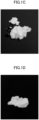
- Shape changes of the chewing function assessment material will be described in detail with reference to the FIGS. 1A to 1D .
- FIG. 1A is an image illustrating an example of the chewing function assessment material having a tablet shape.
- FIGS. 1B and 1C are images illustrating an example of the chewing function assessment material having a ground shape.
- FIG. 1D is an image illustrating an example of the chewing function assessment material having a bolus-of-food shape.
- the chewing function assessment material has a tablet shape before being chewed, as illustrated in FIG. 1A .
- the shape of the chewing function assessment material in an initial period of chewing is a ground shape as illustrated in FIGS. 1B and 1C .
- the "initial period of chewing” means a period from immediately after starting to chew the chewing function assessment material until before a bolus of food is formed.
- the "ground shape” means a nonuniform shape in which a ground product and an unground product are mixed.
- the shape of the chewing function assessment material in a later period of chewing is a bolus-of-food shape as illustrated in FIG. 1D .
- the "later period of chewing” means a period after a bolus of food is formed as a result of chewing the chewing function assessment material.
- the "bolus-of-food shape” means a uniform shape in which no unground product exists.
- the hardness of the chewing function assessment material is not particularly limited, may be appropriately selected in accordance with the intended purpose, and is preferably 100 N or greater and 180 N or less and more preferably 120 N or greater and 170 N or less.
- the hardness of the chewing function assessment material is 180 N or less, there is an advantage that the chewing function assessment material is easy to chew and grind.
- the method for measuring the hardness of the chewing function assessment material is not particularly limited.
- An example of the method is as follows.
- a compressive fracture test is performed using a precision universal tester Autograph AG-IS (available from Shimadzu Corporation) at a crosshead speed of 1 mm/min, and the average of compressive fracture loads is used as the hardness.
- the volume of the chewing function assessment material is not particularly limited, may be appropriately selected in accordance with the intended purpose, yet is preferably 300 mm 3 or greater and 2,300 mm 3 or less in terms of facilitating chewing and grinding.
- the method for producing the chewing function assessment material is not particularly limited, and an example of the method is as follows.
- a mixture (1,200 mg) of the materials of the chewing function assessment material is tableted at a tableting pressure of 1.0 t, to produce a chewing function assessment material having a disk shape having a diameter of 15 mm and a thickness of 7 mm.
- the method for verifying the gum base and the sugar component in the chewing function assessment material is not particularly limited and may be appropriately selected in accordance with the intended purpose. For example, the following methods may be employed.
- the blended components can be identified based on infrared absorption spectrums of the assessment material that are obtained by a total reflection measuring method of Fourier transform infrared spectroscopy.
- the assessment material is dissolved in an organic solvent or water, to extract the gum base or the sugar component, to prepare a sample liquid.
- an organic solvent or water By the high-performance liquid chromatography method, the molecular species of the sample liquid are identified based on the detection positions in the chromatogram.
- the concentration of each component can be calculated based on the peak area.
- a chewing function assessment material is chewed for a certain period of time to form a chewed product, and the chewing function is assessed based on the properties or the appearance of the chewed product.
- the "properties" are not particularly limited so long as a chewing function, i.e., a chewing/grinding function and a bolus-of-food forming function can be assessed.
- the properties include the average thickness, the average consistency, and the like of the chewed product. More specifically, the chewing/grinding function can be assessed based on the average thickness of the chewed product.
- the bolus-of-food forming function can be assessed based on the average consistency of the chewed product.
- the chewing function assessment method can sensorily assess the chewing/grinding function and the bolus-of-food forming function based on the appearance (e.g., a captured image, a developed color, or the like) of the chewed product.
- the "certain period of time” is not particularly limited and may be appropriately set in accordance with the composition of the chewing function assessment material, the health condition of the test subject, and the like. Yet, the certain period of time is preferably 10 seconds or longer and 40 seconds or shorter in terms of facilitating assessment of the chewed product.
- the method for measuring the average thickness of the chewed product is not particularly limited.
- the average thickness can be measured by the following method.
- the average thickness of the chewed product can be measured based partly on Japanese Industrial Standards (JIS) T 6513:2019, Dental Elastomeric Impression Materials, 7.2-Consistency test. Specifically, a chewed product resulting from the certain period of time of chewing is put in the center of a glass plate covered with a polyethylene sheet, a polyethylene sheet and a glass plate are placed on them in this order, and a load of 14 N is immediately applied. The load is removed at 5 seconds after the start of loading, and after 15 minutes or longer has passed, the thickness of the chewed product compressed under the load is measured using a caliper. The number of samples is three or four, and the average of the samples is used as the average thickness of the chewed product.
- JIS Japanese Industrial Standards
- T 6513:2019 Dental Elastomeric Impression Materials
- the method for measuring the average consistency of the chewed product is not particularly limited.
- the average consistency can be measured by the following method.
- the average consistency can be measured based partly on JIS T 6513:2019, Dental Elastomeric Impression Materials, 7.2-Consistency test. Specifically, a chewed product resulting from being chewed for a certain period of time is put in the center of a glass plate covered with a polyethylene sheet, another polyethylene sheet and another glass plate are placed on them in this order, and a load of 14 N is immediately applied. The load is removed at 5 seconds after the start of loading, and the chewed product is left to stand still for 15 minutes or longer. The maximum and minimum dimensions between parallel cutting lines of the chewed product after being left to stand still are measured using a caliper, and the average of the dimensions is calculated. The number of samples is three or four, and the average of the samples is used as the average consistency of the chewed product.
- the chewing function assessment material enables one sample (chewed product) to be assessed in terms of two items, namely the chewing/grinding function based on measured values of the thickness, and the bolus-of-food forming function based on measured values of the consistency.
- the chewing function assessment method may include another assessment method in addition to the chewing/grinding function assessment method based on the average thickness and the bolus-of-food forming function assessment method based on the average consistency.
- the other assessment method is not particularly limited.
- An example of the other assessment method is a chewing/grinding function assessment method that is based on a glucose concentration in the saliva after chewing the chewing function assessment material.
- the method for measuring the glucose concentration in the saliva is not particularly limited.
- the glucose concentration may be measured by the following method.
- a chewed product resulting from chewing and water (10 mL) are put in the mouth cavity, and then the chewed product and the water are spat out into a container on which a filtration mesh is placed, to separate the chewed product and the filtrate from each other.
- the concentration of glucose contained in the filtrate is measured using a glucose amount measuring instrument (e.g., a Glucosensor GS-IIN, available from GC Corporation).
- a chewing function assessment kit includes a chewing function assessment material, and may include other members.
- Examples of the other members include a manual of instructions for use, polyethylene sheets, glass plates, and a ruler for measuring the thickness and the consistency of a chewed product, and a glucose measuring instrument and a filtration mesh for measuring the glucose concentration in saliva.
- the uses of the chewing function assessment material are not particularly limited. Examples of the uses of the chewing function assessment material include a food, a chewing function training food, and the like.
- a gummi chewing ability test was performed in the manner described below, to judge the chewing ability of ten panelists.
- a tester gummi (GLUCORUM, obtained from GC Corporation) was chewed on the main chewing side, water (10 mL) was poured into the mouth cavity, the chewed product and the water were spat out into a container on which a filtration mesh was placed, to separate the chewed product and the filtrate from each other.
- the concentration of glucose eluted into the filtrate was measured using a glucose amount measuring instrument (a Glucosensor GS-IIN, obtained from GC Corporation).
- the ten panelists were sorted into three groups based on the following judgment criteria.
- Example 1 Materials were mixed based on the composition and blending amounts indicated in Table 1 below, to prepare a mixture of Example 1.
- the mixture (1,200 mg) was tableted at a tableting pressure of 1.0 t, to produce a chewing function assessment material of Example 1 having a disk shape having a diameter of 15 mm and a thickness of 7 mm.
- Example 1 The chewing function assessment material of Example 1 was chewed for a predetermined period of time (10 seconds, 20 seconds, or 30 seconds), and spat out. The average thickness and the average consistency of the spat-out chewed product were assessed as follows. The results are indicated in Tables 2 and 3.
- the average thickness was measured based partly on JIS T 6513:2019, Dental Elastomeric Impression Materials, 7.2-Consistency test. Specifically, a chewed product resulting from being chewed for a certain period of time was put in the center of a glass plate covered with a polyethylene sheet, another polyethylene sheet and another glass plate were placed on them in this order, and a load of 14 N was immediately applied. The load was removed at 5 seconds after the start of loading, and after 15 minutes or longer passed, the thickness of the chewed product compressed under the load was measured using a caliper. The number of samples was three or four, and the average of the samples was used as the average thickness.
- the average consistency was measured based partly on JIS T 6513:2019, Dental Elastomeric Impression Materials, 7.2-Consistency test. Specifically, the chewed product resulting from the certain period of time of chewing was put in the center of a glass plate covered with a polyethylene sheet, a polyethylene sheet and a glass plate were placed on them in this order, and a load of 14 N was immediately applied. The load was removed at 5 seconds after the start of loading, and the chewed product was left to stand still for 15 minutes or longer. The maximum and minimum dimensions between parallel cutting lines of the chewed product after being left to stand still were measured using a caliper, and the average of the dimensions was calculated. The number of samples was three or four, and the average of the samples was used as the average consistency of the chewed product.
- Chewing time 30 sec 2.9 3.4 3.6 2.2 2.3 3.0 1.8 1.9 2.7 Average consistency of chewed product [mm] Chewing time; 10 sec 15.9 11.4 11.9 16.5 12.0 12.4 16.9 12.4 12.7 Chewing time: 20 sec 19.8 16.8 12.8 20.3 17.3 13.4 20.7 17.7 13.8 Chewing time: 30 sec 23.2 20.0 17.4 23.7 20.5 17.8 24.2 21.0 18.3 [Table 3] Comp. Ex. 1 Comp. Ex.
- Example 2 a chewed product of Example 2 and water (10 mL) were put in the mouth cavity of each panelist, and then the chewed product and the water were spat out into a container on which a filtration mesh was placed, to separate the chewed product and the filtrate from each other.
- the concentration of glucose contained in the filtrate was measured using a glucose measuring instrument (a Glucosensor GS-IIN, obtained from GC Corporation). The results and the appearances are indicated or illustrated in FIG. 2 .
- the chewed products had variations in the average thickness and the average consistency depending on the panelists' chewing abilities. That is, by comparing the chewed products based on the average thickness having correlation with the sugar component grinding degree, it was possible to assess the chewing/grinding abilities. Similarly, by comparing the chewed products based on the average consistency, it was possible to assess the bolus-of-food forming abilities.
- the chewing function assessment material it is possible to assess the chewing/grinding function and the bolus-of-food forming function simultaneously, easily, and at low costs, by performing comparison with normal chewed product properties (i.e., the average thickness and the average consistency of a chewed product of a panelist who has the normal chewing ability). Moreover, it is possible to assess the chewing/grinding function in greater detail by performing glucose concentration measurement in combination.
- the chewing function assessment material according to any one of ⁇ 1> to ⁇ 6>, the chewing function assessment kit according to ⁇ 7>, and the chewing function assessment method according to any one of ⁇ 8> to ⁇ 11> can solve the various problems in the related art and achieve the object of the present disclosure.
Landscapes
- Life Sciences & Earth Sciences (AREA)
- Health & Medical Sciences (AREA)
- Chemical & Material Sciences (AREA)
- Engineering & Computer Science (AREA)
- Food Science & Technology (AREA)
- Polymers & Plastics (AREA)
- Molecular Biology (AREA)
- Inorganic Chemistry (AREA)
- Physics & Mathematics (AREA)
- Medical Informatics (AREA)
- Dentistry (AREA)
- Biophysics (AREA)
- Pathology (AREA)
- Biomedical Technology (AREA)
- Heart & Thoracic Surgery (AREA)
- Physical Education & Sports Medicine (AREA)
- Surgery (AREA)
- Animal Behavior & Ethology (AREA)
- General Health & Medical Sciences (AREA)
- Public Health (AREA)
- Veterinary Medicine (AREA)
- Confectionery (AREA)
- Dental Tools And Instruments Or Auxiliary Dental Instruments (AREA)
Abstract
A chewing function assessment material with which it is possible to assess both of a chewing/grinding function and a bolus-of-food forming function simultaneously is provided. The chewing function assessment material contains a gum base and a sugar component. The content of the sugar component is 6% by mass or greater and 50% by mass or less relative to the whole amount of the chewing function assessment material.
Description
- The present disclosure relates to a chewing function assessment material, a chewing function assessment method, and a chewing function assessment kit.
- A process of masticating a food to form a ground product, and a process of mixing the ground product with the saliva to form a bolus of food are referred to generally as chewing. In recent years, an assessment material and an assessment method that can assess the chewing ability have been proposed with a view to, for example, understanding of the health condition, and the like.
- For example, in order to assess the chewing efficiency, which is generally referred to as the chewing/grinding function, a non-sugar gummi candy for chewing ability testing, containing a sugar alcohol, polydextrose, gelatin, and esterified carboxyl group-containing polysaccharide at a specific ratio, has been proposed (for example, see
Japanese Patent Application Laid-Open Publication No. 2012-170424 Japanese Patent Application Laid-Open Publication No. 2013-090830 - However, with the invention described in
Japanese Patent Application Laid-Open Publication No. 2012-170424 Japanese Patent Application Laid-Open Publication No. 2013-090830 - With existing chewing function assessment materials including the inventions described in
Japanese Patent Application Laid-Open Publication No. 2012-170424 Japanese Patent Application Laid-Open Publication No. 2013-090830 - Hence, an object of the present disclosure is to provide a chewing function assessment material with which it is possible to assess both of the chewing/grinding function and the bolus-of-food forming function simultaneously.
- A chewing function assessment material according to the present disclosure is a chewing function assessment material containing a gum base and a sugar component. A content of the sugar component is 6% by mass or greater and 50% by mass or less relative to a whole amount of the chewing function assessment material.
- According to the present disclosure, it is possible to provide a chewing function assessment material with which it is possible to assess both of the chewing/grinding function and the bolus-of-food forming function simultaneously.
-
-
FIG. 1A is an image illustrating an example of a chewing function assessment material having a tablet shape; -
FIG. 1B is an image illustrating an example of a chewing function assessment material having a ground shape (part 1); -
FIG. 1C is an image illustrating an example of a chewing function assessment material having a ground shape (part 2); -
FIG. 1D is an image illustrating an example of a chewing function assessment material having a bolus-of-food shape; and -
FIG. 2 is a table illustrating the results of appearance assessment and glucose elution concentration measurement in Examples. - The present disclosure will be described in detail below.
- A chewing function assessment material according to the present disclosure contains a gum base and a sugar component, and may contain other components as needed.
- As will be described in detail below, with the chewing function assessment material according to the present disclosure, it is possible to assess both of a chewing/grinding function and a bolus-of-food forming function simultaneously based on the average thickness and the average consistency of a chewed product resulting from chewing the chewing function assessment material.
- The gum base is mainly blended in order for a bolus of food to be formed, i.e., in order for a ground product to be changed to a gum paste.
- The gum base contains a synthetic rubber, and may further contain other components as needed.
- The synthetic rubber is not particularly limited and may be appropriately selected in accordance with the intended purpose. Examples of the synthetic rubber include polyisobutylene, polyisoprene, isobutylene-isoprene copolymers, styrene-butadiene rubbers, and the like. These synthetic rubbers may be used alone or in combination of two or more.
- The other components contained in the gum base are not particularly limited and may be appropriately selected in accordance with the intended purpose. Examples of the other components include polyvinyl acetate, gum ester, a wax, an oil or a fat, an emulsifier, a filler, and the like. These may be used alone or in combination of two or more.
- A coating layer may be formed on the surface of the gum base. The material used as the coating layer is not particularly limited and may be appropriately selected in accordance with the intended purpose. Examples of the material include sugars (a liquid sugar, a honey, molasses, a starch syrup, powdered sugars, a sugar alcohol, and the like), an antioxidant, food additives, and the like. One of these may be used alone or in combination of two or more.
- In a case where the coating layer contains a sugar, it is assumed that the content of the "sugar" in the coating layer is not included in the content of the "sugar component" of the chewing function assessment material.
- The content of the gum base is preferably 60% by mass or greater and 80% by mass or less relative to the whole amount of the chewing function assessment material.
- When the content of the gum base is 60% by mass or greater relative to the whole amount of the chewing function assessment material, there is an advantage that the chewing function assessment material has a favorable hardness and is easy to chew.
- When the content of the gum base is 80% by mass or less relative to the whole amount of the chewing function assessment material, there is an advantage that the chewing function assessment material has a favorable hardness and it is easy to discern a shape change of the chewing function assessment material from a ground shape to a bolus-of-food shape in a chewing process.
- The particle diameter of the gum base is not particularly limited and may be appropriately selected in accordance with the intended purpose, yet a particle diameter (D90) of the gum base is preferably 1 mm or less.
- The method for measuring the particle diameter of the gum base is not particularly limited. For example, it is possible to measure the particle diameter of the gum base by using a particle size distribution measuring instrument (laser diffraction/scattering type).
- The amount of 20 mesh-on particles in the gum base is not particularly limited, yet is preferably 10% by mass or less relative to the whole amount of the gum base because the chewing function assessment material can have a favorable hardness.
- As the gum base, an appropriately synthesized product may be used or a commercially available product may be used. Examples of the commercially available product of the gum base include product name: HEALTH IN GUM PWD-04 (blend powder gum base, D90 = 0.95 mm, an amount of 20 mesh-on particles = 4% by mass relative to the whole amount, available from CAFOSA GUM S.A.), and the like.
- The sugar component is mainly blended for tablet formation, and control of the hardness of the chewing function assessment material.
- The sugar component is not particularly limited and may be appropriately selected in accordance with the intended purpose. Examples of the sugar component include: monosaccharides such as arabinose, galactose, xylose, glucose, fructose, and the like; disaccharides such as isotrehalose, sucrose, trehalulose, trehalose, neotrehalose, palatinose (isomaltulose), maltose, lactose, and the like; oligosaccharides such as soybean oligosaccharide, invert sugars, starch syrups, and the like; and sugar alcohols such as xylitol, glycerol, sorbitol, maltitol, mannitol, reduced palatinose, reduced maltose starch syrups, reduced starch syrups, and the like. Among these sugar components, anhydrous glucose and reduced palatinose are preferable.
- In the present disclosure, the content of the sugar component is 6% by mass or greater and 50% by mass or less and preferably 10% by mass or greater and 40% by mass or less relative to the whole amount of the chewing function assessment material.
- When the content of the sugar component is 6% by mass or greater relative to the whole amount of the chewing function assessment material, there is an advantage that the chewing function assessment material has a favorable hardness and it is easy to discern a shape change of the chewing function assessment material from a ground shape to a bolus-of-food shape in a chewing process.
- When the content of the sugar component is 50% by mass or less relative to the whole amount of the chewing function assessment material, there is an advantage that the chewing function assessment material has a favorable hardness and is easy to chew.
- The chewing function assessment material according to the present disclosure may contain other components in addition to the components described above.
- The other components are not particularly limited and may be appropriately selected in accordance with the intended purpose. Examples of the other components include additives, a colorant, and the like. Specific examples of the additives include a dispersant, a humectant, a stabilizer, an anti-adhesive agent for tablets, a bubble stabilizer, a binder, and the like.
- Examples of the dispersant, the humectant, and the stabilizer include sucrose fatty acid ester.
- Examples of the stabilizer and the anti-adhesive agent include powder cellulose.
- Examples of the bubble stabilizer and the binder include hydroxypropyl cellulose.
- The shape of the chewing function assessment material is not particularly limited, yet a tablet form is preferable. Examples of the tablet shape include a disk shape, an annular shape, a plate shape, a star shape, a spherical shape, a bar shape, and the like. It is preferable that the chewing function assessment material undergoes shape change as the chewing time passes. More specifically, it is preferable that the chewing function assessment material has a ground shape in an initial period of chewing, and has a bolus-of-food shape in a later period of chewing.
- Shape changes of the chewing function assessment material will be described in detail with reference to the
FIGS. 1A to 1D . -
FIG. 1A is an image illustrating an example of the chewing function assessment material having a tablet shape.FIGS. 1B and1C are images illustrating an example of the chewing function assessment material having a ground shape.FIG. 1D is an image illustrating an example of the chewing function assessment material having a bolus-of-food shape. - It is preferable that the chewing function assessment material has a tablet shape before being chewed, as illustrated in
FIG. 1A . - It is preferable that the shape of the chewing function assessment material in an initial period of chewing is a ground shape as illustrated in
FIGS. 1B and1C . Here, the "initial period of chewing" means a period from immediately after starting to chew the chewing function assessment material until before a bolus of food is formed. The "ground shape" means a nonuniform shape in which a ground product and an unground product are mixed. - It is preferable that the shape of the chewing function assessment material in a later period of chewing is a bolus-of-food shape as illustrated in
FIG. 1D . Here, the "later period of chewing" means a period after a bolus of food is formed as a result of chewing the chewing function assessment material. The "bolus-of-food shape" means a uniform shape in which no unground product exists. - The hardness of the chewing function assessment material is not particularly limited, may be appropriately selected in accordance with the intended purpose, and is preferably 100 N or greater and 180 N or less and more preferably 120 N or greater and 170 N or less.
- When the hardness of the chewing function assessment material is 100 N or greater, there is an advantage that tableting compression is facilitated.
- When the hardness of the chewing function assessment material is 180 N or less, there is an advantage that the chewing function assessment material is easy to chew and grind.
- The method for measuring the hardness of the chewing function assessment material is not particularly limited. An example of the method is as follows.
- A compressive fracture test is performed using a precision universal tester Autograph AG-IS (available from Shimadzu Corporation) at a crosshead speed of 1 mm/min, and the average of compressive fracture loads is used as the hardness.
- The volume of the chewing function assessment material is not particularly limited, may be appropriately selected in accordance with the intended purpose, yet is preferably 300 mm3 or greater and 2,300 mm3 or less in terms of facilitating chewing and grinding.
- The method for producing the chewing function assessment material is not particularly limited, and an example of the method is as follows.
- A mixture (1,200 mg) of the materials of the chewing function assessment material is tableted at a tableting pressure of 1.0 t, to produce a chewing function assessment material having a disk shape having a diameter of 15 mm and a thickness of 7 mm.
- The method for verifying the gum base and the sugar component in the chewing function assessment material is not particularly limited and may be appropriately selected in accordance with the intended purpose. For example, the following methods may be employed.
- The blended components can be identified based on infrared absorption spectrums of the assessment material that are obtained by a total reflection measuring method of Fourier transform infrared spectroscopy.
- The assessment material is dissolved in an organic solvent or water, to extract the gum base or the sugar component, to prepare a sample liquid. By the high-performance liquid chromatography method, the molecular species of the sample liquid are identified based on the detection positions in the chromatogram. The concentration of each component can be calculated based on the peak area.
- In a chewing function assessment method according to the present disclosure, a chewing function assessment material is chewed for a certain period of time to form a chewed product, and the chewing function is assessed based on the properties or the appearance of the chewed product.
- Here, the "properties" are not particularly limited so long as a chewing function, i.e., a chewing/grinding function and a bolus-of-food forming function can be assessed. Examples of the properties include the average thickness, the average consistency, and the like of the chewed product. More specifically, the chewing/grinding function can be assessed based on the average thickness of the chewed product. The bolus-of-food forming function can be assessed based on the average consistency of the chewed product.
- Moreover, the chewing function assessment method according to the present disclosure can sensorily assess the chewing/grinding function and the bolus-of-food forming function based on the appearance (e.g., a captured image, a developed color, or the like) of the chewed product.
- The "chewing function assessment material" mentioned above is the same as the one that is described under the foregoing item (Chewing function assessment material). Therefore, overlapping descriptions will be omitted.
- The "certain period of time" is not particularly limited and may be appropriately set in accordance with the composition of the chewing function assessment material, the health condition of the test subject, and the like. Yet, the certain period of time is preferably 10 seconds or longer and 40 seconds or shorter in terms of facilitating assessment of the chewed product.
- The method for measuring the average thickness of the chewed product is not particularly limited. For example, the average thickness can be measured by the following method.
- The average thickness of the chewed product can be measured based partly on Japanese Industrial Standards (JIS) T 6513:2019, Dental Elastomeric Impression Materials, 7.2-Consistency test. Specifically, a chewed product resulting from the certain period of time of chewing is put in the center of a glass plate covered with a polyethylene sheet, a polyethylene sheet and a glass plate are placed on them in this order, and a load of 14 N is immediately applied. The load is removed at 5 seconds after the start of loading, and after 15 minutes or longer has passed, the thickness of the chewed product compressed under the load is measured using a caliper. The number of samples is three or four, and the average of the samples is used as the average thickness of the chewed product.
- The method for measuring the average consistency of the chewed product is not particularly limited. For example, the average consistency can be measured by the following method.
- The average consistency can be measured based partly on JIS T 6513:2019, Dental Elastomeric Impression Materials, 7.2-Consistency test. Specifically, a chewed product resulting from being chewed for a certain period of time is put in the center of a glass plate covered with a polyethylene sheet, another polyethylene sheet and another glass plate are placed on them in this order, and a load of 14 N is immediately applied. The load is removed at 5 seconds after the start of loading, and the chewed product is left to stand still for 15 minutes or longer. The maximum and minimum dimensions between parallel cutting lines of the chewed product after being left to stand still are measured using a caliper, and the average of the dimensions is calculated. The number of samples is three or four, and the average of the samples is used as the average consistency of the chewed product.
- It is possible to perform the method for assessing the chewing/grinding function based on the average thickness, and the method for assessing the bolus-of-food forming function based on the average consistency separately. Yet, it is preferable to perform them simultaneously. In other words, the chewing function assessment material according to the present disclosure enables one sample (chewed product) to be assessed in terms of two items, namely the chewing/grinding function based on measured values of the thickness, and the bolus-of-food forming function based on measured values of the consistency.
- The chewing function assessment method may include another assessment method in addition to the chewing/grinding function assessment method based on the average thickness and the bolus-of-food forming function assessment method based on the average consistency.
- The other assessment method is not particularly limited. An example of the other assessment method is a chewing/grinding function assessment method that is based on a glucose concentration in the saliva after chewing the chewing function assessment material.
- The method for measuring the glucose concentration in the saliva is not particularly limited. For example, the glucose concentration may be measured by the following method.
- A chewed product resulting from chewing and water (10 mL) are put in the mouth cavity, and then the chewed product and the water are spat out into a container on which a filtration mesh is placed, to separate the chewed product and the filtrate from each other. The concentration of glucose contained in the filtrate is measured using a glucose amount measuring instrument (e.g., a Glucosensor GS-IIN, available from GC Corporation).
- A chewing function assessment kit according to the present disclosure includes a chewing function assessment material, and may include other members.
- The "chewing function assessment material" mentioned above is the same as the one that is described under the foregoing item (Chewing function assessment material). Therefore, overlapping descriptions will be omitted.
- Examples of the other members include a manual of instructions for use, polyethylene sheets, glass plates, and a ruler for measuring the thickness and the consistency of a chewed product, and a glucose measuring instrument and a filtration mesh for measuring the glucose concentration in saliva.
- The uses of the chewing function assessment material are not particularly limited. Examples of the uses of the chewing function assessment material include a food, a chewing function training food, and the like.
- The present disclosure will further be described below by way of Examples. In the following description, values without units, and "part" or "%" are mass-based unless otherwise particularly noted.
- A gummi chewing ability test was performed in the manner described below, to judge the chewing ability of ten panelists.
- After a tester gummi (GLUCORUM, obtained from GC Corporation) was chewed on the main chewing side, water (10 mL) was poured into the mouth cavity, the chewed product and the water were spat out into a container on which a filtration mesh was placed, to separate the chewed product and the filtrate from each other. The concentration of glucose eluted into the filtrate was measured using a glucose amount measuring instrument (a Glucosensor GS-IIN, obtained from GC Corporation). The ten panelists were sorted into three groups based on the following judgment criteria.
- Judgment criteria-
- Group A: The glucose concentration was 150 mg/dL or higher (the chewing ability was normal, four panelists)
- Group B: The glucose concentration was 100 mg/dL or higher and lower than 150 mg/dL (the chewing ability was poor, three panelists)
- Group C: The glucose concentration was lower than 100 mg/dL (the chewing ability was extremely poor, three panelists)
- Materials were mixed based on the composition and blending amounts indicated in Table 1 below, to prepare a mixture of Example 1. The mixture (1,200 mg) was tableted at a tableting pressure of 1.0 t, to produce a chewing function assessment material of Example 1 having a disk shape having a diameter of 15 mm and a thickness of 7 mm.
- A compressive fracture test was performed using a precision universal tester Autograph AG-IS (obtained from Shimadzu Corporation) at a crosshead speed of 1 mm/min, and the hardness of the chewing function assessment material of Example 1 was calculated as an average compressive fracture load. The result is indicated in Table 1.
Table 1 Ex. Comp. Ex. 1 2 3 1 2 Gum component Gum base 60 70 77 85 0 Sugar component Glucose 10 10 10 0 40 Reduced palatinose 20 10 8 5 50 Additives Sucrose fatty acid ester 5 5 2 5 5 Powder cellulose 3 3 1 3 3 Hydroxypropyl cellulose 2 2 2 2 2 Total 100 100 100 100 100 Hardness [/N] 172 165 148 85 280 - The details of the materials indicated in Table 1 are as follows.
- Gum base: HEALTH IN GUM PWD-04 (blend powder gum base, D90 = 0.95 mm, an amount of 20 mesh-on particles = 4% by mass relative to the whole amount, obtained from CAFOSA GUM S.A.)
- Glucose (obtained from San-ei Sucrochemical Co., Ltd.)
- Reduced palatinose (obtained from Mitsui DM Sugar Co., Ltd.)
- Sucrose fatty acid ester (obtained from Mitsubishi Chemical Group Corporation)
- Powder cellulose (obtained from Nippon Paper Industries Co., Ltd.)
- Hydroxypropyl cellulose (obtained from Nippon Soda Co., Ltd.)
- The chewing function assessment material of Example 1 was chewed for a predetermined period of time (10 seconds, 20 seconds, or 30 seconds), and spat out. The average thickness and the average consistency of the spat-out chewed product were assessed as follows. The results are indicated in Tables 2 and 3.
- The average thickness was measured based partly on JIS T 6513:2019, Dental Elastomeric Impression Materials, 7.2-Consistency test. Specifically, a chewed product resulting from being chewed for a certain period of time was put in the center of a glass plate covered with a polyethylene sheet, another polyethylene sheet and another glass plate were placed on them in this order, and a load of 14 N was immediately applied. The load was removed at 5 seconds after the start of loading, and after 15 minutes or longer passed, the thickness of the chewed product compressed under the load was measured using a caliper. The number of samples was three or four, and the average of the samples was used as the average thickness.
- The average consistency was measured based partly on JIS T 6513:2019, Dental Elastomeric Impression Materials, 7.2-Consistency test. Specifically, the chewed product resulting from the certain period of time of chewing was put in the center of a glass plate covered with a polyethylene sheet, a polyethylene sheet and a glass plate were placed on them in this order, and a load of 14 N was immediately applied. The load was removed at 5 seconds after the start of loading, and the chewed product was left to stand still for 15 minutes or longer. The maximum and minimum dimensions between parallel cutting lines of the chewed product after being left to stand still were measured using a caliper, and the average of the dimensions was calculated. The number of samples was three or four, and the average of the samples was used as the average consistency of the chewed product.
- Assessment was performed in the same manner as in Example 1, except that the composition and the blending amounts were changed as indicated in Table 1. The results are indicated in Tables 2 and 3.
Table 2 Ex. 1 Ex. 2 Ex. 3 A B C A B C A B C Average thickness of chewed product [mm] Chewing time; 10 sec 4.2 6.2 6.2 3.5 5.6 5.7 3.3 5.2 5.4 Chewing time: 20 sec 3.5 4.3 4 . 9 2.7 3.8 4.3 2.4 3.4 4.0 Chewing time: 30 sec 2.9 3.4 3.6 2.2 2.3 3.0 1.8 1.9 2.7 Average consistency of chewed product [mm] Chewing time; 10 sec 15.9 11.4 11.9 16.5 12.0 12.4 16.9 12.4 12.7 Chewing time: 20 sec 19.8 16.8 12.8 20.3 17.3 13.4 20.7 17.7 13.8 Chewing time: 30 sec 23.2 20.0 17.4 23.7 20.5 17.8 24.2 21.0 18.3 [Table 3] Comp. Ex. 1 Comp. Ex. 2 A B C A B C Average thickness of chewed product [mm] Chewing time; 10 sec 1.8 1.9 2.0 6.4 8.7 9.5 Chewing time: 20 sec 1.7 1.7 1.7 Dissolved Dissolved 8.7 Chewing time: 30 sec 1.7 1.7 1.7 Dissolved Dissolved 7.6 Average consistency of chewed product [mm] Chewing time; 10 sec 28.0 27.3 26.7 Unmeasurable Unmeasurable Unmeasurable Chewing time: 20 sec 28.4 28.2 27.7 Dissolved Unmeasurable Unmeasurable Chewing time: 30 sec 28.7 28.0 27.3 Dissolved Dissolved Dissolved - In the group B, a chewed product of Example 2 and water (10 mL) were put in the mouth cavity of each panelist, and then the chewed product and the water were spat out into a container on which a filtration mesh was placed, to separate the chewed product and the filtrate from each other.
- The concentration of glucose contained in the filtrate was measured using a glucose measuring instrument (a Glucosensor GS-IIN, obtained from GC Corporation). The results and the appearances are indicated or illustrated in
FIG. 2 . - In each of Examples 1 to 3, the chewed products had variations in the average thickness and the average consistency depending on the panelists' chewing abilities. That is, by comparing the chewed products based on the average thickness having correlation with the sugar component grinding degree, it was possible to assess the chewing/grinding abilities. Similarly, by comparing the chewed products based on the average consistency, it was possible to assess the bolus-of-food forming abilities.
- In Comparative Example 1, chewed products having a constant thickness and a constant consistency were obtained irrespective of the panelists' chewing abilities. Therefore, it was difficult to assess the chewing/grinding function and the bolus-of-food forming function.
- In Comparative Example 2, although it was found that the chewed products had variation in the average thickness depending on the panelists' chewing abilities, it was difficult to assess the chewing/grinding function because the sugar component of the chewed products mixed with and dissolved in the saliva, making it impossible to sufficiently confirm shape change of the chewed products. Moreover, because no bolus of food was obtained, it was also difficult to assess the bolus-of-food forming function.
- With the chewing function assessment material according to the present disclosure, it is possible to assess the chewing/grinding function and the bolus-of-food forming function simultaneously, easily, and at low costs, by performing comparison with normal chewed product properties (i.e., the average thickness and the average consistency of a chewed product of a panelist who has the normal chewing ability). Moreover, it is possible to assess the chewing/grinding function in greater detail by performing glucose concentration measurement in combination.
- Aspects of the present disclosure are, for example, as follows.
- <1> A chewing function assessment material, including:
- a gum base; and
- a sugar component,
- wherein a content of the sugar component is 6% by mass or greater and 50% by mass or less relative to a whole amount of the chewing function assessment material.
- <2> The chewing function assessment material according to <1>,
wherein the chewing function assessment material has a tablet shape. - <3> The chewing function assessment material according to <2>,
- wherein the chewing function assessment material undergoes shape change as chewing time passes, and
- the chewing function assessment material has a ground shape in an initial period of chewing, and has a bolus-of-food shape in a later period of chewing.
- <4> The chewing function assessment material according to any one of <1> to <3>,
wherein a content of the gum base is 60% by mass or greater and 80% by mass or less relative to a whole amount of the chewing function assessment material. - <5> The chewing function assessment material according to any one of <1> to <4>,
- wherein the sugar component contains either or both of anhydrous glucose and reduced palatinose, and
- the content of the sugar component is 10% by mass or greater and 40% by mass or less relative to the whole amount of the chewing function assessment material.
- <6> The chewing function assessment material according to any one of <1> to <5>,
wherein the chewing function assessment material has a volume of 300 mm3 or greater and 2,300 mm3 or less. - <7> A chewing function assessment kit, including:
the chewing function assessment material of any one of <1> to <6>. - <8> A chewing function assessment method, including:
- chewing a chewing function assessment material for a certain period of time, to form a chewed product, the chewing function assessment material containing a gum base and a sugar component, wherein a content of the sugar component is 6% by mass or greater and 50% by mass or less relative to a whole amount of the chewing function assessment material; and
- assessing a chewing function based on a property or appearance of the chewed product.
- <9> The chewing function assessment method according to <8>,
wherein a chewing/grinding function is assessed based on an average thickness of the chewed product. - <10> The chewing function assessment method according to <8> or <9>,
wherein a bolus-of-food forming function is assessed based on an average consistency of the chewed product. - <11> The chewing function assessment method according to any one of <8> to <10>,
wherein a chewing/grinding function is assessed based on a glucose concentration in saliva after the chewing function assessment material is chewed. - The chewing function assessment material according to any one of <1> to <6>, the chewing function assessment kit according to <7>, and the chewing function assessment method according to any one of <8> to <11> can solve the various problems in the related art and achieve the object of the present disclosure.
Claims (11)
- A chewing function assessment material, comprising:a gum base; anda sugar component,wherein a content of the sugar component is 6% by mass or greater and 50% by mass or less relative to a whole amount of the chewing function assessment material.
- The chewing function assessment material according to claim 1,
wherein the chewing function assessment material has a tablet shape. - The chewing function assessment material according to claim 2,wherein the chewing function assessment material undergoes shape change as chewing time passes, andthe chewing function assessment material has a ground shape in an initial period of chewing, and has a bolus-of-food shape in a later period of chewing.
- The chewing function assessment material according to claim 1,
wherein a content of the gum base is 60% by mass or greater and 80% by mass or less relative to the whole amount of the chewing function assessment material. - The chewing function assessment material according to claim 1,wherein the sugar component contains either or both of anhydrous glucose and reduced palatinose, andthe content of the sugar component is 10% by mass or greater and 40% by mass or less relative to the whole amount of the chewing function assessment material.
- The chewing function assessment material according to claim 1,
wherein the chewing function assessment material has a volume of 300 mm3 or greater and 2,300 mm3 or less. - A chewing function assessment kit, comprising:
the chewing function assessment material of any one of claims 1 to 6. - A chewing function assessment method, comprising:chewing a chewing function assessment material for a certain period of time, to form a chewed product, the chewing function assessment material containing a gum base and a sugar component, wherein a content of the sugar component is 6% by mass or greater and 50% by mass or less relative to a whole amount of the chewing function assessment material; andassessing a chewing function based on a property or appearance of the chewed product.
- The chewing function assessment method according to claim 8,
wherein a chewing/grinding function is assessed based on an average thickness of the chewed product. - The chewing function assessment method according to claim 8 or 9,
wherein a bolus-of-food forming function is assessed based on an average consistency of the chewed product. - The chewing function assessment method according to claim 8 or 9,
wherein a chewing/grinding function is assessed based on a glucose concentration in saliva after the chewing function assessment material is chewed.
Applications Claiming Priority (1)
| Application Number | Priority Date | Filing Date | Title |
|---|---|---|---|
| JP2023119925A JP2025017055A (en) | 2023-07-24 | 2023-07-24 | Masticatory function evaluation material, masticatory function evaluation method, and masticatory function evaluation kit |
Publications (1)
| Publication Number | Publication Date |
|---|---|
| EP4497330A1 true EP4497330A1 (en) | 2025-01-29 |
Family
ID=91950250
Family Applications (1)
| Application Number | Title | Priority Date | Filing Date |
|---|---|---|---|
| EP24188628.2A Pending EP4497330A1 (en) | 2023-07-24 | 2024-07-15 | Chewing function assessment material, chewing function assessment method, and chewing function assessment kit |
Country Status (3)
| Country | Link |
|---|---|
| US (1) | US20250032025A1 (en) |
| EP (1) | EP4497330A1 (en) |
| JP (1) | JP2025017055A (en) |
Citations (6)
| Publication number | Priority date | Publication date | Assignee | Title |
|---|---|---|---|---|
| JPH02308759A (en) * | 1989-05-22 | 1990-12-21 | Meiji Seika Kaisha Ltd | Chewing gum for judging mastication ability |
| WO1991015941A1 (en) * | 1991-06-19 | 1991-10-31 | Wm. Wrigley Jr. Company | Chewing gum containing palatinose |
| WO2004004478A1 (en) * | 2002-07-02 | 2004-01-15 | Gumlink A/S | Compressed chewing gum tablet ii |
| JP2012170424A (en) | 2011-02-23 | 2012-09-10 | Uha Mikakuto Co Ltd | Sugarless gummi candy for examining masticatory ability, and method for producing the same |
| US20120253232A1 (en) * | 2009-09-30 | 2012-10-04 | Shunsuke Minakuchi | Method for creating color scale for determination of masticatory performance |
| JP2013090830A (en) | 2011-10-26 | 2013-05-16 | Lotte Co Ltd | Color scale for assessing xylitol chewing gum mastication force |
-
2023
- 2023-07-24 JP JP2023119925A patent/JP2025017055A/en active Pending
-
2024
- 2024-07-05 US US18/764,757 patent/US20250032025A1/en active Pending
- 2024-07-15 EP EP24188628.2A patent/EP4497330A1/en active Pending
Patent Citations (6)
| Publication number | Priority date | Publication date | Assignee | Title |
|---|---|---|---|---|
| JPH02308759A (en) * | 1989-05-22 | 1990-12-21 | Meiji Seika Kaisha Ltd | Chewing gum for judging mastication ability |
| WO1991015941A1 (en) * | 1991-06-19 | 1991-10-31 | Wm. Wrigley Jr. Company | Chewing gum containing palatinose |
| WO2004004478A1 (en) * | 2002-07-02 | 2004-01-15 | Gumlink A/S | Compressed chewing gum tablet ii |
| US20120253232A1 (en) * | 2009-09-30 | 2012-10-04 | Shunsuke Minakuchi | Method for creating color scale for determination of masticatory performance |
| JP2012170424A (en) | 2011-02-23 | 2012-09-10 | Uha Mikakuto Co Ltd | Sugarless gummi candy for examining masticatory ability, and method for producing the same |
| JP2013090830A (en) | 2011-10-26 | 2013-05-16 | Lotte Co Ltd | Color scale for assessing xylitol chewing gum mastication force |
Also Published As
| Publication number | Publication date |
|---|---|
| JP2025017055A (en) | 2025-02-05 |
| US20250032025A1 (en) | 2025-01-30 |
Similar Documents
| Publication | Publication Date | Title |
|---|---|---|
| Kashket et al. | Accumulation of fermentable sugars and metabolic acids in food particles that become entrapped on the dentition | |
| US20040058033A1 (en) | Chewing gum in powder form and a method of preparation | |
| TWI433652B (en) | Embedded liquid lubricants for tableting | |
| KR101676480B1 (en) | Composition for Natural Lubricant Agent Used for Tablet Production | |
| FI82177B (en) | KALORIFRI, KARIES EJ KARIOGEN TUGGUMMOMPOSITION. | |
| KR20100117950A (en) | Nonsmoking gum composition and preparing method thereof | |
| JP2025521635A (en) | Method for preparing chewing gum and resulting products | |
| US20250032025A1 (en) | Chewing function assessment material, chewing function assessment method, and chewing function assessment kit | |
| EP2978411B1 (en) | Tablet comprising fructose | |
| JP4460817B2 (en) | Coating product containing reduced resistant starch syrup as binder component | |
| König et al. | The effect of wheat grain fractions and sucrose mixtures on rat caries developing in two strains of rats maintained on different regimes and evaluated by two different methods | |
| EP3062628B1 (en) | Improved chewing gums and methods for their preparation | |
| WO2018108764A1 (en) | Directly tablettable matrix for producing tablets with extended active substance delivery | |
| Grenby et al. | Effect of sweets made with and without sucrose on the dental plaque, and the correlation between the extent of plaque and human dental caries experience | |
| CN118632689A (en) | Organic chewable compositions comprising certified organic ingredients and methods of making the same | |
| CN103637995B (en) | A kind of VITAMIN C TABLET and preparation method | |
| Grenby | The effect of glucose syrup on dental caries in the rat | |
| EP2931056B1 (en) | Process for reducing the stickiness of a chewing gum core composition to a surface of a processing machinery using isomalt | |
| WO2001017503A2 (en) | Sugar compositions | |
| KR102047427B1 (en) | A sugar-coating composition | |
| CN119685169A (en) | New strain of Ganoderma lucidum and Ganoderma lucidum tablet containing the same | |
| Rodrigues et al. | Cariogenic potential of commercially available date syrup as a sweetening agent in milk-An in vitro study. | |
| JPH07223936A (en) | Method for improving tableting properties of xylitol | |
| EP0770386A1 (en) | Lanperisone formulation | |
| US20150305365A1 (en) | Process for reducing the stickiness of a chewing gum core composition to a surface of a processing machinery using isomaltulose |
Legal Events
| Date | Code | Title | Description |
|---|---|---|---|
| PUAI | Public reference made under article 153(3) epc to a published international application that has entered the european phase |
Free format text: ORIGINAL CODE: 0009012 |
|
| STAA | Information on the status of an ep patent application or granted ep patent |
Free format text: STATUS: REQUEST FOR EXAMINATION WAS MADE |
|
| 17P | Request for examination filed |
Effective date: 20240718 |
|
| AK | Designated contracting states |
Kind code of ref document: A1 Designated state(s): AL AT BE BG CH CY CZ DE DK EE ES FI FR GB GR HR HU IE IS IT LI LT LU LV MC ME MK MT NL NO PL PT RO RS SE SI SK SM TR |