EP4496444A2 - Catalysed synthesis of fluorinated alkenes and fluorinated alkene compositions - Google Patents
Catalysed synthesis of fluorinated alkenes and fluorinated alkene compositions Download PDFInfo
- Publication number
- EP4496444A2 EP4496444A2 EP24201434.8A EP24201434A EP4496444A2 EP 4496444 A2 EP4496444 A2 EP 4496444A2 EP 24201434 A EP24201434 A EP 24201434A EP 4496444 A2 EP4496444 A2 EP 4496444A2
- Authority
- EP
- European Patent Office
- Prior art keywords
- working fluid
- hfo
- formula
- chcf
- electrical component
- Prior art date
- Legal status (The legal status is an assumption and is not a legal conclusion. Google has not performed a legal analysis and makes no representation as to the accuracy of the status listed.)
- Pending
Links
Images
Classifications
-
- C—CHEMISTRY; METALLURGY
- C07—ORGANIC CHEMISTRY
- C07C—ACYCLIC OR CARBOCYCLIC COMPOUNDS
- C07C17/00—Preparation of halogenated hydrocarbons
- C07C17/26—Preparation of halogenated hydrocarbons by reactions involving an increase in the number of carbon atoms in the skeleton
- C07C17/272—Preparation of halogenated hydrocarbons by reactions involving an increase in the number of carbon atoms in the skeleton by addition reactions
- C07C17/278—Preparation of halogenated hydrocarbons by reactions involving an increase in the number of carbon atoms in the skeleton by addition reactions of only halogenated hydrocarbons
-
- C—CHEMISTRY; METALLURGY
- C07—ORGANIC CHEMISTRY
- C07C—ACYCLIC OR CARBOCYCLIC COMPOUNDS
- C07C21/00—Acyclic unsaturated compounds containing halogen atoms
- C07C21/02—Acyclic unsaturated compounds containing halogen atoms containing carbon-to-carbon double bonds
- C07C21/18—Acyclic unsaturated compounds containing halogen atoms containing carbon-to-carbon double bonds containing fluorine
-
- C—CHEMISTRY; METALLURGY
- C09—DYES; PAINTS; POLISHES; NATURAL RESINS; ADHESIVES; COMPOSITIONS NOT OTHERWISE PROVIDED FOR; APPLICATIONS OF MATERIALS NOT OTHERWISE PROVIDED FOR
- C09K—MATERIALS FOR MISCELLANEOUS APPLICATIONS, NOT PROVIDED FOR ELSEWHERE
- C09K5/00—Heat-transfer, heat-exchange or heat-storage materials, e.g. refrigerants; Materials for the production of heat or cold by chemical reactions other than by combustion
- C09K5/08—Materials not undergoing a change of physical state when used
- C09K5/10—Liquid materials
-
- H—ELECTRICITY
- H01—ELECTRIC ELEMENTS
- H01M—PROCESSES OR MEANS, e.g. BATTERIES, FOR THE DIRECT CONVERSION OF CHEMICAL ENERGY INTO ELECTRICAL ENERGY
- H01M10/00—Secondary cells; Manufacture thereof
- H01M10/60—Heating or cooling; Temperature control
- H01M10/61—Types of temperature control
- H01M10/613—Cooling or keeping cold
-
- H—ELECTRICITY
- H01—ELECTRIC ELEMENTS
- H01M—PROCESSES OR MEANS, e.g. BATTERIES, FOR THE DIRECT CONVERSION OF CHEMICAL ENERGY INTO ELECTRICAL ENERGY
- H01M10/00—Secondary cells; Manufacture thereof
- H01M10/60—Heating or cooling; Temperature control
- H01M10/65—Means for temperature control structurally associated with the cells
- H01M10/656—Means for temperature control structurally associated with the cells characterised by the type of heat-exchange fluid
- H01M10/6567—Liquids
-
- H—ELECTRICITY
- H05—ELECTRIC TECHNIQUES NOT OTHERWISE PROVIDED FOR
- H05K—PRINTED CIRCUITS; CASINGS OR CONSTRUCTIONAL DETAILS OF ELECTRIC APPARATUS; MANUFACTURE OF ASSEMBLAGES OF ELECTRICAL COMPONENTS
- H05K7/00—Constructional details common to different types of electric apparatus
- H05K7/20—Modifications to facilitate cooling, ventilating, or heating
- H05K7/2029—Modifications to facilitate cooling, ventilating, or heating using a liquid coolant with phase change in electronic enclosures
- H05K7/203—Modifications to facilitate cooling, ventilating, or heating using a liquid coolant with phase change in electronic enclosures by immersion
-
- F—MECHANICAL ENGINEERING; LIGHTING; HEATING; WEAPONS; BLASTING
- F25—REFRIGERATION OR COOLING; COMBINED HEATING AND REFRIGERATION SYSTEMS; HEAT PUMP SYSTEMS; MANUFACTURE OR STORAGE OF ICE; LIQUEFACTION SOLIDIFICATION OF GASES
- F25B—REFRIGERATION MACHINES, PLANTS OR SYSTEMS; COMBINED HEATING AND REFRIGERATION SYSTEMS; HEAT PUMP SYSTEMS
- F25B2400/00—Component parts or details not otherwise provided for in this subclass
- F25B2400/12—Inflammable refrigerants
Definitions
- the present invention is directed to the production of fluorinated alkene compounds and fluorinated alkene compositions.
- ORCs and HTHPs require the use of working fluids.
- Working fluids with high global warming potentials (GWPs) currently in common use for HTHPs and ORCs (e.g. HFC-245fa) have been under increasing scrutiny, culminating in the landmark HFC amendment to the Montreal Protocol recently agreed upon in Kigali, Cambodia.
- GWPs global warming potentials
- HFC-245fa global warming potentials
- °C degrees Celsius
- These fluids can also be used as solvents to remove contaminants or particles away from a given surface or structure, as carrier fluids where the desired product would be deposited and said fluid evaporates away, and as a medium for fire extinguishant as a nonflammable agent that suppresses or displace the chemical reaction.
- this process is lengthy and is based on relatively expensive starting materials (F-heptene is made using the reaction of hexafluoropropene (HFP) and 2 moles of tetrafluoroethene (TFE)).
- SbF 5 antimony pentafluoride
- X 2 , X 3 , X 4 , and X 5 are each independently H, Br, Cl, or F; and at least three of X 2 , X 3 , X 4 , and X 5 are F.
- n is an integer from 0 to 10; and m is an integer from 1 to 10;
- X 6 , X 7 , X 8 , X 9 , and X 10 are each independently H, Br, Cl, or F; and the total number of each of H, Br, Cl, and F represented by X 6 , X 7 , X 8 , and X 9 is the same as the total number of each of H, Br, Cl, and F provided by X 1 , X 2 , X 3 , X 4 , and X 5 in formulae (1) and (2).
- the present invention includes the following aspects and embodiments:
- X 2 , X 3 , X 4 , and X 5 are each independently H, Cl, or F; and at least three of X 2 , X 3 , X 4 , and X 5 are F.
- R f is selected from the group consisting of CF 3 , C 2 F 5 , C 3 F 7 , i-C 3 F 7 , C 4 F 9 , C 5 F 11 , i-C 5 F 11 , C 6 F 13 , and i-C 6 F 13 .
- the amount sufficient includes a molar ratio of (TFE): the compound of formula (1) of 0.01:1 to 5:1.
- the amount sufficient includes a molar ratio of (TFE): the compound of formula (1) of 0.1:1 to 2:1.
- the amount sufficient includes a molar ration of the compound of formula (2) and the compound of formula (1) of 0.01:1 to 5:1.
- composition further includes a solvent.
- the perfluorinated saturated compound is selected from the group insisting of perfluoropentane, perfluorohexane, cyclic dimer of hexafluoropropene, (mixture of perfluoro-1,2- and perfluoro-1,3- dimethylcyclobutanes), and combinations thereof.
- the catalyst includes aluminum chloride (AlCl 3 ), or antimony pentafluoride (SbF 5 ), or aluminum chlorofluoride AlCl x F 3-x .
- R f is a linear or branched C 2 -C 10 perfluorinated alkyl group.
- R f is CF 3 , C 2 F 5 , C 3 F 7 , iC 3 F 7 , C 4 F 9 , C 5 F 11 , i-C 5 F 11 , C 6 F 13 or i-C 6 F 13 .
- reaction is conducted at 0.1 to 300 psig.
- compositions formed by any of the foregoing methods are also disclosed herein.
- methods for transferring heat from an electronic component comprising providing an immersion cell having at least one electronic component and introducing the inventive composition into the immersion cell wherein the composition at least partially immerses the electronic component.
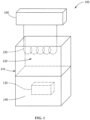
- FIG 1 illustrates on embodiment of the invention wherein the inventive composition is employed in an immersion cooling system.
- Embodiments of the present disclosure provide a one-step synthesis for the production of fluorinated alkenes. More specifically, the present disclosure provides a one-step synthesis for the production of fluorinated alkenes having a perfluorinated alkyl chain. The resulting fluorinated alkenes are non-conductive and exhibit low liquid viscosities.
- Embodiments of the present disclosure comprise compositions that have a 0 Ozone Depletion Potential (ODP), are non-flammable (when measured in accordance with ASTM E681) and have a GWP of less than 150, less than 10 and in some cases less than about 1.
- ODP Ozone Depletion Potential
- the process may be conducted in any reactor suitable for a vapor phase fluorination reaction.
- the reactor is made of a material that is resistant to the reactants employed.
- the reactor may be constructed from materials which are resistant to the corrosive effects of hydrogen fluoride such as stainless steel, Hastelloy ® , Inconel ® , Monel ® , gold or gold-lined or quartz.
- the reactions may be conducted batchwise, continuous, semi-continuous or combinations thereof. Suitable reactors include batch reactor vessels and tubular reactors.
- R f CX 1 CHCF 3 (1)
- the number of carbons present in formulae (3) is the summation of the carbons present in formula (1) and (2).
- the reaction product of formula (3) can further react with the compound of formulae (1) and/or (2) to produce a second compound of formulae (3) wherein the number of carbons present in the second formulae (3) compound is the summation of the carbons present in the first formulae (3) product plus the number of formulae (2) carbons.
- the ratio of formulae (1) to formulae (2) compounds is about 1:1 and, in some cases, about to 1:1 to about 1:2. In the event the ratio of formulae (1) to formulae (2) compounds is greater than about 1:1, then the number of formulae (3) compounds as well as the carbon atoms present in formulae (3) compounds also increases.
- R f may be a linear or branched perfluorinated or polyfluorinated alkyl group.
- R f may be CF 3 , C 2 F 5 , C 3 F 7 , i-C 3 F 7 , C 4 F 9 , C 5 F 11 , i-C 5 F 11 , C 6 F 13 or i-C 6 F 13 .
- the fluorinated ethylene of formulae (2) includes CTFE.
- formulae (3) will include two isomers.
- fluorinated ethylene of formula (2) may include a plurality of compounds of formula (2).
- the resulting compound of formula (3) may include a plurality of compounds of formula (3).
- the number of formulae (3) compounds and the number of carbons present in each formulae (3) compound will vary as a function of the ratio of formulae (1) to formulae (2) compounds.
- the reaction is may be conducted in a closed system under atmospheric or elevated pressure.
- the catalyst is preferably a Lewis acid including, for example, at least one of aluminum chloride, antimony chlorides, among others.
- the Lewis acid is a strong Lewis acid.
- the catalyst is at least one of antimony pentafluoride (SbF 5 ), or aluminum chlorofluoride AlCl x F 3-x or aluminum bromofluoride AlBr x F 3-x
- x may be an integer from 1 to 3.
- x may be 0.01 to 0.5. While any suitable amount of catalyst can be employed, the amount can range from about 0.5 to about 20 mol%, about 1 to about 15 mole% and, in some cases, about 5 to 10 mole% of the formulae (1) and formulae (2) compounds.
- the reaction mixture is heated to a sub-ambient or ambient temperature. In some embodiments, the reaction mixture is heated to a temperature of -50°C to 50°C. In one embodiment, the reaction mixture is heated to a temperature of -50°C to 25°C. In some embodiments, the reaction is performed at a reactor pressure of 0.1 pound per square inch gauged (psig) to 300 pounds per square inch gauged (psig). In some embodiments, the reaction is performed under autogenic pressure.
- the formation of the compound of formula (3) may be conducted in the presence of a solvent.
- the solvent comprises at least one of the reaction product (e.g., at least one formulae (3) compound), at least one starting material (e.g., at least one of the formulae (1) or (2) compounds), or a perfluorinated saturated compound.
- the perfluorinated saturated compound may include perfluoropentane, perfluorohexane, cyclic dimer of hexafluoropropene, (mixture of perfluoro-1,2- and perfluoro-1,3- dimethylcyclobutanes), and combinations thereof.
- the amount of solvent will vary as a function of the volume of the reactor as well as the ratios of formulae (1) and formulae (2) used to obtain formulae (3).
- Compounds of formula (3) may be used in numerous applications for the transfer of heat, such as, heat transfer fluids .
- the compounds of formula (3) may be used to transfer heat from an article.
- the article may be contacted with a heat transfer media including at least one compound of formula (3).
- the inventive composition can have a heat of vaporization ranging from about 80 to about 150kjoules/kg, about 90 to about 140 and, in some cases, about 100 to about 130 kjoules/kg; when calculated using the Clausius Clapeyron equation.
- the compounds of formula (3) may be used in various applications including as working fluids.
- Working fluids provide the medium to transport heat or produce power by mechanical means by expansion.
- Working fluids are typically in the liquid state at a first region.
- the working fluid absorbs heat in the first region, vaporizes, and migrates to a second region, having a lower temperature, where it condenses.
- the working fluid is typically returned to the first region after condensation allowing the heat transfer cycle to be repeated.
- Working fluids may be used in conjunction with compression, expansion systems, pumps or in passive evaporative cooling such as heat pipes or thermosyphons.
- the compounds of formula (3) may also be used as solvents in various applications such as for cleaning (vapor degreasing, flux removal) or as a carrier fluid for the deposition or removal of soluble compounds.
- the working fluid in a first region is exposed to an elevated (first) temperature causing the working fluid to vaporize, thus absorbing thermal energy.
- the vaporized working fluid migrates to a second region, which is at a lower (second) temperature than the first region.
- the working fluid condenses in the second region, releasing the thermal energy, which is transported external to the system.
- the working fluid is subsequently returned to the first region.
- the working fluid typically cyclically moves between the first region and the second region, transporting thermal energy between the first region and the second region.
- Working fluids are selected to undergo a phase transition from the liquid to the gaseous state over the desired operational temperature range of a system, such as a heat pipe or thermosyphon.
- the composition of the working fluids includes one or more compounds of formula (3).
- the operational temperature is at least 0°C, at least 10°C, at least 20°C, at least 30°C, at least 40°C, at least 50°C, less than 75°C, less than 70°C, less than 65°C, less than 60°C, less than 55°C, and combinations thereof.
- the ability of the working fluid to transport heat is related to the heat of vaporization of the working fluids.
- the compounds of formula (3) may exhibit a heat of vaporization of at least about 80 kilojoules per kg.
- Working fluids may also be selected based at least partially on additional material properties. As the working fluids condense and return to the first region workings fluids having a lower viscosity more easily flow between the regions.
- the compounds of formula (3) may exhibit a viscosity less than water of the same temperature, over the operational temperature range. In some embodiments, the compounds of formula (3) exhibit a viscosity of less than 0.5 centipoise at 55°C.
- the inventive composition can have a dynamic viscosity at a temperature of 55°C ranging from about 0.001 to about 3 centipoise, about 0.1 to about 2 and, in some cases, about 0.15 to about 1.5, when determined by ASTM D445.
- Compounds of formula (3) as working fluids for heat transfer applications may be selected based at least partially on the surface tension exhibited by the materials. For example, in heat pipe applications working fluids exhibiting high surface tensions may be more easily transported between the hot region and the cool region. In some embodiments, the selection of the wick materials may enhance the rate at which the condensed working fluid is returned to the hot region of the heat pipe. In some embodiments, the working fluids may exhibit a surface tension less than water of the same temperature, over the operational temperature range.
- the compounds of formula (3) exhibit a surface tension of less than 64.5 dyne/cm at 70°C, less than 66.3 dyne/cm at 60°C, and/or less than 67.9 dyne/cm at 50°C.
- the working fluids may also be selected based at least partially on other thermodynamic properties of the materials.
- Working fluids exhibiting a lower specific heat and/or a lower thermal conductivity than water at the same temperature may enhance energy transport between the hot region and the cool region of a heat pipe.
- the working fluids may exhibit a specific heat of less than about 4.2 joules per gram Kelvin degree.
- the compounds of formula (3) may exhibit a thermal conductivity of less than about 0.6 watts per meter Kelvin degree at 20°C.
- the working fluids may also be selected to exhibit a dielectric constant suitable for electrical applications.
- materials exhibiting a low dielectric constant provide increased electrical isolation of the electrical components immersed therein. Examples of such electrical components include, for example, automotive batteries, computers, and servers wherein the dielectric constant is less than about 2.5. In some embodiments, the dielectric constant of the working fluids is less than about 8 over the operational frequency range (0 to 20 GHz).
- Suitable dielectric working fluids include compounds of formula (3) and their mixtures having a dielectric constant over the operational frequency range (0 to 20 GHz) of less than 7.3, or less than 5.5, or less than 5.0, or less than 4.0, or less than 3.5, or less than 2.7, or less than 2.5, or less than 2.0, or less than 1.9, or less than 1.8, or less than 1.5.
- Other embodiments include compounds and mixtures having a dielectric constant greater than about 1.0 and less than about 8.0, or greater than about 2.0 and less than about 7.3, or greater than about 2.5 and less than about 5.5, or greater than about 3.5 and less than about 5.0.
- Additional additives may be added to the working fluid.
- Suitable additives include linear hydrocarbons, linear halocarbons, cyclic hydrocarbons, cyclic halocarbons, heptafluorocyclopentane, alcohols (e.g., methanol, ethanol, isopropanol), ethers, halogenated ethers, ketones, and halogenated ketones.
- Suitable additives include pentane (bp 36°C), hexane (bp 69°C), heptane (bp 98°C), octane (bp 125°C), cyclopentane (49°C), cyclohexane (80°C) , cycloheptane (118°C), methyl cyclobutane (39°C), methylcyclopentane (72°C), diethyl ether (35°C), diisopropyl ether (bp 69 C), C 4 F 9 OCH 3 ( CAS 163702-07-6 ), C 4 F 9 OCH 2 CH 3 ( CAS 163702-05-4 ); i-C 4 F 9 OCH 2 CH 3 ( CAS 163702-06-5 ), (CF 3 ) 2 CFCF(OCH 3 )CF 2 CF 3 (73DE, CAS 132182-92-4 ), C 3 F 7 OCH 3 ( CAS 375-03-1 ), (CF
- FIG. 1 illustrates an immersion cooling unit 100 is shown in FIG. 1 .
- the immersion cooling system 100 includes an immersion cell 110 defining an internal cavity 120.
- An electronic component 130, to be cooled, may be placed in the internal cavity 120.
- the inventive dielectric working fluid 140 is supplied to and partially fills the internal cavity 120.
- the dielectric working fluid 140 at least partially immerses the electronic component 130.
- the dielectric working fluid 140 substantially immerses the electronic component 130.
- the dielectric working fluid 140 completely immerses the electronic component 130.
- a condensing coil 150 is additionally present in the internal cavity 120.
- the condensing coil 150 may be spatially located above at least a portion of the dielectric working fluid 140.
- heat generated by the electrical component 130 heats the dielectric working fluid 140 causing a portion of the dielectric working fluid 140 to vaporize.
- the dielectric working fluid 140 vapors contact the condensing coil 150 above the dielectric working fluid 140 and transfer thermal energy to the condensing coil 150 allowing the condensate dielectric working fluid 140 to precipitate into the dielectric working fluid 140 below.
- the thermal energy transferred to the condensing coil 150 is transported external to the immersion cell 110 and released into the environment via a heat exchanger 160.
- TFE tetrafluoroethylene
- a shaker tube (200 mL) was charged with 5g (0.02 mol) of antimony pentafluoride (SbFs, content of HF 1.4 mol %).
- the reactor was kept at 20°C for 12 h.
- a pressure drop 120 to 5 psi) occurred in first hour of the reaction, internal temperature spiked to 30°C).
- the shaker tube was vented off, the liquid reaction mixture was transferred into glass jar.
- reaction mixture was slowly poured into 500 ml of iced water (exothermic) to remove residual SbF 5 , organic layer was separated, washed by water (100mLx2) and dried over MgSO 4 .
- the amount of HFO-153-10mzzy is in excess such that the HFO-153-10mzzy functions as a reactant as well as a solvent and thereby encourages formation of HFO-153-10mzzy . After filtration it was isolated 152g of crude product.
- E -(CF 3 ) 2 CFCH CHCF 2 CF 2 CF 3 :
- TFE tetrafluoroethylene
- HFO-153-10mzzy (F13iE) and CTFE was carried out using the setup described in the previous experiment, using 5 g (0.023mol) SbF 5 30 g (0.11 mol) of HFO-153-10mzzy was slowly added to the flask at +2-5°C with vigorous agitation.
- Gaseous CFCl CF 2 (chlorotrifluoroethylene, CTFE, 13.5 g, 0.12 mol) was slowly added to the reaction mixture over 30 min period, while the temperature of the reaction mixture was maintained between 5-15°C.
- the reaction mixture was kept at ambient temperature for 3 h period. It was dumped into 100 ml of iced water, organic layer was separated, washed with water, dried over MgSO 4 and filtered.
Landscapes
- Chemical & Material Sciences (AREA)
- Organic Chemistry (AREA)
- Engineering & Computer Science (AREA)
- Chemical Kinetics & Catalysis (AREA)
- Thermal Sciences (AREA)
- Physics & Mathematics (AREA)
- Microelectronics & Electronic Packaging (AREA)
- Combustion & Propulsion (AREA)
- Materials Engineering (AREA)
- Manufacturing & Machinery (AREA)
- Electrochemistry (AREA)
- General Chemical & Material Sciences (AREA)
- Organic Low-Molecular-Weight Compounds And Preparation Thereof (AREA)
- Low-Molecular Organic Synthesis Reactions Using Catalysts (AREA)
- Catalysts (AREA)
Abstract
Rf(CF2)nCX6=CH(CF2)mCX7X8CFX9X10. In the compound of formula (3), X6, X7, X8, X9, and X10 are each independently H, Br, Cl, or F, and the total number of each of H, Br, Cl, and F corresponds to the total number of each of H, Br, Cl, and F provided by the compounds of formulae (1) and (2).
Description
- This application claims the benefit of
U.S. Application No. 62/945388, filed December 09, 2019 62/945388 - The present invention is directed to the production of fluorinated alkene compounds and fluorinated alkene compositions.
- Uncertainty in energy supplies and prices and a growing public awareness of the environmental impacts from the extraction, transportation and use of fossil fuels are motivating a renewed interest in low temperature heat utilization (i.e., heat at temperatures lower than about 300°C). Such heat may be extracted from various commercial, industrial or natural sources. Elevation of the temperature of available heat through high temperature mechanical compression heat pumps (HTHPs) to meet heating requirements and conversion of the available heat to mechanical or electrical power through Organic Rankine Cycles (ORCs) are two promising approaches for the utilization of low temperature heat.
- ORCs and HTHPs require the use of working fluids. Working fluids with high global warming potentials (GWPs) currently in common use for HTHPs and ORCs (e.g. HFC-245fa) have been under increasing scrutiny, culminating in the landmark HFC amendment to the Montreal Protocol recently agreed upon in Kigali, Rwanda. Clearly, there is an increasing need for more environmentally sustainable working fluids for HTHPs and ORCs, especially given that environmental sustainability is a primary motivation for low temperature heat utilization. More specifically, there is a need for low GWP working fluids with boiling points higher than about 50 degrees Celsius (hereinafter "°C") that are particularly suitable for conversion of heat available at temperatures approaching or exceeding 200°C to power and for heating at temperatures approaching 200°C from heat available at lower temperatures.
- Other areas for use exist for direct contact with electrified components. These fluids typically exhibit very low dielectric constants which means that they do not conduct and as such could provide heat transfer in various applications, including immersion cooling and phase change cooling (e.g., of electronics, including data center cooling). Additional application as insulating gas also exist due to the extremely low dielectric constant values. Inherently, liquid dielectric values for a fluid also shown to exhibit even lower dielectric values in the gas phase.
- These fluids also offer use in general heat transfer application which can utilize forced convection and/or phase change as a mechanism to displace heat from hot source to a cold source or for the reverse (cold to hot source). Applications can include heat pipes, refrigeration, and/or any convective heat transfer system.
- These fluids can also be used as solvents to remove contaminants or particles away from a given surface or structure, as carrier fluids where the desired product would be deposited and said fluid evaporates away, and as a medium for fire extinguishant as a nonflammable agent that suppresses or displace the chemical reaction.
- Fluoroalkenes, such as, HFO-163-12mczz (C2F5CH=CHC3F7) can be prepared using F-heptene-3 starting material using a four-step preparation, including sequential hydrogenation/dehydrofluorination process. However, this process is lengthy and is based on relatively expensive starting materials (F-heptene is made using the reaction of hexafluoropropene (HFP) and 2 moles of tetrafluoroethene (TFE)).
-
WO 2008/057513 describes a process for the preparation of internal dihydrofluoroolefins of the formula RCH=CHC2F5, comprising reacting a fluorinated olefin of the RCH=CHF, wherein R is selected from perfluoroalkyl groups having from one to ten carbon atoms, and the said alkyl group is either an n-alkyl chain, a sec-alkyl chain, or an iso-alkyl chain, in the liquid phase with tetrafluoroethylene, in the presence of an antimony pentafluoride (SbF5), removing the Lewis acid catalyst and isolating the dihydrofluoroolefin. The disclosure ofWO 2008/057513 is hereby incorporated by reference. - In an embodiment, a method of producing a fluoroolefin includes contacting a compound of formula (1), RfCX1=CHCF3 (1) wherein Rf is a linear or branched C1-C10 perfluorinated or polyfluorinated alkyl group; and wherein X1 is H, Br, Cl, or F; with a fluorinated ethylene compound of formula (2), CX2X3=CX4X5 (2). In the compound of formula (2) X2, X3, X4, and X5 are each independently H, Br, Cl, or F; and at least three of X2, X3, X4, and X5 are F. The contacting is performed in the presence of a catalyst in an amount sufficient to form a composition comprising a compound of formula (3), Rf(CF2)nCX6=CH(CF2)mCX7X8CFX9X10 (3). In the compound of formula (3) n is an integer from 0 to 10; and m is an integer from 1 to 10; In the compound of formula (3) X6, X7, X8, X9, and X10 are each independently H, Br, Cl, or F; and the total number of each of H, Br, Cl, and F represented by X6, X7, X8, and X9 is the same as the total number of each of H, Br, Cl, and F provided by X1, X2, X3, X4, and X5 in formulae (1) and (2).
- The present invention includes the following aspects and embodiments:
In one embodiment, disclosed herein are methods of producing a fluoroolefin. The methods described herein comprise: contacting a compound of formula (1), RfCX1=CHCF3 (1) wherein Rf is a linear or branched C1-C10 perfluorinated or polyfluorinated alkyl group; and wherein X1 is H, Cl, or F; with a fluorinated ethylene compound of formula (2), CX2X3=CX4X5 (2). In the compound of formula (2) X2, X3, X4, and X5 are each independently H, Cl, or F; and at least three of X2, X3, X4, and X5 are F. The contacting is performed in the presence of a catalyst in an amount sufficient to form a composition comprising a compound of formula (3), Rf(CF2)nCX6=CH(CF2)mCX7X8CFX9X10 (3) wherein n is an integer from 0 to 10; wherein m is an integer from 1 to 10; wherein X6, X7, X8, X9, and X10 are each independently H, Cl, or F; and wherein the total number of each of H, Cl, and F represented by X6, X7, X8, X9, and X10 is the same as the total number of each of H, Cl, and F provided by X1, X2, X3, X4, and X5 in formulae (1) and (2). - According to any of the foregoing embodiments, also disclosed herein are methods wherein Rf is selected from the group consisting of CF3, C2F5, C3F7, i-C3F7, C4F9, C5F11, i-C5F11, C6F13, and i-C6F13.
- According to any of the foregoing embodiments, also disclosed herein are methods wherein the compound of formula (1) includes C4F9CH=CHCF3, (CF3)2CFCH=CHCF3, CF3CH=CFCF3, or CF3CH=CClCF3; and the compound of formula (3) includes C4F9CH=CHCF2CFClCF3, C4F9CH=CHCF2CF2CF2Cl, (CF3)2CFCH=CHCF2CFClCF3, (CF3)2CFCH=CHCF2CF2CF2Cl, C2F5CH=CHC2F5, C2F5CF=CHCFClCF3, C2F5CF=CHCF2CF2Cl, or C3F7CH=CClCF3.
- According to any of the foregoing embodiments, also disclosed herein are methods wherein the fluorinated ethylene of formula (2) comprises at least one of CF2=CF2, CFCl=CF2; CFCl=CFCl, CFH=CF2 (HFO-1123), CFH=CFH (HFO-1132, and CF2=CH2 (VF2) and the composition comprises at least one member selected from the group consisting of C4F9CH=CHCF2CFClCF3, C4F9CH=CHCF2CF2CF2Cl, (CF3)2CFCH=CHCF2CFClCF3, (CF3)2CFCH=CHCF2CF2CF2Cl, C2F5CH=CHC2F5, C2F5CF=CHCFClCF3, C2F5CF=CHCF2CF2Cl, or C3F7CH=CClCF3, and CF3CF=CHCFClCF2Cl.
- According to any of the foregoing embodiments, also disclosed herein are methods wherein the amount sufficient includes a molar ratio of (TFE): the compound of formula (1) of 0.01:1 to 5:1.
- According to any of the foregoing embodiments, also disclosed herein are methods wherein the amount sufficient includes a molar ratio of (TFE): the compound of formula (1) of 0.1:1 to 2:1.
- According to any of the foregoing embodiments, also disclosed herein are methods wherein the amount sufficient includes a molar ration of the compound of formula (2) and the compound of formula (1) of 0.01:1 to 5:1.
- According to any of the foregoing embodiments, also disclosed herein are methods wherein the composition further includes a solvent.
- According to any of the foregoing embodiments, also disclosed herein are methods wherein the solvent is a perfluorinated saturated compound.
- According to any of the foregoing embodiments, also disclosed herein are methods wherein the perfluorinated saturated compound is selected from the group insisting of perfluoropentane, perfluorohexane, cyclic dimer of hexafluoropropene, (mixture of perfluoro-1,2- and perfluoro-1,3- dimethylcyclobutanes), and combinations thereof.
- According to any of the foregoing embodiments, also disclosed herein are methods wherein the catalyst includes antimony pentafluoride (SbF5) or a compound of formula (4), SbClxF5-x wherein x = 0.01 to 0.5.
- According to any of the foregoing embodiments, also disclosed herein are methods wherein the catalyst includes aluminum chloride (AlCl3), or antimony pentafluoride (SbF5), or aluminum chlorofluoride AlClxF3-x.
- According to any of the foregoing embodiments, also disclosed herein are methods wherein Rf is a linear or branched C2-C10 perfluorinated alkyl group.
- According to any of the foregoing embodiments, also disclosed herein are methods wherein Rf is CF3, C2F5, C3F7, iC3F7, C4F9, C5F11, i-C5F11, C6F13 or i-C6F13.
- According to any of the foregoing embodiments, also disclosed herein are methods wherein the contacting is performed at sub-ambient or ambient temperature.
- According to any of the foregoing embodiments, also disclosed herein are methods wherein the reaction is conducted under autogenic pressure.
- According to any of the foregoing embodiments, also disclosed herein are methods wherein the reaction is conducted at 0.1 to 300 psig.
- According to any of the foregoing embodiments, also disclosed herein are methods wherein the reaction is conducted in a closed system.
- According to any of the foregoing embodiments, also disclosed herein are methods wherein the contacting is performed at a temperature of -50°C to 50°C.
- According to any of the foregoing embodiments, also disclosed herein are compositions formed by any of the foregoing methods.
- According to any of the foregoing embodiments, also disclosed herein are methods for transferring heat from an electronic component comprising providing an immersion cell having at least one electronic component and introducing the inventive composition into the immersion cell wherein the composition at least partially immerses the electronic component.
- According to any of the foregoing embodiments, also disclosed herein are methods for transferring heat from an electronic component that comprises at least one of an automotive battery, a computer or server.
- According to any of the foregoing embodiments, also disclosed herein are use of the inventive compositions for removing heat from an electronic component.
- The embodiments of the invention can be used alone or in combinations with each other. Other features and advantages of the present invention will be apparent from the following more detailed description, taken in conjunction with the accompanying drawings which illustrate, by way of example, the principles of the invention.
-
Figure 1 illustrates on embodiment of the invention wherein the inventive composition is employed in an immersion cooling system. - Provided is a one-step synthesis for the production of fluorinated alkenes, which overcomes the limitations described above.
- Embodiments of the present disclosure, for example, in comparison to concepts failing to include one or more of the features disclosed herein, provide a one-step synthesis for the production of fluorinated alkenes. More specifically, the present disclosure provides a one-step synthesis for the production of fluorinated alkenes having a perfluorinated alkyl chain. The resulting fluorinated alkenes are non-conductive and exhibit low liquid viscosities. Embodiments of the present disclosure comprise compositions that have a 0 Ozone Depletion Potential (ODP), are non-flammable (when measured in accordance with ASTM E681) and have a GWP of less than 150, less than 10 and in some cases less than about 1.
- The process may be conducted in any reactor suitable for a vapor phase fluorination reaction. The reactor is made of a material that is resistant to the reactants employed. The reactor may be constructed from materials which are resistant to the corrosive effects of hydrogen fluoride such as stainless steel, Hastelloy®, Inconel®, Monel®, gold or gold-lined or quartz. The reactions may be conducted batchwise, continuous, semi-continuous or combinations thereof. Suitable reactors include batch reactor vessels and tubular reactors.
- In an embodiment a compound of formula (1),
RfCX1=CHCF3 (1)
- wherein Rf is a linear or branched C1-C10 perfluorinated alkyl group; and
- wherein X1 is H, Br, Cl, or F;
- is charged to a reactor, heated, and contacted, in the presence of a catalyst, with a fluorinated ethylene compound of formula (2),
CX2X3=CX4X5 (2)
- wherein X2, X3, X4, and X5 are each independently H, Br, Cl, or F; and
- wherein at least three of X2, X3, X4, and X5 are F.
- The temperature and pressure of the reactor are maintained at levels sufficient to effect, in the presence of a catalyst, the formation of a composition comprising a compound of formula (3),
Rf(CF2)nCX6=CH(CF2)mCX7X8CFX9X10 (3)
- wherein n is an integer from 0 to 10;
- wherein m is an integer from 1 to 10;
- wherein X6, X7, X8, X9, and X10 are each independently H, Br, Cl, or F; and
- wherein the total number of each of H, Br, Cl, and F represented by X6, X7, X8, X9, and X10 is the same as the total number of each of H, Br, Cl, and F provided by X1, X2, X3, X4, and X5 in formulae (1) and (2).
- In some embodiments, the number of carbons present in formulae (3) is the summation of the carbons present in formula (1) and (2). In some embodiments, the reaction product of formula (3) can further react with the compound of formulae (1) and/or (2) to produce a second compound of formulae (3) wherein the number of carbons present in the second formulae (3) compound is the summation of the carbons present in the first formulae (3) product plus the number of formulae (2) carbons.
- In some embodiments, the ratio of formulae (1) to formulae (2) compounds is about 1:1 and, in some cases, about to 1:1 to about 1:2. In the event the ratio of formulae (1) to formulae (2) compounds is greater than about 1:1, then the number of formulae (3) compounds as well as the carbon atoms present in formulae (3) compounds also increases.
- In some embodiments, the compound of formula (1) includes C4F9CH=CHCF3 (CF3)2CFCH=CHCF3, CF3CH=CFCF3 (HFO-1327), or CF3CH=CClCF3 (HFO-1326). In one embodiment, the compound of formula (1) includes CF3CH=CHF (1234ze). In some embodiments, Rf may be a linear or branched perfluorinated or polyfluorinated alkyl group. In some embodiments, Rf may be CF3, C2F5, C3F7, i-C3F7, C4F9, C5F11, i-C5F11, C6F13 or i-C6F13.
- In some embodiments, the fluorinated ethylene of formula (2) includes at least one of tetrafluoro-ethene, CF2=CF2 (TFE) or CFCl=CF2 (1-chloro-1,2,2-trifluoro-ethene or CTFE). In one embodiment, the fluorinated ethylene of formula (2) includes tetrafluoro-ethene, CF2=CF2 (TFE). In another embodiment, the fluorinated ethylene of formulae (2) includes CTFE. When CTFE is employed as a formulae (2) compound, formulae (3) will include two isomers.
- In one embodiment, the compound of formula (1) includes CF3CH=CFCF3 (HFO-1327) and the fluorinated ethylene of formula (2) includes CF2=CF2 (TFE). The reaction of CF3CH=CFCF3 (HFO-1327) and CF2=CF2 (TFE) may result in the formation of the composition including C2F5CH=CHC2F5 (HFO-153-10mczz).
- The C2F5CH=CHC2F5 (HFO-153-10mczz) may be isolated and optionally purified prior to use. Suitable uses of C2F5CH=CHC2F5 (HFO-153-10mczz) include, but are not limited to, working fluids in systems utilizing a thermodynamic cyclic, a reactive intermediate, a heat transfer fluid with or without phase change, and a solvent.
- In some embodiments, fluorinated ethylene of formula (2) may include a plurality of compounds of formula (2). The resulting compound of formula (3) may include a plurality of compounds of formula (3). In one embodiment, the fluorinated ethylene of formula (2) may include tetrafluoro-ethene, CF2=CF2 (TFE) and 1-chloro-1,2,2-trifluoroethene. The number of formulae (3) compounds and the number of carbons present in each formulae (3) compound will vary as a function of the ratio of formulae (1) to formulae (2) compounds.
- In some embodiments, the resulting compound of formula (3) may include at least one of C2F5CH=CFC2F5 (HFO-152-11mcyz), CF3CF=CHCF2CF2CF3 (HFO-152-11myz), C4F9CH-CHCF2CFClCF3, C4F9CH=CHCF2CF2CF2Cl, (CF3)2CFCH=CHCF2CFClCF3, (CF3)2CFCH=CHCF2CF2CF2Cl, C2F5CH=CHC2F5, C2F5CF=CHCFClCF3, C2F5CF=CHCF2CF2Cl, C2F5CF=CHCFClCF2Cl, C3F7CH=CClCF3 and mixtures thereof. In some embodiments, the compound of formula (3) may be present in compositions further including C2F5CF=CHCCl(CF3)CF2CF3. C2F5CF=CHCCl(CF3)CF2CF3 can form as a result of the foregoing formulae (3) compounds reacting with a formulae (2) compound.
- In some embodiments, the compound of formula (2) and the compound of formula (1) are contacted in amounts resulting in a molar ratio of 0.01:1 to 5:1. In one embodiment, the compound of formula (2) and the compound of formula (1) are contacted in amounts resulting in a molar ratio of (2):(1) of 0.1:1 to 2:1. In one embodiment, the compound of formula (2) and the compound of formula (1) are contacted in amounts resulting in a molar ratio of (2):(1) of 1:1 to 2:1. In an embodiment, the compound of formula (2) is (TFE) and the compound of formula (1) is CF3CH=CFCF3 (HFO-1327).
- The reaction is may be conducted in a closed system under atmospheric or elevated pressure. The catalyst is preferably a Lewis acid including, for example, at least one of aluminum chloride, antimony chlorides, among others. In some embodiments, the Lewis acid is a strong Lewis acid. In one embodiment, the catalyst is at least one of antimony pentafluoride (SbF5), or aluminum chlorofluoride AlClxF3-x or aluminum bromofluoride AlBrxF 3-x In some embodiments, x may be an integer from 1 to 3. In some embodiments, x may be 0.01 to 0.5. While any suitable amount of catalyst can be employed, the amount can range from about 0.5 to about 20 mol%, about 1 to about 15 mole% and, in some cases, about 5 to 10 mole% of the formulae (1) and formulae (2) compounds.
- Additional suitable strong Lewis acids may be found in (Chemical Reviews, 1996, v.96, pp.3269-3301; a list of strong Lewis acids is given on page 3271), which is hereby incorporated by reference. In some embodiments, the reaction mixture is heated to a sub-ambient or ambient temperature. In some embodiments, the reaction mixture is heated to a temperature of -50°C to 50°C. In one embodiment, the reaction mixture is heated to a temperature of -50°C to 25°C. In some embodiments, the reaction is performed at a reactor pressure of 0.1 pound per square inch gauged (psig) to 300 pounds per square inch gauged (psig). In some embodiments, the reaction is performed under autogenic pressure.
- In some embodiments, the formation of the compound of formula (3) may be conducted in the presence of a solvent. In some embodiments, the solvent comprises at least one of the reaction product (e.g., at least one formulae (3) compound), at least one starting material (e.g., at least one of the formulae (1) or (2) compounds), or a perfluorinated saturated compound. In some embodiments, the perfluorinated saturated compound may include perfluoropentane, perfluorohexane, cyclic dimer of hexafluoropropene, (mixture of perfluoro-1,2- and perfluoro-1,3- dimethylcyclobutanes), and combinations thereof. The amount of solvent will vary as a function of the volume of the reactor as well as the ratios of formulae (1) and formulae (2) used to obtain formulae (3).
- Compounds of formula (3) may be used in numerous applications for the transfer of heat, such as, heat transfer fluids . In one embodiment, the compounds of formula (3) may be used to transfer heat from an article. The article may be contacted with a heat transfer media including at least one compound of formula (3). The inventive composition can have a heat of vaporization ranging from about 80 to about 150kjoules/kg, about 90 to about 140 and, in some cases, about 100 to about 130 kjoules/kg; when calculated using the Clausius Clapeyron equation.
- The compounds of formula (3) may be used in various applications including as working fluids. Working fluids provide the medium to transport heat or produce power by mechanical means by expansion. Working fluids are typically in the liquid state at a first region. The working fluid absorbs heat in the first region, vaporizes, and migrates to a second region, having a lower temperature, where it condenses. The working fluid is typically returned to the first region after condensation allowing the heat transfer cycle to be repeated. Working fluids may be used in conjunction with compression, expansion systems, pumps or in passive evaporative cooling such as heat pipes or thermosyphons.
- The compounds of formula (3) may also be used as solvents in various applications such as for cleaning (vapor degreasing, flux removal) or as a carrier fluid for the deposition or removal of soluble compounds.
- During use, the working fluid in a first region is exposed to an elevated (first) temperature causing the working fluid to vaporize, thus absorbing thermal energy. The vaporized working fluid migrates to a second region, which is at a lower (second) temperature than the first region. The working fluid condenses in the second region, releasing the thermal energy, which is transported external to the system. The working fluid is subsequently returned to the first region. The working fluid typically cyclically moves between the first region and the second region, transporting thermal energy between the first region and the second region.
- Working fluids are selected to undergo a phase transition from the liquid to the gaseous state over the desired operational temperature range of a system, such as a heat pipe or thermosyphon. In some embodiments, the composition of the working fluids includes one or more compounds of formula (3). In some embodiments, the working fluids include one or more of 151-12mcyE, HFO-153-10mczz, HFO-153-10mzz, HFO-153-10mzzy, 151-12mcyZ, CF3CH=CHCF2CF2Cl, CF3CH=CHCF2CF2CF2Cl, CF3CH=CHCF2CFClCF3, CF3CH=CHCFClCF3, 153-10ze, R-1214xbE, F1214YA, C2F5CH=CFC2F5, BrCF2CF2CH=CH2, R-1214xbZ, or R-1233yd(Z). In some embodiments, the operational temperature is at least 0°C, at least 10°C, at least 20°C, at least 30°C, at least 40°C, at least 50°C, less than 75°C, less than 70°C, less than 65°C, less than 60°C, less than 55°C, and combinations thereof.
- The ability of the working fluid to transport heat is related to the heat of vaporization of the working fluids. The greater the heat of vaporization of the working fluids the greater amount of energy that the working fluid will absorb during vaporization and transport across the heat pipe to be released during condensation. In some embodiments, the compounds of formula (3) may exhibit a heat of vaporization of at least about 80 kilojoules per kg.
- Working fluids may also be selected based at least partially on additional material properties. As the working fluids condense and return to the first region workings fluids having a lower viscosity more easily flow between the regions. In some embodiments, the compounds of formula (3) may exhibit a viscosity less than water of the same temperature, over the operational temperature range. In some embodiments, the compounds of formula (3) exhibit a viscosity of less than 0.5 centipoise at 55°C. The inventive composition can have a dynamic viscosity at a temperature of 55°C ranging from about 0.001 to about 3 centipoise, about 0.1 to about 2 and, in some cases, about 0.15 to about 1.5, when determined by ASTM D445.
- Compounds of formula (3) as working fluids for heat transfer applications may be selected based at least partially on the surface tension exhibited by the materials. For example, in heat pipe applications working fluids exhibiting high surface tensions may be more easily transported between the hot region and the cool region. In some embodiments, the selection of the wick materials may enhance the rate at which the condensed working fluid is returned to the hot region of the heat pipe. In some embodiments, the working fluids may exhibit a surface tension less than water of the same temperature, over the operational temperature range. In some embodiments, the compounds of formula (3) exhibit a surface tension of less than 64.5 dyne/cm at 70°C, less than 66.3 dyne/cm at 60°C, and/or less than 67.9 dyne/cm at 50°C.
- The working fluids may also be selected based at least partially on other thermodynamic properties of the materials. Working fluids exhibiting a lower specific heat and/or a lower thermal conductivity than water at the same temperature may enhance energy transport between the hot region and the cool region of a heat pipe. In some embodiments, the working fluids may exhibit a specific heat of less than about 4.2 joules per gram Kelvin degree. In some embodiments, the compounds of formula (3) may exhibit a thermal conductivity of less than about 0.6 watts per meter Kelvin degree at 20°C.
- The working fluids may also be selected to exhibit a dielectric constant suitable for electrical applications. In general, materials exhibiting a low dielectric constant provide increased electrical isolation of the electrical components immersed therein. Examples of such electrical components include, for example, automotive batteries, computers, and servers wherein the dielectric constant is less than about 2.5. In some embodiments, the dielectric constant of the working fluids is less than about 8 over the operational frequency range (0 to 20 GHz). Suitable dielectric working fluids include compounds of formula (3) and their mixtures having a dielectric constant over the operational frequency range (0 to 20 GHz) of less than 7.3, or less than 5.5, or less than 5.0, or less than 4.0, or less than 3.5, or less than 2.7, or less than 2.5, or less than 2.0, or less than 1.9, or less than 1.8, or less than 1.5. Other embodiments include compounds and mixtures having a dielectric constant greater than about 1.0 and less than about 8.0, or greater than about 2.0 and less than about 7.3, or greater than about 2.5 and less than about 5.5, or greater than about 3.5 and less than about 5.0.
- Examples of compounds of formula (3) are shown in Table 1.
TABLE 1 method= basis set= MP2 6-311G (d, p) liquid at 25°C Fluid dipole moment (Debye) Polarizability (Bohr ^ 3) rho_l (g/cm3) dielectric constant E-C2F5CF=CFC2F5 (FO-151-12mcyyE) 0.00 63.27 1.64 1.75* E-C2F5CH=CH C2F5 (HFO-153-10mczz) 0.10 62.74 1.52 1.82* E-C2F5CH=CHCF3 (HFO-1438mzz) 0.0789 52.19 1.42 1.83* C3F7CH=CHCF3 (HFO-153-10mzz) 0.24 62.81 1.51 2.09* (CF3)2CFCH=CHCF3 (HFO-153-10mzzy) 0.20 62.66 1.49 1.85* CF3CH=CHCF2CF2CF2Cl 0.84 71.90 1.53 1.94** CF3CH=CHCF2CFClCF3 0.59 72.14 1.74 2.09** CF3CH=CHCFClCF3 0.68 61.66 1.57 2.28** C4F9CH=CFH (HFO-153-10ze) 1.48 63.26 1.55 3.77* E-CF3CCl=CFCl (CFO-1214xbE) 0.98 50.72 1.53 2.67** CF3CF=CCl2 (CFO-1214ya) 1.26 50.90 1.53 3.42** C2F5CH=CFC2F5 (HFO-152-11mcyz) 1.41 62.88 1.61 3.46** BrCF2CF2CH=CH2 2.16 57.52 1.73 4.81** Z-CF3CCl=CFCl (CFO-1214xbZ) 1.78 50.30 1.53 5.45** Z-HCF2CF=CHCl (HCFO-1233ydZ) 1.74 41.37 1.32 7.28** Z-C2F5CF=CFC2F5 (FO-151-12mcyZ) 0.43 63.45 1.64 1.59** CF3CH=CHCF2CF2Cl 0.59 60.85 1.49 1.74** * measured using ASTM D924
** calculated using conventional methods known in the art. - Additional additives may be added to the working fluid. Suitable additives include linear hydrocarbons, linear halocarbons, cyclic hydrocarbons, cyclic halocarbons, heptafluorocyclopentane, alcohols (e.g., methanol, ethanol, isopropanol), ethers, halogenated ethers, ketones, and halogenated ketones. Examples of suitable additives include pentane (bp 36°C), hexane (bp 69°C), heptane (bp 98°C), octane (bp 125°C), cyclopentane (49°C), cyclohexane (80°C) , cycloheptane (118°C), methyl cyclobutane (39°C), methylcyclopentane (72°C), diethyl ether (35°C), diisopropyl ether (bp 69 C), C4F9OCH3 (CAS 163702-07-6), C4F9OCH2CH3 (CAS 163702-05-4); i-C4F9OCH2CH3 (CAS 163702-06-5), (CF3)2CFCF(OCH3)CF2CF3 (73DE, CAS 132182-92-4), C3F7OCH3 (CAS 375-03-1), (CF3)2CFCF(OCH2CH3)CF2CF2CF3 (HFE 7500, CAS 297730-93-9), 1,1,1,2,3,3-hexafluoro-4-(1,1,2,3,3,3-hexafluoropropoxy)pentane (HFE 7600,CAS 870778-34-0), Furan, 2,3,3,4,4-pentafluorotetrahydro-5-methoxy-2,5-bis[1,2,2,2-tetrafluoro-1-(trifluoromethyl)ethyl]- (HFE 7700), [CAS 812-05-4], and 1,1,1,2,4,4,5,5,5-nonafluoro-(2-trifluoromethyl) -3-pentanone (Novec 1230, CAS 756-13-8). These additives typically have a GWP greater than the inventive formulae (3) compounds and formulae (3) containing compositions. The amount of the additives will vary depending upon the desired GWP of the working fluid.
- While the inventive composition can be used as a dielectric working fluid in any suitable immersion cooling system, one suitable immersion cooling system is illustrated in
Figure 1 . Referring now toFigure 1, Figure 1 illustrates animmersion cooling unit 100 is shown inFIG. 1 . Theimmersion cooling system 100 includes animmersion cell 110 defining aninternal cavity 120. Anelectronic component 130, to be cooled, may be placed in theinternal cavity 120. The inventivedielectric working fluid 140 is supplied to and partially fills theinternal cavity 120. The dielectric workingfluid 140 at least partially immerses theelectronic component 130. In some embodiments, the dielectric workingfluid 140 substantially immerses theelectronic component 130. In one embodiment, the dielectric workingfluid 140 completely immerses theelectronic component 130. A condensingcoil 150 is additionally present in theinternal cavity 120. The condensingcoil 150 may be spatially located above at least a portion of the dielectric workingfluid 140. - During operation, heat generated by the
electrical component 130, heats the dielectric workingfluid 140 causing a portion of the dielectric workingfluid 140 to vaporize. The dielectric workingfluid 140 vapors contact the condensingcoil 150 above the dielectric workingfluid 140 and transfer thermal energy to the condensingcoil 150 allowing the condensatedielectric working fluid 140 to precipitate into the dielectric workingfluid 140 below. The thermal energy transferred to the condensingcoil 150 is transported external to theimmersion cell 110 and released into the environment via aheat exchanger 160. - The following Examples are provided to illustrate certain aspects of the invention and shall not limit the scope of the appended claims.
- Exemplary examples of the formation of compounds of formula (3) are shown below.
-

- A 400 ml Hastelloy® shaker tube was loaded with 10g (0.046 mol) of SbF5, shaker tube was cooled down in dry ice, evacuated and charged with 65g (0.36 mol) of HFO-1327 (CF3CH=CFCF3) and 40g (0.4 mol) of tetrafluoroethylene (TFE). It was placed in a barricade and was warmed up to ambient temperature and kept agitated for 16 hours. 100 ml of water was injected into shaker tube, it was cooled down with ice, vented off and unloaded. Organic layer was separated, dried over MgSO4 and filtered to give 102g of crude product, which was fractionated to give 80g (79% yield) of fraction b.p. 47-48°C, which was identified as a mixture of CF3CF2CF=CHCF2CF3 and CF3CF=CHCF2CF3 in ratio 90:10 (purity of this fraction was >99.5%).
E-C2F5CH=CFC2F5
- 1H Nuclear Magnetic Resonance (NMR) (CDCl3): 5.83(dt, 29.3, 12.2 Hz) ppm
- 19F NMR (CDCl3): -83.96(3F, td, 6.2, 2.1 Hz), -86.06 (3F, dt, 5.7, 2.0 Hz), - 110.83(1F,m), -113.48 (2F, ddq, 22.9, 12,2, 2.1 Hz), -122.75(2F, dq, 12.9, 2.0 Hz) ppm E-CF3CF=CHCF2CF2CF3
- 19F NMR (CDCl3): -74.03(3F, dt, 9.4,1.5 Hz), -80.64(3F, t, 9.3 Hz), -110.78 (1F,m), - 114.86 (2F, m), -128.06(2F, d, 6.4 Hz) ppm
- 1H NMR (CDCl3): 6.74(1H, m), 6.91(1H,m) ppm
- MS(m/z, mixture of isomers): 282 (M+, C6HF11 +)
-

- A 25 mL round-bottomed flask was charged with 5 g (0.023mol) SbF5 and equipped with dry ice condenser connected to cols trap (-78°C), thermocouple well, gas inlet tube and magnetic stir bar. It was cooled down with wet ice and 10 g (0.055 mol) of CF3CH=CFCF3 was slowly added to the flask at +2-5°C with vigorous agitation. Gaseous CFCl=CF2 (chlorotrifluoroethylene, CTFE, 6g, 0.051 mol) was slowly added to the reaction mixture over 30 min period and the reaction mixture was warmed up to ambient temperature overnight. Next morning the reaction flask was cooled down with wet ice and CTFE collected in cold trap was added to the reaction mixture and the reaction continued. Over 10 h temperature went up to 18°C. At this point the reaction mixture was dumped into 100 ml of iced water, organic layer was separated, washed with water, dried over MgSO4 and filtered to give 20 g of the crude product which was fractionated to give 14 g (83% yield) of fraction b.p. 74-76°C, which was identified by NMR as a mixture of E- C2F5CH=CFCF2CF2Cl and E- C2F5CH=CFCFClCF3 (ratio 51:49).
C2F5CH=CFCF2CF2Cl:
- 19F NMR (CDCl3): -70.78(2F, m), -85.82(3F (m), -108.68(1F, m), -113.27(2F, ddq, 23.0, 12.0, 2.3 Hz), -118.10(2F, dtt, 12.2, 5.0, 2.3 Hz) ppm
- 1H NMR (CDCl3): 5.7-6.0 (m) ppm
C2F5CH=CFCFClCF3:
- 19F NMR (CDCl3): -80.55(3F, t, 7.5 Hz), -85.82(3F, m), -104.99(1F,m), -113.02(1F, dq, 23.5, 10.8 Hz), -133.43(1F, m) ppm
- 1H NMR (CDCl3): 5.7-6.0 (m) ppm
- GC/MS(z/e, mixture of isomers): 298 (M+, C6HClF10 +)
-

- A shaker tube (200 mL) was charged with 5g (0.02 mol) of antimony pentafluoride (SbFs, content of HF 1.4 mol %). The reaction vessel was cooled down with dry ice, evacuated and 95 g (0.36 mol) of (CF3)2CFCH=CHCF3 (HFO-153-10mzzy ) was added to the reactor, followed by 40 g (0.4 mol) of TFE. The reactor was kept at 20°C for 12 h. A pressure drop (120 to 5 psi) occurred in first hour of the reaction, internal temperature spiked to 30°C). The shaker tube was vented off, the liquid reaction mixture was transferred into glass jar. The reaction mixture was slowly poured into 500 ml of iced water (exothermic) to remove residual SbF5, organic layer was separated, washed by water (100mLx2) and dried over MgSO4. The amount of HFO-153-10mzzy is in excess such that the HFO-153-10mzzy functions as a reactant as well as a solvent and thereby encourages formation of HFO-153-10mzzy . After filtration it was isolated 152g of crude product. Crude material was analyzed by NMR and it was shown to contain small amount of HFO-153-10mzzy , (CF3)2CFCH=CHCF2CF2CF3 and trace (CF3)2CFCH= CHCF(C2F5)2 in ratio 23:76.9:0.1. Crude material was fractionated at atmospheric pressure to give 100 g (yield 76%) of E-(CF3)2CFCH=CHCF2CF2CF3, b.p 92.2-92.5°C (see Table 4), (~99% purity,). The pot residue (4 g) was found to be a mixture of (CF3)2CFCH=CHCF2CF2CF3 and trace (CF3)2CFCH= CHCF(C2F5)2 in ratio 85:15.
E-(CF3)2CFCH=CHCF2CF2CF3:
- 19F NMR (CDCl3): -76.88(6F, d, 6.8 Hz), -80.78 (3F,t, 9.0 Hz), -115.05 (2F, quint., 9.0Hz), -128.01 (2F, s), -187.45(1F, m) ppm.
- 1H NMR (CDCl3): 6.46(m) ppm.
- MS (m/z): 364 (M+, C8F14H2 +).
(CF3)2CFCH=CHCF(CF2CF3)2 :
- 19F NMR (CDCl3): -79.47(6F, d, 6.7 Hz), -79.96 (6F,d, 11.6 Hz), -121.17 (2F, A:B quartet., 298 Hz), -122.23 (2F, A:B quartet, 298 Hz), -186.15 (1F, m), -187.47 (1F, m) ppm.
- 1H NMR (CDCl3): 6.38 (m) ppm.
- GC/MS (m/z): 464 (M+, C10F18H2 +).
-

- A 400 ml Hastelloy® shaker tube was loaded with 6g (0.028 mol) of SbF5, shaker tube was cooled down in dry ice, evacuated and charged with 60g (0.3 mol) of HCFO-1326 (CF3CH=CClCF3) and 50g (0.5 mol) of tetrafluoroethylene (TFE). It was placed in a barricade and was warmed up to ambient temperature and kept agitated for 16 hour. 100 ml of water was injected into shaker tube, it was cooled down with ice, vented off and unloaded. Organic layer was separated, dried over MgSO4 and filtered to give 85g of crude product, containing 50% of HCFO-1326, 37% of CF3CCl=CHC3F7 and 13% of 1:2 adduct of HCFO-1326/TFE (GC/MS).
- Crude reaction mixture was fractionated to give 39 g (79% yield, at 50%conversion of HCFO-1326) of fraction b.p. 80-86°C, which was identified as a mixture of E-CF3CCl=CHCF2CF3 and Z-CF3CCl=CHCF2CF3 in ratio 65:35, along with 10g of higher boiling point fraction (1:2 adduct, GC/MS).
E-CF3CCl=CHC3F7:
- 19F NMR (CDCl3): -70.98 (3F,s), -80.67(3F, t, 8.9 Hz), -111.64(2F, sixt. 10.5 Hz), - 127.16(2F, q, 4.0 Hz) ppm
- 1H NMR (CDCl3): 6.59(t, 12.3 Hz) ppm
Z-CF3CCl=CHC3F7:
- 19F NMR (CDCl3): -63.64(3F,tt, 17.7, 4.0 Hz), -80.52(3F, t, 10.5), -107.20(2F,m), - 127.76 (2F,s) ppm1H NMR (CDCl3):
- 1H NMR (CDCl3): 6.41(t, 14.5 Hz) ppm
- GC/MS (m/z, mixture of isomers): 298 (M+, C6HClF10 +)
- 1:2 Adduct - C2F5CF=CHCCl(CF3)CF2CF3 (major isomer): b.p. 105-109°C (est).
- 19F NMR (CDCl3): -71.83(3F,dm, 12.1 Hz), -78.24(3F,m), -83.96, (3F, dt, 6.1, 1.8 Hz), -108.55(1F, m), -115.92 (2F, AB quart., Jd = 296.7 Hz), -122.32(2F, ddq, 13.0, 10.8, 2.1 Hz) ppm
- 1H NMR (CDCl3): 5.84(d, 27.6 Hz) ppm
- GC/MS (m/z, mixture of isomers): 398 (M+, C8HClF14 +)
-

- A 50 mL round-bottomed flask was charged with 5 g (0.023mol) SbF5 and equipped with dry ice condenser, thermocouple well, gas inlet tube and magnetic stir bar. It was cooled down with wet ice and 23 g (0.073 mol) of C4F9CH=CHCF3 was slowly added to the flask at +2-5°Cwith vigorous agitation. Gaseous CFCl=CF2 (chlorotrifluoroethylene, CTFE, 7 g, 0.06 mol) was slowly added to the reaction mixture over 30 min period and the reaction mixture was warmed up to ambient temperature over 3 h period. It was dumped into 100 ml of iced water, organic layer was separated, washed with water, dried over MgSO4 and filtered. The crude product contained 33% of C4F9CH=CHCF3 (conversion 67%) and 67% of product. It was fractionated to give 15 g (68% yield on converted C4F9CH=CHCF3) of fraction b.p. 137-141°C, which was identified by NMR as a mixture of E- C4F9CH=CHCF2CF2CF2Cl and E-C4F9CH=CHCF2CFClCF3 (ratio 55:45).
E- C4F9CH=CHCF2CF2CF2Cl:
- 19F NMR (CDCl3): -67.05(2F,t, 11.2 Hz), -81.06(3F, m), -113.26(2F,m), -114.08(2F, m), -121.86(2F,s), -124.25(2F, m), -125.85 (2F, m) ppm
- 1H NMR (CDCl3): 6.40-6.62 (m) ppm
E-C4F9CH=CHCF2CFClCF3
- 19F NMR (CDCl3): -76.81(3F,q, 9.7 Hz), -81.06(3F, m), -109.61(2F,q, 9.7Hz), - 114.08(2F,m), -121.86(2F,s), -124.25(2F,m), -125.85 (2F,m), -138.51(1F, sixt., 7.5 Hz) ppm
- 1H NMR (CDCl3): 6.40-6.62 (m) ppm
- GC/MS (m/z, mixture of isomers): 430 (M+, C9H2ClF15 +)
-

- The reaction of HFO-153-10mzzy (F13iE) and CTFE was carried out using the setup described in the previous experiment, using 5 g (0.023mol) SbF5 30 g (0.11 mol) of HFO-153-10mzzy was slowly added to the flask at +2-5°C with vigorous agitation. Gaseous CFCl=CF2 (chlorotrifluoroethylene, CTFE, 13.5 g, 0.12 mol) was slowly added to the reaction mixture over 30 min period, while the temperature of the reaction mixture was maintained between 5-15°C. The reaction mixture was kept at ambient temperature for 3 h period. It was dumped into 100 ml of iced water, organic layer was separated, washed with water, dried over MgSO4 and filtered. Crude reaction mixture was fractionated to give 25g (80% yield) of fraction b.p. 111-115°C, identified by NMR and GC/MS as a mixture of (CF3)2CFCH=CHCF2CF2CF2Cl and (CF3)2CFCH=CHCF2CF2ClCF3 in ratio 59:41.
(CF3)2CFCH=CHCF2CF2CF2Cl:
- 19F NMR (CDCl3): -67.54(2F, t, 11.0 Hz), -76.54 (6F,m), -113.00 (2F, q, 10.3 Hz), - 122.06(2F,s), -187.19(1F,m) ppm
- 1H NMR (CDCl3): 6.4-6.6(m) ppm
(CF3)2CFCH=CHCF2CFClCF3:
- 19F NMR (CDCl3): -76.54(6F, m), -76.95(3F,m), -109.44(2F, sixt., 10.4 Hz), - 138.56(1F,sixt., 7.6 Hz), -187.19(1F,m) ppm
- 1H NMR (CDC13): 5.7-6.0 (m) ppm
- GC/MS(z/e, mixture of isomers): 380 (M+, C8H2ClF13 +)
-

- The reaction of HFO-1438mzz and CTFE was carried out sing set up described in previous experiment, using 5 g (0.023mol) SbF5 30 g (0.14 mol) of HFO-1438mzz was slowly added to the flask at +2-5°C with vigorous agitation. Gaseous CFCl=CF2 (chlorotrifluoroethylene, CTFE, 16 g, 0.14 mol) was slowly added to the reaction mixture over 30 min period. The reaction mixture was left overnight. It was dumped into 100 ml of iced water, organic layer was separated, washed with water, dried over MgSO4 and filtered. Crude reaction mixture (30g) was fractionated to give 6g (13% yield) of fraction b.p. 90-95°C, identified by NMR and GC/MS as a mixture of E-C2F5CH=CHCF2CF2CF2Cl and E-C2F5CH=CHCF2CF2ClCF3 in ratio 60:40.
E-CF3CFZCH=CHCF2CF2CF2Cl
- 19F NMR (CDCl3): -67.35 (2F, t, 10.7 Hz), -84.96(3F,m), -113.41 (2F,q, 10.7 Hz), - 117.73 (2F,m), -121.97(2F, s) ppm
E-C2F5CH=CHCF2CF2ClCF3
- 19F NMR (CDCl3): -76.89(3F, m), -84.96(3F,m), -109.79 (2F,m), -117.73 (2F,m), - 138.56(1F, m) ppm
- 1H NMR (CDCl3, mixture of isomers): 6.37-6.64 (m) ppm
- GC/MS (m/z, mixture of isomers): 330 (M+, C7H2ClF11 +)
-

- The reaction of HFO-1327 and CFCl=CFCl was carried out sing set up described in previous experiment, using 5 g (0.023mol) SbF5 and 20 g (0.11 mol) of CF3CH=CFCF3. CFO-1112 was slowly added to the reaction mixture at +2-5°C with vigorous agitation over 30 min period. The reaction mixture was kept at 5-18°C for 2 h. It was dumped into 100 ml of iced water, organic layer was separated, washed with water, dried over MgSO4 and filtered. Crude reaction mixture (32g) was fractionated to give 11g (33% yield) of fraction b.p. 102-104°C, identified by NMR and GC/MS as a mixture of E-C2F5CF=CHCFClCF2Cl.
E-C2F5CF=CHCFClCF2Cl, b.p. 102-104°C, yield 33%;
- 19F NMR (CDCl3): -65.69(2F, AB q. 173.0 Hz), -85.74(3F, dt, 5.6, 2.7 Hz), -103.66 (1F,m), -112.98 (2F, AB q., 278.8Hz), -126.53 (1F, dt, 18.9, 10.5 Hz) ppm
- 1H NMR (CDCl3): 5.70 (dt, 30.4, 11.6 Hz) ppm
- GC/Ms (m/z): 314 (M+, C6HCl2F9 +).
- While the invention has been described with reference to one or more embodiments, it will be understood by those skilled in the art that various changes may be made and equivalents may be substituted for elements thereof without departing from the scope of the invention. In addition, many modifications may be made to adapt a particular situation or material to the teachings of the invention without departing from the essential scope thereof. Therefore, it is intended that the invention not be limited to the particular embodiment disclosed as the best mode contemplated for carrying out this invention, but that the invention will include all embodiments falling within the scope of the appended claims. In addition, all numerical values identified in the detailed description shall be interpreted as though the precise and approximate values are both expressly identified.
- The invention moreover pertains to the following embodiments:
- 1. A method of producing a fluoroolefin comprising:
- contacting a compound comprising formula (1),
RfCX1=CHCF3 (1)
- wherein Rf is a linear or branched C1-C10 perfluorinated or polyfluorinated alkyl group; and
- wherein X1 is H, Br, Cl, or F;
- with a fluorinated ethylene compound comprising formula (2),
CX2X3=CX4X5 (2)
- wherein X2, X3, X4, and X5 are each independently H, Br, Cl, or F; and
- wherein at least three of X2, X3, X4, and X5 are F;
- in the presence of a catalyst in an amount sufficient to form a composition comprising a compound of formula (3),
Rf(CF2)nCX6=CH(CF2)mCX7X8CFX9X10 (3)
- wherein n is an integer from 0 to 10;
- wherein m is an integer from 1 to 10;
- wherein X6, X7, X8, X9, and X10 are each independently H, Br, Cl, or F; and
- wherein the total number of each of H, Br, Cl, and F represented by X6, X7, X8, X9, and X10 is the same as the total number of each of H, Br, Cl, and F provided by X1, X2, X3, X4, and X5 in formulae (1) and (2).
- contacting a compound comprising formula (1),
- 2. The method of claim 1 wherein:
Rf is selected from the group consisting of CF3, C2F5, C3F7, i-C3F7, C4F9, C5F11, i-C5F11, C6F13, and i-C6F13. - 3. The method of embodiment 1 wherein:
- the compound of formula (1) comprises at least one member selected from the group consisting of C4F9CH=CHCF3, (CF3)2CFCH=CHCF3, CF3CH=CFCF3, and CF3CH=CClCF3; and
- the compound of formula (3) comprises at least one member selected from the group consisting of C4F9CH=CHCF2CFClCF3, C4F9CH=CHCF2CF2CF2Cl, (CF3)2CFCH=CHCF2CFClCF3, (CF3)2CFCH=CHCF2CF2CF2Cl, C2F5CH=CHC2F5, C2F5CF=CHCFClCF3, C2F5CF=CHCF2CF2Cl, and C3F7CH=CClCF3.
- 4. The method of embodiment 1 wherein:
- the fluorinated ethylene of formula (2) comprises at least one of CF2=CF2, CFCl=CF2; CFCl=CFCl, CFH=CF2 (HFO-1123), CFH=CFH (HFO-1132, and CF2=CH2 (VF2) and the
- the composition comprises at least one member selected from the group consisting of C4F9CH=CHCF2CFClCF3, C4F9CH=CHCF2CF2CF2Cl, (CF3)2CFCH=CHCF2CFClCF3, (CF3)2CFCH=CHCF2CF2CF2Cl,
- C2F5CH=CHC2F5, C2F5CF=CHCFClCF3, C2F5CF=CHCF2CF2Cl, or
- C3F7CH=CClCF3, and CF3CF=CHCFClCF2Cl.
- 5. The method of embodiment 1, wherein the amount sufficient includes a molar ratio of fluoroethylene: the compound of formula (1) of 0.01:1 to 5:1.
- 6. The method of embodiment 5, wherein the amount sufficient includes a molar ratio of fluoroethylene: the compound of formula (1) of 0.1:1 to 2:1.
- 7. The method of embodiment 1, wherein the amount sufficient includes a molar ration of the compound of formula (2) and the compound of formula (1) of 0.01:1 to 5:1.
- 8. The method of embodiment 1, wherein the composition further includes a solvent.
- 9. The method of embodiment 8, wherein the solvent comprises a perfluorinated saturated compound.
- 10. The method of embodiment 9, wherein the perfluorinated saturated compound comprises at least one member selected from the group consisting of perfluoropentane, perfluorohexane, cyclic dimer of hexafluoropropene, (mixture of perfluoro-1,2- and perfluoro-1,3- dimethylcyclobutanes), and combinations thereof.
- 11. The method of embodiment 1 wherein:
the catalyst includes antimony pentafluoride (SbF5) or a compound of formula (4), SbClxF5-x wherein x = 0.01 to 0.5. - 12. The method of embodiment 11, wherein the catalyst comprises at least one member selected from the group consisting of aluminum chloride (AlCl3), antimony pentafluoride (SbF5), and aluminum chlorofluoride AlClxF3-x.
- 13. The method of embodiment 1, wherein Rf comprises a linear or branched C2-C10 perfluorinated alkyl group.
- 14. The method of embodiment 1, wherein Rf is CF3, C2F5, C3F7, iC3F7, C4F9, C5F11, i-C5F11, C6F13 or i-C6F13.
- 15. The method of embodiment 1, wherein the contacting is performed at sub-ambient or ambient temperature.
- 16. The method of embodiment 1, wherein the reaction is conducted under autogenic pressure.
- 17. The method of embodiment 1, wherein the reaction is conducted at 0.1 to 300 psig.
- 18. The method of embodiment 1, wherein the reaction is conducted in a closed system.
- 19. The method of embodiment 1, wherein the contacting is performed at a temperature of -50°C to 50°C.
- 20. A composition formed by the method of embodiment 1.
- 21. A composition formed by the method of embodiment 3.
- 22. A composition formed by the method of embodiment 4.
- 23. A method for transferring heat from an electronic component comprising providing an immersion cell having at least one electronic component and introducing a composition of any one of embodiments 20 to 22 into the immersion cell wherein the composition at least partially immerses the electronic component.
- 24. The method of embodiment 23 wherein the electronic component comprises at least one of an automotive battery, computer or server.
- 25. Use of the composition of any one of embodiments 20 to 22 for removing heat from an electronic component.
Claims (15)
- An immersion cooling unit (100) comprising:• an immersion cell (110), defining an internal cavity (120);i) an electrical component (130) in the internal cavity (120);ii) a dielectric working fluid (140) partially filling the internal cavity (120);iii) a condensing coil (150), positioned in the internal cavity (120) above the electrical component (130);• wherein the dielectric working fluid (140) at least partially immerses the electrical component (130); and• wherein the dielectric working fluid (140) includes at least one of: E-1,1,1,2,2,5,5,6,6,6-decafluoro-3-hexene (HFO-153-10mczz) and E-1,1,1,4,5,5,5-heptafluoro-4-trifluoromethyl-2-pentene (HFO-153-10mzzy).
- The immersion cooling unit of claim 1, wherein the working fluid (140) consists essentially of at least one of E-1,1,1,2,2,5,5,6,6,6-decafluoro-3-hexene (HFO-153-10mczz) and E-1,1,1,4,5,5,5-heptafluoro-4-trifluoromethyl-2-pentene (HFO-153-10mzzy), or wherein the working fluid (140) consists essentially of E-1,1,1,2,2,5,5,6,6,6-decafluoro-3-hexene (HFO-153-10mczz).
- The immersion cooling unit of claim 1, wherein the resistivity of the dielectric working fluid is at least about 1 x 10¹³ Ω-cm, or at least about 1 x 10¹⁴ Ω-cm.
- The immersion cooling unit of claim 1, wherein the operating temperature range is between 40°C and 65°C, or between 45°C and 55°C.
- The immersion cooling unit of claim 1, wherein the operating temperature is at least 40°C, and/or less than 65°C, preferably less than 60°C, more preferably less than 55°C, or wherein the operating temperature range is between 40°C and 55°C.
- The immersion cooling unit of claim 1, wherein the dielectric working fluid has a loss tangent value of less than 1.0 x 10⁻³ at frequencies of from 3 GHz to 67 GHz.
- The immersion cooling unit of claim 1, wherein the working fluid has a dielectric constant greater than 1.0 and less than 8.0, preferably greater than 1,0 and less than 5.0, as measured by ASTM D924.
- The immersion cooling unit (100) of claim 1, wherein the electrical component (130) is selected from the group consisting of a high-capacity energy storage devices, electronic devices, datacenter servers, insulated-gate bipolar transistor (IGBT) devices, telecommunication infrastructure, military electronics, televisions (TVs), cell phones, monitors, drones, automotive batteries, powertrains for electric vehicles (EVs), power electronics, avionics devices, power devices and displays.
- The immersion cooling unit (100) of claim 1, wherein the electrical component (130) is selected from the group consisting of computers, servers, and automotive batteries.
- A method for transferring heat from an electrical component comprising providing an immersion cell having at least one electrical component, and introducing a working fluid into the immersion cell wherein the working fluid at least partially immerses the electrical component;
wherein the working fluid comprises at least one of:
1,1,1,2,2,5,5,6,6,6-decafluoro-3-hexene (HFO-153-10mczz) and 1,1,1,4,5,5,5-heptafluoro-4-trifluoromethyl-2-pentene (HFO-153-10mzzy). - The method of claim 10, wherein the working fluid consists essentially of at least one of 1,1,1,2,2,5,5,6,6,6 -decafluoro-3-hexene (HFO-153-10mczz) and 1,1,1,4,5,5,5-heptafluoro-4-trifluoromethyl-2-pentene (HFO-153-10mzzy), or wherein the working fluid consists essentially of 1,1,1,2,2,5,5,6,6,6-decafluoro-3-hexene (HFO-153-lOmczz).
- The method of claim 10, where said transferring of heat occurs through vaporization of said working fluid in contact with the electrical component to be cooled, and condensing said working fluid vapor through contact with a heat sink.
- The method of claim 12, wherein the heat sink is a condensing coil above the working fluid, and wherein the condensed working fluid is allowed to precipitate into the working fluid below.
- The method of claim 10, wherein said working fluid has a volume resistivity of about 1 x 10¹³ Ω-cm.
- The method of claim 10, wherein said electrical component is selected from the group consisting of a high-capacity energy storage devices, electronic devices-datacenter servers, insulated-gate bipolar transistor (IGBT) devices, telecommunication infrastructure, military electronics, televisions (TVs), cell phones, monitors, drones, automotive batteries, powertrains for electric vehicles (EVs), power electronics, avionics devices, power devices and displays.
Applications Claiming Priority (3)
| Application Number | Priority Date | Filing Date | Title |
|---|---|---|---|
| US201962945388P | 2019-12-09 | 2019-12-09 | |
| EP20834089.3A EP4073022A1 (en) | 2019-12-09 | 2020-12-09 | Catalysed synthesis of fluorinated alkenes and fluorinated alkene compositions |
| PCT/US2020/063932 WO2021119078A1 (en) | 2019-12-09 | 2020-12-09 | Catalysed synthesis of fluorinated alkenes and fluorinated alkene compositions |
Related Parent Applications (1)
| Application Number | Title | Priority Date | Filing Date |
|---|---|---|---|
| EP20834089.3A Division EP4073022A1 (en) | 2019-12-09 | 2020-12-09 | Catalysed synthesis of fluorinated alkenes and fluorinated alkene compositions |
Publications (2)
| Publication Number | Publication Date |
|---|---|
| EP4496444A2 true EP4496444A2 (en) | 2025-01-22 |
| EP4496444A3 EP4496444A3 (en) | 2025-05-07 |
Family
ID=74106197
Family Applications (2)
| Application Number | Title | Priority Date | Filing Date |
|---|---|---|---|
| EP20834089.3A Pending EP4073022A1 (en) | 2019-12-09 | 2020-12-09 | Catalysed synthesis of fluorinated alkenes and fluorinated alkene compositions |
| EP24201434.8A Pending EP4496444A3 (en) | 2019-12-09 | 2020-12-09 | Catalysed synthesis of fluorinated alkenes and fluorinated alkene compositions |
Family Applications Before (1)
| Application Number | Title | Priority Date | Filing Date |
|---|---|---|---|
| EP20834089.3A Pending EP4073022A1 (en) | 2019-12-09 | 2020-12-09 | Catalysed synthesis of fluorinated alkenes and fluorinated alkene compositions |
Country Status (7)
| Country | Link |
|---|---|
| US (2) | US12441673B2 (en) |
| EP (2) | EP4073022A1 (en) |
| JP (1) | JP7617924B2 (en) |
| KR (1) | KR20220110821A (en) |
| CN (1) | CN114787112A (en) |
| MX (1) | MX2022005113A (en) |
| WO (1) | WO2021119078A1 (en) |
Families Citing this family (9)
| Publication number | Priority date | Publication date | Assignee | Title |
|---|---|---|---|---|
| US20210185850A1 (en) * | 2021-02-25 | 2021-06-17 | Intel Corporation | Hybrid liquid cooling |
| EP4114159A1 (en) * | 2021-06-29 | 2023-01-04 | Siemens Aktiengesellschaft | Device for heat dissipation from microelectronic components arranged in an electronics enclosure |
| TW202315853A (en) * | 2021-10-12 | 2023-04-16 | 美商科慕Fc有限責任公司 | Immersion cooling dielectric working fluids |
| US11765859B2 (en) * | 2021-10-12 | 2023-09-19 | The Chemours Company Fc, Llc | Methods of immersion cooling with low-GWP fluids in immersion cooling systems |
| US20250145551A1 (en) * | 2022-02-25 | 2025-05-08 | The Chemours Company Fc, Llc | Synthesis of hfo-153-10mczz including catalytic coupling of hcfc-225ca or cfc-215cb |
| US20240130086A1 (en) * | 2022-03-23 | 2024-04-18 | Nano And Advanced Materials Institute Limited | Multimode immersion cooling |
| WO2024173628A1 (en) * | 2023-02-17 | 2024-08-22 | The Chemours Company Fc, Llc | Compositions comprising cis-1,1,1,2,2,5,5,6,6,6-decafluoro-3-hexene ((z)hfo-153-10mczz) and uses thereof |
| TW202511232A (en) * | 2023-08-29 | 2025-03-16 | 美商科慕Fc有限責任公司 | Azeotropic compositions comprising a bis(perfluoroalkyl)ethylene and uses thereof |
| TW202540024A (en) | 2024-01-22 | 2025-10-16 | 美商科慕Fc有限責任公司 | Purification of 1,1,1,2,2,5,5,6,6,6-decafluorohex-3-ene |
Citations (1)
| Publication number | Priority date | Publication date | Assignee | Title |
|---|---|---|---|---|
| WO2008057513A1 (en) | 2006-11-07 | 2008-05-15 | E. I. Du Pont De Nemours And Company | Method of manufacture of fluorinated olefins |
Family Cites Families (6)
| Publication number | Priority date | Publication date | Assignee | Title |
|---|---|---|---|---|
| US9079818B2 (en) * | 2007-10-15 | 2015-07-14 | Honeywell International Inc. | Process for synthesis of fluorinated olefins |
| US20100154419A1 (en) * | 2008-12-19 | 2010-06-24 | E. I. Du Pont De Nemours And Company | Absorption power cycle system |
| US20130098396A1 (en) * | 2011-10-19 | 2013-04-25 | E I Du Pont De Nemours And Company | Novel 1,1,1,4,4,5,5,6,6,6-decafluorohex-2-ene isomer mixtures and uses thereof |
| GB2542844B (en) | 2015-10-01 | 2021-06-16 | Iceotope Group Ltd | An immersion cooling system |
| US20210139441A1 (en) * | 2017-03-10 | 2021-05-13 | The Chemours Company Fc, Llc | Uses of fluorinated epoxides and novel mixtures thereof |
| WO2018179162A1 (en) | 2017-03-29 | 2018-10-04 | 日本電気株式会社 | Cooling apparatus |
-
2020
- 2020-12-09 JP JP2022535048A patent/JP7617924B2/en active Active
- 2020-12-09 WO PCT/US2020/063932 patent/WO2021119078A1/en not_active Ceased
- 2020-12-09 EP EP20834089.3A patent/EP4073022A1/en active Pending
- 2020-12-09 US US17/774,278 patent/US12441673B2/en active Active
- 2020-12-09 KR KR1020227023164A patent/KR20220110821A/en active Pending
- 2020-12-09 CN CN202080085303.1A patent/CN114787112A/en active Pending
- 2020-12-09 EP EP24201434.8A patent/EP4496444A3/en active Pending
- 2020-12-09 MX MX2022005113A patent/MX2022005113A/en unknown
-
2025
- 2025-09-16 US US19/329,644 patent/US20260015306A1/en active Pending
Patent Citations (1)
| Publication number | Priority date | Publication date | Assignee | Title |
|---|---|---|---|---|
| WO2008057513A1 (en) | 2006-11-07 | 2008-05-15 | E. I. Du Pont De Nemours And Company | Method of manufacture of fluorinated olefins |
Non-Patent Citations (2)
| Title |
|---|
| CHEMICAL REVIEWS, vol. 96, 1996, pages 3269 - 3301 |
| no. 870778-34-0 |
Also Published As
| Publication number | Publication date |
|---|---|
| KR20220110821A (en) | 2022-08-09 |
| CN114787112A (en) | 2022-07-22 |
| JP7617924B2 (en) | 2025-01-20 |
| WO2021119078A1 (en) | 2021-06-17 |
| US12441673B2 (en) | 2025-10-14 |
| EP4073022A1 (en) | 2022-10-19 |
| MX2022005113A (en) | 2022-05-30 |
| JP2023505993A (en) | 2023-02-14 |
| EP4496444A3 (en) | 2025-05-07 |
| US20220388929A1 (en) | 2022-12-08 |
| US20260015306A1 (en) | 2026-01-15 |
Similar Documents
| Publication | Publication Date | Title |
|---|---|---|
| EP4496444A2 (en) | Catalysed synthesis of fluorinated alkenes and fluorinated alkene compositions | |
| TWI781178B (en) | Fluids for immersion cooling | |
| JP6749347B2 (en) | Hydrofluoroolefin and method of using the same | |
| CN106715549B (en) | Nitrogen-containing hydrofluoroethers and methods of use thereof | |
| US20250178989A1 (en) | Compositions and methods for making hfo-153-10mzz and hfo-153-10mczz | |
| US11858875B2 (en) | Propenylamines and methods of making and using same | |
| US20250145551A1 (en) | Synthesis of hfo-153-10mczz including catalytic coupling of hcfc-225ca or cfc-215cb | |
| US20180312478A1 (en) | Allylic terminally unsaturated hydrofluoroamine and allylic terminally unsaturated hydrofluoroether compounds and methods of using the same | |
| JP7758806B2 (en) | Fluorinated alkoxy vinyl ethers and methods for preparing fluorinated alkoxy vinyl ethers | |
| JP2019536742A (en) | Nitrogen and / or oxygen containing hydrofluoroolefins, and methods of making and using same | |
| CN109652235B (en) | Azeotropic composition and application thereof | |
| TW202021957A (en) | Hydrofluoroethers and methods of using same | |
| JP2022528745A (en) | Lewis acid-catalyzed synthesis of 1,2-bis (perfluoroalkyl) ethylene | |
| WO2018165608A1 (en) | Processes for preparing partially fluorinated epoxides and perfluorinated epoxides and compositions related thereto |
Legal Events
| Date | Code | Title | Description |
|---|---|---|---|
| PUAI | Public reference made under article 153(3) epc to a published international application that has entered the european phase |
Free format text: ORIGINAL CODE: 0009012 |
|
| STAA | Information on the status of an ep patent application or granted ep patent |
Free format text: STATUS: THE APPLICATION HAS BEEN PUBLISHED |
|
| AC | Divisional application: reference to earlier application |
Ref document number: 4073022 Country of ref document: EP Kind code of ref document: P |
|
| AK | Designated contracting states |
Kind code of ref document: A2 Designated state(s): AL AT BE BG CH CY CZ DE DK EE ES FI FR GB GR HR HU IE IS IT LI LT LU LV MC MK MT NL NO PL PT RO RS SE SI SK SM TR |
|
| REG | Reference to a national code |
Ref country code: DE Ref legal event code: R079 Free format text: PREVIOUS MAIN CLASS: H05K0007200000 Ipc: C07C0017278000 |
|
| PUAL | Search report despatched |
Free format text: ORIGINAL CODE: 0009013 |
|
| AK | Designated contracting states |
Kind code of ref document: A3 Designated state(s): AL AT BE BG CH CY CZ DE DK EE ES FI FR GB GR HR HU IE IS IT LI LT LU LV MC MK MT NL NO PL PT RO RS SE SI SK SM TR |
|
| RIC1 | Information provided on ipc code assigned before grant |
Ipc: H05K 7/20 20060101ALI20250401BHEP Ipc: C09K 5/10 20060101ALI20250401BHEP Ipc: C07C 21/18 20060101ALI20250401BHEP Ipc: C07C 17/278 20060101AFI20250401BHEP |
|
| STAA | Information on the status of an ep patent application or granted ep patent |
Free format text: STATUS: REQUEST FOR EXAMINATION WAS MADE |
|
| 17P | Request for examination filed |
Effective date: 20251103 |