EP4496027A1 - Positive electrode active material, and positive electrode and lithium secondary battery, each including same - Google Patents
Positive electrode active material, and positive electrode and lithium secondary battery, each including same Download PDFInfo
- Publication number
- EP4496027A1 EP4496027A1 EP23792211.7A EP23792211A EP4496027A1 EP 4496027 A1 EP4496027 A1 EP 4496027A1 EP 23792211 A EP23792211 A EP 23792211A EP 4496027 A1 EP4496027 A1 EP 4496027A1
- Authority
- EP
- European Patent Office
- Prior art keywords
- positive electrode
- active material
- electrode active
- oxyhalide
- lithium
- Prior art date
- Legal status (The legal status is an assumption and is not a legal conclusion. Google has not performed a legal analysis and makes no representation as to the accuracy of the status listed.)
- Pending
Links
Images





Classifications
-
- H—ELECTRICITY
- H01—ELECTRIC ELEMENTS
- H01M—PROCESSES OR MEANS, e.g. BATTERIES, FOR THE DIRECT CONVERSION OF CHEMICAL ENERGY INTO ELECTRICAL ENERGY
- H01M4/00—Electrodes
- H01M4/02—Electrodes composed of, or comprising, active material
- H01M4/36—Selection of substances as active materials, active masses, active liquids
- H01M4/58—Selection of substances as active materials, active masses, active liquids of inorganic compounds other than oxides or hydroxides, e.g. sulfides, selenides, tellurides, halogenides or LiCoFy; of polyanionic structures, e.g. phosphates, silicates or borates
- H01M4/582—Halogenides
-
- H—ELECTRICITY
- H01—ELECTRIC ELEMENTS
- H01M—PROCESSES OR MEANS, e.g. BATTERIES, FOR THE DIRECT CONVERSION OF CHEMICAL ENERGY INTO ELECTRICAL ENERGY
- H01M4/00—Electrodes
- H01M4/02—Electrodes composed of, or comprising, active material
- H01M4/13—Electrodes for accumulators with non-aqueous electrolyte, e.g. for lithium-accumulators; Processes of manufacture thereof
- H01M4/136—Electrodes based on inorganic compounds other than oxides or hydroxides, e.g. sulfides, selenides, tellurides, halogenides or LiCoFy
-
- H—ELECTRICITY
- H01—ELECTRIC ELEMENTS
- H01M—PROCESSES OR MEANS, e.g. BATTERIES, FOR THE DIRECT CONVERSION OF CHEMICAL ENERGY INTO ELECTRICAL ENERGY
- H01M4/00—Electrodes
- H01M4/02—Electrodes composed of, or comprising, active material
- H01M4/36—Selection of substances as active materials, active masses, active liquids
- H01M4/48—Selection of substances as active materials, active masses, active liquids of inorganic oxides or hydroxides
- H01M4/50—Selection of substances as active materials, active masses, active liquids of inorganic oxides or hydroxides of manganese
- H01M4/505—Selection of substances as active materials, active masses, active liquids of inorganic oxides or hydroxides of manganese of mixed oxides or hydroxides containing manganese for inserting or intercalating light metals, e.g. LiMn2O4 or LiMn2OxFy
-
- C—CHEMISTRY; METALLURGY
- C01—INORGANIC CHEMISTRY
- C01G—COMPOUNDS CONTAINING METALS NOT COVERED BY SUBCLASSES C01D OR C01F
- C01G45/00—Compounds of manganese
- C01G45/20—Compounds containing manganese, with or without oxygen or hydrogen, and containing one or more other elements
- C01G45/22—Compounds containing manganese, with or without oxygen or hydrogen, and containing two or more other elements
-
- H—ELECTRICITY
- H01—ELECTRIC ELEMENTS
- H01M—PROCESSES OR MEANS, e.g. BATTERIES, FOR THE DIRECT CONVERSION OF CHEMICAL ENERGY INTO ELECTRICAL ENERGY
- H01M10/00—Secondary cells; Manufacture thereof
- H01M10/05—Accumulators with non-aqueous electrolyte
- H01M10/052—Li-accumulators
-
- H—ELECTRICITY
- H01—ELECTRIC ELEMENTS
- H01M—PROCESSES OR MEANS, e.g. BATTERIES, FOR THE DIRECT CONVERSION OF CHEMICAL ENERGY INTO ELECTRICAL ENERGY
- H01M10/00—Secondary cells; Manufacture thereof
- H01M10/05—Accumulators with non-aqueous electrolyte
- H01M10/052—Li-accumulators
- H01M10/0525—Rocking-chair batteries, i.e. batteries with lithium insertion or intercalation in both electrodes; Lithium-ion batteries
-
- H—ELECTRICITY
- H01—ELECTRIC ELEMENTS
- H01M—PROCESSES OR MEANS, e.g. BATTERIES, FOR THE DIRECT CONVERSION OF CHEMICAL ENERGY INTO ELECTRICAL ENERGY
- H01M4/00—Electrodes
- H01M4/02—Electrodes composed of, or comprising, active material
- H01M4/13—Electrodes for accumulators with non-aqueous electrolyte, e.g. for lithium-accumulators; Processes of manufacture thereof
- H01M4/139—Processes of manufacture
- H01M4/1391—Processes of manufacture of electrodes based on mixed oxides or hydroxides, or on mixtures of oxides or hydroxides, e.g. LiCoOx
- H01M4/13915—Processes of manufacture of electrodes based on mixed oxides or hydroxides, or on mixtures of oxides or hydroxides, e.g. LiCoOx containing halogen atoms, e.g. LiCoOxFy
-
- H—ELECTRICITY
- H01—ELECTRIC ELEMENTS
- H01M—PROCESSES OR MEANS, e.g. BATTERIES, FOR THE DIRECT CONVERSION OF CHEMICAL ENERGY INTO ELECTRICAL ENERGY
- H01M4/00—Electrodes
- H01M4/02—Electrodes composed of, or comprising, active material
- H01M4/13—Electrodes for accumulators with non-aqueous electrolyte, e.g. for lithium-accumulators; Processes of manufacture thereof
- H01M4/139—Processes of manufacture
- H01M4/1397—Processes of manufacture of electrodes based on inorganic compounds other than oxides or hydroxides, e.g. sulfides, selenides, tellurides, halogenides or LiCoFy
-
- H—ELECTRICITY
- H01—ELECTRIC ELEMENTS
- H01M—PROCESSES OR MEANS, e.g. BATTERIES, FOR THE DIRECT CONVERSION OF CHEMICAL ENERGY INTO ELECTRICAL ENERGY
- H01M4/00—Electrodes
- H01M4/02—Electrodes composed of, or comprising, active material
- H01M4/36—Selection of substances as active materials, active masses, active liquids
- H01M4/48—Selection of substances as active materials, active masses, active liquids of inorganic oxides or hydroxides
- H01M4/52—Selection of substances as active materials, active masses, active liquids of inorganic oxides or hydroxides of nickel, cobalt or iron
- H01M4/525—Selection of substances as active materials, active masses, active liquids of inorganic oxides or hydroxides of nickel, cobalt or iron of mixed oxides or hydroxides containing iron, cobalt or nickel for inserting or intercalating light metals, e.g. LiNiO2, LiCoO2 or LiCoOxFy
-
- C—CHEMISTRY; METALLURGY
- C01—INORGANIC CHEMISTRY
- C01P—INDEXING SCHEME RELATING TO STRUCTURAL AND PHYSICAL ASPECTS OF SOLID INORGANIC COMPOUNDS
- C01P2002/00—Crystal-structural characteristics
- C01P2002/30—Three-dimensional structures
- C01P2002/32—Three-dimensional structures spinel-type (AB2O4)
-
- C—CHEMISTRY; METALLURGY
- C01—INORGANIC CHEMISTRY
- C01P—INDEXING SCHEME RELATING TO STRUCTURAL AND PHYSICAL ASPECTS OF SOLID INORGANIC COMPOUNDS
- C01P2002/00—Crystal-structural characteristics
- C01P2002/50—Solid solutions
-
- C—CHEMISTRY; METALLURGY
- C01—INORGANIC CHEMISTRY
- C01P—INDEXING SCHEME RELATING TO STRUCTURAL AND PHYSICAL ASPECTS OF SOLID INORGANIC COMPOUNDS
- C01P2002/00—Crystal-structural characteristics
- C01P2002/70—Crystal-structural characteristics defined by measured X-ray, neutron or electron diffraction data
- C01P2002/72—Crystal-structural characteristics defined by measured X-ray, neutron or electron diffraction data by d-values or two theta-values, e.g. as X-ray diagram
-
- C—CHEMISTRY; METALLURGY
- C01—INORGANIC CHEMISTRY
- C01P—INDEXING SCHEME RELATING TO STRUCTURAL AND PHYSICAL ASPECTS OF SOLID INORGANIC COMPOUNDS
- C01P2002/00—Crystal-structural characteristics
- C01P2002/70—Crystal-structural characteristics defined by measured X-ray, neutron or electron diffraction data
- C01P2002/74—Crystal-structural characteristics defined by measured X-ray, neutron or electron diffraction data by peak-intensities or a ratio thereof only
-
- C—CHEMISTRY; METALLURGY
- C01—INORGANIC CHEMISTRY
- C01P—INDEXING SCHEME RELATING TO STRUCTURAL AND PHYSICAL ASPECTS OF SOLID INORGANIC COMPOUNDS
- C01P2004/00—Particle morphology
- C01P2004/01—Particle morphology depicted by an image
- C01P2004/03—Particle morphology depicted by an image obtained by SEM
-
- C—CHEMISTRY; METALLURGY
- C01—INORGANIC CHEMISTRY
- C01P—INDEXING SCHEME RELATING TO STRUCTURAL AND PHYSICAL ASPECTS OF SOLID INORGANIC COMPOUNDS
- C01P2004/00—Particle morphology
- C01P2004/01—Particle morphology depicted by an image
- C01P2004/04—Particle morphology depicted by an image obtained by TEM, STEM, STM or AFM
-
- C—CHEMISTRY; METALLURGY
- C01—INORGANIC CHEMISTRY
- C01P—INDEXING SCHEME RELATING TO STRUCTURAL AND PHYSICAL ASPECTS OF SOLID INORGANIC COMPOUNDS
- C01P2004/00—Particle morphology
- C01P2004/60—Particles characterised by their size
- C01P2004/62—Submicrometer sized, i.e. from 0.1-1 micrometer
-
- C—CHEMISTRY; METALLURGY
- C01—INORGANIC CHEMISTRY
- C01P—INDEXING SCHEME RELATING TO STRUCTURAL AND PHYSICAL ASPECTS OF SOLID INORGANIC COMPOUNDS
- C01P2004/00—Particle morphology
- C01P2004/60—Particles characterised by their size
- C01P2004/64—Nanometer sized, i.e. from 1-100 nanometer
-
- C—CHEMISTRY; METALLURGY
- C01—INORGANIC CHEMISTRY
- C01P—INDEXING SCHEME RELATING TO STRUCTURAL AND PHYSICAL ASPECTS OF SOLID INORGANIC COMPOUNDS
- C01P2006/00—Physical properties of inorganic compounds
- C01P2006/40—Electric properties
-
- H—ELECTRICITY
- H01—ELECTRIC ELEMENTS
- H01M—PROCESSES OR MEANS, e.g. BATTERIES, FOR THE DIRECT CONVERSION OF CHEMICAL ENERGY INTO ELECTRICAL ENERGY
- H01M4/00—Electrodes
- H01M4/02—Electrodes composed of, or comprising, active material
- H01M2004/021—Physical characteristics, e.g. porosity, surface area
-
- H—ELECTRICITY
- H01—ELECTRIC ELEMENTS
- H01M—PROCESSES OR MEANS, e.g. BATTERIES, FOR THE DIRECT CONVERSION OF CHEMICAL ENERGY INTO ELECTRICAL ENERGY
- H01M4/00—Electrodes
- H01M4/02—Electrodes composed of, or comprising, active material
- H01M2004/026—Electrodes composed of, or comprising, active material characterised by the polarity
- H01M2004/028—Positive electrodes
-
- H—ELECTRICITY
- H01—ELECTRIC ELEMENTS
- H01M—PROCESSES OR MEANS, e.g. BATTERIES, FOR THE DIRECT CONVERSION OF CHEMICAL ENERGY INTO ELECTRICAL ENERGY
- H01M4/00—Electrodes
- H01M4/02—Electrodes composed of, or comprising, active material
- H01M4/13—Electrodes for accumulators with non-aqueous electrolyte, e.g. for lithium-accumulators; Processes of manufacture thereof
- H01M4/131—Electrodes based on mixed oxides or hydroxides, or on mixtures of oxides or hydroxides, e.g. LiCoOx
- H01M4/1315—Electrodes based on mixed oxides or hydroxides, or on mixtures of oxides or hydroxides, e.g. LiCoOx containing halogen atoms, e.g. LiCoOxFy
-
- Y—GENERAL TAGGING OF NEW TECHNOLOGICAL DEVELOPMENTS; GENERAL TAGGING OF CROSS-SECTIONAL TECHNOLOGIES SPANNING OVER SEVERAL SECTIONS OF THE IPC; TECHNICAL SUBJECTS COVERED BY FORMER USPC CROSS-REFERENCE ART COLLECTIONS [XRACs] AND DIGESTS
- Y02—TECHNOLOGIES OR APPLICATIONS FOR MITIGATION OR ADAPTATION AGAINST CLIMATE CHANGE
- Y02E—REDUCTION OF GREENHOUSE GAS [GHG] EMISSIONS, RELATED TO ENERGY GENERATION, TRANSMISSION OR DISTRIBUTION
- Y02E60/00—Enabling technologies; Technologies with a potential or indirect contribution to GHG emissions mitigation
- Y02E60/10—Energy storage using batteries
Definitions
- the present invention relates to a positive electrode active material, and a positive electrode and a lithium secondary battery which include the same, and more particularly, to a manganese-based positive electrode active material having a disordered rock-salt structure, and a positive electrode and a lithium secondary battery which include the same.
- a lithium secondary battery is generally prepared by a method in which, after an electrode assembly is prepared by disposing a separator between a positive electrode, which includes a positive electrode active material formed of a transition metal oxide containing lithium, and a negative electrode including a negative electrode active material capable of storing lithium ions and the electrode assembly is inserted into a battery case, a non-aqueous electrolyte that becomes a medium for transferring the lithium ions is injected thereinto and the battery case is then sealed.
- the non-aqueous electrolyte is generally composed of a lithium salt and an organic solvent capable of dissolving the lithium salt.
- lithium composite transition metal oxides such as lithium nickel-cobalt-manganese-aluminum oxide or layered-structured lithium nickel-cobalt-manganese oxide with high energy density
- prices of transition metals, such as nickel and cobalt, soar as the demand for secondary batteries has rapidly increased, price competitiveness is reduced.
- an increase in energy density of the secondary battery, in which the conventional lithium composite transition metal oxide is used has reached its limit. Accordingly, an attempt has been made to develop a positive electrode active material based on manganese (Mn) with excellent price competitiveness.
- Mn manganese
- an overlithiated manganese-rich positive electrode active material e.g. Li 1.2 Ni 0.13 Mn 0.54 Co 0.13 O 2
- a Li 2 MnO 3 rock-salt structure and a LiMO 2 layered structure are mixed
- a positive electrode active material having a partial spinel-disordered rock-salt structure e.g. Li 1.68 Mn 1.6 O 3.7 F 0.3
- the overlithiated manganese-rich positive electrode active material With respect to the overlithiated manganese-rich positive electrode active material, it has excellent capacity characteristics, but its use is limited due to low rate capability caused by structural characteristics and there is a problem in that life characteristics are degraded due to an irreversible oxygen-redox reaction, and, with respect to the positive electrode active material having a partial spinel-disordered rock-salt structure, it has excellent rate capability and capacity characteristics, but there is a problem in that it still exhibits low life characteristics.
- An aspect of the present invention provides a novel positive electrode active material which is based on relatively inexpensive manganese and has excellent capacity characteristics, rate capability, and life characteristics by including a disordered rock-salt structure.
- a positive electrode active material including a lithium manganese-based oxyhalide which has a composition represented by [Formula 1] and has a disordered rock-salt structure.
- [Formula 1] Li 0.5+a Mn b M c O d X e
- M is at least one selected from the group consisting of titanium (Ti), nickel (Ni), zirconium (Zr), vanadium (V), cobalt (Co), tin (Sn), iron (Fe), iridium (Ir), chromium (Cr), lead (Pb), and ruthenium (Ru) and is preferably Ti
- X is a halogen element and is preferably fluorine (F), and 0 ⁇ a ⁇ 0.7, 0.5 ⁇ b ⁇ 1, 0 ⁇ c ⁇ b/2, 1.5 ⁇ d ⁇ 1.9, 0.1 ⁇ e ⁇ 0.5, and d+e ⁇ 2.
- An atomic ratio of cation elements : anion elements in the lithium manganese-based oxyhalide may be in a range of 0.75 : 1 to 1 : 1.
- the lithium manganese-based oxyhalide may have a primary particle size of 50 nm to 300 nm.
- the lithium manganese-based oxyhalide may have a composition represented by [Formula 1-1] .
- M is at least one selected from the group consisting of Ti, Ni, Zr, V, Co, Sn, Fe, Ir, Cr, Pb, and Ru and is preferably Ti
- X is a halogen element and is preferably F, and 0 ⁇ a1 ⁇ 0.2, 0.5 ⁇ b1 ⁇ 1, 0 ⁇ c1 ⁇ b1/2, and 0.1 ⁇ e1 ⁇ 0.5.
- the lithium manganese-based oxyhalide represented by [Formula 1-1] may have a single-phase structure of the disordered rock-salt structure.
- the lithium manganese-based oxyhalide may have a composition represented by [Formula 1-2].
- M is at least one selected from the group consisting of Ti, Ni, Zr, V, Co, Sn, Fe, Ir, Cr, Pb, and Ru and is preferably Ti
- X is a halogen element and is preferably F, and 0 ⁇ a2 ⁇ 0.5, 0.5 ⁇ b2 ⁇ 1, 0 ⁇ c2 ⁇ b2/2, and 0.1 ⁇ e2 ⁇ 0.5.
- the lithium manganese-based oxyhalide having the composition represented by [Formula 1-2] may have a multi-phase structure in which a disordered rock-salt structure, a layered rock-salt structure, and a spinel structure are mixed, and, in this case, a ratio of a spinel phase in the lithium manganese-based oxyhalide is 75% or less, preferably, 25% to 75%.
- the lithium manganese-based oxyhalide represented by [Formula 1-2] may have an I(400) R /I(111) s , a ratio of (400) plane peak intensity I(400) R to (111) plane peak intensity I(111) s , of 1 or more.
- a positive electrode including the positive electrode active material according to the present invention and a lithium secondary battery including the positive electrode.
- a positive electrode active material includes a lithium manganese-based oxyhalide which has a disordered rock-salt structure and is doped with element M (where M is at least one selected from the group consisting of titanium (Ti), nickel (Ni), zirconium (Zr), vanadium (V), cobalt (Co), tin (Sn), iron (Fe), iridium (Ir), chromium (Cr), lead (Pb), and ruthenium (Ru)).
- M is at least one selected from the group consisting of titanium (Ti), nickel (Ni), zirconium (Zr), vanadium (V), cobalt (Co), tin (Sn), iron (Fe), iridium (Ir), chromium (Cr), lead (Pb), and ruthenium (Ru)).
- the lithium manganese-based oxyhalide in which some of oxygen atoms are substituted with halogen, may reduce the oxidation number of a transition metal due to the presence of the large halogen element (F - ) with a low negative charge, an oxidation/reduction amount of the stable transition metal may be increased to achieve better rate capability and cycle characteristics than a conventional overlithiated manganese-based oxide.
- a positive electrode active material includes a lithium manganese-based oxyhalide which has a disordered rock-salt structure and is doped with element M (where M is at least one selected from the group consisting of titanium (Ti), nickel (Ni), zirconium (Zr), vanadium (V), cobalt (Co), tin (Sn), iron (Fe), iridium (Ir), chromium (Cr), lead (Pb), and ruthenium (Ru)).
- M is at least one selected from the group consisting of titanium (Ti), nickel (Ni), zirconium (Zr), vanadium (V), cobalt (Co), tin (Sn), iron (Fe), iridium (Ir), chromium (Cr), lead (Pb), and ruthenium (Ru)).
- Conventionally used positive electrode active materials generally had a crystal structure that was composed of an ordered layered structure, in which a lithium layer and a transition metal layer were separated, or an ordered spinel structure.
- these conventional positive electrode active materials had a problem in that expensive transition metals, such as nickel or cobalt, must be used and an improvement in energy density was limited because phase transition occurred when deintercalation of lithium from the lithium layer was increased.
- the positive electrode active material having a disordered rock-salt structure as in the present invention since there is no separate lithium layer, it is advantageous in that higher energy density may be achieved, because the occurrence of the phase transition due to the deintercalation of the lithium is less, and a loss of a conductive network due to an increase in volume of the positive electrode active material may be minimized because a change in the volume due to charge and discharge is low.
- the lithium manganese-based oxyhalide according to the present invention may have a composition represented by [Formula 1] below.
- M may be at least one selected from the group consisting of Ti, Ni, Zr, V, Co, Sn, Fe, Ir, Cr, Pb, and Ru, and may preferably be Ti.
- Jahn-Teller effect Jahn-Teller distortion
- Mn 3+ Jahn-Teller distortion
- X may be a halogen element, preferably fluorine (F), chlorine (Cl), bromine (Br), and/or iodine (I), and more preferably F.
- F fluorine
- Cl chlorine
- Br bromine
- I iodine
- 0.5+a represents an atomic ratio of lithium (Li) in the lithium manganese-based oxyhalide, wherein a may satisfy 0 ⁇ a ⁇ 0.7, 0.02 ⁇ a ⁇ 0.7, 0.02 ⁇ a ⁇ 0.5, 0 ⁇ a ⁇ 0.2, 0.02 ⁇ a ⁇ 0.2, or 0.2 ⁇ a ⁇ 0.7.
- the positive electrode active material of the present invention includes Li in excess of a stoichiometric ratio. In a case in which Li is included in an amount greater than the stoichiometric ratio, high-capacity characteristics are improved, and an effect of improving the rate capability is more excellent due to an increase in the amount of lithium with 0 (0-TM) or 1 (1-TM) transition metal based on 4 tetrahedral faces.
- the atomic ratio of the Li in the lithium manganese-based oxyhalide is 1.2 or less.
- b represents an atomic ratio of manganese (Mn) in the lithium manganese-based oxyhalide, wherein b may satisfy 0.5 ⁇ b ⁇ 1, 0.5 ⁇ b ⁇ 0.9, 0.6 ⁇ b ⁇ 0.8, 0.5 ⁇ b ⁇ 1, or 0.5 ⁇ b ⁇ 0.9.
- Mn manganese
- c represents an atomic ratio of doping element M in the lithium manganese-based oxyhalide, wherein c may satisfy 0 ⁇ c ⁇ b/2, 0.05 ⁇ c ⁇ b/2, or 0.1 ⁇ c ⁇ b/2.
- a positive electrode active material with excellent capacity characteristics, rate capability, and life characteristics may be achieved. If an amount of the doping element M is excessively increased, capacity and rate capability of the positive electrode active material may be reduced, and if the amount of the doping element M is excessively small, the effect of improving the life characteristics is insignificant.
- d represents an atomic ratio of oxygen in the lithium manganese-based oxyhalide, wherein d may satisfy 1.5 ⁇ d ⁇ 1.9, 1.7 ⁇ d ⁇ 1.9, 1.5 ⁇ d ⁇ 1.7, or 1.75 ⁇ d ⁇ 1.85.
- e represents an atomic ratio of halogen element X in the lithium manganese-based oxyhalide, wherein e may satisfy 0.1 ⁇ e ⁇ 0.5, 0.1 ⁇ e ⁇ 0.4, or 0.1 ⁇ e ⁇ 0.3.
- the charge balance between the cations and the anions may be appropriately maintained to achieve excellent rate capability and cycle characteristics.
- d+e ⁇ 2, and d+e may preferably be 2.
- an atomic ratio of cation elements i.e., Li, Mn, and element M
- anion elements i.e., oxygen and halogen element
- the disordered rock-salt structure may be smoothly formed.
- the lithium manganese-based oxyhalide may be in the form of a primary particle and/or a secondary particle in which a plurality of primary particles are aggregated, and, in this case, a primary particle size may be in a range of 50 nm to 300 nm, preferably, 50 nm to 250 nm.
- a primary particle size may be in a range of 50 nm to 300 nm, preferably, 50 nm to 250 nm.
- the lithium manganese-based oxyhalide may have a composition represented by [Formula 1-1] below.
- M and X are the same as those defined in [Formula 1]. That is, M may be at least one selected from the group consisting of Ti, Ni, Zr, V, Co, Sn, Fe, Ir, Cr, Pb, and Ru, and may preferably be Ti, and X may be a halogen element, preferably, F.
- 1+a1 represents an atomic ratio of Li in the lithium manganese-based oxyhalide, wherein a1 may satisfy 0 ⁇ a1 ⁇ 0.2, 0.02 ⁇ a1 ⁇ 0.2, or 0.02 ⁇ a1 ⁇ 0.15.
- b1 represents an atomic ratio of Mn in the lithium manganese-based oxyhalide, wherein b1 may satisfy 0.5 ⁇ b1 ⁇ 1, 0.6 ⁇ b1 ⁇ 1, or 0.6 ⁇ b1 ⁇ 0.9.
- c1 represents an atomic ratio of doping element M in the lithium manganese-based oxyhalide, wherein c1 may satisfy 0 ⁇ c1 ⁇ b1/2, 0.05 ⁇ c1 ⁇ b1/2, or 0.1 ⁇ c1 ⁇ b1/2.
- e1 represents an atomic ratio of halogen element X in the lithium manganese-based oxyhalide, wherein e1 may satisfy 0.1 ⁇ e1 ⁇ 0.5, 0.1 ⁇ e1 ⁇ 0.4, or 0.1 ⁇ e1 ⁇ 0.25.
- the lithium manganese-based oxyhalide represented by [Formula 1-1] may have a disordered rock-salt structure phase, and may preferably be composed of a single phase of the disordered rock-salt structure.
- a conventional overlithiated manganese oxide a large amount of excess lithium was required for smooth lithium movement in its structure, and this led to the formation of a large amount of transition metal-deficient oxide.
- a transition metal is essential for resolving instability in the structure which occurs in a positive electrode during charge (delithiation reaction), but the transition metal-deficient oxide (lithium-excess oxide) increases the structural instability.
- structural stability may be achieved by minimizing a transition metal deficiency phenomenon in the positive electrode by reducing the lithium excess amount (a1) to 0.2 at% or less, and the structural stability may be further improved by doping with the element M.
- the stability in the structure of the positive electrode is achieved through low lithium excess and doping in the manganese-based oxyhalide, a structural change of the positive electrode active material during charge and discharge is suppressed, and thus, an effect of significantly improving the life characteristics may be obtained.
- the lithium manganese-based oxyhalide may have a composition represented by [Formula 1-2] below.
- M and X are the same as those defined in [Formula 1]. That is, M may be at least one selected from the group consisting of Ti, Ni, Zr, V, Co, Sn, Fe, Ir, Cr, Pb, and Ru, and may preferably be Ti, and X may be a halogen element, preferably, F.
- 0.5+a2 represents an atomic ratio of Li in the lithium manganese-based oxyhalide, wherein a2 may satisfy 0 ⁇ a2 ⁇ 0.5, 0.1 ⁇ a2 ⁇ 0.5, or 0.2 ⁇ a2 ⁇ 0.4.
- b2 represents an atomic ratio of Mn in the lithium manganese-based oxyhalide, wherein b2 may satisfy 0.5 ⁇ b2 ⁇ 1, 0.6 ⁇ b2 ⁇ 1, or 0.65 ⁇ b2 ⁇ 0.95.
- c2 represents an atomic ratio of doping element M in the lithium manganese-based oxyhalide, wherein c2 may satisfy 0 ⁇ c2 ⁇ b2/2, 0.05 ⁇ c2 ⁇ b2/2, or 0.1 ⁇ c2 ⁇ b2/2.
- e2 represents an atomic ratio of halogen element X in the lithium manganese-based oxyhalide, wherein e2 may satisfy 0.1 ⁇ e2 ⁇ 0.5, 0.1 ⁇ e2 ⁇ 0.4, or 0.1 ⁇ e2 ⁇ 0.25.
- the lithium manganese-based oxyhalide having the composition represented by [Formula 1-2] may have a multi-phase structure in which a disordered rock-salt structure, a layered rock-salt structure, and a spinel structure are mixed.
- the transition metal and Li are randomly distributed and arranged at 16c and 16d octahedral sites and it usually has low rate capability because it has a limitation in that the movement of the lithium is possible only when the number of transition metals is 0 (0-TM) or 1 (1-TM) based on the 4 tetrahedral faces for the lithium movement in the structure.
- the lithium manganese-based oxyhalide has the multi-phase structure, in which the disordered rock-salt structure and the spinel structure are mixed, as described above, an effect of improving the rate capability may be obtained in comparison to a case where the lithium manganese-based oxyhalide is only composed of the single phase of the disordered rock-salt structure.
- a ratio of a spinel phase in the lithium manganese-based oxide may be in a range of 75% or less, preferably, 25% to 75%.
- the ratio of the spinel phase satisfies the above range and a ratio of the rock-salt structure is increased, since the structural change of the positive electrode active material during charge and discharge is suppressed, the effect of significantly improving the life characteristics may be obtained.
- I(400) R /I(111) S a ratio of (400) plane peak intensity I(400) R to (111) plane peak intensity I(111) s , may be in a range of 1 or more, preferably 1 to 2, and more preferably 1 to 1.5.
- I(400) R /I(111) S satisfies the above range, the effect of improving the life characteristics is excellent.
- the lithium manganese-based oxyhalide having a disordered rock-salt structure may be synthesized by mechanochemically mixing a lithium source, a manganese source, a halogen source, and a doping element M source.
- the lithium manganese-based oxyhalide according to the present invention may be prepared by adding a lithium source, a manganese source, a halogen source, and a doping element M source into a high-energy ball mill and then ball-mill mixing them.
- lithium source for example, Li 2 O, Li 2 O 2 , Li 2 MnO 3 , or a combination thereof
- the manganese source for example, Mn 2 O 3 , MnO 2 , Li 2 MnO 3 , or a combination thereof
- the halogen source for example, LiF, MnF 2 , or a combination thereof
- an oxide of element M for example, TiO 2 , may be used, but the present invention is not limited thereto.
- the above sources may be mixed in amounts such that atomic ratios of Li, Mn, M, and O in the lithium manganese-based oxyhalide to be finally prepared are satisfied.
- the ball-mill mixing may be performed for 25 hours to 50 hours at a stirring speed of 300 rpm to 600 rpm, preferably, 400 rpm to 500 rpm, and may be performed by adding two types of stainless steel balls having different sizes.
- the positive electrode according to the present invention includes a positive electrode active material layer including the positive electrode active material according to the present invention.
- the positive electrode includes a positive electrode collector and a positive electrode active material layer which is formed on the positive electrode collector and includes the positive electrode active material.
- the positive electrode collector is not particularly limited as long as it has conductivity without causing adverse chemical changes in the battery, and, for example, stainless steel, aluminum, nickel, titanium, fired carbon, or aluminum or stainless steel that is surface-treated with one of carbon, nickel, titanium, silver, or the like may be used.
- the positive electrode collector may typically have a thickness of 3 um to 500 ⁇ m, and microscopic irregularities may be formed on the surface of the collector to improve the adhesion of the positive electrode active material.
- the positive electrode collector for example, may be used in various shapes such as that of a film, a sheet, a foil, a net, a porous body, a foam body, a non-woven fabric body, and the like.
- the positive electrode active material layer may include a conductive agent and a binder in addition to the above-described positive electrode active material.
- the conductive agent is used to provide conductivity to the electrode, wherein any conductive agent may be used without particular limitation as long as it has suitable electron conductivity without causing adverse chemical changes in the battery.
- the conductive agent may be graphite such as natural graphite or artificial graphite; carbon-based materials such as carbon black, acetylene black, Ketjen black, channel black, furnace black, lamp black, thermal black, carbon fibers, and carbon nanotubes; powder or fibers of metal such as copper, nickel, aluminum, and silver; conductive whiskers such as zinc oxide whiskers and potassium titanate whiskers; conductive metal oxides such as titanium oxide; or conductive polymers such as polyphenylene derivatives, and any one thereof or a mixture of two or more thereof may be used.
- the conductive agent may be typically included in an amount of 1 wt% to 30 wt%, preferably 1 wt% to 20 wt%, and more preferably 1 wt% to 10 wt% based on a total weight of the positive electrode active material layer.
- the binder improves the adhesion between positive electrode active material particles and the adhesion between the positive electrode active material and the positive electrode collector.
- the binder may be polyvinylidene fluoride (PVDF), polyvinylidene fluoride-hexafluoropropylene copolymer (PVDF-co-HFP), polyvinyl alcohol, polyacrylonitrile, carboxymethyl cellulose (CMC), starch, hydroxypropyl cellulose, regenerated cellulose, polyvinylpyrrolidone, polytetrafluoroethylene, polyethylene, polypropylene, an ethylene-propylene-diene monomer rubber (EPDM rubber), a sulfonated EPDM, a styrene-butadiene rubber (SBR), a fluorine rubber, or various copolymers thereof, and any one thereof or a mixture of two or more thereof may be used.
- PVDF polyvinylidene fluoride
- PVDF-co-HFP polyvin
- the binder may be included in an amount of 1 wt% to 30 wt%, preferably 1 wt% to 20 wt%, and more preferably 1 wt% to 10 wt% based on the total weight of the positive electrode active material layer.
- the positive electrode may be prepared according to a typical method of preparing a positive electrode. For example, after a positive electrode slurry is prepared by mixing the positive electrode active material, the binder, and/or the conductive agent in a solvent and is coated on the positive electrode collector, the positive electrode may be prepared by drying and rolling the coated positive electrode collector. In this case, types and amounts of the positive electrode active material, the binder, and the conductive are the same as those previously described.
- the solvent may be a solvent normally used in the art.
- the solvent may include dimethyl sulfoxide (DMSO), isopropyl alcohol, N-methylpyrrolidone (NMP), acetone, or water, and any one thereof or a mixture of two or more thereof may be used.
- An amount of the solvent used may be sufficient if the solvent may dissolve or disperse the positive electrode active material, the conductive agent, and the binder in consideration of a coating thickness of the slurry and manufacturing yield, and may allow to have viscosity that may provide excellent thickness uniformity during the subsequent coating for the preparation of the positive electrode.
- the positive electrode may be prepared by casting the positive electrode slurry on a separate support and then laminating a film separated from the support on the positive electrode collector.
- the lithium secondary battery of the present invention includes the positive electrode according to the present invention.
- the lithium secondary battery includes a positive electrode, a negative electrode disposed to face the positive electrode, a separator disposed between the positive electrode and the negative electrode, and an electrolyte, and the positive electrode is the same as described above.
- the lithium secondary battery may further optionally include a battery container accommodating an electrode assembly of the positive electrode, the negative electrode, and the separator, and a sealing member sealing the battery container.
- the negative electrode includes a negative electrode collector and a negative electrode active material layer disposed on the negative electrode collector.
- the negative electrode collector is not particularly limited as long as it has high conductivity without causing adverse chemical changes in the battery, and, for example, copper, stainless steel, aluminum, nickel, titanium, fired carbon, copper or stainless steel that is surface-treated with one of carbon, nickel, titanium, silver, or the like, and an aluminum-cadmium alloy may be used.
- the negative electrode collector may typically have a thickness of 3 um to 500 ⁇ m, and, similar to the positive electrode collector, microscopic irregularities may be formed on the surface of the collector to improve adhesion of a negative electrode active material.
- the negative electrode collector for example, may be used in various shapes such as that of a film, a sheet, a foil, a net, a porous body, a foam body, a non-woven fabric body, and the like.
- the negative electrode active material layer optionally includes a binder and a conductive agent in addition to the negative electrode active material.
- a compound capable of reversibly intercalating and deintercalating lithium may be used as the negative electrode active material.
- the negative electrode active material may be a carbonaceous material such as artificial graphite, natural graphite, graphitized carbon fibers, and amorphous carbon; a metallic compound alloyable with lithium such as silicon (Si), aluminum (Al), tin (Sn), lead (Pb), zinc (Zn), bismuth (Bi), indium (In), magnesium (Mg), gallium (Ga), cadmium (Cd), a Si alloy, a Sn alloy, or an Al alloy; a metal oxide which may be doped and undoped with lithium such as SiOp(0 ⁇ 2), SnO 2 , vanadium oxide, and lithium vanadium oxide; or a composite including the metallic compound and the carbonaceous material such as a Si-C composite or a Sn-C composite, and any one thereof or a mixture of two or more thereof may be used.
- a metallic lithium thin film may be used as the negative electrode active material.
- both low crystalline carbon and high crystalline carbon may be used as the carbon material.
- Typical examples of the low crystalline carbon may be soft carbon and hard carbon
- typical examples of the high crystalline carbon may be irregular, planar, flaky, spherical, or fibrous natural graphite or artificial graphite, Kish graphite, pyrolytic carbon, mesophase pitch-based carbon fibers, meso-carbon microbeads, mesophase pitches, and high-temperature sintered carbon such as petroleum or coal tar pitch derived cokes.
- the conductive agent is used to provide conductivity to the electrode, wherein any conductive agent may be used without particular limitation as long as it has suitable electron conductivity without causing adverse chemical changes in the battery.
- the conductive agent may be graphite such as natural graphite or artificial graphite; carbon-based materials such as carbon black, acetylene black, Ketjen black, channel black, furnace black, lamp black, thermal black, carbon fibers, and carbon nanotubes; powder or fibers of metal such as copper, nickel, aluminum, and silver; conductive whiskers such as zinc oxide whiskers and potassium titanate whiskers; conductive metal oxides such as titanium oxide; or conductive polymers such as polyphenylene derivatives, and any one thereof or a mixture of two or more thereof may be used.
- the conductive agent may be typically included in an amount of 1 wt% to 30 wt%, preferably 1 wt% to 20 wt%, and more preferably 1 wt% to 10 wt% based on a total weight of the negative electrode active material layer.
- the binder improves the adhesion between negative electrode active material particles and the adhesion between the negative electrode active material and the negative electrode collector.
- the binder may be polyvinylidene fluoride (PVDF), polyvinylidene fluoride-hexafluoropropylene copolymer (PVDF-co-HFP), polyvinyl alcohol, polyacrylonitrile, carboxymethyl cellulose (CMC), starch, hydroxypropyl cellulose, regenerated cellulose, polyvinylpyrrolidone, polytetrafluoroethylene, polyethylene, polypropylene, an ethylene-propylene-diene monomer rubber (EPDM rubber), a sulfonated EPDM, a styrene-butadiene rubber (SBR), a fluorine rubber, or various copolymers thereof, and any one thereof or a mixture of two or more thereof may be used.
- PVDF polyvinylidene fluoride
- PVDF-co-HFP polyvin
- the binder may be included in an amount of 1 wt% to 30 wt%, preferably 1 wt% to 20 wt%, and more preferably 1 wt% to 10 wt% based on the total weight of the negative electrode active material layer.
- the negative electrode active material layer may be prepared by coating the negative electrode collector with a negative electrode slurry including the negative electrode active material as well as optionally the binder and the conductive agent and drying, or may also be prepared by casting the negative electrode slurry on a separate support and then laminating a film separated from the support on the negative electrode collector.
- the separator separates the negative electrode and the positive electrode and provides a movement path of lithium ions
- any separator may be used as the separator without particular limitation as long as it is typically used in a lithium secondary battery, and particularly, a separator having high moisture-retention ability for an electrolyte as well as low resistance to the transfer of electrolyte ions may be used.
- a porous polymer film for example, a porous polymer film prepared from a polyolefin-based polymer, such as an ethylene homopolymer, a propylene homopolymer, an ethylene/butene copolymer, an ethylene/hexene copolymer, and an ethylene/methacrylate copolymer, or a laminated structure having two or more layers thereof may be used.
- a typical porous nonwoven fabric for example, a nonwoven fabric formed of high melting point glass fibers or polyethylene terephthalate fibers may be used.
- a coated separator including a ceramic component or a polymer material may be used to secure heat resistance or mechanical strength, and the separator having a single layer or multilayer structure may be optionally used.
- the electrolyte used in the present invention may include an organic liquid electrolyte, an inorganic liquid electrolyte, a solid polymer electrolyte, a gel-type polymer electrolyte, a solid inorganic electrolyte, or a molten-type inorganic electrolyte which may be used in the preparation of the lithium secondary battery, but the present invention is not limited thereto.
- the electrolyte may include an organic solvent and a lithium salt.
- any organic solvent may be used as the organic solvent without particular limitation so long as it may function as a medium through which ions involved in an electrochemical reaction of the battery may move.
- an ester-based solvent such as methyl acetate, ethyl acetate, ⁇ -butyrolactone, and ⁇ -caprolactone
- an ether-based solvent such as dibutyl ether or tetrahydrofuran
- a ketone-based solvent such as cyclohexanone
- an aromatic hydrocarbon-based solvent such as benzene and fluorobenzene
- a carbonate-based solvent such as dimethyl carbonate (DMC), diethyl carbonate (DEC), methylethyl carbonate (MEC), ethylmethyl carbonate (EMC), ethylene carbonate (EC), and propylene carbonate (PC)
- an alcohol-based solvent such as ethyl alcohol and isopropyl alcohol
- nitriles such as R-CN (where R is
- the carbonate-based solvent is preferable, and a mixture of a cyclic carbonate (e.g., ethylene carbonate or propylene carbonate) having high ionic conductivity and high dielectric constant, which may increase charge/discharge performance of the battery, and a low-viscosity linear carbonate-based compound (e.g., ethylmethyl carbonate, dimethyl carbonate, or diethyl carbonate) is more preferable.
- a cyclic carbonate e.g., ethylene carbonate or propylene carbonate
- a low-viscosity linear carbonate-based compound e.g., ethylmethyl carbonate, dimethyl carbonate, or diethyl carbonate
- the lithium salt may be used without particular limitation as long as it is a compound capable of providing lithium ions used in the lithium secondary battery. Specifically, LiPF 6 , LiClO 4 , LiAsF 6 , LiBF 4 , LiSbF 6 , LiAlO 4 , LiAlCl 4 , LiCF 3 SO 3 , LiC 4 F 9 SO 3 , LiN(C 2 F 5 SO 3 ) 2 , LiN(C 2 F 5 SO 2 ) 2 , LiN(CF 3 SO 2 ) 2 , LiCl, LiI, or LiB(C 2 O 4 ) 2 may be used as the lithium salt.
- the lithium salt may be used in a concentration range of 0.1 M to 5.0 M, preferably, 0.1 M to 3.0 M. If the concentration of the lithium salt is included within the above range, since the electrolyte may have appropriate conductivity and viscosity, excellent performance of the electrolyte may be obtained and lithium ions may effectively move.
- an additive may be further included in the electrolyte.
- a halo-alkylene carbonate-based compound such as difluoroethylene carbonate, pyridine, triethylphosphite, triethanolamine, cyclic ether, ethylenediamine, n-glyme, hexaphosphorictriamide, a nitrobenzene derivative, sulfur, a quinone imine dye, N-substituted oxazolidinone, N,N-substituted imidazolidine, ethylene glycol dialkyl ether, an ammonium salt, pyrrole, 2-methoxy ethanol, or aluminum trichloride, may be used alone or in a mixture thereof, but the present invention is not limited thereto.
- the additive may be included in an amount of 0.1 wt% to 10 wt%, preferably, 0.1 wt% to
- the lithium secondary battery including the positive electrode active material according to the present invention stably exhibits excellent capacity characteristics, output characteristics, and life characteristics
- the lithium secondary battery is suitable for portable devices, such as mobile phones, notebook computers, and digital cameras, and electric cars such as hybrid electric vehicles (HEVs).
- portable devices such as mobile phones, notebook computers, and digital cameras
- electric cars such as hybrid electric vehicles (HEVs).
- HEVs hybrid electric vehicles
- a battery module including the lithium secondary battery as a unit cell and a battery pack including the battery module are provided.
- the battery module or the battery pack may be used as a power source of at least one medium and large sized device of a power tool; electric cars including an electric vehicle (EV), a hybrid electric vehicle, and a plug-in hybrid electric vehicle (PHEV); or a power storage system.
- electric cars including an electric vehicle (EV), a hybrid electric vehicle, and a plug-in hybrid electric vehicle (PHEV); or a power storage system.
- EV electric vehicle
- PHEV plug-in hybrid electric vehicle
- Li 2 O, Li 2 O 2 , MnO, MnF 2 , and TiO 2 were added to a PM200 high energy instrument in a weight ratio of 0.0510:0.2050:0.6118:0.1012:0.0432 and then dry-milled at 450 rpm for 33 hours in a state in which ten 5 mm stainless steel balls and five 10 mm stainless steel balls were added based on 1g batch to synthesize Li 1.05 Mn 0.90 Ti 0.05 O 1.8 F 0.2 .
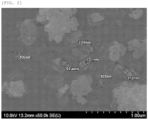
- FIG. 1 A differential scanning electron microscope image of the synthesized Li 1.05 Mn 0.90 Ti 0.05 O 1.8 F 0.2 powder is illustrated in FIG. 1 . It may be confirmed from FIG. 1 that the synthesized Li 1.05 Mn 0.90 Ti 0.05 O 1.8 F 0.2 was in the form of a secondary particle in which primary particles having a size of 50 nm to 300 nm were aggregated.
- Li 2 O, Li 2 O 2 , MnO, MnF 2 , and TiO 2 were added to a PM200 high energy instrument in a weight ratio of 0.0999:0.1302:0.5117:0.1026:0.1665 and then dry-milled at 450 rpm for 33 hours in a state in which ten 5 mm stainless steel balls and five 10 mm stainless steel balls were added based on 1g batch to synthesize Li 1.05 Mn 0.76 Ti 0.19 O 1.8 F 0.2 .
- FIG. 2 A differential scanning electron microscope image of the synthesized Li 1.05 Mn 0.76 Ti 0.19 O 1.8 F 0.2 powder is illustrated in FIG. 2 . It may be confirmed from FIG. 2 that the synthesized Li 1.05 Mn 0.76 Ti 0.19 O 1.8 F 0.2 was in the form of a secondary particle in which primary particles having a size of 50 nm to 300 nm were aggregated.
- Li 2 MnO 3 , Mn 2 O 3 , MnO 2 , and MnF 2 were added to a PM200 high energy instrument in a weight ratio of 0.6029:0.2803:0.0392:0.0856 and then dry-milled at 450 rpm for 33 hours in a state in which ten 5 mm stainless steel balls and five 10 mm stainless steel balls were added based on 1g batch to synthesize Li 0.89 Mn 0.80 O 1.85 F 0.15 .
- FIG. 3 A differential scanning electron microscope image of the synthesized Li 0.89 Mn 0.80 O 1.85 F 0.15 powder is illustrated in FIG. 3 . It may be confirmed from FIG. 3 that the synthesized Li 0.89 Mn 0.80 O 1.85 F 0.15 was in the form of a secondary particle in which primary particles having a size of 50 nm to 300 nm were aggregated.
- Li 2 MnO 3 , Mn 2 O 3 , MnO 2 , MnF 2 , and TiO 2 were added to a PM200 high energy instrument in a weight ratio of 0.6068:0.0394:0.2023:0.0861:0.0736 and then dry-milled at 450 rpm for 33 hours in a state in which ten 5 mm stainless steel balls and five 10 mm stainless steel balls were added based on 1g batch to synthesize Li 0.89 Mn 0.725 Ti 0.075 O 1.85 F 0.15 .
- FIG. 4 A differential scanning electron microscope image of the synthesized Li 0.89 Mn 0.725 Ti 0.075 O 1.85 F 0.15 powder is illustrated in FIG. 4 . It may be confirmed from FIG. 4 that the synthesized Li 0.89 Mn 0.725 Ti 0.075 O 1.85 F 0.15 was in the form of a secondary particle in which primary particles having a size of 50 nm to 300 nm were aggregated.
- Li 2 MnO 3 , Mn 2 O 3 , MnO 2 , MnF 2 , and TiO 2 were added to a PM200 high energy instrument in a weight ratio of 0.6107:0.0397:0.1232:0.0867:0.0148 and then dry-milled at 450 rpm for 33 hours in a state in which ten 5 mm stainless steel balls and five 10 mm stainless steel balls were added based on 1g batch to synthesize Li 0.89 Mn 0.65 Ti 0.15 0 1.85 F 0.15 .
- FIG. 5 A differential scanning electron microscope image of the synthesized Li 0.89 Mn 0.65 Ti 0.15 O 1.85 F 0.15 powder is illustrated in FIG. 5 . It may be confirmed from FIG. 5 that the synthesized Li 0.89 Mn 0.65 Ti 0.15 O 1.85 F 0.15 was in the form of a secondary particle in which primary particles having a size of 50 nm to 300 nm were aggregated.
- Each of the lithium manganese-based oxyhalides prepared in Examples 1 to 4 and Comparative Example and SUPER P were added in a weight ratio of 7:2 to a Premium Line 7 instrument by FRISTCH GmbH and then mixed at 300 rpm for 30 minutes to coat a surface of the lithium manganese-based oxyhalide with SUPER P to prepare a positive electrode active material.
- the prepared positive electrode active material, a conductive agent (SUPER P), and a binder (PVDF 5120) were mixed in N-methylpyrrolidone (NMP) in a weight ratio of 7:2:1 to prepare a positive electrode material mixture, and an aluminum current collector was coated with the positive electrode material mixture, dried, and then rolled to prepare a positive electrode.
- NMP N-methylpyrrolidone
- a lithium metal foil having a thickness of 0.2 mm was used as a negative electrode.
- An electrode assembly was prepared by disposing a separator between the above-prepared positive electrode and negative electrode, the electrode assembly was inserted into a battery can, and an electrolyte solution was then injected to prepare a lithium secondary battery.
- An electrolyte in which LiPF 6 was dissolved in a concentration of 1 M in a mixed organic solvent in which ethylene carbonate (EC) :dimethyl carbonate (DMC) were mixed in a volume ratio of 1:1, was used as the electrolyte solution.
- FIG. 6 is a graph illustrating life characteristics of the lithium secondary batteries in which the lithium manganese-based oxyhalides synthesized in Examples 1 and 2 were used
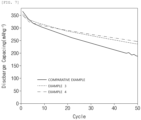
- FIG. 7 is a graph illustrating life characteristics of the lithium secondary batteries in which the lithium manganese-based oxyhalides synthesized in Comparative Example and Examples 3 and 4 were used.
- the lithium secondary batteries in which the Ti-doped lithium manganese-based oxyhalides of Examples 1 to 4 were used, had better life characteristics than the lithium secondary battery in which the undoped lithium manganese-based oxyhalide of Comparative Example was used.
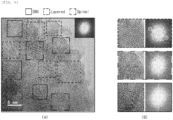
- a crystal structure of the lithium manganese-based oxyhalide synthesized in Example 4 was measured through high-resolution transmission electron microscopy (HR-TEM) analysis and selected area electron diffraction (SAED) analysis.
- HR-TEM high-resolution transmission electron microscopy
- SAED selected area electron diffraction
- FIG. 8(A) is a high-resolution transmission electron microscope (HR-TEM) image of the lithium manganese-based oxyhalide synthesized by Example 4, and FIG. 8(B) is results of measuring SAED patterns of the lithium manganese-based oxyhalide synthesized by Example 4.
- HR-TEM transmission electron microscope
- the lithium manganese-based oxyhalide of Example 4 had a multi-phase in which a disordered rock-salt structure (DRX), a layered rock-salt structure, and a spinel structure were mixed.
- DRX disordered rock-salt structure
- a layered rock-salt structure a layered rock-salt structure
- a spinel structure a disordered rock-salt structure
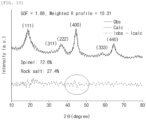
- FIG. 9 is XRD data of Comparative Example
- FIG. 10 is XRD data of Example 3
- FIG. 11 is XRD data of Example 4.
- a ratio of the spinel phase of Example 3 was 72.6% and a ratio of the spinel phase of Example 4 was 60.5%, and a ratio of the spinel phase of Comparative Example was 76.4%, wherein it may be confirmed that the ratio of the spinel phase was reduced when Ti doping was performed.
Landscapes
- Chemical & Material Sciences (AREA)
- Chemical Kinetics & Catalysis (AREA)
- Electrochemistry (AREA)
- General Chemical & Material Sciences (AREA)
- Engineering & Computer Science (AREA)
- Inorganic Chemistry (AREA)
- Materials Engineering (AREA)
- Manufacturing & Machinery (AREA)
- Organic Chemistry (AREA)
- Battery Electrode And Active Subsutance (AREA)
- Secondary Cells (AREA)
- Inorganic Compounds Of Heavy Metals (AREA)
Abstract
[Formula 1] Li0.5+aMnbMcOdXe
Description
- This application claims priority from
Korean Patent Application No. 10-2022-0050421, filed on April 22, 2022 - The present invention relates to a positive electrode active material, and a positive electrode and a lithium secondary battery which include the same, and more particularly, to a manganese-based positive electrode active material having a disordered rock-salt structure, and a positive electrode and a lithium secondary battery which include the same.
- Recently, interests in energy storage technologies have been increasingly grown, and efforts for research and development of electrochemical devices have been gradually materialized as the application of the energy storage technologies is expanded to the energy of mobile phones, camcorders, notebook PCs, and even to electric vehicles.
- There emerges an interest in development of rechargeable secondary batteries among these electrochemical devices, and, particularly, lithium secondary batteries developed in the early 1990's are spotlighted because the lithium secondary batteries are advantageous in that they have higher operating voltage and significantly higher energy density.
- A lithium secondary battery is generally prepared by a method in which, after an electrode assembly is prepared by disposing a separator between a positive electrode, which includes a positive electrode active material formed of a transition metal oxide containing lithium, and a negative electrode including a negative electrode active material capable of storing lithium ions and the electrode assembly is inserted into a battery case, a non-aqueous electrolyte that becomes a medium for transferring the lithium ions is injected thereinto and the battery case is then sealed. The non-aqueous electrolyte is generally composed of a lithium salt and an organic solvent capable of dissolving the lithium salt.
- Recently, lithium composite transition metal oxides, such as lithium nickel-cobalt-manganese-aluminum oxide or layered-structured lithium nickel-cobalt-manganese oxide with high energy density, have mainly been used as a positive electrode active material as demand for secondary batteries with high energy density, such as batteries for electric vehicles, has increased. However, since prices of transition metals, such as nickel and cobalt, soar as the demand for secondary batteries has rapidly increased, price competitiveness is reduced. Also, an increase in energy density of the secondary battery, in which the conventional lithium composite transition metal oxide is used, has reached its limit. Accordingly, an attempt has been made to develop a positive electrode active material based on manganese (Mn) with excellent price competitiveness.
- As the Mn-based positive electrode active material that has been actively researched recently, there is an overlithiated manganese-rich positive electrode active material (e.g. Li1.2Ni0.13Mn0.54Co0.13O2), in which a Li2MnO3 rock-salt structure and a LiMO2 layered structure are mixed, or a positive electrode active material having a partial spinel-disordered rock-salt structure (e.g. Li1.68Mn1.6O3.7F0.3). With respect to the overlithiated manganese-rich positive electrode active material, it has excellent capacity characteristics, but its use is limited due to low rate capability caused by structural characteristics and there is a problem in that life characteristics are degraded due to an irreversible oxygen-redox reaction, and, with respect to the positive electrode active material having a partial spinel-disordered rock-salt structure, it has excellent rate capability and capacity characteristics, but there is a problem in that it still exhibits low life characteristics.
- An aspect of the present invention provides a novel positive electrode active material which is based on relatively inexpensive manganese and has excellent capacity characteristics, rate capability, and life characteristics by including a disordered rock-salt structure.
- According to an aspect of the present invention, there is provided a positive electrode active material including a lithium manganese-based oxyhalide which has a composition represented by [Formula 1] and has a disordered rock-salt structure.
[Formula 1] Li0.5+aMnbMcOdXe
- In [Formula 1], M is at least one selected from the group consisting of titanium (Ti), nickel (Ni), zirconium (Zr), vanadium (V), cobalt (Co), tin (Sn), iron (Fe), iridium (Ir), chromium (Cr), lead (Pb), and ruthenium (Ru) and is preferably Ti, X is a halogen element and is preferably fluorine (F), and 0<a≤0.7, 0.5≤b<1, 0<c≤b/2, 1.5≤d≤1.9, 0.1≤e≤0.5, and d+e≤2.
- An atomic ratio of cation elements : anion elements in the lithium manganese-based oxyhalide may be in a range of 0.75 : 1 to 1 : 1.
- The lithium manganese-based oxyhalide may have a primary particle size of 50 nm to 300 nm.
- According to an embodiment, the lithium manganese-based oxyhalide may have a composition represented by [Formula 1-1] .
[Formula 1-1] Li1+a1Mnb1Mc1O2-e1Xe1
- In [Formula 1-1],
- M is at least one selected from the group consisting of Ti, Ni, Zr, V, Co, Sn, Fe, Ir, Cr, Pb, and Ru and is preferably Ti, X is a halogen element and is preferably F, and 0<a1≤0.2, 0.5≤b1<1, 0<c1≤b1/2, and 0.1≤e1≤0.5.
- The lithium manganese-based oxyhalide represented by [Formula 1-1] may have a single-phase structure of the disordered rock-salt structure.
- According to another embodiment, the lithium manganese-based oxyhalide may have a composition represented by [Formula 1-2].
[Formula 1-2] Li0.5+a2Mnb2Mc2O2-e2Xe2
- In [Formula 1-2], M is at least one selected from the group consisting of Ti, Ni, Zr, V, Co, Sn, Fe, Ir, Cr, Pb, and Ru and is preferably Ti, X is a halogen element and is preferably F, and 0<a2<0.5, 0.5≤b2<1, 0<c2≤b2/2, and 0.1≤e2≤0.5.
- The lithium manganese-based oxyhalide having the composition represented by [Formula 1-2] may have a multi-phase structure in which a disordered rock-salt structure, a layered rock-salt structure, and a spinel structure are mixed, and, in this case, a ratio of a spinel phase in the lithium manganese-based oxyhalide is 75% or less, preferably, 25% to 75%.
- Also, the lithium manganese-based oxyhalide represented by [Formula 1-2] may have an I(400)R/I(111)s, a ratio of (400) plane peak intensity I(400)R to (111) plane peak intensity I(111)s, of 1 or more.
- According to another aspect of the present invention, there is provided a positive electrode including the positive electrode active material according to the present invention and a lithium secondary battery including the positive electrode.
- A positive electrode active material according to the present invention includes a lithium manganese-based oxyhalide which has a disordered rock-salt structure and is doped with element M (where M is at least one selected from the group consisting of titanium (Ti), nickel (Ni), zirconium (Zr), vanadium (V), cobalt (Co), tin (Sn), iron (Fe), iridium (Ir), chromium (Cr), lead (Pb), and ruthenium (Ru)). In a case in which the lithium manganese-based oxyhalide having the disordered rock-salt structure is doped with the element M as in the present invention, since structural characteristics are controlled to mitigate Jahn-Teller effect (Jahn-Teller distortion) caused by Mn3+ and improve reversibility of oxygen redox during charge and discharge, cycle characteristics are significantly improved.
- Also, since the lithium manganese-based oxyhalide, in which some of oxygen atoms are substituted with halogen, may reduce the oxidation number of a transition metal due to the presence of the large halogen element (F-) with a low negative charge, an oxidation/reduction amount of the stable transition metal may be increased to achieve better rate capability and cycle characteristics than a conventional overlithiated manganese-based oxide.
-
-
FIG. 1 is a scanning electron microscope (SEM) image of a lithium manganese-based oxyhalide synthesized by Example 1. -
FIG. 2 is an SEM image of a lithium manganese-based oxyhalide synthesized by Example 2. -
FIG. 3 is an SEM image of a lithium manganese-based oxyhalide synthesized by Comparative Example. -
FIG. 4 is an SEM image of a lithium manganese-based oxyhalide synthesized by Example 3. -
FIG. 5 is an SEM image of a lithium manganese-based oxyhalide synthesized by Example 4. -
FIG. 6 is a graph illustrating life characteristics of lithium secondary batteries in which the lithium manganese-based oxyhalides synthesized in Examples 1 and 2 are used. -
FIG. 7 is a graph illustrating life characteristics of lithium secondary batteries in which the lithium manganese-based oxyhalides synthesized in Comparative Example and Examples 3 and 4 are used. -
FIG. 8(A) is a high-resolution transmission electron microscope (HR-TEM) image of the lithium manganese-based oxyhalide synthesized by Example 4, andFIG. 8(B) is results of measuring selected area electron diffraction (SAED) patterns of the lithium manganese-based oxyhalide synthesized by Example 4. -
FIG. 9 is X-ray diffraction (XRD) data of the lithium manganese-based oxyhalide synthesized by Comparative Example. -
FIG. 10 is XRD data of the lithium manganese-based oxyhalide synthesized by Example 3. -
FIG. 11 is XRD data of the lithium manganese-based oxyhalide synthesized by Example 4. - Hereinafter, the present invention will be described in more detail.
- A positive electrode active material according to the present invention includes a lithium manganese-based oxyhalide which has a disordered rock-salt structure and is doped with element M (where M is at least one selected from the group consisting of titanium (Ti), nickel (Ni), zirconium (Zr), vanadium (V), cobalt (Co), tin (Sn), iron (Fe), iridium (Ir), chromium (Cr), lead (Pb), and ruthenium (Ru)).
- Conventionally used positive electrode active materials generally had a crystal structure that was composed of an ordered layered structure, in which a lithium layer and a transition metal layer were separated, or an ordered spinel structure. However, these conventional positive electrode active materials had a problem in that expensive transition metals, such as nickel or cobalt, must be used and an improvement in energy density was limited because phase transition occurred when deintercalation of lithium from the lithium layer was increased. In contrast, with respect to the positive electrode active material having a disordered rock-salt structure as in the present invention, since there is no separate lithium layer, it is advantageous in that higher energy density may be achieved, because the occurrence of the phase transition due to the deintercalation of the lithium is less, and a loss of a conductive network due to an increase in volume of the positive electrode active material may be minimized because a change in the volume due to charge and discharge is low.
- Specifically, the lithium manganese-based oxyhalide according to the present invention may have a composition represented by [Formula 1] below.
[Formula 1] Li0.5+aMnbMcOdXe
- In [Formula 1], M may be at least one selected from the group consisting of Ti, Ni, Zr, V, Co, Sn, Fe, Ir, Cr, Pb, and Ru, and may preferably be Ti. In a case in which the lithium manganese-based oxyhalide having a disordered rock-salt structure is doped with the element M as in the present invention, since Jahn-Teller effect (Jahn-Teller distortion) caused by Mn3+ is mitigated and reversibility of oxygen redox is improved during charge and discharge through structural control, an effect of improving life characteristics may be obtained.
- X may be a halogen element, preferably fluorine (F), chlorine (Cl), bromine (Br), and/or iodine (I), and more preferably F. In a case in which some of oxygen atoms are substituted with the halogen, since charge balance between cations and anions may be achieved, even in a case in which lithium more than stoichiometry is added, due to the presence of the halogen element having higher electronegativity than oxygen, better rate capability and cycle characteristics than those of a conventional overlithiated manganese-based oxide may be achieved.
- 0.5+a represents an atomic ratio of lithium (Li) in the lithium manganese-based oxyhalide, wherein a may satisfy 0<a≤0.7, 0.02≤a≤0.7, 0.02≤a≤0.5, 0<a≤0.2, 0.02≤a≤0.2, or 0.2≤a≤0.7. It is desirable that the positive electrode active material of the present invention includes Li in excess of a stoichiometric ratio. In a case in which Li is included in an amount greater than the stoichiometric ratio, high-capacity characteristics are improved, and an effect of improving the rate capability is more excellent due to an increase in the amount of lithium with 0 (0-TM) or 1 (1-TM) transition metal based on 4 tetrahedral faces. However, since excessive lithium may deteriorate overall conduction properties by reducing electronic conductivity of the material, it is desirable that the atomic ratio of the Li in the lithium manganese-based oxyhalide is 1.2 or less.
- b represents an atomic ratio of manganese (Mn) in the lithium manganese-based oxyhalide, wherein b may satisfy 0.5≤b<1, 0.5≤b≤0.9, 0.6≤b≤0.8, 0.5≤b<1, or 0.5≤b≤0.9. When the atomic ratio of the manganese satisfies the above range, excellent capacity characteristics may be achieved.
- c represents an atomic ratio of doping element M in the lithium manganese-based oxyhalide, wherein c may satisfy 0<c≤b/2, 0.05≤c≤b/2, or 0.1≤c≤b/2. When the atomic ratio of the doping element M satisfies the above range, a positive electrode active material with excellent capacity characteristics, rate capability, and life characteristics may be achieved. If an amount of the doping element M is excessively increased, capacity and rate capability of the positive electrode active material may be reduced, and if the amount of the doping element M is excessively small, the effect of improving the life characteristics is insignificant.
- d represents an atomic ratio of oxygen in the lithium manganese-based oxyhalide, wherein d may satisfy 1.5≤d≤1.9, 1.7≤d≤1.9, 1.5≤d≤1.7, or 1.75≤d≤1.85.
- e represents an atomic ratio of halogen element X in the lithium manganese-based oxyhalide, wherein e may satisfy 0.1≤e≤0.5, 0.1≤e≤0.4, or 0.1≤e≤0.3. When the atomic ratio of the halogen element X satisfies the above range, the charge balance between the cations and the anions may be appropriately maintained to achieve excellent rate capability and cycle characteristics.
- In
Formula 1, d+e≤2, and d+e may preferably be 2. - In the lithium manganese-based oxyhalide, an atomic ratio of cation elements (i.e., Li, Mn, and element M) :anion elements (i.e., oxygen and halogen element) may be in a range of 0.75:1 to 1:1. When the atomic ratio of the cation elements to the anion elements satisfies the above range, the disordered rock-salt structure may be smoothly formed.
- The lithium manganese-based oxyhalide may be in the form of a primary particle and/or a secondary particle in which a plurality of primary particles are aggregated, and, in this case, a primary particle size may be in a range of 50 nm to 300 nm, preferably, 50 nm to 250 nm. When the primary particle size satisfies the above range, an effect of overcoming disadvantages of the material having low ionic conductivity may be obtained by increasing a ratio of a surface to a bulk.
- According to an embodiment, the lithium manganese-based oxyhalide may have a composition represented by [Formula 1-1] below.
[Formula 1-1] Li1+a1Mnb1Mc1O2-e1Xe1
- In [Formula 1-1], M and X are the same as those defined in [Formula 1]. That is, M may be at least one selected from the group consisting of Ti, Ni, Zr, V, Co, Sn, Fe, Ir, Cr, Pb, and Ru, and may preferably be Ti, and X may be a halogen element, preferably, F.
- 1+a1 represents an atomic ratio of Li in the lithium manganese-based oxyhalide, wherein a1 may satisfy 0<a1≤0.2, 0.02≤a1<0.2, or 0.02≤a1≤0.15.
- b1 represents an atomic ratio of Mn in the lithium manganese-based oxyhalide, wherein b1 may satisfy 0.5≤b1<1, 0.6≤b1<1, or 0.6≤b1≤0.9.
- c1 represents an atomic ratio of doping element M in the lithium manganese-based oxyhalide, wherein c1 may satisfy 0<c1≤b1/2, 0.05≤c1≤b1/2, or 0.1≤c1≤b1/2.
- e1 represents an atomic ratio of halogen element X in the lithium manganese-based oxyhalide, wherein e1 may satisfy 0.1≤e1≤0.5, 0.1≤e1≤0.4, or 0.1≤e1≤0.25.
- The lithium manganese-based oxyhalide represented by [Formula 1-1] may have a disordered rock-salt structure phase, and may preferably be composed of a single phase of the disordered rock-salt structure. With respect to a conventional overlithiated manganese oxide, a large amount of excess lithium was required for smooth lithium movement in its structure, and this led to the formation of a large amount of transition metal-deficient oxide. A transition metal is essential for resolving instability in the structure which occurs in a positive electrode during charge (delithiation reaction), but the transition metal-deficient oxide (lithium-excess oxide) increases the structural instability. Thus, in the present invention, structural stability may be achieved by minimizing a transition metal deficiency phenomenon in the positive electrode by reducing the lithium excess amount (a1) to 0.2 at% or less, and the structural stability may be further improved by doping with the element M. As described above, since the stability in the structure of the positive electrode is achieved through low lithium excess and doping in the manganese-based oxyhalide, a structural change of the positive electrode active material during charge and discharge is suppressed, and thus, an effect of significantly improving the life characteristics may be obtained.
- According to another embodiment, the lithium manganese-based oxyhalide may have a composition represented by [Formula 1-2] below.
[Formula 1-2] Li0.5+a2Mnb2Mc2O2-e2Xe2
- In [Formula 1-2], M and X are the same as those defined in [Formula 1]. That is, M may be at least one selected from the group consisting of Ti, Ni, Zr, V, Co, Sn, Fe, Ir, Cr, Pb, and Ru, and may preferably be Ti, and X may be a halogen element, preferably, F.
- 0.5+a2 represents an atomic ratio of Li in the lithium manganese-based oxyhalide, wherein a2 may satisfy 0<a2<0.5, 0.1≤a2<0.5, or 0.2≤a2≤0.4.
- b2 represents an atomic ratio of Mn in the lithium manganese-based oxyhalide, wherein b2 may satisfy 0.5≤b2<1, 0.6≤b2<1, or 0.65≤b2≤0.95.
- c2 represents an atomic ratio of doping element M in the lithium manganese-based oxyhalide, wherein c2 may satisfy 0<c2≤b2/2, 0.05≤c2≤b2/2, or 0.1≤c2≤b2/2.
- e2 represents an atomic ratio of halogen element X in the lithium manganese-based oxyhalide, wherein e2 may satisfy 0.1≤e2≤0.5, 0.1≤e2≤0.4, or 0.1≤e2≤0.25.
- The lithium manganese-based oxyhalide having the composition represented by [Formula 1-2] may have a multi-phase structure in which a disordered rock-salt structure, a layered rock-salt structure, and a spinel structure are mixed.
- In the disordered rock-salt structure, the transition metal and Li are randomly distributed and arranged at 16c and 16d octahedral sites and it usually has low rate capability because it has a limitation in that the movement of the lithium is possible only when the number of transition metals is 0 (0-TM) or 1 (1-TM) based on the 4 tetrahedral faces for the lithium movement in the structure. In contrast, in the ordered spinel structure, diffusion of lithium is easy, because all of the transition metals, such as Mn, are located at 16d octahedral sites, lithium is located at 8a tetrahedral sites, and all lithium atoms have a 0-TM Li environment in which the transition metal is not located on all tetrahedral faces. In addition, it has a characteristic of having high rate capability by structurally forming a three-dimensional lithium network. Thus, in a case in which the lithium manganese-based oxyhalide has the multi-phase structure, in which the disordered rock-salt structure and the spinel structure are mixed, as described above, an effect of improving the rate capability may be obtained in comparison to a case where the lithium manganese-based oxyhalide is only composed of the single phase of the disordered rock-salt structure.
- In this case, a ratio of a spinel phase in the lithium manganese-based oxide may be in a range of 75% or less, preferably, 25% to 75%. In a case in which the ratio of the spinel phase satisfies the above range and a ratio of the rock-salt structure is increased, since the structural change of the positive electrode active material during charge and discharge is suppressed, the effect of significantly improving the life characteristics may be obtained.
- Also, in X-ray diffraction (XRD) data of the lithium manganese-based oxyhalide represented by [Formula 1-2], I(400)R/I(111)S, a ratio of (400) plane peak intensity I(400)R to (111) plane peak intensity I(111)s, may be in a range of 1 or more, preferably 1 to 2, and more preferably 1 to 1.5. When I(400)R/I(111)S satisfies the above range, the effect of improving the life characteristics is excellent.
- The lithium manganese-based oxyhalide having a disordered rock-salt structure may be synthesized by mechanochemically mixing a lithium source, a manganese source, a halogen source, and a doping element M source. For example, the lithium manganese-based oxyhalide according to the present invention may be prepared by adding a lithium source, a manganese source, a halogen source, and a doping element M source into a high-energy ball mill and then ball-mill mixing them.
- As the lithium source, for example, Li2O, Li2O2, Li2MnO3, or a combination thereof may be used, and, as the manganese source, for example, Mn2O3, MnO2, Li2MnO3, or a combination thereof may be used, but the present invention is limited thereto. As the halogen source, for example, LiF, MnF2, or a combination thereof may be used, and, as the doping element M source, an oxide of element M, for example, TiO2, may be used, but the present invention is not limited thereto.
- The above sources may be mixed in amounts such that atomic ratios of Li, Mn, M, and O in the lithium manganese-based oxyhalide to be finally prepared are satisfied.
- Also, the ball-mill mixing may be performed for 25 hours to 50 hours at a stirring speed of 300 rpm to 600 rpm, preferably, 400 rpm to 500 rpm, and may be performed by adding two types of stainless steel balls having different sizes.
- Next, a positive electrode according to the present invention will be described.
- The positive electrode according to the present invention includes a positive electrode active material layer including the positive electrode active material according to the present invention. Specifically, the positive electrode includes a positive electrode collector and a positive electrode active material layer which is formed on the positive electrode collector and includes the positive electrode active material.
- In the positive electrode, the positive electrode collector is not particularly limited as long as it has conductivity without causing adverse chemical changes in the battery, and, for example, stainless steel, aluminum, nickel, titanium, fired carbon, or aluminum or stainless steel that is surface-treated with one of carbon, nickel, titanium, silver, or the like may be used. Also, the positive electrode collector may typically have a thickness of 3 um to 500 µm, and microscopic irregularities may be formed on the surface of the collector to improve the adhesion of the positive electrode active material. The positive electrode collector, for example, may be used in various shapes such as that of a film, a sheet, a foil, a net, a porous body, a foam body, a non-woven fabric body, and the like.
- Also, the positive electrode active material layer may include a conductive agent and a binder in addition to the above-described positive electrode active material.
- The conductive agent is used to provide conductivity to the electrode, wherein any conductive agent may be used without particular limitation as long as it has suitable electron conductivity without causing adverse chemical changes in the battery. Specific examples of the conductive agent may be graphite such as natural graphite or artificial graphite; carbon-based materials such as carbon black, acetylene black, Ketjen black, channel black, furnace black, lamp black, thermal black, carbon fibers, and carbon nanotubes; powder or fibers of metal such as copper, nickel, aluminum, and silver; conductive whiskers such as zinc oxide whiskers and potassium titanate whiskers; conductive metal oxides such as titanium oxide; or conductive polymers such as polyphenylene derivatives, and any one thereof or a mixture of two or more thereof may be used. The conductive agent may be typically included in an amount of 1 wt% to 30 wt%, preferably 1 wt% to 20 wt%, and more preferably 1 wt% to 10 wt% based on a total weight of the positive electrode active material layer.
- The binder improves the adhesion between positive electrode active material particles and the adhesion between the positive electrode active material and the positive electrode collector. Specific examples of the binder may be polyvinylidene fluoride (PVDF), polyvinylidene fluoride-hexafluoropropylene copolymer (PVDF-co-HFP), polyvinyl alcohol, polyacrylonitrile, carboxymethyl cellulose (CMC), starch, hydroxypropyl cellulose, regenerated cellulose, polyvinylpyrrolidone, polytetrafluoroethylene, polyethylene, polypropylene, an ethylene-propylene-diene monomer rubber (EPDM rubber), a sulfonated EPDM, a styrene-butadiene rubber (SBR), a fluorine rubber, or various copolymers thereof, and any one thereof or a mixture of two or more thereof may be used. The binder may be included in an amount of 1 wt% to 30 wt%, preferably 1 wt% to 20 wt%, and more preferably 1 wt% to 10 wt% based on the total weight of the positive electrode active material layer.
- The positive electrode may be prepared according to a typical method of preparing a positive electrode. For example, after a positive electrode slurry is prepared by mixing the positive electrode active material, the binder, and/or the conductive agent in a solvent and is coated on the positive electrode collector, the positive electrode may be prepared by drying and rolling the coated positive electrode collector. In this case, types and amounts of the positive electrode active material, the binder, and the conductive are the same as those previously described.
- The solvent may be a solvent normally used in the art. The solvent may include dimethyl sulfoxide (DMSO), isopropyl alcohol, N-methylpyrrolidone (NMP), acetone, or water, and any one thereof or a mixture of two or more thereof may be used. An amount of the solvent used may be sufficient if the solvent may dissolve or disperse the positive electrode active material, the conductive agent, and the binder in consideration of a coating thickness of the slurry and manufacturing yield, and may allow to have viscosity that may provide excellent thickness uniformity during the subsequent coating for the preparation of the positive electrode.
- As another method, the positive electrode may be prepared by casting the positive electrode slurry on a separate support and then laminating a film separated from the support on the positive electrode collector.
- Next, a lithium secondary battery according to the present invention will be described.
- The lithium secondary battery of the present invention includes the positive electrode according to the present invention. Specifically, the lithium secondary battery includes a positive electrode, a negative electrode disposed to face the positive electrode, a separator disposed between the positive electrode and the negative electrode, and an electrolyte, and the positive electrode is the same as described above. Also, the lithium secondary battery may further optionally include a battery container accommodating an electrode assembly of the positive electrode, the negative electrode, and the separator, and a sealing member sealing the battery container.
- In the lithium secondary battery, the negative electrode includes a negative electrode collector and a negative electrode active material layer disposed on the negative electrode collector.
- The negative electrode collector is not particularly limited as long as it has high conductivity without causing adverse chemical changes in the battery, and, for example, copper, stainless steel, aluminum, nickel, titanium, fired carbon, copper or stainless steel that is surface-treated with one of carbon, nickel, titanium, silver, or the like, and an aluminum-cadmium alloy may be used. Also, the negative electrode collector may typically have a thickness of 3 um to 500 µm, and, similar to the positive electrode collector, microscopic irregularities may be formed on the surface of the collector to improve adhesion of a negative electrode active material. The negative electrode collector, for example, may be used in various shapes such as that of a film, a sheet, a foil, a net, a porous body, a foam body, a non-woven fabric body, and the like.
- The negative electrode active material layer optionally includes a binder and a conductive agent in addition to the negative electrode active material.
- A compound capable of reversibly intercalating and deintercalating lithium may be used as the negative electrode active material. Specific examples of the negative electrode active material may be a carbonaceous material such as artificial graphite, natural graphite, graphitized carbon fibers, and amorphous carbon; a metallic compound alloyable with lithium such as silicon (Si), aluminum (Al), tin (Sn), lead (Pb), zinc (Zn), bismuth (Bi), indium (In), magnesium (Mg), gallium (Ga), cadmium (Cd), a Si alloy, a Sn alloy, or an Al alloy; a metal oxide which may be doped and undoped with lithium such as SiOp(0<β<2), SnO2, vanadium oxide, and lithium vanadium oxide; or a composite including the metallic compound and the carbonaceous material such as a Si-C composite or a Sn-C composite, and any one thereof or a mixture of two or more thereof may be used.
- Also, a metallic lithium thin film may be used as the negative electrode active material. Furthermore, both low crystalline carbon and high crystalline carbon may be used as the carbon material. Typical examples of the low crystalline carbon may be soft carbon and hard carbon, and typical examples of the high crystalline carbon may be irregular, planar, flaky, spherical, or fibrous natural graphite or artificial graphite, Kish graphite, pyrolytic carbon, mesophase pitch-based carbon fibers, meso-carbon microbeads, mesophase pitches, and high-temperature sintered carbon such as petroleum or coal tar pitch derived cokes.
- The conductive agent is used to provide conductivity to the electrode, wherein any conductive agent may be used without particular limitation as long as it has suitable electron conductivity without causing adverse chemical changes in the battery. Specific examples of the conductive agent may be graphite such as natural graphite or artificial graphite; carbon-based materials such as carbon black, acetylene black, Ketjen black, channel black, furnace black, lamp black, thermal black, carbon fibers, and carbon nanotubes; powder or fibers of metal such as copper, nickel, aluminum, and silver; conductive whiskers such as zinc oxide whiskers and potassium titanate whiskers; conductive metal oxides such as titanium oxide; or conductive polymers such as polyphenylene derivatives, and any one thereof or a mixture of two or more thereof may be used. The conductive agent may be typically included in an amount of 1 wt% to 30 wt%, preferably 1 wt% to 20 wt%, and more preferably 1 wt% to 10 wt% based on a total weight of the negative electrode active material layer.
- The binder improves the adhesion between negative electrode active material particles and the adhesion between the negative electrode active material and the negative electrode collector. Specific examples of the binder may be polyvinylidene fluoride (PVDF), polyvinylidene fluoride-hexafluoropropylene copolymer (PVDF-co-HFP), polyvinyl alcohol, polyacrylonitrile, carboxymethyl cellulose (CMC), starch, hydroxypropyl cellulose, regenerated cellulose, polyvinylpyrrolidone, polytetrafluoroethylene, polyethylene, polypropylene, an ethylene-propylene-diene monomer rubber (EPDM rubber), a sulfonated EPDM, a styrene-butadiene rubber (SBR), a fluorine rubber, or various copolymers thereof, and any one thereof or a mixture of two or more thereof may be used. The binder may be included in an amount of 1 wt% to 30 wt%, preferably 1 wt% to 20 wt%, and more preferably 1 wt% to 10 wt% based on the total weight of the negative electrode active material layer.
- The negative electrode active material layer, for example, may be prepared by coating the negative electrode collector with a negative electrode slurry including the negative electrode active material as well as optionally the binder and the conductive agent and drying, or may also be prepared by casting the negative electrode slurry on a separate support and then laminating a film separated from the support on the negative electrode collector.
- In the lithium secondary battery, the separator separates the negative electrode and the positive electrode and provides a movement path of lithium ions, wherein any separator may be used as the separator without particular limitation as long as it is typically used in a lithium secondary battery, and particularly, a separator having high moisture-retention ability for an electrolyte as well as low resistance to the transfer of electrolyte ions may be used. Specifically, a porous polymer film, for example, a porous polymer film prepared from a polyolefin-based polymer, such as an ethylene homopolymer, a propylene homopolymer, an ethylene/butene copolymer, an ethylene/hexene copolymer, and an ethylene/methacrylate copolymer, or a laminated structure having two or more layers thereof may be used. Also, a typical porous nonwoven fabric, for example, a nonwoven fabric formed of high melting point glass fibers or polyethylene terephthalate fibers may be used. Furthermore, a coated separator including a ceramic component or a polymer material may be used to secure heat resistance or mechanical strength, and the separator having a single layer or multilayer structure may be optionally used.
- Also, the electrolyte used in the present invention may include an organic liquid electrolyte, an inorganic liquid electrolyte, a solid polymer electrolyte, a gel-type polymer electrolyte, a solid inorganic electrolyte, or a molten-type inorganic electrolyte which may be used in the preparation of the lithium secondary battery, but the present invention is not limited thereto.
- Specifically, the electrolyte may include an organic solvent and a lithium salt.
- Any organic solvent may be used as the organic solvent without particular limitation so long as it may function as a medium through which ions involved in an electrochemical reaction of the battery may move. Specifically, an ester-based solvent such as methyl acetate, ethyl acetate, γ-butyrolactone, and ε-caprolactone; an ether-based solvent such as dibutyl ether or tetrahydrofuran; a ketone-based solvent such as cyclohexanone; an aromatic hydrocarbon-based solvent such as benzene and fluorobenzene; or a carbonate-based solvent such as dimethyl carbonate (DMC), diethyl carbonate (DEC), methylethyl carbonate (MEC), ethylmethyl carbonate (EMC), ethylene carbonate (EC), and propylene carbonate (PC); an alcohol-based solvent such as ethyl alcohol and isopropyl alcohol; nitriles such as R-CN (where R is a linear, branched, or cyclic C2-C20 hydrocarbon group and may include a double-bond aromatic ring or ether bond); amides such as dimethylformamide; dioxolanes such as 1,3-dioxolane; or sulfolanes may be used as the organic solvent. Among these solvents, the carbonate-based solvent is preferable, and a mixture of a cyclic carbonate (e.g., ethylene carbonate or propylene carbonate) having high ionic conductivity and high dielectric constant, which may increase charge/discharge performance of the battery, and a low-viscosity linear carbonate-based compound (e.g., ethylmethyl carbonate, dimethyl carbonate, or diethyl carbonate) is more preferable.
- The lithium salt may be used without particular limitation as long as it is a compound capable of providing lithium ions used in the lithium secondary battery. Specifically, LiPF6, LiClO4, LiAsF6, LiBF4, LiSbF6, LiAlO4, LiAlCl4, LiCF3SO3, LiC4F9SO3, LiN(C2F5SO3)2, LiN(C2F5SO2)2, LiN(CF3SO2)2, LiCl, LiI, or LiB(C2O4)2 may be used as the lithium salt. The lithium salt may be used in a concentration range of 0.1 M to 5.0 M, preferably, 0.1 M to 3.0 M. If the concentration of the lithium salt is included within the above range, since the electrolyte may have appropriate conductivity and viscosity, excellent performance of the electrolyte may be obtained and lithium ions may effectively move.
- In order to improve life characteristics of the battery, suppress the reduction in battery capacity, and improve discharge capacity of the battery, an additive may be further included in the electrolyte. For example, as the additive, a halo-alkylene carbonate-based compound such as difluoroethylene carbonate, pyridine, triethylphosphite, triethanolamine, cyclic ether, ethylenediamine, n-glyme, hexaphosphorictriamide, a nitrobenzene derivative, sulfur, a quinone imine dye, N-substituted oxazolidinone, N,N-substituted imidazolidine, ethylene glycol dialkyl ether, an ammonium salt, pyrrole, 2-methoxy ethanol, or aluminum trichloride, may be used alone or in a mixture thereof, but the present invention is not limited thereto. The additive may be included in an amount of 0.1 wt% to 10 wt%, preferably, 0.1 wt% to 5 wt% based on a total weight of the electrolyte.
- As described above, since the lithium secondary battery including the positive electrode active material according to the present invention stably exhibits excellent capacity characteristics, output characteristics, and life characteristics, the lithium secondary battery is suitable for portable devices, such as mobile phones, notebook computers, and digital cameras, and electric cars such as hybrid electric vehicles (HEVs).
- Thus, according to another embodiment of the present invention, a battery module including the lithium secondary battery as a unit cell and a battery pack including the battery module are provided.
- The battery module or the battery pack may be used as a power source of at least one medium and large sized device of a power tool; electric cars including an electric vehicle (EV), a hybrid electric vehicle, and a plug-in hybrid electric vehicle (PHEV); or a power storage system.
- Hereinafter, examples of the present invention will be described in detail in such a manner that it may easily be carried out by a person with ordinary skill in the art to which the present invention pertains. The invention may, however, be embodied in many different forms and should not be construed as being limited to the examples set forth herein.
- Li2O, Li2O2, MnO, MnF2, and TiO2 were added to a PM200 high energy instrument in a weight ratio of 0.0510:0.2050:0.6118:0.1012:0.0432 and then dry-milled at 450 rpm for 33 hours in a state in which ten 5 mm stainless steel balls and five 10 mm stainless steel balls were added based on 1g batch to synthesize Li1.05Mn0.90Ti0.05O1.8F0.2.
- A differential scanning electron microscope image of the synthesized Li1.05Mn0.90Ti0.05O1.8F0.2 powder is illustrated in
FIG. 1 . It may be confirmed fromFIG. 1 that the synthesized Li1.05Mn0.90Ti0.05O1.8F0.2 was in the form of a secondary particle in which primary particles having a size of 50 nm to 300 nm were aggregated. - Li2O, Li2O2, MnO, MnF2, and TiO2 were added to a PM200 high energy instrument in a weight ratio of 0.0999:0.1302:0.5117:0.1026:0.1665 and then dry-milled at 450 rpm for 33 hours in a state in which ten 5 mm stainless steel balls and five 10 mm stainless steel balls were added based on 1g batch to synthesize Li1.05Mn0.76Ti0.19O1.8F0.2.
- A differential scanning electron microscope image of the synthesized Li1.05Mn0.76Ti0.19O1.8F0.2 powder is illustrated in
FIG. 2 . It may be confirmed fromFIG. 2 that the synthesized Li1.05Mn0.76Ti0.19O1.8F0.2 was in the form of a secondary particle in which primary particles having a size of 50 nm to 300 nm were aggregated. - Li2MnO3, Mn2O3, MnO2, and MnF2 were added to a PM200 high energy instrument in a weight ratio of 0.6029:0.2803:0.0392:0.0856 and then dry-milled at 450 rpm for 33 hours in a state in which ten 5 mm stainless steel balls and five 10 mm stainless steel balls were added based on 1g batch to synthesize Li0.89Mn0.80O1.85F0.15.
- A differential scanning electron microscope image of the synthesized Li0.89Mn0.80O1.85F0.15 powder is illustrated in
FIG. 3 . It may be confirmed fromFIG. 3 that the synthesized Li0.89Mn0.80O1.85F0.15 was in the form of a secondary particle in which primary particles having a size of 50 nm to 300 nm were aggregated. - Li2MnO3, Mn2O3, MnO2, MnF2, and TiO2 were added to a PM200 high energy instrument in a weight ratio of 0.6068:0.0394:0.2023:0.0861:0.0736 and then dry-milled at 450 rpm for 33 hours in a state in which ten 5 mm stainless steel balls and five 10 mm stainless steel balls were added based on 1g batch to synthesize Li0.89Mn0.725Ti0.075O1.85F0.15.
- A differential scanning electron microscope image of the synthesized Li0.89Mn0.725Ti0.075O1.85F0.15 powder is illustrated in
FIG. 4 . It may be confirmed fromFIG. 4 that the synthesized Li0.89Mn0.725Ti0.075O1.85F0.15 was in the form of a secondary particle in which primary particles having a size of 50 nm to 300 nm were aggregated. - Li2MnO3, Mn2O3, MnO2, MnF2, and TiO2 were added to a PM200 high energy instrument in a weight ratio of 0.6107:0.0397:0.1232:0.0867:0.0148 and then dry-milled at 450 rpm for 33 hours in a state in which ten 5 mm stainless steel balls and five 10 mm stainless steel balls were added based on 1g batch to synthesize Li0.89Mn0.65Ti0.1501.85F0.15.
- A differential scanning electron microscope image of the synthesized Li0.89Mn0.65Ti0.15O1.85F0.15 powder is illustrated in
FIG. 5 . It may be confirmed fromFIG. 5 that the synthesized Li0.89Mn0.65Ti0.15O1.85F0.15 was in the form of a secondary particle in which primary particles having a size of 50 nm to 300 nm were aggregated. - Each of the lithium manganese-based oxyhalides prepared in Examples 1 to 4 and Comparative Example and SUPER P were added in a weight ratio of 7:2 to a Premium Line 7 instrument by FRISTCH GmbH and then mixed at 300 rpm for 30 minutes to coat a surface of the lithium manganese-based oxyhalide with SUPER P to prepare a positive electrode active material.
- The prepared positive electrode active material, a conductive agent (SUPER P), and a binder (PVDF 5120) were mixed in N-methylpyrrolidone (NMP) in a weight ratio of 7:2:1 to prepare a positive electrode material mixture, and an aluminum current collector was coated with the positive electrode material mixture, dried, and then rolled to prepare a positive electrode.
- A lithium metal foil having a thickness of 0.2 mm was used as a negative electrode.
- An electrode assembly was prepared by disposing a separator between the above-prepared positive electrode and negative electrode, the electrode assembly was inserted into a battery can, and an electrolyte solution was then injected to prepare a lithium secondary battery. An electrolyte, in which LiPF6 was dissolved in a concentration of 1 M in a mixed organic solvent in which ethylene carbonate (EC) :dimethyl carbonate (DMC) were mixed in a volume ratio of 1:1, was used as the electrolyte solution.
- While charging of each of the above-prepared lithium secondary batteries at 0.1 C to 4.8 V in a constant current-constant voltage (CC-CV) mode at 25°C, maintaining of a CV mode until the charging current was 0.05 C or less, and discharging of each lithium secondary battery at a constant current of 0.1 C to 1.5 V were set as one cycle and 30 cycles or 50 cycles of the charging and discharging were performed, discharge capacities were measured to evaluate life characteristics. Measurement results are presented in
FIG. 6 andFIG. 7 . -
FIG. 6 is a graph illustrating life characteristics of the lithium secondary batteries in which the lithium manganese-based oxyhalides synthesized in Examples 1 and 2 were used, andFIG. 7 is a graph illustrating life characteristics of the lithium secondary batteries in which the lithium manganese-based oxyhalides synthesized in Comparative Example and Examples 3 and 4 were used. - As illustrated in
FIGS. 6 and7 , the lithium secondary batteries, in which the Ti-doped lithium manganese-based oxyhalides of Examples 1 to 4 were used, had better life characteristics than the lithium secondary battery in which the undoped lithium manganese-based oxyhalide of Comparative Example was used. - A crystal structure of the lithium manganese-based oxyhalide synthesized in Example 4 was measured through high-resolution transmission electron microscopy (HR-TEM) analysis and selected area electron diffraction (SAED) analysis.
- Measurement results are presented in
FIG. 8. FIG. 8(A) is a high-resolution transmission electron microscope (HR-TEM) image of the lithium manganese-based oxyhalide synthesized by Example 4, andFIG. 8(B) is results of measuring SAED patterns of the lithium manganese-based oxyhalide synthesized by Example 4. - Referring to
FIG. 8 , it may be confirmed that the lithium manganese-based oxyhalide of Example 4 had a multi-phase in which a disordered rock-salt structure (DRX), a layered rock-salt structure, and a spinel structure were mixed. - X-ray diffraction patterns of the lithium manganese-based oxyhalide powders synthesized by Comparative Example and Examples 3 and 4 were measured and presented in
FIGS. 9 to 11 .FIG. 9 is XRD data of Comparative Example,FIG. 10 is XRD data of Example 3, andFIG. 11 is XRD data of Example 4. - Referring to
FIGS. 9 through 11 , it may be confirmed that, with respect to the Ti-doped lithium manganese-based oxyhalides of Examples 3 and 4, (400)R peaks appeared more dominant than (111)S peaks, but, with respect to the Ti-undoped lithium manganese-based oxyhalide of Comparative Example, a (400)R peak and a (111)S peak had similar intensities. Specifically, a ratio of I(400)R/I(111)S of Example 3 was 1.95, a ratio of I(400)R/I(111)S of Example 4 was 1.15, and a ratio of I(400)R/I(111)S of Comparative Example was 0.95. - Also, as a result of measuring a ratio of the spinel phase to the rock-salt phase (disordered rock-salt phase + layered rock-salt phase) through the XRD data analysis, a ratio of the spinel phase of Example 3 was 72.6% and a ratio of the spinel phase of Example 4 was 60.5%, and a ratio of the spinel phase of Comparative Example was 76.4%, wherein it may be confirmed that the ratio of the spinel phase was reduced when Ti doping was performed.
Claims (12)
- A positive electrode active material comprising a lithium manganese-based oxyhalide which has a composition represented by [Formula 1] and has a disordered rock-salt structure.
[Formula 1] Li0.5+aMnbMcOdXe
wherein, in [Formula 1],M is at least one selected from the group consisting of titanium (Ti), nickel (Ni), zirconium (Zr), vanadium (V), cobalt (Co), tin (Sn), iron (Fe), iridium (Ir), chromium (Cr), lead (Pb), and ruthenium (Ru), X is a halogen element, and 0<a≤0.7, 0.5≤b<1, 0<c≤b/2, 1.5≤d≤1.9, 0.1≤e≤0.5, and d+e≤2. - The positive electrode active material of claim 1, wherein a molar ratio of cation elements : anion elements in the lithium manganese-based oxyhalide is in a range of 0.75 : 1 to 1 : 1.
- The positive electrode active material of claim 1, wherein, in [Formula 1], M is Ti, and X is fluorine (F).
- The positive electrode active material of claim 1, wherein the lithium manganese-based oxyhalide has a primary particle size of 50 nm to 300 nm.
- The positive electrode active material of claim 1, wherein the lithium manganese-based oxyhalide has a composition represented by [Formula 1-1].
[Formula 1-1] Li1+a1Mnb1Mc1O2 -e1Xe1
wherein, in [Formula 1-1],M is at least one selected from the group consisting of Ti, Ni, Zr, V, Co, Sn, Fe, Ir, Cr, Pb, and Ru, X is a halogen element, and 0<a1≤0.2, 0.5≤b1<1, 0<c1≤b1/2, and 0.1≤e1≤1. - The positive electrode active material of claim 5, wherein the lithium manganese-based oxyhalide has a single-phase structure of the disordered rock-salt structure.
- The positive electrode active material of claim 1, wherein the lithium manganese-based oxyhalide has a composition represented by [Formula 1-2].
[Formula 1-2] Li0.5+a2Mnb2Mc2O2-e2Xe2
wherein, in [Formula 1-2], M is at least one selected from the group consisting of Ti, Ni, Zr, V, Co, Sn, Fe, Ir, Cr, Pb, and Ru, X is a halogen element, and 0<a2<0.5, 0.5≤b2<1, 0<c2≤b2/2, and 0.1≤e2≤0.5. - The positive electrode active material of claim 7, wherein the lithium manganese-based oxyhalide has a multi-phase structure in which a disordered rock-salt structure, a layered rock-salt structure, and a spinel structure are mixed.
- The positive electrode active material of claim 8, wherein a ratio of the spinel structure in the lithium manganese-based oxyhalide is 75% or less.
- The positive electrode active material of claim 7, wherein the lithium manganese-based oxyhalide has an I(400)R/I(111)S, a ratio of (400) plane peak intensity I(400)R to (111) plane peak intensity I(111)s, of 1 or more.
- A positive electrode comprising the positive electrode active material of any one of claims 1 to 10.
- A lithium secondary battery comprising the positive electrode of claim 11.
Applications Claiming Priority (2)
| Application Number | Priority Date | Filing Date | Title |
|---|---|---|---|
| KR1020220050421A KR20230150676A (en) | 2022-04-22 | 2022-04-22 | Positive electrode active material, positive elelctrode and lithium secondary battery comprising the same |
| PCT/KR2023/005394 WO2023204637A1 (en) | 2022-04-22 | 2023-04-20 | Positive electrode active material, and positive electrode and lithium secondary battery, each including same |
Publications (2)
| Publication Number | Publication Date |
|---|---|
| EP4496027A1 true EP4496027A1 (en) | 2025-01-22 |
| EP4496027A4 EP4496027A4 (en) | 2025-07-30 |
Family
ID=88420198
Family Applications (1)
| Application Number | Title | Priority Date | Filing Date |
|---|---|---|---|
| EP23792211.7A Pending EP4496027A4 (en) | 2022-04-22 | 2023-04-20 | Positive electrode active material, and positive electrode and lithium secondary battery, each including same |
Country Status (6)
| Country | Link |
|---|---|
| US (1) | US20250266438A1 (en) |
| EP (1) | EP4496027A4 (en) |
| JP (1) | JP2025514829A (en) |
| KR (1) | KR20230150676A (en) |
| CN (1) | CN119072796A (en) |
| WO (1) | WO2023204637A1 (en) |
Families Citing this family (2)
| Publication number | Priority date | Publication date | Assignee | Title |
|---|---|---|---|---|
| KR20250085891A (en) * | 2023-12-05 | 2025-06-13 | 삼성에스디아이 주식회사 | All Solid Secondary Battery |
| KR20250175746A (en) * | 2024-06-10 | 2025-12-18 | 삼성에스디아이 주식회사 | Anode for all-solid-state battery, all-solid-state battery including the same |
Family Cites Families (11)
| Publication number | Priority date | Publication date | Assignee | Title |
|---|---|---|---|---|
| KR100797099B1 (en) * | 2006-06-09 | 2008-01-22 | 한양대학교 산학협력단 | Cathode active material for lithium secondary battery, preparation method thereof, and lithium secondary battery comprising same |
| JP6952251B2 (en) * | 2016-11-15 | 2021-10-20 | パナソニックIpマネジメント株式会社 | Positive electrode active material for batteries and batteries |
| CN110199419B (en) * | 2017-03-06 | 2022-08-23 | 松下知识产权经营株式会社 | Positive electrode active material and battery |
| US12278365B2 (en) * | 2017-04-07 | 2025-04-15 | The Regents Of The University Of California | Fluorine substituted cation-disordered lithium metal oxides and methods of making same |
| US10978706B2 (en) * | 2017-09-19 | 2021-04-13 | The Regents Of The University Of California | Cation-disordered rocksalt lithium metal oxides and oxyfluorides and methods of making same |
| EP3690998A4 (en) * | 2017-09-27 | 2020-11-11 | Panasonic Intellectual Property Management Co., Ltd. | POSITIVE ELECTRODE ACTIVE MATERIAL AND BATTERY |
| JP7228773B2 (en) * | 2018-01-17 | 2023-02-27 | パナソニックIpマネジメント株式会社 | Positive electrode active material and battery |
| WO2020044653A1 (en) * | 2018-08-31 | 2020-03-05 | パナソニックIpマネジメント株式会社 | Positive electrode active material and battery provided with same |
| CN112074977B (en) * | 2018-09-05 | 2024-08-13 | 松下知识产权经营株式会社 | Positive electrode active material and battery having the same |
| JP2021174637A (en) * | 2020-04-23 | 2021-11-01 | 株式会社豊田中央研究所 | Lithium Composite Oxide, Power Storage Device and Method for Producing Lithium Composite Oxide |
| KR102401106B1 (en) | 2020-10-16 | 2022-05-23 | 서울특별시 | Apparatus for preventing from bridge falling accident |
-
2022
- 2022-04-22 KR KR1020220050421A patent/KR20230150676A/en active Pending
-
2023
- 2023-04-20 US US18/857,584 patent/US20250266438A1/en active Pending
- 2023-04-20 WO PCT/KR2023/005394 patent/WO2023204637A1/en not_active Ceased
- 2023-04-20 EP EP23792211.7A patent/EP4496027A4/en active Pending
- 2023-04-20 CN CN202380035661.5A patent/CN119072796A/en active Pending
- 2023-04-20 JP JP2024562344A patent/JP2025514829A/en active Pending
Also Published As
| Publication number | Publication date |
|---|---|
| EP4496027A4 (en) | 2025-07-30 |
| KR20230150676A (en) | 2023-10-31 |
| WO2023204637A1 (en) | 2023-10-26 |
| CN119072796A (en) | 2024-12-03 |
| US20250266438A1 (en) | 2025-08-21 |
| JP2025514829A (en) | 2025-05-09 |
Similar Documents
| Publication | Publication Date | Title |
|---|---|---|
| US11515522B2 (en) | Positive electrode active material for secondary battery, method of preparing the same, and lithium secondary battery including the positive electrode active material | |
| KR102849566B1 (en) | Positive active material and lithium secondary battery comprising the same | |
| US11031595B2 (en) | Positive electrode active material for lithium secondary battery, method of preparing the same, and positive electrode for lithium secondary battery and lithium secondary battery which include the positive electrode active material | |
| KR102323190B1 (en) | Lithium composite oxide, positive electrode active material and lithium secondary battery comprising the same | |
| EP3629403B1 (en) | Lithium secondary battery positive electrode active material, method for preparing same, and lithium secondary battery positive electrode and lithium secondary battery comprising same | |
| US11440807B2 (en) | Positive electrode active material for secondary battery, method of preparing the same, and lithium secondary battery including the positive electrode active material | |
| US20230034497A1 (en) | Positive Electrode Active Material for Lithium Secondary Battery and Method of Preparing the Same | |
| US20200381719A1 (en) | Positive Electrode Active Material for Lithium Secondary Battery, Method of Preparing the Same, and Positive Electrode for Lithium Secondary Battery and Lithium Secondary Battery Which Include the Positive Electrode Active Material | |
| CN111095629A (en) | Positive electrode active material for lithium secondary battery, method for producing same, and positive electrode for lithium secondary battery and lithium secondary battery comprising same | |
| EP3868714A1 (en) | Octahedral lithium manganese-based positive electrode active material, and positive electrode and lithium secondary battery including same | |
| EP4084146A1 (en) | Positive electrode active material precursor for secondary battery, positive electrode active material, and lithium secondary battery including same | |
| US20250149572A1 (en) | Positive Electrode Active Material, Method for Preparing the Same, and Positive Electrode and Lithium Secondary Battery Including the Same | |
| US11764347B2 (en) | Method of preparing positive electrode active material for secondary battery and secondary battery using the same | |
| JP2023551720A (en) | Cathode active material, cathode and lithium secondary battery | |
| JP2020031052A (en) | Positive electrode active material and lithium secondary battery containing the same | |
| US20250279422A1 (en) | Positive Electrode Active Material, Preparation Method Thereof, and Lithium Secondary Battery Including the Positive Electrode Active Material | |
| EP4496027A1 (en) | Positive electrode active material, and positive electrode and lithium secondary battery, each including same | |
| CN114631207B (en) | Irreversible additive, positive electrode material containing the irreversible additive, and lithium secondary battery containing the positive electrode material | |
| EP3584222B1 (en) | Method for preparing positive electrode active material for lithium secondary battery | |
| CA3239764A1 (en) | Positive electrode active material and positive electrode including same | |
| CN119768932A (en) | Lithium secondary battery | |
| KR20250130562A (en) | Positive active material and lithium secondary battery comprising the same | |
| CN119627061A (en) | Positive electrode active material and lithium secondary battery including the same | |
| CA3286642A1 (en) | Positive electrode active material, preparation method thereof, and positive electrode and lithium secondary battery which include the positive electrode active material | |
| JP2025070989A (en) | Positive electrode active material and lithium secondary battery including the same |
Legal Events
| Date | Code | Title | Description |
|---|---|---|---|
| STAA | Information on the status of an ep patent application or granted ep patent |
Free format text: STATUS: THE INTERNATIONAL PUBLICATION HAS BEEN MADE |
|
| PUAI | Public reference made under article 153(3) epc to a published international application that has entered the european phase |
Free format text: ORIGINAL CODE: 0009012 |
|
| STAA | Information on the status of an ep patent application or granted ep patent |
Free format text: STATUS: REQUEST FOR EXAMINATION WAS MADE |
|
| 17P | Request for examination filed |
Effective date: 20241017 |
|
| AK | Designated contracting states |
Kind code of ref document: A1 Designated state(s): AL AT BE BG CH CY CZ DE DK EE ES FI FR GB GR HR HU IE IS IT LI LT LU LV MC ME MK MT NL NO PL PT RO RS SE SI SK SM TR |
|
| REG | Reference to a national code |
Ref country code: DE Ref legal event code: R079 Free format text: PREVIOUS MAIN CLASS: H01M0004136000 Ipc: C01G0045220000 |
|
| A4 | Supplementary search report drawn up and despatched |
Effective date: 20250630 |
|
| DAV | Request for validation of the european patent (deleted) | ||
| DAX | Request for extension of the european patent (deleted) | ||
| RIC1 | Information provided on ipc code assigned before grant |
Ipc: C01G 45/22 20250101AFI20250624BHEP Ipc: H01M 4/136 20100101ALI20250624BHEP Ipc: H01M 4/58 20100101ALI20250624BHEP Ipc: H01M 4/1315 20100101ALI20250624BHEP Ipc: H01M 4/1397 20100101ALI20250624BHEP Ipc: H01M 4/13915 20100101ALI20250624BHEP Ipc: H01M 4/02 20060101ALI20250624BHEP |