EP4495891A1 - Method and system for manufacturer and type identification of a medical implant - Google Patents
Method and system for manufacturer and type identification of a medical implant Download PDFInfo
- Publication number
- EP4495891A1 EP4495891A1 EP24183640.2A EP24183640A EP4495891A1 EP 4495891 A1 EP4495891 A1 EP 4495891A1 EP 24183640 A EP24183640 A EP 24183640A EP 4495891 A1 EP4495891 A1 EP 4495891A1
- Authority
- EP
- European Patent Office
- Prior art keywords
- layer
- convolution
- block
- implant
- features
- Prior art date
- Legal status (The legal status is an assumption and is not a legal conclusion. Google has not performed a legal analysis and makes no representation as to the accuracy of the status listed.)
- Pending
Links
Images


Classifications
-
- G—PHYSICS
- G06—COMPUTING OR CALCULATING; COUNTING
- G06V—IMAGE OR VIDEO RECOGNITION OR UNDERSTANDING
- G06V10/00—Arrangements for image or video recognition or understanding
- G06V10/70—Arrangements for image or video recognition or understanding using pattern recognition or machine learning
- G06V10/82—Arrangements for image or video recognition or understanding using pattern recognition or machine learning using neural networks
-
- G—PHYSICS
- G06—COMPUTING OR CALCULATING; COUNTING
- G06V—IMAGE OR VIDEO RECOGNITION OR UNDERSTANDING
- G06V10/00—Arrangements for image or video recognition or understanding
- G06V10/70—Arrangements for image or video recognition or understanding using pattern recognition or machine learning
- G06V10/74—Image or video pattern matching; Proximity measures in feature spaces
- G06V10/75—Organisation of the matching processes, e.g. simultaneous or sequential comparisons of image or video features; Coarse-fine approaches, e.g. multi-scale approaches; using context analysis; Selection of dictionaries
- G06V10/751—Comparing pixel values or logical combinations thereof, or feature values having positional relevance, e.g. template matching
-
- G—PHYSICS
- G06—COMPUTING OR CALCULATING; COUNTING
- G06V—IMAGE OR VIDEO RECOGNITION OR UNDERSTANDING
- G06V10/00—Arrangements for image or video recognition or understanding
- G06V10/40—Extraction of image or video features
- G06V10/44—Local feature extraction by analysis of parts of the pattern, e.g. by detecting edges, contours, loops, corners, strokes or intersections; Connectivity analysis, e.g. of connected components
-
- G—PHYSICS
- G06—COMPUTING OR CALCULATING; COUNTING
- G06V—IMAGE OR VIDEO RECOGNITION OR UNDERSTANDING
- G06V10/00—Arrangements for image or video recognition or understanding
- G06V10/40—Extraction of image or video features
- G06V10/44—Local feature extraction by analysis of parts of the pattern, e.g. by detecting edges, contours, loops, corners, strokes or intersections; Connectivity analysis, e.g. of connected components
- G06V10/443—Local feature extraction by analysis of parts of the pattern, e.g. by detecting edges, contours, loops, corners, strokes or intersections; Connectivity analysis, e.g. of connected components by matching or filtering
- G06V10/449—Biologically inspired filters, e.g. difference of Gaussians [DoG] or Gabor filters
- G06V10/451—Biologically inspired filters, e.g. difference of Gaussians [DoG] or Gabor filters with interaction between the filter responses, e.g. cortical complex cells
- G06V10/454—Integrating the filters into a hierarchical structure, e.g. convolutional neural networks [CNN]
-
- G—PHYSICS
- G06—COMPUTING OR CALCULATING; COUNTING
- G06V—IMAGE OR VIDEO RECOGNITION OR UNDERSTANDING
- G06V10/00—Arrangements for image or video recognition or understanding
- G06V10/70—Arrangements for image or video recognition or understanding using pattern recognition or machine learning
- G06V10/764—Arrangements for image or video recognition or understanding using pattern recognition or machine learning using classification, e.g. of video objects
-
- G—PHYSICS
- G06—COMPUTING OR CALCULATING; COUNTING
- G06V—IMAGE OR VIDEO RECOGNITION OR UNDERSTANDING
- G06V10/00—Arrangements for image or video recognition or understanding
- G06V10/70—Arrangements for image or video recognition or understanding using pattern recognition or machine learning
- G06V10/77—Processing image or video features in feature spaces; using data integration or data reduction, e.g. principal component analysis [PCA] or independent component analysis [ICA] or self-organising maps [SOM]; Blind source separation
- G06V10/7715—Feature extraction, e.g. by transforming the feature space, e.g. multi-dimensional scaling [MDS]; Mappings, e.g. subspace methods
-
- G—PHYSICS
- G06—COMPUTING OR CALCULATING; COUNTING
- G06V—IMAGE OR VIDEO RECOGNITION OR UNDERSTANDING
- G06V20/00—Scenes; Scene-specific elements
- G06V20/50—Context or environment of the image
-
- G—PHYSICS
- G06—COMPUTING OR CALCULATING; COUNTING
- G06V—IMAGE OR VIDEO RECOGNITION OR UNDERSTANDING
- G06V2201/00—Indexing scheme relating to image or video recognition or understanding
- G06V2201/03—Recognition of patterns in medical or anatomical images
Definitions
- the disclosure herein generally relates to image processing, and, more particularly, to a method and system for manufacturer and type identification of a medical implant.
- Medical implants are devices or tissues that are placed inside or on surface of body. Some may replace missing body parts, while others may deliver medication, monitor body functions, or provide support to organs and tissues. Implanted prosthetics maybe subject to wear and tear. Due to critical functionalities they serve, it is important to keep a check on health of the implant. Different prosthesis models require different procedures and sometimes different equipment for repair and removal. Patients and surgeons may not know the model or manufacturer of the original prosthesis often if the original surgery was performed many years before the follow-up surgery, or if the surgery was performed internationally or due to ambiguity in medical records.
- a processor implemented method includes collecting, via one or more hardware processors, an X-ray image of a subject as input. Further, a plurality of features of at least one implant in the X-ray image is extracted, using a 3-block classifier executed by the one or more hardware processors, wherein the 3-block classifier extracts the plurality of features using a) an encoder-decoder block, b) a convolution dense block, and c) a classification block, of the 3-block classifier.
- the extracted plurality of features are compared via the one or more hardware processors, with a set of manufacturer specifications. Further, type and manufacturer of the at least one implant are identified, via the one or more hardware processors, based on a match found for the extracted plurality of features with the manufacturer specifications.
- an encoder section of the encoder-decoder block comprises a plurality of convolution blocks arranged in a sequence, wherein a first convolution block in the plurality of convolution blocks comprises of a 2D convolution layer, a leakyRelu layer, and a Dropout layer, and each subsequent convolution block among the plurality of convolution blocks comprises the 2D convolution layer, the leakyRelu layer, the Dropout layer, and a batch normalization layer.
- a decoder section of the encoder-decoder block comprises a plurality of 2D transposed convolution up-sampling blocks arranged in a sequence, wherein each of the plurality of 2D transposed convolution up-sampling blocks comprises of a convolutional 2D transpose layer, a batch normalization layer, a leakyRelu layer, and a Dropout layer.
- the convolution dense block comprises a convolution block and a plurality of dense blocks, wherein the convolution block comprises 256 filters, a leakyRelu layer, and a batch normalization layer, and each of the plurality of dense blocks comprises a dense layer, the leakyRelu layer, and the batch normalization layer, and wherein, the convolution block extracts one or more finer features of the at least one implant using the 256 filters and one or more feature maps, and features of each of the plurality of dense blocks is combined with data from an activation layer using a concatenation block.
- a sobel filter is used for capturing a plurality of edge-based features of the at least one implant, wherein the plurality of edge-based features comprises one or more of edges of the at least one implant, one or more screws present in the at least one implant, one or more domes of the at least one implant, and pointed bottom shape of implant.
- the classification block classifies the extracted plurality of features to a set of pre-defined feature classes.
- the 3-block classifier uses a supervised contrastive loss function to eliminate a class imbalance problem while identifying the type and manufacturer of the at least one implant, wherein while calculating loss of one class type the supervised contrastive loss function considers embeddings of one or more other classes.
- a system in yet another embodiment, includes one or more hardware processors, a communication interface, and a memory storing a plurality of instructions.
- the plurality of instructions cause the one or more hardware processors to collect an X-ray image of a subject as input.
- a plurality of features of at least one implant in the X-ray image is extracted, using a 3-block classifier executed by the one or more hardware processors, wherein the 3-block classifier extracts the plurality of features using a) an encoder-decoder block, b) a convolution dense block, and c) a classification block, of the 3-block classifier.
- the extracted plurality of features are compared via the one or more hardware processors, with a set of manufacturer specifications.
- type and manufacturer of the at least one implant are identified, via the one or more hardware processors, based on a match found for the extracted plurality of features with the manufacturer specifications.
- an encoder section of the encoder-decoder block comprises a plurality of convolution blocks arranged in a sequence, wherein a first convolution block in the plurality of convolution blocks comprises of a 2D convolution layer, a leakyRelu layer, and a Dropout layer, and each subsequent convolution block among the plurality of convolution blocks comprises the 2D convolution layer, the leakyRelu layer, the Dropout layer, and a batch normalization layer.
- a decoder section of the encoder-decoder block comprises a plurality of 2D transposed convolution up-sampling blocks arranged in a sequence, wherein each of the plurality of 2D transposed convolution up-sampling blocks comprises of a convolutional 2D transpose layer, a batch normalization layer, a leakyRelu layer, and a Dropout layer.
- the convolution dense block comprises a convolution block and a plurality of dense blocks, wherein the convolution block comprises 256 filters, a leakyRelu layer, and a batch normalization layer, and each of the plurality of dense blocks comprises a dense layer, the leakyRelu layer, and the batch normalization layer, and wherein, the convolution block extracts one or more finer features of the at least one implant using the 256 filters and one or more feature maps, and features of each of the plurality of dense blocks is combined with data from an activation layer using a concatenation block.
- a sobel filter is used for capturing a plurality of edge-based features of the at least one implant, wherein the plurality of edge-based features comprises one or more of edges of the at least one implant, one or more screws present in the at least one implant, one or more domes of the at least one implant, and pointed bottom shape of implant.
- the classification block classifies the extracted plurality of features to a set of pre-defined feature classes.
- the 3-block classifier uses a supervised contrastive loss function to eliminate a class imbalance problem while identifying the type and manufacturer of the at least one implant, wherein while calculating loss of one class type the supervised contrastive loss function considers embeddings of one or more other classes.
- a non-transitory computer readable medium includes a plurality of instructions, which when executed, cause the one or more hardware processors to collect, via one or more hardware processors, an X-ray image of a subject as input. Further, a plurality of features of at least one implant in the X-ray image is extracted, using a 3-block classifier executed by the one or more hardware processors, wherein the 3-block classifier extracts the plurality of features using a) an encoder-decoder block, b) a convolution dense block, and c) a classification block, of the 3-block classifier.
- the extracted plurality of features are compared via the one or more hardware processors, with a set of manufacturer specifications. Further, type and manufacturer of the at least one implant are identified, via the one or more hardware processors, based on a match found for the extracted plurality of features with the manufacturer specifications.
- a 3-block classifier includes an encoder-decoder block, a convolution dense block, and a classification block, wherein an encoder section of the encoder-decoder block comprises a plurality of convolution blocks arranged in a sequence, wherein a first convolution block in the plurality of convolution blocks comprises of a 2D convolution layer, a leakyRelu layer, and a Dropout layer, and each subsequent convolution block among the plurality of convolution blocks comprises the 2D convolution layer, the leakyRelu layer, the Dropout layer, and a batch normalization layer, a decoder section of the encoder-decoder block comprises a plurality of 2D transposed convolution up-sampling blocks arranged in a sequence, wherein each of the plurality of 2D transposed convolution up-sampling blocks comprises of a convolutional 2D transpose layer, a batch normalization layer, a leakyRelu layer, and a Dropout layer,
- the method includes collecting an X-ray image of a subject as input. Further, a plurality of features of at least one implant in the X-ray image is extracted, using a 3-block classifier executed by one or more hardware processors, wherein the 3-block classifier extracts the plurality of features using a) an encoder-decoder block, b) a convolution dense block, and c) a classification block, of the 3-block classifier. Further, the extracted plurality of features is compared with a set of manufacturer specifications. Further, type and manufacturer of the at least one implant are identified based on a match found for the extracted plurality of features with the manufacturer specifications.
- FIG. 1 through FIG. 4 where similar reference characters denote corresponding features consistently throughout the figures, there are shown preferred embodiments and these embodiments are described in the context of the following exemplary system and/or method.
- FIG. 1 illustrates an exemplary system for manufacturer and type identification of a medical implant in a subject, according to some embodiments of the present disclosure.
- the system 100 includes or is otherwise in communication with hardware processors 102, at least one memory such as a memory 104, an I/O interface 112.
- the hardware processors 102, memory 104, and the Input /Output (I/O) interface 112 may be coupled by a system bus such as a system bus 108 or a similar mechanism.
- the hardware processors 102 can be one or more hardware processors.
- the I/O interface 112 may include a variety of software and hardware interfaces, for example, a web interface, a graphical user interface, and the like.
- the I/O interface 112 may include a variety of software and hardware interfaces, for example, interfaces for peripheral device(s), such as a keyboard, a mouse, an external memory, a printer and the like. Further, the I/O interface 112 may enable the system 100 to communicate with other devices, such as web servers, and external databases.
- the I/O interface 112 can facilitate multiple communications within a wide variety of networks and protocol types, including wired networks, for example, local area network (LAN), cable, etc., and wireless networks, such as Wireless LAN (WLAN), cellular, or satellite.
- the I/O interface 112 may include one or more ports for connecting several computing systems with one another or to another server computer.
- the I/O interface 112 may include one or more ports for connecting several devices to one another or to another server.
- the one or more hardware processors 102 may be implemented as one or more microprocessors, microcomputers, microcontrollers, digital signal processors, central processing units, node machines, logic circuitries, and/or any devices that manipulate signals based on operational instructions.
- the one or more hardware processors 102 is configured to fetch and execute computer-readable instructions stored in the memory 104.
- the memory 104 may include any computer-readable medium known in the art including, for example, volatile memory, such as static random-access memory (SRAM) and dynamic random-access memory (DRAM), and/or non-volatile memory, such as read only memory (ROM), erasable programmable ROM, flash memories, hard disks, optical disks, and magnetic tapes.
- volatile memory such as static random-access memory (SRAM) and dynamic random-access memory (DRAM)
- non-volatile memory such as read only memory (ROM), erasable programmable ROM, flash memories, hard disks, optical disks, and magnetic tapes.
- ROM read only memory
- erasable programmable ROM erasable programmable ROM
- flash memories hard disks
- optical disks optical disks
- magnetic tapes magnetic tapes
- the plurality of modules 106 include programs or coded instructions that supplement applications or functions performed by the system 100 for executing different steps involved in the process of implant manufacturer and type identification, being performed by the system 100.
- the plurality of modules 106 can include routines, programs, objects, components, and data structures, which performs particular tasks or implement particular abstract data types.
- the plurality of modules 106 may also be used as, signal processor(s), node machine(s), logic circuitries, and/or any other device or component that manipulates signals based on operational instructions.
- the plurality of modules 106 can be used by hardware, by computer-readable instructions executed by the one or more hardware processors 102, or by a combination thereof.
- the plurality of modules 106 can include various sub-modules (not shown).
- the plurality of modules 106 may include computer-readable instructions that supplement applications or functions performed by the system 100 for the implant manufacturer and type identification.
- the data repository (or repository) 110 may include a plurality of abstracted piece of code for refinement and data that is processed, received, or generated as a result of the execution of the plurality of modules in the module(s) 106.
- the data repository 110 is shown internal to the system 100, it will be noted that, in alternate embodiments, the data repository 110 can also be implemented external to the system 100, where the data repository 110 may be stored within a database (repository 110) communicatively coupled to the system 100.
- the data contained within such external database may be periodically updated. For example, new data may be added into the database (not shown in FIG. 1 ) and/or existing data may be modified and/or non-useful data may be deleted from the database.
- the data may be stored in an external system, such as a Lightweight Directory Access Protocol (LDAP) directory and a Relational Database Management System (RDBMS). Functions of the components of the system 100 are now explained with reference to the steps in flow diagrams in FIG. 2 and the 3-block classifier diagram in FIG. 3 .
- LDAP Lightweight Directory Access Protocol
- RDBMS Relational Database Management System
- FIG. 2 is a flow diagram depicting steps involved in the process of identifying manufacturer and type of a medical implant, using the system of FIG. 1 , according to some embodiments of the present disclosure.
- the system 100 comprises one or more data storage devices or the memory 104 operatively coupled to the processor(s) 102 and is configured to store instructions for execution of steps of the method 200 by the processor(s) or one or more hardware processors 102.
- the steps of the method 200 of the present disclosure will now be explained with reference to the components or blocks of the system 100 as depicted in FIG. 1 and the steps of flow diagram as depicted in FIG. 2 .
- process steps, method steps, techniques or the like may be described in a sequential order, such processes, methods, and techniques may be configured to work in alternate orders. In other words, any sequence or order of steps that may be described does not necessarily indicate a requirement that the steps to be performed in that order.
- the steps of processes described herein may be performed in any order practical. Further, some steps may be performed simultaneously.
- the system 100 collects, via the one or more hardware processors 102, an X-ray image of a subject as input.
- the X-ray image may contain one or more implants.
- the X-ray image maybe from an X-ray imaging system not connected to the system 100, and in this scenario, the X-ray image maybe fed/uploaded to the system 100 via one or more suitable interfaces.
- the system 100 maybe directly interfaced with the X-ray imaging system and may receive the X-ray image directly from the imaging system.
- a plurality of features of at least one implant in the X-ray image is extracted, using a 3-block classifier (alternately referred to as ⁇ classifier') executed by the one or more hardware processors, wherein the 3-block classifier extracts the plurality of features using a) an encoder-decoder block, b) a convolution dense block, and c) a classification block, of the 3-block classifier.
- ⁇ classifier' executes the one or more hardware processors, wherein the 3-block classifier extracts the plurality of features using a) an encoder-decoder block, b) a convolution dense block, and c) a classification block, of the 3-block classifier.
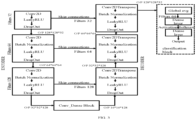
- Architecture of the 3-block classifier is depicted in FIG. 3 .
- the extracted plurality of features are compared via the one or more hardware processors, with a set of manufacturer specifications.
- An encoder section of the encoder-decoder block comprises a plurality of convolution blocks arranged in a sequence, wherein a first convolution block in the plurality of convolution blocks comprises of a 2D convolution layer, a leakyRelu layer, and a Dropout layer, and each subsequent convolution block among the plurality of convolution blocks comprises the 2D convolution layer, the leakyRelu layer, the Dropout layer, and a batch normalization layer.
- a Dropout of 0.4 is used.
- a decoder section of the encoder-decoder block comprises a plurality of 2D transposed convolution up-sampling blocks arranged in a sequence, wherein each of the plurality of 2D transposed convolution up-sampling blocks comprises of a convolutional 2D transpose layer, a batch normalization layer, a leakyRelu layer, and a Dropout layer.
- the 2D transposed convolution up-sampling layers take features from the convolution dense block, with rest of the parameters similar to the encoder.
- Each subsequent block in the encoder section is filtered with 32-64-128 filters respectively with a stride of 2 and a kernel of 3 ⁇ 3.
- the kernel is initialized as 'He Normal'.
- a L2 kernel regularizer maybe used to reduce covariate shifts and instability in distributions. Skip connections are used between the encoder and decoder to preserve specific and crucial information lost during down-sampling.
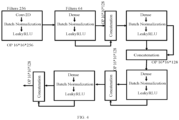
- the convolution dense block comprises a convolution block and a plurality of dense blocks.
- the convolution block comprises of 256 filters, a leakyRelu layer, and a batch normalization layer, and each of the plurality of dense blocks comprises of a dense layer, the leakyRelu layer, and the batch normalization layer.
- the convolution block extracts one or more finer features of the at least one implant using the 256 filters and one or more feature maps, and features of each of the plurality of dense blocks is combined with data from an activation layer using a concatenation block.
- Each of the dense layers has 64 filters, followed by batch normalization and Leaky Relu activation layers. The structure of the convolution dense block is depicted in FIG. 4 .
- edges, screws present, domes, pointed bottoms, of the at least one implant are key features that play a significant role in identifying manufacturer type.
- the 3-block classifier uses a sobel filter is used for capturing the plurality of edge-based features of the at least one implant, including the edges, screws present, domes, and the pointed bottoms, of the at least one implant.
- Output of the decoder section is fed as input to the classification block.
- a Global Average Pooling layer of the classification block collects the data from the decoder section and generates one feature for each corresponding category of the classification task, thus reducing memory requirement, enforces correspondence, and reduces overfitting.
- the Global Average Pooling layer is followed by a Dense layer with 64 filters, and Relu activation with a Random Normal kernel.
- a final layer in the sequence is a dense layer with a SoftMax function for 4-class classification and classifies the extracted plurality of features to a set of pre-defined feature classes.
- the 3-block classifier uses a supervised contrastive loss function to eliminate a class imbalance problem while identifying the type and manufacturer of the at least one implant, wherein while calculating loss of one class type the supervised contrastive loss function considers embeddings of one or more other classes. In this approach, clusters of points belonging to same class are pulled together in embedding space and clusters of samples from different classes are pulled apart.
- a is an anchor label or label under consideration
- ⁇ is positive sample with the same label as the anchor point
- n is negative sample with a different label from a
- m is margin
- d is distance measured between samples, which maybe a Euclidean distance. Factoring in information from all the other implant classes using this loss helps in better convergence and generalization.
- Output of the 3-block classifier is the features specific to the at least one implant, that have been extracted from the X-ray image.
- the system 100 compares the extracted plurality of features with a set of manufacturer specifications.
- the manufacturer specifications capture characteristics of different types of the implants from each of a plurality of manufacturers. The characteristics maybe in terms of features such as but not limited to edges, screws present, domes, and pointed bottoms.
- each type of implant from each manufacturer may have one or more unique characteristics, which helps differentiate between implants from different manufacturers and helps identify type of implant.
- the system 100 checks for matches for the extracted plurality of features with data in the set of manufacturer specifications, and based on a match found, identifies type and manufacturer of the at least one implant, at step 208 of the method 200.
- the identified data with respect to the manufacturer and type of the at least one implant is then provided as output of the system 100, to at least one user of the system 100, via one or more output means.
- manufacturer and type information maybe displayed using a display interface, and/or maybe provided in the form of a report. This information maybe then used by the user, who maybe a doctor or any other qualified personnel, to make informed decisions with respect to implant purchase for replacement of existing implant.
- the input image size was normalized to 256 ⁇ 256 as per the network requirement. Images which were less than this size were zero-padded and boundaries cropped if the size was more. The pixel values were normalized between [0,1].
- the network training was done for 500 epochs having a batch size of 32 using Adam optimizer. Adaptive learning rates like time-based learning rate decay schedulers and reduction of learning rate when a metric has stopped improving were employed during training to get better convergence and avoid overfitting, and the method 200 was implemented using Tensorflow and OpenCV.
- Performance of the 3-block classifier of the system 100 was compared using the following metrics.
- Accuracy is the ratio of correct predictions to all predictions as given in Eq. 2.
- Precision is the ratio of true positives to predicted positives as defined in Eq. 3.
- Recall is the ratio of true positives to actual positives as given in Eq. 4.
- F1-score is the harmonic mean between precision and recall as defined in Eq. 5.
- TN k represents the number of true negatives of class k, and is the result in which the other class (except for class k) is correctly predicted by the model.
- FN k is the number of false negatives of class k, which occurs when class k is incorrectly predicted into another class using the model.
- Performance of the method 200 was compared with other methods reported in literature on the same dataset in table I.
- the method 200 was found to be providing a classification accuracy of 92%. It could be seen that the non deep learning based methods like Random forest, logistic regression, gradient boosting and KNN did not perform well on this dataset providing an accuracy of around 56%, 53%, 55%, and 52% respectively with less precision, recall, and F1-scores.
- the classification accuracy improved significantly by using deep learning based methods like VGG providing 74%, ResNet around 75% and DenseNet around 79.6%.
- NASNet provided around 80%, X-Net [7] around 82%, and DRE-Net [6] around 86%.
- the embodiments of present disclosure herein address unresolved problem of manufacturer and type identification of medical implants.
- the embodiment thus provides a 3-class classifier for extraction of information on finer features of the medical implant, from an X-ray image being processed.
- the embodiments herein further provide a mechanism of comparing the extracted plurality of features of the implant with manufacturer specifications, to identify manufacturer and type of the implant.
- Such computer-readable storage means contain program-code means for implementation of one or more steps of the method, when the program runs on a server or mobile device or any suitable programmable device.
- the hardware device can be any kind of device which can be programmed including e.g., any kind of computer like a server or a personal computer, or the like, or any combination thereof.
- the device may also include means which could be e.g., hardware means like e.g., an application-specific integrated circuit (ASIC), a field-programmable gate array (FPGA), or a combination of hardware and software means, e.g., an ASIC and an FPGA, or at least one microprocessor and at least one memory with software processing components located therein.
- the means can include both hardware means and software means.
- the method embodiments described herein could be implemented in hardware and software.
- the device may also include software means. Alternatively, the embodiments may be implemented on different hardware devices, e.g., using a plurality of CPUs.
- the embodiments herein can comprise hardware and software elements.
- the embodiments that are implemented in software include but are not limited to, firmware, resident software, microcode, etc.
- the functions performed by various components described herein may be implemented in other components or combinations of other components.
- a computer-usable or computer readable medium can be any apparatus that can comprise, store, communicate, propagate, or transport the program for use by or in connection with the instruction execution system, apparatus, or device.
- a computer-readable storage medium refers to any type of physical memory on which information or data readable by a processor may be stored.
- a computer-readable storage medium may store instructions for execution by one or more processors, including instructions for causing the processor(s) to perform steps or stages consistent with the embodiments described herein.
- the term "computer-readable medium” should be understood to include tangible items and exclude carrier waves and transient signals, i.e., be non-transitory. Examples include random access memory (RAM), read-only memory (ROM), volatile memory, nonvolatile memory, hard drives, CD ROMs, DVDs, flash drives, disks, and any other known physical storage media.
Landscapes
- Engineering & Computer Science (AREA)
- Theoretical Computer Science (AREA)
- Computer Vision & Pattern Recognition (AREA)
- Multimedia (AREA)
- General Physics & Mathematics (AREA)
- Physics & Mathematics (AREA)
- Evolutionary Computation (AREA)
- Artificial Intelligence (AREA)
- Health & Medical Sciences (AREA)
- General Health & Medical Sciences (AREA)
- Computing Systems (AREA)
- Software Systems (AREA)
- Medical Informatics (AREA)
- Databases & Information Systems (AREA)
- Life Sciences & Earth Sciences (AREA)
- Biodiversity & Conservation Biology (AREA)
- Biomedical Technology (AREA)
- Molecular Biology (AREA)
- Image Analysis (AREA)
Abstract
Description
- The present application claims priority to
Indian application no. 202321049274, filed on July 21, 2023 - The disclosure herein generally relates to image processing, and, more particularly, to a method and system for manufacturer and type identification of a medical implant.
- Medical implants (or otherwise referred to as 'implants') are devices or tissues that are placed inside or on surface of body. Some may replace missing body parts, while others may deliver medication, monitor body functions, or provide support to organs and tissues. Implanted prosthetics maybe subject to wear and tear. Due to critical functionalities they serve, it is important to keep a check on health of the implant. Different prosthesis models require different procedures and sometimes different equipment for repair and removal. Patients and surgeons may not know the model or manufacturer of the original prosthesis often if the original surgery was performed many years before the follow-up surgery, or if the surgery was performed internationally or due to ambiguity in medical records. Currently, the task of identifying a prosthesis model in such cases involves rigorous examinations and visual inspection comparison of X-ray images which is difficult for both radiologists and orthopedic surgeons. This can be a meticulous task that is tedious, dependent on the surgeon's experience, time-consuming and an erroneous recognition can have certain consequences, thus, indicating an unmet need for a tool that will aid the experts in identifying unknown prostheses quickly and accurately.
- Embodiments of the present disclosure present technological improvements as solutions to one or more of the above-mentioned technical problems recognized by the inventors in conventional systems. For example, in one embodiment, a processor implemented method is provided. The method includes collecting, via one or more hardware processors, an X-ray image of a subject as input. Further, a plurality of features of at least one implant in the X-ray image is extracted, using a 3-block classifier executed by the one or more hardware processors, wherein the 3-block classifier extracts the plurality of features using a) an encoder-decoder block, b) a convolution dense block, and c) a classification block, of the 3-block classifier. Further, the extracted plurality of features are compared via the one or more hardware processors, with a set of manufacturer specifications. Further, type and manufacturer of the at least one implant are identified, via the one or more hardware processors, based on a match found for the extracted plurality of features with the manufacturer specifications.
- In an embodiment of the processor implemented method, an encoder section of the encoder-decoder block comprises a plurality of convolution blocks arranged in a sequence, wherein a first convolution block in the plurality of convolution blocks comprises of a 2D convolution layer, a leakyRelu layer, and a Dropout layer, and each subsequent convolution block among the plurality of convolution blocks comprises the 2D convolution layer, the leakyRelu layer, the Dropout layer, and a batch normalization layer.
- In another embodiment of the processor implemented method, a decoder section of the encoder-decoder block comprises a plurality of 2D transposed convolution up-sampling blocks arranged in a sequence, wherein each of the plurality of 2D transposed convolution up-sampling blocks comprises of a convolutional 2D transpose layer, a batch normalization layer, a leakyRelu layer, and a Dropout layer.
- In another embodiment of the processor implemented method, the convolution dense block comprises a convolution block and a plurality of dense blocks, wherein the convolution block comprises 256 filters, a leakyRelu layer, and a batch normalization layer, and each of the plurality of dense blocks comprises a dense layer, the leakyRelu layer, and the batch normalization layer, and wherein, the convolution block extracts one or more finer features of the at least one implant using the 256 filters and one or more feature maps, and features of each of the plurality of dense blocks is combined with data from an activation layer using a concatenation block.
- In another embodiment of the processor implemented method, a sobel filter is used for capturing a plurality of edge-based features of the at least one implant, wherein the plurality of edge-based features comprises one or more of edges of the at least one implant, one or more screws present in the at least one implant, one or more domes of the at least one implant, and pointed bottom shape of implant.
- In another embodiment of the processor implemented method, the classification block classifies the extracted plurality of features to a set of pre-defined feature classes.
- In another embodiment of the processor implemented method, the 3-block classifier uses a supervised contrastive loss function to eliminate a class imbalance problem while identifying the type and manufacturer of the at least one implant, wherein while calculating loss of one class type the supervised contrastive loss function considers embeddings of one or more other classes.
- In yet another embodiment, a system is provided. The system includes one or more hardware processors, a communication interface, and a memory storing a plurality of instructions. The plurality of instructions cause the one or more hardware processors to collect an X-ray image of a subject as input. Further, a plurality of features of at least one implant in the X-ray image is extracted, using a 3-block classifier executed by the one or more hardware processors, wherein the 3-block classifier extracts the plurality of features using a) an encoder-decoder block, b) a convolution dense block, and c) a classification block, of the 3-block classifier. Further, the extracted plurality of features are compared via the one or more hardware processors, with a set of manufacturer specifications. Further, type and manufacturer of the at least one implant are identified, via the one or more hardware processors, based on a match found for the extracted plurality of features with the manufacturer specifications.
- In yet another embodiment of the system, an encoder section of the encoder-decoder block comprises a plurality of convolution blocks arranged in a sequence, wherein a first convolution block in the plurality of convolution blocks comprises of a 2D convolution layer, a leakyRelu layer, and a Dropout layer, and each subsequent convolution block among the plurality of convolution blocks comprises the 2D convolution layer, the leakyRelu layer, the Dropout layer, and a batch normalization layer.
- In yet another embodiment of the system, a decoder section of the encoder-decoder block comprises a plurality of 2D transposed convolution up-sampling blocks arranged in a sequence, wherein each of the plurality of 2D transposed convolution up-sampling blocks comprises of a convolutional 2D transpose layer, a batch normalization layer, a leakyRelu layer, and a Dropout layer.
- In yet another embodiment of the system, the convolution dense block comprises a convolution block and a plurality of dense blocks, wherein the convolution block comprises 256 filters, a leakyRelu layer, and a batch normalization layer, and each of the plurality of dense blocks comprises a dense layer, the leakyRelu layer, and the batch normalization layer, and wherein, the convolution block extracts one or more finer features of the at least one implant using the 256 filters and one or more feature maps, and features of each of the plurality of dense blocks is combined with data from an activation layer using a concatenation block.
- In yet another embodiment of the system, a sobel filter is used for capturing a plurality of edge-based features of the at least one implant, wherein the plurality of edge-based features comprises one or more of edges of the at least one implant, one or more screws present in the at least one implant, one or more domes of the at least one implant, and pointed bottom shape of implant.
- In yet another embodiment of the system, the classification block classifies the extracted plurality of features to a set of pre-defined feature classes.
- In yet another embodiment of the system, the 3-block classifier uses a supervised contrastive loss function to eliminate a class imbalance problem while identifying the type and manufacturer of the at least one implant, wherein while calculating loss of one class type the supervised contrastive loss function considers embeddings of one or more other classes.
- In yet another aspect, a non-transitory computer readable medium is provided. The non-transitory computer readable medium includes a plurality of instructions, which when executed, cause the one or more hardware processors to collect, via one or more hardware processors, an X-ray image of a subject as input. Further, a plurality of features of at least one implant in the X-ray image is extracted, using a 3-block classifier executed by the one or more hardware processors, wherein the 3-block classifier extracts the plurality of features using a) an encoder-decoder block, b) a convolution dense block, and c) a classification block, of the 3-block classifier. Further, the extracted plurality of features are compared via the one or more hardware processors, with a set of manufacturer specifications. Further, type and manufacturer of the at least one implant are identified, via the one or more hardware processors, based on a match found for the extracted plurality of features with the manufacturer specifications.
- In yet another aspect, a 3-block classifier is provided. The 3-block classifier includes an encoder-decoder block, a convolution dense block, and a classification block, wherein an encoder section of the encoder-decoder block comprises a plurality of convolution blocks arranged in a sequence, wherein a first convolution block in the plurality of convolution blocks comprises of a 2D convolution layer, a leakyRelu layer, and a Dropout layer, and each subsequent convolution block among the plurality of convolution blocks comprises the 2D convolution layer, the leakyRelu layer, the Dropout layer, and a batch normalization layer, a decoder section of the encoder-decoder block comprises a plurality of 2D transposed convolution up-sampling blocks arranged in a sequence, wherein each of the plurality of 2D transposed convolution up-sampling blocks comprises of a convolutional 2D transpose layer, a batch normalization layer, a leakyRelu layer, and a Dropout layer, the convolution dense block comprises a convolution block and a plurality of dense blocks, wherein the convolution block comprises 256 filters, a leakyRelu layer, and a batch normalization layer, and each of the plurality of dense blocks comprises a dense layer, the leakyRelu layer, and the batch normalization layer, wherein, the convolution block extracts one or more finer features of the at least one implant using the 256 filters and one or more feature maps, and features of each of the plurality of dense blocks is combined with data from an activation layer using a concatenation block, a sobel filter is used for capturing a plurality of edge-based features of the at least one implant, wherein the plurality of edge-based features comprises one or more of edges of the at least one implant, one or more screws present in the at least one implant, one or more domes of the at least one implant, and pointed bottom shape of implant, the classification block classifies the extracted plurality of features to a set of pre-defined feature classes, and a supervised contrastive loss function is used to eliminate a class imbalance problem while identifying the type and manufacturer of the at least one implant, wherein while calculating loss of one class type the supervised contrastive loss function considers embeddings of one or more other classes.
- It is to be understood that both the foregoing general description and the following detailed description are exemplary and explanatory only and are not restrictive of the invention, as claimed.
- The accompanying drawings, which are incorporated in and constitute a part of this disclosure, illustrate exemplary embodiments and, together with the description, serve to explain the disclosed principles:
-
FIG. 1 illustrates an exemplary system for manufacturer and type identification of a medical implant in a subject, according to some embodiments of the present disclosure. -
FIG. 2 is a flow diagram depicting steps involved in the process of identifying manufacturer and type of a medical implant, using the system ofFIG. 1 , according to some embodiments of the present disclosure. -
FIG. 3 illustrates a block diagram of a 3-block classifier used by the system ofFIG. 1 , for feature extraction, in accordance with some embodiments of the present disclosure. -
FIG. 4 illustrates a block diagram of a convolution dense block of the 3-block classifier, in accordance with some embodiments of the present disclosure. - Exemplary embodiments are described with reference to the accompanying drawings. In the figures, the left-most digit(s) of a reference number identifies the figure in which the reference number first appears. Wherever convenient, the same reference numbers are used throughout the drawings to refer to the same or like parts. While examples and features of disclosed principles are described herein, modifications, adaptations, and other implementations are possible without departing from the scope of the disclosed embodiments.
- Different prosthesis models require different procedures and sometimes different equipment for repair and removal. Patients and surgeons may not know the model or manufacturer of the original prosthesis often if the original surgery was performed many years before the follow-up surgery, or if the surgery was performed internationally or due to ambiguity in medical records. Currently, the task of identifying a prosthesis model in such cases involves rigorous examinations and visual inspection comparison of X-ray images which is difficult for both radiologists and orthopedic surgeons. This can be a meticulous task that is tedious, dependent on the surgeon's experience, time-consuming and an erroneous recognition can have certain consequences, thus, indicating an unmet need for a tool that will aid the experts in identifying unknown prostheses quickly and accurately.
- In order to address these challenges in the art, embodiments disclosed herein provide a method and system for manufacturer and type identification of a medical implant. The method includes collecting an X-ray image of a subject as input. Further, a plurality of features of at least one implant in the X-ray image is extracted, using a 3-block classifier executed by one or more hardware processors, wherein the 3-block classifier extracts the plurality of features using a) an encoder-decoder block, b) a convolution dense block, and c) a classification block, of the 3-block classifier. Further, the extracted plurality of features is compared with a set of manufacturer specifications. Further, type and manufacturer of the at least one implant are identified based on a match found for the extracted plurality of features with the manufacturer specifications.
- Referring now to the drawings, and more particularly to
FIG. 1 through FIG. 4 , where similar reference characters denote corresponding features consistently throughout the figures, there are shown preferred embodiments and these embodiments are described in the context of the following exemplary system and/or method. -
FIG. 1 illustrates an exemplary system for manufacturer and type identification of a medical implant in a subject, according to some embodiments of the present disclosure. Thesystem 100 includes or is otherwise in communication withhardware processors 102, at least one memory such as amemory 104, an I/O interface 112. Thehardware processors 102,memory 104, and the Input /Output (I/O)interface 112 may be coupled by a system bus such as asystem bus 108 or a similar mechanism. In an embodiment, thehardware processors 102 can be one or more hardware processors. - The I/
O interface 112 may include a variety of software and hardware interfaces, for example, a web interface, a graphical user interface, and the like. The I/O interface 112 may include a variety of software and hardware interfaces, for example, interfaces for peripheral device(s), such as a keyboard, a mouse, an external memory, a printer and the like. Further, the I/O interface 112 may enable thesystem 100 to communicate with other devices, such as web servers, and external databases. - The I/
O interface 112 can facilitate multiple communications within a wide variety of networks and protocol types, including wired networks, for example, local area network (LAN), cable, etc., and wireless networks, such as Wireless LAN (WLAN), cellular, or satellite. For the purpose, the I/O interface 112 may include one or more ports for connecting several computing systems with one another or to another server computer. The I/O interface 112 may include one or more ports for connecting several devices to one another or to another server. - The one or
more hardware processors 102 may be implemented as one or more microprocessors, microcomputers, microcontrollers, digital signal processors, central processing units, node machines, logic circuitries, and/or any devices that manipulate signals based on operational instructions. Among other capabilities, the one ormore hardware processors 102 is configured to fetch and execute computer-readable instructions stored in thememory 104. - The
memory 104 may include any computer-readable medium known in the art including, for example, volatile memory, such as static random-access memory (SRAM) and dynamic random-access memory (DRAM), and/or non-volatile memory, such as read only memory (ROM), erasable programmable ROM, flash memories, hard disks, optical disks, and magnetic tapes. In an embodiment, thememory 104 includes a plurality ofmodules 106. - The plurality of
modules 106 include programs or coded instructions that supplement applications or functions performed by thesystem 100 for executing different steps involved in the process of implant manufacturer and type identification, being performed by thesystem 100. The plurality ofmodules 106, amongst other things, can include routines, programs, objects, components, and data structures, which performs particular tasks or implement particular abstract data types. The plurality ofmodules 106 may also be used as, signal processor(s), node machine(s), logic circuitries, and/or any other device or component that manipulates signals based on operational instructions. Further, the plurality ofmodules 106 can be used by hardware, by computer-readable instructions executed by the one ormore hardware processors 102, or by a combination thereof. The plurality ofmodules 106 can include various sub-modules (not shown). The plurality ofmodules 106 may include computer-readable instructions that supplement applications or functions performed by thesystem 100 for the implant manufacturer and type identification. - The data repository (or repository) 110 may include a plurality of abstracted piece of code for refinement and data that is processed, received, or generated as a result of the execution of the plurality of modules in the module(s) 106.
- Although the
data repository 110 is shown internal to thesystem 100, it will be noted that, in alternate embodiments, thedata repository 110 can also be implemented external to thesystem 100, where thedata repository 110 may be stored within a database (repository 110) communicatively coupled to thesystem 100. The data contained within such external database may be periodically updated. For example, new data may be added into the database (not shown inFIG. 1 ) and/or existing data may be modified and/or non-useful data may be deleted from the database. In one example, the data may be stored in an external system, such as a Lightweight Directory Access Protocol (LDAP) directory and a Relational Database Management System (RDBMS). Functions of the components of thesystem 100 are now explained with reference to the steps in flow diagrams inFIG. 2 and the 3-block classifier diagram inFIG. 3 . -
FIG. 2 is a flow diagram depicting steps involved in the process of identifying manufacturer and type of a medical implant, using the system ofFIG. 1 , according to some embodiments of the present disclosure. - In an embodiment, the
system 100 comprises one or more data storage devices or thememory 104 operatively coupled to the processor(s) 102 and is configured to store instructions for execution of steps of themethod 200 by the processor(s) or one ormore hardware processors 102. The steps of themethod 200 of the present disclosure will now be explained with reference to the components or blocks of thesystem 100 as depicted inFIG. 1 and the steps of flow diagram as depicted inFIG. 2 . Although process steps, method steps, techniques or the like may be described in a sequential order, such processes, methods, and techniques may be configured to work in alternate orders. In other words, any sequence or order of steps that may be described does not necessarily indicate a requirement that the steps to be performed in that order. The steps of processes described herein may be performed in any order practical. Further, some steps may be performed simultaneously. - At
step 202 ofmethod 200 inFIG. 2 , thesystem 100 collects, via the one ormore hardware processors 102, an X-ray image of a subject as input. The X-ray image may contain one or more implants. In an embodiment, the X-ray image maybe from an X-ray imaging system not connected to thesystem 100, and in this scenario, the X-ray image maybe fed/uploaded to thesystem 100 via one or more suitable interfaces. In another embodiment, thesystem 100 maybe directly interfaced with the X-ray imaging system and may receive the X-ray image directly from the imaging system. - Further, at
step 204 of themethod 200, a plurality of features of at least one implant in the X-ray image is extracted, using a 3-block classifier (alternately referred to as `classifier') executed by the one or more hardware processors, wherein the 3-block classifier extracts the plurality of features using a) an encoder-decoder block, b) a convolution dense block, and c) a classification block, of the 3-block classifier. Architecture of the 3-block classifier is depicted inFIG. 3 . Further, the extracted plurality of features are compared via the one or more hardware processors, with a set of manufacturer specifications. Further, type and manufacturer of the at least one implant are identified, via the one or more hardware processors, based on a match found for the extracted plurality of features with the manufacturer specifications. An encoder section of the encoder-decoder block comprises a plurality of convolution blocks arranged in a sequence, wherein a first convolution block in the plurality of convolution blocks comprises of a 2D convolution layer, a leakyRelu layer, and a Dropout layer, and each subsequent convolution block among the plurality of convolution blocks comprises the 2D convolution layer, the leakyRelu layer, the Dropout layer, and a batch normalization layer. In an embodiment, a Dropout of 0.4 is used. The batch normalization is used in the encoder section to stabilize an activation distribution, and mean and standard deviation migrate as the 3-block classifier learns. In an embodiment, input data to the classifier is normalized in 0-1 range as part of preprocessing, easing process of computing mean and variance of whole of a training sample used, rather than learning per batch, hence reducing redundancy and saving cost. A decoder section of the encoder-decoder block comprises a plurality of 2D transposed convolution up-sampling blocks arranged in a sequence, wherein each of the plurality of 2D transposed convolution up-sampling blocks comprises of a convolutional 2D transpose layer, a batch normalization layer, a leakyRelu layer, and a Dropout layer. The 2D transposed convolution up-sampling layers take features from the convolution dense block, with rest of the parameters similar to the encoder. Each subsequent block in the encoder section is filtered with 32-64-128 filters respectively with a stride of 2 and a kernel of 3 × 3. The kernel is initialized as 'He Normal'. A L2 kernel regularizer maybe used to reduce covariate shifts and instability in distributions. Skip connections are used between the encoder and decoder to preserve specific and crucial information lost during down-sampling. The convolution dense block comprises a convolution block and a plurality of dense blocks. The convolution block comprises of 256 filters, a leakyRelu layer, and a batch normalization layer, and each of the plurality of dense blocks comprises of a dense layer, the leakyRelu layer, and the batch normalization layer. The convolution block extracts one or more finer features of the at least one implant using the 256 filters and one or more feature maps, and features of each of the plurality of dense blocks is combined with data from an activation layer using a concatenation block. Each of the dense layers has 64 filters, followed by batch normalization and Leaky Relu activation layers. The structure of the convolution dense block is depicted inFIG. 4 . It was observed from feature maps using gradient weighted class activation mapping that edges, screws present, domes, pointed bottoms, of the at least one implant are key features that play a significant role in identifying manufacturer type. The 3-block classifier uses a sobel filter is used for capturing the plurality of edge-based features of the at least one implant, including the edges, screws present, domes, and the pointed bottoms, of the at least one implant. Output of the decoder section is fed as input to the classification block. A Global Average Pooling layer of the classification block collects the data from the decoder section and generates one feature for each corresponding category of the classification task, thus reducing memory requirement, enforces correspondence, and reduces overfitting. The Global Average Pooling layer is followed by a Dense layer with 64 filters, and Relu activation with a Random Normal kernel. A final layer in the sequence is a dense layer with a SoftMax function for 4-class classification and classifies the extracted plurality of features to a set of pre-defined feature classes. In another embodiment the 3-block classifier uses a supervised contrastive loss function to eliminate a class imbalance problem while identifying the type and manufacturer of the at least one implant, wherein while calculating loss of one class type the supervised contrastive loss function considers embeddings of one or more other classes. In this approach, clusters of points belonging to same class are pulled together in embedding space and clusters of samples from different classes are pulled apart. Loss value calculated using the supervised contrastive loss function is expressed as:
- Further, at
step 206 of themethod 200, thesystem 100 compares the extracted plurality of features with a set of manufacturer specifications. The manufacturer specifications capture characteristics of different types of the implants from each of a plurality of manufacturers. The characteristics maybe in terms of features such as but not limited to edges, screws present, domes, and pointed bottoms. In an embodiment, each type of implant from each manufacturer may have one or more unique characteristics, which helps differentiate between implants from different manufacturers and helps identify type of implant. By comparing the extracted plurality of features with the set of manufacturer specifications, thesystem 100 checks for matches for the extracted plurality of features with data in the set of manufacturer specifications, and based on a match found, identifies type and manufacturer of the at least one implant, atstep 208 of themethod 200. - The identified data with respect to the manufacturer and type of the at least one implant is then provided as output of the
system 100, to at least one user of thesystem 100, via one or more output means. For example, manufacturer and type information maybe displayed using a display interface, and/or maybe provided in the form of a report. This information maybe then used by the user, who maybe a doctor or any other qualified personnel, to make informed decisions with respect to implant purchase for replacement of existing implant. - For the experiments, the input image size was normalized to 256 × 256 as per the network requirement. Images which were less than this size were zero-padded and boundaries cropped if the size was more. The pixel values were normalized between [0,1]. The network training was done for 500 epochs having a batch size of 32 using Adam optimizer. Adaptive learning rates like time-based learning rate decay schedulers and reduction of learning rate when a metric has stopped improving were employed during training to get better convergence and avoid overfitting, and the
method 200 was implemented using Tensorflow and OpenCV. - Performance of the 3-block classifier of the
system 100 was compared using the following metrics. Accuracy is the ratio of correct predictions to all predictions as given in Eq. 2. Precision is the ratio of true positives to predicted positives as defined in Eq. 3. Recall is the ratio of true positives to actual positives as given in Eq. 4. F1-score is the harmonic mean between precision and recall as defined in Eq. 5.


where K represents the total number of classes, which was 4 during the experiment. TPk is the number of true positives of class k, which represents the correctly predicted image from class k. FPk is the number of false positives of class k representing the incorrect prediction of another class into class k. TNk represents the number of true negatives of class k, and is the result in which the other class (except for class k) is correctly predicted by the model. FNk is the number of false negatives of class k, which occurs when class k is incorrectly predicted into another class using the model. - Performance of the
method 200 was compared with other methods reported in literature on the same dataset in table I. Themethod 200 was found to be providing a classification accuracy of 92%. It could be seen that the non deep learning based methods like Random forest, logistic regression, gradient boosting and KNN did not perform well on this dataset providing an accuracy of around 56%, 53%, 55%, and 52% respectively with less precision, recall, and F1-scores. The classification accuracy improved significantly by using deep learning based methods like VGG providing 74%, ResNet around 75% and DenseNet around 79.6%. NASNet provided around 80%, X-Net [7] around 82%, and DRE-Net [6] around 86%. It has to be noted that even precision, recall, and F1-scores improved with deep learning based methods. Themethod 200 performed better than other reported methods providing an accuracy of 92%. It can be seen that themethod 200 has higher precision of 0.92, a high recall of 0.87 and high F1-score of 0.90 than the ones reported in the table thus indicating the robustness.TABLE I: Comparison of performance measure with other reported methods on the same dataset. Note '*' denotes non deep learning based methods. Methods Accuracy Precision Recall F 1-score Random Forest 56 0.62 0.36 0.51 Logistic Regression 53 0.44 0.31 0.41 Gradient Boosting 55 0.58 0.34 0.48 KNN 52 0.49 0.31 0.43 VGG-16 74.0 0.72 0.68 0.69 VGG-19 76.2 0.75 0.69 0.70 ResNet-50 75.4 0.75 0.70 0.71 ResNet-152 75.6 0.73 0.69 0.70 NASNet 80.4 0.80 0.75 0.76 DenseNet-201 79.6 0.79 0.74 0.74 DRE-Net 85.9 0.85 0.84 0.85 X-Net 82 0.81 0.77 0.79 Method 20092 0.92 0.87 0.90 - The written description describes the subject matter herein to enable any person skilled in the art to make and use the embodiments. The scope of the subject matter embodiments is defined by the claims and may include other modifications that occur to those skilled in the art. Such other modifications are intended to be within the scope of the claims if they have similar elements that do not differ from the literal language of the claims or if they include equivalent elements with insubstantial differences from the literal language of the claims.
- The embodiments of present disclosure herein address unresolved problem of manufacturer and type identification of medical implants. The embodiment, thus provides a 3-class classifier for extraction of information on finer features of the medical implant, from an X-ray image being processed. Moreover, the embodiments herein further provide a mechanism of comparing the extracted plurality of features of the implant with manufacturer specifications, to identify manufacturer and type of the implant.
- It is to be understood that the scope of the protection is extended to such a program and in addition to a computer-readable means having a message therein; such computer-readable storage means contain program-code means for implementation of one or more steps of the method, when the program runs on a server or mobile device or any suitable programmable device. The hardware device can be any kind of device which can be programmed including e.g., any kind of computer like a server or a personal computer, or the like, or any combination thereof. The device may also include means which could be e.g., hardware means like e.g., an application-specific integrated circuit (ASIC), a field-programmable gate array (FPGA), or a combination of hardware and software means, e.g., an ASIC and an FPGA, or at least one microprocessor and at least one memory with software processing components located therein. Thus, the means can include both hardware means and software means. The method embodiments described herein could be implemented in hardware and software. The device may also include software means. Alternatively, the embodiments may be implemented on different hardware devices, e.g., using a plurality of CPUs.
- The embodiments herein can comprise hardware and software elements. The embodiments that are implemented in software include but are not limited to, firmware, resident software, microcode, etc. The functions performed by various components described herein may be implemented in other components or combinations of other components. For the purposes of this description, a computer-usable or computer readable medium can be any apparatus that can comprise, store, communicate, propagate, or transport the program for use by or in connection with the instruction execution system, apparatus, or device.
- The illustrated steps are set out to explain the exemplary embodiments shown, and it should be anticipated that ongoing technological development will change the manner in which particular functions are performed. These examples are presented herein for purposes of illustration, and not limitation. Further, the boundaries of the functional building blocks have been arbitrarily defined herein for the convenience of the description. Alternative boundaries can be defined so long as the specified functions and relationships thereof are appropriately performed. Alternatives (including equivalents, extensions, variations, deviations, etc., of those described herein) will be apparent to persons skilled in the relevant art(s) based on the teachings contained herein. Such alternatives fall within the scope of the disclosed embodiments. Also, the words "comprising," "having," "containing," and "including," and other similar forms are intended to be equivalent in meaning and be open ended in that an item or items following any one of these words is not meant to be an exhaustive listing of such item or items, or meant to be limited to only the listed item or items. It must also be noted that as used herein and in the appended claims, the singular forms "a," "an," and "the" include plural references unless the context clearly dictates otherwise.
- Furthermore, one or more computer-readable storage media may be utilized in implementing embodiments consistent with the present disclosure. A computer-readable storage medium refers to any type of physical memory on which information or data readable by a processor may be stored. Thus, a computer-readable storage medium may store instructions for execution by one or more processors, including instructions for causing the processor(s) to perform steps or stages consistent with the embodiments described herein. The term "computer-readable medium" should be understood to include tangible items and exclude carrier waves and transient signals, i.e., be non-transitory. Examples include random access memory (RAM), read-only memory (ROM), volatile memory, nonvolatile memory, hard drives, CD ROMs, DVDs, flash drives, disks, and any other known physical storage media.
- It is intended that the disclosure and examples be considered as exemplary only, with a true scope of disclosed embodiments being indicated by the following claims.
Claims (15)
- A processor implemented method (200), comprising:collecting (202), via one or more hardware processors, an X-ray image of a subject as input;extracting (204), using a 3-block classifier executed by the one or more hardware processors, a plurality of features of at least one implant in the X-ray image, wherein the 3-block classifier extracts the plurality of features using a) an encoder-decoder block, b) a convolution dense block, and c) a classification block;comparing (206), via the one or more hardware processors, the extracted plurality of features with a set of manufacturer specifications; andidentifying (208), via the one or more hardware processors, type andmanufacturer of the at least one implant, based on a match found for the extracted plurality of features with the manufacturer specifications.
- The processor implemented method as claimed in claim 1, wherein an encoder section of the encoder-decoder block comprises a plurality of convolution blocks arranged in a sequence, and wherein a first convolution block in the plurality of convolution blocks comprises of a 2D convolution layer, a leakyRelu layer, and a Dropout layer, and each subsequent convolution block among the plurality of convolution blocks comprises the 2D convolution layer, the leakyRelu layer, the Dropout layer, and a batch normalization layer.
- The processor implemented method as claimed in claim 1, wherein a decoder section of the encoder-decoder block comprises a plurality of 2D transposed convolution up-sampling blocks arranged in a sequence, and wherein each of the plurality of 2D transposed convolution up-sampling blocks comprises of a convolutional 2D transpose layer, a batch normalization layer, a leakyRelu layer, and a Dropout layer.
- The processor implemented method as claimed in claim 1, wherein, the convolution dense block comprises a convolution block and a plurality of dense blocks, wherein the convolution block comprises 256 filters, a leakyRelu layer, and a batch normalization layer, and each of the plurality of dense blocks comprises a dense layer, the leakyRelu layer, and the batch normalization layer, and wherein the convolution block extracts one or more finer features of the at least one implant using the 256 filters and one or more feature maps, and features of each of the plurality of dense blocks is combined with data from an activation layer using a concatenation block.
- The processor implemented method as claimed in claim 4, wherein a sobel filter is used for capturing a plurality of edge-based features of the at least one implant, wherein the plurality of edge-based features comprises one or more of edges of the at least one implant, one or more screws present in the at least one implant, one or more domes of the at least one implant, and pointed bottom shape of implant.
- The processor implemented method as claimed in claim 1, wherein the classification block classifies the extracted plurality of features to a set of pre-defined feature classes.
- The processor implemented method as claimed in claim 1, wherein the 3-block classifier uses a supervised contrastive loss function to eliminate a class imbalance problem while identifying the type and manufacturer of the at least one implant, and wherein while calculating loss of one class type the supervised contrastive loss function considers embeddings of one or more other classes.
- A system (100), comprising:one or more hardware processors (102);a communication interface (112); anda memory (104) storing a plurality of instructions, wherein the plurality of instructions cause the one or more hardware processors to:collect an X-ray image of a subject as input;extract, via a 3-block classifier executed by the one or more hardware processors, a plurality of features of at least one implant in the X-ray image, wherein the 3-block classifier extracts the plurality of features using a) an encoder-decoder block, b) a convolution dense block, and c) a classification block;compare the extracted plurality of features with a set of manufacturer specifications; andidentify type and manufacturer of the at least one implant, based on a match found for the extracted plurality of features with the manufacturer specifications.
- The system as claimed in claim 8, wherein an encoder section of the encoder-decoder block comprises a plurality of convolution blocks arranged in a sequence, and wherein a first convolution block in the plurality of convolution blocks comprises of a 2D convolution layer, a leakyRelu layer, and a Dropout layer, and each subsequent convolution block among the plurality of convolution blocks comprises the 2D convolution layer, the leakyRelu layer, the Dropout layer, and a batch normalization layer.
- The system as claimed in claim 8, wherein a decoder section of the encoder-decoder block comprises a plurality of 2D transposed convolution up-sampling blocks arranged in a sequence, and wherein each of the plurality of 2D transposed convolution up-sampling blocks comprises of a convolutional 2D transpose layer, a batch normalization layer, a leakyRelu layer, and a Dropout layer.
- The system as claimed in claim 8, wherein the convolution dense block comprises a convolution block and a plurality of dense blocks, wherein the convolution block comprises 256 filters, a leakyRelu layer, and a batch normalization layer, and each of the plurality of dense blocks comprises a dense layer, the leakyRelu layer, and the batch normalization layer, and wherein, the convolution block extracts one or more finer features of the at least one implant using the 256 filters and one or more feature maps, and features of each of the plurality of dense blocks is combined with data from an activation layer using a concatenation block.
- The system as claimed in claim 11, wherein a sobel filter is used for capturing a plurality of edge-based features of the at least one implant, wherein the plurality of edge-based features comprises one or more of edges of the at least one implant, one or more screws present in the at least one implant, one or more domes of the at least one implant, and pointed bottom shape of implant.
- The system as claimed in claim 8, wherein the classification block classifies the extracted plurality of features to a set of pre-defined feature classes.
- The system as claimed in claim 8, wherein the 3-block classifier uses a supervised contrastive loss function to eliminate a class imbalance problem while identifying the type and manufacturer of the at least one implant, and wherein while calculating loss of one class type the supervised contrastive loss function considers embeddings of one or more other classes.
- A 3-block classifier, comprising:an encoder-decoder block;a convolution dense block; anda classification block, whereinan encoder section of the encoder-decoder block comprises a plurality of convolution blocks arranged in a sequence, wherein a first convolution block in the plurality of convolution blocks comprises of a 2D convolution layer, a leakyRelu layer, and a Dropout layer, and each subsequent convolution block among the plurality of convolution blocks comprises the 2D convolution layer, the leakyRelu layer, the Dropout layer, and a batch normalization layer,a decoder section of the encoder-decoder block comprises a plurality of 2D transposed convolution up-sampling blocks arranged in a sequence, wherein each of the plurality of 2D transposed convolution up-sampling blocks comprises of a convolutional 2D transpose layer, a batch normalization layer, a leakyRelu layer, and a Dropout layer,the convolution dense block comprises a convolution block and a plurality of dense blocks, wherein the convolution block comprises 256 filters, a leakyRelu layer, and a batch normalization layer, and each of the plurality of dense blocks comprises a dense layer, the leakyRelu layer, and the batch normalization layer, and wherein, the convolution block extracts one or more finer features of the at least one implant using the 256 filters and one or more feature maps, and features of each of the plurality of dense blocks is combined with data from an activation layer using a concatenation block,a sobel filter is used for capturing a plurality of edge-based features of the at least one implant, wherein the plurality of edge-based features comprises one or more of edges of the at least one implant, one or more screws present in the at least one implant, one or more domes of the at least one implant, and pointed bottom shape of implant,the classification block classifies the extracted plurality of features to a set of pre-defined feature classes, anda supervised contrastive loss function is used to eliminate a class imbalance problem while identifying the type and manufacturer of the at least one implant, wherein while calculating loss of one class type the supervised contrastive loss function considers embeddings of one or more other classes.
Applications Claiming Priority (1)
| Application Number | Priority Date | Filing Date | Title |
|---|---|---|---|
| IN202321049274 | 2023-07-21 |
Publications (1)
| Publication Number | Publication Date |
|---|---|
| EP4495891A1 true EP4495891A1 (en) | 2025-01-22 |
Family
ID=91664161
Family Applications (1)
| Application Number | Title | Priority Date | Filing Date |
|---|---|---|---|
| EP24183640.2A Pending EP4495891A1 (en) | 2023-07-21 | 2024-06-21 | Method and system for manufacturer and type identification of a medical implant |
Country Status (2)
| Country | Link |
|---|---|
| US (1) | US20250029360A1 (en) |
| EP (1) | EP4495891A1 (en) |
Citations (1)
| Publication number | Priority date | Publication date | Assignee | Title |
|---|---|---|---|---|
| US20200074631A1 (en) * | 2018-09-04 | 2020-03-05 | The Board Of Regents, The University Of Texas System | Systems And Methods For Identifying Implanted Medical Devices |
-
2024
- 2024-06-21 EP EP24183640.2A patent/EP4495891A1/en active Pending
- 2024-07-01 US US18/760,954 patent/US20250029360A1/en active Pending
Patent Citations (1)
| Publication number | Priority date | Publication date | Assignee | Title |
|---|---|---|---|---|
| US20200074631A1 (en) * | 2018-09-04 | 2020-03-05 | The Board Of Regents, The University Of Texas System | Systems And Methods For Identifying Implanted Medical Devices |
Non-Patent Citations (3)
| Title |
|---|
| PATEL RAVI ET AL: "Automated Identification of Orthopedic Implants on Radiographs Using Deep Learning", RADIOLOGY: ARTIFICIAL INTELLIGENCE, vol. 3, no. 4, 1 July 2021 (2021-07-01), US, pages e200183, XP093228783, ISSN: 2638-6100, DOI: 10.1148/ryai.2021200183 * |
| YAN SHI ET AL: "DeepTKAClassifier: Brand Classification of Total Knee Arthroplasty Implants Using Explainable Deep Convolutional Neural Networks", 31 December 2020, SPRINGER, PAGE(S) 154 - 165, XP047591411 * |
| YI PAUL H ET AL: "Automated detection and classification of shoulder arthroplasty models using deep learning", SKELETAL RADIOLOGY, vol. 49, no. 10, 15 May 2020 (2020-05-15), pages 1623 - 1632, XP037318508, ISSN: 0364-2348, DOI: 10.1007/S00256-020-03463-3 * |
Also Published As
| Publication number | Publication date |
|---|---|
| US20250029360A1 (en) | 2025-01-23 |
Similar Documents
| Publication | Publication Date | Title |
|---|---|---|
| US20220198230A1 (en) | Auxiliary detection method and image recognition method for rib fractures based on deep learning | |
| CN111598867B (en) | Method, apparatus, and computer-readable storage medium for detecting specific facial syndrome | |
| US11847188B2 (en) | Image recognition method and device based on deep convolutional neural network | |
| EP3654343A1 (en) | Application of deep learning for medical imaging evaluation | |
| US12400325B2 (en) | Lumbar spine anatomical annotation based on magnetic resonance images using artificial intelligence | |
| CN112017744A (en) | Electronic case automatic generation method, device, equipment and storage medium | |
| CN111814832A (en) | A target detection method, device and storage medium | |
| CN111932547A (en) | Method and device for segmenting target object in image, electronic device and storage medium | |
| CN112307938B (en) | Data clustering method and device, electronic equipment and storage medium | |
| US12175786B2 (en) | Systems, methods, and devices for automatically converting explanation of benefits (EOB) printable documents into electronic format using artificial intelligence techniques | |
| CN110852076A (en) | Method and device for automatic disease code conversion | |
| CN114512207B (en) | Encoding method, apparatus, device and storage medium for disease names | |
| CN108899063A (en) | Physical examination data processing method, device, computer equipment and storage medium | |
| Tahghighi et al. | Automatic classification of symmetry of hemithoraces in canine and feline radiographs | |
| Reza et al. | Acute lymphoblastic leukemia diagnosis and subtype segmentation in blood smears using CNN and U-Net | |
| CN116486983A (en) | Text logic detection method, device, equipment and medium for medical image report | |
| US20250029360A1 (en) | Method and system for manufacturer and type identification of a medical implant | |
| CN120706515A (en) | Medical multimodal knowledge graph construction method, system, electronic device and storage medium | |
| CN116189209B (en) | Medical document image classification method and device, electronic device and storage medium | |
| Pandey et al. | Leveraging vision transformers for early detection of Alzheimer's disease through MRI image analysis | |
| CN115810016B (en) | Automatic identification method, system, storage medium and terminal for CXR (Lung infection) image | |
| CN110232957A (en) | A kind of diagnosis and therapy system and its construction method based on artificial intelligence, equipment and storage medium | |
| WO2020099941A1 (en) | Application of deep learning for medical imaging evaluation | |
| Chakraborty et al. | AlzClassNet: A Hybrid CNN-Transformer Model for Alzheimer’s Disease Detection and Staging | |
| CN111524096B (en) | Musculoskeletal X-ray film classification method, control device and storage medium |
Legal Events
| Date | Code | Title | Description |
|---|---|---|---|
| PUAI | Public reference made under article 153(3) epc to a published international application that has entered the european phase |
Free format text: ORIGINAL CODE: 0009012 |
|
| STAA | Information on the status of an ep patent application or granted ep patent |
Free format text: STATUS: THE APPLICATION HAS BEEN PUBLISHED |
|
| AK | Designated contracting states |
Kind code of ref document: A1 Designated state(s): AL AT BE BG CH CY CZ DE DK EE ES FI FR GB GR HR HU IE IS IT LI LT LU LV MC ME MK MT NL NO PL PT RO RS SE SI SK SM TR |
|
| STAA | Information on the status of an ep patent application or granted ep patent |
Free format text: STATUS: REQUEST FOR EXAMINATION WAS MADE |
|
| 17P | Request for examination filed |
Effective date: 20250623 |
|
| GRAP | Despatch of communication of intention to grant a patent |
Free format text: ORIGINAL CODE: EPIDOSNIGR1 |
|
| STAA | Information on the status of an ep patent application or granted ep patent |
Free format text: STATUS: GRANT OF PATENT IS INTENDED |