EP4495845A1 - Training data generation program, training data generation method, and information processing device - Google Patents
Training data generation program, training data generation method, and information processing device Download PDFInfo
- Publication number
- EP4495845A1 EP4495845A1 EP22931947.0A EP22931947A EP4495845A1 EP 4495845 A1 EP4495845 A1 EP 4495845A1 EP 22931947 A EP22931947 A EP 22931947A EP 4495845 A1 EP4495845 A1 EP 4495845A1
- Authority
- EP
- European Patent Office
- Prior art keywords
- attribute
- value
- attributes
- training data
- constraint
- Prior art date
- Legal status (The legal status is an assumption and is not a legal conclusion. Google has not performed a legal analysis and makes no representation as to the accuracy of the status listed.)
- Withdrawn
Links
Images




Classifications
-
- G—PHYSICS
- G06—COMPUTING OR CALCULATING; COUNTING
- G06N—COMPUTING ARRANGEMENTS BASED ON SPECIFIC COMPUTATIONAL MODELS
- G06N20/00—Machine learning
-
- G—PHYSICS
- G06—COMPUTING OR CALCULATING; COUNTING
- G06N—COMPUTING ARRANGEMENTS BASED ON SPECIFIC COMPUTATIONAL MODELS
- G06N7/00—Computing arrangements based on specific mathematical models
- G06N7/01—Probabilistic graphical models, e.g. probabilistic networks
Definitions
- the present invention relates to a technology for generating training data in consideration of fairness.
- dimension compression applies a continuous weight to each dimension of an original feature and generates a new feature of a lower dimension. Note that new interpretation is needed for the generated feature.
- the feature selection applies a weight of zero or one (sparse) to each dimension of the original feature and selects a feature. New interpretation is not needed for the selected feature.
- the data after the feature selection has a lower dimension than the original data, reduction in a calculation amount and noise removal can be realized. Furthermore, the data after the feature selection has high interpretability.
- Fairness of machine learning is defined as that prediction of a machine learning model is fair for each protection group based on a protection attribute of data.
- the protection attribute is an attribute such as race or gender, that should not be discriminated, based on laws and expertise.
- the protection group is a group obtained by dividing the data by the protection attribute.
- fair feature selection for adding fairness to the feature selection is important.
- the fair feature selection is problem-defined as trade-off evaluation between an approximation rate to the original data and the fairness of the data after approximation, with respect to the number of feature selections. That is, it is requested to achieve both of the accuracy and the fairness.
- a method has been known for using a convex optimization framework for fair unsupervised feature selection.
- a kernel function is used to estimate nonlinear correlation of a high-dimensional feature X.
- L ⁇ ⁇ K K S + ⁇ ⁇ ⁇ K S K P ⁇ ⁇ ⁇ ⁇ K u K p + ⁇ f + u
- the reference K is a matrix obtained by applying a kernel function k to a matrix X.
- the references ⁇ and ⁇ are hyperparameters.
- Non-Patent Document 1 Xiaoying Xing, Hongfu Liu, Chen Chen, Jundong Li, "Fairness-Aware Unsupervised Feature Selection",[online], June 4, 2021, [Searched on January 25, 2022], Internet ⁇ URL: https://arxiv.org/abs/2106.02216 >
- an object of the present invention is to generate training data in consideration of fairness.
- this training data generation program causes a computer to execute processing including calculating an occurrence probability of a value of a second attribute other than a first attribute of a plurality of attributes, for each of a first value and a second value of the first attribute of the plurality of attributes included in data, selecting a single or a plurality of the second attributes from among the plurality of attributes, based on a loss function that includes a parameter that indicates a difference between the occurrence probabilities respectively for the first value and the second value, and generating training data, based on the single or the plurality of attributes.
- FIG. 1 is a diagram schematically illustrating a configuration of an information processing device 1 as an example of the embodiment.
- the information processing device 1 has functions as a feature selection unit 110, a loss calculation unit 120, a gradient calculation unit 130, a parameter update unit 140, and a training data generation unit 101.
- Training data D is input to the feature selection unit 110.
- the training data D is training data used to train a machine learning model.
- the training data D may be also referred to as input data D.
- the reference X is a feature matrix, and X E R n ⁇ d .
- X corresponds to a first attribute of a plurality of attributes included in the data (input data).
- the reference Z is a protection attribute matrix, and Z G R n x .
- Z corresponds to a second attribute, other than the first attribute, of the plurality of attributes included in the data (input data).
- each data i is represented by a d-dimensional feature vector Xi E R 1 ⁇ d and a z-dimensional protection attribute vector Zi ⁇ R 1 ⁇ z .
- the feature selection unit 110 selects a feature matrix X s from the feature matrix X included in the training data D, using a feature selection vector f.
- the selected feature matrix X s may be referred to as a selection feature matrix X s .
- the feature selection unit 110 has functions as a diagonal matrix generation unit 111 and a product calculation unit 112.
- the diagonal matrix generation unit 111 generates a diagonal matrix F of the feature selection vector f.
- the product calculation unit 112 calculates a product XF of a product of the feature matrix X and the diagonal matrix F.
- the selection feature matrix X s XF.
- the loss calculation unit 120, the gradient calculation unit 130, and the parameter update unit 140 implement functions as a feature selection vector update unit 100.
- the feature selection vector update unit 100 updates a feature function f used by the feature selection unit 110, in consideration of fairness.
- the loss calculation unit 120 calculates a loss function L ours for the selection feature matrix X s selected by the feature selection unit 110.
- L ours ⁇ ⁇ K K s + ⁇ u ⁇ + ⁇ ⁇ ⁇ F 2 + ⁇ s ⁇ + ⁇ ⁇ ⁇ F T 2 + ⁇ f
- the references ⁇ u and ⁇ s are hyperparameters for fairness constraint adjustment, and the reference ⁇ is a hyperparameter for sparsity constraint adjustment.
- the loss calculation unit 120 has functions as a decorrelation calculation unit 121, a fairness constraint calculation unit 122, and a sparsity constraint calculation unit 123.
- the decorrelation calculation unit 121 calculates ⁇ (K, K s ) of the formula of the loss function L ours indicated by the above formula (2) .
- the decorrelation calculation unit 121 calculates non-linear correlation between the original feature matrix X and the selection feature matrix X s .
- the reference Tr is a trace of a matrix.
- H n I ⁇ 1 n 11 T , I: Unit matrix, 1: Vector of all components 1
- the reference AB is a product of a matrix A and a matrix B.
- the reference K is a matrix obtained by applying a kernel function k to a matrix X.
- K ij k X i , X j , K ⁇ R n ⁇ n
- the reference k is a kernel function and may be, for example, a polynomial kernel or a Radial Basis Function kernel to be described below.
- the fairness constraint calculation unit 122 calculates a u
- the fairness constraint calculation unit 122 incorporates a fairness metrics ⁇ into the formula of the loss function L ours , as a direct constraint.
- the fairness metrics ⁇ is expressed by the following formula (3).
- ⁇ sup t
- Z i 1) - P (h (X i s ) ⁇ t
- Z i 0)
- h: R d' ⁇ ⁇ 0, 1 ⁇ : may be a simple linear classifier such as a support vector machine (SVM).
- SVM support vector machine
- This setting can be easily made by another machine learning model, for example, a kernel SVM or the like.
- t is a threshold used by the classifier.
- the fairness metrics In the fairness metrics, how much the protection attribute is distinguished is evaluated, using the selected feature matrix X s .
- the fairness metrics represents a Kolmogorov distance that is a total variation distance of probability accuracy used to measure a distance between two probability distributions.
- kernel matrices K u and K P are similar, it is possible to reduce the calculation amount.
- each of ⁇ + and ⁇ - is an average vector, and each of ⁇ + and ⁇ - is a variance covariance matrix.
- the average vectors ⁇ + and ⁇ - can be expressed by the following formula, for example.
- variance covariance matrices ⁇ + and ⁇ - can be expressed by the following formula, for example.
- minimizing ⁇ can be approximated by minimizing one of or both of s + and s - or m + and m_.
- the formula is developed using the Gaussian distribution.
- the present invention is not limited to this, and the formula may be developed using a method other than the Gaussian distribution.
- can be interpreted as a constraint (first constraint) that brings a variance of features of the two groups to the selected feature matrix X s .
- Z i 1) - P (h (X i s ) ⁇ t
- Z i 0)
- the sparsity constraint calculation unit 123 calculates ⁇
- a sparse constraint is a constraint used to set the feature selection vector f to ⁇ 0, 1 ⁇ d .
- the sparsity constraint calculation unit 123 can calculate ⁇
- the gradient calculation unit 130 calculates a gradient ⁇ L our / ⁇ f, based on the above formula (4).
- the parameter update unit 140 updates a parameter of the feature selection vector f, using the gradient calculated by the gradient calculation unit 130.
- the parameter update unit 140 updates the parameter using a gradient method.
- the parameter update unit 140 optimizes the parameter so as to reduce a loss, in the loss function L ours indicated by the above formula (4), for example, using a gradient descent method.
- Z i 1) - P (h (X i s ) ⁇ t
- Z i 0)
- Z i 1) - P (h (X i s ) ⁇ t
- Z i 0)
- the parameter update unit 140 optimizes the parameter of the loss function L ours so as to reduce the loss, in the loss function L ours indicated by the formula (4). Therefore, the loss function L ours includes a condition that the difference between the occurrence probabilities respectively for the first value G+ and the second value G_ (distance between distributions) is reduced.
- the parameter update unit 140 updates the parameter of the feature selection vector f.
- Processing for updating the parameter of the feature selection vector f by the parameter update unit 140 can be expressed by the following formula. f ⁇ f ⁇ ⁇ ⁇ L ours ⁇ f
- the reference ⁇ is a hyperparameter of a training rate.
- Z i 1) - P (h (X i s ) ⁇ t
- Z i 0)
- the feature selection vector update unit 100 repeats the selection of the selection feature matrix X s by the feature selection unit 110, the calculation of the loss function L ours by the loss calculation unit 120, the calculation of the gradient ⁇ L our / ⁇ f by the gradient calculation unit 130, and the parameter update of the feature selection vector f.
- the feature selection unit 110 performs fair feature selection using the trained feature selection vector f. As a result, it is possible to realize the fair feature selection for high-dimensional data.
- the training data generation unit 101 generates training data based on one or more features (selection feature matrix X s ) selected by the feature selection unit 110.
- Fairness of the data of the one or more selection feature matrices X s output is ensured by using the trained feature selection vector f for the input data by the feature selection unit 110.
- the machine learning model trained using the training data generated by using the selection feature matrix X s realizes fairness.
- the training data generated by the training data generation unit 101 is training data that has a low dimension and a high approximation rate with the original data (input data) and simultaneously achieves the fairness of the approximated data.
- step S1 the feature selection vector f is initialized.
- the parameter of the feature selection vector f may be initialized using any value.
- step S2 the input data (observation data D) is input into the feature selection unit 110, and the feature selection unit 110 selects the selection feature matrix X s from the feature matrix X included in the observation data D using the feature selection vector f.
- step S3 the loss calculation unit 120 calculates the loss function L ours using the above formula (2) .
- step S4 the gradient calculation unit 130 calculates the gradient ⁇ L our / ⁇ f based on the loss function L ours calculated by the loss calculation unit 120.
- step S5 the parameter update unit 140 updates the parameter of the feature selection vector f based on the gradient calculated by the gradient calculation unit 130.
- step S6 the feature selection vector update unit 100 (refer to FIG. 1 ) confirms whether or not the feature selection vector f has converged.
- the procedure returns to step S2, and the feature selection unit 110 selects a new selection feature matrix X s .
- the feature selection unit 110 inputs the training data into the trained feature selection vector f and performs fair feature selection.
- the training data generation unit 101 generates the training data based on the one or more features selected in this way.
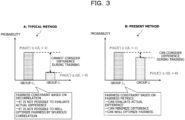
- FIG. 3 is a diagram illustrating respective occurrence probabilities of two groups G+ and G - classified based on the approximate data generated by the feature selection performed by the information processing device 1 as an example of the embodiment, in comparison with a typical method.
- a reference A indicates an occurrence probability P (h (X i s ) ⁇ t
- Z i 1) of the group G+ and an occurrence probability P (h (X i s ) ⁇ t
- Z i 0) of G_ with the typical method.
- a reference B indicates the occurrence probability P (h (X i s ) ⁇ t
- Z i 1) of the group G+ and the occurrence probability P (h (X i s ) ⁇ t
- Z i 0) of G - with the information processing device 1.
- the fairness constraint based on the fairness metrics, it is possible to evaluate an actual difference between the occurrence probabilities of the groups G+ and G_, and it is possible to minimize the difference.
- the fairness can be well optimized.
- the difference between the occurrence probabilities of the groups G+ and G - can be considered during training, and an unfair state in which the difference between the occurrence probabilities is small is obtained. That is, it is possible to improve the fairness.
- FIG. 4 is a diagram illustrating probability densities of the respective selection features of the two groups G+ and G - classified based on the approximate data generated by the feature selection performed by the information processing device 1 as an example of the embodiment, in comparison with the typical method.
- a reference A indicates a distribution of the probability density of the selection feature matrix X s of the group G+ and a distribution of the probability density of the selection feature matrix X s of G_, with the typical method.
- a reference B indicates a distribution of the probability density of the selection feature matrix X s of the group G+ and a distribution of the probability density of the selection feature matrix X s of G_, with the information processing device 1.
- FIG. 5 is a diagram illustrating a hardware configuration of the information processing device 1 as an example of the embodiment.
- the information processing device 1 is a computer, and includes, as its components, a processor 11, a memory 12, a storage device 13, a graphic processing device 14, an input interface 15, an optical drive device 16, a device coupling interface 17, and a network interface 18, for example.
- Those components 11 to 18 are configured to be communicable with each other via a bus 19.
- the processor (control unit) 11 controls the entire information processing device 1.
- the processor 11 may be a multiprocessor.
- the processor 11 may be any one of a central processing unit (CPU), a micro processing unit (MPU), a digital signal processor (DSP), an application specific integrated circuit (ASIC), a programmable logic device (PLD), a field programmable gate array (FPGA), and a graphics processing unit (GPU), for example.
- the processor 11 may be a combination of two or more types of elements of the CPU, MPU, DSP, ASIC, PLD, FPGA, and GPU.
- the processor 11 executes a control program (training data generation program: not illustrated) for the information processing device 1 so as to implement the functions as the feature selection unit 110, the loss calculation unit 120, the gradient calculation unit 130, the parameter update unit 140, and the training data generation unit 101, illustrated in FIG. 1 .
- a control program training data generation program: not illustrated
- the information processing device 1 executes, for example, a program (training data generation program and OS program) recorded in a non-transitory computer-readable recording medium so as to implement the functions as the feature selection unit 110, the loss calculation unit 120, the gradient calculation unit 130, the parameter update unit 140, and the training data generation unit 101, described above.
- a program training data generation program and OS program
- the programs in which processing content to be executed by the information processing device 1 is written may be recorded in various types of recording media.
- the programs to be executed by the information processing device 1 may be stored in the storage device 13.
- the processor 11 loads at least some of the programs in the storage device 13 into the memory 12, and executes the loaded program.
- the programs to be executed by the information processing device 1 may be recorded in a non-transitory portable recording medium such as an optical disk 16a, a memory device 17a, or a memory card 17c.
- the programs stored in a portable recording medium may be executed after being installed into the storage device 13, under the control of the processor 11, for example.
- the processor 11 may directly read the program from the portable recording medium and execute it.
- the memory 12 is a storage memory including a read only memory (ROM) and a random access memory (RAM) .
- the RAM of the memory 12 is used as a main storage device of the information processing device 1.
- the RAM temporarily stores at least some of the programs to be executed by the processor 11.
- the memory 12 stores various types of data needed for processing by the processor 11.
- the storage device 13 is a storage device such as a hard disk drive (Hard Disk Drive: HDD), a solid state drive (SSD), or a storage class memory (Storage Class Memory: SCM), and stores various types of data.
- HDD Hard Disk Drive
- SSD solid state drive
- SCM Storage Class Memory
- the storage device 13 stores the OS programs, the control programs, and various types of data.
- the control program includes the training data generation program.
- a semiconductor storage device such as an SCM or a flash memory
- a flash memory may be used as an auxiliary storage device.
- redundant arrays of inexpensive disks RAID may be configured using a plurality of the storage devices 13.
- data generated in a process of the processing by at least one of the feature selection unit 110, the loss calculation unit 120, the gradient calculation unit 130, the parameter update unit 140, and the training data generation unit 101 may be stored.
- the graphic processing device 14 is coupled to a monitor 14a.
- the graphic processing device 14 displays an image on a screen of the monitor 14a in response to an instruction from the processor 11.
- Examples of the monitor 14a include a display device using a cathode ray tube (CRT), a liquid crystal display device, and the like.
- the input interface 15 is coupled to a keyboard 15a and a mouse 15b.
- the input interface 15 transmits signals sent from the keyboard 15a and the mouse 15b to the processor 11.
- the mouse 15b is an example of a pointing device, and another pointing device may be used. Examples of the another pointing device include a touch panel, a tablet, a touch pad, a track ball, and the like.
- the optical drive device 16 reads data recorded in the optical disk 16a, using laser light or the like.
- the optical disk 16a is a non-transitory portable recording medium in which data is recorded in a readable manner by reflection of light. Examples of the optical disk 16a include a digital versatile disc (DVD), a DVD-RAM, a compact disc read only memory (CD-ROM), a CD-recordable (R)/rewritable (RW), and the like.
- the device coupling interface 17 is a communication interface for coupling a peripheral device to the information processing device 1.
- the memory device 17a and a memory reader/writer 17b may be coupled to the device coupling interface 17.
- the memory device 17a is a non-transitory recording medium having a function for communicating with the device coupling interface 17, and is, for example, a universal serial bus (USB) memory.
- the memory reader/writer 17b writes data to the memory card 17c, or reads data from the memory card 17c.
- the memory card 17c is a card-type non-transitory recording medium.
- the network interface 18 is coupled to a network.
- the network interface 18 transmits and receives data via the network.
- Other information processing devices, communication devices, and the like may be coupled to the network.
- the method for approximating the minimization problem of the fairness metrics ⁇ the method based on the inequality of Pinsker indicated in the above formula (4) is used.
- the present invention is not limited to this, and the method can be appropriately changed and implemented.
- an approximation method using a function such as a sigmoid function or a hinge function may be used.
- an approximation method using sampling such as Monte Carlo sampling may be used.
Landscapes
- Engineering & Computer Science (AREA)
- Physics & Mathematics (AREA)
- Theoretical Computer Science (AREA)
- General Physics & Mathematics (AREA)
- Software Systems (AREA)
- Mathematical Physics (AREA)
- Artificial Intelligence (AREA)
- Data Mining & Analysis (AREA)
- Evolutionary Computation (AREA)
- Computing Systems (AREA)
- General Engineering & Computer Science (AREA)
- Computational Mathematics (AREA)
- Probability & Statistics with Applications (AREA)
- Algebra (AREA)
- Mathematical Analysis (AREA)
- Mathematical Optimization (AREA)
- Pure & Applied Mathematics (AREA)
- Medical Informatics (AREA)
- Computer Vision & Pattern Recognition (AREA)
- Information Retrieval, Db Structures And Fs Structures Therefor (AREA)
Abstract
Description
- The present invention relates to a technology for generating training data in consideration of fairness.
- In a case where high-dimensional data is handled by a machine learning model (clustering, classification, or the like), accuracy degradation and instability of a model often become problems, due to noise and a high calculation amount of the data. Therefore, feature selection for reducing dimensions of the data in advance has been actively studied.
- In the feature selection, only features necessary for well approximating an information amount of the high-dimensional data are selected.
- As a method for realizing the feature selection, for example, dimension compression has been known. The dimension compression applies a continuous weight to each dimension of an original feature and generates a new feature of a lower dimension. Note that new interpretation is needed for the generated feature.
- The feature selection applies a weight of zero or one (sparse) to each dimension of the original feature and selects a feature. New interpretation is not needed for the selected feature.
- Since the data after the feature selection has a lower dimension than the original data, reduction in a calculation amount and noise removal can be realized. Furthermore, the data after the feature selection has high interpretability.
- In recent years, the machine learning models (clustering, classification, or the like) have been implemented in the society and used in more decision-making processes (medical decision, loan examination, university entrance examination, criminal region prediction, or the like). In such a case, it is necessary to consider fairness, in addition to model prediction accuracy, in order to comply with laws and ethics.
- Fairness of machine learning is defined as that prediction of a machine learning model is fair for each protection group based on a protection attribute of data. The protection attribute is an attribute such as race or gender, that should not be discriminated, based on laws and expertise. Furthermore, the protection group is a group obtained by dividing the data by the protection attribute.
- Here, many fairness technologies for unsupervised training have not been developed yet as compared with fairness technologies for supervised training. However, unsupervised training has a wide application range and a large social impact.
- For example, since large-scale data does not include a teacher label, it is difficult to apply supervised fairness. Furthermore, there are many types of machine learning (unsupervised training) performed without using the teacher label. Such an example includes clustering and feature selection. Moreover, as a preprocessing stage to machine learning, unsupervised training is often used. Such an example includes prior training and feature selection.
- In this way, technology development for ensuring the fairness of unsupervised training is important.
- Since data (original data) used for the feature selection is manually created, the data often includes a bias to the protection group. Therefore, there is a possibility that the data after the feature selection includes a bias, if the feature selection is applied to the original data. It has been found that the bias affects the machine learning model and causes unfair results for the protection group.
- Therefore, fair feature selection for adding fairness to the feature selection is important. The fair feature selection is problem-defined as trade-off evaluation between an approximation rate to the original data and the fairness of the data after approximation, with respect to the number of feature selections. That is, it is requested to achieve both of the accuracy and the fairness.
- For example, a method has been known for using a convex optimization framework for fair unsupervised feature selection. In such a method, a kernel function is used to estimate nonlinear correlation of a high-dimensional feature X.
- Specifically, a loss function L indicated in the following formula (1) is minimized.
[Expression 1]
- The reference K is a matrix obtained by applying a kernel function k to a matrix X.
- The reference ρ is a function for obtaining a kind of a covariance and is, for example,
ρ (K, Ks) = Tr (HKHHKSH) = Tr (HKHKS). - The reference Tr represents a trace of a matrix. For example,
for A E Rn × n, Tr (A) = Σn i = 1aii. - The references α and β are hyperparameters.
- In a high-dimensional space, it is assumed that a non-linear relationship that is generally difficult to estimate by a linear function exist, and a vector u G {0, 1}d used to select an "unselected feature" is introduced.
-
- Patent Document 1:
Japanese Laid-open Patent Publication No. 10-63635 - Patent Document 2:
Japanese National Publication of International Patent Application No. 2021-501384 - Patent Document 3:
U.S. Patent Application Publication No. 2017/0213153 - Patent Document 4:
U.S. Patent No. 11048727 - Non-Patent Document 1: Xiaoying Xing, Hongfu Liu, Chen Chen, Jundong Li, "Fairness-Aware Unsupervised Feature Selection",[online], June 4, 2021, [Searched on January 25, 2022], Internet <URL: https://arxiv.org/abs/2106.02216>
- However, in such a typical fairness technology with respect to unsupervised training, it is not possible for a non-linear correlation constraint to constantly ensure fairness.
- In the above formula (1), particularly, since both of a selection feature and a protection attribute to be a base of kernel matrices KS and KZ are low dimensional (z << d' << d), there is a case where linear correlation is considered. Since the non-linear correlation assumes a high dimension, the non-liner correlation is overfitted. Furthermore, there is a high possibility that an erroneous constraint due to spurious correlation that does not consider a cause and effect is imposed.
- Therefore, in the fairness technology for typical unsupervised training, there is a possibility that regularization does not function well and it is not possible to remove a bias from a selection feature matrix Xs. Furthermore, there is a problem that each of four types of kernel matrices has a large calculation amount.
- In one aspect, an object of the present invention is to generate training data in consideration of fairness.
- Therefore, this training data generation program causes a computer to execute processing including calculating an occurrence probability of a value of a second attribute other than a first attribute of a plurality of attributes, for each of a first value and a second value of the first attribute of the plurality of attributes included in data, selecting a single or a plurality of the second attributes from among the plurality of attributes, based on a loss function that includes a parameter that indicates a difference between the occurrence probabilities respectively for the first value and the second value, and generating training data, based on the single or the plurality of attributes.
- According to an embodiment, it is possible to generate training data in consideration of fairness.
-
-
FIG. 1 is a diagram schematically illustrating a configuration of an information processing device as an example of an embodiment. -
FIG. 2 is a flowchart for explaining training processing of a feature function of the information processing device as an example of the embodiment. -
FIG. 3 is a diagram illustrating respective occurrence probabilities of two groups classified based on approximate data generated by feature selection performed by the information processing device as an example of the embodiment, in comparison with a typical method. -
FIG. 4 is a diagram illustrating probability densities of respective selection features of the two groups classified based on the approximate data generated by the feature selection performed by the information processing device as an example of the embodiment, in comparison with a typical method. -
FIG. 5 is a diagram illustrating a hardware configuration of the information processing device as an example of the embodiment. - Hereinafter, embodiments of a training data generation method program, a training data generation method, and an information processing device will be described with reference to the drawings. Note that the embodiments described below are merely examples, and there is no intention to exclude application of various modifications and techniques not explicitly described in the embodiments. That is, the present embodiments may be variously modified and implemented in a range without departing from the spirit thereof. Furthermore, each drawing is not intended to include only the components illustrated in the drawing, and may include other functions and the like.
-
FIG. 1 is a diagram schematically illustrating a configuration of aninformation processing device 1 as an example of the embodiment. - As illustrated in
FIG. 1 , theinformation processing device 1 has functions as afeature selection unit 110, aloss calculation unit 120, agradient calculation unit 130, aparameter update unit 140, and a trainingdata generation unit 101. - Training data D is input to the
feature selection unit 110. The training data D is training data used to train a machine learning model. The training data D may be also referred to as input data D. The training data D may be expressed as training data D = {X, Z}. - The reference X is a feature matrix, and X E Rn × d. X corresponds to a first attribute of a plurality of attributes included in the data (input data).
- The reference Z is a protection attribute matrix, and Z G Rn x . Z corresponds to a second attribute, other than the first attribute, of the plurality of attributes included in the data (input data).
- For n data sets, each data i is represented by a d-dimensional feature vector Xi E R1 × d and a z-dimensional protection attribute vector Zi ∈ R1 × z.
- The
feature selection unit 110 selects a feature matrix Xs from the feature matrix X included in the training data D, using a feature selection vector f. The selected feature matrix Xs may be referred to as a selection feature matrix Xs. - The
feature selection unit 110 has functions as a diagonalmatrix generation unit 111 and aproduct calculation unit 112. - The diagonal
matrix generation unit 111 generates a diagonal matrix F of the feature selection vector f. - F = diag (f) is satisfied, and diag represents diagonalization of a vector.
- The
product calculation unit 112 calculates a product XF of a product of the feature matrix X and the diagonal matrix F. - The selection feature matrix Xs = XF.
- The
loss calculation unit 120, thegradient calculation unit 130, and theparameter update unit 140 implement functions as a feature selectionvector update unit 100. The feature selectionvector update unit 100 updates a feature function f used by thefeature selection unit 110, in consideration of fairness. - The
loss calculation unit 120 calculates a loss function Lours for the selection feature matrix Xs selected by thefeature selection unit 110. - The loss function Lours is expressed by the following formula (2) .
[Expression 2]
- The references αu and αs are hyperparameters for fairness constraint adjustment, and the reference β is a hyperparameter for sparsity constraint adjustment.
- As illustrated
FIG. 1 , theloss calculation unit 120 has functions as adecorrelation calculation unit 121, a fairnessconstraint calculation unit 122, and a sparsityconstraint calculation unit 123. - The
decorrelation calculation unit 121 calculates ρ (K, Ks) of the formula of the loss function Lours indicated by the above formula (2) .
- The
decorrelation calculation unit 121 calculates non-linear correlation between the original feature matrix X and the selection feature matrix Xs. - The reference Tr is a trace of a matrix.
- For example, for A E R<(n × n), Tr (A) = Σn i = 1 aii.
- Furthermore, the following Hn is defined.

components 1 - For example, in a case where n = 1 or 2, the following is obtained.

- The reference AB is a product of a matrix A and a matrix B.
- The reference K is a matrix obtained by applying a kernel function k to a matrix X.

- The reference k is a kernel function and may be, for example, a polynomial kernel or a Radial Basis Function kernel to be described below.

- The fairness
constraint calculation unit 122 calculates au | (µ+ - µ-) F | 2 + as | (Σ+ - Σ-) F | 2 of the formula of the loss function Lours indicated by the above formula (2). - The fairness
constraint calculation unit 122 incorporates a fairness metrics Δ into the formula of the loss function Lours, as a direct constraint. The fairness metrics Δ is expressed by the following formula (3).Δ = supt | P (h (Xi s) ≤ t | Zi = 1) - P (h (Xi s) ≤ t | Zi = 0) |... (3) - It is assumed that a classifier h has a parameter w and, for example, h (Xs) = wTXs is output.
- P (h (Xi s) ≤ t | Zi = 1) is an occurrence probability of a first value (G+) of the protection attribute, and P (h (Xi s) ≤ t | Zi = 0) is an occurrence probability of a second value (G-) of the protection attribute.
- This setting can be easily made by another machine learning model, for example, a kernel SVM or the like.
- t: is a threshold used by the classifier.
- In the fairness metrics, how much the protection attribute is distinguished is evaluated, using the selected feature matrix Xs. The fairness metrics represents a Kolmogorov distance that is a total variation distance of probability accuracy used to measure a distance between two probability distributions.
- A minimization problem minLours is applied to the loss function Lours expressed by the following formula (4).
[Expression 6]
- By incorporating the fairness metrics Δ into the formula of the loss function Lours as the direct constraint, it is possible to remove a bias of a result, regardless of a type of correlation.
- Furthermore, since it is not necessary to consider a function u and moreover, kernel matrices Ku and KP are similar, it is possible to reduce the calculation amount.
- However, since a constraint Δ based on the fairness metrics uses a function (unit step) that is not differentiable, it is difficult to optimize the constraint Δ.
- Therefore, an upper limit of the fairness metrics Δ is obtained, and the minimization problem of Δ is approximated, as indicated in the following formula (5).

- However, for two groups G+ = {i | Zi = 1} and G- = {i | Zi = 0}, each of µ+ and µ- is an average vector, and each of Σ+ and Σ- is a variance covariance matrix.
- The average vectors µ+ and µ- can be expressed by the following formula, for example.

- Furthermore, the variance covariance matrices Σ+ and Σ- can be expressed by the following formula, for example.

- Proof of the above formula (5) is indicated below.
From Δ = supt | P (h (Xi s) ≤ t | Zi = 1) - P (h (Xi s) ≤ t | Zi = 0) |, Xs = XF, h (Xs) = wTXs, Δ = supt | P (wTXF ≤ t | Z = 1) - P (wTXF ≤ t | Z = 0) | = supt | P (wTX+F ≤ t) - P (wTX-F ≤ t) | - However, X+ = {Xi | Zi = 1} and X- = {Xi | Zi = 0} are random variable vectors.
- The right side of the above formula (6) is the total variation distance. Therefore, when an inequality of Pinsker is applied, it can be expressed by the following formula (7).
[Expression 9] : Kullback-Leibler Information amount
- If it is assumed as


- In this way, minimizing Δ can be approximated by minimizing one of or both of s+ and s- or m+ and m_.
- Note that, since the reference w is the parameter of the classifier h, w is set to be out of a range of minimization.
- Furthermore, in the above embodiment, the formula is developed using the Gaussian distribution. However, the present invention is not limited to this, and the formula may be developed using a method other than the Gaussian distribution.


- The fairness
constraint calculation unit 122 approximates a minimization problem of a difference between occurrence probabilities respectively for the first value (G+) and the second value (G_) (distance between distributions: Δ = supt | P (h (Xi s) ≤ t | Zi = 1) - P (h (Xi s) ≤ t | Zi = 0) |), based on the first constraint ((Σ+ - Σ-) FT |) and the second constraint (| (µ+ - µ-) F |) . - The sparsity
constraint calculation unit 123 calculates β | | f | | of the formula of the loss function Lours indicated by the above formula (2). A sparse constraint is a constraint used to set the feature selection vector f to {0, 1}d. - The sparsity
constraint calculation unit 123 can calculate β | | f | | with a known method, and detailed description thereof is omitted. - The
gradient calculation unit 130 calculates a gradient ∂Lour / ∂f, based on the above formula (4). - The
parameter update unit 140 updates a parameter of the feature selection vector f, using the gradient calculated by thegradient calculation unit 130. Theparameter update unit 140 updates the parameter using a gradient method. - The
parameter update unit 140 optimizes the parameter so as to reduce a loss, in the loss function Lours indicated by the above formula (4), for example, using a gradient descent method. - The loss function Lours indicated by the formula (4) includes the difference between the occurrence probabilities respectively for the first value G+ and the second value G_ (distance between distributions: Δ = supt | P (h (Xi s) ≤ t | Zi = 1) - P (h (Xi s) ≤ t | Zi = 0) |). That is, the loss function Lours includes a parameter representing the difference between the occurrence probabilities respectively for G+ (first value) and G_ (second value)(distance between distributions: Δ = supt | P (h (Xi s) ≤ t | Zi = 1) - P (h (Xi s) ≤ t | Zi = 0) |).
- The
parameter update unit 140 optimizes the parameter of the loss function Lours so as to reduce the loss, in the loss function Lours indicated by the formula (4). Therefore, the loss function Lours includes a condition that the difference between the occurrence probabilities respectively for the first value G+ and the second value G_ (distance between distributions) is reduced. - Then, the
parameter update unit 140 updates the parameter of the feature selection vector f. - Processing for updating the parameter of the feature selection vector f by the
parameter update unit 140 can be expressed by the following formula.
- The reference η is a hyperparameter of a training rate.
- The feature selection vector f reflects the loss function Lours indicated by the formula (4), and furthermore, the loss function Lours reflects the difference between the occurrence probabilities respectively for the first value G+ and the second value G_ (distance between distributions: Δ = supt | P (h (Xi s) ≤ t | Zi = 1) - P (h (Xi s) ≤ t | Zi = 0) |).
- Until the feature selection vector f converges, the feature selection
vector update unit 100 repeats the selection of the selection feature matrix Xs by thefeature selection unit 110, the calculation of the loss function Lours by theloss calculation unit 120, the calculation of the gradient ∂Lour / ∂f by thegradient calculation unit 130, and the parameter update of the feature selection vector f. - Whether or not the feature selection vector f is converged can be confirmed by a known method, and description thereof is omitted.
- The
feature selection unit 110 performs fair feature selection using the trained feature selection vector f. As a result, it is possible to realize the fair feature selection for high-dimensional data. - The training
data generation unit 101 generates training data based on one or more features (selection feature matrix Xs) selected by thefeature selection unit 110. - Fairness of the data of the one or more selection feature matrices Xs output is ensured by using the trained feature selection vector f for the input data by the
feature selection unit 110. As a result, the machine learning model trained using the training data generated by using the selection feature matrix Xs realizes fairness. The training data generated by the trainingdata generation unit 101 is training data that has a low dimension and a high approximation rate with the original data (input data) and simultaneously achieves the fairness of the approximated data. - Training processing of the feature selection vector f by the
information processing device 1 as an example of the embodiment configured as described above will be described according to the flowchart (steps S1 to S6) illustrated inFIG. 2 . - In step S1, the feature selection vector f is initialized. The parameter of the feature selection vector f may be initialized using any value.
- In step S2, the input data (observation data D) is input into the
feature selection unit 110, and thefeature selection unit 110 selects the selection feature matrix Xs from the feature matrix X included in the observation data D using the feature selection vector f. - In step S3, the
loss calculation unit 120 calculates the loss function Lours using the above formula (2) . - In step S4, the
gradient calculation unit 130 calculates the gradient ∂Lour / ∂f based on the loss function Lours calculated by theloss calculation unit 120. - In step S5, the
parameter update unit 140 updates the parameter of the feature selection vector f based on the gradient calculated by thegradient calculation unit 130. - In step S6, the feature selection vector update unit 100 (refer to
FIG. 1 ) confirms whether or not the feature selection vector f has converged. - As a result of the confirmation, in a case where the feature selection vector f does not converge (refer to NO route in step S6), the procedure returns to step S2, and the
feature selection unit 110 selects a new selection feature matrix Xs. - On the other hand, in a case where the feature selection vector f has converged (refer to YES route in step S6), the processing ends.
- Thereafter, the
feature selection unit 110 inputs the training data into the trained feature selection vector f and performs fair feature selection. The trainingdata generation unit 101 generates the training data based on the one or more features selected in this way. - In this way, according to the
information processing device 1 as an example of the embodiment, by using the fairness metrics as the direct constraint, it is possible to improve the fairness Δ regardless of the type of correlation. -
FIG. 3 is a diagram illustrating respective occurrence probabilities of two groups G+ and G- classified based on the approximate data generated by the feature selection performed by theinformation processing device 1 as an example of the embodiment, in comparison with a typical method. - In
FIG. 3 , a reference A indicates an occurrence probability P (h (Xi s) ≤ t | Zi = 1) of the group G+ and an occurrence probability P (h (Xi s) ≤ t | Zi = 0) of G_ with the typical method. Furthermore, a reference B indicates the occurrence probability P (h (Xi s) ≤ t | Zi = 1) of the group G+ and the occurrence probability P (h (Xi s) ≤ t | Zi = 0) of G- with theinformation processing device 1. - In the method by the
information processing device 1, by using the fairness constraint based on the fairness metrics, it is possible to evaluate an actual difference between the occurrence probabilities of the groups G+ and G_, and it is possible to minimize the difference. As a result, the fairness can be well optimized. The difference between the occurrence probabilities of the groups G+ and G- can be considered during training, and an unfair state in which the difference between the occurrence probabilities is small is obtained. That is, it is possible to improve the fairness. - On the other hand, in the typical method, a fairness constraint based on decorrelation is used. Therefore, it is not possible to evaluate an actual difference between the occurrence probabilities of the groups G+ and G_. As a result, it is not possible to well optimize the fairness by spurious correlation. The difference between the occurrence probabilities of the groups G+ and G_ cannot be considered during training, and an unfair state is obtained.
-
FIG. 4 is a diagram illustrating probability densities of the respective selection features of the two groups G+ and G- classified based on the approximate data generated by the feature selection performed by theinformation processing device 1 as an example of the embodiment, in comparison with the typical method. - In
FIG. 4 , a reference A indicates a distribution of the probability density of the selection feature matrix Xs of the group G+ and a distribution of the probability density of the selection feature matrix Xs of G_, with the typical method. Furthermore, a reference B indicates a distribution of the probability density of the selection feature matrix Xs of the group G+ and a distribution of the probability density of the selection feature matrix Xs of G_, with theinformation processing device 1. - In the method by the
information processing device 1, by using the constraint according to an average and a variance of the distribution, a direct constraint regarding a shape of the distribution of the probability density of the selection feature matrix Xs is applied. As a result, it is not possible for an arbitrary classifier to distinguish the two groups G+ and G_. That is, it is possible to make it difficult to distinguish the selection feature matrix Xs according to the protection attribute, regardless of the type of correlation, and the fairness can be realized. - On the other hand, in the typical method, a fairness constraint based on decorrelation is used. Therefore, a constraint regarding the shape of the distribution of the probability density of the selection feature matrix Xs is not applied. As a result, in a case where there is an oversight in the correlation, an arbitrary classifier distinguishes the two groups G+ and G_, and unfairness occurs.
-
FIG. 5 is a diagram illustrating a hardware configuration of theinformation processing device 1 as an example of the embodiment. - The
information processing device 1 is a computer, and includes, as its components, aprocessor 11, amemory 12, astorage device 13, agraphic processing device 14, aninput interface 15, anoptical drive device 16, adevice coupling interface 17, and anetwork interface 18, for example. Thosecomponents 11 to 18 are configured to be communicable with each other via abus 19. - The processor (control unit) 11 controls the entire
information processing device 1. Theprocessor 11 may be a multiprocessor. Theprocessor 11 may be any one of a central processing unit (CPU), a micro processing unit (MPU), a digital signal processor (DSP), an application specific integrated circuit (ASIC), a programmable logic device (PLD), a field programmable gate array (FPGA), and a graphics processing unit (GPU), for example. Furthermore, theprocessor 11 may be a combination of two or more types of elements of the CPU, MPU, DSP, ASIC, PLD, FPGA, and GPU. - Then, the
processor 11 executes a control program (training data generation program: not illustrated) for theinformation processing device 1 so as to implement the functions as thefeature selection unit 110, theloss calculation unit 120, thegradient calculation unit 130, theparameter update unit 140, and the trainingdata generation unit 101, illustrated inFIG. 1 . - Note that the
information processing device 1 executes, for example, a program (training data generation program and OS program) recorded in a non-transitory computer-readable recording medium so as to implement the functions as thefeature selection unit 110, theloss calculation unit 120, thegradient calculation unit 130, theparameter update unit 140, and the trainingdata generation unit 101, described above. - The programs in which processing content to be executed by the
information processing device 1 is written may be recorded in various types of recording media. For example, the programs to be executed by theinformation processing device 1 may be stored in thestorage device 13. Theprocessor 11 loads at least some of the programs in thestorage device 13 into thememory 12, and executes the loaded program. - Furthermore, the programs to be executed by the information processing device 1 (processor 11) may be recorded in a non-transitory portable recording medium such as an
optical disk 16a, amemory device 17a, or amemory card 17c. The programs stored in a portable recording medium may be executed after being installed into thestorage device 13, under the control of theprocessor 11, for example. Furthermore, theprocessor 11 may directly read the program from the portable recording medium and execute it. - The
memory 12 is a storage memory including a read only memory (ROM) and a random access memory (RAM) . The RAM of thememory 12 is used as a main storage device of theinformation processing device 1. The RAM temporarily stores at least some of the programs to be executed by theprocessor 11. Furthermore, thememory 12 stores various types of data needed for processing by theprocessor 11. - The
storage device 13 is a storage device such as a hard disk drive (Hard Disk Drive: HDD), a solid state drive (SSD), or a storage class memory (Storage Class Memory: SCM), and stores various types of data. - The
storage device 13 stores the OS programs, the control programs, and various types of data. The control program includes the training data generation program. - Note that a semiconductor storage device, such as an SCM or a flash memory, may be used as an auxiliary storage device. Furthermore, redundant arrays of inexpensive disks (RAID) may be configured using a plurality of the
storage devices 13. - In the
storage device 13, data generated in a process of the processing by at least one of thefeature selection unit 110, theloss calculation unit 120, thegradient calculation unit 130, theparameter update unit 140, and the trainingdata generation unit 101 may be stored. - The
graphic processing device 14 is coupled to amonitor 14a. Thegraphic processing device 14 displays an image on a screen of themonitor 14a in response to an instruction from theprocessor 11. Examples of themonitor 14a include a display device using a cathode ray tube (CRT), a liquid crystal display device, and the like. - The
input interface 15 is coupled to akeyboard 15a and amouse 15b. Theinput interface 15 transmits signals sent from thekeyboard 15a and themouse 15b to theprocessor 11. Note that themouse 15b is an example of a pointing device, and another pointing device may be used. Examples of the another pointing device include a touch panel, a tablet, a touch pad, a track ball, and the like. - The
optical drive device 16 reads data recorded in theoptical disk 16a, using laser light or the like. Theoptical disk 16a is a non-transitory portable recording medium in which data is recorded in a readable manner by reflection of light. Examples of theoptical disk 16a include a digital versatile disc (DVD), a DVD-RAM, a compact disc read only memory (CD-ROM), a CD-recordable (R)/rewritable (RW), and the like. - The
device coupling interface 17 is a communication interface for coupling a peripheral device to theinformation processing device 1. For example, thememory device 17a and a memory reader/writer 17b may be coupled to thedevice coupling interface 17. Thememory device 17a is a non-transitory recording medium having a function for communicating with thedevice coupling interface 17, and is, for example, a universal serial bus (USB) memory. The memory reader/writer 17b writes data to thememory card 17c, or reads data from thememory card 17c. Thememory card 17c is a card-type non-transitory recording medium. - The
network interface 18 is coupled to a network. Thenetwork interface 18 transmits and receives data via the network. Other information processing devices, communication devices, and the like may be coupled to the network. - Then, the disclosed technology is not limited to the embodiment described above, and various modifications may be made and implemented in a range without departing from the gist of the present embodiment. Each configuration and each processing of the present embodiment may be selected or omitted as needed, or may be appropriately combined.
- For example, in the embodiment, as the method for approximating the minimization problem of the fairness metrics Δ, the method based on the inequality of Pinsker indicated in the above formula (4) is used. However, the present invention is not limited to this, and the method can be appropriately changed and implemented. For example, an approximation method using a function such as a sigmoid function or a hinge function may be used. Furthermore, an approximation method using sampling such as Monte Carlo sampling may be used.
- Furthermore, those skilled in the art may carry out or manufacture the present embodiment according to the disclosure described above.
-
- 1
- information processing device
- 11
- processor (control unit)
- 12
- memory
- 13
- storage device
- 14
- graphic processing device
- 14a
- monitor
- 15
- input interface
- 15a
- keyboard
- 15b
- mouse
- 16
- optical drive device
- 16a
- optical disk
- 17
- device coupling interface
- 17a
- memory device
- 17b
- memory reader/writer
- 17c
- memory card
- 18
- network interface
- 19
- bus
- 100
- feature selection vector update unit
- 101
- training data generation unit
- 110
- feature selection unit
- 111
- diagonal matrix generation unit
- 112
- product calculation unit
- 120
- loss calculation unit
- 121
- decorrelation calculation unit
- 122
- fairness constraint calculation unit
- 123
- sparsity constraint calculation unit
- 130
- gradient calculation unit
- 140
- parameter update unit
Claims (6)
- A training data generation program for causing a computer to execute processing comprising:calculating an occurrence probability of a value of a second attribute other than a first attribute of a plurality of attributes, for each of a first value and a second value of the first attribute of the plurality of attributes included in data;selecting a single or a plurality of the second attributes from among the plurality of attributes, based on a loss function that includes a parameter that indicates a difference between the occurrence probabilities respectively for the first value and the second value; andgenerating training data, based on the single or the plurality of attributes.
- The training data generation program according to claim 1, for causing the computer to execute processing further comprising:approximating a minimization problem of the difference between the occurrence probabilities respectively for the first value and the second value based ona first constraint that approximates a variance of the second attributes of two groups that include a group of values of the first attribute and a group of values of the second attribute to the selected second attribute anda second constraint that approximates an average of the second attributes of the two groups to the selected second attribute.
- A training data generation method, wherein a computer executes processing comprising:calculating an occurrence probability of a value of a second attribute other than a first attribute of a plurality of attributes, for each of a first value and a second value of the first attribute of the plurality of attributes included in data;selecting a single or a plurality of the second attributes from among the plurality of attributes, based on a loss function that includes a parameter that indicates a difference between the occurrence probabilities respectively for the first value and the second value; andgenerating training data, based on the single or the plurality of attributes.
- The training data generation method according to claim 3, for causing the computer to execute processing further comprising:approximating a minimization problem of the difference between the occurrence probabilities respectively for the first value and the second value based ona first constraint that approximates a variance of the second attributes of two groups that include a group of values of the first attribute and a group of values of the second attribute to the selected second attribute anda second constraint that approximates an average of the second attributes of the two groups to the selected second attribute.
- An information processing device comprising: a control unit configured to execute processing includingcalculating an occurrence probability of a value of a second attribute other than a first attribute of a plurality of attributes, for each of a first value and a second value of the first attribute of the plurality of attributes included in data,selecting a single or a plurality of the second attributes from among the plurality of attributes, based on a loss function that includes a parameter that indicates a difference between the occurrence probabilities respectively for the first value and the second value, andgenerating training data, based on the single or the plurality of attributes.
- The information processing device according to claim 5, whereinthe control unit executes processing includingapproximating a minimization problem of the difference between the occurrence probabilities respectively for the first value and the second value based ona first constraint that approximates a variance of the second attributes of two groups that include a group of values of the first attribute and a group of values of the second attribute to the selected second attribute anda second constraint that approximates an average of the second attributes of the two groups to the selected second attribute.
Applications Claiming Priority (1)
| Application Number | Priority Date | Filing Date | Title |
|---|---|---|---|
| PCT/JP2022/011268 WO2023175662A1 (en) | 2022-03-14 | 2022-03-14 | Training data generation program, training data generation method, and information processing device |
Publications (2)
| Publication Number | Publication Date |
|---|---|
| EP4495845A1 true EP4495845A1 (en) | 2025-01-22 |
| EP4495845A4 EP4495845A4 (en) | 2025-04-30 |
Family
ID=88022810
Family Applications (1)
| Application Number | Title | Priority Date | Filing Date |
|---|---|---|---|
| EP22931947.0A Withdrawn EP4495845A4 (en) | 2022-03-14 | 2022-03-14 | TRAINING DATA GENERATION PROGRAM, TRAINING DATA GENERATION METHOD, AND INFORMATION PROCESSING DEVICE |
Country Status (4)
| Country | Link |
|---|---|
| US (1) | US20240428102A1 (en) |
| EP (1) | EP4495845A4 (en) |
| JP (1) | JP7670229B2 (en) |
| WO (1) | WO2023175662A1 (en) |
Family Cites Families (4)
| Publication number | Priority date | Publication date | Assignee | Title |
|---|---|---|---|---|
| JP3621786B2 (en) | 1996-08-23 | 2005-02-16 | 富士通株式会社 | Multi-dimensional input data feature selection device |
| US20170213153A1 (en) | 2016-01-22 | 2017-07-27 | Arizona Board Of Regents On Behalf Of Arizona State University | Systems and methods for embedded unsupervised feature selection |
| US11048727B2 (en) | 2018-09-10 | 2021-06-29 | Ciena Corporation | Systems and methods for automated feature selection and pattern discovery of multi-variate time-series |
| US12002258B2 (en) * | 2020-06-03 | 2024-06-04 | Discover Financial Services | System and method for mitigating bias in classification scores generated by machine learning models |
-
2022
- 2022-03-14 EP EP22931947.0A patent/EP4495845A4/en not_active Withdrawn
- 2022-03-14 JP JP2024507203A patent/JP7670229B2/en active Active
- 2022-03-14 WO PCT/JP2022/011268 patent/WO2023175662A1/en not_active Ceased
-
2024
- 2024-09-03 US US18/823,030 patent/US20240428102A1/en active Pending
Also Published As
| Publication number | Publication date |
|---|---|
| JP7670229B2 (en) | 2025-04-30 |
| US20240428102A1 (en) | 2024-12-26 |
| EP4495845A4 (en) | 2025-04-30 |
| JPWO2023175662A1 (en) | 2023-09-21 |
| WO2023175662A1 (en) | 2023-09-21 |
Similar Documents
| Publication | Publication Date | Title |
|---|---|---|
| US20240312198A1 (en) | System and method for mitigating bias in classification scores generated by machine learning models | |
| US8417648B2 (en) | Change analysis | |
| US12212588B2 (en) | Method for web page fraud activity | |
| US20220114494A1 (en) | Model-agnostic approach to interpreting sequence predictions | |
| US11410065B2 (en) | Storage medium, model output method, and model output device | |
| JP5984147B2 (en) | Information processing apparatus, information processing method, and program | |
| US20240086706A1 (en) | Storage medium, machine learning method, and machine learning device | |
| US11373760B2 (en) | False detection rate control with null-hypothesis | |
| US20230401426A1 (en) | Prediction method, prediction apparatus and program | |
| US20210248462A1 (en) | Interpreting convolutional sequence model by learning local and resolution-controllable prototypes | |
| EP4198831A1 (en) | Automated feature engineering for predictive modeling using deep reinforcement learning | |
| US20240428102A1 (en) | Computer-readable recording medium storing training data generation program, training data generation method, and information processing device | |
| US20240330684A1 (en) | Data generation method, machine learning method, information processing apparatus, non-transitory computer-readable recording medium storing data generation program, and non-transitory computer-readable recording medium storing machine learning program | |
| Lapanowski et al. | Sparse feature selection in kernel discriminant analysis via optimal scoring | |
| He et al. | Two‐Stage Early Exiting From Globality Towards Reliability | |
| EP1785917A2 (en) | Learning machine that considers global structure of data | |
| Hsieh et al. | Uplifting bandits | |
| US20070106625A1 (en) | System for suporting user's behavior | |
| Lin et al. | TaylorGAN: Neighbor-augmented policy update towards sample-efficient natural language generation | |
| JP2020071737A (en) | Learning method, learning program and learning device | |
| US20120005135A1 (en) | Recognition dictionary training method, system, and program | |
| CN115439729B (en) | A scene graph generation apparatus and method based on alternating iterative optimization | |
| US12189642B2 (en) | Information processing apparatus and prediction method | |
| US20250245293A1 (en) | Computer-readable recording medium storing arithmetic program, arithmetic method, and information processing device | |
| Arslanbay | Explainability in Machine Learning Models for Churn Prediction |
Legal Events
| Date | Code | Title | Description |
|---|---|---|---|
| STAA | Information on the status of an ep patent application or granted ep patent |
Free format text: STATUS: THE INTERNATIONAL PUBLICATION HAS BEEN MADE |
|
| PUAI | Public reference made under article 153(3) epc to a published international application that has entered the european phase |
Free format text: ORIGINAL CODE: 0009012 |
|
| STAA | Information on the status of an ep patent application or granted ep patent |
Free format text: STATUS: REQUEST FOR EXAMINATION WAS MADE |
|
| 17P | Request for examination filed |
Effective date: 20240902 |
|
| AK | Designated contracting states |
Kind code of ref document: A1 Designated state(s): AL AT BE BG CH CY CZ DE DK EE ES FI FR GB GR HR HU IE IS IT LI LT LU LV MC MK MT NL NO PL PT RO RS SE SI SK SM TR |
|
| A4 | Supplementary search report drawn up and despatched |
Effective date: 20250328 |
|
| RIC1 | Information provided on ipc code assigned before grant |
Ipc: G06N 7/01 20230101ALI20250324BHEP Ipc: G06N 20/00 20190101AFI20250324BHEP |
|
| DAV | Request for validation of the european patent (deleted) | ||
| DAX | Request for extension of the european patent (deleted) | ||
| STAA | Information on the status of an ep patent application or granted ep patent |
Free format text: STATUS: THE APPLICATION IS DEEMED TO BE WITHDRAWN |
|
| 18D | Application deemed to be withdrawn |
Effective date: 20251016 |