EP4495813A1 - System for metering - Google Patents
System for metering Download PDFInfo
- Publication number
- EP4495813A1 EP4495813A1 EP23186502.3A EP23186502A EP4495813A1 EP 4495813 A1 EP4495813 A1 EP 4495813A1 EP 23186502 A EP23186502 A EP 23186502A EP 4495813 A1 EP4495813 A1 EP 4495813A1
- Authority
- EP
- European Patent Office
- Prior art keywords
- metering
- software
- group
- computer unit
- integrity
- Prior art date
- Legal status (The legal status is an assumption and is not a legal conclusion. Google has not performed a legal analysis and makes no representation as to the accuracy of the status listed.)
- Pending
Links
Images

Classifications
-
- G—PHYSICS
- G06—COMPUTING OR CALCULATING; COUNTING
- G06F—ELECTRIC DIGITAL DATA PROCESSING
- G06F9/00—Arrangements for program control, e.g. control units
- G06F9/06—Arrangements for program control, e.g. control units using stored programs, i.e. using an internal store of processing equipment to receive or retain programs
- G06F9/44—Arrangements for executing specific programs
- G06F9/455—Emulation; Interpretation; Software simulation, e.g. virtualisation or emulation of application or operating system execution engines
- G06F9/45533—Hypervisors; Virtual machine monitors
- G06F9/45558—Hypervisor-specific management and integration aspects
-
- G—PHYSICS
- G06—COMPUTING OR CALCULATING; COUNTING
- G06F—ELECTRIC DIGITAL DATA PROCESSING
- G06F21/00—Security arrangements for protecting computers, components thereof, programs or data against unauthorised activity
- G06F21/50—Monitoring users, programs or devices to maintain the integrity of platforms, e.g. of processors, firmware or operating systems
- G06F21/52—Monitoring users, programs or devices to maintain the integrity of platforms, e.g. of processors, firmware or operating systems during program execution, e.g. stack integrity ; Preventing unwanted data erasure; Buffer overflow
- G06F21/53—Monitoring users, programs or devices to maintain the integrity of platforms, e.g. of processors, firmware or operating systems during program execution, e.g. stack integrity ; Preventing unwanted data erasure; Buffer overflow by executing in a restricted environment, e.g. sandbox or secure virtual machine
-
- G—PHYSICS
- G06—COMPUTING OR CALCULATING; COUNTING
- G06F—ELECTRIC DIGITAL DATA PROCESSING
- G06F21/00—Security arrangements for protecting computers, components thereof, programs or data against unauthorised activity
- G06F21/50—Monitoring users, programs or devices to maintain the integrity of platforms, e.g. of processors, firmware or operating systems
- G06F21/57—Certifying or maintaining trusted computer platforms, e.g. secure boots or power-downs, version controls, system software checks, secure updates or assessing vulnerabilities
-
- G—PHYSICS
- G06—COMPUTING OR CALCULATING; COUNTING
- G06Q—INFORMATION AND COMMUNICATION TECHNOLOGY [ICT] SPECIALLY ADAPTED FOR ADMINISTRATIVE, COMMERCIAL, FINANCIAL, MANAGERIAL OR SUPERVISORY PURPOSES; SYSTEMS OR METHODS SPECIALLY ADAPTED FOR ADMINISTRATIVE, COMMERCIAL, FINANCIAL, MANAGERIAL OR SUPERVISORY PURPOSES, NOT OTHERWISE PROVIDED FOR
- G06Q50/00—Information and communication technology [ICT] specially adapted for implementation of business processes of specific business sectors, e.g. utilities or tourism
- G06Q50/06—Energy or water supply
-
- H—ELECTRICITY
- H04—ELECTRIC COMMUNICATION TECHNIQUE
- H04L—TRANSMISSION OF DIGITAL INFORMATION, e.g. TELEGRAPHIC COMMUNICATION
- H04L67/00—Network arrangements or protocols for supporting network services or applications
- H04L67/01—Protocols
- H04L67/12—Protocols specially adapted for proprietary or special-purpose networking environments, e.g. medical networks, sensor networks, networks in vehicles or remote metering networks
-
- H—ELECTRICITY
- H04—ELECTRIC COMMUNICATION TECHNIQUE
- H04Q—SELECTING
- H04Q9/00—Arrangements in telecontrol or telemetry systems for selectively calling a substation from a main station, in which substation desired apparatus is selected for applying a control signal thereto or for obtaining measured values therefrom
-
- G—PHYSICS
- G06—COMPUTING OR CALCULATING; COUNTING
- G06F—ELECTRIC DIGITAL DATA PROCESSING
- G06F9/00—Arrangements for program control, e.g. control units
- G06F9/06—Arrangements for program control, e.g. control units using stored programs, i.e. using an internal store of processing equipment to receive or retain programs
- G06F9/44—Arrangements for executing specific programs
- G06F9/455—Emulation; Interpretation; Software simulation, e.g. virtualisation or emulation of application or operating system execution engines
- G06F9/45533—Hypervisors; Virtual machine monitors
- G06F9/45558—Hypervisor-specific management and integration aspects
- G06F2009/45587—Isolation or security of virtual machine instances
-
- H—ELECTRICITY
- H04—ELECTRIC COMMUNICATION TECHNIQUE
- H04Q—SELECTING
- H04Q2209/00—Arrangements in telecontrol or telemetry systems
- H04Q2209/60—Arrangements in telecontrol or telemetry systems for transmitting utility meters data, i.e. transmission of data from the reader of the utility meter
Definitions
- the present invention relates to a system for metering and to a charging system for electrical vehicles.
- Systems for metering are widely used and well known in the state-of-the-art. There are for example systems for metering our current consumption or more general an energy consumption. Such systems may have to be certified. This may be a challenge over a lifetime of such systems.
- a system for metering comprising: a metering device for metering;
- the virtualization may comprise a trusted execution environment for the first group.
- the virtualization may be based on a hyper visor.
- the virtualization may be based on container technology.
- system may further comprise an exclusive interface for connecting the metering device with the computer unit, and wherein the metering device and the computer unit may be connected by the exclusive interface.
- system may further comprise a screen for displaying metering data and non metering data.
- the computer unit may further be configured to generate a display composition for metering data and non metering data on a screen, and wherein a software for generating the display composition may be executed in the first group.
- the computer unit may be configured to provide an software interface for data exchange between the non metering software and the screen, wherein the software interface may be executed in the first group.
- the computer unit may be configured to provide an access to the metering device exclusively via the metering software.
- the metering device may be an energy meter.
- system may be configured to be booted by secure boot.
- system may be provided,
- the first group and the second group may be isolated by at least one of the following: CPU rings/privilege, exception level, memory management unit (MMU), TrustZone hardware (HW).
- CPU rings/privilege exception level
- MMU memory management unit
- HW TrustZone hardware
- a further aspect of the present disclosure relates to a charging station for electrical vehicles, comprising a system as described above and below.
- a further aspect of the present disclosure relates to the use of a system as described above and below in a charging station.
- a last aspect of the present disclosure relates to a use of a system described above in a charging station.
- system for metering has to be understood broadly and may relate to any system that comprises a metering device.
- the system may comprise for example an energy meter, a pressure meter, a current meter, a voltage meter, a weight meter.
- the system may comprise further entities such an user interface, a power supply, a control unit, a screen.
- the metering device is to be understood broadly and may relate to any device that is configured to measure a physical value, e.g. current, voltage, energy, weight, pressure.
- the metering device may comprise an interface to exchange data to a computer unit that is part of the system for metering.
- the metering device may comprise a power supply, an internal control unit and a measurement sensor.
- the term computer unit is to be understood broadly and may relate to any logic that is configured to process data from a metering device and to output a result (e.g. processed measurement result: consumed energy).
- the computer unit may comprise hardware lives (i.e. hardware components), such as a mainboard, storages means (e.g. RAM, ROM, disk drive, NAND flash etc.), a central processing unit, a graphic card, one or more interfaces etc.
- the computer unit may be configured to execute software.
- the computer unit may comprise software to execute the system, such as a bootloader and an operating system (OS).
- OS operating system
- the computer unit may be configured to execute metering software and non metering software.
- virtualization is to be understood broadly and may relate to the process of running a virtual instance of a computer system in a layer abstracted from the actual hardware. It may refer to running multiple operating systems on a computer system simultaneously. Virtualization may offer the ability to run different operating systems. Virtualization may offer a way to segment a large system into many smaller parts, allowing a server to be used more efficiently by a number of different users or applications with different needs. Virtualization may allow for isolation, keeping programs running inside of a virtual machine safe from the processes taking place in another virtual machine on the same host. This may be advantageous in terms of efficiency and safety.
- first group and second group are to be understood broadly and relate to a division of the hardware resources in a first part and a second part by means of the virtualization.
- first group and second group relate virtual instances of the hardware resources.
- the system may further be configured to provide a virtualization to a further group.
- metering software is to be understood broadly and may relate to any software that is crucial for executing the metering device and processing measurement data (i.e. metering data).
- the metering software may comprise applications to filter raw data of the measuremts.
- the metering software may comprise applications to calucate measurement values based on the filtered raw data.
- the metering software may relate to any software that is legally relevant for the metering.
- the legally relevant software in general may have to be certified by official organisations (e.g. bureau of standards). In case, an update of the system is required, such metering software may have to be certified again in case it is amended.
- non metering software is to be understood broadly and may relate to any software that is not crucial for executing the metering device and processing measurement data.
- the non metering software doesn't have to be certified by official organizations.
- the term cannot interfere, as used herein, means that the non metering software is not able to amend the metering software in any way.
- the metering software and the non metering software are executed in virtual instances (i.e. first group and second group) that are isolated from each other.
- trusted execution environment relates to an isolated processing environment in wich applications can be securely executed irrespective of the rest the system.
- a trusted execution environment may be a secure area of a main processor. It may help code and data loaded inside it to be protected with respect to confidentiality and integrity. Data integrity may prevent unauthorized entities from outside the TEE from altering data, while code integrity prevents code in the TEE from being replaced or modified by unauthorized entities.
- a TEE as an isolated execution environment provides security features such as isolated execution, integrity of applications executing with the TEE, along with confidentiality of their assets. In general terms, the TEE offers an execution space that may provide a higher level of security for trusted applications running on the device than a rich operating system and more functionality than a secure element.
- metering software may be executed in the TEE and non metering software may executed in the operating system of the computer unit.
- hyper visor may relate to a program for creating and running virtual machines.
- a virtual machine is an emulated equivalent of a computer system that runs on top of another system.
- Virtual machines may be based on computer architectures and provide the functionality of a physical computer.
- a first virtual machine may be generated and may serve as an operating system for the metering software and for the second group a second virtual machine may be generated and may serve as an operating system for the non metering software.
- Container in general may contain applications in a way that keeps them isolated from the host system that they run on. In a way, containers may behave like a virtual machine. To the outside world, they can look like their own complete system. But unlike a virtual machine, rather than creating a whole virtual operating system, containers don't need to replicate an entire operating system, only the individual components they need in order to operate. This may give a significant performance boost and may reduce the size of the application. They may also operate much faster, as unlike traditional virtualization the process is essentially running natively on its host, just with an additional layer of protection around it. In the present disclosure, different containers may be generated for the first group and the second group to execute the metering software and and the non metering software. The containers run on the operating system of the computer unit.
- exclusive interface is to be understood broadly and may relate to an interface that is exclusively controlled by the metering software in the first group of the computer unit.
- the exclusive interface may comprise one of the following: a serial port, a network interface, USB (Universal Serial Bus), CAN (Control Area Network), or other.
- the term screen is to be understood broadly and relates to any hardware display configured to present data (metering data and non metering data).
- the screen may preferably be controlled by the metering software executed in the first group.
- display composition as used herein, is to be understood broadly and may relate an arrangement of information on a screen.
- the display composition may further relate to an underlying data transmission.
- the term software interface used herein, is to be understood broadly and may relate to an interface configured to exchange data.
- the software interface may be controlled by the first group respectively the metering software executed in the first group or another software executed in the first group.
- the energy meter is to be understood broadly and may relate to a device configured to measure an energy consumption (e.g. energy consumption of an electrical vehicle charger).
- secure boot is to be understood broadly and may relate to a security feature configured to prevent malicious software from loading when the system starts up (boots).
- integrity check is to be understood broadly and may relate to any check whether data is real and/or safeguarded from unauthorized modification.
- the integrity check may be carried out in the start-up phase and therefor relate to the boot process of the system (including the metering software and any hardware of the metering device) and corresponding software (e.g. operation system software).
- the integrity check may be performed for metering software and/or all components (hardware and software) involved in the start up phase.
- the integrity check may lead to an integrity result (failed integrity check or passed integrity check).
- an integrity check measurement data may be logged for documentation.
- the integrity check may be executed in the first group and for the software executed in the first group and for the underlying hardware of the system and corresponding software in lower layers.
- OS kernel integrity measurement features is to be understood broadly and may relate any features of operating systems that measure and appraise integrity of files, e.g., the Linux Integrity Measuremnt Architecture.
- proof is to be understood broadly and may relate to any information configured to describe a result of an executed integrity check.
- remote attestation is to be understood broadly and may relate to a security mechanism that allows remote observers to check or view a proof of integrity, e.g., using a TPM and PCRs or other roots of trust and integrity measurement means.
- integrity measurement is to be understood broadly and may relate to any intermediate result or end result of an executed integritity check and corresponding produced integrity check data.
- CPU ring/privilege is to be understood broadly and may relate to structural layers that limit interaction between installed applications on a computer (or on virtualized humans) and core processes.
- the CPU ring/privilege are used for the metering software in the first group and the non metering software in the second group.
- exception level is to be understood broadly and may relate to a specific condition which comprises specific privileges to control system register accessability and instruction availability. There may exist a plurality of different exceptions levels for the first group and the second group of the system and their respective metering software and non metering software.
- MMU as used herein, is to be understood broadly and may relate to any hardware component that manages physical computer memory and provides isolated virtual memory spaces to different applications of a system.
- TrustZone is to be understood broadly and may relate to a hardware mechanism implemented in the system that breaks the execution environment into secure and non-secure memory, peripherals, and functions.
- the charging station is to be understood broadly and may relate to any station configured to charge an electrical vehicle.
- the charging station may comprise a power supply and means for connecting and transmission of electrical energy to an electrical vehicle.
- the system described above may comprise an energy meter when used in the charging station.
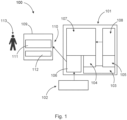
- FIG. 1 shows a schematic illustration of an example system 100 for metering.
- the system 100 comprises a computer unit 101 and a metering device 102.
- the computer unit 100 comprises hardware resources 103.
- the hardware resources 103 may comprise a central processing unit (CPU), a memory, a graphic card, a mainboard, an interface.
- the computer unit 100 is configured to virtualize these hardware lives 103 to a first group 104 and a second group 105.
- the computer unit is further configured to execute metering software 107 of the metering device 102 in the first group 104 and non-metering software 108 in the second group 105.
- the computer unit may 101 may further be configured to generate a display composition 110 for metering data 111 and none metering data 112 on a screen 109.
- the system may comprise a screen 109 for displaying metering data 111 and metering data 112.
- the computer unit 101 may execute software for generating the display composition in the first group.
- the computer unit may further be configured to provide an software interface for data exchange between the non metering software 108 and the screen 109.
- the software interface may be executed in the first group.
- the first group 104 may be responsible for displaying the non-metering data on the screen 109.
- the first group respectively the metering software executed in the first group is configured to control the software interface for data exchange with the second group.
- the displaying of non metering data on the screen by means of the first group may also be called display remoting.
- the computer unit 101 may further comprise an exclusive hardware interface 106.
- the exclusive hardware interface 106 is used to connect the metering device 102 and the computer unit 101.
- the exclusive hardware interface 106 may be a serial port.
- the exclusive hardware interface 106 may be controlled by the first group 104.
- the metering device may be in the present example an energy meter used to measure an energy consumption in a charging station for electric vehicles (not shown).
- a user 113 may interact with the screen 109, in particular with the non metering data 112 by means of an user interface. The user 113 is not able to amend the metering data 111.
- Figure 2 shows three different schematic level representations of the computer unit of an example system for metering.
- the first schematic level representation 200 comprises as lowest level a ROM level 201 that relates to the hardware lives of the computer unit.
- the next level relates to a bootloader level 202 that relates to the software is executed in a start up phase.
- the third level 203 relates to the virtualization of the hardware lives 201.
- the third level comprises an operating system 204 for executing the non metering software 206 and a trusted execution environment 205 for executing the metering software 207.
- the forth level comprises in the present example the application level of the metering software 207 and the non metering software 206.
- the second schematic level representation 300 comprises again as lowest level a ROM level 301 that relates to the hardware lives of the computer unit.
- the next level relates to a bootloader level 302 that relates to the software executed in a start up phase.
- the third level 303 relates to the virtualization of the hardware lives 301.
- a hyper visor 303 generates two virtual machines for an operating system 304 for executing the non metering software and an operating system 305 for executing the metering software depicted in the fourth level 306.
- the fifth level 307 comprises in the present example the application level of the metering software 308 and the non metering software 309.
- the third schematic level representation 400 comprises again as lowest level a ROM level 401 that relates to the hardware lives of the computer unit.
- the next level relates to a bootloader level 402.
- the third level relates to an operating system level 403.
- the fourth level relates to a container level 404 that provides for each of the first group and second group containers that are isolated from each other.
- the application level, metering software 405 is executed in a container and non metering software 406 is executed in a different container.
- FIG. 3 shows a charging station 500 for electrical vehicels.
- the charging station 500 comprises an electrical charger 501 for electrical vehicles and a system for metering 502 as described above.
- the invention proposes to virtualize hardware resources in order to execute metering software and non metering software in virtual environments separated from each other. Hence, it is possible to update the non metering software without interfering with the metering software. This may be advantageous in terms of cost savings as no further hardware is needed due to the virtualization. This may be advantageous in terms of efficiency as no further cerfication of the metering software is required.
- Measurement components can be parts of larger systems, e.g., an active energy meter can be a part of a charging station for electric vehicles. Depending on the use of the system, the measurement component may have to be certified to fulfill legal requirements. Non-metering components may require frequent updates of their software, while legally relevant parts of the system may be changed infrequently since changes would often require a re-certification.
- metering SW and other, non-metering software may be run on the same processing unit, sharing processing resources (e.g., CPU, memory) and based on the same execution infrastructure (e.g., ROM, bootloaders, hypervisors, OS kernel, user space initialization, container runtimes).
- processing resources e.g., CPU, memory
- execution infrastructure e.g., ROM, bootloaders, hypervisors, OS kernel, user space initialization, container runtimes.
- the legally relevant metering software may be isolated from the non metering software, so that the non-metering SW cannot interfere with the metering functionality, using resource protection features of e.g., an operating system, hypervisor, Linux containers or trusted execution enclave.
- the legally relevant metering SW may be connected to and in control of a display that can display both legally relevant metering information and other information.
- Hardware virtualization technologies may be used to share resources between metering components and non-metering components.
- the hardware virtualization techniques can be e.g., hypervisors, containers, or Trusted Executions Environments (TEEs, e.g., TrustZone based secure execution environments).
- TEEs Trusted Executions Environments
- the respective hardware virtualization technology may provide the needed isolation between the components at run-time, and may enforce the needed restrictions to device access for components and may allow for the needed interaction between components.
- Resources that may be shared between legally relevant metering components and non-metering components may be exclusively controlled by the legally relevant component with a restricted and controlled interface offered to non-metering components.
- Secure boot may be used to guarantee the integrity of the metering software and configuration at load-time, i.e., a chain of trust from bootloader into the user space containing metering component software and configuration may be established.
- Both legally relevant (LR) metering and non-LR components may run on (virtual) compute environments (CE), e.g., processes, containers, hypervisor guests.
- Hardware resources may be virtualized and shared between LR and non-LR components, e.g., as virtual memory, virtual CPU, virtual machine (hypervisor) or other (TEE). Isolation between the compute environments at run-time may be enforced by e.g., CPU rings/privilege and exception levels, MMUs, TrustZone HW.
- Metering HW may be accessible only from the CE of the LR SW, e.g., LR equipment connected through serial ports, network interfaces, USB (Universal Serial Bus), CAN (Control Area Network), or other.
- LR SW e.g., LR equipment connected through serial ports, network interfaces, USB (Universal Serial Bus), CAN (Control Area Network), or other.
- USB Universal Serial Bus
- CAN Control Area Network
- Display hardware may accessible from an LR component only. Access to the display for other components may be possible through defined interfaces of the LR component only, display composition is done by the LR component.
- the LR software may offer an interface to the non-LR SW through e.g., a socket, using e.g., a display server protocol (X11, Way-land) or web technologies.
- a display server protocol X11, Way-land
- the display composition inside the LR SW may ensure that LR information shown may always be on top and clearly distinguishable from non-LR information.
- secure boot may be used to ensure the integrity of the execution infrastructure (EI), i.e., the integrity of all the components in the boot chain up to the TEE, hypervisor, or OS kernel/parameters/device tree.
- EI execution infrastructure
- the integrity measurements may extend into user-space using OS integrity measurement features.
- Evidence of the integrity of the LR components can be shown on the display at device/system startup. Changes to the LR components can be logged inside the trusted execution infrastructure.
- a failed integrity check of the execution infrastructure can lead to disabling of the device or the operation without legal metering.
- a failed integrity check of a LR component can lead to disabling of the device, operation without legal metering or operation with limited legal metering features.
Landscapes
- Engineering & Computer Science (AREA)
- Theoretical Computer Science (AREA)
- Software Systems (AREA)
- Computer Security & Cryptography (AREA)
- General Engineering & Computer Science (AREA)
- General Physics & Mathematics (AREA)
- Physics & Mathematics (AREA)
- Health & Medical Sciences (AREA)
- Computer Hardware Design (AREA)
- Business, Economics & Management (AREA)
- General Health & Medical Sciences (AREA)
- Economics (AREA)
- Computer Networks & Wireless Communication (AREA)
- Tourism & Hospitality (AREA)
- General Business, Economics & Management (AREA)
- Strategic Management (AREA)
- Primary Health Care (AREA)
- Computing Systems (AREA)
- Medical Informatics (AREA)
- Signal Processing (AREA)
- Marketing (AREA)
- Human Resources & Organizations (AREA)
- Water Supply & Treatment (AREA)
- Public Health (AREA)
- Remote Monitoring And Control Of Power-Distribution Networks (AREA)
Abstract
Description
- The present invention relates to a system for metering and to a charging system for electrical vehicles.
- Systems for metering are widely used and well known in the state-of-the-art. There are for example systems for metering our current consumption or more general an energy consumption. Such systems may have to be certified. This may be a challenge over a lifetime of such systems.
- It has now become apparent that there is a further need to provide a system for metering.
- In view of the above, it is an object of the present invention to provide a system for metering, in particular it is an object of the present invention to provide an improved system for metering. These and other objects, which become apparent upon reading the following description, are solved by the subject matter of the independent claims. The dependent claims refer to preferred embodiments of the invention.
- In one aspect of the present disclosure, a system for metering is provided, comprising: a metering device for metering;
- a computer unit configured to provide a virtualization of its hardware ressources to a first group and to a second group;
- the computer unit further configured to execute metering software for the metering device on the first group and non metering software on the second group such that the non metering software cannot interfere with the metering software.
- In an embodiment, the virtualization may comprise a trusted execution environment for the first group.
- In an embodiment, the virtualization may be based on a hyper visor.
- In an embodiment, the virtualization may be based on container technology.
- In an embodiment, the system may further comprise an exclusive interface for connecting the metering device with the computer unit, and wherein the metering device and the computer unit may be connected by the exclusive interface.
- In an embodiment, the system may further comprise a screen for displaying metering data and non metering data.
- In an embodiment, the computer unit may further be configured to generate a display composition for metering data and non metering data on a screen, and wherein a software for generating the display composition may be executed in the first group.
- In an embodiment, the computer unit may be configured to provide an software interface for data exchange between the non metering software and the screen, wherein the software interface may be executed in the first group.
- In an embodiment, the computer unit may be configured to provide an access to the metering device exclusively via the metering software.
- In an embodiment, the metering device may be an energy meter.
- In an embodiment, the system may be configured to be booted by secure boot.
- In an embodiment, the system may be provided,
- wherein the system may be configured to provide an integrity check in a start-up phase; and/or
- wherein an integrity of the metering software may be ensured using OS kernel integrity measurement features; and/or
- wherein a proof of an integrity of the metering SW may be shown on the screen; and/or
- wherein an integrity of the metering software can be proven to remote observers using remote attestation; and/or
- wherein integrity measurements of the integrity check may be logged inside the first group; and/or
- wherein a failed integrity check may lead to disabling the metering device or to an operation of the system without metering or to an operation of the sytem with limited metering functionality.
- In an embodiment, the first group and the second group may be isolated by at least one of the following: CPU rings/privilege, exception level, memory management unit (MMU), TrustZone hardware (HW).
- A further aspect of the present disclosure relates to a charging station for electrical vehicles, comprising a system as described above and below.
- A further aspect of the present disclosure relates to the use of a system as described above and below in a charging station.
- A last aspect of the present disclosure relates to a use of a system described above in a charging station.
- The term system for metering, as used herein, has to be understood broadly and may relate to any system that comprises a metering device. The system may comprise for example an energy meter, a pressure meter, a current meter, a voltage meter, a weight meter. However, the system is not limited to these examples. The system may comprise further entities such an user interface, a power supply, a control unit, a screen.
- The metering device, as used herein, is to be understood broadly and may relate to any device that is configured to measure a physical value, e.g. current, voltage, energy, weight, pressure. The metering device may comprise an interface to exchange data to a computer unit that is part of the system for metering. The metering device may comprise a power supply, an internal control unit and a measurement sensor.
- The term computer unit, as used herein, is to be understood broadly and may relate to any logic that is configured to process data from a metering device and to output a result (e.g. processed measurement result: consumed energy). The computer unit may comprise hardware ressources (i.e. hardware components), such as a mainboard, storages means (e.g. RAM, ROM, disk drive, NAND flash etc.), a central processing unit, a graphic card, one or more interfaces etc. The computer unit may be configured to execute software. The computer unit may comprise software to execute the system, such as a bootloader and an operating system (OS). The computer unit may be configured to execute metering software and non metering software.
- The term virtualization, as used herein, is to be understood broadly and may relate to the process of running a virtual instance of a computer system in a layer abstracted from the actual hardware. It may refer to running multiple operating systems on a computer system simultaneously. Virtualization may offer the ability to run different operating systems. Virtualization may offer a way to segment a large system into many smaller parts, allowing a server to be used more efficiently by a number of different users or applications with different needs. Virtualization may allow for isolation, keeping programs running inside of a virtual machine safe from the processes taking place in another virtual machine on the same host. This may be advantageous in terms of efficiency and safety.
- The terms first group and second group, as used herein, are to be understood broadly and relate to a division of the hardware resources in a first part and a second part by means of the virtualization. In other words, the first group and second group relate virtual instances of the hardware resources. However, the system may further be configured to provide a virtualization to a further group.
- The term metering software, as used herein, is to be understood broadly and may relate to any software that is crucial for executing the metering device and processing measurement data (i.e. metering data). The metering software may comprise applications to filter raw data of the measuremts. The metering software may comprise applications to calucate measurement values based on the filtered raw data. The metering software may relate to any software that is legally relevant for the metering. The legally relevant software in general may have to be certified by official organisations (e.g. bureau of standards). In case, an update of the system is required, such metering software may have to be certified again in case it is amended.
- The term non metering software, as used herein, is to be understood broadly and may relate to any software that is not crucial for executing the metering device and processing measurement data. The non metering software doesn't have to be certified by official organizations.
- The term cannot interfere, as used herein, means that the non metering software is not able to amend the metering software in any way. The metering software and the non metering software are executed in virtual instances (i.e. first group and second group) that are isolated from each other.
- The term trusted execution environment (TEE), as used herein, relates to an isolated processing environment in wich applications can be securely executed irrespective of the rest the system. A trusted execution environment may be a secure area of a main processor. It may help code and data loaded inside it to be protected with respect to confidentiality and integrity. Data integrity may prevent unauthorized entities from outside the TEE from altering data, while code integrity prevents code in the TEE from being replaced or modified by unauthorized entities. A TEE as an isolated execution environment provides security features such as isolated execution, integrity of applications executing with the TEE, along with confidentiality of their assets. In general terms, the TEE offers an execution space that may provide a higher level of security for trusted applications running on the device than a rich operating system and more functionality than a secure element. In the present disclosure, metering software may be executed in the TEE and non metering software may executed in the operating system of the computer unit.
- The term hyper visor, as used herein, may relate to a program for creating and running virtual machines. A virtual machine is an emulated equivalent of a computer system that runs on top of another system. Virtual machines may be based on computer architectures and provide the functionality of a physical computer. In the present disclosure, for the first group a first virtual machine may be generated and may serve as an operating system for the metering software and for the second group a second virtual machine may be generated and may serve as an operating system for the non metering software.
- The term container technology, as used herein, is to be understood broadly and may relate to the use of so called containers. Container in general may contain applications in a way that keeps them isolated from the host system that they run on. In a way, containers may behave like a virtual machine. To the outside world, they can look like their own complete system. But unlike a virtual machine, rather than creating a whole virtual operating system, containers don't need to replicate an entire operating system, only the individual components they need in order to operate. This may give a significant performance boost and may reduce the size of the application. They may also operate much faster, as unlike traditional virtualization the process is essentially running natively on its host, just with an additional layer of protection around it. In the present disclosure, different containers may be generated for the first group and the second group to execute the metering software and and the non metering software. The containers run on the operating system of the computer unit.
- The term exclusive interface, as used herein, is to be understood broadly and may relate to an interface that is exclusively controlled by the metering software in the first group of the computer unit. The exclusive interface may comprise one of the following:
a serial port, a network interface, USB (Universal Serial Bus), CAN (Control Area Network), or other. - The term screen, as used herein, is to be understood broadly and relates to any hardware display configured to present data (metering data and non metering data). The screen may preferably be controlled by the metering software executed in the first group.
- The term display composition, as used herein, is to be understood broadly and may relate an arrangement of information on a screen. The display composition may further relate to an underlying data transmission.
- The term software interface, used herein, is to be understood broadly and may relate to an interface configured to exchange data. The software interface may be controlled by the first group respectively the metering software executed in the first group or another software executed in the first group.
- The energy meter, as used herein, is to be understood broadly and may relate to a device configured to measure an energy consumption (e.g. energy consumption of an electrical vehicle charger).
- The term secure boot, as used herein, is to be understood broadly and may relate to a security feature configured to prevent malicious software from loading when the system starts up (boots).
- The term integrity check, as used herein, is to be understood broadly and may relate to any check whether data is real and/or safeguarded from unauthorized modification. The integrity check may be carried out in the start-up phase and therefor relate to the boot process of the system (including the metering software and any hardware of the metering device) and corresponding software (e.g. operation system software). The integrity check may be performed for metering software and/or all components (hardware and software) involved in the start up phase. The integrity check may lead to an integrity result (failed integrity check or passed integrity check). During an integrity check measurement data may be logged for documentation. The integrity check may be executed in the first group and for the software executed in the first group and for the underlying hardware of the system and corresponding software in lower layers.
- The term OS kernel integrity measurement features, as used herein, is to be understood broadly and may relate any features of operating systems that measure and appraise integrity of files, e.g., the Linux Integrity Measuremnt Architecture.
- The term proof, as used herein, is to be understood broadly and may relate to any information configured to describe a result of an executed integrity check.
- The term remote attestation, as used herein, is to be understood broadly and may relate to a security mechanism that allows remote observers to check or view a proof of integrity, e.g., using a TPM and PCRs or other roots of trust and integrity measurement means.
- The term integrity measurement, as used herein, is to be understood broadly and may relate to any intermediate result or end result of an executed integritity check and corresponding produced integrity check data.
- The term CPU ring/privilege, as used herein, is to be understood broadly and may relate to structural layers that limit interaction between installed applications on a computer (or on virtualized ressources) and core processes. In the present disclosure the CPU ring/privilege are used for the metering software in the first group and the non metering software in the second group.
- The term exception level, as used herein, is to be understood broadly and may relate to a specific condition which comprises specific privileges to control system register accessability and instruction availability. There may exist a plurality of different exceptions levels for the first group and the second group of the system and their respective metering software and non metering software.
- The term MMU, as used herein, is to be understood broadly and may relate to any hardware component that manages physical computer memory and provides isolated virtual memory spaces to different applications of a system.
- The term TrustZone, as used herein, is to be understood broadly and may relate to a hardware mechanism implemented in the system that breaks the execution environment into secure and non-secure memory, peripherals, and functions.
- The charging station, as used herein, is to be understood broadly and may relate to any station configured to charge an electrical vehicle. The charging station may comprise a power supply and means for connecting and transmission of electrical energy to an electrical vehicle. The system described above may comprise an energy meter when used in the charging station.
- Any disclosure and embodiments described herein relate to the methods, the systems, the devices, the computer program element lined out above and vice versa. Advantageously, the benefits provided by any of the embodiments and examples equally apply to all other embodiments and examples and vice versa.
- In the following, the present disclosure is described exemplarily with reference to the enclosed figures, in which
- Figure 1
- shows a schematic illustration of an example system for metering; and
- Figure 2
- shows a schematic illustrations of a part of an example system for metering;
- Figure 3
- shows a schematic illustration of an example charging station for electrical vehicles.
-
Figure 1 shows a schematic illustration of anexample system 100 for metering. Thesystem 100 comprises acomputer unit 101 and ametering device 102. Thecomputer unit 100 compriseshardware resources 103. Thehardware resources 103 may comprise a central processing unit (CPU), a memory, a graphic card, a mainboard, an interface. Thecomputer unit 100 is configured to virtualize these hardware ressources 103 to afirst group 104 and asecond group 105. The computer unit is further configured to executemetering software 107 of themetering device 102 in thefirst group 104 andnon-metering software 108 in thesecond group 105. The computer unit may 101 may further be configured to generate adisplay composition 110 formetering data 111 andnone metering data 112 on ascreen 109. The system may comprise ascreen 109 for displayingmetering data 111 andmetering data 112. Thecomputer unit 101 may execute software for generating the display composition in the first group. The computer unit may further be configured to provide an software interface for data exchange between thenon metering software 108 and thescreen 109. The software interface may be executed in the first group. In other words, thefirst group 104 may be responsible for displaying the non-metering data on thescreen 109. The first group respectively the metering software executed in the first group is configured to control the software interface for data exchange with the second group. The displaying of non metering data on the screen by means of the first group may also be called display remoting. Thecomputer unit 101 may further comprise anexclusive hardware interface 106. Theexclusive hardware interface 106 is used to connect themetering device 102 and thecomputer unit 101. Theexclusive hardware interface 106 may be a serial port. Theexclusive hardware interface 106 may be controlled by thefirst group 104. The metering device may be in the present example an energy meter used to measure an energy consumption in a charging station for electric vehicles (not shown). Auser 113 may interact with thescreen 109, in particular with thenon metering data 112 by means of an user interface. Theuser 113 is not able to amend themetering data 111. -
Figure 2 shows three different schematic level representations of the computer unit of an example system for metering. - The first
schematic level representation 200 comprises as lowest level aROM level 201 that relates to the hardware ressources of the computer unit. The next level relates to abootloader level 202 that relates to the software is executed in a start up phase. Thethird level 203 relates to the virtualization of thehardware ressources 201. In the present example the third level comprises anoperating system 204 for executing thenon metering software 206 and a trustedexecution environment 205 for executing themetering software 207. The forth level comprises in the present example the application level of themetering software 207 and thenon metering software 206. - The second
schematic level representation 300 comprises again as lowest level aROM level 301 that relates to the hardware ressources of the computer unit. The next level relates to abootloader level 302 that relates to the software executed in a start up phase. Thethird level 303 relates to the virtualization of thehardware ressources 301. In the present example ahyper visor 303 generates two virtual machines for anoperating system 304 for executing the non metering software and anoperating system 305 for executing the metering software depicted in thefourth level 306. Thefifth level 307 comprises in the present example the application level of themetering software 308 and thenon metering software 309. - The third
schematic level representation 400 comprises again as lowest level aROM level 401 that relates to the hardware ressources of the computer unit. The next level relates to abootloader level 402. The third level relates to anoperating system level 403. The fourth level relates to acontainer level 404 that provides for each of the first group and second group containers that are isolated from each other. In thefifth level 407, the application level,metering software 405 is executed in a container andnon metering software 406 is executed in a different container. -
Figure 3 shows a chargingstation 500 for electrical vehicels. The chargingstation 500 comprises anelectrical charger 501 for electrical vehicles and a system formetering 502 as described above. - In the following, a summary of the main effects and main advantages of the present disclosure is provided:
- The invention proposes to virtualize hardware resources in order to execute metering software and non metering software in virtual environments separated from each other. Hence, it is possible to update the non metering software without interfering with the metering software. This may be advantageous in terms of cost savings as no further hardware is needed due to the virtualization. This may be advantageous in terms of efficiency as no further cerfication of the metering software is required.
- Measurement components can be parts of larger systems, e.g., an active energy meter can be a part of a charging station for electric vehicles. Depending on the use of the system, the measurement component may have to be certified to fulfill legal requirements. Non-metering components may require frequent updates of their software, while legally relevant parts of the system may be changed infrequently since changes would often require a re-certification.
- Physically separating the legally relevant metering components from other parts of the system, e.g., by running them on separate computers, is a common solution to the problem.
- In the solution described here, legally relevant metering software and other, non-metering software may be run on the same processing unit, sharing processing resources, the execution infrastructure and peripherals. This may advantageously lead to a less need of hardware, a simplified system, and an improved user experience.
- In the solution described here, legally relevant metering SW and other, non-metering software may be run on the same processing unit,
sharing processing resources (e.g., CPU, memory) and based on the same execution infrastructure (e.g., ROM, bootloaders, hypervisors, OS kernel, user space initialization, container runtimes). - The legally relevant metering software may be isolated from the non metering software, so that the non-metering SW cannot interfere with the metering functionality, using resource protection features of e.g., an operating system, hypervisor, Linux containers or trusted execution enclave. The legally relevant metering SW may be connected to and in control of a display that can display both legally relevant metering information and other information.
- Hardware virtualization technologies may be used to share resources between metering components and non-metering components.
- The hardware virtualization techniques can be e.g., hypervisors, containers, or Trusted Executions Environments (TEEs, e.g., TrustZone based secure execution environments).
- The respective hardware virtualization technology may provide the needed isolation between the components at run-time, and may enforce the needed restrictions to device access for components and may allow for the needed interaction between components.
- Resources that may be shared between legally relevant metering components and non-metering components may be exclusively controlled by the legally relevant component with a restricted and controlled interface offered to non-metering components.
- Secure boot may be used to guarantee the integrity of the metering software and configuration at load-time, i.e., a chain of trust from bootloader into the user space containing metering component software and configuration may be established.
- Both legally relevant (LR) metering and non-LR components may run on (virtual) compute environments (CE), e.g., processes, containers, hypervisor guests. Hardware resources may be virtualized and shared between LR and non-LR components, e.g., as virtual memory, virtual CPU, virtual machine (hypervisor) or other (TEE). Isolation between the compute environments at run-time may be enforced by e.g., CPU rings/privilege and exception levels, MMUs, TrustZone HW.
- Metering HW may be accessible only from the CE of the LR SW, e.g., LR equipment connected through serial ports, network interfaces, USB (Universal Serial Bus), CAN (Control Area Network), or other.
- Display hardware may accessible from an LR component only. Access to the display for other components may be possible through defined interfaces of the LR component only, display composition is done by the LR component.
- The LR software may offer an interface to the non-LR SW through e.g., a socket, using e.g., a display server protocol (X11, Way-land) or web technologies. The display composition inside the LR SW may ensure that LR information shown may always be on top and clearly distinguishable from non-LR information.
- At load-time, secure boot may be used to ensure the integrity of the execution infrastructure (EI), i.e., the integrity of all the components in the boot chain up to the TEE, hypervisor, or OS kernel/parameters/device tree. In a container based implementation, the integrity measurements may extend into user-space using OS integrity measurement features.
- Evidence of the integrity of the LR components (e.g., a cryptographic hash of code and configuration), can be shown on the display at device/system startup. Changes to the LR components can be logged inside the trusted execution infrastructure.
- A failed integrity check of the execution infrastructure can lead to disabling of the device or the operation without legal metering. A failed integrity check of a LR component can lead to disabling of the device, operation without legal metering or operation with limited legal metering features.
-
- 100, 502
- system
- 101
- computer unit
- 102
- metering device
- 103
- hardware ressources
- 104
- first group
- 105
- second group
- 106
- interface
- 107
- metering software
- 108
- non metering software
- 109
- screen
- 110
- display composition
- 111
- metering data
- 112
- non metering data
- 113
- user
- 200, 300, 400
- schematic level representation
- 201, 301, 401
- ROM level
- 202, 302, 402
- bootloader level
- 203, 303
- virtualization level
- 204
- operating system
- 205
- trusted execution environment
- 206, 308, 406
- non metering software
- 207, 309, 405
- metering software
- 208, 307, 407
- application level
- 304
- operating system for non metering software
- 305
- operating system for metering software
- 306, 403
- operating system level
- 404
- container level
- 500
- charging station
- 501
- electrical charger
Claims (15)
- System for metering, comprising:a metering device for metering;a computer unit configured to provide a virtualization of its hardware ressources to a first group and to a second group;the computer unit further configured to execute metering software for the metering device on the first group and non metering software on the second group such that the non metering software cannot interfere with the metering software.
- System according to claim 1, wherein the virtualization comprises a trusted execution environment for the first group.
- System according to claim 1 or 2, wherein the virtualization is based on a hyper visor.
- System according to any one of the preceding claims, wherein the virtualization is based on container technology.
- System according to any one of the preceding claims, further comprising an exclusive interface for connecting the metering device with the computer unit, and wherein the metering device and the computer unit are connected by the exclusive interface.
- System according to any one of the preceding claims, further comprising a screen for displaying metering data and non metering data.
- System according to claim 6, wherein the computer unit is further configured to generate a display composition for metering data and non metering data on the screen, and wherein a software for generating the display composition is executed in the first group.
- System according to claim 7, wherein the computer unit is configured to provide an software interface for data exchange between the non metering software and the screen, wherein the software interface is executed in the first group.
- System according to any one of the preceding claims, wherein the computer unit is configured to provide an access to the metering device exclusively via the metering software.
- System according to any one of the preceding claims, wherein the metering device is an energy meter.
- System according to any preceding claims, wherein the system is configured to be booted by secure boot.
- System according to any one of the preceding claims,wherein the system is configured to provide an integrity check in a start-up phase; and/orwherein an integrity of the metering software is ensured using OS kernel integrity measurement features; and/orwherein a proof of the integrity of the metering SW is shown on a screen; and/orwherein the integrity of the metering software can be proven to remote observers using remote attestation; and/orwherein integrity measurements of the integrity check are logged inside the first group; and/orwherein a failed integrity check leads to disabling the metering device or to an operation of the system without metering or to an operation of the sytem with limited metering functionality.
- System according to any one of the preceding claims, wherein the first group and the second group are isolated by at least one of the following: CPU rings/privilege, exception level, memory management unit (MMU), TrustZone hardware (HW).
- Charging station for electrical vehicles, comprising a system according to any one of the claims 1 to 13.
- Use of a system according to any one of the claims 1 to 13 in a charging station.
Priority Applications (1)
| Application Number | Priority Date | Filing Date | Title |
|---|---|---|---|
| EP23186502.3A EP4495813A1 (en) | 2023-07-19 | 2023-07-19 | System for metering |
Applications Claiming Priority (1)
| Application Number | Priority Date | Filing Date | Title |
|---|---|---|---|
| EP23186502.3A EP4495813A1 (en) | 2023-07-19 | 2023-07-19 | System for metering |
Publications (1)
| Publication Number | Publication Date |
|---|---|
| EP4495813A1 true EP4495813A1 (en) | 2025-01-22 |
Family
ID=87426927
Family Applications (1)
| Application Number | Title | Priority Date | Filing Date |
|---|---|---|---|
| EP23186502.3A Pending EP4495813A1 (en) | 2023-07-19 | 2023-07-19 | System for metering |
Country Status (1)
| Country | Link |
|---|---|
| EP (1) | EP4495813A1 (en) |
Citations (2)
| Publication number | Priority date | Publication date | Assignee | Title |
|---|---|---|---|---|
| US20200380619A1 (en) * | 2019-05-31 | 2020-12-03 | Landis+Gyr Innovations, Inc. | Utility meter supporting a remote display |
| CN114584614A (en) * | 2022-01-17 | 2022-06-03 | 北京智芯微电子科技有限公司 | Information interaction method used between intelligent terminal and acquisition terminal |
-
2023
- 2023-07-19 EP EP23186502.3A patent/EP4495813A1/en active Pending
Patent Citations (2)
| Publication number | Priority date | Publication date | Assignee | Title |
|---|---|---|---|---|
| US20200380619A1 (en) * | 2019-05-31 | 2020-12-03 | Landis+Gyr Innovations, Inc. | Utility meter supporting a remote display |
| CN114584614A (en) * | 2022-01-17 | 2022-06-03 | 北京智芯微电子科技有限公司 | Information interaction method used between intelligent terminal and acquisition terminal |
Non-Patent Citations (1)
| Title |
|---|
| HARTIG HERMANN ET AL: "Lateral Thinking for Trustworthy Apps", PROCEEDINGS OF THE INTERNATIONAL CONFERENCE ON DISTRIBUTED COMPUTING SYSTEMS, IEEE COMPUTER SOCIETY, US, 5 June 2017 (2017-06-05), pages 1890 - 1899, XP033123095, ISSN: 1063-6927, [retrieved on 20170713], DOI: 10.1109/ICDCS.2017.29 * |
Similar Documents
| Publication | Publication Date | Title |
|---|---|---|
| Pinto et al. | Demystifying arm trustzone: A comprehensive survey | |
| EP3619605B1 (en) | Securing virtual execution environments | |
| Li et al. | Twinvisor: Hardware-isolated confidential virtual machines for arm | |
| Zhang et al. | Cloudvisor: retrofitting protection of virtual machines in multi-tenant cloud with nested virtualization | |
| US9372984B2 (en) | Authenticated launch of virtual machines and nested virtual machine managers | |
| KR20200036732A (en) | Technologies for fast launch of trusted containers | |
| US8151264B2 (en) | Injecting virtualization events in a layered virtualization architecture | |
| US20100262722A1 (en) | Dynamic Assignment of Graphics Processing Unit to a Virtual Machine | |
| Yu et al. | Trusted display on untrusted commodity platforms | |
| Moratelli et al. | Embedded virtualization for the design of secure IoT applications | |
| US12511141B2 (en) | System and methods for Input/Output device emulation | |
| CN114490450A (en) | Configuration method of address translation relationship and computer system | |
| Wan et al. | Building trust into cloud computing using virtualization of TPM | |
| Blazevic et al. | Teevsel4: Trusted execution environment for virtualized sel4-based systems | |
| Zhao et al. | Sok: Hardware security support for trustworthy execution | |
| NL2039172B1 (en) | High-throughput confidential computing method and system based on risc-v architecture | |
| Parkinson | Safety, security and multicore | |
| Sinha et al. | A paravirtualized android for next generation interactive automotive systems | |
| Ushakov et al. | Trusted hart for mobile RISC-V security | |
| Zaki | An embedded multi-core platform for mixed-criticality systems: Study and analysis of virtualization techniques | |
| Schönstedt et al. | Safetee: Combining safety and security on arm-based microcontrollers | |
| de Matos et al. | Towards seL4 for Enhanced System Isolation and Security on Embedded Devices | |
| Kim | Architectural design on hypervisor-based guest oss and safetyrtos in automotive platform | |
| Aguiar et al. | Virtual hellfire hypervisor: Extending hellfire framework for embedded virtualization support | |
| Lie et al. | Using hypervisors to secure commodity operating systems |
Legal Events
| Date | Code | Title | Description |
|---|---|---|---|
| PUAI | Public reference made under article 153(3) epc to a published international application that has entered the european phase |
Free format text: ORIGINAL CODE: 0009012 |
|
| STAA | Information on the status of an ep patent application or granted ep patent |
Free format text: STATUS: THE APPLICATION HAS BEEN PUBLISHED |
|
| AK | Designated contracting states |
Kind code of ref document: A1 Designated state(s): AL AT BE BG CH CY CZ DE DK EE ES FI FR GB GR HR HU IE IS IT LI LT LU LV MC ME MK MT NL NO PL PT RO RS SE SI SK SM TR |
|
| STAA | Information on the status of an ep patent application or granted ep patent |
Free format text: STATUS: REQUEST FOR EXAMINATION WAS MADE |
|
| 17P | Request for examination filed |
Effective date: 20250715 |
|
| STAA | Information on the status of an ep patent application or granted ep patent |
Free format text: STATUS: EXAMINATION IS IN PROGRESS |
|
| 17Q | First examination report despatched |
Effective date: 20260112 |