EP4495721A1 - Data analysis system, data analysis device, data analysis method, and computer program - Google Patents
Data analysis system, data analysis device, data analysis method, and computer program Download PDFInfo
- Publication number
- EP4495721A1 EP4495721A1 EP23770536.3A EP23770536A EP4495721A1 EP 4495721 A1 EP4495721 A1 EP 4495721A1 EP 23770536 A EP23770536 A EP 23770536A EP 4495721 A1 EP4495721 A1 EP 4495721A1
- Authority
- EP
- European Patent Office
- Prior art keywords
- data
- concealed
- product
- influence
- conversion device
- Prior art date
- Legal status (The legal status is an assumption and is not a legal conclusion. Google has not performed a legal analysis and makes no representation as to the accuracy of the status listed.)
- Pending
Links
Images






Classifications
-
- G—PHYSICS
- G05—CONTROLLING; REGULATING
- G05B—CONTROL OR REGULATING SYSTEMS IN GENERAL; FUNCTIONAL ELEMENTS OF SUCH SYSTEMS; MONITORING OR TESTING ARRANGEMENTS FOR SUCH SYSTEMS OR ELEMENTS
- G05B13/00—Adaptive control systems, i.e. systems automatically adjusting themselves to have a performance which is optimum according to some preassigned criterion
- G05B13/02—Adaptive control systems, i.e. systems automatically adjusting themselves to have a performance which is optimum according to some preassigned criterion electric
- G05B13/04—Adaptive control systems, i.e. systems automatically adjusting themselves to have a performance which is optimum according to some preassigned criterion electric involving the use of models or simulators
- G05B13/042—Adaptive control systems, i.e. systems automatically adjusting themselves to have a performance which is optimum according to some preassigned criterion electric involving the use of models or simulators in which a parameter or coefficient is automatically adjusted to optimise the performance
-
- G—PHYSICS
- G06—COMPUTING OR CALCULATING; COUNTING
- G06F—ELECTRIC DIGITAL DATA PROCESSING
- G06F21/00—Security arrangements for protecting computers, components thereof, programs or data against unauthorised activity
- G06F21/60—Protecting data
- G06F21/62—Protecting access to data via a platform, e.g. using keys or access control rules
- G06F21/6218—Protecting access to data via a platform, e.g. using keys or access control rules to a system of files or objects, e.g. local or distributed file system or database
- G06F21/6245—Protecting personal data, e.g. for financial or medical purposes
- G06F21/6254—Protecting personal data, e.g. for financial or medical purposes by anonymising data, e.g. decorrelating personal data from the owner's identification
-
- G—PHYSICS
- G05—CONTROLLING; REGULATING
- G05B—CONTROL OR REGULATING SYSTEMS IN GENERAL; FUNCTIONAL ELEMENTS OF SUCH SYSTEMS; MONITORING OR TESTING ARRANGEMENTS FOR SUCH SYSTEMS OR ELEMENTS
- G05B19/00—Program-control systems
- G05B19/02—Program-control systems electric
- G05B19/418—Total factory control, i.e. centrally controlling a plurality of machines, e.g. direct or distributed numerical control [DNC], flexible manufacturing systems [FMS], integrated manufacturing systems [IMS] or computer integrated manufacturing [CIM]
-
- G—PHYSICS
- G06—COMPUTING OR CALCULATING; COUNTING
- G06Q—INFORMATION AND COMMUNICATION TECHNOLOGY [ICT] SPECIALLY ADAPTED FOR ADMINISTRATIVE, COMMERCIAL, FINANCIAL, MANAGERIAL OR SUPERVISORY PURPOSES; SYSTEMS OR METHODS SPECIALLY ADAPTED FOR ADMINISTRATIVE, COMMERCIAL, FINANCIAL, MANAGERIAL OR SUPERVISORY PURPOSES, NOT OTHERWISE PROVIDED FOR
- G06Q50/00—Information and communication technology [ICT] specially adapted for implementation of business processes of specific business sectors, e.g. utilities or tourism
- G06Q50/04—Manufacturing
-
- Y—GENERAL TAGGING OF NEW TECHNOLOGICAL DEVELOPMENTS; GENERAL TAGGING OF CROSS-SECTIONAL TECHNOLOGIES SPANNING OVER SEVERAL SECTIONS OF THE IPC; TECHNICAL SUBJECTS COVERED BY FORMER USPC CROSS-REFERENCE ART COLLECTIONS [XRACs] AND DIGESTS
- Y02—TECHNOLOGIES OR APPLICATIONS FOR MITIGATION OR ADAPTATION AGAINST CLIMATE CHANGE
- Y02P—CLIMATE CHANGE MITIGATION TECHNOLOGIES IN THE PRODUCTION OR PROCESSING OF GOODS
- Y02P90/00—Enabling technologies with a potential contribution to greenhouse gas [GHG] emissions mitigation
- Y02P90/30—Computing systems specially adapted for manufacturing
Definitions
- the present disclosure relates to a data analysis system, a data analysis device, a data analysis method, and a computer program.
- Companies may form an inter-company network when promoting business.
- Typical examples of such an inter-company network includes a supply chain.
- the supply chain includes organizations such as suppliers, assemblers, manufacturers, makers, and buyers, is a network in which procurement and shipment at the organizations are continuous, and is a network that progresses from the procurement of raw materials to the sale of final products.
- identifiers are assigned to parts in circulation, and when a defect occurs in a product downstream of the supply chain, IDs of the parts causing the defect is provided to an upstream parts maker.
- the parts maker compares the ID with data held by the parts maker to investigate the cause of the defect.
- Patent Document 1 JP2007-213506A
- the present disclosure provides a data analysis system, a data analysis device, a data analysis method, and a computer program that can identify a cause of a defect that occurs due to a complex cause across organizations.
- a data analysis system includes: a first data conversion device configured to conceal first data on a first product manufactured in a first manufacturing system and output the first data as first concealed data; and a data analysis device configured to select an element of the first concealed data that affects second data on a second product manufactured using the first product by evaluating a degree of influence between the first concealed data and the second data.
- FIG. 1 is an explanatory diagram illustrating a configuration example of a data analysis system according to Embodiment 1.
- the data analysis system according to Embodiment 1 is a system for implementing the circulation, integration, analysis, and feedback of data across a supply chain.
- a first maker M1 that manufactures a first product by procuring parts and materials from an upstream side and a second maker M2 that manufactures a second product by procuring the first product manufactured by the first maker M1 are illustrated among organizations implementing the supply chain.
- the upstream side and downstream side of the first maker M1 and the upstream side and downstream side of the second maker M1 may be provided with other organizations such as other makers, a supplier, an assembler, a manufacturer, and a buyer.
- the first maker M1 is a maker of manufacturing a semiconductor manufacturing device by procuring parts from the upstream side
- the second maker M2 is a maker of manufacturing a semiconductor device by introducing the semiconductor manufacturing device manufactured by the first maker M1.
- the first maker M1 includes a first manufacturing system 100, a first database 120, a first data conversion device 140, and a first optimization device 160.
- the first manufacturing system 100 is a system for manufacturing the first product (the semiconductor manufacturing device).
- the first product manufactured by the first manufacturing system 100 includes apparatuses such as an exposure apparatus, a resist processing apparatus, an etching apparatus, a cleaning and drying apparatus, a film forming apparatus, an ion implantation apparatus, and an inspection apparatus. Manufacturing steps include steps of procuring, storing, processing, assembling, and inspecting materials.
- the first database 120 stores data on the first product manufactured in the first manufacturing system 100.
- the data on the first product is data set or measured in the manufacturing step of the first product.
- These pieces of data may include, for example, identification information on a device serving as an output source of the data, such as a serial number assigned to each product or a device model number indicating a device type.
- the data may further include actual number information representing conditions in the manufacturing step such as temperature and pressure.
- the data may further include actual number information output from the inspection step as a manufacturing result such as a film thickness, a shape, and a characteristic value.
- the first data conversion device 140 has a function of concealing the data and a function of decoding the concealed data. For example, when the data stored in the first database 120 is provided to an outside, the first data conversion device 140 can read target data from the first database 120 and provide the read data to the outside in a concealed manner. A concealment method will be described later in detail.
- a destination to which the data is provided is, for example, an analysis device 500.
- the first data conversion device 140 decodes the acquired data and transmits the decoded data to, for example, the first optimization device 160.
- the first optimization device 160 optimizes a manufacturing parameter in the first manufacturing system 100 by referring to the data stored in the first database 120 and the data received through the first data conversion device 140.
- the second maker M2 includes a second manufacturing system 200 and a second database 220.
- the second manufacturing system 200 is a system for manufacturing the second product (the semiconductor device) and includes the semiconductor manufacturing device introduced from the first manufacturing system 100.
- the second product manufactured by the second manufacturing system 200 is a semiconductor device such as a diode, a transistor, a light-emitting device, a light-receiving device, an IC, a microcomputer, a CPU, or a memory. Manufacturing steps thereof include steps such as an exposure step, a resist step, an etching configuration, a cleaning and drying step, a film formation step, an ion implantation step, and an inspection step.
- the second database 220 stores data on the second product manufactured in the second manufacturing system 200.
- the data on the second product is data set or measured in the manufacturing step of the second product.
- These pieces of data include, for example, a serial number assigned to each product, a product model number indicating a product type, and measured values such as a current, a voltage, a temperature, pressure, and a film thickness measured in the inspection step.
- the data stored in the second database 220 is provided to the analysis device 500 without being concealed.
- the data analysis system includes the analysis device 500 that acquires data from the makers implementing the supply chain and analyzes the data across the supply chain. To perform the analysis, the analysis device 500 acquires data (first concealed data) concealed by the first data conversion device 140 for the first product manufactured in the first manufacturing system 100. The analysis device 500 acquires data (second data) provided by the second manufacturing system 200 without being concealed for the second product manufactured in the second manufacturing system 200. The analysis device 500 selects an element of the first concealed data that affects the second data by evaluating a degree of influence between the acquired first concealed data and the acquired second data and outputs a selection result.
- first concealed data concealed by the first data conversion device 140 for the first product manufactured in the first manufacturing system 100.
- the analysis device 500 acquires data (second data) provided by the second manufacturing system 200 without being concealed for the second product manufactured in the second manufacturing system 200.
- the analysis device 500 selects an element of the first concealed data that affects the second data by evaluating a degree of influence between the acquired first concealed data and the acquired second data and outputs a selection result
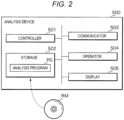
- FIG. 2 is a block diagram illustrating a configuration of the analysis device 500.
- the analysis device 500 is a dedicated or general-purpose computer such as a server computer and includes a controller 501, a storage 502, a communicator 503, an operator 504, and a display 505.
- the controller 501 includes a central processing unit (CPU), a read only memory (ROM), a random access memory (RAM), and the like.
- the ROM provided in the controller 501 stores control programs for controlling operations of the parts of the hardware.
- the CPU in the controller 501 reads and executes the control programs stored in the ROM and various computer programs stored in the storage 502 and controls the operations of the parts of the hardware to cause the entire device to function as a data analysis device of the present disclosure.
- the RAM provided in the controller 501 temporarily stores data used during the execution of an arithmetic operation.
- the controller 501 includes the CPU, the ROM, and the RAM, the configuration of the controller 501 is not limited to the above-described configuration.
- the controller 501 may be, for example, one or a plurality of control circuits or arithmetic circuits that include a graphic processing unit (GPU), a field programmable gate array (FPGA), a digital signal processor (DSP), a quantum processor, a volatile or nonvolatile memory, or the like.
- the controller 501 may include functions such as a clock for outputting date and time information, a timer for measuring the time elapsed from the time when a measurement start instruction is applied to the time when a measurement end instruction is applied, and a counter for counting the number.
- the storage 502 includes storage devices such as a hard disk drive (HDD), a solid state drive (SSD), and an electronically erasable programmable read only memory (EEPROM).
- the storage 502 stores various types of computer programs executed by the controller 501 and various data used by the controller 501.
- the computer programs stored in the storage 502 includes an analysis program PG for analyzing the data acquired from the first maker M1, the second maker M2, ...
- the analysis program PG may be a single computer program or may be implemented by a plurality of computer programs.
- the analysis program PG may partially use an existing library.
- a computer program such as the analysis program PG stored in the storage 502 is provided by a non-temporary recording medium RM in which the computer program is readably recorded.
- the recording medium RM is a portable memory such as a CD-ROM, a USB memory, a secure digital (SD) card, a micro SD card, or a compact flash (registered trademark).
- the controller 501 reads various types of computer programs from the recording medium RM using a reading device (not illustrated) and stores the read various types of computer programs in the storage 502.
- the computer program stored in the storage 502 may be provided through communication. In this case, the controller 501 may acquire the computer program through the communicator 503 and store the acquired computer program in the storage 502.
- the communicator 503 includes a communication interface for transmitting and receiving various data.
- the communication interface provided in the communicator 503 is, for example, a communication interface conforming to a communication standard of a LAN used in WiFi (registered trademark) or Ethernet (registered trademark).
- the communicator 503 transmits data to be transmitted to the designated destination.
- the communicator 503 outputs the received data to the controller 501.
- the operator 504 includes an operation device such as a touch panel, a keyboard, and a switch and receives inputs of various operations and data input by a user.
- the controller 501 performs appropriate controls based on various types of operation information supplied from the operator 504 and stores the input data in the storage 502 as necessary.
- the display 505 includes a display device such as a liquid crystal display or an organic electro-luminescence (EL) display, and displays information to be notified to the user in response to an instruction from the controller 501.
- a display device such as a liquid crystal display or an organic electro-luminescence (EL) display
- the analysis device 500 may be a single computer or may be a computer system including computers, peripheral devices, or the like.
- the analysis device 500 may be a virtual machine in which entities are virtualized, or may be a cloud.
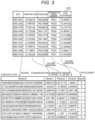
- FIG. 3 is an explanatory diagram illustrating a creation example of the concealed data.
- the first database 120 stores the data on the first product manufactured in the first manufacturing system 100.
- the data stored in the first database 120 includes data such as a serial number assigned to each product (film forming apparatus), an apparatus model number, and a temperature, a pressure, and a film thickness measured in the inspection step.
- the first database 120 illustrated in FIG. 3 as an example includes five columns (elements) including a serial number, a temperature, a pressure, an apparatus model number, and a film thickness. A state in which values obtained for each product are stored in each column is illustrated.
- the first data conversion device 140 reads target data from the first database 120 and conceals the read data. Specifically, the first data conversion device 140 conceals the data by using at least one of column name masking, column replacement, value standardization, and dimension compression.
- FIG. 3 illustrates a state in which original column names "S/N”, "temperature”, “pressure”, “apparatus model number”, and “film thickness are changed to the column names [Param0], [Param2], [Param1], [Param4], and [Param3] to mask these column names, respectively to perform the concealment.
- FIG. 3 illustrates a state in which the concealment is performed by swapping the columns of "temperature” and “pressure” and swapping the columns of "apparatus model number” and "film thickness".
- the first data conversion device 140 preferably stores a correspondence between the column names before and after the masking and a correspondence between the column names before and after the swapping.
- the example of FIG. 3 illustrates a state in which the concealment is performed by standardizing the values of each column of "temperature”, "pressure", and "film thickness".
- the first data conversion device 140 may calculate an average value and a variance for each column and standardize each value based on the calculated average value and variance.
- the first data conversion device 140 preferably stores values of the average value and variance used for the standardization.
- the data may be encoded by using a common method between the organizations. For example, among the columns illustrated in FIG. 3 , the serial number (S/N) of the product is used in common by the first maker M1 and the second maker M2. Therefore, the first data conversion device 140 may replace the serial number of the product with another character string by using a predetermined hash function. Any function can be used for the replacement as long as it is common among the organizations.
- a predetermined number or character string may be assigned. For example, among the columns illustrated in FIG. 3 , three types of values P001 to P003 are used for the apparatus model number. Therefore, the first data conversion device 140 can assign numerals of [0], [1], and [2] in an order of P001 to P003, respectively. Alternatively, a known character string such as [A], [B], and [C] may be assigned.
- the creation example of the concealed data illustrated in FIG. 3 is merely an example.
- the first data conversion device 140 may perform appropriate concealment processing according to attributes of columns prepared in the first database 120.
- the first data conversion device 140 may dimensionally compress the data stored in the first database 120 by using an algorithm such as principal component analysis or independent component analysis.
- the analysis device 500 acquires the first concealed data concealed by the first data conversion device 140 and the second data on the second product obtained in the second manufacturing system 200 and selects the element (the column) of the first concealed data that affects the second data by evaluating the degree of influence of the first concealed data and the second data.
- FIG. 4 is an explanatory diagram illustrating element selection by the analysis device 500.
- the first concealed data generated by the first data conversion device 140 will be referred to as X
- the second data generated by the second manufacturing system 200 will be referred to as Y.
- the first concealed data X is data including n elements (columns).
- n is an integer of 2 or more.
- the analysis device 500 acquires the first concealed data X from the first data conversion device 140 and acquires the second data Y from the second manufacturing system 200.
- the analysis device 500 selects an element of the first concealed data X that affects the second data Y by evaluating the degree of influence between the first concealed data X and the second data Y.
- the analysis device 500 excludes columns of X unrelated to the prediction of Y.
- the degree of influence of each element included in X on Y is evaluated to exclude elements unrelated to the prediction of Y.
- the analysis device 500 can find out an element x of X that has a strong degree of influence on Y by using a statistical method (a filtering method).
- the analysis device 500 can find out the element x of X that has a strong degree of influence on Y with a method (an incorporation method) using a machine learning model.
- a method an incorporation method
- a regression coefficient an absolute value directly represents the degree of influence if the explanatory variable X is appropriately scaled.
- a method such as Lasso (L1 regularization) may be used.
- the degree of influence can be evaluated by using an index such as the Gini coefficient in a random forest.
- An evaluation index of the degree of influence is not limited to the Gini coefficient, and an evaluation index such as a permutation feature importance, an LIME, and a SHAP may be used.
- the analysis device 500 may use a wrapper method in which a feature value is input and output and an element having a strong degree of influence is selected while checking the prediction accuracy.
- a wrapper method since a machine learning model is created many times to evaluate the degree of influence and select the feature value, the degree of influence can be evaluated with high accuracy even though it takes a long calculation time.
- the analysis device 500 selects the element p and notifies the first data conversion device 140 of information on the selected element p.
- the number of elements p selected by the analysis device 500 is not limited to one and may be plural. That is, the analysis device 500 may exclude the elements of the first concealed data X unrelated to the prediction of the second data Y and select the subset x of the first concealed data X necessary for the prediction of the second data Y.
- element selection processing between two organizations is described, and the same element selection processing can be applied to any number of organizations connected in series.
- concealed data generated in an uppermost organization is referred to as an X1
- concealed data generated in an organization downstream thereof is referred to as X2
- Xn-1 concealed data generated in an organization upstream of a lowermost organization
- Y data generated in the lowermost organization
- the analysis device 500 can select an element pn-1 of the concealed data Xn-1 that affects the data Y by evaluating a degree of influence between the concealed data Xn-1 and the data Y. Next, the analysis device 500 can identify an element pn-2 of the concealed data Xn-2 that affects the element pn-1 of the concealed data Xn-1 by evaluating a degree of influence between the concealed data Xn-2 and the concealed data Xn-1. In this way, the analysis device 500 can select the element that affects each piece of data by successively performing an analysis retrospectively from the most downstream.
- the analysis device 500 may concatenate X1, X2, ... , and Xn-1 to regard as one explanatory variable X and select a subset necessary for the prediction of the objective variable Y.
- the first data conversion device 140 stores the correspondence of element between the data before being concealed (the first data) and the data after being concealed (the first concealed data). Therefore, when the first data conversion device 140 is notified of the information on the element p from the analysis device 500, the first data conversion device 140 can identify the element of the first data that affects the second data based on the information on the element p.
- the analysis device 500 may display information on the degree of influence of each element on the display 505 in a process of selecting the element.
- FIG. 5 is a schematic diagram illustrating a display example in the analysis device 500.
- an element having larger absolute values of the coefficients a1, a2, ... an has a higher degree of influence on the data Y.
- a sign of the coefficient varies depending on whether the influence on the data Y is positive or negative.
- the analysis device 500 can display the degree of influence of each element in the drawing by drawing the degree of influence of each element in a bar graph with a horizontal axis representing the degree of influence and a vertical axis representing the element.
- FIG. 5 illustrates an example in which elements are sorted in a descending order of degree of influence.
- each element column name
- it is not possible to recognize actual column names column names before concealment.
- the analysis device 500 may notify the first data conversion device 140 of the information on the degree of influence calculated for each element and display the information on the degree of influence of each element on the first data conversion device 140.
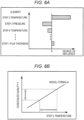
- FIGS. 6A and 6B are schematic diagrams illustrating display examples in the first data conversion device 140. Similar to the analysis device 500, the first data conversion device 140 can display the degree of influence of each element by drawing the degree of influence of each element in a bar graph with a horizontal axis representing the degree of influence and a vertical axis representing the element.
- FIG. 6A illustrates an example in which elements are sorted in a descending order of degree of influence.
- the first data conversion device 140 can present the column names before the concealment as the name of element by converting the data before concealment (the first data) and the data after concealment (the first concealed data) referring to the correspondence of element therebetween. Therefore, in the example of FIG. 6A , it can be seen that "temperature” in "step 2" has the greatest influence on the quality of the second product manufactured in the second manufacturing system 200.
- the first data conversion device 140 may display a graph illustrating a relationship between a management range of each element and a variation range of the quality Y.
- a graph illustrates a relationship between a management range of "temperature” in "step 2" and a variation range of quality.
- the variation range of quality is, for example, a value designated by the second manufacturing system 200 and notified through the analysis device 500. By reading this graph, the user can grasp how much the variation range of the quality of the second product can be controlled by changing the management range of "temperature" in "step 2".
- the first optimization device 160 optimizes the parameter in the manufacturing step of the first product by referring to the information on the element selected by the first data conversion device 140.
- FIGS. 7A and 7B are explanatory diagrams illustrating an optimization method by the first optimization device 160.
- An element xp identified by the first data conversion device 140 is a temperature T of a certain step of a certain part.
- the first optimization device 160 optimizes a management value of a temperature condition in the step.
- Y is data on the quality of the second product
- a, b, and c are coefficients that are optimized at the time of model creation.
- the first optimization device 160 determines how to set the temperature T based on the coefficients a, b, and c, and a range of Y that is desired to be implemented.
- the first optimization device 160 performs the management within a temperature range of T0 ⁇ ⁇ T in the past, and may perform the management by T0 ⁇ ⁇ T' and control the variation in quality of the second product manufactured in the second manufacturing system 200 (see FIG. 7A ). Further, the first optimization device 160 performs the management within the temperature range of T0 ⁇ ⁇ T in the past as illustrated in FIG. 7B , and may perform the management by T 1 ⁇ ⁇ T and control an offset of quality of the second product manufactured in the second manufacturing system 200 (see FIG. 7B ).
- the first optimization device 160 may change a management value of an element having the second largest influence. Further, the first optimization device 160 may change the management values of the elements.
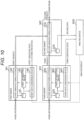
- FIG. 8 is a flowchart illustrating a procedure of processing executed in the data analysis system according to Embodiment 1.
- the first data conversion device 140 acquires the first data from the first database 120 (step S101) and conceals the acquired first data (step S102). At least one of column name masking, column swapping, value standardization, and dimension compression is used to conceal the first data.
- the first data conversion device 140 stores, in an internal memory (not illustrated), the correspondence of element between the data before being concealed (the first data) and the data after being concealed (the first concealed data).
- the first data conversion device 140 transmits the first concealed data obtained by concealing the first data to the analysis device 500 (step S103).
- the first product manufactured in the first manufacturing system is procured and the second product is manufactured.
- the second manufacturing system 200 generates the data on the second product (the second data) (step S105), stores the second data in the second database 220, and transmits the generated second data to the analysis device 500 (step S106).
- the analysis device 500 receives the first concealed data transmitted from the first data conversion device 140 (step S104) and receives the second data transmitted from the second manufacturing system 200 (step S107).
- the analysis device 500 evaluates the degree of influence between the acquired first concealed data and the second data (step S108) and selects the element of the first concealed data that affects the second data (step S109).
- the analysis device 500 can evaluate the degree of influence on the second data for each element of the first concealed data and select an element having a high degree of influence.
- the analysis device 500 notifies the first data conversion device 140 of the information on the selected element (step S110).
- the information notified to the first data conversion device 140 includes the column name of the element (column) selected by the analysis device 500. Since there is no need for the analysis device 500 to grasp the meaning of the selected element, for example, the column name in the masked state may be notified to the first data conversion device 140.
- the first data conversion device 140 receives the information on the element notified from the analysis device 500 (step S111) and decodes the received information of the element (step S112).
- the first data conversion device 140 identifies an element of the first data corresponding to the element selected by the analysis device 500 by referring to the correspondence stored in the memory (step 5113).
- the first data conversion device 140 notifies the first optimization device 160 of the information on the identified element of the first data (step S114).
- the first optimization device 160 optimizes the management value of the corresponding element based on the information notified from the first data conversion device 140 (step S115). For example, the first optimization device 160 may set a range of management value of the element based on a range of Y that is desired to be implemented for the quality Y of the second product.
- the data analysis system evaluates the degree of influence between the first concealed data obtained by the first maker M1 and the second data obtained by the second maker M2 and selects the element of the first concealed data that affects the second data. Accordingly, even if a supply chain extends over makers, it is possible to identify an upstream data factor that influences downstream products and give a feedback to the respective makers without providing raw data (data before concealment).
- Embodiment 2 a configuration in which the second maker M2 includes a data conversion device will be described.
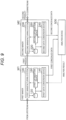
- FIG. 9 is an explanatory diagram illustrating a configuration example of a data analysis system according to Embodiment 2.
- the first maker M1 is the same as that in Embodiment 1 and includes the first manufacturing system 100, the first database 120, the first data conversion device 140, and the first optimization device 160.
- the second maker M2 includes a second data conversion device 240 and a second optimization device 260 in addition to the second manufacturing system 200 and the second database 220.
- the second data conversion device 240 has a function of concealing data and a function of decoding the concealed data.
- the same concealment method as that in the first data conversion device 140 is used. That is, the second data conversion device 240 may generate second concealed data by performing at least one of column name masking, column swapping, value standardization, and dimension compression on data on the second product (second data) read from the second database 220.
- the second concealed data obtained from the second data conversion device 240 is provided, for example, to the analysis device 500.
- the second optimization device 260 optimizes a manufacturing parameter in the second manufacturing system 200 by referring to the data stored in the second database 220 and the data received through the second data conversion device 240.
- the analysis device 500 in Embodiment 2 acquires the first concealed data from the first data conversion device 140 and acquires the second concealed data from the second data conversion device 240.
- the analysis device 500 selects an element (a column) of the first concealed data that affects the second concealed data by evaluating a degree of influence of the acquired concealed data.
- a method for selecting an element is the same as that in Embodiment 1.
- the analysis device 500 notifies the first data conversion device 140 of the information on the selected element.
- the first data conversion device 140 decodes the notified information to identify an element of the first data corresponding to the element selected by the analysis device 500.
- the first optimization device 160 optimizes a parameter in a manufacturing step of the first product by referring to the information on the element identified by the first data conversion device 140.
- the data analysis system evaluates the degree of influence between the first concealed data obtained by the first maker M1 and the second concealed data obtained by the second maker M2 and selects the element of the first concealed data that affects the second concealed data. Accordingly, even if a supply chain extends over makers, it is possible to identify an upstream data factor that influences downstream products and give a feedback to the respective makers without providing raw data (data before concealment).
- a supply chain in Embodiment 3 includes a third maker M3 disposed in parallel with the first maker M1.
- the second maker M2 procures a first product manufactured by the first maker M1 and a third product manufactured by the third maker M3 to manufacture a second product.
- FIG. 10 is an explanatory diagram illustrating a configuration example of a data analysis system according to Embodiment 3.
- a configuration of the first maker M1 is the same as that in Embodiment 1. That is, the first product manufactured in the first manufacturing system 100 is supplied to the first maker, and the first concealed data obtained by concealing the first data on the first product is provided to the analysis device 500.
- the second maker M2 includes the second manufacturing system 200 that procures the first product manufactured by the first maker M1 and the third product manufactured by the third maker M3 to manufacture the second product.
- the second manufacturing system 200 stores data on the second product (second data) in the second database 220 and provides the second data to the analysis device 500.
- the third maker M3 is disposed upstream of the second maker M2.
- the third maker M3 includes a third manufacturing system 300, a third database 320, a third data conversion device 340, and a third optimization device 360.
- the third manufacturing system 300 is a system for manufacturing the third product (for example, a semiconductor manufacturing device).
- the third database 320 stores data on the third product manufactured in the third manufacturing system 300.
- the third data conversion device 340 has a function of concealing data and a function of decoding the concealed data. The same concealment method as that in the first data conversion device 140 is used. That is, the third data conversion device 340 may generate third concealed data by performing at least one of column name masking, column swapping, value standardization, and dimension compression on the data on the third product (third data) read from the third database 320.
- the third concealed data obtained from the third data conversion device 340 is provided, for example, to the analysis device 500.
- the third optimization device 360 optimizes a manufacturing parameter in the third manufacturing system 300 by referring to the data stored in the third database 320 and the data received through the third data conversion device 340.
- the analysis device 500 acquires the first concealed data provided from the first data conversion device 140, the third concealed data provided from the third data conversion device 340, and the second data provided from the second manufacturing system 200.
- the analysis device 500 selects elements of the first concealed data and the third concealed data that affect the second data by evaluating a degree of influence between data including the acquired first concealed data and the acquired third concealed data and the second data.
- a method for selecting an element is the same as that in Embodiment 1.
- the analysis device 500 notifies the first data conversion device 140 and the third data conversion device 340 of information on the selected element.
- the first data conversion device 140 decodes the notified information to identify an element of the first data corresponding to the element selected by the analysis device 500.
- the first optimization device 160 optimizes a parameter in a manufacturing step of the first product by referring to the information on the element identified by the first data conversion device 140.
- the third data conversion device 340 decodes the notified information to identify an element of the third data corresponding to the element selected by the analysis device 500.
- the third optimization device 360 optimizes a parameter in a manufacturing step of the third product by referring to the information on the element identified by the third data conversion device 340.
- the data analysis system evaluates the degree of influence between the data including the first concealed data obtained by the first maker M1 and the third concealed data obtained by the third maker M3 and the second data obtained by the second maker M2, and selects the elements of the first concealed data and the third concealed data that affect the second data. Accordingly, even if a supply chain extends over makers, it is possible to identify an upstream data factor that influences downstream products and give a feedback to the respective makers without providing raw data (data before concealment).
- a supply chain in Embodiment 4 includes a fourth maker M4 disposed in parallel with the second maker M2.
- the second maker M2 procures a first product manufactured by the first maker M1 to manufacture a second product
- the fourth maker M4 procures the first product manufactured by the first maker M1 to manufacture a fourth product.
- FIG. 11 is an explanatory diagram illustrating a configuration example of a data analysis system according to Embodiment 4.
- a configuration of the first maker M1 is the same as that in Embodiment 1.
- the first product manufactured in the first manufacturing system 100 is supplied to the first maker M1 and the fourth maker M4.
- First concealed data obtained by concealing first data on the first product is provided to the analysis device 500.
- a configuration of the second maker M2 is the same as that in Embodiment 2.
- the second maker M2 includes the second manufacturing system 200 for procuring the first product manufactured by the first maker M1 and manufacturing the second product.
- Data on the second product (second data) manufactured in the second manufacturing system 200 is stored in the second database 220, concealed, and provided to the analysis device 500 as second concealed data.
- the fourth maker M4 is disposed downstream of the first maker M1 in parallel with the second maker M2.
- the fourth maker M4 includes a fourth manufacturing system 400, a fourth database 420, a fourth data conversion device 440, and a fourth optimization device 460.
- the fourth manufacturing system 400 is a system for manufacturing the fourth product (for example, a semiconductor device).
- the fourth database 420 stores data on the fourth product manufactured in the fourth manufacturing system 400.
- the fourth data conversion device 440 has a function of concealing data and a function of decoding the concealed data. The same concealment method as that in the first data conversion device 140 is used. That is, the fourth data conversion device 440 may generate fourth concealed data by performing at least one of column name masking, column swapping, value standardization, and dimension compression on the data on the fourth product (fourth data) read from the fourth database 420.
- the fourth concealed data obtained from the fourth data conversion device 440 is provided, for example, to the analysis device 500.
- the fourth optimization device 460 optimizes a manufacturing parameter in the fourth manufacturing system 400 by referring to the data stored in the fourth database 420 and the data received through the fourth data conversion device 440.
- the analysis device 500 acquires the first concealed data provided from the first data conversion device 140, the second concealed data provided from the second data conversion device 240, and the fourth concealed data provided from the fourth data conversion device 440.
- the analysis device 500 selects an element of the first concealed data that affects the second concealed data and the fourth concealed data by evaluating a degree of influence between the acquired first concealed data and data including the second concealed data and the fourth concealed data.
- a method for selecting an element is the same as that in Embodiment 1.
- the first concealed data includes i elements v1, v2, ..., vi that affect only the second manufacturing system 200 and j elements w1, w2, ..., wj that affect only the fourth manufacturing system 400 in addition to the n elements x1, x2, ..., xn.
- f and g are independent functions, and an element can be selected independently for each of Y1 and Y2.
- the analysis device 500 notifies the first data conversion device 140 of the information on the selected element.
- the first data conversion device 140 decodes the notified information to identify an element of the first data corresponding to the element selected by the analysis device 500.
- the first optimization device 160 optimizes a parameter in a manufacturing step of the first product by referring to the information on the element identified by the first data conversion device 140.
- the data analysis system evaluates the degree of influence between the first concealed data obtained by the first maker M1 and the data including the second concealed data obtained by the second maker M2 and the fourth concealed data obtained by the fourth maker, and selects the element of the first concealed data that affects the second concealed data or the fourth concealed data. Accordingly, even if a supply chain extends over makers, it is possible to identify an upstream data factor that influences downstream products and give a feedback to the respective makers without providing raw data (data before concealment).
Landscapes
- Engineering & Computer Science (AREA)
- Health & Medical Sciences (AREA)
- General Physics & Mathematics (AREA)
- Physics & Mathematics (AREA)
- General Health & Medical Sciences (AREA)
- Theoretical Computer Science (AREA)
- Business, Economics & Management (AREA)
- Bioethics (AREA)
- Medical Informatics (AREA)
- Software Systems (AREA)
- Manufacturing & Machinery (AREA)
- General Engineering & Computer Science (AREA)
- Automation & Control Theory (AREA)
- Strategic Management (AREA)
- Tourism & Hospitality (AREA)
- Computer Security & Cryptography (AREA)
- Computer Hardware Design (AREA)
- Economics (AREA)
- Human Resources & Organizations (AREA)
- Marketing (AREA)
- Primary Health Care (AREA)
- Databases & Information Systems (AREA)
- General Business, Economics & Management (AREA)
- Quality & Reliability (AREA)
- Artificial Intelligence (AREA)
- Computer Vision & Pattern Recognition (AREA)
- Evolutionary Computation (AREA)
- Management, Administration, Business Operations System, And Electronic Commerce (AREA)
- General Factory Administration (AREA)
- Complex Calculations (AREA)
Abstract
Description
- The present disclosure relates to a data analysis system, a data analysis device, a data analysis method, and a computer program.
- Companies may form an inter-company network when promoting business. Typical examples of such an inter-company network includes a supply chain.
- The supply chain includes organizations such as suppliers, assemblers, manufacturers, makers, and buyers, is a network in which procurement and shipment at the organizations are continuous, and is a network that progresses from the procurement of raw materials to the sale of final products.
- In the supply chain, identifiers are assigned to parts in circulation, and when a defect occurs in a product downstream of the supply chain, IDs of the parts causing the defect is provided to an upstream parts maker. The parts maker compares the ID with data held by the parts maker to investigate the cause of the defect.
- [Patent Document 1] Patent Document 1:
JP2007-213506A - The present disclosure provides a data analysis system, a data analysis device, a data analysis method, and a computer program that can identify a cause of a defect that occurs due to a complex cause across organizations.
- A data analysis system according to one aspect of the present disclosure includes: a first data conversion device configured to conceal first data on a first product manufactured in a first manufacturing system and output the first data as first concealed data; and a data analysis device configured to select an element of the first concealed data that affects second data on a second product manufactured using the first product by evaluating a degree of influence between the first concealed data and the second data.
- According to the present disclosure, it is possible to identify the cause of the defect that occurs due to a complex cause across makers.
-
-
FIG. 1 is an explanatory diagram illustrating a configuration example of a data analysis system according toEmbodiment 1. -
FIG. 2 is a block diagram illustrating a configuration of an analysis device. -
FIG. 3 is an explanatory diagram illustrating a creation example of concealed data. -
FIG. 4 is an explanatory diagram illustrating element selection by the analysis device. -
FIG. 5 is a schematic diagram illustrating a display example in the analysis device. -
FIG. 6A is a schematic diagram illustrating a display example in a first data conversion device. -
FIG. 6B is a schematic diagram illustrating a display example in the first data conversion device. -
FIG. 7A is an explanatory diagram illustrating an optimization method by an optimization device. -
FIG. 7B is an explanatory diagram illustrating an optimization method using the optimization device. -
FIG. 8 is a flowchart illustrating a procedure of processing executed in the data analysis system according toEmbodiment 1. -
FIG. 9 is an explanatory diagram illustrating a configuration example of a data analysis system according toEmbodiment 2. -
FIG. 10 is an explanatory diagram illustrating a configuration example of a data analysis system according toEmbodiment 3. -
FIG. 11 is an explanatory diagram illustrating a configuration example of a data analysis system according to Embodiment 4. -
FIG. 1 is an explanatory diagram illustrating a configuration example of a data analysis system according toEmbodiment 1. The data analysis system according to Embodiment 1 is a system for implementing the circulation, integration, analysis, and feedback of data across a supply chain. In the example illustrated inFIG. 1 , a first maker M1 that manufactures a first product by procuring parts and materials from an upstream side and a second maker M2 that manufactures a second product by procuring the first product manufactured by the first maker M1 are illustrated among organizations implementing the supply chain. The upstream side and downstream side of the first maker M1 and the upstream side and downstream side of the second maker M1 may be provided with other organizations such as other makers, a supplier, an assembler, a manufacturer, and a buyer. - Hereinafter, an application example of the present invention will be described assuming that the first maker M1 is a maker of manufacturing a semiconductor manufacturing device by procuring parts from the upstream side and the second maker M2 is a maker of manufacturing a semiconductor device by introducing the semiconductor manufacturing device manufactured by the first maker M1.
- The first maker M1 includes a
first manufacturing system 100, afirst database 120, a firstdata conversion device 140, and afirst optimization device 160. - The
first manufacturing system 100 is a system for manufacturing the first product (the semiconductor manufacturing device). The first product manufactured by thefirst manufacturing system 100 includes apparatuses such as an exposure apparatus, a resist processing apparatus, an etching apparatus, a cleaning and drying apparatus, a film forming apparatus, an ion implantation apparatus, and an inspection apparatus. Manufacturing steps include steps of procuring, storing, processing, assembling, and inspecting materials. - The
first database 120 stores data on the first product manufactured in thefirst manufacturing system 100. Here, the data on the first product is data set or measured in the manufacturing step of the first product. These pieces of data may include, for example, identification information on a device serving as an output source of the data, such as a serial number assigned to each product or a device model number indicating a device type. The data may further include actual number information representing conditions in the manufacturing step such as temperature and pressure. The data may further include actual number information output from the inspection step as a manufacturing result such as a film thickness, a shape, and a characteristic value. - The first
data conversion device 140 has a function of concealing the data and a function of decoding the concealed data. For example, when the data stored in thefirst database 120 is provided to an outside, the firstdata conversion device 140 can read target data from thefirst database 120 and provide the read data to the outside in a concealed manner. A concealment method will be described later in detail. A destination to which the data is provided is, for example, ananalysis device 500. When the concealed data is acquired from the outside, the firstdata conversion device 140 decodes the acquired data and transmits the decoded data to, for example, thefirst optimization device 160. - The
first optimization device 160 optimizes a manufacturing parameter in thefirst manufacturing system 100 by referring to the data stored in thefirst database 120 and the data received through the firstdata conversion device 140. - The second maker M2 includes a
second manufacturing system 200 and asecond database 220. - The
second manufacturing system 200 is a system for manufacturing the second product (the semiconductor device) and includes the semiconductor manufacturing device introduced from thefirst manufacturing system 100. The second product manufactured by thesecond manufacturing system 200 is a semiconductor device such as a diode, a transistor, a light-emitting device, a light-receiving device, an IC, a microcomputer, a CPU, or a memory. Manufacturing steps thereof include steps such as an exposure step, a resist step, an etching configuration, a cleaning and drying step, a film formation step, an ion implantation step, and an inspection step. - The
second database 220 stores data on the second product manufactured in thesecond manufacturing system 200. Here, the data on the second product is data set or measured in the manufacturing step of the second product. These pieces of data include, for example, a serial number assigned to each product, a product model number indicating a product type, and measured values such as a current, a voltage, a temperature, pressure, and a film thickness measured in the inspection step. InEmbodiment 1, the data stored in thesecond database 220 is provided to theanalysis device 500 without being concealed. - The data analysis system according to the present embodiment includes the
analysis device 500 that acquires data from the makers implementing the supply chain and analyzes the data across the supply chain. To perform the analysis, theanalysis device 500 acquires data (first concealed data) concealed by the firstdata conversion device 140 for the first product manufactured in thefirst manufacturing system 100. Theanalysis device 500 acquires data (second data) provided by thesecond manufacturing system 200 without being concealed for the second product manufactured in thesecond manufacturing system 200. Theanalysis device 500 selects an element of the first concealed data that affects the second data by evaluating a degree of influence between the acquired first concealed data and the acquired second data and outputs a selection result. -
FIG. 2 is a block diagram illustrating a configuration of theanalysis device 500. Theanalysis device 500 is a dedicated or general-purpose computer such as a server computer and includes acontroller 501, astorage 502, acommunicator 503, anoperator 504, and adisplay 505. - The
controller 501 includes a central processing unit (CPU), a read only memory (ROM), a random access memory (RAM), and the like. The ROM provided in thecontroller 501 stores control programs for controlling operations of the parts of the hardware. The CPU in thecontroller 501 reads and executes the control programs stored in the ROM and various computer programs stored in thestorage 502 and controls the operations of the parts of the hardware to cause the entire device to function as a data analysis device of the present disclosure. The RAM provided in thecontroller 501 temporarily stores data used during the execution of an arithmetic operation. - In the embodiment, although the
controller 501 includes the CPU, the ROM, and the RAM, the configuration of thecontroller 501 is not limited to the above-described configuration. Thecontroller 501 may be, for example, one or a plurality of control circuits or arithmetic circuits that include a graphic processing unit (GPU), a field programmable gate array (FPGA), a digital signal processor (DSP), a quantum processor, a volatile or nonvolatile memory, or the like. In addition, thecontroller 501 may include functions such as a clock for outputting date and time information, a timer for measuring the time elapsed from the time when a measurement start instruction is applied to the time when a measurement end instruction is applied, and a counter for counting the number. - The
storage 502 includes storage devices such as a hard disk drive (HDD), a solid state drive (SSD), and an electronically erasable programmable read only memory (EEPROM). Thestorage 502 stores various types of computer programs executed by thecontroller 501 and various data used by thecontroller 501. - The computer programs stored in the
storage 502 includes an analysis program PG for analyzing the data acquired from the first maker M1, the second maker M2, ... The analysis program PG may be a single computer program or may be implemented by a plurality of computer programs. In addition, the analysis program PG may partially use an existing library. - A computer program such as the analysis program PG stored in the
storage 502 is provided by a non-temporary recording medium RM in which the computer program is readably recorded. The recording medium RM is a portable memory such as a CD-ROM, a USB memory, a secure digital (SD) card, a micro SD card, or a compact flash (registered trademark). Thecontroller 501 reads various types of computer programs from the recording medium RM using a reading device (not illustrated) and stores the read various types of computer programs in thestorage 502. In addition, the computer program stored in thestorage 502 may be provided through communication. In this case, thecontroller 501 may acquire the computer program through thecommunicator 503 and store the acquired computer program in thestorage 502. - The
communicator 503 includes a communication interface for transmitting and receiving various data. The communication interface provided in thecommunicator 503 is, for example, a communication interface conforming to a communication standard of a LAN used in WiFi (registered trademark) or Ethernet (registered trademark). In a case where data to be transmitted is input from thecontroller 501, thecommunicator 503 transmits data to be transmitted to the designated destination. In addition, in a case where data transmitted from an external device is received, thecommunicator 503 outputs the received data to thecontroller 501. - The
operator 504 includes an operation device such as a touch panel, a keyboard, and a switch and receives inputs of various operations and data input by a user. Thecontroller 501 performs appropriate controls based on various types of operation information supplied from theoperator 504 and stores the input data in thestorage 502 as necessary. - The
display 505 includes a display device such as a liquid crystal display or an organic electro-luminescence (EL) display, and displays information to be notified to the user in response to an instruction from thecontroller 501. - In the present embodiment, the
analysis device 500 may be a single computer or may be a computer system including computers, peripheral devices, or the like. In addition, theanalysis device 500 may be a virtual machine in which entities are virtualized, or may be a cloud. - Hereinafter, the concealed data that is an analysis target will be described.
-
FIG. 3 is an explanatory diagram illustrating a creation example of the concealed data. As described above, thefirst database 120 stores the data on the first product manufactured in thefirst manufacturing system 100. For example, when the first product is a film forming apparatus, the data stored in thefirst database 120 includes data such as a serial number assigned to each product (film forming apparatus), an apparatus model number, and a temperature, a pressure, and a film thickness measured in the inspection step. Thefirst database 120 illustrated inFIG. 3 as an example includes five columns (elements) including a serial number, a temperature, a pressure, an apparatus model number, and a film thickness. A state in which values obtained for each product are stored in each column is illustrated. - The first
data conversion device 140 reads target data from thefirst database 120 and conceals the read data. Specifically, the firstdata conversion device 140 conceals the data by using at least one of column name masking, column replacement, value standardization, and dimension compression. - The example of
FIG. 3 illustrates a state in which original column names "S/N", "temperature", "pressure", "apparatus model number", and "film thickness are changed to the column names [Param0], [Param2], [Param1], [Param4], and [Param3] to mask these column names, respectively to perform the concealment. - Further, the example of
FIG. 3 illustrates a state in which the concealment is performed by swapping the columns of "temperature" and "pressure" and swapping the columns of "apparatus model number" and "film thickness". The firstdata conversion device 140 preferably stores a correspondence between the column names before and after the masking and a correspondence between the column names before and after the swapping. - The example of
FIG. 3 illustrates a state in which the concealment is performed by standardizing the values of each column of "temperature", "pressure", and "film thickness". Specifically, the firstdata conversion device 140 may calculate an average value and a variance for each column and standardize each value based on the calculated average value and variance. The firstdata conversion device 140 preferably stores values of the average value and variance used for the standardization. - Further, for data commonly used by the organizations, the data may be encoded by using a common method between the organizations. For example, among the columns illustrated in
FIG. 3 , the serial number (S/N) of the product is used in common by the first maker M1 and the second maker M2. Therefore, the firstdata conversion device 140 may replace the serial number of the product with another character string by using a predetermined hash function. Any function can be used for the replacement as long as it is common among the organizations. - For data in which a type of value that appears is fixed, a predetermined number or character string may be assigned. For example, among the columns illustrated in
FIG. 3 , three types of values P001 to P003 are used for the apparatus model number. Therefore, the firstdata conversion device 140 can assign numerals of [0], [1], and [2] in an order of P001 to P003, respectively. Alternatively, a known character string such as [A], [B], and [C] may be assigned. - The creation example of the concealed data illustrated in
FIG. 3 is merely an example. The firstdata conversion device 140 may perform appropriate concealment processing according to attributes of columns prepared in thefirst database 120. For example, the firstdata conversion device 140 may dimensionally compress the data stored in thefirst database 120 by using an algorithm such as principal component analysis or independent component analysis. - The
analysis device 500 acquires the first concealed data concealed by the firstdata conversion device 140 and the second data on the second product obtained in thesecond manufacturing system 200 and selects the element (the column) of the first concealed data that affects the second data by evaluating the degree of influence of the first concealed data and the second data. -
FIG. 4 is an explanatory diagram illustrating element selection by theanalysis device 500. InFIG. 4 , the first concealed data generated by the firstdata conversion device 140 will be referred to as X, and the second data generated by thesecond manufacturing system 200 will be referred to as Y. The first concealed data X is data including n elements (columns). Here, n is an integer of 2 or more. The first concealed data illustrated inFIG. 3 as an example has five columns, and thus a case of n = 5 is illustrated. - The
analysis device 500 acquires the first concealed data X from the firstdata conversion device 140 and acquires the second data Y from thesecond manufacturing system 200. Theanalysis device 500 selects an element of the first concealed data X that affects the second data Y by evaluating the degree of influence between the first concealed data X and the second data Y. Specifically, by using the first concealed data X as an explanatory variable and the second data Y as an objective variable, theanalysis device 500 sets a model function f (that is, Y = f(X)) for predicting the objective variable from the explanatory variable and selects a subset x of X necessary for the prediction of Y based on the set model function f. In other words, theanalysis device 500 excludes columns of X unrelated to the prediction of Y. - In the present embodiment, the degree of influence of each element included in X on Y is evaluated to exclude elements unrelated to the prediction of Y. For example, the
analysis device 500 can find out an element x of X that has a strong degree of influence on Y by using a statistical method (a filtering method). - Further, the
analysis device 500 can find out the element x of X that has a strong degree of influence on Y with a method (an incorporation method) using a machine learning model. For example, when Y = f(X) is a linear model, a regression coefficient (an absolute value) directly represents the degree of influence if the explanatory variable X is appropriately scaled. In particular, when the unrelated elements need to be removed, a method such as Lasso (L1 regularization) may be used. Further, when Y = f(x) is a nonlinear model, the degree of influence can be evaluated by using an index such as the Gini coefficient in a random forest. An evaluation index of the degree of influence is not limited to the Gini coefficient, and an evaluation index such as a permutation feature importance, an LIME, and a SHAP may be used. - The
analysis device 500 may use a wrapper method in which a feature value is input and output and an element having a strong degree of influence is selected while checking the prediction accuracy. In the wrapper method, since a machine learning model is created many times to evaluate the degree of influence and select the feature value, the degree of influence can be evaluated with high accuracy even though it takes a long calculation time. - When it is determined based on the evaluation of the degree of influence that a specific element (referred to as an element p) among the elements of the first concealed data X particularly affects the second data Y, the
analysis device 500 selects the element p and notifies the firstdata conversion device 140 of information on the selected element p. - The number of elements p selected by the
analysis device 500 is not limited to one and may be plural. That is, theanalysis device 500 may exclude the elements of the first concealed data X unrelated to the prediction of the second data Y and select the subset x of the first concealed data X necessary for the prediction of the second data Y. - In the example of
FIG. 4 , element selection processing between two organizations is described, and the same element selection processing can be applied to any number of organizations connected in series. For example, in a supply chain in which n organizations are connected in series, concealed data generated in an uppermost organization is referred to as an X1, concealed data generated in an organization downstream thereof is referred to as X2, ... , concealed data generated in an organization upstream of a lowermost organization is referred to as Xn-1, and data generated in the lowermost organization is referred to as Y. Theanalysis device 500 acquires these pieces of data from the organizations. Theanalysis device 500 can select an element pn-1 of the concealed data Xn-1 that affects the data Y by evaluating a degree of influence between the concealed data Xn-1 and the data Y. Next, theanalysis device 500 can identify an element pn-2 of the concealed data Xn-2 that affects the element pn-1 of the concealed data Xn-1 by evaluating a degree of influence between the concealed data Xn-2 and the concealed data Xn-1. In this way, theanalysis device 500 can select the element that affects each piece of data by successively performing an analysis retrospectively from the most downstream. - Further, since it is possible that the element of the concealed data that has the greatest effect on the data Y is the element pn-3 of the concealed data Xn-3, there is no need to be traced back one by one. Generally described, the
analysis device 500 may perform a factor analysis while creating a prediction model such that Y = f(x1 ⊂ X1, x2 ⊂ X2, ..., xn-1 ⊂ Xn-1). In other words, theanalysis device 500 may concatenate X1, X2, ... , and Xn-1 to regard as one explanatory variable X and select a subset necessary for the prediction of the objective variable Y. - The first
data conversion device 140 stores the correspondence of element between the data before being concealed (the first data) and the data after being concealed (the first concealed data). Therefore, when the firstdata conversion device 140 is notified of the information on the element p from theanalysis device 500, the firstdata conversion device 140 can identify the element of the first data that affects the second data based on the information on the element p. - The
analysis device 500 may display information on the degree of influence of each element on thedisplay 505 in a process of selecting the element.FIG. 5 is a schematic diagram illustrating a display example in theanalysis device 500. In the process of selecting the element, it is assumed that Y = f(x1, x2, ... , xn) = a1 * x1 + a2 * x2 + ... + an * xn is obtained as a model. In this case, an element having larger absolute values of the coefficients a1, a2, ..., an has a higher degree of influence on the data Y. A sign of the coefficient varies depending on whether the influence on the data Y is positive or negative. For example, theanalysis device 500 can display the degree of influence of each element in the drawing by drawing the degree of influence of each element in a bar graph with a horizontal axis representing the degree of influence and a vertical axis representing the element.FIG. 5 illustrates an example in which elements are sorted in a descending order of degree of influence. In theanalysis device 500, since each element (column name) is concealed, it is not possible to recognize actual column names (column names before concealment). - Similarly, the
analysis device 500 may notify the firstdata conversion device 140 of the information on the degree of influence calculated for each element and display the information on the degree of influence of each element on the firstdata conversion device 140.FIGS. 6A and 6B are schematic diagrams illustrating display examples in the firstdata conversion device 140. Similar to theanalysis device 500, the firstdata conversion device 140 can display the degree of influence of each element by drawing the degree of influence of each element in a bar graph with a horizontal axis representing the degree of influence and a vertical axis representing the element.FIG. 6A illustrates an example in which elements are sorted in a descending order of degree of influence. The firstdata conversion device 140 can present the column names before the concealment as the name of element by converting the data before concealment (the first data) and the data after concealment (the first concealed data) referring to the correspondence of element therebetween. Therefore, in the example ofFIG. 6A , it can be seen that "temperature" in "step 2" has the greatest influence on the quality of the second product manufactured in thesecond manufacturing system 200. - The first
data conversion device 140 may display a graph illustrating a relationship between a management range of each element and a variation range of the quality Y. In the example ofFIG. 6B , a graph illustrates a relationship between a management range of "temperature" in "step 2" and a variation range of quality. The variation range of quality is, for example, a value designated by thesecond manufacturing system 200 and notified through theanalysis device 500. By reading this graph, the user can grasp how much the variation range of the quality of the second product can be controlled by changing the management range of "temperature" in "step 2". - The
first optimization device 160 optimizes the parameter in the manufacturing step of the first product by referring to the information on the element selected by the firstdata conversion device 140. -
FIGS. 7A and 7B are explanatory diagrams illustrating an optimization method by thefirst optimization device 160. An element xp identified by the firstdata conversion device 140 is a temperature T of a certain step of a certain part. In this case, thefirst optimization device 160 optimizes a management value of a temperature condition in the step. - For example, the
analysis device 500 obtains a prediction formula of Y = a * xp +... for the element xp, and the firstdata conversion device 140 has a corresponding formula of T = b * xp + c for the temperature T. Here, Y is data on the quality of the second product, and a, b, and c are coefficients that are optimized at the time of model creation. At this time, thefirst optimization device 160 determines how to set the temperature T based on the coefficients a, b, and c, and a range of Y that is desired to be implemented. - For example, the
first optimization device 160 performs the management within a temperature range of T0 ± ΔT in the past, and may perform the management by T0 ± ΔT' and control the variation in quality of the second product manufactured in the second manufacturing system 200 (seeFIG. 7A ). Further, thefirst optimization device 160 performs the management within the temperature range of T0 ± ΔT in the past as illustrated inFIG. 7B , and may perform the management byT 1 ± ΔT and control an offset of quality of the second product manufactured in the second manufacturing system 200 (seeFIG. 7B ). - When a management value of the selected element xp cannot be changed, the
first optimization device 160 may change a management value of an element having the second largest influence. Further, thefirst optimization device 160 may change the management values of the elements. -
FIG. 8 is a flowchart illustrating a procedure of processing executed in the data analysis system according toEmbodiment 1. When manufacturing the first product in thefirst manufacturing system 100, the data on the first product (the first data) is stored in thefirst database 120. The firstdata conversion device 140 acquires the first data from the first database 120 (step S101) and conceals the acquired first data (step S102). At least one of column name masking, column swapping, value standardization, and dimension compression is used to conceal the first data. The firstdata conversion device 140 stores, in an internal memory (not illustrated), the correspondence of element between the data before being concealed (the first data) and the data after being concealed (the first concealed data). The firstdata conversion device 140 transmits the first concealed data obtained by concealing the first data to the analysis device 500 (step S103). - In the
second manufacturing system 200, the first product manufactured in the first manufacturing system is procured and the second product is manufactured. When manufacturing the second product, thesecond manufacturing system 200 generates the data on the second product (the second data) (step S105), stores the second data in thesecond database 220, and transmits the generated second data to the analysis device 500 (step S106). - The
analysis device 500 receives the first concealed data transmitted from the first data conversion device 140 (step S104) and receives the second data transmitted from the second manufacturing system 200 (step S107). - The
analysis device 500 evaluates the degree of influence between the acquired first concealed data and the second data (step S108) and selects the element of the first concealed data that affects the second data (step S109). By using the filter method, the incorporation method, the wrapper method, or the like described above, theanalysis device 500 can evaluate the degree of influence on the second data for each element of the first concealed data and select an element having a high degree of influence. - The
analysis device 500 notifies the firstdata conversion device 140 of the information on the selected element (step S110). The information notified to the firstdata conversion device 140 includes the column name of the element (column) selected by theanalysis device 500. Since there is no need for theanalysis device 500 to grasp the meaning of the selected element, for example, the column name in the masked state may be notified to the firstdata conversion device 140. - The first
data conversion device 140 receives the information on the element notified from the analysis device 500 (step S111) and decodes the received information of the element (step S112). The firstdata conversion device 140 identifies an element of the first data corresponding to the element selected by theanalysis device 500 by referring to the correspondence stored in the memory (step 5113). The firstdata conversion device 140 notifies thefirst optimization device 160 of the information on the identified element of the first data (step S114). - The
first optimization device 160 optimizes the management value of the corresponding element based on the information notified from the first data conversion device 140 (step S115). For example, thefirst optimization device 160 may set a range of management value of the element based on a range of Y that is desired to be implemented for the quality Y of the second product. - As described above, the data analysis system according to
Embodiment 1 evaluates the degree of influence between the first concealed data obtained by the first maker M1 and the second data obtained by the second maker M2 and selects the element of the first concealed data that affects the second data. Accordingly, even if a supply chain extends over makers, it is possible to identify an upstream data factor that influences downstream products and give a feedback to the respective makers without providing raw data (data before concealment). - In
Embodiment 2, a configuration in which the second maker M2 includes a data conversion device will be described. -
FIG. 9 is an explanatory diagram illustrating a configuration example of a data analysis system according toEmbodiment 2. The first maker M1 is the same as that inEmbodiment 1 and includes thefirst manufacturing system 100, thefirst database 120, the firstdata conversion device 140, and thefirst optimization device 160. - The second maker M2 includes a second
data conversion device 240 and asecond optimization device 260 in addition to thesecond manufacturing system 200 and thesecond database 220. - Similar to the first
data conversion device 140, the seconddata conversion device 240 has a function of concealing data and a function of decoding the concealed data. The same concealment method as that in the firstdata conversion device 140 is used. That is, the seconddata conversion device 240 may generate second concealed data by performing at least one of column name masking, column swapping, value standardization, and dimension compression on data on the second product (second data) read from thesecond database 220. The second concealed data obtained from the seconddata conversion device 240 is provided, for example, to theanalysis device 500. - The
second optimization device 260 optimizes a manufacturing parameter in thesecond manufacturing system 200 by referring to the data stored in thesecond database 220 and the data received through the seconddata conversion device 240. - The
analysis device 500 inEmbodiment 2 acquires the first concealed data from the firstdata conversion device 140 and acquires the second concealed data from the seconddata conversion device 240. Theanalysis device 500 selects an element (a column) of the first concealed data that affects the second concealed data by evaluating a degree of influence of the acquired concealed data. A method for selecting an element is the same as that inEmbodiment 1. - The
analysis device 500 notifies the firstdata conversion device 140 of the information on the selected element. The firstdata conversion device 140 decodes the notified information to identify an element of the first data corresponding to the element selected by theanalysis device 500. Thefirst optimization device 160 optimizes a parameter in a manufacturing step of the first product by referring to the information on the element identified by the firstdata conversion device 140. - As described above, the data analysis system according to
Embodiment 2 evaluates the degree of influence between the first concealed data obtained by the first maker M1 and the second concealed data obtained by the second maker M2 and selects the element of the first concealed data that affects the second concealed data. Accordingly, even if a supply chain extends over makers, it is possible to identify an upstream data factor that influences downstream products and give a feedback to the respective makers without providing raw data (data before concealment). - A supply chain in
Embodiment 3 includes a third maker M3 disposed in parallel with the first maker M1. The second maker M2 procures a first product manufactured by the first maker M1 and a third product manufactured by the third maker M3 to manufacture a second product. -
FIG. 10 is an explanatory diagram illustrating a configuration example of a data analysis system according toEmbodiment 3. A configuration of the first maker M1 is the same as that inEmbodiment 1. That is, the first product manufactured in thefirst manufacturing system 100 is supplied to the first maker, and the first concealed data obtained by concealing the first data on the first product is provided to theanalysis device 500. - The second maker M2 includes the
second manufacturing system 200 that procures the first product manufactured by the first maker M1 and the third product manufactured by the third maker M3 to manufacture the second product. Thesecond manufacturing system 200 stores data on the second product (second data) in thesecond database 220 and provides the second data to theanalysis device 500. - The third maker M3 is disposed upstream of the second maker M2. The third maker M3 includes a
third manufacturing system 300, athird database 320, a thirddata conversion device 340, and athird optimization device 360. - The
third manufacturing system 300 is a system for manufacturing the third product (for example, a semiconductor manufacturing device). Thethird database 320 stores data on the third product manufactured in thethird manufacturing system 300. The thirddata conversion device 340 has a function of concealing data and a function of decoding the concealed data. The same concealment method as that in the firstdata conversion device 140 is used. That is, the thirddata conversion device 340 may generate third concealed data by performing at least one of column name masking, column swapping, value standardization, and dimension compression on the data on the third product (third data) read from thethird database 320. The third concealed data obtained from the thirddata conversion device 340 is provided, for example, to theanalysis device 500. Thethird optimization device 360 optimizes a manufacturing parameter in thethird manufacturing system 300 by referring to the data stored in thethird database 320 and the data received through the thirddata conversion device 340. - The
analysis device 500 acquires the first concealed data provided from the firstdata conversion device 140, the third concealed data provided from the thirddata conversion device 340, and the second data provided from thesecond manufacturing system 200. Theanalysis device 500 selects elements of the first concealed data and the third concealed data that affect the second data by evaluating a degree of influence between data including the acquired first concealed data and the acquired third concealed data and the second data. A method for selecting an element is the same as that inEmbodiment 1. - For example, when the first concealed data is data including n elements (x1, x2, ..., xn) and the third concealed data is data including m elements (z1, z2, ..., zm), the
analysis device 500 evaluates Y = f(x1, x2, ..., xn, z1, z2, ..., zm) and selects an element having a high degree of influence on a variation of Y. At this time, theanalysis device 500 may select either the element of the first concealed data or the element of the third concealed data, or may select elements from both the first concealed data and the third concealed data. - The
analysis device 500 notifies the firstdata conversion device 140 and the thirddata conversion device 340 of information on the selected element. The firstdata conversion device 140 decodes the notified information to identify an element of the first data corresponding to the element selected by theanalysis device 500. Thefirst optimization device 160 optimizes a parameter in a manufacturing step of the first product by referring to the information on the element identified by the firstdata conversion device 140. - Similarly, the third
data conversion device 340 decodes the notified information to identify an element of the third data corresponding to the element selected by theanalysis device 500. Thethird optimization device 360 optimizes a parameter in a manufacturing step of the third product by referring to the information on the element identified by the thirddata conversion device 340. - As described above, the data analysis system according to
Embodiment 3 evaluates the degree of influence between the data including the first concealed data obtained by the first maker M1 and the third concealed data obtained by the third maker M3 and the second data obtained by the second maker M2, and selects the elements of the first concealed data and the third concealed data that affect the second data. Accordingly, even if a supply chain extends over makers, it is possible to identify an upstream data factor that influences downstream products and give a feedback to the respective makers without providing raw data (data before concealment). - A supply chain in Embodiment 4 includes a fourth maker M4 disposed in parallel with the second maker M2. The second maker M2 procures a first product manufactured by the first maker M1 to manufacture a second product, and the fourth maker M4 procures the first product manufactured by the first maker M1 to manufacture a fourth product.
-
FIG. 11 is an explanatory diagram illustrating a configuration example of a data analysis system according to Embodiment 4. A configuration of the first maker M1 is the same as that inEmbodiment 1. In Embodiment 4, the first product manufactured in thefirst manufacturing system 100 is supplied to the first maker M1 and the fourth maker M4. First concealed data obtained by concealing first data on the first product is provided to theanalysis device 500. - A configuration of the second maker M2 is the same as that in
Embodiment 2. The second maker M2 includes thesecond manufacturing system 200 for procuring the first product manufactured by the first maker M1 and manufacturing the second product. Data on the second product (second data) manufactured in thesecond manufacturing system 200 is stored in thesecond database 220, concealed, and provided to theanalysis device 500 as second concealed data. - The fourth maker M4 is disposed downstream of the first maker M1 in parallel with the second maker M2. The fourth maker M4 includes a
fourth manufacturing system 400, afourth database 420, a fourthdata conversion device 440, and afourth optimization device 460. - The
fourth manufacturing system 400 is a system for manufacturing the fourth product (for example, a semiconductor device). Thefourth database 420 stores data on the fourth product manufactured in thefourth manufacturing system 400. The fourthdata conversion device 440 has a function of concealing data and a function of decoding the concealed data. The same concealment method as that in the firstdata conversion device 140 is used. That is, the fourthdata conversion device 440 may generate fourth concealed data by performing at least one of column name masking, column swapping, value standardization, and dimension compression on the data on the fourth product (fourth data) read from thefourth database 420. The fourth concealed data obtained from the fourthdata conversion device 440 is provided, for example, to theanalysis device 500. Thefourth optimization device 460 optimizes a manufacturing parameter in thefourth manufacturing system 400 by referring to the data stored in thefourth database 420 and the data received through the fourthdata conversion device 440. - The
analysis device 500 acquires the first concealed data provided from the firstdata conversion device 140, the second concealed data provided from the seconddata conversion device 240, and the fourth concealed data provided from the fourthdata conversion device 440. Theanalysis device 500 selects an element of the first concealed data that affects the second concealed data and the fourth concealed data by evaluating a degree of influence between the acquired first concealed data and data including the second concealed data and the fourth concealed data. A method for selecting an element is the same as that inEmbodiment 1. For example, the first concealed data includes i elements v1, v2, ..., vi that affect only thesecond manufacturing system 200 and j elements w1, w2, ..., wj that affect only thefourth manufacturing system 400 in addition to the n elements x1, x2, ..., xn. In this case, for second concealed data Y1, theanalysis device 500 identifies an element having a high degree of influence on a variation of Y1 by using Y1 = f(x1, x2, ..., xn, v1, v2, ..., vi). Further, for fourth concealed data Y2, theanalysis device 500 identifies an element having a high degree of influence on a variation of Y2 by using Y2 = g(x1, x2, ..., xn, w1, w2, ..., wj). Here, f and g are independent functions, and an element can be selected independently for each of Y1 and Y2. - The
analysis device 500 notifies the firstdata conversion device 140 of the information on the selected element. The firstdata conversion device 140 decodes the notified information to identify an element of the first data corresponding to the element selected by theanalysis device 500. Thefirst optimization device 160 optimizes a parameter in a manufacturing step of the first product by referring to the information on the element identified by the firstdata conversion device 140. - As described above, the data analysis system according to Embodiment 4 evaluates the degree of influence between the first concealed data obtained by the first maker M1 and the data including the second concealed data obtained by the second maker M2 and the fourth concealed data obtained by the fourth maker, and selects the element of the first concealed data that affects the second concealed data or the fourth concealed data. Accordingly, even if a supply chain extends over makers, it is possible to identify an upstream data factor that influences downstream products and give a feedback to the respective makers without providing raw data (data before concealment).
- The embodiments disclosed herein are exemplary in all respects and are required to be considered to be not restrictive embodiments. The scope of the present invention is indicated by the scope of the claims, not the meaning described above, and is intended to include meanings equivalent to the scope of the claims and all changes within the scope.
-
- M1
- First maker
- 100
- First manufacturing system
- 120
- First database
- 140
- First data conversion device
- 160
- First optimization device
- M2
- Second maker
- 200
- Second manufacturing system
- 220
- Second database
- 500
- Analysis device
- 501
- Controller
- 502
- Storage
- 503
- Communicator
- 504
- Operator
- 505
- Display
Claims (11)
- A data analysis system comprising:a first data conversion device configured to conceal first data on a first product manufactured in a first manufacturing system and output the first data as first concealed data; anda data analysis device configured to select an element of the first concealed data that affects second data on a second product manufactured using the first product by evaluating a degree of influence between the first concealed data and the second data.
- The data analysis system according to claim 1, wherein
the second data is data concealed by a second data conversion device. - The data analysis system according to claim 1 or 2, further comprising:a third data conversion device configured to conceal third data on a third product manufactured in a third manufacturing system and output the third data as third concealed data, whereinthe data analysis device select an element of the first concealed data and the third concealed data that affects the second data by evaluating a degree of influence between the second data and data including the first concealed data and the third concealed data.
- The data analysis system according to claim 1 or 2, further comprising:a fourth data conversion device configured to conceal fourth data on a fourth product manufactured in a fourth manufacturing system using the first product and output the fourth data as fourth concealed data, whereinthe data analysis device selects an element of the first concealed data that affects the second data and the fourth concealed data by evaluating the degree of influence between the first concealed data and the second data and a degree of influence between the first concealed data and the fourth concealed data.
- The data analysis system according to any one of claims 1 to 4, further comprising:
a first optimization device configured to adjust a parameter in a manufacturing step of the first product based on an element of the first data corresponding to the selected element of the first concealed data. - The data analysis system according to claim 3, further comprising:
a third optimization device configured to adjust a parameter in a manufacturing step of the third product based on an element of the third data corresponding to the selected element of the third concealed data. - The data analysis system according to any one of claims 1 to 6, whereindata on each product includes elements and values for each of the elements, andconcealment of the data includes at least one of element name masking, replacement between elements, standardization of values of elements, and dimension compression.
- A data analysis device comprising:a first acquirer configured to acquire first concealed data obtained by concealing first data on a first product manufactured in a first manufacturing system;a second acquirer configured to acquire second data on a second product manufactured in a second manufacturing system using the first product;a selector configured to select an element of the first concealed data that affects the second data by evaluating a degree of influence between the first concealed data and the second data; andan output configured to output a selection result.
- The data analysis device according to claim 8, whereinthe first data includes elements and values for each of the elements,concealment of the first data includes at least one of element name masking, replacement between elements, standardization of values of elements, and dimension compression, andthe selector calculates a degree of influence of each element included in the first concealed data on the second data and selects the element of the first concealed data according to the calculated degree of influence.
- A data analysis method for a computer to execute processing comprising:acquiring first concealed data obtained by concealing first data on a first product manufactured in a first manufacturing system;acquiring second data on a second product manufactured in a second manufacturing system using the first product;selecting an element of the first concealed data that affects the second data by evaluating a degree of influence between the first concealed data and the second data; andoutputting a selection result.
- A computer program causing a computer to execute processing comprising:acquiring first concealed data obtained by concealing first data on a first product manufactured in a first manufacturing system;acquiring second data on a second product manufactured in a second manufacturing system using the first product;selecting an element of the first concealed data that affects the second data by evaluating a degree of influence between the first concealed data and the second data; andoutputting a selection result.
Applications Claiming Priority (2)
| Application Number | Priority Date | Filing Date | Title |
|---|---|---|---|
| JP2022040380 | 2022-03-15 | ||
| PCT/JP2023/008515 WO2023176580A1 (en) | 2022-03-15 | 2023-03-07 | Data analysis system, data analysis device, data analysis method, and computer program |
Publications (2)
| Publication Number | Publication Date |
|---|---|
| EP4495721A1 true EP4495721A1 (en) | 2025-01-22 |
| EP4495721A4 EP4495721A4 (en) | 2026-04-01 |
Family
ID=88023133
Family Applications (1)
| Application Number | Title | Priority Date | Filing Date |
|---|---|---|---|
| EP23770536.3A Pending EP4495721A4 (en) | 2022-03-15 | 2023-03-07 | DATA ANALYSIS SYSTEM, DATA ANALYSIS DEVICE, DATA ANALYSIS METHOD AND COMPUTER PROGRAM |
Country Status (7)
| Country | Link |
|---|---|
| US (1) | US20250004432A1 (en) |
| EP (1) | EP4495721A4 (en) |
| JP (1) | JPWO2023176580A1 (en) |
| KR (1) | KR20240165381A (en) |
| CN (1) | CN118871868A (en) |
| TW (1) | TW202347233A (en) |
| WO (1) | WO2023176580A1 (en) |
Family Cites Families (4)
| Publication number | Priority date | Publication date | Assignee | Title |
|---|---|---|---|---|
| JP2006155394A (en) * | 2004-11-30 | 2006-06-15 | Matsushita Electric Ind Co Ltd | Data mining method, apparatus, program, and recording medium |
| JP2007213506A (en) | 2006-02-13 | 2007-08-23 | Eigyotatsu Kofun Yugenkoshi | Product quality tracking system and method |
| EP3557350B1 (en) * | 2018-04-18 | 2025-07-02 | Reifenhäuser GmbH & Co. KG Maschinenfabrik | Method and device for providing, retrieving and using a data element |
| JP6860530B2 (en) * | 2018-07-31 | 2021-04-14 | ファナック株式会社 | Data management device, data management method and data management program |
-
2023
- 2023-03-01 TW TW112107233A patent/TW202347233A/en unknown
- 2023-03-07 KR KR1020247034058A patent/KR20240165381A/en active Pending
- 2023-03-07 CN CN202380027571.1A patent/CN118871868A/en active Pending
- 2023-03-07 WO PCT/JP2023/008515 patent/WO2023176580A1/en not_active Ceased
- 2023-03-07 JP JP2024507780A patent/JPWO2023176580A1/ja active Pending
- 2023-03-07 EP EP23770536.3A patent/EP4495721A4/en active Pending
-
2024
- 2024-09-12 US US18/882,797 patent/US20250004432A1/en active Pending
Also Published As
| Publication number | Publication date |
|---|---|
| KR20240165381A (en) | 2024-11-22 |
| EP4495721A4 (en) | 2026-04-01 |
| TW202347233A (en) | 2023-12-01 |
| JPWO2023176580A1 (en) | 2023-09-21 |
| US20250004432A1 (en) | 2025-01-02 |
| WO2023176580A1 (en) | 2023-09-21 |
| CN118871868A (en) | 2024-10-29 |
Similar Documents
| Publication | Publication Date | Title |
|---|---|---|
| JP7244610B2 (en) | Systems and computer-implemented methods for measuring industrial process performance for industrial process facilities and computer-implemented methods for reducing outlier bias in measured target variables for financial instruments | |
| Carlsson et al. | Evaluating microfoundations for aggregate price rigidities: evidence from matched firm-level data on product prices and unit labor cost | |
| JP5352485B2 (en) | Factor analyzer | |
| CN112823364A (en) | Predictive model enhancement | |
| JP2022046363A (en) | Production management system, production management method, and production management program | |
| US8000819B2 (en) | Manufacturing instruction evaluation support system, manufacturing instruction evaluation support method, and manufacturing instruction evaluation support program | |
| WO2017022234A1 (en) | Manufacturing process analysis device, manufacturing process analysis method, and recording medium whereupon manufacturing process analysis program is stored | |
| Schmitt et al. | Parameter selection guidelines for adaptive PCA‐based control charts | |
| EP4495721A1 (en) | Data analysis system, data analysis device, data analysis method, and computer program | |
| De Ketelaere et al. | Statistical process monitoring of time-dependent data | |
| US20210318672A1 (en) | Manufacturing Defect Factor Searching Method and Manufacturing Defect Factor Searching Apparatus | |
| Yang | Multivariate statistical methods and Six-Sigma | |
| JP2009134518A (en) | Test program verification method and verification system | |
| Pazhayattil et al. | Qualification, Continued Process Verification, and Lifecycle Management | |
| CN119438487B (en) | Gas identification method, device, equipment and medium suitable for home environment | |
| WO2009081696A1 (en) | Data analysis device, data analysis method, and program | |
| US20250271823A1 (en) | Information processing device, information processing method, and computer program product | |
| JP2022046344A (en) | Production management system, production management method, and production management program | |
| CN119173888A (en) | Data analysis device, data analysis method, and program | |
| Grenyer et al. | Compound uncertainty quantification and aggregation (CUQA) for reliability assessment in industrial maintenance | |
| Grenyer et al. | Compound Uncertainty Quantification and Aggregation for Reliability Assessment in Industrial Maintenance. Machines 2023, 11, 560 | |
| Chen et al. | Metaevaluation: a comprehensive evaluation of health indicator on real options-based maintenance scheduling and health prognostics of bearing degradation | |
| Greipel | Grouping of inspection characteristics to reduce costs of adaptive inspection planning in variant production | |
| JP2022046352A (en) | Integrated management system, integrated management method, and integrated management program | |
| Murthy | Intelligent Modeling and Practical Solutions |
Legal Events
| Date | Code | Title | Description |
|---|---|---|---|
| STAA | Information on the status of an ep patent application or granted ep patent |
Free format text: STATUS: THE INTERNATIONAL PUBLICATION HAS BEEN MADE |
|
| PUAI | Public reference made under article 153(3) epc to a published international application that has entered the european phase |
Free format text: ORIGINAL CODE: 0009012 |
|
| STAA | Information on the status of an ep patent application or granted ep patent |
Free format text: STATUS: REQUEST FOR EXAMINATION WAS MADE |
|
| 17P | Request for examination filed |
Effective date: 20241015 |
|
| AK | Designated contracting states |
Kind code of ref document: A1 Designated state(s): AL AT BE BG CH CY CZ DE DK EE ES FI FR GB GR HR HU IE IS IT LI LT LU LV MC ME MK MT NL NO PL PT RO RS SE SI SK SM TR |
|
| DAV | Request for validation of the european patent (deleted) | ||
| DAX | Request for extension of the european patent (deleted) | ||
| A4 | Supplementary search report drawn up and despatched |
Effective date: 20260302 |
|
| RIC1 | Information provided on ipc code assigned before grant |
Ipc: G05B 19/418 20060101AFI20260224BHEP Ipc: G06Q 50/04 20120101ALI20260224BHEP Ipc: G06F 21/62 20130101ALI20260224BHEP |