EP4495617A1 - Degradation state prediction method, degradation state prediction device, and degradation state prediction program - Google Patents
Degradation state prediction method, degradation state prediction device, and degradation state prediction program Download PDFInfo
- Publication number
- EP4495617A1 EP4495617A1 EP23770548.8A EP23770548A EP4495617A1 EP 4495617 A1 EP4495617 A1 EP 4495617A1 EP 23770548 A EP23770548 A EP 23770548A EP 4495617 A1 EP4495617 A1 EP 4495617A1
- Authority
- EP
- European Patent Office
- Prior art keywords
- deterioration
- cause
- state
- secondary battery
- deterioration state
- Prior art date
- Legal status (The legal status is an assumption and is not a legal conclusion. Google has not performed a legal analysis and makes no representation as to the accuracy of the status listed.)
- Pending
Links
Images


Classifications
-
- H—ELECTRICITY
- H01—ELECTRIC ELEMENTS
- H01M—PROCESSES OR MEANS, e.g. BATTERIES, FOR THE DIRECT CONVERSION OF CHEMICAL ENERGY INTO ELECTRICAL ENERGY
- H01M10/00—Secondary cells; Manufacture thereof
- H01M10/42—Methods or arrangements for servicing or maintenance of secondary cells or secondary half-cells
- H01M10/48—Accumulators combined with arrangements for measuring, testing or indicating the condition of cells, e.g. the level or density of the electrolyte
-
- G—PHYSICS
- G01—MEASURING; TESTING
- G01R—MEASURING ELECTRIC VARIABLES; MEASURING MAGNETIC VARIABLES
- G01R19/00—Arrangements for measuring currents or voltages or for indicating presence or sign thereof
- G01R19/003—Measuring mean values of current or voltage during a given time interval
-
- G—PHYSICS
- G01—MEASURING; TESTING
- G01R—MEASURING ELECTRIC VARIABLES; MEASURING MAGNETIC VARIABLES
- G01R19/00—Arrangements for measuring currents or voltages or for indicating presence or sign thereof
- G01R19/165—Indicating that current or voltage is either above or below a predetermined value or within or outside a predetermined range of values
- G01R19/16528—Indicating that current or voltage is either above or below a predetermined value or within or outside a predetermined range of values using digital techniques or performing arithmetic operations
-
- G—PHYSICS
- G01—MEASURING; TESTING
- G01R—MEASURING ELECTRIC VARIABLES; MEASURING MAGNETIC VARIABLES
- G01R19/00—Arrangements for measuring currents or voltages or for indicating presence or sign thereof
- G01R19/30—Measuring the maximum or the minimum value of current or voltage reached in a time interval
-
- G—PHYSICS
- G01—MEASURING; TESTING
- G01R—MEASURING ELECTRIC VARIABLES; MEASURING MAGNETIC VARIABLES
- G01R31/00—Arrangements for testing electric properties; Arrangements for locating electric faults; Arrangements for electrical testing characterised by what is being tested not provided for elsewhere
- G01R31/36—Arrangements for testing, measuring or monitoring the electrical condition of accumulators or electric batteries, e.g. capacity or state of charge [SoC]
- G01R31/3644—Constructional arrangements
- G01R31/3648—Constructional arrangements comprising digital calculation means, e.g. for performing an algorithm
-
- G—PHYSICS
- G01—MEASURING; TESTING
- G01R—MEASURING ELECTRIC VARIABLES; MEASURING MAGNETIC VARIABLES
- G01R31/00—Arrangements for testing electric properties; Arrangements for locating electric faults; Arrangements for electrical testing characterised by what is being tested not provided for elsewhere
- G01R31/36—Arrangements for testing, measuring or monitoring the electrical condition of accumulators or electric batteries, e.g. capacity or state of charge [SoC]
- G01R31/367—Software therefor, e.g. for battery testing using modelling or look-up tables
-
- G—PHYSICS
- G01—MEASURING; TESTING
- G01R—MEASURING ELECTRIC VARIABLES; MEASURING MAGNETIC VARIABLES
- G01R31/00—Arrangements for testing electric properties; Arrangements for locating electric faults; Arrangements for electrical testing characterised by what is being tested not provided for elsewhere
- G01R31/36—Arrangements for testing, measuring or monitoring the electrical condition of accumulators or electric batteries, e.g. capacity or state of charge [SoC]
- G01R31/382—Arrangements for monitoring battery or accumulator variables, e.g. SoC
- G01R31/3842—Arrangements for monitoring battery or accumulator variables, e.g. SoC combining voltage and current measurements
-
- G—PHYSICS
- G01—MEASURING; TESTING
- G01R—MEASURING ELECTRIC VARIABLES; MEASURING MAGNETIC VARIABLES
- G01R31/00—Arrangements for testing electric properties; Arrangements for locating electric faults; Arrangements for electrical testing characterised by what is being tested not provided for elsewhere
- G01R31/36—Arrangements for testing, measuring or monitoring the electrical condition of accumulators or electric batteries, e.g. capacity or state of charge [SoC]
- G01R31/389—Measuring internal impedance, internal conductance or related variables
-
- G—PHYSICS
- G01—MEASURING; TESTING
- G01R—MEASURING ELECTRIC VARIABLES; MEASURING MAGNETIC VARIABLES
- G01R31/00—Arrangements for testing electric properties; Arrangements for locating electric faults; Arrangements for electrical testing characterised by what is being tested not provided for elsewhere
- G01R31/36—Arrangements for testing, measuring or monitoring the electrical condition of accumulators or electric batteries, e.g. capacity or state of charge [SoC]
- G01R31/392—Determining battery ageing or deterioration, e.g. state of health
-
- G—PHYSICS
- G01—MEASURING; TESTING
- G01R—MEASURING ELECTRIC VARIABLES; MEASURING MAGNETIC VARIABLES
- G01R31/00—Arrangements for testing electric properties; Arrangements for locating electric faults; Arrangements for electrical testing characterised by what is being tested not provided for elsewhere
- G01R31/36—Arrangements for testing, measuring or monitoring the electrical condition of accumulators or electric batteries, e.g. capacity or state of charge [SoC]
- G01R31/396—Acquisition or processing of data for testing or for monitoring individual cells or groups of cells within a battery
-
- G—PHYSICS
- G06—COMPUTING OR CALCULATING; COUNTING
- G06N—COMPUTING ARRANGEMENTS BASED ON SPECIFIC COMPUTATIONAL MODELS
- G06N20/00—Machine learning
-
- H—ELECTRICITY
- H01—ELECTRIC ELEMENTS
- H01M—PROCESSES OR MEANS, e.g. BATTERIES, FOR THE DIRECT CONVERSION OF CHEMICAL ENERGY INTO ELECTRICAL ENERGY
- H01M10/00—Secondary cells; Manufacture thereof
- H01M10/42—Methods or arrangements for servicing or maintenance of secondary cells or secondary half-cells
-
- H—ELECTRICITY
- H01—ELECTRIC ELEMENTS
- H01M—PROCESSES OR MEANS, e.g. BATTERIES, FOR THE DIRECT CONVERSION OF CHEMICAL ENERGY INTO ELECTRICAL ENERGY
- H01M10/00—Secondary cells; Manufacture thereof
- H01M10/42—Methods or arrangements for servicing or maintenance of secondary cells or secondary half-cells
- H01M10/48—Accumulators combined with arrangements for measuring, testing or indicating the condition of cells, e.g. the level or density of the electrolyte
- H01M10/486—Accumulators combined with arrangements for measuring, testing or indicating the condition of cells, e.g. the level or density of the electrolyte for measuring temperature
-
- Y—GENERAL TAGGING OF NEW TECHNOLOGICAL DEVELOPMENTS; GENERAL TAGGING OF CROSS-SECTIONAL TECHNOLOGIES SPANNING OVER SEVERAL SECTIONS OF THE IPC; TECHNICAL SUBJECTS COVERED BY FORMER USPC CROSS-REFERENCE ART COLLECTIONS [XRACs] AND DIGESTS
- Y02—TECHNOLOGIES OR APPLICATIONS FOR MITIGATION OR ADAPTATION AGAINST CLIMATE CHANGE
- Y02E—REDUCTION OF GREENHOUSE GAS [GHG] EMISSIONS, RELATED TO ENERGY GENERATION, TRANSMISSION OR DISTRIBUTION
- Y02E60/00—Enabling technologies; Technologies with a potential or indirect contribution to GHG emissions mitigation
- Y02E60/10—Energy storage using batteries
Definitions
- the present invention relates to a deterioration-state prediction method, a deterioration-state prediction apparatus, and a deterioration-state prediction program for predicting the deterioration state of a chargeable and dischargeable secondary battery.
- a secondary battery can supply stored electric power to various devices by discharging electric power stored by charging. Deterioration of the secondary battery, such as a decrease in full charge capacity, progresses due to repeated charging and discharging and long-term storage. The deterioration state of the secondary battery may be predicted for healthy and continuous use of the secondary battery.
- Patent Document 1 discloses, for example, a method of calculating the deterioration state of a secondary battery based on the power law of time with a deterioration rate as a coefficient.
- Patent Document 1 WO 2019/171688
- the progress of deterioration greatly changes depending on use conditions, and the use conditions change from time to time while the secondary battery is used.
- the charging and discharging methods and conditions greatly differ between charging and discharging of the electric vehicle and charging and discharging for power leveling. This makes it difficult to accurately predict the deterioration state.
- An object of the present invention is to accurately predict the deterioration state of the secondary battery.
- a characteristic configuration of a deterioration-state prediction method lies in a deterioration-state prediction method for calculating a cause-based deterioration state for each cause of deterioration and predicting a deterioration state of a secondary battery based on a plurality of the cause-based deterioration states, the method including: calculating each of the cause-based deterioration states based on: a previous cause-based deterioration state being the cause-based deterioration state a first time period ago; and a unit cause-based deterioration state indicating deterioration occurring during the first time period, while considering: time dependence varying depending on the cause of deterioration and following a power law with respect to an elapsed time of the cause-based deterioration state; and a deterioration rate varying depending on the cause of deterioration and determined based on a use condition at time of prediction.
- a characteristic configuration of a deterioration-state prediction apparatus lies in a deterioration-state prediction apparatus configured to predict a deterioration state of a secondary battery, the apparatus including: a previous cause-based deterioration state acquisition unit configured to acquire, for each cause of deterioration of the secondary battery, a previous cause-based deterioration state being a cause-based deterioration state acquired a first time period ago for the cause of deterioration; a use condition acquisition unit configured to acquire a use condition at time of prediction at which the deterioration state of the secondary battery is predicted; a deterioration rate coefficient calculation unit configured to determine, for each cause of deterioration, a deterioration rate coefficient corresponding to a deterioration rate of the secondary battery with use of the use condition; a cause-based deterioration state computation unit configured to calculate the cause-based deterioration state for each cause of deterioration based on: a time coefficient applied to an elapsed time pre
- a characteristic configuration of a deterioration-state prediction program lies in a deterioration-state prediction program configured to predict a deterioration state of a secondary battery, the program causing a computer to execute: a function of acquiring, for each cause of deterioration of the secondary battery, a previous cause-based deterioration state being a cause-based deterioration state obtained a first time period ago for the cause of deterioration; a function of acquiring a use condition at time of prediction at which the deterioration state of the secondary battery is predicted; a function of determining, for each cause of deterioration, a deterioration rate coefficient corresponding to a deterioration rate of the secondary battery with use of the use condition; a function of calculating the cause-based deterioration state for each cause of deterioration based on: a time coefficient applied to an elapsed time predetermined for the cause of deterioration; the deterioration rate coefficient; and the previous cause-
- Deterioration of a secondary battery progresses while being affected by a plurality of causes of deterioration.
- the progress rate of deterioration (deterioration state) varies between causes of deterioration.
- the progress rate of the cause-based deterioration state complexly changes depending on the use conditions. It is difficult to comprehensively calculate the deterioration state of the secondary battery while considering a plurality of causes of deterioration, whereas it is relatively easy to individually calculate the cause-based deterioration state for each cause of deterioration.
- the deterioration state of the secondary battery can be easily and accurately predicted by individually calculating the cause-based deterioration state for each cause of deterioration and predicting the deterioration state of the secondary battery based on the cause-based deterioration state.
- the cause-based deterioration state for each cause of deterioration has time dependence that follows a power law and depends on the deterioration rate that varies depending on the cause of deterioration. That is, the inventors have discovered that the cause-based deterioration state for each cause of deterioration can be calculated based on the deterioration rate and the time dependence.
- the deterioration rate changes from time to time depending on various use conditions, such as temperature conditions, charging and discharging current, and a battery voltage, even with the same cause of deterioration.
- the deterioration rate is therefore not constant from when the secondary battery begins to be used to the time point at which the deterioration state is predicted, and it is difficult to accurately calculate the deterioration state (cause-based deterioration state) if a fixed deterioration rate is used for each cause of deterioration.
- the cause-based deterioration state is calculated based on the previous cause-based deterioration state, which is the deterioration state (cause-based deterioration state) up to a certain, immediately previous time point, and the unit cause-based deterioration state, which is the deterioration state (cause-based deterioration state) during a time period from that time point until the first time period elapses from the time point.
- This allows only the deterioration rate during the first time period to be considered and can thus suppress the influence of changes in the use conditions on the deterioration rate. As a result, the deterioration state of the secondary battery can be accurately predicted.
- the deterioration state (cause-based deterioration state) is obtained while considering the deterioration rate calculated in accordance with the use conditions at the time of prediction (present time point) rather than using a constant deterioration rate for each cause of deterioration. This enables accurate prediction of the deterioration state of the secondary battery.
- This configuration enables easy and accurate prediction of the deterioration state of the secondary battery.
- the deterioration state may be obtained by adding up all of the calculated cause-based deterioration states.
- This configuration enables the deterioration state to be predicted while easily and appropriately considering a plurality of cause-based deterioration states, and enables easy and accurate prediction of the deterioration state of the secondary battery.
- the previous cause-based deterioration state may be an actual measurement value obtained by any method.
- This configuration makes it possible to predict the cause-based deterioration state during a time period from when the secondary battery begins to be used until the time of prediction by substantially only predicting the cause-based deterioration state during the first time period with use of the actual previous cause-based deterioration state.
- This configuration enables accurate prediction of the deterioration state of the secondary battery.
- the previous cause-based deterioration state may be the cause-based deterioration state calculated based on: the previous cause-based deterioration state at a time point a second time period before a time point before the first time period; and the unit cause-based deterioration state during the second time period.
- This configuration makes it possible to predict the cause-based deterioration state during a time period from when the secondary battery begins to be used until the time of prediction by repeating the prediction of the cause-based deterioration state during a short time period during which the change in the use conditions can be expected to be limited.
- This configuration enables accurate prediction of the deterioration state of the secondary battery.
- the deterioration rate may be determined with use of temperature information, current information, and voltage information as the use condition
- the temperature information may include at least one of: cell temperature; environmental temperature; and air temperature
- the current information may include at least one of: a charging current; a discharging current; a charging rate; a discharging rate; a total amount of discharged electricity; and a total amount of charged electricity
- the voltage information may include at least one of: an average voltage; an average charging state; an upper-limit charging voltage; a lower-limit discharging voltage; a time spent in a range of a predetermined charging state; and an overvoltage.
- This configuration makes it possible to select appropriate use conditions in response to the cause of deterioration and determine the deterioration rate with use of the selected use conditions. As a result, the deterioration state of the secondary battery can be accurately predicted.
- the overvoltage may be obtained by applying a current to the secondary battery over a predetermined time period and stopping the current, and subtracting a voltage value of the secondary battery at a time point before starting applying the current to the secondary battery from a voltage value of the secondary battery at a time point a predetermined third time period after the start of applying the current.
- This configuration makes it possible to obtain an overvoltage easily and accurately.
- the deterioration rate can thus be accurately determined.
- the deterioration state of the secondary battery can be accurately predicted.
- the overvoltage may be obtained by applying a current to the secondary battery over a predetermined time period and stopping the current, and subtracting a voltage value of the secondary battery at a time point a predetermined fourth time period after the stop of the current from a voltage value of the secondary battery while the current is applied.
- This configuration makes it possible to obtain an overvoltage easily and accurately.
- the deterioration rate can thus be accurately determined.
- the deterioration state of the secondary battery can be accurately predicted.
- the overvoltage may be obtained as a product of the charging current and an internal resistance of the secondary battery.
- This configuration makes it possible to obtain an overvoltage easily and accurately.
- the deterioration rate can thus be accurately determined.
- the deterioration state of the secondary battery can be accurately predicted.
- the deterioration rate may be determined with use of: use history data including history of the temperature information, history of the current information, and history of the voltage information; and cell status history data including at least one of: battery capacity history; resistance history, battery voltage history; output history; outer dimensions; and a confining pressure.
- This configuration makes it possible to more accurately determine the deterioration rate and accurately predict the deterioration state of the secondary battery.
- the deterioration rate may be determined by machine-learning the use history data and the cell status history data.
- This configuration makes it possible to more accurately determine the deterioration rate and accurately predict the deterioration state of the secondary battery.
- Deterioration of a secondary battery is caused by various reaction mechanisms (causes of deterioration), such as an increase of a resistance film at an electrode-electrolyte interface (SEI), metal Li (electrode metal) precipitation on an electrode surface, cracks in an electrode active material, crystal phase transition, and a gas generation caused by electrolyte decomposition.
- SEI electrode-electrolyte interface
- metal Li electrode metal precipitation on an electrode surface
- cracks in an electrode active material crystal phase transition
- a gas generation caused by electrolyte decomposition a gas generation caused by electrolyte decomposition.
- the deterioration state 26 is, for example, indicated by a value that decreases from 1, which indicates the chargeable capacity of an unused secondary battery, as deterioration progresses, and is also referred to as a "state of health" (SOH).
- SOH state of health
- Deterioration of the secondary battery can be approximated by a power law with respect to the time (elapsed time) from when the secondary battery begins to be used. That is, deterioration of the secondary battery has time dependence proportional to a power law of time and depends on the deterioration rate. This proportional relationship can be expressed by using a later-described deterioration rate coefficient 23 (see FIG. 1 ) as a constant and a later-described time coefficient 24 (see FIG. 1 ) as an exponent.
- the deterioration rate coefficient 23 depends on various use conditions 22 (see FIG. 1 ), such as a use environment, a use method, and a use mode. Further, the use conditions 22 often change during the use of the secondary battery. If the deterioration state 26 (cause-based deterioration state 25) of the secondary battery over a long time period (during the lapse of a long time) is calculated (predicted) with use of a constant deterioration rate coefficient 23, an error may occur in response to variations in the use conditions 22, making it difficult to accurately predict the deterioration state 26 (cause-based deterioration state 25) of the secondary battery.
- the cause-based deterioration state 25 of the secondary battery is therefore calculated based on a previous cause-based deterioration state 21 (see FIG. 1 ) that is obtained in advance and a unit cause-based deterioration state during a time period from when the previous cause-based deterioration state 21 was calculated (measured) until a first time period, which may be any time period, elapses.
- the previous cause-based deterioration state 21 is the deterioration state 26 (cause-based deterioration state 25) of the secondary battery at a time point the first time period before the present time point (time point at which the deterioration state 26 of the secondary battery is predicted).
- the previous cause-based deterioration state 21 may alternatively be a prediction value (cause-based deterioration state 25) calculated the first time period before the present time point. In this case, at a time point the first time period before the present time point, the cause-based deterioration state 25 calculated at a time point a second time period before that time point is acquired as the previous cause-based deterioration state 21, and the cause-based deterioration state 25 is calculated.
- the previous cause-based deterioration state 21 may alternatively be an actual measurement value measured with a predetermined means the first time period before the present time point.
- the previous cause-based deterioration state 21 may alternatively be a corrected prediction value obtained by correcting a prediction value (cause-based deterioration state 25) calculated the first time period before the present time point while additionally considering an actual measurement value measured with a predetermined method the first time period before the present time point.
- the unit cause-based deterioration state is the deterioration state 26 (cause-based deterioration state 25) of the secondary battery during a time period from when the previous cause-based deterioration state 21 was calculated/measured (acquired) to the present time point, i.e. during the first time period.
- the unit cause-based deterioration state is the deterioration state 26 (cause-based deterioration state 25) of the secondary battery during a time period from the time point at which the previous cause-based deterioration state 21 was calculated/measured (acquired) until the time point the first time period before the present time point is reached, i.e. during the second time period.
- the deterioration state 26 (cause-based deterioration state 25) at the present time point (at the time of prediction) has a proportional relationship with the time coefficient 24 as an exponent, and the deterioration state 26 (cause-based deterioration state 25) is therefore calculated based on the previous cause-based deterioration state 21 and the unit cause-based deterioration state while considering the time dependence that follows the power law with respect to the elapsed time.
- the deterioration state 26 (cause-based deterioration state 25) is calculated based on the previous cause-based deterioration state 21 and the unit cause-based deterioration state regarding deterioration during the first time period, while considering the time dependence that varies depending on the cause of deterioration and follows the power law with respect to the elapsed time of the cause-based deterioration state 25, and the deterioration rate varying depending on the cause of deterioration and determined by the use conditions 22 at the time of prediction.
- the deterioration state 26 (cause-based deterioration state 25) at the present time point (at the time of prediction) is calculated with Equation 1, which will be described later.
- the deterioration state 26 can be calculated with use of the cause-based deterioration state 25 calculated for each cause of deterioration by calculating the deterioration state 26 of the secondary battery as described above, thus enabling accurate calculation of the deterioration state 26 of the secondary battery.
- the time period for calculating the deterioration state 26 (unit cause-based deterioration state) can be shortened by calculating the cause-based deterioration state 25 with use of the unit cause-based deterioration state during the first time period, thereby suppressing the influence of variations in the use conditions 22.
- the deterioration rate coefficient 23 is accurately determined, and the unit cause-based deterioration state (cause-based deterioration state 25) can be accurately calculated.
- the deterioration state 26 (cause-based deterioration state 25) can be predicted with use of the previous cause-based deterioration state 21, thus reducing the portion that requires calculation (prediction) and enabling more accurate calculation of the deterioration state 26 (cause-based deterioration state 25) of the secondary battery.
- the previous cause-based deterioration state 21 is an actual measurement value or a corrected prediction value that has been corrected while additionally considering the actual measurement value
- the portion that requires actual prediction is reduced to a portion for only the first time period, and the deterioration state 26 (cause-based deterioration state 25) of the secondary battery can be calculated more accurately.
- the use conditions 22 can be determined with respect to a short time period, and it is only necessary to calculate the deterioration state 26 (cause-based deterioration state 25) for each short time period, thus enabling accurate calculation of the deterioration state 26 (cause-based deterioration state 25) of the secondary battery.
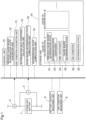
- a functional configuration of the deterioration-state prediction apparatus that predicts the deterioration state 26 of the secondary battery, and a deterioration-state prediction method are described with reference to FIGS. 1 and 2 .
- the following description takes an example of a configuration for predicting the deterioration state 26 of the lithium-ion battery 1 serving as an example of the secondary battery.
- the lithium-ion battery 1 can be charged and discharged, and supplies electric power to various devices, which are power-consuming objects, by discharging electric power stored by charging.
- An ammeter 2 is connected in series to the lithium-ion battery 1. The ammeter 2 measures a current value at the lithium-ion battery 1.
- a voltmeter 3 is also connected in parallel to the lithium-ion battery 1. The voltmeter 3 measures a voltage value across the lithium-ion battery 1.
- a battery capacity measuring unit 5 is connected to the lithium-ion battery 1 and measures the battery capacity for electric power storable in the lithium-ion battery 1.
- a use condition measuring unit 6 is provided around the lithium-ion battery 1. The use condition measuring unit 6 measures various use conditions 22 of the lithium-ion battery 1, such as use environment including temperature (cell temperature), environmental temperature, and air temperature, and a method/mode of use.
- the deterioration-state prediction apparatus that predicts the deterioration state 26 of the lithium-ion battery 1 includes a control unit 10, a previous cause-based deterioration state acquisition unit12, a use condition acquisition unit 13, a deterioration rate coefficient calculation unit 15, a cause-based deterioration state computation unit 16, a deterioration-state computation unit 18, and a storage unit 19.
- the control unit 10 includes a processor such as a CPU and controls operation of each functional unit of the deterioration-state prediction apparatus.
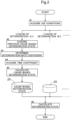
- the use condition acquisition unit 13 acquires various use conditions 22 of the lithium-ion battery 1, such as use environment and a method/mode of use that are acquired by the ammeter 2, the voltmeter 3, the use condition measuring unit 6, or any other method (step #1 in FIG. 2 ).
- the use conditions 22 to be acquired are those at the present time point (when the deterioration state 26 is predicted (at the time of prediction)), i.e. at a time point the first time period has elapsed since the previous cause-based deterioration state 21 (cause-based deterioration state 25) acquired by the later-described previous cause-based deterioration state acquisition unit 12 was calculated and acquired.
- the use condition acquisition unit 13 stores the acquired use conditions 22 in the storage unit 19.
- the previous cause-based deterioration state acquisition unit12 acquires, for each cause of deterioration, the cause-based deterioration state 25 the first time period, which may be any time period, before the present time point (time of prediction) as the previous cause-based deterioration state 21 (step #2 in FIG. 2 ).
- the previous cause-based deterioration state 21 is the deterioration state 26 (cause-based deterioration state 25) of the lithium-ion battery 1 that has deteriorated by the time the first time period before the time of prediction.
- the previous cause-based deterioration state acquisition unit12 acquires, for each cause of deterioration, the cause-based deterioration state 25 that was calculated immediately previously or in the past.
- the previous cause-based deterioration state acquisition unit12 acquires, for each cause of deterioration, the cause-based deterioration state 25 that was acquired the first time period, which may be any time period, before the present time point with use of any means.
- the previous cause-based deterioration state acquisition unit 12 stores the acquired previous cause-based deterioration state 21 in association with the cause of deterioration in the storage unit 19.
- the deterioration rate coefficient calculation unit 15 determines the deterioration rate coefficient 23 for each cause of deterioration based on the use conditions 22 acquired by the use condition acquisition unit 13 (step #3 in FIG. 2 ).
- the deterioration state 26 (cause-based deterioration state 25) is proportional to the power law of time.
- the deterioration rate coefficient 23 is a coefficient corresponding to the deterioration rate and corresponds to a constant of this proportional relationship (proportional expression).
- the use conditions 22 to be used to determine the deterioration rate coefficient 23 can be optionally set in correspondence with the causes of deterioration.
- the use conditions 22 may include temperature information, current information, and voltage information.
- the temperature information includes at least one of: cell temperature, which is the temperature of the lithium-ion battery 1; environmental temperature, which is the temperature around the lithium-ion battery 1; and air temperature, and any of these temperatures is selected in response to the cause of deterioration.
- the current information includes at least one of the following types of information regarding charging and discharging the lithium-ion battery 1: a charging current, a discharging current, a charging rate (Crate), a discharging rate (Orate), a total amount of discharged electricity, and a total amount of charged electricity, and any of these types of information is selected in response to the cause of deterioration.
- the voltage information includes at least one of the following types of information regarding the lithium-ion battery 1: an average voltage, an average charging state, an upper-limit charging voltage, a lower-limit discharging voltage, a time spent in a range of a predetermined charging state, and overvoltage, and any of these types of information is selected in response to the cause of deterioration.
- Deterioration of the lithium-ion battery 1 is affected by the state of use of the lithium-ion battery 1; e.g. how often the lithium-ion battery 1 is used; whether charging and discharging are successively repeated; and whether there is a time period when the use is stopped. It is thus particularly preferable that the use conditions 22 include a total amount of discharged electricity, a total amount of charged electricity, a time spent in a range of a predetermined state of charge, or the like.
- the deterioration rate coefficient 23 can be determined by any method with use of the selected use conditions 22, but may also be calculated with use of a calculation method predetermined for each cause of deterioration.
- the deterioration rate coefficient 23 can be obtained by substituting the acquired use conditions 22 into a predetermined calculation formula for the deterioration rate coefficient 23.
- the calculation formula for the deterioration rate coefficient 23 can be obtained by collecting in advance a plurality of selected use conditions 22 and battery deterioration data of the lithium-ion battery 1, and performing regression analysis on the collected data.
- the regression analysis model may be any of the Arrhenius equation (Arrhenius model: physicochemical empirical formula expressing the temperature dependence of reaction rate) or Butler-Volmer equation (theoretical formula expressing the relationship between the reaction rate, overvoltage, and temperature) as a physicochemical model, as well as any of the linear model (linear multiple regression model), the generalized linear model, Gaussian process regression, random forest regression, a neural network, support vector regression, or the like as a statistical model (machine learning model).
- the linear multiple regression model and the Arrhenius model can be used in combination.
- the time coefficient 24 for each cause of deterioration used to calculate the cause-based deterioration state 25 is obtained in advance and stored in the storage unit 19.
- the stored time coefficient 24 is acquired for each cause of deterioration (step #4 in FIG. 2 ).
- the deterioration state 26 is proportional to the power law of time.
- the time coefficient 24 is a coefficient indicating the time dependence of the deterioration state 26 and corresponds to an exponent. Similar to the deterioration rate coefficient 23, the time coefficient 24 can be calculated through regression analysis with use of a statistical model (machine learning model).
- the time coefficient 24 may be calculated by any of the functional blocks of the deterioration-state prediction apparatus, namely the control unit 10, the deterioration rate coefficient calculation unit 15, or the cause-based deterioration state computation unit 16, but may alternatively be calculated by a unit other than the functional blocks of the deterioration-state prediction apparatus.
- the cause-based deterioration state computation unit 16 calculates the cause-based deterioration state 25 for each cause of deterioration based on the previous cause-based deterioration state 21, the deterioration rate coefficient 23, and the time coefficient 24 (step #5 in FIG. 2 ).
- the cause-based deterioration state computation unit 16 stores the calculated cause-based deterioration state 25 in association with the cause of deterioration in the storage unit 19.
- the cause-based deterioration state computation unit 16 may calculate the cause-based deterioration state 25 with use of any method, while as mentioned above, the cause-based deterioration state 25 is calculated with use of the proportional relationship to time with the deterioration rate coefficient 23 as a constant and the time coefficient 24 as an exponent, while considering the previous cause-based deterioration state 21. That is, the cause-based deterioration state computation unit 16 calculates the cause-based deterioration state 25 based on the previous cause-based deterioration state 21 and the deterioration state 26 (unit cause-based deterioration state) of the lithium-ion battery 1 during the elapsed time (first time period) after acquiring the previous cause-based deterioration state 21.
- the deterioration-state computation unit 18 calculates the deterioration state 26 of the lithium-ion battery 1 at the time of prediction based on the cause-based deterioration state 25 stored for each cause of deterioration in the storage unit 19 (step #6 in FIG. 2 ). For example, the deterioration-state computation unit 18 adds up all of the calculated cause-based deterioration states 25 to calculate a prediction value of the deterioration state 26 of the lithium-ion battery 1.
- SOH t denotes the deterioration state 26 at the time t
- ⁇ denotes the first time period
- ⁇ nt denotes each cause-based deterioration state 25 at the time t
- ⁇ n(t- ⁇ ) denotes the previous cause-based deterioration state 21 for each cause-based deteriorati
- the deterioration rate coefficient 23 is determined for each cause of deterioration with use of one or more appropriate use conditions 22 selected in response to the cause of deterioration, thus facilitating determination of an appropriate deterioration rate coefficient 23.
- the deterioration state 26 of the lithium-ion battery 1 at the present time point (time of prediction) can be predicted accurately.
- the state of progress of deterioration is also diverse.
- SEI film growth the deterioration rapidly progresses at the initial stage of use of the lithium-ion battery 1, but then slows down after the reaction has progressed to a certain extent.
- the deterioration of the lithium-ion battery 1 due to, for example, gas generation at the positive electrode, cracks in the positive electrode active material, and precipitation of metal Li in the negative electrode, the deterioration hardly progresses at the initial stage of use of the lithium-ion battery 1, but the deterioration rate tends to increase after the deterioration has progressed.
- the deterioration-state prediction apparatus obtains more appropriate deterioration rate coefficient 23 and time coefficient 24 in accordance with the use conditions 22. That is, the deterioration-state prediction apparatus determines the method for calculating the deterioration rate coefficient 23 and the time coefficient 24 for each cause of deterioration that reflects deterioration caused by the SEI film growth, Li precipitation, gas generation, or the like, based on data acquired in advance with use of a lithium-ion battery 1 serving as an actual sample.
- the deterioration state 26 (cause-based deterioration state 25) of the lithium-ion battery 1 can be accurately predicted with use of a model based on the thus-obtained deterioration rate coefficient 23 and time coefficient 24.
- the deterioration rate coefficient 23 for each cause of deterioration is affected by the use conditions 22, which change from time to time while the lithium-ion battery 1 is in use. It has been difficult to accurately calculate the deterioration state 26 (cause-based deterioration state 25) of the lithium-ion battery 1 if the deterioration rate coefficient 23 is a fixed value for each cause of deterioration.
- the previous cause-based deterioration state 21 for each cause of deterioration at a time point before the present time point (time of prediction) is acquired, and the cause-based deterioration state 25 can be obtained with use of a model based on the previous cause-based deterioration state 21 and the amount of change in the cause-based deterioration state (unit cause-based deterioration state) during the time period from the time of calculation or measurement of the previous cause-based deterioration state 21 until the time of prediction.
- the influence of changes in the use conditions 22 can be suppressed, thus enabling accurate prediction of the deterioration state 26 of the lithium-ion battery 1 at the present time point (time of prediction).
- FIG. 3 shows experimental results in the case of predicting the deterioration state while considering only Li consumption due to SEI film growth as a cause of deterioration, i.e. considering only one cause of deterioration.
- a line 30 indicates the results of predicting the deterioration state while considering only Li consumption due to SEI film growth as a cause of deterioration.
- a line 31 indicates the results of predicting the deterioration state while considering only high-temperature deterioration as a cause of deterioration.
- a line 32 indicates the results of predicting the deterioration state while considering Li consumption due to SEI film growth and high-temperature deterioration as causes of deterioration.
- the deterioration state 26 can be accurately predicted by calculating the cause-based deterioration state 25 for each of a plurality of causes of deterioration and calculating the deterioration state 26 of the secondary battery based on the plurality of cause-based deterioration states 25.
- FIG. 5 shows the relationship between the prediction results and the actual measurement values in the case of determining the deterioration rate coefficient 23 for Li consumption and the deterioration rate coefficient 23 for high-temperature deterioration as follows while considering Li consumption due to SEI film growth and high-temperature deterioration (deterioration due to gas generation
- ⁇ denotes the deterioration rate coefficient 23
- ⁇ 0 denotes a predetermined reference coefficient
- Ea denotes a constant independent of the cell temperature
- R denotes a gas constant (approx. 8.314)
- T denotes the cell temperature (absolute temperature [K]).
- deterioration rate coefficient 23 in this case can also be obtained by the following Equation 5.
- ⁇ WV ⁇ V + WC ⁇ C + r ⁇ exp Ea/RT
- the experiment was conducted with different use conditions 22 (use environments), and the relationship between the prediction results and actual measurement values was illustrated for the case of fixing (storing) the voltage of the lithium-ion battery 1 (secondary battery) at 4.15 V (4.15-V storage test), the case of fixing (storing) the voltage at 3.67 V (3.67-V storage test), and the case of repeating a predetermined cycle of charging and discharging at a charging rate of 0.7 C (cycle test) such that the average voltage is 3.7 V
- the closer the relationship between the prediction results and the actual measurement values is to a proportional relationship with a slope of 1 solid line in the figures), the more the prediction results and the actual measurement values coincide with each other.
- the prediction results and the actual measurement values substantially coincide with each other in the case of fixing (storing) the voltage at 4.15 V (4.15-V storage test) as shown in FIG. 5 .
- the prediction results and the actual measurement values do not coincide with each other in the case of fixing (storing) the voltage at 3.67 V (3.67-V storage test) and in the case of repeating a predetermined cycle of charging and discharging at a charging rate of 0.7 C (cycle test) such that the average voltage is 3.7 V
- the prediction results and the actual measurement values substantially coincide with each other in all cases when the deterioration rate coefficient 23 is determined while considering the temperature, the average voltage, and the charging rate as the use conditions 22 and the deterioration state 26 is predicted with use of the thus-determined deterioration rate coefficient 23, as shown in FIG. 6 .
- the deterioration rate coefficient 23 that matches the cause of deterioration can be accurately determined by determining the deterioration rate coefficient 23 with use of a plurality of use conditions 22 in accordance with the cause of deterioration, thus enabling accurate prediction of the deterioration state 26.
- the overvoltage can be obtained by applying a current to the secondary battery (lithium-ion battery 1) over a predetermined time period and stopping the current, and subtracting a voltage value of the secondary battery at a time point before starting applying the current to the secondary battery from a voltage value of the secondary battery at a time point a predetermined third time period after the start of applying the current.
- the third time period may be, for example, 0.5 seconds or more and 60 seconds or less.
- the overvoltage may also be obtained by applying a current to the secondary battery (lithium-ion battery 1) over a predetermined time period and stopping the current, and subtracting a voltage value of the secondary battery at a time point a predetermined fourth time period after the stop of the current from a voltage value of the secondary battery while the current is applied.
- the fourth time period may be, for example, 0.5 seconds or more and 60 seconds or less.
- the overvoltage can also be obtained as the product of the charging current and the internal resistance of the secondary battery.
- the deterioration rate coefficient 23 may be determined with use of use history data including temperature information history (past trends), current information history, and voltage information history, as well as cell status history data including at least one of the battery capacity history, resistance history, battery voltage history, output history, outer dimensions, and confining pressure.
- the deterioration rate coefficient 23 can be determined by machine-learning the use history data and the cell status history data.
- the deterioration rate coefficient 23 can thus be more accurately determined while considering the history of the use conditions 22.
- the deterioration state 26 (cause-based deterioration state 25) of the secondary battery (lithium-ion battery 1) can be predicted accurately.
- the deterioration-state prediction apparatus is not limited to including functional blocks such as those shown in FIG. 1 , and may include any functional blocks.
- each functional block of the deterioration-state prediction apparatus may be further subdivided, or conversely, some or all of the functional blocks may be combined.
- the aforementioned deterioration-state prediction method is not limited to being performed by the deterioration-state prediction apparatus shown in FIG. 1 , and may be performed by deterioration-state prediction apparatuses having any configuration.
- Some or all of the functions of the deterioration-state prediction apparatus may be configured by software.
- a program associated with the software is stored in any storage device such as the storage unit 19, and is executed by a processor (computer) such as a CPU included in the control unit 10 or a separately provided processor (computer).
- the present invention can be applied to prediction of the deterioration state of various secondary batteries such as lithium-ion batteries.
Landscapes
- Physics & Mathematics (AREA)
- General Physics & Mathematics (AREA)
- Engineering & Computer Science (AREA)
- Manufacturing & Machinery (AREA)
- Chemical & Material Sciences (AREA)
- Chemical Kinetics & Catalysis (AREA)
- Electrochemistry (AREA)
- General Chemical & Material Sciences (AREA)
- Theoretical Computer Science (AREA)
- Software Systems (AREA)
- Data Mining & Analysis (AREA)
- Evolutionary Computation (AREA)
- Medical Informatics (AREA)
- Computer Vision & Pattern Recognition (AREA)
- Computing Systems (AREA)
- General Engineering & Computer Science (AREA)
- Mathematical Physics (AREA)
- Artificial Intelligence (AREA)
- Secondary Cells (AREA)
- Tests Of Electric Status Of Batteries (AREA)
- Charge And Discharge Circuits For Batteries Or The Like (AREA)
Abstract
Description
- The present invention relates to a deterioration-state prediction method, a deterioration-state prediction apparatus, and a deterioration-state prediction program for predicting the deterioration state of a chargeable and dischargeable secondary battery.
- A secondary battery can supply stored electric power to various devices by discharging electric power stored by charging. Deterioration of the secondary battery, such as a decrease in full charge capacity, progresses due to repeated charging and discharging and long-term storage. The deterioration state of the secondary battery may be predicted for healthy and continuous use of the secondary battery.
-
Patent Document 1 discloses, for example, a method of calculating the deterioration state of a secondary battery based on the power law of time with a deterioration rate as a coefficient. - Patent Document 1:
WO 2019/171688 - However, the progress of deterioration greatly changes depending on use conditions, and the use conditions change from time to time while the secondary battery is used. Particularly when one power storage device is shared by a plurality of applications, e.g. when an electric vehicle is connected to a power grid and also used for leveling, the charging and discharging methods and conditions greatly differ between charging and discharging of the electric vehicle and charging and discharging for power leveling. This makes it difficult to accurately predict the deterioration state.
- An object of the present invention is to accurately predict the deterioration state of the secondary battery.
- To achieve the above-stated object, a characteristic configuration of a deterioration-state prediction method according to one embodiment of the present invention lies in a deterioration-state prediction method for calculating a cause-based deterioration state for each cause of deterioration and predicting a deterioration state of a secondary battery based on a plurality of the cause-based deterioration states, the method including: calculating each of the cause-based deterioration states based on: a previous cause-based deterioration state being the cause-based deterioration state a first time period ago; and a unit cause-based deterioration state indicating deterioration occurring during the first time period, while considering: time dependence varying depending on the cause of deterioration and following a power law with respect to an elapsed time of the cause-based deterioration state; and a deterioration rate varying depending on the cause of deterioration and determined based on a use condition at time of prediction.
- A characteristic configuration of a deterioration-state prediction apparatus according to one embodiment of the present invention lies in a deterioration-state prediction apparatus configured to predict a deterioration state of a secondary battery, the apparatus including: a previous cause-based deterioration state acquisition unit configured to acquire, for each cause of deterioration of the secondary battery, a previous cause-based deterioration state being a cause-based deterioration state acquired a first time period ago for the cause of deterioration; a use condition acquisition unit configured to acquire a use condition at time of prediction at which the deterioration state of the secondary battery is predicted; a deterioration rate coefficient calculation unit configured to determine, for each cause of deterioration, a deterioration rate coefficient corresponding to a deterioration rate of the secondary battery with use of the use condition; a cause-based deterioration state computation unit configured to calculate the cause-based deterioration state for each cause of deterioration based on: a time coefficient applied to an elapsed time predetermined for the cause of deterioration; the deterioration rate coefficient; and the previous cause-based deterioration state; and a deterioration-state computation unit configured to predict the deterioration state of the secondary battery based on a plurality of the cause-based deterioration states calculated for corresponding causes of deterioration.
- A characteristic configuration of a deterioration-state prediction program according to one embodiment of the present invention lies in a deterioration-state prediction program configured to predict a deterioration state of a secondary battery, the program causing a computer to execute: a function of acquiring, for each cause of deterioration of the secondary battery, a previous cause-based deterioration state being a cause-based deterioration state obtained a first time period ago for the cause of deterioration; a function of acquiring a use condition at time of prediction at which the deterioration state of the secondary battery is predicted; a function of determining, for each cause of deterioration, a deterioration rate coefficient corresponding to a deterioration rate of the secondary battery with use of the use condition; a function of calculating the cause-based deterioration state for each cause of deterioration based on: a time coefficient applied to an elapsed time predetermined for the cause of deterioration; the deterioration rate coefficient; and the previous cause-based deterioration state; and a function of predicting the deterioration state of the secondary battery based on a plurality of the cause-based deterioration states calculated for corresponding causes of deterioration.
- Deterioration of a secondary battery progresses while being affected by a plurality of causes of deterioration. The progress rate of deterioration (deterioration state) varies between causes of deterioration. Furthermore, the progress rate of the cause-based deterioration state complexly changes depending on the use conditions. It is difficult to comprehensively calculate the deterioration state of the secondary battery while considering a plurality of causes of deterioration, whereas it is relatively easy to individually calculate the cause-based deterioration state for each cause of deterioration. The deterioration state of the secondary battery can be easily and accurately predicted by individually calculating the cause-based deterioration state for each cause of deterioration and predicting the deterioration state of the secondary battery based on the cause-based deterioration state.
- As a result of intensive study, the inventors have discovered that the cause-based deterioration state for each cause of deterioration has time dependence that follows a power law and depends on the deterioration rate that varies depending on the cause of deterioration. That is, the inventors have discovered that the cause-based deterioration state for each cause of deterioration can be calculated based on the deterioration rate and the time dependence.
- Here, the deterioration rate changes from time to time depending on various use conditions, such as temperature conditions, charging and discharging current, and a battery voltage, even with the same cause of deterioration. The deterioration rate is therefore not constant from when the secondary battery begins to be used to the time point at which the deterioration state is predicted, and it is difficult to accurately calculate the deterioration state (cause-based deterioration state) if a fixed deterioration rate is used for each cause of deterioration.
- The cause-based deterioration state is calculated based on the previous cause-based deterioration state, which is the deterioration state (cause-based deterioration state) up to a certain, immediately previous time point, and the unit cause-based deterioration state, which is the deterioration state (cause-based deterioration state) during a time period from that time point until the first time period elapses from the time point. This allows only the deterioration rate during the first time period to be considered and can thus suppress the influence of changes in the use conditions on the deterioration rate. As a result, the deterioration state of the secondary battery can be accurately predicted.
- The deterioration state (cause-based deterioration state) is obtained while considering the deterioration rate calculated in accordance with the use conditions at the time of prediction (present time point) rather than using a constant deterioration rate for each cause of deterioration. This enables accurate prediction of the deterioration state of the secondary battery.
- The cause-based deterioration state may be obtained as

- This configuration enables easy and accurate prediction of the deterioration state of the secondary battery.
- The deterioration state may be obtained by adding up all of the calculated cause-based deterioration states.
- This configuration enables the deterioration state to be predicted while easily and appropriately considering a plurality of cause-based deterioration states, and enables easy and accurate prediction of the deterioration state of the secondary battery.
- The previous cause-based deterioration state may be an actual measurement value obtained by any method.
- This configuration makes it possible to predict the cause-based deterioration state during a time period from when the secondary battery begins to be used until the time of prediction by substantially only predicting the cause-based deterioration state during the first time period with use of the actual previous cause-based deterioration state. This configuration enables accurate prediction of the deterioration state of the secondary battery.
- The previous cause-based deterioration state may be the cause-based deterioration state calculated based on: the previous cause-based deterioration state at a time point a second time period before a time point before the first time period; and the unit cause-based deterioration state during the second time period.
- This configuration makes it possible to predict the cause-based deterioration state during a time period from when the secondary battery begins to be used until the time of prediction by repeating the prediction of the cause-based deterioration state during a short time period during which the change in the use conditions can be expected to be limited. This configuration enables accurate prediction of the deterioration state of the secondary battery.
- The deterioration rate may be determined with use of temperature information, current information, and voltage information as the use condition, the temperature information may include at least one of: cell temperature; environmental temperature; and air temperature, the current information may include at least one of: a charging current; a discharging current; a charging rate; a discharging rate; a total amount of discharged electricity; and a total amount of charged electricity, and the voltage information may include at least one of: an average voltage; an average charging state; an upper-limit charging voltage; a lower-limit discharging voltage; a time spent in a range of a predetermined charging state; and an overvoltage.
- This configuration makes it possible to select appropriate use conditions in response to the cause of deterioration and determine the deterioration rate with use of the selected use conditions. As a result, the deterioration state of the secondary battery can be accurately predicted.
- The overvoltage may be obtained by applying a current to the secondary battery over a predetermined time period and stopping the current, and subtracting a voltage value of the secondary battery at a time point before starting applying the current to the secondary battery from a voltage value of the secondary battery at a time point a predetermined third time period after the start of applying the current.
- This configuration makes it possible to obtain an overvoltage easily and accurately. The deterioration rate can thus be accurately determined. As a result, the deterioration state of the secondary battery can be accurately predicted.
- The overvoltage may be obtained by applying a current to the secondary battery over a predetermined time period and stopping the current, and subtracting a voltage value of the secondary battery at a time point a predetermined fourth time period after the stop of the current from a voltage value of the secondary battery while the current is applied.
- This configuration makes it possible to obtain an overvoltage easily and accurately. The deterioration rate can thus be accurately determined. As a result, the deterioration state of the secondary battery can be accurately predicted.
- The overvoltage may be obtained as a product of the charging current and an internal resistance of the secondary battery.
- This configuration makes it possible to obtain an overvoltage easily and accurately. The deterioration rate can thus be accurately determined. As a result, the deterioration state of the secondary battery can be accurately predicted.
- The deterioration rate may be determined with use of: use history data including history of the temperature information, history of the current information, and history of the voltage information; and cell status history data including at least one of: battery capacity history; resistance history, battery voltage history; output history; outer dimensions; and a confining pressure.
- This configuration makes it possible to more accurately determine the deterioration rate and accurately predict the deterioration state of the secondary battery.
- The deterioration rate may be determined by machine-learning the use history data and the cell status history data.
- This configuration makes it possible to more accurately determine the deterioration rate and accurately predict the deterioration state of the secondary battery.
-
-
FIG. 1 is a diagram showing an example of a functional configuration of a deterioration-state prediction apparatus. -
FIG. 2 is a diagram showing an example of a flow of deterioration-state prediction. -
FIG. 3 illustrates a comparison between actual measurement values and deterioration-state prediction performed while considering one cause of deterioration. -
FIG. 4 illustrates a comparison between actual measurement values and deterioration-state prediction performed while considering two causes of deterioration. -
FIG. 5 illustrates a comparison between actual measurement values and deterioration-state prediction performed with use of a deterioration rate coefficient determined based on one use condition. -
FIG. 6 illustrates a comparison between actual measurement values and deterioration-state prediction performed with use of a deterioration rate coefficient determined based on three use conditions. - Deterioration of a secondary battery is caused by various reaction mechanisms (causes of deterioration), such as an increase of a resistance film at an electrode-electrolyte interface (SEI), metal Li (electrode metal) precipitation on an electrode surface, cracks in an electrode active material, crystal phase transition, and a gas generation caused by electrolyte decomposition. In prediction of a deterioration state 26 (see
FIG. 1 ) of a secondary battery, the deterioration state 26 (cause-based deterioration state 25) is obtained for each cause of deterioration, and thedeterioration state 26 of the secondary battery is obtained based on one or more cause-based deterioration states 25. Note that thedeterioration state 26 is, for example, indicated by a value that decreases from 1, which indicates the chargeable capacity of an unused secondary battery, as deterioration progresses, and is also referred to as a "state of health" (SOH). - Deterioration of the secondary battery can be approximated by a power law with respect to the time (elapsed time) from when the secondary battery begins to be used. That is, deterioration of the secondary battery has time dependence proportional to a power law of time and depends on the deterioration rate. This proportional relationship can be expressed by using a later-described deterioration rate coefficient 23 (see
FIG. 1 ) as a constant and a later-described time coefficient 24 (seeFIG. 1 ) as an exponent. - Here, the
deterioration rate coefficient 23 depends on various use conditions 22 (seeFIG. 1 ), such as a use environment, a use method, and a use mode. Further, theuse conditions 22 often change during the use of the secondary battery. If the deterioration state 26 (cause-based deterioration state 25) of the secondary battery over a long time period (during the lapse of a long time) is calculated (predicted) with use of a constantdeterioration rate coefficient 23, an error may occur in response to variations in theuse conditions 22, making it difficult to accurately predict the deterioration state 26 (cause-based deterioration state 25) of the secondary battery. - The cause-based
deterioration state 25 of the secondary battery is therefore calculated based on a previous cause-based deterioration state 21 (seeFIG. 1 ) that is obtained in advance and a unit cause-based deterioration state during a time period from when the previous cause-baseddeterioration state 21 was calculated (measured) until a first time period, which may be any time period, elapses. - The previous cause-based
deterioration state 21 is the deterioration state 26 (cause-based deterioration state 25) of the secondary battery at a time point the first time period before the present time point (time point at which thedeterioration state 26 of the secondary battery is predicted). The previous cause-baseddeterioration state 21 may alternatively be a prediction value (cause-based deterioration state 25) calculated the first time period before the present time point. In this case, at a time point the first time period before the present time point, the cause-baseddeterioration state 25 calculated at a time point a second time period before that time point is acquired as the previous cause-baseddeterioration state 21, and the cause-baseddeterioration state 25 is calculated. The above calculation of the cause-baseddeterioration state 25 is repeated. The previous cause-baseddeterioration state 21 may alternatively be an actual measurement value measured with a predetermined means the first time period before the present time point. The previous cause-baseddeterioration state 21 may alternatively be a corrected prediction value obtained by correcting a prediction value (cause-based deterioration state 25) calculated the first time period before the present time point while additionally considering an actual measurement value measured with a predetermined method the first time period before the present time point. - The unit cause-based deterioration state is the deterioration state 26 (cause-based deterioration state 25) of the secondary battery during a time period from when the previous cause-based
deterioration state 21 was calculated/measured (acquired) to the present time point, i.e. during the first time period. Note that if, at a time point the first time period before the present time point, the cause-baseddeterioration state 25 calculated at a time point the second time period before that time point is used as the previous cause-baseddeterioration state 21, the unit cause-based deterioration state is the deterioration state 26 (cause-based deterioration state 25) of the secondary battery during a time period from the time point at which the previous cause-baseddeterioration state 21 was calculated/measured (acquired) until the time point the first time period before the present time point is reached, i.e. during the second time period. - The deterioration state 26 (cause-based deterioration state 25) at the present time point (at the time of prediction) has a proportional relationship with the
time coefficient 24 as an exponent, and the deterioration state 26 (cause-based deterioration state 25) is therefore calculated based on the previous cause-baseddeterioration state 21 and the unit cause-based deterioration state while considering the time dependence that follows the power law with respect to the elapsed time. That is, the deterioration state 26 (cause-based deterioration state 25) is calculated based on the previous cause-baseddeterioration state 21 and the unit cause-based deterioration state regarding deterioration during the first time period, while considering the time dependence that varies depending on the cause of deterioration and follows the power law with respect to the elapsed time of the cause-baseddeterioration state 25, and the deterioration rate varying depending on the cause of deterioration and determined by theuse conditions 22 at the time of prediction. For example, the deterioration state 26 (cause-based deterioration state 25) at the present time point (at the time of prediction) is calculated withEquation 1, which will be described later. - The
deterioration state 26 can be calculated with use of the cause-baseddeterioration state 25 calculated for each cause of deterioration by calculating thedeterioration state 26 of the secondary battery as described above, thus enabling accurate calculation of thedeterioration state 26 of the secondary battery. - Further, the time period for calculating the deterioration state 26 (unit cause-based deterioration state) can be shortened by calculating the cause-based
deterioration state 25 with use of the unit cause-based deterioration state during the first time period, thereby suppressing the influence of variations in the use conditions 22. As a result, thedeterioration rate coefficient 23 is accurately determined, and the unit cause-based deterioration state (cause-based deterioration state 25) can be accurately calculated. - The deterioration state 26 (cause-based deterioration state 25) can be predicted with use of the previous cause-based
deterioration state 21, thus reducing the portion that requires calculation (prediction) and enabling more accurate calculation of the deterioration state 26 (cause-based deterioration state 25) of the secondary battery. In particular, if the previous cause-baseddeterioration state 21 is an actual measurement value or a corrected prediction value that has been corrected while additionally considering the actual measurement value, the portion that requires actual prediction is reduced to a portion for only the first time period, and the deterioration state 26 (cause-based deterioration state 25) of the secondary battery can be calculated more accurately. Note that even if the previous cause-baseddeterioration state 21 is a calculated value, theuse conditions 22 can be determined with respect to a short time period, and it is only necessary to calculate the deterioration state 26 (cause-based deterioration state 25) for each short time period, thus enabling accurate calculation of the deterioration state 26 (cause-based deterioration state 25) of the secondary battery. - A functional configuration of the deterioration-state prediction apparatus that predicts the
deterioration state 26 of the secondary battery, and a deterioration-state prediction method are described with reference toFIGS. 1 and2 . The following description takes an example of a configuration for predicting thedeterioration state 26 of the lithium-ion battery 1 serving as an example of the secondary battery. - The lithium-
ion battery 1 can be charged and discharged, and supplies electric power to various devices, which are power-consuming objects, by discharging electric power stored by charging. Anammeter 2 is connected in series to the lithium-ion battery 1. Theammeter 2 measures a current value at the lithium-ion battery 1. Avoltmeter 3 is also connected in parallel to the lithium-ion battery 1. Thevoltmeter 3 measures a voltage value across the lithium-ion battery 1. - A battery
capacity measuring unit 5 is connected to the lithium-ion battery 1 and measures the battery capacity for electric power storable in the lithium-ion battery 1. A usecondition measuring unit 6 is provided around the lithium-ion battery 1. The usecondition measuring unit 6 measuresvarious use conditions 22 of the lithium-ion battery 1, such as use environment including temperature (cell temperature), environmental temperature, and air temperature, and a method/mode of use. - The deterioration-state prediction apparatus that predicts the
deterioration state 26 of the lithium-ion battery 1 includes acontrol unit 10, a previous cause-based deterioration state acquisition unit12, a usecondition acquisition unit 13, a deterioration ratecoefficient calculation unit 15, a cause-based deteriorationstate computation unit 16, a deterioration-state computation unit 18, and astorage unit 19. - The
control unit 10 includes a processor such as a CPU and controls operation of each functional unit of the deterioration-state prediction apparatus. - The use
condition acquisition unit 13 acquiresvarious use conditions 22 of the lithium-ion battery 1, such as use environment and a method/mode of use that are acquired by theammeter 2, thevoltmeter 3, the usecondition measuring unit 6, or any other method (step # 1 inFIG. 2 ). Theuse conditions 22 to be acquired are those at the present time point (when thedeterioration state 26 is predicted (at the time of prediction)), i.e. at a time point the first time period has elapsed since the previous cause-based deterioration state 21 (cause-based deterioration state 25) acquired by the later-described previous cause-based deteriorationstate acquisition unit 12 was calculated and acquired. The usecondition acquisition unit 13 stores the acquireduse conditions 22 in thestorage unit 19. - The previous cause-based deterioration state acquisition unit12 acquires, for each cause of deterioration, the cause-based
deterioration state 25 the first time period, which may be any time period, before the present time point (time of prediction) as the previous cause-based deterioration state 21 (step # 2 inFIG. 2 ). The previous cause-baseddeterioration state 21 is the deterioration state 26 (cause-based deterioration state 25) of the lithium-ion battery 1 that has deteriorated by the time the first time period before the time of prediction. If, for example, thedeterioration state 26 of the lithium-ion battery 1 is predicted at predetermined or any time intervals, the previous cause-based deterioration state acquisition unit12 acquires, for each cause of deterioration, the cause-baseddeterioration state 25 that was calculated immediately previously or in the past. Alternatively, the previous cause-based deterioration state acquisition unit12 acquires, for each cause of deterioration, the cause-baseddeterioration state 25 that was acquired the first time period, which may be any time period, before the present time point with use of any means. The previous cause-based deteriorationstate acquisition unit 12 stores the acquired previous cause-baseddeterioration state 21 in association with the cause of deterioration in thestorage unit 19. - The deterioration rate
coefficient calculation unit 15 determines thedeterioration rate coefficient 23 for each cause of deterioration based on theuse conditions 22 acquired by the use condition acquisition unit 13 (step # 3 inFIG. 2 ). As mentioned above, the deterioration state 26 (cause-based deterioration state 25) is proportional to the power law of time. Thedeterioration rate coefficient 23 is a coefficient corresponding to the deterioration rate and corresponds to a constant of this proportional relationship (proportional expression). - The
use conditions 22 to be used to determine thedeterioration rate coefficient 23 can be optionally set in correspondence with the causes of deterioration. For example, theuse conditions 22 may include temperature information, current information, and voltage information. - These use
conditions 22 are measured by theammeter 2, thevoltmeter 3, the usecondition measuring unit 6, or the like, and are obtained by further performing calculation as necessary. - The temperature information includes at least one of: cell temperature, which is the temperature of the lithium-
ion battery 1; environmental temperature, which is the temperature around the lithium-ion battery 1; and air temperature, and any of these temperatures is selected in response to the cause of deterioration. The current information includes at least one of the following types of information regarding charging and discharging the lithium-ion battery 1: a charging current, a discharging current, a charging rate (Crate), a discharging rate (Orate), a total amount of discharged electricity, and a total amount of charged electricity, and any of these types of information is selected in response to the cause of deterioration. The voltage information includes at least one of the following types of information regarding the lithium-ion battery 1: an average voltage, an average charging state, an upper-limit charging voltage, a lower-limit discharging voltage, a time spent in a range of a predetermined charging state, and overvoltage, and any of these types of information is selected in response to the cause of deterioration. - Deterioration of the lithium-
ion battery 1 is affected by the state of use of the lithium-ion battery 1; e.g. how often the lithium-ion battery 1 is used; whether charging and discharging are successively repeated; and whether there is a time period when the use is stopped. It is thus particularly preferable that theuse conditions 22 include a total amount of discharged electricity, a total amount of charged electricity, a time spent in a range of a predetermined state of charge, or the like. - The
deterioration rate coefficient 23 can be determined by any method with use of the selecteduse conditions 22, but may also be calculated with use of a calculation method predetermined for each cause of deterioration. - For example, the
deterioration rate coefficient 23 can be obtained by substituting the acquireduse conditions 22 into a predetermined calculation formula for thedeterioration rate coefficient 23. The calculation formula for thedeterioration rate coefficient 23 can be obtained by collecting in advance a plurality of selecteduse conditions 22 and battery deterioration data of the lithium-ion battery 1, and performing regression analysis on the collected data. Note that the regression analysis model may be any of the Arrhenius equation (Arrhenius model: physicochemical empirical formula expressing the temperature dependence of reaction rate) or Butler-Volmer equation (theoretical formula expressing the relationship between the reaction rate, overvoltage, and temperature) as a physicochemical model, as well as any of the linear model (linear multiple regression model), the generalized linear model, Gaussian process regression, random forest regression, a neural network, support vector regression, or the like as a statistical model (machine learning model). For example, the linear multiple regression model and the Arrhenius model can be used in combination. - Here, the
time coefficient 24 for each cause of deterioration used to calculate the cause-baseddeterioration state 25 is obtained in advance and stored in thestorage unit 19. The storedtime coefficient 24 is acquired for each cause of deterioration (step # 4 inFIG. 2 ). As mentioned above, thedeterioration state 26 is proportional to the power law of time. Thetime coefficient 24 is a coefficient indicating the time dependence of thedeterioration state 26 and corresponds to an exponent. Similar to thedeterioration rate coefficient 23, thetime coefficient 24 can be calculated through regression analysis with use of a statistical model (machine learning model). Thetime coefficient 24 may be calculated by any of the functional blocks of the deterioration-state prediction apparatus, namely thecontrol unit 10, the deterioration ratecoefficient calculation unit 15, or the cause-based deteriorationstate computation unit 16, but may alternatively be calculated by a unit other than the functional blocks of the deterioration-state prediction apparatus. - The cause-based deterioration
state computation unit 16 calculates the cause-baseddeterioration state 25 for each cause of deterioration based on the previous cause-baseddeterioration state 21, thedeterioration rate coefficient 23, and the time coefficient 24 (step # 5 inFIG. 2 ). The cause-based deteriorationstate computation unit 16 stores the calculated cause-baseddeterioration state 25 in association with the cause of deterioration in thestorage unit 19. The cause-based deteriorationstate computation unit 16 may calculate the cause-baseddeterioration state 25 with use of any method, while as mentioned above, the cause-baseddeterioration state 25 is calculated with use of the proportional relationship to time with thedeterioration rate coefficient 23 as a constant and thetime coefficient 24 as an exponent, while considering the previous cause-baseddeterioration state 21. That is, the cause-based deteriorationstate computation unit 16 calculates the cause-baseddeterioration state 25 based on the previous cause-baseddeterioration state 21 and the deterioration state 26 (unit cause-based deterioration state) of the lithium-ion battery 1 during the elapsed time (first time period) after acquiring the previous cause-baseddeterioration state 21. - For example, the cause-based deterioration
state computation unit 16 calculates the cause-baseddeterioration state 25 at the time of prediction with use of a function indicated by the following Equation 1:
deterioration state 25 at the time t, µ(t-δ) denotes the previous cause-baseddeterioration state 21, α denotes thedeterioration rate coefficient 23, and ß denotes thetime coefficient 24. - The deterioration-
state computation unit 18 calculates thedeterioration state 26 of the lithium-ion battery 1 at the time of prediction based on the cause-baseddeterioration state 25 stored for each cause of deterioration in the storage unit 19 (step # 6 inFIG. 2 ). For example, the deterioration-state computation unit 18 adds up all of the calculated cause-based deterioration states 25 to calculate a prediction value of thedeterioration state 26 of the lithium-ion battery 1. - The
deterioration state 26 calculated based on theabove Equation 1 is calculated as the following Equations 2:
deterioration state 26 at the time t, δ denotes the first time period, µnt denotes each cause-baseddeterioration state 25 at the time t, µn(t-δ) denotes the previous cause-baseddeterioration state 21 for each cause-baseddeterioration state 25, αn denotes thedeterioration rate coefficient 23 for each cause-baseddeterioration state 25, and βn denotes thetime coefficient 24 for each cause-based deterioration state 25 (n = 1, 2, 3 ...) - By predicting the
deterioration state 26 of the lithium-ion battery 1 with use of the deterioration-state prediction apparatus having the above configuration, thedeterioration rate coefficient 23 is determined for each cause of deterioration with use of one or moreappropriate use conditions 22 selected in response to the cause of deterioration, thus facilitating determination of an appropriatedeterioration rate coefficient 23. As a result, thedeterioration state 26 of the lithium-ion battery 1 at the present time point (time of prediction) can be predicted accurately. - There are various causes of deterioration of the lithium-
ion battery 1, and the state of progress of deterioration is also diverse. For example, in the deterioration of the lithium-ion battery 1 due to the growth of a film on the negative electrode surface of the lithium-ion battery 1 (SEI film growth), the deterioration rapidly progresses at the initial stage of use of the lithium-ion battery 1, but then slows down after the reaction has progressed to a certain extent. In the deterioration of the lithium-ion battery 1 due to, for example, gas generation at the positive electrode, cracks in the positive electrode active material, and precipitation of metal Li in the negative electrode, the deterioration hardly progresses at the initial stage of use of the lithium-ion battery 1, but the deterioration rate tends to increase after the deterioration has progressed. - In response to such a variety of causes of deterioration, the deterioration-state prediction apparatus according to the present embodiment obtains more appropriate
deterioration rate coefficient 23 andtime coefficient 24 in accordance with the use conditions 22. That is, the deterioration-state prediction apparatus determines the method for calculating thedeterioration rate coefficient 23 and thetime coefficient 24 for each cause of deterioration that reflects deterioration caused by the SEI film growth, Li precipitation, gas generation, or the like, based on data acquired in advance with use of a lithium-ion battery 1 serving as an actual sample. The deterioration state 26 (cause-based deterioration state 25) of the lithium-ion battery 1 can be accurately predicted with use of a model based on the thus-obtaineddeterioration rate coefficient 23 andtime coefficient 24. - The
deterioration rate coefficient 23 for each cause of deterioration is affected by theuse conditions 22, which change from time to time while the lithium-ion battery 1 is in use. It has been difficult to accurately calculate the deterioration state 26 (cause-based deterioration state 25) of the lithium-ion battery 1 if thedeterioration rate coefficient 23 is a fixed value for each cause of deterioration. According to this embodiment, the previous cause-baseddeterioration state 21 for each cause of deterioration at a time point before the present time point (time of prediction) is acquired, and the cause-baseddeterioration state 25 can be obtained with use of a model based on the previous cause-baseddeterioration state 21 and the amount of change in the cause-based deterioration state (unit cause-based deterioration state) during the time period from the time of calculation or measurement of the previous cause-baseddeterioration state 21 until the time of prediction. As a result, the influence of changes in theuse conditions 22 can be suppressed, thus enabling accurate prediction of thedeterioration state 26 of the lithium-ion battery 1 at the present time point (time of prediction). - Next, experimental results of predicting the deterioration state of the lithium-ion battery 1 (secondary battery) according to the present embodiment are described with reference to
FIGS. 1 and3 to 6 . - First,
FIG. 3 shows experimental results in the case of predicting the deterioration state while considering only Li consumption due to SEI film growth as a cause of deterioration, i.e. considering only one cause of deterioration. Note that aline 30 inFIG. 3 indicates the results of predicting the deterioration state while considering only Li consumption due to SEI film growth as a cause of deterioration, with the first time period being δ = 240 hours, thedeterioration rate coefficient 23 being α = 0.002, and thetime coefficient 24 being β = 0.5 in theabove Equation 1.FIG. 4 shows experimental results of predicting the deterioration state while considering Li consumption due to SEI film growth and high-temperature deterioration (deterioration due to gas generation) as causes of deterioration, with the first time period being δ = 240 hours, thedeterioration rate coefficient 23 for Li consumption being α1 = 0.002, thetime coefficient 24 for Li consumption being β1 = 0.5, thedeterioration rate coefficient 23 for high-temperature deterioration being α2 = 0.5 × 10⁻⁶, and thetime coefficient 24 for high-temperature deterioration being β2 = 1.5 in theabove Equation 2. InFIG. 4 , aline 30 indicates the results of predicting the deterioration state while considering only Li consumption due to SEI film growth as a cause of deterioration. Aline 31 indicates the results of predicting the deterioration state while considering only high-temperature deterioration as a cause of deterioration. Aline 32 indicates the results of predicting the deterioration state while considering Li consumption due to SEI film growth and high-temperature deterioration as causes of deterioration. - It can be understood that the prediction results indicated by the
lines FIGS. 3 and 4 . In contrast, theline 32 obtained by predicting the deterioration state while considering more than one cause of deterioration substantially matches the actual measurement values obtained from the experiment, as shown inFIG. 4 . - It can be understood from the above results that the
deterioration state 26 can be accurately predicted by calculating the cause-baseddeterioration state 25 for each of a plurality of causes of deterioration and calculating thedeterioration state 26 of the secondary battery based on the plurality of cause-based deterioration states 25. -
FIG. 5 shows the relationship between the prediction results and the actual measurement values in the case of determining thedeterioration rate coefficient 23 for Li consumption and thedeterioration rate coefficient 23 for high-temperature deterioration as follows while considering Li consumption due to SEI film growth and high-temperature deterioration (deterioration due to gas generation) as causes of deterioration and considering only the temperature (cell temperature) as ause condition 22, and predicting thedeterioration state 26 for each cause of deterioration with the first time period being δ = 240 hours, thetime coefficient 24 for Li consumption being β1 = 0.5, thetime coefficient 24 for high-temperature deterioration being β2 = 1.5 in theabove Equation 2.FIG. 6 shows the relationship between the prediction results and the actual measurement values in the case of determining thedeterioration rate coefficient 23 for Li consumption and thedeterioration rate coefficient 23 for high-temperature deterioration, as inFIG. 5 , while considering the temperature (cell temperature), the average voltage, and the charging rate asuse conditions 22, and predicting thedeterioration state 26 for each cause of deterioration with the first time period being δ = 240 hours, thetime coefficient 24 for Li consumption being β1 = 0.5, thetime coefficient 24 for high-temperature deterioration being β2 = 1.5 in theabove Equation 2. - Note that the
deterioration rate coefficient 23 used in the prediction shown inFIG. 5 and determined while considering only the cell temperature can be obtained by the following Equation 3:
deterioration rate coefficient 23, α0 denotes a predetermined reference coefficient, Ea denotes a constant independent of the cell temperature, R denotes a gas constant (approx. 8.314), and T denotes the cell temperature (absolute temperature [K]). - The
deterioration rate coefficient 23 used in the prediction shown inFIG. 6 and determined while considering the cell temperature, the average voltage, and the charging rate can be obtained by the following Equation 4:
deterioration rate coefficient 23, WV denotes a predetermined reference voltage, V denotes the average voltage at the time of prediction, WC denotes a predetermined reference charging rate, C denotes the charging rate during charging performed at the time of prediction or immediately before the prediction, r denotes a predetermined constant, Ea denotes a constant independent of the cell temperature, R denotes a gas constant (approx. 8.314), and T denotes the cell temperature (absolute temperature [K]). - Note that the
deterioration rate coefficient 23 in this case can also be obtained by the followingEquation 5.
- Here, the experiment was conducted with different use conditions 22 (use environments), and the relationship between the prediction results and actual measurement values was illustrated for the case of fixing (storing) the voltage of the lithium-ion battery 1 (secondary battery) at 4.15 V (4.15-V storage test), the case of fixing (storing) the voltage at 3.67 V (3.67-V storage test), and the case of repeating a predetermined cycle of charging and discharging at a charging rate of 0.7 C (cycle test) such that the average voltage is 3.7 V In the figures, the closer the relationship between the prediction results and the actual measurement values is to a proportional relationship with a slope of 1 (solid line in the figures), the more the prediction results and the actual measurement values coincide with each other.
- The prediction results and the actual measurement values substantially coincide with each other in the case of fixing (storing) the voltage at 4.15 V (4.15-V storage test) as shown in
FIG. 5 . However, the prediction results and the actual measurement values do not coincide with each other in the case of fixing (storing) the voltage at 3.67 V (3.67-V storage test) and in the case of repeating a predetermined cycle of charging and discharging at a charging rate of 0.7 C (cycle test) such that the average voltage is 3.7 V These results indicate that if thedeterioration rate coefficient 23 is determined without using appropriate use conditions 22 (use environments), there are cases where the cause of deterioration and thedeterioration rate coefficient 23 do not match and thedeterioration state 26 cannot be accurately predicted. - In contrast, the prediction results and the actual measurement values substantially coincide with each other in all cases when the
deterioration rate coefficient 23 is determined while considering the temperature, the average voltage, and the charging rate as theuse conditions 22 and thedeterioration state 26 is predicted with use of the thus-determineddeterioration rate coefficient 23, as shown inFIG. 6 . - It can be understood from the above experiment results that the
deterioration rate coefficient 23 that matches the cause of deterioration can be accurately determined by determining thedeterioration rate coefficient 23 with use of a plurality ofuse conditions 22 in accordance with the cause of deterioration, thus enabling accurate prediction of thedeterioration state 26. -
- (1) The secondary battery whose
deterioration state 26 is to be predicted in the above embodiment is not limited to the lithium-ion battery 1, but may be any type of secondary battery capable of various types of charging and discharging, such as a non-aqueous secondary battery. - (2) In the above embodiments, the overvoltage, which is one of the
use conditions 22 for determining thedeterioration rate coefficient 23, can be obtained by various methods as follows. - For example, the overvoltage can be obtained by applying a current to the secondary battery (lithium-ion battery 1) over a predetermined time period and stopping the current, and subtracting a voltage value of the secondary battery at a time point before starting applying the current to the secondary battery from a voltage value of the secondary battery at a time point a predetermined third time period after the start of applying the current. The third time period may be, for example, 0.5 seconds or more and 60 seconds or less. The overvoltage caused due to the charging/discharging reaction on the electrode surface can be accurately obtained by thus setting the third time period, and the
deterioration rate coefficient 23 can be accurately calculated. - The overvoltage may also be obtained by applying a current to the secondary battery (lithium-ion battery 1) over a predetermined time period and stopping the current, and subtracting a voltage value of the secondary battery at a time point a predetermined fourth time period after the stop of the current from a voltage value of the secondary battery while the current is applied. The fourth time period may be, for example, 0.5 seconds or more and 60 seconds or less. The overvoltage can be accurately obtained by thus setting the fourth time period, and the
deterioration rate coefficient 23 can be accurately calculated. - The overvoltage can also be obtained as the product of the charging current and the internal resistance of the secondary battery.
- (3) The
deterioration rate coefficient 23 may be determined with use of use history data including temperature information history (past trends), current information history, and voltage information history, as well as cell status history data including at least one of the battery capacity history, resistance history, battery voltage history, output history, outer dimensions, and confining pressure. - For example, the
deterioration rate coefficient 23 can be determined by machine-learning the use history data and the cell status history data. - The
deterioration rate coefficient 23 can thus be more accurately determined while considering the history of the use conditions 22. As a result, the deterioration state 26 (cause-based deterioration state 25) of the secondary battery (lithium-ion battery 1) can be predicted accurately. - (4) In the above embodiments, the deterioration-state prediction apparatus is not limited to including functional blocks such as those shown in
FIG. 1 , and may include any functional blocks. For example, each functional block of the deterioration-state prediction apparatus may be further subdivided, or conversely, some or all of the functional blocks may be combined. The aforementioned deterioration-state prediction method is not limited to being performed by the deterioration-state prediction apparatus shown inFIG. 1 , and may be performed by deterioration-state prediction apparatuses having any configuration. Some or all of the functions of the deterioration-state prediction apparatus may be configured by software. A program associated with the software is stored in any storage device such as thestorage unit 19, and is executed by a processor (computer) such as a CPU included in thecontrol unit 10 or a separately provided processor (computer). - Note that the configurations disclosed in the above embodiments (including other embodiments; the same applies hereinafter) can be applied in combination with configurations disclosed in other embodiments as long as no contradiction arises. The embodiments disclosed herein are examples, and the embodiments of the present invention are not limited thereto and can be modified as appropriate without departing from the object of the present invention.
- The present invention can be applied to prediction of the deterioration state of various secondary batteries such as lithium-ion batteries.
-
- 1
- Lithium-ion battery (secondary battery)
- 12
- Previous cause-based deterioration state acquisition unit
- 13
- Use condition acquisition unit
- 15
- Deterioration rate coefficient calculation unit
- 16
- Cause-based deterioration state computation unit
- 18
- Deterioration-state computation unit
- 19
- Storage unit
- 21
- Previous cause-based deterioration state
- 22
- Use condition
- 23
- Deterioration rate coefficient
- 24
- Time coefficient
- 25
- Cause-based deterioration state
- 26
- Deterioration state
Claims (13)
- A deterioration-state prediction method for calculating a cause-based deterioration state for each cause of deterioration and predicting a deterioration state of a secondary battery based on a plurality of the cause-based deterioration states, the method comprising:
calculating each of the cause-based deterioration states based on: a previous cause-based deterioration state being the cause-based deterioration state a first time period ago; and a unit cause-based deterioration state indicating deterioration occurring during the first time period, while considering: time dependence varying depending on the cause of deterioration and following a power law with respect to an elapsed time of the cause-based deterioration state; and a deterioration rate varying depending on the cause of deterioration and determined based on a use condition at time of prediction. - The deterioration-state prediction method according to claim 1,wherein the cause-based deterioration state is obtained as
 where t denotes a time of prediction, δ denotes the first time period, µt denotes the cause-based deterioration state, µ(t-δ) denotes the previous cause-based deterioration state, α denotes a deterioration rate coefficient corresponding to the deterioration rate, and ß denotes a time coefficient indicating the time dependence.
 - The deterioration-state prediction method according to claim 2,
wherein the deterioration state is obtained by adding up all of the calculated cause-based deterioration states. - The deterioration-state prediction method according to any one of claims 1 to 3,
wherein the previous cause-based deterioration state is an actual measurement value obtained by any method. - The deterioration-state prediction method according to any one of claims 1 to 3,
wherein the previous cause-based deterioration state is the cause-based deterioration state calculated based on: the previous cause-based deterioration state at a time point a second time period before a time point before the first time period; and the unit cause-based deterioration state during the second time period. - The deterioration-state prediction method according to any one of claims 1 to 3,wherein the deterioration rate is determined with use of temperature information, current information, and voltage information as the use condition,the temperature information includes at least one of: cell temperature; environmental temperature; and air temperature,the current information includes at least one of: a charging current; a discharging current; a charging rate; a discharging rate; a total amount of discharged electricity; and a total amount of charged electricity, andthe voltage information includes at least one of: an average voltage; an average charging state; an upper-limit charging voltage; a lower-limit discharging voltage; a time spent in a range of a predetermined charging state; and an overvoltage.
- The deterioration-state prediction method according to claim 6,
wherein the overvoltage is obtained by applying a current to the secondary battery over a predetermined time period and stopping the current, and subtracting a voltage value of the secondary battery at a time point before starting applying the current to the secondary battery from a voltage value of the secondary battery at a time point a predetermined third time period after the start of applying the current. - The deterioration-state prediction method according to claim 6,
wherein the overvoltage is obtained by applying a current to the secondary battery over a predetermined time period and stopping the current, and subtracting a voltage value of the secondary battery at a time point a predetermined fourth time period after the stop of the current from a voltage value of the secondary battery while the current is applied. - The deterioration-state prediction method according to claim 6,
wherein the overvoltage is obtained as a product of the charging current and an internal resistance of the secondary battery. - The deterioration-state prediction method according to claim 6,
wherein the deterioration rate is determined with use of:use history data including history of the temperature information, history of the current information, and history of the voltage information; andcell status history data including at least one of: battery capacity history; resistance history, battery voltage history; output history; outer dimensions; and a confining pressure. - The deterioration-state prediction method according to claim 10,
wherein the deterioration rate is determined by machine-learning the use history data and the cell status history data. - A deterioration-state prediction apparatus configured to predict a deterioration state of a secondary battery, the apparatus comprising:a previous cause-based deterioration state acquisition unit configured to acquire, for each cause of deterioration of the secondary battery, a previous cause-based deterioration state being a cause-based deterioration state acquired a first time period ago for the cause of deterioration;a use condition acquisition unit configured to acquire a use condition at time of prediction at which the deterioration state of the secondary battery is predicted;a deterioration rate coefficient calculation unit configured to determine, for each cause of deterioration, a deterioration rate coefficient corresponding to a deterioration rate of the secondary battery with use of the use condition;a cause-based deterioration state computation unit configured to calculate the cause-based deterioration state for each cause of deterioration based on: a time coefficient applied to an elapsed time predetermined for the cause of deterioration; the deterioration rate coefficient; and the previous cause-based deterioration state; anda deterioration-state computation unit configured to predict the deterioration state of the secondary battery based on a plurality of the cause-based deterioration states calculated for corresponding causes of deterioration.
- A deterioration-state prediction program configured to predict a deterioration state of a secondary battery, the program causing a computer to execute:a function of acquiring, for each cause of deterioration of the secondary battery, a previous cause-based deterioration state being a cause-based deterioration state obtained a first time period ago for the cause of deterioration;a function of acquiring a use condition at time of prediction at which the deterioration state of the secondary battery is predicted;a function of determining, for each cause of deterioration, a deterioration rate coefficient corresponding to a deterioration rate of the secondary battery with use of the use condition;a function of calculating the cause-based deterioration state for each cause of deterioration based on: a time coefficient applied to an elapsed time predetermined for the cause of deterioration; the deterioration rate coefficient; and the previous cause-based deterioration state; anda function of predicting the deterioration state of the secondary battery based on a plurality of the cause-based deterioration states calculated for corresponding causes of deterioration.
Applications Claiming Priority (2)
| Application Number | Priority Date | Filing Date | Title |
|---|---|---|---|
| JP2022043907A JP7752553B2 (en) | 2022-03-18 | 2022-03-18 | Deterioration state prediction method, deterioration state prediction device, and deterioration state prediction program |
| PCT/JP2023/008593 WO2023176592A1 (en) | 2022-03-18 | 2023-03-07 | Degradation state prediction method, degradation state prediction device, and degradation state prediction program |
Publications (2)
| Publication Number | Publication Date |
|---|---|
| EP4495617A1 true EP4495617A1 (en) | 2025-01-22 |
| EP4495617A4 EP4495617A4 (en) | 2026-04-15 |
Family
ID=88023089
Family Applications (1)
| Application Number | Title | Priority Date | Filing Date |
|---|---|---|---|
| EP23770548.8A Pending EP4495617A4 (en) | 2022-03-18 | 2023-03-07 | METHOD FOR PREDICTING A DECAY STATE, DEVICE FOR PREDICTING A DECAY STATE AND PROGRAM FOR PREDICTING A DECAY STATE |
Country Status (7)
| Country | Link |
|---|---|
| US (1) | US20240426935A1 (en) |
| EP (1) | EP4495617A4 (en) |
| JP (1) | JP7752553B2 (en) |
| KR (1) | KR20240164771A (en) |
| CN (1) | CN117980758A (en) |
| CA (1) | CA3232032A1 (en) |
| WO (1) | WO2023176592A1 (en) |
Families Citing this family (1)
| Publication number | Priority date | Publication date | Assignee | Title |
|---|---|---|---|---|
| WO2025158692A1 (en) * | 2024-01-22 | 2025-07-31 | ヤマハ発動機株式会社 | Battery device and saddle-type electric vehicle |
Family Cites Families (11)
| Publication number | Priority date | Publication date | Assignee | Title |
|---|---|---|---|---|
| JP5466564B2 (en) * | 2010-04-12 | 2014-04-09 | 本田技研工業株式会社 | Battery degradation estimation method, battery capacity estimation method, battery capacity equalization method, and battery degradation estimation apparatus |
| KR101329826B1 (en) * | 2010-04-26 | 2013-11-14 | 도요타지도샤가부시키가이샤 | Degradation estimation device and degradation estimation method for storage battery device |
| JP2013210340A (en) * | 2012-03-30 | 2013-10-10 | Panasonic Corp | Charge control device, charge control method and power storage system |
| JP2014052186A (en) * | 2012-09-04 | 2014-03-20 | Honda Motor Co Ltd | Method for estimating capacity maintenance rate of secondary battery |
| AU2016285501B2 (en) * | 2015-06-30 | 2019-03-14 | Murata Manufacturing Co., Ltd. | Power storage system, controller, and storage battery charging and discharging method |
| KR102225431B1 (en) * | 2016-12-21 | 2021-03-08 | 가부시키가이샤 지에스 유아사 | Power storage device management device, power storage device, photovoltaic power generation system, estimation method of deterioration amount, and computer program |
| JP6428957B2 (en) * | 2017-03-29 | 2018-11-28 | 株式会社Gsユアサ | Degradation estimation apparatus, degradation estimation method, and computer program |
| CN111801586B (en) * | 2018-03-07 | 2023-08-01 | 松下知识产权经营株式会社 | Method for evaluating remaining performance of rechargeable battery, program for evaluating remaining performance of rechargeable battery, computing device, and system for evaluating remaining performance |
| US20230243893A1 (en) * | 2020-07-08 | 2023-08-03 | Mitsubishi Electric Corporation | Battery degradation prediction device, battery degradation prediction system, and preparation method for battery degradation prediction |
| EP4390422A4 (en) * | 2021-08-19 | 2025-08-13 | Eliiy Power Co Ltd | Method for estimating the secondary battery capacity holding ratio, program for estimating the secondary battery capacity holding ratio, and device for estimating the secondary battery capacity holding ratio |
| WO2023022225A1 (en) * | 2021-08-19 | 2023-02-23 | エリーパワー株式会社 | Secondary battery capacity retention rate estimation method, secondary battery capacity retention rate estimation program, and secondary battery capacity retention rate estimation device |
-
2022
- 2022-03-18 JP JP2022043907A patent/JP7752553B2/en active Active
-
2023
- 2023-03-07 CA CA3232032A patent/CA3232032A1/en active Pending
- 2023-03-07 US US18/692,444 patent/US20240426935A1/en active Pending
- 2023-03-07 CN CN202380013651.1A patent/CN117980758A/en active Pending
- 2023-03-07 KR KR1020247008940A patent/KR20240164771A/en active Pending
- 2023-03-07 WO PCT/JP2023/008593 patent/WO2023176592A1/en not_active Ceased
- 2023-03-07 EP EP23770548.8A patent/EP4495617A4/en active Pending
Also Published As
| Publication number | Publication date |
|---|---|
| WO2023176592A1 (en) | 2023-09-21 |
| JP7752553B2 (en) | 2025-10-10 |
| KR20240164771A (en) | 2024-11-20 |
| CA3232032A1 (en) | 2023-09-21 |
| CN117980758A (en) | 2024-05-03 |
| JP2023137632A (en) | 2023-09-29 |
| US20240426935A1 (en) | 2024-12-26 |
| EP4495617A4 (en) | 2026-04-15 |
Similar Documents
| Publication | Publication Date | Title |
|---|---|---|
| Berecibar et al. | State of health estimation algorithm of LiFePO4 battery packs based on differential voltage curves for battery management system application | |
| JP7490921B2 (en) | Method and apparatus for detecting lithium plating and for obtaining polarization ratio - Patents.com | |
| EP2325658B1 (en) | Device and method for estimating battery resistance characteristics using battery voltage behaviour | |
| EP3542173B1 (en) | Determining a state of health of a battery and providing an alert | |
| EP3396396B1 (en) | Apparatus and method of testing performance of battery cell | |
| EP3306735B1 (en) | Device for estimating degree of battery degradation, and estimation method | |
| Hu et al. | A multiscale framework with extended Kalman filter for lithium-ion battery SOC and capacity estimation | |
| EP3145021B1 (en) | Secondary-battery monitoring device and method for predicting capacity of secondary battery | |
| EP3605124B1 (en) | Degradation estimating device, degradation estimating method, and computer program | |
| CN103149535A (en) | Method and apparatus for online determination of battery state of charge and state of health | |
| WO2000075678A1 (en) | Battery capacity measurement | |
| JP7639947B2 (en) | Battery Diagnostic System | |
| CN109633477A (en) | Real-time monitoring method of battery pack health status based on EKF-GPR and daily fragment data | |
| JP2004354050A (en) | Battery state of charge estimation method, open circuit voltage estimation method, and deterioration degree calculation method and apparatus | |
| US20230243893A1 (en) | Battery degradation prediction device, battery degradation prediction system, and preparation method for battery degradation prediction | |
| EP4632408A1 (en) | Diagnosis device for secondary battery and diagnosis method for secondary battery | |
| EP4495612A1 (en) | Remaining-battery-capacity estimation method | |
| EP4495617A1 (en) | Degradation state prediction method, degradation state prediction device, and degradation state prediction program | |
| JP2007311255A (en) | Battery pack state measuring device, battery pack deterioration judgment method and battery pack deterioration judgment program | |
| KR20250094291A (en) | Method for creating a machine learning model for diagnosing and predicting battery status, and diagnosing and predicting battery status using the generated machine learning model | |
| JP4011303B2 (en) | Lead storage battery condition monitoring method | |
| EP4496069A1 (en) | Information processing device, information processing method, information processing system, and computer program | |
| Liebhart et al. | Sensitivity analysis of battery cell aging estimators based on impedance spectroscopy regarding temperature compensation | |
| JP2012083142A (en) | Calculation device for internal resistance of secondary battery | |
| KR20250111280A (en) | Apparatus for managing battery data and operating method of the same |
Legal Events
| Date | Code | Title | Description |
|---|---|---|---|
| STAA | Information on the status of an ep patent application or granted ep patent |
Free format text: STATUS: THE INTERNATIONAL PUBLICATION HAS BEEN MADE |
|
| PUAI | Public reference made under article 153(3) epc to a published international application that has entered the european phase |
Free format text: ORIGINAL CODE: 0009012 |
|
| STAA | Information on the status of an ep patent application or granted ep patent |
Free format text: STATUS: REQUEST FOR EXAMINATION WAS MADE |
|
| 17P | Request for examination filed |
Effective date: 20240315 |
|
| AK | Designated contracting states |
Kind code of ref document: A1 Designated state(s): AL AT BE BG CH CY CZ DE DK EE ES FI FR GB GR HR HU IE IS IT LI LT LU LV MC ME MK MT NL NO PL PT RO RS SE SI SK SM TR |
|
| DAV | Request for validation of the european patent (deleted) | ||
| DAX | Request for extension of the european patent (deleted) | ||
| A4 | Supplementary search report drawn up and despatched |
Effective date: 20260318 |
|
| RIC1 | Information provided on ipc code assigned before grant |
Ipc: G01R 31/392 20190101AFI20260312BHEP Ipc: H01M 10/42 20060101ALI20260312BHEP Ipc: H01M 10/48 20060101ALI20260312BHEP Ipc: G01R 31/367 20190101ALI20260312BHEP |